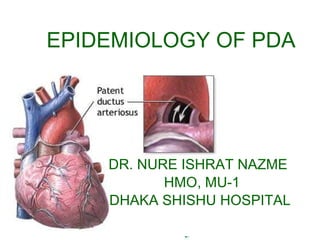

EPIDEMIOLOGY OF PDA DR. NURE ISHRAT NAZME HMO, MU-1 DHAKA SHISHU HOSPITAL
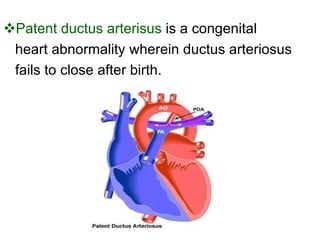
Patent ductus arterisus  is a congenital heart abnormality wherein ductus arteriosus fails to close after birth.
As an isolated defect, PDA is the  5 th  - 6 th  most common congenital cardiovascular lesion. It represents  5-10%  of all types of Congenital Heart Diseases, excluding those in premature infants.
It occurs in approximately  8 per 1000  live premature births.  Isolated PDA is found in around  1 in 2000  full term infants.
A higher prevalence is found in preterm infants. 50–80%  incidence was found in preterm infants  <26 wks  gestation. Douglas J et al, Circulation. 2006;114:1873-1882. In babies who are  less than 1500  g at birth, many studies show the incidence of a patent ductus arteriosus  > 30%.
The female to male ratio is  2:1.  In patients in whom the PDA is associated with a specific teratogenic exposure, e.g.  congenital rubella , the incidence is equal between the sexes.
PDA occurs more commonly in populations that  live at  high altitude . The incidence is as much as  30  times greater in populations that live higher than  5000 m.
As many as 20% of neonates with  respiratory distress syndrome  have a patent ductus arteriosus.  Rubella infection  during the first trimester of pregnancy, particularly in the first 4 weeks, is associated with a high incidence of PDA.
PDA is   also  associated with- single-gene mutations (such as Carpenter’s syndrome and Holt-Oram syndrome). X-linked mutations (such as incontinentia pigmenti).  asphyxia at birth. fetal alcohol syndrome. maternal amphetamine use and maternal phenytoin use.
Occasional cases are associated with  specific  genetic defects , such as- Trisomy 21 Trisomy 18 Rubinstein-Taybi syndrome and CHARGE syndrome.
Familial occurrence  of PDA is uncommon. The usual mechanism of inheritance is considered to be  polygenic  with a recurrence risk of 3%. In some patients genetic mechanism of  PDA may be  autosomal recessive  inheritance with incomplete penetrance.
PDA cases undergo  spontaneous closure  in a rate of 0.6% per year. It is estimated that if left untreated, the  mortality rate  is- -20% by age 20 years. -45% by age 45 years. -60% by age 60 years.
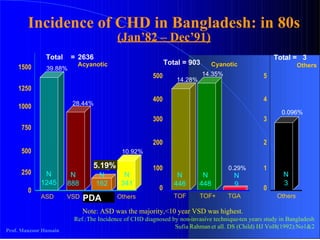
PDA 5.19% Incidence of CHD in Bangladesh: in 80s (Jan ’ 82  – Dec ’ 91) ASD VSD PDA Others TOF TOF+ TGA Others Total  = 2636 N 1245 N 888 N 162 N 341 N 446 N 448 N 9 N 3 1500 1250 1000 750 500 250 0 500 400 300 200 100 0 39.88% 28.44% 5.19 % 10.92% 14.28% 14.35% 0.29% 0.096% Acyanotic Cyanotic Others Total =  3 5 4 3 2 1 0 Note: ASD was the majority,<10 year VSD was highest. Ref.:The Incidence of CHD diagnosed by non - invasive technique - ten years study in Bangladesh  Sufia Rahman et all. DS (Child) HJ Vol8(1992):No1&2 Total = 903 Prof.  Manzoor Hussain
Jan.2005 – Apr.2007
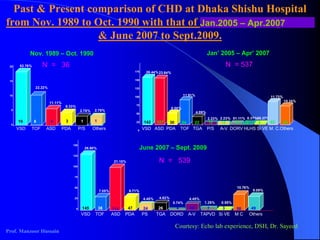
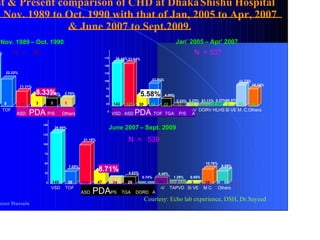
Past & Present comparison of CHD at Dhaka  Shishu Hospital  from Nov. 1989 to Oct. 1990 with that of Jan, 2005 to Apr, 2007 & June 2007 to Sept.2009. VSD  TOF ASD  PDA   P/S  Others Nov. 1989  – Oct. 1990 June 2007  – Sept. 2009 19 8 4 3 1 1 52.78% 22.22% 11.11% 8.33% 2.78% 2.78% 26.90% 20 15 10 5 0 150 125 100 75 50 25 0 N  =  36 Jan ’ 2005  – Apr ’ 2007 38 114 47 26 24 9.09% 7.05% 21.15% 8.71% 4.82% 4 24 3 58 0.74% 4.45% 1.29% 0.55% 10.76% VSD  TOF ASD  PDA PS  TGA  DORD  A - V  TAPVD  Si VE  M C  Others 7 145 49 N  = 537  N  =  539 175 150 125 100 75 50 25 0 142 64 127 30 22 12 26.44% 11.91% 23.64% 5.58% 4.09% 2.23% 6 12 2 2 55 01.11% 2.23% 0.37% 00.37% 10.24% 63 11.73% 142 VSD  ASD  PDA   TOF  TGA  P/S  A - V  DORV HLHS  Si VE M. C.Others Prof.  Manzoor Hussain Courtesy: Echo lab experience, DSH, Dr.  Sayeed
Reference 1.Nelson text book of pediatrics-18 th  edition. 2.Professional guide to disease-8 th  edition. 3.Pediatric cardiology-2 nd  edition by Benson LN . 4.The 5 minutes Pediatric consult,2008. 5. Forsey et al Orphanet journal of rare diseases, 2009,4:17,1172-74 6. Douglas J et al, Circulation. 2006;114:1873-1882
THANK YOU

Pda Part 2 Epidemiology

  • 1.
    EPIDEMIOLOGY OF PDADR. NURE ISHRAT NAZME HMO, MU-1 DHAKA SHISHU HOSPITAL
  • 2.
    Patent ductus arterisus is a congenital heart abnormality wherein ductus arteriosus fails to close after birth.
  • 3.
    As an isolateddefect, PDA is the 5 th - 6 th most common congenital cardiovascular lesion. It represents 5-10% of all types of Congenital Heart Diseases, excluding those in premature infants.
  • 4.
    It occurs inapproximately 8 per 1000 live premature births. Isolated PDA is found in around 1 in 2000 full term infants.
  • 5.
    A higher prevalenceis found in preterm infants. 50–80% incidence was found in preterm infants <26 wks gestation. Douglas J et al, Circulation. 2006;114:1873-1882. In babies who are less than 1500 g at birth, many studies show the incidence of a patent ductus arteriosus > 30%.
  • 6.
    The female tomale ratio is 2:1. In patients in whom the PDA is associated with a specific teratogenic exposure, e.g. congenital rubella , the incidence is equal between the sexes.
  • 7.
    PDA occurs morecommonly in populations that  live at high altitude . The incidence is as much as 30 times greater in populations that live higher than 5000 m.
  • 8.
    As many as20% of neonates with respiratory distress syndrome have a patent ductus arteriosus. Rubella infection during the first trimester of pregnancy, particularly in the first 4 weeks, is associated with a high incidence of PDA.
  • 9.
    PDA is also associated with- single-gene mutations (such as Carpenter’s syndrome and Holt-Oram syndrome). X-linked mutations (such as incontinentia pigmenti). asphyxia at birth. fetal alcohol syndrome. maternal amphetamine use and maternal phenytoin use.
  • 10.
    Occasional cases areassociated with specific genetic defects , such as- Trisomy 21 Trisomy 18 Rubinstein-Taybi syndrome and CHARGE syndrome.
  • 11.
    Familial occurrence of PDA is uncommon. The usual mechanism of inheritance is considered to be polygenic with a recurrence risk of 3%. In some patients genetic mechanism of PDA may be autosomal recessive inheritance with incomplete penetrance.
  • 12.
    PDA cases undergo spontaneous closure in a rate of 0.6% per year. It is estimated that if left untreated, the mortality rate is- -20% by age 20 years. -45% by age 45 years. -60% by age 60 years.
  • 13.
    PDA 5.19% Incidenceof CHD in Bangladesh: in 80s (Jan ’ 82 – Dec ’ 91) ASD VSD PDA Others TOF TOF+ TGA Others Total = 2636 N 1245 N 888 N 162 N 341 N 446 N 448 N 9 N 3 1500 1250 1000 750 500 250 0 500 400 300 200 100 0 39.88% 28.44% 5.19 % 10.92% 14.28% 14.35% 0.29% 0.096% Acyanotic Cyanotic Others Total = 3 5 4 3 2 1 0 Note: ASD was the majority,<10 year VSD was highest. Ref.:The Incidence of CHD diagnosed by non - invasive technique - ten years study in Bangladesh Sufia Rahman et all. DS (Child) HJ Vol8(1992):No1&2 Total = 903 Prof. Manzoor Hussain
  • 14.
  • 15.
    Past & Presentcomparison of CHD at Dhaka Shishu Hospital from Nov. 1989 to Oct. 1990 with that of Jan, 2005 to Apr, 2007 & June 2007 to Sept.2009. VSD TOF ASD PDA P/S Others Nov. 1989 – Oct. 1990 June 2007 – Sept. 2009 19 8 4 3 1 1 52.78% 22.22% 11.11% 8.33% 2.78% 2.78% 26.90% 20 15 10 5 0 150 125 100 75 50 25 0 N = 36 Jan ’ 2005 – Apr ’ 2007 38 114 47 26 24 9.09% 7.05% 21.15% 8.71% 4.82% 4 24 3 58 0.74% 4.45% 1.29% 0.55% 10.76% VSD TOF ASD PDA PS TGA DORD A - V TAPVD Si VE M C Others 7 145 49 N = 537 N = 539 175 150 125 100 75 50 25 0 142 64 127 30 22 12 26.44% 11.91% 23.64% 5.58% 4.09% 2.23% 6 12 2 2 55 01.11% 2.23% 0.37% 00.37% 10.24% 63 11.73% 142 VSD ASD PDA TOF TGA P/S A - V DORV HLHS Si VE M. C.Others Prof. Manzoor Hussain Courtesy: Echo lab experience, DSH, Dr. Sayeed
  • 16.
    Reference 1.Nelson textbook of pediatrics-18 th edition. 2.Professional guide to disease-8 th edition. 3.Pediatric cardiology-2 nd edition by Benson LN . 4.The 5 minutes Pediatric consult,2008. 5. Forsey et al Orphanet journal of rare diseases, 2009,4:17,1172-74 6. Douglas J et al, Circulation. 2006;114:1873-1882
  • 17.