American Fuel & Petrochemical Manufacturers 1667 K Street
Suite 700
Washington, DC
20006
202.457.0480 voice
202.457.0486 fax
www.afpm.org
Q&A and Technology Forum
Plant Automation & Decision Support
October 4 - 7, 2015
New Orleans Marriott
New Orleans, LA
PD-15-04 Refocus Your APC Program to Improve
Profitability
Presented By:
Randy Conley
Supervisor DCS/SIS/APC
Implementation
Total
Port Arthur Refinery
Port Arthur, TX
Diana Diaz
APC Engineer
Total
Port Arthur Refinery
Port Arthur, TX
This paper has been reproduced for the author or authors as a courtesy by the American Fuel &
Petrochemical Manufacturers (AFPM). Publication of this paper does not signify that the
contents necessarily reflect the opinions of the AFPM, its officers, directors, members, or staff.
Requests for authorization to quote or use the contents should be addressed directly to the
author(s)
Page 1 2015 AFPM Q&APD-15-04 1
 Presenter: Randy Conley is DCS/ SIS/ APC Implementation
Supervisor for TOTAL’s Port Arthur Texas (PAR) refinery. He is
currently architect for PAR’s multiyear site-wide DCS and SIS
migration projects and supervises the Advanced Process Control
group. Randy’s previous employers include Profimatics and
CITGO’s Lake Charles, Louisiana refinery.
Randy holds BS and MS degrees in Chemical Engineering from
Lamar University.
 Co-author: Diana Diaz is an APC engineer for TOTAL. Diana just
transitioned from Port Arthur’s APC group to an assignment in
TOTAL’s corporate APC group (Le Havre). Diana was instrumental
in implementing the techniques outlined in this presentation. She
holds a BS degree in Chemical Engineering from Colorado School
of Mines.
2015 AFPM Q&APD-15-04 Page 2
TOTAL – Port Arthur Refinery (PAR)
• PAR is a 174MBPD transportation fuels, merchant refinery
• The site began in the 1920s as an Atlantic Refining oil terminal.
The terminal shipped crude oil from the nearby Spindletop oil
field to Atlantic’s New Jersey refinery
• The site has been owned and operated by Atlantic (1920s), ARCO
(1938), BP (1969), FINA (1973) and TOTAL (1999)
• PAR has operated as a fuels refinery since 1936
• Major processing units include an FCC, Reformer and Delayed
Coker
• Most products are shipped east of the Rockies via pipeline
2015 AFPM Q&APD-15-04 Page 3
Overview
In early 2012 our refinery decided to reinvigorate our APC
(Advanced Process Controls), which had fallen into disuse.
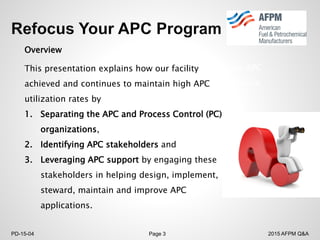
This presentation explains how our facility
achieved and continues to maintain high APC
utilization rates by
1. Separating the APC and Process Control (PC)
organizations,
2. Identifying APC stakeholders and
3. Leveraging APC support by engaging these
stakeholders in helping design, implement,
steward, maintain and improve APC
applications.
2015 AFPM Q&APD-15-04 Page 4
What I will cover
• APC/ PC Organization & Resources
• Identifying the APC Stakeholders
• The APC Engineer
• Stakeholder Training & Information
• APC Program Philosophy & Results
2015 AFPM Q&APD-15-04 Page 5
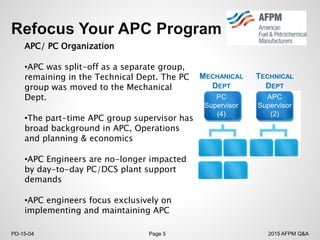
APC/ PC Organization
•APC was split-off as a separate group,
remaining in the Technical Dept. The PC
group was moved to the Mechanical
Dept.
•The part-time APC group supervisor has
broad background in APC, Operations
and planning & economics
•APC Engineers are no-longer impacted
by day-to-day PC/DCS plant support
demands
•APC engineers focus exclusively on
implementing and maintaining APC
PC
Supervisor
(4)
MECHANICAL
DEPT
TECHNICAL
DEPT
APC
Supervisor
(2)
2015 AFPM Q&APD-15-04 Page 6
APC Consultant/ Corporate Assistance
•Negotiated 3-year alliance with APC
contractor
• APC projects and maintenance are now
single-source, time & materials (T&M)
• T&M allows APC contractor to
thoroughly understand issues,
identify/ correct underlying DCS/
instrument problems
• As functioning APC applications grew,
increased yearly maintenance contract
• Began requesting/ using corporate (central
engineering) APC resources: 4-5 visits per
year, ~10 days per visit
• Began requesting/ using engineering
interns for more basic work, leveraging
APC engineers
2015 AFPM Q&APD-15-04 Page 7
Identified Stakeholders:
•Primary Stakeholders (frequent
interaction)
•APC Engineers
•Console Operators
•Unit Supervisors
•Process Engineers
•Planning & Economics
•Supporting Stakeholders (as-needed
interaction)
•Process Control, Instrument groups
•Laboratory (on-stream analyzers)
•General Management
2015 AFPM Q&APD-15-04 Page 8
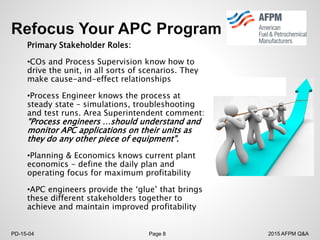
Primary Stakeholder Roles:
•COs and Process Supervision know how to
drive the unit, in all sorts of scenarios. They
make cause-and-effect relationships
•Process Engineer knows the process at
steady state – simulations, troubleshooting
and test runs. Area Superintendent comment:
“Process engineers …should understand and
monitor APC applications on their units as
they do any other piece of equipment”.
•Planning & Economics knows current plant
economics - define the daily plan and
operating focus for maximum profitability
•APC engineers provide the ‘glue’ that brings
these different stakeholders together to
achieve and maintain improved profitability
2015 AFPM Q&APD-15-04 Page 9
APC Group/ Stakeholder Interactions
•APC engineer frequently collaborates with
stakeholders during APC development and
operation
•APC engineer works with the operations to
translate the Daily Op Plan directives into
targets meaningful to them – challenging APC
clamps, requesting APC constraints be relaxed,
modifying application to handle changing
operating modes, economics
•APC group issues monthly KPIs, application
summary, host quarterly meetings, “lunch-
and-learns” – high visibility to the organization
2015 AFPM Q&APD-15-04 Page 10
APC Engineer Time Allocation - Ongoing Support*
•Helps CO configure each APC application to
maximize profits. To do so APC engineer must
•Understand Op Plan economics ~2 hrs/week
•Configure APC application to comply with Op
Plan ~4-6 hrs/week
•Monitor/ adjust inferentials ~ 2-4 hrs/ week
Good APC engineer can successfully steward 4 large
APC applications, 5-6 with outside help
•Example: Recent responsibility-transfer to a new
APC engineer included 18 separate ‘in-process’
follow-up issues for a single established APC
application (in service since 2013)
* ”APC Application Ownership”, Zak Freidman, Hydrocarbon Processing, Sept
2010; p. 13
2015 AFPM Q&APD-15-04 Page 11
APC Engineer/ CO Interactions
APC Engineer
•Demonstrates skills (process and APC
understanding) and interest to CO –
gaining CO acceptance
•Coaches COs so that they understand
the APC application, take ownership in
setting the correct APC targets and limits
•Helps CO understand how to adapt the
daily Op Plan targets to the APC
application
•Challenges CO-set limits and clamps
•Provides frequent one-on-one, ad-hoc
mini-training sessions for COs on using
APC features.
2015 AFPM Q&APD-15-04 Page 12
Types of Stakeholder Training
•APC CBT (how MPC works) – different
modules for different stakeholders
•Lunch & learn – various stakeholders –
technical, conceptual information
•OJT (On-the-Job Training) – daily
interaction between CO, Operations
supervision and APC engineer
•Quarterly meetings
•With Operations supervision, process
engineer [for each major application]
•With Planning and Economics, Lab
•With Project Development, Process
Engineering supervisors
•CO formal training (part of requalification)
2015 AFPM Q&APD-15-04 Page 13
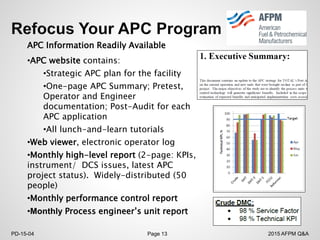
APC Information Readily Available
•APC website contains:
•Strategic APC plan for the facility
•One-page APC Summary; Pretest,
Operator and Engineer
documentation; Post-Audit for each
APC application
•All lunch-and-learn tutorials
•Web viewer, electronic operator log
•Monthly high-level report (2-page: KPIs,
instrument/ DCS issues, latest APC
project status). Widely-distributed (50
people)
•Monthly performance control report
•Monthly Process engineer’s unit report
2015 AFPM Q&APD-15-04 Page 14
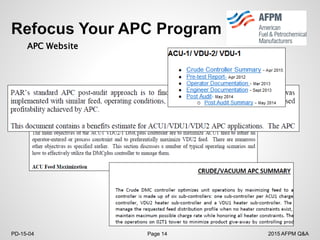
APC Website
2015 AFPM Q&APD-15-04 Page 15
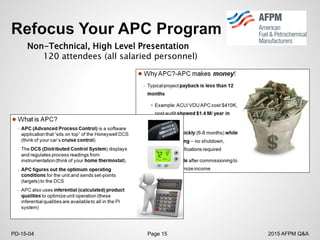
Non-Technical, High Level Presentation
120 attendees (all salaried personnel)
2015 AFPM Q&APD-15-04 Page 16
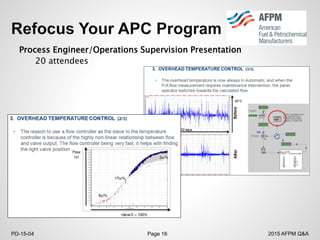
Process Engineer/Operations Supervision Presentation
20 attendees
2015 AFPM Q&APD-15-04 Page 17
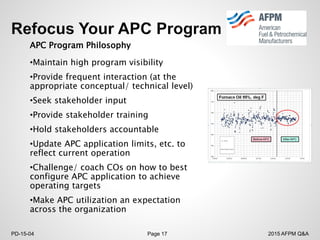
APC Program Philosophy
•Maintain high program visibility
•Provide frequent interaction (at the
appropriate conceptual/ technical level)
•Seek stakeholder input
•Provide stakeholder training
•Hold stakeholders accountable
•Update APC application limits, etc. to
reflect current operation
•Challenge/ coach COs on how to best
configure APC application to achieve
operating targets
•Make APC utilization an expectation
across the organization
2015 AFPM Q&APD-15-04 Page 18
Recipe for APC Success at Your Facility
Management must match its APC ambition to
the number and quality of people it is willing
to dedicate to the effort *
•Choose a group supervisor (part-time is OK)
with broad plant experience: control,
operations, plant economics
•Deal with DCS/Instrument problems before
beginning APC
•Partner with a proven APC contractor
•Focus APC engineering efforts on
implementing and maintaining successful
applications
•Involve the COs, Process Supervision and
Process Engineer in all aspects of APC
development and usage
* ”Advanced process Control: It Takes Effort to Make It Work”, Zak
Freidman, Hydrocarbon Processing, Feb 1997; p. 17
2015 AFPM Q&APD-15-04 Page 19
APC Program Results
•APC group’s job became easier
•Responsibilities are shared with
stakeholders
•Stakeholders understand their role in
achieving success
•Productivity increases
•Stakeholders motivated/ engaged -
feel a part of the APC team
•APC applications remain in service:
Supervision is quick to ask why an
application is turned off – APC-critical
DCS or instrument repairs are given a
high priority

PD-15-4-Refocus_Your_APC_Program-Randy_Conley-Total

  • 1.
    American Fuel &Petrochemical Manufacturers 1667 K Street Suite 700 Washington, DC 20006 202.457.0480 voice 202.457.0486 fax www.afpm.org Q&A and Technology Forum Plant Automation & Decision Support October 4 - 7, 2015 New Orleans Marriott New Orleans, LA PD-15-04 Refocus Your APC Program to Improve Profitability Presented By: Randy Conley Supervisor DCS/SIS/APC Implementation Total Port Arthur Refinery Port Arthur, TX Diana Diaz APC Engineer Total Port Arthur Refinery Port Arthur, TX
  • 2.
    This paper hasbeen reproduced for the author or authors as a courtesy by the American Fuel & Petrochemical Manufacturers (AFPM). Publication of this paper does not signify that the contents necessarily reflect the opinions of the AFPM, its officers, directors, members, or staff. Requests for authorization to quote or use the contents should be addressed directly to the author(s)
  • 3.
    Page 1 2015AFPM Q&APD-15-04 1  Presenter: Randy Conley is DCS/ SIS/ APC Implementation Supervisor for TOTAL’s Port Arthur Texas (PAR) refinery. He is currently architect for PAR’s multiyear site-wide DCS and SIS migration projects and supervises the Advanced Process Control group. Randy’s previous employers include Profimatics and CITGO’s Lake Charles, Louisiana refinery. Randy holds BS and MS degrees in Chemical Engineering from Lamar University.  Co-author: Diana Diaz is an APC engineer for TOTAL. Diana just transitioned from Port Arthur’s APC group to an assignment in TOTAL’s corporate APC group (Le Havre). Diana was instrumental in implementing the techniques outlined in this presentation. She holds a BS degree in Chemical Engineering from Colorado School of Mines.
  • 4.
    2015 AFPM Q&APD-15-04Page 2 TOTAL – Port Arthur Refinery (PAR) • PAR is a 174MBPD transportation fuels, merchant refinery • The site began in the 1920s as an Atlantic Refining oil terminal. The terminal shipped crude oil from the nearby Spindletop oil field to Atlantic’s New Jersey refinery • The site has been owned and operated by Atlantic (1920s), ARCO (1938), BP (1969), FINA (1973) and TOTAL (1999) • PAR has operated as a fuels refinery since 1936 • Major processing units include an FCC, Reformer and Delayed Coker • Most products are shipped east of the Rockies via pipeline
  • 5.
    2015 AFPM Q&APD-15-04Page 3 Overview In early 2012 our refinery decided to reinvigorate our APC (Advanced Process Controls), which had fallen into disuse. This presentation explains how our facility achieved and continues to maintain high APC utilization rates by 1. Separating the APC and Process Control (PC) organizations, 2. Identifying APC stakeholders and 3. Leveraging APC support by engaging these stakeholders in helping design, implement, steward, maintain and improve APC applications.
  • 6.
    2015 AFPM Q&APD-15-04Page 4 What I will cover • APC/ PC Organization & Resources • Identifying the APC Stakeholders • The APC Engineer • Stakeholder Training & Information • APC Program Philosophy & Results
  • 7.
    2015 AFPM Q&APD-15-04Page 5 APC/ PC Organization •APC was split-off as a separate group, remaining in the Technical Dept. The PC group was moved to the Mechanical Dept. •The part-time APC group supervisor has broad background in APC, Operations and planning & economics •APC Engineers are no-longer impacted by day-to-day PC/DCS plant support demands •APC engineers focus exclusively on implementing and maintaining APC PC Supervisor (4) MECHANICAL DEPT TECHNICAL DEPT APC Supervisor (2)
  • 8.
    2015 AFPM Q&APD-15-04Page 6 APC Consultant/ Corporate Assistance •Negotiated 3-year alliance with APC contractor • APC projects and maintenance are now single-source, time & materials (T&M) • T&M allows APC contractor to thoroughly understand issues, identify/ correct underlying DCS/ instrument problems • As functioning APC applications grew, increased yearly maintenance contract • Began requesting/ using corporate (central engineering) APC resources: 4-5 visits per year, ~10 days per visit • Began requesting/ using engineering interns for more basic work, leveraging APC engineers
  • 9.
    2015 AFPM Q&APD-15-04Page 7 Identified Stakeholders: •Primary Stakeholders (frequent interaction) •APC Engineers •Console Operators •Unit Supervisors •Process Engineers •Planning & Economics •Supporting Stakeholders (as-needed interaction) •Process Control, Instrument groups •Laboratory (on-stream analyzers) •General Management
  • 10.
    2015 AFPM Q&APD-15-04Page 8 Primary Stakeholder Roles: •COs and Process Supervision know how to drive the unit, in all sorts of scenarios. They make cause-and-effect relationships •Process Engineer knows the process at steady state – simulations, troubleshooting and test runs. Area Superintendent comment: “Process engineers …should understand and monitor APC applications on their units as they do any other piece of equipment”. •Planning & Economics knows current plant economics - define the daily plan and operating focus for maximum profitability •APC engineers provide the ‘glue’ that brings these different stakeholders together to achieve and maintain improved profitability
  • 11.
    2015 AFPM Q&APD-15-04Page 9 APC Group/ Stakeholder Interactions •APC engineer frequently collaborates with stakeholders during APC development and operation •APC engineer works with the operations to translate the Daily Op Plan directives into targets meaningful to them – challenging APC clamps, requesting APC constraints be relaxed, modifying application to handle changing operating modes, economics •APC group issues monthly KPIs, application summary, host quarterly meetings, “lunch- and-learns” – high visibility to the organization
  • 12.
    2015 AFPM Q&APD-15-04Page 10 APC Engineer Time Allocation - Ongoing Support* •Helps CO configure each APC application to maximize profits. To do so APC engineer must •Understand Op Plan economics ~2 hrs/week •Configure APC application to comply with Op Plan ~4-6 hrs/week •Monitor/ adjust inferentials ~ 2-4 hrs/ week Good APC engineer can successfully steward 4 large APC applications, 5-6 with outside help •Example: Recent responsibility-transfer to a new APC engineer included 18 separate ‘in-process’ follow-up issues for a single established APC application (in service since 2013) * ”APC Application Ownership”, Zak Freidman, Hydrocarbon Processing, Sept 2010; p. 13
  • 13.
    2015 AFPM Q&APD-15-04Page 11 APC Engineer/ CO Interactions APC Engineer •Demonstrates skills (process and APC understanding) and interest to CO – gaining CO acceptance •Coaches COs so that they understand the APC application, take ownership in setting the correct APC targets and limits •Helps CO understand how to adapt the daily Op Plan targets to the APC application •Challenges CO-set limits and clamps •Provides frequent one-on-one, ad-hoc mini-training sessions for COs on using APC features.
  • 14.
    2015 AFPM Q&APD-15-04Page 12 Types of Stakeholder Training •APC CBT (how MPC works) – different modules for different stakeholders •Lunch & learn – various stakeholders – technical, conceptual information •OJT (On-the-Job Training) – daily interaction between CO, Operations supervision and APC engineer •Quarterly meetings •With Operations supervision, process engineer [for each major application] •With Planning and Economics, Lab •With Project Development, Process Engineering supervisors •CO formal training (part of requalification)
  • 15.
    2015 AFPM Q&APD-15-04Page 13 APC Information Readily Available •APC website contains: •Strategic APC plan for the facility •One-page APC Summary; Pretest, Operator and Engineer documentation; Post-Audit for each APC application •All lunch-and-learn tutorials •Web viewer, electronic operator log •Monthly high-level report (2-page: KPIs, instrument/ DCS issues, latest APC project status). Widely-distributed (50 people) •Monthly performance control report •Monthly Process engineer’s unit report
  • 16.
    2015 AFPM Q&APD-15-04Page 14 APC Website
  • 17.
    2015 AFPM Q&APD-15-04Page 15 Non-Technical, High Level Presentation 120 attendees (all salaried personnel)
  • 18.
    2015 AFPM Q&APD-15-04Page 16 Process Engineer/Operations Supervision Presentation 20 attendees
  • 19.
    2015 AFPM Q&APD-15-04Page 17 APC Program Philosophy •Maintain high program visibility •Provide frequent interaction (at the appropriate conceptual/ technical level) •Seek stakeholder input •Provide stakeholder training •Hold stakeholders accountable •Update APC application limits, etc. to reflect current operation •Challenge/ coach COs on how to best configure APC application to achieve operating targets •Make APC utilization an expectation across the organization
  • 20.
    2015 AFPM Q&APD-15-04Page 18 Recipe for APC Success at Your Facility Management must match its APC ambition to the number and quality of people it is willing to dedicate to the effort * •Choose a group supervisor (part-time is OK) with broad plant experience: control, operations, plant economics •Deal with DCS/Instrument problems before beginning APC •Partner with a proven APC contractor •Focus APC engineering efforts on implementing and maintaining successful applications •Involve the COs, Process Supervision and Process Engineer in all aspects of APC development and usage * ”Advanced process Control: It Takes Effort to Make It Work”, Zak Freidman, Hydrocarbon Processing, Feb 1997; p. 17
  • 21.
    2015 AFPM Q&APD-15-04Page 19 APC Program Results •APC group’s job became easier •Responsibilities are shared with stakeholders •Stakeholders understand their role in achieving success •Productivity increases •Stakeholders motivated/ engaged - feel a part of the APC team •APC applications remain in service: Supervision is quick to ask why an application is turned off – APC-critical DCS or instrument repairs are given a high priority