Achieving the Balance
Aligning and Integrating Curriculum, Instruction,
Assessment, and the P21 Framework
Capstone Original Contribution
Heather Brett
American College of Education
Rationale
• The rationale for this original contribution is
to assist and inspire educators to include the
alignment of the P21’s Framework for 21st
century learning when integrating curriculum,
instruction, and assessment in order to
achieve a well-rounded balance that today’s
21st century learners need in order to to be
successful in life and a highly competitive
global economy (Blackhurst, 2015).
What is 21st Learning?
•Providing students with the skills to be successful in life beyond
the classroom.
•Student-centered learning
•Integration of technology
•Skills necessary to participate in a highly competitive global
economy
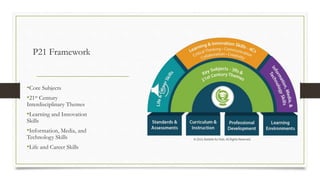
P21 Framework
•Core Subjects
•21st Century
Interdisciplinary Themes
•Learning and Innovation
Skills
•Information, Media, and
Technology Skills
•Life and Career Skills
Weaving in (Integrating) 21st
Century Themes
• Global Awareness
• Financial Literacy
• Civic Literacy
• Health Literacy
• Environmental Literacy
Framework for 21st Century Learning (2019,
p. 2)
How to Weave in 21st Century Themes
• STEAM
• PBL
• Local or Global Issues
• Physical Education
• Family Life Education
• Class Meetings
• Growth Mindset
• Positive Behavior Intervention
System (PBIS)
• Social Emotional Character
Development
• Classroom Economy
• Math Performance
Tasks
• Classroom Constitution
• Associated Student
Body (ASB)
• Local City Council
• Skype
• Project Based
Learning (PBL)
• Google Field Trip
Global
Awareness
Economic and
Civic Literacy
Environmental
Literacy
Health Literacy
Learning and
Innovation Skills-The
4Cs
• Creativity and Innovation
• Critical Thinking and Problem
Solving
• Communication
• Collaboration
Framework for 21st Century Learning (2019, p. 2), Andrade (2016) and Cleaves (2015)
Information, Media, and Technology Skills
• Information Literacy
•Media Literacy
• Information, Communications, and Technology Literacy
(ICT)
Framework for 21st Century Learning, (2019, p. 2). Bali (2016), and Watanabe-Crockett, (2017)
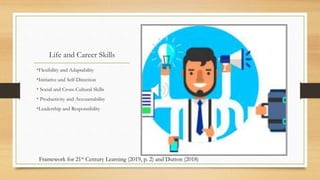
Life and Career Skills
•Flexibility and Adaptability
•Initiative and Self-Direction
• Social and Cross-Cultural Skills
• Productivity and Accountability
•Leadership and Responsibility
Framework for 21st Century Learning (2019, p. 2) and Dutton (2018)
How Do We Integrate 21ST Themes and
Essential Skills?
Curriculum
Essential Questions
Big Ideas
Enduring Understandings
Objectives
What 21st century themes can be
integrated? What 21st century
skills can be included and
measured?
Instruction
Direct/Indirect
Interactive/Experiential
Self-Directed/Independent Study
Intervention
Enrichment
How can the 4Cs, technology,
and life and career skills be
integrated?
Assessment
Informal
Formal
Formative
Summative
How can the 4Cs, digital literacy,
and life and career skills be
integrated?
Backwards Design: Unpacking a Standard
The Next Generation Science Standard (NGSS): 4-ESS3-1
Big Ideas
• Energy and fuels obtained by humans are made from natural resources.
• Energy and fuel usage affect the environment in many ways.
• Energy and fuel can be categorized as renewable and/or nonrenewable
• The renewable and nonrenewable energy and fuel sources can be combined to lessen their impact on the environment.
Enduring Understandings
• Nonrenewable energy and fuel can be depleted.
• Renewable energy and fuel can be recreated.
• Overtime, people’s energy and fuel needs change based on the need for new and improved environmental laws and
technology.
Themes: Environmental
Literacy and Global
Awareness
Discovery Education (2016)
Content
and/or Essential
Questions
Knowledge and
Skills
Suggested Assessment Activities
Engage-
Renewable
Energy
Renewable
energy and naming
three of its sources.
Formative Pretest: Why should we
choose renewable, versus nonrenewable,
resources whenever possible? Students will
type response and post in Padlet.
Students will
watch videos and view
images to discuss
everyday uses of
natural resources.
4Cs
Life
and
Career
Skill
Environmental
Literacy
Day 1: Engage-Renewable Energy
Discovery Education (2016)
Explore-Differences
between renewable and
nonrenewable resources
Essential Question:
Explain: What is the
difference between
renewable and nonrenewable
energy sources?
Investigation
and inquiry of
resources
Formative
Assessment: Virtual
lab results
Students
will complete a
virtual lab in
order to
determine the
value of
renewable
resources.
Discover
Education virtual
lab “Value of
Renewable
Resources”
Day 2: Explore Differences in Energy Sources
Life and
Career
Skills
Digital
Literacy
Digital
Literacy
Environmental
Literacy
Discovery Education (2016)
Explain-Students will
explain why humans should
choose renewable resources over
nonrenewable, whenever possible.
Essential Question: How
can I apply my energy knowledge
to solving real-world problems?
Personal
applications of
energy resources
Formative
assessment using
Flip Grid to assess
student
understanding
Students will explain
using presentation software
their insights into why
humans should use
renewable energy, whenever
possible.
Students will
create a 30-60 second
explanation using
their laptop and the
web-application Flip
Grid.
Day 3: Explain Why Humans Should Choose Renewable Resources
Digital
LiteracyDigital ,
Health,
Economic, and
Environmental
Literacy
Digital
Literacy
Digital ,
Health,
Economic, and
Environmental
Literacy
Discovery Education (2016)
Elaborate with STEM-Students will
analyze how technology needs change based on
energy needs and the environment.
Essential question: Interpret: How will
the use of renewable energy influence new
technologies?
Real-world
applications of energy
uses
Students will
complete a Kahoot on the
real-world uses of energy
and its impacts.
Students will
complete a matching
table for energy
situations and its best
energy source
Careers that
involve renewable
energy and Discovery
Education (2016)
Day 4: Elaborate with STEM
Digital
Literacy
Life and
Career
SkillsDigital ,
Health,
Economic, and
Environmental
Literacy
Life and
Career
Skills
Discovery Education (2016)
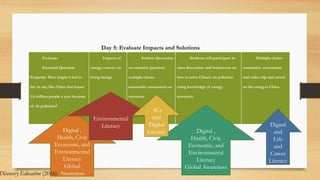
Evaluate-
Essential Question:
Empathy: How might it feel to
live in city like China that losses
1.6 million people a year because
of air pollution?
Impacts of
energy sources on
living beings
Student discussion
on essential question;
multiple-choice
summative assessment on
resources
Students will participate in
class discussion and brainstorm on
how to solve China’s air pollution
using knowledge of energy
resources.
Multiple-choice
summative assessment
and video clip and article
on the smog in China
Day 5: Evaluate Impacts and Solutions
Digital
and
Life
and
Career
Literacy
Digital ,
Health, Civic
Economic, and
Environmental
Literacy
Global Awareness
Digital ,
Health, Civic
Economic, and
Environmental
Literacy
Global
Awareness
Environmental
Literacy
4Cs
and
Digital
Literacy
Discovery Education (2016)
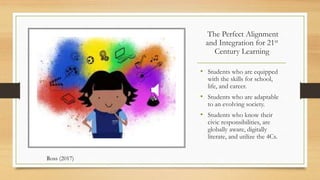
The Perfect Alignment
and Integration for 21st
Century Learning
• Students who are equipped
with the skills for school,
life, and career.
• Students who are adaptable
to an evolving society.
• Students who know their
civic responsibilities, are
globally aware, digitally
literate, and utilize the 4Cs.
Ross (2017)
References
• Andrade, M. (2016). Curricular elements for learner success – 21st century skills. Journal of Education and Training Studies, 4(8), 143-149
• Bali, M. (2016). Digital skills and digital literacy. Literacy Today, 33(4), 24-25
• Blackhurst, Kathryn. (2015). Common core: What is international benchmarking? Newsmax. Retrieved from https://www.newsmax.com/fastfeatures/common-core-
international-benchmarking/2015/06/02/id/648150/
• Cleaves, P. (2015). Collaboration – How do we actually develop this essential 21st century skill in students? Australian Educational Leader, 37(3), 79-82
• Discovery Education. (2016). Value of renewable resources. Discovery Education, California. Retrieved from
https://app.discoveryeducation.com/learn/techbook/courses/science
• Dutton, C. (Course Lecturer). (2018). 21st Century skills for the digital educator review: Module 1 [Video]. American College of Education. Retrieved from http://ace.edu
• P21 Partnership for 21st Century Learning. (2019). Framework for 21st century learning. Battle for Kids. Retrieved from
http://www.battelleforkids.org/networks/p21/frameworks-resources
• P21 Partnership for 21st Century Learning. (2019). Framework for 21st century learning definitions. Battle for Kids. Retrieved from
http://www.battelleforkids.org/networks/p21/frameworks-resources
• Ross, D. (2017). Empowering students with 21st century skills for today. Getting Smart. Retrieved from https://www.gettingsmart.com/2017/04/empowering-students-21st-
century-skills/
• Watanabe-Crockett, L. (2017, November). 5 Reasons why you should be teaching digital citizenship. Global Digital Citizenship Foundation. Retrieved from
https://globaldigitalcitizen.org/5-reasons-teaching-digital-citizenship

Original Contribution

  • 1.
    Achieving the Balance Aligningand Integrating Curriculum, Instruction, Assessment, and the P21 Framework Capstone Original Contribution Heather Brett American College of Education
  • 2.
    Rationale • The rationalefor this original contribution is to assist and inspire educators to include the alignment of the P21’s Framework for 21st century learning when integrating curriculum, instruction, and assessment in order to achieve a well-rounded balance that today’s 21st century learners need in order to to be successful in life and a highly competitive global economy (Blackhurst, 2015).
  • 3.
    What is 21stLearning? •Providing students with the skills to be successful in life beyond the classroom. •Student-centered learning •Integration of technology •Skills necessary to participate in a highly competitive global economy
  • 4.
    P21 Framework •Core Subjects •21stCentury Interdisciplinary Themes •Learning and Innovation Skills •Information, Media, and Technology Skills •Life and Career Skills
  • 5.
    Weaving in (Integrating)21st Century Themes • Global Awareness • Financial Literacy • Civic Literacy • Health Literacy • Environmental Literacy Framework for 21st Century Learning (2019, p. 2)
  • 6.
    How to Weavein 21st Century Themes • STEAM • PBL • Local or Global Issues • Physical Education • Family Life Education • Class Meetings • Growth Mindset • Positive Behavior Intervention System (PBIS) • Social Emotional Character Development • Classroom Economy • Math Performance Tasks • Classroom Constitution • Associated Student Body (ASB) • Local City Council • Skype • Project Based Learning (PBL) • Google Field Trip Global Awareness Economic and Civic Literacy Environmental Literacy Health Literacy
  • 7.
    Learning and Innovation Skills-The 4Cs •Creativity and Innovation • Critical Thinking and Problem Solving • Communication • Collaboration Framework for 21st Century Learning (2019, p. 2), Andrade (2016) and Cleaves (2015)
  • 8.
    Information, Media, andTechnology Skills • Information Literacy •Media Literacy • Information, Communications, and Technology Literacy (ICT) Framework for 21st Century Learning, (2019, p. 2). Bali (2016), and Watanabe-Crockett, (2017)
  • 9.
    Life and CareerSkills •Flexibility and Adaptability •Initiative and Self-Direction • Social and Cross-Cultural Skills • Productivity and Accountability •Leadership and Responsibility Framework for 21st Century Learning (2019, p. 2) and Dutton (2018)
  • 10.
    How Do WeIntegrate 21ST Themes and Essential Skills? Curriculum Essential Questions Big Ideas Enduring Understandings Objectives What 21st century themes can be integrated? What 21st century skills can be included and measured? Instruction Direct/Indirect Interactive/Experiential Self-Directed/Independent Study Intervention Enrichment How can the 4Cs, technology, and life and career skills be integrated? Assessment Informal Formal Formative Summative How can the 4Cs, digital literacy, and life and career skills be integrated?
  • 11.
    Backwards Design: Unpackinga Standard The Next Generation Science Standard (NGSS): 4-ESS3-1 Big Ideas • Energy and fuels obtained by humans are made from natural resources. • Energy and fuel usage affect the environment in many ways. • Energy and fuel can be categorized as renewable and/or nonrenewable • The renewable and nonrenewable energy and fuel sources can be combined to lessen their impact on the environment. Enduring Understandings • Nonrenewable energy and fuel can be depleted. • Renewable energy and fuel can be recreated. • Overtime, people’s energy and fuel needs change based on the need for new and improved environmental laws and technology. Themes: Environmental Literacy and Global Awareness Discovery Education (2016)
  • 12.
    Content and/or Essential Questions Knowledge and Skills SuggestedAssessment Activities Engage- Renewable Energy Renewable energy and naming three of its sources. Formative Pretest: Why should we choose renewable, versus nonrenewable, resources whenever possible? Students will type response and post in Padlet. Students will watch videos and view images to discuss everyday uses of natural resources. 4Cs Life and Career Skill Environmental Literacy Day 1: Engage-Renewable Energy Discovery Education (2016)
  • 13.
    Explore-Differences between renewable and nonrenewableresources Essential Question: Explain: What is the difference between renewable and nonrenewable energy sources? Investigation and inquiry of resources Formative Assessment: Virtual lab results Students will complete a virtual lab in order to determine the value of renewable resources. Discover Education virtual lab “Value of Renewable Resources” Day 2: Explore Differences in Energy Sources Life and Career Skills Digital Literacy Digital Literacy Environmental Literacy Discovery Education (2016) Discovery Education (2016)
  • 14.
    Explain-Students will explain whyhumans should choose renewable resources over nonrenewable, whenever possible. Essential Question: How can I apply my energy knowledge to solving real-world problems? Personal applications of energy resources Formative assessment using Flip Grid to assess student understanding Students will explain using presentation software their insights into why humans should use renewable energy, whenever possible. Students will create a 30-60 second explanation using their laptop and the web-application Flip Grid. Day 3: Explain Why Humans Should Choose Renewable Resources Digital LiteracyDigital , Health, Economic, and Environmental Literacy Digital Literacy Digital , Health, Economic, and Environmental Literacy Discovery Education (2016)
  • 15.
    Elaborate with STEM-Studentswill analyze how technology needs change based on energy needs and the environment. Essential question: Interpret: How will the use of renewable energy influence new technologies? Real-world applications of energy uses Students will complete a Kahoot on the real-world uses of energy and its impacts. Students will complete a matching table for energy situations and its best energy source Careers that involve renewable energy and Discovery Education (2016) Day 4: Elaborate with STEM Digital Literacy Life and Career SkillsDigital , Health, Economic, and Environmental Literacy Life and Career Skills Discovery Education (2016)
  • 16.
    Evaluate- Essential Question: Empathy: Howmight it feel to live in city like China that losses 1.6 million people a year because of air pollution? Impacts of energy sources on living beings Student discussion on essential question; multiple-choice summative assessment on resources Students will participate in class discussion and brainstorm on how to solve China’s air pollution using knowledge of energy resources. Multiple-choice summative assessment and video clip and article on the smog in China Day 5: Evaluate Impacts and Solutions Digital and Life and Career Literacy Digital , Health, Civic Economic, and Environmental Literacy Global Awareness Digital , Health, Civic Economic, and Environmental Literacy Global Awareness Environmental Literacy 4Cs and Digital Literacy Discovery Education (2016)
  • 17.
    The Perfect Alignment andIntegration for 21st Century Learning • Students who are equipped with the skills for school, life, and career. • Students who are adaptable to an evolving society. • Students who know their civic responsibilities, are globally aware, digitally literate, and utilize the 4Cs. Ross (2017)
  • 18.
    References • Andrade, M.(2016). Curricular elements for learner success – 21st century skills. Journal of Education and Training Studies, 4(8), 143-149 • Bali, M. (2016). Digital skills and digital literacy. Literacy Today, 33(4), 24-25 • Blackhurst, Kathryn. (2015). Common core: What is international benchmarking? Newsmax. Retrieved from https://www.newsmax.com/fastfeatures/common-core- international-benchmarking/2015/06/02/id/648150/ • Cleaves, P. (2015). Collaboration – How do we actually develop this essential 21st century skill in students? Australian Educational Leader, 37(3), 79-82 • Discovery Education. (2016). Value of renewable resources. Discovery Education, California. Retrieved from https://app.discoveryeducation.com/learn/techbook/courses/science • Dutton, C. (Course Lecturer). (2018). 21st Century skills for the digital educator review: Module 1 [Video]. American College of Education. Retrieved from http://ace.edu • P21 Partnership for 21st Century Learning. (2019). Framework for 21st century learning. Battle for Kids. Retrieved from http://www.battelleforkids.org/networks/p21/frameworks-resources • P21 Partnership for 21st Century Learning. (2019). Framework for 21st century learning definitions. Battle for Kids. Retrieved from http://www.battelleforkids.org/networks/p21/frameworks-resources • Ross, D. (2017). Empowering students with 21st century skills for today. Getting Smart. Retrieved from https://www.gettingsmart.com/2017/04/empowering-students-21st- century-skills/ • Watanabe-Crockett, L. (2017, November). 5 Reasons why you should be teaching digital citizenship. Global Digital Citizenship Foundation. Retrieved from https://globaldigitalcitizen.org/5-reasons-teaching-digital-citizenship