PayPal /IPSOS Cross-
Border Consumer Research
2015
GLOBAL SNAPSHOT
PayPal Cross Border contacts: Melissa O’Malley, Astrid Huijssoon, Ritesh Arora
PayPal Market Research Contact: Daniel Jenkinson
Ipsos Contacts: Eleanor Pettit & Peter Attwell
Background & Objectives
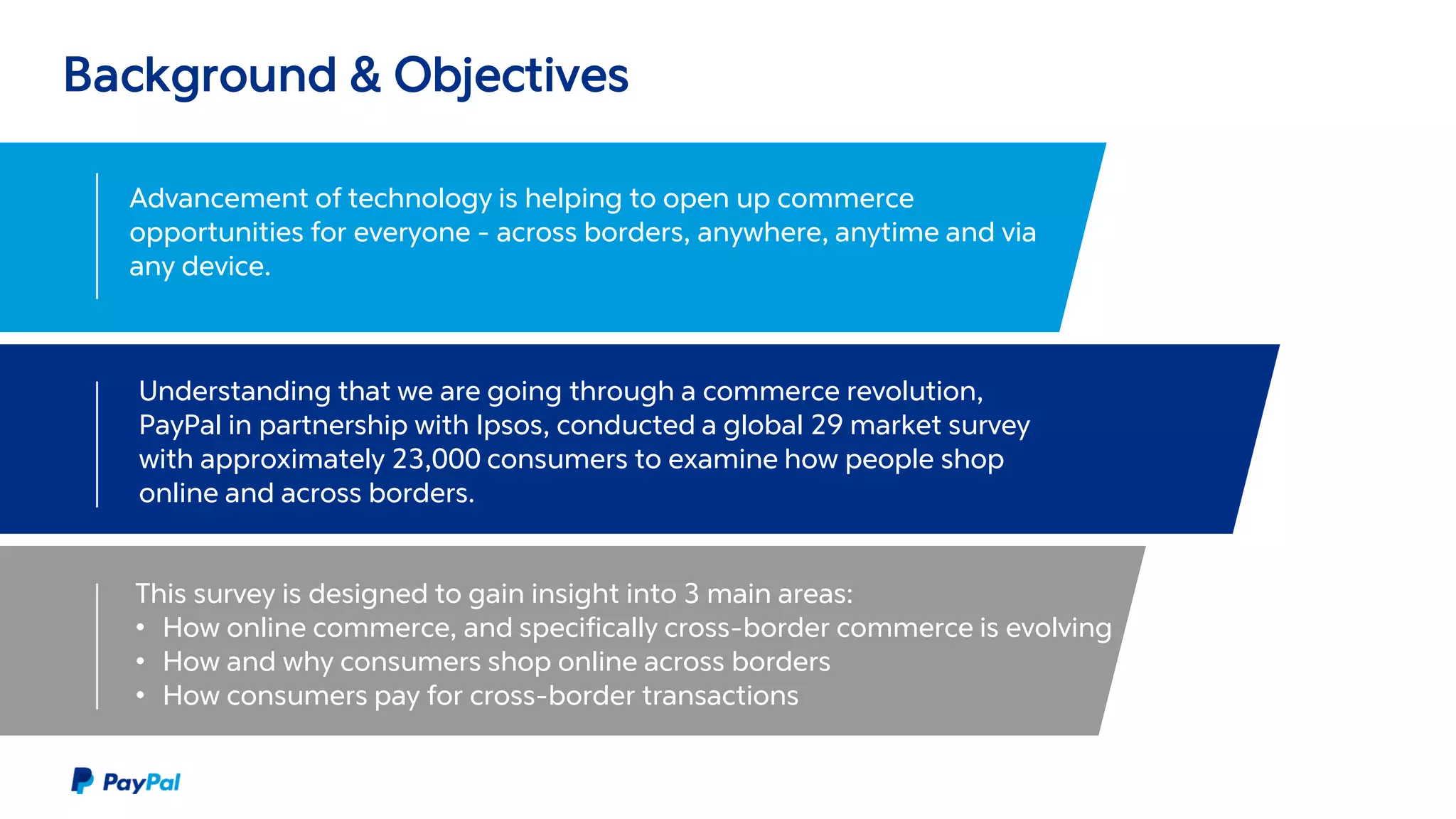
Understanding that we are going through a commerce revolution,
PayPal in partnership with Ipsos, conducted a global 29 market survey
with approximately 23,000 consumers to examine how people shop
online and across borders.
Advancement of technology is helping to open up commerce
opportunities for everyone - across borders, anywhere, anytime and via
any device.
This survey is designed to gain insight into 3 main areas:
• How online commerce, and specifically cross-border commerce is evolving
• How and why consumers shop online across borders
• How consumers pay for cross-border transactions
Research Methodology
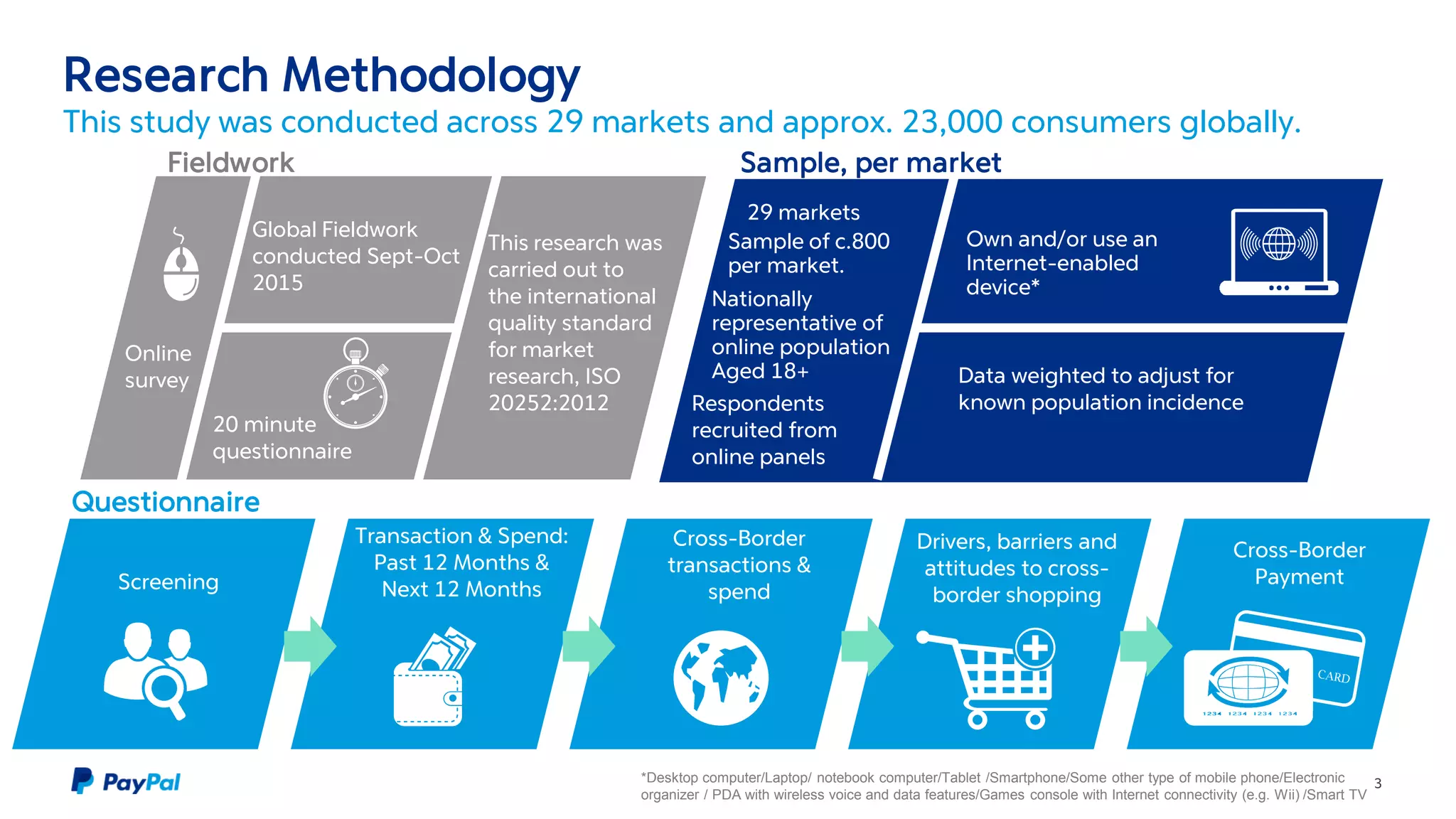
This study was conducted across 29 markets and approx. 23,000 consumers globally.
3
Screening
Transaction & Spend:
Past 12 Months &
Next 12 Months
Cross-Border
transactions &
spend
Cross-Border
Payment
Online
survey
Global Fieldwork
conducted Sept-Oct
2015
20 minute
questionnaire
Respondents
recruited from
online panels
Own and/or use an
Internet-enabled
device*
Nationally
representative of
online population
Aged 18+
Fieldwork Sample, per market
Questionnaire
This research was
carried out to
the international
quality standard
for market
research, ISO
20252:2012
Data weighted to adjust for
known population incidence
29 markets
Sample of c.800
per market.
Drivers, barriers and
attitudes to cross-
border shopping
*Desktop computer/Laptop/ notebook computer/Tablet /Smartphone/Some other type of mobile phone/Electronic
organizer / PDA with wireless voice and data features/Games console with Internet connectivity (e.g. Wii) /Smart TV
GLOBAL SNAPSHOT
4
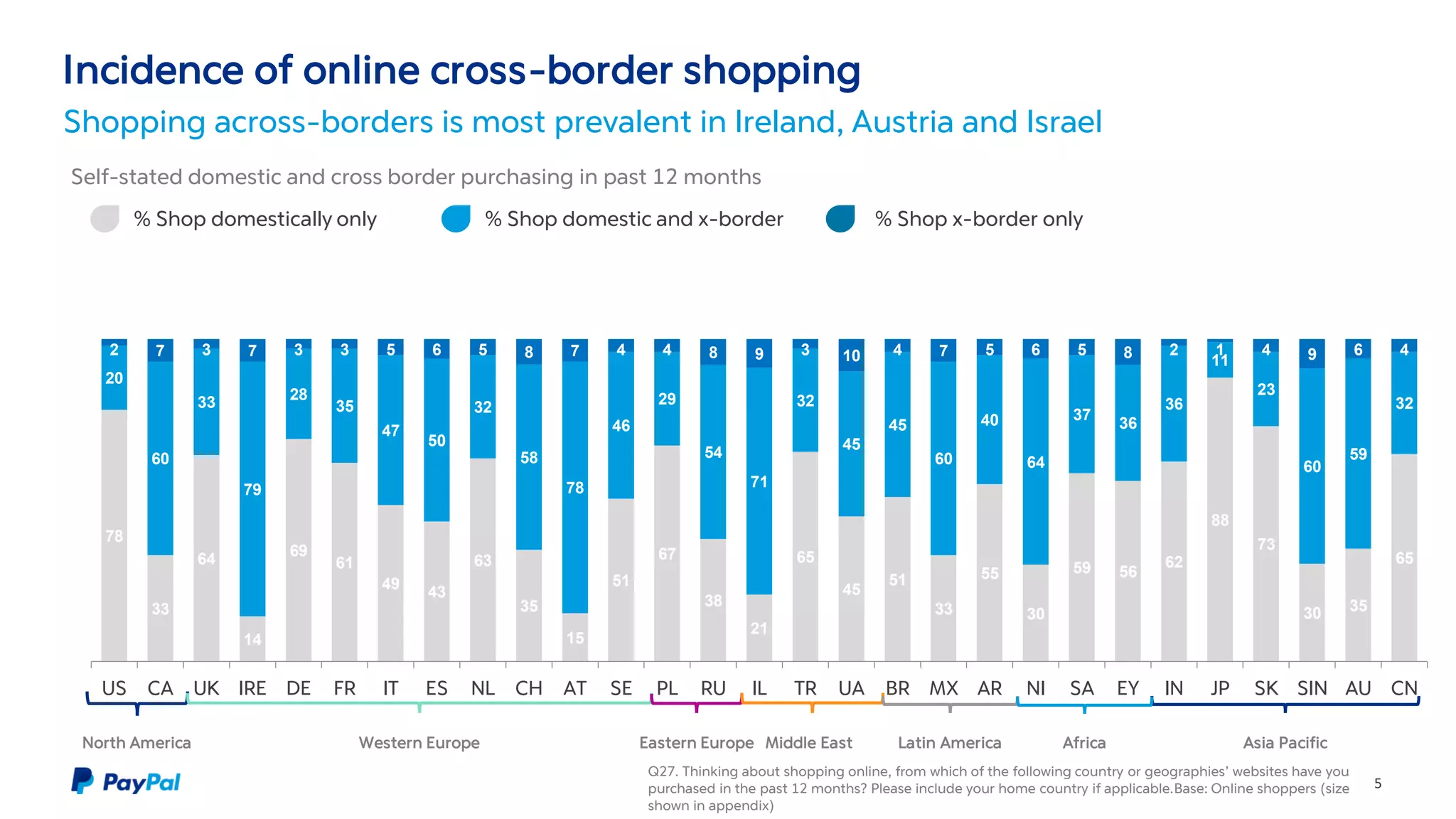
Incidence of online cross-border shopping
Shopping across-borders is most prevalent in Ireland, Austria and Israel
5
78
33
64
14
69
61
49
43
63
35
15
51
67
38
21
65
45
51
33
55
30
59 56
62
88
73
30 35
65
20
60
33
79
28
35
47
50
32
58
78
46
29
54
71
32
45
45
60
40
64
37
36
36
11
23
60
59
32
2 7 3 7 3 3 5 6 5 8 7 4 4 8 9 3 10 4 7 5 6 5 8 2 1 4 9 6 4
US CA UK IRE DE FR IT ES NL CH AT SE PL RU IL TR UA BR MX AR NI SA EY IN JP SK SIN AU CN
North America Western Europe Middle East Latin America Asia PacificAfricaEastern Europe
% Shop domestically only % Shop domestic and x-border % Shop x-border only
Self-stated domestic and cross border purchasing in past 12 months
Q27. Thinking about shopping online, from which of the following country or geographies’ websites have you
purchased in the past 12 months? Please include your home country if applicable.Base: Online shoppers (size
shown in appendix)
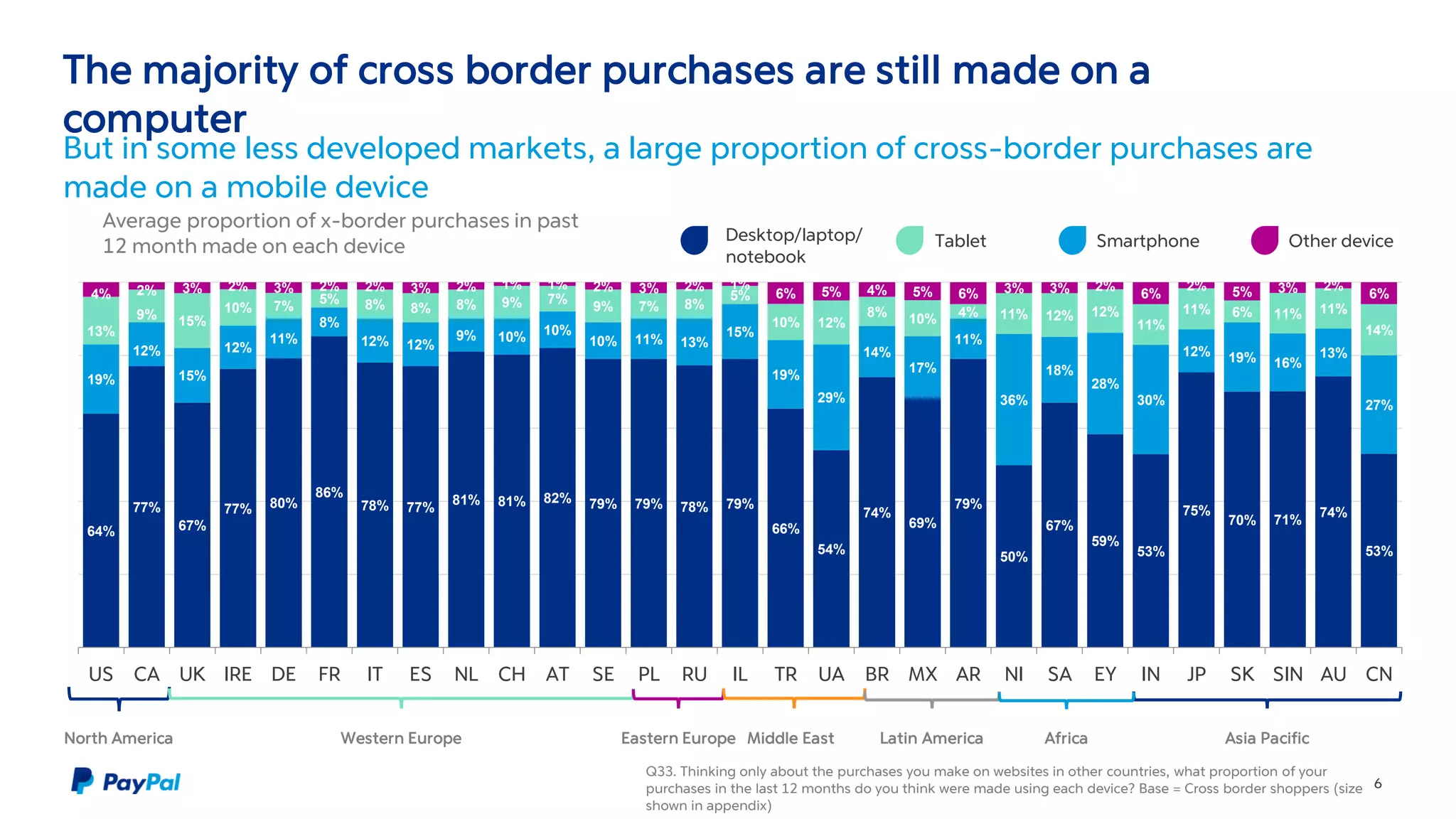
The majority of cross border purchases are still made on a
computer
But in some less developed markets, a large proportion of cross-border purchases are
made on a mobile device
6
64%
77%
67%
77% 80%
86%
78% 77%
81% 81% 82% 79% 79% 78% 79%
66%
54%
74%
69%
79%
50%
67%
59%
53%
75%
70% 71%
74%
53%
19%
12%
15%
12%
11%
8%
12% 12%
9% 10% 10%
10% 11% 13%
15%
19%
29%
14%
17%
11%
36%
18%
28%
30%
12% 19% 16%
13%
27%
13%
9% 15%
10% 7%
5% 8% 8% 8% 9% 7%
9% 7% 8%
5%
10% 12%
8% 10% 4% 11% 12% 12%
11%
11% 6% 11% 11%
14%
4% 2% 3% 2% 3% 2% 2% 3% 2% 1% 1% 2% 3% 2% 1%
6% 5% 4% 5% 6% 3% 3% 2%
6%
2% 5% 3% 2%
6%
US CA UK IRE DE FR IT ES NL CH AT SE PL RU IL TR UA BR MX AR NI SA EY IN JP SK SIN AU CN
North America Western Europe Middle East Latin America Asia PacificAfricaEastern Europe
Q33. Thinking only about the purchases you make on websites in other countries, what proportion of your
purchases in the last 12 months do you think were made using each device? Base = Cross border shoppers (size
shown in appendix)
Other deviceTablet SmartphoneDesktop/laptop/
notebook
Average proportion of x-border purchases in past
12 month made on each device
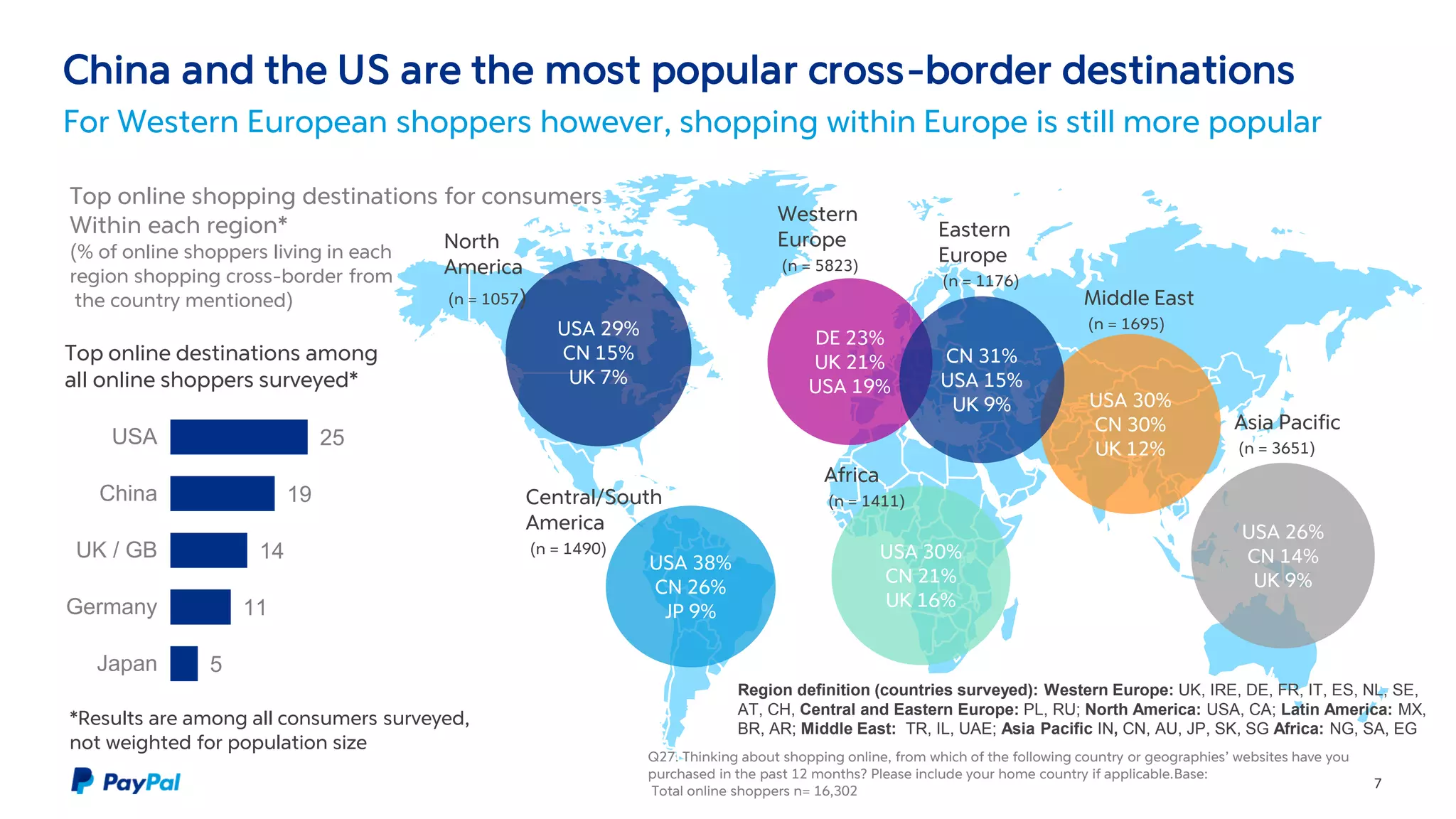
China and the US are the most popular cross-border destinations
For Western European shoppers however, shopping within Europe is still more popular
7
25
19
14
11
5
USA
China
UK / GB
Germany
Japan
Top online destinations among
all online shoppers surveyed*
Top online shopping destinations for consumers
Within each region*
(% of online shoppers living in each
region shopping cross-border from
the country mentioned)
USA 30%
CN 21%
UK 16%
USA 29%
CN 15%
UK 7%
USA 38%
CN 26%
JP 9%
DE 23%
UK 21%
USA 19%
USA 26%
CN 14%
UK 9%
USA 30%
CN 30%
UK 12%
North
America
(n = 1057)
Central/South
America
(n = 1490)
Western
Europe
(n = 5823)
Africa
(n = 1411)
Middle East
(n = 1695)
Asia Pacific
(n = 3651)
*Results are among all consumers surveyed,
not weighted for population size
Q27. Thinking about shopping online, from which of the following country or geographies’ websites have you
purchased in the past 12 months? Please include your home country if applicable.Base:
Total online shoppers n= 16,302
Region definition (countries surveyed): Western Europe: UK, IRE, DE, FR, IT, ES, NL, SE,
AT, CH, Central and Eastern Europe: PL, RU; North America: USA, CA; Latin America: MX,
BR, AR; Middle East: TR, IL, UAE; Asia Pacific IN, CN, AU, JP, SK, SG Africa: NG, SA, EG
CN 31%
USA 15%
UK 9%
Eastern
Europe
(n = 1176)
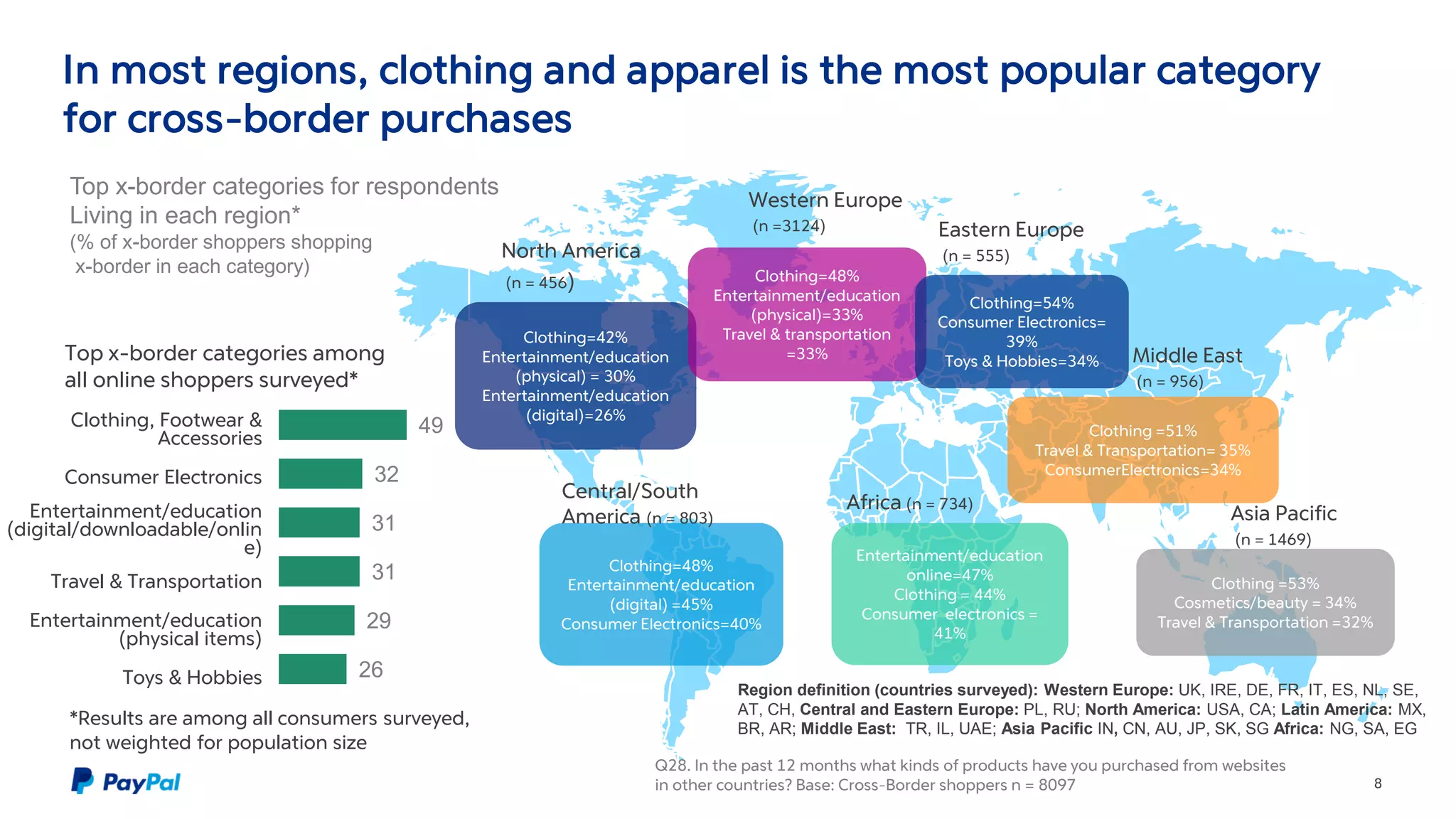
In most regions, clothing and apparel is the most popular category
for cross-border purchases
8
Top x-border categories among
all online shoppers surveyed*
Top x-border categories for respondents
Living in each region*
(% of x-border shoppers shopping
x-border in each category)
Entertainment/education
online=47%
Clothing = 44%
Consumer electronics =
41%
Clothing=42%
Entertainment/education
(physical) = 30%
Entertainment/education
(digital)=26%
Clothing=48%
Entertainment/education
(digital) =45%
Consumer Electronics=40%
Clothing=48%
Entertainment/education
(physical)=33%
Travel & transportation
=33%
Clothing =53%
Cosmetics/beauty = 34%
Travel & Transportation =32%
Clothing =51%
Travel & Transportation= 35%
ConsumerElectronics=34%
North America
(n = 456)
Central/South
America (n = 803)
Western Europe
(n =3124)
Africa (n = 734)
Middle East
(n = 956)
Asia Pacific
(n = 1469)
*Results are among all consumers surveyed,
not weighted for population size
Clothing=54%
Consumer Electronics=
39%
Toys & Hobbies=34%
Eastern Europe
(n = 555)
49
32
31
31
29
26
Clothing, Footwear &
Accessories
Consumer Electronics
Entertainment/education
(digital/downloadable/onlin
e)
Travel & Transportation
Entertainment/education
(physical items)
Toys & Hobbies
Q28. In the past 12 months what kinds of products have you purchased from websites
in other countries? Base: Cross-Border shoppers n = 8097
Region definition (countries surveyed): Western Europe: UK, IRE, DE, FR, IT, ES, NL, SE,
AT, CH, Central and Eastern Europe: PL, RU; North America: USA, CA; Latin America: MX,
BR, AR; Middle East: TR, IL, UAE; Asia Pacific IN, CN, AU, JP, SK, SG Africa: NG, SA, EG
64
61
58
46
45
41
41
37
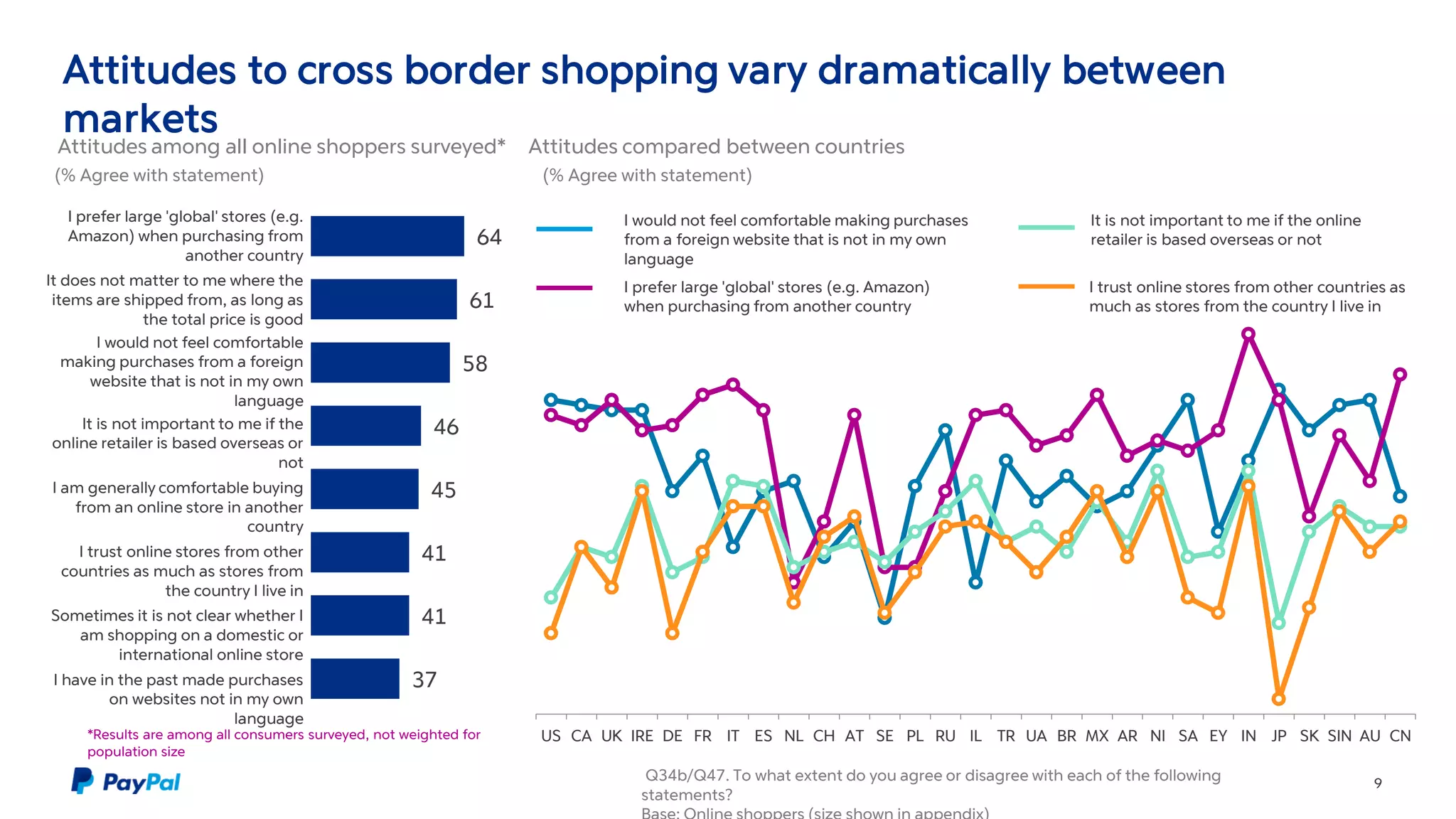
Attitudes to cross border shopping vary dramatically between
markets
9
US CA UK IRE DE FR IT ES NL CH AT SE PL RU IL TR UA BR MX AR NI SA EY IN JP SK SIN AU CN
I prefer large 'global' stores (e.g.
Amazon) when purchasing from
another country
It does not matter to me where the
items are shipped from, as long as
the total price is good
I would not feel comfortable
making purchases from a foreign
website that is not in my own
language
It is not important to me if the
online retailer is based overseas or
not
I am generally comfortable buying
from an online store in another
country
I trust online stores from other
countries as much as stores from
the country I live in
Sometimes it is not clear whether I
am shopping on a domestic or
international online store
I have in the past made purchases
on websites not in my own
language
(% Agree with statement)
Attitudes among all online shoppers surveyed*
*Results are among all consumers surveyed, not weighted for
population size
Attitudes compared between countries
(% Agree with statement)
Q34b/Q47. To what extent do you agree or disagree with each of the following
statements?
I would not feel comfortable making purchases
from a foreign website that is not in my own
language
I prefer large 'global' stores (e.g. Amazon)
when purchasing from another country
It is not important to me if the online
retailer is based overseas or not
I trust online stores from other countries as
much as stores from the country I live in
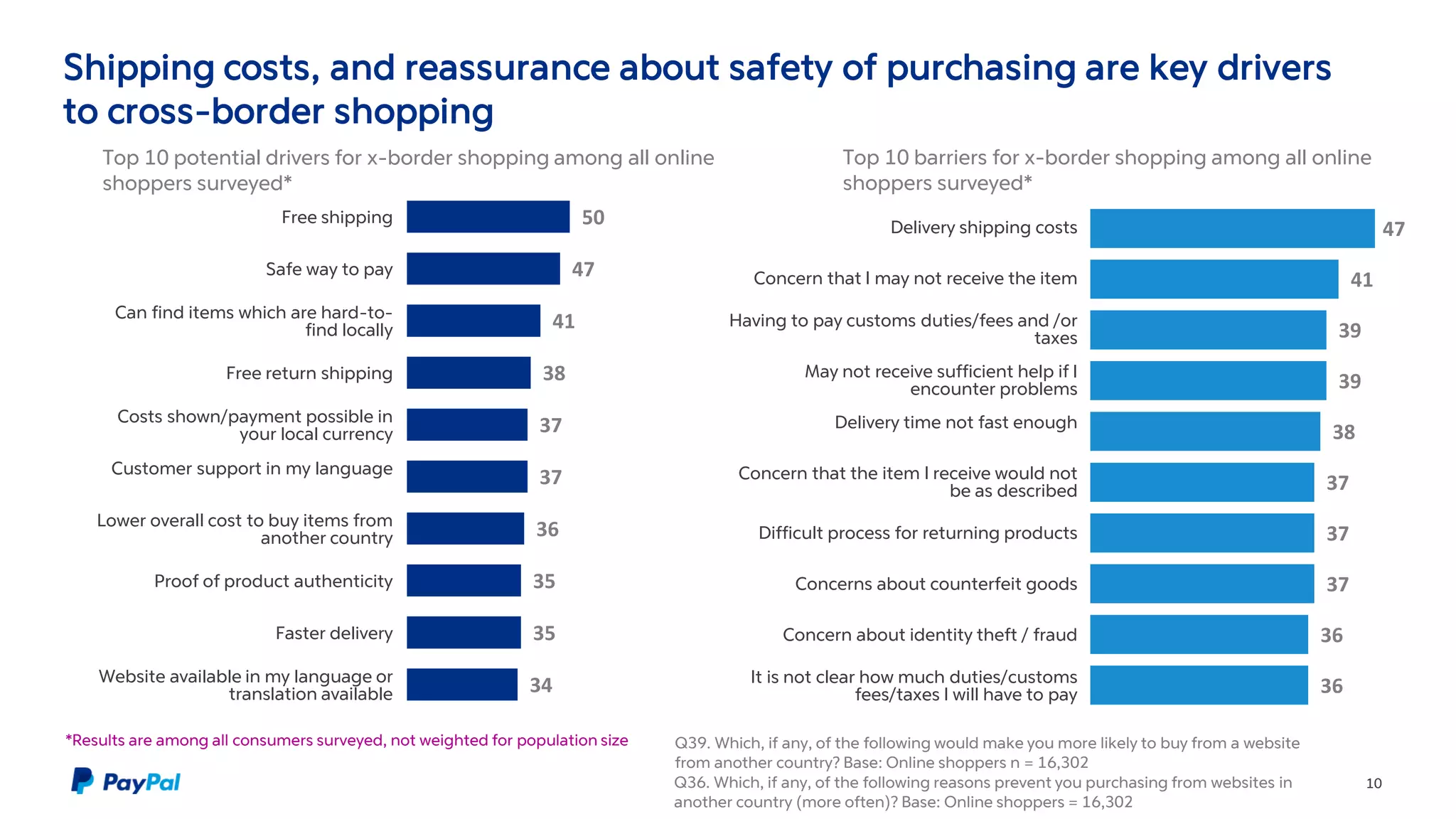
Shipping costs, and reassurance about safety of purchasing are key drivers
to cross-border shopping
10
50
47
41
38
37
37
36
35
35
34
Free shipping
Safe way to pay
Can find items which are hard-to-
find locally
Free return shipping
Costs shown/payment possible in
your local currency
Customer support in my language
Lower overall cost to buy items from
another country
Proof of product authenticity
Faster delivery
Website available in my language or
translation available
Q39. Which, if any, of the following would make you more likely to buy from a website
from another country? Base: Online shoppers n = 16,302
47
41
39
39
38
37
37
37
36
36
Delivery shipping costs
Concern that I may not receive the item
Having to pay customs duties/fees and /or
taxes
May not receive sufficient help if I
encounter problems
Delivery time not fast enough
Concern that the item I receive would not
be as described
Difficult process for returning products
Concerns about counterfeit goods
Concern about identity theft / fraud
It is not clear how much duties/customs
fees/taxes I will have to pay
Q36. Which, if any, of the following reasons prevent you purchasing from websites in
another country (more often)? Base: Online shoppers = 16,302
*Results are among all consumers surveyed, not weighted for population size
Top 10 potential drivers for x-border shopping among all online
shoppers surveyed*
Top 10 barriers for x-border shopping among all online
shoppers surveyed*
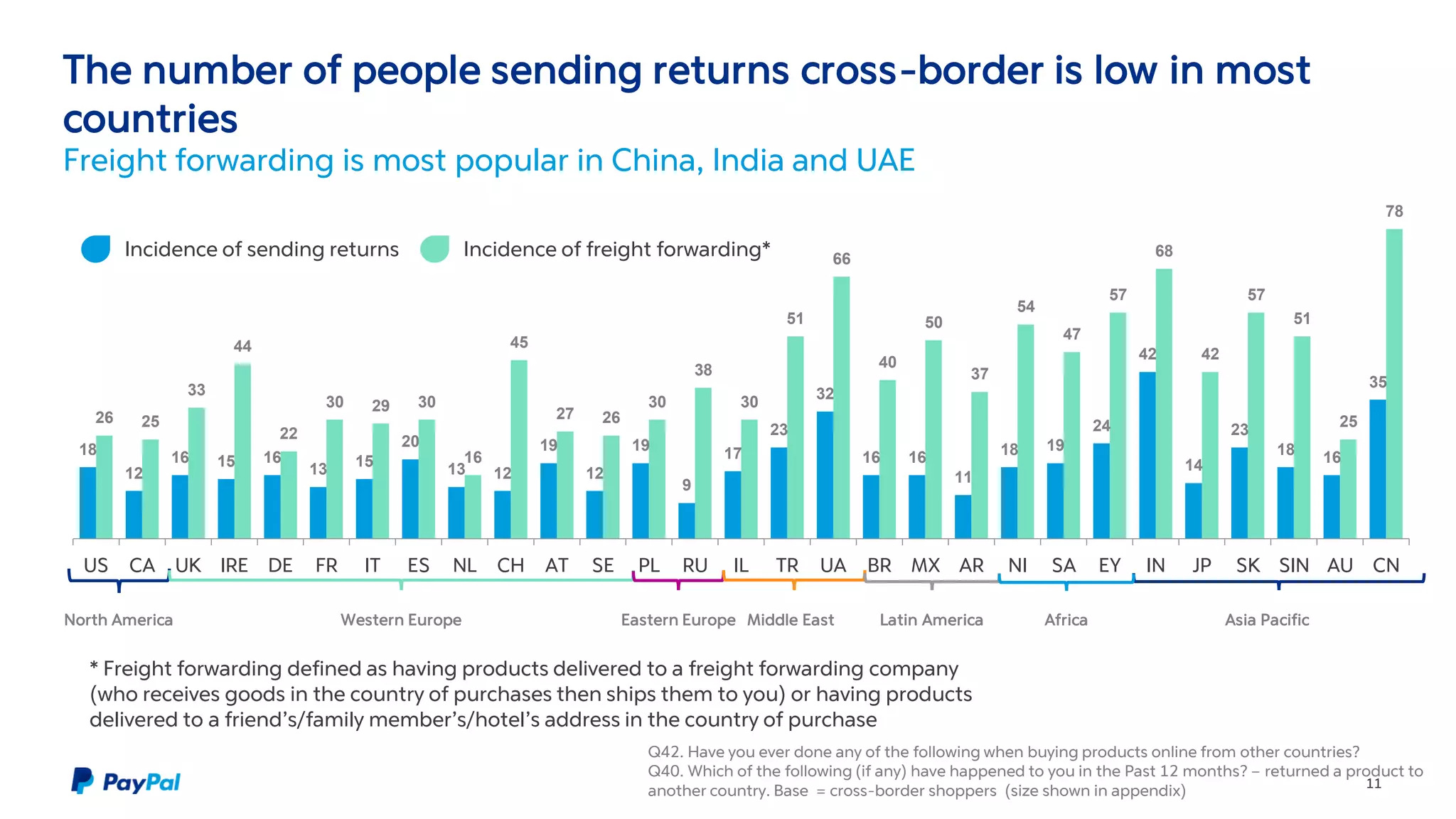
The number of people sending returns cross-border is low in most
countries
Freight forwarding is most popular in China, India and UAE
11
18
12
16 15 16
13 15
20
13 12
19
12
19
9
17
23
32
16 16
11
18 19
24
42
14
23
18 16
35
26 25
33
44
22
30 29 30
16
45
27 26
30
38
30
51
66
40
50
37
54
47
57
68
42
57
51
25
78
US CA UK IRE DE FR IT ES NL CH AT SE PL RU IL TR UA BR MX AR NI SA EY IN JP SK SIN AU CN
North America Western Europe Middle East Latin America Asia PacificAfricaEastern Europe
Incidence of sending returns Incidence of freight forwarding*
Q42. Have you ever done any of the following when buying products online from other countries?
Q40. Which of the following (if any) have happened to you in the Past 12 months? – returned a product to
another country. Base = cross-border shoppers (size shown in appendix)
* Freight forwarding defined as having products delivered to a freight forwarding company
(who receives goods in the country of purchases then ships them to you) or having products
delivered to a friend’s/family member’s/hotel’s address in the country of purchase
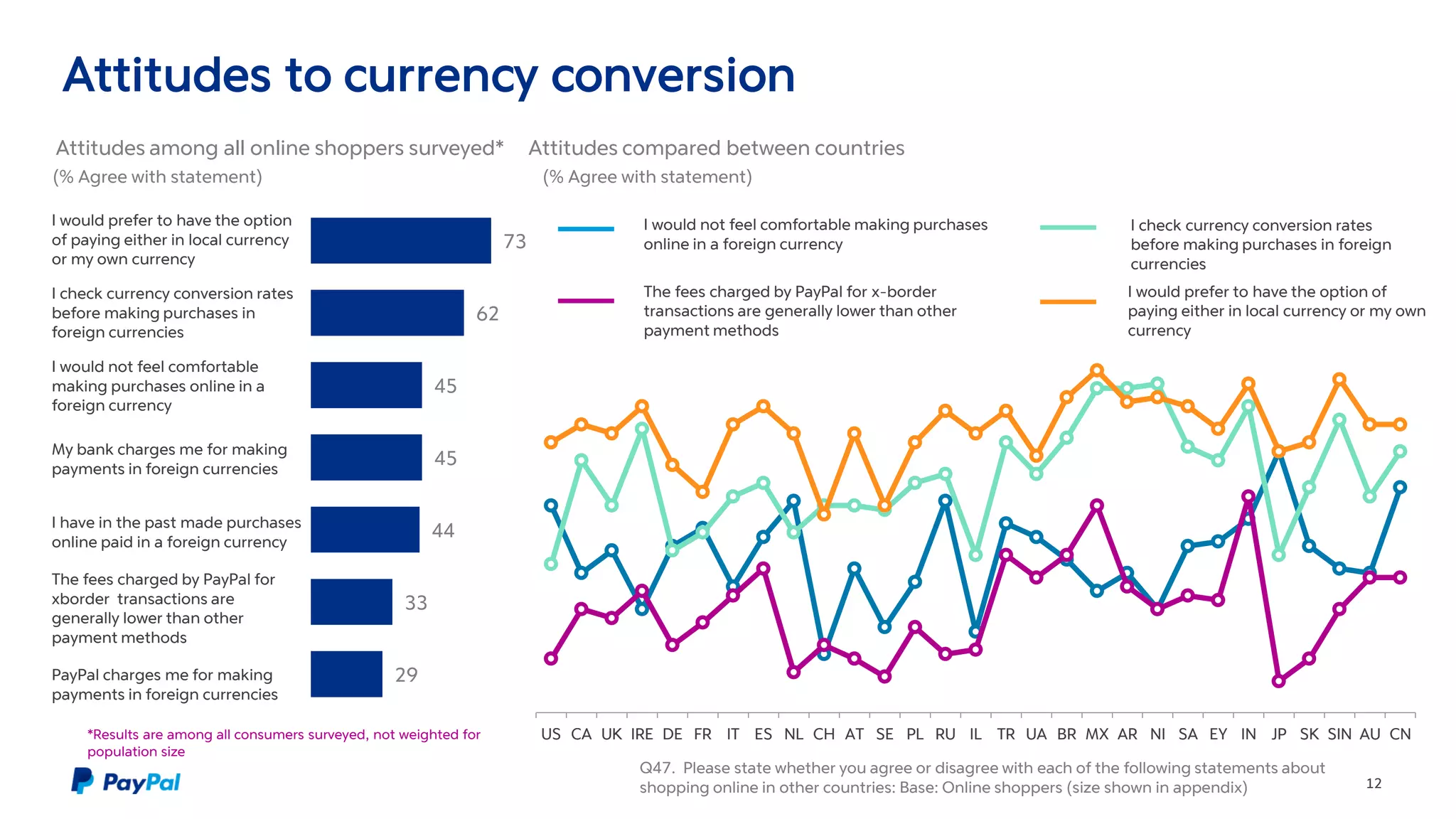
73
62
45
45
44
33
29
Attitudes to currency conversion
12
US CA UK IRE DE FR IT ES NL CH AT SE PL RU IL TR UA BR MX AR NI SA EY IN JP SK SIN AU CN
I would prefer to have the option
of paying either in local currency
or my own currency
I check currency conversion rates
before making purchases in
foreign currencies
I would not feel comfortable
making purchases online in a
foreign currency
My bank charges me for making
payments in foreign currencies
I have in the past made purchases
online paid in a foreign currency
The fees charged by PayPal for
xborder transactions are
generally lower than other
payment methods
PayPal charges me for making
payments in foreign currencies
(% Agree with statement)
Attitudes among all online shoppers surveyed* Attitudes compared between countries
(% Agree with statement)
Q47. Please state whether you agree or disagree with each of the following statements about
shopping online in other countries: Base: Online shoppers (size shown in appendix)
I would not feel comfortable making purchases
online in a foreign currency
The fees charged by PayPal for x-border
transactions are generally lower than other
payment methods
I check currency conversion rates
before making purchases in foreign
currencies
I would prefer to have the option of
paying either in local currency or my own
currency
*Results are among all consumers surveyed, not weighted for
population size
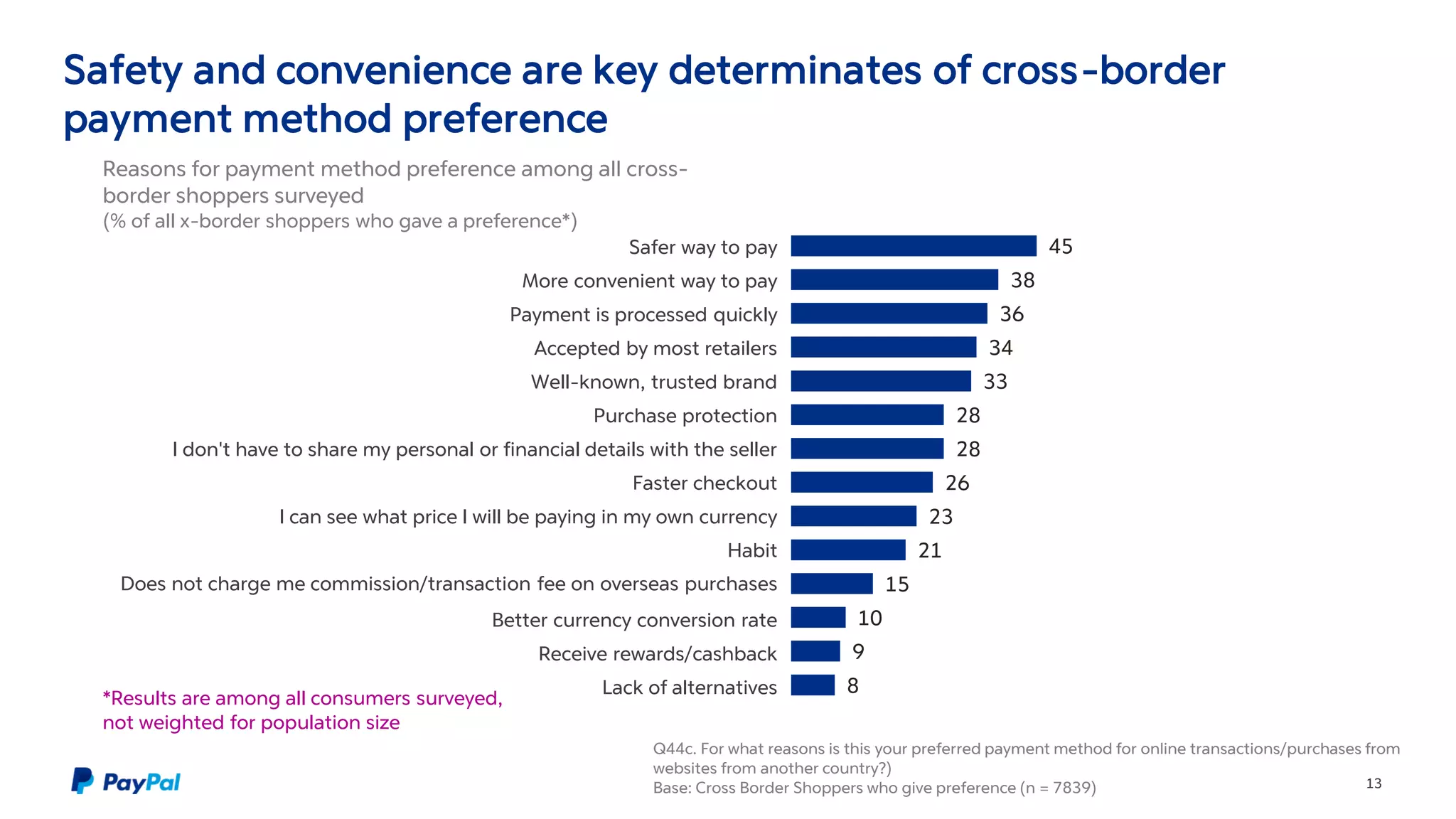
Safety and convenience are key determinates of cross-border
payment method preference
13
Q44c. For what reasons is this your preferred payment method for online transactions/purchases from
websites from another country?)
Base: Cross Border Shoppers who give preference (n = 7839)
45
38
36
34
33
28
28
26
23
21
15
10
9
8
Safer way to pay
More convenient way to pay
Payment is processed quickly
Accepted by most retailers
Well-known, trusted brand
Purchase protection
I don't have to share my personal or financial details with the seller
Faster checkout
I can see what price I will be paying in my own currency
Habit
Does not charge me commission/transaction fee on overseas purchases
Better currency conversion rate
Receive rewards/cashback
Lack of alternatives
*Results are among all consumers surveyed,
not weighted for population size
Reasons for payment method preference among all cross-
border shoppers surveyed
(% of all x-border shoppers who gave a preference*)
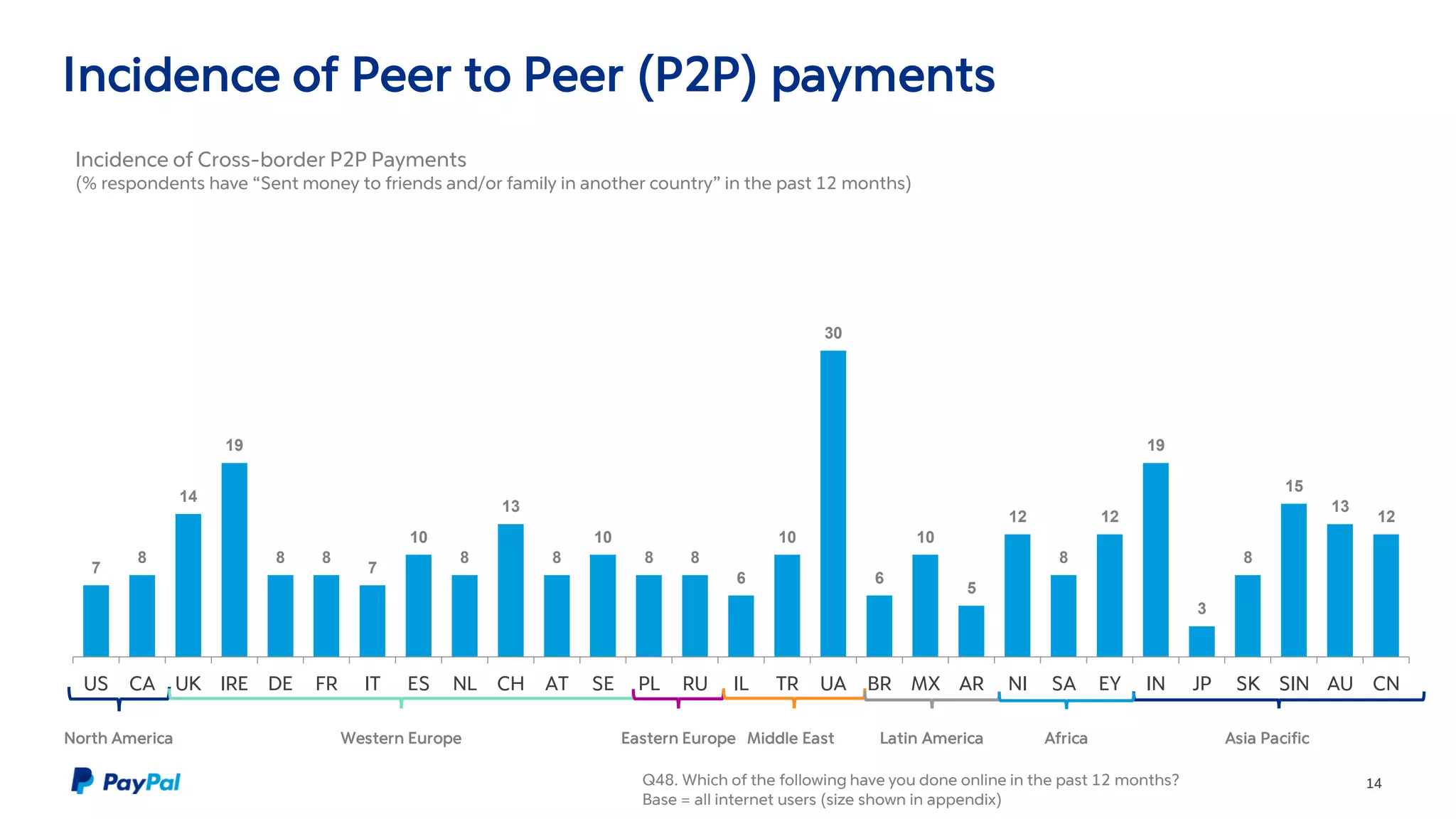
Incidence of Peer to Peer (P2P) payments
14
7
8
14
19
8 8
7
10
8
13
8
10
8 8
6
10
30
6
10
5
12
8
12
19
3
8
15
13
12
US CA UK IRE DE FR IT ES NL CH AT SE PL RU IL TR UA BR MX AR NI SA EY IN JP SK SIN AU CN
North America Western Europe Middle East Latin America Asia PacificAfricaEastern Europe
Q48. Which of the following have you done online in the past 12 months?
Base = all internet users (size shown in appendix)
Incidence of Cross-border P2P Payments
(% respondents have “Sent money to friends and/or family in another country” in the past 12 months)
© 2015 PayPal Inc. All rights reserved. Confidential and proprietary.
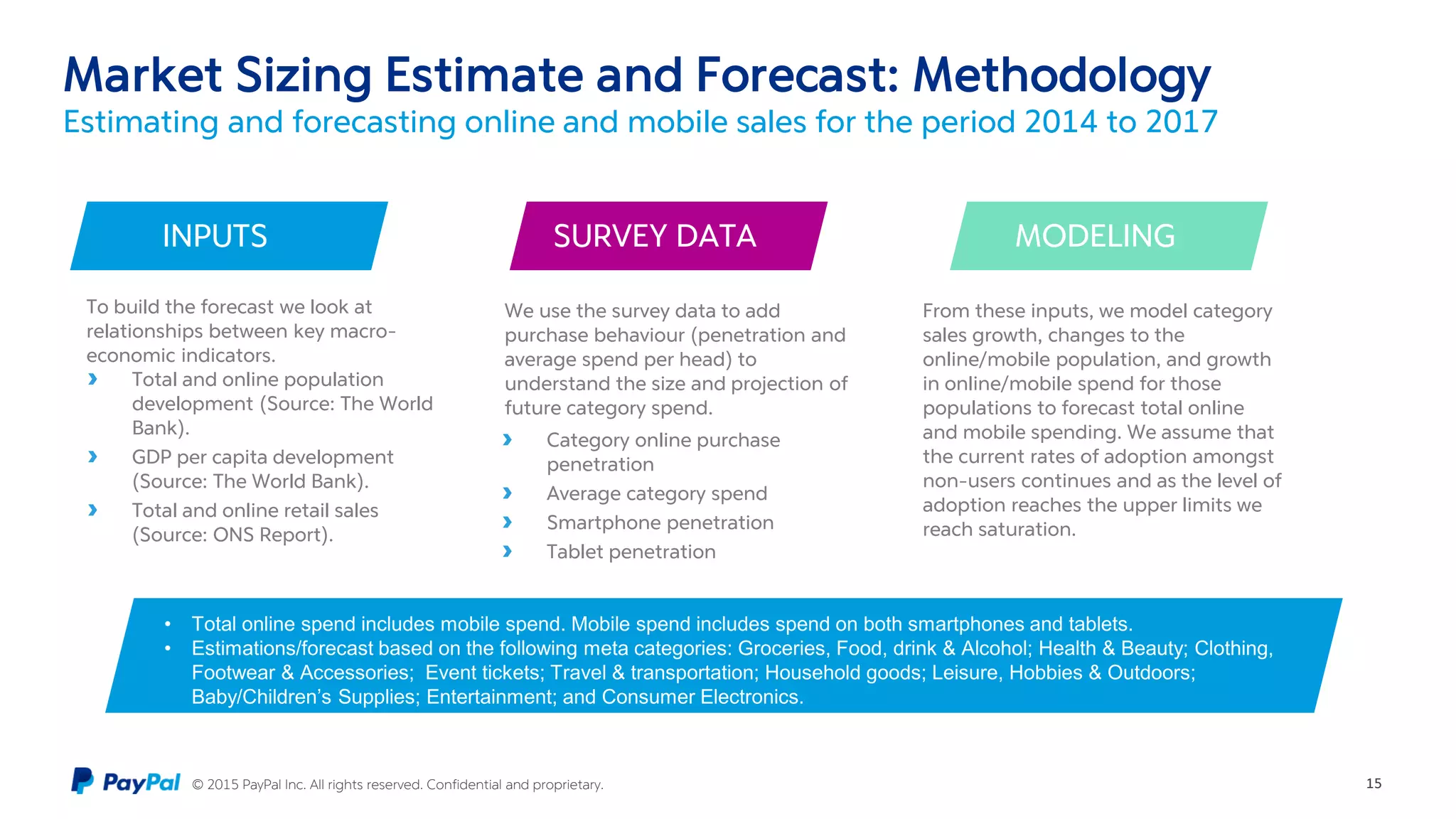
Market Sizing Estimate and Forecast: Methodology
Estimating and forecasting online and mobile sales for the period 2014 to 2017
15
To build the forecast we look at
relationships between key macro-
economic indicators.
We use the survey data to add
purchase behaviour (penetration and
average spend per head) to
understand the size and projection of
future category spend.
From these inputs, we model category
sales growth, changes to the
online/mobile population, and growth
in online/mobile spend for those
populations to forecast total online
and mobile spending. We assume that
the current rates of adoption amongst
non-users continues and as the level of
adoption reaches the upper limits we
reach saturation.
Total and online population
development (Source: The World
Bank).
GDP per capita development
(Source: The World Bank).
Total and online retail sales
(Source: ONS Report).
Category online purchase
penetration
Average category spend
Smartphone penetration
Tablet penetration
INPUTS SURVEY DATA MODELING
• Total online spend includes mobile spend. Mobile spend includes spend on both smartphones and tablets.
• Estimations/forecast based on the following meta categories: Groceries, Food, drink & Alcohol; Health & Beauty; Clothing,
Footwear & Accessories; Event tickets; Travel & transportation; Household goods; Leisure, Hobbies & Outdoors;
Baby/Children’s Supplies; Entertainment; and Consumer Electronics.

PayPal ipsos insights 2015 global

  • 1.
    PayPal /IPSOS Cross- BorderConsumer Research 2015 GLOBAL SNAPSHOT PayPal Cross Border contacts: Melissa O’Malley, Astrid Huijssoon, Ritesh Arora PayPal Market Research Contact: Daniel Jenkinson Ipsos Contacts: Eleanor Pettit & Peter Attwell
  • 2.
    Background & Objectives Understandingthat we are going through a commerce revolution, PayPal in partnership with Ipsos, conducted a global 29 market survey with approximately 23,000 consumers to examine how people shop online and across borders. Advancement of technology is helping to open up commerce opportunities for everyone - across borders, anywhere, anytime and via any device. This survey is designed to gain insight into 3 main areas: • How online commerce, and specifically cross-border commerce is evolving • How and why consumers shop online across borders • How consumers pay for cross-border transactions
  • 3.
    Research Methodology This studywas conducted across 29 markets and approx. 23,000 consumers globally. 3 Screening Transaction & Spend: Past 12 Months & Next 12 Months Cross-Border transactions & spend Cross-Border Payment Online survey Global Fieldwork conducted Sept-Oct 2015 20 minute questionnaire Respondents recruited from online panels Own and/or use an Internet-enabled device* Nationally representative of online population Aged 18+ Fieldwork Sample, per market Questionnaire This research was carried out to the international quality standard for market research, ISO 20252:2012 Data weighted to adjust for known population incidence 29 markets Sample of c.800 per market. Drivers, barriers and attitudes to cross- border shopping *Desktop computer/Laptop/ notebook computer/Tablet /Smartphone/Some other type of mobile phone/Electronic organizer / PDA with wireless voice and data features/Games console with Internet connectivity (e.g. Wii) /Smart TV
  • 4.
  • 5.
    Incidence of onlinecross-border shopping Shopping across-borders is most prevalent in Ireland, Austria and Israel 5 78 33 64 14 69 61 49 43 63 35 15 51 67 38 21 65 45 51 33 55 30 59 56 62 88 73 30 35 65 20 60 33 79 28 35 47 50 32 58 78 46 29 54 71 32 45 45 60 40 64 37 36 36 11 23 60 59 32 2 7 3 7 3 3 5 6 5 8 7 4 4 8 9 3 10 4 7 5 6 5 8 2 1 4 9 6 4 US CA UK IRE DE FR IT ES NL CH AT SE PL RU IL TR UA BR MX AR NI SA EY IN JP SK SIN AU CN North America Western Europe Middle East Latin America Asia PacificAfricaEastern Europe % Shop domestically only % Shop domestic and x-border % Shop x-border only Self-stated domestic and cross border purchasing in past 12 months Q27. Thinking about shopping online, from which of the following country or geographies’ websites have you purchased in the past 12 months? Please include your home country if applicable.Base: Online shoppers (size shown in appendix)
  • 6.
    The majority ofcross border purchases are still made on a computer But in some less developed markets, a large proportion of cross-border purchases are made on a mobile device 6 64% 77% 67% 77% 80% 86% 78% 77% 81% 81% 82% 79% 79% 78% 79% 66% 54% 74% 69% 79% 50% 67% 59% 53% 75% 70% 71% 74% 53% 19% 12% 15% 12% 11% 8% 12% 12% 9% 10% 10% 10% 11% 13% 15% 19% 29% 14% 17% 11% 36% 18% 28% 30% 12% 19% 16% 13% 27% 13% 9% 15% 10% 7% 5% 8% 8% 8% 9% 7% 9% 7% 8% 5% 10% 12% 8% 10% 4% 11% 12% 12% 11% 11% 6% 11% 11% 14% 4% 2% 3% 2% 3% 2% 2% 3% 2% 1% 1% 2% 3% 2% 1% 6% 5% 4% 5% 6% 3% 3% 2% 6% 2% 5% 3% 2% 6% US CA UK IRE DE FR IT ES NL CH AT SE PL RU IL TR UA BR MX AR NI SA EY IN JP SK SIN AU CN North America Western Europe Middle East Latin America Asia PacificAfricaEastern Europe Q33. Thinking only about the purchases you make on websites in other countries, what proportion of your purchases in the last 12 months do you think were made using each device? Base = Cross border shoppers (size shown in appendix) Other deviceTablet SmartphoneDesktop/laptop/ notebook Average proportion of x-border purchases in past 12 month made on each device
  • 7.
    China and theUS are the most popular cross-border destinations For Western European shoppers however, shopping within Europe is still more popular 7 25 19 14 11 5 USA China UK / GB Germany Japan Top online destinations among all online shoppers surveyed* Top online shopping destinations for consumers Within each region* (% of online shoppers living in each region shopping cross-border from the country mentioned) USA 30% CN 21% UK 16% USA 29% CN 15% UK 7% USA 38% CN 26% JP 9% DE 23% UK 21% USA 19% USA 26% CN 14% UK 9% USA 30% CN 30% UK 12% North America (n = 1057) Central/South America (n = 1490) Western Europe (n = 5823) Africa (n = 1411) Middle East (n = 1695) Asia Pacific (n = 3651) *Results are among all consumers surveyed, not weighted for population size Q27. Thinking about shopping online, from which of the following country or geographies’ websites have you purchased in the past 12 months? Please include your home country if applicable.Base: Total online shoppers n= 16,302 Region definition (countries surveyed): Western Europe: UK, IRE, DE, FR, IT, ES, NL, SE, AT, CH, Central and Eastern Europe: PL, RU; North America: USA, CA; Latin America: MX, BR, AR; Middle East: TR, IL, UAE; Asia Pacific IN, CN, AU, JP, SK, SG Africa: NG, SA, EG CN 31% USA 15% UK 9% Eastern Europe (n = 1176)
  • 8.
    In most regions,clothing and apparel is the most popular category for cross-border purchases 8 Top x-border categories among all online shoppers surveyed* Top x-border categories for respondents Living in each region* (% of x-border shoppers shopping x-border in each category) Entertainment/education online=47% Clothing = 44% Consumer electronics = 41% Clothing=42% Entertainment/education (physical) = 30% Entertainment/education (digital)=26% Clothing=48% Entertainment/education (digital) =45% Consumer Electronics=40% Clothing=48% Entertainment/education (physical)=33% Travel & transportation =33% Clothing =53% Cosmetics/beauty = 34% Travel & Transportation =32% Clothing =51% Travel & Transportation= 35% ConsumerElectronics=34% North America (n = 456) Central/South America (n = 803) Western Europe (n =3124) Africa (n = 734) Middle East (n = 956) Asia Pacific (n = 1469) *Results are among all consumers surveyed, not weighted for population size Clothing=54% Consumer Electronics= 39% Toys & Hobbies=34% Eastern Europe (n = 555) 49 32 31 31 29 26 Clothing, Footwear & Accessories Consumer Electronics Entertainment/education (digital/downloadable/onlin e) Travel & Transportation Entertainment/education (physical items) Toys & Hobbies Q28. In the past 12 months what kinds of products have you purchased from websites in other countries? Base: Cross-Border shoppers n = 8097 Region definition (countries surveyed): Western Europe: UK, IRE, DE, FR, IT, ES, NL, SE, AT, CH, Central and Eastern Europe: PL, RU; North America: USA, CA; Latin America: MX, BR, AR; Middle East: TR, IL, UAE; Asia Pacific IN, CN, AU, JP, SK, SG Africa: NG, SA, EG
  • 9.
    64 61 58 46 45 41 41 37 Attitudes to crossborder shopping vary dramatically between markets 9 US CA UK IRE DE FR IT ES NL CH AT SE PL RU IL TR UA BR MX AR NI SA EY IN JP SK SIN AU CN I prefer large 'global' stores (e.g. Amazon) when purchasing from another country It does not matter to me where the items are shipped from, as long as the total price is good I would not feel comfortable making purchases from a foreign website that is not in my own language It is not important to me if the online retailer is based overseas or not I am generally comfortable buying from an online store in another country I trust online stores from other countries as much as stores from the country I live in Sometimes it is not clear whether I am shopping on a domestic or international online store I have in the past made purchases on websites not in my own language (% Agree with statement) Attitudes among all online shoppers surveyed* *Results are among all consumers surveyed, not weighted for population size Attitudes compared between countries (% Agree with statement) Q34b/Q47. To what extent do you agree or disagree with each of the following statements? I would not feel comfortable making purchases from a foreign website that is not in my own language I prefer large 'global' stores (e.g. Amazon) when purchasing from another country It is not important to me if the online retailer is based overseas or not I trust online stores from other countries as much as stores from the country I live in
  • 10.
    Shipping costs, andreassurance about safety of purchasing are key drivers to cross-border shopping 10 50 47 41 38 37 37 36 35 35 34 Free shipping Safe way to pay Can find items which are hard-to- find locally Free return shipping Costs shown/payment possible in your local currency Customer support in my language Lower overall cost to buy items from another country Proof of product authenticity Faster delivery Website available in my language or translation available Q39. Which, if any, of the following would make you more likely to buy from a website from another country? Base: Online shoppers n = 16,302 47 41 39 39 38 37 37 37 36 36 Delivery shipping costs Concern that I may not receive the item Having to pay customs duties/fees and /or taxes May not receive sufficient help if I encounter problems Delivery time not fast enough Concern that the item I receive would not be as described Difficult process for returning products Concerns about counterfeit goods Concern about identity theft / fraud It is not clear how much duties/customs fees/taxes I will have to pay Q36. Which, if any, of the following reasons prevent you purchasing from websites in another country (more often)? Base: Online shoppers = 16,302 *Results are among all consumers surveyed, not weighted for population size Top 10 potential drivers for x-border shopping among all online shoppers surveyed* Top 10 barriers for x-border shopping among all online shoppers surveyed*
  • 11.
    The number ofpeople sending returns cross-border is low in most countries Freight forwarding is most popular in China, India and UAE 11 18 12 16 15 16 13 15 20 13 12 19 12 19 9 17 23 32 16 16 11 18 19 24 42 14 23 18 16 35 26 25 33 44 22 30 29 30 16 45 27 26 30 38 30 51 66 40 50 37 54 47 57 68 42 57 51 25 78 US CA UK IRE DE FR IT ES NL CH AT SE PL RU IL TR UA BR MX AR NI SA EY IN JP SK SIN AU CN North America Western Europe Middle East Latin America Asia PacificAfricaEastern Europe Incidence of sending returns Incidence of freight forwarding* Q42. Have you ever done any of the following when buying products online from other countries? Q40. Which of the following (if any) have happened to you in the Past 12 months? – returned a product to another country. Base = cross-border shoppers (size shown in appendix) * Freight forwarding defined as having products delivered to a freight forwarding company (who receives goods in the country of purchases then ships them to you) or having products delivered to a friend’s/family member’s/hotel’s address in the country of purchase
  • 12.
    73 62 45 45 44 33 29 Attitudes to currencyconversion 12 US CA UK IRE DE FR IT ES NL CH AT SE PL RU IL TR UA BR MX AR NI SA EY IN JP SK SIN AU CN I would prefer to have the option of paying either in local currency or my own currency I check currency conversion rates before making purchases in foreign currencies I would not feel comfortable making purchases online in a foreign currency My bank charges me for making payments in foreign currencies I have in the past made purchases online paid in a foreign currency The fees charged by PayPal for xborder transactions are generally lower than other payment methods PayPal charges me for making payments in foreign currencies (% Agree with statement) Attitudes among all online shoppers surveyed* Attitudes compared between countries (% Agree with statement) Q47. Please state whether you agree or disagree with each of the following statements about shopping online in other countries: Base: Online shoppers (size shown in appendix) I would not feel comfortable making purchases online in a foreign currency The fees charged by PayPal for x-border transactions are generally lower than other payment methods I check currency conversion rates before making purchases in foreign currencies I would prefer to have the option of paying either in local currency or my own currency *Results are among all consumers surveyed, not weighted for population size
  • 13.
    Safety and convenienceare key determinates of cross-border payment method preference 13 Q44c. For what reasons is this your preferred payment method for online transactions/purchases from websites from another country?) Base: Cross Border Shoppers who give preference (n = 7839) 45 38 36 34 33 28 28 26 23 21 15 10 9 8 Safer way to pay More convenient way to pay Payment is processed quickly Accepted by most retailers Well-known, trusted brand Purchase protection I don't have to share my personal or financial details with the seller Faster checkout I can see what price I will be paying in my own currency Habit Does not charge me commission/transaction fee on overseas purchases Better currency conversion rate Receive rewards/cashback Lack of alternatives *Results are among all consumers surveyed, not weighted for population size Reasons for payment method preference among all cross- border shoppers surveyed (% of all x-border shoppers who gave a preference*)
  • 14.
    Incidence of Peerto Peer (P2P) payments 14 7 8 14 19 8 8 7 10 8 13 8 10 8 8 6 10 30 6 10 5 12 8 12 19 3 8 15 13 12 US CA UK IRE DE FR IT ES NL CH AT SE PL RU IL TR UA BR MX AR NI SA EY IN JP SK SIN AU CN North America Western Europe Middle East Latin America Asia PacificAfricaEastern Europe Q48. Which of the following have you done online in the past 12 months? Base = all internet users (size shown in appendix) Incidence of Cross-border P2P Payments (% respondents have “Sent money to friends and/or family in another country” in the past 12 months)
  • 15.
    © 2015 PayPalInc. All rights reserved. Confidential and proprietary. Market Sizing Estimate and Forecast: Methodology Estimating and forecasting online and mobile sales for the period 2014 to 2017 15 To build the forecast we look at relationships between key macro- economic indicators. We use the survey data to add purchase behaviour (penetration and average spend per head) to understand the size and projection of future category spend. From these inputs, we model category sales growth, changes to the online/mobile population, and growth in online/mobile spend for those populations to forecast total online and mobile spending. We assume that the current rates of adoption amongst non-users continues and as the level of adoption reaches the upper limits we reach saturation. Total and online population development (Source: The World Bank). GDP per capita development (Source: The World Bank). Total and online retail sales (Source: ONS Report). Category online purchase penetration Average category spend Smartphone penetration Tablet penetration INPUTS SURVEY DATA MODELING • Total online spend includes mobile spend. Mobile spend includes spend on both smartphones and tablets. • Estimations/forecast based on the following meta categories: Groceries, Food, drink & Alcohol; Health & Beauty; Clothing, Footwear & Accessories; Event tickets; Travel & transportation; Household goods; Leisure, Hobbies & Outdoors; Baby/Children’s Supplies; Entertainment; and Consumer Electronics.