


Brion Bonkowski
Managing Director
June 20, 2013
Boot Camp Week 3
Improve your Payment IQ
Understanding Interchange – Opening
Visa & MasterCard’s Kimono
 Optimizing Interchange for
your Business
 Technology/ Gateway
Considerations
 Trends
 Wrap-up / Q&A
 Introduction
 Who is Interested in Payments?
 Ecosystem Recap w/ Terms &
Terminology
 Interchange Explained
 Network & Gateway Costs
 Industry Pricing Schemes
Agenda
 My Story – Moving into the Payment Space
 Who is ROI Payments?
 Why a Boot Camp Series?
Introduction
 Who?
 Roles including Finance, IT, Sales, Marketing, and Treasury are all involved in the payment
chain at some point
 It is rare when someone is specifically assigned to payments, as such many people find
themselves unprepared to navigate the payment ecosystem
 ROI Payment Webinars attract
 A cross section of industries, including state/local government, non-profit organizations,
eCommerce, SaaS and payment industry insiders
 Senior Finance folks (CFOs, controllers, etc), technology execs, operations managers and
sales/marketing team members
 Why?
 People become involved in payment projects and need a holistic overview of the industry
so that they can dive deep into their project, work, etc.
 Wikipedia and Google searches don’t provide a comprehensive understanding
 Result?
 Everybody can benefit from an increased “Payment IQ”
 Comprehensive understanding helps in today’s environment (rapidly evolving)
Who is Interested in Payments
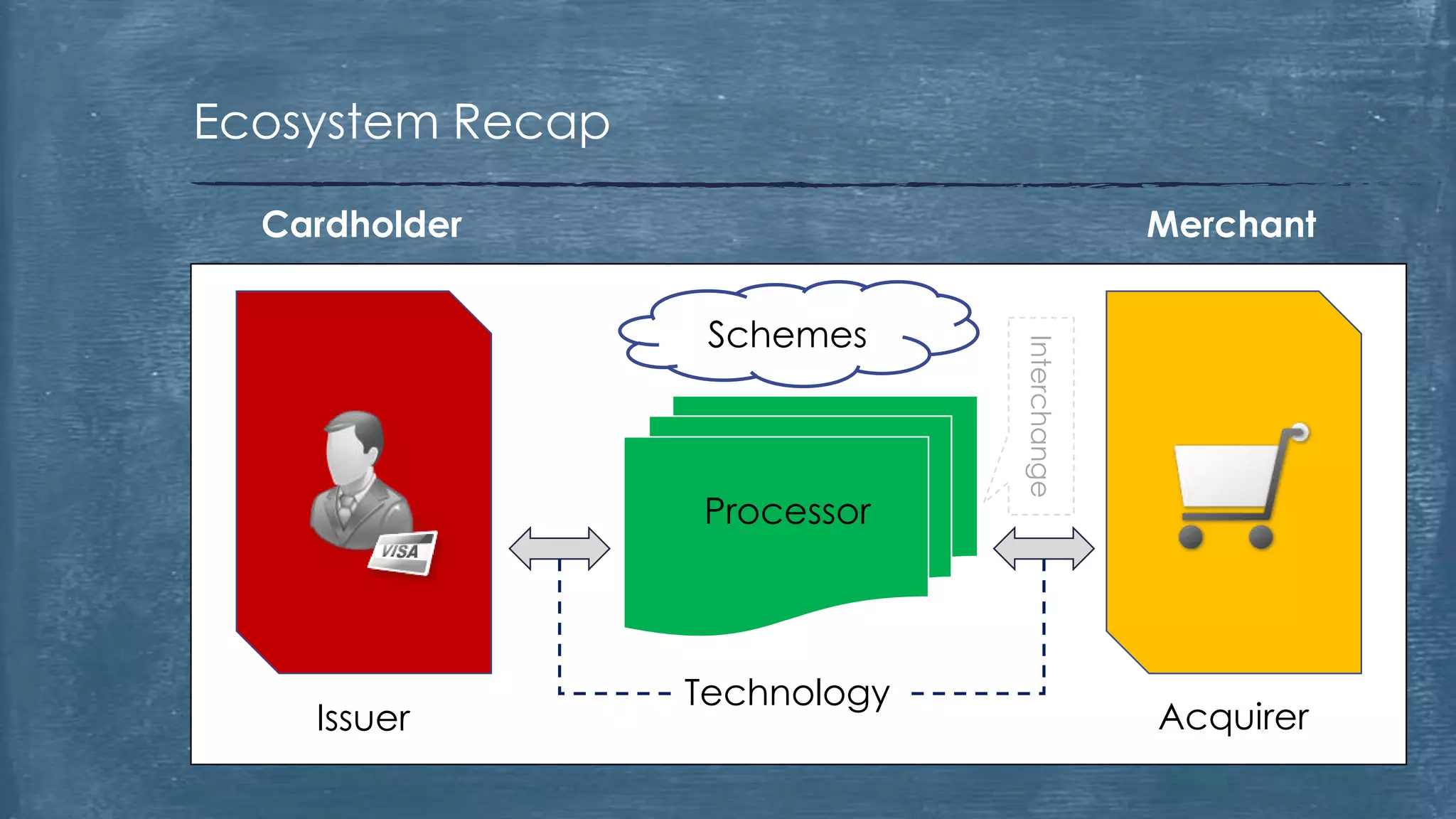
Ecosystem Recap
Customer
Cardholder Merchant
Technology
Issuer Acquirer
Interchange
Processor
Schemes
Let’s Do a Deep Dive into
Interchange
 United States
 Highest and most complex
interchange fees in the world
 Under scrutiny by legislators and
orgs like the Merchant Payments
Coalition
 Average interchange rate is 1.79%
 Europe
 Regulated by the European
Commission
 Broken down into European
Economic Areas (EEAs) and Non-
EEAs (two different schedules)
 Alternative payments have
sprouted as a result of legislation
Interchange by Region
 Australia
 Reserve Bank of Australia
legislated to lower interchange
fees from .95% to .50%
 Significantly less rewards cards-
nearly all debit
 New Zealand
 NZ Commerce Commission is
trying to pass similar laws
 Current interchange rate for NZ is
1.8%
 Asia, Africa, South
America= Developing
Markets
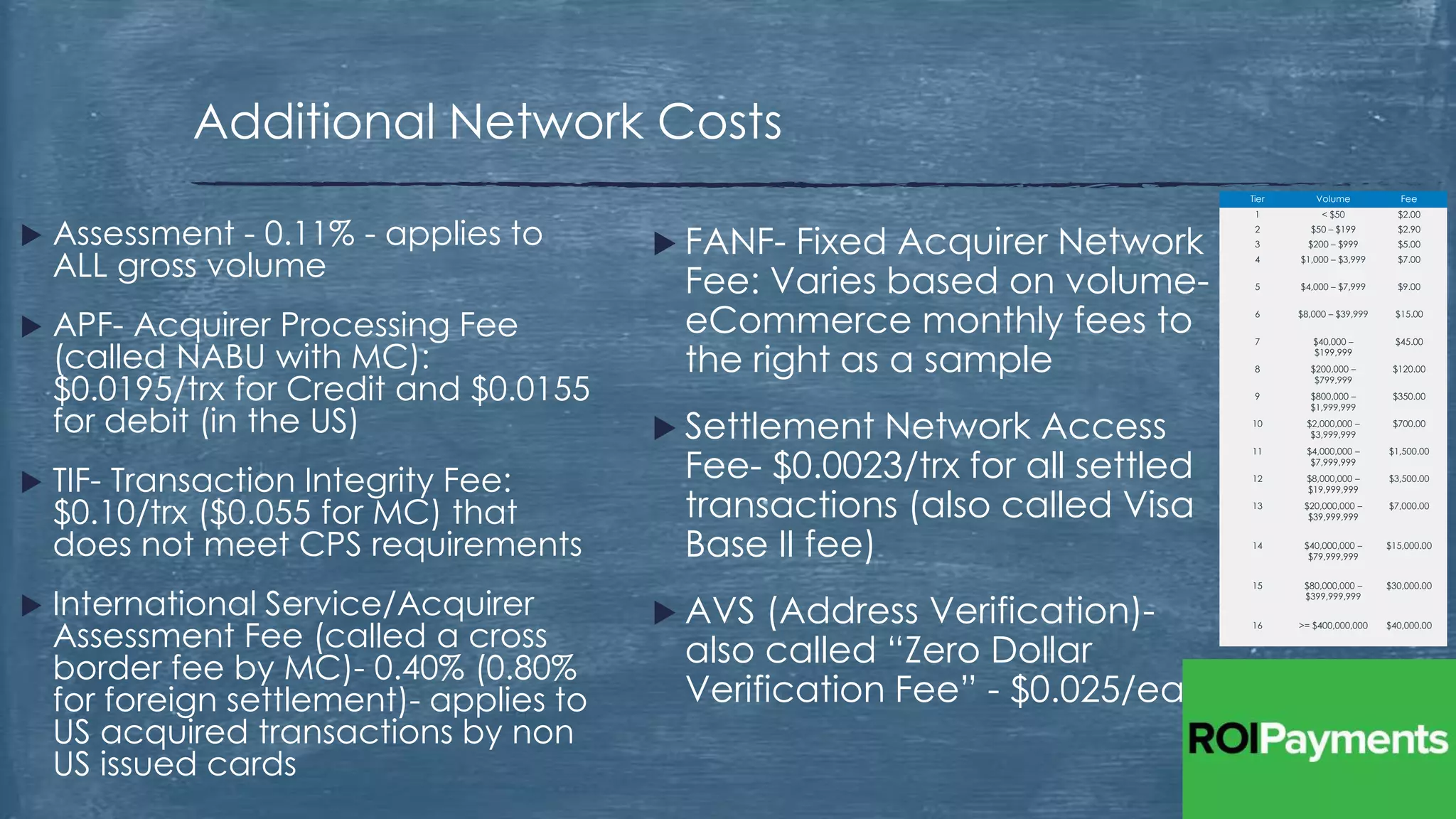
 Assessment - 0.11% - applies to
ALL gross volume
 APF- Acquirer Processing Fee
(called NABU with MC):
$0.0195/trx for Credit and $0.0155
for debit (in the US)
 TIF- Transaction Integrity Fee:
$0.10/trx ($0.055 for MC) that
does not meet CPS requirements
 International Service/Acquirer
Assessment Fee (called a cross
border fee by MC)- 0.40% (0.80%
for foreign settlement)- applies to
US acquired transactions by non
US issued cards
Additional Network Costs
Tier Volume Fee
1 < $50 $2.00
2 $50 – $199 $2.90
3 $200 – $999 $5.00
4 $1,000 – $3,999 $7.00
5 $4,000 – $7,999 $9.00
6 $8,000 – $39,999 $15.00
7 $40,000 –
$199,999
$45.00
8 $200,000 –
$799,999
$120.00
9 $800,000 –
$1,999,999
$350.00
10 $2,000,000 –
$3,999,999
$700.00
11 $4,000,000 –
$7,999,999
$1,500.00
12 $8,000,000 –
$19,999,999
$3,500.00
13 $20,000,000 –
$39,999,999
$7,000.00
14 $40,000,000 –
$79,999,999
$15,000.00
15 $80,000,000 –
$399,999,999
$30,000.00
16 >= $400,000,000 $40,000.00
 FANF- Fixed Acquirer Network
Fee: Varies based on volume-
eCommerce monthly fees to
the right as a sample
 Settlement Network Access
Fee- $0.0023/trx for all settled
transactions (also called Visa
Base II fee)
 AVS (Address Verification)-
also called “Zero Dollar
Verification Fee” - $0.025/ea
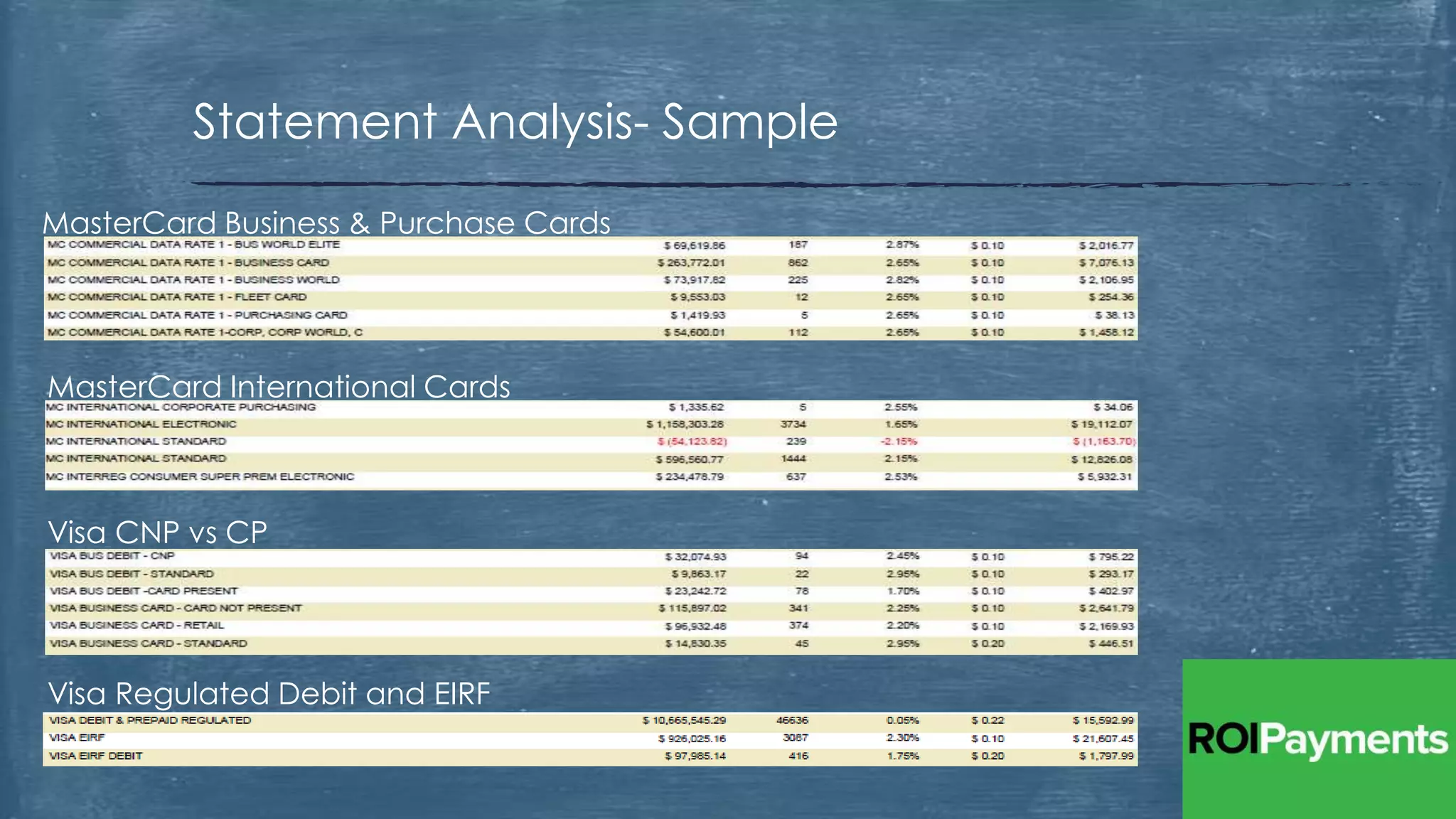
Statement Analysis- Sample
MasterCard Business & Purchase Cards
MasterCard International Cards
Visa CNP vs CP
Visa Regulated Debit and EIRF
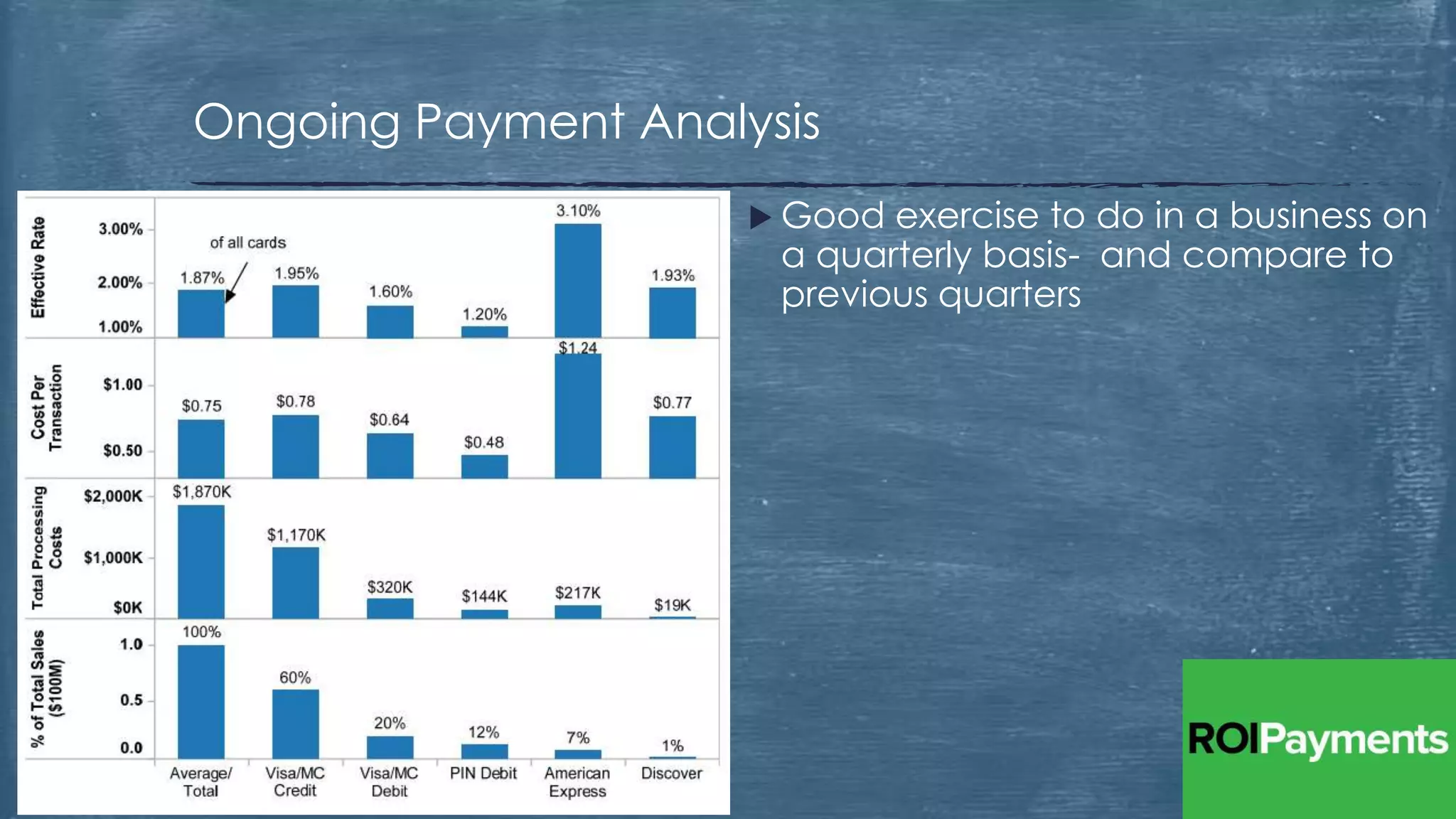
 Good exercise to do in a business on
a quarterly basis- and compare to
previous quarters
Ongoing Payment Analysis
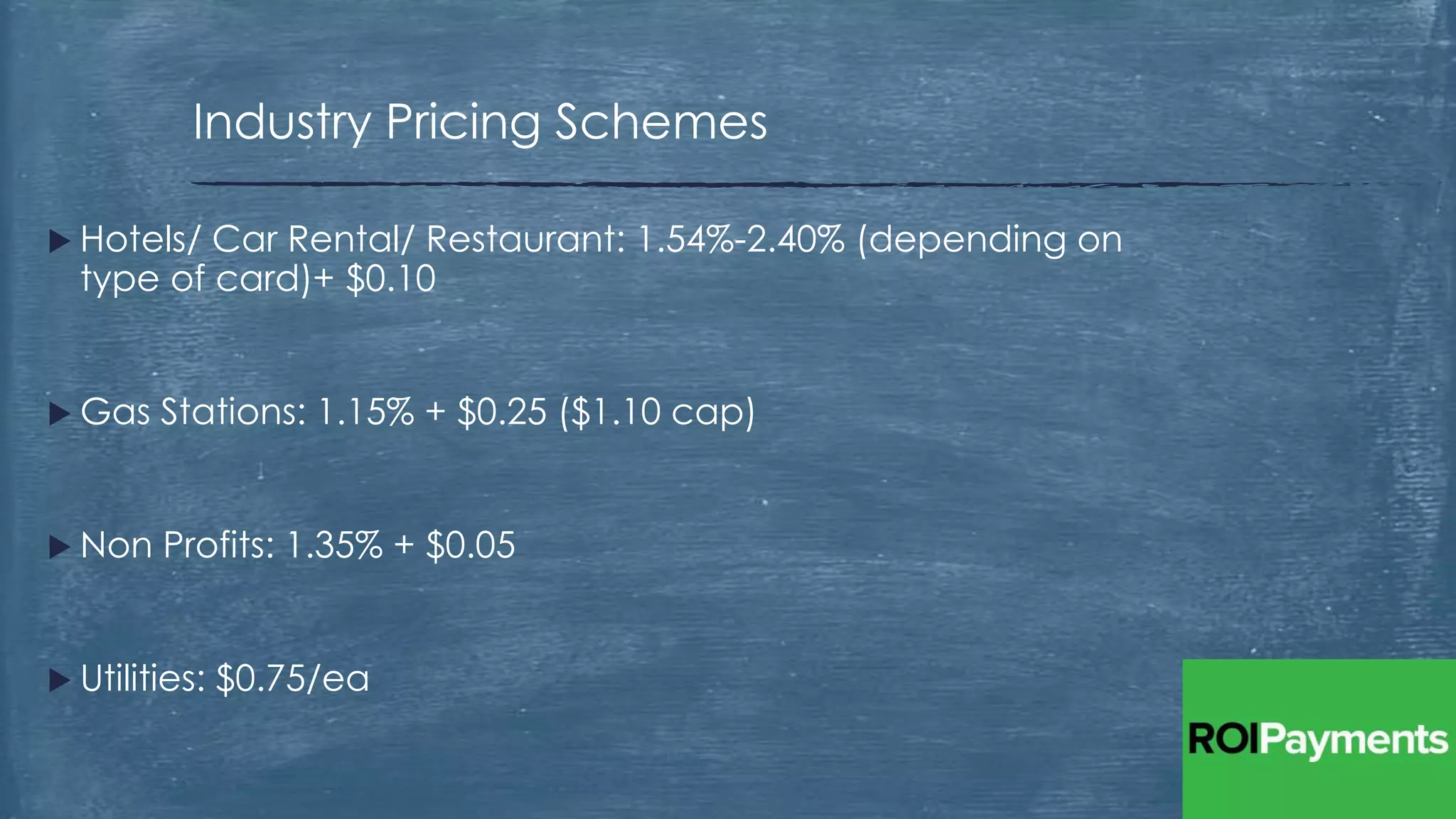
 Hotels/ Car Rental/ Restaurant: 1.54%-2.40% (depending on
type of card)+ $0.10
 Gas Stations: 1.15% + $0.25 ($1.10 cap)
 Non Profits: 1.35% + $0.05
 Utilities: $0.75/ea
Industry Pricing Schemes
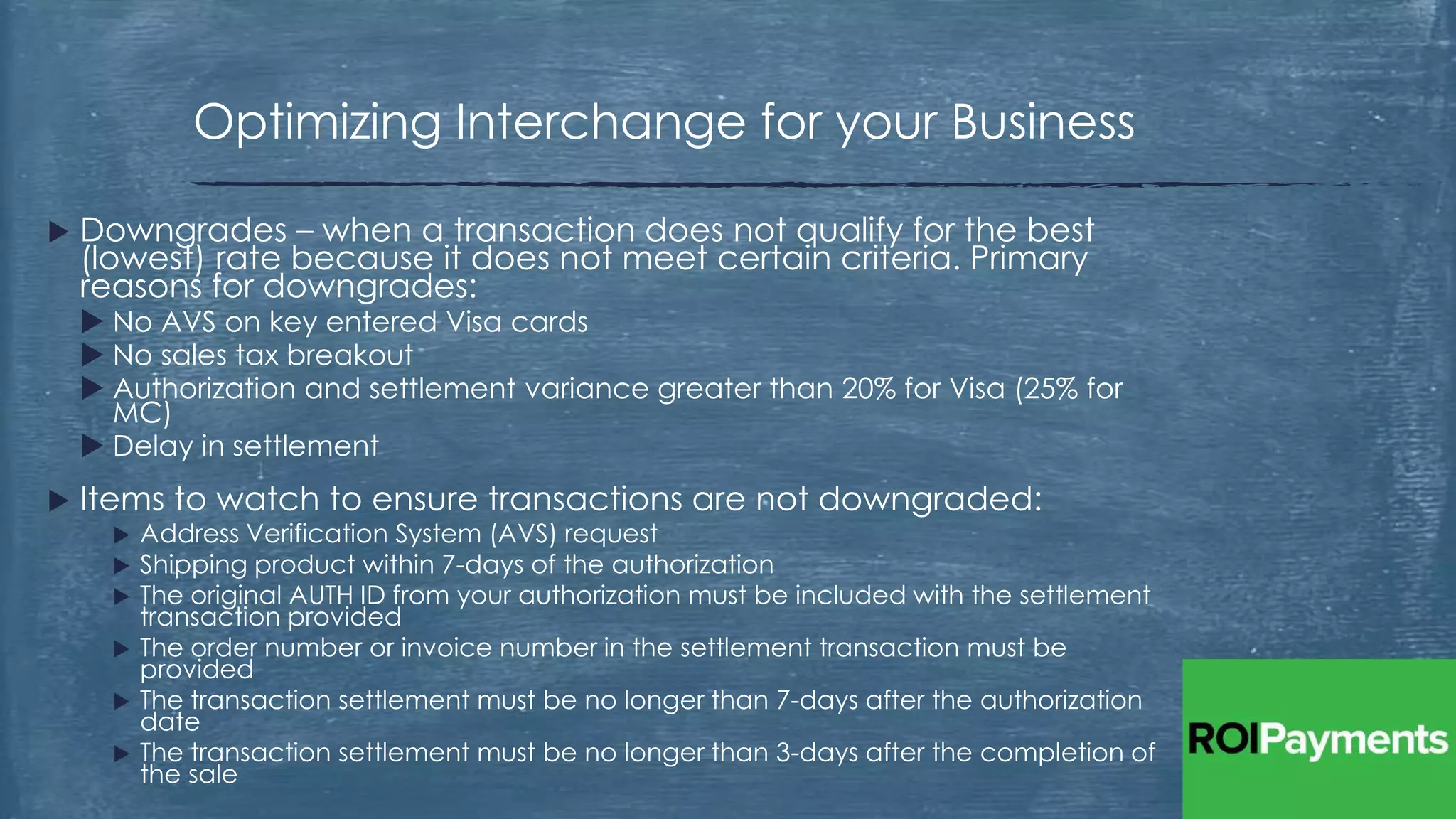
 Downgrades – when a transaction does not qualify for the best
(lowest) rate because it does not meet certain criteria. Primary
reasons for downgrades:
 No AVS on key entered Visa cards
 No sales tax breakout
 Authorization and settlement variance greater than 20% for Visa (25% for
MC)
 Delay in settlement
 Items to watch to ensure transactions are not downgraded:
 Address Verification System (AVS) request
 Shipping product within 7-days of the authorization
 The original AUTH ID from your authorization must be included with the settlement
transaction provided
 The order number or invoice number in the settlement transaction must be
provided
 The transaction settlement must be no longer than 7-days after the authorization
date
 The transaction settlement must be no longer than 3-days after the completion of
the sale
Optimizing Interchange for your Business
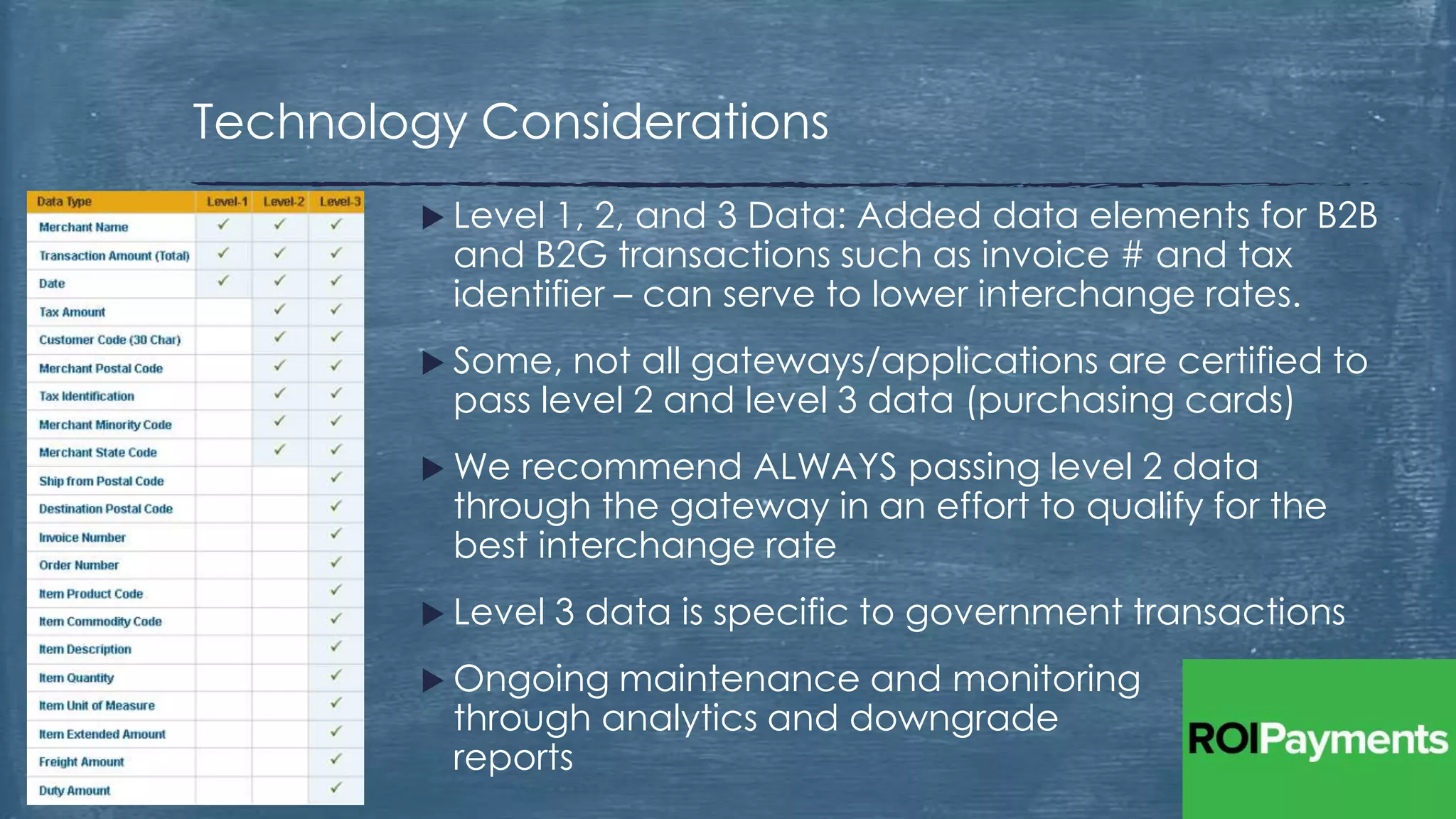
 Level 1, 2, and 3 Data: Added data elements for B2B
and B2G transactions such as invoice # and tax
identifier – can serve to lower interchange rates.
 Some, not all gateways/applications are certified to
pass level 2 and level 3 data (purchasing cards)
 We recommend ALWAYS passing level 2 data
through the gateway in an effort to qualify for the
best interchange rate
 Level 3 data is specific to government transactions
 Ongoing maintenance and monitoring
through analytics and downgrade
reports
Technology Considerations
 Overall- interchange is increasing and has since it’s inception
 Regulators have been successful in lowering interchange for
certain types of transactions- Reference Durbin Amendment-
debit cards lowered interchange fee to .05% and $0.20
(previously 1.80% and $0.10)
 Increased competition- alternative payments, mobile, carrier
billing, closed loop networks – all put pressure on Schemes
 Increased litigation between the schemes, merchant groups,
and regulators
Trends
Contact Information:
Brion Bonkowski
brion@roipayments.com
212.812.4177 x: 2134
Questions & Contact Info

Payments IQ Bootcamp #3 - Understanding Interchange, Opening Visa / MasterCard’s Kimono

  • 1.
    Brion Bonkowski Managing Director June20, 2013 Boot Camp Week 3 Improve your Payment IQ Understanding Interchange – Opening Visa & MasterCard’s Kimono
  • 2.
     Optimizing Interchangefor your Business  Technology/ Gateway Considerations  Trends  Wrap-up / Q&A  Introduction  Who is Interested in Payments?  Ecosystem Recap w/ Terms & Terminology  Interchange Explained  Network & Gateway Costs  Industry Pricing Schemes Agenda
  • 3.
     My Story– Moving into the Payment Space  Who is ROI Payments?  Why a Boot Camp Series? Introduction
  • 4.
     Who?  Rolesincluding Finance, IT, Sales, Marketing, and Treasury are all involved in the payment chain at some point  It is rare when someone is specifically assigned to payments, as such many people find themselves unprepared to navigate the payment ecosystem  ROI Payment Webinars attract  A cross section of industries, including state/local government, non-profit organizations, eCommerce, SaaS and payment industry insiders  Senior Finance folks (CFOs, controllers, etc), technology execs, operations managers and sales/marketing team members  Why?  People become involved in payment projects and need a holistic overview of the industry so that they can dive deep into their project, work, etc.  Wikipedia and Google searches don’t provide a comprehensive understanding  Result?  Everybody can benefit from an increased “Payment IQ”  Comprehensive understanding helps in today’s environment (rapidly evolving) Who is Interested in Payments
  • 5.
  • 6.
    Let’s Do aDeep Dive into Interchange
  • 8.
     United States Highest and most complex interchange fees in the world  Under scrutiny by legislators and orgs like the Merchant Payments Coalition  Average interchange rate is 1.79%  Europe  Regulated by the European Commission  Broken down into European Economic Areas (EEAs) and Non- EEAs (two different schedules)  Alternative payments have sprouted as a result of legislation Interchange by Region  Australia  Reserve Bank of Australia legislated to lower interchange fees from .95% to .50%  Significantly less rewards cards- nearly all debit  New Zealand  NZ Commerce Commission is trying to pass similar laws  Current interchange rate for NZ is 1.8%  Asia, Africa, South America= Developing Markets
  • 9.
     Assessment -0.11% - applies to ALL gross volume  APF- Acquirer Processing Fee (called NABU with MC): $0.0195/trx for Credit and $0.0155 for debit (in the US)  TIF- Transaction Integrity Fee: $0.10/trx ($0.055 for MC) that does not meet CPS requirements  International Service/Acquirer Assessment Fee (called a cross border fee by MC)- 0.40% (0.80% for foreign settlement)- applies to US acquired transactions by non US issued cards Additional Network Costs Tier Volume Fee 1 < $50 $2.00 2 $50 – $199 $2.90 3 $200 – $999 $5.00 4 $1,000 – $3,999 $7.00 5 $4,000 – $7,999 $9.00 6 $8,000 – $39,999 $15.00 7 $40,000 – $199,999 $45.00 8 $200,000 – $799,999 $120.00 9 $800,000 – $1,999,999 $350.00 10 $2,000,000 – $3,999,999 $700.00 11 $4,000,000 – $7,999,999 $1,500.00 12 $8,000,000 – $19,999,999 $3,500.00 13 $20,000,000 – $39,999,999 $7,000.00 14 $40,000,000 – $79,999,999 $15,000.00 15 $80,000,000 – $399,999,999 $30,000.00 16 >= $400,000,000 $40,000.00  FANF- Fixed Acquirer Network Fee: Varies based on volume- eCommerce monthly fees to the right as a sample  Settlement Network Access Fee- $0.0023/trx for all settled transactions (also called Visa Base II fee)  AVS (Address Verification)- also called “Zero Dollar Verification Fee” - $0.025/ea
  • 10.
    Statement Analysis- Sample MasterCardBusiness & Purchase Cards MasterCard International Cards Visa CNP vs CP Visa Regulated Debit and EIRF
  • 11.
     Good exerciseto do in a business on a quarterly basis- and compare to previous quarters Ongoing Payment Analysis
  • 12.
     Hotels/ CarRental/ Restaurant: 1.54%-2.40% (depending on type of card)+ $0.10  Gas Stations: 1.15% + $0.25 ($1.10 cap)  Non Profits: 1.35% + $0.05  Utilities: $0.75/ea Industry Pricing Schemes
  • 13.
     Downgrades –when a transaction does not qualify for the best (lowest) rate because it does not meet certain criteria. Primary reasons for downgrades:  No AVS on key entered Visa cards  No sales tax breakout  Authorization and settlement variance greater than 20% for Visa (25% for MC)  Delay in settlement  Items to watch to ensure transactions are not downgraded:  Address Verification System (AVS) request  Shipping product within 7-days of the authorization  The original AUTH ID from your authorization must be included with the settlement transaction provided  The order number or invoice number in the settlement transaction must be provided  The transaction settlement must be no longer than 7-days after the authorization date  The transaction settlement must be no longer than 3-days after the completion of the sale Optimizing Interchange for your Business
  • 14.
     Level 1,2, and 3 Data: Added data elements for B2B and B2G transactions such as invoice # and tax identifier – can serve to lower interchange rates.  Some, not all gateways/applications are certified to pass level 2 and level 3 data (purchasing cards)  We recommend ALWAYS passing level 2 data through the gateway in an effort to qualify for the best interchange rate  Level 3 data is specific to government transactions  Ongoing maintenance and monitoring through analytics and downgrade reports Technology Considerations
  • 15.
     Overall- interchangeis increasing and has since it’s inception  Regulators have been successful in lowering interchange for certain types of transactions- Reference Durbin Amendment- debit cards lowered interchange fee to .05% and $0.20 (previously 1.80% and $0.10)  Increased competition- alternative payments, mobile, carrier billing, closed loop networks – all put pressure on Schemes  Increased litigation between the schemes, merchant groups, and regulators Trends
  • 16.