7	
  Ques/ons	
  to	
  Ask	
  When	
  
Evalua/ng	
  Salary	
  Surveys	
  

                         Presented	
  by:	
  	
  
                         Tim	
  Low,	
  VP	
  Marke0ng	
  
                         0ml@payscale.com	
  
                         With	


                         Ka0e	
  Bardaro,	
  Director	
  of	
  
                         Analy0cs	
  and	
  Lead	
  Economist	


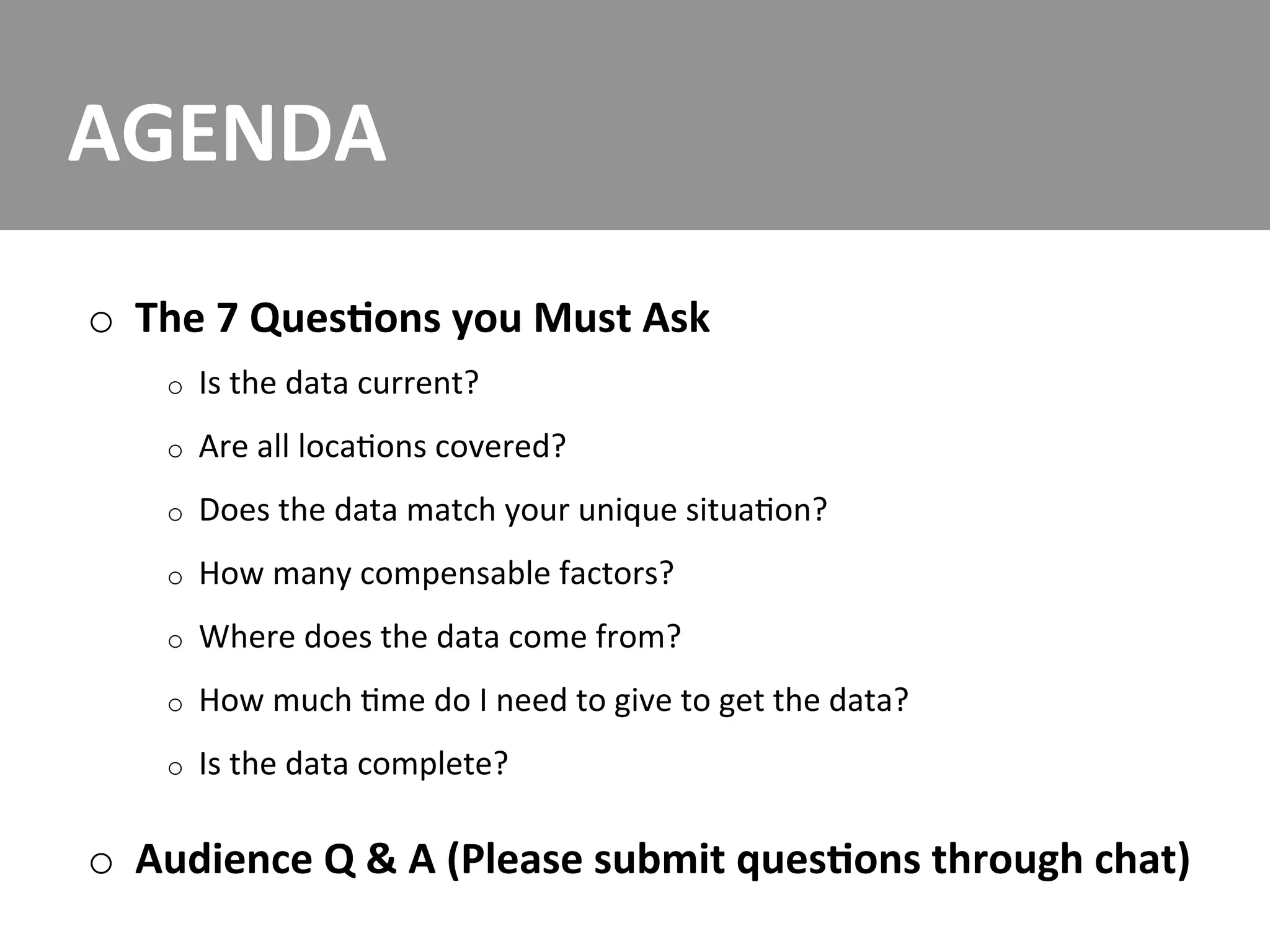
AGENDA	
  
o  The	
  7	
  Ques/ons	
  you	
  Must	
  Ask	
  
      o    Is	
  the	
  data	
  current?	
  
      o    Are	
  all	
  loca0ons	
  covered?	
  
      o    Does	
  the	
  data	
  match	
  your	
  unique	
  situa0on?	
  
      o    How	
  many	
  compensable	
  factors?	
  
      o    Where	
  does	
  the	
  data	
  come	
  from?	
  
      o    How	
  much	
  0me	
  do	
  I	
  need	
  to	
  give	
  to	
  get	
  the	
  data?	
  
      o    Is	
  the	
  data	
  complete?	
  

o  Audience	
  Q	
  &	
  A	
  (Please	
  submit	
  ques/ons	
  through	
  chat)	
  
A	
  Brief	
  History	
  of	
  Salary	
  Data…	
  

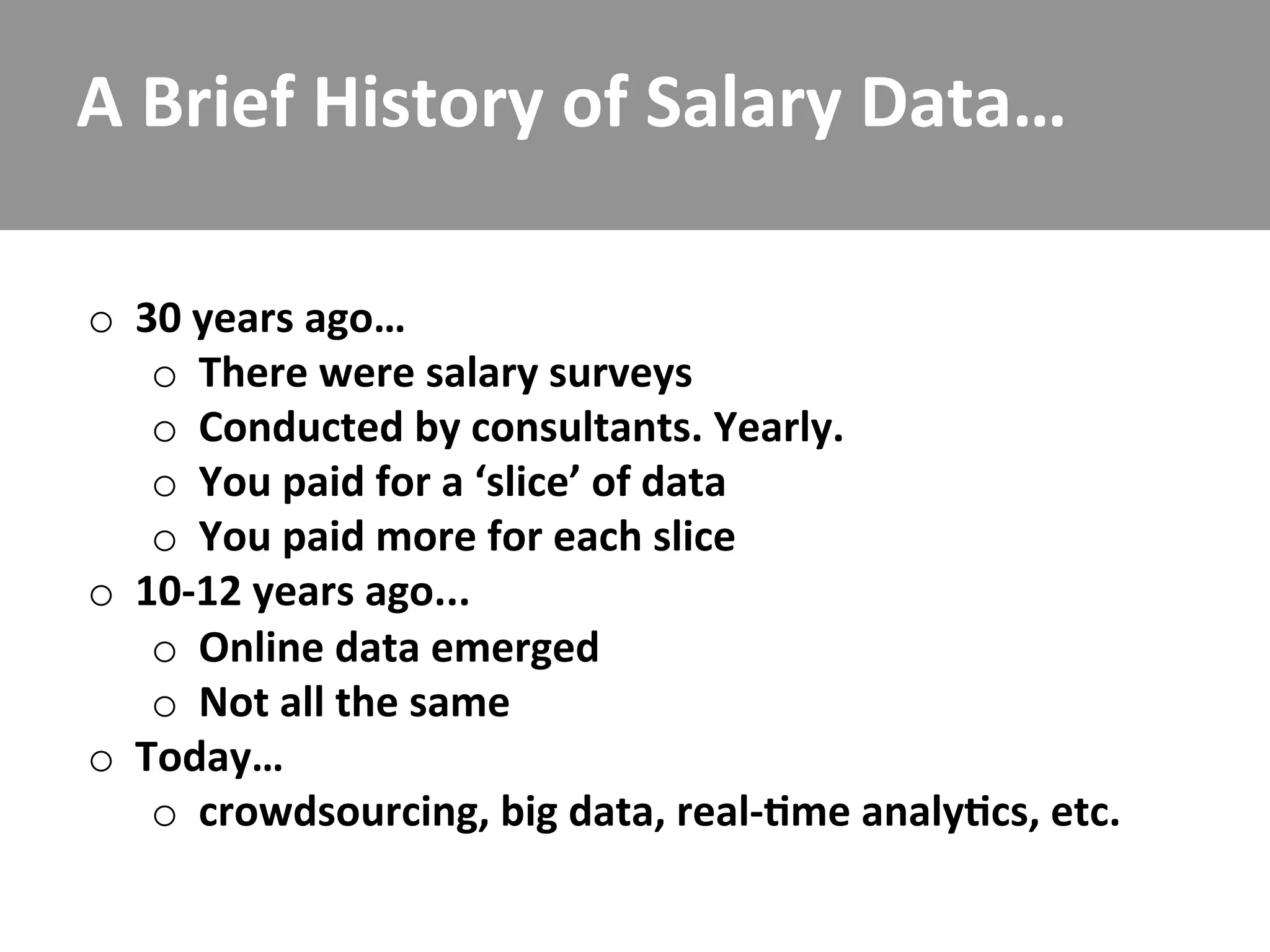
o  30	
  years	
  ago…	
  
    o  There	
  were	
  salary	
  surveys	
  
    o  Conducted	
  by	
  consultants.	
  Yearly.	
  
    o  You	
  paid	
  for	
  a	
  ‘slice’	
  of	
  data	
  
    o  You	
  paid	
  more	
  for	
  each	
  slice	
  
o  10-­‐12	
  years	
  ago...	
  
    o  Online	
  data	
  emerged	
  
    o  Not	
  all	
  the	
  same	
  
o  Today…	
  
    o  crowdsourcing,	
  big	
  data,	
  real-­‐/me	
  analy/cs,	
  etc.	
  
Ques/on	
  #1.	
  Is	
  the	
  Data	
  
Current?	
  
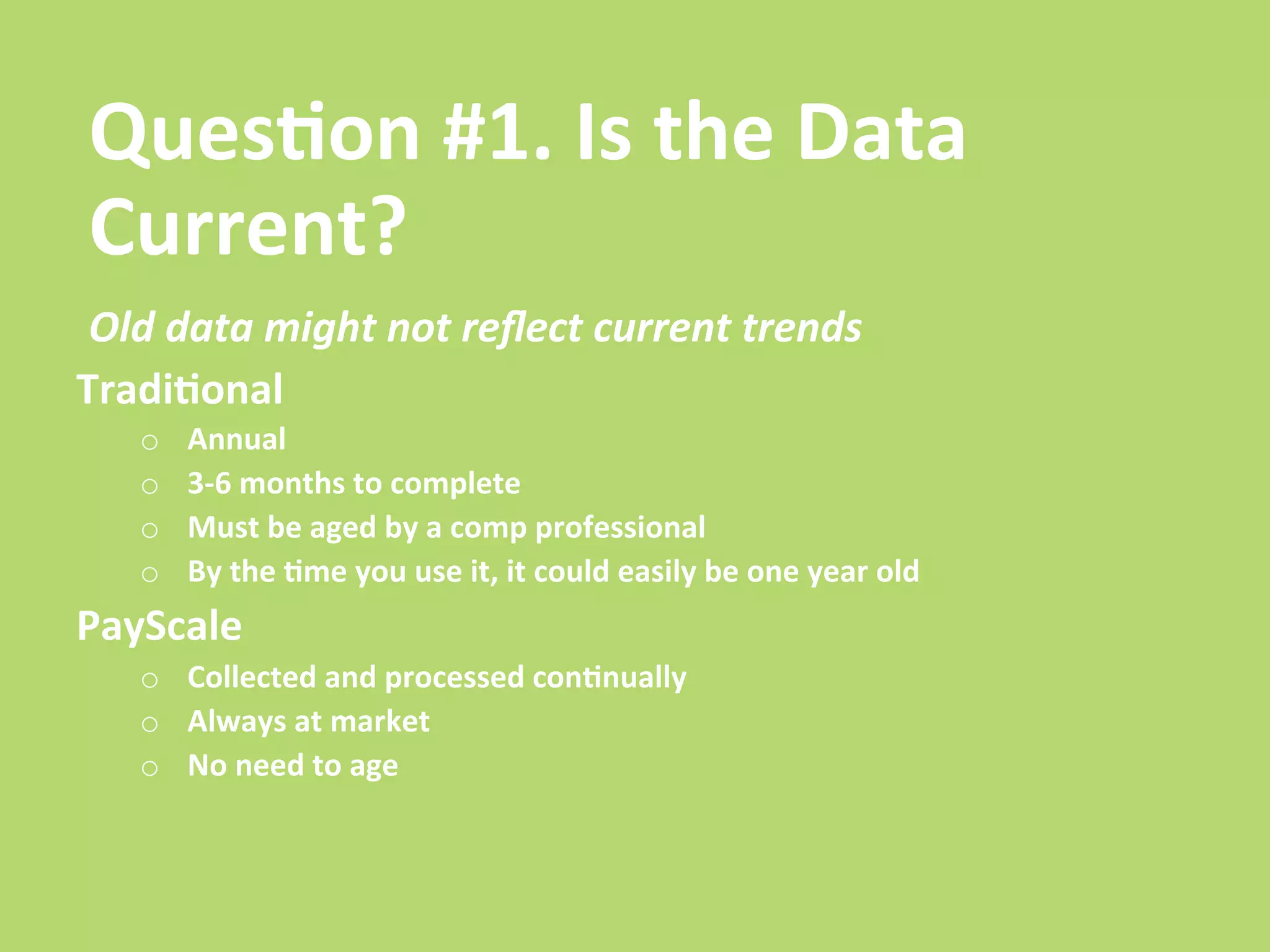
 Old	
  data	
  might	
  not	
  reflect	
  current	
  trends	
  
Tradi/onal	
  
     o    Annual	
  
     o    3-­‐6	
  months	
  to	
  complete	
  
     o    Must	
  be	
  aged	
  by	
  a	
  comp	
  professional	
  
     o    By	
  the	
  /me	
  you	
  use	
  it,	
  it	
  could	
  easily	
  be	
  one	
  year	
  old	
  
PayScale	
  
     o  Collected	
  and	
  processed	
  con/nually	
  
     o  Always	
  at	
  market	
  
     o  No	
  need	
  to	
  age	
  
Ques/on	
  #2.	
  Are	
  all	
  Loca/ons	
  
Covered?	
  
You	
  need	
  compensa5on	
  data	
  that	
  covers	
  all	
  loca5ons,	
  
major	
  and	
  rural,	
  to	
  get	
  the	
  right	
  fit	
  for	
  you.	


Tradi/onal	
  
    o  Limited	
  geographies,	
  typically	
  major	
  ci/es	
  
    o  Data	
  must	
  be	
  adjusted	
  to	
  account	
  for	
  cost	
  of	
  living	
  differences	
  and	
  
       posi/on	
  demand	
  for	
  loca/ons	
  outside	
  of	
  that	
  scope	
  

PayScale	
  
    o  Unlimited	
  geographies,	
  most	
  specific	
  loca/ons	
  covered	
  
    o  Matches	
  for	
  rural	
  loca/ons	
  are	
  more	
  precise	
  
    o  No	
  need	
  to	
  adjust	
  the	
  data	
  
Ques/on	
  #3.	
  Does	
  the	
  Data	
  
Match	
  You?	
  
Your	
  employees	
  may	
  have	
  a	
  unique	
  combina5on	
  of	
  
knowledge,	
  skills	
  and	
  abili5es	


Tradi/onal	
  
    o  It	
  may	
  include	
  pay	
  differen/als,	
  different	
  years	
  of	
  experience,	
  
       cer/fica/ons,	
  or	
  skills,	
  but	
  never	
  in	
  combina/on	
  with	
  each	
  other	
  
    o  If	
  the	
  posi/on	
  is	
  unique,	
  it	
  may	
  not	
  be	
  covered	
  

PayScale	
  
    o  Combina/ons	
  of	
  skills	
  and	
  abili/es	
  are	
  covered	
  
    o  Broader	
  base	
  of	
  input	
  means	
  unique	
  posi/ons	
  can	
  likely	
  be	
  matched	
  
Ques/on	
  #4.	
  How	
  Many	
  
Compensable	
  Factors?	
  
The	
  more	
  factors	
  included,	
  the	
  more	
  accurate	
  the	
  salary	
  data	
  

Tradi/onal	
  
  o    Must	
  find	
  slices	
  of	
  data	
  that	
  match	
  all	
  the	
  compensable	
  factors	
  
  o    Intensive	
  calcula/ons	
  needed	
  to	
  blend	
  the	
  data	
  

PayScale	
  
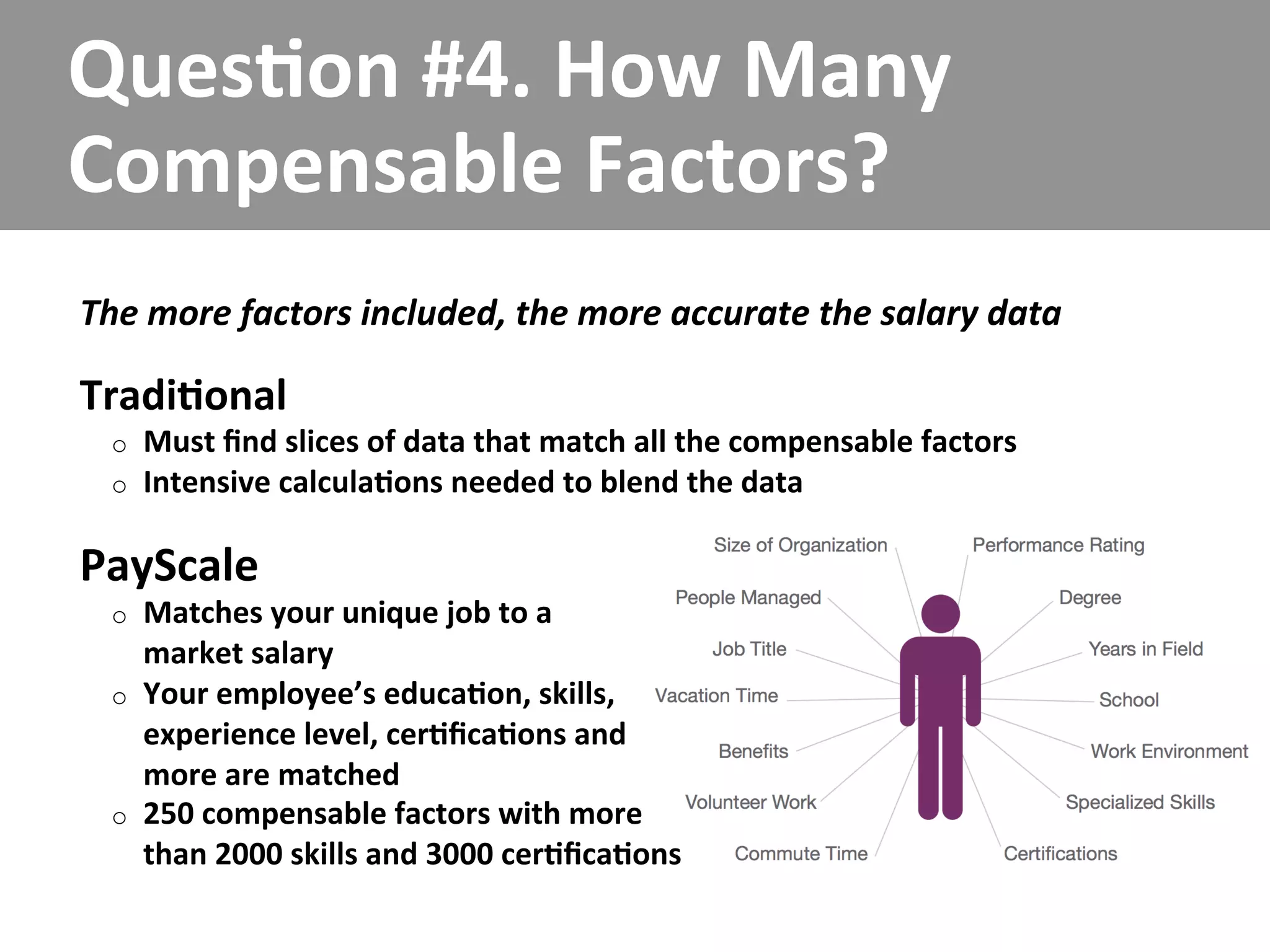
  o    Matches	
  your	
  unique	
  job	
  to	
  a	
  	
  
       market	
  salary	
  
  o    Your	
  employee’s	
  educa/on,	
  skills,	
  	
  
       experience	
  level,	
  cer/fica/ons	
  and	
  	
  
       more	
  are	
  matched	
  
  o    250	
  compensable	
  factors	
  with	
  more	
  	
  
       than	
  2000	
  skills	
  and	
  3000	
  cer/fica/ons	
  
Ques/on	
  #5.	
  Where	
  do	
  they	
  
get	
  the	
  data?	
  
Data	
  transparency	
  lets	
  comp	
  pros	
  make	
  beCer	
  decisions	
  about	
  
how	
  well	
  the	
  data	
  source	
  matches	
  their	
  employees	
  

Tradi/onal	
  
  o    Data	
  collec/on	
  methods	
  are	
  well-­‐known	
  and	
  understood	
  
  o    However,	
  exact	
  sources	
  of	
  data	
  are	
  not	
  included	
  in	
  a	
  survey	
  
  o    Some	
  consultants	
  and	
  online	
  survey	
  providers	
  aggregate	
  informa/on	
  
       from	
  mul/ple	
  sources	
  and	
  don’t	
  provide	
  those	
  details	
  

PayScale	
  
  o    Transparent	
  
  o    Our	
  methodology	
  is	
  public	
  and	
  data	
  sources	
  are	
  provided,	
  right	
  down	
  to	
  
       specific	
  user	
  profiles	
  (anonymous	
  of	
  course)	
  that	
  provided	
  the	
  info	
  
  o    PayScale	
  tells	
  you	
  why	
  it	
  used	
  the	
  source	
  as	
  a	
  match	
  and	
  gives	
  you	
  
       control	
  over	
  which	
  data	
  is	
  used	
  
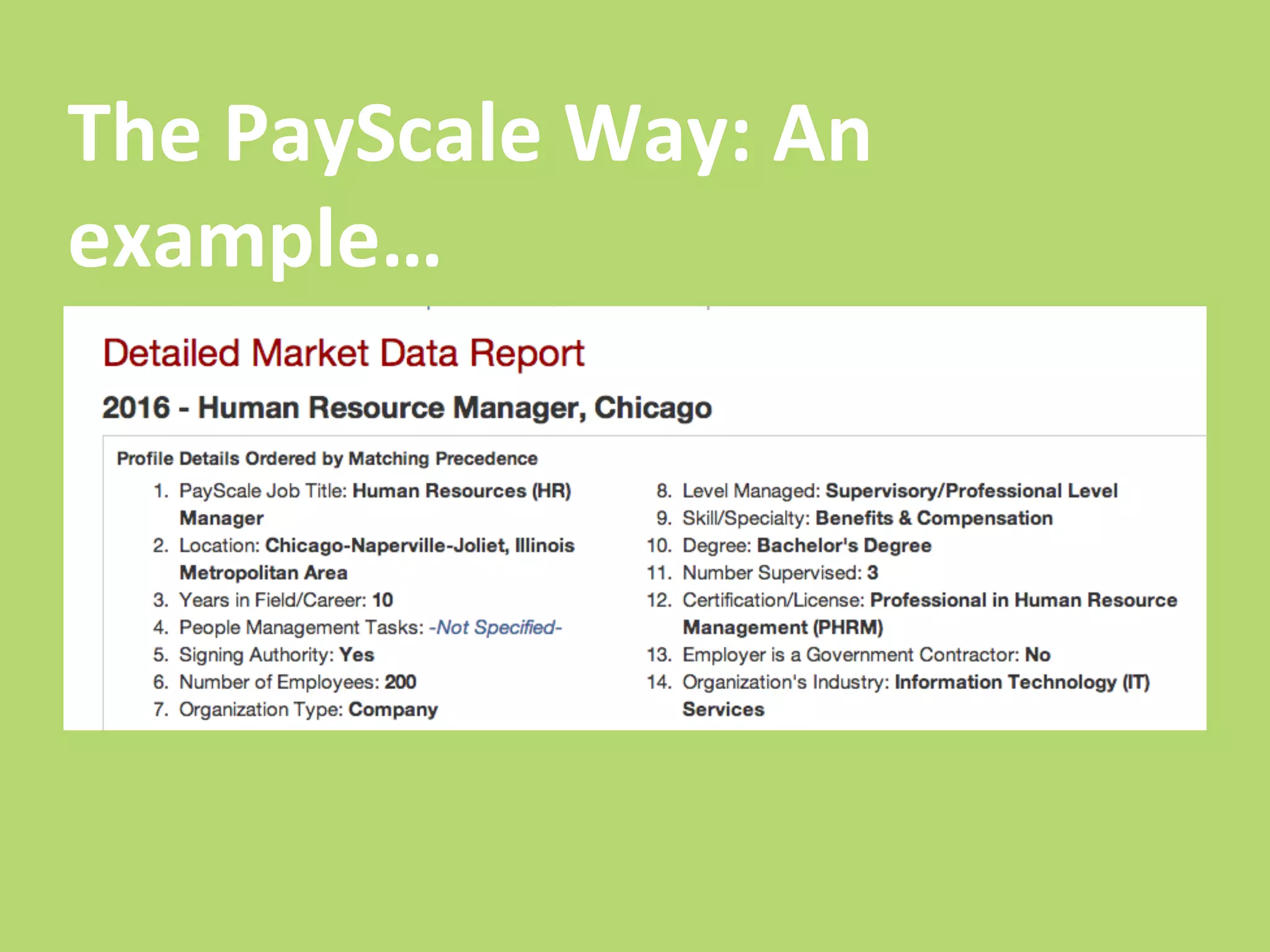
The	
  PayScale	
  Way:	
  An	
  
example…	
  
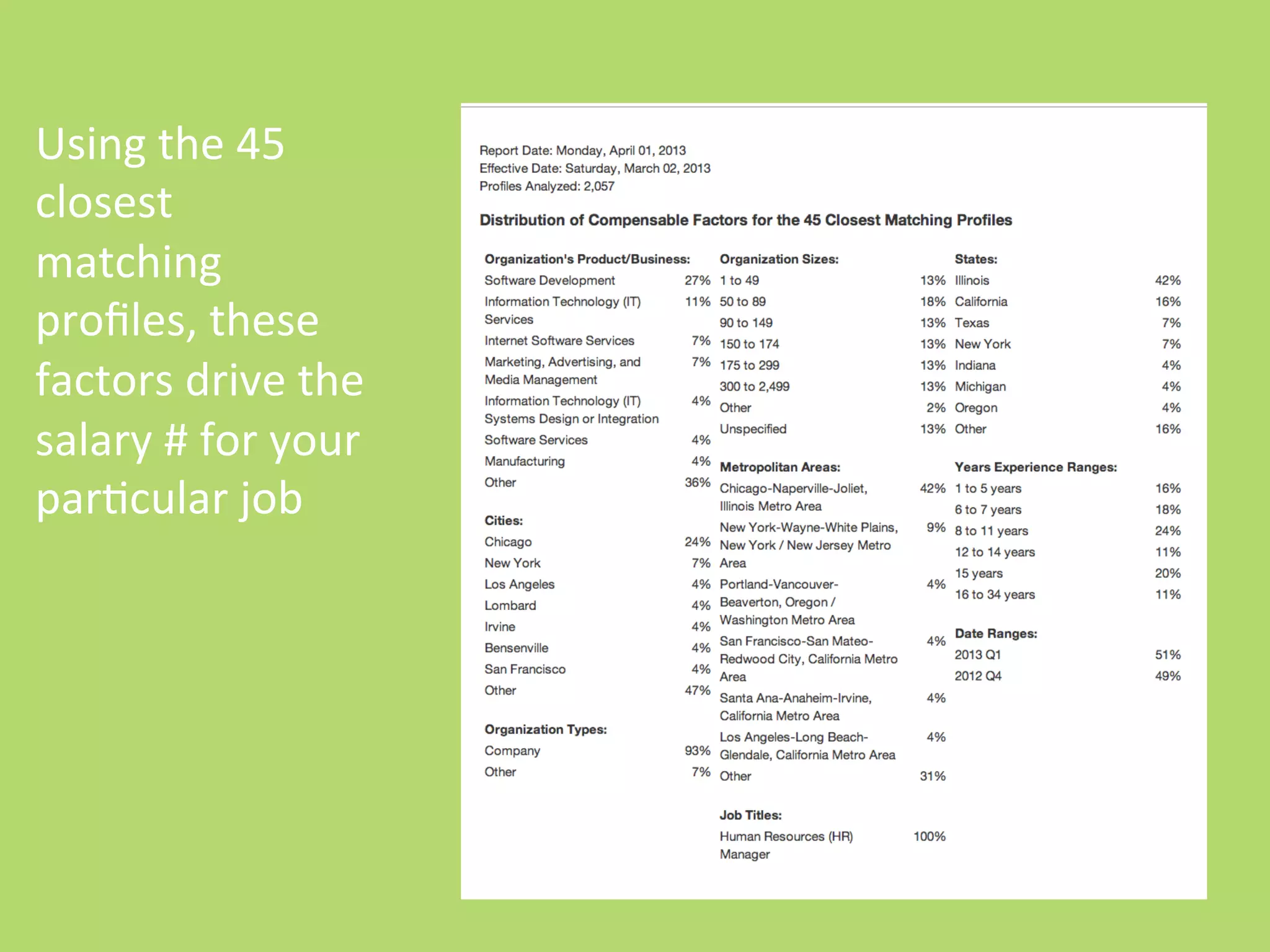
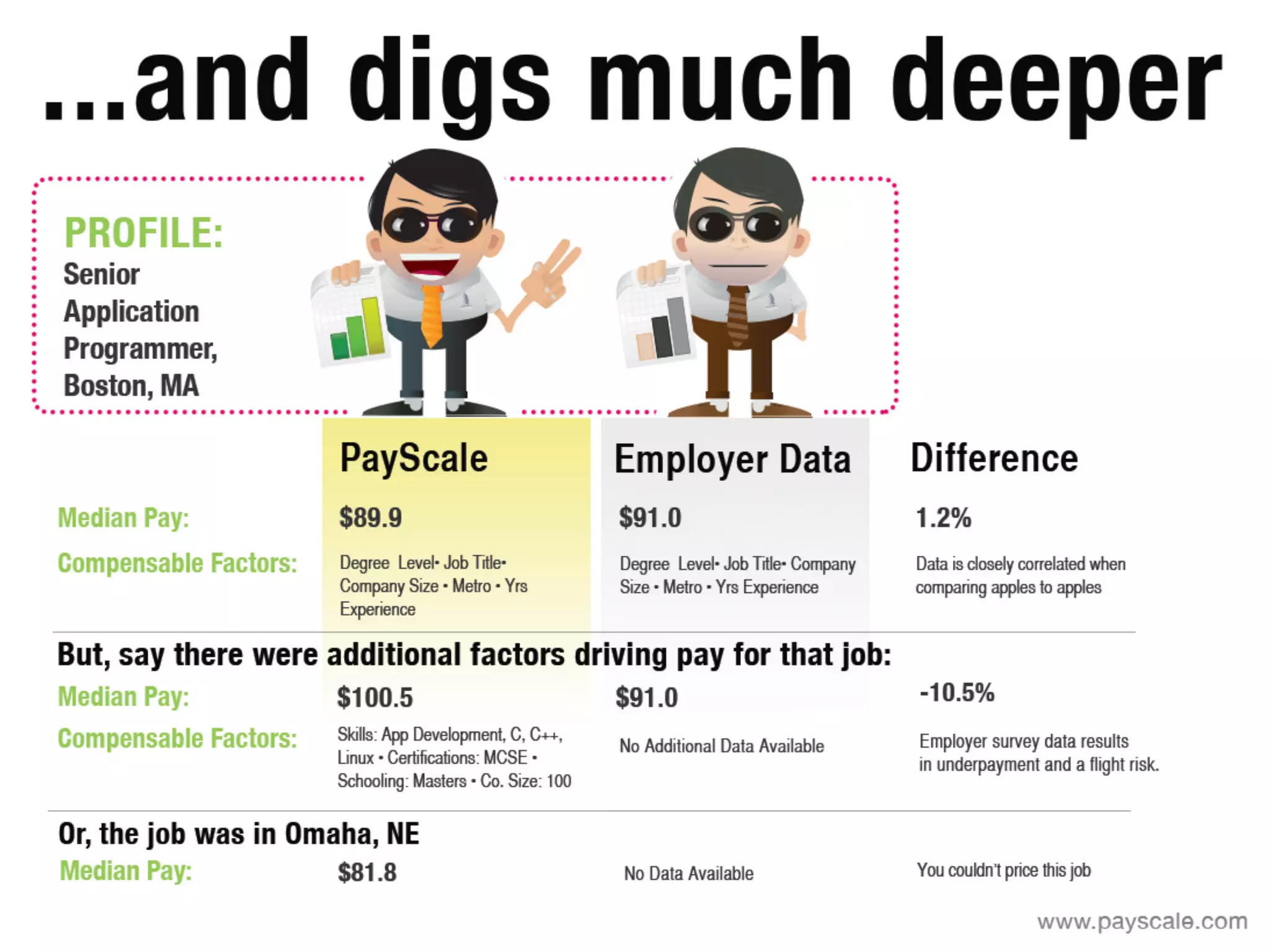
Using	
  the	
  45	
  
closest	
  
matching	
  
profiles,	
  these	
  
factors	
  drive	
  the	
  
salary	
  #	
  for	
  your	
  
par0cular	
  job	
  
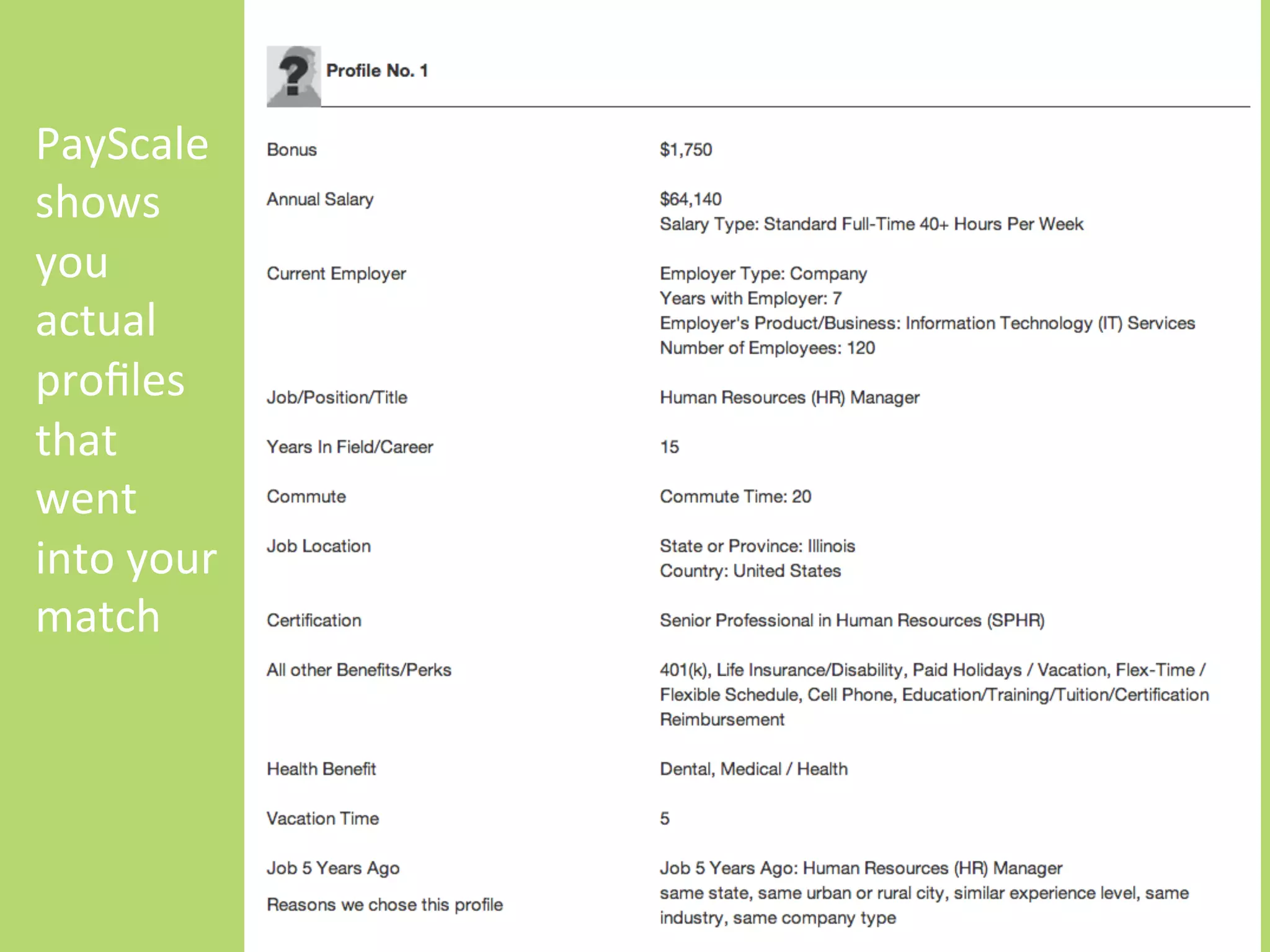
PayScale	
  
shows	
  
you	
  
actual	
  
profiles	
  
that	
  
went	
  
into	
  your	
  
match	
  
Ques/on	
  #6.	
  How	
  much	
  /me	
  do	
  you	
  have	
  
to	
  invest	
  to	
  get	
  the	
  data?	
  
What	
  is	
  required	
  to	
  be	
  eligible	
  to	
  receive	
  the	
  data?	
  How	
  much	
  5me	
  to	
  
do	
  you	
  have?	
  
Tradi/onal	
  
   o    Paper,	
  spreadsheets	
  
   o    It	
  is	
  typically	
  required	
  or	
  requested	
  that	
  employers	
  par/cipate	
  in	
  their	
  surveys	
  before	
  
        receiving	
  results.	
  Comprehensive	
  data	
  about	
  the	
  company,	
  policies,	
  prac/ces	
  and	
  salaries	
  	
  
        must	
  be	
  provided	
  
   o    The	
  employer	
  then	
  waits	
  typically	
  6	
  months	
  to	
  get	
  the	
  results	
  
   o    Time	
  must	
  then	
  be	
  spent	
  to	
  match	
  the	
  general	
  salary	
  data	
  to	
  the	
  specific	
  situa/on	
  

PayScale	
  
   o    Cloud	
  sofware	
  
   o    Entering	
  a	
  job	
  /tle	
  unlocks	
  a	
  set	
  of	
  ques/ons	
  about	
  compensable	
  factors	
  affec/ng	
  pay	
  for	
  
        that	
  /tle	
  
   o    Adding	
  in	
  more	
  details	
  yields	
  greater	
  accuracy	
  
   o    PayScale	
  tells	
  you	
  instantly	
  what	
  that	
  job	
  should	
  be	
  paid,	
  including	
  recommended	
  ranges	
  
   o    No	
  aging	
  or	
  blending	
  required—data	
  is	
  real-­‐/me	
  and	
  at-­‐market	
  
Ques/on	
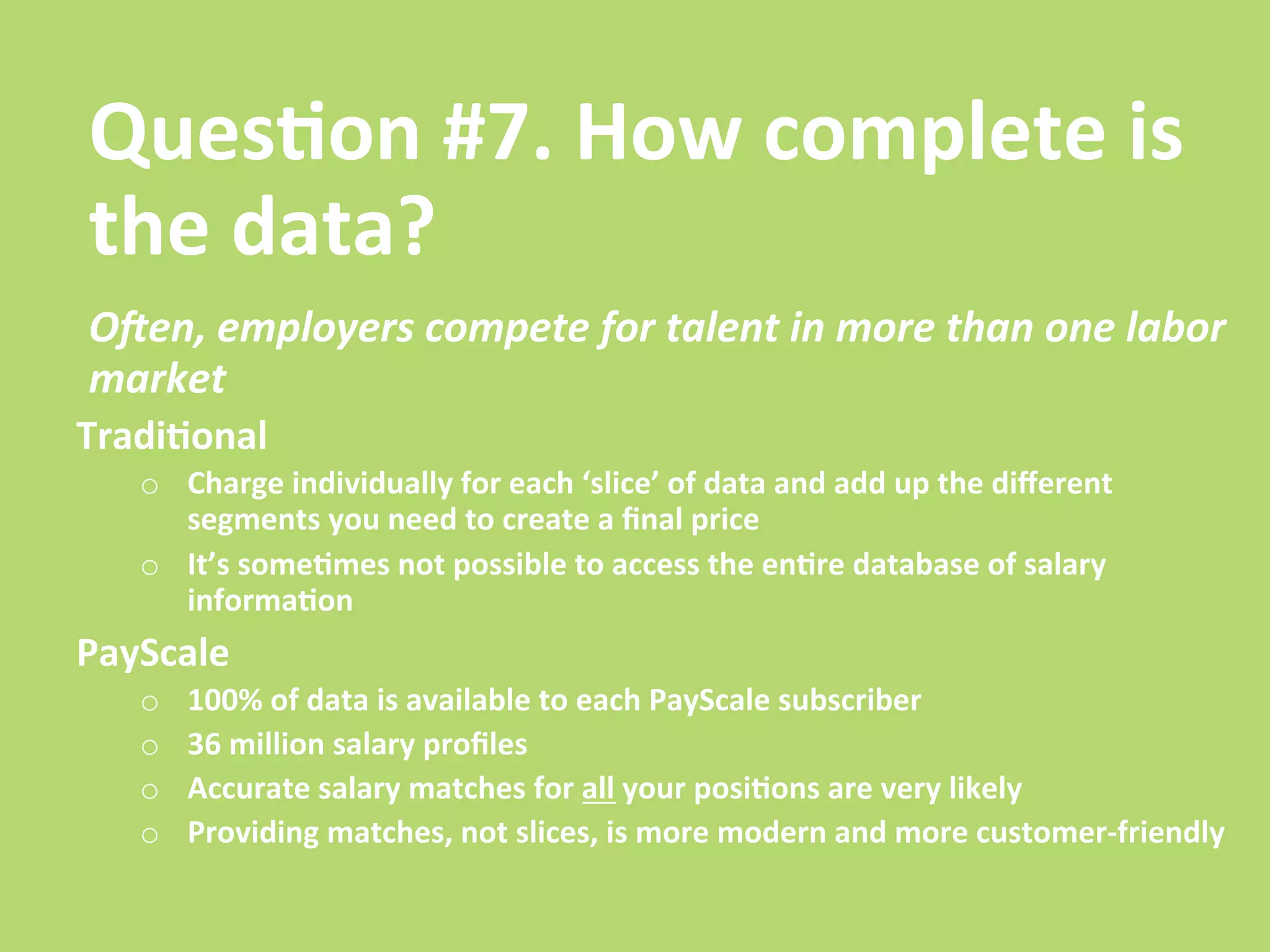
  #7.	
  How	
  complete	
  is	
  
the	
  data?	
  
OGen,	
  employers	
  compete	
  for	
  talent	
  in	
  more	
  than	
  one	
  labor	
  
market	
  	
  
Tradi/onal	
  
    o  Charge	
  individually	
  for	
  each	
  ‘slice’	
  of	
  data	
  and	
  add	
  up	
  the	
  different	
  
       segments	
  you	
  need	
  to	
  create	
  a	
  final	
  price	
  	
  
    o  It’s	
  some/mes	
  not	
  possible	
  to	
  access	
  the	
  en/re	
  database	
  of	
  salary	
  
       informa/on	
  
PayScale	
  
    o    100%	
  of	
  data	
  is	
  available	
  to	
  each	
  PayScale	
  subscriber	
  
    o    36	
  million	
  salary	
  profiles	
  
    o    Accurate	
  salary	
  matches	
  for	
  all	
  your	
  posi/ons	
  are	
  very	
  likely	
  
    o    Providing	
  matches,	
  not	
  slices,	
  is	
  more	
  modern	
  and	
  more	
  customer-­‐friendly	
  
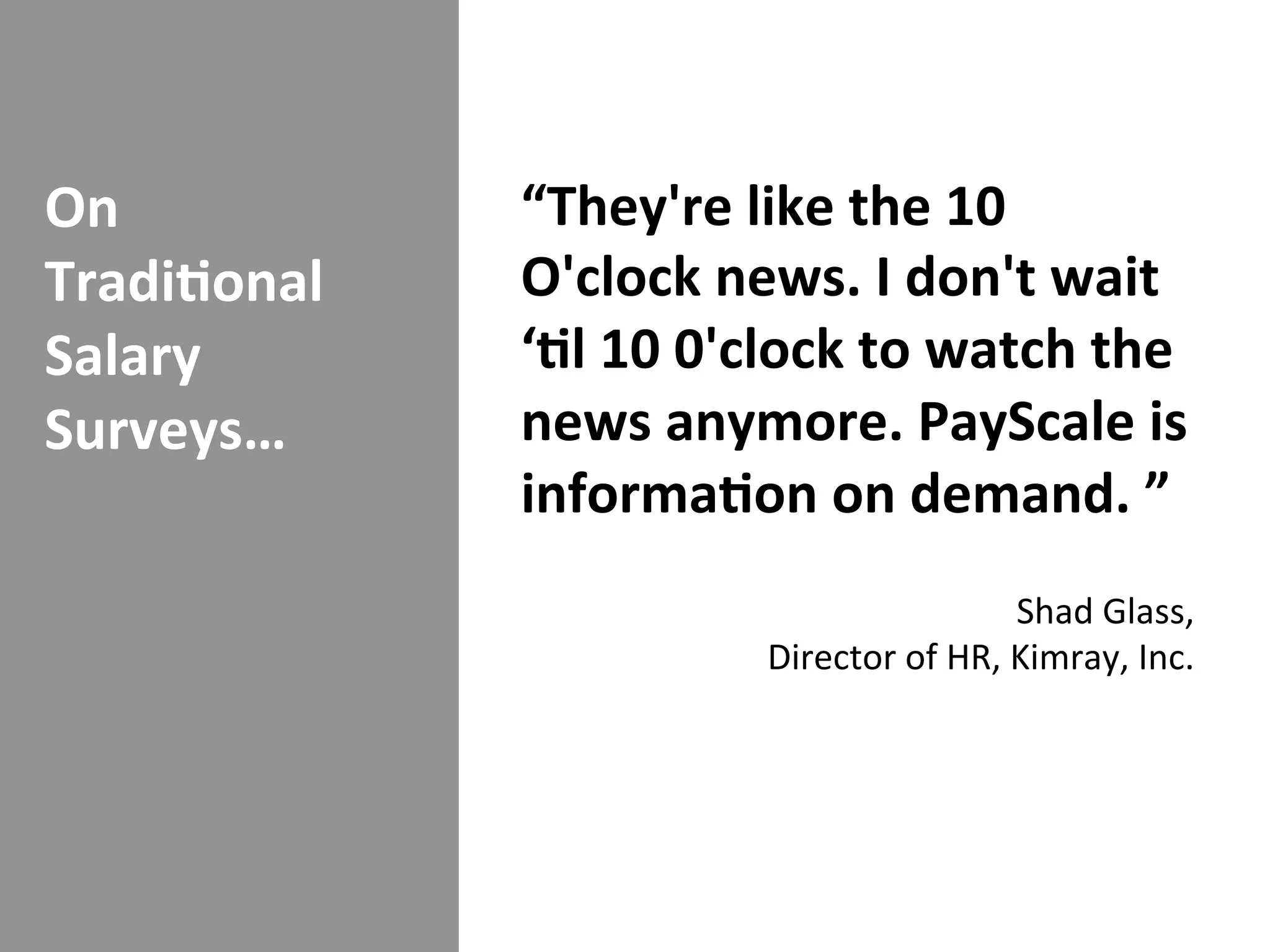
On	
             “They're	
  like	
  the	
  10	
  
Tradi/onal	
     O'clock	
  news.	
  I	
  don't	
  wait	
  
Salary	
         ‘/l	
  10	
  0'clock	
  to	
  watch	
  the	
  
Surveys…	
       news	
  anymore.	
  PayScale	
  is	
  
                 informa/on	
  on	
  demand.	
  ”	


                                                          Shad	
  Glass,	
  
                                 Director	
  of	
  HR,	
  Kimray,	
  Inc.	
  
Special	
  Access	
  for	
  You:	
  
  Get	
  the	
  Complete	
  
     Whitepaper	
  
                          Presented	
  by:	
  	
  
                          Tim	
  Low,	
  VP	
  Marke0ng	
  
                          0ml@payscale.com	


                          Ka0e	
  Bardaro,	
  Director	
  of	
  
                          Analy0cs	
  and	
  Lead	
  Economist	
  

Pay scale presentation 7 questions to ask about salary data sources

  • 1.
    7  Ques/ons  to  Ask  When   Evalua/ng  Salary  Surveys   Presented  by:     Tim  Low,  VP  Marke0ng   0ml@payscale.com   With     Ka0e  Bardaro,  Director  of   Analy0cs  and  Lead  Economist    
  • 2.
    AGENDA   o  The  7  Ques/ons  you  Must  Ask   o  Is  the  data  current?   o  Are  all  loca0ons  covered?   o  Does  the  data  match  your  unique  situa0on?   o  How  many  compensable  factors?   o  Where  does  the  data  come  from?   o  How  much  0me  do  I  need  to  give  to  get  the  data?   o  Is  the  data  complete?   o  Audience  Q  &  A  (Please  submit  ques/ons  through  chat)  
  • 3.
    A  Brief  History  of  Salary  Data…   o  30  years  ago…   o  There  were  salary  surveys   o  Conducted  by  consultants.  Yearly.   o  You  paid  for  a  ‘slice’  of  data   o  You  paid  more  for  each  slice   o  10-­‐12  years  ago...   o  Online  data  emerged   o  Not  all  the  same   o  Today…   o  crowdsourcing,  big  data,  real-­‐/me  analy/cs,  etc.  
  • 4.
    Ques/on  #1.  Is  the  Data   Current?   Old  data  might  not  reflect  current  trends   Tradi/onal   o  Annual   o  3-­‐6  months  to  complete   o  Must  be  aged  by  a  comp  professional   o  By  the  /me  you  use  it,  it  could  easily  be  one  year  old   PayScale   o  Collected  and  processed  con/nually   o  Always  at  market   o  No  need  to  age  
  • 5.
    Ques/on  #2.  Are  all  Loca/ons   Covered?   You  need  compensa5on  data  that  covers  all  loca5ons,   major  and  rural,  to  get  the  right  fit  for  you.     Tradi/onal   o  Limited  geographies,  typically  major  ci/es   o  Data  must  be  adjusted  to  account  for  cost  of  living  differences  and   posi/on  demand  for  loca/ons  outside  of  that  scope   PayScale   o  Unlimited  geographies,  most  specific  loca/ons  covered   o  Matches  for  rural  loca/ons  are  more  precise   o  No  need  to  adjust  the  data  
  • 6.
    Ques/on  #3.  Does  the  Data   Match  You?   Your  employees  may  have  a  unique  combina5on  of   knowledge,  skills  and  abili5es     Tradi/onal   o  It  may  include  pay  differen/als,  different  years  of  experience,   cer/fica/ons,  or  skills,  but  never  in  combina/on  with  each  other   o  If  the  posi/on  is  unique,  it  may  not  be  covered   PayScale   o  Combina/ons  of  skills  and  abili/es  are  covered   o  Broader  base  of  input  means  unique  posi/ons  can  likely  be  matched  
  • 7.
    Ques/on  #4.  How  Many   Compensable  Factors?   The  more  factors  included,  the  more  accurate  the  salary  data   Tradi/onal   o  Must  find  slices  of  data  that  match  all  the  compensable  factors   o  Intensive  calcula/ons  needed  to  blend  the  data   PayScale   o  Matches  your  unique  job  to  a     market  salary   o  Your  employee’s  educa/on,  skills,     experience  level,  cer/fica/ons  and     more  are  matched   o  250  compensable  factors  with  more     than  2000  skills  and  3000  cer/fica/ons  
  • 8.
    Ques/on  #5.  Where  do  they   get  the  data?   Data  transparency  lets  comp  pros  make  beCer  decisions  about   how  well  the  data  source  matches  their  employees   Tradi/onal   o  Data  collec/on  methods  are  well-­‐known  and  understood   o  However,  exact  sources  of  data  are  not  included  in  a  survey   o  Some  consultants  and  online  survey  providers  aggregate  informa/on   from  mul/ple  sources  and  don’t  provide  those  details   PayScale   o  Transparent   o  Our  methodology  is  public  and  data  sources  are  provided,  right  down  to   specific  user  profiles  (anonymous  of  course)  that  provided  the  info   o  PayScale  tells  you  why  it  used  the  source  as  a  match  and  gives  you   control  over  which  data  is  used  
  • 9.
    The  PayScale  Way:  An   example…  
  • 10.
    Using  the  45   closest   matching   profiles,  these   factors  drive  the   salary  #  for  your   par0cular  job  
  • 11.
    PayScale   shows   you   actual   profiles   that   went   into  your   match  
  • 12.
    Ques/on  #6.  How  much  /me  do  you  have   to  invest  to  get  the  data?   What  is  required  to  be  eligible  to  receive  the  data?  How  much  5me  to   do  you  have?   Tradi/onal   o  Paper,  spreadsheets   o  It  is  typically  required  or  requested  that  employers  par/cipate  in  their  surveys  before   receiving  results.  Comprehensive  data  about  the  company,  policies,  prac/ces  and  salaries     must  be  provided   o  The  employer  then  waits  typically  6  months  to  get  the  results   o  Time  must  then  be  spent  to  match  the  general  salary  data  to  the  specific  situa/on   PayScale   o  Cloud  sofware   o  Entering  a  job  /tle  unlocks  a  set  of  ques/ons  about  compensable  factors  affec/ng  pay  for   that  /tle   o  Adding  in  more  details  yields  greater  accuracy   o  PayScale  tells  you  instantly  what  that  job  should  be  paid,  including  recommended  ranges   o  No  aging  or  blending  required—data  is  real-­‐/me  and  at-­‐market  
  • 13.
    Ques/on  #7.  How  complete  is   the  data?   OGen,  employers  compete  for  talent  in  more  than  one  labor   market     Tradi/onal   o  Charge  individually  for  each  ‘slice’  of  data  and  add  up  the  different   segments  you  need  to  create  a  final  price     o  It’s  some/mes  not  possible  to  access  the  en/re  database  of  salary   informa/on   PayScale   o  100%  of  data  is  available  to  each  PayScale  subscriber   o  36  million  salary  profiles   o  Accurate  salary  matches  for  all  your  posi/ons  are  very  likely   o  Providing  matches,  not  slices,  is  more  modern  and  more  customer-­‐friendly  
  • 14.
    On   “They're  like  the  10   Tradi/onal   O'clock  news.  I  don't  wait   Salary   ‘/l  10  0'clock  to  watch  the   Surveys…   news  anymore.  PayScale  is   informa/on  on  demand.  ”     Shad  Glass,   Director  of  HR,  Kimray,  Inc.  
  • 18.
    Special  Access  for  You:   Get  the  Complete   Whitepaper   Presented  by:     Tim  Low,  VP  Marke0ng   0ml@payscale.com     Ka0e  Bardaro,  Director  of   Analy0cs  and  Lead  Economist