PAVEMENT ANALYSIS &
DESIGN
PAVEMENT TYPES & MATERIALS
What is a Pavement?
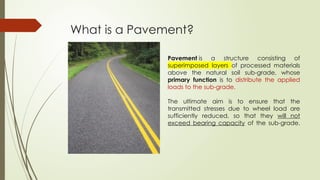
Pavement is a structure consisting of
superimposed layers of processed materials
above the natural soil sub-grade, whose
primary function is to distribute the applied
loads to the sub-grade.
The ultimate aim is to ensure that the
transmitted stresses due to wheel load are
sufficiently reduced, so that they will not
exceed bearing capacity of the sub-grade.
Requirements of a Pavement
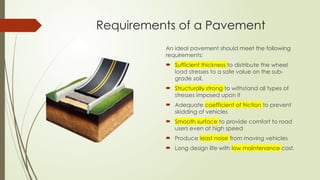
An ideal pavement should meet the following
requirements:
 Sufficient thickness to distribute the wheel
load stresses to a safe value on the sub-
grade soil,
 Structurally strong to withstand all types of
stresses imposed upon it
 Adequate coefficient of friction to prevent
skidding of vehicles
 Smooth surface to provide comfort to road
users even at high speed
 Produce least noise from moving vehicles
 Long design life with low maintenance cost.
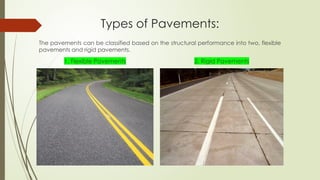
Types of Pavements:
1. Flexible Pavements 2. Rigid Pavements
The pavements can be classified based on the structural performance into two, flexible
pavements and rigid pavements.
1. Flexible Pavements
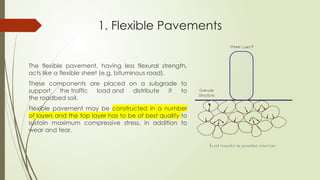
The flexible pavement, having less flexural strength,
acts like a flexible sheet (e.g. bituminous road).
These components are placed on a subgrade to
support the traffic load and distribute it to
the roadbed soil.
Flexible pavement may be constructed in a number
of layers and the top layer has to be of best quality to
sustain maximum compressive stress, in addition to
wear and tear.
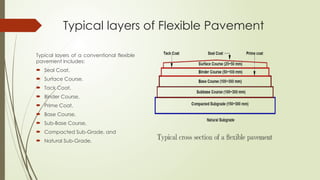
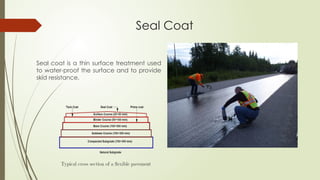
Typical layers of Flexible Pavement
Typical layers of a conventional flexible
pavement includes:
 Seal Coat,
 Surface Course,
 Tack Coat,
 Binder Course,
 Prime Coat,
 Base Course,
 Sub-Base Course,
 Compacted Sub-Grade, and
 Natural Sub-Grade.
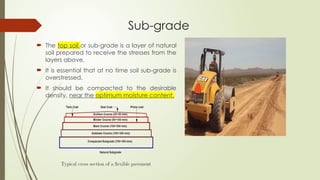
Sub-grade
 The top soil or sub-grade is a layer of natural
soil prepared to receive the stresses from the
layers above.
 It is essential that at no time soil sub-grade is
overstressed.
 It should be compacted to the desirable
density, near the optimum moisture content.
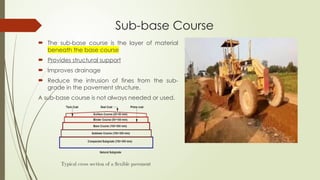
Sub-base Course
 The sub-base course is the layer of material
beneath the base course
 Provides structural support
 Improves drainage
 Reduce the intrusion of fines from the sub-
grade in the pavement structure.
A sub-base course is not always needed or used.
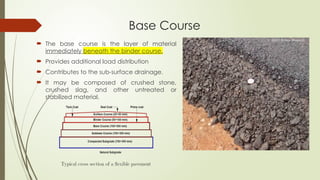
Base Course
 The base course is the layer of material
immediately beneath the binder course.
 Provides additional load distribution
 Contributes to the sub-surface drainage.
 It may be composed of crushed stone,
crushed slag, and other untreated or
stabilized material.
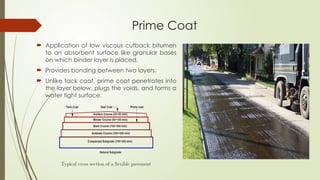
Prime Coat
 Application of low viscous cutback bitumen
to an absorbent surface like granular bases
on which binder layer is placed.
 Provides bonding between two layers.
 Unlike tack coat, prime coat penetrates into
the layer below, plugs the voids, and forms a
water tight surface.
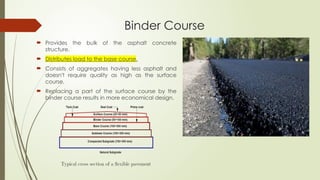
Binder Course
 Provides the bulk of the asphalt concrete
structure.
 Distributes load to the base course.
 Consists of aggregates having less asphalt and
doesn't require quality as high as the surface
course,
 Replacing a part of the surface course by the
binder course results in more economical design.
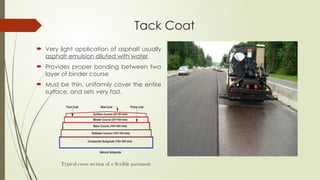
Tack Coat
 Very light application of asphalt usually
asphalt emulsion diluted with water.
 Provides proper bonding between two
layer of binder course
 Must be thin, uniformly cover the entire
surface, and sets very fast.
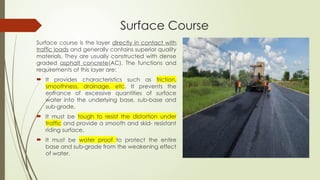
Surface Course
Surface course is the layer directly in contact with
traffic loads and generally contains superior quality
materials. They are usually constructed with dense
graded asphalt concrete(AC). The functions and
requirements of this layer are:
 It provides characteristics such as friction,
smoothness, drainage, etc. It prevents the
entrance of excessive quantities of surface
water into the underlying base, sub-base and
sub-grade,
 It must be tough to resist the distortion under
traffic and provide a smooth and skid- resistant
riding surface,
 It must be water proof to protect the entire
base and sub-grade from the weakening effect
of water.
Seal Coat
Seal coat is a thin surface treatment used
to water-proof the surface and to provide
skid resistance.
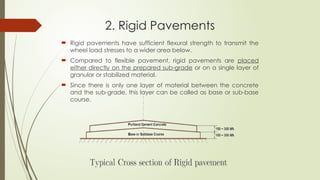
2. Rigid Pavements
 Rigid pavements have sufficient flexural strength to transmit the
wheel load stresses to a wider area below.
 Compared to flexible pavement, rigid pavements are placed
either directly on the prepared sub-grade or on a single layer of
granular or stabilized material.
 Since there is only one layer of material between the concrete
and the sub-grade, this layer can be called as base or sub-base
course.
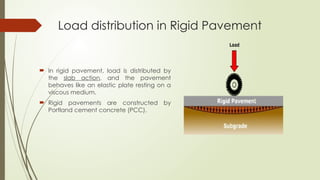
Load distribution in Rigid Pavement
 In rigid pavement, load is distributed by
the slab action, and the pavement
behaves like an elastic plate resting on a
viscous medium.
 Rigid pavements are constructed by
Portland cement concrete (PCC).
The Difference:
Flexible Pavements
 It consists of a series of layers with the
highest quality material at or near the
surface of the pavement.
 Its stability depends upon the
aggregate interlocks, particle friction,
and cohesion.
 Pavement design is greatly influenced
by the subgrade strength.
 Temperature variations due to change
in atmospheric conditions do not
produce stresses in flexible pavements.
 Flexible pavements have self-healing
properties due to heavier wheel loads
that are recoverable to some extent.
Rigid Pavements
 It consists of one layer Portland
cement concrete slab of relatively
high flexural strength.
 Its structural strength is provided by
the pavement slab itself by its beam
action.
 Flexural strength of concrete is a major
factor for design.
 Temperature changes induce heavy
stresses in the rigid pavement.
 Any excessive deformation occurring
due to heavier wheel loads are not
recoverable.
AIRPORT PAVEMENT
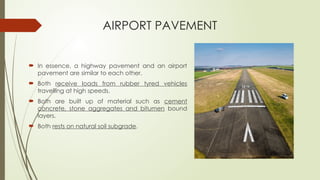
 In essence, a highway pavement and an airport
pavement are similar to each other.
 Both receive loads from rubber tyred vehicles
travelling at high speeds.
 Both are built up of material such as cement
concrete, stone aggregates and bitumen bound
layers.
 Both rests on natural soil subgrade.
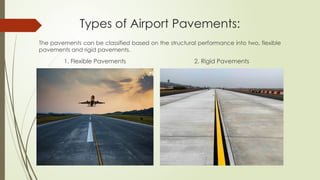
Types of Airport Pavements:
1. Flexible Pavements 2. Rigid Pavements
The pavements can be classified based on the structural performance into two, flexible
pavements and rigid pavements.
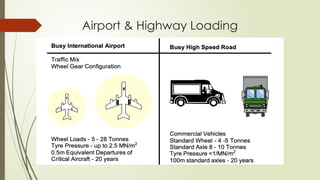
Airport & Highway Loading
Airport Pavement Design
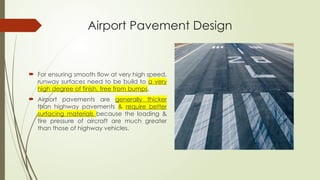
 For ensuring smooth flow at very high speed,
runway surfaces need to be build to a very
high degree of finish, free from bumps.
 Airport pavements are generally thicker
than highway pavements & require better
surfacing materials because the loading &
tire pressure of aircraft are much greater
than those of highway vehicles.
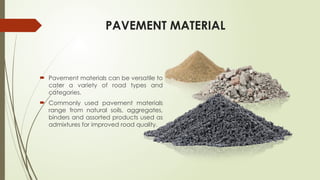
PAVEMENT MATERIAL
 Pavement materials can be versatile to
cater a variety of road types and
categories.
 Commonly used pavement materials
range from natural soils, aggregates,
binders and assorted products used as
admixtures for improved road quality.
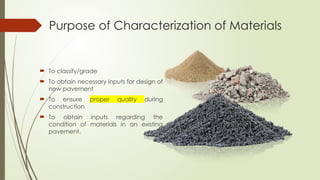
Purpose of Characterization of Materials
 To classify/grade
 To obtain necessary inputs for design of
new pavement
 To ensure proper quality during
construction
 To obtain inputs regarding the
condition of materials in an existing
pavement.
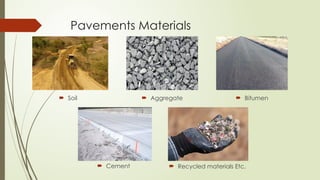
Pavements Materials
 Recycled materials Etc.
 Soil  Aggregate  Bitumen
 Cement
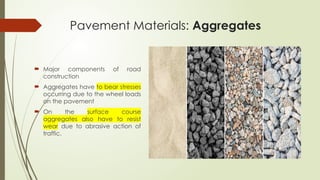
Pavement Materials: Aggregates
 Major components of road
construction
 Aggregates have to bear stresses
occurring due to the wheel loads
on the pavement
 On the surface course
aggregates also have to resist
wear due to abrasive action of
traffic.
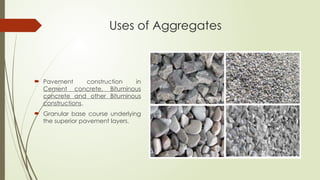
Uses of Aggregates
 Pavement construction in
Cement concrete, Bituminous
concrete and other Bituminous
constructions.
 Granular base course underlying
the superior pavement layers.
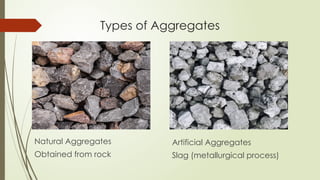
Types of Aggregates
Natural Aggregates
Obtained from rock
Artificial Aggregates
Slag (metallurgical process)
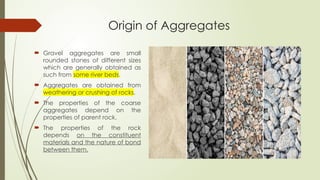
Origin of Aggregates
 Gravel aggregates are small
rounded stones of different sizes
which are generally obtained as
such from some river beds.
 Aggregates are obtained from
weathering or crushing of rocks.
 The properties of the coarse
aggregates depend on the
properties of parent rock.
 The properties of the rock
depends on the constituent
materials and the nature of bond
between them.
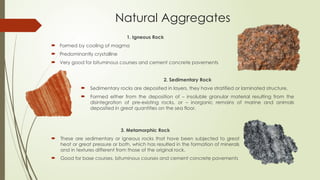
Natural Aggregates
1. Igneous Rock
 Formed by cooling of magma
 Predominantly crystalline
 Very good for bituminous courses and cement concrete pavements
2. Sedimentary Rock
 Sedimentary rocks are deposited in layers, they have stratified or laminated structure.
 Formed either from the deposition of – insoluble granular material resulting from the
disintegration of pre-existing rocks, or – inorganic remains of marine and animals
deposited in great quantities on the sea floor.
3. Metamorphic Rock
 These are sedimentary or igneous rocks that have been subjected to great
heat or great pressure or both, which has resulted in the formation of minerals
and in textures different from those of the original rock.
 Good for base courses, bituminous courses and cement concrete pavements
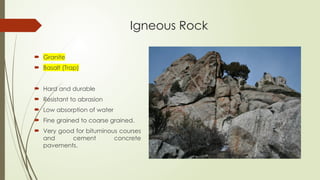
Igneous Rock
 Granite
 Basalt (Trap)
 Hard and durable
 Resistant to abrasion
 Low absorption of water
 Fine grained to coarse grained.
 Very good for bituminous courses
and cement concrete
pavements.
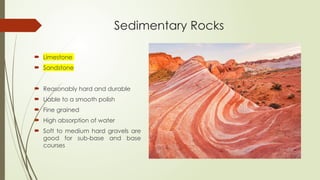
Sedimentary Rocks
 Limestone
 Sandstone
 Reasonably hard and durable
 Liable to a smooth polish
 Fine grained
 High absorption of water
 Soft to medium hard gravels are
good for sub-base and base
courses
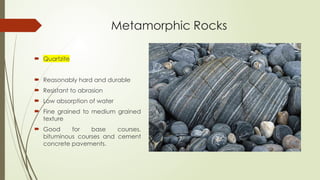
Metamorphic Rocks
 Quartzite
 Reasonably hard and durable
 Resistant to abrasion
 Low absorption of water
 Fine grained to medium grained
texture
 Good for base courses,
bituminous courses and cement
concrete pavements.
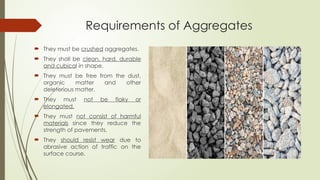
Requirements of Aggregates
 They must be crushed aggregates.
 They shall be clean, hard, durable
and cubical in shape.
 They must be free from the dust,
organic matter and other
deleterious matter.
 They must not be flaky or
elongated.
 They must not consist of harmful
materials since they reduce the
strength of pavements.
 They should resist wear due to
abrasive action of traffic on the
surface course.
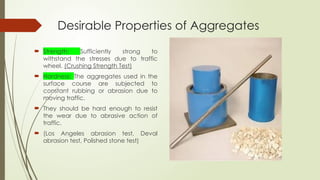
Desirable Properties of Aggregates
 Strength: Sufficiently strong to
withstand the stresses due to traffic
wheel. (Crushing Strength Test)
 Hardness: The aggregates used in the
surface course are subjected to
constant rubbing or abrasion due to
moving traffic.
 They should be hard enough to resist
the wear due to abrasive action of
traffic.
 (Los Angeles abrasion test, Deval
abrasion test, Polished stone test)
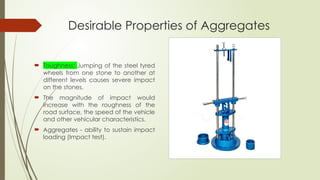
Desirable Properties of Aggregates
 Toughness: Jumping of the steel tyred
wheels from one stone to another at
different levels causes severe impact
on the stones.
 The magnitude of impact would
increase with the roughness of the
road surface, the speed of the vehicle
and other vehicular characteristics.
 Aggregates - ability to sustain impact
loading (Impact test).
Desirable Properties of Aggregates
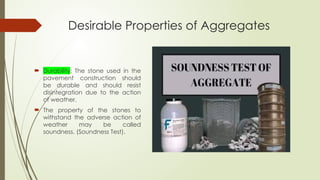
 Durability: The stone used in the
pavement construction should
be durable and should resist
disintegration due to the action
of weather.
 The property of the stones to
withstand the adverse action of
weather may be called
soundness. (Soundness Test).
Desirable Properties of Aggregates
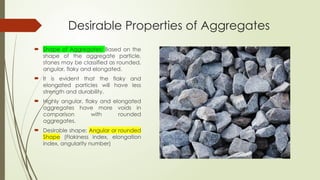
 Shape of Aggregates: Based on the
shape of the aggregate particle,
stones may be classified as rounded,
angular, flaky and elongated.
 It is evident that the flaky and
elongated particles will have less
strength and durability.
 Highly angular, flaky and elongated
aggregates have more voids in
comparison with rounded
aggregates.
 Desirable shape: Angular or rounded
Shape (Flakiness index, elongation
index, angularity number)
Desirable Properties of Aggregates
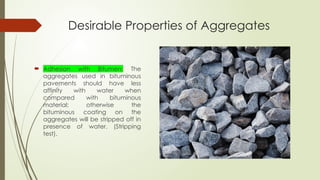
 Adhesion with Bitumen: The
aggregates used in bituminous
pavements should have less
affinity with water when
compared with bituminous
material; otherwise the
bituminous coating on the
aggregates will be stripped off in
presence of water. (Stripping
test).
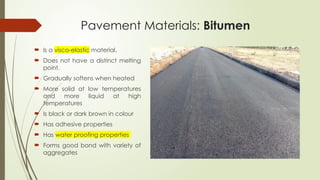
Pavement Materials: Bitumen
 Is a visco-elastic material.
 Does not have a distinct melting
point.
 Gradually softens when heated
 More solid at low temperatures
and more liquid at high
temperatures
 Is black or dark brown in colour
 Has adhesive properties
 Has water proofing properties
 Forms good bond with variety of
aggregates
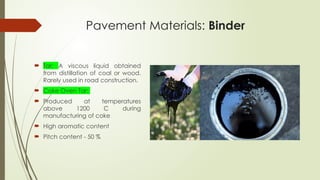
Pavement Materials: Binder
 Tar: A viscous liquid obtained
from distillation of coal or wood.
Rarely used in road construction.
 Coke Oven Tar:
 Produced at temperatures
above 1200 C during
manufacturing of coke
 High aromatic content
 Pitch content - 50 %
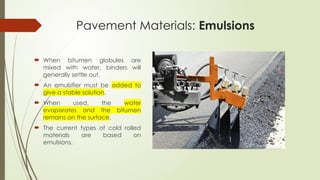
Pavement Materials: Emulsions
 When bitumen globules are
mixed with water, binders will
generally settle out.
 An emulsifier must be added to
give a stable solution.
 When used, the water
evaporates and the bitumen
remains on the surface.
 The current types of cold rolled
materials are based on
emulsions.
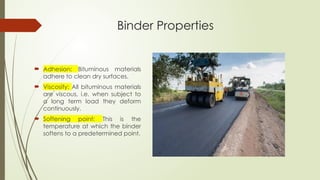
Binder Properties
 Adhesion: Bituminous materials
adhere to clean dry surfaces.
 Viscosity: All bituminous materials
are viscous, i.e. when subject to
a long term load they deform
continuously.
 Softening point: This is the
temperature at which the binder
softens to a predetermined point.
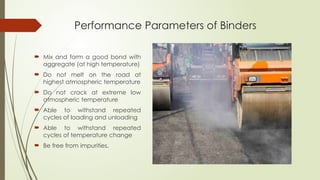
Performance Parameters of Binders
 Mix and form a good bond with
aggregate (at high temperature)
 Do not melt on the road at
highest atmospheric temperature
 Do not crack at extreme low
atmospheric temperature
 Able to withstand repeated
cycles of loading and unloading
 Able to withstand repeated
cycles of temperature change
 Be free from impurities.
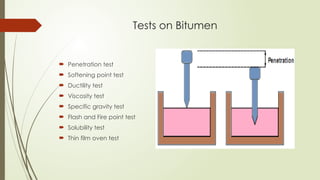
Tests on Bitumen
 Penetration test
 Softening point test
 Ductility test
 Viscosity test
 Specific gravity test
 Flash and Fire point test
 Solubility test
 Thin film oven test
THANK YOU

Pavement Types & Material, Highway Engineering.pptx

  • 1.
  • 2.
    What is aPavement? Pavement is a structure consisting of superimposed layers of processed materials above the natural soil sub-grade, whose primary function is to distribute the applied loads to the sub-grade. The ultimate aim is to ensure that the transmitted stresses due to wheel load are sufficiently reduced, so that they will not exceed bearing capacity of the sub-grade.
  • 3.
    Requirements of aPavement An ideal pavement should meet the following requirements:  Sufficient thickness to distribute the wheel load stresses to a safe value on the sub- grade soil,  Structurally strong to withstand all types of stresses imposed upon it  Adequate coefficient of friction to prevent skidding of vehicles  Smooth surface to provide comfort to road users even at high speed  Produce least noise from moving vehicles  Long design life with low maintenance cost.
  • 4.
    Types of Pavements: 1.Flexible Pavements 2. Rigid Pavements The pavements can be classified based on the structural performance into two, flexible pavements and rigid pavements.
  • 5.
    1. Flexible Pavements Theflexible pavement, having less flexural strength, acts like a flexible sheet (e.g. bituminous road). These components are placed on a subgrade to support the traffic load and distribute it to the roadbed soil. Flexible pavement may be constructed in a number of layers and the top layer has to be of best quality to sustain maximum compressive stress, in addition to wear and tear.
  • 6.
    Typical layers ofFlexible Pavement Typical layers of a conventional flexible pavement includes:  Seal Coat,  Surface Course,  Tack Coat,  Binder Course,  Prime Coat,  Base Course,  Sub-Base Course,  Compacted Sub-Grade, and  Natural Sub-Grade.
  • 7.
    Sub-grade  The topsoil or sub-grade is a layer of natural soil prepared to receive the stresses from the layers above.  It is essential that at no time soil sub-grade is overstressed.  It should be compacted to the desirable density, near the optimum moisture content.
  • 8.
    Sub-base Course  Thesub-base course is the layer of material beneath the base course  Provides structural support  Improves drainage  Reduce the intrusion of fines from the sub- grade in the pavement structure. A sub-base course is not always needed or used.
  • 9.
    Base Course  Thebase course is the layer of material immediately beneath the binder course.  Provides additional load distribution  Contributes to the sub-surface drainage.  It may be composed of crushed stone, crushed slag, and other untreated or stabilized material.
  • 10.
    Prime Coat  Applicationof low viscous cutback bitumen to an absorbent surface like granular bases on which binder layer is placed.  Provides bonding between two layers.  Unlike tack coat, prime coat penetrates into the layer below, plugs the voids, and forms a water tight surface.
  • 11.
    Binder Course  Providesthe bulk of the asphalt concrete structure.  Distributes load to the base course.  Consists of aggregates having less asphalt and doesn't require quality as high as the surface course,  Replacing a part of the surface course by the binder course results in more economical design.
  • 12.
    Tack Coat  Verylight application of asphalt usually asphalt emulsion diluted with water.  Provides proper bonding between two layer of binder course  Must be thin, uniformly cover the entire surface, and sets very fast.
  • 13.
    Surface Course Surface courseis the layer directly in contact with traffic loads and generally contains superior quality materials. They are usually constructed with dense graded asphalt concrete(AC). The functions and requirements of this layer are:  It provides characteristics such as friction, smoothness, drainage, etc. It prevents the entrance of excessive quantities of surface water into the underlying base, sub-base and sub-grade,  It must be tough to resist the distortion under traffic and provide a smooth and skid- resistant riding surface,  It must be water proof to protect the entire base and sub-grade from the weakening effect of water.
  • 14.
    Seal Coat Seal coatis a thin surface treatment used to water-proof the surface and to provide skid resistance.
  • 15.
    2. Rigid Pavements Rigid pavements have sufficient flexural strength to transmit the wheel load stresses to a wider area below.  Compared to flexible pavement, rigid pavements are placed either directly on the prepared sub-grade or on a single layer of granular or stabilized material.  Since there is only one layer of material between the concrete and the sub-grade, this layer can be called as base or sub-base course.
  • 16.
    Load distribution inRigid Pavement  In rigid pavement, load is distributed by the slab action, and the pavement behaves like an elastic plate resting on a viscous medium.  Rigid pavements are constructed by Portland cement concrete (PCC).
  • 17.
    The Difference: Flexible Pavements It consists of a series of layers with the highest quality material at or near the surface of the pavement.  Its stability depends upon the aggregate interlocks, particle friction, and cohesion.  Pavement design is greatly influenced by the subgrade strength.  Temperature variations due to change in atmospheric conditions do not produce stresses in flexible pavements.  Flexible pavements have self-healing properties due to heavier wheel loads that are recoverable to some extent. Rigid Pavements  It consists of one layer Portland cement concrete slab of relatively high flexural strength.  Its structural strength is provided by the pavement slab itself by its beam action.  Flexural strength of concrete is a major factor for design.  Temperature changes induce heavy stresses in the rigid pavement.  Any excessive deformation occurring due to heavier wheel loads are not recoverable.
  • 18.
    AIRPORT PAVEMENT  Inessence, a highway pavement and an airport pavement are similar to each other.  Both receive loads from rubber tyred vehicles travelling at high speeds.  Both are built up of material such as cement concrete, stone aggregates and bitumen bound layers.  Both rests on natural soil subgrade.
  • 19.
    Types of AirportPavements: 1. Flexible Pavements 2. Rigid Pavements The pavements can be classified based on the structural performance into two, flexible pavements and rigid pavements.
  • 20.
  • 21.
    Airport Pavement Design For ensuring smooth flow at very high speed, runway surfaces need to be build to a very high degree of finish, free from bumps.  Airport pavements are generally thicker than highway pavements & require better surfacing materials because the loading & tire pressure of aircraft are much greater than those of highway vehicles.
  • 22.
    PAVEMENT MATERIAL  Pavementmaterials can be versatile to cater a variety of road types and categories.  Commonly used pavement materials range from natural soils, aggregates, binders and assorted products used as admixtures for improved road quality.
  • 23.
    Purpose of Characterizationof Materials  To classify/grade  To obtain necessary inputs for design of new pavement  To ensure proper quality during construction  To obtain inputs regarding the condition of materials in an existing pavement.
  • 24.
    Pavements Materials  Recycledmaterials Etc.  Soil  Aggregate  Bitumen  Cement
  • 25.
    Pavement Materials: Aggregates Major components of road construction  Aggregates have to bear stresses occurring due to the wheel loads on the pavement  On the surface course aggregates also have to resist wear due to abrasive action of traffic.
  • 26.
    Uses of Aggregates Pavement construction in Cement concrete, Bituminous concrete and other Bituminous constructions.  Granular base course underlying the superior pavement layers.
  • 27.
    Types of Aggregates NaturalAggregates Obtained from rock Artificial Aggregates Slag (metallurgical process)
  • 28.
    Origin of Aggregates Gravel aggregates are small rounded stones of different sizes which are generally obtained as such from some river beds.  Aggregates are obtained from weathering or crushing of rocks.  The properties of the coarse aggregates depend on the properties of parent rock.  The properties of the rock depends on the constituent materials and the nature of bond between them.
  • 29.
    Natural Aggregates 1. IgneousRock  Formed by cooling of magma  Predominantly crystalline  Very good for bituminous courses and cement concrete pavements 2. Sedimentary Rock  Sedimentary rocks are deposited in layers, they have stratified or laminated structure.  Formed either from the deposition of – insoluble granular material resulting from the disintegration of pre-existing rocks, or – inorganic remains of marine and animals deposited in great quantities on the sea floor. 3. Metamorphic Rock  These are sedimentary or igneous rocks that have been subjected to great heat or great pressure or both, which has resulted in the formation of minerals and in textures different from those of the original rock.  Good for base courses, bituminous courses and cement concrete pavements
  • 30.
    Igneous Rock  Granite Basalt (Trap)  Hard and durable  Resistant to abrasion  Low absorption of water  Fine grained to coarse grained.  Very good for bituminous courses and cement concrete pavements.
  • 31.
    Sedimentary Rocks  Limestone Sandstone  Reasonably hard and durable  Liable to a smooth polish  Fine grained  High absorption of water  Soft to medium hard gravels are good for sub-base and base courses
  • 32.
    Metamorphic Rocks  Quartzite Reasonably hard and durable  Resistant to abrasion  Low absorption of water  Fine grained to medium grained texture  Good for base courses, bituminous courses and cement concrete pavements.
  • 33.
    Requirements of Aggregates They must be crushed aggregates.  They shall be clean, hard, durable and cubical in shape.  They must be free from the dust, organic matter and other deleterious matter.  They must not be flaky or elongated.  They must not consist of harmful materials since they reduce the strength of pavements.  They should resist wear due to abrasive action of traffic on the surface course.
  • 34.
    Desirable Properties ofAggregates  Strength: Sufficiently strong to withstand the stresses due to traffic wheel. (Crushing Strength Test)  Hardness: The aggregates used in the surface course are subjected to constant rubbing or abrasion due to moving traffic.  They should be hard enough to resist the wear due to abrasive action of traffic.  (Los Angeles abrasion test, Deval abrasion test, Polished stone test)
  • 35.
    Desirable Properties ofAggregates  Toughness: Jumping of the steel tyred wheels from one stone to another at different levels causes severe impact on the stones.  The magnitude of impact would increase with the roughness of the road surface, the speed of the vehicle and other vehicular characteristics.  Aggregates - ability to sustain impact loading (Impact test).
  • 36.
    Desirable Properties ofAggregates  Durability: The stone used in the pavement construction should be durable and should resist disintegration due to the action of weather.  The property of the stones to withstand the adverse action of weather may be called soundness. (Soundness Test).
  • 37.
    Desirable Properties ofAggregates  Shape of Aggregates: Based on the shape of the aggregate particle, stones may be classified as rounded, angular, flaky and elongated.  It is evident that the flaky and elongated particles will have less strength and durability.  Highly angular, flaky and elongated aggregates have more voids in comparison with rounded aggregates.  Desirable shape: Angular or rounded Shape (Flakiness index, elongation index, angularity number)
  • 38.
    Desirable Properties ofAggregates  Adhesion with Bitumen: The aggregates used in bituminous pavements should have less affinity with water when compared with bituminous material; otherwise the bituminous coating on the aggregates will be stripped off in presence of water. (Stripping test).
  • 39.
    Pavement Materials: Bitumen Is a visco-elastic material.  Does not have a distinct melting point.  Gradually softens when heated  More solid at low temperatures and more liquid at high temperatures  Is black or dark brown in colour  Has adhesive properties  Has water proofing properties  Forms good bond with variety of aggregates
  • 40.
    Pavement Materials: Binder Tar: A viscous liquid obtained from distillation of coal or wood. Rarely used in road construction.  Coke Oven Tar:  Produced at temperatures above 1200 C during manufacturing of coke  High aromatic content  Pitch content - 50 %
  • 41.
    Pavement Materials: Emulsions When bitumen globules are mixed with water, binders will generally settle out.  An emulsifier must be added to give a stable solution.  When used, the water evaporates and the bitumen remains on the surface.  The current types of cold rolled materials are based on emulsions.
  • 42.
    Binder Properties  Adhesion:Bituminous materials adhere to clean dry surfaces.  Viscosity: All bituminous materials are viscous, i.e. when subject to a long term load they deform continuously.  Softening point: This is the temperature at which the binder softens to a predetermined point.
  • 43.
    Performance Parameters ofBinders  Mix and form a good bond with aggregate (at high temperature)  Do not melt on the road at highest atmospheric temperature  Do not crack at extreme low atmospheric temperature  Able to withstand repeated cycles of loading and unloading  Able to withstand repeated cycles of temperature change  Be free from impurities.
  • 44.
    Tests on Bitumen Penetration test  Softening point test  Ductility test  Viscosity test  Specific gravity test  Flash and Fire point test  Solubility test  Thin film oven test
  • 45.