paul sharits
paul sharits
organized by yann beauvais
les presses du réel
Table of Content
Figment, yann beauvais
Paul Sharits and the Critique of Illusionism: An Introduction, Annette Michelson
Information theory and aesthetic perception: objects in your mirror are closer
than they appear, Keith Sanborn
Paul Sharits, Rosalind Krauss
Shadow is the Queen of Colour, Edwin Carels
The Artist as Archivist, Bill Brand
Art Friend (A Memoir), Józef Robakowski
Attention: Light! Technical description, Wieslaw Michalak
Interview with Paul Sharits, Jean-Claude Lebensztejn
Words per Page, Paul Sharits
Chart Of Visual Development / Razor Blades, Paul Sharits
Dear Mr. Lebensztejn, Paul Sharits
Letter to Marlis Grüterlich, Wallraf-Richartz Museum, Köln, Paul Sharits
Hearing : Seeing, Paul Sharits
Cinema As Cognition: Introductory Remarks, Paul Sharits
Regarding the Frozen Film Frame Series: A Statement for the 5th International Experimental
Film Festival, Knokke, December 1974, Paul Sharits
Program note for the Whitney Museum of American Art’s New American Film Series,
Paul Sharits
I Feel Free, Paul Sharits
Interview with Paul Sharits, Gary Garrels
Post-Expressionism, Paul Sharits
My painting (& film) for Galerie A, Paul Sharits
Filmography
Installations
7
31
35
47
57
63
71
73
77
103
113
115
117
121
127
131
133
135
141
153
163
195
196
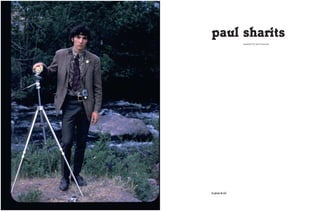
page 2 : Paul Sharits with tripod
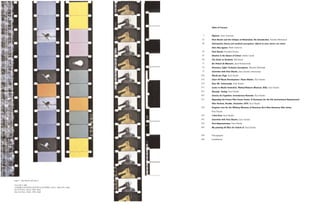
From left to right:
S:TREAM:S:S:ECTION:S:ECTION:S:S:ECTIONED, 16mm, 1968-1970, detail
N:O:T:H:I:N:G, 16mm, 1968, detail
Ray Gun Virus, 16mm, 1966, detail
Figment
yann beauvais
Paul Sharits was born July 8, 1943 and died July 8, 1993.
Although Paul Sharits is primarily known as a filmmaker, his artistic practice was not limited to the
realm of filmmaking. Painting, drawing, sculpture and performance all held a large place. They are
not broadly known and yet are essential if we wish to understand the scope and singularity of his
artistic work and achievements. His film and pictorial works revolved around two central themes:
one, formal, closely related to music, fit within the world of abstraction, while the other unfolded
within the psychological and emotional arena of the figurative. This exhibition proposes to show the
connections between these different practices by demonstrating that they are but moments of a
whole. Film can be projected, but it may also be approached as an object, in the way that Fluxus
drawings, scores and objects are.
Sharits was familiar with painting and film in his childhood; his uncle’s paintings fascinated him.
Film was present through the family chronicle that his godfather shot on 16mm. It was he who
offered Paul Sharits his first camera, along with the many reels of expired film that the artist used to
make his first film: a psychodrama shot when he was fifteen.1
After studying painting at Denver
University,2
Sharits dedicated himself to cinema. His films questioned the ability of the medium to
produce works – employing the very mechanisms and elements of the medium itself: the filmstrip and
its still frames, along with the passage of the filmstrip through the projector, and hence projection as
material, too, within his multi-screen films or in his installations – that are anti-illusionist.
In the 1960s Sharits moved from painting to film: “I stopped painting in the middle 1960s but
became more and more engaged with film, attempting to isolate and essentialize aspects of its
representationalism.”3
Three events encouraged this change, one related to art – the discovery of
Christo’s motorcycle:4
“Then I saw Christo’s motorcycle and thought I would never get to that level of
‘concise toughness’”;5
the other two were of a psychological nature: his mother’s suicide and his
becoming a father, which made him decide to give up painting and to take up industrial design.
The latter experience was not convincing, however. All these events led him to abandon the
Illumination, Accident 6
project and to focus on a radical approach to cinema. Henceforth, he would
be a filmmaker. As he said himself: “‘Cinematic’ meant ‘cinematic treatment’ of a non-filmic ‘subject.’
So I began to look to the actual materials-processes of my medium, in the most basic-obvious
modalities, for ‘subject’ matter and for appropriate overall structural principles.”7
He then launched
into a film that would become Ray Gun Virus and would take three years to make. It was also at this
time that he found an original way of writing and drawing “scores” for his films and creating modular
drawings on graph paper. This notation system would later free itself from this original purpose and
allow him to return to abstract painting, in the first instance, followed by a renewed interest in
figurative art at the end of the 1970s.
During his studies, he founded the Denver Experimental Film Society in 1962, which enabled him to
see films he had been unfamiliar with up until then. It was after a screening of Stan Brakhage’s Dog
1. “During 1958, when I began making
8mm film studies of a psychodramatic
nature.” See “I Feel Free”
in this catalogue.
2. Stan Brakage also studied at the
same university a few years earlier.
3. “Hearing : Seeing,” 1975, published
in Film Culture #65-66 (Winter, 1978).
4. Wrapped Vespa, 1963-64.
5. See “My painting (& film)” for Galerie A
(Amsterdam, 1989) in this catalogue.
6. Concerns a feature film that proved
impossible to edit and finish. With
regard to Illumination, Accident, see the
interview (unpublished) between Hollis
Frampton and Paul Sharits within the
framework of Media Studies at Buffalo,
1973, and “My painting (& film)” op. cit.
7. Paul Sharits:
“UR(i)N(ul)LS:S:TREAM:S:SECTION:S:SE
CTION:S:S:ECTIONED(A)(lysis)JO:“1968
-1970,” Film Culture #65-66, op cit.,
p. 13.
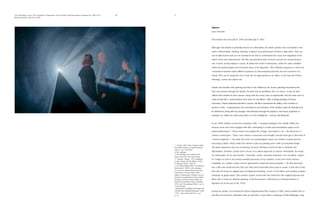
76Line Describing a Cone, 1973. Projection à l’exposition « Into the Light: Projected Image in American Art, 1964-1977 »,
Whitney Museum, New York, 2002
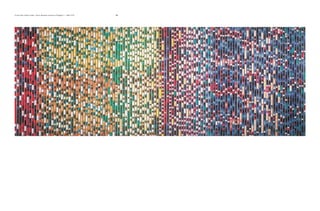
and the scores on graph paper allow us to grasp film as a whole; temporal experience is, in a
certain manner, discredited in favor of the analytical experience that unfolds through the “scores.”
The Frozen Film Frames allow us to distinguish the structuring and dividing up of the elements at
work that the experience of duration while watching the projected film masks because of the fusion
of these same elements in an audio-visual flow. A similar, though distinct, experience occurs with
Sharits’s multi-screen installations. Once again, everything is immediately apparent to us. Right from
the beginning, we perceive the various elements whose variations and combinations will nourish
and become the actual experience of the work. It is pointless to expect narrative development that
would modify our perception of the installation, such as that achieved, in its own fashion, by
Anthony McCall’s film/installation Line Describing a Cone. It is not a question of works “which raise
the possibilities of oscillatory composition, they don’t end, are not dramatic and don’t develop.”18
The experience of duration modifies the perception we have of a work by adding a temporal
dimension to it, enhanced by a soundtrack that the Frozen Film Frames notations do not call for.
Razor Blades marked both a break (we can talk about a tabula rasa compared with his writings at
the time in which he was not always kind with the current cinematographic avant-garde) as much
as a true beginning.19
The film radically distinguished itself from much else that was being made at
the time, although certain filmmakers – Peter Kubelka, Tony Conrad and Victor Grauer20
– had
worked with the flicker film.21
The films by the first two filmmakers were in black and white, while
Archangel by Grauer, who was also a musician,22
was in color. In Arnulf Rainer, Peter Kubelka’s
approach was dominated by music, whereas mathematics and the fact of performing with the
Theater of Eternal Music23
and of carrying out tests with stroboscopic lighting served as the basis of
Tony Conrad’s The Flicker.24
In Ray Gun Virus, Sharits was no longer dealing with abstract film, even though this work consists
of a stroboscopic succession of still pure color frames, accompanied by the recorded sound made
by the sprocket holes as they pass over the projector head. He would go so far as to say that it was
“a color narrative.”25
It is a concrete film, in that it uses the medium’s very materiality. He plays with
the medium’s basic components: the perforated filmstrip and dust specks in Apparent Motion.
The film operates according to the rhythms and sequence of colors that make the experience of the
film a visual exploration as much as a realization as to the specificity of the experience proposed.26
Does the film resist? Or does it stand in the way of its perception? The film offers us a peculiar
experience, which consists of an exchange between what is being projected – what we perceive of it
and what appears on the screen. The film resists the analysis of its experience during the screening.
The flicker makes us pass from public space (the theater), to a private experience (the analysis of
the phenomena of our perception of the film),27
before brutally slamming us back against the
screen. We go from the flicker to the physical perception of the screen (volume effect) and from the
screen to the flicker, but this return modifies the perception we have of both the screen
and the flicker.28
In Sharits’s flicker films, the question of immersion developed in his installations is constituent with
the experience of watching the projected film. The Ray Gun Virus experience also possesses a
peculiar cruelty, in that it is accompanied by the constant roar of the sprocket holes, whose regular
18. Program notes dated January 8, 1975
for the Whitney Museum of American Art’s
New American Film Series.
19. “I made a few things for this final form.
I really don’t have any defendable
aesthetic for doing something like this, just
a deeply felt impulse… I guess this is why I
am worried I can hardly wait to get it all
together. I am beginning to feel a logic that
‘justifies’ what I call ‘fragmented’… maybe
the beginning of something.”
Letter of May 20, 1967 to Stan Brakhage.
20. See the interview with Jean-Claude
Lebensztejn in this catalogue, initially
published in Ecrits sur l’art récent: Brice
Marden, Malcolm Morley, Paul Sharits
(Paris: Éditions Aldines, 1995)
21. An earlier film exists, with which these
filmmakers were unfamiliar because it was
rarely shown before being rediscovered in
the 1980s, namely: L’Anticoncept (1951)
by Gil Wolman
22. In “A Theory of Pure Film” in Field of
Vision #1 (Pittsburgh Fall 1976) and #3
(Winter 1977-78), Victor Grauer wanted to
establish a theory that would isolate film’s
basic elements with regard to his own films
and those by Kubelka, Conrad and Sharits.
23. Theater of the Eternal Music or Dream
Syndicate, an American music group that
explored experimental music and drone.
LaMonte Young, John Cale, Angus MacLise,
Marian Zazeela, Tony Conrad, and
sometimes Terry Riley, were members.
24. I am grateful to Keith Sanborn for
pointing out these details.
25. Interview with Frampton, March 1,
1973
26. See the texts by Rosalind Krauss,
“Paul Sharits” in Paul Sharits: Dream
Displacement and Other Projects,
published in conjunction with the exhibition
of the same name, Albright-Knox Art
Gallery (Buffalo 1976), and Annette
Michelson, “Paul Sharits and the Critique of
Illusionism: An Introduction” in the
Projected Exhibition exhibition catalogue,
Walker Art Center (Minneapolis Fall 1974)
reprinted in this catalogue.
27. This experience felt while watching a
Sharits’s film is analyzed by Keith Sanborn
in “Information theory and aesthetic
perception: objects in your mirror are
closer than they appear,” included in this
catalogue.
28. In a mid-November 1966 letter to
Sharits about Ray Gun Virus, Stan
Brakhage spoke of the similarities between
their work with regard to the use of light
flashes: “My enthusiasm after seeing your
film Ray Gun Virus was such that I would
have sent you a telegram if I could have
afforded it! I think I do really have a union
with your own film in that we are working
along the same Westward Ho! cultural line
of development wiz: the un-masked flash!
I showed Gregg the 1st tension of my work
in progress called Scenes from Under
Childhood and he/we all were amazed at
certain specific similarities and then also the
23rd Psalm Branch of mine is integrally in
value with the physiological rhythms of
memory re-calls (as the optic nerve flashes
in the act of memory).”
9
Star Man that he initiated a correspondence with the filmmaker in which he often talked about
his work.8
Sharits’s first film works participated in a psychodramatic movement that made use of actors and
thematically explored the subjects of sexuality, solitude, anxiety and fear. In this sense, these films picked
up on, and drew from, the reservoir of themes and subjects explored by earlier generations of American
filmmakers such as Maya Deren, Kenneth Anger, and Stan Brakhage.9
Some of these themes would be
found in part of his later film work alongside films that, based on the still frame, filmstrip and projection,
analyzed the processes and specifics of the cinematic mechanism. This approach took part in the
modernist project that placed great importance on a cinematographic ontology; a project clearly
synthesized in “Words per Page,”10
a study that served as an introduction to a class Sharits gave at Antioch
College in 1970. In this text, he defined cinema, acknowledging the importance of the still frame and the
film stock/strip as integral elements of film’s being. This approach was not dissimilar to that of Hollis
Framption, a few years earlier, during a conference/performance.11
This reduction of film to its integral
elements occurred more or less alongside Clement Greenburg’s theories12
as to the pertinence
of the reflexivity of artistic practice, which then triggered artists’ explorations of their chosen medium’s
specific potentialities.
Although painting fell within the scope of this dualism between abstraction and the figurative, Sharits’s
film work attempted to escape this kind of mutual exclusion. In a letter to Brakhage,13
he mentioned
the difficulty of making films that would be classed in the abstract film category, which he considered
reductionistic and too bound up with the history of painting rather than that of cinema. As he
acknowledged with regard to his first works (which he would later destroy in an anti-narrative rage),
his films operated at the edges of these categories; he used a term that he could have just as easily
applied to his later work. In a text written in 1963,14
referring to his filmic experiments, he described
them as “‘imagistic’”15
in order to distinguish them from more traditional films based on literary or
verbal symbolism. In these early works, of which Wintercourse is the only remaining example, the
narrative continuity typical of traditional film is fragmented and representational imagery thereby
obstructed. He nevertheless returned to this type of exploded narration in his later works: Figment I:
Fluxglam Voyage in Search of the Real Maciunas and Rapture. In this sense, Sharits adopted, for his
own purposes and in his own terms, the approach often found in works by many other filmmakers
of the New American Cinema, which consisted of shattering a dominant cinematic narrative
continuity in favor of the affirmation of brief temporal units elaborated through effects. Sharits
radicalized narrative deconstruction because his works did not attempt to shape any narrative
structure whatsoever, unlike that explored in the New Novel, Jean-Luc Godard’s films,16
or even in
works by Gregory Markopoulos.17
To consider the experience of film as a whole, which is to say as
an image, is to imagine cinema according to criteria that escape classical visual art considerations to
favor work that gives priority to form, and yet is not formalist. We realize how music, its notation
system, as much as its composition structure (for example sonatas and their four movements),
provided a model for Paul Sharits.
This understanding of film in its entirety, as an image, anticipated the spatial vision of film presented
by Frozen Film Frames (filmstrip “paintings”). Film, that fleet of moving images, resides in our
memory, whereas painting presents itself immediatly through all its elements. Frozen Film Frames
8. Unpublished correspondence
included in the Mind Frames: Media
Study at Buffalo exhibition at ZKM
(Karlsruhe: Zentrum für Kunst
und Medientechnologie, 2007)
9. For a study of these films see
P. Adams Sitney, Visionary Film:
The American Avant-Garde (New York:
Oxford University Press, 1974), and
David E. James, Allegories of Cinema:
American Film in the Sixties (Princeton:
Princeton University Press, 1989).
10. “Words per Page,” Afterimage #4
(London, Fall 1972).
11. “A Lecture 1968,” published in
The Avant-Garde Film: A Reader of
Theory and Criticism, ed. P. Adams
Sitney (New York: New York University
Press, 1978).
12. Let us recall that “Modernist
Painting” was published in Art and
Literature #4 (New York, Spring 1965).
13. “I’ve always & still do resist the idea
of abstract cinema for several reasons:
because my work in painting/sculpture
was never figurative (it was
‘abstract’/’non-objective’)… I am wary
of categorization (‘abstract cinema’) and
the idea that someone can ‘understand’
something by labeling it (labeling has,
for me, always led to ‘putting aside,’
‘feeling comfortable with,’ etc.”
14. Published in Catalogue 3 of the
Film-Makers’ Cooperative, Film Culture
#37 (Summer 1965)
15. With regard to the ambiguity of this
term, see the interview with Hollis
Frampton, op. cit.
16. We recall that one of Paul Sharits’s
first articles concerning the use of color
in film focused on Godard: “Red,
Blue, Godard,” Film Quarterly #19
(Summer 1966)
17. “Towards a New Narrative Film
Form,” Film Culture #31
(Winter 1963-64).
8
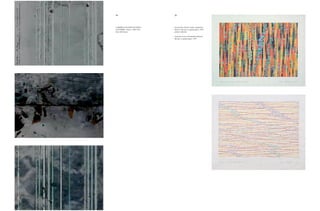
10Frozen Film Frames Series, 16mm filmstrips encased in Plexiglass, c. 1966-1976
shapes/images produced by the flicker. This sound repeated throughout the film matches the visual
pulsation, although it slips away in the middle of the film, where silence reigns. With Word Movie
(Fluxfilm 29), the sound of declaimed words seems to respond, precede and follow the streaming of
certain words appearing in the image, whereas N:O:T:H:I:N:G juxtaposes distinct temporalities.
We don’t see the immediate connection between a telephone’s ringing and the falling backwards off a
chair. On the other hand, what we feel is an affirmation of the inherent potentialities of a system that
allows us to activate the sound outside the image, and vice versa. The sound of this film is episodic,
most of the film is silent; we could say that, when sound suddenly arrives, it infringes on the image.
At the beginning of the film, we can hear a glass breaking, then the sound of liquid being poured into
a container, and, at the end of the film, when we hear cows moo, we deduce that the liquid in
question is milk. There is no causal logic between the sound events and neither are these linked to
the visual. Sound and image have a confrontational, contradictory, almost surreal relationship.32
We should also question the relationship between the texts33
– be they humorous (“A-R-E-Y-O-U-D-E-
A-D-?-H-U-H?” in Razor Blades) or trashy – and the figurative images, and how the verbal warnings
(text on screen) and violent images (surgical operations, assaults, and sexuality) function. The slit eye
reappears several times in Razor Blades (the two half-circles that do not form one of the film’s two
screens), and in T,O,U,C,H,I,N,G (the eye operation), echoing the recurrent image in Un Chien
Andalou, and, later, 3rd
Degree features an attack on a woman’s face, her eye, by the use of a lit
match. We can see this face more easily in Bad Burns because the film specimen is projected
normally, whereas the 3rd
Degree installation has the projection pivot by 90 degrees. In Razor Blades,
a sequence alternates the faces of a man and woman with very brief shots of a piece of meat sliced
in two by a razor, which is then coated with shaving cream.34
In Sound Strip/Film Strip,35
the scratch on the sprocket holes is part of this same humor that plays
with film’s capacity to produce visual illusions: “That can’t happen since the sprocket hole is just
empty: there can’t be a scratch inside it.”36
The trace of facial scratches in T,O,U,C,H,I,N,G appears as a trickle of glitter, which is inappropriate to say
the least. We are in the presence of a representation heightened by alteration. The scene’s violence is
minimized and mocked by this blood that isn’t, because it consists of glitter. We are in the realm of “bad
taste,” which is part of a “camp” esthetic that has appropriated materials and moods from other domains.
References to comic books and cartoons abound (the light bulb hollowing out its black light in
N:O:T:H:I:N:G). Comedy is also present: in Analytical Study II: Unframed Lines, a specimen of worn out
filmstrip vainly tries to pass through an analytical projector; the pseudo-educational film on how to wipe
your ass in Razor Blades. This humor that makes light of bad taste is also found in the bones spiked with
colored paint, as it is in most of the fluxus objects: Pair of Silver Shoes Covered in Plastic Spiders, Keys…
The mat aspect of the painted bones’ colors, the juxaposition of textures in the fluxus objects and the
abstract paintings, and then in the “expressionist” works of the 80s, the chromatic juxtapositions, all
combine to explore the limits of taste. Scenes of violence, either represented or suggested, are also
found in the treatment of the filmstrip itself, be it by scratches or burns, or even both together in
certain cases, as in Anlaytical Studies, Episodic Generation and 3rd
Degree.
29. Razor Blades is composed of 14
loops made over a period of years for
various projects.
30. The film was made over a period
of three years.
31. With regard to this phenomenon of
irradiation, see Edwin Carels, “Shadow is
the Queen of Colour,” in which he
analyzes the relationship between
Joseph Plateau’s experiences and those of
Paul Sharits, included in this catalogue.
32. See the interview with yann beauvais,
July 1980, Scratch Book (Paris, 1998).
33. The relationship Paul Sharits’s films
develop between the text as image or
the image of the text as scansion
(Razor Blades, Word Movie (Fluxfilm 29))
is worthy of a whole separate study.
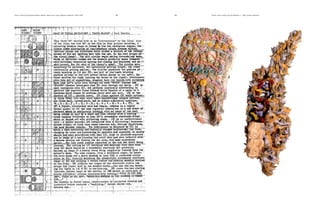
34. See Chart of Visual Development,
Razor Blades, in this catalogue.
35. A precise description of this
installation, along with the problems
inherent to it, can be found in the text by
Bill Brand, “The Artist as Archivist,” in this
catalogue. Originally published in In
Results You Can’t Refuse: Celebrating 30
Years of BB Optics, ed. Andrew Lampert
(New York: Anthology Film Archives,
2006).
36. Paul Sharits interviewed by Gary
Garrels, originally published in the
Mediums of Language: Vernon Fisher,
Myrel Chernick, Paul Sharits exhibition
catalogue, Hayden Galleries, MIT
(Massachusetts 1982).
13
scansion clashes with the flicker’s chromatic flash, which obeys a whole other logic of sequences.
This regular repetition of sprocket hole noise anticipated the soundtracks of various films in which
a/some words were indefinitely repeated, such as T,O,U,C,H,I,N,G, Inferential Current and Episodic
Generation, and for the installation Sound Strip/Film Strip. But it is Color Sound Frames that will
directly prolong this roar by the refilming, at varying speeds and with synchronous sound, of
scrolling filmstrips complete with their sprocket holes. Inferential Current deploys sound processes
similar to those used for the image. In this film, two strips of flicker film stream in opposite
directions. Depending on one of the strip’s running speeds, the word repeated in each of the
soundtracks produces blocks of swirling meaning, such as can be experienced, for example, with
Steve Reich’s Come Out and It’s Gonna Rain. The overlaying of sound loops, staggered or not
according to their speeding up or slowing down, produces these effects, which distance themselves
from what is perceived visually despite a processual similarity.
In Sears Catalogue 1-3, Dots 1 & 2, Wrist Trick, Unrolling Event, Word Movie (Fluxfilm 29), Ray Gun
Virus, Piece Mandala/End War, Razor Blades, T,O,U,C,H,I,N,G and N:O:T:H:I:N:G, Sharits combined
photos and illustrations with pure color frames. The confrontational dynamic between these elements is
emphasized by the fragmentary aspect of the first films, which function according to an accumulation of
short, distinct loops.29
These loops enabled Sharits to establish sets of tonalities, chromatic sequences that
produce effects of volume, and depths of contractions and expansions of the color field modified by the
flicker speed as much as by the dominant that distributes them. With these early films, he recorded the
creation of emerging forms, their movements and speeds that depend, for a major part, on tonalities;
some of the tonalties led to large forms, while the sense of movement seemed to stem from the
recurrence of colors used over a duration. Razor Blades30
opens and closes this first series of films, which
do not develop according to symmetrical forms or mandalas, as was the case with Piece Mandala/End
War, T,O,U,C,H,I,N,G and N:O:T:H:I:N:G. The recourse to a form that established a linearity running
through the film allowed a loosening up in the arrangement of rhythms, according to pre-established
geometrical expansions (which are also found in various sketches and preliminary diagrams for these
films). It is this increase and retraction of the pulsation – may we speak of the variable of the interstice?
– that allows the fusing of units in T,O,U,C,H,I,N,G, while in N:O:T:H:I:N:G the accentuated chromatic
variations separate themselves from the figurative elements. These chromatic interludes, these
irradiations,31
suddenly appear – just like the flashes that cause our perception of the mandala to vacillate,
thereby favoring the immediacy of the chromatic assault. In N:O:T:H:I:N:G, the soundtrack shapes the
perception of the flicker in a new way. With Ray Gun Virus, the roar of the sprocket holes brings about
acoustic phenomena similar to those unfurled by the music of LaMonte Young or Terry Riley: drone. The
word “destroy” repeated incessantly, except during T,O,U,C,H,I,N,G’s central section, shapes, for its part,
causal relationships between the sound and image that are not found in N:O:T:H:I:N:G, which instead
favors acoustic drift, if not to say unpredictability.
N:O:T:H:I:N:G. opens up the possibilities of juxtapositions between sound and image that are not
causal or even processual. T,O,U,C,H,I,N,G’s soundtrack has been constructed from five versions of
“destroy” being said aloud and joined together without any pauses. As Sharits himself notes, the
word “destroy” breaks down into two parts, “de” and “stroy,” which suspend our comprehension of
the word itself, and give rise to parasitical words – or so we believe we hear – like those
12 Word Movie, 16mm, 1966, detailT,O,U,C,H,I,N,G, 16mm, 1968, detail
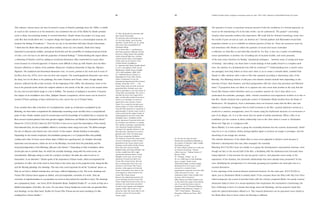
1514 Bones, bone, acrylic and Gel Medium, c. 1980, private collectionChart of Visual Development/Razor Blades. Extract from Razor Blades workbook, 1966-1968
16Posalo, acrylic on canvas, c. 1982, private collection
The question of music is important because around it both the conditions of a formal approach, as
much as the abandoning of it in the later works, can be understood. The project43
concerning
Chopin’s final mazurka confirms this importance. We recall that for Clement Greenberg, music was
the model of pure art and as such, an abstract art.44
Several painters and filmmakers found their
inspiration therein so as to establish an abstract practice of their art. There are numerous texts by,
and interviews with Sharits in which the question of sound and music motivated
a reflection on what film is and what film should be. For him, it was not a matter of establishing
some synaesthesia or another, but of making use of musical models, and more precisely,
of the way music functions by finding “operational analogues… between ways of seeing and ways
of hearing,” and asking “can there exist a visual analogy of that quality found in a complex aural
tone, the mixture of a fundamental tone with its overtones?”45
Understanding how a chord’s notes
are arranged, how they follow on from each other so as to create a melodic fabric, enabled Paul
Sharits to offer solutions with a view to film that operated according to elementary units of the
filmstrip. The flickering clusters of still pure color frames created melodic lines depending on the
intensity of hues, their duration, and their juxtaposition with the colors that preceded and followed
them.46
A projection does not allow us to capture one color more than another in the way that the
frozen film frames (which therefore serve as a notation system) do, but it does allow us to
understand the melodies, passages, shifts, colored contractions and expansions worked on in this or
that film. Sharits declared that a particular section of Declarative Mode resulted from the finale of
Beethoven’s 7th Symphony. Such a declaration does not however mean that the film’s aim was
related to synethesia. It happens that for brief moments in the film, musical rhythmics served as a
model for a section’s arrangement, even if it meant using the rhythmical structure of a movement or
part of an allegro, etc. It is in this sense that we speak of partial synesthesia. When a film or an
installation put two screens in direct relationship (one in the other when it comes to Declarative
Mode and Tirgu Jiu, or contiguous with
Razor Blades), it is even easier to grasp the musicality between the two screens (instrument), which
may be in or out of phase, before joining together again to produce an image or passages, and the
dissolving of one image into another.
The melodic dimension of the flicker films is even more palpable in Sharits’s work because it
followed a development that was often arranged: the mandala.
Watching N:O:T:H:I:N:G does not enable us to grasp the development’s symmetrical structure, even
though we feel, in the second half of the film, a familiarity with the rhythmical and chromatic lines
being explored. Is this because the eye has grown used to, and pinpoints more easily, in the
experience of the duration, the chromatic relationships that have already been presented? In this
case, identifying the arrangement of a chromatic grouping and repetition are what give rise to a
musical dimension.
Is this capturing of the musical element reinforced because, for the main part, N:O:T:H:I:N:G is
silent, just as Declarative Mode is entirely silent? If we compare these two films with Ray Gun Virus,
which juxtaposes the sound of sprocket holes with the colored, projected flicker, the purely musical
dimension fades in favor of a visual experience that emphasizes the mechanism’s functioning: the
flow of filmstrip in front of a shutter that brings about the flickering, and the projector head that
reads the optical information offered to it. This musical dimension can be perceived more clearly in
the flicker films than in those where the filmstrip is refilmed.
43. See the two texts by Jòzef
Robakowski and Wieslaw Michalak on
the creation of Attention: Light!, initially
Paul Sharits’s project.
44. Edson Barrus alerted me to this text
by Clement Greenberg: “Toward
a New Laocoon,” Partisan Review #7
(Boston 1940)
45. “Hearing : Seeing,” op. cit.
46. In a 1968 letter to Stan Brakhage
about a project, Sharits wrote:
“Referential images would be largely
eliminated from such works, as the
concern for a musical (I have
apprehension using that word since film
is film and music is music… you
understand what I mean though) color
structure will be dominant.”
Gilles Deleuze and Felix Guattari touch
on this when they speak of the piloting
role of sounds that induce colors in
synethesia. See A Thousand Plateaus,
translator Brian Massumi, Chapter 11
”1837: Of the Refrain.” (Minnesota:
University of Minnesota Press, 1987)
p. 347.
19
This violence, whose traces can also be found in many of Sharits’s paintings from the 1980s, is visible
as much in the contents as in the treatment, but sometimes the use of the flicker by Sharits pertains
more to diary, documenting anxiety. In several interviews, Sharits shares the project of a long, pure
color film that would allow him “to express things that happen almost in a chronological manner; for
instance the feeling of loneliness.”37
Does he not say, in his interview with Jean-Claude Lebensztejn,
“I think that the flicker films are partly about anxiety, about my own anxiety. Aside from being
interested in perceptual realities, perceptual thresholds and the possibility of creating temporal chords
of color, a lot of it has to do with the projection of internal feelings.”38
Acknowleding this aspect allows
a reframing of Sharits’s work by adding an emotional dimension often overlooked by many critics
more focused on a formal approach. It became more difficult to keep up with Sharits once the films
became reflections or diaries of his anxieties (Brancusi’s Sculpture Ensemble at Tirgu Jiu, Figment,
Rapture). The analytical and theoretical dimension was, of course, present in his work and in most of
his films from the 1970s, but it was not their sole impetus. The autobiographical dimension was never
far away, be it in his films or his paintings; the series Positano and Posalo, which, though deeply
abstract, reflected his life at that moment. At the beginning of the 1980s, this dimension came to the
fore in his pictorial works where the subjects related to the events of his life, such as the assault when
he was shot at point-blank range in a bar in Buffalo. The question of epilepsy is recurrent; it became
the subject of an installation and a film, Epileptic Seizure Comparison, whose traces can be found in
several of Paul’s paintings of faces deformed by color, and in the cry of Portrait Series.
If we consider that a film is the flow of a modulated line, made up of elements coordinated by the
flickering, we then better comprehend the relationship connecting music and film from a compositional
point of view. Sharits studied music for several years and his knowledge of it enabled him to compose his
films around musical patterns that were genuine triggers: Beethoven and Mahler for Declarative Mode,39
Mozart for T,O,U,C,H,I,N,G, Bach for N:O:T:H:I:N:G. It was not so much the transcription of the melody
that interested him, but the possibilities offered to musicians when using such tools. The flicker arranges
the sets of still pure color frames into color chords. In this respect, Shutter Interface is exemplary.
Depending on the version employed, this installation juxtaposes 2 or 4 projected films that partially
overlap each other. In those zones where strips of flicker are superimposed, we visualize chromatic
harmonics and resonances, which are not on the filmstrips, but result from the periodicity and the
temporal juxtaposition of the flickering, still pure color frames.40
Depending on their modulation, these
chords give rise to melodic lines, for which the modular drawings, along with the work scores, are
essential links. Although acting as notes for a project’s evolution, the latter also exist in and as of
themselves. In an interview,41
Sharits spoke of the importance of these works, which accompanied the
production of a film, and of the need to show them in the same way as the projected work, being the film
and the filmstrip paintings, the drawings. This was even more important for all the “locational” pieces, as
they do not have a defined running time, are loops, without beginning or end. The score, drawings and
Frozen Film Frames hence appear as distinct, and yet inseparable, moments of a work. They are
moments of experimentation in a proposition as much as they extend the way film is used. The drawings
are a preparatory study – see Score 3A for Declarative Mode, Analytical Studies IV – as much as they are a
faithful transcription of the film, the score. On one hand, Frame Studies are scores that can generate films
and drawings, on the other hand, Studies for Frozen Film Frames are the exact rendering of a film
resulting from Frame Studies.42
37. Ibid, along with the interview with
Jean-Claude Lebensztejn.
38. Interview with Lebensztejn op. cit.
39. See Paul Sharits, yann beauvais
interview, Scratch Book, op. cit., along
with work notes (unpublished) for
Declarative Mode.
40. In Horror Film 1, a performance
with three projectors, Malcolm LeGrice
becomes a living shutter who partially
masks projected light rays, creating
colored shadow play. A prolongation
of this work can be found in a few
of Anita Tacher’s installations.
41. Interview with Steina Vasulka filmed
in 1977, and edited in 2005, for the
MindFrames: Media Study at Buffalo
1973-1990 exhibition, ZKM, 2007.
42. “Exhibition/Frozen Frames, in
Regarding the Frozen Film Frames
Series: A statement, for the 5th
International Experimental Film Festival,
Knokke, December 1974.” “…The
Frame Study series are both scores for
generating films (wherein each color
mark is equivalent to one color frame of
16mm film) and drawings. The score is
read like the book, from upper left to
right, one line after another from top to
bottom; as a drawing, it is read as a
typical all-at-once structure. Frame
Study 15 is a study for the final score
(Frame Study 17) of the 3,600 frame-
long (90’) film Specimen II. Specimen II,
approximately 3 minutes long, is both a
work in itself and the subject matter of
rephotography for the four-screen film
installation piece, Oscillation (which
shows Specimen II, sprocket holes and
all, moving in one direction, at varying
slow speeds of passage, superimposed
over Specimen II going backwards,
moving in the opposite direction to the
first exposure); Specimen II is used to
generate each of the 10-minute-long
film loops comprising Oscillation.
The Study for Frozen Film Frame series
are exact renderings of what the films
generated by the Frame Study scores-
drawings would (will) look like if those
films were (are cut) into equally
lengthed strips and hung vertically, side
by side, serially from left to right,
sandwiched between sheets of clear
Plexiglas. In this case, we see what
Specimen II would look like in the
Frozen Film Frame format. We note
that, in transposition from the score
structure to the Frozen Film Frame
structure, what appear as horizontal
bands of dominant color zones in the
score appear as vertical bands in the
Frozen Film Frame format.
Because the relationship between the
scores-drawings and the Frozen Film
Frame studies derived from them are so
absolute, the works form sets which
should be kept together and displayed
together, either side by side or one
above the other (the score either to the
left side or above the Frozen Film
Frame study).”
18 Untitled Portraits Series, acrylique et technique mixte sur toile, 1991-1992, collection du Burchfield-Penney Art Center
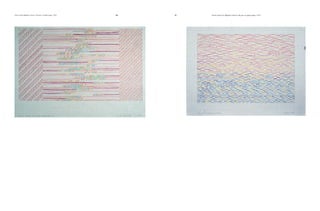
2120 Frame Study 24: Migraine Onset B, felt pen on graph paper, 1979Frame Study Migraine Onset G, felt pen on graph paper, 1976
positioning, matches the increasing layers of declaimed words as much as, by symmetrical
inversion, it recalls the diminishing and recommencement of the river sequences. The sound of the
splices, which is not synchronized but staggered according to diminishing intervals, emphasizes both
the implacability of the system Sharits’s employs as much as the possibility of lingering at all kinds
of intervals within a system. The scratches of varying thicknesses and changing colors sometimes
set off leaks in the image, the flows, partially becoming scratches or vice-versa, produce an overlap
in the image’s thickness, between the back- and foreground. A fusion by retraction of the
cinematographic illusion is produced in the course of a scratch, while others, like a Lye doodle,
buckle and twist in order to keep the separation between the nature of the two filmed objects
present in the image. At each splice, all the scratches disappear from a still frame; all we see is a
black mark centered in the image, the beginning of a flicker is induced by the interplay of the splices
in the river shots. The scratches and flows fit into one another in an amazing counterpoint from
which emerge beeps and the scratches’ static, like a fleeting ritornello. Because the logic of this film’s
development is predictable, we can “explore these moments of particular tension in which the
illusion of a stream of projected images plays with the flux of images: the projected filmstrip, the
one we are actually busy watching.”
S:TREAM:S:S:ECTION:S:ECTION:S:S:ECTIONED informs us of the future development that Sharits
would undertake with films and installations whose subject is the motion of the filmstrip through the
projector. The superimposed layering of the river shots anticipated the filmstrip slidings of Sound
Strip/Film Strip, Color Sound Frames, the Analytical Studies series, and Episodic Generation. These
works arranged space and questioned other optical illusions, thereby separating themselves from
the Op Art arena in which some of Sharits’s films were often presumed to belong. Color Sound
Frames and Episodic Generation show how the sliding of filmstrips produces gaps that seem to
distort the screen. We are in the presence of optical illusions that induce blisters on the vertical
edges of the screen in the single-screen version of Episodic Generation. These effects become
horizontal in the installation because the projectors are tipped 90 degrees to the right. Presented in
its installation form, this film seems to modifiy the solid appearance of the screen on which it is
projected. Suddenly, affected by the speeds at which the layers were shot, the screen deforms and
the wall, this screen, becomes a bent space, or more precisely, an ondulating space; nothing is still,
nothing is less certain than this fiction that we see at work, of which we are the actors.
The installations demand the participation of the spectators; they represent an important phase in
the literally immersive development of Sharits’s cinematographic work. In the films, the immersion
was often counterbalanced by the emotional impact of certain images – for example, the eye
operation, to mention but one. Gil Wolman delved into the question of the violence of stroboscopic
effects in his film L’Anticoncept, which questioned the classic mechanism of projection because a
sounding balloon was required for the film to be screened.53
Paul Sharits envisaged his works for the
museum and art gallery as an extension and an overtaking of the formatted framework of
screenings in a theater. “Film can occupy spaces other than that of the theater; it can become
‘locational’ (rather than suggesting-representing other locations) by existing in spaces whose shapes
and scales of possible sound and image ‘sizes’ are part of the holistic piece. I have found this form
of filmmaking and display, using ‘more than one projector,’ more and more meaningful (and
53. Jean-Michel Bouhours took an
interest in Wolman’s films and explored
their relation to works by Kubelka and
Conrad in a fine text, “De l’anticoncept
à l’anticoncept, 1950 – 1990,” initially
published in a catalogue about Wolman
(Paris 1990), and included in the
upcoming publication Quel cinema
(Dijon: Les presses du réel).
23
S:TREAM:S:S:ECTION:S:ECTION:S:S:ECTIONED escapes this proscription. It is not actually a flicker
film, and yet the musical paradigm is forcefully affirmed by it. With this film, Sharits said he had
finally come “to use superimposition, as a way of attaining both ‘chordal depth’ and the possibility of
‘counterpoint’.” Later on, he would ask that his reader “not jump to the conclusion that ‘musicality’ is
the primary intention behind the film.”47
The film’s organization is important because it mixes at least
four distinct sources of information: the superimposed shots of the river (which pass from six to
none, looped 3 times), scratches (8 sets of three scratches every four minutes from the fourth),
repeated words (numbering six, layered one on the other), and beeps and splices (the relationship
between the beeps and the splices is modular).48
The film compares the filmstrip’s streaming with
the water’s flow, it questions the interval existing between the photographic recording, which creates
the illusion of three-dimensional space, with the filmstrip’s two-dimensional physical space. The six
shots of the river interweave in an effervescence of information flows that rarely let us single out any
particular one.
When only one flow remains, we have the impression of seeing others. We have entered a realm to
do with the imagination: a construction (a figment). The first word repeated in a loop, like in
T,O,U,C,H,I,N,G, upon which, one by one, the others are spliced, irrigates this figment. The repetition
induces another sound effervescence, another flow about which we perceive the differences without,
however, halting to note them; they are part of the information flow and the experience. An interval’s
arrival on the scene is part of the proposition and reinforces it. Each set of scratches makes us look
at the frame in another way, along with the water currents, and the relationship connecting these two
kinds of photographic and graphic information. The scratch affirms the medium’s fragility as much as
its materiality; it is for this reason it has often been cast aside by entertainment movies and rarely
claimed by avant-garde filmmakers. An entire archeaology about the incorporation of the scratch as a
visual element merits being established, which would include, among others, Len Lye, Adrian Brunel,
Stan Brakhage, Isidore Isou, Maurice Lemaitre, and Carolee Schneeman, to mention just a few.
These scratches, which are the very subject of the film and affirm, for the first time, the importance
of flow in Sharits’s work, are also important plastic objects that link this film to the field of plastic arts
(think of Barnett Newman’s zip, or Lucio Fontana’s slashes), as much as they show the connection
existing between the modular designs and the scores. The latter two are created by the means of
colored dots that represent a still frame, or more or less trembling, zigzagging lines (we could almost
be talking about doodles).49
In one, we see the score, still frame by still frame, in the other we see in
the dissolves from one color into another, the simultaneous criss-crossings of distinct information.
One thing that is glaringly obvious in S:TREAM:S:S:ECTION:S:ECTION:S:S:ECTIONED, as is the case
with Wintercourse, 3rd
Degree,50
and even Rapture,51
is that photographic quality matters little to the
filmmaker. By photographic quality, we mean what is technically envisaged as the norm: good
exposure, sharpness, lighting… In these films what is worked upon is not the beautiful image but
the production of a cinematographic image, which is to say, an image that is only by and in the
projection, an image by which we will induce thinking about the apparatus as much as about the
mechanisms that allow us to grasp what is at play during the reception of these propositions. Herein
we find what Duchamp52
advocated as to the participation of the spectator with regard to the
composition of a work. These are the procedures that Sharits employed in
S:TREAM:S:S:ECTION:S:ECTION:S:ECTION:S: S:ECTIONED and which describe the relation to the
musical; the predictability of the arrival of the scratches, without however knowing exactly their
47. “Hearing : Seeing,” op.cit.
48. Regina Cornell offers an excellent
analysis of this film in “Paul Sharits:
Illusion and Object,” Artforum
(New York, September 1971).
49. With regard to doodling, or
automatic drawing, Len Lye
demonstrated balletic flair at this,
directly scratching the filmstrip.
See Len Lye, eds. Jean-Michel
Bouhours, Roger Horrocks
(Paris: Pompidou Center, 2000).
50. In his interview with Gary Garrels,
Sharits speaks about the bad quality of
the image speciman used in 3rd Degree.
51. In a letter to me in February, 1988,
Paul wrote that he had moved from film
to video, and that he hoped to make
flicker films, or more precisely “color
field pieces,” in video.
52. “The Creative Act,” Marcel
Duchamp. A paper read at the Session
on the Creative Act, Convention of the
American Federation of Arts, Houston,
Texas, April 1957.
22
Frozen Film Frames Study: Declarative
Mode II, felt pen on graph paper, 1976,
private collection
Study for Score of Declarative Mode II,
felt pen on graph paper, 1976
25
S:TREAM:S:S:ECTION:S:ECTION:S:
S:ECTIONED, 16mm, 1968-1970,
three still frames
24
2726 Chart for T,O,U,C,H,I,N,G, pencil and chalk on paper, 1986Study for the 3rd
Degree installation, pencil and chalk on paper, 1982
Destruction, violence and intimidation make 3rd
Degree57
as much a study of the intimidated woman’s
fragility and vulnerability as it is of the film’s; the theme had already been broached, but in a more
formal manner, in Analytical Studies 2 and 4.
From 1982, Sharits’s film output began to diminish after the assault mentioned earlier, which nearly
cost him his life. He returned more ferociously to painting and exhibited more often. His paintings’
subjects became more openly autobiographical and revived certain motifs found in his films: the
firearm in Ray Gun Virus is found in several paintings, of which Infected Pistol is an example. His
working of pictorial matter was more affirmed; paint was directly emptied from a tube onto the
canvas, or applied by means of a cake decorator, the themes referred back to moments of
destruction, infection, etc. Networks of lines creating superimposed figures call to mind certain
cinematographic effects in which a delay, a lapse between seeing and perceiving is created.
At this point, painting represented a new terrain for experimentation that film could no longer
provide. Nonetheless, new directions were explored in film, among which the diary film dimension
was fully assumed in Brancusi’s Sculpture Ensemble at Tirgu Jiu. This dimension would be extended
further in Figment, whose form closely resembles a chronicle in episodes (serial), which enabled
Sharits to discover new sound designs. This question of new sound relationships is illustrated by the
project concerning Chopin’s mazurka. During a trip to Poland, Sharits discovered this composition
and decided to launch into a new project, doing tests by filming to the music’s rhythms.58
A few weeks later he sent the score, which would serve as the guiding line for the film’s production,
back to Jòzef Robakowski. Exhibiting installations required maintenance that Sharits would often
have to oversee, making exhibition a draining task,
a supplementary constraint that became onerous. The precariousness of his living situation led
Paul Sharits to explore less costly mediums: video and performances, thereby reconnecting
with the Fluxus spirit.
The moment has now come to consider his work in its entirety; we hope this exhibition and this
catalogue mark the necessary beginnings.
57. I’m grateful to Keith Sanborn for
alerting me to this title’s other
connotations: “to give someone the
third degree.” A phrase first heard in
American film noir films in the 1930s.
Paul Sharits watched all kinds of films;
for his classes, he borrowed examples
from all genres of film dating right back
to film’s beginnings.
A study of the relationship between
Paul Sharits’s films and B-movies would
be worthy of attention.
58. This experience is detailed in
“Art Friend (a memoir)” by
Jòzef Robakowski, initially published
by Hallwalls 2004, for the opening
of Attention: Light! and reprinted
in this catalogue.
29
imperative if I wish to truly actualize my intent of developing a clear ontological analysis of film’s
many mechanisms and dualisms).”54
We mentioned earlier that Paul Sharits’s installations require spectator participation because they are
above all analytical. They explore the notion of projection streaming along with the conditions of
how the work is received. Spectators question how the piece was produced, thereby enabling it to
also be the means of what it puts into place. The work’s contents are not concealed, “they are its
specimen.” It is because these works are open, can be entered or left at any time, do not have a
predetermined running time, their compositional structure does not respond to plot development
criteria, and their contents are immediate, that they require a commitment from spectators. As a
spectator of the Dream Displacement installation noted, the sound layout in relation to the image
induces a gap in the projection space, which encourages viewers to constantly move about.55
What’s
more, projection is spatially distributed, which reinforces the movement in the space. One must pace
around the projection space to activate it. Although everything is present from the beginning, it is the
moving about that enables one to grasp what is unfolding in the projected work. Each work
configures the space it occupies in a specific way.56
The images’ format, the way in which they fit
exactly together, often reproducing a horizontal rather than vertical unspooling filmstrip, their
relationship with the sound, which may be environmental (a sound landscape) or localized, renews
and demonstrates the variety of locational interventions created by Paul Sharits. Although the first
installations favored the streaming of filmstrips, two of these did not fit that mold: 3rd
Degree in part,
and Epileptic Seizure Comparison entirely. The latter is the only vertical installation, in which we are
both in the interior and at the exterior of an epileptic seizure. We notice that the various drawings
accompanying 3rd
Degree’s production show the work from two directions, either the three films flow
to the right, or to the left in an interlocking step pattern.
In Epileptic Seizure Comparison, we share the seizure in two ways, on the one hand we see and
hear patients’ cries, on the other we hear and see a sound transcription of the alpha brainwaves of
these same patients, along with a chromatic conversion of this same seizure, from the interior.
Both screens flicker alternately, dispersing the seizures in a triangular environment that only adds
to their intensity.
Epileptic Seizure Comparison revived the use of double screens, which were one of the permanent
features of Paul Sharits’s cinematographic work – from Razor Blades, through Vertical Contiguity,
Declarative Mode, Brancusi’s Scuplture Ensemble at Tirgu Jiu, and Tirgu Jiu. The double screen’s
multiplicity of spatial configurations enabled him to contemplate connections that could activate the
virtualities of film. Symmetry may have been what was explored, or the complementarity between
images, or the relation may also, as was the case with Declarative Mode and Tirgu Jiu, examine
mise-en-abyme, and thereby question the frame and its boundaries, as well as the overlappings of
the frame, as in Tirgu Jiu, which shares similarities with Shutter Interface. Some films became, like
the many experimentations of which they were comprised, specimens for new films.
Epileptic Seizure, and also 3rd
Degree, portrayed Sharits’s personal history. Epilepsy was always
something Sharits dreaded, and above all the fear of the being/being epileptic, or the fear of Being?
54. “Statement Regarding Multiple
Screen/Sound ‘Location’ Film
Environments-Installations” (1976).
55. An anonymous, unpublished letter
to Paul Sharits in his work journal for
Dream Displacement.
56. See the descriptions by Annette
Michelson of Synchronoussoundtracks,
or that by Rosalind Krauss of Sound
Strip/Film Strip, in this catalogue.
28

Paul sharits by yann beauvais

  • 1.
  • 2.
    paul sharits organized byyann beauvais les presses du réel
  • 3.
    Table of Content Figment,yann beauvais Paul Sharits and the Critique of Illusionism: An Introduction, Annette Michelson Information theory and aesthetic perception: objects in your mirror are closer than they appear, Keith Sanborn Paul Sharits, Rosalind Krauss Shadow is the Queen of Colour, Edwin Carels The Artist as Archivist, Bill Brand Art Friend (A Memoir), Józef Robakowski Attention: Light! Technical description, Wieslaw Michalak Interview with Paul Sharits, Jean-Claude Lebensztejn Words per Page, Paul Sharits Chart Of Visual Development / Razor Blades, Paul Sharits Dear Mr. Lebensztejn, Paul Sharits Letter to Marlis Grüterlich, Wallraf-Richartz Museum, Köln, Paul Sharits Hearing : Seeing, Paul Sharits Cinema As Cognition: Introductory Remarks, Paul Sharits Regarding the Frozen Film Frame Series: A Statement for the 5th International Experimental Film Festival, Knokke, December 1974, Paul Sharits Program note for the Whitney Museum of American Art’s New American Film Series, Paul Sharits I Feel Free, Paul Sharits Interview with Paul Sharits, Gary Garrels Post-Expressionism, Paul Sharits My painting (& film) for Galerie A, Paul Sharits Filmography Installations 7 31 35 47 57 63 71 73 77 103 113 115 117 121 127 131 133 135 141 153 163 195 196 page 2 : Paul Sharits with tripod From left to right: S:TREAM:S:S:ECTION:S:ECTION:S:S:ECTIONED, 16mm, 1968-1970, detail N:O:T:H:I:N:G, 16mm, 1968, detail Ray Gun Virus, 16mm, 1966, detail
  • 4.
    Figment yann beauvais Paul Sharitswas born July 8, 1943 and died July 8, 1993. Although Paul Sharits is primarily known as a filmmaker, his artistic practice was not limited to the realm of filmmaking. Painting, drawing, sculpture and performance all held a large place. They are not broadly known and yet are essential if we wish to understand the scope and singularity of his artistic work and achievements. His film and pictorial works revolved around two central themes: one, formal, closely related to music, fit within the world of abstraction, while the other unfolded within the psychological and emotional arena of the figurative. This exhibition proposes to show the connections between these different practices by demonstrating that they are but moments of a whole. Film can be projected, but it may also be approached as an object, in the way that Fluxus drawings, scores and objects are. Sharits was familiar with painting and film in his childhood; his uncle’s paintings fascinated him. Film was present through the family chronicle that his godfather shot on 16mm. It was he who offered Paul Sharits his first camera, along with the many reels of expired film that the artist used to make his first film: a psychodrama shot when he was fifteen.1 After studying painting at Denver University,2 Sharits dedicated himself to cinema. His films questioned the ability of the medium to produce works – employing the very mechanisms and elements of the medium itself: the filmstrip and its still frames, along with the passage of the filmstrip through the projector, and hence projection as material, too, within his multi-screen films or in his installations – that are anti-illusionist. In the 1960s Sharits moved from painting to film: “I stopped painting in the middle 1960s but became more and more engaged with film, attempting to isolate and essentialize aspects of its representationalism.”3 Three events encouraged this change, one related to art – the discovery of Christo’s motorcycle:4 “Then I saw Christo’s motorcycle and thought I would never get to that level of ‘concise toughness’”;5 the other two were of a psychological nature: his mother’s suicide and his becoming a father, which made him decide to give up painting and to take up industrial design. The latter experience was not convincing, however. All these events led him to abandon the Illumination, Accident 6 project and to focus on a radical approach to cinema. Henceforth, he would be a filmmaker. As he said himself: “‘Cinematic’ meant ‘cinematic treatment’ of a non-filmic ‘subject.’ So I began to look to the actual materials-processes of my medium, in the most basic-obvious modalities, for ‘subject’ matter and for appropriate overall structural principles.”7 He then launched into a film that would become Ray Gun Virus and would take three years to make. It was also at this time that he found an original way of writing and drawing “scores” for his films and creating modular drawings on graph paper. This notation system would later free itself from this original purpose and allow him to return to abstract painting, in the first instance, followed by a renewed interest in figurative art at the end of the 1970s. During his studies, he founded the Denver Experimental Film Society in 1962, which enabled him to see films he had been unfamiliar with up until then. It was after a screening of Stan Brakhage’s Dog 1. “During 1958, when I began making 8mm film studies of a psychodramatic nature.” See “I Feel Free” in this catalogue. 2. Stan Brakage also studied at the same university a few years earlier. 3. “Hearing : Seeing,” 1975, published in Film Culture #65-66 (Winter, 1978). 4. Wrapped Vespa, 1963-64. 5. See “My painting (& film)” for Galerie A (Amsterdam, 1989) in this catalogue. 6. Concerns a feature film that proved impossible to edit and finish. With regard to Illumination, Accident, see the interview (unpublished) between Hollis Frampton and Paul Sharits within the framework of Media Studies at Buffalo, 1973, and “My painting (& film)” op. cit. 7. Paul Sharits: “UR(i)N(ul)LS:S:TREAM:S:SECTION:S:SE CTION:S:S:ECTIONED(A)(lysis)JO:“1968 -1970,” Film Culture #65-66, op cit., p. 13. 76Line Describing a Cone, 1973. Projection à l’exposition « Into the Light: Projected Image in American Art, 1964-1977 », Whitney Museum, New York, 2002
  • 5.
    and the scoreson graph paper allow us to grasp film as a whole; temporal experience is, in a certain manner, discredited in favor of the analytical experience that unfolds through the “scores.” The Frozen Film Frames allow us to distinguish the structuring and dividing up of the elements at work that the experience of duration while watching the projected film masks because of the fusion of these same elements in an audio-visual flow. A similar, though distinct, experience occurs with Sharits’s multi-screen installations. Once again, everything is immediately apparent to us. Right from the beginning, we perceive the various elements whose variations and combinations will nourish and become the actual experience of the work. It is pointless to expect narrative development that would modify our perception of the installation, such as that achieved, in its own fashion, by Anthony McCall’s film/installation Line Describing a Cone. It is not a question of works “which raise the possibilities of oscillatory composition, they don’t end, are not dramatic and don’t develop.”18 The experience of duration modifies the perception we have of a work by adding a temporal dimension to it, enhanced by a soundtrack that the Frozen Film Frames notations do not call for. Razor Blades marked both a break (we can talk about a tabula rasa compared with his writings at the time in which he was not always kind with the current cinematographic avant-garde) as much as a true beginning.19 The film radically distinguished itself from much else that was being made at the time, although certain filmmakers – Peter Kubelka, Tony Conrad and Victor Grauer20 – had worked with the flicker film.21 The films by the first two filmmakers were in black and white, while Archangel by Grauer, who was also a musician,22 was in color. In Arnulf Rainer, Peter Kubelka’s approach was dominated by music, whereas mathematics and the fact of performing with the Theater of Eternal Music23 and of carrying out tests with stroboscopic lighting served as the basis of Tony Conrad’s The Flicker.24 In Ray Gun Virus, Sharits was no longer dealing with abstract film, even though this work consists of a stroboscopic succession of still pure color frames, accompanied by the recorded sound made by the sprocket holes as they pass over the projector head. He would go so far as to say that it was “a color narrative.”25 It is a concrete film, in that it uses the medium’s very materiality. He plays with the medium’s basic components: the perforated filmstrip and dust specks in Apparent Motion. The film operates according to the rhythms and sequence of colors that make the experience of the film a visual exploration as much as a realization as to the specificity of the experience proposed.26 Does the film resist? Or does it stand in the way of its perception? The film offers us a peculiar experience, which consists of an exchange between what is being projected – what we perceive of it and what appears on the screen. The film resists the analysis of its experience during the screening. The flicker makes us pass from public space (the theater), to a private experience (the analysis of the phenomena of our perception of the film),27 before brutally slamming us back against the screen. We go from the flicker to the physical perception of the screen (volume effect) and from the screen to the flicker, but this return modifies the perception we have of both the screen and the flicker.28 In Sharits’s flicker films, the question of immersion developed in his installations is constituent with the experience of watching the projected film. The Ray Gun Virus experience also possesses a peculiar cruelty, in that it is accompanied by the constant roar of the sprocket holes, whose regular 18. Program notes dated January 8, 1975 for the Whitney Museum of American Art’s New American Film Series. 19. “I made a few things for this final form. I really don’t have any defendable aesthetic for doing something like this, just a deeply felt impulse… I guess this is why I am worried I can hardly wait to get it all together. I am beginning to feel a logic that ‘justifies’ what I call ‘fragmented’… maybe the beginning of something.” Letter of May 20, 1967 to Stan Brakhage. 20. See the interview with Jean-Claude Lebensztejn in this catalogue, initially published in Ecrits sur l’art récent: Brice Marden, Malcolm Morley, Paul Sharits (Paris: Éditions Aldines, 1995) 21. An earlier film exists, with which these filmmakers were unfamiliar because it was rarely shown before being rediscovered in the 1980s, namely: L’Anticoncept (1951) by Gil Wolman 22. In “A Theory of Pure Film” in Field of Vision #1 (Pittsburgh Fall 1976) and #3 (Winter 1977-78), Victor Grauer wanted to establish a theory that would isolate film’s basic elements with regard to his own films and those by Kubelka, Conrad and Sharits. 23. Theater of the Eternal Music or Dream Syndicate, an American music group that explored experimental music and drone. LaMonte Young, John Cale, Angus MacLise, Marian Zazeela, Tony Conrad, and sometimes Terry Riley, were members. 24. I am grateful to Keith Sanborn for pointing out these details. 25. Interview with Frampton, March 1, 1973 26. See the texts by Rosalind Krauss, “Paul Sharits” in Paul Sharits: Dream Displacement and Other Projects, published in conjunction with the exhibition of the same name, Albright-Knox Art Gallery (Buffalo 1976), and Annette Michelson, “Paul Sharits and the Critique of Illusionism: An Introduction” in the Projected Exhibition exhibition catalogue, Walker Art Center (Minneapolis Fall 1974) reprinted in this catalogue. 27. This experience felt while watching a Sharits’s film is analyzed by Keith Sanborn in “Information theory and aesthetic perception: objects in your mirror are closer than they appear,” included in this catalogue. 28. In a mid-November 1966 letter to Sharits about Ray Gun Virus, Stan Brakhage spoke of the similarities between their work with regard to the use of light flashes: “My enthusiasm after seeing your film Ray Gun Virus was such that I would have sent you a telegram if I could have afforded it! I think I do really have a union with your own film in that we are working along the same Westward Ho! cultural line of development wiz: the un-masked flash! I showed Gregg the 1st tension of my work in progress called Scenes from Under Childhood and he/we all were amazed at certain specific similarities and then also the 23rd Psalm Branch of mine is integrally in value with the physiological rhythms of memory re-calls (as the optic nerve flashes in the act of memory).” 9 Star Man that he initiated a correspondence with the filmmaker in which he often talked about his work.8 Sharits’s first film works participated in a psychodramatic movement that made use of actors and thematically explored the subjects of sexuality, solitude, anxiety and fear. In this sense, these films picked up on, and drew from, the reservoir of themes and subjects explored by earlier generations of American filmmakers such as Maya Deren, Kenneth Anger, and Stan Brakhage.9 Some of these themes would be found in part of his later film work alongside films that, based on the still frame, filmstrip and projection, analyzed the processes and specifics of the cinematic mechanism. This approach took part in the modernist project that placed great importance on a cinematographic ontology; a project clearly synthesized in “Words per Page,”10 a study that served as an introduction to a class Sharits gave at Antioch College in 1970. In this text, he defined cinema, acknowledging the importance of the still frame and the film stock/strip as integral elements of film’s being. This approach was not dissimilar to that of Hollis Framption, a few years earlier, during a conference/performance.11 This reduction of film to its integral elements occurred more or less alongside Clement Greenburg’s theories12 as to the pertinence of the reflexivity of artistic practice, which then triggered artists’ explorations of their chosen medium’s specific potentialities. Although painting fell within the scope of this dualism between abstraction and the figurative, Sharits’s film work attempted to escape this kind of mutual exclusion. In a letter to Brakhage,13 he mentioned the difficulty of making films that would be classed in the abstract film category, which he considered reductionistic and too bound up with the history of painting rather than that of cinema. As he acknowledged with regard to his first works (which he would later destroy in an anti-narrative rage), his films operated at the edges of these categories; he used a term that he could have just as easily applied to his later work. In a text written in 1963,14 referring to his filmic experiments, he described them as “‘imagistic’”15 in order to distinguish them from more traditional films based on literary or verbal symbolism. In these early works, of which Wintercourse is the only remaining example, the narrative continuity typical of traditional film is fragmented and representational imagery thereby obstructed. He nevertheless returned to this type of exploded narration in his later works: Figment I: Fluxglam Voyage in Search of the Real Maciunas and Rapture. In this sense, Sharits adopted, for his own purposes and in his own terms, the approach often found in works by many other filmmakers of the New American Cinema, which consisted of shattering a dominant cinematic narrative continuity in favor of the affirmation of brief temporal units elaborated through effects. Sharits radicalized narrative deconstruction because his works did not attempt to shape any narrative structure whatsoever, unlike that explored in the New Novel, Jean-Luc Godard’s films,16 or even in works by Gregory Markopoulos.17 To consider the experience of film as a whole, which is to say as an image, is to imagine cinema according to criteria that escape classical visual art considerations to favor work that gives priority to form, and yet is not formalist. We realize how music, its notation system, as much as its composition structure (for example sonatas and their four movements), provided a model for Paul Sharits. This understanding of film in its entirety, as an image, anticipated the spatial vision of film presented by Frozen Film Frames (filmstrip “paintings”). Film, that fleet of moving images, resides in our memory, whereas painting presents itself immediatly through all its elements. Frozen Film Frames 8. Unpublished correspondence included in the Mind Frames: Media Study at Buffalo exhibition at ZKM (Karlsruhe: Zentrum für Kunst und Medientechnologie, 2007) 9. For a study of these films see P. Adams Sitney, Visionary Film: The American Avant-Garde (New York: Oxford University Press, 1974), and David E. James, Allegories of Cinema: American Film in the Sixties (Princeton: Princeton University Press, 1989). 10. “Words per Page,” Afterimage #4 (London, Fall 1972). 11. “A Lecture 1968,” published in The Avant-Garde Film: A Reader of Theory and Criticism, ed. P. Adams Sitney (New York: New York University Press, 1978). 12. Let us recall that “Modernist Painting” was published in Art and Literature #4 (New York, Spring 1965). 13. “I’ve always & still do resist the idea of abstract cinema for several reasons: because my work in painting/sculpture was never figurative (it was ‘abstract’/’non-objective’)… I am wary of categorization (‘abstract cinema’) and the idea that someone can ‘understand’ something by labeling it (labeling has, for me, always led to ‘putting aside,’ ‘feeling comfortable with,’ etc.” 14. Published in Catalogue 3 of the Film-Makers’ Cooperative, Film Culture #37 (Summer 1965) 15. With regard to the ambiguity of this term, see the interview with Hollis Frampton, op. cit. 16. We recall that one of Paul Sharits’s first articles concerning the use of color in film focused on Godard: “Red, Blue, Godard,” Film Quarterly #19 (Summer 1966) 17. “Towards a New Narrative Film Form,” Film Culture #31 (Winter 1963-64). 8
  • 6.
    10Frozen Film FramesSeries, 16mm filmstrips encased in Plexiglass, c. 1966-1976
  • 7.
    shapes/images produced bythe flicker. This sound repeated throughout the film matches the visual pulsation, although it slips away in the middle of the film, where silence reigns. With Word Movie (Fluxfilm 29), the sound of declaimed words seems to respond, precede and follow the streaming of certain words appearing in the image, whereas N:O:T:H:I:N:G juxtaposes distinct temporalities. We don’t see the immediate connection between a telephone’s ringing and the falling backwards off a chair. On the other hand, what we feel is an affirmation of the inherent potentialities of a system that allows us to activate the sound outside the image, and vice versa. The sound of this film is episodic, most of the film is silent; we could say that, when sound suddenly arrives, it infringes on the image. At the beginning of the film, we can hear a glass breaking, then the sound of liquid being poured into a container, and, at the end of the film, when we hear cows moo, we deduce that the liquid in question is milk. There is no causal logic between the sound events and neither are these linked to the visual. Sound and image have a confrontational, contradictory, almost surreal relationship.32 We should also question the relationship between the texts33 – be they humorous (“A-R-E-Y-O-U-D-E- A-D-?-H-U-H?” in Razor Blades) or trashy – and the figurative images, and how the verbal warnings (text on screen) and violent images (surgical operations, assaults, and sexuality) function. The slit eye reappears several times in Razor Blades (the two half-circles that do not form one of the film’s two screens), and in T,O,U,C,H,I,N,G (the eye operation), echoing the recurrent image in Un Chien Andalou, and, later, 3rd Degree features an attack on a woman’s face, her eye, by the use of a lit match. We can see this face more easily in Bad Burns because the film specimen is projected normally, whereas the 3rd Degree installation has the projection pivot by 90 degrees. In Razor Blades, a sequence alternates the faces of a man and woman with very brief shots of a piece of meat sliced in two by a razor, which is then coated with shaving cream.34 In Sound Strip/Film Strip,35 the scratch on the sprocket holes is part of this same humor that plays with film’s capacity to produce visual illusions: “That can’t happen since the sprocket hole is just empty: there can’t be a scratch inside it.”36 The trace of facial scratches in T,O,U,C,H,I,N,G appears as a trickle of glitter, which is inappropriate to say the least. We are in the presence of a representation heightened by alteration. The scene’s violence is minimized and mocked by this blood that isn’t, because it consists of glitter. We are in the realm of “bad taste,” which is part of a “camp” esthetic that has appropriated materials and moods from other domains. References to comic books and cartoons abound (the light bulb hollowing out its black light in N:O:T:H:I:N:G). Comedy is also present: in Analytical Study II: Unframed Lines, a specimen of worn out filmstrip vainly tries to pass through an analytical projector; the pseudo-educational film on how to wipe your ass in Razor Blades. This humor that makes light of bad taste is also found in the bones spiked with colored paint, as it is in most of the fluxus objects: Pair of Silver Shoes Covered in Plastic Spiders, Keys… The mat aspect of the painted bones’ colors, the juxaposition of textures in the fluxus objects and the abstract paintings, and then in the “expressionist” works of the 80s, the chromatic juxtapositions, all combine to explore the limits of taste. Scenes of violence, either represented or suggested, are also found in the treatment of the filmstrip itself, be it by scratches or burns, or even both together in certain cases, as in Anlaytical Studies, Episodic Generation and 3rd Degree. 29. Razor Blades is composed of 14 loops made over a period of years for various projects. 30. The film was made over a period of three years. 31. With regard to this phenomenon of irradiation, see Edwin Carels, “Shadow is the Queen of Colour,” in which he analyzes the relationship between Joseph Plateau’s experiences and those of Paul Sharits, included in this catalogue. 32. See the interview with yann beauvais, July 1980, Scratch Book (Paris, 1998). 33. The relationship Paul Sharits’s films develop between the text as image or the image of the text as scansion (Razor Blades, Word Movie (Fluxfilm 29)) is worthy of a whole separate study. 34. See Chart of Visual Development, Razor Blades, in this catalogue. 35. A precise description of this installation, along with the problems inherent to it, can be found in the text by Bill Brand, “The Artist as Archivist,” in this catalogue. Originally published in In Results You Can’t Refuse: Celebrating 30 Years of BB Optics, ed. Andrew Lampert (New York: Anthology Film Archives, 2006). 36. Paul Sharits interviewed by Gary Garrels, originally published in the Mediums of Language: Vernon Fisher, Myrel Chernick, Paul Sharits exhibition catalogue, Hayden Galleries, MIT (Massachusetts 1982). 13 scansion clashes with the flicker’s chromatic flash, which obeys a whole other logic of sequences. This regular repetition of sprocket hole noise anticipated the soundtracks of various films in which a/some words were indefinitely repeated, such as T,O,U,C,H,I,N,G, Inferential Current and Episodic Generation, and for the installation Sound Strip/Film Strip. But it is Color Sound Frames that will directly prolong this roar by the refilming, at varying speeds and with synchronous sound, of scrolling filmstrips complete with their sprocket holes. Inferential Current deploys sound processes similar to those used for the image. In this film, two strips of flicker film stream in opposite directions. Depending on one of the strip’s running speeds, the word repeated in each of the soundtracks produces blocks of swirling meaning, such as can be experienced, for example, with Steve Reich’s Come Out and It’s Gonna Rain. The overlaying of sound loops, staggered or not according to their speeding up or slowing down, produces these effects, which distance themselves from what is perceived visually despite a processual similarity. In Sears Catalogue 1-3, Dots 1 & 2, Wrist Trick, Unrolling Event, Word Movie (Fluxfilm 29), Ray Gun Virus, Piece Mandala/End War, Razor Blades, T,O,U,C,H,I,N,G and N:O:T:H:I:N:G, Sharits combined photos and illustrations with pure color frames. The confrontational dynamic between these elements is emphasized by the fragmentary aspect of the first films, which function according to an accumulation of short, distinct loops.29 These loops enabled Sharits to establish sets of tonalities, chromatic sequences that produce effects of volume, and depths of contractions and expansions of the color field modified by the flicker speed as much as by the dominant that distributes them. With these early films, he recorded the creation of emerging forms, their movements and speeds that depend, for a major part, on tonalities; some of the tonalties led to large forms, while the sense of movement seemed to stem from the recurrence of colors used over a duration. Razor Blades30 opens and closes this first series of films, which do not develop according to symmetrical forms or mandalas, as was the case with Piece Mandala/End War, T,O,U,C,H,I,N,G and N:O:T:H:I:N:G. The recourse to a form that established a linearity running through the film allowed a loosening up in the arrangement of rhythms, according to pre-established geometrical expansions (which are also found in various sketches and preliminary diagrams for these films). It is this increase and retraction of the pulsation – may we speak of the variable of the interstice? – that allows the fusing of units in T,O,U,C,H,I,N,G, while in N:O:T:H:I:N:G the accentuated chromatic variations separate themselves from the figurative elements. These chromatic interludes, these irradiations,31 suddenly appear – just like the flashes that cause our perception of the mandala to vacillate, thereby favoring the immediacy of the chromatic assault. In N:O:T:H:I:N:G, the soundtrack shapes the perception of the flicker in a new way. With Ray Gun Virus, the roar of the sprocket holes brings about acoustic phenomena similar to those unfurled by the music of LaMonte Young or Terry Riley: drone. The word “destroy” repeated incessantly, except during T,O,U,C,H,I,N,G’s central section, shapes, for its part, causal relationships between the sound and image that are not found in N:O:T:H:I:N:G, which instead favors acoustic drift, if not to say unpredictability. N:O:T:H:I:N:G. opens up the possibilities of juxtapositions between sound and image that are not causal or even processual. T,O,U,C,H,I,N,G’s soundtrack has been constructed from five versions of “destroy” being said aloud and joined together without any pauses. As Sharits himself notes, the word “destroy” breaks down into two parts, “de” and “stroy,” which suspend our comprehension of the word itself, and give rise to parasitical words – or so we believe we hear – like those 12 Word Movie, 16mm, 1966, detailT,O,U,C,H,I,N,G, 16mm, 1968, detail
  • 8.
    1514 Bones, bone,acrylic and Gel Medium, c. 1980, private collectionChart of Visual Development/Razor Blades. Extract from Razor Blades workbook, 1966-1968
  • 9.
    16Posalo, acrylic oncanvas, c. 1982, private collection
  • 10.
    The question ofmusic is important because around it both the conditions of a formal approach, as much as the abandoning of it in the later works, can be understood. The project43 concerning Chopin’s final mazurka confirms this importance. We recall that for Clement Greenberg, music was the model of pure art and as such, an abstract art.44 Several painters and filmmakers found their inspiration therein so as to establish an abstract practice of their art. There are numerous texts by, and interviews with Sharits in which the question of sound and music motivated a reflection on what film is and what film should be. For him, it was not a matter of establishing some synaesthesia or another, but of making use of musical models, and more precisely, of the way music functions by finding “operational analogues… between ways of seeing and ways of hearing,” and asking “can there exist a visual analogy of that quality found in a complex aural tone, the mixture of a fundamental tone with its overtones?”45 Understanding how a chord’s notes are arranged, how they follow on from each other so as to create a melodic fabric, enabled Paul Sharits to offer solutions with a view to film that operated according to elementary units of the filmstrip. The flickering clusters of still pure color frames created melodic lines depending on the intensity of hues, their duration, and their juxtaposition with the colors that preceded and followed them.46 A projection does not allow us to capture one color more than another in the way that the frozen film frames (which therefore serve as a notation system) do, but it does allow us to understand the melodies, passages, shifts, colored contractions and expansions worked on in this or that film. Sharits declared that a particular section of Declarative Mode resulted from the finale of Beethoven’s 7th Symphony. Such a declaration does not however mean that the film’s aim was related to synethesia. It happens that for brief moments in the film, musical rhythmics served as a model for a section’s arrangement, even if it meant using the rhythmical structure of a movement or part of an allegro, etc. It is in this sense that we speak of partial synesthesia. When a film or an installation put two screens in direct relationship (one in the other when it comes to Declarative Mode and Tirgu Jiu, or contiguous with Razor Blades), it is even easier to grasp the musicality between the two screens (instrument), which may be in or out of phase, before joining together again to produce an image or passages, and the dissolving of one image into another. The melodic dimension of the flicker films is even more palpable in Sharits’s work because it followed a development that was often arranged: the mandala. Watching N:O:T:H:I:N:G does not enable us to grasp the development’s symmetrical structure, even though we feel, in the second half of the film, a familiarity with the rhythmical and chromatic lines being explored. Is this because the eye has grown used to, and pinpoints more easily, in the experience of the duration, the chromatic relationships that have already been presented? In this case, identifying the arrangement of a chromatic grouping and repetition are what give rise to a musical dimension. Is this capturing of the musical element reinforced because, for the main part, N:O:T:H:I:N:G is silent, just as Declarative Mode is entirely silent? If we compare these two films with Ray Gun Virus, which juxtaposes the sound of sprocket holes with the colored, projected flicker, the purely musical dimension fades in favor of a visual experience that emphasizes the mechanism’s functioning: the flow of filmstrip in front of a shutter that brings about the flickering, and the projector head that reads the optical information offered to it. This musical dimension can be perceived more clearly in the flicker films than in those where the filmstrip is refilmed. 43. See the two texts by Jòzef Robakowski and Wieslaw Michalak on the creation of Attention: Light!, initially Paul Sharits’s project. 44. Edson Barrus alerted me to this text by Clement Greenberg: “Toward a New Laocoon,” Partisan Review #7 (Boston 1940) 45. “Hearing : Seeing,” op. cit. 46. In a 1968 letter to Stan Brakhage about a project, Sharits wrote: “Referential images would be largely eliminated from such works, as the concern for a musical (I have apprehension using that word since film is film and music is music… you understand what I mean though) color structure will be dominant.” Gilles Deleuze and Felix Guattari touch on this when they speak of the piloting role of sounds that induce colors in synethesia. See A Thousand Plateaus, translator Brian Massumi, Chapter 11 ”1837: Of the Refrain.” (Minnesota: University of Minnesota Press, 1987) p. 347. 19 This violence, whose traces can also be found in many of Sharits’s paintings from the 1980s, is visible as much in the contents as in the treatment, but sometimes the use of the flicker by Sharits pertains more to diary, documenting anxiety. In several interviews, Sharits shares the project of a long, pure color film that would allow him “to express things that happen almost in a chronological manner; for instance the feeling of loneliness.”37 Does he not say, in his interview with Jean-Claude Lebensztejn, “I think that the flicker films are partly about anxiety, about my own anxiety. Aside from being interested in perceptual realities, perceptual thresholds and the possibility of creating temporal chords of color, a lot of it has to do with the projection of internal feelings.”38 Acknowleding this aspect allows a reframing of Sharits’s work by adding an emotional dimension often overlooked by many critics more focused on a formal approach. It became more difficult to keep up with Sharits once the films became reflections or diaries of his anxieties (Brancusi’s Sculpture Ensemble at Tirgu Jiu, Figment, Rapture). The analytical and theoretical dimension was, of course, present in his work and in most of his films from the 1970s, but it was not their sole impetus. The autobiographical dimension was never far away, be it in his films or his paintings; the series Positano and Posalo, which, though deeply abstract, reflected his life at that moment. At the beginning of the 1980s, this dimension came to the fore in his pictorial works where the subjects related to the events of his life, such as the assault when he was shot at point-blank range in a bar in Buffalo. The question of epilepsy is recurrent; it became the subject of an installation and a film, Epileptic Seizure Comparison, whose traces can be found in several of Paul’s paintings of faces deformed by color, and in the cry of Portrait Series. If we consider that a film is the flow of a modulated line, made up of elements coordinated by the flickering, we then better comprehend the relationship connecting music and film from a compositional point of view. Sharits studied music for several years and his knowledge of it enabled him to compose his films around musical patterns that were genuine triggers: Beethoven and Mahler for Declarative Mode,39 Mozart for T,O,U,C,H,I,N,G, Bach for N:O:T:H:I:N:G. It was not so much the transcription of the melody that interested him, but the possibilities offered to musicians when using such tools. The flicker arranges the sets of still pure color frames into color chords. In this respect, Shutter Interface is exemplary. Depending on the version employed, this installation juxtaposes 2 or 4 projected films that partially overlap each other. In those zones where strips of flicker are superimposed, we visualize chromatic harmonics and resonances, which are not on the filmstrips, but result from the periodicity and the temporal juxtaposition of the flickering, still pure color frames.40 Depending on their modulation, these chords give rise to melodic lines, for which the modular drawings, along with the work scores, are essential links. Although acting as notes for a project’s evolution, the latter also exist in and as of themselves. In an interview,41 Sharits spoke of the importance of these works, which accompanied the production of a film, and of the need to show them in the same way as the projected work, being the film and the filmstrip paintings, the drawings. This was even more important for all the “locational” pieces, as they do not have a defined running time, are loops, without beginning or end. The score, drawings and Frozen Film Frames hence appear as distinct, and yet inseparable, moments of a work. They are moments of experimentation in a proposition as much as they extend the way film is used. The drawings are a preparatory study – see Score 3A for Declarative Mode, Analytical Studies IV – as much as they are a faithful transcription of the film, the score. On one hand, Frame Studies are scores that can generate films and drawings, on the other hand, Studies for Frozen Film Frames are the exact rendering of a film resulting from Frame Studies.42 37. Ibid, along with the interview with Jean-Claude Lebensztejn. 38. Interview with Lebensztejn op. cit. 39. See Paul Sharits, yann beauvais interview, Scratch Book, op. cit., along with work notes (unpublished) for Declarative Mode. 40. In Horror Film 1, a performance with three projectors, Malcolm LeGrice becomes a living shutter who partially masks projected light rays, creating colored shadow play. A prolongation of this work can be found in a few of Anita Tacher’s installations. 41. Interview with Steina Vasulka filmed in 1977, and edited in 2005, for the MindFrames: Media Study at Buffalo 1973-1990 exhibition, ZKM, 2007. 42. “Exhibition/Frozen Frames, in Regarding the Frozen Film Frames Series: A statement, for the 5th International Experimental Film Festival, Knokke, December 1974.” “…The Frame Study series are both scores for generating films (wherein each color mark is equivalent to one color frame of 16mm film) and drawings. The score is read like the book, from upper left to right, one line after another from top to bottom; as a drawing, it is read as a typical all-at-once structure. Frame Study 15 is a study for the final score (Frame Study 17) of the 3,600 frame- long (90’) film Specimen II. Specimen II, approximately 3 minutes long, is both a work in itself and the subject matter of rephotography for the four-screen film installation piece, Oscillation (which shows Specimen II, sprocket holes and all, moving in one direction, at varying slow speeds of passage, superimposed over Specimen II going backwards, moving in the opposite direction to the first exposure); Specimen II is used to generate each of the 10-minute-long film loops comprising Oscillation. The Study for Frozen Film Frame series are exact renderings of what the films generated by the Frame Study scores- drawings would (will) look like if those films were (are cut) into equally lengthed strips and hung vertically, side by side, serially from left to right, sandwiched between sheets of clear Plexiglas. In this case, we see what Specimen II would look like in the Frozen Film Frame format. We note that, in transposition from the score structure to the Frozen Film Frame structure, what appear as horizontal bands of dominant color zones in the score appear as vertical bands in the Frozen Film Frame format. Because the relationship between the scores-drawings and the Frozen Film Frame studies derived from them are so absolute, the works form sets which should be kept together and displayed together, either side by side or one above the other (the score either to the left side or above the Frozen Film Frame study).” 18 Untitled Portraits Series, acrylique et technique mixte sur toile, 1991-1992, collection du Burchfield-Penney Art Center
  • 11.
    2120 Frame Study24: Migraine Onset B, felt pen on graph paper, 1979Frame Study Migraine Onset G, felt pen on graph paper, 1976
  • 12.
    positioning, matches theincreasing layers of declaimed words as much as, by symmetrical inversion, it recalls the diminishing and recommencement of the river sequences. The sound of the splices, which is not synchronized but staggered according to diminishing intervals, emphasizes both the implacability of the system Sharits’s employs as much as the possibility of lingering at all kinds of intervals within a system. The scratches of varying thicknesses and changing colors sometimes set off leaks in the image, the flows, partially becoming scratches or vice-versa, produce an overlap in the image’s thickness, between the back- and foreground. A fusion by retraction of the cinematographic illusion is produced in the course of a scratch, while others, like a Lye doodle, buckle and twist in order to keep the separation between the nature of the two filmed objects present in the image. At each splice, all the scratches disappear from a still frame; all we see is a black mark centered in the image, the beginning of a flicker is induced by the interplay of the splices in the river shots. The scratches and flows fit into one another in an amazing counterpoint from which emerge beeps and the scratches’ static, like a fleeting ritornello. Because the logic of this film’s development is predictable, we can “explore these moments of particular tension in which the illusion of a stream of projected images plays with the flux of images: the projected filmstrip, the one we are actually busy watching.” S:TREAM:S:S:ECTION:S:ECTION:S:S:ECTIONED informs us of the future development that Sharits would undertake with films and installations whose subject is the motion of the filmstrip through the projector. The superimposed layering of the river shots anticipated the filmstrip slidings of Sound Strip/Film Strip, Color Sound Frames, the Analytical Studies series, and Episodic Generation. These works arranged space and questioned other optical illusions, thereby separating themselves from the Op Art arena in which some of Sharits’s films were often presumed to belong. Color Sound Frames and Episodic Generation show how the sliding of filmstrips produces gaps that seem to distort the screen. We are in the presence of optical illusions that induce blisters on the vertical edges of the screen in the single-screen version of Episodic Generation. These effects become horizontal in the installation because the projectors are tipped 90 degrees to the right. Presented in its installation form, this film seems to modifiy the solid appearance of the screen on which it is projected. Suddenly, affected by the speeds at which the layers were shot, the screen deforms and the wall, this screen, becomes a bent space, or more precisely, an ondulating space; nothing is still, nothing is less certain than this fiction that we see at work, of which we are the actors. The installations demand the participation of the spectators; they represent an important phase in the literally immersive development of Sharits’s cinematographic work. In the films, the immersion was often counterbalanced by the emotional impact of certain images – for example, the eye operation, to mention but one. Gil Wolman delved into the question of the violence of stroboscopic effects in his film L’Anticoncept, which questioned the classic mechanism of projection because a sounding balloon was required for the film to be screened.53 Paul Sharits envisaged his works for the museum and art gallery as an extension and an overtaking of the formatted framework of screenings in a theater. “Film can occupy spaces other than that of the theater; it can become ‘locational’ (rather than suggesting-representing other locations) by existing in spaces whose shapes and scales of possible sound and image ‘sizes’ are part of the holistic piece. I have found this form of filmmaking and display, using ‘more than one projector,’ more and more meaningful (and 53. Jean-Michel Bouhours took an interest in Wolman’s films and explored their relation to works by Kubelka and Conrad in a fine text, “De l’anticoncept à l’anticoncept, 1950 – 1990,” initially published in a catalogue about Wolman (Paris 1990), and included in the upcoming publication Quel cinema (Dijon: Les presses du réel). 23 S:TREAM:S:S:ECTION:S:ECTION:S:S:ECTIONED escapes this proscription. It is not actually a flicker film, and yet the musical paradigm is forcefully affirmed by it. With this film, Sharits said he had finally come “to use superimposition, as a way of attaining both ‘chordal depth’ and the possibility of ‘counterpoint’.” Later on, he would ask that his reader “not jump to the conclusion that ‘musicality’ is the primary intention behind the film.”47 The film’s organization is important because it mixes at least four distinct sources of information: the superimposed shots of the river (which pass from six to none, looped 3 times), scratches (8 sets of three scratches every four minutes from the fourth), repeated words (numbering six, layered one on the other), and beeps and splices (the relationship between the beeps and the splices is modular).48 The film compares the filmstrip’s streaming with the water’s flow, it questions the interval existing between the photographic recording, which creates the illusion of three-dimensional space, with the filmstrip’s two-dimensional physical space. The six shots of the river interweave in an effervescence of information flows that rarely let us single out any particular one. When only one flow remains, we have the impression of seeing others. We have entered a realm to do with the imagination: a construction (a figment). The first word repeated in a loop, like in T,O,U,C,H,I,N,G, upon which, one by one, the others are spliced, irrigates this figment. The repetition induces another sound effervescence, another flow about which we perceive the differences without, however, halting to note them; they are part of the information flow and the experience. An interval’s arrival on the scene is part of the proposition and reinforces it. Each set of scratches makes us look at the frame in another way, along with the water currents, and the relationship connecting these two kinds of photographic and graphic information. The scratch affirms the medium’s fragility as much as its materiality; it is for this reason it has often been cast aside by entertainment movies and rarely claimed by avant-garde filmmakers. An entire archeaology about the incorporation of the scratch as a visual element merits being established, which would include, among others, Len Lye, Adrian Brunel, Stan Brakhage, Isidore Isou, Maurice Lemaitre, and Carolee Schneeman, to mention just a few. These scratches, which are the very subject of the film and affirm, for the first time, the importance of flow in Sharits’s work, are also important plastic objects that link this film to the field of plastic arts (think of Barnett Newman’s zip, or Lucio Fontana’s slashes), as much as they show the connection existing between the modular designs and the scores. The latter two are created by the means of colored dots that represent a still frame, or more or less trembling, zigzagging lines (we could almost be talking about doodles).49 In one, we see the score, still frame by still frame, in the other we see in the dissolves from one color into another, the simultaneous criss-crossings of distinct information. One thing that is glaringly obvious in S:TREAM:S:S:ECTION:S:ECTION:S:S:ECTIONED, as is the case with Wintercourse, 3rd Degree,50 and even Rapture,51 is that photographic quality matters little to the filmmaker. By photographic quality, we mean what is technically envisaged as the norm: good exposure, sharpness, lighting… In these films what is worked upon is not the beautiful image but the production of a cinematographic image, which is to say, an image that is only by and in the projection, an image by which we will induce thinking about the apparatus as much as about the mechanisms that allow us to grasp what is at play during the reception of these propositions. Herein we find what Duchamp52 advocated as to the participation of the spectator with regard to the composition of a work. These are the procedures that Sharits employed in S:TREAM:S:S:ECTION:S:ECTION:S:ECTION:S: S:ECTIONED and which describe the relation to the musical; the predictability of the arrival of the scratches, without however knowing exactly their 47. “Hearing : Seeing,” op.cit. 48. Regina Cornell offers an excellent analysis of this film in “Paul Sharits: Illusion and Object,” Artforum (New York, September 1971). 49. With regard to doodling, or automatic drawing, Len Lye demonstrated balletic flair at this, directly scratching the filmstrip. See Len Lye, eds. Jean-Michel Bouhours, Roger Horrocks (Paris: Pompidou Center, 2000). 50. In his interview with Gary Garrels, Sharits speaks about the bad quality of the image speciman used in 3rd Degree. 51. In a letter to me in February, 1988, Paul wrote that he had moved from film to video, and that he hoped to make flicker films, or more precisely “color field pieces,” in video. 52. “The Creative Act,” Marcel Duchamp. A paper read at the Session on the Creative Act, Convention of the American Federation of Arts, Houston, Texas, April 1957. 22
  • 13.
    Frozen Film FramesStudy: Declarative Mode II, felt pen on graph paper, 1976, private collection Study for Score of Declarative Mode II, felt pen on graph paper, 1976 25 S:TREAM:S:S:ECTION:S:ECTION:S: S:ECTIONED, 16mm, 1968-1970, three still frames 24
  • 14.
    2726 Chart forT,O,U,C,H,I,N,G, pencil and chalk on paper, 1986Study for the 3rd Degree installation, pencil and chalk on paper, 1982
  • 15.
    Destruction, violence andintimidation make 3rd Degree57 as much a study of the intimidated woman’s fragility and vulnerability as it is of the film’s; the theme had already been broached, but in a more formal manner, in Analytical Studies 2 and 4. From 1982, Sharits’s film output began to diminish after the assault mentioned earlier, which nearly cost him his life. He returned more ferociously to painting and exhibited more often. His paintings’ subjects became more openly autobiographical and revived certain motifs found in his films: the firearm in Ray Gun Virus is found in several paintings, of which Infected Pistol is an example. His working of pictorial matter was more affirmed; paint was directly emptied from a tube onto the canvas, or applied by means of a cake decorator, the themes referred back to moments of destruction, infection, etc. Networks of lines creating superimposed figures call to mind certain cinematographic effects in which a delay, a lapse between seeing and perceiving is created. At this point, painting represented a new terrain for experimentation that film could no longer provide. Nonetheless, new directions were explored in film, among which the diary film dimension was fully assumed in Brancusi’s Sculpture Ensemble at Tirgu Jiu. This dimension would be extended further in Figment, whose form closely resembles a chronicle in episodes (serial), which enabled Sharits to discover new sound designs. This question of new sound relationships is illustrated by the project concerning Chopin’s mazurka. During a trip to Poland, Sharits discovered this composition and decided to launch into a new project, doing tests by filming to the music’s rhythms.58 A few weeks later he sent the score, which would serve as the guiding line for the film’s production, back to Jòzef Robakowski. Exhibiting installations required maintenance that Sharits would often have to oversee, making exhibition a draining task, a supplementary constraint that became onerous. The precariousness of his living situation led Paul Sharits to explore less costly mediums: video and performances, thereby reconnecting with the Fluxus spirit. The moment has now come to consider his work in its entirety; we hope this exhibition and this catalogue mark the necessary beginnings. 57. I’m grateful to Keith Sanborn for alerting me to this title’s other connotations: “to give someone the third degree.” A phrase first heard in American film noir films in the 1930s. Paul Sharits watched all kinds of films; for his classes, he borrowed examples from all genres of film dating right back to film’s beginnings. A study of the relationship between Paul Sharits’s films and B-movies would be worthy of attention. 58. This experience is detailed in “Art Friend (a memoir)” by Jòzef Robakowski, initially published by Hallwalls 2004, for the opening of Attention: Light! and reprinted in this catalogue. 29 imperative if I wish to truly actualize my intent of developing a clear ontological analysis of film’s many mechanisms and dualisms).”54 We mentioned earlier that Paul Sharits’s installations require spectator participation because they are above all analytical. They explore the notion of projection streaming along with the conditions of how the work is received. Spectators question how the piece was produced, thereby enabling it to also be the means of what it puts into place. The work’s contents are not concealed, “they are its specimen.” It is because these works are open, can be entered or left at any time, do not have a predetermined running time, their compositional structure does not respond to plot development criteria, and their contents are immediate, that they require a commitment from spectators. As a spectator of the Dream Displacement installation noted, the sound layout in relation to the image induces a gap in the projection space, which encourages viewers to constantly move about.55 What’s more, projection is spatially distributed, which reinforces the movement in the space. One must pace around the projection space to activate it. Although everything is present from the beginning, it is the moving about that enables one to grasp what is unfolding in the projected work. Each work configures the space it occupies in a specific way.56 The images’ format, the way in which they fit exactly together, often reproducing a horizontal rather than vertical unspooling filmstrip, their relationship with the sound, which may be environmental (a sound landscape) or localized, renews and demonstrates the variety of locational interventions created by Paul Sharits. Although the first installations favored the streaming of filmstrips, two of these did not fit that mold: 3rd Degree in part, and Epileptic Seizure Comparison entirely. The latter is the only vertical installation, in which we are both in the interior and at the exterior of an epileptic seizure. We notice that the various drawings accompanying 3rd Degree’s production show the work from two directions, either the three films flow to the right, or to the left in an interlocking step pattern. In Epileptic Seizure Comparison, we share the seizure in two ways, on the one hand we see and hear patients’ cries, on the other we hear and see a sound transcription of the alpha brainwaves of these same patients, along with a chromatic conversion of this same seizure, from the interior. Both screens flicker alternately, dispersing the seizures in a triangular environment that only adds to their intensity. Epileptic Seizure Comparison revived the use of double screens, which were one of the permanent features of Paul Sharits’s cinematographic work – from Razor Blades, through Vertical Contiguity, Declarative Mode, Brancusi’s Scuplture Ensemble at Tirgu Jiu, and Tirgu Jiu. The double screen’s multiplicity of spatial configurations enabled him to contemplate connections that could activate the virtualities of film. Symmetry may have been what was explored, or the complementarity between images, or the relation may also, as was the case with Declarative Mode and Tirgu Jiu, examine mise-en-abyme, and thereby question the frame and its boundaries, as well as the overlappings of the frame, as in Tirgu Jiu, which shares similarities with Shutter Interface. Some films became, like the many experimentations of which they were comprised, specimens for new films. Epileptic Seizure, and also 3rd Degree, portrayed Sharits’s personal history. Epilepsy was always something Sharits dreaded, and above all the fear of the being/being epileptic, or the fear of Being? 54. “Statement Regarding Multiple Screen/Sound ‘Location’ Film Environments-Installations” (1976). 55. An anonymous, unpublished letter to Paul Sharits in his work journal for Dream Displacement. 56. See the descriptions by Annette Michelson of Synchronoussoundtracks, or that by Rosalind Krauss of Sound Strip/Film Strip, in this catalogue. 28