SAN MARCOS  UNIVERSITY AMERICA LITERATURE  PAUL LAURENCE DUNBAR School: Education  Student: Elida cullanco menenses Teacher: Yony Cárdenas Cornelio
PAUL LAURENCE DUNBAR (1872-1906) The first black American writer He was an influential poet of the late 19th and early 20th centuries
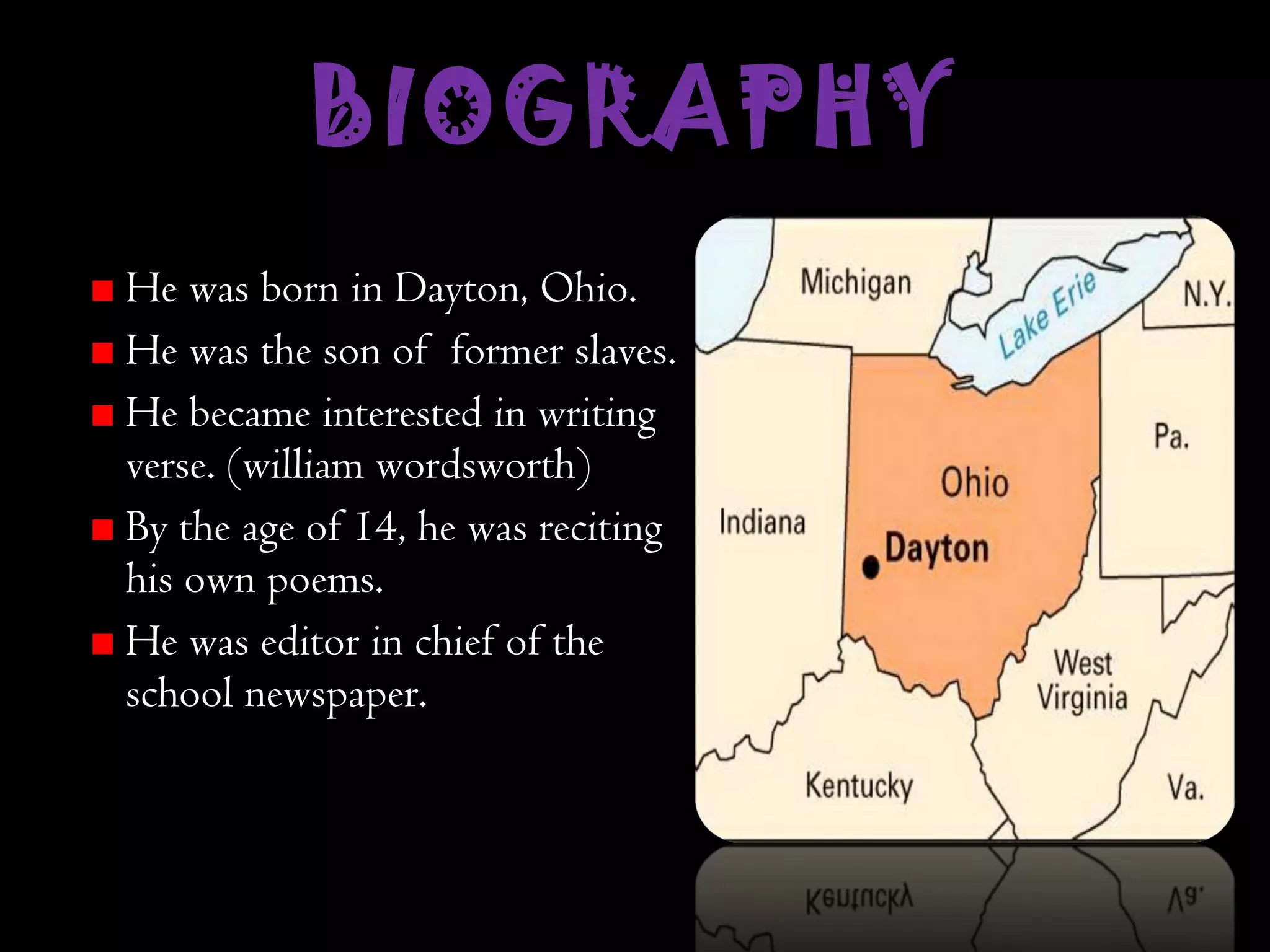
BIOGRAPHY   He was born in Dayton, Ohio. He was the son of  former slaves . He became interested in writing verse. (william wordsworth) By the age of 14, he was reciting his own poems. He was editor in chief of the school newspaper.
BIOGRAPHY   With the help of former schoolmates Orville and Wilbur Wright, he started a small newspaper for the black community, but it failed.  He had to work as an elevator operator.
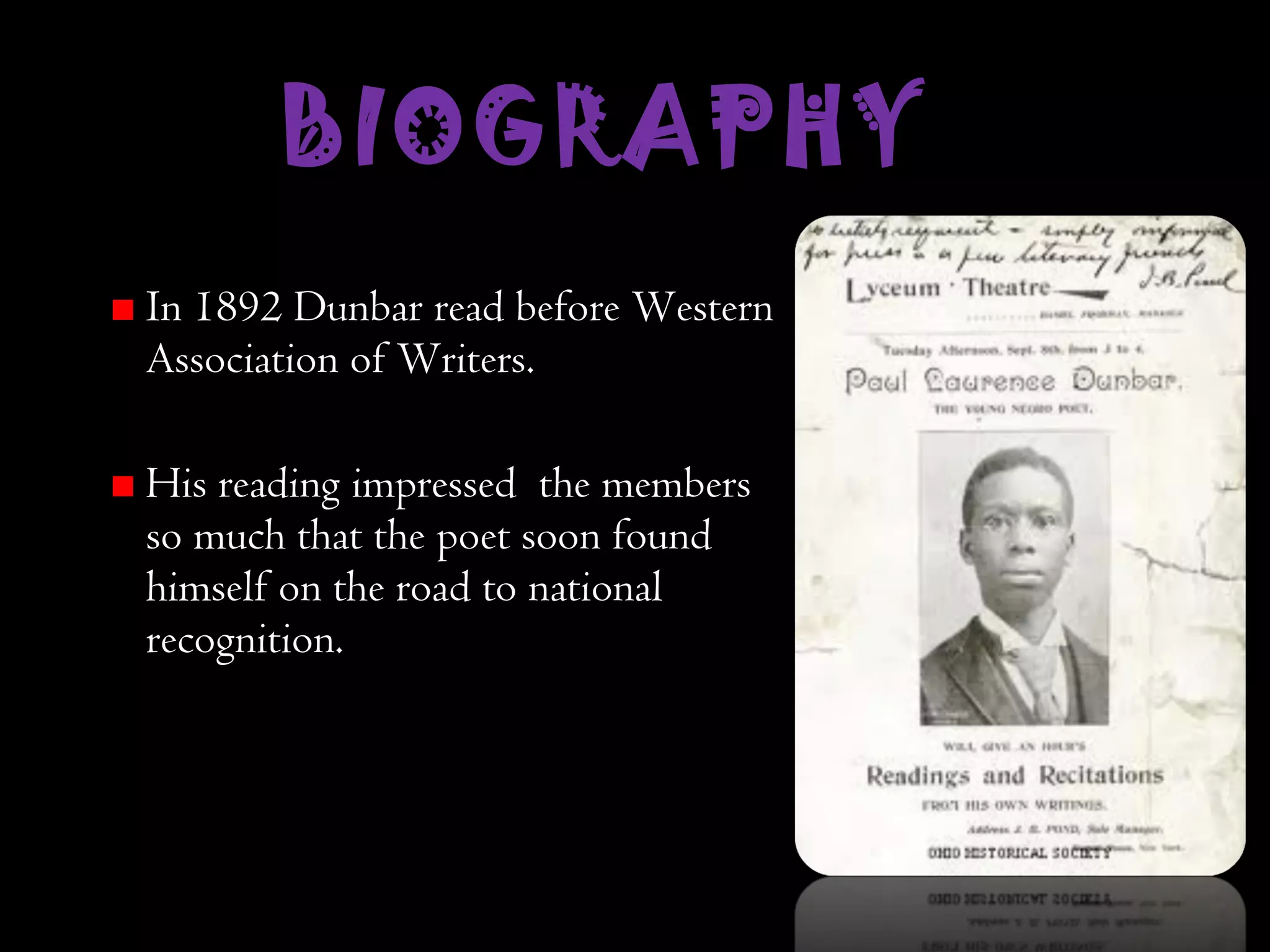
BIOGRAPHY   In 1892 Dunbar read before Western Association of Writers.  His reading impressed  the members so much that the poet soon found himself on the road to national recognition.
BIOGRAPHY   He achieved national recognition for his 1896  Lyrics of a Lowly Life   (one of the collection in Ode to Ethiopia). He was intimately connected with  Frederick Douglass  (a former slave who escaped and became a speaker and leader against slavery) and  Booker T. Washington  and was honored with a ceremonial sword by President  Theodore Roosevelt .
BIOGRAPHY   His work is known for its colorful language and use of dialect(black community), and a conversational tone, with a brilliant rhetorical structure. He was later diagnosed with tuberculosis in 1900, and moved to Colorado with his wife, he died at age thirty-three on February 9, 1906.
LITERARY  PRODUCTION POETRY  "The   Ante-bellum   Sermon" and "  When Dey 'Listed Colored Soldiers ."  "We Wear the Mask," "When Malindy Sings," "Frederick Douglass," "The Colored Soldiers,"  "The Haunted Oak“ He had written 12 books of poetry, five novels, and four books of short stories. (He was mainly concerned, in his writing, with issues that related to his people and his culture) Dunbar's loyalty to the black race and his pride in its achievements, as well as his righteous anger over racial injustice.
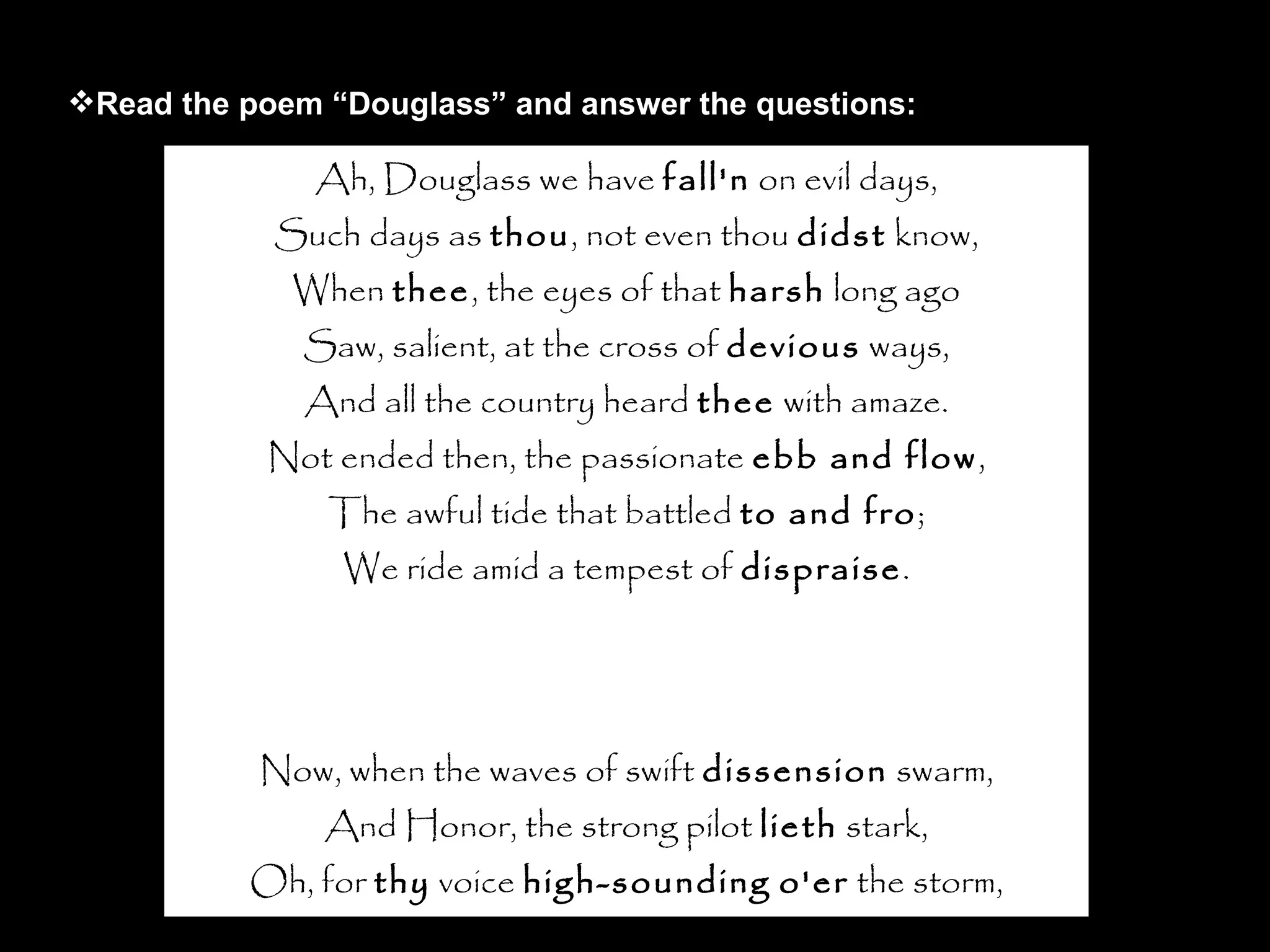
DOUGLASS   by Paul Laurence Dunber Ah, Douglass we have  fall'n  on evil days, Such days as  thou , not even thou  didst  know, When  thee , the eyes of that  harsh  long ago Saw, salient, at the cross of  devious  ways, And all the country heard  thee  with amaze. Not ended then, the passionate  ebb and flow , The awful tide that battled  to and fro ; We ride amid a tempest of  dispraise . Now, when the waves of swift  dissension  swarm, And Honor, the strong pilot  lieth  stark, Oh, for  thy  voice  high-sounding   o'er  the storm, For  thy  strong arm to guide the shivering bark, The blast-defying power of  thy  form, To give us comfort through the lonely dark.
VOCABULARY:  Thee:  you. Thou:  you. Thy:  you. Devious :  behaving in a dishonest or indirect way, or tricking people, in order to get sth.   Ebb and flow:  the repeated, often regular, movement from one state to another; the repeated change in level, numbers or amount. To and fro:  backwards and forwards.  High-sounding :  complicated and intended to sound important,  pretentious . Didst.-  archaic (used with the pronoun thou or its relative equivalent) a form of the past tense of do Harsh.-  unpleasant, unkind, cruel or unnecessarily severe Dispraise.-  disapproval, censure Dissension.-  Difference of opinion; disagreement Lieth.-  (archaic) Third-person singular simple present indicative form of lie O’er.-  over
Who was Frederick Douglass? Dunbar tells how Douglass' voice and speeches have helped the slaves get through their tough times. A former slave A speaker and leader against slavery He gave hope and support to his people in a time of crisis
Slavery  is represented by a giant  storm .  The slaves  are a  ship  that ride against the storm, Douglass' voice  leads the slaves through the way to safety. DOUGLASS   by Paul Laurence Dunber THEMES  AND SYMBOLS
ATTITUDE   Bitterness Struggle to achieve their goals and to gain equality, and to be given the same opportunities. Hope that someone will take charge and improve the way of life for African Americans - Wanting equality and new opportunities
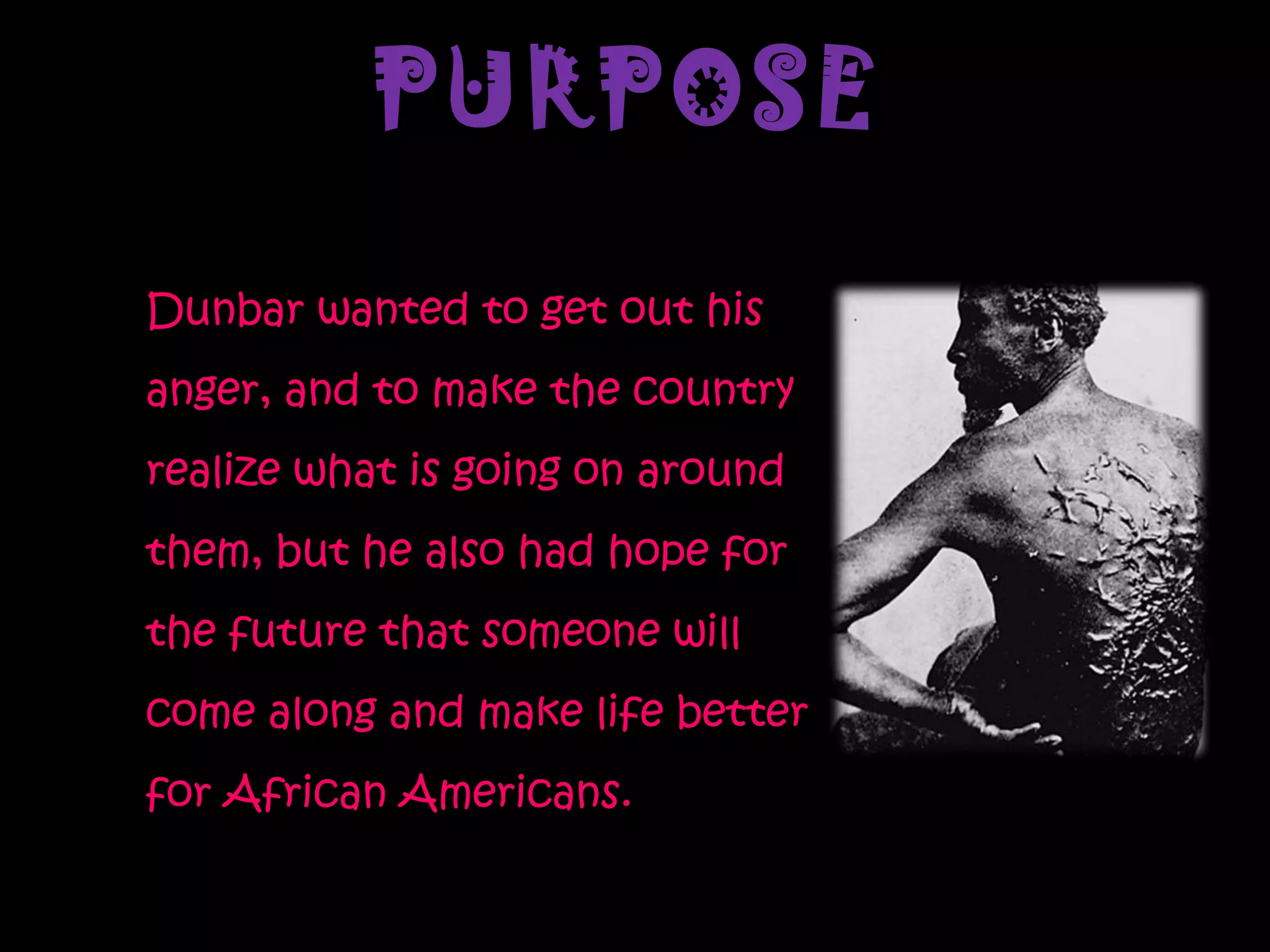
PURPOSE Dunbar wanted to get out his anger, and to make the country realize what is going on around them, but he also had hope for the future that someone will come along and make life better for African Americans.
AUDIENCE To his fellow African Americans To make them realize that changes need to be made,  and that African Americans have to stand up and take charge - They have to fight for what they want: Equality New opportunities
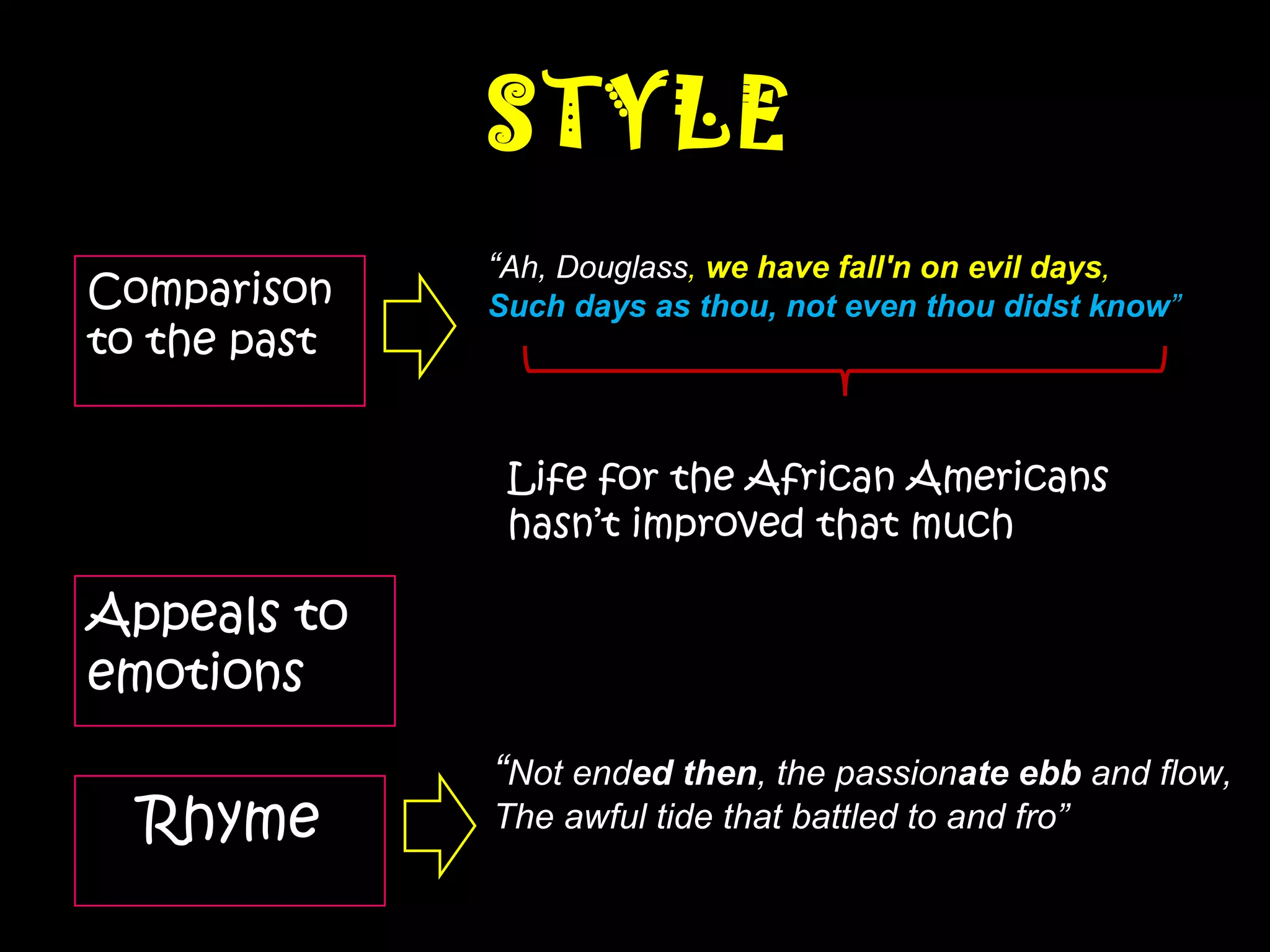
STYLE Comparison  to the past “ Ah, Douglass ,  we have fall'n on evil days ,  Such   days as   thou, not even thou didst know ” Life for the African Americans  hasn’t improved that much Appeals to  emotions Rhyme “ Not end ed   then , the passion ate   ebb  and flow,  The awful tide that battled to and fro”
This poem represents Realism because it  talks about the things that happen to the slaves.  It may not talk about those things directly, but Dunbar  uses figurative language and  symbolism  to get his point across.  Realism
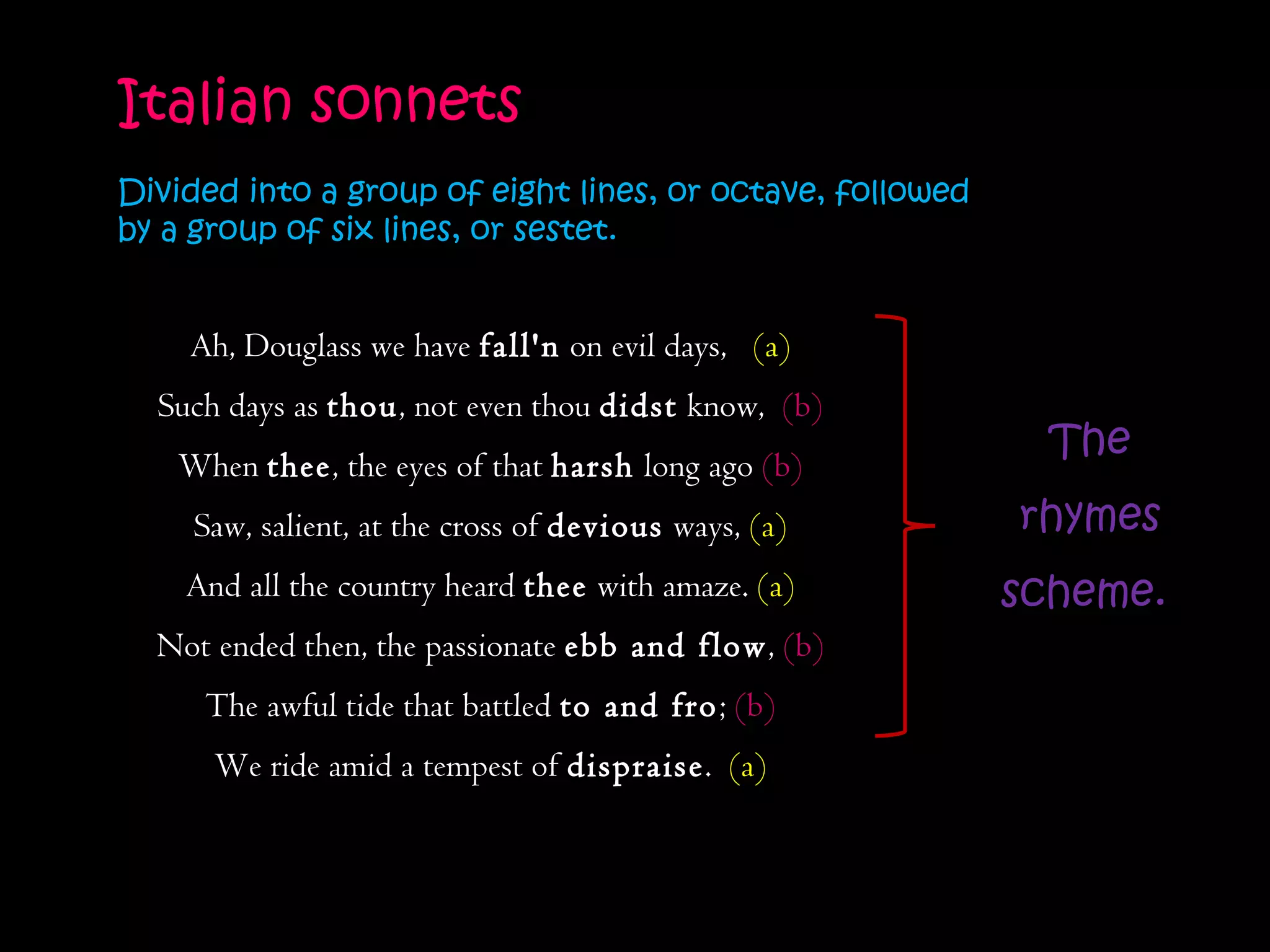
Ah, Douglass we have  fall'n  on evil days,  (a) Such days as  thou , not even thou  didst  know,  (b) When  thee , the eyes of that  harsh  long ago  (b) Saw, salient, at the cross of  devious  ways,  (a) And all the country heard  thee  with amaze.  (a) Not ended then, the passionate  ebb and flow ,  (b) The awful tide that battled  to and fro ;  (b) We ride amid a tempest of  dispraise .  (a) Italian sonnets  Divided into a group of eight lines, or octave, followed by a group of six lines, or sestet.  The rhymes scheme.
Ah, Douglass we have  fall'n  on evil days, Such days as  thou , not even thou  didst  know, When  thee , the eyes of that  harsh  long ago Saw, salient, at the cross of  devious  ways, And all the country heard  thee  with amaze. Not ended then, the passionate  ebb and flow , The awful tide that battled  to and fro ; We ride amid a tempest of  dispraise . Now, when the waves of swift  dissension  swarm, And Honor, the strong pilot  lieth  stark, Oh, for  thy  voice  high-sounding   o'er  the storm, For  thy  strong arm to guide the shivering bark, The blast-defying power of  thy  form, To give us comfort through the lonely dark. Read the poem “Douglass” and answer the questions:
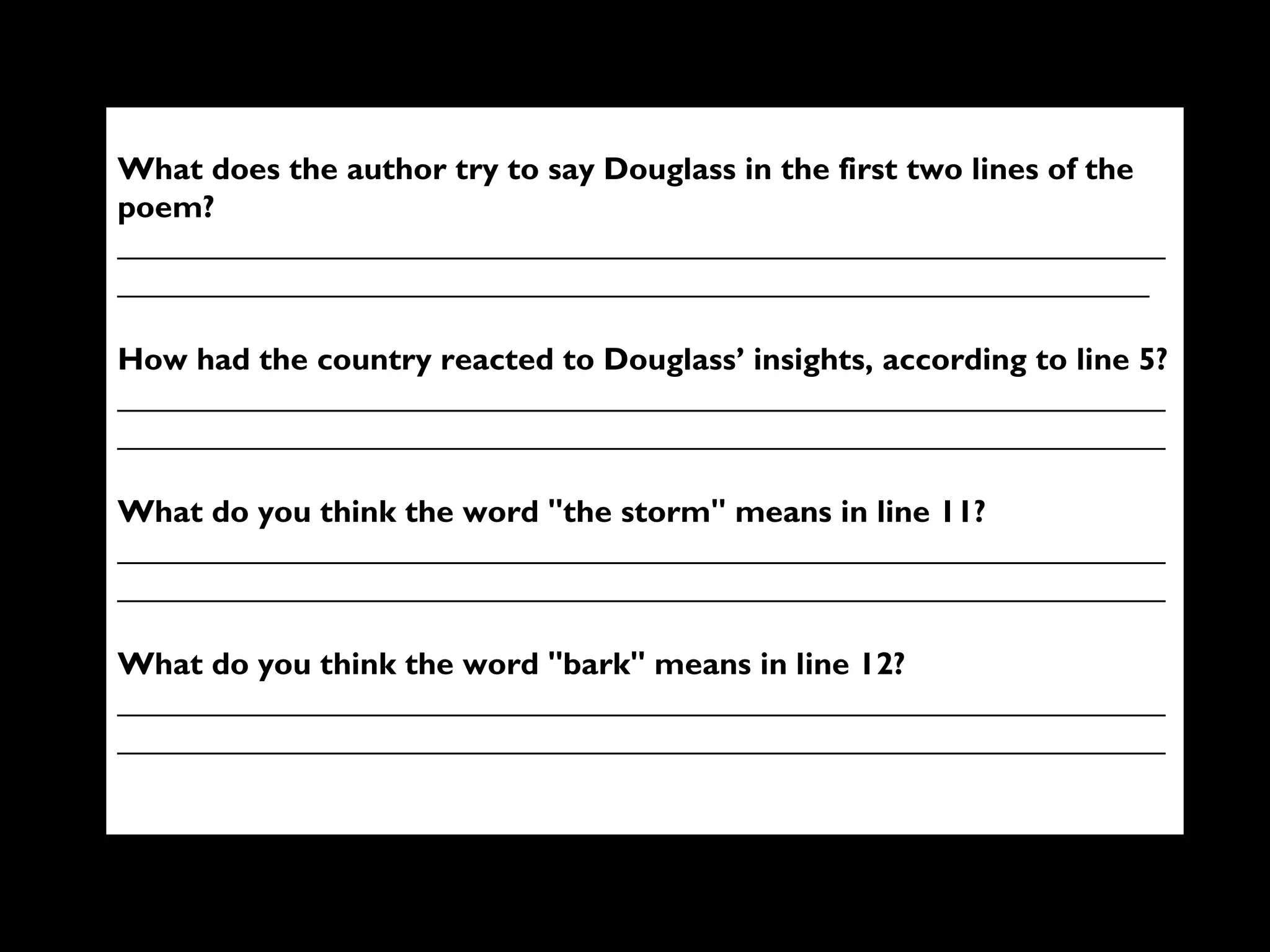
What does the author try to say Douglass in the first two lines of the poem? ___________________________________________________________________________________________________________________________________ How had the country reacted to Douglass’ insights, according to line 5? ____________________________________________________________________________________________________________________________________   What do you think the word "the storm" means in line 11? ____________________________________________________________________________________________________________________________________   What do you think the word "bark" means in line 12? ____________________________________________________________________________________________________________________________________
What three qualities of Douglass’ does the speaker then call for in lines 11-14? ____________________________________________________________________________________________________________________________________   Why do you think the author wrote about Douglass?  ____________________________________________________________________________________________________________________________________   What do you think is the main message of this poem? ____________________________________________________________________________________________________________________________________
 

Paul Laurence Dunbar

  • 1.
    SAN MARCOS UNIVERSITY AMERICA LITERATURE PAUL LAURENCE DUNBAR School: Education Student: Elida cullanco menenses Teacher: Yony Cárdenas Cornelio
  • 2.
    PAUL LAURENCE DUNBAR(1872-1906) The first black American writer He was an influential poet of the late 19th and early 20th centuries
  • 3.
    BIOGRAPHY He was born in Dayton, Ohio. He was the son of former slaves . He became interested in writing verse. (william wordsworth) By the age of 14, he was reciting his own poems. He was editor in chief of the school newspaper.
  • 4.
    BIOGRAPHY With the help of former schoolmates Orville and Wilbur Wright, he started a small newspaper for the black community, but it failed. He had to work as an elevator operator.
  • 5.
    BIOGRAPHY In 1892 Dunbar read before Western Association of Writers. His reading impressed the members so much that the poet soon found himself on the road to national recognition.
  • 6.
    BIOGRAPHY He achieved national recognition for his 1896 Lyrics of a Lowly Life (one of the collection in Ode to Ethiopia). He was intimately connected with Frederick Douglass (a former slave who escaped and became a speaker and leader against slavery) and Booker T. Washington and was honored with a ceremonial sword by President Theodore Roosevelt .
  • 7.
    BIOGRAPHY His work is known for its colorful language and use of dialect(black community), and a conversational tone, with a brilliant rhetorical structure. He was later diagnosed with tuberculosis in 1900, and moved to Colorado with his wife, he died at age thirty-three on February 9, 1906.
  • 8.
    LITERARY PRODUCTIONPOETRY "The  Ante-bellum   Sermon" and " When Dey 'Listed Colored Soldiers ."  "We Wear the Mask," "When Malindy Sings," "Frederick Douglass," "The Colored Soldiers," "The Haunted Oak“ He had written 12 books of poetry, five novels, and four books of short stories. (He was mainly concerned, in his writing, with issues that related to his people and his culture) Dunbar's loyalty to the black race and his pride in its achievements, as well as his righteous anger over racial injustice.
  • 9.
    DOUGLASS by Paul Laurence Dunber Ah, Douglass we have fall'n on evil days, Such days as thou , not even thou didst know, When thee , the eyes of that harsh long ago Saw, salient, at the cross of devious ways, And all the country heard thee with amaze. Not ended then, the passionate ebb and flow , The awful tide that battled to and fro ; We ride amid a tempest of dispraise . Now, when the waves of swift dissension swarm, And Honor, the strong pilot lieth stark, Oh, for thy voice high-sounding o'er the storm, For thy strong arm to guide the shivering bark, The blast-defying power of thy form, To give us comfort through the lonely dark.
  • 10.
    VOCABULARY: Thee: you. Thou: you. Thy: you. Devious : behaving in a dishonest or indirect way, or tricking people, in order to get sth. Ebb and flow: the repeated, often regular, movement from one state to another; the repeated change in level, numbers or amount. To and fro: backwards and forwards. High-sounding : complicated and intended to sound important, pretentious . Didst.- archaic (used with the pronoun thou or its relative equivalent) a form of the past tense of do Harsh.- unpleasant, unkind, cruel or unnecessarily severe Dispraise.- disapproval, censure Dissension.- Difference of opinion; disagreement Lieth.- (archaic) Third-person singular simple present indicative form of lie O’er.- over
  • 11.
    Who was FrederickDouglass? Dunbar tells how Douglass' voice and speeches have helped the slaves get through their tough times. A former slave A speaker and leader against slavery He gave hope and support to his people in a time of crisis
  • 12.
    Slavery isrepresented by a giant storm . The slaves are a ship that ride against the storm, Douglass' voice leads the slaves through the way to safety. DOUGLASS by Paul Laurence Dunber THEMES AND SYMBOLS
  • 13.
    ATTITUDE Bitterness Struggle to achieve their goals and to gain equality, and to be given the same opportunities. Hope that someone will take charge and improve the way of life for African Americans - Wanting equality and new opportunities
  • 14.
    PURPOSE Dunbar wantedto get out his anger, and to make the country realize what is going on around them, but he also had hope for the future that someone will come along and make life better for African Americans.
  • 15.
    AUDIENCE To hisfellow African Americans To make them realize that changes need to be made, and that African Americans have to stand up and take charge - They have to fight for what they want: Equality New opportunities
  • 16.
    STYLE Comparison to the past “ Ah, Douglass , we have fall'n on evil days , Such days as thou, not even thou didst know ” Life for the African Americans hasn’t improved that much Appeals to emotions Rhyme “ Not end ed then , the passion ate ebb and flow, The awful tide that battled to and fro”
  • 17.
    This poem representsRealism because it talks about the things that happen to the slaves. It may not talk about those things directly, but Dunbar uses figurative language and symbolism to get his point across. Realism
  • 18.
    Ah, Douglass wehave fall'n on evil days, (a) Such days as thou , not even thou didst know, (b) When thee , the eyes of that harsh long ago (b) Saw, salient, at the cross of devious ways, (a) And all the country heard thee with amaze. (a) Not ended then, the passionate ebb and flow , (b) The awful tide that battled to and fro ; (b) We ride amid a tempest of dispraise . (a) Italian sonnets Divided into a group of eight lines, or octave, followed by a group of six lines, or sestet. The rhymes scheme.
  • 19.
    Ah, Douglass wehave fall'n on evil days, Such days as thou , not even thou didst know, When thee , the eyes of that harsh long ago Saw, salient, at the cross of devious ways, And all the country heard thee with amaze. Not ended then, the passionate ebb and flow , The awful tide that battled to and fro ; We ride amid a tempest of dispraise . Now, when the waves of swift dissension swarm, And Honor, the strong pilot lieth stark, Oh, for thy voice high-sounding o'er the storm, For thy strong arm to guide the shivering bark, The blast-defying power of thy form, To give us comfort through the lonely dark. Read the poem “Douglass” and answer the questions:
  • 20.
    What does theauthor try to say Douglass in the first two lines of the poem? ___________________________________________________________________________________________________________________________________ How had the country reacted to Douglass’ insights, according to line 5? ____________________________________________________________________________________________________________________________________   What do you think the word "the storm" means in line 11? ____________________________________________________________________________________________________________________________________   What do you think the word "bark" means in line 12? ____________________________________________________________________________________________________________________________________
  • 21.
    What three qualitiesof Douglass’ does the speaker then call for in lines 11-14? ____________________________________________________________________________________________________________________________________   Why do you think the author wrote about Douglass? ____________________________________________________________________________________________________________________________________   What do you think is the main message of this poem? ____________________________________________________________________________________________________________________________________
  • 22.