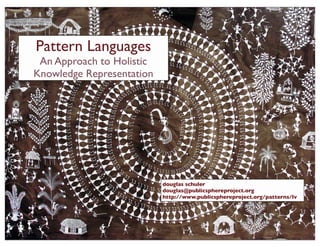
Pattern Languages
An Approach to Holistic
Knowledge Representation
douglas schuler
douglas@publicsphereproject.org
http://www.publicsphereproject.org/patterns/lv
I am obsessed with ideas and actions
that help build civic intelligence.
Civic intelligence is the ability to
collaboratively address social and
environmental challenges effectively
and equitably.
Confession...
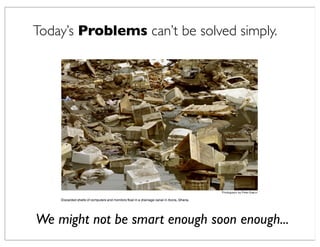
Today’s Problems can’t be solved simply.
We might not be smart enough soon enough...
• Our global problems are vast and potentially
catastrophic. (And our national, regional, and local ones
aren’t exactly trivial.)
• Complex problems require complex solutions.
• We need ways to re-integrate knowledge silos and help
coordinate actions directly and indirectly.
• We will need everybody!
What kind of world
are we living in?
I’ll make a case for pattern languages...
• They describe current phenomena and provide
vision for the future.
• They integrate knowledge from diverse sources.
• They link theory and practice.
• They help coordinate the thoughts and actions of
groups of people; and at the same time,
• They don’t under-prescribe or over-prescribe.
Consider that when they’re done well...
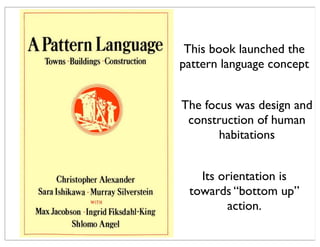
This book launched the
pattern language concept
Its orientation is
towards “bottom up”
action.
The focus was design and
construction of human
habitations
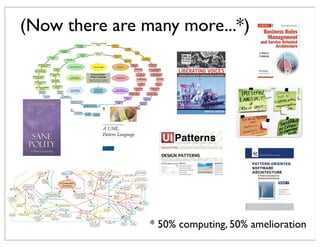
(Now there are many more...*)
* 50% computing, 50% amelioration
What is a Pattern?
• A pattern is a form of seed. It contains a reflection of
current work and thinking, as well as the vision of a
future in which the seeds all have been successfully
cultivated.
• Each pattern is presented using five main parts: title,
problem, context, discussion, and solution.Additionally they
often have an introductory graphic that conveys the idea
and a diagram that summarizes the pattern.
Alexander uses “pattern” in a specific sense.
Using Patterns
"Each pattern describes a problem which occurs over and over
again in our environment, and then describes the core of the
solution to that problem, in such a way that you can use the
solution a million times over, without ever doing it the same way
twice."
(From A Pattern Language)
What is a Pattern Language?
• A pattern language is an ordered collection of patterns.
• The patterns in a pattern language combine into a holistic set
of patterns that are intended to be used together
• In the original book Alexander stated that a pattern language
could be developed in any domain.
• Now pattern languages are often a collective work.
Alexander uses “pattern language” in a specific sense
A Pattern Language
provides 253 “patterns”
for “bottom up”
architecture
from, pattern 1
INDEPENDENT REGIONS, the most general,
to pattern 253, the most specific,...
THINGS FROM YOUR LIFE.
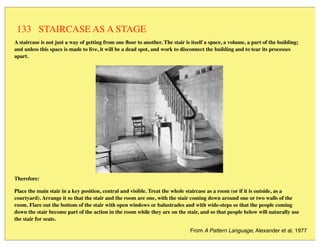
A staircase is not just a way of getting from one floor to another. The stair is itself a space, a volume, a part of the building;
and unless this space is made to live, it will be a dead spot, and work to disconnect the building and to tear its processes
apart.
Therefore:
Place the main stair in a key position, central and visible. Treat the whole staircase as a room (or if it is outside, as a
courtyard). Arrange it so that the stair and the room are one, with the stair coming down around one or two walls of the
room. Flare out the bottom of the stair with open windows or balustrades and with wide-steps so that the people coming
down the stair become part of the action in the room while they are on the stair, and so that people below will naturally use
the stair for seats.
133...STAIRCASE AS A STAGE
From A Pattern Language, Alexander et al, 1977
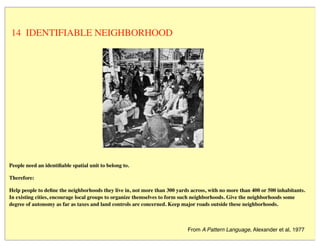
14 .IDENTIFIABLE NEIGHBORHOOD
People need an identifiable spatial unit to belong to.
Therefore:
Help people to define the neighborhoods they live in, not more than 300 yards across, with no more than 400 or 500 inhabitants.
In existing cities, encourage local groups to organize themselves to form such neighborhoods. Give the neighborhoods some
degree of autonomy as far as taxes and land controls are concerned. Keep major roads outside these neighborhoods.
From A Pattern Language, Alexander et al, 1977
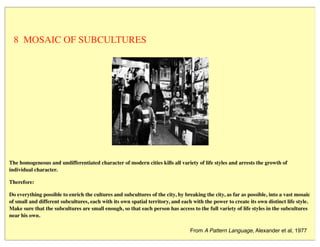
8 .MOSAIC OF SUBCULTURES
The homogeneous and undifferentiated character of modern cities kills all variety of life styles and arrests the growth of
individual character.
Therefore:
Do everything possible to enrich the cultures and subcultures of the city, by breaking the city, as far as possible, into a vast mosaic
of small and different subcultures, each with its own spatial territory, and each with the power to create its own distinct life style.
Make sure that the subcultures are small enough, so that each person has access to the full variety of life styles in the subcultures
near his own.
From A Pattern Language, Alexander et al, 1977
LiberatingVoices provides
136 “patterns” for
“bottom up” information
and communication
from, pattern 1, the most general,
CIVIC INTELLIGENCE
to pattern 136, (not necessarily) the most specific,
RETREAT AND REFLECTION
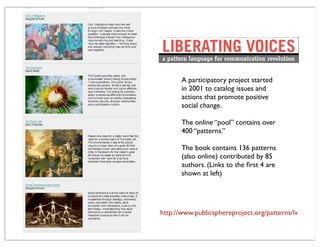
A participatory project started
in 2001 to catalog issues and
actions that promote positive
social change.
The online “pool” contains over
400 “patterns.”
The book contains 136 patterns
(also online) contributed by 85
authors. (Links to the first 4 are
shown at left)
http://www.publicsphereproject.org/patterns/lv
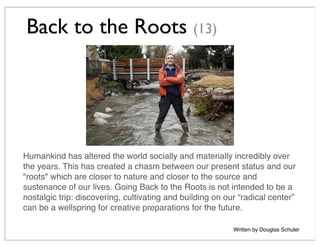
Back to the Roots (13)
Humankind has altered the world socially and materially incredibly over
the years. This has created a chasm between our present status and our
"roots" which are closer to nature and closer to the source and
sustenance of our lives. Going Back to the Roots is not intended to be a
nostalgic trip: discovering, cultivating and building on our “radical center”
can be a wellspring for creative preparations for the future.
Written by Douglas Schuler
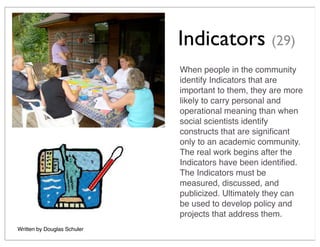
Indicators (29)
When people in the community
identify Indicators that are
important to them, they are more
likely to carry personal and
operational meaning than when
social scientists identify
constructs that are significant
only to an academic community.
The real work begins after the
Indicators have been identified.
The Indicators must be
measured, discussed, and
publicized. Ultimately they can
be used to develop policy and
projects that address them.
Written by Douglas Schuler
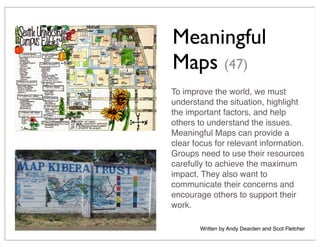
Meaningful
Maps (47)
To improve the world, we must
understand the situation, highlight
the important factors, and help
others to understand the issues.
Meaningful Maps can provide a
clear focus for relevant information.
Groups need to use their resources
carefully to achieve the maximum
impact. They also want to
communicate their concerns and
encourage others to support their
work.
Written by Andy Dearden and Scot Fletcher
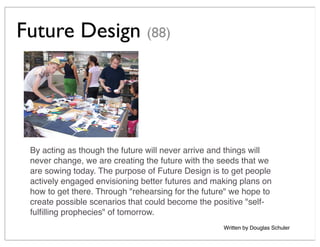
By acting as though the future will never arrive and things will
never change, we are creating the future with the seeds that we
are sowing today. The purpose of Future Design is to get people
actively engaged envisioning better futures and making plans on
how to get there. Through "rehearsing for the future" we hope to
create possible scenarios that could become the positive "self-
fulfilling prophecies" of tomorrow.
Future Design (88)
Written by Douglas Schuler
Patterns aren’t recipes
They don’t provide precise instructions...
Patterns are more like seeds that have different results
when planted in different soil. Different people, in
different situations, will use the patterns differently. They
are really tools for thought.
The use of a pattern is intended to change the flow of
what would have happened in its absence.
Patterns
provide ideas that...
• Already exist but aren’t necessarily recognized
• Perturb “business as usual”
• Aren’t obvious (Fincher)
• Lead to other things; they are “generative”
• Promote action as well as thought;They are
“actionable”
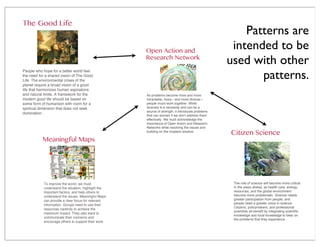
Patterns are
intended to be
used with other
patterns.
Citizen Science
The role of science will become more critical
in the years ahead, as health care, energy,
resources, and the global environment
become more problematic. Science needs
greater participation from people, and
people need a greater voice in science.
Citizens, policymakers, and professional
scientists all benefit by integrating scientific
knowledge and local knowledge to bear on
the problems that they experience.
Open Action and
Research Network
As problems become more and more
intractable, more—and more diverse—
people much work together. While
diversity is a necessity and can be a
source of strength, it introduces problems
that can worsen if we don't address them
effectively. We must acknowledge the
importance of Open Action and Research
Networks while resolving the issues and
building on the incipient wisdom.
Meaningful Maps
To improve the world, we must
understand the situation, highlight the
important factors, and help others to
understand the issues. Meaningful Maps
can provide a clear focus for relevant
information. Groups need to use their
resources carefully to achieve the
maximum impact. They also want to
communicate their concerns and
encourage others to support their work.
The Good Life
People who hope for a better world feel
the need for a shared vision of The Good
Life. The environmental crises of the
planet require a broad vision of a good
life that harmonizes human aspirations
and natural limits. A framework for the
modern good life should be based on
some form of humanism with room for a
spiritual dimension that does not seek
domination.
What’s Next?
• We have developed a set of cards that we have started to
use in workshops with community groups and social change
organizations. (Also a simple online game — offline at the
moment)
• We are currently transforming our web site to help support
use and further development of the patterns.
• We are thinking about how to use the patterns in online
deliberative systems.
• We are still adding patterns — and you can too!
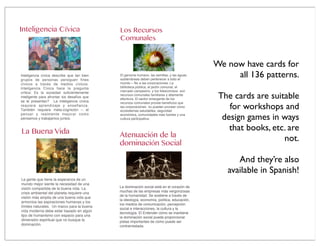
Inteligencia Cívica
Inteligencia cívica describe que tan bien
grupos de personas persiguen fines
cívicos a través de medios cívicos.
Inteligencia Cívica hace la pregunta
crítica: Es la sociedad suficientemente
inteligente para afrontar los desafíos que
se le presentan? La inteligencia cívica
requiere aprendizaje y enseñanza.
También requiere meta-cognición – el
pensar y realmente mejorar como
pensamos y trabajamos juntos.
La Buena Vida
La gente que tiene la esperanza de un
mundo mejor siente la necesidad de una
visión compartida de la buena vida. La
crisis ambiental del planeta requiere una
visión más amplia de una buena vida que
armonice las aspiraciones humanas y los
límites naturales. Un marco para la buena
vida moderna debe estar basado en algún
tipo de humanismo con espacio para una
dimensión espiritual que no busque la
dominación.
Atenuación de la
dominación Social
La dominación social está en el corazón de
muchas de las empresas más vergonzosas
de la humanidad. Se sostiene a través de
la ideología, economía, política, educación,
los medios de comunicación, percepción
social e interacciones, la cultura y la
tecnología. El Entender cómo se mantiene
la dominación social puede proporcionar
pistas importantes de cómo puede ser
contrarrestada.
Los Recursos
Comunales
El genoma humano, las semillas, y las aguas
subterráneas deben pertenecer a todo el
mundo – No a las corporaciones. La
biblioteca pública, el jardín comunal, el
mercado campesino, y los fideicomisos son
recursos comunales familiares y altamente
efectivos. El sector emergente de los
recursos comunales provee beneficios que
las corporaciones no pueden proveer como
ecosistemas saludables, seguridad
económica, comunidades más fuertes y una
cultura participativa.
We now have cards for
all 136 patterns.
The cards are suitable
for workshops and
design games in ways
that books, etc. are
not.
And they’re also
available in Spanish!
Methodology
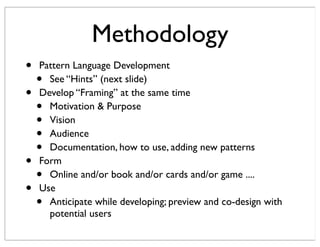
• Pattern Language Development
• See “Hints” (next slide)
• Develop “Framing” at the same time
• Motivation & Purpose
• Vision
• Audience
• Documentation, how to use, adding new patterns
• Form
• Online and/or book and/or cards and/or game ....
• Use
• Anticipate while developing; preview and co-design with
potential users
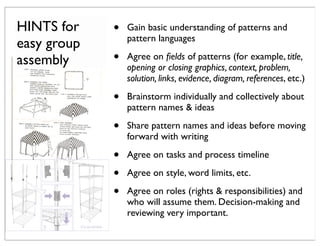
• Gain basic understanding of patterns and
pattern languages
• Agree on fields of patterns (for example, title,
opening or closing graphics, context, problem,
solution, links, evidence, diagram, references, etc.)
• Brainstorm individually and collectively about
pattern names & ideas
• Share pattern names and ideas before moving
forward with writing
• Agree on tasks and process timeline
• Agree on style, word limits, etc.
• Agree on roles (rights & responsibilities) and
who will assume them. Decision-making and
reviewing very important.
HINTS for
easy group
assembly
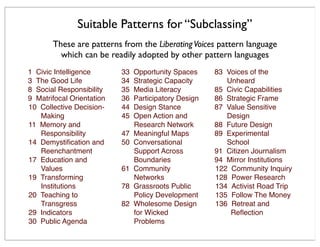
1  Civic Intelligence
3  The Good Life
8  Social Responsibility
9  Matrifocal Orientation
10  Collective Decision-
Making
11  Memory and
Responsibility
14  Demystification and
Reenchantment
17  Education and
Values
19  Transforming
Institutions
20  Teaching to
Transgress
29  Indicators 
30  Public Agenda
33  Opportunity Spaces
34  Strategic Capacity
35  Media Literacy
36  Participatory Design
44  Design Stance
45  Open Action and
Research Network
47  Meaningful Maps
50  Conversational
Support Across
Boundaries
61  Community
Networks
78  Grassroots Public
Policy Development
82  Wholesome Design
for Wicked
Problems
83  Voices of the
Unheard
85  Civic Capabilities
86  Strategic Frame
87  Value Sensitive
Design
88  Future Design
89  Experimental
School
91  Citizen Journalism
94  Mirror Institutions
122  Community Inquiry
128  Power Research
134  Activist Road Trip
135  Follow The Money
136  Retreat and
Reflection
Suitable Patterns for “Subclassing”
These are patterns from the LiberatingVoices pattern language
which can be readily adopted by other pattern languages
Conclusions & Observations
• Pattern languages are well suited in terms
of structure and intent for group
knowledge construction.
• And participants learn by doing!
• Methodologies for use is still challenging.
Thanks for listening!
Questions or comments?
Please feel free to contact me any time.
douglas schuler
douglas@publicsphereproject.org
http://www.publicsphereproject.org/patterns/lv

Pattern Languages — An Approach to Holistic Knowledge Representation

  • 1.
    Pattern Languages An Approachto Holistic Knowledge Representation douglas schuler douglas@publicsphereproject.org http://www.publicsphereproject.org/patterns/lv
  • 2.
    I am obsessedwith ideas and actions that help build civic intelligence. Civic intelligence is the ability to collaboratively address social and environmental challenges effectively and equitably. Confession...
  • 3.
    Today’s Problems can’tbe solved simply. We might not be smart enough soon enough...
  • 4.
    • Our globalproblems are vast and potentially catastrophic. (And our national, regional, and local ones aren’t exactly trivial.) • Complex problems require complex solutions. • We need ways to re-integrate knowledge silos and help coordinate actions directly and indirectly. • We will need everybody! What kind of world are we living in?
  • 5.
    I’ll make acase for pattern languages... • They describe current phenomena and provide vision for the future. • They integrate knowledge from diverse sources. • They link theory and practice. • They help coordinate the thoughts and actions of groups of people; and at the same time, • They don’t under-prescribe or over-prescribe. Consider that when they’re done well...
  • 6.
    This book launchedthe pattern language concept Its orientation is towards “bottom up” action. The focus was design and construction of human habitations
  • 7.
    (Now there aremany more...*) * 50% computing, 50% amelioration
  • 8.
    What is aPattern? • A pattern is a form of seed. It contains a reflection of current work and thinking, as well as the vision of a future in which the seeds all have been successfully cultivated. • Each pattern is presented using five main parts: title, problem, context, discussion, and solution.Additionally they often have an introductory graphic that conveys the idea and a diagram that summarizes the pattern. Alexander uses “pattern” in a specific sense.
  • 9.
    Using Patterns "Each patterndescribes a problem which occurs over and over again in our environment, and then describes the core of the solution to that problem, in such a way that you can use the solution a million times over, without ever doing it the same way twice." (From A Pattern Language)
  • 10.
    What is aPattern Language? • A pattern language is an ordered collection of patterns. • The patterns in a pattern language combine into a holistic set of patterns that are intended to be used together • In the original book Alexander stated that a pattern language could be developed in any domain. • Now pattern languages are often a collective work. Alexander uses “pattern language” in a specific sense
  • 11.
    A Pattern Language provides253 “patterns” for “bottom up” architecture from, pattern 1 INDEPENDENT REGIONS, the most general, to pattern 253, the most specific,... THINGS FROM YOUR LIFE.
  • 12.
    A staircase isnot just a way of getting from one floor to another. The stair is itself a space, a volume, a part of the building; and unless this space is made to live, it will be a dead spot, and work to disconnect the building and to tear its processes apart. Therefore: Place the main stair in a key position, central and visible. Treat the whole staircase as a room (or if it is outside, as a courtyard). Arrange it so that the stair and the room are one, with the stair coming down around one or two walls of the room. Flare out the bottom of the stair with open windows or balustrades and with wide-steps so that the people coming down the stair become part of the action in the room while they are on the stair, and so that people below will naturally use the stair for seats. 133...STAIRCASE AS A STAGE From A Pattern Language, Alexander et al, 1977
  • 13.
    14 .IDENTIFIABLE NEIGHBORHOOD Peopleneed an identifiable spatial unit to belong to. Therefore: Help people to define the neighborhoods they live in, not more than 300 yards across, with no more than 400 or 500 inhabitants. In existing cities, encourage local groups to organize themselves to form such neighborhoods. Give the neighborhoods some degree of autonomy as far as taxes and land controls are concerned. Keep major roads outside these neighborhoods. From A Pattern Language, Alexander et al, 1977
  • 14.
    8 .MOSAIC OFSUBCULTURES The homogeneous and undifferentiated character of modern cities kills all variety of life styles and arrests the growth of individual character. Therefore: Do everything possible to enrich the cultures and subcultures of the city, by breaking the city, as far as possible, into a vast mosaic of small and different subcultures, each with its own spatial territory, and each with the power to create its own distinct life style. Make sure that the subcultures are small enough, so that each person has access to the full variety of life styles in the subcultures near his own. From A Pattern Language, Alexander et al, 1977
  • 15.
    LiberatingVoices provides 136 “patterns”for “bottom up” information and communication from, pattern 1, the most general, CIVIC INTELLIGENCE to pattern 136, (not necessarily) the most specific, RETREAT AND REFLECTION
  • 16.
    A participatory projectstarted in 2001 to catalog issues and actions that promote positive social change. The online “pool” contains over 400 “patterns.” The book contains 136 patterns (also online) contributed by 85 authors. (Links to the first 4 are shown at left) http://www.publicsphereproject.org/patterns/lv
  • 17.
    Back to theRoots (13) Humankind has altered the world socially and materially incredibly over the years. This has created a chasm between our present status and our "roots" which are closer to nature and closer to the source and sustenance of our lives. Going Back to the Roots is not intended to be a nostalgic trip: discovering, cultivating and building on our “radical center” can be a wellspring for creative preparations for the future. Written by Douglas Schuler
  • 18.
    Indicators (29) When peoplein the community identify Indicators that are important to them, they are more likely to carry personal and operational meaning than when social scientists identify constructs that are significant only to an academic community. The real work begins after the Indicators have been identified. The Indicators must be measured, discussed, and publicized. Ultimately they can be used to develop policy and projects that address them. Written by Douglas Schuler
  • 19.
    Meaningful Maps (47) To improvethe world, we must understand the situation, highlight the important factors, and help others to understand the issues. Meaningful Maps can provide a clear focus for relevant information. Groups need to use their resources carefully to achieve the maximum impact. They also want to communicate their concerns and encourage others to support their work. Written by Andy Dearden and Scot Fletcher
  • 20.
    By acting asthough the future will never arrive and things will never change, we are creating the future with the seeds that we are sowing today. The purpose of Future Design is to get people actively engaged envisioning better futures and making plans on how to get there. Through "rehearsing for the future" we hope to create possible scenarios that could become the positive "self- fulfilling prophecies" of tomorrow. Future Design (88) Written by Douglas Schuler
  • 21.
    Patterns aren’t recipes Theydon’t provide precise instructions... Patterns are more like seeds that have different results when planted in different soil. Different people, in different situations, will use the patterns differently. They are really tools for thought. The use of a pattern is intended to change the flow of what would have happened in its absence.
  • 22.
    Patterns provide ideas that... •Already exist but aren’t necessarily recognized • Perturb “business as usual” • Aren’t obvious (Fincher) • Lead to other things; they are “generative” • Promote action as well as thought;They are “actionable”
  • 23.
    Patterns are intended tobe used with other patterns. Citizen Science The role of science will become more critical in the years ahead, as health care, energy, resources, and the global environment become more problematic. Science needs greater participation from people, and people need a greater voice in science. Citizens, policymakers, and professional scientists all benefit by integrating scientific knowledge and local knowledge to bear on the problems that they experience. Open Action and Research Network As problems become more and more intractable, more—and more diverse— people much work together. While diversity is a necessity and can be a source of strength, it introduces problems that can worsen if we don't address them effectively. We must acknowledge the importance of Open Action and Research Networks while resolving the issues and building on the incipient wisdom. Meaningful Maps To improve the world, we must understand the situation, highlight the important factors, and help others to understand the issues. Meaningful Maps can provide a clear focus for relevant information. Groups need to use their resources carefully to achieve the maximum impact. They also want to communicate their concerns and encourage others to support their work. The Good Life People who hope for a better world feel the need for a shared vision of The Good Life. The environmental crises of the planet require a broad vision of a good life that harmonizes human aspirations and natural limits. A framework for the modern good life should be based on some form of humanism with room for a spiritual dimension that does not seek domination.
  • 24.
    What’s Next? • Wehave developed a set of cards that we have started to use in workshops with community groups and social change organizations. (Also a simple online game — offline at the moment) • We are currently transforming our web site to help support use and further development of the patterns. • We are thinking about how to use the patterns in online deliberative systems. • We are still adding patterns — and you can too!
  • 25.
    Inteligencia Cívica Inteligencia cívicadescribe que tan bien grupos de personas persiguen fines cívicos a través de medios cívicos. Inteligencia Cívica hace la pregunta crítica: Es la sociedad suficientemente inteligente para afrontar los desafíos que se le presentan? La inteligencia cívica requiere aprendizaje y enseñanza. También requiere meta-cognición – el pensar y realmente mejorar como pensamos y trabajamos juntos. La Buena Vida La gente que tiene la esperanza de un mundo mejor siente la necesidad de una visión compartida de la buena vida. La crisis ambiental del planeta requiere una visión más amplia de una buena vida que armonice las aspiraciones humanas y los límites naturales. Un marco para la buena vida moderna debe estar basado en algún tipo de humanismo con espacio para una dimensión espiritual que no busque la dominación. Atenuación de la dominación Social La dominación social está en el corazón de muchas de las empresas más vergonzosas de la humanidad. Se sostiene a través de la ideología, economía, política, educación, los medios de comunicación, percepción social e interacciones, la cultura y la tecnología. El Entender cómo se mantiene la dominación social puede proporcionar pistas importantes de cómo puede ser contrarrestada. Los Recursos Comunales El genoma humano, las semillas, y las aguas subterráneas deben pertenecer a todo el mundo – No a las corporaciones. La biblioteca pública, el jardín comunal, el mercado campesino, y los fideicomisos son recursos comunales familiares y altamente efectivos. El sector emergente de los recursos comunales provee beneficios que las corporaciones no pueden proveer como ecosistemas saludables, seguridad económica, comunidades más fuertes y una cultura participativa. We now have cards for all 136 patterns. The cards are suitable for workshops and design games in ways that books, etc. are not. And they’re also available in Spanish!
  • 26.
    Methodology • Pattern LanguageDevelopment • See “Hints” (next slide) • Develop “Framing” at the same time • Motivation & Purpose • Vision • Audience • Documentation, how to use, adding new patterns • Form • Online and/or book and/or cards and/or game .... • Use • Anticipate while developing; preview and co-design with potential users
  • 27.
    • Gain basicunderstanding of patterns and pattern languages • Agree on fields of patterns (for example, title, opening or closing graphics, context, problem, solution, links, evidence, diagram, references, etc.) • Brainstorm individually and collectively about pattern names & ideas • Share pattern names and ideas before moving forward with writing • Agree on tasks and process timeline • Agree on style, word limits, etc. • Agree on roles (rights & responsibilities) and who will assume them. Decision-making and reviewing very important. HINTS for easy group assembly
  • 28.
    1  Civic Intelligence 3  The GoodLife 8  Social Responsibility 9  Matrifocal Orientation 10  Collective Decision- Making 11  Memory and Responsibility 14  Demystification and Reenchantment 17  Education and Values 19  Transforming Institutions 20  Teaching to Transgress 29  Indicators  30  Public Agenda 33  Opportunity Spaces 34  Strategic Capacity 35  Media Literacy 36  Participatory Design 44  Design Stance 45  Open Action and Research Network 47  Meaningful Maps 50  Conversational Support Across Boundaries 61  Community Networks 78  Grassroots Public Policy Development 82  Wholesome Design for Wicked Problems 83  Voices of the Unheard 85  Civic Capabilities 86  Strategic Frame 87  Value Sensitive Design 88  Future Design 89  Experimental School 91  Citizen Journalism 94  Mirror Institutions 122  Community Inquiry 128  Power Research 134  Activist Road Trip 135  Follow The Money 136  Retreat and Reflection Suitable Patterns for “Subclassing” These are patterns from the LiberatingVoices pattern language which can be readily adopted by other pattern languages
  • 29.
    Conclusions & Observations •Pattern languages are well suited in terms of structure and intent for group knowledge construction. • And participants learn by doing! • Methodologies for use is still challenging.
  • 30.
    Thanks for listening! Questionsor comments? Please feel free to contact me any time. douglas schuler douglas@publicsphereproject.org http://www.publicsphereproject.org/patterns/lv