Pattern Languages for 
Public Problem Solving 
Seven Seeds for Theory and Practice 
November 14, 2014 
Krems, Austria 
Douglas Schuler 
The Evergreen State College 
The Public Sphere Project
• Purpose: Exploring opportunities for focusing our 
work 
• Disclaimer: This work is exploratory. I’m not 
attempting to be definitive or authoritative. 
• Approach: A vision, followed by seven seeds with 
questions and ideas (not answers). (And the seeds 
are not autonomous.)
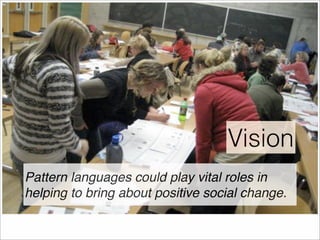
Vision 
Pattern languages could play vital roles in 
helping to bring about positive social change.
How might this come about? 
• Pattern languages could help document the problem solving aspects in a 
given domain (e.g. nature of problem, forces, indicators, marshaling 
resources, resolving problems and sub-problems, goals) 
• Pattern language development could provide community building 
opportunities (to do one project — but also to promote / shepherd / 
market the ability for others to do the same) 
• Pattern languages could provide additional opportunities if they were 
more accessible, attractive, and easier to use 
• Pattern languages could promote interdisciplinary work by providing a 
shared “neutral” language 
• Pattern languages could promote distributed, loosely coordinated work
Seven Seeds 
1. Appeal 
2. Use 
3. Theory 
4. Meta-patterns 
5. Cataloging & Formalization 
6. Public Problem Domains 
7. Community
SEED 1 
Appeal 
• What do we like about patterns & pattern languages? 
(this I will not try to bias here…) 
• Why do we think they’d be useful for social change? 
• problem-solving orientation 
• good level of generality 
• holistic, systems orientation 
• more!
SEED 2 
Theory 
Two main types (I think): 
1. About patterns & pattern languages themselves 
(generative processes, piecemeal growth, network-based, 
…) 
2. About the use of patterns & pattern languages
SEED 3 (1/9) 
Use 
• In what ways are pattern languages used? 
• In what ways could pattern languages be used? 
• How can we make pattern languages more useful 
and accessible? 
• What barriers are there? 
• What difference does the actual form make? 
• Is there pattern language life-cycle? 
• And can / should a methodology be formalized?
SEED 3 (2/9) 
Use 
In what ways are and could pattern languages used? 
• By whom? Children? students? activists? 
• In what arena or setting? 
• Using what guidelines, scripts, or protocol 
• For what purpose?
SEED 3 (3/9) 
Use 
• What difference does the form make? Cards, 
games, master plan, online, posters, interviews, 
multi-media productions (StreamScapes) 
• Patterns and pattern languages can be thought of 
as “social objects” [See Iba Tasashi’s dialogue 
workshop]
SEED 3 (4/9) 
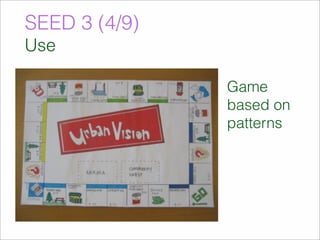
Use 
Game 
based on 
patterns
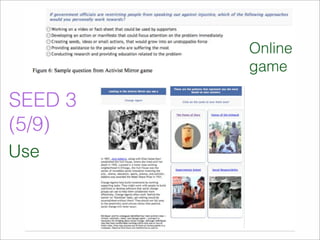
SEED 3 
(5/9) 
Use 
Online 
game
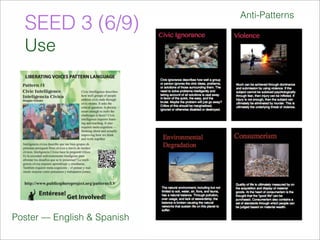
SEED 3 (6/9) 
Use 
Poster — English & Spanish 
Anti-Patterns
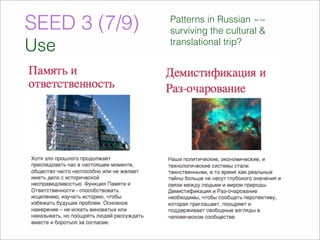
SEED 3 (7/9) 
Use 
Patterns in Russian ~~ 
surviving the cultural & 
translational trip?
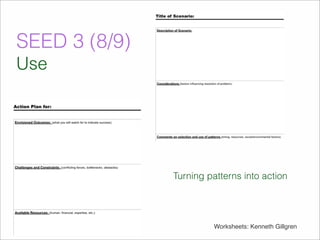
SEED 3 (8/9) 
Use 
Turning patterns into action 
Worksheets: Kenneth Gillgren
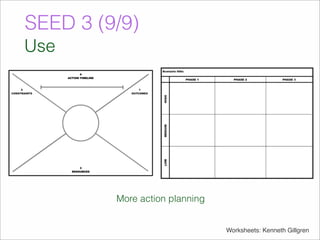
SEED 3 (9/9) 
Use 
More action planning 
Worksheets: Kenneth Gillgren
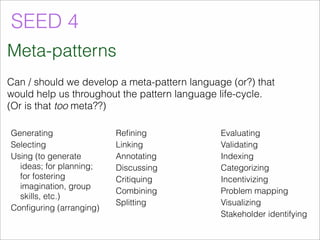
SEED 4 
Meta-patterns 
Can / should we develop a meta-pattern language (or?) that 
would help us throughout the pattern language life-cycle. 
(Or is that too meta??) 
Generating 
Selecting 
Using (to generate 
ideas; for planning; 
for fostering 
imagination, group 
skills, etc.) 
Configuring (arranging) 
Refining 
Linking 
Annotating 
Discussing 
Critiquing 
Combining 
Splitting 
Evaluating 
Validating 
Indexing 
Categorizing 
Incentivizing 
Problem mapping 
Visualizing 
Stakeholder identifying
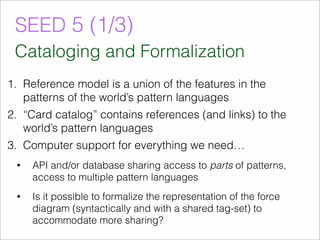
SEED 5 (1/3) 
Cataloging and Formalization 
1. Reference model is a union of the features in the 
patterns of the world’s pattern languages 
2. “Card catalog” contains references (and links) to the 
world’s pattern languages 
3. Computer support for everything we need… 
• API and/or database sharing access to parts of patterns, 
access to multiple pattern languages 
• Is it possible to formalize the representation of the force 
diagram (syntactically and with a shared tag-set) to 
accommodate more sharing?
SEED 5 (2/3) 
Cataloging and Formalization 
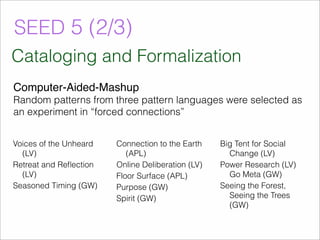
Computer-Aided-Mashup 
Random patterns from three pattern languages were selected as 
an experiment in “forced connections” 
Voices of the Unheard 
(LV) 
Retreat and Reflection 
(LV) 
Seasoned Timing (GW) 
Connection to the Earth 
(APL) 
Online Deliberation (LV) 
Floor Surface (APL) 
Purpose (GW) 
Spirit (GW) 
Big Tent for Social 
Change (LV) 
Power Research (LV) 
Go Meta (GW) 
Seeing the Forest, 
Seeing the Trees 
(GW)
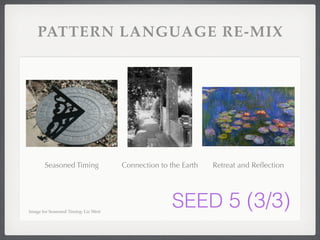
PATTERN LANGUAGE RE-MIX 
Seasoned Timing Connection to the Earth Retreat and Reflection 
Image for Seasoned Timing: Liz West SEED 5 (3/3)
SEED 6 
Public Problem Domain(s) 
Work with a small number of communities to develop 
pattern languages collaboratively. This could focus 
attention (including our own) and we could learn by 
doing how pattern languages could help. 
Suggestions: Climate Change, Government and 
Business Corruption, Public Education (not just 
“Education in the Public Schools”)
SEED 7 
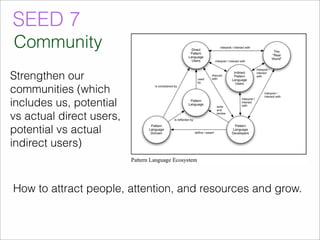
Community 
Strengthen our 
communities (which 
includes us, potential 
vs actual direct users, 
potential vs actual 
indirect users) 
How to attract people, attention, and resources and grow.
last word… 
Understand our own interest around pattern 
languages 
Thanks! 
Expand our community 
Critique and improve these seeds…

Pattern Languages for Public Problem Solving: Seven Seeds for Theory and Practice

  • 1.
    Pattern Languages for Public Problem Solving Seven Seeds for Theory and Practice November 14, 2014 Krems, Austria Douglas Schuler The Evergreen State College The Public Sphere Project
  • 2.
    • Purpose: Exploringopportunities for focusing our work • Disclaimer: This work is exploratory. I’m not attempting to be definitive or authoritative. • Approach: A vision, followed by seven seeds with questions and ideas (not answers). (And the seeds are not autonomous.)
  • 3.
    Vision Pattern languagescould play vital roles in helping to bring about positive social change.
  • 4.
    How might thiscome about? • Pattern languages could help document the problem solving aspects in a given domain (e.g. nature of problem, forces, indicators, marshaling resources, resolving problems and sub-problems, goals) • Pattern language development could provide community building opportunities (to do one project — but also to promote / shepherd / market the ability for others to do the same) • Pattern languages could provide additional opportunities if they were more accessible, attractive, and easier to use • Pattern languages could promote interdisciplinary work by providing a shared “neutral” language • Pattern languages could promote distributed, loosely coordinated work
  • 5.
    Seven Seeds 1.Appeal 2. Use 3. Theory 4. Meta-patterns 5. Cataloging & Formalization 6. Public Problem Domains 7. Community
  • 6.
    SEED 1 Appeal • What do we like about patterns & pattern languages? (this I will not try to bias here…) • Why do we think they’d be useful for social change? • problem-solving orientation • good level of generality • holistic, systems orientation • more!
  • 7.
    SEED 2 Theory Two main types (I think): 1. About patterns & pattern languages themselves (generative processes, piecemeal growth, network-based, …) 2. About the use of patterns & pattern languages
  • 8.
    SEED 3 (1/9) Use • In what ways are pattern languages used? • In what ways could pattern languages be used? • How can we make pattern languages more useful and accessible? • What barriers are there? • What difference does the actual form make? • Is there pattern language life-cycle? • And can / should a methodology be formalized?
  • 9.
    SEED 3 (2/9) Use In what ways are and could pattern languages used? • By whom? Children? students? activists? • In what arena or setting? • Using what guidelines, scripts, or protocol • For what purpose?
  • 10.
    SEED 3 (3/9) Use • What difference does the form make? Cards, games, master plan, online, posters, interviews, multi-media productions (StreamScapes) • Patterns and pattern languages can be thought of as “social objects” [See Iba Tasashi’s dialogue workshop]
  • 11.
    SEED 3 (4/9) Use Game based on patterns
  • 12.
    SEED 3 (5/9) Use Online game
  • 13.
    SEED 3 (6/9) Use Poster — English & Spanish Anti-Patterns
  • 14.
    SEED 3 (7/9) Use Patterns in Russian ~~ surviving the cultural & translational trip?
  • 15.
    SEED 3 (8/9) Use Turning patterns into action Worksheets: Kenneth Gillgren
  • 16.
    SEED 3 (9/9) Use More action planning Worksheets: Kenneth Gillgren
  • 17.
    SEED 4 Meta-patterns Can / should we develop a meta-pattern language (or?) that would help us throughout the pattern language life-cycle. (Or is that too meta??) Generating Selecting Using (to generate ideas; for planning; for fostering imagination, group skills, etc.) Configuring (arranging) Refining Linking Annotating Discussing Critiquing Combining Splitting Evaluating Validating Indexing Categorizing Incentivizing Problem mapping Visualizing Stakeholder identifying
  • 18.
    SEED 5 (1/3) Cataloging and Formalization 1. Reference model is a union of the features in the patterns of the world’s pattern languages 2. “Card catalog” contains references (and links) to the world’s pattern languages 3. Computer support for everything we need… • API and/or database sharing access to parts of patterns, access to multiple pattern languages • Is it possible to formalize the representation of the force diagram (syntactically and with a shared tag-set) to accommodate more sharing?
  • 19.
    SEED 5 (2/3) Cataloging and Formalization Computer-Aided-Mashup Random patterns from three pattern languages were selected as an experiment in “forced connections” Voices of the Unheard (LV) Retreat and Reflection (LV) Seasoned Timing (GW) Connection to the Earth (APL) Online Deliberation (LV) Floor Surface (APL) Purpose (GW) Spirit (GW) Big Tent for Social Change (LV) Power Research (LV) Go Meta (GW) Seeing the Forest, Seeing the Trees (GW)
  • 20.
    PATTERN LANGUAGE RE-MIX Seasoned Timing Connection to the Earth Retreat and Reflection Image for Seasoned Timing: Liz West SEED 5 (3/3)
  • 21.
    SEED 6 PublicProblem Domain(s) Work with a small number of communities to develop pattern languages collaboratively. This could focus attention (including our own) and we could learn by doing how pattern languages could help. Suggestions: Climate Change, Government and Business Corruption, Public Education (not just “Education in the Public Schools”)
  • 22.
    SEED 7 Community Strengthen our communities (which includes us, potential vs actual direct users, potential vs actual indirect users) How to attract people, attention, and resources and grow.
  • 23.
    last word… Understandour own interest around pattern languages Thanks! Expand our community Critique and improve these seeds…