Patricia Benner’s
Level of Expertise Model
By:
Jeffrey S. Evangelista, RN
Patricia Benner, R.N, Ph.D, F.A.A.N,
F.R.C.N
 is a Professor Emerita at the University
of California, San Francisco
 BA in Nursing - Pasadena College/Point
Loma College
 MS in Med/Surg nursing from UCSF
 PhD -1982 from UC Berkeley
 1970s - Research at UCSF and UC
Berkeley
Has taught and done research at UCSF since
1979
Published 9 books and numerous articles
Published ‘Novice to Expert Theory’ in 1982
Received Book of the Year from AJN in
1984,1990,1996, 2000
 expert nurses develop skills and understanding of patient care
over time through a sound educational base as well as a
multitude of experiences
 one could gain knowledge and skills ("knowing how") without
ever learning the theory ("knowing that")
 conceptualizes in her writing about nursing skills as
experience is a prerequisite for becoming an
expert
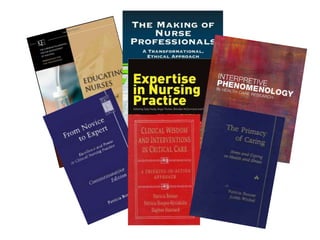
• From Novice to Expert
• The Primacy of Caring
• Interpretive Phenomenology
• Expertise in Nursing Practice
• Clinical Wisdom and Interventions in Critical Care
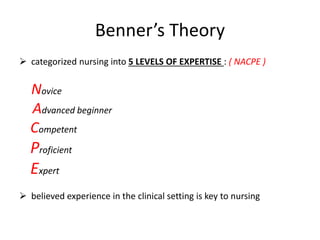
Benner’s Theory
 categorized nursing into 5 LEVELS OF EXPERTISE : ( NACPE )
Novice
Advanced beginner
Competent
Proficient
Expert
 believed experience in the clinical setting is key to nursing
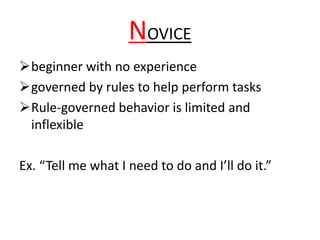
NOVICE
beginner with no experience
governed by rules to help perform tasks
Rule-governed behavior is limited and
inflexible
Ex. “Tell me what I need to do and I’ll do it.”
NOexperience
VatasInflexible
imited
ce
0 year
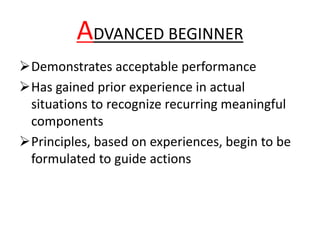
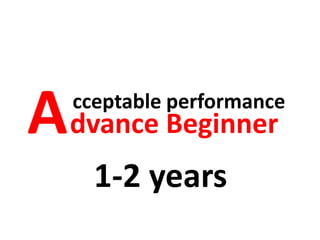
ADVANCED BEGINNER
Demonstrates acceptable performance
Has gained prior experience in actual
situations to recognize recurring meaningful
components
Principles, based on experiences, begin to be
formulated to guide actions
Advance Beginner
cceptable performance
1-2 years
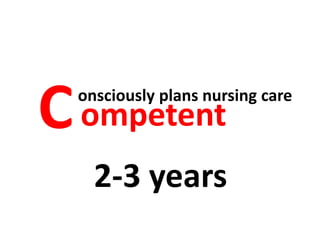
COMPETENT
Nurse with 2-3 years experience on the job in the
same area or in similar day-to-day situations
More aware of long-term goals
Consciously plans nursing
Competent
onsciously plans nursing care
2-3 years
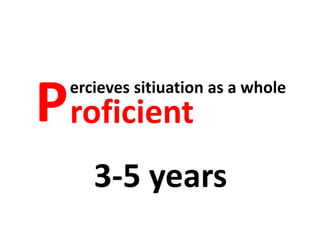
PROFICIENT
Perceives and understands situations as
whole parts
More holistic understanding improves
decision-making
Learns from experiences what to expect in
certain situations and how to modify plans
Proficient
ercieves sitiuation as a whole
3-5 years
EXPERT
No longer relies on principles, rules, or guidelines
to connect situations and determine actions
Much more background of experience
Has intuitive grasp of clinical situations
Performance is now fluid, flexible, and highly-
proficient
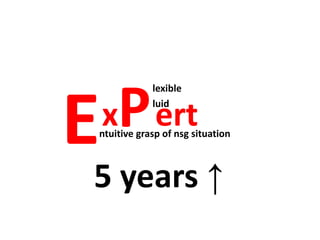
ExPert
ntuitive grasp of nsg situation
lexible
luid
5 years ↑
Different levels of skills reflect changes in 3 aspects of
skilled performance:
1. Movement from relying on abstract principles to using past
concrete experiences to guide actions
2. Change in learner’s perception of situations as whole parts
rather than in separate pieces
3. Passage from a detached observer to an involved performer,
no longer outside the situation but now actively engaged in
participation
SIGNIFICANCE OF THE THEORY
• These levels reflect movement from reliance on
past abstract principles to the use of past
concrete experience as paradigms and change in
perception of situation as a complete whole in
which certain parts are relevant
• Each step builds on the previous one as abstract
principles are refined and expanded by
experience and the learner gains clinical
expertise.
• This theory changed the profession's
understanding of what it means to be an
expert, placing this designation not on the
nurse with the most highly paid or most
prestigious position, but on the nurse who
provided "THE MOST EXQUISITE NURSING
CARE”.
THE END

Patricia Benner’s.pptx

  • 1.
    Patricia Benner’s Level ofExpertise Model By: Jeffrey S. Evangelista, RN
  • 2.
    Patricia Benner, R.N,Ph.D, F.A.A.N, F.R.C.N  is a Professor Emerita at the University of California, San Francisco  BA in Nursing - Pasadena College/Point Loma College  MS in Med/Surg nursing from UCSF  PhD -1982 from UC Berkeley  1970s - Research at UCSF and UC Berkeley
  • 3.
    Has taught anddone research at UCSF since 1979 Published 9 books and numerous articles Published ‘Novice to Expert Theory’ in 1982 Received Book of the Year from AJN in 1984,1990,1996, 2000
  • 4.
     expert nursesdevelop skills and understanding of patient care over time through a sound educational base as well as a multitude of experiences  one could gain knowledge and skills ("knowing how") without ever learning the theory ("knowing that")  conceptualizes in her writing about nursing skills as experience is a prerequisite for becoming an expert
  • 5.
    • From Noviceto Expert • The Primacy of Caring • Interpretive Phenomenology • Expertise in Nursing Practice • Clinical Wisdom and Interventions in Critical Care
  • 7.
    Benner’s Theory  categorizednursing into 5 LEVELS OF EXPERTISE : ( NACPE ) Novice Advanced beginner Competent Proficient Expert  believed experience in the clinical setting is key to nursing
  • 8.
    NOVICE beginner with noexperience governed by rules to help perform tasks Rule-governed behavior is limited and inflexible Ex. “Tell me what I need to do and I’ll do it.”
  • 9.
  • 10.
    ADVANCED BEGINNER Demonstrates acceptableperformance Has gained prior experience in actual situations to recognize recurring meaningful components Principles, based on experiences, begin to be formulated to guide actions
  • 11.
  • 12.
    COMPETENT Nurse with 2-3years experience on the job in the same area or in similar day-to-day situations More aware of long-term goals Consciously plans nursing
  • 13.
  • 14.
    PROFICIENT Perceives and understandssituations as whole parts More holistic understanding improves decision-making Learns from experiences what to expect in certain situations and how to modify plans
  • 15.
  • 16.
    EXPERT No longer relieson principles, rules, or guidelines to connect situations and determine actions Much more background of experience Has intuitive grasp of clinical situations Performance is now fluid, flexible, and highly- proficient
  • 17.
    ExPert ntuitive grasp ofnsg situation lexible luid 5 years ↑
  • 18.
    Different levels ofskills reflect changes in 3 aspects of skilled performance: 1. Movement from relying on abstract principles to using past concrete experiences to guide actions 2. Change in learner’s perception of situations as whole parts rather than in separate pieces 3. Passage from a detached observer to an involved performer, no longer outside the situation but now actively engaged in participation
  • 19.
    SIGNIFICANCE OF THETHEORY • These levels reflect movement from reliance on past abstract principles to the use of past concrete experience as paradigms and change in perception of situation as a complete whole in which certain parts are relevant • Each step builds on the previous one as abstract principles are refined and expanded by experience and the learner gains clinical expertise.
  • 20.
    • This theorychanged the profession's understanding of what it means to be an expert, placing this designation not on the nurse with the most highly paid or most prestigious position, but on the nurse who provided "THE MOST EXQUISITE NURSING CARE”.
  • 21.