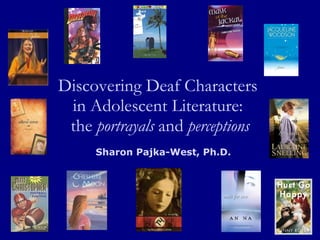
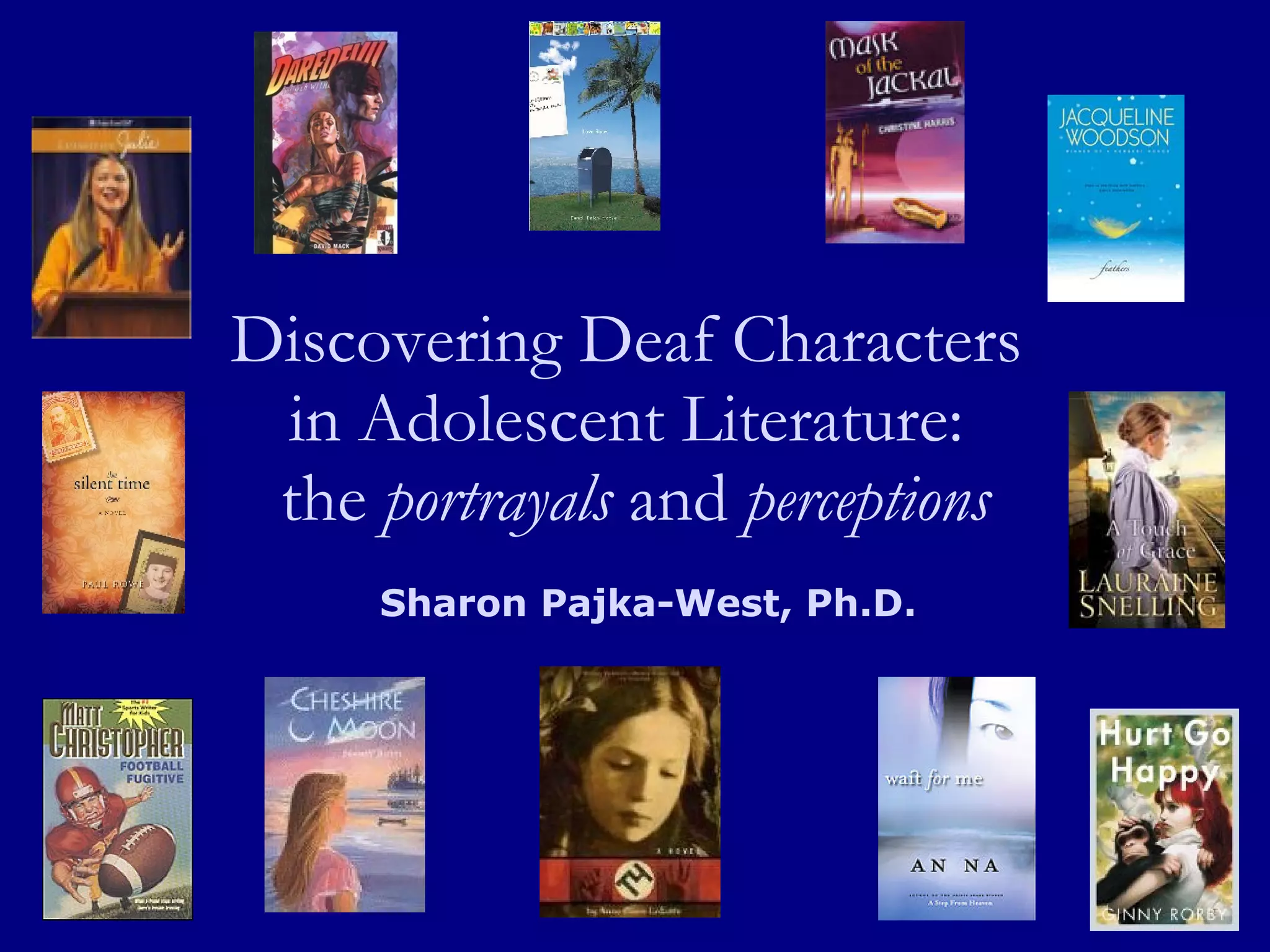

Discovering Deaf Characters  in Adolescent Literature:  the  portrayals  and  perceptions Sharon Pajka-West, Ph.D.
Goals: To give an overview of my research study,  The portrayals and perceptions of deaf characters in adolescent literature To acknowledge the differences in portrayals of deaf characters by deaf and hearing authors To highlight contemporary adolescent literature texts with a range of deaf characters To share resources (websites, books, and articles) highlighting children’s/adolescent books with deaf characters
Research Questions: Are deaf characters being presented as culturally Deaf characters or as pathologically deaf and disabled? Do readers favor deaf authors over hearing ones? If so, why?  How do deaf and hearing adult readers perceive deaf characters in adolescent literature?  How do the participants’ responses and perceptions of deaf characters relate to the check-off forms based upon the authors’ portrayals?
Problem Acquiring fictional books with deaf characters can be time-consuming and challenging.  Few scholars have conducted research on the topic.  of those even fewer have focused their attentions to adolescent fiction
Research on the portrayals of deaf characters Lack of attention to the topic (Civiletto & Schirmer, 2000). Limited empirical research (Burns, 1950; Guella, 1983; Krentz, 2002, Wilding-Diaz, 1993). A lack of understanding regarding the representation of deaf characters in literature (Batson & Bergman, 1985; Bergman, 1987; Burns, 1980; Krentz, 2002; Panara, 1972; Taylor, 1974, 1976a, 1976b, Schwartz, 1980; Wilding-Diaz, 1993).  Deafness used as a literary device (Batson & Bergman, 1985; Bergman, 1987; Burns, 1980; Krentz, 2002; Panara, 1972; Taylor, 1974, 1976a, 1976b, Schwartz, 1980; Wilding-Diaz, 1993).
Influential Research:  Literature Pertaining to Diversity and Multiculturalism in Adolescent Fiction Despite decades of research affirming culturally authentic children’s literature and the merits of multicultural literature, a coexisting body of research reveals the lack of culturally authentic texts  (Applebee, 1992; Campbell & Wirtenberg, 1980; Ernest, 1995; Larrick, 1965; Sherriff, 2005; Taxel, 1986).
Authentic Literature Authentic multicultural literature =  one that is based upon fact (cultural accuracy),  one that reproduces the crucial features of the original (cultural accuracy),  one that is true to the creator's own cultural personality, spirit, or character (cultural immersion).   For multicultural literature to be considered “authentic” it must include evidence that it is  grounded in the accurate facts of the culture   the authors have  faithfully adhered to the culture  in their literary interpretations. (Dresang, 2006)
When diverse characters are portrayed realistically and authentically in fiction, Children’s attitudes about race and gender are affected positively  (Campbell & Wirtenberg, 1980; Jetton & Savage-Davis, 2005). Children begin to understand a sense of ‘self’  (Campbell & Wirtenberg, 1980; Grice & Vaughn, 1992).   Children show an increase in enjoyment  (Smith, 1995). Children who had been identified as low ability students showed an interest in books with diverse characters. Researchers discovered that these children’s reading levels had been misrepresented as grades lower than the students could read  (Grice & Vaughn, 1992).
Location, Time Frame, Methodology Where?  Virginia When? Data collection: January- April 2006 Methodology? Mixed Research methods, specifically mixed model research using both qualitative and quantitative research within the research process. 
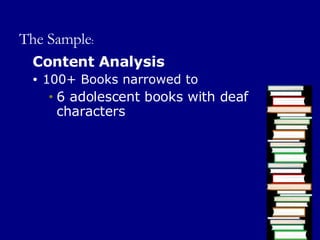
The Sample : Content Analysis 100+ Books narrowed to 6 adolescent books with deaf characters
Criteria for selecting books for this study Only chapter books (not Picture Books) Juvenile, Adolescent or Cross-over books Realistic Fiction (did not include Magic or Historical Realism) Availability (access through public libraries and/or bookstore) In-publication (excluded books no longer published) Main character(s) must be deaf Main character(s) must be human (deaf animals or books  based upon hearing ear dogs were not included) 50% of the books from Deaf Authors; 50% of the books authors from Hearing Authors All books written in English or translated into English Books based in the United States to reflect American deaf characters Included the most recent book selections (within last 15 years of publication or reissuing of publication)
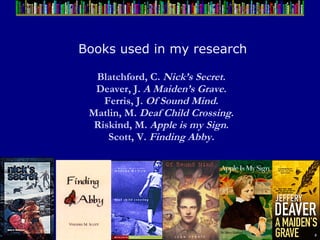
Books used in my research Blatchford, C.  Nick’s Secret .  Deaver, J.  A Maiden’s Grave .  Ferris, J.  Of Sound Mind .  Matlin, M.  Deaf Child Crossing .  Riskind, M.  Apple is my Sign .  Scott, V.  Finding Abby.
The Sample : Reader-Response Survey 27* Participant Readers: Deaf Familiar Unfamiliar Each participant read 2 books One book written by a Deaf Author One book written by a Hearing Author ( I didn’t divulge this but I didn’t hide it either ) * 24 completed the study:   8 from each group
Methodology: Instrumentation 1)  Content Analysis - developed to specifically analyze adolescent literature with deaf characters using Deaf Studies, Queer Theory and Disability Studies  ( for   emphasizing empowerment and challenging norms).   2)  Reader-Response Survey -  Participant readers responded to dichotomous and open-ended portions of each of the 10 questions.  Instrumentation derived from Schwartz’ (1980) ‘Criteria for Analyzing Books about Deafness ’. 
Findings: Research Question 1 Are deaf characters being presented as culturally Deaf or as pathologically deaf and disabled? The majority of the hearing authors presented the cultural perspective model.  The pathological perspective model was underrepresented in the books by the hearing authors;  yet, the majority of deaf authors included the pathological perspective. Reasons why these deaf authors included more pathological perspective statements while the hearing authors included more cultural perspective statements:  1. lived experience 2. fewer deaf characters in books by deaf authors 3. fewer ‘D’eaf authors
Findings: Research Question 2 Do these readers favor deaf authors over hearing ones? The Deaf participants along with the participants as a whole preferred the books written by the hearing authors  as better describing realistic deaf people,  for presenting deaf characters adequately and realistically, and  for the authors’ portrayals of deaf characters matching their own perceptions of deaf people.  In general, the Deaf participants were more critical of the deaf authors while the familiar participants, although as a group preferred the books by the hearing authors, were more critical of the hearing authors. Participants mentioned their preference for a spectrum of deaf characters.  The books used in this study that were written by hearing authors included a variety of characters.
Findings: Research Question 3 How do readers perceive deaf characters?   Themes that emerged from the Reader Response Surveys included the participants’ perceptions of these characters as:  the “normal” curious kid the egocentric spoiled brat the advocate those dependent upon the majority culture  those isolated*** those searching for their identities.
Findings: Research Question 4 How do the participants’ responses and perceptions of deaf characters relate to my analysis based upon Deaf Studies, Disability Studies and Queer Theory? A slight correlation between how the books rated on the Adolescent Literature Content- Analysis Check-off Forms and the Reader Response Surveys.  The books including higher percentages of the cultural perspective statements were perceived to be more positive by the participants.  This may indicate a preference for those books including more cultural perspective themes.
Other Conclusions: Participants made  more positive  comments about the  culturally Deaf male characters , particularly… Ben Roper, Jeremy and Thomas of  Of Sound Mind , and  Harry of  Apple is My Sign . Although the participants were divided in their responses to the various female characters,  all of the  female characters were criticized …  except for one minor culturally Deaf character, Susan….  ( but then, she was killed early on in the book – so what does that reveal? )
Oh, Did I mention?..... Participant Readers: Deaf  7  Females 1 Male Familiar 8  Females Unfamiliar 8  Females
Implications: -Inform teachers, librarians and adolescent readers regarding this unique genre of literature  ( presented on this topic nearly a dozen times and each time my focus changes slightly ) -Increased acknowledgement of the genre in Multicultural Literature  ( ALAN Review, Newfoundland and Labrador Studies Journal, NCTE ) -Add awareness to both the literature and to the community
Recommendations:   Components of this study would be valuable for use in classrooms interested in adolescent literature with deaf characters. Students:  -read and rate the books based upon the Adolescent Literature Content Analysis. -use the Reader-Response Survey to guide them through book discussions. -discuss the dichotomy of deafness and incorporate the authors’ backgrounds into their book talks. Since my initial research, I have used these in my classroom with: Feathers  (Woodson);  Graven Images  (Fleischman); and self-selected books with Deaf Characters
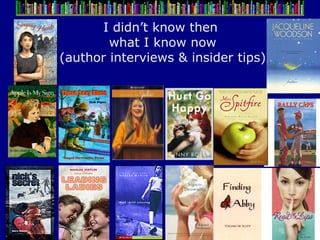
I didn’t know then  what I know now (author interviews & insider tips)
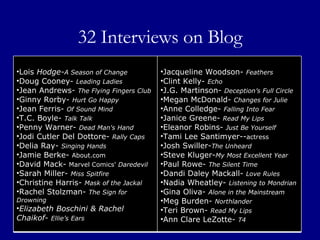
32 Interviews on Blog Lois  Hodge- A Season of Change  Doug Cooney-  Leading Ladies  Jean Andrews-  The Flying Fingers Club Ginny Rorby-  Hurt Go Happy  Jean Ferris-  Of Sound Mind  T.C. Boyle-  Talk Talk  Penny Warner-  Dead Man's Hand  Jodi Cutler Del Dottore-  Rally Caps  Delia Ray-  Singing Hands  Jamie Berke-  About.com   David Mack-  Marvel Comics'  Daredevil  Sarah Miller-  Miss Spitfire  Christine Harris-  Mask of the Jackal  Rachel Stolzman-  The Sign for Drowning  Elizabeth Boschini & Rachel Chaikof-  Ellie’s Ears  Jacqueline Woodson-  Feathers   Clint Kelly-  Echo   J.G. Martinson-  Deception’s Full Circle Megan McDonald-  Changes for Julie  Anne Colledge-  Falling Into Fear  Janice Greene-  Read My Lips  Eleanor Robins-  Just Be Yourself  Tami Lee Santimyer-- actress   Josh Swiller- The Unheard  Steve Kluger- My Most Excellent Year  Paul Rowe-  The Silent Time  Dandi Daley Mackall-  Love Rules  Nadia Wheatley-  Listening to Mondrian  Gina Oliva-  Alone in the Mainstream  Meg Burden-  Northlander   Teri Brown-  Read My Lips  Ann Clare LeZotte-  T4
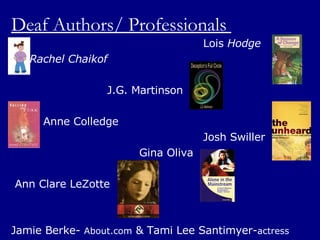
Deaf Authors/ Professionals  Lois  Hodge Rachel Chaikof   J.G. Martinson Anne Colledge Josh Swiller Gina Oliva Ann Clare LeZotte Jamie Berke-  About.com  & Tami Lee Santimyer- actress
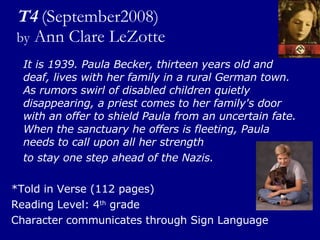
T4   (September2008) by  Ann Clare LeZotte It is 1939. Paula Becker, thirteen years old and deaf, lives with her family in a rural German town. As rumors swirl of disabled children quietly disappearing, a priest comes to her family's door with an offer to shield Paula from an uncertain fate. When the sanctuary he offers is fleeting, Paula needs to call upon all her strength  to stay one step ahead of the Nazis. *Told in Verse (112 pages) Reading Level: 4 th  grade Character communicates through Sign Language
T4   (Sept.2008) by  Ann Clare LeZotte “ I hope readers will realize that Deaf and Disabled people have been the victims of the most horrible kinds of persecution, and that we still live on, and value and enjoy our lives. There is a new form of eugenics today. Recently, I read the Nobel Prize winning Physiologist Sir John Sulston say, ‘I don't think one ought to bring a clearly disabled child into the world.’ As we move forward, into a new era of medicine and science, the next generations will have to decide what place and position the Disabled will take. I hope that they will value the best of human diversity.”
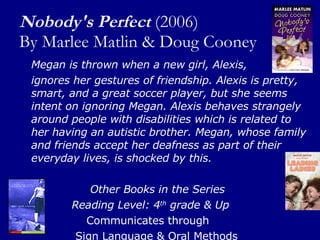
Nobody's Perfect   (2006) By Marlee Matlin & Doug Cooney Megan is thrown when a new girl, Alexis,  ignores her gestures of friendship. Alexis is pretty, smart, and a great soccer player, but she seems intent on ignoring Megan. Alexis behaves strangely around people with disabilities which is related to her having an autistic brother. Megan, whose family and friends accept her deafness as part of their everyday lives, is shocked by this.  Other Books in the Series Reading Level: 4 th  grade & Up Communicates through  Sign Language & Oral Methods
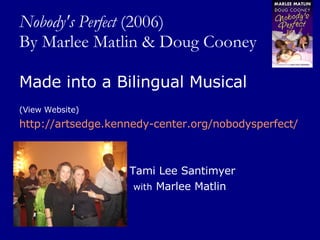
Nobody's Perfect  (2006) By Marlee Matlin & Doug Cooney Made into a Bilingual Musical (View Website) http://artsedge.kennedy-center.org/nobodysperfect/ Tami Lee Santimyer  with  Marlee Matlin
Hearing Authors Typically:  -have family members who are Deaf -work as Teachers of the Deaf or as Interpreters -include empowered Deaf Characters (those who use ASL and those who use Oral Methods of communication)
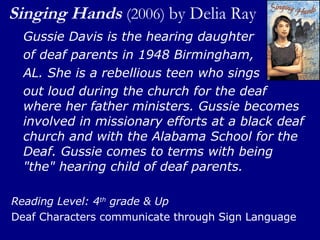
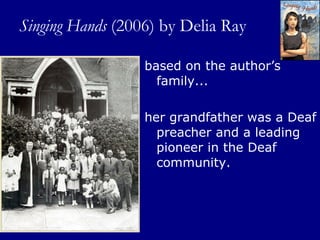
Singing Hands   (2006)  by Delia Ray  Gussie Davis is the hearing daughter  of deaf parents in 1948 Birmingham,  AL. She is a rebellious teen who sings  out loud during the church for the deaf where her father ministers. Gussie becomes involved in missionary efforts at a black deaf church and with the Alabama School for the Deaf. Gussie comes to terms with being "the" hearing child of deaf parents.  Reading Level: 4 th  grade & Up Deaf Characters communicate through Sign Language
Singing Hands  (2006) by Delia Ray  based on the author’s family...  her grandfather was a Deaf preacher and a leading pioneer in the Deaf community.
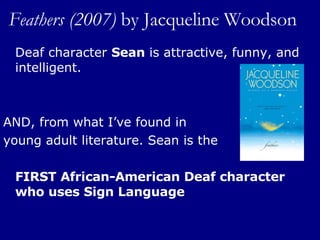
Feathers (2007)  by   Jacqueline Woodson Deaf character  Sean  is attractive, funny, and intelligent.  AND, from what I’ve found in  young adult literature. Sean is the  FIRST African-American Deaf character who uses Sign Language
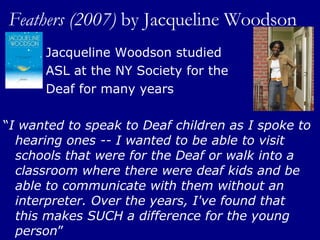
Feathers (2007)  by   Jacqueline Woodson Jacqueline Woodson studied  ASL at the NY Society for the  Deaf for many years  “ I wanted to speak to Deaf children as I spoke to hearing ones -- I wanted to be able to visit schools that were for the Deaf or walk into a classroom where there were deaf kids and be able to communicate with them without an interpreter. Over the years, I've found that this makes SUCH a difference for the young person ”
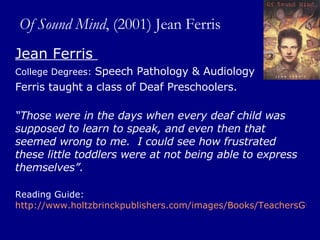
Of Sound Mind , (2001) Jean Ferris Reading Level: Teen/Characters communicate through ASL Deaf Characters Ben Roper, Ph.D.  Penn State Employee, Model Airplanes, Single Parent Jeremy Self-Confident, attends “special classes” at mainstream school  Thomas Carpenter, attended Gallaudet, doesn’t trust Hearing People Palma Deaf of Deaf, attended Gallaudet, famous artist “ She is too overly dependent on her hearing son, too helpless, too afraid, too high strung and too much the Prima Donna to be ‘real’ ”(9d).
Of Sound Mind , (2001) Jean Ferris Jean Ferris  College Degrees:  Speech Pathology & Audiology  Ferris taught a class of Deaf Preschoolers.  “ Those were in the days when every deaf child was supposed to learn to speak, and even then that seemed wrong to me.  I could see how frustrated these little toddlers were at not being able to express themselves”.  Reading Guide:  http://www.holtzbrinckpublishers.com/images/Books/TeachersGuides/0374455848TG.pdf
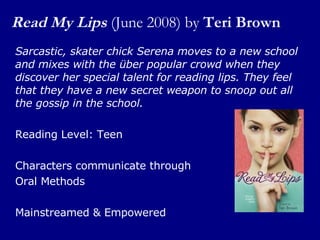
Read My Lips   (June 2008) by  Teri Brown Sarcastic, skater chick Serena moves to a new school and mixes with the über popular crowd when they discover her special talent for reading lips. They feel that they have a new secret weapon to snoop out all the gossip in the school.  Reading Level: Teen Characters communicate through  Oral Methods Mainstreamed & Empowered
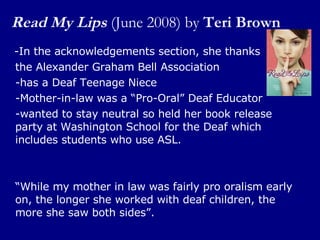
Read My Lips   (June 2008) by  Teri Brown -In the acknowledgements section, she thanks  the Alexander Graham Bell Association  -has a Deaf Teenage Niece -Mother-in-law was a “Pro-Oral” Deaf Educator -wanted to stay neutral so held her book release party at Washington School for the Deaf which includes students who use ASL. “ While my mother in law was fairly pro oralism early on, the longer she worked with deaf children, the more she saw both sides”.
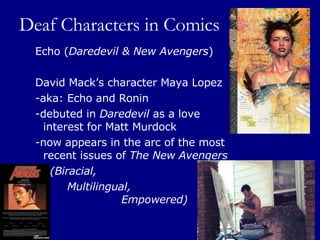
Deaf Characters in Comics Echo ( Daredevil & New Avengers ) David Mack’s character Maya Lopez  -aka: Echo and Ronin  -debuted in  Daredevil  as a love interest for Matt Murdock  -now appears in the arc of the most recent issues of  The New Avengers     (Biracial,  Multilingual,    Empowered)
Echo ( Daredevil  &  New Avengers ) The Secret Invasion is here!  Have the Skrulls infiltrated the Avengers?  Is Maya Lopez the only one  with proof?  Will she live to tell the tale?  All this and a major Avengers  hook up!
Check out my Blog!  * Includes over 185 titles  –  26 books from 2007-2008 *30+ Author & Professionals Interviews *Websites & Articles *Free Newsletter http://pajka.blogspot.com/     For Resources highlighting children’s/adolescent books with deaf characters

Pathways to Possibilities: Discovering Deaf Characters

  • 1.
    Discovering Deaf Characters in Adolescent Literature: the portrayals and perceptions Sharon Pajka-West, Ph.D.
  • 2.
    Goals: To givean overview of my research study, The portrayals and perceptions of deaf characters in adolescent literature To acknowledge the differences in portrayals of deaf characters by deaf and hearing authors To highlight contemporary adolescent literature texts with a range of deaf characters To share resources (websites, books, and articles) highlighting children’s/adolescent books with deaf characters
  • 3.
    Research Questions: Aredeaf characters being presented as culturally Deaf characters or as pathologically deaf and disabled? Do readers favor deaf authors over hearing ones? If so, why? How do deaf and hearing adult readers perceive deaf characters in adolescent literature? How do the participants’ responses and perceptions of deaf characters relate to the check-off forms based upon the authors’ portrayals?
  • 4.
    Problem Acquiring fictionalbooks with deaf characters can be time-consuming and challenging. Few scholars have conducted research on the topic. of those even fewer have focused their attentions to adolescent fiction
  • 5.
    Research on theportrayals of deaf characters Lack of attention to the topic (Civiletto & Schirmer, 2000). Limited empirical research (Burns, 1950; Guella, 1983; Krentz, 2002, Wilding-Diaz, 1993). A lack of understanding regarding the representation of deaf characters in literature (Batson & Bergman, 1985; Bergman, 1987; Burns, 1980; Krentz, 2002; Panara, 1972; Taylor, 1974, 1976a, 1976b, Schwartz, 1980; Wilding-Diaz, 1993). Deafness used as a literary device (Batson & Bergman, 1985; Bergman, 1987; Burns, 1980; Krentz, 2002; Panara, 1972; Taylor, 1974, 1976a, 1976b, Schwartz, 1980; Wilding-Diaz, 1993).
  • 6.
    Influential Research: Literature Pertaining to Diversity and Multiculturalism in Adolescent Fiction Despite decades of research affirming culturally authentic children’s literature and the merits of multicultural literature, a coexisting body of research reveals the lack of culturally authentic texts (Applebee, 1992; Campbell & Wirtenberg, 1980; Ernest, 1995; Larrick, 1965; Sherriff, 2005; Taxel, 1986).
  • 7.
    Authentic Literature Authenticmulticultural literature = one that is based upon fact (cultural accuracy), one that reproduces the crucial features of the original (cultural accuracy), one that is true to the creator's own cultural personality, spirit, or character (cultural immersion). For multicultural literature to be considered “authentic” it must include evidence that it is grounded in the accurate facts of the culture the authors have faithfully adhered to the culture in their literary interpretations. (Dresang, 2006)
  • 8.
    When diverse charactersare portrayed realistically and authentically in fiction, Children’s attitudes about race and gender are affected positively (Campbell & Wirtenberg, 1980; Jetton & Savage-Davis, 2005). Children begin to understand a sense of ‘self’ (Campbell & Wirtenberg, 1980; Grice & Vaughn, 1992).   Children show an increase in enjoyment (Smith, 1995). Children who had been identified as low ability students showed an interest in books with diverse characters. Researchers discovered that these children’s reading levels had been misrepresented as grades lower than the students could read (Grice & Vaughn, 1992).
  • 9.
    Location, Time Frame,Methodology Where? Virginia When? Data collection: January- April 2006 Methodology? Mixed Research methods, specifically mixed model research using both qualitative and quantitative research within the research process. 
  • 10.
    The Sample :Content Analysis 100+ Books narrowed to 6 adolescent books with deaf characters
  • 11.
    Criteria for selectingbooks for this study Only chapter books (not Picture Books) Juvenile, Adolescent or Cross-over books Realistic Fiction (did not include Magic or Historical Realism) Availability (access through public libraries and/or bookstore) In-publication (excluded books no longer published) Main character(s) must be deaf Main character(s) must be human (deaf animals or books based upon hearing ear dogs were not included) 50% of the books from Deaf Authors; 50% of the books authors from Hearing Authors All books written in English or translated into English Books based in the United States to reflect American deaf characters Included the most recent book selections (within last 15 years of publication or reissuing of publication)
  • 12.
    Books used inmy research Blatchford, C. Nick’s Secret . Deaver, J. A Maiden’s Grave . Ferris, J. Of Sound Mind . Matlin, M. Deaf Child Crossing . Riskind, M. Apple is my Sign . Scott, V. Finding Abby.
  • 13.
    The Sample :Reader-Response Survey 27* Participant Readers: Deaf Familiar Unfamiliar Each participant read 2 books One book written by a Deaf Author One book written by a Hearing Author ( I didn’t divulge this but I didn’t hide it either ) * 24 completed the study: 8 from each group
  • 14.
    Methodology: Instrumentation 1) Content Analysis - developed to specifically analyze adolescent literature with deaf characters using Deaf Studies, Queer Theory and Disability Studies ( for emphasizing empowerment and challenging norms). 2) Reader-Response Survey - Participant readers responded to dichotomous and open-ended portions of each of the 10 questions. Instrumentation derived from Schwartz’ (1980) ‘Criteria for Analyzing Books about Deafness ’. 
  • 15.
    Findings: Research Question1 Are deaf characters being presented as culturally Deaf or as pathologically deaf and disabled? The majority of the hearing authors presented the cultural perspective model. The pathological perspective model was underrepresented in the books by the hearing authors; yet, the majority of deaf authors included the pathological perspective. Reasons why these deaf authors included more pathological perspective statements while the hearing authors included more cultural perspective statements: 1. lived experience 2. fewer deaf characters in books by deaf authors 3. fewer ‘D’eaf authors
  • 16.
    Findings: Research Question2 Do these readers favor deaf authors over hearing ones? The Deaf participants along with the participants as a whole preferred the books written by the hearing authors as better describing realistic deaf people, for presenting deaf characters adequately and realistically, and for the authors’ portrayals of deaf characters matching their own perceptions of deaf people. In general, the Deaf participants were more critical of the deaf authors while the familiar participants, although as a group preferred the books by the hearing authors, were more critical of the hearing authors. Participants mentioned their preference for a spectrum of deaf characters. The books used in this study that were written by hearing authors included a variety of characters.
  • 17.
    Findings: Research Question3 How do readers perceive deaf characters? Themes that emerged from the Reader Response Surveys included the participants’ perceptions of these characters as: the “normal” curious kid the egocentric spoiled brat the advocate those dependent upon the majority culture those isolated*** those searching for their identities.
  • 18.
    Findings: Research Question4 How do the participants’ responses and perceptions of deaf characters relate to my analysis based upon Deaf Studies, Disability Studies and Queer Theory? A slight correlation between how the books rated on the Adolescent Literature Content- Analysis Check-off Forms and the Reader Response Surveys. The books including higher percentages of the cultural perspective statements were perceived to be more positive by the participants. This may indicate a preference for those books including more cultural perspective themes.
  • 19.
    Other Conclusions: Participantsmade more positive comments about the culturally Deaf male characters , particularly… Ben Roper, Jeremy and Thomas of Of Sound Mind , and Harry of Apple is My Sign . Although the participants were divided in their responses to the various female characters, all of the female characters were criticized … except for one minor culturally Deaf character, Susan…. ( but then, she was killed early on in the book – so what does that reveal? )
  • 20.
    Oh, Did Imention?..... Participant Readers: Deaf 7 Females 1 Male Familiar 8 Females Unfamiliar 8 Females
  • 21.
    Implications: -Inform teachers,librarians and adolescent readers regarding this unique genre of literature ( presented on this topic nearly a dozen times and each time my focus changes slightly ) -Increased acknowledgement of the genre in Multicultural Literature ( ALAN Review, Newfoundland and Labrador Studies Journal, NCTE ) -Add awareness to both the literature and to the community
  • 22.
    Recommendations: Components of this study would be valuable for use in classrooms interested in adolescent literature with deaf characters. Students: -read and rate the books based upon the Adolescent Literature Content Analysis. -use the Reader-Response Survey to guide them through book discussions. -discuss the dichotomy of deafness and incorporate the authors’ backgrounds into their book talks. Since my initial research, I have used these in my classroom with: Feathers (Woodson); Graven Images (Fleischman); and self-selected books with Deaf Characters
  • 23.
    I didn’t knowthen what I know now (author interviews & insider tips)
  • 24.
    32 Interviews onBlog Lois Hodge- A Season of Change Doug Cooney- Leading Ladies Jean Andrews- The Flying Fingers Club Ginny Rorby- Hurt Go Happy Jean Ferris- Of Sound Mind T.C. Boyle- Talk Talk Penny Warner- Dead Man's Hand Jodi Cutler Del Dottore- Rally Caps Delia Ray- Singing Hands Jamie Berke- About.com David Mack- Marvel Comics' Daredevil Sarah Miller- Miss Spitfire Christine Harris- Mask of the Jackal Rachel Stolzman- The Sign for Drowning Elizabeth Boschini & Rachel Chaikof- Ellie’s Ears Jacqueline Woodson- Feathers Clint Kelly- Echo J.G. Martinson- Deception’s Full Circle Megan McDonald- Changes for Julie Anne Colledge- Falling Into Fear Janice Greene- Read My Lips Eleanor Robins- Just Be Yourself Tami Lee Santimyer-- actress Josh Swiller- The Unheard Steve Kluger- My Most Excellent Year Paul Rowe- The Silent Time Dandi Daley Mackall- Love Rules Nadia Wheatley- Listening to Mondrian Gina Oliva- Alone in the Mainstream Meg Burden- Northlander Teri Brown- Read My Lips Ann Clare LeZotte- T4
  • 25.
    Deaf Authors/ Professionals Lois Hodge Rachel Chaikof J.G. Martinson Anne Colledge Josh Swiller Gina Oliva Ann Clare LeZotte Jamie Berke- About.com & Tami Lee Santimyer- actress
  • 26.
    T4 (September2008) by Ann Clare LeZotte It is 1939. Paula Becker, thirteen years old and deaf, lives with her family in a rural German town. As rumors swirl of disabled children quietly disappearing, a priest comes to her family's door with an offer to shield Paula from an uncertain fate. When the sanctuary he offers is fleeting, Paula needs to call upon all her strength to stay one step ahead of the Nazis. *Told in Verse (112 pages) Reading Level: 4 th grade Character communicates through Sign Language
  • 27.
    T4 (Sept.2008) by Ann Clare LeZotte “ I hope readers will realize that Deaf and Disabled people have been the victims of the most horrible kinds of persecution, and that we still live on, and value and enjoy our lives. There is a new form of eugenics today. Recently, I read the Nobel Prize winning Physiologist Sir John Sulston say, ‘I don't think one ought to bring a clearly disabled child into the world.’ As we move forward, into a new era of medicine and science, the next generations will have to decide what place and position the Disabled will take. I hope that they will value the best of human diversity.”
  • 28.
    Nobody's Perfect (2006) By Marlee Matlin & Doug Cooney Megan is thrown when a new girl, Alexis, ignores her gestures of friendship. Alexis is pretty, smart, and a great soccer player, but she seems intent on ignoring Megan. Alexis behaves strangely around people with disabilities which is related to her having an autistic brother. Megan, whose family and friends accept her deafness as part of their everyday lives, is shocked by this. Other Books in the Series Reading Level: 4 th grade & Up Communicates through Sign Language & Oral Methods
  • 29.
    Nobody's Perfect (2006) By Marlee Matlin & Doug Cooney Made into a Bilingual Musical (View Website) http://artsedge.kennedy-center.org/nobodysperfect/ Tami Lee Santimyer with Marlee Matlin
  • 30.
    Hearing Authors Typically: -have family members who are Deaf -work as Teachers of the Deaf or as Interpreters -include empowered Deaf Characters (those who use ASL and those who use Oral Methods of communication)
  • 31.
    Singing Hands (2006) by Delia Ray Gussie Davis is the hearing daughter of deaf parents in 1948 Birmingham, AL. She is a rebellious teen who sings out loud during the church for the deaf where her father ministers. Gussie becomes involved in missionary efforts at a black deaf church and with the Alabama School for the Deaf. Gussie comes to terms with being "the" hearing child of deaf parents. Reading Level: 4 th grade & Up Deaf Characters communicate through Sign Language
  • 32.
    Singing Hands (2006) by Delia Ray based on the author’s family... her grandfather was a Deaf preacher and a leading pioneer in the Deaf community.
  • 33.
    Feathers (2007) by Jacqueline Woodson Deaf character Sean is attractive, funny, and intelligent. AND, from what I’ve found in young adult literature. Sean is the FIRST African-American Deaf character who uses Sign Language
  • 34.
    Feathers (2007) by Jacqueline Woodson Jacqueline Woodson studied ASL at the NY Society for the Deaf for many years “ I wanted to speak to Deaf children as I spoke to hearing ones -- I wanted to be able to visit schools that were for the Deaf or walk into a classroom where there were deaf kids and be able to communicate with them without an interpreter. Over the years, I've found that this makes SUCH a difference for the young person ”
  • 35.
    Of Sound Mind, (2001) Jean Ferris Reading Level: Teen/Characters communicate through ASL Deaf Characters Ben Roper, Ph.D. Penn State Employee, Model Airplanes, Single Parent Jeremy Self-Confident, attends “special classes” at mainstream school Thomas Carpenter, attended Gallaudet, doesn’t trust Hearing People Palma Deaf of Deaf, attended Gallaudet, famous artist “ She is too overly dependent on her hearing son, too helpless, too afraid, too high strung and too much the Prima Donna to be ‘real’ ”(9d).
  • 36.
    Of Sound Mind, (2001) Jean Ferris Jean Ferris College Degrees: Speech Pathology & Audiology Ferris taught a class of Deaf Preschoolers. “ Those were in the days when every deaf child was supposed to learn to speak, and even then that seemed wrong to me. I could see how frustrated these little toddlers were at not being able to express themselves”. Reading Guide: http://www.holtzbrinckpublishers.com/images/Books/TeachersGuides/0374455848TG.pdf
  • 37.
    Read My Lips (June 2008) by Teri Brown Sarcastic, skater chick Serena moves to a new school and mixes with the über popular crowd when they discover her special talent for reading lips. They feel that they have a new secret weapon to snoop out all the gossip in the school. Reading Level: Teen Characters communicate through Oral Methods Mainstreamed & Empowered
  • 38.
    Read My Lips (June 2008) by Teri Brown -In the acknowledgements section, she thanks the Alexander Graham Bell Association -has a Deaf Teenage Niece -Mother-in-law was a “Pro-Oral” Deaf Educator -wanted to stay neutral so held her book release party at Washington School for the Deaf which includes students who use ASL. “ While my mother in law was fairly pro oralism early on, the longer she worked with deaf children, the more she saw both sides”.
  • 39.
    Deaf Characters inComics Echo ( Daredevil & New Avengers ) David Mack’s character Maya Lopez -aka: Echo and Ronin -debuted in Daredevil as a love interest for Matt Murdock -now appears in the arc of the most recent issues of The New Avengers (Biracial, Multilingual, Empowered)
  • 40.
    Echo ( Daredevil & New Avengers ) The Secret Invasion is here! Have the Skrulls infiltrated the Avengers? Is Maya Lopez the only one with proof? Will she live to tell the tale? All this and a major Avengers hook up!
  • 41.
    Check out myBlog! * Includes over 185 titles – 26 books from 2007-2008 *30+ Author & Professionals Interviews *Websites & Articles *Free Newsletter http://pajka.blogspot.com/ For Resources highlighting children’s/adolescent books with deaf characters