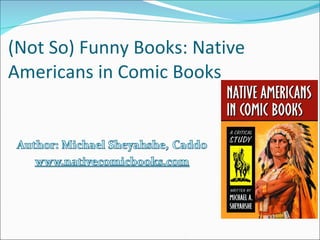
(Not So) Funny Books: Native Americans in Comic Books
Synopsis Native American characters have been misrepresented in many genre and media forms How do we evaluate the level of stereotypes used? Universal standard to determine stereotype? Character eval is subjective, at best Broad categories to help make determinations about potential misrepresentation. Explore these criteria and examples that conform –fully or in part – or resist such stereotypes.
 
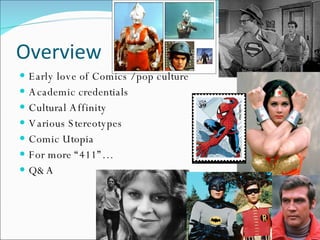
Overview Early love of Comics / pop culture Academic credentials Cultural Affinity Various Stereotypes Comic Utopia For more “411”… Q&A
Love of Comics Why comics? Farmboys need comics, too…
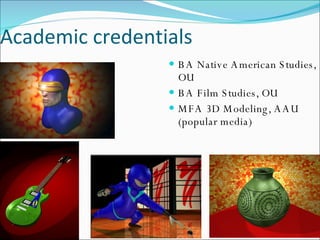
BA Native American Studies, OU BA Film Studies, OU MFA 3D Modeling, AAU (popular media) Academic credentials
Cultural Affinity Indigenous - Caddo Participation / Appointments Business Goals
Why Use Criteria? Comics medium is far-ranging Has many similarities in other media Stereotypes various/numerous, specific need to break into categories Offers a way to form personal opinion, used as a foundation
Stedman Source Text Shadows of the Indian: Stereotypes in American Outlines stereotypes in many media forms Provides specific questions to ask
Stedman Criteria Is the vocabulary demeaning? Do the Indians Talk Like Tonto? Do the Indians Belong to the Feather-Bonnet Tribe? Are Comic Interludes Built Upon Firewater and Stupidity? Are the Indians Portrayed as an Extinct Species? Are the Indians either Noble or Savage? Is the Tone Patronizing? Is Indian Humanness Recognized?
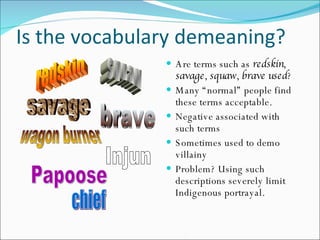
Is the vocabulary demeaning? Are terms such as  redskin ,  savage ,  squaw ,  brave used ? Many “normal” people find these terms acceptable. Negative associated with such terms Sometimes used to demo villainy  Problem? Using such descriptions severely limit Indigenous portrayal. redskin savage squaw brave  wagon burner Injun Papoose chief
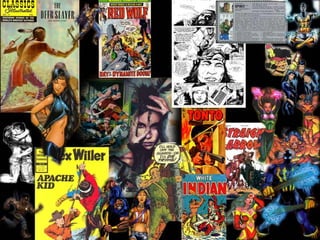
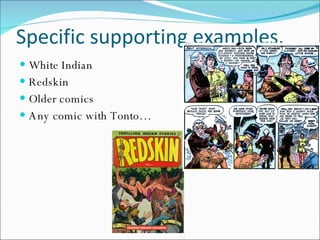
Specific supporting examples. White Indian Redskin Older comics Any comic with Tonto…
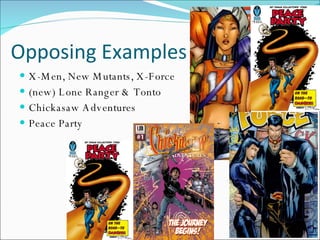
Opposing Examples X-Men, New Mutants, X-Force (new) Lone Ranger & Tonto Chickasaw Adventures Peace Party
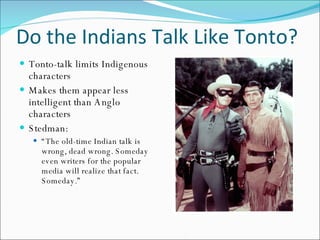
Do the Indians Talk Like Tonto? Tonto-talk limits Indigenous characters Makes them appear less intelligent than Anglo characters Stedman: “ The old-time Indian talk is wrong, dead wrong. Someday even writers for the popular media will realize that fact. Someday.”
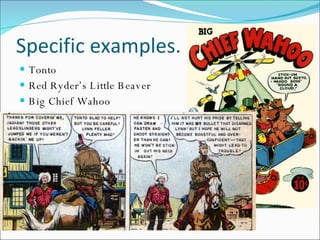
Specific examples. Tonto Red Ryder’s Little Beaver Big Chief Wahoo
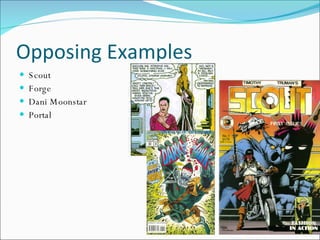
Opposing Examples Scout Forge Dani Moonstar Portal
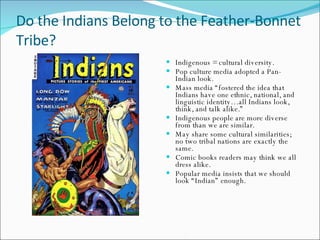
Do the Indians Belong to the Feather-Bonnet Tribe? Indigenous = cultural diversity. Pop culture media adopted a Pan-Indian look. Mass media “fostered the idea that Indians have one ethnic, national, and linguistic identity…all Indians look, think, and talk alike.” Indigenous people are more diverse from than we are similar. May share some cultural similarities; no two tribal nations are exactly the same. Comic books readers may think we all dress alike. Popular media insists that we should look “Indian” enough.
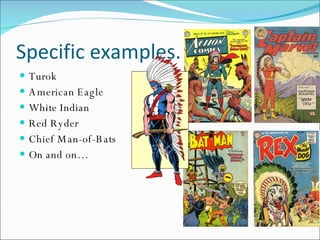
Specific examples. Turok American Eagle White Indian Red Ryder Chief Man-of-Bats On and on…
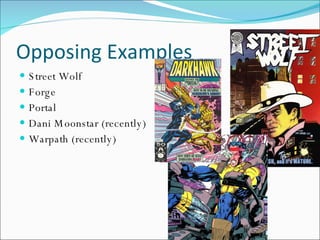
Opposing Examples Street Wolf Forge Portal Dani Moonstar (recently) Warpath (recently)
Are Comic Interludes Built Upon Firewater and Stupidity? Portrays Indigenous people as drunkards, stupid, or just stupid drunks. Stedman: “he is either the drunken fool or the sober dolt.” Similar to “jungle” comics - restless natives waiting for a white savior. Examples: Red Ryder’s Little Beaver and The Lone Ranger’s Tonto.
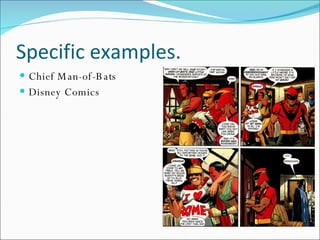
Specific examples. Chief Man-of-Bats Disney Comics
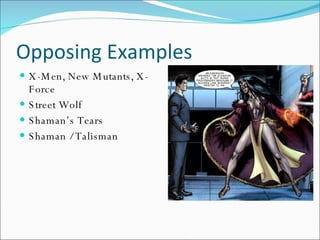
Opposing Examples X-Men, New Mutants, X-Force Street Wolf Shaman’s Tears Shaman / Talisman
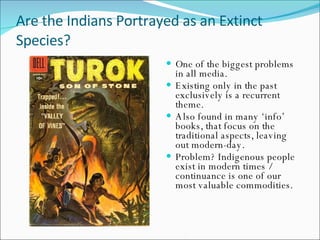
Are the Indians Portrayed as an Extinct Species? One of the biggest problems in all media. Existing only in the past exclusively is a recurrent theme. Also found in many ‘info’ books, that focus on the traditional aspects, leaving out modern-day. Problem? Indigenous people exist in modern times / continuance is one of our most valuable commodities.
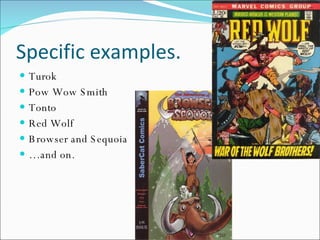
Specific examples. Turok Pow Wow Smith Tonto Red Wolf Browser and Sequoia … and on.
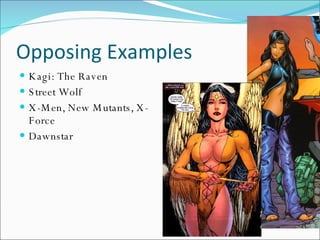
Opposing Examples Kagi: The Raven Street Wolf X-Men, New Mutants, X-Force Dawnstar
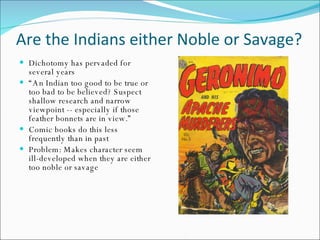
Are the Indians either Noble or Savage? Dichotomy has pervaded for several years “ An Indian too good to be true or too bad to be believed? Suspect shallow research and narrow viewpoint -- especially if those feather bonnets are in view.” Comic books do this less frequently than in past Problem: Makes character seem ill-developed when they are either too noble or savage
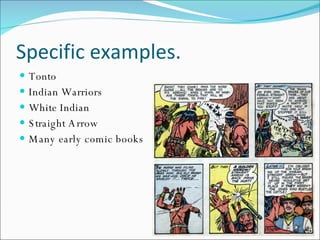
Specific examples. Tonto Indian Warriors White Indian Straight Arrow Many early comic books
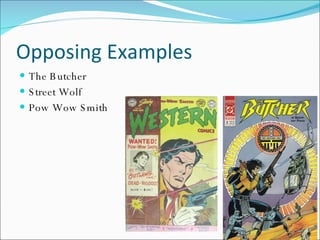
Opposing Examples The Butcher Street Wolf Pow Wow Smith
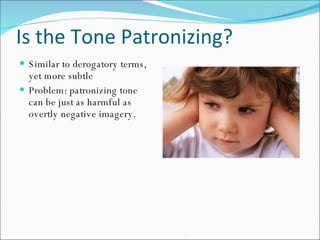
Is the Tone Patronizing? Similar to derogatory terms, yet more subtle Problem: patronizing tone can be just as harmful as overtly negative imagery.
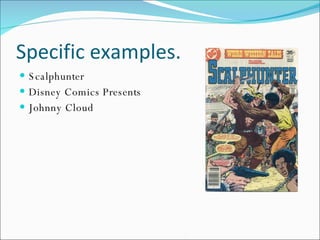
Specific examples. Scalphunter Disney Comics Presents Johnny Cloud
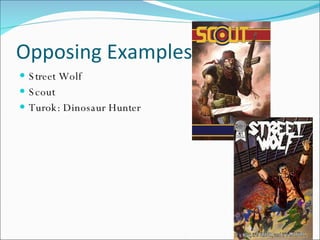
Opposing Examples Street Wolf Scout Turok: Dinosaur Hunter
Is Indian Humanness Recognized? “ In sum, are [Indigenous people] seen in something resembling full dimension?” a.k.a., “humanity” One of the most important elements of the criteria A recurring problem in comic books Main focus for this book Indigenous people are human and real. Problem: Indigenous must be seen as “real” people and not just caricatures
Specific examples. Almost every comic book with Native American characters
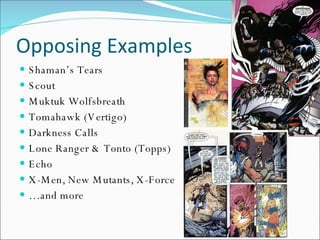
Opposing Examples Shaman’s Tears Scout Muktuk Wolfsbreath Tomahawk (Vertigo) Darkness Calls Lone Ranger & Tonto (Topps) Echo X-Men, New Mutants, X-Force … and more
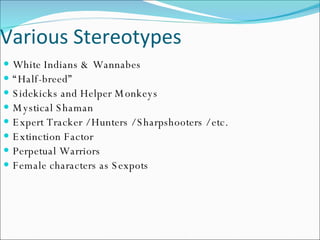
Various Stereotypes White Indians & Wannabes “ Half-breed” Sidekicks and Helper Monkeys Mystical Shaman Expert Tracker / Hunters / Sharpshooters / etc. Extinction Factor Perpetual Warriors Female characters as Sexpots
Comic Utopia: What Can Be Done? Personal Goals Native driven media Future Needs More creative control (complete) Call to action Get involved
For more “411”… Comics themselves Cornell Pewewardy: American Indian Stereotypes in the World of Children  Raymond William Stedman: Shadows of the Indian William Savage, Jr.: Commies, Cowboys, and Jungle Queens Bradford Wright: Comic Book Nation Jacqueline Kilpatrick: Celluloid Indian Overstreet The DC and Marvel Encyclopedias The Web Blue Corn Comics The Grand Comic Book Data Base Michigan State University Libraries – Comic Art Collection, Special Collections Division The Unofficial Guide to the DC Universe eBay Wikipedia Comic Book Resources (CBR) Marvel Universe: the Official Marvel Wiki
Q&A Go for it.

"(Not So) Funny Books"

  • 1.
    (Not So) FunnyBooks: Native Americans in Comic Books
  • 2.
    Synopsis Native Americancharacters have been misrepresented in many genre and media forms How do we evaluate the level of stereotypes used? Universal standard to determine stereotype? Character eval is subjective, at best Broad categories to help make determinations about potential misrepresentation. Explore these criteria and examples that conform –fully or in part – or resist such stereotypes.
  • 3.
  • 4.
    Overview Early loveof Comics / pop culture Academic credentials Cultural Affinity Various Stereotypes Comic Utopia For more “411”… Q&A
  • 5.
    Love of ComicsWhy comics? Farmboys need comics, too…
  • 6.
    BA Native AmericanStudies, OU BA Film Studies, OU MFA 3D Modeling, AAU (popular media) Academic credentials
  • 7.
    Cultural Affinity Indigenous- Caddo Participation / Appointments Business Goals
  • 8.
    Why Use Criteria?Comics medium is far-ranging Has many similarities in other media Stereotypes various/numerous, specific need to break into categories Offers a way to form personal opinion, used as a foundation
  • 9.
    Stedman Source TextShadows of the Indian: Stereotypes in American Outlines stereotypes in many media forms Provides specific questions to ask
  • 10.
    Stedman Criteria Isthe vocabulary demeaning? Do the Indians Talk Like Tonto? Do the Indians Belong to the Feather-Bonnet Tribe? Are Comic Interludes Built Upon Firewater and Stupidity? Are the Indians Portrayed as an Extinct Species? Are the Indians either Noble or Savage? Is the Tone Patronizing? Is Indian Humanness Recognized?
  • 11.
    Is the vocabularydemeaning? Are terms such as redskin , savage , squaw , brave used ? Many “normal” people find these terms acceptable. Negative associated with such terms Sometimes used to demo villainy Problem? Using such descriptions severely limit Indigenous portrayal. redskin savage squaw brave wagon burner Injun Papoose chief
  • 12.
    Specific supporting examples.White Indian Redskin Older comics Any comic with Tonto…
  • 13.
    Opposing Examples X-Men,New Mutants, X-Force (new) Lone Ranger & Tonto Chickasaw Adventures Peace Party
  • 14.
    Do the IndiansTalk Like Tonto? Tonto-talk limits Indigenous characters Makes them appear less intelligent than Anglo characters Stedman: “ The old-time Indian talk is wrong, dead wrong. Someday even writers for the popular media will realize that fact. Someday.”
  • 15.
    Specific examples. TontoRed Ryder’s Little Beaver Big Chief Wahoo
  • 16.
    Opposing Examples ScoutForge Dani Moonstar Portal
  • 17.
    Do the IndiansBelong to the Feather-Bonnet Tribe? Indigenous = cultural diversity. Pop culture media adopted a Pan-Indian look. Mass media “fostered the idea that Indians have one ethnic, national, and linguistic identity…all Indians look, think, and talk alike.” Indigenous people are more diverse from than we are similar. May share some cultural similarities; no two tribal nations are exactly the same. Comic books readers may think we all dress alike. Popular media insists that we should look “Indian” enough.
  • 18.
    Specific examples. TurokAmerican Eagle White Indian Red Ryder Chief Man-of-Bats On and on…
  • 19.
    Opposing Examples StreetWolf Forge Portal Dani Moonstar (recently) Warpath (recently)
  • 20.
    Are Comic InterludesBuilt Upon Firewater and Stupidity? Portrays Indigenous people as drunkards, stupid, or just stupid drunks. Stedman: “he is either the drunken fool or the sober dolt.” Similar to “jungle” comics - restless natives waiting for a white savior. Examples: Red Ryder’s Little Beaver and The Lone Ranger’s Tonto.
  • 21.
    Specific examples. ChiefMan-of-Bats Disney Comics
  • 22.
    Opposing Examples X-Men,New Mutants, X-Force Street Wolf Shaman’s Tears Shaman / Talisman
  • 23.
    Are the IndiansPortrayed as an Extinct Species? One of the biggest problems in all media. Existing only in the past exclusively is a recurrent theme. Also found in many ‘info’ books, that focus on the traditional aspects, leaving out modern-day. Problem? Indigenous people exist in modern times / continuance is one of our most valuable commodities.
  • 24.
    Specific examples. TurokPow Wow Smith Tonto Red Wolf Browser and Sequoia … and on.
  • 25.
    Opposing Examples Kagi:The Raven Street Wolf X-Men, New Mutants, X-Force Dawnstar
  • 26.
    Are the Indianseither Noble or Savage? Dichotomy has pervaded for several years “ An Indian too good to be true or too bad to be believed? Suspect shallow research and narrow viewpoint -- especially if those feather bonnets are in view.” Comic books do this less frequently than in past Problem: Makes character seem ill-developed when they are either too noble or savage
  • 27.
    Specific examples. TontoIndian Warriors White Indian Straight Arrow Many early comic books
  • 28.
    Opposing Examples TheButcher Street Wolf Pow Wow Smith
  • 29.
    Is the TonePatronizing? Similar to derogatory terms, yet more subtle Problem: patronizing tone can be just as harmful as overtly negative imagery.
  • 30.
    Specific examples. ScalphunterDisney Comics Presents Johnny Cloud
  • 31.
    Opposing Examples StreetWolf Scout Turok: Dinosaur Hunter
  • 32.
    Is Indian HumannessRecognized? “ In sum, are [Indigenous people] seen in something resembling full dimension?” a.k.a., “humanity” One of the most important elements of the criteria A recurring problem in comic books Main focus for this book Indigenous people are human and real. Problem: Indigenous must be seen as “real” people and not just caricatures
  • 33.
    Specific examples. Almostevery comic book with Native American characters
  • 34.
    Opposing Examples Shaman’sTears Scout Muktuk Wolfsbreath Tomahawk (Vertigo) Darkness Calls Lone Ranger & Tonto (Topps) Echo X-Men, New Mutants, X-Force … and more
  • 35.
    Various Stereotypes WhiteIndians & Wannabes “ Half-breed” Sidekicks and Helper Monkeys Mystical Shaman Expert Tracker / Hunters / Sharpshooters / etc. Extinction Factor Perpetual Warriors Female characters as Sexpots
  • 36.
    Comic Utopia: WhatCan Be Done? Personal Goals Native driven media Future Needs More creative control (complete) Call to action Get involved
  • 37.
    For more “411”…Comics themselves Cornell Pewewardy: American Indian Stereotypes in the World of Children Raymond William Stedman: Shadows of the Indian William Savage, Jr.: Commies, Cowboys, and Jungle Queens Bradford Wright: Comic Book Nation Jacqueline Kilpatrick: Celluloid Indian Overstreet The DC and Marvel Encyclopedias The Web Blue Corn Comics The Grand Comic Book Data Base Michigan State University Libraries – Comic Art Collection, Special Collections Division The Unofficial Guide to the DC Universe eBay Wikipedia Comic Book Resources (CBR) Marvel Universe: the Official Marvel Wiki
  • 38.