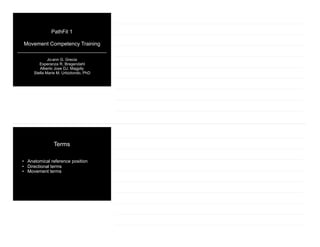
PathFit 1
Movement Competency Training
Jo-ann G. Grecia
Esperanza R. Bregendahl
Alberto Jose DJ. Magpily
Stella Marie M. Urbiztondo, PhD
Terms
• Anatomical reference position
• Directional terms
• Movement terms
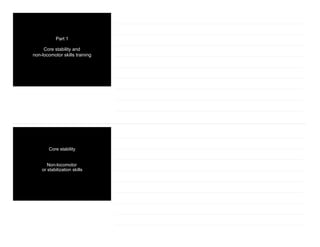
Part 1
Core stability and
non-locomotor skills training
Core stability
Non-locomotor
or stabilization skills
Breathing and Bracing
Core Stability Exercises
✓ Deadbug series
✓ Rolling
✓ Plank series
✓ Bird dog series
Deadbug Series
Key Points:
• Exercise Progression & Regression
• Spotting techniques
Turning/Rolling/Twisting
Scapulothoracic Exercises
Key Points:
• Activation
• Shoulder mobility
• Y-T-W
Lumbo-pelvic Exercises
Key Points:
• Activation
• Glute hip bridge
Plank Series
✓ Elbow/Low plank
✓ Straight arm/High plank
✓ Front & side
Bird Dog Series
Squat Sequence
Training Guidelines
• Static position for an extended time
• Progress by increasing the time/reps; narrow
base of support; unstable surface and
application of external resistance (e.g. load)
• Mastery of technique prior to progression
•
Part 2
Locomotor skills training
Crawling series
✓ Crawling vs. creeping
✓ Linear and lateral movements
Exercises for Balance
• Static vs. dynamic balance
Joint mobility exercises
Locomotor skills
✓ Land
• step-down
• reverse drop
✓ Jump
Locomotor skills
✓ Linear & lateral movements
✓ Run
• arm action
• leg action
Locomotor skills
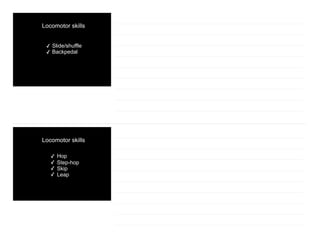
✓ Slide/shuffle
✓ Backpedal
Locomotor skills
✓ Hop
✓ Step-hop
✓ Skip
✓ Leap
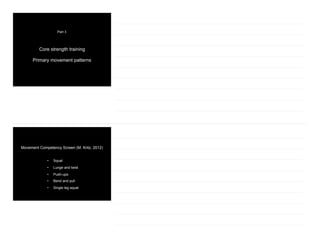
Part 3
Core strength training
Primary movement patterns
Movement Competency Screen (M. Kritz, 2012)
• Squat
• Lunge and twist
• Push-ups
• Bend and pull
• Single leg squat
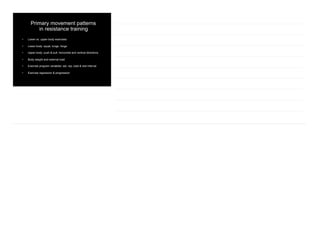
Primary movement patterns
in resistance training
• Lower vs. upper body exercises
• Lower body: squat, lunge, hinge
• Upper body: push & pull; horizontal and vertical directions
• Body weight and external load
• Exercise program variables: set, rep, load & rest interval
• Exercise regression & progression

pathfit-1-5.pdf

  • 4.
    PathFit 1 Movement CompetencyTraining Jo-ann G. Grecia Esperanza R. Bregendahl Alberto Jose DJ. Magpily Stella Marie M. Urbiztondo, PhD Terms • Anatomical reference position • Directional terms • Movement terms
  • 5.
    Part 1 Core stabilityand non-locomotor skills training Core stability Non-locomotor or stabilization skills
  • 6.
    Breathing and Bracing CoreStability Exercises ✓ Deadbug series ✓ Rolling ✓ Plank series ✓ Bird dog series
  • 7.
    Deadbug Series Key Points: •Exercise Progression & Regression • Spotting techniques Turning/Rolling/Twisting
  • 8.
    Scapulothoracic Exercises Key Points: •Activation • Shoulder mobility • Y-T-W Lumbo-pelvic Exercises Key Points: • Activation • Glute hip bridge
  • 9.
    Plank Series ✓ Elbow/Lowplank ✓ Straight arm/High plank ✓ Front & side Bird Dog Series
  • 10.
    Squat Sequence Training Guidelines •Static position for an extended time • Progress by increasing the time/reps; narrow base of support; unstable surface and application of external resistance (e.g. load) • Mastery of technique prior to progression •
  • 11.
    Part 2 Locomotor skillstraining Crawling series ✓ Crawling vs. creeping ✓ Linear and lateral movements
  • 12.
    Exercises for Balance •Static vs. dynamic balance Joint mobility exercises
  • 13.
    Locomotor skills ✓ Land •step-down • reverse drop ✓ Jump Locomotor skills ✓ Linear & lateral movements ✓ Run • arm action • leg action
  • 14.
    Locomotor skills ✓ Slide/shuffle ✓Backpedal Locomotor skills ✓ Hop ✓ Step-hop ✓ Skip ✓ Leap
  • 15.
    Part 3 Core strengthtraining Primary movement patterns Movement Competency Screen (M. Kritz, 2012) • Squat • Lunge and twist • Push-ups • Bend and pull • Single leg squat
  • 16.
    Primary movement patterns inresistance training • Lower vs. upper body exercises • Lower body: squat, lunge, hinge • Upper body: push & pull; horizontal and vertical directions • Body weight and external load • Exercise program variables: set, rep, load & rest interval • Exercise regression & progression