©2018 Lane Powell PC
Patenting AI and Machine Learning Innovations
Alan D. Minsk – FisherBroyles
alan.minsk@fisherbroyles.com
Key Points -Takeaways
• Although there are obstacles due to the nature and implementation of AI and ML innovations,
techniques exist that can assist in obtaining protection;
• Patent applications should be prepared with eye towards countering expected Examiner
rejections based on assertion that innovations represent unpatentable subject matter and/or that
patent application fails to satisfy “enablement” or “written description” requirements;
• Some forms of IP must be identified and developed in order to become a business asset - this
requires planning in advance and the execution of a very specific process (including being aware
of bar dates, implications of public disclosure, commercialization, or sale, and other limitations on
the ability to obtain protection; also, developing sufficiently detailed descriptions of certain
aspects of products or services, etc.).;
• Failing to invest in at least identifying IP and developing an effective strategy is a serious error
that can prevent continued investment, reduce the desirability of a merger or acquisition, expose
the company to greater risk, and may indicate a less than optimal execution of a business strategy
by management (and expose to shareholder suit), etc.
Types of Intellectual Property
• Patents (design, utility, plant)
• provisional patent applications
• non-provisional patent applications
• Trademarks (and trade dress, branding aspects)
• Copyrights
• Trade Secrets
• “Know How”
• Each type has its own associated protectable aspects
and requirements for being recognized, granted, or
asserted
Patents
• Granted to new and non-obvious methods, devices, and systems that are not considered to be
unpatentable subject matter;
• Patent claims define the “invention” which a patent owner may prevent others from making,
selling, offering for sale, using, or importing by using the legal system;
• claims must be supported by contents of patent application and figures;
• interpretation of claims may be altered by statements in application or file history;
• Innovations for which protection is desired must be described with sufficient level of detail
(breadth and depth) in application and figures – this is the “enablement requirement”;
• Use cases, certain benefits of innovation must be recognized by inventor in order to be
covered by claims – this is the “written description” requirement
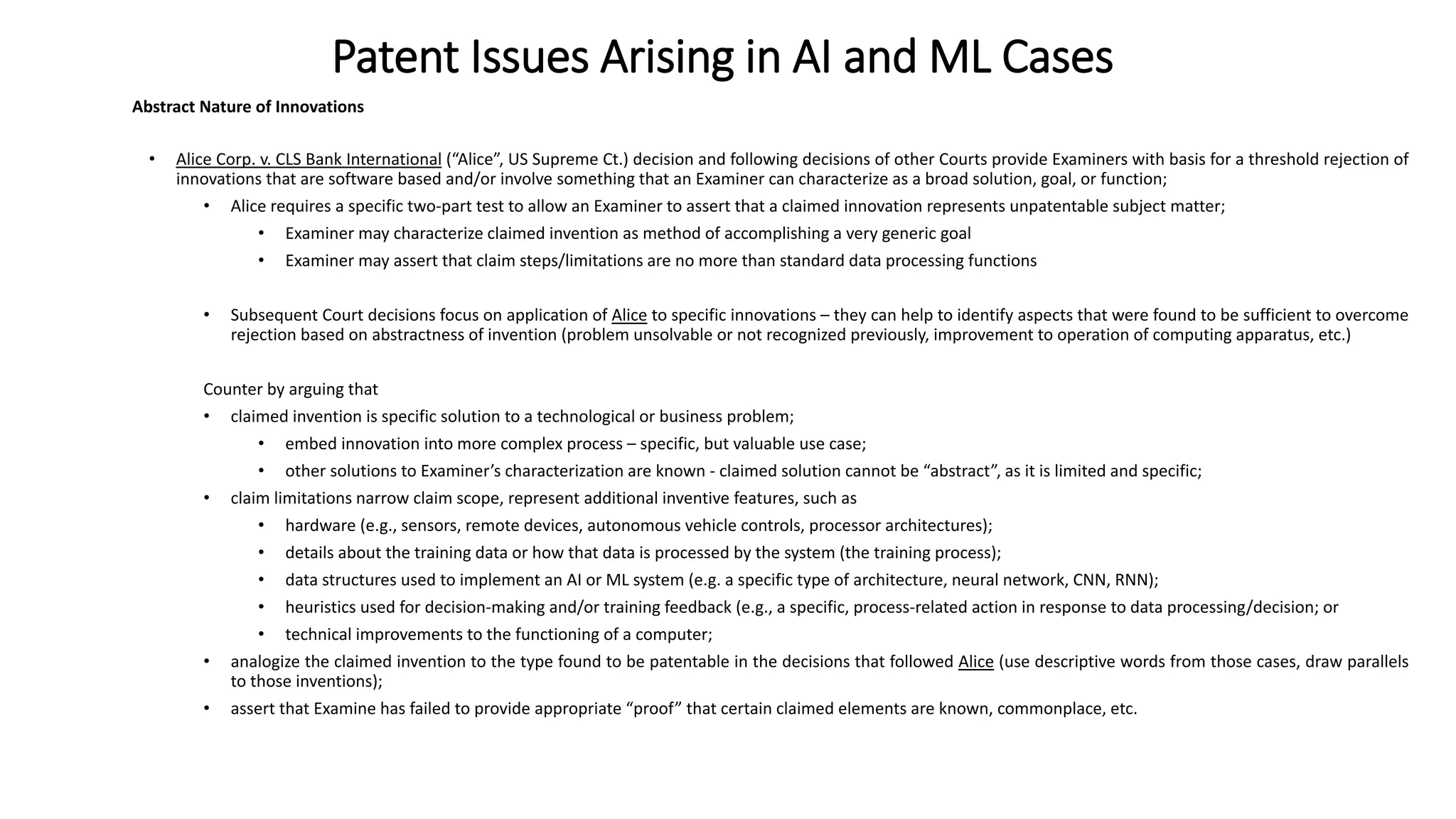
Patent Issues Arising in AI and ML Cases
Abstract Nature of Innovations
• Alice Corp. v. CLS Bank International (“Alice”, US Supreme Ct.) decision and following decisions of other Courts provide Examiners with basis for a threshold rejection of
innovations that are software based and/or involve something that an Examiner can characterize as a broad solution, goal, or function;
• Alice requires a specific two-part test to allow an Examiner to assert that a claimed innovation represents unpatentable subject matter;
• Examiner may characterize claimed invention as method of accomplishing a very generic goal
• Examiner may assert that claim steps/limitations are no more than standard data processing functions
• Subsequent Court decisions focus on application of Alice to specific innovations – they can help to identify aspects that were found to be sufficient to overcome
rejection based on abstractness of invention (problem unsolvable or not recognized previously, improvement to operation of computing apparatus, etc.)
Counter by arguing that
• claimed invention is specific solution to a technological or business problem;
• embed innovation into more complex process – specific, but valuable use case;
• other solutions to Examiner’s characterization are known - claimed solution cannot be “abstract”, as it is limited and specific;
• claim limitations narrow claim scope, represent additional inventive features, such as
• hardware (e.g., sensors, remote devices, autonomous vehicle controls, processor architectures);
• details about the training data or how that data is processed by the system (the training process);
• data structures used to implement an AI or ML system (e.g. a specific type of architecture, neural network, CNN, RNN);
• heuristics used for decision-making and/or training feedback (e.g., a specific, process-related action in response to data processing/decision; or
• technical improvements to the functioning of a computer;
• analogize the claimed invention to the type found to be patentable in the decisions that followed Alice (use descriptive words from those cases, draw parallels
to those inventions);
• assert that Examine has failed to provide appropriate “proof” that certain claimed elements are known, commonplace, etc.
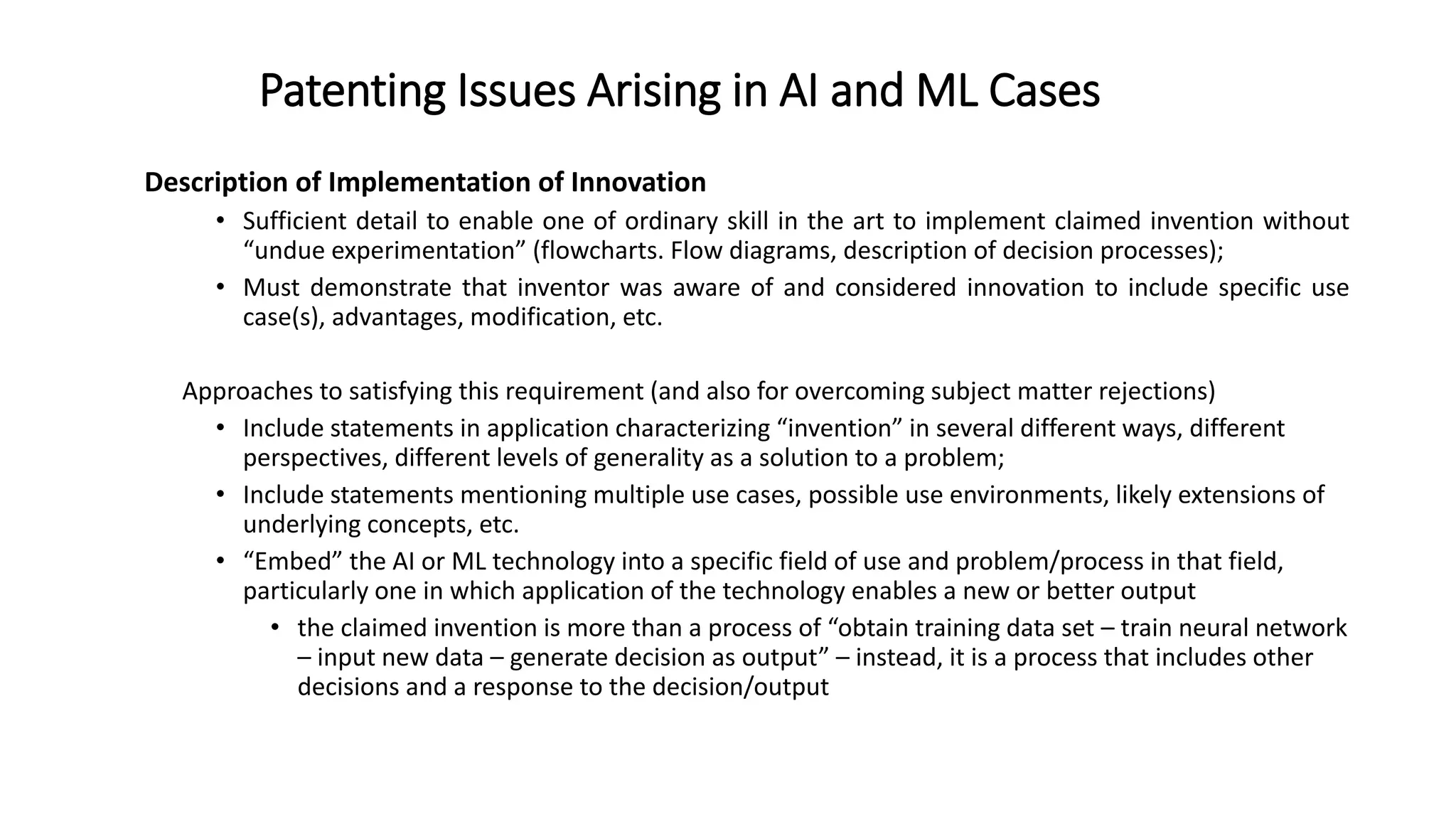
Patenting Issues Arising in AI and ML Cases
Description of Implementation of Innovation
• Sufficient detail to enable one of ordinary skill in the art to implement claimed invention without
“undue experimentation” (flowcharts. Flow diagrams, description of decision processes);
• Must demonstrate that inventor was aware of and considered innovation to include specific use
case(s), advantages, modification, etc.
Approaches to satisfying this requirement (and also for overcoming subject matter rejections)
• Include statements in application characterizing “invention” in several different ways, different
perspectives, different levels of generality as a solution to a problem;
• Include statements mentioning multiple use cases, possible use environments, likely extensions of
underlying concepts, etc.
• “Embed” the AI or ML technology into a specific field of use and problem/process in that field,
particularly one in which application of the technology enables a new or better output
• the claimed invention is more than a process of “obtain training data set – train neural network
– input new data – generate decision as output” – instead, it is a process that includes other
decisions and a response to the decision/output
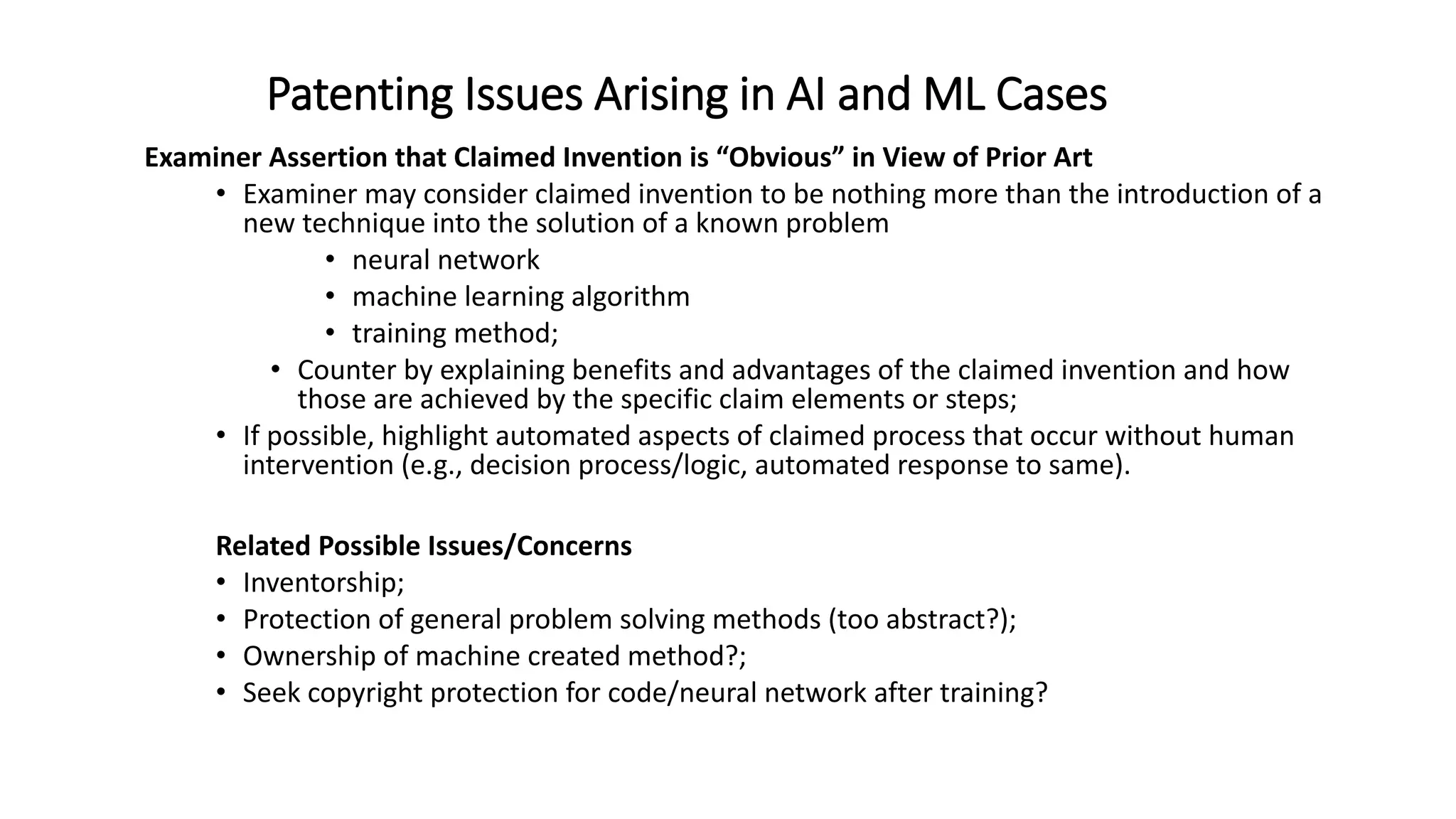
Patenting Issues Arising in AI and ML Cases
Examiner Assertion that Claimed Invention is “Obvious” in View of Prior Art
• Examiner may consider claimed invention to be nothing more than the introduction of a
new technique into the solution of a known problem
• neural network
• machine learning algorithm
• training method;
• Counter by explaining benefits and advantages of the claimed invention and how
those are achieved by the specific claim elements or steps;
• If possible, highlight automated aspects of claimed process that occur without human
intervention (e.g., decision process/logic, automated response to same).
Related Possible Issues/Concerns
• Inventorship;
• Protection of general problem solving methods (too abstract?);
• Ownership of machine created method?;
• Seek copyright protection for code/neural network after training?
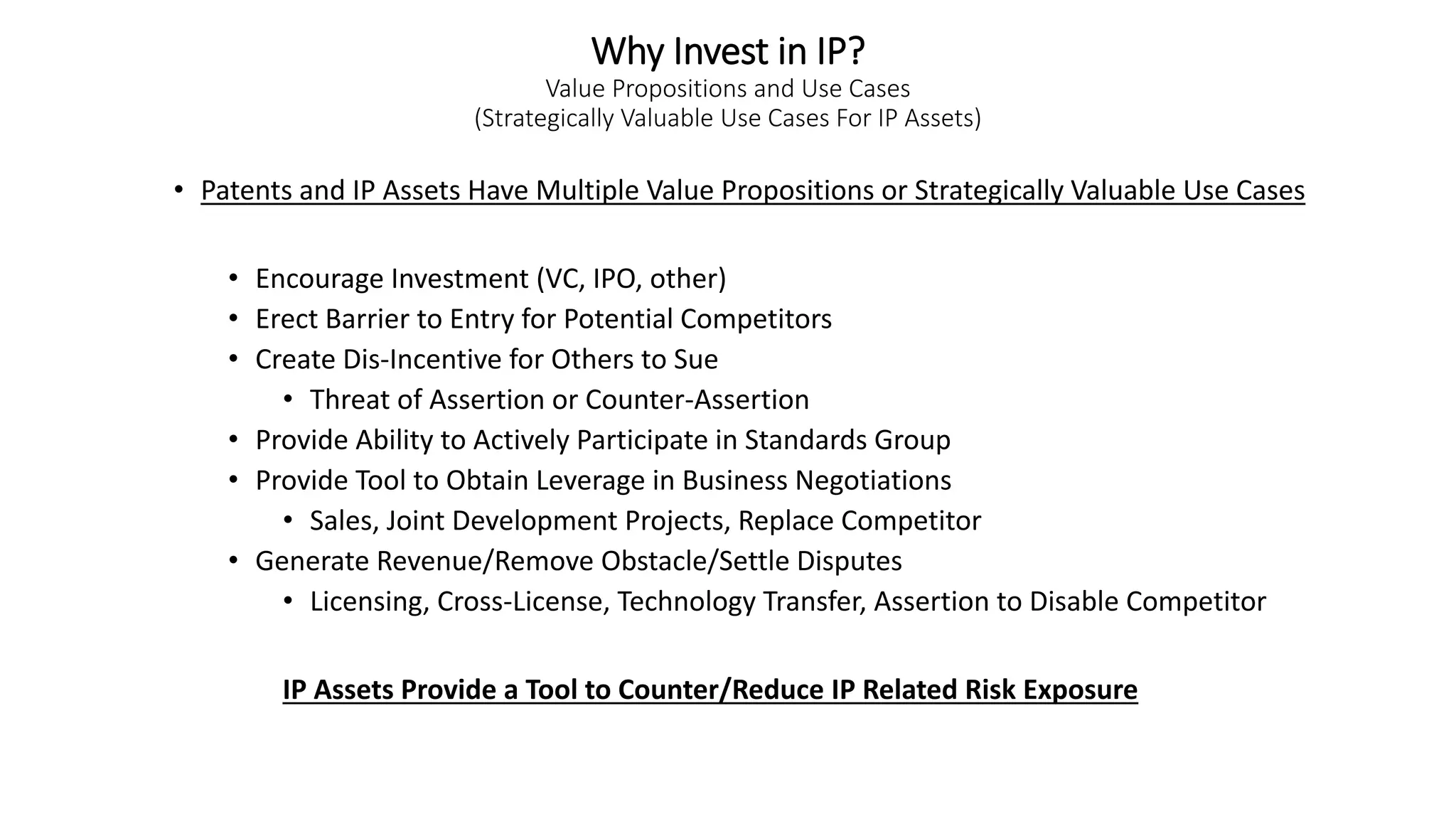
Why Invest in IP?
Value Propositions and Use Cases
(Strategically Valuable Use Cases For IP Assets)
• Patents and IP Assets Have Multiple Value Propositions or Strategically Valuable Use Cases
• Encourage Investment (VC, IPO, other)
• Erect Barrier to Entry for Potential Competitors
• Create Dis-Incentive for Others to Sue
• Threat of Assertion or Counter-Assertion
• Provide Ability to Actively Participate in Standards Group
• Provide Tool to Obtain Leverage in Business Negotiations
• Sales, Joint Development Projects, Replace Competitor
• Generate Revenue/Remove Obstacle/Settle Disputes
• Licensing, Cross-License, Technology Transfer, Assertion to Disable Competitor
IP Assets Provide a Tool to Counter/Reduce IP Related Risk Exposure
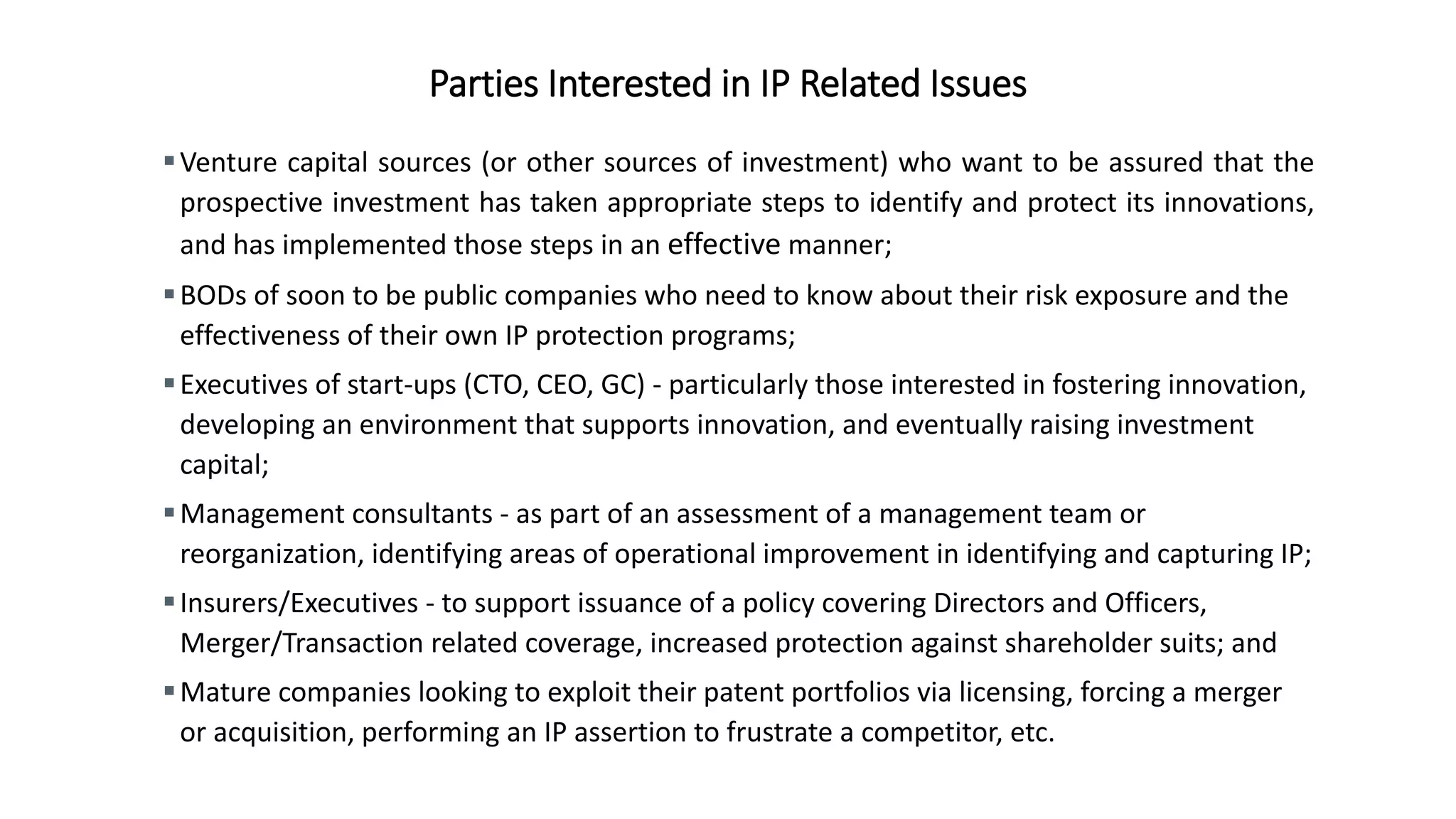
Parties Interested in IP Related Issues
Venture capital sources (or other sources of investment) who want to be assured that the
prospective investment has taken appropriate steps to identify and protect its innovations,
and has implemented those steps in an effective manner;
BODs of soon to be public companies who need to know about their risk exposure and the
effectiveness of their own IP protection programs;
Executives of start-ups (CTO, CEO, GC) - particularly those interested in fostering innovation,
developing an environment that supports innovation, and eventually raising investment
capital;
Management consultants - as part of an assessment of a management team or
reorganization, identifying areas of operational improvement in identifying and capturing IP;
Insurers/Executives - to support issuance of a policy covering Directors and Officers,
Merger/Transaction related coverage, increased protection against shareholder suits; and
Mature companies looking to exploit their patent portfolios via licensing, forcing a merger
or acquisition, performing an IP assertion to frustrate a competitor, etc.
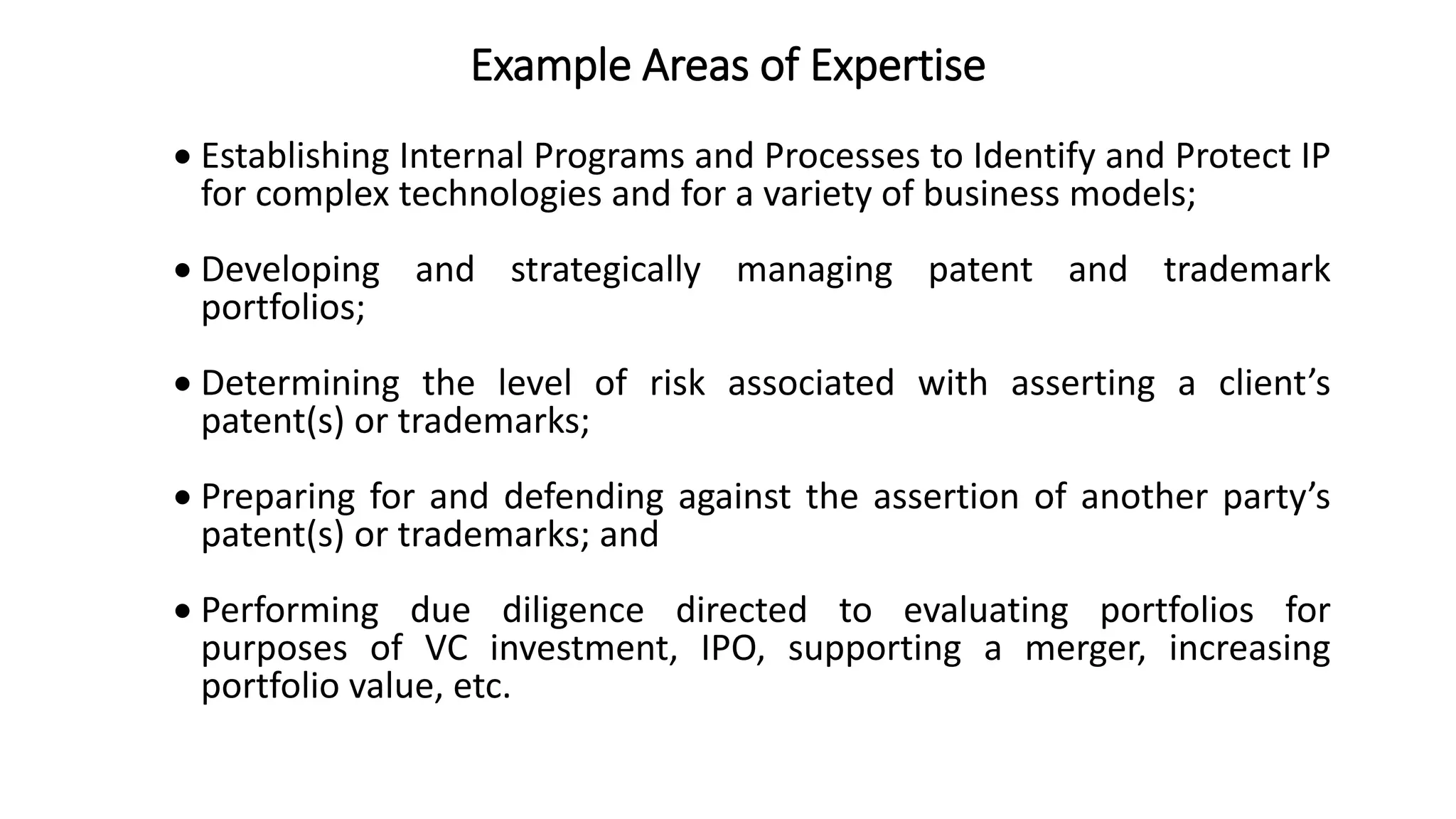
Example Areas of Expertise
 Establishing Internal Programs and Processes to Identify and Protect IP
for complex technologies and for a variety of business models;
 Developing and strategically managing patent and trademark
portfolios;
 Determining the level of risk associated with asserting a client’s
patent(s) or trademarks;
 Preparing for and defending against the assertion of another party’s
patent(s) or trademarks; and
 Performing due diligence directed to evaluating portfolios for
purposes of VC investment, IPO, supporting a merger, increasing
portfolio value, etc.
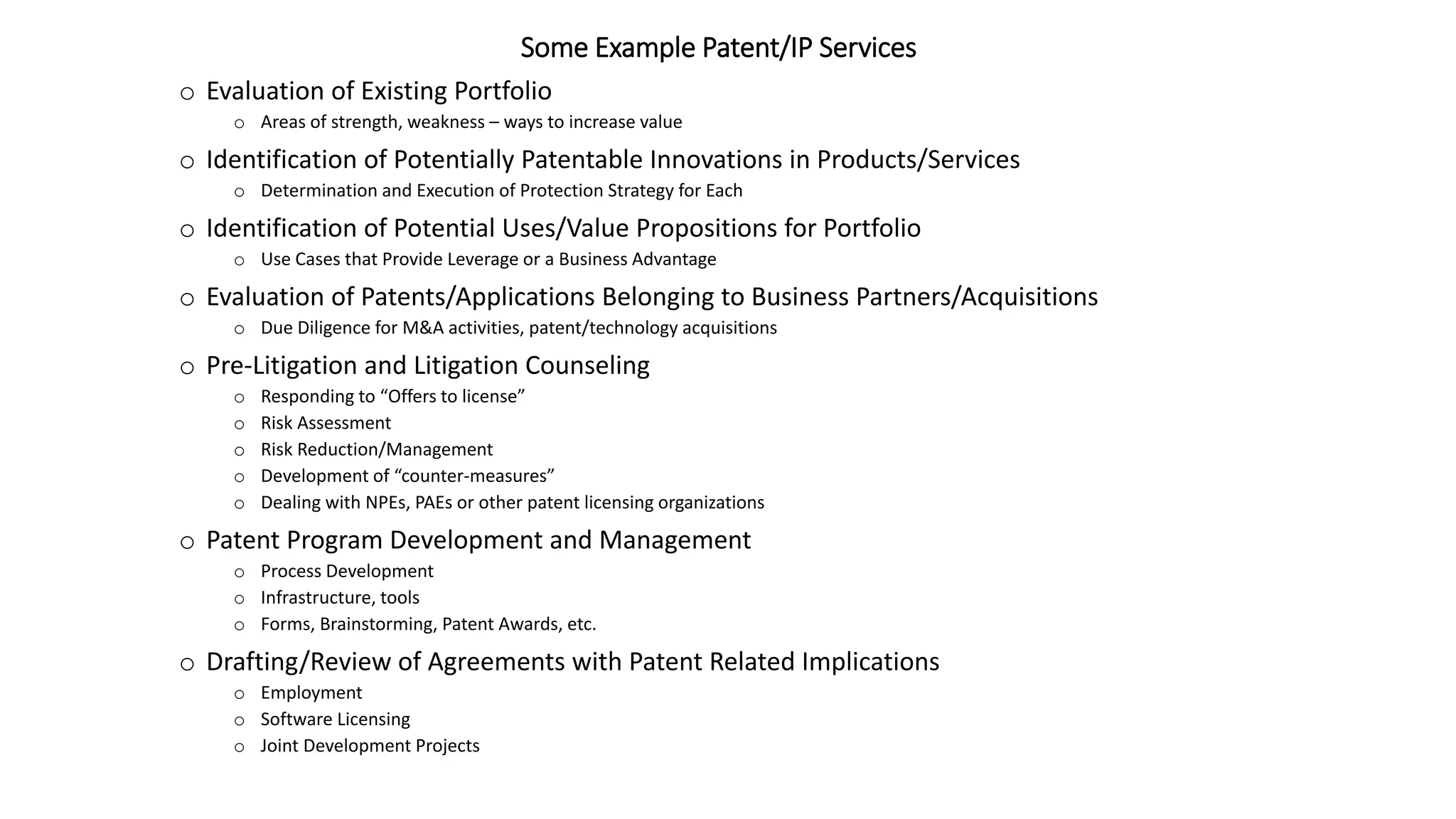
Some Example Patent/IP Services
o Evaluation of Existing Portfolio
o Areas of strength, weakness – ways to increase value
o Identification of Potentially Patentable Innovations in Products/Services
o Determination and Execution of Protection Strategy for Each
o Identification of Potential Uses/Value Propositions for Portfolio
o Use Cases that Provide Leverage or a Business Advantage
o Evaluation of Patents/Applications Belonging to Business Partners/Acquisitions
o Due Diligence for M&A activities, patent/technology acquisitions
o Pre-Litigation and Litigation Counseling
o Responding to “Offers to license”
o Risk Assessment
o Risk Reduction/Management
o Development of “counter-measures”
o Dealing with NPEs, PAEs or other patent licensing organizations
o Patent Program Development and Management
o Process Development
o Infrastructure, tools
o Forms, Brainstorming, Patent Awards, etc.
o Drafting/Review of Agreements with Patent Related Implications
o Employment
o Software Licensing
o Joint Development Projects
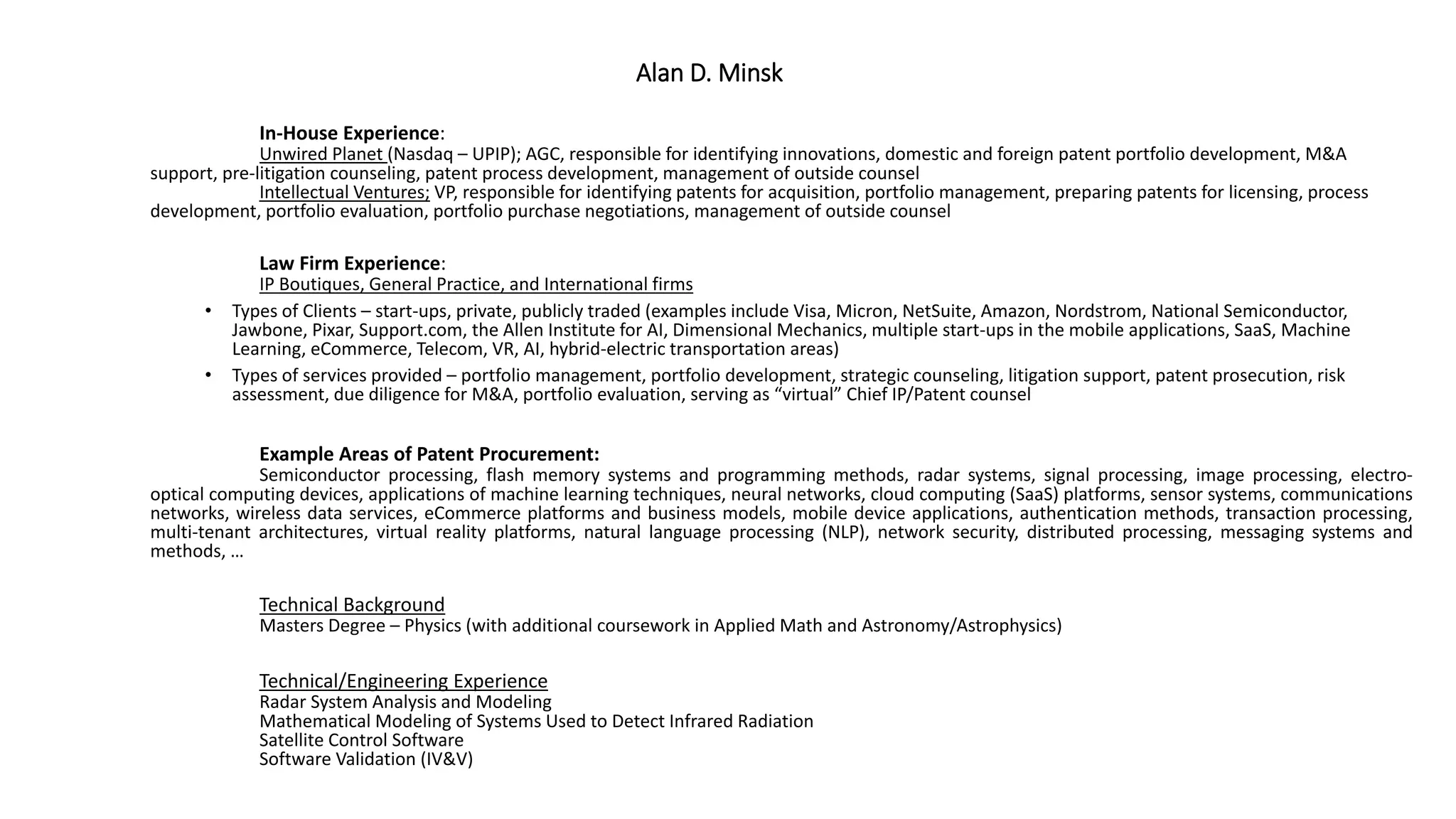
Alan D. Minsk
In-House Experience:
Unwired Planet (Nasdaq – UPIP); AGC, responsible for identifying innovations, domestic and foreign patent portfolio development, M&A
support, pre-litigation counseling, patent process development, management of outside counsel
Intellectual Ventures; VP, responsible for identifying patents for acquisition, portfolio management, preparing patents for licensing, process
development, portfolio evaluation, portfolio purchase negotiations, management of outside counsel
Law Firm Experience:
IP Boutiques, General Practice, and International firms
• Types of Clients – start-ups, private, publicly traded (examples include Visa, Micron, NetSuite, Amazon, Nordstrom, National Semiconductor,
Jawbone, Pixar, Support.com, the Allen Institute for AI, Dimensional Mechanics, multiple start-ups in the mobile applications, SaaS, Machine
Learning, eCommerce, Telecom, VR, AI, hybrid-electric transportation areas)
• Types of services provided – portfolio management, portfolio development, strategic counseling, litigation support, patent prosecution, risk
assessment, due diligence for M&A, portfolio evaluation, serving as “virtual” Chief IP/Patent counsel
Example Areas of Patent Procurement:
Semiconductor processing, flash memory systems and programming methods, radar systems, signal processing, image processing, electro-
optical computing devices, applications of machine learning techniques, neural networks, cloud computing (SaaS) platforms, sensor systems, communications
networks, wireless data services, eCommerce platforms and business models, mobile device applications, authentication methods, transaction processing,
multi-tenant architectures, virtual reality platforms, natural language processing (NLP), network security, distributed processing, messaging systems and
methods, …
Technical Background
Masters Degree – Physics (with additional coursework in Applied Math and Astronomy/Astrophysics)
Technical/Engineering Experience
Radar System Analysis and Modeling
Mathematical Modeling of Systems Used to Detect Infrared Radiation
Satellite Control Software
Software Validation (IV&V)

Patenting AI and Machine Learning Innovations (new version)

  • 1.
    ©2018 Lane PowellPC Patenting AI and Machine Learning Innovations Alan D. Minsk – FisherBroyles alan.minsk@fisherbroyles.com
  • 2.
    Key Points -Takeaways •Although there are obstacles due to the nature and implementation of AI and ML innovations, techniques exist that can assist in obtaining protection; • Patent applications should be prepared with eye towards countering expected Examiner rejections based on assertion that innovations represent unpatentable subject matter and/or that patent application fails to satisfy “enablement” or “written description” requirements; • Some forms of IP must be identified and developed in order to become a business asset - this requires planning in advance and the execution of a very specific process (including being aware of bar dates, implications of public disclosure, commercialization, or sale, and other limitations on the ability to obtain protection; also, developing sufficiently detailed descriptions of certain aspects of products or services, etc.).; • Failing to invest in at least identifying IP and developing an effective strategy is a serious error that can prevent continued investment, reduce the desirability of a merger or acquisition, expose the company to greater risk, and may indicate a less than optimal execution of a business strategy by management (and expose to shareholder suit), etc.
  • 3.
    Types of IntellectualProperty • Patents (design, utility, plant) • provisional patent applications • non-provisional patent applications • Trademarks (and trade dress, branding aspects) • Copyrights • Trade Secrets • “Know How” • Each type has its own associated protectable aspects and requirements for being recognized, granted, or asserted
  • 4.
    Patents • Granted tonew and non-obvious methods, devices, and systems that are not considered to be unpatentable subject matter; • Patent claims define the “invention” which a patent owner may prevent others from making, selling, offering for sale, using, or importing by using the legal system; • claims must be supported by contents of patent application and figures; • interpretation of claims may be altered by statements in application or file history; • Innovations for which protection is desired must be described with sufficient level of detail (breadth and depth) in application and figures – this is the “enablement requirement”; • Use cases, certain benefits of innovation must be recognized by inventor in order to be covered by claims – this is the “written description” requirement
  • 5.
    Patent Issues Arisingin AI and ML Cases Abstract Nature of Innovations • Alice Corp. v. CLS Bank International (“Alice”, US Supreme Ct.) decision and following decisions of other Courts provide Examiners with basis for a threshold rejection of innovations that are software based and/or involve something that an Examiner can characterize as a broad solution, goal, or function; • Alice requires a specific two-part test to allow an Examiner to assert that a claimed innovation represents unpatentable subject matter; • Examiner may characterize claimed invention as method of accomplishing a very generic goal • Examiner may assert that claim steps/limitations are no more than standard data processing functions • Subsequent Court decisions focus on application of Alice to specific innovations – they can help to identify aspects that were found to be sufficient to overcome rejection based on abstractness of invention (problem unsolvable or not recognized previously, improvement to operation of computing apparatus, etc.) Counter by arguing that • claimed invention is specific solution to a technological or business problem; • embed innovation into more complex process – specific, but valuable use case; • other solutions to Examiner’s characterization are known - claimed solution cannot be “abstract”, as it is limited and specific; • claim limitations narrow claim scope, represent additional inventive features, such as • hardware (e.g., sensors, remote devices, autonomous vehicle controls, processor architectures); • details about the training data or how that data is processed by the system (the training process); • data structures used to implement an AI or ML system (e.g. a specific type of architecture, neural network, CNN, RNN); • heuristics used for decision-making and/or training feedback (e.g., a specific, process-related action in response to data processing/decision; or • technical improvements to the functioning of a computer; • analogize the claimed invention to the type found to be patentable in the decisions that followed Alice (use descriptive words from those cases, draw parallels to those inventions); • assert that Examine has failed to provide appropriate “proof” that certain claimed elements are known, commonplace, etc.
  • 6.
    Patenting Issues Arisingin AI and ML Cases Description of Implementation of Innovation • Sufficient detail to enable one of ordinary skill in the art to implement claimed invention without “undue experimentation” (flowcharts. Flow diagrams, description of decision processes); • Must demonstrate that inventor was aware of and considered innovation to include specific use case(s), advantages, modification, etc. Approaches to satisfying this requirement (and also for overcoming subject matter rejections) • Include statements in application characterizing “invention” in several different ways, different perspectives, different levels of generality as a solution to a problem; • Include statements mentioning multiple use cases, possible use environments, likely extensions of underlying concepts, etc. • “Embed” the AI or ML technology into a specific field of use and problem/process in that field, particularly one in which application of the technology enables a new or better output • the claimed invention is more than a process of “obtain training data set – train neural network – input new data – generate decision as output” – instead, it is a process that includes other decisions and a response to the decision/output
  • 7.
    Patenting Issues Arisingin AI and ML Cases Examiner Assertion that Claimed Invention is “Obvious” in View of Prior Art • Examiner may consider claimed invention to be nothing more than the introduction of a new technique into the solution of a known problem • neural network • machine learning algorithm • training method; • Counter by explaining benefits and advantages of the claimed invention and how those are achieved by the specific claim elements or steps; • If possible, highlight automated aspects of claimed process that occur without human intervention (e.g., decision process/logic, automated response to same). Related Possible Issues/Concerns • Inventorship; • Protection of general problem solving methods (too abstract?); • Ownership of machine created method?; • Seek copyright protection for code/neural network after training?
  • 8.
    Why Invest inIP? Value Propositions and Use Cases (Strategically Valuable Use Cases For IP Assets) • Patents and IP Assets Have Multiple Value Propositions or Strategically Valuable Use Cases • Encourage Investment (VC, IPO, other) • Erect Barrier to Entry for Potential Competitors • Create Dis-Incentive for Others to Sue • Threat of Assertion or Counter-Assertion • Provide Ability to Actively Participate in Standards Group • Provide Tool to Obtain Leverage in Business Negotiations • Sales, Joint Development Projects, Replace Competitor • Generate Revenue/Remove Obstacle/Settle Disputes • Licensing, Cross-License, Technology Transfer, Assertion to Disable Competitor IP Assets Provide a Tool to Counter/Reduce IP Related Risk Exposure
  • 9.
    Parties Interested inIP Related Issues Venture capital sources (or other sources of investment) who want to be assured that the prospective investment has taken appropriate steps to identify and protect its innovations, and has implemented those steps in an effective manner; BODs of soon to be public companies who need to know about their risk exposure and the effectiveness of their own IP protection programs; Executives of start-ups (CTO, CEO, GC) - particularly those interested in fostering innovation, developing an environment that supports innovation, and eventually raising investment capital; Management consultants - as part of an assessment of a management team or reorganization, identifying areas of operational improvement in identifying and capturing IP; Insurers/Executives - to support issuance of a policy covering Directors and Officers, Merger/Transaction related coverage, increased protection against shareholder suits; and Mature companies looking to exploit their patent portfolios via licensing, forcing a merger or acquisition, performing an IP assertion to frustrate a competitor, etc.
  • 10.
    Example Areas ofExpertise  Establishing Internal Programs and Processes to Identify and Protect IP for complex technologies and for a variety of business models;  Developing and strategically managing patent and trademark portfolios;  Determining the level of risk associated with asserting a client’s patent(s) or trademarks;  Preparing for and defending against the assertion of another party’s patent(s) or trademarks; and  Performing due diligence directed to evaluating portfolios for purposes of VC investment, IPO, supporting a merger, increasing portfolio value, etc.
  • 11.
    Some Example Patent/IPServices o Evaluation of Existing Portfolio o Areas of strength, weakness – ways to increase value o Identification of Potentially Patentable Innovations in Products/Services o Determination and Execution of Protection Strategy for Each o Identification of Potential Uses/Value Propositions for Portfolio o Use Cases that Provide Leverage or a Business Advantage o Evaluation of Patents/Applications Belonging to Business Partners/Acquisitions o Due Diligence for M&A activities, patent/technology acquisitions o Pre-Litigation and Litigation Counseling o Responding to “Offers to license” o Risk Assessment o Risk Reduction/Management o Development of “counter-measures” o Dealing with NPEs, PAEs or other patent licensing organizations o Patent Program Development and Management o Process Development o Infrastructure, tools o Forms, Brainstorming, Patent Awards, etc. o Drafting/Review of Agreements with Patent Related Implications o Employment o Software Licensing o Joint Development Projects
  • 12.
    Alan D. Minsk In-HouseExperience: Unwired Planet (Nasdaq – UPIP); AGC, responsible for identifying innovations, domestic and foreign patent portfolio development, M&A support, pre-litigation counseling, patent process development, management of outside counsel Intellectual Ventures; VP, responsible for identifying patents for acquisition, portfolio management, preparing patents for licensing, process development, portfolio evaluation, portfolio purchase negotiations, management of outside counsel Law Firm Experience: IP Boutiques, General Practice, and International firms • Types of Clients – start-ups, private, publicly traded (examples include Visa, Micron, NetSuite, Amazon, Nordstrom, National Semiconductor, Jawbone, Pixar, Support.com, the Allen Institute for AI, Dimensional Mechanics, multiple start-ups in the mobile applications, SaaS, Machine Learning, eCommerce, Telecom, VR, AI, hybrid-electric transportation areas) • Types of services provided – portfolio management, portfolio development, strategic counseling, litigation support, patent prosecution, risk assessment, due diligence for M&A, portfolio evaluation, serving as “virtual” Chief IP/Patent counsel Example Areas of Patent Procurement: Semiconductor processing, flash memory systems and programming methods, radar systems, signal processing, image processing, electro- optical computing devices, applications of machine learning techniques, neural networks, cloud computing (SaaS) platforms, sensor systems, communications networks, wireless data services, eCommerce platforms and business models, mobile device applications, authentication methods, transaction processing, multi-tenant architectures, virtual reality platforms, natural language processing (NLP), network security, distributed processing, messaging systems and methods, … Technical Background Masters Degree – Physics (with additional coursework in Applied Math and Astronomy/Astrophysics) Technical/Engineering Experience Radar System Analysis and Modeling Mathematical Modeling of Systems Used to Detect Infrared Radiation Satellite Control Software Software Validation (IV&V)

Editor's Notes