PATENT SPECIFICTION
Pravin Raj P
S2- M.Tech.Structural Engineering
SBC22CESE03
Purpose of Patent Specification:
To fulfil the patentee’s part in the contract that a patent
constitutes.
Full disclosure of the invention, the patentee can have a time-
limited monopoly for the invention. During that time, the
patentee has the right to stop others working the invention
without permission.
The monopoly generally lasts for twenty years.
After the patent expires, the invention enters the public domain
and cannot be patented again.
A patent is enforced if necessary against infringers by action
brought before the court.
A patent specification is a legal document. Third parties and the
court must be able to understand it, so that the limits of the
protection it affords can be determined precisely.
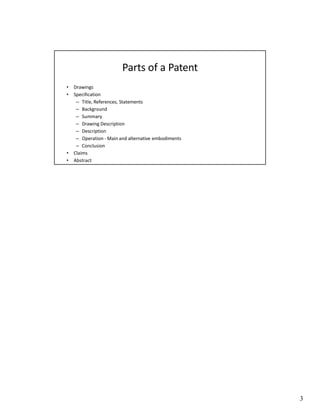
Parts of a Patent
• Drawings
• Specification
– Title, References, Statements
– Background
– Summary
– Drawing Description
– Description
– Operation ‐ Main and alternative embodiments
– Conclusion
• Claims
• Abstract
3
Background
• Short description of the state of the general field the
inventions pertains to.
• Describes the problems to be solved.
• Describes prior art (i.e. what’s already out there to
address this problem.
• Criticism of relevant prior art.
5
Summary
• Describes how your invention addresses the
previously stated problem.
• Describes why your invention is useful.
• Positive aspects of the invention (relative to
criticisms of prior art).
Basically explains, what the invention does.
Advantages over prior art and technology .
10/30/2008
Drawing Description
DESCRIBING THE INVENTION THROUGH FIGURES.
6
10/30/2008
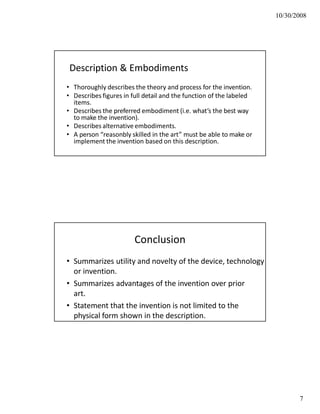
Description & Embodiments
• Thoroughly describes the theory and process for the invention.
• Describes figures in full detail and the function of the labeled
items.
• Describes the preferred embodiment (i.e. what’s the best way
to make the invention).
• Describes alternative embodiments.
• A person “reasonbly skilled in the art” must be able to make or
implement the invention based on this description.
Conclusion
• Summarizes utility and novelty of the device, technology
or invention.
• Summarizes advantages of the invention over prior
art.
• Statement that the invention is not limited to the
physical form shown in the description.
7
10/30/2008
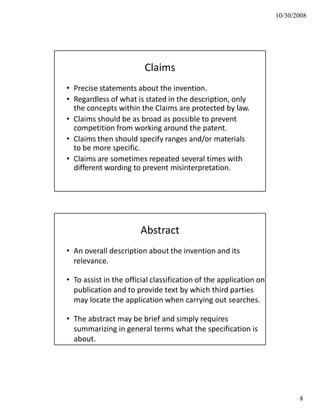
Claims
• Precise statements about the invention.
• Regardless of what is stated in the description, only
the concepts within the Claims are protected by law.
• Claims should be as broad as possible to prevent
competition from working around the patent.
• Claims then should specify ranges and/or materials
to be more specific.
• Claims are sometimes repeated several times with
different wording to prevent misinterpretation.
8
Abstract
• An overall description about the invention and its
relevance.
• To assist in the official classification of the application on
publication and to provide text by which third parties
may locate the application when carrying out searches.
• The abstract may be brief and simply requires
summarizing in general terms what the specification is
about.

Patent Specification.pdf

  • 1.
    PATENT SPECIFICTION Pravin RajP S2- M.Tech.Structural Engineering SBC22CESE03
  • 2.
    Purpose of PatentSpecification: To fulfil the patentee’s part in the contract that a patent constitutes. Full disclosure of the invention, the patentee can have a time- limited monopoly for the invention. During that time, the patentee has the right to stop others working the invention without permission. The monopoly generally lasts for twenty years. After the patent expires, the invention enters the public domain and cannot be patented again. A patent is enforced if necessary against infringers by action brought before the court. A patent specification is a legal document. Third parties and the court must be able to understand it, so that the limits of the protection it affords can be determined precisely.
  • 3.
    Parts of aPatent • Drawings • Specification – Title, References, Statements – Background – Summary – Drawing Description – Description – Operation ‐ Main and alternative embodiments – Conclusion • Claims • Abstract 3
  • 4.
    Background • Short descriptionof the state of the general field the inventions pertains to. • Describes the problems to be solved. • Describes prior art (i.e. what’s already out there to address this problem. • Criticism of relevant prior art.
  • 5.
    5 Summary • Describes howyour invention addresses the previously stated problem. • Describes why your invention is useful. • Positive aspects of the invention (relative to criticisms of prior art). Basically explains, what the invention does. Advantages over prior art and technology .
  • 6.
  • 7.
    10/30/2008 Description & Embodiments •Thoroughly describes the theory and process for the invention. • Describes figures in full detail and the function of the labeled items. • Describes the preferred embodiment (i.e. what’s the best way to make the invention). • Describes alternative embodiments. • A person “reasonbly skilled in the art” must be able to make or implement the invention based on this description. Conclusion • Summarizes utility and novelty of the device, technology or invention. • Summarizes advantages of the invention over prior art. • Statement that the invention is not limited to the physical form shown in the description. 7
  • 8.
    10/30/2008 Claims • Precise statementsabout the invention. • Regardless of what is stated in the description, only the concepts within the Claims are protected by law. • Claims should be as broad as possible to prevent competition from working around the patent. • Claims then should specify ranges and/or materials to be more specific. • Claims are sometimes repeated several times with different wording to prevent misinterpretation. 8 Abstract • An overall description about the invention and its relevance. • To assist in the official classification of the application on publication and to provide text by which third parties may locate the application when carrying out searches. • The abstract may be brief and simply requires summarizing in general terms what the specification is about.