Instituto Universitario Politécnico
“Santiago Mariño”
¡Formación para la Excelencia!
Simple Past
Realizado por:
Anthony Espinoza
C.I: 26.897.325 - #47
Simple past
Definition
The simple past is one of these verb tenses, present in different languages. The
mention of the past refers to actions that have already been carried out previously
(that is, they have already been completed)
Characteristics
1) Indicates an action that was performed at a specific time in the past
2) Its essential characteristic is that the main verb of the sentence is always in the
past
3) Is the only grammatical time that uses verbs in the past
4) It is composed of simple elements, so only the following formula is used in its
composition
s + v2 + c
Conjugation of verbs
You must know the verbs to know their conjugation in the past, but we must
remember that the verbs are of 2 types:
1 Regular: When they make their Past and Past Participle by adding "ed" to their
present form:
Example: To live = Lived / To walk = Walked
2 Irregular: When they make their past and past participle in the same or different
way from the present
Example: To sing - Sang - Sung / To eat - Ate – Eaten
Affirmative sentences
They are recognized because the main verb of the sentence is in the past, and
because it also complies with the following formula: S + V2 + C
Example: The girl went to the cinema yesterday
Where: The girl (she) is the subject; went is the past of the verb go: and, to the
cinema everyday, is the complement
interrogative sentences
They are recognized because at the beginning of the sentence the auxiliary "did" is
written, then the normal sentence in simple present affirming and at the end the
question mark is added, but we must bear in mind that
Did: used with all personal pronouns
Example: Peter painted the house. Switch to: Did peter paint the house?
They went to the beat. Switch to: Did they go to the beach
Answer to interrogative sentences
A sentence that begins with the auxiliary did, only admits two types of answers:
Yes or No
They must therefore follow the following form:
If the answer is yes: yes, S + Did
If the answer is no: No, S + Did not
Example
Did nancy eat bread? Yes, she did / No, she did not
Did they live in caracas? Yes, they did / no, they did not

Past simple evaluacion

  • 1.
    Instituto Universitario Politécnico “SantiagoMariño” ¡Formación para la Excelencia! Simple Past Realizado por: Anthony Espinoza C.I: 26.897.325 - #47
  • 2.
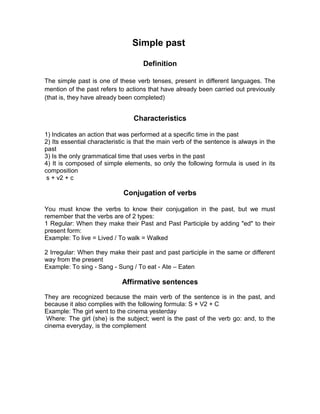
    Simple past Definition The simplepast is one of these verb tenses, present in different languages. The mention of the past refers to actions that have already been carried out previously (that is, they have already been completed) Characteristics 1) Indicates an action that was performed at a specific time in the past 2) Its essential characteristic is that the main verb of the sentence is always in the past 3) Is the only grammatical time that uses verbs in the past 4) It is composed of simple elements, so only the following formula is used in its composition s + v2 + c Conjugation of verbs You must know the verbs to know their conjugation in the past, but we must remember that the verbs are of 2 types: 1 Regular: When they make their Past and Past Participle by adding "ed" to their present form: Example: To live = Lived / To walk = Walked 2 Irregular: When they make their past and past participle in the same or different way from the present Example: To sing - Sang - Sung / To eat - Ate – Eaten Affirmative sentences They are recognized because the main verb of the sentence is in the past, and because it also complies with the following formula: S + V2 + C Example: The girl went to the cinema yesterday Where: The girl (she) is the subject; went is the past of the verb go: and, to the cinema everyday, is the complement
  • 3.
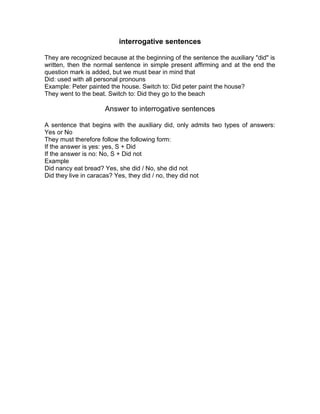
    interrogative sentences They arerecognized because at the beginning of the sentence the auxiliary "did" is written, then the normal sentence in simple present affirming and at the end the question mark is added, but we must bear in mind that Did: used with all personal pronouns Example: Peter painted the house. Switch to: Did peter paint the house? They went to the beat. Switch to: Did they go to the beach Answer to interrogative sentences A sentence that begins with the auxiliary did, only admits two types of answers: Yes or No They must therefore follow the following form: If the answer is yes: yes, S + Did If the answer is no: No, S + Did not Example Did nancy eat bread? Yes, she did / No, she did not Did they live in caracas? Yes, they did / no, they did not