PASSIVE VOICE
USES
USES
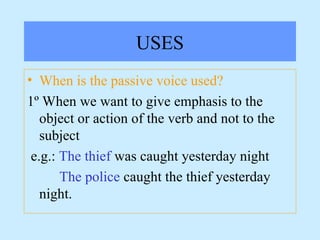
• When is the passive voice used?
1º When we want to give emphasis to the
object or action of the verb and not to the
subject
e.g.: The thief was caught yesterday night
The police caught the thief yesterday
night.
MORE USES
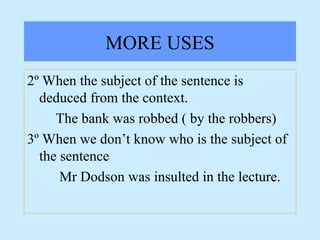
2º When the subject of the sentence is
deduced from the context.
The bank was robbed ( by the robbers)
3º When we don’t know who is the subject of
the sentence
Mr Dodson was insulted in the lecture.
Passive in English / Spanish
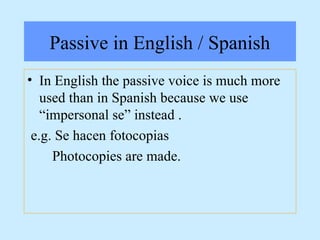
• In English the passive voice is much more
used than in Spanish because we use
“impersonal se” instead .
e.g. Se hacen fotocopias
Photocopies are made.
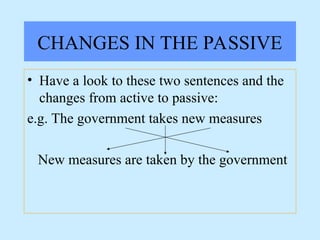
CHANGES IN THE PASSIVE
• Have a look to these two sentences and the
changes from active to passive:
e.g. The government takes new measures
New measures are taken by the government
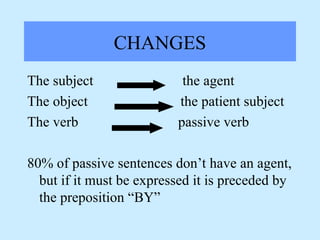
CHANGES
The subject the agent
The object the patient subject
The verb passive verb
80% of passive sentences don’t have an agent,
but if it must be expressed it is preceded by
the preposition “BY”
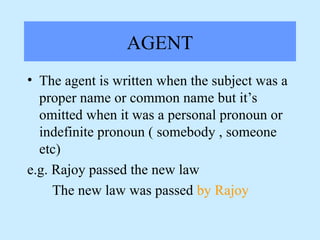
AGENT
• The agent is written when the subject was a
proper name or common name but it’s
omitted when it was a personal pronoun or
indefinite pronoun ( somebody , someone
etc)
e.g. Rajoy passed the new law
The new law was passed by Rajoy
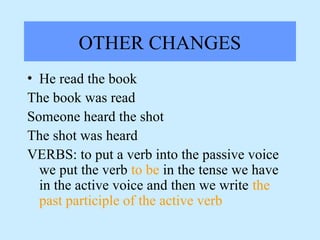
OTHER CHANGES
• He read the book
The book was read
Someone heard the shot
The shot was heard
VERBS: to put a verb into the passive voice
we put the verb to be in the tense we have
in the active voice and then we write the
past participle of the active verb
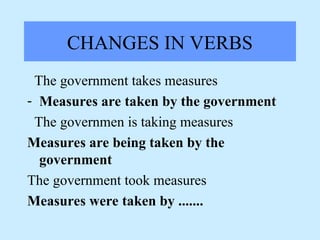
CHANGES IN VERBS
The government takes measures
- Measures are taken by the government
The governmen is taking measures
Measures are being taken by the
government
The government took measures
Measures were taken by .......
VERBS
The government has taken measures
Measures have been taken by the ....
The government will take measures
Measures will be taken
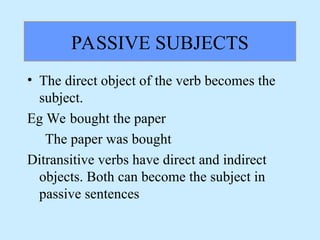
PASSIVE SUBJECTS
• The direct object of the verb becomes the
subject.
Eg We bought the paper
The paper was bought
Ditransitive verbs have direct and indirect
objects. Both can become the subject in
passive sentences
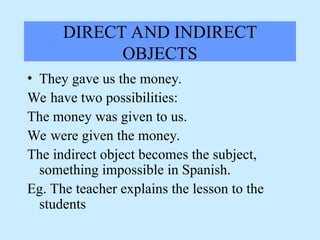
DIRECT AND INDIRECT
OBJECTS
• They gave us the money.
We have two possibilities:
The money was given to us.
We were given the money.
The indirect object becomes the subject,
something impossible in Spanish.
Eg. The teacher explains the lesson to the
students
Indirect object as subject
• The lesson is explained to the student
• The students are explained the lesson
Translate : nos dieron las llaves
We were given the keys
Le dieron las noticias
He was given the news.
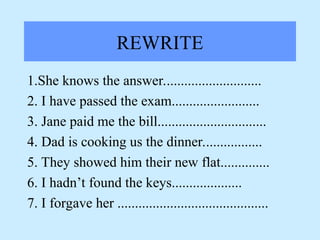
REWRITE
1.She knows the answer............................
2. I have passed the exam.........................
3. Jane paid me the bill...............................
4. Dad is cooking us the dinner.................
5. They showed him their new flat..............
6. I hadn’t found the keys....................
7. I forgave her ...........................................

passive voice.prsentationfor4thesostudentsppt

  • 1.
  • 2.
    USES • When isthe passive voice used? 1º When we want to give emphasis to the object or action of the verb and not to the subject e.g.: The thief was caught yesterday night The police caught the thief yesterday night.
  • 3.
    MORE USES 2º Whenthe subject of the sentence is deduced from the context. The bank was robbed ( by the robbers) 3º When we don’t know who is the subject of the sentence Mr Dodson was insulted in the lecture.
  • 4.
    Passive in English/ Spanish • In English the passive voice is much more used than in Spanish because we use “impersonal se” instead . e.g. Se hacen fotocopias Photocopies are made.
  • 5.
    CHANGES IN THEPASSIVE • Have a look to these two sentences and the changes from active to passive: e.g. The government takes new measures New measures are taken by the government
  • 6.
    CHANGES The subject theagent The object the patient subject The verb passive verb 80% of passive sentences don’t have an agent, but if it must be expressed it is preceded by the preposition “BY”
  • 7.
    AGENT • The agentis written when the subject was a proper name or common name but it’s omitted when it was a personal pronoun or indefinite pronoun ( somebody , someone etc) e.g. Rajoy passed the new law The new law was passed by Rajoy
  • 8.
    OTHER CHANGES • Heread the book The book was read Someone heard the shot The shot was heard VERBS: to put a verb into the passive voice we put the verb to be in the tense we have in the active voice and then we write the past participle of the active verb
  • 9.
    CHANGES IN VERBS Thegovernment takes measures - Measures are taken by the government The governmen is taking measures Measures are being taken by the government The government took measures Measures were taken by .......
  • 10.
    VERBS The government hastaken measures Measures have been taken by the .... The government will take measures Measures will be taken
  • 11.
    PASSIVE SUBJECTS • Thedirect object of the verb becomes the subject. Eg We bought the paper The paper was bought Ditransitive verbs have direct and indirect objects. Both can become the subject in passive sentences
  • 12.
    DIRECT AND INDIRECT OBJECTS •They gave us the money. We have two possibilities: The money was given to us. We were given the money. The indirect object becomes the subject, something impossible in Spanish. Eg. The teacher explains the lesson to the students
  • 13.
    Indirect object assubject • The lesson is explained to the student • The students are explained the lesson Translate : nos dieron las llaves We were given the keys Le dieron las noticias He was given the news.
  • 14.
    REWRITE 1.She knows theanswer............................ 2. I have passed the exam......................... 3. Jane paid me the bill............................... 4. Dad is cooking us the dinner................. 5. They showed him their new flat.............. 6. I hadn’t found the keys.................... 7. I forgave her ...........................................