Rethinking US Education
for a Global Society
GDIT 725 Education in Global Society
Emtinan Alqurashi
We have travelled around the globe to explore different education systems
Introduction
 We have travelled together around the world to explore
different education systems.
 This trip includes countries from group presentations
(US, England, South Korea, and China) and the
individual studies of selected countries (Japan,
Singapore, Italy, Belgium, Finland, Lithuania, India, and
Mexico).
 Throughout the journey, I will be discussing successes
and concerns of countries we visited, and then what
can the United States education system learn from this
journey.
The USA (successes)
 Multicultural educational reform
 Democracy
 Standards-based educational reform
 Academic expectations
 Students’ achievement
 Teacher quality
The USA (concerns)
 Multicultural educational reform
 Difficult to “create the policy and structural supports needed
to institutionalize multicultural education in schools”
 Teacher education
 Standards-based educational reform
 Narrows curriculum and limits pedagogy
 Promotes an assimilation agenda
England (successes)
 National Curriculum
 SAT
 Provide children with access to “broad, balanced, differentiated,
and relevant school experience”
 Students’ emotional health and positive behaviors
 Early childhood education
 Every Child Matters
 Special education needs and inclusion
 Children’s services
 health, safety, enjoyment and achievement, positive
contribution, economic well-being.
 Status of teachers
 national standard for certification of teachers
England (concerns)
 Curriculum issues
 Students with learning difficulties are at highest risk
 SAT scores (credibility)
 Governance issue
 Funding, based on size of school
 Decline in the power vested in LEAs
 Pupils behavior issues
 Challenging behavior
 More pupil referral units
 Educational and Social Inclusion Issues
 Pupils who prevent others from learning are not included in regular classes
 Personal and Social Education Issues
 Less attention on emotional development, personal care, etc.
 More focus on Standards
South Korea (successes)
 Opportunities for education have conspicuously
expanded.
 Education has made many qualitative changes.
 Illiteracy has dropped.
 Parental involvement
 Education has contributed to political, economic,
social and cultural development.
 Education relates to an increase in social mobility.
 Traditional value.
South Korea (concerns)
 High suicidal rates
 Overcrowded classrooms
 Building more schools, especially in urban areas.
 Diverse population
 Accommodate students from the diverse cultures, religions,
generations, and classes.
 Lack of democracy in the country is a challenge to the
education sector.
 Curriculum changs
 Gender equality
 Private education
China (successes)
 Students are expected to perform well on standardized
tests
 Evaluating and revising education system on a regular
basis.
 Technology usage
China (concerns)
 The Linguistic and Technological Divides
 Gab between urban and rural areas
 Curriculum Reform and Heavy Study Load
 Pressure on students to perform well
 Education of Domestic Migrant Children
 Domestic migrant children are not eligible for free access to
public schools
 Creating World-Class Universities
 Research and publication
 More assistant, associate and full professors
Japan (successes)
 High quality education by international standards
 Across OECD countries, Japan is ranked one of the top four
countries in Reading and Science, and top seven in
Mathematics scores according to PISA results (2012); and
ranked one of the top five according to TIMMS results (2011)
 Japan succeeded in “bringing up excellent leaders and
workers to promote modern industry”
Japan (concerns)
 School drop out rates
 School violence and bullying
 Students’ lack of interest
 Teachers’ workload
 Crises of childhood
 More focus on standardized testes and less oh human
development
Singapore (successes)
 High scores on standardized tests
 Student development
 University graduation rates increased
 Gender equality
 Bilingual policy
 Profession development hours for teachers
Singapore (concerns)
 Preschool education is not funded
 Gap between low-income and high-income families
 Private tutoring business
 Wealthy students are taking advantage of it
Italy (successes)
 Early childhood education
 98% of children at age of 3 are enrolled in early childhood
program
 The education system is improving quickly
Italy (concerns)
 Low scores on standardized tests
 High drop out rates
 Poor assessment techniques
Belgium(successes)
Flemish education
 High quality education by international standards
 Schools are responsible for their own curricula
 School reports are published online
 Funded schools
Belgium (concerns)
Flemish education
 Private schools
 Not funded, not recognized
 Low performance of students from low socioeconomic
status
 Internal evaluation is not not connected to external
evaluation
Finland (successes)
 High scores on standardized tests
 Education is a human right
 Free education from preschool up to university
 More play time
 to reduce anxiety
 Qualified teachers
 Attractive salary
 Comfortable schedule
Finland (concerns)
Finland education system is very successful and my
research on their concerns was very limited.
What is better than having less class time and more
recess time, attractive salary for teachers with few
working hours. On the top of that, high scores on
standardized tests.
Lithuania (successes)
 High literacy rates
 Funded preschool education
 No assessments for primary education
 Focus on individual progress
 Individual education plan in upper secondary education
 Focus on teacher training and pedagogy
Lithuania (concerns)
 Teachers can teach primary and basic education
without a bachelor degree
 Compulsory education is only 10 years, this is less than
the US, which is 12 years
India (successes)
 High literacy rates
 Easy access to schools in rural areas
 Open Schools (from distance)
 Well-developed adult education system
 “Education for Women’s Equality” initiative
India (concerns)
 Poverty, child labor, children working in farming prevent
children from education
 Graduates rate more than jobs available
 Teachers are not well-paid
 Private institution
 Create gap between children from low-income and high-
income families
Mexico (successes)
 Years of compulsory education increased
 Funded textbooks
 Qualified teachers
 Innovative education programs
 Less student-teacher ration
 Free breakfast for poor children
Mexico (concerns)
 Low scoring on standardized tests
 Facility storage
 Classroom resources, buildings
 Salaries of teachers
 Low salary
 Qualification requirement increased
 Unequal access to education
 Poor classroom instruction
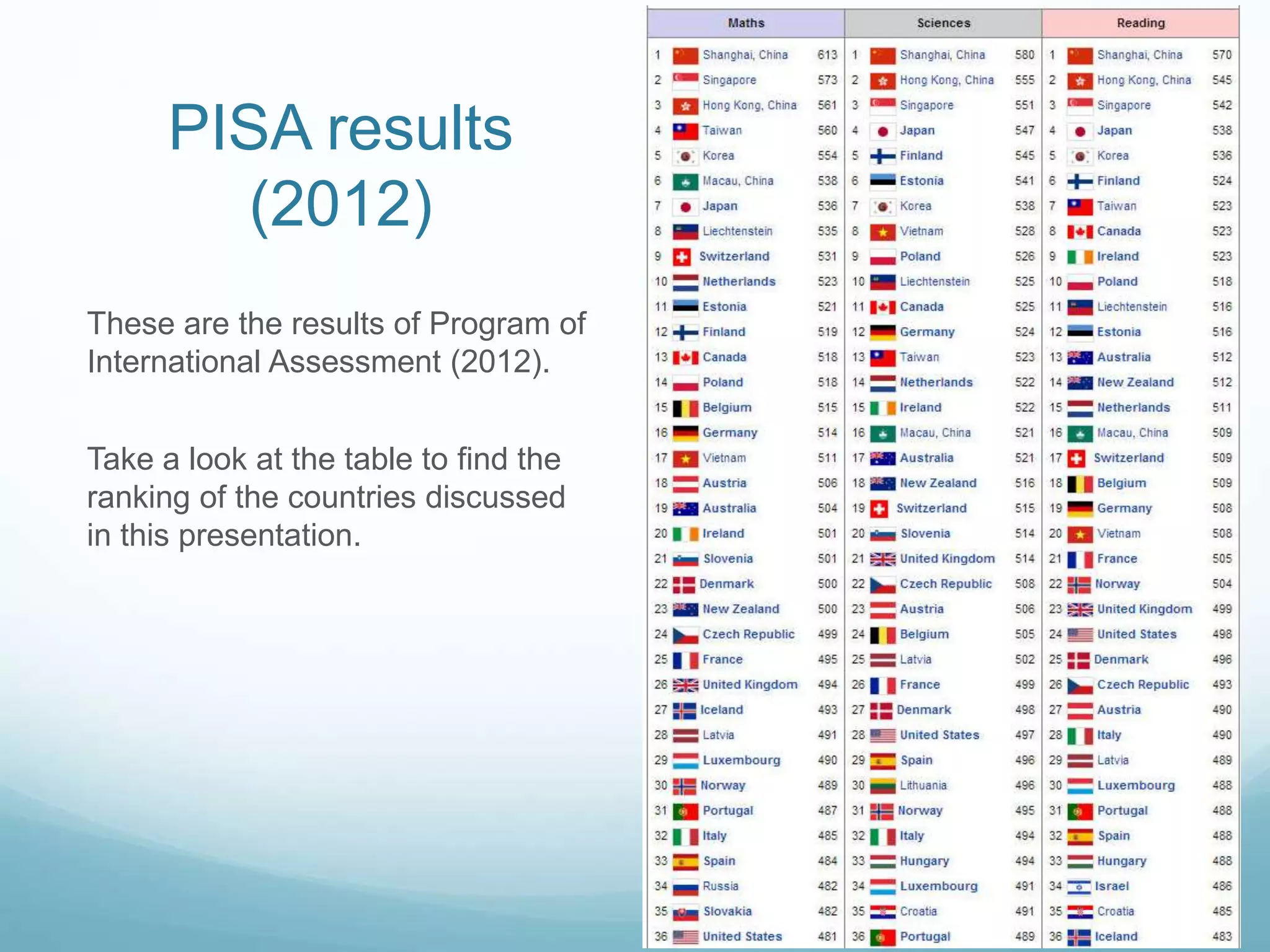
PISA results
(2012)
These are the results of Program of
International Assessment (2012).
Take a look at the table to find the
ranking of the countries discussed
in this presentation.
TIMSS (2011)
These are the results of the Trends
in International Mathematics and
Science Study.
Take a look at the table to find the
average scores of the countries
discussed in this presentation.
Reflection
What can the Unites States education system learn from
this journey?
Throughout this amazing and very inserting journey
around the world, there are a few successful elements I
believe it would benefit the US education system:
1. Funded education
2. Balance
3. Teacher’s professional development and salary
Funded education
Ensuring free education for all should be a basic human
right starting from preschool up to university education.
This includes cost of tuition, school meals, learning
materials, textbooks, equipment, facilities, student
counseling, transportation, etc. This is to ensure that
students from different socioeconomic status have equity
access to quality education.
By doing this, teachers can focus on teaching and
enhance learning, and bringing new ideas and practices
to schools.
Balance
Balance is the key to a successful education system.
South Korea, for example, focused more on standardized
tests and less on emotional and physical well-being; high
suicidal rates in school occurred.
Finland was a great example of balancing between school
work and play time, and they are one of the best countries
not just in standardized tests, but also preparing students
for their future careers.
Teachers
Improving education system should start with
strengthening education profession and investing in
teachers preparation and support. When teachers are
well-prepare and trusted, teaching become a highly
respected and appreciated profession.
Attractive salaries and acceptable workload are important
factors that play role in teacher’s productivity. When
teachers are satisfied, they would focus more teaching
and learning, and students’ emotional and physical
support.
Final thoughts
This journey around the world has been an amazing
learning experience. It allowed me to gain knowledge and
insight into the education system in each country
discussed, and how to bring back those successful
experiences to improve the US education system.
Emtinan
References
 All group and individual presentations, thanks to:
 Natalie, Mark, Rachel, Marcia, Amena, Elif, and Mia
 Mazurek, K., & Winzer, M. A. (2006). Schooling around
the world: Debates, challenges and practice. New York,
NY: Pearson Education.

726 Rethinking us education

  • 1.
    Rethinking US Education fora Global Society GDIT 725 Education in Global Society Emtinan Alqurashi
  • 2.
    We have travelledaround the globe to explore different education systems
  • 3.
    Introduction  We havetravelled together around the world to explore different education systems.  This trip includes countries from group presentations (US, England, South Korea, and China) and the individual studies of selected countries (Japan, Singapore, Italy, Belgium, Finland, Lithuania, India, and Mexico).  Throughout the journey, I will be discussing successes and concerns of countries we visited, and then what can the United States education system learn from this journey.
  • 4.
    The USA (successes) Multicultural educational reform  Democracy  Standards-based educational reform  Academic expectations  Students’ achievement  Teacher quality
  • 5.
    The USA (concerns) Multicultural educational reform  Difficult to “create the policy and structural supports needed to institutionalize multicultural education in schools”  Teacher education  Standards-based educational reform  Narrows curriculum and limits pedagogy  Promotes an assimilation agenda
  • 6.
    England (successes)  NationalCurriculum  SAT  Provide children with access to “broad, balanced, differentiated, and relevant school experience”  Students’ emotional health and positive behaviors  Early childhood education  Every Child Matters  Special education needs and inclusion  Children’s services  health, safety, enjoyment and achievement, positive contribution, economic well-being.  Status of teachers  national standard for certification of teachers
  • 7.
    England (concerns)  Curriculumissues  Students with learning difficulties are at highest risk  SAT scores (credibility)  Governance issue  Funding, based on size of school  Decline in the power vested in LEAs  Pupils behavior issues  Challenging behavior  More pupil referral units  Educational and Social Inclusion Issues  Pupils who prevent others from learning are not included in regular classes  Personal and Social Education Issues  Less attention on emotional development, personal care, etc.  More focus on Standards
  • 8.
    South Korea (successes) Opportunities for education have conspicuously expanded.  Education has made many qualitative changes.  Illiteracy has dropped.  Parental involvement  Education has contributed to political, economic, social and cultural development.  Education relates to an increase in social mobility.  Traditional value.
  • 9.
    South Korea (concerns) High suicidal rates  Overcrowded classrooms  Building more schools, especially in urban areas.  Diverse population  Accommodate students from the diverse cultures, religions, generations, and classes.  Lack of democracy in the country is a challenge to the education sector.  Curriculum changs  Gender equality  Private education
  • 10.
    China (successes)  Studentsare expected to perform well on standardized tests  Evaluating and revising education system on a regular basis.  Technology usage
  • 11.
    China (concerns)  TheLinguistic and Technological Divides  Gab between urban and rural areas  Curriculum Reform and Heavy Study Load  Pressure on students to perform well  Education of Domestic Migrant Children  Domestic migrant children are not eligible for free access to public schools  Creating World-Class Universities  Research and publication  More assistant, associate and full professors
  • 12.
    Japan (successes)  Highquality education by international standards  Across OECD countries, Japan is ranked one of the top four countries in Reading and Science, and top seven in Mathematics scores according to PISA results (2012); and ranked one of the top five according to TIMMS results (2011)  Japan succeeded in “bringing up excellent leaders and workers to promote modern industry”
  • 13.
    Japan (concerns)  Schooldrop out rates  School violence and bullying  Students’ lack of interest  Teachers’ workload  Crises of childhood  More focus on standardized testes and less oh human development
  • 14.
    Singapore (successes)  Highscores on standardized tests  Student development  University graduation rates increased  Gender equality  Bilingual policy  Profession development hours for teachers
  • 15.
    Singapore (concerns)  Preschooleducation is not funded  Gap between low-income and high-income families  Private tutoring business  Wealthy students are taking advantage of it
  • 16.
    Italy (successes)  Earlychildhood education  98% of children at age of 3 are enrolled in early childhood program  The education system is improving quickly
  • 17.
    Italy (concerns)  Lowscores on standardized tests  High drop out rates  Poor assessment techniques
  • 18.
    Belgium(successes) Flemish education  Highquality education by international standards  Schools are responsible for their own curricula  School reports are published online  Funded schools
  • 19.
    Belgium (concerns) Flemish education Private schools  Not funded, not recognized  Low performance of students from low socioeconomic status  Internal evaluation is not not connected to external evaluation
  • 20.
    Finland (successes)  Highscores on standardized tests  Education is a human right  Free education from preschool up to university  More play time  to reduce anxiety  Qualified teachers  Attractive salary  Comfortable schedule
  • 21.
    Finland (concerns) Finland educationsystem is very successful and my research on their concerns was very limited. What is better than having less class time and more recess time, attractive salary for teachers with few working hours. On the top of that, high scores on standardized tests.
  • 22.
    Lithuania (successes)  Highliteracy rates  Funded preschool education  No assessments for primary education  Focus on individual progress  Individual education plan in upper secondary education  Focus on teacher training and pedagogy
  • 23.
    Lithuania (concerns)  Teacherscan teach primary and basic education without a bachelor degree  Compulsory education is only 10 years, this is less than the US, which is 12 years
  • 24.
    India (successes)  Highliteracy rates  Easy access to schools in rural areas  Open Schools (from distance)  Well-developed adult education system  “Education for Women’s Equality” initiative
  • 25.
    India (concerns)  Poverty,child labor, children working in farming prevent children from education  Graduates rate more than jobs available  Teachers are not well-paid  Private institution  Create gap between children from low-income and high- income families
  • 26.
    Mexico (successes)  Yearsof compulsory education increased  Funded textbooks  Qualified teachers  Innovative education programs  Less student-teacher ration  Free breakfast for poor children
  • 27.
    Mexico (concerns)  Lowscoring on standardized tests  Facility storage  Classroom resources, buildings  Salaries of teachers  Low salary  Qualification requirement increased  Unequal access to education  Poor classroom instruction
  • 28.
    PISA results (2012) These arethe results of Program of International Assessment (2012). Take a look at the table to find the ranking of the countries discussed in this presentation.
  • 29.
    TIMSS (2011) These arethe results of the Trends in International Mathematics and Science Study. Take a look at the table to find the average scores of the countries discussed in this presentation.
  • 30.
    Reflection What can theUnites States education system learn from this journey? Throughout this amazing and very inserting journey around the world, there are a few successful elements I believe it would benefit the US education system: 1. Funded education 2. Balance 3. Teacher’s professional development and salary
  • 31.
    Funded education Ensuring freeeducation for all should be a basic human right starting from preschool up to university education. This includes cost of tuition, school meals, learning materials, textbooks, equipment, facilities, student counseling, transportation, etc. This is to ensure that students from different socioeconomic status have equity access to quality education. By doing this, teachers can focus on teaching and enhance learning, and bringing new ideas and practices to schools.
  • 32.
    Balance Balance is thekey to a successful education system. South Korea, for example, focused more on standardized tests and less on emotional and physical well-being; high suicidal rates in school occurred. Finland was a great example of balancing between school work and play time, and they are one of the best countries not just in standardized tests, but also preparing students for their future careers.
  • 33.
    Teachers Improving education systemshould start with strengthening education profession and investing in teachers preparation and support. When teachers are well-prepare and trusted, teaching become a highly respected and appreciated profession. Attractive salaries and acceptable workload are important factors that play role in teacher’s productivity. When teachers are satisfied, they would focus more teaching and learning, and students’ emotional and physical support.
  • 34.
    Final thoughts This journeyaround the world has been an amazing learning experience. It allowed me to gain knowledge and insight into the education system in each country discussed, and how to bring back those successful experiences to improve the US education system. Emtinan
  • 35.
    References  All groupand individual presentations, thanks to:  Natalie, Mark, Rachel, Marcia, Amena, Elif, and Mia  Mazurek, K., & Winzer, M. A. (2006). Schooling around the world: Debates, challenges and practice. New York, NY: Pearson Education.