PUBLIC
ADMINISTRATION
&
INTERGOVERNMENTAL
RELATIONS
RESOURCE SPEAKERS
1. MARY PAULINE J. GABULE
2. MARISOL L. UY
3. JOHARA B. ANDIG
4. COLSID-REY B. TUBIANO
PUBLIC
ADMINISTRATION
Learning Objectives
• Explain the definition of Public Administration in different perspectives
• Revisit the history of Philippine Public Administration
• Determine the comparison between Public and Private Administration
• Explain the definition and importance of Intergovernmental Relations to the
modern society
PUBLIC
• Relating to all the people or the whole area of a nation or state
• Organizing concept in delineating the field.
• Presumed beneficiary of the government
ADMINISTRATION
• Process or activity of running a business or an organization
• Organizational process concerned with the implementation of objectives and
plans and internal operating efficiency (Leonard D. White)
• The capacity of coordinating many and often conflicting, social energies in a
single organism, so adroitly that they shall operate as a unity. (Brooks Adams)
• Determined action taken in pursuit of a conscious purpose.
What is Public Administration?
• “ Government in Action”
• Concerned with institutional framework of the government, its socio-
economic and political milieu & the behavior of the individuals who man the
bureaucratic machine
• Concerns with the formulation of public policies and implementation of
programs
Public Administration
Government
• Totality of all institutions through which the state carries out its will
Administration
• Persons in whose hands the reins of the government are placed for the time being
Administrative Services
• Governmental agencies that are necessary to carry on government routine work
Public Administration (Dwight Waldo)
• Cooperative group efforts in a public setting
• Covers Executive, Legislative, & Judicial & their interrelationships
• Has an important role in public policy and is part of the political process
SCOPE
• Embraces ALL the activities of the government
• No less than the scope of the state activity
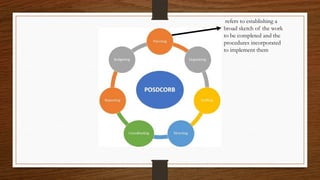
• Planning, Organizing, Staffing, Directing, Coordinating, Reporting,
Budgeting etc…
Management
• Planning, deciding, exercising of control and the supervision on some
functions of the organization
• The function of executive leadership (Ralph Davis & Alan Filley)
• Organ of society specifically charged with making resources productive (Peter
Drucker)
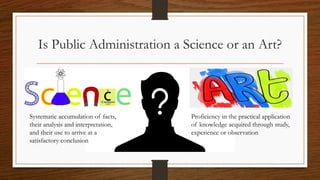
Is Public Administration a Science or an Art?
Proficiency in the practical application
of knowledge acquired through study,
experience or observation
Systematic accumulation of facts,
their analysis and interpretation,
and their use to arrive at a
satisfactory conclusion
ART
• The art of administration is the direction,
coordination and control of many persons to
achieve some purpose or objective.
SCIENCE
• A science of administration would be a body of
formal statements describing invariant
relationships between measurable objects, units or
elements.
• A science of human interaction that is susceptible
to objective investigation and analysis without
reference to value judgment.
“
”
The ART and SCIENCE of designing and
carrying out public policy
Presthus
Real Core of Public Administration
 Basic service which is performed for the public
 Ensures the security and protection of life and property of
the members of the society
 Maintaining proper law and order
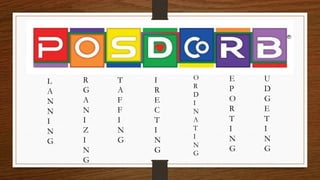
ELEMENTS of PUBLIC ADMINISTRATION
L
A
N
N
I
N
G
R
G
A
N
I
Z
I
N
G
T
A
F
F
I
N
G
I
R
E
C
T
I
N
G
O
R
D
I
N
A
T
I
N
G
E
P
O
R
T
I
N
G
U
D
G
E
T
I
N
G
refers to establishing a
broad sketch of the work
to be completed and the
procedures incorporated
to implement them
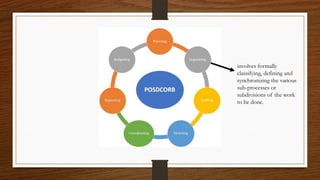
involves formally
classifying, defining and
synchronizing the various
sub-processes or
subdivisions of the work
to be done.
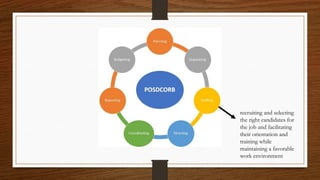
recruiting and selecting
the right candidates for
the job and facilitating
their orientation and
training while
maintaining a favorable
work environment
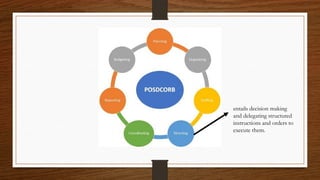
entails decision making
and delegating structured
instructions and orders to
execute them.
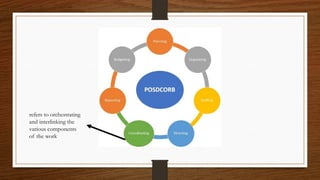
refers to orchestrating
and interlinking the
various components
of the work
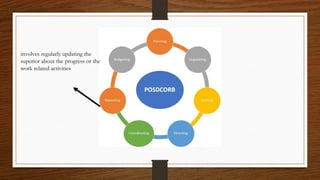
involves regularly updating the
superior about the progress or the
work related activities
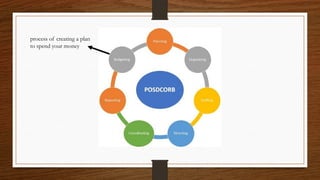
process of creating a plan
to spend your money
“there is similarity, if not
identity, in process wherever
observed”
-White
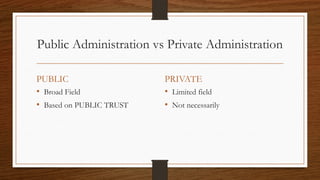
Public Administration vs Private Administration
PUBLIC
• Broad Field
• Based on PUBLIC TRUST
PRIVATE
• Limited field
• Not necessarily
PUBLIC OFFICE
is
PUBLIC TRUST
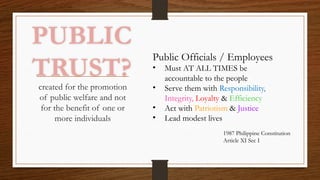
created for the promotion
of public welfare and not
for the benefit of one or
more individuals
PUBLIC
TRUST?
Public Officials / Employees
• Must AT ALL TIMES be
accountable to the people
• Serve them with Responsibility,
Integrity, Loyalty & Efficiency
• Act with Patriotism & Justice
• Lead modest lives
1987 Philippine Constitution
Article XI Sec I
“
”
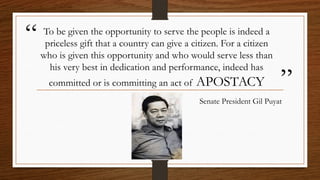
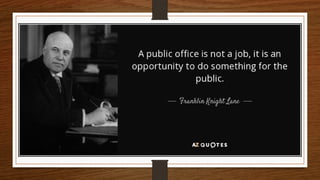
To be given the opportunity to serve the people is indeed a
priceless gift that a country can give a citizen. For a citizen
who is given this opportunity and who would serve less than
his very best in dedication and performance, indeed has
committed or is committing an act of APOSTACY
Senate President Gil Puyat
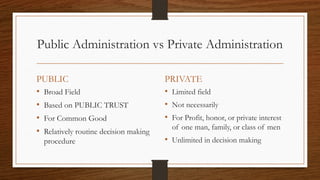
Public Administration vs Private Administration
PUBLIC
• Broad Field
• Based on PUBLIC TRUST
• For Common Good
• Relatively routine decision making
procedure
PRIVATE
• Limited field
• Not necessarily
• For Profit, honor, or private interest
of one man, family, or class of men
• Unlimited in decision making
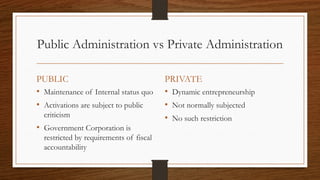
Public Administration vs Private Administration
PUBLIC
• Maintenance of Internal status quo
• Activations are subject to public
criticism
• Government Corporation is
restricted by requirements of fiscal
accountability
PRIVATE
• Dynamic entrepreneurship
• Not normally subjected
• No such restriction
History of Philippine Public
Administration
Pre-Colonial Period
• The Philippines did not exist as a single entity but rather lived as self-
governing groups called Barangays, each ruled by a datu who assumed the
position of a territorial chief, administrator of community life, and was the
galvanizing center of various spheres of activities in the community.
Spanish Colonial Period
• Began the tradition of Centralization
• Jurisdictional boundaries between the state and religion were never clearly defined
• Introduced the system of public revenue and public expenditure
• Public offices were regarded as a grant or favor
• Practice of filling up positions by appointment or purchase
American Colonial Period
• All high officials of the central government with exception of the Filipino delegates elected
to the Philippine assembly was appointed by the Pres. of the US with the consent of the
American Senate
• Establishment of the Philippine Civil Service system under the Schurman Commission
• Filipinization of the civil service became a basic administrative policy
• Put primary focus on the creation and operation of an efficient and non-political civil service
Commonwealth Period
• The civil service had been completely Filipinized
• It adopted a government “ republican in form, Filipino in personnel, and
autonomy in domestic affairs.
Japanese Occupation
• Organized a new government in the Philippines known as the Second
Philippine Republic, which was headed by President Jose P. Laurel
• It attempted to secure Filipino cooperation by setting up a facade of a
Filipino civil administration but this government ended up being very
unpopular
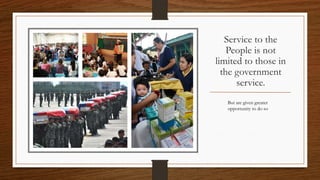
Service to the
People is not
limited to those in
the government
service.
But are given greater
opportunity to do so
RELATIONSHIPS
INTERGOVERNMENTAL
RELATIONS
The processes and
institutions through which
governments within a
political system interact.
Important interactions
between governmental units
of all types and levels.
Interacting network of
institutions at national,
provincial and local levels..
An evolving system of
institutional co-operation
that seeks to address the
relations of equality and
interdependence as defined
by the Constitution
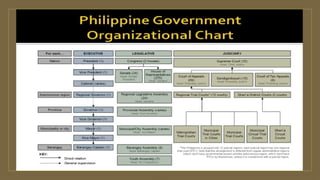
GOVERNMENT
•The system by which a state or community is governed
•Refers to the particular executive in control of a state at a
given time
•Refers to the larger system by which any state is organized
•The means by which state policy is enforced, as well as the
mechanism for determining the policy of the state
Federal System
1. Formal constitutional change, redefining the roles and responsibilities of the
federal and provincial governments
2. Nonstatutory federal-provincial agreement that set out obligations and
commitments in specific policy areas, such as the environment
3. Statutory and binding obligations and commitments, such as
intergovernmental fiscal transfers
4. Informal agreements among political leaders to undertake a certain course of
action
Unitary System
ADMINISTRATIVE COORDINATION
and
FISCAL MEASURES
Unitary System
ADMINISTRATIVE COORDINATION
and
FISCAL MEASURES
What is the relationship of local
governments to the national
government?
NATIONAL CONTROL of LOCAL
GOVERNMENT ACTIVITIES
Dysfunctional Patterns of National Control
• OVERCONTROL
• UNDERCONTROL
• PERVERSE REGULATION
Overcontrol
The subnational governments are merely
administrative arms of the central government
Undercontrol
Each tier of subnational government is almost
sovereign and competes with other levels of
government
Perverse Regulation
Local governments have some degree of political
autonomy, but perverse incentives characterize the
relationship with the central government
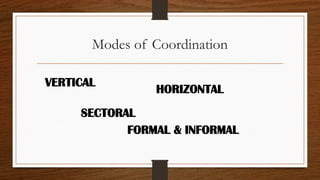
Modes of Coordination
VERTICAL
HORIZONTAL
SECTORAL
FORMAL & INFORMAL
VERTICAL
• seeks to assure top-down policy coherence
• facilitated by national norms for program goals, and uniform
guidelines of financing institutions
• Local government associations and councils of mayors are often the
main interlocutors with the national and provincial governments on
issues affecting local governments
HORIZONTAL
• takes place among agencies operating at the same level of
government, or between local government and the corresponding
civil society
SECTORAL
• each policy sector tends to have its own IGR networks and
personnel
• scope, frequency and intensity of interaction can vary between
policy sectors, as can the level of cooperation or conflict
FORMAL OR INFORMAL
• Informal IGR are inevitably more difficult to observe but often
as important as formal mechanisms, if not moreso
• There may be unspoken rules, conventions or principles that
are important to the conduct and effectiveness
References
• To Serve and To Preserve: Improving Public Administration in a Competitive World
• Understanding Intergovernmental Relations: Key Features and Trends by John Phillimore
• Growth and Development of Public Administration in the Philippines by Pinky Manio
• Is There a Public Administration by Raul P. De Guzman
• Public Administration : The Business of Government by Jose P. Leveriza
• Elements of Public Administration by Smita Khatri Dr. Shiwani Bansal
• https://www.mbaskool.com/business-concepts/marketing-and-strategy-terms/2443-posdcorb.html
Reporting - Intro to Public Administration & Intergovernmental Relations (1).pptx

Reporting - Intro to Public Administration & Intergovernmental Relations (1).pptx

  • 1.
  • 2.
    RESOURCE SPEAKERS 1. MARYPAULINE J. GABULE 2. MARISOL L. UY 3. JOHARA B. ANDIG 4. COLSID-REY B. TUBIANO
  • 3.
  • 4.
    Learning Objectives • Explainthe definition of Public Administration in different perspectives • Revisit the history of Philippine Public Administration • Determine the comparison between Public and Private Administration • Explain the definition and importance of Intergovernmental Relations to the modern society
  • 7.
    PUBLIC • Relating toall the people or the whole area of a nation or state • Organizing concept in delineating the field. • Presumed beneficiary of the government
  • 8.
    ADMINISTRATION • Process oractivity of running a business or an organization • Organizational process concerned with the implementation of objectives and plans and internal operating efficiency (Leonard D. White) • The capacity of coordinating many and often conflicting, social energies in a single organism, so adroitly that they shall operate as a unity. (Brooks Adams) • Determined action taken in pursuit of a conscious purpose.
  • 9.
    What is PublicAdministration? • “ Government in Action” • Concerned with institutional framework of the government, its socio- economic and political milieu & the behavior of the individuals who man the bureaucratic machine • Concerns with the formulation of public policies and implementation of programs
  • 10.
    Public Administration Government • Totalityof all institutions through which the state carries out its will Administration • Persons in whose hands the reins of the government are placed for the time being Administrative Services • Governmental agencies that are necessary to carry on government routine work
  • 11.
    Public Administration (DwightWaldo) • Cooperative group efforts in a public setting • Covers Executive, Legislative, & Judicial & their interrelationships • Has an important role in public policy and is part of the political process
  • 12.
    SCOPE • Embraces ALLthe activities of the government • No less than the scope of the state activity • Planning, Organizing, Staffing, Directing, Coordinating, Reporting, Budgeting etc…
  • 13.
    Management • Planning, deciding,exercising of control and the supervision on some functions of the organization • The function of executive leadership (Ralph Davis & Alan Filley) • Organ of society specifically charged with making resources productive (Peter Drucker)
  • 14.
    Is Public Administrationa Science or an Art? Proficiency in the practical application of knowledge acquired through study, experience or observation Systematic accumulation of facts, their analysis and interpretation, and their use to arrive at a satisfactory conclusion
  • 15.
    ART • The artof administration is the direction, coordination and control of many persons to achieve some purpose or objective.
  • 16.
    SCIENCE • A scienceof administration would be a body of formal statements describing invariant relationships between measurable objects, units or elements. • A science of human interaction that is susceptible to objective investigation and analysis without reference to value judgment.
  • 17.
    “ ” The ART andSCIENCE of designing and carrying out public policy Presthus
  • 18.
    Real Core ofPublic Administration  Basic service which is performed for the public  Ensures the security and protection of life and property of the members of the society  Maintaining proper law and order
  • 19.
    ELEMENTS of PUBLICADMINISTRATION L A N N I N G R G A N I Z I N G T A F F I N G I R E C T I N G O R D I N A T I N G E P O R T I N G U D G E T I N G
  • 20.
    refers to establishinga broad sketch of the work to be completed and the procedures incorporated to implement them
  • 21.
    involves formally classifying, definingand synchronizing the various sub-processes or subdivisions of the work to be done.
  • 22.
    recruiting and selecting theright candidates for the job and facilitating their orientation and training while maintaining a favorable work environment
  • 23.
    entails decision making anddelegating structured instructions and orders to execute them.
  • 24.
    refers to orchestrating andinterlinking the various components of the work
  • 25.
    involves regularly updatingthe superior about the progress or the work related activities
  • 26.
    process of creatinga plan to spend your money
  • 28.
    “there is similarity,if not identity, in process wherever observed” -White
  • 29.
    Public Administration vsPrivate Administration PUBLIC • Broad Field • Based on PUBLIC TRUST PRIVATE • Limited field • Not necessarily
  • 30.
  • 31.
    created for thepromotion of public welfare and not for the benefit of one or more individuals PUBLIC TRUST? Public Officials / Employees • Must AT ALL TIMES be accountable to the people • Serve them with Responsibility, Integrity, Loyalty & Efficiency • Act with Patriotism & Justice • Lead modest lives 1987 Philippine Constitution Article XI Sec I
  • 32.
    “ ” To be giventhe opportunity to serve the people is indeed a priceless gift that a country can give a citizen. For a citizen who is given this opportunity and who would serve less than his very best in dedication and performance, indeed has committed or is committing an act of APOSTACY Senate President Gil Puyat
  • 33.
    Public Administration vsPrivate Administration PUBLIC • Broad Field • Based on PUBLIC TRUST • For Common Good • Relatively routine decision making procedure PRIVATE • Limited field • Not necessarily • For Profit, honor, or private interest of one man, family, or class of men • Unlimited in decision making
  • 34.
    Public Administration vsPrivate Administration PUBLIC • Maintenance of Internal status quo • Activations are subject to public criticism • Government Corporation is restricted by requirements of fiscal accountability PRIVATE • Dynamic entrepreneurship • Not normally subjected • No such restriction
  • 35.
    History of PhilippinePublic Administration
  • 36.
    Pre-Colonial Period • ThePhilippines did not exist as a single entity but rather lived as self- governing groups called Barangays, each ruled by a datu who assumed the position of a territorial chief, administrator of community life, and was the galvanizing center of various spheres of activities in the community.
  • 37.
    Spanish Colonial Period •Began the tradition of Centralization • Jurisdictional boundaries between the state and religion were never clearly defined • Introduced the system of public revenue and public expenditure • Public offices were regarded as a grant or favor • Practice of filling up positions by appointment or purchase
  • 38.
    American Colonial Period •All high officials of the central government with exception of the Filipino delegates elected to the Philippine assembly was appointed by the Pres. of the US with the consent of the American Senate • Establishment of the Philippine Civil Service system under the Schurman Commission • Filipinization of the civil service became a basic administrative policy • Put primary focus on the creation and operation of an efficient and non-political civil service
  • 39.
    Commonwealth Period • Thecivil service had been completely Filipinized • It adopted a government “ republican in form, Filipino in personnel, and autonomy in domestic affairs.
  • 40.
    Japanese Occupation • Organizeda new government in the Philippines known as the Second Philippine Republic, which was headed by President Jose P. Laurel • It attempted to secure Filipino cooperation by setting up a facade of a Filipino civil administration but this government ended up being very unpopular
  • 41.
    Service to the Peopleis not limited to those in the government service. But are given greater opportunity to do so
  • 43.
  • 44.
  • 45.
    The processes and institutionsthrough which governments within a political system interact.
  • 46.
    Important interactions between governmentalunits of all types and levels. Interacting network of institutions at national, provincial and local levels..
  • 47.
    An evolving systemof institutional co-operation that seeks to address the relations of equality and interdependence as defined by the Constitution
  • 48.
    GOVERNMENT •The system bywhich a state or community is governed •Refers to the particular executive in control of a state at a given time •Refers to the larger system by which any state is organized •The means by which state policy is enforced, as well as the mechanism for determining the policy of the state
  • 50.
    Federal System 1. Formalconstitutional change, redefining the roles and responsibilities of the federal and provincial governments 2. Nonstatutory federal-provincial agreement that set out obligations and commitments in specific policy areas, such as the environment 3. Statutory and binding obligations and commitments, such as intergovernmental fiscal transfers 4. Informal agreements among political leaders to undertake a certain course of action
  • 51.
  • 52.
  • 53.
    What is therelationship of local governments to the national government?
  • 54.
    NATIONAL CONTROL ofLOCAL GOVERNMENT ACTIVITIES
  • 55.
    Dysfunctional Patterns ofNational Control • OVERCONTROL • UNDERCONTROL • PERVERSE REGULATION
  • 56.
    Overcontrol The subnational governmentsare merely administrative arms of the central government
  • 57.
    Undercontrol Each tier ofsubnational government is almost sovereign and competes with other levels of government
  • 58.
    Perverse Regulation Local governmentshave some degree of political autonomy, but perverse incentives characterize the relationship with the central government
  • 59.
  • 60.
    VERTICAL • seeks toassure top-down policy coherence • facilitated by national norms for program goals, and uniform guidelines of financing institutions • Local government associations and councils of mayors are often the main interlocutors with the national and provincial governments on issues affecting local governments
  • 61.
    HORIZONTAL • takes placeamong agencies operating at the same level of government, or between local government and the corresponding civil society
  • 62.
    SECTORAL • each policysector tends to have its own IGR networks and personnel • scope, frequency and intensity of interaction can vary between policy sectors, as can the level of cooperation or conflict
  • 63.
    FORMAL OR INFORMAL •Informal IGR are inevitably more difficult to observe but often as important as formal mechanisms, if not moreso • There may be unspoken rules, conventions or principles that are important to the conduct and effectiveness
  • 65.
    References • To Serveand To Preserve: Improving Public Administration in a Competitive World • Understanding Intergovernmental Relations: Key Features and Trends by John Phillimore • Growth and Development of Public Administration in the Philippines by Pinky Manio • Is There a Public Administration by Raul P. De Guzman • Public Administration : The Business of Government by Jose P. Leveriza • Elements of Public Administration by Smita Khatri Dr. Shiwani Bansal • https://www.mbaskool.com/business-concepts/marketing-and-strategy-terms/2443-posdcorb.html