Richard Crawley 
Calculating the cost
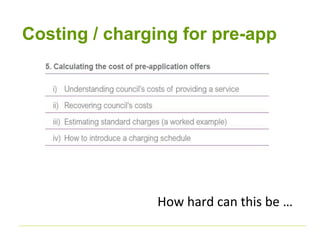
Costing / charging for pre-app 
How hard can this be …
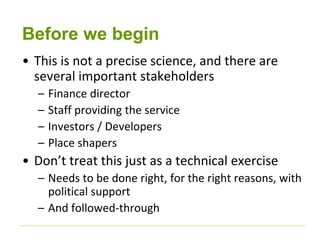
Before we begin 
• This is not a precise science, and there are 
several important stakeholders 
– Finance director 
– Staff providing the service 
– Investors / Developers 
– Place shapers 
• Don’t treat this just as a technical exercise 
– Needs to be done right, for the right reasons, with 
political support 
– And followed-through
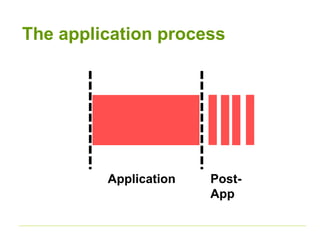
The application process 
Application Post- 
App
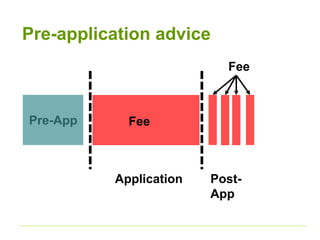
Pre-application advice 
Pre-App 
Application Post- 
App 
Fee 
Fee
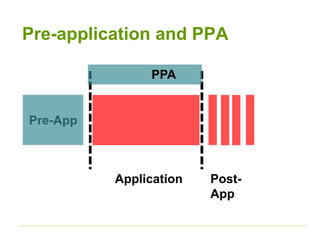
Pre-application and PPA 
Pre-App 
Application Post- 
App 
PPA
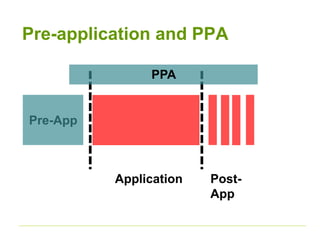
Pre-application and PPA 
Pre-App 
Application Post- 
App 
PPA
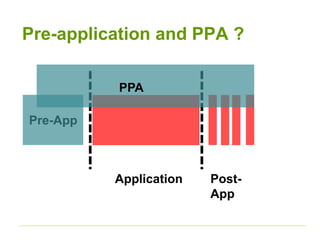
Pre-application and PPA ? 
Pre-App 
Application Post- 
App 
PPA
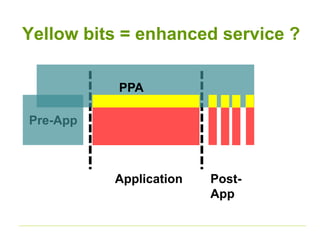
Yellow bits = enhanced service ? 
Pre-App 
Application Post- 
App 
PPA
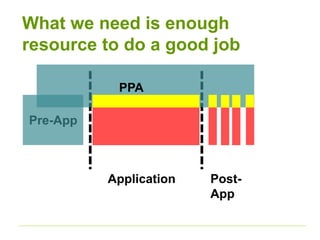
What we need is enough 
resource to do a good job 
Pre-App 
Application Post- 
App 
PPA
(i) Understanding councils costs 
• Even if you’re not going to charge, 
discretionary services need to be designed 
with cost in mind 
• Services are (mostly) provided by people 
– Who, 
– How long 
– How much per unit 
– ……….. Does it add value ?
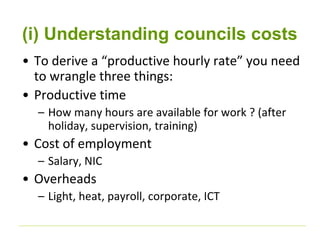
(i) Understanding councils costs 
• To derive a “productive hourly rate” you need 
to wrangle three things: 
• Productive time 
– How many hours are available for work ? (after 
holiday, supervision, training) 
• Cost of employment 
– Salary, NIC 
• Overheads 
– Light, heat, payroll, corporate, ICT
(i) Understanding councils costs 
• Productive hourly rate = cost / hours * 
overheads 
• See page 39 
• Consultation costs (ie within the council) are 
not always understood fully (and may not 
need to be) 
• [also note “opportunity cost” – planners 
working on pre-apps are not working on apps]
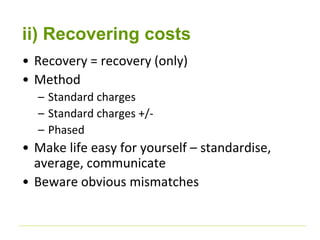
ii) Recovering costs 
• Recovery = recovery (only) 
• Method 
– Standard charges 
– Standard charges +/- 
– Phased 
• Make life easy for yourself – standardise, 
average, communicate 
• Beware obvious mismatches
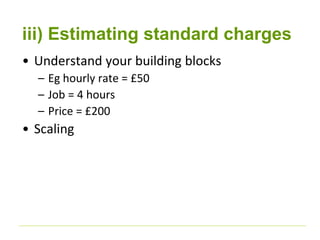
iii) Estimating standard charges 
• Understand your building blocks 
– Eg hourly rate = £50 
– Job = 4 hours 
– Price = £200 
• Scaling
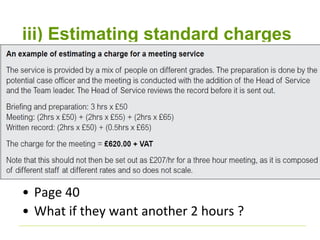
iii) Estimating standard charges 
• Page 40 
• What if they want another 2 hours ?
iv) Introducing a schedule 
• Think about monitoring 
• Think about capacity 
– Core capacity and discretionary capacity ? 
• Talk to your neighbours 
• Be ready to learn 
– A change of mindset ? 
– An ability to negotiate
Your turn 
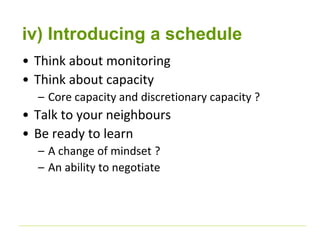
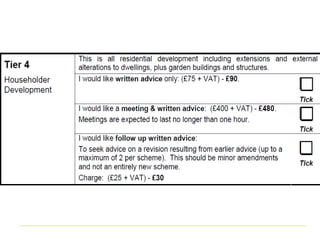
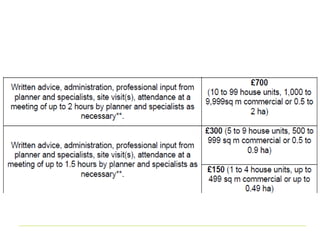
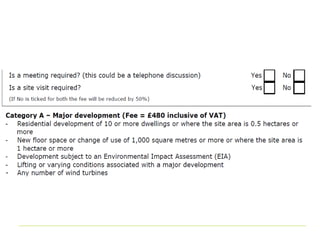
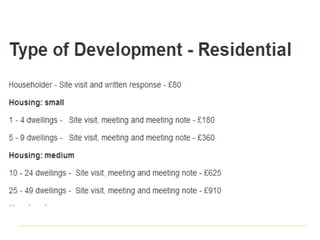
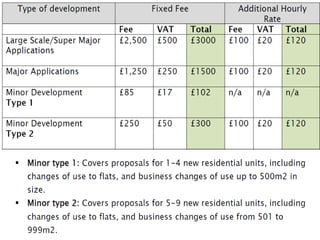
• For a few minutes each, consider these 
extracts from charging schedules [all 
downloaded on 5th June 2014] 
• Assume the role of buyer. What do you 
like / not like
What do you think ?
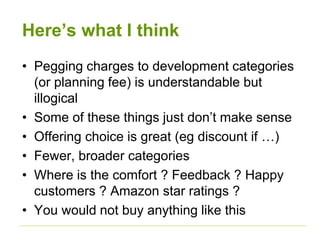
Here’s what I think 
• Pegging charges to development categories 
(or planning fee) is understandable but 
illogical 
• Some of these things just don’t make sense 
• Offering choice is great (eg discount if …) 
• Fewer, broader categories 
• Where is the comfort ? Feedback ? Happy 
customers ? Amazon star ratings ? 
• You would not buy anything like this
The Planner [Dec/Jan 2014 p. 43] 
“The RTPI’s experience is that most 
complaints about consultant’s fees occur 
when no agreement has been formalised 
between consultant and client. There should 
be no ambiguity. It is advisable to cover the 
following items” 
Summary table of estimated costs; detailed 
tables of time costs; reimbursable expenses; 
subsistence and daily allowances; terms and 
schedule of payment.
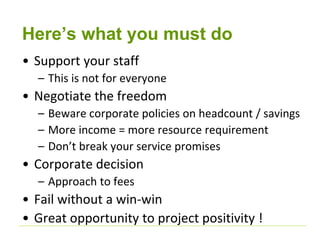
Here’s what you must do 
• Support your staff 
– This is not for everyone 
• Negotiate the freedom 
– Beware corporate policies on headcount / savings 
– More income = more resource requirement 
– Don’t break your service promises 
• Corporate decision 
– Approach to fees 
• Fail without a win-win 
• Great opportunity to project positivity !
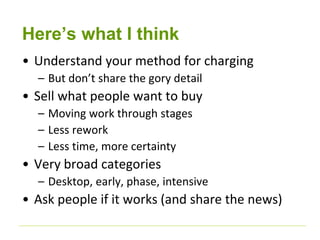
Here’s what I think 
• Understand your method for charging 
– But don’t share the gory detail 
• Sell what people want to buy 
– Moving work through stages 
– Less rework 
– Less time, more certainty 
• Very broad categories 
– Desktop, early, phase, intensive 
• Ask people if it works (and share the news)

PAS - calculating the cost of pre-application services

  • 1.
  • 2.
    Costing / chargingfor pre-app How hard can this be …
  • 3.
    Before we begin • This is not a precise science, and there are several important stakeholders – Finance director – Staff providing the service – Investors / Developers – Place shapers • Don’t treat this just as a technical exercise – Needs to be done right, for the right reasons, with political support – And followed-through
  • 4.
    The application process Application Post- App
  • 5.
    Pre-application advice Pre-App Application Post- App Fee Fee
  • 6.
    Pre-application and PPA Pre-App Application Post- App PPA
  • 7.
    Pre-application and PPA Pre-App Application Post- App PPA
  • 8.
    Pre-application and PPA? Pre-App Application Post- App PPA
  • 9.
    Yellow bits =enhanced service ? Pre-App Application Post- App PPA
  • 10.
    What we needis enough resource to do a good job Pre-App Application Post- App PPA
  • 11.
    (i) Understanding councilscosts • Even if you’re not going to charge, discretionary services need to be designed with cost in mind • Services are (mostly) provided by people – Who, – How long – How much per unit – ……….. Does it add value ?
  • 12.
    (i) Understanding councilscosts • To derive a “productive hourly rate” you need to wrangle three things: • Productive time – How many hours are available for work ? (after holiday, supervision, training) • Cost of employment – Salary, NIC • Overheads – Light, heat, payroll, corporate, ICT
  • 13.
    (i) Understanding councilscosts • Productive hourly rate = cost / hours * overheads • See page 39 • Consultation costs (ie within the council) are not always understood fully (and may not need to be) • [also note “opportunity cost” – planners working on pre-apps are not working on apps]
  • 14.
    ii) Recovering costs • Recovery = recovery (only) • Method – Standard charges – Standard charges +/- – Phased • Make life easy for yourself – standardise, average, communicate • Beware obvious mismatches
  • 15.
    iii) Estimating standardcharges • Understand your building blocks – Eg hourly rate = £50 – Job = 4 hours – Price = £200 • Scaling
  • 16.
    iii) Estimating standardcharges • Page 40 • What if they want another 2 hours ?
  • 17.
    iv) Introducing aschedule • Think about monitoring • Think about capacity – Core capacity and discretionary capacity ? • Talk to your neighbours • Be ready to learn – A change of mindset ? – An ability to negotiate
  • 18.
    Your turn •For a few minutes each, consider these extracts from charging schedules [all downloaded on 5th June 2014] • Assume the role of buyer. What do you like / not like
  • 24.
    What do youthink ?
  • 25.
    Here’s what Ithink • Pegging charges to development categories (or planning fee) is understandable but illogical • Some of these things just don’t make sense • Offering choice is great (eg discount if …) • Fewer, broader categories • Where is the comfort ? Feedback ? Happy customers ? Amazon star ratings ? • You would not buy anything like this
  • 26.
    The Planner [Dec/Jan2014 p. 43] “The RTPI’s experience is that most complaints about consultant’s fees occur when no agreement has been formalised between consultant and client. There should be no ambiguity. It is advisable to cover the following items” Summary table of estimated costs; detailed tables of time costs; reimbursable expenses; subsistence and daily allowances; terms and schedule of payment.
  • 27.
    Here’s what youmust do • Support your staff – This is not for everyone • Negotiate the freedom – Beware corporate policies on headcount / savings – More income = more resource requirement – Don’t break your service promises • Corporate decision – Approach to fees • Fail without a win-win • Great opportunity to project positivity !
  • 28.
    Here’s what Ithink • Understand your method for charging – But don’t share the gory detail • Sell what people want to buy – Moving work through stages – Less rework – Less time, more certainty • Very broad categories – Desktop, early, phase, intensive • Ask people if it works (and share the news)

Editor's Notes