Housing Standards Review Roll Out
2015
Stephen Porter, DCLG.
Structure of presentation
• Rationalising Housing Standards
• Housing Standards Review – Overview
• Transition and Implementation
• Building Regulations transitional provisions
• Key issues for Building Control
• Key issues for Planning Authorities
• Key Planning Issues – Development Management
The New Housing Standards
• Nationally described space standard
• Access Standard
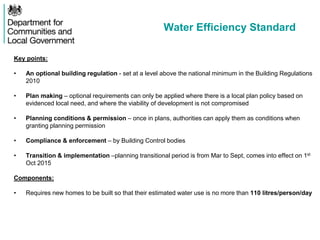
• Water Efficiency Standard
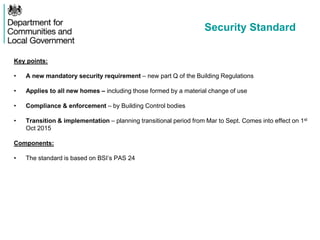
• Security Standard
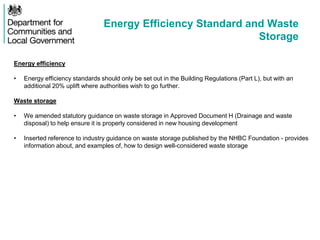
• Energy Efficiency Standard and Waste Storage
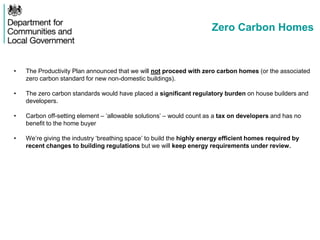
• Zero Carbon Homes
• Further information
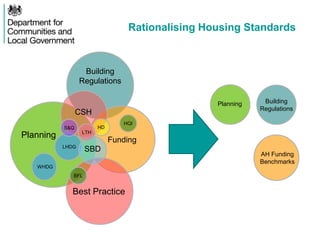
Rationalising Housing Standards
Building
Regulations
Funding
Planning
Best Practice
CSH
HD
Building
Regulations
Planning
HQI
LHDG
S&Q
BFL
SBD
LTH
AH Funding
Benchmarks
WHDG
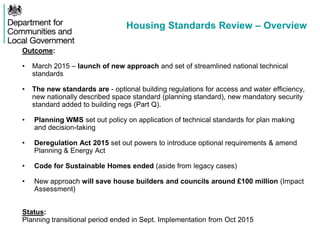
Housing Standards Review – Overview
Background:
• Fundamental review of planning technical housing standards, and their
link to building regulations
• Aims - reduce bureaucracy and costs, reform and simplify framework, make
house-building process easier to navigate, reduce contradictions and
overlap & allow local choice
• Extensive work with stakeholders from a range of sectors e.g. house
builders, local authorities, disability and energy groups etc. (over 140
different groups)
Housing Standards Review – Overview
Outcome:
• March 2015 – launch of new approach and set of streamlined national technical
standards
• The new standards are - optional building regulations for access and water efficiency,
new nationally described space standard (planning standard), new mandatory security
standard added to building regs (Part Q).
• Planning WMS set out policy on application of technical standards for plan making
and decision-taking
• Deregulation Act 2015 set out powers to introduce optional requirements & amend
Planning & Energy Act
• Code for Sustainable Homes ended (aside from legacy cases)
• New approach will save house builders and councils around £100 million (Impact
Assessment)
Status:
Planning transitional period ended in Sept. Implementation from Oct 2015
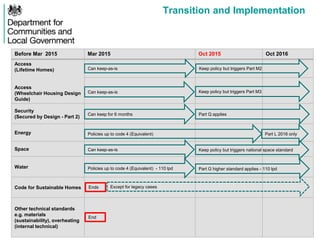
Transition and Implementation
Before Mar 2015 Mar 2015 Oct 2015 Oct 2016
Access
(Lifetime Homes)
Access
(Wheelchair Housing Design
Guide)
Security
(Secured by Design - Part 2)
Energy
Space
Water
Code for Sustainable Homes
Other technical standards
e.g. materials
(sustainability), overheating
(internal technical)
Keep policy but triggers Part M2
Keep policy but triggers Part M3
Part Q applies
Can keep-as-is
Can keep-as-is
Can keep for 6 months
Policies up to code 4 (Equivalent) Part L 2016 only
Except for legacy cases
End
Policies up to code 4 (Equivalent) - 110 lpd Part G higher standard applies - 110 lpd
Can keep-as-is Keep policy but triggers national space standard
Ends
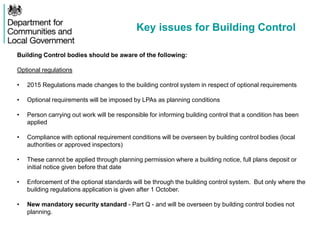
Key issues for Building Control
Building Control bodies should be aware of the following:
Optional regulations
• 2015 Regulations made changes to the building control system in respect of optional requirements
• Optional requirements will be imposed by LPAs as planning conditions
• Person carrying out work will be responsible for informing building control that a condition has been
applied
• Compliance with optional requirement conditions will be overseen by building control bodies (local
authorities or approved inspectors)
• These cannot be applied through planning permission where a building notice, full plans deposit or
initial notice given before that date
• Enforcement of the optional standards will be through the building control system. But only where the
building regulations application is given after 1 October.
• New mandatory security standard - Part Q - and will be overseen by building control bodies not
planning.
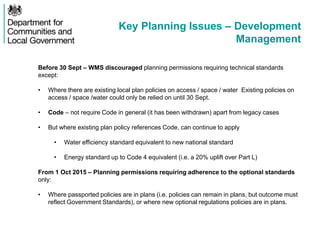
Key Planning Issues – Development
Management
Before 30 Sept – WMS discouraged planning permissions requiring technical standards
except:
• Where there are existing local plan policies on access / space / water Existing policies on
access / space /water could only be relied on until 30 Sept.
• Code – not require Code in general (it has been withdrawn) apart from legacy cases
• But where existing plan policy references Code, can continue to apply
• Water efficiency standard equivalent to new national standard
• Energy standard up to Code 4 equivalent (i.e. a 20% uplift over Part L)
From 1 Oct 2015 – Planning permissions requiring adherence to the optional standards
only:
• Where passported policies are in plans (i.e. policies can remain in plans, but outcome must
reflect Government Standards), or where new optional regulations policies are in plans.
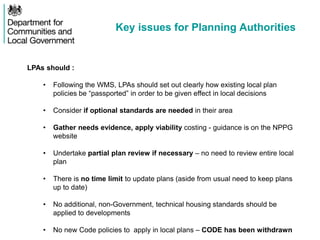
Key issues for Planning Authorities
LPAs should :
• Following the WMS, LPAs should set out clearly how existing local plan
policies be “passported” in order to be given effect in local decisions
• Consider if optional standards are needed in their area
• Gather needs evidence, apply viability costing - guidance is on the NPPG
website
• Undertake partial plan review if necessary – no need to review entire local
plan
• There is no time limit to update plans (aside from usual need to keep plans
up to date)
• No additional, non-Government, technical housing standards should be
applied to developments
• No new Code policies to apply in local plans – CODE has been withdrawn
The New Housing
Standards
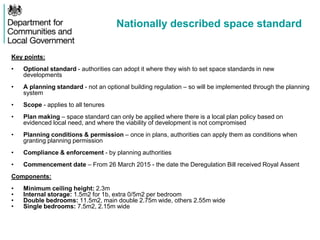
Nationally described space standard
Key points:
• Optional standard - authorities can adopt it where they wish to set space standards in new
developments
• A planning standard - not an optional building regulation – so will be implemented through the planning
system
• Scope - applies to all tenures
• Plan making – space standard can only be applied where there is a local plan policy based on
evidenced local need, and where the viability of development is not compromised
• Planning conditions & permission – once in plans, authorities can apply them as conditions when
granting planning permission
• Compliance & enforcement - by planning authorities
• Commencement date – From 26 March 2015 - the date the Deregulation Bill received Royal Assent
Components:
• Minimum ceiling height: 2.3m
• Internal storage: 1.5m2 for 1b, extra 0/5m2 per bedroom
• Double bedrooms: 11.5m2, main double 2.75m wide, others 2.55m wide
• Single bedrooms: 7.5m2, 2.15m wide
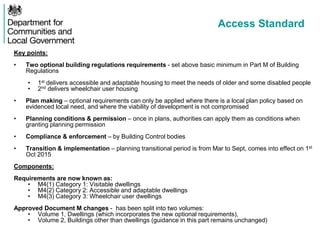
Access Standard
Key points:
• Two optional building regulations requirements - set above basic minimum in Part M of Building
Regulations
• 1st delivers accessible and adaptable housing to meet the needs of older and some disabled people
• 2nd delivers wheelchair user housing
• Plan making – optional requirements can only be applied where there is a local plan policy based on
evidenced local need, and where the viability of development is not compromised
• Planning conditions & permission – once in plans, authorities can apply them as conditions when
granting planning permission
• Compliance & enforcement – by Building Control bodies
• Transition & implementation – planning transitional period is from Mar to Sept, comes into effect on 1st
Oct 2015
Components:
Requirements are now known as:
• M4(1) Category 1: Visitable dwellings
• M4(2) Category 2: Accessible and adaptable dwellings
• M4(3) Category 3: Wheelchair user dwellings
Approved Document M changes - has been split into two volumes:
• Volume 1, Dwellings (which incorporates the new optional requirements),
• Volume 2, Buildings other than dwellings (guidance in this part remains unchanged)
Water Efficiency Standard
Key points:
• An optional building regulation - set at a level above the national minimum in the Building Regulations
2010
• Plan making – optional requirements can only be applied where there is a local plan policy based on
evidenced local need, and where the viability of development is not compromised
• Planning conditions & permission – once in plans, authorities can apply them as conditions when
granting planning permission
• Compliance & enforcement – by Building Control bodies
• Transition & implementation –planning transitional period is from Mar to Sept, comes into effect on 1st
Oct 2015
Components:
• Requires new homes to be built so that their estimated water use is no more than 110 litres/person/day
Security Standard
Key points:
• A new mandatory security requirement – new part Q of the Building Regulations
• Applies to all new homes – including those formed by a material change of use
• Compliance & enforcement – by Building Control bodies
• Transition & implementation – planning transitional period from Mar to Sept. Comes into effect on 1st
Oct 2015
Components:
• The standard is based on BSI’s PAS 24
Energy Efficiency Standard and Waste
Storage
Energy efficiency
• Energy efficiency standards should only be set out in the Building Regulations (Part L), but with an
additional 20% uplift where authorities wish to go further.
Waste storage
• We amended statutory guidance on waste storage in Approved Document H (Drainage and waste
disposal) to help ensure it is properly considered in new housing development
• Inserted reference to industry guidance on waste storage published by the NHBC Foundation - provides
information about, and examples of, how to design well-considered waste storage
Zero Carbon Homes
• The Productivity Plan announced that we will not proceed with zero carbon homes (or the associated
zero carbon standard for new non-domestic buildings).
• The zero carbon standards would have placed a significant regulatory burden on house builders and
developers.
• Carbon off-setting element – ‘allowable solutions’ – would count as a tax on developers and has no
benefit to the home buyer
• We’re giving the industry ‘breathing space’ to build the highly energy efficient homes required by
recent changes to building regulations but we will keep energy requirements under review.
Further information
Further information - available from GOV.UK
Other useful links:
• Planning written ministerial statement
• Planning guidance for housing optional technical standards
• A nationally described space standard
• Approved Document M: volume 1 - access to and use of dwellings
• Approved Document M: volume 2 - access to and use of buildings other than dwellings
• Approved Document Q - security - dwellings
• Approved Document G - sanitation, hot water safety and water efficiency
• Approved Document H - drainage and waste disposal
• Circular letter

Housing Standards Review: DCLG Presentation

  • 1.
    Housing Standards ReviewRoll Out 2015 Stephen Porter, DCLG.
  • 2.
    Structure of presentation •Rationalising Housing Standards • Housing Standards Review – Overview • Transition and Implementation • Building Regulations transitional provisions • Key issues for Building Control • Key issues for Planning Authorities • Key Planning Issues – Development Management The New Housing Standards • Nationally described space standard • Access Standard • Water Efficiency Standard • Security Standard • Energy Efficiency Standard and Waste Storage • Zero Carbon Homes • Further information
  • 3.
    Rationalising Housing Standards Building Regulations Funding Planning BestPractice CSH HD Building Regulations Planning HQI LHDG S&Q BFL SBD LTH AH Funding Benchmarks WHDG
  • 4.
    Housing Standards Review– Overview Background: • Fundamental review of planning technical housing standards, and their link to building regulations • Aims - reduce bureaucracy and costs, reform and simplify framework, make house-building process easier to navigate, reduce contradictions and overlap & allow local choice • Extensive work with stakeholders from a range of sectors e.g. house builders, local authorities, disability and energy groups etc. (over 140 different groups)
  • 5.
    Housing Standards Review– Overview Outcome: • March 2015 – launch of new approach and set of streamlined national technical standards • The new standards are - optional building regulations for access and water efficiency, new nationally described space standard (planning standard), new mandatory security standard added to building regs (Part Q). • Planning WMS set out policy on application of technical standards for plan making and decision-taking • Deregulation Act 2015 set out powers to introduce optional requirements & amend Planning & Energy Act • Code for Sustainable Homes ended (aside from legacy cases) • New approach will save house builders and councils around £100 million (Impact Assessment) Status: Planning transitional period ended in Sept. Implementation from Oct 2015
  • 6.
    Transition and Implementation BeforeMar 2015 Mar 2015 Oct 2015 Oct 2016 Access (Lifetime Homes) Access (Wheelchair Housing Design Guide) Security (Secured by Design - Part 2) Energy Space Water Code for Sustainable Homes Other technical standards e.g. materials (sustainability), overheating (internal technical) Keep policy but triggers Part M2 Keep policy but triggers Part M3 Part Q applies Can keep-as-is Can keep-as-is Can keep for 6 months Policies up to code 4 (Equivalent) Part L 2016 only Except for legacy cases End Policies up to code 4 (Equivalent) - 110 lpd Part G higher standard applies - 110 lpd Can keep-as-is Keep policy but triggers national space standard Ends
  • 7.
    Key issues forBuilding Control Building Control bodies should be aware of the following: Optional regulations • 2015 Regulations made changes to the building control system in respect of optional requirements • Optional requirements will be imposed by LPAs as planning conditions • Person carrying out work will be responsible for informing building control that a condition has been applied • Compliance with optional requirement conditions will be overseen by building control bodies (local authorities or approved inspectors) • These cannot be applied through planning permission where a building notice, full plans deposit or initial notice given before that date • Enforcement of the optional standards will be through the building control system. But only where the building regulations application is given after 1 October. • New mandatory security standard - Part Q - and will be overseen by building control bodies not planning.
  • 8.
    Key Planning Issues– Development Management Before 30 Sept – WMS discouraged planning permissions requiring technical standards except: • Where there are existing local plan policies on access / space / water Existing policies on access / space /water could only be relied on until 30 Sept. • Code – not require Code in general (it has been withdrawn) apart from legacy cases • But where existing plan policy references Code, can continue to apply • Water efficiency standard equivalent to new national standard • Energy standard up to Code 4 equivalent (i.e. a 20% uplift over Part L) From 1 Oct 2015 – Planning permissions requiring adherence to the optional standards only: • Where passported policies are in plans (i.e. policies can remain in plans, but outcome must reflect Government Standards), or where new optional regulations policies are in plans.
  • 9.
    Key issues forPlanning Authorities LPAs should : • Following the WMS, LPAs should set out clearly how existing local plan policies be “passported” in order to be given effect in local decisions • Consider if optional standards are needed in their area • Gather needs evidence, apply viability costing - guidance is on the NPPG website • Undertake partial plan review if necessary – no need to review entire local plan • There is no time limit to update plans (aside from usual need to keep plans up to date) • No additional, non-Government, technical housing standards should be applied to developments • No new Code policies to apply in local plans – CODE has been withdrawn
  • 10.
  • 11.
    Nationally described spacestandard Key points: • Optional standard - authorities can adopt it where they wish to set space standards in new developments • A planning standard - not an optional building regulation – so will be implemented through the planning system • Scope - applies to all tenures • Plan making – space standard can only be applied where there is a local plan policy based on evidenced local need, and where the viability of development is not compromised • Planning conditions & permission – once in plans, authorities can apply them as conditions when granting planning permission • Compliance & enforcement - by planning authorities • Commencement date – From 26 March 2015 - the date the Deregulation Bill received Royal Assent Components: • Minimum ceiling height: 2.3m • Internal storage: 1.5m2 for 1b, extra 0/5m2 per bedroom • Double bedrooms: 11.5m2, main double 2.75m wide, others 2.55m wide • Single bedrooms: 7.5m2, 2.15m wide
  • 12.
    Access Standard Key points: •Two optional building regulations requirements - set above basic minimum in Part M of Building Regulations • 1st delivers accessible and adaptable housing to meet the needs of older and some disabled people • 2nd delivers wheelchair user housing • Plan making – optional requirements can only be applied where there is a local plan policy based on evidenced local need, and where the viability of development is not compromised • Planning conditions & permission – once in plans, authorities can apply them as conditions when granting planning permission • Compliance & enforcement – by Building Control bodies • Transition & implementation – planning transitional period is from Mar to Sept, comes into effect on 1st Oct 2015 Components: Requirements are now known as: • M4(1) Category 1: Visitable dwellings • M4(2) Category 2: Accessible and adaptable dwellings • M4(3) Category 3: Wheelchair user dwellings Approved Document M changes - has been split into two volumes: • Volume 1, Dwellings (which incorporates the new optional requirements), • Volume 2, Buildings other than dwellings (guidance in this part remains unchanged)
  • 13.
    Water Efficiency Standard Keypoints: • An optional building regulation - set at a level above the national minimum in the Building Regulations 2010 • Plan making – optional requirements can only be applied where there is a local plan policy based on evidenced local need, and where the viability of development is not compromised • Planning conditions & permission – once in plans, authorities can apply them as conditions when granting planning permission • Compliance & enforcement – by Building Control bodies • Transition & implementation –planning transitional period is from Mar to Sept, comes into effect on 1st Oct 2015 Components: • Requires new homes to be built so that their estimated water use is no more than 110 litres/person/day
  • 14.
    Security Standard Key points: •A new mandatory security requirement – new part Q of the Building Regulations • Applies to all new homes – including those formed by a material change of use • Compliance & enforcement – by Building Control bodies • Transition & implementation – planning transitional period from Mar to Sept. Comes into effect on 1st Oct 2015 Components: • The standard is based on BSI’s PAS 24
  • 15.
    Energy Efficiency Standardand Waste Storage Energy efficiency • Energy efficiency standards should only be set out in the Building Regulations (Part L), but with an additional 20% uplift where authorities wish to go further. Waste storage • We amended statutory guidance on waste storage in Approved Document H (Drainage and waste disposal) to help ensure it is properly considered in new housing development • Inserted reference to industry guidance on waste storage published by the NHBC Foundation - provides information about, and examples of, how to design well-considered waste storage
  • 16.
    Zero Carbon Homes •The Productivity Plan announced that we will not proceed with zero carbon homes (or the associated zero carbon standard for new non-domestic buildings). • The zero carbon standards would have placed a significant regulatory burden on house builders and developers. • Carbon off-setting element – ‘allowable solutions’ – would count as a tax on developers and has no benefit to the home buyer • We’re giving the industry ‘breathing space’ to build the highly energy efficient homes required by recent changes to building regulations but we will keep energy requirements under review.
  • 17.
    Further information Further information- available from GOV.UK Other useful links: • Planning written ministerial statement • Planning guidance for housing optional technical standards • A nationally described space standard • Approved Document M: volume 1 - access to and use of dwellings • Approved Document M: volume 2 - access to and use of buildings other than dwellings • Approved Document Q - security - dwellings • Approved Document G - sanitation, hot water safety and water efficiency • Approved Document H - drainage and waste disposal • Circular letter

Editor's Notes

  • #12 Useful links: Space Standard Document – https://www.gov.uk/government/publications/technical-housing-standards-nationally-described-space-standard Guidance on how planning authorities can gather evidence to set the nationally described space standard - ttp://planningguidance.planningportal.gov.uk/blog/guidance/housing-optional-technical-standards/
  • #13 Useful links: Approved Document M: volume 1 - access to and use of dwellings - http://www.planningportal.gov.uk/buildingregulations/approveddocuments/partm/adm/admvol1   Approved Document M: volume 2 - access to and use of buildings other than dwellings - http://www.planningportal.gov.uk/buildingregulations/approveddocuments/partm/adm/admvol2 Guidance on how planning authorities can gather evidence to set optional requirements – http://planningguidance.planningportal.gov.uk/blog/guidance/housing-optional-technical-standards/ Circular Letter – https://www.gov.uk/government/publications/building-act-1984-as-amended-by-the-deregulation-act-2015
  • #14 Useful links: Approved Document G – http://www.planningportal.gov.uk/buildingregulations/approveddocuments/partg/approved Guidance on how planning authorities can gather evidence to set optional requirements – http://planningguidance.planningportal.gov.uk/blog/guidance/housing-optional-technical-standards/ Circular Letter – https://www.gov.uk/government/publications/building-act-1984-as-amended-by-the-deregulation-act-2015
  • #15 Approved Document Q – http://www.planningportal.gov.uk/buildingregulations/approveddocuments/partq/approved Circular Letter – https://www.gov.uk/government/publications/building-act-1984-as-amended-by-the-deregulation-act-2015
  • #16 Useful links Approved Document H – http://www.planningportal.gov.uk/buildingregulations/approveddocuments/parth/approved
  • #17 Useful links Approved Document H – http://www.planningportal.gov.uk/buildingregulations/approveddocuments/parth/approved