July 2021 local.gov.uk/pas
Biodiversity Net Gain (BNG)
& Local Plans
Planning Advisory Service (PAS)
• Martin Hutchings, Local Plans Principle Adviser, PAS
• PAS - a programme of work that sits in the LGA, funded by
DLUHC
“PAS exists to support local planning
authorities to provide efficient & effective
planning services, to drive improvement and to
respond to and deliver changes in the planning
system”
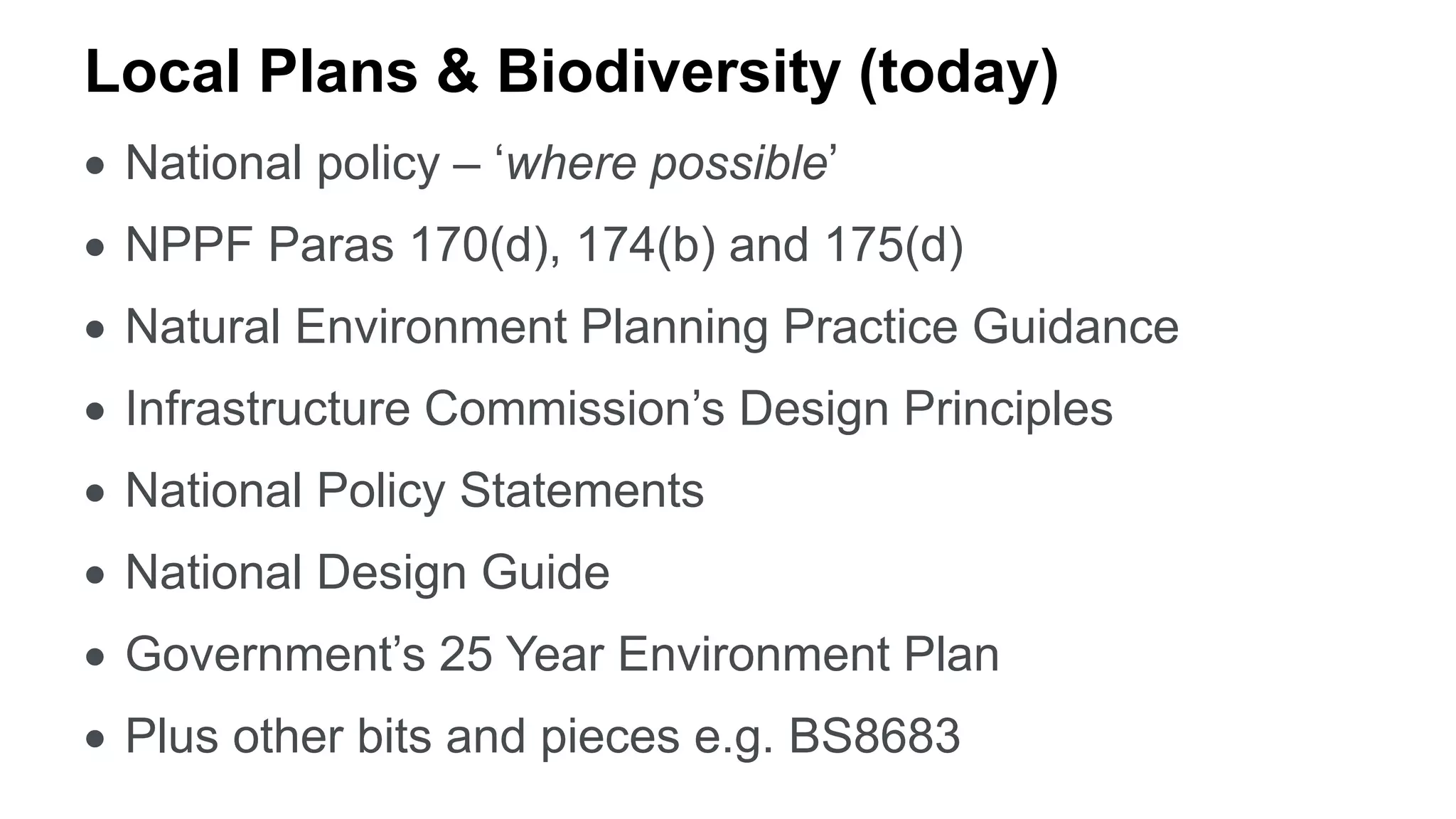
Local Plans & Biodiversity (today)
 National policy – ‘where possible’
 NPPF Paras 170(d), 174(b) and 175(d)
 Natural Environment Planning Practice Guidance
 Infrastructure Commission’s Design Principles
 National Policy Statements
 National Design Guide
 Government’s 25 Year Environment Plan
 Plus other bits and pieces e.g. BS8683
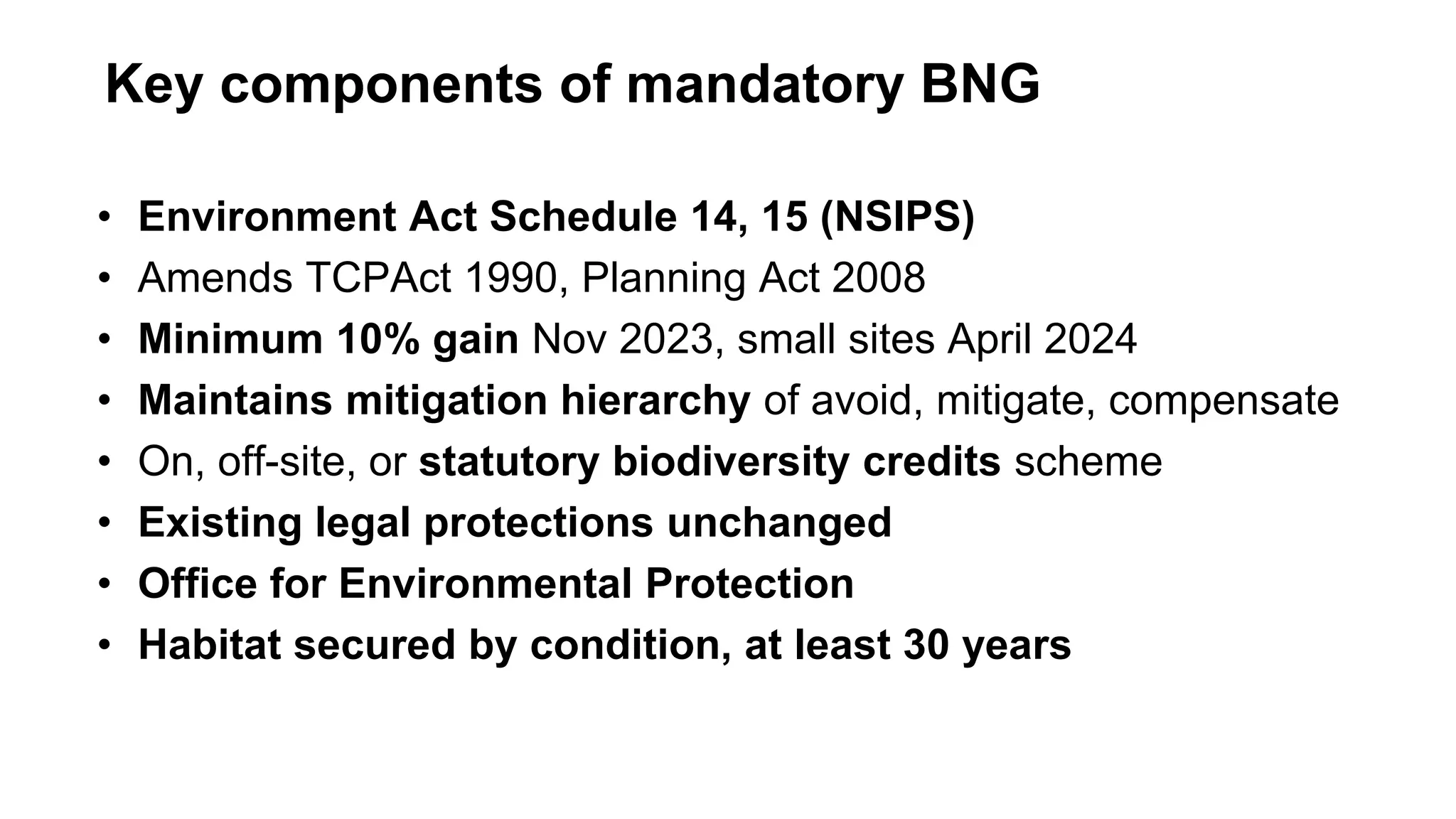
• Environment Act Schedule 14, 15 (NSIPS)
• Amends TCPAct 1990, Planning Act 2008
• Minimum 10% gain Nov 2023, small sites April 2024
• Maintains mitigation hierarchy of avoid, mitigate, compensate
• On, off-site, or statutory biodiversity credits scheme
• Existing legal protections unchanged
• Office for Environmental Protection
• Habitat secured by condition, at least 30 years
Key components of mandatory BNG
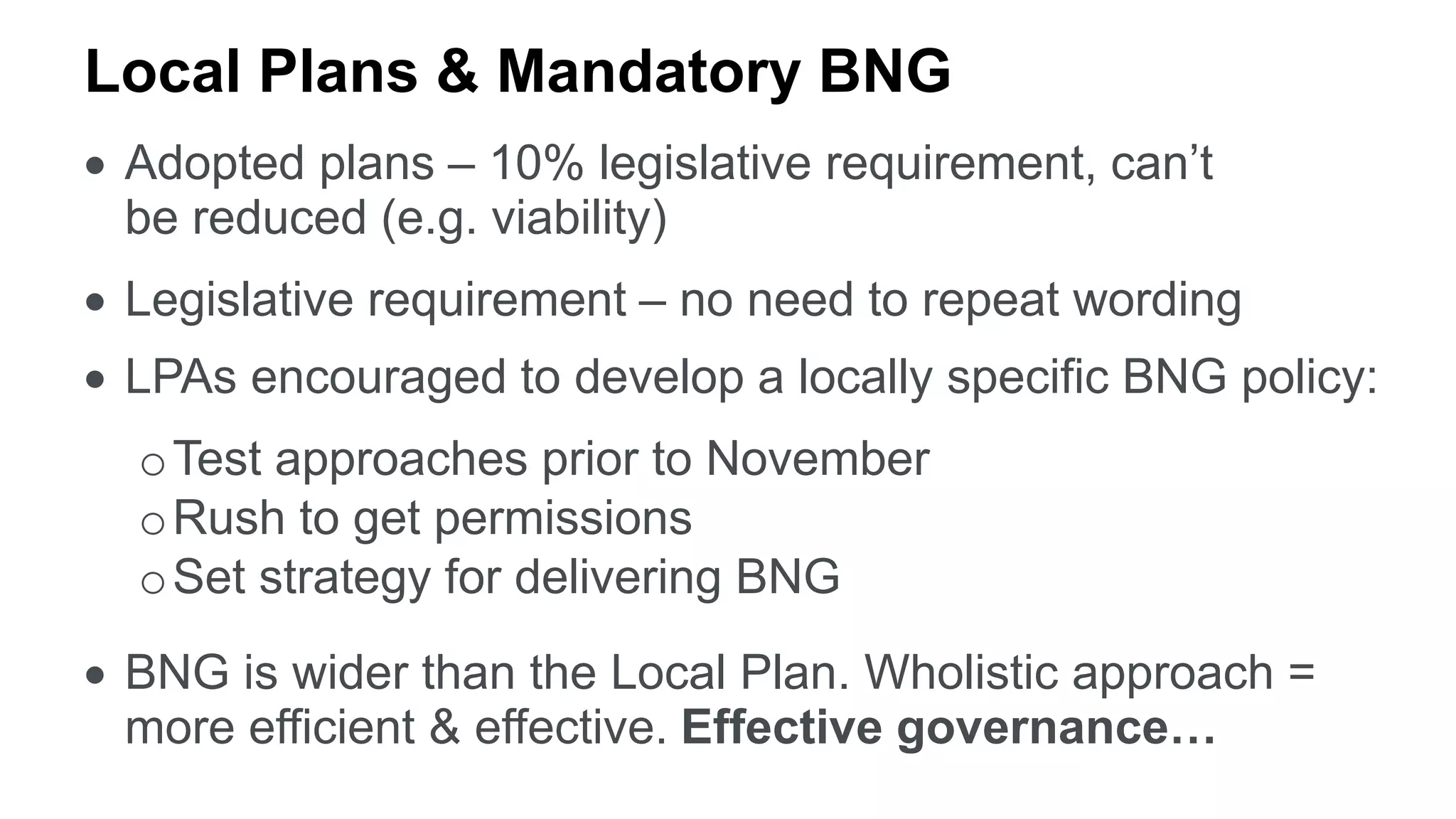
Local Plans & Mandatory BNG
 Adopted plans – 10% legislative requirement, can’t
be reduced (e.g. viability)
 Legislative requirement – no need to repeat wording
 LPAs encouraged to develop a locally specific BNG policy:
oTest approaches prior to November
oRush to get permissions
oSet strategy for delivering BNG
 BNG is wider than the Local Plan. Wholistic approach =
more efficient & effective. Effective governance…
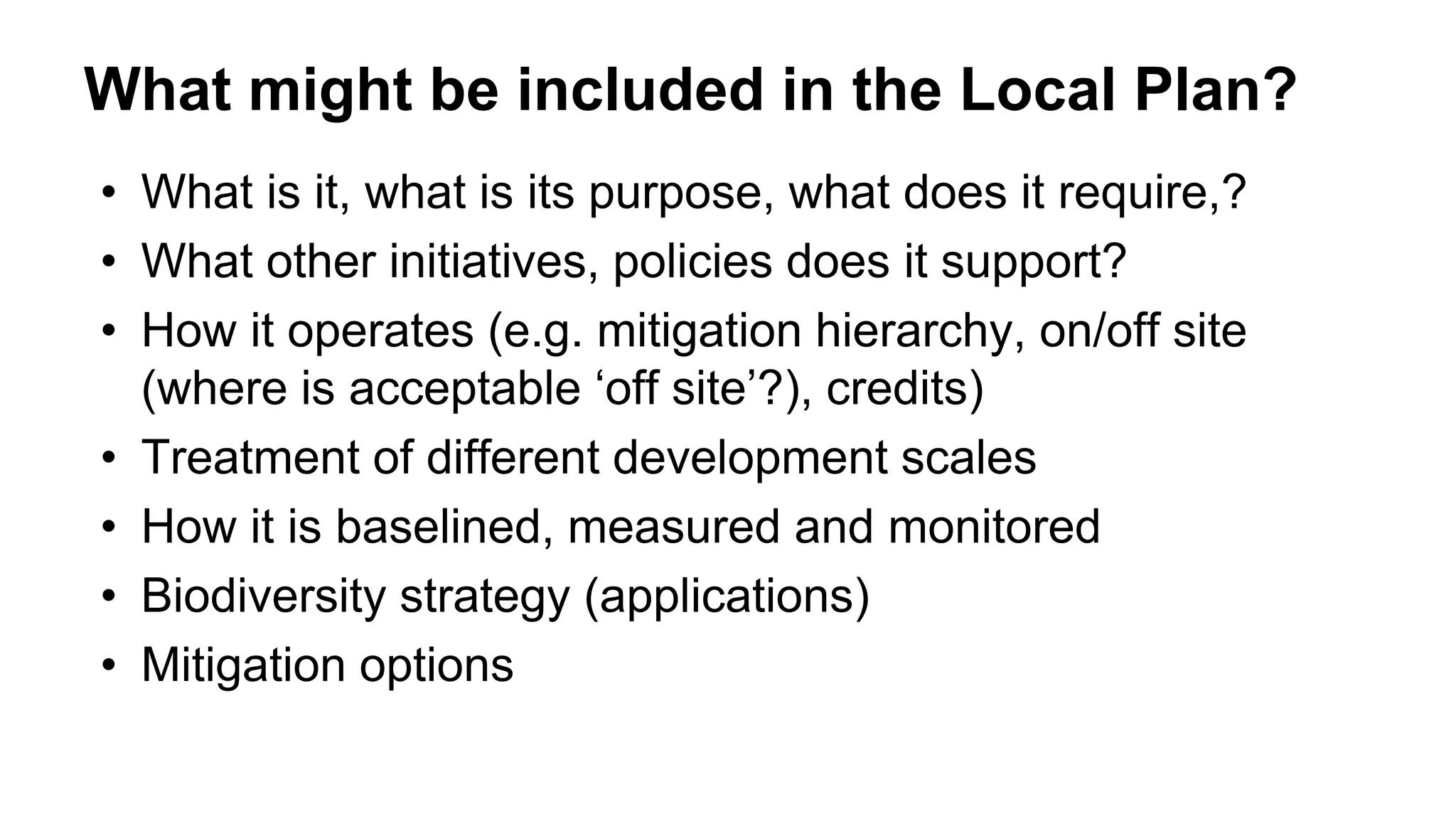
What might be included in the Local Plan?
• What is it, what is its purpose, what does it require,?
• What other initiatives, policies does it support?
• How it operates (e.g. mitigation hierarchy, on/off site
(where is acceptable ‘off site’?), credits)
• Treatment of different development scales
• How it is baselined, measured and monitored
• Biodiversity strategy (applications)
• Mitigation options
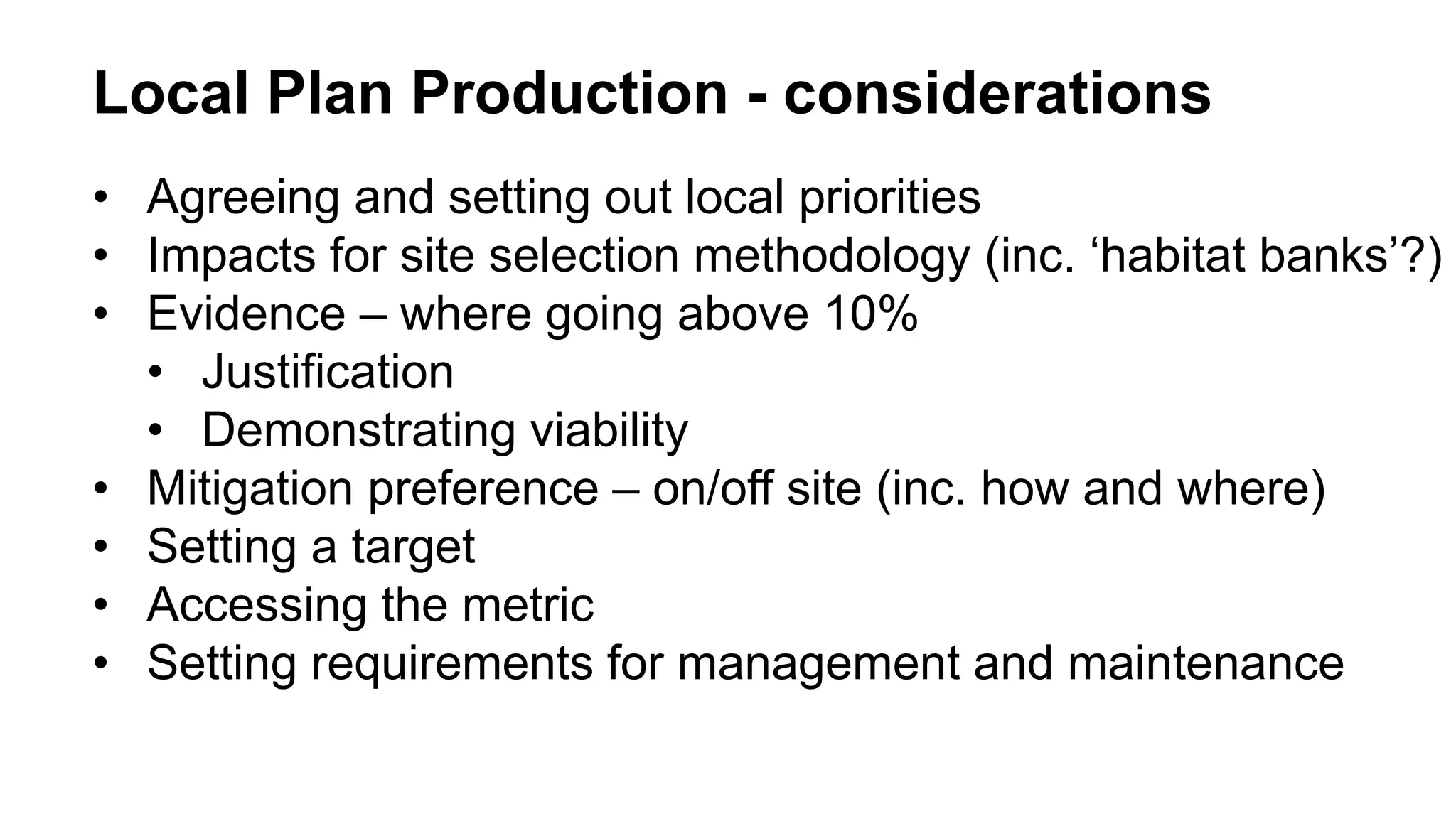
Local Plan Production - considerations
• Agreeing and setting out local priorities
• Impacts for site selection methodology (inc. ‘habitat banks’?)
• Evidence – where going above 10%
• Justification
• Demonstrating viability
• Mitigation preference – on/off site (inc. how and where)
• Setting a target
• Accessing the metric
• Setting requirements for management and maintenance
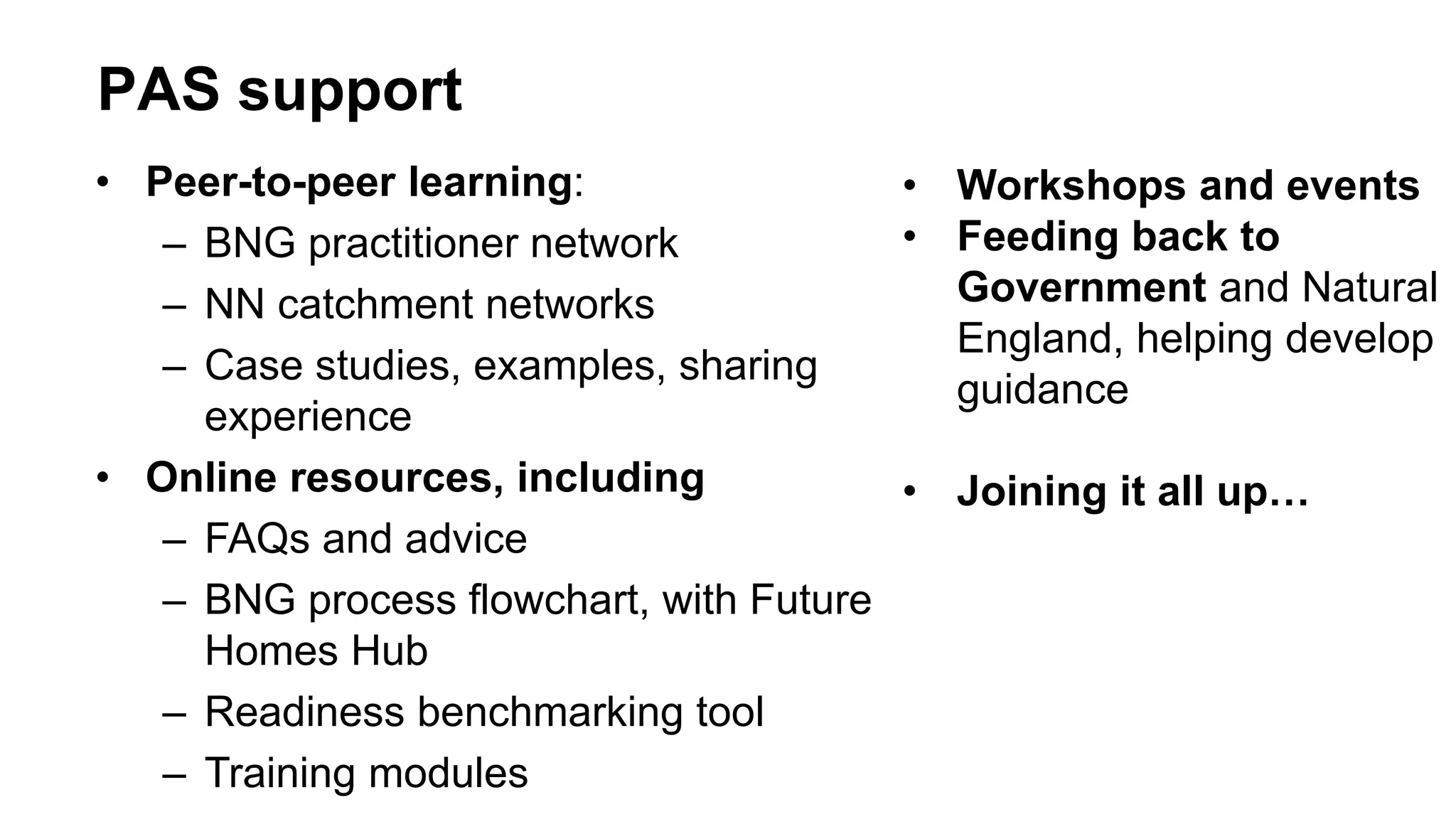
PAS support
• Peer-to-peer learning:
– BNG practitioner network
– NN catchment networks
– Case studies, examples, sharing
experience
• Online resources, including
– FAQs and advice
– BNG process flowchart, with Future
Homes Hub
– Readiness benchmarking tool
– Training modules
• Workshops and events
• Feeding back to
Government and Natural
England, helping develop
guidance
• Joining it all up…
Final thoughts
• It’s important – not just for the ecologists
– impacts on all aspects of planning and place making
• Incomplete knowledge is no excuse for inaction
– lots of examples of BNG working now
– lessons to learn and ideas to pinch
• Perfection is the enemy of the good
• A practical opportunity for planners & planning
–need to work corporately and build relationships
–working with neighbouring areas makes sense
PAS is here to help
For more information:
• https://www.local.gov.uk/pas/topics/environment
• Sign up to the PAS bulletin:
https://www.local.gov.uk/pas/our-work/keep-touch
• Join our BNG practitioner network – email:
pas@local.gov.uk
• Questions?!

PAS BNG in Local Plans slides June 2023

  • 1.
    July 2021 local.gov.uk/pas BiodiversityNet Gain (BNG) & Local Plans
  • 2.
    Planning Advisory Service(PAS) • Martin Hutchings, Local Plans Principle Adviser, PAS • PAS - a programme of work that sits in the LGA, funded by DLUHC “PAS exists to support local planning authorities to provide efficient & effective planning services, to drive improvement and to respond to and deliver changes in the planning system”
  • 3.
    Local Plans &Biodiversity (today)  National policy – ‘where possible’  NPPF Paras 170(d), 174(b) and 175(d)  Natural Environment Planning Practice Guidance  Infrastructure Commission’s Design Principles  National Policy Statements  National Design Guide  Government’s 25 Year Environment Plan  Plus other bits and pieces e.g. BS8683
  • 4.
    • Environment ActSchedule 14, 15 (NSIPS) • Amends TCPAct 1990, Planning Act 2008 • Minimum 10% gain Nov 2023, small sites April 2024 • Maintains mitigation hierarchy of avoid, mitigate, compensate • On, off-site, or statutory biodiversity credits scheme • Existing legal protections unchanged • Office for Environmental Protection • Habitat secured by condition, at least 30 years Key components of mandatory BNG
  • 5.
    Local Plans &Mandatory BNG  Adopted plans – 10% legislative requirement, can’t be reduced (e.g. viability)  Legislative requirement – no need to repeat wording  LPAs encouraged to develop a locally specific BNG policy: oTest approaches prior to November oRush to get permissions oSet strategy for delivering BNG  BNG is wider than the Local Plan. Wholistic approach = more efficient & effective. Effective governance…
  • 6.
    What might beincluded in the Local Plan? • What is it, what is its purpose, what does it require,? • What other initiatives, policies does it support? • How it operates (e.g. mitigation hierarchy, on/off site (where is acceptable ‘off site’?), credits) • Treatment of different development scales • How it is baselined, measured and monitored • Biodiversity strategy (applications) • Mitigation options
  • 7.
    Local Plan Production- considerations • Agreeing and setting out local priorities • Impacts for site selection methodology (inc. ‘habitat banks’?) • Evidence – where going above 10% • Justification • Demonstrating viability • Mitigation preference – on/off site (inc. how and where) • Setting a target • Accessing the metric • Setting requirements for management and maintenance
  • 8.
    PAS support • Peer-to-peerlearning: – BNG practitioner network – NN catchment networks – Case studies, examples, sharing experience • Online resources, including – FAQs and advice – BNG process flowchart, with Future Homes Hub – Readiness benchmarking tool – Training modules • Workshops and events • Feeding back to Government and Natural England, helping develop guidance • Joining it all up…
  • 9.
    Final thoughts • It’simportant – not just for the ecologists – impacts on all aspects of planning and place making • Incomplete knowledge is no excuse for inaction – lots of examples of BNG working now – lessons to learn and ideas to pinch • Perfection is the enemy of the good • A practical opportunity for planners & planning –need to work corporately and build relationships –working with neighbouring areas makes sense
  • 10.
    PAS is hereto help For more information: • https://www.local.gov.uk/pas/topics/environment • Sign up to the PAS bulletin: https://www.local.gov.uk/pas/our-work/keep-touch • Join our BNG practitioner network – email: pas@local.gov.uk • Questions?!