What are they?
English has 8 parts
of speech:
1. Noun
2. Verb
3. Adjective
4. Adverb
5. Pronoun
6. Preposition
7. Conjunction
8. Interjection
Why Learn Them?
 English sentences can be divided into
their parts of speech. Knowing these
can help you understand and learn
better.
 It will help your listening, reading,
writing, and speaking skills.
 When you study vocabulary, pay
attention to the part of speech.
Noun
A person, place, idea, or thing
Example: France, a mountain, Steven,
sheep, socialism
Sentences:
The moon is bright.
John is reading that book.
Pronoun
A pronoun replaces a noun. Sometimes this
is done to avoid repetition.
Example: him, his her, theirs, we
Sentences:
They wanted us to go with them.
He asked her to the dance but she said no.
Pronoun
Adjective
An adjective describes, changes, or gives
extra information about a noun or pronoun.
Example: long, high, red, fast, British, angry
Sentences:
The tall man looked at the beautiful woman.
The slow car stopped by the big supermarket.
Adjective
There are different kinds of adjectives:
1. Descriptive (ie. difficult, cheap)
2. Proper (ie. Japanese, Italian)
3. Quantitative (ie. some, many)
and so on…
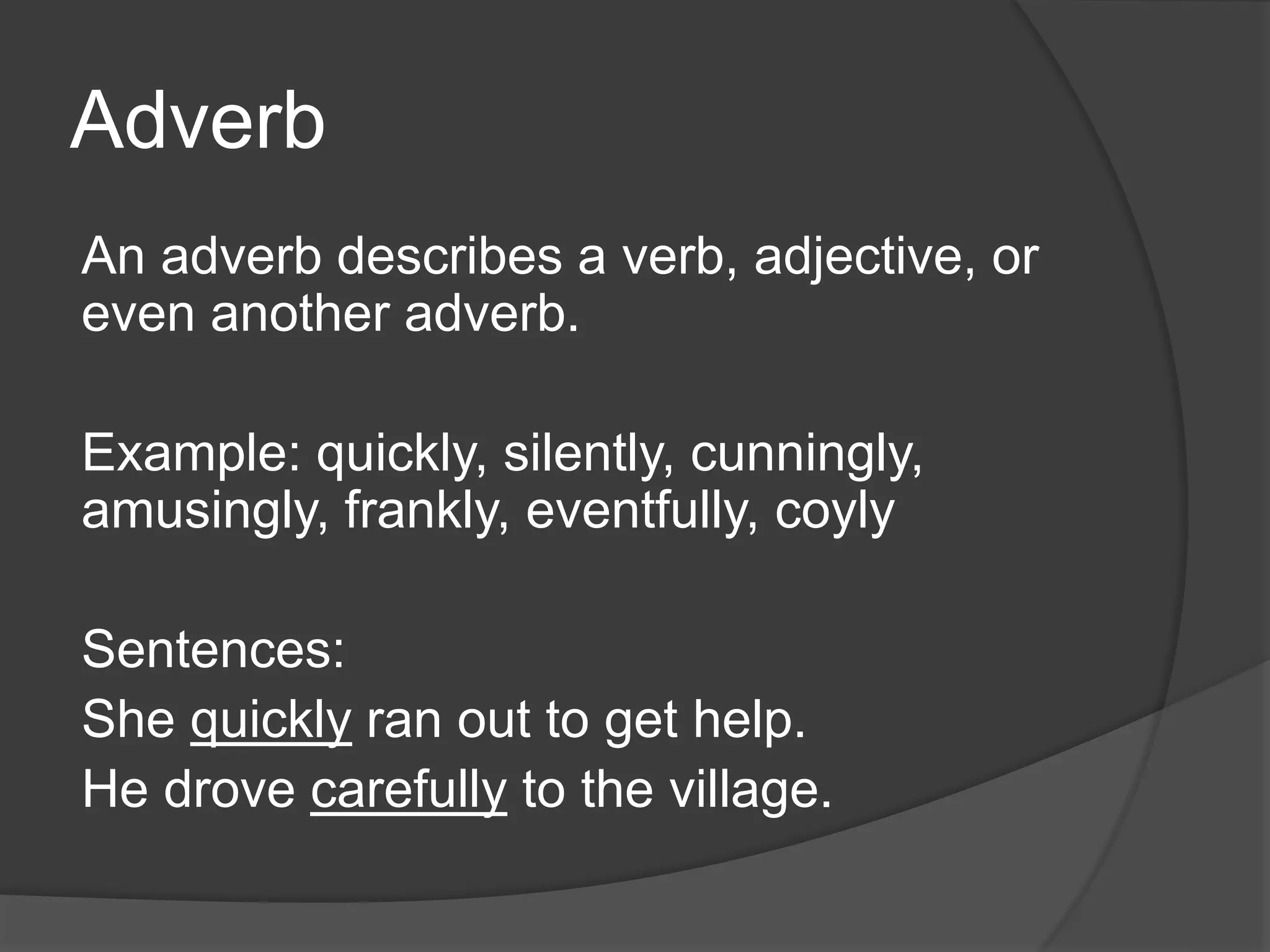
Adverb
An adverb describes a verb, adjective, or
even another adverb.
Example: quickly, silently, cunningly,
amusingly, frankly, eventfully, coyly
Sentences:
She quickly ran out to get help.
He drove carefully to the village.
Adverb
Adverbs often give information about
question words – how, where, when?
There are often adverbs of frequency –
always, never, sometimes
Verb
A verb is usually an action, but may also
indicate a state of being.
Examples: think, run, dance, sing, believe
Sentences:
He studies English so he can go to America.
They think they can beat their rivals.
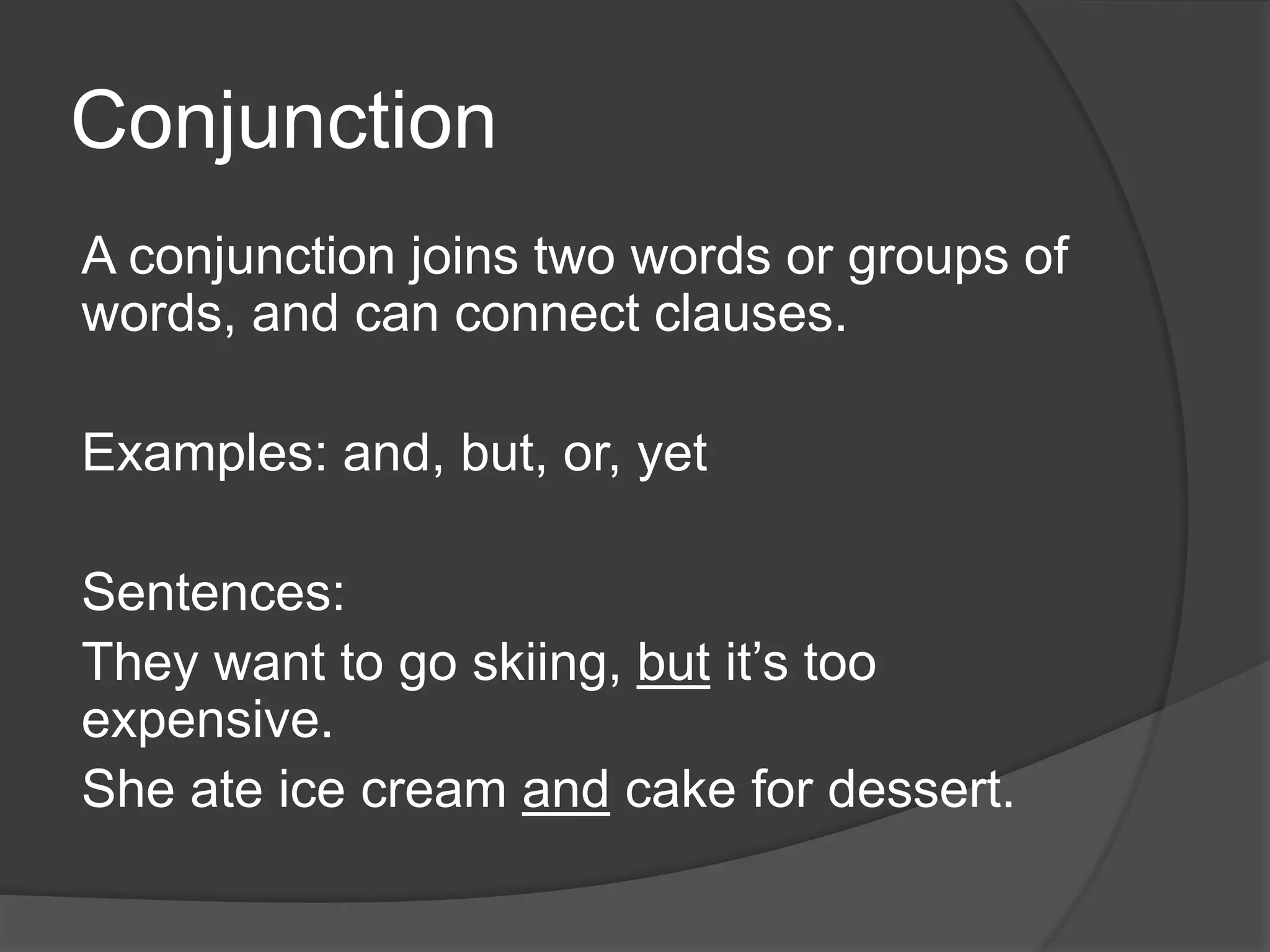
Conjunction
A conjunction joins two words or groups of
words, and can connect clauses.
Examples: and, but, or, yet
Sentences:
They want to go skiing, but it’s too
expensive.
She ate ice cream and cake for dessert.
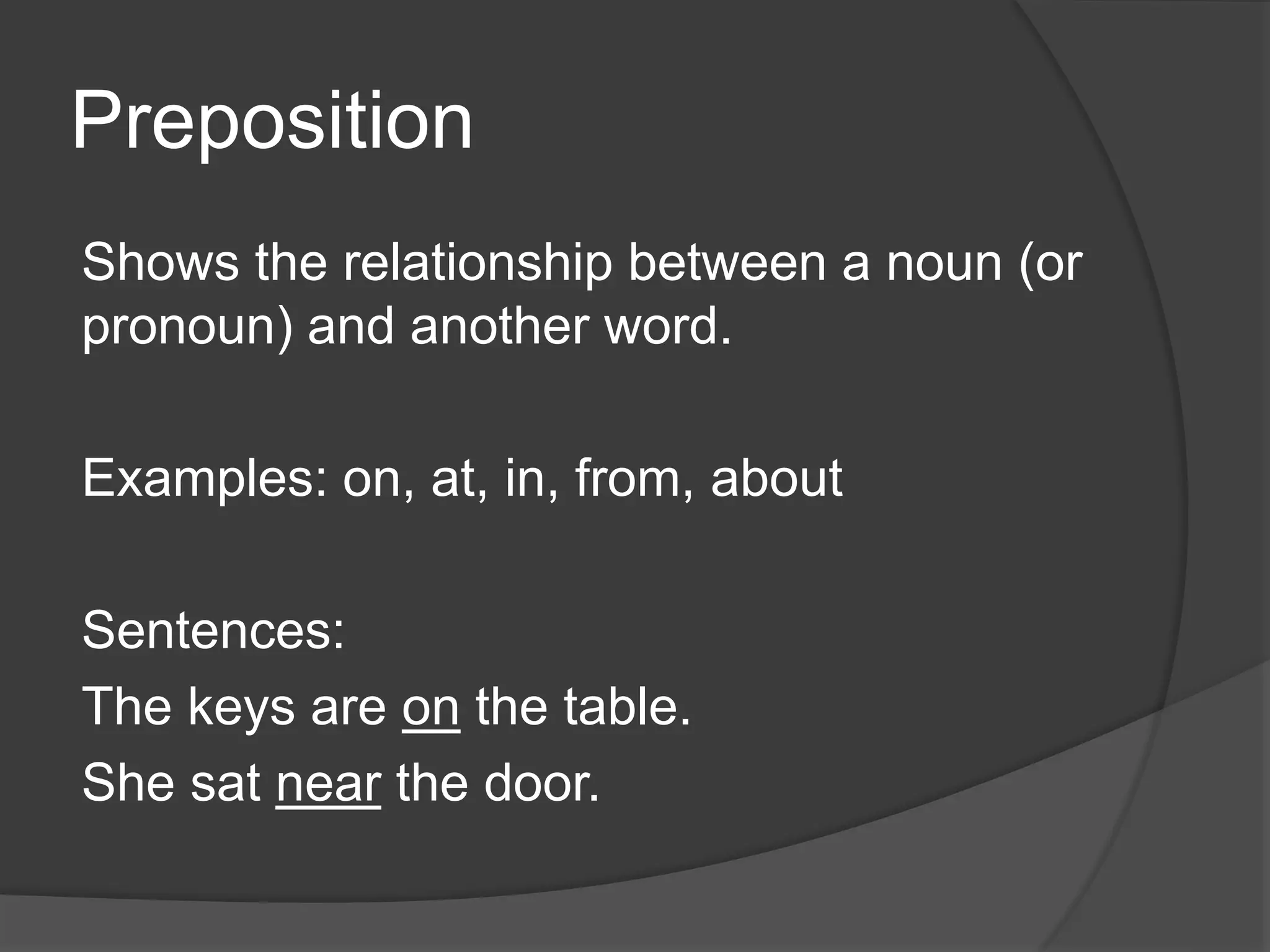
Preposition
Shows the relationship between a noun (or
pronoun) and another word.
Examples: on, at, in, from, about
Sentences:
The keys are on the table.
She sat near the door.
Interjection
A word or phrase that expresses emotion.
Examples: wow, ah, watch out, ouch
Sentences:
Ouch! That hurt!
Wow! That was amazing!
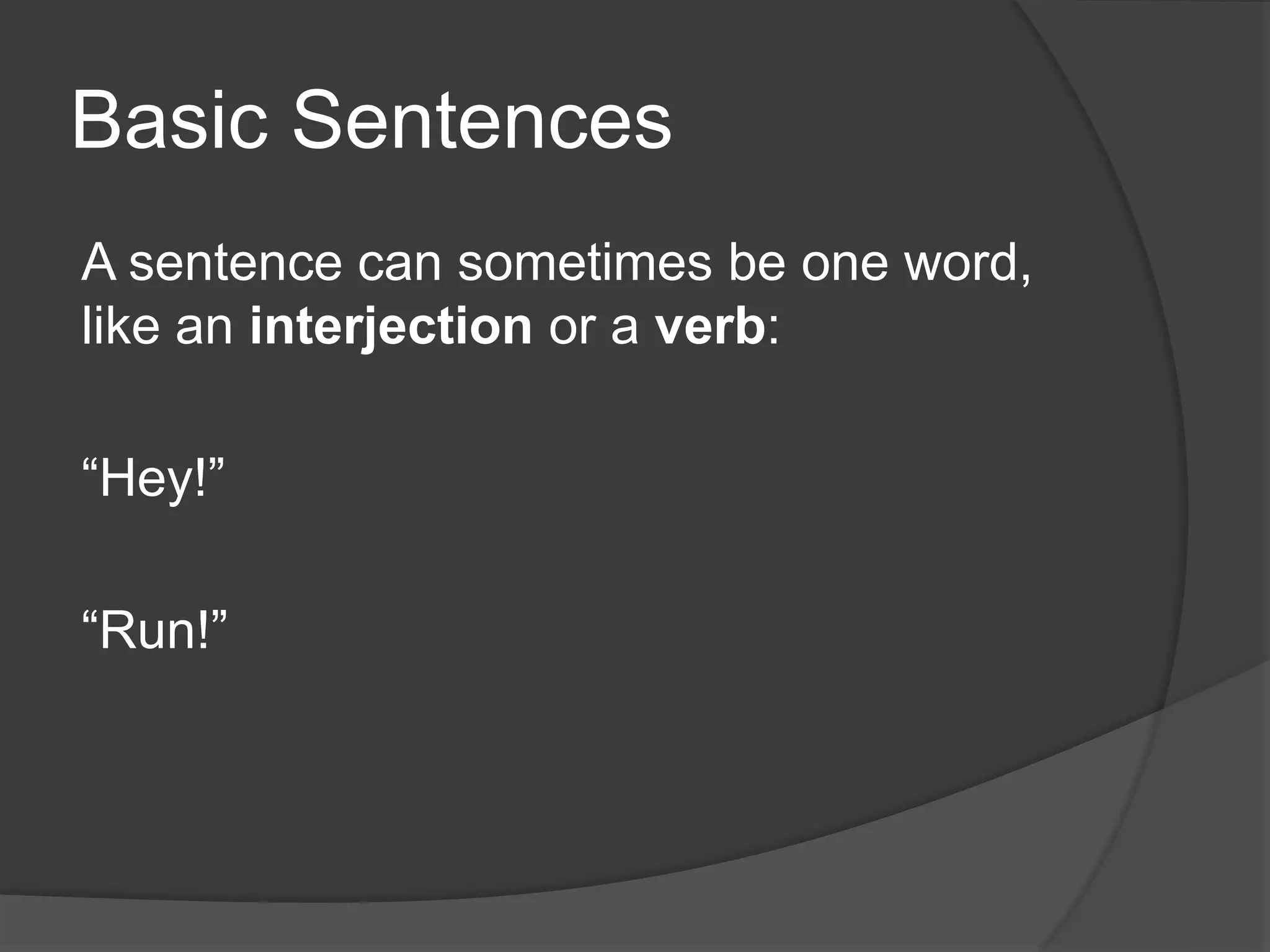
Basic Sentences
A sentence can sometimes be one word,
like an interjection or a verb:
“Hey!”
“Run!”
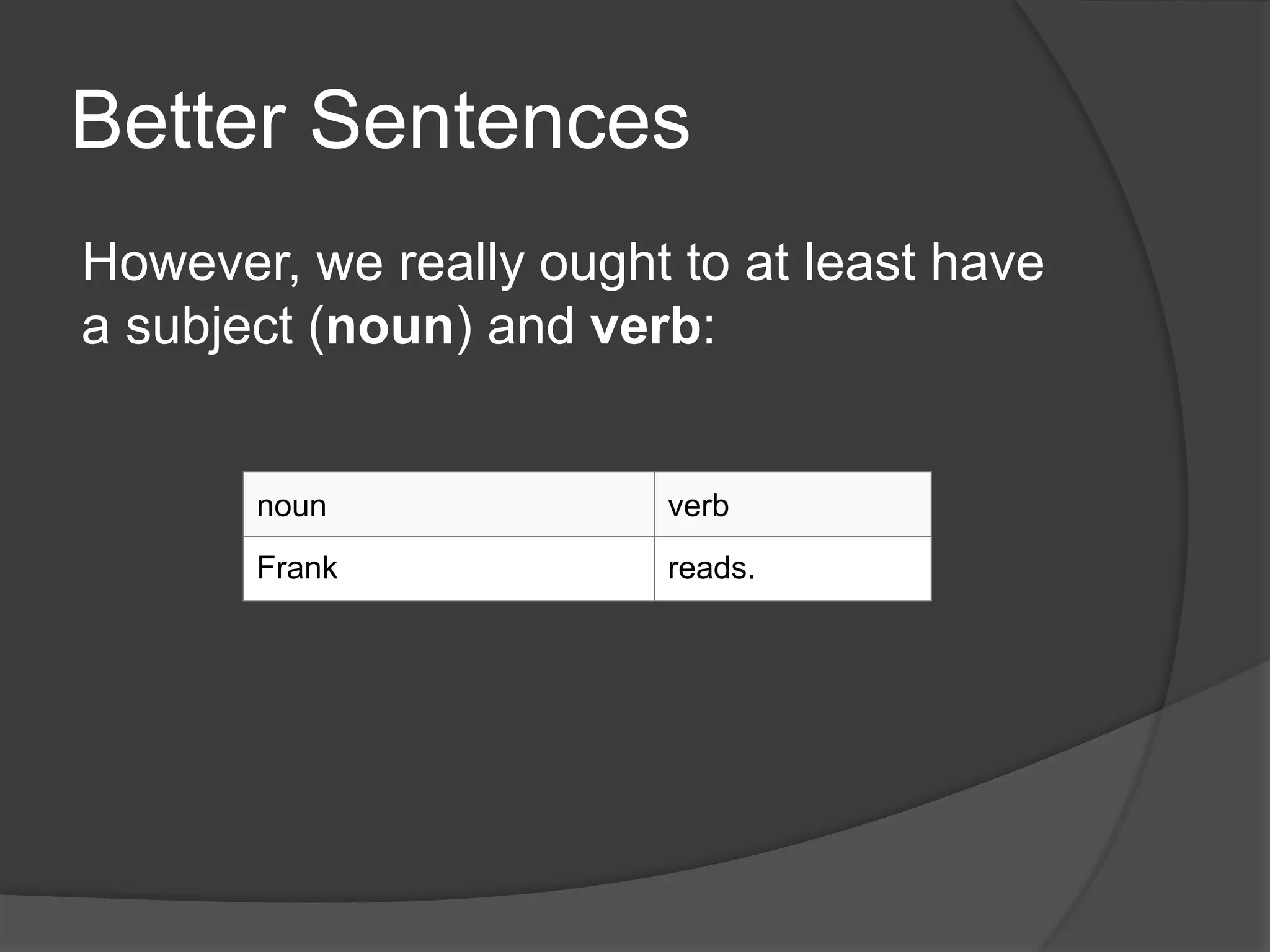
Better Sentences
However, we really ought to at least have
a subject (noun) and verb:
noun verb
Frank reads.
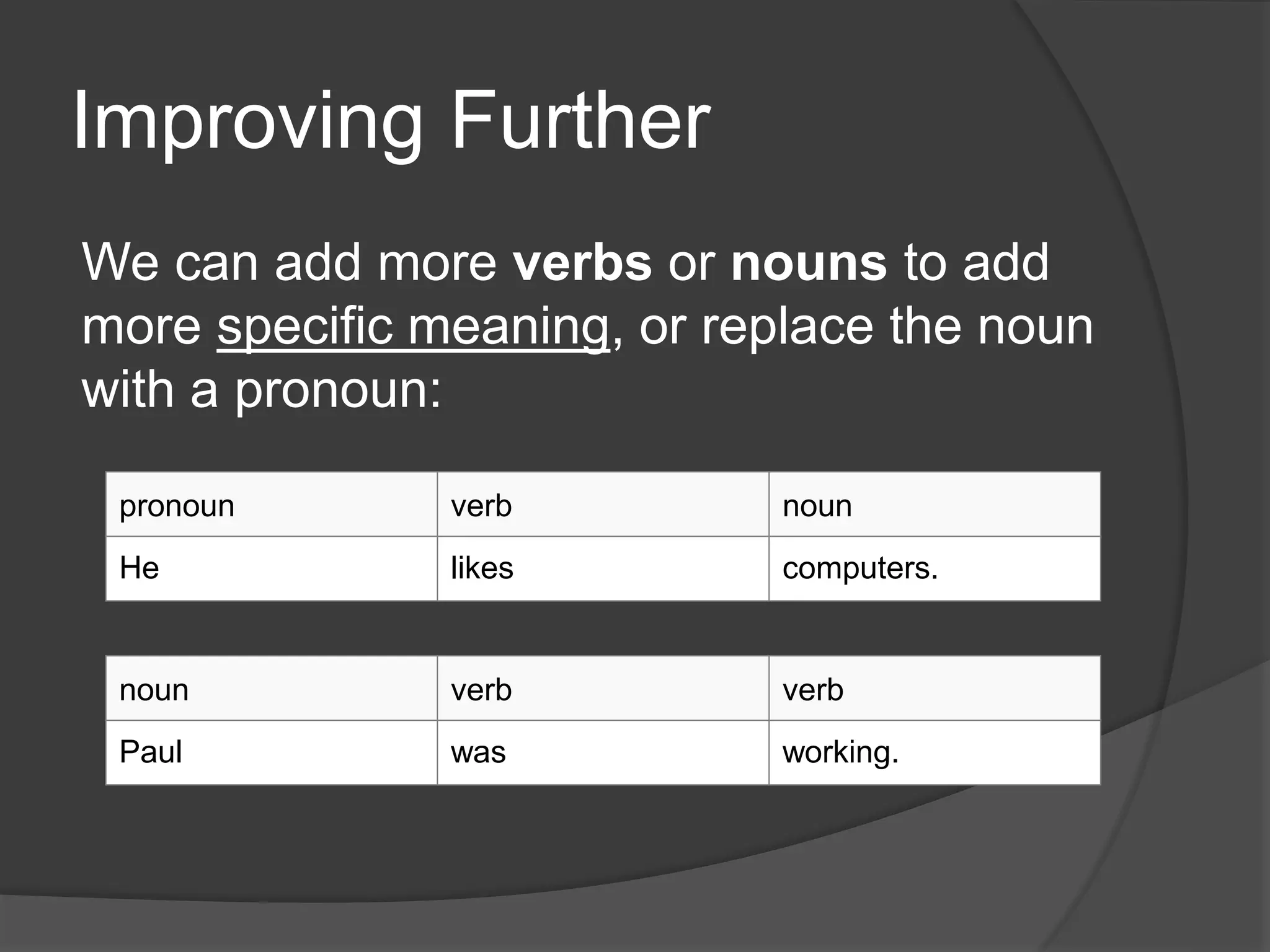
Improving Further
We can add more verbs or nouns to add
more specific meaning, or replace the noun
with a pronoun:
pronoun verb noun
He likes computers.
noun verb verb
Paul was working.
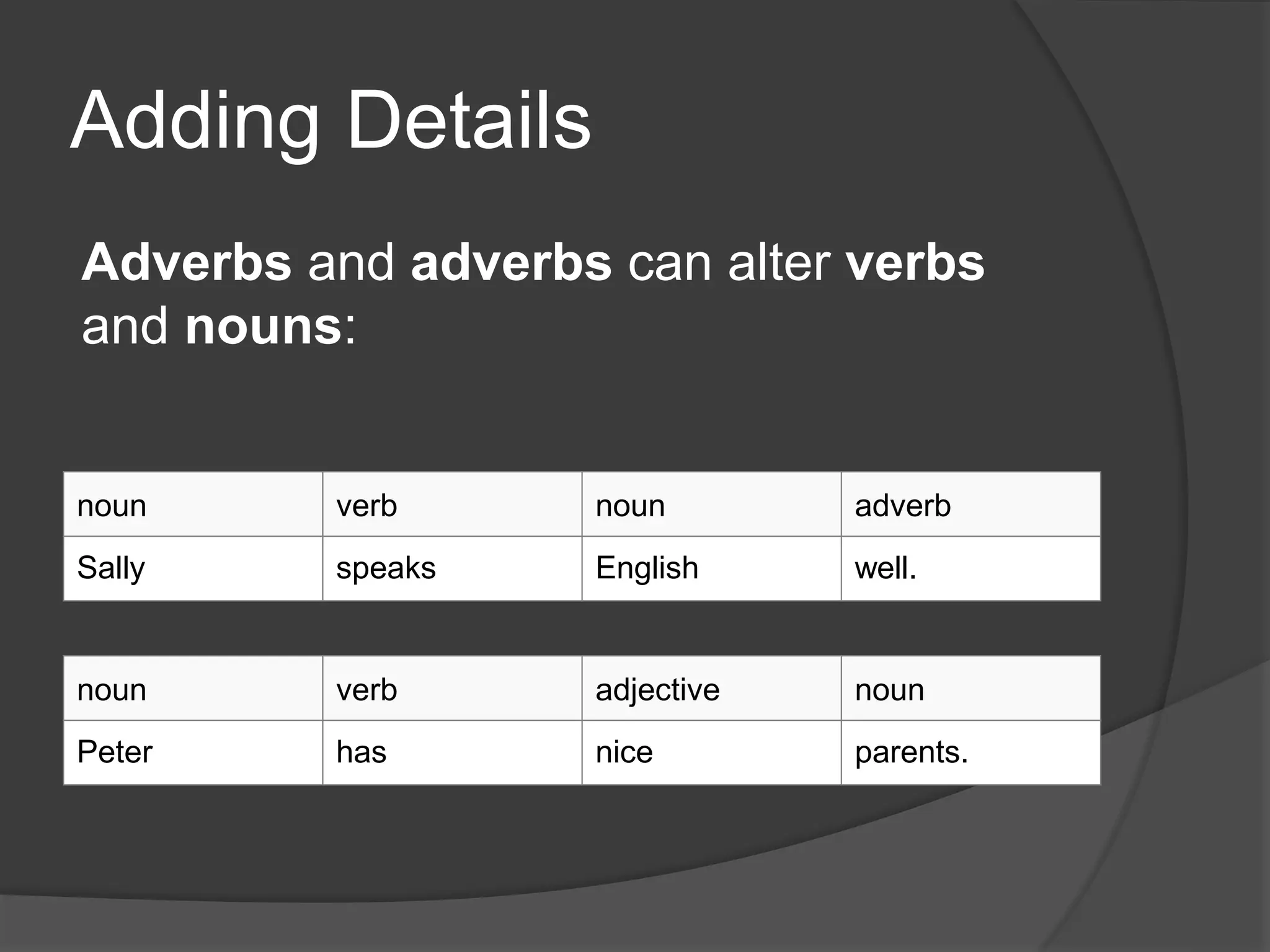
Adding Details
Adverbs and adverbs can alter verbs
and nouns:
noun verb noun adverb
Sally speaks English well.
noun verb adjective noun
Peter has nice parents.
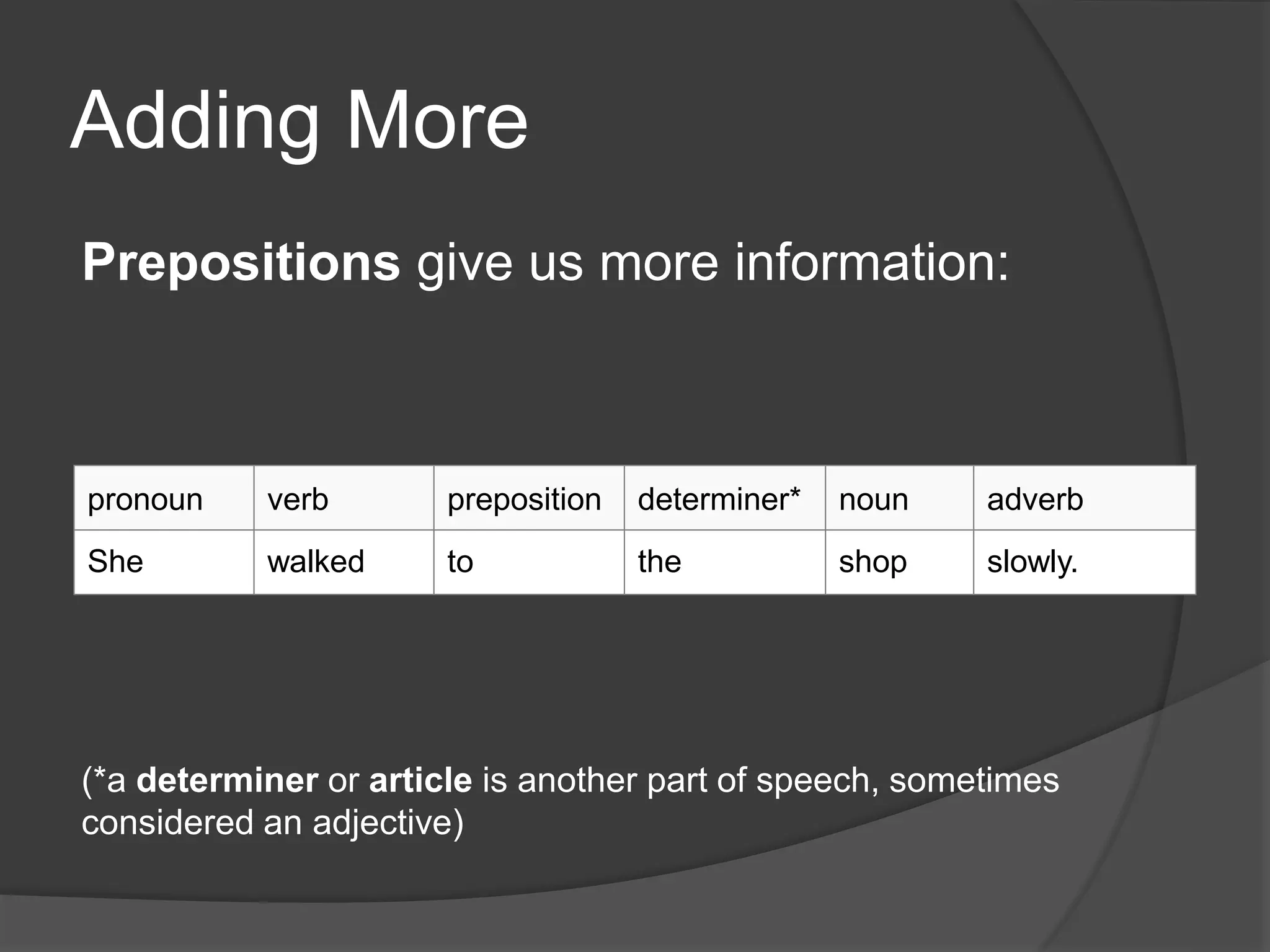
Adding More
Prepositions give us more information:
(*a determiner or article is another part of speech, sometimes
considered an adjective)
pronoun verb preposition determiner* noun adverb
She walked to the shop slowly.
Adding Clauses
Conjunctions allow us to add multiple
clauses into a sentence:
pron. verb adj. noun conjunction pron. verb pron.
They like fast cars but I hate them.
Using All Parts
This sentence includes all parts of speech:
Interjection noun conj. pron. adj. noun verb prep. adverb
Well, Jane and her old dog walked back sadly.
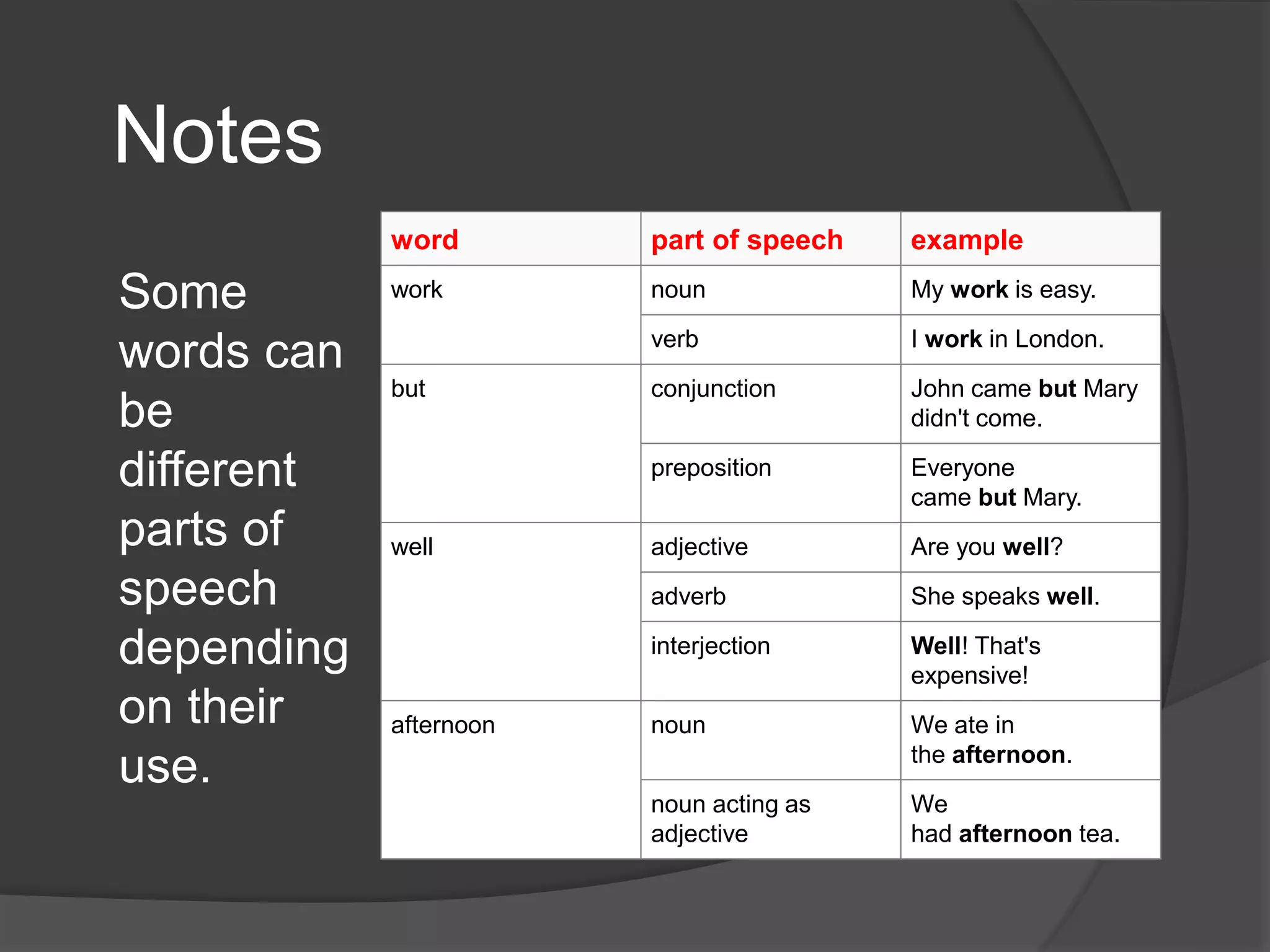
Notes
word part of speech example
work noun My work is easy.
verb I work in London.
but conjunction John came but Mary
didn't come.
preposition Everyone
came but Mary.
well adjective Are you well?
adverb She speaks well.
interjection Well! That's
expensive!
afternoon noun We ate in
the afternoon.
noun acting as
adjective
We
had afternoon tea.
Some
words can
be
different
parts of
speech
depending
on their
use.

Parts of Speech Overview

  • 2.
    What are they? Englishhas 8 parts of speech: 1. Noun 2. Verb 3. Adjective 4. Adverb 5. Pronoun 6. Preposition 7. Conjunction 8. Interjection
  • 3.
    Why Learn Them? English sentences can be divided into their parts of speech. Knowing these can help you understand and learn better.  It will help your listening, reading, writing, and speaking skills.  When you study vocabulary, pay attention to the part of speech.
  • 5.
    Noun A person, place,idea, or thing Example: France, a mountain, Steven, sheep, socialism Sentences: The moon is bright. John is reading that book.
  • 7.
    Pronoun A pronoun replacesa noun. Sometimes this is done to avoid repetition. Example: him, his her, theirs, we Sentences: They wanted us to go with them. He asked her to the dance but she said no.
  • 8.
  • 10.
    Adjective An adjective describes,changes, or gives extra information about a noun or pronoun. Example: long, high, red, fast, British, angry Sentences: The tall man looked at the beautiful woman. The slow car stopped by the big supermarket.
  • 11.
    Adjective There are differentkinds of adjectives: 1. Descriptive (ie. difficult, cheap) 2. Proper (ie. Japanese, Italian) 3. Quantitative (ie. some, many) and so on…
  • 13.
    Adverb An adverb describesa verb, adjective, or even another adverb. Example: quickly, silently, cunningly, amusingly, frankly, eventfully, coyly Sentences: She quickly ran out to get help. He drove carefully to the village.
  • 14.
    Adverb Adverbs often giveinformation about question words – how, where, when? There are often adverbs of frequency – always, never, sometimes
  • 16.
    Verb A verb isusually an action, but may also indicate a state of being. Examples: think, run, dance, sing, believe Sentences: He studies English so he can go to America. They think they can beat their rivals.
  • 18.
    Conjunction A conjunction joinstwo words or groups of words, and can connect clauses. Examples: and, but, or, yet Sentences: They want to go skiing, but it’s too expensive. She ate ice cream and cake for dessert.
  • 20.
    Preposition Shows the relationshipbetween a noun (or pronoun) and another word. Examples: on, at, in, from, about Sentences: The keys are on the table. She sat near the door.
  • 22.
    Interjection A word orphrase that expresses emotion. Examples: wow, ah, watch out, ouch Sentences: Ouch! That hurt! Wow! That was amazing!
  • 24.
    Basic Sentences A sentencecan sometimes be one word, like an interjection or a verb: “Hey!” “Run!”
  • 25.
    Better Sentences However, wereally ought to at least have a subject (noun) and verb: noun verb Frank reads.
  • 26.
    Improving Further We canadd more verbs or nouns to add more specific meaning, or replace the noun with a pronoun: pronoun verb noun He likes computers. noun verb verb Paul was working.
  • 27.
    Adding Details Adverbs andadverbs can alter verbs and nouns: noun verb noun adverb Sally speaks English well. noun verb adjective noun Peter has nice parents.
  • 28.
    Adding More Prepositions giveus more information: (*a determiner or article is another part of speech, sometimes considered an adjective) pronoun verb preposition determiner* noun adverb She walked to the shop slowly.
  • 29.
    Adding Clauses Conjunctions allowus to add multiple clauses into a sentence: pron. verb adj. noun conjunction pron. verb pron. They like fast cars but I hate them.
  • 30.
    Using All Parts Thissentence includes all parts of speech: Interjection noun conj. pron. adj. noun verb prep. adverb Well, Jane and her old dog walked back sadly.
  • 31.
    Notes word part ofspeech example work noun My work is easy. verb I work in London. but conjunction John came but Mary didn't come. preposition Everyone came but Mary. well adjective Are you well? adverb She speaks well. interjection Well! That's expensive! afternoon noun We ate in the afternoon. noun acting as adjective We had afternoon tea. Some words can be different parts of speech depending on their use.