Partnering with Your Local Government Why so Tough? Craiglist Boot Camp  2011 Ed Everett: Senior Fellow  Davenport Institute
Why the Separation? Mistrust of govt. Anti-govt. mood Local govt. has pretended to engage the public without letting go of control Public acts as Customers not Citizens  No feeling of community Business and local govt. tend to ignore each other
How all Parties Contribute to this Separation. Staff and electeds have a negative attitude of the public and some businesses. Public has negative attitude of govt. Business has negative attitude of govt. What psychologists tell us about changing our behavior. We are a siloed society.
Public acts as Customers vs.. Citizens
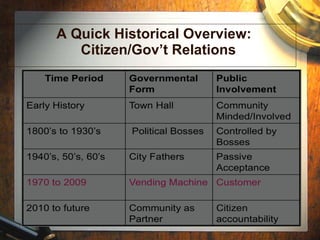
A Quick Historical Overview: Citizen/Gov’t Relations
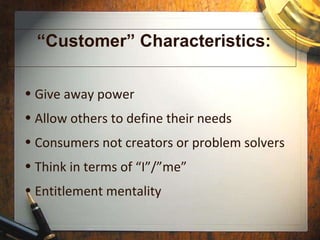
“ Customer” Characteristics: Give away power Allow others to define their needs Consumers not creators or problem solvers Think in terms of “I”/”me” Entitlement mentality
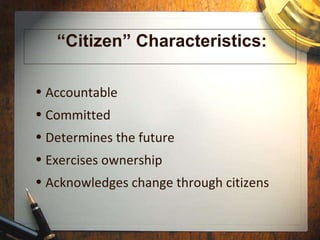
“ Citizen” Characteristics: Accountable Committed Determines the future Exercises ownership Acknowledges change through citizens
Citizens can and will partner. Customers are unable and won’t partner.
Govt. not Understanding Its True Role
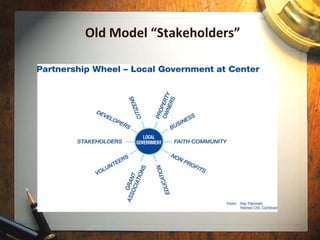
Old Model “Stakeholders”
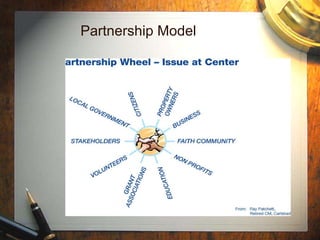
Partnership Model
No Feeling of Community
It is much easier to form partnerships between citizens and government when citizens feel part of a community.
Community is defined by 4 feelings : Belonging Pride Inclusion Not being alone
What do we actually know about community? A Decrease in: Membership of service clubs, PTA’S, unions,  national organizations and church attendance Volunteer hours (may be increasing) Whether we think we can trust people At tending a public meeting or School Affairs Having friends over to your house for dinner or going to friends house for dinner *Robert Putman - Bowling Alone
Past National Surveys Tell Us Most of us in society don’t know 50% of our neighbors. 75% of us think “b r eakdown in community” and “s e lfishness” are “s e rious” and “e x tremely serious” problems. 80% of us believe that there should be more emphasis on community even if that put more demands on us.
What psychologists, anthropologists and sociologists tell us about Community.
The Impact of Community on Important Social Issues   Putman ranked all states in term of Social Capital or Community He compared all states in 4 important policy areas: education, crime, physical and mental health What did he find?
As Community Increased: Educational performance increases Crime decreases Physical Health increases Mental Health increases
When Was the Last Time Society Experienced a Strong Sense of Community ?
Civic Engagement a Way Out of the Wilderness
Civic Engagement is  not …  Selling the public on… Getting votes for… Convincing the public to…. A process where staff/non-profit controls   outcome A meeting to complain/find fault with… A process of lobbying council meetings
The Essences of Public Engagement Citizens talking to citizens  Staff or elected posing the right questions Staff and elected officials listening and learning not talking NOT Staff or elected officials answering questions in the front of the room. Public naming, blaming and finding fault.
Why Civic Engagement is Tough… Distrust: Experience with “old” model. New set of skills and leadership Behavioral and attitudinal changes: By Govt.   and Citizens (Citizens vs.. Customers) Perceived  loss of control
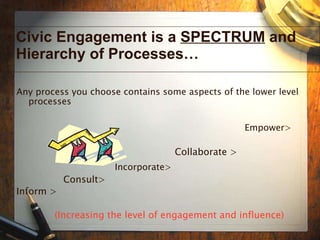
Civic Engagement is a  SPECTRUM  and Hierarchy of Processes… Any process you choose contains some aspects of the lower level processes Empower> Collaborate > Incorporate>   Consult> Inform >  (Increasing the level of engagement and influence)
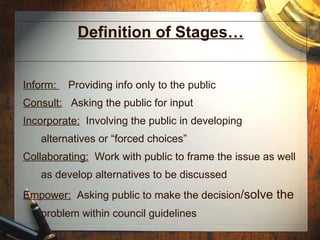
Definition of Stages… Inform:  Providing info only to the public Consult:   Asking the public for input Incorporate:   Involving the public in developing alternatives or “forced choices” Collaborating:   Work with public to frame the issue as well as develop alternatives to be discussed Empower:   Asking public to make the decision /solve the  problem within council guidelines
So Now What The we the public have to let go of acting like customers  Govt. must let go of acting like they can solve all problems The public must take responsibility Govt. must stop being so controlling Both must partner with each other
Today’s Problems Require Partnerships  Child Obesity Safety Education Homeliness Land Use/Development Balancing the budget
Q and A. Reactions?

Partnering with Local Governments: Why so Tough?

  • 1.
    Partnering with YourLocal Government Why so Tough? Craiglist Boot Camp 2011 Ed Everett: Senior Fellow Davenport Institute
  • 2.
    Why the Separation?Mistrust of govt. Anti-govt. mood Local govt. has pretended to engage the public without letting go of control Public acts as Customers not Citizens No feeling of community Business and local govt. tend to ignore each other
  • 3.
    How all PartiesContribute to this Separation. Staff and electeds have a negative attitude of the public and some businesses. Public has negative attitude of govt. Business has negative attitude of govt. What psychologists tell us about changing our behavior. We are a siloed society.
  • 4.
    Public acts asCustomers vs.. Citizens
  • 5.
    A Quick HistoricalOverview: Citizen/Gov’t Relations
  • 6.
    “ Customer” Characteristics:Give away power Allow others to define their needs Consumers not creators or problem solvers Think in terms of “I”/”me” Entitlement mentality
  • 7.
    “ Citizen” Characteristics:Accountable Committed Determines the future Exercises ownership Acknowledges change through citizens
  • 8.
    Citizens can andwill partner. Customers are unable and won’t partner.
  • 9.
  • 10.
  • 11.
  • 12.
    No Feeling ofCommunity
  • 13.
    It is mucheasier to form partnerships between citizens and government when citizens feel part of a community.
  • 14.
    Community is definedby 4 feelings : Belonging Pride Inclusion Not being alone
  • 15.
    What do weactually know about community? A Decrease in: Membership of service clubs, PTA’S, unions, national organizations and church attendance Volunteer hours (may be increasing) Whether we think we can trust people At tending a public meeting or School Affairs Having friends over to your house for dinner or going to friends house for dinner *Robert Putman - Bowling Alone
  • 16.
    Past National SurveysTell Us Most of us in society don’t know 50% of our neighbors. 75% of us think “b r eakdown in community” and “s e lfishness” are “s e rious” and “e x tremely serious” problems. 80% of us believe that there should be more emphasis on community even if that put more demands on us.
  • 17.
    What psychologists, anthropologistsand sociologists tell us about Community.
  • 18.
    The Impact ofCommunity on Important Social Issues Putman ranked all states in term of Social Capital or Community He compared all states in 4 important policy areas: education, crime, physical and mental health What did he find?
  • 19.
    As Community Increased:Educational performance increases Crime decreases Physical Health increases Mental Health increases
  • 20.
    When Was theLast Time Society Experienced a Strong Sense of Community ?
  • 21.
    Civic Engagement aWay Out of the Wilderness
  • 22.
    Civic Engagement is not … Selling the public on… Getting votes for… Convincing the public to…. A process where staff/non-profit controls outcome A meeting to complain/find fault with… A process of lobbying council meetings
  • 23.
    The Essences ofPublic Engagement Citizens talking to citizens Staff or elected posing the right questions Staff and elected officials listening and learning not talking NOT Staff or elected officials answering questions in the front of the room. Public naming, blaming and finding fault.
  • 24.
    Why Civic Engagementis Tough… Distrust: Experience with “old” model. New set of skills and leadership Behavioral and attitudinal changes: By Govt. and Citizens (Citizens vs.. Customers) Perceived loss of control
  • 25.
    Civic Engagement isa SPECTRUM and Hierarchy of Processes… Any process you choose contains some aspects of the lower level processes Empower> Collaborate > Incorporate> Consult> Inform > (Increasing the level of engagement and influence)
  • 26.
    Definition of Stages…Inform: Providing info only to the public Consult: Asking the public for input Incorporate: Involving the public in developing alternatives or “forced choices” Collaborating: Work with public to frame the issue as well as develop alternatives to be discussed Empower: Asking public to make the decision /solve the problem within council guidelines
  • 27.
    So Now WhatThe we the public have to let go of acting like customers Govt. must let go of acting like they can solve all problems The public must take responsibility Govt. must stop being so controlling Both must partner with each other
  • 28.
    Today’s Problems RequirePartnerships Child Obesity Safety Education Homeliness Land Use/Development Balancing the budget
  • 29.
    Q and A.Reactions?

Editor's Notes

  • #15 The feeling of Belonging to something or some group The feeling of Pride in your group, be that a neighborhood, service club, sports team, hobby group of whatever The feeling of being part of something Important and the feeling of being Included The feeling of Not Being Alone rather knowing others in our community will help us even if they don’t know us.
  • #16 Robert Putman in his book Bowling Alone studied the rise and fall of community or what he called Social Capital. Here is what he found.
  • #17 From National survey we also know that the following….. When was the last time that 75 to 80% of society agreed on anything especially if “it put more demands on us”