Approaches to Local Governance
Today’s Local Governance
Environment
 Erosion of trust in government;
 Cynicism toward government;
 Diversity of citizens’ views;
 Complex issues;
 Polarization;
 A breakdown in basic civility;
Traditional Local Governance Roles
 Local officials – Issue framers, experts, analysts,
policy producers/decision-makers;
 Citizens – Voters, feedback providers, policy
consumers, policy consumers/reactors;
 Community Organizations – Issue framers,
feedback providers, policy position advocates.
Traditional Local Governance
Challenges
 Wicked problems;
 How issues get named and framed;
 Getting sufficient perspective;
 Limitations of discussion and debate.
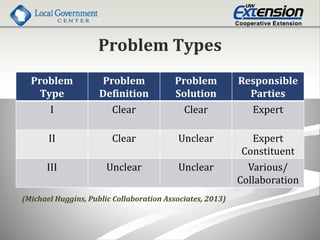
Problem Types
Problem
Type
Problem
Definition
Problem
Solution
Responsible
Parties
I Clear Clear Expert
II Clear Unclear Expert
Constituent
III Unclear Unclear Various/
Collaboration
(Michael Huggins, Public Collaboration Associates, 2013)
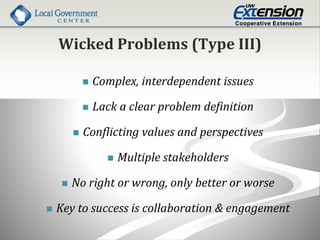
Wicked Problems (Type III)
 Complex, interdependent issues
 Lack a clear problem definition
 Conflicting values and perspectives
 Multiple stakeholders
 No right or wrong, only better or worse
 Key to success is collaboration & engagement
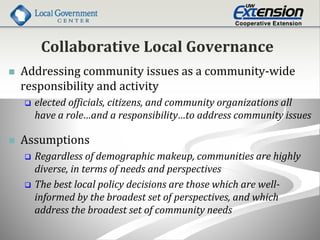
Collaborative Local Governance
 Addressing community issues as a community-wide
responsibility and activity
 elected officials, citizens, and community organizations all
have a role…and a responsibility…to address community issues
 Assumptions
 Regardless of demographic makeup, communities are highly
diverse, in terms of needs and perspectives
 The best local policy decisions are those which are well-
informed by the broadest set of perspectives, and which
address the broadest set of community needs
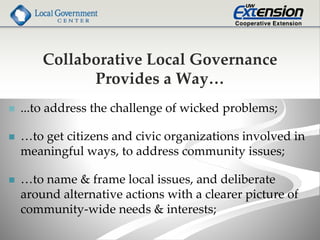
Collaborative Local Governance
Provides a Way…
 ...to address the challenge of wicked problems;
 …to get citizens and civic organizations involved in
meaningful ways, to address community issues;
 …to name & frame local issues, and deliberate
around alternative actions with a clearer picture of
community-wide needs & interests;
Collaborative Local Governance Roles
 Local Elected Officials
 Issue-namer and framer, convener, educator, dialogue
participant, deliberator, learner, public engagement
champion, decision-maker.
 Citizens
 Issue-namer and framer, dialogue participant, deliberator,
learner, informer, voter.
 Community-serving Organizations
 Issue-namer and framer, convener, dialogue participant,
deliberator, learner, educator.
Discussion Question
 Do you have examples of “wicked” in
your community? How have you
addressed them? Examples can come from
any local jurisdiction – Town, Village,
City, or County government.
 What approach to local governance do
you have in your community, and how is
it working?
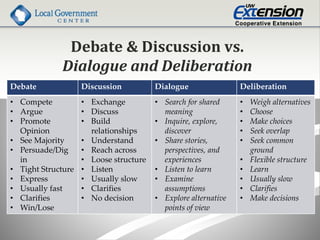
Debate & Discussion vs.
Dialogue and Deliberation
Debate Discussion Dialogue Deliberation
• Compete
• Argue
• Promote
Opinion
• See Majority
• Persuade/Dig
in
• Tight Structure
• Express
• Usually fast
• Clarifies
• Win/Lose
• Exchange
• Discuss
• Build
relationships
• Understand
• Reach across
• Loose structure
• Listen
• Usually slow
• Clarifies
• No decision
• Search for shared
meaning
• Inquire, explore,
discover
• Share stories,
perspectives, and
experiences
• Listen to learn
• Examine
assumptions
• Explore alternative
points of view
• Weigh alternatives
• Choose
• Make choices
• Seek overlap
• Seek common
ground
• Flexible structure
• Learn
• Usually slow
• Clarifies
• Make decisions
Why Engage the Public More?
 Policies that accurately reflect the range of community
needs and interests;
 Representative policy = supportable local policy;
 Reduce conflict among interests;
 Provides a way for experts to explain complex issues
and inform how people see and think about issues;
 Reduce transaction and opportunity costs;
 Provide safe, civil, spaces and means for people to talk
and learn from each other about issues and each other.
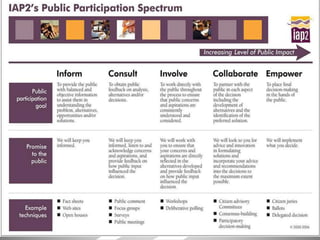
Citizen Engagement Values
International Association of Public Participation (IAP2)
 Public participation is based on the belief that those who are
affected by a decision have a right to be involved in the
decision-making process;
 Public participation includes the promise that the public's
contribution will influence the decision’
 Public participation promotes sustainable decisions by
recognizing and communicating the needs and interests of
all participants, including decision makers.
Citizen Engagement Values
 Public participation seeks out and facilitates the involvement
of those potentially affected by or interested in a decision.
 Public participation seeks input from participants in
designing how they participate.
 Public participation provides participants with the
information they need to participate in a meaningful way.
 Public participation communicates to participants how their
input affected the decision
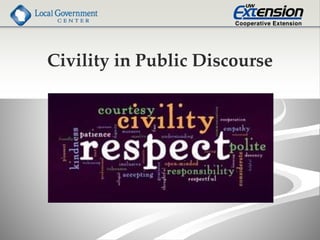
Civility in Public Discourse
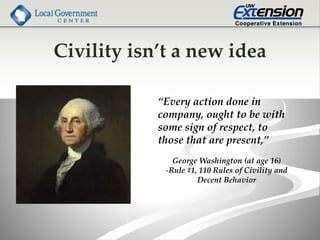
Civility isn’t a new idea
“Every action done in
company, ought to be with
some sign of respect, to
those that are present,”
George Washington (at age 16)
-Rule #1, 110 Rules of Civility and
Decent Behavior
What does the public think?
 2010 Study by Allegheny College (PA) and
Indiana-Purdue University Ft. Wayne
 Random survey of 1000 Americans to
assess their attitudes and views around
civility in politics.
 95 % of Americans believe civility in politics is important for a
healthy democracy.
 87% of Americans suggest it is possible for people to disagree
about politics respectfully.
 Citizens paying close attention to politics are four times more
likely to say the tone of politics has gotten worse than those who
pay only modest attention to the news.
 Women define civility differently than men, and are more likely
to label recent public political behaviors as uncivil.
• 40% of Americans believe the least civil politicians should
suffer a “trip to the woodshed,”
• 32% said they should take a manners class with Emily Post;
 85% of Americans believe politicians should work to cultivate
friendships with members of the other party.
 63% of Americans say civility has gotten worse in the past few
years.
 Women are more likely to be turned off by negative politics
than are men.
It’s easy for incivility to develop!
 Lots of pressures…from everywhere;
 Issues are complex, difficult…wicked;
 A lot at stake for citizens, for
communities, for local officials personally;
 Frustration develops and tempers can
flare.
What’s the civility payoff?
A civil atmosphere makes it possible to
thoughtfully and effectively talk about, learn about,
consider, and leverage a wide range of ideas and
perspectives;
When leaders talk about issues effectively it
becomes possible to find solutions which might not
have otherwise surfaced.
New Jersey State League of
Municipalities
1. Thou shalt not rudely interrupt a colleague
midsentence, nor “speak over” a colleague while
she/he is speaking;
2. Thou shalt not assume that shrillness of tone is a
substitute for substantive dialogue;
3. Thou shalt not resort to “zingers” designed solely to
embarrass your target;
New Jersey State League of
Municipalities
4. Thou shalt not allow legitimate critique of policy and practice
to become a personal attack aimed at the person who devised
the policy or implements the practice;
5. Thou shalt always recognize that your colleagues were also
elected, just as you were, and deserve the same level of respect
for having run and won;
6. Thou shalt not ridicule or belittle a colleague, or a member of
the public, simply because he or she disagrees with you on an
issue.
A Synopsis of Civility Principles
 Tolerance
 respect and acknowledge the legitimacy of opposing views
 Respectful Interaction
 no personal attacks, belittling, name calling, profanity, insults,
or disparaging remarks.
 no jumping to conclusions without knowing what is being
said or suggested
 no interrupting someone when they have the floor.
 does permit offering constructive criticism or politely
challenging one’s assumptions, both of which may serve to
enhance the policy dialogue.
A Synopsis of Civility Principles
 Listening
 to understand what someone else is saying
 to understand their views and interests
 to consider new information and become better informed
 Does not include gathering information to repudiate or
attack someone
 Compromise
 recognizing and accepting that the best decisions are often
necessarily a product of compromise where good-faith
attempts are made to integrate opposing interests
 focus is on the greatest public good
A Synopsis of Civility Principles
 Dialogue
 Examine assumptions and interests behind positions.
 Dialogue is deeper and more purposeful than discussion.
 The intended outcome is to ‘discover’ synergistic solutions.
 Analysis and Deliberation
 The intent is to carefully examine as many facets of an
issue or problem as possible.
 The purpose is to craft a solution that serves the greatest
good.
Civility in Local Government
3 Examples from the Field
 Douglas County Board of Supervisors, WI)
 Evansville, WI
 Seminole County, FL
Citizen Engagement
Examples of Public
Engagement Strategies
 Issue-specific public learning events
 Deliberation events, in-person and on-line
 Study Circles
 ChoiceWork Dialogue sessions
 Consensus Conferences
 Deliberative Polling
 Issue Naming & Framing
Citizen Engagement Methods
IAP2 Toolbox
 Public participation tools and techniques;
 Organized around 3 public participation objectives:
1. Sharing information
2. Compiling and provide feedback
3. Bringing people together
Citizen Engagement
3 Examples from the Field
 Clear Vision, Eau Claire (WI)
 Sustainable Dubuque Initiative (IA)
 Lake St. Croix Nutrient Loading Project (WI, MN)
Leadership Opportunities for
Local Leaders
 If you’re an elected official, talk to your colleagues
 If you’re not, talk to your elected officials
 Start talking about collaborative governance locally
 Start a local civility project
 Become a trained dialogue facilitator
 Tap into a network…read, learn, share
 Convene an community issue dialogue, but start small
and with a popular but inert issue

local.pptx

  • 1.
  • 2.
    Today’s Local Governance Environment Erosion of trust in government;  Cynicism toward government;  Diversity of citizens’ views;  Complex issues;  Polarization;  A breakdown in basic civility;
  • 3.
    Traditional Local GovernanceRoles  Local officials – Issue framers, experts, analysts, policy producers/decision-makers;  Citizens – Voters, feedback providers, policy consumers, policy consumers/reactors;  Community Organizations – Issue framers, feedback providers, policy position advocates.
  • 4.
    Traditional Local Governance Challenges Wicked problems;  How issues get named and framed;  Getting sufficient perspective;  Limitations of discussion and debate.
  • 5.
    Problem Types Problem Type Problem Definition Problem Solution Responsible Parties I ClearClear Expert II Clear Unclear Expert Constituent III Unclear Unclear Various/ Collaboration (Michael Huggins, Public Collaboration Associates, 2013)
  • 6.
    Wicked Problems (TypeIII)  Complex, interdependent issues  Lack a clear problem definition  Conflicting values and perspectives  Multiple stakeholders  No right or wrong, only better or worse  Key to success is collaboration & engagement
  • 7.
    Collaborative Local Governance Addressing community issues as a community-wide responsibility and activity  elected officials, citizens, and community organizations all have a role…and a responsibility…to address community issues  Assumptions  Regardless of demographic makeup, communities are highly diverse, in terms of needs and perspectives  The best local policy decisions are those which are well- informed by the broadest set of perspectives, and which address the broadest set of community needs
  • 8.
    Collaborative Local Governance Providesa Way…  ...to address the challenge of wicked problems;  …to get citizens and civic organizations involved in meaningful ways, to address community issues;  …to name & frame local issues, and deliberate around alternative actions with a clearer picture of community-wide needs & interests;
  • 9.
    Collaborative Local GovernanceRoles  Local Elected Officials  Issue-namer and framer, convener, educator, dialogue participant, deliberator, learner, public engagement champion, decision-maker.  Citizens  Issue-namer and framer, dialogue participant, deliberator, learner, informer, voter.  Community-serving Organizations  Issue-namer and framer, convener, dialogue participant, deliberator, learner, educator.
  • 10.
    Discussion Question  Doyou have examples of “wicked” in your community? How have you addressed them? Examples can come from any local jurisdiction – Town, Village, City, or County government.  What approach to local governance do you have in your community, and how is it working?
  • 11.
    Debate & Discussionvs. Dialogue and Deliberation Debate Discussion Dialogue Deliberation • Compete • Argue • Promote Opinion • See Majority • Persuade/Dig in • Tight Structure • Express • Usually fast • Clarifies • Win/Lose • Exchange • Discuss • Build relationships • Understand • Reach across • Loose structure • Listen • Usually slow • Clarifies • No decision • Search for shared meaning • Inquire, explore, discover • Share stories, perspectives, and experiences • Listen to learn • Examine assumptions • Explore alternative points of view • Weigh alternatives • Choose • Make choices • Seek overlap • Seek common ground • Flexible structure • Learn • Usually slow • Clarifies • Make decisions
  • 12.
    Why Engage thePublic More?  Policies that accurately reflect the range of community needs and interests;  Representative policy = supportable local policy;  Reduce conflict among interests;  Provides a way for experts to explain complex issues and inform how people see and think about issues;  Reduce transaction and opportunity costs;  Provide safe, civil, spaces and means for people to talk and learn from each other about issues and each other.
  • 13.
    Citizen Engagement Values InternationalAssociation of Public Participation (IAP2)  Public participation is based on the belief that those who are affected by a decision have a right to be involved in the decision-making process;  Public participation includes the promise that the public's contribution will influence the decision’  Public participation promotes sustainable decisions by recognizing and communicating the needs and interests of all participants, including decision makers.
  • 14.
    Citizen Engagement Values Public participation seeks out and facilitates the involvement of those potentially affected by or interested in a decision.  Public participation seeks input from participants in designing how they participate.  Public participation provides participants with the information they need to participate in a meaningful way.  Public participation communicates to participants how their input affected the decision
  • 15.
  • 16.
    Civility isn’t anew idea “Every action done in company, ought to be with some sign of respect, to those that are present,” George Washington (at age 16) -Rule #1, 110 Rules of Civility and Decent Behavior
  • 17.
    What does thepublic think?  2010 Study by Allegheny College (PA) and Indiana-Purdue University Ft. Wayne  Random survey of 1000 Americans to assess their attitudes and views around civility in politics.
  • 18.
     95 %of Americans believe civility in politics is important for a healthy democracy.  87% of Americans suggest it is possible for people to disagree about politics respectfully.  Citizens paying close attention to politics are four times more likely to say the tone of politics has gotten worse than those who pay only modest attention to the news.  Women define civility differently than men, and are more likely to label recent public political behaviors as uncivil.
  • 19.
    • 40% ofAmericans believe the least civil politicians should suffer a “trip to the woodshed,” • 32% said they should take a manners class with Emily Post;  85% of Americans believe politicians should work to cultivate friendships with members of the other party.  63% of Americans say civility has gotten worse in the past few years.  Women are more likely to be turned off by negative politics than are men.
  • 20.
    It’s easy forincivility to develop!  Lots of pressures…from everywhere;  Issues are complex, difficult…wicked;  A lot at stake for citizens, for communities, for local officials personally;  Frustration develops and tempers can flare.
  • 21.
    What’s the civilitypayoff? A civil atmosphere makes it possible to thoughtfully and effectively talk about, learn about, consider, and leverage a wide range of ideas and perspectives; When leaders talk about issues effectively it becomes possible to find solutions which might not have otherwise surfaced.
  • 22.
    New Jersey StateLeague of Municipalities 1. Thou shalt not rudely interrupt a colleague midsentence, nor “speak over” a colleague while she/he is speaking; 2. Thou shalt not assume that shrillness of tone is a substitute for substantive dialogue; 3. Thou shalt not resort to “zingers” designed solely to embarrass your target;
  • 23.
    New Jersey StateLeague of Municipalities 4. Thou shalt not allow legitimate critique of policy and practice to become a personal attack aimed at the person who devised the policy or implements the practice; 5. Thou shalt always recognize that your colleagues were also elected, just as you were, and deserve the same level of respect for having run and won; 6. Thou shalt not ridicule or belittle a colleague, or a member of the public, simply because he or she disagrees with you on an issue.
  • 24.
    A Synopsis ofCivility Principles  Tolerance  respect and acknowledge the legitimacy of opposing views  Respectful Interaction  no personal attacks, belittling, name calling, profanity, insults, or disparaging remarks.  no jumping to conclusions without knowing what is being said or suggested  no interrupting someone when they have the floor.  does permit offering constructive criticism or politely challenging one’s assumptions, both of which may serve to enhance the policy dialogue.
  • 25.
    A Synopsis ofCivility Principles  Listening  to understand what someone else is saying  to understand their views and interests  to consider new information and become better informed  Does not include gathering information to repudiate or attack someone  Compromise  recognizing and accepting that the best decisions are often necessarily a product of compromise where good-faith attempts are made to integrate opposing interests  focus is on the greatest public good
  • 26.
    A Synopsis ofCivility Principles  Dialogue  Examine assumptions and interests behind positions.  Dialogue is deeper and more purposeful than discussion.  The intended outcome is to ‘discover’ synergistic solutions.  Analysis and Deliberation  The intent is to carefully examine as many facets of an issue or problem as possible.  The purpose is to craft a solution that serves the greatest good.
  • 27.
    Civility in LocalGovernment 3 Examples from the Field  Douglas County Board of Supervisors, WI)  Evansville, WI  Seminole County, FL
  • 28.
  • 29.
    Examples of Public EngagementStrategies  Issue-specific public learning events  Deliberation events, in-person and on-line  Study Circles  ChoiceWork Dialogue sessions  Consensus Conferences  Deliberative Polling  Issue Naming & Framing
  • 30.
    Citizen Engagement Methods IAP2Toolbox  Public participation tools and techniques;  Organized around 3 public participation objectives: 1. Sharing information 2. Compiling and provide feedback 3. Bringing people together
  • 31.
    Citizen Engagement 3 Examplesfrom the Field  Clear Vision, Eau Claire (WI)  Sustainable Dubuque Initiative (IA)  Lake St. Croix Nutrient Loading Project (WI, MN)
  • 32.
    Leadership Opportunities for LocalLeaders  If you’re an elected official, talk to your colleagues  If you’re not, talk to your elected officials  Start talking about collaborative governance locally  Start a local civility project  Become a trained dialogue facilitator  Tap into a network…read, learn, share  Convene an community issue dialogue, but start small and with a popular but inert issue