Part of speech 
ENGLISH LANGUAGE PROFICIENCY I 
Yong Hua Ai 
Nur Hazwani Binti Hasni 
Nursyamilah Binti Pauzan 
Mariya Sazwana Binti Mohd Syukri 
Lecturer’s Name : Madam Dashima Binti Abdul Wahab
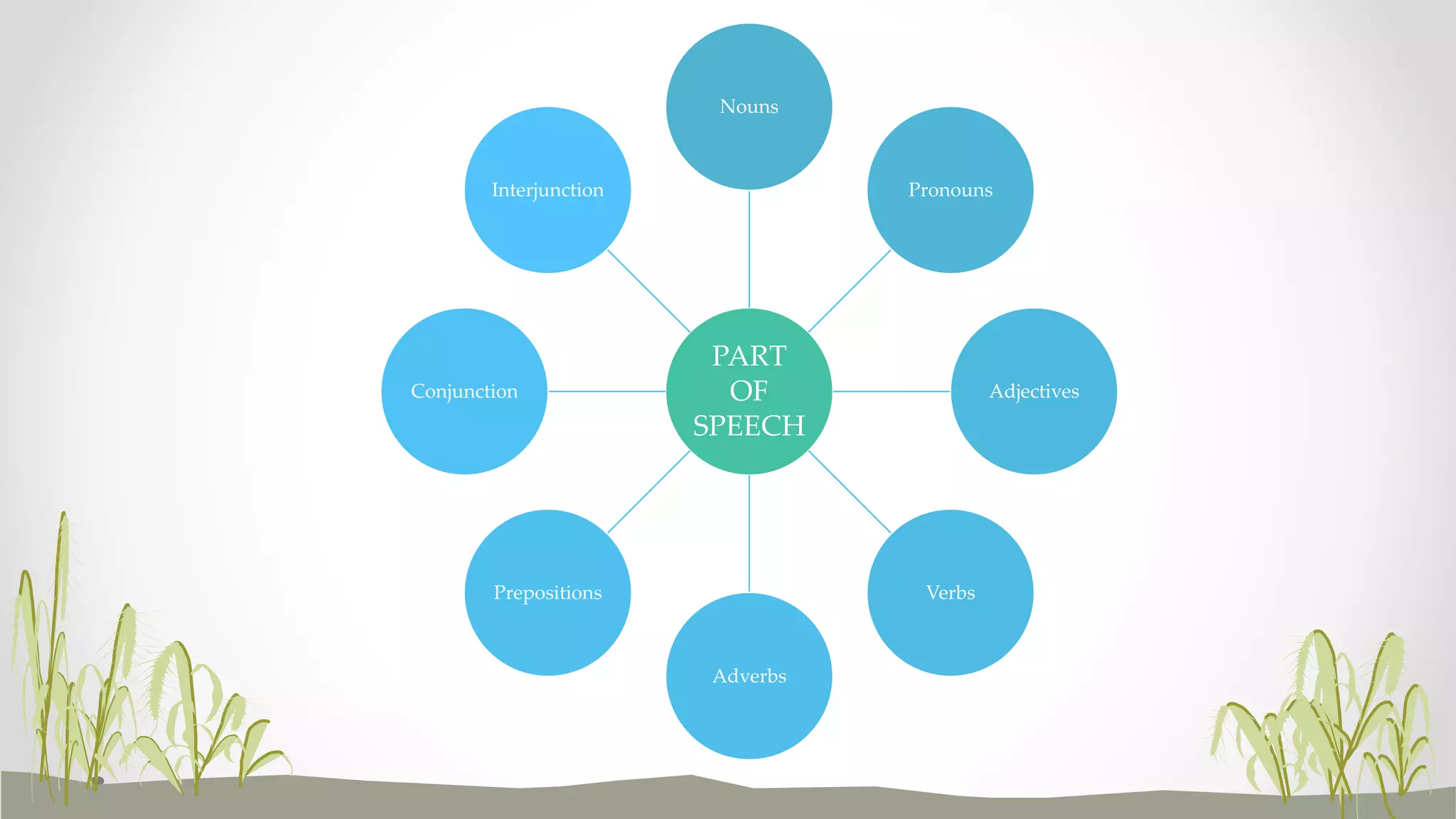
Nouns 
PART 
OF 
SPEECH 
Pronouns 
Adjectives 
Verbs 
Adverbs 
Interjunction 
Conjunction 
Prepositions
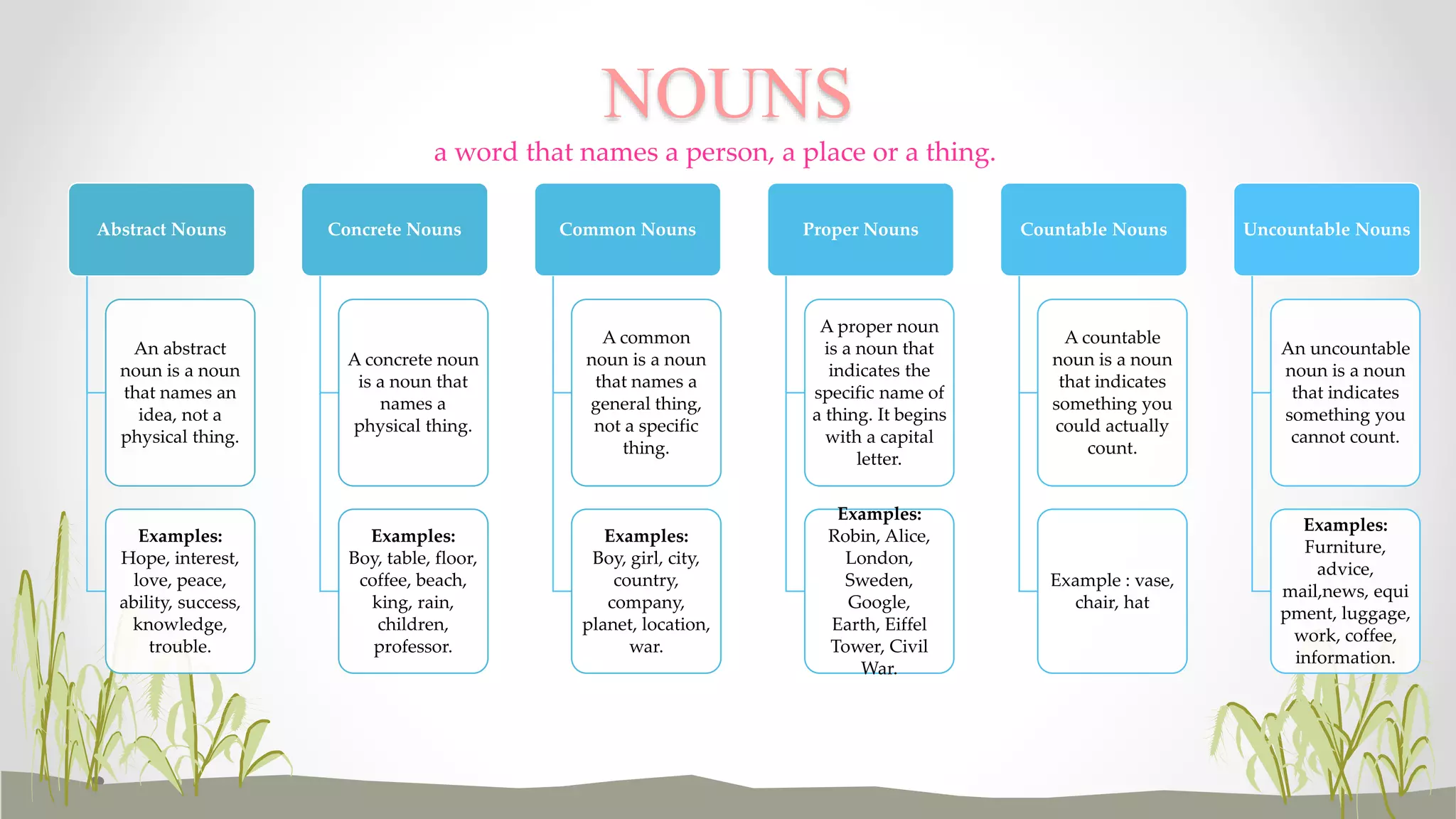
NOUNS 
Abstract Nouns 
An abstract 
noun is a noun 
that names an 
idea, not a 
physical thing. 
Examples: 
Hope, interest, 
love, peace, 
ability, success, 
knowledge, 
trouble. 
Concrete Nouns 
A concrete noun 
is a noun that 
names a 
physical thing. 
Examples: 
Boy, table, floor, 
coffee, beach, 
king, rain, 
children, 
professor. 
Common Nouns 
A common 
noun is a noun 
that names a 
general thing, 
not a specific 
thing. 
Examples: 
Boy, girl, city, 
country, 
company, 
planet, location, 
war. 
Proper Nouns 
A proper noun 
is a noun that 
indicates the 
specific name of 
a thing. It begins 
with a capital 
letter. 
Examples: 
Robin, Alice, 
London, 
Sweden, 
Google, 
Earth, Eiffel 
Tower, Civil 
War. 
Countable Nouns 
A countable 
noun is a noun 
that indicates 
something you 
could actually 
count. 
Example : vase, 
chair, hat 
Uncountable Nouns 
An uncountable 
noun is a noun 
that indicates 
something you 
cannot count. 
Examples: 
Furniture, 
advice, 
mail,news, equi 
pment, luggage, 
work, coffee, 
information. 
a word that names a person, a place or a thing.
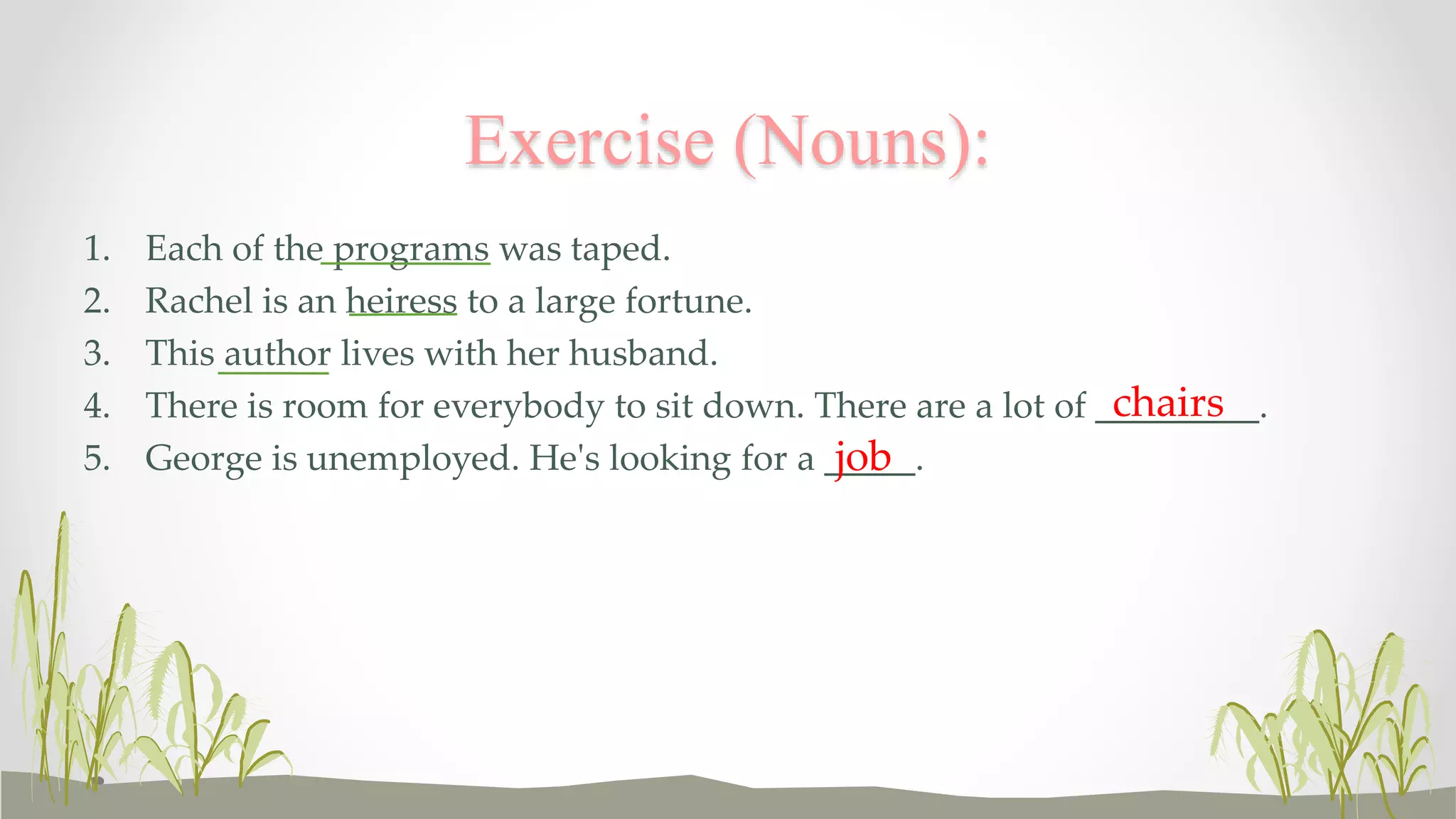
Exercise (Nouns): 
1. Each of the programs was taped. 
2. Rachel is an heiress to a large fortune. 
3. This author lives with her husband. 
4. There is room for everybody to sit down. There are a lot of _________. 
chairs 
5. George is unemployed. He's looking for a _____. 
job
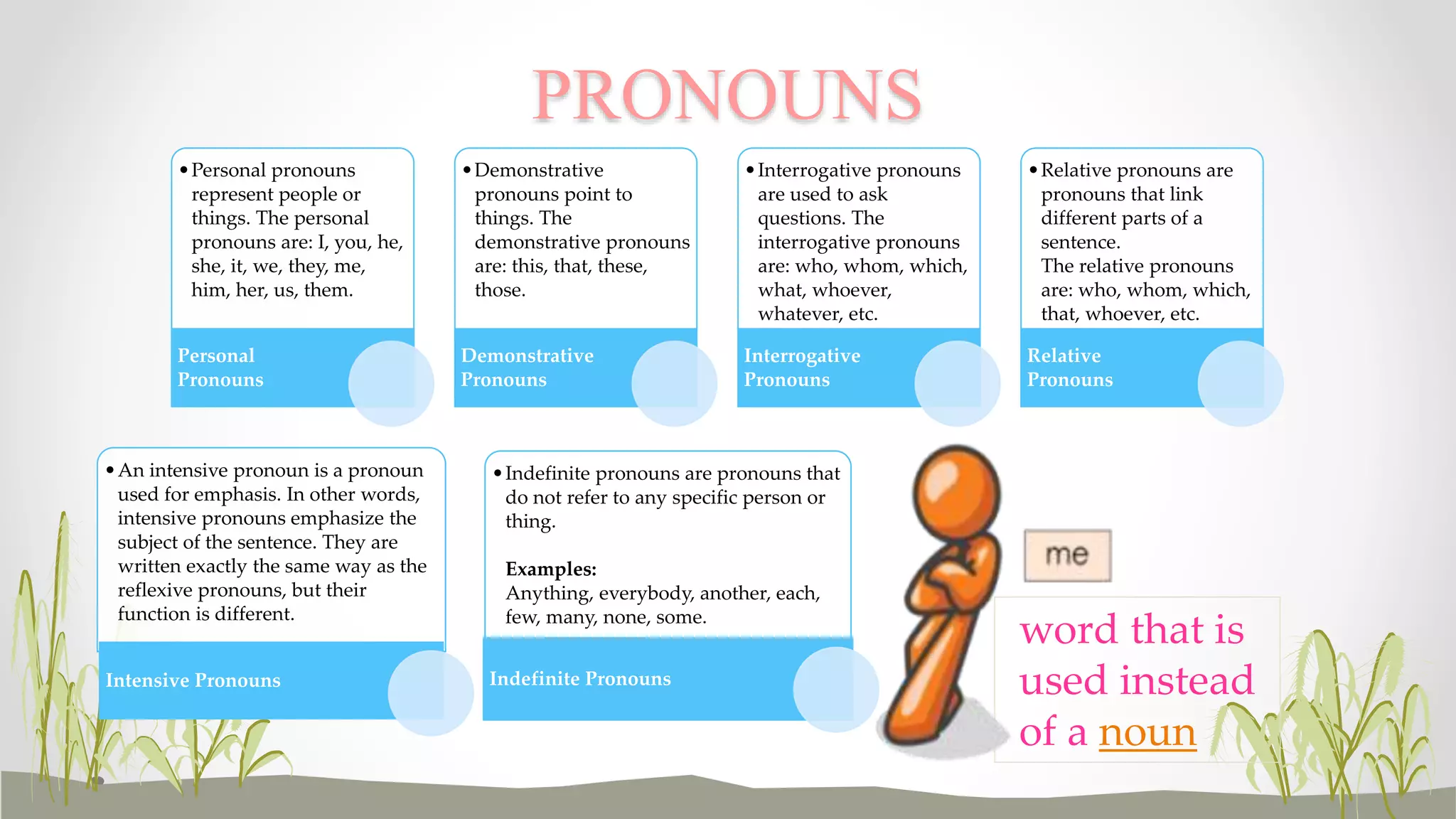
PRONOUNS 
•Personal pronouns 
represent people or 
things. The personal 
pronouns are: I, you, he, 
she, it, we, they, me, 
him, her, us, them. 
Personal 
Pronouns 
•Demonstrative 
pronouns point to 
things. The 
demonstrative pronouns 
are: this, that, these, 
those. 
Demonstrative 
Pronouns 
• Interrogative pronouns 
are used to ask 
questions. The 
interrogative pronouns 
are: who, whom, which, 
what, whoever, 
whatever, etc. 
Interrogative 
Pronouns 
•Relative pronouns are 
pronouns that link 
different parts of a 
sentence. 
The relative pronouns 
are: who, whom, which, 
that, whoever, etc. 
Relative 
Pronouns 
•An intensive pronoun is a pronoun 
used for emphasis. In other words, 
intensive pronouns emphasize the 
subject of the sentence. They are 
written exactly the same way as the 
reflexive pronouns, but their 
function is different. 
Intensive Pronouns 
• Indefinite pronouns are pronouns that 
do not refer to any specific person or 
thing. 
Examples: 
Anything, everybody, another, each, 
few, many, none, some. 
Indefinite Pronouns 
word that is 
used instead 
of a noun
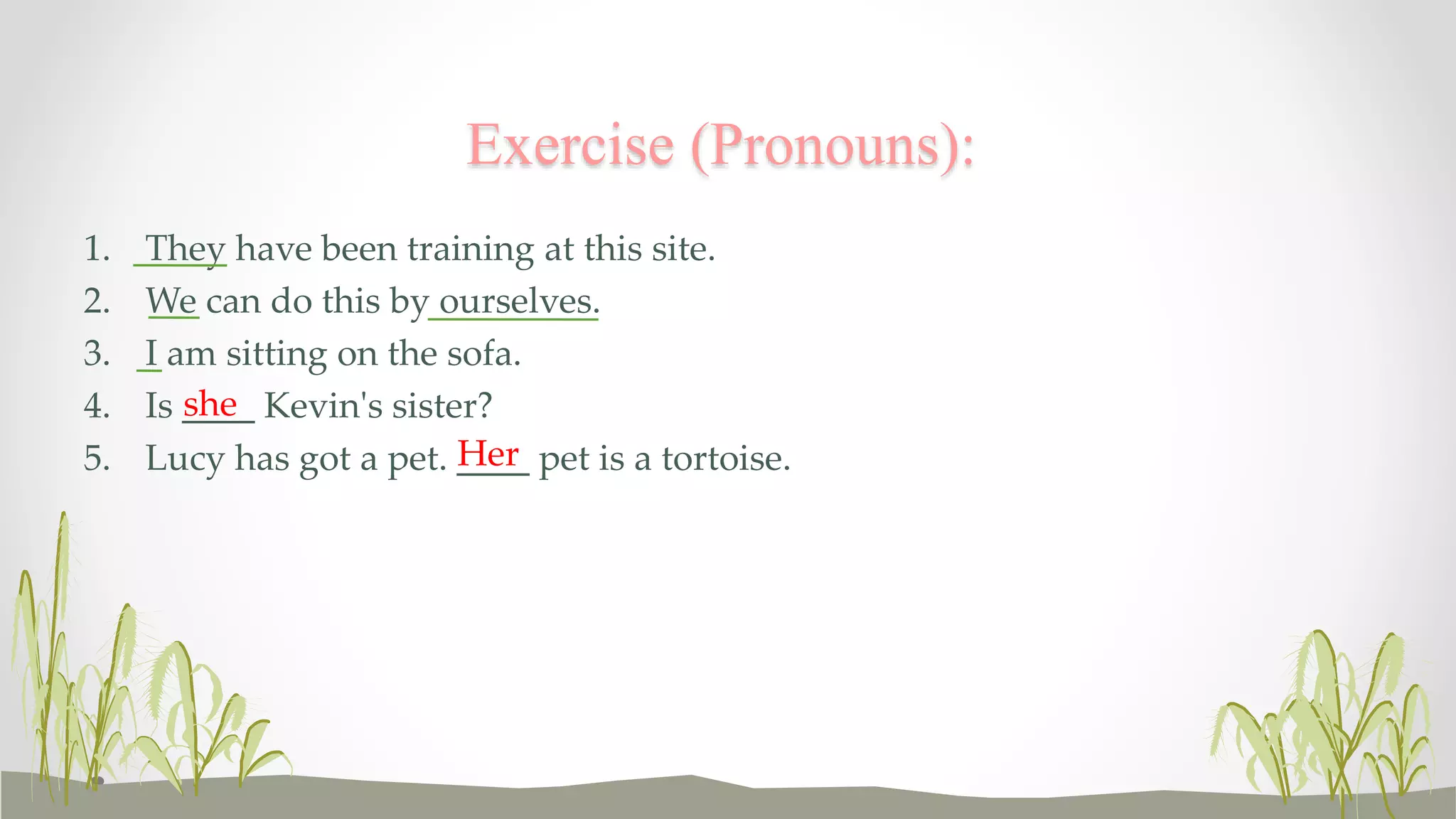
Exercise (Pronouns): 
1. They have been training at this site. 
2. We can do this by ourselves. 
3. I am sitting on the sofa. 
4. Is ____ she 
Kevin's sister? 
5. Lucy has got a pet. ____ Her 
pet is a tortoise.
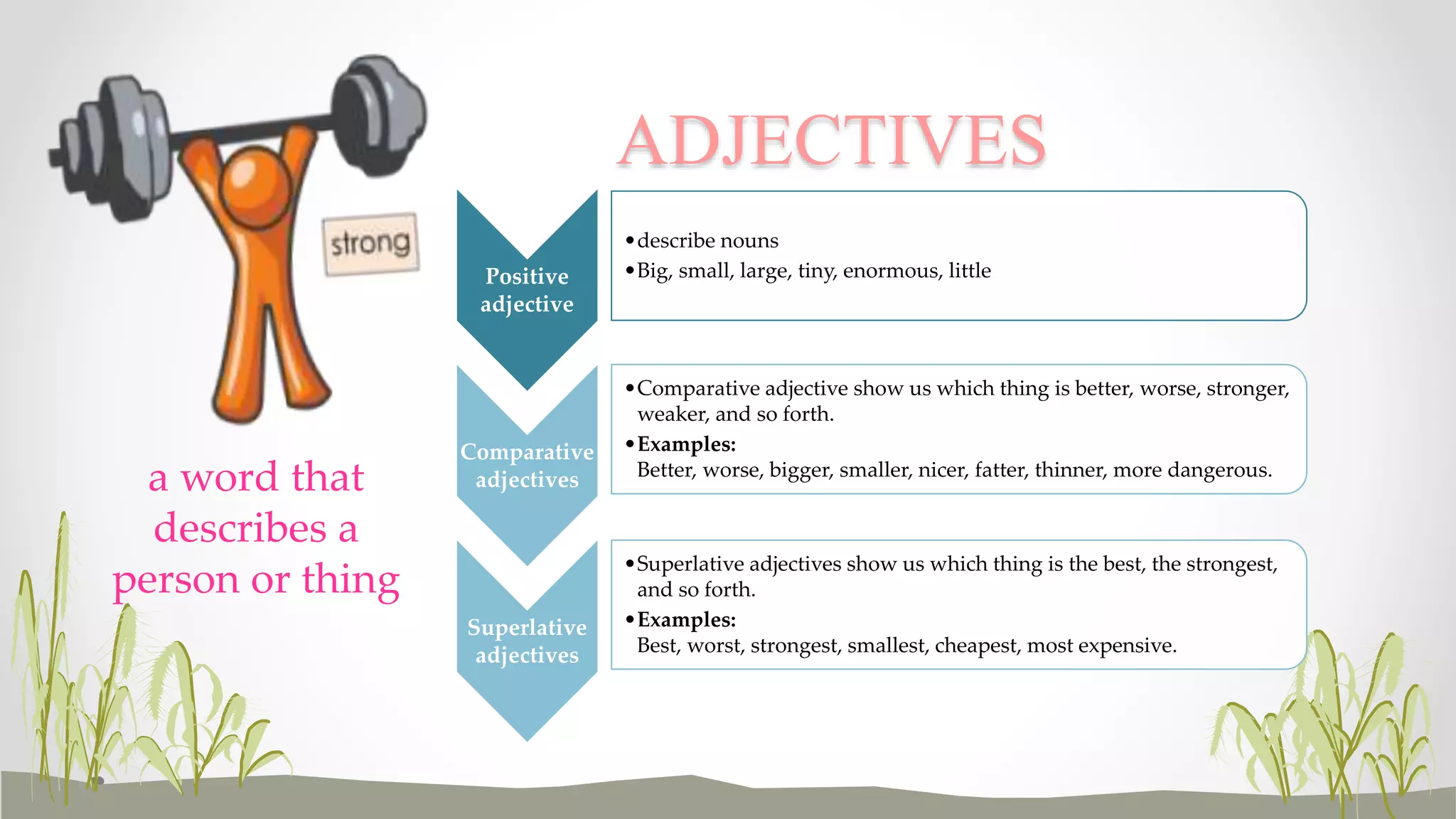
ADJECTIVES 
Positive 
adjective 
•describe nouns 
•Big, small, large, tiny, enormous, little 
Comparative 
adjectives 
•Comparative adjective show us which thing is better, worse, stronger, 
weaker, and so forth. 
•Examples: 
Better, worse, bigger, smaller, nicer, fatter, thinner, more dangerous. 
Superlative 
adjectives 
•Superlative adjectives show us which thing is the best, the strongest, 
and so forth. 
•Examples: 
Best, worst, strongest, smallest, cheapest, most expensive. 
a word that 
describes a 
person or thing
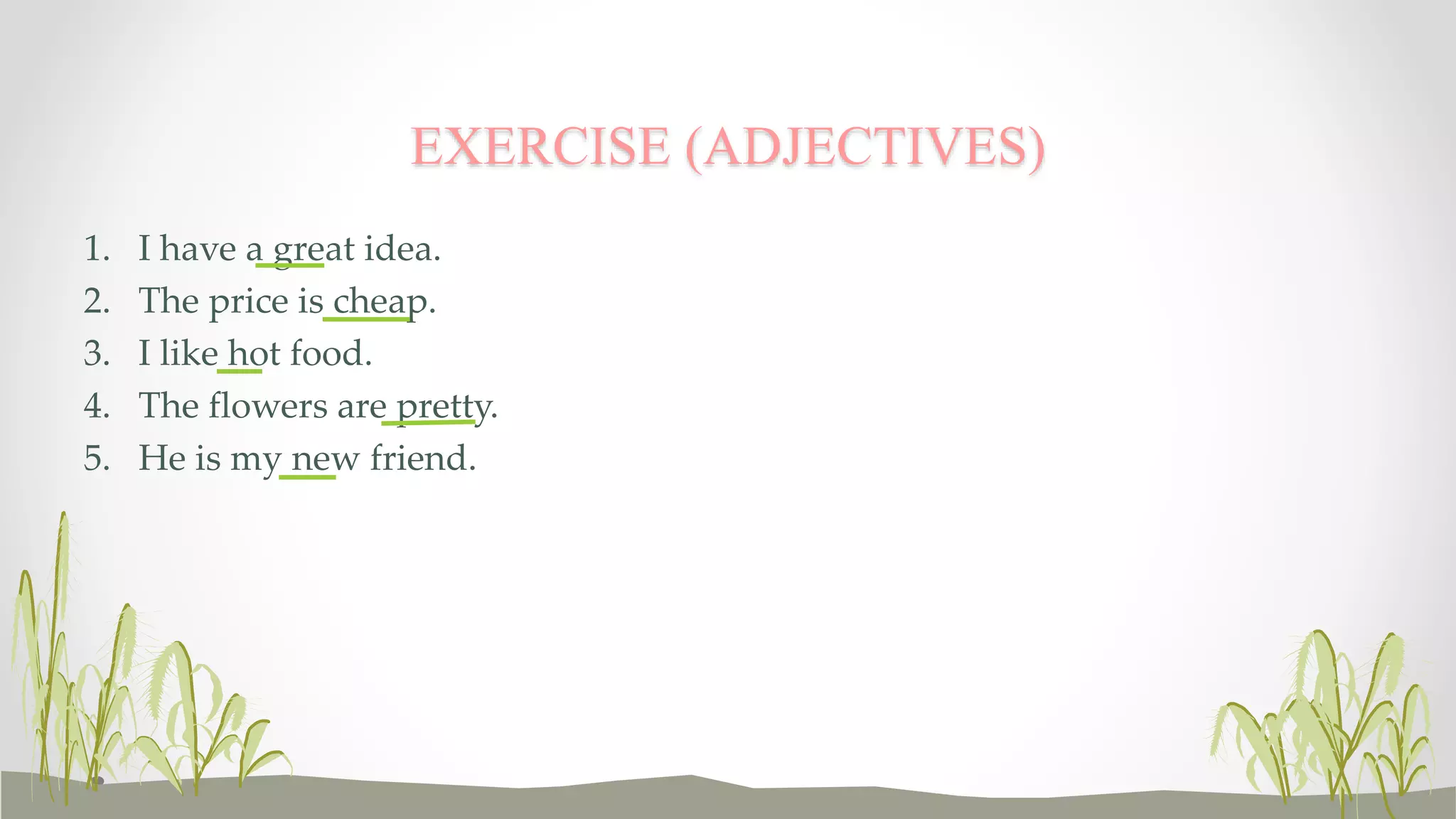
EXERCISE (ADJECTIVES) 
1. I have a great idea. 
2. The price is cheap. 
3. I like hot food. 
4. The flowers are pretty. 
5. He is my new friend.
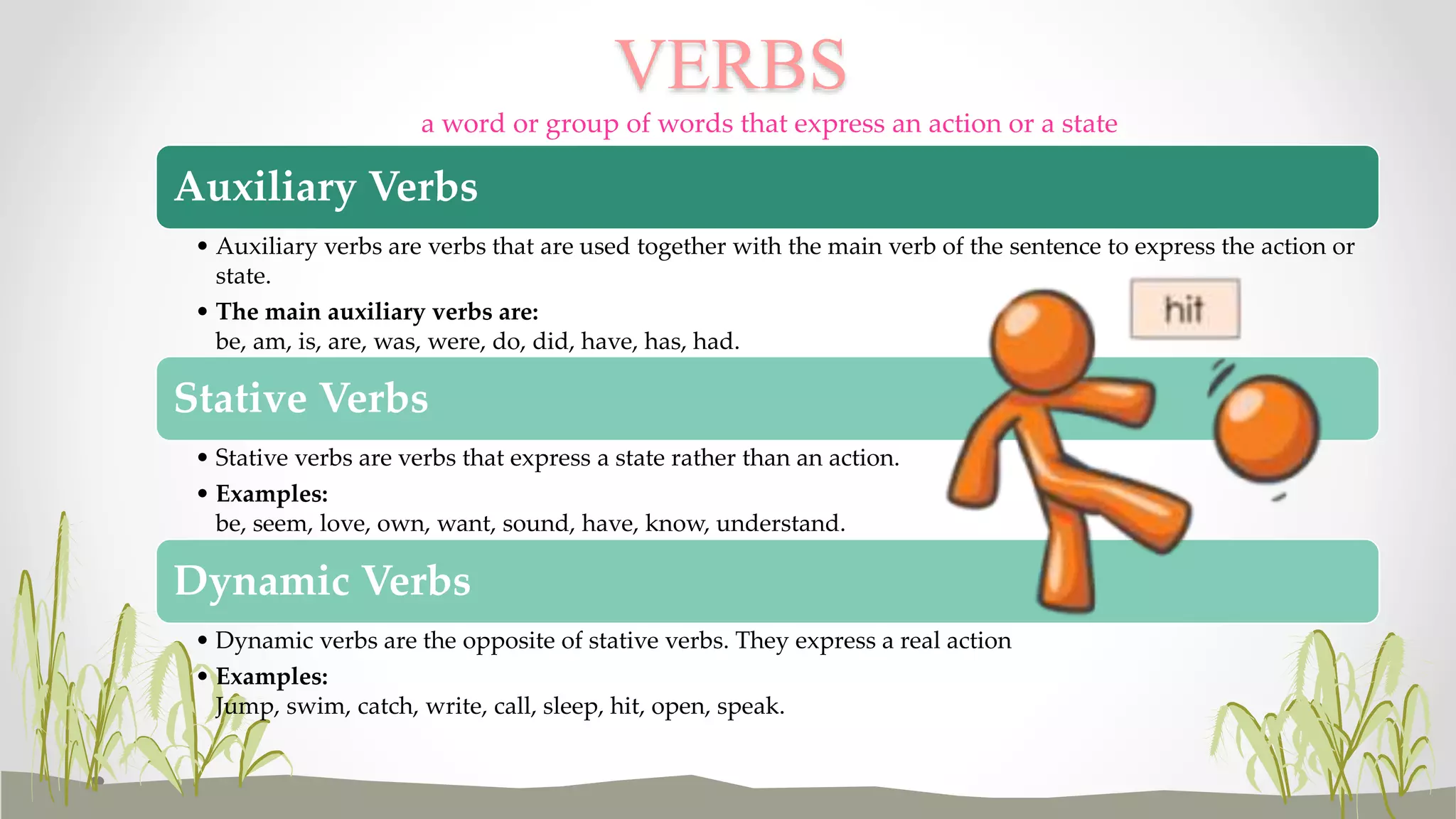
VERBS 
a word or group of words that express an action or a state 
Auxiliary Verbs 
• Auxiliary verbs are verbs that are used together with the main verb of the sentence to express the action or 
state. 
• The main auxiliary verbs are: 
be, am, is, are, was, were, do, did, have, has, had. 
Stative Verbs 
• Stative verbs are verbs that express a state rather than an action. 
• Examples: 
be, seem, love, own, want, sound, have, know, understand. 
Dynamic Verbs 
• Dynamic verbs are the opposite of stative verbs. They express a real action 
• Examples: 
Jump, swim, catch, write, call, sleep, hit, open, speak.
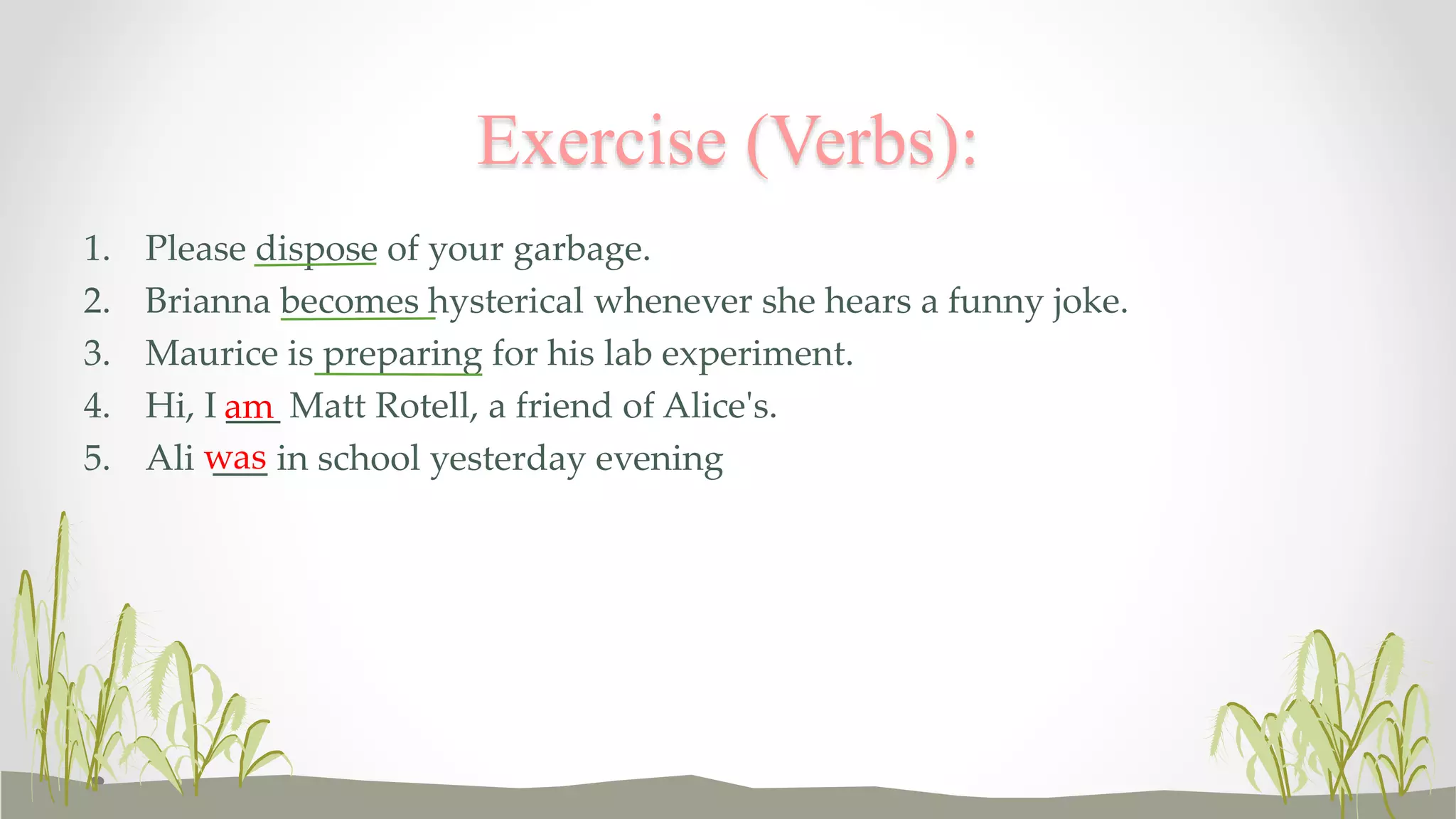
Exercise (Verbs): 
1. Please dispose of your garbage. 
2. Brianna becomes hysterical whenever she hears a funny joke. 
3. Maurice is preparing for his lab experiment. 
4. Hi, I am 
___ Matt Rotell, a friend of Alice's. 
5. Ali was 
___ in school yesterday evening
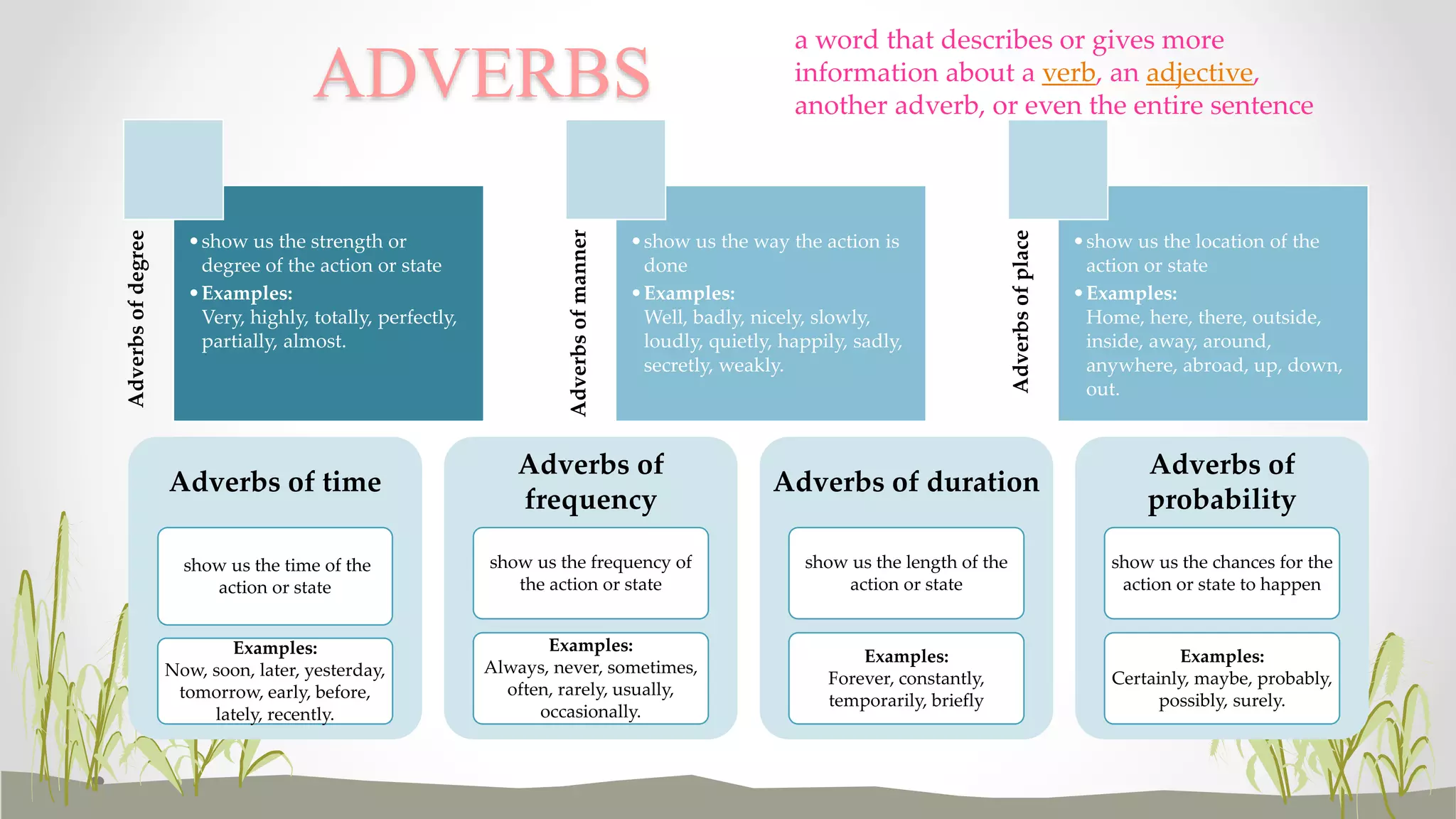
ADVERBS 
Adverbs of degree 
•show us the strength or 
degree of the action or state 
•Examples: 
Very, highly, totally, perfectly, 
partially, almost. 
Adverbs of manner 
a word that describes or gives more 
information about a verb, an adjective, 
another adverb, or even the entire sentence 
•show us the way the action is 
done 
•Examples: 
Well, badly, nicely, slowly, 
loudly, quietly, happily, sadly, 
secretly, weakly. 
Adverbs of place 
•show us the location of the 
action or state 
•Examples: 
Home, here, there, outside, 
inside, away, around, 
anywhere, abroad, up, down, 
out. 
Adverbs of time 
show us the time of the 
action or state 
Examples: 
Now, soon, later, yesterday, 
tomorrow, early, before, 
lately, recently. 
Adverbs of 
frequency 
show us the frequency of 
the action or state 
Examples: 
Always, never, sometimes, 
often, rarely, usually, 
occasionally. 
Adverbs of duration 
show us the length of the 
action or state 
Examples: 
Forever, constantly, 
temporarily, briefly 
Adverbs of 
probability 
show us the chances for the 
action or state to happen 
Examples: 
Certainly, maybe, probably, 
possibly, surely.
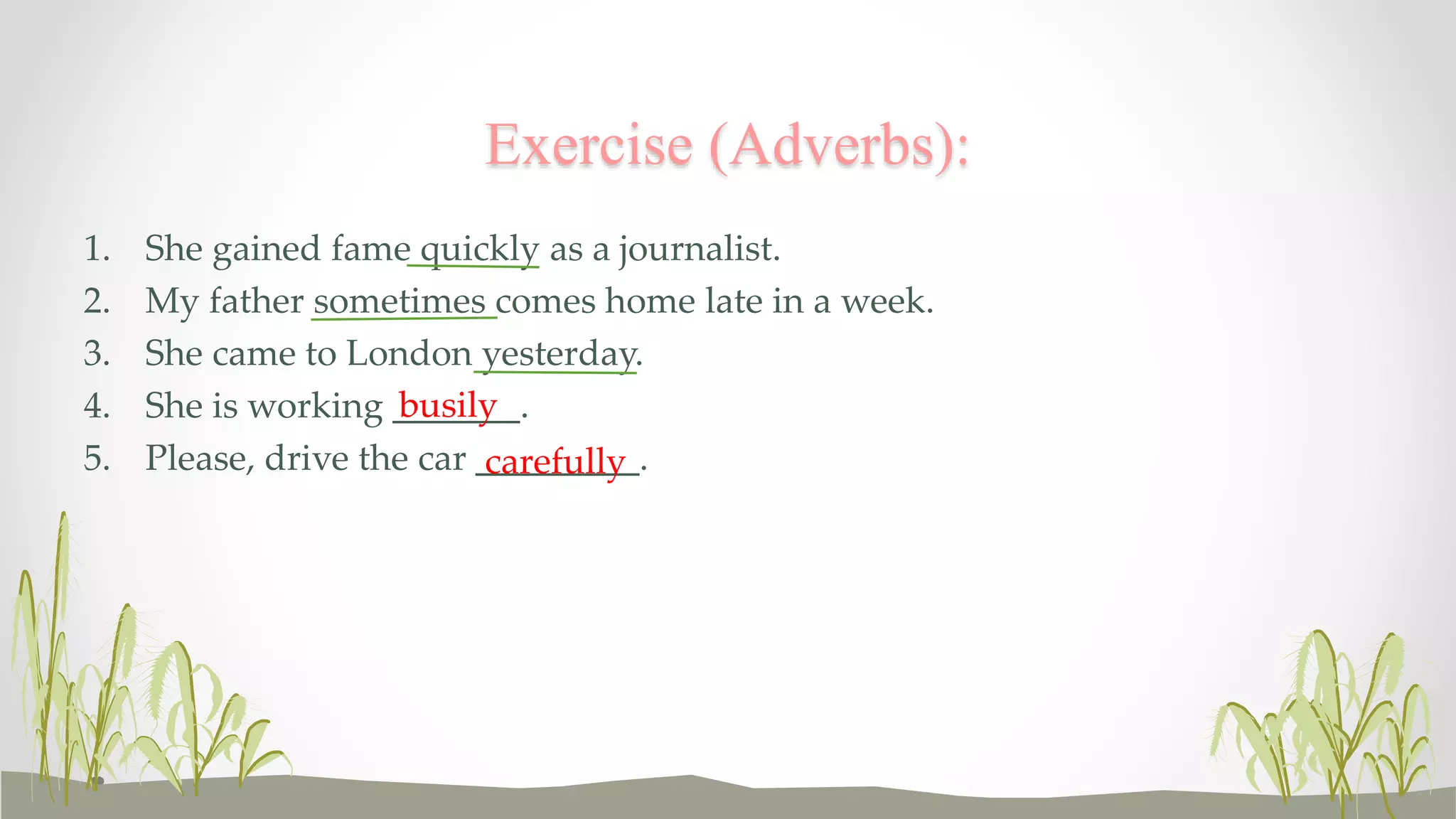
Exercise (Adverbs): 
1. She gained fame quickly as a journalist. 
2. My father sometimes comes home late in a week. 
3. She came to London yesterday. 
4. She is working _______. 
busily 
5. Please, drive the car _________. 
carefully
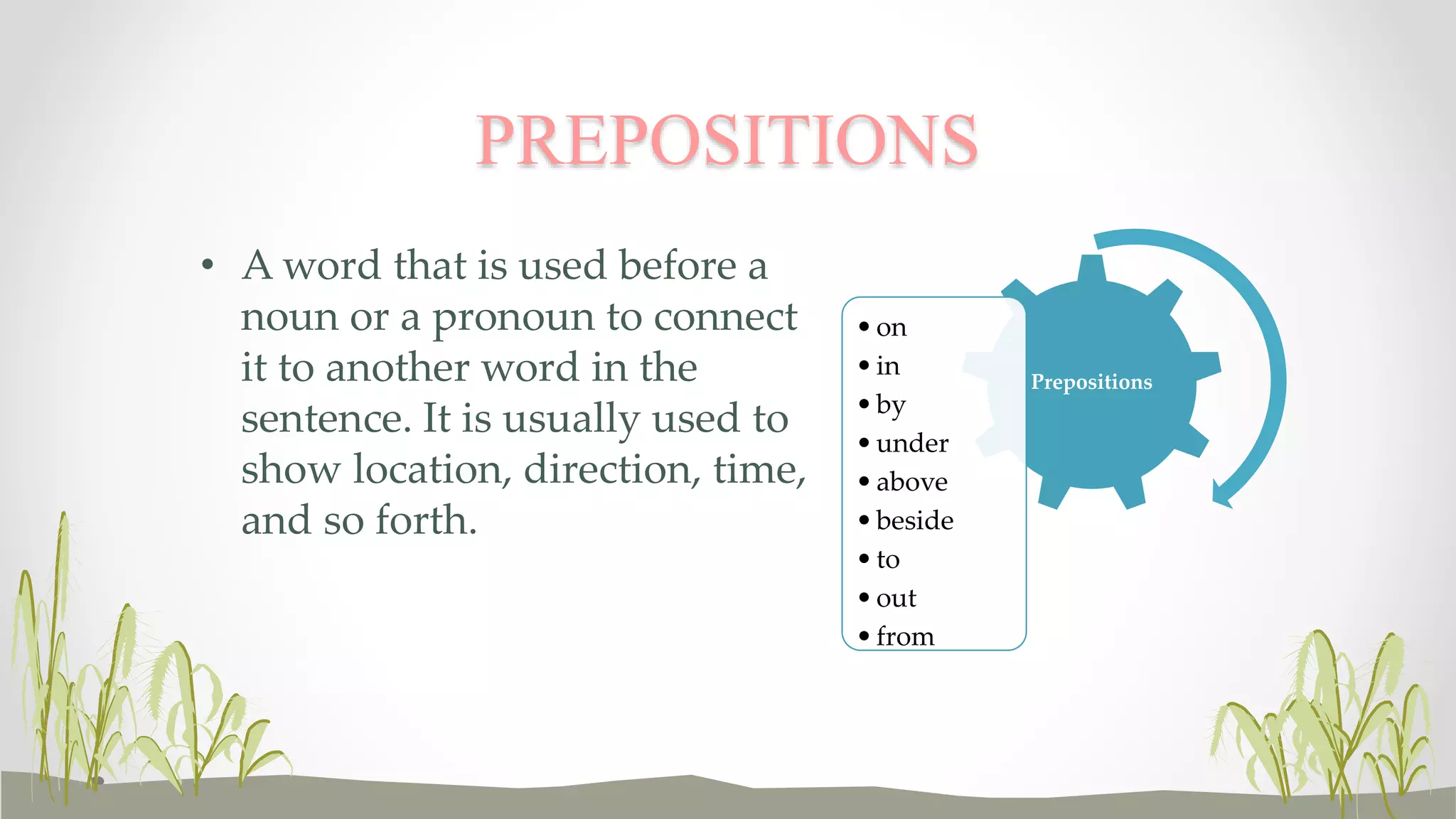
PREPOSITIONS 
• Aword that is used before a 
noun or a pronoun to connect 
it to another word in the 
sentence. It is usually used to 
show location, direction, time, 
and so forth. 
Prepositions 
• on 
• in 
• by 
•under 
• above 
• beside 
• to 
• out 
• from
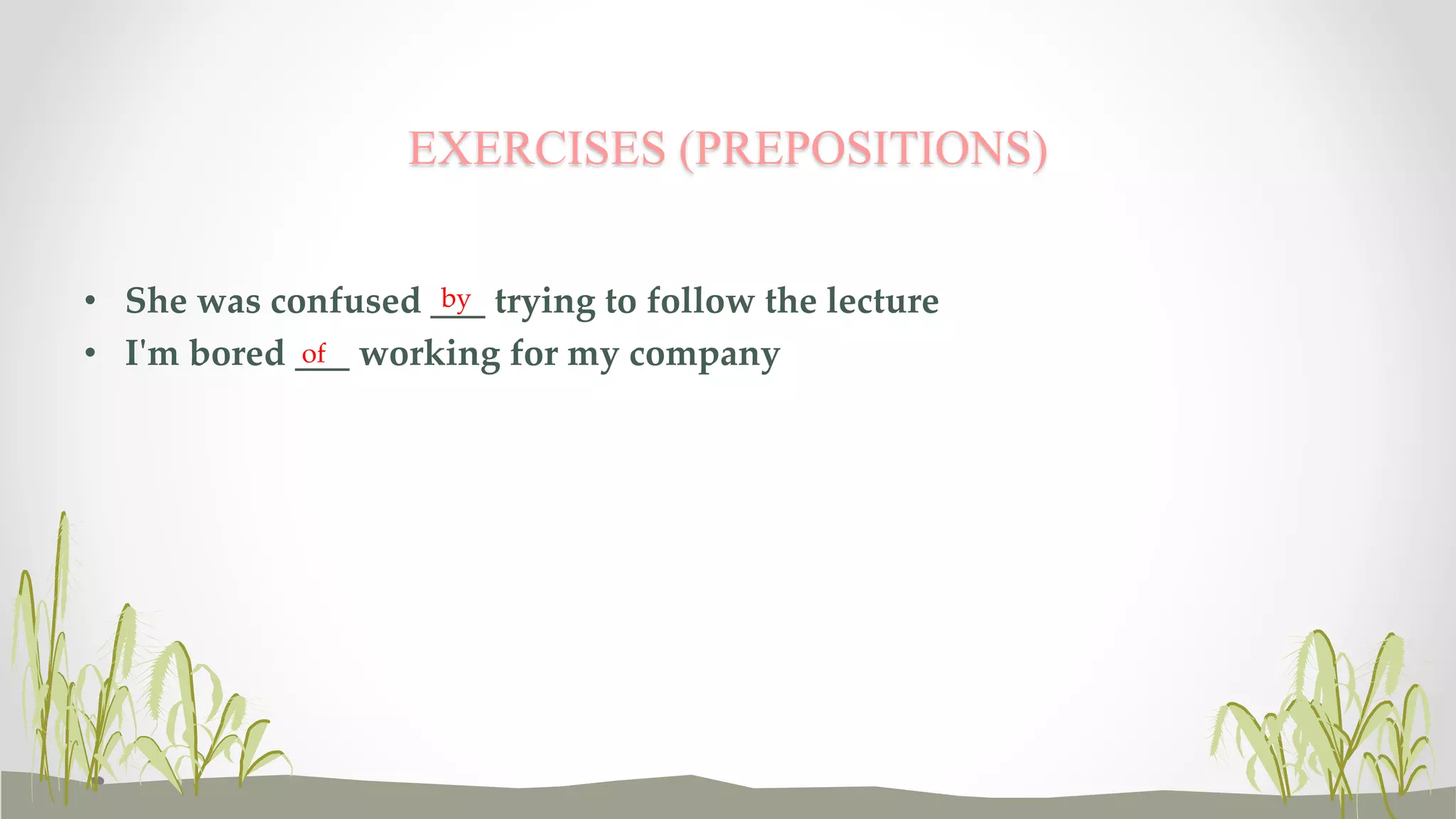
EXERCISES (PREPOSITIONS) 
• She was confused ___ by 
trying to follow the lecture 
• I'm bored ___ of 
working for my company
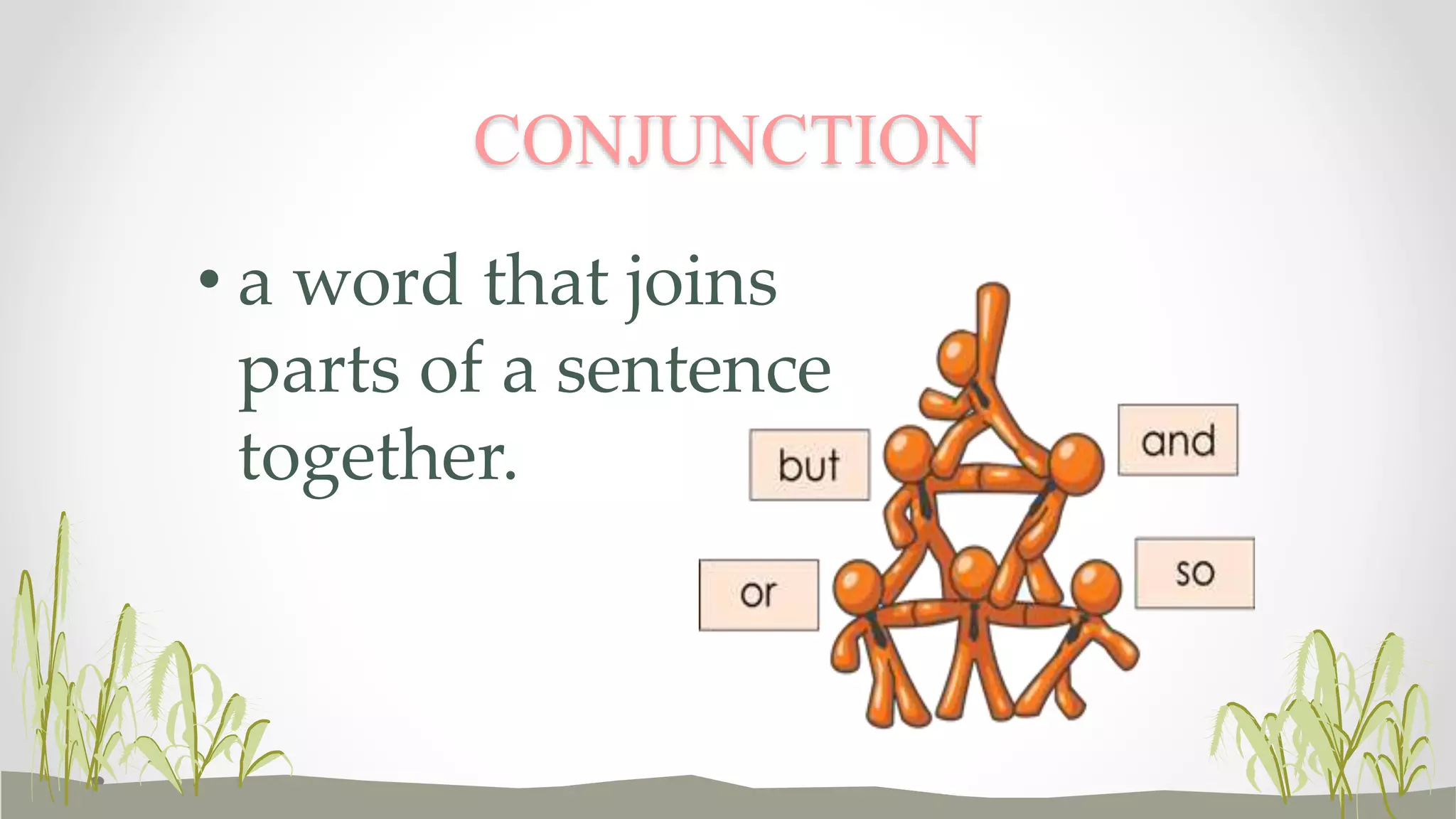
CONJUNCTION 
• a word that joins 
parts of a sentence 
together.
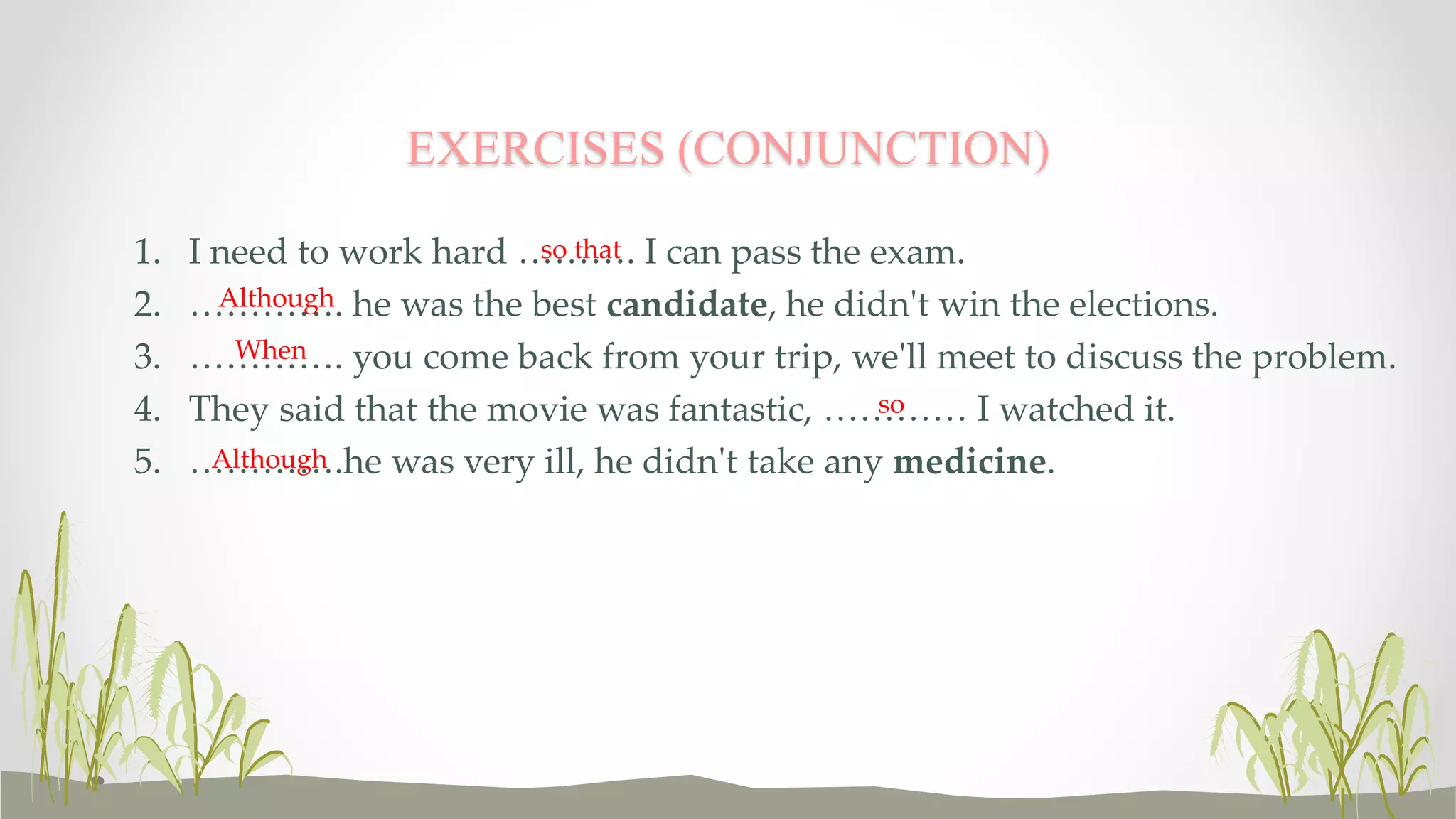
EXERCISES (CONJUNCTION) 
1. I need to work hard ………. so that 
I can pass the exam. 
2. …………. Although 
he was the best candidate, he didn't win the elections. 
3. …………. When 
you come back from your trip, we'll meet to discuss the problem. 
4. They said that the movie was fantastic, ………… so 
I watched it. 
5. ………….Although 
he was very ill, he didn't take any medicine.
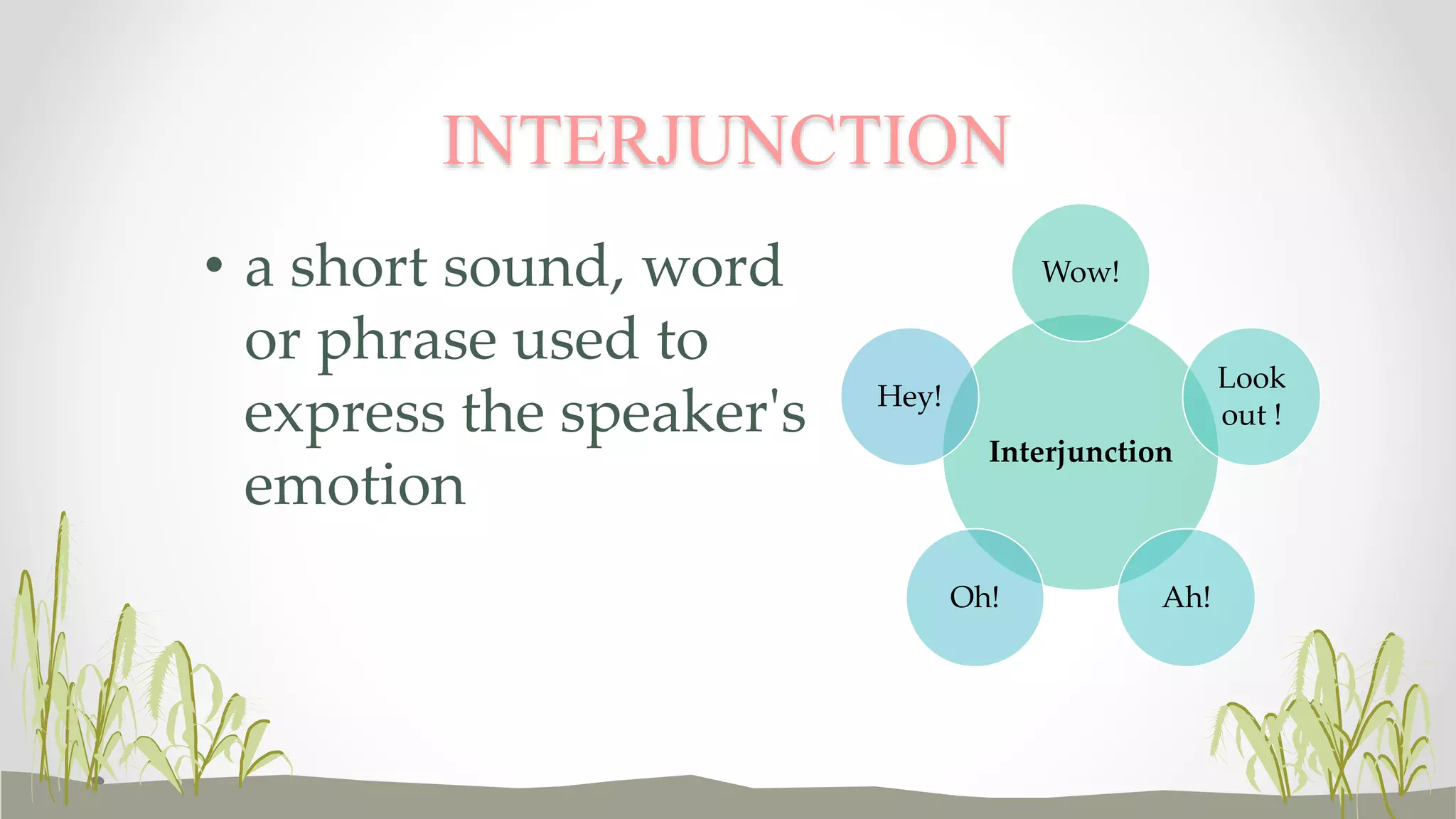
Wow! 
INTERJUNCTION 
Interjunction 
Look 
out ! 
Oh! Ah! 
Hey! 
• a short sound, word 
or phrase used to 
express the speaker's 
emotion
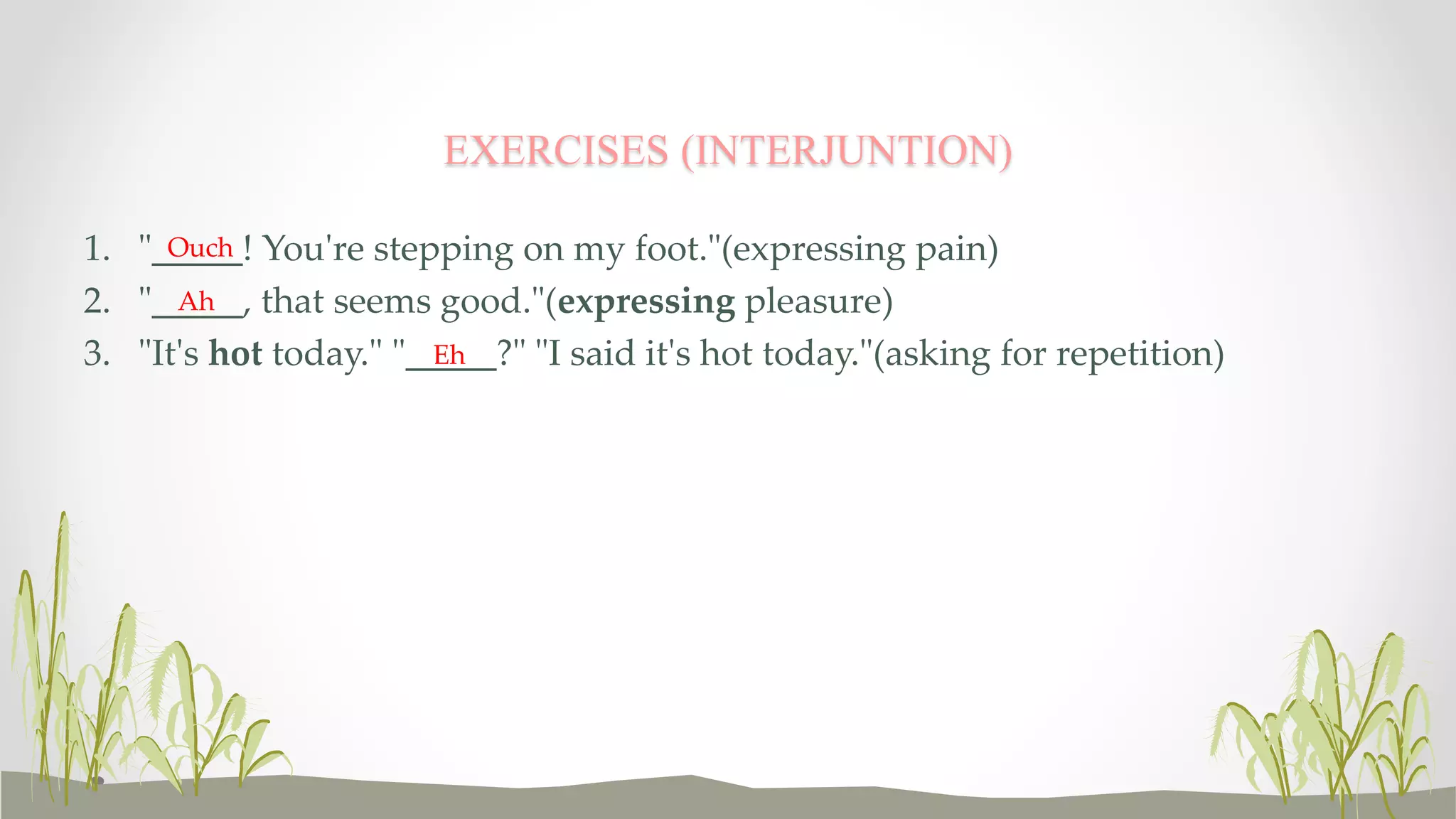
EXERCISES (INTERJUNTION) 
1. "_____! Ouch 
You're stepping on my foot."(expressing pain) 
2. "_____, Ah 
that seems good."(expressing pleasure) 
3. "It's hot today." "_____?" Eh 
"I said it's hot today."(asking for repetition)

Part of speech

  • 1.
    Part of speech ENGLISH LANGUAGE PROFICIENCY I Yong Hua Ai Nur Hazwani Binti Hasni Nursyamilah Binti Pauzan Mariya Sazwana Binti Mohd Syukri Lecturer’s Name : Madam Dashima Binti Abdul Wahab
  • 2.
    Nouns PART OF SPEECH Pronouns Adjectives Verbs Adverbs Interjunction Conjunction Prepositions
  • 3.
    NOUNS Abstract Nouns An abstract noun is a noun that names an idea, not a physical thing. Examples: Hope, interest, love, peace, ability, success, knowledge, trouble. Concrete Nouns A concrete noun is a noun that names a physical thing. Examples: Boy, table, floor, coffee, beach, king, rain, children, professor. Common Nouns A common noun is a noun that names a general thing, not a specific thing. Examples: Boy, girl, city, country, company, planet, location, war. Proper Nouns A proper noun is a noun that indicates the specific name of a thing. It begins with a capital letter. Examples: Robin, Alice, London, Sweden, Google, Earth, Eiffel Tower, Civil War. Countable Nouns A countable noun is a noun that indicates something you could actually count. Example : vase, chair, hat Uncountable Nouns An uncountable noun is a noun that indicates something you cannot count. Examples: Furniture, advice, mail,news, equi pment, luggage, work, coffee, information. a word that names a person, a place or a thing.
  • 4.
    Exercise (Nouns): 1.Each of the programs was taped. 2. Rachel is an heiress to a large fortune. 3. This author lives with her husband. 4. There is room for everybody to sit down. There are a lot of _________. chairs 5. George is unemployed. He's looking for a _____. job
  • 5.
    PRONOUNS •Personal pronouns represent people or things. The personal pronouns are: I, you, he, she, it, we, they, me, him, her, us, them. Personal Pronouns •Demonstrative pronouns point to things. The demonstrative pronouns are: this, that, these, those. Demonstrative Pronouns • Interrogative pronouns are used to ask questions. The interrogative pronouns are: who, whom, which, what, whoever, whatever, etc. Interrogative Pronouns •Relative pronouns are pronouns that link different parts of a sentence. The relative pronouns are: who, whom, which, that, whoever, etc. Relative Pronouns •An intensive pronoun is a pronoun used for emphasis. In other words, intensive pronouns emphasize the subject of the sentence. They are written exactly the same way as the reflexive pronouns, but their function is different. Intensive Pronouns • Indefinite pronouns are pronouns that do not refer to any specific person or thing. Examples: Anything, everybody, another, each, few, many, none, some. Indefinite Pronouns word that is used instead of a noun
  • 6.
    Exercise (Pronouns): 1.They have been training at this site. 2. We can do this by ourselves. 3. I am sitting on the sofa. 4. Is ____ she Kevin's sister? 5. Lucy has got a pet. ____ Her pet is a tortoise.
  • 7.
    ADJECTIVES Positive adjective •describe nouns •Big, small, large, tiny, enormous, little Comparative adjectives •Comparative adjective show us which thing is better, worse, stronger, weaker, and so forth. •Examples: Better, worse, bigger, smaller, nicer, fatter, thinner, more dangerous. Superlative adjectives •Superlative adjectives show us which thing is the best, the strongest, and so forth. •Examples: Best, worst, strongest, smallest, cheapest, most expensive. a word that describes a person or thing
  • 8.
    EXERCISE (ADJECTIVES) 1.I have a great idea. 2. The price is cheap. 3. I like hot food. 4. The flowers are pretty. 5. He is my new friend.
  • 9.
    VERBS a wordor group of words that express an action or a state Auxiliary Verbs • Auxiliary verbs are verbs that are used together with the main verb of the sentence to express the action or state. • The main auxiliary verbs are: be, am, is, are, was, were, do, did, have, has, had. Stative Verbs • Stative verbs are verbs that express a state rather than an action. • Examples: be, seem, love, own, want, sound, have, know, understand. Dynamic Verbs • Dynamic verbs are the opposite of stative verbs. They express a real action • Examples: Jump, swim, catch, write, call, sleep, hit, open, speak.
  • 10.
    Exercise (Verbs): 1.Please dispose of your garbage. 2. Brianna becomes hysterical whenever she hears a funny joke. 3. Maurice is preparing for his lab experiment. 4. Hi, I am ___ Matt Rotell, a friend of Alice's. 5. Ali was ___ in school yesterday evening
  • 11.
    ADVERBS Adverbs ofdegree •show us the strength or degree of the action or state •Examples: Very, highly, totally, perfectly, partially, almost. Adverbs of manner a word that describes or gives more information about a verb, an adjective, another adverb, or even the entire sentence •show us the way the action is done •Examples: Well, badly, nicely, slowly, loudly, quietly, happily, sadly, secretly, weakly. Adverbs of place •show us the location of the action or state •Examples: Home, here, there, outside, inside, away, around, anywhere, abroad, up, down, out. Adverbs of time show us the time of the action or state Examples: Now, soon, later, yesterday, tomorrow, early, before, lately, recently. Adverbs of frequency show us the frequency of the action or state Examples: Always, never, sometimes, often, rarely, usually, occasionally. Adverbs of duration show us the length of the action or state Examples: Forever, constantly, temporarily, briefly Adverbs of probability show us the chances for the action or state to happen Examples: Certainly, maybe, probably, possibly, surely.
  • 12.
    Exercise (Adverbs): 1.She gained fame quickly as a journalist. 2. My father sometimes comes home late in a week. 3. She came to London yesterday. 4. She is working _______. busily 5. Please, drive the car _________. carefully
  • 13.
    PREPOSITIONS • Awordthat is used before a noun or a pronoun to connect it to another word in the sentence. It is usually used to show location, direction, time, and so forth. Prepositions • on • in • by •under • above • beside • to • out • from
  • 14.
    EXERCISES (PREPOSITIONS) •She was confused ___ by trying to follow the lecture • I'm bored ___ of working for my company
  • 15.
    CONJUNCTION • aword that joins parts of a sentence together.
  • 16.
    EXERCISES (CONJUNCTION) 1.I need to work hard ………. so that I can pass the exam. 2. …………. Although he was the best candidate, he didn't win the elections. 3. …………. When you come back from your trip, we'll meet to discuss the problem. 4. They said that the movie was fantastic, ………… so I watched it. 5. ………….Although he was very ill, he didn't take any medicine.
  • 17.
    Wow! INTERJUNCTION Interjunction Look out ! Oh! Ah! Hey! • a short sound, word or phrase used to express the speaker's emotion
  • 18.
    EXERCISES (INTERJUNTION) 1."_____! Ouch You're stepping on my foot."(expressing pain) 2. "_____, Ah that seems good."(expressing pleasure) 3. "It's hot today." "_____?" Eh "I said it's hot today."(asking for repetition)