In What Ways Does Your Media
Product Use, Develop, or Challenge
Forms and Conventions Of Real
Media Products?
By Si Yau Tuong
• The title sequence created follows the codes
and conventions of a crime mystery film in
order to convey our narrative across to our
audience.
• The plot of our antagonist following his latest
victim before her death is portrayed through
the use of sound, editing, mise en scene and
cinematography.
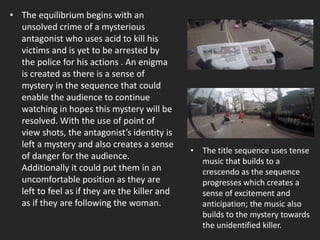
• The equilibrium begins with an
unsolved crime of a mysterious
antagonist who uses acid to kill his
victims and is yet to be arrested by
the police for his actions . An enigma
is created as there is a sense of
mystery in the sequence that could
enable the audience to continue
watching in hopes this mystery will be
resolved. With the use of point of
view shots, the antagonist’s identity is
left a mystery and also creates a sense
of danger for the audience.
Additionally it could put them in an
uncomfortable position as they are
left to feel as if they are the killer and
as if they are following the woman.
• The title sequence uses tense
music that builds to a
crescendo as the sequence
progresses which creates a
sense of excitement and
anticipation; the music also
builds to the mystery towards
the unidentified killer.
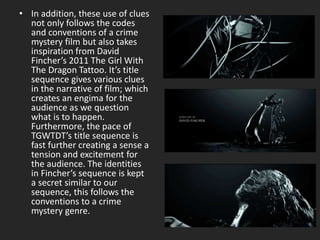
• In addition, these use of clues
not only follows the codes
and conventions of a crime
mystery film but also takes
inspiration from David
Fincher’s 2011 The Girl With
The Dragon Tattoo. It’s title
sequence gives various clues
in the narrative of film; which
creates an engima for the
audience as we question
what is to happen.
Furthermore, the pace of
TGWTDT’s title sequence is
fast further creating a sense a
tension and excitement for
the audience. The identities
in Fincher’s sequence is kept
a secret similar to our
sequence, this follows the
conventions to a crime
mystery genre.
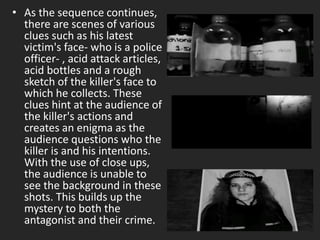
• As the sequence continues,
there are scenes of various
clues such as his latest
victim's face- who is a police
officer- , acid attack articles,
acid bottles and a rough
sketch of the killer's face to
which he collects. These
clues hint at the audience of
the killer's actions and
creates an enigma as the
audience questions who the
killer is and his intentions.
With the use of close ups,
the audience is unable to
see the background in these
shots. This builds up the
mystery to both the
antagonist and their crime.
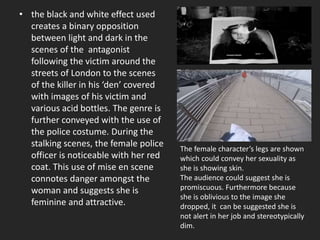
• the black and white effect used
creates a binary opposition
between light and dark in the
scenes of the antagonist
following the victim around the
streets of London to the scenes
of the killer in his ‘den’ covered
with images of his victim and
various acid bottles. The genre is
further conveyed with the use of
the police costume. During the
stalking scenes, the female police
officer is noticeable with her red
coat. This use of mise en scene
connotes danger amongst the
woman and suggests she is
feminine and attractive.
The female character’s legs are shown
which could convey her sexuality as
she is showing skin.
The audience could suggest she is
promiscuous. Furthermore because
she is oblivious to the image she
dropped, it can be suggested she is
not alert in her job and stereotypically
dim.
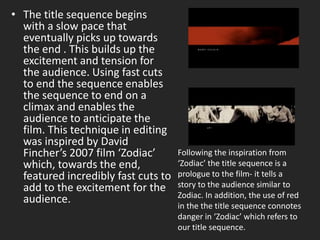
• The title sequence begins
with a slow pace that
eventually picks up towards
the end . This builds up the
excitement and tension for
the audience. Using fast cuts
to end the sequence enables
the sequence to end on a
climax and enables the
audience to anticipate the
film. This technique in editing
was inspired by David
Fincher’s 2007 film ‘Zodiac’
which, towards the end,
featured incredibly fast cuts to
add to the excitement for the
audience.
Following the inspiration from
‘Zodiac’ the title sequence is a
prologue to the film- it tells a
story to the audience similar to
Zodiac. In addition, the use of red
in the the title sequence connotes
danger in ‘Zodiac’ which refers to
our title sequence.
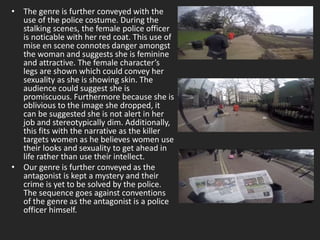
• The genre is further conveyed with the
use of the police costume. During the
stalking scenes, the female police officer
is noticable with her red coat. This use of
mise en scene connotes danger amongst
the woman and suggests she is feminine
and attractive. The female character’s
legs are shown which could convey her
sexuality as she is showing skin. The
audience could suggest she is
promiscuous. Furthermore because she is
oblivious to the image she dropped, it
can be suggested she is not alert in her
job and stereotypically dim. Additionally,
this fits with the narrative as the killer
targets women as he believes women use
their looks and sexuality to get ahead in
life rather than use their intellect.
• Our genre is further conveyed as the
antagonist is kept a mystery and their
crime is yet to be solved by the police.
The sequence goes against conventions
of the genre as the antagonist is a police
officer himself.

Part 4: Evaluation

  • 1.
    In What WaysDoes Your Media Product Use, Develop, or Challenge Forms and Conventions Of Real Media Products? By Si Yau Tuong
  • 2.
    • The titlesequence created follows the codes and conventions of a crime mystery film in order to convey our narrative across to our audience. • The plot of our antagonist following his latest victim before her death is portrayed through the use of sound, editing, mise en scene and cinematography.
  • 3.
    • The equilibriumbegins with an unsolved crime of a mysterious antagonist who uses acid to kill his victims and is yet to be arrested by the police for his actions . An enigma is created as there is a sense of mystery in the sequence that could enable the audience to continue watching in hopes this mystery will be resolved. With the use of point of view shots, the antagonist’s identity is left a mystery and also creates a sense of danger for the audience. Additionally it could put them in an uncomfortable position as they are left to feel as if they are the killer and as if they are following the woman. • The title sequence uses tense music that builds to a crescendo as the sequence progresses which creates a sense of excitement and anticipation; the music also builds to the mystery towards the unidentified killer.
  • 4.
    • In addition,these use of clues not only follows the codes and conventions of a crime mystery film but also takes inspiration from David Fincher’s 2011 The Girl With The Dragon Tattoo. It’s title sequence gives various clues in the narrative of film; which creates an engima for the audience as we question what is to happen. Furthermore, the pace of TGWTDT’s title sequence is fast further creating a sense a tension and excitement for the audience. The identities in Fincher’s sequence is kept a secret similar to our sequence, this follows the conventions to a crime mystery genre.
  • 5.
    • As thesequence continues, there are scenes of various clues such as his latest victim's face- who is a police officer- , acid attack articles, acid bottles and a rough sketch of the killer's face to which he collects. These clues hint at the audience of the killer's actions and creates an enigma as the audience questions who the killer is and his intentions. With the use of close ups, the audience is unable to see the background in these shots. This builds up the mystery to both the antagonist and their crime.
  • 6.
    • the blackand white effect used creates a binary opposition between light and dark in the scenes of the antagonist following the victim around the streets of London to the scenes of the killer in his ‘den’ covered with images of his victim and various acid bottles. The genre is further conveyed with the use of the police costume. During the stalking scenes, the female police officer is noticeable with her red coat. This use of mise en scene connotes danger amongst the woman and suggests she is feminine and attractive. The female character’s legs are shown which could convey her sexuality as she is showing skin. The audience could suggest she is promiscuous. Furthermore because she is oblivious to the image she dropped, it can be suggested she is not alert in her job and stereotypically dim.
  • 7.
    • The titlesequence begins with a slow pace that eventually picks up towards the end . This builds up the excitement and tension for the audience. Using fast cuts to end the sequence enables the sequence to end on a climax and enables the audience to anticipate the film. This technique in editing was inspired by David Fincher’s 2007 film ‘Zodiac’ which, towards the end, featured incredibly fast cuts to add to the excitement for the audience. Following the inspiration from ‘Zodiac’ the title sequence is a prologue to the film- it tells a story to the audience similar to Zodiac. In addition, the use of red in the the title sequence connotes danger in ‘Zodiac’ which refers to our title sequence.
  • 8.
    • The genreis further conveyed with the use of the police costume. During the stalking scenes, the female police officer is noticable with her red coat. This use of mise en scene connotes danger amongst the woman and suggests she is feminine and attractive. The female character’s legs are shown which could convey her sexuality as she is showing skin. The audience could suggest she is promiscuous. Furthermore because she is oblivious to the image she dropped, it can be suggested she is not alert in her job and stereotypically dim. Additionally, this fits with the narrative as the killer targets women as he believes women use their looks and sexuality to get ahead in life rather than use their intellect. • Our genre is further conveyed as the antagonist is kept a mystery and their crime is yet to be solved by the police. The sequence goes against conventions of the genre as the antagonist is a police officer himself.