Paraneoplastic
Syndrome
Presented By
Dr.Md.Mushfequr Rahman Khan
FCPS Core Medicine Trainee
Medicine Unit-VI,DMCH
Objetives:
• Definition
• Epidemiology
• Mechanism
• Classification
• Explain how to evaluate a patient for paraneoplastic syndrome
• Treatment option available for Paraneoplastic syndrome
• Differential Diagnosis
• Prognosis
• Reference
Definition :
• Paraneoplastic Syndromes are rare disorders that are triggered by an
altered immune system response to a neoplasm.
• They are defined as clinical syndromes involving non-metastatic
systemic effects that accompany malignant disease.
• The first report of a paraneoplastic syndrome dates back to the 19th
century.
Epidemiology:
• The precise incidence and prevalence of paraneoplastic syndrome are
unknown because of the rarity of the disease.
• A literature review suggests that paraneoplastic syndrome occurs in up
to 8% of cancer patients.
• Neurology manifestation in the form of neuropathies are the most
common presentation.
• Male and female are affected equally.
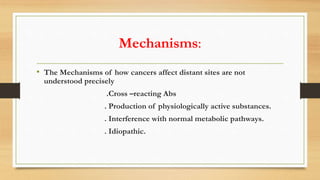
Mechanisms:
• The Mechanisms of how cancers affect distant sites are not
understood precisely
.Cross –reacting Abs
. Production of physiologically active substances.
. Interference with normal metabolic pathways.
. Idiopathic.
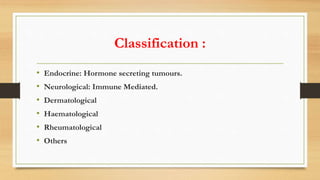
Classification :
• Endocrine: Hormone secreting tumours.
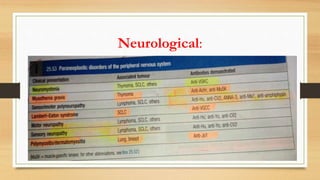
• Neurological: Immune Mediated.
• Dermatological
• Haematological
• Rheumatological
• Others
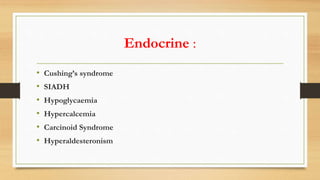
Endocrine :
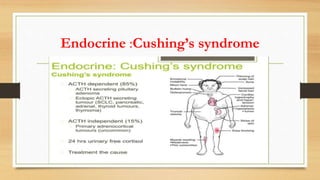
• Cushing’s syndrome
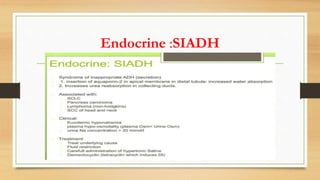
• SIADH
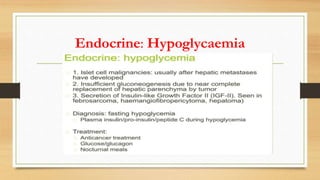
• Hypoglycaemia
• Hypercalcemia
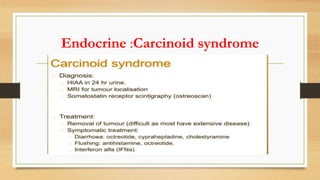
• Carcinoid Syndrome
• Hyperaldesteronism
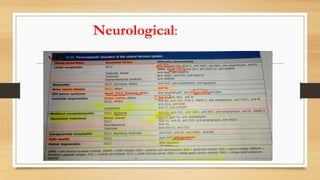
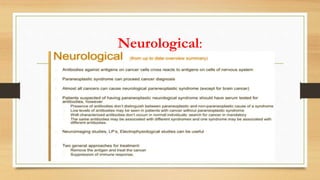
Neurological:
Neurological:
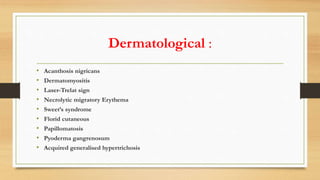
Dermatological :
• Acanthosis nigricans
• Dermatomyositis
• Laser-Trelat sign
• Necrolytic migratory Erythema
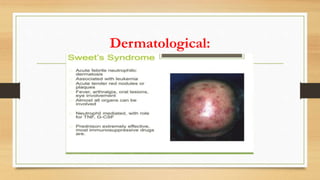
• Sweet’s syndrome
• Florid cutaneous
• Papillomatosis
• Pyoderma gangrenosum
• Acquired generalised hypertrichosis
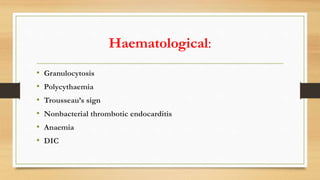
Haematological:
• Granulocytosis
• Polycythaemia
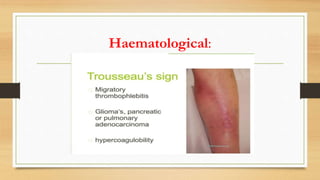
• Trousseau’s sign
• Nonbacterial thrombotic endocarditis
• Anaemia
• DIC
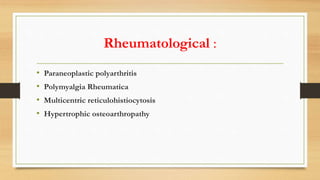
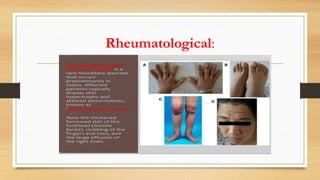
Rheumatological :
• Paraneoplastic polyarthritis
• Polymyalgia Rheumatica
• Multicentric reticulohistiocytosis
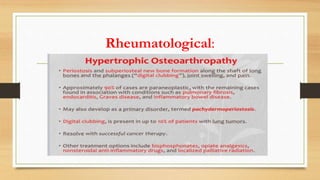
• Hypertrophic osteoarthropathy
Others:
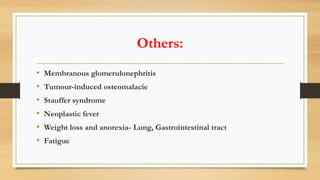
• Membranous glomerulonephritis
• Tumour-induced osteomalacie
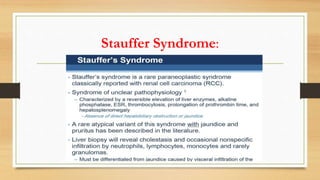
• Stauffer syndrome
• Neoplastic fever
• Weight loss and anorexia- Lung, Gastrointestinal tract
• Fatigue
Endocrine :Cushing’s syndrome
Endocrine :SIADH
Endocrine: Hypoglycaemia
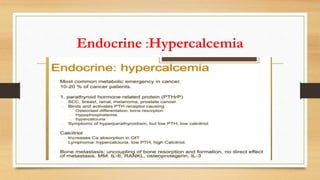
Endocrine :Hypercalcemia
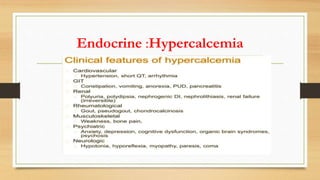
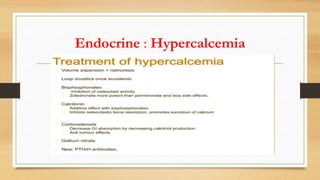
Endocrine : Hypercalcemia
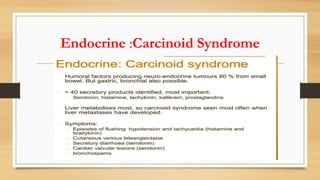
Endocrine :Carcinoid Syndrome
Endocrine :Carcinoid syndrome
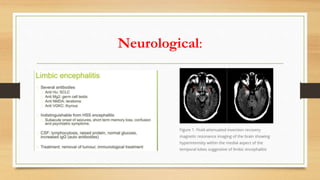
Neurological:
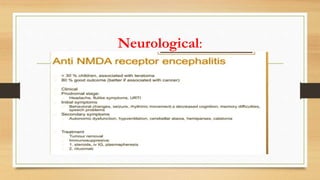
Neurological:
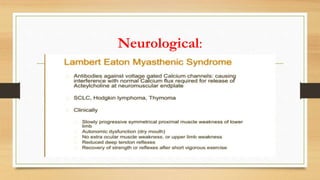
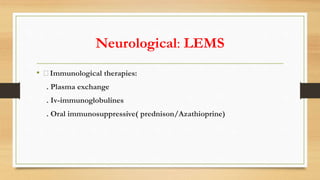
Neurological:LEMS
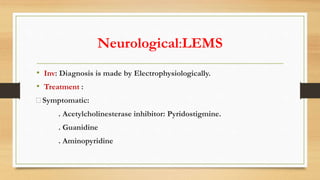
• Inv: Diagnosis is made by Electrophysiologically.
• Treatment :
🧵Symptomatic:
. Acetylcholinesterase inhibitor: Pyridostigmine.
. Guanidine
. Aminopyridine
Neurological: LEMS
• 🧵Immunological therapies:
. Plasma exchange
. Iv-immunoglobulines
. Oral immunosuppressive( prednison/Azathioprine)
LEMS VS Myasthenia Gravis
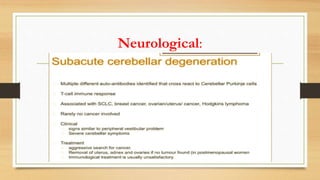
Neurological:
Neurological:
Neurological:
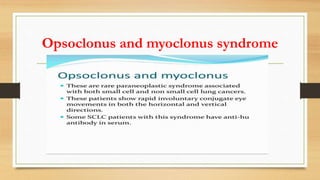
Opsoclonus and myoclonus syndrome
Dermatological:
Dermatological:
Dermatological:
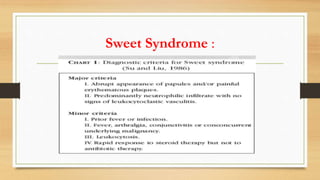
Sweet Syndrome :
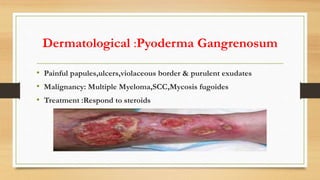
Dermatological :Pyoderma Gangrenosum
• Painful papules,ulcers,violaceous border & purulent exudates
• Malignancy: Multiple Myeloma,SCC,Mycosis fugoides
• Treatment :Respond to steroids
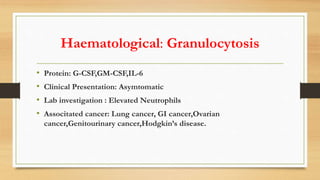
Haematological: Granulocytosis
• Protein: G-CSF,GM-CSF,IL-6
• Clinical Presentation: Asymtomatic
• Lab investigation : Elevated Neutrophils
• Associtated cancer: Lung cancer, GI cancer,Ovarian
cancer,Genitourinary cancer,Hodgkin’s disease.
Haematological:
Rheumatological:
Rheumatological:
Rheumatological:
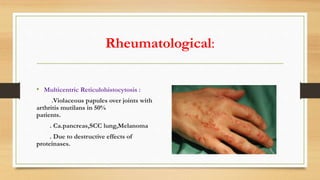
• Multicentric Reticulohistocytosis :
.Violaceous papules over joints with
arthritis mutilans in 50%
patients.
. Ca.pancreas,SCC lung,Melanoma
. Due to destructive effects of
proteinases.
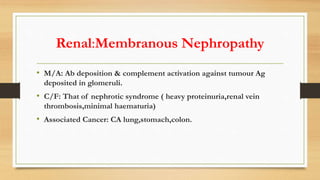
Renal:Membranous Nephropathy
• M/A: Ab deposition & complement activation against tumour Ag
deposited in glomeruli.
• C/F: That of nephrotic syndrome ( heavy proteinuria,renal vein
thrombosis,minimal haematuria)
• Associated Cancer: CA lung,stomach,colon.
Stauffer Syndrome:
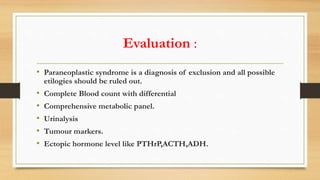
Evaluation :
• Paraneoplastic syndrome is a diagnosis of exclusion and all possible
etilogies should be ruled out.
• Complete Blood count with differential
• Comprehensive metabolic panel.
• Urinalysis
• Tumour markers.
• Ectopic hormone level like PTHrP,ACTH,ADH.
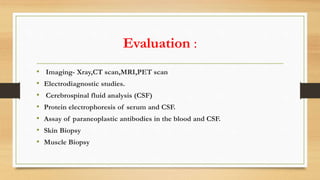
Evaluation :
• Imaging- Xray,CT scan,MRI,PET scan
• Electrodiagnostic studies.
• Cerebrospinal fluid analysis (CSF)
• Protein electrophoresis of serum and CSF.
• Assay of paraneoplastic antibodies in the blood and CSF.
• Skin Biopsy
• Muscle Biopsy
Differential Diagnosis :
• Toxic Metabolic encephalopathy-rule out underlying infections &
electrolyte abnormalities.
• Infectious encephalitis :rule out any bacterial, viral or fungal etiologies
• Myelitis:rule out infectious or inflammatory causes.
• Chronic fatigue syndrome
• Mixed connective tissue disorder
• Bone marrow failure
Prognosis:
• Paraneoplastic syndrome have diverse clinical manifestations and hence
prognosis may vary.
• Few paraneoplastic disorders may resolve spontaneously or with primary
cancer treatment.
• Death may result from the underlying :
-progression of cancer
-from complications of cancer treatments
-an irreversible system impairment
Reference :
• 1) Davidson 23rd edition
• 2) https://www.slideshare.net/jameswheeler001/paraneoplastic-
syndromes-36986377
• 3) https://www.ncbi.nlm.nih.gov/books/NBK507890/
• 4) https://www.slideshare.net/IhabSamy/para-neoplastic-malignant-
syndromes
• 5) Wikipedia
Paraneoplastic Syndrome.pptx

Paraneoplastic Syndrome.pptx