

PARAGRAPHS Natasha Luepke
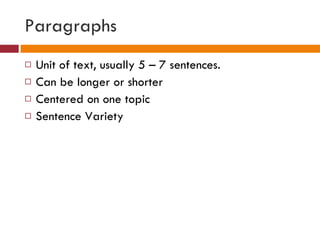
Paragraphs Unit of text, usually 5 – 7 sentences. Can be longer or shorter Centered on one topic Sentence Variety
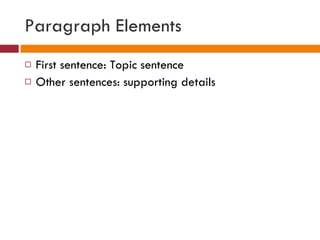
Paragraph Elements First sentence: Topic sentence Other sentences: supporting details
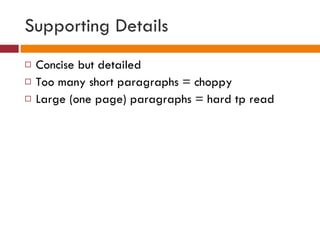
Supporting Details Concise but detailed Too many short paragraphs = choppy Large (one page) paragraphs = hard tp read
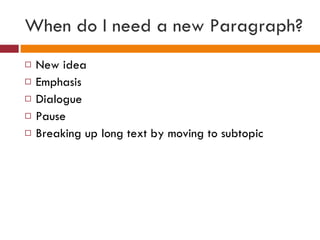
When do I need a new Paragraph? New idea Emphasis Dialogue Pause Breaking up long text by moving to subtopic
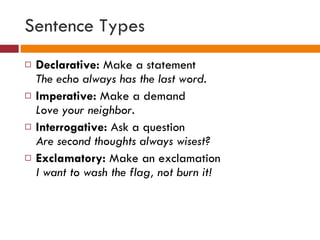
Sentence Types Declarative:  Make a statement The echo always has the last word. Imperative:  Make a demand Love your neighbor. Interrogative:  Ask a question Are second thoughts always wisest? Exclamatory:  Make an exclamation I want to wash the flag, not burn it!
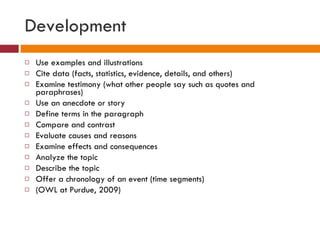
Development  Use examples and illustrations Cite data (facts, statistics, evidence, details, and others) Examine testimony (what other people say such as quotes and paraphrases) Use an anecdote or story Define terms in the paragraph Compare and contrast Evaluate causes and reasons Examine effects and consequences Analyze the topic Describe the topic Offer a chronology of an event (time segments) (OWL at Purdue, 2009)
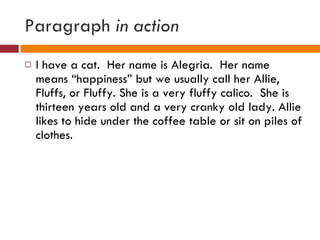
Paragraph  in action I have a cat.  Her name is Alegria.  Her name means “happiness” but we usually call her Allie, Fluffs, or Fluffy. She is a very fluffy calico.  She is thirteen years old and a very cranky old lady. Allie likes to hide under the coffee table or sit on piles of clothes.
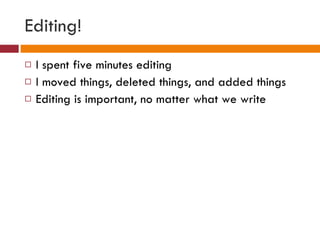
Editing! I spent five minutes editing  I moved things, deleted things, and added things Editing is important, no matter what we write
Questions, Comments, Concerns?

Paragraphs

  • 1.
  • 2.
    Paragraphs Unit oftext, usually 5 – 7 sentences. Can be longer or shorter Centered on one topic Sentence Variety
  • 3.
    Paragraph Elements Firstsentence: Topic sentence Other sentences: supporting details
  • 4.
    Supporting Details Concisebut detailed Too many short paragraphs = choppy Large (one page) paragraphs = hard tp read
  • 5.
    When do Ineed a new Paragraph? New idea Emphasis Dialogue Pause Breaking up long text by moving to subtopic
  • 6.
    Sentence Types Declarative: Make a statement The echo always has the last word. Imperative: Make a demand Love your neighbor. Interrogative: Ask a question Are second thoughts always wisest? Exclamatory: Make an exclamation I want to wash the flag, not burn it!
  • 7.
    Development Useexamples and illustrations Cite data (facts, statistics, evidence, details, and others) Examine testimony (what other people say such as quotes and paraphrases) Use an anecdote or story Define terms in the paragraph Compare and contrast Evaluate causes and reasons Examine effects and consequences Analyze the topic Describe the topic Offer a chronology of an event (time segments) (OWL at Purdue, 2009)
  • 8.
    Paragraph inaction I have a cat. Her name is Alegria. Her name means “happiness” but we usually call her Allie, Fluffs, or Fluffy. She is a very fluffy calico. She is thirteen years old and a very cranky old lady. Allie likes to hide under the coffee table or sit on piles of clothes.
  • 9.
    Editing! I spentfive minutes editing I moved things, deleted things, and added things Editing is important, no matter what we write
  • 10.