Blockchain, Cryptocurrency & Apps
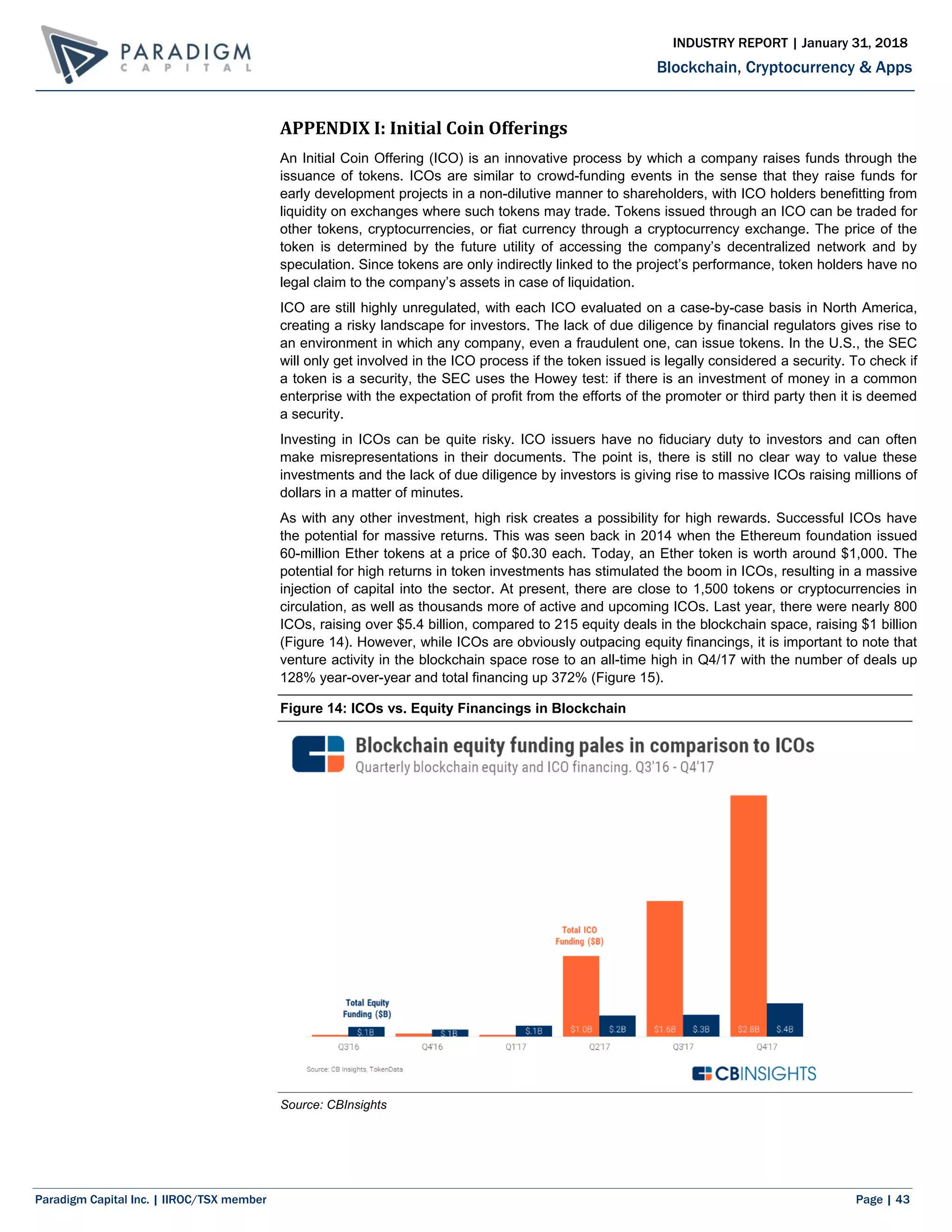
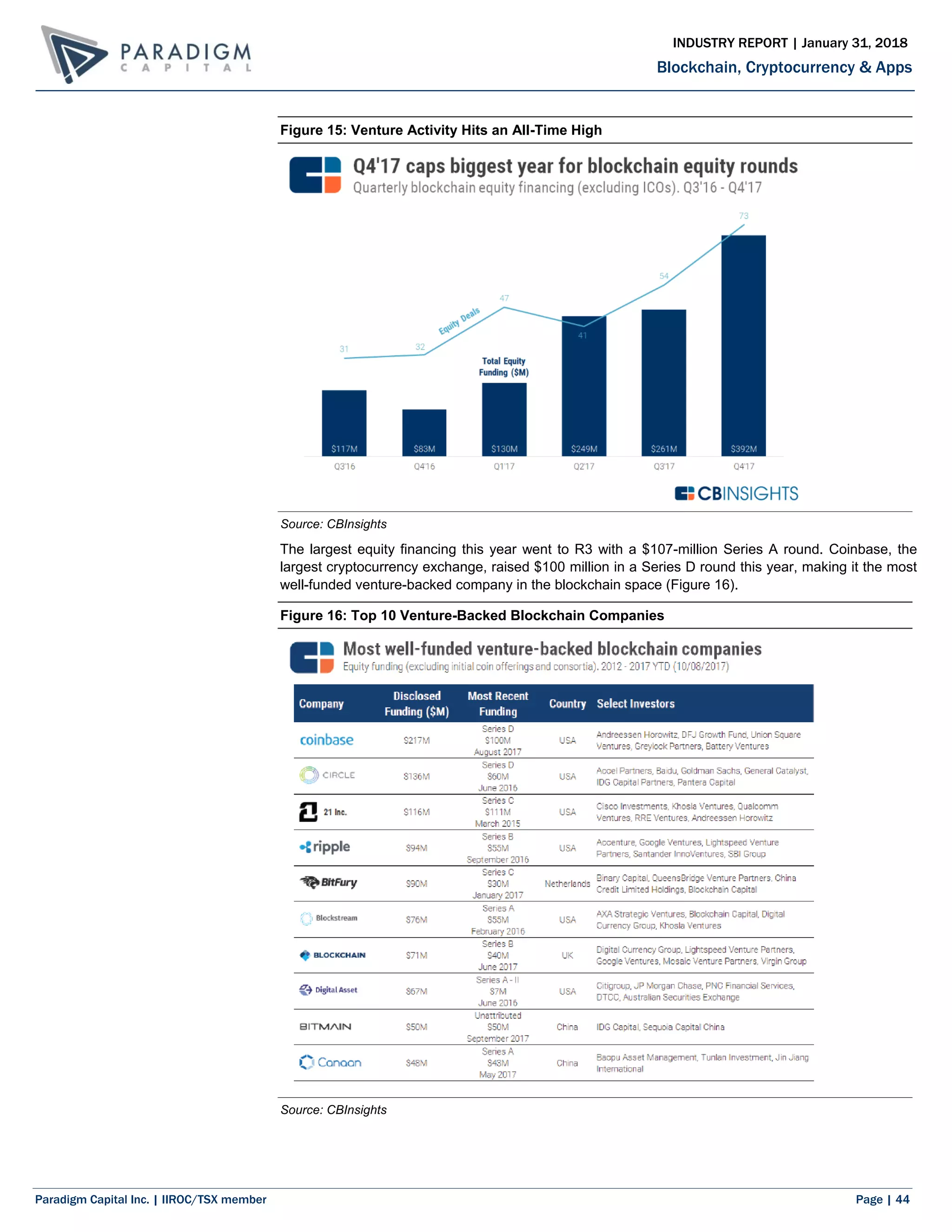
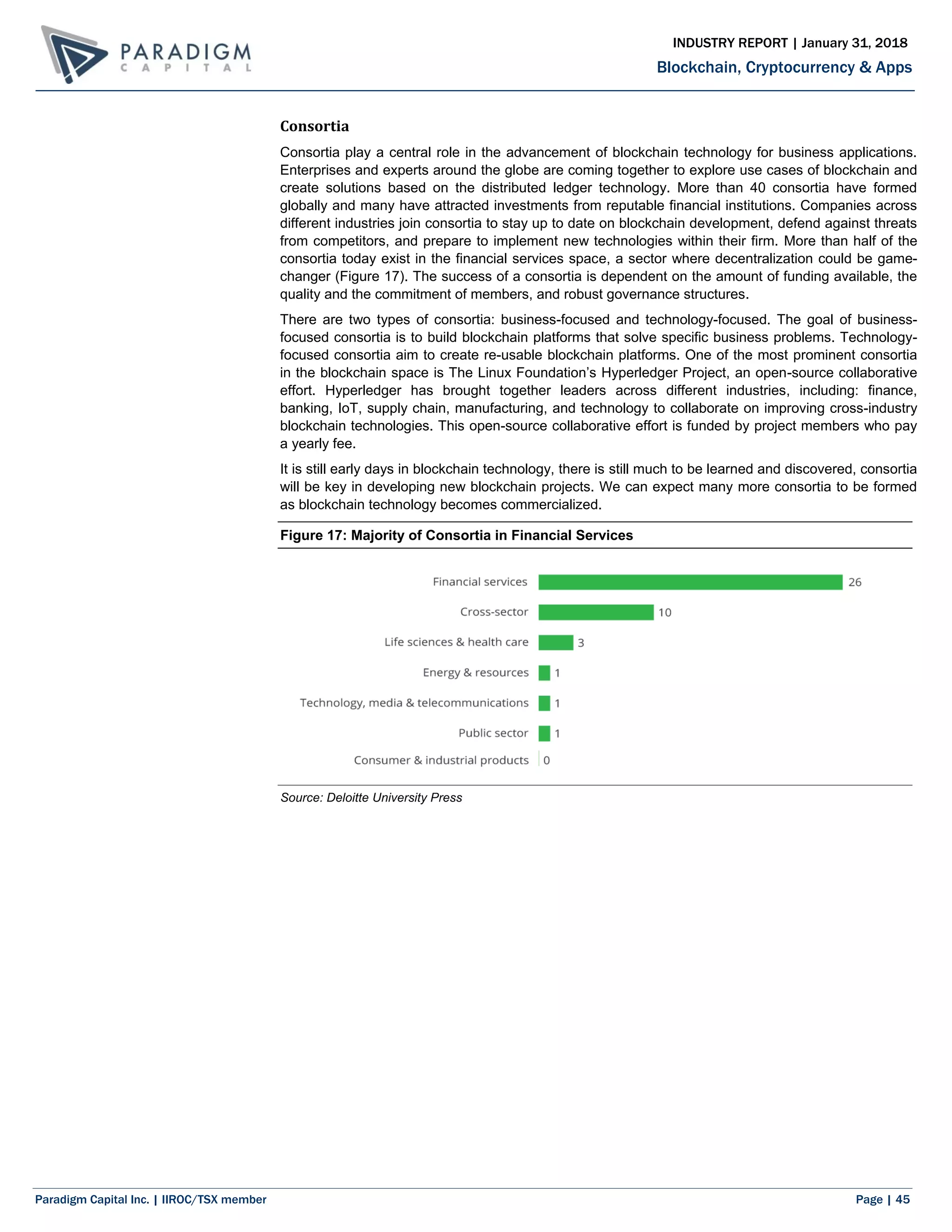
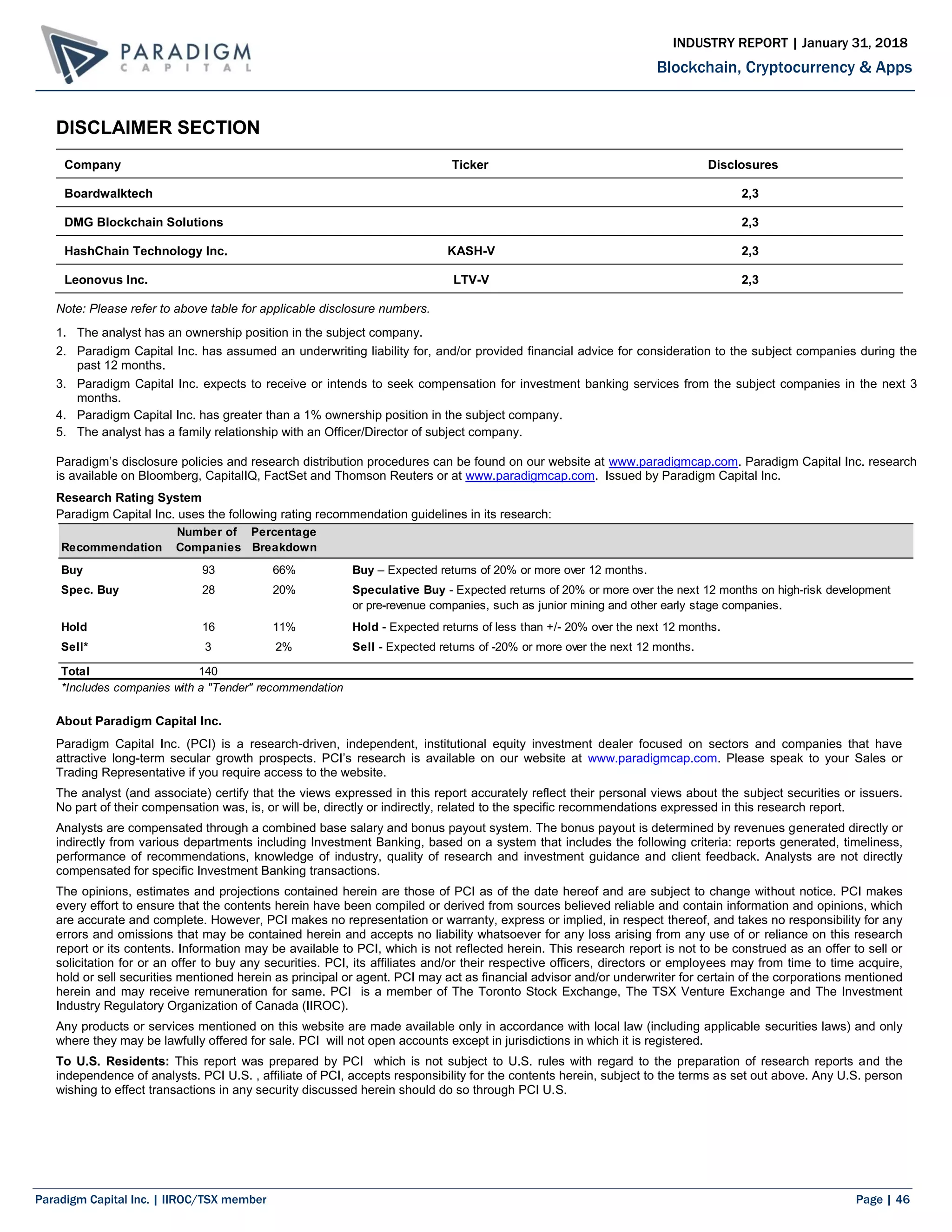
Our disclosure statements are located at the end of this report.
INDUSTRY REPORT | January 31, 2018
Investment Opportunities in Blockchain
We do not intend to fully define what blockchain is in this report. This is more than well
documented with innumerable industry reports. Blockchain will deliver cost savings
and prosperity to the masses that the Internet alone failed to reach. We look to several
key elements of blockchain to assess its market potential. First, like the Internet, it has
the potential to massively disintermediate business processes and to redefine entire
industries. More importantly, blockchain will unlock near endless new business
opportunities. By definition, these two factors imply blockchain would have at least a
similar market impact as the Internet itself. But blockchain has the capability to deliver
something the Internet has not — democratization of wealth of the unbanked global
masses.
Miners
Traditional mining companies (gold, silver, copper, etc.) and pulp and paper mills have
left a trail of deserted outposts and mining towns with world-class infrastructure (high-
speed fiber optics; stable, renewable and inexpensive hydroelectricity). Ironically,
these are basic ingredients necessary to build world-class cryptocurrency mining
operations. Add to the mix: sub-Arctic temperatures, willing local government, world-
class global reputation and now receptive capital markets, will make Canada a global
leader in securing the blockchain.
Apps
While Bitcoin serves as the world’s first blockchain application, it has been Ethereum
that has driven the blockchain apps revolution. Ethereum dominates the landscape by
a wide margin, accounting for ~90% of the total combined value of the top 500 tokens.
We see token values being driven a mix of network utility and ownership in
decentralized applications, with much potential for disrupting centralized models and
radically shifting the distribution of wealth from incumbents to protocol developers.
Almost all industries will be impacted by blockchain, with enterprises poised to more
meaningfully explore its use over the coming years.
Cryptocurrency
During the Internet bubble between 1997 and 2000, a total of 522 dotcom companies
were listed, raising more than $43 billion. The Nasdaq peak market cap was $6.6
trillion, with the dotcoms representing one-third of that total. Blockchain companies by
comparison currently have a combined market cap of only $6 billion. The headlines,
however, centre around cryptocurrencies which have a massive $510-billion combined
market cap. Bitcoin follows Metcalfe’s law, however taking this one step further, using
a price-to-Metcalfe value suggests Bitcoin has plenty of room for price appreciation.
Deeper still, Zipf’s law is a useful tool for trading cryptocurrencies as it demonstrates a
logarithmic relationship (Golden Ratio) between the various cryptocurrencies.
Conclusion
Within this report we have put together a complete list of every Canadian and U.S.
blockchain/cryptocurrency publicly traded company. We have also included a portfolio
of next-generation private companies who we believe hold great promise of becoming
tomorrow’s market darlings. Blockchain and decentralized applications will
undoubtedly have a profound impact on all business processes. The stock market is
clearly pricing in some of the impact of this new protocol; however, we are in the early
innings of a long game. We put forth in this report why investors cannot ignore
blockchain’s potential as we believe the opportunity for outsized returns has just
begun.
Daniel Kim, Analyst | 416.363.6644 | dkim@paradigmcap.com
Kevin Krishnaratne, Analyst | 416.361.6054 | kkrishnaratne@paradigmcap.com
Daniela Campo, Associate | 416.216.3574 | dcampo@paradigmcap.com
All figures in US$, unless otherwise noted.
Companies discussed in this report:
MINERS
CryptoGlobal Inc. (CPTO-V, NR): Operates facilities
with ASIC and GPU mining, with the ability to shift hash
power to take advantage of the most profitable coins.
DMG Blockchain Solutions (listing pending):
Specializes in Bitcoin mining, Mining as a Service
(MaaS), blockchain platform development, and
blockchain analytics.
Fortress Blockchain Corp. (private): Operates
mining facilities in low-cost and environmentally friendly
power regions.
Great North Data (private): Specializes in hosting
high-density computer hardware requiring substantial
access to both power and cooling.
HashChain Technology Inc. (KASH-V, NR): First
publicly traded Canadian cryptocurrency mining
company to support highly scalable and flexible
operations across all major cryptocurrencies.
Hyperblock Technologies Corp. (private): Operates
across four channels: self-mining, hashrate sales,
server hosting, and server hardware sales.
APPS
Auxesis (private): Created the world’s largest private
decentralized network which powers the Auxledger
blockchain platform.
Blockchain Intelligence Group (BIGG-CNQ, NR):
Brings security and accountability to cryptocurrency
with its trusted data analysis and risk-scoring
capabilities.
Boardwalktech (private): Developed a positional cell
data management tech that forms the core of a
patented, multi-party digital ledger blockchain database
designed for collaborative applications which rely on
digital information exchange.
Leonovus Inc. (LTV-V, NR): Offers a blockchain
hardened software-defined object storage solution.
Polymath (private): Guides customers through the
technical and legal process of a successful token
launch.
TradeWind Markets (private): Creating a technology
that will enhance the experience of trading, owning,
and using precious metals.
Victory Square Technologies Inc. (VST-CNQ, NR): A
venture builder that incubates and invests in technology
businesses focused on blockchain, AI, VR, and more.
TECHNOLOGY
Paradigm Capital Inc. | IIROC/TSX member Page | 2
Blockchain, Cryptocurrency & Apps
INDUSTRY REPORT | January 31, 2018
Table of Contents
Blockchain Is Just Math But Its Promise Is Revolutionary ..................................................3
Value Proposition Is Unstoppable................................................................................3
Market Size.........................................................................................................................4
Blockchain Market .......................................................................................................4
Cyclenomics ................................................................................................................4
Bubble Perspective......................................................................................................6
Cryptocurrency....................................................................................................................7
Cryptocurrency Market Size.........................................................................................7
Securely Canadian..............................................................................................................8
Blockchain Applications ....................................................................................................11
Bitcoin: Scalability Looks to Limit the Viability of Blockchain’s First Application ........11
Ethereum: The De Facto Blockchain Applications Platform.......................................12
Tokenomics ...............................................................................................................13
Overview of the World’s (Currently) Most Valuable Tokens.......................................15
Industries Most Likely to Be Impacted by Blockchain Applications ............................16
Enterprise Applications of Blockchain........................................................................17
Investment Opportunities ..................................................................................................19
Company Profiles..............................................................................................................22
APPENDIX I: Initial Coin Offerings....................................................................................43
Paradigm Capital Inc. | IIROC/TSX member Page | 3
Blockchain, Cryptocurrency & Apps
INDUSTRY REPORT | January 31, 2018
Blockchain Is Just Math But Its Promise Is Revolutionary
“Almost every company in the world, not just intermediaries, is at risk of being cannibalized from a
blockchain version of themselves. We are at the ground floor of a new paradigm in humanity that will
change the human experience. The thing that will change is trust.” (source: Richie Etwaru).
While it is too early to point to any single application, except Bitcoin, blockchain and decentralized
applications (Dapps) will undoubtedly have a profound impact in all business processes. The stock
market is clearly pricing in some of the impact of this new protocol; however, we are in the early
innings of a long game. We put forth in this report why investors cannot ignore blockchain’s potential
as we believe the opportunity for outsized returns has just begun.
Value Proposition Is Unstoppable
We look to several key elements of blockchain to assess its market potential. First, like the Internet, it
has the potential to massively disintermediate business processes and to redefine some entire
industries. More importantly, blockchain will unlock near endless new business opportunities. By
definition, these two factors imply blockchain would have at least a similar market impact as the
Internet itself. But blockchain has the capability to deliver something the Internet has not —
democratization of wealth of the unbanked global masses.
Blockchain will facilitate the largest asset transfers in human history “moving trillions of dollars from
millions of bank accounts to millions of Circle wallets” (source: Blockchain Revolution).
Facebook and Google were early to recognize the potential value of tapping into the unbanked market
of two-billion people with independent initiatives to provide inexpensive, broadband Internet access.
The value, however, accrues to companies who provide this consolidation role and not the users
whom they serve. Blockchain will democratize them. By leveling the playing field, lowering the cost of
doing business, and providing liquidity to two-billion untapped resources, it will unleash enormous
wealth creation and thus global growth.
We do not intend to fully define what blockchain is in this report. Blockchain is just math. This math,
however, will deliver cost savings and prosperity that the Internet alone failed to do. Below, we
summarize blockchain’s value proposition in five key bullets.
1. Trust: Establishes trust between independent parties; therefore, risk disappears for any
transaction. Furthermore, the level of distrust between parties is widening. This is particularly true
for financial services firms who are the most distrusted organizations on the planet.
2. Democratization of Wealth: Trust breaks down barriers which will bring the unbanked two-billion
people into the global economy.
3. Monetize Users: Companies whose value is defined by the number of users it attracts (e.g., Uber,
Airbnb, Google, Facebook, Amazon) will be disrupted. Blockchain will marginalize these
organizations and deliver more accrued value of these consolidators to its users.
4. Connect Capital to Investors: Opportunities for ordinary people to invest in tomorrow’s Google
are often limited to high-profile private equity firms who then work with their favoured investment
bank(s) for public offerings, which are typically limited to only their top clients. Initial coin offerings
(ICOs) offer anyone the opportunity to invest in these companies, thus leveling the playing field of
investable opportunities.
5. Disrupt Information Flow: Transactions posted on the blockchain are public for everyone to see.
Furthermore, the precise history of the entire transaction will be saved in perpetuity. (The opposite
is also true with private blockchains where only permissioned users have access to the
transactional data.) Imagine a corporation on blockchain where its financial health is posted in real
time. This will provide a constant stream of information, thus obviating the need, for example, of
quarterly filings, therefore leveling the playing field of information distribution and analysis.
Paradigm Capital Inc. | IIROC/TSX member Page | 4
Blockchain, Cryptocurrency & Apps
INDUSTRY REPORT | January 31, 2018
Market Size
Given its disruptive promise and industry-wide corporate buy-in, it comes as no surprise that every
industry we have researched has suggested explosive growth in the blockchain industry. Our key
findings are summarized with a range of 26–80% CAGR of an industry, growing to $6–$45 billion over
the next 5–10 years.
Blockchain Market
 Market size of $412 million in 2017 growing to $7.7 billion by 2022, representing 80% CAGR.
Looking further out, blockchain is expected to be a $45-billion industry in the next decade. (source:
ResearchandMarkets, Blockchain Market by Provider, Organziation Size, Vertical and Region).
 According to a recent report published by IndustryARC, the global blockchain market is expected
to grow at a 48% CAGR and reach $6 billion by 2023. North America is expected to dominate the
market with blockchain technology applied to payments, digital identities, smart contracts, and
identities.
 The World Economic Forum predicts 10% of global GDP will be stored on the blockchain by 2027.
It also estimates that 80% of banks are working on private blockchain applications and are
estimated to be spending $200 million on the development of these applications in 2017.
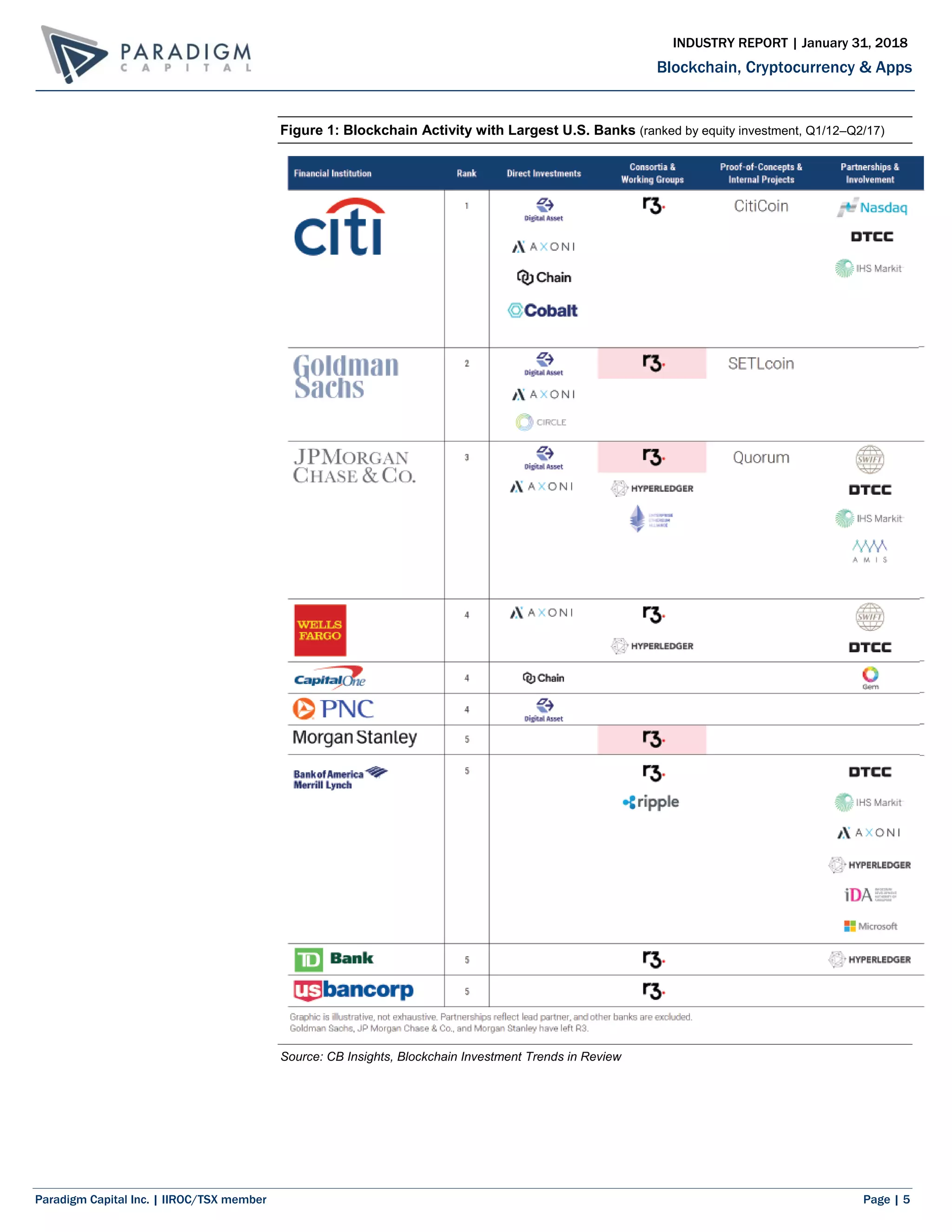
Furthermore, a report from CB Insights highlighted that since June 2014 the 10 largest U.S. banks
have participated in nine rounds of blockchain investments totaling $267 million (Figure 1).
Cyclenomics
We lived through the dotcom bubble and subsequent implosion. The following data demonstrates that
investors have elevated the combined market caps of blockchain companies faster than during the
dotcom bubble; however, we counter with two observations. First, the velocity of information is much
faster and broader today than it was 20 years ago. My first job as a research associate (in 1994)
required trips to the Toronto Reference Library to make copies off microfiche! Second, as previously
mentioned, blockchain’s impact on commerce, business processes, and wealth distribution should
have a more meaningful impact global growth than the Internet, so the early gains on stocks and larger
valuations are warranted, in our opinion.
Paradigm Capital Inc. | IIROC/TSX member Page | 5
Blockchain, Cryptocurrency & Apps
INDUSTRY REPORT | January 31, 2018
Figure 1: Blockchain Activity with Largest U.S. Banks (ranked by equity investment, Q1/12–Q2/17)
Source: CB Insights, Blockchain Investment Trends in Review
Paradigm Capital Inc. | IIROC/TSX member Page | 6
Blockchain, Cryptocurrency & Apps
INDUSTRY REPORT | January 31, 2018
Bubble Perspective
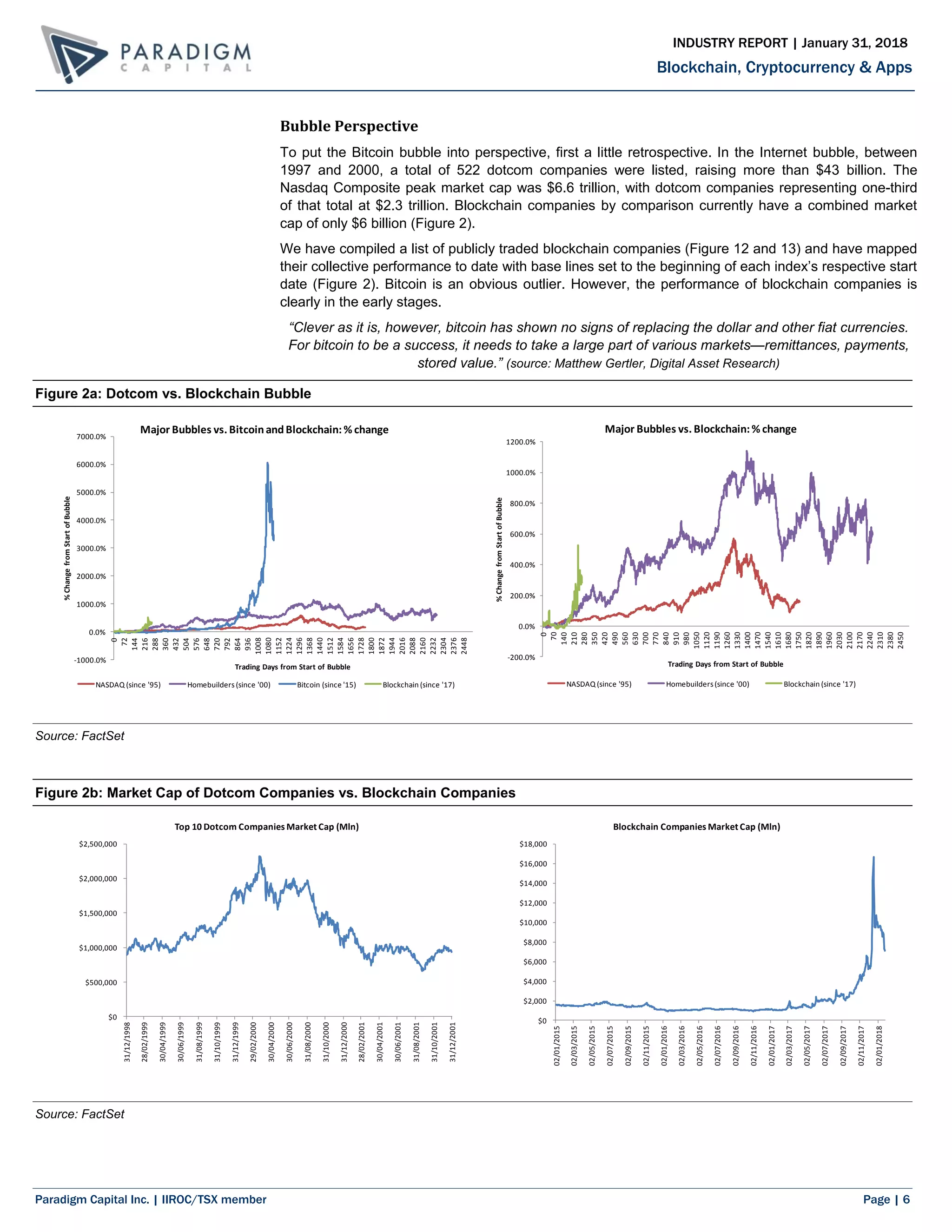
To put the Bitcoin bubble into perspective, first a little retrospective. In the Internet bubble, between
1997 and 2000, a total of 522 dotcom companies were listed, raising more than $43 billion. The
Nasdaq Composite peak market cap was $6.6 trillion, with dotcom companies representing one-third
of that total at $2.3 trillion. Blockchain companies by comparison currently have a combined market
cap of only $6 billion (Figure 2).
We have compiled a list of publicly traded blockchain companies (Figure 12 and 13) and have mapped
their collective performance to date with base lines set to the beginning of each index’s respective start
date (Figure 2). Bitcoin is an obvious outlier. However, the performance of blockchain companies is
clearly in the early stages.
“Clever as it is, however, bitcoin has shown no signs of replacing the dollar and other fiat currencies.
For bitcoin to be a success, it needs to take a large part of various markets—remittances, payments,
stored value.” (source: Matthew Gertler, Digital Asset Research)
Figure 2a: Dotcom vs. Blockchain Bubble
Source: FactSet
Figure 2b: Market Cap of Dotcom Companies vs. Blockchain Companies
Source: FactSet
-1000.0%
0.0%
1000.0%
2000.0%
3000.0%
4000.0%
5000.0%
6000.0%
7000.0%
0
72
144
216
288
360
432
504
576
648
720
792
864
936
1008
1080
1152
1224
1296
1368
1440
1512
1584
1656
1728
1800
1872
1944
2016
2088
2160
2232
2304
2376
2448
%ChangefromStartofBubble
Trading Days from Start of Bubble
Major Bubbles vs. BitcoinandBlockchain:% change
NASDAQ (since '95) Homebuilders(since '00) Bitcoin (since '15) Blockchain (since '17)
-200.0%
0.0%
200.0%
400.0%
600.0%
800.0%
1000.0%
1200.0%
0
70
140
210
280
350
420
490
560
630
700
770
840
910
980
1050
1120
1190
1260
1330
1400
1470
1540
1610
1680
1750
1820
1890
1960
2030
2100
2170
2240
2310
2380
2450
%ChangefromStartofBubble
Trading Days from Start of Bubble
Major Bubbles vs. Blockchain:% change
NASDAQ (since '95) Homebuilders(since '00) Blockchain (since '17)
$0
$2,000
$4,000
$6,000
$8,000
$10,000
$12,000
$14,000
$16,000
$18,000
02/01/2015
02/03/2015
02/05/2015
02/07/2015
02/09/2015
02/11/2015
02/01/2016
02/03/2016
02/05/2016
02/07/2016
02/09/2016
02/11/2016
02/01/2017
02/03/2017
02/05/2017
02/07/2017
02/09/2017
02/11/2017
02/01/2018
Blockchain Companies Market Cap (Mln)
$0
$500,000
$1,000,000
$1,500,000
$2,000,000
$2,500,000
31/12/1998
28/02/1999
30/04/1999
30/06/1999
31/08/1999
31/10/1999
31/12/1999
29/02/2000
30/04/2000
30/06/2000
31/08/2000
31/10/2000
31/12/2000
28/02/2001
30/04/2001
30/06/2001
31/08/2001
31/10/2001
31/12/2001
Top 10 Dotcom Companies Market Cap (Mln)
Paradigm Capital Inc. | IIROC/TSX member Page | 7
Blockchain, Cryptocurrency & Apps
INDUSTRY REPORT | January 31, 2018
Cryptocurrency
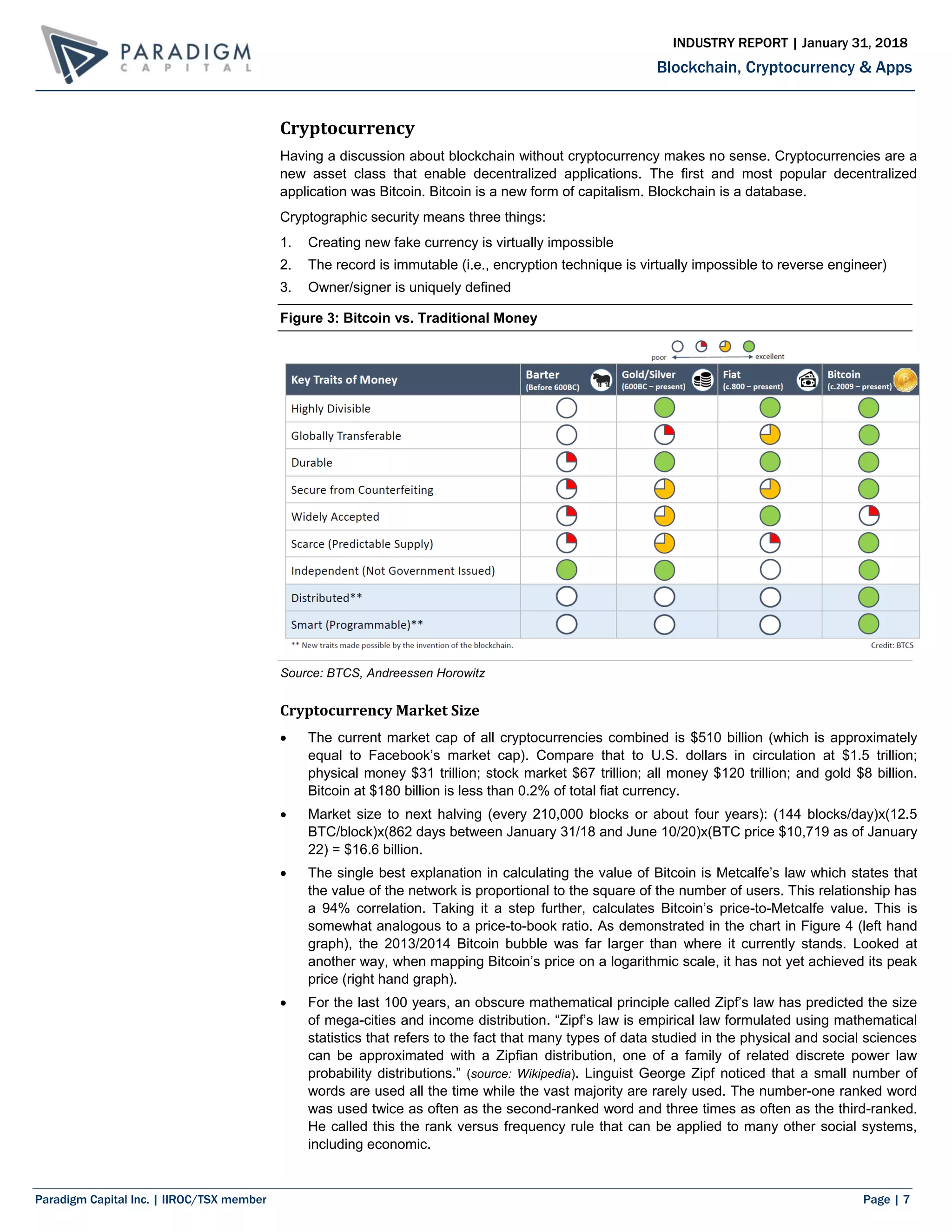
Having a discussion about blockchain without cryptocurrency makes no sense. Cryptocurrencies are a
new asset class that enable decentralized applications. The first and most popular decentralized
application was Bitcoin. Bitcoin is a new form of capitalism. Blockchain is a database.
Cryptographic security means three things:
1. Creating new fake currency is virtually impossible
2. The record is immutable (i.e., encryption technique is virtually impossible to reverse engineer)
3. Owner/signer is uniquely defined
Figure 3: Bitcoin vs. Traditional Money
Source: BTCS, Andreessen Horowitz
Cryptocurrency Market Size
 The current market cap of all cryptocurrencies combined is $510 billion (which is approximately
equal to Facebook’s market cap). Compare that to U.S. dollars in circulation at $1.5 trillion;
physical money $31 trillion; stock market $67 trillion; all money $120 trillion; and gold $8 billion.
Bitcoin at $180 billion is less than 0.2% of total fiat currency.
 Market size to next halving (every 210,000 blocks or about four years): (144 blocks/day)x(12.5
BTC/block)x(862 days between January 31/18 and June 10/20)x(BTC price $10,719 as of January
22) = $16.6 billion.
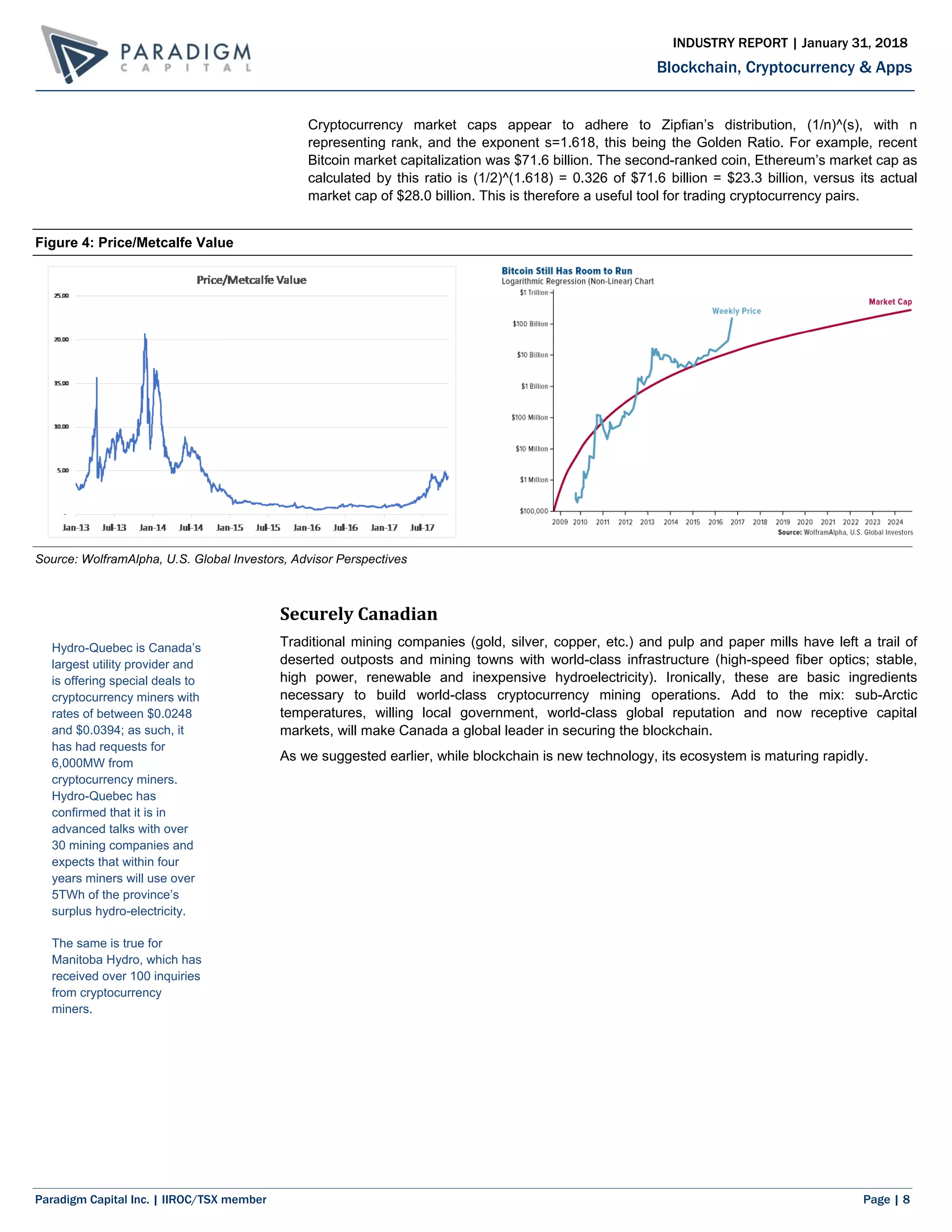
 The single best explanation in calculating the value of Bitcoin is Metcalfe’s law which states that
the value of the network is proportional to the square of the number of users. This relationship has
a 94% correlation. Taking it a step further, calculates Bitcoin’s price-to-Metcalfe value. This is
somewhat analogous to a price-to-book ratio. As demonstrated in the chart in Figure 4 (left hand
graph), the 2013/2014 Bitcoin bubble was far larger than where it currently stands. Looked at
another way, when mapping Bitcoin’s price on a logarithmic scale, it has not yet achieved its peak
price (right hand graph).
 For the last 100 years, an obscure mathematical principle called Zipf’s law has predicted the size
of mega-cities and income distribution. “Zipf’s law is empirical law formulated using mathematical
statistics that refers to the fact that many types of data studied in the physical and social sciences
can be approximated with a Zipfian distribution, one of a family of related discrete power law
probability distributions.” (source: Wikipedia). Linguist George Zipf noticed that a small number of
words are used all the time while the vast majority are rarely used. The number-one ranked word
was used twice as often as the second-ranked word and three times as often as the third-ranked.
He called this the rank versus frequency rule that can be applied to many other social systems,
including economic.
Paradigm Capital Inc. | IIROC/TSX member Page | 8
Blockchain, Cryptocurrency & Apps
INDUSTRY REPORT | January 31, 2018
Cryptocurrency market caps appear to adhere to Zipfian’s distribution, (1/n)^(s), with n
representing rank, and the exponent s=1.618, this being the Golden Ratio. For example, recent
Bitcoin market capitalization was $71.6 billion. The second-ranked coin, Ethereum’s market cap as
calculated by this ratio is (1/2)^(1.618) = 0.326 of $71.6 billion = $23.3 billion, versus its actual
market cap of $28.0 billion. This is therefore a useful tool for trading cryptocurrency pairs.
Figure 4: Price/Metcalfe Value
Source: WolframAlpha, U.S. Global Investors, Advisor Perspectives
Securely Canadian
Traditional mining companies (gold, silver, copper, etc.) and pulp and paper mills have left a trail of
deserted outposts and mining towns with world-class infrastructure (high-speed fiber optics; stable,
high power, renewable and inexpensive hydroelectricity). Ironically, these are basic ingredients
necessary to build world-class cryptocurrency mining operations. Add to the mix: sub-Arctic
temperatures, willing local government, world-class global reputation and now receptive capital
markets, will make Canada a global leader in securing the blockchain.
As we suggested earlier, while blockchain is new technology, its ecosystem is maturing rapidly.
Hydro-Quebec is Canada’s
largest utility provider and
is offering special deals to
cryptocurrency miners with
rates of between $0.0248
and $0.0394; as such, it
has had requests for
6,000MW from
cryptocurrency miners.
Hydro-Quebec has
confirmed that it is in
advanced talks with over
30 mining companies and
expects that within four
years miners will use over
5TWh of the province’s
surplus hydro-electricity.
The same is true for
Manitoba Hydro, which has
received over 100 inquiries
from cryptocurrency
miners.
Paradigm Capital Inc. | IIROC/TSX member Page | 9
Blockchain, Cryptocurrency & Apps
INDUSTRY REPORT | January 31, 2018
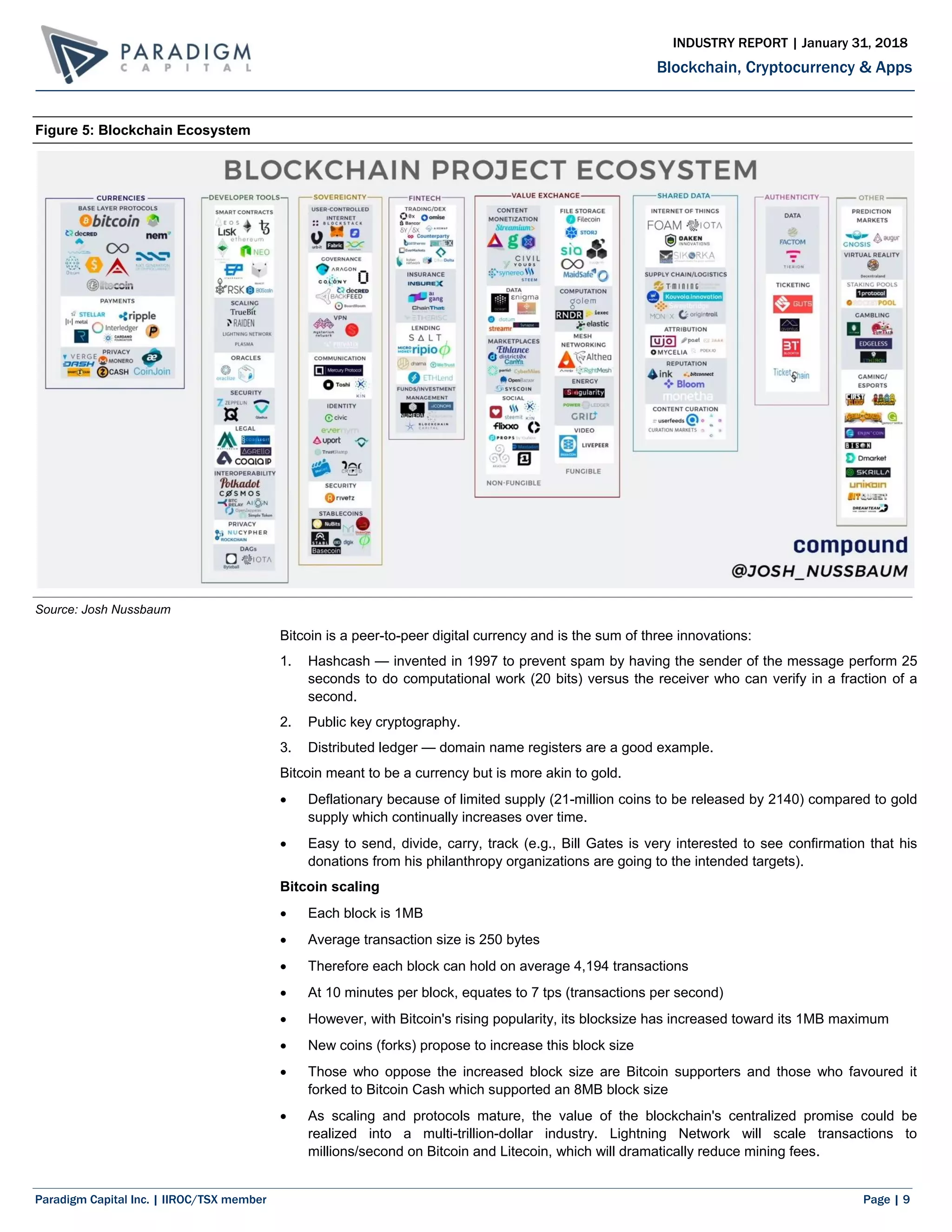
Figure 5: Blockchain Ecosystem
Source: Josh Nussbaum
Bitcoin is a peer-to-peer digital currency and is the sum of three innovations:
1. Hashcash — invented in 1997 to prevent spam by having the sender of the message perform 25
seconds to do computational work (20 bits) versus the receiver who can verify in a fraction of a
second.
2. Public key cryptography.
3. Distributed ledger — domain name registers are a good example.
Bitcoin meant to be a currency but is more akin to gold.
 Deflationary because of limited supply (21-million coins to be released by 2140) compared to gold
supply which continually increases over time.
 Easy to send, divide, carry, track (e.g., Bill Gates is very interested to see confirmation that his
donations from his philanthropy organizations are going to the intended targets).
Bitcoin scaling
 Each block is 1MB
 Average transaction size is 250 bytes
 Therefore each block can hold on average 4,194 transactions
 At 10 minutes per block, equates to 7 tps (transactions per second)
 However, with Bitcoin's rising popularity, its blocksize has increased toward its 1MB maximum
 New coins (forks) propose to increase this block size
 Those who oppose the increased block size are Bitcoin supporters and those who favoured it
forked to Bitcoin Cash which supported an 8MB block size
 As scaling and protocols mature, the value of the blockchain's centralized promise could be
realized into a multi-trillion-dollar industry. Lightning Network will scale transactions to
millions/second on Bitcoin and Litecoin, which will dramatically reduce mining fees.
Paradigm Capital Inc. | IIROC/TSX member Page | 10
Blockchain, Cryptocurrency & Apps
INDUSTRY REPORT | January 31, 2018
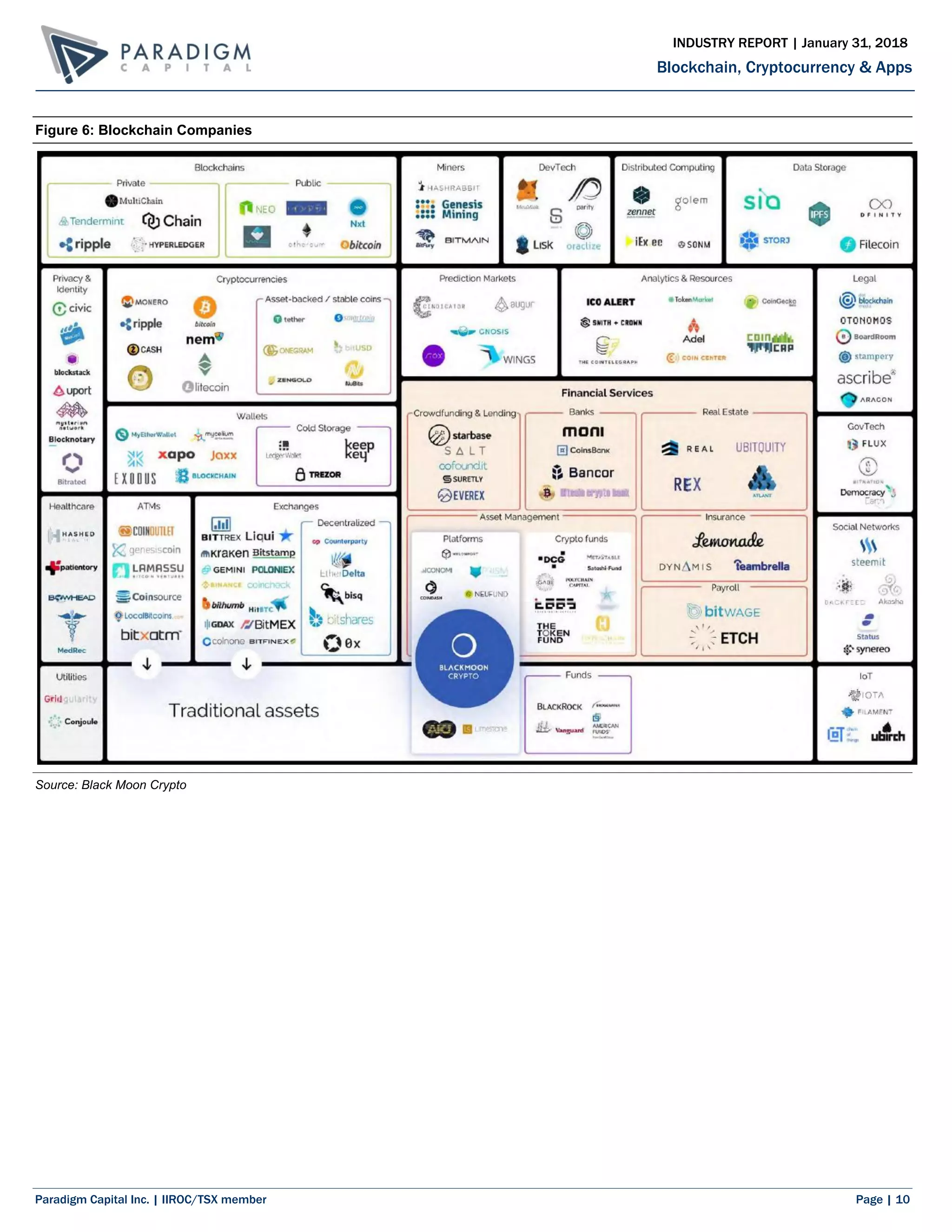
Figure 6: Blockchain Companies
Source: Black Moon Crypto
Paradigm Capital Inc. | IIROC/TSX member Page | 11
Blockchain, Cryptocurrency & Apps
INDUSTRY REPORT | January 31, 2018
Blockchain Applications
Since the creation of Bitcoin, the world’s first application of blockchain, its rising popularity and rapidly
expanding valuation have stimulated the creation of variations of itself via forking, including
cryptocurrencies such as Litecoin, Bitcoin Cash, and, most recently, Bitcoin Gold; the development of
brand new native blockchains including Ethereum and Ripple; and the launch of hundreds of tokens
and related apps built on top of a variety of blockchains, Ethereum being the platform of choice for
developers by a wide margin.
Bitcoin: Scalability Looks to Limit the Viability of Blockchain’s First Application
Bitcoin remains the most discussed and highly valued cryptocurrency at a current market cap of ~$180
billion, though there remains much debate on its longer-term viability as a method for everyday
transactions. This has largely been owing to scalability issues related to Bitcoin’s underlying protocol,
which, as previously noted, limits a transaction’s block size to 1MB and leads to lower transaction
speeds that result in uneconomical transaction processing fees for practical purposes. Transaction
fees are attached to each proposed Bitcoin transaction as an incentive to be processed by a miner and
to be added to the Bitcoin blockchain. In order to have a given user’s transaction processed on the
limited space of a 1MB block, it needs to outbid other users, leading to fee inflation given supply and
demand dynamics. At the time of writing this report, the average Bitcoin transaction fee sits at ~US$10,
well below the recent peak of +US$55 in late December, but still orders of magnitude above the
~$0.01–$0.10 seen at the cryptocurrency’s inception through to 2016, when this metric started to
materially rise. Besides rapidly increasing transaction fees, early Bitcoin applications, such as Bitpay,
suffered from slow payment times owing to increasing congestion on the network. Such scalability
limitations have led developers to upgrade Bitcoin’s protocol to address these issues, a process known
as forking.
As discussed earlier, Bitcoin Cash, which was a hard fork created on August 1, 2017, served to solve
the capacity constraints of Bitcoin by increasing the block size within this new protocol to 8MB. While
this technically drives higher transaction speeds, the catch is that it also requires more storage space
given that every node maintains a copy of this much larger ledger. An argument can be made that
such an implementation raises storage costs and could therefore lead to a network controlled by an
increasing proportion of well-funded and larger entities, negating Bitcoin’s original decentralization
promise. Bitcoin Gold, the latest Bitcoin hard fork which went live on October 24, 2017, aims to solve
the decentralization problem by ensuring ASICs can’t be used the way they currently are leveraged by
professional Bitcoin miners with dedicated and expensive hardware. The thought is that Bitcoin Gold
can give the power of processing back to a more distributed network of everyday PC users as opposed
to the concentrated Bitcoin mining pools and entities of today. Other mechanisms to address the
scalability constraints of blockchain continue to be explored, such as the Lightning Network, which
leverages a network of payment channels through which parties can make transactions off the
blockchain (i.e., not added to the ledger), thereby saving work and time.
It remains to be seen which decentralized payment protocol might prevail, and the reality is that the
market and its consumer and merchant participants will ultimately dictate the most efficient method for
blockchain’s first recognized and obvious application. Some retailers do accept Bitcoin and other
cryptocurrencies as a form of payment, but many do not. Last year, Internet Retailer noted that Bitcoin
was accepted at just three of the top 500 online merchants that it tracks, down from five in 2016.
During its Q3/17 call, Shopify’s CEO acknowledged the e-commerce infrastructure provider’s lead in
enabling its merchants to accept Bitcoin (as early as 2012), though he also noted his view of it being
an “exceptionally volatile store of value rather than a transactional system”. And just last week, online
payments processor Stripe formally announced it is ending its support of Bitcoin on April 23, noting
how block size limitations have led the cryptocurrency to evolve into more of an asset than a means for
exchange (with transaction fees on par with bank wires). Interestingly, the firm remains bullish on
cryptocurrencies overall, looking forward to initiatives such as Lightning, Ethereum-based tokens, and
even the potential for Bitcoin forks such as Bitcoin Cash or Litecoin.
Paradigm Capital Inc. | IIROC/TSX member Page | 12
Blockchain, Cryptocurrency & Apps
INDUSTRY REPORT | January 31, 2018
Ethereum: The De Facto Blockchain Applications Platform
Bitcoin’s open-source nature has made it relatively easy for developers to copy its software and modify
its protocols in order to create new forks, such as Bitcoin Cash and Bitcoin Gold. Scaling issues aside,
the protocol’s major limitations with regards to use cases other than payments relate to its lack of
flexibility to program more complex rules and logic governing the movement of tokens between two
parties without the use of an intermediary. Early attempts to build on top of Bitcoin’s protocols to allow
for this functionality gave birth to the likes of Counterparty and Omni. However, it was an entirely new
blockchain, known as Ethereum, with its own scripting language and an ability to create “smart
contracts” (the logic governing the rules of token transfer) that has driven today’s blockchain
applications revolution. Fueling the growth in Ethereum-based apps over the past two years was
the release of ERC-20, with nearly all Ethereum tokens being compliant with this standard.
What are tokens in the Ethereum blockchain? Tokens represent digital assets within Ethereum-
based decentralized applications (Dapps) that can range from almost anything such as in-game items,
loyalty points, media rights, and access to server space, among many other use cases. Each token is
defined by a set of code that dictates how it will behave on the network when a given user or a smart
contract sends a message to the token’s contract, along with an associated database keeping track of
Ether payments. Tokens are application specific, in contrast to Ether, which is the cryptocurrency
underlying Ethereum and is what an application user uses to “pay” for a transaction. For example,
when a token is sent across the network (reflecting the transfer of an in-game weapon from one player
to another), the “miner” who confirms this transaction onto the Ethereum blockchain is paid in Ether as
incentive. We discuss in detail later, but tokens should generally only reflect the utility derived from its
use within an application, nothing more and nothing less.
Why are ERC-20 compliant tokens important to Ethereum applications development? Ethereum
Request for Comments proposal ID 20, or ERC-20 for short, was created in November 2015 and only
formally standardized in September 2017. It’s an important standard that has led to the explosion of
Ethereum-based tokens and related applications that govern how new tokens are launched (ICOs) and
how they behave across the blockchain. By creating a set of rules for Ethereum-based tokens to
adhere to, apps developers were able to understand how their tokens would behave within smart
contracts, inside of wallets, and on exchanges. ERC-20 is underscored by a set of six functions, such
as how to transfer a token and how to access a token’s data (token balance, name, etc.). In our view,
the creation of ERC-20 has allowed the Ethereum-based applications ecosystem to flourish.
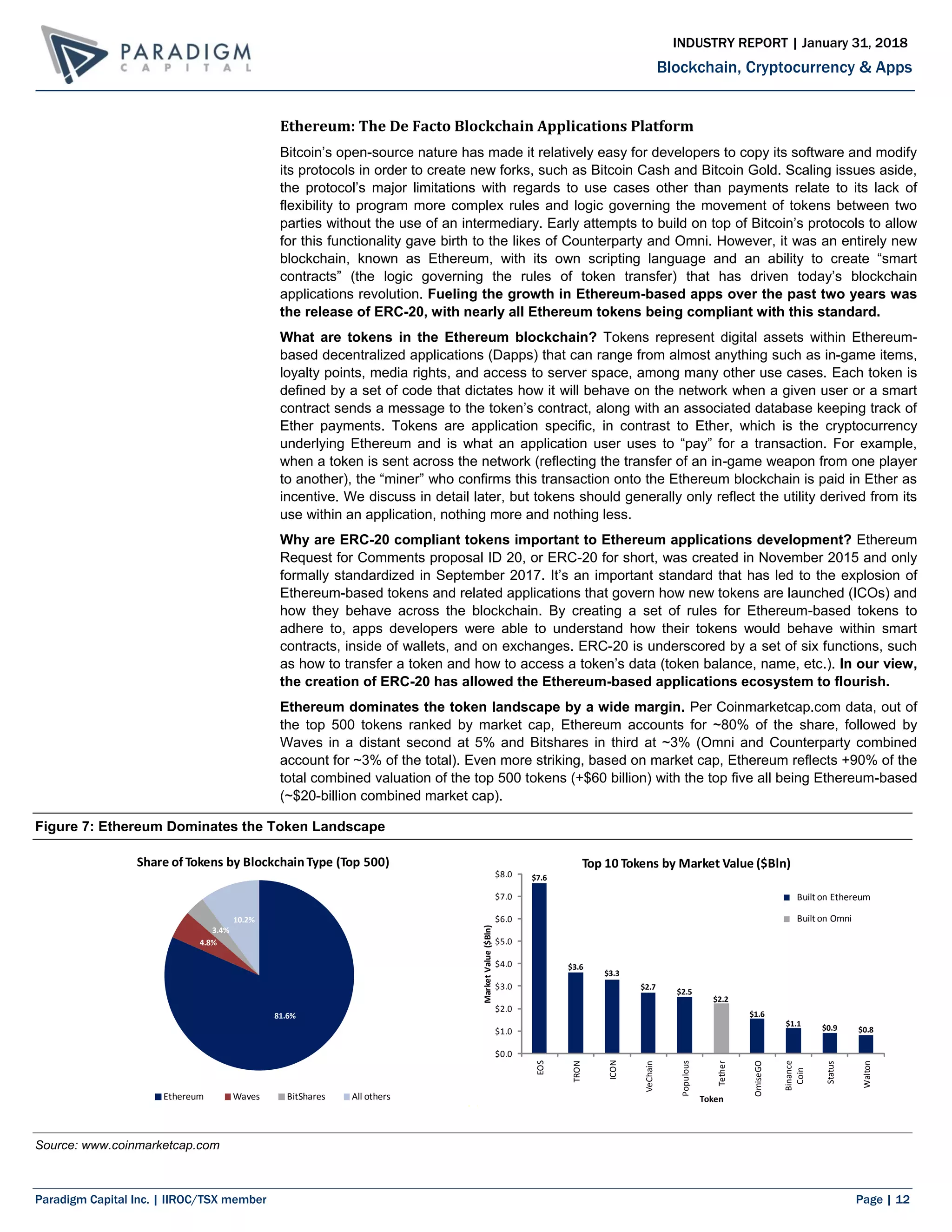
Ethereum dominates the token landscape by a wide margin. Per Coinmarketcap.com data, out of
the top 500 tokens ranked by market cap, Ethereum accounts for ~80% of the share, followed by
Waves in a distant second at 5% and Bitshares in third at ~3% (Omni and Counterparty combined
account for ~3% of the total). Even more striking, based on market cap, Ethereum reflects +90% of the
total combined valuation of the top 500 tokens (+$60 billion) with the top five all being Ethereum-based
(~$20-billion combined market cap).
Figure 7: Ethereum Dominates the Token Landscape
Source: www.coinmarketcap.com
$7.6
$3.6
$3.3
$2.7
$2.5
$2.2
$1.6
$1.1 $0.9 $0.8
$0.0
$1.0
$2.0
$3.0
$4.0
$5.0
$6.0
$7.0
$8.0
EOS
TRON
ICON
VeChain
Populous
Tether
OmiseGO
Binance
Coin
Status
Walton
MarketValue($Bln)
Token
Top 10 Tokens by Market Value ($Bln)
Populous
Tether
Built on Ethereum
Built on Omni
81.6%
4.8%
3.4%
10.2%
Share of Tokens by BlockchainType (Top 500)
Ethereum Waves BitShares All others
Paradigm Capital Inc. | IIROC/TSX member Page | 13
Blockchain, Cryptocurrency & Apps
INDUSTRY REPORT | January 31, 2018
Tokenomics
What’s a token worth? While it’s easy to understand why there’s been a material jump in the number
of Ethereum-based applications being launched, given the ease of development and the establishment
of related rules governing smart contracts, it’s less obvious how investors should properly assign value
to a given token and its corresponding application. In theory, the market value of a token asset class
should approximate the value attributable to the utility of the underlying application the tokens allow
access to. Conversely, one might consider the value of any decentralized application which replaces a
two-sided, centralized middleman marketplace as converging toward the sum of the minimum feasible
costs to run such a network. In other words, an application’s token should really just be worth the
bottom-line economic benefit to the user.
Clearly, there’s much more at play, with tokens of today reflecting part real-world application
usage value, part speculation…in many cases, maybe mainly speculation. In October, Ethereum
co-founder Vitalik Buterin emphatically stressed his bearish views on the future of most of today’s
tokens, suggesting that at least 90% are likely to fail. Application tokens do not represent equity in a
company, and its holder has no legal claim on a company’s assets — they merely have the right to
utilize an application (in most cases, an as of yet to be developed application). We do not make an
attempt on how to separate a token’s true signal from the noise, the latter moving ever louder and
fueled by an increasing participation of less-than-sophisticated and “fear of missing out” investors in
unregulated token offerings. What we do outline, however, are our views on the financial and societal
implications of the promise of blockchain applications.
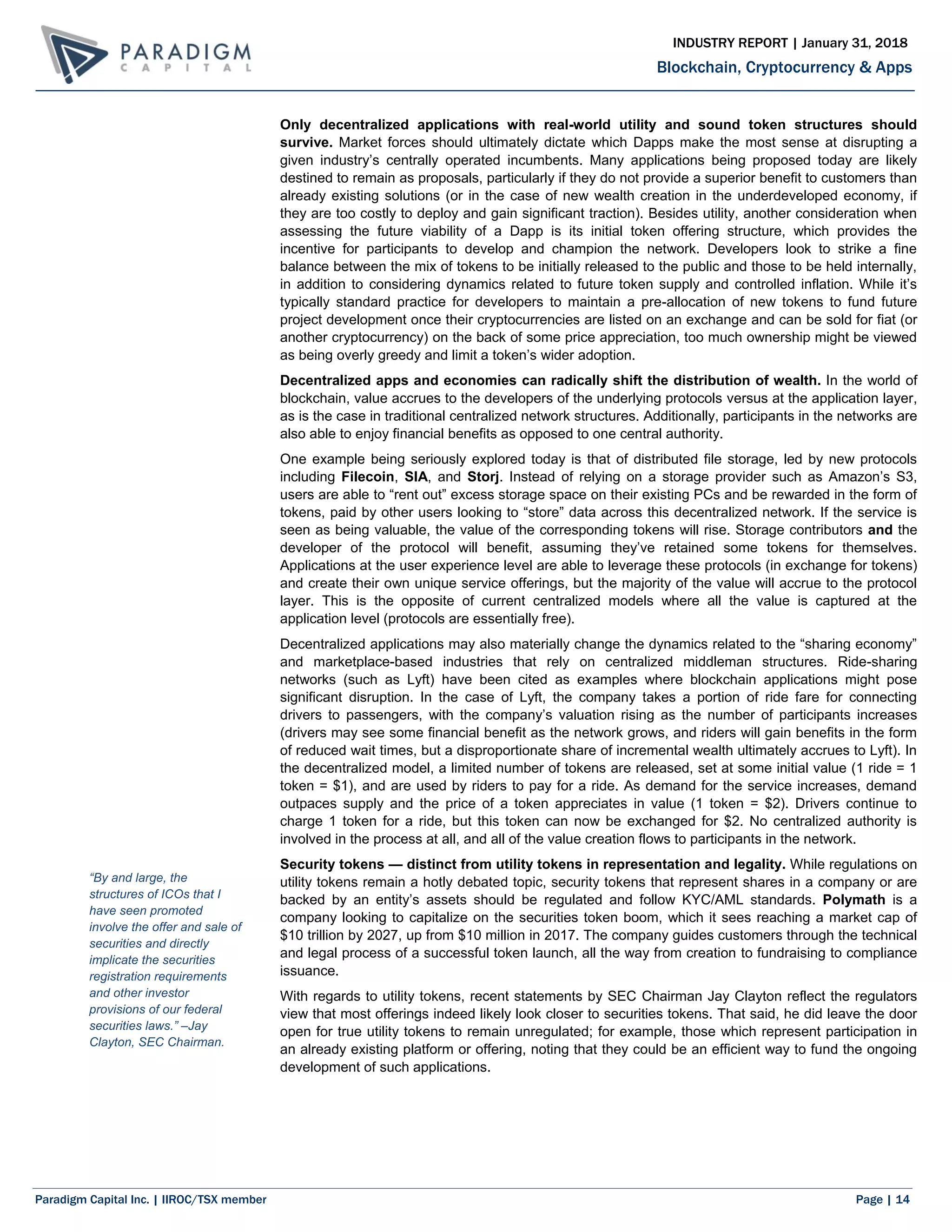
Token values are driven by network ownership effects, not network effects. It’s well understood
(Metcalfe’s Law) that the value or utility of a network is proportional to the number of customers using
that network. Traditionally, it’s a challenge to “bootstrap” and start a new network, as there’s little to no
incentive for early adopters to use that network, meaning that the benefits to consumers are only
realized at scale. Furthermore, while the consumers of the network may “socially” benefit from the
application, it is the centralized owners who benefit “financially”. Decentralized network models
using a token structure can accelerate the initiation of a network by incentivizing early
participation. Furthermore, with no centralized owners, all users who “buy in” to the token early on,
including developers, consumers, and speculators, share in outsized financial utility. This powerful
combination of network utility + ownership drives players with a vested interest in seeing their own
wealth increase rapidly develop applications and act as marketers and evangelists for the token,
thereby creating a feedback loop that fuels further token appreciation. Bitcoin users not only use the
application, but also have ownership in the network, and benefit by being advocates for the BTC token.
Bitcoin sees its value rise and fall in line with the supply and demand of its application, as well as
owing to the perception of its future usage. Early application adopters enjoy the highest financial utility
(greatest token appreciation) and kickstart the network into wider recognition. Traditional
applications have “customers”, decentralized applications have “users”, and the distinction
between participants in the latter such network is much more blurred.
Figure 8: Ownership in Network Accelerates Application Adoption
Source: Andreesen Horowitz (Decrypting Crypto, From Bitcoin and Blockchain to ICOs) & Nick Tomaino (The Token Economy)
UtilitytoUser
Number of users
Traditional Network Effect
Overall utility= Application utility
Bootstrapping Problem
UtilitytoUser
Number of users
Token Network Effect
Applicationutility
Financial utility
Overall utility= financial
applicationutility
“It is an established fact
that ninety percent of start-
ups fail. And it should also
be an established fact that
90 percent of these
ERC20s on
CoinMarketCap are going
to go to zero” – Vitalik
Buterin
Paradigm Capital Inc. | IIROC/TSX member Page | 14
Blockchain, Cryptocurrency & Apps
INDUSTRY REPORT | January 31, 2018
Only decentralized applications with real-world utility and sound token structures should
survive. Market forces should ultimately dictate which Dapps make the most sense at disrupting a
given industry’s centrally operated incumbents. Many applications being proposed today are likely
destined to remain as proposals, particularly if they do not provide a superior benefit to customers than
already existing solutions (or in the case of new wealth creation in the underdeveloped economy, if
they are too costly to deploy and gain significant traction). Besides utility, another consideration when
assessing the future viability of a Dapp is its initial token offering structure, which provides the
incentive for participants to develop and champion the network. Developers look to strike a fine
balance between the mix of tokens to be initially released to the public and those to be held internally,
in addition to considering dynamics related to future token supply and controlled inflation. While it’s
typically standard practice for developers to maintain a pre-allocation of new tokens to fund future
project development once their cryptocurrencies are listed on an exchange and can be sold for fiat (or
another cryptocurrency) on the back of some price appreciation, too much ownership might be viewed
as being overly greedy and limit a token’s wider adoption.
Decentralized apps and economies can radically shift the distribution of wealth. In the world of
blockchain, value accrues to the developers of the underlying protocols versus at the application layer,
as is the case in traditional centralized network structures. Additionally, participants in the networks are
also able to enjoy financial benefits as opposed to one central authority.
One example being seriously explored today is that of distributed file storage, led by new protocols
including Filecoin, SIA, and Storj. Instead of relying on a storage provider such as Amazon’s S3,
users are able to “rent out” excess storage space on their existing PCs and be rewarded in the form of
tokens, paid by other users looking to “store” data across this decentralized network. If the service is
seen as being valuable, the value of the corresponding tokens will rise. Storage contributors and the
developer of the protocol will benefit, assuming they’ve retained some tokens for themselves.
Applications at the user experience level are able to leverage these protocols (in exchange for tokens)
and create their own unique service offerings, but the majority of the value will accrue to the protocol
layer. This is the opposite of current centralized models where all the value is captured at the
application level (protocols are essentially free).
Decentralized applications may also materially change the dynamics related to the “sharing economy”
and marketplace-based industries that rely on centralized middleman structures. Ride-sharing
networks (such as Lyft) have been cited as examples where blockchain applications might pose
significant disruption. In the case of Lyft, the company takes a portion of ride fare for connecting
drivers to passengers, with the company’s valuation rising as the number of participants increases
(drivers may see some financial benefit as the network grows, and riders will gain benefits in the form
of reduced wait times, but a disproportionate share of incremental wealth ultimately accrues to Lyft). In
the decentralized model, a limited number of tokens are released, set at some initial value (1 ride = 1
token = $1), and are used by riders to pay for a ride. As demand for the service increases, demand
outpaces supply and the price of a token appreciates in value (1 token = $2). Drivers continue to
charge 1 token for a ride, but this token can now be exchanged for $2. No centralized authority is
involved in the process at all, and all of the value creation flows to participants in the network.
Security tokens — distinct from utility tokens in representation and legality. While regulations on
utility tokens remain a hotly debated topic, security tokens that represent shares in a company or are
backed by an entity’s assets should be regulated and follow KYC/AML standards. Polymath is a
company looking to capitalize on the securities token boom, which it sees reaching a market cap of
$10 trillion by 2027, up from $10 million in 2017. The company guides customers through the technical
and legal process of a successful token launch, all the way from creation to fundraising to compliance
issuance.
With regards to utility tokens, recent statements by SEC Chairman Jay Clayton reflect the regulators
view that most offerings indeed likely look closer to securities tokens. That said, he did leave the door
open for true utility tokens to remain unregulated; for example, those which represent participation in
an already existing platform or offering, noting that they could be an efficient way to fund the ongoing
development of such applications.
“By and large, the
structures of ICOs that I
have seen promoted
involve the offer and sale of
securities and directly
implicate the securities
registration requirements
and other investor
provisions of our federal
securities laws.” –Jay
Clayton, SEC Chairman.
Paradigm Capital Inc. | IIROC/TSX member Page | 15
Blockchain, Cryptocurrency & Apps
INDUSTRY REPORT | January 31, 2018
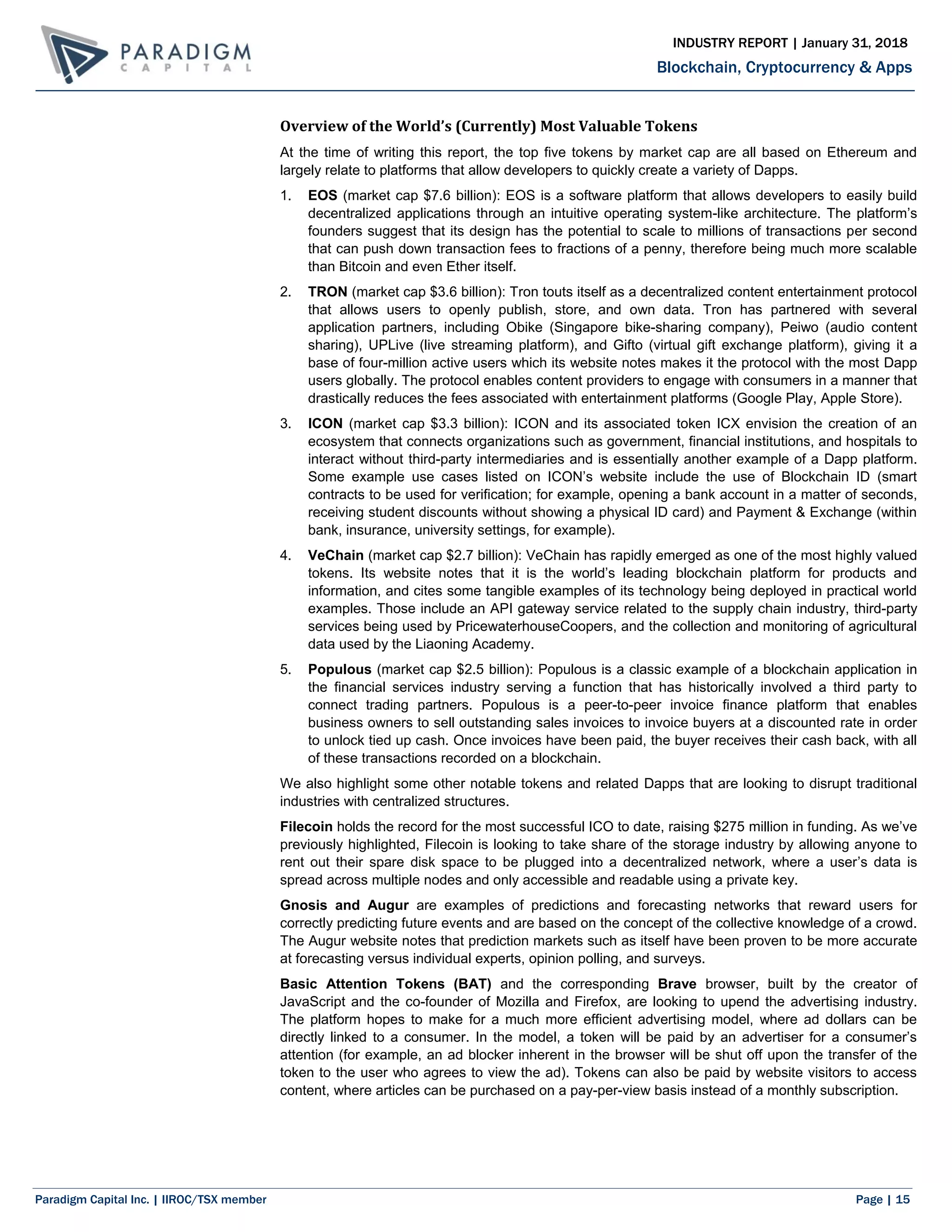
Overview of the World’s (Currently) Most Valuable Tokens
At the time of writing this report, the top five tokens by market cap are all based on Ethereum and
largely relate to platforms that allow developers to quickly create a variety of Dapps.
1. EOS (market cap $7.6 billion): EOS is a software platform that allows developers to easily build
decentralized applications through an intuitive operating system-like architecture. The platform’s
founders suggest that its design has the potential to scale to millions of transactions per second
that can push down transaction fees to fractions of a penny, therefore being much more scalable
than Bitcoin and even Ether itself.
2. TRON (market cap $3.6 billion): Tron touts itself as a decentralized content entertainment protocol
that allows users to openly publish, store, and own data. Tron has partnered with several
application partners, including Obike (Singapore bike-sharing company), Peiwo (audio content
sharing), UPLive (live streaming platform), and Gifto (virtual gift exchange platform), giving it a
base of four-million active users which its website notes makes it the protocol with the most Dapp
users globally. The protocol enables content providers to engage with consumers in a manner that
drastically reduces the fees associated with entertainment platforms (Google Play, Apple Store).
3. ICON (market cap $3.3 billion): ICON and its associated token ICX envision the creation of an
ecosystem that connects organizations such as government, financial institutions, and hospitals to
interact without third-party intermediaries and is essentially another example of a Dapp platform.
Some example use cases listed on ICON’s website include the use of Blockchain ID (smart
contracts to be used for verification; for example, opening a bank account in a matter of seconds,
receiving student discounts without showing a physical ID card) and Payment & Exchange (within
bank, insurance, university settings, for example).
4. VeChain (market cap $2.7 billion): VeChain has rapidly emerged as one of the most highly valued
tokens. Its website notes that it is the world’s leading blockchain platform for products and
information, and cites some tangible examples of its technology being deployed in practical world
examples. Those include an API gateway service related to the supply chain industry, third-party
services being used by PricewaterhouseCoopers, and the collection and monitoring of agricultural
data used by the Liaoning Academy.
5. Populous (market cap $2.5 billion): Populous is a classic example of a blockchain application in
the financial services industry serving a function that has historically involved a third party to
connect trading partners. Populous is a peer-to-peer invoice finance platform that enables
business owners to sell outstanding sales invoices to invoice buyers at a discounted rate in order
to unlock tied up cash. Once invoices have been paid, the buyer receives their cash back, with all
of these transactions recorded on a blockchain.
We also highlight some other notable tokens and related Dapps that are looking to disrupt traditional
industries with centralized structures.
Filecoin holds the record for the most successful ICO to date, raising $275 million in funding. As we’ve
previously highlighted, Filecoin is looking to take share of the storage industry by allowing anyone to
rent out their spare disk space to be plugged into a decentralized network, where a user’s data is
spread across multiple nodes and only accessible and readable using a private key.
Gnosis and Augur are examples of predictions and forecasting networks that reward users for
correctly predicting future events and are based on the concept of the collective knowledge of a crowd.
The Augur website notes that prediction markets such as itself have been proven to be more accurate
at forecasting versus individual experts, opinion polling, and surveys.
Basic Attention Tokens (BAT) and the corresponding Brave browser, built by the creator of
JavaScript and the co-founder of Mozilla and Firefox, are looking to upend the advertising industry.
The platform hopes to make for a much more efficient advertising model, where ad dollars can be
directly linked to a consumer. In the model, a token will be paid by an advertiser for a consumer’s
attention (for example, an ad blocker inherent in the browser will be shut off upon the transfer of the
token to the user who agrees to view the ad). Tokens can also be paid by website visitors to access
content, where articles can be purchased on a pay-per-view basis instead of a monthly subscription.
Paradigm Capital Inc. | IIROC/TSX member Page | 16
Blockchain, Cryptocurrency & Apps
INDUSTRY REPORT | January 31, 2018
Industries Most Likely to Be Impacted by Blockchain Applications
The token examples on the previous page provide some clues as to where some of the most logical
areas and industries that blockchain technologies may be well suited for deployment.
In short, the greatest business opportunities for blockchain applications will be in industries
characterized by a relatively high level of intermediaries.
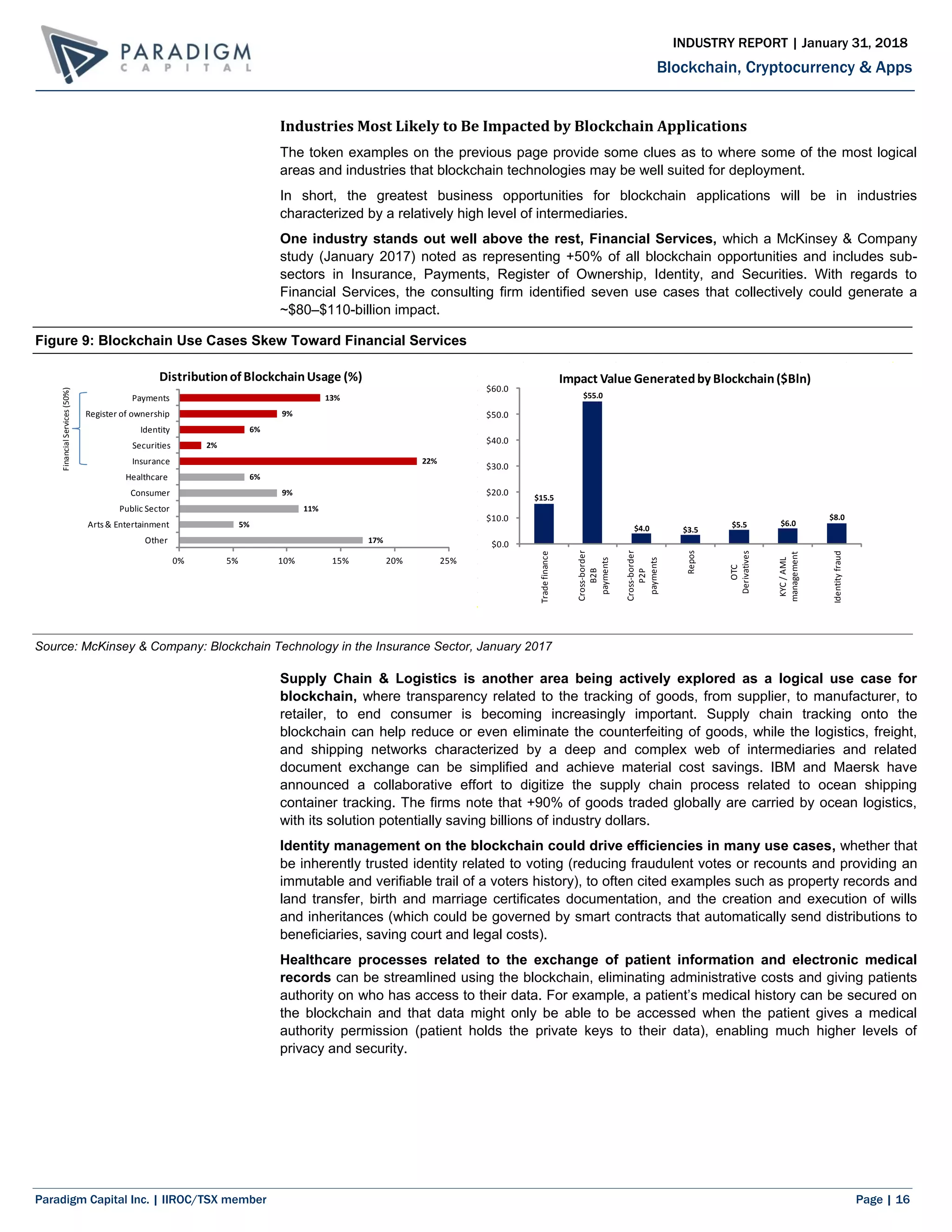
One industry stands out well above the rest, Financial Services, which a McKinsey & Company
study (January 2017) noted as representing +50% of all blockchain opportunities and includes sub-
sectors in Insurance, Payments, Register of Ownership, Identity, and Securities. With regards to
Financial Services, the consulting firm identified seven use cases that collectively could generate a
~$80–$110-billion impact.
Figure 9: Blockchain Use Cases Skew Toward Financial Services
Source: McKinsey & Company: Blockchain Technology in the Insurance Sector, January 2017
Supply Chain & Logistics is another area being actively explored as a logical use case for
blockchain, where transparency related to the tracking of goods, from supplier, to manufacturer, to
retailer, to end consumer is becoming increasingly important. Supply chain tracking onto the
blockchain can help reduce or even eliminate the counterfeiting of goods, while the logistics, freight,
and shipping networks characterized by a deep and complex web of intermediaries and related
document exchange can be simplified and achieve material cost savings. IBM and Maersk have
announced a collaborative effort to digitize the supply chain process related to ocean shipping
container tracking. The firms note that +90% of goods traded globally are carried by ocean logistics,
with its solution potentially saving billions of industry dollars.
Identity management on the blockchain could drive efficiencies in many use cases, whether that
be inherently trusted identity related to voting (reducing fraudulent votes or recounts and providing an
immutable and verifiable trail of a voters history), to often cited examples such as property records and
land transfer, birth and marriage certificates documentation, and the creation and execution of wills
and inheritances (which could be governed by smart contracts that automatically send distributions to
beneficiaries, saving court and legal costs).
Healthcare processes related to the exchange of patient information and electronic medical
records can be streamlined using the blockchain, eliminating administrative costs and giving patients
authority on who has access to their data. For example, a patient’s medical history can be secured on
the blockchain and that data might only be able to be accessed when the patient gives a medical
authority permission (patient holds the private keys to their data), enabling much higher levels of
privacy and security.
17%
5%
11%
9%
6%
22%
2%
6%
9%
13%
0% 5% 10% 15% 20% 25%
Other
Arts& Entertainment
Public Sector
Consumer
Healthcare
Insurance
Securities
Identity
Register of ownership
Payments
FinancialServices(50%)
Distributionof BlockchainUsage (%)
$15.5
$55.0
$4.0 $3.5
$5.5 $6.0
$8.0
$0.0
$10.0
$20.0
$30.0
$40.0
$50.0
$60.0
Tradefinance
Cross-border
B2B
payments
Cross-border
P2P
payments
Repos
OTC
Derivatives
KYC/AML
management
Identityfraud
Impact Value Generatedby Blockchain($Bln)
Paradigm Capital Inc. | IIROC/TSX member Page | 17
Blockchain, Cryptocurrency & Apps
INDUSTRY REPORT | January 31, 2018
Enterprise Applications of Blockchain
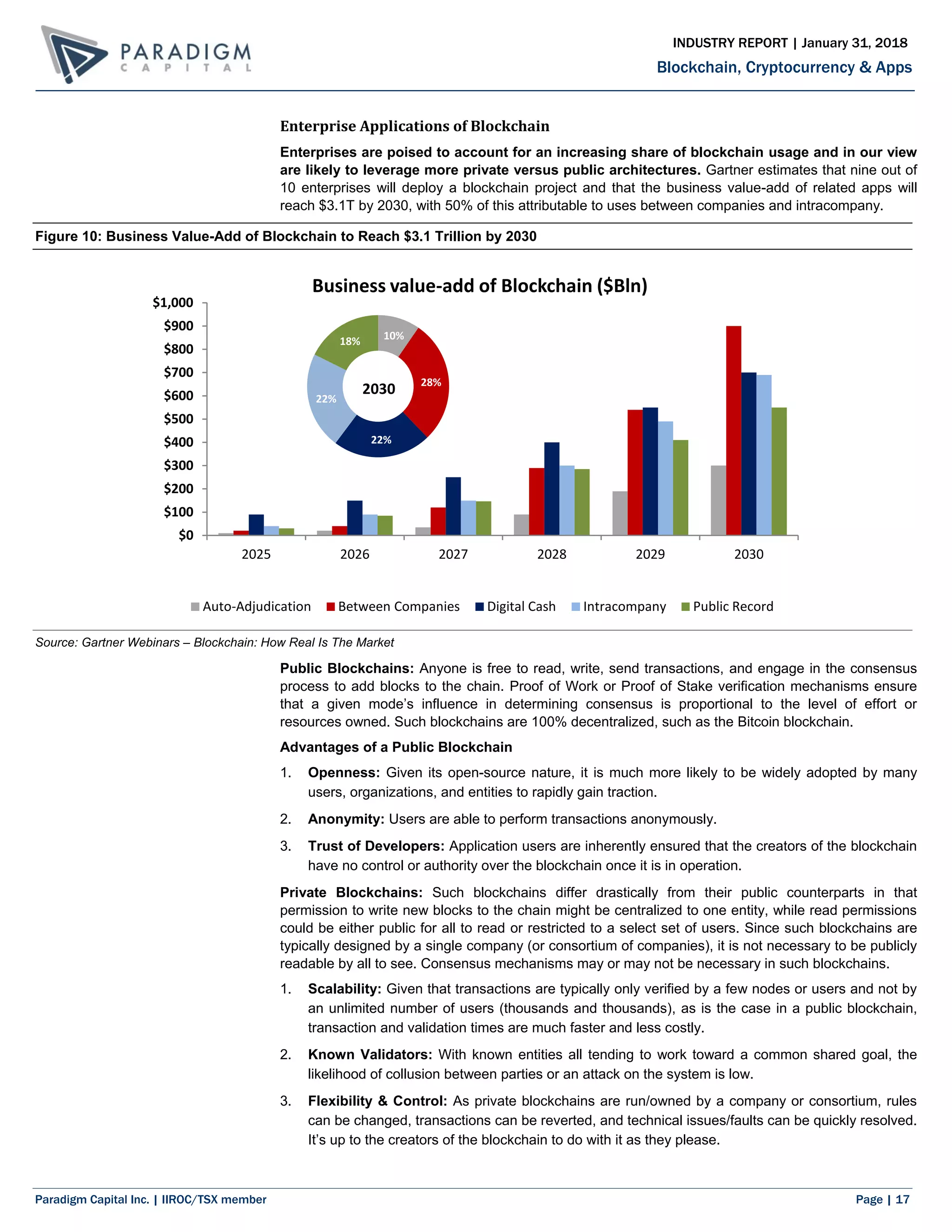
Enterprises are poised to account for an increasing share of blockchain usage and in our view
are likely to leverage more private versus public architectures. Gartner estimates that nine out of
10 enterprises will deploy a blockchain project and that the business value-add of related apps will
reach $3.1T by 2030, with 50% of this attributable to uses between companies and intracompany.
Figure 10: Business Value-Add of Blockchain to Reach $3.1 Trillion by 2030
Source: Gartner Webinars – Blockchain: How Real Is The Market
Public Blockchains: Anyone is free to read, write, send transactions, and engage in the consensus
process to add blocks to the chain. Proof of Work or Proof of Stake verification mechanisms ensure
that a given mode’s influence in determining consensus is proportional to the level of effort or
resources owned. Such blockchains are 100% decentralized, such as the Bitcoin blockchain.
Advantages of a Public Blockchain
1. Openness: Given its open-source nature, it is much more likely to be widely adopted by many
users, organizations, and entities to rapidly gain traction.
2. Anonymity: Users are able to perform transactions anonymously.
3. Trust of Developers: Application users are inherently ensured that the creators of the blockchain
have no control or authority over the blockchain once it is in operation.
Private Blockchains: Such blockchains differ drastically from their public counterparts in that
permission to write new blocks to the chain might be centralized to one entity, while read permissions
could be either public for all to read or restricted to a select set of users. Since such blockchains are
typically designed by a single company (or consortium of companies), it is not necessary to be publicly
readable by all to see. Consensus mechanisms may or may not be necessary in such blockchains.
1. Scalability: Given that transactions are typically only verified by a few nodes or users and not by
an unlimited number of users (thousands and thousands), as is the case in a public blockchain,
transaction and validation times are much faster and less costly.
2. Known Validators: With known entities all tending to work toward a common shared goal, the
likelihood of collusion between parties or an attack on the system is low.
3. Flexibility & Control: As private blockchains are run/owned by a company or consortium, rules
can be changed, transactions can be reverted, and technical issues/faults can be quickly resolved.
It’s up to the creators of the blockchain to do with it as they please.
$0
$100
$200
$300
$400
$500
$600
$700
$800
$900
$1,000
2025 2026 2027 2028 2029 2030
Business value-add of Blockchain ($Bln)
Auto-Adjudication Between Companies Digital Cash Intracompany Public Record
10%
28%
22%
22%
18%
2030
Paradigm Capital Inc. | IIROC/TSX member Page | 18
Blockchain, Cryptocurrency & Apps
INDUSTRY REPORT | January 31, 2018
Requirements for enterprises to operate transactions at scale and retain control over data
access should drive private blockchain adoption in the Enterprise. Notwithstanding efforts being
made to increase the scalability issues of existing public blockchains, such as Lightning, the reality is
that private blockchains appear to be much better suited for the level of transactions processed by
most Enterprises. For example, global telecom companies can process 100’s of thousands of
payments transactions per second, while major credit card companies are known to be able to handle
10’s of thousands of transactions per second. Furthermore, private blockchains, which many consider
to be closer to “permissioned private databases”, may actually require user identity and accountability
depending on the application in question. An example could be a supply chain implementation where a
retailer requires a full time-stamped history of a product’s journey from supplier to manufacturer to end
customer. We highlight in the figure below (reference: Distributed Lab) the various blockchain
architectures and their corresponding level of anonymity and trust.
Figure 11: Public vs. Private Blockchain Analysis
Source: Pavel Kravchenko (Distributed Lab – Ok, I need a blockchain, but which one?), Paradigm Capital Inc.
Level of trust
Level of
anonymity
Proof of StakeProof of Work
Federated Byzantime
Agreement
Practical Byzantime
Fault Tolerance,
Multisignature
Permissionless Public
Permissioned Public
Permissioned Private
“When I and others talk to
companies about building
their applications on a
blockchain, two primary
issues always come up:
scalability and privacy.” –
Vitalik Buterin.
Paradigm Capital Inc. | IIROC/TSX member Page | 19
Blockchain, Cryptocurrency & Apps
INDUSTRY REPORT | January 31, 2018
Investment Opportunities
The following tables summarize all publicly traded Canadian and U.S. blockchain/cryptocurrency
companies and investment portfolios. Our first observation, the rule of 10x has been broken. Canada is
very well represented by this list with more publicly listed blockchain companies than in the U.S. and
with a combined market capitalization of ~C$2.5 billion compared to their American counterparts at just
US$800 million.
We conclude the substance of this report with profiles on 13 next-generation companies, who we
believe hold great promise of disrupting the market.
Peripherally, we often get asked by investors if there are investment opportunities within the
ecosystem of companies who provide the hardware for cryptocurrency mining. Below we summarize
some anecdotal numbers and a cautionary note.
 ASIC Manufacturer | Bitcoin mining is powering the growth engine for the world’s biggest chip
maker, Taiwan Semiconductor Manufacturing Company (TSM-N, NR). Analyst’s estimate cypto-
mining generated $350-$400 million in TSMC’s third alone (4–5% of revenue and up 46% year-
over-year) and could account for as much as $3.7 billion (10% of revenue) in 2018, thus becoming
its fastest-growing segment. TSMC manufacturers ASICs for Bitmain and Bitfury as well as GPUs
for Nvidia and AMD.
 GPU Manufacturers | Analysts estimate $150 million or 6.7% of Nvidia’s (NVDA-Q, NR) Q2
revenue is derived from cypto-mining. Advanced Micro Devices (AMD-N, NR) has been much
more tight-lipped. Recent commentary from the semiconductor analyst at Morgan Stanley
estimates “total graphic sales for Ethereum mining in 2017 will be $800 million or so, and will
decline by 50% in 2018”. This will be a consequence of shift to a technology called “the Casper
hard fork” which will render current Ethereum mining hardware obsolete.
 ASIC Testing | Cadence Design Systems (CDNS-Q, NR)
 Memory Modules | Samsung Electronics (005930.KS, NR)
 Chip Packaging | Advanced Semiconductor Engineering (ASX-N, NR)
Paradigm Capital Inc. | IIROC/TSX member Page | 20
Blockchain, Cryptocurrency & Apps
INDUSTRY REPORT | January 31, 2018
Figure 12: Publicly Listed Canadian Blockchain Companies
Source: FactSet
In millions except per share data Shares Market Avg. Volume Money
Company Name Ticker Price Out Cap High Low 6-month Raised (M) LTM
Miners
360 Blockchain Inc CODE-CA $0.17 153.2 $25 $0.39 $0.04 - $2.5
Aim Explorations Ltd AXN-CA $0.18 7.9 $1 - - - $40.8
Blockchain Power Trust BPWR.UT-CA $0.39 223.1 $87 $0.90 $0.33 247 $46.6
CryptoGlobal Corp. CPTO-CA $1.13 120.1 $136 $1.74 $0.49 - $11.0
HashChain Technology, Inc. KASH-CA $2.12 45.9 $97 $4.00 $1.50 477 $29.7
HIVE Blockchain Technologies Ltd HIVE-CA $2.95 261.3 $771 $6.75 $0.74 2,564 $185.4
Global Blockchain Technologies Corp BLOC-CA $1.78 29.4 $52 $1.86 $1.45 1,718 $55.3
Average $167
Median $1,170
Apps
BIG Blockchain Intelligence Group Inc. BIGG-CA $1.31 73.8 $97 $2.77 $0.30 275 $19.6
Block One Capital Inc BLOK-CA $0.93 62.5 $58 $1.85 $0.10 424 $10.5
BTL Group Ltd. BTL-CA $8.80 21.3 $188 $18.90 $2.79 202 $18.4
Glance Technologies, Inc. GET-CA $1.45 131.8 $191 $3.84 $0.16 2,311 $19.4
LeoNovus Inc. LTV-CA $0.26 246.0 $63 $0.70 $0.05 2,595 $16.6
eXeBlock Technology Corp. XBLK-CA $0.54 61.4 $33 $1.79 $0.48 234 -
Imagination Park Entertainment Inc IP-CA $0.94 63.0 $59 $1.08 $0.22 386 $0.1
Identillect Technologies Corp. ID-CA $0.23 97.2 $22 $0.61 $0.07 1,409 $2.7
Internet of Things Inc. ITT-CA $0.13 167.5 $21 $0.15 $0.05 651 $0.6
Kontrol Energy Corp. KNR-CA $1.44 25.3 $36 $1.58 $0.56 13 $3.2
Blox Labs Inc BLOX-CA $0.50 24.1 $12 $2.25 $0.02 9 $0.7
Syncordia Technologies and Healthcare Solutions Corp SYN-CA $0.15 19.7 $3 $0.30 $0.05 31 -
Stompy Bot Corp. BOT-CA $0.15 111.3 $16 $0.25 $0.01 1,035 $2.1
Global Remote Technologies Ltd RGT-CA $0.61 42.1 $26 $0.61 $0.06 590 $5.0
Average $59
Total $825
Exchange
NetCents Technology, Inc. Class A NC-CA $2.55 41.4 $106 $6.75 $0.26 659 $1.7
Average $106
Total $106
ATM/POS
DataMetrex AI Ltd. DM-CA $0.26 199.8 $51 $0.47 $0.05 2,308 $8.8
Fintech Select Ltd FTEC-CA $0.23 64.4 $14 $0.64 $0.17 1,610 $3.5
Average $33
Total $65
Fin Tech
Fineqia International, Inc. FNQ-CA $0.04 760.0 $22 $0.08 $0.01 913 $0.9
Katipult Technology Corp. FUND-CA $0.52 24.9 $10 $0.88 $0.25 79 -
Midpoint Holdings Ltd. MPT-CA $0.21 103.8 $18 $0.38 $0.05 269 $1.7
Posera Limited PAY-CA $0.24 118.5 $23 $0.34 $0.14 399 $4.7
Vogogo Inc VGO-CA $0.89 132.5 $88 $0.94 $0.75 306 $6.0
Average $32
Total $161
Investment Portfolio
Victory Square Technologies Inc VST-CA $2.97 41.4 $123 $4.17 $0.35 178 $3.9
Average $123
Total $123
Total Combined Market Caps of Canadian Blockchain Companies $2,450
6-month
Paradigm Capital Inc. | IIROC/TSX member Page | 21
Blockchain, Cryptocurrency & Apps
INDUSTRY REPORT | January 31, 2018
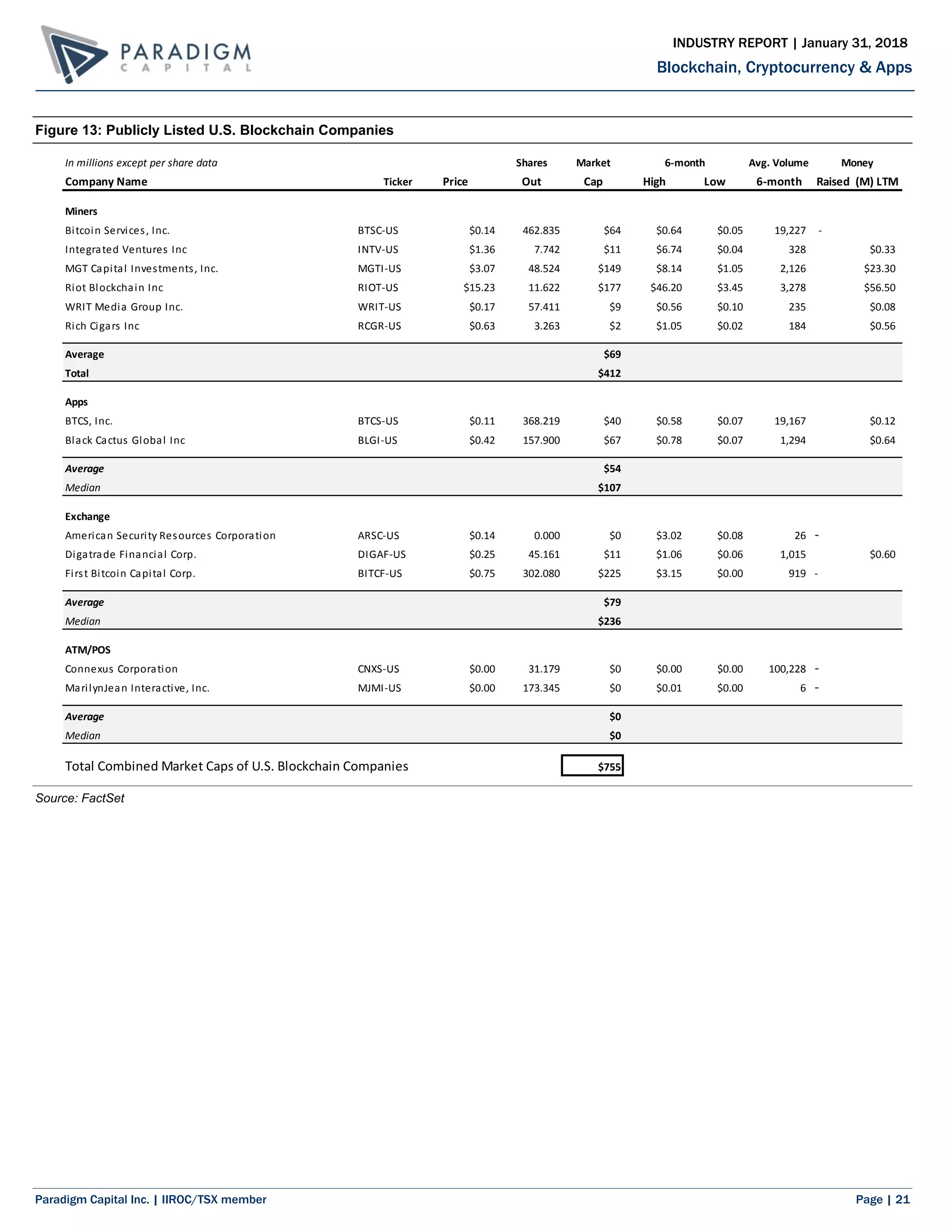
Figure 13: Publicly Listed U.S. Blockchain Companies
Source: FactSet
In millions except per share data Shares Market Avg. Volume Money
Company Name Ticker Price Out Cap High Low 6-month Raised (M) LTM
Miners
Bitcoin Services, Inc. BTSC-US $0.14 462.835 $64 $0.64 $0.05 19,227 -
Integrated Ventures Inc INTV-US $1.36 7.742 $11 $6.74 $0.04 328 $0.33
MGT Capital Investments, Inc. MGTI-US $3.07 48.524 $149 $8.14 $1.05 2,126 $23.30
Riot Blockchain Inc RIOT-US $15.23 11.622 $177 $46.20 $3.45 3,278 $56.50
WRIT Media Group Inc. WRIT-US $0.17 57.411 $9 $0.56 $0.10 235 $0.08
Rich Cigars Inc RCGR-US $0.63 3.263 $2 $1.05 $0.02 184 $0.56
Average $69
Total $412
Apps
BTCS, Inc. BTCS-US $0.11 368.219 $40 $0.58 $0.07 19,167 $0.12
Black Cactus Global Inc BLGI-US $0.42 157.900 $67 $0.78 $0.07 1,294 $0.64
Average $54
Median $107
Exchange
American Security Resources Corporation ARSC-US $0.14 0.000 $0 $3.02 $0.08 26 -
Digatrade Financial Corp. DIGAF-US $0.25 45.161 $11 $1.06 $0.06 1,015 $0.60
First Bitcoin Capital Corp. BITCF-US $0.75 302.080 $225 $3.15 $0.00 919 -
Average $79
Median $236
ATM/POS
Connexus Corporation CNXS-US $0.00 31.179 $0 $0.00 $0.00 100,228 -
MarilynJean Interactive, Inc. MJMI-US $0.00 173.345 $0 $0.01 $0.00 6 -
Average $0
Median $0
Total Combined Market Caps of U.S. Blockchain Companies $755
6-month
Paradigm Capital Inc. | IIROC/TSX member Page | 22
Blockchain, Cryptocurrency & Apps
INDUSTRY REPORT | January 31, 2018
Company Profiles
Auxesis Group (private)
Auxesis partners with organizations to build, deploy, and operate blockchain networks. The company
has created the world’s largest private decentralized network which powers the Auxledger blockchain
platform. Auxledger is a blockchain infrastructure that has been deployed successfully across a
number of enterprises focusing on security, performance, and scalability. The current version of
Auxledger has over 53-million users in India with customers across different verticals including:
government, Internet of Things (IoT), cross-border remittances, capital markets, insurance, and supply
chain. This blockchain powers 15 applications. In addition to Auxledger, the company has a financial
product suite:
 Auxy: A cryptocurrency and crypto-token wallet.
 AuxPay: Payment solutions for merchants to enable the acceptance of cryptocurrencies as a form
of payment.
 AuxCE: A high-frequency cryptocurrency exchange. Allows users to trade Bitcoin, Ethereum, fiat
currency, gold, and energy.
Auxesis also operates an advisory, research and training lab called Blockchain Lab. The lab was
established in 2017 to promote and grow the Blockchain ecosystem in India. The lab has four zones:
defence, IoT, FinTech, and RegTech. The Blockchain Lab focuses on product development,
organizing conferences and seminars, and training students and professionals on implementing
blockchain technology.
Highlights
 Recognition: Auxesis has been recognized among the Top 100 Most Influential Blockchain
Companies, ranking 42 in the world and the only one from India. It has also partnered with
industry leaders to grow its network, including HP (server side and applications deploymnet), Ernst
& Young (consulting & advisory), and IIT (research & development).
 Large Customer Base: Auxledger is already powering enterprise applications and is being used
by over 53-million customers.
Management & Board
Kumar Gaurav – Chairman | Kumar is an entrepreneur who has been responsible for building some
of today’s most exciting fintech businesses. He is among the Top 100 Most Influential People in the
blockchain industry. He was granted Extraordinary status (O1) by the U.S. government for blockchain
expertise. Kumar is the Chairman of Auxesis, India’s first enterprise blockchain company. He also
founded Cashaa and co-founded Darwinsurance. He is the Vice President, Innovation, of Responsible
Gold, the Advisor for Satoshi Studio, and is on the Editorial Board of CoinTelegraph. Kumar holds a
Bachelor’s degree in Computer Engineering and a Master’s in Management from Politechnico di
Milano.
Akash Gaurav – CEO | Akash is a blockchain entrepreneur. He founded Auxesis Group during his
undergraduate studies at IIT Bombay. He also founded Blockchain Lab and Auxledger Foundation. He
is on the Advisory Board of Cashaa and is the Technology Advisor for VEDA Networks. He is also a
mentor to the Entrepreneurship Club of MISB Bocconi. Before founding Auxesis he was the manager
of The Entrepreneurship Cell, IIT Bombay. He also founded Sporturlook and MyCarGenie.
Janina Lowisz – Senior Vice President, Marketing | Janina is well known in the industry as
Blockchain Girl. She has worked as a blockchain analyst for major companies including Amex and
ManPower, and Co-Founded Bitnation. She is a Top 100 Global Blockchain influencer, a blockchain
speaker, and a model.
Sudhir Chaudhary – Senior Vice President, Technology | Sudhir is an experienced techie from
HSBC, Emirates National Bank of Dubai, and Infosys. He is a contributor of Digital Transformation for
HSBC as Integration Specialist for re-innovating HSBC’s e-channels platform to elevate
Commercial/Wholesale banking business for HSBC. He was an Integration Specialist for Emirates
NBD and built e-channel platforms to automate Bulk Payments for Emirates Group, Fly Dubai, and
Paradigm Capital Inc. | IIROC/TSX member Page | 23
Blockchain, Cryptocurrency & Apps
INDUSTRY REPORT | January 31, 2018
Dubai Smart Government. He is an Enterprise Technical expert for IBM’s integration product suite
particularly in Managed File Transfer domain and Sterling B2B integrator.
Dr. Bernard Lietaer – Strategic Advisor | Bernard Lietaer is a civil engineer, economist, author, and
professor. He studies monetary systems and promotes the idea that communities can benefit from
creating their own local or complementary currency, which circulate parallel with national currencies.
He has been active in the realm of money systems for close to 40 years in a wide variety of functions.
With the publication of his post-graduate thesis at MIT in 1971 and the Nixon Shock of that same year
which eradicated the Bretton Woods system by unhinging the U.S. dollar value from its gold standard
and inaugurated the new era of universal floating exchanges, the fledgling management consultant
suddenly found himself to be at the centre of the financial world's attention. The techniques that he had
developed for those marginal Latin American currencies were overnight the only systematic research
that could be used to deal with all of the major currencies of the world. A major U.S. bank negotiated
exclusive rights to his approach which required that he begin another career. While at the Central Bank
in Belgium (National Bank of Belgium) he implemented the convergence mechanism (ECU) to the
single European currency system. During that period, he also served as President of Belgium’s
Electronic Payment System. His consultant experience in monetary aspects on four continents ranges
from multinational corporations to developing countries.
Dr. John Clippinger – Strategic Advisor | Throughout his career John has always been interested in
complex, self-organizing systems and new approaches to organizational and institutional design to
address fundamental civic, economic, and ecological issues. John has held senior positions in
government and large enterprises, and founded four software companies. He has been engaged with
non-profit organizations and institutes, Santa Fe Institute, Aspen Institute, World Economic Forum,
Kauffman Foundation, and has started new programs and institutes at Harvard and Harvard Law
School, Brandeis Florence Heller School, MIT Media Lab, and, more recently, co-founded ID3 with
Sandy Pentland of MIT Media Lab. John is especially interested in the disruptive opportunities enabled
through decentralized technologies such as cryptocurrencies, smart contracts, and ledgers. He
recently organized a series of retreats and workshops to develop principles for new forms of emergent
self-organization and autonomous communities. He also recently edited a book, From Bitcoin to
Burning Man and Beyond — The Quest for Identity and Autonomy in Digital Society.
Richard Kastelein – Crypto Advisor | Founder of industry publication Blockchain News, partner at
ICO services collective CryptoAsset Design Group, director of education company Blockchain Partners
(Oracle Partner) and ICO event organizer — Richard is an award-winning publisher & entrepreneur.
He sits on the advisory boards of half a dozen blockchain start-ups (ICOs) and has written over 1,400
articles on blockchain technology at Blockchain News, and has also published on ICOs in Harvard
Business Review & Venturebeat. Kastelein has spoken (keynotes and panels) on blockchain in
Amsterdam, Antwerp, Barcelona, Beijing, Brussels, Bucharest, Dubai, Eindhoven, Gdansk, Groningen,
the Hague, Helsinki, London, Manchester, Minsk, Nairobi, Nanchang, San Mateo, Shanghai, Tel Aviv,
Venice, and Zurich. He's a Canadian (Dutch/Irish/English/Métis) whose writing career has ranged from
the Canadian Native Press (Arctic) to the Caribbean and Europe. He's written occasionally for Harvard
Business Review, Wired, Venturebeat, The Guardian, and Virgin.com — his work and ideas have been
translated into Dutch, Greek, Polish, German, and French.
Alex Norta – Blockchain Advisor | Alex Norta is currently a research member at the Faculty of
Informatics/TTU and was earlier a researcher at the Oulu University Secure-Programming Group
(OUSPG ) after having been a post-doctoral researcher at the University of Helsinki, Finland. He
received his MSc (2001) from the Johannes Kepler University of Linz, Austria, and his PhD (2007) from
the Eindhoven University of Technology, The Netherlands. His PhD thesis was partly financed by the
IST project CrossWork, in which he focused on developing the eSourcing concept for dynamic inter-
organizational business process collaboration. His research interests include business-process
collaboration, workflow management, e-business transactions, service-oriented computing, software
architectures and software engineering, ontologies, mashups, and social web. At the IEEE EDOC'12-
conference, Alex won the best-paper award for his full research paper with the title #Inter-enterprise
business transaction management in open service ecosystems#.
Dinesh Prasad – Strategic Advisor | Head of Devices, Qualcomm India & South Asia, with the prime
responsibility of driving chipset/device sales through global OEMs, Operators, Local Distributors, and
Brands. Accomplished and knowledgeable in sales, business development, and program management
professional with 22+ years of global experience in the wireless telecom and semiconductor industries.
Results oriented and decisive leader with a proven track record in ecosystem creation, new business
development, increasing sales and market share, achieving growth objectives and program
Paradigm Capital Inc. | IIROC/TSX member Page | 24
Blockchain, Cryptocurrency & Apps
INDUSTRY REPORT | January 31, 2018
management through astute business acumen and sound technical knowledge, identifying and
architecting creative solutions while gaining credibility and building influential relationships at the
highest levels with industry partners and key stakeholders.
Anil Earla – Fintech Advisor | Head of Information & Data Analytics, Visa. Enterprise technology
executive heading digital transformation for world’s largest payment network. Leading various
technology teams to maximize the data assets of Visa Inc. Reduced the incident response time of Visa
network from 6–10 days to 2–3 milliseconds. Intrapreneur passionate about bringing Silicon Valley
innovative mindset to larger organizations. Built lean start-ups resulting in creating new stream of
revenue.
Paradigm Capital Inc. | IIROC/TSX member Page | 25
Blockchain, Cryptocurrency & Apps
INDUSTRY REPORT | January 31, 2018
Blockchain Intelligence Group (BIGG-CNQ, NR)
Blockchain Intelligence Group (BIG) strives to bring security and accountability to cryptocurrency with
its trusted data analysis and risk-scoring capabilities for blockchain/Bitcoin and other cryptocurrencies.
The company was founded in 2010 and is located in Vancouver, B.C. BIG’s proprietary platform
uncovers criminal transactions in the blockchain network and provides peace of mind to people
transacting on the blockchain. The company has created the first easy-to-understand “risk score” for
cryptocurrencies, as well as an Anti-Money Laundering (AML) and Office of Foreign Asset Control
(OFAC) detection API. The platform will target the financial services industry, regulators, and the law
enforcement community to help meet the demands of a blockchain-based future, providing trust and
real-time risk evaluation.
All transactions on the blockchain are permanently stored for all to see on an online public ledger. BIG
uses advanced search and analytics to gather evidence, track movement of funds between wallets,
and ultimately connect criminals with their transactions.
Highlights
 BitRank: A proprietary risk scoring system that ranks the safety of the wallet that a customer is
transacting with. Wallet holders can check their safety rank on bitrankverified.com. Wallets are
ranked on a 0 to 100 scale, 0 being the most dangerous score and 100 being the safest score.
Clients are able to use their API to perform large-volume look-ups.
 Qlue: Qlue stands for Qualitive Law Enforcement Unified Edge. This platform was created to aid
in the fight against financial crimes involving Bitcoin and other cryptocurrencies. Qlue uses
advanced search algorithms and other techniques to detect suspicious activity in Bitcoin and other
cryptocurrency transactions, use of “Dark Web” tools, and other methods used by criminals to
cover illegal activity.
 Blockbits: Provides search and data analytics for companies needing to verify critical business
information.
Management & Board
Shone Anstey – Executive Chairman & Co-Founder | Shone brings 20 years of experience building
complex technologies and software within the IT industry. Shone was co-founder of a scalable web
crawler and search engine, and is a Certified Bitcoin Professional. Formerly, Shone acted as Director
of Technology for a distributed Bitcoin mining pool.
Lance Morginn – CEO & Co-Founder | With over 20 years of industry experience in technology-
based start-ups, Lance brings a vast and proven track record for growing and developing multi-million-
dollar businesses from the ground up. His background includes roles as Founder/CEO/Director in a
handful of publicly traded and privately held companies.
Anthony Zelen – Corporate Development & Co-Founder | Anthony has over 17 years of experience
in finance, investor relations, and corporate development. He is the owner of the full-service corporate
communications firm Senergy Communications Inc., providing investor relations, public relations, and
marketing solutions.
Kim Evans, CPA, CGA – CFO | Kim, founder of Golden Reign, is a Certified General Accountant with
extensive experience in both the junior mining sector and the corporate securities industry. Ms. Evans
has 17 years' experience as a director and/or officer, working with a number of public companies listed
on the TSX Venture Exchange.
Tom Kennedy – Director | Mr. Kennedy, B.Comm., J.D., is a graduate of the University of British
Columbia. After an initial career at the Federal Department of Justice, he has primarily focused as a
legal, financial, and business consultant to publicly traded companies. Mr. Kennedy is currently a
member of the Law Society of British Columbia, the Canadian Bar Association, the British Columbia
Bar Association, and an Associate member of the American Bar Association. Mr. Kennedy is an officer
and/or director of several publicly traded companies. He is an independent contractor and expects to
devote 5% of his time to the affairs of the resulting issuer.
Paradigm Capital Inc. | IIROC/TSX member Page | 26
Blockchain, Cryptocurrency & Apps
INDUSTRY REPORT | January 31, 2018
Robert Birmingham – Director | Mr. Birmingham has over 10 years’ experience in the resources and
corporate sector. He is the current President & CEO of New Destiny Mining Inc., a TSX Venture-listed
company involved in mining exploration. He was previously the President & Chief Executive Officer of
Revolver Resources Inc. (now GGX Resources), a TSX Venture-listed company involved in mining
exploration. In addition, Mr. Birmingham has been a director of multiple public companies on the TSX
Venture Exchange and the Canadian Securities Exchange. Mr. Birmingham holds a business degree
from Capilano University. He is an independent contractor and expects to devote 5% of his time to the
affairs of the resulting issuer.
Paradigm Capital Inc. | IIROC/TSX member Page | 27
Blockchain, Cryptocurrency & Apps
INDUSTRY REPORT | January 31, 2018
Boardwalktech (private)
Founded in 2005, Boardwalktech was the first company to develop a positional, cell data management
technology that it now delivers as the core component of a patented, multi-party digital ledger
blockchain database designed for collaborative, multi-party, mission-critical applications which rely on
a digital information exchange internally and externally. Its platform is ideal for managing the exchange
of information between parties in a distributed manner in any application and in any industry via a
blockchain digital ledger that facilitates more efficient trade, establishes trust, enhances transparency,
and enables better control for businesses and their customers
The company has a blue-chip customer base, including a number of Fortune 500 companies like
Apple, Coke, Teva, and PwC. In addition, the company works with IBM, Oracle, Microsoft, Accenture,
and McKinsey as both consulting and technology partners. The return on investment (ROI) for
customers is a reduction in manual processes, a reduction in inefficiencies and risk, better data
accuracy, and faster decision cycles.
Highlights
 Boardwalk Application Engine (BAE): allows customers to build enterprise quality applications
that scale, secure, and integrate existing spreadsheet processes or create entirely new
applications based using BAE’s digital ledger data management technology. BAE’s tools can be
used to build and maintain applications with multiple internal or external using Excel or any other
UI.
 Boardwalk Enterprise Blockchain: provides a dynamic, smart contract enabled information
exchange that combines BAE’s temporal data management and enterprise integration
environment with Blockchain’s trust and validation capabilities. The result is a private
permissioned enterprise blockchain that supports multi-party transactions and consensus models.
Management & Board
Andrew Duncan – CEO | Andy has over 20 years of experience focused on building companies and
taking products and services to market. Prior to Boardwalktech, he served as President and CEO of
Advanced Data Exchange. ADX provides an on-demand supply chain transaction processing network
used today by over 200 of the Fortune 1000 companies. Andy also served as President and CEO of
The EC Company, which was focused on payment transaction technologies for the small and mid-
market. During his work in the technology field, he has led companies through several stages of
growth and secured significant investments from American Express, CMGI @Ventures, Invamed
Associates, Intel Capital, Wasserstein Addelson Ventures, GKM Ventures, Sandler Captial, and The
Thomson Companies. Prior to entering the technology field, Andy was President and CEO of Duncan
Insurance, Inc., a nationwide insurance brokerage representing over 80 insurance companies
specializing in commercial insurance.
Ravi Krishan – CTO | Ravi, and the other two founders, Sarang Kulkarni and Dharmesh Dadbhawala,
have over 50 years combined of engineering product data management experience working for
Parametric Technology, Sherpa, and Netfish. Prior to Boardwalktech, Ravi was a founder of the
Hunington Group which provided advanced database architecture and design consulting. Ravi was
responsible for the vision and drive beyond a 10,000-user, $100-million collaborative product data
management solution, using existing database technology, at Parametric Technology Corporation.
Mike Braun – Advisor & Director | Mike Braun was most recently the President and CEO of Intacct
Corp., a leader in cloud-based accounting and financial management software for small- and medium-
sized businesses using the software-as-a-service (SaaS) model. Mr. Braun led a period of rapid
investment and growth and was one of the Top 100 Most Influential People in the Accounting
Profession. He retired in late 2009 and was named CEO Emeritus of Intacct. After retirement, he
worked part-time as Dean's Executive Professor of Information Systems at the Leavey School of
Business at Santa Clara University. Mr. Braun has over 40 years of experience in the information
technology industry spanning businesses of all sizes and most product categories. He was also CEO
of The Interim CEO Network, a specialized recruiting firm he founded; Neuron Data which he
transformed to become Blaze Software and went public; and Kaleida Labs, the pioneering multimedia
joint venture of Apple and IBM. Mr. Braun spent over 23 years at IBM, including as General Manager
of four divisions: Global Small Business; Global Consumer Division; Fireworks Partners, a venture
capital firm; and the Multimedia. He has a BA and an MBA from the University of Rochester.
Paradigm Capital Inc. | IIROC/TSX member Page | 28
Blockchain, Cryptocurrency & Apps
INDUSTRY REPORT | January 31, 2018
Ken Goldman – Advisor | Ken Goldman is an accomplished executive with extensive financial,
operational and business management experience, and a solid track record of success. He is currently
the CFO of Yahoo. Previously, he served as the the CFO of Fortinet, the Senior Vice President,
Finance and Administration, and CFO of Siebel Systems from August 2000 until the close of Oracle's
acquisition in January 2006. Prior to that, he held CFO positions at Excite@Home, Sybase, Inc.,
Cypress Semiconductor, and VLSI Technology. Additionally, his experience includes board director,
audit committee chairman, and financial advisory roles at several leading public and private technology
companies. Ken earned his Bachelor's degree in Electrical Engineering from Cornell University in 1971
and his Master's in Business Administration from Harvard Business School in 1974. He is a member
and the former president of The Financial Executive Institute, Santa Clara chapter, and was formerly a
member of the Financial Accounting Standards Board Advisory Council (FASAC) from 2000 to 2004.
Joe Cardenas – Advisor | Joe Cardenas was most currently the CIO of Salesforce.com where he was
responsible for all system infrastructure and IT practices. He was also the Executive Vice President
and CIO for Employers Direct Insurance Corporation (EDIC) working with the company from start-up to
over $100 million in 18 months. Before EDIC, he was the CIO for Autodesk and for Fremont General, a
financial services company. Cardenas also spent four years at Oracle Corp. as Vice President of
Information Technology. At Oracle he was responsible for internal application development, data
centre, network operation centres, and network security.
Pierluigi Zappacosta – Advisor | Mr. Zappacosta co-founded Logitech (Nasdaq: LOGI), the leading
maker of mice and other personal interface products that enable people to work, play and
communicate in the digital world. At Logitech, he served over a sixteen-year period first as President
and CEO and later as Vice-Chairman. He was instrumental in taking the company public in Switzerland
in 1988 and on NASDAQ in 1997, raising over $60 million. By the time Mr. Zappacosta left in 1998,
sales of Logitech had risen to over $400 million per year.
Don Haderle – Advisor | Don Haderle is a pioneer of relational database and information
management technology. From 1968 to 2005, he worked in Research & Development at IBM Corp.
where he was responsible for over 50 patents and disclosures. As the technology leader for IBM's
relational database, DB2, which debuted in the 1980s and serves most of the major corporations in the
world today, Haderle is known as the "Father of DB2." In 1989 Haderle was appointed IBM Fellow,
IBM's most prestigious position for technologists.
Paradigm Capital Inc. | IIROC/TSX member Page | 29
Blockchain, Cryptocurrency & Apps
INDUSTRY REPORT | January 31, 2018
CryptoGlobal Corp. (CPTO-T, NR)
CryptoGlobal Inc. is a cryptocurrency mining company. It operates facilities with both ASIC and GPU
mining in order to generate profit from mining various cryptocurrencies, including Bitcoin, Litecoin,
Dash, Ethereum, and Monero. The company has the ability to quickly shift hash power to take
advantage of the most profitable coins. CryptoGlobal uses the cryptocurrencies mined to distribute
profits to investors and build its own coin inventory. Its goal is to become Canada’s largest crypto-
mining company by expanding its mines across multiple provinces.
Highlights
 Canadian Edge: Canada is recognized as one of the best places for cryptocurrency mining owing
to its economic and political stability, inexpensive renewable power, will government, educated
workforce, and sub-Arctic temperatures.
Management & Board
Rob Segal – CEO & Director | Mr. Segal is a North American marketing and communications
executive and entrepreneur. He founded Segal Communications (acquired by Interpublic in 2000) and
went on to lead WorldGaming (acquired by Cineplex in 2015) and Ruby, and has worked with a
number of global brands. Mr. Segal is a co-founder of CryptoGlobal and a board member of OMX
(theOMX.com) and Autism Speaks Canada. He holds a B.A. from the University of Western Ontario.
James Millership – President & Director | Mr. Millership is an early-stage investor and entrepreneur.
His background in operations and finance has led to a successful career focused on start-ups and
corporate turnarounds. He most recently played a leadership role in the re-organization of two tech
platforms: WorldGaming (acquired by Cineplex in 2015) and Ruby. James is a co-founder of
CryptoGlobal. He has an MBA from the Ivey School of Business.
Perry Miele – Director | Mr. Miele is Chairman and partner of Beringer Capital, a fund investing in
emerging marketing services companies. Most recently, he assumed the role of Chairman of Match
Marketing, a North American retail marketing firm with over 7,000 employees and eight offices in the
U.S. and Canada. Mr. Miele is also a director of Andrew Peller Ltd., a TSX-listed company, and is on
the board of Trillium Heath Partners.
Nicole Verkindt – Director | Ms. Verkindt is the founder of OMX (Offset Market Exchange) and the
newest Dragon on CBC’s Next Gen Den. She also sits on the board of the Peter Munk School of
Global Affairs MGA Program. Additionally, Ms. Verkindt is the official technology columnist for
Vanguard Magazine and a regular commentator and panellist on CBC’s The Exchange. She is an
active member of the CSCA (Canadian Space Commerce Association), CADSI (Canadian Aerospace,
Defence, Security Industry Association), Aerospace Industries Association of Canada (AIAC), and
Global Offset and Countertrade Association (GOCA). In 2017, Nicole was named “Canada’s 2017
Woman Entrepreneur of the Year” by StartUp Canada.
Eric Klein – Director | Mr. Klein is Executive Vice President, Corporate Development, at Dundee
Corp.. He has more than 25 years of experience advising on mergers and acquisitions, corporate
finance, business valuations, and corporate strategy. Prior to joining Dundee, Mr. Klein was the
Partner at Klein Farber Financial where his duties included providing value-added financial advisory
services to mid-market companies. Eric holds a Bachelor’s degree in Commerce and Graduate
Diploma in Public Accounting from McGill University. He is a Chartered Accountant (CA) and a
Chartered Business Valuator (CBV). Mr. Klein currently serves on the boards of several public issuers
and is a frequent lecturer and speaker on valuation, corporate finance, and entrepreneurship, and is
involved in various charities.
Paradigm Capital Inc. | IIROC/TSX member Page | 30
Blockchain, Cryptocurrency & Apps
INDUSTRY REPORT | January 31, 2018
DMG Blockchain Solutions (listing pending)
DMG Blockchain Solutions Inc., is a diversified leader in blockchain technology, specializing in Bitcoin
mining, Mining as a Service (MaaS), blockchain platform development, and blockchain analytics. DMG
is one of the first companies to offer Maas, and its access to a large customer base of Bitcoin buyers
throughout Japan has already led to more than $3 million in MaaS sales. While the company focuses
on Bitcoin because of its addressable market size and DMG’s competitive advantage for executing
industrial mining at scale, DMG intends to expand into other leading cryptocurrencies during 2018. The
company was built by an experienced team of seasoned Bitcoin mining experts and blockchain
technology executives.
DMG has two operational mining facilities in Western Canada with thousands of Bitcoin mining rigs
now energized. The company has acquired a third facility, which when completed will have access to
up to 85MW, which, to our knowledge, would be the largest such facility in Canada.
Today, DMG is generating revenue through DMG-owned Bitcoin mining and MaaS; however, the
company will soon add the following revenue streams:
 Expansion of Mining as a Service (MaaS): MaaS allows individuals and groups to purchase any
number of servers from anywhere in the world. DMG charges on average a hosting fee of
$200/server per month, which equates to $110,000/month per MW (550 servers per MW of
mining). DMG recently entered into a lease and hosting agreement with Mogo Financial (MOGO-
T, NR) for the lease of 1,000 Bitcoin mining rigs to be managed and hosted by DMG on behalf of
Mogo.
 Blockchain Platforms: DMG’s blockchain platform development team has recently announced a
partnership with leading licensed producer, Emerald Health Therapeutics (EMH-T), to develop a
blockchain-based supply chain management platform for the medicinal cannabis market. DMG
has also begun collaborating with Element Fleet Management (EFM-T) to develop a blockchain-
based smart contract platform to facilitate life-cycle management and vehicle tracking. Element is
North America’s largest fleet leasing company.
 Forensics: DMG’s cryptocurrency forensics effort is led by Simon Padgett, a Certified Fraud
Examiner and CPA. The company plans to partner with legal and accounting firms to provide
forensic services as they relate to Bitcoin, Ethereum, and other cryptocurrencies.
Highlights
 Scalability: DMG employs a blended model for its mining, specifically company-owned miners,
and MaaS. This model allows DMG to scale rapidly with a substantial portion of the capital costs
and currency risk borne by hosting clients. This business model is highly scalable, and it is DMG’s
goal to provide complete transparency on costs and returns to customers.
 Management Team: There are few companies in this emerging space with a management team
that includes former executives from the world’s second-largest Bitcoin mining and blockchain
company, Bitfury. Prior to co-founding DMG, Sheldon Bennett was responsible for building
Bitfury’s largest mining facility at 58MW, providing plenty of experience and expertise as he leads
the construction of DMG’s 85MW facility. Steven Eliscu, also formerly with Bitfury, leads corporate
development for DMG, and Varun Gupta, formerly legal counsel for Bitfury, provides crypto-
focused legal advice to DMG’s legal team. DMG’s Chairman is head of Bitmasters, a network of
Japanese Bitcoin buyers, numbering in the tens of thousands.
Recent Announcements and Potential Transactions (Letters of Intent Signed)
 January 26, 2018: Emerald Health Therapeutics and DMG Blockchain Solutions establish letters
of intent (LOI) to create cannabis supply chain management system and e-commerce platform.
 January 24, 2018: BlockSeer LOI signed for acquisition (leading blockchain AI, analytics and
forensics company).
 January 23, 2018: DMG and MOGO sign MaaS LOI.
 December 28, 2017: DMG Blockchain Solutions Inc. and Aim Explorations Ltd. announce closing
of C$28,060,800.
 December 14, 2017: DMG launches Bitcoin Mining as a Service (MaaS) direct to Japanese
customers and receives initial order in excess of C$3 million.
 December 4, 2017: Element Fleet Management strategic investment (a global leader in fleet
management).
Paradigm Capital Inc. | IIROC/TSX member Page | 31
Blockchain, Cryptocurrency & Apps
INDUSTRY REPORT | January 31, 2018
Management & Board
Dan Reitzik – CEO & Director | Dan Reitzik is a successful entrepreneur having built companies at
the forefront of societal change. These include Digital Youth Network, a teen-focused wireless
community, which was a joint venture between Rogers Wireless, Canada’s largest mobile phone
network, and Universal Music, the world’s largest record label.
Ryan Cheung – CFO & Director | Ryan Cheung is the founder and managing partner of MCPA
Services Inc., Chartered Professional Accountants, in Vancouver, B.C. Leveraging his experience as a
former auditor for junior-venture and resource companies, Mr. Cheung serves as a director and/or
officer or consultant for public and private companies providing financial reporting, taxation, and
strategic guidance.
Chris Filiatrault – Chairman | Chris Filiatrault is a co-founder and director of DMG. For over 30 years
he has been developing Internet technology and software for the Japanese business market. In 1999,
he founded Universal Objects Japan. In May 2012, Mr. Filiatrault brought Bitcoin to the Japanese
market and since then he has become a respected international authority on Bitcoin, opening the first
Bitcoin ATM in Tokyo in 2014.
Sheldon Bennett – Director | Sheldon Bennett has over 20 years of management experience leading
international companies including PwC, Ernst & Young, Baker & McKenzie, Cisco Systems, and
Fonterra CIS. For the past three years, Sheldon led Bitfury’s Canadian mining operations, where he
was responsible for the set-up and development of industrial Bitcoin mining operations, including
government relations, power optimization with Canadian utilities, and the engineering and
development of mining operations.
Simon Paget – Forensics | Simon Paget is a British ACCA Accountant with a Canadian CPA and an
MBA from Oxford. He is also a CFE (Certified Fraud Examiner) with over 25 years of experience as
Head of Internal Audit, Risk Management and Corporate Governance, with a particular focus on and
specialism in forensic accounting and fraud and corruption investigations, anti-fraud programs and
anti-money laundering. He has worked for the big four accountancy firms, including six years at Ernst
& Young in South Africa and KPMG in the Caribbean Region.
Steven Eliscu – Special Advisor to the Board | Steven Eliscu leads the corporate development
efforts at DMG. He was most recently Head of Finance at Bitfury, a leading blockchain and
cryptocurrency company. Prior to Bitfury, Steve had his own consulting business, during which he was
part of a corporate development team that executed a half-billion-dollar acquisition. Prior to that, Steve
was an equity research analyst at UBS for nine years, during which he covered semiconductor
companies with an aggregate market cap in excess of $200 billion. He has also worked in executive
marketing and business development roles in the semiconductor and network equipment sectors.
Paradigm Capital Inc. | IIROC/TSX member Page | 32
Blockchain, Cryptocurrency & Apps
INDUSTRY REPORT | January 31, 2018
Fortress Blockchain Corp. (private)
Fortress is a cryptocurrency mining company operating in low-cost and environmentally friendly power
regions. The company has been operating its 2MW facility since 2014 in Washington State. This
facility contains 1,400 Bitmain S9 Antminers and has a current hash rate of 18.9 PH/s. Fortress uses
renewable hydroelectric energy to power its data centre. The cost of electricity is US$0.026/kWh, 50%
lower than Canada’s average industrial electricity cost. All Bitcoins currently mined are held to take
advantage of future price appreciations.
Fortress has the exclusive option to acquire additional mines to become the second-largest miner in
North America. The current 2MW facility is being expanded to 5MW. By the end of Q2/18, the
company will own another 9MW facility, increasing its portfolio to a total of 14MW. Fortress is in the
process of acquiring land for a 40MW facility (Q1/18) and land for a 60MW facility (Q2/18), these mines
will be operational in early 2019 and late 2019, respectively.
Highlights
 Thermal Network: After years of data centre operational experience, the company has created
an efficient themal network to keep equipment cool while minimizing energy consumption. The
mining servers are isolated from their exhaust system in heat trapping corridors; this warm air is
removed from the isolated area using a negative pressure system. This network prevents hot air
from circulating around the data centre.
 Cold Storage: All coins mined are kept in cold storate with a secure third-party custodian.
Management & Board
Aydin Kilic – CEO & Director | An experienced management consultant and expert analyst with a
deep understanding of cryptocurrency mining algorithms and is a partner in a commercial-scale
cryptocurrency mine in Canada. Aydin has underwritten over $200 million in land acquisitions for
property developers and has managed and secured over $100 million in construction financing. He
holds a BSc. in Engineering Science from SFU with a specialization in high-frequency electronics,
mathematical modeling, and physics.
Roy Sebag – Chairman | An entrepreneur who has enjoyed a successful 15-year career in diverse
industries including technology, precious metals, and investment management. He is the Co-Founder
and CEO of Goldmoney, the world’s largest gold savings and payment platform with $2 billion in
precious metals savings. Roy began his career as a portfolio manager founding a hedge fund that
specialized in contrarian investing in global public equity markets.
Josh Crumb – Director | Co-Founder, Chief Strategy Officer, and CFO of Goldmoney, the world’s
largest gold savings and payments platform with $2 billion in precious metals savings. He was
previously an executive director at Goldman Sachs (Global Economics, Commodities and Strategies)
in London, U.K. Josh holds a MSc. In Mineral Economics, a Graduate Certificate in International
Political Economy, and a BSc. In Engineering from the Colorado School of Mines.
Kent Wakeford – Director | Over 18 years of digital entertainment, media, technology, and video-
gaming experience. He is the Co-Founder, COO and board member of KSV eSports, a global eSports
company which owns multiple championship teams in Korea. Kent is the former COO of Kabam, a
leading developer and publisher of AAA mobile games.
Paul Lum – Advisor | Paul has 20+ years of experience as a multi-disciplinary entrepreneur
specializing in IT and consumer products. He has been an expert in commercial cryptomining since
2014. He is a recipient of Entrepreneur of the Year Award and Top 40 under 40 Award. He has a
BComm in Finance from the University of British Columbia.
Jeff Howell – Advisor | A senior gaming executive with 15 years of experience in mobile, PC, and
console game development. He is the CIO at Kabam, a world leader in AAA mobile games. He was
previously the CTO of Exploding Barrel Games and held multiple senior technical roles at Electronic
Arts.
Sandeep Sood – Advisor | Technology entrepreneur, software consultant, and investor. He sold
technology consultancy Monsoon Company to Capital One in 2015. He is currently Vice President,
Ventures and Software Engineering, at Capital One and leading its blockchain product research for the
past six months.
Paradigm Capital Inc. | IIROC/TSX member Page | 33
Blockchain, Cryptocurrency & Apps
INDUSTRY REPORT | January 31, 2018
Derek White – Advisor | He has over 30 years of experience in metals, mining, and capital markets.
He is currently President and CEO of Ascot Resources, an emerging gold and silver exploration
company in B.C. Derek is the former President and CEO of KGHM International Ltd. and Executive
Vice President, Business Development, and CFO of Quadra FNX Mining Ltd.
Kyle Hickey – Advisor | Former Director, Investment Banking at BMO Capital Markets in Vancouver,
B.C. He as prior experience at JP Morgan in London, U.K. and private equity in New York City. Kyle
holds an LLB from the University of Oxford and a BComm from McGill University.
Paradigm Capital Inc. | IIROC/TSX member Page | 34
Blockchain, Cryptocurrency & Apps
INDUSTRY REPORT | January 31, 2018
Great North Data (private)
Great North Data specializes in hosting high-density computer hardware requiring substantial access
to both power and cooling. GND’s head office is located in St. John’s, Newfoundland and Labrador,
with operations in Labrador City and Goose Bay. The current capacity of the operations data centre
sits at 5MW (100% utilized), with significant additional capacity expected to come online throughout
early to mid-2018. All the power sourced by GND is hydro-generated and thus environmentally
sustainable.
GND has a local advantage in Newfoundland and Labrador, as major competitors have been locked
out of the market owing to the complexities of working in the jurisdiction. Securing large-scale electrical
permits requires substantial time and existing relationships with the public utility, as well as political
and community support. The federal and provincial government supports all of the company’s projects,
through financial backing in the form of interest free loans and grants.
GND has been in the mining industry for more than five years and has been able to develop a wealth
of experience hosting equipment from every major manufacturer, supporting clients from across the
world. This experience has allowed it to round out its business with a significant revenue stream in
servicing and repair. The ability to fix miners in-house rather than the time-consuming process of
shipping back to the manufacturer has become a considerable value-added service to clients.
Highlights
 Geographic Location: Canada is uniquely positioned to become a dominant blockchain mining
force: geographic stability, affordable green energy, sub-Arctic temperatures, and traditional
mining towns hungry to attract investment.
 Electricity: GND has secured contracts that provides it with green hydroelectricity at one of the
lowest prices globally, C$0.02/kwh (similar to DMG).
 Low Costs: Low overhead costs allow GND to provide industry-leading prices to its customers. Its
custom-designed HVAC systems are cost effective and environmentally friendly.
Management & Board
James Goodwin – CEO & Co-Founder | James graduated with his law degree from the University of
New Brunswick in 2010. He has been a past member of the Law Society of New Brunswick and since
2011 a practicing member of the Law Society of Newfoundland and Labrador. He is originally from
Toronto but followed his wife to settle in Newfoundland and Labrador. Through his work in the province
he was able to identify the advantages of doing business in the jurisdiction. When he first discovered
Bitcoin and the mining process, he knew this could be one of the best locations in the world to operate.
James has been a driving force in turning a basement side project into a rapidly growing company that
has clients spanning the globe.
Paul Renard – COO & Co-Founder | Paul Renard is a Bachelor of Commerce graduate from the Ted
Rogers School of Business at Ryerson University. Paul partnered with James and several other early
Bitcoin innovators to open the first iteration of GND over five years ago. Since then, he’s been
responsible for initiating and managing relationships with the many government agencies and
community partners needed to grow the business from a small start-up into a large enterprise. He’s
currently overseeing the construction of several new data centres and managing a rapidly growing
workforce.
Paradigm Capital Inc. | IIROC/TSX member Page | 35
Blockchain, Cryptocurrency & Apps
INDUSTRY REPORT | January 31, 2018
Hashchain Technology Inc. (KASH-V, NR)
HashChain is a blockchain mining company, and the first publicly traded Canadian cryptocurrency
mining company to file a final prospectus supporting highly scalable and flexible mining operations
across all major cryptocurrencies. HashChain taps low-cost North American power, cool climate, and
high-speed Internet: the trifecta most critical to mining success, to create a competitive position for
maximizing the number of mining “wins”. Its data centre, which is located in Vancouver, currently has
100 dash rigs with 770 S9 Antminer rigs delivered in January. Current rigs acquired will be equivalent
to 1.23MWs and will be phased in by the end of January. The company has also signed a purchase
order to acquire 5,000 rigs from its supplier, of which 3,000 have been paid for. Upon delivery and
installation of these rigs, the company’s total number will increase to 5,870 and its total mining capacity
will to ~8.7MW. The 5,000 rigs are expected to be received in multiple deliveries between February
and May. Additionally, in January HashChain closed a $29.7-million bought deal private placement.
Hashchain sees Dash as the cryptocurrency of the future as it is moving quickly to mass adoption and
will soon be as easy to use as PayPal. There is a significant opportunity in the Dash market; as a
comparison, Bitcoin’s market cap is $187 billion while Dash’s is $6.1 billion.
Hashchain’s current data centre is located in Vancouver. This data centre consumes power at
US$0.04/kWh. The company has signed a commitment for space for mining operations of up to 20MW
in a facility in Montana, and is exploring additional capacity in Newfoundland. The Newfoundland data
centre will have an advantage in power cost with a price of $0.02/kwh.
Highlights
 Transaction Time: The transaction and block time for Dash is significantly better than Bitcoin’s. It
takes Dash 1.3 seconds to complete a transaction and 2.5 minutes for a new block, while Bitcoin
takes +10 minutes for a transaction and 10 minutes for a new block.
 Dash Masternode | Hashchain owns one Dash Masternode (1000 Dash coins) which gives the
company governance privileges and voting rights on the Dash blockchain. The company paid
$280,000 to acquire this Masternode and it expects to receive ~10% return on investment. When
Dash miners discover a new block the reward is shared as follows: 45% to the mine, 45% to
Masternodes, and 10% reserved for the budget system.
Management & Board
Patrick Gray – CEO & Director | Patrick Gray is the CEO and founder of HashChain and helps lead
the overall strategic vision of the company. Mr. Gray obtained a Bachelor’s degree in Computer
Science and a minor in Business from Siena College in New York. The first start-up he was involved in
was sold to Xerox for $220 million. Patrick has started multiple successful companies and raised
millions from private investors. One of his start-ups sponsored a nationally televised race, the Indy 225
at the New Hampshire Motor Speedway, which was televised on NBC. He currently owns sCube Inc.,
a niche IT service provider that focuses on e-discovery, e-licensing, application development, and IoT.
sCube has been awarded Best Places to Work by the Business Review. Mr. Gray has been
recognized with two of his companies on his alma maters wall of success. He is also a recipient of the
Business Reviews “40 under 40”.
Herrick Lau – CFO | Mr. Lau is currently the CFO and Corporate Secretary and the Managing Director
of Baron Global Financial Canada Ltd., a merchant-banking firm which provides financial advisory
services to private and public companies and offers advice on transaction structuring, mergers and
acquisitions, corporate governance, and compliance issues. With over 20 years in financial
management and corporate finance, Mr. Lau has gained valuable experience in developing financing
strategy, liaising with external parties, devising business development plans, and maintaining
compliance with corporate governance requirements. He also has experience as a senior financial
executive in public companies. He has been CFO and/or Director for various public companies listed
on TSX, TSX Venture Exchange, and Canadian Securities Exchange. Mr. Lau obtained his Bachelor
and Master degrees in Business Administration and Economics from Simon Fraser University. He is
also a Chartered Financial Analyst.
Nitin Kaushal – Director | Mr. Kaushal serves as Managing Director, Corporate Finance at PwC
Canada. He has over 30 years of finance and investment experience in the financial, life sciences,
consumer healthcare, and medical device industries. Over the course of his career, Mr. Kaushal has
worked in senior roles with a number of Canadian investment banks, including Desjardins Securities
Paradigm Capital Inc. | IIROC/TSX member Page | 36
Blockchain, Cryptocurrency & Apps
INDUSTRY REPORT | January 31, 2018
Inc., Orion Securities Inc., Vengate Capital Partners Company, HSBC Securities Inc., Medwell Capital
Corp., and Gordon Capital, and has held various roles within the private equity/venture capital industry.
In addition, he has sat on the boards of a number of public and private companies, including Patient
Home Monitoring Corp., Convalo Health International, Delivra Inc., Global Gardens Group Inc., and
Shelby Ventures. Mr. Kaushal holds a Bachelor of Science (Chemistry) degree from the University of
Toronto and is a CPA-CA.
Perry Woodin – Advisory Board | Perry Woodin’s interest in blockchain technologies started with the
financial incentives that digital currencies use to encourage network participation, from early Bitcoin
mining to Dash-incentivized full nodes. Perry founded NODE40 to service serious blockchain investors
who want to participate in incentivized networks and track the financial health of their assets. Perry
comes to blockchain application development with over 20 years’ experience developing and
managing web-based applications and services. Prior to NODE40, he worked as a consultant and was
responsible for the development and management of customized metrics-intensive business
applications. His business experience includes running one of the first web-based applications that
allowed high-end art galleries to manage their online presence. It was the go-to data management
application for many galleries in New York City for 12 years.
Gary Bahre – Advisory Board | Gary Bahre is an experienced entrepreneur who owned, operated,
and sold the New Hampshire Motor Speedway. He was also a majority owner of the Oxford Casino in
Maine which sold to Churchill Downs. He is considered one of the most successful businessmen in the
Northeast and was even listed on The Powerful: New Hampshire’s 10 most influential people. Gary is
a philanthropist who cares about the environment, politics and communal wellbeing. He takes a
vigorous stance in social responsibility initiatives and is very active in charitable contributions
worldwide.
Paradigm Capital Inc. | IIROC/TSX member Page | 37
Blockchain, Cryptocurrency & Apps
INDUSTRY REPORT | January 31, 2018
Hyperblock Technologies Corp. (private)
Hyperblock is a cryptocurrency mining company operating one of the largest North American mining
facilities, Project Northwest. The sector operated by Hyperblock runs 10PH/s of Bitcoin ASIC miners
and has an additional 10PH/s going online this quarter. Hyperblock has signed a definite agreement to
acquire its co-location partner Project Northwest. Project Northwest runs 13,000 servers at a 20MW
capacity with the ability to scale to 80MW and operates across four channels: self-mining, hashrate
sales, server hosting, and server hardware sales. The company has a contract with a tier-1
hydroelectric power producer that provides low cost power at US$0.04/kWh.
Highlights
 Multiple Revenue Streams: Project Northwest operates multiple revenue streams: 1) self-mining
is cryptocurrency mining through a mining pool which guarantees daily payouts; 2) hash rate sales
to wholesale buyers for a fixed period of time; 3) server hardware sales of new and used
equipment which de-risks capex and allows the company to upgrade equipment constantly to the
newest versions; and 4) server hosting provides the company with monthly U.S. dollar payments
from customers who own their own servers and operate them at the data centre.
Management & Board
Sean Walsh – Founder, CEO & Executive Director | Sean Walsh is the founder of one of the largest
blockchain mining data centres in North America. He started commercial-scale Bitcoin mining in 2013
and previously worked for the award-winning private equity firm Bertram Capital focusing solely on
Bitcoin; while there he founded the Bertram Labs incubator which was recognized for disrupting the
trillion-dollar private equity middle market. Mr. Walsh is an internationally sought-after leader who was
featured at the keynote address for the 2017 World Blockchain Forum. He is an Aerospace
Engineering graduate and has helped design two commercial satellite networks and several NASA
research missions.
Eric So – Chairman | Eric So has over 15 years of experience advising both public and private
companies. Currently, he is the Managing Director of Globalive Technology Partners Inc., Lead
Director for Riot Blockchain Inc., and an Independent Director of Therapix Biosciences Inc. Previously
he was CLO & Chief Corporate Development Officer for Mundo Inc.
Hon Ronald R. Spoehel – Vice Chairman | Mr. Spoehel has over 35 years of private investment,
board, executive management, and investment banking experience. Currently, he is the Managing
Partner of Windrock Investments, a director of Profire Energy, Inc. and Chairman of Millennial Esports
Corp. Previously he was the presidentially appointed CFO of NASA and spent 10 years at Lehman
Brothers and Bank of America.
Anthony Lacavera – Director | Mr. Lacavera founded WIND Mobile and served as Chairman and
CEO until 2015. He is currently the Founder, Chairman, and CEO of Globalive Technology Partners
Inc. He is actively involved in accelerators and incubators, including MaRS, Creative Destruction LAB
(CDL), NEXT Canada, and the DMZ at Ryerson University.
Dayna Gibbs – Director | Dayna Gibbs has over 15 years of corporate finance and capital markets
experience. She is currently a trustee and the Chair of the Corporate Governance & Nominating
Committee of Agellan Commercial REIT. She previously held progressively senior positions in the
investment banking division of BMO Capital Markets, Brascan Financial Real Estate Group (Brookfield
Financial), and RBC Capital Markets.
Tony Gaffney – Director | Mr. Gaffney previously held CEO roles at Aon Hewitt Canada, Bell Nexxia,
and BCE Emergis, a publicly traded company. He held international leadership positions with SHL
Systemhouse Inc., MCI Corp., and Anderson Consulting. He currently sits on the boards of Altus
Group, President’s Choice Bank, Canada’s Walk of Fame, and Bishop Strachan School.
Paradigm Capital Inc. | IIROC/TSX member Page | 38
Blockchain, Cryptocurrency & Apps
INDUSTRY REPORT | January 31, 2018
Leonovus Inc. (LTV-T, NR)
Leonovus offers blockchain hardened software-defined object storage solutions. The company was
founded in 2009 and has offices in San Jose, California and Ottawa, Ontario. Unlike other big storage
providers, like IBM and Oracle, who have hardware-defined proprietary storage systems, LTV’s is
Linux-based so runs on any hardware and any operating software. LTV takes data and encrypts it,
then breaks it up in small parts and stores each of these parts onto different nodes of the network (i.e.,
this is distributed storage), thus rendering the data unreadable. Blockchain hardens this process
further to make this an even more secure application.
Firms produce vast amounts of data and often struggle trying to store this data because of the high
cost of storage. Leonovus eliminates this storage issue at the petabyte level and beyond. The solution
that LTV provides becomes more efficient over time as the size of the data grows, increasing customer
return on investment. To secure the data, the company takes an encrypted data file and segments it,
re-encrypts it and then replicates it across multiple endpoints — this redundancy provides higher
disaster recovery.
In September 2017, LTV announced a $1.5-million financing to fuel a new blockchain strategy:
enterprise-grade blockchain software-defined distributed storage. This product is currently available
and is in proof-of-concept stage with several customers.
In October 2017, LTV partnered with DLT Labs to help develop three blockchain initiatives on LTV’s
software architecture. The first initiative is to secure meta-data in a private blockchain. The other two
initiatives are currently being worked on internally. For the second initiative, LTV will be working hand
in hand with DLT Labs and the product is expected to launch in the first half of 2018. The third initiative
will be spearheaded by LTV with less involvement from DLT Labs and will leverage user experience
work from BitHeads Inc. The first product from this third initiative is expected to launch in Q3/18.
The company recently announced an agreement with one of the big six Canadian banks for its
blockchain-distributed storage software which will meet or exceed the bank’s data governance policies.
It will dramatically reduce data storage costs and increase data security. The company is in
discussions with several other Canadian charter banks and over 20 large enterprise customers.
The company currently only has one dedicated salesman. Despite this it has 40–50 companies in its
sales pipeline. Its goal is to hire five more sales people to help it reach its three-year target of
$100 million.
Highlights
 ROI: Moving data to the cloud is far less expensive for large corporations than continuing to build
bigger and newer on-premises data centers. Moreover, Leonovus designed its blockchain
enhanced software defined storage solution to ensure that standard IT controls for governance,
risk management and compliance are extended to the cloud.
 Security: All centralized databases are at risk of failing at some point to hackers. Distributed
storage is virtually impossible to hack, as all the nodes storing separate files need to be hacked.
 Compliance: Blockchain tech provides an audit trail of incorruptible files, therefore allowing
auditors/regulators to perform audits on your data. This has the added benefit of lowering
insurance costs.
Management & Board
Michael Gaffney – Chair & CEO | Mr. Gaffney has been Chair and CEO of Leonovus since November
2016. He is currently also Chair, CEO, and Director of Intouch Insight Inc. Previously he was Founder
and CEO of Blufyre One (Soltoro Inc.) from 2002 to 2004, Co-Founder and CEO of Kleer
Semiconductor from 2002 to 2004, Founder and CEO of Learnsoft Corp. from 1996 to 2001, and Vice
President of Newbridge Networks from 1991 to 1996. Mr. Gaffney received his B.Sc. from the
University of Ottawa and his MBA from the John Molson School of Business at Concordia University.
Dan Hilton – CFO & Director | Mr. Hilton has been the CFO and Corporate Secretary of Datawind
Inc. since January 2014 and Director of Green Swan Capital since October 2008. Previously he held
the roles of Executive Director of the Conservative Party of Canada from 2009 to 2013, CFO of Green
Swan Capital from 2008 to 2011, Director of Sunora Foods from 2011 to 2015, and Director of
Enablence Technologies from 2012 to 2013. Mr. Hilton has his CA, CPA, and MBA.
Paradigm Capital Inc. | IIROC/TSX member Page | 39
Blockchain, Cryptocurrency & Apps
INDUSTRY REPORT | January 31, 2018
Dennis Archambault – Director | Mr. Archambault has served on the National Board of the Real
Estate Institute of Canada along with appointments on its Finance Committee and is currently serving
on the board of a hotel and multi-use property in south Florida and a Montreal pension fund. He also
served as Director of Finance and Development Co-ordinator for a major real estate developer in
Ottawa where his duties included strategic mortgage analysis, acquisitions, and development of a
varied portfolio of real estate assets. Mr. Archambault was Dean of Faculty for the finance program for
the Real Estate Institute of Canada for over 20 years. He is currently President of DMAC Group Inc.
Mr. Archambault received his B. Comm. from the University of Ottawa.
David Chow – Director | Mr. Chow is the President and CFO of Stoneworks Technologies Inc, a
leading reseller of IT infrastructure. Previously, he worked in sales, management, and accounting with
Avnet Technology Solutions, Rebel.com, Hardware Canada Computing, and KPMG. He received his
B.A. from Queens University.
Dan Willis – Vice President & CTOC | Mr. Willis it the Chief Technology Officer and Vice President of
Leonovus Inc. and has been the Chief Architect Software Engineering at Leonovus Inc. since October
29, 2010. He founded Adscape Media and served as CEO and Chief Technical Officer. Adscape was
purchased by Google in 2007. Prior to Adscape, he spent over 15 years at Bell Northern Research and
Nothern Telecom. He has over 60 patent applications to his name across Nortel, Adscape, Google,
and Leonovus. Mr. Willis received his B.Sc. in Computer Science from Queens University.
Alyson Gaffney – Vice President, Partnerships | Alyson Gaffney is a sales and marketing strategist
who partners with enterprises to grow their businesses through channel partners. She has 20 years of
global marketing, sales, and partner development experience with Alcatel-Lucent, Newbridge
Networks, and Mitel. She has achieved President’s Club alliance sales status, successfully managed a
€600-million portfolio of pan-European channels, designed from the ground up indirect partner
marketing, operations and enablement strategies, systems and tools. She received her B. Eng. from
Carleton University and a Marketing Certificate from the Richard Ivey School of Business.
Paradigm Capital Inc. | IIROC/TSX member Page | 40
Blockchain, Cryptocurrency & Apps
INDUSTRY REPORT | January 31, 2018
Polymath (private)
Polymath is the interface between financial securities and the blockchain. Polymath guides customers
through the technical and legal process of a successful token launch, all the way from creation, to
fundraising, to compliance issuance. The system facilitates the primary issuance and secondary
trading of security tokens. The company has created a protocol which is embedded into the tokens that
ensures the tokens are only purchased and traded by verified participants. Polymath believes the
security token market has the ability to grow from $10 million in 2017 to $10 trillion in 2027. Security
tokens have a few benefits over traditional securities: trade 24/7, accessible to two-billion unbanked
users, negligible transaction fees, programmable with dividends, voting, and KYC. Polymath walks
customers through the entire process of creating and launching a security token through its four layers:
protocol, application, legal, and exchange.
Polymath has created ST20, a securities token standard, to simplify the process of creating and
investing in security tokens. This standard is transparent, open-sourced, and has KYC built-in, making
it easy for issuers, investors, and exchanges to adopt.
Polymath has also launched its own utility token, POLY, for issuers, investors, and developers. Issuers
pay a POLY fee to create security tokens. Investors pay a POLY fee for KYC verification and to obtain
access to the Polymath network. Developers receive POLY tokens to incentivize them to continue
evolving the Polymath network.
Highlights
 Full Service: Polymath is the one-stop-shop for security token projects. The company provides all
the technological, legal, and liquidity tools needed to create and launch a successful security
token. The company has created the infrastructure needed to enable trillions of dollars of security
tokens to migrate to the blockchain.
Management & Board
Trevor Koverko – CEO | Trevor is a Silicon Valley entrepreneur. He founded eProf.com and Oculus
Rift, which became the world’s first VR exit. He founded Digital Assets International, a private equity
firm focused on acquiring ultra-profitable websites. Trevor is an active angel investor, with early
positions in ShapeShift.io, Luminex, and Royalty Exchange. Trevor was an NHL Draft Pick (New York
Rangers). He graduated from Ivey Business School.
Chris Housser – Co-Founder | Chris is a Toronto lawyer with practice in commercial litigation and
securities. He is a 12-year Canadian Forces Infantry Leader with service in Afghanistan. He is a
Certified Bitcoin Professional.
Stan Miroshnik – Banking Partner | Stan is a former Morgan Stanley Investment Banker with 10+
years of experience, his roles included Head of Morgan Stanley U.K. He is a crypto investment
banker/advisor to leading crypto projects.
Paradigm Capital Inc. | IIROC/TSX member Page | 41
Blockchain, Cryptocurrency & Apps
INDUSTRY REPORT | January 31, 2018
TradeWind Markets (private)
Tradewind Markets has built a technology platform for digitizing the ownership and trading of physical
precious metals. The Tradewind solution combines the world-class market technology of IEX, the fair,
simple and transparent stock exchange with a purpose-built blockchain application. The first product to
launch on the Tradewind platform will be Digital Gold vaulted with a G7 government counterparty, and
offered in partnership with Sprott Asset Management.
Tradewind was founded in April 2016, and is funded by IEX Group Inc., Sprott Inc., and Goldcorp Inc.
Highlights
 Positioning Gold in the Digital Era: The Tradewind platform leverages the unique attributes of
blockchain technology to make physical gold investing and trading simple, secure and efficient.
 Near-Term Launch: The Tradewind platform is in pre-production testing, and will be live in Q1. A
diverse set of physical gold dealers, commodity trading firms and primary producers are currently
being on-boarded.
Management & Board
Fraser Buchan – Co-Founder | Mr. Buchan has a background in precious metals project
development, investing and sales. Fraser has been involved in building several mining companies,
including NewCastle Gold, a publicly traded development company. Fraser previously worked with
GMP Securities, an independent Canadian investment bank and broker dealer in both Toronto and
London in institutional equity sales.
Matt Trudeau – Co-Founder | Mr. Trudeau 17 years’ experience in electronic trading and financial
markets. Matt was Head of Product and Strategic Ventures at IEX. Prior to joining IEX, Matt was the
Global Head of Product at Chi-X Global and COO of Chi-X Canada where he was instrumental in
building and launching new electronic markets and products in Canada, Brazil, Japan, Australia and
Singapore. Prior to Chi-X Matt held product, strategy, and operations positions at Instinet and Charles
Schwab.
Michael Haughton – Co-Founder | has a background in capital markets and investment
management. Mike worked in the capital markets division at RBC for 7 years, after which he joined
Steve Eisman in starting Emrys Partners, a long/short hedge fund in New York, to focus on research
into the workings of the global banking system. Michael joined IEX with the purpose of developing
business strategies concerning distributed settlements, including the development of Tradewind.
Paradigm Capital Inc. | IIROC/TSX member Page | 42
Blockchain, Cryptocurrency & Apps
INDUSTRY REPORT | January 31, 2018
Victory Square Technologies Inc. (VST-CNQ, NR)
Victory Square Technologies is a venture builder that incubates and invests in technology businesses
focused on blockchain technology, virtual reality, artificial intelligence, personalized health, gaming,
and film. Victory Square helps entrepreneurs scale their businesses internationally by providing access
to education programs, a global network of mentors, distribution partners, creative workspaces,
strategic capital, resources, and other forms of operational support. The company has expanded
globally through an extensive network of over 20 accelerator partners in developing tech hubs.
Victory Square invests in companies in five major segments: blockchain, gaming, health, VR/AR/MR,
and artificial intelligence. The company has been focusing on using its expertise to identify, incubate,
advise, and invest in the best blockchain entrepreneurs, launching the new technology market leaders
of the future. There are four ways in which the company plans to monetize the blockchain opportunity:
1. Equity investments in the best blockchain companies, teams, and ideas
2. Participate in, advise in, market, and service leading ICOs
3. Provide liquidity in pre- and post-ICO, public markets and spin-off opportunities
4. Acquire portfolio companies
Highlights
 Equity track record
Source: Company filings
Management & Board
Shafin Diamond – CEO | Shafin has successfully launched over 40 start-ups in 21 countries,
employing hundreds of people and generating over US$100 million in annual revenue. Shafin is a
passionate philanthropist and has donated over US$80 million to children and youth charitable
organizations in Canada, the U.S., and around the world.
Peter Smyrniotis – Director | Mr. Smyrniotis is a technologist, entrepreneur, and director to private
and publicly traded companies, and commercialization and growth professional based in Vancouver,
B.C. Peter is a graduate of the University of Toronto, with expertise in technology, zoology and
anthropology and a Master in IT from Royal Roads University. Furthermore, he has completed training
and certification in business development, strategy, and technology from SAP, Microsoft, and Cisco
Systems.
Darius Eghdami – Corporate Development | Darius is a Chartered Accountant and has been
involved in start-ups for the past seven years. He has two successful exits and is currently the CEO of
FansUnite. He has extensive experience managing start-ups, raising capital, developing overall vision,
and business framework.
Duncan McIntyre – Operations | Duncan is a practicing blockchain and digital asset lawyer and
investor, experienced in mergers, acquisitions, and various corporate matters. He is a Co-Founder of
FansUnite and has over a decade experience in sports betting and data analytics. He has had
substantial involvement in product development, overseeing daily operations and business
development over several ventures.
Company Equity Value Upon Investment Current Value of Investment ROI
V2 Games $65K $4.5M 6823%
FansUnite $1.6M $16M 900%
PBI $350K $1.5M 329%
Blockchain Assembly $250K $6M 2300%
Multapplied Networks $300K $3M 900%
Unified Film Fund 2 $4.4M $10M 127%
Immersive Tech $135KWQ $5M 3604%
Howyl $250K $500K 100%
Paradigm Capital Inc. | IIROC/TSX member Page | 43
Blockchain, Cryptocurrency & Apps
INDUSTRY REPORT | January 31, 2018
APPENDIX I: Initial Coin Offerings
An Initial Coin Offering (ICO) is an innovative process by which a company raises funds through the
issuance of tokens. ICOs are similar to crowd-funding events in the sense that they raise funds for
early development projects in a non-dilutive manner to shareholders, with ICO holders benefitting from
liquidity on exchanges where such tokens may trade. Tokens issued through an ICO can be traded for
other tokens, cryptocurrencies, or fiat currency through a cryptocurrency exchange. The price of the
token is determined by the future utility of accessing the company’s decentralized network and by
speculation. Since tokens are only indirectly linked to the project’s performance, token holders have no
legal claim to the company’s assets in case of liquidation.
ICO are still highly unregulated, with each ICO evaluated on a case-by-case basis in North America,
creating a risky landscape for investors. The lack of due diligence by financial regulators gives rise to
an environment in which any company, even a fraudulent one, can issue tokens. In the U.S., the SEC
will only get involved in the ICO process if the token issued is legally considered a security. To check if
a token is a security, the SEC uses the Howey test: if there is an investment of money in a common
enterprise with the expectation of profit from the efforts of the promoter or third party then it is deemed
a security.
Investing in ICOs can be quite risky. ICO issuers have no fiduciary duty to investors and can often
make misrepresentations in their documents. The point is, there is still no clear way to value these
investments and the lack of due diligence by investors is giving rise to massive ICOs raising millions of
dollars in a matter of minutes.
As with any other investment, high risk creates a possibility for high rewards. Successful ICOs have
the potential for massive returns. This was seen back in 2014 when the Ethereum foundation issued
60-million Ether tokens at a price of $0.30 each. Today, an Ether token is worth around $1,000. The
potential for high returns in token investments has stimulated the boom in ICOs, resulting in a massive
injection of capital into the sector. At present, there are close to 1,500 tokens or cryptocurrencies in
circulation, as well as thousands more of active and upcoming ICOs. Last year, there were nearly 800
ICOs, raising over $5.4 billion, compared to 215 equity deals in the blockchain space, raising $1 billion
(Figure 14). However, while ICOs are obviously outpacing equity financings, it is important to note that
venture activity in the blockchain space rose to an all-time high in Q4/17 with the number of deals up
128% year-over-year and total financing up 372% (Figure 15).
Figure 14: ICOs vs. Equity Financings in Blockchain
Source: CBInsights
Paradigm Capital Inc. | IIROC/TSX member Page | 44
Blockchain, Cryptocurrency & Apps
INDUSTRY REPORT | January 31, 2018
Figure 15: Venture Activity Hits an All-Time High
Source: CBInsights
The largest equity financing this year went to R3 with a $107-million Series A round. Coinbase, the
largest cryptocurrency exchange, raised $100 million in a Series D round this year, making it the most
well-funded venture-backed company in the blockchain space (Figure 16).
Figure 16: Top 10 Venture-Backed Blockchain Companies
Source: CBInsights
Paradigm Capital Inc. | IIROC/TSX member Page | 45
Blockchain, Cryptocurrency & Apps
INDUSTRY REPORT | January 31, 2018
Consortia
Consortia play a central role in the advancement of blockchain technology for business applications.
Enterprises and experts around the globe are coming together to explore use cases of blockchain and
create solutions based on the distributed ledger technology. More than 40 consortia have formed
globally and many have attracted investments from reputable financial institutions. Companies across
different industries join consortia to stay up to date on blockchain development, defend against threats
from competitors, and prepare to implement new technologies within their firm. More than half of the
consortia today exist in the financial services space, a sector where decentralization could be game-
changer (Figure 17). The success of a consortia is dependent on the amount of funding available, the
quality and the commitment of members, and robust governance structures.
There are two types of consortia: business-focused and technology-focused. The goal of business-
focused consortia is to build blockchain platforms that solve specific business problems. Technology-
focused consortia aim to create re-usable blockchain platforms. One of the most prominent consortia
in the blockchain space is The Linux Foundation’s Hyperledger Project, an open-source collaborative
effort. Hyperledger has brought together leaders across different industries, including: finance,
banking, IoT, supply chain, manufacturing, and technology to collaborate on improving cross-industry
blockchain technologies. This open-source collaborative effort is funded by project members who pay
a yearly fee.
It is still early days in blockchain technology, there is still much to be learned and discovered, consortia
will be key in developing new blockchain projects. We can expect many more consortia to be formed
as blockchain technology becomes commercialized.
Figure 17: Majority of Consortia in Financial Services
Source: Deloitte University Press
Paradigm Capital Inc. | IIROC/TSX member Page | 46
Blockchain, Cryptocurrency & Apps
INDUSTRY REPORT | January 31, 2018
DISCLAIMER SECTION
Company Ticker Disclosures
Boardwalktech 2,3
DMG Blockchain Solutions 2,3
HashChain Technology Inc. KASH-V 2,3
Leonovus Inc. LTV-V 2,3
Note: Please refer to above table for applicable disclosure numbers.
1. The analyst has an ownership position in the subject company.
2. Paradigm Capital Inc. has assumed an underwriting liability for, and/or provided financial advice for consideration to the subject companies during the
past 12 months.
3. Paradigm Capital Inc. expects to receive or intends to seek compensation for investment banking services from the subject companies in the next 3
months.
4. Paradigm Capital Inc. has greater than a 1% ownership position in the subject company.
5. The analyst has a family relationship with an Officer/Director of subject company.
Paradigm’s disclosure policies and research distribution procedures can be found on our website at www.paradigmcap.com. Paradigm Capital Inc. research
is available on Bloomberg, CapitalIQ, FactSet and Thomson Reuters or at www.paradigmcap.com. Issued by Paradigm Capital Inc.
Research Rating System
Paradigm Capital Inc. uses the following rating recommendation guidelines in its research:
About Paradigm Capital Inc.
Paradigm Capital Inc. (PCI) is a research-driven, independent, institutional equity investment dealer focused on sectors and companies that have
attractive long-term secular growth prospects. PCI’s research is available on our website at www.paradigmcap.com. Please speak to your Sales or
Trading Representative if you require access to the website.
The analyst (and associate) certify that the views expressed in this report accurately reflect their personal views about the subject securities or issuers.
No part of their compensation was, is, or will be, directly or indirectly, related to the specific recommendations expressed in this research report.
Analysts are compensated through a combined base salary and bonus payout system. The bonus payout is determined by revenues generated directly or
indirectly from various departments including Investment Banking, based on a system that includes the following criteria: reports generated, timeliness,
performance of recommendations, knowledge of industry, quality of research and investment guidance and client feedback. Analysts are not directly
compensated for specific Investment Banking transactions.
The opinions, estimates and projections contained herein are those of PCI as of the date hereof and are subject to change without notice. PCI makes
every effort to ensure that the contents herein have been compiled or derived from sources believed reliable and contain information and opinions, which
are accurate and complete. However, PCI makes no representation or warranty, express or implied, in respect thereof, and takes no responsibility for any
errors and omissions that may be contained herein and accepts no liability whatsoever for any loss arising from any use of or reliance on this research
report or its contents. Information may be available to PCI, which is not reflected herein. This research report is not to be construed as an offer to sell or
solicitation for or an offer to buy any securities. PCI, its affiliates and/or their respective officers, directors or employees may from time to time acquire,
hold or sell securities mentioned herein as principal or agent. PCI may act as financial advisor and/or underwriter for certain of the corporations mentioned
herein and may receive remuneration for same. PCI is a member of The Toronto Stock Exchange, The TSX Venture Exchange and The Investment
Industry Regulatory Organization of Canada (IIROC).
Any products or services mentioned on this website are made available only in accordance with local law (including applicable securities laws) and only
where they may be lawfully offered for sale. PCI will not open accounts except in jurisdictions in which it is registered.
To U.S. Residents: This report was prepared by PCI which is not subject to U.S. rules with regard to the preparation of research reports and the
independence of analysts. PCI U.S. , affiliate of PCI, accepts responsibility for the contents herein, subject to the terms as set out above. Any U.S. person
wishing to effect transactions in any security discussed herein should do so through PCI U.S.
Number of Percentage
Recommendation Companies Breakdown
Buy 93 66% Buy – Expected returns of 20% or more over 12 months.
Spec. Buy 28 20% Speculative Buy - Expected returns of 20% or more over the next 12 months on high-risk development
or pre-revenue companies, such as junior mining and other early stage companies.
Hold 16 11% Hold - Expected returns of less than +/- 20% over the next 12 months.
Sell* 3 2% Sell - Expected returns of -20% or more over the next 12 months.
Total 140
*Includes companies with a "Tender" recommendation
Paradigm Capital Inc. | IIROC/TSX member Page | 47
Blockchain, Cryptocurrency & Apps
INDUSTRY REPORT | January 31, 2018
RESEARCH
Technology
Daniel Kim (Head of Research) 416.363.6644
Kevin Krishnaratne, CFA 416.361.6054
Healthcare
Rahul Sarugaser, PhD 416.216.3564
Energy Services
Jason Tucker 403.513.1031
Oil and Gas
Ken Lin, CFA 403.513.1042
Infrastructure / Travel & Leisure
Corey Hammill 416.361.0754
Metals, Mining & Agriculture
David Davidson 416.360.3462
Jeff Woolley, CFA 416.361.9557
Gold and Precious Metals
Don MacLean 416.360.3459
Don Blyth 416.360.3461
Lauren McConnell 416.366.7776
Industrial Products
Marvin Wolff, CFA 416.361.3376
Quantitative / Technical Analysis
Kevin Archibald, CMT 416.368.6150
Research Associates
Chelsea Bedrejo 403.513.1030
Daniela Campo 416.216.3574
Michael Freeman 416.361.9080
Kevin O’Flaherty 416.363.4618
David Roderick 416.361.6053
SALES
John Bellamy (Head of Sales) 416.361.6032
David Roland 416.216.6844
James Bates 416.363.6228
Kevin Conibear 416.361.1895
Naomi Ebata, CFA 416.364.9764
Wolfgang Rosner 514.447.8950
TRADING
Peter Dunlop 416.368.6557
Liam Farrell 416.361.3030
Matthew Green 416.364.7988
Blair McIntosh 416.360.3579
Conor O’Brien 416.368.8353
OFFICES
Toronto
95 Wellington Street West, Suite 2101, PO Box 55
Toronto, Ontario M5J 2N7
General Line 416.361.9892
Fax Line 416.361.6050
Calgary
110-9th Avenue SW
Suite 500
Calgary, Alberta T2P 0T1
General Line 403.513.1025
Fax (Research) 403.265.8721
STOCK RATING SYSTEM
Buy: Expected returns of 20% or more over 12 months.
Speculative Buy: Expected returns of 20% or more over the next 12
months on high-risk development or pre-revenue companies, such as
junior mining and other early stage companies.
Hold: Expected returns of less than 20% over the next 12 months.
Sell: Expected returns of -20% or more over the next 12 months. .

Paradigm Capital Blockchain, Cryptocurrency & Apps Report

  • 1.
    Blockchain, Cryptocurrency &Apps Our disclosure statements are located at the end of this report. INDUSTRY REPORT | January 31, 2018 Investment Opportunities in Blockchain We do not intend to fully define what blockchain is in this report. This is more than well documented with innumerable industry reports. Blockchain will deliver cost savings and prosperity to the masses that the Internet alone failed to reach. We look to several key elements of blockchain to assess its market potential. First, like the Internet, it has the potential to massively disintermediate business processes and to redefine entire industries. More importantly, blockchain will unlock near endless new business opportunities. By definition, these two factors imply blockchain would have at least a similar market impact as the Internet itself. But blockchain has the capability to deliver something the Internet has not — democratization of wealth of the unbanked global masses. Miners Traditional mining companies (gold, silver, copper, etc.) and pulp and paper mills have left a trail of deserted outposts and mining towns with world-class infrastructure (high- speed fiber optics; stable, renewable and inexpensive hydroelectricity). Ironically, these are basic ingredients necessary to build world-class cryptocurrency mining operations. Add to the mix: sub-Arctic temperatures, willing local government, world- class global reputation and now receptive capital markets, will make Canada a global leader in securing the blockchain. Apps While Bitcoin serves as the world’s first blockchain application, it has been Ethereum that has driven the blockchain apps revolution. Ethereum dominates the landscape by a wide margin, accounting for ~90% of the total combined value of the top 500 tokens. We see token values being driven a mix of network utility and ownership in decentralized applications, with much potential for disrupting centralized models and radically shifting the distribution of wealth from incumbents to protocol developers. Almost all industries will be impacted by blockchain, with enterprises poised to more meaningfully explore its use over the coming years. Cryptocurrency During the Internet bubble between 1997 and 2000, a total of 522 dotcom companies were listed, raising more than $43 billion. The Nasdaq peak market cap was $6.6 trillion, with the dotcoms representing one-third of that total. Blockchain companies by comparison currently have a combined market cap of only $6 billion. The headlines, however, centre around cryptocurrencies which have a massive $510-billion combined market cap. Bitcoin follows Metcalfe’s law, however taking this one step further, using a price-to-Metcalfe value suggests Bitcoin has plenty of room for price appreciation. Deeper still, Zipf’s law is a useful tool for trading cryptocurrencies as it demonstrates a logarithmic relationship (Golden Ratio) between the various cryptocurrencies. Conclusion Within this report we have put together a complete list of every Canadian and U.S. blockchain/cryptocurrency publicly traded company. We have also included a portfolio of next-generation private companies who we believe hold great promise of becoming tomorrow’s market darlings. Blockchain and decentralized applications will undoubtedly have a profound impact on all business processes. The stock market is clearly pricing in some of the impact of this new protocol; however, we are in the early innings of a long game. We put forth in this report why investors cannot ignore blockchain’s potential as we believe the opportunity for outsized returns has just begun. Daniel Kim, Analyst | 416.363.6644 | dkim@paradigmcap.com Kevin Krishnaratne, Analyst | 416.361.6054 | kkrishnaratne@paradigmcap.com Daniela Campo, Associate | 416.216.3574 | dcampo@paradigmcap.com All figures in US$, unless otherwise noted. Companies discussed in this report: MINERS CryptoGlobal Inc. (CPTO-V, NR): Operates facilities with ASIC and GPU mining, with the ability to shift hash power to take advantage of the most profitable coins. DMG Blockchain Solutions (listing pending): Specializes in Bitcoin mining, Mining as a Service (MaaS), blockchain platform development, and blockchain analytics. Fortress Blockchain Corp. (private): Operates mining facilities in low-cost and environmentally friendly power regions. Great North Data (private): Specializes in hosting high-density computer hardware requiring substantial access to both power and cooling. HashChain Technology Inc. (KASH-V, NR): First publicly traded Canadian cryptocurrency mining company to support highly scalable and flexible operations across all major cryptocurrencies. Hyperblock Technologies Corp. (private): Operates across four channels: self-mining, hashrate sales, server hosting, and server hardware sales. APPS Auxesis (private): Created the world’s largest private decentralized network which powers the Auxledger blockchain platform. Blockchain Intelligence Group (BIGG-CNQ, NR): Brings security and accountability to cryptocurrency with its trusted data analysis and risk-scoring capabilities. Boardwalktech (private): Developed a positional cell data management tech that forms the core of a patented, multi-party digital ledger blockchain database designed for collaborative applications which rely on digital information exchange. Leonovus Inc. (LTV-V, NR): Offers a blockchain hardened software-defined object storage solution. Polymath (private): Guides customers through the technical and legal process of a successful token launch. TradeWind Markets (private): Creating a technology that will enhance the experience of trading, owning, and using precious metals. Victory Square Technologies Inc. (VST-CNQ, NR): A venture builder that incubates and invests in technology businesses focused on blockchain, AI, VR, and more. TECHNOLOGY
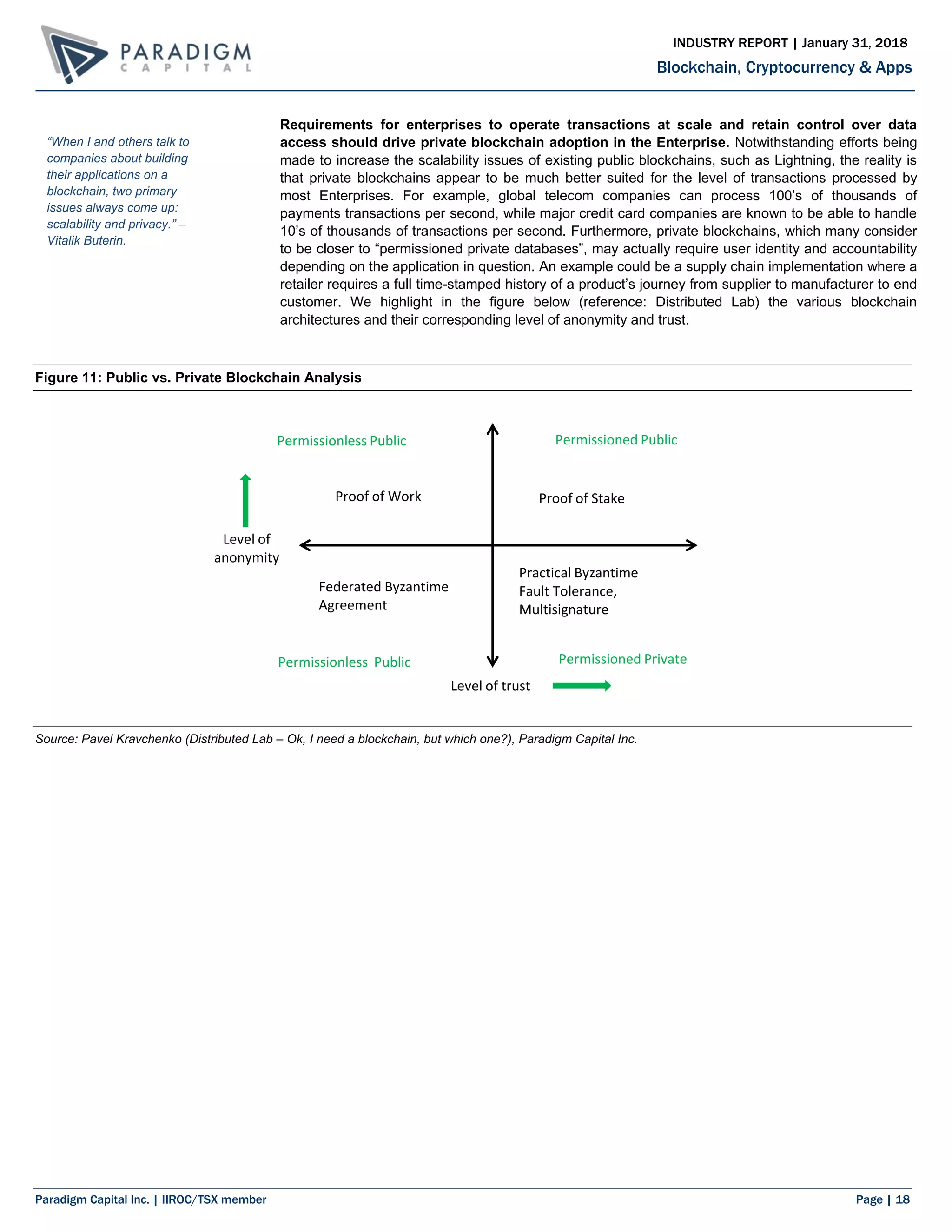
  • 2.
    Paradigm Capital Inc.| IIROC/TSX member Page | 2 Blockchain, Cryptocurrency & Apps INDUSTRY REPORT | January 31, 2018 Table of Contents Blockchain Is Just Math But Its Promise Is Revolutionary ..................................................3 Value Proposition Is Unstoppable................................................................................3 Market Size.........................................................................................................................4 Blockchain Market .......................................................................................................4 Cyclenomics ................................................................................................................4 Bubble Perspective......................................................................................................6 Cryptocurrency....................................................................................................................7 Cryptocurrency Market Size.........................................................................................7 Securely Canadian..............................................................................................................8 Blockchain Applications ....................................................................................................11 Bitcoin: Scalability Looks to Limit the Viability of Blockchain’s First Application ........11 Ethereum: The De Facto Blockchain Applications Platform.......................................12 Tokenomics ...............................................................................................................13 Overview of the World’s (Currently) Most Valuable Tokens.......................................15 Industries Most Likely to Be Impacted by Blockchain Applications ............................16 Enterprise Applications of Blockchain........................................................................17 Investment Opportunities ..................................................................................................19 Company Profiles..............................................................................................................22 APPENDIX I: Initial Coin Offerings....................................................................................43
  • 3.
    Paradigm Capital Inc.| IIROC/TSX member Page | 3 Blockchain, Cryptocurrency & Apps INDUSTRY REPORT | January 31, 2018 Blockchain Is Just Math But Its Promise Is Revolutionary “Almost every company in the world, not just intermediaries, is at risk of being cannibalized from a blockchain version of themselves. We are at the ground floor of a new paradigm in humanity that will change the human experience. The thing that will change is trust.” (source: Richie Etwaru). While it is too early to point to any single application, except Bitcoin, blockchain and decentralized applications (Dapps) will undoubtedly have a profound impact in all business processes. The stock market is clearly pricing in some of the impact of this new protocol; however, we are in the early innings of a long game. We put forth in this report why investors cannot ignore blockchain’s potential as we believe the opportunity for outsized returns has just begun. Value Proposition Is Unstoppable We look to several key elements of blockchain to assess its market potential. First, like the Internet, it has the potential to massively disintermediate business processes and to redefine some entire industries. More importantly, blockchain will unlock near endless new business opportunities. By definition, these two factors imply blockchain would have at least a similar market impact as the Internet itself. But blockchain has the capability to deliver something the Internet has not — democratization of wealth of the unbanked global masses. Blockchain will facilitate the largest asset transfers in human history “moving trillions of dollars from millions of bank accounts to millions of Circle wallets” (source: Blockchain Revolution). Facebook and Google were early to recognize the potential value of tapping into the unbanked market of two-billion people with independent initiatives to provide inexpensive, broadband Internet access. The value, however, accrues to companies who provide this consolidation role and not the users whom they serve. Blockchain will democratize them. By leveling the playing field, lowering the cost of doing business, and providing liquidity to two-billion untapped resources, it will unleash enormous wealth creation and thus global growth. We do not intend to fully define what blockchain is in this report. Blockchain is just math. This math, however, will deliver cost savings and prosperity that the Internet alone failed to do. Below, we summarize blockchain’s value proposition in five key bullets. 1. Trust: Establishes trust between independent parties; therefore, risk disappears for any transaction. Furthermore, the level of distrust between parties is widening. This is particularly true for financial services firms who are the most distrusted organizations on the planet. 2. Democratization of Wealth: Trust breaks down barriers which will bring the unbanked two-billion people into the global economy. 3. Monetize Users: Companies whose value is defined by the number of users it attracts (e.g., Uber, Airbnb, Google, Facebook, Amazon) will be disrupted. Blockchain will marginalize these organizations and deliver more accrued value of these consolidators to its users. 4. Connect Capital to Investors: Opportunities for ordinary people to invest in tomorrow’s Google are often limited to high-profile private equity firms who then work with their favoured investment bank(s) for public offerings, which are typically limited to only their top clients. Initial coin offerings (ICOs) offer anyone the opportunity to invest in these companies, thus leveling the playing field of investable opportunities. 5. Disrupt Information Flow: Transactions posted on the blockchain are public for everyone to see. Furthermore, the precise history of the entire transaction will be saved in perpetuity. (The opposite is also true with private blockchains where only permissioned users have access to the transactional data.) Imagine a corporation on blockchain where its financial health is posted in real time. This will provide a constant stream of information, thus obviating the need, for example, of quarterly filings, therefore leveling the playing field of information distribution and analysis.
  • 4.
    Paradigm Capital Inc.| IIROC/TSX member Page | 4 Blockchain, Cryptocurrency & Apps INDUSTRY REPORT | January 31, 2018 Market Size Given its disruptive promise and industry-wide corporate buy-in, it comes as no surprise that every industry we have researched has suggested explosive growth in the blockchain industry. Our key findings are summarized with a range of 26–80% CAGR of an industry, growing to $6–$45 billion over the next 5–10 years. Blockchain Market  Market size of $412 million in 2017 growing to $7.7 billion by 2022, representing 80% CAGR. Looking further out, blockchain is expected to be a $45-billion industry in the next decade. (source: ResearchandMarkets, Blockchain Market by Provider, Organziation Size, Vertical and Region).  According to a recent report published by IndustryARC, the global blockchain market is expected to grow at a 48% CAGR and reach $6 billion by 2023. North America is expected to dominate the market with blockchain technology applied to payments, digital identities, smart contracts, and identities.  The World Economic Forum predicts 10% of global GDP will be stored on the blockchain by 2027. It also estimates that 80% of banks are working on private blockchain applications and are estimated to be spending $200 million on the development of these applications in 2017. Furthermore, a report from CB Insights highlighted that since June 2014 the 10 largest U.S. banks have participated in nine rounds of blockchain investments totaling $267 million (Figure 1). Cyclenomics We lived through the dotcom bubble and subsequent implosion. The following data demonstrates that investors have elevated the combined market caps of blockchain companies faster than during the dotcom bubble; however, we counter with two observations. First, the velocity of information is much faster and broader today than it was 20 years ago. My first job as a research associate (in 1994) required trips to the Toronto Reference Library to make copies off microfiche! Second, as previously mentioned, blockchain’s impact on commerce, business processes, and wealth distribution should have a more meaningful impact global growth than the Internet, so the early gains on stocks and larger valuations are warranted, in our opinion.
  • 5.
    Paradigm Capital Inc.| IIROC/TSX member Page | 5 Blockchain, Cryptocurrency & Apps INDUSTRY REPORT | January 31, 2018 Figure 1: Blockchain Activity with Largest U.S. Banks (ranked by equity investment, Q1/12–Q2/17) Source: CB Insights, Blockchain Investment Trends in Review
  • 6.
    Paradigm Capital Inc.| IIROC/TSX member Page | 6 Blockchain, Cryptocurrency & Apps INDUSTRY REPORT | January 31, 2018 Bubble Perspective To put the Bitcoin bubble into perspective, first a little retrospective. In the Internet bubble, between 1997 and 2000, a total of 522 dotcom companies were listed, raising more than $43 billion. The Nasdaq Composite peak market cap was $6.6 trillion, with dotcom companies representing one-third of that total at $2.3 trillion. Blockchain companies by comparison currently have a combined market cap of only $6 billion (Figure 2). We have compiled a list of publicly traded blockchain companies (Figure 12 and 13) and have mapped their collective performance to date with base lines set to the beginning of each index’s respective start date (Figure 2). Bitcoin is an obvious outlier. However, the performance of blockchain companies is clearly in the early stages. “Clever as it is, however, bitcoin has shown no signs of replacing the dollar and other fiat currencies. For bitcoin to be a success, it needs to take a large part of various markets—remittances, payments, stored value.” (source: Matthew Gertler, Digital Asset Research) Figure 2a: Dotcom vs. Blockchain Bubble Source: FactSet Figure 2b: Market Cap of Dotcom Companies vs. Blockchain Companies Source: FactSet -1000.0% 0.0% 1000.0% 2000.0% 3000.0% 4000.0% 5000.0% 6000.0% 7000.0% 0 72 144 216 288 360 432 504 576 648 720 792 864 936 1008 1080 1152 1224 1296 1368 1440 1512 1584 1656 1728 1800 1872 1944 2016 2088 2160 2232 2304 2376 2448 %ChangefromStartofBubble Trading Days from Start of Bubble Major Bubbles vs. BitcoinandBlockchain:% change NASDAQ (since '95) Homebuilders(since '00) Bitcoin (since '15) Blockchain (since '17) -200.0% 0.0% 200.0% 400.0% 600.0% 800.0% 1000.0% 1200.0% 0 70 140 210 280 350 420 490 560 630 700 770 840 910 980 1050 1120 1190 1260 1330 1400 1470 1540 1610 1680 1750 1820 1890 1960 2030 2100 2170 2240 2310 2380 2450 %ChangefromStartofBubble Trading Days from Start of Bubble Major Bubbles vs. Blockchain:% change NASDAQ (since '95) Homebuilders(since '00) Blockchain (since '17) $0 $2,000 $4,000 $6,000 $8,000 $10,000 $12,000 $14,000 $16,000 $18,000 02/01/2015 02/03/2015 02/05/2015 02/07/2015 02/09/2015 02/11/2015 02/01/2016 02/03/2016 02/05/2016 02/07/2016 02/09/2016 02/11/2016 02/01/2017 02/03/2017 02/05/2017 02/07/2017 02/09/2017 02/11/2017 02/01/2018 Blockchain Companies Market Cap (Mln) $0 $500,000 $1,000,000 $1,500,000 $2,000,000 $2,500,000 31/12/1998 28/02/1999 30/04/1999 30/06/1999 31/08/1999 31/10/1999 31/12/1999 29/02/2000 30/04/2000 30/06/2000 31/08/2000 31/10/2000 31/12/2000 28/02/2001 30/04/2001 30/06/2001 31/08/2001 31/10/2001 31/12/2001 Top 10 Dotcom Companies Market Cap (Mln)
  • 7.
    Paradigm Capital Inc.| IIROC/TSX member Page | 7 Blockchain, Cryptocurrency & Apps INDUSTRY REPORT | January 31, 2018 Cryptocurrency Having a discussion about blockchain without cryptocurrency makes no sense. Cryptocurrencies are a new asset class that enable decentralized applications. The first and most popular decentralized application was Bitcoin. Bitcoin is a new form of capitalism. Blockchain is a database. Cryptographic security means three things: 1. Creating new fake currency is virtually impossible 2. The record is immutable (i.e., encryption technique is virtually impossible to reverse engineer) 3. Owner/signer is uniquely defined Figure 3: Bitcoin vs. Traditional Money Source: BTCS, Andreessen Horowitz Cryptocurrency Market Size  The current market cap of all cryptocurrencies combined is $510 billion (which is approximately equal to Facebook’s market cap). Compare that to U.S. dollars in circulation at $1.5 trillion; physical money $31 trillion; stock market $67 trillion; all money $120 trillion; and gold $8 billion. Bitcoin at $180 billion is less than 0.2% of total fiat currency.  Market size to next halving (every 210,000 blocks or about four years): (144 blocks/day)x(12.5 BTC/block)x(862 days between January 31/18 and June 10/20)x(BTC price $10,719 as of January 22) = $16.6 billion.  The single best explanation in calculating the value of Bitcoin is Metcalfe’s law which states that the value of the network is proportional to the square of the number of users. This relationship has a 94% correlation. Taking it a step further, calculates Bitcoin’s price-to-Metcalfe value. This is somewhat analogous to a price-to-book ratio. As demonstrated in the chart in Figure 4 (left hand graph), the 2013/2014 Bitcoin bubble was far larger than where it currently stands. Looked at another way, when mapping Bitcoin’s price on a logarithmic scale, it has not yet achieved its peak price (right hand graph).  For the last 100 years, an obscure mathematical principle called Zipf’s law has predicted the size of mega-cities and income distribution. “Zipf’s law is empirical law formulated using mathematical statistics that refers to the fact that many types of data studied in the physical and social sciences can be approximated with a Zipfian distribution, one of a family of related discrete power law probability distributions.” (source: Wikipedia). Linguist George Zipf noticed that a small number of words are used all the time while the vast majority are rarely used. The number-one ranked word was used twice as often as the second-ranked word and three times as often as the third-ranked. He called this the rank versus frequency rule that can be applied to many other social systems, including economic.
  • 8.
    Paradigm Capital Inc.| IIROC/TSX member Page | 8 Blockchain, Cryptocurrency & Apps INDUSTRY REPORT | January 31, 2018 Cryptocurrency market caps appear to adhere to Zipfian’s distribution, (1/n)^(s), with n representing rank, and the exponent s=1.618, this being the Golden Ratio. For example, recent Bitcoin market capitalization was $71.6 billion. The second-ranked coin, Ethereum’s market cap as calculated by this ratio is (1/2)^(1.618) = 0.326 of $71.6 billion = $23.3 billion, versus its actual market cap of $28.0 billion. This is therefore a useful tool for trading cryptocurrency pairs. Figure 4: Price/Metcalfe Value Source: WolframAlpha, U.S. Global Investors, Advisor Perspectives Securely Canadian Traditional mining companies (gold, silver, copper, etc.) and pulp and paper mills have left a trail of deserted outposts and mining towns with world-class infrastructure (high-speed fiber optics; stable, high power, renewable and inexpensive hydroelectricity). Ironically, these are basic ingredients necessary to build world-class cryptocurrency mining operations. Add to the mix: sub-Arctic temperatures, willing local government, world-class global reputation and now receptive capital markets, will make Canada a global leader in securing the blockchain. As we suggested earlier, while blockchain is new technology, its ecosystem is maturing rapidly. Hydro-Quebec is Canada’s largest utility provider and is offering special deals to cryptocurrency miners with rates of between $0.0248 and $0.0394; as such, it has had requests for 6,000MW from cryptocurrency miners. Hydro-Quebec has confirmed that it is in advanced talks with over 30 mining companies and expects that within four years miners will use over 5TWh of the province’s surplus hydro-electricity. The same is true for Manitoba Hydro, which has received over 100 inquiries from cryptocurrency miners.
  • 9.
    Paradigm Capital Inc.| IIROC/TSX member Page | 9 Blockchain, Cryptocurrency & Apps INDUSTRY REPORT | January 31, 2018 Figure 5: Blockchain Ecosystem Source: Josh Nussbaum Bitcoin is a peer-to-peer digital currency and is the sum of three innovations: 1. Hashcash — invented in 1997 to prevent spam by having the sender of the message perform 25 seconds to do computational work (20 bits) versus the receiver who can verify in a fraction of a second. 2. Public key cryptography. 3. Distributed ledger — domain name registers are a good example. Bitcoin meant to be a currency but is more akin to gold.  Deflationary because of limited supply (21-million coins to be released by 2140) compared to gold supply which continually increases over time.  Easy to send, divide, carry, track (e.g., Bill Gates is very interested to see confirmation that his donations from his philanthropy organizations are going to the intended targets). Bitcoin scaling  Each block is 1MB  Average transaction size is 250 bytes  Therefore each block can hold on average 4,194 transactions  At 10 minutes per block, equates to 7 tps (transactions per second)  However, with Bitcoin's rising popularity, its blocksize has increased toward its 1MB maximum  New coins (forks) propose to increase this block size  Those who oppose the increased block size are Bitcoin supporters and those who favoured it forked to Bitcoin Cash which supported an 8MB block size  As scaling and protocols mature, the value of the blockchain's centralized promise could be realized into a multi-trillion-dollar industry. Lightning Network will scale transactions to millions/second on Bitcoin and Litecoin, which will dramatically reduce mining fees.
  • 10.
    Paradigm Capital Inc.| IIROC/TSX member Page | 10 Blockchain, Cryptocurrency & Apps INDUSTRY REPORT | January 31, 2018 Figure 6: Blockchain Companies Source: Black Moon Crypto
  • 11.
    Paradigm Capital Inc.| IIROC/TSX member Page | 11 Blockchain, Cryptocurrency & Apps INDUSTRY REPORT | January 31, 2018 Blockchain Applications Since the creation of Bitcoin, the world’s first application of blockchain, its rising popularity and rapidly expanding valuation have stimulated the creation of variations of itself via forking, including cryptocurrencies such as Litecoin, Bitcoin Cash, and, most recently, Bitcoin Gold; the development of brand new native blockchains including Ethereum and Ripple; and the launch of hundreds of tokens and related apps built on top of a variety of blockchains, Ethereum being the platform of choice for developers by a wide margin. Bitcoin: Scalability Looks to Limit the Viability of Blockchain’s First Application Bitcoin remains the most discussed and highly valued cryptocurrency at a current market cap of ~$180 billion, though there remains much debate on its longer-term viability as a method for everyday transactions. This has largely been owing to scalability issues related to Bitcoin’s underlying protocol, which, as previously noted, limits a transaction’s block size to 1MB and leads to lower transaction speeds that result in uneconomical transaction processing fees for practical purposes. Transaction fees are attached to each proposed Bitcoin transaction as an incentive to be processed by a miner and to be added to the Bitcoin blockchain. In order to have a given user’s transaction processed on the limited space of a 1MB block, it needs to outbid other users, leading to fee inflation given supply and demand dynamics. At the time of writing this report, the average Bitcoin transaction fee sits at ~US$10, well below the recent peak of +US$55 in late December, but still orders of magnitude above the ~$0.01–$0.10 seen at the cryptocurrency’s inception through to 2016, when this metric started to materially rise. Besides rapidly increasing transaction fees, early Bitcoin applications, such as Bitpay, suffered from slow payment times owing to increasing congestion on the network. Such scalability limitations have led developers to upgrade Bitcoin’s protocol to address these issues, a process known as forking. As discussed earlier, Bitcoin Cash, which was a hard fork created on August 1, 2017, served to solve the capacity constraints of Bitcoin by increasing the block size within this new protocol to 8MB. While this technically drives higher transaction speeds, the catch is that it also requires more storage space given that every node maintains a copy of this much larger ledger. An argument can be made that such an implementation raises storage costs and could therefore lead to a network controlled by an increasing proportion of well-funded and larger entities, negating Bitcoin’s original decentralization promise. Bitcoin Gold, the latest Bitcoin hard fork which went live on October 24, 2017, aims to solve the decentralization problem by ensuring ASICs can’t be used the way they currently are leveraged by professional Bitcoin miners with dedicated and expensive hardware. The thought is that Bitcoin Gold can give the power of processing back to a more distributed network of everyday PC users as opposed to the concentrated Bitcoin mining pools and entities of today. Other mechanisms to address the scalability constraints of blockchain continue to be explored, such as the Lightning Network, which leverages a network of payment channels through which parties can make transactions off the blockchain (i.e., not added to the ledger), thereby saving work and time. It remains to be seen which decentralized payment protocol might prevail, and the reality is that the market and its consumer and merchant participants will ultimately dictate the most efficient method for blockchain’s first recognized and obvious application. Some retailers do accept Bitcoin and other cryptocurrencies as a form of payment, but many do not. Last year, Internet Retailer noted that Bitcoin was accepted at just three of the top 500 online merchants that it tracks, down from five in 2016. During its Q3/17 call, Shopify’s CEO acknowledged the e-commerce infrastructure provider’s lead in enabling its merchants to accept Bitcoin (as early as 2012), though he also noted his view of it being an “exceptionally volatile store of value rather than a transactional system”. And just last week, online payments processor Stripe formally announced it is ending its support of Bitcoin on April 23, noting how block size limitations have led the cryptocurrency to evolve into more of an asset than a means for exchange (with transaction fees on par with bank wires). Interestingly, the firm remains bullish on cryptocurrencies overall, looking forward to initiatives such as Lightning, Ethereum-based tokens, and even the potential for Bitcoin forks such as Bitcoin Cash or Litecoin.
  • 12.
    Paradigm Capital Inc.| IIROC/TSX member Page | 12 Blockchain, Cryptocurrency & Apps INDUSTRY REPORT | January 31, 2018 Ethereum: The De Facto Blockchain Applications Platform Bitcoin’s open-source nature has made it relatively easy for developers to copy its software and modify its protocols in order to create new forks, such as Bitcoin Cash and Bitcoin Gold. Scaling issues aside, the protocol’s major limitations with regards to use cases other than payments relate to its lack of flexibility to program more complex rules and logic governing the movement of tokens between two parties without the use of an intermediary. Early attempts to build on top of Bitcoin’s protocols to allow for this functionality gave birth to the likes of Counterparty and Omni. However, it was an entirely new blockchain, known as Ethereum, with its own scripting language and an ability to create “smart contracts” (the logic governing the rules of token transfer) that has driven today’s blockchain applications revolution. Fueling the growth in Ethereum-based apps over the past two years was the release of ERC-20, with nearly all Ethereum tokens being compliant with this standard. What are tokens in the Ethereum blockchain? Tokens represent digital assets within Ethereum- based decentralized applications (Dapps) that can range from almost anything such as in-game items, loyalty points, media rights, and access to server space, among many other use cases. Each token is defined by a set of code that dictates how it will behave on the network when a given user or a smart contract sends a message to the token’s contract, along with an associated database keeping track of Ether payments. Tokens are application specific, in contrast to Ether, which is the cryptocurrency underlying Ethereum and is what an application user uses to “pay” for a transaction. For example, when a token is sent across the network (reflecting the transfer of an in-game weapon from one player to another), the “miner” who confirms this transaction onto the Ethereum blockchain is paid in Ether as incentive. We discuss in detail later, but tokens should generally only reflect the utility derived from its use within an application, nothing more and nothing less. Why are ERC-20 compliant tokens important to Ethereum applications development? Ethereum Request for Comments proposal ID 20, or ERC-20 for short, was created in November 2015 and only formally standardized in September 2017. It’s an important standard that has led to the explosion of Ethereum-based tokens and related applications that govern how new tokens are launched (ICOs) and how they behave across the blockchain. By creating a set of rules for Ethereum-based tokens to adhere to, apps developers were able to understand how their tokens would behave within smart contracts, inside of wallets, and on exchanges. ERC-20 is underscored by a set of six functions, such as how to transfer a token and how to access a token’s data (token balance, name, etc.). In our view, the creation of ERC-20 has allowed the Ethereum-based applications ecosystem to flourish. Ethereum dominates the token landscape by a wide margin. Per Coinmarketcap.com data, out of the top 500 tokens ranked by market cap, Ethereum accounts for ~80% of the share, followed by Waves in a distant second at 5% and Bitshares in third at ~3% (Omni and Counterparty combined account for ~3% of the total). Even more striking, based on market cap, Ethereum reflects +90% of the total combined valuation of the top 500 tokens (+$60 billion) with the top five all being Ethereum-based (~$20-billion combined market cap). Figure 7: Ethereum Dominates the Token Landscape Source: www.coinmarketcap.com $7.6 $3.6 $3.3 $2.7 $2.5 $2.2 $1.6 $1.1 $0.9 $0.8 $0.0 $1.0 $2.0 $3.0 $4.0 $5.0 $6.0 $7.0 $8.0 EOS TRON ICON VeChain Populous Tether OmiseGO Binance Coin Status Walton MarketValue($Bln) Token Top 10 Tokens by Market Value ($Bln) Populous Tether Built on Ethereum Built on Omni 81.6% 4.8% 3.4% 10.2% Share of Tokens by BlockchainType (Top 500) Ethereum Waves BitShares All others
  • 13.
    Paradigm Capital Inc.| IIROC/TSX member Page | 13 Blockchain, Cryptocurrency & Apps INDUSTRY REPORT | January 31, 2018 Tokenomics What’s a token worth? While it’s easy to understand why there’s been a material jump in the number of Ethereum-based applications being launched, given the ease of development and the establishment of related rules governing smart contracts, it’s less obvious how investors should properly assign value to a given token and its corresponding application. In theory, the market value of a token asset class should approximate the value attributable to the utility of the underlying application the tokens allow access to. Conversely, one might consider the value of any decentralized application which replaces a two-sided, centralized middleman marketplace as converging toward the sum of the minimum feasible costs to run such a network. In other words, an application’s token should really just be worth the bottom-line economic benefit to the user. Clearly, there’s much more at play, with tokens of today reflecting part real-world application usage value, part speculation…in many cases, maybe mainly speculation. In October, Ethereum co-founder Vitalik Buterin emphatically stressed his bearish views on the future of most of today’s tokens, suggesting that at least 90% are likely to fail. Application tokens do not represent equity in a company, and its holder has no legal claim on a company’s assets — they merely have the right to utilize an application (in most cases, an as of yet to be developed application). We do not make an attempt on how to separate a token’s true signal from the noise, the latter moving ever louder and fueled by an increasing participation of less-than-sophisticated and “fear of missing out” investors in unregulated token offerings. What we do outline, however, are our views on the financial and societal implications of the promise of blockchain applications. Token values are driven by network ownership effects, not network effects. It’s well understood (Metcalfe’s Law) that the value or utility of a network is proportional to the number of customers using that network. Traditionally, it’s a challenge to “bootstrap” and start a new network, as there’s little to no incentive for early adopters to use that network, meaning that the benefits to consumers are only realized at scale. Furthermore, while the consumers of the network may “socially” benefit from the application, it is the centralized owners who benefit “financially”. Decentralized network models using a token structure can accelerate the initiation of a network by incentivizing early participation. Furthermore, with no centralized owners, all users who “buy in” to the token early on, including developers, consumers, and speculators, share in outsized financial utility. This powerful combination of network utility + ownership drives players with a vested interest in seeing their own wealth increase rapidly develop applications and act as marketers and evangelists for the token, thereby creating a feedback loop that fuels further token appreciation. Bitcoin users not only use the application, but also have ownership in the network, and benefit by being advocates for the BTC token. Bitcoin sees its value rise and fall in line with the supply and demand of its application, as well as owing to the perception of its future usage. Early application adopters enjoy the highest financial utility (greatest token appreciation) and kickstart the network into wider recognition. Traditional applications have “customers”, decentralized applications have “users”, and the distinction between participants in the latter such network is much more blurred. Figure 8: Ownership in Network Accelerates Application Adoption Source: Andreesen Horowitz (Decrypting Crypto, From Bitcoin and Blockchain to ICOs) & Nick Tomaino (The Token Economy) UtilitytoUser Number of users Traditional Network Effect Overall utility= Application utility Bootstrapping Problem UtilitytoUser Number of users Token Network Effect Applicationutility Financial utility Overall utility= financial applicationutility “It is an established fact that ninety percent of start- ups fail. And it should also be an established fact that 90 percent of these ERC20s on CoinMarketCap are going to go to zero” – Vitalik Buterin
  • 14.
    Paradigm Capital Inc.| IIROC/TSX member Page | 14 Blockchain, Cryptocurrency & Apps INDUSTRY REPORT | January 31, 2018 Only decentralized applications with real-world utility and sound token structures should survive. Market forces should ultimately dictate which Dapps make the most sense at disrupting a given industry’s centrally operated incumbents. Many applications being proposed today are likely destined to remain as proposals, particularly if they do not provide a superior benefit to customers than already existing solutions (or in the case of new wealth creation in the underdeveloped economy, if they are too costly to deploy and gain significant traction). Besides utility, another consideration when assessing the future viability of a Dapp is its initial token offering structure, which provides the incentive for participants to develop and champion the network. Developers look to strike a fine balance between the mix of tokens to be initially released to the public and those to be held internally, in addition to considering dynamics related to future token supply and controlled inflation. While it’s typically standard practice for developers to maintain a pre-allocation of new tokens to fund future project development once their cryptocurrencies are listed on an exchange and can be sold for fiat (or another cryptocurrency) on the back of some price appreciation, too much ownership might be viewed as being overly greedy and limit a token’s wider adoption. Decentralized apps and economies can radically shift the distribution of wealth. In the world of blockchain, value accrues to the developers of the underlying protocols versus at the application layer, as is the case in traditional centralized network structures. Additionally, participants in the networks are also able to enjoy financial benefits as opposed to one central authority. One example being seriously explored today is that of distributed file storage, led by new protocols including Filecoin, SIA, and Storj. Instead of relying on a storage provider such as Amazon’s S3, users are able to “rent out” excess storage space on their existing PCs and be rewarded in the form of tokens, paid by other users looking to “store” data across this decentralized network. If the service is seen as being valuable, the value of the corresponding tokens will rise. Storage contributors and the developer of the protocol will benefit, assuming they’ve retained some tokens for themselves. Applications at the user experience level are able to leverage these protocols (in exchange for tokens) and create their own unique service offerings, but the majority of the value will accrue to the protocol layer. This is the opposite of current centralized models where all the value is captured at the application level (protocols are essentially free). Decentralized applications may also materially change the dynamics related to the “sharing economy” and marketplace-based industries that rely on centralized middleman structures. Ride-sharing networks (such as Lyft) have been cited as examples where blockchain applications might pose significant disruption. In the case of Lyft, the company takes a portion of ride fare for connecting drivers to passengers, with the company’s valuation rising as the number of participants increases (drivers may see some financial benefit as the network grows, and riders will gain benefits in the form of reduced wait times, but a disproportionate share of incremental wealth ultimately accrues to Lyft). In the decentralized model, a limited number of tokens are released, set at some initial value (1 ride = 1 token = $1), and are used by riders to pay for a ride. As demand for the service increases, demand outpaces supply and the price of a token appreciates in value (1 token = $2). Drivers continue to charge 1 token for a ride, but this token can now be exchanged for $2. No centralized authority is involved in the process at all, and all of the value creation flows to participants in the network. Security tokens — distinct from utility tokens in representation and legality. While regulations on utility tokens remain a hotly debated topic, security tokens that represent shares in a company or are backed by an entity’s assets should be regulated and follow KYC/AML standards. Polymath is a company looking to capitalize on the securities token boom, which it sees reaching a market cap of $10 trillion by 2027, up from $10 million in 2017. The company guides customers through the technical and legal process of a successful token launch, all the way from creation to fundraising to compliance issuance. With regards to utility tokens, recent statements by SEC Chairman Jay Clayton reflect the regulators view that most offerings indeed likely look closer to securities tokens. That said, he did leave the door open for true utility tokens to remain unregulated; for example, those which represent participation in an already existing platform or offering, noting that they could be an efficient way to fund the ongoing development of such applications. “By and large, the structures of ICOs that I have seen promoted involve the offer and sale of securities and directly implicate the securities registration requirements and other investor provisions of our federal securities laws.” –Jay Clayton, SEC Chairman.
  • 15.
    Paradigm Capital Inc.| IIROC/TSX member Page | 15 Blockchain, Cryptocurrency & Apps INDUSTRY REPORT | January 31, 2018 Overview of the World’s (Currently) Most Valuable Tokens At the time of writing this report, the top five tokens by market cap are all based on Ethereum and largely relate to platforms that allow developers to quickly create a variety of Dapps. 1. EOS (market cap $7.6 billion): EOS is a software platform that allows developers to easily build decentralized applications through an intuitive operating system-like architecture. The platform’s founders suggest that its design has the potential to scale to millions of transactions per second that can push down transaction fees to fractions of a penny, therefore being much more scalable than Bitcoin and even Ether itself. 2. TRON (market cap $3.6 billion): Tron touts itself as a decentralized content entertainment protocol that allows users to openly publish, store, and own data. Tron has partnered with several application partners, including Obike (Singapore bike-sharing company), Peiwo (audio content sharing), UPLive (live streaming platform), and Gifto (virtual gift exchange platform), giving it a base of four-million active users which its website notes makes it the protocol with the most Dapp users globally. The protocol enables content providers to engage with consumers in a manner that drastically reduces the fees associated with entertainment platforms (Google Play, Apple Store). 3. ICON (market cap $3.3 billion): ICON and its associated token ICX envision the creation of an ecosystem that connects organizations such as government, financial institutions, and hospitals to interact without third-party intermediaries and is essentially another example of a Dapp platform. Some example use cases listed on ICON’s website include the use of Blockchain ID (smart contracts to be used for verification; for example, opening a bank account in a matter of seconds, receiving student discounts without showing a physical ID card) and Payment & Exchange (within bank, insurance, university settings, for example). 4. VeChain (market cap $2.7 billion): VeChain has rapidly emerged as one of the most highly valued tokens. Its website notes that it is the world’s leading blockchain platform for products and information, and cites some tangible examples of its technology being deployed in practical world examples. Those include an API gateway service related to the supply chain industry, third-party services being used by PricewaterhouseCoopers, and the collection and monitoring of agricultural data used by the Liaoning Academy. 5. Populous (market cap $2.5 billion): Populous is a classic example of a blockchain application in the financial services industry serving a function that has historically involved a third party to connect trading partners. Populous is a peer-to-peer invoice finance platform that enables business owners to sell outstanding sales invoices to invoice buyers at a discounted rate in order to unlock tied up cash. Once invoices have been paid, the buyer receives their cash back, with all of these transactions recorded on a blockchain. We also highlight some other notable tokens and related Dapps that are looking to disrupt traditional industries with centralized structures. Filecoin holds the record for the most successful ICO to date, raising $275 million in funding. As we’ve previously highlighted, Filecoin is looking to take share of the storage industry by allowing anyone to rent out their spare disk space to be plugged into a decentralized network, where a user’s data is spread across multiple nodes and only accessible and readable using a private key. Gnosis and Augur are examples of predictions and forecasting networks that reward users for correctly predicting future events and are based on the concept of the collective knowledge of a crowd. The Augur website notes that prediction markets such as itself have been proven to be more accurate at forecasting versus individual experts, opinion polling, and surveys. Basic Attention Tokens (BAT) and the corresponding Brave browser, built by the creator of JavaScript and the co-founder of Mozilla and Firefox, are looking to upend the advertising industry. The platform hopes to make for a much more efficient advertising model, where ad dollars can be directly linked to a consumer. In the model, a token will be paid by an advertiser for a consumer’s attention (for example, an ad blocker inherent in the browser will be shut off upon the transfer of the token to the user who agrees to view the ad). Tokens can also be paid by website visitors to access content, where articles can be purchased on a pay-per-view basis instead of a monthly subscription.
  • 16.
    Paradigm Capital Inc.| IIROC/TSX member Page | 16 Blockchain, Cryptocurrency & Apps INDUSTRY REPORT | January 31, 2018 Industries Most Likely to Be Impacted by Blockchain Applications The token examples on the previous page provide some clues as to where some of the most logical areas and industries that blockchain technologies may be well suited for deployment. In short, the greatest business opportunities for blockchain applications will be in industries characterized by a relatively high level of intermediaries. One industry stands out well above the rest, Financial Services, which a McKinsey & Company study (January 2017) noted as representing +50% of all blockchain opportunities and includes sub- sectors in Insurance, Payments, Register of Ownership, Identity, and Securities. With regards to Financial Services, the consulting firm identified seven use cases that collectively could generate a ~$80–$110-billion impact. Figure 9: Blockchain Use Cases Skew Toward Financial Services Source: McKinsey & Company: Blockchain Technology in the Insurance Sector, January 2017 Supply Chain & Logistics is another area being actively explored as a logical use case for blockchain, where transparency related to the tracking of goods, from supplier, to manufacturer, to retailer, to end consumer is becoming increasingly important. Supply chain tracking onto the blockchain can help reduce or even eliminate the counterfeiting of goods, while the logistics, freight, and shipping networks characterized by a deep and complex web of intermediaries and related document exchange can be simplified and achieve material cost savings. IBM and Maersk have announced a collaborative effort to digitize the supply chain process related to ocean shipping container tracking. The firms note that +90% of goods traded globally are carried by ocean logistics, with its solution potentially saving billions of industry dollars. Identity management on the blockchain could drive efficiencies in many use cases, whether that be inherently trusted identity related to voting (reducing fraudulent votes or recounts and providing an immutable and verifiable trail of a voters history), to often cited examples such as property records and land transfer, birth and marriage certificates documentation, and the creation and execution of wills and inheritances (which could be governed by smart contracts that automatically send distributions to beneficiaries, saving court and legal costs). Healthcare processes related to the exchange of patient information and electronic medical records can be streamlined using the blockchain, eliminating administrative costs and giving patients authority on who has access to their data. For example, a patient’s medical history can be secured on the blockchain and that data might only be able to be accessed when the patient gives a medical authority permission (patient holds the private keys to their data), enabling much higher levels of privacy and security. 17% 5% 11% 9% 6% 22% 2% 6% 9% 13% 0% 5% 10% 15% 20% 25% Other Arts& Entertainment Public Sector Consumer Healthcare Insurance Securities Identity Register of ownership Payments FinancialServices(50%) Distributionof BlockchainUsage (%) $15.5 $55.0 $4.0 $3.5 $5.5 $6.0 $8.0 $0.0 $10.0 $20.0 $30.0 $40.0 $50.0 $60.0 Tradefinance Cross-border B2B payments Cross-border P2P payments Repos OTC Derivatives KYC/AML management Identityfraud Impact Value Generatedby Blockchain($Bln)
  • 17.
    Paradigm Capital Inc.| IIROC/TSX member Page | 17 Blockchain, Cryptocurrency & Apps INDUSTRY REPORT | January 31, 2018 Enterprise Applications of Blockchain Enterprises are poised to account for an increasing share of blockchain usage and in our view are likely to leverage more private versus public architectures. Gartner estimates that nine out of 10 enterprises will deploy a blockchain project and that the business value-add of related apps will reach $3.1T by 2030, with 50% of this attributable to uses between companies and intracompany. Figure 10: Business Value-Add of Blockchain to Reach $3.1 Trillion by 2030 Source: Gartner Webinars – Blockchain: How Real Is The Market Public Blockchains: Anyone is free to read, write, send transactions, and engage in the consensus process to add blocks to the chain. Proof of Work or Proof of Stake verification mechanisms ensure that a given mode’s influence in determining consensus is proportional to the level of effort or resources owned. Such blockchains are 100% decentralized, such as the Bitcoin blockchain. Advantages of a Public Blockchain 1. Openness: Given its open-source nature, it is much more likely to be widely adopted by many users, organizations, and entities to rapidly gain traction. 2. Anonymity: Users are able to perform transactions anonymously. 3. Trust of Developers: Application users are inherently ensured that the creators of the blockchain have no control or authority over the blockchain once it is in operation. Private Blockchains: Such blockchains differ drastically from their public counterparts in that permission to write new blocks to the chain might be centralized to one entity, while read permissions could be either public for all to read or restricted to a select set of users. Since such blockchains are typically designed by a single company (or consortium of companies), it is not necessary to be publicly readable by all to see. Consensus mechanisms may or may not be necessary in such blockchains. 1. Scalability: Given that transactions are typically only verified by a few nodes or users and not by an unlimited number of users (thousands and thousands), as is the case in a public blockchain, transaction and validation times are much faster and less costly. 2. Known Validators: With known entities all tending to work toward a common shared goal, the likelihood of collusion between parties or an attack on the system is low. 3. Flexibility & Control: As private blockchains are run/owned by a company or consortium, rules can be changed, transactions can be reverted, and technical issues/faults can be quickly resolved. It’s up to the creators of the blockchain to do with it as they please. $0 $100 $200 $300 $400 $500 $600 $700 $800 $900 $1,000 2025 2026 2027 2028 2029 2030 Business value-add of Blockchain ($Bln) Auto-Adjudication Between Companies Digital Cash Intracompany Public Record 10% 28% 22% 22% 18% 2030
  • 18.
    Paradigm Capital Inc.| IIROC/TSX member Page | 18 Blockchain, Cryptocurrency & Apps INDUSTRY REPORT | January 31, 2018 Requirements for enterprises to operate transactions at scale and retain control over data access should drive private blockchain adoption in the Enterprise. Notwithstanding efforts being made to increase the scalability issues of existing public blockchains, such as Lightning, the reality is that private blockchains appear to be much better suited for the level of transactions processed by most Enterprises. For example, global telecom companies can process 100’s of thousands of payments transactions per second, while major credit card companies are known to be able to handle 10’s of thousands of transactions per second. Furthermore, private blockchains, which many consider to be closer to “permissioned private databases”, may actually require user identity and accountability depending on the application in question. An example could be a supply chain implementation where a retailer requires a full time-stamped history of a product’s journey from supplier to manufacturer to end customer. We highlight in the figure below (reference: Distributed Lab) the various blockchain architectures and their corresponding level of anonymity and trust. Figure 11: Public vs. Private Blockchain Analysis Source: Pavel Kravchenko (Distributed Lab – Ok, I need a blockchain, but which one?), Paradigm Capital Inc. Level of trust Level of anonymity Proof of StakeProof of Work Federated Byzantime Agreement Practical Byzantime Fault Tolerance, Multisignature Permissionless Public Permissionless Public Permissioned Public Permissioned Private “When I and others talk to companies about building their applications on a blockchain, two primary issues always come up: scalability and privacy.” – Vitalik Buterin.
  • 19.
    Paradigm Capital Inc.| IIROC/TSX member Page | 19 Blockchain, Cryptocurrency & Apps INDUSTRY REPORT | January 31, 2018 Investment Opportunities The following tables summarize all publicly traded Canadian and U.S. blockchain/cryptocurrency companies and investment portfolios. Our first observation, the rule of 10x has been broken. Canada is very well represented by this list with more publicly listed blockchain companies than in the U.S. and with a combined market capitalization of ~C$2.5 billion compared to their American counterparts at just US$800 million. We conclude the substance of this report with profiles on 13 next-generation companies, who we believe hold great promise of disrupting the market. Peripherally, we often get asked by investors if there are investment opportunities within the ecosystem of companies who provide the hardware for cryptocurrency mining. Below we summarize some anecdotal numbers and a cautionary note.  ASIC Manufacturer | Bitcoin mining is powering the growth engine for the world’s biggest chip maker, Taiwan Semiconductor Manufacturing Company (TSM-N, NR). Analyst’s estimate cypto- mining generated $350-$400 million in TSMC’s third alone (4–5% of revenue and up 46% year- over-year) and could account for as much as $3.7 billion (10% of revenue) in 2018, thus becoming its fastest-growing segment. TSMC manufacturers ASICs for Bitmain and Bitfury as well as GPUs for Nvidia and AMD.  GPU Manufacturers | Analysts estimate $150 million or 6.7% of Nvidia’s (NVDA-Q, NR) Q2 revenue is derived from cypto-mining. Advanced Micro Devices (AMD-N, NR) has been much more tight-lipped. Recent commentary from the semiconductor analyst at Morgan Stanley estimates “total graphic sales for Ethereum mining in 2017 will be $800 million or so, and will decline by 50% in 2018”. This will be a consequence of shift to a technology called “the Casper hard fork” which will render current Ethereum mining hardware obsolete.  ASIC Testing | Cadence Design Systems (CDNS-Q, NR)  Memory Modules | Samsung Electronics (005930.KS, NR)  Chip Packaging | Advanced Semiconductor Engineering (ASX-N, NR)
  • 20.
    Paradigm Capital Inc.| IIROC/TSX member Page | 20 Blockchain, Cryptocurrency & Apps INDUSTRY REPORT | January 31, 2018 Figure 12: Publicly Listed Canadian Blockchain Companies Source: FactSet In millions except per share data Shares Market Avg. Volume Money Company Name Ticker Price Out Cap High Low 6-month Raised (M) LTM Miners 360 Blockchain Inc CODE-CA $0.17 153.2 $25 $0.39 $0.04 - $2.5 Aim Explorations Ltd AXN-CA $0.18 7.9 $1 - - - $40.8 Blockchain Power Trust BPWR.UT-CA $0.39 223.1 $87 $0.90 $0.33 247 $46.6 CryptoGlobal Corp. CPTO-CA $1.13 120.1 $136 $1.74 $0.49 - $11.0 HashChain Technology, Inc. KASH-CA $2.12 45.9 $97 $4.00 $1.50 477 $29.7 HIVE Blockchain Technologies Ltd HIVE-CA $2.95 261.3 $771 $6.75 $0.74 2,564 $185.4 Global Blockchain Technologies Corp BLOC-CA $1.78 29.4 $52 $1.86 $1.45 1,718 $55.3 Average $167 Median $1,170 Apps BIG Blockchain Intelligence Group Inc. BIGG-CA $1.31 73.8 $97 $2.77 $0.30 275 $19.6 Block One Capital Inc BLOK-CA $0.93 62.5 $58 $1.85 $0.10 424 $10.5 BTL Group Ltd. BTL-CA $8.80 21.3 $188 $18.90 $2.79 202 $18.4 Glance Technologies, Inc. GET-CA $1.45 131.8 $191 $3.84 $0.16 2,311 $19.4 LeoNovus Inc. LTV-CA $0.26 246.0 $63 $0.70 $0.05 2,595 $16.6 eXeBlock Technology Corp. XBLK-CA $0.54 61.4 $33 $1.79 $0.48 234 - Imagination Park Entertainment Inc IP-CA $0.94 63.0 $59 $1.08 $0.22 386 $0.1 Identillect Technologies Corp. ID-CA $0.23 97.2 $22 $0.61 $0.07 1,409 $2.7 Internet of Things Inc. ITT-CA $0.13 167.5 $21 $0.15 $0.05 651 $0.6 Kontrol Energy Corp. KNR-CA $1.44 25.3 $36 $1.58 $0.56 13 $3.2 Blox Labs Inc BLOX-CA $0.50 24.1 $12 $2.25 $0.02 9 $0.7 Syncordia Technologies and Healthcare Solutions Corp SYN-CA $0.15 19.7 $3 $0.30 $0.05 31 - Stompy Bot Corp. BOT-CA $0.15 111.3 $16 $0.25 $0.01 1,035 $2.1 Global Remote Technologies Ltd RGT-CA $0.61 42.1 $26 $0.61 $0.06 590 $5.0 Average $59 Total $825 Exchange NetCents Technology, Inc. Class A NC-CA $2.55 41.4 $106 $6.75 $0.26 659 $1.7 Average $106 Total $106 ATM/POS DataMetrex AI Ltd. DM-CA $0.26 199.8 $51 $0.47 $0.05 2,308 $8.8 Fintech Select Ltd FTEC-CA $0.23 64.4 $14 $0.64 $0.17 1,610 $3.5 Average $33 Total $65 Fin Tech Fineqia International, Inc. FNQ-CA $0.04 760.0 $22 $0.08 $0.01 913 $0.9 Katipult Technology Corp. FUND-CA $0.52 24.9 $10 $0.88 $0.25 79 - Midpoint Holdings Ltd. MPT-CA $0.21 103.8 $18 $0.38 $0.05 269 $1.7 Posera Limited PAY-CA $0.24 118.5 $23 $0.34 $0.14 399 $4.7 Vogogo Inc VGO-CA $0.89 132.5 $88 $0.94 $0.75 306 $6.0 Average $32 Total $161 Investment Portfolio Victory Square Technologies Inc VST-CA $2.97 41.4 $123 $4.17 $0.35 178 $3.9 Average $123 Total $123 Total Combined Market Caps of Canadian Blockchain Companies $2,450 6-month
  • 21.
    Paradigm Capital Inc.| IIROC/TSX member Page | 21 Blockchain, Cryptocurrency & Apps INDUSTRY REPORT | January 31, 2018 Figure 13: Publicly Listed U.S. Blockchain Companies Source: FactSet In millions except per share data Shares Market Avg. Volume Money Company Name Ticker Price Out Cap High Low 6-month Raised (M) LTM Miners Bitcoin Services, Inc. BTSC-US $0.14 462.835 $64 $0.64 $0.05 19,227 - Integrated Ventures Inc INTV-US $1.36 7.742 $11 $6.74 $0.04 328 $0.33 MGT Capital Investments, Inc. MGTI-US $3.07 48.524 $149 $8.14 $1.05 2,126 $23.30 Riot Blockchain Inc RIOT-US $15.23 11.622 $177 $46.20 $3.45 3,278 $56.50 WRIT Media Group Inc. WRIT-US $0.17 57.411 $9 $0.56 $0.10 235 $0.08 Rich Cigars Inc RCGR-US $0.63 3.263 $2 $1.05 $0.02 184 $0.56 Average $69 Total $412 Apps BTCS, Inc. BTCS-US $0.11 368.219 $40 $0.58 $0.07 19,167 $0.12 Black Cactus Global Inc BLGI-US $0.42 157.900 $67 $0.78 $0.07 1,294 $0.64 Average $54 Median $107 Exchange American Security Resources Corporation ARSC-US $0.14 0.000 $0 $3.02 $0.08 26 - Digatrade Financial Corp. DIGAF-US $0.25 45.161 $11 $1.06 $0.06 1,015 $0.60 First Bitcoin Capital Corp. BITCF-US $0.75 302.080 $225 $3.15 $0.00 919 - Average $79 Median $236 ATM/POS Connexus Corporation CNXS-US $0.00 31.179 $0 $0.00 $0.00 100,228 - MarilynJean Interactive, Inc. MJMI-US $0.00 173.345 $0 $0.01 $0.00 6 - Average $0 Median $0 Total Combined Market Caps of U.S. Blockchain Companies $755 6-month
  • 22.
    Paradigm Capital Inc.| IIROC/TSX member Page | 22 Blockchain, Cryptocurrency & Apps INDUSTRY REPORT | January 31, 2018 Company Profiles Auxesis Group (private) Auxesis partners with organizations to build, deploy, and operate blockchain networks. The company has created the world’s largest private decentralized network which powers the Auxledger blockchain platform. Auxledger is a blockchain infrastructure that has been deployed successfully across a number of enterprises focusing on security, performance, and scalability. The current version of Auxledger has over 53-million users in India with customers across different verticals including: government, Internet of Things (IoT), cross-border remittances, capital markets, insurance, and supply chain. This blockchain powers 15 applications. In addition to Auxledger, the company has a financial product suite:  Auxy: A cryptocurrency and crypto-token wallet.  AuxPay: Payment solutions for merchants to enable the acceptance of cryptocurrencies as a form of payment.  AuxCE: A high-frequency cryptocurrency exchange. Allows users to trade Bitcoin, Ethereum, fiat currency, gold, and energy. Auxesis also operates an advisory, research and training lab called Blockchain Lab. The lab was established in 2017 to promote and grow the Blockchain ecosystem in India. The lab has four zones: defence, IoT, FinTech, and RegTech. The Blockchain Lab focuses on product development, organizing conferences and seminars, and training students and professionals on implementing blockchain technology. Highlights  Recognition: Auxesis has been recognized among the Top 100 Most Influential Blockchain Companies, ranking 42 in the world and the only one from India. It has also partnered with industry leaders to grow its network, including HP (server side and applications deploymnet), Ernst & Young (consulting & advisory), and IIT (research & development).  Large Customer Base: Auxledger is already powering enterprise applications and is being used by over 53-million customers. Management & Board Kumar Gaurav – Chairman | Kumar is an entrepreneur who has been responsible for building some of today’s most exciting fintech businesses. He is among the Top 100 Most Influential People in the blockchain industry. He was granted Extraordinary status (O1) by the U.S. government for blockchain expertise. Kumar is the Chairman of Auxesis, India’s first enterprise blockchain company. He also founded Cashaa and co-founded Darwinsurance. He is the Vice President, Innovation, of Responsible Gold, the Advisor for Satoshi Studio, and is on the Editorial Board of CoinTelegraph. Kumar holds a Bachelor’s degree in Computer Engineering and a Master’s in Management from Politechnico di Milano. Akash Gaurav – CEO | Akash is a blockchain entrepreneur. He founded Auxesis Group during his undergraduate studies at IIT Bombay. He also founded Blockchain Lab and Auxledger Foundation. He is on the Advisory Board of Cashaa and is the Technology Advisor for VEDA Networks. He is also a mentor to the Entrepreneurship Club of MISB Bocconi. Before founding Auxesis he was the manager of The Entrepreneurship Cell, IIT Bombay. He also founded Sporturlook and MyCarGenie. Janina Lowisz – Senior Vice President, Marketing | Janina is well known in the industry as Blockchain Girl. She has worked as a blockchain analyst for major companies including Amex and ManPower, and Co-Founded Bitnation. She is a Top 100 Global Blockchain influencer, a blockchain speaker, and a model. Sudhir Chaudhary – Senior Vice President, Technology | Sudhir is an experienced techie from HSBC, Emirates National Bank of Dubai, and Infosys. He is a contributor of Digital Transformation for HSBC as Integration Specialist for re-innovating HSBC’s e-channels platform to elevate Commercial/Wholesale banking business for HSBC. He was an Integration Specialist for Emirates NBD and built e-channel platforms to automate Bulk Payments for Emirates Group, Fly Dubai, and
  • 23.
    Paradigm Capital Inc.| IIROC/TSX member Page | 23 Blockchain, Cryptocurrency & Apps INDUSTRY REPORT | January 31, 2018 Dubai Smart Government. He is an Enterprise Technical expert for IBM’s integration product suite particularly in Managed File Transfer domain and Sterling B2B integrator. Dr. Bernard Lietaer – Strategic Advisor | Bernard Lietaer is a civil engineer, economist, author, and professor. He studies monetary systems and promotes the idea that communities can benefit from creating their own local or complementary currency, which circulate parallel with national currencies. He has been active in the realm of money systems for close to 40 years in a wide variety of functions. With the publication of his post-graduate thesis at MIT in 1971 and the Nixon Shock of that same year which eradicated the Bretton Woods system by unhinging the U.S. dollar value from its gold standard and inaugurated the new era of universal floating exchanges, the fledgling management consultant suddenly found himself to be at the centre of the financial world's attention. The techniques that he had developed for those marginal Latin American currencies were overnight the only systematic research that could be used to deal with all of the major currencies of the world. A major U.S. bank negotiated exclusive rights to his approach which required that he begin another career. While at the Central Bank in Belgium (National Bank of Belgium) he implemented the convergence mechanism (ECU) to the single European currency system. During that period, he also served as President of Belgium’s Electronic Payment System. His consultant experience in monetary aspects on four continents ranges from multinational corporations to developing countries. Dr. John Clippinger – Strategic Advisor | Throughout his career John has always been interested in complex, self-organizing systems and new approaches to organizational and institutional design to address fundamental civic, economic, and ecological issues. John has held senior positions in government and large enterprises, and founded four software companies. He has been engaged with non-profit organizations and institutes, Santa Fe Institute, Aspen Institute, World Economic Forum, Kauffman Foundation, and has started new programs and institutes at Harvard and Harvard Law School, Brandeis Florence Heller School, MIT Media Lab, and, more recently, co-founded ID3 with Sandy Pentland of MIT Media Lab. John is especially interested in the disruptive opportunities enabled through decentralized technologies such as cryptocurrencies, smart contracts, and ledgers. He recently organized a series of retreats and workshops to develop principles for new forms of emergent self-organization and autonomous communities. He also recently edited a book, From Bitcoin to Burning Man and Beyond — The Quest for Identity and Autonomy in Digital Society. Richard Kastelein – Crypto Advisor | Founder of industry publication Blockchain News, partner at ICO services collective CryptoAsset Design Group, director of education company Blockchain Partners (Oracle Partner) and ICO event organizer — Richard is an award-winning publisher & entrepreneur. He sits on the advisory boards of half a dozen blockchain start-ups (ICOs) and has written over 1,400 articles on blockchain technology at Blockchain News, and has also published on ICOs in Harvard Business Review & Venturebeat. Kastelein has spoken (keynotes and panels) on blockchain in Amsterdam, Antwerp, Barcelona, Beijing, Brussels, Bucharest, Dubai, Eindhoven, Gdansk, Groningen, the Hague, Helsinki, London, Manchester, Minsk, Nairobi, Nanchang, San Mateo, Shanghai, Tel Aviv, Venice, and Zurich. He's a Canadian (Dutch/Irish/English/Métis) whose writing career has ranged from the Canadian Native Press (Arctic) to the Caribbean and Europe. He's written occasionally for Harvard Business Review, Wired, Venturebeat, The Guardian, and Virgin.com — his work and ideas have been translated into Dutch, Greek, Polish, German, and French. Alex Norta – Blockchain Advisor | Alex Norta is currently a research member at the Faculty of Informatics/TTU and was earlier a researcher at the Oulu University Secure-Programming Group (OUSPG ) after having been a post-doctoral researcher at the University of Helsinki, Finland. He received his MSc (2001) from the Johannes Kepler University of Linz, Austria, and his PhD (2007) from the Eindhoven University of Technology, The Netherlands. His PhD thesis was partly financed by the IST project CrossWork, in which he focused on developing the eSourcing concept for dynamic inter- organizational business process collaboration. His research interests include business-process collaboration, workflow management, e-business transactions, service-oriented computing, software architectures and software engineering, ontologies, mashups, and social web. At the IEEE EDOC'12- conference, Alex won the best-paper award for his full research paper with the title #Inter-enterprise business transaction management in open service ecosystems#. Dinesh Prasad – Strategic Advisor | Head of Devices, Qualcomm India & South Asia, with the prime responsibility of driving chipset/device sales through global OEMs, Operators, Local Distributors, and Brands. Accomplished and knowledgeable in sales, business development, and program management professional with 22+ years of global experience in the wireless telecom and semiconductor industries. Results oriented and decisive leader with a proven track record in ecosystem creation, new business development, increasing sales and market share, achieving growth objectives and program
  • 24.
    Paradigm Capital Inc.| IIROC/TSX member Page | 24 Blockchain, Cryptocurrency & Apps INDUSTRY REPORT | January 31, 2018 management through astute business acumen and sound technical knowledge, identifying and architecting creative solutions while gaining credibility and building influential relationships at the highest levels with industry partners and key stakeholders. Anil Earla – Fintech Advisor | Head of Information & Data Analytics, Visa. Enterprise technology executive heading digital transformation for world’s largest payment network. Leading various technology teams to maximize the data assets of Visa Inc. Reduced the incident response time of Visa network from 6–10 days to 2–3 milliseconds. Intrapreneur passionate about bringing Silicon Valley innovative mindset to larger organizations. Built lean start-ups resulting in creating new stream of revenue.
  • 25.
    Paradigm Capital Inc.| IIROC/TSX member Page | 25 Blockchain, Cryptocurrency & Apps INDUSTRY REPORT | January 31, 2018 Blockchain Intelligence Group (BIGG-CNQ, NR) Blockchain Intelligence Group (BIG) strives to bring security and accountability to cryptocurrency with its trusted data analysis and risk-scoring capabilities for blockchain/Bitcoin and other cryptocurrencies. The company was founded in 2010 and is located in Vancouver, B.C. BIG’s proprietary platform uncovers criminal transactions in the blockchain network and provides peace of mind to people transacting on the blockchain. The company has created the first easy-to-understand “risk score” for cryptocurrencies, as well as an Anti-Money Laundering (AML) and Office of Foreign Asset Control (OFAC) detection API. The platform will target the financial services industry, regulators, and the law enforcement community to help meet the demands of a blockchain-based future, providing trust and real-time risk evaluation. All transactions on the blockchain are permanently stored for all to see on an online public ledger. BIG uses advanced search and analytics to gather evidence, track movement of funds between wallets, and ultimately connect criminals with their transactions. Highlights  BitRank: A proprietary risk scoring system that ranks the safety of the wallet that a customer is transacting with. Wallet holders can check their safety rank on bitrankverified.com. Wallets are ranked on a 0 to 100 scale, 0 being the most dangerous score and 100 being the safest score. Clients are able to use their API to perform large-volume look-ups.  Qlue: Qlue stands for Qualitive Law Enforcement Unified Edge. This platform was created to aid in the fight against financial crimes involving Bitcoin and other cryptocurrencies. Qlue uses advanced search algorithms and other techniques to detect suspicious activity in Bitcoin and other cryptocurrency transactions, use of “Dark Web” tools, and other methods used by criminals to cover illegal activity.  Blockbits: Provides search and data analytics for companies needing to verify critical business information. Management & Board Shone Anstey – Executive Chairman & Co-Founder | Shone brings 20 years of experience building complex technologies and software within the IT industry. Shone was co-founder of a scalable web crawler and search engine, and is a Certified Bitcoin Professional. Formerly, Shone acted as Director of Technology for a distributed Bitcoin mining pool. Lance Morginn – CEO & Co-Founder | With over 20 years of industry experience in technology- based start-ups, Lance brings a vast and proven track record for growing and developing multi-million- dollar businesses from the ground up. His background includes roles as Founder/CEO/Director in a handful of publicly traded and privately held companies. Anthony Zelen – Corporate Development & Co-Founder | Anthony has over 17 years of experience in finance, investor relations, and corporate development. He is the owner of the full-service corporate communications firm Senergy Communications Inc., providing investor relations, public relations, and marketing solutions. Kim Evans, CPA, CGA – CFO | Kim, founder of Golden Reign, is a Certified General Accountant with extensive experience in both the junior mining sector and the corporate securities industry. Ms. Evans has 17 years' experience as a director and/or officer, working with a number of public companies listed on the TSX Venture Exchange. Tom Kennedy – Director | Mr. Kennedy, B.Comm., J.D., is a graduate of the University of British Columbia. After an initial career at the Federal Department of Justice, he has primarily focused as a legal, financial, and business consultant to publicly traded companies. Mr. Kennedy is currently a member of the Law Society of British Columbia, the Canadian Bar Association, the British Columbia Bar Association, and an Associate member of the American Bar Association. Mr. Kennedy is an officer and/or director of several publicly traded companies. He is an independent contractor and expects to devote 5% of his time to the affairs of the resulting issuer.
  • 26.
    Paradigm Capital Inc.| IIROC/TSX member Page | 26 Blockchain, Cryptocurrency & Apps INDUSTRY REPORT | January 31, 2018 Robert Birmingham – Director | Mr. Birmingham has over 10 years’ experience in the resources and corporate sector. He is the current President & CEO of New Destiny Mining Inc., a TSX Venture-listed company involved in mining exploration. He was previously the President & Chief Executive Officer of Revolver Resources Inc. (now GGX Resources), a TSX Venture-listed company involved in mining exploration. In addition, Mr. Birmingham has been a director of multiple public companies on the TSX Venture Exchange and the Canadian Securities Exchange. Mr. Birmingham holds a business degree from Capilano University. He is an independent contractor and expects to devote 5% of his time to the affairs of the resulting issuer.
  • 27.
    Paradigm Capital Inc.| IIROC/TSX member Page | 27 Blockchain, Cryptocurrency & Apps INDUSTRY REPORT | January 31, 2018 Boardwalktech (private) Founded in 2005, Boardwalktech was the first company to develop a positional, cell data management technology that it now delivers as the core component of a patented, multi-party digital ledger blockchain database designed for collaborative, multi-party, mission-critical applications which rely on a digital information exchange internally and externally. Its platform is ideal for managing the exchange of information between parties in a distributed manner in any application and in any industry via a blockchain digital ledger that facilitates more efficient trade, establishes trust, enhances transparency, and enables better control for businesses and their customers The company has a blue-chip customer base, including a number of Fortune 500 companies like Apple, Coke, Teva, and PwC. In addition, the company works with IBM, Oracle, Microsoft, Accenture, and McKinsey as both consulting and technology partners. The return on investment (ROI) for customers is a reduction in manual processes, a reduction in inefficiencies and risk, better data accuracy, and faster decision cycles. Highlights  Boardwalk Application Engine (BAE): allows customers to build enterprise quality applications that scale, secure, and integrate existing spreadsheet processes or create entirely new applications based using BAE’s digital ledger data management technology. BAE’s tools can be used to build and maintain applications with multiple internal or external using Excel or any other UI.  Boardwalk Enterprise Blockchain: provides a dynamic, smart contract enabled information exchange that combines BAE’s temporal data management and enterprise integration environment with Blockchain’s trust and validation capabilities. The result is a private permissioned enterprise blockchain that supports multi-party transactions and consensus models. Management & Board Andrew Duncan – CEO | Andy has over 20 years of experience focused on building companies and taking products and services to market. Prior to Boardwalktech, he served as President and CEO of Advanced Data Exchange. ADX provides an on-demand supply chain transaction processing network used today by over 200 of the Fortune 1000 companies. Andy also served as President and CEO of The EC Company, which was focused on payment transaction technologies for the small and mid- market. During his work in the technology field, he has led companies through several stages of growth and secured significant investments from American Express, CMGI @Ventures, Invamed Associates, Intel Capital, Wasserstein Addelson Ventures, GKM Ventures, Sandler Captial, and The Thomson Companies. Prior to entering the technology field, Andy was President and CEO of Duncan Insurance, Inc., a nationwide insurance brokerage representing over 80 insurance companies specializing in commercial insurance. Ravi Krishan – CTO | Ravi, and the other two founders, Sarang Kulkarni and Dharmesh Dadbhawala, have over 50 years combined of engineering product data management experience working for Parametric Technology, Sherpa, and Netfish. Prior to Boardwalktech, Ravi was a founder of the Hunington Group which provided advanced database architecture and design consulting. Ravi was responsible for the vision and drive beyond a 10,000-user, $100-million collaborative product data management solution, using existing database technology, at Parametric Technology Corporation. Mike Braun – Advisor & Director | Mike Braun was most recently the President and CEO of Intacct Corp., a leader in cloud-based accounting and financial management software for small- and medium- sized businesses using the software-as-a-service (SaaS) model. Mr. Braun led a period of rapid investment and growth and was one of the Top 100 Most Influential People in the Accounting Profession. He retired in late 2009 and was named CEO Emeritus of Intacct. After retirement, he worked part-time as Dean's Executive Professor of Information Systems at the Leavey School of Business at Santa Clara University. Mr. Braun has over 40 years of experience in the information technology industry spanning businesses of all sizes and most product categories. He was also CEO of The Interim CEO Network, a specialized recruiting firm he founded; Neuron Data which he transformed to become Blaze Software and went public; and Kaleida Labs, the pioneering multimedia joint venture of Apple and IBM. Mr. Braun spent over 23 years at IBM, including as General Manager of four divisions: Global Small Business; Global Consumer Division; Fireworks Partners, a venture capital firm; and the Multimedia. He has a BA and an MBA from the University of Rochester.
  • 28.
    Paradigm Capital Inc.| IIROC/TSX member Page | 28 Blockchain, Cryptocurrency & Apps INDUSTRY REPORT | January 31, 2018 Ken Goldman – Advisor | Ken Goldman is an accomplished executive with extensive financial, operational and business management experience, and a solid track record of success. He is currently the CFO of Yahoo. Previously, he served as the the CFO of Fortinet, the Senior Vice President, Finance and Administration, and CFO of Siebel Systems from August 2000 until the close of Oracle's acquisition in January 2006. Prior to that, he held CFO positions at Excite@Home, Sybase, Inc., Cypress Semiconductor, and VLSI Technology. Additionally, his experience includes board director, audit committee chairman, and financial advisory roles at several leading public and private technology companies. Ken earned his Bachelor's degree in Electrical Engineering from Cornell University in 1971 and his Master's in Business Administration from Harvard Business School in 1974. He is a member and the former president of The Financial Executive Institute, Santa Clara chapter, and was formerly a member of the Financial Accounting Standards Board Advisory Council (FASAC) from 2000 to 2004. Joe Cardenas – Advisor | Joe Cardenas was most currently the CIO of Salesforce.com where he was responsible for all system infrastructure and IT practices. He was also the Executive Vice President and CIO for Employers Direct Insurance Corporation (EDIC) working with the company from start-up to over $100 million in 18 months. Before EDIC, he was the CIO for Autodesk and for Fremont General, a financial services company. Cardenas also spent four years at Oracle Corp. as Vice President of Information Technology. At Oracle he was responsible for internal application development, data centre, network operation centres, and network security. Pierluigi Zappacosta – Advisor | Mr. Zappacosta co-founded Logitech (Nasdaq: LOGI), the leading maker of mice and other personal interface products that enable people to work, play and communicate in the digital world. At Logitech, he served over a sixteen-year period first as President and CEO and later as Vice-Chairman. He was instrumental in taking the company public in Switzerland in 1988 and on NASDAQ in 1997, raising over $60 million. By the time Mr. Zappacosta left in 1998, sales of Logitech had risen to over $400 million per year. Don Haderle – Advisor | Don Haderle is a pioneer of relational database and information management technology. From 1968 to 2005, he worked in Research & Development at IBM Corp. where he was responsible for over 50 patents and disclosures. As the technology leader for IBM's relational database, DB2, which debuted in the 1980s and serves most of the major corporations in the world today, Haderle is known as the "Father of DB2." In 1989 Haderle was appointed IBM Fellow, IBM's most prestigious position for technologists.
  • 29.
    Paradigm Capital Inc.| IIROC/TSX member Page | 29 Blockchain, Cryptocurrency & Apps INDUSTRY REPORT | January 31, 2018 CryptoGlobal Corp. (CPTO-T, NR) CryptoGlobal Inc. is a cryptocurrency mining company. It operates facilities with both ASIC and GPU mining in order to generate profit from mining various cryptocurrencies, including Bitcoin, Litecoin, Dash, Ethereum, and Monero. The company has the ability to quickly shift hash power to take advantage of the most profitable coins. CryptoGlobal uses the cryptocurrencies mined to distribute profits to investors and build its own coin inventory. Its goal is to become Canada’s largest crypto- mining company by expanding its mines across multiple provinces. Highlights  Canadian Edge: Canada is recognized as one of the best places for cryptocurrency mining owing to its economic and political stability, inexpensive renewable power, will government, educated workforce, and sub-Arctic temperatures. Management & Board Rob Segal – CEO & Director | Mr. Segal is a North American marketing and communications executive and entrepreneur. He founded Segal Communications (acquired by Interpublic in 2000) and went on to lead WorldGaming (acquired by Cineplex in 2015) and Ruby, and has worked with a number of global brands. Mr. Segal is a co-founder of CryptoGlobal and a board member of OMX (theOMX.com) and Autism Speaks Canada. He holds a B.A. from the University of Western Ontario. James Millership – President & Director | Mr. Millership is an early-stage investor and entrepreneur. His background in operations and finance has led to a successful career focused on start-ups and corporate turnarounds. He most recently played a leadership role in the re-organization of two tech platforms: WorldGaming (acquired by Cineplex in 2015) and Ruby. James is a co-founder of CryptoGlobal. He has an MBA from the Ivey School of Business. Perry Miele – Director | Mr. Miele is Chairman and partner of Beringer Capital, a fund investing in emerging marketing services companies. Most recently, he assumed the role of Chairman of Match Marketing, a North American retail marketing firm with over 7,000 employees and eight offices in the U.S. and Canada. Mr. Miele is also a director of Andrew Peller Ltd., a TSX-listed company, and is on the board of Trillium Heath Partners. Nicole Verkindt – Director | Ms. Verkindt is the founder of OMX (Offset Market Exchange) and the newest Dragon on CBC’s Next Gen Den. She also sits on the board of the Peter Munk School of Global Affairs MGA Program. Additionally, Ms. Verkindt is the official technology columnist for Vanguard Magazine and a regular commentator and panellist on CBC’s The Exchange. She is an active member of the CSCA (Canadian Space Commerce Association), CADSI (Canadian Aerospace, Defence, Security Industry Association), Aerospace Industries Association of Canada (AIAC), and Global Offset and Countertrade Association (GOCA). In 2017, Nicole was named “Canada’s 2017 Woman Entrepreneur of the Year” by StartUp Canada. Eric Klein – Director | Mr. Klein is Executive Vice President, Corporate Development, at Dundee Corp.. He has more than 25 years of experience advising on mergers and acquisitions, corporate finance, business valuations, and corporate strategy. Prior to joining Dundee, Mr. Klein was the Partner at Klein Farber Financial where his duties included providing value-added financial advisory services to mid-market companies. Eric holds a Bachelor’s degree in Commerce and Graduate Diploma in Public Accounting from McGill University. He is a Chartered Accountant (CA) and a Chartered Business Valuator (CBV). Mr. Klein currently serves on the boards of several public issuers and is a frequent lecturer and speaker on valuation, corporate finance, and entrepreneurship, and is involved in various charities.
  • 30.
    Paradigm Capital Inc.| IIROC/TSX member Page | 30 Blockchain, Cryptocurrency & Apps INDUSTRY REPORT | January 31, 2018 DMG Blockchain Solutions (listing pending) DMG Blockchain Solutions Inc., is a diversified leader in blockchain technology, specializing in Bitcoin mining, Mining as a Service (MaaS), blockchain platform development, and blockchain analytics. DMG is one of the first companies to offer Maas, and its access to a large customer base of Bitcoin buyers throughout Japan has already led to more than $3 million in MaaS sales. While the company focuses on Bitcoin because of its addressable market size and DMG’s competitive advantage for executing industrial mining at scale, DMG intends to expand into other leading cryptocurrencies during 2018. The company was built by an experienced team of seasoned Bitcoin mining experts and blockchain technology executives. DMG has two operational mining facilities in Western Canada with thousands of Bitcoin mining rigs now energized. The company has acquired a third facility, which when completed will have access to up to 85MW, which, to our knowledge, would be the largest such facility in Canada. Today, DMG is generating revenue through DMG-owned Bitcoin mining and MaaS; however, the company will soon add the following revenue streams:  Expansion of Mining as a Service (MaaS): MaaS allows individuals and groups to purchase any number of servers from anywhere in the world. DMG charges on average a hosting fee of $200/server per month, which equates to $110,000/month per MW (550 servers per MW of mining). DMG recently entered into a lease and hosting agreement with Mogo Financial (MOGO- T, NR) for the lease of 1,000 Bitcoin mining rigs to be managed and hosted by DMG on behalf of Mogo.  Blockchain Platforms: DMG’s blockchain platform development team has recently announced a partnership with leading licensed producer, Emerald Health Therapeutics (EMH-T), to develop a blockchain-based supply chain management platform for the medicinal cannabis market. DMG has also begun collaborating with Element Fleet Management (EFM-T) to develop a blockchain- based smart contract platform to facilitate life-cycle management and vehicle tracking. Element is North America’s largest fleet leasing company.  Forensics: DMG’s cryptocurrency forensics effort is led by Simon Padgett, a Certified Fraud Examiner and CPA. The company plans to partner with legal and accounting firms to provide forensic services as they relate to Bitcoin, Ethereum, and other cryptocurrencies. Highlights  Scalability: DMG employs a blended model for its mining, specifically company-owned miners, and MaaS. This model allows DMG to scale rapidly with a substantial portion of the capital costs and currency risk borne by hosting clients. This business model is highly scalable, and it is DMG’s goal to provide complete transparency on costs and returns to customers.  Management Team: There are few companies in this emerging space with a management team that includes former executives from the world’s second-largest Bitcoin mining and blockchain company, Bitfury. Prior to co-founding DMG, Sheldon Bennett was responsible for building Bitfury’s largest mining facility at 58MW, providing plenty of experience and expertise as he leads the construction of DMG’s 85MW facility. Steven Eliscu, also formerly with Bitfury, leads corporate development for DMG, and Varun Gupta, formerly legal counsel for Bitfury, provides crypto- focused legal advice to DMG’s legal team. DMG’s Chairman is head of Bitmasters, a network of Japanese Bitcoin buyers, numbering in the tens of thousands. Recent Announcements and Potential Transactions (Letters of Intent Signed)  January 26, 2018: Emerald Health Therapeutics and DMG Blockchain Solutions establish letters of intent (LOI) to create cannabis supply chain management system and e-commerce platform.  January 24, 2018: BlockSeer LOI signed for acquisition (leading blockchain AI, analytics and forensics company).  January 23, 2018: DMG and MOGO sign MaaS LOI.  December 28, 2017: DMG Blockchain Solutions Inc. and Aim Explorations Ltd. announce closing of C$28,060,800.  December 14, 2017: DMG launches Bitcoin Mining as a Service (MaaS) direct to Japanese customers and receives initial order in excess of C$3 million.  December 4, 2017: Element Fleet Management strategic investment (a global leader in fleet management).
  • 31.
    Paradigm Capital Inc.| IIROC/TSX member Page | 31 Blockchain, Cryptocurrency & Apps INDUSTRY REPORT | January 31, 2018 Management & Board Dan Reitzik – CEO & Director | Dan Reitzik is a successful entrepreneur having built companies at the forefront of societal change. These include Digital Youth Network, a teen-focused wireless community, which was a joint venture between Rogers Wireless, Canada’s largest mobile phone network, and Universal Music, the world’s largest record label. Ryan Cheung – CFO & Director | Ryan Cheung is the founder and managing partner of MCPA Services Inc., Chartered Professional Accountants, in Vancouver, B.C. Leveraging his experience as a former auditor for junior-venture and resource companies, Mr. Cheung serves as a director and/or officer or consultant for public and private companies providing financial reporting, taxation, and strategic guidance. Chris Filiatrault – Chairman | Chris Filiatrault is a co-founder and director of DMG. For over 30 years he has been developing Internet technology and software for the Japanese business market. In 1999, he founded Universal Objects Japan. In May 2012, Mr. Filiatrault brought Bitcoin to the Japanese market and since then he has become a respected international authority on Bitcoin, opening the first Bitcoin ATM in Tokyo in 2014. Sheldon Bennett – Director | Sheldon Bennett has over 20 years of management experience leading international companies including PwC, Ernst & Young, Baker & McKenzie, Cisco Systems, and Fonterra CIS. For the past three years, Sheldon led Bitfury’s Canadian mining operations, where he was responsible for the set-up and development of industrial Bitcoin mining operations, including government relations, power optimization with Canadian utilities, and the engineering and development of mining operations. Simon Paget – Forensics | Simon Paget is a British ACCA Accountant with a Canadian CPA and an MBA from Oxford. He is also a CFE (Certified Fraud Examiner) with over 25 years of experience as Head of Internal Audit, Risk Management and Corporate Governance, with a particular focus on and specialism in forensic accounting and fraud and corruption investigations, anti-fraud programs and anti-money laundering. He has worked for the big four accountancy firms, including six years at Ernst & Young in South Africa and KPMG in the Caribbean Region. Steven Eliscu – Special Advisor to the Board | Steven Eliscu leads the corporate development efforts at DMG. He was most recently Head of Finance at Bitfury, a leading blockchain and cryptocurrency company. Prior to Bitfury, Steve had his own consulting business, during which he was part of a corporate development team that executed a half-billion-dollar acquisition. Prior to that, Steve was an equity research analyst at UBS for nine years, during which he covered semiconductor companies with an aggregate market cap in excess of $200 billion. He has also worked in executive marketing and business development roles in the semiconductor and network equipment sectors.
  • 32.
    Paradigm Capital Inc.| IIROC/TSX member Page | 32 Blockchain, Cryptocurrency & Apps INDUSTRY REPORT | January 31, 2018 Fortress Blockchain Corp. (private) Fortress is a cryptocurrency mining company operating in low-cost and environmentally friendly power regions. The company has been operating its 2MW facility since 2014 in Washington State. This facility contains 1,400 Bitmain S9 Antminers and has a current hash rate of 18.9 PH/s. Fortress uses renewable hydroelectric energy to power its data centre. The cost of electricity is US$0.026/kWh, 50% lower than Canada’s average industrial electricity cost. All Bitcoins currently mined are held to take advantage of future price appreciations. Fortress has the exclusive option to acquire additional mines to become the second-largest miner in North America. The current 2MW facility is being expanded to 5MW. By the end of Q2/18, the company will own another 9MW facility, increasing its portfolio to a total of 14MW. Fortress is in the process of acquiring land for a 40MW facility (Q1/18) and land for a 60MW facility (Q2/18), these mines will be operational in early 2019 and late 2019, respectively. Highlights  Thermal Network: After years of data centre operational experience, the company has created an efficient themal network to keep equipment cool while minimizing energy consumption. The mining servers are isolated from their exhaust system in heat trapping corridors; this warm air is removed from the isolated area using a negative pressure system. This network prevents hot air from circulating around the data centre.  Cold Storage: All coins mined are kept in cold storate with a secure third-party custodian. Management & Board Aydin Kilic – CEO & Director | An experienced management consultant and expert analyst with a deep understanding of cryptocurrency mining algorithms and is a partner in a commercial-scale cryptocurrency mine in Canada. Aydin has underwritten over $200 million in land acquisitions for property developers and has managed and secured over $100 million in construction financing. He holds a BSc. in Engineering Science from SFU with a specialization in high-frequency electronics, mathematical modeling, and physics. Roy Sebag – Chairman | An entrepreneur who has enjoyed a successful 15-year career in diverse industries including technology, precious metals, and investment management. He is the Co-Founder and CEO of Goldmoney, the world’s largest gold savings and payment platform with $2 billion in precious metals savings. Roy began his career as a portfolio manager founding a hedge fund that specialized in contrarian investing in global public equity markets. Josh Crumb – Director | Co-Founder, Chief Strategy Officer, and CFO of Goldmoney, the world’s largest gold savings and payments platform with $2 billion in precious metals savings. He was previously an executive director at Goldman Sachs (Global Economics, Commodities and Strategies) in London, U.K. Josh holds a MSc. In Mineral Economics, a Graduate Certificate in International Political Economy, and a BSc. In Engineering from the Colorado School of Mines. Kent Wakeford – Director | Over 18 years of digital entertainment, media, technology, and video- gaming experience. He is the Co-Founder, COO and board member of KSV eSports, a global eSports company which owns multiple championship teams in Korea. Kent is the former COO of Kabam, a leading developer and publisher of AAA mobile games. Paul Lum – Advisor | Paul has 20+ years of experience as a multi-disciplinary entrepreneur specializing in IT and consumer products. He has been an expert in commercial cryptomining since 2014. He is a recipient of Entrepreneur of the Year Award and Top 40 under 40 Award. He has a BComm in Finance from the University of British Columbia. Jeff Howell – Advisor | A senior gaming executive with 15 years of experience in mobile, PC, and console game development. He is the CIO at Kabam, a world leader in AAA mobile games. He was previously the CTO of Exploding Barrel Games and held multiple senior technical roles at Electronic Arts. Sandeep Sood – Advisor | Technology entrepreneur, software consultant, and investor. He sold technology consultancy Monsoon Company to Capital One in 2015. He is currently Vice President, Ventures and Software Engineering, at Capital One and leading its blockchain product research for the past six months.
  • 33.
    Paradigm Capital Inc.| IIROC/TSX member Page | 33 Blockchain, Cryptocurrency & Apps INDUSTRY REPORT | January 31, 2018 Derek White – Advisor | He has over 30 years of experience in metals, mining, and capital markets. He is currently President and CEO of Ascot Resources, an emerging gold and silver exploration company in B.C. Derek is the former President and CEO of KGHM International Ltd. and Executive Vice President, Business Development, and CFO of Quadra FNX Mining Ltd. Kyle Hickey – Advisor | Former Director, Investment Banking at BMO Capital Markets in Vancouver, B.C. He as prior experience at JP Morgan in London, U.K. and private equity in New York City. Kyle holds an LLB from the University of Oxford and a BComm from McGill University.
  • 34.
    Paradigm Capital Inc.| IIROC/TSX member Page | 34 Blockchain, Cryptocurrency & Apps INDUSTRY REPORT | January 31, 2018 Great North Data (private) Great North Data specializes in hosting high-density computer hardware requiring substantial access to both power and cooling. GND’s head office is located in St. John’s, Newfoundland and Labrador, with operations in Labrador City and Goose Bay. The current capacity of the operations data centre sits at 5MW (100% utilized), with significant additional capacity expected to come online throughout early to mid-2018. All the power sourced by GND is hydro-generated and thus environmentally sustainable. GND has a local advantage in Newfoundland and Labrador, as major competitors have been locked out of the market owing to the complexities of working in the jurisdiction. Securing large-scale electrical permits requires substantial time and existing relationships with the public utility, as well as political and community support. The federal and provincial government supports all of the company’s projects, through financial backing in the form of interest free loans and grants. GND has been in the mining industry for more than five years and has been able to develop a wealth of experience hosting equipment from every major manufacturer, supporting clients from across the world. This experience has allowed it to round out its business with a significant revenue stream in servicing and repair. The ability to fix miners in-house rather than the time-consuming process of shipping back to the manufacturer has become a considerable value-added service to clients. Highlights  Geographic Location: Canada is uniquely positioned to become a dominant blockchain mining force: geographic stability, affordable green energy, sub-Arctic temperatures, and traditional mining towns hungry to attract investment.  Electricity: GND has secured contracts that provides it with green hydroelectricity at one of the lowest prices globally, C$0.02/kwh (similar to DMG).  Low Costs: Low overhead costs allow GND to provide industry-leading prices to its customers. Its custom-designed HVAC systems are cost effective and environmentally friendly. Management & Board James Goodwin – CEO & Co-Founder | James graduated with his law degree from the University of New Brunswick in 2010. He has been a past member of the Law Society of New Brunswick and since 2011 a practicing member of the Law Society of Newfoundland and Labrador. He is originally from Toronto but followed his wife to settle in Newfoundland and Labrador. Through his work in the province he was able to identify the advantages of doing business in the jurisdiction. When he first discovered Bitcoin and the mining process, he knew this could be one of the best locations in the world to operate. James has been a driving force in turning a basement side project into a rapidly growing company that has clients spanning the globe. Paul Renard – COO & Co-Founder | Paul Renard is a Bachelor of Commerce graduate from the Ted Rogers School of Business at Ryerson University. Paul partnered with James and several other early Bitcoin innovators to open the first iteration of GND over five years ago. Since then, he’s been responsible for initiating and managing relationships with the many government agencies and community partners needed to grow the business from a small start-up into a large enterprise. He’s currently overseeing the construction of several new data centres and managing a rapidly growing workforce.
  • 35.
    Paradigm Capital Inc.| IIROC/TSX member Page | 35 Blockchain, Cryptocurrency & Apps INDUSTRY REPORT | January 31, 2018 Hashchain Technology Inc. (KASH-V, NR) HashChain is a blockchain mining company, and the first publicly traded Canadian cryptocurrency mining company to file a final prospectus supporting highly scalable and flexible mining operations across all major cryptocurrencies. HashChain taps low-cost North American power, cool climate, and high-speed Internet: the trifecta most critical to mining success, to create a competitive position for maximizing the number of mining “wins”. Its data centre, which is located in Vancouver, currently has 100 dash rigs with 770 S9 Antminer rigs delivered in January. Current rigs acquired will be equivalent to 1.23MWs and will be phased in by the end of January. The company has also signed a purchase order to acquire 5,000 rigs from its supplier, of which 3,000 have been paid for. Upon delivery and installation of these rigs, the company’s total number will increase to 5,870 and its total mining capacity will to ~8.7MW. The 5,000 rigs are expected to be received in multiple deliveries between February and May. Additionally, in January HashChain closed a $29.7-million bought deal private placement. Hashchain sees Dash as the cryptocurrency of the future as it is moving quickly to mass adoption and will soon be as easy to use as PayPal. There is a significant opportunity in the Dash market; as a comparison, Bitcoin’s market cap is $187 billion while Dash’s is $6.1 billion. Hashchain’s current data centre is located in Vancouver. This data centre consumes power at US$0.04/kWh. The company has signed a commitment for space for mining operations of up to 20MW in a facility in Montana, and is exploring additional capacity in Newfoundland. The Newfoundland data centre will have an advantage in power cost with a price of $0.02/kwh. Highlights  Transaction Time: The transaction and block time for Dash is significantly better than Bitcoin’s. It takes Dash 1.3 seconds to complete a transaction and 2.5 minutes for a new block, while Bitcoin takes +10 minutes for a transaction and 10 minutes for a new block.  Dash Masternode | Hashchain owns one Dash Masternode (1000 Dash coins) which gives the company governance privileges and voting rights on the Dash blockchain. The company paid $280,000 to acquire this Masternode and it expects to receive ~10% return on investment. When Dash miners discover a new block the reward is shared as follows: 45% to the mine, 45% to Masternodes, and 10% reserved for the budget system. Management & Board Patrick Gray – CEO & Director | Patrick Gray is the CEO and founder of HashChain and helps lead the overall strategic vision of the company. Mr. Gray obtained a Bachelor’s degree in Computer Science and a minor in Business from Siena College in New York. The first start-up he was involved in was sold to Xerox for $220 million. Patrick has started multiple successful companies and raised millions from private investors. One of his start-ups sponsored a nationally televised race, the Indy 225 at the New Hampshire Motor Speedway, which was televised on NBC. He currently owns sCube Inc., a niche IT service provider that focuses on e-discovery, e-licensing, application development, and IoT. sCube has been awarded Best Places to Work by the Business Review. Mr. Gray has been recognized with two of his companies on his alma maters wall of success. He is also a recipient of the Business Reviews “40 under 40”. Herrick Lau – CFO | Mr. Lau is currently the CFO and Corporate Secretary and the Managing Director of Baron Global Financial Canada Ltd., a merchant-banking firm which provides financial advisory services to private and public companies and offers advice on transaction structuring, mergers and acquisitions, corporate governance, and compliance issues. With over 20 years in financial management and corporate finance, Mr. Lau has gained valuable experience in developing financing strategy, liaising with external parties, devising business development plans, and maintaining compliance with corporate governance requirements. He also has experience as a senior financial executive in public companies. He has been CFO and/or Director for various public companies listed on TSX, TSX Venture Exchange, and Canadian Securities Exchange. Mr. Lau obtained his Bachelor and Master degrees in Business Administration and Economics from Simon Fraser University. He is also a Chartered Financial Analyst. Nitin Kaushal – Director | Mr. Kaushal serves as Managing Director, Corporate Finance at PwC Canada. He has over 30 years of finance and investment experience in the financial, life sciences, consumer healthcare, and medical device industries. Over the course of his career, Mr. Kaushal has worked in senior roles with a number of Canadian investment banks, including Desjardins Securities
  • 36.
    Paradigm Capital Inc.| IIROC/TSX member Page | 36 Blockchain, Cryptocurrency & Apps INDUSTRY REPORT | January 31, 2018 Inc., Orion Securities Inc., Vengate Capital Partners Company, HSBC Securities Inc., Medwell Capital Corp., and Gordon Capital, and has held various roles within the private equity/venture capital industry. In addition, he has sat on the boards of a number of public and private companies, including Patient Home Monitoring Corp., Convalo Health International, Delivra Inc., Global Gardens Group Inc., and Shelby Ventures. Mr. Kaushal holds a Bachelor of Science (Chemistry) degree from the University of Toronto and is a CPA-CA. Perry Woodin – Advisory Board | Perry Woodin’s interest in blockchain technologies started with the financial incentives that digital currencies use to encourage network participation, from early Bitcoin mining to Dash-incentivized full nodes. Perry founded NODE40 to service serious blockchain investors who want to participate in incentivized networks and track the financial health of their assets. Perry comes to blockchain application development with over 20 years’ experience developing and managing web-based applications and services. Prior to NODE40, he worked as a consultant and was responsible for the development and management of customized metrics-intensive business applications. His business experience includes running one of the first web-based applications that allowed high-end art galleries to manage their online presence. It was the go-to data management application for many galleries in New York City for 12 years. Gary Bahre – Advisory Board | Gary Bahre is an experienced entrepreneur who owned, operated, and sold the New Hampshire Motor Speedway. He was also a majority owner of the Oxford Casino in Maine which sold to Churchill Downs. He is considered one of the most successful businessmen in the Northeast and was even listed on The Powerful: New Hampshire’s 10 most influential people. Gary is a philanthropist who cares about the environment, politics and communal wellbeing. He takes a vigorous stance in social responsibility initiatives and is very active in charitable contributions worldwide.
  • 37.
    Paradigm Capital Inc.| IIROC/TSX member Page | 37 Blockchain, Cryptocurrency & Apps INDUSTRY REPORT | January 31, 2018 Hyperblock Technologies Corp. (private) Hyperblock is a cryptocurrency mining company operating one of the largest North American mining facilities, Project Northwest. The sector operated by Hyperblock runs 10PH/s of Bitcoin ASIC miners and has an additional 10PH/s going online this quarter. Hyperblock has signed a definite agreement to acquire its co-location partner Project Northwest. Project Northwest runs 13,000 servers at a 20MW capacity with the ability to scale to 80MW and operates across four channels: self-mining, hashrate sales, server hosting, and server hardware sales. The company has a contract with a tier-1 hydroelectric power producer that provides low cost power at US$0.04/kWh. Highlights  Multiple Revenue Streams: Project Northwest operates multiple revenue streams: 1) self-mining is cryptocurrency mining through a mining pool which guarantees daily payouts; 2) hash rate sales to wholesale buyers for a fixed period of time; 3) server hardware sales of new and used equipment which de-risks capex and allows the company to upgrade equipment constantly to the newest versions; and 4) server hosting provides the company with monthly U.S. dollar payments from customers who own their own servers and operate them at the data centre. Management & Board Sean Walsh – Founder, CEO & Executive Director | Sean Walsh is the founder of one of the largest blockchain mining data centres in North America. He started commercial-scale Bitcoin mining in 2013 and previously worked for the award-winning private equity firm Bertram Capital focusing solely on Bitcoin; while there he founded the Bertram Labs incubator which was recognized for disrupting the trillion-dollar private equity middle market. Mr. Walsh is an internationally sought-after leader who was featured at the keynote address for the 2017 World Blockchain Forum. He is an Aerospace Engineering graduate and has helped design two commercial satellite networks and several NASA research missions. Eric So – Chairman | Eric So has over 15 years of experience advising both public and private companies. Currently, he is the Managing Director of Globalive Technology Partners Inc., Lead Director for Riot Blockchain Inc., and an Independent Director of Therapix Biosciences Inc. Previously he was CLO & Chief Corporate Development Officer for Mundo Inc. Hon Ronald R. Spoehel – Vice Chairman | Mr. Spoehel has over 35 years of private investment, board, executive management, and investment banking experience. Currently, he is the Managing Partner of Windrock Investments, a director of Profire Energy, Inc. and Chairman of Millennial Esports Corp. Previously he was the presidentially appointed CFO of NASA and spent 10 years at Lehman Brothers and Bank of America. Anthony Lacavera – Director | Mr. Lacavera founded WIND Mobile and served as Chairman and CEO until 2015. He is currently the Founder, Chairman, and CEO of Globalive Technology Partners Inc. He is actively involved in accelerators and incubators, including MaRS, Creative Destruction LAB (CDL), NEXT Canada, and the DMZ at Ryerson University. Dayna Gibbs – Director | Dayna Gibbs has over 15 years of corporate finance and capital markets experience. She is currently a trustee and the Chair of the Corporate Governance & Nominating Committee of Agellan Commercial REIT. She previously held progressively senior positions in the investment banking division of BMO Capital Markets, Brascan Financial Real Estate Group (Brookfield Financial), and RBC Capital Markets. Tony Gaffney – Director | Mr. Gaffney previously held CEO roles at Aon Hewitt Canada, Bell Nexxia, and BCE Emergis, a publicly traded company. He held international leadership positions with SHL Systemhouse Inc., MCI Corp., and Anderson Consulting. He currently sits on the boards of Altus Group, President’s Choice Bank, Canada’s Walk of Fame, and Bishop Strachan School.
  • 38.
    Paradigm Capital Inc.| IIROC/TSX member Page | 38 Blockchain, Cryptocurrency & Apps INDUSTRY REPORT | January 31, 2018 Leonovus Inc. (LTV-T, NR) Leonovus offers blockchain hardened software-defined object storage solutions. The company was founded in 2009 and has offices in San Jose, California and Ottawa, Ontario. Unlike other big storage providers, like IBM and Oracle, who have hardware-defined proprietary storage systems, LTV’s is Linux-based so runs on any hardware and any operating software. LTV takes data and encrypts it, then breaks it up in small parts and stores each of these parts onto different nodes of the network (i.e., this is distributed storage), thus rendering the data unreadable. Blockchain hardens this process further to make this an even more secure application. Firms produce vast amounts of data and often struggle trying to store this data because of the high cost of storage. Leonovus eliminates this storage issue at the petabyte level and beyond. The solution that LTV provides becomes more efficient over time as the size of the data grows, increasing customer return on investment. To secure the data, the company takes an encrypted data file and segments it, re-encrypts it and then replicates it across multiple endpoints — this redundancy provides higher disaster recovery. In September 2017, LTV announced a $1.5-million financing to fuel a new blockchain strategy: enterprise-grade blockchain software-defined distributed storage. This product is currently available and is in proof-of-concept stage with several customers. In October 2017, LTV partnered with DLT Labs to help develop three blockchain initiatives on LTV’s software architecture. The first initiative is to secure meta-data in a private blockchain. The other two initiatives are currently being worked on internally. For the second initiative, LTV will be working hand in hand with DLT Labs and the product is expected to launch in the first half of 2018. The third initiative will be spearheaded by LTV with less involvement from DLT Labs and will leverage user experience work from BitHeads Inc. The first product from this third initiative is expected to launch in Q3/18. The company recently announced an agreement with one of the big six Canadian banks for its blockchain-distributed storage software which will meet or exceed the bank’s data governance policies. It will dramatically reduce data storage costs and increase data security. The company is in discussions with several other Canadian charter banks and over 20 large enterprise customers. The company currently only has one dedicated salesman. Despite this it has 40–50 companies in its sales pipeline. Its goal is to hire five more sales people to help it reach its three-year target of $100 million. Highlights  ROI: Moving data to the cloud is far less expensive for large corporations than continuing to build bigger and newer on-premises data centers. Moreover, Leonovus designed its blockchain enhanced software defined storage solution to ensure that standard IT controls for governance, risk management and compliance are extended to the cloud.  Security: All centralized databases are at risk of failing at some point to hackers. Distributed storage is virtually impossible to hack, as all the nodes storing separate files need to be hacked.  Compliance: Blockchain tech provides an audit trail of incorruptible files, therefore allowing auditors/regulators to perform audits on your data. This has the added benefit of lowering insurance costs. Management & Board Michael Gaffney – Chair & CEO | Mr. Gaffney has been Chair and CEO of Leonovus since November 2016. He is currently also Chair, CEO, and Director of Intouch Insight Inc. Previously he was Founder and CEO of Blufyre One (Soltoro Inc.) from 2002 to 2004, Co-Founder and CEO of Kleer Semiconductor from 2002 to 2004, Founder and CEO of Learnsoft Corp. from 1996 to 2001, and Vice President of Newbridge Networks from 1991 to 1996. Mr. Gaffney received his B.Sc. from the University of Ottawa and his MBA from the John Molson School of Business at Concordia University. Dan Hilton – CFO & Director | Mr. Hilton has been the CFO and Corporate Secretary of Datawind Inc. since January 2014 and Director of Green Swan Capital since October 2008. Previously he held the roles of Executive Director of the Conservative Party of Canada from 2009 to 2013, CFO of Green Swan Capital from 2008 to 2011, Director of Sunora Foods from 2011 to 2015, and Director of Enablence Technologies from 2012 to 2013. Mr. Hilton has his CA, CPA, and MBA.
  • 39.
    Paradigm Capital Inc.| IIROC/TSX member Page | 39 Blockchain, Cryptocurrency & Apps INDUSTRY REPORT | January 31, 2018 Dennis Archambault – Director | Mr. Archambault has served on the National Board of the Real Estate Institute of Canada along with appointments on its Finance Committee and is currently serving on the board of a hotel and multi-use property in south Florida and a Montreal pension fund. He also served as Director of Finance and Development Co-ordinator for a major real estate developer in Ottawa where his duties included strategic mortgage analysis, acquisitions, and development of a varied portfolio of real estate assets. Mr. Archambault was Dean of Faculty for the finance program for the Real Estate Institute of Canada for over 20 years. He is currently President of DMAC Group Inc. Mr. Archambault received his B. Comm. from the University of Ottawa. David Chow – Director | Mr. Chow is the President and CFO of Stoneworks Technologies Inc, a leading reseller of IT infrastructure. Previously, he worked in sales, management, and accounting with Avnet Technology Solutions, Rebel.com, Hardware Canada Computing, and KPMG. He received his B.A. from Queens University. Dan Willis – Vice President & CTOC | Mr. Willis it the Chief Technology Officer and Vice President of Leonovus Inc. and has been the Chief Architect Software Engineering at Leonovus Inc. since October 29, 2010. He founded Adscape Media and served as CEO and Chief Technical Officer. Adscape was purchased by Google in 2007. Prior to Adscape, he spent over 15 years at Bell Northern Research and Nothern Telecom. He has over 60 patent applications to his name across Nortel, Adscape, Google, and Leonovus. Mr. Willis received his B.Sc. in Computer Science from Queens University. Alyson Gaffney – Vice President, Partnerships | Alyson Gaffney is a sales and marketing strategist who partners with enterprises to grow their businesses through channel partners. She has 20 years of global marketing, sales, and partner development experience with Alcatel-Lucent, Newbridge Networks, and Mitel. She has achieved President’s Club alliance sales status, successfully managed a €600-million portfolio of pan-European channels, designed from the ground up indirect partner marketing, operations and enablement strategies, systems and tools. She received her B. Eng. from Carleton University and a Marketing Certificate from the Richard Ivey School of Business.
  • 40.
    Paradigm Capital Inc.| IIROC/TSX member Page | 40 Blockchain, Cryptocurrency & Apps INDUSTRY REPORT | January 31, 2018 Polymath (private) Polymath is the interface between financial securities and the blockchain. Polymath guides customers through the technical and legal process of a successful token launch, all the way from creation, to fundraising, to compliance issuance. The system facilitates the primary issuance and secondary trading of security tokens. The company has created a protocol which is embedded into the tokens that ensures the tokens are only purchased and traded by verified participants. Polymath believes the security token market has the ability to grow from $10 million in 2017 to $10 trillion in 2027. Security tokens have a few benefits over traditional securities: trade 24/7, accessible to two-billion unbanked users, negligible transaction fees, programmable with dividends, voting, and KYC. Polymath walks customers through the entire process of creating and launching a security token through its four layers: protocol, application, legal, and exchange. Polymath has created ST20, a securities token standard, to simplify the process of creating and investing in security tokens. This standard is transparent, open-sourced, and has KYC built-in, making it easy for issuers, investors, and exchanges to adopt. Polymath has also launched its own utility token, POLY, for issuers, investors, and developers. Issuers pay a POLY fee to create security tokens. Investors pay a POLY fee for KYC verification and to obtain access to the Polymath network. Developers receive POLY tokens to incentivize them to continue evolving the Polymath network. Highlights  Full Service: Polymath is the one-stop-shop for security token projects. The company provides all the technological, legal, and liquidity tools needed to create and launch a successful security token. The company has created the infrastructure needed to enable trillions of dollars of security tokens to migrate to the blockchain. Management & Board Trevor Koverko – CEO | Trevor is a Silicon Valley entrepreneur. He founded eProf.com and Oculus Rift, which became the world’s first VR exit. He founded Digital Assets International, a private equity firm focused on acquiring ultra-profitable websites. Trevor is an active angel investor, with early positions in ShapeShift.io, Luminex, and Royalty Exchange. Trevor was an NHL Draft Pick (New York Rangers). He graduated from Ivey Business School. Chris Housser – Co-Founder | Chris is a Toronto lawyer with practice in commercial litigation and securities. He is a 12-year Canadian Forces Infantry Leader with service in Afghanistan. He is a Certified Bitcoin Professional. Stan Miroshnik – Banking Partner | Stan is a former Morgan Stanley Investment Banker with 10+ years of experience, his roles included Head of Morgan Stanley U.K. He is a crypto investment banker/advisor to leading crypto projects.
  • 41.
    Paradigm Capital Inc.| IIROC/TSX member Page | 41 Blockchain, Cryptocurrency & Apps INDUSTRY REPORT | January 31, 2018 TradeWind Markets (private) Tradewind Markets has built a technology platform for digitizing the ownership and trading of physical precious metals. The Tradewind solution combines the world-class market technology of IEX, the fair, simple and transparent stock exchange with a purpose-built blockchain application. The first product to launch on the Tradewind platform will be Digital Gold vaulted with a G7 government counterparty, and offered in partnership with Sprott Asset Management. Tradewind was founded in April 2016, and is funded by IEX Group Inc., Sprott Inc., and Goldcorp Inc. Highlights  Positioning Gold in the Digital Era: The Tradewind platform leverages the unique attributes of blockchain technology to make physical gold investing and trading simple, secure and efficient.  Near-Term Launch: The Tradewind platform is in pre-production testing, and will be live in Q1. A diverse set of physical gold dealers, commodity trading firms and primary producers are currently being on-boarded. Management & Board Fraser Buchan – Co-Founder | Mr. Buchan has a background in precious metals project development, investing and sales. Fraser has been involved in building several mining companies, including NewCastle Gold, a publicly traded development company. Fraser previously worked with GMP Securities, an independent Canadian investment bank and broker dealer in both Toronto and London in institutional equity sales. Matt Trudeau – Co-Founder | Mr. Trudeau 17 years’ experience in electronic trading and financial markets. Matt was Head of Product and Strategic Ventures at IEX. Prior to joining IEX, Matt was the Global Head of Product at Chi-X Global and COO of Chi-X Canada where he was instrumental in building and launching new electronic markets and products in Canada, Brazil, Japan, Australia and Singapore. Prior to Chi-X Matt held product, strategy, and operations positions at Instinet and Charles Schwab. Michael Haughton – Co-Founder | has a background in capital markets and investment management. Mike worked in the capital markets division at RBC for 7 years, after which he joined Steve Eisman in starting Emrys Partners, a long/short hedge fund in New York, to focus on research into the workings of the global banking system. Michael joined IEX with the purpose of developing business strategies concerning distributed settlements, including the development of Tradewind.
  • 42.
    Paradigm Capital Inc.| IIROC/TSX member Page | 42 Blockchain, Cryptocurrency & Apps INDUSTRY REPORT | January 31, 2018 Victory Square Technologies Inc. (VST-CNQ, NR) Victory Square Technologies is a venture builder that incubates and invests in technology businesses focused on blockchain technology, virtual reality, artificial intelligence, personalized health, gaming, and film. Victory Square helps entrepreneurs scale their businesses internationally by providing access to education programs, a global network of mentors, distribution partners, creative workspaces, strategic capital, resources, and other forms of operational support. The company has expanded globally through an extensive network of over 20 accelerator partners in developing tech hubs. Victory Square invests in companies in five major segments: blockchain, gaming, health, VR/AR/MR, and artificial intelligence. The company has been focusing on using its expertise to identify, incubate, advise, and invest in the best blockchain entrepreneurs, launching the new technology market leaders of the future. There are four ways in which the company plans to monetize the blockchain opportunity: 1. Equity investments in the best blockchain companies, teams, and ideas 2. Participate in, advise in, market, and service leading ICOs 3. Provide liquidity in pre- and post-ICO, public markets and spin-off opportunities 4. Acquire portfolio companies Highlights  Equity track record Source: Company filings Management & Board Shafin Diamond – CEO | Shafin has successfully launched over 40 start-ups in 21 countries, employing hundreds of people and generating over US$100 million in annual revenue. Shafin is a passionate philanthropist and has donated over US$80 million to children and youth charitable organizations in Canada, the U.S., and around the world. Peter Smyrniotis – Director | Mr. Smyrniotis is a technologist, entrepreneur, and director to private and publicly traded companies, and commercialization and growth professional based in Vancouver, B.C. Peter is a graduate of the University of Toronto, with expertise in technology, zoology and anthropology and a Master in IT from Royal Roads University. Furthermore, he has completed training and certification in business development, strategy, and technology from SAP, Microsoft, and Cisco Systems. Darius Eghdami – Corporate Development | Darius is a Chartered Accountant and has been involved in start-ups for the past seven years. He has two successful exits and is currently the CEO of FansUnite. He has extensive experience managing start-ups, raising capital, developing overall vision, and business framework. Duncan McIntyre – Operations | Duncan is a practicing blockchain and digital asset lawyer and investor, experienced in mergers, acquisitions, and various corporate matters. He is a Co-Founder of FansUnite and has over a decade experience in sports betting and data analytics. He has had substantial involvement in product development, overseeing daily operations and business development over several ventures. Company Equity Value Upon Investment Current Value of Investment ROI V2 Games $65K $4.5M 6823% FansUnite $1.6M $16M 900% PBI $350K $1.5M 329% Blockchain Assembly $250K $6M 2300% Multapplied Networks $300K $3M 900% Unified Film Fund 2 $4.4M $10M 127% Immersive Tech $135KWQ $5M 3604% Howyl $250K $500K 100%
  • 43.
    Paradigm Capital Inc.| IIROC/TSX member Page | 43 Blockchain, Cryptocurrency & Apps INDUSTRY REPORT | January 31, 2018 APPENDIX I: Initial Coin Offerings An Initial Coin Offering (ICO) is an innovative process by which a company raises funds through the issuance of tokens. ICOs are similar to crowd-funding events in the sense that they raise funds for early development projects in a non-dilutive manner to shareholders, with ICO holders benefitting from liquidity on exchanges where such tokens may trade. Tokens issued through an ICO can be traded for other tokens, cryptocurrencies, or fiat currency through a cryptocurrency exchange. The price of the token is determined by the future utility of accessing the company’s decentralized network and by speculation. Since tokens are only indirectly linked to the project’s performance, token holders have no legal claim to the company’s assets in case of liquidation. ICO are still highly unregulated, with each ICO evaluated on a case-by-case basis in North America, creating a risky landscape for investors. The lack of due diligence by financial regulators gives rise to an environment in which any company, even a fraudulent one, can issue tokens. In the U.S., the SEC will only get involved in the ICO process if the token issued is legally considered a security. To check if a token is a security, the SEC uses the Howey test: if there is an investment of money in a common enterprise with the expectation of profit from the efforts of the promoter or third party then it is deemed a security. Investing in ICOs can be quite risky. ICO issuers have no fiduciary duty to investors and can often make misrepresentations in their documents. The point is, there is still no clear way to value these investments and the lack of due diligence by investors is giving rise to massive ICOs raising millions of dollars in a matter of minutes. As with any other investment, high risk creates a possibility for high rewards. Successful ICOs have the potential for massive returns. This was seen back in 2014 when the Ethereum foundation issued 60-million Ether tokens at a price of $0.30 each. Today, an Ether token is worth around $1,000. The potential for high returns in token investments has stimulated the boom in ICOs, resulting in a massive injection of capital into the sector. At present, there are close to 1,500 tokens or cryptocurrencies in circulation, as well as thousands more of active and upcoming ICOs. Last year, there were nearly 800 ICOs, raising over $5.4 billion, compared to 215 equity deals in the blockchain space, raising $1 billion (Figure 14). However, while ICOs are obviously outpacing equity financings, it is important to note that venture activity in the blockchain space rose to an all-time high in Q4/17 with the number of deals up 128% year-over-year and total financing up 372% (Figure 15). Figure 14: ICOs vs. Equity Financings in Blockchain Source: CBInsights
  • 44.
    Paradigm Capital Inc.| IIROC/TSX member Page | 44 Blockchain, Cryptocurrency & Apps INDUSTRY REPORT | January 31, 2018 Figure 15: Venture Activity Hits an All-Time High Source: CBInsights The largest equity financing this year went to R3 with a $107-million Series A round. Coinbase, the largest cryptocurrency exchange, raised $100 million in a Series D round this year, making it the most well-funded venture-backed company in the blockchain space (Figure 16). Figure 16: Top 10 Venture-Backed Blockchain Companies Source: CBInsights
  • 45.
    Paradigm Capital Inc.| IIROC/TSX member Page | 45 Blockchain, Cryptocurrency & Apps INDUSTRY REPORT | January 31, 2018 Consortia Consortia play a central role in the advancement of blockchain technology for business applications. Enterprises and experts around the globe are coming together to explore use cases of blockchain and create solutions based on the distributed ledger technology. More than 40 consortia have formed globally and many have attracted investments from reputable financial institutions. Companies across different industries join consortia to stay up to date on blockchain development, defend against threats from competitors, and prepare to implement new technologies within their firm. More than half of the consortia today exist in the financial services space, a sector where decentralization could be game- changer (Figure 17). The success of a consortia is dependent on the amount of funding available, the quality and the commitment of members, and robust governance structures. There are two types of consortia: business-focused and technology-focused. The goal of business- focused consortia is to build blockchain platforms that solve specific business problems. Technology- focused consortia aim to create re-usable blockchain platforms. One of the most prominent consortia in the blockchain space is The Linux Foundation’s Hyperledger Project, an open-source collaborative effort. Hyperledger has brought together leaders across different industries, including: finance, banking, IoT, supply chain, manufacturing, and technology to collaborate on improving cross-industry blockchain technologies. This open-source collaborative effort is funded by project members who pay a yearly fee. It is still early days in blockchain technology, there is still much to be learned and discovered, consortia will be key in developing new blockchain projects. We can expect many more consortia to be formed as blockchain technology becomes commercialized. Figure 17: Majority of Consortia in Financial Services Source: Deloitte University Press
  • 46.
    Paradigm Capital Inc.| IIROC/TSX member Page | 46 Blockchain, Cryptocurrency & Apps INDUSTRY REPORT | January 31, 2018 DISCLAIMER SECTION Company Ticker Disclosures Boardwalktech 2,3 DMG Blockchain Solutions 2,3 HashChain Technology Inc. KASH-V 2,3 Leonovus Inc. LTV-V 2,3 Note: Please refer to above table for applicable disclosure numbers. 1. The analyst has an ownership position in the subject company. 2. Paradigm Capital Inc. has assumed an underwriting liability for, and/or provided financial advice for consideration to the subject companies during the past 12 months. 3. Paradigm Capital Inc. expects to receive or intends to seek compensation for investment banking services from the subject companies in the next 3 months. 4. Paradigm Capital Inc. has greater than a 1% ownership position in the subject company. 5. The analyst has a family relationship with an Officer/Director of subject company. Paradigm’s disclosure policies and research distribution procedures can be found on our website at www.paradigmcap.com. Paradigm Capital Inc. research is available on Bloomberg, CapitalIQ, FactSet and Thomson Reuters or at www.paradigmcap.com. Issued by Paradigm Capital Inc. Research Rating System Paradigm Capital Inc. uses the following rating recommendation guidelines in its research: About Paradigm Capital Inc. Paradigm Capital Inc. (PCI) is a research-driven, independent, institutional equity investment dealer focused on sectors and companies that have attractive long-term secular growth prospects. PCI’s research is available on our website at www.paradigmcap.com. Please speak to your Sales or Trading Representative if you require access to the website. The analyst (and associate) certify that the views expressed in this report accurately reflect their personal views about the subject securities or issuers. No part of their compensation was, is, or will be, directly or indirectly, related to the specific recommendations expressed in this research report. Analysts are compensated through a combined base salary and bonus payout system. The bonus payout is determined by revenues generated directly or indirectly from various departments including Investment Banking, based on a system that includes the following criteria: reports generated, timeliness, performance of recommendations, knowledge of industry, quality of research and investment guidance and client feedback. Analysts are not directly compensated for specific Investment Banking transactions. The opinions, estimates and projections contained herein are those of PCI as of the date hereof and are subject to change without notice. PCI makes every effort to ensure that the contents herein have been compiled or derived from sources believed reliable and contain information and opinions, which are accurate and complete. However, PCI makes no representation or warranty, express or implied, in respect thereof, and takes no responsibility for any errors and omissions that may be contained herein and accepts no liability whatsoever for any loss arising from any use of or reliance on this research report or its contents. Information may be available to PCI, which is not reflected herein. This research report is not to be construed as an offer to sell or solicitation for or an offer to buy any securities. PCI, its affiliates and/or their respective officers, directors or employees may from time to time acquire, hold or sell securities mentioned herein as principal or agent. PCI may act as financial advisor and/or underwriter for certain of the corporations mentioned herein and may receive remuneration for same. PCI is a member of The Toronto Stock Exchange, The TSX Venture Exchange and The Investment Industry Regulatory Organization of Canada (IIROC). Any products or services mentioned on this website are made available only in accordance with local law (including applicable securities laws) and only where they may be lawfully offered for sale. PCI will not open accounts except in jurisdictions in which it is registered. To U.S. Residents: This report was prepared by PCI which is not subject to U.S. rules with regard to the preparation of research reports and the independence of analysts. PCI U.S. , affiliate of PCI, accepts responsibility for the contents herein, subject to the terms as set out above. Any U.S. person wishing to effect transactions in any security discussed herein should do so through PCI U.S. Number of Percentage Recommendation Companies Breakdown Buy 93 66% Buy – Expected returns of 20% or more over 12 months. Spec. Buy 28 20% Speculative Buy - Expected returns of 20% or more over the next 12 months on high-risk development or pre-revenue companies, such as junior mining and other early stage companies. Hold 16 11% Hold - Expected returns of less than +/- 20% over the next 12 months. Sell* 3 2% Sell - Expected returns of -20% or more over the next 12 months. Total 140 *Includes companies with a "Tender" recommendation
  • 47.
    Paradigm Capital Inc.| IIROC/TSX member Page | 47 Blockchain, Cryptocurrency & Apps INDUSTRY REPORT | January 31, 2018 RESEARCH Technology Daniel Kim (Head of Research) 416.363.6644 Kevin Krishnaratne, CFA 416.361.6054 Healthcare Rahul Sarugaser, PhD 416.216.3564 Energy Services Jason Tucker 403.513.1031 Oil and Gas Ken Lin, CFA 403.513.1042 Infrastructure / Travel & Leisure Corey Hammill 416.361.0754 Metals, Mining & Agriculture David Davidson 416.360.3462 Jeff Woolley, CFA 416.361.9557 Gold and Precious Metals Don MacLean 416.360.3459 Don Blyth 416.360.3461 Lauren McConnell 416.366.7776 Industrial Products Marvin Wolff, CFA 416.361.3376 Quantitative / Technical Analysis Kevin Archibald, CMT 416.368.6150 Research Associates Chelsea Bedrejo 403.513.1030 Daniela Campo 416.216.3574 Michael Freeman 416.361.9080 Kevin O’Flaherty 416.363.4618 David Roderick 416.361.6053 SALES John Bellamy (Head of Sales) 416.361.6032 David Roland 416.216.6844 James Bates 416.363.6228 Kevin Conibear 416.361.1895 Naomi Ebata, CFA 416.364.9764 Wolfgang Rosner 514.447.8950 TRADING Peter Dunlop 416.368.6557 Liam Farrell 416.361.3030 Matthew Green 416.364.7988 Blair McIntosh 416.360.3579 Conor O’Brien 416.368.8353 OFFICES Toronto 95 Wellington Street West, Suite 2101, PO Box 55 Toronto, Ontario M5J 2N7 General Line 416.361.9892 Fax Line 416.361.6050 Calgary 110-9th Avenue SW Suite 500 Calgary, Alberta T2P 0T1 General Line 403.513.1025 Fax (Research) 403.265.8721 STOCK RATING SYSTEM Buy: Expected returns of 20% or more over 12 months. Speculative Buy: Expected returns of 20% or more over the next 12 months on high-risk development or pre-revenue companies, such as junior mining and other early stage companies. Hold: Expected returns of less than 20% over the next 12 months. Sell: Expected returns of -20% or more over the next 12 months. .