1
Blockchain
As a
Technology & Investment
Whitepaper Version 1.0
By
Ibrahim Khatri
2
Document History
Version Number Published Date Version Detail
1.0 14-Dec-2017 First published Version
3
1 TABLE OF CONTENTS
1 Introduction............................................................................................................................ 4
2 Blockchain.............................................................................................................................. 5
3 Crypto currency .................................................................................................................... 7
4 Blockchain Investment Options .......................................................................................... 9
4.1 crypto-currencies........................................................................................................... 9
4.2 crypto-currency syndicates ....................................................................................... 10
4.3 Crowdfunding .............................................................................................................. 10
4.4 Venture Capital Funds ................................................................................................ 10
4.5 Equities........................................................................................................................... 10
5 Conclusion ........................................................................................................................... 11
6 Disclaimer............................................................................................................................. 11
4
1 INTRODUCTION
During last few years, we heard following jargons on daily basis at variety of occasions. If
yes, this white paper will help to understand more about those and add value to your
future actions, decisions for yourself and for your business.
 Blockchain
 Crypto currency
 Bitcoin
 Crypto Economy
 Crypto Equity
After closely monitoring of all above and performing various research and review of
various material, I will try my best to explain in upcoming sections of the document.
Here I assume that you have basic knowledge of some IT and Financial terminologies.
For any further inquiries or queries,
Email me at Ibrahim.khatri@outlook.com
5
2 BLOCKCHAIN
Blockchain has made up of Block + Chain, so it is as easy to understand as chain of
blocks.
Definition: “Blockchain is a distributed public database that keeps a permanent record
of digital transactions”
Blockchain is a continuously growing list of records, called blocks, which are linked and
secured using cryptography. Each block typically contains a hash pointer as a link to a
previous block, a timestamp and transaction data. By design, blockchains are inherently
resistant to modification of the data.
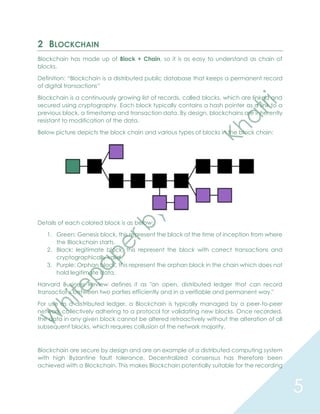
Below picture depicts the block chain and various types of blocks in the block chain:
Details of each colored block is as below:
1. Green: Genesis block, this represent the block at the time of inception from where
the Blockchain starts.
2. Black: legitimate block, this represent the block with correct transactions and
cryptographically valid.
3. Purple: Orphan block, this represent the orphan block in the chain which does not
hold legitimate data.
Harvard Business Review defines it as "an open, distributed ledger that can record
transactions between two parties efficiently and in a verifiable and permanent way."
For use as a distributed ledger, a Blockchain is typically managed by a peer-to-peer
network collectively adhering to a protocol for validating new blocks. Once recorded,
the data in any given block cannot be altered retroactively without the alteration of all
subsequent blocks, which requires collusion of the network majority.
Blockchain are secure by design and are an example of a distributed computing system
with high Byzantine fault tolerance. Decentralized consensus has therefore been
achieved with a Blockchain. This makes Blockchain potentially suitable for the recording
6
of events, medical records, and other records management activities, such as identity
management, transaction processing, documenting provenance, or food traceability.
The first blockchain was conceptualised in 2008 by an anonymous person or group known
as Satoshi Nakamoto and implemented in 2009 as a core component of bitcoin where it
serves as the public ledger for all transactions.
The invention of the blockchain for bitcoin made it the first digital currency to solve the
double spending problem without the need of a trusted authority or central server. The
bitcoin design has been the inspiration for other applications
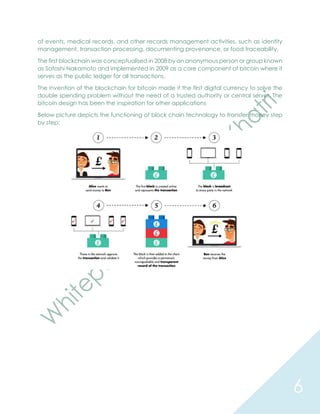
Below picture depicts the functioning of block chain technology to transfer money step
by step:
7
3 CRYPTO CURRENCY
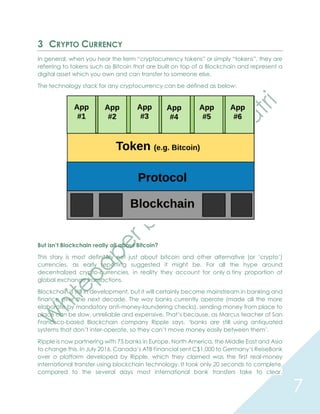
In general, when you hear the term “cryptocurrency tokens” or simply “tokens”, they are
referring to tokens such as Bitcoin that are built on top of a Blockchain and represent a
digital asset which you own and can transfer to someone else.
The technology stack for any cryptocurrency can be defined as below:
But isn’t Blockchain really all about Bitcoin?
This story is most definitely not just about bitcoin and other alternative (or ‘crypto’)
currencies, as early reporting suggested it might be. For all the hype around
decentralized crypto-currencies, in reality they account for only a tiny proportion of
global exchange transactions.
Blockchain is still in development, but it will certainly become mainstream in banking and
finance over the next decade. The way banks currently operate (made all the more
elaborate by mandatory anti-money-laundering checks), sending money from place to
place can be slow, unreliable and expensive. That’s because, as Marcus teacher of San
Francisco-based Blockchain company Ripple says, ‘banks are still using antiquated
systems that don’t inter-operate, so they can’t move money easily between them’.
Ripple is now partnering with 75 banks in Europe, North America, the Middle East and Asia
to change this. In July 2016, Canada’s ATB Financial sent C$1,000 to Germany’s ReiseBank
over a platform developed by Ripple, which they claimed was the first real-money
international transfer using blockchain technology. It took only 20 seconds to complete,
compared to the several days most international bank transfers take to clear.
8
The Bank of England is now in this game as well: its FinTech Accelerator is trialling Ripple’s
technology to make cross-border payments and currency transactions more immediate.
According to Teacher, this collaboration marks the first instance of a central bank
exploring Blockchain technology. And there are also several trials aimed at increasing
the speed and transparency with which property purchases are recorded officially
recognized.
But André Brunner, of fintech consultancy Capco, warns: ‘Blockchain by itself does not
solve any business problem. The industry is still looking for the first “killer app” which will
take Blockchain mainstream.’
Much as HTTP (hypertext transfer protocol — the building block of online data
communication) took the internet into the mainstream almost 30 years ago, the potential
uses for Blockchain are still being explored. Legal structures will also need to change to
fit the challenges that it brings.
9
4 BLOCKCHAIN INVESTMENT OPTIONS
Blockchain is the hottest bit of jargon in the financial world and potentially the most
exciting development since the invention of the internet. it ‘promises to do for finance
and payments what the shipping container did for world trade’. But what the devil is it,
and if it’s really that big, how the devil do you invest in it?
As you might expect, the reality is a little more complicated than that. Dr Windsor Holden
of Juniper Research told that the reason blockchain technologies are so revolutionary is
that they combine these ledger functions with leaps forward in ‘transparency, security
and speed’.
Here are the possible investment options:
4.1 CRYPTO-CURRENCIES
Even though these digital means of exchange are only a small part of what blockchain
is, they are still the least expensive way to get exposure to the companies building the
blockchain such as Ripple and Ethereum, which issue ‘coins’ or tokens that you can buy
on exchanges such as Kraken and Coinbase.
Caveat emptor applies here: a product built on Ethereum’s code base was
compromised last year by a fraudster taking advantage of a loophole in the structure.
More than 2.4 million units were vacuumed out of the system by someone who
understood a kink in the code and took advantage of it.
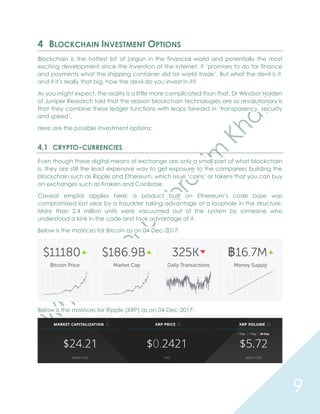
Below is the matrices for Bitcoin as on 04-Dec-2017:
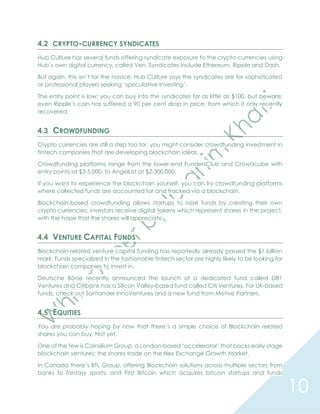
Below is the matrices for Ripple (XRP) as on 04-Dec-2017:
10
4.2 CRYPTO-CURRENCY SYNDICATES
Hub Culture has several funds offering syndicate exposure to the crypto-currencies using
Hub’s own digital currency, called Ven. Syndicates include Ethereum, Ripple and Dash.
But again, this isn’t for the novice. Hub Culture says the syndicates are for sophisticated
or professional players seeking ‘speculative investing’.
The entry point is low: you can buy into the syndicates for as little as $100, but beware:
even Ripple’s coin has suffered a 90 per cent drop in price, from which it only recently
recovered.
4.3 CROWDFUNDING
Crypto currencies are still a step too far, you might consider crowdfunding investment in
fintech companies that are developing blockchain ideas.
Crowdfunding platforms range from the lower-end FundersClub and Crowdcube with
entry points at $3-5,000, to AngelList at $2-300,000.
If you want to experience the blockchain yourself, you can try crowdfunding platforms
where collected funds are accounted for and tracked via a blockchain.
Blockchain-based crowdfunding allows startups to raise funds by creating their own
crypto-currencies; investors receive digital tokens which represent shares in the project,
with the hope that the shares will appreciate.
4.4 VENTURE CAPITAL FUNDS
Blockchain-related venture capital funding has reportedly already passed the $1 billion
mark. Funds specialized in the fashionable fintech sector are highly likely to be looking for
blockchain companies to invest in.
Deutsche Börse recently announced the launch of a dedicated fund called DB1
Ventures and Citibank has a Silicon Valley-based fund called Citi Ventures. For UK-based
funds, check out Santander InnoVentures and a new fund from Motive Partners.
4.5 EQUITIES
You are probably hoping by now that there’s a simple choice of Blockchain related
shares you can buy. Not yet.
One of the few is Coinsilium Group, a London-based ‘accelerator’ that backs early-stage
blockchain ventures: the shares trade on the Nex Exchange Growth Market.
In Canada there’s BTL Group, offering Blockchain solutions across multiple sectors from
banks to fantasy sports; and First Bitcoin which acquires bitcoin startups and funds
11
companies developing bitcoin software and hardware.
There are bound to be more Blockchain related shares in a couple of years time.
5 CONCLUSION
Blockchain will change finance forever, and for the better. Investing in it now may feel
like prospecting for gold in a freezing mountain stream, but if you’ve got a strong
constitution and can sift through the financial jargon, you may just strike it rich.
The legitimacy of various crypto currencies in various countries are still question, so it is
advised to be more cautious evaluation is essential before investing.
6 DISCLAIMER
The content provided in this whitepaper is intended solely for general information and
learning purposes only. It is provided with the understanding that the authors and
publishers are not herein engaged in writing this whitepaper or other professional advice
or services from various information is collected.
Consequently, any use of this information should be done only in consultation with a
qualified and licensed professional who can take into account all relevant factors and
desired outcomes. The information in these whitepaper was posted with reasonable
care and attention. However, it is possible that some information in these whitepaper is
incomplete, incorrect, or inapplicable to particular circumstances or conditions. I do not
accept liability for direct or indirect losses resulting from using, relying or acting upon
information in this white paper.

Whitepaper blockchain technology and investment

  • 1.
    1 Blockchain As a Technology &Investment Whitepaper Version 1.0 By Ibrahim Khatri
  • 2.
    2 Document History Version NumberPublished Date Version Detail 1.0 14-Dec-2017 First published Version
  • 3.
    3 1 TABLE OFCONTENTS 1 Introduction............................................................................................................................ 4 2 Blockchain.............................................................................................................................. 5 3 Crypto currency .................................................................................................................... 7 4 Blockchain Investment Options .......................................................................................... 9 4.1 crypto-currencies........................................................................................................... 9 4.2 crypto-currency syndicates ....................................................................................... 10 4.3 Crowdfunding .............................................................................................................. 10 4.4 Venture Capital Funds ................................................................................................ 10 4.5 Equities........................................................................................................................... 10 5 Conclusion ........................................................................................................................... 11 6 Disclaimer............................................................................................................................. 11
  • 4.
    4 1 INTRODUCTION During lastfew years, we heard following jargons on daily basis at variety of occasions. If yes, this white paper will help to understand more about those and add value to your future actions, decisions for yourself and for your business.  Blockchain  Crypto currency  Bitcoin  Crypto Economy  Crypto Equity After closely monitoring of all above and performing various research and review of various material, I will try my best to explain in upcoming sections of the document. Here I assume that you have basic knowledge of some IT and Financial terminologies. For any further inquiries or queries, Email me at Ibrahim.khatri@outlook.com
  • 5.
    5 2 BLOCKCHAIN Blockchain hasmade up of Block + Chain, so it is as easy to understand as chain of blocks. Definition: “Blockchain is a distributed public database that keeps a permanent record of digital transactions” Blockchain is a continuously growing list of records, called blocks, which are linked and secured using cryptography. Each block typically contains a hash pointer as a link to a previous block, a timestamp and transaction data. By design, blockchains are inherently resistant to modification of the data. Below picture depicts the block chain and various types of blocks in the block chain: Details of each colored block is as below: 1. Green: Genesis block, this represent the block at the time of inception from where the Blockchain starts. 2. Black: legitimate block, this represent the block with correct transactions and cryptographically valid. 3. Purple: Orphan block, this represent the orphan block in the chain which does not hold legitimate data. Harvard Business Review defines it as "an open, distributed ledger that can record transactions between two parties efficiently and in a verifiable and permanent way." For use as a distributed ledger, a Blockchain is typically managed by a peer-to-peer network collectively adhering to a protocol for validating new blocks. Once recorded, the data in any given block cannot be altered retroactively without the alteration of all subsequent blocks, which requires collusion of the network majority. Blockchain are secure by design and are an example of a distributed computing system with high Byzantine fault tolerance. Decentralized consensus has therefore been achieved with a Blockchain. This makes Blockchain potentially suitable for the recording
  • 6.
    6 of events, medicalrecords, and other records management activities, such as identity management, transaction processing, documenting provenance, or food traceability. The first blockchain was conceptualised in 2008 by an anonymous person or group known as Satoshi Nakamoto and implemented in 2009 as a core component of bitcoin where it serves as the public ledger for all transactions. The invention of the blockchain for bitcoin made it the first digital currency to solve the double spending problem without the need of a trusted authority or central server. The bitcoin design has been the inspiration for other applications Below picture depicts the functioning of block chain technology to transfer money step by step:
  • 7.
    7 3 CRYPTO CURRENCY Ingeneral, when you hear the term “cryptocurrency tokens” or simply “tokens”, they are referring to tokens such as Bitcoin that are built on top of a Blockchain and represent a digital asset which you own and can transfer to someone else. The technology stack for any cryptocurrency can be defined as below: But isn’t Blockchain really all about Bitcoin? This story is most definitely not just about bitcoin and other alternative (or ‘crypto’) currencies, as early reporting suggested it might be. For all the hype around decentralized crypto-currencies, in reality they account for only a tiny proportion of global exchange transactions. Blockchain is still in development, but it will certainly become mainstream in banking and finance over the next decade. The way banks currently operate (made all the more elaborate by mandatory anti-money-laundering checks), sending money from place to place can be slow, unreliable and expensive. That’s because, as Marcus teacher of San Francisco-based Blockchain company Ripple says, ‘banks are still using antiquated systems that don’t inter-operate, so they can’t move money easily between them’. Ripple is now partnering with 75 banks in Europe, North America, the Middle East and Asia to change this. In July 2016, Canada’s ATB Financial sent C$1,000 to Germany’s ReiseBank over a platform developed by Ripple, which they claimed was the first real-money international transfer using blockchain technology. It took only 20 seconds to complete, compared to the several days most international bank transfers take to clear.
  • 8.
    8 The Bank ofEngland is now in this game as well: its FinTech Accelerator is trialling Ripple’s technology to make cross-border payments and currency transactions more immediate. According to Teacher, this collaboration marks the first instance of a central bank exploring Blockchain technology. And there are also several trials aimed at increasing the speed and transparency with which property purchases are recorded officially recognized. But André Brunner, of fintech consultancy Capco, warns: ‘Blockchain by itself does not solve any business problem. The industry is still looking for the first “killer app” which will take Blockchain mainstream.’ Much as HTTP (hypertext transfer protocol — the building block of online data communication) took the internet into the mainstream almost 30 years ago, the potential uses for Blockchain are still being explored. Legal structures will also need to change to fit the challenges that it brings.
  • 9.
    9 4 BLOCKCHAIN INVESTMENTOPTIONS Blockchain is the hottest bit of jargon in the financial world and potentially the most exciting development since the invention of the internet. it ‘promises to do for finance and payments what the shipping container did for world trade’. But what the devil is it, and if it’s really that big, how the devil do you invest in it? As you might expect, the reality is a little more complicated than that. Dr Windsor Holden of Juniper Research told that the reason blockchain technologies are so revolutionary is that they combine these ledger functions with leaps forward in ‘transparency, security and speed’. Here are the possible investment options: 4.1 CRYPTO-CURRENCIES Even though these digital means of exchange are only a small part of what blockchain is, they are still the least expensive way to get exposure to the companies building the blockchain such as Ripple and Ethereum, which issue ‘coins’ or tokens that you can buy on exchanges such as Kraken and Coinbase. Caveat emptor applies here: a product built on Ethereum’s code base was compromised last year by a fraudster taking advantage of a loophole in the structure. More than 2.4 million units were vacuumed out of the system by someone who understood a kink in the code and took advantage of it. Below is the matrices for Bitcoin as on 04-Dec-2017: Below is the matrices for Ripple (XRP) as on 04-Dec-2017:
  • 10.
    10 4.2 CRYPTO-CURRENCY SYNDICATES HubCulture has several funds offering syndicate exposure to the crypto-currencies using Hub’s own digital currency, called Ven. Syndicates include Ethereum, Ripple and Dash. But again, this isn’t for the novice. Hub Culture says the syndicates are for sophisticated or professional players seeking ‘speculative investing’. The entry point is low: you can buy into the syndicates for as little as $100, but beware: even Ripple’s coin has suffered a 90 per cent drop in price, from which it only recently recovered. 4.3 CROWDFUNDING Crypto currencies are still a step too far, you might consider crowdfunding investment in fintech companies that are developing blockchain ideas. Crowdfunding platforms range from the lower-end FundersClub and Crowdcube with entry points at $3-5,000, to AngelList at $2-300,000. If you want to experience the blockchain yourself, you can try crowdfunding platforms where collected funds are accounted for and tracked via a blockchain. Blockchain-based crowdfunding allows startups to raise funds by creating their own crypto-currencies; investors receive digital tokens which represent shares in the project, with the hope that the shares will appreciate. 4.4 VENTURE CAPITAL FUNDS Blockchain-related venture capital funding has reportedly already passed the $1 billion mark. Funds specialized in the fashionable fintech sector are highly likely to be looking for blockchain companies to invest in. Deutsche Börse recently announced the launch of a dedicated fund called DB1 Ventures and Citibank has a Silicon Valley-based fund called Citi Ventures. For UK-based funds, check out Santander InnoVentures and a new fund from Motive Partners. 4.5 EQUITIES You are probably hoping by now that there’s a simple choice of Blockchain related shares you can buy. Not yet. One of the few is Coinsilium Group, a London-based ‘accelerator’ that backs early-stage blockchain ventures: the shares trade on the Nex Exchange Growth Market. In Canada there’s BTL Group, offering Blockchain solutions across multiple sectors from banks to fantasy sports; and First Bitcoin which acquires bitcoin startups and funds
  • 11.
    11 companies developing bitcoinsoftware and hardware. There are bound to be more Blockchain related shares in a couple of years time. 5 CONCLUSION Blockchain will change finance forever, and for the better. Investing in it now may feel like prospecting for gold in a freezing mountain stream, but if you’ve got a strong constitution and can sift through the financial jargon, you may just strike it rich. The legitimacy of various crypto currencies in various countries are still question, so it is advised to be more cautious evaluation is essential before investing. 6 DISCLAIMER The content provided in this whitepaper is intended solely for general information and learning purposes only. It is provided with the understanding that the authors and publishers are not herein engaged in writing this whitepaper or other professional advice or services from various information is collected. Consequently, any use of this information should be done only in consultation with a qualified and licensed professional who can take into account all relevant factors and desired outcomes. The information in these whitepaper was posted with reasonable care and attention. However, it is possible that some information in these whitepaper is incomplete, incorrect, or inapplicable to particular circumstances or conditions. I do not accept liability for direct or indirect losses resulting from using, relying or acting upon information in this white paper.