* blockchain
sector scaled to $2.6 trillion
*practical, scalable applications *alignment of interests & value among developers, businesses,
end-users
* brings proofof-funds process onchain
The Future of
BlockchainApplications:
Reshaping Global Industries
OKX & Blockworks Research Special Report
May 2025
3.
Preface
OKX is anonchain technology company with a mission to make blockchain-based
assets more accessible. It began as a crypto exchange giving millions of people the
ability to trade, and over time became among the largest platforms in the world.
Blockworks Research is crypto’s most powerful research platform and brings together
data, onchain analytics, governance, financial models, and more. Institutions, funds, and
protocols rely on Blockworks Research for actionable insights related to their portfolios
and businesses.
How did our two companies come to collaborate on The Future of Blockchain
Applications: Reshaping Global Industries?
The report was born from our mutual stake in the positive disruption blockchain
technology is bringing today. Just as the internet and cell phones redefined
communication and information sharing, blockchain is transforming the inner workings
of companies across industries.
As leaders in the space, we believe these changes and their implications for businesses
and society at large deserve a closer look.
Although we can’t predict the future, we see great value in analyzing the advancements
seen to date to anticipate the trends and developments that are driving blockchain and
building the crypto economy of tomorrow. In the report, we explore this change from
many different perspectives.
Haider Rafique
Chief Marketing Officer, OKX
Jason Yanowitz
Co-Founder, Blockworks
2
The report hastwo key objectives:
Blockchain and its many applications are
changing the world.
Although the last 10 years have been
speculative, the next 10 will be defined
by blockchain applications redefining
major global industries — including
financial services, technology, consumer
and luxury goods, and sports and
entertainment.
In particular, the ongoing development
of defined blockchain use cases —
cryptocurrencies; real-world asset
tokenization; decentralized apps
(dApps); practical self-custody; wallets
and payments — will act as a key
disruptor across vital business sectors.
Moreover, blockchain’s emergence
into a phase of utility, adoption and
ubiquity has profound implications. The
World Economic Forum predicts that
10% of global GDP could be tokenized
and stored on the blockchain by 2027,
with the technology set to become
increasingly embedded in daily life [1].
The following pages explore this
dynamic with a view to mapping out how
the blockchain economy will shape the
next two and a half decades.
First, the findings provide an
overview of the current state of
blockchain’s application in the
following global industries:
→ Financial services
→ Technology
→ Consumer and luxury
goods
→ Sports and
entertainment
1
Second, the text lays out
research-driven predictions
and insights about how
blockchain can transform
existing models in these
sectors, how the technology
can give rise to new forms
of economic activity — and
where the blockchain and its
key applications are headed in
the next 25 years.
2
Introduction
6.
3
High-level insights include:
Arising tide of asset
tokenization is underway. This
is facilitated by dApps that
enable the creation, trading,
and management of tokenized
assets, and could unlock trillions
of dollars worth of currently
illiquid assets in the future.
Changes in the treatment
of data will disrupt current
business models. The shift
towards user-centric data
ownership will change how data
is collected and used.
Digital wallet innovations
are simplifying the customer
experience — which will
enhance user engagement, and
spur mainstream adoption. OKX
Pay’s practical self custody is
one example of this trend.
AI and crypto will converge. AI
will enable more effective coding
and troubleshooting; crypto will
create strong incentives for AI
training and deployment.
Blockchain opens up new
revenue streams for companies
across multiple sectors. The
growing proliferation of dApps
and other digital asset products
is a key driver of this growth.
Real value for end users will
grow. The above-mentioned
advancements will converge
to benefit users and create
incentives for them to invest and
participate in the blockchain
economy.
Retail and institutional adoption
of crypto in financial services
will accelerate. Asset allocation
to crypto will continue to grow
across all portfolios.
1
2
3
4
5
6
7
The report utilizes a methodology that combines data from Blockworks Research,
independent analysis from OKX, and interviews conducted with entrepreneurs and
business leaders in the sectors identified above.
7.
4
In the pastdecade, the blockchain
sector scaled from comprising a handful
of cryptocurrencies to constituting
a $2.6 trillion ecosystem. The report
explores how the systems supporting
that ecosystem are now well-established
and stable enough to enable developers
to build investable, real-world
applications beyond speculation around
novel tokens. The evidence collected by
Blockworks Research and OKX points
to an emphatic conclusion: growth will
continue, and it carries the potential to
reshape the global economy.
Rich Widmann, Google’s head of Web3
strategy, put it best: “Blockchain is a
pressure chamber of innovation.” [2]
Understanding how this evolution
will play out — and how blockchain
technology is likely to advance and
adapt along the way — is critical for
anyone involved in building or investing
in the future.
Innovators, business leaders and global brands consulted
or interviewed during the course of the research include the
following:
The research collected makes it clear that the blockchain ecosystem is moving
inexorably towards practical, scalable applications across all of the surveyed industries,
creating a virtuous alignment of interests and value among developers, businesses and
end-users.
8.
5
Decentralized Applications:
Innovative blockchainapplications are being developed across all of the industries
covered in this report, and the research focuses on a handful in each sector.
Finance Technology Brand Entertainment
Spot bitcoin ETFs
The Render Network’s
decentralized GPU marketplace
TYB by Avalanche
McLaren Racing’s digital
collectibles
Crypto mutual funds/ETPs Solana by Solana Labs IBM’s Food Trust Box Office by Sports Illustrated
Visa Tokenization Asset Platform Gitcoin Passport Hyperledger Fabric Off the Grid on Avalanche
Crypto remittances
Dune’s blockchain data
analytics dashboard
Supply chain traceability
Fan tokens - FC Barcelona, UFC,
Formula 1 teams
JP Morgan’s JPM Coin Google Web3 Cloud
Digital product passports
used by Louis Vuitton
Manchester City & OKX digital
collectibles
High-frequency trading and risk
management tools
Bittensor crowdsourced AI
model development
NFTs for ethical product
authentication
Peer-to-peer sports betting
TradFi - DeFi integration
platforms
AI micropayments
NFT-based product
authentication
NFTs for music and merchandise
- e.g. Kings of Leon, 3LAU
Digital wallets IPFS cloud storage
Blockchain-enabled consumer
data analytics, used by Starbucks
Tokenized film investments
Crypto custody services
Arweave permanent
decentralized data storage
Blockchain for product lifecycle
tracking: L’Oréal
Blockchain-based royalty
systems - e.g. Audius, Royal
Crypto based payment rails
Google Web3 hybrid
blockchain cloud solutions
NFTs for enhanced customer
experience
Decentralized streaming,
e.g. Livepeer
Worldcoin’s Proof of Humanhood Ronin blockchain for gaming
Peer-to-peer cloud and internet
services
Interoperable gaming assets
Blockchain gaming guilds and
cooperatives
IP and royalty enforcement
AI-driven dynamic worlds
7
Reshaping Value Creationand
Financial Products
Institutional investors continue to allocate capital to digital
assets and related products. Further development of trading
products and custody services will make it easier for investors
to allocate and increase exposure in the years ahead.
Stablecoins are primed to alter the global payments
landscape. Major firms like Visa are investing money and
resources, and today’s top stablecoins continue to grow in
market capitalization and use.
Crypto exchanges will rewire how assets trade in the world.
This shift is already underway and has spurred market
incumbents to explore innovations such as 24/7 trading hours.
Major financial services firms are moving toward a tokenized
future. More than two-thirds of financial services interview
respondents said they are developing capabilities to support
the issuance and servicing of tokenized assets.
1
2
3
4
11.
8
Investing and AssetManagement
Current State
A pronounced shift toward passive investing is underway as
investors become more comfortable with alternatives.
A core aspect of blockchain technology in financial services is its ability to transfer value
securely and efficiently between parties immutably without the need for intermediaries.
The decentralized nature of blockchain ensures that transactions are verified by a
network of nodes, reducing the risk of fraud or manipulation.
Elwood Asset Management said:
“Institutional adoption of blockchain-based financial services is
expected to grow steadily as regulatory clarity improves, making
institutions more confident in adopting digital asset solutions.
Blockchain offers operational efficiencies, such as faster settlement
times and reduced costs for digital assets, which could attract
institutions seeking to streamline processes. As blockchain
infrastructure becomes more scalable and customizable, institutions
will be incentivized to adopt it for broader use cases like trade
settlement and portfolio management. Tokenization of traditional
assets will enable institutions to access liquidity and fractionalize
investments.” [3]
In recent years, new digital technologies have emerged that have enabled faster and
more seamless trading and interactions across the financial services ecosystem. This
innovation, together with the increased use of blockchain and blockchain wallets in
trading and financial services, has moved forward the merger of traditional finance with
emergent technology.
12.
9
According to Ernst& Young’s 2024 institutional investor
research report:
→ 43% of respondents have invested in digital asset mutual funds/ETPs
→ 37% of respondents are actively holding spot cryptocurrencies
→ 59% of asset managers plan to launch a crypto fund in the next two years
Ernst & Young Asset Manager Survey, May 2024 [4]
A key event that illustrates acceptance of digital assets in traditional finance was the
US Securities and Exchange Commission’s approval of spot bitcoin ETFs in early 2024.
The participation of industry giants such as BlackRock, Fidelity, Invesco and State Street
brought with it critical institutional credibility.
As Ophelia Snyder, co-founder and president of 21Shares – one of the world’s largest
crypto ETP issuers – stated:
“We’re seeing enhanced institutional adoption of crypto worldwide.
This isn’t solely a retail product, and institutional investors are
starting to understand the role crypto products can play in a broader
portfolio. In the US market, institutional investors are buying bitcoin
ETFs. Adoption is amongst the quickest we’ve seen for any new ETF
category.” [5]
The majority of interview participants concurred with the view that institutional adoption
of crypto and digital assets is steadily increasing. This view is also evidenced by the
growth in total market capitalization of bitcoin ETFs to $116.51 billion across 21 products
since the inception in 2021 [6].
Snyder also highlighted the Michigan state pension fund’s interest in bitcoin ETF
products as a signal of expanding awareness and demand for such products: “This is a
fantastic sign of how many of these pension plans are currently thinking about the asset
class or will be in the near future.”
Investing and Asset Management
Current State
13.
10
The research showsthat today’s
successes will fuel a wave of innovative
new products, further focusing investor
attention on digital assets.
Many respondents said they are already
working on or exploring how to establish
infrastructure and services to support
the issuance of tokenized products —
indicating that today’s slate of BTC and
ETH exchange-traded funds is only the
beginning.
Morgan Krupetsky, senior director of BD
at Ava Labs, said that “tokenization will
do for assets what ETFs did for mutual
funds.”
Digital tokens represent a significant
improvement over ETFs — digital
assets trade 365 days a year, 24 hours
a day, and are programmable via smart
contracts, allowing for automatic rules-
based rebalancing and even lower costs
for the investor [7].
Interviewees also said that digital assets
will create new revenue streams, and
therefore present financial incentives for
continued work in this area.
Anchorage, for example, said that it expects digital assets to be a
common component of both institutional and retail portfolios.
“Just as the ETF boom democratized access to a wide range of
investment strategies, I believe blockchain-based assets will
open up new opportunities for market participants of all types,” a
spokesperson said [8].
As advancements in blockchain technology continue to revolutionize financial services,
many expect to see a future state where more efficient, transparent, and accessible
systems emerge for investing and asset management. In the future, crypto and
decentralized finance (DeFi) platforms will increasingly disrupt and alter traditional
financial models, and digital assets will become a core component of mainstream
financial products.
Investing and Asset Management
Future State
14.
11
Despite its globalrelevance, the
payments industry is plagued with
inefficiencies due to its reliance on
legacy rails. An outgoing international
wire transfer can cost up to $75, while
some banks charge a fee for accepting
an incoming international transfer
[11]. Credit card processing fees hover
between 1.5% and 3.5%, with merchants
forced to wait up to three days for the
processing company to deposit funds
into their bank account [12].
In contrast, crypto uses internet-native
rails, with networks such as Solana
consistently registering median fees
below a cent of a dollar and near-instant
settlement times. The integration
of crypto with existing payment
solutions, combined with increasing
regulatory clarity, can alleviate existing
inefficiencies and reduce costs for
merchants and consumers.
Stablecoins have a major part to play
in this transformation. These assets
are already well-established in certain
markets because of the cost and speed
advantages they bring over conventional
systems — two features that make
them well-suited to facilitate remittance
payments.
As a result, crypto-native firms are
leveraging blockchain technology and
the stability of fiat-pegged stablecoins
to enable instant, low-cost global
payments. OKX for example, recently
launched its OKX Pay solution, which
utilizes stablecoins such as USDT and
USDC to facilitate near-instant transfers,
bypassing legacy banking bottlenecks
and improving cash flow and price
stability for users.
One of the most significant advantages
of crypto payments is cost. In Q1 2024,
the global average cost of sending $200
was 6.35%, per data from The World
Bank [13]. Many crypto services process
transfers for as low as .05%, and some,
such as OKX Pay, have zero transfer
fees. This makes the service particularly
valuable for cross-border payments
and merchant settlements, where
conventional payment processors levy
substantial fees.
The payments industry is a key part of the global economy. According to McKinsey,
its revenue pool amounted to $2.4 trillion in 2023, and is expected to top $3 trillion
by 2026 [9]. Meanwhile, global remittances reached nearly $670 billion in 2023,
representing a 3.8% year-over-year increase [10].
Payments and Remittances
Current State
15.
12
As regulatory frameworksfor
stablecoins mature, crypto payment
solutions are poised to bridge the
gap between crypto efficiency and
traditional payment reliability, offering
a compelling alternative to outdated
financial infrastructure.
Stablecoins have also caught the eye of
governments looking to bring greater
efficiency to payments. Nations in Sub-
Saharan Africa and Latin America, for
example, are increasingly adopting
stablecoins to hedge against local
economic instability and for lower- cost
remittances [14]. Brazil in particular has
seen a surge of crypto usage over the
past two to three years, with 90% of the
flow linked to stablecoins as a means of
making global payments [15].
Beyond speed and cost savings, these innovative services provide enhanced
accessibility. Users can send funds globally without maintaining multiple currency
accounts or paying foreign exchange premiums. Self-custody features allow merchants
to receive payments directly to their wallets while maintaining full control of their
assets. In combination with the above, new services, including OKX Pay, offer seamless
integration for e-commerce platforms, enabling businesses to accept crypto payments
without complex technical implementation.
Payments and Remittances
Current State
16.
13
Other countries arenow taking firm
action towards embedding stablecoins
into their own financial systems. Many
eyes are on the United States and its
progress towards crypto regulation
following the return of President Trump
to the White House.
In January 2025, President Trump
issued an executive order to strengthen
America’s leadership in digital financial
technology. The order included a
policy to develop a dollar-backed
stablecoin with the aim of “promoting
and protecting the sovereignty of the
United States dollar” [16]. Weeks later,
stablecoin bills were introduced in
Tennessee and California, which aim to
formalize the regulatory framework to
protect consumers while encouraging
innovation [17]. In addition, the growing
momentum of the GENIUS Act amongst
lawmakers in the first half of 2025 has
set the stage for stablecoins to become
the first major piece of the crypto puzzle
to be fully regulated in the US.
Endorsements such as this can
accelerate the global acceptance of
stablecoins, while sparking fresh use
cases that bring about lasting positive
disruption. On the players behind the
disruption, Harvard Business Review
puts it simply, “the companies that
control the stablecoin market will wield
substantial influence over the future of
money” [18].
Those leading the stablecoin market are
busy advancing the infrastructure that’s
required if the technology is to become
more deeply infiltrated in mainstream
finance. Interoperability is key to
achieving this. When stablecoins can
move freely across chains, users benefit
from a simpler experience overall —
removing a barrier to adoption.
Payments and Remittances
Current State
17.
14
Traditional finance companiescan
support here, building blockchain
technology into products and platforms
without compromising on the seamless
and intuitive experience end users have
come to expect.
Global payment giants such as PayPal
and Visa have taken steps toward
integrating cryptocurrency as a form of
payment, further expanding the utility of
digital currencies beyond speculation.
For instance, Visa is supporting Spanish
Banking giant BBVA to launch its own
stablecoin. According to Francisco
Maroto, BBVA’s head of digital assets
and blockchain, the bank is currently
participating in a new Visa programme
designed to help firms develop their own
tokenised assets [19].
However, businesses and regulators must work together before crypto permeates the
payments industry worldwide. Nathan McCauley, CEO and co-founder of Anchorage,
said:
“Realizing these opportunities requires overcoming some
challenges. Technical interoperability is complex as traditional
financial systems often rely on legacy infrastructure not designed
with blockchain in mind. The decentralized nature of blockchain
technology also requires new, crypto-specific solutions for
compliance with AML and KYC controls.” [8]
Payments and Remittances
Current State
18.
15
Financial infrastructure isnotoriously
resistant to fundamental change, but
blockchain presents a viable path
forward. Tokenization plays a central role
in this shift, with key use cases emerging
across payments, cross-border money
movement, and programmable finance.
The goal of blockchain integration in this
framework is to enable many use cases
on a single payment rail by connecting
different markets and asset classes. By
enabling the programming of digital
money, existing processes can become
more capital-efficient.
Visa is intensifying its commitment
to tokenization by launching the Visa
Tokenization Asset Platform (VTAP), a
project that has been in development for
more than two years.
VTAP is Visa’s suite of APIs that enable
partner financial institutions to tokenize
deposits, connect to offchain Visa
services, and use blockchain rails to
make B2B, B2P, and P2P payments in
and out of banks.
In this sector, blockchain is viewed as a new payment rail that can
operate alongside, but will not entirely replace, existing payment
systems.
Payments and Remittances
Future State
19.
16
Payments is onearea where blockchain’s
integration has the potential to bring
efficiency gains that grow exponentially
as adoption increases in the coming
years. According to Paolo Ardoino,
CEO of stablecoin issuer Tether, USDT
and other stablecoins can improve “by
orders of magnitude your ability to do
business” [20].
This benefit can not only be felt in the
speed with which payments can be sent
and received, according to Ardoino, but
also through the related due diligence
merchants perform.
As Ardoino notes, when stablecoins
like USDT are commonplace among
the global payments infrastructure,
blockchain will allow sellers to validate
that a buyer holds the USDT they claim
to.
This essentially brings the proof-
of-funds process onchain, where
blockchain’s transparency and
immutability can help accelerate the due
diligence process and better protect
merchants.
Payments and Remittances
Future State
20.
17
As stablecoins continueto gain market
share in the future, crypto-based
remittances will provide greater access
to global financial systems for the
underbanked or unbanked. In addition to
the chart above, World Bank data shows
that in some countries, remittances
make up as much as 30% of GDP [13],
which further highlights the potential
impact of crypto remittances on
economies.
Rather than displacing legacy systems,
however, interview respondents said
they see a future where blockchain
and digital currencies coexist with and
enhance the infrastructure and products
of traditional finance.
The result will be a hyper-connected
global economy whose growth
is determined by an increasingly
borderless world.
Payments and Remittances
Future State
21.
18
Some takeaways fromthe research:
→ Financial companies, including asset manager Elwood, are developing
new and sophisticated tools for trading, risk management, and portfolio
management across blockchain assets.
→ Digital wallets are more sophisticated and easier to use than ever before,
and are fundamental to how users experience platforms and services.
→ Crypto-native firms have solved legacy issues around self-custody, making
it easier for the next-generation of users to onboard to Web3 using their
own digital wallets. In the future, financial services companies will create
their own decentralized apps (dApps) on top of self-custody wallets.
→ Tokenization of traditional assets is enabling new trading opportunities
and increased liquidity for previously illiquid assets.
→ The 24/7 nature of digital asset markets is changing trading dynamics and
risk management strategies.
→ There is potential for near-instantaneous transactions and increased
liquidity across various asset classes.
Trading, Custody, and Wallets
Current State
22.
19
Giovanni Vicioso, Headof Digital
Assets Strategy, CME Group, said in
an interview that blockchain’s most
significant impact on trading will be
a shift towards 24/7, instantaneous
settlement in traditional markets.
Vicioso also stated that use of crypto
rails is increasing, and highlighted
a shift away from speculation, with
digital assets beginning to merge
into a broader categorization, namely
“investible technology.” [21]
Many traditional financial
institutions have also branched into
cryptocurrencies. Goldman Sachs offers
OTC crypto trading, options, and futures
trading for BTC and ETH, while Standard
Chartered offers a trading and custody
platform for institutional participants
through a partnership with OKX.
Meanwhile, Fidelity Digital Assets offers
comprehensive digital asset services,
including custody.
Recent innovation in self-custody
by crypto firms has produced new
solutions that address long-standing
challenges around security, accessibility,
and usability. Traditional self-custody
methods, including hardware wallets
or seed phrase backups, often require
technical knowledge and introduce
risks such as sending to the wrong
address, potential lost keys or exposure
to phishing attacks. Additionally, the
difficulty of transacting directly from
self-custodied wallets limited their
adoption for everyday use.
Current digital asset trading infrastructure is marked by diverse
trading strategies, an increase in high-frequency trading, and
support for a broad range of assets and products.
Trading, Custody, and Wallets
Current State
23.
20
To solve theseissues, crypto companies
are leveraging advanced technologies
such as multi-party computation (MPC)
wallets, account abstraction (AA), and
zero knowledge (ZK) email recovery,
for example, which eliminate single
points of failure by distributing key
management across multiple devices
or parties, enabling secure recovery
without vulnerable seed phrases.
Modern wallet designs also prioritize
user experience, offering biometric
authentication, intuitive interfaces, and
social recovery options to make self-
custody more accessible. Platforms
such as OKX are further bridging the
gap by integrating the above recovery
features into self-custody wallets with
DeFi, CeFi, and payment services,
allowing users to trade, earn yield, and
spend assets without relinquishing
control or sacrificing security.
One notable innovation is OKX Pay,
which enables instant, low-friction,
low-cost transactions directly from self-
custodied wallets, enhancing liquidity
and usability. This solution includes
a feature where users don’t need to
manage a private key. This benefits
both everyday users and merchants
— individuals retain full ownership of
assets while businesses can accept
crypto payments without intermediaries.
In addition, institutional players like
Fidelity Digital Assets and Standard
Chartered (through partnership with
OKX) are also offering hybrid custody
models that combine self-custody
flexibility with enterprise-grade security.
As a result of this innovation, core
infrastructure has become more
mainstream and easier to access, paving
the way for all financial institutions
to eventually develop and deploy
proprietary dApps on top of self-custody
wallets.
These advancements are transforming
self-custody into a practical, secure, and
integrated component of the broader
financial ecosystem. By reducing
friction and improving security, crypto
companies are empowering users to
maintain full asset ownership while
creating a Web2-like experience on
Web3—paving the way for wider
adoption of decentralized solutions.
Trading, Custody, and Wallets
Current State
24.
21
Over the next25 years, crypto trading will advance exponentially
in sophistication, with new tools, products, and protocols being
created in the process.
Digital wallets, for example, are expected to enable whole new use cases as they become
more sophisticated.
Sandy Kaul, SVP and Head of Digital Asset & Investor Advisory Services at Franklin
Templeton, said there is potential for blockchain technologies to replace session-based
regional trading with 24/7 global trading, and book-order with atomic settlement. The
technology could also see bi-lateral transaction records moved to shared ledgers,
alongside ending today’s complicated account-based approach by moving all holdings
to a cryptographically protected wallet.
Kaul stated:
“Over the next 10 years we anticipate a shift in expectations that
would reposition an investor’s portfolio to the center of their lives
and enable them to earn rewards and receive incentives from their
holdings, much like credit cards provide today. The investment
portfolio will cover short-term liquidity needs, optimize forms of
payment, facilitate experiences, allow the investor to better leverage
their own assets and cover long-term savings and retirement goals.
This will allow the asset management industry to deliver on a vision
of better living through investing.” [22]
Trading tools have come a long way in the past decade thanks to the evolution of
onchain data analysis, social media sentiment monitoring, and alternative data.
However, the industry is still marked by fragmented liquidity across multiple exchanges,
creating the need for advanced risk management tools, the majority of which are
developed in-house.
Trading, Custody, and Wallets
Future State
25.
22
As regulatory clarityimproves, an
increasing proportion of volume will
be driven by institutional investors — a
trend that will in turn drive the need for
more sophisticated offerings, such as
structured products and derivatives.
In the coming decades, crypto banking
services will be fully integrated into
traditional banking systems. Many major
banks could offer comprehensive digital
asset services ranging from crypto-
enabled debit, credit, and financing, to
a diverse array of more sophisticated
products.
Simultaneously, the distinction between
“crypto banks” or “neo banks” versus
traditional banks will largely disappear.
This is certainly anticipated in guidance
from the US Department of the
Treasury’s Office of the Comptroller
of Currency (OCC), which allows
national banks and federal savings
associations to use public blockchains
and stablecoins for payments [23].
Many traditional banks now also offer
crypto custody, trading, and investment
services, while crypto banks and
neobanks similarly offer traditional
banking products such as checking
accounts, debit cards, and loans.
Trading, Custody, and Wallets
Future State
26.
23
Financial institutions arecommonly
leveraging blockchain for transaction
settlement, product operations, and
streamlining processes — resulting in
significant cost savings.
There is also a growing race to
offer full-service banking for digital
asset customers. Custody lies at the
foundation of this development. By
providing the critical infrastructure
for secure storage and protection of
digital assets, banks can build trust with
customers. This, in turn, allows banks to
offer additional financial services on top,
such as trading, lending and borrowing,
staking, and payments [8].
Stablecoins, too, are growing in
sophistication and capitalization. The
market has reached a collective value
of $180 billion, with USDT and USDC
dominating the landscape [24]. Issuers
are emphasizing regulatory compliance
and diversifying their backing assets.
As mentioned previously, bitcoin
ETFs and other products are gaining
momentum. Recent approvals indicate
growing regulatory acceptance,
although progress remains slow.
The value proposition to banks is
clear. The total market capitalization of
commodity-backed tokens is greater
than $1.1 billion currently [25] and is
conservatively expected to exceed $10
trillion by 2030, according to Roland
Berger [26]. Such growth reflects the
extent to which a more diverse range
of asset types is capturing investor
mindshare.
Financial institutions plan to tokenize
ownership of hard and soft assets and to
create their own tokens, as in the case of
JP Morgan’s JPM Coin, used for instant
payments.
A remarkable degree of product innovation is taking place in
financial services, and much of it is driven by digital assets and
blockchain.
Emerging Financial Products
Current State
27.
24
Senior professionals atFranklin
Templeton, Elwood Asset Management,
and Visa, all stated a belief that
tokenization will impact treasuries,
bonds, equities, commodities, real
estate, and credit, and that these
products will benefit from increased
liquidity, accessibility, transparency, and
composability.
Through tokenization, liquidity from
previously illiquid asset classes will
be unlocked and entirely new asset
classes will be created. Carbon credits,
fine art, and even IP will be tokenized,
creating fractional, easily tradeable
digital representations and unique new
assets. Tokenization of carbon credits,
for instance, could enhance market
liquidity and transparency, potentially
accelerating global efforts to combat
climate change.
Tokenization of intellectual property
might create new markets around
patents, copyrights, and other intangible
assets, with far-reaching implications
relating to innovation and value creation.
New products will also emerge that
combine these asset classes in unique
and interesting ways.
For instance, a tokenized real estate
investment trust (REIT) could increase
liquidity, lower barriers to entry by
enabling fractional ownership, and
improve the accuracy of property
valuations.
A clear theme emerged from interviews with leaders of both
crypto-native and non-crypto-native financial institutions:
blockchains will be used to settle transactions, manage products
with greater transparency, and streamline operations.
Emerging Financial Products
Future State
28.
25
Proof of Reserves(PoR) has emerged
as a critical tool for enhancing
transparency and trust, particularly
for centralized exchanges. By offering
cryptographic proof that they hold
sufficient assets to cover user deposits,
exchanges can provide verifiable
reassurance to their customers. OKX is
an industry leader in this regard, using
advanced methods such as Merkle trees
and zero-knowledge (ZK) proofs, and
producing monthly PoR reports for two
and a half years.
The Merkle tree structure allows users
to independently verify assets are
accounted for in the exchange’s reserve
holdings without compromising privacy.
This cryptographic approach maintains
data integrity by securely hashing
transaction data and proving the
existence of each user’s assets without
exposing sensitive information.
ZK proofs have also become an essential
innovation in PoR as they enable
exchanges to validate their holdings
without disclosing specific asset details,
enhancing privacy and proving solvency.
As ZK proof technology develops, it
is expected to further streamline and
secure the PoR process.
PoR is not provided exclusively by
exchanges, however. While exchange
PoR focuses on proving that the
exchange holds sufficient liquidity to
cover user assets, token PoR verifies
that token issuers hold adequate
reserves to back their circulating tokens.
For exchanges or token issuers alike,
only blockchain solutions can offer this
level of transparency.
Proof of Reserves
Current State
29.
26
In the yearsahead, the role of PoR in crypto audits will evolve significantly. Traditional
third-party audits, though still in use, will likely be augmented by real-time,
cryptographic audits that use PoR methodologies. With the growing sophistication of
blockchain technologies, including the use of ZK proofs and advanced cryptographic
techniques, exchanges will be able to provide continuous proof of their reserves. This
will likely drive a shift from periodic audits to ongoing, transparent solvency checks.
McCauley added:
“The radical transparency of blockchain technology can help solve
traditional compliance challenges, offering new tools for auditing,
tracking, and verifying transactions in real-time. Our goal is to help
create a regulatory environment that unlocks the potential of crypto,
while maintaining the safety and soundness of the financial system.
It’s a complex challenge, but one we believe is essential to get right.”
[8]
Proof of Reserves
Future State
28
Technology & Infrastructureare
Transforming Onchain
Blockchain has changed how software, networks, and data
systems are constructed and used.
The future of AI will be influenced by blockchain. Startups and
developers are exploring how blockchain can decentralize the
development of artificial intelligence systems.
Privacy and blockchain will improve symbiotically online,
enabling users to transact pseudonymously while maintaining
control of their personal data.
The convergence of blockchain, cloud computing, and
AI is underway and could grow into a multi-trillion-dollar-
opportunity.
1
2
3
4
32.
29
With open-source software,developers
can freely analyze the core source code
of a protocol and learn exactly what led
to past successes or failures. To make
informed decisions, though, developers
need access to data around network key
performance indicators (KPIs).
As a result, a new market for indexing
and analytics has emerged. More
orderly, digestible data formats are
proving valuable to companies around
the world.
Fredrik Haga, co-founder and CEO
of crypto analytics platform Dune,
emphasized that blockchain’s openness
allows anyone to download and analyze
data freely. This accessibility accelerates
innovation, as developers can study
successful protocols and learn from
past failures. This transparency creates
an evolutionary dynamic, enabling
developers to iterate more rapidly.
Blockchain-based smart contracts have fundamentally changed
the way software is developed.
“Smart contracts are open source, and you can see exactly how many
users they have and what those users did,” Haga said. “This makes
innovation accelerate much faster because everyone can see what led to
adoption or what failed.” [27]
This is in sharp contrast with how traditional tech companies typically silo and restrict
access to such information.
Software Development, Indexing, and Analytics
Current State
33.
30
Challenges remain. AsGoogle Cloud’s
Widmann said:
“Look at the structure of crypto data —
there is a great irony in the openness
and transparency, but opaqueness at the
same time due to the problem with block
explorers.” [2]
However, once this data is structured
builders can use it to provide traders,
investors and other decision-makers
with more information about the market.
Widmann further explained that this
presents a fantastic opportunity for
generative AI. By processing massive
amounts of unstructured blockchain
data, AI can create advanced search
products that not only return raw data
but also provide contextual insights into
transactions and smart contracts.
Sophia Zhao from Alumni Ventures
noted that the convergence of Web3
and AI enhances security, enabling more
robust analytics platforms that can serve
both the crypto-native and traditional
finance sectors [28].
For instance, the US government has
used Chainalysis to assist in various
criminal investigations, helping to trace
millions of dollars in stolen funds. In
another example, the German Federal
Criminal Police Office used Arkham to
trace and seize almost 50,000 BTC from
operators of a piracy website [29, 30].
In sum, blockchain’s inherent
transparency and decentralization is
beginning to solve many of the flaws of
opaque and centralized legacy systems.
Software Development, Indexing, and Analytics
Current State
34.
31
Improving the developerexperience is critical as more talent
enters the space. A major stumbling block, according to the
research, is a lack of familiarity with crypto-native coding
languages.
Google Cloud’s Widmann said he believes that generative AI, combined with advanced
blockchain indexing and analytics products, will help developers overcome these
hurdles.
He said:
“You have this brilliant idea, but how do you transform it into code?
A developer could use AI-powered search to find what blockchains
have the most liquidity, give you the smart contracts with the highest
TVLs, and then go to the code portal and build the tooling because
you don’t know that blockchain’s coding language.” [2]
This approach could significantly reduce
the time to launch new blockchain
applications, in turn bridging the gap
between innovation and consumer
usage.
Widmann envisions creating a product
that enables users to search for specific
events on the blockchain and also get
context on what happened with the help
of generative AI.
For example, a user could theoretically
input a hash of a specific transaction,
and the search product could return
structured data around what tokens
were transferred and explain the
transaction in natural language.
Ultimately, the convergence of
blockchain and AI will accelerate the
former’s utility and evolution, paving the
way for mass adoption.
Software Development, Indexing, and Analytics
Future State
35.
32
The convergence ofblockchain and AI
is just getting started and is still broadly
underappreciated.
Today, the production of AI models
is highly resource-intensive, both in
monetary terms and computationally,
but blockchain networks and
decentralization could change this.
Jules Urbach, founder of the Render
Network, explained that blockchain
helps coordinate computational
resources for AI training and inference,
“Networks like Render are using
blockchain to build decentralized
AI infrastructure, leveraging the
combination of peer-to-peer networks
and token incentives to coordinate
computation more efficiently.” [31]
The Render Network, for example,
is a decentralized blockchain-based
GPU marketplace that allows users to
contribute their idle GPU computing
power in exchange for payment. To
date, Render’s computer network has
rendered over 38.1 million frames,
supplying artists with affordable
compute resources for 3D effects.
In addition to computing for AI training,
the decentralization of machine learning
model development is also underway.
Bittensor, a blockchain protocol
designed to incentivize decentralized
machine learning model development,
enables anyone to contribute to open-
source machine learning models.
To date, the protocol has yielded 36
models, called subnets, providing
unbiased alternatives to frontier models
which are owned and operated by
centralized entities.
Traditional tech companies are taking
more decentralized approaches to AI
model development as well.
Google Cloud’s Widmann added that
Google is creating an open ecosystem
for users in a hub and spoke model: “We
have an open garden to AI that allows
people to get access to any model,
not just Gemini. Portal will be the first
version of an open ecosystem where
they can come to Google to get the best
of any innovation anywhere.” [2]
Not all consumers will feel comfortable
accessing decentralized model services
directly. A hub and spoke model, like the
one Google is employing, could bring
decentralized models directly to users
through familiar rails.
Ultimately, the convergence of
developers, data and infrastructure
providers, and investors is making it
possible to bring decentralized AI to the
masses.
AI Model Development
Current State
36.
33
Looking ahead, Urbachsaid in an interview:
“It’s foolish to bet on centralization in the field of technology. The
lessons of Linux or Wikipedia show the power of open-source
decentralized development. It will be the same for AI. We’re working
with a number of large cap companies in open-source standards
organizations to create the media and infrastructure primitives of the
future.” [31]
Adding to the insight above, Urbach said he believes the future will include
decentralized AI powered by blockchain, with transparently crowdsourced, attributed,
and remunerated data.
“Participants such as data providers, computer infrastructure
providers, and AI developers can get remunerated transparently via
onchain smart contracts for their contributions,” he explained. “We’re
already seeing Data DAOs emerge, where collectives form around
data pools used for training large language models.” [31]
According to Dune co-founder and CEO Fredrik Haga, “AI agents will be a big thing —
crypto offers the perfect rails for agents to conduct economic activity.” [27]
AI Model Development
Future State
37.
34
Digital-wallet-enabled agents will
transactonchain and interact with smart
contracts — but crucially, humans will be
able to control and monitor their actions.
This presents a challenge, though.
AI services typically employ monthly
subscription models through proprietary
interfaces — an approach that will
become impractical as the array of
services and agents grows exponentially.
Next-gen blockchains like Solana
can provide the high-throughput
micropayment infrastructure required
for the productization of AI services,
enabling developers to monetize models
on a per-usage basis for the first time.
Urbach indicated that this is “a natural
product market fit for blockchain.”
In turn, crypto micropayments
can help unbundle AI services and
unlock widespread consumer usage.
Overall, the integration of blockchain
with AI promises to democratize AI
development, enhance data privacy and
ownership, and foster new sectors.
Urbach believes that this will facilitate
a macroeconomic restructuring from
industrial-age economies to ones
increasingly built on creative production.
“The digital exchange of virtual goods
and services will, over time, supplant
physical labor and fiat exchange,”
Urbach noted.
Widmann echoed this sentiment:
“Looking 20 years ahead, Google envisions a world where
digital intelligence can seamlessly transact in digital forms,
enhancing everyday tasks and interactions without the need for
traditional devices. This reflects a broader ambition to integrate
AI with blockchain for more efficient commerce and agreement
codification.” [2]
AI Model Development
Future State
38.
35
The issue ofdata ownership and privacy
related to technology was highlighted
during Mark Zuckerberg’s 2018 US
Senate hearing, which focused on
concerns about infringements of private
user data.
Blockchain technology offers a solution
to this problem by enabling individuals
to own and control their personal
data. Privacy preserving blockchain
technology will enable users to interact
with decentralized applications and
submit only the information that is
needed for a specific transaction.
As blockchain ecosystems become
more interconnected, ensuring privacy
in cross-chain transactions will be
critical as well.
Polygon Labs is addressing this
challenge by implementing zero-
knowledge proofs in their cross-
chain interoperability solutions,
thereby protecting user identities and
transaction details across multiple
platforms. This advancement is essential
for users who engage with multiple
blockchains but require consistent
privacy assurances.
“A novel ZK proof called a pessimistic
proof will help secure interoperability
across the AggLayer. This will make
blockchain transactions faster, cheaper,
and more secure,” according to Will
Macfie, Director of Growth Marketing at
Polygon Labs [32].
At the same time, the rise of generative
AI has also brought into question
the importance of user identity and
authentication systems.
The proliferation of deep fakes as a
result of generative AI poses a threat to
information integrity and public trust.
Blockchain enables authentication
of any digital information, allowing
users to verify the source of online
content. For example, Worldcoin is
building a privacy-preserving human
identity network so that individuals can
distinguish content created by humans
from that which derives from generative
AI models. To date, Worldcoin has
verified over 6 million users.
Ethical concerns arise from such
projects’ reliance on biometric data
due to fears of potential misuse by
surveillance states.
Another example of a crypto project
developing identity solutions that don’t
rely on biometrics is Gitcoin Passport,
which allows individuals to create
onchain credentials by collecting
“stamps” from different authenticators.
Privacy and Identity
Current State
39.
36
As AI continuesto evolve, issues around
data privacy are likely to proliferate.
Imagine a scenario where each
individual has their own powerful AI
assistant to help with all aspects of
digital life. These assistants would,
as a result, know everything about
individuals, and if they were controlled
by Big Tech, privacy would be at risk.
Various blockchain-based
technologies — including ZK proofs,
fully homomorphic encryption (FHE),
and multi-party computation (MPC)
— are under development to enable
the sharing and privacy-preserving
computation of encrypted data.
This means users can interact with AI
models without revealing the contents of
their own underlying data.
“Blockchain can protect user ownership
of data in an age of AI, giving artists and
consumers control of what data is used
to train models, and control of what data
is leveraged by AI apps,” said Urbach.
Although these technologies are at
an early stage, decentralized private
computers will be a necessary precursor
for mass adoption of personalized AI.
Privacy and Identity
Future State
40.
37
Today, many projectsrely on blockchain
technology to create decentralized
alternatives to centralized cloud
services, making the web faster, safer,
and more transparent. Developers are
increasingly dedicating time to building
decentralized infrastructure that
leverages blockchain’s capabilities to
transform traditional cloud computing.
For instance, IPFS is a peer-to-peer
distributed file system that allows
users to host and access files in a
decentralized manner. The network
has 230,000 unique weekly active
nodes, and has become a staple for the
Web3 community and cryptocurrency
ecosystems.
Developers are also working on
decentralized data storage protocols
that can protect against data censorship
in an increasingly polarized world. A
notable example is Arweave, which
enables permanent data storage and
has been actively used to preserve
cultural and social documents.
In March 2024, an archival pool was
created leveraging Arweave to preserve
digital artifacts relating to Iran, in light
of the country’s geopolitical instability.
The pool now includes articles from over
60,000 sources [33].
While traditional companies and firms
are beginning to see the benefits of
blockchain technology, there remains
a gap between their perceptions and
those of developers.
Until better abstraction layers are built
to connect end users to decentralized
cloud services, the fragmentation
between developers, investors,
companies, and consumers will slow
adoption.
Cloud Solutions
Current State
41.
38
Looking ahead, developersare
focusing on creating more scalable
and interoperable decentralized cloud
solutions that are easier to integrate into
existing systems.
Google Cloud’s Widmann said that he
believes blockchain represents a bring-
your-own-market technology — in other
words, it enables anyone to create a
peer-to-peer marketplace around a
variety of cloud services, from computer
to storage, models, and more. [2]
Google was one of the first cloud
providers to develop a connector
between Google Cloud Storage (GCS)
and Filecoin, enabling users to utilize
GCS as a decentralized container
through the familiar interface of Google
Cloud.
Because the decentralized cloud market
is in its early stages, the gap between
centralized and decentralized systems
can be bridged in ways that address
questions around visibility, privacy, and
security.
As Widmann summarized, “The future of
cloud computing is likely a combination
of centralized and decentralized
solutions, with centralized providers
being among the biggest contributors to
leading decentralized networks.”
This architecture will maximize the
size of the cloud market while giving
users the optionality to choose the
infrastructure that works best for them.
Cloud Solutions
Future State
40
Blockchain is Enhancingthe
Brand Experience
Major consumer and luxury brands are poised to tap
blockchain’s potential. Big box retail operators like Walmart
and luxury brands such as LVMH are integrating blockchain
to revolutionize supply chain transparency and production
processes.
Consumer and luxury brands are experimenting with use
cases that can reshape their businesses, including digital
product passports, luxury-brand NFTs, smart contracts for
business practices, and blockchain-based product lifecycle
tracking.
Consumer and luxury goods are blending the physical and
digital for an onchain future, and digital experiences will foster
loyalty across different types of consumer businesses.
Blockchain technology has made significant in-roads in the consumer,
luxury goods, and retail industries.
For this section, several sub-sectors were examined within the
consumer and retail industry. These included apparel retailers, luxury
brands, electronics, e-commerce, beauty and cosmetics, automotive,
art, food and beverage, logistics and shipping, and jewelry.
1
2
3
44.
41
Of the companiesanalyzed in the
consumer goods, retail, and luxury
industries that have blockchain
initiatives in progress, a quarter had
implemented or explored integrating
blockchain to revolutionize supply chain
transparency and production processes.
Other categories that were of interest
in the sector were NFTs, product
authentication and anti-counterfeiting,
and data management.
Consumer goods and retail giants
Walmart, Carrefour, and Unilever are
implementing blockchain to enhance
supply chain traceability, improve food
safety, verify product authenticity, and
substantiate sustainability claims.
This level of adoption demonstrates
growing recognition of the technology’s
utility for real-world use cases. These
companies are trendsetters and their
actions can influence the entire retail
and consumer sector, with downward
ripple effects waterfalling to other global
retailers such as H&M and Zara.
For instance, Walmart’s use of IBM’s
Food Trust blockchain allows for the
rapid identification of contaminated
products and facilitates efficient recalls.
Built on Hyperledger Fabric, using the
IBM Food Trust platform, its system
allows Walmart to trace the origin of over
25 products from five different suppliers
in just 2.2 seconds. It previously took
seven days to perform such checks [34].
Walmart also requires its vegetable
suppliers to adopt Hyperledger Fabric
to increase internal accountability and
improve food safety and traceability, and
continues to test the use of blockchain
in various countries and geographies
crucial to its supply chain.
While large retailers are taking steps
to utilize blockchain to improve
supply chain transparency, mid-
tier and boutique retailers may face
challenges following suit due to high
implementation costs, the complexity
of integrations with existing systems,
and a lack of standardized protocols and
regulatory frameworks to guide such
integrations.
Web3 companies such as Ava Labs
are taking steps to facilitate this
integration: Ava Labs Chief Business
Officer John Nahas and its Senior
Business Development Director Morgan
Krupetsky revealed that the firm is trying
to “provide a way for Web2 companies
in any industry to upgrade tech
infrastructure in an end-to-end way [7].
Retail Goods and Services
Current State
45.
42
The Head ofMetaverse at one of the
world’s largest consumer brands said
that the organizing principle of the
internet is shifting toward “experience”
— the essence of the metaverse.
A shift from “mass culture” to “micro-
cultures”, wherein product value is
increasingly defined by consumer
alignment, is underway, our interviewee
asserted [35].
In this context, NFTs will become
important for assigning unique identities
to objects and experiences.
Experimentation also creates brand
differentiation. In today’s fast-moving
media world, brands need more positive
content and unique propositions to
stand out. By embracing NFTs, and the
metaverse as a whole, they can create
new ways of generating media and
consumer attention.
Ultimately, brands that can successfully
leverage blockchain capabilities
stand to gain significant competitive
advantage through stronger customer
relationships, enhanced brand value,
and by setting new standards for ethical
and sustainable practices in their
respective industries.
The work being done today by
Starbucks, Walmart and others is only
the beginning [36].
In the years ahead, many products will
be equal parts digital and physical. Put
simply, any product can be paired with
a piece of unique data on a blockchain
that will allow it to be authenticated and
tracked throughout the entire consumer
lifecycle.
The convergence of various
technologies is expected to create more
personalized experiences, allowing
individuals to become the center of their
own digital universes.
Marc Baumann, the founder and
CEO of FiftyOne Ventures, echoed
this point: “With [blockchain] data,
brands can leverage machine
learning and smart contracts to offer
highly personalized, automated
experiences, giving consumers
greater control and ownership over
the products they engage with” he
said [37].
Blockchain will allow brands to learn
more from data than they can currently.
For example, if a customer uses a
blockchain wallet to buy an item, the
open nature of blockchain networks
will allow more meaningful data to be
gleaned, securely, from each transaction
using advanced analytics tools.
Retail Goods and Services
Future State
46.
43
The luxury goodsindustry is
experiencing strong growth. Global
sales exceeded $1.24 trillion in 2023, and
are projected to grow 4.04% annually
over the next four years, according to
Statista [38].
Alongside this growth will come new
customer segments emerging with
evolving demands. Specifically, there will
be an ever greater focus on millennial
and Gen Z consumers — who have
accounted for 30% of luxury sales but
85% of growth over the last 10 years,
according to Bain & Company — and a
greater focus on experiences [39].
To address these changing market
dynamics, luxury brands are turning to
blockchain technology as a means of
enhancing authenticity, transparency,
and customer engagement.
Luxury apparel brands are using
blockchain to explore the idea of having
a physical and digital layer interacting
together. For instance, Gucci enabled
holders of its Vault Material NFTs
to redeem the digital collectible for
limited edition wallets and duffle bags
[40]. Other brands like Nike have also
launched digital collectibles that give
access to exclusive apparel, finding
tremendous success. For instance,
the Nike-RTFKT non-fungible token
collections had generated nearly $1.4
billion in trading volume and $170 million
in earnings as of 2023 [41].
In the luxury goods and jewelry sectors,
firms have embraced blockchain
technology to combat counterfeiting
and verify ethical sourcing. LVMH,
Cartier, and De Beers are at the forefront,
having created digital certificates
and NFTs to authenticate products,
track ownership history, and verify the
sourcing of materials such as diamonds
and precious metals.
In the beauty industry, while specific
implementations are less publicized,
companies like L’Oréal and Estée Lauder
are exploring blockchain for ingredient
traceability and substantiation of eco-
friendly practices.
Luxury companies are also utilizing
blockchain for proof of ownership and
verification of product authenticity.
According to Lou McEwen, McLaren
Racing’s Chief Marketing Officer, “we
could see blockchain being applied in
areas like merchandise authentication,
further enhancing trust and
transparency.” [42]
For instance, Swiss luxury watchmaker
Breitling issues an NFT with each
watch. This blockchain-backed proof of
ownership enables customers to access
premium services and the watch’s
product information, such as warranty
status and full history [43].
Luxury Goods
Current State
47.
44
Product authentication maybe a core
growth area for blockchain application
in the consumer goods space. Last year,
US customs agents seized roughly $2
billion in counterfeit goods, signaling
that fake products continue to flood the
market [44].
Consumers who opt to purchase luxury
goods likely do so because they want
the best of the best. A unique piece
of blockchain data will help to verify
the authenticity of their goods. In
addition to delivering a better consumer
experience, this will help the product
retain its value.
The Head of Metaverse offered sneakers
as an example, highlighting how buyers
of luxury sneakers will in future receive
an NFT as well — a piece of data that
both supports authenticity and gives the
owner something special alongside the
product.
The luxury goods sector will benefit from blockchain in many
of the same ways listed for more general consumer focused
retailers.
Luxury Goods
Future State
48.
45
The utility ofblockchain-based technologies extends beyond
production and the supply chain to the ways users consume data
and experiences, and develop brand loyalty along the way.
Greg Swimer, Chief Technology Officer at City Football Group, underscored the role
blockchain technology can play in brand loyalty, especially via digital collectibles or
NFTs:
“Manchester City have released digital art and free-to-claim
collectibles with our partner OKX celebrating on-pitch success,
giving fans a unique way to commemorate key moments in the
club’s history. These digital assets not only deepen the emotional
connection with the team but also engage new and existing fans
in a modern, accessible way, driving loyalty and enhancing the fan
experience by offering something exclusive and memorable to own.”
[45]
FiftyOne Ventures’ Baumann also sees the potential for blockchain technology
enhancing brand loyalty, but warned:
“Many consumer brands were jumping on the NFT hype for the
wrong reasons, believing that blockchain-based loyalty activation
would solve engagement. Over 50% of Interband’s Top 100 Global
Brands launched loyalty-driven NFT activations. At 51 Insights we’ve
looked at all of them. Most failed to create sustained engagement
and ROI and stopped their programs.” [37]
The prevailing lesson is clear: to successfully enhance consumer loyalty, brands could
likely benefit from using blockchain technologies as a means to an end to enhance
existing programs, rather than viewing them as the end-all-be-all solution.
Consumer Loyalty
Current State
49.
46
Blockchain could potentiallyprovide
the technology rails for more
individually tailored loyalty experiences.
Furthermore, cryptocurrencies could
offer the means to provide loyal
customers with digital assets that have
actual value and are usable beyond one
particular brand’s application.
Baumann predicted that blockchain and
crypto systems will help make existing
loyalty programs more efficient and
beneficial to the end user.
“Undoubtedly, blockchain technology
offers real potential. It can scale loyalty
programs across brands, enable
personalized, more granular rewards,
and make loyalty points transferable,” he
said.
If today’s blockchain-centric loyalty projects are focused on
broadening adoption, what does the future hold?
Consumer Loyalty
Future State
48
Changing the Gamefor Sports
& Entertainment
Sports organizations and teams are leveraging blockchain
technology to enhance fan engagement through digital
collectibles, team-specific tokens, and unique experiences.
Blockchain applications are expected to expand into new areas
including metaverse and sports betting.
Crypto will allow creators a greater share of — and control
over — revenue. This is in stark contrast with today’s state of
affairs, in which creators in the film, TV, and music industries
must share revenue with hosting platforms.
Blockchain will reshape the gaming landscape and provide
financial incentives to players. Interoperability and the play-
to-earn model can create more sustainable funding models for
gamers.
1
2
3
52.
49
Sports organizations areexploring the
use of blockchain-based tokens to give
fans unique ways of engaging with their
favorite teams or celebrities. By utilizing
blockchain-based tokens and NFTs,
teams aim to deepen the connection
with their supporters and attract new
audiences.
Major sports teams, esports
organizations, MMA companies, and
Formula 1 racing teams have launched
fan tokens on the Chiliz blockchain
through the Socios platform.
Users can purchase, trade, and consume
these tokens in order to participate in
various activities such as voting on team
decisions, accessing exclusive content,
and earning rewards.
Examples of teams and organizations
exploring this technology are: FC
Barcelona, the Argentina Football
Association, Natus Vincere, the UFC,
and Aston Martin Cognizant.
NFTs are used in the industry to create
digital collectibles, onchain experiences,
and loyalty rewards that enhance the fan
experience.
For example, OKX is partnered with
Manchester City Football Club across
a variety of fan engagement verticals,
including ‘Unseen City Shirts’ Digital
Collectibles: commemorative football
shirts that can be minted as digital
collectibles (NFTs) on the OKX app and
redeemed for exclusive prizes.
Sport and Fan Experiences
Current State
53.
50
OKX also partneredwith McLaren Racing to create digital collectibles using blockchain
technology. McLaren views digital assets as a new and unique way to boost fan
engagement, especially among younger audiences.
Lou McEwen, McLaren Racing’s Chief Marketing Officer said of the partnership:
“At McLaren Racing, we see blockchain and digital assets as an
important way of enhancing our fan engagement. Our aim is to
deepen the connection between our fans and the team by providing
innovative and exciting opportunities. Digital assets offer new
avenues for us to engage a younger generation of fans, allowing
them to collect unique items, interact with the team, and express
their fandom in new ways.” [42]
The Race Rewind Digital Collectibles is a collaborative initiative between OKX and
McLaren Racing that enabled fans to collect, own, and interact with unique NFTs
centered around McLaren’s Formula 1 season.
McEwen continued:
“Following races, fans can claim a free ‘mystery box’ digital collectible
minted on OKX’s XLayer chain. After the race, these mystery boxes
update with images, quotes, and statistics, along with sounds from
the McLaren F1 Team environment. Depending on the rarity of the
collectible unlocked, fans can redeem prizes such as tours of the
McLaren Technology Centre and Q&As with our drivers.” [42]
NFTs are making their way into other sectors, as well. SI Tickets, a fan-first ticketing site
from Sports Illustrated, is creating a complete NFT ticketing platform called Box Office
that aims to revolutionize the ticketing industry. This platform reduces fees for fans,
while also guaranteeing security, authenticity, and rewards for usage.
The technology can be applied to more sectors than just sports, however. In fact, it has
widespread applications across the music industry and other event-based businesses.
Sport and Fan Experiences
Current State
54.
51
As sports digitalcollectibles continue to increase in popularity, McEwen expects the
space to expand to new franchises and verticals:
“At McLaren Racing, we anticipate that Web3 will continue to
introduce new interaction methods between teams and fans across
the sports landscape, not just in Formula 1. As sports entities
discover innovative ways to utilize blockchain for fan engagement,
we will need to continuously push boundaries and innovate
to maintain our competitive edge in this space and ensure an
exceptional experience for our fans.” [42]
One key area of expansion will be Metaverse engagement, which Manchester City FC is
already exploring with OKX. The integration of blockchain technology into the metaverse
can create immersive experiences that bring fans closer to their favorite teams and
athletes.
As digital collectibles become increasingly ingrained in our culture, new issues around
authenticity arise, however.
Sport and Fan Experiences
Future State
55.
52
McEwen said ofblockchain transparency:
“Sports memorabilia is one area where transaction chains can
exist, with items traded many times over and across years or even
decades. Therefore, the use of blockchain could allow fans to be
more certain that the items they were purchasing in any authorized
secondary market were genuine. Blockchain would also offer better
opportunities for teams and athletes to provide proof and certainty
of origin, and drive down fraud.” [42]
One use case that has yet to take off is
decentralized sports gambling.
The broader sports gambling industry
has seen significant growth in recent
years, with companies like FanDuel
and DraftKings reaping the benefits
of the sector’s legalization. Like most
traditional sportsbooks, these sites
generate commission through a built-in
margin from the odds offered.
A decentralized protocol could utilize
token incentives to bootstrap a peer-
to-peer sports betting marketplace, in
turn creating a product that removes the
rent-seeking intermediary of traditional
sportsbooks, thereby creating a more
efficient market for participants.
Sport and Fan Experiences
Future State
56.
53
Creators in theentertainment industry
have historically faced challenges
monetizing their work and capturing the
full value of their creative output. Third-
party intermediaries often siphon big
portions of revenue, leaving artists with
a smaller share of the profits generated
from their IP.
The intersection of blockchain
technology and the music industry
— although very much in its infancy —
shows promise and may be able to solve
these issues.
Artists are using blockchain to offer
unique digital collectibles, limited
edition releases, or even fractional
ownership of their catalogs in the form
of NFTs. Some examples are Kings of
Leon, Grimes, and 3LAU, who have all
generated significant revenue through
selling NFTs representing limited edition
albums, exclusive artwork, virtual
concert tickets, fan experiences, or
merchandise.
The technology is now also beginning
to be used in the film and TV industries.
Warner Bros. Discovery is piloting
projects from various IPs, creating
personalized avatars and storybooks
through interactive character studios
that leverage blockchain technology [7].
Blockchain is also being applied to new
forms of capital formation, with the aim
of democratizing IP ownership.
Pressman Films, the production
company behind movies like Wall
Street and American Psycho, recently
launched a blockchain and tokenization-
enabled crowd investment opportunity
for its community. The capital raised
will be allocated towards new projects,
leveraging a mix of existing and new
intellectual property [7].
Film, TV, and Music
Current State
57.
54
Blockchain is alsoenhancing event
experiences. Forward Studio, a
consumer-focused company shaping
the future of entertainment through
emerging technologies, has worked
with major entertainment brands like
Coachella to enhance event experiences
for patrons. In 2024, the Coachella
Canvas Quest was a free-to-play
online quest that rewarded fans for
participating in physical and virtual
Coachella experiences [46].
This kind of technology could become
a crucial part of how artists attract and
reward patrons to their performances
or reward loyal fans who attend their
shows. Blockchain technology is also
being explored to solve royalty tracking
and distribution issues.
Investors are increasingly interested
in projects that leverage blockchain to
transform film, TV, and music. As more
assets are tokenized, the opportunity for
both fans and investors will grow.
Film, TV, and Music
Current State
58.
55
The music andfilm industries have long
grappled with challenges in ensuring
artists receive fair compensation for
their work, including issues largely
stemming from complex royalty
structures and outdated distribution
platforms.
The 2023 Writers Guild of America strike
highlighted these ongoing issues, and
even actors often struggle to obtain
royalty agreements for the films in which
they play critical roles.
Projects such as Audius and Royal are
attempting to create more transparent
and efficient royalty systems, in which an
artist’s work can be tracked throughout
its entire life cycle.
Blockchain will enable such IP to
be licensed “permissionlessly,” with
revenue paid automatically to the
original creator.
By providing a transparent and
immutable ledger, blockchain-enabled
royalty tracking and distribution
platforms can ensure that artists
are fairly compensated, while
simultaneously removing rent-seeking
intermediaries.
Finally, digital film distribution and
streaming requires significant compute
resources. Livepeer is developing a
decentralized video infrastructure
network for live and on-demand
streaming, with the goal of giving
creators autonomy from monopoly
platforms [47].
The democratization of streaming
through a decentralized product like
Livepeer could unlock even more
revenue to be returned to artists by
enabling direct creator-to-consumer
relationships. While developers are
pushing the industry forward, there is
often a disconnect between them and
creatives such as musicians and artists.
Once this hurdle is overcome, creators
might realize the empowering nature
of this technology, and mass adoption
could occur very quickly.
Film, TV, and Music
Future State
59.
56
Bailey Tan, Headof Ecosystem at
Ronin, stressed in an interview that the
potential for blockchain to revolutionize
gaming by enabling player-owned
gaming economies is enormous.
“Community plays a large part in a
game’s success, especially at early
stages. In the early days, token rewards
can help bootstrap the game,” she said
[48].
Axie Infinity’s explosive growth in
2021 foreshadowed what’s to come.
Blockchain-based play-to-earn models
are proving they can onboard millions of
users and generate significant economic
activity.
Teams have solved the wallet and
scalability challenges that previously
plagued blockchain game developers.
With hyper-efficient layer twos
and wallets that abstract away gas
payments, technology has enabled
developers to build games that aim to
deliver top-flight experiences to players.
Gaming
Current State
60.
57
OKX partnered withWeb3 gaming
platform Immutable in early 2024 to
introduce a GameFi NFT launchpad and
integrate Immutable’s gaming-focused
zkEVM chain into the OKX Marketplace
and OKX Wallet.
Partnerships such as this could help
to finally tip Web3 gaming into the
mainstream. As evidence of the sector’s
growth, Immutable reported a 900%
increase in signed games year-over-year
between Q1 2023 and Q1 2024.
Gaming
Current State
61.
58
Looking to thefuture, Tan sees the rise
of gaming cooperatives and guilds that
will have significant influence on game
development.
Large guilds will have the ability to
boost specific games or influence
the governance decisions of open
ecosystems. While future blockchain
games might incorporate sophisticated
economic models that could include
player-driven marketplaces around play-
to-earn activities, gaming guilds might
control various aspects of the in-game
supply chain.
In turn, play-to-earn games might
provide careers for a select group of
specialized individuals who trade their
time for money.
However, as Tan noted: “If you’re
expecting to live off a game, that game
has to be very large. Consumption levels
have to be very high — you could be a
full-time content creator, pro player, or
specialized role that is a core part of the
supply chain of the game.” [48]
Tan also said that standards will be built
that enable interoperability between
blockchain games, adding that new
studios will build out games around
existing IP to attract user bases and
drive adoption.
This means small studios can target
popular in-game asset collections
to build around, or popular IP where
they can expand existing universes.
Interoperability will also enable players
to move assets between games.
Gaming
Future State
62.
59
Simultaneously, blockchain couldenable
royalty enforcement, such that those
who own the IP are properly rewarded.
As Tan put it: “More creators will
demand their creations are onchain
and have some proof that they were
the one that created it. In turn they own
the IP and they can control and also
assign licenses for others to use for their
creation.” [48]
From the developers’ perspective, there
is a focus on integrating blockchain in
ways that improve gaming experiences
without overwhelming the player with
technical complexities. This is the
unlock that will lead to mass adoption.
Finally, Tan sees deep integration of AI
in gaming: “An AI could run the logic of
the world — natural disasters, NPCs, and
quests — that make the world feel real.”
AI agents could be leveraged to help
gaming feel more dynamic and fresh,
creating a constantly evolving world
that provides players with unique
experiences every time they log in.
To conclude, blockchain technology
holds significant potential to
revolutionize gaming. Realizing this
potential requires bridging the gap
between developers, companies, and
consumers through education, and
innovation which abstracts the technical
blockchain elements of a game away
from the end users.
Gaming
Future State
61
2025 & Beyond
Manywould agree that it’s not
possible to explore bitcoin’s role in the
transformation of industries through
2025 and beyond without looking at the
asset’s price.
The dynamics of supply and demand
that fuel bitcoin’s volatility are more
complex today than ever before, thanks
to the arrival of Spot BTC ETFs and
increasing institutional investment. As
prices rise, so does interest from players
who’ve not yet significantly gained
exposure to digital assets.
Investment management firm VanEck
predicts bitcoin will be valued at around
$180,000 during 2025 [49], while
Anthony Scaramucci, Founder and
Managing Partner of asset manager
SkyBridge, believes the asset could hit
$200,000 [50].
This rise in value can be partly attributed
to a supply squeeze amplified by two
factors: the 2024 bitcoin halving event,
and inflows to Spot BTC ETFs. Historical
price action shows that the halving,
which occurs approximately every
four years and sees the bitcoin mining
reward cut in half, typically causes a
drop in supply that isn’t immediately felt.
Although historical performance is no
guarantee of future events, a halving-
driven spike could continue during 2025.
What’s different now is the influence
of Spot bitcoin ETFs. By the end of
January 2025, the funds’ total holdings
had passed $125 billion — more than
6.05% of the current BTC supply [51].
The bitcoin held in these funds are
essentially removed from circulation,
further tightening the supply squeeze.
If the next 25 years are to be defined by a major shake-up of global industries driven
by blockchain-based applications, what might 2025 bring towards this end? 2024’s
headline moments give guidance on what might follow. Let’s take a closer look.
Bitcoin’s continued price strength through 2025
65.
62
2025 & Beyond
Self-custody-baseddApps could come
into sharper focus during 2025 as
more users recognize the importance
of self-custody and refinements are
made to the user experience. Industry
commentators have pointed to the
sometimes complex Web3 onboarding
experience as a hurdle to participation
[52].
Removing this hurdle will be a priority for
many, and a competitive battleground
for those building blockchain dApps.
This will be joint responsibility for Web3-
native entities as well as TradFi firms
moving into the space.
In particular, TradFi players could
move to offer self-managed wallets
and regulated stablecoins. JP Morgan
has already made progress in this area
with its JPM Coin for instant payments.
However, the financial services giant
doesn’t provide crypto custody services.
Could this change as competition
grows?
OKX is working in a similar vein to
transform its self-custody Wallet into a
gateway for all dApps. Just as Google
is the go-to for web access, OKX aims
for its Wallet to be the first destination
for finding and interacting with dApps.
Meanwhile, the exchange’s Web3 arm,
which includes the Wallet, is evolving
to better support retail users with self-
custody. OKX is planning to become a
leader in inscriptions and was the first
to launch support for emerging token
standards Atomicals, Stamps, Runes,
and Doginals.
One other key use case that could
emerge during 2025 is crypto loyalty
schemes. Earlier, this report outlined
how major consumer and luxury
brands are seeking to capitalize on
blockchain’s potential for supply chain
management and production processes.
Loyalty schemes could be a powerful
third opportunity, because blockchain
addresses many of the limitations of
conventional loyalty schemes and their
infrastructure. For example, traditional
loyalty programs are often siloed by
brand, and don’t allow customers to pool
rewards from multiple brands.
The decentralization and interoperability
brought by blockchain can create a
unified, tamper-resistant system that
maximizes the effectiveness of loyalty
schemes. Meanwhile, the immutability
of blockchain technology can help
prevent fraudulent activities, such as
claiming fake points or accessing a
user’s legitimate points by breaching a
centralized system.
The rise of self-custody-based dApps
66.
63
2025 & Beyond
Ifthe arrival of spot ETFs in 2024
marked a watershed moment for
TradFi’s move towards cryptocurrencies,
2025 could see a deepening of this
involvement through the utility of
blockchain applications.
The tokenization of real world assets
(RWAs) could follow spot ETFs as a
core offering for TradFi institutions as
they seek to broaden their products
while modernizing outdated structures.
Tokenized securities can allow for 24-
hour access to assets, removing the
geographic limitations that restrict
traders’ actions today. Meanwhile,
tokenization can unlock the greater
mobility of assets, improving liquidity to
aid price discovery.
Fractional ownership is another key
benefit of bringing equities and RWAs
onchain, with the potential to empower
more people towards financial freedom.
With fractional ownership, traders can
own a portion of an asset — from equity
investments to physical real estate
— rather than needing to purchase a
whole unit. Blockchain democratizes the
process of fractional ownership, bringing
its benefits to more people worldwide.
This disruption is already evident with
global asset management group Janus
Henderson planning to follow others in
pursuing tokenization [53].
Tokenization and the arrival of equities onchain
67.
64
2025 & Beyond
Anew cohort of crypto and blockchain developers
As blockchain technology grows in adoption through 2025, more developers could
follow the opportunity and turn their skills towards dApps. There are reportedly
more than 100 million developers on GitHub today [54], and they’ve made 5.2 billion
contributions to more than 518 million open source, public, and private projects [55].
Past data suggests this number could increase. Between October 2020 and October
2023, the global number of blockchain developers grew by 66%, despite a bear market
beginning during this period [56]. This growth was accompanied by a rapid increase in
token launches, as developer tooling made it easier to build.
68.
65
2025 & Beyond
Thearrival of new developer talent
in 2025 could have a flywheel effect
where fresh expertise breeds innovation
which attracts more new talent, and
so on. A spike in blockchain developer
numbers is arguably further validation of
crypto’s acceptance as a new alternative
to traditional financial systems, as
developers shift from conventional
industries to a revolutionary space.
What areas might these developers
focus their energies on during 2025
and beyond? Building the intersection
of AI chat agents with blockchain
technology is one possibility. Although
the growing pervasiveness of AI
across industries is well known, its
integration with blockchain technology
can multiply the benefits. Stablecoin
issuer Circle has demonstrated how AI
and blockchain can transform what is
known about conventional payments
[57]. They’ve shown how AI agents can
be programmed to complete tasks and
process payments autonomously, all
underpinned by blockchain’s speed
and security. Companies could own AI
agents that interact with other agents
behind the scenes, providing a passive
income stream paid out in stablecoins.
69.
66
2025 & Beyond
Manyanticipate the evolution of
brokerage platforms and two-sided
marketplaces in 2025 [58], driven by an
emerging regulatory landscape, new
user demands, and further product
innovation. Part of this evolution could
involve simplifying users’ interaction
with interfaces to lessen the learning
curve. That would require a deeper
investment in UX and UI design to
capture non-crypto-natives who might
be turned away by overly technical
processes.
As outlined above, tokenized real-
world assets could become a more
prominent part of platforms’ offerings.
Demand for this is growing, and
providers are increasingly recognizing
the advantages tokenization can bring
to assets that otherwise face relatively
high costs, geographic limitations, and
slow, manual process. In fact, global
consulting company Boston Consulting
Group predicts the total assets under
management of tokenized real-world
assets could reach $600 billion by 2030
[59].
Evolving brokerage platforms and two-sided marketplaces
70.
67
2025 & beyond
Investmentsin generative AI (GenAI) are
predicted to grow by 60% between 2024
and 2027, according to another Boston
Consulting Group study [60].
The crypto scene was quick to
embrace GenAI, with token creation
emerging as a key use case. Pump.
fun, a democratized Solana memecoin
marketplace, attracted a spike in users
as AI-generated assets took off [61],
fueled by the speed and simplicity
through which new memecoins could
be launched. Users no longer need
deep technical expertise to create and
distribute a coin. As a result, by 2024’s
close, seven tokens were being launched
on Pump.fun every minute, on average
[62].
Beyond memecoins, broader iterations
of GenAI are well placed to disrupt
industries in 2025. In late 2024,
BlackRock announced that its tokenized
BUIDL fund was expanding beyond the
Ethereum network to other blockchains.
The move allows developers to build on
top of the BUIDL fund in their chosen
ecosystem, creating opportunities for
DAOs to be integrated with the fund [63].
Add to this the increasing involvement
of AI agents within DAOs, and the world
could see autonomous organizations
taking a major leap forward to play a
more involved role in financial products
like BUIDL and others.
Generative AI finds new use cases
71.
68
Conclusion
Blockchain is nolonger just a buzzword
— it’s become a powerful driver of
innovation, rapidly transforming global
industries and economies. As shown
throughout this report, the integration
of blockchain into finance, technology,
consumer goods, and entertainment is
already reshaping traditional models,
sometimes in surprising ways.
In financial services, blockchain
is leading the shift toward asset
tokenization, proof of reserves, and
24/7 trading. The tokenization of real-
world assets is unlocking liquidity,
while stablecoins are revolutionizing
global payments. As more traditional
financial institutions adopt blockchain
technology, we are witnessing the early
days of a more transparent, efficient,
and decentralized financial world.
In technology and infrastructure,
blockchain is enhancing transparency
and decentralization across cloud
services, AI model development, and
data privacy. It’s helping developers
leverage open data, creating
decentralized cloud solutions, and
facilitating the convergence of AI
and crypto. Blockchain is expected
by industry stakeholders to drive the
development of AI, for example by
offering decentralized marketplaces
for computational resources and
enabling peer-to-peer innovation across
technology sectors.
In the consumer and luxury goods
sector, blockchain is used to boost
supply chain transparency, fight
counterfeiting, and offer new customer
engagement experiences through NFTs
and digital product passports. Major
brands such as Walmart and LVMH
are already tapping into blockchain
solutions to trace the lifecycle of their
products and create unique digital
identities that blend physical and digital
ownership.
In the sports and entertainment
industry, blockchain is reshaping how
fans engage with teams and creators.
Digital collectibles, NFTs, and fan tokens
are deepening fan interaction, while
decentralized platforms are creating
new opportunities for direct creator-to-
fan engagement. In the gaming space,
play-to-earn models and interoperable
assets are creating more sustainable
economies for players, while sports
teams are leveraging NFTs to enhance
fan loyalty and create new revenue
streams.
What this report makes clear is that
blockchain is bigger than Bitcoin, and
even crypto. The technology is already
driving innovation across industries,
and the interview and research results
show that the trend is just beginning.
The companies that seize these
opportunities now will shape the future
of the decentralized, digital-first global
economy in 2050.
72.
69
Works Cited
1. WorldEconomic Forum, “Blockchain is in from the cold — and stablecoins are set to change the financial system
forever,” https://www.weforum.org/stories/2024/01/blockchain-change-world-finance-stablecoins-internet/
Accessed May 6, 2025
2. Rich Widmann, Head of Web3 Strategy, Google Web3 Cloud, Interview, September 2024
3. Steven Hillenbrand, Head of BD, Digital Assets, Elwood Asset Management, Interview, September 2024
4. EY, “Institutional sentiment points to increased adoption of digital assets,” https://www.ey.com/en_us/insights/
financial-services/evolving-digital-assets-sentiment-among-investors Accessed November 10, 2024
5. Ophelia Snyder, Co-Founder, 21Shares, Interview, September 2024
6. CoinGlass, “Bitcoin ETF Overview,” https://www.coinglass.com/bitcoin-etf Accessed November 1, 2024.
7. John Nahas, Chief Business Officer and Morgan Krupetsky, Senior Director of BD, Ava Labs, Interview,
September 2024
8. Nathan McCauley, Co-Founder and CEO, Anchorage, Interview, September 2024
9. McKinsey & Company, “Money side up,” https://www.mckinsey.com/featured-insights/sustainable-inclusive-
growth/charts/money-side-up Accessed November 5, 2024
10. The World Bank, “Remittances Prices Worldwide Quarterly March 2024,” https://remittanceprices.worldbank.
org/sites/default/files/rpw_main_report_and_annex_q124_final.pdf Accessed November 6, 2024
11. Wise, “How to avoid international transfer wire fees,” https://wise.com/us/blog/international-wire-transfer-fees
Accessed, November 11, 2024
12. Stripe, “Payment settlement explained: How it works and how long it takes,” https://stripe.com/resources/more/
payment-settlement-explained-how-it-works-and-how-long-it-takes Accessed November 11, 2024
13. The World Bank, “World Development Indicators,” https://databank.worldbank.org/source/world-development-
indicators/Series/BX.TRF.PWKR.DT.GD.ZS Accessed November 12, 2024
14. Chainalysis, “Stablecoins 101: Behind crypto’s most popular asset”, https://www.chainalysis.com/blog/
stablecoins-most-popular-asset/ Accessed February 27, 2025
15. Reuters, “Brazil’s Galipolo sees surge in crypto use, says 90% of flow tied to stablecoins”, https://www.reuters.
com/technology/brazils-galipolo-sees-surge-crypto-use-says-90-flow-tied-stablecoins-2025-02-06/?utm_
source=chatgpt.com Accessed February 27, 2025
16. The White House, “Strengthening American Leadership in Digital Financial Technology”, https://www.
whitehouse.gov/presidential-actions/2025/01/strengthening-american-leadership-in-digital-financial-
technology/ Accessed February 27, 2025
17. Forbes, “GENIUS Act Vs. Waters Bill: Competing Paths For U.S. Stablecoin Regulation”, https://www.forbes.com/
sites/tonyaevans/2025/02/17/what-the-newest-crypto-bills-in-congress-mean-for-stablecoins/ Accessed
February 27, 2025
18. Harvard Business Review, “The Race to Dominate Stablecoins”, https://hbr.org/2024/08/the-race-to-dominate-
stablecoins Accessed February 27, 2025
19. APA: Digital Pound Foundation, “Visa partners with Spanish banking giant BBVA for 2025 stablecoin launch”,
https://digitalpoundfoundation.com/visa-partners-with-spanish-banking-giant-bbva-for-2025-stablecoin-
launch/ Accessed October 3, 2024
20. Paolo Ardoino, CEO of Tether, “Tether CEO and Luno GM of Product Experience explain why stablecoins are the
future”, https://www.youtube.com/watch?v=gYVegAl2s1o Accessed February 25, 2025
73.
70
Works Cited
21. GiovanniVicioso, Head of Digital Assets Strategy, CME Group, Interview, September 2024
22. Sandy Kaul, SVP and Head of Digital Asset & Investor Advisory Services, Franklin Templeton, Interview,
September 2024
23. Office of the Comptroller of the Currency, “The Future of Crypto-Assets and Regulation,” https://www.occ.gov/
news-issuances/speeches/2022/pub-speech-2022-2.pdf Accessed October 21, 2024
24. DeFi Llama, “Stablecoins,” https://defillama.com/stablecoins Accessed November 11, 2024
25. 21.co and Dune Analytics, “Tokenization: Commodities,” https://dune.com/21co/tokenization-commodities
Accessed November 12, 2024
26. Roland Berger, “Tokenization of Real-World Assets,” https://www.rolandberger.com/en/Insights/Publications/
Tokenization-of-real-world-assets-unlocking-a-new-era-of-ownership-trading.html Accessed November 1, 2024
27. Fredrik Haga, Co-founder and CEO, Dune, Interview, October 2024
28. Sophia Zhao, Partner at Blockchain Fund, Alumni Ventures, Interview, September 2024
29. Chainalysis, “Chainalysis in Action: How Law Enforcement Tracked Millions’ Worth of Illicit Bitcoin in the Harmon
Brothers Cases,” https://www.chainalysis.com/blog/helix-mixer-harmon-brothers-investigation/ Accessed
October 20, 2024
30. Arkham Intelligence, “The German Government is now on Arkham,” https://www.arkhamintelligence.com/
announcements/the-german-government-is-now-on-arkham Accessed October 23, 2024
31. Jules Urbach, Founder of the Render Network and Founder and CEO of OTOY Inc., Interview, October 2024
32. Will Macfie, Director of Growth Marketing, Polygon Labs, Interview, September 2024
33. Arweave: https://alex.arweave.dev/#/pool/aZyoKUqv1AUhHDTiajUlgCB-9IGZplstxc3ooa8ZgWw
34. LF Decentralized Trust, “How Walmart brought unprecedented transparency to the food supply chain with
Hyperledger Fabric” https://www.lfdecentralizedtrust.org/case-studies/walmart-case-study Accessed October
1, 2024
35. Head of Metaverse, Anonymous, Interview, September 2024
36. Starbucks, “Starbucks Brewing Revolutionary Web3 Experience for its Starbucks Rewards Members” https://
about.starbucks.com/press/2022/starbucks-brewing-revolutionary-web3-experience-for-its-starbucks-
rewards-members/ Accessed October 14, 2024
37. Marc Baumann, Founder and CEO, FiftyOne ventures, Interview, September 2024
38. Statista, “Luxury Goods - Worldwide”, https://www.statista.com/outlook/cmo/luxury-goods/worldwide Accessed
October 29, 2024
39. Bain & Company, “Long Live Luxury: Converge to Expand through Turbulence” https://www.bain.com/insights/
long-live-luxury-converge-to-expand-through-turbulence/ Accessed November 5, 2024
40. Yuga Labs, “Gucci Vault Exchange: Redeem Vault Material NFTs for Gucci Physicals” https://news.yuga.com/
gucci-vault-material Accessed October 25, 2024
41. The Block, “Nike-RTFKT’s crypto universe nears $1.4 billion in NFT trading as sneakerheads swoon,” https://
www.theblock.co/post/261478/nike-rtfkts-crypto-universe-nears-1-4-billion-in-nft-trading-as-sneakerheads-
swoon?utm_source=chatgpt.com Accessed October 28, 2024
42. Lou McEwen, Chief Marketing Officer, McLaren Racing, Interview, October 2024
74.
71
43. Breitling, “BreitlingBlockchain,” https://www.breitling.com/us-en/about/digital-passport/?srsltid=AfmBOor0-
4ky2XtEzWiTLGVMoFPKPesbVc35o5sg9rhWByhY_pnZgY7H Accessed November 20, 2024
44. ABC News, “Superfakes: Copycat manufacturers are becoming increasingly skilled at producing knock-off
designer handbags https://abcnews.go.com/Business/superfakes-copycat-manufacturers-becoming-
increasingly-skilled-producing-knock/story?id=109344382 Accessed October 2, 2024
45. Greg Swimer, Chief Technology Officer, City Football Group, Interview, October 2024
46. Forward Studio, “Case Study: Coachella”, https://www.forward.studio/coachella-2023
47. Livepeer, “The World’s Open Video Infrastructure”, https://www.livepeer.org/
48. Bailey Tan, Head of Ecosystem, Ronin, Interview, September 2024
49. @vaneck_us on X, https://x.com/vaneck_us/status/1867610972237521256 Accessed December 19, 2024
50. Wall Street Journal, “Anthony Scaramucci Predicts Bitcoin Could Reach $200,000 Next Year” https://www.
wsj.com/livecoverage/stock-market-today-dow-sp500-nasdaq-live-12-16-2024/card/anthony-scaramucci-
predicts-bitcoin-could-reach-200-000-next-year-AHyO88uQ35lm2jnrLW5B Accessed December 19, 2024
51. Coin Telegraph, “Bitcoin ETFs surpass $125B, BlackRock’s IBIT ranks 31st worldwide” https://cointelegraph.com/
news/bitcoin-etfs-surpass-125-b-blackrock-ibit-world-31st-etf Accessed February 18, 2025
52. Techopedia, “Web3 Tech Is Awaiting Its Windows Moment: What Are the Biggest Challenges in User
Onboarding?” https://www.techopedia.com/web3-onboarding-challenges Accessed December 19, 2024
53. Financial Times, “Janus Henderson to follow BlackRock and Fidelity into tokenisation” https://www.ft.com/
content/648f2249-5783-4e98-8412-4056f56ad1b0 Accessed December 19, 2024
54. GitHub, https://github.blog/news-insights/company-news/100-million-developers-and-counting/ Accessed
December 19, 2024
55. GitHub, https://github.blog/news-insights/octoverse/octoverse-2024/ Accessed December 19, 2024
56. Coinweb, https://coinweb.com/trends/how-many-blockchain-developers-are-there Accessed December 19,
2024
57. Circle, https://www.circle.com/blog/enabling-ai-agents-with-blockchain Accessed December 19, 2024.
58. Technavio, Sharing Economy Market Analysis APAC, Europe, North America, South America, Middle East
and Africa - US, China, Germany, Japan, UK, South Korea, France, Canada, Brazil, Saudi Arabia - Size and
Forecast 2025-2029, https://www.technavio.com/report/sharing-economy-market-industry-analysis?utm_
source=prnewswire&utm_medium=pressrelease&utm_campaign=aitrend1_2_report_week7_2025&utm_
content=IRTNTR76975 Accessed February 18, 2025
59. Cointelegraph, https://cointelegraph.com/news/real-world-asset-tokenization-sector-six-hundred-billion-aum-
five-years-bcg Accessed December 19, 2024.
60. Boston Consulting Group, https://web-assets.bcg.com/0b/f6/c2880f9f4472955538567a5bcb6a/ai-radar-2025-
slideshow-jan-2025-r.pdf Accessed February 18, 2025
61. CCN, https://www.ccn.com/news/crypto/ai-memecoins-pump-fun-thriving Accessed February 2025
62. Solana Floor, https://solanafloor.com/news/total-tokens-created-on-pump-fun-hits-record-3-million-averaging-
7-per-minute-since-launch Accessed February 2025
63. Markets Media, https://www.marketsmedia.com/blackrock-extends-tokenized-fund-across-multiple-
blockchains/ Accessed February 18, 2025
Works Cited
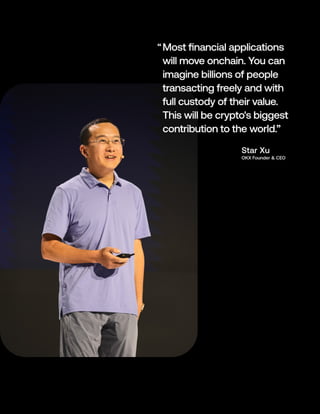
![2
The report has two key objectives:
Blockchain and its many applications are
changing the world.
Although the last 10 years have been
speculative, the next 10 will be defined
by blockchain applications redefining
major global industries — including
financial services, technology, consumer
and luxury goods, and sports and
entertainment.
In particular, the ongoing development
of defined blockchain use cases —
cryptocurrencies; real-world asset
tokenization; decentralized apps
(dApps); practical self-custody; wallets
and payments — will act as a key
disruptor across vital business sectors.
Moreover, blockchain’s emergence
into a phase of utility, adoption and
ubiquity has profound implications. The
World Economic Forum predicts that
10% of global GDP could be tokenized
and stored on the blockchain by 2027,
with the technology set to become
increasingly embedded in daily life [1].
The following pages explore this
dynamic with a view to mapping out how
the blockchain economy will shape the
next two and a half decades.
First, the findings provide an
overview of the current state of
blockchain’s application in the
following global industries:
→ Financial services
→ Technology
→ Consumer and luxury
goods
→ Sports and
entertainment
1
Second, the text lays out
research-driven predictions
and insights about how
blockchain can transform
existing models in these
sectors, how the technology
can give rise to new forms
of economic activity — and
where the blockchain and its
key applications are headed in
the next 25 years.
2
Introduction](https://image.slidesharecdn.com/blockworksresearchreport-250622151427-a8027262/85/Blockworks_Research-AI-crypto-converge-5-320.jpg)
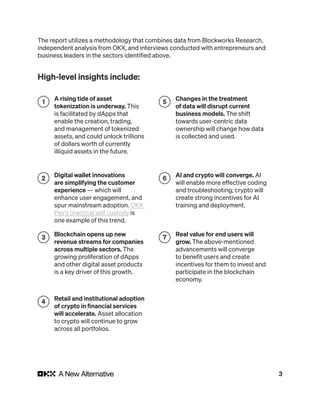
![4
In the past decade, the blockchain
sector scaled from comprising a handful
of cryptocurrencies to constituting
a $2.6 trillion ecosystem. The report
explores how the systems supporting
that ecosystem are now well-established
and stable enough to enable developers
to build investable, real-world
applications beyond speculation around
novel tokens. The evidence collected by
Blockworks Research and OKX points
to an emphatic conclusion: growth will
continue, and it carries the potential to
reshape the global economy.
Rich Widmann, Google’s head of Web3
strategy, put it best: “Blockchain is a
pressure chamber of innovation.” [2]
Understanding how this evolution
will play out — and how blockchain
technology is likely to advance and
adapt along the way — is critical for
anyone involved in building or investing
in the future.
Innovators, business leaders and global brands consulted
or interviewed during the course of the research include the
following:
The research collected makes it clear that the blockchain ecosystem is moving
inexorably towards practical, scalable applications across all of the surveyed industries,
creating a virtuous alignment of interests and value among developers, businesses and
end-users.](https://image.slidesharecdn.com/blockworksresearchreport-250622151427-a8027262/85/Blockworks_Research-AI-crypto-converge-7-320.jpg)
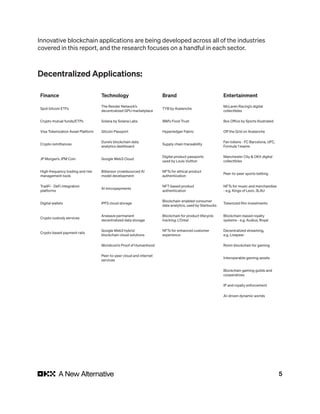

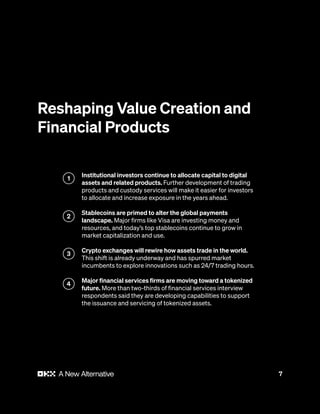
![8
Investing and Asset Management
Current State
A pronounced shift toward passive investing is underway as
investors become more comfortable with alternatives.
A core aspect of blockchain technology in financial services is its ability to transfer value
securely and efficiently between parties immutably without the need for intermediaries.
The decentralized nature of blockchain ensures that transactions are verified by a
network of nodes, reducing the risk of fraud or manipulation.
Elwood Asset Management said:
“Institutional adoption of blockchain-based financial services is
expected to grow steadily as regulatory clarity improves, making
institutions more confident in adopting digital asset solutions.
Blockchain offers operational efficiencies, such as faster settlement
times and reduced costs for digital assets, which could attract
institutions seeking to streamline processes. As blockchain
infrastructure becomes more scalable and customizable, institutions
will be incentivized to adopt it for broader use cases like trade
settlement and portfolio management. Tokenization of traditional
assets will enable institutions to access liquidity and fractionalize
investments.” [3]
In recent years, new digital technologies have emerged that have enabled faster and
more seamless trading and interactions across the financial services ecosystem. This
innovation, together with the increased use of blockchain and blockchain wallets in
trading and financial services, has moved forward the merger of traditional finance with
emergent technology.](https://image.slidesharecdn.com/blockworksresearchreport-250622151427-a8027262/85/Blockworks_Research-AI-crypto-converge-11-320.jpg)
![9
According to Ernst & Young’s 2024 institutional investor
research report:
→ 43% of respondents have invested in digital asset mutual funds/ETPs
→ 37% of respondents are actively holding spot cryptocurrencies
→ 59% of asset managers plan to launch a crypto fund in the next two years
Ernst & Young Asset Manager Survey, May 2024 [4]
A key event that illustrates acceptance of digital assets in traditional finance was the
US Securities and Exchange Commission’s approval of spot bitcoin ETFs in early 2024.
The participation of industry giants such as BlackRock, Fidelity, Invesco and State Street
brought with it critical institutional credibility.
As Ophelia Snyder, co-founder and president of 21Shares – one of the world’s largest
crypto ETP issuers – stated:
“We’re seeing enhanced institutional adoption of crypto worldwide.
This isn’t solely a retail product, and institutional investors are
starting to understand the role crypto products can play in a broader
portfolio. In the US market, institutional investors are buying bitcoin
ETFs. Adoption is amongst the quickest we’ve seen for any new ETF
category.” [5]
The majority of interview participants concurred with the view that institutional adoption
of crypto and digital assets is steadily increasing. This view is also evidenced by the
growth in total market capitalization of bitcoin ETFs to $116.51 billion across 21 products
since the inception in 2021 [6].
Snyder also highlighted the Michigan state pension fund’s interest in bitcoin ETF
products as a signal of expanding awareness and demand for such products: “This is a
fantastic sign of how many of these pension plans are currently thinking about the asset
class or will be in the near future.”
Investing and Asset Management
Current State](https://image.slidesharecdn.com/blockworksresearchreport-250622151427-a8027262/85/Blockworks_Research-AI-crypto-converge-12-320.jpg)
![10
The research shows that today’s
successes will fuel a wave of innovative
new products, further focusing investor
attention on digital assets.
Many respondents said they are already
working on or exploring how to establish
infrastructure and services to support
the issuance of tokenized products —
indicating that today’s slate of BTC and
ETH exchange-traded funds is only the
beginning.
Morgan Krupetsky, senior director of BD
at Ava Labs, said that “tokenization will
do for assets what ETFs did for mutual
funds.”
Digital tokens represent a significant
improvement over ETFs — digital
assets trade 365 days a year, 24 hours
a day, and are programmable via smart
contracts, allowing for automatic rules-
based rebalancing and even lower costs
for the investor [7].
Interviewees also said that digital assets
will create new revenue streams, and
therefore present financial incentives for
continued work in this area.
Anchorage, for example, said that it expects digital assets to be a
common component of both institutional and retail portfolios.
“Just as the ETF boom democratized access to a wide range of
investment strategies, I believe blockchain-based assets will
open up new opportunities for market participants of all types,” a
spokesperson said [8].
As advancements in blockchain technology continue to revolutionize financial services,
many expect to see a future state where more efficient, transparent, and accessible
systems emerge for investing and asset management. In the future, crypto and
decentralized finance (DeFi) platforms will increasingly disrupt and alter traditional
financial models, and digital assets will become a core component of mainstream
financial products.
Investing and Asset Management
Future State](https://image.slidesharecdn.com/blockworksresearchreport-250622151427-a8027262/85/Blockworks_Research-AI-crypto-converge-13-320.jpg)
![11
Despite its global relevance, the
payments industry is plagued with
inefficiencies due to its reliance on
legacy rails. An outgoing international
wire transfer can cost up to $75, while
some banks charge a fee for accepting
an incoming international transfer
[11]. Credit card processing fees hover
between 1.5% and 3.5%, with merchants
forced to wait up to three days for the
processing company to deposit funds
into their bank account [12].
In contrast, crypto uses internet-native
rails, with networks such as Solana
consistently registering median fees
below a cent of a dollar and near-instant
settlement times. The integration
of crypto with existing payment
solutions, combined with increasing
regulatory clarity, can alleviate existing
inefficiencies and reduce costs for
merchants and consumers.
Stablecoins have a major part to play
in this transformation. These assets
are already well-established in certain
markets because of the cost and speed
advantages they bring over conventional
systems — two features that make
them well-suited to facilitate remittance
payments.
As a result, crypto-native firms are
leveraging blockchain technology and
the stability of fiat-pegged stablecoins
to enable instant, low-cost global
payments. OKX for example, recently
launched its OKX Pay solution, which
utilizes stablecoins such as USDT and
USDC to facilitate near-instant transfers,
bypassing legacy banking bottlenecks
and improving cash flow and price
stability for users.
One of the most significant advantages
of crypto payments is cost. In Q1 2024,
the global average cost of sending $200
was 6.35%, per data from The World
Bank [13]. Many crypto services process
transfers for as low as .05%, and some,
such as OKX Pay, have zero transfer
fees. This makes the service particularly
valuable for cross-border payments
and merchant settlements, where
conventional payment processors levy
substantial fees.
The payments industry is a key part of the global economy. According to McKinsey,
its revenue pool amounted to $2.4 trillion in 2023, and is expected to top $3 trillion
by 2026 [9]. Meanwhile, global remittances reached nearly $670 billion in 2023,
representing a 3.8% year-over-year increase [10].
Payments and Remittances
Current State](https://image.slidesharecdn.com/blockworksresearchreport-250622151427-a8027262/85/Blockworks_Research-AI-crypto-converge-14-320.jpg)
![12
As regulatory frameworks for
stablecoins mature, crypto payment
solutions are poised to bridge the
gap between crypto efficiency and
traditional payment reliability, offering
a compelling alternative to outdated
financial infrastructure.
Stablecoins have also caught the eye of
governments looking to bring greater
efficiency to payments. Nations in Sub-
Saharan Africa and Latin America, for
example, are increasingly adopting
stablecoins to hedge against local
economic instability and for lower- cost
remittances [14]. Brazil in particular has
seen a surge of crypto usage over the
past two to three years, with 90% of the
flow linked to stablecoins as a means of
making global payments [15].
Beyond speed and cost savings, these innovative services provide enhanced
accessibility. Users can send funds globally without maintaining multiple currency
accounts or paying foreign exchange premiums. Self-custody features allow merchants
to receive payments directly to their wallets while maintaining full control of their
assets. In combination with the above, new services, including OKX Pay, offer seamless
integration for e-commerce platforms, enabling businesses to accept crypto payments
without complex technical implementation.
Payments and Remittances
Current State](https://image.slidesharecdn.com/blockworksresearchreport-250622151427-a8027262/85/Blockworks_Research-AI-crypto-converge-15-320.jpg)
![13
Other countries are now taking firm
action towards embedding stablecoins
into their own financial systems. Many
eyes are on the United States and its
progress towards crypto regulation
following the return of President Trump
to the White House.
In January 2025, President Trump
issued an executive order to strengthen
America’s leadership in digital financial
technology. The order included a
policy to develop a dollar-backed
stablecoin with the aim of “promoting
and protecting the sovereignty of the
United States dollar” [16]. Weeks later,
stablecoin bills were introduced in
Tennessee and California, which aim to
formalize the regulatory framework to
protect consumers while encouraging
innovation [17]. In addition, the growing
momentum of the GENIUS Act amongst
lawmakers in the first half of 2025 has
set the stage for stablecoins to become
the first major piece of the crypto puzzle
to be fully regulated in the US.
Endorsements such as this can
accelerate the global acceptance of
stablecoins, while sparking fresh use
cases that bring about lasting positive
disruption. On the players behind the
disruption, Harvard Business Review
puts it simply, “the companies that
control the stablecoin market will wield
substantial influence over the future of
money” [18].
Those leading the stablecoin market are
busy advancing the infrastructure that’s
required if the technology is to become
more deeply infiltrated in mainstream
finance. Interoperability is key to
achieving this. When stablecoins can
move freely across chains, users benefit
from a simpler experience overall —
removing a barrier to adoption.
Payments and Remittances
Current State](https://image.slidesharecdn.com/blockworksresearchreport-250622151427-a8027262/85/Blockworks_Research-AI-crypto-converge-16-320.jpg)
![14
Traditional finance companies can
support here, building blockchain
technology into products and platforms
without compromising on the seamless
and intuitive experience end users have
come to expect.
Global payment giants such as PayPal
and Visa have taken steps toward
integrating cryptocurrency as a form of
payment, further expanding the utility of
digital currencies beyond speculation.
For instance, Visa is supporting Spanish
Banking giant BBVA to launch its own
stablecoin. According to Francisco
Maroto, BBVA’s head of digital assets
and blockchain, the bank is currently
participating in a new Visa programme
designed to help firms develop their own
tokenised assets [19].
However, businesses and regulators must work together before crypto permeates the
payments industry worldwide. Nathan McCauley, CEO and co-founder of Anchorage,
said:
“Realizing these opportunities requires overcoming some
challenges. Technical interoperability is complex as traditional
financial systems often rely on legacy infrastructure not designed
with blockchain in mind. The decentralized nature of blockchain
technology also requires new, crypto-specific solutions for
compliance with AML and KYC controls.” [8]
Payments and Remittances
Current State](https://image.slidesharecdn.com/blockworksresearchreport-250622151427-a8027262/85/Blockworks_Research-AI-crypto-converge-17-320.jpg)
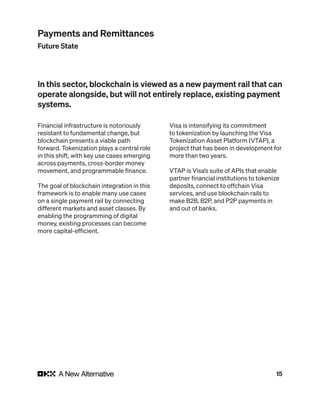
![16
Payments is one area where blockchain’s
integration has the potential to bring
efficiency gains that grow exponentially
as adoption increases in the coming
years. According to Paolo Ardoino,
CEO of stablecoin issuer Tether, USDT
and other stablecoins can improve “by
orders of magnitude your ability to do
business” [20].
This benefit can not only be felt in the
speed with which payments can be sent
and received, according to Ardoino, but
also through the related due diligence
merchants perform.
As Ardoino notes, when stablecoins
like USDT are commonplace among
the global payments infrastructure,
blockchain will allow sellers to validate
that a buyer holds the USDT they claim
to.
This essentially brings the proof-
of-funds process onchain, where
blockchain’s transparency and
immutability can help accelerate the due
diligence process and better protect
merchants.
Payments and Remittances
Future State](https://image.slidesharecdn.com/blockworksresearchreport-250622151427-a8027262/85/Blockworks_Research-AI-crypto-converge-19-320.jpg)
![17
As stablecoins continue to gain market
share in the future, crypto-based
remittances will provide greater access
to global financial systems for the
underbanked or unbanked. In addition to
the chart above, World Bank data shows
that in some countries, remittances
make up as much as 30% of GDP [13],
which further highlights the potential
impact of crypto remittances on
economies.
Rather than displacing legacy systems,
however, interview respondents said
they see a future where blockchain
and digital currencies coexist with and
enhance the infrastructure and products
of traditional finance.
The result will be a hyper-connected
global economy whose growth
is determined by an increasingly
borderless world.
Payments and Remittances
Future State](https://image.slidesharecdn.com/blockworksresearchreport-250622151427-a8027262/85/Blockworks_Research-AI-crypto-converge-20-320.jpg)
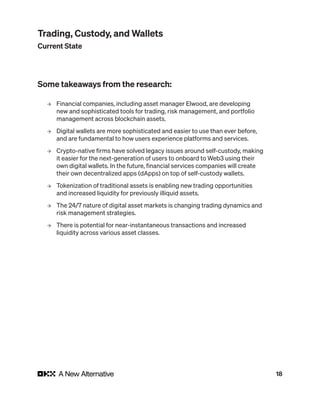
![19
Giovanni Vicioso, Head of Digital
Assets Strategy, CME Group, said in
an interview that blockchain’s most
significant impact on trading will be
a shift towards 24/7, instantaneous
settlement in traditional markets.
Vicioso also stated that use of crypto
rails is increasing, and highlighted
a shift away from speculation, with
digital assets beginning to merge
into a broader categorization, namely
“investible technology.” [21]
Many traditional financial
institutions have also branched into
cryptocurrencies. Goldman Sachs offers
OTC crypto trading, options, and futures
trading for BTC and ETH, while Standard
Chartered offers a trading and custody
platform for institutional participants
through a partnership with OKX.
Meanwhile, Fidelity Digital Assets offers
comprehensive digital asset services,
including custody.
Recent innovation in self-custody
by crypto firms has produced new
solutions that address long-standing
challenges around security, accessibility,
and usability. Traditional self-custody
methods, including hardware wallets
or seed phrase backups, often require
technical knowledge and introduce
risks such as sending to the wrong
address, potential lost keys or exposure
to phishing attacks. Additionally, the
difficulty of transacting directly from
self-custodied wallets limited their
adoption for everyday use.
Current digital asset trading infrastructure is marked by diverse
trading strategies, an increase in high-frequency trading, and
support for a broad range of assets and products.
Trading, Custody, and Wallets
Current State](https://image.slidesharecdn.com/blockworksresearchreport-250622151427-a8027262/85/Blockworks_Research-AI-crypto-converge-22-320.jpg)
![21
Over the next 25 years, crypto trading will advance exponentially
in sophistication, with new tools, products, and protocols being
created in the process.
Digital wallets, for example, are expected to enable whole new use cases as they become
more sophisticated.
Sandy Kaul, SVP and Head of Digital Asset & Investor Advisory Services at Franklin
Templeton, said there is potential for blockchain technologies to replace session-based
regional trading with 24/7 global trading, and book-order with atomic settlement. The
technology could also see bi-lateral transaction records moved to shared ledgers,
alongside ending today’s complicated account-based approach by moving all holdings
to a cryptographically protected wallet.
Kaul stated:
“Over the next 10 years we anticipate a shift in expectations that
would reposition an investor’s portfolio to the center of their lives
and enable them to earn rewards and receive incentives from their
holdings, much like credit cards provide today. The investment
portfolio will cover short-term liquidity needs, optimize forms of
payment, facilitate experiences, allow the investor to better leverage
their own assets and cover long-term savings and retirement goals.
This will allow the asset management industry to deliver on a vision
of better living through investing.” [22]
Trading tools have come a long way in the past decade thanks to the evolution of
onchain data analysis, social media sentiment monitoring, and alternative data.
However, the industry is still marked by fragmented liquidity across multiple exchanges,
creating the need for advanced risk management tools, the majority of which are
developed in-house.
Trading, Custody, and Wallets
Future State](https://image.slidesharecdn.com/blockworksresearchreport-250622151427-a8027262/85/Blockworks_Research-AI-crypto-converge-24-320.jpg)
![22
As regulatory clarity improves, an
increasing proportion of volume will
be driven by institutional investors — a
trend that will in turn drive the need for
more sophisticated offerings, such as
structured products and derivatives.
In the coming decades, crypto banking
services will be fully integrated into
traditional banking systems. Many major
banks could offer comprehensive digital
asset services ranging from crypto-
enabled debit, credit, and financing, to
a diverse array of more sophisticated
products.
Simultaneously, the distinction between
“crypto banks” or “neo banks” versus
traditional banks will largely disappear.
This is certainly anticipated in guidance
from the US Department of the
Treasury’s Office of the Comptroller
of Currency (OCC), which allows
national banks and federal savings
associations to use public blockchains
and stablecoins for payments [23].
Many traditional banks now also offer
crypto custody, trading, and investment
services, while crypto banks and
neobanks similarly offer traditional
banking products such as checking
accounts, debit cards, and loans.
Trading, Custody, and Wallets
Future State](https://image.slidesharecdn.com/blockworksresearchreport-250622151427-a8027262/85/Blockworks_Research-AI-crypto-converge-25-320.jpg)
![23
Financial institutions are commonly
leveraging blockchain for transaction
settlement, product operations, and
streamlining processes — resulting in
significant cost savings.
There is also a growing race to
offer full-service banking for digital
asset customers. Custody lies at the
foundation of this development. By
providing the critical infrastructure
for secure storage and protection of
digital assets, banks can build trust with
customers. This, in turn, allows banks to
offer additional financial services on top,
such as trading, lending and borrowing,
staking, and payments [8].
Stablecoins, too, are growing in
sophistication and capitalization. The
market has reached a collective value
of $180 billion, with USDT and USDC
dominating the landscape [24]. Issuers
are emphasizing regulatory compliance
and diversifying their backing assets.
As mentioned previously, bitcoin
ETFs and other products are gaining
momentum. Recent approvals indicate
growing regulatory acceptance,
although progress remains slow.
The value proposition to banks is
clear. The total market capitalization of
commodity-backed tokens is greater
than $1.1 billion currently [25] and is
conservatively expected to exceed $10
trillion by 2030, according to Roland
Berger [26]. Such growth reflects the
extent to which a more diverse range
of asset types is capturing investor
mindshare.
Financial institutions plan to tokenize
ownership of hard and soft assets and to
create their own tokens, as in the case of
JP Morgan’s JPM Coin, used for instant
payments.
A remarkable degree of product innovation is taking place in
financial services, and much of it is driven by digital assets and
blockchain.
Emerging Financial Products
Current State](https://image.slidesharecdn.com/blockworksresearchreport-250622151427-a8027262/85/Blockworks_Research-AI-crypto-converge-26-320.jpg)
![26
In the years ahead, the role of PoR in crypto audits will evolve significantly. Traditional
third-party audits, though still in use, will likely be augmented by real-time,
cryptographic audits that use PoR methodologies. With the growing sophistication of
blockchain technologies, including the use of ZK proofs and advanced cryptographic
techniques, exchanges will be able to provide continuous proof of their reserves. This
will likely drive a shift from periodic audits to ongoing, transparent solvency checks.
McCauley added:
“The radical transparency of blockchain technology can help solve
traditional compliance challenges, offering new tools for auditing,
tracking, and verifying transactions in real-time. Our goal is to help
create a regulatory environment that unlocks the potential of crypto,
while maintaining the safety and soundness of the financial system.
It’s a complex challenge, but one we believe is essential to get right.”
[8]
Proof of Reserves
Future State](https://image.slidesharecdn.com/blockworksresearchreport-250622151427-a8027262/85/Blockworks_Research-AI-crypto-converge-29-320.jpg)
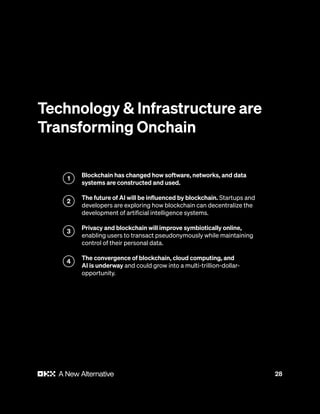
![29
With open-source software, developers
can freely analyze the core source code
of a protocol and learn exactly what led
to past successes or failures. To make
informed decisions, though, developers
need access to data around network key
performance indicators (KPIs).
As a result, a new market for indexing
and analytics has emerged. More
orderly, digestible data formats are
proving valuable to companies around
the world.
Fredrik Haga, co-founder and CEO
of crypto analytics platform Dune,
emphasized that blockchain’s openness
allows anyone to download and analyze
data freely. This accessibility accelerates
innovation, as developers can study
successful protocols and learn from
past failures. This transparency creates
an evolutionary dynamic, enabling
developers to iterate more rapidly.
Blockchain-based smart contracts have fundamentally changed
the way software is developed.
“Smart contracts are open source, and you can see exactly how many
users they have and what those users did,” Haga said. “This makes
innovation accelerate much faster because everyone can see what led to
adoption or what failed.” [27]
This is in sharp contrast with how traditional tech companies typically silo and restrict
access to such information.
Software Development, Indexing, and Analytics
Current State](https://image.slidesharecdn.com/blockworksresearchreport-250622151427-a8027262/85/Blockworks_Research-AI-crypto-converge-32-320.jpg)
![30
Challenges remain. As Google Cloud’s
Widmann said:
“Look at the structure of crypto data —
there is a great irony in the openness
and transparency, but opaqueness at the
same time due to the problem with block
explorers.” [2]
However, once this data is structured
builders can use it to provide traders,
investors and other decision-makers
with more information about the market.
Widmann further explained that this
presents a fantastic opportunity for
generative AI. By processing massive
amounts of unstructured blockchain
data, AI can create advanced search
products that not only return raw data
but also provide contextual insights into
transactions and smart contracts.
Sophia Zhao from Alumni Ventures
noted that the convergence of Web3
and AI enhances security, enabling more
robust analytics platforms that can serve
both the crypto-native and traditional
finance sectors [28].
For instance, the US government has
used Chainalysis to assist in various
criminal investigations, helping to trace
millions of dollars in stolen funds. In
another example, the German Federal
Criminal Police Office used Arkham to
trace and seize almost 50,000 BTC from
operators of a piracy website [29, 30].
In sum, blockchain’s inherent
transparency and decentralization is
beginning to solve many of the flaws of
opaque and centralized legacy systems.
Software Development, Indexing, and Analytics
Current State](https://image.slidesharecdn.com/blockworksresearchreport-250622151427-a8027262/85/Blockworks_Research-AI-crypto-converge-33-320.jpg)
![31
Improving the developer experience is critical as more talent
enters the space. A major stumbling block, according to the
research, is a lack of familiarity with crypto-native coding
languages.
Google Cloud’s Widmann said he believes that generative AI, combined with advanced
blockchain indexing and analytics products, will help developers overcome these
hurdles.
He said:
“You have this brilliant idea, but how do you transform it into code?
A developer could use AI-powered search to find what blockchains
have the most liquidity, give you the smart contracts with the highest
TVLs, and then go to the code portal and build the tooling because
you don’t know that blockchain’s coding language.” [2]
This approach could significantly reduce
the time to launch new blockchain
applications, in turn bridging the gap
between innovation and consumer
usage.
Widmann envisions creating a product
that enables users to search for specific
events on the blockchain and also get
context on what happened with the help
of generative AI.
For example, a user could theoretically
input a hash of a specific transaction,
and the search product could return
structured data around what tokens
were transferred and explain the
transaction in natural language.
Ultimately, the convergence of
blockchain and AI will accelerate the
former’s utility and evolution, paving the
way for mass adoption.
Software Development, Indexing, and Analytics
Future State](https://image.slidesharecdn.com/blockworksresearchreport-250622151427-a8027262/85/Blockworks_Research-AI-crypto-converge-34-320.jpg)
![32
The convergence of blockchain and AI
is just getting started and is still broadly
underappreciated.
Today, the production of AI models
is highly resource-intensive, both in
monetary terms and computationally,
but blockchain networks and
decentralization could change this.
Jules Urbach, founder of the Render
Network, explained that blockchain
helps coordinate computational
resources for AI training and inference,
“Networks like Render are using
blockchain to build decentralized
AI infrastructure, leveraging the
combination of peer-to-peer networks
and token incentives to coordinate
computation more efficiently.” [31]
The Render Network, for example,
is a decentralized blockchain-based
GPU marketplace that allows users to
contribute their idle GPU computing
power in exchange for payment. To
date, Render’s computer network has
rendered over 38.1 million frames,
supplying artists with affordable
compute resources for 3D effects.
In addition to computing for AI training,
the decentralization of machine learning
model development is also underway.
Bittensor, a blockchain protocol
designed to incentivize decentralized
machine learning model development,
enables anyone to contribute to open-
source machine learning models.
To date, the protocol has yielded 36
models, called subnets, providing
unbiased alternatives to frontier models
which are owned and operated by
centralized entities.
Traditional tech companies are taking
more decentralized approaches to AI
model development as well.
Google Cloud’s Widmann added that
Google is creating an open ecosystem
for users in a hub and spoke model: “We
have an open garden to AI that allows
people to get access to any model,
not just Gemini. Portal will be the first
version of an open ecosystem where
they can come to Google to get the best
of any innovation anywhere.” [2]
Not all consumers will feel comfortable
accessing decentralized model services
directly. A hub and spoke model, like the
one Google is employing, could bring
decentralized models directly to users
through familiar rails.
Ultimately, the convergence of
developers, data and infrastructure
providers, and investors is making it
possible to bring decentralized AI to the
masses.
AI Model Development
Current State](https://image.slidesharecdn.com/blockworksresearchreport-250622151427-a8027262/85/Blockworks_Research-AI-crypto-converge-35-320.jpg)
![33
Looking ahead, Urbach said in an interview:
“It’s foolish to bet on centralization in the field of technology. The
lessons of Linux or Wikipedia show the power of open-source
decentralized development. It will be the same for AI. We’re working
with a number of large cap companies in open-source standards
organizations to create the media and infrastructure primitives of the
future.” [31]
Adding to the insight above, Urbach said he believes the future will include
decentralized AI powered by blockchain, with transparently crowdsourced, attributed,
and remunerated data.
“Participants such as data providers, computer infrastructure
providers, and AI developers can get remunerated transparently via
onchain smart contracts for their contributions,” he explained. “We’re
already seeing Data DAOs emerge, where collectives form around
data pools used for training large language models.” [31]
According to Dune co-founder and CEO Fredrik Haga, “AI agents will be a big thing —
crypto offers the perfect rails for agents to conduct economic activity.” [27]
AI Model Development
Future State](https://image.slidesharecdn.com/blockworksresearchreport-250622151427-a8027262/85/Blockworks_Research-AI-crypto-converge-36-320.jpg)
![34
Digital-wallet-enabled agents will
transact onchain and interact with smart
contracts — but crucially, humans will be
able to control and monitor their actions.
This presents a challenge, though.
AI services typically employ monthly
subscription models through proprietary
interfaces — an approach that will
become impractical as the array of
services and agents grows exponentially.
Next-gen blockchains like Solana
can provide the high-throughput
micropayment infrastructure required
for the productization of AI services,
enabling developers to monetize models
on a per-usage basis for the first time.
Urbach indicated that this is “a natural
product market fit for blockchain.”
In turn, crypto micropayments
can help unbundle AI services and
unlock widespread consumer usage.
Overall, the integration of blockchain
with AI promises to democratize AI
development, enhance data privacy and
ownership, and foster new sectors.
Urbach believes that this will facilitate
a macroeconomic restructuring from
industrial-age economies to ones
increasingly built on creative production.
“The digital exchange of virtual goods
and services will, over time, supplant
physical labor and fiat exchange,”
Urbach noted.
Widmann echoed this sentiment:
“Looking 20 years ahead, Google envisions a world where
digital intelligence can seamlessly transact in digital forms,
enhancing everyday tasks and interactions without the need for
traditional devices. This reflects a broader ambition to integrate
AI with blockchain for more efficient commerce and agreement
codification.” [2]
AI Model Development
Future State](https://image.slidesharecdn.com/blockworksresearchreport-250622151427-a8027262/85/Blockworks_Research-AI-crypto-converge-37-320.jpg)
![35
The issue of data ownership and privacy
related to technology was highlighted
during Mark Zuckerberg’s 2018 US
Senate hearing, which focused on
concerns about infringements of private
user data.
Blockchain technology offers a solution
to this problem by enabling individuals
to own and control their personal
data. Privacy preserving blockchain
technology will enable users to interact
with decentralized applications and
submit only the information that is
needed for a specific transaction.
As blockchain ecosystems become
more interconnected, ensuring privacy
in cross-chain transactions will be
critical as well.
Polygon Labs is addressing this
challenge by implementing zero-
knowledge proofs in their cross-
chain interoperability solutions,
thereby protecting user identities and
transaction details across multiple
platforms. This advancement is essential
for users who engage with multiple
blockchains but require consistent
privacy assurances.
“A novel ZK proof called a pessimistic
proof will help secure interoperability
across the AggLayer. This will make
blockchain transactions faster, cheaper,
and more secure,” according to Will
Macfie, Director of Growth Marketing at
Polygon Labs [32].
At the same time, the rise of generative
AI has also brought into question
the importance of user identity and
authentication systems.
The proliferation of deep fakes as a
result of generative AI poses a threat to
information integrity and public trust.
Blockchain enables authentication
of any digital information, allowing
users to verify the source of online
content. For example, Worldcoin is
building a privacy-preserving human
identity network so that individuals can
distinguish content created by humans
from that which derives from generative
AI models. To date, Worldcoin has
verified over 6 million users.
Ethical concerns arise from such
projects’ reliance on biometric data
due to fears of potential misuse by
surveillance states.
Another example of a crypto project
developing identity solutions that don’t
rely on biometrics is Gitcoin Passport,
which allows individuals to create
onchain credentials by collecting
“stamps” from different authenticators.
Privacy and Identity
Current State](https://image.slidesharecdn.com/blockworksresearchreport-250622151427-a8027262/85/Blockworks_Research-AI-crypto-converge-38-320.jpg)
![37
Today, many projects rely on blockchain
technology to create decentralized
alternatives to centralized cloud
services, making the web faster, safer,
and more transparent. Developers are
increasingly dedicating time to building
decentralized infrastructure that
leverages blockchain’s capabilities to
transform traditional cloud computing.
For instance, IPFS is a peer-to-peer
distributed file system that allows
users to host and access files in a
decentralized manner. The network
has 230,000 unique weekly active
nodes, and has become a staple for the
Web3 community and cryptocurrency
ecosystems.
Developers are also working on
decentralized data storage protocols
that can protect against data censorship
in an increasingly polarized world. A
notable example is Arweave, which
enables permanent data storage and
has been actively used to preserve
cultural and social documents.
In March 2024, an archival pool was
created leveraging Arweave to preserve
digital artifacts relating to Iran, in light
of the country’s geopolitical instability.
The pool now includes articles from over
60,000 sources [33].
While traditional companies and firms
are beginning to see the benefits of
blockchain technology, there remains
a gap between their perceptions and
those of developers.
Until better abstraction layers are built
to connect end users to decentralized
cloud services, the fragmentation
between developers, investors,
companies, and consumers will slow
adoption.
Cloud Solutions
Current State](https://image.slidesharecdn.com/blockworksresearchreport-250622151427-a8027262/85/Blockworks_Research-AI-crypto-converge-40-320.jpg)
![38
Looking ahead, developers are
focusing on creating more scalable
and interoperable decentralized cloud
solutions that are easier to integrate into
existing systems.
Google Cloud’s Widmann said that he
believes blockchain represents a bring-
your-own-market technology — in other
words, it enables anyone to create a
peer-to-peer marketplace around a
variety of cloud services, from computer
to storage, models, and more. [2]
Google was one of the first cloud
providers to develop a connector
between Google Cloud Storage (GCS)
and Filecoin, enabling users to utilize
GCS as a decentralized container
through the familiar interface of Google
Cloud.
Because the decentralized cloud market
is in its early stages, the gap between
centralized and decentralized systems
can be bridged in ways that address
questions around visibility, privacy, and
security.
As Widmann summarized, “The future of
cloud computing is likely a combination
of centralized and decentralized
solutions, with centralized providers
being among the biggest contributors to
leading decentralized networks.”
This architecture will maximize the
size of the cloud market while giving
users the optionality to choose the
infrastructure that works best for them.
Cloud Solutions
Future State](https://image.slidesharecdn.com/blockworksresearchreport-250622151427-a8027262/85/Blockworks_Research-AI-crypto-converge-41-320.jpg)

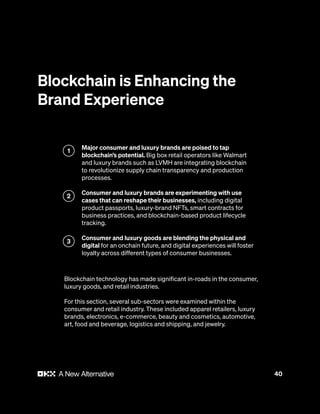
![41
Of the companies analyzed in the
consumer goods, retail, and luxury
industries that have blockchain
initiatives in progress, a quarter had
implemented or explored integrating
blockchain to revolutionize supply chain
transparency and production processes.
Other categories that were of interest
in the sector were NFTs, product
authentication and anti-counterfeiting,
and data management.
Consumer goods and retail giants
Walmart, Carrefour, and Unilever are
implementing blockchain to enhance
supply chain traceability, improve food
safety, verify product authenticity, and
substantiate sustainability claims.
This level of adoption demonstrates
growing recognition of the technology’s
utility for real-world use cases. These
companies are trendsetters and their
actions can influence the entire retail
and consumer sector, with downward
ripple effects waterfalling to other global
retailers such as H&M and Zara.
For instance, Walmart’s use of IBM’s
Food Trust blockchain allows for the
rapid identification of contaminated
products and facilitates efficient recalls.
Built on Hyperledger Fabric, using the
IBM Food Trust platform, its system
allows Walmart to trace the origin of over
25 products from five different suppliers
in just 2.2 seconds. It previously took
seven days to perform such checks [34].
Walmart also requires its vegetable
suppliers to adopt Hyperledger Fabric
to increase internal accountability and
improve food safety and traceability, and
continues to test the use of blockchain
in various countries and geographies
crucial to its supply chain.
While large retailers are taking steps
to utilize blockchain to improve
supply chain transparency, mid-
tier and boutique retailers may face
challenges following suit due to high
implementation costs, the complexity
of integrations with existing systems,
and a lack of standardized protocols and
regulatory frameworks to guide such
integrations.
Web3 companies such as Ava Labs
are taking steps to facilitate this
integration: Ava Labs Chief Business
Officer John Nahas and its Senior
Business Development Director Morgan
Krupetsky revealed that the firm is trying
to “provide a way for Web2 companies
in any industry to upgrade tech
infrastructure in an end-to-end way [7].
Retail Goods and Services
Current State](https://image.slidesharecdn.com/blockworksresearchreport-250622151427-a8027262/85/Blockworks_Research-AI-crypto-converge-44-320.jpg)
![42
The Head of Metaverse at one of the
world’s largest consumer brands said
that the organizing principle of the
internet is shifting toward “experience”
— the essence of the metaverse.
A shift from “mass culture” to “micro-
cultures”, wherein product value is
increasingly defined by consumer
alignment, is underway, our interviewee
asserted [35].
In this context, NFTs will become
important for assigning unique identities
to objects and experiences.
Experimentation also creates brand
differentiation. In today’s fast-moving
media world, brands need more positive
content and unique propositions to
stand out. By embracing NFTs, and the
metaverse as a whole, they can create
new ways of generating media and
consumer attention.
Ultimately, brands that can successfully
leverage blockchain capabilities
stand to gain significant competitive
advantage through stronger customer
relationships, enhanced brand value,
and by setting new standards for ethical
and sustainable practices in their
respective industries.
The work being done today by
Starbucks, Walmart and others is only
the beginning [36].
In the years ahead, many products will
be equal parts digital and physical. Put
simply, any product can be paired with
a piece of unique data on a blockchain
that will allow it to be authenticated and
tracked throughout the entire consumer
lifecycle.
The convergence of various
technologies is expected to create more
personalized experiences, allowing
individuals to become the center of their
own digital universes.
Marc Baumann, the founder and
CEO of FiftyOne Ventures, echoed
this point: “With [blockchain] data,
brands can leverage machine
learning and smart contracts to offer
highly personalized, automated
experiences, giving consumers
greater control and ownership over
the products they engage with” he
said [37].
Blockchain will allow brands to learn
more from data than they can currently.
For example, if a customer uses a
blockchain wallet to buy an item, the
open nature of blockchain networks
will allow more meaningful data to be
gleaned, securely, from each transaction
using advanced analytics tools.
Retail Goods and Services
Future State](https://image.slidesharecdn.com/blockworksresearchreport-250622151427-a8027262/85/Blockworks_Research-AI-crypto-converge-45-320.jpg)
![43
The luxury goods industry is
experiencing strong growth. Global
sales exceeded $1.24 trillion in 2023, and
are projected to grow 4.04% annually
over the next four years, according to
Statista [38].
Alongside this growth will come new
customer segments emerging with
evolving demands. Specifically, there will
be an ever greater focus on millennial
and Gen Z consumers — who have
accounted for 30% of luxury sales but
85% of growth over the last 10 years,
according to Bain & Company — and a
greater focus on experiences [39].
To address these changing market
dynamics, luxury brands are turning to
blockchain technology as a means of
enhancing authenticity, transparency,
and customer engagement.
Luxury apparel brands are using
blockchain to explore the idea of having
a physical and digital layer interacting
together. For instance, Gucci enabled
holders of its Vault Material NFTs
to redeem the digital collectible for
limited edition wallets and duffle bags
[40]. Other brands like Nike have also
launched digital collectibles that give
access to exclusive apparel, finding
tremendous success. For instance,
the Nike-RTFKT non-fungible token
collections had generated nearly $1.4
billion in trading volume and $170 million
in earnings as of 2023 [41].
In the luxury goods and jewelry sectors,
firms have embraced blockchain
technology to combat counterfeiting
and verify ethical sourcing. LVMH,
Cartier, and De Beers are at the forefront,
having created digital certificates
and NFTs to authenticate products,
track ownership history, and verify the
sourcing of materials such as diamonds
and precious metals.
In the beauty industry, while specific
implementations are less publicized,
companies like L’Oréal and Estée Lauder
are exploring blockchain for ingredient
traceability and substantiation of eco-
friendly practices.
Luxury companies are also utilizing
blockchain for proof of ownership and
verification of product authenticity.
According to Lou McEwen, McLaren
Racing’s Chief Marketing Officer, “we
could see blockchain being applied in
areas like merchandise authentication,
further enhancing trust and
transparency.” [42]
For instance, Swiss luxury watchmaker
Breitling issues an NFT with each
watch. This blockchain-backed proof of
ownership enables customers to access
premium services and the watch’s
product information, such as warranty
status and full history [43].
Luxury Goods
Current State](https://image.slidesharecdn.com/blockworksresearchreport-250622151427-a8027262/85/Blockworks_Research-AI-crypto-converge-46-320.jpg)
![44
Product authentication may be a core
growth area for blockchain application
in the consumer goods space. Last year,
US customs agents seized roughly $2
billion in counterfeit goods, signaling
that fake products continue to flood the
market [44].
Consumers who opt to purchase luxury
goods likely do so because they want
the best of the best. A unique piece
of blockchain data will help to verify
the authenticity of their goods. In
addition to delivering a better consumer
experience, this will help the product
retain its value.
The Head of Metaverse offered sneakers
as an example, highlighting how buyers
of luxury sneakers will in future receive
an NFT as well — a piece of data that
both supports authenticity and gives the
owner something special alongside the
product.
The luxury goods sector will benefit from blockchain in many
of the same ways listed for more general consumer focused
retailers.
Luxury Goods
Future State](https://image.slidesharecdn.com/blockworksresearchreport-250622151427-a8027262/85/Blockworks_Research-AI-crypto-converge-47-320.jpg)
![45
The utility of blockchain-based technologies extends beyond
production and the supply chain to the ways users consume data
and experiences, and develop brand loyalty along the way.
Greg Swimer, Chief Technology Officer at City Football Group, underscored the role
blockchain technology can play in brand loyalty, especially via digital collectibles or
NFTs:
“Manchester City have released digital art and free-to-claim
collectibles with our partner OKX celebrating on-pitch success,
giving fans a unique way to commemorate key moments in the
club’s history. These digital assets not only deepen the emotional
connection with the team but also engage new and existing fans
in a modern, accessible way, driving loyalty and enhancing the fan
experience by offering something exclusive and memorable to own.”
[45]
FiftyOne Ventures’ Baumann also sees the potential for blockchain technology
enhancing brand loyalty, but warned:
“Many consumer brands were jumping on the NFT hype for the
wrong reasons, believing that blockchain-based loyalty activation
would solve engagement. Over 50% of Interband’s Top 100 Global
Brands launched loyalty-driven NFT activations. At 51 Insights we’ve
looked at all of them. Most failed to create sustained engagement
and ROI and stopped their programs.” [37]
The prevailing lesson is clear: to successfully enhance consumer loyalty, brands could
likely benefit from using blockchain technologies as a means to an end to enhance
existing programs, rather than viewing them as the end-all-be-all solution.
Consumer Loyalty
Current State](https://image.slidesharecdn.com/blockworksresearchreport-250622151427-a8027262/85/Blockworks_Research-AI-crypto-converge-48-320.jpg)


![50
OKX also partnered with McLaren Racing to create digital collectibles using blockchain
technology. McLaren views digital assets as a new and unique way to boost fan
engagement, especially among younger audiences.
Lou McEwen, McLaren Racing’s Chief Marketing Officer said of the partnership:
“At McLaren Racing, we see blockchain and digital assets as an
important way of enhancing our fan engagement. Our aim is to
deepen the connection between our fans and the team by providing
innovative and exciting opportunities. Digital assets offer new
avenues for us to engage a younger generation of fans, allowing
them to collect unique items, interact with the team, and express
their fandom in new ways.” [42]
The Race Rewind Digital Collectibles is a collaborative initiative between OKX and
McLaren Racing that enabled fans to collect, own, and interact with unique NFTs
centered around McLaren’s Formula 1 season.
McEwen continued:
“Following races, fans can claim a free ‘mystery box’ digital collectible
minted on OKX’s XLayer chain. After the race, these mystery boxes
update with images, quotes, and statistics, along with sounds from
the McLaren F1 Team environment. Depending on the rarity of the
collectible unlocked, fans can redeem prizes such as tours of the
McLaren Technology Centre and Q&As with our drivers.” [42]
NFTs are making their way into other sectors, as well. SI Tickets, a fan-first ticketing site
from Sports Illustrated, is creating a complete NFT ticketing platform called Box Office
that aims to revolutionize the ticketing industry. This platform reduces fees for fans,
while also guaranteeing security, authenticity, and rewards for usage.
The technology can be applied to more sectors than just sports, however. In fact, it has
widespread applications across the music industry and other event-based businesses.
Sport and Fan Experiences
Current State](https://image.slidesharecdn.com/blockworksresearchreport-250622151427-a8027262/85/Blockworks_Research-AI-crypto-converge-53-320.jpg)
![51
As sports digital collectibles continue to increase in popularity, McEwen expects the
space to expand to new franchises and verticals:
“At McLaren Racing, we anticipate that Web3 will continue to
introduce new interaction methods between teams and fans across
the sports landscape, not just in Formula 1. As sports entities
discover innovative ways to utilize blockchain for fan engagement,
we will need to continuously push boundaries and innovate
to maintain our competitive edge in this space and ensure an
exceptional experience for our fans.” [42]
One key area of expansion will be Metaverse engagement, which Manchester City FC is
already exploring with OKX. The integration of blockchain technology into the metaverse
can create immersive experiences that bring fans closer to their favorite teams and
athletes.
As digital collectibles become increasingly ingrained in our culture, new issues around
authenticity arise, however.
Sport and Fan Experiences
Future State](https://image.slidesharecdn.com/blockworksresearchreport-250622151427-a8027262/85/Blockworks_Research-AI-crypto-converge-54-320.jpg)
![52
McEwen said of blockchain transparency:
“Sports memorabilia is one area where transaction chains can
exist, with items traded many times over and across years or even
decades. Therefore, the use of blockchain could allow fans to be
more certain that the items they were purchasing in any authorized
secondary market were genuine. Blockchain would also offer better
opportunities for teams and athletes to provide proof and certainty
of origin, and drive down fraud.” [42]
One use case that has yet to take off is
decentralized sports gambling.
The broader sports gambling industry
has seen significant growth in recent
years, with companies like FanDuel
and DraftKings reaping the benefits
of the sector’s legalization. Like most
traditional sportsbooks, these sites
generate commission through a built-in
margin from the odds offered.
A decentralized protocol could utilize
token incentives to bootstrap a peer-
to-peer sports betting marketplace, in
turn creating a product that removes the
rent-seeking intermediary of traditional
sportsbooks, thereby creating a more
efficient market for participants.
Sport and Fan Experiences
Future State](https://image.slidesharecdn.com/blockworksresearchreport-250622151427-a8027262/85/Blockworks_Research-AI-crypto-converge-55-320.jpg)
![53
Creators in the entertainment industry
have historically faced challenges
monetizing their work and capturing the
full value of their creative output. Third-
party intermediaries often siphon big
portions of revenue, leaving artists with
a smaller share of the profits generated
from their IP.
The intersection of blockchain
technology and the music industry
— although very much in its infancy —
shows promise and may be able to solve
these issues.
Artists are using blockchain to offer
unique digital collectibles, limited
edition releases, or even fractional
ownership of their catalogs in the form
of NFTs. Some examples are Kings of
Leon, Grimes, and 3LAU, who have all
generated significant revenue through
selling NFTs representing limited edition
albums, exclusive artwork, virtual
concert tickets, fan experiences, or
merchandise.
The technology is now also beginning
to be used in the film and TV industries.
Warner Bros. Discovery is piloting
projects from various IPs, creating
personalized avatars and storybooks
through interactive character studios
that leverage blockchain technology [7].
Blockchain is also being applied to new
forms of capital formation, with the aim
of democratizing IP ownership.
Pressman Films, the production
company behind movies like Wall
Street and American Psycho, recently
launched a blockchain and tokenization-
enabled crowd investment opportunity
for its community. The capital raised
will be allocated towards new projects,
leveraging a mix of existing and new
intellectual property [7].
Film, TV, and Music
Current State](https://image.slidesharecdn.com/blockworksresearchreport-250622151427-a8027262/85/Blockworks_Research-AI-crypto-converge-56-320.jpg)
![54
Blockchain is also enhancing event
experiences. Forward Studio, a
consumer-focused company shaping
the future of entertainment through
emerging technologies, has worked
with major entertainment brands like
Coachella to enhance event experiences
for patrons. In 2024, the Coachella
Canvas Quest was a free-to-play
online quest that rewarded fans for
participating in physical and virtual
Coachella experiences [46].
This kind of technology could become
a crucial part of how artists attract and
reward patrons to their performances
or reward loyal fans who attend their
shows. Blockchain technology is also
being explored to solve royalty tracking
and distribution issues.
Investors are increasingly interested
in projects that leverage blockchain to
transform film, TV, and music. As more
assets are tokenized, the opportunity for
both fans and investors will grow.
Film, TV, and Music
Current State](https://image.slidesharecdn.com/blockworksresearchreport-250622151427-a8027262/85/Blockworks_Research-AI-crypto-converge-57-320.jpg)
![55
The music and film industries have long
grappled with challenges in ensuring
artists receive fair compensation for
their work, including issues largely
stemming from complex royalty
structures and outdated distribution
platforms.
The 2023 Writers Guild of America strike
highlighted these ongoing issues, and
even actors often struggle to obtain
royalty agreements for the films in which
they play critical roles.
Projects such as Audius and Royal are
attempting to create more transparent
and efficient royalty systems, in which an
artist’s work can be tracked throughout
its entire life cycle.
Blockchain will enable such IP to
be licensed “permissionlessly,” with
revenue paid automatically to the
original creator.
By providing a transparent and
immutable ledger, blockchain-enabled
royalty tracking and distribution
platforms can ensure that artists
are fairly compensated, while
simultaneously removing rent-seeking
intermediaries.
Finally, digital film distribution and
streaming requires significant compute
resources. Livepeer is developing a
decentralized video infrastructure
network for live and on-demand
streaming, with the goal of giving
creators autonomy from monopoly
platforms [47].
The democratization of streaming
through a decentralized product like
Livepeer could unlock even more
revenue to be returned to artists by
enabling direct creator-to-consumer
relationships. While developers are
pushing the industry forward, there is
often a disconnect between them and
creatives such as musicians and artists.
Once this hurdle is overcome, creators
might realize the empowering nature
of this technology, and mass adoption
could occur very quickly.
Film, TV, and Music
Future State](https://image.slidesharecdn.com/blockworksresearchreport-250622151427-a8027262/85/Blockworks_Research-AI-crypto-converge-58-320.jpg)
![56
Bailey Tan, Head of Ecosystem at
Ronin, stressed in an interview that the
potential for blockchain to revolutionize
gaming by enabling player-owned
gaming economies is enormous.
“Community plays a large part in a
game’s success, especially at early
stages. In the early days, token rewards
can help bootstrap the game,” she said
[48].
Axie Infinity’s explosive growth in
2021 foreshadowed what’s to come.
Blockchain-based play-to-earn models
are proving they can onboard millions of
users and generate significant economic
activity.
Teams have solved the wallet and
scalability challenges that previously
plagued blockchain game developers.
With hyper-efficient layer twos
and wallets that abstract away gas
payments, technology has enabled
developers to build games that aim to
deliver top-flight experiences to players.
Gaming
Current State](https://image.slidesharecdn.com/blockworksresearchreport-250622151427-a8027262/85/Blockworks_Research-AI-crypto-converge-59-320.jpg)
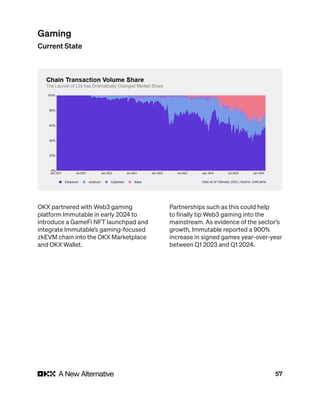
![58
Looking to the future, Tan sees the rise
of gaming cooperatives and guilds that
will have significant influence on game
development.
Large guilds will have the ability to
boost specific games or influence
the governance decisions of open
ecosystems. While future blockchain
games might incorporate sophisticated
economic models that could include
player-driven marketplaces around play-
to-earn activities, gaming guilds might
control various aspects of the in-game
supply chain.
In turn, play-to-earn games might
provide careers for a select group of
specialized individuals who trade their
time for money.
However, as Tan noted: “If you’re
expecting to live off a game, that game
has to be very large. Consumption levels
have to be very high — you could be a
full-time content creator, pro player, or
specialized role that is a core part of the
supply chain of the game.” [48]
Tan also said that standards will be built
that enable interoperability between
blockchain games, adding that new
studios will build out games around
existing IP to attract user bases and
drive adoption.
This means small studios can target
popular in-game asset collections
to build around, or popular IP where
they can expand existing universes.
Interoperability will also enable players
to move assets between games.
Gaming
Future State](https://image.slidesharecdn.com/blockworksresearchreport-250622151427-a8027262/85/Blockworks_Research-AI-crypto-converge-61-320.jpg)
![59
Simultaneously, blockchain could enable
royalty enforcement, such that those
who own the IP are properly rewarded.
As Tan put it: “More creators will
demand their creations are onchain
and have some proof that they were
the one that created it. In turn they own
the IP and they can control and also
assign licenses for others to use for their
creation.” [48]
From the developers’ perspective, there
is a focus on integrating blockchain in
ways that improve gaming experiences
without overwhelming the player with
technical complexities. This is the
unlock that will lead to mass adoption.
Finally, Tan sees deep integration of AI
in gaming: “An AI could run the logic of
the world — natural disasters, NPCs, and
quests — that make the world feel real.”
AI agents could be leveraged to help
gaming feel more dynamic and fresh,
creating a constantly evolving world
that provides players with unique
experiences every time they log in.
To conclude, blockchain technology
holds significant potential to
revolutionize gaming. Realizing this
potential requires bridging the gap
between developers, companies, and
consumers through education, and
innovation which abstracts the technical
blockchain elements of a game away
from the end users.
Gaming
Future State](https://image.slidesharecdn.com/blockworksresearchreport-250622151427-a8027262/85/Blockworks_Research-AI-crypto-converge-62-320.jpg)
![61
2025 & Beyond
Many would agree that it’s not
possible to explore bitcoin’s role in the
transformation of industries through
2025 and beyond without looking at the
asset’s price.
The dynamics of supply and demand
that fuel bitcoin’s volatility are more
complex today than ever before, thanks
to the arrival of Spot BTC ETFs and
increasing institutional investment. As
prices rise, so does interest from players
who’ve not yet significantly gained
exposure to digital assets.
Investment management firm VanEck
predicts bitcoin will be valued at around
$180,000 during 2025 [49], while
Anthony Scaramucci, Founder and
Managing Partner of asset manager
SkyBridge, believes the asset could hit
$200,000 [50].
This rise in value can be partly attributed
to a supply squeeze amplified by two
factors: the 2024 bitcoin halving event,
and inflows to Spot BTC ETFs. Historical
price action shows that the halving,
which occurs approximately every
four years and sees the bitcoin mining
reward cut in half, typically causes a
drop in supply that isn’t immediately felt.
Although historical performance is no
guarantee of future events, a halving-
driven spike could continue during 2025.
What’s different now is the influence
of Spot bitcoin ETFs. By the end of
January 2025, the funds’ total holdings
had passed $125 billion — more than
6.05% of the current BTC supply [51].
The bitcoin held in these funds are
essentially removed from circulation,
further tightening the supply squeeze.
If the next 25 years are to be defined by a major shake-up of global industries driven
by blockchain-based applications, what might 2025 bring towards this end? 2024’s
headline moments give guidance on what might follow. Let’s take a closer look.
Bitcoin’s continued price strength through 2025](https://image.slidesharecdn.com/blockworksresearchreport-250622151427-a8027262/85/Blockworks_Research-AI-crypto-converge-64-320.jpg)
![62
2025 & Beyond
Self-custody-based dApps could come
into sharper focus during 2025 as
more users recognize the importance
of self-custody and refinements are
made to the user experience. Industry
commentators have pointed to the
sometimes complex Web3 onboarding
experience as a hurdle to participation
[52].
Removing this hurdle will be a priority for
many, and a competitive battleground
for those building blockchain dApps.
This will be joint responsibility for Web3-
native entities as well as TradFi firms
moving into the space.
In particular, TradFi players could
move to offer self-managed wallets
and regulated stablecoins. JP Morgan
has already made progress in this area
with its JPM Coin for instant payments.
However, the financial services giant
doesn’t provide crypto custody services.
Could this change as competition
grows?
OKX is working in a similar vein to
transform its self-custody Wallet into a
gateway for all dApps. Just as Google
is the go-to for web access, OKX aims
for its Wallet to be the first destination
for finding and interacting with dApps.
Meanwhile, the exchange’s Web3 arm,
which includes the Wallet, is evolving
to better support retail users with self-
custody. OKX is planning to become a
leader in inscriptions and was the first
to launch support for emerging token
standards Atomicals, Stamps, Runes,
and Doginals.
One other key use case that could
emerge during 2025 is crypto loyalty
schemes. Earlier, this report outlined
how major consumer and luxury
brands are seeking to capitalize on
blockchain’s potential for supply chain
management and production processes.
Loyalty schemes could be a powerful
third opportunity, because blockchain
addresses many of the limitations of
conventional loyalty schemes and their
infrastructure. For example, traditional
loyalty programs are often siloed by
brand, and don’t allow customers to pool
rewards from multiple brands.
The decentralization and interoperability
brought by blockchain can create a
unified, tamper-resistant system that
maximizes the effectiveness of loyalty
schemes. Meanwhile, the immutability
of blockchain technology can help
prevent fraudulent activities, such as
claiming fake points or accessing a
user’s legitimate points by breaching a
centralized system.
The rise of self-custody-based dApps](https://image.slidesharecdn.com/blockworksresearchreport-250622151427-a8027262/85/Blockworks_Research-AI-crypto-converge-65-320.jpg)
![63
2025 & Beyond
If the arrival of spot ETFs in 2024
marked a watershed moment for
TradFi’s move towards cryptocurrencies,
2025 could see a deepening of this
involvement through the utility of
blockchain applications.
The tokenization of real world assets
(RWAs) could follow spot ETFs as a
core offering for TradFi institutions as
they seek to broaden their products
while modernizing outdated structures.
Tokenized securities can allow for 24-
hour access to assets, removing the
geographic limitations that restrict
traders’ actions today. Meanwhile,
tokenization can unlock the greater
mobility of assets, improving liquidity to
aid price discovery.
Fractional ownership is another key
benefit of bringing equities and RWAs
onchain, with the potential to empower
more people towards financial freedom.
With fractional ownership, traders can
own a portion of an asset — from equity
investments to physical real estate
— rather than needing to purchase a
whole unit. Blockchain democratizes the
process of fractional ownership, bringing
its benefits to more people worldwide.
This disruption is already evident with
global asset management group Janus
Henderson planning to follow others in
pursuing tokenization [53].
Tokenization and the arrival of equities onchain](https://image.slidesharecdn.com/blockworksresearchreport-250622151427-a8027262/85/Blockworks_Research-AI-crypto-converge-66-320.jpg)
![64
2025 & Beyond
A new cohort of crypto and blockchain developers
As blockchain technology grows in adoption through 2025, more developers could
follow the opportunity and turn their skills towards dApps. There are reportedly
more than 100 million developers on GitHub today [54], and they’ve made 5.2 billion
contributions to more than 518 million open source, public, and private projects [55].
Past data suggests this number could increase. Between October 2020 and October
2023, the global number of blockchain developers grew by 66%, despite a bear market
beginning during this period [56]. This growth was accompanied by a rapid increase in
token launches, as developer tooling made it easier to build.](https://image.slidesharecdn.com/blockworksresearchreport-250622151427-a8027262/85/Blockworks_Research-AI-crypto-converge-67-320.jpg)
![65
2025 & Beyond
The arrival of new developer talent
in 2025 could have a flywheel effect
where fresh expertise breeds innovation
which attracts more new talent, and
so on. A spike in blockchain developer
numbers is arguably further validation of
crypto’s acceptance as a new alternative
to traditional financial systems, as
developers shift from conventional
industries to a revolutionary space.
What areas might these developers
focus their energies on during 2025
and beyond? Building the intersection
of AI chat agents with blockchain
technology is one possibility. Although
the growing pervasiveness of AI
across industries is well known, its
integration with blockchain technology
can multiply the benefits. Stablecoin
issuer Circle has demonstrated how AI
and blockchain can transform what is
known about conventional payments
[57]. They’ve shown how AI agents can
be programmed to complete tasks and
process payments autonomously, all
underpinned by blockchain’s speed
and security. Companies could own AI
agents that interact with other agents
behind the scenes, providing a passive
income stream paid out in stablecoins.](https://image.slidesharecdn.com/blockworksresearchreport-250622151427-a8027262/85/Blockworks_Research-AI-crypto-converge-68-320.jpg)
![66
2025 & Beyond
Many anticipate the evolution of
brokerage platforms and two-sided
marketplaces in 2025 [58], driven by an
emerging regulatory landscape, new
user demands, and further product
innovation. Part of this evolution could
involve simplifying users’ interaction
with interfaces to lessen the learning
curve. That would require a deeper
investment in UX and UI design to
capture non-crypto-natives who might
be turned away by overly technical
processes.
As outlined above, tokenized real-
world assets could become a more
prominent part of platforms’ offerings.
Demand for this is growing, and
providers are increasingly recognizing
the advantages tokenization can bring
to assets that otherwise face relatively
high costs, geographic limitations, and
slow, manual process. In fact, global
consulting company Boston Consulting
Group predicts the total assets under
management of tokenized real-world
assets could reach $600 billion by 2030
[59].
Evolving brokerage platforms and two-sided marketplaces](https://image.slidesharecdn.com/blockworksresearchreport-250622151427-a8027262/85/Blockworks_Research-AI-crypto-converge-69-320.jpg)
![67
2025 & beyond
Investments in generative AI (GenAI) are
predicted to grow by 60% between 2024
and 2027, according to another Boston
Consulting Group study [60].
The crypto scene was quick to
embrace GenAI, with token creation
emerging as a key use case. Pump.
fun, a democratized Solana memecoin
marketplace, attracted a spike in users
as AI-generated assets took off [61],
fueled by the speed and simplicity
through which new memecoins could
be launched. Users no longer need
deep technical expertise to create and
distribute a coin. As a result, by 2024’s
close, seven tokens were being launched
on Pump.fun every minute, on average
[62].
Beyond memecoins, broader iterations
of GenAI are well placed to disrupt
industries in 2025. In late 2024,
BlackRock announced that its tokenized
BUIDL fund was expanding beyond the
Ethereum network to other blockchains.
The move allows developers to build on
top of the BUIDL fund in their chosen
ecosystem, creating opportunities for
DAOs to be integrated with the fund [63].
Add to this the increasing involvement
of AI agents within DAOs, and the world
could see autonomous organizations
taking a major leap forward to play a
more involved role in financial products
like BUIDL and others.
Generative AI finds new use cases](https://image.slidesharecdn.com/blockworksresearchreport-250622151427-a8027262/85/Blockworks_Research-AI-crypto-converge-70-320.jpg)
![72
Disclaimer
This content is provided for informational purposes only and may cover products that
are not available in your region. It is not intended to provide (i) investment advice or an
investment recommendation; (ii) an offer or solicitation to buy, sell, or hold crypto/digital
assets, or (iii) financial, accounting, legal, or tax advice. Crypto/digital asset holdings,
including stablecoins and NFTs, involve a high degree of risk and can fluctuate greatly.
You should carefully consider whether trading or holding crypto/digital assets is suitable
for you in light of your financial condition. Please consult your legal/tax/investment
professional for questions about your specific circumstances. Information (including
market data and statistical information, if any) appearing in this post is for general
information purposes only. While all reasonable care has been taken in preparing
this data and graphs, no responsibility or liability is accepted for any errors of fact or
omission expressed herein. Both OKX Web3 Wallet and OKX NFT Marketplace are
subject to separate terms of service at www.okx.com.
© 2025 OKX. This article may be reproduced or distributed in its entirety, or excerpts
of 100 words or less of this article may be used, provided such use is non-commercial.
Any reproduction or distribution of the entire article must also prominently state: “This
article is © 2025 OKX and is used with permission.” Permitted excerpts must cite to the
name of the article and include attribution, for example “Article Name, [author name if
applicable], © 2025 OKX.” No derivative works or other uses of this article are permitted.](https://image.slidesharecdn.com/blockworksresearchreport-250622151427-a8027262/85/Blockworks_Research-AI-crypto-converge-75-320.jpg)


