The reflector antennas are most important in microwave radiation
applications. At microwave frequencies the physical size of the high
gain antenna becomes so small that practically any suitable shaped
reflector can produce desired directivity.
In reflector antenna, another antenna is required to excite it. Hence
the antenna such as dipole, horn, slot which excites the reflector
antenna is called primary antenna, while the reflector antenna is
called secondary antenna.
In general, reflector antenna can be represented in any geometrical
configuration, but the most commonly used shapes are
plane reflector, corner reflector and curved or parabolic reflectors.
Using reflectors, the radiation pattern of a radiating antenna can be
modified.
Parabolic Reflector
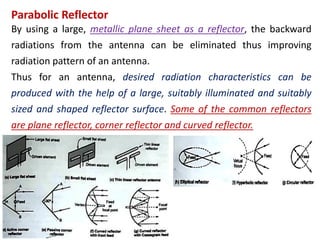
By using a large, metallic plane sheet as a reflector, the backward
radiations from the antenna can be eliminated thus improving
radiation pattern of an antenna.
Thus for an antenna, desired radiation characteristics can be
produced with the help of a large, suitably illuminated and suitably
sized and shaped reflector surface. Some of the common reflectors
are plane reflector, corner reflector and curved reflector.
Parabolic Reflector
To improve the overall radiation characteristics of the reflector
antenna, the parabolic structure is oftenly used.
Basically a parabola is a locus of a point which moves in such
a way that the distance of the point from fixed point called focus plus
the distance from the straight line called directrix is constant as
shown in the Fig.
Parabolic Reflector
By the geometrical optics, when the point source is placed at the
focus or focal point, then the rays reflected by the parabolic reflector
form parallel wave front as shown in the Fig.(b). This principle is used
in the transmitting antenna.
Similarly when the beam of parallel rays is incident on a parabolic
reflector, then the radiations focus at a focal point as shown in the
Fig.(c). This principle is used in the receiving antenna.
Parabolic Reflector
Consider a parabolic reflector as shown in the Fig, 6.8.1 (b), When
the point source is kept at the focus or focal point of the parabola,
the radiations striking the parabolic reflector are reflected parallel to
the axis of parabola irrespective of the angle at which
the radiations strike the reflector.
That means the rays which are reflected by the parabolic reflector
travel same distance to reach near the mouth of the reflector. The
open end of the parabolic reflector is called aperture.
The time taken by the reflected rays to travel a distance upto the
directrix of the parabola is same. That means all the reflected rays
are in phase.
Parabolic Reflector
Thus the wave front at the aperture of the parabolic reflector
is uniform phase front and thus very strong and concentrated beam
is obtained along the axis.
Thus parabolic reflector is the most effective microwave antenna
which produces concentrated radiation beam along the axis of
parabola.
The power gain of the paraboloid is a function of ratio between
diameter of aperture.
Parabolic Reflector
In practical applications, a three dimensional structure of the
parabolic reflector is used. The three dimensional structure of the
parabolic reflector can be obtained by rotating the parabola around
its axis and it is called paraboloid.
The paraboloid is as shown in the Fig.(a). The radiation pattern of the
paraboloid is as shown in the Fig. (b). As the mouth of the paraboloid
is circular in shape, the parallel, beam produced are of the circular
cross-section. The radiation pattern consists very sharp major lobe
and smaller minor lobes.
Paraboloid or Paraboloidal Reflector or Microwave Dish

Parabolic Reflector.pdf

  • 1.
    The reflector antennasare most important in microwave radiation applications. At microwave frequencies the physical size of the high gain antenna becomes so small that practically any suitable shaped reflector can produce desired directivity. In reflector antenna, another antenna is required to excite it. Hence the antenna such as dipole, horn, slot which excites the reflector antenna is called primary antenna, while the reflector antenna is called secondary antenna. In general, reflector antenna can be represented in any geometrical configuration, but the most commonly used shapes are plane reflector, corner reflector and curved or parabolic reflectors. Using reflectors, the radiation pattern of a radiating antenna can be modified. Parabolic Reflector
  • 2.
    By using alarge, metallic plane sheet as a reflector, the backward radiations from the antenna can be eliminated thus improving radiation pattern of an antenna. Thus for an antenna, desired radiation characteristics can be produced with the help of a large, suitably illuminated and suitably sized and shaped reflector surface. Some of the common reflectors are plane reflector, corner reflector and curved reflector. Parabolic Reflector
  • 3.
    To improve theoverall radiation characteristics of the reflector antenna, the parabolic structure is oftenly used. Basically a parabola is a locus of a point which moves in such a way that the distance of the point from fixed point called focus plus the distance from the straight line called directrix is constant as shown in the Fig. Parabolic Reflector
  • 4.
    By the geometricaloptics, when the point source is placed at the focus or focal point, then the rays reflected by the parabolic reflector form parallel wave front as shown in the Fig.(b). This principle is used in the transmitting antenna. Similarly when the beam of parallel rays is incident on a parabolic reflector, then the radiations focus at a focal point as shown in the Fig.(c). This principle is used in the receiving antenna. Parabolic Reflector
  • 5.
    Consider a parabolicreflector as shown in the Fig, 6.8.1 (b), When the point source is kept at the focus or focal point of the parabola, the radiations striking the parabolic reflector are reflected parallel to the axis of parabola irrespective of the angle at which the radiations strike the reflector. That means the rays which are reflected by the parabolic reflector travel same distance to reach near the mouth of the reflector. The open end of the parabolic reflector is called aperture. The time taken by the reflected rays to travel a distance upto the directrix of the parabola is same. That means all the reflected rays are in phase. Parabolic Reflector
  • 6.
    Thus the wavefront at the aperture of the parabolic reflector is uniform phase front and thus very strong and concentrated beam is obtained along the axis. Thus parabolic reflector is the most effective microwave antenna which produces concentrated radiation beam along the axis of parabola. The power gain of the paraboloid is a function of ratio between diameter of aperture. Parabolic Reflector
  • 7.
    In practical applications,a three dimensional structure of the parabolic reflector is used. The three dimensional structure of the parabolic reflector can be obtained by rotating the parabola around its axis and it is called paraboloid. The paraboloid is as shown in the Fig.(a). The radiation pattern of the paraboloid is as shown in the Fig. (b). As the mouth of the paraboloid is circular in shape, the parallel, beam produced are of the circular cross-section. The radiation pattern consists very sharp major lobe and smaller minor lobes. Paraboloid or Paraboloidal Reflector or Microwave Dish