The following paper was originally published in the
Proceedings of the 4th USENIX Conference on Object-Oriented Technologies and Systems (COOTS)
Santa Fe, New Mexico, April 27-30, 1998
For more information about USENIX Association contact:
1. Phone: 510 528-8649
2. FAX: 510 548-5738
3. Email: office@usenix.org
4. WWW URL: http://www.usenix.org/
The Architecture of a Distributed Virtual Worlds System
Manny Vellon, Kirk Marple, Don Mitchell, and Steven Drucker
Microsoft Research
The Architecture of a Distributed Virtual Worlds System
Manny Vellon, Kirk Marple, Don Mitchell, Steven Drucker
Virtual Worlds Group
Microsoft Research
Microsoft Corporation
Abstract
We have developed an object model that facilitates the
development of shared virtual environments. We have
implemented our object model on top of COM and
OLE Automation and facilitated access from Active
Scripting enabled languages. This paper provides a
brief description of the work we have done on the V-
Worlds project.
1. Introduction
Virtual reality is a user-interface paradigm in which the
user feels immersed in a computer-generated space.
Two aspects of this feeling of immersion have been
discussed: simulating the sensory experience of being
in a space, and the non-sensory aspect of presenting the
user with consistent structure and action [Mitchell94].
The sensory aspect has been pursued by research and
development in 3D computer graphics and display
technology [Sutherland65, Sutherland68, Brooks86,
Brooks88]. Some currently popular computer games
have demonstrated immersive 3D graphical interfaces
on personal computers available to the general public
[DOOM93, QUAKE97].
We use the term virtual world for virtual reality sys-
tems that allow multiple users to interact in the same
space. Adding multiple users to VR creates a number
of interesting new problems. Networking with multiple
clients is obviously necessary, and in some cases the
technology of distributed databases may be required to
support a multi-user VR system. The interface now
requires social functionality for talking and gesturing.
The graphical presentation of the space must allow a
group of people to interact socially and see one an-
other’s actions and responses. Security is an issue, es-
pecially if the system allows users to build and program
within the world.
Current work on multi-user VR systems can be divided
into graphical chat systems, characterized by static
spaces and transient user identity and persistent worlds
with dynamic spaces, movable objects and permanent
user identities. Two very different kinds of systems
have pioneered the development of large-scale virtual
worlds: military simulation networks [Thorpe87,
Zyda92], and text-based multi-user worlds known as
MUDs [Reid94]. SIMNET is based on vehicle and
flight simulators that generate real-time 3D images of a
virtual world. A peer-to-peer network protocol allows
these simulators to display other users’ vehicles and
projectiles during virtual battle simulations.
MUDs maintain long-term persistent worlds in a central
object server; these worlds are accessed via clients
similar in appearance to the old text adventure com-
puter games. Having existed for almost twenty years,
MUDs are a rich source of experience about the struc-
tural aspects of virtual worlds. Some MUDs have been
in continuous operation for ten years and have on the
order of 10,000 subscribed users [FurryMUCK, Lamb-
daMOO], so there is also considerable experience about
the sociology of on-line worlds. We’ve drawn more
extensively from the technology of MUDs than from
graphical VR systems and standards, because we are
explicitly interested in supporting the structural and
social mechanisms found in MUDs.
Elizabeth Reid’s thesis gives a well-researched history
and analysis of MUDs [Reid94]. Early multi-user
combat/adventure games appeared in the late 1970s,
and by the mid 1980s, some of them had abandoned
actual game play and enhanced user communication
and self-expression, becoming what are now called
social MUDs. Jim Aspnes’ TinyMUD and the Habitat
system by Farmer and Morningstar [Morningstar91]
were good examples of purely social MUDs. Habitat
was distinguished by a 2D graphical interface, and
TinyMUD was the first system to give users extensive
abilities to build new places and objects in the world.
Stephen White developed the TinyMUCK and the
MOO systems, extensions to TinyMUD that allowed
users to write scripts controlling objects. The MOO
was developed further by researchers at Xerox PARC
[Curtis92]. In the meantime, combat/adventure MUDs
have also evolved, and servers like the LPMUD have
essentially the same technical capabilities as the most
advanced social MUDs.
An object-oriented MUD, like White and Curtis’ MOO,
is a network database server which stores objects hav-
ing properties and methods. The topology of the space
is defined by “room” objects, representing discrete lo-
cations, interconnected by portal objects. Each room
has descriptive text which users read to situate them-
selves in the location. Portals with names like “north”,
“climb”, “trapdoor”, connect one location to another
and may print text to embellish the user’s experience of
movement and/or announce someone’s entrance or exit
to others. MUDs are non-Cartesian, meaning they are
not limited by any geometric constraint on the spatial
arrangement of rooms. For example, a portal named
“sleep” could connect a bedroom to a collection of
dream-world locations.
Objects in a MOO can also represent things located in a
room, and objects called “players” or “avatars” repre-
sent the user’s character in the world. Users in the
same room are able to talk by typing text and reading
the text that others type. Each MUD room is superfi-
cially similar to an Internet chat room or IRC channel,
but the description of structure and actions repeatedly
suggest to the user that they are the avatar, acting in a
virtual space.
Our most fundamental departure from MUDs is the
support of a graphical view of the virtual world. The
medium of text is certainly not inferior to graphics, and
in fact many types of MUD experiences would be diffi-
cult to reproduce visually. However, the textual de-
scriptions of MUDs limit the speed with which a large
amount of interesting information about the world’s
structure can be conveyed. A graphical world is sim-
ply a different user experience, in the same way that a
movie is a different way of seeing a story than reading
a book. We believe it will be a more accessible experi-
ence, and we want to explore the possibilities of this
new medium.
Our basic requirements posed several technical chal-
lenges:
• A distributed architecture needs to be supported.
• Objects need to persist over time.
• End users should be able to easily extend the sys-
tem.
• End users should be able to make changes to the
system while the system in running.
• Finally, since end users are modifying the system,
security is of great concern.
These are explored in further detail in the sections that
follow.
2. Ease of Development
V-Worlds is a platform for developing shared virtual
environments. It is intended that content developers
create specific environments with their own artwork
and programmed behavior. It is our objective that, ul-
timately, V-Worlds allow even end-users to be able to
create interesting content. Some of V-Worlds’ design
is influenced by ideas from text MUDs – especially
from LambdaMOO. LambdaMOO is notable for its
features that allow end-users to create Artifacts, Rooms
and other objects with programmed behavior.
Programming behavior in V-Worlds is accomplished by
defining methods on objects in the environment. These
methods can respond to activity in the environments
(e.g. users talking or moving) and can be exposed
through the user-interface (through context menus).
In order to facilitate the development of new types of
objects, V-Worlds implements object inheritance. A
V-Worlds object has a property that references its ex-
emplar. The object’s exemplar is similar (but not iden-
tical) to the class of a C++ or Smalltalk object. When
V-Worlds accesses a property or a method of an object,
it first looks in the object itself for that property or
method. If it does not find it there, it then looks in the
object’s exemplar. The search continues up the exem-
plar hierarchy until the property or method is found or
the top of the hierarchy is reached (in which case an
error results). This mechanism differs from C++’s in
several ways:
• The search is done by name, at run-time (i.e. late-
bound)
• An object instance can have methods and proper-
ties attached to it (beyond those introduced by its
exemplar)
• An object’s exemplar is, itself, another object in-
stance
• An object’s exemplar can be changed at run-time
• V-Worlds does not support multiple inheritance
Inheritance facilitates development because it allows
content authors to create new objects by specializing
existing ones. Having created a new object, the author
can allow others to further specialize by declaring his
object an exemplar and allowing others to instantiate it
or create additional exemplars that inherit from it.
V-Worlds does not support multiple inheritance,
mostly, to keep the programming model simple. Sup-
porting multiple inheritance requires that users be pre-
pared to handle unintentional name collisions and
classes encountered multiple times through different
base classes (the C++ “virtual base class” problem).
3. Basic Object Model
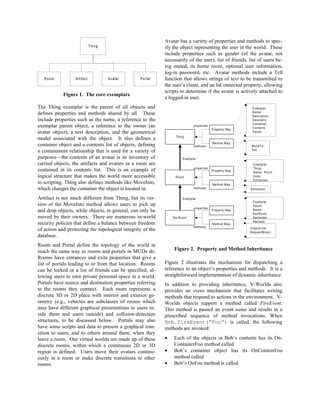
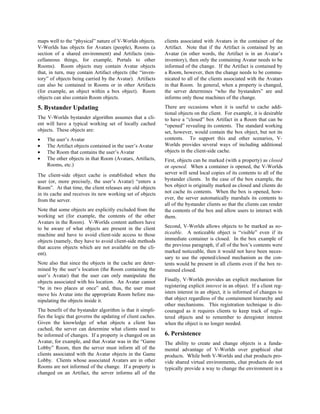
Similar to MOO’s, a few basic objects are provided,
such as “Rooms”, “Avatars”, “Portals”, and “Artifacts”.
These in fact, are all based on the single generic object
“Thing”. Users of the system can add properties and
methods to instances of the objects, or change the in-
heritance chain dynamically.
Thing
Room Artifact Avatar Portal
Figure 1. The core exemplars
The Thing exemplar is the parent of all objects and
defines properties and methods shared by all. These
include properties such as the name, a reference to the
exemplar parent object, a reference to the owner (an
avatar object), a text description, and the geometrical
model associated with the object. It also defines a
container object and a contents list of objects, defining
a containment relationship that is used for a variety of
purposes—the contents of an avatar is its inventory of
carried objects, the artifacts and avatars in a room are
contained in its contents list. This is an example of
logical structure that makes the world more accessible
to scripting. Thing also defines methods like MoveInto,
which changes the container the object is located in.
Artifact is not much different from Thing, but its ver-
sion of the MoveInto method allows users to pick up
and drop objects, while objects, in general, can only be
moved by their owners. There are numerous in-world
security policies that define a balance between freedom
of action and protecting the topological integrity of the
database.
Room and Portal define the topology of the world in
much the same way as rooms and portals in MUDs do.
Rooms have entrances and exits properties that give a
list of portals leading to or from that location. Rooms
can be locked or a list of friends can be specified, al-
lowing users to own private personal space in a world.
Portals have source and destination properties referring
to the rooms they connect. Each room represents a
discrete 3D or 2D place with interior and exterior ge-
ometry (e.g., vehicles are subclasses of rooms which
may have different graphical presentations to users in-
side them and users outside) and collision-detection
structures, to be discussed below. Portals may also
have some scripts and data to present a graphical tran-
sition to users, and to others around them, when they
leave a room. Our virtual worlds are made up of these
discrete rooms, within which a continuous 2D or 3D
region is defined. Users move their avatars continu-
ously in a room or make discrete transitions to other
rooms.
Avatar has a variety of properties and methods to spec-
ify the object representing the user in the world. These
include properties such as gender (of the avatar, not
necessarily of the user), list of friends, list of users be-
ing muted, its home room, optional user information,
log-in password, etc. Avatar methods include a Tell
function that allows strings of text to be transmitted to
the user’s client, and an IsConnected property, allowing
scripts to determine if the avatar is actively attached to
a logged-in user.
Room
Thing
Exemplar
Exemplar
BarRoom
Property Map
Method Map
Property Map
Method Map
Property Map
Method Map
properties
properties
properties
methods
methods
methods
Exemplar:
Name:
Description:
Geometry:
Container:
Contents:
Owner:
Exemplar:
Thing
Name: Room
Exits:
Entrances:
Exemplar:
Room
Name:
BarRoom
Bartender:
Recipes:
MoveTo:
Tell:
Announce:
OrderDrink:
RequestMusic:
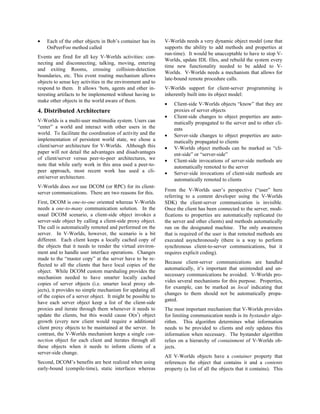
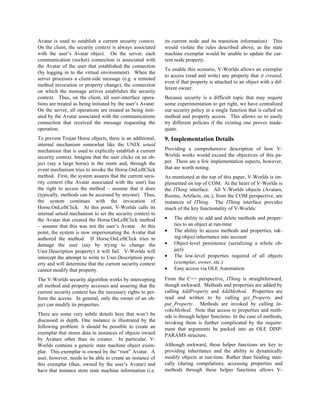
Figure 2. Property and Method Inheritance
Figure 2 illustrates the mechanism for dispatching a
reference to an object’s properties and methods. It is a
straightforward implementation of dynamic inheritance.
In addition to providing inheritance, V-Worlds also
provides an event mechanism that facilitates writing
methods that respond to actions in the environment. V-
Worlds objects support a method called FireEvent.
This method is passed an event name and results in a
prescribed sequence of method invocations. When
Bob.FireEvent(“Foo”) is called, the following
methods are invoked:
• Each of the objects in Bob’s contents has its On-
ContainerFoo method called
• Bob’s container object has its OnContentFoo
method called
• Bob’s OnFoo method is called
• Each of the other objects in Bob’s container has its
OnPeerFoo method called
Events are fired for all key V-Worlds activities: con-
necting and disconnecting, talking, moving, entering
and exiting Rooms, crossing collision-detection
boundaries, etc. This event routing mechanism allows
objects to sense key activities in the environment and to
respond to them. It allows ‘bots, agents and other in-
teresting artifacts to be implemented without having to
make other objects in the world aware of them.
4. Distributed Architecture
V-Worlds is a multi-user multimedia system. Users can
“enter” a world and interact with other users in the
world. To facilitate the coordination of activity and the
implementation of persistent world state, we chose a
client/server architecture for V-Worlds. Although this
paper will not detail the advantages and disadvantages
of client/server versus peer-to-peer architectures, we
note that while early work in this area used a peer-to-
peer approach, most recent work has used a cli-
ent/server architecture.
V-Worlds does not use DCOM (or RPC) for its client-
server communications. There are two reasons for this.
First, DCOM is one-to-one oriented whereas V-Worlds
needs a one-to-many communication solution. In the
usual DCOM scenario, a client-side object invokes a
server-side object by calling a client-side proxy object.
The call is automatically remoted and performed on the
server. In V-Worlds, however, the scenario is a bit
different. Each client keeps a locally cached copy of
the objects that it needs to render the virtual environ-
ment and to handle user interface operations. Changes
made to the “master copy” at the server have to be re-
flected to all the clients that have local copies of the
object. While DCOM custom marshaling provides the
mechanism needed to have smarter locally cached
copies of server objects (i.e. smarter local proxy ob-
jects), it provides no simple mechanism for updating all
of the copies of a server object. It might be possible to
have each server object keep a list of the client-side
proxies and iterate through them whenever it needs to
update the clients, but this would cause O(n
2
) object
growth (every new client would require n additional
client proxy objects to be maintained at the server. In
contrast, the V-Worlds mechanism keeps a single con-
nection object for each client and iterates through all
these objects when it needs to inform clients of a
server-side change.
Second, DCOM’s benefits are best realized when using
early-bound (compile-time), static interfaces whereas
V-Worlds needs a very dynamic object model (one that
supports the ability to add methods and properties at
run-time). It would be unacceptable to have to stop V-
Worlds, update IDL files, and rebuild the system every
time new functionality needed to be added to V-
Worlds. V-Worlds needs a mechanism that allows for
late-bound remote procedure calls.
V-Worlds support for client-server programming is
inherently built into its object model:
• Client-side V-Worlds objects “know” that they are
proxies of server objects
• Client-side changes to object properties are auto-
matically propagated to the server and to other cli-
ents
• Server-side changes to object properties are auto-
matically propagated to clients
• V-Worlds object methods can be marked as “cli-
ent-side” or “server-side”
• Client-side invocations of server-side methods are
automatically remoted to the server
• Server-side invocations of client-side methods are
automatically remoted to clients
From the V-Worlds user’s perspective (“user” here
referring to a content developer using the V-Worlds
SDK) the client-server communication is invisible.
Once the client has been connected to the server, modi-
fications to properties are automatically replicated (to
the server and other clients) and methods automatically
run on the designated machine. The only awareness
that is required of the user is that remoted methods are
executed asynchronously (there is a way to perform
synchronous client-to-server communications, but it
requires explicit coding).
Because client-server communications are handled
automatically, it’s important that unintended and un-
necessary communications be avoided. V-Worlds pro-
vides several mechanisms for this purpose. Properties,
for example, can be marked as local indicating that
changes to them should not be automatically propa-
gated.
The most important mechanism that V-Worlds provides
for limiting communication needs is its bystander algo-
rithm. This algorithm determines what information
needs to be provided to clients and only updates this
information when necessary. The bystander algorithm
relies on a hierarchy of containment of V-Worlds ob-
jects.
All V-Worlds objects have a container property that
references the object that contains it and a contents
property (a list of all the objects that it contains). This
maps well to the “physical” nature of V-Worlds objects.
V-Worlds has objects for Avatars (people), Rooms (a
section of a shared environment) and Artifacts (mis-
cellaneous things, for example, Portals to other
Rooms). Room objects may contain Avatar objects
that, in turn, may contain Artifact objects (the “inven-
tory” of objects being carried by the Avatar). Artifacts
can also be contained in Rooms or in other Artifacts
(for example, an object within a box object). Room
objects can also contain Room objects.
5. Bystander Updating
The V-Worlds bystander algorithm assumes that a cli-
ent will have a typical working set of locally cached
objects. These objects are:
• The user’s Avatar
• The Artifact objects contained in the user’s Avatar
• The Room that contains the user’s Avatar
• The other objects in that Room (Avatars, Artifacts,
Rooms, etc.)
The client-side object cache is established when the
user (or, more precisely, the user’s Avatar) “enters a
Room”. At that time, the client releases any old objects
in its cache and receives its new working set of objects
from the server.
Note that some objects are explicitly excluded from the
working set (for example, the contents of the other
Avatars in the Room). V-Worlds content authors have
to be aware of what objects are present in the client
machine and have to avoid client-side access to those
objects (namely, they have to avoid client-side methods
that access objects which are not available on the cli-
ent).
Note also that since the objects in the cache are deter-
mined by the user’s location (the Room containing the
user’s Avatar) that the user can only manipulate the
objects associated with his location. An Avatar cannot
“be in two places at once” and, thus, the user must
move his Avatar into the appropriate Room before ma-
nipulating the objects inside it.
The benefit of the bystander algorithm is that it simpli-
fies the logic that governs the updating of client caches.
Given the knowledge of what objects a client has
cached, the server can determine what clients need to
be informed of changes. If a property is changed on an
Avatar, for example, and that Avatar was in the “Game
Lobby” Room, then the server must inform all of the
clients associated with the Avatar objects in the Game
Lobby. Clients whose associated Avatars are in other
Rooms are not informed of the change. If a property is
changed on an Artifact, the server informs all of the
clients associated with Avatars in the container of the
Artifact. Note that if the Artifact is contained by an
Avatar (in other words, the Artifact is in an Avatar’s
inventory), then only the containing Avatar needs to be
informed of the change. If the Artifact is contained by
a Room, however, then the change needs to be commu-
nicated to all of the clients associated with the Avatars
in that Room. In general, when a property is changed,
the server determines “who the bystanders” are and
informs only those machines of the change.
There are occasions when it is useful to cache addi-
tional objects on the client. For example, it is desirable
to have a “closed” box Artifact in a Room that can be
“opened” revealing its contents. The standard working
set, however, would contain the box object, but not its
contents. To support this and other scenarios, V-
Worlds provides several ways of including additional
objects in the client-side cache.
First, objects can be marked (with a property) as closed
or opened. When a container is opened, the V-Worlds
server will send local copies of its contents to all of the
bystander clients. In the case of the box example, the
box object is originally marked as closed and clients do
not cache its contents. When the box is opened, how-
ever, the server automatically marshals its contents to
all of the bystander clients so that the clients can render
the contents of the box and allow users to interact with
them.
Second, V-Worlds allows objects to be marked as no-
ticeable. A noticeable object is “visible” even if its
immediate container is closed. In the box example of
the previous paragraph, if all of the box’s contents were
marked noticeable, then it would not have been neces-
sary to use the opened/closed mechanism as the con-
tents would be present in all clients even if the box re-
mained closed.
Finally, V-Worlds provides an explicit mechanism for
registering explicit interest in an object. If a client reg-
isters interest in an object, it is informed of changes to
that object regardless of the containment hierarchy and
other mechanisms. This registration technique is dis-
couraged as it requires clients to keep track of regis-
tered objects and to remember to deregister interest
when the object is no longer needed.
6. Persistence
The ability to create and change objects is a funda-
mental advantage of V-Worlds over graphical chat
products. While both V-Worlds and chat products pro-
vide shared virtual environments, chat products do not
typically provide a way to change the environment in a
persistent fashion (other than, perhaps, changing Avatar
characteristics). Mostly, this is because chat products
are usually implemented atop simple messaging server
software – for example, IRC servers. These servers
provide a mechanism for the real-time dissemination of
data, but no mechanism for long-term storage of world
state. V-Worlds provides its own server software that
allows for persistent, changeable, world state.
V-Worlds implements persistence by allowing entire
objects to be serialized and by automatically logging
changes to object properties.
Storing the state of an entire object is relatively
straightforward – V-Worlds stores the values of its
properties and a record of what methods it has.
V-Worlds automatically logs changes to object proper-
ties. When a property value is changed on the server,
the server automatically records the change in a log file.
This file is a simple sequential file. To restore the state
of an environment, V-Worlds reads this log, reapplying
the property changes. If the server crashes, only the
unwritten change records are lost (although expensive,
the server can be told to immediately write changes out
to the log file in order to provide the maximum robust-
ness).
To avoid unnecessary logging, V-Worlds allows prop-
erties to be marked as volatile indicating that changes
to them not be logged.
To avoid large log files, V-Worlds can write out its
entire state to a new log file (by writing out complete
objects) and then the old file can be deleted (or ar-
chived).
7. Run-time Editing
Another aspect of MUDs that we have adopted in V-
Worlds is the ability to perform live editing of content.
V-Worlds allows objects to be created and modified
while those objects (and others in the same environ-
ment) are in use (on the server and connected clients).
Most Web content cannot be edited in such a manner.
Web pages, for example, are usually authored off-line
and then posted on public servers during times when
users are not likely to be accessing them (in order to
avoid missing pages or incorrect links during the post-
ing process).
The live-editing capability of V-Worlds includes more
than just the ability to create object instances and to
modify their properties. V-Worlds allows methods and
properties to be added and deleted from objects and
object exemplars to be changed. As with property
changes and method invocations, V-Worlds will propa-
gate these changes to all the clients affected by the
changes. (Note: in practice, these types of changes are
usually made to exemplar objects and exemplar objects
are typically cached by all client machines. Thus,
changes to object structure are usually replicated in all
connected clients.) In addition to replicating these
changes, V-Worlds will also persist them by writing out
the necessary log records.
The replication and logging of these changes occurs
automatically as an object’s structure is maintained in
its properties. An object’s exemplar is referenced by an
object-valued property. An object’s methods are kept
in a “map-” (dictionary-) valued property. An object’s
properties are kept in a map-valued property. Thus,
changes to an object’s structure are really modifications
to an object’s properties. As V-Worlds automatically
replicates and persists any property changes, this
mechanism also replicates and persists changes in ob-
ject structure.
The ability to change an object’s structure at run-time is
very valuable. First, it allows changes to be made to an
environment without having to shut down access to it.
Second, it allows a system to be extended by content
providers and, ultimately, end-users without having to
teach them about IDL files and recompiling a compli-
cated system. Together, these features facilitate long-
term operation, maintenance and enhancement of vir-
tual environments by less-skilled content developers.
8. Security
End-user object creation (including the ability to author
methods), clearly raises security issues. The typical
scenario that we want to enable is the one that raises the
most concern. We want to allow end-users to create
interesting objects that can be used by others. In such a
scenario, it is imperative that a security mechanism be
provided to avoid “Trojan Horses” (objects that look
good, but do bad things).
The V-Worlds security mechanism is similar to that
used by LambdaMOO. Its basic tenet is that code
should only be able to modify objects owned by the
user that wrote the code. Implicit in this tenet are three
requirements:
• That all methods and objects be associated with an
owner
• That the system be able to, internally, impersonate
a user for the purposes of security testing
• That all method and property access be validated
All V-Worlds objects have an owner property that ref-
erences the Avatar object that created them. Because
the user has an Avatar associated with him/her, this
Avatar is used to establish a current security context.
On the client, the security context is always associated
with the user’s Avatar object. On the server, each
communication (socket) connection is associated with
the Avatar of the user that established the connection
(by logging in to the virtual environment). When the
server processes a client-side message (e.g. a remoted
method invocation or property change), the connection
on which the message arrives establishes the security
context. Thus, on the client, all user-interface opera-
tions are treated as being initiated by the user’s Avatar.
On the server, all operations are treated as being initi-
ated by the Avatar associated with the communications
connection that received the message requesting the
operation.
To prevent Trojan Horse objects, there is an additional,
internal mechanism somewhat like the UNIX setuid
mechanism that is used to explicitly establish a current
security context. Imagine that the user clicks on an ob-
ject (say a large horse) in the room and, through the
event mechanism tries to invoke the Horse.OnLeftClick
method. First, the system assures that the current secu-
rity context (the Avatar associated with the user) has
the right to access the method – assume that it does
(typically, methods can be accessed by anyone). Thus,
the system continues with the invocation of
Horse.OnLeftClick. At this point, V-Worlds calls its
internal setuid mechanism to set the security context to
the Avatar that created the Horse.OnLeftClick method
– assume that this was not the user’s Avatar. At this
point, the system is now impersonating the Avatar that
authored the method. If Horse.OnLeftClick tries to
damage the user (say by trying to change the
User.Description property) it will fail. V-Worlds will
intercept the attempt to write to User.Description prop-
erty and will determine that the current security context
cannot modify that property.
The V-Worlds security algorithm works by intercepting
all method and property accesses and assuring that the
current security context has the necessary rights to per-
form the access. In general, only the owner of an ob-
ject can modify its properties.
There are some very subtle details here that won’t be
discussed in depth. One instance is illustrated by the
following problem: it should be possible to create an
exemplar that stores data in instances of objects owned
by Avatars other than its creator. In particular, V-
Worlds contains a generic state machine object exem-
plar. This exemplar is owned by the “root” Avatar. A
user, however, needs to be able to create an instance of
this exemplar (thus, owned by the user’s Avatar) and
have that instance store state machine information (i.e.
its current node and its transition information). This
would violate the rules described above, as the state
machine exemplar would be unable to update the cur-
rent node property.
To enable this scenario, V-Worlds allows an exemplar
to access (read and write) any property that it created,
even if that property is attached to an object with a dif-
ferent owner.
Because security is a difficult topic that may require
some experimentation to get right, we have centralized
our security policy in a single function that is called on
method and property access. This allows us to easily
try different policies if the existing one proves inade-
quate.
9. Implementation Details
Providing a comprehensive description of how V-
Worlds works would exceed the objectives of this pa-
per. There are a few implementation aspects, however,
that are worth noting.
As mentioned at the top of this paper, V-Worlds is im-
plemented on top of COM. At the heart of V-Worlds is
the IThing interface. All V-Worlds objects (Avatars,
Rooms, Artifacts, etc.), from the COM perspective, are
instances of IThing. The IThing interface provides
much of the key functionality of V-Worlds:
• The ability to add and delete methods and proper-
ties to an object at run-time
• The ability to access methods and properties, tak-
ing object inheritance into account
• Object-level persistence (serializing a whole ob-
ject)
• The low-level properties required of all objects
(exemplar, owner, etc.)
• Easy access via OLE Automation
From the C++ perspective, IThing is straightforward,
though awkward. Methods and properties are added by
calling AddProperty and AddMethod. Properties are
read and written to by calling get_Property and
put_Property. Methods are invoked by calling In-
vokeMethod. Note that access to properties and meth-
ods is through helper functions. In the case of methods,
invoking them is further complicated by the require-
ment that arguments be packed into an OLE DISP-
PARAMS structure.
Although awkward, these helper functions are key to
providing inheritance and the ability to dynamically
modify objects at run-time. Rather than binding stati-
cally (during compilation), accessing properties and
methods through these helper functions allows V-
Worlds to perform late binding. The helper functions
also enforce V-Worlds security policies and automati-
cally perform any remoting (e.g. replicating property
changes or invoking remote methods). On the server,
the put_Property helper function is responsible for log-
ging property changes.
From scripting languages (and anything else that uses
OLE Automation), access to V-Worlds objects is much
more straightforward. V-Worlds IThing objects im-
plement IDispatch by consulting the dynamically added
properties and methods in addition to the static OLE
TypeLib information. Essentially, the implementation
of IDispatch turns an x.y reference into an
x.get_Property(“y”),x.put_Property(“y
”)or x.InvokeMethod(“y”) helper function
call. Thus, the content developer can more naturally
access added methods and properties:
‘ In VBScript
‘ add a new property and initial-
ize it
foo.AddProperty “Age”, 12
‘ access the property
DogYears = foo.Age * 7
foo.Age = DogYears
‘ add a new method
bServerSide = True
set method = world.CreateMethod(…,
bServerSide, …)
foo.AddMethod “newmethod”, method
‘ call it
foo.newmethod 7, “Bob”
10. Status
The V-Worlds system has been implemented and will
be released to a limited developer beta-test in the sec-
ond quarter of 1998. We’re currently working with
about a half dozen third party developers and universi-
ties to build different worlds on top of the basic plat-
form described in this paper. Performance improve-
ments and optimizations are still in progress. To date,
we have built 4 test worlds on top of the V-Worlds plat-
form and the system has been tested with 20 simultane-
ous users, and 150 simulated users.
11. Summary
The Virtual Worlds Group has implemented a platform
that facilitates the development of shared virtual envi-
ronments. The platform provides features that handle
client/server computing, persistent state management,
security and ease of development. These features are
built on top of standard COM functionality.
12. References
[Brooks86] Brooks, F.P. Walkthrough – A Dynamic
Graphics System for Simulating Virtual Buildings –
Proceedings of 1986 Workshop on Interactive 3D
Computer Graphics (Chapel Hill, North Carolina).
Computer Graphics. pp. 9-21. 1986.
[Brooks88] Brooks, F.P. Grasping Reality Through
Illusion: Interactive Graphics Serving Science. Pro-
ceedings of SIGCHI - 1988. pp 1-11. 1988.
[Curtis92] Curtis, P. Mudding: Social Phenomena in
Text-Based Virtual Realities, Intertek Vol 3.3 1992
[DOOM93, QUAKE97] The DOOM and Quake PC
computer games, produced by Id Software, Mesquite
TX, 1993, 1997.
[FurryMUCK] http://www.furry.com/
[LambdaMOO] lambda.parc.xerox.com:8888
[Mitchell94] Mitchell, A.R., S. Rosen, W. Bricken, R.
Martinez, B. Laurel, Panel on Determinants of Immer-
sivity in Virtual Reality: Graphics vs. Action. Computer
Graphics, p. 496. 1994.
[Morningstar91] Morningstar, C., Farmer, R., “The
Lessons of Lucasfilm’s Habitat” in Cyberspace: First
Steps, Michael Benedikt (ed), pp 273-302, MIT Press,
1991.
[Reid94] Reid, E. Cultural Formations in Text-Based
Virtual Realities. Masters Thesis. English Department.
University of Melbourne. 1994.
[Sutherland65]. Sutherland. I.E. The Ultimate Display.
Information Processing. Proc. IFIP Congress 65. 506-
508. 1965.
[Sutherland68] Sutherland I.E. A Head Mounted Three
Dimensional Display. In Fall Joint Computer Confer-
ence, AFIPS Conference Proceedings 33. 757-764.
1968.
[Thorpe87] Thorpe, Jack. The New Technology of
Large Scale Simulator Networking: Implications for
Mastering the Art of Warfighting. Proceedings of the
Ninth Interservice Industry Training Systems Confer-
ence. 1987.
[Zyda92]. Zyda, Michael J. D.R. Pratt, JG Monahan,
K.P. Wilson, NPSNET: Constructing a 3D Virtual
World. Proceedings of 1992 Symposium on Interactive
3D Graphics. Computer Graphics. 1992.

Papers_usenix98

  • 1.
    The following paperwas originally published in the Proceedings of the 4th USENIX Conference on Object-Oriented Technologies and Systems (COOTS) Santa Fe, New Mexico, April 27-30, 1998 For more information about USENIX Association contact: 1. Phone: 510 528-8649 2. FAX: 510 548-5738 3. Email: office@usenix.org 4. WWW URL: http://www.usenix.org/ The Architecture of a Distributed Virtual Worlds System Manny Vellon, Kirk Marple, Don Mitchell, and Steven Drucker Microsoft Research
  • 2.
    The Architecture ofa Distributed Virtual Worlds System Manny Vellon, Kirk Marple, Don Mitchell, Steven Drucker Virtual Worlds Group Microsoft Research Microsoft Corporation Abstract We have developed an object model that facilitates the development of shared virtual environments. We have implemented our object model on top of COM and OLE Automation and facilitated access from Active Scripting enabled languages. This paper provides a brief description of the work we have done on the V- Worlds project. 1. Introduction Virtual reality is a user-interface paradigm in which the user feels immersed in a computer-generated space. Two aspects of this feeling of immersion have been discussed: simulating the sensory experience of being in a space, and the non-sensory aspect of presenting the user with consistent structure and action [Mitchell94]. The sensory aspect has been pursued by research and development in 3D computer graphics and display technology [Sutherland65, Sutherland68, Brooks86, Brooks88]. Some currently popular computer games have demonstrated immersive 3D graphical interfaces on personal computers available to the general public [DOOM93, QUAKE97]. We use the term virtual world for virtual reality sys- tems that allow multiple users to interact in the same space. Adding multiple users to VR creates a number of interesting new problems. Networking with multiple clients is obviously necessary, and in some cases the technology of distributed databases may be required to support a multi-user VR system. The interface now requires social functionality for talking and gesturing. The graphical presentation of the space must allow a group of people to interact socially and see one an- other’s actions and responses. Security is an issue, es- pecially if the system allows users to build and program within the world. Current work on multi-user VR systems can be divided into graphical chat systems, characterized by static spaces and transient user identity and persistent worlds with dynamic spaces, movable objects and permanent user identities. Two very different kinds of systems have pioneered the development of large-scale virtual worlds: military simulation networks [Thorpe87, Zyda92], and text-based multi-user worlds known as MUDs [Reid94]. SIMNET is based on vehicle and flight simulators that generate real-time 3D images of a virtual world. A peer-to-peer network protocol allows these simulators to display other users’ vehicles and projectiles during virtual battle simulations. MUDs maintain long-term persistent worlds in a central object server; these worlds are accessed via clients similar in appearance to the old text adventure com- puter games. Having existed for almost twenty years, MUDs are a rich source of experience about the struc- tural aspects of virtual worlds. Some MUDs have been in continuous operation for ten years and have on the order of 10,000 subscribed users [FurryMUCK, Lamb- daMOO], so there is also considerable experience about the sociology of on-line worlds. We’ve drawn more extensively from the technology of MUDs than from graphical VR systems and standards, because we are explicitly interested in supporting the structural and social mechanisms found in MUDs. Elizabeth Reid’s thesis gives a well-researched history and analysis of MUDs [Reid94]. Early multi-user combat/adventure games appeared in the late 1970s, and by the mid 1980s, some of them had abandoned actual game play and enhanced user communication and self-expression, becoming what are now called social MUDs. Jim Aspnes’ TinyMUD and the Habitat system by Farmer and Morningstar [Morningstar91] were good examples of purely social MUDs. Habitat was distinguished by a 2D graphical interface, and TinyMUD was the first system to give users extensive abilities to build new places and objects in the world. Stephen White developed the TinyMUCK and the MOO systems, extensions to TinyMUD that allowed users to write scripts controlling objects. The MOO was developed further by researchers at Xerox PARC [Curtis92]. In the meantime, combat/adventure MUDs have also evolved, and servers like the LPMUD have essentially the same technical capabilities as the most advanced social MUDs. An object-oriented MUD, like White and Curtis’ MOO, is a network database server which stores objects hav- ing properties and methods. The topology of the space is defined by “room” objects, representing discrete lo- cations, interconnected by portal objects. Each room has descriptive text which users read to situate them-
  • 3.
    selves in thelocation. Portals with names like “north”, “climb”, “trapdoor”, connect one location to another and may print text to embellish the user’s experience of movement and/or announce someone’s entrance or exit to others. MUDs are non-Cartesian, meaning they are not limited by any geometric constraint on the spatial arrangement of rooms. For example, a portal named “sleep” could connect a bedroom to a collection of dream-world locations. Objects in a MOO can also represent things located in a room, and objects called “players” or “avatars” repre- sent the user’s character in the world. Users in the same room are able to talk by typing text and reading the text that others type. Each MUD room is superfi- cially similar to an Internet chat room or IRC channel, but the description of structure and actions repeatedly suggest to the user that they are the avatar, acting in a virtual space. Our most fundamental departure from MUDs is the support of a graphical view of the virtual world. The medium of text is certainly not inferior to graphics, and in fact many types of MUD experiences would be diffi- cult to reproduce visually. However, the textual de- scriptions of MUDs limit the speed with which a large amount of interesting information about the world’s structure can be conveyed. A graphical world is sim- ply a different user experience, in the same way that a movie is a different way of seeing a story than reading a book. We believe it will be a more accessible experi- ence, and we want to explore the possibilities of this new medium. Our basic requirements posed several technical chal- lenges: • A distributed architecture needs to be supported. • Objects need to persist over time. • End users should be able to easily extend the sys- tem. • End users should be able to make changes to the system while the system in running. • Finally, since end users are modifying the system, security is of great concern. These are explored in further detail in the sections that follow. 2. Ease of Development V-Worlds is a platform for developing shared virtual environments. It is intended that content developers create specific environments with their own artwork and programmed behavior. It is our objective that, ul- timately, V-Worlds allow even end-users to be able to create interesting content. Some of V-Worlds’ design is influenced by ideas from text MUDs – especially from LambdaMOO. LambdaMOO is notable for its features that allow end-users to create Artifacts, Rooms and other objects with programmed behavior. Programming behavior in V-Worlds is accomplished by defining methods on objects in the environment. These methods can respond to activity in the environments (e.g. users talking or moving) and can be exposed through the user-interface (through context menus). In order to facilitate the development of new types of objects, V-Worlds implements object inheritance. A V-Worlds object has a property that references its ex- emplar. The object’s exemplar is similar (but not iden- tical) to the class of a C++ or Smalltalk object. When V-Worlds accesses a property or a method of an object, it first looks in the object itself for that property or method. If it does not find it there, it then looks in the object’s exemplar. The search continues up the exem- plar hierarchy until the property or method is found or the top of the hierarchy is reached (in which case an error results). This mechanism differs from C++’s in several ways: • The search is done by name, at run-time (i.e. late- bound) • An object instance can have methods and proper- ties attached to it (beyond those introduced by its exemplar) • An object’s exemplar is, itself, another object in- stance • An object’s exemplar can be changed at run-time • V-Worlds does not support multiple inheritance Inheritance facilitates development because it allows content authors to create new objects by specializing existing ones. Having created a new object, the author can allow others to further specialize by declaring his object an exemplar and allowing others to instantiate it or create additional exemplars that inherit from it. V-Worlds does not support multiple inheritance, mostly, to keep the programming model simple. Sup- porting multiple inheritance requires that users be pre- pared to handle unintentional name collisions and classes encountered multiple times through different base classes (the C++ “virtual base class” problem). 3. Basic Object Model Similar to MOO’s, a few basic objects are provided, such as “Rooms”, “Avatars”, “Portals”, and “Artifacts”. These in fact, are all based on the single generic object “Thing”. Users of the system can add properties and methods to instances of the objects, or change the in- heritance chain dynamically.
  • 4.
    Thing Room Artifact AvatarPortal Figure 1. The core exemplars The Thing exemplar is the parent of all objects and defines properties and methods shared by all. These include properties such as the name, a reference to the exemplar parent object, a reference to the owner (an avatar object), a text description, and the geometrical model associated with the object. It also defines a container object and a contents list of objects, defining a containment relationship that is used for a variety of purposes—the contents of an avatar is its inventory of carried objects, the artifacts and avatars in a room are contained in its contents list. This is an example of logical structure that makes the world more accessible to scripting. Thing also defines methods like MoveInto, which changes the container the object is located in. Artifact is not much different from Thing, but its ver- sion of the MoveInto method allows users to pick up and drop objects, while objects, in general, can only be moved by their owners. There are numerous in-world security policies that define a balance between freedom of action and protecting the topological integrity of the database. Room and Portal define the topology of the world in much the same way as rooms and portals in MUDs do. Rooms have entrances and exits properties that give a list of portals leading to or from that location. Rooms can be locked or a list of friends can be specified, al- lowing users to own private personal space in a world. Portals have source and destination properties referring to the rooms they connect. Each room represents a discrete 3D or 2D place with interior and exterior ge- ometry (e.g., vehicles are subclasses of rooms which may have different graphical presentations to users in- side them and users outside) and collision-detection structures, to be discussed below. Portals may also have some scripts and data to present a graphical tran- sition to users, and to others around them, when they leave a room. Our virtual worlds are made up of these discrete rooms, within which a continuous 2D or 3D region is defined. Users move their avatars continu- ously in a room or make discrete transitions to other rooms. Avatar has a variety of properties and methods to spec- ify the object representing the user in the world. These include properties such as gender (of the avatar, not necessarily of the user), list of friends, list of users be- ing muted, its home room, optional user information, log-in password, etc. Avatar methods include a Tell function that allows strings of text to be transmitted to the user’s client, and an IsConnected property, allowing scripts to determine if the avatar is actively attached to a logged-in user. Room Thing Exemplar Exemplar BarRoom Property Map Method Map Property Map Method Map Property Map Method Map properties properties properties methods methods methods Exemplar: Name: Description: Geometry: Container: Contents: Owner: Exemplar: Thing Name: Room Exits: Entrances: Exemplar: Room Name: BarRoom Bartender: Recipes: MoveTo: Tell: Announce: OrderDrink: RequestMusic: Figure 2. Property and Method Inheritance Figure 2 illustrates the mechanism for dispatching a reference to an object’s properties and methods. It is a straightforward implementation of dynamic inheritance. In addition to providing inheritance, V-Worlds also provides an event mechanism that facilitates writing methods that respond to actions in the environment. V- Worlds objects support a method called FireEvent. This method is passed an event name and results in a prescribed sequence of method invocations. When Bob.FireEvent(“Foo”) is called, the following methods are invoked: • Each of the objects in Bob’s contents has its On- ContainerFoo method called • Bob’s container object has its OnContentFoo method called • Bob’s OnFoo method is called
  • 5.
    • Each ofthe other objects in Bob’s container has its OnPeerFoo method called Events are fired for all key V-Worlds activities: con- necting and disconnecting, talking, moving, entering and exiting Rooms, crossing collision-detection boundaries, etc. This event routing mechanism allows objects to sense key activities in the environment and to respond to them. It allows ‘bots, agents and other in- teresting artifacts to be implemented without having to make other objects in the world aware of them. 4. Distributed Architecture V-Worlds is a multi-user multimedia system. Users can “enter” a world and interact with other users in the world. To facilitate the coordination of activity and the implementation of persistent world state, we chose a client/server architecture for V-Worlds. Although this paper will not detail the advantages and disadvantages of client/server versus peer-to-peer architectures, we note that while early work in this area used a peer-to- peer approach, most recent work has used a cli- ent/server architecture. V-Worlds does not use DCOM (or RPC) for its client- server communications. There are two reasons for this. First, DCOM is one-to-one oriented whereas V-Worlds needs a one-to-many communication solution. In the usual DCOM scenario, a client-side object invokes a server-side object by calling a client-side proxy object. The call is automatically remoted and performed on the server. In V-Worlds, however, the scenario is a bit different. Each client keeps a locally cached copy of the objects that it needs to render the virtual environ- ment and to handle user interface operations. Changes made to the “master copy” at the server have to be re- flected to all the clients that have local copies of the object. While DCOM custom marshaling provides the mechanism needed to have smarter locally cached copies of server objects (i.e. smarter local proxy ob- jects), it provides no simple mechanism for updating all of the copies of a server object. It might be possible to have each server object keep a list of the client-side proxies and iterate through them whenever it needs to update the clients, but this would cause O(n 2 ) object growth (every new client would require n additional client proxy objects to be maintained at the server. In contrast, the V-Worlds mechanism keeps a single con- nection object for each client and iterates through all these objects when it needs to inform clients of a server-side change. Second, DCOM’s benefits are best realized when using early-bound (compile-time), static interfaces whereas V-Worlds needs a very dynamic object model (one that supports the ability to add methods and properties at run-time). It would be unacceptable to have to stop V- Worlds, update IDL files, and rebuild the system every time new functionality needed to be added to V- Worlds. V-Worlds needs a mechanism that allows for late-bound remote procedure calls. V-Worlds support for client-server programming is inherently built into its object model: • Client-side V-Worlds objects “know” that they are proxies of server objects • Client-side changes to object properties are auto- matically propagated to the server and to other cli- ents • Server-side changes to object properties are auto- matically propagated to clients • V-Worlds object methods can be marked as “cli- ent-side” or “server-side” • Client-side invocations of server-side methods are automatically remoted to the server • Server-side invocations of client-side methods are automatically remoted to clients From the V-Worlds user’s perspective (“user” here referring to a content developer using the V-Worlds SDK) the client-server communication is invisible. Once the client has been connected to the server, modi- fications to properties are automatically replicated (to the server and other clients) and methods automatically run on the designated machine. The only awareness that is required of the user is that remoted methods are executed asynchronously (there is a way to perform synchronous client-to-server communications, but it requires explicit coding). Because client-server communications are handled automatically, it’s important that unintended and un- necessary communications be avoided. V-Worlds pro- vides several mechanisms for this purpose. Properties, for example, can be marked as local indicating that changes to them should not be automatically propa- gated. The most important mechanism that V-Worlds provides for limiting communication needs is its bystander algo- rithm. This algorithm determines what information needs to be provided to clients and only updates this information when necessary. The bystander algorithm relies on a hierarchy of containment of V-Worlds ob- jects. All V-Worlds objects have a container property that references the object that contains it and a contents property (a list of all the objects that it contains). This
  • 6.
    maps well tothe “physical” nature of V-Worlds objects. V-Worlds has objects for Avatars (people), Rooms (a section of a shared environment) and Artifacts (mis- cellaneous things, for example, Portals to other Rooms). Room objects may contain Avatar objects that, in turn, may contain Artifact objects (the “inven- tory” of objects being carried by the Avatar). Artifacts can also be contained in Rooms or in other Artifacts (for example, an object within a box object). Room objects can also contain Room objects. 5. Bystander Updating The V-Worlds bystander algorithm assumes that a cli- ent will have a typical working set of locally cached objects. These objects are: • The user’s Avatar • The Artifact objects contained in the user’s Avatar • The Room that contains the user’s Avatar • The other objects in that Room (Avatars, Artifacts, Rooms, etc.) The client-side object cache is established when the user (or, more precisely, the user’s Avatar) “enters a Room”. At that time, the client releases any old objects in its cache and receives its new working set of objects from the server. Note that some objects are explicitly excluded from the working set (for example, the contents of the other Avatars in the Room). V-Worlds content authors have to be aware of what objects are present in the client machine and have to avoid client-side access to those objects (namely, they have to avoid client-side methods that access objects which are not available on the cli- ent). Note also that since the objects in the cache are deter- mined by the user’s location (the Room containing the user’s Avatar) that the user can only manipulate the objects associated with his location. An Avatar cannot “be in two places at once” and, thus, the user must move his Avatar into the appropriate Room before ma- nipulating the objects inside it. The benefit of the bystander algorithm is that it simpli- fies the logic that governs the updating of client caches. Given the knowledge of what objects a client has cached, the server can determine what clients need to be informed of changes. If a property is changed on an Avatar, for example, and that Avatar was in the “Game Lobby” Room, then the server must inform all of the clients associated with the Avatar objects in the Game Lobby. Clients whose associated Avatars are in other Rooms are not informed of the change. If a property is changed on an Artifact, the server informs all of the clients associated with Avatars in the container of the Artifact. Note that if the Artifact is contained by an Avatar (in other words, the Artifact is in an Avatar’s inventory), then only the containing Avatar needs to be informed of the change. If the Artifact is contained by a Room, however, then the change needs to be commu- nicated to all of the clients associated with the Avatars in that Room. In general, when a property is changed, the server determines “who the bystanders” are and informs only those machines of the change. There are occasions when it is useful to cache addi- tional objects on the client. For example, it is desirable to have a “closed” box Artifact in a Room that can be “opened” revealing its contents. The standard working set, however, would contain the box object, but not its contents. To support this and other scenarios, V- Worlds provides several ways of including additional objects in the client-side cache. First, objects can be marked (with a property) as closed or opened. When a container is opened, the V-Worlds server will send local copies of its contents to all of the bystander clients. In the case of the box example, the box object is originally marked as closed and clients do not cache its contents. When the box is opened, how- ever, the server automatically marshals its contents to all of the bystander clients so that the clients can render the contents of the box and allow users to interact with them. Second, V-Worlds allows objects to be marked as no- ticeable. A noticeable object is “visible” even if its immediate container is closed. In the box example of the previous paragraph, if all of the box’s contents were marked noticeable, then it would not have been neces- sary to use the opened/closed mechanism as the con- tents would be present in all clients even if the box re- mained closed. Finally, V-Worlds provides an explicit mechanism for registering explicit interest in an object. If a client reg- isters interest in an object, it is informed of changes to that object regardless of the containment hierarchy and other mechanisms. This registration technique is dis- couraged as it requires clients to keep track of regis- tered objects and to remember to deregister interest when the object is no longer needed. 6. Persistence The ability to create and change objects is a funda- mental advantage of V-Worlds over graphical chat products. While both V-Worlds and chat products pro- vide shared virtual environments, chat products do not typically provide a way to change the environment in a
  • 7.
    persistent fashion (otherthan, perhaps, changing Avatar characteristics). Mostly, this is because chat products are usually implemented atop simple messaging server software – for example, IRC servers. These servers provide a mechanism for the real-time dissemination of data, but no mechanism for long-term storage of world state. V-Worlds provides its own server software that allows for persistent, changeable, world state. V-Worlds implements persistence by allowing entire objects to be serialized and by automatically logging changes to object properties. Storing the state of an entire object is relatively straightforward – V-Worlds stores the values of its properties and a record of what methods it has. V-Worlds automatically logs changes to object proper- ties. When a property value is changed on the server, the server automatically records the change in a log file. This file is a simple sequential file. To restore the state of an environment, V-Worlds reads this log, reapplying the property changes. If the server crashes, only the unwritten change records are lost (although expensive, the server can be told to immediately write changes out to the log file in order to provide the maximum robust- ness). To avoid unnecessary logging, V-Worlds allows prop- erties to be marked as volatile indicating that changes to them not be logged. To avoid large log files, V-Worlds can write out its entire state to a new log file (by writing out complete objects) and then the old file can be deleted (or ar- chived). 7. Run-time Editing Another aspect of MUDs that we have adopted in V- Worlds is the ability to perform live editing of content. V-Worlds allows objects to be created and modified while those objects (and others in the same environ- ment) are in use (on the server and connected clients). Most Web content cannot be edited in such a manner. Web pages, for example, are usually authored off-line and then posted on public servers during times when users are not likely to be accessing them (in order to avoid missing pages or incorrect links during the post- ing process). The live-editing capability of V-Worlds includes more than just the ability to create object instances and to modify their properties. V-Worlds allows methods and properties to be added and deleted from objects and object exemplars to be changed. As with property changes and method invocations, V-Worlds will propa- gate these changes to all the clients affected by the changes. (Note: in practice, these types of changes are usually made to exemplar objects and exemplar objects are typically cached by all client machines. Thus, changes to object structure are usually replicated in all connected clients.) In addition to replicating these changes, V-Worlds will also persist them by writing out the necessary log records. The replication and logging of these changes occurs automatically as an object’s structure is maintained in its properties. An object’s exemplar is referenced by an object-valued property. An object’s methods are kept in a “map-” (dictionary-) valued property. An object’s properties are kept in a map-valued property. Thus, changes to an object’s structure are really modifications to an object’s properties. As V-Worlds automatically replicates and persists any property changes, this mechanism also replicates and persists changes in ob- ject structure. The ability to change an object’s structure at run-time is very valuable. First, it allows changes to be made to an environment without having to shut down access to it. Second, it allows a system to be extended by content providers and, ultimately, end-users without having to teach them about IDL files and recompiling a compli- cated system. Together, these features facilitate long- term operation, maintenance and enhancement of vir- tual environments by less-skilled content developers. 8. Security End-user object creation (including the ability to author methods), clearly raises security issues. The typical scenario that we want to enable is the one that raises the most concern. We want to allow end-users to create interesting objects that can be used by others. In such a scenario, it is imperative that a security mechanism be provided to avoid “Trojan Horses” (objects that look good, but do bad things). The V-Worlds security mechanism is similar to that used by LambdaMOO. Its basic tenet is that code should only be able to modify objects owned by the user that wrote the code. Implicit in this tenet are three requirements: • That all methods and objects be associated with an owner • That the system be able to, internally, impersonate a user for the purposes of security testing • That all method and property access be validated All V-Worlds objects have an owner property that ref- erences the Avatar object that created them. Because the user has an Avatar associated with him/her, this
  • 8.
    Avatar is usedto establish a current security context. On the client, the security context is always associated with the user’s Avatar object. On the server, each communication (socket) connection is associated with the Avatar of the user that established the connection (by logging in to the virtual environment). When the server processes a client-side message (e.g. a remoted method invocation or property change), the connection on which the message arrives establishes the security context. Thus, on the client, all user-interface opera- tions are treated as being initiated by the user’s Avatar. On the server, all operations are treated as being initi- ated by the Avatar associated with the communications connection that received the message requesting the operation. To prevent Trojan Horse objects, there is an additional, internal mechanism somewhat like the UNIX setuid mechanism that is used to explicitly establish a current security context. Imagine that the user clicks on an ob- ject (say a large horse) in the room and, through the event mechanism tries to invoke the Horse.OnLeftClick method. First, the system assures that the current secu- rity context (the Avatar associated with the user) has the right to access the method – assume that it does (typically, methods can be accessed by anyone). Thus, the system continues with the invocation of Horse.OnLeftClick. At this point, V-Worlds calls its internal setuid mechanism to set the security context to the Avatar that created the Horse.OnLeftClick method – assume that this was not the user’s Avatar. At this point, the system is now impersonating the Avatar that authored the method. If Horse.OnLeftClick tries to damage the user (say by trying to change the User.Description property) it will fail. V-Worlds will intercept the attempt to write to User.Description prop- erty and will determine that the current security context cannot modify that property. The V-Worlds security algorithm works by intercepting all method and property accesses and assuring that the current security context has the necessary rights to per- form the access. In general, only the owner of an ob- ject can modify its properties. There are some very subtle details here that won’t be discussed in depth. One instance is illustrated by the following problem: it should be possible to create an exemplar that stores data in instances of objects owned by Avatars other than its creator. In particular, V- Worlds contains a generic state machine object exem- plar. This exemplar is owned by the “root” Avatar. A user, however, needs to be able to create an instance of this exemplar (thus, owned by the user’s Avatar) and have that instance store state machine information (i.e. its current node and its transition information). This would violate the rules described above, as the state machine exemplar would be unable to update the cur- rent node property. To enable this scenario, V-Worlds allows an exemplar to access (read and write) any property that it created, even if that property is attached to an object with a dif- ferent owner. Because security is a difficult topic that may require some experimentation to get right, we have centralized our security policy in a single function that is called on method and property access. This allows us to easily try different policies if the existing one proves inade- quate. 9. Implementation Details Providing a comprehensive description of how V- Worlds works would exceed the objectives of this pa- per. There are a few implementation aspects, however, that are worth noting. As mentioned at the top of this paper, V-Worlds is im- plemented on top of COM. At the heart of V-Worlds is the IThing interface. All V-Worlds objects (Avatars, Rooms, Artifacts, etc.), from the COM perspective, are instances of IThing. The IThing interface provides much of the key functionality of V-Worlds: • The ability to add and delete methods and proper- ties to an object at run-time • The ability to access methods and properties, tak- ing object inheritance into account • Object-level persistence (serializing a whole ob- ject) • The low-level properties required of all objects (exemplar, owner, etc.) • Easy access via OLE Automation From the C++ perspective, IThing is straightforward, though awkward. Methods and properties are added by calling AddProperty and AddMethod. Properties are read and written to by calling get_Property and put_Property. Methods are invoked by calling In- vokeMethod. Note that access to properties and meth- ods is through helper functions. In the case of methods, invoking them is further complicated by the require- ment that arguments be packed into an OLE DISP- PARAMS structure. Although awkward, these helper functions are key to providing inheritance and the ability to dynamically modify objects at run-time. Rather than binding stati- cally (during compilation), accessing properties and methods through these helper functions allows V-
  • 9.
    Worlds to performlate binding. The helper functions also enforce V-Worlds security policies and automati- cally perform any remoting (e.g. replicating property changes or invoking remote methods). On the server, the put_Property helper function is responsible for log- ging property changes. From scripting languages (and anything else that uses OLE Automation), access to V-Worlds objects is much more straightforward. V-Worlds IThing objects im- plement IDispatch by consulting the dynamically added properties and methods in addition to the static OLE TypeLib information. Essentially, the implementation of IDispatch turns an x.y reference into an x.get_Property(“y”),x.put_Property(“y ”)or x.InvokeMethod(“y”) helper function call. Thus, the content developer can more naturally access added methods and properties: ‘ In VBScript ‘ add a new property and initial- ize it foo.AddProperty “Age”, 12 ‘ access the property DogYears = foo.Age * 7 foo.Age = DogYears ‘ add a new method bServerSide = True set method = world.CreateMethod(…, bServerSide, …) foo.AddMethod “newmethod”, method ‘ call it foo.newmethod 7, “Bob” 10. Status The V-Worlds system has been implemented and will be released to a limited developer beta-test in the sec- ond quarter of 1998. We’re currently working with about a half dozen third party developers and universi- ties to build different worlds on top of the basic plat- form described in this paper. Performance improve- ments and optimizations are still in progress. To date, we have built 4 test worlds on top of the V-Worlds plat- form and the system has been tested with 20 simultane- ous users, and 150 simulated users. 11. Summary The Virtual Worlds Group has implemented a platform that facilitates the development of shared virtual envi- ronments. The platform provides features that handle client/server computing, persistent state management, security and ease of development. These features are built on top of standard COM functionality. 12. References [Brooks86] Brooks, F.P. Walkthrough – A Dynamic Graphics System for Simulating Virtual Buildings – Proceedings of 1986 Workshop on Interactive 3D Computer Graphics (Chapel Hill, North Carolina). Computer Graphics. pp. 9-21. 1986. [Brooks88] Brooks, F.P. Grasping Reality Through Illusion: Interactive Graphics Serving Science. Pro- ceedings of SIGCHI - 1988. pp 1-11. 1988. [Curtis92] Curtis, P. Mudding: Social Phenomena in Text-Based Virtual Realities, Intertek Vol 3.3 1992 [DOOM93, QUAKE97] The DOOM and Quake PC computer games, produced by Id Software, Mesquite TX, 1993, 1997. [FurryMUCK] http://www.furry.com/ [LambdaMOO] lambda.parc.xerox.com:8888 [Mitchell94] Mitchell, A.R., S. Rosen, W. Bricken, R. Martinez, B. Laurel, Panel on Determinants of Immer- sivity in Virtual Reality: Graphics vs. Action. Computer Graphics, p. 496. 1994. [Morningstar91] Morningstar, C., Farmer, R., “The Lessons of Lucasfilm’s Habitat” in Cyberspace: First Steps, Michael Benedikt (ed), pp 273-302, MIT Press, 1991. [Reid94] Reid, E. Cultural Formations in Text-Based Virtual Realities. Masters Thesis. English Department. University of Melbourne. 1994. [Sutherland65]. Sutherland. I.E. The Ultimate Display. Information Processing. Proc. IFIP Congress 65. 506- 508. 1965. [Sutherland68] Sutherland I.E. A Head Mounted Three Dimensional Display. In Fall Joint Computer Confer- ence, AFIPS Conference Proceedings 33. 757-764. 1968. [Thorpe87] Thorpe, Jack. The New Technology of Large Scale Simulator Networking: Implications for Mastering the Art of Warfighting. Proceedings of the Ninth Interservice Industry Training Systems Confer- ence. 1987. [Zyda92]. Zyda, Michael J. D.R. Pratt, JG Monahan, K.P. Wilson, NPSNET: Constructing a 3D Virtual World. Proceedings of 1992 Symposium on Interactive 3D Graphics. Computer Graphics. 1992.