See discussions, stats, and author profiles for this publication at: https://www.researchgate.net/publication/352014077
Face Detection for Color Image Based on MATLAB
Article in Journal of Physics Conference Series · May 2021
DOI: 10.1088/1742-6596/1879/2/022129
CITATIONS
7
READS
1,183
3 authors, including:
Some of the authors of this publication are also working on these related projects:
Fuzzy algebra, special functions and graph theory View project
image processing View project
Asma Abdulelah
University of Technology
41 PUBLICATIONS 269 CITATIONS
SEE PROFILE
Fouad Shaker Tahir
University of Technology - Iraq
17 PUBLICATIONS 50 CITATIONS
SEE PROFILE
All content following this page was uploaded by Fouad Shaker Tahir on 09 February 2022.
The user has requested enhancement of the downloaded file.
Journal of Physics: Conference Series
PAPER • OPEN ACCESS
Face Detection for Color Image Based on MATLAB
To cite this article: Shahad laith abd al_galib et al 2021 J. Phys.: Conf. Ser. 1879 022129
View the article online for updates and enhancements.
This content was downloaded from IP address 37.238.20.32 on 31/05/2021 at 22:38
Content from this work may be used under the terms of the Creative Commons Attribution 3.0 licence. Any further distribution
of this work must maintain attribution to the author(s) and the title of the work, journal citation and DOI.
Published under licence by IOP Publishing Ltd
Ibn Al-Haitham International Conference for Pure and Applied Sciences (IHICPS)
Journal of Physics: Conference Series 1879(2021) 022129
IOP Publishing
doi:10.1088/1742-6596/1879/2/022129
1
Face Detection for Color Image Based on MATLAB
Shahad laith abd al_galib, Asma Abdulelah Abdulrahman, Fouad Shaker Tahir
Al-azawi
University of Technology, Department of Applied Science, Mathematics and
Application of Computer, Baghdad, Iraq.
E-mail: 100243@uotechnology.edu.iq
Abstract. Amazing results in many works in the field of deep convolutional neural networks
using them in many fields of machine learning such as image classification control of atrial
play, and image annotation. Mathematical analysis of deep convolutional neural networks
(CNN) has a broad role in many applications including image classification applications. Face
recognition technology has occupied a wide field in research that is still continuing in this
work. Face recognition technology is being developed depending on the MATLAB program to
develop the subjecting of the color image to the neural convolution network and the work of a
program to reduce the time the network deals with the image to reduce the number of layers to
only two layers and access the algorithm Suggested in this work. Computer vision of a color
image in a face detection study. In this work, the researcher created a fast algorithm to reach
the research goal based on new standards in the field of face detection. A new face detection
program was designed using MATLAB, CascadeObjectDetector and
trainCascadeObjectDetector the face detection devices were developed. In this work, a
technique for panning and color image using the convolutional neural network for deep
learning is proposed, the method used to reach the goal of this work.
1. Introduction
In recent years, the field of face recognition has taken a wide area of research due to the urgent need
for security and commercial applications to demonstrate the interaction between humans and
computers using measurement analysis. The work in this field varies greatly in terms of face, skin,
gender, and colour [1]. The difference in the background lighting of the face and facial expressions is
a reason that increases the complexity of the problem [2]. Among the many applications in the field of
face detection, including recognition and monitoring of the driver's face, face recognition by means of
video surveillance, or image data management, the algorithms for face detection are characterized by
complexity. Face detection is complicated [3]. In [4] which it was clarified that the face detection
algorithms are divided into two parts, (i) feature (ii) learning, the first is based on simple facial
features without looking at the surrounding light, rotating, or standing. The face position is determined
by the vertical projection of the grey level image after the image has been projected for face detection
[5]. The role of the neural network appears strongly in the field of facial recognition that has the
potential to deal with image data .The neural network technology is multi-layered as it is to design a
file containing a recognition system that results in a completely flat structure with inputs that are
completely connected to later layers in architecture due to huge interconnecting nodes in addition to
the amount of input data that is ignored. This leads to training for all permutations in the input vector
Ibn Al-Haitham International Conference for Pure and Applied Sciences (IHICPS)
Journal of Physics: Conference Series 1879(2021) 022129
IOP Publishing
doi:10.1088/1742-6596/1879/2/022129
2
[6]. The fields of science and technology have led us to develop rapidly in order to be able to reach
goals that were far from being achieved in the past few decades. Many areas have made life easier,
such as machine learning and artificial intelligence, to reach solutions to complex problems in modern
science. Computer vision achieves algorithms on the human level in classifying and analysing images.
It was presented YOLO theory to discover things and Fast YOLO, which is the fastest detector, is the
fastest detector for the general purpose [7]. Face detection was achieved using PCA theory. The
network was trained fast [ 8 ]. The performance of face detection is evaluated by the false-match rate
(FMR), and the false-non-match rate (FNMR) [ 9]. Viola Jones' method was used to check the number
of faces that have been treated and count the number of faces [10]. Modern technology has a role in
computer vision at this time when the world is living fighting the emerging corona virus, the disease
pandemic (Covid-19) due to technology, work has been completed from home to adapt to the disease
[11]. Facial characteristics such as freckles and hair were identified using a new generator to present
data on human faces [12]. the method Kanade Lucas Tomasi (KLT), which is a simple system where it
is able to detect the face and track it where the system is able to detect the face when the head moves
and tilts, with Estim Geometric Transform (EGT) function and Duration Geometric Transform
(DGT)[13]. In this work, a fast algorithm was proposed based on the use of CNN and the use of the
MATLAB program to classify the image and the detection of the face in two stages, the face detection
without a mask that has different measurements and criteria for the detection of the face with the mask
and the use of the algorithm in tracking objects in these circumstances.
2. Methodology
2.1. Research Design The purpose of this paper is to achieve the recognition of a face or a number of
faces, the steps for face recognition will be achieved as shown in figure (1) in this figure a number of
steps have been achieved to show the structure of the search.
Figure 1. Shows the steps of research design with the result
The color image and face highlighting are read as cover layers are incorporated into this work. CNN
is used with a mathematical technique to calculate the torsion where the person's face is determined
and then the layer is fused as shown in Figure (2).
Ibn Al-Haitham International Conference for Pure and Applied Sciences (IHICPS)
Journal of Physics: Conference Series 1879(2021) 022129
IOP Publishing
doi:10.1088/1742-6596/1879/2/022129
3
Figure 2. Convolutions on RGB image
3. Convolutional neural network method
The convolutional neural network method is unique. It combines segmentation, extraction, and
classification in features. One processing unit. CNN components are 7 layers of 4 feature extraction
layers and 3 layers of MLP. The feature extraction layer consists of twisting and subsample layers.
Warp layer removes noise and detects lines, borders, or corners of an image file. Preventing image
distortion is in the Downsampling layer, which reduces image resolution. CNN has built-in stability
compared to a typical neural network (MLP). CNN excels at producing high accuracy in the
identification process even though the algorithm is complex. In network training, LeNet-5 applies
The proposed algorithm will be built using MATLAB by designing a program for a learning algorithm
to identify the face with a simple and easy base to reverse previously identified neural networks to
implement a complex database.
4.Mathematical aspects in CNN Technology
Deep learning deals with images using computer vision and processes large numbers of images from
multiple countless numbers, Computer vision relies on the convolutional neural network fed into neural
networks to reveal the face,
The pictures are inserted in mathematical expressions.
As shown in figure (3), using the filter and multiplying it with the color image, the sum of the
product is obtained by the item
The result of this process is a convolution that defines the volume to mathematically represent the
image then; the height size denoted by mH, the width of size is mW, the number of channels denoted mc.
A color image RGB has three channels m3 red, green, and blue. The filter is F
The filter is single to center each pixel in the filter that must contain the kernel N with the number
of channels identical to the image, so a different filter is applied that passes on each channel, Equation
(1) calculate the dimensions of the filter
Dim filter=(F,F,mc) (1)
The image is mapped with filter the convolutional process mathematically is
𝐶(𝐼, 𝑁)𝑥,𝑦 = ∑ ∑ ∑ 𝑁𝑖,𝑗−𝑁𝐼𝑥+𝑖−1,𝑦+𝑗−1,𝑁
𝑚𝐶
𝑁=1
𝑚𝑊
𝑗=1
𝑚𝐻
𝑖=1 (2)
dim(𝐶(𝐼, 𝑁)) = ([
𝑚𝐻+2𝑃−𝐹
𝑆
+ 1] , [
𝑚𝑊+2𝑃−𝐹
𝑆
+ 1]) 𝑆 > 0; (3)
If 𝑆 = 1 equation (3) will be
(𝑚𝐻 + 2𝑃 − 𝐹, 𝑚𝑊 + 2𝑃 − 𝐹) (4)
Where [n] is the floor function of n P=0 is the valid CNN output size is equal output size then 𝑃 =
𝐹−1
2
is the same CNN, if F=1, this means 1 × 1Convolution.
Ibn Al-Haitham International Conference for Pure and Applied Sciences (IHICPS)
Journal of Physics: Conference Series 1879(2021) 022129
IOP Publishing
doi:10.1088/1742-6596/1879/2/022129
4
The merging and reduction process distinguishes the image by specifying its information on each
channel, which affects the dimensions (𝑚𝐻, 𝑚𝑊) and maintains the number of channels after passing
the filter.
dim(𝑃(𝐼, 𝑁)) = ([
𝑚𝐻+2𝑃−𝐹
𝑆
+ 1] , [
𝑚𝑊+2𝑃−𝐹
𝑆
+ 1] , 𝑚𝐶) 𝑆 > 0; (5)
If 𝑆 = 1 equation (5) will be
(𝑚𝐻 + 2𝑃 − 𝐹, 𝑚𝑊 + 2𝑃 − 𝐹, 𝑚𝐶) (6)
After the training process, using CNN leads to the reduction of a number of layers Figure (4) shows
how a process F led to the reduction of the three layers
Figure 3. the convolutional neural network in color image
Using filters on the input image using the activation function £,
4.1. Mathematical algorithm in convolutional process In 1th
layer
Input image with r[l]
, r[l-1]
and size (𝑚𝐻
[𝑙−1]
, 𝑚𝑊
[𝑙−1]
, 𝑚𝐶
[𝑙−1]
), Padding p[1]
, stride s[l]
, number of filters
𝑚𝐶
(𝑙)
where each F(m)
has the dimension [𝑓𝑙
, 𝑓𝑙
, 𝑚𝐶
[𝑙−1]
], and activation function £[𝑙]
.
Output 𝑟[𝑙]
with size (𝑚𝐻
(𝑙)
, 𝑚𝑊
(𝑙)
, 𝑚𝐶
(𝑙)
) ∀ 𝑚 ∈ [1,2, … , 𝑚𝐶
[𝑙]
]
Step1: the convolution step CNN
𝑐𝑜𝑛𝑣(𝑟[𝑙−1]
, 𝐹[𝑙−1]
)𝑥,𝑦 = £[𝑙]
(∑ ∑ ∑ 𝐹𝑖,𝑗,𝐾
(𝑚)
𝑟𝑥+𝑖−1,𝑦+𝑗−1,𝑓
[𝑙−1]
𝑚𝐶
[𝑙−1]
𝐾=1 + 𝑠𝑚
[𝑙]
𝑚𝑊
[𝑙−1]
𝑗=1
𝑚𝐻
[𝑙−1]
𝑖=1
)
dim (𝑐𝑜𝑛𝑣(𝑟[𝑙−1]
, 𝐹(𝑚)
)) = (𝑚𝐻
[𝑙]
, 𝑚𝑊
[𝑙]
) (7)
𝑟[𝑙]
= £[𝑙]
(𝑐𝑜𝑛𝑣(𝑟[𝑙−1]
, 𝐹[1]
)), £[𝑙]
(𝑐𝑜𝑛𝑣(𝑟[𝑙−1]
, 𝐹[2]
)), … , £[𝑙]
(𝑐𝑜𝑛𝑣(𝑟[𝑙−1]
, 𝐹[𝑚𝑐
[𝑙]
))
Where
𝑚𝐻
𝑊
⁄
[𝑙−1]
= [
𝑚𝐻
𝑊
⁄
[𝑙−1]
+2𝑃[𝑙]
−𝑓[𝑙]
𝑆[𝑙] + 1] ; 𝑆 > 0 (8)
= 𝑚𝐻
𝑊
⁄
[𝑙−1]
+ 2𝑃[𝑙]
− 𝑓[𝑙]
; 𝑆 = 0
𝑚𝐶
[𝑙]
= number of filters
The learned parameters at the 𝑙𝑡ℎ
layer filters with (𝑓 × 𝑓 × 𝑚) × 𝑚𝐶
[𝑙]
parameters
Bias with (1 × 1 × 1) × 𝑚𝐶 parameters (broad casting)
Figure (4) and Figure (5) represent the shrinkage of the convolutional layer
Ibn Al-Haitham International Conference for Pure and Applied Sciences (IHICPS)
Journal of Physics: Conference Series 1879(2021) 022129
IOP Publishing
doi:10.1088/1742-6596/1879/2/022129
5
Figure4. The convolutional layer
Figure5. The convolutional layer
4.2. Fully Connected layer
The definition of a fully connected layer is the layer that enters its vector and then another layer is
created from a limited number of neurons
Then 𝑗𝑡ℎ
node with 𝑖𝑡ℎ
layer the equation is achieved (9)
𝑊
𝑗
[𝑖]
= ∑ 𝑤𝑗,1
[𝑖]
+ 𝑠𝑗
[𝑖]
𝑚𝑖−1
𝑗=1 (9)
𝑟
𝑗
[𝑖]
= £[𝑖]
(𝑤𝑗
[𝑖]
) (10)
The input 𝑟[𝑖−1]
might be the result of convolution or a pooling layer with the dimensions
(𝑚𝐻
[𝑖−1]
, 𝑚𝑊
[𝑖−1]
, 𝑚𝐶
[𝑖−1]
) in order to be able to plug it into the fully connected layer; we flatten the
tensor to one dimension vector having the dimension (𝑚𝐻
[𝑖−1]
× 𝑚𝑊
[𝑖−1]
× 𝑚𝐶
[𝑖−1]
, 1) thus 𝑚𝑖−1 =
𝑚𝐻
[𝑖−1]
× 𝑚𝑊
[𝑖−1]
× 𝑚𝐶
[𝑖−1]
The learned parameters at the 𝑙𝑡ℎ
layer are weights 𝑤𝑗,1 with 𝑚𝑙−1 × 𝑚𝑙
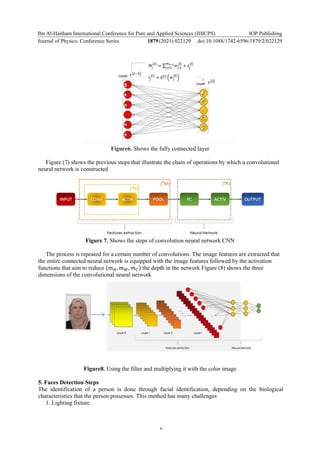
Parameters bias with 𝑚𝑙 parameters, Figure (6) shows the fully connected layer
Ibn Al-Haitham International Conference for Pure and Applied Sciences (IHICPS)
Journal of Physics: Conference Series 1879(2021) 022129
IOP Publishing
doi:10.1088/1742-6596/1879/2/022129
6
Figure6. Shows the fully connected layer
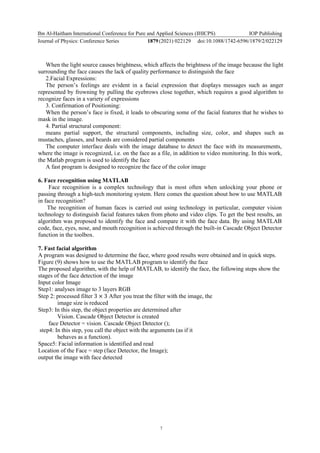
Figure (7) shows the previous steps that illustrate the chain of operations by which a convolutional
neural network is constructed
Figure 7. Shows the steps of convolution neural network CNN
The process is repeated for a certain number of convolutions. The image features are extracted that
the entire connected neural network is equipped with the image features followed by the activation
functions that aim to reduce (𝑚𝐻, 𝑚𝑊, 𝑚𝐶) the depth in the network Figure (8) shows the three
dimensions of the convolutional neural network
Figure8. Using the filter and multiplying it with the color image
5. Faces Detection Steps
The identification of a person is done through facial identification, depending on the biological
characteristics that the person possesses. This method has many challenges
1. Lighting fixture
Ibn Al-Haitham International Conference for Pure and Applied Sciences (IHICPS)
Journal of Physics: Conference Series 1879(2021) 022129
IOP Publishing
doi:10.1088/1742-6596/1879/2/022129
7
When the light source causes brightness, which affects the brightness of the image because the light
surrounding the face causes the lack of quality performance to distinguish the face
2.Facial Expressions:
The person’s feelings are evident in a facial expression that displays messages such as anger
represented by frowning by pulling the eyebrows close together, which requires a good algorithm to
recognize faces in a variety of expressions
3. Confirmation of Positioning:
When the person’s face is fixed, it leads to obscuring some of the facial features that he wishes to
mask in the image.
4. Partial structural component:
means partial support, the structural components, including size, color, and shapes such as
mustaches, glasses, and beards are considered partial components
The computer interface deals with the image database to detect the face with its measurements,
where the image is recognized, i.e. on the face as a file, in addition to video monitoring. In this work,
the Matlab program is used to identify the face
A fast program is designed to recognize the face of the color image
6. Face recognition using MATLAB
Face recognition is a complex technology that is most often when unlocking your phone or
passing through a high-tech monitoring system. Here comes the question about how to use MATLAB
in face recognition?
The recognition of human faces is carried out using technology in particular, computer vision
technology to distinguish facial features taken from photo and video clips. To get the best results, an
algorithm was proposed to identify the face and compare it with the face data. By using MATLAB
code, face, eyes, nose, and mouth recognition is achieved through the built-in Cascade Object Detector
function in the toolbox.
7. Fast facial algorithm
A program was designed to determine the face, where good results were obtained and in quick steps.
Figure (9) shows how to use the MATLAB program to identify the face
The proposed algorithm, with the help of MATLAB, to identify the face, the following steps show the
stages of the face detection of the image
Input color Image
Step1: analyses image to 3 layers RGB
Step 2: processed filter 3 × 3 After you treat the filter with the image, the
image size is reduced
Step3: In this step, the object properties are determined after
Vision. Cascade Object Detector is created
face Detector = vision. Cascade Object Detector ();
step4: In this step, you call the object with the arguments (as if it
behaves as a function).
Space5: Facial information is identified and read
Location of the Face = step (face Detector, the Image);
output the image with face detected
Ibn Al-Haitham International Conference for Pure and Applied Sciences (IHICPS)
Journal of Physics: Conference Series 1879(2021) 022129
IOP Publishing
doi:10.1088/1742-6596/1879/2/022129
8
Figure 9a. Shows face identification
With location face is [19, 40, 50, 20], height of image 255 and width 128
Figure 9b. Shows face identification
With location face is [105,68,51,51]
8. Discuss the results
In this section, the results obtained for the correct rate of face detection are presented. the new algorithm
shows its efficiency by presenting the results obtained. In this work, a modern version of MATLAB was used
to design a face detection program for several people in one image, and the best results were obtained.
Figure (10) and Figure (11) show the efficiency of the proposed algorithm to detect the face of a
number of people and distinguish their faces with the label. The correct rate of the proposed algorithm
is 98%, an image containing 3 members and the image is (432 × 980 × 3 unit8) with Boxing Faces is
and table (1) shows Bounding Box values which comprises of [x, y, Height, Width] of faces to be
detected Figure (10) The sample to which the proposed algorithm is applied
Figure 10. shows the efficiency of the proposed algorithm to detect the face of a number of people
and distinguish their faces.
Table (1) shows Bounding Box values
X Y width Height
442 150 115 115
125 28 150 150
571 31 267 267
Ibn Al-Haitham International Conference for Pure and Applied Sciences (IHICPS)
Journal of Physics: Conference Series 1879(2021) 022129
IOP Publishing
doi:10.1088/1742-6596/1879/2/022129
9
Figure (11) shows the efficiency of the proposed algorithm to detect the face of a number of masked
people and distinguish their faces.
9.Conclusion
In this paper, a new algorithm was built for face detection technology by segmenting the color
image into RGB in which a neural network is used, where the face area of a person was detected
through a comparison between the input and output image, the correctness of the face detection rate
98%.
With the implementation of the algorithm in the MATLAB program, good results were obtained
for the indications of the algorithm.
a new technique for identifying the face of color images was presented after analyzing the image
and dividing it into three layers resulting from the neural network that helps to detect the features of
the face, and by using the MATLAB program, a classification technique is applied to detect the face,
which satisfactory results were obtained after using the basic equations.
The algorithm was applied to the images without a mask, and the other stage was with the mask. As
for the last, the experiment was on the image with the mask and glasses, and the algorithm was applied
with high and fast technology, as the algorithm proved its efficiency because the examples showed
that the new algorithm is valid under the new circumstances.
References
[1] A M Abou El-Nasr, and A L Abbot 2007 A New Face Detection Technique using 2D DCT and
Self Organizing Feature Map in Proc. of World Academy of Science Engineering and
Technology 21 pp 15-19
[2] J. Nagi 2007 Design of an Efficient High-speed Face Recognition System Department of
Electrical and Electronics Engineering College of Engineering Universiti Tenaga Nasional
March
[3] C Zhang, Z Zhang 2010 Boosting-based face detection and adaptation Synthesis Lectures on
Computer Vision Morgan & Claypool Publishers 2 (1) pp 1-140
[4] M H Yang, D J Kriegman and N Ahuja 2002 Detecting faces in images: a survey IEEE
Transactions on Pattern Analysis and Machine Intelligence 24 (1)
[5] F Wang and H Qin 2005 A FPGA based driver drowsiness detecting system Proceedings of
IEEE International Conference on Vehicular Electronics and Safety Xian October
[6] H Khalajzadeh, M Mansouri, T M Hierarchical 2013 Structure Based Convolutional Neural
Network for Face Recognition Int J Comput Intell Applicat 12 (03)
[7] G A Farhadiy 2016 You Only Look Once: Unified, Real-Time Object Detection arXiv
1506.02640v5 [cs.CV]
[8] P Yadav, K Dhankad, A Shrivastava, A Kumar, P Manglik STUDY & ANALYSIS OF FACE
DETECTION & RECOGNITION; MATLAB APPROACH IJESAT International Journal of
Engineering Science & Advanced Technology 4 (3) pp 285-292
[9] G Ravindra 2017 Dabhade Optimal Neural Network Based Face Recognition System for
Various Pose and Occluded Images International Journal of Applied Engineering Research 12
(22) pp 12625-12636
Ibn Al-Haitham International Conference for Pure and Applied Sciences (IHICPS)
Journal of Physics: Conference Series 1879(2021) 022129
IOP Publishing
doi:10.1088/1742-6596/1879/2/022129
10
[10] E Winarno 2018 Multi-View Faces Detection Using Viola-Jones Method Journal of Physics:
Conference Series J.Phys. Conf. Ser 1114 012068
[11] M S Ejaz, M R Islam, M Sifatullah, A Sarker 2019 Implementation of principal component
analysis on masked and non-masked face recognition 1st
International Conference on Advances
in Science Engineering and Robotics Technology (ICASERT) pp 1–5
[12] T Karras, S Laine and T Aila 2019 A Style Based Generator Architecture for Generative
Adversarial Networks IEEE/CVF Conference on Computer Vision and Pattern Recognition
(CVPR) Long Beach CA USA pp 4396- 4405 doi: 10.1109/CVPR.2019.00453
[13] F Shaker, A Abdulelah 2020 Face Detection By some Methods based on MATLAB Journal of
Al- Qadisiyah for Computer Science and Mathematics 12 (4) pp 12–17
View publication stats

FaceDetectionforColorImageBasedonMATLAB.pdf

  • 1.
    See discussions, stats,and author profiles for this publication at: https://www.researchgate.net/publication/352014077 Face Detection for Color Image Based on MATLAB Article in Journal of Physics Conference Series · May 2021 DOI: 10.1088/1742-6596/1879/2/022129 CITATIONS 7 READS 1,183 3 authors, including: Some of the authors of this publication are also working on these related projects: Fuzzy algebra, special functions and graph theory View project image processing View project Asma Abdulelah University of Technology 41 PUBLICATIONS 269 CITATIONS SEE PROFILE Fouad Shaker Tahir University of Technology - Iraq 17 PUBLICATIONS 50 CITATIONS SEE PROFILE All content following this page was uploaded by Fouad Shaker Tahir on 09 February 2022. The user has requested enhancement of the downloaded file.
  • 2.
    Journal of Physics:Conference Series PAPER • OPEN ACCESS Face Detection for Color Image Based on MATLAB To cite this article: Shahad laith abd al_galib et al 2021 J. Phys.: Conf. Ser. 1879 022129 View the article online for updates and enhancements. This content was downloaded from IP address 37.238.20.32 on 31/05/2021 at 22:38
  • 3.
    Content from thiswork may be used under the terms of the Creative Commons Attribution 3.0 licence. Any further distribution of this work must maintain attribution to the author(s) and the title of the work, journal citation and DOI. Published under licence by IOP Publishing Ltd Ibn Al-Haitham International Conference for Pure and Applied Sciences (IHICPS) Journal of Physics: Conference Series 1879(2021) 022129 IOP Publishing doi:10.1088/1742-6596/1879/2/022129 1 Face Detection for Color Image Based on MATLAB Shahad laith abd al_galib, Asma Abdulelah Abdulrahman, Fouad Shaker Tahir Al-azawi University of Technology, Department of Applied Science, Mathematics and Application of Computer, Baghdad, Iraq. E-mail: 100243@uotechnology.edu.iq Abstract. Amazing results in many works in the field of deep convolutional neural networks using them in many fields of machine learning such as image classification control of atrial play, and image annotation. Mathematical analysis of deep convolutional neural networks (CNN) has a broad role in many applications including image classification applications. Face recognition technology has occupied a wide field in research that is still continuing in this work. Face recognition technology is being developed depending on the MATLAB program to develop the subjecting of the color image to the neural convolution network and the work of a program to reduce the time the network deals with the image to reduce the number of layers to only two layers and access the algorithm Suggested in this work. Computer vision of a color image in a face detection study. In this work, the researcher created a fast algorithm to reach the research goal based on new standards in the field of face detection. A new face detection program was designed using MATLAB, CascadeObjectDetector and trainCascadeObjectDetector the face detection devices were developed. In this work, a technique for panning and color image using the convolutional neural network for deep learning is proposed, the method used to reach the goal of this work. 1. Introduction In recent years, the field of face recognition has taken a wide area of research due to the urgent need for security and commercial applications to demonstrate the interaction between humans and computers using measurement analysis. The work in this field varies greatly in terms of face, skin, gender, and colour [1]. The difference in the background lighting of the face and facial expressions is a reason that increases the complexity of the problem [2]. Among the many applications in the field of face detection, including recognition and monitoring of the driver's face, face recognition by means of video surveillance, or image data management, the algorithms for face detection are characterized by complexity. Face detection is complicated [3]. In [4] which it was clarified that the face detection algorithms are divided into two parts, (i) feature (ii) learning, the first is based on simple facial features without looking at the surrounding light, rotating, or standing. The face position is determined by the vertical projection of the grey level image after the image has been projected for face detection [5]. The role of the neural network appears strongly in the field of facial recognition that has the potential to deal with image data .The neural network technology is multi-layered as it is to design a file containing a recognition system that results in a completely flat structure with inputs that are completely connected to later layers in architecture due to huge interconnecting nodes in addition to the amount of input data that is ignored. This leads to training for all permutations in the input vector
  • 4.
    Ibn Al-Haitham InternationalConference for Pure and Applied Sciences (IHICPS) Journal of Physics: Conference Series 1879(2021) 022129 IOP Publishing doi:10.1088/1742-6596/1879/2/022129 2 [6]. The fields of science and technology have led us to develop rapidly in order to be able to reach goals that were far from being achieved in the past few decades. Many areas have made life easier, such as machine learning and artificial intelligence, to reach solutions to complex problems in modern science. Computer vision achieves algorithms on the human level in classifying and analysing images. It was presented YOLO theory to discover things and Fast YOLO, which is the fastest detector, is the fastest detector for the general purpose [7]. Face detection was achieved using PCA theory. The network was trained fast [ 8 ]. The performance of face detection is evaluated by the false-match rate (FMR), and the false-non-match rate (FNMR) [ 9]. Viola Jones' method was used to check the number of faces that have been treated and count the number of faces [10]. Modern technology has a role in computer vision at this time when the world is living fighting the emerging corona virus, the disease pandemic (Covid-19) due to technology, work has been completed from home to adapt to the disease [11]. Facial characteristics such as freckles and hair were identified using a new generator to present data on human faces [12]. the method Kanade Lucas Tomasi (KLT), which is a simple system where it is able to detect the face and track it where the system is able to detect the face when the head moves and tilts, with Estim Geometric Transform (EGT) function and Duration Geometric Transform (DGT)[13]. In this work, a fast algorithm was proposed based on the use of CNN and the use of the MATLAB program to classify the image and the detection of the face in two stages, the face detection without a mask that has different measurements and criteria for the detection of the face with the mask and the use of the algorithm in tracking objects in these circumstances. 2. Methodology 2.1. Research Design The purpose of this paper is to achieve the recognition of a face or a number of faces, the steps for face recognition will be achieved as shown in figure (1) in this figure a number of steps have been achieved to show the structure of the search. Figure 1. Shows the steps of research design with the result The color image and face highlighting are read as cover layers are incorporated into this work. CNN is used with a mathematical technique to calculate the torsion where the person's face is determined and then the layer is fused as shown in Figure (2).
  • 5.
    Ibn Al-Haitham InternationalConference for Pure and Applied Sciences (IHICPS) Journal of Physics: Conference Series 1879(2021) 022129 IOP Publishing doi:10.1088/1742-6596/1879/2/022129 3 Figure 2. Convolutions on RGB image 3. Convolutional neural network method The convolutional neural network method is unique. It combines segmentation, extraction, and classification in features. One processing unit. CNN components are 7 layers of 4 feature extraction layers and 3 layers of MLP. The feature extraction layer consists of twisting and subsample layers. Warp layer removes noise and detects lines, borders, or corners of an image file. Preventing image distortion is in the Downsampling layer, which reduces image resolution. CNN has built-in stability compared to a typical neural network (MLP). CNN excels at producing high accuracy in the identification process even though the algorithm is complex. In network training, LeNet-5 applies The proposed algorithm will be built using MATLAB by designing a program for a learning algorithm to identify the face with a simple and easy base to reverse previously identified neural networks to implement a complex database. 4.Mathematical aspects in CNN Technology Deep learning deals with images using computer vision and processes large numbers of images from multiple countless numbers, Computer vision relies on the convolutional neural network fed into neural networks to reveal the face, The pictures are inserted in mathematical expressions. As shown in figure (3), using the filter and multiplying it with the color image, the sum of the product is obtained by the item The result of this process is a convolution that defines the volume to mathematically represent the image then; the height size denoted by mH, the width of size is mW, the number of channels denoted mc. A color image RGB has three channels m3 red, green, and blue. The filter is F The filter is single to center each pixel in the filter that must contain the kernel N with the number of channels identical to the image, so a different filter is applied that passes on each channel, Equation (1) calculate the dimensions of the filter Dim filter=(F,F,mc) (1) The image is mapped with filter the convolutional process mathematically is 𝐶(𝐼, 𝑁)𝑥,𝑦 = ∑ ∑ ∑ 𝑁𝑖,𝑗−𝑁𝐼𝑥+𝑖−1,𝑦+𝑗−1,𝑁 𝑚𝐶 𝑁=1 𝑚𝑊 𝑗=1 𝑚𝐻 𝑖=1 (2) dim(𝐶(𝐼, 𝑁)) = ([ 𝑚𝐻+2𝑃−𝐹 𝑆 + 1] , [ 𝑚𝑊+2𝑃−𝐹 𝑆 + 1]) 𝑆 > 0; (3) If 𝑆 = 1 equation (3) will be (𝑚𝐻 + 2𝑃 − 𝐹, 𝑚𝑊 + 2𝑃 − 𝐹) (4) Where [n] is the floor function of n P=0 is the valid CNN output size is equal output size then 𝑃 = 𝐹−1 2 is the same CNN, if F=1, this means 1 × 1Convolution.
  • 6.
    Ibn Al-Haitham InternationalConference for Pure and Applied Sciences (IHICPS) Journal of Physics: Conference Series 1879(2021) 022129 IOP Publishing doi:10.1088/1742-6596/1879/2/022129 4 The merging and reduction process distinguishes the image by specifying its information on each channel, which affects the dimensions (𝑚𝐻, 𝑚𝑊) and maintains the number of channels after passing the filter. dim(𝑃(𝐼, 𝑁)) = ([ 𝑚𝐻+2𝑃−𝐹 𝑆 + 1] , [ 𝑚𝑊+2𝑃−𝐹 𝑆 + 1] , 𝑚𝐶) 𝑆 > 0; (5) If 𝑆 = 1 equation (5) will be (𝑚𝐻 + 2𝑃 − 𝐹, 𝑚𝑊 + 2𝑃 − 𝐹, 𝑚𝐶) (6) After the training process, using CNN leads to the reduction of a number of layers Figure (4) shows how a process F led to the reduction of the three layers Figure 3. the convolutional neural network in color image Using filters on the input image using the activation function £, 4.1. Mathematical algorithm in convolutional process In 1th layer Input image with r[l] , r[l-1] and size (𝑚𝐻 [𝑙−1] , 𝑚𝑊 [𝑙−1] , 𝑚𝐶 [𝑙−1] ), Padding p[1] , stride s[l] , number of filters 𝑚𝐶 (𝑙) where each F(m) has the dimension [𝑓𝑙 , 𝑓𝑙 , 𝑚𝐶 [𝑙−1] ], and activation function £[𝑙] . Output 𝑟[𝑙] with size (𝑚𝐻 (𝑙) , 𝑚𝑊 (𝑙) , 𝑚𝐶 (𝑙) ) ∀ 𝑚 ∈ [1,2, … , 𝑚𝐶 [𝑙] ] Step1: the convolution step CNN 𝑐𝑜𝑛𝑣(𝑟[𝑙−1] , 𝐹[𝑙−1] )𝑥,𝑦 = £[𝑙] (∑ ∑ ∑ 𝐹𝑖,𝑗,𝐾 (𝑚) 𝑟𝑥+𝑖−1,𝑦+𝑗−1,𝑓 [𝑙−1] 𝑚𝐶 [𝑙−1] 𝐾=1 + 𝑠𝑚 [𝑙] 𝑚𝑊 [𝑙−1] 𝑗=1 𝑚𝐻 [𝑙−1] 𝑖=1 ) dim (𝑐𝑜𝑛𝑣(𝑟[𝑙−1] , 𝐹(𝑚) )) = (𝑚𝐻 [𝑙] , 𝑚𝑊 [𝑙] ) (7) 𝑟[𝑙] = £[𝑙] (𝑐𝑜𝑛𝑣(𝑟[𝑙−1] , 𝐹[1] )), £[𝑙] (𝑐𝑜𝑛𝑣(𝑟[𝑙−1] , 𝐹[2] )), … , £[𝑙] (𝑐𝑜𝑛𝑣(𝑟[𝑙−1] , 𝐹[𝑚𝑐 [𝑙] )) Where 𝑚𝐻 𝑊 ⁄ [𝑙−1] = [ 𝑚𝐻 𝑊 ⁄ [𝑙−1] +2𝑃[𝑙] −𝑓[𝑙] 𝑆[𝑙] + 1] ; 𝑆 > 0 (8) = 𝑚𝐻 𝑊 ⁄ [𝑙−1] + 2𝑃[𝑙] − 𝑓[𝑙] ; 𝑆 = 0 𝑚𝐶 [𝑙] = number of filters The learned parameters at the 𝑙𝑡ℎ layer filters with (𝑓 × 𝑓 × 𝑚) × 𝑚𝐶 [𝑙] parameters Bias with (1 × 1 × 1) × 𝑚𝐶 parameters (broad casting) Figure (4) and Figure (5) represent the shrinkage of the convolutional layer
  • 7.
    Ibn Al-Haitham InternationalConference for Pure and Applied Sciences (IHICPS) Journal of Physics: Conference Series 1879(2021) 022129 IOP Publishing doi:10.1088/1742-6596/1879/2/022129 5 Figure4. The convolutional layer Figure5. The convolutional layer 4.2. Fully Connected layer The definition of a fully connected layer is the layer that enters its vector and then another layer is created from a limited number of neurons Then 𝑗𝑡ℎ node with 𝑖𝑡ℎ layer the equation is achieved (9) 𝑊 𝑗 [𝑖] = ∑ 𝑤𝑗,1 [𝑖] + 𝑠𝑗 [𝑖] 𝑚𝑖−1 𝑗=1 (9) 𝑟 𝑗 [𝑖] = £[𝑖] (𝑤𝑗 [𝑖] ) (10) The input 𝑟[𝑖−1] might be the result of convolution or a pooling layer with the dimensions (𝑚𝐻 [𝑖−1] , 𝑚𝑊 [𝑖−1] , 𝑚𝐶 [𝑖−1] ) in order to be able to plug it into the fully connected layer; we flatten the tensor to one dimension vector having the dimension (𝑚𝐻 [𝑖−1] × 𝑚𝑊 [𝑖−1] × 𝑚𝐶 [𝑖−1] , 1) thus 𝑚𝑖−1 = 𝑚𝐻 [𝑖−1] × 𝑚𝑊 [𝑖−1] × 𝑚𝐶 [𝑖−1] The learned parameters at the 𝑙𝑡ℎ layer are weights 𝑤𝑗,1 with 𝑚𝑙−1 × 𝑚𝑙 Parameters bias with 𝑚𝑙 parameters, Figure (6) shows the fully connected layer
  • 8.
    Ibn Al-Haitham InternationalConference for Pure and Applied Sciences (IHICPS) Journal of Physics: Conference Series 1879(2021) 022129 IOP Publishing doi:10.1088/1742-6596/1879/2/022129 6 Figure6. Shows the fully connected layer Figure (7) shows the previous steps that illustrate the chain of operations by which a convolutional neural network is constructed Figure 7. Shows the steps of convolution neural network CNN The process is repeated for a certain number of convolutions. The image features are extracted that the entire connected neural network is equipped with the image features followed by the activation functions that aim to reduce (𝑚𝐻, 𝑚𝑊, 𝑚𝐶) the depth in the network Figure (8) shows the three dimensions of the convolutional neural network Figure8. Using the filter and multiplying it with the color image 5. Faces Detection Steps The identification of a person is done through facial identification, depending on the biological characteristics that the person possesses. This method has many challenges 1. Lighting fixture
  • 9.
    Ibn Al-Haitham InternationalConference for Pure and Applied Sciences (IHICPS) Journal of Physics: Conference Series 1879(2021) 022129 IOP Publishing doi:10.1088/1742-6596/1879/2/022129 7 When the light source causes brightness, which affects the brightness of the image because the light surrounding the face causes the lack of quality performance to distinguish the face 2.Facial Expressions: The person’s feelings are evident in a facial expression that displays messages such as anger represented by frowning by pulling the eyebrows close together, which requires a good algorithm to recognize faces in a variety of expressions 3. Confirmation of Positioning: When the person’s face is fixed, it leads to obscuring some of the facial features that he wishes to mask in the image. 4. Partial structural component: means partial support, the structural components, including size, color, and shapes such as mustaches, glasses, and beards are considered partial components The computer interface deals with the image database to detect the face with its measurements, where the image is recognized, i.e. on the face as a file, in addition to video monitoring. In this work, the Matlab program is used to identify the face A fast program is designed to recognize the face of the color image 6. Face recognition using MATLAB Face recognition is a complex technology that is most often when unlocking your phone or passing through a high-tech monitoring system. Here comes the question about how to use MATLAB in face recognition? The recognition of human faces is carried out using technology in particular, computer vision technology to distinguish facial features taken from photo and video clips. To get the best results, an algorithm was proposed to identify the face and compare it with the face data. By using MATLAB code, face, eyes, nose, and mouth recognition is achieved through the built-in Cascade Object Detector function in the toolbox. 7. Fast facial algorithm A program was designed to determine the face, where good results were obtained and in quick steps. Figure (9) shows how to use the MATLAB program to identify the face The proposed algorithm, with the help of MATLAB, to identify the face, the following steps show the stages of the face detection of the image Input color Image Step1: analyses image to 3 layers RGB Step 2: processed filter 3 × 3 After you treat the filter with the image, the image size is reduced Step3: In this step, the object properties are determined after Vision. Cascade Object Detector is created face Detector = vision. Cascade Object Detector (); step4: In this step, you call the object with the arguments (as if it behaves as a function). Space5: Facial information is identified and read Location of the Face = step (face Detector, the Image); output the image with face detected
  • 10.
    Ibn Al-Haitham InternationalConference for Pure and Applied Sciences (IHICPS) Journal of Physics: Conference Series 1879(2021) 022129 IOP Publishing doi:10.1088/1742-6596/1879/2/022129 8 Figure 9a. Shows face identification With location face is [19, 40, 50, 20], height of image 255 and width 128 Figure 9b. Shows face identification With location face is [105,68,51,51] 8. Discuss the results In this section, the results obtained for the correct rate of face detection are presented. the new algorithm shows its efficiency by presenting the results obtained. In this work, a modern version of MATLAB was used to design a face detection program for several people in one image, and the best results were obtained. Figure (10) and Figure (11) show the efficiency of the proposed algorithm to detect the face of a number of people and distinguish their faces with the label. The correct rate of the proposed algorithm is 98%, an image containing 3 members and the image is (432 × 980 × 3 unit8) with Boxing Faces is and table (1) shows Bounding Box values which comprises of [x, y, Height, Width] of faces to be detected Figure (10) The sample to which the proposed algorithm is applied Figure 10. shows the efficiency of the proposed algorithm to detect the face of a number of people and distinguish their faces. Table (1) shows Bounding Box values X Y width Height 442 150 115 115 125 28 150 150 571 31 267 267
  • 11.
    Ibn Al-Haitham InternationalConference for Pure and Applied Sciences (IHICPS) Journal of Physics: Conference Series 1879(2021) 022129 IOP Publishing doi:10.1088/1742-6596/1879/2/022129 9 Figure (11) shows the efficiency of the proposed algorithm to detect the face of a number of masked people and distinguish their faces. 9.Conclusion In this paper, a new algorithm was built for face detection technology by segmenting the color image into RGB in which a neural network is used, where the face area of a person was detected through a comparison between the input and output image, the correctness of the face detection rate 98%. With the implementation of the algorithm in the MATLAB program, good results were obtained for the indications of the algorithm. a new technique for identifying the face of color images was presented after analyzing the image and dividing it into three layers resulting from the neural network that helps to detect the features of the face, and by using the MATLAB program, a classification technique is applied to detect the face, which satisfactory results were obtained after using the basic equations. The algorithm was applied to the images without a mask, and the other stage was with the mask. As for the last, the experiment was on the image with the mask and glasses, and the algorithm was applied with high and fast technology, as the algorithm proved its efficiency because the examples showed that the new algorithm is valid under the new circumstances. References [1] A M Abou El-Nasr, and A L Abbot 2007 A New Face Detection Technique using 2D DCT and Self Organizing Feature Map in Proc. of World Academy of Science Engineering and Technology 21 pp 15-19 [2] J. Nagi 2007 Design of an Efficient High-speed Face Recognition System Department of Electrical and Electronics Engineering College of Engineering Universiti Tenaga Nasional March [3] C Zhang, Z Zhang 2010 Boosting-based face detection and adaptation Synthesis Lectures on Computer Vision Morgan & Claypool Publishers 2 (1) pp 1-140 [4] M H Yang, D J Kriegman and N Ahuja 2002 Detecting faces in images: a survey IEEE Transactions on Pattern Analysis and Machine Intelligence 24 (1) [5] F Wang and H Qin 2005 A FPGA based driver drowsiness detecting system Proceedings of IEEE International Conference on Vehicular Electronics and Safety Xian October [6] H Khalajzadeh, M Mansouri, T M Hierarchical 2013 Structure Based Convolutional Neural Network for Face Recognition Int J Comput Intell Applicat 12 (03) [7] G A Farhadiy 2016 You Only Look Once: Unified, Real-Time Object Detection arXiv 1506.02640v5 [cs.CV] [8] P Yadav, K Dhankad, A Shrivastava, A Kumar, P Manglik STUDY & ANALYSIS OF FACE DETECTION & RECOGNITION; MATLAB APPROACH IJESAT International Journal of Engineering Science & Advanced Technology 4 (3) pp 285-292 [9] G Ravindra 2017 Dabhade Optimal Neural Network Based Face Recognition System for Various Pose and Occluded Images International Journal of Applied Engineering Research 12 (22) pp 12625-12636
  • 12.
    Ibn Al-Haitham InternationalConference for Pure and Applied Sciences (IHICPS) Journal of Physics: Conference Series 1879(2021) 022129 IOP Publishing doi:10.1088/1742-6596/1879/2/022129 10 [10] E Winarno 2018 Multi-View Faces Detection Using Viola-Jones Method Journal of Physics: Conference Series J.Phys. Conf. Ser 1114 012068 [11] M S Ejaz, M R Islam, M Sifatullah, A Sarker 2019 Implementation of principal component analysis on masked and non-masked face recognition 1st International Conference on Advances in Science Engineering and Robotics Technology (ICASERT) pp 1–5 [12] T Karras, S Laine and T Aila 2019 A Style Based Generator Architecture for Generative Adversarial Networks IEEE/CVF Conference on Computer Vision and Pattern Recognition (CVPR) Long Beach CA USA pp 4396- 4405 doi: 10.1109/CVPR.2019.00453 [13] F Shaker, A Abdulelah 2020 Face Detection By some Methods based on MATLAB Journal of Al- Qadisiyah for Computer Science and Mathematics 12 (4) pp 12–17 View publication stats