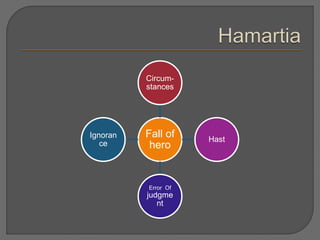
This document analyzes the unity of action in Sophocles' play Oedipus the King. It discusses how Aristotle considered Oedipus the King to be the perfect tragedy due to its unified action. Each incident in the play directly causes the next through a chain of events. The climax occurs when Oedipus' true identity is revealed, leading to Jocasta's suicide and Oedipus blinding himself and leaving Thebes. The document analyzes how the play adheres to Aristotle's principles of tragedy by having one continuous action that builds to a reversal and resolution.