PAPASKARASI
The grape of ’’Passion and Love'’
‘’KARASEVDA’’
Mustafa Camlica
Chamlija Wines
Vitis International Variety Catalogue ( VIVC )
• Prime name PAPASKARASI
• Color of berry skin NOIR
• Variety number 8923
• Country of origin of the variety TURKEY
• Vitis species VITIS VINIFERA LINNÉ
• Pedigree as given in bibliography ALBA IMPUTOTATO X PROKUPAC
• Prime name of parent 1 ALBA IMPUTOTATO
• Prime name of parent 2 PROKUPAC
• Holding institution BGR013
• Breeder
• Breeding contact address
• Year of crossing
• Year of selection
• Year of protection
• Formation of seeds COMPLETE
• Sex of flowers HERMAPHRODITE
• Photos
• Table of accession names YES
• Table of area
• Last update 29.09.2014
•
• Synonym :
• KALE DOIRAN KARA SEFTA KARAPAPASKA KARAPAPASKE
• KARASEFTA KARASEITA PAPAESCA CERNA PAPAESCA NEAGRA
• PAPASCA NEAGRA PAPASKA CERNA PAPASKA NEAGRA PAPASKA TCHERNA
• PAPASKARA PAPAZ KARASI PAPAZKA CERNA PAPAZKARASI
• PAPEASCA NEAGRA SEVTA SHARALUK CHER SIFTA
• SIVINA VINTA VINTA CHERNA
Marcel BIRON
‘Vignes et vins de Turquie, Thrace – Marmara’
62 p, publié en 1950 (original provenant de l’Université de Californie)
• He mentions the following points:
• The Papaskarasi is a variety of the Balkans. It
grows mostly in Turkey sunny and rocky slopes
of the Quaternary alluvium around Edirne ,
Kircasali ( Zalof ) of Uzunköprü and Strandja
Massif Kirklareli ( Üsküp ) in Thrace. (It is also a
registered varieatal in Greece as Kara Papas.)
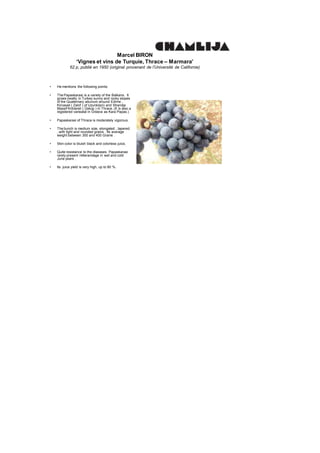
• Papaskarasi of Thrace is moderately vigorous.
• The bunch is medium size, elongated , tapered
, with tight and rounded grains . Its average
weight between 300 and 400 Grams .
• Skin color is bluish black and colorless juice,
• Quite resistance to the diseases. Papaskarasi
rarely present millerandage in wet and cold
June years .
• Its juice yield is very high, up to 80 %.
• Our observations so far:
• Growing Season:
• Bud break: One week later than Cabernet
Sauvignon
• Flowering: One week later than Cabernet
Sauvignon
• Verasion: 10 days later than Cabernet Sauvignon
• Harvest: 2 weeks later than Cabernet Sauvignon.
• Final 30 days before harvest mean temperature: 16
degrees Celcius.
• Soil: Best in very poor soils such as decomposed
granites where bunches are smaller.
• The red wine Papaskarasi have the
following characteristics:
• a fortnight- 2 weeks fermentation,
without maceration and temperature control,
light color, light to medium body, 12.5 to
13.5% of alcohol and 4-5 grams of total
acidity.
• Possible blends Papaskarasi with excellent
wine ' Adakarasi ' Asva of , for example,
possible to obtain a degree more color.
But I do not say the same with regard to the '
Karalahana ' cited above.
• A small amount of Cabernet Sauvignon or
Pinot Noir , for example , goes with
Papaskarasi an amazing way.
• Color , alcohol, acidity and aroma all
improve.

Papaskarasi

  • 1.
    PAPASKARASI The grape of’’Passion and Love'’ ‘’KARASEVDA’’ Mustafa Camlica Chamlija Wines Vitis International Variety Catalogue ( VIVC ) • Prime name PAPASKARASI • Color of berry skin NOIR • Variety number 8923 • Country of origin of the variety TURKEY • Vitis species VITIS VINIFERA LINNÉ • Pedigree as given in bibliography ALBA IMPUTOTATO X PROKUPAC • Prime name of parent 1 ALBA IMPUTOTATO • Prime name of parent 2 PROKUPAC • Holding institution BGR013 • Breeder • Breeding contact address • Year of crossing • Year of selection • Year of protection • Formation of seeds COMPLETE • Sex of flowers HERMAPHRODITE • Photos • Table of accession names YES • Table of area • Last update 29.09.2014 • • Synonym : • KALE DOIRAN KARA SEFTA KARAPAPASKA KARAPAPASKE • KARASEFTA KARASEITA PAPAESCA CERNA PAPAESCA NEAGRA • PAPASCA NEAGRA PAPASKA CERNA PAPASKA NEAGRA PAPASKA TCHERNA • PAPASKARA PAPAZ KARASI PAPAZKA CERNA PAPAZKARASI • PAPEASCA NEAGRA SEVTA SHARALUK CHER SIFTA • SIVINA VINTA VINTA CHERNA
  • 2.
    Marcel BIRON ‘Vignes etvins de Turquie, Thrace – Marmara’ 62 p, publié en 1950 (original provenant de l’Université de Californie) • He mentions the following points: • The Papaskarasi is a variety of the Balkans. It grows mostly in Turkey sunny and rocky slopes of the Quaternary alluvium around Edirne , Kircasali ( Zalof ) of Uzunköprü and Strandja Massif Kirklareli ( Üsküp ) in Thrace. (It is also a registered varieatal in Greece as Kara Papas.) • Papaskarasi of Thrace is moderately vigorous. • The bunch is medium size, elongated , tapered , with tight and rounded grains . Its average weight between 300 and 400 Grams . • Skin color is bluish black and colorless juice, • Quite resistance to the diseases. Papaskarasi rarely present millerandage in wet and cold June years . • Its juice yield is very high, up to 80 %.
  • 3.
    • Our observationsso far: • Growing Season: • Bud break: One week later than Cabernet Sauvignon • Flowering: One week later than Cabernet Sauvignon • Verasion: 10 days later than Cabernet Sauvignon • Harvest: 2 weeks later than Cabernet Sauvignon. • Final 30 days before harvest mean temperature: 16 degrees Celcius. • Soil: Best in very poor soils such as decomposed granites where bunches are smaller. • The red wine Papaskarasi have the following characteristics: • a fortnight- 2 weeks fermentation, without maceration and temperature control, light color, light to medium body, 12.5 to 13.5% of alcohol and 4-5 grams of total acidity. • Possible blends Papaskarasi with excellent wine ' Adakarasi ' Asva of , for example, possible to obtain a degree more color. But I do not say the same with regard to the ' Karalahana ' cited above. • A small amount of Cabernet Sauvignon or Pinot Noir , for example , goes with Papaskarasi an amazing way. • Color , alcohol, acidity and aroma all improve.