www.chamlija-wine.com
MUSTAFA CAMLICA
Chamlija Wines
www.chamlija-wine.com
The Camlica family has been farming in Buyukkarıstıran, Luleburgaz
since 1936. the first generation of the family immigrated from Kubadin,
Razgrad, in northeastern Bulgaria. Kubadin was renamed Loznitsa in the
1930s. The new name means ‘Vineyard Place’ in Bulgarian, referring to
the fact that this was the first place where American rootstocks were
grown first time in the country.
Mustafa Camlica, a prominent fine wine investor from the third
generation of the family to live in Turkey, is the name behind this very
ambitious project. The company is named his daughter, who also
designs all the labels. All the production facilities are in Buyukkarıstıran,
120 kilometers west of Istanbul.
www.chamlija-wine.com
STRANDJA
www.chamlija-wine.com
STRANDJA
The Strandja Massif is located in the NW part of Turkey. The massif
is bounded by the Thrace basin to the south, the Istanbul Zone to
the east and the black Sea to the north. It is roughly a NW- SE
trending mountain belt, ca. 200 km long and 90 km wide.
www.chamlija-wine.com
Limestones of Strandja
The coastal deposits along the southern slopes of the Strandja Massif
indicate the presence of shallow marine depositional environments in
the area. The quartz sand rich detrial deposits should correspond to
depositional environments in bays, while the ooletic limestones are
probably deposited in flat shelves with tides.
Limestones of Strandja
www.chamlija-wine.com
Limestones of Strandja
The occurrence of Congeria rich limestones suggests also lagunal
depositional environments. The lignite formation usually occurs in
swamp areas, in marshy basins behind the coastline. There are two
lignite mines next to our vineyards.
KIRKLARELİ FORMATION ISLAMBEYLI FORMATION
www.chamlija-wine.com
LACUSTRINE LIMESTONES OF SINANLI FORMATION
KUCUKKARISTIRAN AKCAKOY VİNYARDS
www.chamlija-wine.com
THRACE ALUVION
SOĞUCAK FORMATION
PINARHISAR FORMATION
www.chamlija-wine.com
VINEYARD
All the vineyards are located in Kirklareli Province. The
Bulgarian name of Kirklareli was Lozengrad, which
means ‘The city of Vines’. We currently have 85
hectares under wine.
www.chamlija-wine.com
Our plantings are some of the highest density in the
Balkans and turkey, ranging from 5,000 to 6,666 vines
per hectare, with some vineyards even at 10,000.
www.chamlija-wine.com
The aim of high-
density planting is to
enhance quality and
encourage deep root
systems to express the
full potential of the
terroir.
The Strandja Massif has a dominant effect on our vineyard soils
and climates.
The grape of
’’Passion and Love'’
‘’KARASEVDA’’
PAPASKARASI
www.chamlija-wine.com
Vitis International Variety Catalogue ( VIVC )
Prime name PAPASKARASI
Color of berry skin NOIR
Variety number 8923
Country of origin of the variety TURKEY
Vitis species VITIS VINIFERA LINNÉ
Pedigree as given in bibliography ALBA IMPUTOTATO X PROKUPAC
Prime name of parent 1 ALBA IMPUTOTATO
Prime name of parent 2 PROKUPAC
Holding institution BGR013
Breeder
Breeding contact address
Year of crossing
Year of selection
Year of protection
Formation of seeds COMPLETE
Sex of flowers HERMAPHRODITE
Photos
Table of accession names YES
Table of area
Last update 29.09.2014
www.chamlija-wine.com
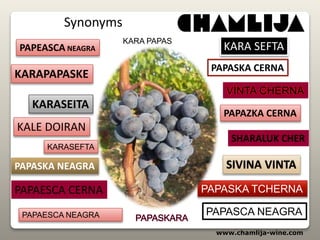
Synonyms
KALE DOIRAN
KARA SEFTA
KARA PAPAS
KARAPAPASKE
KARASEFTA
KARASEITA
PAPAESCA CERNA
VINTA CHERNA
SIVINA VINTA
SHARALUK CHER
PAPAESCA NEAGRA PAPASCA NEAGRA
PAPASKA CERNA
PAPASKA NEAGRA
PAPASKA TCHERNA
PAPAZKA CERNA
PAPEASCA NEAGRA
www.chamlija-wine.com
Marcel BIRON
‘Vignes et vins de Turquie, Thrace –
Marmara’
62 p, publié en 1950 (original provenant de
l’Université de Californie)
He mentions the following points:
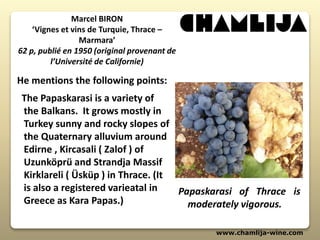
The Papaskarasi is a variety of
the Balkans. It grows mostly in
Turkey sunny and rocky slopes of
the Quaternary alluvium around
Edirne , Kircasali ( Zalof ) of
Uzunköprü and Strandja Massif
Kirklareli ( Üsküp ) in Thrace. (It
is also a registered varieatal in
Greece as Kara Papas.)
Papaskarasi of Thrace is
moderately vigorous.
www.chamlija-wine.com
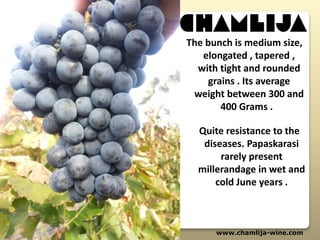
Quite resistance to the
diseases. Papaskarasi
rarely present
millerandage in wet and
cold June years .
The bunch is medium size,
elongated , tapered ,
with tight and rounded
grains . Its average
weight between 300 and
400 Grams .
www.chamlija-wine.com
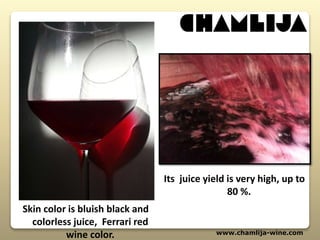
Its juice yield is very high, up to
80 %.
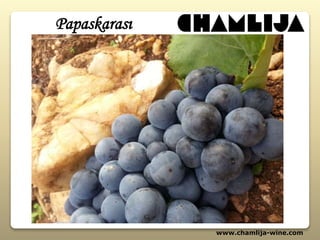
Skin color is bluish black and
colorless juice, Ferrari red
wine color.
www.chamlija-wine.com
 Our observations so far:
 Growing Season:
 Bud break: One week later than Cabernet
Sauvignon
 Flowering: One week later than Cabernet
Sauvignon
 Verasion: 10 days later than Cabernet Sauvignon
 Harvest: 2 weeks later than Cabernet
Sauvignon.
 Final 30 days before harvest mean temperature:
16 degrees Celcius.
 Soil: Best in very poor soils such as decomposed
granites where bunches are smaller.
Papaskarası
www.chamlija-wine.com
Papaskarası
www.chamlija-wine.com
in late August in late October
And harvest day
www.chamlija-wine.com
The red wine Papaskarasi have the following
characteristics:
a fortnight- 2 weeks fermentation, without
maceration and temperature control, light
color, light to medium body, 12.5 to 13.5% of
alcohol and 4-5 grams of total acidity.
Possible blends Papaskarasi with excellent
wine ' Adakarasi ' Asva of , for example,
possible to obtain a degree more color.
But I do not say the same with regard to the '
Karalahana ' cited above.
A small amount of Cabernet Sauvignon or
Pinot Noir , for example , goes with Papaskarasi
an amazing way.
Color , alcohol, acidity and aroma all improve.
www.chamlija-wine.com
Papaskarasi is extremly sensitive to hot temperatures and
heat waves. It needs quite cool temperatures after verasion
starts. The critical period is between August 15 and October
15. If avarage temperatures exceed 19 degrees during this
period the grape does not get enough color. Therefore, it
needs cooler places to accumulate enough anthocyanins found
in the skin of the grape. Therefore, you can easily identify a
Papaskarasi wine looking at the color. The paler the color the
hotter the season or the place. It is very site and climate
sensitive cultivar.
Climate
Papaskarası
www.chamlija-wine.com
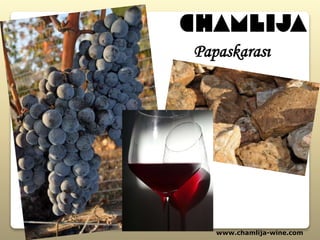
Papaskarasi is Blue-black skin color
grape. The color of '' passionate love''
is blue. Kara Sevda is also other name
of the cultivar which is translated as ''
passionate love''.
Papaskarasi is very unusual grape
with respect to ripenning course.
Canes are ripenning first.
Pedigree:
Parents: Alba Imputotato (RO)*
Prokupac (SRB)
Off springs: Kadarka# 1610 (HUN),
Feher Kövidinka#348 (HUN)
Full Sister: Baela Debela # 2237 (BG)
Half Sister: Furmint#25 (HUN)
www.chamlija-wine.com
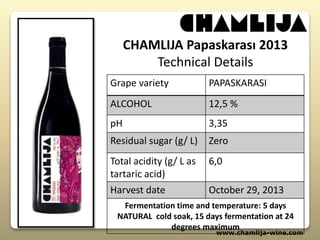
Grape variety PAPASKARASI
ALCOHOL 12,5 %
pH 3,35
Residual sugar (g/ L) Zero
Total acidity (g/ L as
tartaric acid)
6,0
Harvest date October 29, 2013
Fermentation time and temperature: 5 days
NATURAL cold soak, 15 days fermentation at 24
degrees maximum
CHAMLIJA Papaskarası 2013
Technical Details
PAPASKARASI
www.chamlija-wine.com
Dark purple red with
violet hue. Complex nose
with aroma Reminiscent
of nutmeg, Gingerbread,
ginger, vanilla and white
pepper. On the palate
well structured with
medium weight and good
length.
Markus Del Monego MW
Tasting Notes
www.chamlija-wine.com
EXPORT TO GREECE IN 1894.
ORIGIN: KIRKLARELI
www.chamlija-wine.com
Michel Brion studied
Thracian Papaskarasi
between 1938 -1946
and put this varietal at
the top of Turkish
grapes.
Papaskarası
www.chamlija-wine.com

Papaskarasi mw presentation

  • 1.
  • 2.
    www.chamlija-wine.com The Camlica familyhas been farming in Buyukkarıstıran, Luleburgaz since 1936. the first generation of the family immigrated from Kubadin, Razgrad, in northeastern Bulgaria. Kubadin was renamed Loznitsa in the 1930s. The new name means ‘Vineyard Place’ in Bulgarian, referring to the fact that this was the first place where American rootstocks were grown first time in the country. Mustafa Camlica, a prominent fine wine investor from the third generation of the family to live in Turkey, is the name behind this very ambitious project. The company is named his daughter, who also designs all the labels. All the production facilities are in Buyukkarıstıran, 120 kilometers west of Istanbul.
  • 3.
  • 4.
    www.chamlija-wine.com STRANDJA The Strandja Massifis located in the NW part of Turkey. The massif is bounded by the Thrace basin to the south, the Istanbul Zone to the east and the black Sea to the north. It is roughly a NW- SE trending mountain belt, ca. 200 km long and 90 km wide.
  • 5.
    www.chamlija-wine.com Limestones of Strandja Thecoastal deposits along the southern slopes of the Strandja Massif indicate the presence of shallow marine depositional environments in the area. The quartz sand rich detrial deposits should correspond to depositional environments in bays, while the ooletic limestones are probably deposited in flat shelves with tides.
  • 6.
  • 7.
    www.chamlija-wine.com Limestones of Strandja Theoccurrence of Congeria rich limestones suggests also lagunal depositional environments. The lignite formation usually occurs in swamp areas, in marshy basins behind the coastline. There are two lignite mines next to our vineyards. KIRKLARELİ FORMATION ISLAMBEYLI FORMATION
  • 8.
    www.chamlija-wine.com LACUSTRINE LIMESTONES OFSINANLI FORMATION KUCUKKARISTIRAN AKCAKOY VİNYARDS
  • 9.
  • 10.
    www.chamlija-wine.com VINEYARD All the vineyardsare located in Kirklareli Province. The Bulgarian name of Kirklareli was Lozengrad, which means ‘The city of Vines’. We currently have 85 hectares under wine.
  • 11.
    www.chamlija-wine.com Our plantings aresome of the highest density in the Balkans and turkey, ranging from 5,000 to 6,666 vines per hectare, with some vineyards even at 10,000.
  • 12.
    www.chamlija-wine.com The aim ofhigh- density planting is to enhance quality and encourage deep root systems to express the full potential of the terroir. The Strandja Massif has a dominant effect on our vineyard soils and climates.
  • 13.
    The grape of ’’Passionand Love'’ ‘’KARASEVDA’’ PAPASKARASI www.chamlija-wine.com
  • 14.
    www.chamlija-wine.com Vitis International VarietyCatalogue ( VIVC ) Prime name PAPASKARASI Color of berry skin NOIR Variety number 8923 Country of origin of the variety TURKEY Vitis species VITIS VINIFERA LINNÉ Pedigree as given in bibliography ALBA IMPUTOTATO X PROKUPAC Prime name of parent 1 ALBA IMPUTOTATO Prime name of parent 2 PROKUPAC Holding institution BGR013 Breeder Breeding contact address Year of crossing Year of selection Year of protection Formation of seeds COMPLETE Sex of flowers HERMAPHRODITE Photos Table of accession names YES Table of area Last update 29.09.2014
  • 15.
    www.chamlija-wine.com Synonyms KALE DOIRAN KARA SEFTA KARAPAPAS KARAPAPASKE KARASEFTA KARASEITA PAPAESCA CERNA VINTA CHERNA SIVINA VINTA SHARALUK CHER PAPAESCA NEAGRA PAPASCA NEAGRA PAPASKA CERNA PAPASKA NEAGRA PAPASKA TCHERNA PAPAZKA CERNA PAPEASCA NEAGRA
  • 16.
    www.chamlija-wine.com Marcel BIRON ‘Vignes etvins de Turquie, Thrace – Marmara’ 62 p, publié en 1950 (original provenant de l’Université de Californie) He mentions the following points: The Papaskarasi is a variety of the Balkans. It grows mostly in Turkey sunny and rocky slopes of the Quaternary alluvium around Edirne , Kircasali ( Zalof ) of Uzunköprü and Strandja Massif Kirklareli ( Üsküp ) in Thrace. (It is also a registered varieatal in Greece as Kara Papas.) Papaskarasi of Thrace is moderately vigorous.
  • 17.
    www.chamlija-wine.com Quite resistance tothe diseases. Papaskarasi rarely present millerandage in wet and cold June years . The bunch is medium size, elongated , tapered , with tight and rounded grains . Its average weight between 300 and 400 Grams .
  • 18.
    www.chamlija-wine.com Its juice yieldis very high, up to 80 %. Skin color is bluish black and colorless juice, Ferrari red wine color.
  • 19.
    www.chamlija-wine.com  Our observationsso far:  Growing Season:  Bud break: One week later than Cabernet Sauvignon  Flowering: One week later than Cabernet Sauvignon  Verasion: 10 days later than Cabernet Sauvignon  Harvest: 2 weeks later than Cabernet Sauvignon.  Final 30 days before harvest mean temperature: 16 degrees Celcius.  Soil: Best in very poor soils such as decomposed granites where bunches are smaller.
  • 20.
  • 21.
  • 22.
  • 23.
    www.chamlija-wine.com The red winePapaskarasi have the following characteristics: a fortnight- 2 weeks fermentation, without maceration and temperature control, light color, light to medium body, 12.5 to 13.5% of alcohol and 4-5 grams of total acidity. Possible blends Papaskarasi with excellent wine ' Adakarasi ' Asva of , for example, possible to obtain a degree more color. But I do not say the same with regard to the ' Karalahana ' cited above. A small amount of Cabernet Sauvignon or Pinot Noir , for example , goes with Papaskarasi an amazing way. Color , alcohol, acidity and aroma all improve.
  • 24.
    www.chamlija-wine.com Papaskarasi is extremlysensitive to hot temperatures and heat waves. It needs quite cool temperatures after verasion starts. The critical period is between August 15 and October 15. If avarage temperatures exceed 19 degrees during this period the grape does not get enough color. Therefore, it needs cooler places to accumulate enough anthocyanins found in the skin of the grape. Therefore, you can easily identify a Papaskarasi wine looking at the color. The paler the color the hotter the season or the place. It is very site and climate sensitive cultivar. Climate
  • 25.
  • 26.
    www.chamlija-wine.com Papaskarasi is Blue-blackskin color grape. The color of '' passionate love'' is blue. Kara Sevda is also other name of the cultivar which is translated as '' passionate love''. Papaskarasi is very unusual grape with respect to ripenning course. Canes are ripenning first. Pedigree: Parents: Alba Imputotato (RO)* Prokupac (SRB) Off springs: Kadarka# 1610 (HUN), Feher Kövidinka#348 (HUN) Full Sister: Baela Debela # 2237 (BG) Half Sister: Furmint#25 (HUN)
  • 27.
    www.chamlija-wine.com Grape variety PAPASKARASI ALCOHOL12,5 % pH 3,35 Residual sugar (g/ L) Zero Total acidity (g/ L as tartaric acid) 6,0 Harvest date October 29, 2013 Fermentation time and temperature: 5 days NATURAL cold soak, 15 days fermentation at 24 degrees maximum CHAMLIJA Papaskarası 2013 Technical Details
  • 28.
    PAPASKARASI www.chamlija-wine.com Dark purple redwith violet hue. Complex nose with aroma Reminiscent of nutmeg, Gingerbread, ginger, vanilla and white pepper. On the palate well structured with medium weight and good length. Markus Del Monego MW Tasting Notes
  • 29.
    www.chamlija-wine.com EXPORT TO GREECEIN 1894. ORIGIN: KIRKLARELI
  • 30.
    www.chamlija-wine.com Michel Brion studied ThracianPapaskarasi between 1938 -1946 and put this varietal at the top of Turkish grapes.
  • 31.
  • 32.

Editor's Notes