B
1. Obtain covariance matrix for each panelist
(averaging over reps)
2. Obtain average covariance
matrix
3. Decompose covariance matrix 𝑆
(e.g. SVD decomposition)
A Preliminary Review of Multiple Group Principal
Component Analysis for Descriptive Sensory Data
Moyi Li1, Ryan P. Browne1, Paul D. McNicholas1, John C. Castura2
1University of Guelph, Guelph, Ontario, Canada
2Compusense, Guelph, Ontario, Canada
MGPCA GPAPCA
Attributes
Products
1. Obtain average (or median) data
over all panelists and reps
2. Obtain covariance
matrix based on
average data
3. Decompose covariance matrix 𝑆 𝑋
(e.g. SVD decomposition)
𝑆 𝑋
S1 S 𝑁. . .
𝑆
1. Average over reps
2. Translate data (centering)
3. Iterative rotation/reflection and scaling until
convergence (using loss function and
threshold)
4. PCA (for presentation of results)
5. Permutation test to evaluate
solution
Attributes
Products
Panelist 1
Attributes
Products
Panelist n
. . .
Sweet Sour
1
2
3
𝑿 𝟏
10
20
30
10
20
30
Sweet Sour
1
2
3
𝑿 𝟐
30
20
10
10
20
30
Sweet Sour
1
2
3
𝑿
20
20
20
10
20
30
PCA
𝑺 𝟏
100
100
100
100
MGPCA
𝑺 𝟐
100
-100
-100
100
𝑺
100
0
0
100
𝑺 𝑿
0
0
0
100
Sweet Sour
Sweet SourSweet Sour Sweet Sour
𝑋
Is a more appropriate
estimate of variance of
“sweet” 0 (as in PCA) or
100 (as in MGPCA)?
MGPCAPCA
A
B
G
H
LC
E
FD
J
K
ToastedBitterness
Grain
Nutty
Sourness
Saltiness
Yeasty
Flour
Sweetness
Dairy
I
A
BG
H
L
C E
F
D
J
K Toasted
Bitterness
Grain
Nutty
Sourness
Saltiness
Yeasty Flour
Sweetness
Dairy
I
A
G
H
L
C
E
F
D
J
KI
PC 1 (25.2%)
PC 2 (22.7%) MC 2 (18.3%)
MC 1 (31.3%)
References:
Hotelling, H. (1936) Relations between two sets of variates. Biometrika, 28, 321-377
Thorpe, R.S. 1988. Multiple Group Principal Component Analysis and Population Differentiation. Journal of Zoology, 216, 37-40.
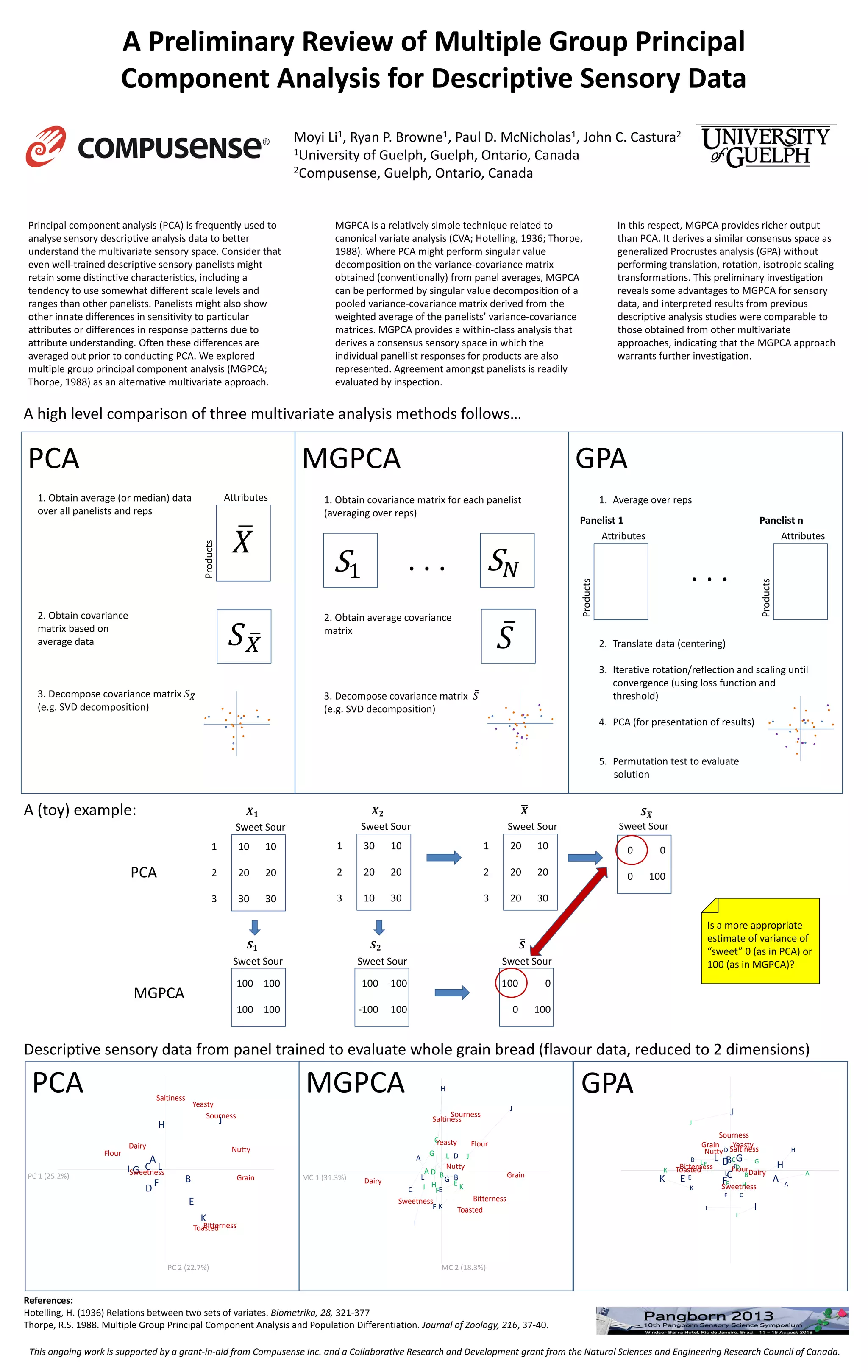
Principal component analysis (PCA) is frequently used to
analyse sensory descriptive analysis data to better
understand the multivariate sensory space. Consider that
even well-trained descriptive sensory panelists might
retain some distinctive characteristics, including a
tendency to use somewhat different scale levels and
ranges than other panelists. Panelists might also show
other innate differences in sensitivity to particular
attributes or differences in response patterns due to
attribute understanding. Often these differences are
averaged out prior to conducting PCA. We explored
multiple group principal component analysis (MGPCA;
Thorpe, 1988) as an alternative multivariate approach.
MGPCA is a relatively simple technique related to
canonical variate analysis (CVA; Hotelling, 1936; Thorpe,
1988). Where PCA might perform singular value
decomposition on the variance-covariance matrix
obtained (conventionally) from panel averages, MGPCA
can be performed by singular value decomposition of a
pooled variance-covariance matrix derived from the
weighted average of the panelists’ variance-covariance
matrices. MGPCA provides a within-class analysis that
derives a consensus sensory space in which the
individual panellist responses for products are also
represented. Agreement amongst panelists is readily
evaluated by inspection.
In this respect, MGPCA provides richer output
than PCA. It derives a similar consensus space as
generalized Procrustes analysis (GPA) without
performing translation, rotation, isotropic scaling
transformations. This preliminary investigation
reveals some advantages to MGPCA for sensory
data, and interpreted results from previous
descriptive analysis studies were comparable to
those obtained from other multivariate
approaches, indicating that the MGPCA approach
warrants further investigation.
GPA
A
B G
H
L
CE
D
F
J
K
ToastedBitterness
Grain
Nutty
Sourness
Saltiness
Yeasty
Flour
Sweetness
Dairy
I
B
A
B
G
H
L
C
E
F
D
J
K
I
A
G
H
L C
F
D
J
I
K
E
A (toy) example:
Descriptive sensory data from panel trained to evaluate whole grain bread (flavour data, reduced to 2 dimensions)
This ongoing work is supported by a grant-in-aid from Compusense Inc. and a Collaborative Research and Development grant from the Natural Sciences and Engineering Research Council of Canada.
A high level comparison of three multivariate analysis methods follows…

A Preliminary Review of Multiple Group Principal Component Analysis for Descriptive Sensory Data

  • 1.
    B 1. Obtain covariancematrix for each panelist (averaging over reps) 2. Obtain average covariance matrix 3. Decompose covariance matrix 𝑆 (e.g. SVD decomposition) A Preliminary Review of Multiple Group Principal Component Analysis for Descriptive Sensory Data Moyi Li1, Ryan P. Browne1, Paul D. McNicholas1, John C. Castura2 1University of Guelph, Guelph, Ontario, Canada 2Compusense, Guelph, Ontario, Canada MGPCA GPAPCA Attributes Products 1. Obtain average (or median) data over all panelists and reps 2. Obtain covariance matrix based on average data 3. Decompose covariance matrix 𝑆 𝑋 (e.g. SVD decomposition) 𝑆 𝑋 S1 S 𝑁. . . 𝑆 1. Average over reps 2. Translate data (centering) 3. Iterative rotation/reflection and scaling until convergence (using loss function and threshold) 4. PCA (for presentation of results) 5. Permutation test to evaluate solution Attributes Products Panelist 1 Attributes Products Panelist n . . . Sweet Sour 1 2 3 𝑿 𝟏 10 20 30 10 20 30 Sweet Sour 1 2 3 𝑿 𝟐 30 20 10 10 20 30 Sweet Sour 1 2 3 𝑿 20 20 20 10 20 30 PCA 𝑺 𝟏 100 100 100 100 MGPCA 𝑺 𝟐 100 -100 -100 100 𝑺 100 0 0 100 𝑺 𝑿 0 0 0 100 Sweet Sour Sweet SourSweet Sour Sweet Sour 𝑋 Is a more appropriate estimate of variance of “sweet” 0 (as in PCA) or 100 (as in MGPCA)? MGPCAPCA A B G H LC E FD J K ToastedBitterness Grain Nutty Sourness Saltiness Yeasty Flour Sweetness Dairy I A BG H L C E F D J K Toasted Bitterness Grain Nutty Sourness Saltiness Yeasty Flour Sweetness Dairy I A G H L C E F D J KI PC 1 (25.2%) PC 2 (22.7%) MC 2 (18.3%) MC 1 (31.3%) References: Hotelling, H. (1936) Relations between two sets of variates. Biometrika, 28, 321-377 Thorpe, R.S. 1988. Multiple Group Principal Component Analysis and Population Differentiation. Journal of Zoology, 216, 37-40. Principal component analysis (PCA) is frequently used to analyse sensory descriptive analysis data to better understand the multivariate sensory space. Consider that even well-trained descriptive sensory panelists might retain some distinctive characteristics, including a tendency to use somewhat different scale levels and ranges than other panelists. Panelists might also show other innate differences in sensitivity to particular attributes or differences in response patterns due to attribute understanding. Often these differences are averaged out prior to conducting PCA. We explored multiple group principal component analysis (MGPCA; Thorpe, 1988) as an alternative multivariate approach. MGPCA is a relatively simple technique related to canonical variate analysis (CVA; Hotelling, 1936; Thorpe, 1988). Where PCA might perform singular value decomposition on the variance-covariance matrix obtained (conventionally) from panel averages, MGPCA can be performed by singular value decomposition of a pooled variance-covariance matrix derived from the weighted average of the panelists’ variance-covariance matrices. MGPCA provides a within-class analysis that derives a consensus sensory space in which the individual panellist responses for products are also represented. Agreement amongst panelists is readily evaluated by inspection. In this respect, MGPCA provides richer output than PCA. It derives a similar consensus space as generalized Procrustes analysis (GPA) without performing translation, rotation, isotropic scaling transformations. This preliminary investigation reveals some advantages to MGPCA for sensory data, and interpreted results from previous descriptive analysis studies were comparable to those obtained from other multivariate approaches, indicating that the MGPCA approach warrants further investigation. GPA A B G H L CE D F J K ToastedBitterness Grain Nutty Sourness Saltiness Yeasty Flour Sweetness Dairy I B A B G H L C E F D J K I A G H L C F D J I K E A (toy) example: Descriptive sensory data from panel trained to evaluate whole grain bread (flavour data, reduced to 2 dimensions) This ongoing work is supported by a grant-in-aid from Compusense Inc. and a Collaborative Research and Development grant from the Natural Sciences and Engineering Research Council of Canada. A high level comparison of three multivariate analysis methods follows…