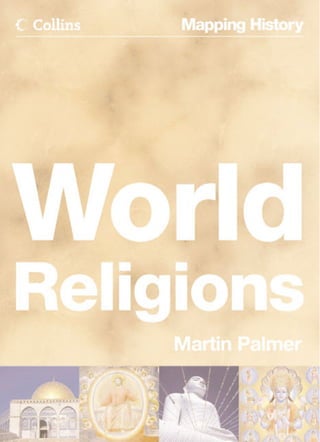
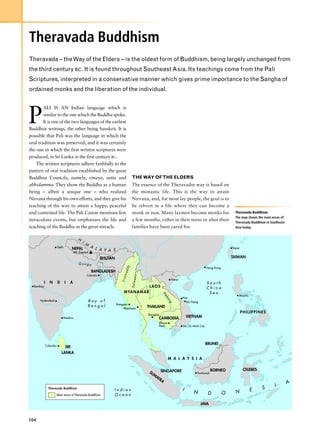
World
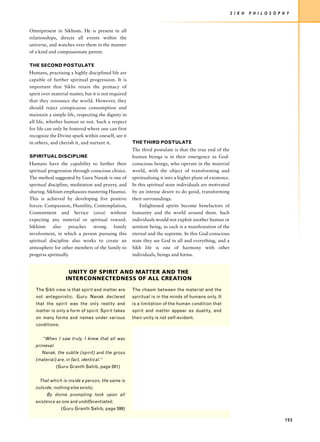
Religions
Paperback edition                                      General Editor
Published in 2004 by                                       Martin Palmer
TIMES BOOKS                                                Director of the International Consultancy
HarperCollins Publishers                                   on Religion, Education and Culture
77-85 Fulham Palace Road                                   (ICOREC)
London W6 8JB
                                                       Contributors
The Collins website address is                              See pages 4–5
www.collins.co.uk
                                                       Editorial and Design Team for Flame Tree
First published by Times Books 2002                         Jennifer Bishop, Michelle Clare, Vicky
                                                            Garrard, Dave Jones, Nicki Marshall,
Copyright © Flame Tree Publishing 2002, 2004,               Sonya Newland, Nick Wells, Polly Willis,
part of The Foundry Creative Media Company Ltd              Tom Worsley
Maps © Times Books Ltd 2002, 2004
                                                       Editorial and Design Team for HarperCollins
                                                            Philip Parker, Martin Brown


All rights reserved. No part of this publication may
be reproduced, stored in a retrieval system, or
transmitted in any form or by any means electronic,
mechanical, photocopying or otherwise, without the
prior written permission of the publishers and
copyright holder.

Printed and bound in Singapore

British Library Cataloguing in Publication Dad
A catalogue record for this book is available from
the British Library

ISBN 0 0071 9991 0
World
Religions
    Martin Palmer
C O N T R I B U T O R S


Contributors
MARTIN PALMER                                                              TARA LEWIS
General Editor; Roots of Religion; Taoism                                  Shamanism
Martin Palmer is the Director of the International Consultancy on          Having obtained a joint Honours degree in Comparative Religions
Religion, Education and Culture (ICOREC). ICOREC specialises in            and History of Art, and researched a thesis on ‘Shamans in the work
projects related to religious, environmental and development issues        of Siyah Qalam’, after travelling widely in Asia for her studies,Tara
and works with a variety of international organisations such asThe         Lewis went on to work for the Alliance of Religions and Conservation
World Wide Fund for Nature (WWF),The World Bank, UNESCO, and               (a UK-based charity). She established ARC Asia, organising and
the World Council of Churches. He was also instrumental in the             developing conservation projects with religious communities in
creation of the Alliance of Religions and Conservation first launched      Cambodia,Thailand, Indonesia, Mongolia and China. She is currently
in 1995 by HRH the Prince Philip of which he is now Secretary              editing Mongolian Sacred Legends of the Land.
General. In 1997 he founded the Sacred Land Project which works
world wide preserving sacred sites from Mongolia to Mexico.                JIMMY WEINER
   Martin is the author of many books including Travels through            Oceania; Australian Aboriginals
Sacred China, Sacred Britain, Christianity and Ecology, Sacred             Dr. James F. Weiner received his PhD from Australian National
Gardens and the forthcoming Jesus Sutras which is a translation of         University in 1984. He has held teaching and research positions in
the sacred texts of the Nestorian Christians, China’s first Christian      anthropology at Australian National University, University of
community dating from AD 635. He frequently appears on television          Manchester and University of Adelaide. He has worked for over
and radio, has presented a number of series on sacred topics and           three years in Papua New Guinea with the Foi people and has
also writes for a wide variety of publications.                            published two books on New Guinea mythology. Currently he is
   Martin studied theology at Cambridge, with a special emphasis           working as an independent consultant in native title for Aboriginal
on Chinese and Japanese studies. He founded the Centre for the             communities throughout Australia. He is also working on a book
Study of Religion and Education in inner city Manchester and has           about the Hindmarsh Island sacred site case in South Australia.
been a pioneer in the areas of interfaith environmental education.
                                                                           GRAHAM HARVEY
BRENDA RALPH-LEWIS                                                         The Maoris
The Ancient Near East; Zorastrianism                                       Graham Harvey is Reader in Religious Studies at King Alfred’s
Brenda Ralph Lewis is a freelance author specializing in history,          College, Winchester. He is particularly interested in Maori and
with particular reference to ancient civilizations. Her most recent        Ojibwe spirituality, but has also published books about
book (out of a total of more than 90), published in 2001, deals with       contemporary Paganism and ancient Judaism. His (edited)
the philosophy and practice of ritual sacrifice in both ancient and        Indigenous Religions: a Companion brings together excellent
modern religion. Mrs Lewis has also written over 25TV and video            writing about issues in indigenous religious and their study.
scripts on the history and culture of ancient civilisations. She is
married with one son and lives in Buckinghamshire.                         FREDA RAJOTTE
                                                                           Native North Americans
ROBERT MORKOT                                                              Rev Dr Freda Rajotte has always been dedicated to both justice
Ancient Egypt                                                              issues and to preserving the integrity of creation. As a Geography
Robert Morkot is an ancient historian specialising in North-East           professor she focused upon the related issues of economic
Africa. He studied at London University and the Humboldt-                  development and environmental conservation. She also gave
University, Berlin, and currently teaches at Exeter University. As         courses in Comparative Religion. Freda has numerous First Nation
well as many academic publications he is author of The Penguin             colleagues, relatives and friends. Always interested in encouraging
Historical Atlas of Ancient Greece (1996), The Black Pharaohs: Egypt’s     better understanding between people of different cultures and
Nubian Rulers (2000) and The Empires of Ancient Egypt (2001).              faiths, for seven years she was the director of the Canadian
                                                                           Coalition for Ecology, Ethics and Religion. During this time, thanks
MICHAEL KERRIGAN                                                           to the contributions and assistance of many First Nation leaders,
Greece and Rome                                                            she compiled and published First Nations Faith and Ecology.
An Edinburgh-based freelance writer specializing in the civilizations of   Freda is married and has six children.
ancient times, Michael Kerrigan has written on almost every aspect
of archaeology, ancient history and culture, covering subjects from        KEVIN WARD
the origins of agriculture to the icons of Byzantium, from the rise of     African Traditional Religions
the Greek city-state to the fall of Rome. A regular contributor to such    Dr Kevin Ward teaches African Religious Studies in the Department
journals as the Times Literary Supplement and the Scotsman, his recent     ofTheology and Religious Studies at the University of Leeds. He
books include Ancient Greece and the Mediterranean (2001), Ancient         worked for over 20 years in East Africa, as a teacher in Kenya and
Rome and the Roman Empire (2001) andThe Instruments ofTorture (2001).      as a lecturer at a seminary in Uganda. He is ordained in the Church
                                                                           of Uganda.
NIGEL CAMPBELL PENNICK
Northern Europe                                                            MICHAEL SHACKLETON
Nigel Pennick was born in Surrey in 1946.Trained in biology, he            Shinto
published descriptions of eight new species of marine algae before         Michael Shackleton studied at Cambridge University, and also
moving on to become a writer and illustrator. He is author of over 40      at the University of Manchester from which he received a post-
books on European spiritual traditions, arts and landscapes.               graduate diploma in Social Anthropology. At present he is
                                                                           Associate Professor of Social Anthropology at Osaka Gakuin
SUSANNA ROSTAS                                                             University in Japan with a special interest in Japanese Religion (in
Central and South America                                                  particular New Religions and traditional mountain cults, or
Susanna Rostas has a D.Phil in Social Anthropology and has                 ‘shugendo’). He undertakes research, which has recently taken him
taught at both Goldsmiths’ College and Durham University. She is           to Southern Ethiopia and Southern Sudan. Michael is also involved
currently a Research Associate in the Department of Social                 in working with Martin Palmer (General Editor) on the Alliance of
Anthropology in Cambridge. Her publications include The Popular            Religions and Conservation (ARC) scheme. He currently lives in
Use of Popular Religion in Latin America with Andre Droogers.              Japan with his wife and two children.

4
C O N T R I B U T O R S


JIM PYM                                                                  serving as a special advisor to Jathedar Manjit Singh, one of the
Buddhism                                                                 spiritual heads of the worldwide Sikh community, he has also
Jim Pym has been a Buddhist for over 40 years. He is the author of You   served as a board member for the North American Interfaith
Don’t Have to Sit on the Floor; a book on practical Buddhism inWestern   Network. Dr Singh founded the Sikh Council on Religion and
culture (Rider Books 2001), editor of Pure Land Notes, a Buddhist        Education (SCORE) in 1998, based in Washington DC, of which he
journal, and a member of the Council of the Buddhist Society, London.    is currently the chairman. Acting on behalf of SCORE, he has been
                                                                         invited to speak at the White House, the US Congress, the Vatican
ALAN BROWN                                                               and by various non-governmental organizations to present the Sikh
Christianity                                                             perspective.
Alan Brown is director of the National Society’s Kensington R. E.
Centre and R. E. (Schools) Officer of the General Synod Board of         MARK TULLY
Education. He has written a great many books about the Christian         East Meets West; Multi-faith Societies
faith and world religions, as well as numerous articles, reviews and     MarkTully was born in Calcutta, India, and was educated at
booklets. He is also tutor and examiner forThe Open University           Cambridge University where he did a Masters in History and
course, ‘The Religious Quest’.                                           Theology. He worked as a correspondent for the BBC for 30 years,
                                                                         and for 22 years of that time was the Delhi correspondent. Since
JOHN CHINNERY                                                            1994, Mark has been a freelance broadcaster and writer. His most
Confucianism                                                             recent publications include Amritsar – Mrs Gandhi’s Last Battle
Dr John Chinnery formerly headed the Department of East Asian            (1985), Raj to Rajiv (1985), No Full Stops In India (1988), The Heart
Studies at the University of Edinburgh. He is a frequent visitor to      of India (1995) and Lives of Jesus (1996). In 1992 he was awarded
China and has written on a wide range of Chinese subjects, from          the Padma Shri by the Government of India, and in 2002 received
philosophy to the theatre. He is currently Honorary President of the     the KBE.
Scotland China Association.
                                                                         ELIZABETH PUTTICK
RAMESHCHANDRA MAJITHIA                                                   New Religious Movements; Women and Religion
Hinduism                                                                 Dr Elizabeth Puttick is a sociologist of religion, specializing in
Rameshchandra Majithia was born inTanzania. He graduated with a          women’s spirituality and new religions (including New Age,
BSc in Engineering from the University of London and followed a          shamanism and paganism). Her publications include Women in
career as a teacher of mathematics and graphic communication at          New Religions (Macmillan/St Martin’s Press). She teaches
secondary level. He was responsible for informing organised              religious studies at the British American College, London, and also
groups to Shree Sanatan Mandir, the first Hindu temple to be             works as a literary agent and publishing consultant.
established, about Hinduism; he is also editor of the bimonthly
magazine published by the temple. He gave Hinduism input to              RACHEL STORM
Religious Education students in teacher training, and has co-            Rastafari; Scientific Religions; Glossary
ordinated Hindu religious education for children aged five to 16 for     Rachel Storm has studied and written about mythology and religion
the last seven years at his local temple in Leicester.                   since the 1980s. She is the author of three books in the area and has
                                                                         contributed to a number of encyclopedias, as well as to national
AMAR HEGEDÜS                                                             and international magazines and newspapers.
Islam
Writer, reviewer, broadcaster and lecturer on Islamic subjects,          SUSAN GREENWOOD
Amar Hegedüs established the Islam in English Press (IEP) to             Contemporary Paganism
provide ready access, in comprehensible style and language, to this      Susan Greenwood is lecturer is the School of Cultural and
frequently misrepresented subject. He networks with other faiths in      Community Studies at the University of Sussex, an Open
common initiatives to create better understanding between peoples,       University Associate Lecturer and Visiting Fellow at Goldsmiths
and provides spiritual and pastoral care to the community. He is         College, University of London. She gained her doctorate from
Chaplaincy Imam to the South London and Maudsley NHSTrust.               research on Paganism, and her recent publications include Magic,
                                                                         Witchcraft and the Otherworld: an anthropology (2000).
DR SHAH
Jainism                                                                  PAUL VALLELY
Professor Natubhai Shah teaches Jainism at the FVG Antwerp,              The Culture of the West; Conflicts of Ideology
Selly Oak Colleges University of Birmingham and occasionally at          Paul Vallely writes on religion for The Independent newspaper, of
the SOAS London University. He represents Jainism at the highest         which he is associate editor. He is chair of the Catholic Institute for
level and was responsible for the creation of the beautiful Jain         International Relations and is the editor of The New Politics:
temple in Leicester, and for establishing Jain Academy and Jain          Catholic Social Teaching for the 21st century (1999) and is the author
Studies courses in the UK and Mumbai University. He was awarded          of Bad Samaritans: First World Ethics and Third World Debt (1990) and
Jain Ratna by the Prime Minister of India in 2001. He is the author of   various other books.
Jainism: The World of Conquerors (1998).

RACHEL MONTAGU
Judaism
Rabbi Rachel Montagu is Assistant Education Officer for the
Council of Christians and Jews and teaches Judaism and Biblical
Hebrew at Birkbeck College and Allen Hall. She read Classics at
Newnham College, Cambridge and studied Judaism at Leo Baeck
College, London and Machon Pardes, Jerusalem. She is married
and has two sons.

RAJWANT SINGH
Sikhism
Dr Rajwant Singh was born in Calcutta, India, and emigrated to the
United States. In 1984 he helped initiate the Sikh Association of
America, and he is a founding member of the Guru Gobind Singh
Foundation, a Sikh congregation based in Maryland. As well as

                                                                                                                                                 5
C O N T E N T S


Contents
Introduction . . . . . . . . . . . . . . . . . . . . . . . . . . . . . . . . .8             OCEANIA
                                                                                            Death, Ghosts and the Soul . . . . . . . . . . . . . . . . . . . . . .60
THE ROOTS OF RELIGION . . . . . . . .12                                                     The Mythic Chieftainship . . . . . . . . . . . . . . . . . . . . . . . .62
Religion Before History . . . . . . . . . . . . . . . . . . . . . . . . . .12               Millenarian Movements . . . . . . . . . . . . . . . . . . . . . . . . . .64

The Nature of Religion . . . . . . . . . . . . . . . . . . . . . . . . . . .14
A Religious World-view . . . . . . . . . . . . . . . . . . . . . . . . . .16                AUSTRALIAN ABORIGINALS
                                                                                            The Dreaming . . . . . . . . . . . . . . . . . . . . . . . . . . . . . . . . . . .66
                                                                                            Initiation . . . . . . . . . . . . . . . . . . . . . . . . . . . . . . . . . . . . . . .68
ANCIENT RELIGIONS . . . . . . . . . . . . . .18
THE ANCIENT NEAR EAST
                                                                                            THE MAORIS
The Sumerians . . . . . . . . . . . . . . . . . . . . . . . . . . . . . . . . . .18
                                                                                            Maori Religion . . . . . . . . . . . . . . . . . . . . . . . . . . . . . . . . . .70
The Babylonians . . . . . . . . . . . . . . . . . . . . . . . . . . . . . . . .20
                                                                                            MaoriTraditional Knowledge . . . . . . . . . . . . . . . . . . . . .72
The Assyrians . . . . . . . . . . . . . . . . . . . . . . . . . . . . . . . . . .22
The Canaanites . . . . . . . . . . . . . . . . . . . . . . . . . . . . . . . . .24
                                                                                            NATIVE NORTH AMERICANS
                                                                                            North American First Nations . . . . . . . . . . . . . . . . . . . .74
ANCIENT EGYPT                                                                               Spirituality . . . . . . . . . . . . . . . . . . . . . . . . . . . . . . . . . . . . .76
The Kingdoms of Egypt . . . . . . . . . . . . . . . . . . . . . . . . . .26                 Ceremonies and Rituals . . . . . . . . . . . . . . . . . . . . . . . . .78
The Egyptian Pantheon . . . . . . . . . . . . . . . . . . . . . . . . . .28
Temples and Worship . . . . . . . . . . . . . . . . . . . . . . . . . . . .30               CENTRAL AND SOUTH AMERICA
                                                                                            The Amazonians . . . . . . . . . . . . . . . . . . . . . . . . . . . . . . . .80
GREECE AND ROME                                                                             The Huichol . . . . . . . . . . . . . . . . . . . . . . . . . . . . . . . . . . . . .82
Classical Origins . . . . . . . . . . . . . . . . . . . . . . . . . . . . . . . .32         Highland MayaToday . . . . . . . . . . . . . . . . . . . . . . . . . . . .84
Homeric Gods and Heroes . . . . . . . . . . . . . . . . . . . . . . .34
Civilization and Religion . . . . . . . . . . . . . . . . . . . . . . . . .36               AFRICAN TRADITIONAL RELIGION
The Gods in Imperial Rome . . . . . . . . . . . . . . . . . . . . . .38                     Religion in Africa . . . . . . . . . . . . . . . . . . . . . . . . . . . . . . . .86
Religion and Philosophy . . . . . . . . . . . . . . . . . . . . . . . . .40                 African Cosmologies, Gods and Ancestors . . . . . . .88

Religions Under Rome . . . . . . . . . . . . . . . . . . . . . . . . . . .42                The Celebration of Life and Cults of Affliction . . . . . .90
                                                                                            African Religion, Politics and
                                                                                                The Challenge of Modernity . . . . . . . . . . . . . . . . . . .92
NORTHERN EUROPE
Religion of the Landscape . . . . . . . . . . . . . . . . . . . . . . . .44
                                                                                            SHINTO
Celtic Religion . . . . . . . . . . . . . . . . . . . . . . . . . . . . . . . . . .46
                                                                                            The History of Shinto . . . . . . . . . . . . . . . . . . . . . . . . . . . .94
Germanic Religion . . . . . . . . . . . . . . . . . . . . . . . . . . . . . .48
                                                                                            Shinto Shrines (jinja) . . . . . . . . . . . . . . . . . . . . . . . . . . . .96
Slavic and Baltic Peoples . . . . . . . . . . . . . . . . . . . . . . . .50
                                                                                            ShintoToday . . . . . . . . . . . . . . . . . . . . . . . . . . . . . . . . . . . .98

CENTRAL AND SOUTH AMERICA
                                                                                            WORLD RELIGIONS . . . . . . . . . . . . . . .100
The Maya . . . . . . . . . . . . . . . . . . . . . . . . . . . . . . . . . . . . . . .52    BUDDHISM
The Aztecs . . . . . . . . . . . . . . . . . . . . . . . . . . . . . . . . . . . . .54      The Buddha . . . . . . . . . . . . . . . . . . . . . . . . . . . . . . . . . . . .100
The Incas . . . . . . . . . . . . . . . . . . . . . . . . . . . . . . . . . . . . . . .56   Early Buddhism . . . . . . . . . . . . . . . . . . . . . . . . . . . . . . . .102
                                                                                            Theravada Buddhism . . . . . . . . . . . . . . . . . . . . . . . . . . .104
INDIGENOUS RELIGIONS . . . . . . . . .58                                                    Mahayana Buddhism . . . . . . . . . . . . . . . . . . . . . . . . . . .106
SHAMANISM                                                                                   Zen Buddhism . . . . . . . . . . . . . . . . . . . . . . . . . . . . . . . . .108
Shamanism . . . . . . . . . . . . . . . . . . . . . . . . . . . . . . . . . . . . .58       Living Buddhism . . . . . . . . . . . . . . . . . . . . . . . . . . . . . . .110

6
C O N T E N T S


CHRISTIANITY                                                                                 Jewish Festivals . . . . . . . . . . . . . . . . . . . . . . . . . . . . . . .178
The Life andTeaching of Jesus . . . . . . . . . . . . . . . . . .112                         Jewish Movements . . . . . . . . . . . . . . . . . . . . . . . . . . . . .180
The Early Church . . . . . . . . . . . . . . . . . . . . . . . . . . . . . . .114            Judaism in Practice . . . . . . . . . . . . . . . . . . . . . . . . . . . .182
The Christian Bible . . . . . . . . . . . . . . . . . . . . . . . . . . . . .116             Jewish Worship . . . . . . . . . . . . . . . . . . . . . . . . . . . . . . . .184
Central Beliefs . . . . . . . . . . . . . . . . . . . . . . . . . . . . . . . . .118         Anti-Judaism . . . . . . . . . . . . . . . . . . . . . . . . . . . . . . . . . .186
Rites and Practices . . . . . . . . . . . . . . . . . . . . . . . . . . . .120
Festival and Celebration . . . . . . . . . . . . . . . . . . . . . . . .122                  SIKHISM
The Catholic Church Worldwide . . . . . . . . . . . . . . . . .124
                                                                                             Origins and Practice . . . . . . . . . . . . . . . . . . . . . . . . . . . .188
The Orthodox Churches . . . . . . . . . . . . . . . . . . . . . . . .126
                                                                                             Guru Nanak’sTeachings . . . . . . . . . . . . . . . . . . . . . . . .190
The Anglican Communion . . . . . . . . . . . . . . . . . . . . . .128
                                                                                             Sikh Philosophy . . . . . . . . . . . . . . . . . . . . . . . . . . . . . . . .192
Luther, Calvin and the Reformation . . . . . . . . . . . . . .130
                                                                                             SikhismToday . . . . . . . . . . . . . . . . . . . . . . . . . . . . . . . . . .194
The Protestant Churches . . . . . . . . . . . . . . . . . . . . . . .132
The Pentecostal Movement . . . . . . . . . . . . . . . . . . . . .134
                                                                                             TAOISM
The Diversity of Christianity . . . . . . . . . . . . . . . . . . . .136
                                                                                             Origins . . . . . . . . . . . . . . . . . . . . . . . . . . . . . . . . . . . . . . . .196
                                                                                             Taoist Beliefs and Practices . . . . . . . . . . . . . . . . . . . .198
CONFUCIANISM
The Life andTeachings of Confucius . . . . . . . . . . . . .138                              Lao Zi and Zhuang Zi . . . . . . . . . . . . . . . . . . . . . . . . . . .200

After Confucius . . . . . . . . . . . . . . . . . . . . . . . . . . . . . . .142             Taoism Beyond China . . . . . . . . . . . . . . . . . . . . . . . . . . .202


HINDUISM                                                                                     ZOROASTRIANISM
Foundations of Hinduism . . . . . . . . . . . . . . . . . . . . . . .144                     Zoroastrianism . . . . . . . . . . . . . . . . . . . . . . . . . . . . . . . .204
Major Beliefs and Concepts
    of Hinduism . . . . . . . . . . . . . . . . . . . . . . . . . . . . . . . . .146         NEW RELIGIONS . . . . . . . . . . . . . . . . . . .206
Hindu Gods and Goddesses . . . . . . . . . . . . . . . . . . . . .148                        East Meets West . . . . . . . . . . . . . . . . . . . . . . . . . . . . . . .206
Hindu Life . . . . . . . . . . . . . . . . . . . . . . . . . . . . . . . . . . . . .150      New Religious Movements . . . . . . . . . . . . . . . . . . . . . .208
Hindu Places of Worship (mandir) . . . . . . . . . . . . . . .152                            Baha’i . . . . . . . . . . . . . . . . . . . . . . . . . . . . . . . . . . . . . . . . .210
Hindu Festivals . . . . . . . . . . . . . . . . . . . . . . . . . . . . . . . .154           Rastafarianism . . . . . . . . . . . . . . . . . . . . . . . . . . . . . . . .212
                                                                                             Contemporary Paganism . . . . . . . . . . . . . . . . . . . . . . .214
ISLAM
                                                                                             The Culture of the West . . . . . . . . . . . . . . . . . . . . . . . . .216
Allah’s Guidance . . . . . . . . . . . . . . . . . . . . . . . . . . . . . . .156
The Early Years of the Prophet Muhammad . . . . . . .158
                                                                                             RELIGION IN THE MODERN
Revelation in Makkah . . . . . . . . . . . . . . . . . . . . . . . . . . .160
                                                                                              WORLD . . . . . . . . . . . . . . . . . . . . . . . . . . . . .218
Revelation in Madinah . . . . . . . . . . . . . . . . . . . . . . . . . .162
                                                                                             Conflict of Ideologies . . . . . . . . . . . . . . . . . . . . . . . . . . .218
The Book of Allah . . . . . . . . . . . . . . . . . . . . . . . . . . . . . .164
                                                                                             Multi-faith Societies . . . . . . . . . . . . . . . . . . . . . . . . . . .220
The Prophet’s Example . . . . . . . . . . . . . . . . . . . . . . . . .166
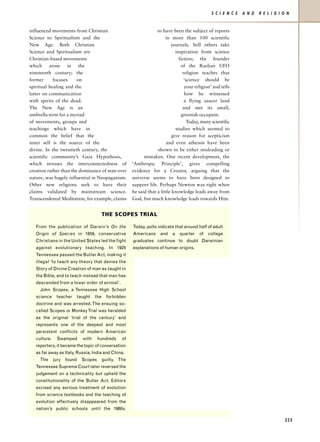
                                                                                             Science and Religion . . . . . . . . . . . . . . . . . . . . . . . . . . .222
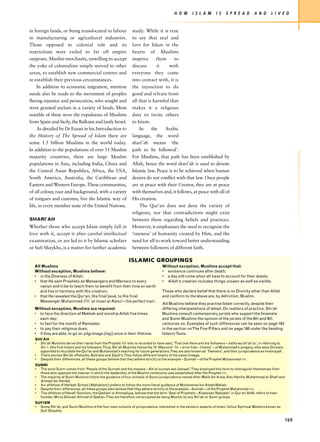
How Islam is Spread and Lived . . . . . . . . . . . . . . . . . .168
                                                                                             Women and Religion . . . . . . . . . . . . . . . . . . . . . . . . . . .224

JAINISM
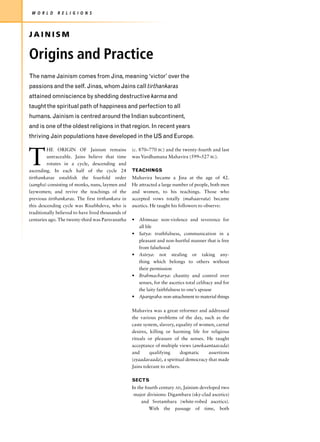
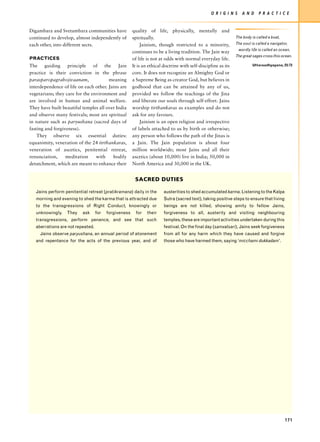
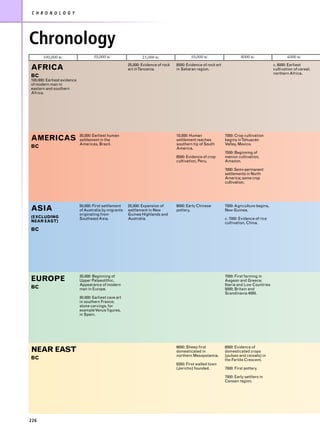
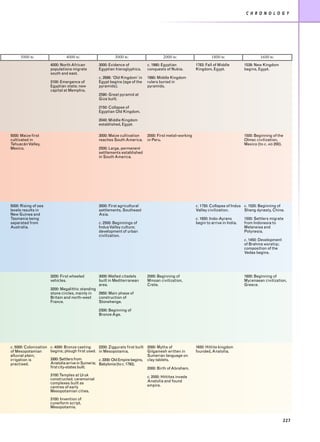
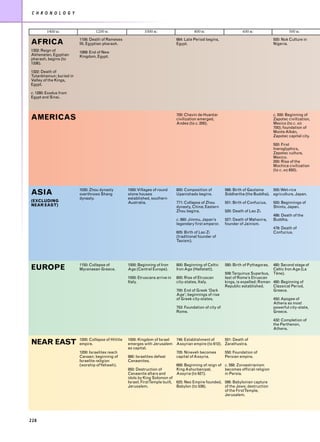
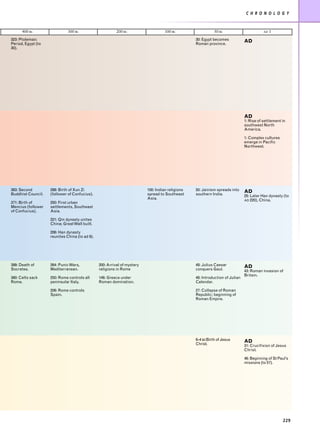
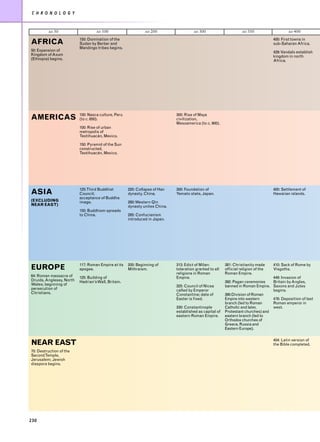
Origins and Practice . . . . . . . . . . . . . . . . . . . . . . . . . . .170                Chronology . . . . . . . . . . . . . . . . . . . . . . . . . . . . . . . . . . . .226

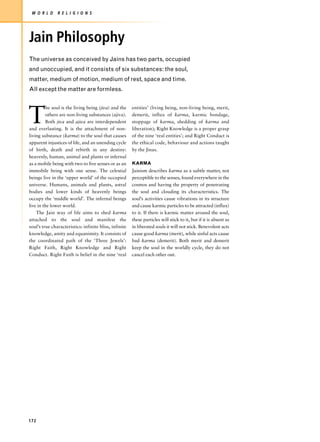
Jain Philosophy . . . . . . . . . . . . . . . . . . . . . . . . . . . . . . . .172           Glossary . . . . . . . . . . . . . . . . . . . . . . . . . . . . . . . . . . . . . . .236
                                                                                             Bibliography . . . . . . . . . . . . . . . . . . . . . . . . . . . . . . . . . . .242
JUDAISM                                                                                      Names Index . . . . . . . . . . . . . . . . . . . . . . . . . . . . . . . . . . .248
Origins . . . . . . . . . . . . . . . . . . . . . . . . . . . . . . . . . . . . . . . .174   Subject Index . . . . . . . . . . . . . . . . . . . . . . . . . . . . . . . . . .251
SacredTexts . . . . . . . . . . . . . . . . . . . . . . . . . . . . . . . . . . .176         Picture Credits/Acknowledgements . . . . . . . . . . . . .256

                                                                                                                                                                                           7
I N T R O D U C T I O N


Introduction
Since the earliest days of humanity, religion has played a part in both
structuring life and explaining life.Through ritual, myths and legends, dance,
art, buildings, beliefs, teachings and daily practices, faith has guided, inspired
and shaped the way people have lived. As with all things human, even those
perhaps touched by the divine, this has led to great acts of generosity and great
acts of arrogance; it has brought peace and has created wars; it has held those
who are suffering wiping away their tears and it has been the very cause of tears.
Religion, like any human endeavour, brings out the best and the worst in people.
However, for most people, throughout history and today, religion has made the
mundane sacred; given meaning to what could otherwise be experienced
as a meaningless world and has taught that small acts of kindness and
thoughtfulness are the true fruits of religion.


I
    n this Encyclopedia, we explore what this      travels from the great ancient faiths of antiquity
    means and has meant. Our notion, and to        such as Egypt or Greece to the most modern of
    some degree definition, of what is religion    faiths – such as the Baha’is or some of the new
ranges from the vast arrays of indigenous          pagan movements. Together and over time these
religions still to be found today to the great     ideas, thoughts, beliefs and practices, have, for
missionary faiths such as Buddhism and Islam. It   better or worse, made the world we live in today.
I N T R O D U C T I O N


Where it has been possible, we have asked that
members of the living faiths of our
contemporary world be our guides. For
ultimately, faith is personal and thus to
understand its significance we need to do more
than just stand outside and examine its shape
and form. We also need to know something of
what it feels like to live within a worldview such
as, for example, Hinduism or African
Traditional religion. Buildings and rituals are
important but more important is the reason why
they exist. To understand this we need to
hear the voice of faith as well as see its
outward manifestations.
     Such a voice comes from allowing the faith
itself to determine that which is important and
significant, and this is something we asked the
contributors to do, albeit in dialogue with those
of us with overall responsibility for this book.
What can appear to outsiders as the most
important aspect of a faith can upon closer
examination be of less significance to the
believer. For example, most outsiders view
Christmas as the most important Christian
festival. While it is very important and through
the stories, activities, symbols and celebrations
one can indeed gain a good idea of Christianity,
it is not the most important festival. That falls to


                                                       Easter and without understanding why Easter is
                                                       the more significant, an understanding of
                                                       Christianity would be incomplete, indeed
                                                       rather lopsided.
                                                           The decision was taken early on in the
                                                       construction of this Encyclopedia to include
                                                       faiths which have died. Religion is always
                                                       changing and although the great faiths of today
                                                       may seem unaltered through time, in fact they
                                                       are constantly adapting. The faiths of the world
                                                       are the oldest surviving human institutions in the
                                                       world. As such they have learnt a thing or two
                                                       about continuity. But some faiths have not
                                                       survived. They have become part of the rich
                                                       tapestry of our world but only as now fading
                                                       colours in the background. Yet without an
                                                       understanding of the shifting ideas, which are
                                                       manifested in the changes, for example, the
                                                       insignificant role of humanity in Egyptian
                                                       religion to the nuanced role of humanity in for
                                                       example Middle Eastern religions of ancient

                                                                                                                                  9
I N T R O D U C T I O N


                                                       years, has re-emerged as a major player on the
                                                       world scene. This is for good, bad and indifferent
                                                       reasons. The good is the increasing role of
                                                       religions in social and environmental issues.
                                                       Where once science and the state were seen as
                                                       having taken over the traditional role of faiths as
                                                       guides through social and ecological upheavals,
                                                       now increasingly, religion is being included as a
                                                       partner once again. In part this is due to the
                                                       collapse of ideologies such as Marxism and state
                                                       control. In part it is because in the end people
                                                       relate better to locally led initiatives rather than
                                                       governmental and especially inter-governmental
                                                       initiatives. The faiths have the best network for
                                                       reaching virtually all-local communities, in the
                                                       world. They are now beginning to offer this in
                                                       partnership with humanitarian movements and
                                                       environmental and social concerns.
                                                           The bad is the rise of extremism within so
                                                       many faiths. Labelled as ‘fundamentalism’ – a
                                                       phrase which is usually insulting to all major
                                                       faiths – extremism is religion with its back to the
                                                       wall and fighting back. It arises from the sense of
                                                       helplessness, which so many who lie outside the
                                                       sphere of the benefits of modern technology and
                                                       economics feel. It is often a cry of pain and
                                                       frustration from the most powerless and as such
                                                       demands serious attention from the world. Sadly,
                                                       however, it is often then forced or chooses to
                                                       take the path of violence in order to be heard.
                                                       The rise of extremism in the world’s faiths –
                                                       there is no major faith without such a movement


Mesopotamia, our current notion of what
it means to be human cannot adequately
be understood.
    The need for an Encyclopedia, which thus
opens up the worlds of faiths, has perhaps never
been so urgent. It was conventional wisdom in
the twentieth century to assume that religion was
dying. Science, modern secular political
movements and the growth of pluralism were
seen as the potential death knells of religion. This
was especially so for writers – who were the
majority writers on religion – from the West
where in many European countries, overt
practice of traditional religion was in decline.
    The reality in the twenty-first century is that
religion, having suffered the most extensive
period of persecution in history in the last 100

10
I N T R O D U C T I O N


– is a challenge to the rest of the world to listen   wonderful poetry and literature the world has
carefully to the root concerns and to offer help      ever seen. Through its rituals and liturgies,
before the movement feels completely isolated         prayers and actions it brings hope to many and
and literally at war with the rest of the world.      offers vehicles for living, which aid billions in
    The indifferent is the increasing recognition     making sense of a difficult world.
that, far from fading, religion is transmogrifying    Its understandings of what it means to be
in many cultures. Pluralism has led many whose        human and its recognition that the
grandparents were of one faith to embrace either      world is more than just that which
another faith or to include into their religious      can be observed, noted and
worldview, elements of different faiths. This         catalogued     means      that   its
pluralism has weakened some traditional faiths,       approach is truly encyclopaedic.
but it may be that from such an interaction, new      What, therefore, could be more
religions are beginning to emerge as well as new      appropriate than an encyclopedia
expressions of the older faiths.                      of world religions.
    Finally, religion embodies the wisdom and
experience of humanity through countless              Martin Palmer
generations. It contains some of the most             2002

                                                                                                                               11
T H E   R O O T S    O F   R E L I G I O N


The Roots of Religion
Religion Before History
Our knowledge of prehistoric religion is, of necessity, scant and uncertain.
Our only evidence is archaeological, and the range of interpretations
possible from any one artefact or site is enormous. For many years there was
a tendency to interpret virtually any prehistoric object as religious – no matter
what its nature – and for evidence to be twisted and bent to fit the pet theories
of the researcher, commonly extrapolated back from anthropological theories
which are often now discredited themselves. In the final analysis, our best
theories are only speculation.


T
          HE FAMOUS CHAUVET cave                     hunted, or even direct worship of the animals
          paintings, over 30,000 years old,          themselves. Possibly, though, their purpose is
          discovered in France in 1994, depict in    simply artistic; perhaps the men and women
vivid and splendid detail animals which now          who painted these wonderful paintings did so
long extinct, are perhaps our earliest evidence of   purely in order to celebrate and delight in beauty
religious activity. Undisturbed patterns in the      and their own ability to create. We simply do
dirt of the floor seem to show signs of dancing;     not, and cannot, know.
there is a bear skull on a stone block which
might be a shrine; and a strange figure at the       PALEOLITHIC VENUS
back of the cave seems, possibly, to combine         Perhaps the most striking prehistoric artefacts
aspects of beast and man.                            are the so-called ‘Venuses’: carved female stone
    The depiction of the animals may represent a     figures with prominent and exaggerated breasts
symbolic invocation of the animal spirits to fill    and genitalia, sometimes headless, which
the hunters with power, or an attempt to             appear all over Europe from 40,000 to 25,000
increase the numbers of the animals to be            BC. Again, it is hard to know what
R E L I G I O N    B E F O R E   H I S T O R Y


interpretation to place upon these figures. Do     their worship of a single ‘Goddess’ became an
they represent the exultation or the degradation   orthodoxy of the study of prehistoric religion
of the female form? Were they intended to          until the 1970s, and virtually any figure, dot,
celebrate or perhaps increase female fertility?    spiral or curve was interpreted as representing
Or were they simply pornographic? After all,       the Goddess. Although now discredited
drawing     naughty      pictures    has   been    academically, it is still a common belief in both
commonplace in virtually all cultures.             feminist and neo-pagan circles. The hard truth
                                                   of it is that there is absolutely no evidence of a
WAS THERE A GODDESS?                               universal prehistoric ‘Goddess’, it is a projection
These figures are a keystone of a powerful         back of our own need for a figure to counteract
modern myth – the ‘Cult of the Great Goddess’.     the masculine God of the Judeo-Christian
First proposed in the nineteenth century, the      tradition, and highlights the problems of how to
belief that prehistoric societies were united in   interpret a silent religious prehistory.


                                      THE GREAT SITES

   There are spectacular prehistoric sites,        conjunctions and alignments there are may
   such as the long barrows and stone circles      be for purely dramatic or architectural
   of England, or the mound cultures of North      purposes; after all, the windows of many
   and South America, which may have had a         cathedrals are aligned to light up the altar in
   strongly religious purpose. In the case of      sunlight, but nobody would claim this was
   the long barrows, dating from around            their primary purpose. Many of the stone
   4000–3000   BC ,   they may have been part of   circles are near areas that show signs of
   a tradition of ancestor-worship; skulls         trade and industry; perhaps they were
   seem to have been regularly moved in and        boundaries within which making a deal was
   out of them, probably for some ritual           sacred. Again, we simply cannot tell.
   purpose. Perhaps the spirits of the               Really, all we can be sure of is that some
   ancestors watched over the tribe, or joined     form of religious activity, some form of
   them at festivals.                              veneration and worship, was taking place.
     As for the stone circles – easily the most    The dead were certainly buried with some
   impressive and awesome prehistoric sites in     respect for their future fate; perhaps this is
   Europe – their purpose remains essentially      the most telling sign of religion.The nature of
   unknown. Certainly at the larger sites, such    religious activity, towards whom or what it
   as Stonehenge, they probably had a              was directed, the cosmology into which it
   ceremonial or dramatic function. They have      fitted, and the nature of the ceremonies
   often been associated with astrology, but the   involved all remain hidden behind a veil that
   evidence for this is scant, and what            will never be lifted.

                                                                                                                                   13
T H E   R O O T S    O F   R E L I G I O N


The Nature of Religion
Religion, for billions of people, is a vital way of making sense of their life, and of giving purpose
and meaning to existence.Through ethical and metaphysical theology, and through ceremony and
liturgy, religion imbues people with a powerful sense of meaning. Many attempts have been made
to define religion, most of which fail before its vast diversity, but one factor that links almost all
religions is their belief in a reality beyond the material world, that there is something greater than
just the here and now.


T
          HERE IS A strong argument about the          the last century has been towards the
          etymology of the word ‘religion’ itself,     second approach; religion is increasingly
          which reflects two rather different          seen as a matter of personal conscience, not
views of the purpose of religion. It may be            public commitment.
derived from the Latin religare, ‘to bind’,
suggesting that the first concern of religion is to    ATTITUDES TOWARDS RELIGION
bind humanity and the divine together, and to          Religion has often been attacked as essentially
bind us together in community; to those                an oppressive, even tyrannical force. It has been
opposed to religion, this binding can seem like        linked to racism, war, dictatorship, sexism and
an imprisonment. On the other hand, it may be
derived from relegare, ‘to tread carefully’,
reflecting a respect and care for both the natural
and supernatural worlds, which for many is the
primary concern of religion – to provide us with
guidance as to how to live.
    Indeed, religion provides us with a purpose
greater and more profound than simple survival,
forging a bridge between the world of human
experience and the supposed greater realm of the
divine. For some religious people, this means
forsaking the temporal pleasures of this world in
search of a transcendent meta-reality, through
fasting, celibacy and so forth. For others, it leads
to a desire to improve this world, to bring the
material closer to the divine and to honour the
presence of God in everything.

A PERSONAL OR PUBLIC APPROACH?
There has always been something of a tension
in religion between the community and the
individual. Structured communities, from the
Catholic Church to the Hindu caste system,
have always been a part of religion, as have
communities bound by less formal ties, and
many people find that the experience of
worshipping as a community – and the support
that a community can provide – powerful and
profound. Others find religious communities
stifling, sometimes even oppressive, and
approach the divine in a more individual way.
Generally speaking, the shift in the West over

14
T H E   R O O T S   O F   R E L I G I O N


slavery, and every religion has its fair share of
guilt here, from the cruelty of the Inquisition to
the slave-keeping Buddhist monks of China.
Karl Marx (1818–83) famously wrote that
‘religion is the opium of the people’ and many
have seen religion as essentially soporific,
designed to keep the oppressed and
downtrodden quiet before their masters.
    However, Marx also wrote that religion was
the ‘heart of a heartless world, the soul of
soulless conditions’. As much as religion has
been used to justify human horrors, it is also
often a profoundly redemptive and powerful
force, providing hope and liberation for billions
of people. In the end, the success of religion lies,
perhaps, in its providing powerful explanations,
or legitimising the asking of questions about, the
issues of existence, the cosmos and good and
evil. It may not settle all questions, but it gives
many people a way of coping with the problems
of their lives, and a means to explore even deeper
questions about the universe.


          THE ULTIMATE POWER

   Broadly speaking, almost all religions
   claim to worship or venerate one ultimate
   power – God, Buddha, Tao – the names
   change. For some faiths, especially Islam
   and Judaism, the being of God is so
   unknowable that it is forbidden even to try
   to depict ‘God’. In other faiths, such as
   Hinduism and Taoism, this power is
   depicted in many different ways and is
   accompanied by a wide range of gods and
   goddesses. In faiths such as Christianity
   and Islam, there is a strong emphasis on
   the    relationship    between      God     and
   humanity, with humanity’s proper role
   being seen generally as submission and
   acceptance before God’s might. God is
   generally seen as omnipotent, omniscient,
   and benevolent; reconciling these three
   attributes with the reality of suffering is
   often a problematic concern.
     Other religions, however, such as Shinto
   and Hinduism, have a more practical focus.
   They often have a profound side, but there is
   also the simple question of ‘What can this
   god do for us?’ In Chinese folk religion, for
   instance, the gods are essentially seen as
   being useful patrons to whom one makes
   offerings in return for favour. Something of
   this same pragmatism can also be seen in
   ancient Greek and Roman religion.

                                                                                               15
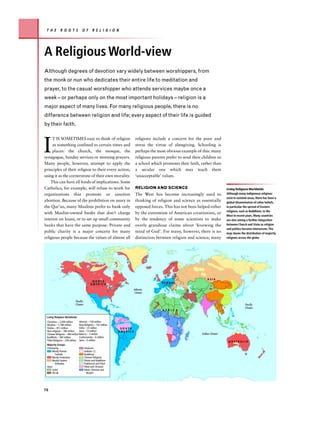
A   R E L I G I O U S   W O R L D - V I E W


                                                                  had strong associations with the
                                                                  nonconformist churches, and the
                                                                  support of religious leaders is often
                                                                  essential in elections. Two-thirds of
                                                                  American Jews consistently vote
                                                                  Democrat, reflecting the Jewish
                                                                  commitment to social justice and a
                                                                  concern for minority rights.
                                                                      Even now, some states are entirely
                                                                  committed to one religion. This is
                                                                  particularly common in Islamic
                                                                  countries such as Iran and Saudi
                                                                  Arabia, where Islamic religious law is
                                                                  used as the basis for the justice system,
                                                                  and the rights of members of other
                                                                  religions are circumscribed; for
                                                                  instance, non-Muslims can only
                                                                  worship in private in Saudi Arabia and
                                                                  cannot attempt to convert others.
                                                                  Communist states, dominated by an
                                                                  atheist ideology, often carried out
                                                                  terrible religious persecution, such as
famous scientists have been religious and have         Stalin’s purges of the Jews, and the Cultural
seen the discovery of the laws of nature as a          Revolution in China. The situation in China
sacred charge from God.                                eased after 1977, though the government retains
    Science has seemed to answer some questions        a cautious attitude to religious activity.
about the origins of life and the nature of the            In recent years, faiths have found themselves
mind better, perhaps, than religion, and some          being brought more strongly into partnership
people believe that the sphere of influence of         with secular structures that formerly thought
religion will shrink as our knowledge of science       religion obsolete. The environment movement
grows. Many, however, believe that there are           now has a strong involvement with all the major
certain questions, particularly concerning the         religions, while the World Bank is working with
meaning and purpose of existence – if there is         faiths to try and find new economic and
one – that science simply cannot answer, and           developmental models.
that religion provides far more powerful answers           Alongside this runs the quest for deeper
to such questions.                                     spiritual meaning. It is not without significance
                                                       that, worldwide, the practice of spiritual retreats
RELIGION AND POLITICS                                  is growing. While patterns of religious
As with science, there is little distinction between   observance are changing, the quest goes on.
religion and politics for many people. Indeed,
the separation of Church and State is essentially
a product of the eighteenth century, following
terrible European religious wars between
Catholic and Protestant. Before that, the State
was strongly associated with a particular
religion, and followers of other religions were
frequently persecuted, such as Cathars and Jews
in medieval France, or Christians in Shinto-
dominated Japan. Wars were often religiously
motivated, from the Crusades to the Hindu
extermination of Buddhism during the ninth to
the twelfth centuries in India.
    A religious world-view, however, also often
leads to a powerful motivation for social change.
The socialist movement in England, for example,

                                                                                                                                     17
Ancient Religions
                      THE ANCIENT NEAR EAST

                      The Sumerians
                      Sumeria, the earliest known city civilization, set the religious tone
                      for the rest of Mesopotamia. Sumeria seemed to be saturated with
                      divine presence and its concept of myriad gods and goddesses,
                      each controlling their own aspect of life, together with the
                      sacrifices required to humour them, greatly influenced other
                      Mesopotamian religions.


                      T
                                HE FIRST PEOPLES settled in Sumeria,                                                  Sumerians believed that humans had been
                                Mesopotamia, in around 4500 BC, but                                                   created out of clay in order to relieve the gods of
                                it was another 12 centuries before the                                                their workload. It followed that humans were
                      Sumerian tribes from Anatolia established a                                                     the servants of the gods. Nevertheless, the gods
                      number of city states where the Sumerian                                                        were envisaged as much like humans, with
                      civilization developed in which religion and its                                                similar physical form, needs, appetites and
                      rituals were all-pervasive. Their purpose was to                                                characteristics. This was why food became the
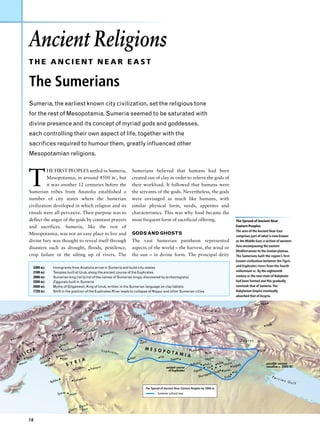
                      deflect the anger of the gods by constant prayers                                               most frequent form of sacrificial offering.                                          The Spread of Ancient Near
                      and sacrifices. Sumeria, like the rest of                                                                                                                                            Eastern Peoples
                                                                                                                                                                                                           The area of the Ancient Near East
                      Mesopotamia, was not an easy place to live and                                                  GODS AND GHOSTS
                                                                                                                                                                                                           comprises part of what is now known
                      divine fury was thought to reveal itself through                                                The vast Sumerian pantheon represented                                               as the Middle East, a section of western
                                                                                                                                                                                                           Asia encompassing the eastern
                      disasters such as drought, floods, pestilence,                                                  aspects of the world – the harvest, the wind or
                                                                                                                                                                                                           Mediterranean to the Iranian plateau.
                      crop failure or the silting up of rivers. The                                                   the sun – in divine form. The principal deity                                        The Sumerians built the region’s first-
                                                                                                                                                                                                           known civilization between the Tigris
                            3300 BC       Immigrants from Anatolia arrive in Sumeria and build city-states                                                                                                 and Euphrates rivers from the fourth
                            3100 BC       Temples built at Uruk, along the ancient course of the Euphrates                                                                                                 millennium BC. By the eighteenth
                            2600 BC       Sumerian king list (a list of the names of Sumerian kings, discovered by archeologists)                                                                          century BC the new state of Babylonia
                            2200 BC       Ziggurats built in Sumeria                                                                                                                                       had been formed and this gradually
                            2000 BC       Myths of Gilgamesh, King of Uruk, written in the Sumerian language on clay tablets                                                                               overtook that of Sumeria.The
                            1720 BC       Shift in the position of the Euphrates River leads to collapse of Nippur and other Sumerian cities                                                               Babylonian Empire eventually
                                                                                                                                                                                                           absorbed that of Assyria.

                                                                                                                                                                                                                        Tepe Hisar
                                                                                            zg      irt
                                                                                       Mala                                                                                          Elburz Mts
                                                                                                                                        ia
                                                                                                      an                          Urm
                                                                                                  e V                  Lake
                                                                                       Lak                                                                                                r
                                                                                                                                                                                     Harha adam
                                                                                                                                             ndiz              iyah                   Ham
                                                     ˆ ig
                                                    Elaz
                                                         ˘                                                                             Rawa                man                                                                    Sialk
                                                                     ni                 ir                         Ninev
                                                                                                                        eh                           Sulay
                                                               Erga             iyarb
                                                                                      ak
                                Gür
                                   ün                                      D                              ybin         Arba
                                                                                                                             il                     kha                             nshah
                                           Mala
                                                tya                                                Nusa                                      Arrap                         Kerma
    sh
Kane                                                                       r Baz
                                                                                 ar
                   ts                      tan                   a                                                                                                                                            Zagros      Mts
                  M Sariz             Elbis           ik    Chag                                                             Ashu
                                                                                                                                   r
             us                                 Birec         Harra
                                                                    n
         r                                               mish                                                                     MESO
     u                  IA                   t s Carche                                           Euphra                               POTA      Eshnun
                                                                                                                                                        na
                                                                                                                                                                                                                           Susa
Ta                 IC                    s M                                                                 tes                                                                         Der
                                                                                                                                            MI A
              IL sus              ma
                                     nu        Alepp
                                                     o
                                                                                                                     Mari             Hit
         C Tar                  A
                                       h          Ebla
                                                                 I A                                                                                         Sippar                    Nippu
                                                                                                                                                                                                r  Tigr
                                                                                                                                                                                                         is
                                   lak
         Mer
             sin                Ala
                                      Uga
                                           rit        S      Y R                                                                                                           Babylo
                                                                                                                                                                                 n
                                                                                                                                                                                       Kish   Adab Umma                           possible ancient
                                                                                             ra                                                                                          Isin            Lagash                   coastline c. 2000 BC
                                                                   Qatna           Palmy
                                                                                                                                                          ancient course
                                                                                                                                                                                  e
                                                                                                                                                           of Euphrates      Agad                 Larsa Ur
                                                                                                                                                                                          k Uruk
                                                                                                                                                                                     uppa
                                                                            s                                                                                                   Shur               Eridu                              Per
                                             s                       ascu                                                                                                                                                                   sia
                                        Byblo                  Dam                                                                                                                                                                                n G
                                                                                                                                                                                                                                                      ulf
                                                                                                                                   The Spread of Ancient Near Eastern Peoples by 2000 BC
                                                 Tyre     Hazo
                                                               r                                                                               Sumerian cultural area


                                                                        ad
                                                                     De
                                                                a
                                                             Gaz      Sea


                      18
T H E   S U M E R I A N S


was Anu, ruler of Heaven, who was later                The Epic of Gilgamesh
replaced by Enlil, Lord of the Winds. There            Gilgamesh, the fifth king of the first dynasty of Uruk, in
                                                       present-day southern Iraq, reigned in around 2600 BC,
were also some 3,000 other deities in Sumeria.
                                                       and was the subject of five Sumerian poems probably
In addition, individual villages had their own         written six centuries later. Gilgamesh became the
local gods, as did inanimate objects. Enlil, for       hero not only of Sumerian, but also of Hittite, Akkadian
instance, was god of the hoe through his               and Assyrian legend. The Epic tells how Gilgamesh
connection with the moist spring wind and the          searches for immortality, but after many adventures,
                                                       he fails and is forced to recognize the reality of death.
planting season. Enlil’s son, Ninurta, was god
of the plough. Concepts of reincarnation and         libations of water were poured over sheaves of
the afterlife were alien to Sumerian theology.       grain or bunches of dates so that the gods of
The dead, Sumerians believed, had no specific        fertility would grant rain for healthy crops. All
place in which to continue in the same style         manner of offerings were brought to the priests
they had known while living. Consequently, the       in the temples for use by the gods: clothing,
living were thought to be constantly at risk         beds, chairs, drinking vessels, jewels,
from their presence and only by regular              ornaments or weapons. All these were classed
offerings of food and drink could these ghosts       as divine property and were placed in the
be dissuaded from haunting them.                     temple treasuries. Clothing was first offered to
                                                     the gods, then distributed among the priests
THE PRIESTS                                          and other officials who staffed the temples. The
Priests in the Sumerian temples acted as             high priest had first pick, and the last went to
conduits between the gods and human beings.          the lowly sweepers of the temple courtyards.
They conducted the daily services and presided
over festivals, such as Akitu, the festival of the
new year, which fell approximately at the time
of the Spring equinox. They interpreted the
entrails of sacrificed animals, usually sheep, in
order to learn the divine will. They performed
the public sacrifices which usually consisted of
goats, cattle and birds, as well as sheep. The
divine portion of an animal sacrifice comprised
the right leg, the kidneys and a piece of meat for
roasting. The rest of the animal sacrifices were
consumed at the temple feast. In addition,


                                          ZIGGURATS

   The high temple towers known as ziggurats,        the Tower of Babel, which is popularly
   which were topped by a small temple               believed to have had links with the ziggurat
   dedicated to one of the Mesopotamian              at the temple of Marduk, the national god of
   deities,   were   a   feature   of   religious    Babylonia. The Tower of Babel, having been
   architecture around 2200 BC and 500 BC. The       built in the vicinity of Babylon, is regarded
   practice of building ziggurats began in           by some archaeologists and anthropologists
   Sumeria, spreading later to Babylonia and         as an extension of the worship of Marduk at
   Assyria. The step-sided ziggurat bore little      his ziggurat temple in the city.
   resemblance to the later pyramids of
   Ancient Egypt. There were no internal
   rooms or passageways and the core was
   made of mud brick, with baked brick
   covering the exterior. The shape was either
   square or rectangular, with measurements
   averaging 40 or 50 sq m (130 or 165 sq ft) at
   the base. The most complete extant
   ziggurat, now named Tall al-Muqayyar, was
   built at Ur in south-west Sumeria (present-
   day southern Iraq). The most famous was

                                                                                                                                            19
A N C I E N T   R E L I G I O N S


The Babylonians
There were two empires of Babylonia –
the Old Empire (c. 2200–1750 BC) and the
Neo-Babylonian Empire (625–539 BC).
Both the Babylonian and Assyrian
religions, which bore a close
resemblance to one another,
originally derived from that of
Sumeria. However, differences
between them evolved over time.
The Babylonian religion stressed
goodness, truth, law and order,
justice and freedom, wisdom and
learning, courage and loyalty.The
chief Babylonian god was Marduk,
‘king over the universe entire’.


B
        ABYLONIAN FAITH encompassed                 WORSHIP AND RITUAL IN BABYLONIA
        the whole universe and each sector of it    Worship and ritual at the Babylonian temples
        was under the rule of a particular deity.   usually took place out of doors, in courtyards
Heaven, earth, sea and air comprised one            where there were fountains for washing before
sector, the sun, the moon and the planets           prayers and altars where sacrifices were
another. Nature, as manifested in rivers,           offered. The private areas of a temple, the
mountains, plains and other geographical            monopoly of the high priest, the clergy and
features was a further sector and the fourth        royalty, were indoors. The occult tendency in
was the city state of Babylon. Marduk, the          Babylonian religion was fully represented
chief god, presided over the pantheon. Like         among the clergy. They included astrologers,
the Sumerians, the Babylonians believed that        soothsayers, diviners, the interpreters of
tools and implements – bricks, ploughs, axes,       dreams, musicians and singers.
hoes – had their own particular deities. In         Sacrifices took place daily. One
addition, individuals had their own personal        Babylonian temple kept a stock of
gods to whom they prayed and looked for             7,000 head of cattle and
salvation. Magic was prominent in                   150,000 head of other animals
Babylonian religion and Ea, god of wisdom,          for this purpose alone. Apart
was also god of spells and incantations. The        from      animals,     sacrifices
sun and the moon had their own gods,                consisted of vegetables, incense
Shamash and Sin respectively. Shamash was           or libations of water, beer and
also the god of justice. Adad was the god of        wine. There were numerous
wind, storm and flood and Ishtar, a dynamic,        festivals, including a feast for the
but cruel deity, was goddess of love and war.       new moon and the most important,
Although the general tenor of Babylonian            Akitu, which lasted 11 days and
religion was beneficent, there was also a           involved lively processions. At Akitu,
negative, fearful side to it. This was              worshippers purified themselves,
represented by underworld gods, demons,             propitiated the gods, offered
devils and monsters who posed an ongoing            sacrifices, performed penance and
threat to the wellbeing of humanity.                obtained absolution.

20
T H E       B A B Y L O N I A N S


BABYLONIAN BELIEF                                             was necessary first of all to confess sin and
The ethos of Babylonia was essentially                        admit to failings. Only then would an
philanthropic. Compassion and mercy were                      individual’s personal god intercede for them
prime virtues. The poor and unfortunate,                      with the greater Babylonian deities. There was
widows and orphans, were accorded special                     no comfortable afterlife in Babylonian belief.
protection. No one, however virtuous, was                     After death, the spirit parted from the body
considered to be faultless so that suffering,                 and all that awaited it was descent into the
where it occurred, was never entirely                         dark underworld. There was no protection
undeserved. The gods handed out punishment                    from a wretched existence after death, not
for unethical or immoral behaviour. To obtain                 even for those who had led righteous and
the help of the gods in solving problems, it                  ethical lives.

                               THE COSMOLOGY OF BABYLON
   The      renowned        Babylonian        skill    in
   astronomy and mathematics developed
   from the interest in the heavens that was
   an integral part of their religion. Using only
   the naked eye, astronomers would observe
   the movements of heavenly bodies and use
   them     to    make      prophecies       or   cast
   horoscopes. In Babylonian times, the
   seven planets visible in the sky – the
   Sun, Moon, Mercury, Venus, Mars,
   Jupiter and Saturn – were wanderers
   among the fixed constellations of the
   zodiac. Each of them had its own god or
   goddess. In common with the Sumerians,
   the Babylonians believed that heaven
   and earth had once been joined as a
   single enormous mountain. This was
   imitated by ziggurat temple towers
   which were regarded as cosmic
   mountains. Apart from the Tower of
   Babel,      whose       construction       was
   detailed in the Biblical Book of
   Genesis, the most apposite was the
   ziggurat built by King Nebuchadnezzar
   (c. 630–562     BC ),   the Temple of Seven
   Spheres of the World. This had seven
   tiers, one for each stage of heaven, as
   represented by the seven visible planets.
   Inside was a vault, also constructed in
   seven levels, which represented the seven
   gates through which Ishtar, goddess of sex
   and war, passed during her regular
   descents into the underworld.


    c. 2200–1750 BC    Old Babylonian Empire                                        When Anu the Sublime ... and Bel, the lord of Heaven and earth
          c.1900 BC    Epic of Gilgamesh
                                                                                    ... assigned to Marduk ... God of righteousness, dominion over
          c.1790 BC    Code (of laws) of Hammurabi, sixth king of
                       the Amorite dynasty of Babylon                               earthly humanity ... they made [Babylon] great on earth, and
          c. 1750 BC   Death of Hammurabi                                           founded an everlasting kingdom, whose foundations are laid as
              625 BC   Establishment of New Babylonian Empire                       solidly as those of heaven and earth.
                       by King Nabopolassar
           c. 587 BC   Marduk as chief god of Babylonia                                                             From the Prologue to the Laws of
           c. 539 BC   Persian conquest of the Babylonian Empire
                                                                                                                        Hammurabi, king of Babylon


                                                                                                                                                   21
A N C I E N T            R E L I G I O N S


The Assyrians
Religion had important political significance in Assyria.
Kings were believed to derive their power from Assur, the
chief god, and both divination and astrology were initially
facilities for the use of the monarch. Underlying this though,
was a popular religion based on fear and superstition.


R
          ELIGION WAS A VITAL factor in                                    ascetic Babylonians, Assyrians favoured rich
          unifying and strengthening the Assyrian                          decorations, large statues and elaborate reliefs on
          Empire (746–612 BC). This was a state                            their temple buildings. The temples were the
religion, with the king himself as chief priest and                        scene of daily rituals that included feeding
representative on earth of Assur the chief                                 the gods. To judge by Assyrian records, the
Assyrian god, from whom Assyria likely takes its                           expense was considerable.
name. Divination and prophecy were religious
functions of the State, designed to aid the king by                        ASSUR, NATIONAL GOD OF ASSYRIA
revealing the destiny of the Empire. Even the                              Four of the six major Assyrian deities – Ishtar,
libraries of Assyrian cities had a god of their own:                       Shamash, Adad and Sin – were identical in both
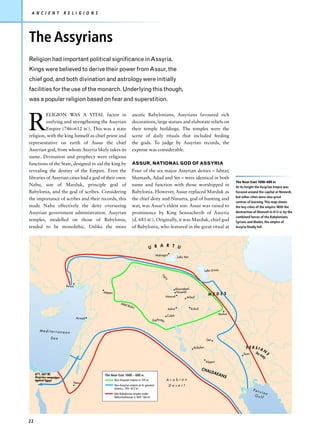
                                                                                                                                                             The Near East 1000–600 BC
Nabu, son of Marduk, principle god of                                      name and function with those worshipped in                                        At its height the Assyrian Empre was
Babylonia, and the god of scribes. Considering                             Babylonia. However, Assur replaced Marduk as                                      focused around the capital at Nineveh,
                                                                                                                                                             but other cities were also great
the importance of scribes and their records, this                          the chief deity and Ninurta, god of hunting and
                                                                                                                                                             centres of learning. This map shows
made Nabu effectively the deity overseeing                                 war, was Assur’s eldest son. Assur was raised to                                  the key cities of the empire. With the
Assyrian government administration. Assyrian                               prominence by King Sennacherib of Assyria                                         destruction of Nineveh in 612 BC by the
                                                                                                                                                             combined forces of the Babylonians,
temples, modelled on those of Babylonia,                                   (d. 681 BC). Originally, it was Marduk, chief god                                 Syrians and Medes, the empire of
tended to be monolithic. Unlike the more                                   of Babylonia, who featured in the great ritual at                                 Assyria finally fell.


                                                                                           R T U
                                                                                     U R A
                                                                                             Malazgirt
                                                                                                                  Lake Van


                                                                                                                                         Lake Urmia
                                                                                                 Tig
                                                                                                    ris


                           Tarsus
                                                                                                                 Khorsabad
                                              Aleppo                                                              Nineveh
                                                                                                       Nimrud
                                                                                                                                           MEDES
                                                                                                                        Arbail
                                                            Jebe
                                                                   l Bis
                                                                        hri
                                                                                                         Ashur               Kirkuk
                                                                                                                                                   Harhar
                                                                                                       Calah
                                    Arwad
                                                                                        Euphrates


        Mediterranean

                Sea
                                                                                                                                          Der

                                                                                                                               Babylon                              PERSIA
                                                                                                                                                                          (by
                                                                                                                                                                                  N
                                                                                                                                                                  Susa        6
                                                                                                                                                                                  S
                                                                                                                                                                               40
                                                                                                                                                                                 )


                                                                                                                                          Nippur

                                                                                                                                      CHA
                                                                                                                                            LDA
     671, 667 BC                               The Near East 1000 – 600 BC                                                                         EAN
     Assyrian campaigns                                                                                                                                  S
     against Egypt                                     Neo-Assyrian empire in 745 BC                   Arabian
                                Petra
                                                       Neo-Assyrian empire at its greatest              Deser t
                                                       extent,c. 705–612 BC                                                                                              Per
                                                                                                                                                                            sian
                                                       Neo-Babylonian empire under
                                                                                                                                                                          Gul
                                                       Nebuchadnezzar II, 604– 562 BC                                                                                         f


22
T H E      A S S Y R I A N S


                        THE LIBRARY OF KING ASHURBANIPAL

   King Ashurbanipal of Assyria, who reigned                    other subjects: omens, the motions of the
   between 668        BC    and 627        BC,   gathered       sun, moon, planets and stars, prayers,
   together a collection of texts, written in                   incantations, rituals, proverbs and creation
   cuneiform (a wedge-shaped script) that                       stories. Scientific texts were also stored
   represented        the     first     systematically          in Ashurbanipal’s library, together with folk
   catalogued library in the Ancient Near East.                 tales, one of which, ‘The
   Much of present-day knowledge concerning                     Poor      Man      of    Nippur’
   Assyria comes from tablets preserved from                    prefigured        the    famous
   this library, including the text of the Epic of              stories of ‘One Thousand
   Gilgamesh. An important purpose of the                       and One Nights’ from
   library was to furnish information for priests               Baghdad. The library was
   and diviners in their work of advising the                   discovered by Sir Henry
   king and seeing to his spiritual needs.                      Layard during excavations
   Ashurbanipal’s sources were the libraries of                 at the palace of King
   temples all over Mesopotamia, together                       Sennacherib             between
   with tablets from Ashur, Calah (an ancient                   1845 and 1851. More than
   Assyrian city south of Mosul in present-day                  20,000        tablets           from
   Iraq) and the king’s great capital at Nineveh.               Ashurbanipal’s collection
   Scribes     were     ordered       to    copy     texts      were later placed in the
   concerning a wide variety of religious and                   British Museum.


the Akitu festival, which celebrated his victory                The struggle for survival
over Tiamat. Tiamat was a primordial creature                   imposed on those who
who had created monsters to avenge the death of                 lived there produced a
her ‘husband’ Apsu at the hands of Ea, one of                   popular religion permeated
their children, the younger gods. In his role as                with the power of the
champion of the younger gods, however,                          supernatural and dominated by superstition.
Marduk killed the monsters and Tiamat as well.                  Devils and evil spirits lurked everywhere and       May all the gods curse anyone who
                                                                                                                    breaks, defaces, or removes this
    Sennacherib, however, ascribed the deed to                  charms and incantations were frequently used to
                                                                                                                    tablet with a curse which cannot
Assur after he conquered and destroyed Babylon                  exorcise them. To the Assyrians, devils and         be relieved, terrible and merciless
in 689 BC and so gave the god his central place in              demons had the power to enter the human body        as long as he lives, may they let his
both the festival and the Assyrian pantheon.                    and the clay and metal charms worn to fend          name, his seed be carried off from
This was a political rather than a religious move.              them off included human heads and monstrous         the land, and may they put his flesh

It was believed that Assyria had been granted its               animals. Repeating seven times the seven            in a dog’s mouth.
                                                                                                                    Curse on book-thieves, from the
empire by Assur and that its armies were under                  magical words inscribed on stone tablets was
                                                                                                                       library of King Ashurbanipal
his protection. Assyrian kings used to present                  another commonly used means of averting evil.
Assur with their reports on campaigns they had                  The supernatural appeared so all-pervading in
conducted, virtually making the god a divine                    Assyria that a series of omens was developed,
commander-in-chief.                                             listing every conceivable piece of bad luck, with
                                                                instructions on how to avoid them. A special
RELIGION AND SUPERSTITION                                       class of priests – the baru, or
Assyria was an extremely harsh land, with few                   seers – dealt with the science
natural advantages and much arid desert.                        of omens and portents.


     745 BC    Succession of KingTiglath-Pileser III, who turned Assyria into an empire and a
               military state
  732–722 BC   Assyrian conquest of Palestine and Syria
      710 BC   King Sargon II conquers Babylon
      705 BC   Nineveh, rebuilt by King Sennacherib, becomes capital of Assyria
      689 BC   Assur made national god of Assyria
  668–627 BC   Reign of King Ashurbanipal
      612 BC   Destruction of Nineveh by Babylonians, Syrians and Medes; fall of the
               Assyrian Empire.


                                                                                                                                                      23
A N C I E N T            R E L I G I O N S


                     The Canaanites
                     The Canaanites are the earliest recorded settlers of ancient Palestine, with a
                     history in the region dating back to 3000 BC. Canaanite religion and Canaanite gods
                     were synonymous with nature. For instance, the end of the rainy, fertile season
                     was their sign that Mot, the god of death, had killed Baal in his guise as storm
                     god. According to the Bible, however, the Canaanites’ abominable religious
                     practices marked them for destruction.


                    B
                             AAL, WHO WAS worshipped not only in                                                        supreme god, and father of Baal, was El, creator of
                             Canaan, but throughout the surrounding                                                     creatures. Shachar, the dawn, and Shalim, the dusk
                             area, was not a name, but a title meaning                                                  were his twin offspring. Apart from Baal, there
                     ‘lord’ or ‘master’. This did not describe a single god                                             were several fertility deities, such as Baalat,
                     or divine function. Baal could be lord of trees,                                                   goddesses of conception and childbirth, sea-deities
                     rocks, streams, mountains and other natural                                                        and hunter-deities.
                     phenomena, but was most frequently identified
                     with storms, rain and fertility. The fertility of an                                               THE CANAANITES AND THE BIBLE
                     area frequently threatened by drought and desert                                                   The Canaanites had gods with more sinister
                     was the main preoccupation of Canaanite religion                                                   representations: death, sterility, destruction, chaos
                     and the gods were often associated with the                                                        and the underworld. However, the worship of these
                     manifestations of nature. Baal, for instance, was                                                  and other gods as idols was not the only aspect of
                     called ‘rider of the clouds’, ‘god of lightning and                                                the Canaanite religion that earned such a pejorative
                     thunder’ or ‘lord of the sky and the earth’.                                                       image in the Bible. There is also the controversial                                                              Kingdoms and Empires
                                                                                                                                                                                                                                         Canaan is the Biblical name for the
                     Likewise, Yarikh, the moon god, was called                                                         assertion that many Canaanite religious practices
                                                                                                                                                                                                                                         area of ancient Palestine west of the
                     illuminator of myriads of stars, lamp of heaven or                                                 were barbaric, together with what biblical scribes                                                               river Jordan. This map shows Egyptian
                     lord of the sickle. The Canaanite pantheon was                                                     saw as abominations: incest, bestiality and human                                                                dominated Canaan and its surrounding
                                                                                                                                                                                                                                         kingdoms and empires in the period
                     based around a family unit, with the gods                                                          sacrifice. The practice of offering their children as                                                            from 1500–1100 BC.
                     envisaged as kings presiding over royal courts. The                                                sacrifices to Baal came under special censure. So did

                                                                                     GA
                                                                                                 SG
                                                                                                       A
                                                                              lys
                                                                           Ha
                                                                                                                                                                                                                                                                        C a
                                                                                                                                                                                                                            Kingdoms and Empires 1500 – 1100 BC
Aegea


                                                                                                                                                                                                                                    Hittite empire established by
                                                                                                                                                                                                                                                                            s p i

                                                                               Hattushash                                                                                                                                           Suppiluliuma I, 1344– 1322 BC
                    L Y


                                                                                                                                                                                                                                    Mitanni territory at its greatest
                                                                                                                                                                                                                                    extent, 1480– 1340 BC
                                                 H I T T I T E
                        D


                                                                           E M P I R E
                                                                                                                                                                                                                                                                                  a n
               AR


                                                                                                                                                                                                                                    Mitanni after 1340 BC (under
      n Se


                        I A


                                                                                                                                                                                                                                    Hittite and Assyrian control)
                                                                                                                                                                 Lake Van
                                                                                                                   Mt
                                                                                                                                             129
                ZA


                                                                                                                                                5–1                                                                                 Assyrian territory gained by
                                                    A                                                       us                                        26
                                                                                                                                                                                                                                                                                S e a


                                                                                                                             HURRI                      4                                                                           Ashur-uballit I, 1353– 1318 BC
                                                                    i
                    W


                                                          n a                                           r
           a


                                                              t o l                                  au
                     A


                                                                                                                                                                                                  Lake                              Babylonia under
                                                                                                                                                 M


                                                                                                 T
                        N


                                                                                                                                                                                                  Urmia                             Burnaburiash II, 1347–1321 BC
                            S


                                                                                                                                                 e s


                                                                                                    A                           M I TA N N I                                                                                        Elam under Tepti-ahar,
                                                                                                 C I Carchemish                                                                                                                     1353– 1318 BC
                                                                                         LI                                                                                            ab
                                                                                    CI
                                                                                                                                                     o


                                                                                                                             Harran Washshukanni                                     tZ                                             Egypt under Amenophis IV and
                                                                                                                    Aleppo
                                                                                                                                                       p


                                                                                                                                       12                   Nineveh                                                                 Tutankhamun, 1352– 1335 BC
                                                                                                                                                                            ea


                                                                                                                                          95
                                                                                                       T


                                                                                                                                                                          Gr
                                                                                                                                                        o t


                                                                                                              Alalakh                        –1
                                                                                                                                                26           A S S Y R I Ab
                                                                                                         Orontes


                                                                                                                                                   4                                     a
                                                                                                      N


                                                                                                             Syria
                                                                                                                                                            a m


                                                                                                                                                                                   Z
                                                                                                                                           bur


                                                                                    Ugarit                                                                        Ashur            tle
                                                                                                                                                                            L it                     ai
                                                                                                                                                                                                          m
                                                                                                                                          K ha


                                                                                                                                                                                    12


                                                               hiya                                            Hamath                                                                          Adh
                                                        A l a sp r u s )
                                                                                                                                                                       95


                                                                                                                   Qatna
                                                         (Cy
                                                                                                     A


                                                                                                                                                                          –1
                                                                                                                                                                          Tig – 1197
                                                                                                                                                                           1 23


                                                                                                                   Kadesh Palmyra
                                                                                                                                                                                                 la


                                                                                                                                                     Euphrates
                                                                                                                                                                             26
                                                                                                                                                                              r is


                                                                                    Byblos
                                                                                                                                                                                                ya


                                                                                                                                                                                                                                   Za
                                                                                                                                                                                 3


                                                                                                                                                                                  4


                                                                                                              1275
                                                                                                                                                                                               Di
                                                                                             V


                                                                                                                                                                                                                                     gr


                       M e d i t e                                                        1275
                                                                                                                                                                                                                                             os


                                   r r a n e a n
                                                              S e a
                                                                                                                                                                                                                                              M


                                                                                                            Damascus                                                                         Dur-Kurigalzu                        155
                                                                                         E


                                                                                                                                                                                                                         1180 – 1
                                                                                                                                                                                                                                                  ts


                                                                                                                                                                                                                  Der                                E L
                                                                                                                                                                                                     B


                                                                                                                                                                                                                            1213                         A
                                                                                                                                                                                                          A


                                                                                                                                                                                                                                              K ar


                                                                                                                                                                                                                                                                    M
                                                                                     L


                                                                                                                                                                                                              B


                                                                                                                                                                                               Babylon
                                                                                                                                                                                                                                                khe
                                                                                        Jordan
                                                                                  a n


                                                                                                                                                                                                               Y


                                                                                                                                                                                                                                         Susa
                                                                                                                                                                                                                  LO


                                                                                                                                                                                                                                                           Al-Untash-
                                                                                                                                                                                                                                                  h


                                                                      Joppa
                                                                              n a


                                                                                                                                                                                                              Nippur                                       Napirisha
                                                                                                                                                                                                                    N


                                                                    Ascalon      Ashdod
                                                                                                                                                                                                                         IA


                                                                     Gaza
                                                                           Ca


                                                                                                                                                                                                                                                     un


                                                                                 Gath                                                                                                             Uruk                                   5             r
                                                                                                                                                                                                                                  11 0            Ka
                                                                               Gerar                                                                                                                                    1 126 –
                                    EG YP T                                                                                                                                                                            Ur
                                                                                                                                                                                                                                                                                 Anshan
                                          Nile


                                Memphis                                              Petra


                    24
T H E    C A N A A N I T E S


the essentially orgiastic, sensual atmosphere of                 began at Ugarit (on the coast of present-day Syria,
Canaanite religion and its fertility cults and serpent           north of Lattaqia) in 1929 considerably expanded           And they chopped down the
                                                                                                                            altars of the Baals in his
symbols. The biblical view of God and worship                    this knowledge. In this area, during King Niqmad
                                                                                                                            presence, and he cut down the
was vastly different from that of the Canaanites.                II’s reign (c. 1360 BC), sacred texts were recorded
                                                                                                                            incense altars that stood above
The Canaanites viewed worship as a means of                      on clay tablets at the king’s request, using the           them. And he broke in pieces
controlling the gods, rather than serving them and               cuneiform script invented by the Sumerians in the          the Asherim and the carved and
the sexual nature of Canaanite deities was in                    fourth century BC. Thirty-four deities were listed,        the metal images, and he made
complete contrast to the spiritual qualities of the              beginning with the god residing in Tsafon, the             dust of them and scattered it
biblical God who occupied a lofty place, far                     sacred mountain. The deity of the cult of the dead         over the graves of those who
beyond such earthly temptations. The biblical                    came next, and thirdly El, the bull and source of          had sacrificed to them.

representation certainly has elements of the                     creation, power, sagacity and virility. Dagan, a                            Chronicles 2, 34:4
polemic and archeology and anthropology show a                   semitic god worshipped throughout the Near East,
different side to the Canaanites.                                especially in the region of the middle Euphrates,
                                                                 was listed after that, then seven different Baals and
EXCAVATIONS AT UGARIT                                            the more minor deities. The rituals recorded on the
For a long time, the Bible was the only source of                tablets were all reserved to the king, or to the
information about the Canaanites and their                       official priesthood who performed them in his
religion, together with some material from ancient               presence. The Ugarit tablets also included texts
Greek writers. However, the excavations that                     concerned with oracles.


                                         FUNERARY FIGURINES
   Up to the present, little direct evidence has                 god El seated on a throne, excavated at
   been found for the daily practice of religion                 Ugarit, and dating from the thirteenth century
   among the ordinary people of Canaan,                          BC,   was monolithic and less elaborate. El is
   despite the greatly increased knowledge                       depicted as an old man, with a grey beard and
   made available by the excavations at Ugarit,                  a sage, benign expression.
   which shared many customs with Canaan.
   However, a small insight into popular worship
   and rituals derives from the thousands of tiny
   bronze figurines which have been found in
   virtually all the excavations conducted in
   or around the area of ancient Canaan.
   These     figurines        were     probably      small
   representations of the great statues of gods
   and goddesses that were the subject of public
   worship in the temples. It is thought that they
   were votive offerings or offerings made to
   confirm or consecrate a vow. These figurines
   could be very beautiful, elaborate and
   expensive. One such, dating from around
   1900 BC and measuring 235 mm (9 in) high, was
   worked in gold and silver foil. The clothing
   worn    by    the    figurine       was     intricately
   decorated and showed the god wearing
   jewellery and a head-dress. By contrast, a
   limestone statue of the supreme Canaanite


            c. 7000–4000 BC          Early Paleolithic (Old Stone Age) and Mesolithic settlements in the area of Canaan.
            c. 3000–2000 BC          Bronze Age settlers, including Semites, in Canaan
            c. 2000–1500 BC          Early recorded history of Canaan region
            c. 1500–1200 BC          Canaan dominated by Egypt
            c. 1200 BC               Israelites reach Canaan
            c. 990 BC                Final defeat of the Canaanites by Israelites
            c. 950 BC                Solomon, king of Israel, breaks Canaanite idols and altars


                                                                                                                                                            25
A N C I E N T   R E L I G I O N S


ANCIENT EGYPT

The Kingdoms of Egypt
Documented Egyptian history, from the unification of the country to
the acceptance of Christianity as the official religion, lasted some
3,500 years.This huge expanse of time saw periods of confidence,
prosperity and empire, separated by times of economic trouble and political
fragmentation. But throughout, the fundamentals of Egyptian religion
                                                                                                                                    Egypt’s Nubian Empire
appear to have remained constant.
                                                                                                                                    The map shows Egypt’s Nubian Empire.
                                                                                                                                    Nubia, on Egypt’s southern frontier,
                                                                                                                                    was conquered and garrisoned by the


E
        GYPT ENJOYED SEVERAL major                  storehouses for the wealth of the empire. At the                                pharaohs of the twelfth dynasty
        periods of prosperity, with the state       height of Egypt’s power came the one attempt to                                 (1991–1783 BC) who built forts at
                                                                                                                                    strategic points. At the end of the
        strongly centralized under the pharaoh      replace the many gods with worship of the sun
                                                                                                                                    Middle Kingdom control was lost, but
who was regarded as a god-king. The first of        alone. This phase, in the reign of Akhenaten                                    the territory was reconquered by the
these ‘high points’ was the Old Kingdom             (c. 1352–1336 BC) was short-lived, but had                                      eighteenth dynasty pharaohs
                                                                                                                                    (1552–1306 BC), who pushed it borders
(Dynasties 3–6, c. 2650–2150 BC). At this time,     repercussions in the way people understood their                                farther south. Nubia eventually broke
the temples to the gods appear to have been         relationship to the gods.                                                       away at the end of the New Kingdom.

rather small and the resources of the state were
concentrated on the building of massive royal
                                                         GREECE                                                 ANATO L IA
tombs in the form of pyramids. The pyramids                                                                                                               Tarsus                                  Carchemish
                                                                                                                                                                         Tell
were symbols of the sun, and of the primeval                                                                                                        Mersin           Tayinat         Aleppo
                                                                                                                                                                                         Emar
                                                                                                                                                                                 Alalakh
mound on which the sun first appeared. The                                                                                                                                              Hamath
                                                                                                                                                                     Ugarit
pharaoh was the intermediary between the gods                              Crete
                                                                                                                                               Cypru s
and people and was their provider. It was                                                                                                                                                    Qatna
                                                                                                                                                                                        Kadesh
through the pharoahs that the aloof gods                                                                                                                             Byblos
                                                                                                                                                                                    Damascus
                                                                                           M e d i t e r r a n e a n                      S e a                     Sidon
provided sustenance and justice to the people.                                                                                                                       Tyre       Laish
                                                                                                                                                                                                      Syrian
    Troubled times followed the end of the Old                                                                                                                     Acre         Hazor              Desert
                                                                                                                                                                                Taanach
Kingdom. There was no single ruling dynasty in                                                                                                                Megiddo            Beth-shan
                                                                                                                                                             Ashdod               Tell es-Saidiyeh
control of the whole country and rival families                                                                                                                Joppa                Amman
                                                                                                                                                             Gaza
competed for power. Egypt was reunited and                                                                                                                                Jerusalem
                                                                                                                            Pi-Ramesse
enjoyed another period of prosperity under the                                                                         Heliopolis
                                                                                                                                       Tanis
                                                      New Kingdom Egypt                                                               Bubastis
Middle Kingdom (Dynasties 11–13 c. 2007                    New Kingdom temples                                                      Memphis
–1700 BC). During this period there were major             Egyptian fortress or garrison

developments in funerary practices and                     core area of Egyptian state
                                                                                                               Herakleopolis                                                             A
                                                           Nubian gold resources                                                                                                              R
literature, both of which were no longer an                                                                                                                                                       A
                                                           trade routes
exclusively royal preserve. Associated with this                                                                                El-Amarna
                                                                                                                                                                                                      B


                                                           limit of Egyptian control in Nubia                                   (Tell el-Amarna)
                                                                                                                                                                                                       I


was an increased devotion to Osiris, the ruler of          under Amenophis I (1527–1507 BC)
                                                                                                                                                                                                          A


                                                           limit of Egyptian control in Nubia
the underworld.                                            under Tuthmosis III (1490 –1436 BC)
                                                                                                                                Abydos
                                                           northern limit of campaigns of
                                                           Tuthmosis I (1507–1494 BC) and
                                                                                                                                                                            R


                                                                                                                           Medinet Habu             Karnak
                                                           Tuthmosis III (1490 –1436 BC)
THE NEW KINGDOM
                                                                                                                                                                                e


                                                                                                                                    Thebes          Luxor
                                                                                                               E G Y P T
                                                                                                                                                                                  d


                                                           boundary between Egyptian and
A second period of breakdown was followed by               Mitannian zones of influence at the end
                                                           of the reign of Amenophis II (1438 –1412 BC)
                                                                                                                                                                                         S


the reunification under the New Kingdom                    boundary between Egyptian and Hittite
                                                                                                                                                                                          e
                                                                                                                                                   Nile


                                                           zones of influence at the end of the reign of
                                                                                                                                                                                             a


(Dynasties 18–20, c. 1539–1069 BC); this was also          Akhenaten, 1347 BC

the time of Egypt’s empire in western Asia and                                                                                  Aniba
                                                                                                                                                  Quban
                                                                                                                       Abu Simbel
Nubia. The temples of the kings and gods now                                                                              Faras
                                                                                                                                           Qasr Ibrim
                                                                                                                         Buhen
                                                                                                                                    2nd Cataract
replaced pyramids as the focus of the state’s                                                              Island of Meinarti
                                                                                                                      Semna
                                                                                                                                Island of Dorginarti
building operations. The temples became vast                                                                               Island of Sai
                                                                                                                Amara
structures serving as the theatre for elaborate                                                                                                           Nubian
                                                                                                               Soleb
festival processions. They were also the                                                                                  Sesebi
                                                                                                                                                          Deser t
                                                                                                     3rd Cataract
                                                                                                                          Tumbos
                                                                                                                               Kawa
26
                                                                                                                            Gebel             4th Cataract
                                                                                                                           Barkal
                                                                                                                          Napata                             5th Cataract
T H E    K I N G D O M S    O F   E G Y P T


THE LATE PERIOD
                                                           EGYPTIAN DYNASTIES
Following the end of the New Kingdom there was             c. 5000–2900 BC    Predynastic
another period of fragmentation, and attempts by           c. 2900–2650 BC    Early Dynastic Dynasties 1–2
                                                           c. 2650–2150 BC    Old Kingdom Dynasties 3–6
some rulers to regain Egypt’s former power failed
                                                           c. 2150–2007 BC    First Intermediate Period Dynasties 7–10
in the face of the Babylonian and Persian empires.         c. 2007–1700 BC    Middle Kingdom Dynasties 11–13
                                                           c. 1700–1539 BC    Second Intermediate Period Dynasties 13–17
Despite the loss of empire and periods of foreign
                                                           c. 1539–1069 BC    New Kingdom Dynasties 18–20
rule, the Late Period (Dynasties 26–30, 664–323             c. 1069–656 BC    Third Intermediate Period Dynasties 21–25
                                                                664–332 BC    Late Period Dynasties 26–30
BC) did see many huge temples constructed. This
                                                                332–323 BC    Persian Empire under Alexander
was also the time when the cults of sacred animals               323–30 BC    Ptolemaic Period
were most popular.                                            30 BC–AD 395    Roman Period

    In 332 BC Alexander the Great of Macedon
took Egypt from the Persians, and for the three
centuries following his death the Ptolemaic
Dynasty ruled the country. This period brought
many Greek settlers to Egypt and saw the
identification of Greek with Egyptian gods (so
Re, the sun god, was identified with Helios, and
the goddess Hathor with Aphrodite), and also
the spread of some Egyptian cults around the
Mediterranean. This process continued when
Egypt fell under Roman rule, and the cult of Isis
became one of the major religions of the Roman
Empire. Christianity found a home in Egypt very
early and monasticism flourished in the deserts.
During the first centuries AD Christianity and the
traditional Egyptian gods co-existed and there
was certainly a strong influence from the old
cults on many aspects of the worship and
iconography of the newer religion.


                     AKHENATEN: THE FIRST MONOTHEIST?

   The most striking episode in Egypt’s religious        attempting to reinstate the sun cult of the Old
   history is the 17-year reign of the pharaoh           Kingdom pyramid builders, with its emphasis
   Akhenaten (c. 1352–36 BC) at the height of the        upon the pharaoh as the sole intermediary
   New Kingdom. This is still one of the most            between the divine and human realms. The
   controversial     subjects     in       Egyptology.   experiment     proved    unacceptable      and
   Ascending the throne as Amenhotep IV the
                                       ,                 following Akhenaten’s death the traditional
   new pharaoh soon abandoned the major state            cults were rapidly restored.
   cults, notably that of the god Amun, in favour
   of a solar cult emphasizing the visible disk of
   the sun, the Aten. At some point in the reign
   there was an iconoclastic phase when the
   images of gods, particularly Amun, were
   destroyed. The extraordinary style of art
   adopted at this time, allied with the poetry and
   content of the sun hymns, led early
   Egyptologists to present a false impression of
   the pharaoh as a true monotheist, and a
   pacifist.They also suggested that Akhenaten
   was the pharaoh who had befriended Joseph,
   and that his hymns to the sun were an
   influence    on     the      biblical      Psalms.
   Egyptologists now think that in many ways
   Akhenaten’s religious ideas were reactionary,

                                                                                                                                         27
A N C I E N T       R E L I G I O N S


The Egyptian Pantheon
Egyptian art presents us with hundreds of gods, many
with animal or bird heads, some even more complex
creatures combining a beetle’s body, bird’s wings and
animal heads. Each of the different elements represented
to the Egyptians a recognizable characteristic which
encapsulated the nature of the god.


E
       GYPTIAN RELIGION developed in the                  occasion demanded. Some
       long period known as the Predynastic               Egyptologists have claimed
       Period (c. 5000–2900 BC) before the                that – certainly by the later
unification of Egypt into one kingdom. In the             periods – all gods were
nineteenth century Egyptologists explained the            aspects of one, and
many gods that characterize Egyptian religion as          that Egyptian religion was
the product of this Predynastic Period. They              moving towards monotheism. While a process of
thought that Egypt was divided into many small            rationalization does appear to be a feature of the
kingdoms or chiefdoms, each with its major                later periods, there was no attempt to abandon
centre and gods, a triad of creator god (usually          the polytheistic system.
male), consort and child. When Egypt was
united these gods remained as the patrons of the          DEPICTING THE GODS
different regions, and at a later stage there were        One of the most striking features of Egyptian                     Pyramids and Temples of the
                                                                                                                            Old Kingdom
attempts to rationalize and amalgamate gods               religious imagery is the way that animal and bird                 During the period of the Old Kingdom
with similar associations (such as solar gods).           heads are combined with a human body. Gods                        (c. 1539–1069 BC) the main focus of
This interpretation served to explain the                 can often be associated with more than one                        Egyptian religious practice was pyramid
                                                                                                                            building, rather than temple construction.
daunting number of gods in the Egyptian                   animal, representing different characteristics or                 The pharaoh was thought to be the
pantheon, but it is now regarded as simplistic.           phases of their existence. Some of the                            intermediary between humanity and the
                                                                                                                            gods; the pyramids were representations
The Egyptians were polytheistic: they accepted            associations are obscure to us, but others are                    of this power as well as conduits to the
the existence of numerous gods, some                      very obvious. The scarab beetle was a symbol of                   underworld and eternal life.
with very specific functions, and others who
were only vaguely defined. They also                                                                                    S        i     n       a
created many new gods as                                                                 Tanis
                                                                                                                                                       i
                                                                                            Nabesha
                                                                   Mendes         Qantir              Pithom
                                                                                (Avaris,
                                                                            Pi Ramesse)          T. er-Rataba
                                 a     )
                                   Sea
                                                Buto
                              Se
                                                                   Busiris             Bubastis

                        e at nean              Sais                        Athribis

                    Gr rra
                                                                                 T. el-Yahudiyeh

                    ite                                            Abu Roash     Heliopolis
            e   d                                                          Giza     Abusir
         (M                                                              Saqqara    Memphis
                                                                            Dahshur
                                                                   L O W E R                     E G Y P T
                                                                                      Illahun
                                                                                                Meidum


                                                                                                     El-Amarna
                                                                                 Hermopolis


                                                                                                                 Nile                           U P P E R

                                            Pyramids and Temples of the Old Kingdom                                                                Deir el-Medina
                                                                                                                                                     Thebes (W)      Karnak
                                                Pyramid                                                                              Abydos             Malqata     Luxor
                                                                                                                                                                                El-Kab
                                                Temple                                                                                               Gebelein

                                                                                                                                                                Hieraconpolis
                                                                                                                                                      E G Y P T


28
T H E   E G Y P T I A N     P A N T H E O N


the creator god Khepri because it lays its eggs in      MINOR DEITIES
a ball of dung. The scarab rolling the ball of          There were numerous minor deities who
dung was associated with the sun god pushing            had specific functions in relation to the
the sun disk across the sky; but more                            underworld, or protection in this life.
important, the small scarabs                                              The major deities tended to
emerged from the dung as if they                                             be rather less specific,
had     created    themselves.                                                  although many appeared
Emerging as the new-born                                                          as creator or solar gods.
sun, Khepri rose into the sky                                                     Falcon-headed        gods
and was transformed into                                                          were common, and
the falcon-headed god at                                                          associated with sky.
the sun’s zenith. After sunset                                                    Many of the goddesses       Homage to thee, Osiris, Lord of
                                                                                                              eternity, King of gods, whose
he assumed the head of                                                           could appear as both
                                                                                                              names are manifold, whose
a ram to travel through                                                         vulture and as the rearing
                                                                                                              forms are holy, thou being of
the night towards his rebirth                                                  cobra, the uraeus, which
                                                                                                              hidden form in the temples,
next dawn.                                                                     spits fire at the pharaoh’s    whose Ka is holy…. Thou art
    Many of the goddesses                                                     enemies. Nekhbet, and           the Great Chief, the first among
had an ambivalent nature, so                                                other goddesses such as Isis,     thy brethren, the Prince of
Hathor could appear as the                                                 were thought of as the mother      Company of the Gods, the
wild cow of the Delta marshes                                             of the pharaoh, therefore they      stabiliser of Right and Truth

which had to be calmed, and in                                           could assume vulture form and        throughout the World, the Son
                                                                                                              who was set on the great throne
doing so became the domestic cow.                                     queens wore a headdress in the
                                                                                                              of his father Keb. Thou art
Although calmed, such goddesses always                          form of a vulture with extended wings;
                                                                                                              beloved of thy mother Nut,
had the potential to become violent again. This         they could also be shown with vulture wings           the mighty one of valour….
appeasing of violent aspects of the world is at the     enfolding their bodies. In Egyptian hieroglyphic
                                                                                                                          Hymn to Osiris, from
heart of Egyptian cult practices.                       the word ‘mother’ uses the symbol for a vulture.
                                                                                                                         the Book of the Dead

                                 OSIRIS AND THE AFTERLIFE
      The Egyptians believed that it was the              thought of as leaving the tomb and flying
      pharaoh who ensured the afterlife of the            around), and a tomb and grave goods.
      ordinary people: he cared and provided for          Complex religious texts (the Book of the
      them in the afterlife as he had on earth. Even      Dead) aided the passage of the soul through
      so, during the Predynastic period, the dead         the gates of the underworld, to the
      were buried with food and other equipment           judgement hall of Osiris, where the heart
      to assist them. Towards the end of the Old          was weighed in the balance against ‘truth’.
      Kingdom, with a decline in royal power, there       It was only after vindication that the
      was a change, and everyone expected to              deceased could go on to enjoy the afterlife.
      enjoy the afterlife. The cult of Osiris
      developed at the same time and rose to ever-
      greater prominence in the Middle and New
      Kingdoms. Osiris was a mythical pharaoh
      murdered by his brother, who cut his body
      into pieces and scattered them across the
      globe. These pieces were collected by his
      sister-wife Isis and mummified by Anubis,
      the dog- or jackal-headed god of the
      cemeteries,    who    invented    embalming.
      Briefly restored to life he was able to father
      Horus (the pharaoh) before becoming ruler
      of the underworld. Every Egyptian could look
      forward to becoming ‘an Osiris’. To this end
      elaborate     preparations     were     made:
      mummification to preserve the body so that
      the soul (the ba) could return to it (the ba is
      shown as a human-headed bird, and is

                                                                                                                                              29
A N C I E N T       R E L I G I O N S


Temples and Worship
In Egypt the priests performed rituals in the temples on behalf of the pharaoh, to ensure the
preservation of the cosmos. Personal intercessions could be made in the home, in the major
temples or village shrines, using intermediary statues or images carved on the walls, or when the
god’s statue was brought out in a festival procession.
                                           Tell el-Fara`in
                                           BUTO                                    MENDES
                                   SAIS
                    NAUKRATIS                                                                        Tell el-Muqdan
                                                                                                     TAREMU
                                                                                                            TANIS


                                                                                                 Qantir
                                                                                                 PIRAMESSE
                          Kom el-Hisn
                                                                                            Tell el-Dab`a
                                                                                            AVARIS
                      L O W E R                              E G Y P T
                                                                                                     Tell el-Maskhuta
                                     Tell Atrib                                  Tell Basta
                                     ATHRIBIS                                    BUBASTIS
                                                                                                             salt lake
                                                                         Tell el Yahudiya
                              Merimda Beni Salama                           LEONTOPOLIS
                                                                        HELIOPOLIS
                                            Abu Roash                Maadi
                                                  Giza              El-Omari
                                                  Abusir            Mit Rahina
                                                 Saqqara            MEMPHIS
                                                    Dahshur

                                                    El-Lisht

                                                  Hawara
                                                                                                                  Re


                             Medinet el-Fayum                    Meidum
                                                                                                                    d


                          CROCODILOPOLIS
                                                                                                                     Se


                          Medinet Maadi                          El-Lahun
                           NARMOUTHIS
                                                                                                                         a


                                                           Ibnasya el-Medina
                                     Gurob               HERAKLEOPOLIS MAGNA
                                U


                                                      El-Hiba
                                                     ANKYRONPOLIS
                                PPE
                                     R


                                                   Beni Hasan
                                                  El-Ashmunein
                                                  HERMOPOLIS MAGNA
                                                    Deir el-Bersha
                                                     El-Amarna
                                                    AKHETATEN


                                        Meir
                                                             E
                                                                 G


                                                     Asyut
                                                                       Y
                                                                            P
                                                                                 T


                                                                                 Akhmim


                                                                                         Nag el-Deir

                                                                             ABYDOS                             Dendera
                                                                                                                             Deir el-Ballas
                                                                                                                              Qift
                                                                                                              Naqada         KOPTOS

        Pharaonic Egypt
                settlement                                                                  Valley of the Kings
                                                                                                                         Karnak, Luxor
                temple                                                                             Armant                THEBES
                tombs                                                                         HERMONTHIS
                site with archaeological                                                     Gebelein
                                                                                                                  Tod                                 Pharonic Egypt
                remains                                                                                           El-Mo'alla
                                                                                        APHRODITOPOLIS                                                This map shows the major temples
                Early Dynastic                                                                                    Esna
                Old Kingdom                                                                                      LATOPOLIS                            and sites of worship during the
                Middle Kingdom                                                                                                                        period of the pharaohs in Egypt.
                New Kingdom                                                                                                  Elkab
                                                                                                                             NECHEB                   Although many ancient Egyptians had
                Late Period
                fertile land                                                                                                    Edfu                  shrines to the household gods in their
                                                                                                                                APOLLINOPOLIS MAGNA
          Aswan modern name
                                                                                                                                                      homes, the temples became a focal
        MEMPHIS ancient name
                capitals of Upper and                                                                                                                 point not just for religious worship
                Lower Egypt
                                                                                                                                                      but also for state occasions such as
                                                                                                                                   Kom Ombo           festivals and processions.


                                                                                                                                  Aswan
                                                                                                                                 ELEPHANTINE
T E M P L E S   A N D   W O R S H I P


E
        GYPTIAN TEMPLES were a significant            stuck out his tongue to ward off evil. Bes
        part of the state machine. Few temples        frequently accompanied another popular deity,
        from the early periods survive, and those     Taweret, who was a pregnant hippopotamus
that do are quite small. The major focus of state     with lion’s paws and a crocodile tail: she also
building in the Old Kingdom was the pyramid           protected women during childbirth.
and its associated temple, emphasizing the role           One significant development in Egyptian
of the pharaoh as god on earth. In the New            religious thought during the New Kingdom was
Kingdom (c.1539–1069 BC) temples were major           that of the direct relationship of the individual to
land-holders and employers throughout the             the major gods. These became more
country. The temples became the repositories of       approachable, and a large number of
the wealth of Egypt’s empire, and they were the       inscriptions record prayers to the gods for help,
focus of the largest state building operations.       or recording the afflictions (usually described as
This accounts for the vast scale of temples like      ‘blindness’) caused by ‘sin’ or taking the name of
that of Amun at Karnak, still one of the largest      the god in vain. People could go to the state
surviving religious complexes. However, the           temples to pray, adore and present offerings to
temples and the priesthood remained under the         the gods. Access was limited to certain areas,
direct authority of the pharaoh: there was no         such as the great forecourt, or a shrine at the
division between Church and State.                    back of the temple. The statues of pharaohs and
    In the New Kingdom festival processions           officials set up in these outer parts functioned as
became an important feature of religion, and this,    intermediaries and passed on the prayers to the
too, played its part in the development of temples    gods inside.
and the religious landscape of the cities. The gods
now travelled between temples, along the river,       THE TOMB
canals or sphinx-lined avenues. Carried in the        The other major focus of
sacred barks (portable boats with a shrine for the    religious activity was the
statue of the god), the veiled images were still      tomb. Egyptian tombs were
invisible to the ordinary people, but their           family vaults, focussed on a
presence was indicated by the head of the god         decorated tomb chapel built
which adorned the prow and stern of the bark.         by the leading member.
                                                      Here, at certain times of the
GODS AND THE INDIVIDUAL                               year, families would gather
The Egyptians made offerings to their household       to celebrate rituals of
gods, and perhaps to their ancestors, at shrines      renewal       with       their
in the main rooms of their homes. These gods          ancestors, bringing the
protected against the hazards of daily life, such     statues out from the chapel
as snakes and scorpions, illness and disease, and     to receive the rays of the
during the dangerous times of pregnancy and           rising sun. Here they would
childbirth. The gods were often rather fearsome       gather     to    enact     the
in appearance, and armed with sharp knives.           elaborate burial rituals to
Among the most popular of these gods was Bes,         ensure the journey of the
a dwarf with a lion skin around his face, who         soul into the afterlife.

                                    THE HOUSE OF GOD
   In form, the Egyptian temple combined the          world at the moment of creation and here the
   attributes of a house, with an image of the        god’s image resided in a shrine, the focus of
   moment of creation. Protected by high              the daily ritual.The temple precinct included
   towers (a pylon), the entrance led into a          other chapels, a sacred lake that supplied
   public open court, where people could come         water for the temple rituals, houses for the
   to make their offerings and prayers to the         priests when on duty, storage areas and
   gods. Beyond this court, access was                workshops, and ‘hospitals’ in which the ill
   increasingly    restricted.   One    or   more     were treated, combining medicines and
   columned offering halls, flanked with rooms        ‘magic’. The roof of the temple was used for
   for the storage of cult objects, led to the        observations of the stars, and for the New
   sanctuary, where only the highest priests          Year festival when the statue of the god was
   could go. This sanctuary represented the           taken to receive the rays of the rising sun.

                                                                                                                                    31
A N C I E N T          R E L I G I O N S


GREECE AND ROME

Classical Origins
The civilization established by the ancient Greeks and subsequently built
upon by Rome would in time be regarded as the foundation for 2,000 years of
western history, though no-one could have forseen this imposing legacy. While
the great states of Mesopotamia and Egypt flourished, stone-age farmers in
what we now know as Greece were still scratching at the soil, eking out the
sparsest possible of livings from year to year.The story of classical religion,
like that of classical culture more generally, is one of local practices and
traditions being brought gradually to coherence through the evolution of
                                                                                                                                                                                                  Mycenaean Greece
ever more far-reaching states and empires.                                                                                                                                                        The Mycenaeans took control of the
                                                                                                                                                                                                  Aegean after the Minoan civilization
                                                                                                                                                                                                  had disappeared. They were


A
         LTHOUGH THERE ARE known to (its name derived from that of its great mythical                                                                                                             apparently a warlike people, as
                                                                                                                                                                                                  proved by the impressive fortified
         have been people in Greece from as long ruler King Minos) was a peace-loving culture of                                                                                                  citadels that have been discovered,
         ago as Neanderthal times, the first artistic accomplishment and nature-worship.                                                                                                          as well as implements of war. Their
distinctively ‘Greek’ culture is thought to have Though later Greeks, envious of the Minoan                                                                                                       great palaces and citadels testify to
                                                                                                                                                                                                  their major preoccupation: trade.
been imported by a wave of immigrants pushing achievement, might have told of the bull-headed                                                                                                     The map shows sites of key buildings
westward from Anatolia some 4,500 years ago. monster held in the labyrinth beneath Minos’s                                                                                                        of the Mycenaean culture.

With them they brought bronze-age                                                                                  Spilia
metalworking skills unknown to                     Lake
                                                                                                     Pindus M
                                                                           As


                                              Ioannina                                                                  Maramariani
                                                                             pr


the Neolithic farmers among whom          E
                                                                               op


                                            P                                                  THESSALY
                                                                                 o ta


                                               IR                                                                             Lake Voiviis             A e g e a n
                                                                                    A rak


                                                                                     mo


they settled. Down the centuries                  U                                                                                                       S e a
                                                    S
                                                                                        s


                                                                                                              ts
                                                                                          hthos


                                                                                                                                      Iolkos                                                                                           Yioura
                                                                                                                          Toumba
many important cultural influences     Parga
                                                                                             Kouphia Rachi                                                                                                                       Pelagos
                                                                                                                                  Kastraki
                                                                                                                                 Pagasean                       Iliodhromia
would come to the eastern                                                                                                           Gulf

Mediterranean across the Aegean                                                                                              Gritsa                                    Skopelos
                                                                                              Lake Xinia
and around the coastal fringes of                    Ambracian                                                   Ayios Theodhoros
                                                        Gulf                                                                                                                                                                              Skyros
Thrace. Much speculation surrounds                                                                                                   Gu
                                                                                   AETOLIA                                               lf o
the religious beliefs of the early                                                                                                            f E
                                                                                                                                                  ub
                                                                                                                  PHOCIS                             oe       EU
                                                                                                                                                        a
Greeks, as there are few religious                    Chrysovitsa               Lake                                  Orchomenos Chantsa
                                                                                                                                                                   B
                                                                                                                                                                      O
                                                                       Mila     Trikhonis                         Panopeus            Pyrgos         Ayios loannis
                                                                                                                                                                        EA
artefacts and little written evidence                                                                                                             Ayia Marina
                                                 Ithaca
                                                                                                                  Krisa       Stroviki Lake
                                                                                                                                       Kopais      Gla
to indicate what they were. One                                                                                                     Kastri             Thebes
                                                                                                                                                                                                                                   Katakolou

                                                                                                         Gu
theory is that they honoured their               Cephalonia                 a
                                                                       f P tras                             lf
                                                                                                               of
                                                                                                                                       Eutresis
                                                                     o                                              Co                     BOEOTIA
own ancestors as guiding spirits and     Mazarakata               lf          Araxos                                     rin                                A
                                                                                           Bouga                              th                               TT                                                            Vrana
                                                                            u


                                                              G                                                                                                     I CMenidi
worshipped the deities of local                                                           ACHAEA                                                          Athens
                                                                                                                                                                       A
                                                                            Ayios Ilias                                     Korakou
springs, the weather and other life-                 Akroterion           P E L O P O N N E S E
                                                                                                                                       Perdikaria          Salamis
                                                                                                                                                   Saron
                                                                                                                                                              ic
sustaining forces.                                                                                            Mycenae            Berbati                           Gu                                                          Thorikos
                                                                                                                                                                                             Kolonna              lf
                                                                                                                                                                  Prosymma                              Aegina                     Ayia Irini
                                                                      Zacynthus
                                                                                                                   Alfios                         Argos              Dendra
                                                                                                                                                             Tiryns                                                                               Kea
CRETAN CONTRADICTIONS                                                                                                                                         Asine      Kastro
                                                                                                                   Kakovatos
                                                                                                                                             Lake
The first significant civilization in
                                                                                                                                                                            G


                                                                                                                                             Taka                                                                                       Kythnos
                                                                                                                                                                            ul


                                                                                                             Kamari                             Vourvoura
                                                                                                                  Mandra
                                                                                                                                                                                f


the area seems to have evolved not                                                                Peristeria    Stylari                                                                                  Hydra
                                                                                                                                                                                 of


                                                                                                                       Xerovrysi
                                                                                                   Elliniko      Malthi                                                                  Spetsai
in mainland Greece itself, but on the                                                                                                                                                                                                      Serifos
                                                                                                                                                                                     A


                                                                                                           Pylos Koukounara Aithaia
                                                                                                                                                                                       rg


                                                                                                                                        Menelaion                                                      M i r t o a n
                                                                                                                    Garalavouni Vaphio
isle of Crete where what is known
                                                                                                                                                                                         o


                                                                                                                      Dara                                                                                 S e a
                                                                                                                                                                                         li
                                                                                                                                                                                             s


                                                                                                                        Nichoria    LACONIA
as the Minoan civilization had its
                                                                                                                                                                            Pa


                                                                                                                 Yenitsari
                                                                                                                                                                             rn


                                                                                                                           Kambos
                                                                                                                                                   Ev r o


                                                                                                              Midhen                 Arkines
                                                                                                                               Gu


                                                                                                                                                                                on


capital at Knossos around 2000 BC.                                                                                                           s
                                                                                                                                                     ta


                                                                                                  Ayios Nikolaos
                                                                                                         Charakopio                                                                                                                        Phylakopi
                                                                                                                               lf


                                                                                                                                                                                 Mts


As revealed to the modern world by
                                                                                                                                                        Gulf of La


                                                                                                                                                                                                                                            Melos
                                                                                                                                of


                                                                                                                                                                                                          Mycenaean Greece
the nineteenth-century archeologist
                                                                                                                                    Mes


                                                                                                                                                                                                          1400–1000 BC
                                                                                                     I o n i a n                                                      Pavlopetri                                 major settlement
Sir Arthur Evans, Minoan culture
                                                                                                                                     senia


                                                                                                        S e a                                                                                                    major fortification
                                                                                                                                                                                                                 fortification
                                                                                                                                                                   con


                                                                                                                                                                                                                 major palace
32                                                                                                                                                                          Cythera
                                                                                                                                                                                         Kastri                  trade route
                                                                                                                                                                       ia


                                                                                                                                                                                                                 fertile plains
C L A S S I C A L   O R I G I N S


palace, the reality was altogether gentler. For      masculine a culture as the Minoans were
Evans, the Minoans’ elevation of femininity over     feminine and pleasure-loving, the Mycenaeans
brute masculinity was symbolized by the image        left an archeological legacy of heavy bronze
of graceful girl-gymnasts vaulting over the back     swords and helmets, and warlike fortifications.
of a charging bull. Finds from impressive arsenals   Yet here too, appearances may deceive: the
of weaponry to evidence of human sacrifice (and      Mycenaeans’ most important force may well
possibly even cannibalism) have called Evans’s       have been their army of priestly scribes, for
idealized picture increasingly into question, yet    they were even more meticulous than the
he seems to have been correct in his view that the   Minoans in their administration of what was
Minoans were subject to a matriarchy. Evidence       clearly first and foremost a trading empire. Yet
has mounted that the king was a mere figurehead      their reign was brief: by about 1200 BC
beside the high priestess who really ruled.          Mycenean power itself was declining. The
Likewise, the great goddess Potnia far outranked     reasons for this remain obscure: historians have
the male deity who was at once her consort           suggested that political instability further east
and son.                                             left Mycenae cut off from its trading partners,
    Ultimately, the issue of masculinity versus      economically stranded. Those same troubles,
femininity misses the point of a religion whose      meanwhile, had their demographic impact too,
main function may have had less to do with           setting off large-scale movements of peoples
spiritual than economic life. The most vital role    throughout western Asia. From the coastal
of the Minoan priesthood seems to have been in       settlements of what is now Turkey, it is
maintaining a highly centralized mercantile          thought, came the ‘Sea Peoples’, who ravaged
economy with contacts throughout the eastern         much of the eastern Mediterranean with their
Mediterranean: to this, all more obviously sacred    raids. Meanwhile, the Dorians – warlike
roles may well have been secondary. Inscriptions     nomads from the western steppe – poured
found at Knossos, dating from the fourteenth         overland into northern Greece, the precursors
century BC, appear to have been written in the       of later hordes like the Huns and Mongols. By
hands of up to 70 different scribes, recording       the beginning of the first millennium BC, the
agricultural output in the city’s hinterland in      Mycenaeans had disappeared: Greece had little
great detail. Meanwhile, the priests seem to have    apparently to show for more than 3,000 years
supervised a large number of craftsmen working       of history.
in the palace precincts. Pots, jewels and other
luxuries from Knossos have been discovered
throughout Asia Minor and Southeast Europe,
while Egyptian tomb-paintings attest to the visits
of Minoan merchants.

THE MYCENAEANS AND AFTER
Records of Minoan culture disappear around
1400 BC, supplanted – if not actually destroyed
– by the might of Mycenae, then emerging on
the mainland. Apparently as austerely


                                                         BLOOD RITES

   Digging at Anemospilia, Crete, in 1981, Greek researchers         can be no doubt that they were caught in the act of human
   Yannis and Efi Sakellarakis made a remarkable find after          sacrifice.The seismic disaster they were apparently seeking
   opening up what appeared to have been a basement room in          to stave off seems to have struck too suddenly for them to
   an ancient temple that was believed to have been destroyed        complete the ritual: buried beneath tons of fallen masonry,
   by an earthquake in about 1700     BC.   There they found the     the tableau would remain frozen in mid-moment, lying
   skeletal remains of a boy, trussed up like a sacrificial bull,    undisturbed for 37 centuries. If the scene the Sakellarakises
   with a priest and priestess beside him poised to cut his          exposed amounts to an archeological snapshot of a pivotal
   throat with a knife and catch his blood in a cup. Speculation     point in the great Cretan civilization’s agonising collapse,
   that the sacrificial victim was the son of one or both of his     their discovery also spelled a severe fall in the Minoans’
   would-be dispatchers has never been confirmed, but there          modern reputation for gracious humanity.


                                                                                                                                     33
A N C I E N T    R E L I G I O N S


Homeric Gods and Heroes
The ‘Dark Age’ that followed the fall of Mycenae was not, perhaps,
as black as it has since been painted, although there was no great
civilization to chronicle its history or give it cultural coherence.
Although cast by history in the role of wild invaders, the incoming
peoples brought with them a spirit of cultural ambition and enterprise.
Their knowledge of ironworking filled the breach that the now lost bronze
technology had once filled, and a slow re-urbanization of the country
began. From this early urban culture emerged the epic poems of Homer;
chronicles of the distant Mycenean past and a defining work of future Greek
cultural, religious and political consciousness.


T
         HE IMPOSITION upon a culture of              the warlike Iliad, and his account of the long
         subsistence farming of a civilization        and difficult homecoming of the trickster
         that raised its eyes to the heavens can be   Odysseus, the Odyssey, may differ significantly
seen represented symbolically in the story of the     in tone and technique, but both hold up a set of
war between the Titans and Olympians. As              Greek heroes for respect and emulation. These
recorded by Hesiod’s Theogony (c. 700 BC), the        stories, and the values they enshrined, became
world was once ruled by the Titans, the children      part of the general Greek inheritance, uniting
of Gaia, the earth, and Uranus (Heaven), her son      scattered communities which might otherwise
and husband. To this point, the antique order         have shared only mutual enmity.
corresponded with the sort of matriarchy
imagined by the Minoans, with their goddess           THE OLYMPIAD
Potnia, but events took a different turn in the       The Homeric poems also mark the unforgettable
developing Greek tradition. The story tells how       mythic debut of the Olympians as rulers of the
Kronos, Gaia’s youngest son, castrated his father     heavens, the often all-too human divinities
and usurped his throne; he then married his
sister Rhea, but in order to secure his position,
he swallowed all their children as they were
born. One alone escaped: the infant Zeus was
smuggled to safety in Crete, where he grew to
manhood plotting revenge against his unnatural
sire. The god of open sky and mountain-top,
Zeus was armed with flashing thunderbolts, and
established his seat on the summit of Greece’s
highest peak, Mount Olympus, from where he
led his own family in war against the Titans
(now regurgitated so as to be able to help in their
father’s defence). The final victory of Zeus and
his Olympians marked not only the end of the
region’s pre-Greek period, but also a significant
break with a past in which mother earth had
been at the spiritual centre of things.

WARS OF GODS AND MEN
The epics of Homer (eighth century BC) did
more than anything else to forge a common
Greek identity. His tale of the battle for Troy,

34
H O M E R I C     G O D S   A N D   H E R O E S


presiding over the fortunes – and misfortunes – of     intellectual achievement. Long before the
mortal men and women. Hence, outraged at the           Parthenon or Plato, in the depths of a
slight they have received in being placed behind       supposedly ‘Dark Age’, the ancient Greeks
Aphrodite in terms of beauty, Hera, Zeus’s sister      had set forth on the long road that would
and queen, and his daughter Athene, the goddess        lead to modernity.
of wisdom, both side with the Greeks in the
hostilities that follow Paris’s theft of Helen.
While the goddess of beauty and love herself may
stand loyally by her supporter’s city, Aphrodite
cannot finally prevail over the other goddesses,
despite the assistance of her lover Ares, the god of
war. Poseidon the earth-shaker, god of the sea,
sets himself against Troy from the very start –
although he also does his best to hinder
Odysseus’s subsequent homeward journey.
Fortunately, the hero has help from Hermes, the
messenger of the gods. Even Apollo, the
radiant sun-god, is not above intervening
to bring about the death of the
apparently invincible Achilles, while
his sister the virgin-huntress Artemis,
goddess of the moon, also takes the
part of Troy.
    If the Greek gods as exhibited in
Homer seem by today’s standards
more petty than divine, their foibles
have the paradoxical effect of
underlining the importance of
human agency. A culture which saw
so many mortal frailties in its
deities was correspondingly quick
to discern the potential for
greatness in humankind: the result
would be an age of unparalleled artistic and


                                     THE TROJAN WARS

   Asked to judge which was the fairest                followed was a series of stentorian speeches
   goddess – Hera, Athene or Aphrodite –               and heroic single combats, with the warrior
   Paris, Prince of Troy, was offered various          ethics of pride and honour.Thus we meet the
   inducements to sway his decision. Hera,             courageous Ajax, the cunning Odysseus and
   the consort of Zeus, offered him the gift of        the angry Achilles – all but indestructible
   empire, while Athene promised him military          since his mother dipped him in the Styx, the
   might. Aphrodite, goddess of love, tempted          river of the underworld, when he was an
   him with the most beautiful woman in the            infant. Only the heel by which she held him
   world – and the young Paris could not resist.       was left unprotected, and it was here that he
     This most beautiful woman was Helen,              would finally be caught by an arrow from
   wife of Menelaus, the king of Sparta (and           Paris’s bow, after the Greek had slaughtered
   brother of Agamemnon, king of Argos). Paris         Paris’s brother, the noble Trojan general
   eloped with Helen after being welcomed in           Hector. The famous tale of the Wooden
   Sparta as an honoured guest, and heroes             Horse – the ‘gift’ within which Odysseus and
   from scores      of Greek cities        heeded      his troops contrived to make their way into
   Agamemnon’s call to arms and lay siege to           the city – does not in fact figure in Homer’s
   Troy in an effort to restore Helen to her           Iliad, though it is referred to incidentally in
   cuckolded     husband. The       conflict   that    the Odyssey.

                                                                                                                                     35
C I V I L I Z AT I O N   A N D   R E L I G I O N


                                                       A VENEER OF CIVILIZATION?
                                                       Yet if a city like Athens had much to celebrate,
                                                       individual people still feared sickness and death,
                                                       while states knew they were never entirely safe
                                                       from the possibility of crop failure, plague or
                                                       military defeat. The construction of a second fine
                                                       classical temple to Athene on the Acropolis (the
                                                       Erechtheion, around the much older shrine of
                                                       Erechtheus, mythical king and archaic earth-god)
                                                       underlines how reluctant the Athenians were to let
ultimate symbol of ‘classical’ perfection. Its lines   go entirely of their older ancestral ways. In various
assert the triumph of human skill and ingenuity, a     of its aspects the cult of Apollo – and still more that
disdainful reproach to the rough untidiness of         of his son the serpent-god Asklepios, master of
nature. A temple to Athene, the Parthenon              healing – hark back to pre-Olympian religious
enshrines for ever the co-opting of an Olympian        cults. As for the wild trances entered into by the
goddess as tutelary deity to a single city.            more determined adherents of Dionysos, they
                                                       suggest the sort of shamanism now associated with
FESTIVALS                                              indigenous religions of the most ‘basic’ sort.
The festival calendar in classical Greece likewise
placed a premium on mortal, rather than divine,
accomplishment: so it was, for example, with the
original Olympic Games. First held in 776 BC in
the shadow of Mount Olympus, this gathering
brought the youth of Greece together to compete
in running, wrestling and other tests of speed,
strength and skill. Although the athletes’
achievements were offered up to Zeus (there were
games in the name of Apollo and Athena
elsewhere), such tournaments were first and
foremost a showcase for the grace and strength of
the human body. The importance of Dionysos,
god of revelry, cannot be overestimated: there
were seven Dionysiac festivals a year in Athens
alone. The whole city processed to the theatre,
where music and dancing set the scene for
programmes of drama from farce to tragedy.


                                    DEATH OF THE YEAR

   The tradition that Kore, the daughter of            pomegranate seeds, however, and she was
   Demeter, goddess of the harvest, had been           thus deemed to have sealed her marriage
   abducted by Hades, the ruler of the                 with the infernal king. Although restored once
   underworld, was commemorated by Athenian            more to her mother, Kore was from that time
   youths in an annual autumn pilgrimage to the        obliged to return to her husband’s home for
   scene of the crime at Eleusis, on the coast         one season in every four. During that time
   north-west of Athens. Enraged at her loss, the      Demeter’s bitterness is marked by biting
   goddess of the harvest had struck down the          frosts and barren soil. The tradition of Kore’s
   crops where they were growing in the fields –       descent to the underworld each winter and
   they would not bear fruit again, she warned,        her subsequent resurrection for the spring,
   until she once more had her daughter.               clearly reflects an age-old concern with the
   Concerned that their human subjects would           continuation     of    the   agricultural   cycle
   soon starve, the gods sent Hermes down into         (presided over, not by male Zeus, but by a
   the earth to bring Kore back – if she had eaten     female deity), as well as a more modern
   nothing in her time below she would be free         theological preoccupation with the question
   forever. Hades had tempted her to take a few        of life after death.

                                                                                                                                        37
A N C I E N T   R E L I G I O N S


The Gods in Imperial Rome
The origins of Rome were obscure and unpromising: through the earlier
centuries of the first millennium BC another civilization dominated what is
now central Italy – the Etruscans.The lively culture of the Etruscans is best
remembered for its elaborately decorated complexes of tombs, but they
were also responsible for the drainage scheme which allowed the
reclamation of the land on which Rome would be built. Expanding downward
from the surrounding hilltops, under the auspices of Etruscan rule, the
settlement established by Latin shepherds in the mid-eighth century was
slowly evolving and as it grew, so did its confidence and self-belief: by
509 BC, Rome had succeeded in expelling its Etruscan overlords; as a
republic, it would bring all Italy under its control. By the second century AD                                                                    The Peoples of Italy
                                                                                                                                                  The Etruscans were the dominant
Rome’s dominions spanned the known world, from Scotland to Syria, yet the                                                                         civilization in Italy throughout the early
                                                                                                                                                  first millennium BC, but there were
civilization propagated there was recognizably Greek in origin.                                                                                   settlements of other peoples across the
                                                                                                                                                  country as well. None were to pose a
                                                                                                                                                  serious challenge to the Etruscans until the
                                                                                                                                                  rising Roman republic finally drove them


A
          S MIGHT BE expected with so                creation, he was honoured on the first day of                                                out. From this point, the Romans began
          pragmatic a people, the Romans took        every month, as well as throughout Januarius,                                                extending the boundaries of their empire
                                                                                                                                                  beyond their homeland and at its height,
          over the Greek gods along with much        the first month of every year. Besides the great                                             the Roman Empire ruled much of the
else, adapting more or less the entire Olympian      gods so far mentioned, the Romans held                                                       known world.
pantheon to their own purposes. Thus father
Zeus became thundering Jupiter, his wife Hera
                                                                                                    I


                                                                                                                                        The Peoples of Italy 500 BC
                                                                                                   ET


                                                                                                    A                    CE
                                                                                               RH                             LT S     Savus
the imperious Roman Juno, while Aphrodite                                                                     TI                               Carthaginian                             Greek
                                                                                                            NE
                                                                       Addua


became the love goddess Venus and chaste                                                    Verona        VE                                      Etruscan                              Italic
                                                            Ti c


                                                                                                         Patavium
                                                             in


                                                                   s
Artemis Diana. Athene passed her wisdom on to                                               Mantua
                                                               u


                                                                                  Padus
Minerva, the messenger Hermes was reinvented                URE
                                                               S
                                                                                  Felsina (Bononia)
                                                                                                            Spina
                                                         LIG                                                 Ravenna
as Mercury. Yet such apparently straightforward         Genua              (Marzabotto)
                                                                                                                    Ariminum
transformations may mask rather more complex                                         ETRUSCANS
                                                                                           us                          Novilara
                                                                               Pisae    Arn
origins: the most famous Roman god of all, for
                                                                                                        Tib


                                                                                          Arretium                    PIC
                                                                                                                                                                                     Naro


                                                                                                                         E
                                                                                                            eri


                                                                                                                                           A
                                                                                                                s


                                                                                                                      NT


example, was the war-god Mars. Although in
                                                                                                                      UMBR


                                                                               Volaterrae                                                      dr
                                                                                              ro


                                                                                         Cortona
                                                                                                                         ES
                                                                                               b


                                                                                    Perusia                                                         ia
                                                                                            Um


                                                                 Populonia
time he assumed the attributes of the Greek Ares,                                        Clusium                                                           ti
                                                                                                                            IANS


                                                                     Vetulonia                                Asculum
                                                                                Rusellae    Volsinii                                                            c
he had in fact started life among the early Latins                              Vucli                                                                               Se
                                                           Corsica             Tarquinii       Falerii
                                                                                                          Amiternum
                                                                                                                                                                               a
as an agricultural deity. Only as Rome’s raison                  Aleria               Caere     Veii SABINI
                                                                                                 Rome
                                                                                                                                                IAP


d’etre shifted down the generations from the                                            Ostia LA       VO
                                                                                                          L S C I Malvent                                   Arpi
                                                                                                                                            SA um


                                                                                                   TI
                                                                                                                                             YG


                                                                                         Antium NI                                                     S
                                                                                                                                              MN


farming to the military front did Mars by slow                                                               AURUNCI
                                                                                                                                                E


                                                                                      Anxur (Tarracina)                                                      us
                                                                                                                                                  ITE


                                                                                                             Capua                                         id MESSAP
                                                                                                                                                               f
                                                                                                                                                            Au          II
                                                                                                                                                      S


degrees take on his more warlike nature.                                 Olbia                                                  Cumae     Neapolis                    Brundisium
                                                          Turris Libisonis                                                                         LUCANI        Tarentum
                                                                                                                                      Posidonia        Metapontum
A BORROWED PANTHEON                                                                                                                   Elea (Velia)       Sy
                                                                                                                                                            ba      Siris
                                                                                                                                                              ris
There was in fact no shortage of gods and                  Sardinia                                                                                                Sybaris
                                                                                                                                                      Laus
                                                          Neapolis
                                                                                                                                                                     Crathis


goddesses, but most found their identities                                                  Ty r r h e n i a n S e a
                                                                                                                                                                                     Croton
merged with, and their functions assumed by,                       Carales
                                                               Nora
                                                                                                                                                                       TII


members of this new and Greek-derived                                                                                                Aeoliae Insulae
                                                                                                                                                                    UT


                                                                                                                                                               Locri Epizephyrii
                                                                                                                                                                    BR


pantheon. One uniquely Roman deity who did                                                                                                    Mylae    Zancle
                                                                                                                    Panormus                             Rhegium
survive, however, was the double-faced Janus,                                                                                          Himera      Tyndaris
                                                                                                                          SI


                                                                                                                      ELYM A N          Sicilia
                                                                                                                               C


                                                                                                                          I    I                       Naxus
god of gateways, entrances and exits, new                                                                      Selinus                   SIC                                       Ionian
                                                                                                                                            U LI
                                                                                                                                     Agrigentum                                      Sea
ventures and fresh beginnings. Associated not                               Hippo Diarrhytus
                                                                                                                                           Gela      Syracusae
                                                                               Utica
only with daybreak but with the world’s                                  Tunes
                                                                                   Carthage                     Cossura                       Camarina


38
T H E   G O D S   I N   I M P E R I A L   R O M E


innumerable other minor deities in awe:                                as the ‘cult of personality’. The
the Lares (household spirits) and                                        adulation      accorded      to
Penates (guardians of the                                                generals such as Julius
pantry) were only the best                                                Caesar led to their elevation
known of these. If Janus                                                  to effective dictatorship, a
presided over doorways, there                                            role merely ratified when, in
were separate spirits responsible                                       27 BC, Octavian, Caesar’s
for hinges, thresholds and                                             great-nephew and adoptive
the doors themselves. For                                            son, and final victor in the
the pious Roman any                                                 long years of faction-fighting that
action, from pruning a                                              had followed the dictator’s
vine to embarking                                                  assassination in 44 BC, enthroned
on an overseas                                                     himself as ‘Imperator’ or Emperor
voyage, might                                                     Augustus (the name simply means
require     the                                                  ‘splendid’). In Egypt and the Asiatic
performance of precise                                           provinces, where kings had long
rituals, special prayers                                        been venerated as gods, he was soon
and propitiatory offerings.                                     popularly regarded as a living
                                                               divinity. After his death in AD 14, this
AUGUSTUS,                                                      became the official policy of Rome
EMPEROR AND GOD                                               itself, and subsequent emperors were
As time went on, and                                          automatically promoted to the ranks of
power in what had once                                       deities. So accepted a part of Roman             GREEK GODS AND THEIR
                                                                                                              ROMAN COUNTERPARTS
been a republic became                                       life did such deifications become that,           Greek            Roman
concentrated more and                                        when the emperor Hadrian’s young                  Zeus             Jupiter
                                                                                                               Hero             Juno
more in the hands of                                        lover Antinous drowned during a visit
                                                                                                               Aphrodite        Venus
individual leaders, Rome                                    to Egypt in AD 130, the emperor had the            Artemis          Diana
saw the development of                                         youth enrolled among the gods and               Athene           Minerva
                                                                                                               Hermes           Mercury
what modern states                                             worshipped at shrines throughout                Ares             Mars
would come to know                                             the Empire.


                                CYBELE: ASIATIC SAVIOUR

  Although the Romans borrowed most of their         Rome before the general Scipio turned the
  pantheon wholesale from the Greeks, they           tables. By 206   BC   the Carthaginians, ousted
  were not too proud to take assistance              from Italy itself, had suffered a serious defeat
  wherever it was offered – especially in times      in Spain. The following year, however, a
  of trouble.Their greatest fear in the early days   prodigious meteorite-shower fell upon the
  of empire was the Punici, or Phoenicians, of       city, an apparent omen which sent the
  Carthage. The region’s foremost mercantile         Romans into a fever of consternation. An
  and naval power, Carthage effectively ruled        oracle urged them to invoke the aid of the
  the coasts – and thus the commerce – of the        Phrygian mother-goddess Cybele, whose
  entire Mediterranean. If Rome was to expand        sacred throne was a massive black boulder
  its influence further, it would have to find a     fallen from the skies: she,
  way of capturing Carthage. Conversely,             the prophecy promised,
  Carthage knew it had to see off this threat to     would rid Rome of the
  its own dominance. In a series of Punic Wars       Carthaginian          menace
  fought from 264     BC,   the advantage shifted    once and for all. Envoys
  back and forth between the two rival empires,      sent to Asia Minor to the
  at one point threatening to see Roman power        Phrygian king returned
  extinguished completely. In the years after        bearing Cybele’s throne:
  218   BC,   the Carthaginian general Hannibal      three years later, at Zama,
  ranged relatively unhindered through Italy for     Hannibal      was      finally
  several years, almost reaching the gates of        vanquished.


                                                                                                                                          39
A N C I E N T   R E L I G I O N S


Religion and Philosophy
The institutions of Greek and Roman religion are now a matter of strictly
historical interest and the beliefs involved no more than an unusually rich
and colourful mythology. But the philosophies first conceived in
classical Athens and further developed in ancient Rome have
remained in important respects as vital as ever. Religious and
secular thought have been equally indebted to the work of these
ancient pioneers. Without the ideas they set in motion the entire
intellectual history of the western world would be very different.


P
        HILOSOPHY BEGAN in the open air,          THE SCHOOL OF ATHENS
        around the city square, or agora, of      The colonnaded walks, or stoas, of central Athens
        Athens, where experienced thinkers or     were a favourite haunt of philosophers, hence the
‘sophists’ gave lessons in logic and rhetoric –   name given to the body of thought first
the art of persuasion – to the sons of more       propounded by Zeno of Citium around the end of
affluent citizens. This was the context in        the third century BC. ‘Stoicism’, as it came to be
which the ideas first formulated by Socrates      called, involved the submission of the individual
took shape, in the dialogues he had with his      self to the providential workings of the universe at
students at the end of the fourth century BC.     large, the quiet acceptance of adversity and good
He was compelled to commit suicide in             fortune alike. As modified by later Greek thinkers
399 BC, charged with ‘impiety’ and the            like Epictetus and by Romans such as Seneca,
corruption of Athenian youth – the tradition      Stoicism became the pre-eminent intellectual
of intellectuals upsetting those in power was     movement of the ancient world. What may sound
established very early. Although
Socrates left no writings, his
teachings were recorded by his
pupil     Plato,   whose     own
philosophical       contribution
cannot clearly be distinguished
from his master’s. It has,
however, become conventional
to attribute to Plato the
distinction between material
things and the ideas to which
they give imperfect reflection,
and in the case of humanity the
difference between the body and
the immortal soul. Plato’s
student Aristotle took the more
down-to-earth view that we
could really only know what we
could perceive for ourselves
through our physical senses: the
tension between these two
opposing philosophies would
prove the main intellectual
armature of western thought
through more than 2,000 years.


40
R E L I G I O N   A N D   P H I L O S O P H Y


like a doctrine of passivity in fact involved the            could really know anything – even what our
most strenuous efforts of discipline and self-               senses told us. Their solution, ‘suspending
control: in AD 65, after falling foul of his                 judgement’, may seem a defeatist one, but to
headstrong pupil Emperor Nero, Seneca took his               the true sceptic, it was argued, it brought
own life in perfect calm – the ultimate stoic.               contentment and peace of mind. Pyrrhon’s
                                                             Roman successor, Sextus Empiricus, gave his
THE SCEPTIC                                                  name to the sceptical doctrine of empiricism,
Sceptics such as Pyrrhon (c. 365–270 BC)                     the belief that sense-experience was the
and his followers took the ‘small-s’ scepticism              essential – albeit insufficient – basis of
of Aristotle to extremes, asking how far we                  all knowledge.


                                                TRUE BELIEVERS?
   How far did the ancients actually believe                 serious argument only caricatured by later
   their own mythology? Did their tales                      depictions of the Epicureans as a crowd of
   constitute a religious scripture? And did                 decadent pleasure-seekers.
   they    take    what          we      would    call   a
   ‘fundamentalist’ view of their traditions’
   literal truth? From as early as the sixth
   century BC, in fact, the mythic conventions
   co-existed with a spirit of genuine
   scientific     enquiry          –     however
   extravagant some of its findings
   may     seem       in        retrospect.
   Pythagoras (b. c. 580                 BC )

   formulated rules of geometry
   which hold today – as well as
   his idiosyncratic philosophy of
   reincarnation. By his doctrine of
   the ‘transmigration of the soul’,
   the spirit slips from one physical
   form to another in successive lives,
   with the potential for progressive
   purification through abstinence and
   virtuous living. One hundred years
   later Heraclitus suggested that the
   entire cosmos was in a state of perpetual
   flux; its governing principle, reason, was
   manifested physically in fire. Anticipating
   the     findings        of      modern        science,
   Democritus (c. 460–370 BC) proposed that
   all matter was made up of minute
   atoms assembled in different
   combinations;                       the
   philosophy of Epicurus
   followed       from          this
   strictly     materialistic
   view.      Since      there
   could be no gods or
   life after death there
   could be no higher
   goal        than         the
   avoidance of suffering
   in the here and now – a


                                                                                                                                       41
A N C I E N T               R E L I G I O N S


             Religions Under Rome
             At its height in the second century AD the Roman Empire covered some five million sq km
             (2 million sq miles), occupying lands which now belong to over 30 different sovereign states.
             Around 100 million Roman subjects were drawn together into a single political entity, despite the
             enormous variety of their linguistic and cultural backgrounds. Yet, while their temporal authority
             was absolute, the Romans were much more relaxed about matters spiritual: under their iron rule a
             remarkable religious diversity was free to thrive.


             D
                       ETERMINED STANDARDIZERS,                                                                being recruited to the Roman side. Rather as                                                   The Roman Empire by the
                                                                                                                                                                                                              Second Century AD
                       the conquering Romans created an air                                                    the old gods had been subsumed into the                                                        In the second century BC the area under
                       of uniformity wherever they went in                                                     official Roman pantheon, indigenous cults                                                      Roman rule covered only Italy and its
                                                                                                                                                                                                              islands, and the small coastal area of
             everything from law to architecture, from                                                         were spliced together with Roman traditions by
                                                                                                                                                                                                              Dalmatia to the east. Three hundred
             entertainment to roadbuilding, from fashion to                                                    a process of ‘syncretism’.                                                                     years later the empire’s boundaries
             city planning. It was precisely these profound                                                                                                                                                   stretched as far north as the Scottish
                                                                                                                                                                                                              border in the British Isles, modern-day
             rigidities, and the cultural confidence they                                                      AN ECUMENICAL EMPIRE
                                                                                                                                                                                                              France and Spain, the coastal areas of
             gave, that enabled the expanding empire to                                                        In parts of Gaul the Roman war god was linked                                                  North Africa and eastwards to the Black
                                                                                                                                                                                                              Sea. Some gods and goddesses in
             display comparative tolerance towards local                                                       to a local god of light: Mars Loucetus, as he
                                                                                                                                                                                                              subject lands succeeded in maintaining
             religious beliefs and ritual practices. In fact, the                                              became known, was widely worshipped. At Bath                                                   their independent existence, and in
             Romans were able to make such open-                                                               the British spring goddess Sulis was associated so                                             some cases exerted a strong influence
                                                                                                                                                                                                              on the Roman people (e.g. Isis and
             mindedness an instrument of pacification in                                                       closely with the Roman Minerva that they                                                       Mithras). They became known as
             newly conquered territories, native deities                                                       became to all intents and purposes different                                                   mystery religions.


                                                                                                                                                                                                                        The Roman Empire by the Second Century AD
                                                                Eburacum                                                                                                                                                             Roman empire, AD 180
                                             Deva
                                                                                                                                                                                                                                     sea routes
                                            Isca                                                                                                                                                                                     provincial colonial settlements
                                                Londinium           Dubris             Colonia                                                                                                                                       road
                                                                                       Agrippina
                                                                     Gesoriacum                                                                                                                                                      original homeland of mystery religion
                                                                                              Mogontiacum
                                                                   Rotomagus              Augusta
                                                                                                         Castra Regina                                                                            ia                    eum
                                                                                          Treverorum                                                                                          Olb                    pa
                                                                       Lutetia                                                                        um                                                        tica
                                                                                                          Vindobona                         Aquinc                      sa                                 Pan
                                                                                                                                                                 Potais                                                                                        rias
                                                                                                                                                                                                                                                          scu
                                                              Augustodunum                                                                                                                                                                          Dio
                                                                                                                                                                 Apulum
                                                                                                                                                                                                                                                                          us
                                                                                                                                                                                                                                                                       pez
                                                                                                                                                                                                                                             pe                   Tra
                                                                   Lugdunum                                     Aquileia                                          cium                       Tom
                                                                                                                                                                                                  i                                  Sino                                                           Mithraism
                                                                                                                    Patavium                               Vimina
                                           Burdigal                                                                                                                                         Od essus
                                                    a                                                                                                                               e                                                                                   ala
                                                                                                     Mutina         Ravenna                                                 Nova                                                                                   Sat
                                                                                                                                      Salonae                                                                                                                                        e
                                                                       Arelate                                                                        Naissus            Serdic
                                                                                                                                                                                a                     ntium    ia                yra                                          liten
                                                                                                                                                                                                  Byza Nicomed                                                           Me
                                                                                                                           Ancona                                                                                             Anc
                                                   Tolosa                                             Arretium
                                                                       Narbo      Massilia                                                                                                                  ea
                                                                                                                                                   Sabazius                                            Nica                                                                                         um
                                                                                                                      Rome                                                                                                                                                                     ori
                                                                                                                                                                                 lonica                                                                                                  eph
                                                                                                                      Ostia Capua                                        Thessa                       am   um                    Icon
                                                                                                                                                                                                                                      iu m                                           Nic
                                                                   Tarraco                                                      Brundisium                      nia                              Perg                                             Tarsus
                            Toletum                                                                                  Puteoli                           Apollo
                                                                                                                                                                                                                                                                             mea
                                                                                  A l e 30 d


                Emeri                                                                                                         Tarentum                                                                  sus
               Augustta                                                                                                                                                                             Ephe                                               ioch           Apa                      ra
Felicit                                                                                                                                                                                                             Side                          Ant                                   my
                                                                                       xa


        as            a                                                                                                                                                                                                                                                             Pal
                                                                                          nd y s


   Julia
                                                                                                                                                                                 Athen
                                                                                                                                                                                       ae                                                                                             cus
                                                                                            ria


                      Cordu                                                                                                                                                                                                                                                      m as
                                                                                                                                                                                                                                                                          Da
                                                                                               a


                            ba                                                                                                                                Cybele
                                                                                                -M


                                                                                                 a                         Messana                                                 Isis                    Caes                                           tus
                                                   Carthago                                           s il                              Rhegium                              Sparta                             a re                                Bery                           Bos
                                                                                                                                                                                                                                                                                         tra
                                                                                                     s


                                                   Nova                                                   ia                                                                                                           a-
                  Gades                                                                                                                                                                                                     B yz                              s
                                                                                                                                      Syracuse                                                                                     anti                 Tyru               re     a
                                 Malaca                   s                               Hippo
                                                                                                                                                                                            Cnoss
                                                                                                                                                                                                   us                                  um 2                        C  aesa
                                                   d   ay                                 Regius                                                                                                  n
                                                                                                                                                                                                                                              0 da y
                                                                                                                                                                                                                                                    s
                   Tingis        Gade s - O stia 9                                                             Carthage                     ex                                              Gorty
                                                                                                                                          A


                                                                                                                                                 a nd      Caesarea
                                                                                                                                           l


                                                                                                                                                     ria              - Rome 20 days
                                                                                                                                                                                                                                                                             a
                                                                                  Cirta                                                                  - P ut
                                                                                                                                                               eoli 15–20 da ys (fastest 9 days
                                                                                                                                                                                                )                                                                   Gaz
                                                                                                                                                                                                                                                                                      a
                                                                                                                                                                                               ene 6 days                                                                        Petr
                                                                                                                                                                                   andria - Cyr                                                                     m                   a
                                                                                                     Theveste                                                                 Alex                                                                       Pelus
                                                                                                                                                                                                                                                               iu
                                                                                                                                                                                                                                                                                 A elan
                                                                                                                                                                                                             ndria
                                                                                                                                                                    Cyrene                             Alexa
                                                                                                                          Sabrata                na                                                                                                phis
                                                                                                                                     Leptis Mag            Berenice                                                                          Mem
                                                                                                                                                                                                                        Osiris
                                                                                                                                                                                                                                                                                           rmus
                                                                                                                                                                                                                                                                                  s Ho
                                                                                                                                                                                                                                                                         Myo
                                                                                                                                                                                                                                                                                               imen
                                                                                                                                                                                                                                                                                         os L
                                                                                                                                                                                                                                                                                  Leuc
                                                                                                                                                                                                                                                                                   ae
                                                                                                                                                                                                                                                                         Theb
                                                                                                                                                                                                                                                                                                    nice
                                                                                                                                                                                                                                                                                            Bere


             42
R E L I G I O N S   U N D E R   R O M E


facets of a single Romano-British deity. In North       appealed to battle-hardened legionaries.
Africa, meanwhile, characteristics of the old           Wherever the legions went, Mithras went too,
Phoenician fertility god Baal-Hammon, renewer           the soldiers’ guardian and guide: signs of his
of all energies, were effectively grafted on to         worship have been found in the very shadow of
those of Jupiter, to produce a recognizably             Hadrian’s Wall.
Roman deity, Jupiter-Ammon, whose particular                The fort at Carrawburgh, Northumberland
characteristics were nevertheless appropriate to        is one of five Mithraic shrines to have been
the traditions of a region on whose arid soils          found in Britain, and one of the best sources yet
agricultural life had always been that much more        discovered of archeological insights into the
precarious than they had ever been in Italy.            workings of this secret devotion. Some 20
                                                        adherents seem to have gathered
MITHRAS                                                 here at any one time, wearing masks
Some gods and goddesses in subject lands                to mark the level of initiation they
succeeded in maintaining their independent              had reached – those grades we know
existence: the Egyptian Isis, and her husband           of are Raven, Lion,
Osiris, for example. The latter’s death each            Soldier, Bride and Father.
year clearly symbolized the death of the crops          The ordeals endured by
in the Nile Valley; the tears of the widow who          postulants       hoping    to
restored him to life were the annual floods. At         progress from one grade to
first an underground cult, confined to slaves,          the next included everything
the worship of Isis had won a degree of official        from the binding of the
backing, and by the first century AD she had a          hands      with    chicken
prestigious temple in the heart of imperial             intestines      to    the
Rome. By that time Mithras, the Persian god of          branding of the body
light and truth, had won a wide unofficial              with red-hot
following in the Roman army: a male-only                irons and even
cult, with tough initiation rites, it naturally         burial alive.


                                    RENDER UNTO CAESAR...
    Roman tolerance was not, of course,
    unlimited: wherever native religions showed
    the potential for destabilization they were
    ruthlessly crushed, as the Druids were, for
    instance, in parts of Gaul. Denounced by
    later   critics   as   a   ‘slave      morality’,
    Christianity’s    values   of     peace      and
    forgiveness should have made it easy
    enough for the Roman Empire to absorb.This
    does seem to be the case: it was Jesus’s
    misfortune that his mission on earth
    happened to coincide with a period of violent
    resistance in the province of Judaea. The
    chronicler Josephus, the only Roman author
    specifically to deal with Christ in his work,
    shows much more interest in the armed
    independence-struggle           (and      mass-
    crucifixion) of the Jewish Maccabees. Even
    afterwards, when Christ’s followers did              destroyed much of his capital in AD 64. Only
    indeed suffer savage persecution, it was in          very slowly in the centuries that followed
    the first instance a matter of political             would Christianity’s gospel of love come to
    opportunism, the Emperor Nero needing to             be regarded as a serious threat to the mighty
    find a scapegoat for the disastrous fire that        Roman Empire.


                                                                                                                                    43
A N C I E N T                R E L I G I O N S


NORTHERN EUROPE

Religion of the Landscape
Indigenous religion in northern Europe was based upon the activities of everyday life.The climate
and landscape gave it its character, hunting and farming its deities and festivals. Focused on
local cults and shrines, it was eventually overwhelmed by the better-organized Christian church.


                                                                                                                       Offerings were cast into lakes
 Northern European Peoples                                                                                             and springs at certain times of    Left: Northern European Peoples
                                                                                                                                                          With the decline of the Roman Empire
                                                  T     S
                                                                                                                       year in thanksgiving or            the way was opened for expansion of
                                               PIC
                                                                                                                       propitiation. Holy trees were
                                                                                            S


                                                                                                                                                          the native northern Europeans.
                                                                                      J UTE
                                                                                   ANGL E S


                                                                                                                                                          Germanic peoples spread northwards
                                                                                                                       protected by fences, and decked
                                                        O N N GLES


                                                                                                                                                          to Sweden and Norway and westwards
                                                                                                                       with garlands and ribbons.         into France. Later the marauding
                                                                                     S
                                                                                   ON
                                                           A
                                                           S


                                                                                                                       Sacred signs, images of gods       Viking Norsemen took this influence
                                           T S


                                                                                                            SLAVS
                                                                                AX


                                                                                S
                                                        AX


                                                                                                                                                          still further, expanding into Iceland
                                                         S
                                                                                                                       and animals were carved on
                                          L


                                                                     FRISIANS
                                                                                                G IANI N-


                                                                                                                                                          and the British Isles and even on into
                                                                                                      S
                                        E


                                                                                                    R


                                                                                                                       rocky outcrops; stopping-
                                    C


                                                                                                                                                          the Mediterranean.
                                                                                                THU


                                                            FRANKISH KINGDOM
                                                                                                            LOMBARDS   places along tracks and roads
                                                                                ALEMANNI
                                                           K.OF
                                                                                                OSTROGOTHIC
                                                                                                                       were marked by shrines to local
                                               AQUITANIA BURGUNDY
                                                                                                 KINGDOM
                                                                                                                       gods as places of devotion
                              BAS                                                                                      for travellers.
               ES


                  V              Q U ES
            SUE
                                                                                                                           Other holy places with no
                                                    M
                                               DO
                                        IN G                                                                           particular natural features have
                                 IC K
                          G   OTH
                      VISI                                                                                             been marked by posts, images
                                                                                                                       and temples. Cairns were
                                                                         VANDALS                                       generally erected where a
                                                                                                                       sacrifice was made, or where a
                                                                                                                       person had died. It was a sacred


N
           ORTHERN EUROPEAN religion is
           essentially polytheistic. Northern
           religion acknowledges spirit guardians
of fields and flocks, earth spirits, water and tree
sprites, spiritual protectors of travellers and
seafarers, personifications of disease and death,
and demons who bring bad luck. These are the
innate spiritual qualities of places, expressed as
guardian spirits or deities.

A SACRED LANDSCAPE
Religion in northern Europe is inextricably
bound up with landscape, climate and the cycle
of the seasons. The same features of landscape
are sacred in the Celtic, Germanic, Slavic and
Baltic traditions into which the main elements
of    northern     European     religion   may
conveniently be divided. They include hills and
mountains, springs, rivers and lakes, special
rocks and trees. Each have their particular
marks of veneration. Mountains were ritually
ascended on the holy days of the sky gods.

44
R E L I G I O N    O F   T H E     L A N D S C A P E


act to place a stone upon it with a prayer. From      RECORDS
around the ninth century, labyrinths made of turf     Certain ancient texts, most notably the Irish
or stones were used in spring rites, weather-magic    Dindsenchas preserve landscape myths that date
and ceremonies of the dead. Early Christian           from pre-Christian times. The best record of
churches were built on such sacred places when        landscape religion comes from Iceland. During the
the old religion was destroyed. There are 134         ninth and tenth centuries, the uninhabited island of
places in Brittany alone where Christian churches     Iceland was colonized by settlers from Norway and
are built upon places of ancient worship.             the Western Isles of Scotland. Their religious
    Particular mountains were recognized as holy.     response to the landscape is recorded in
Among the most notable are Mont Ventoux in            Landnámabók. These settlers were acutely aware
Provence, the Celtic holy mountain of the winds;      of the spiritual nature of places. Certain areas were
Helgafell in Iceland; Ríp in Bohemia, the place of    not settled, being reserved for the landvaettir (‘land   Heathendom is ... that they
the Czech ancestors; Hörselberg, Wurmberg and         wights’) or spirits of place. Ceremonies were            worship heathen gods, and
Brocken in Germany; and the Polish holy               performed in honour of the landvaettir, and              the sun or moon, fire or rivers,
mountains of Góra Kosciuszki, Lysa Góra,              offerings left for them. More generally, prayers         water-wells or stones, or forest
Radunia and Sobótka. Mountains dedicated to St        were directed towards Helgafell, the Icelandic holy      trees of any kind...
Michael all over Europe were often formerly           mountain. Before praying, devotees first washed             The Dooms of Canute, king of
places of solar veneration.                           their faces out of respect.                               Denmark and England (1020–23).


                                                     SEASONAL FESTIVALS

   Throughout northern Europe, religious festivals are linked with the seasons. The midwinter solstice, celebrating the
   increasing light after the longest night, is the major festival of the year. Celebrated with feasting and fires, disguise and
   games, it was the old Norse Yule, Slavic Kracun, and the Lithuanian Kucios and Kaledos. Most midwinter rites and
   ceremonies of the old religion were absorbed into Christmas.
     In eastern Europe, the day on which the first thunder of the year was heard was sacred to the god Perun. Because hens begin
   to lay when days become longer than the nights, eggs are symbols of springtime. The oldest extant spring egg is from Wolin,
   Poland. Covered with marbled patterns, it dates from the tenth century. The Christian festival of Easter is named after the
   Germanic goddess of springtime, Eostre.
     In Celtic religion, Beltane fires, sacred to the god of fire and light, Belenos, were kindled on May Day, and maypoles were
   erected. Midsummer was also commemorated by erecting poles and lighting fires. Harvest-time was the Anglo-Saxon festival
   of Lammas, the Celtic Lá Lúnasa celebrating the god Lugus. The ancestral dead were remembered in early November with
   festivals including the Celtic La Samhna and the Lithuanian Velines.


                                                                                                                                             45
A N C I E N T    R E L I G I O N S


Celtic Religion
The Celts emerged as a powerful force in central Europe, later expanding to occupy the north-
west. Acknowledging the divine in all things, their religion was influenced by Roman practices.
The Druids are the best-remembered ancient priesthood of northern Europe, although they
suffered persecution first by the Romans, then by the Christian Church.


D
          EFINED BY THEIR material culture,
          the Celts emerged as a recognizable
          group around the seventh century BC in
Austria: the Hallstatt Culture. From the fifth
century BC, the Greeks gave the name ‘Keltoi’ to
the tribes of central Europe who raided their cities.
During the late fifth century BC Celtic influences
expanded westwards into what is now France and
Spain, northwards to Britain and Ireland and
eastwards through the Balkans into Asia Minor.
    Early Celtic religion was aniconic (without
images) and atectonic (without architectural
settings). Celtic oral culture has left no ancient
texts, and any information we have comes from
contemporary Greek and Roman authors, in
addition to archeology and later writings that
put oral traditions in writing.

HOLY GROVES AND TEMENOI
Celtic holy groves (nemetona) were held in awe
and approached only by members of the
priesthood. The modern place-name element               the areas of present-day France, Germany and
                                                                                                                        Celtic Europe By 200 BC
nemet or nympton denotes the former site of a           Switzerland adopted human form for their
                                                                                                                        The extent of the Celtic inhabitation
holy grove. The goddesses Nemetona and                  deities. Sacred buildings were introduced as the                of Europe is best identified through
Rigonemetis are named as protectors of groves.          result of the influence of Roman religion and                   evidence of their material culture such
                                                                                                                        as artefacts, burial sites, hillforts and
The temenos was the central place of collective         some 70 Celtic deities are named in surviving                   settlements. The map shows their area
worship for the continental Celts; it was an            inscriptions from the Roman period.                             of influence by 200 BC.
enclosure, defined by ditches, in which
ceremonial gatherings took place and was                                                                                         Extent of Celtic impact
                                                                                             N O R T H                           on Europe by 200 BC
generally square or rectangular. In central                                 BRITISH ISLES
                                                                                               S E A


Europe the enclosures known as viereckschanze
(‘four-cornered fort’) are Celtic temenoi, The
temenoi contained aniconic or iconic images,              A T L A N T I C
                                                            O C E A N
sacred stones, ceremonial fireplaces, a tree or
                                                                                                           GERMANY
pole, wells and shafts for ritual offerings.
                                                                                 FRANCE
Compressed earth at such places attests to
ceremonial perambulation or dances around
the central point.
                                                                                                               ITA


                                                             IBERIA
IMAGES OF THE GODS
                                                                                                                   LY


                                                                                                                        BALKANS
From the late sixth century BC, the Celts began
to make anthropomorphic images from stone                                      M E D I T E R R A N E A N   S E A                                  ANATOLIA

which were set up on burial mounds. Under the
influence of Mediterranean culture, the Celts in

46
C E L T I C   R E L I G I O N


                                                                                                        Brigid was a great goddess
                                                                                                        whom the poets worshipped,
                                                                                                        for very great and noble was
                                                                                                        her perfection. Her sisters
                                                                                                        were Brigid, woman of healing,
                                                                                                        and Brigid, woman of smith’s
                                                                                                        craft, goddesses.

                                                                                                             Cormac’s Glossary, Ireland,
                                                                                                                        ninth century AD


    Julius Caesar stated that the Gauls               war, also assimilated with the Roman Mars,
considered Dis Pater, the lord of the underworld,     include Belutacadros, Cocidius, Corotiacus,
to be their divine ancestor. In Ireland, the          Loucetius and Rigisamus. Ogmios, god of
goddess Dana was the ancestress of certain            strength and eloquence, was equated with
tribes. The Celtic kings in Britain counted their     Hercules. Poeninus, god of mountain ranges,
descent from the divine couple Beli and Anna.         was also equated with Jupiter.
Lugus, or Lugh, was the supreme god of the                In common with other European
western Celts.                                        traditions, the Celts acknowledged various
    In Celtic regions under Roman rule, images        gods of trades and crafts. Seafarers
and altars to Celtic deities bore inscriptions that   worshipped the sea-god called Manannan or
reflected the interpretatio Romana. According         Manawydden. Smiths had a god with a name
to this, Lugus is equated with Mercury, Taranis,      close to the Irish Gobniu, Sucellos was god of
the Celtic god of thunder, with Jupiter, and          vineyards and Rosmerta goddess of
Teutates, god of the tribe, with Mars. Gods of        fruitfulness and financial gain.

                                    CELTIC PRIESTHOOD
   The Celtic priesthood comprised the                century BC bronze calendar from Coligny in
   Bards, Vates and Druids, all of whom were          France, inscribed with Greek characters, is
   restricted to Ireland, Gaul and Britain. The       the only surviving example. Divided into 62
   Bards were the genealogists, keepers of            consecutive lunar months, it shows the main
   myth and song. Vates performed sacred              religious festivals of the Gallic year, with
   divinations, whilst the Druids performed           auspicious    and    inauspicious    months.
   religious rites. The Roman author Lucan,           According to classical sources, the Druids
   in his Pharsalia, mentions the Gaulish             taught the doctrine of transmigration of
   Druids who lived in deep groves and                souls. In this belief, human souls at death
   remote woodlands. ‘They worship the gods           enter into trees, rocks or animals, or newborn
   in the woods without using temples,’ noted         humans. Outside the Druidic order, each holy
   his commentator.                                   place had its own guardian, certain members
     According to classical writers, the Druids,      of the family who owned the land.The office of
   whose name meant ‘men of the oak tree’,            dewar, keeper of sacred things, continued in
   were keepers of astronomical knowledge             Scotland and Ireland in a Christian context
   and regulators of the calendar. A first-           until the twentieth century.

                                                                                                                                       47
A N C I E N T    R E L I G I O N S


Germanic Religion
Germanic religion was relatively uninfluenced by Rome. Spread to
England in the sixth century AD, it was soon replaced by Christianity.
In mainland Europe, it succumbed to the crusades of Charlemagne.
It survived longer in Scandinavia, from whence it was re-exported to
the British Isles by the Vikings, who also took it to Iceland and Greenland.


T
         HE POLYTHEISTIC RELIGION of the                used in divination and sacred inscriptions –
         Germanic peoples was centred upon the          which were believed to come from Woden.
         cult of the divine ancestor. In early times,
the king’s ancestor was also the tribal god, and        THE GERMANIC GODS
this principle was maintained until well into           Germanic religion continued in Scandinavia
Christian times. Seven out of eight Anglo-Saxon         until the tenth century AD, long after it had died
royal genealogies begin with Woden, as does the         out in England and Germany. The conversion
Swedish royal line. Folk meetings were held on          of England began in AD 597, when the first
moot hills, the burial mounds of ancestors, whose       Christian missionaries arrived in Kent and in
help was invoked in decision-making. Seeresess          AD 716 Boniface made his first trip to Germany.      Settlements of the Germanic Peoples
                                                                                                             The Germanic peoples are classed as
accompanied early Germanic rulers; they                 It was re-imported to parts of Britain (northern
                                                                                                             those peoples descended from the
contacted the spirits of the ancestors by various       Scotland and eastern England) and to central         speakers of Proto-Germanic – the
divinatory techniques. From the fourth century          Ireland by Viking and Danish settlers, although      ancestor of German, as well as Dutch and
                                                                                                             Scandinavian. Germanic peoples shared
AD, they used the runes – an alphabet derived           Christianity seemed to have survived the Viking      a common culture and religion, which
from the Etruscans with religious significance,         raids, albeit with interruptions in Christian        spread with them as they migrated.
G E R M A N I C     R E L I G I O N


                        NORDIC PRIESTHOOD AND TEMPLES
   The office of Godi originated in the priest      complete with the sacred earth on which it
   of a tribe or clan who held a certain sacred     stood. Some Norse shrines were dedicated
   place in common. Godar were never full-          to particular gods, such as the temple of the
   time officials, but were rather hereditary       Black Thor at Dublin. Others housed many
   landowners who had the duty to maintain          deities.
   ancestral holy places. In Iceland, the Godi
   in charge of the temple at Kialarnes, the
   direct descendent of the first settler, Ingulf
   Amarson, bore the title Alsherjargodi, or
   High Priest. In accordance with ancient
   tradition Iceland was divided into four
   quarters,     each      containing      three
   jurisdictions, further subdivided into three
   Godord, each with its ruling Godi. The
   Icelandic law-making assembly (Lögrétta)
   was originally composed largely of Godar.
     Norse temples were the personal property
   of the hereditary keeper of the land on which
   they stood. In Iceland, the Höfud-hof or
   public temples were sometimes owned by
   women. During the settlement period (ninth
   to tenth centuries AD), whole temples were
   shipped to Iceland. Erbyggja Saga tells of the
   Norwegian    Godi Thórolf      Mostrarskegg
   transporting his timber temple of Thor,


practice. In earlier times, the sky god Tîwaz
was considered the chief deity. There is also
evidence of an older, pre-agricultural pantheon,
including the god Frey and the goddess Freyja,
known in Scandinavia as the Vanir. In Anglo-        extension, the afhús, where sacred objects and
Saxon England, Woden and Thunor were the            images were kept. Here, regular festivals were
major gods, whilst in Saxony, their                 observed to mark the passing of the seasons.
counterparts, Wotan and Donar were                     There was a shrine in Saxony with a huge
venerated. Later, in Viking times, Odin             post called Irminsul, the ‘universal pillar’, which   Odin is called Allfather, for he
(Woden) became pre-eminent, with the title          was destroyed by Charlemagne in AD 772. The           is the father of the gods. He is
                                                                                                          also called Father of the Slain,
Allfather. Thor (Thunor), god of the peasantry,     shrines of the god Fosite, on the holy island of
                                                                                                          for all who fall in battle are his
was relegated to the status of son of Odin.         Heligoland, were destroyed in AD 785. In the
                                                                                                          adoptive sons. He gives them
                                                                  Viking age, important temples of        places in Valhalla...
HOLY PLACES                                                         the Nordic gods stood at Jellinge
                                                                                                           Gylfagynning, Snorri Sturluson
The Germanic religious landscape                                    in Denmark, Sigtuna and Gamla
was filled with sacred places. The                               Uppsala in Sweden, Mæri, Lade,
Anglo-Saxon Wih was a holy image                           Skiringssal, Trondenes and Vatnsdal in
standing in the open. In Scandinavian                      Norway, Kialarnes in Iceland and Dublin
practice, unsheltered images were                               in Ireland. Many Nordic temples
protected by a fence of Hazel                                        contained images of more than
posts and ropes (the Vébond).                                             one god, though some were
More substantial was a shrine                                              dedicated to a single deity.
covered with a pavilion, the                                               At Gamla Uppsala, the
Traef     or   Hørgr.      In                                              Swedish royal centre,
Scandinavia and Scandinavian                                 which emerged as the most important
colonies, communal worship took place in the        temple, there were images of Thor, Odin and
Hof, a hall-form farmhouse with a special           Frey – the three chief gods.

                                                                                                                                          49
A N C I E N T   R E L I G I O N S


Slavic and Baltic Peoples
Slavic and Baltic religion followed the general pattern of the Celtic and Germanic traditions.
Worship was conducted first in holy groves, and later in wooden temples served by priests and
priestesses. In Lithuania, a state religion emerged in the thirteenth century whose remnants were
still evident 300 years later.


T
         HE SLAVS CAME into existence as a         was worshipped by the Elbe Slavs. In 1008
         recognized ethnic group formed of the     Bruno von Querfurt described his cult centre at
         amalgamation of various tribes who        Retra. Inside a castle with nine towers was a
came to occupy their territory in the sixth        timber temple adorned with aurochs – horns
century AD. Their polytheistic religion            bedecked with gold and jewels. Among others,
continued long after the Christian church had      the main image was of Svarozic, dressed in
taken over western and south-eastern Europe.       armour, with weapons. The temple was
In early times, the head of the family or clan     destroyed in l068.
officiated at religious ceremonies. From the
eighth to ninth centuries onwards, a Slavic        THE CULT OF PERUN
priesthood emerged. Rites formerly performed       The thunder god Perun (Lithuanian Perkunas)
in open-air enclosures or groves were              was venerated throughout the Slavic and
transferred to newly built temples. In             Baltic lands, in association with the weather-
Pomerania, there were three grades of priest.      and wind-gods Erisvorsh, Varpulis and
Central or provincial temples were officiated      Dogoda. Perun is first mentioned in the
over by a high priest.                             seventh-century AD Life of St Demetrios of
                                                   Salonika. In AD 980, an image of Perun with a
THE SLAVIC GODS                                    silver head and a golden beard was set up by
Byzantine chronicles of the sixth century AD       the side of the River Volchov at Kiev. At
mention the Slavic god Svarog, a god of fire and   Perynj, near Novgorod, an eternal fire of oak
light, equating him with the Greek Hephaistos.     branches was maintained in honour of Perun.
His son, Dazbog, was paralleled with the sun-      Oak trees were sacred to Perun. In Poland, a
god Helios. Dazbog was brought into the            holy oak was venerated at Czestochowa. In
pantheon of Kiev by Duke Vladimir in AD 980.       the tenth century, Russian devotees sacrificed
As Svarozic (son of Svarog) the god Dazbog         chickens, made offerings of meat and bread,
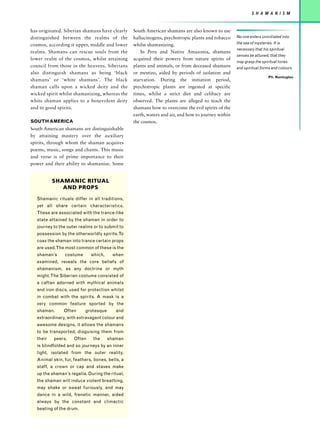


50
S L AV I C   A N D    B A L T I C      P E O P L E S


and shot arrows in honour of the god at a            worship of national heroes, practised cremation
sacred oak on the holy island of Chortice in         of the dead, and taught the doctrine of
the river Dnieper.                                   reincarnation. Until the early fifteenth century,
                                                     Lithuanian royalty and noblemen were cremated
LITHUANIAN STATE RELIGION                            in full regalia accompanied by their horses, dogs
Lithuanian religion was formulated by                and falcons. As late as 1583, Jesuit monks
Sventaragis in the sixth century AD, when the        visiting Lithuania reported that Perkunas was
cult of Perkunas was established. All over           being worshipped at oak trees.
Lithuania, on tracts of land called alkos sacred         In addition to the Vilnius shrine, there was
to the god, eternal fires were maintained by         another important centre at Romuva (now
priestesses known as vaidilutes. Sventaragis         in the Kaliningrad enclave of Russia),
established an ancestral centre in an oak grove      where, Peter von Duisburg records in 1326,
at Vilnius, where the ancestors of the ruling        a high priest, Kriviu Krivaitis, officiated.
dynasty were venerated.                              Whilst Perkunas was the major god, the
    During the early thirteenth century, in          Lithuanian pantheon contained many other
response to external threats, a polytheistic state   deities, including the goddesses Zemyna
religion was established by King Mindaugas. It       (earth), Saule (sun), Gabija (fire), and Laima,
amalgamated local cults, emphasized the              goddess of individual destinies.


                               TEMPLES IN POMERANIA
                                                                                                         In Vilnius ... Skirtnantas, the
   Until 1123, when it was destroyed by Bishop       had seven heads and seven swords.                   Lithuanian ruler, ordered vestals
   Otto of Bamberg, a temple of Gerovit stood        A hereditary high priest who was the head of        and priests to make offerings in
                                                                                                         honour of the gods and to the
   at Wolgast, a fortified holy island at the        the ruling family officiated at the temple of
                                                                                                         Great God Perkunas, who rules
   junction of three rivers in Pomerania. Until      Svantevit (Svarog) at Arkona. Svantevit was
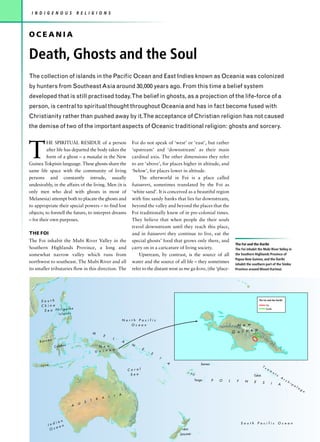
                                                                                                         fire, thunder and lightning. Day
   the same time, temples of Triglav existed at      depicted in a multiple-headed image holding
                                                                                                         and night, they were to feed the
   Wolin, Sezezin and the place that retains his     a horn. Comparable tenth-century images             eternal flame with oak wood.
   name today, Trzyglów. The holy island of          have been found in Poland in the Riavinski          If the fire ever went out, it was
   Rügen in the Baltic, settled by the Wends in      forest and the River Zbruc. The Rügen               re-lit from sparks made with a
   the seventh century AD, contained two main        temples were destroyed in 1169 by Danish            great boulder.
   temple enclosures, at Garz and Arkona.            crusaders after fierce resistance from the                        The Lithuanian and
   At Garz, an oaken image of the god Rugievit       men-at-arms dedicated to defend them.                          Samogytian Chronicle


                                                                                                                                             51
A N C I E N T           R E L I G I O N S


CENTRAL AND SOUTH AMERICA

The Maya
In what is now Mexico, the Maya dominated the lowland peninsula of
theYucatan highlands, Chiapas and most of Guatemala.There was
never one unified theocracy but a number of aggressive city-states.The
Maya favoured the arts and learning and pushed knowledge of astronomy and
mathematics much further than any previous civilization in the Americas.They
recorded much of their knowledge and beliefs by means of glyphs which, since
their decipherment, have enabled us to know much more about their religion.


T
        he effects on the Mayan people of their                                         All gods were endowed with a
        huge pantheon of supernatural forces –                                      calendrical presence, some more directly
        deities, spiritual beings and essences,                                     than others: the Pahuatuns or wind
could in part be discerned or predicted by the use                                  deities (Ik in the calendar); the Chicchans,
of their Calendars. The Tzolkin or divinatory                                       a giant snake (Chicchan); and the four
calendar, consisted of a 260-day sacred round.                                      Balams, jaguars who protected the
Found exclusively in Mesoamerica, the calendar                                      cultivated fields (Ix). Also important were
consisted of 13 numbers linked to 20 day names,                                     Exchel, the moon and the four Chacs or
each of which was a divine force: the first, Imix                                   rain gods. (See also pages 84–85 on
was linked to the earth monster.                                                    The Highland Maya Today.)


                                                                                                                        El Meco


                                                                                  Chichén Itzá
                                                                                                Cobá    Xelhá
                                                       Dzibilchaltún Izamal                                   San Gervasio
     The Realm of the Maya                                                               Halakal
                                                               Acancéh       Aké                 Tancáh
       settlements                                             Tihoo                   Yaxuná     Tulum
     trade and traded items                                              Mayapán
                                                         Oxkintok Maní
           trade              feathers                       Uxmal
           routes                                                         Loltun Cave
                                                    Huaymil     Kabáh
                              slaves                                       Labná                            Chacmool
           cacao                                                   Sayil
                                                     Jaina
                              marine products               Xcocha             Santa Rosa Xtampak
           obsidian           and shells                                         Dzibilnocac
           jade               salt                           Etzná
                                                                                                                                                       Left: The Realm of the Maya
     I T Z Á language group                                          Hochob         Yucatán                                                            Like their neighbours, the Aztec, the
                                                                                                             Ichpaatun
                                                              Champotón       Pechal                                                                   Maya thrived on trade. This map shows
                                                               Cilvituk                                    Santa Rita
                                                                                     Xpuhil                   Cerros                                   the realm of the Maya, their
                                                                                   Becan          Nohmul
                                                                                              Río Bec                                                  settlements, their language groups
                                                                                                            Cuello
                                                                         Oxpemul                                                                       and the items that they traded.
                                                                                               El Palmar
     metalwork imported                      Xicalango                     Calakmul
           from Mexican                                                                             Río Azul
               highlands                                             El Mirador Uxul                         San Jose
                                                                            Naachtún                   La Honradez                    metalwork
                       Bellote                                                                                Barton Ramie        imported from
                                          Jonuta                                    Uaxactún             Holmul
                       Comalcalco                              Moralles                   Tikal                                  Central America
                                                                                                         Naranjo
                                                                                      Uolantún                          Pomona
             C H O N TA L
                                                               Piedras          I T Z Á Topoxte Ucanal Tzimin Kax
               San Miguel                                      Negras El Cayo        Tayasal                    Mountain Cow
                                   Palenque                                                                   Caracol
                                                                             El Pajaral           Ixkun
                            CHOL                        La Mar            El Yaxchilán               MOPÁN          Lubaantun
                                         Toniná      LACANDÓN                  K E K C H I Seibal              Pusilha                                 Right: A jade serpent recovered
                                 T Z E L TA L                 Bonampak                                                             JICAQUE
                                                                         Kuna                        Machaquilá                                        from a sacred well (or cenote) at
                                                              Altar de Sacrificios           Cancuén                 San Felipe
                       TZOTZIL                                                                                                                         Chichen Itza.
                                   Chiapa del Corzo                               Aquateca                                    Naco        Santa Rita
                  San Augustín                TOJOLABAL            POKOMCHÍ
                           Santa Cruz            Chinkultic                                  KEKCHI
                                                                 Quen Santo                                Quiriguá          Los Higos
                                             T Z E L TA L                                   Chamá
                                 Santa Rosa                         Chaculá
                                                                    Nebaj QUICHÉ Pantzac                                 Copán         Yarumela                    TIME LINE
                 Tonalá                                            Chutixtiox              Zacualpa        Acasaguastlán
                                                              Zaculeu                         Cahyup       POKOMAM
                                                              MAM Utatlán                   Mixco Viejo                                                 Olmecs               150–750 BC
                                                       Tajumulco CAKCHIQUEL
                                                                    Abaj                        Kaminaljuyú
                                                                                    Sololá
                                                      Izapa                                      Amatitlán
                                                                   Takalik                                                                              Zapotecs             AD 300–600
                                                                              El Baúl       Pantaleón
                                                        El Jobo                                                    Chalchuapa
                                                         Salinas    Chocolá
                                                     la Blanca TZUTUHIL             Monte Obrero                                         Usulután
                                                                                     Alto      Finca Arizona                                            Classic Maya         AD 300–900

                                                                       Tiquisate
52
T H E   M AY A


MAYA COSMOLOGY
In Maya cosmology, seven layers extended
above the earth ruled by the 13 deities of the
Heavens: six marked the sun’s ascent, six its                                                     The 365-day solar calendar
                                                                                                  consisting of 18 months of 20 days
descent and one its position at midday. Below
                                                                                                  (here shown running together)
the earth was Xibalba, the realm of the dead,
consisting of four layers and ruled by the nine
deities of the underworld, an unpleasant place
                                                           The 20 day names of the
of putrefaction and strong smells from which
                                                           260-day sacred round
illnesses came. Each night, the sun passed
through the underworld in the guise of a jaguar,
descending through four layers before
midnight, to ascend again (through four) to rise
in the east. The underworld was linked to the
heavens by a huge tree, the ceiba, which is still
considered to be sacred in Mayan communities
today. The tree marked the centre of the earth,
distinguishing where the sun rose (our east and
linked to the colour red) from where the sun set
(west and linked to black). The north and south
(or up and down) were simply known as
sides of heaven and associated with white and
yellow respectively.                                         The 13 day numbers of the
    The other, 365-day calendar was important for            260-day sacred round

determining the dates of ritual. It consisted of 18
named months linked to 20 numbers (360) and a                                             The Mayans, like other Mesoamerican
                                                                                          peoples such as the later Aztecs, had a
month of five days known as the Uayeb, whose                                              sophisticated calendar. The divinatory,
days were considered particularly unpropitious.                                           260-day calendar intermeshed with the
The 365-day calendar was based on astronomical                                            365-day calendar (rather like interlocking
                                                                                          cog wheels) to give each day its distinct
calculations and intermeshed with the 260-day
                                                                                          character. With both calendars, an
divinatory calendar. With the two calendars                                               identically named day only re-occurred
combined, an identically named day only occurred                                          every 18,980 days (i.e. 52 years).
every 52 years, after which a new cycle began.


                                              RECOVERING MAYA BELIEFS
    It is the Chilam Balam and the Popul Vue, documents                especially of war captives and occasionally of children, but
    written after the Spanish Conquest, which began in 1517,           not on a scale comparable to the Aztecs. Animals and birds
    plus the numerous depictions on pottery and sculpture,             were also offered, such as armadillos and parrots, and
    which tell us much of what we know about the Maya’s                plants or plant products: copal, flowers, cacao, honey and
    beliefs, mythology and practices: such as those of the             the rubbery like chichle, from which chewing gum is made.
    mythical hero-twins, Xbalanque and Hunapahu, sons of                  Deities varied from community to community as did the
    Hun Hunapahu (god of corn), who were monster slayers               details of the calendars themselves. Both calendars are still
    and ballplayers. More recently the decipherment of the             to be found in use today, however, in many Mayan
    Mayan hieroglyphic script has added detail which                   communities in the highlands of Guatemala, for divinatory
    previously could only be guessed at.                                             purposes and to give shape to the ritual year.
      Rituals were huge affairs, preceded by fasting,
    abstinence     and    ceremonial     steam    baths,
    accompanied by music, dancing and incense and
    attended by many. Autosacrifice was an important
    means of contacting the deities. By drawing a cord
    or piece of grass through the penis or the nose, and
    letting blood, visions could be induced, personified by
    the Vision Serpent. This was performed particularly by
    the king and his wife. Human sacrifice did occur,

                                                                                                                                                    53
A N C I E N T                    R E L I G I O N S


The Aztecs
The Aztecs were an itinerant people who settled in the Valley of Mexico
between AD 1200 and 1300. From humble beginnings they rose to become the
dominant political force in Central America by the time of the Spanish arrival
in 1519. Daily life was dominated by the sun,Tonatiuh, who by the time of the
Aztecs (1350–1525) was often equated with Huitzilopochtli, their principal
deity and also a god of war. He demanded to be fed by blood in order to keep
rising, necessitating human sacrifice.


W
             HAT WE KNOW of Aztec religion                                                     around AD 1325, after a long journey south
             is primarily due to the accounts of                                               from Aztlan during the fifth and final Sun,
             those Spanish friars who, after the                                               which was to bring earthquakes and famine.
Aztec defeat, became interested in the beliefs
and practices they were attempting to stamp                                                    THE COSMOS
out. The Aztec codices, folding screens books                                                  According to myth, there had already been four
made from deer skin, give us details in a                                                      previous Suns, each of which had been
pictorial language while the sculptural forms                                                  destroyed. But the last was a Sun of movement,
can tell us what their deities looked like.                                                    such that some of the gods had even sacrificed
                                                                                               themselves in order to keep it in motion. The
THE RISE OF THE LAST SUN                                                                       world was believed to consist of a disc
The Aztecs were the last of a number of                                                        surrounded by water with 13 layers above and
different cultures that occupied the Central                                                   nine layers below. In the highest lived
Mexican plateau and the most belligerent,                                                      Ometeotl, the omnipotent supreme being, deity                                        The Aztec Empire to 1519
although their expansionist empire lasted only                                                 of duality both masculine and feminine, but                                          The Aztec relied heavily on trade and
                                                                                                                                                                                    tributes for their livelihood. The map
a century. Huitzilopochtli owed his pre-                                                       who also lived in Mictlan, the underworld and                                        shows the major sites, settlements and
eminence to the Chichimeca-Mexica tribal                                                       peopled all the other layers. Ometeotl had four                                      trading routes of the Aztec Empire
                                                                                                                                                                                    to 1519. The expansion of the Empire
peoples whose deity he was. They had made                                                      sons, the four Tezcatlipocas, (a name usually
                                                                                                                                                                                    was also driven by the need to acquire
Tenochtitlan (today Mexico City) their home in                                                 translated as ‘Smoking Mirror’) two of whom                                          captives for use as human sacrifices.


                             Pá
                                                                 Tamuín
                              nu
                                co


               Aztec capital
           founded AD1325
                                                                                 Teayo
                                             Tula
                                                                      El Tajín
           Tzintzuntzán                    Azcapotzalco
                              L.Texcoco       Texcoco                                                             B a y o f C a m p e c h e                                                      Chichén Itzá
                              Tenochtitlán                                                                                                                               Mayapán
                                              Tlatelolco
                               Tlacopán                                                                    long-dist
                                                     Tlaxcala                                                       a   nce contacts from 9th century AD
                                         Malinalco                      Cacaxtla
 Aztec period temple                                                     Cholula          Cempoala
                                      Xochicalco                                                                                                                                                    Tulum
      carved in rock
                                                                                    major centre of
                                                                                    Aztec allies                                                                              Y u c a t á n
                                                            s                                                                           tween
                                                      lsa             Teotitlán                                     trading exchanges be                   Champotón
                                                    Ba                                   Teh                                                                                 P e n i n s u l a
                                                                        lley             Va uacá                    A z t e c a n d M a ya       Xicalango
                                             Monte Albán              Va Yagul             lle
                                                                                               y
                                                                                                n


                                                                                                                                                                                                  Ichpaatun
                                                                 ca


                                                                          Mitla
                                                                xa
                                                                Oa


                                                                                                                                                                                    Santa Rita

                                                                                                                                                                  ACALAN           Lamanai          Maya centres occupied
                                                                                                                                                                                 Tipu               continuously until
                                                                                                                                                                       Tayasal                      mid-17th century
                                                                                                      Guiengola

     The Aztec Empire to 1519                                                                                                                                                                                 Gulf   of
                                                                                                                                                                                                            Honduras
            Maya area
                                                                                                                        XO
                                                                                                                          CO


            area of Aztec domination, 1519                                                                                                     Zaculeu                  Wild Cane Cay
                                                                                                                              N


                                                                                              rich province supplying                                             island trading centre
                                                                                                                                US


            trading routes                                                                  cacao to the Aztec capital
                                                                                                                                  CO


                                                                                                                   Xoconocho                      Iximché


54
T H E   A Z T E C S


are sometimes known as Quetzalcoatl (‘Plumed              These were lavish and costly affairs, at least
Serpent’) and Huitzilopochtli (‘Hummingbird           in Tenochtitlan which was a large and
on the Left’).                                        sophisticated city, with 30 distinct classes of
    Associated with the four early Suns, they         priests and priestesses, education for women,
were responsible for creating fire, a half sun and    and slaves. The ceremonies were held in the
moon, water, other divine beings and the              open air and were attended by thousands,
calendar. But it was the fifth Sun that completed     including the common people.
the cosmos.                                           During the preparatory days,
                                                      the priests fasted (one meal
THE FESTIVALS                                         per day) and observed
The Aztecs had two calendars, the Haab and the        prohibitions (on bathing
Tonalpohualli, but most of the large monthly          and sex). An all-night vigil
religious festivals were related to the former, the   preceded the festival itself,
365-day cycle. Many were for agricultural             which was usually of
matters and dedicated to Tlaloc and the               several days duration.
Tlaloque (the deities of water and fertility),        Shrines were embowered
while others propitiated Huitzilopochtli,             and decorated with
Tezcatlipoca or Xiuhtecuhtli (deity of fire), or      flowers, and offerings
female deities, such as the goddess of love,          of food, clothing
Xochiquetzal (‘Precious Flower’) or Coatlicue         and rubber-spattered
(‘She of the Serpent Skirt’).                         papers were made,
                                                      accompanied        by
                                                      burning incense and
                                                      libations. Through-
                                                      out the festivities
                                                      sacred songs were
                                                      sung, music played and
                                                      there was dancing.
                                                          Festivities in the countryside were simpler,
                                                      more benign and often dedicated to local and            QUETZALCOATL
                                                                                                            Although still part of
                                                      feminine deities (such as Tonantzin, who
                                                                                                            the    Aztec     pantheon,
                                                      represented the power of the earth). For              Quetzalcoatl     (as     the
                                                      although the Aztecs conquered a huge area and         plumed serpent) was of
                                                      brought all the foreign deities into their            less significance than at
                                                      pantheon in Tenochtitlan, they were unable to         the time of the earlier city-
                                                                                                            state    of Teotihuacan
                                                      obliterate local customs.
                                                                                                            (150 BC–AD 750 – see Time
                                                          Most      pre-Christian    practices    were      Line below), where he was
                                                      eradicated, with time, by the Spaniards but           revered as a feathered
                                                      there are today groups in Mexico City who             celestial dragon. For the
                                                                                                            laterToltecs (AD 900–1200),
                                                      are      disaffected with their lives and
                                                                                                            he became the patron of
                                                      with globalization. Calling themselves the            warriors and associated
                                                      Mexica, they are attempting to reinvent               with the morning star.
                                                      Aztec religiosity.


                                       THE SACRIFICES
   Each festival had one or more processions          and a compelling political message: that
   which included those to be sacrificed,             the Aztecs were the servants of their
   sometimes dressed up as deities (ixiptla),         deities. Often thousands of men and
   whom they impersonated for a day or two,           women were sacrificed, captives from
   living in luxury, before their hearts were cut     neighbouring groups, their bodies allowed                      TIME LINE

   out with an obsidian knife and offered up in       to fall down the steps from the top of the           Teotihuacan       150 BC–AD 750
   ceremonial vessels and their flayed skins          ceremonial pyramids, after which their
                                                                                                           Toltecs           AD 900–1200
   worn    by   male    dancers. These      were      heads were placed on the skull rack and
   theatrical occasions with dramatic appeal          their flesh cooked.                                  Aztecs            AD 1350–1525


                                                                                                                                            55
A N C I E N T   R E L I G I O N S


The Incas
The Incas were originally a mountain culture, brought to the Cuzco Valley by
legendary leader Manco Capac in 1200.They gradually established their
dominance over other valley cultures, until at their height they incorporated
much of Peru and Bolivia, and sections of Chile, Argentina and Ecuador. At
the head of the empire was a divine monarch, who demanded a loyalty akin to
slavery, but provided for all the needs of the people in return. Religion was
organized in a similar fashion, with Viracocha, the supreme immanent deity,
responsible for all the others.The most important religious ceremonies took
place in Cuzco, the centre of the empire, for the Sun (Inti), his consort the
Moon (Mama Qiya) and Ilyap’a (the thunder and weather deity).


T
        HE CONSOLIDATION of the Inca                 SACRED GEOGRAPHY
        empire had occurred (c. 1400) only a         Conceptually, the Inca cosmos was divided into
        little over a century before its conquest    spheres linked together by Viracocha (as the
by the Spanish in 1532, and covered parts of         cosmic river). This earth (kaypacha) was seen as
present-day Peru, Bolivia, Ecuador and Chile.        an almost vertical domain, probably because of
Although Viracocha was considered to be              the immense physical diversity that characterizes
omnipresent, this name was just one of the many      the region – rising from sea level to high
attributions given to the deity before the arrival   mountains in a very short distance.
of the Spaniards.                                        Only east and west were named, where the
                                                     sun rose and set while the country was seen to
THE INCA COSMOS                                      consist of four unequal ritual quarters, as was
At the beginning of the cosmic cycle,                Cuzco itself. Radiating out from the Coricancha
Viracocha was associated with Lake Titicaca,         (the temple of the Sun in Cuzco) were ceques –
out of which the sun, moon and stars emerged
and ascended as gods. The numerous lesser
deities were believed to have emanated from
the caves, hills, springs and mountains, many
taking animal (zoomorphic) or bird (avian)
forms. The Quechua-speaking indigenous
people today still associate their deities with
these sacred locations known as huacas.
Considered to be animate, they are imbued
with supernatural power and mythic
significance, and are usually marked by stones.
Some are the tombs of ancestors, which
contained their mummies during the time of
the Inca empire. It was to the huacas that
sacrifices of alpacas and llamas and sometimes
children were made, linked to divination by
ritual specialists. Mostly of regional
significance, nonetheless travellers made and
still make offerings of coca, chicha (beer),
pieces of clothing or an additional stone,
particularly during pilgrimages. The earth
itself, known as Pachamama (the earth mother)
has not only to be consulted, but also assuaged.

56
T H E      I N C A S


                                                        known as Qolqa (‘the granary’), were
                                                        particularly important for prognostication of
                                                        agricultural fertility and many of the bigger
                                                        ceremonies centred around the growth cycle.
                                                            Important rituals were held also at solstices.
                                                        During the festival of Qapaq Raymi in December,
                                                        as held in Cuzco, boys of royal descent were
                                                        initiated and llamas sacrificed to the sun. The
                                                        llama was sacred to the royal lineage. So, for the
                                                        Ayriwa celebrations, in April, a perfect white
                                                        llama was dressed in red with gold ear ornaments
                                                        and taught to ingest coca and chicha and allowed
                                                        to live. For other festivals, the llamas were less
                                                        lucky and were usually sacrificed, sometimes in                                      Inca Empire
a series of some 41 conceptual lines along which        large numbers and usually accompanied by                                             The Inca empire expanded rapidly in
                                                                                                                                             the fifteenth century. From Cuzco, the
still lie some 328 huacas.                              prayer, music, dancing and drinking.
                                                                                                                                             Inca emperor exerted rigid control over
     The various parts of the empire were linked            By the time of Pachacutec, anthropomorphic                                       this extensive territory by means of a
together by a network of roads along which              statues had been made, such as that of Viracocha                                     highly trained bureaucracy, a state
                                                                                                                                             religion, a powerful army and an
messengers ran carrying quipu, bundled cords,           fashioned from gold and representing a young                                         advanced communications network.
from which hung dyed knotted strings. These             boy. Viracocha was also believed to be a culture                                     The final expansion under Huayna
                                                                                                                                             Capac put the Inca world under great
were coding devices that could communicate              hero and to travel throughout his dominions and
                                                                                                                                             strain, however, and by the arrival of
information at a distance: the Incas lacked             according to myth disappeared across the ocean                                       the Spanish conqueror Pizarro, in 1533,
a written language which means that all of              to the north-west.                                                                   civil war had split the empire in two.

our information on their religious practices is
post-conquest.                                                                                                                                                                   Ja pu
                                                                                                                                                                                         rá
                                                                                       Quito
INCA HISTORY AND RITUAL
                                                                                                                                                                        Amazo
The first Inca (king) was Manco Capac, who                                                                                                                                   n
was also seen as an androgynous founder                                            Cuenca

ancestor. All subsequent Incas and their wives,                    CHINCHAYSUYU
                                                                                                                        ón
                                                                                                             M ar a ñ
                                                                                               A


(the Coyas) were also considered to be of divine
                                                                                                                             li
                                                                                                                              a


descent: the Inca, the son of the sun; the Coya,
                                                                                       C


                                                                                                                           ay
                                                                                                                         Uc
                                                                                         H
                                                                                               nM Ú


the daughter of the moon. Their festivals were                                                                                                                         P urus
                                                                                           I


                                                                                        Chan          Cajamarca
ordered according to a calendar based on the                                            Chan


                                                                                                                                                                                         e
                                                                                                                                                                                    or
                                                                                                 d


                                                                                                                                                                                  am
moon and stars and consisting of 12 months.


                                                                                                                                                                                 M
They gave particular importance to the Milky                                                                      Huánuco
                                                                                                        e


                                                                                                          Bombón
Way, two of whose constellations were named
                                                                                                              s


as a baby and an adult llama. The Pleiades,
                                                                                                Pachacamac                        Machu      ANTISUYU
                                                                                                                                  Picchu
                                                                                                         Inkahwasi                         Ollantaytambo
                DIVINATION                                                                                           Vilcashuamán          Cusco

                                                                                                                         Limatambo

   As all illness was believed to be due to                                                                                                   M     Lake
                                                                                                                                                    Titicaca
                                                                                                                             CUNTISUYU                            Tiahuanaco
   supernatural      causes,     divination     was
                                                                                                                                                    o


   important for curing when amulets, plants,                                                                                                                  Cochabamba
                                                            The Inca Empire
   guinea-pig fat and parts of other animals
                                                                                                                                                           u


                                                            The growth of the Inca Empire:
   were administered. For really serious                             under Pachacuti,
                                                                     1438–63
   illnesses or for taking important decisions, an                                                                Pacific
                                                                                                                                                           n


                                                                      added under Pachacuti
   oracle would be consulted such as at the                           and Topa Inca, 1463–71                      Ocean                                    COLLASUYU
                                                                      added under Topa Inca,
   Apurima huaca, where a tree trunk, had a
                                                                                                                                                                t


                                                                      1471–93
   ‘gold band the thickness of one hand                               territory under Huayna
                                                                      Capac, 1493–1525
                                                                                                                                                                a


   ...wrapped around it; this band had a pair of
                                                           ANTISUYU 'Four Quarters' of the
   solid gold breasts on it’ and was dressed in                     Inca Empire
                                                                                                                                                                i


                                                                      imperial roads
   women’s clothing ‘of very fine gold and many
   ...large pins’. ‘...this post was covered in blood
                                                                                                                                                                n


   from the sacrifices that were made there.’
                                                                                                                                                                s
Indigenous Religions
SHAMANISM

Shamanism
Shamanism is recognized as the world’s oldest religious tradition, evolving
before the Neolithic period (c. 8000–3000 BC) and the Bronze Age (2000–500
BC). It was originally practised among hunting and gathering societies of

Siberia and Central Asia.


T
         HE WORD SAMAN is derived from the                 Shamans come into their roles for a
         Tungus people of Siberia, becoming            variety of reasons. Often it is a question of
         shaman in Russian, and has been               inheritance, or they are something of a
interpreted to mean ‘he who knows’ or ‘one who         social misfit, or else they undergo an
is excited, moved, raised.’ References to these        alteration in character. They may appear
figures include medicine men, sorcerers,               possessed     and     experience    remarkable
magicians, necromancers, ascetics, healers,            behavioural changes and neurosis. This is referred
ecstatics, acrobats and Brahmans, but essentially      to as the Initiation Crisis. Generally, once
the shaman is an indigenous practitioner whose         initiated, these symptoms disappear and the
expertise lies in entering a trance which enables      shaman abandons his or her former life in
his or her soul to travel to the upper and lower       submission to a new path. Women are as likely as
worlds of the spirits and demons. Alternatively,       men to be shamans. Essentially the shamans are in
in mastering the spirits, the shaman will invite the   possession of a supernatural gift that is received
spirits into him or herself. The shaman’s journey      from the spirit realm and the donor becomes the
through this altered state of consciousness is         spiritual guide or spiritual ‘spouse’. Shamans
conducted in order to pass into the world of the       know initiation when they have an apparition of
spirits as a mediator for his tribe or people.         their guide, who will seemingly steal the soul and
    Shamanism is believed to have been present         travel to another realm of the cosmos where the
in most parts of the world, but it is known to         soul will perish, only to be reproduced and, in a
have originated in Siberia. There is contention        sense, reborn into a new vocation.
over whether seeds of shamanism arose
naturally or were disseminated by means of             THE ROOTS OF SHAMANISM
trade routes, migration or oral traditions. It is      Siberia is the homeland of the shaman, where
plausible that most religions and cultures have        they have been an integral part of the culture
acquired it or incorporated it through an innate       of such peoples as the Tungus, the Mongols,
human desire or inherent social need to                the Samoyedes, the Inuits and the Altaians –
communicate with the otherworld.                       from whom the term and definition ‘shaman’


58
S H A M A N I S M


has originated. Siberian shamans have clearly    South American shamans are also known to use
distinguished between the realms of the          hallucinogens, psychotropic plants and tobacco     No one enters uninitiated into
                                                                                                    the sea of mysteries. It is
cosmos, according it upper, middle and lower     whilst shamanizing.
                                                                                                    necessary that his spiritual
realms. Shamans can rescue souls from the            In Peru and Native Amazonia, shamans
                                                                                                    senses be attuned, that they
lower realm of the cosmos, whilst attaining      acquired their powers from nature spirits of
                                                                                                    may grasp the spiritual tones
council from those in the heavens. Siberians     plants and animals, or from deceased shamans       and spiritual forms and colours.
also distinguish shamans as being ‘black         or mestizo, aided by periods of isolation and
                                                                                                                       Ph. Kontuglou
shamans’ or ‘white shamans’. The black           starvation. During the initiation period,
shaman calls upon a wicked deity and the         psychotropic plants are ingested at specific
wicked spirit whilst shamanizing, whereas the    times, whilst a strict diet and celibacy are
white shaman applies to a benevolent deity       observed. The plants are alleged to teach the
and to good spirits.                             shamans how to overcome the evil spirits of the
                                                 earth, waters and air, and how to journey within
SOUTH AMERICA                                    the cosmos.
South American shamans are distinguishable
by attaining mastery over the auxiliary
spirits, through whom the shaman acquires
poems, music, songs and chants. This music
and verse is of prime importance to their
power and their ability to shamanize. Some


           SHAMANIC RITUAL
              AND PROPS

   Shamanic rituals differ in all traditions,
   yet all share certain characteristics.
   These are associated with the trance-like
   state attained by the shaman in order to
   journey to the outer realms or to submit to
   possession by the otherworldly spirits. To
   coax the shaman into trance certain props
   are used.The most common of these is the
   shaman’s     costume      which,     when
   examined, reveals the core beliefs of
   shamanism, as any doctrine or myth
   might. The Siberian costume consisted of
   a caftan adorned with mythical animals
   and iron discs, used for protection whilst
   in combat with the spirits. A mask is a
   very common feature sported by the
   shaman.      Often      grotesque      and
   extraordinary, with extravagant colour and
   awesome designs, it allows the shamans
   to be transported, disguising them from
   their   peers.    Often    the      shaman
   is blindfolded and so journeys by an inner
   light, isolated from the outer reality.
   Animal skin, fur, feathers, bones, bells, a
   staff, a crown or cap and staves make
   up the shaman’s regalia. During the ritual,
   the shaman will induce violent breathing,
   may shake or sweat furiously, and may
   dance in a wild, frenetic manner, aided
   always by the constant and climactic
   beating of the drum.
I N D I G E N O U S                R E L I G I O N S


OCEANIA

Death, Ghosts and the Soul
The collection of islands in the Pacific Ocean and East Indies known as Oceania was colonized
by hunters from Southeast Asia around 30,000 years ago. From this time a belief system
developed that is still practised today.The belief in ghosts, as a projection of the life-force of a
person, is central to spiritual thought throughout Oceania and has in fact become fused with
Christianity rather than pushed away by it.The acceptance of Christian religion has not caused
the demise of two of the important aspects of Oceanic traditional religion: ghosts and sorcery.


T
          HE SPIRITUAL RESIDUE of a person                                       Foi do not speak of ‘west’ or ‘east’, but rather
          after life has departed the body takes the                             ‘upstream’ and ‘downstream’ as their main
          form of a ghost – a masalai in the New                                 cardinal axis. The other dimensions they refer
Guinea Tokpisin language. These ghosts share the                                 to are ‘above’, for places higher in altitude, and
same life space with the community of living                                     ‘below’, for places lower in altitude.
persons and constantly intrude, usually                                              The afterworld in Foi is a place called
undesirably, in the affairs of the living. Men (it is                            haisureri, sometimes translated by the Foi as
only men who deal with ghosts in most of                                         ‘white sand’. It is conceived as a beautiful region
Melanesia) attempt both to placate the ghosts and                                with fine sandy banks that lies far downstream,
to appropriate their special powers – to find lost                               beyond the valley and beyond the places that the
objects; to foretell the future, to interpret dreams                             Foi traditionally knew of in pre-colonial times.
– for their own purposes.                                                        They believe that when people die their souls
                                                                                 travel downstream until they reach this place,
THE FOI                                                                          and in haisureri they continue to live, eat the
The Foi inhabit the Mubi River Valley in the                                     special ghosts’ food that grows only there, and
                                                                                                                                              The Foi and the Daribi
Southern Highlands Province, a long and                                          carry on in a caricature of living society.                  The Foi inhabit the Mubi River Valley in
somewhat narrow valley which runs from                                               Upstream, by contrast, is the source of all              the Southern Highlands Province of
                                                                                                                                              Papua New Guinea, and the Daribi
northwest to southeast. The Mubi River and all                                   water and the source of all life – they sometimes            inhabit the southern part of the Simbu
its smaller tributaries flow in this direction. The                              refer to the distant west as me ga kore, (the ‘place-        Province around Mount Karimui.


      South                                                                                                                                                    The Foi and the Daribi

      China                                                                                                                                                             Foi
                    pine
       S e a Philip
                                                                                                                                                                        Daribi

                   Islands

                                                                            North Pacific
                                                                               Ocean                                                           N e w
                                                                                                                                                     e a
                                                M                                                                                            G u i n
                                                        E
           o
                                                                L
     Borne                                                                  A
                            s                                                    N
               C e le b e                         N e w
                                                        e a                             E
                                                G u i n                                     S
                                                                                                I
                                                                                                    A                    Samoa
      Java                                                                                                                                                          Tu
                                                                                Coral                                                                                  am
                                                                                                                                                                                 ot
                                                                                 Sea                              Fiji                                     Tahiti                   u
                                                                                                                                                                                            A
                                                                                                                     Tonga                                                                      rc
                                                                                                                                 P   O   L     Y    N      E                                       hi
                                                                                                                                                                    S       I           A             pe
                                                                                                                                                                                                         la
                                                                                                                                                                                                            go

                                                                    I   A
                                                        A   L
                                            T       R
                                        S
                                    U
                                A


              ian                                                                                                                                  South       Pacific                  Ocean
          Ind an
           O ce                                                                                             NEW
                                                                                                           ZEALAND
D E AT H ,   G H O S T S   A N D   T H E   S O U L


                                                              It is not just the flow of water and digestion
                                                          that are modelled by these macrocosmic
                                                          orientations, but also the moral direction of the
                                                          flow of social energy. By stipulating that men
                                                          and women should inhabit distinct spatial zones,
                                                          a visible flow – of food, sexual fluids, children –
                                                          is set up between them. Pearl shells, which are
                                                          given by men to other men in exchange for
                                                          women as brides, govern the marital destinies of
                                                          women and men, and thus also flow in similar
                                                          mythical directions.

source-upstream’), and it is the direction from
which pearl shells are thought to have originated,
as well as certain brightly coloured shrubs and
flowers associated with pearl-shell magic.

THE DARIBI
The Daribi inhabit the southern part of Simbu
Province around Mount Karimui. Their
macrocosm is similarly oriented by the flow of
the Tua River, only in this case it flows from east
to west, thus paralleling the movement of the
sun. It is interesting to note that in the cases of the
Foi and Daribi it is the movement of water that is
the primary orienting movement, and movement
of the sun, by contrast, is interpreted accordingly.
Thus, for the Foi, the sunset is associated with the
origin and source of water and has connotations
of vitality and life. The red of a flamboyant
sunset reminds them of the red paint that young
men and women wear at dances, a time when
flirtation, sexual play and marriage proposals are
approved of. It also, of course, reminds them of
the red colour of pearl shells.


                                   THE DARIBI LONGHOUSE

   The Daribi longhouse is oriented with the              in the direction of the sunrise while women
   front of it facing east so that the rising sun         live in the direction of the sunset, the place
   may shine through the front door. This is              where water and ghosts go. For the Daribi
   considered the ‘face’ of the house, and is             the sunset means just the opposite to that
   the only end provided with a ladder for                of the Foi: it is associated with death and
   entrance – all coming and going is through             the place the ghosts go, for ghosts follow
   the front door. The back door, by contrast,            the direction of water in both the Foi and
   is used to throw rubbish and food remains              Daribi traditions.
   out, and is also used as a latrine by the                Unlike the Foi, both Daribi men and women
   men and women.                                         live in the longhouse, which is divided into
      Thus, the Daribi longhouse is a miniature           male and female areas: men live in the ‘east’
   or microcosmic version of the more                     or ‘front’ section, while women live in the
   encompassing world space or macrocosm.                 ‘rear’ or ‘west’ section. East also means
   The analogy of the longhouse is that of the            ‘higher’ in Daribi, as ‘west’ means ‘lower’ or
   human digestive tract, in which food and               below;   some        Daribi   longhouses   are
   other materials enter from one end and                 constructed of two stories, in which case the
   excretion takes place out the other. Men live          men sleep in the upper half.

                                                                                                                                         61
I N D I G E N O U S   R E L I G I O N S


The Mythic Chieftainship
Unlike most interior New Guinea societies, in island Melanesia,
as in Polynesia, the institution of chieftainship is a central social
and cultural institution.The chief has certain religious and ritual
responsibilities and partakes of a certain divinity himself. He is
the incarnation of certain deities, as in Hawai’i, or of the totem, as
in New Caledonia.


P
       OLYNESIAN SOCIETIES IN general              CHIEFLY POWER
       are hierarchical, usually with a chiefly    The primary concern of religion was
       ruling class, commoners, and a lower or     protection of the people – individual and
slave class. As well as the king being of divine   group – from divine malevolence. Strict
origin, the head of a family also mediated the     adherence to laws and procedures was
divine realm. This function was increasingly       necessary to keep the divine and physical
taken over by a class of priests. There is much    worlds in harmony. The main functions of
variation in the region as to how separate were    priests were the foretelling of events through
the roles of chief and priest and the kinds of     divine intercession, and leading ceremonies to
secular power they exerted.                        ensure the conventional stability of society.


62
T H E   M Y T H I C   C H I E F T A I N S H I P


   All chiefly power in Polynesia is                 body. The god father, however, forces them to
made possible by divine power. In the                regurgitate the body, which he god then brings
Marquesas, the birth of a firstborn is referred      back to life and sends to earth to be the first
to as the epiphany of a god, according to            Tu’i Tonga.
the anthropologist Douglas Oliver. It has                Stone petrolgyphs in Hawai’i were
also been reported that Marquesans believed          important ritual anchors between the surface
that the firstborn was sired by an                   world and the divine sky realm. Hawai’ian
ancestral divinity.                                  shrines, called heiau, were often built upon a
                                                     sacred foundation of stones. One such place is
THE SACRED KING                                      Kukaniloko. When Kukaniloko was used as an
In Tonga, the sacred king is known as the Tu’i       ancient birthing place, there was a large stone
Tonga. He was the main mediator between the          that presumably held the mother up in a sitting
realm of the human and that of the divine, and       position. A chief was required
is said to have descended from the sky. In the       to stand before each
myth, the first Tu’i Tonga was Aho’eitu. He          woman. The child born
was the son of the earth-mother Ilaheva, who         would be called ‘a
was made pregnant by Eitumatupu’a, the sky           chief     divine;    a
god, who then went back to his heavenly realm.       burning fire’. The
As a small boy the son goes to heaven to find        name Kukaniloko
his father. When the god sees his son, he falls to   itself means ‘an
the ground, so overwhelmed is he by his son’s        inland area from
beauty. Later, Aho’eitu defeats his older            which great events
brothers, who in revenge, kill him and eat his       are heralded’.


                          HAWAI’IAN GODS

   Humans and gods would compete over the power to
   reproduce themselves. La’ila’i is the older sister of
   both god and human and is also the firstborn. Her
   brothers, sometimes described as twins, are Ki’i (a
   man) and Kane (a god). She weds both of them,
   giving birth to both the line of humans and of gods,
   though the children of Kane are senior to those of
   Ki’i. As the generations succeed each other, the line
   of men repeatedly marry back into the line of gods,
   according to the Kumulipo chant.
     In Hawai’i, the time of the god Lono begins with
   the winter rainy season, the period when all things
   planted bear fruit. Lono is the god of regeneration
   and fertility, while Ku is the god of war and sacrifice.
   This generative power is maintained at the expense
   of its opposite, the power of war, which is the
   province of the god Ku, whose temple rituals are
   suspended during this period. After Lono departs,
   the king had to re-sanctify the temples of Ku by
   means of human sacrifices.
     It is said that Lono, as part of the general fertility
   he brings, descends from heaven to mate with a
   beautiful woman. Thus, when Captain Cook arrived,
   from the proper direction, at Hawai’i at the time of
   Lono, it was thought he was the god. The Hawai’ian
   women paddled out to meet him and his crew, eager
   to mate with the gods in the hope of bearing a sacred
   child who would be chief.

                                                                                                                                 63
I N D I G E N O U S                  R E L I G I O N S


          Millenarian Movements
          Cargo cult is the label given to a series of millenarian and apocalyptic movements that arose in
          many South Pacific islands following European colonization. What these cults have in common is
          a perception of the magical source of western material wealth and the Pacific islanders’ attempt
          to recreate that magical procedure so as to attain the wealth themselves.


          T
                    HE CARGO CULT in Melanesia was                                        be arriving by aeroplane. People abandoned
                    in many respects an ‘inverted                                         their gardens and engaged in frenzied acts
                    anthropology’ – it was the attempt by                                 of spirit possession. This was called ‘The
          Melanesian people to analyze the source and                                     Vailala Madness’ by the anthropologist F. E.
          substance of the western material world in                                      Williams. For the next 10 years the British
          terms of their own magical and spiritual                                        colonial administration imprisoned all men
          cosmos, and efforts were expended to obtain                                     who took leadership roles in inciting
          access to this world by means of their own                                      hallucinatory activity and by 1931, the cult had
          ‘magical technology’. They saw acceptance                                       died out.
          of Christianity as the Europeans’ ritual means
          of obtaining the cargo. This approach
          still   remains      fundamental    to    many
          Melanesians’ responses to governance and
          economic issues of today, although the cargo
          cults as such have become institutionalized and                                                                                                                 New Oceanic Cults
          ‘routinized’ to a large extent.                                                                                                                                 The twentieth century witnessed the
                                                                                                                                                                          rise of many new religious cults in
                                                                                                                                                                          areas of Oceania. The extreme and
          THE VAILALA MADNESS                                                                                                                                             sometimes bizarre nature of some of
                                                                                                                                                                          these movements had led to them being
          In 1919, on the south coast of Papua New
                                                                                                                                                                          given the label ‘cargo cults’, although
          Guinea, one of the most dramatic of the                                                                                                                         this is now seen as a derogatory term.
          Melanesian cargo cults started. The ancestral                                                                                                                   Most proved to be short-lived. The map
                                                                                                                                                                          shows the areas in which these new
          spirits communicated to certain men that                                                                                                                        cults arose, alongside the traditional
          western ‘cargo’ or material goods would                                                                                                                         tribal settlements of the area.


       So uth
                                                                                                                                                               Marshall
       Ch ina     Philippine                                                                                                                                   Islands
                                                                                                                                                                                                New Oceanic Cults
        Se a                                                                                   Caroline Islands                                                                                        The Vailala Madness
                    Islands
                                                                                  I        C           R        O        N       E         S       I       A                                           The Johnson Cult
                                                                          M                                                                                                                            The Luveniwai Movement
                                                                                                                                                                                                       The Nagriamel Gospel


                                                                                                                                                                            Kiribati
                                                                              M                                                                                             (Gilbert
                                     Moluccas                                             E                                                                                  Islands)

  Borne
           o                                                                                           L              New Ireland
                                                                                                                                                                                                                   Phoenix Islands
                                                                       N e w                                      A
                             s                                                                                            N
                C e le b e                                           G u i n
                                                                             e a
                                                                                                            New
                                                                                 Kuk                                                 E                                                  Tuvalu                                  Tokelau
                                                                                      Swamp                Britain                                                                 (Ellice Islands)
                                          Banda                                                                                 Solomon        S                                                                                Islands
                                           Sea                                                                                   Islands
                                                                                          Purari                                                       I
                                                           Arafura
                                                                                           Delta                                                                A
                                                             Sea
                                         Timor                                                                                                                                                                        Samoa
Java
                                                                                                                      Co ra l                                       Vanuatu
                                 Timor                                                                                 Se a                                         (New Hebrides)
                                   Sea                                                                                                                                                                Fiji

                                                                                                                                                                                                             Tonga
                                                                                                                                                               New Caledonia


                                                                                           I       A
                                                                              A       L
                                                             T        R                                                                                               Norfolk I.
                                                       S
                                                   U                                                                                                                                                         Kermadec Is.
                                           A
M I L L E N A R I A N   M O V E M E N T S


THE NAGRIAMEL GOSPEL                                 petitioned for independence, demanding
In the New Hebrides (now Vanuatu) in 1966,           repatriation of foreign-owned plantations. In
Jimmy Stephens became a prophet and called           1964, when the first elections were held in Papua
his reform movement Nagriamel – which was            New Guinea, the people of New Hanover
a symbol for the restoration of traditional          became persuaded that the then US president,
custom. On the island of Espiritu Santo,             Lyndon Johnson, would be the person to lead
Stephens and his followers spread the                them to a better government. They collected a
Nagriamel gospel, which aimed to recover             large amount of money in shilling coins and gave
land that had been appropriated by the               this to the local Catholic missionary with
Europeans. He continued to be an important           instructions to send the money to President
political presence well after the independence       Johnson to cover his travelling costs to New
of Vanuatu, but was eventually imprisoned.           Hanover. The money was returned to them, but
                                                     their desire to install President Johnson as their
THE LUVENIWAI MOVEMENT                               leader continued for some time after that.
In Fiji, a secret society arose towards the end of
the nineteenth century. The movement focused
on the class of indigenous spirit beings called
luveniwai (‘children of the water’). These were
small elves or dwarfs that lived in areas of
waterfalls and dense jungle. Many people
believed they were spirits of abandoned
infants. The Luveniwai Movement attested
that each person could have a personal
guardian spirit of the forest – they met in secret
clearings in the forest, drank kava and
performed ceremonies. The movement
eventually attracted the attention of the
colonial government when people involved
refused to work and ordained it illegal.

THE JOHNSON CULT
One of the most bizarre of the cults was the so-
called Johnson Cult of New Hanover in Papua
New Guinea. In 1933, the people of the island


                                             NEW MEN

   In the Purari Delta of Papua New                  administrative detail of western life; he
   Guinea’s south coast, there arose after           built his own ‘office’ which he littered
   the Second World War the movement of              with printed papers of all kinds, including
   ‘New Men’ led by Tommy Kabu. Like Yali of         copies of articles from Reader’s Digest, to
   Madang District, Tommy Kabu served in             create     the     impression      of    official
   New Guinea during the war and saw                 administrative functioning. The New Men
   something of Australia during the war             were     to   embark     on      western-style
   years. When he returned to the Purari             business ventures, to market sago and
   Delta, he started a movement that                 copra to Port Moresby. However, because
   advocated     destruction     of   traditional    of their lack of understanding of real
   religion,   the   wholesale    adoption     of    business         fundamentals,      and       the
   Christianity, and the reformulation of            formidable       resistance   of   the     social
   local society on a business cooperative           system to western-style individualism,
   basis. He and his followers also rejected         these ventures failed. By the mid-1950s,
   the colonial administration of their area,        although the first steps had been taken,
   preferring to form their own police force         the people of the Purari River Delta had
   and build their own jails. Tommy Kabu             only succeeded in introducing destructive
   himself     was    impressed       with    the    influences into their traditional cult life.

                                                                                                                                     65
I N D I G E N O U S          R E L I G I O N S


AUSTRALIAN ABORIGINALS

The Dreaming
The most distinctive concept of Australian Aboriginal religion is
that of the ‘dreaming’ or, as it used to be called, the ‘dreamtime’.
This refers to a primordial creative period when ancestor beings
roamed the land, in various human and animal forms, creating the
landscape and the species of the earth as humans find them in the
present day.


I
      N THE CENTRE of Australia and the                                  discontinuity between the waking life and the
      Great Victoria Desert, the term for the                            dream life in terms of everyday meaning and
      creative period when the earth and all its                         significance for Aboriginal persons, although of
contents were first made by the ancestors, is                            course Aboriginal people know the difference
djugurba. Not only was it the initial form-                              between the real world and the dream world.
creating period of the world, but its creative
powers exist to the present day. The ancestors                           CREATION MYTHS
continue to exert their form-making powers, and                          Most of the major Australian creation myths
it is up to humans to detect this power and tap                          detail the wanderings of mythical beings. They
into it for their own purposes. The word ‘dream’                         moved from place to place, creating waterholes,
is highlighted, as many Aboriginal people say                            rocks, creatures, landscape features, and also
that ancestors and ancestral power often reveal                          giving these things their names. The pathway of
themselves in dreams. There is much less                                 a single creator being or a single route of travel is


                                                                                                                                                                                                     Aboriginal Australia
                                                    Dar win
                                                                                                                                                                                                     When Europeans first began to settle in
                                                                                              Gulf of                                                                                                Australia towards the end of the
                                                                                            Carpentaria
                                                                                                                                                                                                     eighteenth century there were already
     Indian                                                                                                                                                                  Coral
                                                                                                                                                                                                     300,000 people on the continent. As the
     Ocean                                                                                                                                                                                           frontier was pushed forward, the
                                                                                                                                                                                 Sea                 competition for land and water became
                                                                                                                                                                                                     fierce. The native population began to
                          Broome                                                                                                                                                                     decline almost immediately. Since the
                                                                                                                                                Townsville                                           1970s, however, large tracts of land
                                                                                                                                                                                                     have been returned to the aboriginals
                                                                                                                                                   Gre


                                                                                                                                                                                                     and the aboriginal population is now
                                                                                                                                                    at


                                                                                                                                                                                                     estimated at around 350,000.
                                                                                                                                                      Div
                                                                                                                                                         idi


                                                                            Alice Springs
                                                                                                                                                          ng


                                       esert
                              Gibson D                                           Simpson
                                                                                                                                                                R


                                                         Uluru/Ayers Rock         Desert
                                                                                                                                                                 a


                                                                                                                                                                             g
                                                                                                                                                                     n


                                                                                                                                                                                 e

                                                                                                                                            e
                                                                                                                                        g
                                                                                                                Sturt               n
                                                                                                                                a
                                                                                                               Desert       R                                                                            Brisbane
                                             toria Desert
                                   Great Vic
                                                                                                                        y
                                                                                                                    re


                                                                                                           g
                                                                                                                  G
                                                                                                       n
                                                                                                   s Ra


                                                               r Plain
                                                                                            Flinder


                          e
                Kalgoorli                              larbo
                                                Nul
                                                                                                                                                                                                e
                                                                                                                                                                                            ng
                                                                                                                                                                                           Ra


                                                      Great
                                                                 t
      Perth                                      Australian Bigh
                                                                                                                                                                                       g
                                                                                                                                                                                      in
                                                                                                                                                                                 id


                                                                                                                                                                                            Sydney
                                                                                                                                                                                 iv
                                                                                                Adelaide                                                                     D
                                                                                                                                                                         t
                                                                                                                                                                     a
                                                                                                                                                                re           Canberra
                Albany                                                                                                                  Bendigo             G
                                Aboriginal Australia
                                Areas of recorded aboriginal
                                resistance to European settlements                                                                              Melbourne

                                         pre–1850                                                                               Bass S
                                                                                                                                       trait
                                         1850–80
                                         1880–1930
                                         native land rights claims, Jan. 1997                                               Ta s m a n i a
66
T H E   D R E A M I N G


                                                      be performed as a complete ritual performance.
                                                      Thus, in a certain important sense, traditional
                                                      Aboriginal groups of Australia were only parts
                                                      of a larger mythological whole which they could
                                                      infer but the extent of which they did not know.

                                                      SUPREME BEINGS
                                                      In south-east Australia, there is the widespread
                                                      belief in a supreme being, a male ‘All-Father’.
                                                      He is called Ngurunderi among the
                                                      Ngarrindjeri of the Lower Murray, South
                                                      Australia, Baiami among the Wiradjuri of New
                                                      South Wales and Victoria, and the Kamilaroi of
                                                      New South Wales and Queensland. In the
                                                      Lower Murray, Ngurunderi travelled along the
                                                      south coast, creating the contours of the
                                                      coastline and the mouth of the Murray River.
                                                      Pursuing his two wives who had fled, he caught
                                                      up with them around Cape Willoughby and
called a dreaming track. These can be very long       caused the sea to rise,
and can connect dozens of groups literally across     drowning them. They turned
the breadth of the continent. The tracks criss-       into the Pages Islands there.
cross Australia and thus provide a network for            The Rainbow Serpent is
religious and social communication between            also a widespread figure
groups at very great distances from one another.      across Aboriginal Australia.
    The dreaming track is a single thing and can      It is always associated with
be said to have a beginning and an end. But           rain or water and is often said
because different Aboriginal groups occupy only       to inhabit deep water holes.
restricted portions of the route, they only ‘own’     Around Ayers Rock (Uluru) it
part of the myth and its associated ritual. This      is called wanambi and is
creates the condition under which different           regarded as very dangerous
groups come together to perform their own             and is treated with great
special segments of the total myth, although          circumspection by local
because of the length of the tracks, it could never   Aboriginal people.


                                    FERTILITY

   Bolung among the Dalabon of the Northern           powerful. The wandjina have
   Territory refers explicitly to the rainbow. The    the power to make babies and
   Dalabon believe that if a woman is to              ensure the coming of the wet
   conceive, she must be entered by a rainbow         season and the flourishing of
   snake, and that after death the performance        edible plants and animals.
   of the proper ceremonies will transform a            In the Pilbara region of
   person’s spirit back into its rainbow-snake        Western Australia, south of
   form. Bolung as an adjective, however, means       Kimberly,      early   reporters
   anything that had creative, transformative         mentioned the concept of tarlow – a pile of
   power in the Dreaming period.                      stones or a single stone set apart to mark some
     In Western Australia, a similar idea is          spot of particular fertile power, the power to
   contained in the notion of ungud. Ungud, is a      make things increase and multiply. Among the
   property of the wandjina paintings found in        Karadjieri of Western Australia, there are
   caves of Western Australia. These paintings        centres of ritual that belong to all-important
   show beings with no mouths and often no            plant and animal species, upon which increase
   bodies. The wandjina are the creative spirits      rites are performed.The performance of these
   that made the land and its features. Ungud is      rites thus keeps Dreaming power alive in
   the creative power that made the wandjina          the present.

                                                                                                                               67
I N D I G E N O U S    R E L I G I O N S


Initiation
The initiation of boys was and still is one of the central ritual events of the
community, especially in central Australia. Both circumcision and sub-
incision of the male genitalia were practised over a considerable area of
interior Australia. As well as this, the focus was on the training of boys in
the sacred mythology and ritual of their group.


I
     N THE WESTERN desert, there are four             they make when swung over the head is
     main stages to initiation. First, the initiate   believed to be the voice of the ancestor). Later
     is taken from the care of his female             on they are returned to the camp where their
kinsmen. He is then painted with older men’s          arrival is celebrated by their relatives. The
blood and then with red ochre. After this, he is      novices are taken on to their country and
isolated with the other initiates for up to a year.   instructed in their territorial mythology. After
In the second stage, fire is thrown over the          this, the novices may be sub-incised, a process
heads of the novices. Older men take blood            whereby an incision is made in the underside of
from their arms and use it to fasten bird             the urethra. In the last stage, the novices receive
feathers down in the shape of sacred totemic          their cicatrizations – scars made on the initiate’s
designs. In the third stage, the circumcision of      back which leave a permanent raised weal of
the novices is performed and they are taken           flesh on the body. At this point the young men
back into the seclusion camp to heal and to be        are considered fully initiated and may
shown the sacred bullroarers (oblong pieces of        participate in a range of rituals and ceremonies
wood inscribed with sacred designs; the noise         performed by men.


68
I N I T I AT I O N


CIRCUMCISION AND SCARIFICATION                          Sub-incision is practised in the Great Victoria
In eastern Arnhem Land, the boys who are            Desert, northern South Australia and central
being prepared for circumcision are told that       Australia. In these areas, the wound is
the mythical python Yurlunggor has smelled          subsequently opened up in certain ritual
their foreskins and is coming to swallow them,      contexts, so that blood may flow from the man’s
as he swallowed the mythical Wawilak sisters        genitals on to his legs during dancing.
in the myth. The novices are also smeared with          Scarification of the body was also practised
ochre during the djunggawon initiation cycle,       extensively throughout Australia, particularly in
which stands for the blood of the Wawilak           Queensland. Parallel scars were made on the
sisters in the myth. In the Kunapipi (Gunabibi)     chests of initiated men among the Butchulla and
initiation, men let blood from their arms fall      Kabi Kabi of the Wide Bay Coast of central
upon the sacred trench dug in the ground –          Queensland as late as the twentieth century.
again, this is supposed to represent the            Among the Dieri of Northern Australia
Wawilak sisters’ blood.                             cicatrizations are common.


                                                  THE WAWILAK MYTH

   The Wawilak myth is central to the Australian Creation. At the beginning of time, it is said, the Wawilak sisters travelled north
   from their home in central Australia towards the sea. As they travelled they named places, animals and plants, and dug holes
   in the ground from which water sprang. On their journey they stopped near a waterhole in whichYurlunggor, the great python,
   lived. It was here that one of the sisters (the eldest) polluted the waterhole with her menstrual blood. Yurlunggor was angry
   and emerged from the waterhole, commanding a great flood and heavy rains. The water covered the whole earth and
   everything on it.The flood receded as Yurlunggor descended back into the waterhole.


                                                                                                                                       69
I N D I G E N O U S    R E L I G I O N S


MAORI

Maori Religion
Maori are the indigenous people of Aotearoa (New Zealand).They
name themselves tangata whenua (‘people of the land’ or ‘locals’).
Maori often say that they are very spiritual people. Although many
Maori identify themselves as Christians, Baha’is, Rastafarians or
as members of other religions, there is a sense in which these
religions are added to an omnipresent and traditional Maori
spirituality that informs much of contemporary Maori culture.


M
             AORI SPIRITUALITY IS centrally           inherent potential and increase the
             concerned with relationships between     prestige of the family and place.
             people, and between them and the         Everything and everyone is understood
land. It is about genealogy, family and               to have an essence, mauri. As people develop their
neighbourliness, and it is about the importance of    abilities and realise their potential, they increase in
particular locations and what takes place there.      mana (charisma or the authoritative prestige of
These concerns underlie the highly respected arts     gifted people). Some people, places or things have
of oratory and carving that are especially evident    more mana than others – they are more gifted,
in Maori gatherings of various sorts. Such arts and   valued or powerful. Encounters between different
encounters engage the dynamics of mana and            strengths or kinds of mana are potentially fraught,
tapu, and involve a wide community of human           if not dangerous: whose prestige is greater? How
and other-than-human persons. All of this (and        will one strength affect the other? Should one
much more) comes together when Maori meet             skilful ability come into contact with another?
guests on marae (sacred spaces) and their             Especially difficult are encounters between
associated buildings: wharenui (meeting-houses),      different tribes, or between Maori and other
and wharekai (dining-halls).                          peoples. These encounters are therefore controlled
                                                      by social restrictions, tapu, a word widely known
MANA                                                  in its wider Polynesian form tabu. Sometimes tapu
Traditionally, when a child is born its placenta is   involves keeping mana-full things or people
buried in the family’s land, and establishes the      separate, establishing a place and clear boundaries
child’s rights in that place, its turangawaewae       for every activity. However, when it is necessary to
(‘standing place’). Throughout life each person is    bring two mana together there are careful
encouraged to exercise their rights not only in       protocols and procedures that negotiate the
living in a place, but also in acts that unfold       boundaries and establish new relationships.


70
M A O R I   R E L I G I O N


MARAE                                                 rather than their potential hostility. The gifts of
When hosts receive visitors they typically do so on   oratory are demonstrated in speeches made and
the marae, an open space in which potential           received by hosts and guests. These refer to aspects
becomes apparent as different mana encounter          of traditional knowledge (korero tahito) that
one another. The local hosts greet visitors,          demonstrate respect to both parties. Local
recognize their mana and that of their ancestors      ancestors are also present in the form of more-or-
(who are ever-present with the current generation),   less elaborately carved meeting houses (wharenui):
but also insist on the pre-eminent mana, prestige,    their arms outstretched in welcome of visitors,
of local ancestors and community. By various          their spine supporting the roof that shelters those
ceremonies the visitors are brought into the marae    currently alive and making space for further
space and their potential friendship is established   talking and decision-making.


                                        MAORI TRIBES
   Maori identify themselves not only as the          those yet to be born. Each family
   indigenous people of the land, but also as         community has strong ties to particular
   members of particular tribes, iwi, which           places    where       ancestors        lived   and
   are further sub-divided into clans, hapu,          are buried, where each generation is
   and families, whanau. Around 1,000 years           born, works, socializes and gives birth to
   ago Maori migrated from elsewhere in the           the    next     generation.       In      speech-
   Pacific in a fleet (or series of fleets) of        making,       korero,      people       introduce
   large canoes, waka. Each iwi descends              themselves by referring to place and
   from a common ancestor who captained               genealogy. Thus, someone from Ruatoria
   one of those canoes and first settled a            might begin with:
   particular area in the new land, Aotearoa,
   Land of the Long White Cloud (or Long                Ko Hikurangi te maunga,
   Twilight). Within each iwi, families trace           ko Waiapu te awa,
   their descent from more recent but also              ko Ngati Porou te iwi.
   highly honoured ancestors. Thus whanau
   refers not just to a relationship between            Hikurangi is the mountain,
   parents and their children, but includes             Waiapu is the river,
   the ancestors, all those alive today, and            Ngati Porou is the tribe.

                                                                                                                                       71
I N D I G E N O U S    R E L I G I O N S


Maori Traditional Knowledge
Maori oratory is rooted in traditional narratives that should not be mistaken for
primitive, childish or erroneous ‘myths’. If orators refer to the rain as the tears
of Father Sky, sad at his separation from Mother Earth, they are not confused
about the nature of the cosmos, but reinforcing a point by referring to ubiquitous
signs of relationship, desire, disappointment and so on.


T
          HE FOLLOWING SUMMARY of a                  grow. The overwhelming closeness of the
          traditional Maori theme is not             parents caused a division in the affections of the
          principally about ‘how the world got to    children. Eventually, with considerable effort,
be as it is’ but might establish a point about the   Tanemahuta pushed his father up and away
constraints imposed by over-close relationships.     from his mother. With space and light to grow,
It continues to demonstrate that space is needed     the children took on the responsibilities of
if people are going to grow towards the              furthering the great unfolding of life’s potential.
fulfilment of their potential.                           These acts engendered not only growth, but
    Some time ago in the evolution of all things,    also further acts both of conflict and community.
Father Sky and Mother Earth were so intimately       Tanemahuta’s act is partly replicated every time
devoted to one another that there was no space       someone skilfully makes space for life and
between them. The children born of their             potential. It is clear in the tall forest trees
passion had neither light nor space in which to      (Tanemahuta’s domain), but also in the lifting of
                                                     roofs above floors in wharenui and all other
                                                     whare (houses). It does not encourage disrespect
                                                     to parents, partly because it was only justified by
                                                     the extreme conditions endured before the
                                                     separation, and partly because traditional
                                                     knowledge also speaks of the priority of peace
                                                     despite the occasional necessity of conflict.

                                                     MAUI
                                                     It is not only gods who contribute to the creative
                                                     unfolding of potential; humanity is also
                                                     implicated in the choices and constraints that
                                                     arise in life. Maui, ancestor of all Maori,
                                                     achieved many things that made life better for
                                                     his relatives and descendants – and, indeed, for
                                                     all humanity. Maui considered the day too brief
                                                     to be useful. So, with the help of his brothers, he
                                                     trapped the sun in a large net, and forced it to
                                                     travel across the sky slowly enough to provide
                                                     sufficient time and light to achieve great things.
                                                     On another occasion Maui is said to have used
                                                     New Zealand’s South Island as a canoe from
                                                     which to fish up the North Island out of the
                                                     depths. However, in the end, Maui failed. Or
                                                     maybe it is simply that he tried to go too far, and
                                                     his failure must be counted a benefit to all. Had
                                                     his attempt to gain immortality for humanity
                                                     succeeded, there would be absolutely no room
                                                     left on earth by now. In brief, an orator might

72
draw out the following traditional knowledge to         rediscovered as resources for facing ordinary life
support a particular argument about restraint.          and its concerns, whether everyday or
    Maui hoped that immortality might be found          overwhelming. Central to Maori knowledge and
by entering the body of the divine-ancestress.          culture is the creation and maintenance of more
Transforming himself into a lizard, he warns his        respectful relationships and lifestyles.
companions not to laugh. But the sight of Maui
                                                                                               North Cape
entering head-first into the vagina of the sleeping
                                                          Maori Tribes
Hine-nui-te-po was far too funny. The twittering                 southern limit of gourd
                                                                 and taro cultivation
laughter woke the sleeper, who closed her legs
                                                                 southern limit of sweet
and crushed Maui to death.                                       potato cultivation                               Bay of
                                                                                                                  Plenty   East
                                                                 areas of densest                                          Cape
    Over the last 30 years there has been a                      population
renaissance of Maori culture. Traditional                        1st aukati (border), 1862

knowledge has been found to be rich and                          2nd aukati (border), 1866                  North
                                                                                                                           Hawke
                                                                                                            Island
resonant and, importantly, well able to speak to                                               Taranaki
                                                                                                                           Bay
                                                                                                  Bight
contemporary concerns and issues. Even in an era                                      C. Farewell
                                                              Tasman
when most Maori live in cities rather than small                Sea                                                                Maori Tribes
                                                                                                                                   There are more than 40 different
villages, when they participate in global forums                                                            C. Palliser
                                                                                                                                   Maori tribes. The map shows the main
like the internet and trade, and even when many                                                                                    areas of Maori settlement in New
are unemployed or impoverished, the knowledge                                                                                      Zealand before European contact in
                                                                                                                                   1769. Although most food was
of divine and ancestral deeds is increasingly                                                                                      obtained through hunting and
valued. Maori cultural centres have been                                                                                           gathering, the Maori also cultivated
                                                                                South                                              the land. The limits of this cultivation
established in the cities, children are introduced to                           Island                                             are shown on the map. In the 1860s
Maori language via traditional stories and elders                                                                                  the Maori fought bloody campaigns
again explore the wisdom handed down in                                                                                            against the British in defence of their
                                                                                                                                   lands. Aukati was a border proclaimed
powerful and evocative oratory. What may seem                                                                                      by the Maori king to limit European
like myths of strange and miraculous events are              Stewart Is.                                                           penetration from the south.


                                                                                                                                                                        73
I N D I G E N O U S               R E L I G I O N S


N AT I V E N O R T H A M E R I C A

North American First Nations
When, from the end of the fifteenth century, Europeans
began to explore North America, they found a large and
culturally diverse population. However, epidemics and frequent
warfare – coupled with the loss of land and resources to an
increasing flood of immigrants – decimated the scattered
populations. It was only in the 1960s that a resurgence began.


O
         VER MANY THOUSANDS of years                                                                     POPULATION DECLINE
         successive migrations of peoples had                                                            The native population had no immunity to
         filled every inhabitable region of North                                                        European diseases such as influenza,
America, from the Arctic tundra, to the interior                                                         diphtheria or smallpox and by 1600 some 20
plains, and from the sea coasts to the desert                                                            epidemics had swept through the Americas,
plateaux of the arid south-west. Speaking over                                                           decimating the population until less than one-
300 distinct languages, each tribal group had                                                            tenth of the original number remained.
developed its own distinctive culture, mythology                                                             As increasing numbers of European settlers
and rituals, specific to living in harmony within                                                        arrived they came into conflict with the native
their local environment. Scholarly estimates,                                                            peoples. Genocide obliterated some first nations
based upon both oral tradition and archeological                                                         that, together with their unique languages, cultures,
evidence, suggest that the population of the                                                             oral histories and cosmologies, disappeared for ever.
Americas prior to the arrival of Christopher                                                                 Treaties were negotiated between native                                                                  Tribal America Before 1492
Columbus in 1492 exceeded 100 million.                                                                   nations and European representatives from                                                                    The map shows the location of the
                                                                                                                                                                                                                      tribes of the 100 million people that
                                                                                                                               Britain or France, but these                                                           made up the population of North
                                                                                                                                             were routinely                                                           America before the arrival of
                      I A
                  E R                                                                                                                                                                                                 Columbus in 1492.
            S I B                                it
                                            ra
                                       St                     I
                                   g
                          r   in                          N
                                                                             N
                       Be                    K   OYU
                                                     KO
                                                          K        A                            U
                                                      SKUT
                                 A INL A TA N              CHI
                                                               N                                                    I
                                              AN                                                         HAR
                                      G AL       A HAN                                                          E                       T
                                                 IK
A L
    E U
        T                                                               T UTC                                       DOG
                                                                                  HON                                            RIB
                                                                                         E
                                                                                         KAS
                                                              T


                                                                                                       KA
                                                                  L


                                                                                                   N
                                                                   IN


                                                                                             HIA
                                                                                        MS
                                                                                 T SI
                                                                       G


                                                                                                                                                            CHIPE
                                                                                                                                                                 WYAN
                                                                         IT


                                                                                                                         BEAV
                                                          H AID                                                                        ER
                                                                   A                    C ARR
                                                                                                IE R
                 Tribal America Before 1492
                                                                   KWA                          SH US
                                                                                                            SA


                                                                          KIUT                                                                                    C R
                                                                              L                -WAP
                                                                                                                RC


                        Arctic                                           NOO                                                                                          E E
                                                                                                                        EE


                                                                              TK A
                        Sub-Arctic
                                                                                                                        BLA C
                        Northwest Coast                                    CH I N                                                  KFOO
                                                                                    OOK                                                            T
                                                                                                        NEZ                                                                                                  MONTAGNA
                        Plateau                                                                        PERCE                                                                                                         IS-NASKAPI
                                                                                                                                                                          O J
                        Great Basin                                                                                                                                           I B W
                                                                                                                                 C RO W                   MAND                      A
                                                                                  K


                                                                                                                                                              AN
                                                                              RO


                        California                                YURO
                                                                         K        MOD                  S HO S                    M ENO M         OTTAWA                            BEOTHUK
                                                                             KA


                                                                                             OC                 HONE                        IN            ALGONKIN
                        Southwest
                                                                       PO M                                                          SAUK EE  C H EY                   SIOUX
                        Great Plains                                          O                                                                         EN NE
                                                                                                                                                          HURON           MICMAC
                                                                                                                                              POTAWA
                                                                                                                                                                         Mis


                                                                                                             P                                 TOMI -          IROQUOI ABENA
                        Northeast                                                                        ARAPAAWNEE                                                    S       KI
                                                                                                                                                                          s i ss


                                                                       YOK U       PAIUT                      HO                               FOX
                                                                                              U TE
                                                                                                                                                                                       ILLI


                        Southeast                                           TS           E
                                                                                                                                                                                ippi


                                                                   CHUM                                                                            ERIE       SUSQUEH
                                                                                                                                                                      ANNOCK
                                                                                                                                                                                           NO


                                                                       ASH                                                                   MIAMI
                                                                                                                                                                             MASSACHUSETT
                                                                                                                                                                                             IS


                                                                                            NAVA              KI O W
                                                                                  M OH             JO                   A                                                 N
                                                                                       AVE HOPI                           OSAG                SHAWN                  DELAWA ARRAGANSETT
                                                                                  PAPA       P U E BL                I TA      E                     EE                    RE
                                                                                        GO            O             H                                         EE PO
                                                                                                                 IC                                         OK      WHATAN
                                                                                           APAC         C OMA W                                          ER
                                                                                                HE                                  CH I C K          CH
                                                                                                            PI M
                                                                                                                TA


                                                                                                             NCHE                            ASAW       CATAWB
                                                                                                                           CADDO                                 A
                                                                                                                  RA
                                                                                                                   A


                                                                             COCH                                                    CHOCT
                                                                                                                     H


                                                                                 IM                                         NATCH              AW CREEK
                                                                                                                             U M TE P


                                                                                                                                   EZ
                                                                                                                                A R EHU


                                                                                                                                                                                                                         Atlantic
                                                                                                                                   A


                                                                                                                                               COAH
                                                                                                                                                    UILTE
                                                                                                                                                         C                                         TIMUCU                                Ocean
                                                                                                                                                                                                         A
                                                                                                                                        AN


                                                                                                                                      HUICH                        Gulf
                                                                                                                                           COR A


                                                                                                                                                       OL                        of Me             CALUS
                                                                                                                                                         H UAS
                                                                                                                                                                 TEC
                                                                                                                                                                                       xi         co    A

                                                                                                                                                      TOT
                                                                                                                                                   NAHU ONAC
                                                                                                                                                       ATL
N O R T H    A M E R I C A N   F I R S T   N AT I O N S


ignored by the newly arriving, land-hungry              ceremonies were declared
settlers. Many natives were killed in skirmishes        illegal (despite charters in
with settlers, or in concerted attacks by armed         both countries proclaiming
forces, such as the massacre of the Lakota people       freedom of religion). West-
at Wounded Knee in 1890.                                coast Potlatches, sun dances,
    Successive waves of immigrants surged               sweat lodges and sweet-
westwards and flowed over traditional native            grass ceremonies were all
gardens and hunting grounds. European                   banned. Only on the large
encroachment and annexation of ‘Indian Lands’           reservations of the Pueblo
forced native peoples on to diminishing areas of        peoples in the arid south-
‘reservation’ lands, which were generally of            western USA did the
marginal productivity. Without a viable economic        traditional cycles of religious
base, the majority were condemned to poverty.           rituals and ceremonies
    The immigrants viewed the remnants of the           continue undisturbed.
native nations as just one more obstacle in their           Some left the reserves for urban centres.
way. In 1830 President Jackson ordered the mass         Many still remain on isolated and resource-poor
relocation of all ‘Indians’ living east of the          reservation       lands,       where      poverty,
Mississippi. Although Cherokee elders fought this       unemployment, illness, alcoholism, domestic
policy in the courts, the people were still forced to   violence, child abuse, despair and soaring suicide
migrate from their ancestral lands and to relocate      rates are endemic.
far to the west. Herded by federal soldiers, sick,          By the 1960s there were government
exhausted and starving, many died along the             proposals for ‘extinguishment’ (in the USA) and
‘Trail of Tears’, which is only now beginning to be     ‘termination’ (in Canada). These proposals
mourned and commemorated in art, literature             would have effectively ended all treaty rights and
and song. Land loss or relocation also entailed         treaty status of native peoples.
spiritual bankruptcy, for relationship to the
spiritual world is mediated through the land.           RESURGENCE
                                                        In the mid 1960s, however, a series of
DISINHERITANCE                                          conferences convened by native peoples began
Both American and Canadian governments                  to publicise their plight and awaken public
assumed that total assimilation of their native         outrage. The glorious pioneering history
populations was inevitable. From the late               recounted in text books was challenged by
nineteenth century right up until the 1980s             native communities who had experienced their
many thousands of native children were                  own history as a continuous tragedy of
forcibly taken from their families to residential       injustice, broken treaties, persecution,
schools or removed for adoption into ‘white’            violence, plunder and suppression.
families. The use of indigenous languages was               There followed a series of very public and
forbidden. Almost all traditional religious             televised events: the occupation of the
                                                        abandoned prison island of Alcatraz (1969),
           RE-ESTABLISHING                              native militant youth holding out against USA
              TRADITION                                 marshals for 71 days at Wounded Knee (1973),
                                                        or Canadian Mohawk people defending their
   Gradually the old religious traditions and           tribal lands against encroachment at
   ceremonies are returning. Often elders               Kanehsatake (1990).
   can still remember how sacred dances                     In the USA the Indian Self-Determination Act
   and rituals were conducted. Museums                  was passed in 1975. Each recognized tribe is
   and public art galleries have been                   entitled to receive assistance in establishing its
   ordered to repatriate sacred artefacts,              own government, court system, police and
   dance masks, etc. to the tribes to which             schools. Each may operate as an independent
   they belong and to return ancestral                  nation, developing their land as they wish. This
   bones for re-burial. Native languages                development already includes everything from
   and spirituality now form established                resorts and casinos, to industrial developments
   courses in many universities, while                  and toxic and nuclear waste dumps. In Canada
   Aboriginal elders work as chaplains in               the movement towards complete self-
   many hospitals, universities and prisons.            government is progressing more slowly.

                                                                                                                                     75
I N D I G E N O U S    R E L I G I O N S


Spirituality
The recent resurgence of native spirituality
provides the self-respect and cultural
identity essential to the ongoing struggle
to regain treaty lands and achieve political
independence. Despite wide variations in
mythologies, ceremonies and rituals, it is
possible to generalize. Native spirituality
expresses the close relationship between people, nature
and the spirit world. Its re-introduction sometimes causes
friction with older tribal members who have become devout Christians,
but is of increasing appeal to the young and to the wider North American public.


N
            ATIVE TRIBAL CULTURE and self-                  or a spring, for example) and
            image are based upon the continuous             specific creatures will assume
            habitation of place. People and place           special significance, and can and do
together form a social, cultural and spiritual             become vehicles for revelation.
unit. Prominent landscape elements are the                 A bear, a buffalo, a raven, and so on
sacred sites – places where the spiritual                  will, on occasion become, or
world is manifest. They may mark the                      body forth, the power of the spirit
place of the emergence of a people                     world to protect, teach, warn or heal
from the underworld, or of its                      tribal members.
creation by mythological spirit                           The focus upon spatiality may be
powers. Here the ancestral                             expressed in the medicine wheel, a
bones rest.                                           circular form, frequently marked out in
     Oral histories, stories                          rock patterns on the land. The medicine
of origin and of ancient                                wheel is a symbol of inclusiveness, of
mythological       creatures                             the four directions (north, south, east
vary across the continent, but                         and west), of the whole people
all serve the function of                               (children, youth, adult and elderly),
culturally bonding a people                            of the circle of the teepee, inside the
together. They all stress the                              circle of the tribe, inside the circle of
interaction between people and the                         the world. Prayers can be addressed
natural and spiritual world. Story-                         to and blessings sought from the
telling, chanting, dancing and role-                         four directions.
playing wearing elaborate dance masks
enable people to actively participate in            RESPECT FOR ANIMALS
addressing issues of ultimate concern, and          Spirituality is pervasive throughout all life
expressing the unity and spiritual origin of        and, therefore, all animals are part of the
all things.                                          sacred creation. They contain a spiritual
                                                      essence no less significant than our own
HIEROPHANIC NATURE                                     and so must be treated with respect. It is
Nature is experienced as hierophanic, that is,         often possible to be in spiritual
manifesting the spiritual. It is said that nature       communication with an animal spirit. A
itself is the cathedral, the site where the              hunter may ‘call’ animals towards
spiritual may be encountered. For each tribal            himself. On killing an animal for food,
group, certain specific places (a high mountain           the hunter should make a reciprocal

76
S P I R I T U A L I T Y


offering, possibly of tobacco, offered
to the animal spirit and to the
Creator in thanksgiving, respect and
acknowledgement of the hunter’s reliance
upon the animal for survival.

SHAMANISM
Shamanism is found throughout Native
North America. The shaman (usually a
tribal elder or holy man) has, by fasting
and prayer, established a close
relationship with his specific guardian
animal spirit. He undertakes journeys
into the spirit world where he may be
given wisdom to prophesy, to give
warnings to his people, or inform people
why certain animals are scarce and
where they should hunt. He has
extensive knowledge of herbal remedies
and may be called upon (instead of,
or in addition to, modern medical
facilities) to provide both physical and
spiritual healing.
    Shamans, with their healing powers,
are highly respected. Their activities
they carry out are extremely diverse,
ranging from knowing the movements of
Arctic fish, to healing with sand paintings
and traditional chants in the south-
western deserts. Today, some undertake
work as counsellors, advisors or
chaplains in hospitals and colleges.
Their clients increasingly include non-
native followers.


                           NATIVE NORTH-AMERICAN ART

   There is an amazing variety of works of
   great artistic merit created, not primarily
   for decoration, but as an expression of the
   spiritual manifest in all things. Art is not a
   separate category but rather a symbolic
   representation of a spiritual reality. Each
   pattern and decoration, each shape and
   colour, each rattle and feather, is symbolic
   and carries a specific meaning. Often these
   symbols are highly stylized. Art is used to
   decorate both sacred objects (e.g. dance
   masks) and everyday items of clothing,
   housing, and implements of daily life such
   as canoe paddles, pottery, baskets etc. Art
   honours the object by affording it meaning.
   It is an expression of the role of the object in
   the sacredness and interacting unity of life,
   and the great circle of being.

                                                                             77
I N D I G E N O U S     R E L I G I O N S


Ceremonies and Rituals
Across North America there is not only a wide variation in the type and
purpose of ceremonies but also in their continuity.The Pueblo peoples
of south-western USA, were never subjected to military conquest and,
having rejected the early Spanish missionaries, maintained their
traditional ritual cycles without interruption, preserving much of their
culture and mythology intact. In contrast, Canadian First Nations are
reinstating traditional ceremonies and dances that were prohibited by
law for many years. In other communities, especially those of the
south-eastern USA, where people were displaced from their lands,
and many of the ancient traditions and ceremonies were irretrievably lost.


C
           EREMONIES AND rituals reinforce a           of the earth up a vertical axis. Located in
           reciprocal relationship between people,     the centre of the village, the kiva is the domain
           nature and the spirit world. Spiritual      of the men and is where the Kachina masks and
power or Orenda (Iroquois), Manitou                    costumes are stored.
(Algonquin), Wakan-Tanka (Sioux) or Kachina                The annual ritual cycle follows the seasonal
(Hopi), ensures the abundance of nature, and           cycle of nature: cultivation of crops in the
people play an essential role in this by offering      summer and harvest in the fall being followed by
gifts, rituals and gratitude.                          the dance and ceremonial cycles, generally
    Before most ceremonies a sweat lodge is built      lasting from the winter to the summer solstice.
for purification from sin, addiction and               For the complex cycle of masked dances and
brokenness. Constructed of saplings bent together      ceremonies, the sacred masks are brought out of
to form a half sphere, with the entrance facing        storage in the kivas and may be repainted and
east, it is covered with cedar boughs and tarpaulins   decorated. The dances form a liturgical cycle in
to ensure darkness. Very hot rocks are placed in       which both mask and dancer become the
the central fire-pit and, accompanied by prayer        embodiment of the spirit power that is
and chanting, cold water is sprinkled on them. The     represented. Dolls are made for the children as
lodge combines earth, air, water and fire. Aromatic    small replicas of the Kachinas, so that they can
herbs, drums and rattles may also be used.             learn to recognize each of the masks and
                                                       associated spirit powers.
VISION SEEKING
Another widespread tradition is that of vision         CEREMONIES OF THE CENTRAL PLAINS
seeking. After receiving instruction from a            – THE SUN DANCE
shaman, and after making offerings and                 For so long declared illegal, it is only since the
receiving purification in a sweat lodge, the vision    1970s that a slow revival of the Sun Dance has
seeker goes to a wilderness location to spend          been possible. It is held annually by an
several days in solitude, fasting and prayer. The
seeker may have dreams and see beyond the
physical world into the spiritual. Many receive a
visit from an animal who will reveal itself as
being the person’s spiritual guardian.

CEREMONIES OF SOUTH-WESTERN USA
Pueblo traditions are based upon a cosmology
of the emergence of people from underground
worlds. The stonewalled, underground kiva
chambers symbolize emergence from the womb

78
C E R E M O N I E S   A N D   R I T U A L S


increasing number of bands. A dance
arena is selected and surrounded by an
arbour of poles and evergreen branches.
A central pole is erected, representing
the axial centre of existence, linking
dancers to both the circle of earth and
the celestial circle of the spirit world.
    Following weeks of preparation, the
dancers begin each day with a sweat
lodge, and fast throughout the four or
more days of the ceremony. They circle the
arena continuously during daylight hours,
accompanied by groups of drummers who
maintain a steady rhythm, like the
heartbeat of the earth. It is also a test of
endurance and bravery. Some of the young
men choose to have skewers placed
through their back or chest muscles,
attached by ropes to heavy buffalo skulls. They       CONFLICT OF INTEREST
compete to drag the skulls the furthest, and can      While the last few decades have seen an
win prestigious awards.                               extraordinary resurgence in Native religion in
                                                      North America, accompanied by rapid
CEREMONIES OF THE NORTH-WEST                          educational improvements and political
COAST – THE POTLATCH                                  changes, many thousands of native people,
The nations of the Pacific north-west                 especially those on the more remote and
acknowledge         the    profound       spiritual   resource-poor reserves, remain in poverty and
relationship that exists between people and           are seriously marginalized with few prospects
nature, by carving the story of the family            for a better future.
relationship with both real and mythological              As the destructiveness of the modern North
creatures into house posts, mortuary poles and        American way of life has become increasingly
totem (or family crest) poles.                        apparent, native spiritual teaching has become
    The most important ceremony is the potlatch       increasingly appealing to many in ‘mainstream’
(prohibited from 1884 until 1951). In large and       society. There is a certain irony that the native
wonderfully carved assembly halls, feasting is        integrated worldview of a sacred earth, where
followed by elaborate dances in which the dancers     people, nature and land are interdependent and
wear huge, fabulously carved masks to depict          hierophanic, is in absolute contrast to the
ancestral legends honouring a particular chief or     economic aspirations of many band councils (the
clan. Dancing is followed by a lavish ‘give-away’,    local community organisation responsible for
in which the giver of the potlatch gains status by    First Nation affairs) to develop casinos, resorts,
his generosity. Potlatches may be held to celebrate   mines, industries, in fact anything that will
any major event such as a birth, wedding,             catapult band members into the materialist,
anniversary or appointment of a new chief.            consumer mainstream.


                                                  THE POWWOW CIRCUIT

   The recent resurgence in national pride and culture has led        types of dance costume. Prizes may be awarded for
   almost every tribal group and reservation to hold a regular        dancing and for costumes. Notable performers, a skilled
   summer celebration (homecoming), during which powwow               hoop dancer, for example, may be invited to come a
   dances form an essential part of the celebration. The              considerable distance to give a solo performance. Many
   powwow is a series of dances in which participants circle          younger band members spend their summer months on the
   the dance arena to the rhythm of different drum groups. It         powwow trail, moving from one celebration to another.
   may last anywhere from a few hours to several days. There          They carry with them not only costumes and drums, but
   are different categories of dancing; some for men, or for          also new cultural, political and economic ideas and cement
   women, or children, and some open for everyone present to          friendship bonds between Native peoples of many
   join in. There are different categories of the very elaborate      different cultures.

                                                                                                                                   79
I N D I G E N O U S          R E L I G I O N S


CENTRAL AND SOUTH AMERICA

The Amazonians
Not only is the longhouse the centre of the everyday lives of the
Amazonian people but, during ritual, their house becomes the
cosmos. With the assistance of the shaman, space and time
become one as the participants experience the invisible world
which is essential to their continuing wellbeing.


T
         HE PEOPLES WHO inhabit the                                     forest-dwelling creatures, of which the jaguar is
         Amazonian           forest,      located                       the most powerful. All creatures are believed to
         predominantly in Brazil but also                               be controlled by the ‘master of animals’ who is
Venezuela, Colombia and Peru, live by shifting                          sometimes the group’s shaman.
agriculture; hunting, fishing and gathering.
    For them the cosmos is animate. According                           SHAMANISM
to their cosmologies, the universe has three                            The shaman is often the only individual with a
layers, each peopled by different beings. In the                        specialized role in the community. Able to see the
underworld live aquatic creatures, the most                             invisible world, which co-exists with the visible,
important of which are the anaconda or caiman.                          shamans communicate with it and are
In the sky live the birds, of which the vulture or                      responsible, for example, for releasing game
harpy eagle are the most significant for myth and                       animals for which the souls of new-born babies
beliefs generally. On the earth live people and                         have to be exchanged. They can also travel to the

                                                                                                                La Mata
                                                                              Sitio C                                               Cerro M
                                                                                     onte                                                        achado
                                                             superb
                                                                      goldw
                                                                            ork fo           Filand                        Orinoc
                                                                                   und in          ia                SAVAN
                                                                                              tombs               FARME NAH
                                                                                San A                                   RS
                                                                         NOR      gustín
                                                                      ANDE TH
                                                                    C H IE F  AN
                                                                             DOMS
                                                                        Los Est
                                                                                eros
                                                                                                                                                                      Pacova
                                                                                                                                                                                         l

                                                                                                                                     Amazon                                                        Mara
                                                                                                                                                                                           extensijó Island
                                                                                         A


                                                               imperi          Moch                                                                                                               ve villa
                                                                      al                                                                                              Santaré
                                                                 immen capital wit e                                                                                                     m                 ges
                                                                         se pyra h
                                                                                mids
                                                                              Maran                       Mo
                                                                                        ga
                                                                                                        Hernmund
                                                                                             n


                                                                                Cahua                        ack
                                                                          CENT         chi                            Mou
                                                                          A N D ER A L                Huari          exten nd Velar
                                                                                                                          sive fi de
                                                                      C IV IL     AN                                             eld sy
                                                                                                  d


                                                                              IZ AT IO           Nasca           SAVA                   s    tems
                                                                                       N                               NN
                                                                                                                 FARM AH
                                                                                                                        ERS
                                                                                                               Tiah
                                                                                                               cult cuanaco
                                                                                                      e


                                                                                                               econ entre an
                                                                                                                   omic      d
                                                                                                        Coyo            pow
                                                                                                                             erho
                                                                                                                                 use
                                                                                                      s


                                                                                                                 HUN                                                                                          S
                                                                                                                OF   TERS                                                                                   OR
                                                                                                            CHA THE                                                                                      CT
                                                                                                                CO                                                                                  LE
                                                                                                          SAVA                                                                               C   OL
                                                                                                               NNA                                                                       H
                                                                                                                   H
                                                                                                                                                                             LL   FI S
                                                                                                                                                                      S   HE
                                                                                                                                                                 S,
                                                                                                                                                        T   ER
                                                                                                                                                 H   UN
                                                                                                                                           IME
                                                                                                                                    RI T
                                             Padre                                                                            MA
                                                     Las C
                                                             asas                    GRA
                                                                                  STEP SSLAND                                                    Amazonia
                                                                                      PE H
                                                                                           UNT
                                                                                               ERS
                                                                                                                                                                  farming peoples
Amazonia                                    MA
                                           HU RITIME                                                                                                              chiefdoms
The map shows the settlement of the     SHEL NTERS,
                                      COLL LFISH                                                                                                                  civilized states
                                          ECTO
peoples of the Amazon and South                RS                                                                                                                 hunters and gatherers
America from 300 BC to AD 1300.                                                                                                                                   site first occupied before AD 600
                                                                                                                                                                  site mainly occupied after AD 600


80
T H E       A M A Z O N I A N S


                                                                                                                   EAST
                                          he   Sun
                                     of t
                               th
                             Pa


                                                           WEST                Symbolic centre
                                                                                 of the world


                                                                                                               d
                                                                                                            Dea
                                                                                                        the
                                                                                                 r of
                          Pa                                                                 Rive
                             th
                                  of t
                                       he   Sun


different layers of the cosmos or send others              midday sun. For this water scented with aromatic
                                                                                                                          The house becomes one with the
there in trance or by means of hallucinogenic              leaves is thrown over the patient’s body which is
                                                                                                                          universe and the spirit world which it
drugs. In many groups, the son of a shaman is              thought to ‘trawl’ through it removing ‘spines,                represents. An imaginary river seen as
apprenticed to his father, but in others, men              bundles of fur or feathers which the shaman throws             flowing through the middle of the house
                                                                                                                          is the underworld river of the dead, who
become shamans by means of a severe illness, by            away amid much blowing, clapping of hands and                  travel in their burial canoes.The sun’s
revelation or simply ambition.                             flicking of fingers’. The shaman makes a                       canoe travels in the opposite direction
                                                                                                                          so that it can rise once again in the east.
     The latter pay for their initiation and               performance out of such rituals: for he has to not
accumulate power in the forest through direct              only know all the myths, rites and other
experience. It is a hard training involving sexual         esoteric knowledge (of plants, animals
abstinence, fasting, vomiting and other dietary            and the stars) but also to add something
prohibitions. The shaman enters into a                     of himself to become highly respected.
relationship with one or more ancestral spirits, and
is given his spirit weapons. Potency lies in the           THE HE OR YURUPARY CULT
invisible world which is viewed with ambiguity (as         For the Barasana, who live in the upper
is the self-made shaman). All shamans have access          Vaupes region in Colombia, the
to considerable power which they can use for good          anaconda is the first ancestor and
or evil: the most powerful can turn themselves into        associated with the sacred He flutes and
jaguars. Mostly, however, a shaman does good in            trumpets which are kept under water and
his own community but wards off mystical                   represent its bones. He refers to a timeless
attacks sent by shamans from elsewhere.                    generating force, known also as Yurupary. In myth,
                                                           Yurupary was the culture hero who established
CURING                                                     order in nature and taught the first men rules and
Shamans can cure both physiological illness and            ritual conduct. These instruments must never be
social disorder; they may blow tobacco smoke over          seen by women and girls, and only by boys who
the patient, suck out spirit weapons or go into a          have been initiated. During ritual, as those involved
trance to fight the spirits causing the problem.           dance and chant, ancestral time is recreated; the
More powerful is water throwing carried out in the         house is seen to become the cosmos.

                                                     THE BARANSA HOUSE AS COSMOS

   During ritual, the floor of the house is conceptualized as              the earth and the sky. The cassava griddle used by the
   the earth, the roof becomes the sky supported by the                    women is like the cosmos, and said to be the one dropped
   house posts which become the mountains. The horizontal                  by the female maker of the world (Roumi Kumu), when
   roof beams represent the sun’s path. Any grave under the                there were only sky people and the Primal Sun. She was
   house is seen as being in the underworld, and the ritual                the originator of domestic fire, and it was her sacred
   ornaments hanging from the ceiling beams, collectively                  beeswax gourd that gave men their shamanic power.
   known as ‘macaw feathers’, act as the mediator between

                                                                                                                                                                 81
I N D I G E N O U S      R E L I G I O N S


The Huichol
The Huichol believe that their ancestors gave them the
task of looking after not only their community but the
whole cosmos. Every year they perform rituals for the
earth led by their shamans. But these can only be
performed after they have made a pilgrimage to the
sacred land of Wiricuta, the birth place of the sun.


T
         HE HUICHOL LIVE high up in the                  who is also priest, healer
         inaccessible Sierra mountains in the state      and community leader,
         of Sinaloa, Mexico, where they grow the         and can be either male of
staples of maize and beans. They number around           female). The shaman
20 000, and today have only a small amount of            wears      deer     antlers
land, the terrain in the immediate vicinity was          attached to his hat and becomes Tatewari
once all theirs and they were predominantly              accompanied by the mythical Kauyumari (the
hunters rather than agriculturalists. Today,             sacred Deer Person and culture hero). This is a
much of that land has become the property of             tough journey requiring abstinence from salt, sex,
ranchers and peasant farmers. Despite the                washing, full meals and sufficient sleep for its
proximity of mainstream Mexican society, the             duration, not just for those who go but for those
Huichol’s sacred beliefs and practices have              who stay behind too. Peyote is believed to have
remained comparatively unchallenged, and there           been given to them by the deer and is ‘hunted’ until
are only a few traces of Catholicism, such as the        it reveals its whereabouts. Once gathered, it is
mention of Jesucristo in their prayers.                  treated with the greatest respect and carefully
                                                         brought back.
HUICHOL DEITIES                                              Tatewari, having guided their quest, is
All aspects of their cosmos are imbued with              equally important on their return: the Huichol
supernatural significance. The most important            circle the fire to thank him for their successful
deity is Tatawarei (Grandfather Fire), made              quest. Before any ritual, Tatewari prepares them.
                                                                                                                                                                                        The Huichol
manifest long ago by the Animal People                   They ‘confess’ their misdoings to the fire which                                                                               The Huichol live high up in the Sierra
(specifically Deer Person and Ant Person), while         cleanses them and Tatewarei is fed a small                                                                                     mountains of Sinaloa, Mexico (see map).
Tayaupa (Our Father Sun) was subsequently                                                                                                                                                                                 Atlanta
                                                                           Phoenix                                          UNITED STATES OF AMERICA
created when a Huichol boy was thrown into the                                                                                                                            R e
                                                                                                                                                                                         ssissippi


                                                                                                                                                                              d
                                                         S I


water to become the sun. He travelled down                                                                                                                           Dallas
                                                                                                         El Paso
                                                             E R


                                                                                                                                                                Br


                                                                                                                                                                                                                                 Jacksonville
                                                              G u


through five levels to the underworld and                                                    Ciudad Juárez                       Pe
                                                                                                                                                                  az


                                                                                                                                    c   os
                                                                                                                                                                                        Mi
                                                                                                                   S I
                                                                 R A


                                                                                                                                                                     os
                                                                  l f


eventually emerged in the east in a burst of                                                                                                                                                         New Orleans
                                                                                                                       E R
                                                                      Ba


                                                                                                                                                                       Houston
                                                                       o f


                                                                                                                                              Ri
                                                                                              M


                                                                                                                                                                                                                           Tampa
                                                                                                                           R A
                                                                         ja


volcanic activity. The Huichol feel ambivalent                                                                                                          San
                                                                                                                                              o


                                                                           Hermosillo
                                                                                                           Chihuahua
                                                                                                                                                 G
                                                                                                   A


                                                                                                                                                        Antonio
                                                                                                                                                   ra
                                                                            C
                                                                             Ca


                                                                                                   D


                                                                                                                                                     nd


about Tayaupa: he is potent and can be
                                                                              a


                                                                                                                             M


                                                                                                                                                                                                                                        Miami
                                                                                                                                                        e
                                                                                                   R
                                                                                l i
                                                                                lif


                                                                                                                                 A
                                                                                                       E


                                                                                                       M       E       X          I       C         O
                                                                                    f o


dangerous. The pilgrimage into the desert to
                                                                                                                                      D
                                                                                     or


                                                                                                                                      R
                                                                                                           O


                                                                                                                                                                  Matamoros             G U L F           O F       M E X I C O
                                                                                        ni
                                                                                        r n


                                                                                                                                                   Monterrey
                                                                                                                                          E
                                                                                                           C


Wiricuta, 480 km (300 miles) away, is partly to                                                                                  Saltillo
                                                                                            a


                                                                                              Culiacán
                                                                                             i a


                                                                                                               C


                                                                                                                                             O


                                                                      La Paz                                                                                                                                                   Habana
                                                                                                                        Durango
                                                                                                               I D


                                                                                                                                              R


make offerings to him but it is also to hunt
                                                                                                                                                 IE


                                                                                                                                                                                                           Yu c a
                                                                                                                    E


                                                                               Cabo Falso                                                                                                                           tan
                                                                                                                                                     N
                                                                                                                      N


                                                                                                                                 Aguascalientes
for peyote, a hallucinogenic cactus, which today                                                                                                                Tampico                                                   Ch       Isla de la
                                                                                                                                                        T


                                                                                                                                                                                                                               a n Juventad
                                                                                                                         T


                                                                                                                                                          A
                                                                                                                           A


                                                                                                                                                                                                                                  n
                                                                                                                                                            L


                                                                                                                                             León                             Bahia de                   Mérida
has close associations with corn: both
                                                                                                                                 L


                                                                                                                                                                                                                                  e


                                                                                                                                                                              Campeche
                                                                                                                                                                                                          Yucatan
                                                                                                                                                                                                                                    l


                                                                                                Cabo Guadalajara Tlalneplanta Ecatepec          Campeche                                                 Peninsula
considered to be aspects of Tateima (Our                                                      Corrientes         Naucalpan Mexico City Veracruz
                                                                                                                                                   Laguna de
                                                                                                    Manzanillo                   Puebla             Terminos
Mothers or Mother Earth).                                                                                                                                                                                      Belize City
                                                                                                                                                     Balsas
                                                                                                                                                                          Coatzacoalcas                      Belmopan
                                                                          The Huichol                                                                             Oaxaca                        BELIZE Gulf of Honduras
                                                                                                                                        Acapulco
                                                                                       area of inhabitation                                                                 Golfo de                 HONDURAS
THE PILGRIMAGE TO WIRICUTA                                                                                                                                                Tehuantapec   GUATEMALA
                                                                                                                                                                                                             Tegucigalpa
                                                                                                                                                                                   Guatemala
In spring, before the start of the ceremonies to bring                                                                                                                                San Salvador
                                                                                  P A C I F I C                            O C E A N                                                      EL SALVADOR                     NICARAGUA
rain, up to 12 men and women make the                                                                                                                                                                                    Lago de
                                                                                                                                                                                                                Managua Nicáragua
pilgrimage led by their mara’akame (or shaman

82
T H E   H U I C H O L


portion of all food and drink. Collected also in   the past this would have been a deer, but today
Wiricuta is a yellow root whose sap is used to     the Huichoi do not hunt much). The blood not
decorate the faces of the entire community with    only feeds Tateima but unites everyone and
designs showing their respect for Tayaupa.         everything, as each in turn has a little daubed on
                                                   his or her forehead and on all their possessions.
THE CEREMONIAL CYCLE                                   Rain is believed to come from the sea and so, to
The main rituals are to Tateima and Nakawe         ensure its continuance, the Huichol also make
(Grandmother Growth) whom they believe they        pilgrimages, not to the nearest ocean (the Pacific)
must nurture before the rains will come and the    but to the Atlantic. Entire families travel with their
corn ripen, accompanied by music, song, prayers    children, who are blindfolded as they approach.
and chants. Amidst many candles and flowers        After keeping vigil on the beach all night, the
decorated with ribbons, a cow is sacrificed (in    children are ritually presented to the sea at dawn.


                                                             PEYOTE
   During the dry season, the Huichols use peyote for many of        sacred chair in the tuki (sacred house), has been known
   their rituals, thereby increasing their knowledge of their        to chant for up to 36 hours non-stop. However, only
   cosmology. Children are introduced to it little by                the shaman reveals to others what he or she has learnt
   little when still quite young. During one whole day,              from peyote.
   they are taken on a
   metaphorical journey to
   Wiricuta by the shaman,
   by   means    of     chants
   and songs accompanied
   by   drumming.       When
   initiated, they stay up all
   night to dance and sing
   with everyone else and
   experience     the      full
   sensory complexity of
   their cosmos. It is not
   unusual for Huichols not
   to sleep for three to four
   nights in a row; a female
   shaman, sitting in her


                                                                                                                                83
I N D I G E N O U S     R E L I G I O N S


The Highland Maya Today
The indigenous peoples of Mexico and Guatemala although apparently Roman Catholics, have
their own cosmologies. Some of their rituals occur in the church, where they venerate their saints,
but in their everyday lives, the sun and the moon are more important.


T
         HE TZELTAL, who live in the highlands
         of Chiapas, Mexico are just one of many
         Maya groups with rather similar oral
traditions. An egalitarian people, they grow corn
and beans for their own consumption, on the land
surrounding their scattered homesteads. Each
house has an altar, consisting of a simple cross
placed on the dirt floor, an incense burner and
candles, framed by pine boughs. In each parish,
crosses mark natural features which are
considered to be sacred, such as springs or
limestone shafts, generically known as metik- or
tatik-anjel. At these, prayers are offered daily,
addressed to ch’ultatik (the sun), ch’ulme’tik (the
moon) and to kaxeltik (the earth). The sun is
responsible for giving men their vital heat (k’ahk),   THE SAINT-GODS
while the moon, the mother of the sun, is              In Tenejapa, the images of the indigenous saints
concerned with the welfare and fertility of women.     in the church are different from those venerated
She is also responsible for rain and associated with   by the Roman Catholic mestizos. There
water holes and lakes (metik-anjel). But it is         ch’ultatik (the sun of the parish) becomes
kaxeltik (also feminine) who is the protector and      Kahkanantik (or burning protector), the
sustainer and to whom prayers are said for both        principal male deity, but known to the mestizos
planting and the harvest: she is the greatest threat   as San Alonso (Saint Alphonsus). He is the
to people, bringing both life and death.               patron saint of the community for both Catholics
                                                       and indigenes. The moon becomes halame’tik (a                                                                                  The Tzeltal
                                                                                                                                                                                      The Tzeltal live in the highlands of
THE FESTIVALS                                          synonym for ch’ulme’tik – Dear Mother) but is                                                                                  Chiapas, Mexico near the border of
The Tzeltal, in common with many other                 known as Santa Maria (the Virgin Mary) to the                                                                                  Guatemala (see map).

highland indigenous peoples in both Mexico,
                                                                                                                                                                                                                         Atlanta
                                                                         Phoenix                                          UNITED STATES OF AMERICA
Guatemala, Bolivia and Peru, had imposed on                                                                                                                             R e
                                                                                                                                                                                        ssissippi


                                                                                                                                                                            d
                                                       S I


them, by the Spaniards in the sixteenth century,                                                                                                                   Dallas
                                                                                                       El Paso
                                                           E R


                                                                                                                                                              Br


                                                                                                                                                                                                                                Jacksonville
                                                            G u


what are known as cargo systems or civil-                                                  Ciudad Juárez                       Pe
                                                                                                                                                                az


                                                                                                                                  c   os
                                                                                                                                                                                       Mi
                                                                                                                 S I
                                                               R A


                                                                                                                                                                   os
                                                                l f


religious hierarchies. Today, cargo holders –                                                                                                                                                       New Orleans
                                                                                                                     E R
                                                                    Ba


                                                                                                                                                                     Houston
                                                                     o f


                                                                                                                                            Ri
                                                                                            M


                                                                                                                                                                                                                          Tampa
eight couples for each saint – continue to
                                                                                                                         R A
                                                                       ja


                                                                                                                                                      San
                                                                                                                                            o


                                                                         Hermosillo
                                                                                                         Chihuahua
                                                                                                                                               G
                                                                                                 A


                                                                                                                                                      Antonio
                                                                                                                                                 ra
                                                                          C
                                                                           Ca


                                                                                                 D


organize the main festivals for a year, which
                                                                                                                                                   nd
                                                                            a


                                                                                                                           M


                                                                                                                                                                                                                                       Miami
                                                                                                                                                      e
                                                                                                 R
                                                                              l i
                                                                              lif


                                                                                                                               A
                                                                                                     E


centre on the church in the small town in each                                                       M       E       X          I       C         O
                                                                                  f o


                                                                                                                                    D
                                                                                   or


                                                                                                                                    R
                                                                                                         O


                                                                                                                                                                Matamoros              G U L F           O F       M E X I C O
                                                                                      ni
                                                                                      r n


                                                                                                                                                 Monterrey
                                                                                                                                        E


community. Each of the 11 or so festivals is
                                                                                                         C


                                                                                                                               Saltillo
                                                                                          a


                                                                                            Culiacán
                                                                                           i a


                                                                                                             C


                                                                                                                                           O


                                                                    La Paz                                                                                                                                                    Habana
                                                                                                                      Durango
                                                                                                             I D


                                                                                                                                            R


marked by a period of communal living, very
                                                                                                                                               IE


                                                                                                                                                                                                          Yu c a
                                                                                                                  E


                                                                             Cabo Falso                                                                                                                            tan
                                                                                                                                                   N


different from their normal isolation. Special
                                                                                                                    N


                                                                                                                               Aguascalientes                 Tampico                                                    Ch       Isla de la
                                                                                                                                                      T


                                                                                                                                                                                                                              a n Juventad
                                                                                                                       T


                                                                                                                                                        A
                                                                                                                         A


                                                                                                                                                                                                                                 n
                                                                                                                                                          L


foods are prepared to be consumed by all, after                                                                                            León                             Bahia de                    Mérida
                                                                                                                               L


                                                                                                                                                                                                                                 e


                                                                                                                                                                            Campeche
                                                                                                                                                                                                         Yucatan
                                                                                                                                                                                                                                   l


                                                                                              Cabo Guadalajara Tlalneplanta Ecatepec          Campeche
their saint’s clothing has been ritually changed                                            Corrientes         Naucalpan Mexico City Veracruz
                                                                                                                                                                                                        Peninsula
                                                                                                                                                 Laguna de
and washed on one day, and their saint has                                                        Manzanillo                   Puebla             Terminos
                                                                                                                                                                                                              Belize City
                                                                                                                                                   Balsas
                                                                                                                                                                        Coatzacoalcas                       Belmopan
been taken out in procession around the town                            The Tzeltal                                                                             Oaxaca                         BELIZE Gulf of Honduras
                                                                                                                                      Acapulco
on the next. During these five days, there is                                 area of inhabitation                                                                        Golfo de                  HONDURAS
                                                                                                                                                                        Tehuantapec    GUATEMALA
                                                                                                                                                                                                            Tegucigalpa
constant activity, either in the cargo holders                                                                                                                                   Guatemala
                                                                                                                                                                                    San Salvador
houses or in the church, where music is played                                  P A C I F I C                            O C E A N                                                       EL SALVADOR                     NICARAGUA
                                                                                                                                                                                                                        Lago de
                                                                                                                                                                                                               Managua Nicáragua
and toasts drunk to the saints and to each other.

84
T H E    H I G H L A N D   M AY A   T O D AY


mestizos. Other figures include Tatik Mamal         the ‘true people’ distinct and better than its
(Old Father), the brother of Kahkanantik, while     neighbours, there is only occasional contact
Santa Luca, or San Ciako (Santiago or Saint         between them during pilgrimages.
James) have names closer to Catholic usage.             Today an increasing number of people are
Rather than calling these images saints, they can   being attracted to various faiths, such as
best be referred to as saint-gods, as they          Jehovah’s Witnesses, the Adventists and the
incorporate a measure of Catholicism which is       Baptists, in part to avoid the financial
underpinned by the Mayan pre-Colombian              responsibility of caring for the saint-gods. But it
beliefs and practices of the countryside. The       is not yet clear that these new affiliations will last
range of saint-gods varies from community to        and whether the Maya peoples will revert to the
community, and as each community sees itself as     beliefs and practices they had before.


                                                         THE CHURCH
   Nominally Roman Catholic, the
   church     is    shared     by     the
   mestizos and the indigenes,
   although         the       mestizos’
   Catholic        services         never
   overlap with the indigenous
   use of the church. On a Sunday
   during a festival, for example,
   the space of the church will be
   used     all    morning     by     the
   indigenes who come to pray
   and hold ceremonies for their
   saint-gods accompanied by
   music and ritual drinking. Then
   after midday, mestizo women
   descend with brooms to sweep
   it out, clean it up and replace
   the pews, readying it for their
   Catholic service taken by the
   local priest later in the day.

                                                                                                                                 85
I N D I G E N O U S     R E L I G I O N S


AFRICAN TRADITIONAL RELIGION

Religion in Africa
Africa has a rich cultural and spiritual heritage, expressed in complex and
historically diverse religious traditions. Amidst the tremendous diversity
there are a number of common features: above all, a concern for community
and the expression of common humanity (the word used in many Bantu
languages is Ubuntu). Community involves not only the living, but also
those not yet born and those who have died: the ‘living dead’, in the famous
phrase of the Kenyan theologian and thinker, John Mbiti. Religion is an
orientation of the present community towards the spirit world.The spirit
world lies parallel and beyond the world of sense perceptions.


I
     N AFRICANS: The History of a Continent            is mediated through sacred sites and persons:
     (1995, p. 1), John Iliffe writes: ‘The central    priests and diviners, kings and elders, musical
     themes of African history are the peopling of     performers and official ‘remembrancers’. They
the continent, the achievement of human                function as guardians and transmitters of that
coexistence with nature, the building of enduring      corporate sense of community; they define a
societies, and their defence against aggression        society’s place in the natural world and its relation
from more favoured regions. As a Malawian              to the spiritual world.
proverb says, “It is people who make the world;
the bush has wounds and scars.” ... Until the later
twentieth century … Africa was an                                                                                                 Mediterranean Sea
                                                                                      ts
                                                                                  s M
underpopulated continent. Its societies were                                 Atla
specialised to maximise numbers and colonise                                                                                                              ARABIC
                                                                                                                      ARABIC
land. Agricultural systems were mobile, adapting                                              S        A          H       A        R        A


                                                                                                                                                                                          Re
to the environment rather than transforming it,

                                                                                                                                                                                            d
                                                                                                  TUAREG


                                                                                                                                                                                               Se
concerned to avert extinction by crop-failure.                                                                                                                                     BEJA
                                                                             MALI

                                                                                                                                                                                                  a
                                                                                                                                          TUBU

Ideologies focused on fertility and the defence of             GHANA                                                                                                      MEROË
                                                                              SONGHAI
civilization against nature.’                                                      FULA                                  KANURI    KANEM
                                                               BAMBARA
                                                                                                                                                                                              AXUM
                                                       WOLOF
                                                                                                          HAUSA
                                                        FULA
                                                                                                     Ni                                                         500 – 350 CE                  AMHARIC
                                                                                                                                                                                                                   SOMALI
                                                                                                       ge
THE CELEBRATION OF LIFE                                                                                    r                                                                     NUER
                                                                                 MOSSI                                                                                                              OROMO
                                                                                                                                                                           DINKA
African traditional religion is thus centrally                 MENDE
                                                                                                                                                 SARA
                                                                         ASANTE
                                                                                                   YORUBA
concerned with the establishment and building                                 AKAN       EWE                                                            SANGO       ZANDE
                                                                                                               IGBO
                                                                                                                       EFIK                                                 BUNYORO
up of human society, with human flourishing                                                                             EWONDO                          MONGO
                                                                                                                                                           KITARA
and the celebration of life. But it is also                                                                              FANG                                         LUGANDA             MASAI
                                                                          African Kingdoms                                                       RWANDA                                           KIKUYU

intensely aware of the fragility of life.                                 date of kingdoms                                      LINGALA
                                                                                                                                                 BURUNDI
                                                                                                                                                                                   SUKUMA
                                                                                   pre-800                                                                                                                 PEMBA
Existence and wellbeing are constantly                                             ninth-thirteenth centuries
                                                                                                                               KONGO
                                                                                   fourteenth-fifteenth centuries                KONGO                             LUBA                                     Indian
threatened. Much of African religious practice                                     sixteenth-nineteenth centuries                                                    LUBA                       SWAHILI     Ocean
                                                                          ARABIC language groups                                           CHOKWE                              BEMBA
is devoted to coping with the eruption of evil                                                                                                     LUNDA
                                                                                                                                                                                                  MAKUA
and its persistence in the world.
                                                                                                                                                                                   NYANJA
    African approaches to religion may be                                                Atlantic Ocean                           UMBUNDU


characterized as the glorification of everyday life,                                                                                               GREAT ZIMBABWE                         MUTAPA
                                                       African Kingdoms                                                                                                      SHONA
imagined and enacted through ritual. Religion is                                                                                                          KUNG
                                                                                                                                                                                                   SAKALAVA
                                                       The installation of many African rulers was
not enshrined in books, in scriptures or written       accompanied by a series of rituals, which                                                         KALAHARI
                                                                                                                                                          DESERT
                                                                                                                                                                                                             R


                                                                                                                                                                                      TONGA
                                                                                                                                                                                                           SCA


liturgies, but in customs and ritual performance,      gave them special religious powers, and the                                                                 TSWANA
                                                                                                                                                                                                           GA


                                                       spirit world was mediated through them.The                                                                      SOTHO
in folk tales and proverbs, creation myths, prayer
                                                                                                                                                                                                        DA


                                                                                                                                                 NAMA
                                                       map shows the areas of sacred kingdoms up
                                                                                                                                                                                                     MA


and invocation, music and dance. The spirit world      until the end of the nineteenth century.                                                                                ZULU
                                                                                                                                                                                      Mozambique
                                                                                                                                                                                       Channel       MERINA
                                                                                                                                                                     XHOSA
86
R E L I G I O N   I N   A F R I C A


                                                                 CHRISTIANITY AND ISLAM
                                                                  In     different    ways,    both
                                                                  Christianity and Islam have been
                                                                  the means by which modernity
                                                                  has penetrated Africa. Yet both
                                                                  these religions have a long
                                                                  history on the African continent,
                                                                  and have a long ‘pre-modern’
                                                                  encounter with Africa in the form
                                                                  of     Coptic    and    Ethiopian
                                                                  Christianity and North African
                                                                  Islam. Both religions have
                                                                  incorporated dimensions of
                                                                  traditional African religion into
                                                                  their own systems. Even when
                                                                  they denounce many aspects of
                                                                  African religion as ‘pagan’, they
                                                                  still cannot avoid expressing the
RELIGIOUS DIVERSITY                                spiritual aspirations of African religion.
Religion in Africa is bound up with the whole      Nevertheless Islam and Christianity are seen as
structure of society and its communal self-        different in kind from the African spiritual
understanding. Yet it would be wrong to regard     sensibility – in East Africa, Islam and
religion in Africa as fragmented and               Christianity are called dini (from the Arabic
ethnocentric – the term ‘tribal religions’, so     word). Dini implies a religious body which can
often used in the Western discourse, is            be distinguished from and stand over against
unfortunate. Africa does indeed contain a wide     other institutions in a society, which a person
diversity of particular ethnic groups. But there   joins. African traditional religions do not
has always been an immense amount of               function in this way. Rather, they are
interaction between peoples. The fact that         constituted by the totality of being and practice
different language groups live in close            in a community. Islam and Christianity may
proximity means that many Africans are multi-      strive for a total transformation of a society,
lingual, speaking a variety of vernacular          but they recognize a disjunction between
languages, as well as a lingua franca such as      present ideal and reality.
Swahili or Hausa, in addition to proficiency in
a world language such as Arabic, French or
English. In religion there is an equal diffusion
of concepts, forms and practices over wide
areas. For example, the name for God (or
divinity) may have wide currency over large
areas. Spirit-possession or witch-eradication
cults transcend ethnic boundaries. Nor is such
interaction confined to ethnically similar
people. There is much interaction, for example,
between Bantu speakers and Luo in eastern
Africa; between Khoi and San (the pastoralists
and hunters of southern Africa) and their
Xhosa and Tswana neighbours. African
traditional religions do not operate in timeless
non-historical contexts. There is much evidence
of the interchange and development of practice
and ideas over time. ‘Traditional’ does not
mean that African religions exist primarily as
backward looking, quaint survivals. They are
responsive to new situations, not least to the
forces of modernity and globalization.

                                                                                                                                 87
I N D I G E N O U S   R E L I G I O N S


African Cosmologies, Gods
and Ancestors
African societies are concerned with the enhancement of life: the health
of human beings and of livestock, the fertility of the land and the prosperity
of the whole community. Ancestors (the ‘living dead’), nature spirits and
gods are guardians of the community.These beings are refractions of
spirit, the High God, the dynamic principle of life. African cosmologies
attempt to explain the loss of immediacy between the two worlds and
to account for the fragility and disharmony of existence.


CREATION STORY (MORU, SUDAN)                        involved in the life of the community; they are
When God created the world, Heaven and              also more benign, though they can be offended.
earth were close together, connected by a           In many African societies the dead are buried
leather ladder. People were constantly moving       near the homestead, and the ancestors of the
to and fro. They loved to attend the dances and     family have a tangible presence. In some
feasts of heaven, and returned to earth             societies, there is a class of ancestors who assume
rejuvenated. One day a girl was grinding some       wider significance, as heroic figures, who achieve
sorghum (sorghum is a grain used for food and       divinity, and whose cults spread far and wide.
to make beer). She delayed and was late for the         The Dogon of Mali have a complex
dance. In her haste she started to climb the        cosmology, symbolically mirrored in the
ladder without washing her hands. The trail of      architecture of village and homestead and of the
sorghum on the ladder attracted the hyena. He       human body itself.
began licking the ladder. That set him to
gnawing at the leather, until the ladder broke.     THE YORUBA PANTHEON
So the communication between earth and              The Yoruba of Nigeria have developed a rich
Heaven has been broken. People cannot be            urban culture of historical depth. Each city
rejuvenated and death has come into the world.      state has an orisha or divinity, with its own

ORIGIN OF DEATH (ZULU)
The chameleon was entrusted with a message
to take to earth – immortality for humankind.
But he loitered on the way and was beaten to
earth by the lizard. The lizard also had a
message – death for humankind. Thus death
came into the world.

GODS AND ANCESTORS
The African cosmos is populated by spirits who
occupy a realm which is outside normal reality,
but which impinges at many points on human
society. There are nature spirits who typically
inhabit the uncultivated places and wilderness
which stand over against the abode of people.
Such spirits are by their nature fickle and best
avoided; their potential for harm to human
society is great. The ancestors are more directly

88
A F R I C A N   C O S M O L O G I E S ,   G O D S   A N D   A N C E S T O R S


priesthood and cult and method of divination.        wilderness. However, as a strong,
Above all the orisha is Olorun, the Lord and         centralized state, with a monarch
owner of the Sky. Olorun is also know as             (the Kabaka), Buganda also had a
Olodumare, the Creator, the ‘owner of the            series of national gods: the
spirit of life’ and the one in charge of the         balubaale (singular lubaale).
destiny of human beings. Olorun apportioned          These were of two kinds. The
oversight of the world to the orisha divinities.     ‘gods of the mainland’ were
The orisha are representations of the divine,        mainly personifications of
and mediate between God and human society.           natural forces: Ggulu (the sky),
They include Esu, a trickster god, of a type         Walumbe (death), Kiwanuka
familiar in other parts of Africa (for example       (thunder) and Kawumpuli (the
among the Bushmen of the Kalahari). Ogun is          plague). The ‘gods of the lake’
the god of iron and war. Sango, the deified          were heroic figures originating
fourth king of the ancient Yoruba kingdom of         from the Ssese islands of
Oyo, is a particularly popular orisha much           Lake Victoria (Lake
depicted in sculpture. In life regarded as a         Nalubaale). Mukasa was
tyrant who committed suicide, in his heavenly        the god of the lake – his
guise he is the god of thunder. Sango is noted       symbol was a paddle –
for his capricious behaviour in both giving and      and he was regarded
destroying life. He is the object of a major cult    as       overwhelmingly
of possession.                                       beneficent, particularly
                                                     to pregnant women and
AN AFRICAN MONOTHEISM?                               never demanded human
One of the most vigorous debates among               sacrifice. In contrast, his
students      of    African      religion   and      brother Kibuuka was
anthropologists has been the role and                the god of war,
importance of a ‘high god’, a ‘great spirit’.        associated with the
Christian missionaries often attempted to            long struggle between
discover such a concept, so that they could use      Buganda       and     its
his name for the God they proclaimed. At the         neighbour Bunyoro. On the lakeside, shrines
same time they tended to disparage the African       (masabo) dedicated to Mukasa, with their
conception of deity as deus otiosus, a god who       distinctive paddle insignia, are still common.
had departed from direct concern with the            The name of one lubaale, Katonda (‘Creator’),
world and humanity. Anthropologists have             has been adopted by Muslims and Christians to
sometimes been sceptical of the antiquity of         describe the supreme God.
most concepts of high gods, seeing this as an            In many parts of Africa, kings were
alien discourse in which outsiders have              accorded a divine status. This was not so in
imposed their views. There was a growth of           Buganda, at least during the lifetime of the
what has been called ‘ethical monotheism’ in         Kabaka, whose power was seen as distinct from
many societies in the nineteenth century,            that of the balubaale. On the king’s death, the
relating to the enlargement of scale resulting       jawbone was separated from the body and
from Africa’s incorporation into a global            buried separately. Both burial sites became the
economy, requiring attention to a divinity who       focus of a cult, distinct from the balubaale
is above and beyond the particular concerns of       themselves. In Buganda, there was a deep
the local community. This accounts for some          ambiguity about the spirit world, sometimes
of the attraction of Islam and Christianity, but     expressed in proverbs of surprisingly modern
it also helps to explain the rise of universalist    scepticism: ‘You are wasting your time begging
traits within African religions themselves.          health from a jawbone: if it could give health,
                                                     why did its owner die?’ Islam and Christianity
THE CASE OF BUGANDA                                  dealt a severe blow to the public expression of
Like neighbouring societies Buganda (south of        traditional religion. But its ethos and
what is now Uganda) in the nineteenth century        spirituality survived in the covert construction
had a strong awareness of ancestral spirits          of shrines, consultation of diviners and a
(mizimu) and the nature spirits (misambwa)           reverence for the Kabaka as a symbol of
who inhabited the swamps, forest and                 national identity.

                                                                                                                                89
I N D I G E N O U S    R E L I G I O N S


The Celebration of Life and Cults
of Affliction
African traditional religion is concerned with the enhancement of life. It
celebrates community, health and prosperity, fertility and procreation. Africans
are also acutely aware that these values are fragile. Harmony with the spirit
world is necessary for human flourishing; but, if mishandled, the spirit world
can also exercise malign power in ways which diminish and negate life.


R
         ITES OF PASSAGE are important                    Naming is of great importance and often has
         stages for the affirmation of life. They     strong religious connotations. Children are given
         are liminal experiences when people          the names of divinities. If the birth has been
stand on the threshold of the spirit world, times     difficult, or occurs after a history of trouble
of celebration but also of danger.                    within the family, the name might have a
    Fertility and procreation are celebrated, but     somewhat derogatory implication, in the hope
they are surrounded by danger. The birth of           that the vengeful spirit may overlook the
twins illustrates the combination of vitality and     rejoicing and not inflict further punishment.
danger. In some parts of Africa, twins are
regarded as an anomaly: by mischance the spirit       INITIATION
counterpart of the child has also been born, an       The most important communal rites are often
offence to the spirits and a danger for all. In       at adolescence when boys are initiated through
parts of East Africa, by contrast, twins are          circumcision. They are sent away from normal
regarded as a special blessing, a sign of the super   human society and for a time live beyond its
abundance of the spirit world. Special twin           rules. In the circumcision camp, on the
names are given not only to the children, but to      boundary between civilization and wilderness,
those who are born after them, and to the             humanity and the spirits, initiates learn
parents themselves. Such names are held in            important new skills appropriate to the adult
great honour.                                         world, gender and sexual roles, the history and
                                                      ethics of the group as transmitted from one
                                                      generation to the next. Not all African societies
                                                      perform circumcision. The Zulu are said to
                                                      have abandoned circumcision during the time
                                                      of Shaka, when it would have compromised the
                                                      fighting effectiveness of the impi. Female
                                                      ‘circumcision’ is less common than male
                                                      circumcision. But where it does occur it is
                                                      meant to have the same socializing role.
                                                      Missionaries strongly condemned female
                                                      circumcision in the 1920s and were in turn
                                                      attacked for wanting to destroy African
                                                      culture. More recently human rights and
                                                      women’s groups have renewed the opposition
                                                      to the practice, insisting that it is, in effect,
                                                      female genital mutilation.

                                                      MASKS AND MASQUERADES
                                                      The great communal celebrations of rites of
                                                      passage or harvest festivals, as well as initiation
                                                      into healing or status cults, are often

90
T H E   C E L E B R AT I O N     O F   L I F E   A N D   C U L T S   O F   A F F L I C T I O N


                                                      AFRICAN NOVELISTS
   Modern African novelists have tackled many themes                  explores the dilemmas of a young Kikuyu girl torn between
   associated with traditional religions sensitively and              the desire to undergo the rite of initiation into full
   powerfully. The Mourned One (1975) by Stanlake                     womanhood, and the opposition of her parents, Christian
   Samkange, a Shona from Zimbabwe, is concerned with the             converts. Chinua Achebe’s Things Fall Apart (1958) is the
   plight of a woman who gives birth to twins. The Kenyan             classic account of the onslaught of western colonialism
   writer, Ngugi wa Thiong’o in The River Between (1965),             on African cultural and religious values.


accompanied by pageants and masquerades,              paraphernalia – bones, cowry shells, animal
dramatic performances, song and dance in              sacrifice – to discover the reasons. Mediums are
which the relationship between the spirit world       possessed by spirits and act as their mouthpiece
and human society are enacted and re-enacted. In      in diagnosing the problem and offering
donning a mask the performer loses his own            solutions. Witches and sorcerers also have access
individuality and entirely becomes the entry          to spiritual powers. They do not admit freely to
point for communication with the realm of spirit.     such deeply anti-social activity. The covertness
                                                      of their activity is itself the cause of alarm and
SICKNESS AND MISFORTUNE                               anxiety. The problem is that spiritual powers can
Africa has always been a harsh place in which         be used for both good and evil.
to live, environmentally and politically. Infant
mortality has always been high; more recently,        SPIRIT POSSESSION
the AIDS pandemic has affected especially the         The search for relief and therapy is often
strong and economically productive sections of        embodied in ‘cults of affliction’. In Bantu-
society. Yet, only the death of the very old can      speaking areas these often go under the general
easily be accepted as part of the natural flow of     name of Ngoma (‘drum’: referring to the music
events. The death of younger people needs             and dance which may be part and parcel of
explanation, as does illness and bad luck,            membership of the group). Such groups have a
particularly if they are recurrent. There may be      public existence and (unlike witchcraft
proximate explanations – a specific symptom           activities) have respect from society. But
or event – but what is the enduring,                  initiates enter into a secret world, which may
determining cause? The problem may be                 involve learning an arcane language and the
located in a failure to respect ancestors or other    symbolic performance of acts normally taboo.
spirits, or the accidental or deliberate failure to   Women are often the majority. They may begin
comply with certain norms. It may be caused by        their involvement by consulting a diviner for
jealousy on the part of kinsfolk or neighbours,       some particular problem during pregnancy and
or be due to the malice of witchcraft.                be gradually drawn into membership. By
    A number of religious professionals can be        becoming adept at healing or divination,
consulted. There are healers who are skilled in       women have opportunities to gain a status
herbal medicines. Diviners use a variety of           otherwise denied them.
I N D I G E N O U S               R E L I G I O N S


African Religion, Politics and the
Challenge of Modernity
Because African traditional religion was so closely integrated into society, it has often
been regarded as lacking the critical distance from the centres of power effectively to
challenge authority: it served rather to sacralize political and cultural institutions. For
example, a territorial cult like that of Mbona in the Shire and Zambesi valleys of Malawi
and Mozambique may have begun in opposition to local power, but it soon became co-opted
into those structures.Yet there are a few examples of religious opposition to the status quo.


A
         N EARLIER AFRICAN opposition to                                           planting crops and kill all their cattle. The
         colonial rule is associated with the                                      prophecies deeply divided the Xhosa people, but
         young Xhosa girl Nongqawuse. The                                          the overall result was famine, death, the exodus
Xhosa had suffered intense pressure on land and                                    of young men to work as landless labourers on
resources emanating from Afrikaner and British                                     European farms, and a further erosion of Xhosa
farmers for half a century. Nongqawuse had a                                       culture. Nongqawuse’s message, with its
vision in which the ancestors promised to rise                                     adoption of Christian elements (such as
                                                                                                                                                                                 The Reaction Against European
from the dead and, with the help of the Russians                                   resurrection of the dead) into a Xhosa cultural                                               Imperialism
(who had just fought the British in the Crimea),                                   framework, shows the cultural adaptability of                                                 Growing dissatisfaction with colonial
                                                                                                                                                                                 rule resulted in revolt throughout
to drive out the British and renew the land. To                                    African religious sensibilities, even though in this                                          Africa from the late nineteenth
realise this the Xhosa should refrain from                                         case to negative effect.                                                                      century onwards.

                                                                                                                                          S               e a
                                                                     Jellaz incident, 1911,
                                                                                                             d i t e r r a n e a n Dinshaway,
                                                                     followed by martial                M e                                                                                                                                     PERSIA
                                                                     law until 1921       TUNISIA                                    incident, 1906
                                                                                        anti-French      Sanusi war      Nationalist rising
                                                                                        rising, 1915–16 against Italy,       under Arabi
                                                                                                                                                                R


                                                                                                          1912–31         Pasha, 1881–2
                                                                                                                                                                  e


                                                                                               LI B YA                                             EGYPT
                                                                                                                                                                   d


                                                         A L G E R IA
                                                                                                                                                                      S
                                                                                                                                                                        e


                                                                                                                                A N G LO-E G Y P T I A N
                                                                                                                                                                          a


                                                                                                                                       S U DA N
                                                                                                                                                   Khartoum
                                      FR E NCH W E S T A FR ICA                           resistance                            Mahdist state, 1881–98
                                                                                          to French                        Khartoum falls to Mahdi, 1885
                                                                                          under Rabih,
       Mahmadou Lamine, 1881–7;                                                           1897–1900                                                                           Abyssinia defeats
       Sén é   Ahmadou, 1881–93                                                                                                                                               Italy at Adowa, 1896
                                                                                                        A


            ga            er
                      Ni g                                                                                                                                                                 BRI T I SH
                                                                                                      RIC


                                                           Sokoto caliphate,
            l


                                                             1890s–1903                                                                    Nil e                                        S O MA LI LAND
                                                                                                        F


         Mande resistance to French                         NIGE R IA
                                                                                                    L A


                                                                                                                                                                    ABYSSINIA                                            Somali resistance to
          under Samory, 1884–98
                                                                                                                                                                                                                      D British and Italians under
                                                                                               RIA


                                                 Ijebu war, 1892       Anyang
                                                                                                                                                                                                                 AN      Sayyid Muhammed,
                              GO L D                                 revolt, 1904                                                                                                                           IL           'the Mad Mullah', 1891–1920
                                                                                                                                                                                                       AL
                                                                                               TO


                                                    Itsekiri war,
Temne revolt,                 CO A S T                 1893–4     CAM E R OON                                                                                                                      M
                                                                                            UA


  1898–1900
                  Ashanti rebellions,                                                                                                          U G A N DA                                     SO
                                                                                          EQ


                                                                                                            Congo                         Bunyoro
                  1874, 1896, 1900 D A H O M E Y                                                                                          resistance to
                                                                                                                                                            BRITISH                      AN
                                   Fon resistance, 1889–94                                                                                British rule, E A S T A F R I C A           LI
                                                                                                                                                                                   TA
                                                                                       CH


                                                                                                                                          1890–8                                 I
                                                                                                                                                         Nandi resistance
                                                                                  EN


                                                                                                            B E LG I A N
                                                                                  FR                        C ON G O                Tutsi and Hutu
                                                                                                                                                           to British rule,
                                                                                                                                                            1895–1905
                                                                                                                                    resistance to British
                                                                                                                                    and Germans, 1911–17
                                                                                                            Arab resistance           TA N G A N Y I K A Abushiri revolt,
                                                                                                            under Tippu Tib                                  1888–9
                The Reaction Against European Imperialism                                                    to Congo Free               (GERMAN
                                                                                                                                                            Hehe revolt, Zanzibar
                in Africa in the late Nineteenth and Early                                                    State, 1891–4           E A S T A F R I C A ) 1891–8          rising against
                Twentieth Century                                          anti-Portuguese
                                                                            risings, 1913                                                                 Maji–Maji         British, 1896
                       rebellion against foreign or colonial power                                                            Arab resistance to        revolt, 1905–6
                                                                                                                               British, 1887–97
                                                                                    A N G OLA                                                                 risings,
                                                                                                                                                              1895–9
                                                                                                                     R H ODE S I A
                                                                        anti-Portuguese                                                     Chilembwe's
                                                                         risings, 1913                                                     rebellion,1915
                                                                                                                                                                                                        R
                                                                                                                                                                                                       CA
                                                                                                                                                        UE


                                                                                                                                                                                                   AS


                                                                                                                              Ndebele and
                                                                                                                                                        IQ


                                                                                                                             Mashona revolts,
                                                                                                                                                                                              AG


                                                                               Herero and Khoi
                                                                                                                                                     MB


                                                                                                                                  1896
                                                                            revolts against German
                                                                                                                                                                                         AD
                                                                                                                                                   ZA


                                                                             colonial rule, 1904–8
                                                                                                                                                                                       M
                                                                                                                                               MO


                                                                                  GERMAN
                                                                               S OU T H - W E S T                                                                                     anti–French
                                                                                                                                                                                      revolt in Madagascar,
                                                                                  AFRICA                                                                                              1896–1905

                                                                                                                                          Zulu war, 1879;
                                                                                                                                          Zulu revolt in
                                                                                                            S OU T H                      Natal, 1906
                                                                                                            AFRICA
A F R I C A N    R E L I G I O N ,   P O L I T I C S    A N D    T H E    C H A L L E N G E   O F   M O D E R N I T Y


    Such responses of distress have been repeated
at critical periods in Africa’s confrontation with
external forces. The Maji Maji revolt against
German rule in East Africa between 1905 and
1907 dispensed a sacred water to make people
immune from the guns of the aggressor. In the
aftermath of military defeat in Northern Uganda
after 1986, Alice Lakwena, possessed by ‘the
holy spirit’ and other spirits of the Acholi people,
waged a spiritual battle. She promised immunity
from bullets, and looked the spirits to restore
purity and dignity to the polluted land.

PRIVATIZATION OF RELIGION
One of the startling changes of modern African
life is the increasing privatization of aspects of
the traditional African religious vocabulary           ISLAM AND CHRISTIANITY
and repertoire. Islam and Christianity have            In North Africa the process of incorporating
become major players in public life at a whole         African religious values into Islam has gone far.
variety of levels – the institution of a traditional   Sufi brotherhoods have historically been at the
ruler, the rites of passage: particularly of birth     forefront of this movement. In Morocco the
and death. Traditional rituals are becoming            Gnawa cult emphasizes healing rituals, with
secularized, divorced from the religious               music playing an important role. Its origins are
concepts which formerly gave them coherence.           traced to the black slaves who came to Morocco
A religious element is often sought from the           from sub-Saharan Africa, and the sensibilities of
local priest, pastor or imam.                          a spirit-possession cult of affliction seem evident.
    In the search for health, however, African              Christianity has always been more wary
traditional understandings continue to flourish,       about bringing these two worlds together, though
not least in urban settings. Politicians, business     African Instituted Churches, such as Aladura
men and women, civil servants and teachers,            churches in Nigeria and Zionists in Southern
not to mention the army of workers and job             Africa, have often emphazised healing and
seekers, all have reason to consult traditional        prayer. Modern Pentecostalism, however, is loud
diviners and healers both as a remedy for              in its denunciation of the traditional spirits, all of
sickness (in situations where public health            whom are demonized. Yet they do address the
provision declines) and for success in work or         issues of healing on a similar conceptual footing
love. Students look for success in exams.              to traditional understandings, and this may be
    Such consultation may be conducted in              one reason for the rapid expansion of this type of
secret and with a certain amount of shame. It          Christianity in late twentieth-century Africa.
may also involve the use of anti-social forms of
the manipulation of the spirit world. Beliefs in       NEO-TRADITIONAL MOVEMENTS
witchcraft have a long history in Africa. The          There have been attempts to reinvent African
reluctance of colonialists and missionaries to         religion as a ‘religion’ like Christianity or Islam.
recognize the reality of witchcraft and their          In Gabon, Bwiti freely incorporates Christian
willingness to punish those who made                   elements. Outside Africa, Candomblé in
accusations as much as the actual witches              Brazil mixes local Catholicism and
offended African distinctions. It has not              Yoruba orisha.
reduced the fears of witchcraft. The insecurities          These movements are interesting,
of modern life have if anything led to increased       but they are not the major way in which
manipulation of objects for a harmful                  African traditional religion survives. For
purposes. In the 1990s the disintegration of           most Africans this is more likely to be
states such as Liberia and Sierra Leone was            through the articulation of an authentic
accompanied by an increased fear of the                African spirituality within Islam and
harmful effects of witchcraft in political power       Christianity and in the wider social,
struggles and as a resource for undisciplined          political and ecological concerns of
boy soldiers.                                          African life.

                                                                                                                                      93
I N D I G E N O U S                      R E L I G I O N S


 SHINTO

 The History of Shinto
 Shinto – the traditional belief system of Japan – has no fundamental creeds or written teachings, and is not
 particularly evangelical. However it resonates with a veneration for Japanese tradition and the invisible
 presence of innumerable spiritual powers, or kami.Thus the spiritual insights attributed to Japan’s ancient
 inhabitants are regarded as just as valid now as throughout all the vicissitudes of history. Shinto is
 essentially a body of ritual to relate with kami in a way that is respectful, warm, open, positive and vibrant.
 Local festivals (matsuri) have become so much part of social life and enshrine so much traditional
 Japanese morality and social behaviour that participation seems natural common-sense, good
 neighbourliness and part of being Japanese. Shinto has thus become a vehicle for many themes, and need
 not operate merely on the basis of conscious ‘belief’.


                                                                                       T
                                                             RUSSIAN FED.                       HE NAME ‘Shinto’ combines the
                                                                                                Chinese characters for kami and way,
                                                                                                (implying the way to/from and of the
                                                  HOKKAIDO
                                                                                       kami). It was originally chosen by government
                                                                                       in the seventh century to distinguish
                                                         N


                                                                                       ‘traditional’ worship from Buddhism. Shinto,
                                                                                       however, is clearly not simply an indigenous
                                                                                       native cult but reflects much of the ancient
                                                                                       shamanic traditions common to its Asian
                                                                                       neighbours. Historians can also pinpoint how
                                                                                       Buddhist, Taoist, Confucian and, more
                                                                                       recently, Christian philosophy and customs
                                                                                       have been adopted because of the attractions
                                                                 A


      The Spread of Yamato Influence
      in the Eighth Century AD                                                         and challenges of Chinese, Korean and
         early Yamato palace (AD 600-650)
         major burial grounds
                                                                                       Western civilization. At times Shinto has also
         mound cemetery
         area of state formation
                                                                                       been used by the Japanese State to unify the
         expansion of state
                                                                                       nation under the Emperor, as a national
                                                 Sado
                                                                                       religion, against foreign enemies.
                                                            no


                                                                                           This background of political and academic
                                                         ina
                                                        Sh


                                                                                       debate however has usually been alien to most
                                                    R.
                                                         P


                                                                       Sekitama
                                                                                       Japanese people, who have always spoken
                                                                                       simply of ‘the kami’, (never ‘Shinto’) and
                                Matsuoka                               Dendenchofu
                                                                                       moreover practise a mixture of Buddhism and
                                        L.Biwa                                         Shinto, without any sense of contradiction.
               Oki
                                      Umami        Saki
               Umanoyama             Furuichi         Oyamato-Yanagimoto               Furthermore, few Japanese would refer to either
                                      Mozo
                                    Ikaruga         Asuka-Itabuki imperial residence   Buddhism or Shinto as ‘religion’, or shukyou,
                 Izumo
                                 Kibi
                                     A


                                                Yamato                                 which is usually equated with pushy evangelism
                                                                                       and quibbling over dogma.
                              KU
                             O


                                                                                                                                         Left: The Spread of Yamato
                           IK
                         SH


                                                                                       THE KAMI                                          Influence in the Eighth Century AD
                                                                                                                                         In the eighth century AD Shinto became
North Kyushu
                                                                                       Japan’s earliest histories, the Kojiki and
                                                                                                                                         a political entity when Yamato writers
            J                                                                          Nihonshoki, were compiled on the orders of        ascribed divine origins to the imperial
                                                                                       the imperial family in AD 712 and AD 720          family, and so claimed legitimacy for
                     Saitobaru
          KYUSHU                                                                                                                         rule. Shinto thus became an essential
                                                                                       respectively, for the purpose of justifying the   weapon for Yamato expansion.The map
                     Tojin                                                             royal lineage, and describe many of the most      shows the directions of this expansion.


 94
T H E   H I S T O R Y   O F   S H I N T O


important kami. Although there was an                  mischievous elements like fox-spirits,
obvious political aim to unite all the regional        kitsune, or tree spirits, tengu. These may be
and clan deities under the authority of the            called on to communicate with us through
imperial, Yamato, clan-deity Amaterasu O-              mediums, to explain their behaviour. On
mikami, the kami of the sun, these legends             special occasions, the kami may also possess
provide an explanation for most Shinto                 a medium to send an important message.
rituals and the starting point for any official,     • Individuals should venerate and entertain
Shinto ‘theology’.                                     the kami most important to them, not only
    Some basic concepts that emerge are:               because their good will is required but also
• Kami are not necessarily the same as ‘gods’.         because they appreciate that individual’s
    They can die, and decompose like mortals.          concern. They are not all-knowing, and
    Some are human. There is no easy divide            want to be informed about significant
    between what is animate and inanimate,             events. They love most to see individuals
    cultural and natural, human and divine.            enjoying themselves in a happy community.
    Rather, all creation is the expression of        • There is no teaching about the original
    spiritual powers. All things are bound             creation of the universe, or about any future
    together in a kind of spiritual family, and it     end or final judgement. Likewise, there is no
    is natural therefore to try and relate with        clear description of any after-life. After a
    the world emotionally, as well as materially       person dies, they simply merge with their
    and scientifically. Spiritual power is not         ancestral kami and have no individual soul
    spread equally, but can be recognized as           such as is taught in Christianity or Buddhism.
    especially     powerful      in    particular      Primary identity thus reflects membership in
    phenomena and these are the kami.                  a community and social roles.
• The kami are invisible and countless. Shinto       • Purity is essential to a right relationship with
    focuses upon those that reveal their               the kami and the avoidance of failure or
    importance to people. Particular kami are          disease. Many rituals feature the exorcism of
    identified with the kitchen, safety on the         sins in order to be restored to original purity.
    roads, education etc. Others are identified        Cleanliness,     sincerity     (makoto)     and
    with places, especially forests, mountains or      politeness in particular signify freedom from
    waterfalls, that seem especially numinous,         bad external influences, and reliability. The
    or natural phenomena that are especially           kami are especially repelled by blood and by
    awesome, such as winds and thunder.                death. Traditionally, women were banned
    Individuals too, who seem possessed of a           from shrine events during menstruation; those
    special charisma or just very successful,          who worked with dead bodies, such as
    might be called kami. Other, less important,       tanners, were not tolerated and soldiers
    spiritual forces are recognized, such as           required special purification after battle.

                                                                                                                                   95
I N D I G E N O U S      R E L I G I O N S


Shinto Shrines (jinja)
Shinto shrines and ritual very carefully mark entry into a special world. Even in a bustling city,
shrines express a different atmosphere. Surrounded by evergreen trees, and approached on a
noisy gravel path, they still everyday conversation.There is a special silence, broken only by ritual
hand-claps, or the sound of crows and seasonal insects. Shinto ritual, including music (gakaku)
and dance (kagura), is characterized by a special slow, measured pace, appropriate to the
timeless kami and quite different from daily life outside. On special occasions (matsuri) a
mass of local people will be crowded together in noisy festivity, letting themselves go in front
of the kami in ways they would never dream of doing outside the shrine.


I
      T IS IMPORTANT that the shrines blend              THE KAMI
      into the environment chosen by the kami.           The kami do not ‘live’ in the shrines, and must be
      Traditionally built from wood and generally        summoned politely. The approach to each shrine
left untreated, they need regular repair or              is marked by one or several great gateways, or
rebuilding, and the work of the local community          torii, and there will be a basin to rinse hands and
is thus bound to the life of the local shrine. This is   mouth. A shrine is usually dedicated to one
still the tradition of Japan’s most celebrated           particular kami, but may host any number of
shrine, the Grand Shrine of Ise, dedicated to            smaller shrines, representing other kami that
Amaterasu and reconstructed in ancient style             local people should also venerate. Sacred points,
every generation. Worship is done primarily in           such as entrances or particular trees and rocks,
the open air, and the key buildings enshrine the         will be marked off by ropes of elaborately
tokens that are the focus of veneration.                 plaited straw, or streamers of plain paper.


96
S H I N T O   S H R I N E S   ( J I N J A )


    The kami are usually summoned by pulling a
bell-rope outside the shrine, making a small
(money) offering followed by two hand-claps, a
short silent prayer, and two bows, but variation
is tolerated and this procedure is longer at the
most important shrines. The primary audience is
always the kami. Matsuri, for example, seem
great fun but always begin with an invitation by
priests facing away from the people, towards the
kami, and inviting them to attend, and end with
priestly farewells on their departure.
    Traditionally, the professional priesthood
was limited to the great shrines, and local people
took it in turns to be the priest. But recently the
professional priesthood has grown to about
20,000, including 2,000 women priests. All
except the smallest shrines will be the
responsibility of a team of priests (guji) of
various ranks, assisted by a team of local
(unmarried) girls (miko) who perform
ceremonial dances (kagura) and other services.
Most new priests are now university graduates,
usually from Shinto universities, and are often
from priestly families. There is no equivalent to
a Pope or leader of Shinto, and each shrine is
independent. But most shrines are linked
together through the national shrine
organization (jinja honcho) which provides
information and administrative services, and
helps represent Shinto overseas.

                                                                                                97
I N D I G E N O U S   R E L I G I O N S


Shinto Today
There are four major seasonal events: NewYear, Rice-Planting (spring), O-Bon (a visit by the
ancestors in mid-July or August) and HarvestThanskgiving (autumn). In addition there will be the
festival days of the local kami.There will also be special events to mark rites of passage, such as
presenting a new-born baby to be recognized and protected by the kami,
followed by further presentations during childhood (boys aged five, girls aged
three and seven), then a coming-of-age ceremony when 20. Within the last 100
years, marriage has also begun to be celebrated at the local shrine. Funerals
are left to Buddhist priests, since shrines must avoid pollution.


                                                                                                                                Abashiri


                                                                                                                            Asahikawa
                                                                                                                             Hokkaido


                                                                                                                               N
                                                                                                               Sapporo
                                                                                                                               Tomakomai


                                                                                                                               Osore-yama (Shinto)


                                                                                                                Iwaki-san


                                                                             Shinto Today


                                                                                                                                      A
                                                                                      sacred mountains


M
            OST TRADITIONAL FAMILY                                                    Shinto shrines
                                                                                                                       Haguro-san
            homes feature a kamidana or shelf
                                                                                                                                                               Tosho-gu
            on which amulets and tokens of the                                                                                                                 17th century

kami are displayed. Particular rooms associated
                                                                                                                                                                 Meiji-jingu
with pollution or danger, such as the toilet and                                                                                                                 20th century
                                                                                                                                                                 shrine to
kitchen, may also feature amulets.                                                                                                                               Emperor Meiji
                                                                                                                                                                 Yasukuni-jinja
                                                                                                                                                                 shrine to
                                                                                                                                       Minobu-san                war dead
                                                                                                                                P


THE ROLE OF THE EMPEROR                                                                                                      Tate-yama (Nichiren)      Tokyo
                                                    S e a       o f                                                          (Shinto)
                                                                                                                        Ontake-san      Honshu        Yokohama
The failure of Japan’s brutal adventure into                                                                            (Shinto)
                                                     J a p a n
mainland Asia from 1894 to 1945, in the name                                        Fushimi-Inari                                     Mt Fuji   Mt Fuji (Shinto shrine)
                                                                                    9th century shrine
                                                                                                                                                Shizuoka
of the emperor, has complicated his place in                                        ti Inari, god of rice
                                                           Ullung-do                      Kasuga Shrine
Shinto. The emperor has been promoted as                                      Oki-        8th century               Hiei-zan
                                                                              shoto                                  (Buddhist)
                                                                                                               Kyoto                   Ise Shrine 3rd century shrine
Shinto’s high priest, Japan’s primary link with                                                                         Nara           to Amaterasu, sun goddess
                                                     Izumo-no-Oyashiro                                       Kobe            Omime-yama (Shugendo)
the most important kami – notably Amaterasu          rebuilt in 18th century;                                          Osaka           Kumano-Jinja,14th century
                                                     shrine to goddess of marriage                                         Koya-san (Shingon)
O-mikami – since the very foundation of the                                                                                  Mt Miwa
                                                                                                             A


Japanese state by the Yamato clan around the
                                                                             Hiroshima
early sixth century. Between 1868 and 1945, this                                                Shikoku                         Pacific
tradition was interpretated to make him head of                                          Matsuyama
                                                                                                                                    Ocean
state, and State Shinto was promulgated as the
                                                            Tsushima
chief arm of government, but the emperor was                   Fukuoka                                                              Shinto Today
                                                                                                       Ama-no-lwato-Jinja
not given any clear mandate to rule.                                            J        Aso-san       Shrine to Amaterasu
                                                                                                       Omikami, sun goddess
                                                                                                                                    Even in today’s heavily industrialized
                                                                                                                                    Japan, Shinto continues to play a part
                                                              Nagasaki        Kyushu
    Since 1945, the Japanese constitution forbids                                                                                   in society. Shinto customs are still
                                                                  Kirishima-yama                                                    practised, including visiting shrines,
any formal link between members of government
                                                                                                                                    marriage ceremonies, taking part in
and religious activism. The Shinto ceremony                                                                                         shrine festivals and praying to Shinto
when the crown prince formally becomes an                                                                                           gods for success.


98
S H I N T O   T O D AY


emperor in theory makes his body the host of a          Insofar as they played down the significance of
kami, but in Japanese law the Emperor is now            the emperor, they were suppressed until 1945.
merely the symbol of the Japanese nation and not        Since then, some such as Tenri-kyo, Sekai
a religious figure. He still has a busy schedule of     Kyusei Kyo and Mahikari have enjoyed
rituals to perform, such as offering the first fruits   spectacular success for example in Southeast
after harvest to (other) kami.                          Asia or South America, where similar spirit-
    The myth that all Japanese are ‘children of         based cults are indigenous.
the kami’, especially Amaterasu O-mikami,
through the emperor, has made it easy to
generate a proud nation unified on the basis of a
common ethnic origin. It fails, however, to
respect the rights of those whose roots do not lie
in the Yamato tradition, such as the Ainu or
Okinawans, or immigrants, and claim the right
to be different.

NEW SHINTO SECTS
Since around the middle of the nineteenth
century, as Japan faced up to all sorts of crises
due to foreign imperialism and internal change,
a variety of local Shinto cults appeared.
Typically, they introduced new, hitherto
unknown kami, who could help the people and
meet the new challenges. Often they assumed
an international character, unlike traditional
Shinto, and sought to compete with
Christianity as evangelical, saviour religions.

                                                                                                                               99
World Religions
BUDDHISM

The Buddha
The Buddha was born, lived and died a human being. He is not a god.The
special thing about him was that he realized the state of sublime wisdom
and compassion called Nirvana. He discovered the causes of all suffering,
and the way by which all beings could reach the same state.


G
           AUTAMA SIDDHARTHA, the historical                four things which changed his life. First he saw an
           Buddha, was born in the year 566 BC, the         old man, then a sick man, and a corpse. Gautama
           son of the king of the Sakya people in           was shocked, and asked for an explanation. The
present-day Nepal. At his birth it was prophesied           groom told him that these conditions were
that he would either become a world ruler or a great        normal, and happened to everyone. Gautama
sage. His father wanted the former, so he arranged          then met a wandering holy man, who had given
for his son to be brought up without seeing the             up everything to practise the religious life and seek
troubles of the world. Gautama grew up to be a              the answer to suffering. He radiated a sense of
handsome youth, who excelled in all kinds of                serenity which Gautama knew he had to find.
                                                                                                                        Buddhism
activities. He lived a happy and contented life within          Soon afterwards, Gautama shaved his head,               Buddha was born in the year 566 BC in
the walls of the palace, and married a princess,            and slipped out of the palace. He wandered far              Nepal. At his birth it was prophesied
                                                                                                                        that he would either become a great
Yasodhara, who bore him a son, Rahula.                      and wide, begging for his food, and subjecting
                                                                                                                        ruler or a great sage. Today, 360
                                                            himself to all kinds of austerities. Eventually,            million Buddhists account for almost
ENLIGHTENMENT                                               almost dying with hunger, he decided such                   six percent of the world’s population
                                                                                                                        across 92 countries. The map shows
One day, Gautama persuaded his groom to take                practices would not achieve his goal. He                    the distribution of Buddhists
him outside the city walls. There he encountered            resolved to practise a middle way between                   throughout the world.


                                                                                                        ASIA
                                         NORTH
                                                                           EUROPE
                                        AMERICA


                                                         Atlantic
                                                         Ocean
                           Pacific
                           Ocean                                                                                        Hong Kong   Pacific
                                                                                                                                    Ocean
                                                                           A F R I C A


                                                                                                                   Singapore


  Buddhism                                         SOUTH
  World total – 360 million                       AMERICA
                                                                                                    Indian Ocean
  Concentration of Buddhists in Asia,
  by percentage of population                                                                                           AUSTRALIA
         85% +
         70–84%
         40–69%
         20–39%
         10–19%
         1–9%
         Less than 1%
        Spread of Buddhism


100
austerity and luxury. He took a little food, and
sat beneath a tree at a place called Bodh Gaya in
present-day Bihar, vowing not to move until he
had achieved his goal.
    At the age of 35, on the night of the full
moon in May, he realized Nirvana, (awakening,
enlightenment) entering into deep meditation
and becoming the Buddha, the Enlightened One.
The Buddha would never explain Nirvana,
saying that it is essentially beyond words and
thoughts, and so Buddhists also refrain from
speculating about it.

HIS MESSAGE
At first, the new Buddha was reluctant to            compassion, and a practical way which could be
instruct others, feeling that they would not         followed by those who wished. This teaching he
understand. However, the god Brahma                  called the Dharma. Many of his disciples chose to
appeared to him, and begged him to teach ‘for        follow the Buddha into the homeless life, and thus
the sake of those with but little dust in their      was born the Sangha, or community.
eyes’. He agreed, and delivered his first sermon         Eventually, the Buddha’s life came to an end,
on the Four Noble Truths in the Deer Park near       and he passed away aged 80 at Kusinara, India.
Varanasi, India. In his lifetime, the Buddha         His followers were grief-stricken, but the
taught all who wanted to listen, men and             Buddha’s final words to them were, ‘All
women, rich and poor. We are also told that          conditioned things are impermanent. Strive on!’
he taught animals and spiritual beings of
                                                        THE HISTORICAL BUDDHA*
various kinds.
                                                             566 BC    Buddha born
    His message was always the same: ‘suffering,
                                                             550 BC    Marries Yasodhara
the causes of suffering and the way out of                   535 BC    Son Rahula born
                                                             536 BC    Leaves home
suffering’. He did not talk about God or the soul,
                                                             528 BC    Achieves Nirvana and preaches first sermon
or encourage speculation in matters that could not           526 BC    Founds Sangha
be proved. Rather, he specifically told people to         c. 523 BC    Order of nuns founded
                                                          c. 522 BC    King Bimbisara donates bamboo grove at Magadha
believe and practise only those things which were            483 BC    Achieved Parinirvana (dies)
helpful and led to freedom and peace of mind. It        * The dates are traditional, but not universally recognized.
was a combination of profound wisdom and deep


                                               THE FOUR NOBLE TRUTHS

   The Four Noble Truths are the heart of the Buddha’s                our birth, life and rebirth. One of the skandhas is form, so
   teaching. They are:                                                rebirth is always in some form, which need not be human.
                                                                          Having discovered for himself that there is a way out of
   •   The fact of suffering;                                         suffering, the Buddha proceeded to outline it.This is the final
   •   The cause of suffering;                                        Truth,The Noble Eightfold Path of the way out of suffering:
   •   The fact that there is a way out of suffering;
   •   The way itself.                                                •    Right view (understanding, attitude);
                                                                      •    Right aim (intention, resolve, motive or thought);
   The Buddha observed that all beings suffered. The cause            •    Right speech (not lying, slandering or gossiping);
   of this suffering is selfish desire, and a misunderstanding        •    Right action (or conduct);
   of the nature of ‘self’, which is not the fixed, separate and      •    Right livelihood (means of living);
   enduring entity that it appears to be. What we call ‘self’ is      •    Right effort;
   actually a collection of skandhas (heaps or particles)             •    Right mindfulness (awareness of things as they are);
   which are constantly changing. These are form, feelings,           •    Right concentration (contemplation, meditation).
   perception, mind-contents and consciousness. The
   relationship of these constitutes our ‘self’ at any moment,        The Buddha summed up this path as: ‘Cease to do evil;
   and creates karma (action and reaction) which influences           learn to do good, and purify your heart.’


                                                                                                                                    101
Early Buddhism
Following the death of the Buddha in 483 BC, the concept of the
Sangha, or community, of monks grew ever more important.The
Buddha had ordained monks in his lifetime, calling them to follow
the homeless life and practise the Dharma, and their number
continued to grow after his passing.


T
         HE FIRST MONKS were considered to monks was held. These monks were all
         be arahats, beings enlightened by the arahats who had known the Buddha. They met
         Buddha’s teaching. There was no formal to recite the teaching as they remembered it,
ordination ceremony. The Buddha taught them and to agree a definitive version. However,
the Dharma, and invited them to leave home and there were some who did not agree that the
family. They in turn ordained others. The Council had preserved the pure teaching of the
Buddha had charged his followers to ‘travel for Buddha.
the welfare and happiness of people, and out of                   The teaching was preserved in oral tradition,
compassion for the world’, and this they did. and it was not until many years later that it was
                                                                                                                                                                    The Spread of Buddhism by AD 500
Some 200 years after the Buddha’s death the written down. It was grouped into three pitakas Despite humble beginnings the
movement had spread throughout India. They or baskets. Vinaya consisted of the rules for message of Buddhism soon spread.
                                                                                                                                                                    This map shows the diffusion of
depended on lay people for food and other monks (bhikkhus) and nuns (bhikkhunis). Buddhism throughout the near and far
necessities, and the relationship grew whereby These not only provide guidelines for the east by AD 500.
the monks were fed in


                                                                                                                                                                                                         Na Kyoto
return for teaching.


                                                                                                                                                                                                           ra
    Much of Buddhism’s


                                                                                                                                                                                                       gju
                                                                                                                                                                                               A
                                                                                                                                                                                         RE
                                                                                                                                                                                                    on
early success was due to


                                                                                                                                                                                                 Ky
                                                                                                                                                                                        KO
                                                                                       Ir t
                                                                                        ys


the patronage of higher


                                                                                                                                                                                                                                  e a n
                                                                                                                                                                                  g
                                                                                                                                                                             ijin
                                                                                         h


                                                                                                                                                                          Be
class members of society
                                                                                                                                                                                   er
                                                                                                                                                                                  Riv


                                                                                                                                                                                                                              O c
such as King Bimbisara                                          Lake


                                                                                                                                                                                                          ha n
                                                                Balkhash


                                                                                                                                                                                                        iS a
                                                                                                                                                                                                      ta Sh
                                                                                                                                                                                                            n
                                                                                                                                                              an
                                                                                                                                                                             ow


                                                                                                                                                           Sh


                                                                                                                                                                                                    n- uo
                                                                                                                                                                           ll


of Magadha and many                                                                                                                                     ai
                                                                                                                                                                        Ye


                                                                                                                                                    u-t

                                                                                                                                                                                                 Tia Put
                                                                                                                                                   W
of his court. The king            Aral Sea                                                                                                 iu
                                                                                                                                      fu-x
                                                                   Ja


                                                                                                                                                                                                                            c
                                                                                                                                an-
                                                                     xa


                                                                                                     AN                                                                                   an
                                                                        r


                                                                                                                              W
                                                                                              EST
                                                                        te


                                                                                                                                                                                                                        f i
                                                                                                                                ng                                                     Sh
                                                                          s


gave the Buddha a                                                                       URK                                 hua
                                                                                                                                                                                                             a
                                                                                                                                                                                    ua
                                                                              ES E T                                    Dun                                                     uh                           os
                                                                                                                                                                                                         rm


                                                                                                                                                                                                                    c i
                                                                                                                                                                             Ji
bamboo grove where                                                   CHIN
                                                                                                                                                                                                       Fo
                                                          O


                                                                                                                                                   NA
                                                           xu


                                                                                                                                                HI
                                                             s


                                                                                                                                              C
                                                                                                                                                                                                                    a
the monks could stay. It
                                                                                                                                                                                                              P
                                                                                                                                                                       an
                                                                                                                                                                    Sh
was     considered      an               Merv                                      TIB  ET                                                                    -m
                                                                                                                                                                 ei
                                                                                                                                                            O
                                                                                                                                                                                                              Phi


action of high merit to                         AFGHA    N I S TA N
                                                                                                                                                                                                                  lip


                                                  Gandhara          Taxila                                                  a s
give to monks, so they                                                         H                                       Lhas
                                                                                                                                                                                                                    pi


                                                                                    i                                      a
                                                                                                                                                                                                                    ne


                                                                                         m                           y         ut r a                      Red Riv
were well supported in                                                                          a      l       a             ap                                     er
                                                                                                      gara                hm                                                                     uth
                                                                                                                                                                                                                        Is


                                                                                             K usinai                Bra                                                                       So ina
                                                                                                                                                                                                                         la


their work of spreading                                                                     Lumb L
                                                                                                   in                                                                                           Ch ea
                                                                                                                                             waddy


                                                                                                                                                                                                                            n


                                                                                                                a th                                                                               S         s
                                                                                                 PA arn
                                                                                                                                                                                                                             d


                                                       s
                                                                                           N Eres GaS ges n               AL
                                                                                                                                                                     k
                                                                                                                                                                  Me ong                     M
the Dharma. However,                                 du                                   Bena                     ENG                                                                  NA
                                                                                                                                           Ir r a


                                                   In                                                           B
                                                                                                  Gaya
                                                                                                                                                                      hai
                                                                                                                                                                                  AN
the Buddha’s teaching                                                                      Bodh
                                                                                                                             Pag
                                                                                                                                  an            MA                hot
                                        Karachi                                      hi                 alcu
                                                                                                             tta
                                                                                                                                         B  UR               Suk
                                                                                Sanc                  C                                           u                 N D kor
also    embraced       the                                                                                                        Prom
                                                                                                                                          e Peg gon           I L A Ang
                                                                                                                                               Yan T H A
                                                                                                                                                                                                                        s


                                                                                                                                al
                                                                                                                                                                                                                    be


lowest classes, as he                                                       Ajanta                                         eng
                                                                                                                     of B
                                                                                                                                                                                                                  le


                                                                                                               Bay                                                                                         e
rejected the caste system                                                                                                                                                                             eo C
                                   Arabian Sea
                                                                      INDIA                                                                                                                        rn
                                                         Bombay        Karli                                                                                                                   Bo
and taught that all could
                                                                                                                                                          M
                                                                                                                                                              al
                                                                                                                                                              ay


attain enlightenment.                                                                             s
                                                                                         Madra
                                                                                                                                                                   Pe
                                                                                                                                                                    ni


                                                                                                                                                                        su
                                                                                                                                                                     n


                                                                                                                                                                             la
                                                                                                                                                      S
                                                                                                                                                          u                                       ur
                                                                                                                       ra                                     m                                ud
ORGANIZATION                                                                                                     dhapu                                             a t                     rob
                                                                                                            Anura y                                                    r a              Bo
                                                                                                             Kand
Soon after the Buddha’s                                                                                             ka
                                                                                                       Sr i L a n
death (in approximately                             The Spread of Buddhism by AD 500
                                                            spread of Buddhism
483 BC), the First Great
                                                            first area of Buddhist
Council of 500 senior                                       missionary activity
                                                            area of rise of Mahayana
                                                            Buddhism
102                                                         Buddhist sites
E A R LY   B U D D H I S M


monastic life, but allow for settling of disputes    all beings (bodhisattvas). In fact, as
and imposing discipline. Sutta is the collection     compassion is an essential aspect of Buddhist
of the Buddha’s sermons, while abhidamma             practice, this is largely a question of semantics.
(higher    Dharma)       consists    largely    of   Today, there are two main traditions, the
philosophical analysis of the Buddha’s               Theravada or Teaching of the Elders, and the
teachings. It was the differing interpretations in   Mahayana or Greater Vehicle, which contains
this section which caused most of the disputes       a number of different traditions such as Zen,
between the various emerging schools.                Vajrayana and Pure Land.
                                                         While the various schools differed in many
THE TWO TRADITIONS                                   ways, they were united by the Dharma, and by
A second Great Council took place around             the vinaya, the rules of monastic life, even
383 BC. By this time, several schools had come       though interpretations differed.
into existence. Part of the controversy was              As time went by, Buddhism tended to lose its
over whether Buddhists should only try to gain       distinctive character due to the influence of
their own enlightenment (arahats) or whether         various Hindu teachings, and so virtually
they should seek the freedom from suffering of       disappeared from India as a separate religion.


                                         THE SANGHA
   The original meaning of Sangha is the               In other Mahayana traditions, such as Zen
   community of monks. Today, different              and Pure Land, the term Sangha is used for all
   traditions place different emphases on            ‘Disciples of the Buddha’ whether lay or
   what constitutes Sangha. In the Theravada         monastic. In these traditions, priests can be
   and some Mahayana traditions, the Sangha          married and the temple may be a family affair.
   is limited to those who have ‘embraced the          Nuns have extra rules to follow, including
   homeless life’ – even though they may live        being subservient to monks. Originally, the
   in monasteries. The Buddha himself laid           Buddha was reluctant to ordain nuns, and
   down rules for the monastic Sangha. At the        only did so after much persuasion. This was
   First Council, 227 rules were recited, and        mainly because of the attitude to women
   these became the basis for the Sangha.            prevailing in his time. In some schools the
   Monks (and nuns) are celibate and keep            order of nuns died out, and today efforts are
   other vinaya rules, such as the times             being made to restore it from traditions
   they may eat.                                     where it survived.


                                                                                                                                  103
Theravada Buddhism
Theravada – the Way of the Elders – is the oldest form of Buddhism, being largely unchanged from
the third century BC. It is found throughout Southeast Asia. Its teachings come from the Pali
Scriptures, interpreted in a conservative manner which gives prime importance to the Sangha of
ordained monks and the liberation of the individual.


P
        ALI IS AN Indian language which is
        similar to the one which the Buddha spoke.
        It is one of the two languages of the earliest
Buddhist writings, the other being Sanskrit. It is
possible that Pali was the language in which the
oral tradition was preserved, and it was certainly
the one in which the first written scriptures were
produced, in Sri Lanka in the first century BC.
    The written scriptures adhere faithfully to the
pattern of oral tradition established by the great
Buddhist Councils, namely, vinaya, sutta and                                   THE WAY OF THE ELDERS
abhidamma. They show the Buddha as a human                                     The essence of the Theravadin way is based on
being – albeit a unique one – who realized                                     the monastic life. This is the way to attain
Nirvana through his own efforts, and they give his                             Nirvana, and, for most lay people, the goal is to
teaching of the way to attain a happy, peaceful                                be reborn in a life where they can become a
and contented life. The Pali Canon mentions few                                monk or nun. Many laymen become monks for                                 Theravada Buddhism
                                                                                                                                                         The map shows the main areas of
miraculous events, but emphasizes the life and                                 a few months, either in their teens or after their
                                                                                                                                                         Theravada Buddhism in Southeast
teaching of the Buddha as the great miracle.                                   families have been cared for.                                             Asia today.


                                         H
                                             I M
                      Delhi                         A L                                                                                                Taipei
                                   NEPAL                A Y A S
                                      Mt. Everest
                                                           BHUTAN                                                                                      TAIWAN
                                         Ganga
                                                                          dy


                                                                                                                                       Hong Kong
                                                    BANGLADESH
                                                                        wad


                                                Calcutta
                                                                                 n
                                                                       Irra


                                                                               Salwee


                                                                                                            Hanoi
        I     N       D       I   A                                                                                                    South
  Bombay                                                                                  LAOS                                         China
                                                                         M YA N A M A R                                                 Sea
                                                                                                      M


                                                                                                                                                            Manila
                                                                                                       ek


                                                                                                                    Hue
                                                                                                          on


      Hyderabad                                    Bay of                                                             Da Nang
                                                                                                          g


                                                                    Rangoon
                                                   Bengal                               THAILAND
                                                                         Moulmein
                                                                                                                                                                PHILIPPINES
                                                                                        Bangkok
                              Madras                                                             CAMBODIA               VIETNAM
                                                                                                 Phnom
                                                                                                 Penh               Ho Chi Minh City


            Colombo
                                                                                                                                       BRUNEI
                            SRI
                          LANKA
                                                                                                          M A L A Y S I A


                                                                                                  SINGAPORE                               BORNEO                 CELEBES
                                                                                          SU                                  Pontianak
                                                                                            M
                                                                                               AT
                                                                                                  RA
                                                                                                                                                                                           A
                                                                                                                                                                                 I
             Theravada Buddhism
                                                                Indian                                              I                                                E     S
                                                                                                                           N            D          O     N
                      Main areas of Theravada Buddhism          Ocean

                                                                                                                                JAVA


104
The Sangha is supported by lay people, and        •   Not to kill or harm living beings;
monks are not allowed to work or handle               •   Not to take what is not freely given;
money. Their main activities are meditation,          •   Not to indulge in sexual impropriety;
study and teaching the Dharma. Their only             •   Not to use slanderous or lying speech;
possessions are their robes, and a few articles for   •   Not to become intoxicated by using
daily use such as a toothbrush and begging bowl.          substances which cloud the mind.
    The Theravadin Sangha claims unbroken
succession from the Buddha, as each ordination        Monks and nuns follow these and a lot more.
has to be conducted by a number of fully                  People become Buddhists by announcing,
ordained monks.                                       usually before a monk, that they, ‘Take refuge in
                                                      the Buddha, Dharma and Sangha’, and by
TEACHINGS AND PRACTICE                                agreeing to follow these five precepts.
The teachings of the Theravada are the basic              Theravadin Buddhist practice has little in the
ones of Buddhism. They are the Signs of Being,        way of ceremony, though devotees will attend a
(dukkha, that life is essentially unsatisfactory,     temple for a puja, or recitation of portions of the
annica, that all things are impermanent or            Pali scriptures. Important times in a person’s life
constantly changing, and anatta, that we do not       will also be marked by chanting.
have a permanent unchanging self); the Four               An important practice is meditation, which is
Noble Truths and the Noble Eightfold Path. The        the way the Buddha achieved his goal. There are
practise of morality is very important, based on      many kinds of meditation, and the basic forms
the Precepts or rule of life. The five basic          practised in Theravada Buddhism are also found
precepts are:                                         in other traditions.

                                   MEDITATION
   Meditation is one step on the                 thoughts of wellbeing and loving
   Eightfold Path, and one practice              kindness. ‘May all beings be well and
   through     which     Buddhists     aim       happy’ is the traditional phrase. ‘All
   to become free of suffering. Four             beings’ include those we love, those
   main types are practised within               we like and those we dislike, beings
   Theravada Buddhism.                           other than human, and ourselves.
                                               • Vipassana or insight meditation
   • Samatha or concentration is the             enables us to be aware of the ever-
     peaceful calming of the mind                changing nature of the self, and its
     through concentration. It is usually        relationship with the world around
     practised by watching the breath,           us. In it, there is direct observation
     and being aware of it without trying        of    the    physical     and   mental
     to change anything.                         components that make up what we
   • Mindfulness consists of being aware         call our ‘self’.
     of the activities of body and mind in
     whatever we might be doing, and           It is preferable to learn meditation from
     watching the mind’s reaction.             a teacher, and in the Theravada this is
   • Metta or loving kindness is the           usually    –   though     not   always   –
     practise of suffusing all beings with     a member of the Sangha.

                                                                                                            105
W O R L D                R E L I G I O N S


Mahayana Buddhism
Mahayana is the form of Buddhism found inTibet, China, Mongolia,
Vietnam, Korea and Japan. It recognizes theTheravadin scriptures,
and adds many more, some of which were composed after the historical
Buddha’s lifetime. Some were based on remembered teaching, others
are mythological, and some are said to have been recorded and hidden
until the time was ripe to reveal them.


I
     N MAHAYANA BUDDHISM, Buddha is                                                                            There are also bodhisattvas such as the
     not limited to the historical Gautama. There                                                          Chinese Guan Yin or the Tibetan Tara,
     are other Buddhas recognized who are not                                                              who represent the personification of
historical figures, but who represent different                                                            active compassion, and Manjusri, the
aspects of his enlightenment. Two of the principle                                                         manifestation of wisdom. Bodhisattvas
ones are Amitabha (the Buddha of Infinite Light)                                                           are often spiritualized beings who were
and Bhaisajya (The Medicine Buddha), but there                                                             disiples of the historical Buddha, but who
are many more. Their lives and teachings were                                                              delayed their own enlightenment, choosing to
revealed by Shakyamuni Buddha, and are                                                                     remain on earth, until all beings are freed from
recorded in the Mahayana scriptures to help                                                                suffering. Their power can help practitioners
disciples understand various practices.                                                                    who know the correct way of invoking it.


                                                                                                                                            Ulan Batur Bogd Khan
                                                                                                              M O N G O L I A


                                                                                                                                                                       Yungang

                                                                                                                                                            Heng Shan                     Beijing                             NORTH
                                                                                          Dunhuang                                                                                                                            KOREA
                                                                                                                                                                               Wu-tai Shan
                                                                                                  Mogao
                                                                                                                                                          Taiyuan

                                                                                                                               Gao Temple
                                                                                                                                                                                                      Tai Shan                     SOUTH
                                                                                                                                     Bingling Si
                                                                                                                                          Luomen                                                                                   KOREA


                                                                                                                                                                                                                                                                       N
                                                                                                                                                                     Longmen                                                                            Mt Hiei
                                                                                                                               Maijishan
                                                                                                                                               Chang'an
                                                                                                                                                                    Loyang                                                                              Kyoto      A
P A K I S T A N                                                                                                                                                                                                                                             P     Nara
                                                                                                                                                            White Horse Temple                  Dragons in the Cloud Hill                              A
                                                                                          C               H        I            N              A                                                                                                   J
                                                                                                                                                                                                 Nanking
                                                                                                                                                                                               Danyang

                                                                                                                                                                                                                  Hugiu
                                                              Jokhang Temple                                                                                          Feilong Shan                                       Shanghai
      Dharmashala                                                                                                                                                                                                    Qionglong Shan
                                                                                                                                                                                                    Yujang
                                                                                                                                                                                                                       Putuo Shan
                                                              Lhasa            Potala Palace                                                        Luoshan Temple             Jiuhua Shan                           Taiping Shan
                                                                                                                                                                                                Ruoye Shan
                                                                                                                Chengdu
                                          Kailas                                                                                                                                                      Shan
                                                   Tashilhunpo Monastery                                                  Leshan
                                                                                                                          Emei Shan                                            Lu Shan
                               Sakya Monastery          Tashilhunpo
                                NEPAL
                                                          BHUTAN
                                                          H


                                                                                                                          Jizu Shan
                                                        DES


 I      N           D      I        A
                                                      GLA


                                                                                                                                                                                             Lion's Head Mountain
                                                    BAN


                                                                                                                                                                                                    Hsuan-Tsang
                                                                                                                                                              Lingjiu Shan                                   TAIWAN
                                                                                                                                                                                         Luofou Shan
                        Mahayana Buddhism
                         Mahayana Buddhism                                                                                                                                                Light of Buddha Mountain

                                    Countries following                                                                                    Temple of Six Banyan Trees
                                       Zen (Ch'an)                                                                                                                 Macao              Temple of 10,000 Buddhas
                                    Mahayana Buddhism                                                                                                                          Hong Kong
                                                                           B     U    R       M    A
                                    Temples                                                                                   VIETNAM                                                                                     Mahayana Buddhism
                                    Cave Temples                                                                                                                                                                          There are many traditions within
                                                                                                                 LAOS
                                    Main Tibetan Lama seats                                                                                                                                                               Mahayana Buddhism. Chan and Pure
                                         Tibeand Ze                                                                                                                                                                       Land Buddhism are two schools
                                    Buddhist Centres
                                                                                                                                                                                                                          popular in China. Tibetan Buddhism
                                    Cities
                                                                                                                                                                                                                          is distinctive in that it took on many
                                    Sacred Buddhist and                                                                                                                                                                   characteristics of Tibet’s indigenous
                                    Taoist Mountains,
                                    with Buddhist Shrines                                                 T H A I L A N D                                                                                                 Bon religion after it first arrived in
                                                                                                                                                                                                                          the country in the seventh century AD.


106
M A H AY A N A   B U D D H I S M


                                                                             PRACTICES
                                                                              Mahayana practices include
                                                                              all the forms of meditation
                                                                              previously mentioned, as
                                                                              well as the practise of
                                                                              morality. However, it also
                                                                              includes a number of other
                                                                              practices not found in
                                                                              the Theravada.
                                                                                  One of these is the
                                                                              Bodhisattva Vow, through
                                                                              which practitioners dedicate
BUDDHA NATURE                                             their practice to the release of all beings from
Another important aspect of Buddha in the                 suffering, and vow to master all the teachings
Mahayana is Buddha Nature, which is latent in             and practices of the Buddha Way. Further, they
all, and which the various practices reveal. In the       vow not to attain their own enlightenment until
earlier Buddhism, enlightenment was something             all beings are freed from suffering. For
that could only be achieved by the few, after             Mahayana practitioners, it is the removal of
many lifetimes, and then only by those who were           suffering from the world that is more important
ordained. The Mahayana emphasizes that                    than personal release.
Buddhahood is not limited, but is the Real                    In general, Mahayana Buddhism is more
Nature of living beings, with them from the very          ritualistic, although the ritual is seen as being
beginning, and only needing to be revealed.               a form of conscious yoga in which there is
     The essence of Buddha Nature is emptiness,           visualization of spiritual beings and
in that it is still not a ‘self’, but is something that   an acceptance of the power of their
is beyond the ability of words to describe. It is         help. This power is a living reality
sometimes referred to as ‘the Unborn’ or ‘Mind’           for Mahayana Buddhists, and can
(capitalized) and said to be the perfect balance of       help relieve suffering in this world
wisdom and compassion. It is hidden by the                and the next. For example, within
defilements or hindrances of greed, anger and             the Pure Land tradition, Amitabha
ignorance, and the various practices of the               vowed to help ordinary beings
Mahayana are taught because they have been                to attain enlightenment, even if
found to remove these hindrances, and allow the           they have not mastered their
Buddha Nature to shine forth.                             own defilements.


                                   TIBETAN BUDDHISM

   Tibetan Buddhism, with its mysterious                  benefit of all beings, through the
   practices and colourful art, is becoming               development of Great Compassion and
   better known in the West, partly due to the            Perfect Wisdom. The Vajrayana or
   influence of His Holiness the Dalai Lama.              Diamond Way is the highest practice,
   The Tibetan tradition is subdivided into a             which aims at achieving Buddhahood in
   number of different schools which contain              this lifetime.
   the whole range of Buddhist practices.                   The Tibetan tradition encourages
      The principle teaching is the Lam Rim or            the use of grand ceremonies, music, dancing,
   graduated path, the first part of which consists       chanting, and colourful paintings of various
   of taking refuge in the Triple Jewel (Buddha,          deities, the production of which is itself a
   Dharma and Sangha), the practice of ethical            spiritual practice. Many of its foremost lamas
   behaviour and basic meditation. The second             or teachers are rimpoches, or rebirths of
   stage empowers meditations which help to               famous lamas of the past, the discovery of
   overcome the limitations of greed, anger and           whom is rigorously tested.
   ignorance, and an understanding of the                   Tibetan Buddhism also has a tradition of
   interdependence of all existing things.The final       silent meditation without symbols called
   stage is the Bodhisattva Path, in which the            Dzogchen, which is in many ways close to
   practitioner seeks full enlightenment for the          Japanese Zen.

                                                                                                                                   107
W O R L D     R E L I G I O N S


Zen Buddhism
Zen is the Japanese form of the Chinese Chan, which is the phonetic pronunciation of the Sanskrit
dhyana or meditation.The practice of meditation – sitting or moving – is the basis for
Zen activity of all kinds, whether in the temple, tea-room, the home or the martial arts practice hall.


I
     T IS SAID that Zen started one day when
     the Buddha silently twirled a flower instead
     of speaking. None of his disciples
understood, except Mahakasyapa, who smiled.
The Buddha then explained that the essential
truth of his teaching is beyond words, and that
he had given it to Mahakasyapa.
    The tradition passed down through a
number of Indian patriarchs to Bodhidharma,
who brought it to China in the early sixth
century AD. He was summoned by the emperor,
who asked what merit building temples and
translating scriptures had gained him. ‘No merit
at all’, answered Bodhidharma, who then retired
to a cave to meditate for nine years. Huike, the
first Chinese patriarch, came to Bodhidharma
seeking peace of mind. ‘Bring me your mind and
I will pacify it’, said Bodhidharma. ‘I cannot find
my mind’, Huike answered. ‘There! I have
pacified it’, exclaimed Bodhidharma.
    From such beginnings, Zen extended                • Obaku Zen, the smallest of the schools, was
throughout China in ways that were often                founded in China, and maintained Chinese
similarly unintelligible to the reasoning mind,         traditions in its chanting, ceremonies and
and spread to Japan, Korea and Vietnam.                 other practices, retaining aspects such as the
                                                        Pure Land teaching.
JAPAN
When Zen reached Japan, it became at the same         In addition to meditation, all traditions include
time more organized and more iconoclastic.            in their training work such as cooking or
Phrases such as ‘If you meet the Buddha, kill         sweeping, and religious ceremonies with
him’ sought to drive Zen practitioners beyond         bowing and chanting.
the confines of organized religion. Three major
streams emerged, as well as many charismatic          ZEN ORIGINALS
figures who were outstanding in their own right.      One of the greatest Zen originals was Bankei
                                                      (1622–93). Although he trained in orthodox
• Soto Zen was founded by Dogen (1200–53).            Zen, he taught that all beings had what he called
  It emphasized zazen or sitting meditation,          ‘the Unborn Buddha Mind’, and the only thing
  through which the sitter’s Buddha Nature is         necessary was to remember this at all times.
  revealed. Enlightenment is seen as a gradual        Formal meditation and religious practices were
  process, revealed in the process of sitting.        not necessary. Though he left no official
• Rinzai Zen was founded by Eisai                     successors, many were said to have become
  (1141–1215). It emphasizes meditation on            enlightened just through hearing him speak.
  koans, riddles that have no logical answer.             Towards the end of the seventeenth
  This creates a ‘great ball of doubt’, the           century, Rinzai Zen became stagnated and
  shattering of which brings about sudden             declined. Hakuin Zenji (1686–1768) reformed
  satori or enlightenment.                            the monastic orders, systematizing koan

108
Z E N     B U D D H I S M


practice, and insisting on the value of zazen.
He also had many lay disciples who he taught                                               ZEN BUDDHISM

according to their needs. He left many                   c.500 BC       Founded by the Historical Buddha as the Dhyana (meditation) tradition
                                                        c. AD 470       Bodhidarma 28th Indian Patriarch born
enlightened successors.                                    AD 530       Bodhidharma creates the Chan tradition in China
    Ryokan (1758–1831) is one of the best-                 AD 543       Bodhidharma dies
                                                           AD 638       Hui Neng (6th Chinese Patriarch who established Chan in China) born
loved poets in Japan. A Soto monk and hermit,              AD 713       Hui Neng dies
he lived alone practising meditation, writing           c. AD 786       Lin-Chi (Rinzai) born in China
                                                           AD 866       Rinzai dies.
poems and playing with the local children.
                                                             1141       Eisai (who took the Rinzai tradition to Japan) born
His simplicity and childlike nature impressed                1215       Eisai dies
                                                             1200       Dogen Zenji (founder of the Japanese Soto tradition) born
all who knew him, and is clearly obvious in
                                                             1253       Dogen dies.
his poetry.


                                   ZEN AND THE ARTS

   Zen had an impact on all aspects of
   Japanese life. Millions of people who never
   practised religious Zen were influenced by
   it through arts such as calligraphy,
   painting, tea ceremony, flower arranging
   and music.
     One of the most typically Zen arts is
   calligraphy,   which   varies   from   formal
   characters to a free style that is hardly
   readable by ordinary Japanese. It was valued
   so much that it often replaced the Buddha
   image in temple and family shrines. Most of
   the celebrated Zen roshis – a word literally
   meaning ‘old boy’ but signifying master –
   were famous for their calligraphy and poetry,
   being pestered by disciples to ‘write              In all arts, the Zen way of teaching includes
   something’ for the home, or even for             mindfulness, which is a form of meditation.
   mundane uses such as shop signs.                 The potter pauses before putting the clay on
     This background of meditation was also         the wheel, the musician practises ‘Blowing
   true of the so-called martial arts. In judo,     Zen’ as he plays his bamboo flute. The Zen
   karate, kendo (sword-fighting) and archery,      influence on the tea ceremony emphasizes
   meditation, both sitting and moving, is a part   being in the moment, and caring for the
   of the traditional training. The essence of      guests. It has evolved it into a religious ritual,
   these arts is not to hurt the opponent, but to   a moving meditation of hospitality. And,
   resolve the conflict in the most harmonious      above all, the Zen ideal of the natural garden
   way possible, which often leads to one party     inspires visitors the world over with its peace
   backing down without a blow being struck.        and tranquillity.


                                                                                                                                                109
W O R L D    R E L I G I O N S


Living Buddhism
In spite of persecution – most notably in the last 70 years – Buddhism is still one of the world’s
major religions. It has a significant presence in most countries in the East – even where
governments have been hostile – and is growing in the West. Practices vary considerably,
as do the forms of Sangha and the style of temples and monastic buildings.


I
     T IS SAID that the Buddha taught 84,000             Other forms of Buddhism also use
     different ways to enlightenment. Meditation     chanting as a practice, principally those based
     is the traditional practice to this end, but    on the Lotus Sutra, such as the Tendai
other forms of Buddhism have evolved to meet         and Nichiren schools. The Lotus Sutra is
the needs of suffering beings today, and have        considered to be the synthesis of all the Buddha’s
become ever more popular.                            teaching, and chanting its title is one of the most
    In the Pali Canon, the Buddha refrained from     suitable ways to enlightenment in this
commenting on what happens after death.              contemporary age.
However, in some Mahayana scriptures, he told
of Buddha-lands created by the enlightenment of      ENGAGED BUDDHISM
other Buddhas, into which we might be reborn.        Another phenomenon of Buddhism has evolved
The basic practice for this is simply chanting the   in the form of what is called ‘Engaged
name of the Buddha concerned, such as                Buddhism’. Traditionally, Buddhism was
Amitabha or Guan Yin. This practice became           concerned with the removal of the causes of
widespread in all Far Eastern Buddhist               suffering through the individual. Today, some
countries, and it has become one of the most         Buddhists are concerned with working to bring
popular of all Buddhist traditions.                  about changes in society, improving the welfare

110
L I V I N G   B U D D H I S M


of those who suffer. They see their work as the
engagement of compassion in the suffering
world, and use the term ‘Engaged Buddhism’ to
explain their motivation.
    Because non-violence is one of the Buddhist
precepts, it is consistent for Buddhists to have
concerns for peace, and to work actively in this
field. Today, there are many other aspects of
engaged Buddhism, such as a hospice for AIDS
sufferers in San Francisco, and a scheme for
feeding homeless people in London. Buddhist
monks in Thailand have ‘ordained trees’ by
wrapping them in Buddhist robes to stop illegal
logging operations, and something similar has
been done in Nepal. Buddhists also actively
campaign for animal welfare and refugee work,
particularly with Tibetan refugees. They have
also worked with the ‘untouchables’ in India,       traditions, a statue of the baby Buddha is bathed
and with re-building Cambodia after the             with sweet tea by all present, and there are
genocide there.                                     street processions with elaborate floats
                                                    commemorating events from the Buddha’s life.
FESTIVALS AND CELEBRATIONS                              Another festival that is celebrated by
One major feast, Vesak, is celebrated by            Buddhists everywhere is that of the New Year,
Buddhists the world over. It brings together        although the date varies from country to
Buddhists from Theravadin and the various           country. New Year celebrations are often mixed
Mahayana schools. This is the Buddha’s              up with local traditions providing lavish
birthday, which is celebrated on the day of the     festivities with music and dancing in which
full moon in May. Theravadin Buddhists also         everybody can join. The Sangha are invited to
celebrate the Buddha’s enlightenment and death      bring a blessing to the New Year by chanting and
on the same day. Others celebrate his Nirvana in    making offerings to the Buddha. It is also a time
December and his death in February.                 when individual Buddhists will seek to forgive
    Special ceremonies are used to celebrate the    those who may have harmed them, and make
Buddha’s birthday. In Chinese and Japanese          reparation to those they have injured in any way.


                                      RITES OF PASSAGE

   Rites of passage also differ from country          As in other religions, the religious
   to country. They are as important for            ceremonies are usually followed with a feast
   Buddhists as for any other religion, as          or party, sometimes with music and dancing,
   they   are    seen     as   emphasizing    the   and often with special food.
   Buddha’s      teaching      of   change,   and
   bringing it home to those concerned. It is
   also important for people to be able to
   celebrate them, and invoke the Buddha’s
   blessing on the occasion.
     Births, marriages, naming ceremonies
   and funerals are all commemorated in
   ways that follow national customs and legal
   requirements. The Buddhist element usually
   consists of chanting from members of the
   Sangha, probably in the local temple of those
   most concerned. There may also be rites
   such as giving new Buddhist names, the
   exchanging of tokens and sprinkling of water
   as a sign of purity.

                                                                                                                                   111
W O R L D         R E L I G I O N S


CHRISTIANITY

The Life and Teaching
of Jesus
Jesus of Nazareth, c. 6 BC–AD 32, is the most important person
in the Christian religion. While his teaching followed the
traditional Jewish style of religious debate it is who he was
that is central for Christians.They believe Jesus was the Son
of God, that he was born on earth, lived the life of a human
being, was crucified, died and then rose from the dead. His
dying and rising revealed God’s love for the world and offered
all people the possibility of eternal life.


F
        OR CHRISTIANS the most important their religion but were aware of the presence and
        event in history has been, and will always pressure of their Roman overlords.
        be, the birth, life, death and resurrection
of Jesus.                                                       THE JEWISH CONTEXT
    Historically nothing of his life is known There were various Jewish groups jostling for
outside the four gospels contained in the Christian position at the time of Jesus’s teaching life. The
Bible. These, however, are not
primarily historical accounts;                                                                                                                   Jesus’s Palestine
                                                                                                                                                 Jesus was born in Palestine during the
rather they give an interpretation                          M E D I T E R R A N E A N
                                                                                                                                                 reign of Herod the Great (37–4 BC).
                                                                        S E A
of what the life of Jesus meant.                                                                                                                 Herod was a client king of the Romans
                                                                                                                 ni


                                                                                                                                                 and he left his kingdom to his three
Consequently there are some               Jesus's Palestine
                                                                                                                ta
                                                                                                                Li


                                                Herod's kingdom in 6 BC                                                                          sons, Herod Antipas (Galilee and
events and stories that appear in               area under Roman rule                                                                            Peraea), Philip the Tetrach (northern
two or three of the gospels and                 areas belonging to Herod's sons                                                                  Transjordan) and Archelaeus (Judaea,
                                                Herod Antipas                                                 Paneas                             Samaria and Idumaea). In AD 6 the
some that are distinctive to one.                                                                             (Caesarea Philippi)
                                                                                                                                                 Roman government took control of
                                                places associated with the life
                                                and teaching of Jesus
There is, however, a core to Jesus’s                                                                                                             Archelaus’s territories which were
                                                                                                                                TRACHONITIS      later ruled by Pontius Pilate.
teaching; the Kingdom of God is                                                         GALILEE
                                                                                                    GAULANITIS
                                                                                   Capernaum                            BATANAEA
now present, God has sent                                                            Magdala
                                                                                                    Bethsaida

                                                                            Nazareth       Cana Sea of Galilee                       AURANITIS
prophets in the past but now                                                   Mount Tabor              uk
                                                                                                    r m
Jesus’s coming opens up the                                                            Nain      Ya
                                                                                                       Gadra
possibility for all people to enter                                                                                  LIS
                                                                        SAMARIA                                    O
                                                                                                                AP
that Kingdom. Jesus is the                                                                                 D EC

fulfillment of God’s promises to
the people of Israel, that they                                                       Sychar
                                                                                                Jordan


would be his people, he would give
                                                                                   Jericho
                                                                                                          EA


them a land (Israel) and he would                             JUDAEA
                                                                                                         PERA
                                                                                                SEA


be their God.                                                            Jerusalem                                                 Jericho
                                                                                                                             Mount of Olives
    At the time of Jesus’s birth                                                                                  Jerusalem
                                                                                                  D
                                                                                              DEA


(now considered to be between                                                                                    Bethphage          Bethany

6–4 BC) the Romans ruled over                                     IDUMAEA
                                                                                                                             Bethlehem

the land of Israel. They were the
                                                                                         NABATAEA
major force in the Mediterranean
world. The Jews, and Jesus was a
Jew, were allowed certain
‘freedoms’ in order to practise

112
T H E   L I F E   A N D    T E A C H I N G    O F    J E S U S


Pharisees are shown in the Gospels to be Jesus’s     healing. He gathered many
enemies because he challenged many of their          men and women around him;
ideas and attitudes, although they were              key amongst them were 12
concerned to maintain the essential qualities of     men called disciples. Jesus
Jewish life and religion. Disputation, debate and    became involved in conflict
interpretation were part and parcel of their         with the religious authorities
method of teaching. The Sadducees, another           in Jerusalem. He was
group, reflected the interests of more traditional   arrested, tried and nailed to a
Jews. There were other groups, like the Zealots      cross, crucified and died.
who were more ‘Messianic’ in flavour. They           Christians believe, and the
were expecting the arrival of the ‘Anointed One’     Gospels recount, Jesus rose
(Messiah, in Greek ‘Christ’) who would release       from the dead. He met his
them from Roman domination.                          followers and ate with them.
                                                     After a few weeks he was
JESUS’S LIFE                                         taken up into heaven
The Gospels of Matthew and Luke say that Jesus       promising to return at the
was born in Bethlehem and grew up with Joseph,       end of the world. Jesus’s
his father, and Mary, his mother, in Nazareth, in    followers believed he was the
Northern Galilee. Joseph is traditionally            Messiah who had brought about the Kingdom
believed to have been a carpenter and would          of God. This was a dangerous idea to the
probably have taught the growing Jesus               Romans who thought this might mean a
something of his trade.                              challenge to their power and equally
    It is likely that Jesus’s ministry began when    disturbing to the Jewish authorities.
he was about 30 years old. He probably taught            Jesus taught in synagogues. The main
for three years after being baptized in the River    concern of many Jews, however, was that he
Jordan by John the Baptist (his cousin).             appeared to claim to forgive sins and only God
Christians believe John was the forerunner of        could do that. Jesus was therefore claiming to be
                                                                                                         For God so loved the world, that
Jesus, preparing the way for him. Jesus              divine and that was not acceptable to the Jewish    he gave his only son, that
travelled throughout Israel, teaching and            religious authorities.                              whoever believes in him should
                                                                                                         not perish but have eternal life.

                                       THE PARABLES                                                                              John, 3:16


   Jesus used parables and healings to help          challenge those around and to help people
   people understand his teaching. He taught         be more aware of the will of God and the
   that the Kingdom of God (an acceptance of         nearness of God’s Kingdom.
   God as Ruler and King) had arrived and it           For Christians the greatest miracles were
   was possible for everyone to enter that           his birth, death and resurrection (rising to
   Kingdom. What was necessary was to see            defeat death). It was a demonstration of the
   what Jesus did and hear and understand            love, authority and power of God.
   his teaching. Some of his parables,
   including The Sower (Mark 4:3–20), The Good
   Samaritan (Luke 10:30–37) and The Lost Son
   (Luke 15:11–32), are very well known and
   are stories in themselves; others like
   The Lost Coin (Luke 15: 8–10) and The Lost
   Sheep (Luke 15:3–7) are short and easily
   remembered. Jesus, like all great teachers,
   took examples from everyday life with which
   his hearers would be familiar. Everyone
   knows the joy of finding something that was
   lost or re-uniting relationships.
     His healings and miracles taught about
   God’s power and authority. Jesus could do
   these things because he was carrying out
   God’s will. He did remarkable things to

                                                                                                                                      113
W O R L D             R E L I G I O N S


The Early Church
At Pentecost the disciples of Jesus received the power of the Holy Spirit.
They went out to teach and preach across the known world. St Paul,
who as Saul, had not been one of Jesus’s followers, was tireless in his
preaching of the Gospel and travelled throughout the Mediterranean.
As time passed and numbers grew, the small groups of Christians began
to organize themselves.They also suffered persecution.


A
         FTER THE EVENTS of Jesus’s life,                                                                                        ‘spirit’ can mean ‘breath’) and looked as if each
         death and resurrection had been                                                                                         of the disciples had a tongue of flame on his
         completed, his followers gathered to                                                                                    head. This powerful event gave the disciples
celebrate the Jewish festival of Pentecost. In the                                                                               power and courage to go out to preach in many
Acts of the Apostles, the coming of the Holy                                                                                     different languages.
Spirit is recorded. The Holy Spirit of God                                                                                           The disciples became known as ‘apostles’ –
arrived in the upper room of a house where the                                                                                   from a Greek word meaning ‘sent as messengers’.
disciples were gathered with the sound of a                                                                                      They went out to preach the good news (the
mighty wind (the Hebrew and Greek words for                                                                                      Gospel) of the risen Christ.
                                                                     Ve
                                                                       rco
                                                                           vic
                                                                               ium
                                                                      Se
                                                                         go
                                                                                   nti

                                                                                   De


                                                                                     Pr
                                                                                       um a um

                                                                                        va


                                                                                         oc
                                                                                            ol
                                                                                             BR
                                                                          Isc


                                                                                               iti
                                                                    Lo


                                                                                                   a
                                                                                                    Eb
                                                                                                     nd


                                                                                                      I T Agr Taun
                                                                                                       ur
                                                                Au

                                                                                                        ini


                                                                                                          ac
                                                                                                          A C ipp um en
                                                                    gu


                                                                                                             um
                                                                                                              I N olo ina
                                                                     sta
                                                                                                                 Tre arz
                                                                  Sc

                                                                                                                    ve
                                                                    hw


                                                                                                                     ni
                                                                                                                       ro


                                                                                                                                                                   The Journeys of St Paul
                                                                                                                        a
                                                                Po


                                                                                                                          ru B


                                                                                                                  N N
                                                      Le


                                                                  ns
                                                            G


                                                                                                                            m in
                                                                                                                            er


                                                                                                                   id e                                                       area converted to Christianity
                                                        sB


                                                                    Sa

                                                                                                                               de i


                                                                                                                     a u                                                      by AD 600
                                                                                                                         e
                                                            ola


                                                                                                                                 n
                                                                A
                                                                                                                                 ra


                                                                                                                                         nh
               S eritata


                                                                                                                                   g
                                                                                                                                    v


                                                                                                                      eim
                Em gus


                                                             rd
                 Au


                                                                                                          StO                                              Paul's first journey AD 46–48
                                                                s
                                                                     U
                       P


                                                                                               Ar            o  ste
                                                                                                                 ck
                                                                                                    sta Bes rbu
                                      St


                                                                                                    ge                                                     Paul's second journey AD 49–52
                                                                             L
                                         Bo ndé


                                                                                 Kö                           ig
                           A


                                                                                                                        r
                                          A


                                                                                     ni ntor dt hei ken
                                           ur ol


                                                                                       gs
                                             g-


                                                                                                  at                 m                                     Paul's third journey AD 53–57
                               I


                                                                                          ho         um
                                                                                             fe
   Vo


                                   N


                                                                                                n                                                          Paul's fourth journey AD 59–62
      lu


                                                                 M                                             Ca
      bil


                                                                    od                  Po                         rn                                      Paul's possible journey to Spain
                                                                                           eto
       is


                                                                        en                      vio                   un                                   AD 64?
                                                                           a                                             tum
                                                                                                                  Bri
                                                                       I T Bolo                                       ge
                                                                                                                          tio
                                                                            A gn Sal
               M


                                                   Co           O            L a ona
                                                                       a R Y
                                                                   sti
               A


                           La                         rsi                                             Ko                         Alb
                                                                                                                                                                                   Dn


                                                          ca
                   U


                              m                                              om                          nji                          aI
                                ba
                   R


                                                                                                                                         u
                                                                                                                                                                                   iep


                                                                                                             c
                           A esis arth
                                        C                                       e                                                  Sa lia
                       ET


                                                                                                                                                                                                                                        a
                                               M


                                                                                                                                                                                        er


                                                                                                         Ne                           rm
                                                                                                                                                                                                                                    Volg


                              N                                                Ca                Ep           fer D                      ize
                                             ag                                                      ida          tar an
                                  IA            e                            Po pua                      uru          a ube
                                                                                                                                             ge
                                                                                                                                                tus
                                                 e


                                       A                                        nti
                                                                                    a                 Se m                                          a
                                           FR                                                           rdi
                                                                                                             ca
                                                                                                                               No
                                                                                                                                    vae       Tîrg
                                                    d


                                              IC             Sic
                                                                 ily                                          Co          TH                       uso
                                                                                                                                                        r
                                                  A                                                               nst           RA
                                                       i


                                                                                                                       an              CE             Bl
                                                                                      GR
      S


                                                                                                                           tin                            ac
                                                                                                                               op
                                                            t


                                                                                             EE                                   le                         k S
                                   Le                                                              CE                                                               ea
           a


                                                            e


                                      pti                                                                                                Ch
                                          sM                                                                                                 alc
                                                                                                                                       Nic       edo
                                                                r


                                             ag                                                                                                       n
                                                                                                                                    A aea
               h


                                                na
                                                                                                                                                         SI
                                                                    r


                                                                                                                                                              A
                   a


                                                                         a


                                                                                                                                              Ep                    M
                                                                                                             Cr
                                                                                                                   ete
                                                                                                                                                he
                                                                                                                                                   sus                   IN                           Trap
                                                                                                                                                                                                           e      zus
                                                                                  n


                                                                    Cy                                                                                                        OR
                       r


                                                                         ren
                                                                                           e


                                                                              e                        a
                           a


                                                                                                                  n
                                                                                                                                                                                             Edes
                                                                                                                                                                                                 sa
                                                                                                                                        S                                    Ant
                                       D


                                                e                                                                                              e         Cyp                    ioch
                                                                                                                 Ale
                                                                                                                                                     a        rus
                                                                                                                                                                         Sido E Dura
                                                        s                                                            xa        ndr                                           n urop -         MES
                                                                                                                                        ia                                Dam        os                OPO                                  The Journeys of St Paul
                                                                e                                                EG                                                           ascu
                                                                                                                                                                                   s                                         TA M
                                                                         r                                                   YP                                   Jeru
                                                                                                                                                                                                                                    IA      Paul was deeply committed to taking
                                                                                                                                        T                             sale
                                                                                     t                                                                                    m
                                                                                                                                                                                                            Ti g
                                                                                                                                                                                                                                            the message of Jesus Christ to the non-
                                                                                                                                                                                                                   ris                      Jewish (Gentile) world. The map shows
                                                                                                                                N il e


                                                                                                                                                                                                                                            his missionary journeys, details of
                                                                                                                                                                                                      Eu
                                                                                                                                                                                                           ph                               which are known from his surviving
                                                                                                                                                                                                                ra t e
                                                                                                                                                                                                                         s                  letters and the Acts of the Apostles.


114
T H E     E A R LY        C H U R C H


   There are many stories of where they went           AS TIME WENT BY
and what they said but Peter, who is considered to     The early followers of Jesus believed the end of
be the leading disciple, ended up in Rome, the         the world would come very soon with everyone
centre of the Roman world. It is believed he was       living under God’s rule. As the apostles died and
crucified there after he had founded a Church. He      the years passed the end did not arrive and each
was the first Bishop of Rome.                          Christian group began to organize itself. Bishops,
                                                       elders and deacons took a role in the organization
PAUL AND THE EARLY YEARS                               and administration of the church with the bishops
The most significant apostle was not in the upper      taking responsibility for the care of people within
room at Pentecost. He is St Paul who, before his       a larger area. The bishops of Rome, Jerusalem,
own conversion, when he was known as Saul, had         Constantinople, Alexandria and Antioch became
persecuted the followers of Jesus. At his conversion   the most influential.
on the road to Damascus he had a vision of Jesus           Christians soon changed their day of worship
that changed his life. He took the name Paul to        from the Jewish Sabbath to the first day of the
show the change he had experienced and after a         week, Sunday. This marked a move away from
few years’ quiet reflection set out to take the        their Jewish origins and recognition that Jesus’s
message of Jesus across the Mediterranean world.       resurrection was the most important event. Easter
    Paul wrote a number of letters contained in        and Pentecost were important festivals but
the Christian Bible. These were written before the     Christmas does not appear to have been                            It is their habit, on a fixed day,
Gospels and tell us a lot about Paul himself as well   celebrated at all.                                                to assemble before daylight and
                                                                                                                         to recite by turns a form of
as about the growing groups of Christians. He              Persecution of the Christians in the Roman
                                                                                                                         words to Christ as God.
was passionate, strong-willed and strong-minded        Empire largely finished when Constantine was
and deeply committed to taking the message of          Emperor in AD 312 although there were outbreaks                      Pliny the Younger, early second
                                                                                                                                                      century
Jesus Christ to the non-Jewish (Gentile) world. He     during the next two centuries. During the fourth
probably died in Rome at about the same time as        century Christianity became much more
Peter, i.e. AD 60–65.                                  formalized, church building took place and by AD
                                                       381 Christianity was the official religion of the
                                                       Roman Empire. In its turn it was not averse to
                                                       persecuting others now that it had the support of
                                                       the Empire.

                                                         AD 48–60     Paul’s missionary journeys
                                                         AD c. 100    First reference to Christians
                                                         AD c. 110    First accounts of Christian martyrs (e.g. Polycarp)
                                                           AD 175     First reference to the four Gospels
                                                           AD 200     Christians symbols in Roman catacombs
                                                           AD 312     Constantine becomes Emperor
                                                           AD 313     Christians granted freedom of worship
                                                           AD 381     Council of Constantinople: Christianity becomes the official religion of the Roman Empire


                                                         JEWISH ROOTS

  The early Christians were Jews and, although Christian                   Christianity was called ‘The Way’ for several decades after
  teaching spread rapidly to the non-Jewish world, they Jesus’s death and the religion developed as a secret society. In the
  continued to attend synagogues and follow the traditional third and fourth centuries there were influential bishops and
  Jewish way of life. The followers of Jesus were regarded as a thinkers some of whom became saints and martyrs. But in the first
  new Jewish sect, rather like the first century BC Jewish group centuries there were no agreed guidelines and the ‘Christian
  of Essenes who lived by the Dead Sea. As they developed, Church’ was a collection of small communities. There were no
  however, the Christians were influenced by Greek ideas and church buildings.
  symbols. Some of the early representations of Jesus (200                 The symbol of the fish became common for early Christians.
  years after his death) show him in the Graeco-Roman style Fish figure in the Gospels; some of the disciples were fishermen
  of a shepherd carrying the lost lamb, or as a sower scattering and the Greek word for ‘fish’ has five letters standing for the initial
  seed     for     future   harvest.     In    the     artwork       of letters in the Greek phrase ‘Jesus Christ God’s Son Saviour’.
  the time Jesus was depicted in much the same way as other It was a secret code to help Christians communicate with each
  gods or kings.                                                         other without the state realizing.


                                                                                                                                                          115
W O R L D     R E L I G I O N S


The Christian Bible
The Christian Bible took nearly 400 years to reach its final form. It consists
of two ‘testaments’ or ‘promises’.The OldTestament is almost entirely
made up of the Jewish scriptures and is written in Hebrew.The New
Testament is written in Greek and tells of the new ‘testament’ made by God
through the life, death and resurrection of Jesus.


T
         HE NEW TESTAMENT was probably                  knowledge about God and the meaning of
         written by a variety of authors between        Jesus’s life, who Jesus was and what he
         AD 48–95. Christians believe the Old           taught, and is the basis and major source of the
Testament shows how God had promised the                churches’ teachings.
coming of Jesus, the Messiah, to the Jews for               For some churches, particularly the
centuries. Jesus fulfilled those prophecies and         Protestant and Pentecostal Churches, the Bible is
writings so the Gospels and Epistles (letters) relate   a direct point of reference when seeking
the story of a new promise – ‘a new testament’.         guidance from God. There is less emphasis on
                                                        the importance of a priest or minister to interpret
EPISTLES                                                what the Bible says and this ‘direct revelation’
The Epistles (the Greek word for ‘letters’) are the     has played a powerful part in the development
earliest known Christian writings. Paul wrote           of Protestantism.
some of the epistles within 20 years of Jesus’s             This belief was also a driving force in the
death. He pays little attention to the detail of        translation of the Bible from the Latin to the
Jesus’s life concentrating much more on what his        vernacular. Martin Luther’s translation of the
life meant. There are other letters, some attributed    Bible into German, in the sixteenth century,
to the apostles, written over a period of 50 years      combined with the development of the printing
or so but little is known of most of their authors.     press (and subsequent rise in literacy), made the
                                                        Bible more widely available in his native
GOSPELS                                                 Germany. However, it was not until the
There are four Gospels (the word means ‘good            formation of the Bible societies, such as
news’), Matthew, Mark, Luke and John. These             Canestein Bible Society, from the eighteenth
are the only records of events in the life of Jesus     century onwards that Bibles became available
but he wrote none of them. They all give a              on a mass scale. These societies were formed
slightly different view of the meaning of Jesus’s       with the sole purpose of translating and
life and have different accounts of his death and       distributing the Bible worldwide, and have been
resurrection. They were probably written                responsible for translating the Bible into
between 30 to 70 years after Jesus’s death.             hundreds of languages. The most well-known of
     The final collection of books in the Christian     the contemporary Bible societies is probably the
Bible was finally agreed at a Council in Carthage       Gideons, who place Bibles in hotels for the use of
in AD 397. Even today however, there is no              commercial travellers, across the globe.
complete agreement as the Roman Catholic
Bible includes a group of Jewish writings called        PERSONAL AND PUBLIC RESPONSES
                                                                                                                You shall love the Lord your
the Apocrypha not normally found in other               Virtually every Christian reads the Bible
                                                                                                                God with all your soul and with
churches’ Bibles.                                       regularly; some study it daily using a guide to
                                                                                                                all your strength and with all
                                                        encourage reflection. Many will have favourite          your mind, and your neighbour
USING THE BIBLE                                         passages, often learned by heart, which they            as yourself.
The Bible is used in nearly every Christian             will re-read at special times.
                                                                                                                                       Luke, 10:27
service. Some Christians believe it to be literally         The cycle of readings in some churches ensures
true; others believe it uses symbols, metaphors         the key aspects of Jesus’s life are linked to the Old   So now, faith, hope and love
and stories to express a truth. All Christians          Testament and the Epistles. The aim is not only to      abide, these three; but the
                                                                                                                greatest of these is love.
believe that in some way the Bible is inspired by       give encouragement to the congregation but also
God and it should be studied. It provides               to demonstrate the ‘wholeness’ of the Bible.                           1 Corinthians, 13:13


116
T H E   C H R I S T I A N   B I B L E


    The strength of the Bible for Christians is      revelations about God and God’s purpose for the
that it reveals God’s continuing part in creation:   world. This ultimate revelation is found in the
the gradual unfolding of sacred history. There       person of Jesus and Christians read about Jesus
are many different writers, writing hundreds of      in the Christian Bible in order to understand
years apart, yet Christians see in the Bible a       more clearly what God’s purpose is for the world
collection of insights, understandings and           and how Jesus’s life reveals God’s love.


                                    THE WORD OF GOD

 Christians believe the Bible shows how God          Jesus brings in the Kingdom of God, which is
 created    the   world   and    has   remained      open to all people; Mark tells of the ‘immediacy’
 concerned with the world. They believe the          of Jesus’s mission; Luke has an interest in the
 Old Testament can only be fully understood          poor, the outcast and the place of women in
 by accepting that Jesus is the Son of God.          society. John’s Gospel is very different from the
 The life of Jesus is the fulfillment of what is     other three gospels – it places great emphasis
 prophesied in the Old Testament.                    on the importance of faith and belief.
   All the NewTestament writers have their own         The Bible is treated with great reverence,
 interpretations of Jesus’s life. Among the          read with devotion, studied intently and used
 Gospel writers, Matthew writes to show how          constantly by Christians as a resource for life.


                                                                                                                                   117
W O R L D    R E L I G I O N S


Central Beliefs
Christianity is a religion of salvation. Human beings have become separated from God through
disobedience. Jesus’s life and death renewed that relationship giving an opportunity to enter into
a special relationship with God. How this salvation occurs leads to the main beliefs of
Christianity: theTrinity, the Incarnation and the Atonement.


T
         HERE ARE OVER 22,000 Christian                 Two of the creeds, the Apostles’ Creed and
         groups and denominations and they          the Nicene Creed (325 AD), are probably used
         all have different views about the         most frequently today. They developed from the
person of Jesus. Most Christians believe,           early creeds used at baptism and were intended
however, that Jesus was the Messiah (the            to act as a safeguard against wrong beliefs.
Anointed, the Christ) and the Son of God. He
died for all people as the Old Testament had        THE TRINITY
prophesied; he rose from the dead, also as          The most mysterious and least understood of
prophesied. This triumph over death was             all Christian beliefs is the Trinity. Christians
witnessed as true by his followers. Jesus’s story   believe there is, and always has been, only one
is why Christians often say Jesus is alive now      God. Christians do, however, refer to God in
and lives in each person.                           three ways: as Father, the Creator; as Son, Jesus
                                                    Christ; and as Holy Spirit, the power of God
CREEDS                                              which people feel and experience in their lives.
The first followers of Jesus could rest their       Thus God is expressed as Father, Son and
faith on what they knew and had seen. Quite         Holy Spirit.
soon, however, as other people came to                  While Christians believe that God is Father,
the ‘Way’ they would be baptized, as Jesus was,     Son and Holy Spirit, the words used to describe
into the faith of the Way. Statements of            this belief never fully capture the experience.
belief or ‘creeds’ arose as people came to join     Human language falls short when trying to
Jesus’s followers and wanted to make a              express the nature of God. What the Trinity
declaration of belief and be baptised. In           expresses is the personal nature of God and
doing so they put away their previous beliefs,      therefore the personal relationship that exists
were ‘washed clean’ and became Christians.          between God and creation.

118
C E N T R A L     B E L I E F S


                                                                           becoming a human being
                                                                           God revealed the extent of
                                                                           love He felt for creation; to be
                                                                           born and live as a complete
                                                                           human being was the only
                                                                           way to save all people.

                                                                           SALVATION AND
                                                                           ATONEMENT
                                                                           What were people to be
                                                                           saved from? Christians
                                                                           believe that sin is what
                                                                           separates people from God.
                                                                           It is not simply wrong-doing
                                                                           but a misuse of the free will
                                                                           given to humans by God.
                                                                           The sin of Adam in the
                                                                           Garden of Eden was
                                                                           disobedience – a failure to
                                                                           do God’s will. They were
                                                                           given responsibilities in the
                                                                           garden but disobeyed God
                                                                           by      eating    from    the
                                                                           forbidden tree. The cycle of
                                                                           sin could only be broken by
                                                                           God’s son, Jesus, being born
THE INCARNATION                                        on earth and, through his life, death and
Virtually every Christian believes that, in some       resurrection, removing the stain of sin.
mysterious way, Jesus was fully God and fully              Jesus, therefore, atones for the sins of the
human and by becoming fully human, God is              world and recreates at-one-ment, the bringing
willing to share our pains and difficulties. Jesus     together of God and human beings. At the heart
knew pain and humiliation, was frightened,             of Christian belief is Jesus Christ who brought
cried, and shared human experience. In                 victory over evil and death.


                               PERSONAL RELATIONSHIPS

   The story of Adam and Eve in the Garden of          and each person can enter into a special
   Eden has been interpreted in many different         relationship with God. Christians believe that
   ways by Christians. Some continue to                by believing in Jesus’s life and teaching the
   believe its literal truth, although there is        original disobedience of Adam and Eve is
   some evidence to suggest that Christians            healed. The outward sign of this is baptism,
   have never been fully in agreement about its        which symbolically ‘washes away sin’.
   historicity. Most Christians regard it as a           The belief in theTrinity affirms there is one
   powerful story illustrating an inherent             God, but Christians use three ways to express
   tendency in humans to fail, to be less than         that oneness – Father, Son and Holy Spirit. It
   perfect. What greater failure than to fail to       is a statement of the relationship between the
   follow their Creator God’s words and                persons of the Trinity, reflecting the personal
   commands? The story is a metaphor of what           relationship between God and creation.
                                                                                                               I believe in one God, the Father
   life could be like if humans accepted God’s           For most Christians the mysterious nature               Almighty….
   rule. The disobedience and deceit had to be         of these beliefs is irrelevant. For them the            And in one Lord Jesus Christ,
   healed and redeemed in some way, but                experience of forgiveness, of being reconciled            the only begotten Son of God
   humans could not do it alone, they needed           to God and feeling the presence of the Holy             And I believe in the Holy Spirit,
   God’s help to heal the separation.                  Spirit is more than enough. The doctrines of              the Lord, the Giver of Life,
                                                                                                               The forgiveness of sins….
     Belief in Jesus as God’s Son and Saviour          the Church are important but personal
   means, for Christians, that all sins are forgiven   experience is much more significant.                     Extract from the ‘Nicene Creed’


                                                                                                                                                119
W O R L D    R E L I G I O N S


Rites and Practices
Christians practise their faith through worship and prayer, public and private, and by reading and
studying the Bible.There are, however, two major rites, Baptism and Holy Communion (given
different names in different churches), which are almost universal within Christianity.The Gospels
record Jesus’s baptism by John the Baptist and tell the story of the Last Supper with his disciples.


T
         HERE ARE TWO major practices in
         which most Christians participate.
         These are: baptism, universally agreed
as the way in which one becomes a Christian;
and celebrating Holy Communion (the Mass,
the Eucharist or whatever name churches give to
the way in which Jesus’s last meal with his
disciples is commemorated). Generally only the
Religious Society of Friends and the Salvation
Army do not commemorate Jesus’s Last Supper
with a re-enactment of the event.

BAPTISM
Most Christians regard baptism as a means of
re-birth. It washes away their old life and starts
a new life following Jesus Christ. Jesus’s
baptism at the hands of John the Baptist in the
River Jordan acts as a model for Christians.
    Churches vary in their practice. Baptists
believe that only believers can be baptized so
they don’t baptize babies since infants are not
old enough to make a personal commitment to
Christ. Baptists, like many Protestant churches,     of bread and the drinking of wine. The
baptize by total immersion and in warmer             churches also have different beliefs about how
countries this will take place outside in a river    to remember the meal. Roman Catholic
or pool.                                             churches celebrate Mass daily as do some
    Other churches, such as the Roman Catholic,      Anglican churches. Others celebrate less
Orthodox and Anglican Churches, baptize              frequently, with United Reformed and Baptist
children when they are still babies. The Russian     Churches perhaps once a month.
Orthodox Church traditionally baptizes babies            Orthodox and Roman Catholics believe that
when they are eight days old, immersing the          the bread and wine fully become the body and
babies completely in water. Other churches may       blood of Jesus when the Thanksgiving prayer is
sprinkle the baby with blessed water from the        offered to God. Jesus is physically present so
font and anoint them with chrism (oil). In these     worshippers can share in his sacrifice.
churches the godparents, adults chosen by the            Most Protestants do not believe this change
baby’s parents, make promises to help the child      takes place. For them the service is a memorial
grow up in the Christian faith.                      where Jesus is symbolically present.
                                                         There are other rites of passage: marriage
HOLY COMMUNION                                       and funeral rites, and, in some churches,
Churches use a variety of names for the              confirmation where the promises made at
ceremony recalling Jesus’s Last Supper with his      Baptism are confirmed by a bishop laying hands
disciples the night before his death. They           on the person being confirmed. All churches find
shared bread and wine with Jesus, who asked          ways to express how the Christian faith affects
his disciples to remember him in the breaking        the lives of each believer.

120
R I T E S    A N D      P R A C T I C E S


                                                                                                              For as often as you eat this
                                                                                                              bread and drink the cup, you
                                                                                                              proclaim the Lord’s death until
                                                                                                              he comes.

                                                                                                                            1 Corinthians, 11:26


                                                                                                              As the body is buried under
                                                                                                              water and rises again so shall
                                                                                                              the bodies of the faithful be
                                                                                                              raised by the power of Christ.

                                                                                                               From a Baptist baptism service
      SACRAMENTS: OUTWARD SIGNS OF INNER BLESSINGS
                                                                                                              I baptize you in the name of the
Some churches are ‘sacramental’. These               confidence. The priest absolves the person’s             Father, and of the Son, and of
churches usually accept the authority of a           sins in the name of Jesus Christ through                 the Holy Spirit.
bishop, and the Mass of Holy Communion               their spiritual authority as a priest.The priest
                                                                                                                   Universal words at Baptism
has a central place in their worship.                suggests acts of penance that will depend on
Certain rites, called sacraments, are                the person and the sins, but it normally
performed to mark special occasions in               includes prayers of penitence.
the life of the Christian.                             A priest who anoints the sick person with
  At confirmation, a candidate kneels before         oil and prays for healing carries out the
a bishop who ‘confirms’ the promises made            sacrament of anointing the sick. The last
at baptism by laying hands upon the person’s         rites, or extreme unction, are given to people
head. By being confirmed the person                  who are near to death.The purpose is to give
confirms their belief in and commitment to           them peace as they face God in the
the Christian faith.                                 knowledge that their sins are forgiven and
  Couples who get married in church express          they are safe in God’s hands.
their love for each other before God and the
Christian congregation. They make their
promises to each other and are guided through
the service by the priest who sends them out
into their life together with God’s blessing.
  Some Christians will become priests, the
sacrament of taking holy orders. After a
period of training they will be received, or
ordained, into the priesthood by a bishop.
Others will become monks or nuns following
in the great monastic tradition of people
such as St Benedict, St Francis or St Clare.
After a period of training, they will make
vows or promises of poverty, chastity and
obedience when they enter the Order they
have chosen.
  The     sacrament      of   confession        or
reconciliation is also available in these
churches. The believer goes to the priest to
confess their wrongdoings in private and in

                                                                                                                                              121
W O R L D     R E L I G I O N S


Festival and Celebration
Christian festivals can be grouped under three sections.The most important group surrounds
Easter and follows the cycle of the moon so Lent, Easter, Ascension Day and Pentecost fall on
different days each year. Christmas follows the solar calendar so the dates connected with the
birth of Jesus occur on the same day each year.The third group is the celebration of the lives of
individual saints and martyrs; these occur on the same day each year.


E
         ASTER RATHER than Christmas is the
         major Christian festival. It is the time
         when the central belief of Christians – that
Jesus died and rose again – is celebrated. Easter
Day, the day of resurrection, is always a Sunday in
March to May; the Friday before, when Christians
remember Jesus’s death, is called ‘Good Friday’.
‘Good’ because of the good deed Jesus performed
– taking all the sins of the world on himself and
enabling people to enter into eternal life.
    Christians prepare for Easter Day, a time of
delight and exhilaration, by undertaking a
period of discipline and self-denial. This season
of Lent lasts for 40 days. ‘Lent’ comes from an
old word for spring because Easter is a
springtime festival in the northern hemisphere.
It used to be a time when prospective Christians
were prepared for baptism but now it usually
commemorates Jesus’s 40 days in the
wilderness. Lent is heralded by Ash Wednesday
when some Christians have a cross of ash placed
on their forehead as a sign of sorrow for their
sins. In some Orthodox churches Lent is called          washing his disciples feet by washing the feet of
the Great Fast and many Christians of all               ordinary people. It is a reminder that at their
denominations fast or go without favourite              last meal together Jesus commanded his
foods as well as preparing themselves for the           followers to serve others before eating bread
coming events of Easter. Some churches remove           and drinking wine.
or cover images or icons during Lent and do not             Good Friday is the most solemn day of the
decorate the building with flowers; other               Christian year. Some Christians walk through
churches do not hold marriages.                         the streets carrying a cross and in Jerusalem
                                                        pilgrims carry the cross along the traditional
HOLY WEEK                                               route of Jesus’s walk to his crucifixion.
The week before Easter (Holy Week) re-enacts                Easter Day, by contrast, is a joyous time
the last week of Jesus’s life. Palm Sunday is the       celebrating the resurrection of Jesus from the
first day of Holy Week and commemorates the             dead. In Orthodox churches ‘new fire’ is brought
entry of Jesus into Jerusalem when people               out from the altar and carried into the church.
welcomed him by waving palms. As the week               Jesus is often referred to as the light of the world
continues the end of the penitential period             and the darkness of death is banished by
draws near. In Seville, Spain, penitents dress in       new light.
black with their faces covered and parade to                The Easter cycle continues with the festival
show sorrow for their sins. On Maundy                   of the Ascension where Christians remember
Thursday, the day before Good Friday, many              Jesus being taken up into heaven watched by his
church leaders re-enact the occasion of Jesus’s         followers; and is completed at Pentecost when,

122
F E S T I V A L   A N D   C E L E B R AT I O N


Christians believe, the Holy Spirit settled upon   importance of saints but
the apostles giving them power to go out and       the Roman Catholic Church,
preach the Gospel to the world.                    Anglican and the Orthodox
                                                   Churches continue to recognize
CHRISTMAS                                          the unique contribution of
The second cycle of festivals surround             some Christians (St Nicholas on
Christmas and celebrate the birth of Jesus. As     6 December providing gifts
with Easter, there is a period of preparation,     for children).
Advent (coming), when Christians remember              For a saint to be recognized as
their sins and prepare for the ‘gift’ of Jesus’s   such, they must be canonized by
birth. Today Christmas in most Christian           the church. This involves proof
traditions is celebrated on 25 December. Some      that they performed miracles, and
Orthodox churches celebrate it on 6 or 7           of their virtous life. Beatification
January (the difference is caused by changes to    requires proof of two miracles and preceeds
the calendar system). The date of Christmas        canonization. Proof of further miracles is
was decided upon by the Emperor Constantine        required for Canonization, and until 1983 the
during the third century AD who chose the date     prospective saint’s life was put on trial by the
of a Roman sun festival and by doing so he         church, with their reputation questioned by a
changed a non-Christian celebration into a         Advocatus Diaboli, or Devil’s Advocate. Many
Christian one.                                     have a special day on which thanks is given for
    Epiphany – the ‘showing forth’ of Jesus to     their lives and Mary, the mother of Jesus, has a
the world – comes 12 days after Christmas. The     number of days devoted to events in her life. One
festival marks the arrival of the Magi (wise men   of these days, the Annunciation, remembers the
or astrologers who had ‘seen’ news of this birth   obedience and acceptance of Mary receiving the
in the stars) from the East. The Christmas cycle   news from the angel Gabriel that she was to bear
finishes with Candlemas (2 February) when          the child Jesus (25 March).
Christians remember Jesus’s presentation by his        Roman Catholics also believe that it is
parents in the temple giving thanks to God for     possible to ask the saints to pray on their
the safe birth of their son.                       behalf, a process that is known as intercession.
                                                   Certain saints are believed to have special
THE SAINTS                                         affiliations with particular trades, or solving
Saints are individuals believed to     have        certain problems, and it is to these Patron
possessed miraculous powers, and have lead         Saints that people will turn when making a
exemplary lives. Not all churches uphold the       specific request.


                          THE CHRISTMAS STORY

   The Christmas story is taken from the           safety, returning only after
   Gospels of Matthew and Luke. The                Herod’s death.
   versions are very different from each other       Luke, on the other hand, places
   with each writer presenting Jesus as the        supreme importance on Mary, the
   Messiah but using distinctive symbols and       mother of Jesus, and on God’s
   illustrations. They agree, however, that        concern for the world. Mary is
   Mary was a virgin and Jesus is God’s son.       obedient, chosen as the woman
   Matthew reveals Jesus as the King and           worthy to be the mother of God.
   Lord before whom all people, including the      Jesus’s birth is a difficult time for
   Magi (non-Jews) come to pay homage. The         his parents. He is born where the
   importance of his birth is told in the          animals are kept and it is the
   heavens,   has    been   prophesied,    and     shepherds who are given the
   heralded across the world. Joseph is the        privilege of being first to receive
   receiver of dreams in which God tells him       the news. For Luke, Jesus has
   what to expect and what to do. The              come into the world to help the
   brutality of Herod is underlined in his         poor and under-privileged and
   effort to kill the newborn ‘king’ and the       it is to them that God’s son is
   family of Jesus has to flee into Egypt for      first revealed.

                                                                                                                                  123
W O R L D              R E L I G I O N S


The Catholic Church Worldwide
About half the Christians in the world are Catholic (approximately one
billion people), and nearly half of these live in Latin America.The Pope,
who lives in the Vatican City, Rome, is the head of the Catholic Church and
is elected by a college of senior clerics called cardinals.The Church is
strongly sacramental. It places great importance on rites and ceremonies
marking the life of each Catholic.


T
          HE CATHOLIC CHURCH traces its                                         God’s power. Through sacraments the Church
          origins back to Peter, one of the original                            provides all Roman Catholics with a firm and
          disciples, who died in approximately 64                               supportive structure by which to order their
AD. The Gospel of Matthew records Jesus telling                                 lives. Babies are baptized, then at about seven
Peter, his leading disciple, that he would have the                             years of age children receive their First
Keys of the Kingdom of Heaven – in other words,                                 Communion where they share in the sacrament
to life after death. Peter is also referred to as the                           of the Mass. Young people are able to make
‘rock’ on which Jesus would build his Church.                                   their own commitment in their early teens
    Peter is believed to have been the first Bishop                             when they confirm their faith and a bishop lays
of Rome, a title held today by the Pope, the                                    hands on them.
leader of 1 billion Catholics. No other Christian                                   The seven sacraments provide a life journey
leader claims such authority directly from Jesus                                for the Catholic: baptism; first communion;
himself. The word ‘Catholic’ means ‘universal’                                  confirmation; marriage; confession; healing;                                 The Catholic Church
and reflects a worldwide church.                                                ordination. In the marriage service bride and                                Between 1464 and 1514, successive
                                                                                                                                                             popes issued a series of edicts to the
                                                                                groom make promises to each other before God.
                                                                                                                                                             Spanish and Portuguese crowns,
THE SACRAMENTS                                                                  The church does not recognize divorce. Death,                                giving them the task of converting the
The Catholic Church, along with other Christian                                 although a sad time for those left, is a celebration                         ‘heathen peoples’ to Catholicism which
                                                                                                                                                             exploration was bringing under their
denominations, is a sacramental church, that is it                              of the dead person being called home to be in                                control.Today there are over one billion
has rites and practices that are visible signs of                               God’s presence.                                                              Catholics living across 202 countries.


                                          CANADA
                                                                1615                                                                        ASIA
                                                              42                                        EUROPE
                                                            16
                                                                1603
                                                                              Atlantic
                                                 USA                          Ocean            14   Gibraltar
                                                                                             15                 Malta
                                                                 4                        1404
                                                        4    149
                             Pacific                 152
                             Ocean              MEXICO                                                                                               Macao    Hong Kong     Pacific
                                                                     Saint Lucia Cape Verde                                     1542                                        Ocean
                                                                        Barbados           1467          A F R I C A
                                                                                         1462


 The Catholic Church                                                   Greneda
                                                                                            1606
 World total – 1 billion
 Concentration of Catholics worldwide,                                                          São Tomé                                               Singapore
 by percentage of population                                                          41             149
                                                                                                         0
                                                                                    15                                         Seychelles
         91%+                                                     SOUTH
         71–90%                                                  AMERICA                                                                                                                  Kiribati
         51–70%                                                                                                                       Indian Ocean                                              Samoa
         26–50%                                                                                                                                                                                Tonga
                                                                                                                         6 0


         11–25%
                                                                                                                        16


         1–10%                                                                                                                                                AUSTRALIA
         Less than 1%
 first European missionary voyages, with date
          Spanish
          Portuguese
          French


124
T H E   C AT H O L I C        C H U R C H   W O R L D W I D E


                                                     of the would-be priest. The laying on of hands is
                                                     a sign of God’s help passed down through the
                                                     priesthood from the first Bishop of Rome.

                                                     CHANGE AND STABILITY
                                                     The Catholic Church offers stability, authority
                                                     and comfort to its adherents in a changing
                                                     world. There have, however, been changes in
                                                     the last 50 years: the Mass is no longer
                                                     conducted in Latin but in the language of the
                                                     country; many monks and nuns wear ordinary
                                                     clothes rather than the traditional habits; and
                                                     there are changes in the attitude of the Catholic
                                                     Church to other Christian churches. The
                                                     Church can be seen as authoritarian but in
                                                     practice there is scope for debate and argument
                                                     on every ethical and theological issue. The
THE PRIESTHOOD                                       breadth of the Church allows, even encourages,
The Church is hierarchical, with the Pope at the     discussion and only occasional fragmentation.
top of the pyramid. Then there are cardinals,
archbishops, bishops and so on. The priesthood
is male and celibate for they are ‘married’ to the
Church and are thus able to commit themselves
fully to the welfare of the Church and its
people. A bishop (or archbishop) is a church
leader who has responsibility for the church in
his area called a diocese. Often one archbishop
will be the leading church representative of his
country and many have the title cardinal. It is
from the cardinals that the Pope is elected.
    All priests have to complete a period of
training before they are ordained. The length of
time can vary but it may take more than four
years before the bishop lays his hands on the head


       THE CATHOLIC NETWORK

   The strength of the Catholic Church lies in
   its worldwide structure. It has a network
   stretching across the whole world and, in
   addition to the priesthood, there are large
   groups of monks and nuns committed to
   teaching, preaching and social work. The          present. There has always been a strong
   Church has the ability to recognize               commitment to education within the Church
   difference within unity. Thus there can be        and children are taught the basic principles of
   very different approaches to religious ideas      Catholicism from an early age. Its worldwide
   and practices, for example, Catholics in          outreach makes it very influential religiously
   Latin   America     compared     with   more      and politically. Catholics can move easily
   traditional   Catholics   in   Rome.    It   is   from country to country knowing they will be
   comparatively rare for a person to be asked       well received and being familiar with the
   to leave the Church (excommunicated).             services and rituals of the Church. The
     The Catholic tradition should be present in     organization of the male-only priesthood
   every aspect of life. The Church creates a        ensures that family duties and family life do
   ‘cradle to grave’ lifestyle in which the          not impinge on the commitment of the priest
   importance of the sacraments is always            to his work for God and for the Church.

                                                                                                                                    125
W O R L D     R E L I G I O N S


The Orthodox Churches
The Orthodox churches each have their own distinctive history but are a group of churches based
on an historic tradition.This tradition arose in the East and the churches of Constantinople,
Antioch, Alexandria and Jerusalem grew at the same time as the Western Church expanded in
Rome.The leaders of the churches are called patriarchs and they work together ecumenically.
At the heart of all Orthodox churches lies the Divine Liturgy, the worship of God, continually
celebrated regardless of social environment and political pressure.


A
          LTHOUGH THERE are different
          Orthodox churches, usually based on
          historic and ethnic tradition i.e. the Greek
Orthodox, Russian Orthodox, Serbian Orthodox,
they all share the same living tradition of worship.
    The word ‘orthodox’ means ‘right’ or ‘true
worship’ and the Orthodox churches trace their
                                                                                                                                          The Orthodox Church
origins back to the very beginning of the early                                                                                           After the split of the Orthodox East
Christian church. Rome was then the capital of                                                                                            and the Roman West in 1054, the
                                                                                                                                          Orthodox churches became the
the Roman Empire but the four eastern churches                                                                                            established religion in countries like
of Jerusalem, Constantinople, Alexandria and                                                                                              Russia, Bulgaria and Greece. They have
                                                                                                                                          continued to survive in spite of attacks
Antioch remained in a strong relationship with
                                                                                                                                          in the twentieth century by communist
each other. The authority of the Bishop of Rome                                                                                           governments (the collapse of the
was a growing problem for the bishops in the                                                                                              Soviet Union has led to a revival of
                                                                                                                                          Orthodoxy). The map shows the
Orthodox churches who believed Church                                                                                                     various religious divisions within
government should lie within an ecumenical                                                                                                Eastern Europe.

group of bishops, not be focused on one.
                                                                                                                 ESTONIA


TOGETHER BUT AS INDIVIDUALS                                                                             a            LATVIA
                                                                                                    e                                           RUSSIAN FEDERATION
The Orthodox East and the Roman West slowly                                                     S
                                                                                        ic                   LITHUANIA
moved apart from each other during the first                                         lt
                                                                           Ba                                                                       The Orthodox Church
1,000 years of Christianity until a definitive                                                                                                      majority religion
                                                                                                                         BELORUSSIA                           Orthodox*
separation occurred in 1054. The Orthodox
                                                                                                                                                              Catholic
churches became the established religion in                                                                                                                   Lutheran
                                                            GERMANY                            POLAND
countries like Russia, Bulgaria and Greece and                                                                                 UKRAINE
                                                                                                                                                              Muslim

have continued to survive in spite of attacks in                                                                                                              Other States
                                                                      CZECH REP.                                                                    * Ukraine has a strong
the twentieth century during periods of                                                       SLOVAKIA                                                Uniate minority

communist       and     other     authoritarian                                                                                MOLDAVIA
                                                                    AUSTRIA                                                                                                  GEORGIA
governments. The organization of the Orthodox                                             HUNGARY
                                                         SLOVENIA                                                    ROMANIA
churches allows each country to develop its own                            CROATIA
language and customs within the context of                                  BOSNIA-
                                                                          HERZEGOVINA                                                      Black Sea
sharing the same worshipping tradition.                    ITALY
                                                                    Ad
                                                                         ria                    YUGOSLAVIA
                                                                               tic                                     BULGARIA
                                                                                     Se
WORSHIP                                                                                   a                                                                                  ARMENIA
                                                                                                 MACEDONIA
                                                                                          ALBANIA
Worship within the Orthodox Church brings all
the senses together. The building is often lit only
                                                                                                            GREECE                         TURKEY
with candles and there is a strong smell of incense.                                                                  Aegean
                                                                                                                        sea
Most Orthodox churches do not have seats,
worshippers stand and move about during
services. The floor represents the world and                                                                                                 CYPRUS               LEBANON
heaven the ceiling, so large icons of Jesus often

126
T H E   O R T H O D O X   C H U R C H E S


look down upon the worshippers. At the opposite
end of the church from the entrance is the
sanctuary where the altar stands. The sanctuary is
separated from the main body of the church by a
screen called an iconostasis. On it are painted
events from the life of Jesus, the Gospel writers
and/or Orthodox saints. Only the priests, acting
on behalf of the people, may open the screens’
doors and pass into the Holy Sanctuary.

DIVINE LITURGY
The most important service in the Orthodox
churches is the Divine Liturgy. This is the name
given to the re-enactment of Jesus’s life, death
and resurrection. The bread and wine become
transformed into the body and blood of Jesus.
Only Orthodox worshippers receive the bread
and wine, on a long spoon, but during the
service bread is blessed by the priest and shared
by all the people after the service. This is called
an agape (a Greek word meaning something
like ‘unconditional love’) and is symbolic of the
sharing of love between Christians.

        THE FIVE PATRIARCHS
   One important aspect of the Orthodox
   churches is their firm commitment to the           PRIESTHOOD
   concept of the Church as a ‘pentarchy’.            Orthodox priests are very distinctive people in
   That is the five patriarchs of Rome,               the community with their beards, black hats and
   Constantinople, Antioch,        Jerusalem          long black robes. The senior archbishops are
   and Alexandria preserve the true faith.            called patriarchs or ‘great fathers’ and are
   Theodore in the ninth century refers to            usually monks. As with priests in other churches
   ‘the five-headed body of the Church’               the priest is the representative of the people and
   meaning those five patriarchs working              through him the worshippers reach out to God;
   together. None was superior to another –           and through the priest God responds. The priest
   a very different concept from the                  is the mediator between God and the people.
   Catholic Church in Rome. Tradition is
   the key to truth for the Orthodox and this
   inbred familiarity with the tradition is
   the key to the spread and survival of the
   Orthodox churches into the Middle East,
   India and beyond. New practices would
   mean that the rites and beliefs handed
   down from the apostles would be
   altered. So it was no surprise when the
   gradual drift of the Eastern churches
   from the West was recognized in 1054.
     The emphasis on tradition has meant
   that the Orthodox churches have acted as
   a stable influence during changes across
   the centuries. In the nineteenth and
   twentieth centuries the churches kept the
   spirits of the nation alive in countries like
   Russia, Romania and Bulgaria.


                                                                                                                                127
W O R L D             R E L I G I O N S


The Anglican Communion
The ‘Anglican Communion’ is the name given to the collection
of Anglican churches worldwide.They all derive from the Church
of England but each has their own system of government with
their own archbishops and bishops.They may have very different
views from each other; some ordain women priests and bishops,
others have women priests but no women bishops and some
have neither.The Anglican Communion regards itself as being
both Catholic and Reformed (Protestant).


T
          HE COLLECTION of worldwide                                      Communion the very nature of
          Anglican churches is usually referred to                        Anglicanism is to strive for
          as the Anglican Communion. There are                            balance in all things. The
Anglican churches in many countries of the                                Anglican Communion is neither
world with their own structure of archbishops,                            Roman Catholic nor Protestant,
bishops, priests, and so on. The leaders meet                             though, in its variety, it has
regularly to confer.                                                      elements of both. It is understood by Anglicans
    There are differences of view in different                            to be a bridge born out of an historical situation
parts of the Anglican Communion and while the                             that continues to be a link between two of the
Church of England may have an influential                                 great divisions within Christianity.
voice, individual churches will go their own
way. In recent times the clearest examples of this                        ORIGINS
have been the ordination of women as priests in                           The English Reformation in the sixteenth
some parts of the Anglican Communion and not                              century was perhaps the most uncertain of any
                                                                                                                                        The Anglican Communion
others and the appointment of women bishops                               in Europe, arising almost by accident. When                   The collection of Anglican churches is
in some parts of the Anglican Communion.                                  Henry VIII declared himself Supreme Head of                   usually referred to as the Anglican
                                                                                                                                        Communion.Today there are believed
    Although such different points of view might                          the Church of England and challenged the                      to be more than 70 million Anglicans
put strains on relationships inside the Anglican                          authority of the Pope (in the 1530s), there was               worldwide.


                                         CANADA
                                          1787
                                                                                                                           ASIA
                                                                                             EUROPE


                                           USA                      Atlantic
                                            1784                     Ocean
                                                              Bermuda
                             Pacific
                             Ocean        MEXICO           Anguilla                                                                                   Pacific
                                                   Jamaica                                 1864
                                                   1824       Antigua                                                                                 Ocean
                                                       Greneda Barbados                 A F R I C A
 The Anglican Communion
 World total – 70 million
 Concentration of Anglicans worldwide,
 by percentage of population                                                                                Seychelles
                                                              SOUTH
        51–60%
                                                             AMERICA                                                     Indian Ocean
        31–50%
        11–30%                                                                                                                                1836
        6–10%                                                                                                                            AUSTRALIA
        1–9%
        Less than 1%


 1784
        date of first Anglican                                                                                                                                   1841
        Bishop


128
T H E   A N G L I C A N   C O M M U N I O N


little actual change in
church services. Henry
wanted no real change with
the past, he only wanted the
Pope to agree to his divorce
from      his    first   wife,
Catherine, but he closed
monasteries and persecuted
Protestants and Catholics
alike. Slowly, however, over
the next twenty years, the
Mass        was      abolished
(though it continued under
another name) and the
emergence of an English
prayer book moved the
Church of England away
from Rome.
     If there was a key figure in the English            differences      between     Catholicism     and
Reformation, after Henry, it was Archbishop              Protestantism continue to cause discord, to a
Thomas Cranmer. He moved the emerging                    lesser degree, in the Anglican church today.
church towards Protestantism emphasizing
the Bible as the living word of God, laying              ANGLICANISM TODAY
the foundation of the Church of England                  The Archbishop of Canterbury is often regarded
as a Bible-reading church. Mary, Henry’s                 as the leader of the Anglican Communion but he
daughter, had him executed when she tried to             does not hold the same position of authority as
restore Catholicism.                                     the Pope in the Roman Catholic Church. What is
     In the Elizabethan era the shift to a national      distinctive about the Church of England is that it
church continued, still a feature of Anglicanism         remains an established church. The British
today. Later, in the seventeenth century, the            Parliament begins its sessions each day with
Church of England was given form and order               prayers, bishops are appointed on the
through the publication of the Authorized                recommendation of the Prime Minister and the
Version of the Bible in 1611 and the new Prayer          monarch remains the Supreme Governor of the
Book of 1662. The unresolved doctrinal                   Church of England. But things might change...


                                      RITES AND PRACTICES

   One unique feature of the Church of       individual and parochial freedom
   England is to be seen at the              under the authority and guidance of
   coronation of the monarch. At her         a bishop.
   coronation in 1953 Elizabeth II                Some     parish    churches,      by
   received      the    title   ‘Supreme     tradition, will be more Catholic in
   Governor of the Church of England’,       their    worship,      using    incense,
   being anointed by the Archbishop of       emphasizing the sacraments and
   Canterbury.     This     reveals   the    placing       importance       on    Holy
   ‘established’ links between the           Communion (often called ‘Mass’
   throne and the Anglican altar,            in      some      churches).        Other
   between the landed powers and the         churches will be plain, have no
   Anglican religion.                        statues, will not use incense and
     In   doctrine,     Anglicans     use    place       greater    emphasis        on
   scripture, tradition and reason as        preaching,       reflecting    a     more
   God-given ways to understand              Protestant ideal. Such tensions
   revelation; reason being the way to       extend into attitudes towards
   interpret scripture and tradition. At     church         government,          social
   parish level there is a combination of    concerns and ethical issues.

                                                                                                                                   129
W O R L D              R E L I G I O N S


Luther, Calvin and the Reformation
During the early fifteenth century there was a re-birth, or Renaissance, in
learning in Europe, in which many scholars returned to the study of
Classical literature.Theologians such as Erasmus (1466–1536) began to
question the disparity between the practices of the Catholic church and
the teachings of the early Christians.The worldliness and extreme wealth
of the church were criticized and a movement for reform began, which
crystallized with the actions of Martin Luther in 1517.


I
    f Martin Luther (1483–1546) was the father                                                           Martin Luther defined the ideology of early
    of the Reformation, Jean Calvin (1509–64)                                                        Protestantism. There had been rumblings of
    ensured that it would continue and develop.                                                      discontent with the practices of the Catholic
Of the many discontented thinkers pushing                                                            Church for very many years but Luther’s
against the ills of the Catholic Church, these two                                                   individuality coincided with a set of favourable
men were the foundation upon which much                                                              political and social circumstances. The other                                                                                         The Reformation
would be built. Luther’s frustration with the                                                        great reformer, Jean Calvin, was strongly                                                                                             Although Luther and Calvin were
                                                                                                                                                                                                                                           arguably the main protagonists of the
Church may have kindled revolution but Calvin                                                        influenced by Luther but, as someone                                                                                                  Reformation, the Anabaptists, the
created the political vision of the ‘City of God’.                                                   who liked order, he was a very practical                                                                                              Anglicans and the Hussites all had a
                                                                                                                                                                                                                                           major part to play. The map shows the
The Reformation represented the shift of power                                                       person who applied his thinking directly to                                                                                           Reformation in Europe in the mid-
from the aristocracy to the middle classes.                                                          political issues.                                                                                                                     sixteenth century.


                                                                                                                                                                                  Bergen       N O R                                   S
                                                                                                                                                                                                     W A Y                                     W             E         D       E       N
                                                                                                                                                                                                Chritiania                                                                             Åbo
                                                                                                                                                                                                                                                                                                        Helsingfors

                                                                                                                                                                                                                                                                 Stockholm                               Reval
                                                                                             SCO
                                                                                                      TLA                                                                                                                                                                                                 ONIA
                                                                                                             ND                                                                                                                                                                                     EST
                                                                                     Gla
                                                                                           sgo                                                                                                                                                                                                                               RUSSIA
                                                                                              w
                                                                                                                                                                                                                                                                                                                     A
                                                                                                         Edin
                                                                                                                                                                                                                                                                                                                               Pskov


                                                                                                                                                                                                                                                                                                                 I
                                                                                                              burg


                                                                                                                                                                                                                                                                                                                N
                                                                                                                     h


                                                                                                                                                                                                                                                                                                             O
                                                                                                                                                                                                                                                                                                           LIV
                                                                 IRE                                                                                                                                                                                                                                 Riga
                                                                        LA
                                                                             N                                                               Nort                                                                                                                                      COUR
                                                                                                                                                  h                                                                                                                                                 LAN
                                                                                                                                                                                                                                                                     a

                                                                        Dub D                                                                Sea                                                                                                                                                           D
                                                                                                                                                                                                                                                                                                                       Dünaburg
                                                                                                                                                                                                                                                                 Se


                                                                           lin                                                                                                                  Copenhag
                                                                                                                                                                                                             en
                                                                                                                                                                                                                                                             ic
                                                                                                                                                                                                                       Malmö
                                                                                                                                                                                           D                                                            lt
                                                                                                                                                                                                 E   N       M        A        R
                                                                                                                                                                                                                                       K
                                                                                                                                                                                                                                               Ba                                                              Vilna
                                                                                                                                                                                                                                                                       Königsberg
                                                                                   WA                                                                                                                                                                                                                                    A
                                                                                        LES          ENG
                                                                                                             LAN                                               Emden                                                                            Danzig
                                                                                                                                                                                                                                                    ´                                                   L I T H U A N I nsk
                                                                                                                                                                                                                                                                                       IA


                                                                                                                     D                                                                                                                                                                                                        Mi
                                                                                                                                                                  D


                                                                                                                                                                                                                                                                                 S
                                                                                                                                       Amste                                 Bremen                                                                                        P RUS
                                                                                                                                                             N


                            The Reformation                                                                                                   rdam                                                                                                           V
                                                                                                                                                                                                           RA
                                                                                                                                                                                                         B
                                                                                                                                                          A


                                                                                                             Londo                                                                                              N DE
                                                                                                                                                                                                                                   G


                                                                                                                                                                                                                                                             ist


                                  Roman                                                                              n                                         Rh                         Hanover                      NBUR
                                                                                                                                                     L


                                                                                                                                                                                                                                                                u la


                                  Catholic          Lutheran                                                                                         R                                                       Berlin                            Poznan
                                                                                                                                                                                                                                                   ´
                                                                                                                                                                  ine


                                  Orthodox          Calvinist                                                                         E                                                                                                                                            Warsaw
                                                                                                                                    H
                                  Islam             Anabaptist                                                                 NME T Brusse                             Cologn
                                                                                                                                  o         ls                                      e
                                  Hussite           Anglican                                                                            ns
                                                                                                                                                                                                                                   Breslau
                                                                                                                                                                                                                                        SIL                                P       O        L       A       N            D
                                                                                                                                                                                                                                                O


                                  borders, 1572                                                                                                                                                                           El                   ES
                                                                                                                                                                                                                                                 de


                                                                                                             e in                                                                                            Prague                                 I Ar
                                                                                                             S


                                                                                                                                                                                                                           be


                             Dots indicate a mixture of faiths                                                   e       Paris
                             Light = small minority                                                                                                                                                           BOHEMIA                                                      Cracow                        Lwów
                                                                                                                                                                                                                                              IA
                             Heavy = larger minority                                                                                                         Strassbu                                                                      AV
                                                                                                                                                                             rg                          Da                            MOR
                                                                                                                                                                                                                                         Brün
                                                                                                                           FRAN                                                                            nu                                       n                                                      Dnie
                                                                                                                                CH                                                                           be
                                                                                                                     L o ire


                                                                                                                             C O M TE -                                                                                                                                R           Kassa                       ste
                                                                                             F R                                    É
                                                                                                                                                                                                                           Vienna Pozsony                        A             Y
                                                                                                                                                                                                                                                                                                                  r


                                                                                                 A N                                                                                               Munich
                                                                                                     C E                                                                                         Salzburg         AUSTRIA                            G                         Eger
                                                                                                                                                                                 Zurich                                                                                          Debrecen
                                                                                                                                                         Berne
                                                                                                                                                                                                                                                                     Buda
                                                                                                                                                                                                                                                                                                                  MOLDAVIA
                                                                                                                                                                                                                                           N


                                                                                                                                                       SW IS S
                                                                                                                                                  CON                                                                                                                                                                        Jassy
                                                                                                                                                Genev FEDERATION                                                      Graz                                                                      Kolozsvár
                                                                                                                                                                                                                                           U


                                                                                                                                                             a
                                                                 N AV                                                         SAVO                                                  M                                                                                       Szeged
                                                                                                                                                                                                                                                                                           TRAN SYLVAN IA
                                                                                                                                                                             Milan AN TUA Ve
                                                                                                                                                                                                                                       H


                                                                     AR R                                                               Y
                                                                                                                                                                         A


                                                                         E                                                      Tu                                                           nice                 Trieste                       Pécs                                                             Brassó
                                                                                                                        M O N TF rin
                                                                                                                                                                     MIL


                                                                                                             VEN A                                                                     Verona                                          Zágráb                        Temesvár
                                                                  br                                         ORANIS SIN         E R RA T
                                                                                                                                                                             PARMA
                                                                                                                                                                                                  V
                                                                                                                   GE
                                                                 E


                                                                    o                   BÉAR                     Avign                                    Genoa                                FER RARA
                                                                                                                                                                                                             E


                                                                                                 N                     on                                                                      MODENA                                                                                                            IA
                                                                                                                                                                                                                                                                                                    W A L LA C H
                              L


                                                 Dour
                                                                                                                                                                                                                  N


                                                                                                                     Marse                   Nizza                   MAS SA                    Bologna
                                                                                                                                                                                                                                                O


                                                     o                                                                          ille                                                                                                                    T                                                  Bucharest
                                                                                                                                                             REP. O


                                                                                                                                                                                                                                                                            Belgrade
                            A


                                                                                                                                                                     LUC CA
                                                                                                                                                                                                                      E


                                                                                                                                         MON AC                                               SAN M ARINO
                                                                                 A R                                                                     O                                                      Zara    Bosna T
                                                                                                                                                                                                                       T


                                                                                                                                                                                   Florence                                                                                                         Danube                    Ruschuk
                         G


                                                                                     A G ANDOR RA                                                                                                    DUCHY O F          Saray     O
                  gus             S
                                                                                                                                                                                                                           I


      Lisb      Ta                                                                        O N                                                                                      TUSCAN Y          URBINO        Spalato          M
                        U


           on                            P                                                                                                                                                                                                                                                 Nish
                                                                                                                                                                                                                               A


                                                       Mad                                                                                                                                       PAPAL            N          Mostar
                                                           rid                                                                                                                                                                         A
                                                                                                                                                                    F GENO


                                                A                                                    Barce                                                                        STATO        Perugia
                    T


                                                    I                                                     lona                                                                      DEI                                   MONTEN EGRO N                                                                 Sofia
                                      C A
                    R


                                                                 N                                                                                                               PRESIDI S T A T E           REPUBLIC O F
                                          S T
                                                                                                                                                                                          Rome
                                                                                                                                                                                                   S                                                                                    E                 Philippopolis
                O


                                              I L                                                                                                                                                               RAGUSA                Üsküb                                                     M
                                                                                                                                                                                                                                                    R


                                                  E                                                                                                                                DUCHY                                                                                                            P
                                                                                                                                                                                                       PON TECORVO                                                                                               Adrianople
                P


                                                                                                                                                                                                                                                                                                         I R
                                                                                                                                                                                                                                                     E P


                                                                                                                                                                                      OF
                                                                                                                                                                                  CASTRO                    BENEVEN TO
                                                                                                   ics                                                                                                                                                                                                           E
                                                                                              lear                                                                                                                Naples                   Bari
                                                                                        Ba
                                                                                                                                                         SA R D I N I
                                                                                                                                                                                                                                                         U


                                                                                                                                                                             A                                                                                                      Salonica
                                                                                                                                                                                                                          NAPLES               Taranto
                                                                                                                                                                                                                                                             B L


                                                                                              Me
                                                                                                 di
                                                                                                    te
                                                                                                       rr                                                                                                                                                                          Janina
                                                                                                                                                                                                                                                                 I C


                                                                                                          an
130                                                                                                          e a n
                                                                                                                                                     S ea
                                                                                                                                                                                                      Palermo
                                                                                                                                                                                                      SICILY              Messina
                                                                                                                                                                                                                                                                                                  Athens
L U T H E R ,   C A LV I N    A N D   T H E   R E F O R M AT I O N


    LUTHER’S STATEMENT                                     into the political, social and economic
    It was on 31 October 1517 that Luther pinned           framework of the state. Calvin created a virtual
    his ‘95 Theses’ to the north door of the Castle        theocracy (a society ruled by God) in Geneva.
    Church in Wittenberg. The document, which                  Calvin taught that knowledge of God could
    would be read by worshippers coming to church          only be found in the Word of God, that only God
    on 1 November (All Saints’ Day), attacked the          could pardon and save and only baptism and
    Church policy on indulgences (the Church sold          communion were sacraments. He gave great
    indulgences to the people to take away their           importance to the external organization of the
    sins). Luther believed this practice was not           Church, with the Church in Geneva being, in
    present in the Bible and that is encouraged            effect, a theocracy, a church and state ruled by
    people to turn their mind away from Jesus Christ       God as interpreted by Calvin. Calvin argued that
    and God’s forgiveness.                                 if God is all-knowing and all-powerful then God
                                                           knows who will be saved and who won’t. This
    ‘PROTESTANTS’                                          doctrine, called predestination, became a feature
    Luther, a monk and professor of Biblical Studies at    of the reformed churches that followed Calvin’s
    Wittenberg, was finally excommunicated on 3            teaching. It was his way of teaching that humans
    January 1521 and outlawed later in the year. He        are saved by God’s power alone; it has nothing to
    continued to write, however, in powerful, readable     do with good works or good behaviour.
    German. In 1529 the emperor, Charles V,
    attempted to move against him but some of the          DIFFERENT CHARACTERS
    German princes stood up in ‘Protest’. Luther had       Luther was a Catholic monk who later married
    touched the nerve of German nationalism but other      because he came to believe there was no
    groups who stood in opposition to the Pope were        difference between priests and the laity. Calvin
    ready to use his name. There was an aspect to          was a humanist attracted by the application of
    Luther’s vision that attracted the kings and princes   Protestantism to the organization of Church and
    of other nations and Lutheranism spread rapidly        State. They were different characters, coming
    into the Baltic States. The power and authority of     from different backgrounds. Luther may not have
    the Pope was broken by the advent of Lutheranism.      wanted, initially, to leave the Catholic Church,
                                                           but Calvin was never part of it. Luther was to
    JEAN CALVIN                                            influence Calvin but Calvin was to move
    If Luther was charismatic, Jean Calvin created         off down a different road from Luther. He
    Protestantism as a credible alternative to             was far more
    Catholicism. Often referred to as the ‘Reformer        politically
    of Geneva,’ Calvin was French. In his book             concerned
    Institutes (1536) he produced a clear defence of       than Luther,
    Reformation beliefs and ideas. In his later            whose ideas
    edition (1559) he argued forcefully how                were used by
    Protestant beliefs can sustain (and undermine)         others for their
    the state. He wove a fabric of Protestant ideas        own purposes.


                                LUTHER VERSUS CALVIN

       Luther’s main emphasis in his teaching was on ‘justification
       by faith’. This meant that God saves sinners through them
       believing in, and having knowledge of, Jesus Christ. All the          Whereas Luther retained much of the ceremony of the
       benefits of Christian living flow from this. Like all the           Catholic Church, other Reformers wanted worship to be as
       Reformers, he believed in the authority of the Bible as             simple as possible, reflecting scriptural practices. Luther
       understood by those who read it. Salvation did not come, as         believed the Church was an earthly creation and could never be
       the Catholic Church taught, through sacraments.                     perfect and encouraged strong church–state links. Calvin had
         Luther, Calvin and the other Reformers were not always in         two distinguishing features of the Church: gospel and
B
       agreement. Luther taught that, in some sense, Christ’s body         sacraments, but ‘discipline’, later to become essential, would
       was a ‘real presence’ in the bread blessed at Holy Communion.       be important if the Church were not to fragment.
       Calvin and his followers rejected this; Christ’s body was in          For all Reformers the first priority was to put the Gospel
       heaven and not on an altar; Christ meets his followers at the       into the hands of Christians in the form of a Bible in their
       Communion table in their hearts not in a piece of bread.            own language.

                                                                                                                                       131
W O R L D    R E L I G I O N S


The Protestant Churches
The variety within Protestantism is an illustration of how strongly individualism has grown
during the last 500 years. Many protestant groups were persecuted; some fled to the New World,
while others divided and sub-divided. At the heart of each movement was the individual’s search
for God and acceptance of the Lordship of God.This was to be found in scripture and in teaching,
preaching and study.


O
           NE OF MARTIN LUTHER’S key
           beliefs was that of the importance
           of the indiviudal within the church,
a belief that remains prominent within all of
the protestant churches today. It is the
responsibility of each person in the community
of the Church to work towards their own
salvation guided by scripture.

THE PRESBYTERIAN CHURCH
The Presbyterian Church arose out of the
Calvinist side of the Reformation. Calvin taught
that the Church was to be a right-living
fellowship of men and women. Elders were
chosen who had every day jobs and could offer
spiritual leadership in governing the Church.
This could include disciplining those who
transgressed. So the church was a place where
people were made Christian and kept Christian.
The main belief of this Church is that God is
Lord and Sovereign of all in the lives of men and
women. Another belief was in predestination –       assurance was given me, that he had taken
that God predestined (intended) some people to      away my sins, even mine, and saved me from
be saved and others to be damned.                   the law of sin and death.’
    The most influential Presbyterian in the            Methodism attracted social groups who
English-speaking world was John Knox                felt excluded from the Church of England.
(1513–73). The national Church of Scotland is       Wesley and his followers had great success in
Presbyterian and was formed by him in the           growing industrial areas like South Wales and
sixteenth century.                                  South Yorkshire, but the countryside too was
                                                    a fertile field.
METHODISM                                               Wesley provided people with a sense of
Methodism began as a society within the             purpose, hope and worthiness founded upon
Church of England and John Wesley (1703–91)         Biblical teaching, the power of prayer and hymn
and his brother Charles (1707–88) tried to keep     singing allied to his own deep love of God.
it there. John was a powerful preacher of deep          After John Wesley’s death the Methodists
piety and with his brother wrote many hymns         broke from the Church of England and then
still sung today. An influence on John Wesley       broke again into other smaller churches. The
was the Moravian church, founded in the             most famous is probably the Salvation Army
eighteenth century, with its emphasis on            founded by William Booth in 1861. Methodism
Christian living and God’s forgiving love. In       is strongest today in North America and today
1738 Wesley wrote: ‘I felt I did trust in Christ,   there are more than 50 million Methodists
in Christ alone for my salvation; and an            worldwide.

132
T H E   P R O T E S T A N T     C H U R C H E S


THE RELIGIOUS SOCIETY OF FRIENDS                     are a non-violent, non-sacramental people who
The Religious Society of Friends (called             worship largely in silence with no fixed order
‘Quakers’ because a judge trying George Fox,         of service. There are no priests and no
the founder of the movement, was told to             celebration of Communion. It was, and is,
‘quake at the voice of the Lord’) is traditionally   a constant search for truth.
considered to have begun on Pentecost 1652
when Fox preached to an enormous crowd. He
criticized the Church for stressing outward
things and not inner meanings. When Fox died
in 1691 there were meetings of Friends all over
Britain and America. There are approximately
300,000 Quakers worldwide today, and they


                    BAPTISTS

   In the seventeenth century groups of
   Baptists were emerging in England and
   Holland. They claimed freedom from state
   interference    and    practised    ‘believers
   baptism’ (adult baptism for those who
   profess belief). At the heart of the Baptist
   movement was, and is, a desire to find and        how the Bible should be interpreted. Some
   follow the pattern of the churches founded        believe it is literally the Word of God, others
   by the apostles who baptised adults. This         believe they should look behind the words to
   has been the pattern for all succeeding           interpret them in a modern-day context.               1. Doing no harm by
   generations.                                        In the USA the Baptists are the strongest              avoiding evil.
     Today the Baptist Church worldwide is           Protestant tradition. Baptists have a strong          2. Doing good of every

   thriving with an estimated 70 million             history of missionary activity stretching                possible sort and as far
                                                                                                              as possible to all men.
   members. This may be due to the strong            back to the foundation of the Baptist
                                                                                                           3. Attending to all public
   Baptist conviction that their church is their     Missionary Society in 1792. The enthusiasm
                                                                                                              worship, especially the
   personal responsibility. The organization of      of the missionaries in parts of Africa and               Lord’s Supper and
   each congregation is democratic, although         India was not to be doubted but met with                 observing private prayer,
   Deacons are appointed to help the day-to-         greater success in Africa than India. Today              Bible study and fasting.
   day running of the Church. Some churches          the strength of the Baptists in the USA
                                                                                                              ‘Rules of the Society of the
   also appoint Elders. While the Bible is           means missionary activity can be well                    people called Methodists’,
   central there is no final agreement about         funded as it reaches out across the world.                     John Wesley, 1 May 1743


                                                                                                                                      133
W O R L D           R E L I G I O N S


The Pentecostal Movement
The Pentecostal movement takes its name from the account of the coming of the Holy Spirit to the
disciples at Pentecost when they were gathered together after Jesus’s ascension (Acts 2:1–4).The
apostles experienced the power of the Holy Spirit’s presence through wind and fire and received
the gift of speaking in tongues – that is to speak in many languages.These two aspects lie at the
heart of the Pentecostal movement. It is probably the fastest-growing of all the Christian churches.


T
         HE PENTECOSTAL MOVEMENT is
         not a denomination or a sect. It really is
         a movement, which, while it has created
new churches, has also found a home in the
traditional churches. It began in the USA at the
turn of the twentieth century partly as a reaction
against very formal styles of worship and partly,
as Pentecostalists would say, as a result of the
actions of the Holy Spirit. This led to many
churches being established, all involved with
innovation, experimentation and a rejection of
formal, ordered worship: Assemblies of God,
Pilgrim Holiness Church, Church of the
Nazarene are just some of the names, perhaps
the best known being the Church of God in
Christ. Although there is a link between the
                                                                                                            The Pentecostal Movement
Pentecostal Churches they are all distinctive and
                                                                                                            The Pentecostal Movement began in
separate. Organized very differently from the                                                               the USA at the turn of the twentieth
Catholic and Orthodox Churches, they rely                                                                   century as a reaction against very
                                                                                                            formal styles of worship. It is one of
upon the power of the Holy Spirit and the raw                                                               the fastest growing religions, with
emotional appeal of the minister or pastor.                                                                 over 100 million followers worldwide.


                                       CANADA
                                                                                                 ASIA
                                                                             EUROPE


                                            USA

                                                                  Atlantic
                           Pacific                                Ocean
                           Ocean           MEXICO                                                                         Pacific
                                                                                                                          Ocean
                                                       Barbados
  The Pentecostal Movement                                                     A F R I C A
  World total – 100 million
  Concentration of Pentecostolists
  worldwide, by percentage of population
         11–30%
         6–10%                                       SOUTH                                   Indian Ocean
         1–5%                                       AMERICA
         Less than 1%
                                                                                                              AUSTRALIA


134
T H E   P E N T E C O S T A L     M O V E M E N T


BELIEFS                                             ‘charismatic’. The word means ‘gift’ (of the
Pentecostalists believe in prophecy, speaking in    Holy Spirit) and some charismatic mainstream
tongues (a gift given to the disciples at           Christian services have much the same power
Pentecost to speak so they can be understood        and force as the Pentecostal services.
by people regardless of which language they         Pentecostalism touches the emotions, allows
speak), visions and, like many other                people to forget about their everyday
Christians, the power of healing. Their             life and lose themselves in the power of the
worship is informal and uses powerful               Holy Spirit. The Devil can possess people to
preaching, rhythmic singing and chanting. Sin       drive them away from the knowledge of Jesus
is often regarded as the cause of ill health,       or can cause illness and ‘demonic possession’.
physical or mental, and to cure such illnesses is   In the Pentecostal movement the power of the
to release people from the evil power of the        Spirit lies very close to everyday life. The
devil. The Devil is a real person who can and       minister can exorcise the Devil and cure
does influence and inhabit people. When             sickness by calling on the Devil (or devils) to
possessed a person needs to be cleansed and         leave the person – but always in the name of
have the Devil cast out so they can be healed.      Jesus. In a world where people can suffer great
This is done in the name of Jesus and follows       poverty and oppression, the vigour, vitality and
the example of Jesus casting out spirits in the     sheer force of communal expression creates a
Bible. Pentecostalists believe that Jesus Christ    situation where people believe they can feel
will return to this world, literally, in person     God’s presence. For a time they are taken out of
and in the near future. There is a vivid            the ordinary world to live in God’s world.
understanding of the afterlife with, Heaven
and Hell being real places of rewards and
punishments usually depicted in stark word
pictures. In the early days they drew their huge
congregations from the poor and the outcast –
often a mixture of black and white people –
and while there are some very large black
Pentecostal churches it is by no means a black
religious phenomenon.

PENTECOSTALISM
An important feature of the Pentecostal
movement has been the way in which some of
its features have been incorporated into the
worship of the more traditional and
mainstream churches. The term usually used to
describe the movement in this case is


                                         INFLUENCE

   The influence of the Pentecostal movement        where Catholicism has always ranged from
   over the last 100 years has been enormous.       local cults to the more coherent political
   On the one hand there has been the rapid         theology of Liberation, there has been a
   growth of Pentecostal churches and the           massive expansion of Pentecostalism.
   huge congregations they draw. On the             What is ‘on offer’ is warmth, fellowship and
   other hand, Pentecostalism has been              the power of the Holy Spirit. The sheer
   incorporated into other more traditional         energy, force and vigour of Pentecostalism
                                                                                                       During worship, it can feel like
   churches. Even in Japan where the number         can remove people from the worries and
                                                                                                       heaven is descending to earth,
   of professing Christians is small, the           fears of everyday life. Worship transforms
                                                                                                       the Holy Spirit seems to sweep
   Makaya Church mingles folk religion with         the person and the world in which they live.       us into the reality of the
   Christian Pentecostal practice. In Russia        The lack of a formal structure allows              presence of Jesus.
   and    other   countries    dominated     by     each person to respond to the power of the
                                                                                                              Heidi Therese Fageraas in
   Communist rule in the twentieth century          Spirit in his or her own way. It is an                      One Island, Many Faiths
   Pentecostalists met in secret. In Brazil,        individual communalism.                                               Rachel Morton


                                                                                                                                    135
W O R L D     R E L I G I O N S


The Diversity of Christianity
Religions are not monolithic: rather the reverse is true. Some Christians are barely recognizable
to other Christians because they dress, worship and even behave so differently.To move from
attending an Easter procession in Latin America to the Easter Day service in a Methodist church
in England is to move to another world – cultural and religious diversity is increasingly recognized
as enrichment to understanding the life of Jesus Christ.


I
     T MAY BE more accurate to write about
     ‘Christianities’ rather than ‘Christianity’.
     The diversity is remarkable and, in one
sense, a great strength. For all Christians, Jesus
Christ is ‘a-cultural’ – that is, he is not identified
in any one cultural form. So Christians express
their commitment to the person of Jesus in ways
that reflect their culture. Some Christians
worship in simple ways – churches are austere
and so are the clothes worn by pastor and
congregation; others celebrate their faith with
rich flamboyance and varied ceremonial.
                                                             In places like Guatemala the Catholic
LATIN AMERICA                                            Church is viewed with suspicion by the
With the large number of Christians living in            authorities because of its liberationist approach.
Latin America, it is of key importance to the            The poverty of the people fires their radical
future of the Catholic Church worldwide.                 thinking. Society offers them nothing but
The late twentieth century witnessed                     oppression. The only way to give vent to their
the development of what is called ‘Liberation            feelings is through the voice and action of the
Theology’. The Church became the main                    Church. The government prefers American-
home for the oppressed, offering freedom,                financed evangelical groups because they appear
spiritually and (often) politically, and                 to offer individual salvation to each person with
championed their cause.                                  no political challenge to the order of the state.
    The strong devotion of the poor to Mary, the
mother of Jesus, is a feature of liberation              CHANGES IN ATTITUDE
theology. In the Magnificat, in Luke’s Gospel,           In the years following the Reformation,
she prays that ‘the powerful will be cast down           European Christianity spread inevitably
and the poor exalted’. In her ‘appearances’ to the       becoming associated with imperialism as
faithful, Mary speaks in Indian languages
identifying the traditional Catholic image with
the revolutionary who reacts against the
oppression of the state.

TENSIONS
Generally in Latin America Christianity has a
rich vibrant expression. It is popular and fulfils
human as well as religious aspirations. The
Catholic Church does continually wrestle,
however, with the cultural expression of people
being drawn into Christianity that includes the
remnants of indigenous tribal religion and
African nuptial traditions.

136
T H E   D I V E R S I T Y    O F   C H R I S T I A N I T Y


European states moved into the Americas,
Africa and Asia. The armies of Europe brought
with them a religion framed in a very different
way from the indigenous religions in the
countries they conquered. It was only in the
later years of the twentieth century that the
association of Christianity with white
domination and rule began to erode. The
strong conviction that God was on their side
led the (white) missionaries, on occasions, to
criticize the indigenous religion and patronize
Christian converts. The development of 2,000
years of Christian thinking in the West made it
hard to re-interpret Christian belief in the
context of Chinese and Indian societies.
Western thinking, based on Greek ideas from
the first century onwards, had defined the
Christian faith. It was not, and would not be,
easy for western Christians to acknowledge
deeper insights that would come from Africa,
India and the Far East.
    Generally there has been a decline in the
numbers professing Christianity in the western      GROWING ECUMENISM
churches, although churchgoing is still strong      The twentieth century witnessed the beginning
in the USA. An example of the changing              of a recognition that the churches should work
pattern of Christian affiliation may be             together; and a new era in the life of the Church
reflected in the fact that 40 per cent of Roman     was to be enriched by contributions from the
Catholic cardinals now come from the                East and, of course, Africa. The World Council
developing world where, in the main,                of Churches has become a symbol itself of this
Christianity, in its many forms, flourishes.        willingness to grow together, though it still has
There is a challenge to the churches as, in the     its own problems of speaking with one voice.
West there is an interest in spiritual issues       The ultra-conservative churches are often
matched by a decline in the importance of           concerned lest they reduce the emphasis on the
traditional forms of Christianity.                  literal truth of scripture and are suspicious of
    ‘If your missionaries would step out their      the motives and pronouncements of the Roman
carriages and live with the poor and the outcast,   Catholic Church which they interpret as
Christianity would flourish,’ Mahatma Gandhi.       claiming superiority over the other churches.


                                   FUNDAMENTALISM

   In   one    sense     all   Christians    are    in the Book of Genesis. One of their
   fundamentalists because they accept the          attractions is that in a materialist world
   fundamental truth revealed by God in Jesus       where traditional values are challenged
   Christ. The term, however, is normally           there is a clear message and formula for
   associated with Protestant groups who            belief and behaviour. Normally critical of the
   believe that every word of the Bible is the      traditional mainstream churches they are
   Word of God. In the USA there is a growing       increasingly    successful     in   countries
   fundamentalist body of nearly two million        formerly under communist domination.
   people who make up what is called the            Always patriarchal, they have been referred
   ‘moral majority’. The moral majority take        to as ‘evangelicals who are angry’. Many
                                                                                                         42% of the USA populace agreed:
   what they believe to be Biblical teaching as     fundamentalist churches are rich, direct,
   absolute on all occasions, particularly in       identify   worldly   success    with   God’s         The Bible is the Word of God
   relation to moral issues such as abortion,       blessing, and have a very strong appeal to           and is not mistaken in its
                                                                                                         statements and teachings.
   capital punishment, and so on. They hold         the emotions. Some congregations run into
   solidly to a literal view of creation as found   tens of thousands.                                              Gallup Poll, USA, 1978


                                                                                                                                      137
W O R L D             R E L I G I O N S


CONFUCIANISM

The Life and Teachings of Confucius
Confucius (551–479 BC) was a teacher and political reformer who lived in China
at a time when the power of the Zhou Dynasty (c.1027–256 BC ) was in decline,
and the political system was undergoing change.The Zhou kings had become
mere figureheads, ruling over a small enclave in the centre of their nominal
domains, and real power was in the hands of the rulers of various principalities,
which were in perpetual competition with each other, each trying to enrich
itself at its neighbours’ expense.                                                                                                                                                  Confucianism in East Asia
                                                                                                                                                                                    The map shows the influences of
                                                                                                                                                                                    Confucianism in East Asia. Confucius
                                                                                                                                                                                    (551-479 BC) was a teacher and


C
         ONFUCIUS’S SURNAME was Kong                                                                  born and spent most of his life in Lu, which was                              political reformer born at a time when
         and his personal name Qiu. In later life                                                     one of the smaller states situated in present-day                             the Zhou dynasty was in a state of
                                                                                                                                                                                    decline. Mencius (371–289 BC),
         he came to be known as Kong Fuzi                                                             Shandong Province in East China. He belonged
                                                                                                                                                                                    developed Confucianism further,
(Master Kong). This was Latinized in the                                                              to a relatively small educated class of civil and                             became a travelling advisor to rulers
sixteenth century by Jesuit missionaries as                                                           military functionaries who were schooled in the                               and wrote the Book of Mencius.
                                                                                                                                                                                    Zhu Xi (AD 1130–1200) distinguished
Confucius. Very little is known about                                                                 Six Arts, which comprised ceremonies, music,                                  Confucian realism from Buddhist
Confucius’s life, though legends abound. He was                                                       archery, chariot driving, writing and arithmetic.                             idealism, and advocated meditation.
       Ir t


                                                                                                                                                                    Confucianism in East Asia
        ys
           h


                                                                                                                                                                               area where Mencius travelled
                                                                                                                                    Sea of
                                    M O N G O L I A                                                                                                                            area where Zhu Xi travelled
                                                                                                                                    Japan
                                                                                                                                                                               approximate date Confucianism
                                                                                                                                           J A PA N                 1392
                                                                                                                           KOREA                                               adopted as state religion
                                                                                                                                            AD 600
                                                                                          Beijing                          1392                                                Countries with a significant
                                                                                                                                                                    LAOS
                                                                                 e                                Yellow                                                       Confucian heritage
                                                                             H                                     Sea
                                                                         g
                                                                     n                                Qufu                 birthplace of Confucius, 551 BC
                                                                ua
                                                            H
                                                                                                                           birthplace of Mencius, 371 BC

                                               C            H                I            N       A                          East
                                                                                                                            China                               P   A      C         I        F       I       C
                                                                136 BC n g
                                                                      a                                                      Sea
                        TIBET                                                        Ji
                                                                             ng                                            birthplace of Zhu Xi, AD1130–1200
              NEPAL
                                                                 C ha


                           BHUTAN                                                                                            TAIWAN                                 O      C        E         A       N
                                          dy


                  Ganga
                                      ad
                                     aw


                                                                                                                                      P h


   I   N      D    I   A
                                    Irr


                                               Sa lw ee n


                                                                                                               South
                                                                                                                                          il


                                    BURMA                       LAOS
                                                                                                             China
                                                                                                                                             ip
                                                                                     M


                                                                                                               Sea
                                                                                                                                                pi
                                                                                     ek


                       Bay of                                                                                                                                                                                         S   I   A
                                                                                          on


                                                                                                                                                                                                                  E
                                                                                                                                                   ne


                                                            THAILAND
                                                                                              g


                       Bengal                                                                                                                                                                             N
                                                                                                                                PHILIPPINES                                                           A
                                                                                                                                                    S


                                                                             CAMBODIA VIETNAM                                                                                                     L
                                                                                                                                                        e


                                                                                                                                                                                          E
                                                                                                                                                        a


                                                                                       1414                                                                                          M


                                                                                                                                     Celebes
         SRI                                                                                               BRUNEI                                                                NEW GUINEA
                                                                                                                                         Sea
       LANKA
                                                                                     M A L A Y S I A


                                                                                                                       I    N   D    O    N    E    S       I   A
                  I N D I A N

                  O C E A N                                                                             JAVA


138
T H E   L I F E   A N D   T E A C H I N G S   O F   C O N F U C I U S


He also became conversant with the ancient              teach anyone who came to him bearing the
classical books on poetry, history and divination.      school fees of 10 pieces of dried meat and
Although he claimed that his best subjects were         performed the entrance ceremony. When one of
archery and chariot driving, his education and          his followers was asked what sort of man
upbringing prepared him for public service, and         Confucius was, he did not know how to reply.
this remained his ambition all his life.                Confucius said: ‘Tell him that Confucius is
                                                        a man who is tireless in learning and tireless
MORAL PHILOSOPHY                                        in teaching. When inspired, he even forgets
Confucius deplored what he regarded as a decline        to eat.’ Confucius may well have had
in moral standards, not only in Lu but in all the       thousands of students during his lifetime,
states of the Zhou domains. His study of ancient        but he also had a small number of close
books led him to believe that this decline had come     followers, or disciples, of which we know
about through a failure by the rulers of his time to    the names of 25. Although a moralist he
maintain the standards of a supposed golden age         was not a fanatic and did not demand
of antiquity. In a bid to halt this decline he          perfection from his students. He was
developed a system of moral philosophy for the          delighted if they made an effort to
guidance of his contemporaries. In 497 BC he was        understand his teachings and showed some
appointed Minister of Justice in Lu where he            progress in their studies.
hoped to put his ideas into practice, but he soon           The school of philosophy which
fell out of favour and spent the next 13 years          Confucius founded is known in China as
travelling from state to state attempting to find a     the Ru school, the word ru coming to mean
ruler willing to accept his advice. In this endeavour   scholars or moralists. He transmitted his
he was unsuccessful and he finally returned to Lu       ideas mainly through word of mouth to his
where he spent his remaining days teaching.             students. His words were compiled by his
                                                        followers not long after his death into a
CONFUCIUS THE TEACHER                                   book entitled Lun Yu, or The Analects of
Confucius had been a teacher most of his life. He       Confucius, which became one of the most
believed that in education there should be no           influential books of East Asia, including
class distinctions and once said that he would          China, Japan, Korea and Vietnam.


                                    CONFUCIUS THE MAN

   Although he was honoured in his lifetime,            springtime I would like to take a group of
   Confucius never made extravagant claims              adults and youths to bathe in the riverYi, and,
   for himself. He was willing to learn from            after bathing, go to enjoy the breeze in the
   anyone. He said that in any group of three           woods by the altars of Wu Yi, and then return
   people there must be one from whom he                home singing.’ Confucius sighed and said:
   could learn something. He was also modest            ‘You are a man after my own heart’.
   about his attainments saying that in any
   hamlet of 10 houses there was sure to be
   someone as loyal and dependable as himself.
     The human side of Confucius is illustrated
   by the following story: Once when he was
   with four of his students he asked them what
   they would wish to do if a prince recognized
   their qualities and gave them the freedom to
   do as they pleased. One said that he would
   like to take charge of a state surrounded by
   powerful enemies. Another said that he
   would like to be put in charge of a district of
   500 square miles, which he would make
   prosperous within three years. The third
   student said he would like to be a minor
   official assisting at ceremonies at the royal
   ancestral temple.The fourth student said: ‘In
W O R L D     R E L I G I O N S


CONFUCIUS THE MORAL
PHILOSOPHER
Confucius thought of himself as a transmitter
rather than an innovator and although he is
reputed to have edited several of China’s
classics, he never wrote a book himself. He was
nonetheless the originator of many of the basic
ideas which have sustained Chinese civilization
for well over 2,000 years.
    Confucius admired the founders of the Zhou
Dynasty, who had ordered the feudal hierarchy
and devised the ritual and music which he
considered of key importance in maintaining
social harmony and stability. He had special
praise for the Duke of Zhou, brother of King Wu
of Zhou, founder of the Dynasty. He believed the
Duke’s rule embodied the qualities of humanity
and moral order which were dear to him. He
once said ‘I am slipping. I have not dreamed of
the Duke of Zhou for a long time.’
    But in drawing lessons from the past,
Confucius was primarily concerned with the
society of his own time. For example, he extolled
the virtues of the junzi, which originally meant
‘prince’ or ‘ruler’, and contrasted it with those of
the xiao ren, meaning ‘small men’ or ‘common
people’. But he used these terms in a new sense,
namely with reference to people who exhibited
superior or inferior moral qualities regardless of
which class they belonged to. The term junzi is
sometimes translated into English as ‘gentleman’
or ‘superior man’. Thus: ‘The gentleman is
calm and at ease, the small man is anxious and ill
at ease.’


140
T H E    L I F E    A N D    T E A C H I N G S   O F   C O N F U C I U S


         c. 1027 BC   Establishment of the Zhou Dynasty whose founders were revered by Confucius
        722–481 BC    Spring and Autumn period; rise of the principalities
        551–479 BC    Life of Confucius
     c. 479–381 BC    Life of Mo Zi, first opponent of Confucius
     c. 450–221 BC    Period of the Hundred Schools, including Mohism,Taoism, Confucianism etc.
     c. 371–289 BC    Life of Mencius
     c. 298–238 BC    Life of Xun Xi
        221–209 BC    China unified by the Qin Dynasty; Confucians persecuted
             136 BC   Acceptance by Emperor Wudi of Dong Zhongshu’s promotion of Confucianism
  AD 2nd century      Buddhism spreads to China
    11th century      Rise of Neo-Confucianism
         1130–1200    Life of Zhu Xi


REN                                                       own needs as an example for the
According to Confucius, the supreme virtue of             treatment of others is the way to
a gentleman was ren. This term, which has been            practice ren.’
variously translated as goodness, benevolence                 Confucius also placed great
and human-heartedness, is the sum total of all            emphasis on yi (righteousness). This
virtues. Confucius said that fortitude,                   meant doing what is morally right and
simplicity and reticence are all close to the             proper in any situation, having regard
meaning of ren. When one of his followers                 for the five cardinal relationships
asked him how to practice ren Confucius said:             upon which the family and society in
‘Love people’. He believed that the sage rulers           general was said to be based: those
of antiquity were men of ren, but he denied that          between sovereign and subject, father
he himself had attained ren: ‘How dare I say              and son, husband and wife,
that I am a sage or a man of ren? But                     elder and younger brother,
I delight in striving toward ren and never tire of        and friend and friend.
teaching what I believe.                                  While ren is the inner
    Ren is closely connected with shu                     quality of goodness
(reciprocity), in that a man of ren judges others         in the gentleman,
by the same standards that he sets for himself.           yi is its outward
Confucius said: ‘Do not do to others what you             manifestation      in
do not wish to be done to you.’ and ‘The good             action, by which his
man is one who, wishing to sustain himself,               character may be
sustains others, and, wishing to develop                  judged.
himself, develops others. To be able to use one’s


    CONFUCIUS AND THE SPIRITS

   Confucianism is sometimes classified as                practices of the
   one of the three religions of China, but it            Zhou kings who
   differs from other religions in that it does           were     entitled     to
   not put the worship of a deity or deities at           make sacrifices to
   the centre of its doctrines or observances.            the supreme spirit,
   Confucius avoided religious controversy,               Heaven (Tian). He
   preferring to concentrate on the problems              believed that every
   of humanity. This was because he wished to             citizen had a duty to
   counter the popular superstitions which                pay regard to the
   were rife in his time. To his disciple Zi Lu           will of Heaven. He also approved of the
   who asked about the worship of spirits he              proper enactment of ancestral rites carried
   said: ‘You still do not know how to serve              out by the population at large. But he
   men, how then can you serve spirits?’ When             considered that such rituals were important
   Zi Lu asked him about the dead Confucius               primarily to ensure the cohesion of the State
   said: ‘You still do not know how to serve the          and the family. He said that one should
   living, how then can you serve the dead?’              sacrifice to the spirits as though they were
      Confucius did not deny the existence of             there, recognizing that even in those days
   spirits and he approved of the ritual                  not everyone believed in them.

                                                                                                                                            141
W O R L D            R E L I G I O N S


After Confucius
Following the death of Confucius his disciples continued to expound his teaching and his message spread
through the various states of what is now north and central China.The followers of Confucius, notably
Mencius and Xun Zi, expanded the scope of Confucius’ teaching, touching on issues, such as human nature,
which were contentious in their day.


M
             ENCIUS (fourth century BC)                         China was unified under the Qin in 221 BC
             considered that man was inherently             (the dynasty from whose name the word China
             good, and it behoved the ruler to              derives). Yet another school, the Legalists, who
liberate this goodness by setting a good example            believed that loyalty to the emperor and the state
which the people would follow ‘like water                   was the highest virtue, then became dominant,
rushing downhill’. Xun Zi (third century BC), on            and many Confucians were put to death and
the other hand, believed that man naturally                 their writings, together with those of the other
tended toward evil and that this tendency had to            schools apart from the Legalists, were banned.
be curbed through education. In spite of these              But quite soon, the Qin was overthrown and
differences both Mencius and Xun Zi believed                the Legalists discredited. The Han Dynasty
that men had the potential to become sages, and             rulers, anxious to rebuild their bureaucracy on a
both belonged to the Ru school of philosophy.               firm ideological foundation, turned to
    By the time of Mencius, other schools of                Confucianism to provide it, and Confucianism
thought had emerged in what became known as                 became the orthodox school of thought                Confucianism Today
the period of the Hundred Schools. First the                supported by the majority of Chinese rulers for      Although Confucianism lost its status as
                                                                                                                 a state orthodoxy early in the twentieth
Mohist school, based on the teachings of the                two thousand years.                                  century, it has continued to exert an
philosopher Mo Di (470–391 BC), who rejected                    The philosopher and politician Dong              influence on the minds and social
Confucianism’s emphasis on a hierarchical                   Zhongshu provided the theoretical basis for the      mores of the Chinese and other East
                                                                                                                 Asian peoples. The Chinese Diaspora
society and advocated universal love, and later             ascendancy of Confucianism when he                   has created communities in places such
Daoism, which rejected all moral systems and                recommended to Emperor Wudi in 136 BC that           as the USA, Europe, Canada, South
                                                                                                                 America and Australia where people
sought to harmonize the life of humanity with               Confucianism should be the means by which the        are attracted to the Confucian concepts
the forces of nature.                                       rulers should effect general unification, and that   of loyalty and filial piety.


                                                                                                      ASIA
                                         NORTH
                                                                          EUROPE
                                        AMERICA
                                                        Atlantic
                                                        Ocean


                          Pacific
                          Ocean                                                                                               Pacific
                                                                                                                              Ocean
                                                                           A F R I C A

Confucianism Today
World total – 6 million
       Important centres of Confucianism
       Countries influenced by Confucianism        SOUTH
       Areas in which Confucianism plays a        AMERICA
                                                                                                  Indian Ocean
       role in the Chinese Diaspora

                                                                                                                 AUSTRALIA


142
A F T E R    C O N F U C I U S


‘All not within the field of the Six Classics should    and the li of a cart enables it to go on
be cut short and not allowed to progress further.’      land. Similarly human nature is the li of
The Six Classics were the ancient books on which        humankind, which the Neo-Confucians,
Confucius based his teaching. Dong Zhongshu’s           like Mencius, thought to be inately
intention was to discourage all other schools and       good, though it could be tarnished by
promote Confucianism as an ideological basis for        earthly passions. But not only animate
the education of officials. At the same time a cult     and inanimate objects had their li, but
of Confucius was encouraged, Confucian temples          also government and social institutions.
were erected in all towns and for a while               Although it was not intended by Zhu
Confucius was widely regarded as a god, but from        Xi, this was taken by some to mean
the first century onwards this period of                that    current      institutions   were
glorification ended and in later ages, although still   immutable. Generally speaking the imposition of
highly honoured, it was as a great teacher rather       Neo-Confucian orthodoxy during the Yuan,
than a divine being.                                    Ming and Qing dynasty had the effect of
    The downfall of the Han Dynasty at the              obstructing political and intellectual change from
beginning of the third century AD was a great blow      the fourteenth to the nineteenth centuries.
to Confucianism, since the system of government             Because of its idealization of the past and
which nurtured it was in a state of collapse. During    espousal by those in society opposed to change,
the following four centuries China was divided          Confucianism lost its status as a state orthodoxy
politically and the new religions of Buddhism and       early in the twentieth century, though it
Taoism spread throughout China, adding a new            continues to exert an influence on the minds and
religious dimension to Chinese life. Buddhism, in       social mores of the Chinese and other East Asian
particular, became popular among all strata of          peoples. The concepts of loyalty and filial piety,
society, right up to the imperial court. By the ninth   which Confucians have promoted through the
century AD it was regarded as a menace to               centuries, are still very much alive.
Confucian supremacy, as well as a drain on the
exchequer, and severe measures were taken
                                                                              THE CONFUCIAN CLASSICS
to restrict the number of Buddhist monasteries
and temples.                                              Confucius based his teaching on            them, knew many of them by heart,
                                                          six      classic     books:    the    Yi   and he could probably sing them. He
NEO-CONFUCIANISM                                          (Changes),         Shi   (Odes),     Shu   recommended them to his students
In the eleventh century an intellectual movement          (History), Li (Rites), Yue (Music)         because it would teach them about
within Confucianism sought to counter both                and      Chun      Qiu   (Springs    and   the customs of other states, to live
Buddhism and Taoism. This movement is known               Autumns). In the second century            harmoniously with other people, and
in the West as Neo-Confucianism. There were               BC these were reduced to five, the         provide an outlet for their emotions.
several schools of Neo-Confucianism, but the              Book of Music having been lost.              The Book of Changes is a manual of
most influential figure in the movement was Zhu           The first three of these books were        divination which originated in the
Xi (1130–1200) also known as Zhu Zi (Master               dignified by the addition of the           Zhou court and was later added to by
Zhu). Zhu Xi was a clear thinker who had wide             word jing (classic): Yi Jing, Shi Jing     Confucian scholars. The system it
knowledge and a voluminous literary output.               and Shu Jing.                              used was based on the manipulation
His most important contribution was the                      The     Analects      of   Confucius    of yarrow stalks to form 64 hexagrams
commentaries he wrote for the Four Books of               mentions both the Book of History          corresponding to all the structures
Confucianism: The Analects of Confucius, The              and the Book of Odes, the former           and changes of the universe.
Book of Mencius, The Doctrine of the Mean and             only twice but the latter twenty times.      The Book of History is an assorted
The Great Learning. In 1313 the Emperor                   The Book of Odes contains 305              collection of official documents
ordered that these four books should be the               songs, including dynastic hymns            dating from the early Zhou period,
main texts used in the state examinations and             sung at the early Zhou court and           most of which were of little interest
that their official interpretation should follow          poems akin to folk songs, including        to Confucius. Springs and Autumns
Zhu Xi’s commentaries.                                    some love songs, from the various          were the annals of Confucius’ own
    Zhu Xi developed a theory which is known as           states of the middle Zhou period.          state of Lu, in which the daily events
Li Xue (The Doctrine of Li). According to this            According to Confucian tradition           of the period from 722 to 481 BC are
theory every object in the world, whether animate         they were collected and edited by          recorded. Confucius is said to have
or inanimate, possesses an innate principle or li,        Confucius himself, but this is             compiled this book himself, though
which differentiates it from other things. For            doubtful. Confucius certainly loved        there is no evidence for this.
example, the li of a ship enables it to go on water

                                                                                                                                             143
W O R L D    R E L I G I O N S


HINDUISM

Foundations of Hinduism
The word Hindu is derived from the name given to the people who settled on
the banks of the river Sindhu (Indus in northern India).The name was corrupted
to Hindu over the course of time, and so their system of beliefs was given the
name Hinduism. Hinduism is regarded as the most ancient living world religion,
being over 5,000 years old. It originated on the subcontinent of India but its
uniqueness lies in the fact that it was not based upon or started by any one
single individual, and its origins cannot be traced back to any particular
historical period. Hinduism is regarded as a way of life, not just a religion.
It leaves itself open to different interpretations and views which have led to
the diverse cultural groups of Hindus that can be found around the world.
                                                                                                                                                 Foundations of Hindiusm
                                                                                                                                                 Little is known for certain about the
                                                                                                                                                 origins of Hinduism. It is believed to be


H
           INDUISM HAS AN enormous                                single author of these teachings and they were                                 linked to early cult practice, but it is
           collection of texts as its basis which                 also compiled by various different rishis.                                     known that it spread through India
                                                                                                                                                 during the Vedic period. The spread of
           were conceived many thousands of                           These Hindu scriptures contain systematic
                                                                                                                                                 Vedic culture can be followed using
years ago in the Sanskrit language – the root of                  explanations on various subjects including                                     the evidence of the discovery of
all modern Indian languages. These were not                       science, religion, metaphysics (first principles),                             ceramics in northern and central India.
                                                                                                                                                 The religion was further developed
actually written down until relatively modern                     philosophy and spiritual knowledge. They are                                   during the Epic period when two of
times but were passed down by learned rishis or                   not limited to a few books because Hinduism                                    Hinduism’s greatest epic poems, the
                                                                                                                                                 Mahabharata and the Ramayana,
sages who realized these teachings. There was no                  is not confined to a single set of ideas and so
                                                                                                                                                 were composed. These both contain
                                                                                                                                                 references to locations throughout
                                                                                                                                                 India which have since become places
                                                    us
                                                 Ind


                                                                                                                                                 of pilgrimage.
                                   Charsada              Yoni

                                                     Taxila


                                                                                                                                  approximate extent of finds of:

                                                                                Renukatirtha                                              Painted Grey ware, 1000–500 BC
                                                                                          H                                               Northern Black Polished ware,
                                                                                               Yamunaprabhava
                                                                                                  i       Kailasa
                                                                                                                                          500–100 BC

                                                      tlej                                            m                                   Early northern cities, 500 BC
                                                    Su            Prthadaka
                                                                                                                                          Hindu places of pilgrimage (Mahabharata)
                                                                                  Kuruksetra Ganga Sangama
                                                                                                        a
                                                                                           Kubjamraka                                     Cities (Ramayana)
                                                                                                                    l
                                                                                                                                          Asramas (Ramayana)
                             s                                                                                          a
                           du
                        In                                                                                                    y               Salagrama
                                                                                                                                    a
                                                                                                                   Sravasti               s           Mithila
                                                                                    Mathura
                                                                                                         Ayodhya/Gopratara                      Kalika-sangama
                                                                                                     Naimisa             Kusinagara
                                               Puskara                                                                                 Vaisali
                                                                                                        Ayodhya
                                                                                         Bharadvaja-asrama                                  Pataliputra
                                                                                                                                                              Ga


                                                                                                                       Gomatai-Ganga
                                                                                                Srngaverapura
                                                                                                                                                              ng


                                      Arduba                                                         Kausambi             Kasi Varanasi Rajagrha
                                                                                                                                                                es


                                                                                                 Citrakuta                                                    Mandaragiri
                                                                                                   Kalanjara          Sarbhanga-asrama       Gaya
                                                                                           Agastya-asrama         Atri-asrama
                                                                    Ujjayini                  Pancavati       Sutiksana-asrama

                                                                                                     Lanka
   Arabian Sea         Dvaravati
                                                                                                                                                                    Gangasagara-sangama
                                                                Omkara

                                                                                                                                                 Viraja
                                    Prabhasa                                                                                                                       Bay of Bengal
                                                             Sutiksana-asrama

                                       Agastya-asrama
                                   Suraparaka


144
F O U N D AT I O N S                 O F      H I N D U I S M


the scriptures have become a home for many
different schools of thought. They are the
                                                                                                            HINDU SCRIPTURES
product of relentless investigations into the
facts and truths of life carried out by                                                       SHRUTIS                                 SMRITIS
                                                                                        (Dealing with eternal                    (Dealing with the
the ancient sages of India. They are divided                                                 principles)                      practical application of
                                                                                                                                  these principles)
into two main categories: Shruti (‘that
which is heard’) and Smriti (‘that which                                      THE VEDAS                   THE 108
                                                                            (Rig, Sama, Yajur,          UPANISHADS
is remembered’).                                                                Atharva)


                                                             UPA-VEDAS                PURANS (MYTHOLOGY)         AGAMAS (GUIDANCE                  MODERN
THE SHRUTIS                                               Ayur Veda (medicine)             18 Main Puranas       FOR IMAGE WORSHIP)                Writings for:
                                                     Dhanur Veda (military science)    (inc. Shrimad Bhagavat)            Vaishnava              Swarminarayan
These deal with the never-changing, eternal              Gandharva Veda (music)              46 Up Puranas                 Shaiva             Krishna Consciousness
                                                     Shilpa Shastras (mechanics and                                        Shakta                  Arya Samaj
principles of Hinduism. Shrutis consist of the                architecture)                                                                  (and many other groups)

Vedas, which are the root of the Hindu religion             DHARMA SHASTRAS (LAW CODES)               ITHASAS (EPICS)          MAJOR OFFSHOOTS
                                                              Niti Shastras (Rules and regulations)      Ramayana                     Buddhism
and are possibly the oldest books in the world.              18 Smitras (eg. Manusmriti – detailing   Mahabharata (inc.                Jainism
                                                                     social and moral codes)           Bhagavad Gita)                  Sikhism
There are four Vedas:                                         Kautilya Shastra (economics, politics
                                                                             and law)

• Rig Veda – deals with general knowledge,
  and is the longest of the Vedas;                  THE SMRITIS
• Sama Veda – deals with knowledge of               These explain the practical applications of the                            The most important and famous
                                                                                                                               Hindu Scriptures. There are many
  worship (upasana) and is also the originator      eternal principles described in the Shrutis. They                          more which have not been mentioned
  of Indian Classical Music;                        detail social and moral codes in the 18 Smritis,                           here but it is possible to see the large
                                                                                                                               foundation which Hinduism has.
• Yajur Veda – deals with knowledge of              the most famous of which was written by
  action (karma)                                    Manu which explains the four stages of life and
• Atharva Veda – deals with knowledge of            the division of labour through a class system.
  science, and other miscellaneous subjects         Manu was a great rishi (master), who lived in
                                                    an era preceding that of the Ramayana and
There are also the Upanishads, of which             Mahabharata as there are references to Manu
there are approximately 108. These are              in these scriptures.
known as Vedanta (‘the end of the Vedas’)               There is also advice for rulers on policies,
They were written to make understanding of          laws and codes of conduct (Niti Shastras and
the Vedas easier. They contain the essence of       Kautilya Shastra). Medicinal science (Ayur
the Vedas and also conclusions from them            Veda), military science (Dhanur Veda), musical
(hence the name Vedanta). There are many            science (Gandharva Veda) and mechanical
dialogues between students and their gurus          science (Shilpa Shastra) are all explained in detail.
or teachers in the Upanishads and this                  The Smritis also contain the Puranas, of
obviously simplifies the principles which are       which there are 18 major ones. These are a series
laid down in the Vedas so that the student          of myths and legends, as well as the stories of
can understand.                                     great men which were designed to simplify
                                                    religious teaching for the benefit of the people.
   THE ORIGINS OF HINDUISM                          However what is most famous about the Smritis
                                                    is the two great epic poems, the Ramayana and
   One    popular     theory     suggests    that   the Mahabharata. The characters described in
   Northern India was invaded by Aryans at          these epics give a set of ideals to which a person
   around 2000 to 1500    BC,   and their culture   can aspire and so they display the perfect
   merged with that of the Dravidian tribes         examples of kindness, nobility and faithfulness
   who were living there at the time, to form       which are intended to inspire the reader.
   slowly into more modern Hinduism.                    The Mahabharata contains the famous
   However, this is contested by many               section known as the Bhagavad Gita, which is
   scholars because scriptures such as the          the essence of the Vedas and the Upanishads,
   Vedas say that India was the immemorial          which have been beautifully condensed into
   home of the Aryans. Archeological                700 concise shlokas (verses). It is renowned as
   evidence suggests that writing and               the jewel of ancient India’s spiritual wisdom,
   silvercraft was being used in 7000 BC, thus      and was spoken by Lord Krishna (an
   implying that there was a greatly advanced       incarnation of Vishnu) on the great battlefield
   civilization existing in India at this time.     of the Mahabharata.

                                                                                                                                                                   145
W O R L D     R E L I G I O N S


Major Beliefs and Concepts of Hinduism
It is a commonly held belief that Hindus worship many Gods. However, God in Hinduism is
thought of as Brahman – the Absolute.This is to say a being without form who pervades
everything, is present everywhere, is all-knowing, is all-powerful and who transcends time
and space.This is the Nirguna (attributeless) Brahman.There is another aspect of God,
and this is Saguna (with attributes) Brahman.


T
         HERE ARE DIFFERENT schools of
         thought about the nature of Brahman.
         Among these are three main ones.
Shankara charya is the upholder of attributeless
Brahman i.e. there is only one Brahman and the
individual soul is also Brahman, with maya (the
material world) being an illusion or a dreamworld
of Brahman. This philosophy is termed absolute
non-dualism. Ramanuja charya stood for
Brahman as being full of attributes: He is the ocean
of wisdom, bliss and grace. Maya is a power of
Brahman and is a part of him. The individual soul
is also a small part of Brahman, and when
experiencing bliss can be said to be the same as
Brahman. This is qualified non-dualism. Madhava
charya said that in Brahman there are both
aspects. He is attributeless as well as full of
attributes. Also, the individual soul is limited and
is under the influence of maya; while Brahman is
all powerful, all pervading and all knowing, and
maya is subject to Him. Therefore the individual
soul should always try to seek God. This
philosophy is termed dualism. There are all these
different views, which may cause confusion, but
the Upanishads also declare that self-realization is
the supreme unity, and in it alone all differences
are harmonized.

FUNDAMENTAL HINDU CONCEPTS                             what a person does not do. The results of one’s
Life is a long journey back to the creator,            actions in one life can also be carried over to the
‘interrupted’ by death for the person’s own            next, which can affect one’s fortunes depending
good, to continue the journey in another body.         on the individual’s past actions.
This concept of rebirth is explained simply by
Lord Krishna in the Bhagavad Gita as follows:          MOKSHA
‘As a man leaves an old garment and puts on            Moksha is the goal of life for all Hindus.
one that is new, the spirit leaves his mortal          Moksha means total freedom from all pain and
body and then puts on one that is new.’                suffering. It is the mind which is said to be the
    The law of karma is the concept that ‘As you       cause of suffering, or freedom from suffering. If
sow, so shall you reap.’ Therefore action and          a state of mind is reached when one is able to        Everything can be sacrificed
reaction (on a physical, mental and spiritual          transcend the pains and the pleasures of life,        for truth, but truth cannot
level) are equal and opposite. Karma is what a         when one’s will merges with the will of God,          be sacrificed for anything.

person does, what a person thinks, and even            then that person has attained Moksha and is            Swami Vivekananda (1863–1902)


146
M A J O R     B E L I E F S   A N D   C O N C E P T S   O F   H I N D U I S M


free from the cycle of births and deaths. This       regarded as the first stage to reach God) which is
joining oneself with God is called yoga.             practised with considerable interest in the West.
    This science of yoga, consisting of different    This is not to be confused with the other forms
paths, has been beautifully explained in the         of yoga, although good health is the first
Bhagavad Gita: e.g. in Chapter 2.50 Shree            requirement if one is to attain moksha.
Krishna says ‘Yogah Karmashu Kaushalam’,
meaning ‘devote yourself to yoga-divine
union’. Skilfulness and excellence in action is
yoga; all activities performed with God-
consciousness is the supreme yoga. The
subdivisions are as follows:

   Karma Yoga (the Path of Action) is that if a
   person acts with his or her mind fixed on
   Brahman (God) he or she will become free
   and at peace. The results of one’s actions
   should be offered up to God in order to
   become one with Him.

   Jnana Yoga (the Way of Knowledge) is
   achieved through study, meditation and
   contemplation.

   Bhakti Yoga (the Way of Devotion) is
   worshipping God through a particular image
   or form, and keeping one’s mind constantly
   upon God by prayer and devotion.

   Mantra Yoga uses chants of the all-pervading
   sound ‘Aum’ with the name of one’s
   chosen deity.

   Raja Yoga (the Path of Dedication) focuses
   on control of the mind, often through
   meditation, or pranic (life-force breathing),
   which allows one to commune with God.

Most seekers practise some or a combination of
all these paths to succeed. However it is Hatha
Yoga (physical postures and breathing exercises,


                                                AUM

   Just as an acorn seed has the potential of a      sound when they are sitting in meditation
   huge oak tree, so does this symbol hide the       totally at peace. The Katha Upanishads say
   potential to give us meaning and direction in     ‘The Goal which all the Vedas declare,
   life.The scriptures say ‘In the beginning was     which all the austerities aim at and which
   the word’. This word is Aum. This sound is        men desire when they lead a life of
   the music of the spheres in the galaxy. This      continence I will tell you briefly: IT IS AUM.’
   short word is the primal sound and it is said     Nearly all chants or mantras have Aum in
   to emanate from the right side of the brain,      front of them. All seekers of truth try to tune
   and pervade down the spine and through the        in with the cosmic sound of Aum because it
   whole body. The seeker tries to chant ‘Aum’       is the voice of God. It is declared in the
   to perfection for full purification of the mind   Vedas to be the only support for reaching up
   and subsequent realization. Yogis hear this       to the Absolute.

                                                                                                                                  147
W O R L D     R E L I G I O N S


Hindu Gods and Goddesses
Those who are beginning on a path of spiritualism cannot
immediately embrace the concept of the Absolute or Brahman.
It is much easier to contemplate a physical manifestation of God,
and use that as a means to concentrate and focus one’s mind.


T
       he many manifestations of God give the      periodically destroy the world
       different aspects of the Absolute           when evil has prevailed, so that it
       through which He can be reached. The        might be recreated in its pure
Absolute controls the universe through three       form. In temples he is worshipped
major qualities, regarded as the Trinity or        in the phallic form of a Shiva
Trimurti of Hinduism:                              lingam which represents the
                                                   indefinable nature of the Absolute.
      •   Brahma – The Creator                     His physical form is that of an
      •   Vishnu – The Preserver                   ascetic (one who has given up the
      •   Shiva – The Destroyer                    world and its pleasures); and his ash-
                                                   covered body serves to remind all that
All three of these are inseparable and operate     the body eventually ends up as ash.
simultaneously. The function of Brahma is to
create through the will of God. Vishnu in turn     THE DIVINE MOTHER
preserves what is created, and to that end he is   The female aspect of God is a
said to have incarnated on earth during various    fundamental part of Hinduism and the
stages of humanity’s evolution to destroy evil     all-compassionate form of the Divine Mother is
and re-establish righteousness. Shiva is           very dear to all Hindus. There are many
regarded as the destroyer, for he is believed to   different female deities.
                                                       Saraswati, the consort of Brahma, represents
                                                   the power of knowledge, best utilized to find
                                                   God. The symbols used for gaining knowledge
                                                   are rosary beads, books and music. Her white
                                                   sari signifies purity of motive to gain knowledge.
                                                       The consort of Vishnu, Lakshmi, is the            That only which we have within,
                                                                                                         can we see without. If we meet
                                                   goddess of wealth. She is said to have
                                                                                                         no Gods, it is because we
                                                   accompanied Vishnu in his avatars (e.g. as Sita
                                                                                                         harbour none.
                                                   when he incarnated as Rama). She is seen
                                                   standing on a lotus flower. The lotus grows in                 Ralph Waldo Emerson,
                                                                                                                      in Worship (1803–82)
                                                   muddy waters yet is beautiful; similarly
                                                   humanity needs to learn to live in this harsh
                                                   world with detachment from its surroundings.
                                                       Parvati, the consort of Shiva, is more
                                                   commonly worshipped as the destructive form of
                                                   the Mother Goddess, called Durga or Kali. She is
                                                   called upon to destroy evil in times of need and to
                                                   give protection to good people. Her form, riding
                                                   upon a tiger and holding symbols of power in her
                                                   eight hands emphasizes this purpose.

                                                   THE AVATARS OF VISHNU
                                                   Vishnu is thought to have incarnated nine times
                                                   already upon the earth, in various different
                                                   forms, to save humanity from evil. His most

148
H I N D U    G O D S    A N D   G O D D E S S E S


famous incarnations for Hindus are as Rama             Hare Rama Hare Rama Rama Rama Hare
and Krishna, the central characters in the epics       Hare Hare Krishna Hare Krishna Krishna
Ramayana and Mahabharata respectively.                 Krishna Hare Hare
They have a rich cultural significance and
provide models for society. Therefore Vishnu is          Recently, Paramhansa Yogananda (author
worshipped mainly through the forms of              of Autobiography of a Yogi) has rekindled the
these incarnations.                                 teachings of Lord Krishna as Kriya Yoga
   However the Buddha, progenitor of                (i.e. yoga of spiritual practices) in the West, and
Buddhism, and Mahavira, founder of Jainism,         particularly in the United States.
are also believed to be his incarnations who
came at times when society needed rejuvenation.
   There is a tenth Avatar of Vishnu called Kalki
who will come at a future time to save mankind
and to promote righteousness.

SANTS (SAINTS)
All Hindus look upon saints as a reflection of
God. The saint would have many of the qualities
that one would associate with God. India has
produced many saints or masters who would fit
this description. Among them are Guru Nanak,
the founder of Sikhism, Ramakrishna
Paramahansa, Sai Baba and Chaintanya
Mahabrabhu. Shree Chaitanya Mahaprabhu
was a great saint born in 1542. He propounded
the message of devotion to Lord Krishna.
According to him, glorifying the divine names
and attributes of Lord Krishna through chanting
is the supreme means of salvation.
    Chanting the name of the Lord is the
essence of all teachings and is the only means
of salvation in this present age called Kali
Yuga. Swami Prabhupada, the follower of
Chaitanya Mahaprabhu and founder of the
Hare Krishna movement (short for the term
International      Society       for    Krishna
Consciousness, or ISKCON), brought these
teachings to the West. It is a common site to see
a group of devotees (many wearing saffron
robes) on the streets chanting the famous
Maha (Great) Mantra:


                                            THE LIFE OF LORD KRISHNA

   The birth and early life of Lord Krishna is fully narrated       where he killed the evil king Kansa and released his
   in the Srimad Bhagavatam, written by Veda Vyasa, a               parents from prison. Finally, in the great symbolic battle
   great sage – regarded as the literary incarnation of God,        of Kurukshetra (narrated in the Mahabharata) between
   as his ultimate spiritual fulfilment. An avatar of Vishnu,       the forces of good and evil, Lord Krishna became the
   Lord Krishna was born in a prison but was moved                  central character. The revelation of the Bhagavad Gita
   overnight to safety to the village of Gokul. Hindus              on the battlefield was a crucial part of the fulfilment of
   consider Lord Krishna as a full manifestation of God’s           his mission on earth. The Vedas are too complex for the
   consciousness. His lila (‘cosmic play’) in the first 12          ordinary man and the Gita as its summary is beautifully
   years of his life is the most profound. In his company all       given to Arjuna, the ideal disciple (the individual soul)
   the villagers experienced the love of God. Lord Krishna’s        by Lord Krishna (the spiritual Godhead) overflowing
   life mission had to continue and he moved to Mathura,            with compassion.

                                                                                                                                 149
W O R L D           R E L I G I O N S


Hindu Life
Human life is considered a journey to meet with the creator, yet human
desires need to be fulfilled along the way.The Hindu way of life
combines both these needs in the four stages (ashrams) of life.


T
          HE FIRST, or student, stage                          spend the rest of their lives in pursuit
          (Brahmacharya) is for good education,                of self-realization. It is the duty of the
          self discipline, learning about one’s                Grihasta to provide for the day-to-day
dharma (a person’s rightful duty to self, family               needs of the sanyasi.
and society) and laying a good foundation to
life for being physically and mentally strong for              HINDU SAMSKARAS
the future.                                                    Within the above-mentioned four stages
     Entering the family life (Grihasta) is the                (from birth to death) there are 16
second stage. Life is not complete without                     Samskaras (sacraments). Apart from the
marriage and children. A loving caring family                  funeral sacraments all the others are causes for
environment enables one to serve others,                       celebration. Friends and relations are invited, fed
including the community and the nation. This                   and entertained with dance and music. While some
stage of life allows the acquiring of material                 of the 16 are rarely practised nowadays, the main
possessions for comfortable living and                         ones are as follows:
enjoyment of worldly happiness through the                     • The birth ceremony. This simply consists of
satisfaction of man’s natural desires.                             welcoming the child into the world by
     The third stage is retirement (Vanaprastha).                  giving it a taste of honey and whispering the
Once the children are all settled one can start                    name of God into its ear. The naming                     Hinduism Worldwide
withdrawing oneself from worldly desires                           ceremony is performed a few days later.                  Hinduism and its associated way of
                                                                                                                            life was once confined to India and
and attachments to devote more time to                         • The sacred thread ceremony. Some families                  the subcontinent. However, as
spiritual pursuits.                                                still perform this ceremony, where the child             migration of people and ideas
                                                                                                                            became commonplace in the
     The final stage is Sanyasa (preparing for                     is ‘initiated’ and given a sacred mantra or
                                                                                                                            nineteenth and twentieth centuries,
moksha) when one renounces all desires,                            name of God to chant regularly.                          during the colonial and post-colonial
possessions and needs, spending every moment                   • The Hindu marriage. This is a sacred step in               eras, the religion spread throughout
                                                                                                                            the world. The map shows the spread
in meditation. There are some who take up this                     one’s spiritual growth as one enters the second          of Hinduism and the number of
stage from a young age, even before marriage, to                   stage of life. Puja is offered to Ganesha,               followers around the world.


                                                                                                            ASIA
                                         NORTH
                                                                               EUROPE
                                        AMERICA
                                                               Atlantic
                                                               Ocean
                 Pacific Ocean


                                                                                A F R I C A                                                       Pacific Ocean
                                                     Greneda
  Hinduism Worldwide
  World Total – 811 million
  Concentration of Hindus worldwide,
  by percentage of population
         75% +                                     SOUTH
         50–74%                                   AMERICA
         25–49%                                                                                                                                             Fiji
         15–24%
         11–15%                                                                                                               AUSTRALIA
         6–10%
                                                                                                             Indian Ocean
         1–5%
         Less than 1%

      Colonial Migrations, nineteenth
      to early twentieth century
      Post-colonial Migrations


150
H I N D U     L I F E


                                                                   • Brahmins: those who took to
                                                                     learning      and      imparted
                                                                     knowledge      and      spiritual
                                                                     guidance to others;
                                                                   • Kshatriyas: those who were to
                                                                     defend and protect society
                                                                     (as warriors and lawmakers);
                                                                   • Vaishyas: those who provided
                                                                     for the material needs of the
                                                                     people, especially food;
                                                                   • Sudras: those who served
                                                                     the community.

  Vishnu and the God of Fire for their presence.   Originally all the classes were equal, but the
  The bride and groom meet under a decorated       system slowly became corrupt, as the class
  canopy (mandap) and garland each other. The      began to be determined by birth, or caste,
  vows are taken by going round a fire in the      rather than personal qualities. This caused
  mandap in the presence of the guests, the        discrimination and created divisions in society.
  priests and God. There are four (or in some      However, in modern times, through the efforts
  regions, seven) vows taken as per the            of Mahatma Gandhi and many other
  requirements of the second stage in life.        enlightened Hindus, the system has been
  The bridegroom’s parents bless the couple        outlawed, and although its influence is still
  and offer gifts to the bride. All those          strong, Hindu society is being reoriented.
  assembled shower flowers and blessings on
  the couple, completing the marriage.                                                   GANESH
• The final Samskara is after death. Hindus
  believe that the atman (soul) never dies, only     Ganesh or Ganapati (meaning               Ganesh explains this event as his
  the body. The body is bathed, clothed and          ‘leader of men’) is the son of            own lila (‘cosmic play’) with the
  brought home. The last rites are performed         Shiva and Parvati. He is the first        dual purpose of inspiring man to
  symbolically, offering food and clothing for       one to be worshipped during any           have a growing compassion for
  continuation of the onward journey. The body       ritual as he is considered the            the animal kingdom and to fulfil
  is usually cremated in the presence of a large     remover        of     obstacles.    The   the wishes of the aggrieved
  gathering. Prayers for the peace of the            mystical form with the elephant           mother,   for   Ganesh     to    be
  departed are offered for 11 to 12 days before      head     is    very     symbolic    and   accepted by all as the first one to
  the final concluding rite. The ashes that are      signifies the qualities required          be always worshipped.
  collected are dispersed in flowing waters.         for leadership which are
                                                     big ears (be a good
MAIN PHILOSOPHIES OF WORSHIP                         listener), and a long nose
Hindus can worship the deity of their choice. In     (be aware of what is going
the path of devotion, those who see God as the       on     around        you).   His
Divine Mother and worship all the female forms       broken        tusk     signifies
as one, are called Shaktas. Those who worship        knowledge and the whole
Shiva as the all-pervading God are known as          tusk means faith. Only
Saivas and those who worship Vishnu (usually         faith will reveal to one the
as Lord Krishna) are Vaishnavas. The Agamas          mystery of the form (or
are the writings which deal with all aspects of      Absolute God). Ganesh
these philosophies.                                  is   very      popular       with
                                                     Hindus and is on the front
THE CASTE SYSTEM                                     of all wedding invitations.
Thousands of years ago a Varna, or class,            The story of the losing of
system was introduced into Hindu society, in         the original head and
order to give it a strong infrastructure. Each       acquiring of the elephant
person was put into one of the four classes          head is narrated in detail
according to the role in society they could          in Ganesh Puran. Shree
best perform.

                                                                                                                                     151
W O R L D     R E L I G I O N S


Hindu Places of Worship
(mandir)
A mandir or temple is a Hindu place of worship. While most Hindus
have a shrine in their own home to worship the deity of their choice,
a (purpose-built) temple for the whole community has great
importance. It serves as a centre where God is worshipped in the
presence of a congregation. Many festivals, religious events and regular
ceremonies are held with great enthusiasm, to create a religious
atmosphere which encourages the mind to turn towards God for real peace.


W
              HILE THE TEMPLES in India are            • He may offer fruits, flowers, dried fruit or
              usually dedicated to one deity,            milk by leaving it in front of the shrine
              those around the world (in the             as thanksgiving.
West) have evolved to keep all the major deities       • The devotee continues his prayers as he
in one temple. This is so that a smaller                 circumnavigates the shrine in a clockwise                                                                                                    Hindu Places of Worship
community of devotees will all be able to find the       direction. The shrines are built specifically                                                                                                Pilgrimages to shrines or sacred sites
                                                                                                                                                                                                      are very important within the Hindu
deity of their choice to which they can offer their      to facilitate this. This ritual has a deep
                                                                                                                                                                                                      tradition. Ceremonies are held with
prayers while also being able to pay their               meaning. Just as the earth goes around the                                                                                                   great enthusiasm in order to create
respects to the other deities in the temple.             sun, its sustainer, the devotee reminds                                                                                                      a religious atmosphere which
                                                                                                                                                                                                      encourages the mind to turn to God.
                                                         himself that God is his sustainer, and the                                                                                                   The map shows various holy places
PUJA (WORSHIP)                                           centre of his life.                                                                                                                          within India.

The temple is meant to reflect the human
body. It has an outer structure with shrines,
inside which the deities reside. The human
body is an outer casing inside which God                                                                                                                                RAJASTHAN

resides, in the form of the atman or soul.


                                                                                                                                                                                                                                        H i
                                                                                                                           G
                                                                                                                               UJ
    The deities in a temple are regarded as living                                                                                  AR                                                                                                                    TIB


                                                                                                                                                                                                                                            m
                                                                                                                                         AT                                                                                                                     ET
                                                             G


entities after installation ceremonies, and the             A            l                                                                                                                       al
                                                                     u


                                                                                                                                                                                                                                             a
                                                                                                                                                                                                         UT


                                                                 r            f                                                                                                             mb
                                                                                                                                                                                                           TA


                                                                                                                                                                                        a


                                                                                                                                                                                                                                                l
                                                                     a                    o                                                                                        Ch
resident priest has to look after them as such (i.e.
                                                                                                                                                                                                              R


                                                                                                                                         MA

                                                                                                                                                                                                                                                 a
                                                                         b
                                                                                                                                                                                                                       Ya


                                                                                              f                                                   HA
                                                                                                                                                                                                                PR


                                                                                  i
                                                                                                                                                                                                                          m


                                                                                                                                                       RAS

                                                                                                                                                                                                                                                    y
                                                                                      a
                                                                                                                                                                                                                              una
                                                                                                                                                                                                                  AD


wake them, bathe them, put clothes on them, offer                                                                                                                HTR

                                                                                                                                                                                                                                                     a
                                                                                                                                                      Nar                A
                                                                                                                                                                                                                     ES


                                                                                                                                                            ma


                                                                                                                                                                                                                                                        s
                                                                                                                                                                 da
                                                                                                                                                                                                                                       G um
                                                                                                                                                                                                                       H


them food and put them to sleep). Some devotees
                                                                                                                                                                                                                                        og t
                                                                                                                                                                                                                                        G


                                                                                                                                                                                                      MA
                                                                                                                                                                                                                                          ra i


                                                                                                                                                                                                           DH
                                                                                                                                                                                                                YA
visit the temple regularly, others when they have                                                                                                                                                                  PRA
                                                                                                                                                  Aja


                                                                                                                                                                                                                          DA
                                                                                                                                                            Ta                                                                  SH
                                                                                                                                                   nta


the time or on special occasions. They offer puja                                                                                                              p   ti
                                                                                                          s


                                                                                                                                                       Hil


                                                                                                                                                                                                                                                         G an
                                                                                                        t


(worship) collectively with the priest during the
                                                                                                                                                            ls
                                                                                                      a


                                                                                                                                                                                                                                                            ges


daily service and also partly by themselves
                                                                                              ATA G h


                                                                                                                                                                                                                                     BIHAR
individually in a number of different ways:                                                                                                   I        N                D           I             A                  Ma
                                                                                                 KA


                                                                                                                                                                                                                          h
                                                                                                                                                                                                                                                          WEST
                                                                                      r n


                                                                                                                                                                                                                          an


• The devotee touches the floor as he enters                                                                                                                                                                                                             BENGAL
                                                                                                                                                                                                                              ad


                                                                                                                                                                                                                                    ORISSA
                                                                                              RN


                                                                                                                                                  ANDHRA
                                                                                                                                                                         Go d av
                                                                                 t e


    the temple.
                                                                                          KA


                                                                                                                                   K r i s h n a PRADESH
                                                                 Coast


• Shoes are removed, as one is treading on
                                                                             e s


                                                                                                                                                                             ar


                                                                                                                                                            s
                                                                                                                                                                              i


                                                                                                                                                        t
    holy ground.
                                                                         W


                                                                                                                                                  a                                                        B a y              o f
                                                                labar


                                                                                                                      TAMIL  h
• The bell in front of the shrine is rung to                                                                                                                                                                B e n g a l
                                                                                                                      NADU G
    make him (the devotee) wake up to the fact
                                                            Ma


                                                                                                                               n
                                                                                                                                                                    l


                                                                                                                       r                                                                Hindu Places of Worship
    that he is in the presence of God.
                                                                     A


                                                                                                                                                                 e
                                                                    L


                                                                                                                  e                                                                                   Places associated with Visnu
                                                                 RA


                                                                                                                                                             d


• The devotee stands with folded hands in                                                                     t                                              n
                                                             KE


                                                                                                        s                                                                                             Places associated with Shiva
                                                                                                                                                        a
                                                                                                   a                                              m                                                   Sacred bathing sites
    front of the shrine as he says his prayers,                                               E                                               o
                                                                                                                                          r
    or in some cases he may prostrate himself                                                                                       o
                                                                                                                               C
                                                           I n d
    on the floor to display his total submission                 i a n
                                                          O c
                                                               e a n                            SRI
    to God.                                                                                   LANKA
                                                                                      Ce
                                                                                              yl
                                                                                                   on
152
H I N D U    P L A C E S    O F   W O R S H I P     ( M A N D I R )


The offering of food to the deities is followed by    receiving the light of God. All the offered food is
a devotional song usually expressing the idea, ‘O     now collected and distributed amongst the
God, you have made everything, but please             devotees as prasad (blessed food). The prasad is
accept my humble offering to you.’ At other           received by the devotees as a part of God’s grace.
times (usually two to three times a day) there is     Many Hindus offer puja and arti regularly, or at
the arti ceremony. This is performed by the priest,   least light a diva (a small, sacred lamp) in the
who, using cotton wicks and clarified butter,         morning or at twilight.
lights five lamps in a plate – the arti plate. As
everyone present sings a prayer the priest rotates    PUJA ON SPECIAL OCCASIONS
the arti in a clockwise direction in front of each    Devotees come to offer puja with the help of the
deity. When the prayer has been completed each        priest on occasions such as:
person present places their right hand over the       • A newly married couple who will come to
lamps and proffer it to their foreheads, thus             the temple to seek God’s blessing for the
                                                          success of their marriage.
           THE SACRED COW                             • A newly born baby (approximately one
   The cow was perhaps the first animal to                month old) will be brought to the temple as
   be domesticated by Hindus in India. It                 its first excursion out of the home, by the
   was a real blessing to the ancient rural               parents, accepting the baby as a gift of God.
   community because it provided milk,                • After successful completion of a fast for
                                                                                                              A Mandir is a centre for
   from which many other common food                      family protection and prosperity.                    realising God.
   products could be made. Cow dung                   • To ask for the recovery from illness of a             A Mandir is where the mind
   would also be used as a fuel and could                 loved one, or for other similar occasions.           becomes still.
   be mixed with mud for plastering walls                                                                     A Mandir is a place of paramout
   and floors. On farms, bulls were used to           KALASHA                                                  peace.

   plough the fields as well as being used            The kalasha consists of a clay or copper pot            A Mandir inspires a higher way
                                                                                                               of life.
   for travel and transport of goods. It is           filled with water with its mouth surrounded by
                                                                                                              A Mandir teaches us to respect
   hardly surprising that soon the cow                leaves and covered by a coconut. The pot itself
                                                                                                               one another.
   occupied in the life of man the same               symbolizes the physical human body, the water
                                                                                                              Pujya Pramukh Swami Maharaj
   position as a mother in the life of a child.       inside representing the ‘water of life’ or the
                                                                                                                                         (b.1921)
   It became unthinkable to kill and eat the          individual soul.
   flesh of one. In Vedic literature the cow               On all auspicious occasions puja of the kalasha
   is a symbol of the divine bounty of the            is performed first. Prayers are offered to Varuna,
   earth and the scriptures prohibit the              Lord of Water, that all the holy waters of the sacred
   slaughter of cows. This is the reason for          rivers be present in the kalasha. Water (being the
   the Hindu reverence for cows, and why              greatest purifier) is then sprinkled on all the
   Hindus refrain from eating beef. This              devotees for their purification and protection. The
   belief is also designed to encourage               water in the kalasha is usually from one of the
   people not to harm or kill any creature,           sacred rivers in India.
   and so many Hindus are vegetarians.                     When the kalasha is moved from one place
                                                      to another it is always carried on top of the head,
                                                      giving it the highest position in all respects.
                                                      Inside temples it sits permanently on the highest
                                                      spot above the dome of the main shrine.


                                                                                                                                            153
W O R L D    R E L I G I O N S


Hindu Festivals
The Hindu Calendar is full of festivals, religious, cultural and social. Some of the Hindu festivals are
multi-purpose e.g. Holi is a religious festival and also a festival welcoming the spring season.
Everybody likes festivals because they give relief from the day-to-day routine of life. Festivals can
raise new hopes and help people to make spiritual progress.The festivals are varied and colourful and
temples get crowded at these time as people always come (for Darshan) to offer their prayers. Some
of the most important festivals are Diwali, Navratri, Janmashtami (birth of Lord Krishna) and Holi.


D
          iwali truly reminds us of a rich and
          exciting tradition and heritage left by
          the great teachers of the past. It is a
five-day festival. The first three days are
dedicated to the female deities Mahalaxmi,
Mahakali and Mahasaraswati, the goddesses of
wealth, strength and knowledge (the word
maha means ‘the purest’). Prayers are offered to
use these gifts for the highest good of humanity.
The fourth day is the Hindu New Year’s Day –
a day of forgetting, forgiving and conveying
good wishes to one and all for a happy and
prosperous new year. The fifth day is
a demonstration of love between the brother
and the sister with partaking of food together
and a sharing of gifts.
    A popular story of Diwali comes from the
Ramayana, where Lord Rama, the incarnation
of Vishnu, goes into exile for 14 years, along
with his brother and wife, Sita. She is kidnapped
by the demon Ravana. However, with the help
of the monkey-god Hanuman, his devoted
servant, and the monkey army, Rama kills
Ravana and rescues Sita. After the 14 years are
over he returns to his capital city of Ayodhya,
and the people welcome him by lining the streets
with divas, as he returned in the middle of a
moonless night.

OTHER FESTIVALS
Navratri, or the ‘Nine Nights’, festival takes
the form of celebrating by dancing to music
around images of the Divine Mother. The
devotees dance by clapping their hands (garba)
or by using small sticks (raas). The festival
takes place to celebrate the victory of the
Divine Mother over the demon Mahishasur.
The more devout devotees of the Divine
Mother fast and devote as much time as
possible during the nine days and nights to
praying and receiving blessings.

154
H I N D U   F E S T I V A L S


    The birthday of Lord Krishna during August     writer of the Mahabharata. Puja is then offered to
is celebrated at midnight (Indian Time).           one’s own guru or spiritual guide (or Lord
Devotees come to do darshan and receive the        Krishna if one does not have a guru.). This is the
privilege of rocking the cradle of baby Krishna.   only day when the followers are allowed to give
                                                   whatever they want to the guru, who usually
HINDU VALUES THROUGH FESTIVALS                     accepts it. The concept of the guru being like God
Guru Purnima is celebrated on the full moon day    is very important in Hinduism and this festival is
in around June or July. Puja is offered to Veda    intended to encourage this ideal in students.
Vyasa first, the compiler of the Vedas and the         Raksha Bandhan occurs on the next full
                                                   moon (during July or August). The sister ties a
                       DIVA                        multicoloured string – rakhi, on the right wrist
                                                   of the brother. This symbolizes the affection
   The diva is very important to Hindus in the     between the sister and brother who in return
   temple and particularly at Diwali or            promises to protect her throughout the year.
   Deepavali (which means ‘festival of
   lights’). The poet Rabindranath Tagore          PILGRIMAGE
   (Nobel    prize      winner)    summarizes      India is thought of as the holy land of all Hindus.
   beautifully the depth of its significance       Temples, rivers, mountains, cities and other holy
   for humanity:                                   places are reminders of historical events from the
                                                   scriptures or of saints and sages who lived up to
      Who will take up my work?                    the teachings of the scriptures. During pilgrimage
      asks the setting sun.                        whatever one’s status, the simplest living and
      None has an answer,                          highest thinking are of the essence. Any difficulties
      in the whole silent world,                   encountered are considered as a test of one’s
      An earthen lamp says humbly                  strength of will for the success of the pilgrimage.
      from a corner                                Pilgrimage may be for the fulfilment of a vow or as
      I will my Lord,                              a result of a birth or death in a family.
      as best I can!                                   The River Ganges is revered as ‘Mother
                                                   Ganga’ and the devotees have faith that bathing
   The sun here represents Brahman and             in the holy river will wash away their sins. The
   the little lamp represents the individual       river’s forceful and destructive flow from the
   soul. The message is that if the sun lights     heavens is believed to be halted through flowing
   the whole world, then each individual           first into the matted locks of Lord Shiva and then
   soul should accept responsibility to light      letting it flow more gently for the benefit of
   the four walls of his or her home, be he        mankind. The Kumbha Mela, a gathering of all
   father, mother, son, daughter, etc. A           Hindus, at Allahabad on the banks of the
   caring, loving family unit is the building      Ganges is held every 12 years, and is the biggest
   block to serve our human family with God        gathering of people that takes place in the world.
   as our father and mother.                       The most recent took place in January 2001.

                                                                                                                                     155
W O R L D    R E L I G I O N S


ISLAM

Allah’s Guidance
The core of Islamic belief is the ‘Oneness’ of the Divine Perfection of
Existence.The Divine, who does not depend on any for existence, is
constant, unchanging, reliable and thus, the only Reality. It is impossible
for ephemeral, perishable creation to resemble the Creator on whom it
depends for its very existence.


E
       very manufacturer of complex equipment       being in a state of islam or dependence. An
       understands the need to provide guidance     especially respected Christian, who is
       on how optimum operational efficiency        acknowledged as being truly sincere and
is to be achieved. It therefore needs little        devout, may also be described as having
imagination to understand why the Creator           submitted, and thus ‘In islam within
needs to provide guidance for the successful        Christianity’. Only when Islam is written with a
existence of humanity. For, in addition to being    capital I, does it specifically refer to those who
                                                                                                                            The Early Spread of Islam
responsible for their own lives, human beings are   declare that they accept no divinity other than                         In AD 622 Muhammad z and his
responsible for care of the environment upon        Allah, and that they sincerely intend always to                         followers migrated from Makkah to
                                                                                                                            Madinah. This departure (or hijrah)
which their, and all other life depends. The        strive and follow the guidance which Allah
                                                                                                                            came to mark the beginning of the
Creator’s guidance is thus all-embracing.           revealed through His final Prophet Muhammad                             Muslim era. At Madinah, Muhammad
                                                    z. If practices of other religions differ from                          z organized his followers into a
                                                                                                                            dynamic socio-political group, whose
ALLAH                                               these, it is because they have, in some way,                            authority was by his death extended
Whilst the word ‘Creator’ describes one Divine      become diluted or modified.                                             over much of the Arabian peninsula.

attribute, the Arabic name Allah represents the
totality of the attributes of the Divine                                                                               S A S A N I A N
                                                                                  E


                                                     Mediterranean
                                                                                IN


Perfection of Existence.                                  Sea
                                                                             ST


     Islamic teaching begins with Adam u, the
                                                                                     Jerusalem                                   E M P I R E
                                                                           LE


                                                                                   Dead
                                                                                    Sea
                                                                        PA


ancestor of Homo sapiens, who is the first                               AD629
                                                                                     Mu'ta         B Y Z A N T I N E
prophet whom Allah guided. Integral to Adam’s                 ARABIAN            Petra
guidance was confirmation that subsequent                      DESERT                                 E M P I R E
                                                                                   Aila
generations would also be guided. Islamic belief
is that 124,000 prophets were sent to ensure that                SINAI
all nations and tribes would benefit. This is                                                                                   Dawmat al Jandal
                                                                                                                      AD630
tremendously important if humanity is to be                                                  AD630    Tabuk
                                                                                                                             Fadak
held accountable for its actions. How could                                                                                 Tayma'
                                                                                R


people, who had not received clear guidance,                                                                           Mada'in Salih           ARABIA
                                                      N
                                                       il


                                                                                                         Al-'Ula
                                                          e


possibly be held accountable? Therefore every
                                                                                     e


prophet taught that people should only worship            E G Y P T
                                                                                                                                                 Khaybar
                                                                                             d


the Divine Perfection of Existence, and should                                                                                 AD625
                                                                                                                                               Uhud
behave decently towards one another.
                                                                                                                   Yanbu             Yathrib (Madinah)
     Allah’s final Prophet, Muhammad Mustafa
                                                                                                     S


z, was sent to confirm and re-establish the                                                                          AD624
                                                                                                                                      Badr

guidance of previous prophets, and to ensure
                                                                                                         e


                                                                                                                    Juhfa
that Allah’s guidance would remain available for     N U B I A N               S T A T E S
                                                                                                                                     Qudayd
                                                                                                              a


all people until the end of human life on earth.                                                                                 Amaj

     The word ‘Islam’ has more than one                                                                                              'Usfan
                                                                The Early Spread of Islam                              Jedda              Makkah
meaning. It may reflect dependence on, and/or,                                                                                               Hunayn
                                                                      route of army                                                    AD630
                                                                                                                      Hudaybiyah                  Ta'if
willingness to yield or submit to Divine                              main route
                                                                      hijrah
supremacy. As everything in the heavens and on                        battle, with date
the earth depends on Allah for its existence and                      pact of Hudaybiyah, AD 628
                                                                      Jews expulsion
continued life, all things may be described as

156
A L L A H ’ S   G U I D A N C E


POLITICAL, ECONOMIC, SOCIAL AND                    most worshipped idols, a few still clung to the
RELIGIOUS CONDITIONS IN ARABIA                     monotheism brought by Ibrahim u. Women
Other than in the Yemen, there was no political    had no status and female infants were
organisation in the Arabia of the late sixth and   sometimes buried alive. Notwithstanding its
early seventh centuries ad. There were villages,   illiteracy, Arab society esteemed oratory and
a few towns and a small number of Jewish           particularly valued poetry.
and         Christian
settlements,       but
nomads        roamed
most of the land.
No law or legal
structure      existed
and     the      only
restraint on people
was       fear      of
vendetta.       Tribal
honour          meant
members          were
protected whatever
their    crime,      a
condition       which
resulted in incessant
warring.        Moral
authority was only
acknowledged
when charismatic
leadership        was
respected.      While

                                        COLOPHONS
   Throughout this section you will see            = Rahimahu Allah
   colophons of the Arabic terms of respect           May Allah grant him mercy
   used by Muslims:                                   (used immediately after referring
   z Sallalahu Alayhi wa aalihi wa Salaam             to a single deceased and
      May Allah’s greetings and blessings be          respected person)
      upon him & his progeny                       4 Rahimahum Allah
      (used immediately after referring to the        May Allah grant them mercy
      Prophet Muhammad)                               (used immediately referring to
   x Alayha al-Salaam                                 deceased and respected people)
      Peace be upon her                            1 Quddisa Sirroh
      (used immediately after referring to            May his soul be blessed
      Khadijah, Fatimah, Zaynab & Maryam)             (used immediately after referring
   7 Alayhi al-Salaam                                 to a single deceased and
      May Allah bless him                             respected scholar)
      (used immediately after referring to a       0 Quddisa Sirrohuma
      single Imam or Prophet)                         May their souls be blessed
   8 Alayhima al-Salaam                               (used immediately after referring
      May Allah bless them                            to two deceased and respected
      (used immediately after referring to            scholars)
      two Imams or two Prophets)                   2 Radi Allahu anhu
   - Alayhum al-Salaam                                May Allah be pleased with him
      May Allah bless them                            (used after referring to a respected
      (used immediately after referring to            companion of the Prophet or
      three or more Imams or Prophets)                 the Imams)


                                                                                                                             157
W O R L D     R E L I G I O N S


The Early Years of the Prophet
Muhammad z
The Messenger enjoins them to do good and forbids them from evil. He makes all good things lawful
and prohibits only those which are shameful. Those who believe, honour and help him, and are
guided by the illumination sent with him, will achieve success
Extracted from Qur’an 7:157


A
         bdullah, Muhammad’s 24-year old                  It was customary for children of Makkan
         father, had to travel to Syria on business   nobility to be entrusted to wet-nurses who
         shortly after his newly wedded wife          lived in the country, away from contagious
Aminah had conceived. On his return journey he        diseases and pollution. There, they could draw
contracted a fatal illness and died. Muhammad’s       benefit from the fresh desert air, learn
inheritance from his estate is recorded as being      traditional customs, culture and the purest
five camels and ten sheep.                            form of indigenous Arabic. In accordance with
                                                      this practice, Muhammad z was fostered by
THE LIFE OF THE PROPHET                               Halimah, of the Bani Sa’d tribe. Due to a
MUHAMMAD z                                            cholera epidemic, he could not be returned
According to his family, Muhammad z was               to his mother after the suckling period, and
born after sunrise on Friday the 17th of Rabi’ul      it was five years before he finally returned
Awwal in the year AD 570; others claim it             to Makkah.
was on Monday the 12th of that month.                     A short time later, Abdullah’s widow took
Until the official naming, seven days after birth,    her son to Yathrib, to visit his father’s last
his mother called him Ahmad. However, at              resting place. On the journey back,
the naming, witnessed by the assembled                Muhammad z tragically lost his mother.
Hashemite clan, his grandfather, the clan’s           After her death, the household of his paternal
leader, gave him the name Muhammad, which             grandfather, Abd al-Muttalib, became home to
means ‘praiseworthy’.                                 the orphaned six-year-old child.

158
T H E   E A R LY    Y E A R S    O F   T H E   P R O P H E T   M U H A M M A D       z


    Two years later, when his paternal uncle Abu     captured. They, determined to rectify this
Talib had inherited the leadership of the Bani       wrongdoing, made a covenant between
Hashim clan, Muhammad z became ward and              themselves to stand up and protect the rights of
a much-loved member of his household. At 12          the oppressed. In due course they reclaimed the
years old, he accompanied his uncle on a trading     unpaid goods and returned them to their owner.
trip to Syria, a journey which he remembered as      Many years later, the Prophet z admitted that
being his most enjoyable ever.                       he still remained faithful to that covenant, called
    Muhammad z is recorded as being an               in English, The League of the Virtuous, and said
unassuming youth with honourable bearing and         that he would never break it, no matter what
good character. Reserved and meditative he           inducement was offered. Indeed, the agreement
eschewed the rude sport and profligacy of his        was so firmly established by all of them, that
contemporaries. This won the approval of his         even their descendants continued to regard
fellow citizens who, by common consent, titled       themselves bound by it.
him The Faithful One – Al-Amin. Respected and
honoured as being both trustworthy and
truthful, he lived a quiet life in the family of
Abu Talib.
    When Muhammad z was 20, a visiting
trader, cheated of his goods by a resident,
remonstrated so poetically and eruditely, that the
attention of several young Makkans was


                                                         KHADIJAH x

   When Muhammad z was 25, his uncle learned that the                  It is also recorded that she later let him know that, due to
   noble Makkan widow Khadijah x, known alternately as               his status and respect within the community, his evident
   Princess of Merchants and The Pure One, was looking for           honesty, good manners and truthfulness, she was earnestly
   a manager to represent her on the annual Syrian trade             inclined to marry him. He said he would need first to consult
   expedition. When told that Muhammad z would probably              his uncles. In another report, Khadijah’s proposal was
   accept that commission, she sent word that, in view of his        delivered by one Nafisah who said, ‘O Muhammad, why don’t
   reputation for truthfulness, honesty and trustworthiness,         you illuminate the night-chamber of your life with the light of
   she would offer him double the sum normally paid. He              a spouse? Will you respond if I invite you to beauty, wealth,
   accepted, and history records that the enterprise was so          gentleness and respect?’
   successful that she offered him a bonus, in addition to             The widowed Lady Khadijah x is reported to have been 40
   their agreed terms. This however he declined.                     when she entered into this, her last marriage.

                                                                                                                                   159
W O R L D                 R E L I G I O N S


 Revelation in Makkah
 The first words revealed to Muhammad z were:
 Recite in the name of you Sustainer, who has created humanity
    from a germ-cell.
 Recite for your Sustainer is The Most Bountiful One,
 Who has taught the use of the pen,
 and taught what humanity had not known.
 Qur’an 96:1–5


 T
          he ‘Mount of Light’ is an almost sterile                                                                        The Messenger’s assignment was to enjoin
          hill of black stone a few miles north-east                                                                  people to do good and to forbid their evil
          of Makkah. From the top of its northern                                                                     behaviour. The revelation was to be of spiritual
 side, one may enter the outer part of a small cave                                                                   truth and moral standards. For the 13 years he
 Hira which, for a few feet, is just high enough to                                                                   was to remain in Makkah, the Prophet z
 stand up in. For several years it had been                                                                           concentrated on rejecting idolatry and inviting
 Muhammad’s practice, every now and then, to                                                                          people to accept that a day would come when
 seclude himself there for a day or so. On such                                                                       they would have to account for their actions
 occasions his young cousin would bring him                                                                           before Allah Almighty, the One True God. Indeed,
 water and food. It was during one of these                                                                           that was all that he taught during that period.                                                                                           Islamic Expansion AD 632–850
 sojourns that revelation first occurred: the order                                                                                                                                                                                                             This map shows the expansion of
                                                                                                                                                                                                                                                                Islam after the prophet Muhammad’s
 to recite or formally announce, in the name of                                                                       THE PROPHET’S EARLY TEACHINGS
                                                                                                                                                                                                                                                                death in AD 632 until the end of the
 the One who Creates and sustains all life, the                                                                       For the first three years he restricted his                                                                                               early Abbasids in AD 850.

 guidance that was to be revealed to him. In                                                                          discussions to selected friends and members
 addition, he had to commit it to writing for                                                                         of his family. For the
 transmission to later generations and different
 cultures. He was charged with this duty in his                                                                                                                                                                                                                         Aral               T R
                                                                                                                                                                                                                                                                         Sea                   A N S O
                                                                                                                                                                    AR                                                                                                                                 X
 fortieth year, the age when, according to                                                                                                                       AZ
                                                                                                                                                              KH      E                                                                                                             Oxus
                                                                                                                                                                                                                                                                                                                                           Samarkand
                                                                                                                                                                  PIR


                                                                                                                                                                                                                                                                                                                                   A
                                                                                                                                                                                                                                                                                                                               0
 Qur’anic teaching, maturity brings                                                                                                                            EM                                                                                                                                              Bukhara 71                     710


                                                                                                                                                                                                                                                                                                                                      N
                                                                                                                                       n                                                               Casp                                                                                                                                I
                                                                                                                                     Do                                                                                                                                                                                                        A
                                                                                                                                                                                                                    ian                                                                                         651
 realization of the need to                                                                                                                                                                              erben
                                                                                                                                                                                                               t               S                                                                  Merv                                         Balkh
                                                                                                                                                                                                       D
                                                                                                                                                                                                                                                                                                                                                651
                                                                                                                                                                                                                                                                    AN
                                                                                                                                                                                                                               ea


 discharge the serious                                                                                                                                         Caucasus Mts
                                                                                                                                                                                                AZ


                                                                                                                                                                 Tiflis                                                                                                             Nishapu
                                                                                                                                                                                                                                                                                            r
                                                                                                                                                                                                                                                                RG


                                                                                                                                                                                                                         bil                                                                                                  Herat
 obligations of life.                                                                                                                                                                                          Arda                                                                      651
                                                                                                                                                                                 NIA
                                                                                                                                                                                                   ER


                                                                                                                                                                             E                                                                                  U
                                                                                                                                                                          RM                                                                                G
                                                                                                                  Sea
                                                                                                                                                                                                         BA


                                                                                                                                                                                                    iz
                                                                                                                                                                A                              Tabr          JA                                      Rai                   KHURAS
                                                                                                             ck
                                                                                                                                                                                                           I


                                                                                                                                                                                                                                                                                           AN
                                                                                                    Bla                               Erzu
                                                                                                                                               rum                                                                 N
                                                                                                                                                                                                                                                                                                                              A
                                                                                                                                                                                                                                                                                                                S     I
                                                                                                                               R
                                                                                                                                     MES                                                 41                                            vand                                                           R
                                                                                                                           O                                T ig
                                                                                                                                                                   r is          ul 6                                              Niha 642                Isfaha
                                                                                                                                                                                                                                                                    n                     P     E
                                                                                                                      IN
                                                                                                                                               OP                           Mos
                                                                        be               –18
                                                                                                                                                        OT                                    Jalula                                Zagros
                                                                   nu            ople 717
                                                                                                                  M
                                                                                                                                       ssa              MI    A                                                                            Mts                            polis
                                                                                                                                                                                                                   Sus
                                                              Da             ntin       R E                                           Ede                  A                                                                                                        Perse hr) 648
                                                                                                                                                                                                                                                                                              KI


                                                                        sta                                                                                                         n
                                                                    Con            P I I A Tarsus                          tioch
                                                                                                                                        Eu
                                                                                                                                           p h r a t es        ela 6
                                                                                                                                                                     80
                                                                                                                                                                          Ctes
                                                                                                                                                                               ipho                                                                  FARS           (Istak
                                                                                                                                                                                                                                                                                                RM


                                                                               E M      S                              An                                  Kerb dad
                                                                                                                                                                        Kufa                                                                  656
                                                                                                                                                                                                                                                                                                    AN


                                                                                      A   ts                                                                Bagh                                                                   Basra
                                          N E                                                        sM                      IA                                        iyya
                                      T I                                                        uru               S Y R ascus 636
                                                                                                                                     5
                                                                                                                                                                  adis                                                                         Pe
                                                                                              Ta                                                             Al Q
                                Z A N                                                                 6 49             Dam muk 63                             637
                                                                                                                                                                                                                                                     rsi
                                                                                                                                                                                                                                                           an
                            B Y                                                                   rus                       ar                                                                                                 BA
                                                                                             Cyp                       la Y        638
                                                                                                                 Ram Fihl
                                                                                                                                                                                                                                     HR                                 Gulf
                                                           des                                                            alem N E                                                                                                            AI                                                                                      at
                                                                                                                     erus E S T I 34                                                                                                                                                                            Suhar         Musc
                                                                                                                                                                                                                                                                                                  O


                                                        Rho654                                                     J                                                                                                                                 N
                                                                                                                         L         6                                                                                                                                                                  M
                                                                                                dria               P A jnadain
                                                                                                                       A                                                                                                                                                                                        A         N
                                                         25                                 xan                s
                                                     te 8                              Ale 643             poli 40
                                                                                                          o 6
                                                 Cre                                                 Heli                                                                                                                                                  YAMAMA
                                      a                                                                                                                                                                                                       Hiji
                                   Se
                                                                                                                                uk
                                                                                         ro)                                Tab
                                                                                      ai
                               n                                                  t (C 0
                                                                              usta 67
                           ea                      F
                                                                                         Y P
                                                                                             T
                                                                                                                                                                                                                                                                    I
                                                                                                                                                                                                                                                                          A
   Sic
       ily
                      an                          CA                                 E G 640
                                                                                                                                           H
                                                                                                                                               EJ                                                                                                           B
                 e rr                        N AI                                                                                                   A                                                                                     R
                                                                                                                                                                                                                                                     A
              it                   A      RE                                            Ni                                                              Z                     inah                                             A
                                 Y     CY
                                                                                             le                                                                           Mad
           ed               I B
     M 7                 L                                                                                                                         r
                                                                                                                                                Bad4
             4                                                                                                                                   62                                                                                                                                                        3
      li 6                                                                                                                                                                                                                                                                                            63
    po
Tri                                               L i b y                                                                                                                       ka   h
                                                                                                                                                                            Mak
                                                                                                                                                                                                                                                                                                  T
                                                                                                                                                                                                                                                                                                U


                                                          a n
                                                                                                                                                                                                                                                                                              A
                                                                                                                                                    R


                                                                                                                                                                                                                                                                                          M
                                                                                                                                                            e


                                                                                    D
                                                                                                                                                                                                                                                                                        A


      To North Africa,
                                                                                                                                                             d


                                                                                                                                                                                                                                                                                      R


      France and Spain
                                                                                                                                                                                                                                                                                    H
                                                                                        e


                                                                                                                                                                                                                                                                                  D
                                                                                                                                                                          S


                                                                                                                                                                                                                                                                               A
                                                                                              s


                                                                                                                                                                           e


                                                                                                                                                                                                                                                                              H


                                                                                                                                                                                                                                       an
                                                                                                   e


                                                                                                                                                                                                                                   Najr
                                                                                                                                                                                a


                                                                                                                                       S
                                                                                                     r


                 Islamic Expansion AD 632–850                                                                                      A N
                                                                                                                               B I
                                                                                                       t


                     growth under Mohammed          expansion of Umayyad                                                   N U
                                                                                                                                                                                                                       YE


                     growth under                   Caliphate (AD 661–750)                            gola
                                                                                                  Don                                             OM
                                                                                                                                                                                                                         M


                     Abu Bakr (AD 632–34)           expansion under the early
                                                                                                                                               GD
                                                                                                                                                                                                                           EN


                                                    Abbasids (AD 750–850)                                                                           M
                     growth under Omar
                                                                                                                                            KIN KSU                                                                                                   n
                     (AD 634 –44)                   routes of advance                                                                          A                                                                                               Ade
                     growth under Othman        638 date of Muslim conquest                                                                 OF
                     (AD 644 –56) and Ali (AD 656–61)
R E V E L AT I O N    I N   M A K K A H


subsequent 10, he appealed to the public at           waning interest in Hashemite banishment,
large. While Islam had a limited audience it was      several Makkans joined together to annul the
not taken seriously by those outside his              boycott and escort the Hashemites home.
immediate circle. However, the existing                   Weakened by outdoor life, the Lady Khadijah
establishment later grew alarmed by its               x, Muhammad’s wife for 24 years, died within
challenge to their authority. No matter how           12 months of their return. A month later his
assiduously they harassed or damaged Muslims          uncle and life-long supporter also perished.
who had no powerful friends, they could not           Muhammad’s year of sorrow gave those who
undermine Muhammad’s influence. Qualities of          hated him opportunity to plot his death. While
forgiveness, generosity, fairness and unfaltering     Ali u lay in his bed to assure prying eyes he was
determination attracted continuing interest and       at home, Muhammad z migrated to Yathrib.
respect. In addition, Muhammad’s uncle, Abu
Talib, was a man of considerable influence and
authority. Before they could deal with
Muhammad z, they had first to contain the
power which protected him.
    A confederation of tribes drew up a
proclamation stating that, unless Muhammad
z was handed to them, his Hashemite clan
would be subject to economic and social boycott.
The Hashemites refused to comply. However, in
recognition of their vulnerability to surprise
attack, they left their homes to camp in the safety
of a naturally protected gorge on the outskirts of
Makkah. After three years, encouraged by


                                                  MUHAMMAD ’S FAMILY

   Khadijah x bore Muhammad z six children. Both sons,                The little boy spent a great deal of time with the other
   Qasim and Abdullah, died in infancy. Their daughters,              children in Muhammad’s house and at the age of five, lived
   Zaynab, Ruqayyah and Um Kulthum became respected                   there permanently. He later recounted that the Prophet z
   ladies of Makkah. Fatimah x, who married Ali ibn Abu               never sought to criticize the things he said or did and would
   Talib u, the elected fourth Caliph and first of the Twelve         often give him big hugs of affection. He, in return, adored
   Imams, was mother of the second and third Imams,                   his cousin whom, in his own words, he ‘used to accompany,
   Hasan and Husayn w.                                                like a young camel following in the footprints of its mother’.
     When Muhammad z was 30 and fathering his own                     Each day, he said, the Prophet z would draw his attention
   children, his uncle Abu Talib, in whose home Muhammad              to one or another virtue which he was then encouraged
   z had lived for the greater part of his life, had a son Ali.       to emulate.

                                                                                                                                   161
W O R L D     R E L I G I O N S


Revelation in Madinah
Years are remembered by notable events, and as the turning point in Muslim fortunes was the year of
Muhammad’s migration or hijrah, this marks the start of the Islamic Hijri calendar. After he had moved
toYathrib, it became known as, ‘the town of the Prophet’ – Madinat al-Nabi, or more simply, Madinah.


I
    n his first year in Madinah, Muhammad
    z, built the mosque which served as a
    place of guidance, education and prayer. He
next integrated some 300 immigrant Makkans
– Muhajirs, and their Yathrib helpers – Ansar,
into one united community by formally pairing
them as ‘brothers in faith’, to live together and
share resources. Muhammad z himself
pledged brotherhood with Ali u. To vouchsafe
the freedom, order and justice of all
inhabitants, he documented the rights and
obligations of Muslims and non-Muslims, in
the first declaration of human rights of
recorded history.

THE RIGHT PATH
During the second year, revelations established:
adhan – the call to prayer; wudu – purification       Zahra’s wedding to Ali ibn Abu Talib u.
preparatory to commencing a prayerful state;              His first grandson Hasan u was born the
salat – the mandatory five daily prayer times;        following year and his second grandson, Husayn
qiblah – the Ka’abah in Makkah as the direction       u in the fourth year. That year their paternal
to face in offering prayer; sawm – fasting for the    grandmother, Fatimah bint Asad, Abu Talib’s
29 or 30 days of the month of Ramadan; zakat          widow died. She was the Prophet’s aunt and
al-Fitr – payment, by the head of households, of      foster mother and the second lady to have
‘the cost of a meal’ on behalf of everyone in their   accepted Islam. In the fourth year in Madinah,
homes, to ensure that all in the community were       intoxicants became prohibited, and in the fifth,
able to feast the day after the Ramadan fast ends;    hajj – pilgrimage to Makkah – became
Id al-Fitr – the recommendation for Muslims to        mandatory for those who can afford it.
mark that day, and Id al-Adha – the anniversary
of Ibrahim’s willingness to sacrifice his son         SPREADING THE WORD
Isma’il u, with celebration and prayer; and           In 6 AH (AD 628) – Anno Hijri – the sixth year in
zakat – the 2.5% tax on wealth. Also in this year,    Madinah, the Prophet z declared his intention
the Prophet celebrated his daughter Fatimah           to perform umrah – the minor pilgrimage, but
                                                      the Makkans denied him entry. Notwithstanding
                                                      that, it was agreed that Muslims would be
                                                      allowed to spend three days of pilgrimage in
                                                      Makkah the following year. Accordingly, in 7 AH
                                                      (AD 629), Muhammad z performed umrah
                                                      with 2,000 well-disciplined pilgrims.
                                                          Instructed to announce that he had been sent
                                                      as a Messenger and Warner to the whole of
                                                      humanity, Muhammad z communicated his
                                                      commandment to princes, kings, tribal chiefs
                                                      and other distinguished personalities in 7 AH
                                                      (AD 629). 185 such communications still exist.
                                                      He sent ambassadors to the Roman and

162
R E V E L AT I O N        I N   M A D I N A H


Byzantine empires, Persia, Ethiopia, Egypt,
Yemen, Bahrain and Jordan.
    In 8 AH (AD 630) Muhammad z was
granted governance of Makkah and cleared the
Ka’abah of idols. 10 AH (AD 632) was marked by
delegations to Madinah, to accept Islam and
pledge allegiance to the Prophet z. It is also the
year of his ‘Farewell hajj’ in which an estimated
100,000 accompanied him. He died in 11 AH at
the age of 63.

ESTABLISHING THE FUNDAMENTALS
Revelation in Madinah provides the basis for
Islamic acts of worship, contract, marital              things, one the Book of Allah, the other my
regulation and all other aspects of Islamic law.        example, exemplified by my progeny. If you
   In his hajj address Muhammad z said,                 abide by them you will not go astray. Those
‘Your person and property is honoured and any           present should communicate these words to
transgression is strictly prohibited. You will          those who are absent. Today, I have banned all
soon return to Allah and have your good and             customs and beliefs of the “Age of Ignorance”.’
bad deeds judged. Those who hold things in                At Ghadeer Khum, just prior to the pilgrims
trust should return them. Usury is prohibited in        dispersing on their separate ways, the Prophet
Islam. None should oppress nor be oppressed.            z raised Ali’s hand and repeatedly announced,
Your women have rights over you and you have            ‘Ali is master of those over whom I am master.’
rights over them. Treat them with kindness and          Thereafter he received the final revelation:
love and provide them with comfortable means              This day I have perfected your religion,
of life. They are only lawful for you according         bestowed full measure of My blessings and willed
to His laws. Hear my words carefully and                your self-surrender to Me to remain your religion.
ponder them! I leave you two memorable                  Qur’an 5:3

                                                         THE FIVE PILLARS
   Those who adhere to the elemental beliefs of Islam may be               by Allah to provide error free guidance; with believers’
   described as Muslim. Those beliefs are sometimes referred               reciprocation by loving them).
   to as being the five pillars of Islam.                                                                            Al-Kafi - Volume 2 Page 15
                                                                                Wassa'il al-Shi'ah - Volume 1 First chapter, Tradition number 1

   Sunni sources
   According to Bukhari in his 'Sahih', the Prophet z said that          Shi’ah point out that while Allah guides all of His creation to its
   Islam is established upon five pillars:                               own specific perfection; trees automatically bearing blossom
   1 Salah (the daily five proscribed times of communal worship)         and fruit for example, the perfection of humanity can only be
   2 Payment of Zakat                                                    arrived at through free will and wise decisions.
   3 Pilgrimage during the month of Hajj                                 (We sent) Messengers to give glad tidings and warnings so
   4 Fasting during the month of Ramadan                                 that people may have no plea [complaint] against Allah after
   5 Declarations of there being no god but Allah, and of                (the coming of) the messengers
     Muhammad z being His Messenger                                                                                               Qur'an 4:165

                        Sahih Bukhari Chapter of Faith Volume 1 Page 9
                                                                         Thus, Allah ensured that the guidance His prophets
   Shi'ah sources                                                        delivered would be free of errors, and appointed guides to
   According to Koleini in his 'al-Kafi', Imam Muhammad                  consolidate those beliefs after the epoch of prophethood
   al-Baqir (the fifth Imam) narrated that the Prophet z                 had ended. It was clearly necessary that they too would not
   (his foref ather), said that Islam is established upon                make errors, if they were to successfully safeguard the
   five pillars:                                                         sciences and laws of Islam. His error-free appointees, who
   1 Salah (the daily five proscribed times of communal worship)         immediately followed the Prophet z, are known as
   2 Payment of Zakat                                                    m'asumin or error-free Imams.
   3 Pilgrimage during the month of Hajj                                 ‘People benefit from the guidance of the error-free Imams
   4 Fasting during the month of Ramadan                                 whenever they find the ability to receive it.'
   5 Wilayah (guardianship of the faith by leaders, appointed                  Islamic Teachings in Brief by Allamah Tabatabai - Page 124 – 125


                                                                                                                                              163
W O R L D    R E L I G I O N S


The Book of Allah
All Muslims agree that the Qur’an is the primary source of Islamic teaching. Although different
schools of thought may differ on aspects such as analogy, consensus, public interest, common
practice and intellectual reasoning, all agree that, in a very deep sense, Islam is the Qur’an and
the Qur’an is Islam.


I
    n Islamic teaching, God is the Creator and           To the Midianites We sent their brother
    the Law giver. As Creator, He is fully aware       Jethro who said, ‘O my people, worship
    of how we should behave for our individual         Allah, fear the last day and do not create
and collective success. The Qur’an is His final        mischief on the earth.
guidance to humanity. The Qur’an consists of 30                                     Qur’an 29:28, 31, 36

sections, some revealed in Makkah, some in          • Truly We graced David, (saying) ‘O
Madinah. One may categorize their content in          mountains sing Our praise with him, and…
the following four ways:                               (We made subservient to) Solomon, the wind
                                                      which covers a months journey in a morning …
1. Belief and creed, e.g.:                                                             Qur’an 34:10, 12

• Allah is the light of heaven and earth.           3. Moral and social guidance, e.g.:
   His light analogous to a lamp in a               • Your Lord has ordered you not to worship
   niche (contained) in glass to appear as a           any except Him. He commanded you to be
   shining star….                                      good to your parents. Should either reach
                                     Qur’an 24:35      old age and need care, do not reproach,
2. History    of    previous nations  and              behave irritably or reject them, but always
   prophets, e.g.:                                     respond gently. Treat them with humility
• And when Lot said to his people, ‘Surely,            and tenderness praying, ‘Lord be merciful to
   your acts of lewdness have never been               them; as they were to me when I was little.
   committed before you.’                                   Your Lord is aware of what is in your
    When Our messengers came to Abraham                heart and how you behave. He is All-
   with the glad tidings …                             forgiving to those who repent.

164
T H E   B O O K   O F   A L L A H


                                                              Give close relatives their entitlement,
                                                         and be generous to travellers in need and the
                                                         poor; but do not fritter your wealth. Those
                                                         who squander are, like Satan, ungrateful to
                                                         the Lord. If you are yourself in need of your
                                                         Lord’s support and have to decline their
                                                         request, do so with kind words and
                                                         compassion. Do not be miserly or worthy
                                                         of reproach, nor so generous that you
                                                         become destitute.
                                                                                         Qur’an 17:23–29

                                                      4 Law. e.g.:
                                                      • O you who believe, when you contract a
                                                        loan for a fixed term, ensure that it be
                                                        accurately recorded in writing. No scribe
                                                        may refuse to do this as Allah commands it
                                                        be done. Let the borrower dictate terms to
                                                        safeguard themselves in full awareness of
                                                        Allah’s laws. However, if they are unable to
                                                        comprehend the terms, suffer some
                                                        disability, or are unable to dictate, ensure
                                                        that their guardian does it justly. Then call
                                                        two reliable witnesses from the community
                                                        … who should not refuse this duty. Do not
                                                        hesitate to document contracts be they large
                                                        or small. This is fairer in the sight of Allah
                                                        and assures the accuracy of testimony …
                                                                                           Qur’an 2:282

                                                         All Muslim scholars accept that the values
                                                      and rulings revealed in the Qur’an are
                                                      without limit and valid for all time. All Muslim
                                                      scholars agree that because Allah pledged
                                                      to protect it, not a single word in the Qur’an
                                                      has been altered.


              THE IMPORTANCE OF THE QUR’AN
In the words of Imam Ali u, ‘Then Allah               quench the thirst of the
sent     him    the    Book     of     Light,    an   learned and to bloom in
inextinguishable illumination of sustained            the heart of jurists. It is
brilliance, a bottomless ocean, an assured            the highway of the
route,    a    never   fading        beacon     and   righteous, a salvation
unchanging elucidation of good and evil. Its          and the illumination of
clarification is unchallengeable, its remedy          darkness.
assured. It is an undiminishing honour and              It is the unbreakable
a virtue whose supporters are never                   rope of those who hold
abandoned. It is a mine of belief with the            to it, the honour of
very source of knowledge at its core. It is an        those who love it, the
ocean of justice and the foundation stone             peace of those who
of Islam.                                             enter     it,   and    the
  It is a valley inexhaustibly irrigated by truth,    guidance of those who
an assured destination with un-miscible               follow it.’
signs for all who seek it. Allah revealed it to                       Sermon 198


                                                                                                                                  165
W O R L D     R E L I G I O N S


The Prophet’s Example
Muhammad z is regarded as the most noble and excellent of Allah’s creation, the
embodiment of human perfection. As His life evidenced all the virtues and perfection
humanity can acquire, He is regarded as the perfect man – Insan al-Kamil. Hadith cover the
sayings, actions and silent assertions of the Prophet z which were narrated by his
companions or progeny.

           adith means literally ‘a saying, report

H          or account’, specifically of what the
           Prophet Muhammad z said, or his
reaction to what others said and did, recounted
by his progeny, household and companions.
Sunnah means literally ‘the model practice and
behaviour, custom or observance of the Prophet
z’ which Muslims try to follow in their daily
lives, religious observance and in their relations
with every aspect of Allah’s creation. Evidence of
his sunnah is found within the hadith. A hadith
may refer to moral conduct, current events,
history, future events, the hereafter, legal rulings
or any other topic, e.g.:
     The Prophet z said, ‘Humanity is
     dependant upon Allah; the most loved by           authenticity of narrations. No Muslim scholar
     Him are those who are of most benefit to          would claim that either the four major
     His dependants.’                                  collections of Ahl ul-Bayt related hadith, or the
     Al Kafi Volume 2 Page 164                         six major Sunni collections, are necessarily
     The Prophet z said, ‘Show kindness to             reliable and binding. The main Shi’ah works,
     the worthy and the unworthy. If you find          known as The Four Books (al-Kutub al-Arba’a)
     that they do not deserve it, you at least         are: Usool al Kafi, Man La Yahdhuruhu al
     will have earned it’.                             Faqih, Istebsaar and Tahtheeb. The main Sunni
     Bihar al Anwar Vol. 74 p. 409                     works, known as The Six Books – (al Sihah al-
     The Prophet z said, ‘No-one is                    Sittah) are: Sahih Bukhari, Sahih Muslim,
     allowed to carry weapons in
     Makkah.’
     Sahih Muslim Vol. 2 Page 989

ISLAMIC TEXTS
In the Prophet’s and his progeny’s lifetime, their
every word and deed was closely observed by
those eager for success in this life and in that yet
to come. Many recorded and collected their
observations. Some regrettably even fabricated
hadith. The Prophet z himself encouraged
people to take care that nothing was falsely
attributed, and to then disseminate hadith as
widely as possible. They were later collected
together by numerous scholars to form a major
resource for Islamic law.
    A crucial and major aspect of this subject is
concerned with the degree of reliability and

166
T H E   P R O P H E T ’ S    E X A M P L E


Sunan abu Dawud, Jami’al Tirmidhi, Sunan             development of a new branch of Islamic study,
ibn Majah and Sunan al-Nissa’i. In addition,         Ilm al-Rijal or Al-Jarh wal taa’dil i.e., the
there are many other Shi’ah and Sunni                biographies of men. Some scholarly works on
collections. While the chapter headings in the       this subject extend to 24 volumes.
above collections are largely the same and               When a jurist is not able to find reference
many narrations similar, their content is not.       in Qur’an or a hadith regarding a specific
    A jurist or Mujtahid, therefore, needs to        issue, he or she must employ secondary
exert substantial time and effort to examine the     sources such as intellectual reasoning,
validity of each hadith. The need to verify the      favoured by the Shi’ah, or analogy, favoured
authenticity of the chain of narrators led to the    by the majority of Sunnis.


                                           THE EXAMPLE OF THE PROPHET
   Muslims, in every age and from every part of the world            rather to the importance of copying of his customs and
   have strived, and continue to do so, to imitate the perfect       practices, for it is only by doing this that unrestricted
   example of the Prophet z        in every aspect of their lives.   success becomes possible. For Allah ordered Muhammad
   As expressed by the great medieval theologian Al-Ghazali          z to, “Tell them, ‘If you love Allah, then follow me; Allah
   of the tenth century in his Ihya ulum al-Din:                     will then love you and forgive your sins, for Allah is indeed
     ‘Know that the key to happiness lies in emulating the           forgiving and merciful” Qur’an 3:31; and “… Accept what
   example of Allah’s Messenger z in everything he did.              the messenger gives you, and refrain from what he has
   Doing the things that he did in the way he did them; his          prohibited … .” Qur’an 59:7. That means, sitting when
   activities, rest, approach to eating, sleeping and talking. I     putting your trousers on, standing when winding your
   do not mention his religious practices, for it goes without       turban and beginning with the right foot when putting
   saying that these must not be neglected. I draw attention         shoes on … .’


                                                                                                                                     167
W O R L D            R E L I G I O N S


How Islam is Spread and Lived
People may be physically coerced into doing many things, but they cannot
be forced to accept certainty of faith, religion, spiritual doctrine or creed.
The spread of Islam, in the form of conversion, is therefore the outcome of
mental or spiritual factors, helped occasionally by material circumstances.


T
         he Arab conquests in the early years of             world. There, they too continued their service to
         Islam, when travel was a lengthy and                the Muslim community and, being literate and
         difficult business, required permanent              learned, often held positions of great trust.
camps being built in far off lands. Economic and
social realities inevitably resulted in these                LAW AND ORDER
garrisons and towns becoming integrated. By the              Perhaps the most interesting aspect of the
time such garrisons were no longer required,                 spread of Islam has been the attraction it held
many troops, already identified with local                   for the oppressed peoples in the areas of its
interests, chose to remain there with their                  introduction. An appeal due to principles of
families and friends. A similar pattern of spread            equality, justice, fairness and clarity of the
resulted from the continued extension and                    doctrine ‘to encourage good and oppose evil’.
development of trade.                                            Being interested in trade, Muslim merchants
    The development of Muslim communities,                   naturally had a great interest in law and order,
far away from the centres of Islamic scholarship             peace and security, a factor which no doubt
and learning, inevitably resulted in calls for               encouraged both migration and conversion in
Islamic teachers and jurists to serve in those               those areas. As trading relationships developed
areas. Over the years, thousands of Muslim                   between neighbouring centres and nations, the ever        Islam Today
                                                                                                                       Islam is the second largest religion in
dignitaries travelled far and wide to meet the               expanding Muslim community constituted a vast
                                                                                                                       the world. There are 1,188 million
needs of such societies and establish new centres            common market of free trade and development.              Muslims in 184 countries throughout
of learning. At the time of the great slave trade to             In latter years, the spread of Islam has largely      the world. The map shows the
                                                                                                                       worldwide distribution of Muslims
the Americas, it was not uncommon for spiritual              been the result of European colonialism. Muslim           and the spread of Islam during the
teachers to be taken and later shipped to the new            citizens of various empires doing military service        20th century.


                                         CANADA
                                                                                                            ASIA
                                                                            EUROPE

                                                         Atlantic
                                           USA           Ocean
                  Pacific
                  Ocean
                                                                                              Bahrain
                                          MEXICO                                                                                     Pacific
                                                                                                                                     Ocean
   Islam Today                                                             A F R I C A
   World total – 1,188 million
   Concentration of Muslims worldwide,
   by percentage of population
          90% +                                                                                                           Bali
          75–89%                                    SOUTH
          50–74%                                   AMERICA
          30– 49%                                                                                       Indian Ocean
          11–29%
          1–10%                                                                                                        AUSTRALIA
          Less than 1%

       Spread of Islam in 20th century


168
H O W      I S L A M      I S    S P R E A D      A N D      L I V E D


in foreign lands, or being translocated to labour               study. While it is true
in manufacturing or agricultural industries.                    to say that zeal and
Those opposed to colonial rule and its                          love for Islam in the
restrictions were exiled to far off empire                      hearts of Muslims
outposts. Muslim merchants, unwilling to accept                 inspires     them     to
the yoke of colonialism simply moved to other                   discuss       it   with
areas, to establish new commercial centres and                  everyone they come
re-establish their previous circumstances.                      into contact with, it is
     In addition to economic migration, mention                 the injunction to do
needs also be made to the movement of peoples                   good and refrain from
fleeing injustice and persecution, who sought and               all that is harmful that
were granted asylum in a variety of lands. Most                 makes it a religious
notable of these were the expulsions of Muslims                 duty to invite others
from Spain and Sicily, the Balkans and lastly Israel.           to Islam.
     As detailed by Dr Ezzati in his Introduction to                In     the   Arabic
the History of The Spread of Islam there are                    language, the word
some 1.5 billion Muslims in the world today.                    shari’ah means ‘the
In addition to the populations of over 51 Muslim                path to be followed’.
majority countries, there are large Muslim                      For Muslims, that path has been established by
populations in Asia, including India, China and                 Allah, hence the word shari’ah is used to denote
the Central Asian Republics, Africa, the USA,                   Islamic law. Peace is to be achieved when human
South America, Australia, the Caribbean and                     desires do not conflict with that law. Once people
Eastern and Western Europe. These communities,                  are at peace with their Creator, they are at peace
of all colour, race and background, with a variety              with themselves and, it follows, at peace with all of
of tongues and customs, live the Islamic way of                 His creation.
life, in every member state of the United Nations.                  The Qur’an does not deny the variety of
                                                                religions, nor that contradictions might exist
SHARI’AH                                                        between them regarding beliefs and practices.
Whether those who accept Islam simply fall in                   However, it emphasizes the need to recognize the
love with it, accept it after careful intellectual              ‘oneness’ of humanity created by Him, and the
examination, or are led to it by Islamic scholars               need for all to work toward better understanding
or Sufi Shaykhs, is a matter for further academic               between followers of different faith.

                                                              ISLAMIC GROUPINGS
  All Muslims                                                                      Without exception, Muslims accept that:
  Without exception, Muslims believe:                                              • existence continues after death;
  • in the Oneness of Allah;                                                       • a day will come when all have to account for their deeds;
  • that He sent Prophets as Messengers and Warners to every                       • Allah’s creation includes things unseen as well as visible.
     nation and tribe to teach them to benefit from their time on earth
     and live in harmony with His creation;                                        Those who declare belief that there is no Divinity other than Allah
  • that He revealed the Qur’an, His final book, to His final                      and conform to the above are, by definition, Muslim.
     Messenger Muhammad z ‘al-Insan al-Kamil – the perfect man’.
                                                                                   All Muslims believe they practise Islam correctly, despite their
  Without exception, Muslims are required:                                         differing interpretations of detail. On matters of practice, Shi’ah
  • to face the direction of Makkah and worship Allah five times                   Muslims consult contemporary jurists who support the Imamate
    each day;                                                                      and Sunni Muslims the opinion of the jurists of the 8th and 9th
  • to fast for the month of Ramadan;                                              centuries AD. Examples of such differences can be seen on page 163
  • to pay their religious dues;                                                   in the section onThe Five Pillars and on page 166 under the heading
  • if they are able, to go on pilgrimage (hajj) once in their lifetime.           IslamicTexts.
   SHI’AH
   • Shi’ah Muslims derive their name from the Prophet z who is recorded to have said, ‘That one there and his followers – hatha wa shi’ah tu’, in referring to
     Ali 7 (the first Imam) and his followers.Thus, Shi’ah Muslims follow the 12 ‘Masumin’ l – error-free – Imams’ – of Muhammad’s progeny, who were Divinely
     appointed to elucidate the Qur’an and Muhammad’s teaching for future generations.They are also known as ‘Twelvers’, and their jurisprudence as Imamiyyah.
   • There are two Shi’ah offshoots, Bohrahs and Zaydi’s.They follow different Imams of the same lineage.
   • Despite their differences, all these groups believe that they adhere strictly to the example – Sunnah – of the Prophet Muhammad z.
   SUNNI
   • The word Sunni comes from ‘People of the Sunnah and the masses – Ahl al-sunnah wal-Jamaah.’They employed this term to distinguish themselves from
     those who opposed the manner in which the leadership of the Muslim community was established after the Prophet z.
   • The majority of Sunni Muslims follow the guidance of four schools of Sunni jurisprudence named after Malik ibn Anas, Abu Hanifa, Muhammad al-Shafi and
     Ahmad ibn Hanbal.
   • An offshoot of Hanbali School (Wahabism) prefers to follow the more literal guidance of Muhammad bin Abdel Wahab.
   • Despite their differences, all these groups also believe that they adhere strictly to the example – Sunnah – of the Prophet Muhammad z.
   • The offshoot of Hanafi Sunnism, the Qadiani or Ahmadiyya, believe that the term ‘Seal of Prophets – Khataman Nabiyeen’ in Qur’an 33:40, refers to their
     founder, Mirza Ghulam Ahmad of Qadian.They are therefore not accepted as being Muslim by any Shi’ah or Sunni groups.
   SUFISM
   • Some Shi’ah, and Sunni Muslims of the four main schools of jurisprudence, interested in the esoteric aspects of Islam, follow Spiritual Masters known as
     Sufi Shaykhs.

                                                                                                                                                                  169
W O R L D    R E L I G I O N S


JAINISM

Origins and Practice
The name Jainism comes from Jina, meaning ‘victor’ over the
passions and the self. Jinas, whom Jains call tirthankaras
attained omniscience by shedding destructive karma and
taught the spiritual path of happiness and perfection to all
humans. Jainism is centred around the Indian subcontinent,
and is one of the oldest religions in that region. In recent years
thriving Jain populations have developed in the US and Europe.


T
         HE ORIGIN OF Jainism remains               (c. 870–770 BC) and the twenty-fourth and last
         untraceable. Jains believe that time       was Vardhamana Mahavira (599–527 BC).
         rotates in a cycle, descending and
ascending. In each half of the cycle 24             TEACHINGS
tirthankaras establish the fourfold order           Mahavira became a Jina at the age of 42.
(sangha) consisting of monks, nuns, laymen and      He attracted a large number of people, both men
laywomen; and revive the teachings of the           and women, to his teachings. Those who
previous tirthankaras. The first tirthankara in     accepted vows totally (mahaavrata) became
this descending cycle was Risabhdeva, who is        ascetics. He taught his followers to observe:
traditionally believed to have lived thousands of
centuries ago. The twenty-third was Parsvanatha     • Ahimsaa: non-violence and reverence for
                                                      all life
                                                    • Satya: truthfulness, communication in a
                                                      pleasant and non-hurtful manner that is free
                                                      from falsehood
                                                    • Asteya: not stealing or taking any-
                                                      thing which belongs to others without
                                                      their permission
                                                    • Brahmacharya: chastity and control over
                                                      senses, for the ascetics total celibacy and for
                                                      the laity faithfulness to one’s spouse
                                                    • Aparigraha: non-attachment to material things

                                                    Mahavira was a great reformer and addressed
                                                    the various problems of the day, such as the
                                                    caste system, slavery, equality of women, carnal
                                                    desires, killing or harming life for religious
                                                    rituals or pleasure of the senses. He taught
                                                    acceptance of multiple views (anekaantaavada)
                                                    and      qualifying      dogmatic     assertions
                                                    (syaadavaada), a spiritual democracy that made
                                                    Jains tolerant to others.

                                                    SECTS
                                                    In the fourth century AD, Jainism developed two
                                                     major divisions: Digambara (sky-clad ascetics)
                                                         and Svetambara (white-robed ascetics).
                                                             With the passage of time, both
O R I G I N S     A N D     P R A C T I C E


Digambara and Svetambara communities have              quality of life, physically, mentally and
continued to develop, almost independently of          spiritually.                                            The body is called a boat,
each other, into different sects.                           Jainism, though restricted to a minority,          The soul is called a navigator,
                                                                                                                 wordly life is called an ocean,
                                                       continues to be a living tradition. The Jain way
                                                                                                               The great sages cross this ocean.
PRACTICES                                              of life is not at odds with normal everyday life.
The     guiding    principle    of   the    Jain       It is an ethical doctrine with self-discipline as its             Uttaraadhyayana, 23:73

practice is their conviction in the phrase             core. It does not recognize an Almighty God or
parasparopagrahojivaanam,              meaning         a Supreme Being as creator God, but believes in
interdependence of life on each other. Jains are       godhood that can be attained by any of us,
vegetarians; they care for the environment and         provided we follow the teachings of the Jina
are involved in human and animal welfare.              and liberate our souls through self-effort. Jains
They have built beautiful temples all over India       worship tirthankaras as examples and do not
and observe many festivals; most are spiritual         ask for any favours.
in nature such as paryushana (sacred days of                Jainism is an open religion and irrespective
fasting and forgiveness).                              of labels attached to us by birth or otherwise;
    They observe six essential duties:                 any person who follows the path of the Jinas is
equanimity, veneration of the 24 tirthankaras,         a Jain. The Jain population is about four
veneration of ascetics, penitential retreat,           million worldwide; most Jains and all their
renunciation,     meditation     with    bodily        ascetics (about 10,000) live in India; 50,000 in
detatchment, which are meant to enhance their          North America and 30,000 in the UK.


                                                        SACRED DUTIES

   Jains perform penitential retreat (pratikramana) daily in the        austerities to shed accumulated karma. Listening to the Kalpa
   morning and evening to shed the karma that is attracted due          Sutra (sacred text), taking positive steps to ensure that living
   to the transgressions of Right Conduct, knowingly or                 beings are not killed, showing amity to fellow Jains,
   unknowingly.   They    ask      for   forgiveness     for   their    forgiveness to all, austerity and visiting neighbouring
   transgressions, perform penance, and see that such                   temples, these are important activities undertaken during this
   aberrations are not repeated.                                        festival. On the final day (samvatsari), Jains seek forgiveness
     Jains observe paryushana, an annual period of atonement            from all for any harm which they have caused and forgive
   and repentance for the acts of the previous year, and of             those who have harmed them, saying ‘micchami dukkadam’.


                                                                                                                                            171
W O R L D     R E L I G I O N S


Jain Philosophy
The universe as conceived by Jains has two parts, occupied
and unoccupied, and it consists of six substances: the soul,
matter, medium of motion, medium of rest, space and time.
All except the matter are formless.


T
         he soul is the living being (jiva) and the     entities’ (living being, non-living being, merit,
         others are non-living substances (ajiva).      demerit, influx of karma, karmic bondage,
         Both jiva and ajiva are interdependent         stoppage of karma, shedding of karma and
and everlasting. It is the attachment of non-           liberation); Right Knowledge is a proper grasp
living substance (karma) to the soul that causes        of the nine ‘real entities’; and Right Conduct is
apparent injustices of life, and an unending cycle      the ethical code, behaviour and actions taught
of birth, death and rebirth in any destiny:             by the Jinas.
heavenly, human, animal and plants or infernal
as a mobile being with two to five senses or as an      KARMA
immobile being with one sense. The celestial            Jainism describes karma as a subtle matter, not
beings live in the ‘upper world’ of the occupied        perceptible to the senses, found everywhere in the
universe. Humans, animals and plants, astral            cosmos and having the property of penetrating
bodies and lower kinds of heavenly beings               the soul and clouding its characteristics. The
occupy the ‘middle world’. The infernal beings          soul’s activities cause vibrations in its structure
live in the lower world.                                and cause karmic particles to be attracted (influx)
    The Jain way of life aims to shed karma             to it. If there is karmic matter around the soul,
attached to the soul and manifest the                   these particles will stick to it, but if it is absent as
soul’s true characteristics: infinite bliss, infinite   in liberated souls it will not stick. Benevolent acts
knowledge, amity and equanimity. It consists of         cause good karma (merit), while sinful acts cause
the coordinated path of the ‘Three Jewels’:             bad karma (demerit). Both merit and demerit
Right Faith, Right Knowledge and Right                  keep the soul in the worldly cycle, they do not
Conduct. Right Faith is belief in the nine ‘real        cancel each other out.


172
J A I N      P H I L O S O P H Y


   The quantity, size, type and density of
                                                                 Abode of the Liberated Souls
karmic particles determine the severity of
                                                                                                                                    Swastika shows
karmic bondage and the form that the soul                                                                                           the cycle of birth
will assume in forthcoming births and its                                                                                           and death and the
                                                               Right Faith                                                          four destinies of
inherent passions. Of course, external                                                                                              Worldly Soul
                                                               Right Conduct
environments      affect    these   passions,
increasing their severity in a complementary                   Right Knowledge                                                      Heaven

way, but Right Conduct can influence the
                                                               Three dots show                                                      Human
karmic result and reduce suffering. On                         the Jain path to
maturity karmic particles attached to the                      Liberation
                                                                                                                                    Hell
soul discharge continuously, but as
replenishment also takes place, the soul                                                                                            Animal

remains in bondage.

LIBERATION
Liberation of the soul from the karmic                           Raised Hand is
                                                              symbol of protection
bondage is a two-stage process: stoppage of                       and blessing                                                             Wheel of Dharma
                                                                                                                                             represents the
karmic flow (blocking of all channels through                                                                                               teachings of the
which karma flows by ethical behaviour and                                                           Non-violence                          24 tirthankaras,
                                                                                                                                              consisting of
control over desires); and shedding the                                                                                                    non-violence and
                                                                                                                                              other virtues
attached karma by austerities. When all
karmic particles are shed, which may occur
after long spiritual development, the soul
attains liberation and reverts to its natural                                              Mutual Interdependence of all lives

state. It ascends to the apex of the universe
where it dwells in siddha silaa, a liberated soul
without material body, enjoying infinite bliss,                                                                        The Symbol for Jainism, which
                                                                                                                       represents the suffering that the three
infinite knowledge, amity and equanimity.                                                                              worlds (Earth, Heaven and Hell) must
                                                                                                                       endure. The open palm is a symbol of
                                                                                                                       reasurrance, that humans need not be
              JAIN TEACHINGS                                                                                           afraid as the path to salvation lies in
                                                                                                                       religion (represented by the Wheel of
     Belief in the self and other realities is Right                                                                   Dharma), and that after obtaining
                                                                                                                       perfection they may live forever in the
     Faith, their comprehension is Right                                                                               Abode of the Liberated Souls.
     Knowledge, being without attachment is
     Right Conduct. These together constitute
     the way to liberation.
                                 (Tattvartha Sutra 1:4)


     Attachment and hatred are the seeds of
     karma. The wise say that karma is caused by
     delusion. Karma is the root of birth and
     death. The wise say that the cycle of birth
     and death is the cause of unhappiness.
                               (Uttaraadhyayana 32:7)
                                                          All living beings have to bear the fruit of their
     By controlling speech the soul achieves              karma, either in this life or in future lives. No
                                                                                                                       One knows the nature of
     mental steadiness and having achieved                one can escape the results of their action.
                                                                                                                        substances from Right
     mental steadiness, the soul with control on          (Uttaraadhyayana 4:3)
                                                                                                                        Knowledge,
     speech becomes qualified for self-realization.                                                                    Believes in them through
                              (Uttaraadhyayana 29:54)     All living beings love their life. No one likes               Right Faith,
                                                          to be killed. Those who kill living beings                   And develops self-control
     By controlling the mind the soul achieves            whether they kill or have it killed by                        by Right Conduct,
     the concentration of mind. The soul with the         someone else or support killing, eventually                  And purifies the soul

     concentration of mind controls the senses.           increase their own enmity and misery.                         by austerities.

                              (Uttaraadhyayana 29:53)                                (Sutrakrutaanga 1:1:3)                        Uttaraadhyayana 28:35


                                                                                                                                                         173
W O R L D         R E L I G I O N S


JUDAISM

Origins
Judaism was the first religion to profess faith in a single, omnipotent God,
with a history dating back over 4,000 years. It shares many of the early
traditions and prophets with the later-founded Islam and Christianity.The
Hebrew Bible consists of five books widely attributed to have been written by
Moses, and which encapsulate the precursory elements of Judaism: the
creation myths, Jewish law, and Israelite history. After the Biblical period,
Jewish theology and practice were developed by the rabbis.


J
     EWS BELIEVE that Abraham (born c. 2000                                         let the people go out and worship their God.
     BC) was the first to recognize the existence of                                Because of the experience of being enslaved and
     God; God made a series of covenants with                                       then rescued by God, Judaism later emphasized
Abraham. Firstly, in return for leaving Ur in                                       the importance of freedom and treating the
Babylon (now Iraq), his native land, Abraham                                        stranger well. In Judaism, redemption when it
and Sarah, his barren wife, were promised the                                       refers to the past describes being rescued from
land of Canaan (today Israel/Palestine) and many                                    Egyptian slavery and when it refers to the future
descendants. Later, God asked Abraham to                                            means the hope that present-day troubles will be
circumcise himself, saying that as a perpetual sign                                 replaced by a time of peace and perfection.
of the covenant between God and Abraham’s                                               When the Children of Israel (the Biblical phrase
descendants they must circumcise their sons eight                                   for what later became the Jewish people) left Egypt
days after birth. Soon after he obeyed God’s                                        and reached Mount Sinai in the desert, God
command, Abraham’s son Isaac was born.                                              remade the covenant with the whole nation, giving                               Let my people go that they may
                                                                                    them the Ten Commandments and many other                                        serve me in the wilderness.
THE EXODUS FROM EGYPT                                                               instructions detailing how they were to serve God.                                                      Exodus, 7:16
Abraham’s descendants went down to Egypt                                            Some influence from Egyptian codes has been
c.1700 BC to avoid a famine. A few generations                                      perceived in the commandments which Moses, the                                  The Journey of Abraham
later they were regarded as hostile aliens, made                                    leader of people through the Exodus and the 40                                  Abraham was the earliest of the
                                                                                                                                                                    Hebrew patriarchs and was summoned
into slaves and forced to do hard labour. When                                      years in the desert, relayed to the people.
                                                                                                                                                                    by God to leave his home in Ur and
the pharaoh ordered their male babies to be                                             When the Children of Israel returned to the                                 journey to Canaan, where he was to
killed, God acted upon the covenant he had                                          land under Joshua’s leadership, they defeated the                               become the father of a nation.
                                                                                                                                                                    Although the Biblical account gives
made with Abraham, Isaac and Jacob and sent                                         tribes living there and established themselves.                                 many details of the journey, there is
plagues upon Egypt when the pharaoh refused to                                      David (who reigned 1006–965 BC), one of the                                     some dispute over his actual route.


                                                                                                                                                               Tepe Hisar
                                                                                                                                      Elburz Mt
                                                                                              rmia
                                                                   Van                  Lake U
                                                              Lake
                                                                                                                                             am
                                                                                                                                      Hamad                             Sialk
                                                                               eh
                                                                         Ninev
             sh
        Kane                     tan                                                                  r
                            Elbis
                                               mish
                                                                                                 Ashu                                             Z a g r o s           M t s
                                          arche arran
                                   Mts C       H                                                 MESO
                             an us                               Euphrates
                                                                                                      POTA
                         Am            Alepp
                                             o
                                                                                                           MIA                                    Tigris
                      Ala
                          lakh                   RIA                           Mari
                              Uga
                                   rit     SY                                                                                      n
                                                                                                                             Babylo
                                                                                                                                                        Ur
                                                                                                                                                       Eridu                    P e
                                                      ascus                                                                                                                         r s
                                    s            Dam                                                                                                                            G u     i a
                              Byblo                                                                                                                                                 l f     n
                                                                                       The Journey of Abraham
                                                  r
                                    Tyre     Hazo                                                probable route of Abraham
                                                                                                 possible route of Abraham

                                          alem
                                    Jerus           Dea
                                                        d
                                           a         Sea
                                      Gaz


                  E G Y P T

174
O R I G I N S


first kings of Israel, erected a tent in Jerusalem to
                                                            c. 2000 BC   Abraham born
hold the ark containing the two stone tablets of            c. 1280 BC   Exodus from Egypt and Sinai
the Ten Commandments. His son Solomon (who                  c. 1200 BC   Joshua conquers Canaan
                                                            c. 1000 BC   David’s reign 1006–965 BC
reigned 965–928 BC) built an impressive temple;                 586 BC   Destruction of the FirstTemple
the Bible contains many references to Jerusalem                 538 BC   Return and rebuild theTemple
                                                                164 BC   Maccabees defeat Syria and rebuildTemple
as ‘the place I chose to dwell among you’.                       70 AD   Destruction of the SecondTemple
Jerusalem was captured by the Babylonians in                     70 AD   Jochanan ben Zakkai founds School atYavneh
                                                                135 AD   Bar Kochba Revolt
586 BC and many of the people forced into exile.                200 AD   Redaction of the Mishnah (see p. 176)
                                                             c. 600 AD   Redaction of the BabylonianTalmud (see p. 176)

FALL OF JERUSALEM
In 538 BC, the people were allowed to return to         siege in a coffin shortly before the destruction of
the land of Israel by Cyrus of Persia, who had          the Temple in AD 70. The Romans permitted                     You shall treat the stranger as
                                                                                                                      the native amongst you, and
crushed the Babylonian empire, and rebuild the          him to set up a school at Yavneh on Israel’s
                                                                                                                      you shall love him as yourself,
Temple in Jerusalem. The Second Temple was              Mediterranean coast. His students became the
                                                                                                                      for you were strangers in
built tall to combine maximum splendour with            first    rabbis;    they     expanded      existing           Egypt; I am the Lord your God.
the dimensions given in the Bible for the               commentaries on the Bible and developed a                                       Leviticus, 19:34
portable shrine the Children of Israel carried in       framework of belief which enabled their
the wilderness.                                         generation, traumatised by the destruction of
    By 44 BC the land was under the control of          the Temple, to continue to live as Jews.
the Roman Empire. The Romans were normally
tolerant of well-behaved local religions but the        RABBINIC JUDAISM
Zealots, an intemperate minority, refused to            Judaism as it is practised now
accept their rule and revolted. In response, the        rests both on the Bible and on
Romans successfully besieged Jerusalem,                 rabbinic      development      of
destroyed the Temple in AD 70 and martyred              Biblical ideas. The ancient
many leading rabbis. After a further                    rabbis in Israel and Babylon
unsuccessful rebellion against Rome in AD 135           said their interpretations of the
by Simon bar Kochba, many Jews were exiled.             Bible represented its true
    A small number of Jews remained in the land         meaning, even when these were
of Israel but the majority of the Jewish people         not literal. For instance they
lived scattered across the world. Immediately           said that ‘an eye for an eye’
after AD 70, the major Jewish communities were          meant paying compensation to
in Babylon, Egypt and Italy. Today the largest          the injured party, not injuring
diaspora community is the USA whose Jewish              them     in     turn.     Another
population outnumbers Israel’s.                         innovation was their belief in
                                                        the immortality of the soul,
EARLY RABBIS                                            possibly because the rabbis in
Yochanan ben Zakkai, a scholar who enabled              Babylon were influenced by
Jewish teaching to survive and who can be               Zoroastrianism,       the   local
regarded as the originator of Rabbinic Judaism,         religion, in which this was
smuggled himself out of Jerusalem during the            important an important belief.


                                                         GOD IN JUDAISM

   ‘Eternal One who ruled alone before creation of all forms …           omniscient, who rewards those who keep the commandments
   after everything shall end, alone in wonder will God reign….          and punishes those who break them and will resurrect the dead.
   This is my God who saves my life, the rock I grasp in deep                Some of God’s Biblical names may originally have been
   despair, … My God is close I shall not fear.’(From Adon Olam,         associated with Canaanite pagan deities but have taken on a
   Ruler of Eternity’, final hymn of the Saturday morning service).      meaning appropriate to Jewish theology. For instance YHVH,
       Maimonides, a twelfth-century Jewish philosopher and              the name of God considered too holy to pronounce, is derived
   expert in Jewish law, defined 13 Principles of Faith, a brief         from the Hebrew root ‘to be’ and is linked in later Jewish
   codification of essential Jewish beliefs; nine deal with the          thought with God’s mercy. Shaddai comes from a root meaning
   nature of God. God is the creator and guide of the universe, is       ‘breast’; there are many breasted pagan goddess figurines
   one, without bodily form, the first and the last, the only focus of   which may the source of the name. It is translated ‘Almighty’
   prayer, the giver of the Torah (the first five books of the Bible),   and used in the Bible to describe God as sustainer.

                                                                                                                                                   175
W O R L D     R E L I G I O N S


Sacred Texts
Jews are called the ‘people of the book’and a great deal of emphasis is
placed on the study of the sacred texts in the Jewish faith. Jews believe
that the nature of God is revealed through the events of history, and it is only
through study that individuals can understand the essence
of Judaism for themselves.


T
         HE BIBLE reached its present form            the text to understand it fully. It often gives
         soon after the Babylonian exile in the       varying opinions, thus validating debate and
         sixth century BC. It is divided into three   diversity, and is written in simple, rhythmic
sections. The first five books – Genesis,             Hebrew, easy to learn by heart, showing its
Exodus, Leviticus, Numbers and Deuteronomy            origins in an oral tradition.
– are called the Torah or Pentateuch (meaning
‘written law’). The Torah records the revelation      THE TALMUD
of God to Moses on Mount Sinai 3,000 years            Once the Mishnah was written down,
ago. They contain 613 commandments, as well           commentators started to analyze why Judah had
as describing the early history of the Children       preferred some existing oral laws to others. The
of Israel. The second section, Prophets,              Babylonian Talmud (‘learning’) was written down
includes the history of settling the Promised         around AD 500; it contains the Mishnah and the
Land and the writings of prophets like Isaiah         Gemara (meaning ‘completion’ of the discussion
and Hosea. The third section, Writings,               on each topic). Its redactors also included
contains the psalms, the short books read on
festivals including Ruth and Song of Songs,
wisdom literature (such as Proverbs and Job)
and later historical books like Chronicles
and Ezra.

THE MISHNAH
The Mishnah (Repetition) was written down
around AD 200. This body of work defined the
teachings and legal system intrinsic to the
Torah. Tradition says it was compiled by Rabbi
Judah the Prince who selected and organized the
body of oral law developed during his time. It is
divided into six orders or subject areas: Prayer
and Agriculture, Festivals, Women, Civil Law,
Rituals and Purity. Each of the orders is
subdivided: Civil Law includes sections on
Damages, Employment Law, Government and
Ethics. The Mishnah begins with prayer and its
first chapter defines times of prayer; it also
begins by referring to the Temple destroyed in
AD 70 and ends by referring to the Messiah,
whom Jews believe to be the messenger
announcing the arrival of a future era of peace
and perfection. This looking back to the
destruction of what had been the pattern of
Jewish life while simultaneously looking
forward to future hope and purpose is typical of
the Mishnah; one must read between the lines of

176
S A C R E D   T E X T S


aggadah, morally improving Bible interpretations
and stories about the lives of the rabbis. The
Gemara is written in Aramaic, the contemporary
vernacular. The Babylonian Talmud deals only
with those areas of Jewish law observed in the
diaspora, not Temple ritual or agriculture. Its style
is discursive; topics beyond the supposed subject
are often included in one volume. Its style can be
deceptive; an apparent debate may include
statements by rabbis who lived generations apart
whose views have been interwoven. There is also
a Palestinian Talmud which is shorter and
considered less authoritative.                             is the Shulchan Aruch (Prepared Table) by Joseph
                                                           Caro who lived in Israel in the sixteenth century;
THE COMMENTARIES                                           it was published with a commentary ‘The
The process of commentary and debate                       Tablecloth’ noting European Jewish practice
continued after the Talmud was written down.               wherever it differed. Today, observant Jews, both
As it flows from subject to subject and needs              Orthodox and Reform, still write to the leading
expertise to decipher, several commentators on             contemporary authorities with questions on
the Talmud also wrote straightforward codes of             Jewish law, particularly on issues which did not
Jewish law which they believed would be                    occur in previous generations and receive replies,
accessible for the uneducated. The most famous             collections of which are often published.


                     THE IMPORTANCE OF LEARNING IN JUDAISM

         ‘Learning God’s teaching is equal to
                everything else’ (Talmud)
   Study has always been very important in
   Judaism, both to understand what God
   wants the people to do and as an intellectual
   joy in itself. It is considered to be as
   important as prayer as a way of becoming
   close to God. Scholars were therefore
   regarded as an elite; matchmakers would
   rate a good Talmud student highly. Study is
   not supposed to exist in isolation from
   deeds of kindness to others, but is supposed
   to inspire goodness.
       This passionate enthusiasm for learning
   inculcated        by   studying      Jewish     texts
   is thought to explain why Jews have
   often        succeeded       as      doctors     and
   university scientists.
       Jewish        literature      also    includes
   philosophy, histories, ethical tracts and
   poetry – liturgical and secular: for example
   Maimonides’ (a twelfth-century Egyptian
   philosopher and legalist) The Guide for the             generations and synagogues and schools
   Perplexed, an explanation of Judaism                    try hard to find imaginative ways of
   written      in   Arabic,      and    Bachya     Ibn    teaching. Synagogues offer classes to
   Pakudah’s (an eleventh-century Spanish                  adults, many Jews travel to Israel to study
   philosopher) Duties of the Heart, a book of             in their gap year, universities in the
   religious ethics.                                       diaspora often offer Jewish Studies and
       These days education is considered the              more people are studying Talmud now than
   way     to    transmit      Judaism      to    future   ever before in Jewish history

                                                                                                                                    177
W O R L D     R E L I G I O N S


Jewish Festivals
The cycle of the Jewish year
includes festivals of joy and times
of mourning, times of contemplation
and times of dancing and happiness.


T
         he prayer book calls Rosh HaShanah
         ‘The birthday of the world’, the
         anniversary of creation. Apples and
honey are eaten at home to express the hope that
the coming year will be sweet. As well as the new
calendar year, Rosh HaShanah begins ten days
remembering all wrong-doings from the past
year in order to rectify them before the Day of
Atonement. The shofar or ram’s horn is blown
repeatedly in synagogue; its harsh sound is
believed to open closed hearts to God.
    Yom Kippur, the Day of Atonement, is a
spiritual cleansing enabling one to start the year
afresh. Those physically able – not the young, or
ill – abstain from all food and drink for 25
hours; services are held in the evening and from
early morning until dark, the synagogue
vestments are white; once a year human beings
aspire to be like angels who, white-clad, spend
all day every day praising God. The liturgy is
particularly beautiful and many of the tunes
sung are joyful – the congregation pray for
forgiveness confident in God’s mercy.
    ‘Eternal, Eternal, God of mercy and
compassion, slow to anger, generous in love and       commemorate the Children of Israel’s hasty
truth, showing love to thousands, forgiving sin,      departure from Egypt.
wrong and failure, who pardons.’ (Exodus 34               Seven weeks after Passover, Shavuot
and Yom Kippur liturgy)                               (Pentecost) celebrates the giving of the Ten
    Tu b’Shvat is the New Year of Trees.              Commandments at Mount Sinai; the
Traditionally observed by mystics, recently some      commandments explain to the people how God
Jews have enjoyed redeveloping its ecological         wishes to be served.
theme and tree-planting has been an important             During Succot (Tabernacles) Jews remember
part of the regeneration of the land of Israel.       living under God’s protection during the 40 years
                                                      in the wilderness. Each family builds a small
DAYS OF PILGRIMAGE                                    open-roofed booth and, weather permitting, eats
Passover (from the Hebrew Pesach),                    there; the lulav, palm fronds, myrtle and willow
commemorates the exodus from Egypt when               branches are shaken together with a citron. At
God redeemed the people from Egyptian                 the end of the festival, on Simchat Torah (the
slavery. It is celebrated by a seder (a sequence of   Rejoicing of the Law), the final chapter from
readings and symbolic actions), described in a        Deuteronomy is read and immediately the cycle
special prayer book, the Haggadah (recitation),       of reading the Torah recommences at the
when the events of the Exodus are explained to        beginning of Genesis. The scrolls are processed
the children by their parents round their dining      around the synagogue and there is often much
table and they eat unleavened bread to                singing, dancing and celebrating.

178
J E W I S H    F E S T I V A L S


DAYS OF THANKSGIVING FOR RESCUE                    DAYS OF MOURNING
Purim commemorates the events of the book of       On Tisha b’Av, the 9th of Av, Jews remember the
Esther which tells how a decree stating that       destruction of the First and Second Temples by
Jews should be killed on a certain date was        fasting, reading the Book of Lamentations and
averted. Jews read the book of Esther, thank       singing dirges describing other episodes
God for averting the decree, give to the poor so   of persecution. Three minor fast days,
they can also celebrate, send food gifts to        17th Tammuz, 10th Tevet and Fast of Gedaliah
friends and eat and drink. Children dress up,      commemorate stages in the siege and defeat
and in Israel there are carnival processions.      of Jerusalem.
    On Chanukah Jews light candles, starting           The seven weeks between Passover and
with one and adding another daily throughout       Shavuot are a time of mourning when the
the eight days of the festival to remember the     deaths from plague of students of Rabbi
rededication of the temple in 164 BC after Judah   Akiva, a first century rabbi, are remembered;
the Maccabbee, his brothers and their small        no weddings or parties are held. On Lag
guerrilla forces drove out the Syrians who         b’Omer the plague lifted for a day so mourning
wanted to control the land that is now Israel      restrictions stop.
due to its key strategic position between Europe
and Africa. To complete their conquest of the      MODERN FESTIVALS
land the Syrians had desecrated the Temple and     Three significant events in twentieth-century
forbidden essential Jewish observances like        Jewish history are now commemorated in the
Sabbath and circumcision. The Talmud               calendar: Holocaust Memorial Day (Yom
describes a miracle: once the temple was           HaShoah), 27th Nissan; the anniversary of the
cleaned and ready to resume services, one day’s    battle of the Warsaw Ghetto, Israel
supply of pure oil for the light kept burning in   Independence Day (Yom HaAtzmaut) 5th Iyar;
the Temple lasted eight days until more could      and Jerusalem Day, 28th Iyar, the anniversary
be prepared.                                       of the reunification of Jerusalem in 1967.


                                                                                  THE FESTIVALS
                                                    The Jewish calendar is a corrected lunar calendar. There are 365 days in the
                                                    solar year and 354 in 12 lunar months. An extra month is added in seven years
                                                    in every 19; this system was worked out during the Babylonian exile – hence
                                                    the Babylonian names for the months. The festivals vary by four weeks
                                                    against the civil calendar but the spring festival, Passover, always happens
                                                    in Nissan (March/April) and no major correction has ever been needed.

                                                              THE MONTHS AND FESTIVALS IN ORDER
                                                       Months              Festival                Months               Festival
                                                       and dates           Names                   and dates            Names
                                                       Tishre (September/October)                  Nissan (March/April)
                                                       1st & 2nd         Rosh HaShanah             *15th–21st       Passover
                                                       3rd               Fast of Gedaliah          27th             Holocaust
                                                       10th              Yom Kippur                                 Memorial Day
                                                       *15th–21st        Succot
                                                       *22rd             Simchat Torah             Iyar (April/May)
                                                                                                   5th                  Israel
                                                        Cheshvan (October/November)                                     Independence
                                                                                                                        Day
                                                        Kislev (November/December)                 18th                 Lag b’Omer
                                                        25th–2nd          Chanukah                 28th                 Jerusalem Day

                                                        Tevet (December/January)                   Sivan (May/June)
                                                        10th              10th Tevet               *6th             Shavuot

                                                        Shevat (January/February)                  Tammuz (June/July)
                                                        15th               Tu b’Shvat              17th             17th Tammuz

                                                        (Extra Adar – leap years only)             Av (July/August)
                                                        Adar (February/March)                      9th                  Tisha b’Av
                                                        13th               Fast of Esther
                                                        14th               Purim                   Elul (August/September)

                                                               *An additional day is observed by Orthodox Jews in the diaspora


                                                                                                                                        179
W O R L D              R E L I G I O N S


Jewish Movements
The Jewish world used to be divided only by geography; each country would have its own foods,
tunes for the liturgy and customs. In the last 200 years, Jews have been divided by ideology as
well as separated by distance.The division is not only between Orthodox
and Reform but between Modern Orthodoxy and Ultra-Orthodoxy.


U
              LTRA-ORTHODOX Jews are divided               with enthusiastic singing and dancing and for
              into two main groups, Hasidim                over-dependence on rabbis who sometimes
              and Mitnagdim.                               exploited their followers. Today the term is used
                                                           for non-Hasidic, very Orthodox Jews who devote
HASIDISM                                                   themselves to Jewish learning and live lives of
Hasidic Judaism originated in Poland in the                intense piety.
eighteenth century. Its founder, known as ‘The
Besht’, an acronym meaning Master of the Good              MODERN ORTHODOXY
Name, felt the Judaism of his time was too focused         Modern Orthodox Jews believe that Jewish law
on scholarship and scholars. He emphasised                 was directly dictated by God to Moses and is
personal piety and the presence of God in                  immutable but that this does not preclude
everything. His disciples developed his ideas and          involvement in the non-Jewish world. Rabbi
each in turn gathered disciples. Later, different          Samson Raphael Hirsch, a leader of nineteenth-
Hasidic sects were named after the places their            century German Orthodoxy, said ‘Be a Jew at home
leader or ‘rebbe’ lived. The best-known Hasidic            and a gentleman out in the street’ and encouraged
sect is Lubavitch who, in particular, emphasize            his followers to go to university and reach a high
outreach to less observant Jews.                           standard of secular as well as Jewish education.
                                                                                                                      Judaism Today
                                                                                                                      Approximately 14 million Jews account
MITNAGDIM                                                  MASORTI (CONSERVATIVE)                                     for 0.4 per cent of the world’s
                                                                                                                      population across 134 countries. The
Mitnagdim (opponents) originally criticized the            In the United States, Conservative Judaism is a            map shows the distribution of Jews
early Hasidim for allowing services to run late            major movement; numbers are smaller but                    throughout the world.


                                      CANADA
                                                                                                      ASIA
                                                                           EUROPE
                                                          Atlantic
                         Pacific        USA               Ocean
                         Ocean


                                       MEXICO                                                                                     Pacific
                                                                                                                                  Ocean
                                                                          A F R I C A
 Judaism Today
 World total – 14 million
  Countries/areas with the greatest              SOUTH
  concentration of adherents                                                                 ISRAEL
                                                AMERICA
          4 million +
          400,000 – 600,000                                                                            Indian Ocean
          100,000 – 400,000
          40,000 – 100,000
                                                                                                                      AUSTRALIA
          20,000 – 40,000
          10,000 – 20,000
          5,000 – 10,000
          1,000 – 5,000
          Less than 1,000

      cities with Jewish population
      of over 200,000


180
J E W I S H   M O V E M E N T S


increasing rapidly in the UK and Israel. Their        be regarded as Jewish (traditional Judaism says
services are traditional in style, although women     Jewish status is passed on only by the mother).
often play a more active role than in Orthodoxy.      Their services use more English and they have a
They recognize that Jewish law has evolved over       modern egalitarian formula for divorce.
time but aim to keep within traditional
parameters. Sometimes they innovate: they ordain      RECONSTRUCTIONISM
women as rabbis, they annul marriages where the       Reconstructionist Jews follow the writings of
husband refuses to divorce his wife, thus             Mordecai Kaplan (1881–1983), an American
preventing her from re-marrying and they permit       thinker who regarded Judaism as a civilization
driving to synagogue on the Sabbath when it is        rather than a religion. He encouraged building
too far to walk. In Israel, where American ideas      Jewish community centres so that broader
are considered alien and in the UK where              aspects of Jewish culture could flourish and
‘Conservative’ has political connotations they call   valued the food laws as part of Jewish culture
themselves Masorti (‘traditional’).                   rather than obedience to God’s word. He
                                                      believed that God is transcendent not immanent.
REFORM
Early Reform Jews in nineteenth-century               CHAVURAH
Germany and the United States felt the dietary        Chavurot (‘fellowship groups’) originated in the
laws and other rituals prevented them from            1960s as small, informal groups wanting a more
enjoying their new opportunities for integration      participatory, egalitarian style of service than
into the surrounding culture. Some of their           synagogues then offered. They developed a
innovations were permitted in Jewish law but not      radical Jewish spirituality, incorporating many
customary usage, for instance prayer in the           New-Age ideas. Participants in their services
vernacular. They also omitted liturgical references   often sit in a circle rather than in formal rows as
to the return to Zion and reintroduction of           in most synagogues; the services often include
Temple sacrifices. Twenty-first-century Reform        meditation and breathing exercises. Their
Jews see more value in observance and have            religious thinkers have asked whether nuclear
reintroduced some rituals and prayers discarded       electricity can be considered kosher; many of the
by their predecessors; the history of last century    mediation practices they encourage exist in
demonstrated the importance of Zionism (the           traditional esoteric Judaism but are not well-
belief that Jews should have a state of their own).   known in the mainstream community.
They believe men and women should play an
equal role in synagogue life.

LIBERAL
Liberal refers to the more radical of the two
progressive Jewish movements in the UK (in pre-
war Germany ‘Liberal’ meant the more
traditional wing). Liberal Jews and American
Reform Jews – but not British ones – say that the
child of a Jewish father, educated as a Jew, should


                                           ASHKENAZIM AND SEPHARDIM

   Ashkenazi originally meant ‘German’ although it now                Spanish, andYiddish combines Hebrew and German. In Spain
   includes all European Jews; as the majority in Europe and the      before the expulsion there was a wonderful flowering of
   United States Ashkenazi customs are usually wrongly                Jewish culture known as the Golden Age of Spain which
   assumed to apply to all Jews. Sephardi originally meant            benefited from the poetic and philosophic influences of the
   ‘Spanish’. The Jews expelled from Spain in 1492 proudly            surrounding Arabic world; many of the liturgical poems
   maintained their distinctive liturgical and cultural traditions    written by Judah HaLevi (c.1075–1141) and Solomon Ibn
   while living among Ashkenazim in the United States and             Gabirol (1020–57) are still in the prayer book and the
   Europe. Sephardi is now also used to describe Jews from            philosophy written by Moses Maimonides remains influential.
   North Africa and the Middle East. Both Ashkenazim and              The Sephardim never divided into groups with different
   Sephardim developed their own tongue which mixed Hebrew            beliefs as the Ashkenazim did. In Israel the differences
   and their local language; Ladino mingles Hebrew and                between the two communities are being eroded.

                                                                                                                                    181
W O R L D    R E L I G I O N S


Judaism in Practice
Judaism prescribes rituals for all stages of the life cycle and includes commandments to give charity and
eat ‘proper’ or kosher food; all aspects of life connect to God and the commandments God gave to the
Jewish people.


E
        ight days after birth, health permitting,
        Jewish boys have a brit milah (‘covenant
        of circumcision’) when they are
circumcised and given a Hebrew name for use
on religious occasions. Recently, new ceremonies
have been written to welcome baby girls into the
covenant – without circumcision. A month after
birth, first-born baby boys from Orthodox
families have a Pidyon HaBen, Redemption of
the Firstborn; in Biblical times, the firstborn
used to be dedicated to God’s service, then the
tribe of Levi became priests for the whole nation
but firstborns are still ceremonially returned to
ordinary status.

COMING OF AGE
Boys at 13 and girls at 12 are considered Bar/Bat
Mitzvah, responsible for their own observance
of the commandments and entitled to perform
ceremonial roles in synagogue. To celebrate their   ceremonies; this has led in recent years for a call
new adult status, they say the blessings recited    for greater observance of their religious maturity
over the Torah in the Sabbath morning service       for Orthodox girls; some now give a speech at
and may also read from the Bible, lead the          the end of the Sabbath service or say Torah
service or prepare a speech on the readings. A      blessings in a separate women-only service and
celebration follows the service. In Progressive     some share a ceremony with other girls, perhaps
synagogues boys and girls have identical            on Sunday in the synagogue hall.
J U D A I S M   I N   P R A C T I C E


MARRIAGE
‘Therefore a man shall leave his mother and
his father and hold fast to his wife, and they
shall be one flesh’. (Genesis, 2:24)
Judaism believes that marriage is the happiest
and holiest state for human beings. Jewish
weddings take place under a canopy,
symbolizing the couple’s future home. To make
the bride and groom happy on their wedding
day is regarded as an important responsibility
for all their guests. Traditionally the groom
gave the bride a ring and a ketubah (marriage
contract) was written, detailing his
responsibilities to her and fixing the alimony
to be paid in case of divorce. This is
unromantic but practical; at the wedding, the
groom loves the bride, believes they will never
separate and so may suggest a more generous
sum than if the couple wait until the marriage
has irretrievably broken down before making
financial arrangements. These days marriage is
regarded as a more equal responsibility and
many non-Orthodox couples exchange rings to
symbolize this.                                       Judaism permits divorce and remarriage in
                                                  the hope that the second marriage may be more
                                                  successful but ‘the altar in heaven weeps when a
                    FOOD                          man divorces the wife of his youth’ (Talmud).
   The laws for kosher eating are an
   important part of Jewish life and identity.    DEATH
   The commandments listed in the Bible –         Judaism teaches that the soul is immortal.
   do not eat blood, do not cook a kid in its     There are many mourning rituals for the
   mother’s milk, do not eat shellfish, do not    bereaved which at first protect them in their
   eat birds of prey, only eat meat from          loss and then gradually help them return to
   animals with split hooves who chew the         daily life. At the funeral, the immediate family
   cud – were further developed by the            say the kaddish, a prayer praising God. After
   rabbis.They instituted shechitah (cutting      the funeral the mourners return home and
   across the arteries of the neck with a         should be brought food, visited and consoled
   sharp knife), a method of slaughter            throughout the next seven days. There follow
   which extracts the maximum amount of           30 days in which some mourning restrictions
   blood while minimizing the animal’s            still apply. One says kaddish for a parent for 11
   suffering).They extended the prohibition       months and for 30 days for other close
   of cooking a kid in its mother’s milk to       relatives; those who attend synagogue to say
   complete separation of all meat and milk,      kaddish often find the support of the
   even prohibiting cooking them in the           community and other mourners helpful. On the
   same vessels or serving them with the          anniversary of a death, the family light a
   same plates and cutlery. Some have             memorial candle and say kaddish.
   suggested     that   the   Biblical   laws
   represent a rudimentary system of              GIVING TO THE POOR (TSEDAKAH)
   hygiene and are now an artificial barrier      Judaism believes giving to the poor is a very
   between Jews and others; others insist         important part of religious life. Synagogues
   that eating is a vital part of life and so     often have special funds to support the needy.
   part of religious observance; blessing         The medieval Jewish philosopher, Maimonides,
   God    before   eating     food   prepared     defined eight types of charitable giving and said
   according to God’s commands helps              that the highest is enabling the poor to become
   connect all daily life to the Almighty.        self-supporting.

                                                                                                                              183
W O R L D    R E L I G I O N S


Jewish Worship
Worship of God is one of life’s central activities for religious Jews.
‘The world stands on three things, Torah, worship and good deeds’ (Talmud)
‘Before you pray, remember any good qualities you have or any good things you have done. This
will put life into you and enable you to pray from the heart’ (Nachman of Bratzlav, 1772–1811, a
Hasidic Rebbe).


A
         FTER THE DESTRUCTION of the
         Temple, a prayer (‘the service of the
         heart’) replaced animal sacrifices.
Known as HaTefillah (the Prayer) or the
Shmoneh Esreh (18 Blessings) or the Amidah
(Standing Prayer), it starts with three
paragraphs in praise of God, continues on
weekdays with requests for forgiveness, health,
wellbeing and redemption, and always ends
with three paragraphs thanking God. On the
Sabbath, God’s day of rest, petitions are
inappropriate; the first three blessings and the
last three are said with one middle blessing,
thanking God for the gift of Sabbath rest
and joy. There are pauses during and at the            The Psalms form a major part of Jewish
end of the set liturgy for private meditation.     worship and some are included in all daily and
The Amidah is said morning, afternoon              festival services.
and evening.                                           Jewish men – and nowadays some women
    Morning and evening, Jews say the Sh’ma:       too – cover their head with a kippah (skullcap)
‘Hear, O Israel: the Lord our God, the Lord is     or hat when they pray as a sign of respect. At the
one, … love the Lord your God with all your        morning service many wear a tallit, a large white
heart and with all your soul and with all your     shawl with a knotted fringe at the corners as a
might…’ (Deuteronomy, 6:4–5). In the prayer        reminder of God’s commandments (‘make
book, the Sh’ma is preceded and followed by        tassels on the corner of your garments … it shall
blessings thanking God for creation,               be a tassel for you to look at and remember all
remembering God’s love for the Jewish people       the commandments of the Lord...’ Numbers,
and hoping for the coming of the Messiah.          15:37–41). The numerical value of the knots and
J E W I S H   W O R S H I P


the Hebrew words for the threads equals 613,         when the sacrifices were offered. Once the
the number of the commandments in the Bible.         Temple was destroyed in AD 70, the rabbis
The Sh’ma is written out on parchment and            developed the synagogue as the place of Jewish
contained in small black leather boxes – tefillin    community socializing, worship and study.
or phylacteries – worn at weekday morning
services by observant Jews on the arm and            HOME
forehead to fulfil the commandment in                Much of Jewish observance takes place in the
Deuteronomy, 5:9: ‘Hold fast to these words as a     home; a Jew with access to a synagogue but no
sign upon your hand and let them be as               facilities for home observance would find it
reminders before your eyes.’                         harder to live a Jewish life than one with no
                                                     synagogue available but with a well-equipped
THE SABBATH                                          Jewish home with a kosher kitchen and all the
Shabbat (‘rest’) is a day on which no creative       books and artefacts needed for study and
work is done, following God’s example: ‘... in six   festival observance. Many festivals are
days the Lord made heaven and earth, and on          observed entirely or mainly at home: the
the seventh day he rested and was refreshed.’        Sabbath meals, the Passover seder, the special
(Exodus, 31:17). This frees time for prayer,         foods associated with each festival, Chanukah
singing, walking, eating, studying and enjoying      candle-lighting. Ultra-Orthodox Jewish women
oneself. This day is the crown of the week for a     who have no role in the synagogue beyond
Jew; a day of blessing and happiness. Two            catering and perhaps special study sessions say
candles are lit to usher in the Sabbath; and a cup   that because they set the religious tone of their
of wine is blessed to declare the day holy. Best     home, they have a religious position as
clothes are worn and especially good meals           influential as their husband’s. The home is also
eaten. The main synagogue service of the week        the place of private prayer and study and
takes place on the Sabbath morning. Shabbat          children’s early Jewish education.
perhaps derives from the Babylonian shapattu,
held on the seventh, 14th, 21st and 28th day of
the month, when their gods were propitiated.

SYNAGOGUE
There are three Hebrew names for the
synagogue, illustrating its three main roles
(‘synagogue’ means the same in Greek): Beit
HaKnesset (House of Assembly), Beit HaTefillah
(House of Prayer) and Beit Hamidrash (House of
Study). Originally, when the second temple was
still standing before AD 70, people would meet in
the early synagogues to pray at the same times as


                                    PERFECTING THE WORLD: TIKKUN OLAM

   Jews believe that they are God’s partners in bringing the         opportunity to build a qualitatively different country to the
   world into a state of perfection.Then the world will reach the    diaspora countries they had left; some felt that in Israel
   Messianic Age, the future time of peace and perfection for all    Jews could return to the land, ‘build and be rebuilt’, living a
   described in the prophetical books of the Bible: for instance     healthier life than the urban existence many had enjoyed –
   Isaiah 11:9: ‘They shall not hurt or destroy in all my holy       or endured – in the diaspora. A. D. Gordon, farmer, thinker
   mountain: for the earth shall be full of the knowledge of the     and writer (1856–1922) preached a ‘religion of labour and
   Eternal as the waters cover the sea.’Therefore actions which      closeness to nature’ and provided the ideology for the
   increase harmony in the world are encouraged. Some prayer         kibbutz movement whose members share everything –
   books specify that certain commandments are performed in          ‘from everyone according to their ability, to everybody
   order to bring the Messiah – in Kabbalistic language, ‘to re-     according to their needs’. Many other social projects
   unite God and the divine presence (Shechinah)’.                   in Israel have been developed out of a profound idealism
      Tikkun Olam was especially important to many Zionists.         and passion to build a society which fulfils Jewish
   Pioneers to the land of Israel believed that they had an          concepts of justice.


                                                                                                                                  185
W O R L D                             R E L I G I O N S


Anti-Judaism
Jesus and his followers were all Jewish, but the two religions quickly became distinct, especially
once Jesus’ followers started converting non-Jews. By the time the gospels were written down,
in order to increase the contrast between Jesus and the Jewish community, his Jewish
contemporaries, the Pharisees, were depicted wrongly as hypocrites and legalists although Jews
know them to be creative and merciful in their interpretations.


O
           NCE CHRISTIANITY had become
           the established religion in Rome, the
           role of the Romans in the death of
Jesus-who used crucifixion as a punishment- was
played down and that of the Jews exaggerated.
The Romans used crucifixion as a method of
capital punishment; post-Biblical Jews rarely
used capital punishment for any crime and never
crucified. Christians believed that they had
inherited God’s covenant with the Jews; a
common image in medieval iconography is the
church as a beautiful upright woman contrasted                                                         employment; among permitted occupations was
with the blindfolded synagogue.                                                                        money-lending, which made them unpopular
                                                                                                                                                                          Persecution of the Jews in Medieval
    In late-medieval times the Jews were attacked                                                      with their debtors. Jews were often forced to wear
                                                                                                                                                                          Europe
as Christ-killers and accused of using the blood of                                                    distinctive clothing, expelled from many                           In late-medieval Europe the Jews were
Christian children to make unleavened bread for                                                        countries, including England in 1290, attacked                     attacked as Christ-killers, restricted in
                                                                                                                                                                          their occupations, forced to wear
Passover and bringing plague to the communities                                                        during the Crusades in Europe and Palestine and                    distinctive clothing, expelled from
in which they lived. Jews were restricted in their                                                     forcibly converted to Christianity.                                many countries and massacred.

                                                                                                                                                              Moscow


                                                                                         MECKLENBURG
                                                                                            1492
                                                                                                                 POMERANIA                                                RUSSIA
                                                                                                                    1492
                                                                                                                                           LITHUANIA
                                                                                                                                                       Kiev                 Persecution of the Jews in
                                                                                                                                                                            Medieval Europe
                                                               York                                                POLAND
                                                                                                                                                                                        expulsions
                                                        Lynn                        Hanover             SAXONY                          Lvov
                                                                   Norwich          1553                  1537                                                                1492      date of expulsion
                                                                                             Erfurt                           Cracow
                                                    Colchester         Amsterdam
                                                                                     Fulda          Würzburg                                                                areas closed to Jews
                                                      London
                                                   1290                      Koblenz                     Bamberg
                                                                                                                                                                                        by 1300
                                                                              Mainz                     Nuremberg 1499
                                                                                                  Y                                 AUSTRIA 1470
                                                             Rouen             Frankfurt    A N Regensburg                                                                              by 1400
                                                                                         RM            1519                  Budapest
                                                                 Paris             GE        Ulm                Vienna
                                                                                                                                                                                        by 1500
                                                                            Strassburg      1499
                                                     Angers                                         Munich
                                                                                                                       STYRIA                                                           partly closed by
                                                                                 Mülhausen                              1496                                                            1500
                                                 Nantes             Bourges                        Venice           CARINTHIA
                                                                                                                     1496
                                                                                                                                                         Constantinople
                                                                                                                                                                                        principal massacres
                                                                                                                                                    Edirne
                                                               FRANCE                                                                                                                   of Jews
                                                                      1394               1498               Florence
                                                                                                                                                                                                            Aleppo
                                                                         Toulouse
                                                                                                                                                    OTTOMAN EMPIRE
                                                                                                                   Rome
                                        Burgos
               P O R T U G A L 1497


                                                                                                                           Naples
                                                         Lérida              Barcelona
                                       Segovia
                                                                                                                                                                                                Damascus
                                                                                                                                                                                                                BIA


                                        Madrid           Cuenca                                   1492

                                         Toledo                   Valencia
                                                                                                                                                                                                               ARA


      Lisbon
                                                                                           e r r a n e                                                                                             Jerusalem
                                                                                     d i t
                                                                                                                          1492
                                                   S PA I N                                            a
                                      Córdoba        1492
                                                                                 M e                     n

                                                  Granada                                                Tunis                              S e a
                            Seville
                                                                                                                                                                                       Cairo
                                                                                                  TUNISIA
                                                                                                                                                                                          EGYPT
                                          Fez                                                                                    Tripoli


186
A N T I - J U D A I S M


    In recent years Christians have recognized            After the Wannsee Conference in 1942 the
the injustice of traditional Christian beliefs        Nazis tried to develop the most efficient methods
about Judaism. In 1965 the Catholic Church            of mass killing. Shooting groups, who were first
published Nostra Aetate which said that Jews          forced to dig a large trench into which they
were not responsible for Jesus’ death, nor had        would fall and be buried, was tried but was
God’s covenant with them ceased.                      considered expensive and inefficient. Six death
    Anti-Judaism did not exist only in Christian      camps were built to which Jews were deported
countries. Muhammad began writing very                from all over Europe; after harrowing journeys
positively about Judaism, and Jewish influence        crammed into cattle cars they were herded into
can be seen in Islam. When the Jews did not           ‘showers’, gassed and their bodies cremated.
convert to Islam he began to criticize them. Jews     Other Jews were forced to staff death camps,
had protected status in Muslim countries as           made to work in labour camps or held in
fellow monotheists and were not subjected to          concentration camps; short rations, disease and
forced conversion but were frequently compelled       terrible conditions killed many but some survived
to wear special clothes and to pay special taxes.     to testify after the war about their experiences.
                                                          Considering that they were often unarmed
THE HOLOCAUST (SHOAH)                                 and inexperienced fighters, there was
Six million Jews, including 1.5 million children      considerable Jewish resistance to the Nazis. There
were killed between 1942 and 1945 by Nazi             were revolts in five death camps and 25 of the
Germany. In Israel this is called the Shoah           ghettoes to which many Jews were deported and
(‘catastrophe’); Holocaust, the term often used       forced to labour. Many escaped the ghettoes and
in English, means ‘burnt-offering’; while many        joined partisan groups. The Warsaw Ghetto
of the victims were cremated, no God would            Revolt lasted from 19 April to 15 May 1943.
wish to be so served. Adolf Hitler came to power      Those unable to resist militarily often focused on
while Germany was suffering economic                  spiritual resistance; aware that the Nazis wanted
depression, worsened by the punitive settlements      not only to kill Jews but degrade them, they
made by the Allies at the end of the First World      consciously held onto their
War. He blamed Germany’s misfortunes on the           human dignity.
Jews and wanted to make Germany and the                   While many non-Jews
countries it held Judenrein, ‘free of Jews’. It was   helped to carry out the
hard for Jews to get visas to countries not under     Nazi programme of mass
German control before the Second World War            destruction, either by actively
began and impossible thereafter; immigration to       participating in the killing or
Palestine held under the British mandate as the       by betraying Jews to the Nazis,
Jewish homeland was restricted in order not to        others were willing to risk their
anger the Arabs.                                      lives to hide or protect them.


                       ZIONISM: SOLUTION TO ANTI-SEMITISM OR CAUSE OF IT?

   Theodore Herzl, a Viennese Jewish journalist, sent to              and were living mostly in the four holy cities Hebron,
   cover the trial of Alfred Dreyfus, accused of treason on           Jerusalem, Safed and Tiberias. Some Zionists ignored the
   scanty evidence in Paris in 1894, decided that if such             question of the indigenous Palestinian population; others
   blatant injustice could be perpetrated in France, the first        assumed that it would be possible for Jews and Arabs to live
   European country to grant Jews full citizenship, then the          in peace and develop the land together.
   Jews needed a homeland of their own as a refuge from                 After the Six Day War in 1967, Israel took possession of
   anti-Semitism. He devoted the rest of his life to                  territories which had been relinquished to Arab countries
   campaigning to bring a Jewish state into existence. The            under the terms of a previous United Nations’ agreement.
   need for a state where Jews could go as a refuge from              These occupied territories have been the source of Jewish-
   persecution was demonstrated as never before by the                Arab tension ever since, with Israel seeing the areas as vital
   Holocaust. Herzl’s daughter died in Theresienstadt, a              to their national security, and Arabs struggling to regain
   Nazi concentration camp.                                           political dominance. Despite a 1995 peace treaty between
       Since 164 BC, Jews had prayed for the return to the land       Yitzhak Rabin and Yasser Arafat (leader of the Palestine
   promised by God to Abraham and his descendants. In the             Liberation Organisation) which planned the withdrawal of
   nineteenth century, before Herzl began his political               Israeli troops and granted zones of self-government to the
   campaign, pioneers had already begun returning to Palestine        Palestinians, tensions still run extremely high.

                                                                                                                                   187
W O R L D                        R E L I G I O N S


SIKHISM

Origins and Practice
Founded only 500 years ago by Guru Nanak (1469–1539), Sikhism is one of the youngest of the world religions.
Nanak was succeeded by nine Gurus, a common term in all Indian traditions for a spiritual guide or teacher.
A Sikh (disciple, or seeker of truth) believes in One God and the teachings of theTen Gurus, enshrined in
the holy book, Guru Granth Sahib. Additionally, he or she must go through the Amrit ceremony, the Sikh
Baptism, which initiates Sikhs into Khalsa.The purpose of the Khalsa brotherhood is to abolish divisions
based on caste, gender, or ethnicity. Fundamental to the faith is fostering compassion for people that are
poor or suffering, promoting equality among all people, cultivating a real personal devotion to God and
seeking harmony among all human beings.


G
           URU NANAK founded the Sikh religion                                                                                                                    Sri Lanka, Tibet and parts of the Arab world he
                                                                                                                                                                                                                                                                                      The Mughal Empire
           after a revelatory experience at the age of                                                                                                            discussed his revelation with people he met, and
                                                                                                                                                                                                                                                                                      Sikhism came into being at a time
           about 38. He began to teach that true                                                                                                                  attracted followers of both Hindu and Muslim                                                                        when the Mughals ruled India and
faith consisted of being ever-mindful of God,                                                                                                                     faiths. Guru Nanak’s teachings of service, humility,                                                                European colonialism was in its
                                                                                                                                                                                                                                                                                      infancy. Although at first
meditating on God’s Name, and reflecting it in all                                                                                                                meditation and truthful living became the                                                                           inconspicuous, Sikhs began to attract
activities of daily life. Travelling throughout India,                                                                                                            foundation of Sikhism.                                                                                              attention early in the seventeenth
                                                                                                                                                                                                                                                                                      century and this resulted in Mughal
                                                                                                                                                                                                                                                                                      hostility, culminating in open warfare
                                                                                                                                                                       Ka                                                                                                             by the beginning of the eighteenth
                                                                                                                           Ka                                             bu
                                                                                                                                nd                K                           l
                                                                                                                                     ah               A                                                                                                                               century. This map shows the extent of
                                                                                                                                         ar                                 Pes
                                                                                                                                                           B                   ha                                                                                                     the Mughal ruler’s empires as well as
                                                                                                                                                                  U                wa
                                                                                                                                                                                                K


                                                      BA                                                                                                              L                 r
                                                                LU                                                                                                             S                                                                                                      the various rebellious factions (the
                                                                                                                                                                                                A


                                                                                                                                                                                    I                   Att
                                                                         CH                                                                                                                 K                ock
                                                                                                                                                                                                                                                                                      Marathas, the Satnamis, the Rajputs,
                                                                                                                                                                                                    S


                                                                                  IS                                                                                      LA
                                                                                       TA
                                                                                                                                                                                                    H
                                                                                                                                                                                                H


                                                                                                                                                                                  HO                         M                                                                        the Jats and the Sikhs) within the
                                                                                            N                                        I ndu s                M Multa                     R E La
                                                                                                                                                                                                    S


                                                                                                                                                                                                                   I                                                                  empire at this time.
                                                 La                                                                                                          U      n                          ho
                                                                                                                                                                                                        re             R
                                                                                       TA                                                                      LT
 G


                                                     ha                                                                                                           A
                                                          ri                                TT                                                                       N
   u


                                                               Ba                                A
                                                                    nd
     l


                                                                         ar                          (S                                                                   Pa                                                            C
         f


                                                                                                          IN                                  (R                   nip D
                                                                                                                      D)                                A J Ra         at E L
                  f                                                                                                                                AJ      M nt          1 5 H Sam                                                              H
             o


                                                                                                         R
                                                                                                              A                 Jod                     P U E R hanb        26 I   an
                                                                                                                                                                                      a                                                                 I
                          A                                                                                           J                                    TA        hu
                                                                                                                                                                                                        IS


                                                                                                                           P             hp                             r De                                                                                    N
                                                                                                                                                                                                                            H i


                                  r                                                                                                         u r               N Fate La lhi
                                                                                                                                                                                                    AM


                                       a                                                                                       U                                A ) hp sw        J A                                                    T                           A
                                                                                                                                     T
                                            b                                                    Sa                                      S                     Ajm Hin Sik ur ari T              T S                                        I
                                                                                                                                                                                                    N


                                                 i                            G                       rkh
                                                                                                                                                                   er dau ri                                                                        B
                                                                                                                                                                                                                                m


                                                      a                           UJ   Ca                    ej                                                          n         SA O U
                                                                                       E R mba                                                                         l   Bia      Ag         DH                                                           E
                                                                                                                                                                                                                               a


                                                                                          AT y                Ah                                                     ba A      na      ra
                                                                                     ma                                                                           am       G Gwa            Luc     T
                                                                                                                                                                                                                                    l


                                                                                        da           M                                                         Ch              R      lio       kn
                                                                                                                                                                                                                                     a
                                                                                                                                                                                                        Ya


                                                                 Su             B                                                                                                                  ow
                                                                    ra B arod bad                         AL                                                                      A       r
                                                                                                                                                                                                           m


                                                                                                                                                                                                                                        y


                                                                       t      roa a                           W
                                                                                                                                                                                                             una


                                                                                   ch                           A                        All
                                                                                                                                                                                                                                            a


                                                                                            Nar                                              aha
                                              Sa                         K                       ma
                                                                                                                                                                                                                                                s


                                                 lse                         H                        da                                         ba B
                                                                                                                                                                                                                           G um


                                                     tte                         A                                                                 d en
                                                                                                                                                                                                                            og t
                                                                                                                                                                                                                            G


                                                Ka I Dau                                       As                                                       are
                                                                              As N D                                                                        s
                                                                                                                                                                                                                              ra i


                                             Jan     lya            lat           say             irg                                            A
                                                          n             ab                   E        arh                                           L L
                                                  jira                     ad         e          S                                                      A H A B A D
                                                                                                                           Aja


                                                                     Ah
                                                             Po          ma                      Ta
                                                                                                    H N                                                         BI        Pa
                                                                on
                                                                                                                               nta


                                                                            d                                 ag                                                   H         t
                                       D                     A H a D naga
                                                                                                     p ti        pu                                                   A na
                                                                            s


                                    Ra abh                                                                          r                                                      R
                                                                                                                                   Hil


                                       jap oi                     M                  r B                                                                                         G an
                                                                         t


                                Ve                       Sa          AD                     ER
                                                                                                                                         ls


                                   ng ur                    ta
                                                                          NA E
                                                                                                                                                                                         Ra
                                                                     a


                                                        M ra                                    AR                                                                                          jma
                                                                                                                                                                                                                                                    ges


                                       url                 AR                                                                                                                                   ha
                                           a                                   GA C
                                                                h


                                                                AT                                                                                                                    BE           l
                                                                                      R                                                                                         Ka        NG
                                                           G


                                                                    HA G                        C                                                                                   sim
                                                              R           S olco                                                           Ma                                  Pla      ba     AL
                                                          U Bi H                     nd
                                                                                        a
                                                                                                        A                                      h                                   sse zar D
                                                                  jap Y                                                                                                                y           acc
                                                     r n


                            Bh
                                                                                                                                                                                                         an


                                                                      ur D E                                   N                                                                                       a
                                                                     P


                                atk                                                        Hy
                                                                                                                                                                                                              ad


                                                                               RA              de                                                             A
                                                                A


                                    al                                                            rab                                                               Pipl
                      Ma                                                             BA                                                                  S               i
                                                                                                                                                        Go d av


                                                                                                                      Viz
                                                          IJ


                                                                                                      ad                                            I S                                     Chi
                                                t e


                         ng                              Vij                              D                               ag              O R                                                   ttag
                           alo                               ay           K rish                  A                          ap                                                                      ong
                                                      B


                               re                               an                 na          D                                ata
                                                                   ag                                                               m
                                                                                            N (PNiza
                                            e s


                                                                                                                                                          ar


                                                                      ar
                              Coast


                                                                                                                                                             i


                                                                                        O           eta mp
                                       M                                              C                  po ata                       l l y
                                                                                                           li) m G i n g e                            B
                                                                                                                           c


                                           YS
                                           W


                                                           Ch                      L                                                                    a
                                              O                an
                                                                  dra          O                                                                            y
                                                  RE
                                                                                                                  i


                                                                      gir G
                                                                                                                                                                                                                                                                        A R


                                Ca                                                                                                                               o
                          labar


                                                                                     Ne
                                   lic
                                       ut                                i       t       llo                                                                        f
                                                                                            re                                                                              B
                                                                                                                                                                                                                                                e
                                                                                                                                                                                                                                                                            A K


                                                                                                     a                                                                                                                                              n
                          Ma


                                                                                                         Sa                                                                                                                                             g
                                                                                                                                                   l


                                                                                                              int                                                     The Mughal Empire                                                                     a
                                                                                            n                                                                                                                                                                   l
                                                                                                                                                e


                                                                                                                      Th
                                                                                                                                                                                                                                                                                A N


                              Ma                      Tan                                                                  om                                              the empire at Akbar's death, 1605
                                                                                                                                          d


             Qu                        du                      jor                r                                             é
                  ilon                     rai                      e                                                                     n                                the empire under Shahjahan, 1628-57
                                                                        a                                                            a                                     the empire c. 1700
                                                                                                                               m                                           Maratha territories at Sivaji's
                                                          C                                                            o
                                                                                                                  r                                                        death, 1680
     I                                  T                                                                o
         n                            Ka utico                                                   C
                                                                                                                                                                      JATS peoples in rebellion against
                                        ya rin                                                                                                                             Mughal empire c. 1700
     O        d                           l
         c            i
              e           a
                      a               n
                              n                       Ce
                                                               yl
                                                                    on
O R I G I N S   A N D   P R A C T I C E


                                                       THE GURU GRANTH SAHIB
                                                       The Guru Granth Sahib contains the writings
                                                       and hymns of saints and preachers with
                                                       different religious backgrounds but whose
                                                       philosophy conformed to the spirit of Sikhism.
                                                       The entire Sikh holy book is composed in music
                                                       and poetry. It contains 5,894 hymns, of which
                                                       Guru Nanak contributed 974, composed in 19
                                                       ragas (musical modes). The singing of these
                                                       hymns from Guru Granth Sahib is an integral
                                                       part of Sikh service.
                                                           The Rehat Maryada (Sikh Code of Conduct)
                                                       published in 1945, regulates individual and
                                                       corporate Sikh life. Life-cycle events are
                                                       recognized in Sikhism by naming of the newborn
                                                       in the gurdwara, the marriage ceremony, and the
                                                       funeral, following which the body is cremated.
    Guru Nanak appointed his successor who was         Funeral monuments are prohibited. Guru
known as Guru Angad and he was followed by             Gobind Singh, the Tenth Guru, instructed his
eight subsequent Gurus. The last living guru, Guru     followers to drop their last names, which in
Gobind Singh, who died in 1708, pronounced the         India indicate one’s caste. All Sikh men,
end of the line of succession and ordained the         therefore, take the additional name Singh (lion)
Guru Granth Sahib, the Sikh Holy Scripture, to be      and women take the name Kaur (princess) to
the ultimate spiritual authority for Sikhs. The        show their acceptance of the equality of all
Guru Granth Sahib was compiled and edited by           people regardless of caste or gender. Another
the Fifth Guru, Guru Arjun, in 1604. It occupies       symbol of the Sikhs’ acceptance of universal
the same place in Sikh veneration that was given to    equality is the langar. This is a meal, which is
the living gurus, and its presence lends sanctity to   eaten together by the congregation, shared food
the Sikh place of worship, the Gurdwara.               becoming a social leveller.


                                          THE GRANTHI

   Sikhs do not have a priestly order, monks, or       sufficient religious knowledge is permitted
   nuns. The Sikh ‘clergyman’ is the granthi,          to conduct gurdwara worship in the absence
   who    is   encouraged      to   marry.    Sikh     of a granthi. All are welcome to attend Sikh
   congregations are autonomous. There is no           religious services and to participate in the
   ecclesiastical hierarchy. The Akal Takhat           langar served afterwards.
   heads the five temporal seats of Sikh
   religious authority in India which debates
   matters of concern to the Sikh community
   worldwide and issues edicts which are
   morally binding on Sikhs. These decisions
   are coordinated by the SGPC (the Shiromini
   Gurdwara Parbandhak Committee) which
   also manages Sikh shrines in India. Format
   Sikh worship consists mainly of singing of
   passages of the Guru Granth Sahib to the
   accompaniment of music. A passage of the
   holy book is read aloud and expounded upon
   by the granthi at the conclusion of the
   religious service. The central prayer of
   Sikhs, Ardas, is recited by the granthi and
   the assembled congregation. This prayer
   gives a synopsis of Sikh history as well as
   being a supplication to God. Any Sikh with

                                                                                                                                 189
W O R L D     R E L I G I O N S


Guru Nanak’s Teachings
The three basic tenets of Guru Nanak’s teachings are: Naam Japo – constant meditating upon
God’s Name; Kirt Karo – engage in an honest, non-exploitive labour; and Wand Chakko – share
your earnings, out of love and compassion for others.


T
          HE CORNERSTONE of Guru Nanak’s
          teachings was equality. He said that in
          the eyes of God everyone is equal and
God’s grace may come to the scholar as well as
to the unlettered, high or low, the rich or poor.
                                                                                                                                                                                      Guru Nanak
It does not depend on caste, knowledge or                                                                                                                                             Guru Nanak was born in the Punjabi
penance. Guru Nanak denounced the idea that                                                                                                                                           village of Talvandi Rai Bhoi (now
                                                                                                                                                                                      Nankana Sahib) in 1469. After a
spirituality was only for men and not for                                                                                                                                             childhood spent in his village he was
women. He perceived that there can be no                                                                                                                                              sent by his father to work in Sultanpur
                                                                                                                                                                                      Lodhi. There he had a vision, telling
enduring democratic culture unless grounded in
                                                                                                                                                                                      him to renounce everything and
recognition of full gender equality. In a society         comprehend. As all creation has the same origin                                                                             venture out and teach the ‘Nam’ (the
deeply divided by religion, gender and caste,             and end, humans must endeavour to live in                                                                                   word of God). For over 20 years he
                                                                                                                                                                                      travelled extensively (see map) and
and with widespread intolerance and                       harmony with God’s creation, and nature, by                                                                                 eventually settled down in Kartarpur
exploitation, Guru Nanak instituted three                 conducting themselves through life with love,                                                                               on the Ravi river where he continued
                                                                                                                                                                                      to teach. He died in Kartarpur in 1539.
practices to promote equality and alleviate               compassion, simplicity and justice.
                                                                                                                                                                                      Also shown are the locations of the
suffering. Sangat was an invitation to people of             According to Guru Nanak, religion in its true                                                                            Five Takhats of Khalsa (‘takhat’
all castes and backgrounds to meditate together.          sense is a search for the Ultimate Spiritual Reality                                                                        meaning throne). They are considered
                                                                                                                                                                                      to be the seats of Sikh religious
Before or after the meditation, he asked people           and an effort to harmonize with it. The primary                                                                             authority, and as such are of great
to sit and eat together irrespective of their social      purpose of human life is to merge with God under                                                                            significance to the Sikh community.

background to create a sense equality,
                                                                                                                                                                         Ka
called pangat. He also started a tradition                                                                                                 Ka
                                                                                                                                                nd
                                                                                                                                                                            bu
                                                                                                                                                                                l
                                                                                                                                                    ah K                      Pes
                                                                                                                                                                                      K
                                                                                                                                                      ar A
of free distribution of food to the rich                                                                                                                        B                ha
                                                                                                                                                                                     wa
                                                                                                                                                                                       A

                                                                                           BA                                                                        U                 r
                                                                                                                                                                     Na L                             H Atto
                                                                                                                                                                                           S

and poor alike at places of worship,                                                            LU                                                                       nka                                        ck
                                                                                                     CH                                                                       na                     Ka M
                                                                                                             IS                                                                       Sa                r ta I
named langar. These three institutions                                                                          TA                                                             LA         hib               rpu R
                                                                                                                                                                                                                  r
                                                                                                                      N                           I ndu s             M Multa H O Laho
still exist in Sikh society today.                                                    La                                                                                 U
                                                                                                                                                                            LT
                                                                                                                                                                                   n      R E re                     Go
                                                                                                                                                                                                                   an lden
                                                                                                                 TA
                                                G


                                                                                         ha                                                                           Da          A                                    d A Te
                                                                                            ri                        TT                                                  md        N                       Su
                                                                                                                                                                                                                lta        ka mp
                                                  u


                                                                                               Ba                         A                                                  am                                     np        l Ta le
                                                                                                  nd                                                                                                                   ur          k
                                                    l


                                                                                                      ar                       (S                                  AJ             aS                         Ke           Lod ht
                                                        f


ULTIMATE SPIRITUAL REALITY                                                                                                        IN                                                  ah                         shg
                                                                                                                                       D)            (R                 M
                                                                                                                                                                            ER
                                                                                                                                                                                         ib
                                                                                                                                                                                               DE          Sa         arh hi
                                                                 f
                                                            o


                                                                                                                                                           AJ                                                  ma          Sa
Guru Nanak defined God as a Supreme                                  A                                                                          Jod            PU F                            D LH                 na        hib
                                                                                                                                                     hp              T A ateh            Ra elhi I
                                                                                                                                                                                                                        H i


                                                                          r                                                                              ur
                                                                                                                                                                          N       pu          nth                                            T
Spirit, Ultimate Spiritual Reality and he                                    a                                                                                               A       rS           an
                                                                                 b                                        Sa                                           Ajm )            ikr          bh                                              I
                                                                                       i                  G                   rkh                                                           i      La ur                                                   B
                                                                                                                                                                                                                            m


                                                                                          a                  UJ m Ca              e                                          er                       sw O
rejected the idea of exclusiveness and                                                                           E R ba j                                                                 Bia        Ag ari U D                                                  E
                                                                                                                                                                                                                               a


                                                                                                                      A T y Ah                                                 a l Hi          na       ra               H
                                                                                                                                                                           mb          n           G                                                                    T
uniqueness of any prophets, gods, race                                                                                                   ma                                        A daun wali Luckn
                                                                                                                                                                                                                                  l


                                                                                                                                                                        ha
                                                                                                                                   Ba dab               M                              G
                                                                                                                                                                                                                                     a


                                                                                                                                                                      C                                     or           ow
                                                                                                                                                                                                     Ya


                                                                                                                  Su                   rod       ad         AL
                                                                                                                      ra                                                                    R
                                                                                                                                                                                                        m


                                                                                                                         t Bro
                                                                                                                                                                                                                                        y


or religion. God is loving father, mother,                                                                                          ac a N                       W                              A
                                                                                                                                                                                                       una


                                                                                                                                                                     A                                 All
                                                                                                                                                                                                                                            a


                                                                                                                           K           h          arm                                                      aha
                                                                                               Sa
                                                                                                                                                                                                                        G um


                                                                                                                                                                                                                                                s


                                                                                                  lse                          H                        ad                                                       ba
husband, wife, beloved and is seen in
                                                                                                                                                                                                                         og t i


                                                                                                                                                                                                                     d      Ben
                                                                                                                                                                                                                         G


                                                                                                      tte        Da                 A            As         a                                                                            a
                                                                                                                     ula                                                                                                         are
                                                                                                                                                                                                                           r


                                                                                             Jan
                                                                                                 Ka I
                                                                                                     lya                  tab Ass N D               irg
                                                                                                                                                        arh                                                      A                   s
every possible relationship. Guru Nanak                                                           jira    n                    ad aye E
                                                                                                                                                    S
                                                                                                                                                                                                                      L L
                                                                                                                                                                                                                             A H A B A D
                                                                                                                                          Aja


                                                                                                                 Po Ahm                           Ta H          Na                                                                            Pa
said, ‘God created this universe and                                                                                 on ad                           pt                                                                                BI
                                                                                                                                           nta


                                                                                                                        a                               i            gp                                                                           tna
                                                                                     D                       A H D naga                                                  ur                                                                H
                                                                                                    t s


                                                                                  Ra abh                                                                                                                                                               Sa
                                                                                                                                                                                                                                             A            h
                                                                                                                                               Hil


revealed himself. To us and in us, God                                        Ve
                                                                                      jap oi              Sa M                         r                                                                                                          R Ganib
                                                                                 ng ur                       tar A D E
                                                                                                                                                ls


                                                                                                                                                    BE                                                                                                       Ra
                                                                                                    a


                                                                                                                a                                                                                                                                               jma
                                                                                                                                                                                                                                                     ges


                                                                                     url                                   NA                              RA                                                                                                       ha
has manifested.’ ‘As fragrance dwells in a                                               a
                                                                                                h


                                                                                                                                 GA C                Ha        R                                                                                             BE        l
                                                                                                                                       R                  zu                                                                                        Ka           NG
                                                                                               G


                                                                                                              R                                 C            rS                                          Ma                                             sim
flower, and reflection in a mirror: so does                                                                U B                                                  ah                                                                                  Pla baz           AL
                                                                                                                                                          A         ib                                        h                                         sse
                                                                           Bh                                      ija H Y                    Go                                                                                                            y ar Dacc
                                                                                          r n


                                                                                                                                                                                                      an
                                                                                                    P


                                                                                                        Vij            pu D                                      N                                                                                                         a
God dwell in every soul.’ According to                                        atk                                         r ER                     lco
                                                                                                                                                                                                        ad
                                                                                                A


                                                                                                            ay                                                                                                                     A
                                                                                  al                           an                    A B Hyd nda                                                                                           Pipl
                                                                   Ma                                                                                                                                                    S S
                                                                                               IJ


                                                                                                                                                                              Viz
                                                                                                                                                             God


                                                                                                                  ag                      A D era                                                       O R I                                   i              Chi
                                                                                         t e


Guru Nanak, the material universe is                                  ng                                             ar                                                           ag                                                                               ttag
                                                                         alo                                                    Kris                 A bad
                                                                                          B


                                                                                                                                      hna                                             ap                                                                                 ong
                                                                                                                                                                                         ata
                                                                                                                                                              av a


                                                                             re                                                                   D N                                          m
                                                                                     e s


God’s creation. Its origin was in God and                                                                                                                  iza
                                                                                                                                                               ri


                                                                                                                                              N (Pe m
                                                                                                                                          O                tap pa                                       y
                                                                                     M                                                  C                      oli tam G i n g e l l                                     B
                                                                                                                                       c


                                                                                          YS                                                                      )
                                                                                W


its end is in God: it operates within God’s                                                                                                                                                                                  a
                                                                          C


                                                                                               O             Ch                      L                                                                                            y
                                                                                                   RE           an               O N
                                                                        labar


                                                                                                                                 i


                                                                                                                                                                                                                                                                               A R


                                                                              Ca                                    dra G                   ello                                                                                        o
Hukam or God’s Order or Will. Guru                                                lic
                                                                                      ut                                 gir                     re                                                                                        f
                                                                                                                             i                                                                                                                    B
                                                                                                                            t


                                                                                                                                                                                                                                                e
                                                                                                                                                                                                                                                                                   A K


                                                                                                                                                                                                                                                    n
                                                                      Ma


Nanak spoke of innumerable galaxies, of                                                                                  a S                                                                                                                             g
                                                                                                                             ain                                                                                                                             a
                                                                                                                                                         l


                                                                                                                                 t    Th                                                                                                                          l
                                                                                                                   n
                                                                                                                                                         e


                                                                                                                                                                                                                                                                                       A N


limitless universe, the boundaries of                                     Ma              Tan                                             om                                        Guru Nanak
                                                            Qu                                                                              é
                                                                                                                                                     d


                                                                                du           jor            r
                                                              ilon                rai           e                                                    n                                     Guru Nanak's travels
which are beyond human ability to                                                                   a                                           a
                                                                            C                                                              m                                               Takhats
                                                        I                                                                             o
                                                                                                                                  r
190                                                    O n           T
                                                                   Ka utico                                                  o
                                                            d        ya rin                                             C
                                                          c             l
                                                            e i a
                                                              a    n         Ce
                                                                 n              yl
                                                                                   o                    n
G U R U    N A N A K ’ S   T E A C H I N G S


the guidance of true Guru, attained through            salvation was of primary importance, which
meditating and contemplating on God’s presence         happens     only      through    God’s     grace.
while still taking an active part in every-day life.   Enlightenment leads to spirituality, which
                                                       inspires humans to dedicate his or her life to the
ENLIGHTENMENT                                          service of humanity. Such were the universally
Guru Nanak’s ethics of truthful living were            applicable ethics of truth and dedication, which
directed towards enlightenment rather than             Guru Nanak strove to promote as true religion
redemption. To him enlightenment not                   among humankind.


                                   INITIATION CEREMONY

   The tenth and the last Guru, Guru Gobind            pray and meditate daily. He or she must live a
   Singh    (1666–1708)    initiated    the    Sikh    moral life of service to mankind, in humility
   Baptism      ceremony      in   1699,      giving   and honesty. The five symbolic ‘K’s’ worn by
   distinctive identity to the Sikhs. The first        the initiated Sikh are: unshorn hair, over
   five baptized Sikhs were named ‘Panj                which men wear a turban; comb; a steel
   Pyare’ (‘Five Beloved Ones’), and they in           bracelet; a short sword; and a garment that is
   turn baptized the Guru on his request. At           usually worn under a Sikh’s outer clothes
   the Amrit ceremony, the initiate promises
   to follow the Sikh code of conduct as an
   integral part of the path toward God-
   realization. He or she vows at that time to
   abstain from the use of tobacco and other
   intoxicants; to never cut the hair on any
   part of the body; to not eat the meat of
   animals killed in a religious or sacrificial
   manner; to refrain from any sexual contact
   outside of marriage; and to wear the five
   symbols of Sikhs.
     After this ceremony, the initiate is
   considered a part of the Khalsa (Belonging to
   God)     brotherhood.     Khalsa    means      a
   spiritually integrated person alive to his
   duties both to God and society, and is
   enjoined to tithe both time and income and to

                                                                                                                                   191
W O R L D     R E L I G I O N S


Sikh Philosophy
The basic postulation of Sikhism is that life is not sinful in its origin, but having emanated from a
Pure Source, the true one abides in it. Nanak wrote: ‘O my mind, thou art the spark of the Supreme
Light. Know thy essence.’ Not only the entire Sikh philosophy, but all of Sikh history flows from
this principle.The religion consists of practical living, in rendering service to humanity and
engendering tolerance and love towards all.The Sikh Gurus did not advocate retirement from the
world in order to attain salvation. It can be achieved by anyone who earns an honest living and
leads a normal life.


I
    n Sikhism, time is cyclical, not linear, so        the existence of this universe. Guru Nanak spoke
    Sikhism has no eschatological beliefs. Time        of innumerable galaxies, of a limitless universe,
    is seen as repeated sequences of creation          the boundaries of which are beyond human
and destruction, and individual existence is           ability to comprehend.
believed to be a repeated sequence of birth,               The nature of God is not to be understood
death, and rebirth as the soul seeks spiritual         through one’s intellect, but through personal
enlightenment. Sikhs believe that greed, lust,         spiritual experience. A believer has to meditate
pride, anger, and attachment to the passing            upon this belief, in order to experience the
values of earthly existence constitute haumai          existence of God. The emphasis is on mastery
(self-centeredness). This is the source of all         over the self and the discovery of the self; not
evil. It is a person’s inclination to evil that        mastery over nature, external forms and beings.
produces the karma that leads to endless                   God is Omnipotent, Omniscient and
rebirth. Haumai separates human beings from
God. Sikhism teaches that human life is the
opportunity for spiritual union with the
Supreme Being; and for release from the cycle
of death and rebirth. Enlightenment happens
only through God’s grace and inspires humans
to dedicate their lives to the service of
humanity. According to Nanak grace does not
depend on caste, knowledge, wisdom or
penance. Those who seek it through love,
service and humility attain the goal of life.

THE UNIVERSE AND NATURE OF GOD
Guru Nanak defined God as the Ultimate
Spiritual Reality and he rejected the idea of
exclusiveness of any prophets, gods, race, or
religion. To Sikhs, religion in its true sense, is a
search for the Ultimate Spiritual Reality and an
effort to harmonize with it. Enlightenment, not
redemption, is the Sikh concept of salvation.
    The material universe is God’s creation. Its
origin was in God and its end is in God; and it
operates within God’s hukam (God’s Order).
Descriptions of the universe and its creation in
Sikh scripture are remarkably similar to recent
scientific speculation about the universe and its
origin. One of the basic hymns in the Sikh
Scripture describes the indeterminate void before

192
S I K H   P H I L O S O P H Y


Omnipresent in Sikhism. He is present in all
relationships, directs all events within the
universe, and watches over them in the manner
of a kind and compassionate parent.

THE SECOND POSTULATE
Humans, practising a highly disciplined life are
capable of further spiritual progression. It is
important that Sikhs retain the primacy of
spirit over material matter, but it is not required
that they renounce the world. However, they
should reject conspicuous consumption and
maintain a simple life, respecting the dignity in
all life, whether human or not. Such a respect
for life can only be fostered where one can first
recognize the Divine spark within oneself, see it
in others, and cherish it, and nurture it.            THE THIRD POSTULATE
                                                      The third postulate is that the true end of the
SPIRITUAL DISCIPLINE                                  human beings is in their emergence as God-
Humans have the capability to further their           conscious beings, who operate in the material
spiritual progression through conscious choice.       world, with the object of transforming and
The method suggested by Guru Nanak is one of          spiritualising it into a higher plane of existence.
spiritual discipline, meditation and prayer, and      In this spiritual state individuals are motivated
sharing. Sikhism emphasizes mastering Haumai.         by an intense desire to do good, transforming
This is achieved by developing five positive          their surroundings.
forces: Compassion, Humility, Contemplation,              Enlightened spirits become benefactors of
Contentment and Service (seva) without                humanity and the world around them. Such
expecting any material or spiritual reward.           individuals would not exploit another human or
Sikhism     also     preaches   strong   family       sentient being, as each is a manifestation of the
involvement, in which a person pursuing this          eternal and the supreme. In this God-conscious
spiritual discipline also works to create an          state they see God in all and everything, and a
atmosphere for other members of the family to         Sikh life is one of harmony with other
progress spiritually.                                 individuals, beings and forms.


                    UNITY OF SPIRIT AND MATTER AND THE
                   INTERCONNECTEDNESS OF ALL CREATION
   The Sikh view is that spirit and matter are        The chasm between the material and the
   not antagonistic. Guru Nanak declared              spiritual is in the minds of humans only. It
   that the spirit was the only reality and           is a limitation of the human condition that
   matter is only a form of spirit. Spirit takes      spirit and matter appear as duality, and
   on many forms and names under various              their unity is not self-evident.
   conditions.


       “When I saw truly, I knew that all was
   primeval.
      Nanak, the subtle (spirit) and the gross
   (material) are, in fact, identical.”
               (Guru Granth Sahib, page 281)


     That which is inside a person, the same is
   outside; nothing else exists;
         By divine prompting look upon all
   existence as one and undifferentiated;
                 (Guru Granth Sahib, page 599)

                                                                                                                                       193
S I K H I S M   T O D AY


                                                   campaigns, issues affecting children, AIDS,
                                                   food and other help for the homeless and
                                                   displaced. In India particularly, there are many
                                                   free clinics operated by Sikhs, which accept
                                                   persons of all religious and castes as patients. In
                                                   some Western cities, Sikhs have continued that
                                                   tradition. Since the intrinsic spirit of Sikhism
                                                   is pluralistic, it has much to contribute
                                                   towards inter-faith and inter-community
                                                   accommodation. It is a willing partner in the
                                                   emergence of a pluralistic world community
                                                   that preserves the rights of human dignity and
                                                   freedom for all human beings. In witness of this
                                                   attitude and spirit, the Ardas, recited at the
                                                   end of a Sikh religious service ends with the
                                                   words ‘May the whole world be blessed by
                                                   your grace’.
                                                       A cornerstone of the Sikh faith is the concept
                                                   of seva, the selfless service of the community –
                                                   not just the Sikh community, but the community
                                                   of man. Bhai Gurdas, an early Sikh theologian,
                                                   said: ‘Service of one’s fellows is a sign of divine
                                                   worship’. What one does in selfless service is
                                                   considered to be a real prayer. A Sikh who, with
                                                   no thought of reward, serves others, performs
                                                   the truest form of worship, whether he is feeding
THE COMMUNITY OF HUMANITY                          the homeless or bringing company and
In modern times, the lesson of equality that is    compassion to people who suffer.
taught by the langar, the meal eaten together by       Sikhism seeks to give humanity a progressive
Sikh congregations, extends beyond caste-          and responsible philosophy as a guide to all of
obliteration to the acceptance and toleration of   the world’s concerns. Believing that there is a
people of all races, creeds and nationalities.     part of the divine in all that God created, the
Sikhs do not disparage other faiths, nor claim     interdependence of all generations, species and
sole possession of the truth. Sikhism does not     resources must be recognized. Sikhs advocate
attempt to convert adherents of other faiths. In   preserving what was given to humanity and
the West, Sikh congregations belong to local       passing it on in a healthy and robust condition,
interfaith associations and participate fully in   hence their strong involvement in the
their efforts such as environmental protection     environmental movement.


                THE HEALTHY, HAPPY, HOLY ORGANISATION

   Since the 1960s, however, there has existed
   a group, generally called the American
   Sikhs, whose leader is Yogi Harbhajan
   Singh.   American       Sikhs   are   easily
   distinguished from others by their all white
   attire and by the fact that turbans are worn
   by both men and women. This group now
   numbers about 5,000. The majority of
   American Sikhs, who refer to their group
   as    3HO     (Healthy,     Happy,     Holy
   Organization) know only limited Punjab.
   Indian   Sikhs    and     American    Sikhs
   are mutually accepting and visit one
   another’s gurdwaras.

                                                                                                                               195
W O R L D        R E L I G I O N S


TA O I S M

Origins
Taoism is the main surviving religion native to China. Its roots lie
far back in Chinese shamanism and in philosophy and its name
comes from the Chinese word for the way – meaning ‘the Way,
the very essence, of nature’. It developed into a full-blown
religion from the second century AD.


T
         HE EARLIEST KNOWN religion in                                         a major formative force in the early culture of
         China is shamanism – the roots of                                     China, creating priestly kings through most of
         which lie north of China in Siberia.                                  the second millennium BC. These gradually gave
Shamans communicate between the two worlds                                     way to specifically military and political rulers
of the physical world of this earth with its                                   while the shamans became court magicians and
creatures and the spiritual world of the deities.                              divination experts.
China has the world’s oldest recorded shamanic
literature including poems of divination from                                  THE ROLE OF SHAMAN
c. 1200 BC as well as an entire cycle of Shamanic                              The gradual end of the official courtly role of
songs dating from c. fourth century BC called the                              shamans came as a result of the rise of the
Chu Ci (Songs of the South). Shamanism was                                     Confucian elite. The world of shamans was


                                                                               M O N G O L I A
                                                                                                                                                                         Qian Shan


                                                                                                                                                                                                    NORTH
                                                                                                                                Heng Shan                    Beijing                                KOREA
                                                                                                                                                                                        Pyongyang
                                                                                                                             Wutai Shan
                                                                                                                                                     Baodu Shan
                                                                                                                      Longmen Shan
                                                                                                                                                                       Kunlun Shan                  Seoul
                                                                                                                                                        Tai Shan
                                                                                                                                                                       Lao Shan                             SOUTH
                                                                                          Xining
                                                                                                                                                                                                            KOREA


                                                                                                                                                                                                                                    N
                                                                                                                       Wangwu Shan
                                                                                                                                                     Zhengzhou
                                                                                                                Chang-an             Hua Shan                                                                                   A
P A K I S T A N                                                                                                                                                                                                             P
                                                                                                                                                Song Shan
                                                                                                        Taibai Shan                                                                                                     A
                                                                   C       H         I              N            A                                                 Jiuhua Shan                                      J
                                                                                                                                 Zhongnan Shan

                                                                                                                                                                              Mao Shan
                                                                                                                     Wudang Shan                        Tongbo Shan                            Shanghai
                                                                                                                 Yuntai Shan                                                     Jingai Shan
                                                                                                                                                 Huo Shan
                                                                                                                          Pingdu Shan
                                                                                  Chengdu
                                                                                                   Jiming                                                                                  Tiantai Shan
                                                                                                                                                Maqi Shan
                                                                               Qingcheng Shan                                                                           Longhu Shan        Kuocang Shan
                                                                                                                                             Xi Shan
                      NEPAL                                                                                                   Changsha
                                                                                Hoaming Shan                                             Heng Shan
                                                  BHUTAN                                                                                                                      Wuyi Shan
                                                                                                                                           Gezao Shan
                                             H
                                          DES


 I    N   D       I       A                                                                                                             Jiuyi Shan                   Fuzhou
                                         GLA


                                                                                                                                                                               Tamsui           Sanshia
                                                                                                                                                                           Taichung
                                       BAN


                                                                                                                                                                                 TAIWAN
                                                                                Kunming
              Taoism in China                                                                                                    Goulou Shan                                             Tainan

                               Area with Taoist
                                                       B   U   R   M   A
                               influence
                                                                                                                                                          Taoism in China
                               Area with historical                                                VIETNAM
                               Taoist influence
                                                                                                                                                          There are numerous sacred mountains in China, many of which
                                                                                    LAOS                                                                  are traditionally associated with Taoism. To Taoists, mountains
                      Taoist temples                                                                                                                      are places of retreat, far removed from society, where nature
                      Cities                                                                                                                              in its full power can be contemplated. At the start of the
                                                                                                                                                          Communist period in China, Taiwan became an important
                      Mountains associated with
                      Taoism                                                                                                                              centre for Taoism, which is now home to some two million
                                                                                                                                                          Taoists. Temples that were destroyed during the Cultural
                                                                           T H A I L A N D
                                                                                                                                                          Revolution in mainland China are now slowly being rebuilt
                                                                                                                                                          and restored, as the religion is recovering itself.


196
O R I G I N


one of spiritual forces, unpredictability and
divination. The Confucians, as the main
legislative and administrative officials deeply
concerned with government law, were the
opposite: they sought order, control and logic
and saw the shamans as unpleasant leftovers of
a primitive worldview – anarchic and
disordered. With the rise of the Confucian elite
from the fourth century BC onwards, the
shamans were gradually but firmly removed
from positions of power or authority by the
Confucian elite until by the first century BC
they had been to all intents and purposes
pushed underground.
    The essential spirit of shamanism was to
resurface in a more ‘respectable’ form through
the rise of a new religion from the second
century AD onwards – Taoism.

THE RISE OF TAOISM
While shamanism was declining, the quest for
immortality was rising. This was a belief that
certain substances or practices could ensure the
physical body, and thus the spirit never died. The      One of the key moments in the origin of Taoism
First Emperor (221–209 BC) was obsessed by this         as a religious movement is usually taken to be an
quest. It is another stream of thought and practice,    experience of Zhang Dao Ling at some time in
which flowed into the creation of Taoism.               the first half of the second century AD when this
    In the second century AD, these streams came        charismatic healer/preacher – very much within
together in the rise of a number of shamanic-type       the shamanic tradition – had a vision. In the
charismatic figures who developed a new semi-           vision Lao Zi, the reputed author of a major
philosophical framework, within which                   book of philosophy of the Tao, known as the
shamanic practices such as exorcism, combined           Dao De Jing, gave Zhang the power to
with the quest for immortality, were expressed          use his teachings to bind evil forces and heal
anew within a religious philosophy of the Tao.          those who repented of their sins.


                                                  THE VIRTUE OF THE WAY

   Lao Zi was a philosopher who lived             – the very foundation of all reality.
   sometime in the sixth century BC and to             When Zhang Dao Ling claimed that
   whom a book of sayings – Dao De Jing           Lao Zi had given him authority over
   meaning The Virtue of the Way – about the      spiritual forces, the key to immortality
   Tao is credited. We actually know              and the power of the Dao De Jing to
   virtually nothing about him – the very         combate evil, Zhang fused elements of
   name just means Old Master. He was one         the officially discredited shamanism of
   of many hundreds of key philosophers           the ordinary folk with the quest for
   who, from the sixth to fourth centuries        longevity and immortality and the
   BC,   explored concepts of the Tao – which     philosophical      and    quintessentially
   simply means ‘the Way’ as in a path. The       anti-Confucian/elite       teachings    of
   Way had originally been used as a moral        philosophers such as Lao Zi. From this
   term – Confucians saw the Tao as the           strange conglomeration came Taoism –
   moral path, which the world had to follow      the Way of the Tao, the religion of
   to remain balanced. But Lao Zi took this       following Nature’s Path, of seeking
   further and explored the Tao as the very       immortality and of combating the forces
   origin of nature – the source of the origin    of evil spirits.


                                                                                                                    197
W O R L D   R E L I G I O N S


Taoist Beliefs and Practices
The essence ofTaoism is maintaining the balance of nature – of the
Tao – through controlling and influencing the forces of yin and
yang, exorcising evil spirits and seeking immortality.Taoist
priests also act as local priests to many communities, offering
advice, prayers and rituals, which maintain local life and offer
the individual solace and comfort.


                                       T
                                                AOISM TEACHES that the
                                                world, indeed the entire cosmos is
                                                finely tuned and balanced and that the
                                       role of humanity is to maintain this balance.
                                       Central to Taoism is the creed-like statement
                                       found in Chapter 42 of the Dao De Jing, the key
                                       text of Taoism:

                                         The Tao is the Origin of the One:
                                         The one is the Origin of the Two:
                                         The Two give birth to the Three:
                                         The Three give birth to every living thing.

                                       In other words, the Tao is the primal source of
                                       all unity and existence – the One. From this one
                                       comes the twin forces of yin and yang – polar
                                       opposites that are locked in a struggle for
                                       supremacy, which can never be achieved
                                       because they each contain the seed of the other
                                       within them. Thus, for example, autumn and
                                       winter are yin but inexorably give way to spring
                                       and summer, which are yang, which in turn give
                                       way to autumn and winter.

                                       THE WAY
                                       In Taoism, the Tao – the Way – moves from
                                       being a descriptive term for the relentless cycle of
                                       the natural world to being to all intents and
                                       purposes the ultimate ‘divine’ force. The Tao is
                                       classically represented in Taoist temples by three
                                       statues. These statues – male figures – represent
                                       the Tao as the Origin, the Tao as manifest in the
                                       human form of the sage Lao Zi and the Tao as
                                       Word – as found in the Dao De Jing.
                                           The two forces of yin and yang dominate all
                                       existence and from their dynamic, eternal
                                       struggle they produce the three of Heaven, earth
                                       and humanity. Heaven is yang while earth is yin
                                       and their interaction gives rise to the forces which
                                       enliven all life. Humanity is the pivot upon which
                                       this all hinges. We have the power to throw the

198
T A O I S T   B E L I E F S   A N D   P R A C T I C E S


            TAOIST RITUALS
   Taoism offers many rituals, charms,
   prayers and prescriptions for dealing
   with physical ailments and psychological
   troubles. It is possible to find a charm to
   be cited, burnt or ingested for almost any
   problem. As such it plays the role of
   priest, psychologist and counsellor for
   many people.
     Taoist rituals are only tangentially
   related to the major rites of passage such
   as birth, marriage and death. A traditional
   Chinese wedding will involve elements of
   Buddhism, Confucianism and Taoism.
   Taoism’s role is more to do with
   establishing a relationship between the
   community and the spirit world – in the
   way that shamans link the spirit world
   with the physical. Taoism claims the
   power to control and shape the behaviour
   of the spirit world in order to enhance the
   life of those here on earth. There is still,
   nevertheless, an element of dealing with
   unpredictable forces in the Taoist rituals
   of invoking the spirit world. All of this is
   seen as part and parcel of maintaining the
   balance of nature – of theTao.


cosmos out of kilter by creating too much yin or
too much yang, or to balance the cosmos. Taoism
embodies this in many of its liturgies and rituals.
    Taoism also offers the individual the chance
to slough off sins and misdemeanours through
rituals of repentance and of exorcism. It also
seeks to control the forces of the spirit world,
which can break through to harm this world. For
example it exorcises or placates ghosts of those
whose descendents have not offered the correct
rituals to ensure they pass to the spirit world.

IMMORTALITY
One of the most important areas of teaching is
the possibility of achieving longevity and even
immortality. Taoism teaches that immortality is       The quest for immortality takes many forms.
about ensuring the physical body is transformed       For some it is the literal quest for certain foods
into an eternal body through rituals and even         and substances which if eaten will transform the
diet. The quest for immortality and the               body. For others it is daily meditational
supernatural powers which this involves, has          practices which encourage the growth of a
been a major facet of the mythology of China          spiritual body. For yet others it is a life of
and manifests itself today in serious                 abstinence and devotion, undertaken as a
practitioners on sacred mountains and in the          hermit in the wild, by which the body becomes
extravagant antics, such as flight, of certain        simply a part of the cosmic Tao and thus can
figures in popular Chinese movies and stories.        never die.

                                                                                                                                   199
W O R L D     R E L I G I O N S


Lao Zi and Zhuang Zi
The two most formative figures inTaoist philosophy never saw themselves as
belonging to a religion calledTaoism. Lao Zi lived in the sixth century and
Zhuang Zi in the fourth century BC. In their books, the Dao De Jing and the
eponymous Zhuang Zi they explored the understanding of reality through
exploring the meaning of theTao – the Way.


L
        AO ZI LIVED at the same time as                  Next down is the dictatorship
        Confucius, c. sixth century BC, yet we           That thrives on oppression and terror –
        know virtually nothing about him. That           And the last is that of those who lie
he wrote some of the verses in the Dao De Jing           And end up despised and rejected.
seems clear because a certain number are written
in the first person. It is likely, however, that the     The sage says little –
bulk of the Dao De Jing are wisdom sayings and           and does not tie the people down:
commentaries which were originally passed                And the people stay happy
down orally and then came to be associated with          Believing that what happens,
the wisdom of Lao Zi. The Dao De Jing has been           happens, naturally.’
described as a handbook to leadership. Its
attitude to such a role is reflected in Chapter 17:    Perhaps the most famous line of all in the Dao
                                                       De Jing sums up the reason why the
  ‘The highest form of government                      Confucians, who wanted logic, found the
  is what people hardly even realize                   thoughts of the Taoist so hard to handle. It is the
     is there..[…]                                     quintessential text of doubt and of humility


200
L A O    Z I   A N D   Z H U A N G   Z I


before the sheer inconceivability of the Origin      with the phrase wu-wei – translated as ‘actionless
of all and is the opening lines of Chapter 1:        action’. In Chapter 22 he defines wu-wei thus:

  ‘The Tao that can be talked about is not             ‘One who follows the Tao daily does less
    the true Tao.                                        and less.
  The name that can be named is not the                As he does less and less, he eventually
    eternal Name.                                        arrives at actionless action.
  Everything in the universe comes out                 Having achieved actionless action, there is
    of Nothing.’                                         nothing which is not done.’

ZHUANG ZI                                            For Zhuang Zi, the Tao is about being natural,
Zhuang Zi takes up this theme of the                 about being true to your ‘innate nature’. He
unknowability of the ultimate and of the             sees the innate nature as something good and
inadequacy of language to capture that which is      given which becomes distorted when people try
beyond. Zhuang Zi was a rumbustuous                  to reform others, make them conform to their
character who lived in the fourth century BC and     ideas or do what they think is right. He is
in his book of the same name we find one of the      anarchic in his approach to authority and
most entertaining, moving and complex                dismisses all attempts to control as attacks on
characters of ancient philosophy. An inveterate      the innate and essential goodness of human
arguer, joker and wit, he takes language to its      nature. This strand of optimism about the
limits and bursts it through stories and ridicule.   nature of life runs throughout Taoism and can
Perhaps one of the most famous of his                be seen for example in the Taoist Association of
explorations of what is reality is the butterfly     China’s statement on ecology:
dream in chapter 2:                                      ‘Taoism has a unique sense of value in that it
    ‘Once upon a time I, Zhuang Zi, dreamt that      judges affluence by the number of different
I was a butterfly, flitting around and enjoying      species. If all things in the universe grow well,
myself. I had no idea I was Zhuang Zi. Then          then a society is a community of affluence. If not,
suddenly I woke up and was Zhuang Zi again.          this kingdom is on the decline.’
But I could not tell, had I been Zhuang Zi               For both Lao Zi and Zhuang Zi, words and
dreaming I was a butterfly, or a butterfly           knowledge are secondary to experience and
dreaming I was now Zhuang Zi?’                       reflection. This is at the heart of the philosophy
    Zhuang Zi also introduces a key term in Taoism   of Taoism.

                                                                                                                                   201
W O R L D           R E L I G I O N S


Taoism Beyond China
Taoism, for centuries only found in China, has in the last
200 years spread wider in Asia and in the last 50 years to
the West, at the same time it has undergone the greatest
persecution of its history in China.


T
          AOISM IS THE quintessential Chinese                 and the Netherlands. In
          religion and for the majority of its history        such communities, Taoism
          has been found only within China itself.            plays a role though usually
However, the migration of the Chinese into                    as part of the backcloth of
Southeast Asia over the last 200 years has led to a           traditional beliefs against
spread of Taoism and Taoist ideas into many parts             which life in these Chinese
of Asia. For example, Malaysia has over 7,500                 communities is played out.
Taoist temples; Indonesia has now long                        In a few places, specific
established-Taoist temples where the Chinese have             Taoist centres have come into being but this has
settled; Singapore has some of the most important             usually been linked to the growing interest in
centres of Taoism outside China. In many such                 Taoism amongst non-Chinese.
places, Taoism has merged with local traditions
and also offers a home for Buddhist and Confucian             THE WEST AND TAOISM
ideas and beliefs. It is very much a parochial form           The teachings of Taoism were first
of Taoism, lacking the great spiritual centres of             sympathetically introduced to the West by
Taoism in China such as the sacred mountains or               returning Christian missionaries and scholarly
the historic centres like Mao Shan. However it is             academics in the late nineteenth century. Since        Taoism beyond China
                                                                                                                     Although for most of its history Taoism
not uncommon to find Taoism shrines in Southeast              then certain key books, such as the Dao De Jing        has been confined to China, the
Asia which have a stone taken from one of the                 and to a lesser extent the Zhuang Zi, have become      migration of the Chinese into Southeast
                                                                                                                     Asia over the last 200 years has led to
sacred mountains, especially the greatest Tai Shan,           international best-selling religious classics. The
                                                                                                                     the spread of Taoism and Taoist ideas
and venerated as a physical link back to China.               iconography of Taoism, especially the yin/yang         into many parts of Asia.The Chinese
    Beyond Southeast Asia, the Chinese diaspora               symbol has become popular with Westerners who          diaspora has also created substantial
                                                                                                                     communities in places such as California,
has created substantial communities in places                 often remain ignorant of the philosophy behind         the UK, Canada, the Netherlands,
such as California, the United Kingdom, Canada                such a symbol but like its ‘feel’.                     Australia and New Zealand.


                                                                                                        ASIA
                                           NORTH                              EUROPE
                                          AMERICA
                                                          Atlantic
                                                          Ocean


                           Pacific
                           Ocean                                                                                      Hong Kong     Pacific
                                                                                                                                    Ocean
                                                                             A F R I C A

   Taoism Beyond China
   World total – 20 million
          Important centres of Taoism
                                                     SOUTH
          Countries/areas with a Taoist influence
                                                    AMERICA
          Cultures into which Taoism has                                                              Indian Ocean
          been assimilated
                                                                                                                      AUSTRALIA


202
T A O I S M   B E Y O N D   C H I N A


    Unlike Buddhism, there has been no serious
attempt to missionize the West by Taoist
masters. There is no equivalent to the impact of
the Dalai Lama on the West nor that of
organizations such as the Hare Krishnas.
Instead, Taoism has few centres but great
appeal as something which individuals engage
with at their own pace and with their own
integrity. In North America and to a much
lesser degree in the United Kingdom and
Europe, there are a few Taoist centres and
movements but they are very small and modest
in their goals. There has instead been a spread
of Taoist ideas into the wider culture of the
West. The use of the yin/yang symbol has been
noted, but the ideas of Feng Shui and
Traditional Chinese medicine, both rooted to a
certain degree in Taoism, have become very
popular and are often used by people who
would see themselves as belonging to
Christianity or Judaism for example, but who
find these ‘Taoist’ ideas helpful.

THE STUDY OF TAOISM
Scholarly study of Taoism is also quite a small
field but is having an impact beyond its modest
scale. For while the West has been collecting
information and analyzing Taoism, the faith
was almost wiped out during the Cultural
Revolution in China from 1966–76. During this
period, virtually all Taoist temples were closed;
thousands destroyed; up to 95 per cent of all
statues destroyed and Taoism as an organized
faith very nearly died out. Mao launched the
Cultural Revolution to destroy the vestiges of
China’s past. He very nearly succeeded.
    As a result, it has been only since c. 1980 that
Taoism has been able to reorganize itself and
slowly try to get its temple sites restored to it. In
the process, it has lost much of its traditional
scale and even its understanding of the deities
and of Taoist practice. To some degree it has had
to look to the West for accounts and resources to
rebuild its presence in China. It is also true to say
that as a result of the Cultural Revolution, many
of the practices and deities associated with the
Imperial world of ancient China have died out
and no-one is particularly interested in reviving           To a certain degree Taoism is going through
them. Instead, the most popular deities being           one of the most challenging and radical stages of
worshipped and supported at Taoist temples in           its long history. Structures and beliefs, which
China are those to do with wealth, health,              have remained unchanged and unchallenged for
success and fertility. It is therefore outside          centuries, have been thrown into sharp relief by
mainland China that one finds the imperial              both the persecution of Taoism in China and by
deities such as the City God or the Jade Emperor        the encounter with interested but questioning
of Heaven worshipped.                                   Western thought and practice.

                                                                                                                                   203
W O R L D    R E L I G I O N S


Zoroastrianism
Like Judaism, Christianity and Islam, Zoroastrianism is a monotheistic religion that still survives
today, albeit with a relatively small number of followers.There are only a few hundred thousand
practising Zorastrians left in Iran, where the religion first emerged, with the largest group being
the Parsees in India who number around 125,000. It is thought by some to have been founded
around 1200 BC; by others around 588 BC by Zarathustra, later known as Zoroaster. Its first
adherents were the pastoral nomads of the ancient Afghanistan-Persian border areas.
Subsequently, Zoroastrianism became the chief faith of Persia before the arrival of Islam.


T
          HE RELIGIONS OF India and Persia
          in Zarathustra’s time were polytheistic.
          Zarathustra, who was probably a
priest in what is now Iran, formulated a new
religion that attempted to concentrate the many
gods of these faiths into one, Ahura Mazda,
meaning Wise One. Ahura Mazda, it seems,
appeared to Zarathustra in a vision and
appointed him to preach asha, the truth.
Creator of the universe and the cosmic order,
Ahura Mazda brought two spirits into being.
One was the spirit of truth, light, life and good,
Spenta Mainyu. The other was Angra Mainyu,
the spirit of darkness, deceit, destruction and
death. World history comprises the ongoing
cosmic struggle between the two Mainyus.
Ahura Mazda is therefore not omnipotent, but
he and Angra Mainyu represent the contest
between good and evil, or asha (truth) and druj
(lies), which is weighted in favour of the former.
Humans must join the cosmic struggle, bringing
both body and soul to the great contest, but they
must not debilitate themselves by fasting or         sacred fire that must never be allowed to go out.
celibacy, both of which are forbidden in             The architecture of the temples is designed to
Zoroastrianism. Zarathustra’s monotheistic           reflect this. The fire must also never be
concept did not make Ahura Mazda the only            contaminated, and the Zoroastrian laity are
focus of faith. There were also the souls known      forbidden to touch the fire. Priests are
as Fravashis, which are venerated by                 responsible for fuelling the fire, and must
Zoroastrians. The Fravashis also participate in      constantly purify themselves to avoid
the cosmic struggle as and when their aid is         contamination. This includes wearing a mask or
enlisted. In this, the Fravashis resemble the        Padan, which covers the nose and mouth.
saints of Roman Catholicism.
                                                     THE GATHAS AND THE ATTRIBUTES
FIRE AND DIVINITY                                    The Gathas is a set of 17 hymns written by
Ahura Mazda is represented by fire, which is         Zarathustra himself. Other texts were later
believed to be a manifestation of the power of       added, but many were destroyed in the
creation and God’s divinity. Fire is a sacred        persecutions that followed invasions of Persia
element of Zoroastrianism, and is used in all        by the ancient Greeks, the Muslims and the
religious ceremonies. The focal points of            Mongols. The language of the Gathas is a very
worship are the fire temples, which house a          ancient tongue, Avestan, which resembled

204
Z O R O A S T R I A N I S M


Sanskrit, the language of the Aryans of India. It     simply as ideas. The basic concept in
was in the Gathas that Zarathustra presented          Zoroastrianism is dedication to moral                    I, who have set my heart on
Ahura Mazda as the sole transcendent god who          excellence and ethics, as expressed in the motto         watching over the soul, in
created the world through his divine Attributes.      ‘good thoughts, good words, good deeds’.                 union with Good Thought, and
Zarathustra did not name a particular number                                                                   as knowing the rewards of
of Attributes, but they have been specified as        ZOROASTRIAN WORSHIP AND BELIEFS                          Mazda Ahura for our works,

seven, known as Amesha Spentas, or                    Zoroastrian ceremonies centre round a sacred fire,       will, while I have power and
                                                                                                               strength, teach men to seek
Bounteous Immortals, all of which include an          but only as a symbol on which the acts of worship
                                                                                                               after Right.
attribute of Ahura Mazda and human virtue as          are concentrated. There is no belief in reincarnation
well. The seven Attributes start with Vohu            or in karma, divine judgement of acts performed                From the Ahunaviati Gatha

Manah, or good thought. Asha Vahishta                 during life. Rather, humans are judged on the basis
represents justice and truth, Kshathra stands         of whether good or evil predominated in their
for dominion, Spenta Armaiti for devotion and         lives. After that, souls are consigned to Heaven,
serenity. Wholeness, or Haurvatat, is the fifth       the best existence, or Hell, the worst existence.
Attribute, followed by Ameretat, immortality,         Zoroastrianism, a fundamentally optimistic
and the good spirit, Spenta Mainya, creative          faith, teaches that collectively, the good done by
energy. In the Gathas, the Attributes are             humanity will transform the world into a
sometimes personified, or sometimes exist             heavenly utopia, and when time ends, all souls,


                          THE TOWERS OF SILENCE

   Death and dead matter are polluting                dead soul, family members
   elements in Zoroastrianism and disposal of         make their farewells and the
   dead bodies have been traditionally carried        body is placed on a stone slab.
   out at private ceremonies within the               A dog, which can chase away
   Dakhma-nashini, better known as theTowers          evil spirits, is brought in to look
   of Silence. This reflects the revulsion for        on the face of the dead person.
   dead bodies that was a feature of the ancient      The body is then taken to a
   Aryan culture of northern India, and Aryan         circular stone structure, the
   ideas, in fact, permeate the Zoroastrian           Dakhma. The corpse is then left
   ceremonies. The only people who can touch          for disposal by a combination of
   a body which, it is believed, is filled with the   the sun, the rain and the
   evil spirit of putrefaction up to three hours      vultures, a process that can take
   after death, are specially designated corpse-      up to a year. This practice is
   bearers. The body is first bathed in the urine     increasingly      rare      among
   of a white bull, the clothes are destroyed and     modern      Zoroastrians,       and
   are replaced by special religious dress, the       disposing    of   the    dead    in
   Sudreh-Kusti.     After     the    Geh-Sarna       Dakhmas has been replaced by
   ceremony, which is designed to fortify the         burial or cremation.

                                                                                                                                              205
N E W    R E L I G I O N S


New Religions
East Meets West
The deepest encounter between East and West has taken place between western Christianity
and Indian religions, particularly Hinduism. Hinduism has many deities, many sacred books, no
Church, and acknowledges that any religion can be a road to the ultimate God. Christianity has
the Bible, the Church, and implies there is only one way to God. Nevertheless the dialogue
between these two apparent opposites has not been a dialogue of the deaf.


W
             HEN THE FIRST Western                  or no effort to disturb Hindus in their beliefs.
             imperialists, the Portuguese, landed   But the Portuguese missionaries brought the
             on the coast of what is now the        intolerance of Western Christianity with them,
Indian state of Kerala in the sixteenth century,    teaching that there was only one Church and no
they were surprised to find Christians who          salvation outside it. This first meeting between
claimed their forefathers had been converted by     Western Christianity and India divided the
St Thomas the doubter, one of the 12 disciples.     Christians of Kerala, taught them to decry
The tradition that the apostle preached and was     Hinduism, and rejected any dialogue with other
martyred in India is so deeply embedded in          religions. The missionaries who spread
South Indian Christianity that it cannot be         throughout India under British rule also
lightly dismissed. The Thomas Christians            preached Christianity as the only true religion
formed a self-contained community making little     and brought their own doctrinal differences with


206
E A S T   M E E T S   W E S T


them. But the Western missionaries’ attempt to       Chicago in 1893. He
convince Hindus that they were in error had          once wrote, ‘India must
little success and by the end of the nineteenth      bring out her treasures
century missionaries were beginning to realize       and      through    them
that there had to be a meeting with Indian           broadcast among the
religions. The World Missionary Conference in        nations of the earth and
Edinburgh in 1910, the first ‘ecumenical’            in return be ready to
gathering of Christians from many traditions,        receive what others have
acknowledged the harm done by ‘missionaries          to give her.’
who have lacked the wisdom to appreciate the
nobler side of the religion which they have          THE TWENTIETH
laboured so indefatigably to replace’.               CENTURY
                                                     During the twentieth
DIALOGUE BETWEEN EAST AND WEST                       century     there   have
From the early days of the British Raj there were    been numerous Christian
laymen who rejected the missionaries’ scornful       teachers who have been
attitude to Hinduism. Warren Hastings, the           deeply influenced by
eighteenth-century Governor of Bengal,               Hinduism. One of the
supported the foundation of the Bengal Asiatic       most widely read is Bede
Society, which produced a number of                  Gritffiths,   a   British
outstanding scholars of Indian languages,            Benedictine monk who
religion, and culture. One, William Wilkins,         came to India and
translated the Bhagvad Gita, the Hindu scripture     founded an Ashram
which deeply influenced Mahatma Gandhi two           where he lived until his death. His book, The
centuries later. In the nineteenth century, Max      Marriage of East and West, summarizes the
Muller, a German scholar, settled in Britain and     influence of the East on his Christianity. There
achieved world renown for his translations of        are many Hindus who have acknowledged a
the Hindu texts. Although a Christian, he was a      debt to Christianity, the most famous being
powerful advocate of the wisdom of the Vedas.        Mahatma Gandhi. In the last half of the
At the same time some Hindus pleaded for a           twentieth century, both Hinduism and
dialogue with Christianity and Western culture.      Buddhism found many followers in the West
The most renowned was Vivekananda, a Swami           who saw in those religions a more spiritual
Hindu holyman, who made a deep impression            religion than Western Christianity, a religion
on the historic World Parliament of Religions in     which valued experience rather than doctrine.


                        THE EAST AND THE ENVIRONMENT

   In the last decades of the twentieth century there was a
   meeting between Western environmentalists and Eastern
   religious thought. The environmentalists acknowledged that
   Western attitudes towards the environment were based on
   theology and philosophy, which elevated humans above the
   rest of creation, and regarded nature as a resource for us to
   exploit. In Eastern religions they found a theology which
   regarded humans as part of nature and taught that it was our
   duty to live in harmony with all creation. The difference was
   acknowledged by many Christian theologians too. Diana Eck,
   an American theologian for instance, wrote, ‘most of us in the
   Christian tradition have not let the icons of nature become a
   powerful part of our theology. There is no part of nature that
   carries for Christians the cultural and mythic energy of the
   Ganges.’ It is this respect for nature, this search for harmony
   between humans and the rest of creation, which may well be
   the most profound outcome of the meeting between East and
   West in the twenty-first century.

                                                                                                                                   207
N E W    R E L I G I O N S


New Religious Movements
New religions are a challenge to both secularism and organized religion.They manifested in the
West as marginal, counter-cultural movements, but the ideas and practices of Eastern-based and
New Age movements have increasingly influenced mainstream society. New religions are also
found worldwide, particularly in Africa, Japan, Indonesia and South America. Other ‘new’ religions
may not be new in the strictest sense, with their basis in the older religions (such as Buddhism and
Christianity).These religions have found new interpretations within a new audience, who live in a
vastly different social context to the ones in which such religions first emerged.


T
         HE LATE TWENTIETH century
         witnessed an upsurge of new religions –
         at a time when the triumph of science-
based secularism seemed almost complete.
However, new religions flourish at times of rapid
social change, while organized religion adapts
more slowly and so may fail to provide leadership
and inspiration. Faced with the challenges of the
post-war technocracy, the churches and
synagogues were widely perceived, especially by
young people, as irrelevant and out of touch.
    Rejection of traditional Western religion by
young people led to a quest for alternative
spiritual traditions, and psychology created a
new vocabulary and awareness of the inner self.
Thousands of seekers were visiting Asia, and
discovering that Hindu and Buddhist meditation
provided a more systematic methodology for
deeper spiritual experience, particularly as
taught by gurus.
    The first guru to popularize meditation was
Maharishi Mahesh Yogi, who brought
Transcendental Meditation to the West in 1958.
The other most popular movements of the time
were ISKCON (International Society for
Krishna Consciousness), the Divine Light
Mission (later Elan Vital) and the Osho
movement. Osho created an innovative
synthesis between psychology and meditation,
which directly influenced contemporary interest
in personal development.                            seeking spiritual growth. Self-development has
                                                    sometimes been condemned as narcissistic, but
WHY PEOPLE JOIN NEW RELIGIONS                       adherents find it a valid, effective path to God.
Whereas earlier sectarian movements, and            While many movements are sects of world
many in the developing world today,                 religions, many others are syncretic; for
particularly Africa, appeal to the poor and         example, Japanese religions often combine
oppressed, the typical membership of new            elements of Buddhism and Shinto, sometimes
religions in the West comprises well-educated,      along with Christianity or positive thinking.
middle-class, youngish men and women,                   New religions have often been protrayed
dissatisfied with received values and actively      negatively as dangerous ‘cults’, led by gurus

208
N E W   R E L I G I O U S   M O V E M E N T S


practising mind control, an
image fuelled by a series of pre-
millennial tragedies such as the
siege at Waco in Texas, where
David Koresh, leader of the
Branch Davidians, died in a fire
along with many of his
followers, including children.
There have been some abuses
of power such as coercion,
deception, financial and sexual
misdemeanours in the more
authoritarian       movements,
particularly Christian-based
movements including the
Unification Church (Moonies)
and the Jesus Army – but such
problems are also found within
organized religions. New
religions have been accused of
breaking up families, but they
also offer a new tribal identity
to survivors of dysfunctional nuclear families.      as Findhorn in Scotland, but it also represents a
One of the greatest benefits described by            shift in values. William Bloom, one of the
members is living in a community of kindred          founder-shapers of the New Age in Britain, has
spirits. Of the tens of thousands of new religions   summarized the philosophy of this holistic
worldwide, the majority coexist peacefully           revolution: ‘The purpose for each of us is to
within society.                                      achieve integration and fulfilment within a
                                                     holistic and intimately interdependent world in
THE NEW AGE AND THE HOLISTIC                         which consciousness and matter are one.’ Some
REVOLUTION                                           key values (shared with pagan movements) are
New religions arose as marginal groups in            reverence for nature (including environmental
society, but also at the leading edge; their         activism, animal rights and organic farming), the
impact extends beyond the numbers of people          goddess and divine feminine, emotional
involved. They function as crucibles for socio-      intelligence, higher consciousness, and a shift
spiritual experiments of which the more              from ‘religion’ to ‘spirituality’. The beliefs and
successful have been taken up by mainstream          practices of new religions and the New Age have
society, particularly through the New Age.           increasingly pervaded homes, workplaces,
    New Age is an umbrella term covering a           medicines, and the arts, helping transform
range of spiritual groups and communities, such      secular society.

                                                               GURUS
   One of the most contentious aspects of new religions is the       disciples can lead to problems such as culture clash. Some
   master–disciple relationship, which is prone to exploitation      commentators have objected to the high status accorded the
   by some of the more unscrupulous leaders. Gurus can be            guru, which seems blasphemous in Christian terms and anti-
   immensely charismatic leaders, who claim to derive their          democratic. Although not unique to new religions, there have
   authority by divine appointment or the possession of              been various examples of abuses of power – among Asian
   esoteric knowledge. They offer enlightenment to their             and Western gurus, but also among Christian priests –
   followers, but often the price is total obedience. In Asia, the   particularly sexual exploitation by male leaders of their
   guru is a revered figure, supported by tradition, whose role      female followers. Submission combined with intense
   varies from spiritual teacher to manifestation of God. The        devotion carries a high risk, yet paradoxically may also lead
   relationship with followers is parent–child, requiring            to a higher freedom. When the guru–disciple relationship
   responsibility and direction from guru, trust and submission      works well, as it often does, the reward is ecstatic mystical
   from devotee. However, the meeting between Asian gurus            experience: a transmission beyond words. The master then
   from more longevous religions and their new Western               becomes a midwife facilitating a spiritual rebirth.

                                                                                                                                 209
N E W        R E L I G I O N S


Baha’i
The Baha’i Faith is an independent monotheistic religion with a worldwide
population of some seven million people.They come from more than 2,000
different tribal, racial and ethnic groups and live in 235 countries and
dependent territories. It originated in Iran in 1844 and has its own sacred
scriptures, laws, calendar and holy days.


T
          HE BAHA’I FAITH teaches that the                Baha’i Faith. The Baha’i community governs itself
          Founders of the world’s major religions,        by elected councils at the local, national and
          including Krishna, Buddha, Zoroaster,           international levels, and only Baha’is are permitted
Abraham, Moses, Jesus Christ and Muhammad,                to contribute to the funds of their Faith. Baha’is in
are divine Teachers sent by one God to educate            Iran have suffered persecution for their beliefs
humanity through teachings and laws suited to its         since the Faith’s earliest days.
stage of development. The Baha’i Faith recognizes
two additional Teachers for this age: the Bab and         UNITY
Baha’u’llah. Baha’is believe that religious               The main theme of Baha’u’llah’s revelation is
revelation will continue in the future to provide         unity. He taught that ‘the earth is but one
guidance to ‘an ever-advancing civilization’.             country, and mankind its citizens’. His writings
    In 1844 the Bab (‘the Gate’) founded the Bábí         contain principles, laws and institutions for a
Faith. His main purpose was to prepare humanity           world civilization, including: abandonment of
for the imminent appearance of another divine             all forms of prejudice; equality between the
Teacher who would lead humanity into an age of            sexes; recognition of the common source and
universal peace. In 1863, Baha’u’llah (‘the Glory         essential oneness of the world’s great religions;
of God’) announced that He was the figure                 elimination of the extremes of poverty and
foretold by the Bab, and the Baha’i Faith was born.       wealth; universal compulsory education;
The Faith’s unity has been preserved through the          responsibility of each individual to search             Baha’i
provisions of a written Covenant, which                   independently for truth; establishment of a             The Baha’i faith originated in Iran, and
                                                                                                                  is an independent monotheistic
established the Faith’s principles of succession and      world federal system based on principles of             religion with a worldwide population
institutional authority. There are no clergy in the       collective security; and recognition that religion      of seven million people.


                                      CANADA
                                                                                                       ASIA
                                                                          EUROPE

                                                          Atlantic
                                        USA               Ocean
                                                                              Acre/Haifa

                            Pacific
                            Ocean      MEXICO                                                                                    Pacific
                                                                                                                                 Ocean
                                                                           A F R I C A
  Bah'ai
  World total – 7 million
  Countries/areas with the greatest              SOUTH
  concentration of adherents                    AMERICA

           1.5 million +                                                                           Indian Ocean
           700,000–750,000
           200,000–500,000
           140,000–200,000                                                                                          AUSTRALIA
           75,000–100,000
           50,000–75,000


210
B A H A’ I


is in harmony with reason and scientific            awaited Messenger of God. The
knowledge. Because of its commitment to these       vast majority of the Bab’s
ideals, the Baha’i community has been an active     followers       accepted      this
supporter of international organizations such as    declaration and so the Baha’i
the United Nations. Service to humanity is          community was born.
another central teaching of the Baha’i faith,           The      key     points     of
which has led Baha’is to initiate thousands         Baha’u’llah’s message can be
of social and economic development projects –       summed up as global unity and
most of them modest, grassroots efforts such as     justice. He taught that there is
schools,     village     healthcare   campaigns     only one God who has revealed
and environmental projects – around the world.      his will through a series of
    The Baha’i World Centre in the Acre/Haifa       divine Teachers. While the
area of Israel has been both the spiritual and      social teachings of the great
administrative centre of the Baha’i Faith since     religions they founded differ
Baha’u’llah was exiled there in 1868. The Shrines   according to the time and place
(burial places) of the Bab on Mount Carmel in       they were delivered, the spiritual essence of all
Haifa and of Baha’u’llah near Acre are the two      faiths is the same: that the purpose of all human
holiest places on earth for Baha’is.                beings is to know and worship their Creator. In
                                                    this age, humanity is capable of recognizing the
BAHA’U’LLAH                                         oneness of God, religion and the human family.
Baha’u’llah, which is Arabic for ‘the Glory of      Baha’u’llah called upon the world’s secular and
God’, is the title adopted by the Founder of the    religious leaders to devote all their energies to
Baha’i Faith, Mirza Husayn-‘Ali’ (1817–92).         the establishment of universal peace. He wrote:
Born into a noble family in nineteenth-century      ‘my object is none other than the betterment of
Iran, Baha’u’llah refused the political position    the world and the tranquility of its peoples’.
offered to him when He was a young man and              Before His death in 1892, Baha’u’llah
chose instead to spend His wealth caring for the    provided for the succession of leadership of the
poor and the sick. He became an early follower      Baha’i community, ensuring its unity and
of the Bab, a young merchant from Shiraz who        protecting it from schism. His eldest son, Abbas
claimed to be the bearer of a new religion          Effendi (who adopted the title Abdu’l-Baha,
destined to renew Persian society.                  which means ‘servant of the Glory’), was
    In 1852, while imprisoned in Tehran for his     appointed the head of the Baha’i Faith and the
belief as a follower of the Bab, Baha’u’llah        sole authorized interpreter of Baha’u’llah’s
received the first intimations of the mission       writings. This act enabled the Baha’i community
foretold by the Bab. Upon his release from          to pass through the first century of its existence
prison, Baha’u’llah was exiled to Baghdad and,      with its unity firmly intact, in the face of both
in 1863, declared there that he was the long-       external and internal challenges.


                                       ABDU’L-BAHA

   Abbas Effendi, known as ‘Abdu’l-Baha’              After the passing of Baha’u’llah on 29 May
   (Arabic for ‘servant of the Glory’), was born    1892, Abdu’l-Baha became the leader of the
   on 23 May 1844 – the same night that the Bab     Baha’i community, the position to which he
   first declared his mission. He was the eldest    had been formally appointed by Baha’u’llah. In
   son of Baha’u’llah and was only eight years      this way, the question of religious succession
   old when his father was first imprisoned. He     that has plagued other faiths was avoided.
   accompanied Baha’u’llah through 40 years of      Through his will and testament, Baha’u’llah
   exile and imprisonment, and as he grew into      prevented schism and established a firm
   adulthood he became not only his Father’s        foundation for the further development and
   closest companion but also his deputy, his       progress of his faith by preserving the integrity
   shield and his principal representative to the   of his teachings. It was Abdu’l-Baha who first
   political and religious leaders of the day.      took the Baha’i message to the West, visiting
   Abdu’l-Baha’s leadership, knowledge and          Europe and North America, where the
   service brought great prestige to the exiled     Teachings found many supporters and the
   Baha’i community.                                worldwide spread of the faith began.

                                                                                                                 211
N E W          R E L I G I O N S


Rastafarianism
Rastafarianism is a loosely organized religio-political movement inspired
by the ‘black power’ teachings of the Jamaican Marcus Garvey (1870–1940).
Garvey taught that black Caribbeans were the lost tribes of Israel and that
all black people in the Western world should shake off the oppression of the
white man and return to Africa, the promised land.


A
          CCORDING TO GARVEY, the Bible                                    Rastafarian movement worldwide. Over the
          showed that an African king would be                             following years, thousands of reggae recordings
          crowned as the Messiah; Ethiopia was                             with titles such as ‘Africa is Paradise’, and ‘Rasta
of special significance. A belief in Ethiopia as the                       Never Fails’ acted as vehicles for the message and
cradle of civilization and site of a future utopia                         spirit of Rastafari. Today there are thought to be
was popularized among black Jamaicans in the                               up to a million Rastas worldwide including in
nineteenth century, taking inspiration from the                            many European and African countries as well as in
biblical prophecy that ‘Ethiopia shall soon                                Australasia and elsewhere. Since the 1950s some
stretch forth her hands unto God’. With Garvey,                            Jamaican Rastafarians have lived in Ethiopia on
Ethiopianism achieved its fullest development.                             land donated by Haile Selassie in thanks for the
Many blacks saw the 1930 coronation of Prince                              support of the African diaspora when the Italians
Ras Tafari Makonnen as Emperor of Ethiopia as                              invaded Ethiopia in 1935. Although the vast
the fulfilment of Garvey’s prophecy. The                                   majority of Rastas are black, a few are Afro-
Emperor, who took the name Haile Selassie                                  Chinese and Afro-East Indian and some are white.
(Power of the Trinity), was hailed as God or Jah,                              Haile Selassie’s death in 1975 caused a crisis of
the divine saviour of the black people, and the                            faith. Some Rastafarians thought his death was a
Rastafarian movement began.                                                fabrication, others that it was part of a Babylonian
     In the 1950s Rastafarianism began to spread                           (white man’s) conspiracy. For Rastafarians,
throughout the Caribbean, playing a major role in                          Babylon is the antithesis of Ethiopia and refers to         Rastafarianism
left-wing politics, and then to the United Kingdom                         the biblical kingdom that enslaved the nation of            Rastafarianism originated in Jamaica,
                                                                                                                                       but it soon spread to the rest of the
and the USA. In the 1970s the music of reggae                              Israel. Some Rastas believe their saviour remains           Caribbean, to the eastern USA, the UK,
artist Bob Marley (1945–81) helped to spread the                           present in spirit, others that he will be resurrected.      Australia, New Zealand and beyond.


                                          CANADA
                                                                                                                            ASIA
                                                                                           EUROPE
                                                                          Atlantic
                                            USA                           Ocean


                            Pacific
                            Ocean          MEXICO                                                                                                   Pacific
                                                    Jamaica                                                                                         Ocean
                                                              Caribbean
                                                                                            A F R I C A

      Rastafarianism Today
                                                                                                             Ethiopia
      World total – 1 million                         SOUTH
      Countries/areas with the greatest              AMERICA
      concentration of adherents
               Over 100,000                                                                                             Indian Ocean
               Over 14,000
               Over 5,000                                                                                                               AUSTRALIA
               500–1,000
               Minimal number


212
R A S T A F A R I


BELIEFS AND PRACTICES
The Rasta belief system is very loosely defined.
Emphasis      is   placed    on    a    natural,
straightforward lifestyle, on coming to know
Jah (God) in every aspect of life, and on the
individual’s subjective interpretation of core
themes: the belief that repatriation to Africa is
the key to overcoming white oppression, non
violence, a belief in the divinity of Haile
Selassie and a condemnation of Babylon (the
white power structure). Ethiopia is sometimes
understood literally as an earthly paradise,
sometimes as a symbol of a time when black
oppression will cease. The concept of ‘I and I’ is
central to the movement and expresses the
concept of oneness – God within all of us, and
all of us as one people. The movement rejects        religion: red, gold and green. Red symbolizes
Christianity although a majority of first            the blood of martyrs, gold the wealth of the
generation Rastas were Christians or came            homeland, and green the beauty and vegetation
from Christian homes.                                of Ethiopia. Sometimes black is used to
    There are two highly organized sects within      represent the colour of Africans. The lion is
Rastafarianism, the Bobos and the Twelve Tribes      also a prominent symbol. It represents Haile
of Israel (to which Bob Marley belonged).            Selassie, the conquering Lion of Judah.
However, most Rastas prefer to live their own
individual Rasta philosophy without belonging
to an organization.

SYMBOLS
The wearing of dreadlocks (hair grown long,
matted and twisted into coils) sets Rastas apart
from Babylon and is supported in the Bible:
‘They shall not make baldness upon their head,
neither shall they shave off the corner of their
beard, nor make any cuttings in the flesh’
(Leviticus 21:5). Rastafarians can also be
recognized by wearing the colours of their


                                 RASTAFARIAN RITUALS

  There are two main Rastafarian rituals:            The nyabinghi or binghi ritual includes
  reasonings and the binghi. The reasoning is        drumming (believed to be the voice of Jah),
  an informal gathering at which a small group       chanting, dancing and praise to Jah Rastafari.
  of brethren generally smoke the holy weed,         Binghi rhythms inspired reggae and Bob
  ganga     (marijuana),     and    engage     in    Marley incorporated its drumming and chants
  discussion. Whoever lights the pipe says a         into   his   music.   Considered    the   most
  short prayer and then the pipe is passed           inspirational meeting of Rastafarians, the
  around the circle until everyone has smoked.       binghi is held on special occasions including
  The reasoning ends when the participants           the coronation of Haile Selassie (2 November),
  have all, one by one, departed. The ganga or       his ceremonial birthday (6 January), his 1966
  ‘wisdom weed’ is smoked for religious              visit to Jamaica (25 April), his personal
  reasons or to aid meditation; some do not          birthday (23 July), emancipation from slavery
  use it at all. A number of Biblical texts are      (1 August), and Marcus Garvey’s birthday (17
  cited to support use of the herb including         August). Binghis can last for several days and
  ‘...thou shalt eat the herb of the field’          in Jamaica bring together hundreds of
  (Genesis 3:18).                                    Rastafarians from all over the country.

                                                                                                                    213
N E W    R E L I G I O N S


Contemporary Paganism
Paganism is an umbrella term for a variety of spiritualities that venerate nature. Most Pagans
practice what they see as pre-Christian or non-Christian traditions, incorporating all aspects of
the natural world within a divine and ever-changing unity. Pagans are usually polytheists seeing
their deities as separate entities but also part of an all-embracing totality of existence.


I
      NFLUENCED BY nineteenth-century               the 1960s women’s movement. Many feminists
      Romanticism and its valuing of individual     sought to reinterpret canonical religious texts of   The spirit world … is not
      experience and spiritual interpretations of   the Judeo-Christian tradition by editing out         separate from the earth we walk
the world, contemporary Paganism can be seen        what they saw as patriarchal elements, others        upon, not some convenient
                                                                                                         semi-detached housing estate
as a reaction against the Enlightenment             turned to the goddess – as representative of
                                                                                                         down the road you can drive
celebration of reason. The term ‘pagan’ derives     ‘feminine aspects of the sacred’ – arguing that
                                                                                                         away from when the tone of the
from the Latin paganus; pagus was a country         formal religion had repressed this part of           neighbourhood starts to
district, and paganus came to refer to a ‘country   holiness. Many Pagans view the root of the           crumble. The spirit world is here
dweller’. ‘Pagan’ was originally a neutral term     current environmental crisis as being located in a   beside us, always; and unseen,
but took on a pejorative meaning among              patriarchal scientific worldview that conceives      often unguessed, it touches and
Christians in the fifth century when it became      of nature as a machine rather than as a              changes the world of physical
used to designate non-Christians. Modern            living organism.                                     forms that we live in. Our
                                                                                                         actions, in turn, change the
Pagans have claimed the word as part of a
                                                                                                         spirit world and we can work to
critique of Christianity, which many say is         MANY PAGAN PATHS
                                                                                                         lighten our awareness of it….
patriarchal, seeking to control both women and      Being eclectic and including many different
nature. By contrast, Pagans give positive values    spiritual    paths,    Paganism     comprises         Gordon MacLellan, ‘Dancing on
                                                                                                         the Edge: Shamanism in Modern
to both, claiming that mastery of women and the     witchcraft, druidry, heathenism and Western                Britain’, in Paganism Today
domination of nature is interconnected.             shamanism amongst others. Modern witch-
The psychology of Carl Jung (1875–1961) has         craft or ‘wicca’ was created in the 1940s and
been formative in a revaluation of ‘the feminine’   1950s by a retired civil servant named Gerald
as a repressed psychological principle. A           Gardner (1884–1964) who mixed ceremonial
feminine focus has been strengthened further by     magic with folk beliefs. Various versions of


214
C O N T E M P O R A R Y    P A G A N I S M


witchcraft have developed from Gardner’s
writings, and contemporary witches are
subdivided into: Gardnerians, those who
derive their ways of working from Gerald
Gardner; Alexandrians, practitioners of Alex
Sanders’ (1926–88) specific mixture of
witchcraft and Kabbalistic magic; and feminist
witches, those who see in witchcraft a means
of overcoming patriarchal oppression.
    Not much is known about the ancient druids,
the Celtic spiritual leaders. Celtic beliefs were
localized and few generalizations may be made,
but the druids have been imagined in different
periods from the Renaissance on. Modern druids
believe Druidry to be one of the nature religions
of the United Kingdom and worship the natural
forces of the earth through the creative arts. The
love and inspiration of nature is called ‘Awen’,
and it is the role of bards to encourage the flow,
and ovates to divine its process through tree lore
and runes. Likewise, Heathens – practitioners of
Anglo-Saxon, German and Scandinavian
traditions – attempt to recapture an ancient way
of life through mythology and the twelfth- and
thirteenth-century sagas of Icelander Snorri
Sturluson (1179–1241). The main northern
tradition is known as ‘Odinism’ after the
principle god Odin, or Asatru, meaning ‘loyalty
or troth to the gods’. By contrast, Western
shamans often turn to non-Western indigenous
religious beliefs for inspiration. Native American
traditions being especially popular.


                                                 CELEBRATING NATURE
   A Pagan view of the world sees a relationship with the        protest against any planned destruction of the countryside.
   whole of nature; it places the individual within a wider      Increasingly, environmental concerns are seen to be an
   connecting pattern, often visualized as a web in which all    important spiritual component of modern Paganism.
   aspects of creation are seen to be in constant flux and
   motion. This is a dynamic and pervasive worldview where
   spirits coexist with everyday material reality. Many Pagans
   celebrate a seasonal myth cycle whereby the process of
   nature – birth, maturation and death – are portrayed in
   dynamic interaction with goddesses and gods, as
   personification of the powers of the cosmos. At eight
   points in the year – usually Samhain (31 October), Winter
   Solstice (22 December), Imbolg (2 February), Spring
   Equinox (21 March), Bealtaine (30 April), Summer Solstice
   (22 June), Lughnasadh (31 July), Autumn Equinox (21
   September) – the changing aspects of practitioner and the
   gods are celebrated. This involves an interaction with the
   web of life as spiritual experience, linking the individual
   with the whole cosmos. Feeling connected to the whole of
   nature leads some Pagans to an involvement in
   environmental campaigns and, in some cases, to radical

                                                                                                                           215
N E W    R E L I G I O N S


The Culture of the West
In the West a culture has emerged which shares many of the characteristics of religions
elsewhere in the world. It is called secularism, and though it specifically repudiates any attempt
to apply any sense of the supernatural to its interpretation of the world, it uses similar techniques
to impose intellectual and moral order on the chaos of existence.


W
              ESTERN SECULARISM has its
              own      revealed     truths    and
              unexamined assumptions. Among
its key values are democracy, capitalism,
scientific scepticism, individualism, tolerance,
human rights, freedom of choice and the
separation of Church and State. All this has its
roots in a Judeo-Christian inheritance but, since
the Enlightenment, it has been shaped by a mix
of other influences – science, rationalism and the
reductive determinism of Darwin and Freud.
    For two centuries, secularism asserted the
possibility of human perfectibility. Utilizing a
philosophy which denied the existence of any
values outside the natural order, it held the
natural sciences to be the highest form of human
knowledge. The practical changes it wrought
freed energies which produced the industrial
revolution, the modern democratic state,
unprecedented levels of economic growth and a
high culture of science, art and learning. And it
brought social progress which undermined
inherited privilege and improved the material life
of ordinary working people. Such evolution
would continue, suggested thinkers like the
German sociologist Max Weber (1864–1920),
who spoke of an irreversible ‘shift to               came a free market whose dominance became
rationalization’. And as human beings became         an unquestionable ideology. Throughout the
more rational they would have no need for            previous three centuries the freedom of
religion. ‘From myths to maths’ was the cry.         individuals and markets had seemed indivisible
                                                     but now tensions surfaced between the two.
MODERNITY                                            The emphasis upon individual self-interest
But the liberal assumption that humanity was         created wealth but tended to atomize society
steadily progressing to a more enlightened and       with increases in family breakdown and in rates
tolerant state had been called into question         of crime and violence. As capitalism developed,
halfway through the twentieth century. The           advertising and designer branding constantly
science, capitalism and modernity which              generated insatiable new levels of demand.
brought antibiotics, foreign holidays and            Those who had once regarded themselves
consumer gadgets also brought nuclear                primarily as citizens began to see themselves
weapons, the gas chamber, pollution and toxic        chiefly as consumers. Morality, which once had
waste. Contradictions and paradoxes began to         been, like language, a shared enterprise,
emerge. With individualism came imperialism –        became the province of private conscience.
military, economic and cultural. Out of                  All this impacted upon the rest of the world.
capitalism came communism. With democracy            In developing nations – particularly in India, sub-

216
T H E   C U L T U R E   O F   T H E   W E S T


Saharan Africa and parts of Latin America – the
forces that produced innovation and independence
in the West brought chiefly imitation and
dependence for the Third World. What were seen
as liberating influences at home was perceived as
an aggressive assault abroad. As the twentieth
century continued, the forces of economic
globalization only exacerbated this divide and the
sense of alienation which went with it. Under the
slogan of multi-culturalism, what often arrived
was an impoverished mono-culturism.

SCIENTIFIC RATIONALISM
As the twentieth century progressed, many felt         rise. Environmentalism took on a religious
that the revolution of scientific rationalism had      dimension. Sects, cults and new religious
left a void at the heart of modern culture. Some,      movements blossomed. The children and
like Sartre and Camus celebrated it, but most          grandchildren of the West’s immigrant
lamented it, or at least felt uneasy at the ‘God-      communities began to shape new Europeanized
shaped hole’ which had been left behind. But as        forms of the old religions, most particularly of
the Age of the Enlightenment finally gave way to       Islam, stripped of the customs and traditions the
that of post-modernism it became clear that the        older generation brought from the Third World.
offspring of modernism – science, capitalism,          New Age spiritualities were experimented with by
individualism and democracy – were merely              as much as a quarter of the Western population.
enabling mechanisms. Liberalism was what               There was a flowering of what was described as
British     philosopher      Alistair     McIntyre     ‘vague faith’ in new folk practices, such as the
(b. 1929) called a ‘second order morality’: it sets    building of roadside shrines for those killed in
up a framework within which other virtues can          traffic accidents or in the response to the death of
flourish, but it does not create them. A society       public figures like the Princess of Wales. It became
whose moral capital had been formed by                 known, dismissively, as ‘pick and mix’ religion but
centuries of Judeo-Christian tradition became a        it was no less potent for that. Beliefs, said
multi-faith pluralistic society with no common         sociologists of religion were of an increasingly
store of values on which to draw. As a result,         individualised and unorthodox nature.
society became increasingly a conflictual forum            Even science was forced to take note.
in which ethnic communities, religious                 Biogenetic structuralists began to suggest that
associations, single issue pressure groups and a       there was something in the gene-proteins of
host of others pressed their disparate claims on       human DNA which was pre-programmed to
the state – which increasingly seemed to lack the      seek after the sacred. Even in the secular West,
core of shared values it needed to adjudicate on       religion would not go away.
disputes between such members.
     Religion was no longer replenishing this moral
capital. For two centuries the institutional
churches had been in decline. Membership of
Protestant churches in Britain fell from 22 per cent
of British adults in 1900 to six per cent 100 years
later. Yet statistics also show that if organized
religion was in decline, belief was not. The 1990
European Values Survey revealed that, though
most people did not expect answers from the
church, the number who regularly feel the need for
prayer, meditation or contemplation was 53 per
cent – three per cent up on a decade earlier. And
the percentage of the population which emerged as
avowedly atheist remained only steady at around
four per cent. Everywhere religion was taking new
fissiparous forms. Fundamentalism was on the

                                                                                                                                     217
R E L I G I O N        A N D           T H E      M O D E R N             W O R L D


Religion in the Modern World
Conflict of Ideologies
For all its strength – or perhaps because of it – the culture of the West provoked
a number of religious and ideological reactions.The most dramatic of these
was fundamentalism. More moderate religious forces also increasingly
challenged many modernist Western assumptions. But, in this clash of
ideologies, the secularWest was always the benchmark for religion’s responses.


F
        UNDAMENTALISM FIRST arose                                            The literalism it applied to the Scriptures went
        early in the twentieth century among                                 back to the fundamentals in a peculiarly
        some Protestants in the United States                                modern way.
who used the term as one of approval to
distinguish themselves from more liberal                                     CO-EXISTENCE
Christians who were, in their opinion,                                       In previous ages Christians had been happy to
distorting the faith. Its five fundamentals were:                            allow two ways of looking at the world to
the literal inerrancy of the Bible, the divinity                             co-exist. Religion primarily located itself in a
of Jesus Christ, the Virgin Birth, the physical                              style of thinking which reached into the deeper
resurrection and bodily return of Christ,                                    layers of the human mind concerned with
and the idea that the Atonement would happen                                 meaning; its tools were aesthetic – myth,
                                                                                                                                                                     The Revival of Religious Conflict
on an individual level rather than be a                                      rituals, poetry, music, art – and it took                                               By the 1960s religion seemed to be in
universal phenomenon.                                                        as its norm an allegorical mystical                                                     decline across the world. In the last 30
                                                                                                                                                                     years, however, it has revived
    From the outset it defined itself as a reaction                          understanding of Scripture. More day to day
                                                                                                                                                                     remarkably, and conflict and violence
against modernism, and yet it was itself very                                concerns were governed by an approach which                                             have returned with it. Although
modernist in the rationalism it applied to                                   was empirical and rational, and concerned                                               religion is not always the major factor
                                                                                                                                                                     in conflicts, its role is increasing. Other
religion and its insistence that the Book of                                 itself with the mechanics of how things                                                 contribiting factors may include
Genesis is scientifically sound it its every detail.                         got done, and could be made to happen                                                   territorial, politcal or ethnic issues.


                   civil conflict between Catholic and
                    Protestant Christians (since 1969)
                                           NORTHERN IRELAND                war between Muslim
                                                                           minority and Orthodox
                                                                           Christian Serbs (1992–5)                         war between Christian Armenians
                                                                                                                            and Muslim Azeris (1988–94)
                                                                                civil war between Albanian
                                                                                Muslims and Orthodox                              civil war against Islamic
                                                                                Christian Serbs (since 1997)                      revolutionary forces

                                                                   BOSNIA                                                                                                              Malukku (1999 violent
                                                                    KOSOVO                                                                                                             clashes between Christians
                                                                                                           TAJIKISTAN                                                                  and Muslims)
                                                MOROCCO                                               NAGORNO-        N
                                                                                      TURKEY          KARABAKH     TA                        MYANMAR
                                                                   TUNISIA
                                                                                                                      IS


                                                         ALGERIA
                                                                                                                   HAN


                                                                               LEBANON SYRIA                                                       Taleban fundamentalist Sunni
            civil war against Islamic                                                     IRAQ          IRAN               PAKISTAN                Muslims civil war against Shi'ahs and
                                                                                                                AFG


         Salvation Front (since 1992)                                                                                                              non-Muslims (1996-2001);Taleban
                                                                   LIBYA                                                         INDIA
                                                                                                                                                   regime overthrown 2002
                                                                                           JORDAN
                                                                                  EGYPT                                                                          MALAYSIA
                                                                                               SAUDI
                                                                                               ARABIA                                                         Aceh (1998 continuing Separatist conflict)
                                                                   CHAD                                                                      conflict between Muslim minorities
                                                                                                               civil war between             and fundamentalist Hindus;
                                                                                SUDAN            YEMEN         Muslims and                   conflicts with Sikh minority over
                                                                                                               Christians (1975–92)          religious freedom and Sikh autonomy
                      conflict between Muslims
                       and southern Christians

                    civil war between National
                 Islamic Front government and                                                                                The Revival of Religious Conflict
          southern Christian rebels (since 1989)
                                                                                                                                      wars and conflict with religious foundation
                                                                                                                                      areas with religious fundamentalist opposition
                                                                                                                                      states with government-sponsored fundamentalism


218
C O N F L I C T   O F   I D E O L O G I E S


more efficiently. It could not assuage human         EXCLUSIVISM
pain or sorrow or explain the meaning of life,       What these all have in common is a new
and did not try to. The difficulty came when the     exclusivism which was previously alien to all the
Enlightenment, with its science and sceptical        major faiths. Ancient Hinduism was tolerant in
rationalism, came to regard reason as ‘true’ and     its own way, as was medieval Muslim
myth as ‘false’ and superstitious. Alarmed by        civilization, and there was an open-mindedness
this, fundamentalists tried to insist that           to the traditional practice of Judaism and
religious truths were in fact true literally and     Christianity which is lacking in modern
scientifically. Their mythology became an            fundamentalists driven by resentment, rage and
ideology. And science and religion went head-        revenge. In all this the focus of the discontent is
to-head in the trial of John Scopes,                 largely the culture of the West, though in India
in Tennessee in 1925, who had been teaching          fundamentalists also kick against a Muslim
schoolchildren Darwin’s theory of evolution.         incursion eight centuries ago, and in Afghanistan
Scopes was convicted, but fundamentalism             the fanatics, disdain for anything non-Islamic
was the real loser in the case. Creationists have    extended even to ancient religious artefacts,
since been forced to create ever more elaborate      including the world’s biggest statues of the
justifications for their position.                   Buddha which were blown up in 2001. All these
    But the pull of such a radical response to       fundamentalisms share a sense of domination
secular modernism has continued to be                and humiliation by Western cultue, in particular
powerfully felt, and not just in the Bible Belt of   the economic and military power of the United
the United States. Though many scholars argue        States which is widely regarded in the Arab
the term fundamentalist is not theologically         world as ‘the Great Satan’. This antipathy
accurate when applied to other religions, similar    reached a terrifying climax on 11 September
visceral reactions to secularism have been felt in   2001 when terrorists, claiming to act in
other faiths where traditional ideals and beliefs    the name of Islam, crashed two planes
come into conflict with Western values. In           into the World Trade
Judaism, Islam, Hinduism, Buddhism and even          Center in New York
Confucianism, something similar has been found       and     one     into     the
– and with sometimes violent consequences.           US military headquarters
Fundamentalists have in Iran toppled a               in      the      Pentagon,
government: in Israel and Egypt they shot their      Washington DC. More
own presidents; in India they caused the death of    than 4,000 people died.
thousands in riots; in Afghanistan they shrouded     In response, the United
the entire female population in veils and            States launched a ‘war
chadours on pain of death; in Indonesia they fed     on terrorism’.
bloody tribal conflicts; in the United States they       Yet this clash of
killed doctors who work in abortion clinics and      ideologies       is      not
in the United Kingdom they forced a leading          restricted to those who
writer, Salman Rushdie, into hiding for years        see the West as the enemy
with death threats.                                  in a cosmic war between
    To characterize each of these as                 good and evil. Western
fundamentalist disguises some key differences.       culture is far from
Christian fundamentalists tend to focus on issues    homogenous and there
of doctrine – which is why there are such intense    have been many internal
clashes between evangelical missionaries and the     critiques of its dominant
Roman Catholic Church in Latin America. By           ideology. Whether or not
contrast their Jewish and Muslim counterparts        religion dies away further
are more concerned with practice – and with          in the West there is no
observing their revealed law more rigorously         doubt      that     internal
than ever before. Then again, Hindu zealots,         Western ideological and
who in 1992 destroyed the 400-year-old Muslim        moral differences will
mosque in Ayodhya and have persecuted both           continue to be coloured
the Muslims and Christian minorities, have           for some time yet by a
developed a fundamentalism much more akin to         dialogue between religious
a religious nationalism.                             and secular values.

                                                                                                                                  219
R E L I G I O N   A N D    T H E   M O D E R N       W O R L D


Multi-faith Societies
A multi-faith society, meaning a society in which there is more than one religion, is not a recent
phenomenon. India for instance has provided a home for all the major world religions for many
centuries.The court of the sixteenth-century Muslim Emperor Akbar was multi-faith, and the
emperor himself took a great interest in all religions even trying to evolve a synthesis of them to
bring faiths together in harmony. Historically, China has been a multi-faith society too and even
today has five major religions, although as a Communist country it is officially atheist.


I
     N THE SECOND half of the twentieth
     century migration, from Asia, Africa and
     the Caribbean has introduced different
religions into many European countries which
were formerly regarded as mono-faith Christian
societies. Those European countries had
minorities such as Jews for many centuries, but it
was only with the twentieth-century migrations
that they came to regard themselves as multi-
faith societies. With their non-Christian faiths,
the migrants also brought different cultures and
were of a different colour to the majority white
population. These three factors have created
difficulties in absorbing the migrants from Asia,
Africa and the Caribbean.

WAYS OF LIVING TOGETHER
There are at least three different ways in which
countries today live with more than one faith.
Some demand that everyone should accept the
dominance of one faith and only allow
minorities to carve out limited spaces for
themselves. No minority is allowed any rights
which dilute the mono-faith character of
society. Countries which define themselves by
their religion, such as Pakistan which has
declared itself to be an Islamic nation, fall into
that category. In Pakistan, non-Muslims do not
share the same voting rights as Muslims, and
while they do have freedom of worship they             country. But at the same time the Mahatma
live under the fear of offending against the           rejoiced in India’s multi-faith tradition and gave
stringent laws forbidding blasphemy against            his life for promoting harmony between Hindus
Islam. In Western European countries there are         and Muslims. It is the Mahatma’s model that
politicians who take a similar, but less               most European countries follow. In the United
draconian line. While not opposing freedom of          Kingdom, for instance there is still an established
worship they do demand that minorities                 Church, but wherever there are communities
conform to ‘the national culture’ and would            which are not Christian there are mosques,
usually describe that culture as Christian.            temples or gurudwaras. All major political
    Mahatma Gandhi openly proclaimed his               parties accept the rights of minority religions
faith in Hinduism, India’s majority religion and       and from time to time acknowledge their
his pride in its contribution to the culture of his    contributions to society.

220
M U L T I - F A I T H   S O C I E T I E S


    Some multi-faith countries have declared
themselves to be secular in order to distance their
governments from any association with the
majority religion. Secular India allows complete
freedom of worship and of religious practice but
although 80 per cent of Indians are classified as
Hindus, neither they nor any other religion is
permitted to play any role in public life and
Hinduism is not treated as the national religion.
The constitution commits the government to
treating all religions equally in every respect. But
the word secular can lead to the impression that
the official policy is opposed to all religious
belief. At the same time the declaration of a
country as secular can create a sense of grievance
among believers in the majority faith who feel
that some recognition of the past and present
contribution their beliefs, traditions and culture
have made should be acknowledged. Both these
problems have arisen in India.


                      CO-OPERATION AND RECONCILIATION

   In part at least because of the increase in         to other religions while at the same time
   multi-faith societies, leaders of world             teaching the unique nature of Jesus, but it is
   religions are now far more ready not just to        a balance they are trying to keep. During his
   talk but to see good in each other. Christian       papacy Pope John Paul II has gone out of
   Churches     traditionally   interpreted    the     his way to promote understanding and
   words of Jesus in St John’s gospel, ‘I am the       to heal historic wounds between the
   way the truth and the life, no man cometh to        Roman Catholic Church, other Christian
   the father but by me’ as meaning that               Churches and other faiths too. But religious
   Christianity was the only way to God, that it       tensions, which can all too easily lead to
   had a monopoly of the truth. Now the                violence, survive in almost all multi-faith
   Western churches acknowledge that there             societies. The best hope for harmony lies
   are universal truths to be found in all the         in the reconciliation and mutual respect
   historic religions. They face a difficult           that the Pope and other religious leaders
   theological balancing act in allowing truth         are promoting.


                                                                                                                                    221
R E L I G I O N   A N D    T H E   M O D E R N       W O R L D


Science and Religion
The Scientific Revolution signalled, for some, the death of God and the replacement of worn-out
superstitions with theories, measurements and calculations. But, while science and religion
might offer competing answers to ultimate questions, they have not always engaged in war.
Rather, their paths to absolute truth have often intertwined, innovations in one leading to
developments in the other.


A
          STRONOMY, THE MOST ancient
          science, was inspired by the desire to
          decipher the divine mysteries of the
heavenly bodies while the progress of modern
science was smoothed by the Biblical teaching
that the natural world is a creation, that creation
can be known and that history is linear. Many of
the founders of modern western science were
Christians seeking to demonstrate that humans
lived in an orderly universe. But, while Nicolaus
Copernicus (1473–1543) and Isaac Newton
(1642–1727) were both Christians, they were
also inspired by alchemy, an ancient mystical-
scientific tradition that sought to uncover
nature’s secrets and which, for some, promised
to reveal the mystery of eternal life. In modern
times, alchemy continues to be a focus for
various alternative mystical paths.
    As the scientific worldview increasingly came
to dominate, especially in intellectual circles, so
too did an image of God as the rational architect
of an ordered world, a type of divine
‘watchmaker’. The publication of Charles
Darwin’s On the Origin of Species in 1859
offered what many considered to be a fatal blow
to the design argument, stressing as it did natural
selection and chance mutation (see box). At the
same time, it spurred some Christians to renew
their efforts to read the Bible as if it were a
scientific manual. Other religions similarly find
scientific truths in their sacred texts; Islam, for
example claims that the Qur’an contains the
basics of embryology, citing verses such as
23:12-16 which describe the development of a           movement, which arose in the United States in
child from a tiny drop in the womb.                    the mid-nineteenth century, taught that ‘Every
                                                       phenomenon in the natural world has its origin
A RESPONSE FROM THE NEW                                in the spiritual world’. New Thought drew on a
RELIGIONS                                              variety of sources, including the teachings of
In opposition both to the dominant scientific          Anton Mesmer, an eighteenth-century physician
paradigm (notably orthodox medicine) and to            who made scientific claims for the existence of a
mainstream Christianity, a number of new               universal life force and whose practice of
religions emerged, drawing on pseudo or                Mesmerism, based on this belief, was a
alternative science. The ‘New Thought’                 forerunner of hypnotism. New Thought

222
S C I E N C E   A N D   R E L I G I O N


influenced movements from Christian                                  to have been the subject of reports
Science to Spiritualism and the                                           in more than 100 scientific
New Age. Both Christian                                                      journals. Still others take
Science and Spiritualism are                                                    inspiration from science
Christian-based movements                                                         fiction; the founder
which arose in the                                                                 of the Raelian UFO
nineteenth century; the                                                              religion teaches that
former      focuses     on                                                            ‘science should be
spiritual healing and the                                                             your religion’ and tells
latter on communication                                                               how he witnessed
with spirits of the dead.                                                             a flying saucer land
The New Age is an                                                                    and met its small,
umbrella term for a myriad                                                          greenish occupant.
of movements, groups and                                                                Today, many scientific
teachings which have in                                                         studies which seemed to
common the belief that the                                                    give reason for scepticism
inner self is the source of the                                           and even atheism have been
divine. In the twentieth century, the                                shown to be either misleading or
scientific community’s Gaia Hypothesis,                       mistaken. One recent development, the
which stresses the interconnectedness of                ‘Anthropic Principle’, gives compelling
creation rather than the dominance of man over          evidence for a Creator, arguing that the
nature, was hugely influential in Neopaganism.          universe seems to have been designed to
Other new religions seek to have their                  support life. Perhaps Newton was right when
claims validated by mainstream science.                 he said that a little knowledge leads away from
Transcendental Meditation, for example, claims          God, but much knowledge leads towards Him.


                                          THE SCOPES TRIAL

   From the publication of Darwin’s On the              Today, polls indicate that around half of adult
   Origin of Species in 1859, conservative              Americans      and    a   quarter    of   college
   Christians in the United States led the fight        graduates continue to doubt Darwinian
   against evolutionary teaching. In 1925               explanations of human origins.
   Tennessee passed the Butler Act, making it
   illegal ‘to teach any theory that denies the
   Story of Divine Creation of man as taught in
   the Bible, and to teach instead that man has
   descended from a lower order of animal’.
     John Scopes, a Tennessee High School
   science     teacher   taught     the     forbidden
   doctrine and was arrested. The ensuing so-
   called Scopes or Monkey Trial was heralded
   as the original ‘trial of the century’ and
   represents one of the deepest and most
   persistent conflicts of modern American
   culture.     Swamped      with     hundreds     of
   reporters, it became the topic of conversation
   as far away as Italy, Russia, India and China.
     The      jury   found   Scopes       guilty. The
   Tennessee Supreme Court later reversed the
   judgement on a technicality but upheld the
   constitutionality of the Butler Act. Editors
   excised any serious treatment of evolution
   from science textbooks and the teaching of
   evolution effectively disappeared from the
   nation’s public schools until the 1960s.

                                                                                                                                        223
R E L I G I O N    A N D     T H E   M O D E R N        W O R L D


Women and Religion
Women have usually played a subordinate role in patriarchal world religions, but have been
revered as mystics and even leaders in many new religions and sects. Feminists are campaigning
successfully for the right to ordination. However, many women are leaving organized religion to
join goddess spirituality movements, which offer a more holistic spirituality, with intrinsic
respect for traditionally feminine qualities such as fertility and creation, which in turn
encompass a respect for life, nature and the female gender.


W
              OMEN HAVE ALWAYS been
              interested in religion and spirituality,
              but have usually been disparaged,
excluded and oppressed by organized religion.
Sometimes it seems that the only salvation
offered is to become submissive wives and gain
redemption through the suffering and sacrifice of
childbirth, or occasionally as virgin martyrs. The
founders of world religions exemplified
progressive, compassionate attitudes to women,
but their reforms were subverted by priesthoods
and theologians into orthodoxies supporting the
misogyny of patriarchal societies. As the
prominent feminist theologian Mary Daly says:
‘Even if in Christ there is neither male nor female,
everywhere else there certainly is.’ Liberal
traditions have promoted greater equality, but
even in interfaith dialogue the main speakers,            women wanted to participate as equal members
events and publications are by men and the                and priests; they therefore began to challenge
theology displays an androcentric bias.                   religious sexism. Feminist theology developed
    There are very few examples of women in               mainly within Christianity and to some extent
positions of formal authority and leadership,             Judaism, but its aims and methods are being
although the medieval abbess Hildegard of Bingen          increasingly adopted within other world
(1098–1179) was a preacher, poet, scientist,              religions, particularly Hinduism and Western
composer, healer, administrator and counsellor to         Buddhism. It operates by questioning practices
kings and popes. Women have always been more              that keep women subordinated and excluded
active on the margins as saints and mystics.              from the priesthood and policy-making; also by
Muhammad’s daughter Fatima (AD 616–662) is                criticizing values, in particular masculine
often recognized as the first Muslim mystic, and          language and symbolism for God. Practical
Rabia (AD 717–801) one of the most prominent              measures include reinterpreting and rewriting
Sufi mystics. A few women have risen as founders          sacred texts, reclaiming forgotten or
and leaders of religious groups, such as the Quaker       undervalued women as heroines and role
Mother Ann Lee (1736–1784). In esoteric                   models, creating gender-inclusive liturgy.
tradition, ‘feminine’ qualities such as intuition and         Some women take a reformist position,
sensitivity are valued; women are believed to             working to achieve equality within their
possess greater magical power, and have excelled          tradition. The feminist theologian Rosemary
as psychics and healers, shamans and seers.               Radford Ruether includes pre-Christian
                                                          goddess religion, heretical traditions and
FEMINIST THEOLOGY                                         ecofeminism in her prophetic-liberationist
Within the 1970s women’s movement, religion               vision. More radical feminists such as Mary
was initially rejected as irrelevant and                  Daly have moved beyond the fold as post-
irredeemably patriarchal. However, many                   Christians. Other women who reject organized

224
W O M E N   A N D   R E L I G I O N


religion join new religions that give more
power to women, such as the Osho movement
and the Brahma Kumaris, or join pagan
goddess-worshipping movements, particularly
Wicca and feminist witchcraft.

PRIEST/ESSES
The key issue in feminist theology is ordination
for women. In many ancient religions, the goddess
was served by priestesses, and her messages were
channelled through female oracles. Women
performed priestly functions in early Buddhism
and Christianity, but were disenfranchized after
patriarchal     routinization.    Women       are
campaigning vigorously for the right of
ordination in both Christianity and in Buddhism,
especially Mahayana Buddhism. Arguments
based on theology and tradition have been
successfully refuted, to the point where women
can become rabbis in Reform and Conservative
Judaism, and priests (though not always bishops)    led by a priest and priestess, but the priestess
in many Christian denominations.                    usually takes precedence and controls the ritual,
    Many of those who are frustrated by             while feminist witchcraft includes groups where
traditional religions are joining goddess-          women are the sole priests and the goddess alone
worshipping pagan groups. Wiccan covens are         is worshipped.


                                 GODDESS SPIRITUALITY
   The most obvious manifestation of sexism         the vision of a holistic spirituality, which will
   in the monotheistic religions is the lack of     heal and reintegrate the duality between
   any female person or element in the              body-spirit, male-female, humanity-nature.
   concept of divinity. Some Jewish and             All goddess worshippers agree that ‘We
   Christian feminists are reclaiming Lilith        don’t want God with a skirt’ – a feminized
   (Adam’s legendary first wife revisioned as       version of the Judeo-Christian transcendent,
   the Creatrix) and Hochmah/Sophia, the            despotic deity. In the words of Starhawk,
   Biblical figure of Wisdom and exemplar of        American feminist witch: ‘The Goddess
   the divine feminine. The Virgin Mary is also     does not rule the world; she is the world.’
   widely elevated in popular devotion and
   sometimes      revisioned     as   a   mother
   goddess, though she is also felt to be an
   unsuitable role model for modern women.
   Women’s spirituality movements have
   rediscovered many Greek, Egyptian, Celtic
   and African goddesses as symbols of
   creativity,   healing   and   empowerment.
   Hinduism offers a rich multiplicity of
   images from the gentle beauty of Uma to
   the fearsome power of Kali.
     The goddess is the central theme of
   thealogy (goddess theology), though there is
   disagreement regarding her meaning and
   status – whether she is a literal deity,
   personification of Mother Earth (Gaia), or
   psychological symbol (the ‘goddess within’).
   Uniting the women’s spirituality movement is
C H R O N O L O G Y


Chronology
      100,000 BC                     50,000 BC                   25,000 BC                  10,000 BC                     8000 BC                    6000 BC
                                                         25,000: Evidence of rock   8500: Evidence of rock art                               c. 6000: Earliest
AFRICA                                                   art inTanzania.            in Saharan region.                                       cultivation of cereal,
                                                                                                                                             northern Africa.
BC
100,000: Earliest evidence
of modern man in
eastern and southern
Africa.


                             30,000: Earliest human                                 10,000: Human                7000: Crop cultivation
AMERICAS                     settlement in the                                      settlement reaches           begins inTehuacán
                             Americas, Brazil.                                      southern tip of South        Valley, Mexico.
BC                                                                                  America.
                                                                                                                 7000: Beginning of
                                                                                    8500: Evidence of crop       manioc cultivation,
                                                                                    cultivation, Peru.           Amazon.

                                                                                                                 7000: Semi-permanent
                                                                                                                 settlements in North
                                                                                                                 America; some crop
                                                                                                                 cultivation.


                             50,000: First settlement    25,000: Expansion of       9000: Early Chinese          7000: Agriculture begins,
ASIA                         of Australia by migrants    settlement in New          pottery.                     New Guinea.
                             originating from            Guinea Highlands and
(EXCLUDING                   Southeast Asia.             Australia.                                              c. 7000: Evidence of rice
NEAR EAST)                                                                                                       cultivation, China.
BC


                             35,000: Beginning of                                                                7000: First farming in
EUROPE                       Upper Palaeolithic.                                                                 Aegean and Greece;
                             Appearance of modern                                                                Iberia and Low Countries
BC                           man in Europe.                                                                      5000; Britain and
                                                                                                                 Scandinavia 4000.
                             30,000: Earliest cave art
                             in southern France;
                             stone carvings, for
                             example Venus figures,
                             in Spain.


                                                                                    9000: Sheep first            8000: Evidence of
NEAR EAST                                                                           domesticated in              domesticated crops
                                                                                    northern Mesopotamia.        (pulses and cereals) in
BC                                                                                                               the Fertile Crescent.
                                                                                    8350: First walled town
                                                                                    (Jericho) founded.           7000: First pottery.

                                                                                                                 7000: Early settlers in
                                                                                                                 Canaan region.


226
C H R O N O L O G Y


     5000 BC                     4000 BC                    3000 BC                     2000 BC                     1800 BC                     1600 BC
                        4000: North African        3000: Evidence of           c. 1990: Egyptian           1783: Fall of Middle        1539: New Kingdom
                        populations migrate        Egyptian hieroglyphics.     conquests of Nubia.         Kingdom, Egypt.             begins, Egypt.
                        south and east.
                                                   c. 2686: ‘Old Kingdom’ in   1990: Middle Kingdom
                        3100: Emergence of         Egypt begins (age of the    rulers buried in
                        Egyptian state; new        pyramids).                  pyramids.
                        capital at Memphis.
                                                   2590: Great pyramid at
                                                   Giza built.

                                                   2150: Collapse of
                                                   Egyptian Old Kingdom.

                                                   2040: Middle Kingdom
                                                   established, Egypt.

5000: Maize first                                  3000: Maize cultivation     2000: First metal-working                               1500: Beginning of the
cultivated in                                      reaches South America.      in Peru.                                                Olmec civilization,
Tehuacán Valley,                                                                                                                       Mexico (to c. AD 200).
Mexico.                                            2500: Large, permanent
                                                   settlements established
                                                   in South America.


5000: Rising of sea                                3000: First agricultural                                c. 1750: Collapse of Indus c. 1520: Beginning of
levels results in                                  settlements, Southeast                                  Valley civilization.       Shang dynasty, China.
New Guinea and                                     Asia.
Tasmania being                                                                                             c. 1650: Indo-Ayrans        1500: Settlers migrate
separated from                                     c. 2500: Beginnings of                                  begin to arrive in India.   from Indonesia to
Australia.                                         Indus Valley culture;                                                               Melaneisa and
                                                   development of urban                                                                Polynesia.
                                                   civilization.
                                                                                                                                       c. 1450: Development
                                                                                                                                       of Brahma worship;
                                                                                                                                       composition of the
                                                                                                                                       Vedas begins.


                        3200: First wheeled        3000: Walled citadels       2000: Beginning of                                      1600: Beginning of
                        vehicles.                  built in Mediterranean      Minoan civilization,                                    Mycenaean civilization,
                                                   area.                       Crete.                                                  Greece.
                        3200: Megalithic standing
                        stone circles, mainly in  2950: Main phase of
                        Britain and north-west    construction of
                        France.                   Stonehenge.

                                                   2300: Beginning of
                                                   Bronze Age.


c. 5000: Colonization   c. 4000: Bronze casting     2200: Ziggurats first built 2000: Myths of             1650: Hittite kingdom
of Mesopotamian         begins; plough first used. in Mesopotamia.              Gilgamesh written in       founded, Anatolia.
alluvial plain;                                                                 Sumerian language on
irrigation is           3300: Settlers from         c. 2200: Old Empire begins, clay tablets.
practised.              Anatolia arrive in Sumeria; Babylonia (to c. 1750).
                        first city-states built.                                2000: Birth of Abraham.
                        3100:Temples at Uruk                                   c. 2000: Hittites invade
                        constructed; ceremonial                                Anatolia and found
                        complexes built as
                        centres of early                                       empire.
                        Mesopotamian cities.

                        3100: Invention of
                        cuneiform script,
                        Mesopotamia.


                                                                                                                                                              227
C H R O N O L O G Y


        1400 BC                   1200 BC                     1000 BC                      800 BC                       600 BC                    500 BC
                         1156: Death of Rameses                                  664: Late Period begins,                                 500: Nok Culture in
AFRICA                   III, Egyptian pharaoh.                                  Egypt.                                                   Nigeria.
1352: Reign of           1069: End of New
Akhenaten, Egyptian      Kingdom, Egypt.
pharaoh, begins (to
1336).

1322: Death of
Tutankhamun; buried in
Valley of the Kings,
Egypt.

c. 1280: Exodus from
Egypt and Sinai.


                                                                                 700: Chavin de Huantar                                   c. 500: Beginning of
AMERICAS                                                                         civilization emerged,                                    Zapotec civilization,
                                                                                 Andes (to c. 200).                                       Mexico (to c. AD
                                                                                                                                          700); foundation of
                                                                                                                                          Monte Albán,
                                                                                                                                          Zapotec capital city.

                                                                                                                                          500: First
                                                                                                                                          hieroglyphics,
                                                                                                                                          Zapotec culture,
                                                                                                                                          Mexico.
                                                                                                                                          200: Rise of the
                                                                                                                                          Mochica civilization
                                                                                                                                          (to c. AD 650).


                         1030: Zhou dynasty          1000: Villages of round     800: Composition of          566: Birth of Gautama    500: Wet-rice
ASIA                     overthrows Shang            stone houses                Upanishads begins.           Siddhartha (the Buddha). agriculture, Japan.
                         dynasty.                    established, southern
(EXCLUDING                                           Australia.                  771: Collapse of Zhou        551: Birth of Confucius.    500: Beginnings of
NEAR EAST)                                                                       dynasty, China; Eastern                                  Shinto, Japan.
                                                                                 Zhou begins.                 520: Death of Lao Zi.
                                                                                                                                          486: Death of the
                                                                                 c. 660: Jimmu, Japan’s       527: Death of Mahavira,     Buddha.
                                                                                 legendary first emperor.     founder of Jainism.
                                                                                                                                          479: Death of
                                                                                 605: Birth of Lao Zi                                     Confucius.
                                                                                 (traditional founder of
                                                                                 Taoism).


                         1150: Collapse of           1000: Beginning of Iron     800: Beginning of Celtic     580: Birth of Pythagoras.   480: Second stage of
EUROPE                   Mycenaean Greece.           Age (Central Europe).       Iron Age (Hallstatt).                                    Celtic Iron Age (La
                                                                                                              509:Tarquinus Superbus,     Tène).
                                                     1000: Etruscans arrive in   800: Rise of Etruscan        last of Rome’s Etruscan
                                                     Italy.                      city-states, Italy.          kings, is expelled; Roman 480: Beginning of
                                                                                                              Republic established.     Classical Period,
                                                                                 700: End of Greek ‘Dark                                Greece.
                                                                                 Age’; beginnings of rise
                                                                                 of Greek city-states.                                    450: Apogee of
                                                                                                                                          Athens as most
                                                                                 753: Foundation of city of                               powerful city-state,
                                                                                 Rome.                                                    Greece.

                                                                                                                                          432: Completion of
                                                                                                                                          the Parthenon,
                                                                                                                                          Athens.

                         1200: Collapse of Hittite   1000: Kingdom of Israel    746: Establishment of         551: Death of
NEAR EAST                empire.                     emerges with Jerusalem Assyrian empire (to 612).         Zarathustra.
                                                     as capital.
                         1200: Israelites reach                                 705: Nineveh becomes          550: Foundation of
                         Canaan; beginning of        990: Israelites defeat     capital of Assyria.           Persian empire.
                         Israelite religion          Canaanites.
                         (worship of Yahweh).                                   668: Beginning of reign of    c. 588: Zoroastrianism
                                                     950: Destruction of        King Ashurbanipal,            becomes official religion
                                                     Canaanite altars and       Assyria (to 627).             in Persia.
                                                     idols by King Solomon of
                                                     Israel; FirstTemple built, 625: Neo Empire founded,      586: Babylonian capture
                                                     Jerusalem.                 Babylon (to 539).             of the Jews; destruction
                                                                                                              of the FirstTemple,
                                                                                                              Jerusalem.


228
C H R O N O L O G Y


      400 BC                  300 BC                      200 BC                   100 BC                   50 BC                         AD   1
323: Ptolemaic                                                                                    30: Egypt becomes            AD
Period, Egypt (to                                                                                 Roman province.
30).


                                                                                                                               AD
                                                                                                                               1: Rise of settlement in
                                                                                                                               southwest North
                                                                                                                               America.

                                                                                                                               1: Complex cultures
                                                                                                                               emerge in Pacific
                                                                                                                               Northwest.


383: Second         298: Birth of Xun Zi                                  100: Indian religions   50: Jainism spreads into     AD
Buddhist Council.   (follower of Confucius).                              spread to Southeast     southern India.              25: Later Han dynasty (to
                                                                          Asia.                                                AD 220), China.
371: Birth of       250: First urban
Mencius (follower   settlements, Southeast
of Confucius).      Asia.

                    221: Qin dynasty unites
                    China; Great Wall built.

                    206: Han dynasty
                    reunites China (to ad 9).


399: Death of       264: Punic Wars,            200: Arrival of mystery                           48: Julius Caesar            AD
Socrates.           Mediterranean.              religions in Rome                                 conquers Gaul.               43: Roman invasion of
                                                                                                                               Britain.
390: Celts sack     250: Rome controls all      146: Greece under                                 46: Introduction of Julian
Rome.               peninsular Italy.           Roman domination.                                 Calendar.

                    206: Rome controls                                                            27: Collapse of Roman
                    Spain.                                                                        Republic; beginning of
                                                                                                  Roman Empire.


                                                                                                  6–4 BCBirth of Jesus         AD
                                                                                                  Christ.                      31: Crucifixion of Jesus
                                                                                                                               Christ.

                                                                                                                               46: Beginning of St Paul’s
                                                                                                                               missions (to 57).


                                                                                                                                                     229
C H R O N O L O G Y


         AD   50                   AD   100                   AD   200                 AD   300                    AD   350                 AD   400
                          150: Domination of the                                                                                    400: First towns in
AFRICA                    Sudan by Berber and                                                                                       sub-Saharan Africa.
                          Mandingo tribes begins.
50: Expansion of                                                                                                                    429: Vandals establish
Kingdom of Axum                                                                                                                     kingdom in north
(Ethiopia) begins.                                                                                                                  Africa.


                          100: Nasca culture, Peru                           300: Rise of Maya
AMERICAS                  (to c. 650).                                       civilization,
                                                                             Mesoamerica (to c. 900).
                          100: Rise of urban
                          metropolis of
                          Teotihuacán, Mexico.

                          150: Pyramid of the Sun
                          constructed,
                          Teotihuacán, Mexico.


                          125:Third Buddhist         220: Collapse of Han    300: Foundation of                                     400: Settlement of
ASIA                      Council;                   dynasty, China.         Yamato state, Japan.                                   Hawaiian islands.
                          acceptance of Buddha
(EXCLUDING                image.                     280: Western Qin
NEAR EAST)                                           dynasty unites China.
                          150: Buddhism spreads
                          to China.                  285: Confucianism
                                                     introduced in Japan.


                          117: Roman Empire at its   200: Beginning of       313: Edict of Milan:        381: Christianity made     410: Sack of Rome by
EUROPE                    apogee.                    Mithraism.              toleration granted to all   official religion of the   Visgoths.
                                                                             religions in Roman          Roman Empire.
64: Roman massacre of     125: Building of                                   Empire.                                              449: Invasion of
Druids, Anglesey, North   Hadrian’s Wall, Britain.                                                       392: Pagan ceremonies    Britain by Angles,
Wales; beginning of                                                          325: Council of Nicea       banned in Roman Empire. Saxons and Jutes
persecution of                                                               called by Emperor                                    begins.
Christians.                                                                  Constantine; date of        395:Division of Roman
                                                                             Easter is fixed.            Empire into western      476: Deposition of last
                                                                                                         branch (led to Roman     Roman emperor in
                                                                             330: Constantinople         Catholic and later,      west.
                                                                             established as capital of   Protestant churches) and
                                                                             eastern Roman Empire.       eastern branch (led to
                                                                                                         Orthodox churches of
                                                                                                         Greece, Russia and
                                                                                                         Eastern Europe).

                                                                                                                                    404: Latin version of
NEAR EAST                                                                                                                           the Bible completed.
70: Destruction of the
SecondTemple,
Jerusalem; Jewish
diaspora begins.


230
C H R O N O L O G Y


        AD   500                  AD   600                    AD   650           AD   700             AD   750                AD   800
500: Arrival of Bantus   600: First known state in
in southern Africa;      Ghana, western Africa.
introduction of
domesticated cattle      641: Arab conquest of
and iron.                north Africa.


550: Buddhism         607: Chinese cultural          650: All major Polynesian              780: Construction of     802: Kingdoms, including
introduced from Korea influence of Japan             islands settled.                       Javanese Buddhist        Angkor, Cambodia,
to Japan.             begins.                                                               temple at Borobudur      founded in Southeast
                                                                                            begins.                  Asia.
589: China reunified     618:Tang dynasty unifies
under Sui dynasty.       China.

                         645: Introduction of
                         Buddhism toTibet.


500: Germanic                                                                               787: First Viking raid   800: Charlemagne
peoples migrate                                                                             recorded                 crowned emperor in
westwards to England                                                                                                 Rome; beginning of Holy
and France; spread of                                                                                                Roman empire.
Germanic religions.

590: Gregory the Great
extends papal power.


571: Birth of            610: Quranic verses         661: Umayyad Arabia.                   750: Abbasid dynasty
Muhammad.                revealed to Muhammad.       dynasty begins (to 750);               begins (to 1258).
                                                     spread of Islamic
                         622: First hijrah by        empire.
                         Muhammad to Makkah ;
                         beginning of Muslim
                         calendar.

                         632: Death of
                         Muhammad.

                         632: Beginning of period
                         of Orthodox Caliphs (to
                         661); collation of the
                         Qur’an.


                                                                                                                                         231
C H R O N O L O G Y


        AD   850                    AD   900                  AD   1000                    AD   1100                  AD   1200                  AD   1250
                           900: Settlement of Arabs                                                          1200: Construction of       1250: West African
AFRICA                     on eastern coast.                                                                 rock-hewn churches,         empire of Benin
                                                                                                             Ethiopia.                   emerges.
                           969: Foundation of Cairo
                           by Fatimids.                                                                      1200: Rise of Mali, west
                                                                                                             Africa.


                           900: Rise ofToltec         1000: Rise of Chimú         1100:Toltec capitalTula
AMERICAS                   civilization,              civilization, Andes         founded.
                           Mesoamerica                (to c. 1470).
                           (to c. 1200).                                          1100: Height of Pueblo
                                                                                  culture, North America.


                           900: Large-scale           1000: Construction of       1130: Zhu Xi born           c. 1200: Zen Buddhism
ASIA                       construction of Hindu      Easter Island statues       (influential figure in Neo- founded in Japan.
                           temples, India.            begins.                     Confucianism).
(EXCLUDING                                                                                                    1200: Rise of Polynesian
NEAR EAST)                                                                        1150: Construction of       chiefdoms.
                                                                                  Buddhist temple of
850: Colonization of New                                                          Angkor Wat, Cambodia.
Zealand by Polynesian
settlers.                                                                         1175: Muhammed Ghuri
                                                                                  invades India and begins
                                                                                  the establishment of a
                                                                                  Muslim empire.


                           989: Foundation of         1054: Great Schism          1198: Innocent III         1232: Establishment of
EUROPE                     Russian Orthodox           begins.                     becomes pope.              the Inquisition.
                           church.
                                                      1066: Norman conquest
                                                      of England.

                                                      1073: Gregory VII elected
                                                      pope; beginning of
                                                      conflict between Empire
                                                      and Papacy.

                                                      1095: Pope Urban II
                                                      makes the call to Holy
                                                      Wars.

                                                      1096: Beginning of the
                                                      First Crusade.

                           935: Qur’an finalized.     1099: Crusader knights                                                             1258: Mongols sack
NEAR EAST                                             capture Jerusalem.                                                                 Baghdad; Abbasid
                                                                                                                                         caliphs remain as
                                                                                                                                         spiritual leaders
                                                                                                                                         (until 1517); further
                                                                                                                                         spread of Islam.


232
C H R O N O L O G Y


AD   1300           AD   1350                   AD   1400                   AD   1450                   AD   1500                  AD   1530
                                        1400: Manufacture of       1492: Conquest of north      1505: Portuguese trading
                                        bronze artefacts begins,   African coast by             posts established, east
                                        Benin.                     Spanish.                     Africa.

                                        1415: Beginning of                                      1520: Beginning of slave
                                        Portuguese empire in                                    trade to New World from
                                        Africa.                                                 West Africa.


            1350: Rise of Aztec                                    1438: Establishment of       1519: Spanish under        1532: Spaniards destroy
            civilization,                                          Inca empire.                 Hernán Cortés arrive in    Inca empire under
            Mesoamerica (to c. 1521);                                                           Mexico.                    Francisco Pizarro.
            Aztec capital                                          1470: Chimú kingdom
            Tenochtitlán founded.                                  conquered by Incas.          1521: Aztec empire
                                                                                                destroyed by Spanish.
            1350: Collapse of Pueblo                               1492: Christopher
            culture, North America.                                Columbus discovers
                                                                   New World.

                                                                   1498: Columbus
                                                                   discovers South
                                                                   America.


                                                                   1469: Birth of Nanak first                              1539: Death of Guru
                                                                   Sikh Guru.                                              Nanak.


            1378: Great Schism in the                              1492: Jews expelled from 1517: ‘95Theses’ posted        1534: Paul III becomes
            Papacy.                                                Spain.                   by Martin Luther on            pope; Henry VIII
                                                                                            church door at                 establishes Church of
            1378: Urban VI becomes                                                          Wittenberg.                    England and breaks with
            pope.                                                                                                          Rome.
                                                                                                1519: Charles V of Spain
                                                                                                and Netherlands, elected 1536: Jean Calvin
                                                                                                Holy Roman Emperor.      publishes Institutes of
                                                                                                                         the Christian Religion.
                                                                                                1521: Martin Luther      1540: Ignatius Loyola
                                                                                                excommunicated;          founds the Society of
                                                                                                beginning of Protestant Jesus (Jesuits).
                                                                                                Reformation.
                                                                                                                         1545: Council ofTrent.
                                                                                                1523: Clement VII
                                                                                                becomes pope.

                                                                                                1517: OttomanTurks take
                                                                                                over Caliphate (until
                                                                                                First World War).


                                                                                                                                                 233
C H R O N O L O G Y


        AD   1550                AD   1600                  AD   1700                  AD   1750                AD   1800                AD   1850
                         1652: Dutch colony         1700: Rise of Ashanti                              1807: Slave trade         1852: South African
AFRICA                   founded, Cape Colony.      power (Gold Coast).                                abolished (within British Republic
                                                                                                       empire).                  established.

                                                                                                       1822: Colony for freed    1869: Suez canal
                                                                                                       slaves established in     opens.
                                                                                                       Liberia.


                         1607: First permanent      1724: Vitus Bering        1775: American           1830: Joseph Smith        1861: American Civil
AMERICAS                 English settlement in      explores route between    Revolution.              founds the Church of      War begins (to 1865).
                         North America (Virginia,   Siberia and North                                  Jesus Christ of Latter-
                         Jamestown).                America.                  1776: American           day Saints (Mormons),     1863: Seventh Day
                                                                              Declaration of           USA.                      Adventists founded.
                         1620: Puritans reach New                             Independence.
                         England in the                                                                1830: President Jackson   1863: Slavery
                         Mayflower.                                           1783: American           orders mass relocation    abolished, USA.
                                                                              Independence             of native peoples, USA.
                         1625: New Amsterdam                                  recognized by Britain.                             1867: Dominion of
                         (New York) founded by                                                                                   Canada established.
                         Dutch settlers.
                                                                                                                                 1870: Birth of Marcus
                                                                                                                                 Garvey.

                                                                                                                                 1872: Jehovah’s
                                                                                                                                 Witnesses founded.

                         1629: First Europeans on   1707: Guru Gobind Singh 1788: British colony of    1801: ‘Kingdom of         1850: Britain grants
ASIA                     Australian soil.           dies.                   Australia founded.         Lahore’ proclaimed by     Australian colonies
                                                                                                       Ranjit Singh.             responsible
(EXCLUDING               1645: Discovery of New                                                                                  government.
NEAR EAST)               Zealand.                                                                      1840: New Zealand
                                                                                                       annexed by Britain.       1856: Britain grants
                         1669:Tenth and final                                                                                    New Zealand
                         Guru, Gobind Singh                                                                                      responsible
                         forms Khalsa (‘Pure                                                                                     government.
                         Ones’) of Sikhism.


                         1652: George Fox           1738: John and Charles                             1806: Abdication of       1859: Charles
EUROPE                   establishes Religious      Wesley found the                                   Emperor Francis I;        Darwin publishes
                         Society of Friends         Methodist movement.                                end of Holy Roman         On the Origin of
1582: Gregorian Calendar (Quakers).                                                                    Empire.                   Species.
introduced.

1598: End of religious
wars in France after
Nantes Edict.


                                                                                                       1844: Bah’ai faith
NEAR EAST                                                                                              established, Persia.


234
C H R O N O L O G Y


     AD   1875                 AD   1900               AD   1925                AD   1950               AD   1975              AD   1990
1885: Belgium                                 1930: RasTafari (Haile    1974: Haile Selassie   1975: Death of Haile   1990: Nelson Mandela
acquires the Congo.                           Selassie) crowned as      dethroned.             Selassie.              freed.
                                              emperor, Abyssinia.
1899: Boer War (to                                                                                                    1994: Nelson Mandela
1902).                                        1935: Italy conquers                                                    first black president of
                                              Abyssinia (Ethiopia).                                                   South Africa.

                                              1941: Haile Selassie
                                              restored to the throne,
                                              Abyssinia.

                                              1942: Apartheid
                                              programme begins,
                                              South Africa.


1876: Battle of the  1921: African Orthodox   1940: Death of Marcus     1950s: Spread of       1975: Indian Self-
Little Bighorn, USA. Church founded.          Garvey.                   Rastafarianism,        Determination Act is
                                                                        Caribbean, USA.        passed, USA.
1890: Battle of
Wounded Knee,                                                           1958: Maharishi Yoga
USA.                                                                    introduces
                                                                        Transcendental
                                                                        Meditation, USA.

                                                                        1965: ISKON (Hare
                                                                        Krishna movement)
                                                                        founded, USA.


                       1911: Collapse of      1947: Indian              1959: Dalai Lama
                       imperial China.        independence declared.    escapes fromTibet
                                                                        to India.
                                              1948: Assassination of
                                              Mahatma Ghandi.           1966: Mao Zedong’s
                                                                        Cultural Revolution
                                              1949: China becomes       begins, China.
                                              Communist.


                                              1941: ‘Final solution’    1958: Maharishi Yoga   1978: John Paul II     1995: Swaminarayan
                                              initiated by Nazis.       introduces             becomes pope.          Hindu Mandir, temple of
                                                                        Transcendental                                the Swaminarayan
                                                                        Meditation, Western                           Movement, opened,
                                                                        Europe.                                       England.

                                                                        1970: Jesus Movement
                                                                        established.


1897: Jewish Zionist                          1948: Establishment of
movement founded                              state of Israel.
byTheodore Herzl.


                                                                                                                                             235
G L O S S A R Y


Glossary
ABORIGINAL RELIGION Usually refers to the                  Shi’ite Islam but it differs in a number of significant
religion of the indigenous peoples of Australia.           ways – for example in teaching that more prophets
                                                           follow Muhammad.
AGES OF MAN In Greek mythology, the five races of
humans created by Zeus.The first race, the Race of         BAPTISM Christian initiation ritual usually involving
Gold, was succeeded by those of Silver, Bronze,            water to signify the initiate’s spiritual purification.
Heroes and Iron (the current race).
                                                           BHAKTI In Hinduism, devotion to a deity. Krishna is
ALLAHThe one true god in the religion of Islam. As         a popular object of bhakti.
the Arabic word for God, ‘Allah’ is also used by Arab
Christians.                                                BIBLE Sacred text of Judaism and Christianity.The
                                                           Christian Bible consists of both the Old and New
AMISH Christian Protestant movement founded in             Testaments whereas the Jewish Bible comprises only
Europe in the late seventeenth century. Followers,         the former.
renowned for their austere, separatist lifestyle, later
settled in the United States and Canada.                   BODHISATTVAS In Buddhism, enlightened beings
                                                           who have postponed their buddhahood in order that
ANABAPTISTS A persecuted radical Protestant                they might lessen the suffering of others.
group which arose during the Reformation in
sixteenth-century Europe. Followers believed that only     BONThe indigenous religion ofTibet which today
adults should be baptized and that they should live        exists as a synthesis of the original doctrines and
apart from the wider society.                              Buddhism, introduced from the seventh and eighth
                                                           centuries AD.
ANCESTOR WORSHIPThe veneration of the dead
by their relatives. It plays an important part in many     BUDDHAThe Awakened or Enlightened One.The
religions including those of China and Africa.             historical Buddha (Siddhartha Gautama), founder of
                                                           Buddhism, was born in India in the sixth century BC.
ASCETICISMThe practice of self-denial in order to
reach a higher spiritual level. Found in many religions,   BUDDHISM A movement arising from the teaching
it includes fasting, self-mortification and celibacy.      of Siddhartha Gautama in the sixth century BC.The
                                                           Mahayana school or ‘Great Vehicle’ developed from
ASHRAMAWithin Hinduism, one of the four stages             the first century AD, emphasizing the alleviation
of life: student, householder, hermit and renunciate.      of suffering for all.TheTheravada school is
                                                           conservative by comparison.The Chan tradition
AVATARWithin Hinduism, the incarnation of a deity          was founded in China in the early sixth century AD
as a human or animal in order to help humanity.The         and appeared in Japan in the ninth century where it
best-known avatars are those of Vishnu.                    is known as Zen.

ARYAN A people who settled in Iran and northern            CANAANITES People who inhabited the region
India in pre-history. In the nineteenth century the idea   often referred to in the Bible as Canaan comprising
of a superior ‘Aryan race’ arose; the term was used by     what used to be Palestine as well as what is now Syria
Adolf Hitler to designate a super-race and to              and Lebanon.
legitimate his persecution of non-Aryans.
                                                           CANNIBALISMThe ritual eating of human flesh,
AZTECS Rulers of a vast empire in Mexico from the          widespread until modern times in some cultures. It
fifteenth century until the Spanish capture of their       was seen as a means of obtaining special
capital in 1521.                                           supernatural powers and often formed part of
                                                           religious rituals.
BABYLONIA An ancient region of southeastern
Mesopotamia; at its height, a great and culturally         CATHEDRALThe official church of a bishop or
influential empire. Its last great ruler was               archbishop.
Nebuchadnezzar II (reigned 605–562 BC), best
remembered for the Babylonian captivity of                 CELTS A people whose culture can be traced back to
the Jews.                                                  1200 BC. Around 500 BC they moved from central Europe
                                                           eastwards into Asia Minor and westwards into Gaul,
BAHA’I A religion founded in the nineteenth century        Spain and Britain. Priests known as Druids oversaw
by Baha’u’llah (Glory of God) in Iran. Its roots lie in    their religious traditions.
236
G L O S S A R Y


CHRISTIANITY Broadly, the religion which                DIASPORAThe dispersion of Jews after the
arose from the teachings of Jesus Christ and            Babylonian exile from Israel of 586 BC, or those living
which has as its core the belief that he was sent to    outside Palestine or present-day Israel.
earth by God to bring salvation to humanity.
                                                        DIVINATION Any method of predicting future
CHRISTMAS In Christianity, the feast of the             events whether through ‘reading’ the stars, runes or
birth of Christ, held on 25 December.                   the entrails of animals.

CHURCH Refers to all Christians, to their major         DIWALIThe Hindu Festival of Lights celebrating the
divisions, denominations and gatherings (e.g.           return of the deities Rama and Sita to Ayodhya. It is
Methodist Church) and to the buildings where            accompanied by fireworks and the exchange of gifts.
congregations meet.
                                                        DOGMA A truth defined by a religious group and
COMMUNION In Christianity, the sacrament of             believed to be essential to its teachings.
thanksgiving (sometimes called the Eucharist or
                                                        DUALISMThe belief that everything is divided into
Mass) which commemorates Jesus’ last meal with
                                                        good and evil – whether beings, deities or concepts.
his disciples. It can also refer to the fellowship of
all Christians and to a particular Christian church
                                                        EASTER Easter Sunday, the most important day of
or group of churches (e.g. Anglican Communion).
                                                        the Christian calendar, commemorates Jesus’
                                                        resurrection.
CONFIRMATION In Christianity, a public
commitment to the faith by mature believers.            ECUMENISMThe promotion of understanding
                                                        between traditions within a single religion.The term is
CONFUCIANISM Considered a religion by                   used most commonly within Christianity.
some, a philosophy by others, it is a system of
ethics stressing respect and restraint which was        ENLIGHTENMENT Movement emphasizing human
founded in China about 500 BC by Confucius.             reason and rational scientific enquiry which arose in
                                                        the eighteenth century across much of western Europe
COSMOLOGY Beliefs about the structure of the            and North America. In France, many of the
universe.                                               enlightenment philosophers attacked established
                                                        religion.
CREED A statement of religious belief. In
Christianity, the Apostles’ Creed and the Nicene        EPISCOPALIAN Member of the Episcopal Church in
Creed are the most popular.                             the United States which descended from and remains
                                                        associated with the Church of England.
CRUCIFIXION A death penalty widely used by
the Romans which involved fastening the victim’s        ETHICSThe study of human values and moral
arms and legs to a cross or stake and leaving him       conduct.
to die. In Christianity, Jesus was crucified by the
Romans under Pontius Pilate.                            EVANGELISM Usually an organized attempt to
                                                        propagate the ‘good news’ of Jesus Christ, whether
CULT Traditionally, a style of worship and its          through preaching or private conversation.
associated rituals. More commonly used to
describe a religious group characterized by             FAITH An attitude of trust and certainty relating the
relatively small size and existing in a state of        worshipper to his or her God or religion. While central
                                                        to, for example, Islam and Christianity, in Hinduism
tension with the host society. In popular usage, a
                                                        correct behaviour is more important.
dangerous or destructive religious movement.
                                                        FASTING Forgoing food and/or water for a period of
DAO DE JINGThe Virtue of the Way, which forms
                                                        time in order to advance spiritually. Muslims are
the basis ofTaoism.Traditionally written by Lao Zi
                                                        expected to fast completely between sunrise and
during the sixth century BC, scholars date it two to    sunset during Ramadan.
three centuries later.
                                                        FESTIVALS Originally religious celebrations which
DEITY A god or goddess; a supernatural being.           included sacred communal feasts, hence their name.
                                                        Many festivals are connected with rites of passage or
DHARMA In Buddhism, the teachings of the                seasonal celebrations.
Buddha or established or natural law. In Hinduism
it means universal law or, for the individual, the      FETISH An object believed to have supernatural
moral norm.                                             powers and hence worshipped.
                                                                                                             237
G L O S S A R Y


FUNDAMENTALISM Originally, a Christian                     HOLOCAUSTThe term means massive destruction;
movement which arose in the United States in the           it usually refers to the German Nazi regime’s
early twentieth century. Followers abided byThe            extermination of some six million Jews during Second
Fundamentals, tracts which laid down the                   World War.
‘fundamentals’ of Christianity and insisted on strict
rather than metaphorical interpretations of the Bible.     HUMANISM Generally used to indicate concern with
More generally, the term refers to the conservative        humans rather than with nature or the supernatural.
wing of religions. Amongst non-fundamentalists the         The movement developed in northern Italy during the
term can be used to imply intolerance and anti-            fourteenth century. In the nineteenth century
intellectualism.                                           humanism sometimes amounted to a secular religion.

FUNERAL RITES Rituals which mark an individual’s           ICONOGRAPHY Study of visual art, including
death and others’ grief and aim to help the transition     religious symbolism.
back to everyday life.
                                                           IMMORTALITYThe continued spiritual existence of
GAULS Ancient Celtic people who inhabited modern-          individuals after death.
day France and parts of Belgium, western Germany
and northern Italy.                                        INCARNATIONThe concept that God became a
                                                           man and dwelt among other humans.
GENEALOGYThe study of family origins and
history. Followers of the Church of Jesus Christ of        INCAS South American Indians who in the fifteenth
Latter Day Saints (Mormons) are particularly               century expanded from their capital at Cuzco to rule
interested in genealogy due to their belief that their     over a vast empire which was lost to the Spanish by 1532.
dead ancestors might be saved by being traced and
ritually baptized.                                         INDIGENOUS RELIGION A ‘home-grown’ religion,
                                                           one originating in and associated with a particular
GODThe supreme being, creator of the universe, or          region, such as the Shinto religion of Japan.
simply a deity.
                                                           ISLAM The word means ‘submission’ – to Allah, the one
GURU A Sanskrit word commonly used in Eastern              true God.The religion was founded in the seventh century
religions meaning teacher, honoured person or saint.       AD by the Prophet Muhammad to whom the Qur’an
                                                           (Islam’s sacred text) is said to have been revealed.Today,
HARE KRISHNAThe name commonly given to the                 Islam is the second largest religion in the world.
International Society for Krishna Consciousness
(ISKCON), a movement founded by A.C.                       JAINISM Religion founded in the sixth century BC by
Bhaktivedanta Swami Prabhupada in the United States        Mahavira. It places great emphasis on ahimsa (the
in 1965. The movement has its roots in Vaishnava           principle of non-violence) and austerity in order to
Hinduism and has devotion to Krishna at its core.          dispel karma (actions). Most of its followers are based
                                                           in India.
HASIDISM A Jewish religious movement founded by
Baal-Shem-Tov in the eighteenth century.The Hasidim        JEHOVAH’S WITNESSES A millenarian
believe that religious devotion is more important than     movement (belief in the imminent return of Christ)
scholarly learning.                                        founded in the United States in 1872 by CharlesTaze
                                                           Russell. Members are expected to devote significant
HEAVEN Often regarded as a blissful upper realm. In        amounts of time to door-to-door witnessing.
Islam, Judaism and Christianity it is where, after
death, the worthy will see God face to face.               JUDAISM Generally, the religion of the Jewish
                                                           people.The term is sometimes used to refer to the
HELL In many religions a realm of the dead, sometimes      form the religion took following 70 AD when the
a place of eternal torment. Within Christianity, various   traditional teachings were laid down by the rabbis.
groups believe individuals’ beliefs or actions cause
them to be sent there after death.Today, more groups       KARMA In Indian tradition the actions or effects of
describe hell as isolation from God.                       actions that an individual accumulates. Karma is
                                                           believed to enmesh individuals in the cycle of death
HINDUISMTerm originally invented by Europeans to           and rebirth and to determine their state when they
describe the religions of India.                           are reincarnated.

HITTITES An ancient Indo-European people who               LENTWithin Christianity, a period of fasting and
appeared in Anatolia at the beginning of the second        spiritual preparation beginning on Ash Wednesday
millennium BC and who for around 200 years were one        and finishing 40 days later at Easter. It commemorates
of the dominant powers of the Middle East.                 Christ’s 40 days in the wilderness.

238
G L O S S A R Y


LUTHERANISMThe Protestant beliefs and                       MORMONS Founded by Joseph Smith in New
practices derived from Martin Luther (1483–1546).           York state in 1830, the Church of Jesus Christ of
Luther’s belief that salvation could be achieved            Latter-day Saints (commonly called Mormons
by faith alone rather than by works provoked a              after their sacred Book of Mormon) teaches that
break with the church in Rome. Lutheranism is the           Jesus spent time in Central and South America
main faith in Scandinavian countries, the main              after his crucifixion. Their key belief is that
Protestant Church in Germany and is strong in               they represent a restoration of the original
North America.                                              Christian church.

MAORIS Polynesian people of New Zealand who                 MOSQUEThe Muslim place of worship; it translates
traditionally arrived in waves from about 850 AD and        as ‘place of prostration’.
finally in the fourteenth century in a ‘great fleet’ from
Hawaiki, a mythical land (Tahiti).                          MYSTERY RELIGIONSTerm for a group of
                                                            religions from the ancient Mediterranean world all
MEDITATIONThe practice of bringing an individual            of which emphasized a central ‘mystery’ (often
to a trance-like state in which he or she can achieve       concerning fertility and immortality), for example
enlightenment or liberation. Numerous different             the Dionysian mysteries.
methods are used.
                                                            MYTH A story that is not literally true, but which
MELANESIA One of the three main divisions                   usually illustrates fundamental religious truths.
of Oceania in the southwest Pacific Ocean. It
includes the Solomon Islands, the Admiralty                 NIRVANA Buddhist term for a state where all
Islands and Fiji.                                           suffering and its causes cease.

MESOPOTAMIAThe so-called ‘cradle of                         NONCONFORMISTTerm usually designating
civilization’, home to some of the earliest cities          Protestant dissenters from the Church of England
and the invention of writing. It occupied the region        including Quakers, Baptists, Methodists and
between theTigris and Euphrates rivers.                     Presbyterians.

MESOAMERICAThe area between the present-                    NUNWoman who belongs to a monastic religious
day United States and South America which, up               order or group.
until the sixteenth century, was home to highly
developed civilizations including the Olmecs,               OCEANIA Collective name for the 25,000 or so
Toltecs, Mayans and Aztecs.                                 islands of the Pacific. It is usually divided into
                                                            Micronesia, Polynesia and Melanesia.
MESSIAH Derived from the Hebrew for ‘anointed
one’. In Judaism, the messiah will come before              ORAL TRADITIONThe verbal dissemination,
the resurrection of the dead and the judgement              from one generation to the next, of a people’s
of mankind. In Christianity, the title refers to            ancestry and cultural history, including religious
Jesus.                                                      beliefs.

METHODISM Christian movement originating                    ORDINATION A formal church ritual that recognizes
in England as part of the eighteenth century                and affirms that God has called a person into
Evangelical Revival. It aimed to reform the Church          professional ministry.
of England and was led by John Wesley and George
Whitefield. In time, it became a separate church.           ORTHODOX CHURCHTerm used for the eastern
                                                            Christian churches after they split from the Roman
MISSIONARY A general term for someone who                   Catholic Church in 1054 AD. Most Orthodox Churches
aims to spread their religion. More specifically, those     are related to a particular country, such as the Russian
who strive to win converts to Christianity.                 Orthodox and Greek Orthodox.

MONASTERYThe residence of a religious order,                PAGANISM Generally, any nature-oriented religion
particularly one of monks.                                  although sometimes used to refer to ancient religions
                                                            such as those of Greece or Egypt or to any religion
MONK A man who separates himself from the                   considered ‘unofficial’.
wider society in order to follow the religious life
full-time.                                                  PALI CANONThe earliest and, for Theravada
                                                            Buddhists, the most authoritative sacred texts of
MONOTHEISM Belief in the existence of only one              Buddhism, transmitted orally from the time of
deity.The three great monotheistic religions are            Gautama Buddha (sixth/fifth century BC) until
Judaism, Christianity and Islam.                            written down in the first century BC.

                                                                                                                 239
G L O S S A R Y


PANTHEONTerm which has come to mean a                      QUR’ANThe sacred book of Islam, the word of God
particular people’s group of deities. For example, the     revealed to the prophet Muhammad in the seventh
ancient Egyptian pantheon included Isis and Osiris.        century AD.

PARABLE Originally, an enigmatic or metaphorical           RABBI In Judaism, primarily a teacher and
saying; the term came to refer to a story illustrating a   interpreter of theTorah and a spiritual guide of the
particular religious or ethical point.                     congregation and community.

PARADISE Usually, a beautiful enchanted garden             RAMADANThe ninth month of the Islamic calendar
brimming with life and symbolizing a time of bliss         during which all Muslims should fast during
and plenty. Paradise is found in many traditions           daylight hours.
including the Sumerian Dilmun, the Bible’s Garden
of Eden (also mentioned in the Qur’an), and China’s
                                                           RASTAFARIANISM A religious movement founded
Isles of the Blessed.
                                                           in Jamaica in the early twentieth century. It takes
                                                           inspiration from the Back to Africa movement,
PASSOVERThe most important feast of the Jewish
calendar celebrating the Hebrews’ escape from              preaches the divinity of the Ethiopian Emperor
slavery in Egypt, usually dated to the mid-thirteenth      Haile Selassie (1892–1975) and draws on the Bible’s
century BC.                                                OldTestament.

PENTECOSTALISTS In Christianity, a movement                REINCARNATIONThe belief that when a person
which began in the United States in the early              dies, their soul is reborn into another living being.
twentieth century and teaches that, following              Buddhists and Hindus are among those who believe in
conversion, Christians can be baptized in the Holy         reincarnation.
Spirit, a phenomenon characterized by glossolalia
or speaking in tongues.                                    RESURRECTION In Christianity, the doctrine that
                                                           Jesus overcame death on Easter Sunday. Islam also
PERSIA Country in the Middle East known, since             teaches the resurrection of the body.
1935, as Iran.
                                                           RITUALS Symbolic words and/or actions which
PILGRIM A religiously motivated journey to a sacred        represent religious meanings, and are often performed
site, widespread since ancient times.The hajj of           during religious services.
Muslims to Makkah is perhaps the most renowned
pilgrimage.                                                ROMAN CATHOLICISMThe Christian Church
                                                           headed (temporally) by the Pope whose authority is
PLURALISM A situation in which no single group             said to descend from Jesus through the apostle Peter.
holds a monopoly in the definition of beliefs, values      It is the largest Christian faith group.
and practices.
                                                           SACRAMENT In Christianity, a sacred ritual
POLYTHEISM Belief in the existence of more than
                                                           believed to be performed with the authority of Jesus.
one deity.
                                                           Most Protestants accept two sacraments (baptism
PRAYERThe attempt to communicate with the divine           and the eucharist) whereas the Roman Catholic and
or supernatural, undertaken either privately or            Orthodox Churches accept seven (baptism,
communally.                                                confirmation, penance, the eucharist, matrimony,
                                                           ordination and extreme unction).
PRIEST Someone who holds an ‘official’ religious
role and who celebrates the religion’s rituals,            SACRIFICE A religious ritual in which an object is
practices and beliefs.                                     offered to a divinity in order to establish, maintain or
                                                           restore a right relationship of a human being to the
PROPHECY Broadly, a prediction of the future. In           sacred order.
ancient times the oracle at Delphi was particularly
famous for its prophecies. Moses is regarded by the        SAINT A holy person appealed to, after his or her
Jews as the greatest prophet whereas in Islam both         death, in prayers. In Roman Catholicism, there is a
Jesus and Muhammad are seen as prophets.Today,             complex structure for saint-making; in Protestantism
prophecy plays an important part in Pentecostal and        a saint is generally regarded as one of the early
Charismatic Christianity.                                  leaders of the church.

QI InTaoism, the vital energy or life force which          SAKTISMWithin Hinduism, the worship of Sakti, the
pervades the universe and in the body is centred near      supreme female creative energy, often as personified
the navel.                                                 in the goddess Devi.
240
G L O S S A R Y


SEVENTH DAY ADVENTISTS A Protestant                      TEMPLEThe term used by Buddhists, Hindus and
sectarian movement founded in 1863 and central to        others to refer to their house of worship.
which is a belief in Christ’s imminent return. Seventh
Day Adventists also believe that the sabbath should      THEOLOGYThe systematic study of God and, more
be celebrated on a Saturday.                             generally, religion.

SHAMAN Originally from central Asia and Siberia,         TORAHThe first five books of the Hebrew Bible
shamans act as intermediaries between people and         (OldTestament): Genesis, Exodus, Leviticus, Numbers
the spirit world.                                        and Deuteronomy.

SHAMANISMThe practice of connecting in an                TRINITYThe Christian belief that God is both one
ecstatic trance state with the spirit world, usually     and three: Father, Son and Holy Spirit.
with the aim of healing others.
                                                         VEDAS India’s oldest sacred texts to which
                                                         superhuman origins and divine authority are ascribed.
SHI’ITES One of the two great branches of Islam
                                                         The word means knowledge or sacred teaching.
(the other being the Sunnis). Shi’ites conflict with
Sunnis over who should have succeeded the
                                                         VOODOO Religion emanating from West Africa
Prophet. Shi’ites insist on the importance of descent
                                                         which combines magical and animistic practices with
from Muhammad’s family. Less than 15 per cent of
                                                         some elements of Roman Catholicism.
Muslims are Shi’ites although it is the dominant
body in Iran.
                                                         WORSHIPVery broadly, the response to whatever is
                                                         considered holy, for example prayers, songs and
SHINTOThe indigenous religion of Japan which
                                                         sermons.
originated at least as early as 500 BC and is composed
of huge variety of myths and rituals.                    YIN AND YANG Ancient Chinese symbol depicting
                                                         the balance of the two great forces in the universe:
SHRINE A building or place considered holy by a          negative and positive, feminine and masculine. Each
religious group, sometimes because it houses a           has within it the embryo of the other.
religious object.
                                                         YOGA General term for spiritual disciplines
SIKHISM A religion generally viewed as a blend of        practised in Indian religions with the aim of release or
Hinduism and Islam. Sikhs believe in a single deity      liberation.
and follow the teachings of theTen Sikh Gurus,
starting with Guru Nanak in 1469.                        ZIONISM Movement formally established in 1897 for
                                                         founding a Jewish national home in Palestine. Since
SUFISM A mystical branch of Islam which can be           the foundation of Israel in 1948 it has continued to seek
traced back to the eighth century.                       support for the state.

SUNNIThe dominant branch of Islam, comprising            ZOROASTRIANISM Religion founded by the
more than 80 per cent of Muslims worldwide.              prophet Zarathustra (later Zoroaster) in Persia.
                                                         Dates of its foundation are not clear; some believe
SYNAGOGUE Judaism’s main place of public                 it to be c. 1200 BC, others date it 588 BC. According
assembly used for worship, study and community           to Zoroaster, the supreme god Ahura Mazda is in
affairs.                                                 constant battle with Ahriman, the force
                                                         of evil.
SYNCRETISM A religion or belief system created
from concepts from two or more religions.

TABOO A restriction or ban on things seen as sacred
or powerful.

TANTRISM Buddhist practice which aims at
direct experience of the enlightened self through
symbols, visual images, repetition of sounds,
prescribed movements and empahsized sexo-yogic
practices.

TAOISM Religion traditionally founded in China by
Lao Zi in the sixth century BC.The goal ofTaoism is
harmony with the universe.

                                                                                                                 241
B I B L I O G R A P H Y


Bibliography
ROOTS OF RELIGION                                            GREECE
Burl, Aubrey, A Guide to the Stone Circles of Britain,       Austin, M. M. and Vidal-Naquet, P. (eds.), The
  Ireland and Brittany, Yale University Press,                 Economic and Social History of Ancient Greece: An
  New Haven, 1995                                              Introduction, Batsford, London, 1977
Chauvet, Jean-Marie, Deschamps, Eliette Brunel and           Boardman, John, The Greeks Overseas: Their Early
  Hillaire, Christian, Chauvet Cave,Thames and                 Colonies and Trade,Thames and Hudson, London,
  Hudson, London, 1996                                         2nd edn., 1980
Hutton, Ronald, Pagan Religions of the Ancient British       Boardman, John, The Oxford History of Classical Art,
  Isles, Blackwell, Oxford, 1991                               Oxford University Press, Oxford, 1993
Levy, G.R., The Gate of Horn, Faber, London, 1963            Carpenter,T. H., Art and Myth in Ancient Greece,
O’Brien, Joanne and Palmer, Martin, State of Religion          Thames and Hudson, London, 1996
  Atlas, Simon & Schuster, London, 1993                      Castleden, Rodney, Minoans: Life in Bronze-Age Crete,
O’Shea, Stephen, Perfect Heresy, Profile Books,                Routledge, London, 1990
  London, 2000                                               Graves, Robert, New Larousse Encyclopedia of
                                                               Mythology, Hamlyn, 1968
ANCIENT EGYPT                                                Green, Peter, Alexander to Actium: The Hellenistic Age,
Hart, George, A Dictionary of Egyptian Gods and                Thames and Hudson, London, 1990
  Goddesses, Routledge and Kegan Paul, London,               Murray, Oswyn, Early Greece, Fontana, London, 1980
  1986                                                       Renfrew, Colin, The Emergence of Civilization: The
Hart, George, Egyptian Myths, British Museum                   Cyclades and the Aegean in the Third Millennium BC,
  Publications, London, 1990                                   Methuen, London, 1972
Hornung, Erik, trans. by John Baines, Conceptions of         Scarre, Christopher and Fagan, Brian M., Ancient
  God in Ancient Egypt: the One and the Many,                  Civilizations, Longman, Harlow, 1997
  Routledge and Kegan Paul, London, 1983
Meeks, Dimitri and Favard-Meeks, Christine,                  ROME
  translated by G. M. Goshgarian, Daily Life of the          Boardman, John, The Oxford History of Classical Art,
  Egyptian Gods, John Murray, London, 1997                     Oxford University Press, Oxford, 1993
Quirke, Stephen, Ancient Egyptian Religion, British          Carcopino, Jacerome (tr. Lorimer, E. O.), Daily Life in
  Museum Press, London, 1992                                   Ancient Rome: The People and the City at the Height
                                                               of the Empire, Penguin, London, 1991
ANCIENT NEAR EAST                                            Graves, Robert, New Larousse Encyclopedia of
Crawford, Harriet, Sumer and the Sumerians,                    Mythology, Hamlyn, 1968
  Cambridge University Press, Cambridge, 1991                Liberati, Anna Maria and Bourbon, Fabio, Splendours
Gibson, John C. L. and Driver, Geoffrey Rolles,                of the Roman World,Thames and Hudson, London,
  Canaanite Myths and Legends, Continuum                       1996
  International, 1978                                        Scarre, Christopher and Fagan, Brian M., Ancient
Hardy, Friedhelm (ed.), The World’s Religions: the             Civilizations, Longman, Harlow, 1997
  Religions of Asia, Routledge, London, 1990
Holloway, Steven W., Assur is King! Assur is King!, Brill    NORTHERN EUROPE
  Academic Club, 2001                                        Davidson, Hilda Ellis, The Lost Beliefs of Northern
King, L. W. (ed.), The Tablets of Creation, BookTree, 1998     Europe, Routledge, London, 1993
Kramer, Samuel Noel, Sumerian Mythology, University          Jones, Prudence and Pennick, Nigel, A History of
  of Pennsylvania Press, 1998                                  Pagan Europe, Routledge, London, 1995
Oppenheim, A. Leo, Ancient Mesopotamia, University           Pennick, Nigel, Celtic Sacred Landscapes,Thames and
  of Chicago Press, Chicago, 1977                              Hudson, London, 2000
Smart, Ninian (ed.), Atlas of World Religions, Oxford        Trinkunas, Jonas (ed.), Of Gods and Holidays. The
  University Press, Oxford, 1999                               Baltic Heritage, Hverme, Vilnius, 1999


242
B I B L I O G R A P H Y


Vana, Zdenek, Mythologie und Götterwelt der                AUSTRALIA
  slawischen Völker. Die geistigen Impulse Ost-Europas,    Berndt, R., Kunapipi, Cheshire, Melbourne, 1951
  Urachhaus Johannes M. Mayer, Stuttgart, 1992             Berndt, R., and Berndt, C., The World of the First
                                                              Australians, Rigby, Adelaide, 1985
CENTRAL AND SOUTH AMERICA (ANCIENT                         Durkheim, E. The Elementary Forms of the Religious
  RELIGIONS)                                                  Life, Allen and Unwin, 1915
Clendinnen, I., The Aztecs, Cambridge University           Eliade, M., Australian Religions An Introduction,
  Press, Cambridge, 1991                                      Cornell University Press, Ithaca, 1973
Cobo, Father B., (ed. & trans. Hamilton) Inca Religion     Howitt, A. W., Native Tribes of South East Australia,
  and Customs, University ofTexas Press, Austin,              Macmillan, London, 1904
  1990                                                     Maddock, K., The Australian Aborigines: A Portrait of
Howland, J. (ed.), ‘Inca Culture at theTime of the            their Society, Penguin, 1972
  Spanish Conquest’, Handbook of South American            Munn, N., Walbiri Icongraphy, Cornell University
  Indians, Vol. 2, 1946                                       Press, Ithaca, 1973
Miller, M. andTaube K., The Gods and Symbols of            Stanner, W. E. H., ‘The Dreaming’, Reader in
  Ancient Mexico and the Maya,Thames and Hudson,              Comparative Religion, Vogt, E. and Lessa, W. (eds.),
  London, 1993                                                Peterson, Evanston, 1958
Pasztory, E, Pre-Columbian Art, Weidenfeld &               Strehlow,T., Aranda Traditions, Melbourne University
  Nicolson, London, 1998                                      Press, Melbourne, 1947
Sahagun, Fray B de, (trans. by Anderson, J.O. &            Warner, L., A Black Civilization, Harper, New York, 1958
  Dibble, C.), Florentine Codex: General History of the
  Things of New Spain, (13 vols.), School of American      MAORI
  Research, Santa Fe, New Mexico, 1950–82.                 Barlow, C., Tikanga Whakaaro: Key Concepts in Maori
Schele, L and Miller, M.E., The Blood of Kings,Thames        Culture, Oxford University Press, Auckland, 1991
  and Hudson, London, 1992                                 Grace, Patricia, Potiki, Women’s Press, London, 1987
Tedlock, D. (trans), Popol Vue: the Mayan Book of the      Harvey, Graham (ed.), ‘Art Works in Aotearoa’ and
  Dawn of Life, Simon and Schuster, New York, 1985           ‘Mana andTapu: Sacred Knowledge, Sacred
                                                             Boundaries’, Indigenous Religions: a Companion,
OCEANIA                                                      Cassell, London/New York, 2000
Bonnemaison, J., The Tree and the Canoe, University of     Harvey, Graham (ed.), ‘Maori Religion’ (byTawhai,
  Hawaii Press, Honolulu, 1994.                              T.P.), Readings in Indigenous Religions, Continuum,
Damon, F. and Wagner, R.. (eds.), Death Rituals and Life     London/New York, 2002
  in the Societies of the Kula Ring, Northern Illinois     Reedy, Anaru (ed.), Nga Korero a Mohi Ruatapu (The
  University Press, 1989.                                    Writings of Mohi Ruatapu), Canterbury University
Goldman, I., Ancient Polynesian Society, University of       Press, Christchurch, 1993
  Chicago Press, Chicago, 1970                             Sutherland, Stewart and Clarke, Peter (eds.), ‘Maori
Hocart, A. M., Kings and Councillors, University of          Religion’, The Study of Religion, Traditional and New
  Chicago Press, Chicago, 1970                               Religion, Routledge, London, 1988
Lawrence P., Road Belong Cargo, Manchester
  University Press, Manchester, 1956                       NATIVE NORTH AMERICANS
Lawrence, P. and Meggitt, M. (eds.), Gods, Ghosts and      Bordewich, Fergus M., Killing the White Man’s Indian:
  Men in Melanesia, Oxford University Press,                 Reinventing Native Americans at the End of the
  Melbourne, 1965                                            Twentieth Century, Anchor Books/Doubleday, New
Sahlins, M., Historical Metaphors and Mythical               York/London, 1997
  Realities, University of Michigan Press, 1976            Rajotte, Freda, First Nations Faith and Ecology,
Thomas, N., Planets around the Sun. Oceania Monographs       Cassell, Anglican Book Centre, United Church
  no. 31, Oceania Publications, Sydney, 1986                 Publishing House, 1998
Wagner, R., Asiwinorong, Princeton University Press,       Versluis, Arthur, Native American Traditions,
  1986                                                       Element, 1994
Wagner R., Habu, University of Chicago Press,              Wright, Ronald, Stolen Continents: The New World
  Chicago, 1972                                              Through Indian Eyes, Penguin Books, London, 1993

                                                                                                                 243
B I B L I O G R A P H Y


CENTRAL AND SOUTH AMERICA                                    Reader, Andreasen & Stefansson (eds.), Japanese
  (INDIGENOUS RELIGIONS)                                       Religions Past and Present, Japan Library, Japan, 1993
Hugh-Jones, C., From the Milk River: Spatial and             Reader, I., Religion in Contemporary Japan, Macmillan,
  Temporal Processes in Northwest Amazonia,                    London, 1990/University of Hawaii Press, Hawaii, 1991
  Cambridge University Press, Cambridge, 1979
Hugh-Jones, S., The Palm and Pleiades: Initiation and        BUDDHISM
  Cosmology in Northwest Amazonia, Cambridge                 Austin, Jack, (trans), The Dhammapada,The Buddhist
  University Press, Cambridge, 1979                            Society, London, 1988
Myerhoff, B., Peyote Hunt: the Sacred Journey of the         Besserman, Perle and Steger, Manfred, Crazy Clouds;
  Huichol Indians, Cornell University Press, London, 1974      Zen Radicals, Rebels and Reformers, Shambhala,
Reichel-Dolmatoff, G, Amazonian Cosmos: the Sexual             Boston, 1991
  and Religious Symbolism of the Tukano Indians,             Blofeld, John, The Way of Power, A Practical Guide to
  Chicago University Press, Chicago, 1971                      the Tantric Mysticism of Tibet, George Allen and
Rostas, S, ‘A Grass Roots View of Religious Change             Unwin, London, 1970
  Amongst Women in an Indigenous Community in                Fowler, Merv, Buddhism, Beliefs and Practices, Sussex
  Chiapas, Mexico’, Bulletin of Latin American Studies,        Academic Press, Brighton and Portland, Oregon,
  Vol. 18, No 3, pp. 327–341, 1999                             1999
Tedlock, B, Time and the Highland Maya, University of        Gethin, Rupert, The Foundations of Buddhism, Oxford
  New Mexico Press, Albuquerque, 1982                          University Press, 1998
Watanabe, J., Maya Saints and Souls in a Changing            McConnell, John A., Mindful Mediation, A Handbook
  World, University ofTexas, Austin, 1992                      for Buddhist Peacemakers, Buddhist Research
                                                               Institute, Mahachula Buddhist University et al.,
AFRICAN TRADITIONAL RELIGIONS                                  Bangkok, 1995
Achebe, Chinua, Things Fall Apart, Heinemann,                Pym, Jim, You Don’t have to Sit on the Floor; Bringing
    London, 1958                                               the Insights and Tools of Buddhism into Everyday Life,
Iliffe, John, Africans: The History of a Continent,            Riders, London, 2001
    Cambridge University Press, Cambridge, 1995              Reps, Paul, Zen Flesh, Zen Bones, Pelican Books,
Mbiti, John, Introduction to African Religion,                 Harmondsworth, 1971
    Heinemann, London, 1991                                  Suzuki, Shunryu, Zen Mind, Beginner’s Mind, Informal
Ray, Benjamin, African Religions: Symbol, Ritual and           Talks on Zen Meditation and Practice, Weatherhill,
    Community, Prentice-Hall, New Jersey, 1999                 New York andTokyo, 1996
    (second edition)                                         Unno,Taitetsu, River of Fire, River of Water; An
Samkange, Stanlake, The Mourned One, Heinemann,                Introduction to the Pure Land Tradition of Shin
    London, 1975                                               Buddhism, Doubleday, New York, 1998
Thiong’o, Ngugi wa, The River Between, Heinemann,
    London, 1965                                             CHRISTIANITY
Visona, Monica B. et al, A History of Art in Africa,         Bowker, John (ed.), The Oxford Dictionary of World
    Thames and Hudson, London, 2000                            Religions, Oxford University Press, Oxford, 1997
Zuesse, Evan M., Ritual Cosmos: The Sanctification of        Burridge, Richard, Four Gospels, One Jesus?, SPCK,
    Life in African Religions, Ohio University Press,          London, 1994
    Ohio, 1979                                               Cohn-Sherlock, Lavinia, Who’s Who in Christianity,
                                                               Routledge, London, 1998
SHINTO                                                       Hinnells, John, Who’s Who in World Religions, Penguin,
Bocking, B., A Popular Dictionary of Shinto, Curzon            London, 1996
  Press, London, 1997                                        Lenman, Bruce P., Chambers Dictionary of World
Breen, J. (ed.), Shinto in History: Ways of the Kami,          History, Chambers, London, 2000
  Curzon Press, London, 2000                                 McManners, John (ed.), The Oxford Illustrated History
Harris, V (ed.), Shinto: The Sacred Art of Ancient Japan,
         .                                                     of Christianity, Oxford University Press, Oxford, 1990
  British Museum, London, 2001                               Porter, J.R., Jesus Christ. The Jesus of History, The Christ
Nelson, J.K., A Year in the Life of a Shinto Shrine,           of Faith, Duncan Baird Publishers, London, 1999
  University of Washington Press, Washington, 1996           Pritchard, James, The Times Atlas of the Bible,Times
Ono, S., Shinto, the Kami Way, CharlesTuttle, Boston, 1962     Books, London, 1987
244
B I B L I O G R A P H Y


CONFUCIANISM                                               Nahj al-Balaghah, Sermons, Letters and Sayings of Amir
Chu His, Learning to be a Sage, University of California     al-Mu’minin, Ali ibn Abi Talib u, Ansariyan
  Press, Berkeley, 1990                                      Publications, Islamic Republic of Iran
Confucius, The Analects, (trans. D.C. Lau), Penguin        Schimmel, Annemarie, And Muhammad is His
  Books, Harmondsworth, 1979                                 Messenger,The University of North Carolina Press
De Bary, WilliamTheodore (ed.), Sources of the             Siddiqi, Muhammad Zubayr, Hadith Literature, Islamic
  Chinese Tradition, Columbia University Press, New          Texts Society
  York, 1950                                               Subhani, Ja’far,The Message, Islamic Seminary
Fung Yulan, A Short History of Chinese Philosophy,The        Publications Pakistan
  Macmillan Company, New York, 1948
Hsun-tzu (Xun Zi), Basic Writings, Watson, Burton          JAINISM
  (trans.), Columbia University Press, New York, 1961      Dundas, P., The Jains, Routledge, London, 1992
Mencius, The Book of Mencius. (trans. D.C. Lau),           Jain, K., Lord Mahavira and His Times, Motilal
  Penguin Books, Harmondsworth, 1970                         Banarsidass, Delhi, 1974
The Book of Songs, Houghton Miflin, Boston/New York,       Jaini, P., The Jaina Path of Purification, University of
  1937                                                       California, Berkeley, 1979
Three Ways of Thought in Ancient China, George Allen       Sangave, V Jaina Community, a Social Survey, Popular
                                                                       .,
  and Unwin, London, 1939                                    Prakashan, Bombay, 1980
Waley, Arthur, The Analects of Confucius, George           Schubring, Walther, The Doctrine of the Jainas, Motilal
  Allen and Unwin, London, 1938                              Banarsidass, Delhi, 1962
Yang, C. K., Religion in Chinese Society, University of    Shah, Natubhai, Jainism: The World of Conquerors (2
  California Press, Berkeley and Los Angeles, 1961           vols.), Sussex Academic Press, Brighton, 1998

HINDUISM                                                   JUDAISM
Jagannathan, Shakunthala, Hinduism – An Introduction       Babylonian Talmud, (Hebrew and English edition),
Nikhilananda, Swami,The Upanishads,                          Soncino Press
Prinja, Naval K., Explaining Hindu Dharma, Vishwa          Gilbert, Martin, The Dent Atlas of Jewish History, Dent,
  Hindu Parishad, UK                                         1993
Shreemad Bhagvat Gyan Yagna Souvenir, Gujarat              Greenberg, Irving, The Jewish Way: Living the Holidays,
  Hindu Society, Preston, UK                                 Simon and Schuster, London, 1993
Yogananda, Paramhansa, Autobiography of a Yogi,            Jacobs, Louis, The Jewish Religion: A Companion,
                                                             Oxford University Press, Oxford, 1995
ISLAM                                                      Landau, Ronnie S. andTauris, I.B., The Nazi Holocaust,
Al-Khui, Al-Sayyid Abu Al-Qassim Al-Musawi, The              London, 1992
  Prolegomena to the Qur’an, Oxford University Press       Mendes-Flohr, Paul and Reinharz, Jehuda, The Jew in
Diouf, Sylviane A., Servants of Allah – African              the Modern World: A Documentary History, Oxford
  Muslims Enslaved in the Americas, New York                 University Press, Oxford, 1980
  University Press                                         Plaut, Gunther, Torah, A Modern Commentary, UAHC
Ezzati, Dr Abul-Fazl, An Introduction to the History of      Press, 1981
  The Spread of Islam,The Ahl ul Bayt World Assembly,      Polaikov, Leon, The History of Anti-Semitism (3 vols),
  Islamic Republic of Iran                                   Littman Library, 1955
Humphreys, R. Stephen, Islamic History: A Framework        Roden, Claudia, The Book of Jewish Food: An Odyssey
  for Inquiry (revised edition), I. B.Tauris & Co.           from Samarkand and Vilna to the Present Day,
  Ltd./Princeton University Press                            Penguin, London, 1996
Kathir, Ibn, The Life of the Prophet Muhammad, Garnet      Roth, Cecil (ed.), Encyclopedia Judaica, Keter
  Publishing Ltd                                             Publishing, Jerusalem, 1972
Levtzion, Nehehia & Pouwels, Randall L. (eds.), The
  History of Islam in Africa, James Currey Ltd             SIKHISM
Lings, Martin, Muhammad, George Allen &                    Joshi, L.M. (ed.) Sikhism, Punjabi University, 1990
  Unwin/IslamicTexts Society                               Kaur, Sahib, Sikh Thought, Sundar Printers, 1986
Madelung, Wilferd, The Succession to Muhammad,             Sambhi, Piara Singh and Cole, W.O., The Sikhs, Vikas
  Cambridge University Press                                 Publishing House, 1978
                                                                                                                 245
B I B L I O G R A P H Y


Singh, Dr S., Philosophical Foundations of the Sikh       NEW RELIGIOUS MOVEMENTS; WOMEN AND
  Value System, Gurmat Publishers, 1982                     RELIGION
Singh, Kapur, Guru Nanak’s Life And Thought, Guru         Barrett, David, The New Believers, Cassell, London,
  Nanak Dev University, 1991                                2001
                                                          Bloom, William, The Penguin Book of New Age and
TAOISM                                                      Holistic Writing, Penguin, London, 2001
Kohn, Livia (ed.), The Taoist Experience, State           Christ, Carol and Plaskow, Judith, Womanspirit Rising:
  University of New York Press, New York, 1993              A Feminist Reader in Religion, HarperCollins, New
Schipper, Kristofer, The Taoist Body, University of         York, 1992
  California Press, Berkeley, 1993                        Daly, Mary, Beyond God the Father: Toward a
Palmer, Martin (trans.), Chuang Tzu, Penguin/Arkana,        Philosophy of Women’s Liberation, Beacon Press,
  London, 1995                                              Boston, 1985
Palmer, Martin, Ramsay, Jay and Man Ho, Kwok, Tao Te      Gallagher, Ann-Marie, The Way of the Goddess,
  Ching, Chrysalis, London, 2002                            HarperCollins, London, 2002
Wong, Eva, Taoism, Shambala, Boston, 1997                 King, Ursula, Women and Spirituality, Macmillan,
                                                            London, 1995
ZOROASTRIANISM                                            Orr, Emma Restall, Druid Priestess, HarperCollins,
Clark, Peter, Zoroastrianism, Sussex Academic Press,        London, 2000
  1998                                                    Osho, Autobiography of a Spiritually Incorrect Mystic,
Hardy, Friedhelm (ed.), The World’s Religions: the          St Martin’s Press, New York, 2001
  Religions of Asia, Routledge, London, 1990              Puttick, Elizabeth, Women in New Religions,
Kapadia, S. A., Teachings of Zoroaster and the              Macmillan, London, 1997
  Philosophy of the Parsi Religion, R. A. Kessinger       Starhawk, The Spiral Dance, HarperCollins, San
  Publishing Company, 1998
                                                            Francisco, 1989
Oppenheim, A. Leo, Ancient Mesopotamia, University
  of Chicago Press, Chicago, 1977
                                                          BAHA’I
Smart, Ninian (ed.), Atlas of World Religions, Oxford
                                                          Bahá’í International Community, Bahá’u’lláh, Office of
  University Press, Oxford, 1999
                                                            Public Information, 1991
                                                          Esslemont, John, Bahá’u’lláh and the New Era, Bahá’í
EAST MEETS WEST
                                                            PublishingTrust, Wilmette, 1990 (5th rev. ed.)
Basham, AL., The Wonder That Was India, Sidgewick &
                                                          Ferraby, John, All Things Made New, Bahá’í Publishing
  Jackson, London, 1967
                                                            Trust, London, 1987 (2nd rev. ed.)
Eck, D., Encountering God, Penguin, London, 1985
                                                          Hatcher, William S. and Martin, J. Douglas, The Bahá’í
Gombrich, R., Mahayana Buddhism, Routledge,
                                                            Faith: The Emerging Global Religion, Bahá’í
  London
                                                            PublishingTrust, Wilmette, 1998 (rev. ed.)
Gombrich, R., Theravada Buddhism, Routledge,
  London
                                                          RASTAFARI
Grifiths, B., A New Vision of Reality: Western Science,
                                                          Barrett, L., Rastafarians: Sounds of Cultural
  Eastern Mysticism and Christian Faith, Collins,
  London, 1989                                              Dissonance, Beacon Press, Boston, 1988
Grifiths, B., The Marriage of East and West, Collins,     Campbell, H., Rasta and Resistance: From Marcus
  London, 1983                                              Garvey to Walter Rodney, Africa World Press,
Krishnan, R., The Hindu View of Life, Allen & Unwin,        Trenton NJ, 1987
  1927 (HarperCollins, India, 1993)                       Cashmore, E., The Rastafarians, Minority Rights Group
Lipner, J., Hindus, Routledge, London, 1994                 London, 1984
Panikkar R., The Unknown Christ of Hinduism, Darton       Cashmore, E., Rastaman: The Rastafarian Movement in
  Longman &Todd, 1964                                       England, G. Allen and Unwin, London, 1979
Zaehrer, R.C, Hinduism, Oxford University Press,          Chevannes, B., Rastafari: Roots and Ideology,
  Oxford, 1966                                              Syracuse University Press, Syracuse, 1994
                                                          Clark, P., Black Paradise: The Rastafarian Movement,
                                                            Borgo Press, San Bernadino, 1994


246
B I B L I O G R A P H Y


CONTEMPORARY PAGANISM                                        Lindberg, D. C. and Numbers, R. L. (eds.), God and
Adler, M, Drawing Down the Moon, Boston, Beacon                Nature: Historical Essays on the Encounter between
  Press, 1986 (1979)                                           Christianity and Science, University of California
Harvey, G., Listening People, Speaking Earth, Hurst &          Press, Berkeley, 1986
  Co., London, 1997                                          Ward, K. God, Chance and Necessity, Oneworld
                                                               Publications, Oxford, 1996
THE CULTURE OF THE WEST
Bowker, John (ed.), The Oxford Dictionary of World           GLOSSARY
  Religions, Oxford University Press, Oxford, 1997           Barrett, David B. (ed.), World Christian Encylopedia: A
Bruce, S., ‘Religion in Britain at the close of the 20th       Comparative Survey of Churches and Religions in the
  century’, Journal of Contemporary Religion, vol. 11,         Modern World (2 vols), 2001
  no 3, p. 264, 1996                                         Hinnells, J. (ed.), The New Penguin Handbook of Living
Kerkhofs, Jan (ed.), European Values Survey, Louvain, 1990     Religions, Penguin, Harmondsworth, 2000
MacIntyre, Alasdair, After Virtue, second edition,           Melton, G. J., The Encyclopedia of American Religions
  Duckworth, London, 1985                                      (4th ed.), Gale, Detroit,1993
Vallely, Paul (ed.), The New Politics: Catholic Social       Schuhmacher, S. and Woerner, G. (eds.), The Rider
  Teaching for the 21st century, SCM Press, London             Encylopedia of Eastern Philosophy and Religion,
                                                               Rider, London, 1989
CONFLICT OF IDEOLOGIES                                       Smart, Ninian, The World’s Religions, Cambridge
Armstrong, Karen, The Battle for God: Fundamentalism           University Press, Cambridge, 1992
  in Judaism, Christianity and Islam, HarperCollins,
  London, 2000
Bowker, John (ed.), The Oxford Dictionary of World
  Religions, Oxford University Press, Oxford, 1997

MULTI-FAITH SOCIETIES
Bellah, R., Beyond Belief: Essays on Religion in a Past
  Traditional World
Hart, D., One Faith: Non-Realism & The World Faiths,
  Mowbrary, 1995
Hinnells, J.R., A Handbook of Living Religions, Viking,
  1984 (Penguin, 1985)
Kung, H. et al, Christianity and the World Religions,
  Collins, London, 1987
Smart, N., The World’s Religions, Cambridge
  University Press, Cambridge, 1989

SCIENTIFIC RELIGIONS
Barbour, I. G., When Science Meets Religion,
  HarperSanFrancisco, San Francisco, 2000
Brooke, J. H. and G. N., Cantor Reconstructing Nature:
  The Engagement of Science and Religion,T &T Clark,
  Edinburgh, 1998.
Fraser, Caroline, God’s Perfect Child: Living and Dying
  in the Christian Science Church, Metropolitan
  Books/Henry Holt & Company, New York, 1999
Gilbert, J. B., Redeeming Culture: American Religion in
  an Age of Science, University of Chicago Press,
  Chicago, 1997
Gould, S. J., Rocks of Ages: Science and Religion in the
  Fullness of Life, Ballantine, New York, 1999
Haught, J. F., Science and Religion: From Conflict to
  Conversation, Paulist Press, New York, 1995

                                                                                                                  247
I N D E X


Index
NAMES                                  Baal 24, 24                        Dis Pater 47
                                       Baalat 24                          Dogen 108–9
Abbas Effendi 211                      Baal-Hammon 43                     Dogoda 50
Abd-al Muttalib 158                    Bab, the 211, 211, 211             Donar 49
Abu Talib 159, 161, 163                Bahadur, Guru Tegh 194
Abdu’l-baha 211, 211                   Baha’u’llah 210–11                 Ea 20, 23
Abo’eitu 62                            Bahubali, Lord 170–1               Eisai 108–9
Abraham 174, 210–11                    Bankei 108                         Ekai 109
Achilles 34, 35                        Bel 21                             El 24–5, 25
Adad 20, 22                            Beli 47                            Elizabeth I, Queen of England
Adam 225                               Belutacadros 47                       128–30
Agamemnon, King of Argos 34, 35        Bes 30, 30                         Enlil 18
Ahura Mazda 204                        Bhai Gurdas 195                    Enlin 19
Ajax 35                                Bhaisajya 106                      Epictetus 40
Akhenaton, Pharoah 27, 27              Bimbisara, King 102                Epicurus 41
Alexander the Great 27                 Bloom, William 209                 Erechteus 37
Al-Ghazali 167                         Bodhidarma 108–9                   Erisvorsh 50
Ali (cousin of Muhammad) 159,          Booth, William 132                 Esu 89
  161, 162                             Brahma 148                         Evans, Sir Arthur 32, 32
Ali ibn Abu Talib (son-in-law of       Brigid 47                          Exchel 53
  Muhammad) 159, 163
Alonso, Saint 85
                                       Calvin, Jean 130–1, 131, 132       Fatimah (daughter of Muhammad)
Amaterasu Omikami 94, 95, 96, 98
                                       Camus, Albert 217                    157, 163, 224
Amenhotep IV, Pharoah see
                                       Caro, Joseph 177                   Fox, George 133
  Akhenaton
                                       Cernunnos 47                       Freia 49
Amitabha 106–7
                                       Ch’ulme’tik 84–5                   Freud, Sigmund 216
Amun 27, 30
                                       Ch’ultatik 84–5                    Frey 49
Angad, Guru 189
                                       Coatlicue 54, 55
Angra Mainyu 204
                                       Cocidius 47                        Gabija 51
Anna 47
                                       Confucius 138–41, 138–43, 143,     Gaia (‘Mother Earth’) 34, 223–5
Antinous 39
Anu 21                                   200                              Gandhi, Mahatma 137, 207, 207,
Anubis 27, 29                          Constantine, Emperor 115, 123        220, 221
Aphrodite 27, 35, 38                   Cook, Captain 63                   Ganesha 151, 151, 153
Apollo 35, 37                          Copernicus, Nicolaus 222           Garvey, Marcus 212, 212
Apsu 23                                Corotiacus 47                      Gautama Buddha 100, 100–1, 101,
Ares 35, 38                            Cranmer, Archbishop Thomas 128       107–9, 108–10, 110, 111, 140,
Aristotle 40, 40, 41                   Cybele 39, 39                        210–11
Arjun, Guru 189, 194                                                      Gerovit 51
Artemis 35, 38                         Dagon 25                           Ggulu 89
Asclepius 37                           Daly, Mary 224                     Gilgamesh 18, 19, 23
Ashur 22–3                             Darwin, Charles 216, 219, 222–3,   Gobind Singh, Guru 189, 191
Ashurbanipal, King of Assyria 23, 23     223                              Gobniu 47
Astarte 24                             Dazbog 50                          Gordon, AD 185
Aten 27                                Demeter 37                         Griffiths, Bede 207
Athene 35, 37, 37, 38, 39              Democritus 41                      Guru Angad 189
Au 19                                  Diana 38                           Guru Granth Sahib 188–90, 195
Augustus, Emperor 39                   Dionysus 37                        Guru Nanak 149, 188–91, 189, 194

248
I N D E X


Hades 37                          John Paul II, Pope 221              Mahakali 154
Hadrian, Emperor 39               John the Baptist 11, 113            Mahakasyapa 108
Haile Selassie, Emperor 212–13,   Johnson, President Lyndon Baines    Mahalaxmi 154
  213                               65                                Maharishi Mahesh Yogi 208, 208
Hakuin Zenji 109                  Joseph (father of Jesus) 113, 123   Mahasaraswati 154
Halame’tik 85                     Joseph (son of Jacob) 27            Mahavira 170
Hammurabi, King of Babylon 21     Josephus 43                         Maimonides, Moses 175, 181
Hannibal 39                       Julius Caesar 39, 47                Mama Quilya 56
Harbhajan Singh, Yogi 195         Jung, Carl Gustav 214, 214          Manannan 47
Hastings, Warren 207              Juno 38                             Manawydden 47
Hathor 27, 29, 29–30              Jupiter 38, 43, 47                  Manjusri 106
Hector 34, 35                                                         Mao Tse-Tung 17, 203
Helen 35                          Kabu, Tommy 65                      Marduk (Babylonian deity) 19–22,
Helios 27, 50                     Kakhanantik 85                       21
Henry VIII, King of England 128   Kali 225                            Marduk, King of Babylon 21
Hephaistos 50                     Kane 63                             Marley, Bob 212–13
Hera 35, 38                       Kaplan, Mordecai 181                Mars 38, 47
Heraclitus 41                     Katonda 89                          Mars Loucetus 42
Hercules 47                       Kauyumari 83                        Marx, Karl 15, 15
Hermes 35, 37–38                  Kawumpuli 89                        Mary I, Queen of England 128
Herzl, Theodore 187               Kaxeltik 84                         Mary (mother of Jesus) 85, 113,
Hesiod 34                         Khadijah (wife of Muhammad)          123, 136, 225, 225
Hildegard of Bingen 224             159, 161                          Maui 72–3
Hine-nui-te-po 73                 Khepri 28–30                        McIntyre, Alistair 217
Hirsch, Samson Raphael 180        Kibuuka 89                          Mencius 141–2
Hitler, Adolf 187                 Ki’i 63                             Menelaus 35
Hochmah/Sophia 225                Kiwanuka 89                         Mercury 380, 47
Homer 34–5                        Knox, John 132                      Mesmer, Anton 222–3
Horus 28, 29                      Kore 37                             Michael, St 45
Hui Neng 109                      Koresh, David 208                   Mindaugas, King of Lithuania 51
Huike 108                         Krishna 146, 149–50, 152, 154–5,    Minerva 38, 39, 42–3
Huitzilopochtli 54–5                210–11                            Minos, King 32
Hun Hunapahu 53                   Kronos 34                           Mithras 43, 43
Hunapahu 53                       Ku 63, 63                           Mo Zi 200
Hus, John 132                     Kwan Yin 106                        Moses 163, 174, 175, 180, 210–11
Husayn-’Ali, Mirza 210–11                                             Mot 24
                                  La’ila’a 63                         Muhammad 156–69, 210–11
Ilyap’a 56                        Laima 51                            Mukasa 89
Inti 56                           Lakshmi 148                         Muller, Max 207
Isaac 174                         Lakwena, Alice 93                   Musisi 89
Ishtar 20–2, 22–3                 Lao Zi 140, 197, 197, 198, 200–1
Isis 28, 29, 29, 43               Layard, Sir Henry 23                Nabopolassar, King of Babylon 21
Itzamn 52                         Lee, Ann 224                        Nabu 22
                                  Lilith 225                          Nakawe 83
Jackson, President Andrew 75      Lono 63                             Nanak, Guru 188, 189, 189, 190-
Jacob 174                         Loucetius 47                         91, 192, 193
Janus 38, 38, 39                  Lu 63                               Nataraja 148
Jesus Christ 43, 112, 112–17,     Lucan 47                            Nebuchadnezzar, King of Babylon
   118–9, 119, 122–3, 134, 136,   Lugh 47                              21
   210–11                         Lugus 47                            Nekhbet 29
 resurrection of 113, 115, 119    Luther, Martin 130–1, 131, 132      Nero, Emperor 39, 43

                                                                                                    249
I N D E X


Newton, Isaac 222–3             Sango 89                            Thórolf Mostrarskegg 49
Nietzsche, Friedrich 217        Sarah 174                           Thunor 49
Ninurta 19, 22                  Saraswati 148                       Tiamet 23
Niqmad II, King of Canaan 25    Sargon II, King of Assyria 23       Tiglath-Pileser III, King of Assyria
Nongqawuse 92–3                 Sartre, Jean-Paul 217                 23
                                Saule 51                            Tiwaz 48
Odin 49, 49, 215                Scopes, John 219, 223, 223          Tlaloc 55
Odysseus 34–5, 35               Seneca 40                           Tlaloque 55
Ogmius 47                       Sennacherib, King of Assyria 22–3   Tonantzin 55
Ogun 89                         Sextus Empiricius 41                Tonatiuh 54
Olorun 89                       Shabari 147                         Triglav 51
Ometeorl 54                     Shachar 24
Ormuzd 205                      Shakyamuni Buddha 106               Uma 225
Osiris 26, 29, 43               Shalim 24                           Uranus 34
                                Shamash 20, 22
Paris 35                        Shango 86                           Varpulis 50
Parvati 148, 151                Shiva 148, 148, 150–1, 151          Varuna 153
Pascal, Jean 217                Shree Chaintanya Mahabrabhu         Ved Vyasa 146
Patroclus 34                      149                               Venus 38
Paul, St 114–16                 Sin 20, 22                          Viracocha 56, 56–7
Penelope 35                     Singh, Guru Gobind 189-91           Vishnu 145, 148, 149, 150–1
Pericles 36                     Skirtnantas, King of Lithuania 51   Vivekananda 207
Perkunas 51                     Snorri Sturluson 215                Vladimir, Duke 50
Perun 50–1                      Socrates 40
Peter, St 114, 124–5            Solomon, King of Israel 25          Walumbe 89
Plato 40, 40                    Spenta Mainyu 204                   Weber, Max 216, 216
Poseidon 35                     Stalin, J 17                        Wesley, Charles 132
Potnia 32, 34                   Starhawk (witch) 225                Wesley, John 132, 132
Pyrrhon 41                      Stephens, Jimmy 65                  Wilkins, William 207
Pythagoras 41, 41               Sucellos 47                         Woden 48–50
                                Sulis 42–3                          Wotan 49
Quetzalcoatl 54, 55             Svantevit 51
                                Svarog 50–1                         Xiuhtecuhtli 55
Rabia 224                       Svarozic 50                         Xochiquetzal 55
Rahula 100–1                    Sventaragis 51
Rama 145, 147, 154              Swami Prabhupada 149                Yarikh 24
Ramakrishna Paramahansa 149                                         Yasodhara 100–1
Re 27                           Tanemahuta 72                       Yurlonggor 69
Rhea 34                         Tara 106
Rigisamus 47                    Taranis 47                          Zemyna 51
Risabhdeva 170                  Tatawar 82–3                        Zeno 40
Rosmerta 47                     Tateima 83                          Zeus 34–5, 37–38
Ruether, Rosemary Radford 224   Tatik Mamal 85                      Zhang Dao Ling 197
Rugievit 51                     Tawaret 30                          Zhuang Zi 200, 200–1, 203
Rumi Kumu 81                    Tawhai, TP 73                       Zoroaster 204, 204, 210–11
Rushdie, Salman 219             Tayaup 82–3
Ryokan 109                      Tegh Bahadur, Guru 195
Sahib, Guru Granth 188, 194     Teutates 47
Sai Baba 149                    Tezcatlipoca 55
Sakellaris, Y and E 33          Thomas, St 206
Sanders, Alex 214               Thor 49, 49

250
I N D E X


SUBJECT                                Baha’i Faith 70, 210–11               burial 13, 25, 25, 26, 29, 47–8, 97,
                                       Bahrain 163                             120, 183, 183, 189, 205
adhan 162                              Baltic States 44, 50–1, 131            alive 43
Adventist Church 85, 118               baptism see under Christianity,        cremation 51, 151
Afghanistan 219, 219                      Sikhism                             mummification 29, 56
Africa 43, 86–93, 86–93, 208, 212,     Baptist Church 85, 133, 217           Bushmen 89
   220, 225                            Beltane 45
 Christianity in 87, 89–91, 93,        Bhagavad Gita 149, 207                Calah 22, 23
   133, 136–7                          Bible, the 116–17, 129, 131, 133,     calendars 37–8, 47, 52–3, 52–7,
 Islam in 87, 89, 93, 163, 166,           172, 176–7, 218, 222                  55, 123, 162, 215
   166–7                                New Testament 112–13, 115,           Canaan 24–5, 174
 rituals and ceremonies 88, 90–1, 93      115–17, 123–4                      Canada 75–6, 78, 203
Akitu festival 19–20, 23                Old Testament 21, 24–5, 27, 112,     cannibalism 32
Aladura Church 93                         116–18, 176, 176–7                 cargo cults 64–5
Alatians 59                            birds 29, 29, 53, 68, 76, 76, 80      ‘cargo systems’ 84
Alexandrians 214                       blood 68–9, 95                        Carthage 39, 39
Amazonians 59, 80–1, 80–1              Bodhisattvas 103, 106–7               Cathars 17, 17
ancestor-worship and chieftain-        Bolivia 56, 84                        Catholic Church see Roman
   worship 13, 30, 32, 39, 47–8,       Brahman 146–7                            Catholic Church
   51, 56, 62–3, 66, 67, 68, 69,       Branch Davidians 208                  cave paintings 12, 12
   71–3, 73, 79, 82–3, 88, 88, 89      Britain 16, 44, 47–9, 75, 92,         Celts 44–7, 46–7, 215, 225
Anemospilia 33                            110, 171, 181, 203, 207,            sacred sites 44–5, 47
Anglican Church 128–9, 132                212, 217                           Central America
 Anglican Communion 120,                Christianity in 17, 128–9, 132–3      native religions 52–5, 82–5
   128–9, 225                           pre-Christian 13, 42–3, 47–9, 215     Roman Catholicism in 54–5, 82,
 Holy Communion 120–1, 128–9,           see also Anglican Church,               84–5, 85, 136–7
   131, 133                               Scotland                           China 15, 17, 17, 94, 106, 106,
animals 47, 209                        Buddha Nature 107                        137–43, 138, 169, 196,
 animal gods and spirits 12, 27,       Buddhism 16, 17, 94–5, 97,               196–203, 212, 220
   28–30, 29, 44, 52–3, 55, 56, 59,       100–11, 199, 202–3, 208, 219,       Buddhism in 15, 106, 108–9, 111,
   67, 76, 79–82, 82, 83, 84, 101,        221, 224–5                            141, 143
   153                                  Dharma 101–102, 104, 107              Taoism in 143, 196–203
 snakes 29, 37, 52, 68–9, 80–1          Engaged Buddhism 110–11              Christian Science 223
 see also birds, bulls and bull-        festivals, rituals and ceremonies    Christianity 13, 16, 17, 44, 47, 50,
   fighting, and under sacrifices         107, 111                              60, 64, 70, 76, 78, 112–37, 156,
Arabia 17, 156–63, 188                  ‘Four Noble Truths’ 101, 105            157, 203, 208, 214, 216–18,
Argos 34, 35                            Mahayana Buddhism 106–7,                220–5
ashrams 150                               110–11                              baptism 120–1, 121, 124, 133
Assyria 19–20, 22, 22–3                 Noble Eightfold Path 105              churches and cathedrals 13, 14,
astrology 13, 20                        Pure Land tradition 103, 107–8          16, 45–6, 121, 127
astronomy 20–1, 23, 31, 47, 56–7,       Sangha, the 15, 101–5, 103–4,         concept of God and the Trinity 13,
   87, 222                                107, 110–11, 111                      15, 15, 89, 112–14, 117–19
Australia 65–9, 66–69                   Signs of Being 105                    early Church 17, 27, 43, 114, 114,
 ‘dreaming’ 66–7, 67                    temples 105, 108                        115
 Wawilak myth 68–9                      Theravadin Buddhism 104–5,            essential beliefs 118–19
avatars 147–9, 149, 154                   107, 111                            festivals, rituals and ceremonies
Ayers Rock 67                           Vajrayana Buddhism 103, 107             84–5, 114–15, 120–4
Aztecs 53–5, 54, 82–3                   see also Bodhisattvas, Pali           fundamentalism 137, 217–19
                                          Scriptures, Zen Buddhism            and Judaism 112–13, 115–16,
Babel, tower of 19, 19, 21             bulls and bull-fighting 23, 25, 32,      186, 186–7, 187
Babylon 19–23, 27, 175–7                  32, 33, 153, 205                    see also Bible, Christmas, Easter,

                                                                                                              251
I N D E X


   Holy Spirit, Pentecost,             education 16, 20, 138–9, 177,             earth-mothers
 see also Coptic Christianity... and     180, 185                              Greece, ancient 15, 25, 27, 32–8,
   under Africa, Hinduism, India,      Egypt 163, 219                            33, 36, 39, 40–1, 46–7, 226
   Islam                                ancient 26–31, 27, 28, 33, 39, 43,     Greece, medieval 126–7
 see also Orthodox Churches...           172, 178, 225                         Guatemala 53, 84, 84–5, 136
 see also under Canada, Central          pyramids 19, 26, 26, 28, 30           Gundestrop Cauldron 47
   America, Japan, New Zealand,          temples 26–7, 28, 30–1, 30–1          gurus def 188, 149, 155, 208–09
   USA                                 Elan Vital 208
Christmas 122–3                        Eleusis 37                              hadith 166–7
circumcision 68–9, 90, 91, 182         Empiricism 41                           Hallstadt Culture 46
Communism 17, 17, 127, 135, 203        Enlightenment, the 218                  Hare Krishna movement 149, 203
Confucianism 94, 138–3, 197, 199,      Epicureans 41                           Hawai’i 62–3, 63
   200–1, 203,                         Essenes 115                             Helgafell 45, 45
   219, 221                            Ethiopia 87, 163, 212                   Hinduism 15, 17, 144–55, 195,
 rituals and ceremonies 143            Etruscans 38, 38, 48                       206–7, 216–17, 219–21, 224–5,
 ‘Six Classics’ 143                                                               314
Coptic Christianity 87                 farming and agriculture 18–19, 32,       caste system 14, 151, 195
cosmologies 13, 15, 20–1, 52–4,           37–38, 43, 50, 53, 55, 57, 78,        essential beliefs 146–7
   56–7, 59, 80, 82–3, 84–5, 88,          84, 209                               festivals, rituals and ceremonies
   190                                  see also fertility deities                150–2, 153, 154–5
creation myths 21, 23, 25, 25, 29,     fasting 53, 55, 80, 162                  God, concept of 15, 146, 148–9
   31, 38, 52, 54, 56, 66–9, 72, 81,   fertility deities 13, 24, 55, 63, 67,    temples 152, 152–3
   89, 95, 117, 156, 190, 192, 219,       84, 86, 90, 91                        see also avatars, Bhagavad Gita
   223, 225                                                                    hijrah 162, 163
Crete 32, 32–3, 34                     festivals, rituals and ceremonies 55,   Holy Spirit 113, 123, 134–5
Crusades 17, 17, 51                       61, 61, 82, 90, 189, 193             Horselberg with umlaut on o 45
                                         pre-Christian 13, 19–20, 22–3,        household gods 30, 31, 39, 39
dance 12, 47, 55, 57, 59, 59, 61,         25, 27, 30–1, 31, 37, 47             Huichol Indians 82–3
  65, 69, 75–6, 78–9, 91, 96, 196,     see also under Buddhism,
  202                                     Christianity, Islam,                 Iceland 45, 45, 49, 215
 sun dances 79, 79                         Judaism, Shintoism                  Id al-Adha 163, 166
death 24–5, 44, 84, 88                 Fiji 65                                 Id al-Fitr 163, 167
 ceremonies 45, 89, 162–3, 183         fire and fire-worship 50–1, 54–5,       images and idols 24–5, 25, 30, 44,
 deaths of gods 112–14, 116,              81–3, 98                                46, 46–7, 50–1, 51, 57, 62–3,
  118–19, 122–3                        Foi tribe 60–1, 61                         72–3, 148–9, 161, 163
 see also burial, immortality and      fortune-telling and omens 20–1,         immortality and afterlives 20–1,
  afterlives                              23, 25, 57                              29, 29, 37, 49, 72–3, 95, 110,
Denmark 48, 51                         France 17, 43, 44, 45–7, 75, 186           119, 124, 135, 151, 172, 197,
divination 20, 22–3, 48, 57, 89, 91,   Fravashis 204                              199, 222
  93                                                                            judgement 29, 29
Divine Light movement 208              Gaia Hypothesis 223                      reincarnation, resurrection and
Diwali festival 154–5                  Gardnerians 214                            rebirth 19, 51, 93, 104, 122–3,
dreams 20, 66–7                        Gathas 204                                 146–7, 205, 218
drugs 59, 65, 80–3                     Germany 44, 44, 47–9, 48, 49, 93,        transmigration of souls 46–7, 146
Druids 43, 43, 47, 47, 215, 215          130–1, 179, 181, 186, 187, 215         see also ghosts, Nirvana
                                       ghosts 19, 60–1, 88                     Incas 56–7
earth-gods and earth-mothers 13,       Gilgamesh, Epic of 18, 19, 21           India 144, 154, 169, 170–3, 188,
  34, 37, 51, 62, 72, 81, 84, 148,     Gnawa cult 93                              188, 190, 194–5, 196, 202, 204,
  214, 224–5                           Gora Kósciuszki 45                         206, 206–7, 217, 220, 220–1,
earthquakes 89                         Granthi, the 189                           221
Easter 122–3                           ‘Great Goddess’ see earth-gods and       Buddhism in 17, 102–8, 110–11

252
I N D E X


  caste system 111–12, 189              anti-Semitism, persecution and      Mbona cult 92
  Christianity in 127, 133, 136,          Holocaust 17, 43, 179, 186–7,     Mecca see Makkah
   137, 206–7, 220                        186–7                             Medes 23
 Hinduism in 17, 144–55, 207,           Ashkenazi and Sephardic Jews        medicine and healing 31, 37, 44,
   220–1                                  176, 181                            57–8, 77, 81, 89, 91, 93, 106,
 Islam in 157, 169, 222                 and education 177, 177, 180, 180,     110, 203
Indonesia 202, 208, 219                   184, 185                           medicine wheels 76
initiation ceremonies 43, 57–9,         festivals, rituals and ceremonies    medicine-men 77
   68–9, 80–1, 90–1, 97–8, 105,           114, 178–9, 178–9, 182–5,         Madinah 162–3, 162, 164
   111, 118, 120, 182, 188, 191           183–3, 224                        meditation 100, 104–5, 107–9, 208
Inquisition, the 15                     God, concept of 13, 15, 24–5, 176   Melanesia 60–1, 64, 64–5, 65
Inuits 59                               religious divisions 180–1           Methodism 132, 217
Iran 17, 163, 174, 219                  synagogues 16, 113, 177, 183,       Mexica religious movement 55
Iraq 156                                  185                               Mexico 52, 55, 82–5, 84, 84–5
Ireland 45, 47                          Talmud 175–7                        Minoan civilisation 32–3, 32–3
iron 89                                 Temple, the 175, 184                Minotaur, the 32
ISKCON 208                              see also Kabbala                    missionaries 133, 137, 203, 206–7,
Islam 17, 87, 89, 93, 156, 156–69,                                            207
   160, 168, 187, 195, 204,            Kabbala, the 177, 214                monks 15–16, 27, 51, 197, 207
   219–20, 224, 316                    karma 101, 145–6, 171–3, 205          Buddhist see Sangha under
 Caliphs 161, 163                      Karnak 30                              Buddhism
 essential beliefs 163, 164–7          Knossos 32, 32, 33                   monotheism 13, 27–8, 89, 173–4,
 festivals, rituals and ceremonies     Korea 94, 106, 108, 139                187–8, 204, 206, 221
   163, 166–9, 168–9                                                         see also Christianity, Islam,
 foundation and expansion of           labyrinths 32, 45                      Judaism
   166–9                               lares 39, 39                         Moon and moon deities 20, 24, 35,
 God, concept of 15, 89, 156–7,        libraries 22–3                         53, 56, 84–5
   156, 164–5                          light 50, 106                        ‘Moonies’ 208
 hajj 163                                see also Sun                       Moravian Church 132
 law 163, 164–67, 169                  Lithuania 50–1                       mountains and mountain gods 25,
 mosques 16, 16, 161, 162, 162–3,      Luveniwai Movement 65                  34, 37, 44–5, 45, 47, 67, 76, 95,
   165, 168–9, 219–20                  Lysa Góra 45                           203
 see also Qu’ran, Shari’ah, Shi’ism,                                        music 20, 55, 57, 59, 59, 81, 83,
   Sufism, Sunni Islam                 magic see witchcraft and magic         85, 96, 145, 148, 212–13
Israel see Judaism                     Mahabharata 149                       see also song
                                       Mahikari cult 98                     Mycenae 32–4, 33
Jainism 170–3                          Makaya Church 135
Jamaica 212                            Makkah 158–61, 158, 161, 162,        Nagriamel Gospel 65
Japan 17, 94, 94–9, 139, 208              163–4, 165, 167                   nature-worship and environment
 Buddhism in 94–5, 97, 106, 108,        Ka’abah 161, 162, 163                 18–20, 24, 32, 37–8, 56, 59, 74,
   111                                 Malawi 92                              76–8, 83, 89, 110, 207, 209,
 Christianity in 94–5, 98, 135         Malaysia 202                           215, 217
 see also Shintoism                    Mali 88                              Neo-paganism 13, 209, 214–15,
Jehovah’s Witnesses 85                 Malta 12                               223
Jesus Army 208, 209                    mana 70–1                            Nepal 59, 100, 110
Jews see Judaism                       Maoris 70–3, 70–3                    New Age religions 209, 217
Johnson Cult 65                        marriage 61, 97, 120, 121, 124,      ‘New Men’ movement 65
Jordan 163                                136, 150, 150, 151, 153, 159,     ‘New Thought’ movement 222
Judaism 13, 112–13, 115–16,               182–3, 189, 192, 199              New Zealand 70, 70–3, 212
   174–87, 175, 212–14, 216–17,        Maya peoples 52–3, 52–3, 84–5        Nigeria 89, 93
   219–20, 224–5                        rituals and ceremonies 53           Nineveh 22, 22

                                                                                                           253
I N D E X


Nirvana 100–1, 104, 111                priestesses 32, 50, 55, 96–7, 225,    saints 123, 149
Norway 45, 45                           225                                   saint-gods 84–5
Nyabingi cult 92                      prophecy and prophets 22, 112,         Salvation Army 120, 132
                                        134, 156, 158–63, 166–7              Sangha, the see under Buddhism
Obaku Zen Buddhism 108                Protestantism 17, 117, 120,            sawm 163
Oceania 60–2, 64, 64–5                  128–33, 137, 217                     Sceptics 41
Odinism 215                           Psalms 27                              science 16–17, 216, 218–19, 222–3
Olympian gods 34–7, 37, 38            Pueblo Indians 74, 77, 78               scientific rationalism 216–17
 Olympic Games 36, 37                 Pure Land tradition see under           see also astronomy
‘One Thousand and One Nights’ 23        Buddhism                             Scopes, John 223
Opus Dei 208                                                                 Scotland 45, 47, 132
oracles 25, 57                        qiblah 163                             ‘Sea Peoples’ 33–5
Orthodox Churches 120, 123, 126,      Quakers 120, 133, 133, 224             seas and sea gods 35, 47, 51, 83
  126–7, 127, 135                     Qu’ran 16, 158, 160, 160, 163,         seers 23, 48
Osho movement 208, 224                  164–7, 169, 222                      Sekai Kyusei Kyo cult 98
                                                                             Serbia 126
Pakistan 220                          Radunia 45                             shamanism 37, 58–9, 58–9, 76–7,
Palestine 23, 218                     Raelian UFO religion 223                  77, 80–1, 80–1, 83, 196–7
Pali Scriptures 104, 110              rain and rain deities 53, 67, 69, 83   Shari’ah 169
Papua New Guinea 65                   Rainbow Serpent 66, 67                 Shintoism 15, 17, 94–9, 94–9, 208
Parthenon 35–6, 36                    Ramadan 162                             festivals, rituals and ceremonies
penates 39                            Rastafarianism 70, 212–13                 94–7, 95
Pentecost 114–15, 123, 134            Reformation 128, 130, 130, 131         Sh’ism 166–7
Pentecostal movement 113, 117,        Religious Society of Friends see       shrines 44, 89, 96, 96–8, 97, 152
   134, 134–5, 135                       Quakers                             Siberia 58–9, 196
Persia 21, 27, 43, 204                Rinzai Zen Buddhism 108–9              Sikhism 149, 188–95, 188–95
 see also Iran                        Roman Catholic Church 14,               baptism 188, 191
Peru 56–7, 56–7, 59, 84                  16–17, 51, 82, 85, 85, 116, 120,     Guru Granth Sahib 188–9, 190,
philosophy 40–1, 138–144, 166–7,         124–31, 136–7, 186, 219, 221           195, 195
   181, 197–201                        and anti-semitism 186–7                Khalsa 188, 191
Phoenicians 43                         Mass 120, 120, 121, 124–5,            sin 20–1, 30, 78, 119, 192
pilgrimages 56, 82–3, 155, 162, 163      128–9, 129, 131                      original sin 119
Poland 45, 51, 179, 187, 190, 50,      Papacy, the 124–6, 128–9              sky and sky gods 34, 44, 62, 72,
   50                                 Rome, ancient 15, 27, 38, 38–43,          89
political influence and power 16,        42, 46–8, 163, 176                  Slav religious tradition 50–1
   17, 23, 43, 50–1, 62, 90–4,         Christianity in 45, 112–15, 126       slavery 15, 55, 168
   97–8, 129–30, 139–43, 145,          rituals and ceremonies 39, 47         Slavs 42
   157, 162–3, 197, 200               runes 48, 48                           Sobótka 45
Polynesia 62, 62                      Russia 35, 50–1                        song 23, 47, 55, 76–7, 83, 91, 108,
Pomerania 50–1                         Russian Orthodox Church 120,             110, 135, 152, 189, 215
‘Poor Man of Nippur’ 23                  123, 126–7, 135                      see also music
Portugal 206                                                                 Soto Zen Buddhism 108–9
potlatches 75, 79                     sacred places 45, 47, 49, 56, 67,      souls 29, 47, 80, 95, 100, 146, 172,
pow-wow ceremonies 75, 79                70–1, 76, 84                           183, 204
prayer 18, 23, 30–1, 39, 45, 57,       see also mountains                     in shamanism 58, 58–9
   83–4, 152, 162, 166–8              sacrifices 15, 18–20, 19, 22, 30–1,    South Africa 92–3
Presbyterian Church 132                  39, 45, 51, 55                      South America 80, 208
priesthoods 19, 23, 25, 30–1, 33,      animal 19, 19–20, 53, 56, 83           Christianity in 124–5, 136–7, 219
   47, 47, 49–51, 55, 62, 83, 89,      human 32–3, 52–6, 62, 63, 89           native religions 13, 56, 59, 80–1
   96, 98, 105, 124–5, 127, 133,        of children 24, 53, 56               Spain 39, 46, 54–5, 78, 84, 122–3,
   203, 224                           salat 162                                 169, 181

254
I N D E X


spirit worlds 58–9, 65, 78, 86, 88,   trees 44, 47, 50–1, 53, 65, 89, 95,     conception, pregnancy and
   94–7, 101, 141, 172, 197–9            110                                    childbirth 16, 30, 30, 67, 84, 89,
 evil spirits 20, 23, 44, 52, 134–5   Trojan War 34, 34–5                       153, 158
 guardian spirits 50, 58, 65, 76–7    Turkey 18, 33, 36, 186                  female deities 12, 12–13, 23, 34,
 spirit possession 91, 93             Twelve Tribes of Israel 212–13            37, 51, 54–5, 148, 209
 spirits of place 44–5, 47, 49, 50    Ugarit 25, 25                            see also earth-gods and
 see also spirit worlds               Ukraine 35                                earth-mothers in religious
Spiritualism 223                      Unification Church 208                    hierarchy 23, 32–3, 48–50, 55,
Sri Lanka 104, 188                    Upanishads 145                            58, 60, 91, 96–7, 128, 214, 224,
Stoicism 40                           Ur 19                                     224–5, 225
Stonehenge 13, 13                     Uruk 18, 19                             see also marriage
Styx river 35                         USA 74–79, 171, 194, 203, 211,         World Council of Churches 137
Sufiism 93, 224                          222–3                               wudu 162
Sumeria 18–19, 18–19, 20–1             Buddhism in 110
Sun and sun gods 20, 22, 26–7, 27,     Christianity in 74–6, 78–9, 132,      Xhosa tribe 92–3
   27–8, 29, 31, 35, 45, 51, 53–6,       137, 219
   61, 72, 81–2, 82, 84–5, 94          Judaism in 17, 180–1                  Yemen 163
 sun dances 75                         native religions 13, 74–9, 74–9,      yoga 147, 147, 149
sunnah 166                               215                                 Yurupary cult 81
Sunni Islam 166–7                        festivals, rituals and ceremonies
sweat lodges 75, 78, 78–9                74, 75–6, 78–9, 78–9                zakat 163
Sweden 48–9                           usury 16, 162–3                        zakat al-Fitr 163
Switzerland 47                                                               Zen Buddhism 103, 108–9
Syria 23                              ‘Vailala Madness’ 64–5                 ziggurats 18, 19, 21
                                      Valhalla 49                            Zionism 181, 185, 187
Tall al-Muqayyat 19                   Vanuatu 65                             Zionist Christian Church 93
Taoism 16, 94, 196–203, 196–203,      Vates 47                               Zoroastrianism 204–5, 204–5
   221                                Vedas 145, 146, 207                    Zulus 90
 Dao De Jing 197–198, 200, 200,       ‘Venus of Malta’ 12
   203                                Vietnam 106, 108, 139, 221
 Gods, concept of 15, 198, 200–1      Vikings 45, 48–9
 rituals and ceremonies 199
temples 12, 19–22, 25, 30, 35, 47,    wandjinas 67, 67
   49–51, 63, 170, 172–3, 195,        war and war-gods 14, 17, 20–1,
   201, 203, 211, 220, 221              23, 35, 38, 43, 47, 54–6, 63, 63,
 see also under Buddhism,               89, 95
   Hinduism                           water and water-gods 54–5, 60–1,
Tenri-ko cult 98                        65, 67–9, 76, 81, 84, 89, 153
Thailand 110, 225                      waterfalls 95
Thomas Christians 206                  see also seas
thunder and thunder gods 47, 50,      weather gods 45, 50, 56
   56, 76, 86, 89                     West Indies 212
Tibet 106–7, 110, 188                 Wicca 224
Tikkun Olam 185                       Wirikuta 82–3
Titans 34                             witchcraft and magic 20, 23,
Tonga 62                                31, 60, 86, 91, 93, 214, 222,
totems 62, 68, 72                       224–5
trade, economics and industry         women
   13, 20, 33, 35, 47, 79, 89,          in community 14, 29, 32–4, 56,
   113, 203                             67–9, 90–1, 95, 159, 163, 170,
Transcendental Meditation 223           181, 219, 224–6

                                                                                                              255
A C K N O W L E D G E M E N T S


Acknowledgements
Thanks to James Palmer                                                      Thanks to Susanna Rostas for all her assistance
Thanks to Matthew Weinberg for all his help and                              (Central and South America)
 advice (Baha’i)                                                            Thanks to Monica
Shree Sanatan Mandir, Leicester: with thanks to the                         Thanks to Christine Kidney
 management for their kind support (Hinduism)                               All Biblical references are taken from the English
Preet Majithia for typing and infectious enthusiasm                          Standard Version (Crossway Bibles, Wheaton,
 (Hinduism)                                                                  Illinois, 2001)
Mrs Kirti Majithia MA (Sanskrit) for her support with
 her Sanskrit language background and study of
 Bhagavad Gita (Hinduism)


Picture Credits
AKG: 11 b, 196, 198 r, 200 b                                                Jak Kilby 156, 157 t, 157 b, 158, 159 t, 161 t, 161 b,
                                                                            162 (all), 163, 164, 165 (all), 166 (all), 167, 168, 169 (all)
Amar Hegedus 160,
                                                                            Mary Evans 43 b, 47 b, 125 b, 126, 138, 139 t, 186
Art Archive: 8t, 8 b, 9 t,10 t, 10 b, 11 t, 12 b, 12 t, 13, 15 t,
15 b, 17 t, 18 t, 19 t, 20 t, 23 t, 24 t, 27 b, 28, 29 t, 29 b, 30, 33 t,   South American Pictures/Tony Morrison: 57
33 b, 34 t, 34 b, 35, 37 t, 37 b, 38, 39 tm, 39 tr, 39 b, 40 t, 40 b,
                                                                            Still Pictures: Walter H. Lodge 99 t
41, 43 t, 52, 53, 54, 55 t, 57, 63 b, 65, 71, 74, 77, 77, 78 t, 86,
88 t, 90 t, 93, 95 t, 106, 108, 113 t, 114, 115 t, 115 b, 116, 117,         Susanna Rostas: 56 m, 83 b, 84, 85 t, 85 b
123 t, 130, 131 t, 133 b, 132, 133 t, 133 b, 139 b, 140 t, 141,
                                                                            Tara Lewis: 59
144, 145, 175, 176, 178, 187 b, 204, 205 t, 205 b, 206, 213 b,
221 t, 222, 225 t, 225 b                                                    Topham: 9 b, 17 b, 19 m, 21, 22 t, 23 b, 25 l, 25 r, 27 t, 31,
                                                                            32, 36, 44, 45, 51, 58, 73, 75, 104, 107 t, 109 t, 111 t, 123 b,
Baha’i World Centre: 211 t
                                                                            127 b, 128, 129 b, 129 t, 148 t, 153 bl, 154 b, 171, 177 t, 177,
Christies Images: 19 b, 68 t,76, 89, 119 l                                  179 t, 179 b, 181 b, 182 t, 183, 185, 202, 207 t, 208, 212, 213 t,
                                                                            214, 216, 221 b, 223 t, 223 b; AAAC: 174
Chloë Sayer: 52, 82, 83 t
                                                                            VAL/Artephot: A. Held 92; Silvio Fiore 48
Circa Picture Library: 140 b, 197 b, 199, 203
                                                                            VAL/Bridgeman: 20 b, 62
Dipak Joshi: 146, 147 t, 149, 153 t, 153 br
                                                                            VAL/Edimedia: 63 t
Dr N.K. Shah: 173
                                                                            Werner Forman: 49 t, 66, 67 t, 67 b, 76, 78 b,170 t, 198 l;
Foundry Arts: 53 t, 81 t, 173 t, 210, 211 b
                                                                            British Museum 55 b; Dorset Natural History &
Graham Stride: 26, 70 b, 100, 103 t, 105 t, 105 b, 107 b,                   Archeology Society 46; Haffenpreffer Museum of
110, 111 b, 152, 172 b                                                      Anthropology 79; Museum fur Volkerkunde 56 t;
                                                                            National Muesum Copenhagen 47 t; Private Collection
Hutchison Library: 81
                                                                            Sydney 200 t; Statens Historiska Museum 49 b
Image Select: 61 (all); FPG International 70;
Giraudon 50;
Impact: 14, 16 t, 68 b, 69, 72 t, 72 b, 75, 80, 87 t, 87 b, 88 b,
90 b, 91, 93, 94, 95 b, 96, 97 t, 97 b, 98, 99, 101, 102, 103 b,
109 b, 112, 113 b, 118, 119 r, 120, 121 t, 121 b, 122, 124, 125 t,
127 t, 134, 135, 136 t, 136 b, 137, 142, 143, 148 b, 150, 151 t,
151 b, 154 t, 155 t, 155 b, 170 b, 172 t, 180, 181 t, 182 b, 184 t,
184 b, 187 t, 189 t, 189 b, 190, 191 t, 191 b, 192, 193, 194, 195
t, 195 b, 197 t, 201, 207 b, 209, 215 t, 215 b, 217 t, 217 b, 218,
219, 220

256

Palmer m.(ed) world religions

  • 2.
  • 3.
    Paperback edition General Editor Published in 2004 by Martin Palmer TIMES BOOKS Director of the International Consultancy HarperCollins Publishers on Religion, Education and Culture 77-85 Fulham Palace Road (ICOREC) London W6 8JB Contributors The Collins website address is See pages 4–5 www.collins.co.uk Editorial and Design Team for Flame Tree First published by Times Books 2002 Jennifer Bishop, Michelle Clare, Vicky Garrard, Dave Jones, Nicki Marshall, Copyright © Flame Tree Publishing 2002, 2004, Sonya Newland, Nick Wells, Polly Willis, part of The Foundry Creative Media Company Ltd Tom Worsley Maps © Times Books Ltd 2002, 2004 Editorial and Design Team for HarperCollins Philip Parker, Martin Brown All rights reserved. No part of this publication may be reproduced, stored in a retrieval system, or transmitted in any form or by any means electronic, mechanical, photocopying or otherwise, without the prior written permission of the publishers and copyright holder. Printed and bound in Singapore British Library Cataloguing in Publication Dad A catalogue record for this book is available from the British Library ISBN 0 0071 9991 0
  • 4.
    World Religions Martin Palmer
  • 5.
    C O NT R I B U T O R S Contributors MARTIN PALMER TARA LEWIS General Editor; Roots of Religion; Taoism Shamanism Martin Palmer is the Director of the International Consultancy on Having obtained a joint Honours degree in Comparative Religions Religion, Education and Culture (ICOREC). ICOREC specialises in and History of Art, and researched a thesis on ‘Shamans in the work projects related to religious, environmental and development issues of Siyah Qalam’, after travelling widely in Asia for her studies,Tara and works with a variety of international organisations such asThe Lewis went on to work for the Alliance of Religions and Conservation World Wide Fund for Nature (WWF),The World Bank, UNESCO, and (a UK-based charity). She established ARC Asia, organising and the World Council of Churches. He was also instrumental in the developing conservation projects with religious communities in creation of the Alliance of Religions and Conservation first launched Cambodia,Thailand, Indonesia, Mongolia and China. She is currently in 1995 by HRH the Prince Philip of which he is now Secretary editing Mongolian Sacred Legends of the Land. General. In 1997 he founded the Sacred Land Project which works world wide preserving sacred sites from Mongolia to Mexico. JIMMY WEINER Martin is the author of many books including Travels through Oceania; Australian Aboriginals Sacred China, Sacred Britain, Christianity and Ecology, Sacred Dr. James F. Weiner received his PhD from Australian National Gardens and the forthcoming Jesus Sutras which is a translation of University in 1984. He has held teaching and research positions in the sacred texts of the Nestorian Christians, China’s first Christian anthropology at Australian National University, University of community dating from AD 635. He frequently appears on television Manchester and University of Adelaide. He has worked for over and radio, has presented a number of series on sacred topics and three years in Papua New Guinea with the Foi people and has also writes for a wide variety of publications. published two books on New Guinea mythology. Currently he is Martin studied theology at Cambridge, with a special emphasis working as an independent consultant in native title for Aboriginal on Chinese and Japanese studies. He founded the Centre for the communities throughout Australia. He is also working on a book Study of Religion and Education in inner city Manchester and has about the Hindmarsh Island sacred site case in South Australia. been a pioneer in the areas of interfaith environmental education. GRAHAM HARVEY BRENDA RALPH-LEWIS The Maoris The Ancient Near East; Zorastrianism Graham Harvey is Reader in Religious Studies at King Alfred’s Brenda Ralph Lewis is a freelance author specializing in history, College, Winchester. He is particularly interested in Maori and with particular reference to ancient civilizations. Her most recent Ojibwe spirituality, but has also published books about book (out of a total of more than 90), published in 2001, deals with contemporary Paganism and ancient Judaism. His (edited) the philosophy and practice of ritual sacrifice in both ancient and Indigenous Religions: a Companion brings together excellent modern religion. Mrs Lewis has also written over 25TV and video writing about issues in indigenous religious and their study. scripts on the history and culture of ancient civilisations. She is married with one son and lives in Buckinghamshire. FREDA RAJOTTE Native North Americans ROBERT MORKOT Rev Dr Freda Rajotte has always been dedicated to both justice Ancient Egypt issues and to preserving the integrity of creation. As a Geography Robert Morkot is an ancient historian specialising in North-East professor she focused upon the related issues of economic Africa. He studied at London University and the Humboldt- development and environmental conservation. She also gave University, Berlin, and currently teaches at Exeter University. As courses in Comparative Religion. Freda has numerous First Nation well as many academic publications he is author of The Penguin colleagues, relatives and friends. Always interested in encouraging Historical Atlas of Ancient Greece (1996), The Black Pharaohs: Egypt’s better understanding between people of different cultures and Nubian Rulers (2000) and The Empires of Ancient Egypt (2001). faiths, for seven years she was the director of the Canadian Coalition for Ecology, Ethics and Religion. During this time, thanks MICHAEL KERRIGAN to the contributions and assistance of many First Nation leaders, Greece and Rome she compiled and published First Nations Faith and Ecology. An Edinburgh-based freelance writer specializing in the civilizations of Freda is married and has six children. ancient times, Michael Kerrigan has written on almost every aspect of archaeology, ancient history and culture, covering subjects from KEVIN WARD the origins of agriculture to the icons of Byzantium, from the rise of African Traditional Religions the Greek city-state to the fall of Rome. A regular contributor to such Dr Kevin Ward teaches African Religious Studies in the Department journals as the Times Literary Supplement and the Scotsman, his recent ofTheology and Religious Studies at the University of Leeds. He books include Ancient Greece and the Mediterranean (2001), Ancient worked for over 20 years in East Africa, as a teacher in Kenya and Rome and the Roman Empire (2001) andThe Instruments ofTorture (2001). as a lecturer at a seminary in Uganda. He is ordained in the Church of Uganda. NIGEL CAMPBELL PENNICK Northern Europe MICHAEL SHACKLETON Nigel Pennick was born in Surrey in 1946.Trained in biology, he Shinto published descriptions of eight new species of marine algae before Michael Shackleton studied at Cambridge University, and also moving on to become a writer and illustrator. He is author of over 40 at the University of Manchester from which he received a post- books on European spiritual traditions, arts and landscapes. graduate diploma in Social Anthropology. At present he is Associate Professor of Social Anthropology at Osaka Gakuin SUSANNA ROSTAS University in Japan with a special interest in Japanese Religion (in Central and South America particular New Religions and traditional mountain cults, or Susanna Rostas has a D.Phil in Social Anthropology and has ‘shugendo’). He undertakes research, which has recently taken him taught at both Goldsmiths’ College and Durham University. She is to Southern Ethiopia and Southern Sudan. Michael is also involved currently a Research Associate in the Department of Social in working with Martin Palmer (General Editor) on the Alliance of Anthropology in Cambridge. Her publications include The Popular Religions and Conservation (ARC) scheme. He currently lives in Use of Popular Religion in Latin America with Andre Droogers. Japan with his wife and two children. 4
  • 6.
    C O NT R I B U T O R S JIM PYM serving as a special advisor to Jathedar Manjit Singh, one of the Buddhism spiritual heads of the worldwide Sikh community, he has also Jim Pym has been a Buddhist for over 40 years. He is the author of You served as a board member for the North American Interfaith Don’t Have to Sit on the Floor; a book on practical Buddhism inWestern Network. Dr Singh founded the Sikh Council on Religion and culture (Rider Books 2001), editor of Pure Land Notes, a Buddhist Education (SCORE) in 1998, based in Washington DC, of which he journal, and a member of the Council of the Buddhist Society, London. is currently the chairman. Acting on behalf of SCORE, he has been invited to speak at the White House, the US Congress, the Vatican ALAN BROWN and by various non-governmental organizations to present the Sikh Christianity perspective. Alan Brown is director of the National Society’s Kensington R. E. Centre and R. E. (Schools) Officer of the General Synod Board of MARK TULLY Education. He has written a great many books about the Christian East Meets West; Multi-faith Societies faith and world religions, as well as numerous articles, reviews and MarkTully was born in Calcutta, India, and was educated at booklets. He is also tutor and examiner forThe Open University Cambridge University where he did a Masters in History and course, ‘The Religious Quest’. Theology. He worked as a correspondent for the BBC for 30 years, and for 22 years of that time was the Delhi correspondent. Since JOHN CHINNERY 1994, Mark has been a freelance broadcaster and writer. His most Confucianism recent publications include Amritsar – Mrs Gandhi’s Last Battle Dr John Chinnery formerly headed the Department of East Asian (1985), Raj to Rajiv (1985), No Full Stops In India (1988), The Heart Studies at the University of Edinburgh. He is a frequent visitor to of India (1995) and Lives of Jesus (1996). In 1992 he was awarded China and has written on a wide range of Chinese subjects, from the Padma Shri by the Government of India, and in 2002 received philosophy to the theatre. He is currently Honorary President of the the KBE. Scotland China Association. ELIZABETH PUTTICK RAMESHCHANDRA MAJITHIA New Religious Movements; Women and Religion Hinduism Dr Elizabeth Puttick is a sociologist of religion, specializing in Rameshchandra Majithia was born inTanzania. He graduated with a women’s spirituality and new religions (including New Age, BSc in Engineering from the University of London and followed a shamanism and paganism). Her publications include Women in career as a teacher of mathematics and graphic communication at New Religions (Macmillan/St Martin’s Press). She teaches secondary level. He was responsible for informing organised religious studies at the British American College, London, and also groups to Shree Sanatan Mandir, the first Hindu temple to be works as a literary agent and publishing consultant. established, about Hinduism; he is also editor of the bimonthly magazine published by the temple. He gave Hinduism input to RACHEL STORM Religious Education students in teacher training, and has co- Rastafari; Scientific Religions; Glossary ordinated Hindu religious education for children aged five to 16 for Rachel Storm has studied and written about mythology and religion the last seven years at his local temple in Leicester. since the 1980s. She is the author of three books in the area and has contributed to a number of encyclopedias, as well as to national AMAR HEGEDÜS and international magazines and newspapers. Islam Writer, reviewer, broadcaster and lecturer on Islamic subjects, SUSAN GREENWOOD Amar Hegedüs established the Islam in English Press (IEP) to Contemporary Paganism provide ready access, in comprehensible style and language, to this Susan Greenwood is lecturer is the School of Cultural and frequently misrepresented subject. He networks with other faiths in Community Studies at the University of Sussex, an Open common initiatives to create better understanding between peoples, University Associate Lecturer and Visiting Fellow at Goldsmiths and provides spiritual and pastoral care to the community. He is College, University of London. She gained her doctorate from Chaplaincy Imam to the South London and Maudsley NHSTrust. research on Paganism, and her recent publications include Magic, Witchcraft and the Otherworld: an anthropology (2000). DR SHAH Jainism PAUL VALLELY Professor Natubhai Shah teaches Jainism at the FVG Antwerp, The Culture of the West; Conflicts of Ideology Selly Oak Colleges University of Birmingham and occasionally at Paul Vallely writes on religion for The Independent newspaper, of the SOAS London University. He represents Jainism at the highest which he is associate editor. He is chair of the Catholic Institute for level and was responsible for the creation of the beautiful Jain International Relations and is the editor of The New Politics: temple in Leicester, and for establishing Jain Academy and Jain Catholic Social Teaching for the 21st century (1999) and is the author Studies courses in the UK and Mumbai University. He was awarded of Bad Samaritans: First World Ethics and Third World Debt (1990) and Jain Ratna by the Prime Minister of India in 2001. He is the author of various other books. Jainism: The World of Conquerors (1998). RACHEL MONTAGU Judaism Rabbi Rachel Montagu is Assistant Education Officer for the Council of Christians and Jews and teaches Judaism and Biblical Hebrew at Birkbeck College and Allen Hall. She read Classics at Newnham College, Cambridge and studied Judaism at Leo Baeck College, London and Machon Pardes, Jerusalem. She is married and has two sons. RAJWANT SINGH Sikhism Dr Rajwant Singh was born in Calcutta, India, and emigrated to the United States. In 1984 he helped initiate the Sikh Association of America, and he is a founding member of the Guru Gobind Singh Foundation, a Sikh congregation based in Maryland. As well as 5
  • 7.
    C O NT E N T S Contents Introduction . . . . . . . . . . . . . . . . . . . . . . . . . . . . . . . . .8 OCEANIA Death, Ghosts and the Soul . . . . . . . . . . . . . . . . . . . . . .60 THE ROOTS OF RELIGION . . . . . . . .12 The Mythic Chieftainship . . . . . . . . . . . . . . . . . . . . . . . .62 Religion Before History . . . . . . . . . . . . . . . . . . . . . . . . . .12 Millenarian Movements . . . . . . . . . . . . . . . . . . . . . . . . . .64 The Nature of Religion . . . . . . . . . . . . . . . . . . . . . . . . . . .14 A Religious World-view . . . . . . . . . . . . . . . . . . . . . . . . . .16 AUSTRALIAN ABORIGINALS The Dreaming . . . . . . . . . . . . . . . . . . . . . . . . . . . . . . . . . . .66 Initiation . . . . . . . . . . . . . . . . . . . . . . . . . . . . . . . . . . . . . . .68 ANCIENT RELIGIONS . . . . . . . . . . . . . .18 THE ANCIENT NEAR EAST THE MAORIS The Sumerians . . . . . . . . . . . . . . . . . . . . . . . . . . . . . . . . . .18 Maori Religion . . . . . . . . . . . . . . . . . . . . . . . . . . . . . . . . . .70 The Babylonians . . . . . . . . . . . . . . . . . . . . . . . . . . . . . . . .20 MaoriTraditional Knowledge . . . . . . . . . . . . . . . . . . . . .72 The Assyrians . . . . . . . . . . . . . . . . . . . . . . . . . . . . . . . . . .22 The Canaanites . . . . . . . . . . . . . . . . . . . . . . . . . . . . . . . . .24 NATIVE NORTH AMERICANS North American First Nations . . . . . . . . . . . . . . . . . . . .74 ANCIENT EGYPT Spirituality . . . . . . . . . . . . . . . . . . . . . . . . . . . . . . . . . . . . .76 The Kingdoms of Egypt . . . . . . . . . . . . . . . . . . . . . . . . . .26 Ceremonies and Rituals . . . . . . . . . . . . . . . . . . . . . . . . .78 The Egyptian Pantheon . . . . . . . . . . . . . . . . . . . . . . . . . .28 Temples and Worship . . . . . . . . . . . . . . . . . . . . . . . . . . . .30 CENTRAL AND SOUTH AMERICA The Amazonians . . . . . . . . . . . . . . . . . . . . . . . . . . . . . . . .80 GREECE AND ROME The Huichol . . . . . . . . . . . . . . . . . . . . . . . . . . . . . . . . . . . . .82 Classical Origins . . . . . . . . . . . . . . . . . . . . . . . . . . . . . . . .32 Highland MayaToday . . . . . . . . . . . . . . . . . . . . . . . . . . . .84 Homeric Gods and Heroes . . . . . . . . . . . . . . . . . . . . . . .34 Civilization and Religion . . . . . . . . . . . . . . . . . . . . . . . . .36 AFRICAN TRADITIONAL RELIGION The Gods in Imperial Rome . . . . . . . . . . . . . . . . . . . . . .38 Religion in Africa . . . . . . . . . . . . . . . . . . . . . . . . . . . . . . . .86 Religion and Philosophy . . . . . . . . . . . . . . . . . . . . . . . . .40 African Cosmologies, Gods and Ancestors . . . . . . .88 Religions Under Rome . . . . . . . . . . . . . . . . . . . . . . . . . . .42 The Celebration of Life and Cults of Affliction . . . . . .90 African Religion, Politics and The Challenge of Modernity . . . . . . . . . . . . . . . . . . .92 NORTHERN EUROPE Religion of the Landscape . . . . . . . . . . . . . . . . . . . . . . . .44 SHINTO Celtic Religion . . . . . . . . . . . . . . . . . . . . . . . . . . . . . . . . . .46 The History of Shinto . . . . . . . . . . . . . . . . . . . . . . . . . . . .94 Germanic Religion . . . . . . . . . . . . . . . . . . . . . . . . . . . . . .48 Shinto Shrines (jinja) . . . . . . . . . . . . . . . . . . . . . . . . . . . .96 Slavic and Baltic Peoples . . . . . . . . . . . . . . . . . . . . . . . .50 ShintoToday . . . . . . . . . . . . . . . . . . . . . . . . . . . . . . . . . . . .98 CENTRAL AND SOUTH AMERICA WORLD RELIGIONS . . . . . . . . . . . . . . .100 The Maya . . . . . . . . . . . . . . . . . . . . . . . . . . . . . . . . . . . . . . .52 BUDDHISM The Aztecs . . . . . . . . . . . . . . . . . . . . . . . . . . . . . . . . . . . . .54 The Buddha . . . . . . . . . . . . . . . . . . . . . . . . . . . . . . . . . . . .100 The Incas . . . . . . . . . . . . . . . . . . . . . . . . . . . . . . . . . . . . . . .56 Early Buddhism . . . . . . . . . . . . . . . . . . . . . . . . . . . . . . . .102 Theravada Buddhism . . . . . . . . . . . . . . . . . . . . . . . . . . .104 INDIGENOUS RELIGIONS . . . . . . . . .58 Mahayana Buddhism . . . . . . . . . . . . . . . . . . . . . . . . . . .106 SHAMANISM Zen Buddhism . . . . . . . . . . . . . . . . . . . . . . . . . . . . . . . . .108 Shamanism . . . . . . . . . . . . . . . . . . . . . . . . . . . . . . . . . . . . .58 Living Buddhism . . . . . . . . . . . . . . . . . . . . . . . . . . . . . . .110 6
  • 8.
    C O NT E N T S CHRISTIANITY Jewish Festivals . . . . . . . . . . . . . . . . . . . . . . . . . . . . . . .178 The Life andTeaching of Jesus . . . . . . . . . . . . . . . . . .112 Jewish Movements . . . . . . . . . . . . . . . . . . . . . . . . . . . . .180 The Early Church . . . . . . . . . . . . . . . . . . . . . . . . . . . . . . .114 Judaism in Practice . . . . . . . . . . . . . . . . . . . . . . . . . . . .182 The Christian Bible . . . . . . . . . . . . . . . . . . . . . . . . . . . . .116 Jewish Worship . . . . . . . . . . . . . . . . . . . . . . . . . . . . . . . .184 Central Beliefs . . . . . . . . . . . . . . . . . . . . . . . . . . . . . . . . .118 Anti-Judaism . . . . . . . . . . . . . . . . . . . . . . . . . . . . . . . . . .186 Rites and Practices . . . . . . . . . . . . . . . . . . . . . . . . . . . .120 Festival and Celebration . . . . . . . . . . . . . . . . . . . . . . . .122 SIKHISM The Catholic Church Worldwide . . . . . . . . . . . . . . . . .124 Origins and Practice . . . . . . . . . . . . . . . . . . . . . . . . . . . .188 The Orthodox Churches . . . . . . . . . . . . . . . . . . . . . . . .126 Guru Nanak’sTeachings . . . . . . . . . . . . . . . . . . . . . . . .190 The Anglican Communion . . . . . . . . . . . . . . . . . . . . . .128 Sikh Philosophy . . . . . . . . . . . . . . . . . . . . . . . . . . . . . . . .192 Luther, Calvin and the Reformation . . . . . . . . . . . . . .130 SikhismToday . . . . . . . . . . . . . . . . . . . . . . . . . . . . . . . . . .194 The Protestant Churches . . . . . . . . . . . . . . . . . . . . . . .132 The Pentecostal Movement . . . . . . . . . . . . . . . . . . . . .134 TAOISM The Diversity of Christianity . . . . . . . . . . . . . . . . . . . .136 Origins . . . . . . . . . . . . . . . . . . . . . . . . . . . . . . . . . . . . . . . .196 Taoist Beliefs and Practices . . . . . . . . . . . . . . . . . . . .198 CONFUCIANISM The Life andTeachings of Confucius . . . . . . . . . . . . .138 Lao Zi and Zhuang Zi . . . . . . . . . . . . . . . . . . . . . . . . . . .200 After Confucius . . . . . . . . . . . . . . . . . . . . . . . . . . . . . . .142 Taoism Beyond China . . . . . . . . . . . . . . . . . . . . . . . . . . .202 HINDUISM ZOROASTRIANISM Foundations of Hinduism . . . . . . . . . . . . . . . . . . . . . . .144 Zoroastrianism . . . . . . . . . . . . . . . . . . . . . . . . . . . . . . . .204 Major Beliefs and Concepts of Hinduism . . . . . . . . . . . . . . . . . . . . . . . . . . . . . . . . .146 NEW RELIGIONS . . . . . . . . . . . . . . . . . . .206 Hindu Gods and Goddesses . . . . . . . . . . . . . . . . . . . . .148 East Meets West . . . . . . . . . . . . . . . . . . . . . . . . . . . . . . .206 Hindu Life . . . . . . . . . . . . . . . . . . . . . . . . . . . . . . . . . . . . .150 New Religious Movements . . . . . . . . . . . . . . . . . . . . . .208 Hindu Places of Worship (mandir) . . . . . . . . . . . . . . .152 Baha’i . . . . . . . . . . . . . . . . . . . . . . . . . . . . . . . . . . . . . . . . .210 Hindu Festivals . . . . . . . . . . . . . . . . . . . . . . . . . . . . . . . .154 Rastafarianism . . . . . . . . . . . . . . . . . . . . . . . . . . . . . . . .212 Contemporary Paganism . . . . . . . . . . . . . . . . . . . . . . .214 ISLAM The Culture of the West . . . . . . . . . . . . . . . . . . . . . . . . .216 Allah’s Guidance . . . . . . . . . . . . . . . . . . . . . . . . . . . . . . .156 The Early Years of the Prophet Muhammad . . . . . . .158 RELIGION IN THE MODERN Revelation in Makkah . . . . . . . . . . . . . . . . . . . . . . . . . . .160 WORLD . . . . . . . . . . . . . . . . . . . . . . . . . . . . .218 Revelation in Madinah . . . . . . . . . . . . . . . . . . . . . . . . . .162 Conflict of Ideologies . . . . . . . . . . . . . . . . . . . . . . . . . . .218 The Book of Allah . . . . . . . . . . . . . . . . . . . . . . . . . . . . . .164 Multi-faith Societies . . . . . . . . . . . . . . . . . . . . . . . . . . .220 The Prophet’s Example . . . . . . . . . . . . . . . . . . . . . . . . .166 Science and Religion . . . . . . . . . . . . . . . . . . . . . . . . . . .222 How Islam is Spread and Lived . . . . . . . . . . . . . . . . . .168 Women and Religion . . . . . . . . . . . . . . . . . . . . . . . . . . .224 JAINISM Origins and Practice . . . . . . . . . . . . . . . . . . . . . . . . . . .170 Chronology . . . . . . . . . . . . . . . . . . . . . . . . . . . . . . . . . . . .226 Jain Philosophy . . . . . . . . . . . . . . . . . . . . . . . . . . . . . . . .172 Glossary . . . . . . . . . . . . . . . . . . . . . . . . . . . . . . . . . . . . . . .236 Bibliography . . . . . . . . . . . . . . . . . . . . . . . . . . . . . . . . . . .242 JUDAISM Names Index . . . . . . . . . . . . . . . . . . . . . . . . . . . . . . . . . . .248 Origins . . . . . . . . . . . . . . . . . . . . . . . . . . . . . . . . . . . . . . . .174 Subject Index . . . . . . . . . . . . . . . . . . . . . . . . . . . . . . . . . .251 SacredTexts . . . . . . . . . . . . . . . . . . . . . . . . . . . . . . . . . . .176 Picture Credits/Acknowledgements . . . . . . . . . . . . .256 7
  • 9.
    I N TR O D U C T I O N Introduction Since the earliest days of humanity, religion has played a part in both structuring life and explaining life.Through ritual, myths and legends, dance, art, buildings, beliefs, teachings and daily practices, faith has guided, inspired and shaped the way people have lived. As with all things human, even those perhaps touched by the divine, this has led to great acts of generosity and great acts of arrogance; it has brought peace and has created wars; it has held those who are suffering wiping away their tears and it has been the very cause of tears. Religion, like any human endeavour, brings out the best and the worst in people. However, for most people, throughout history and today, religion has made the mundane sacred; given meaning to what could otherwise be experienced as a meaningless world and has taught that small acts of kindness and thoughtfulness are the true fruits of religion. I n this Encyclopedia, we explore what this travels from the great ancient faiths of antiquity means and has meant. Our notion, and to such as Egypt or Greece to the most modern of some degree definition, of what is religion faiths – such as the Baha’is or some of the new ranges from the vast arrays of indigenous pagan movements. Together and over time these religions still to be found today to the great ideas, thoughts, beliefs and practices, have, for missionary faiths such as Buddhism and Islam. It better or worse, made the world we live in today.
  • 10.
    I N TR O D U C T I O N Where it has been possible, we have asked that members of the living faiths of our contemporary world be our guides. For ultimately, faith is personal and thus to understand its significance we need to do more than just stand outside and examine its shape and form. We also need to know something of what it feels like to live within a worldview such as, for example, Hinduism or African Traditional religion. Buildings and rituals are important but more important is the reason why they exist. To understand this we need to hear the voice of faith as well as see its outward manifestations. Such a voice comes from allowing the faith itself to determine that which is important and significant, and this is something we asked the contributors to do, albeit in dialogue with those of us with overall responsibility for this book. What can appear to outsiders as the most important aspect of a faith can upon closer examination be of less significance to the believer. For example, most outsiders view Christmas as the most important Christian festival. While it is very important and through the stories, activities, symbols and celebrations one can indeed gain a good idea of Christianity, it is not the most important festival. That falls to Easter and without understanding why Easter is the more significant, an understanding of Christianity would be incomplete, indeed rather lopsided. The decision was taken early on in the construction of this Encyclopedia to include faiths which have died. Religion is always changing and although the great faiths of today may seem unaltered through time, in fact they are constantly adapting. The faiths of the world are the oldest surviving human institutions in the world. As such they have learnt a thing or two about continuity. But some faiths have not survived. They have become part of the rich tapestry of our world but only as now fading colours in the background. Yet without an understanding of the shifting ideas, which are manifested in the changes, for example, the insignificant role of humanity in Egyptian religion to the nuanced role of humanity in for example Middle Eastern religions of ancient 9
  • 11.
    I N TR O D U C T I O N years, has re-emerged as a major player on the world scene. This is for good, bad and indifferent reasons. The good is the increasing role of religions in social and environmental issues. Where once science and the state were seen as having taken over the traditional role of faiths as guides through social and ecological upheavals, now increasingly, religion is being included as a partner once again. In part this is due to the collapse of ideologies such as Marxism and state control. In part it is because in the end people relate better to locally led initiatives rather than governmental and especially inter-governmental initiatives. The faiths have the best network for reaching virtually all-local communities, in the world. They are now beginning to offer this in partnership with humanitarian movements and environmental and social concerns. The bad is the rise of extremism within so many faiths. Labelled as ‘fundamentalism’ – a phrase which is usually insulting to all major faiths – extremism is religion with its back to the wall and fighting back. It arises from the sense of helplessness, which so many who lie outside the sphere of the benefits of modern technology and economics feel. It is often a cry of pain and frustration from the most powerless and as such demands serious attention from the world. Sadly, however, it is often then forced or chooses to take the path of violence in order to be heard. The rise of extremism in the world’s faiths – there is no major faith without such a movement Mesopotamia, our current notion of what it means to be human cannot adequately be understood. The need for an Encyclopedia, which thus opens up the worlds of faiths, has perhaps never been so urgent. It was conventional wisdom in the twentieth century to assume that religion was dying. Science, modern secular political movements and the growth of pluralism were seen as the potential death knells of religion. This was especially so for writers – who were the majority writers on religion – from the West where in many European countries, overt practice of traditional religion was in decline. The reality in the twenty-first century is that religion, having suffered the most extensive period of persecution in history in the last 100 10
  • 12.
    I N TR O D U C T I O N – is a challenge to the rest of the world to listen wonderful poetry and literature the world has carefully to the root concerns and to offer help ever seen. Through its rituals and liturgies, before the movement feels completely isolated prayers and actions it brings hope to many and and literally at war with the rest of the world. offers vehicles for living, which aid billions in The indifferent is the increasing recognition making sense of a difficult world. that, far from fading, religion is transmogrifying Its understandings of what it means to be in many cultures. Pluralism has led many whose human and its recognition that the grandparents were of one faith to embrace either world is more than just that which another faith or to include into their religious can be observed, noted and worldview, elements of different faiths. This catalogued means that its pluralism has weakened some traditional faiths, approach is truly encyclopaedic. but it may be that from such an interaction, new What, therefore, could be more religions are beginning to emerge as well as new appropriate than an encyclopedia expressions of the older faiths. of world religions. Finally, religion embodies the wisdom and experience of humanity through countless Martin Palmer generations. It contains some of the most 2002 11
  • 13.
    T H E R O O T S O F R E L I G I O N The Roots of Religion Religion Before History Our knowledge of prehistoric religion is, of necessity, scant and uncertain. Our only evidence is archaeological, and the range of interpretations possible from any one artefact or site is enormous. For many years there was a tendency to interpret virtually any prehistoric object as religious – no matter what its nature – and for evidence to be twisted and bent to fit the pet theories of the researcher, commonly extrapolated back from anthropological theories which are often now discredited themselves. In the final analysis, our best theories are only speculation. T HE FAMOUS CHAUVET cave hunted, or even direct worship of the animals paintings, over 30,000 years old, themselves. Possibly, though, their purpose is discovered in France in 1994, depict in simply artistic; perhaps the men and women vivid and splendid detail animals which now who painted these wonderful paintings did so long extinct, are perhaps our earliest evidence of purely in order to celebrate and delight in beauty religious activity. Undisturbed patterns in the and their own ability to create. We simply do dirt of the floor seem to show signs of dancing; not, and cannot, know. there is a bear skull on a stone block which might be a shrine; and a strange figure at the PALEOLITHIC VENUS back of the cave seems, possibly, to combine Perhaps the most striking prehistoric artefacts aspects of beast and man. are the so-called ‘Venuses’: carved female stone The depiction of the animals may represent a figures with prominent and exaggerated breasts symbolic invocation of the animal spirits to fill and genitalia, sometimes headless, which the hunters with power, or an attempt to appear all over Europe from 40,000 to 25,000 increase the numbers of the animals to be BC. Again, it is hard to know what
  • 14.
    R E LI G I O N B E F O R E H I S T O R Y interpretation to place upon these figures. Do their worship of a single ‘Goddess’ became an they represent the exultation or the degradation orthodoxy of the study of prehistoric religion of the female form? Were they intended to until the 1970s, and virtually any figure, dot, celebrate or perhaps increase female fertility? spiral or curve was interpreted as representing Or were they simply pornographic? After all, the Goddess. Although now discredited drawing naughty pictures has been academically, it is still a common belief in both commonplace in virtually all cultures. feminist and neo-pagan circles. The hard truth of it is that there is absolutely no evidence of a WAS THERE A GODDESS? universal prehistoric ‘Goddess’, it is a projection These figures are a keystone of a powerful back of our own need for a figure to counteract modern myth – the ‘Cult of the Great Goddess’. the masculine God of the Judeo-Christian First proposed in the nineteenth century, the tradition, and highlights the problems of how to belief that prehistoric societies were united in interpret a silent religious prehistory. THE GREAT SITES There are spectacular prehistoric sites, conjunctions and alignments there are may such as the long barrows and stone circles be for purely dramatic or architectural of England, or the mound cultures of North purposes; after all, the windows of many and South America, which may have had a cathedrals are aligned to light up the altar in strongly religious purpose. In the case of sunlight, but nobody would claim this was the long barrows, dating from around their primary purpose. Many of the stone 4000–3000 BC , they may have been part of circles are near areas that show signs of a tradition of ancestor-worship; skulls trade and industry; perhaps they were seem to have been regularly moved in and boundaries within which making a deal was out of them, probably for some ritual sacred. Again, we simply cannot tell. purpose. Perhaps the spirits of the Really, all we can be sure of is that some ancestors watched over the tribe, or joined form of religious activity, some form of them at festivals. veneration and worship, was taking place. As for the stone circles – easily the most The dead were certainly buried with some impressive and awesome prehistoric sites in respect for their future fate; perhaps this is Europe – their purpose remains essentially the most telling sign of religion.The nature of unknown. Certainly at the larger sites, such religious activity, towards whom or what it as Stonehenge, they probably had a was directed, the cosmology into which it ceremonial or dramatic function. They have fitted, and the nature of the ceremonies often been associated with astrology, but the involved all remain hidden behind a veil that evidence for this is scant, and what will never be lifted. 13
  • 15.
    T H E R O O T S O F R E L I G I O N The Nature of Religion Religion, for billions of people, is a vital way of making sense of their life, and of giving purpose and meaning to existence.Through ethical and metaphysical theology, and through ceremony and liturgy, religion imbues people with a powerful sense of meaning. Many attempts have been made to define religion, most of which fail before its vast diversity, but one factor that links almost all religions is their belief in a reality beyond the material world, that there is something greater than just the here and now. T HERE IS A strong argument about the the last century has been towards the etymology of the word ‘religion’ itself, second approach; religion is increasingly which reflects two rather different seen as a matter of personal conscience, not views of the purpose of religion. It may be public commitment. derived from the Latin religare, ‘to bind’, suggesting that the first concern of religion is to ATTITUDES TOWARDS RELIGION bind humanity and the divine together, and to Religion has often been attacked as essentially bind us together in community; to those an oppressive, even tyrannical force. It has been opposed to religion, this binding can seem like linked to racism, war, dictatorship, sexism and an imprisonment. On the other hand, it may be derived from relegare, ‘to tread carefully’, reflecting a respect and care for both the natural and supernatural worlds, which for many is the primary concern of religion – to provide us with guidance as to how to live. Indeed, religion provides us with a purpose greater and more profound than simple survival, forging a bridge between the world of human experience and the supposed greater realm of the divine. For some religious people, this means forsaking the temporal pleasures of this world in search of a transcendent meta-reality, through fasting, celibacy and so forth. For others, it leads to a desire to improve this world, to bring the material closer to the divine and to honour the presence of God in everything. A PERSONAL OR PUBLIC APPROACH? There has always been something of a tension in religion between the community and the individual. Structured communities, from the Catholic Church to the Hindu caste system, have always been a part of religion, as have communities bound by less formal ties, and many people find that the experience of worshipping as a community – and the support that a community can provide – powerful and profound. Others find religious communities stifling, sometimes even oppressive, and approach the divine in a more individual way. Generally speaking, the shift in the West over 14
  • 16.
    T H E R O O T S O F R E L I G I O N slavery, and every religion has its fair share of guilt here, from the cruelty of the Inquisition to the slave-keeping Buddhist monks of China. Karl Marx (1818–83) famously wrote that ‘religion is the opium of the people’ and many have seen religion as essentially soporific, designed to keep the oppressed and downtrodden quiet before their masters. However, Marx also wrote that religion was the ‘heart of a heartless world, the soul of soulless conditions’. As much as religion has been used to justify human horrors, it is also often a profoundly redemptive and powerful force, providing hope and liberation for billions of people. In the end, the success of religion lies, perhaps, in its providing powerful explanations, or legitimising the asking of questions about, the issues of existence, the cosmos and good and evil. It may not settle all questions, but it gives many people a way of coping with the problems of their lives, and a means to explore even deeper questions about the universe. THE ULTIMATE POWER Broadly speaking, almost all religions claim to worship or venerate one ultimate power – God, Buddha, Tao – the names change. For some faiths, especially Islam and Judaism, the being of God is so unknowable that it is forbidden even to try to depict ‘God’. In other faiths, such as Hinduism and Taoism, this power is depicted in many different ways and is accompanied by a wide range of gods and goddesses. In faiths such as Christianity and Islam, there is a strong emphasis on the relationship between God and humanity, with humanity’s proper role being seen generally as submission and acceptance before God’s might. God is generally seen as omnipotent, omniscient, and benevolent; reconciling these three attributes with the reality of suffering is often a problematic concern. Other religions, however, such as Shinto and Hinduism, have a more practical focus. They often have a profound side, but there is also the simple question of ‘What can this god do for us?’ In Chinese folk religion, for instance, the gods are essentially seen as being useful patrons to whom one makes offerings in return for favour. Something of this same pragmatism can also be seen in ancient Greek and Roman religion. 15
  • 18.
    A R E L I G I O U S W O R L D - V I E W had strong associations with the nonconformist churches, and the support of religious leaders is often essential in elections. Two-thirds of American Jews consistently vote Democrat, reflecting the Jewish commitment to social justice and a concern for minority rights. Even now, some states are entirely committed to one religion. This is particularly common in Islamic countries such as Iran and Saudi Arabia, where Islamic religious law is used as the basis for the justice system, and the rights of members of other religions are circumscribed; for instance, non-Muslims can only worship in private in Saudi Arabia and cannot attempt to convert others. Communist states, dominated by an atheist ideology, often carried out terrible religious persecution, such as famous scientists have been religious and have Stalin’s purges of the Jews, and the Cultural seen the discovery of the laws of nature as a Revolution in China. The situation in China sacred charge from God. eased after 1977, though the government retains Science has seemed to answer some questions a cautious attitude to religious activity. about the origins of life and the nature of the In recent years, faiths have found themselves mind better, perhaps, than religion, and some being brought more strongly into partnership people believe that the sphere of influence of with secular structures that formerly thought religion will shrink as our knowledge of science religion obsolete. The environment movement grows. Many, however, believe that there are now has a strong involvement with all the major certain questions, particularly concerning the religions, while the World Bank is working with meaning and purpose of existence – if there is faiths to try and find new economic and one – that science simply cannot answer, and developmental models. that religion provides far more powerful answers Alongside this runs the quest for deeper to such questions. spiritual meaning. It is not without significance that, worldwide, the practice of spiritual retreats RELIGION AND POLITICS is growing. While patterns of religious As with science, there is little distinction between observance are changing, the quest goes on. religion and politics for many people. Indeed, the separation of Church and State is essentially a product of the eighteenth century, following terrible European religious wars between Catholic and Protestant. Before that, the State was strongly associated with a particular religion, and followers of other religions were frequently persecuted, such as Cathars and Jews in medieval France, or Christians in Shinto- dominated Japan. Wars were often religiously motivated, from the Crusades to the Hindu extermination of Buddhism during the ninth to the twelfth centuries in India. A religious world-view, however, also often leads to a powerful motivation for social change. The socialist movement in England, for example, 17
  • 19.
    Ancient Religions THE ANCIENT NEAR EAST The Sumerians Sumeria, the earliest known city civilization, set the religious tone for the rest of Mesopotamia. Sumeria seemed to be saturated with divine presence and its concept of myriad gods and goddesses, each controlling their own aspect of life, together with the sacrifices required to humour them, greatly influenced other Mesopotamian religions. T HE FIRST PEOPLES settled in Sumeria, Sumerians believed that humans had been Mesopotamia, in around 4500 BC, but created out of clay in order to relieve the gods of it was another 12 centuries before the their workload. It followed that humans were Sumerian tribes from Anatolia established a the servants of the gods. Nevertheless, the gods number of city states where the Sumerian were envisaged as much like humans, with civilization developed in which religion and its similar physical form, needs, appetites and rituals were all-pervasive. Their purpose was to characteristics. This was why food became the deflect the anger of the gods by constant prayers most frequent form of sacrificial offering. The Spread of Ancient Near and sacrifices. Sumeria, like the rest of Eastern Peoples The area of the Ancient Near East Mesopotamia, was not an easy place to live and GODS AND GHOSTS comprises part of what is now known divine fury was thought to reveal itself through The vast Sumerian pantheon represented as the Middle East, a section of western Asia encompassing the eastern disasters such as drought, floods, pestilence, aspects of the world – the harvest, the wind or Mediterranean to the Iranian plateau. crop failure or the silting up of rivers. The the sun – in divine form. The principal deity The Sumerians built the region’s first- known civilization between the Tigris 3300 BC Immigrants from Anatolia arrive in Sumeria and build city-states and Euphrates rivers from the fourth 3100 BC Temples built at Uruk, along the ancient course of the Euphrates millennium BC. By the eighteenth 2600 BC Sumerian king list (a list of the names of Sumerian kings, discovered by archeologists) century BC the new state of Babylonia 2200 BC Ziggurats built in Sumeria had been formed and this gradually 2000 BC Myths of Gilgamesh, King of Uruk, written in the Sumerian language on clay tablets overtook that of Sumeria.The 1720 BC Shift in the position of the Euphrates River leads to collapse of Nippur and other Sumerian cities Babylonian Empire eventually absorbed that of Assyria. Tepe Hisar zg irt Mala Elburz Mts ia an Urm e V Lake Lak r Harha adam ndiz iyah Ham ˆ ig Elaz ˘ Rawa man Sialk ni ir Ninev eh Sulay Erga iyarb ak Gür ün D ybin Arba il kha nshah Mala tya Nusa Arrap Kerma sh Kane r Baz ar ts tan a Zagros Mts M Sariz Elbis ik Chag Ashu r us Birec Harra n r mish MESO u IA t s Carche Euphra POTA Eshnun na Susa Ta IC s M tes Der MI A IL sus ma nu Alepp o Mari Hit C Tar A h Ebla I A Sippar Nippu r Tigr is lak Mer sin Ala Uga rit S Y R Babylo n Kish Adab Umma possible ancient ra Isin Lagash coastline c. 2000 BC Qatna Palmy ancient course e of Euphrates Agad Larsa Ur k Uruk uppa s Shur Eridu Per s ascu sia Byblo Dam n G ulf The Spread of Ancient Near Eastern Peoples by 2000 BC Tyre Hazo r Sumerian cultural area ad De a Gaz Sea 18
  • 20.
    T H E S U M E R I A N S was Anu, ruler of Heaven, who was later The Epic of Gilgamesh replaced by Enlil, Lord of the Winds. There Gilgamesh, the fifth king of the first dynasty of Uruk, in present-day southern Iraq, reigned in around 2600 BC, were also some 3,000 other deities in Sumeria. and was the subject of five Sumerian poems probably In addition, individual villages had their own written six centuries later. Gilgamesh became the local gods, as did inanimate objects. Enlil, for hero not only of Sumerian, but also of Hittite, Akkadian instance, was god of the hoe through his and Assyrian legend. The Epic tells how Gilgamesh connection with the moist spring wind and the searches for immortality, but after many adventures, he fails and is forced to recognize the reality of death. planting season. Enlil’s son, Ninurta, was god of the plough. Concepts of reincarnation and libations of water were poured over sheaves of the afterlife were alien to Sumerian theology. grain or bunches of dates so that the gods of The dead, Sumerians believed, had no specific fertility would grant rain for healthy crops. All place in which to continue in the same style manner of offerings were brought to the priests they had known while living. Consequently, the in the temples for use by the gods: clothing, living were thought to be constantly at risk beds, chairs, drinking vessels, jewels, from their presence and only by regular ornaments or weapons. All these were classed offerings of food and drink could these ghosts as divine property and were placed in the be dissuaded from haunting them. temple treasuries. Clothing was first offered to the gods, then distributed among the priests THE PRIESTS and other officials who staffed the temples. The Priests in the Sumerian temples acted as high priest had first pick, and the last went to conduits between the gods and human beings. the lowly sweepers of the temple courtyards. They conducted the daily services and presided over festivals, such as Akitu, the festival of the new year, which fell approximately at the time of the Spring equinox. They interpreted the entrails of sacrificed animals, usually sheep, in order to learn the divine will. They performed the public sacrifices which usually consisted of goats, cattle and birds, as well as sheep. The divine portion of an animal sacrifice comprised the right leg, the kidneys and a piece of meat for roasting. The rest of the animal sacrifices were consumed at the temple feast. In addition, ZIGGURATS The high temple towers known as ziggurats, the Tower of Babel, which is popularly which were topped by a small temple believed to have had links with the ziggurat dedicated to one of the Mesopotamian at the temple of Marduk, the national god of deities, were a feature of religious Babylonia. The Tower of Babel, having been architecture around 2200 BC and 500 BC. The built in the vicinity of Babylon, is regarded practice of building ziggurats began in by some archaeologists and anthropologists Sumeria, spreading later to Babylonia and as an extension of the worship of Marduk at Assyria. The step-sided ziggurat bore little his ziggurat temple in the city. resemblance to the later pyramids of Ancient Egypt. There were no internal rooms or passageways and the core was made of mud brick, with baked brick covering the exterior. The shape was either square or rectangular, with measurements averaging 40 or 50 sq m (130 or 165 sq ft) at the base. The most complete extant ziggurat, now named Tall al-Muqayyar, was built at Ur in south-west Sumeria (present- day southern Iraq). The most famous was 19
  • 21.
    A N CI E N T R E L I G I O N S The Babylonians There were two empires of Babylonia – the Old Empire (c. 2200–1750 BC) and the Neo-Babylonian Empire (625–539 BC). Both the Babylonian and Assyrian religions, which bore a close resemblance to one another, originally derived from that of Sumeria. However, differences between them evolved over time. The Babylonian religion stressed goodness, truth, law and order, justice and freedom, wisdom and learning, courage and loyalty.The chief Babylonian god was Marduk, ‘king over the universe entire’. B ABYLONIAN FAITH encompassed WORSHIP AND RITUAL IN BABYLONIA the whole universe and each sector of it Worship and ritual at the Babylonian temples was under the rule of a particular deity. usually took place out of doors, in courtyards Heaven, earth, sea and air comprised one where there were fountains for washing before sector, the sun, the moon and the planets prayers and altars where sacrifices were another. Nature, as manifested in rivers, offered. The private areas of a temple, the mountains, plains and other geographical monopoly of the high priest, the clergy and features was a further sector and the fourth royalty, were indoors. The occult tendency in was the city state of Babylon. Marduk, the Babylonian religion was fully represented chief god, presided over the pantheon. Like among the clergy. They included astrologers, the Sumerians, the Babylonians believed that soothsayers, diviners, the interpreters of tools and implements – bricks, ploughs, axes, dreams, musicians and singers. hoes – had their own particular deities. In Sacrifices took place daily. One addition, individuals had their own personal Babylonian temple kept a stock of gods to whom they prayed and looked for 7,000 head of cattle and salvation. Magic was prominent in 150,000 head of other animals Babylonian religion and Ea, god of wisdom, for this purpose alone. Apart was also god of spells and incantations. The from animals, sacrifices sun and the moon had their own gods, consisted of vegetables, incense Shamash and Sin respectively. Shamash was or libations of water, beer and also the god of justice. Adad was the god of wine. There were numerous wind, storm and flood and Ishtar, a dynamic, festivals, including a feast for the but cruel deity, was goddess of love and war. new moon and the most important, Although the general tenor of Babylonian Akitu, which lasted 11 days and religion was beneficent, there was also a involved lively processions. At Akitu, negative, fearful side to it. This was worshippers purified themselves, represented by underworld gods, demons, propitiated the gods, offered devils and monsters who posed an ongoing sacrifices, performed penance and threat to the wellbeing of humanity. obtained absolution. 20
  • 22.
    T H E B A B Y L O N I A N S BABYLONIAN BELIEF was necessary first of all to confess sin and The ethos of Babylonia was essentially admit to failings. Only then would an philanthropic. Compassion and mercy were individual’s personal god intercede for them prime virtues. The poor and unfortunate, with the greater Babylonian deities. There was widows and orphans, were accorded special no comfortable afterlife in Babylonian belief. protection. No one, however virtuous, was After death, the spirit parted from the body considered to be faultless so that suffering, and all that awaited it was descent into the where it occurred, was never entirely dark underworld. There was no protection undeserved. The gods handed out punishment from a wretched existence after death, not for unethical or immoral behaviour. To obtain even for those who had led righteous and the help of the gods in solving problems, it ethical lives. THE COSMOLOGY OF BABYLON The renowned Babylonian skill in astronomy and mathematics developed from the interest in the heavens that was an integral part of their religion. Using only the naked eye, astronomers would observe the movements of heavenly bodies and use them to make prophecies or cast horoscopes. In Babylonian times, the seven planets visible in the sky – the Sun, Moon, Mercury, Venus, Mars, Jupiter and Saturn – were wanderers among the fixed constellations of the zodiac. Each of them had its own god or goddess. In common with the Sumerians, the Babylonians believed that heaven and earth had once been joined as a single enormous mountain. This was imitated by ziggurat temple towers which were regarded as cosmic mountains. Apart from the Tower of Babel, whose construction was detailed in the Biblical Book of Genesis, the most apposite was the ziggurat built by King Nebuchadnezzar (c. 630–562 BC ), the Temple of Seven Spheres of the World. This had seven tiers, one for each stage of heaven, as represented by the seven visible planets. Inside was a vault, also constructed in seven levels, which represented the seven gates through which Ishtar, goddess of sex and war, passed during her regular descents into the underworld. c. 2200–1750 BC Old Babylonian Empire When Anu the Sublime ... and Bel, the lord of Heaven and earth c.1900 BC Epic of Gilgamesh ... assigned to Marduk ... God of righteousness, dominion over c.1790 BC Code (of laws) of Hammurabi, sixth king of the Amorite dynasty of Babylon earthly humanity ... they made [Babylon] great on earth, and c. 1750 BC Death of Hammurabi founded an everlasting kingdom, whose foundations are laid as 625 BC Establishment of New Babylonian Empire solidly as those of heaven and earth. by King Nabopolassar c. 587 BC Marduk as chief god of Babylonia From the Prologue to the Laws of c. 539 BC Persian conquest of the Babylonian Empire Hammurabi, king of Babylon 21
  • 23.
    A N CI E N T R E L I G I O N S The Assyrians Religion had important political significance in Assyria. Kings were believed to derive their power from Assur, the chief god, and both divination and astrology were initially facilities for the use of the monarch. Underlying this though, was a popular religion based on fear and superstition. R ELIGION WAS A VITAL factor in ascetic Babylonians, Assyrians favoured rich unifying and strengthening the Assyrian decorations, large statues and elaborate reliefs on Empire (746–612 BC). This was a state their temple buildings. The temples were the religion, with the king himself as chief priest and scene of daily rituals that included feeding representative on earth of Assur the chief the gods. To judge by Assyrian records, the Assyrian god, from whom Assyria likely takes its expense was considerable. name. Divination and prophecy were religious functions of the State, designed to aid the king by ASSUR, NATIONAL GOD OF ASSYRIA revealing the destiny of the Empire. Even the Four of the six major Assyrian deities – Ishtar, libraries of Assyrian cities had a god of their own: Shamash, Adad and Sin – were identical in both The Near East 1000–600 BC Nabu, son of Marduk, principle god of name and function with those worshipped in At its height the Assyrian Empre was Babylonia, and the god of scribes. Considering Babylonia. However, Assur replaced Marduk as focused around the capital at Nineveh, but other cities were also great the importance of scribes and their records, this the chief deity and Ninurta, god of hunting and centres of learning. This map shows made Nabu effectively the deity overseeing war, was Assur’s eldest son. Assur was raised to the key cities of the empire. With the Assyrian government administration. Assyrian prominence by King Sennacherib of Assyria destruction of Nineveh in 612 BC by the combined forces of the Babylonians, temples, modelled on those of Babylonia, (d. 681 BC). Originally, it was Marduk, chief god Syrians and Medes, the empire of tended to be monolithic. Unlike the more of Babylonia, who featured in the great ritual at Assyria finally fell. R T U U R A Malazgirt Lake Van Lake Urmia Tig ris Tarsus Khorsabad Aleppo Nineveh Nimrud MEDES Arbail Jebe l Bis hri Ashur Kirkuk Harhar Calah Arwad Euphrates Mediterranean Sea Der Babylon PERSIA (by N Susa 6 S 40 ) Nippur CHA LDA 671, 667 BC The Near East 1000 – 600 BC EAN Assyrian campaigns S against Egypt Neo-Assyrian empire in 745 BC Arabian Petra Neo-Assyrian empire at its greatest Deser t extent,c. 705–612 BC Per sian Neo-Babylonian empire under Gul Nebuchadnezzar II, 604– 562 BC f 22
  • 24.
    T H E A S S Y R I A N S THE LIBRARY OF KING ASHURBANIPAL King Ashurbanipal of Assyria, who reigned other subjects: omens, the motions of the between 668 BC and 627 BC, gathered sun, moon, planets and stars, prayers, together a collection of texts, written in incantations, rituals, proverbs and creation cuneiform (a wedge-shaped script) that stories. Scientific texts were also stored represented the first systematically in Ashurbanipal’s library, together with folk catalogued library in the Ancient Near East. tales, one of which, ‘The Much of present-day knowledge concerning Poor Man of Nippur’ Assyria comes from tablets preserved from prefigured the famous this library, including the text of the Epic of stories of ‘One Thousand Gilgamesh. An important purpose of the and One Nights’ from library was to furnish information for priests Baghdad. The library was and diviners in their work of advising the discovered by Sir Henry king and seeing to his spiritual needs. Layard during excavations Ashurbanipal’s sources were the libraries of at the palace of King temples all over Mesopotamia, together Sennacherib between with tablets from Ashur, Calah (an ancient 1845 and 1851. More than Assyrian city south of Mosul in present-day 20,000 tablets from Iraq) and the king’s great capital at Nineveh. Ashurbanipal’s collection Scribes were ordered to copy texts were later placed in the concerning a wide variety of religious and British Museum. the Akitu festival, which celebrated his victory The struggle for survival over Tiamat. Tiamat was a primordial creature imposed on those who who had created monsters to avenge the death of lived there produced a her ‘husband’ Apsu at the hands of Ea, one of popular religion permeated their children, the younger gods. In his role as with the power of the champion of the younger gods, however, supernatural and dominated by superstition. Marduk killed the monsters and Tiamat as well. Devils and evil spirits lurked everywhere and May all the gods curse anyone who breaks, defaces, or removes this Sennacherib, however, ascribed the deed to charms and incantations were frequently used to tablet with a curse which cannot Assur after he conquered and destroyed Babylon exorcise them. To the Assyrians, devils and be relieved, terrible and merciless in 689 BC and so gave the god his central place in demons had the power to enter the human body as long as he lives, may they let his both the festival and the Assyrian pantheon. and the clay and metal charms worn to fend name, his seed be carried off from This was a political rather than a religious move. them off included human heads and monstrous the land, and may they put his flesh It was believed that Assyria had been granted its animals. Repeating seven times the seven in a dog’s mouth. Curse on book-thieves, from the empire by Assur and that its armies were under magical words inscribed on stone tablets was library of King Ashurbanipal his protection. Assyrian kings used to present another commonly used means of averting evil. Assur with their reports on campaigns they had The supernatural appeared so all-pervading in conducted, virtually making the god a divine Assyria that a series of omens was developed, commander-in-chief. listing every conceivable piece of bad luck, with instructions on how to avoid them. A special RELIGION AND SUPERSTITION class of priests – the baru, or Assyria was an extremely harsh land, with few seers – dealt with the science natural advantages and much arid desert. of omens and portents. 745 BC Succession of KingTiglath-Pileser III, who turned Assyria into an empire and a military state 732–722 BC Assyrian conquest of Palestine and Syria 710 BC King Sargon II conquers Babylon 705 BC Nineveh, rebuilt by King Sennacherib, becomes capital of Assyria 689 BC Assur made national god of Assyria 668–627 BC Reign of King Ashurbanipal 612 BC Destruction of Nineveh by Babylonians, Syrians and Medes; fall of the Assyrian Empire. 23
  • 25.
    A N CI E N T R E L I G I O N S The Canaanites The Canaanites are the earliest recorded settlers of ancient Palestine, with a history in the region dating back to 3000 BC. Canaanite religion and Canaanite gods were synonymous with nature. For instance, the end of the rainy, fertile season was their sign that Mot, the god of death, had killed Baal in his guise as storm god. According to the Bible, however, the Canaanites’ abominable religious practices marked them for destruction. B AAL, WHO WAS worshipped not only in supreme god, and father of Baal, was El, creator of Canaan, but throughout the surrounding creatures. Shachar, the dawn, and Shalim, the dusk area, was not a name, but a title meaning were his twin offspring. Apart from Baal, there ‘lord’ or ‘master’. This did not describe a single god were several fertility deities, such as Baalat, or divine function. Baal could be lord of trees, goddesses of conception and childbirth, sea-deities rocks, streams, mountains and other natural and hunter-deities. phenomena, but was most frequently identified with storms, rain and fertility. The fertility of an THE CANAANITES AND THE BIBLE area frequently threatened by drought and desert The Canaanites had gods with more sinister was the main preoccupation of Canaanite religion representations: death, sterility, destruction, chaos and the gods were often associated with the and the underworld. However, the worship of these manifestations of nature. Baal, for instance, was and other gods as idols was not the only aspect of called ‘rider of the clouds’, ‘god of lightning and the Canaanite religion that earned such a pejorative thunder’ or ‘lord of the sky and the earth’. image in the Bible. There is also the controversial Kingdoms and Empires Canaan is the Biblical name for the Likewise, Yarikh, the moon god, was called assertion that many Canaanite religious practices area of ancient Palestine west of the illuminator of myriads of stars, lamp of heaven or were barbaric, together with what biblical scribes river Jordan. This map shows Egyptian lord of the sickle. The Canaanite pantheon was saw as abominations: incest, bestiality and human dominated Canaan and its surrounding kingdoms and empires in the period based around a family unit, with the gods sacrifice. The practice of offering their children as from 1500–1100 BC. envisaged as kings presiding over royal courts. The sacrifices to Baal came under special censure. So did GA SG A lys Ha C a Kingdoms and Empires 1500 – 1100 BC Aegea Hittite empire established by s p i Hattushash Suppiluliuma I, 1344– 1322 BC L Y Mitanni territory at its greatest extent, 1480– 1340 BC H I T T I T E D E M P I R E a n AR Mitanni after 1340 BC (under n Se I A Hittite and Assyrian control) Lake Van Mt 129 ZA 5–1 Assyrian territory gained by A us 26 S e a HURRI 4 Ashur-uballit I, 1353– 1318 BC i W n a r a t o l au A Lake Babylonia under M T N Urmia Burnaburiash II, 1347–1321 BC S e s A M I TA N N I Elam under Tepti-ahar, C I Carchemish 1353– 1318 BC LI ab CI o Harran Washshukanni tZ Egypt under Amenophis IV and Aleppo p 12 Nineveh Tutankhamun, 1352– 1335 BC ea 95 T Gr o t Alalakh –1 26 A S S Y R I Ab Orontes 4 a N Syria a m Z bur Ugarit Ashur tle L it ai m K ha 12 hiya Hamath Adh A l a sp r u s ) 95 Qatna (Cy A –1 Tig – 1197 1 23 Kadesh Palmyra la Euphrates 26 r is Byblos ya Za 3 4 1275 Di V gr M e d i t e 1275 os r r a n e a n S e a M Damascus Dur-Kurigalzu 155 E 1180 – 1 ts Der E L B 1213 A A K ar M L B Babylon khe Jordan a n Y Susa LO Al-Untash- h Joppa n a Nippur Napirisha N Ascalon Ashdod IA Gaza Ca un Gath Uruk 5 r 11 0 Ka Gerar 1 126 – EG YP T Ur Anshan Nile Memphis Petra 24
  • 26.
    T H E C A N A A N I T E S the essentially orgiastic, sensual atmosphere of began at Ugarit (on the coast of present-day Syria, Canaanite religion and its fertility cults and serpent north of Lattaqia) in 1929 considerably expanded And they chopped down the altars of the Baals in his symbols. The biblical view of God and worship this knowledge. In this area, during King Niqmad presence, and he cut down the was vastly different from that of the Canaanites. II’s reign (c. 1360 BC), sacred texts were recorded incense altars that stood above The Canaanites viewed worship as a means of on clay tablets at the king’s request, using the them. And he broke in pieces controlling the gods, rather than serving them and cuneiform script invented by the Sumerians in the the Asherim and the carved and the sexual nature of Canaanite deities was in fourth century BC. Thirty-four deities were listed, the metal images, and he made complete contrast to the spiritual qualities of the beginning with the god residing in Tsafon, the dust of them and scattered it biblical God who occupied a lofty place, far sacred mountain. The deity of the cult of the dead over the graves of those who beyond such earthly temptations. The biblical came next, and thirdly El, the bull and source of had sacrificed to them. representation certainly has elements of the creation, power, sagacity and virility. Dagan, a Chronicles 2, 34:4 polemic and archeology and anthropology show a semitic god worshipped throughout the Near East, different side to the Canaanites. especially in the region of the middle Euphrates, was listed after that, then seven different Baals and EXCAVATIONS AT UGARIT the more minor deities. The rituals recorded on the For a long time, the Bible was the only source of tablets were all reserved to the king, or to the information about the Canaanites and their official priesthood who performed them in his religion, together with some material from ancient presence. The Ugarit tablets also included texts Greek writers. However, the excavations that concerned with oracles. FUNERARY FIGURINES Up to the present, little direct evidence has god El seated on a throne, excavated at been found for the daily practice of religion Ugarit, and dating from the thirteenth century among the ordinary people of Canaan, BC, was monolithic and less elaborate. El is despite the greatly increased knowledge depicted as an old man, with a grey beard and made available by the excavations at Ugarit, a sage, benign expression. which shared many customs with Canaan. However, a small insight into popular worship and rituals derives from the thousands of tiny bronze figurines which have been found in virtually all the excavations conducted in or around the area of ancient Canaan. These figurines were probably small representations of the great statues of gods and goddesses that were the subject of public worship in the temples. It is thought that they were votive offerings or offerings made to confirm or consecrate a vow. These figurines could be very beautiful, elaborate and expensive. One such, dating from around 1900 BC and measuring 235 mm (9 in) high, was worked in gold and silver foil. The clothing worn by the figurine was intricately decorated and showed the god wearing jewellery and a head-dress. By contrast, a limestone statue of the supreme Canaanite c. 7000–4000 BC Early Paleolithic (Old Stone Age) and Mesolithic settlements in the area of Canaan. c. 3000–2000 BC Bronze Age settlers, including Semites, in Canaan c. 2000–1500 BC Early recorded history of Canaan region c. 1500–1200 BC Canaan dominated by Egypt c. 1200 BC Israelites reach Canaan c. 990 BC Final defeat of the Canaanites by Israelites c. 950 BC Solomon, king of Israel, breaks Canaanite idols and altars 25
  • 27.
    A N CI E N T R E L I G I O N S ANCIENT EGYPT The Kingdoms of Egypt Documented Egyptian history, from the unification of the country to the acceptance of Christianity as the official religion, lasted some 3,500 years.This huge expanse of time saw periods of confidence, prosperity and empire, separated by times of economic trouble and political fragmentation. But throughout, the fundamentals of Egyptian religion Egypt’s Nubian Empire appear to have remained constant. The map shows Egypt’s Nubian Empire. Nubia, on Egypt’s southern frontier, was conquered and garrisoned by the E GYPT ENJOYED SEVERAL major storehouses for the wealth of the empire. At the pharaohs of the twelfth dynasty periods of prosperity, with the state height of Egypt’s power came the one attempt to (1991–1783 BC) who built forts at strategic points. At the end of the strongly centralized under the pharaoh replace the many gods with worship of the sun Middle Kingdom control was lost, but who was regarded as a god-king. The first of alone. This phase, in the reign of Akhenaten the territory was reconquered by the these ‘high points’ was the Old Kingdom (c. 1352–1336 BC) was short-lived, but had eighteenth dynasty pharaohs (1552–1306 BC), who pushed it borders (Dynasties 3–6, c. 2650–2150 BC). At this time, repercussions in the way people understood their farther south. Nubia eventually broke the temples to the gods appear to have been relationship to the gods. away at the end of the New Kingdom. rather small and the resources of the state were concentrated on the building of massive royal GREECE ANATO L IA tombs in the form of pyramids. The pyramids Tarsus Carchemish Tell were symbols of the sun, and of the primeval Mersin Tayinat Aleppo Emar Alalakh mound on which the sun first appeared. The Hamath Ugarit pharaoh was the intermediary between the gods Crete Cypru s and people and was their provider. It was Qatna Kadesh through the pharoahs that the aloof gods Byblos Damascus M e d i t e r r a n e a n S e a Sidon provided sustenance and justice to the people. Tyre Laish Syrian Troubled times followed the end of the Old Acre Hazor Desert Taanach Kingdom. There was no single ruling dynasty in Megiddo Beth-shan Ashdod Tell es-Saidiyeh control of the whole country and rival families Joppa Amman Gaza competed for power. Egypt was reunited and Jerusalem Pi-Ramesse enjoyed another period of prosperity under the Heliopolis Tanis New Kingdom Egypt Bubastis Middle Kingdom (Dynasties 11–13 c. 2007 New Kingdom temples Memphis –1700 BC). During this period there were major Egyptian fortress or garrison developments in funerary practices and core area of Egyptian state Herakleopolis A Nubian gold resources R literature, both of which were no longer an A trade routes exclusively royal preserve. Associated with this El-Amarna B limit of Egyptian control in Nubia (Tell el-Amarna) I was an increased devotion to Osiris, the ruler of under Amenophis I (1527–1507 BC) A limit of Egyptian control in Nubia the underworld. under Tuthmosis III (1490 –1436 BC) Abydos northern limit of campaigns of Tuthmosis I (1507–1494 BC) and R Medinet Habu Karnak Tuthmosis III (1490 –1436 BC) THE NEW KINGDOM e Thebes Luxor E G Y P T d boundary between Egyptian and A second period of breakdown was followed by Mitannian zones of influence at the end of the reign of Amenophis II (1438 –1412 BC) S the reunification under the New Kingdom boundary between Egyptian and Hittite e Nile zones of influence at the end of the reign of a (Dynasties 18–20, c. 1539–1069 BC); this was also Akhenaten, 1347 BC the time of Egypt’s empire in western Asia and Aniba Quban Abu Simbel Nubia. The temples of the kings and gods now Faras Qasr Ibrim Buhen 2nd Cataract replaced pyramids as the focus of the state’s Island of Meinarti Semna Island of Dorginarti building operations. The temples became vast Island of Sai Amara structures serving as the theatre for elaborate Nubian Soleb festival processions. They were also the Sesebi Deser t 3rd Cataract Tumbos Kawa 26 Gebel 4th Cataract Barkal Napata 5th Cataract
  • 28.
    T H E K I N G D O M S O F E G Y P T THE LATE PERIOD EGYPTIAN DYNASTIES Following the end of the New Kingdom there was c. 5000–2900 BC Predynastic another period of fragmentation, and attempts by c. 2900–2650 BC Early Dynastic Dynasties 1–2 c. 2650–2150 BC Old Kingdom Dynasties 3–6 some rulers to regain Egypt’s former power failed c. 2150–2007 BC First Intermediate Period Dynasties 7–10 in the face of the Babylonian and Persian empires. c. 2007–1700 BC Middle Kingdom Dynasties 11–13 c. 1700–1539 BC Second Intermediate Period Dynasties 13–17 Despite the loss of empire and periods of foreign c. 1539–1069 BC New Kingdom Dynasties 18–20 rule, the Late Period (Dynasties 26–30, 664–323 c. 1069–656 BC Third Intermediate Period Dynasties 21–25 664–332 BC Late Period Dynasties 26–30 BC) did see many huge temples constructed. This 332–323 BC Persian Empire under Alexander was also the time when the cults of sacred animals 323–30 BC Ptolemaic Period were most popular. 30 BC–AD 395 Roman Period In 332 BC Alexander the Great of Macedon took Egypt from the Persians, and for the three centuries following his death the Ptolemaic Dynasty ruled the country. This period brought many Greek settlers to Egypt and saw the identification of Greek with Egyptian gods (so Re, the sun god, was identified with Helios, and the goddess Hathor with Aphrodite), and also the spread of some Egyptian cults around the Mediterranean. This process continued when Egypt fell under Roman rule, and the cult of Isis became one of the major religions of the Roman Empire. Christianity found a home in Egypt very early and monasticism flourished in the deserts. During the first centuries AD Christianity and the traditional Egyptian gods co-existed and there was certainly a strong influence from the old cults on many aspects of the worship and iconography of the newer religion. AKHENATEN: THE FIRST MONOTHEIST? The most striking episode in Egypt’s religious attempting to reinstate the sun cult of the Old history is the 17-year reign of the pharaoh Kingdom pyramid builders, with its emphasis Akhenaten (c. 1352–36 BC) at the height of the upon the pharaoh as the sole intermediary New Kingdom. This is still one of the most between the divine and human realms. The controversial subjects in Egyptology. experiment proved unacceptable and Ascending the throne as Amenhotep IV the , following Akhenaten’s death the traditional new pharaoh soon abandoned the major state cults were rapidly restored. cults, notably that of the god Amun, in favour of a solar cult emphasizing the visible disk of the sun, the Aten. At some point in the reign there was an iconoclastic phase when the images of gods, particularly Amun, were destroyed. The extraordinary style of art adopted at this time, allied with the poetry and content of the sun hymns, led early Egyptologists to present a false impression of the pharaoh as a true monotheist, and a pacifist.They also suggested that Akhenaten was the pharaoh who had befriended Joseph, and that his hymns to the sun were an influence on the biblical Psalms. Egyptologists now think that in many ways Akhenaten’s religious ideas were reactionary, 27
  • 29.
    A N CI E N T R E L I G I O N S The Egyptian Pantheon Egyptian art presents us with hundreds of gods, many with animal or bird heads, some even more complex creatures combining a beetle’s body, bird’s wings and animal heads. Each of the different elements represented to the Egyptians a recognizable characteristic which encapsulated the nature of the god. E GYPTIAN RELIGION developed in the occasion demanded. Some long period known as the Predynastic Egyptologists have claimed Period (c. 5000–2900 BC) before the that – certainly by the later unification of Egypt into one kingdom. In the periods – all gods were nineteenth century Egyptologists explained the aspects of one, and many gods that characterize Egyptian religion as that Egyptian religion was the product of this Predynastic Period. They moving towards monotheism. While a process of thought that Egypt was divided into many small rationalization does appear to be a feature of the kingdoms or chiefdoms, each with its major later periods, there was no attempt to abandon centre and gods, a triad of creator god (usually the polytheistic system. male), consort and child. When Egypt was united these gods remained as the patrons of the DEPICTING THE GODS different regions, and at a later stage there were One of the most striking features of Egyptian Pyramids and Temples of the Old Kingdom attempts to rationalize and amalgamate gods religious imagery is the way that animal and bird During the period of the Old Kingdom with similar associations (such as solar gods). heads are combined with a human body. Gods (c. 1539–1069 BC) the main focus of This interpretation served to explain the can often be associated with more than one Egyptian religious practice was pyramid building, rather than temple construction. daunting number of gods in the Egyptian animal, representing different characteristics or The pharaoh was thought to be the pantheon, but it is now regarded as simplistic. phases of their existence. Some of the intermediary between humanity and the gods; the pyramids were representations The Egyptians were polytheistic: they accepted associations are obscure to us, but others are of this power as well as conduits to the the existence of numerous gods, some very obvious. The scarab beetle was a symbol of underworld and eternal life. with very specific functions, and others who were only vaguely defined. They also S i n a created many new gods as Tanis i Nabesha Mendes Qantir Pithom (Avaris, Pi Ramesse) T. er-Rataba a ) Sea Buto Se Busiris Bubastis e at nean Sais Athribis Gr rra T. el-Yahudiyeh ite Abu Roash Heliopolis e d Giza Abusir (M Saqqara Memphis Dahshur L O W E R E G Y P T Illahun Meidum El-Amarna Hermopolis Nile U P P E R Pyramids and Temples of the Old Kingdom Deir el-Medina Thebes (W) Karnak Pyramid Abydos Malqata Luxor El-Kab Temple Gebelein Hieraconpolis E G Y P T 28
  • 30.
    T H E E G Y P T I A N P A N T H E O N the creator god Khepri because it lays its eggs in MINOR DEITIES a ball of dung. The scarab rolling the ball of There were numerous minor deities who dung was associated with the sun god pushing had specific functions in relation to the the sun disk across the sky; but more underworld, or protection in this life. important, the small scarabs The major deities tended to emerged from the dung as if they be rather less specific, had created themselves. although many appeared Emerging as the new-born as creator or solar gods. sun, Khepri rose into the sky Falcon-headed gods and was transformed into were common, and the falcon-headed god at associated with sky. the sun’s zenith. After sunset Many of the goddesses Homage to thee, Osiris, Lord of eternity, King of gods, whose he assumed the head of could appear as both names are manifold, whose a ram to travel through vulture and as the rearing forms are holy, thou being of the night towards his rebirth cobra, the uraeus, which hidden form in the temples, next dawn. spits fire at the pharaoh’s whose Ka is holy…. Thou art Many of the goddesses enemies. Nekhbet, and the Great Chief, the first among had an ambivalent nature, so other goddesses such as Isis, thy brethren, the Prince of Hathor could appear as the were thought of as the mother Company of the Gods, the wild cow of the Delta marshes of the pharaoh, therefore they stabiliser of Right and Truth which had to be calmed, and in could assume vulture form and throughout the World, the Son who was set on the great throne doing so became the domestic cow. queens wore a headdress in the of his father Keb. Thou art Although calmed, such goddesses always form of a vulture with extended wings; beloved of thy mother Nut, had the potential to become violent again. This they could also be shown with vulture wings the mighty one of valour…. appeasing of violent aspects of the world is at the enfolding their bodies. In Egyptian hieroglyphic Hymn to Osiris, from heart of Egyptian cult practices. the word ‘mother’ uses the symbol for a vulture. the Book of the Dead OSIRIS AND THE AFTERLIFE The Egyptians believed that it was the thought of as leaving the tomb and flying pharaoh who ensured the afterlife of the around), and a tomb and grave goods. ordinary people: he cared and provided for Complex religious texts (the Book of the them in the afterlife as he had on earth. Even Dead) aided the passage of the soul through so, during the Predynastic period, the dead the gates of the underworld, to the were buried with food and other equipment judgement hall of Osiris, where the heart to assist them. Towards the end of the Old was weighed in the balance against ‘truth’. Kingdom, with a decline in royal power, there It was only after vindication that the was a change, and everyone expected to deceased could go on to enjoy the afterlife. enjoy the afterlife. The cult of Osiris developed at the same time and rose to ever- greater prominence in the Middle and New Kingdoms. Osiris was a mythical pharaoh murdered by his brother, who cut his body into pieces and scattered them across the globe. These pieces were collected by his sister-wife Isis and mummified by Anubis, the dog- or jackal-headed god of the cemeteries, who invented embalming. Briefly restored to life he was able to father Horus (the pharaoh) before becoming ruler of the underworld. Every Egyptian could look forward to becoming ‘an Osiris’. To this end elaborate preparations were made: mummification to preserve the body so that the soul (the ba) could return to it (the ba is shown as a human-headed bird, and is 29
  • 31.
    A N CI E N T R E L I G I O N S Temples and Worship In Egypt the priests performed rituals in the temples on behalf of the pharaoh, to ensure the preservation of the cosmos. Personal intercessions could be made in the home, in the major temples or village shrines, using intermediary statues or images carved on the walls, or when the god’s statue was brought out in a festival procession. Tell el-Fara`in BUTO MENDES SAIS NAUKRATIS Tell el-Muqdan TAREMU TANIS Qantir PIRAMESSE Kom el-Hisn Tell el-Dab`a AVARIS L O W E R E G Y P T Tell el-Maskhuta Tell Atrib Tell Basta ATHRIBIS BUBASTIS salt lake Tell el Yahudiya Merimda Beni Salama LEONTOPOLIS HELIOPOLIS Abu Roash Maadi Giza El-Omari Abusir Mit Rahina Saqqara MEMPHIS Dahshur El-Lisht Hawara Re Medinet el-Fayum Meidum d CROCODILOPOLIS Se Medinet Maadi El-Lahun NARMOUTHIS a Ibnasya el-Medina Gurob HERAKLEOPOLIS MAGNA U El-Hiba ANKYRONPOLIS PPE R Beni Hasan El-Ashmunein HERMOPOLIS MAGNA Deir el-Bersha El-Amarna AKHETATEN Meir E G Asyut Y P T Akhmim Nag el-Deir ABYDOS Dendera Deir el-Ballas Qift Naqada KOPTOS Pharaonic Egypt settlement Valley of the Kings Karnak, Luxor temple Armant THEBES tombs HERMONTHIS site with archaeological Gebelein Tod Pharonic Egypt remains El-Mo'alla APHRODITOPOLIS This map shows the major temples Early Dynastic Esna Old Kingdom LATOPOLIS and sites of worship during the Middle Kingdom period of the pharaohs in Egypt. New Kingdom Elkab NECHEB Although many ancient Egyptians had Late Period fertile land Edfu shrines to the household gods in their APOLLINOPOLIS MAGNA Aswan modern name homes, the temples became a focal MEMPHIS ancient name capitals of Upper and point not just for religious worship Lower Egypt but also for state occasions such as Kom Ombo festivals and processions. Aswan ELEPHANTINE
  • 32.
    T E MP L E S A N D W O R S H I P E GYPTIAN TEMPLES were a significant stuck out his tongue to ward off evil. Bes part of the state machine. Few temples frequently accompanied another popular deity, from the early periods survive, and those Taweret, who was a pregnant hippopotamus that do are quite small. The major focus of state with lion’s paws and a crocodile tail: she also building in the Old Kingdom was the pyramid protected women during childbirth. and its associated temple, emphasizing the role One significant development in Egyptian of the pharaoh as god on earth. In the New religious thought during the New Kingdom was Kingdom (c.1539–1069 BC) temples were major that of the direct relationship of the individual to land-holders and employers throughout the the major gods. These became more country. The temples became the repositories of approachable, and a large number of the wealth of Egypt’s empire, and they were the inscriptions record prayers to the gods for help, focus of the largest state building operations. or recording the afflictions (usually described as This accounts for the vast scale of temples like ‘blindness’) caused by ‘sin’ or taking the name of that of Amun at Karnak, still one of the largest the god in vain. People could go to the state surviving religious complexes. However, the temples to pray, adore and present offerings to temples and the priesthood remained under the the gods. Access was limited to certain areas, direct authority of the pharaoh: there was no such as the great forecourt, or a shrine at the division between Church and State. back of the temple. The statues of pharaohs and In the New Kingdom festival processions officials set up in these outer parts functioned as became an important feature of religion, and this, intermediaries and passed on the prayers to the too, played its part in the development of temples gods inside. and the religious landscape of the cities. The gods now travelled between temples, along the river, THE TOMB canals or sphinx-lined avenues. Carried in the The other major focus of sacred barks (portable boats with a shrine for the religious activity was the statue of the god), the veiled images were still tomb. Egyptian tombs were invisible to the ordinary people, but their family vaults, focussed on a presence was indicated by the head of the god decorated tomb chapel built which adorned the prow and stern of the bark. by the leading member. Here, at certain times of the GODS AND THE INDIVIDUAL year, families would gather The Egyptians made offerings to their household to celebrate rituals of gods, and perhaps to their ancestors, at shrines renewal with their in the main rooms of their homes. These gods ancestors, bringing the protected against the hazards of daily life, such statues out from the chapel as snakes and scorpions, illness and disease, and to receive the rays of the during the dangerous times of pregnancy and rising sun. Here they would childbirth. The gods were often rather fearsome gather to enact the in appearance, and armed with sharp knives. elaborate burial rituals to Among the most popular of these gods was Bes, ensure the journey of the a dwarf with a lion skin around his face, who soul into the afterlife. THE HOUSE OF GOD In form, the Egyptian temple combined the world at the moment of creation and here the attributes of a house, with an image of the god’s image resided in a shrine, the focus of moment of creation. Protected by high the daily ritual.The temple precinct included towers (a pylon), the entrance led into a other chapels, a sacred lake that supplied public open court, where people could come water for the temple rituals, houses for the to make their offerings and prayers to the priests when on duty, storage areas and gods. Beyond this court, access was workshops, and ‘hospitals’ in which the ill increasingly restricted. One or more were treated, combining medicines and columned offering halls, flanked with rooms ‘magic’. The roof of the temple was used for for the storage of cult objects, led to the observations of the stars, and for the New sanctuary, where only the highest priests Year festival when the statue of the god was could go. This sanctuary represented the taken to receive the rays of the rising sun. 31
  • 33.
    A N CI E N T R E L I G I O N S GREECE AND ROME Classical Origins The civilization established by the ancient Greeks and subsequently built upon by Rome would in time be regarded as the foundation for 2,000 years of western history, though no-one could have forseen this imposing legacy. While the great states of Mesopotamia and Egypt flourished, stone-age farmers in what we now know as Greece were still scratching at the soil, eking out the sparsest possible of livings from year to year.The story of classical religion, like that of classical culture more generally, is one of local practices and traditions being brought gradually to coherence through the evolution of Mycenaean Greece ever more far-reaching states and empires. The Mycenaeans took control of the Aegean after the Minoan civilization had disappeared. They were A LTHOUGH THERE ARE known to (its name derived from that of its great mythical apparently a warlike people, as proved by the impressive fortified have been people in Greece from as long ruler King Minos) was a peace-loving culture of citadels that have been discovered, ago as Neanderthal times, the first artistic accomplishment and nature-worship. as well as implements of war. Their distinctively ‘Greek’ culture is thought to have Though later Greeks, envious of the Minoan great palaces and citadels testify to their major preoccupation: trade. been imported by a wave of immigrants pushing achievement, might have told of the bull-headed The map shows sites of key buildings westward from Anatolia some 4,500 years ago. monster held in the labyrinth beneath Minos’s of the Mycenaean culture. With them they brought bronze-age Spilia metalworking skills unknown to Lake Pindus M As Ioannina Maramariani pr the Neolithic farmers among whom E op P THESSALY o ta IR Lake Voiviis A e g e a n A rak mo they settled. Down the centuries U S e a S s ts hthos Iolkos Yioura Toumba many important cultural influences Parga Kouphia Rachi Pelagos Kastraki Pagasean Iliodhromia would come to the eastern Gulf Mediterranean across the Aegean Gritsa Skopelos Lake Xinia and around the coastal fringes of Ambracian Ayios Theodhoros Gulf Skyros Thrace. Much speculation surrounds Gu AETOLIA lf o the religious beliefs of the early f E ub PHOCIS oe EU a Greeks, as there are few religious Chrysovitsa Lake Orchomenos Chantsa B O Mila Trikhonis Panopeus Pyrgos Ayios loannis EA artefacts and little written evidence Ayia Marina Ithaca Krisa Stroviki Lake Kopais Gla to indicate what they were. One Kastri Thebes Katakolou Gu theory is that they honoured their Cephalonia a f P tras lf of Eutresis o Co BOEOTIA own ancestors as guiding spirits and Mazarakata lf Araxos rin A Bouga th TT Vrana u G I CMenidi worshipped the deities of local ACHAEA Athens A Ayios Ilias Korakou springs, the weather and other life- Akroterion P E L O P O N N E S E Perdikaria Salamis Saron ic sustaining forces. Mycenae Berbati Gu Thorikos Kolonna lf Prosymma Aegina Ayia Irini Zacynthus Alfios Argos Dendra Tiryns Kea CRETAN CONTRADICTIONS Asine Kastro Kakovatos Lake The first significant civilization in G Taka Kythnos ul Kamari Vourvoura Mandra f the area seems to have evolved not Peristeria Stylari Hydra of Xerovrysi Elliniko Malthi Spetsai in mainland Greece itself, but on the Serifos A Pylos Koukounara Aithaia rg Menelaion M i r t o a n Garalavouni Vaphio isle of Crete where what is known o Dara S e a li s Nichoria LACONIA as the Minoan civilization had its Pa Yenitsari rn Kambos Ev r o Midhen Arkines Gu on capital at Knossos around 2000 BC. s ta Ayios Nikolaos Charakopio Phylakopi lf Mts As revealed to the modern world by Gulf of La Melos of Mycenaean Greece the nineteenth-century archeologist Mes 1400–1000 BC I o n i a n Pavlopetri major settlement Sir Arthur Evans, Minoan culture senia S e a major fortification fortification con major palace 32 Cythera Kastri trade route ia fertile plains
  • 34.
    C L AS S I C A L O R I G I N S palace, the reality was altogether gentler. For masculine a culture as the Minoans were Evans, the Minoans’ elevation of femininity over feminine and pleasure-loving, the Mycenaeans brute masculinity was symbolized by the image left an archeological legacy of heavy bronze of graceful girl-gymnasts vaulting over the back swords and helmets, and warlike fortifications. of a charging bull. Finds from impressive arsenals Yet here too, appearances may deceive: the of weaponry to evidence of human sacrifice (and Mycenaeans’ most important force may well possibly even cannibalism) have called Evans’s have been their army of priestly scribes, for idealized picture increasingly into question, yet they were even more meticulous than the he seems to have been correct in his view that the Minoans in their administration of what was Minoans were subject to a matriarchy. Evidence clearly first and foremost a trading empire. Yet has mounted that the king was a mere figurehead their reign was brief: by about 1200 BC beside the high priestess who really ruled. Mycenean power itself was declining. The Likewise, the great goddess Potnia far outranked reasons for this remain obscure: historians have the male deity who was at once her consort suggested that political instability further east and son. left Mycenae cut off from its trading partners, Ultimately, the issue of masculinity versus economically stranded. Those same troubles, femininity misses the point of a religion whose meanwhile, had their demographic impact too, main function may have had less to do with setting off large-scale movements of peoples spiritual than economic life. The most vital role throughout western Asia. From the coastal of the Minoan priesthood seems to have been in settlements of what is now Turkey, it is maintaining a highly centralized mercantile thought, came the ‘Sea Peoples’, who ravaged economy with contacts throughout the eastern much of the eastern Mediterranean with their Mediterranean: to this, all more obviously sacred raids. Meanwhile, the Dorians – warlike roles may well have been secondary. Inscriptions nomads from the western steppe – poured found at Knossos, dating from the fourteenth overland into northern Greece, the precursors century BC, appear to have been written in the of later hordes like the Huns and Mongols. By hands of up to 70 different scribes, recording the beginning of the first millennium BC, the agricultural output in the city’s hinterland in Mycenaeans had disappeared: Greece had little great detail. Meanwhile, the priests seem to have apparently to show for more than 3,000 years supervised a large number of craftsmen working of history. in the palace precincts. Pots, jewels and other luxuries from Knossos have been discovered throughout Asia Minor and Southeast Europe, while Egyptian tomb-paintings attest to the visits of Minoan merchants. THE MYCENAEANS AND AFTER Records of Minoan culture disappear around 1400 BC, supplanted – if not actually destroyed – by the might of Mycenae, then emerging on the mainland. Apparently as austerely BLOOD RITES Digging at Anemospilia, Crete, in 1981, Greek researchers can be no doubt that they were caught in the act of human Yannis and Efi Sakellarakis made a remarkable find after sacrifice.The seismic disaster they were apparently seeking opening up what appeared to have been a basement room in to stave off seems to have struck too suddenly for them to an ancient temple that was believed to have been destroyed complete the ritual: buried beneath tons of fallen masonry, by an earthquake in about 1700 BC. There they found the the tableau would remain frozen in mid-moment, lying skeletal remains of a boy, trussed up like a sacrificial bull, undisturbed for 37 centuries. If the scene the Sakellarakises with a priest and priestess beside him poised to cut his exposed amounts to an archeological snapshot of a pivotal throat with a knife and catch his blood in a cup. Speculation point in the great Cretan civilization’s agonising collapse, that the sacrificial victim was the son of one or both of his their discovery also spelled a severe fall in the Minoans’ would-be dispatchers has never been confirmed, but there modern reputation for gracious humanity. 33
  • 35.
    A N CI E N T R E L I G I O N S Homeric Gods and Heroes The ‘Dark Age’ that followed the fall of Mycenae was not, perhaps, as black as it has since been painted, although there was no great civilization to chronicle its history or give it cultural coherence. Although cast by history in the role of wild invaders, the incoming peoples brought with them a spirit of cultural ambition and enterprise. Their knowledge of ironworking filled the breach that the now lost bronze technology had once filled, and a slow re-urbanization of the country began. From this early urban culture emerged the epic poems of Homer; chronicles of the distant Mycenean past and a defining work of future Greek cultural, religious and political consciousness. T HE IMPOSITION upon a culture of the warlike Iliad, and his account of the long subsistence farming of a civilization and difficult homecoming of the trickster that raised its eyes to the heavens can be Odysseus, the Odyssey, may differ significantly seen represented symbolically in the story of the in tone and technique, but both hold up a set of war between the Titans and Olympians. As Greek heroes for respect and emulation. These recorded by Hesiod’s Theogony (c. 700 BC), the stories, and the values they enshrined, became world was once ruled by the Titans, the children part of the general Greek inheritance, uniting of Gaia, the earth, and Uranus (Heaven), her son scattered communities which might otherwise and husband. To this point, the antique order have shared only mutual enmity. corresponded with the sort of matriarchy imagined by the Minoans, with their goddess THE OLYMPIAD Potnia, but events took a different turn in the The Homeric poems also mark the unforgettable developing Greek tradition. The story tells how mythic debut of the Olympians as rulers of the Kronos, Gaia’s youngest son, castrated his father heavens, the often all-too human divinities and usurped his throne; he then married his sister Rhea, but in order to secure his position, he swallowed all their children as they were born. One alone escaped: the infant Zeus was smuggled to safety in Crete, where he grew to manhood plotting revenge against his unnatural sire. The god of open sky and mountain-top, Zeus was armed with flashing thunderbolts, and established his seat on the summit of Greece’s highest peak, Mount Olympus, from where he led his own family in war against the Titans (now regurgitated so as to be able to help in their father’s defence). The final victory of Zeus and his Olympians marked not only the end of the region’s pre-Greek period, but also a significant break with a past in which mother earth had been at the spiritual centre of things. WARS OF GODS AND MEN The epics of Homer (eighth century BC) did more than anything else to forge a common Greek identity. His tale of the battle for Troy, 34
  • 36.
    H O ME R I C G O D S A N D H E R O E S presiding over the fortunes – and misfortunes – of intellectual achievement. Long before the mortal men and women. Hence, outraged at the Parthenon or Plato, in the depths of a slight they have received in being placed behind supposedly ‘Dark Age’, the ancient Greeks Aphrodite in terms of beauty, Hera, Zeus’s sister had set forth on the long road that would and queen, and his daughter Athene, the goddess lead to modernity. of wisdom, both side with the Greeks in the hostilities that follow Paris’s theft of Helen. While the goddess of beauty and love herself may stand loyally by her supporter’s city, Aphrodite cannot finally prevail over the other goddesses, despite the assistance of her lover Ares, the god of war. Poseidon the earth-shaker, god of the sea, sets himself against Troy from the very start – although he also does his best to hinder Odysseus’s subsequent homeward journey. Fortunately, the hero has help from Hermes, the messenger of the gods. Even Apollo, the radiant sun-god, is not above intervening to bring about the death of the apparently invincible Achilles, while his sister the virgin-huntress Artemis, goddess of the moon, also takes the part of Troy. If the Greek gods as exhibited in Homer seem by today’s standards more petty than divine, their foibles have the paradoxical effect of underlining the importance of human agency. A culture which saw so many mortal frailties in its deities was correspondingly quick to discern the potential for greatness in humankind: the result would be an age of unparalleled artistic and THE TROJAN WARS Asked to judge which was the fairest followed was a series of stentorian speeches goddess – Hera, Athene or Aphrodite – and heroic single combats, with the warrior Paris, Prince of Troy, was offered various ethics of pride and honour.Thus we meet the inducements to sway his decision. Hera, courageous Ajax, the cunning Odysseus and the consort of Zeus, offered him the gift of the angry Achilles – all but indestructible empire, while Athene promised him military since his mother dipped him in the Styx, the might. Aphrodite, goddess of love, tempted river of the underworld, when he was an him with the most beautiful woman in the infant. Only the heel by which she held him world – and the young Paris could not resist. was left unprotected, and it was here that he This most beautiful woman was Helen, would finally be caught by an arrow from wife of Menelaus, the king of Sparta (and Paris’s bow, after the Greek had slaughtered brother of Agamemnon, king of Argos). Paris Paris’s brother, the noble Trojan general eloped with Helen after being welcomed in Hector. The famous tale of the Wooden Sparta as an honoured guest, and heroes Horse – the ‘gift’ within which Odysseus and from scores of Greek cities heeded his troops contrived to make their way into Agamemnon’s call to arms and lay siege to the city – does not in fact figure in Homer’s Troy in an effort to restore Helen to her Iliad, though it is referred to incidentally in cuckolded husband. The conflict that the Odyssey. 35
  • 38.
    C I VI L I Z AT I O N A N D R E L I G I O N A VENEER OF CIVILIZATION? Yet if a city like Athens had much to celebrate, individual people still feared sickness and death, while states knew they were never entirely safe from the possibility of crop failure, plague or military defeat. The construction of a second fine classical temple to Athene on the Acropolis (the Erechtheion, around the much older shrine of Erechtheus, mythical king and archaic earth-god) underlines how reluctant the Athenians were to let ultimate symbol of ‘classical’ perfection. Its lines go entirely of their older ancestral ways. In various assert the triumph of human skill and ingenuity, a of its aspects the cult of Apollo – and still more that disdainful reproach to the rough untidiness of of his son the serpent-god Asklepios, master of nature. A temple to Athene, the Parthenon healing – hark back to pre-Olympian religious enshrines for ever the co-opting of an Olympian cults. As for the wild trances entered into by the goddess as tutelary deity to a single city. more determined adherents of Dionysos, they suggest the sort of shamanism now associated with FESTIVALS indigenous religions of the most ‘basic’ sort. The festival calendar in classical Greece likewise placed a premium on mortal, rather than divine, accomplishment: so it was, for example, with the original Olympic Games. First held in 776 BC in the shadow of Mount Olympus, this gathering brought the youth of Greece together to compete in running, wrestling and other tests of speed, strength and skill. Although the athletes’ achievements were offered up to Zeus (there were games in the name of Apollo and Athena elsewhere), such tournaments were first and foremost a showcase for the grace and strength of the human body. The importance of Dionysos, god of revelry, cannot be overestimated: there were seven Dionysiac festivals a year in Athens alone. The whole city processed to the theatre, where music and dancing set the scene for programmes of drama from farce to tragedy. DEATH OF THE YEAR The tradition that Kore, the daughter of pomegranate seeds, however, and she was Demeter, goddess of the harvest, had been thus deemed to have sealed her marriage abducted by Hades, the ruler of the with the infernal king. Although restored once underworld, was commemorated by Athenian more to her mother, Kore was from that time youths in an annual autumn pilgrimage to the obliged to return to her husband’s home for scene of the crime at Eleusis, on the coast one season in every four. During that time north-west of Athens. Enraged at her loss, the Demeter’s bitterness is marked by biting goddess of the harvest had struck down the frosts and barren soil. The tradition of Kore’s crops where they were growing in the fields – descent to the underworld each winter and they would not bear fruit again, she warned, her subsequent resurrection for the spring, until she once more had her daughter. clearly reflects an age-old concern with the Concerned that their human subjects would continuation of the agricultural cycle soon starve, the gods sent Hermes down into (presided over, not by male Zeus, but by a the earth to bring Kore back – if she had eaten female deity), as well as a more modern nothing in her time below she would be free theological preoccupation with the question forever. Hades had tempted her to take a few of life after death. 37
  • 39.
    A N CI E N T R E L I G I O N S The Gods in Imperial Rome The origins of Rome were obscure and unpromising: through the earlier centuries of the first millennium BC another civilization dominated what is now central Italy – the Etruscans.The lively culture of the Etruscans is best remembered for its elaborately decorated complexes of tombs, but they were also responsible for the drainage scheme which allowed the reclamation of the land on which Rome would be built. Expanding downward from the surrounding hilltops, under the auspices of Etruscan rule, the settlement established by Latin shepherds in the mid-eighth century was slowly evolving and as it grew, so did its confidence and self-belief: by 509 BC, Rome had succeeded in expelling its Etruscan overlords; as a republic, it would bring all Italy under its control. By the second century AD The Peoples of Italy The Etruscans were the dominant Rome’s dominions spanned the known world, from Scotland to Syria, yet the civilization in Italy throughout the early first millennium BC, but there were civilization propagated there was recognizably Greek in origin. settlements of other peoples across the country as well. None were to pose a serious challenge to the Etruscans until the rising Roman republic finally drove them A S MIGHT BE expected with so creation, he was honoured on the first day of out. From this point, the Romans began pragmatic a people, the Romans took every month, as well as throughout Januarius, extending the boundaries of their empire beyond their homeland and at its height, over the Greek gods along with much the first month of every year. Besides the great the Roman Empire ruled much of the else, adapting more or less the entire Olympian gods so far mentioned, the Romans held known world. pantheon to their own purposes. Thus father Zeus became thundering Jupiter, his wife Hera I The Peoples of Italy 500 BC ET A CE RH LT S Savus the imperious Roman Juno, while Aphrodite TI Carthaginian Greek NE Addua became the love goddess Venus and chaste Verona VE Etruscan Italic Ti c Patavium in s Artemis Diana. Athene passed her wisdom on to Mantua u Padus Minerva, the messenger Hermes was reinvented URE S Felsina (Bononia) Spina LIG Ravenna as Mercury. Yet such apparently straightforward Genua (Marzabotto) Ariminum transformations may mask rather more complex ETRUSCANS us Novilara Pisae Arn origins: the most famous Roman god of all, for Tib Arretium PIC Naro E eri A s NT example, was the war-god Mars. Although in UMBR Volaterrae dr ro Cortona ES b Perusia ia Um Populonia time he assumed the attributes of the Greek Ares, Clusium ti IANS Vetulonia Asculum Rusellae Volsinii c he had in fact started life among the early Latins Vucli Se Corsica Tarquinii Falerii Amiternum a as an agricultural deity. Only as Rome’s raison Aleria Caere Veii SABINI Rome IAP d’etre shifted down the generations from the Ostia LA VO L S C I Malvent Arpi SA um TI YG Antium NI S MN farming to the military front did Mars by slow AURUNCI E Anxur (Tarracina) us ITE Capua id MESSAP f Au II S degrees take on his more warlike nature. Olbia Cumae Neapolis Brundisium Turris Libisonis LUCANI Tarentum Posidonia Metapontum A BORROWED PANTHEON Elea (Velia) Sy ba Siris ris There was in fact no shortage of gods and Sardinia Sybaris Laus Neapolis Crathis goddesses, but most found their identities Ty r r h e n i a n S e a Croton merged with, and their functions assumed by, Carales Nora TII members of this new and Greek-derived Aeoliae Insulae UT Locri Epizephyrii BR pantheon. One uniquely Roman deity who did Mylae Zancle Panormus Rhegium survive, however, was the double-faced Janus, Himera Tyndaris SI ELYM A N Sicilia C I I Naxus god of gateways, entrances and exits, new Selinus SIC Ionian U LI Agrigentum Sea ventures and fresh beginnings. Associated not Hippo Diarrhytus Gela Syracusae Utica only with daybreak but with the world’s Tunes Carthage Cossura Camarina 38
  • 40.
    T H E G O D S I N I M P E R I A L R O M E innumerable other minor deities in awe: as the ‘cult of personality’. The the Lares (household spirits) and adulation accorded to Penates (guardians of the generals such as Julius pantry) were only the best Caesar led to their elevation known of these. If Janus to effective dictatorship, a presided over doorways, there role merely ratified when, in were separate spirits responsible 27 BC, Octavian, Caesar’s for hinges, thresholds and great-nephew and adoptive the doors themselves. For son, and final victor in the the pious Roman any long years of faction-fighting that action, from pruning a had followed the dictator’s vine to embarking assassination in 44 BC, enthroned on an overseas himself as ‘Imperator’ or Emperor voyage, might Augustus (the name simply means require the ‘splendid’). In Egypt and the Asiatic performance of precise provinces, where kings had long rituals, special prayers been venerated as gods, he was soon and propitiatory offerings. popularly regarded as a living divinity. After his death in AD 14, this AUGUSTUS, became the official policy of Rome EMPEROR AND GOD itself, and subsequent emperors were As time went on, and automatically promoted to the ranks of power in what had once deities. So accepted a part of Roman GREEK GODS AND THEIR ROMAN COUNTERPARTS been a republic became life did such deifications become that, Greek Roman concentrated more and when the emperor Hadrian’s young Zeus Jupiter Hero Juno more in the hands of lover Antinous drowned during a visit Aphrodite Venus individual leaders, Rome to Egypt in AD 130, the emperor had the Artemis Diana saw the development of youth enrolled among the gods and Athene Minerva Hermes Mercury what modern states worshipped at shrines throughout Ares Mars would come to know the Empire. CYBELE: ASIATIC SAVIOUR Although the Romans borrowed most of their Rome before the general Scipio turned the pantheon wholesale from the Greeks, they tables. By 206 BC the Carthaginians, ousted were not too proud to take assistance from Italy itself, had suffered a serious defeat wherever it was offered – especially in times in Spain. The following year, however, a of trouble.Their greatest fear in the early days prodigious meteorite-shower fell upon the of empire was the Punici, or Phoenicians, of city, an apparent omen which sent the Carthage. The region’s foremost mercantile Romans into a fever of consternation. An and naval power, Carthage effectively ruled oracle urged them to invoke the aid of the the coasts – and thus the commerce – of the Phrygian mother-goddess Cybele, whose entire Mediterranean. If Rome was to expand sacred throne was a massive black boulder its influence further, it would have to find a fallen from the skies: she, way of capturing Carthage. Conversely, the prophecy promised, Carthage knew it had to see off this threat to would rid Rome of the its own dominance. In a series of Punic Wars Carthaginian menace fought from 264 BC, the advantage shifted once and for all. Envoys back and forth between the two rival empires, sent to Asia Minor to the at one point threatening to see Roman power Phrygian king returned extinguished completely. In the years after bearing Cybele’s throne: 218 BC, the Carthaginian general Hannibal three years later, at Zama, ranged relatively unhindered through Italy for Hannibal was finally several years, almost reaching the gates of vanquished. 39
  • 41.
    A N CI E N T R E L I G I O N S Religion and Philosophy The institutions of Greek and Roman religion are now a matter of strictly historical interest and the beliefs involved no more than an unusually rich and colourful mythology. But the philosophies first conceived in classical Athens and further developed in ancient Rome have remained in important respects as vital as ever. Religious and secular thought have been equally indebted to the work of these ancient pioneers. Without the ideas they set in motion the entire intellectual history of the western world would be very different. P HILOSOPHY BEGAN in the open air, THE SCHOOL OF ATHENS around the city square, or agora, of The colonnaded walks, or stoas, of central Athens Athens, where experienced thinkers or were a favourite haunt of philosophers, hence the ‘sophists’ gave lessons in logic and rhetoric – name given to the body of thought first the art of persuasion – to the sons of more propounded by Zeno of Citium around the end of affluent citizens. This was the context in the third century BC. ‘Stoicism’, as it came to be which the ideas first formulated by Socrates called, involved the submission of the individual took shape, in the dialogues he had with his self to the providential workings of the universe at students at the end of the fourth century BC. large, the quiet acceptance of adversity and good He was compelled to commit suicide in fortune alike. As modified by later Greek thinkers 399 BC, charged with ‘impiety’ and the like Epictetus and by Romans such as Seneca, corruption of Athenian youth – the tradition Stoicism became the pre-eminent intellectual of intellectuals upsetting those in power was movement of the ancient world. What may sound established very early. Although Socrates left no writings, his teachings were recorded by his pupil Plato, whose own philosophical contribution cannot clearly be distinguished from his master’s. It has, however, become conventional to attribute to Plato the distinction between material things and the ideas to which they give imperfect reflection, and in the case of humanity the difference between the body and the immortal soul. Plato’s student Aristotle took the more down-to-earth view that we could really only know what we could perceive for ourselves through our physical senses: the tension between these two opposing philosophies would prove the main intellectual armature of western thought through more than 2,000 years. 40
  • 42.
    R E LI G I O N A N D P H I L O S O P H Y like a doctrine of passivity in fact involved the could really know anything – even what our most strenuous efforts of discipline and self- senses told us. Their solution, ‘suspending control: in AD 65, after falling foul of his judgement’, may seem a defeatist one, but to headstrong pupil Emperor Nero, Seneca took his the true sceptic, it was argued, it brought own life in perfect calm – the ultimate stoic. contentment and peace of mind. Pyrrhon’s Roman successor, Sextus Empiricus, gave his THE SCEPTIC name to the sceptical doctrine of empiricism, Sceptics such as Pyrrhon (c. 365–270 BC) the belief that sense-experience was the and his followers took the ‘small-s’ scepticism essential – albeit insufficient – basis of of Aristotle to extremes, asking how far we all knowledge. TRUE BELIEVERS? How far did the ancients actually believe serious argument only caricatured by later their own mythology? Did their tales depictions of the Epicureans as a crowd of constitute a religious scripture? And did decadent pleasure-seekers. they take what we would call a ‘fundamentalist’ view of their traditions’ literal truth? From as early as the sixth century BC, in fact, the mythic conventions co-existed with a spirit of genuine scientific enquiry – however extravagant some of its findings may seem in retrospect. Pythagoras (b. c. 580 BC ) formulated rules of geometry which hold today – as well as his idiosyncratic philosophy of reincarnation. By his doctrine of the ‘transmigration of the soul’, the spirit slips from one physical form to another in successive lives, with the potential for progressive purification through abstinence and virtuous living. One hundred years later Heraclitus suggested that the entire cosmos was in a state of perpetual flux; its governing principle, reason, was manifested physically in fire. Anticipating the findings of modern science, Democritus (c. 460–370 BC) proposed that all matter was made up of minute atoms assembled in different combinations; the philosophy of Epicurus followed from this strictly materialistic view. Since there could be no gods or life after death there could be no higher goal than the avoidance of suffering in the here and now – a 41
  • 43.
    A N CI E N T R E L I G I O N S Religions Under Rome At its height in the second century AD the Roman Empire covered some five million sq km (2 million sq miles), occupying lands which now belong to over 30 different sovereign states. Around 100 million Roman subjects were drawn together into a single political entity, despite the enormous variety of their linguistic and cultural backgrounds. Yet, while their temporal authority was absolute, the Romans were much more relaxed about matters spiritual: under their iron rule a remarkable religious diversity was free to thrive. D ETERMINED STANDARDIZERS, being recruited to the Roman side. Rather as The Roman Empire by the Second Century AD the conquering Romans created an air the old gods had been subsumed into the In the second century BC the area under of uniformity wherever they went in official Roman pantheon, indigenous cults Roman rule covered only Italy and its islands, and the small coastal area of everything from law to architecture, from were spliced together with Roman traditions by Dalmatia to the east. Three hundred entertainment to roadbuilding, from fashion to a process of ‘syncretism’. years later the empire’s boundaries city planning. It was precisely these profound stretched as far north as the Scottish border in the British Isles, modern-day rigidities, and the cultural confidence they AN ECUMENICAL EMPIRE France and Spain, the coastal areas of gave, that enabled the expanding empire to In parts of Gaul the Roman war god was linked North Africa and eastwards to the Black Sea. Some gods and goddesses in display comparative tolerance towards local to a local god of light: Mars Loucetus, as he subject lands succeeded in maintaining religious beliefs and ritual practices. In fact, the became known, was widely worshipped. At Bath their independent existence, and in Romans were able to make such open- the British spring goddess Sulis was associated so some cases exerted a strong influence on the Roman people (e.g. Isis and mindedness an instrument of pacification in closely with the Roman Minerva that they Mithras). They became known as newly conquered territories, native deities became to all intents and purposes different mystery religions. The Roman Empire by the Second Century AD Eburacum Roman empire, AD 180 Deva sea routes Isca provincial colonial settlements Londinium Dubris Colonia road Agrippina Gesoriacum original homeland of mystery religion Mogontiacum Rotomagus Augusta Castra Regina ia eum Treverorum Olb pa Lutetia um tica Vindobona Aquinc sa Pan Potais rias scu Augustodunum Dio Apulum us pez pe Tra Lugdunum Aquileia cium Tom i Sino Mithraism Patavium Vimina Burdigal Od essus a e ala Mutina Ravenna Nova Sat Salonae e Arelate Naissus Serdic a ntium ia yra liten Byza Nicomed Me Ancona Anc Tolosa Arretium Narbo Massilia ea Sabazius Nica um Rome ori lonica eph Ostia Capua Thessa am um Icon iu m Nic Tarraco Brundisium nia Perg Tarsus Toletum Puteoli Apollo mea A l e 30 d Emeri Tarentum sus Augustta Ephe ioch Apa ra Felicit Side Ant my xa as a Pal nd y s Julia Athen ae cus ria Cordu m as Da a ba Cybele -M a Messana Isis Caes tus Carthago s il Rhegium Sparta a re Bery Bos tra s Nova ia a- Gades B yz s Syracuse anti Tyru re a Malaca s Hippo Cnoss us um 2 C aesa d ay Regius n 0 da y s Tingis Gade s - O stia 9 Carthage ex Gorty A a nd Caesarea l ria - Rome 20 days a Cirta - P ut eoli 15–20 da ys (fastest 9 days ) Gaz a ene 6 days Petr andria - Cyr m a Theveste Alex Pelus iu A elan ndria Cyrene Alexa Sabrata na phis Leptis Mag Berenice Mem Osiris rmus s Ho Myo imen os L Leuc ae Theb nice Bere 42
  • 44.
    R E LI G I O N S U N D E R R O M E facets of a single Romano-British deity. In North appealed to battle-hardened legionaries. Africa, meanwhile, characteristics of the old Wherever the legions went, Mithras went too, Phoenician fertility god Baal-Hammon, renewer the soldiers’ guardian and guide: signs of his of all energies, were effectively grafted on to worship have been found in the very shadow of those of Jupiter, to produce a recognizably Hadrian’s Wall. Roman deity, Jupiter-Ammon, whose particular The fort at Carrawburgh, Northumberland characteristics were nevertheless appropriate to is one of five Mithraic shrines to have been the traditions of a region on whose arid soils found in Britain, and one of the best sources yet agricultural life had always been that much more discovered of archeological insights into the precarious than they had ever been in Italy. workings of this secret devotion. Some 20 adherents seem to have gathered MITHRAS here at any one time, wearing masks Some gods and goddesses in subject lands to mark the level of initiation they succeeded in maintaining their independent had reached – those grades we know existence: the Egyptian Isis, and her husband of are Raven, Lion, Osiris, for example. The latter’s death each Soldier, Bride and Father. year clearly symbolized the death of the crops The ordeals endured by in the Nile Valley; the tears of the widow who postulants hoping to restored him to life were the annual floods. At progress from one grade to first an underground cult, confined to slaves, the next included everything the worship of Isis had won a degree of official from the binding of the backing, and by the first century AD she had a hands with chicken prestigious temple in the heart of imperial intestines to the Rome. By that time Mithras, the Persian god of branding of the body light and truth, had won a wide unofficial with red-hot following in the Roman army: a male-only irons and even cult, with tough initiation rites, it naturally burial alive. RENDER UNTO CAESAR... Roman tolerance was not, of course, unlimited: wherever native religions showed the potential for destabilization they were ruthlessly crushed, as the Druids were, for instance, in parts of Gaul. Denounced by later critics as a ‘slave morality’, Christianity’s values of peace and forgiveness should have made it easy enough for the Roman Empire to absorb.This does seem to be the case: it was Jesus’s misfortune that his mission on earth happened to coincide with a period of violent resistance in the province of Judaea. The chronicler Josephus, the only Roman author specifically to deal with Christ in his work, shows much more interest in the armed independence-struggle (and mass- crucifixion) of the Jewish Maccabees. Even afterwards, when Christ’s followers did destroyed much of his capital in AD 64. Only indeed suffer savage persecution, it was in very slowly in the centuries that followed the first instance a matter of political would Christianity’s gospel of love come to opportunism, the Emperor Nero needing to be regarded as a serious threat to the mighty find a scapegoat for the disastrous fire that Roman Empire. 43
  • 45.
    A N CI E N T R E L I G I O N S NORTHERN EUROPE Religion of the Landscape Indigenous religion in northern Europe was based upon the activities of everyday life.The climate and landscape gave it its character, hunting and farming its deities and festivals. Focused on local cults and shrines, it was eventually overwhelmed by the better-organized Christian church. Offerings were cast into lakes Northern European Peoples and springs at certain times of Left: Northern European Peoples With the decline of the Roman Empire T S year in thanksgiving or the way was opened for expansion of PIC propitiation. Holy trees were S the native northern Europeans. J UTE ANGL E S Germanic peoples spread northwards protected by fences, and decked O N N GLES to Sweden and Norway and westwards with garlands and ribbons. into France. Later the marauding S ON A S Sacred signs, images of gods Viking Norsemen took this influence T S SLAVS AX S AX still further, expanding into Iceland S and animals were carved on L FRISIANS G IANI N- and the British Isles and even on into S E R rocky outcrops; stopping- C the Mediterranean. THU FRANKISH KINGDOM LOMBARDS places along tracks and roads ALEMANNI K.OF OSTROGOTHIC were marked by shrines to local AQUITANIA BURGUNDY KINGDOM gods as places of devotion BAS for travellers. ES V Q U ES SUE Other holy places with no M DO IN G particular natural features have IC K G OTH VISI been marked by posts, images and temples. Cairns were VANDALS generally erected where a sacrifice was made, or where a person had died. It was a sacred N ORTHERN EUROPEAN religion is essentially polytheistic. Northern religion acknowledges spirit guardians of fields and flocks, earth spirits, water and tree sprites, spiritual protectors of travellers and seafarers, personifications of disease and death, and demons who bring bad luck. These are the innate spiritual qualities of places, expressed as guardian spirits or deities. A SACRED LANDSCAPE Religion in northern Europe is inextricably bound up with landscape, climate and the cycle of the seasons. The same features of landscape are sacred in the Celtic, Germanic, Slavic and Baltic traditions into which the main elements of northern European religion may conveniently be divided. They include hills and mountains, springs, rivers and lakes, special rocks and trees. Each have their particular marks of veneration. Mountains were ritually ascended on the holy days of the sky gods. 44
  • 46.
    R E LI G I O N O F T H E L A N D S C A P E act to place a stone upon it with a prayer. From RECORDS around the ninth century, labyrinths made of turf Certain ancient texts, most notably the Irish or stones were used in spring rites, weather-magic Dindsenchas preserve landscape myths that date and ceremonies of the dead. Early Christian from pre-Christian times. The best record of churches were built on such sacred places when landscape religion comes from Iceland. During the the old religion was destroyed. There are 134 ninth and tenth centuries, the uninhabited island of places in Brittany alone where Christian churches Iceland was colonized by settlers from Norway and are built upon places of ancient worship. the Western Isles of Scotland. Their religious Particular mountains were recognized as holy. response to the landscape is recorded in Among the most notable are Mont Ventoux in Landnámabók. These settlers were acutely aware Provence, the Celtic holy mountain of the winds; of the spiritual nature of places. Certain areas were Helgafell in Iceland; Ríp in Bohemia, the place of not settled, being reserved for the landvaettir (‘land Heathendom is ... that they the Czech ancestors; Hörselberg, Wurmberg and wights’) or spirits of place. Ceremonies were worship heathen gods, and Brocken in Germany; and the Polish holy performed in honour of the landvaettir, and the sun or moon, fire or rivers, mountains of Góra Kosciuszki, Lysa Góra, offerings left for them. More generally, prayers water-wells or stones, or forest Radunia and Sobótka. Mountains dedicated to St were directed towards Helgafell, the Icelandic holy trees of any kind... Michael all over Europe were often formerly mountain. Before praying, devotees first washed The Dooms of Canute, king of places of solar veneration. their faces out of respect. Denmark and England (1020–23). SEASONAL FESTIVALS Throughout northern Europe, religious festivals are linked with the seasons. The midwinter solstice, celebrating the increasing light after the longest night, is the major festival of the year. Celebrated with feasting and fires, disguise and games, it was the old Norse Yule, Slavic Kracun, and the Lithuanian Kucios and Kaledos. Most midwinter rites and ceremonies of the old religion were absorbed into Christmas. In eastern Europe, the day on which the first thunder of the year was heard was sacred to the god Perun. Because hens begin to lay when days become longer than the nights, eggs are symbols of springtime. The oldest extant spring egg is from Wolin, Poland. Covered with marbled patterns, it dates from the tenth century. The Christian festival of Easter is named after the Germanic goddess of springtime, Eostre. In Celtic religion, Beltane fires, sacred to the god of fire and light, Belenos, were kindled on May Day, and maypoles were erected. Midsummer was also commemorated by erecting poles and lighting fires. Harvest-time was the Anglo-Saxon festival of Lammas, the Celtic Lá Lúnasa celebrating the god Lugus. The ancestral dead were remembered in early November with festivals including the Celtic La Samhna and the Lithuanian Velines. 45
  • 47.
    A N CI E N T R E L I G I O N S Celtic Religion The Celts emerged as a powerful force in central Europe, later expanding to occupy the north- west. Acknowledging the divine in all things, their religion was influenced by Roman practices. The Druids are the best-remembered ancient priesthood of northern Europe, although they suffered persecution first by the Romans, then by the Christian Church. D EFINED BY THEIR material culture, the Celts emerged as a recognizable group around the seventh century BC in Austria: the Hallstatt Culture. From the fifth century BC, the Greeks gave the name ‘Keltoi’ to the tribes of central Europe who raided their cities. During the late fifth century BC Celtic influences expanded westwards into what is now France and Spain, northwards to Britain and Ireland and eastwards through the Balkans into Asia Minor. Early Celtic religion was aniconic (without images) and atectonic (without architectural settings). Celtic oral culture has left no ancient texts, and any information we have comes from contemporary Greek and Roman authors, in addition to archeology and later writings that put oral traditions in writing. HOLY GROVES AND TEMENOI Celtic holy groves (nemetona) were held in awe and approached only by members of the priesthood. The modern place-name element the areas of present-day France, Germany and Celtic Europe By 200 BC nemet or nympton denotes the former site of a Switzerland adopted human form for their The extent of the Celtic inhabitation holy grove. The goddesses Nemetona and deities. Sacred buildings were introduced as the of Europe is best identified through Rigonemetis are named as protectors of groves. result of the influence of Roman religion and evidence of their material culture such as artefacts, burial sites, hillforts and The temenos was the central place of collective some 70 Celtic deities are named in surviving settlements. The map shows their area worship for the continental Celts; it was an inscriptions from the Roman period. of influence by 200 BC. enclosure, defined by ditches, in which ceremonial gatherings took place and was Extent of Celtic impact N O R T H on Europe by 200 BC generally square or rectangular. In central BRITISH ISLES S E A Europe the enclosures known as viereckschanze (‘four-cornered fort’) are Celtic temenoi, The temenoi contained aniconic or iconic images, A T L A N T I C O C E A N sacred stones, ceremonial fireplaces, a tree or GERMANY pole, wells and shafts for ritual offerings. FRANCE Compressed earth at such places attests to ceremonial perambulation or dances around the central point. ITA IBERIA IMAGES OF THE GODS LY BALKANS From the late sixth century BC, the Celts began to make anthropomorphic images from stone M E D I T E R R A N E A N S E A ANATOLIA which were set up on burial mounds. Under the influence of Mediterranean culture, the Celts in 46
  • 48.
    C E LT I C R E L I G I O N Brigid was a great goddess whom the poets worshipped, for very great and noble was her perfection. Her sisters were Brigid, woman of healing, and Brigid, woman of smith’s craft, goddesses. Cormac’s Glossary, Ireland, ninth century AD Julius Caesar stated that the Gauls war, also assimilated with the Roman Mars, considered Dis Pater, the lord of the underworld, include Belutacadros, Cocidius, Corotiacus, to be their divine ancestor. In Ireland, the Loucetius and Rigisamus. Ogmios, god of goddess Dana was the ancestress of certain strength and eloquence, was equated with tribes. The Celtic kings in Britain counted their Hercules. Poeninus, god of mountain ranges, descent from the divine couple Beli and Anna. was also equated with Jupiter. Lugus, or Lugh, was the supreme god of the In common with other European western Celts. traditions, the Celts acknowledged various In Celtic regions under Roman rule, images gods of trades and crafts. Seafarers and altars to Celtic deities bore inscriptions that worshipped the sea-god called Manannan or reflected the interpretatio Romana. According Manawydden. Smiths had a god with a name to this, Lugus is equated with Mercury, Taranis, close to the Irish Gobniu, Sucellos was god of the Celtic god of thunder, with Jupiter, and vineyards and Rosmerta goddess of Teutates, god of the tribe, with Mars. Gods of fruitfulness and financial gain. CELTIC PRIESTHOOD The Celtic priesthood comprised the century BC bronze calendar from Coligny in Bards, Vates and Druids, all of whom were France, inscribed with Greek characters, is restricted to Ireland, Gaul and Britain. The the only surviving example. Divided into 62 Bards were the genealogists, keepers of consecutive lunar months, it shows the main myth and song. Vates performed sacred religious festivals of the Gallic year, with divinations, whilst the Druids performed auspicious and inauspicious months. religious rites. The Roman author Lucan, According to classical sources, the Druids in his Pharsalia, mentions the Gaulish taught the doctrine of transmigration of Druids who lived in deep groves and souls. In this belief, human souls at death remote woodlands. ‘They worship the gods enter into trees, rocks or animals, or newborn in the woods without using temples,’ noted humans. Outside the Druidic order, each holy his commentator. place had its own guardian, certain members According to classical writers, the Druids, of the family who owned the land.The office of whose name meant ‘men of the oak tree’, dewar, keeper of sacred things, continued in were keepers of astronomical knowledge Scotland and Ireland in a Christian context and regulators of the calendar. A first- until the twentieth century. 47
  • 49.
    A N CI E N T R E L I G I O N S Germanic Religion Germanic religion was relatively uninfluenced by Rome. Spread to England in the sixth century AD, it was soon replaced by Christianity. In mainland Europe, it succumbed to the crusades of Charlemagne. It survived longer in Scandinavia, from whence it was re-exported to the British Isles by the Vikings, who also took it to Iceland and Greenland. T HE POLYTHEISTIC RELIGION of the used in divination and sacred inscriptions – Germanic peoples was centred upon the which were believed to come from Woden. cult of the divine ancestor. In early times, the king’s ancestor was also the tribal god, and THE GERMANIC GODS this principle was maintained until well into Germanic religion continued in Scandinavia Christian times. Seven out of eight Anglo-Saxon until the tenth century AD, long after it had died royal genealogies begin with Woden, as does the out in England and Germany. The conversion Swedish royal line. Folk meetings were held on of England began in AD 597, when the first moot hills, the burial mounds of ancestors, whose Christian missionaries arrived in Kent and in help was invoked in decision-making. Seeresess AD 716 Boniface made his first trip to Germany. Settlements of the Germanic Peoples The Germanic peoples are classed as accompanied early Germanic rulers; they It was re-imported to parts of Britain (northern those peoples descended from the contacted the spirits of the ancestors by various Scotland and eastern England) and to central speakers of Proto-Germanic – the divinatory techniques. From the fourth century Ireland by Viking and Danish settlers, although ancestor of German, as well as Dutch and Scandinavian. Germanic peoples shared AD, they used the runes – an alphabet derived Christianity seemed to have survived the Viking a common culture and religion, which from the Etruscans with religious significance, raids, albeit with interruptions in Christian spread with them as they migrated.
  • 50.
    G E RM A N I C R E L I G I O N NORDIC PRIESTHOOD AND TEMPLES The office of Godi originated in the priest complete with the sacred earth on which it of a tribe or clan who held a certain sacred stood. Some Norse shrines were dedicated place in common. Godar were never full- to particular gods, such as the temple of the time officials, but were rather hereditary Black Thor at Dublin. Others housed many landowners who had the duty to maintain deities. ancestral holy places. In Iceland, the Godi in charge of the temple at Kialarnes, the direct descendent of the first settler, Ingulf Amarson, bore the title Alsherjargodi, or High Priest. In accordance with ancient tradition Iceland was divided into four quarters, each containing three jurisdictions, further subdivided into three Godord, each with its ruling Godi. The Icelandic law-making assembly (Lögrétta) was originally composed largely of Godar. Norse temples were the personal property of the hereditary keeper of the land on which they stood. In Iceland, the Höfud-hof or public temples were sometimes owned by women. During the settlement period (ninth to tenth centuries AD), whole temples were shipped to Iceland. Erbyggja Saga tells of the Norwegian Godi Thórolf Mostrarskegg transporting his timber temple of Thor, practice. In earlier times, the sky god Tîwaz was considered the chief deity. There is also evidence of an older, pre-agricultural pantheon, including the god Frey and the goddess Freyja, known in Scandinavia as the Vanir. In Anglo- extension, the afhús, where sacred objects and Saxon England, Woden and Thunor were the images were kept. Here, regular festivals were major gods, whilst in Saxony, their observed to mark the passing of the seasons. counterparts, Wotan and Donar were There was a shrine in Saxony with a huge venerated. Later, in Viking times, Odin post called Irminsul, the ‘universal pillar’, which Odin is called Allfather, for he (Woden) became pre-eminent, with the title was destroyed by Charlemagne in AD 772. The is the father of the gods. He is also called Father of the Slain, Allfather. Thor (Thunor), god of the peasantry, shrines of the god Fosite, on the holy island of for all who fall in battle are his was relegated to the status of son of Odin. Heligoland, were destroyed in AD 785. In the adoptive sons. He gives them Viking age, important temples of places in Valhalla... HOLY PLACES the Nordic gods stood at Jellinge Gylfagynning, Snorri Sturluson The Germanic religious landscape in Denmark, Sigtuna and Gamla was filled with sacred places. The Uppsala in Sweden, Mæri, Lade, Anglo-Saxon Wih was a holy image Skiringssal, Trondenes and Vatnsdal in standing in the open. In Scandinavian Norway, Kialarnes in Iceland and Dublin practice, unsheltered images were in Ireland. Many Nordic temples protected by a fence of Hazel contained images of more than posts and ropes (the Vébond). one god, though some were More substantial was a shrine dedicated to a single deity. covered with a pavilion, the At Gamla Uppsala, the Traef or Hørgr. In Swedish royal centre, Scandinavia and Scandinavian which emerged as the most important colonies, communal worship took place in the temple, there were images of Thor, Odin and Hof, a hall-form farmhouse with a special Frey – the three chief gods. 49
  • 51.
    A N CI E N T R E L I G I O N S Slavic and Baltic Peoples Slavic and Baltic religion followed the general pattern of the Celtic and Germanic traditions. Worship was conducted first in holy groves, and later in wooden temples served by priests and priestesses. In Lithuania, a state religion emerged in the thirteenth century whose remnants were still evident 300 years later. T HE SLAVS CAME into existence as a was worshipped by the Elbe Slavs. In 1008 recognized ethnic group formed of the Bruno von Querfurt described his cult centre at amalgamation of various tribes who Retra. Inside a castle with nine towers was a came to occupy their territory in the sixth timber temple adorned with aurochs – horns century AD. Their polytheistic religion bedecked with gold and jewels. Among others, continued long after the Christian church had the main image was of Svarozic, dressed in taken over western and south-eastern Europe. armour, with weapons. The temple was In early times, the head of the family or clan destroyed in l068. officiated at religious ceremonies. From the eighth to ninth centuries onwards, a Slavic THE CULT OF PERUN priesthood emerged. Rites formerly performed The thunder god Perun (Lithuanian Perkunas) in open-air enclosures or groves were was venerated throughout the Slavic and transferred to newly built temples. In Baltic lands, in association with the weather- Pomerania, there were three grades of priest. and wind-gods Erisvorsh, Varpulis and Central or provincial temples were officiated Dogoda. Perun is first mentioned in the over by a high priest. seventh-century AD Life of St Demetrios of Salonika. In AD 980, an image of Perun with a THE SLAVIC GODS silver head and a golden beard was set up by Byzantine chronicles of the sixth century AD the side of the River Volchov at Kiev. At mention the Slavic god Svarog, a god of fire and Perynj, near Novgorod, an eternal fire of oak light, equating him with the Greek Hephaistos. branches was maintained in honour of Perun. His son, Dazbog, was paralleled with the sun- Oak trees were sacred to Perun. In Poland, a god Helios. Dazbog was brought into the holy oak was venerated at Czestochowa. In pantheon of Kiev by Duke Vladimir in AD 980. the tenth century, Russian devotees sacrificed As Svarozic (son of Svarog) the god Dazbog chickens, made offerings of meat and bread, 50
  • 52.
    S L AVI C A N D B A L T I C P E O P L E S and shot arrows in honour of the god at a worship of national heroes, practised cremation sacred oak on the holy island of Chortice in of the dead, and taught the doctrine of the river Dnieper. reincarnation. Until the early fifteenth century, Lithuanian royalty and noblemen were cremated LITHUANIAN STATE RELIGION in full regalia accompanied by their horses, dogs Lithuanian religion was formulated by and falcons. As late as 1583, Jesuit monks Sventaragis in the sixth century AD, when the visiting Lithuania reported that Perkunas was cult of Perkunas was established. All over being worshipped at oak trees. Lithuania, on tracts of land called alkos sacred In addition to the Vilnius shrine, there was to the god, eternal fires were maintained by another important centre at Romuva (now priestesses known as vaidilutes. Sventaragis in the Kaliningrad enclave of Russia), established an ancestral centre in an oak grove where, Peter von Duisburg records in 1326, at Vilnius, where the ancestors of the ruling a high priest, Kriviu Krivaitis, officiated. dynasty were venerated. Whilst Perkunas was the major god, the During the early thirteenth century, in Lithuanian pantheon contained many other response to external threats, a polytheistic state deities, including the goddesses Zemyna religion was established by King Mindaugas. It (earth), Saule (sun), Gabija (fire), and Laima, amalgamated local cults, emphasized the goddess of individual destinies. TEMPLES IN POMERANIA In Vilnius ... Skirtnantas, the Until 1123, when it was destroyed by Bishop had seven heads and seven swords. Lithuanian ruler, ordered vestals Otto of Bamberg, a temple of Gerovit stood A hereditary high priest who was the head of and priests to make offerings in honour of the gods and to the at Wolgast, a fortified holy island at the the ruling family officiated at the temple of Great God Perkunas, who rules junction of three rivers in Pomerania. Until Svantevit (Svarog) at Arkona. Svantevit was fire, thunder and lightning. Day the same time, temples of Triglav existed at depicted in a multiple-headed image holding and night, they were to feed the Wolin, Sezezin and the place that retains his a horn. Comparable tenth-century images eternal flame with oak wood. name today, Trzyglów. The holy island of have been found in Poland in the Riavinski If the fire ever went out, it was Rügen in the Baltic, settled by the Wends in forest and the River Zbruc. The Rügen re-lit from sparks made with a the seventh century AD, contained two main temples were destroyed in 1169 by Danish great boulder. temple enclosures, at Garz and Arkona. crusaders after fierce resistance from the The Lithuanian and At Garz, an oaken image of the god Rugievit men-at-arms dedicated to defend them. Samogytian Chronicle 51
  • 53.
    A N CI E N T R E L I G I O N S CENTRAL AND SOUTH AMERICA The Maya In what is now Mexico, the Maya dominated the lowland peninsula of theYucatan highlands, Chiapas and most of Guatemala.There was never one unified theocracy but a number of aggressive city-states.The Maya favoured the arts and learning and pushed knowledge of astronomy and mathematics much further than any previous civilization in the Americas.They recorded much of their knowledge and beliefs by means of glyphs which, since their decipherment, have enabled us to know much more about their religion. T he effects on the Mayan people of their All gods were endowed with a huge pantheon of supernatural forces – calendrical presence, some more directly deities, spiritual beings and essences, than others: the Pahuatuns or wind could in part be discerned or predicted by the use deities (Ik in the calendar); the Chicchans, of their Calendars. The Tzolkin or divinatory a giant snake (Chicchan); and the four calendar, consisted of a 260-day sacred round. Balams, jaguars who protected the Found exclusively in Mesoamerica, the calendar cultivated fields (Ix). Also important were consisted of 13 numbers linked to 20 day names, Exchel, the moon and the four Chacs or each of which was a divine force: the first, Imix rain gods. (See also pages 84–85 on was linked to the earth monster. The Highland Maya Today.) El Meco Chichén Itzá Cobá Xelhá Dzibilchaltún Izamal San Gervasio The Realm of the Maya Halakal Acancéh Aké Tancáh settlements Tihoo Yaxuná Tulum trade and traded items Mayapán Oxkintok Maní trade feathers Uxmal routes Loltun Cave Huaymil Kabáh slaves Labná Chacmool cacao Sayil Jaina marine products Xcocha Santa Rosa Xtampak obsidian and shells Dzibilnocac jade salt Etzná Left: The Realm of the Maya I T Z Á language group Hochob Yucatán Like their neighbours, the Aztec, the Ichpaatun Champotón Pechal Maya thrived on trade. This map shows Cilvituk Santa Rita Xpuhil Cerros the realm of the Maya, their Becan Nohmul Río Bec settlements, their language groups Cuello Oxpemul and the items that they traded. El Palmar metalwork imported Xicalango Calakmul from Mexican Río Azul highlands El Mirador Uxul San Jose Naachtún La Honradez metalwork Bellote Barton Ramie imported from Jonuta Uaxactún Holmul Comalcalco Moralles Tikal Central America Naranjo Uolantún Pomona C H O N TA L Piedras I T Z Á Topoxte Ucanal Tzimin Kax San Miguel Negras El Cayo Tayasal Mountain Cow Palenque Caracol El Pajaral Ixkun CHOL La Mar El Yaxchilán MOPÁN Lubaantun Toniná LACANDÓN K E K C H I Seibal Pusilha Right: A jade serpent recovered T Z E L TA L Bonampak JICAQUE Kuna Machaquilá from a sacred well (or cenote) at Altar de Sacrificios Cancuén San Felipe TZOTZIL Chichen Itza. Chiapa del Corzo Aquateca Naco Santa Rita San Augustín TOJOLABAL POKOMCHÍ Santa Cruz Chinkultic KEKCHI Quen Santo Quiriguá Los Higos T Z E L TA L Chamá Santa Rosa Chaculá Nebaj QUICHÉ Pantzac Copán Yarumela TIME LINE Tonalá Chutixtiox Zacualpa Acasaguastlán Zaculeu Cahyup POKOMAM MAM Utatlán Mixco Viejo Olmecs 150–750 BC Tajumulco CAKCHIQUEL Abaj Kaminaljuyú Sololá Izapa Amatitlán Takalik Zapotecs AD 300–600 El Baúl Pantaleón El Jobo Chalchuapa Salinas Chocolá la Blanca TZUTUHIL Monte Obrero Usulután Alto Finca Arizona Classic Maya AD 300–900 Tiquisate 52
  • 54.
    T H E M AY A MAYA COSMOLOGY In Maya cosmology, seven layers extended above the earth ruled by the 13 deities of the Heavens: six marked the sun’s ascent, six its The 365-day solar calendar consisting of 18 months of 20 days descent and one its position at midday. Below (here shown running together) the earth was Xibalba, the realm of the dead, consisting of four layers and ruled by the nine deities of the underworld, an unpleasant place The 20 day names of the of putrefaction and strong smells from which 260-day sacred round illnesses came. Each night, the sun passed through the underworld in the guise of a jaguar, descending through four layers before midnight, to ascend again (through four) to rise in the east. The underworld was linked to the heavens by a huge tree, the ceiba, which is still considered to be sacred in Mayan communities today. The tree marked the centre of the earth, distinguishing where the sun rose (our east and linked to the colour red) from where the sun set (west and linked to black). The north and south (or up and down) were simply known as sides of heaven and associated with white and yellow respectively. The 13 day numbers of the The other, 365-day calendar was important for 260-day sacred round determining the dates of ritual. It consisted of 18 named months linked to 20 numbers (360) and a The Mayans, like other Mesoamerican peoples such as the later Aztecs, had a month of five days known as the Uayeb, whose sophisticated calendar. The divinatory, days were considered particularly unpropitious. 260-day calendar intermeshed with the The 365-day calendar was based on astronomical 365-day calendar (rather like interlocking cog wheels) to give each day its distinct calculations and intermeshed with the 260-day character. With both calendars, an divinatory calendar. With the two calendars identically named day only re-occurred combined, an identically named day only occurred every 18,980 days (i.e. 52 years). every 52 years, after which a new cycle began. RECOVERING MAYA BELIEFS It is the Chilam Balam and the Popul Vue, documents especially of war captives and occasionally of children, but written after the Spanish Conquest, which began in 1517, not on a scale comparable to the Aztecs. Animals and birds plus the numerous depictions on pottery and sculpture, were also offered, such as armadillos and parrots, and which tell us much of what we know about the Maya’s plants or plant products: copal, flowers, cacao, honey and beliefs, mythology and practices: such as those of the the rubbery like chichle, from which chewing gum is made. mythical hero-twins, Xbalanque and Hunapahu, sons of Deities varied from community to community as did the Hun Hunapahu (god of corn), who were monster slayers details of the calendars themselves. Both calendars are still and ballplayers. More recently the decipherment of the to be found in use today, however, in many Mayan Mayan hieroglyphic script has added detail which communities in the highlands of Guatemala, for divinatory previously could only be guessed at. purposes and to give shape to the ritual year. Rituals were huge affairs, preceded by fasting, abstinence and ceremonial steam baths, accompanied by music, dancing and incense and attended by many. Autosacrifice was an important means of contacting the deities. By drawing a cord or piece of grass through the penis or the nose, and letting blood, visions could be induced, personified by the Vision Serpent. This was performed particularly by the king and his wife. Human sacrifice did occur, 53
  • 55.
    A N CI E N T R E L I G I O N S The Aztecs The Aztecs were an itinerant people who settled in the Valley of Mexico between AD 1200 and 1300. From humble beginnings they rose to become the dominant political force in Central America by the time of the Spanish arrival in 1519. Daily life was dominated by the sun,Tonatiuh, who by the time of the Aztecs (1350–1525) was often equated with Huitzilopochtli, their principal deity and also a god of war. He demanded to be fed by blood in order to keep rising, necessitating human sacrifice. W HAT WE KNOW of Aztec religion around AD 1325, after a long journey south is primarily due to the accounts of from Aztlan during the fifth and final Sun, those Spanish friars who, after the which was to bring earthquakes and famine. Aztec defeat, became interested in the beliefs and practices they were attempting to stamp THE COSMOS out. The Aztec codices, folding screens books According to myth, there had already been four made from deer skin, give us details in a previous Suns, each of which had been pictorial language while the sculptural forms destroyed. But the last was a Sun of movement, can tell us what their deities looked like. such that some of the gods had even sacrificed themselves in order to keep it in motion. The THE RISE OF THE LAST SUN world was believed to consist of a disc The Aztecs were the last of a number of surrounded by water with 13 layers above and different cultures that occupied the Central nine layers below. In the highest lived Mexican plateau and the most belligerent, Ometeotl, the omnipotent supreme being, deity The Aztec Empire to 1519 although their expansionist empire lasted only of duality both masculine and feminine, but The Aztec relied heavily on trade and tributes for their livelihood. The map a century. Huitzilopochtli owed his pre- who also lived in Mictlan, the underworld and shows the major sites, settlements and eminence to the Chichimeca-Mexica tribal peopled all the other layers. Ometeotl had four trading routes of the Aztec Empire to 1519. The expansion of the Empire peoples whose deity he was. They had made sons, the four Tezcatlipocas, (a name usually was also driven by the need to acquire Tenochtitlan (today Mexico City) their home in translated as ‘Smoking Mirror’) two of whom captives for use as human sacrifices. Pá Tamuín nu co Aztec capital founded AD1325 Teayo Tula El Tajín Tzintzuntzán Azcapotzalco L.Texcoco Texcoco B a y o f C a m p e c h e Chichén Itzá Tenochtitlán Mayapán Tlatelolco Tlacopán long-dist Tlaxcala a nce contacts from 9th century AD Malinalco Cacaxtla Aztec period temple Cholula Cempoala Xochicalco Tulum carved in rock major centre of Aztec allies Y u c a t á n s tween lsa Teotitlán trading exchanges be Champotón Ba Teh P e n i n s u l a lley Va uacá A z t e c a n d M a ya Xicalango Monte Albán Va Yagul lle y n Ichpaatun ca Mitla xa Oa Santa Rita ACALAN Lamanai Maya centres occupied Tipu continuously until Tayasal mid-17th century Guiengola The Aztec Empire to 1519 Gulf of Honduras Maya area XO CO area of Aztec domination, 1519 Zaculeu Wild Cane Cay N rich province supplying island trading centre US trading routes cacao to the Aztec capital CO Xoconocho Iximché 54
  • 56.
    T H E A Z T E C S are sometimes known as Quetzalcoatl (‘Plumed These were lavish and costly affairs, at least Serpent’) and Huitzilopochtli (‘Hummingbird in Tenochtitlan which was a large and on the Left’). sophisticated city, with 30 distinct classes of Associated with the four early Suns, they priests and priestesses, education for women, were responsible for creating fire, a half sun and and slaves. The ceremonies were held in the moon, water, other divine beings and the open air and were attended by thousands, calendar. But it was the fifth Sun that completed including the common people. the cosmos. During the preparatory days, the priests fasted (one meal THE FESTIVALS per day) and observed The Aztecs had two calendars, the Haab and the prohibitions (on bathing Tonalpohualli, but most of the large monthly and sex). An all-night vigil religious festivals were related to the former, the preceded the festival itself, 365-day cycle. Many were for agricultural which was usually of matters and dedicated to Tlaloc and the several days duration. Tlaloque (the deities of water and fertility), Shrines were embowered while others propitiated Huitzilopochtli, and decorated with Tezcatlipoca or Xiuhtecuhtli (deity of fire), or flowers, and offerings female deities, such as the goddess of love, of food, clothing Xochiquetzal (‘Precious Flower’) or Coatlicue and rubber-spattered (‘She of the Serpent Skirt’). papers were made, accompanied by burning incense and libations. Through- out the festivities sacred songs were sung, music played and there was dancing. Festivities in the countryside were simpler, more benign and often dedicated to local and QUETZALCOATL Although still part of feminine deities (such as Tonantzin, who the Aztec pantheon, represented the power of the earth). For Quetzalcoatl (as the although the Aztecs conquered a huge area and plumed serpent) was of brought all the foreign deities into their less significance than at pantheon in Tenochtitlan, they were unable to the time of the earlier city- state of Teotihuacan obliterate local customs. (150 BC–AD 750 – see Time Most pre-Christian practices were Line below), where he was eradicated, with time, by the Spaniards but revered as a feathered there are today groups in Mexico City who celestial dragon. For the laterToltecs (AD 900–1200), are disaffected with their lives and he became the patron of with globalization. Calling themselves the warriors and associated Mexica, they are attempting to reinvent with the morning star. Aztec religiosity. THE SACRIFICES Each festival had one or more processions and a compelling political message: that which included those to be sacrificed, the Aztecs were the servants of their sometimes dressed up as deities (ixiptla), deities. Often thousands of men and whom they impersonated for a day or two, women were sacrificed, captives from living in luxury, before their hearts were cut neighbouring groups, their bodies allowed TIME LINE out with an obsidian knife and offered up in to fall down the steps from the top of the Teotihuacan 150 BC–AD 750 ceremonial vessels and their flayed skins ceremonial pyramids, after which their Toltecs AD 900–1200 worn by male dancers. These were heads were placed on the skull rack and theatrical occasions with dramatic appeal their flesh cooked. Aztecs AD 1350–1525 55
  • 57.
    A N CI E N T R E L I G I O N S The Incas The Incas were originally a mountain culture, brought to the Cuzco Valley by legendary leader Manco Capac in 1200.They gradually established their dominance over other valley cultures, until at their height they incorporated much of Peru and Bolivia, and sections of Chile, Argentina and Ecuador. At the head of the empire was a divine monarch, who demanded a loyalty akin to slavery, but provided for all the needs of the people in return. Religion was organized in a similar fashion, with Viracocha, the supreme immanent deity, responsible for all the others.The most important religious ceremonies took place in Cuzco, the centre of the empire, for the Sun (Inti), his consort the Moon (Mama Qiya) and Ilyap’a (the thunder and weather deity). T HE CONSOLIDATION of the Inca SACRED GEOGRAPHY empire had occurred (c. 1400) only a Conceptually, the Inca cosmos was divided into little over a century before its conquest spheres linked together by Viracocha (as the by the Spanish in 1532, and covered parts of cosmic river). This earth (kaypacha) was seen as present-day Peru, Bolivia, Ecuador and Chile. an almost vertical domain, probably because of Although Viracocha was considered to be the immense physical diversity that characterizes omnipresent, this name was just one of the many the region – rising from sea level to high attributions given to the deity before the arrival mountains in a very short distance. of the Spaniards. Only east and west were named, where the sun rose and set while the country was seen to THE INCA COSMOS consist of four unequal ritual quarters, as was At the beginning of the cosmic cycle, Cuzco itself. Radiating out from the Coricancha Viracocha was associated with Lake Titicaca, (the temple of the Sun in Cuzco) were ceques – out of which the sun, moon and stars emerged and ascended as gods. The numerous lesser deities were believed to have emanated from the caves, hills, springs and mountains, many taking animal (zoomorphic) or bird (avian) forms. The Quechua-speaking indigenous people today still associate their deities with these sacred locations known as huacas. Considered to be animate, they are imbued with supernatural power and mythic significance, and are usually marked by stones. Some are the tombs of ancestors, which contained their mummies during the time of the Inca empire. It was to the huacas that sacrifices of alpacas and llamas and sometimes children were made, linked to divination by ritual specialists. Mostly of regional significance, nonetheless travellers made and still make offerings of coca, chicha (beer), pieces of clothing or an additional stone, particularly during pilgrimages. The earth itself, known as Pachamama (the earth mother) has not only to be consulted, but also assuaged. 56
  • 58.
    T H E I N C A S known as Qolqa (‘the granary’), were particularly important for prognostication of agricultural fertility and many of the bigger ceremonies centred around the growth cycle. Important rituals were held also at solstices. During the festival of Qapaq Raymi in December, as held in Cuzco, boys of royal descent were initiated and llamas sacrificed to the sun. The llama was sacred to the royal lineage. So, for the Ayriwa celebrations, in April, a perfect white llama was dressed in red with gold ear ornaments and taught to ingest coca and chicha and allowed to live. For other festivals, the llamas were less lucky and were usually sacrificed, sometimes in Inca Empire a series of some 41 conceptual lines along which large numbers and usually accompanied by The Inca empire expanded rapidly in the fifteenth century. From Cuzco, the still lie some 328 huacas. prayer, music, dancing and drinking. Inca emperor exerted rigid control over The various parts of the empire were linked By the time of Pachacutec, anthropomorphic this extensive territory by means of a together by a network of roads along which statues had been made, such as that of Viracocha highly trained bureaucracy, a state religion, a powerful army and an messengers ran carrying quipu, bundled cords, fashioned from gold and representing a young advanced communications network. from which hung dyed knotted strings. These boy. Viracocha was also believed to be a culture The final expansion under Huayna Capac put the Inca world under great were coding devices that could communicate hero and to travel throughout his dominions and strain, however, and by the arrival of information at a distance: the Incas lacked according to myth disappeared across the ocean the Spanish conqueror Pizarro, in 1533, a written language which means that all of to the north-west. civil war had split the empire in two. our information on their religious practices is post-conquest. Ja pu rá Quito INCA HISTORY AND RITUAL Amazo The first Inca (king) was Manco Capac, who n was also seen as an androgynous founder Cuenca ancestor. All subsequent Incas and their wives, CHINCHAYSUYU ón M ar a ñ A (the Coyas) were also considered to be of divine li a descent: the Inca, the son of the sun; the Coya, C ay Uc H nM Ú the daughter of the moon. Their festivals were P urus I Chan Cajamarca ordered according to a calendar based on the Chan e or d am moon and stars and consisting of 12 months. M They gave particular importance to the Milky Huánuco e Bombón Way, two of whose constellations were named s as a baby and an adult llama. The Pleiades, Pachacamac Machu ANTISUYU Picchu Inkahwasi Ollantaytambo DIVINATION Vilcashuamán Cusco Limatambo As all illness was believed to be due to M Lake Titicaca CUNTISUYU Tiahuanaco supernatural causes, divination was o important for curing when amulets, plants, Cochabamba The Inca Empire guinea-pig fat and parts of other animals u The growth of the Inca Empire: were administered. For really serious under Pachacuti, 1438–63 illnesses or for taking important decisions, an Pacific n added under Pachacuti oracle would be consulted such as at the and Topa Inca, 1463–71 Ocean COLLASUYU added under Topa Inca, Apurima huaca, where a tree trunk, had a t 1471–93 ‘gold band the thickness of one hand territory under Huayna Capac, 1493–1525 a ...wrapped around it; this band had a pair of ANTISUYU 'Four Quarters' of the solid gold breasts on it’ and was dressed in Inca Empire i imperial roads women’s clothing ‘of very fine gold and many ...large pins’. ‘...this post was covered in blood n from the sacrifices that were made there.’ s
  • 59.
    Indigenous Religions SHAMANISM Shamanism Shamanism isrecognized as the world’s oldest religious tradition, evolving before the Neolithic period (c. 8000–3000 BC) and the Bronze Age (2000–500 BC). It was originally practised among hunting and gathering societies of Siberia and Central Asia. T HE WORD SAMAN is derived from the Shamans come into their roles for a Tungus people of Siberia, becoming variety of reasons. Often it is a question of shaman in Russian, and has been inheritance, or they are something of a interpreted to mean ‘he who knows’ or ‘one who social misfit, or else they undergo an is excited, moved, raised.’ References to these alteration in character. They may appear figures include medicine men, sorcerers, possessed and experience remarkable magicians, necromancers, ascetics, healers, behavioural changes and neurosis. This is referred ecstatics, acrobats and Brahmans, but essentially to as the Initiation Crisis. Generally, once the shaman is an indigenous practitioner whose initiated, these symptoms disappear and the expertise lies in entering a trance which enables shaman abandons his or her former life in his or her soul to travel to the upper and lower submission to a new path. Women are as likely as worlds of the spirits and demons. Alternatively, men to be shamans. Essentially the shamans are in in mastering the spirits, the shaman will invite the possession of a supernatural gift that is received spirits into him or herself. The shaman’s journey from the spirit realm and the donor becomes the through this altered state of consciousness is spiritual guide or spiritual ‘spouse’. Shamans conducted in order to pass into the world of the know initiation when they have an apparition of spirits as a mediator for his tribe or people. their guide, who will seemingly steal the soul and Shamanism is believed to have been present travel to another realm of the cosmos where the in most parts of the world, but it is known to soul will perish, only to be reproduced and, in a have originated in Siberia. There is contention sense, reborn into a new vocation. over whether seeds of shamanism arose naturally or were disseminated by means of THE ROOTS OF SHAMANISM trade routes, migration or oral traditions. It is Siberia is the homeland of the shaman, where plausible that most religions and cultures have they have been an integral part of the culture acquired it or incorporated it through an innate of such peoples as the Tungus, the Mongols, human desire or inherent social need to the Samoyedes, the Inuits and the Altaians – communicate with the otherworld. from whom the term and definition ‘shaman’ 58
  • 60.
    S H AM A N I S M has originated. Siberian shamans have clearly South American shamans are also known to use distinguished between the realms of the hallucinogens, psychotropic plants and tobacco No one enters uninitiated into the sea of mysteries. It is cosmos, according it upper, middle and lower whilst shamanizing. necessary that his spiritual realms. Shamans can rescue souls from the In Peru and Native Amazonia, shamans senses be attuned, that they lower realm of the cosmos, whilst attaining acquired their powers from nature spirits of may grasp the spiritual tones council from those in the heavens. Siberians plants and animals, or from deceased shamans and spiritual forms and colours. also distinguish shamans as being ‘black or mestizo, aided by periods of isolation and Ph. Kontuglou shamans’ or ‘white shamans’. The black starvation. During the initiation period, shaman calls upon a wicked deity and the psychotropic plants are ingested at specific wicked spirit whilst shamanizing, whereas the times, whilst a strict diet and celibacy are white shaman applies to a benevolent deity observed. The plants are alleged to teach the and to good spirits. shamans how to overcome the evil spirits of the earth, waters and air, and how to journey within SOUTH AMERICA the cosmos. South American shamans are distinguishable by attaining mastery over the auxiliary spirits, through whom the shaman acquires poems, music, songs and chants. This music and verse is of prime importance to their power and their ability to shamanize. Some SHAMANIC RITUAL AND PROPS Shamanic rituals differ in all traditions, yet all share certain characteristics. These are associated with the trance-like state attained by the shaman in order to journey to the outer realms or to submit to possession by the otherworldly spirits. To coax the shaman into trance certain props are used.The most common of these is the shaman’s costume which, when examined, reveals the core beliefs of shamanism, as any doctrine or myth might. The Siberian costume consisted of a caftan adorned with mythical animals and iron discs, used for protection whilst in combat with the spirits. A mask is a very common feature sported by the shaman. Often grotesque and extraordinary, with extravagant colour and awesome designs, it allows the shamans to be transported, disguising them from their peers. Often the shaman is blindfolded and so journeys by an inner light, isolated from the outer reality. Animal skin, fur, feathers, bones, bells, a staff, a crown or cap and staves make up the shaman’s regalia. During the ritual, the shaman will induce violent breathing, may shake or sweat furiously, and may dance in a wild, frenetic manner, aided always by the constant and climactic beating of the drum.
  • 61.
    I N DI G E N O U S R E L I G I O N S OCEANIA Death, Ghosts and the Soul The collection of islands in the Pacific Ocean and East Indies known as Oceania was colonized by hunters from Southeast Asia around 30,000 years ago. From this time a belief system developed that is still practised today.The belief in ghosts, as a projection of the life-force of a person, is central to spiritual thought throughout Oceania and has in fact become fused with Christianity rather than pushed away by it.The acceptance of Christian religion has not caused the demise of two of the important aspects of Oceanic traditional religion: ghosts and sorcery. T HE SPIRITUAL RESIDUE of a person Foi do not speak of ‘west’ or ‘east’, but rather after life has departed the body takes the ‘upstream’ and ‘downstream’ as their main form of a ghost – a masalai in the New cardinal axis. The other dimensions they refer Guinea Tokpisin language. These ghosts share the to are ‘above’, for places higher in altitude, and same life space with the community of living ‘below’, for places lower in altitude. persons and constantly intrude, usually The afterworld in Foi is a place called undesirably, in the affairs of the living. Men (it is haisureri, sometimes translated by the Foi as only men who deal with ghosts in most of ‘white sand’. It is conceived as a beautiful region Melanesia) attempt both to placate the ghosts and with fine sandy banks that lies far downstream, to appropriate their special powers – to find lost beyond the valley and beyond the places that the objects; to foretell the future, to interpret dreams Foi traditionally knew of in pre-colonial times. – for their own purposes. They believe that when people die their souls travel downstream until they reach this place, THE FOI and in haisureri they continue to live, eat the The Foi inhabit the Mubi River Valley in the special ghosts’ food that grows only there, and The Foi and the Daribi Southern Highlands Province, a long and carry on in a caricature of living society. The Foi inhabit the Mubi River Valley in somewhat narrow valley which runs from Upstream, by contrast, is the source of all the Southern Highlands Province of Papua New Guinea, and the Daribi northwest to southeast. The Mubi River and all water and the source of all life – they sometimes inhabit the southern part of the Simbu its smaller tributaries flow in this direction. The refer to the distant west as me ga kore, (the ‘place- Province around Mount Karimui. South The Foi and the Daribi China Foi pine S e a Philip Daribi Islands North Pacific Ocean N e w e a M G u i n E o L Borne A s N C e le b e N e w e a E G u i n S I A Samoa Java Tu Coral am ot Sea Fiji Tahiti u A Tonga rc P O L Y N E hi S I A pe la go I A A L T R S U A ian South Pacific Ocean Ind an O ce NEW ZEALAND
  • 62.
    D E ATH , G H O S T S A N D T H E S O U L It is not just the flow of water and digestion that are modelled by these macrocosmic orientations, but also the moral direction of the flow of social energy. By stipulating that men and women should inhabit distinct spatial zones, a visible flow – of food, sexual fluids, children – is set up between them. Pearl shells, which are given by men to other men in exchange for women as brides, govern the marital destinies of women and men, and thus also flow in similar mythical directions. source-upstream’), and it is the direction from which pearl shells are thought to have originated, as well as certain brightly coloured shrubs and flowers associated with pearl-shell magic. THE DARIBI The Daribi inhabit the southern part of Simbu Province around Mount Karimui. Their macrocosm is similarly oriented by the flow of the Tua River, only in this case it flows from east to west, thus paralleling the movement of the sun. It is interesting to note that in the cases of the Foi and Daribi it is the movement of water that is the primary orienting movement, and movement of the sun, by contrast, is interpreted accordingly. Thus, for the Foi, the sunset is associated with the origin and source of water and has connotations of vitality and life. The red of a flamboyant sunset reminds them of the red paint that young men and women wear at dances, a time when flirtation, sexual play and marriage proposals are approved of. It also, of course, reminds them of the red colour of pearl shells. THE DARIBI LONGHOUSE The Daribi longhouse is oriented with the in the direction of the sunrise while women front of it facing east so that the rising sun live in the direction of the sunset, the place may shine through the front door. This is where water and ghosts go. For the Daribi considered the ‘face’ of the house, and is the sunset means just the opposite to that the only end provided with a ladder for of the Foi: it is associated with death and entrance – all coming and going is through the place the ghosts go, for ghosts follow the front door. The back door, by contrast, the direction of water in both the Foi and is used to throw rubbish and food remains Daribi traditions. out, and is also used as a latrine by the Unlike the Foi, both Daribi men and women men and women. live in the longhouse, which is divided into Thus, the Daribi longhouse is a miniature male and female areas: men live in the ‘east’ or microcosmic version of the more or ‘front’ section, while women live in the encompassing world space or macrocosm. ‘rear’ or ‘west’ section. East also means The analogy of the longhouse is that of the ‘higher’ in Daribi, as ‘west’ means ‘lower’ or human digestive tract, in which food and below; some Daribi longhouses are other materials enter from one end and constructed of two stories, in which case the excretion takes place out the other. Men live men sleep in the upper half. 61
  • 63.
    I N DI G E N O U S R E L I G I O N S The Mythic Chieftainship Unlike most interior New Guinea societies, in island Melanesia, as in Polynesia, the institution of chieftainship is a central social and cultural institution.The chief has certain religious and ritual responsibilities and partakes of a certain divinity himself. He is the incarnation of certain deities, as in Hawai’i, or of the totem, as in New Caledonia. P OLYNESIAN SOCIETIES IN general CHIEFLY POWER are hierarchical, usually with a chiefly The primary concern of religion was ruling class, commoners, and a lower or protection of the people – individual and slave class. As well as the king being of divine group – from divine malevolence. Strict origin, the head of a family also mediated the adherence to laws and procedures was divine realm. This function was increasingly necessary to keep the divine and physical taken over by a class of priests. There is much worlds in harmony. The main functions of variation in the region as to how separate were priests were the foretelling of events through the roles of chief and priest and the kinds of divine intercession, and leading ceremonies to secular power they exerted. ensure the conventional stability of society. 62
  • 64.
    T H E M Y T H I C C H I E F T A I N S H I P All chiefly power in Polynesia is body. The god father, however, forces them to made possible by divine power. In the regurgitate the body, which he god then brings Marquesas, the birth of a firstborn is referred back to life and sends to earth to be the first to as the epiphany of a god, according to Tu’i Tonga. the anthropologist Douglas Oliver. It has Stone petrolgyphs in Hawai’i were also been reported that Marquesans believed important ritual anchors between the surface that the firstborn was sired by an world and the divine sky realm. Hawai’ian ancestral divinity. shrines, called heiau, were often built upon a sacred foundation of stones. One such place is THE SACRED KING Kukaniloko. When Kukaniloko was used as an In Tonga, the sacred king is known as the Tu’i ancient birthing place, there was a large stone Tonga. He was the main mediator between the that presumably held the mother up in a sitting realm of the human and that of the divine, and position. A chief was required is said to have descended from the sky. In the to stand before each myth, the first Tu’i Tonga was Aho’eitu. He woman. The child born was the son of the earth-mother Ilaheva, who would be called ‘a was made pregnant by Eitumatupu’a, the sky chief divine; a god, who then went back to his heavenly realm. burning fire’. The As a small boy the son goes to heaven to find name Kukaniloko his father. When the god sees his son, he falls to itself means ‘an the ground, so overwhelmed is he by his son’s inland area from beauty. Later, Aho’eitu defeats his older which great events brothers, who in revenge, kill him and eat his are heralded’. HAWAI’IAN GODS Humans and gods would compete over the power to reproduce themselves. La’ila’i is the older sister of both god and human and is also the firstborn. Her brothers, sometimes described as twins, are Ki’i (a man) and Kane (a god). She weds both of them, giving birth to both the line of humans and of gods, though the children of Kane are senior to those of Ki’i. As the generations succeed each other, the line of men repeatedly marry back into the line of gods, according to the Kumulipo chant. In Hawai’i, the time of the god Lono begins with the winter rainy season, the period when all things planted bear fruit. Lono is the god of regeneration and fertility, while Ku is the god of war and sacrifice. This generative power is maintained at the expense of its opposite, the power of war, which is the province of the god Ku, whose temple rituals are suspended during this period. After Lono departs, the king had to re-sanctify the temples of Ku by means of human sacrifices. It is said that Lono, as part of the general fertility he brings, descends from heaven to mate with a beautiful woman. Thus, when Captain Cook arrived, from the proper direction, at Hawai’i at the time of Lono, it was thought he was the god. The Hawai’ian women paddled out to meet him and his crew, eager to mate with the gods in the hope of bearing a sacred child who would be chief. 63
  • 65.
    I N DI G E N O U S R E L I G I O N S Millenarian Movements Cargo cult is the label given to a series of millenarian and apocalyptic movements that arose in many South Pacific islands following European colonization. What these cults have in common is a perception of the magical source of western material wealth and the Pacific islanders’ attempt to recreate that magical procedure so as to attain the wealth themselves. T HE CARGO CULT in Melanesia was be arriving by aeroplane. People abandoned in many respects an ‘inverted their gardens and engaged in frenzied acts anthropology’ – it was the attempt by of spirit possession. This was called ‘The Melanesian people to analyze the source and Vailala Madness’ by the anthropologist F. E. substance of the western material world in Williams. For the next 10 years the British terms of their own magical and spiritual colonial administration imprisoned all men cosmos, and efforts were expended to obtain who took leadership roles in inciting access to this world by means of their own hallucinatory activity and by 1931, the cult had ‘magical technology’. They saw acceptance died out. of Christianity as the Europeans’ ritual means of obtaining the cargo. This approach still remains fundamental to many Melanesians’ responses to governance and economic issues of today, although the cargo cults as such have become institutionalized and New Oceanic Cults ‘routinized’ to a large extent. The twentieth century witnessed the rise of many new religious cults in areas of Oceania. The extreme and THE VAILALA MADNESS sometimes bizarre nature of some of these movements had led to them being In 1919, on the south coast of Papua New given the label ‘cargo cults’, although Guinea, one of the most dramatic of the this is now seen as a derogatory term. Melanesian cargo cults started. The ancestral Most proved to be short-lived. The map shows the areas in which these new spirits communicated to certain men that cults arose, alongside the traditional western ‘cargo’ or material goods would tribal settlements of the area. So uth Marshall Ch ina Philippine Islands New Oceanic Cults Se a Caroline Islands The Vailala Madness Islands I C R O N E S I A The Johnson Cult M The Luveniwai Movement The Nagriamel Gospel Kiribati M (Gilbert Moluccas E Islands) Borne o L New Ireland Phoenix Islands N e w A s N C e le b e G u i n e a New Kuk E Tuvalu Tokelau Swamp Britain (Ellice Islands) Banda Solomon S Islands Sea Islands Purari I Arafura Delta A Sea Timor Samoa Java Co ra l Vanuatu Timor Se a (New Hebrides) Sea Fiji Tonga New Caledonia I A A L T R Norfolk I. S U Kermadec Is. A
  • 66.
    M I LL E N A R I A N M O V E M E N T S THE NAGRIAMEL GOSPEL petitioned for independence, demanding In the New Hebrides (now Vanuatu) in 1966, repatriation of foreign-owned plantations. In Jimmy Stephens became a prophet and called 1964, when the first elections were held in Papua his reform movement Nagriamel – which was New Guinea, the people of New Hanover a symbol for the restoration of traditional became persuaded that the then US president, custom. On the island of Espiritu Santo, Lyndon Johnson, would be the person to lead Stephens and his followers spread the them to a better government. They collected a Nagriamel gospel, which aimed to recover large amount of money in shilling coins and gave land that had been appropriated by the this to the local Catholic missionary with Europeans. He continued to be an important instructions to send the money to President political presence well after the independence Johnson to cover his travelling costs to New of Vanuatu, but was eventually imprisoned. Hanover. The money was returned to them, but their desire to install President Johnson as their THE LUVENIWAI MOVEMENT leader continued for some time after that. In Fiji, a secret society arose towards the end of the nineteenth century. The movement focused on the class of indigenous spirit beings called luveniwai (‘children of the water’). These were small elves or dwarfs that lived in areas of waterfalls and dense jungle. Many people believed they were spirits of abandoned infants. The Luveniwai Movement attested that each person could have a personal guardian spirit of the forest – they met in secret clearings in the forest, drank kava and performed ceremonies. The movement eventually attracted the attention of the colonial government when people involved refused to work and ordained it illegal. THE JOHNSON CULT One of the most bizarre of the cults was the so- called Johnson Cult of New Hanover in Papua New Guinea. In 1933, the people of the island NEW MEN In the Purari Delta of Papua New administrative detail of western life; he Guinea’s south coast, there arose after built his own ‘office’ which he littered the Second World War the movement of with printed papers of all kinds, including ‘New Men’ led by Tommy Kabu. Like Yali of copies of articles from Reader’s Digest, to Madang District, Tommy Kabu served in create the impression of official New Guinea during the war and saw administrative functioning. The New Men something of Australia during the war were to embark on western-style years. When he returned to the Purari business ventures, to market sago and Delta, he started a movement that copra to Port Moresby. However, because advocated destruction of traditional of their lack of understanding of real religion, the wholesale adoption of business fundamentals, and the Christianity, and the reformulation of formidable resistance of the social local society on a business cooperative system to western-style individualism, basis. He and his followers also rejected these ventures failed. By the mid-1950s, the colonial administration of their area, although the first steps had been taken, preferring to form their own police force the people of the Purari River Delta had and build their own jails. Tommy Kabu only succeeded in introducing destructive himself was impressed with the influences into their traditional cult life. 65
  • 67.
    I N DI G E N O U S R E L I G I O N S AUSTRALIAN ABORIGINALS The Dreaming The most distinctive concept of Australian Aboriginal religion is that of the ‘dreaming’ or, as it used to be called, the ‘dreamtime’. This refers to a primordial creative period when ancestor beings roamed the land, in various human and animal forms, creating the landscape and the species of the earth as humans find them in the present day. I N THE CENTRE of Australia and the discontinuity between the waking life and the Great Victoria Desert, the term for the dream life in terms of everyday meaning and creative period when the earth and all its significance for Aboriginal persons, although of contents were first made by the ancestors, is course Aboriginal people know the difference djugurba. Not only was it the initial form- between the real world and the dream world. creating period of the world, but its creative powers exist to the present day. The ancestors CREATION MYTHS continue to exert their form-making powers, and Most of the major Australian creation myths it is up to humans to detect this power and tap detail the wanderings of mythical beings. They into it for their own purposes. The word ‘dream’ moved from place to place, creating waterholes, is highlighted, as many Aboriginal people say rocks, creatures, landscape features, and also that ancestors and ancestral power often reveal giving these things their names. The pathway of themselves in dreams. There is much less a single creator being or a single route of travel is Aboriginal Australia Dar win When Europeans first began to settle in Gulf of Australia towards the end of the Carpentaria eighteenth century there were already Indian Coral 300,000 people on the continent. As the Ocean frontier was pushed forward, the Sea competition for land and water became fierce. The native population began to Broome decline almost immediately. Since the Townsville 1970s, however, large tracts of land have been returned to the aboriginals Gre and the aboriginal population is now at estimated at around 350,000. Div idi Alice Springs ng esert Gibson D Simpson R Uluru/Ayers Rock Desert a g n e e g Sturt n a Desert R Brisbane toria Desert Great Vic y re g G n s Ra r Plain Flinder e Kalgoorli larbo Nul e ng Ra Great t Perth Australian Bigh g in id Sydney iv Adelaide D t a re Canberra Albany Bendigo G Aboriginal Australia Areas of recorded aboriginal resistance to European settlements Melbourne pre–1850 Bass S trait 1850–80 1880–1930 native land rights claims, Jan. 1997 Ta s m a n i a 66
  • 68.
    T H E D R E A M I N G be performed as a complete ritual performance. Thus, in a certain important sense, traditional Aboriginal groups of Australia were only parts of a larger mythological whole which they could infer but the extent of which they did not know. SUPREME BEINGS In south-east Australia, there is the widespread belief in a supreme being, a male ‘All-Father’. He is called Ngurunderi among the Ngarrindjeri of the Lower Murray, South Australia, Baiami among the Wiradjuri of New South Wales and Victoria, and the Kamilaroi of New South Wales and Queensland. In the Lower Murray, Ngurunderi travelled along the south coast, creating the contours of the coastline and the mouth of the Murray River. Pursuing his two wives who had fled, he caught up with them around Cape Willoughby and called a dreaming track. These can be very long caused the sea to rise, and can connect dozens of groups literally across drowning them. They turned the breadth of the continent. The tracks criss- into the Pages Islands there. cross Australia and thus provide a network for The Rainbow Serpent is religious and social communication between also a widespread figure groups at very great distances from one another. across Aboriginal Australia. The dreaming track is a single thing and can It is always associated with be said to have a beginning and an end. But rain or water and is often said because different Aboriginal groups occupy only to inhabit deep water holes. restricted portions of the route, they only ‘own’ Around Ayers Rock (Uluru) it part of the myth and its associated ritual. This is called wanambi and is creates the condition under which different regarded as very dangerous groups come together to perform their own and is treated with great special segments of the total myth, although circumspection by local because of the length of the tracks, it could never Aboriginal people. FERTILITY Bolung among the Dalabon of the Northern powerful. The wandjina have Territory refers explicitly to the rainbow. The the power to make babies and Dalabon believe that if a woman is to ensure the coming of the wet conceive, she must be entered by a rainbow season and the flourishing of snake, and that after death the performance edible plants and animals. of the proper ceremonies will transform a In the Pilbara region of person’s spirit back into its rainbow-snake Western Australia, south of form. Bolung as an adjective, however, means Kimberly, early reporters anything that had creative, transformative mentioned the concept of tarlow – a pile of power in the Dreaming period. stones or a single stone set apart to mark some In Western Australia, a similar idea is spot of particular fertile power, the power to contained in the notion of ungud. Ungud, is a make things increase and multiply. Among the property of the wandjina paintings found in Karadjieri of Western Australia, there are caves of Western Australia. These paintings centres of ritual that belong to all-important show beings with no mouths and often no plant and animal species, upon which increase bodies. The wandjina are the creative spirits rites are performed.The performance of these that made the land and its features. Ungud is rites thus keeps Dreaming power alive in the creative power that made the wandjina the present. 67
  • 69.
    I N DI G E N O U S R E L I G I O N S Initiation The initiation of boys was and still is one of the central ritual events of the community, especially in central Australia. Both circumcision and sub- incision of the male genitalia were practised over a considerable area of interior Australia. As well as this, the focus was on the training of boys in the sacred mythology and ritual of their group. I N THE WESTERN desert, there are four they make when swung over the head is main stages to initiation. First, the initiate believed to be the voice of the ancestor). Later is taken from the care of his female on they are returned to the camp where their kinsmen. He is then painted with older men’s arrival is celebrated by their relatives. The blood and then with red ochre. After this, he is novices are taken on to their country and isolated with the other initiates for up to a year. instructed in their territorial mythology. After In the second stage, fire is thrown over the this, the novices may be sub-incised, a process heads of the novices. Older men take blood whereby an incision is made in the underside of from their arms and use it to fasten bird the urethra. In the last stage, the novices receive feathers down in the shape of sacred totemic their cicatrizations – scars made on the initiate’s designs. In the third stage, the circumcision of back which leave a permanent raised weal of the novices is performed and they are taken flesh on the body. At this point the young men back into the seclusion camp to heal and to be are considered fully initiated and may shown the sacred bullroarers (oblong pieces of participate in a range of rituals and ceremonies wood inscribed with sacred designs; the noise performed by men. 68
  • 70.
    I N IT I AT I O N CIRCUMCISION AND SCARIFICATION Sub-incision is practised in the Great Victoria In eastern Arnhem Land, the boys who are Desert, northern South Australia and central being prepared for circumcision are told that Australia. In these areas, the wound is the mythical python Yurlunggor has smelled subsequently opened up in certain ritual their foreskins and is coming to swallow them, contexts, so that blood may flow from the man’s as he swallowed the mythical Wawilak sisters genitals on to his legs during dancing. in the myth. The novices are also smeared with Scarification of the body was also practised ochre during the djunggawon initiation cycle, extensively throughout Australia, particularly in which stands for the blood of the Wawilak Queensland. Parallel scars were made on the sisters in the myth. In the Kunapipi (Gunabibi) chests of initiated men among the Butchulla and initiation, men let blood from their arms fall Kabi Kabi of the Wide Bay Coast of central upon the sacred trench dug in the ground – Queensland as late as the twentieth century. again, this is supposed to represent the Among the Dieri of Northern Australia Wawilak sisters’ blood. cicatrizations are common. THE WAWILAK MYTH The Wawilak myth is central to the Australian Creation. At the beginning of time, it is said, the Wawilak sisters travelled north from their home in central Australia towards the sea. As they travelled they named places, animals and plants, and dug holes in the ground from which water sprang. On their journey they stopped near a waterhole in whichYurlunggor, the great python, lived. It was here that one of the sisters (the eldest) polluted the waterhole with her menstrual blood. Yurlunggor was angry and emerged from the waterhole, commanding a great flood and heavy rains. The water covered the whole earth and everything on it.The flood receded as Yurlunggor descended back into the waterhole. 69
  • 71.
    I N DI G E N O U S R E L I G I O N S MAORI Maori Religion Maori are the indigenous people of Aotearoa (New Zealand).They name themselves tangata whenua (‘people of the land’ or ‘locals’). Maori often say that they are very spiritual people. Although many Maori identify themselves as Christians, Baha’is, Rastafarians or as members of other religions, there is a sense in which these religions are added to an omnipresent and traditional Maori spirituality that informs much of contemporary Maori culture. M AORI SPIRITUALITY IS centrally inherent potential and increase the concerned with relationships between prestige of the family and place. people, and between them and the Everything and everyone is understood land. It is about genealogy, family and to have an essence, mauri. As people develop their neighbourliness, and it is about the importance of abilities and realise their potential, they increase in particular locations and what takes place there. mana (charisma or the authoritative prestige of These concerns underlie the highly respected arts gifted people). Some people, places or things have of oratory and carving that are especially evident more mana than others – they are more gifted, in Maori gatherings of various sorts. Such arts and valued or powerful. Encounters between different encounters engage the dynamics of mana and strengths or kinds of mana are potentially fraught, tapu, and involve a wide community of human if not dangerous: whose prestige is greater? How and other-than-human persons. All of this (and will one strength affect the other? Should one much more) comes together when Maori meet skilful ability come into contact with another? guests on marae (sacred spaces) and their Especially difficult are encounters between associated buildings: wharenui (meeting-houses), different tribes, or between Maori and other and wharekai (dining-halls). peoples. These encounters are therefore controlled by social restrictions, tapu, a word widely known MANA in its wider Polynesian form tabu. Sometimes tapu Traditionally, when a child is born its placenta is involves keeping mana-full things or people buried in the family’s land, and establishes the separate, establishing a place and clear boundaries child’s rights in that place, its turangawaewae for every activity. However, when it is necessary to (‘standing place’). Throughout life each person is bring two mana together there are careful encouraged to exercise their rights not only in protocols and procedures that negotiate the living in a place, but also in acts that unfold boundaries and establish new relationships. 70
  • 72.
    M A OR I R E L I G I O N MARAE rather than their potential hostility. The gifts of When hosts receive visitors they typically do so on oratory are demonstrated in speeches made and the marae, an open space in which potential received by hosts and guests. These refer to aspects becomes apparent as different mana encounter of traditional knowledge (korero tahito) that one another. The local hosts greet visitors, demonstrate respect to both parties. Local recognize their mana and that of their ancestors ancestors are also present in the form of more-or- (who are ever-present with the current generation), less elaborately carved meeting houses (wharenui): but also insist on the pre-eminent mana, prestige, their arms outstretched in welcome of visitors, of local ancestors and community. By various their spine supporting the roof that shelters those ceremonies the visitors are brought into the marae currently alive and making space for further space and their potential friendship is established talking and decision-making. MAORI TRIBES Maori identify themselves not only as the those yet to be born. Each family indigenous people of the land, but also as community has strong ties to particular members of particular tribes, iwi, which places where ancestors lived and are further sub-divided into clans, hapu, are buried, where each generation is and families, whanau. Around 1,000 years born, works, socializes and gives birth to ago Maori migrated from elsewhere in the the next generation. In speech- Pacific in a fleet (or series of fleets) of making, korero, people introduce large canoes, waka. Each iwi descends themselves by referring to place and from a common ancestor who captained genealogy. Thus, someone from Ruatoria one of those canoes and first settled a might begin with: particular area in the new land, Aotearoa, Land of the Long White Cloud (or Long Ko Hikurangi te maunga, Twilight). Within each iwi, families trace ko Waiapu te awa, their descent from more recent but also ko Ngati Porou te iwi. highly honoured ancestors. Thus whanau refers not just to a relationship between Hikurangi is the mountain, parents and their children, but includes Waiapu is the river, the ancestors, all those alive today, and Ngati Porou is the tribe. 71
  • 73.
    I N DI G E N O U S R E L I G I O N S Maori Traditional Knowledge Maori oratory is rooted in traditional narratives that should not be mistaken for primitive, childish or erroneous ‘myths’. If orators refer to the rain as the tears of Father Sky, sad at his separation from Mother Earth, they are not confused about the nature of the cosmos, but reinforcing a point by referring to ubiquitous signs of relationship, desire, disappointment and so on. T HE FOLLOWING SUMMARY of a grow. The overwhelming closeness of the traditional Maori theme is not parents caused a division in the affections of the principally about ‘how the world got to children. Eventually, with considerable effort, be as it is’ but might establish a point about the Tanemahuta pushed his father up and away constraints imposed by over-close relationships. from his mother. With space and light to grow, It continues to demonstrate that space is needed the children took on the responsibilities of if people are going to grow towards the furthering the great unfolding of life’s potential. fulfilment of their potential. These acts engendered not only growth, but Some time ago in the evolution of all things, also further acts both of conflict and community. Father Sky and Mother Earth were so intimately Tanemahuta’s act is partly replicated every time devoted to one another that there was no space someone skilfully makes space for life and between them. The children born of their potential. It is clear in the tall forest trees passion had neither light nor space in which to (Tanemahuta’s domain), but also in the lifting of roofs above floors in wharenui and all other whare (houses). It does not encourage disrespect to parents, partly because it was only justified by the extreme conditions endured before the separation, and partly because traditional knowledge also speaks of the priority of peace despite the occasional necessity of conflict. MAUI It is not only gods who contribute to the creative unfolding of potential; humanity is also implicated in the choices and constraints that arise in life. Maui, ancestor of all Maori, achieved many things that made life better for his relatives and descendants – and, indeed, for all humanity. Maui considered the day too brief to be useful. So, with the help of his brothers, he trapped the sun in a large net, and forced it to travel across the sky slowly enough to provide sufficient time and light to achieve great things. On another occasion Maui is said to have used New Zealand’s South Island as a canoe from which to fish up the North Island out of the depths. However, in the end, Maui failed. Or maybe it is simply that he tried to go too far, and his failure must be counted a benefit to all. Had his attempt to gain immortality for humanity succeeded, there would be absolutely no room left on earth by now. In brief, an orator might 72
  • 74.
    draw out thefollowing traditional knowledge to rediscovered as resources for facing ordinary life support a particular argument about restraint. and its concerns, whether everyday or Maui hoped that immortality might be found overwhelming. Central to Maori knowledge and by entering the body of the divine-ancestress. culture is the creation and maintenance of more Transforming himself into a lizard, he warns his respectful relationships and lifestyles. companions not to laugh. But the sight of Maui North Cape entering head-first into the vagina of the sleeping Maori Tribes Hine-nui-te-po was far too funny. The twittering southern limit of gourd and taro cultivation laughter woke the sleeper, who closed her legs southern limit of sweet and crushed Maui to death. potato cultivation Bay of Plenty East areas of densest Cape Over the last 30 years there has been a population renaissance of Maori culture. Traditional 1st aukati (border), 1862 knowledge has been found to be rich and 2nd aukati (border), 1866 North Hawke Island resonant and, importantly, well able to speak to Taranaki Bay Bight contemporary concerns and issues. Even in an era C. Farewell Tasman when most Maori live in cities rather than small Sea Maori Tribes There are more than 40 different villages, when they participate in global forums C. Palliser Maori tribes. The map shows the main like the internet and trade, and even when many areas of Maori settlement in New are unemployed or impoverished, the knowledge Zealand before European contact in 1769. Although most food was of divine and ancestral deeds is increasingly obtained through hunting and valued. Maori cultural centres have been gathering, the Maori also cultivated South the land. The limits of this cultivation established in the cities, children are introduced to Island are shown on the map. In the 1860s Maori language via traditional stories and elders the Maori fought bloody campaigns again explore the wisdom handed down in against the British in defence of their lands. Aukati was a border proclaimed powerful and evocative oratory. What may seem by the Maori king to limit European like myths of strange and miraculous events are Stewart Is. penetration from the south. 73
  • 75.
    I N DI G E N O U S R E L I G I O N S N AT I V E N O R T H A M E R I C A North American First Nations When, from the end of the fifteenth century, Europeans began to explore North America, they found a large and culturally diverse population. However, epidemics and frequent warfare – coupled with the loss of land and resources to an increasing flood of immigrants – decimated the scattered populations. It was only in the 1960s that a resurgence began. O VER MANY THOUSANDS of years POPULATION DECLINE successive migrations of peoples had The native population had no immunity to filled every inhabitable region of North European diseases such as influenza, America, from the Arctic tundra, to the interior diphtheria or smallpox and by 1600 some 20 plains, and from the sea coasts to the desert epidemics had swept through the Americas, plateaux of the arid south-west. Speaking over decimating the population until less than one- 300 distinct languages, each tribal group had tenth of the original number remained. developed its own distinctive culture, mythology As increasing numbers of European settlers and rituals, specific to living in harmony within arrived they came into conflict with the native their local environment. Scholarly estimates, peoples. Genocide obliterated some first nations based upon both oral tradition and archeological that, together with their unique languages, cultures, evidence, suggest that the population of the oral histories and cosmologies, disappeared for ever. Americas prior to the arrival of Christopher Treaties were negotiated between native Tribal America Before 1492 Columbus in 1492 exceeded 100 million. nations and European representatives from The map shows the location of the tribes of the 100 million people that Britain or France, but these made up the population of North were routinely America before the arrival of I A E R Columbus in 1492. S I B it ra St I g r in N N Be K OYU KO K A U SKUT A INL A TA N CHI N I AN HAR G AL A HAN E T IK A L E U T T UTC DOG HON RIB E KAS T KA L N IN HIA MS T SI G CHIPE WYAN IT BEAV H AID ER A C ARR IE R Tribal America Before 1492 KWA SH US SA KIUT C R L -WAP RC Arctic NOO E E EE TK A Sub-Arctic BLA C Northwest Coast CH I N KFOO OOK T NEZ MONTAGNA Plateau PERCE IS-NASKAPI O J Great Basin I B W C RO W MAND A K AN RO California YURO K MOD S HO S M ENO M OTTAWA BEOTHUK KA OC HONE IN ALGONKIN Southwest PO M SAUK EE C H EY SIOUX Great Plains O EN NE HURON MICMAC POTAWA Mis P TOMI - IROQUOI ABENA Northeast ARAPAAWNEE S KI s i ss YOK U PAIUT HO FOX U TE ILLI Southeast TS E ippi CHUM ERIE SUSQUEH ANNOCK NO ASH MIAMI MASSACHUSETT IS NAVA KI O W M OH JO A N AVE HOPI OSAG SHAWN DELAWA ARRAGANSETT PAPA P U E BL I TA E EE RE GO O H EE PO IC OK WHATAN APAC C OMA W ER HE CH I C K CH PI M TA NCHE ASAW CATAWB CADDO A RA A COCH CHOCT H IM NATCH AW CREEK U M TE P EZ A R EHU Atlantic A COAH UILTE C TIMUCU Ocean A AN HUICH Gulf COR A OL of Me CALUS H UAS TEC xi co A TOT NAHU ONAC ATL
  • 76.
    N O RT H A M E R I C A N F I R S T N AT I O N S ignored by the newly arriving, land-hungry ceremonies were declared settlers. Many natives were killed in skirmishes illegal (despite charters in with settlers, or in concerted attacks by armed both countries proclaiming forces, such as the massacre of the Lakota people freedom of religion). West- at Wounded Knee in 1890. coast Potlatches, sun dances, Successive waves of immigrants surged sweat lodges and sweet- westwards and flowed over traditional native grass ceremonies were all gardens and hunting grounds. European banned. Only on the large encroachment and annexation of ‘Indian Lands’ reservations of the Pueblo forced native peoples on to diminishing areas of peoples in the arid south- ‘reservation’ lands, which were generally of western USA did the marginal productivity. Without a viable economic traditional cycles of religious base, the majority were condemned to poverty. rituals and ceremonies The immigrants viewed the remnants of the continue undisturbed. native nations as just one more obstacle in their Some left the reserves for urban centres. way. In 1830 President Jackson ordered the mass Many still remain on isolated and resource-poor relocation of all ‘Indians’ living east of the reservation lands, where poverty, Mississippi. Although Cherokee elders fought this unemployment, illness, alcoholism, domestic policy in the courts, the people were still forced to violence, child abuse, despair and soaring suicide migrate from their ancestral lands and to relocate rates are endemic. far to the west. Herded by federal soldiers, sick, By the 1960s there were government exhausted and starving, many died along the proposals for ‘extinguishment’ (in the USA) and ‘Trail of Tears’, which is only now beginning to be ‘termination’ (in Canada). These proposals mourned and commemorated in art, literature would have effectively ended all treaty rights and and song. Land loss or relocation also entailed treaty status of native peoples. spiritual bankruptcy, for relationship to the spiritual world is mediated through the land. RESURGENCE In the mid 1960s, however, a series of DISINHERITANCE conferences convened by native peoples began Both American and Canadian governments to publicise their plight and awaken public assumed that total assimilation of their native outrage. The glorious pioneering history populations was inevitable. From the late recounted in text books was challenged by nineteenth century right up until the 1980s native communities who had experienced their many thousands of native children were own history as a continuous tragedy of forcibly taken from their families to residential injustice, broken treaties, persecution, schools or removed for adoption into ‘white’ violence, plunder and suppression. families. The use of indigenous languages was There followed a series of very public and forbidden. Almost all traditional religious televised events: the occupation of the abandoned prison island of Alcatraz (1969), RE-ESTABLISHING native militant youth holding out against USA TRADITION marshals for 71 days at Wounded Knee (1973), or Canadian Mohawk people defending their Gradually the old religious traditions and tribal lands against encroachment at ceremonies are returning. Often elders Kanehsatake (1990). can still remember how sacred dances In the USA the Indian Self-Determination Act and rituals were conducted. Museums was passed in 1975. Each recognized tribe is and public art galleries have been entitled to receive assistance in establishing its ordered to repatriate sacred artefacts, own government, court system, police and dance masks, etc. to the tribes to which schools. Each may operate as an independent they belong and to return ancestral nation, developing their land as they wish. This bones for re-burial. Native languages development already includes everything from and spirituality now form established resorts and casinos, to industrial developments courses in many universities, while and toxic and nuclear waste dumps. In Canada Aboriginal elders work as chaplains in the movement towards complete self- many hospitals, universities and prisons. government is progressing more slowly. 75
  • 77.
    I N DI G E N O U S R E L I G I O N S Spirituality The recent resurgence of native spirituality provides the self-respect and cultural identity essential to the ongoing struggle to regain treaty lands and achieve political independence. Despite wide variations in mythologies, ceremonies and rituals, it is possible to generalize. Native spirituality expresses the close relationship between people, nature and the spirit world. Its re-introduction sometimes causes friction with older tribal members who have become devout Christians, but is of increasing appeal to the young and to the wider North American public. N ATIVE TRIBAL CULTURE and self- or a spring, for example) and image are based upon the continuous specific creatures will assume habitation of place. People and place special significance, and can and do together form a social, cultural and spiritual become vehicles for revelation. unit. Prominent landscape elements are the A bear, a buffalo, a raven, and so on sacred sites – places where the spiritual will, on occasion become, or world is manifest. They may mark the body forth, the power of the spirit place of the emergence of a people world to protect, teach, warn or heal from the underworld, or of its tribal members. creation by mythological spirit The focus upon spatiality may be powers. Here the ancestral expressed in the medicine wheel, a bones rest. circular form, frequently marked out in Oral histories, stories rock patterns on the land. The medicine of origin and of ancient wheel is a symbol of inclusiveness, of mythological creatures the four directions (north, south, east vary across the continent, but and west), of the whole people all serve the function of (children, youth, adult and elderly), culturally bonding a people of the circle of the teepee, inside the together. They all stress the circle of the tribe, inside the circle of interaction between people and the the world. Prayers can be addressed natural and spiritual world. Story- to and blessings sought from the telling, chanting, dancing and role- four directions. playing wearing elaborate dance masks enable people to actively participate in RESPECT FOR ANIMALS addressing issues of ultimate concern, and Spirituality is pervasive throughout all life expressing the unity and spiritual origin of and, therefore, all animals are part of the all things. sacred creation. They contain a spiritual essence no less significant than our own HIEROPHANIC NATURE and so must be treated with respect. It is Nature is experienced as hierophanic, that is, often possible to be in spiritual manifesting the spiritual. It is said that nature communication with an animal spirit. A itself is the cathedral, the site where the hunter may ‘call’ animals towards spiritual may be encountered. For each tribal himself. On killing an animal for food, group, certain specific places (a high mountain the hunter should make a reciprocal 76
  • 78.
    S P IR I T U A L I T Y offering, possibly of tobacco, offered to the animal spirit and to the Creator in thanksgiving, respect and acknowledgement of the hunter’s reliance upon the animal for survival. SHAMANISM Shamanism is found throughout Native North America. The shaman (usually a tribal elder or holy man) has, by fasting and prayer, established a close relationship with his specific guardian animal spirit. He undertakes journeys into the spirit world where he may be given wisdom to prophesy, to give warnings to his people, or inform people why certain animals are scarce and where they should hunt. He has extensive knowledge of herbal remedies and may be called upon (instead of, or in addition to, modern medical facilities) to provide both physical and spiritual healing. Shamans, with their healing powers, are highly respected. Their activities they carry out are extremely diverse, ranging from knowing the movements of Arctic fish, to healing with sand paintings and traditional chants in the south- western deserts. Today, some undertake work as counsellors, advisors or chaplains in hospitals and colleges. Their clients increasingly include non- native followers. NATIVE NORTH-AMERICAN ART There is an amazing variety of works of great artistic merit created, not primarily for decoration, but as an expression of the spiritual manifest in all things. Art is not a separate category but rather a symbolic representation of a spiritual reality. Each pattern and decoration, each shape and colour, each rattle and feather, is symbolic and carries a specific meaning. Often these symbols are highly stylized. Art is used to decorate both sacred objects (e.g. dance masks) and everyday items of clothing, housing, and implements of daily life such as canoe paddles, pottery, baskets etc. Art honours the object by affording it meaning. It is an expression of the role of the object in the sacredness and interacting unity of life, and the great circle of being. 77
  • 79.
    I N DI G E N O U S R E L I G I O N S Ceremonies and Rituals Across North America there is not only a wide variation in the type and purpose of ceremonies but also in their continuity.The Pueblo peoples of south-western USA, were never subjected to military conquest and, having rejected the early Spanish missionaries, maintained their traditional ritual cycles without interruption, preserving much of their culture and mythology intact. In contrast, Canadian First Nations are reinstating traditional ceremonies and dances that were prohibited by law for many years. In other communities, especially those of the south-eastern USA, where people were displaced from their lands, and many of the ancient traditions and ceremonies were irretrievably lost. C EREMONIES AND rituals reinforce a of the earth up a vertical axis. Located in reciprocal relationship between people, the centre of the village, the kiva is the domain nature and the spirit world. Spiritual of the men and is where the Kachina masks and power or Orenda (Iroquois), Manitou costumes are stored. (Algonquin), Wakan-Tanka (Sioux) or Kachina The annual ritual cycle follows the seasonal (Hopi), ensures the abundance of nature, and cycle of nature: cultivation of crops in the people play an essential role in this by offering summer and harvest in the fall being followed by gifts, rituals and gratitude. the dance and ceremonial cycles, generally Before most ceremonies a sweat lodge is built lasting from the winter to the summer solstice. for purification from sin, addiction and For the complex cycle of masked dances and brokenness. Constructed of saplings bent together ceremonies, the sacred masks are brought out of to form a half sphere, with the entrance facing storage in the kivas and may be repainted and east, it is covered with cedar boughs and tarpaulins decorated. The dances form a liturgical cycle in to ensure darkness. Very hot rocks are placed in which both mask and dancer become the the central fire-pit and, accompanied by prayer embodiment of the spirit power that is and chanting, cold water is sprinkled on them. The represented. Dolls are made for the children as lodge combines earth, air, water and fire. Aromatic small replicas of the Kachinas, so that they can herbs, drums and rattles may also be used. learn to recognize each of the masks and associated spirit powers. VISION SEEKING Another widespread tradition is that of vision CEREMONIES OF THE CENTRAL PLAINS seeking. After receiving instruction from a – THE SUN DANCE shaman, and after making offerings and For so long declared illegal, it is only since the receiving purification in a sweat lodge, the vision 1970s that a slow revival of the Sun Dance has seeker goes to a wilderness location to spend been possible. It is held annually by an several days in solitude, fasting and prayer. The seeker may have dreams and see beyond the physical world into the spiritual. Many receive a visit from an animal who will reveal itself as being the person’s spiritual guardian. CEREMONIES OF SOUTH-WESTERN USA Pueblo traditions are based upon a cosmology of the emergence of people from underground worlds. The stonewalled, underground kiva chambers symbolize emergence from the womb 78
  • 80.
    C E RE M O N I E S A N D R I T U A L S increasing number of bands. A dance arena is selected and surrounded by an arbour of poles and evergreen branches. A central pole is erected, representing the axial centre of existence, linking dancers to both the circle of earth and the celestial circle of the spirit world. Following weeks of preparation, the dancers begin each day with a sweat lodge, and fast throughout the four or more days of the ceremony. They circle the arena continuously during daylight hours, accompanied by groups of drummers who maintain a steady rhythm, like the heartbeat of the earth. It is also a test of endurance and bravery. Some of the young men choose to have skewers placed through their back or chest muscles, attached by ropes to heavy buffalo skulls. They CONFLICT OF INTEREST compete to drag the skulls the furthest, and can While the last few decades have seen an win prestigious awards. extraordinary resurgence in Native religion in North America, accompanied by rapid CEREMONIES OF THE NORTH-WEST educational improvements and political COAST – THE POTLATCH changes, many thousands of native people, The nations of the Pacific north-west especially those on the more remote and acknowledge the profound spiritual resource-poor reserves, remain in poverty and relationship that exists between people and are seriously marginalized with few prospects nature, by carving the story of the family for a better future. relationship with both real and mythological As the destructiveness of the modern North creatures into house posts, mortuary poles and American way of life has become increasingly totem (or family crest) poles. apparent, native spiritual teaching has become The most important ceremony is the potlatch increasingly appealing to many in ‘mainstream’ (prohibited from 1884 until 1951). In large and society. There is a certain irony that the native wonderfully carved assembly halls, feasting is integrated worldview of a sacred earth, where followed by elaborate dances in which the dancers people, nature and land are interdependent and wear huge, fabulously carved masks to depict hierophanic, is in absolute contrast to the ancestral legends honouring a particular chief or economic aspirations of many band councils (the clan. Dancing is followed by a lavish ‘give-away’, local community organisation responsible for in which the giver of the potlatch gains status by First Nation affairs) to develop casinos, resorts, his generosity. Potlatches may be held to celebrate mines, industries, in fact anything that will any major event such as a birth, wedding, catapult band members into the materialist, anniversary or appointment of a new chief. consumer mainstream. THE POWWOW CIRCUIT The recent resurgence in national pride and culture has led types of dance costume. Prizes may be awarded for almost every tribal group and reservation to hold a regular dancing and for costumes. Notable performers, a skilled summer celebration (homecoming), during which powwow hoop dancer, for example, may be invited to come a dances form an essential part of the celebration. The considerable distance to give a solo performance. Many powwow is a series of dances in which participants circle younger band members spend their summer months on the the dance arena to the rhythm of different drum groups. It powwow trail, moving from one celebration to another. may last anywhere from a few hours to several days. There They carry with them not only costumes and drums, but are different categories of dancing; some for men, or for also new cultural, political and economic ideas and cement women, or children, and some open for everyone present to friendship bonds between Native peoples of many join in. There are different categories of the very elaborate different cultures. 79
  • 81.
    I N DI G E N O U S R E L I G I O N S CENTRAL AND SOUTH AMERICA The Amazonians Not only is the longhouse the centre of the everyday lives of the Amazonian people but, during ritual, their house becomes the cosmos. With the assistance of the shaman, space and time become one as the participants experience the invisible world which is essential to their continuing wellbeing. T HE PEOPLES WHO inhabit the forest-dwelling creatures, of which the jaguar is Amazonian forest, located the most powerful. All creatures are believed to predominantly in Brazil but also be controlled by the ‘master of animals’ who is Venezuela, Colombia and Peru, live by shifting sometimes the group’s shaman. agriculture; hunting, fishing and gathering. For them the cosmos is animate. According SHAMANISM to their cosmologies, the universe has three The shaman is often the only individual with a layers, each peopled by different beings. In the specialized role in the community. Able to see the underworld live aquatic creatures, the most invisible world, which co-exists with the visible, important of which are the anaconda or caiman. shamans communicate with it and are In the sky live the birds, of which the vulture or responsible, for example, for releasing game harpy eagle are the most significant for myth and animals for which the souls of new-born babies beliefs generally. On the earth live people and have to be exchanged. They can also travel to the La Mata Sitio C Cerro M onte achado superb goldw ork fo Filand Orinoc und in ia SAVAN tombs FARME NAH San A RS NOR gustín ANDE TH C H IE F AN DOMS Los Est eros Pacova l Amazon Mara extensijó Island A imperi Moch ve villa al Santaré immen capital wit e m ges se pyra h mids Maran Mo ga Hernmund n Cahua ack CENT chi Mou A N D ER A L Huari exten nd Velar sive fi de C IV IL AN eld sy d IZ AT IO Nasca SAVA s tems N NN FARM AH ERS Tiah cult cuanaco e econ entre an omic d Coyo pow erho use s HUN S OF TERS OR CHA THE CT CO LE SAVA C OL NNA H H LL FI S S HE S, T ER H UN IME RI T Padre MA Las C asas GRA STEP SSLAND Amazonia PE H UNT ERS farming peoples Amazonia MA HU RITIME chiefdoms The map shows the settlement of the SHEL NTERS, COLL LFISH civilized states ECTO peoples of the Amazon and South RS hunters and gatherers America from 300 BC to AD 1300. site first occupied before AD 600 site mainly occupied after AD 600 80
  • 82.
    T H E A M A Z O N I A N S EAST he Sun of t th Pa WEST Symbolic centre of the world d Dea the r of Pa Rive th of t he Sun different layers of the cosmos or send others midday sun. For this water scented with aromatic The house becomes one with the there in trance or by means of hallucinogenic leaves is thrown over the patient’s body which is universe and the spirit world which it drugs. In many groups, the son of a shaman is thought to ‘trawl’ through it removing ‘spines, represents. An imaginary river seen as apprenticed to his father, but in others, men bundles of fur or feathers which the shaman throws flowing through the middle of the house is the underworld river of the dead, who become shamans by means of a severe illness, by away amid much blowing, clapping of hands and travel in their burial canoes.The sun’s revelation or simply ambition. flicking of fingers’. The shaman makes a canoe travels in the opposite direction so that it can rise once again in the east. The latter pay for their initiation and performance out of such rituals: for he has to not accumulate power in the forest through direct only know all the myths, rites and other experience. It is a hard training involving sexual esoteric knowledge (of plants, animals abstinence, fasting, vomiting and other dietary and the stars) but also to add something prohibitions. The shaman enters into a of himself to become highly respected. relationship with one or more ancestral spirits, and is given his spirit weapons. Potency lies in the THE HE OR YURUPARY CULT invisible world which is viewed with ambiguity (as For the Barasana, who live in the upper is the self-made shaman). All shamans have access Vaupes region in Colombia, the to considerable power which they can use for good anaconda is the first ancestor and or evil: the most powerful can turn themselves into associated with the sacred He flutes and jaguars. Mostly, however, a shaman does good in trumpets which are kept under water and his own community but wards off mystical represent its bones. He refers to a timeless attacks sent by shamans from elsewhere. generating force, known also as Yurupary. In myth, Yurupary was the culture hero who established CURING order in nature and taught the first men rules and Shamans can cure both physiological illness and ritual conduct. These instruments must never be social disorder; they may blow tobacco smoke over seen by women and girls, and only by boys who the patient, suck out spirit weapons or go into a have been initiated. During ritual, as those involved trance to fight the spirits causing the problem. dance and chant, ancestral time is recreated; the More powerful is water throwing carried out in the house is seen to become the cosmos. THE BARANSA HOUSE AS COSMOS During ritual, the floor of the house is conceptualized as the earth and the sky. The cassava griddle used by the the earth, the roof becomes the sky supported by the women is like the cosmos, and said to be the one dropped house posts which become the mountains. The horizontal by the female maker of the world (Roumi Kumu), when roof beams represent the sun’s path. Any grave under the there were only sky people and the Primal Sun. She was house is seen as being in the underworld, and the ritual the originator of domestic fire, and it was her sacred ornaments hanging from the ceiling beams, collectively beeswax gourd that gave men their shamanic power. known as ‘macaw feathers’, act as the mediator between 81
  • 83.
    I N DI G E N O U S R E L I G I O N S The Huichol The Huichol believe that their ancestors gave them the task of looking after not only their community but the whole cosmos. Every year they perform rituals for the earth led by their shamans. But these can only be performed after they have made a pilgrimage to the sacred land of Wiricuta, the birth place of the sun. T HE HUICHOL LIVE high up in the who is also priest, healer inaccessible Sierra mountains in the state and community leader, of Sinaloa, Mexico, where they grow the and can be either male of staples of maize and beans. They number around female). The shaman 20 000, and today have only a small amount of wears deer antlers land, the terrain in the immediate vicinity was attached to his hat and becomes Tatewari once all theirs and they were predominantly accompanied by the mythical Kauyumari (the hunters rather than agriculturalists. Today, sacred Deer Person and culture hero). This is a much of that land has become the property of tough journey requiring abstinence from salt, sex, ranchers and peasant farmers. Despite the washing, full meals and sufficient sleep for its proximity of mainstream Mexican society, the duration, not just for those who go but for those Huichol’s sacred beliefs and practices have who stay behind too. Peyote is believed to have remained comparatively unchallenged, and there been given to them by the deer and is ‘hunted’ until are only a few traces of Catholicism, such as the it reveals its whereabouts. Once gathered, it is mention of Jesucristo in their prayers. treated with the greatest respect and carefully brought back. HUICHOL DEITIES Tatewari, having guided their quest, is All aspects of their cosmos are imbued with equally important on their return: the Huichol supernatural significance. The most important circle the fire to thank him for their successful deity is Tatawarei (Grandfather Fire), made quest. Before any ritual, Tatewari prepares them. The Huichol manifest long ago by the Animal People They ‘confess’ their misdoings to the fire which The Huichol live high up in the Sierra (specifically Deer Person and Ant Person), while cleanses them and Tatewarei is fed a small mountains of Sinaloa, Mexico (see map). Tayaupa (Our Father Sun) was subsequently Atlanta Phoenix UNITED STATES OF AMERICA created when a Huichol boy was thrown into the R e ssissippi d S I water to become the sun. He travelled down Dallas El Paso E R Br Jacksonville G u through five levels to the underworld and Ciudad Juárez Pe az c os Mi S I R A os l f eventually emerged in the east in a burst of New Orleans E R Ba Houston o f Ri M Tampa R A ja volcanic activity. The Huichol feel ambivalent San o Hermosillo Chihuahua G A Antonio ra C Ca D nd about Tayaupa: he is potent and can be a M Miami e R l i lif A E M E X I C O f o dangerous. The pilgrimage into the desert to D or R O Matamoros G U L F O F M E X I C O ni r n Monterrey E C Wiricuta, 480 km (300 miles) away, is partly to Saltillo a Culiacán i a C O La Paz Habana Durango I D R make offerings to him but it is also to hunt IE Yu c a E Cabo Falso tan N N Aguascalientes for peyote, a hallucinogenic cactus, which today Tampico Ch Isla de la T a n Juventad T A A n L León Bahia de Mérida has close associations with corn: both L e Campeche Yucatan l Cabo Guadalajara Tlalneplanta Ecatepec Campeche Peninsula considered to be aspects of Tateima (Our Corrientes Naucalpan Mexico City Veracruz Laguna de Manzanillo Puebla Terminos Mothers or Mother Earth). Belize City Balsas Coatzacoalcas Belmopan The Huichol Oaxaca BELIZE Gulf of Honduras Acapulco area of inhabitation Golfo de HONDURAS THE PILGRIMAGE TO WIRICUTA Tehuantapec GUATEMALA Tegucigalpa Guatemala In spring, before the start of the ceremonies to bring San Salvador P A C I F I C O C E A N EL SALVADOR NICARAGUA rain, up to 12 men and women make the Lago de Managua Nicáragua pilgrimage led by their mara’akame (or shaman 82
  • 84.
    T H E H U I C H O L portion of all food and drink. Collected also in the past this would have been a deer, but today Wiricuta is a yellow root whose sap is used to the Huichoi do not hunt much). The blood not decorate the faces of the entire community with only feeds Tateima but unites everyone and designs showing their respect for Tayaupa. everything, as each in turn has a little daubed on his or her forehead and on all their possessions. THE CEREMONIAL CYCLE Rain is believed to come from the sea and so, to The main rituals are to Tateima and Nakawe ensure its continuance, the Huichol also make (Grandmother Growth) whom they believe they pilgrimages, not to the nearest ocean (the Pacific) must nurture before the rains will come and the but to the Atlantic. Entire families travel with their corn ripen, accompanied by music, song, prayers children, who are blindfolded as they approach. and chants. Amidst many candles and flowers After keeping vigil on the beach all night, the decorated with ribbons, a cow is sacrificed (in children are ritually presented to the sea at dawn. PEYOTE During the dry season, the Huichols use peyote for many of sacred chair in the tuki (sacred house), has been known their rituals, thereby increasing their knowledge of their to chant for up to 36 hours non-stop. However, only cosmology. Children are introduced to it little by the shaman reveals to others what he or she has learnt little when still quite young. During one whole day, from peyote. they are taken on a metaphorical journey to Wiricuta by the shaman, by means of chants and songs accompanied by drumming. When initiated, they stay up all night to dance and sing with everyone else and experience the full sensory complexity of their cosmos. It is not unusual for Huichols not to sleep for three to four nights in a row; a female shaman, sitting in her 83
  • 85.
    I N DI G E N O U S R E L I G I O N S The Highland Maya Today The indigenous peoples of Mexico and Guatemala although apparently Roman Catholics, have their own cosmologies. Some of their rituals occur in the church, where they venerate their saints, but in their everyday lives, the sun and the moon are more important. T HE TZELTAL, who live in the highlands of Chiapas, Mexico are just one of many Maya groups with rather similar oral traditions. An egalitarian people, they grow corn and beans for their own consumption, on the land surrounding their scattered homesteads. Each house has an altar, consisting of a simple cross placed on the dirt floor, an incense burner and candles, framed by pine boughs. In each parish, crosses mark natural features which are considered to be sacred, such as springs or limestone shafts, generically known as metik- or tatik-anjel. At these, prayers are offered daily, addressed to ch’ultatik (the sun), ch’ulme’tik (the moon) and to kaxeltik (the earth). The sun is responsible for giving men their vital heat (k’ahk), THE SAINT-GODS while the moon, the mother of the sun, is In Tenejapa, the images of the indigenous saints concerned with the welfare and fertility of women. in the church are different from those venerated She is also responsible for rain and associated with by the Roman Catholic mestizos. There water holes and lakes (metik-anjel). But it is ch’ultatik (the sun of the parish) becomes kaxeltik (also feminine) who is the protector and Kahkanantik (or burning protector), the sustainer and to whom prayers are said for both principal male deity, but known to the mestizos planting and the harvest: she is the greatest threat as San Alonso (Saint Alphonsus). He is the to people, bringing both life and death. patron saint of the community for both Catholics and indigenes. The moon becomes halame’tik (a The Tzeltal The Tzeltal live in the highlands of THE FESTIVALS synonym for ch’ulme’tik – Dear Mother) but is Chiapas, Mexico near the border of The Tzeltal, in common with many other known as Santa Maria (the Virgin Mary) to the Guatemala (see map). highland indigenous peoples in both Mexico, Atlanta Phoenix UNITED STATES OF AMERICA Guatemala, Bolivia and Peru, had imposed on R e ssissippi d S I them, by the Spaniards in the sixteenth century, Dallas El Paso E R Br Jacksonville G u what are known as cargo systems or civil- Ciudad Juárez Pe az c os Mi S I R A os l f religious hierarchies. Today, cargo holders – New Orleans E R Ba Houston o f Ri M Tampa eight couples for each saint – continue to R A ja San o Hermosillo Chihuahua G A Antonio ra C Ca D organize the main festivals for a year, which nd a M Miami e R l i lif A E centre on the church in the small town in each M E X I C O f o D or R O Matamoros G U L F O F M E X I C O ni r n Monterrey E community. Each of the 11 or so festivals is C Saltillo a Culiacán i a C O La Paz Habana Durango I D R marked by a period of communal living, very IE Yu c a E Cabo Falso tan N different from their normal isolation. Special N Aguascalientes Tampico Ch Isla de la T a n Juventad T A A n L foods are prepared to be consumed by all, after León Bahia de Mérida L e Campeche Yucatan l Cabo Guadalajara Tlalneplanta Ecatepec Campeche their saint’s clothing has been ritually changed Corrientes Naucalpan Mexico City Veracruz Peninsula Laguna de and washed on one day, and their saint has Manzanillo Puebla Terminos Belize City Balsas Coatzacoalcas Belmopan been taken out in procession around the town The Tzeltal Oaxaca BELIZE Gulf of Honduras Acapulco on the next. During these five days, there is area of inhabitation Golfo de HONDURAS Tehuantapec GUATEMALA Tegucigalpa constant activity, either in the cargo holders Guatemala San Salvador houses or in the church, where music is played P A C I F I C O C E A N EL SALVADOR NICARAGUA Lago de Managua Nicáragua and toasts drunk to the saints and to each other. 84
  • 86.
    T H E H I G H L A N D M AY A T O D AY mestizos. Other figures include Tatik Mamal the ‘true people’ distinct and better than its (Old Father), the brother of Kahkanantik, while neighbours, there is only occasional contact Santa Luca, or San Ciako (Santiago or Saint between them during pilgrimages. James) have names closer to Catholic usage. Today an increasing number of people are Rather than calling these images saints, they can being attracted to various faiths, such as best be referred to as saint-gods, as they Jehovah’s Witnesses, the Adventists and the incorporate a measure of Catholicism which is Baptists, in part to avoid the financial underpinned by the Mayan pre-Colombian responsibility of caring for the saint-gods. But it beliefs and practices of the countryside. The is not yet clear that these new affiliations will last range of saint-gods varies from community to and whether the Maya peoples will revert to the community, and as each community sees itself as beliefs and practices they had before. THE CHURCH Nominally Roman Catholic, the church is shared by the mestizos and the indigenes, although the mestizos’ Catholic services never overlap with the indigenous use of the church. On a Sunday during a festival, for example, the space of the church will be used all morning by the indigenes who come to pray and hold ceremonies for their saint-gods accompanied by music and ritual drinking. Then after midday, mestizo women descend with brooms to sweep it out, clean it up and replace the pews, readying it for their Catholic service taken by the local priest later in the day. 85
  • 87.
    I N DI G E N O U S R E L I G I O N S AFRICAN TRADITIONAL RELIGION Religion in Africa Africa has a rich cultural and spiritual heritage, expressed in complex and historically diverse religious traditions. Amidst the tremendous diversity there are a number of common features: above all, a concern for community and the expression of common humanity (the word used in many Bantu languages is Ubuntu). Community involves not only the living, but also those not yet born and those who have died: the ‘living dead’, in the famous phrase of the Kenyan theologian and thinker, John Mbiti. Religion is an orientation of the present community towards the spirit world.The spirit world lies parallel and beyond the world of sense perceptions. I N AFRICANS: The History of a Continent is mediated through sacred sites and persons: (1995, p. 1), John Iliffe writes: ‘The central priests and diviners, kings and elders, musical themes of African history are the peopling of performers and official ‘remembrancers’. They the continent, the achievement of human function as guardians and transmitters of that coexistence with nature, the building of enduring corporate sense of community; they define a societies, and their defence against aggression society’s place in the natural world and its relation from more favoured regions. As a Malawian to the spiritual world. proverb says, “It is people who make the world; the bush has wounds and scars.” ... Until the later twentieth century … Africa was an Mediterranean Sea ts s M underpopulated continent. Its societies were Atla specialised to maximise numbers and colonise ARABIC ARABIC land. Agricultural systems were mobile, adapting S A H A R A Re to the environment rather than transforming it, d TUAREG Se concerned to avert extinction by crop-failure. BEJA MALI a TUBU Ideologies focused on fertility and the defence of GHANA MEROË SONGHAI civilization against nature.’ FULA KANURI KANEM BAMBARA AXUM WOLOF HAUSA FULA Ni 500 – 350 CE AMHARIC SOMALI ge THE CELEBRATION OF LIFE r NUER MOSSI OROMO DINKA African traditional religion is thus centrally MENDE SARA ASANTE YORUBA concerned with the establishment and building AKAN EWE SANGO ZANDE IGBO EFIK BUNYORO up of human society, with human flourishing EWONDO MONGO KITARA and the celebration of life. But it is also FANG LUGANDA MASAI African Kingdoms RWANDA KIKUYU intensely aware of the fragility of life. date of kingdoms LINGALA BURUNDI SUKUMA pre-800 PEMBA Existence and wellbeing are constantly ninth-thirteenth centuries KONGO fourteenth-fifteenth centuries KONGO LUBA Indian threatened. Much of African religious practice sixteenth-nineteenth centuries LUBA SWAHILI Ocean ARABIC language groups CHOKWE BEMBA is devoted to coping with the eruption of evil LUNDA MAKUA and its persistence in the world. NYANJA African approaches to religion may be Atlantic Ocean UMBUNDU characterized as the glorification of everyday life, GREAT ZIMBABWE MUTAPA African Kingdoms SHONA imagined and enacted through ritual. Religion is KUNG SAKALAVA The installation of many African rulers was not enshrined in books, in scriptures or written accompanied by a series of rituals, which KALAHARI DESERT R TONGA SCA liturgies, but in customs and ritual performance, gave them special religious powers, and the TSWANA GA spirit world was mediated through them.The SOTHO in folk tales and proverbs, creation myths, prayer DA NAMA map shows the areas of sacred kingdoms up MA and invocation, music and dance. The spirit world until the end of the nineteenth century. ZULU Mozambique Channel MERINA XHOSA 86
  • 88.
    R E LI G I O N I N A F R I C A CHRISTIANITY AND ISLAM In different ways, both Christianity and Islam have been the means by which modernity has penetrated Africa. Yet both these religions have a long history on the African continent, and have a long ‘pre-modern’ encounter with Africa in the form of Coptic and Ethiopian Christianity and North African Islam. Both religions have incorporated dimensions of traditional African religion into their own systems. Even when they denounce many aspects of African religion as ‘pagan’, they still cannot avoid expressing the RELIGIOUS DIVERSITY spiritual aspirations of African religion. Religion in Africa is bound up with the whole Nevertheless Islam and Christianity are seen as structure of society and its communal self- different in kind from the African spiritual understanding. Yet it would be wrong to regard sensibility – in East Africa, Islam and religion in Africa as fragmented and Christianity are called dini (from the Arabic ethnocentric – the term ‘tribal religions’, so word). Dini implies a religious body which can often used in the Western discourse, is be distinguished from and stand over against unfortunate. Africa does indeed contain a wide other institutions in a society, which a person diversity of particular ethnic groups. But there joins. African traditional religions do not has always been an immense amount of function in this way. Rather, they are interaction between peoples. The fact that constituted by the totality of being and practice different language groups live in close in a community. Islam and Christianity may proximity means that many Africans are multi- strive for a total transformation of a society, lingual, speaking a variety of vernacular but they recognize a disjunction between languages, as well as a lingua franca such as present ideal and reality. Swahili or Hausa, in addition to proficiency in a world language such as Arabic, French or English. In religion there is an equal diffusion of concepts, forms and practices over wide areas. For example, the name for God (or divinity) may have wide currency over large areas. Spirit-possession or witch-eradication cults transcend ethnic boundaries. Nor is such interaction confined to ethnically similar people. There is much interaction, for example, between Bantu speakers and Luo in eastern Africa; between Khoi and San (the pastoralists and hunters of southern Africa) and their Xhosa and Tswana neighbours. African traditional religions do not operate in timeless non-historical contexts. There is much evidence of the interchange and development of practice and ideas over time. ‘Traditional’ does not mean that African religions exist primarily as backward looking, quaint survivals. They are responsive to new situations, not least to the forces of modernity and globalization. 87
  • 89.
    I N DI G E N O U S R E L I G I O N S African Cosmologies, Gods and Ancestors African societies are concerned with the enhancement of life: the health of human beings and of livestock, the fertility of the land and the prosperity of the whole community. Ancestors (the ‘living dead’), nature spirits and gods are guardians of the community.These beings are refractions of spirit, the High God, the dynamic principle of life. African cosmologies attempt to explain the loss of immediacy between the two worlds and to account for the fragility and disharmony of existence. CREATION STORY (MORU, SUDAN) involved in the life of the community; they are When God created the world, Heaven and also more benign, though they can be offended. earth were close together, connected by a In many African societies the dead are buried leather ladder. People were constantly moving near the homestead, and the ancestors of the to and fro. They loved to attend the dances and family have a tangible presence. In some feasts of heaven, and returned to earth societies, there is a class of ancestors who assume rejuvenated. One day a girl was grinding some wider significance, as heroic figures, who achieve sorghum (sorghum is a grain used for food and divinity, and whose cults spread far and wide. to make beer). She delayed and was late for the The Dogon of Mali have a complex dance. In her haste she started to climb the cosmology, symbolically mirrored in the ladder without washing her hands. The trail of architecture of village and homestead and of the sorghum on the ladder attracted the hyena. He human body itself. began licking the ladder. That set him to gnawing at the leather, until the ladder broke. THE YORUBA PANTHEON So the communication between earth and The Yoruba of Nigeria have developed a rich Heaven has been broken. People cannot be urban culture of historical depth. Each city rejuvenated and death has come into the world. state has an orisha or divinity, with its own ORIGIN OF DEATH (ZULU) The chameleon was entrusted with a message to take to earth – immortality for humankind. But he loitered on the way and was beaten to earth by the lizard. The lizard also had a message – death for humankind. Thus death came into the world. GODS AND ANCESTORS The African cosmos is populated by spirits who occupy a realm which is outside normal reality, but which impinges at many points on human society. There are nature spirits who typically inhabit the uncultivated places and wilderness which stand over against the abode of people. Such spirits are by their nature fickle and best avoided; their potential for harm to human society is great. The ancestors are more directly 88
  • 90.
    A F RI C A N C O S M O L O G I E S , G O D S A N D A N C E S T O R S priesthood and cult and method of divination. wilderness. However, as a strong, Above all the orisha is Olorun, the Lord and centralized state, with a monarch owner of the Sky. Olorun is also know as (the Kabaka), Buganda also had a Olodumare, the Creator, the ‘owner of the series of national gods: the spirit of life’ and the one in charge of the balubaale (singular lubaale). destiny of human beings. Olorun apportioned These were of two kinds. The oversight of the world to the orisha divinities. ‘gods of the mainland’ were The orisha are representations of the divine, mainly personifications of and mediate between God and human society. natural forces: Ggulu (the sky), They include Esu, a trickster god, of a type Walumbe (death), Kiwanuka familiar in other parts of Africa (for example (thunder) and Kawumpuli (the among the Bushmen of the Kalahari). Ogun is plague). The ‘gods of the lake’ the god of iron and war. Sango, the deified were heroic figures originating fourth king of the ancient Yoruba kingdom of from the Ssese islands of Oyo, is a particularly popular orisha much Lake Victoria (Lake depicted in sculpture. In life regarded as a Nalubaale). Mukasa was tyrant who committed suicide, in his heavenly the god of the lake – his guise he is the god of thunder. Sango is noted symbol was a paddle – for his capricious behaviour in both giving and and he was regarded destroying life. He is the object of a major cult as overwhelmingly of possession. beneficent, particularly to pregnant women and AN AFRICAN MONOTHEISM? never demanded human One of the most vigorous debates among sacrifice. In contrast, his students of African religion and brother Kibuuka was anthropologists has been the role and the god of war, importance of a ‘high god’, a ‘great spirit’. associated with the Christian missionaries often attempted to long struggle between discover such a concept, so that they could use Buganda and its his name for the God they proclaimed. At the neighbour Bunyoro. On the lakeside, shrines same time they tended to disparage the African (masabo) dedicated to Mukasa, with their conception of deity as deus otiosus, a god who distinctive paddle insignia, are still common. had departed from direct concern with the The name of one lubaale, Katonda (‘Creator’), world and humanity. Anthropologists have has been adopted by Muslims and Christians to sometimes been sceptical of the antiquity of describe the supreme God. most concepts of high gods, seeing this as an In many parts of Africa, kings were alien discourse in which outsiders have accorded a divine status. This was not so in imposed their views. There was a growth of Buganda, at least during the lifetime of the what has been called ‘ethical monotheism’ in Kabaka, whose power was seen as distinct from many societies in the nineteenth century, that of the balubaale. On the king’s death, the relating to the enlargement of scale resulting jawbone was separated from the body and from Africa’s incorporation into a global buried separately. Both burial sites became the economy, requiring attention to a divinity who focus of a cult, distinct from the balubaale is above and beyond the particular concerns of themselves. In Buganda, there was a deep the local community. This accounts for some ambiguity about the spirit world, sometimes of the attraction of Islam and Christianity, but expressed in proverbs of surprisingly modern it also helps to explain the rise of universalist scepticism: ‘You are wasting your time begging traits within African religions themselves. health from a jawbone: if it could give health, why did its owner die?’ Islam and Christianity THE CASE OF BUGANDA dealt a severe blow to the public expression of Like neighbouring societies Buganda (south of traditional religion. But its ethos and what is now Uganda) in the nineteenth century spirituality survived in the covert construction had a strong awareness of ancestral spirits of shrines, consultation of diviners and a (mizimu) and the nature spirits (misambwa) reverence for the Kabaka as a symbol of who inhabited the swamps, forest and national identity. 89
  • 91.
    I N DI G E N O U S R E L I G I O N S The Celebration of Life and Cults of Affliction African traditional religion is concerned with the enhancement of life. It celebrates community, health and prosperity, fertility and procreation. Africans are also acutely aware that these values are fragile. Harmony with the spirit world is necessary for human flourishing; but, if mishandled, the spirit world can also exercise malign power in ways which diminish and negate life. R ITES OF PASSAGE are important Naming is of great importance and often has stages for the affirmation of life. They strong religious connotations. Children are given are liminal experiences when people the names of divinities. If the birth has been stand on the threshold of the spirit world, times difficult, or occurs after a history of trouble of celebration but also of danger. within the family, the name might have a Fertility and procreation are celebrated, but somewhat derogatory implication, in the hope they are surrounded by danger. The birth of that the vengeful spirit may overlook the twins illustrates the combination of vitality and rejoicing and not inflict further punishment. danger. In some parts of Africa, twins are regarded as an anomaly: by mischance the spirit INITIATION counterpart of the child has also been born, an The most important communal rites are often offence to the spirits and a danger for all. In at adolescence when boys are initiated through parts of East Africa, by contrast, twins are circumcision. They are sent away from normal regarded as a special blessing, a sign of the super human society and for a time live beyond its abundance of the spirit world. Special twin rules. In the circumcision camp, on the names are given not only to the children, but to boundary between civilization and wilderness, those who are born after them, and to the humanity and the spirits, initiates learn parents themselves. Such names are held in important new skills appropriate to the adult great honour. world, gender and sexual roles, the history and ethics of the group as transmitted from one generation to the next. Not all African societies perform circumcision. The Zulu are said to have abandoned circumcision during the time of Shaka, when it would have compromised the fighting effectiveness of the impi. Female ‘circumcision’ is less common than male circumcision. But where it does occur it is meant to have the same socializing role. Missionaries strongly condemned female circumcision in the 1920s and were in turn attacked for wanting to destroy African culture. More recently human rights and women’s groups have renewed the opposition to the practice, insisting that it is, in effect, female genital mutilation. MASKS AND MASQUERADES The great communal celebrations of rites of passage or harvest festivals, as well as initiation into healing or status cults, are often 90
  • 92.
    T H E C E L E B R AT I O N O F L I F E A N D C U L T S O F A F F L I C T I O N AFRICAN NOVELISTS Modern African novelists have tackled many themes explores the dilemmas of a young Kikuyu girl torn between associated with traditional religions sensitively and the desire to undergo the rite of initiation into full powerfully. The Mourned One (1975) by Stanlake womanhood, and the opposition of her parents, Christian Samkange, a Shona from Zimbabwe, is concerned with the converts. Chinua Achebe’s Things Fall Apart (1958) is the plight of a woman who gives birth to twins. The Kenyan classic account of the onslaught of western colonialism writer, Ngugi wa Thiong’o in The River Between (1965), on African cultural and religious values. accompanied by pageants and masquerades, paraphernalia – bones, cowry shells, animal dramatic performances, song and dance in sacrifice – to discover the reasons. Mediums are which the relationship between the spirit world possessed by spirits and act as their mouthpiece and human society are enacted and re-enacted. In in diagnosing the problem and offering donning a mask the performer loses his own solutions. Witches and sorcerers also have access individuality and entirely becomes the entry to spiritual powers. They do not admit freely to point for communication with the realm of spirit. such deeply anti-social activity. The covertness of their activity is itself the cause of alarm and SICKNESS AND MISFORTUNE anxiety. The problem is that spiritual powers can Africa has always been a harsh place in which be used for both good and evil. to live, environmentally and politically. Infant mortality has always been high; more recently, SPIRIT POSSESSION the AIDS pandemic has affected especially the The search for relief and therapy is often strong and economically productive sections of embodied in ‘cults of affliction’. In Bantu- society. Yet, only the death of the very old can speaking areas these often go under the general easily be accepted as part of the natural flow of name of Ngoma (‘drum’: referring to the music events. The death of younger people needs and dance which may be part and parcel of explanation, as does illness and bad luck, membership of the group). Such groups have a particularly if they are recurrent. There may be public existence and (unlike witchcraft proximate explanations – a specific symptom activities) have respect from society. But or event – but what is the enduring, initiates enter into a secret world, which may determining cause? The problem may be involve learning an arcane language and the located in a failure to respect ancestors or other symbolic performance of acts normally taboo. spirits, or the accidental or deliberate failure to Women are often the majority. They may begin comply with certain norms. It may be caused by their involvement by consulting a diviner for jealousy on the part of kinsfolk or neighbours, some particular problem during pregnancy and or be due to the malice of witchcraft. be gradually drawn into membership. By A number of religious professionals can be becoming adept at healing or divination, consulted. There are healers who are skilled in women have opportunities to gain a status herbal medicines. Diviners use a variety of otherwise denied them.
  • 93.
    I N DI G E N O U S R E L I G I O N S African Religion, Politics and the Challenge of Modernity Because African traditional religion was so closely integrated into society, it has often been regarded as lacking the critical distance from the centres of power effectively to challenge authority: it served rather to sacralize political and cultural institutions. For example, a territorial cult like that of Mbona in the Shire and Zambesi valleys of Malawi and Mozambique may have begun in opposition to local power, but it soon became co-opted into those structures.Yet there are a few examples of religious opposition to the status quo. A N EARLIER AFRICAN opposition to planting crops and kill all their cattle. The colonial rule is associated with the prophecies deeply divided the Xhosa people, but young Xhosa girl Nongqawuse. The the overall result was famine, death, the exodus Xhosa had suffered intense pressure on land and of young men to work as landless labourers on resources emanating from Afrikaner and British European farms, and a further erosion of Xhosa farmers for half a century. Nongqawuse had a culture. Nongqawuse’s message, with its vision in which the ancestors promised to rise adoption of Christian elements (such as The Reaction Against European from the dead and, with the help of the Russians resurrection of the dead) into a Xhosa cultural Imperialism (who had just fought the British in the Crimea), framework, shows the cultural adaptability of Growing dissatisfaction with colonial rule resulted in revolt throughout to drive out the British and renew the land. To African religious sensibilities, even though in this Africa from the late nineteenth realise this the Xhosa should refrain from case to negative effect. century onwards. S e a Jellaz incident, 1911, d i t e r r a n e a n Dinshaway, followed by martial M e PERSIA law until 1921 TUNISIA incident, 1906 anti-French Sanusi war Nationalist rising rising, 1915–16 against Italy, under Arabi R 1912–31 Pasha, 1881–2 e LI B YA EGYPT d A L G E R IA S e A N G LO-E G Y P T I A N a S U DA N Khartoum FR E NCH W E S T A FR ICA resistance Mahdist state, 1881–98 to French Khartoum falls to Mahdi, 1885 under Rabih, Mahmadou Lamine, 1881–7; 1897–1900 Abyssinia defeats Sén é Ahmadou, 1881–93 Italy at Adowa, 1896 A ga er Ni g BRI T I SH RIC Sokoto caliphate, l 1890s–1903 Nil e S O MA LI LAND F Mande resistance to French NIGE R IA L A ABYSSINIA Somali resistance to under Samory, 1884–98 D British and Italians under RIA Ijebu war, 1892 Anyang AN Sayyid Muhammed, GO L D revolt, 1904 IL 'the Mad Mullah', 1891–1920 AL TO Itsekiri war, Temne revolt, CO A S T 1893–4 CAM E R OON M UA 1898–1900 Ashanti rebellions, U G A N DA SO EQ Congo Bunyoro 1874, 1896, 1900 D A H O M E Y resistance to BRITISH AN Fon resistance, 1889–94 British rule, E A S T A F R I C A LI TA CH 1890–8 I Nandi resistance EN B E LG I A N FR C ON G O Tutsi and Hutu to British rule, 1895–1905 resistance to British and Germans, 1911–17 Arab resistance TA N G A N Y I K A Abushiri revolt, under Tippu Tib 1888–9 The Reaction Against European Imperialism to Congo Free (GERMAN Hehe revolt, Zanzibar in Africa in the late Nineteenth and Early State, 1891–4 E A S T A F R I C A ) 1891–8 rising against Twentieth Century anti-Portuguese risings, 1913 Maji–Maji British, 1896 rebellion against foreign or colonial power Arab resistance to revolt, 1905–6 British, 1887–97 A N G OLA risings, 1895–9 R H ODE S I A anti-Portuguese Chilembwe's risings, 1913 rebellion,1915 R CA UE AS Ndebele and IQ Mashona revolts, AG Herero and Khoi MB 1896 revolts against German AD ZA colonial rule, 1904–8 M MO GERMAN S OU T H - W E S T anti–French revolt in Madagascar, AFRICA 1896–1905 Zulu war, 1879; Zulu revolt in S OU T H Natal, 1906 AFRICA
  • 94.
    A F RI C A N R E L I G I O N , P O L I T I C S A N D T H E C H A L L E N G E O F M O D E R N I T Y Such responses of distress have been repeated at critical periods in Africa’s confrontation with external forces. The Maji Maji revolt against German rule in East Africa between 1905 and 1907 dispensed a sacred water to make people immune from the guns of the aggressor. In the aftermath of military defeat in Northern Uganda after 1986, Alice Lakwena, possessed by ‘the holy spirit’ and other spirits of the Acholi people, waged a spiritual battle. She promised immunity from bullets, and looked the spirits to restore purity and dignity to the polluted land. PRIVATIZATION OF RELIGION One of the startling changes of modern African life is the increasing privatization of aspects of the traditional African religious vocabulary ISLAM AND CHRISTIANITY and repertoire. Islam and Christianity have In North Africa the process of incorporating become major players in public life at a whole African religious values into Islam has gone far. variety of levels – the institution of a traditional Sufi brotherhoods have historically been at the ruler, the rites of passage: particularly of birth forefront of this movement. In Morocco the and death. Traditional rituals are becoming Gnawa cult emphasizes healing rituals, with secularized, divorced from the religious music playing an important role. Its origins are concepts which formerly gave them coherence. traced to the black slaves who came to Morocco A religious element is often sought from the from sub-Saharan Africa, and the sensibilities of local priest, pastor or imam. a spirit-possession cult of affliction seem evident. In the search for health, however, African Christianity has always been more wary traditional understandings continue to flourish, about bringing these two worlds together, though not least in urban settings. Politicians, business African Instituted Churches, such as Aladura men and women, civil servants and teachers, churches in Nigeria and Zionists in Southern not to mention the army of workers and job Africa, have often emphazised healing and seekers, all have reason to consult traditional prayer. Modern Pentecostalism, however, is loud diviners and healers both as a remedy for in its denunciation of the traditional spirits, all of sickness (in situations where public health whom are demonized. Yet they do address the provision declines) and for success in work or issues of healing on a similar conceptual footing love. Students look for success in exams. to traditional understandings, and this may be Such consultation may be conducted in one reason for the rapid expansion of this type of secret and with a certain amount of shame. It Christianity in late twentieth-century Africa. may also involve the use of anti-social forms of the manipulation of the spirit world. Beliefs in NEO-TRADITIONAL MOVEMENTS witchcraft have a long history in Africa. The There have been attempts to reinvent African reluctance of colonialists and missionaries to religion as a ‘religion’ like Christianity or Islam. recognize the reality of witchcraft and their In Gabon, Bwiti freely incorporates Christian willingness to punish those who made elements. Outside Africa, Candomblé in accusations as much as the actual witches Brazil mixes local Catholicism and offended African distinctions. It has not Yoruba orisha. reduced the fears of witchcraft. The insecurities These movements are interesting, of modern life have if anything led to increased but they are not the major way in which manipulation of objects for a harmful African traditional religion survives. For purposes. In the 1990s the disintegration of most Africans this is more likely to be states such as Liberia and Sierra Leone was through the articulation of an authentic accompanied by an increased fear of the African spirituality within Islam and harmful effects of witchcraft in political power Christianity and in the wider social, struggles and as a resource for undisciplined political and ecological concerns of boy soldiers. African life. 93
  • 95.
    I N DI G E N O U S R E L I G I O N S SHINTO The History of Shinto Shinto – the traditional belief system of Japan – has no fundamental creeds or written teachings, and is not particularly evangelical. However it resonates with a veneration for Japanese tradition and the invisible presence of innumerable spiritual powers, or kami.Thus the spiritual insights attributed to Japan’s ancient inhabitants are regarded as just as valid now as throughout all the vicissitudes of history. Shinto is essentially a body of ritual to relate with kami in a way that is respectful, warm, open, positive and vibrant. Local festivals (matsuri) have become so much part of social life and enshrine so much traditional Japanese morality and social behaviour that participation seems natural common-sense, good neighbourliness and part of being Japanese. Shinto has thus become a vehicle for many themes, and need not operate merely on the basis of conscious ‘belief’. T RUSSIAN FED. HE NAME ‘Shinto’ combines the Chinese characters for kami and way, (implying the way to/from and of the HOKKAIDO kami). It was originally chosen by government in the seventh century to distinguish N ‘traditional’ worship from Buddhism. Shinto, however, is clearly not simply an indigenous native cult but reflects much of the ancient shamanic traditions common to its Asian neighbours. Historians can also pinpoint how Buddhist, Taoist, Confucian and, more recently, Christian philosophy and customs have been adopted because of the attractions A The Spread of Yamato Influence in the Eighth Century AD and challenges of Chinese, Korean and early Yamato palace (AD 600-650) major burial grounds Western civilization. At times Shinto has also mound cemetery area of state formation been used by the Japanese State to unify the expansion of state nation under the Emperor, as a national Sado religion, against foreign enemies. no This background of political and academic ina Sh debate however has usually been alien to most R. P Sekitama Japanese people, who have always spoken simply of ‘the kami’, (never ‘Shinto’) and Matsuoka Dendenchofu moreover practise a mixture of Buddhism and L.Biwa Shinto, without any sense of contradiction. Oki Umami Saki Umanoyama Furuichi Oyamato-Yanagimoto Furthermore, few Japanese would refer to either Mozo Ikaruga Asuka-Itabuki imperial residence Buddhism or Shinto as ‘religion’, or shukyou, Izumo Kibi A Yamato which is usually equated with pushy evangelism and quibbling over dogma. KU O Left: The Spread of Yamato IK SH THE KAMI Influence in the Eighth Century AD In the eighth century AD Shinto became North Kyushu Japan’s earliest histories, the Kojiki and a political entity when Yamato writers J Nihonshoki, were compiled on the orders of ascribed divine origins to the imperial the imperial family in AD 712 and AD 720 family, and so claimed legitimacy for Saitobaru KYUSHU rule. Shinto thus became an essential respectively, for the purpose of justifying the weapon for Yamato expansion.The map Tojin royal lineage, and describe many of the most shows the directions of this expansion. 94
  • 96.
    T H E H I S T O R Y O F S H I N T O important kami. Although there was an mischievous elements like fox-spirits, obvious political aim to unite all the regional kitsune, or tree spirits, tengu. These may be and clan deities under the authority of the called on to communicate with us through imperial, Yamato, clan-deity Amaterasu O- mediums, to explain their behaviour. On mikami, the kami of the sun, these legends special occasions, the kami may also possess provide an explanation for most Shinto a medium to send an important message. rituals and the starting point for any official, • Individuals should venerate and entertain Shinto ‘theology’. the kami most important to them, not only Some basic concepts that emerge are: because their good will is required but also • Kami are not necessarily the same as ‘gods’. because they appreciate that individual’s They can die, and decompose like mortals. concern. They are not all-knowing, and Some are human. There is no easy divide want to be informed about significant between what is animate and inanimate, events. They love most to see individuals cultural and natural, human and divine. enjoying themselves in a happy community. Rather, all creation is the expression of • There is no teaching about the original spiritual powers. All things are bound creation of the universe, or about any future together in a kind of spiritual family, and it end or final judgement. Likewise, there is no is natural therefore to try and relate with clear description of any after-life. After a the world emotionally, as well as materially person dies, they simply merge with their and scientifically. Spiritual power is not ancestral kami and have no individual soul spread equally, but can be recognized as such as is taught in Christianity or Buddhism. especially powerful in particular Primary identity thus reflects membership in phenomena and these are the kami. a community and social roles. • The kami are invisible and countless. Shinto • Purity is essential to a right relationship with focuses upon those that reveal their the kami and the avoidance of failure or importance to people. Particular kami are disease. Many rituals feature the exorcism of identified with the kitchen, safety on the sins in order to be restored to original purity. roads, education etc. Others are identified Cleanliness, sincerity (makoto) and with places, especially forests, mountains or politeness in particular signify freedom from waterfalls, that seem especially numinous, bad external influences, and reliability. The or natural phenomena that are especially kami are especially repelled by blood and by awesome, such as winds and thunder. death. Traditionally, women were banned Individuals too, who seem possessed of a from shrine events during menstruation; those special charisma or just very successful, who worked with dead bodies, such as might be called kami. Other, less important, tanners, were not tolerated and soldiers spiritual forces are recognized, such as required special purification after battle. 95
  • 97.
    I N DI G E N O U S R E L I G I O N S Shinto Shrines (jinja) Shinto shrines and ritual very carefully mark entry into a special world. Even in a bustling city, shrines express a different atmosphere. Surrounded by evergreen trees, and approached on a noisy gravel path, they still everyday conversation.There is a special silence, broken only by ritual hand-claps, or the sound of crows and seasonal insects. Shinto ritual, including music (gakaku) and dance (kagura), is characterized by a special slow, measured pace, appropriate to the timeless kami and quite different from daily life outside. On special occasions (matsuri) a mass of local people will be crowded together in noisy festivity, letting themselves go in front of the kami in ways they would never dream of doing outside the shrine. I T IS IMPORTANT that the shrines blend THE KAMI into the environment chosen by the kami. The kami do not ‘live’ in the shrines, and must be Traditionally built from wood and generally summoned politely. The approach to each shrine left untreated, they need regular repair or is marked by one or several great gateways, or rebuilding, and the work of the local community torii, and there will be a basin to rinse hands and is thus bound to the life of the local shrine. This is mouth. A shrine is usually dedicated to one still the tradition of Japan’s most celebrated particular kami, but may host any number of shrine, the Grand Shrine of Ise, dedicated to smaller shrines, representing other kami that Amaterasu and reconstructed in ancient style local people should also venerate. Sacred points, every generation. Worship is done primarily in such as entrances or particular trees and rocks, the open air, and the key buildings enshrine the will be marked off by ropes of elaborately tokens that are the focus of veneration. plaited straw, or streamers of plain paper. 96
  • 98.
    S H IN T O S H R I N E S ( J I N J A ) The kami are usually summoned by pulling a bell-rope outside the shrine, making a small (money) offering followed by two hand-claps, a short silent prayer, and two bows, but variation is tolerated and this procedure is longer at the most important shrines. The primary audience is always the kami. Matsuri, for example, seem great fun but always begin with an invitation by priests facing away from the people, towards the kami, and inviting them to attend, and end with priestly farewells on their departure. Traditionally, the professional priesthood was limited to the great shrines, and local people took it in turns to be the priest. But recently the professional priesthood has grown to about 20,000, including 2,000 women priests. All except the smallest shrines will be the responsibility of a team of priests (guji) of various ranks, assisted by a team of local (unmarried) girls (miko) who perform ceremonial dances (kagura) and other services. Most new priests are now university graduates, usually from Shinto universities, and are often from priestly families. There is no equivalent to a Pope or leader of Shinto, and each shrine is independent. But most shrines are linked together through the national shrine organization (jinja honcho) which provides information and administrative services, and helps represent Shinto overseas. 97
  • 99.
    I N DI G E N O U S R E L I G I O N S Shinto Today There are four major seasonal events: NewYear, Rice-Planting (spring), O-Bon (a visit by the ancestors in mid-July or August) and HarvestThanskgiving (autumn). In addition there will be the festival days of the local kami.There will also be special events to mark rites of passage, such as presenting a new-born baby to be recognized and protected by the kami, followed by further presentations during childhood (boys aged five, girls aged three and seven), then a coming-of-age ceremony when 20. Within the last 100 years, marriage has also begun to be celebrated at the local shrine. Funerals are left to Buddhist priests, since shrines must avoid pollution. Abashiri Asahikawa Hokkaido N Sapporo Tomakomai Osore-yama (Shinto) Iwaki-san Shinto Today A sacred mountains M OST TRADITIONAL FAMILY Shinto shrines Haguro-san homes feature a kamidana or shelf Tosho-gu on which amulets and tokens of the 17th century kami are displayed. Particular rooms associated Meiji-jingu with pollution or danger, such as the toilet and 20th century shrine to kitchen, may also feature amulets. Emperor Meiji Yasukuni-jinja shrine to Minobu-san war dead P THE ROLE OF THE EMPEROR Tate-yama (Nichiren) Tokyo S e a o f (Shinto) Ontake-san Honshu Yokohama The failure of Japan’s brutal adventure into (Shinto) J a p a n mainland Asia from 1894 to 1945, in the name Fushimi-Inari Mt Fuji Mt Fuji (Shinto shrine) 9th century shrine Shizuoka of the emperor, has complicated his place in ti Inari, god of rice Ullung-do Kasuga Shrine Shinto. The emperor has been promoted as Oki- 8th century Hiei-zan shoto (Buddhist) Kyoto Ise Shrine 3rd century shrine Shinto’s high priest, Japan’s primary link with Nara to Amaterasu, sun goddess Izumo-no-Oyashiro Kobe Omime-yama (Shugendo) the most important kami – notably Amaterasu rebuilt in 18th century; Osaka Kumano-Jinja,14th century shrine to goddess of marriage Koya-san (Shingon) O-mikami – since the very foundation of the Mt Miwa A Japanese state by the Yamato clan around the Hiroshima early sixth century. Between 1868 and 1945, this Shikoku Pacific tradition was interpretated to make him head of Matsuyama Ocean state, and State Shinto was promulgated as the Tsushima chief arm of government, but the emperor was Fukuoka Shinto Today Ama-no-lwato-Jinja not given any clear mandate to rule. J Aso-san Shrine to Amaterasu Omikami, sun goddess Even in today’s heavily industrialized Japan, Shinto continues to play a part Nagasaki Kyushu Since 1945, the Japanese constitution forbids in society. Shinto customs are still Kirishima-yama practised, including visiting shrines, any formal link between members of government marriage ceremonies, taking part in and religious activism. The Shinto ceremony shrine festivals and praying to Shinto when the crown prince formally becomes an gods for success. 98
  • 100.
    S H IN T O T O D AY emperor in theory makes his body the host of a Insofar as they played down the significance of kami, but in Japanese law the Emperor is now the emperor, they were suppressed until 1945. merely the symbol of the Japanese nation and not Since then, some such as Tenri-kyo, Sekai a religious figure. He still has a busy schedule of Kyusei Kyo and Mahikari have enjoyed rituals to perform, such as offering the first fruits spectacular success for example in Southeast after harvest to (other) kami. Asia or South America, where similar spirit- The myth that all Japanese are ‘children of based cults are indigenous. the kami’, especially Amaterasu O-mikami, through the emperor, has made it easy to generate a proud nation unified on the basis of a common ethnic origin. It fails, however, to respect the rights of those whose roots do not lie in the Yamato tradition, such as the Ainu or Okinawans, or immigrants, and claim the right to be different. NEW SHINTO SECTS Since around the middle of the nineteenth century, as Japan faced up to all sorts of crises due to foreign imperialism and internal change, a variety of local Shinto cults appeared. Typically, they introduced new, hitherto unknown kami, who could help the people and meet the new challenges. Often they assumed an international character, unlike traditional Shinto, and sought to compete with Christianity as evangelical, saviour religions. 99
  • 101.
    World Religions BUDDHISM The Buddha TheBuddha was born, lived and died a human being. He is not a god.The special thing about him was that he realized the state of sublime wisdom and compassion called Nirvana. He discovered the causes of all suffering, and the way by which all beings could reach the same state. G AUTAMA SIDDHARTHA, the historical four things which changed his life. First he saw an Buddha, was born in the year 566 BC, the old man, then a sick man, and a corpse. Gautama son of the king of the Sakya people in was shocked, and asked for an explanation. The present-day Nepal. At his birth it was prophesied groom told him that these conditions were that he would either become a world ruler or a great normal, and happened to everyone. Gautama sage. His father wanted the former, so he arranged then met a wandering holy man, who had given for his son to be brought up without seeing the up everything to practise the religious life and seek troubles of the world. Gautama grew up to be a the answer to suffering. He radiated a sense of handsome youth, who excelled in all kinds of serenity which Gautama knew he had to find. Buddhism activities. He lived a happy and contented life within Soon afterwards, Gautama shaved his head, Buddha was born in the year 566 BC in the walls of the palace, and married a princess, and slipped out of the palace. He wandered far Nepal. At his birth it was prophesied that he would either become a great Yasodhara, who bore him a son, Rahula. and wide, begging for his food, and subjecting ruler or a great sage. Today, 360 himself to all kinds of austerities. Eventually, million Buddhists account for almost ENLIGHTENMENT almost dying with hunger, he decided such six percent of the world’s population across 92 countries. The map shows One day, Gautama persuaded his groom to take practices would not achieve his goal. He the distribution of Buddhists him outside the city walls. There he encountered resolved to practise a middle way between throughout the world. ASIA NORTH EUROPE AMERICA Atlantic Ocean Pacific Ocean Hong Kong Pacific Ocean A F R I C A Singapore Buddhism SOUTH World total – 360 million AMERICA Indian Ocean Concentration of Buddhists in Asia, by percentage of population AUSTRALIA 85% + 70–84% 40–69% 20–39% 10–19% 1–9% Less than 1% Spread of Buddhism 100
  • 102.
    austerity and luxury.He took a little food, and sat beneath a tree at a place called Bodh Gaya in present-day Bihar, vowing not to move until he had achieved his goal. At the age of 35, on the night of the full moon in May, he realized Nirvana, (awakening, enlightenment) entering into deep meditation and becoming the Buddha, the Enlightened One. The Buddha would never explain Nirvana, saying that it is essentially beyond words and thoughts, and so Buddhists also refrain from speculating about it. HIS MESSAGE At first, the new Buddha was reluctant to compassion, and a practical way which could be instruct others, feeling that they would not followed by those who wished. This teaching he understand. However, the god Brahma called the Dharma. Many of his disciples chose to appeared to him, and begged him to teach ‘for follow the Buddha into the homeless life, and thus the sake of those with but little dust in their was born the Sangha, or community. eyes’. He agreed, and delivered his first sermon Eventually, the Buddha’s life came to an end, on the Four Noble Truths in the Deer Park near and he passed away aged 80 at Kusinara, India. Varanasi, India. In his lifetime, the Buddha His followers were grief-stricken, but the taught all who wanted to listen, men and Buddha’s final words to them were, ‘All women, rich and poor. We are also told that conditioned things are impermanent. Strive on!’ he taught animals and spiritual beings of THE HISTORICAL BUDDHA* various kinds. 566 BC Buddha born His message was always the same: ‘suffering, 550 BC Marries Yasodhara the causes of suffering and the way out of 535 BC Son Rahula born 536 BC Leaves home suffering’. He did not talk about God or the soul, 528 BC Achieves Nirvana and preaches first sermon or encourage speculation in matters that could not 526 BC Founds Sangha be proved. Rather, he specifically told people to c. 523 BC Order of nuns founded c. 522 BC King Bimbisara donates bamboo grove at Magadha believe and practise only those things which were 483 BC Achieved Parinirvana (dies) helpful and led to freedom and peace of mind. It * The dates are traditional, but not universally recognized. was a combination of profound wisdom and deep THE FOUR NOBLE TRUTHS The Four Noble Truths are the heart of the Buddha’s our birth, life and rebirth. One of the skandhas is form, so teaching. They are: rebirth is always in some form, which need not be human. Having discovered for himself that there is a way out of • The fact of suffering; suffering, the Buddha proceeded to outline it.This is the final • The cause of suffering; Truth,The Noble Eightfold Path of the way out of suffering: • The fact that there is a way out of suffering; • The way itself. • Right view (understanding, attitude); • Right aim (intention, resolve, motive or thought); The Buddha observed that all beings suffered. The cause • Right speech (not lying, slandering or gossiping); of this suffering is selfish desire, and a misunderstanding • Right action (or conduct); of the nature of ‘self’, which is not the fixed, separate and • Right livelihood (means of living); enduring entity that it appears to be. What we call ‘self’ is • Right effort; actually a collection of skandhas (heaps or particles) • Right mindfulness (awareness of things as they are); which are constantly changing. These are form, feelings, • Right concentration (contemplation, meditation). perception, mind-contents and consciousness. The relationship of these constitutes our ‘self’ at any moment, The Buddha summed up this path as: ‘Cease to do evil; and creates karma (action and reaction) which influences learn to do good, and purify your heart.’ 101
  • 103.
    Early Buddhism Following thedeath of the Buddha in 483 BC, the concept of the Sangha, or community, of monks grew ever more important.The Buddha had ordained monks in his lifetime, calling them to follow the homeless life and practise the Dharma, and their number continued to grow after his passing. T HE FIRST MONKS were considered to monks was held. These monks were all be arahats, beings enlightened by the arahats who had known the Buddha. They met Buddha’s teaching. There was no formal to recite the teaching as they remembered it, ordination ceremony. The Buddha taught them and to agree a definitive version. However, the Dharma, and invited them to leave home and there were some who did not agree that the family. They in turn ordained others. The Council had preserved the pure teaching of the Buddha had charged his followers to ‘travel for Buddha. the welfare and happiness of people, and out of The teaching was preserved in oral tradition, compassion for the world’, and this they did. and it was not until many years later that it was The Spread of Buddhism by AD 500 Some 200 years after the Buddha’s death the written down. It was grouped into three pitakas Despite humble beginnings the movement had spread throughout India. They or baskets. Vinaya consisted of the rules for message of Buddhism soon spread. This map shows the diffusion of depended on lay people for food and other monks (bhikkhus) and nuns (bhikkhunis). Buddhism throughout the near and far necessities, and the relationship grew whereby These not only provide guidelines for the east by AD 500. the monks were fed in Na Kyoto return for teaching. ra Much of Buddhism’s gju A RE on early success was due to Ky KO Ir t ys the patronage of higher e a n g ijin h Be class members of society er Riv O c such as King Bimbisara Lake ha n Balkhash iS a ta Sh n an ow Sh n- uo ll of Magadha and many ai Ye u-t Tia Put W of his court. The king Aral Sea iu fu-x Ja c an- xa AN an r W EST te f i ng Sh s gave the Buddha a URK hua a ua ES E T Dun uh os rm c i Ji bamboo grove where CHIN Fo O NA xu HI s C a the monks could stay. It P an Sh was considered an Merv TIB ET -m ei O Phi action of high merit to AFGHA N I S TA N lip Gandhara Taxila a s give to monks, so they H Lhas pi i a ne m y ut r a Red Riv were well supported in a l a ap er gara hm uth Is K usinai Bra So ina la their work of spreading Lumb L in Ch ea waddy n a th S s PA arn d s N Eres GaS ges n AL k Me ong M the Dharma. However, du Bena ENG NA Ir r a In B Gaya hai AN the Buddha’s teaching Bodh Pag an MA hot Karachi hi alcu tta B UR Suk Sanc C u N D kor also embraced the Prom e Peg gon I L A Ang Yan T H A s al be lowest classes, as he Ajanta eng of B le Bay e rejected the caste system eo C Arabian Sea INDIA rn Bombay Karli Bo and taught that all could M al ay attain enlightenment. s Madra Pe ni su n la S u ur ra m ud ORGANIZATION dhapu a t rob Anura y r a Bo Kand Soon after the Buddha’s ka Sr i L a n death (in approximately The Spread of Buddhism by AD 500 spread of Buddhism 483 BC), the First Great first area of Buddhist Council of 500 senior missionary activity area of rise of Mahayana Buddhism 102 Buddhist sites
  • 104.
    E A RLY B U D D H I S M monastic life, but allow for settling of disputes all beings (bodhisattvas). In fact, as and imposing discipline. Sutta is the collection compassion is an essential aspect of Buddhist of the Buddha’s sermons, while abhidamma practice, this is largely a question of semantics. (higher Dharma) consists largely of Today, there are two main traditions, the philosophical analysis of the Buddha’s Theravada or Teaching of the Elders, and the teachings. It was the differing interpretations in Mahayana or Greater Vehicle, which contains this section which caused most of the disputes a number of different traditions such as Zen, between the various emerging schools. Vajrayana and Pure Land. While the various schools differed in many THE TWO TRADITIONS ways, they were united by the Dharma, and by A second Great Council took place around the vinaya, the rules of monastic life, even 383 BC. By this time, several schools had come though interpretations differed. into existence. Part of the controversy was As time went by, Buddhism tended to lose its over whether Buddhists should only try to gain distinctive character due to the influence of their own enlightenment (arahats) or whether various Hindu teachings, and so virtually they should seek the freedom from suffering of disappeared from India as a separate religion. THE SANGHA The original meaning of Sangha is the In other Mahayana traditions, such as Zen community of monks. Today, different and Pure Land, the term Sangha is used for all traditions place different emphases on ‘Disciples of the Buddha’ whether lay or what constitutes Sangha. In the Theravada monastic. In these traditions, priests can be and some Mahayana traditions, the Sangha married and the temple may be a family affair. is limited to those who have ‘embraced the Nuns have extra rules to follow, including homeless life’ – even though they may live being subservient to monks. Originally, the in monasteries. The Buddha himself laid Buddha was reluctant to ordain nuns, and down rules for the monastic Sangha. At the only did so after much persuasion. This was First Council, 227 rules were recited, and mainly because of the attitude to women these became the basis for the Sangha. prevailing in his time. In some schools the Monks (and nuns) are celibate and keep order of nuns died out, and today efforts are other vinaya rules, such as the times being made to restore it from traditions they may eat. where it survived. 103
  • 105.
    Theravada Buddhism Theravada –the Way of the Elders – is the oldest form of Buddhism, being largely unchanged from the third century BC. It is found throughout Southeast Asia. Its teachings come from the Pali Scriptures, interpreted in a conservative manner which gives prime importance to the Sangha of ordained monks and the liberation of the individual. P ALI IS AN Indian language which is similar to the one which the Buddha spoke. It is one of the two languages of the earliest Buddhist writings, the other being Sanskrit. It is possible that Pali was the language in which the oral tradition was preserved, and it was certainly the one in which the first written scriptures were produced, in Sri Lanka in the first century BC. The written scriptures adhere faithfully to the pattern of oral tradition established by the great Buddhist Councils, namely, vinaya, sutta and THE WAY OF THE ELDERS abhidamma. They show the Buddha as a human The essence of the Theravadin way is based on being – albeit a unique one – who realized the monastic life. This is the way to attain Nirvana through his own efforts, and they give his Nirvana, and, for most lay people, the goal is to teaching of the way to attain a happy, peaceful be reborn in a life where they can become a and contented life. The Pali Canon mentions few monk or nun. Many laymen become monks for Theravada Buddhism The map shows the main areas of miraculous events, but emphasizes the life and a few months, either in their teens or after their Theravada Buddhism in Southeast teaching of the Buddha as the great miracle. families have been cared for. Asia today. H I M Delhi A L Taipei NEPAL A Y A S Mt. Everest BHUTAN TAIWAN Ganga dy Hong Kong BANGLADESH wad Calcutta n Irra Salwee Hanoi I N D I A South Bombay LAOS China M YA N A M A R Sea M Manila ek Hue on Hyderabad Bay of Da Nang g Rangoon Bengal THAILAND Moulmein PHILIPPINES Bangkok Madras CAMBODIA VIETNAM Phnom Penh Ho Chi Minh City Colombo BRUNEI SRI LANKA M A L A Y S I A SINGAPORE BORNEO CELEBES SU Pontianak M AT RA A I Theravada Buddhism Indian I E S N D O N Main areas of Theravada Buddhism Ocean JAVA 104
  • 106.
    The Sangha issupported by lay people, and • Not to kill or harm living beings; monks are not allowed to work or handle • Not to take what is not freely given; money. Their main activities are meditation, • Not to indulge in sexual impropriety; study and teaching the Dharma. Their only • Not to use slanderous or lying speech; possessions are their robes, and a few articles for • Not to become intoxicated by using daily use such as a toothbrush and begging bowl. substances which cloud the mind. The Theravadin Sangha claims unbroken succession from the Buddha, as each ordination Monks and nuns follow these and a lot more. has to be conducted by a number of fully People become Buddhists by announcing, ordained monks. usually before a monk, that they, ‘Take refuge in the Buddha, Dharma and Sangha’, and by TEACHINGS AND PRACTICE agreeing to follow these five precepts. The teachings of the Theravada are the basic Theravadin Buddhist practice has little in the ones of Buddhism. They are the Signs of Being, way of ceremony, though devotees will attend a (dukkha, that life is essentially unsatisfactory, temple for a puja, or recitation of portions of the annica, that all things are impermanent or Pali scriptures. Important times in a person’s life constantly changing, and anatta, that we do not will also be marked by chanting. have a permanent unchanging self); the Four An important practice is meditation, which is Noble Truths and the Noble Eightfold Path. The the way the Buddha achieved his goal. There are practise of morality is very important, based on many kinds of meditation, and the basic forms the Precepts or rule of life. The five basic practised in Theravada Buddhism are also found precepts are: in other traditions. MEDITATION Meditation is one step on the thoughts of wellbeing and loving Eightfold Path, and one practice kindness. ‘May all beings be well and through which Buddhists aim happy’ is the traditional phrase. ‘All to become free of suffering. Four beings’ include those we love, those main types are practised within we like and those we dislike, beings Theravada Buddhism. other than human, and ourselves. • Vipassana or insight meditation • Samatha or concentration is the enables us to be aware of the ever- peaceful calming of the mind changing nature of the self, and its through concentration. It is usually relationship with the world around practised by watching the breath, us. In it, there is direct observation and being aware of it without trying of the physical and mental to change anything. components that make up what we • Mindfulness consists of being aware call our ‘self’. of the activities of body and mind in whatever we might be doing, and It is preferable to learn meditation from watching the mind’s reaction. a teacher, and in the Theravada this is • Metta or loving kindness is the usually – though not always – practise of suffusing all beings with a member of the Sangha. 105
  • 107.
    W O RL D R E L I G I O N S Mahayana Buddhism Mahayana is the form of Buddhism found inTibet, China, Mongolia, Vietnam, Korea and Japan. It recognizes theTheravadin scriptures, and adds many more, some of which were composed after the historical Buddha’s lifetime. Some were based on remembered teaching, others are mythological, and some are said to have been recorded and hidden until the time was ripe to reveal them. I N MAHAYANA BUDDHISM, Buddha is There are also bodhisattvas such as the not limited to the historical Gautama. There Chinese Guan Yin or the Tibetan Tara, are other Buddhas recognized who are not who represent the personification of historical figures, but who represent different active compassion, and Manjusri, the aspects of his enlightenment. Two of the principle manifestation of wisdom. Bodhisattvas ones are Amitabha (the Buddha of Infinite Light) are often spiritualized beings who were and Bhaisajya (The Medicine Buddha), but there disiples of the historical Buddha, but who are many more. Their lives and teachings were delayed their own enlightenment, choosing to revealed by Shakyamuni Buddha, and are remain on earth, until all beings are freed from recorded in the Mahayana scriptures to help suffering. Their power can help practitioners disciples understand various practices. who know the correct way of invoking it. Ulan Batur Bogd Khan M O N G O L I A Yungang Heng Shan Beijing NORTH Dunhuang KOREA Wu-tai Shan Mogao Taiyuan Gao Temple Tai Shan SOUTH Bingling Si Luomen KOREA N Longmen Mt Hiei Maijishan Chang'an Loyang Kyoto A P A K I S T A N P Nara White Horse Temple Dragons in the Cloud Hill A C H I N A J Nanking Danyang Hugiu Jokhang Temple Feilong Shan Shanghai Dharmashala Qionglong Shan Yujang Putuo Shan Lhasa Potala Palace Luoshan Temple Jiuhua Shan Taiping Shan Ruoye Shan Chengdu Kailas Shan Tashilhunpo Monastery Leshan Emei Shan Lu Shan Sakya Monastery Tashilhunpo NEPAL BHUTAN H Jizu Shan DES I N D I A GLA Lion's Head Mountain BAN Hsuan-Tsang Lingjiu Shan TAIWAN Luofou Shan Mahayana Buddhism Mahayana Buddhism Light of Buddha Mountain Countries following Temple of Six Banyan Trees Zen (Ch'an) Macao Temple of 10,000 Buddhas Mahayana Buddhism Hong Kong B U R M A Temples VIETNAM Mahayana Buddhism Cave Temples There are many traditions within LAOS Main Tibetan Lama seats Mahayana Buddhism. Chan and Pure Tibeand Ze Land Buddhism are two schools Buddhist Centres popular in China. Tibetan Buddhism Cities is distinctive in that it took on many Sacred Buddhist and characteristics of Tibet’s indigenous Taoist Mountains, with Buddhist Shrines T H A I L A N D Bon religion after it first arrived in the country in the seventh century AD. 106
  • 108.
    M A HAY A N A B U D D H I S M PRACTICES Mahayana practices include all the forms of meditation previously mentioned, as well as the practise of morality. However, it also includes a number of other practices not found in the Theravada. One of these is the Bodhisattva Vow, through which practitioners dedicate BUDDHA NATURE their practice to the release of all beings from Another important aspect of Buddha in the suffering, and vow to master all the teachings Mahayana is Buddha Nature, which is latent in and practices of the Buddha Way. Further, they all, and which the various practices reveal. In the vow not to attain their own enlightenment until earlier Buddhism, enlightenment was something all beings are freed from suffering. For that could only be achieved by the few, after Mahayana practitioners, it is the removal of many lifetimes, and then only by those who were suffering from the world that is more important ordained. The Mahayana emphasizes that than personal release. Buddhahood is not limited, but is the Real In general, Mahayana Buddhism is more Nature of living beings, with them from the very ritualistic, although the ritual is seen as being beginning, and only needing to be revealed. a form of conscious yoga in which there is The essence of Buddha Nature is emptiness, visualization of spiritual beings and in that it is still not a ‘self’, but is something that an acceptance of the power of their is beyond the ability of words to describe. It is help. This power is a living reality sometimes referred to as ‘the Unborn’ or ‘Mind’ for Mahayana Buddhists, and can (capitalized) and said to be the perfect balance of help relieve suffering in this world wisdom and compassion. It is hidden by the and the next. For example, within defilements or hindrances of greed, anger and the Pure Land tradition, Amitabha ignorance, and the various practices of the vowed to help ordinary beings Mahayana are taught because they have been to attain enlightenment, even if found to remove these hindrances, and allow the they have not mastered their Buddha Nature to shine forth. own defilements. TIBETAN BUDDHISM Tibetan Buddhism, with its mysterious benefit of all beings, through the practices and colourful art, is becoming development of Great Compassion and better known in the West, partly due to the Perfect Wisdom. The Vajrayana or influence of His Holiness the Dalai Lama. Diamond Way is the highest practice, The Tibetan tradition is subdivided into a which aims at achieving Buddhahood in number of different schools which contain this lifetime. the whole range of Buddhist practices. The Tibetan tradition encourages The principle teaching is the Lam Rim or the use of grand ceremonies, music, dancing, graduated path, the first part of which consists chanting, and colourful paintings of various of taking refuge in the Triple Jewel (Buddha, deities, the production of which is itself a Dharma and Sangha), the practice of ethical spiritual practice. Many of its foremost lamas behaviour and basic meditation. The second or teachers are rimpoches, or rebirths of stage empowers meditations which help to famous lamas of the past, the discovery of overcome the limitations of greed, anger and whom is rigorously tested. ignorance, and an understanding of the Tibetan Buddhism also has a tradition of interdependence of all existing things.The final silent meditation without symbols called stage is the Bodhisattva Path, in which the Dzogchen, which is in many ways close to practitioner seeks full enlightenment for the Japanese Zen. 107
  • 109.
    W O RL D R E L I G I O N S Zen Buddhism Zen is the Japanese form of the Chinese Chan, which is the phonetic pronunciation of the Sanskrit dhyana or meditation.The practice of meditation – sitting or moving – is the basis for Zen activity of all kinds, whether in the temple, tea-room, the home or the martial arts practice hall. I T IS SAID that Zen started one day when the Buddha silently twirled a flower instead of speaking. None of his disciples understood, except Mahakasyapa, who smiled. The Buddha then explained that the essential truth of his teaching is beyond words, and that he had given it to Mahakasyapa. The tradition passed down through a number of Indian patriarchs to Bodhidharma, who brought it to China in the early sixth century AD. He was summoned by the emperor, who asked what merit building temples and translating scriptures had gained him. ‘No merit at all’, answered Bodhidharma, who then retired to a cave to meditate for nine years. Huike, the first Chinese patriarch, came to Bodhidharma seeking peace of mind. ‘Bring me your mind and I will pacify it’, said Bodhidharma. ‘I cannot find my mind’, Huike answered. ‘There! I have pacified it’, exclaimed Bodhidharma. From such beginnings, Zen extended • Obaku Zen, the smallest of the schools, was throughout China in ways that were often founded in China, and maintained Chinese similarly unintelligible to the reasoning mind, traditions in its chanting, ceremonies and and spread to Japan, Korea and Vietnam. other practices, retaining aspects such as the Pure Land teaching. JAPAN When Zen reached Japan, it became at the same In addition to meditation, all traditions include time more organized and more iconoclastic. in their training work such as cooking or Phrases such as ‘If you meet the Buddha, kill sweeping, and religious ceremonies with him’ sought to drive Zen practitioners beyond bowing and chanting. the confines of organized religion. Three major streams emerged, as well as many charismatic ZEN ORIGINALS figures who were outstanding in their own right. One of the greatest Zen originals was Bankei (1622–93). Although he trained in orthodox • Soto Zen was founded by Dogen (1200–53). Zen, he taught that all beings had what he called It emphasized zazen or sitting meditation, ‘the Unborn Buddha Mind’, and the only thing through which the sitter’s Buddha Nature is necessary was to remember this at all times. revealed. Enlightenment is seen as a gradual Formal meditation and religious practices were process, revealed in the process of sitting. not necessary. Though he left no official • Rinzai Zen was founded by Eisai successors, many were said to have become (1141–1215). It emphasizes meditation on enlightened just through hearing him speak. koans, riddles that have no logical answer. Towards the end of the seventeenth This creates a ‘great ball of doubt’, the century, Rinzai Zen became stagnated and shattering of which brings about sudden declined. Hakuin Zenji (1686–1768) reformed satori or enlightenment. the monastic orders, systematizing koan 108
  • 110.
    Z E N B U D D H I S M practice, and insisting on the value of zazen. He also had many lay disciples who he taught ZEN BUDDHISM according to their needs. He left many c.500 BC Founded by the Historical Buddha as the Dhyana (meditation) tradition c. AD 470 Bodhidarma 28th Indian Patriarch born enlightened successors. AD 530 Bodhidharma creates the Chan tradition in China Ryokan (1758–1831) is one of the best- AD 543 Bodhidharma dies AD 638 Hui Neng (6th Chinese Patriarch who established Chan in China) born loved poets in Japan. A Soto monk and hermit, AD 713 Hui Neng dies he lived alone practising meditation, writing c. AD 786 Lin-Chi (Rinzai) born in China AD 866 Rinzai dies. poems and playing with the local children. 1141 Eisai (who took the Rinzai tradition to Japan) born His simplicity and childlike nature impressed 1215 Eisai dies 1200 Dogen Zenji (founder of the Japanese Soto tradition) born all who knew him, and is clearly obvious in 1253 Dogen dies. his poetry. ZEN AND THE ARTS Zen had an impact on all aspects of Japanese life. Millions of people who never practised religious Zen were influenced by it through arts such as calligraphy, painting, tea ceremony, flower arranging and music. One of the most typically Zen arts is calligraphy, which varies from formal characters to a free style that is hardly readable by ordinary Japanese. It was valued so much that it often replaced the Buddha image in temple and family shrines. Most of the celebrated Zen roshis – a word literally meaning ‘old boy’ but signifying master – were famous for their calligraphy and poetry, being pestered by disciples to ‘write In all arts, the Zen way of teaching includes something’ for the home, or even for mindfulness, which is a form of meditation. mundane uses such as shop signs. The potter pauses before putting the clay on This background of meditation was also the wheel, the musician practises ‘Blowing true of the so-called martial arts. In judo, Zen’ as he plays his bamboo flute. The Zen karate, kendo (sword-fighting) and archery, influence on the tea ceremony emphasizes meditation, both sitting and moving, is a part being in the moment, and caring for the of the traditional training. The essence of guests. It has evolved it into a religious ritual, these arts is not to hurt the opponent, but to a moving meditation of hospitality. And, resolve the conflict in the most harmonious above all, the Zen ideal of the natural garden way possible, which often leads to one party inspires visitors the world over with its peace backing down without a blow being struck. and tranquillity. 109
  • 111.
    W O RL D R E L I G I O N S Living Buddhism In spite of persecution – most notably in the last 70 years – Buddhism is still one of the world’s major religions. It has a significant presence in most countries in the East – even where governments have been hostile – and is growing in the West. Practices vary considerably, as do the forms of Sangha and the style of temples and monastic buildings. I T IS SAID that the Buddha taught 84,000 Other forms of Buddhism also use different ways to enlightenment. Meditation chanting as a practice, principally those based is the traditional practice to this end, but on the Lotus Sutra, such as the Tendai other forms of Buddhism have evolved to meet and Nichiren schools. The Lotus Sutra is the needs of suffering beings today, and have considered to be the synthesis of all the Buddha’s become ever more popular. teaching, and chanting its title is one of the most In the Pali Canon, the Buddha refrained from suitable ways to enlightenment in this commenting on what happens after death. contemporary age. However, in some Mahayana scriptures, he told of Buddha-lands created by the enlightenment of ENGAGED BUDDHISM other Buddhas, into which we might be reborn. Another phenomenon of Buddhism has evolved The basic practice for this is simply chanting the in the form of what is called ‘Engaged name of the Buddha concerned, such as Buddhism’. Traditionally, Buddhism was Amitabha or Guan Yin. This practice became concerned with the removal of the causes of widespread in all Far Eastern Buddhist suffering through the individual. Today, some countries, and it has become one of the most Buddhists are concerned with working to bring popular of all Buddhist traditions. about changes in society, improving the welfare 110
  • 112.
    L I VI N G B U D D H I S M of those who suffer. They see their work as the engagement of compassion in the suffering world, and use the term ‘Engaged Buddhism’ to explain their motivation. Because non-violence is one of the Buddhist precepts, it is consistent for Buddhists to have concerns for peace, and to work actively in this field. Today, there are many other aspects of engaged Buddhism, such as a hospice for AIDS sufferers in San Francisco, and a scheme for feeding homeless people in London. Buddhist monks in Thailand have ‘ordained trees’ by wrapping them in Buddhist robes to stop illegal logging operations, and something similar has been done in Nepal. Buddhists also actively campaign for animal welfare and refugee work, particularly with Tibetan refugees. They have also worked with the ‘untouchables’ in India, traditions, a statue of the baby Buddha is bathed and with re-building Cambodia after the with sweet tea by all present, and there are genocide there. street processions with elaborate floats commemorating events from the Buddha’s life. FESTIVALS AND CELEBRATIONS Another festival that is celebrated by One major feast, Vesak, is celebrated by Buddhists everywhere is that of the New Year, Buddhists the world over. It brings together although the date varies from country to Buddhists from Theravadin and the various country. New Year celebrations are often mixed Mahayana schools. This is the Buddha’s up with local traditions providing lavish birthday, which is celebrated on the day of the festivities with music and dancing in which full moon in May. Theravadin Buddhists also everybody can join. The Sangha are invited to celebrate the Buddha’s enlightenment and death bring a blessing to the New Year by chanting and on the same day. Others celebrate his Nirvana in making offerings to the Buddha. It is also a time December and his death in February. when individual Buddhists will seek to forgive Special ceremonies are used to celebrate the those who may have harmed them, and make Buddha’s birthday. In Chinese and Japanese reparation to those they have injured in any way. RITES OF PASSAGE Rites of passage also differ from country As in other religions, the religious to country. They are as important for ceremonies are usually followed with a feast Buddhists as for any other religion, as or party, sometimes with music and dancing, they are seen as emphasizing the and often with special food. Buddha’s teaching of change, and bringing it home to those concerned. It is also important for people to be able to celebrate them, and invoke the Buddha’s blessing on the occasion. Births, marriages, naming ceremonies and funerals are all commemorated in ways that follow national customs and legal requirements. The Buddhist element usually consists of chanting from members of the Sangha, probably in the local temple of those most concerned. There may also be rites such as giving new Buddhist names, the exchanging of tokens and sprinkling of water as a sign of purity. 111
  • 113.
    W O RL D R E L I G I O N S CHRISTIANITY The Life and Teaching of Jesus Jesus of Nazareth, c. 6 BC–AD 32, is the most important person in the Christian religion. While his teaching followed the traditional Jewish style of religious debate it is who he was that is central for Christians.They believe Jesus was the Son of God, that he was born on earth, lived the life of a human being, was crucified, died and then rose from the dead. His dying and rising revealed God’s love for the world and offered all people the possibility of eternal life. F OR CHRISTIANS the most important their religion but were aware of the presence and event in history has been, and will always pressure of their Roman overlords. be, the birth, life, death and resurrection of Jesus. THE JEWISH CONTEXT Historically nothing of his life is known There were various Jewish groups jostling for outside the four gospels contained in the Christian position at the time of Jesus’s teaching life. The Bible. These, however, are not primarily historical accounts; Jesus’s Palestine Jesus was born in Palestine during the rather they give an interpretation M E D I T E R R A N E A N reign of Herod the Great (37–4 BC). S E A of what the life of Jesus meant. Herod was a client king of the Romans ni and he left his kingdom to his three Consequently there are some Jesus's Palestine ta Li Herod's kingdom in 6 BC sons, Herod Antipas (Galilee and events and stories that appear in area under Roman rule Peraea), Philip the Tetrach (northern two or three of the gospels and areas belonging to Herod's sons Transjordan) and Archelaeus (Judaea, Herod Antipas Paneas Samaria and Idumaea). In AD 6 the some that are distinctive to one. (Caesarea Philippi) Roman government took control of places associated with the life and teaching of Jesus There is, however, a core to Jesus’s Archelaus’s territories which were TRACHONITIS later ruled by Pontius Pilate. teaching; the Kingdom of God is GALILEE GAULANITIS Capernaum BATANAEA now present, God has sent Magdala Bethsaida Nazareth Cana Sea of Galilee AURANITIS prophets in the past but now Mount Tabor uk r m Jesus’s coming opens up the Nain Ya Gadra possibility for all people to enter LIS SAMARIA O AP that Kingdom. Jesus is the D EC fulfillment of God’s promises to the people of Israel, that they Sychar Jordan would be his people, he would give Jericho EA them a land (Israel) and he would JUDAEA PERA SEA be their God. Jerusalem Jericho Mount of Olives At the time of Jesus’s birth Jerusalem D DEA (now considered to be between Bethphage Bethany 6–4 BC) the Romans ruled over IDUMAEA Bethlehem the land of Israel. They were the NABATAEA major force in the Mediterranean world. The Jews, and Jesus was a Jew, were allowed certain ‘freedoms’ in order to practise 112
  • 114.
    T H E L I F E A N D T E A C H I N G O F J E S U S Pharisees are shown in the Gospels to be Jesus’s healing. He gathered many enemies because he challenged many of their men and women around him; ideas and attitudes, although they were key amongst them were 12 concerned to maintain the essential qualities of men called disciples. Jesus Jewish life and religion. Disputation, debate and became involved in conflict interpretation were part and parcel of their with the religious authorities method of teaching. The Sadducees, another in Jerusalem. He was group, reflected the interests of more traditional arrested, tried and nailed to a Jews. There were other groups, like the Zealots cross, crucified and died. who were more ‘Messianic’ in flavour. They Christians believe, and the were expecting the arrival of the ‘Anointed One’ Gospels recount, Jesus rose (Messiah, in Greek ‘Christ’) who would release from the dead. He met his them from Roman domination. followers and ate with them. After a few weeks he was JESUS’S LIFE taken up into heaven The Gospels of Matthew and Luke say that Jesus promising to return at the was born in Bethlehem and grew up with Joseph, end of the world. Jesus’s his father, and Mary, his mother, in Nazareth, in followers believed he was the Northern Galilee. Joseph is traditionally Messiah who had brought about the Kingdom believed to have been a carpenter and would of God. This was a dangerous idea to the probably have taught the growing Jesus Romans who thought this might mean a something of his trade. challenge to their power and equally It is likely that Jesus’s ministry began when disturbing to the Jewish authorities. he was about 30 years old. He probably taught Jesus taught in synagogues. The main for three years after being baptized in the River concern of many Jews, however, was that he Jordan by John the Baptist (his cousin). appeared to claim to forgive sins and only God Christians believe John was the forerunner of could do that. Jesus was therefore claiming to be For God so loved the world, that Jesus, preparing the way for him. Jesus divine and that was not acceptable to the Jewish he gave his only son, that travelled throughout Israel, teaching and religious authorities. whoever believes in him should not perish but have eternal life. THE PARABLES John, 3:16 Jesus used parables and healings to help challenge those around and to help people people understand his teaching. He taught be more aware of the will of God and the that the Kingdom of God (an acceptance of nearness of God’s Kingdom. God as Ruler and King) had arrived and it For Christians the greatest miracles were was possible for everyone to enter that his birth, death and resurrection (rising to Kingdom. What was necessary was to see defeat death). It was a demonstration of the what Jesus did and hear and understand love, authority and power of God. his teaching. Some of his parables, including The Sower (Mark 4:3–20), The Good Samaritan (Luke 10:30–37) and The Lost Son (Luke 15:11–32), are very well known and are stories in themselves; others like The Lost Coin (Luke 15: 8–10) and The Lost Sheep (Luke 15:3–7) are short and easily remembered. Jesus, like all great teachers, took examples from everyday life with which his hearers would be familiar. Everyone knows the joy of finding something that was lost or re-uniting relationships. His healings and miracles taught about God’s power and authority. Jesus could do these things because he was carrying out God’s will. He did remarkable things to 113
  • 115.
    W O RL D R E L I G I O N S The Early Church At Pentecost the disciples of Jesus received the power of the Holy Spirit. They went out to teach and preach across the known world. St Paul, who as Saul, had not been one of Jesus’s followers, was tireless in his preaching of the Gospel and travelled throughout the Mediterranean. As time passed and numbers grew, the small groups of Christians began to organize themselves.They also suffered persecution. A FTER THE EVENTS of Jesus’s life, ‘spirit’ can mean ‘breath’) and looked as if each death and resurrection had been of the disciples had a tongue of flame on his completed, his followers gathered to head. This powerful event gave the disciples celebrate the Jewish festival of Pentecost. In the power and courage to go out to preach in many Acts of the Apostles, the coming of the Holy different languages. Spirit is recorded. The Holy Spirit of God The disciples became known as ‘apostles’ – arrived in the upper room of a house where the from a Greek word meaning ‘sent as messengers’. disciples were gathered with the sound of a They went out to preach the good news (the mighty wind (the Hebrew and Greek words for Gospel) of the risen Christ. Ve rco vic ium Se go nti De Pr um a um va oc ol BR Isc iti Lo a Eb nd I T Agr Taun ur Au ini ac A C ipp um en gu um I N olo ina sta Tre arz Sc ve hw ni ro The Journeys of St Paul a Po ru B N N Le ns G m in er id e area converted to Christianity sB Sa de i a u by AD 600 e ola n A ra nh S eritata g v eim Em gus rd Au StO Paul's first journey AD 46–48 s U P Ar o ste ck sta Bes rbu St ge Paul's second journey AD 49–52 L Bo ndé Kö ig A r A ni ntor dt hei ken ur ol gs g- at m Paul's third journey AD 53–57 I ho um fe Vo N n Paul's fourth journey AD 59–62 lu M Ca bil od Po rn Paul's possible journey to Spain eto is en vio un AD 64? a tum Bri I T Bolo ge tio A gn Sal M Co O L a ona a R Y sti A La rsi Ko Alb Dn ca U m om nji aI ba R u iep c A esis arth C e Sa lia ET a M er Ne rm Volg N Ca Ep fer D ize ag ida tar an IA e Po pua uru a ube ge tus e A nti a Se m a FR rdi ca No vae Tîrg d IC Sic ily Co TH uso r A nst RA i an CE Bl GR S tin ac op t EE le k S Le CE ea a e pti Ch sM alc Nic edo r ag n A aea h na SI r A a a Ep M Cr ete he sus IN Trap e zus n Cy OR r ren e e a a n Edes sa S Ant D e e Cyp ioch Ale a rus Sido E Dura s xa ndr n urop - MES ia Dam os OPO The Journeys of St Paul e EG ascu s TA M r YP Jeru IA Paul was deeply committed to taking T sale t m Ti g the message of Jesus Christ to the non- ris Jewish (Gentile) world. The map shows N il e his missionary journeys, details of Eu ph which are known from his surviving ra t e s letters and the Acts of the Apostles. 114
  • 116.
    T H E E A R LY C H U R C H There are many stories of where they went AS TIME WENT BY and what they said but Peter, who is considered to The early followers of Jesus believed the end of be the leading disciple, ended up in Rome, the the world would come very soon with everyone centre of the Roman world. It is believed he was living under God’s rule. As the apostles died and crucified there after he had founded a Church. He the years passed the end did not arrive and each was the first Bishop of Rome. Christian group began to organize itself. Bishops, elders and deacons took a role in the organization PAUL AND THE EARLY YEARS and administration of the church with the bishops The most significant apostle was not in the upper taking responsibility for the care of people within room at Pentecost. He is St Paul who, before his a larger area. The bishops of Rome, Jerusalem, own conversion, when he was known as Saul, had Constantinople, Alexandria and Antioch became persecuted the followers of Jesus. At his conversion the most influential. on the road to Damascus he had a vision of Jesus Christians soon changed their day of worship that changed his life. He took the name Paul to from the Jewish Sabbath to the first day of the show the change he had experienced and after a week, Sunday. This marked a move away from few years’ quiet reflection set out to take the their Jewish origins and recognition that Jesus’s message of Jesus across the Mediterranean world. resurrection was the most important event. Easter Paul wrote a number of letters contained in and Pentecost were important festivals but the Christian Bible. These were written before the Christmas does not appear to have been It is their habit, on a fixed day, Gospels and tell us a lot about Paul himself as well celebrated at all. to assemble before daylight and to recite by turns a form of as about the growing groups of Christians. He Persecution of the Christians in the Roman words to Christ as God. was passionate, strong-willed and strong-minded Empire largely finished when Constantine was and deeply committed to taking the message of Emperor in AD 312 although there were outbreaks Pliny the Younger, early second century Jesus Christ to the non-Jewish (Gentile) world. He during the next two centuries. During the fourth probably died in Rome at about the same time as century Christianity became much more Peter, i.e. AD 60–65. formalized, church building took place and by AD 381 Christianity was the official religion of the Roman Empire. In its turn it was not averse to persecuting others now that it had the support of the Empire. AD 48–60 Paul’s missionary journeys AD c. 100 First reference to Christians AD c. 110 First accounts of Christian martyrs (e.g. Polycarp) AD 175 First reference to the four Gospels AD 200 Christians symbols in Roman catacombs AD 312 Constantine becomes Emperor AD 313 Christians granted freedom of worship AD 381 Council of Constantinople: Christianity becomes the official religion of the Roman Empire JEWISH ROOTS The early Christians were Jews and, although Christian Christianity was called ‘The Way’ for several decades after teaching spread rapidly to the non-Jewish world, they Jesus’s death and the religion developed as a secret society. In the continued to attend synagogues and follow the traditional third and fourth centuries there were influential bishops and Jewish way of life. The followers of Jesus were regarded as a thinkers some of whom became saints and martyrs. But in the first new Jewish sect, rather like the first century BC Jewish group centuries there were no agreed guidelines and the ‘Christian of Essenes who lived by the Dead Sea. As they developed, Church’ was a collection of small communities. There were no however, the Christians were influenced by Greek ideas and church buildings. symbols. Some of the early representations of Jesus (200 The symbol of the fish became common for early Christians. years after his death) show him in the Graeco-Roman style Fish figure in the Gospels; some of the disciples were fishermen of a shepherd carrying the lost lamb, or as a sower scattering and the Greek word for ‘fish’ has five letters standing for the initial seed for future harvest. In the artwork of letters in the Greek phrase ‘Jesus Christ God’s Son Saviour’. the time Jesus was depicted in much the same way as other It was a secret code to help Christians communicate with each gods or kings. other without the state realizing. 115
  • 117.
    W O RL D R E L I G I O N S The Christian Bible The Christian Bible took nearly 400 years to reach its final form. It consists of two ‘testaments’ or ‘promises’.The OldTestament is almost entirely made up of the Jewish scriptures and is written in Hebrew.The New Testament is written in Greek and tells of the new ‘testament’ made by God through the life, death and resurrection of Jesus. T HE NEW TESTAMENT was probably knowledge about God and the meaning of written by a variety of authors between Jesus’s life, who Jesus was and what he AD 48–95. Christians believe the Old taught, and is the basis and major source of the Testament shows how God had promised the churches’ teachings. coming of Jesus, the Messiah, to the Jews for For some churches, particularly the centuries. Jesus fulfilled those prophecies and Protestant and Pentecostal Churches, the Bible is writings so the Gospels and Epistles (letters) relate a direct point of reference when seeking the story of a new promise – ‘a new testament’. guidance from God. There is less emphasis on the importance of a priest or minister to interpret EPISTLES what the Bible says and this ‘direct revelation’ The Epistles (the Greek word for ‘letters’) are the has played a powerful part in the development earliest known Christian writings. Paul wrote of Protestantism. some of the epistles within 20 years of Jesus’s This belief was also a driving force in the death. He pays little attention to the detail of translation of the Bible from the Latin to the Jesus’s life concentrating much more on what his vernacular. Martin Luther’s translation of the life meant. There are other letters, some attributed Bible into German, in the sixteenth century, to the apostles, written over a period of 50 years combined with the development of the printing or so but little is known of most of their authors. press (and subsequent rise in literacy), made the Bible more widely available in his native GOSPELS Germany. However, it was not until the There are four Gospels (the word means ‘good formation of the Bible societies, such as news’), Matthew, Mark, Luke and John. These Canestein Bible Society, from the eighteenth are the only records of events in the life of Jesus century onwards that Bibles became available but he wrote none of them. They all give a on a mass scale. These societies were formed slightly different view of the meaning of Jesus’s with the sole purpose of translating and life and have different accounts of his death and distributing the Bible worldwide, and have been resurrection. They were probably written responsible for translating the Bible into between 30 to 70 years after Jesus’s death. hundreds of languages. The most well-known of The final collection of books in the Christian the contemporary Bible societies is probably the Bible was finally agreed at a Council in Carthage Gideons, who place Bibles in hotels for the use of in AD 397. Even today however, there is no commercial travellers, across the globe. complete agreement as the Roman Catholic Bible includes a group of Jewish writings called PERSONAL AND PUBLIC RESPONSES You shall love the Lord your the Apocrypha not normally found in other Virtually every Christian reads the Bible God with all your soul and with churches’ Bibles. regularly; some study it daily using a guide to all your strength and with all encourage reflection. Many will have favourite your mind, and your neighbour USING THE BIBLE passages, often learned by heart, which they as yourself. The Bible is used in nearly every Christian will re-read at special times. Luke, 10:27 service. Some Christians believe it to be literally The cycle of readings in some churches ensures true; others believe it uses symbols, metaphors the key aspects of Jesus’s life are linked to the Old So now, faith, hope and love and stories to express a truth. All Christians Testament and the Epistles. The aim is not only to abide, these three; but the greatest of these is love. believe that in some way the Bible is inspired by give encouragement to the congregation but also God and it should be studied. It provides to demonstrate the ‘wholeness’ of the Bible. 1 Corinthians, 13:13 116
  • 118.
    T H E C H R I S T I A N B I B L E The strength of the Bible for Christians is revelations about God and God’s purpose for the that it reveals God’s continuing part in creation: world. This ultimate revelation is found in the the gradual unfolding of sacred history. There person of Jesus and Christians read about Jesus are many different writers, writing hundreds of in the Christian Bible in order to understand years apart, yet Christians see in the Bible a more clearly what God’s purpose is for the world collection of insights, understandings and and how Jesus’s life reveals God’s love. THE WORD OF GOD Christians believe the Bible shows how God Jesus brings in the Kingdom of God, which is created the world and has remained open to all people; Mark tells of the ‘immediacy’ concerned with the world. They believe the of Jesus’s mission; Luke has an interest in the Old Testament can only be fully understood poor, the outcast and the place of women in by accepting that Jesus is the Son of God. society. John’s Gospel is very different from the The life of Jesus is the fulfillment of what is other three gospels – it places great emphasis prophesied in the Old Testament. on the importance of faith and belief. All the NewTestament writers have their own The Bible is treated with great reverence, interpretations of Jesus’s life. Among the read with devotion, studied intently and used Gospel writers, Matthew writes to show how constantly by Christians as a resource for life. 117
  • 119.
    W O RL D R E L I G I O N S Central Beliefs Christianity is a religion of salvation. Human beings have become separated from God through disobedience. Jesus’s life and death renewed that relationship giving an opportunity to enter into a special relationship with God. How this salvation occurs leads to the main beliefs of Christianity: theTrinity, the Incarnation and the Atonement. T HERE ARE OVER 22,000 Christian Two of the creeds, the Apostles’ Creed and groups and denominations and they the Nicene Creed (325 AD), are probably used all have different views about the most frequently today. They developed from the person of Jesus. Most Christians believe, early creeds used at baptism and were intended however, that Jesus was the Messiah (the to act as a safeguard against wrong beliefs. Anointed, the Christ) and the Son of God. He died for all people as the Old Testament had THE TRINITY prophesied; he rose from the dead, also as The most mysterious and least understood of prophesied. This triumph over death was all Christian beliefs is the Trinity. Christians witnessed as true by his followers. Jesus’s story believe there is, and always has been, only one is why Christians often say Jesus is alive now God. Christians do, however, refer to God in and lives in each person. three ways: as Father, the Creator; as Son, Jesus Christ; and as Holy Spirit, the power of God CREEDS which people feel and experience in their lives. The first followers of Jesus could rest their Thus God is expressed as Father, Son and faith on what they knew and had seen. Quite Holy Spirit. soon, however, as other people came to While Christians believe that God is Father, the ‘Way’ they would be baptized, as Jesus was, Son and Holy Spirit, the words used to describe into the faith of the Way. Statements of this belief never fully capture the experience. belief or ‘creeds’ arose as people came to join Human language falls short when trying to Jesus’s followers and wanted to make a express the nature of God. What the Trinity declaration of belief and be baptised. In expresses is the personal nature of God and doing so they put away their previous beliefs, therefore the personal relationship that exists were ‘washed clean’ and became Christians. between God and creation. 118
  • 120.
    C E NT R A L B E L I E F S becoming a human being God revealed the extent of love He felt for creation; to be born and live as a complete human being was the only way to save all people. SALVATION AND ATONEMENT What were people to be saved from? Christians believe that sin is what separates people from God. It is not simply wrong-doing but a misuse of the free will given to humans by God. The sin of Adam in the Garden of Eden was disobedience – a failure to do God’s will. They were given responsibilities in the garden but disobeyed God by eating from the forbidden tree. The cycle of sin could only be broken by God’s son, Jesus, being born THE INCARNATION on earth and, through his life, death and Virtually every Christian believes that, in some resurrection, removing the stain of sin. mysterious way, Jesus was fully God and fully Jesus, therefore, atones for the sins of the human and by becoming fully human, God is world and recreates at-one-ment, the bringing willing to share our pains and difficulties. Jesus together of God and human beings. At the heart knew pain and humiliation, was frightened, of Christian belief is Jesus Christ who brought cried, and shared human experience. In victory over evil and death. PERSONAL RELATIONSHIPS The story of Adam and Eve in the Garden of and each person can enter into a special Eden has been interpreted in many different relationship with God. Christians believe that ways by Christians. Some continue to by believing in Jesus’s life and teaching the believe its literal truth, although there is original disobedience of Adam and Eve is some evidence to suggest that Christians healed. The outward sign of this is baptism, have never been fully in agreement about its which symbolically ‘washes away sin’. historicity. Most Christians regard it as a The belief in theTrinity affirms there is one powerful story illustrating an inherent God, but Christians use three ways to express tendency in humans to fail, to be less than that oneness – Father, Son and Holy Spirit. It perfect. What greater failure than to fail to is a statement of the relationship between the follow their Creator God’s words and persons of the Trinity, reflecting the personal commands? The story is a metaphor of what relationship between God and creation. I believe in one God, the Father life could be like if humans accepted God’s For most Christians the mysterious nature Almighty…. rule. The disobedience and deceit had to be of these beliefs is irrelevant. For them the And in one Lord Jesus Christ, healed and redeemed in some way, but experience of forgiveness, of being reconciled the only begotten Son of God humans could not do it alone, they needed to God and feeling the presence of the Holy And I believe in the Holy Spirit, God’s help to heal the separation. Spirit is more than enough. The doctrines of the Lord, the Giver of Life, The forgiveness of sins…. Belief in Jesus as God’s Son and Saviour the Church are important but personal means, for Christians, that all sins are forgiven experience is much more significant. Extract from the ‘Nicene Creed’ 119
  • 121.
    W O RL D R E L I G I O N S Rites and Practices Christians practise their faith through worship and prayer, public and private, and by reading and studying the Bible.There are, however, two major rites, Baptism and Holy Communion (given different names in different churches), which are almost universal within Christianity.The Gospels record Jesus’s baptism by John the Baptist and tell the story of the Last Supper with his disciples. T HERE ARE TWO major practices in which most Christians participate. These are: baptism, universally agreed as the way in which one becomes a Christian; and celebrating Holy Communion (the Mass, the Eucharist or whatever name churches give to the way in which Jesus’s last meal with his disciples is commemorated). Generally only the Religious Society of Friends and the Salvation Army do not commemorate Jesus’s Last Supper with a re-enactment of the event. BAPTISM Most Christians regard baptism as a means of re-birth. It washes away their old life and starts a new life following Jesus Christ. Jesus’s baptism at the hands of John the Baptist in the River Jordan acts as a model for Christians. Churches vary in their practice. Baptists believe that only believers can be baptized so they don’t baptize babies since infants are not old enough to make a personal commitment to Christ. Baptists, like many Protestant churches, of bread and the drinking of wine. The baptize by total immersion and in warmer churches also have different beliefs about how countries this will take place outside in a river to remember the meal. Roman Catholic or pool. churches celebrate Mass daily as do some Other churches, such as the Roman Catholic, Anglican churches. Others celebrate less Orthodox and Anglican Churches, baptize frequently, with United Reformed and Baptist children when they are still babies. The Russian Churches perhaps once a month. Orthodox Church traditionally baptizes babies Orthodox and Roman Catholics believe that when they are eight days old, immersing the the bread and wine fully become the body and babies completely in water. Other churches may blood of Jesus when the Thanksgiving prayer is sprinkle the baby with blessed water from the offered to God. Jesus is physically present so font and anoint them with chrism (oil). In these worshippers can share in his sacrifice. churches the godparents, adults chosen by the Most Protestants do not believe this change baby’s parents, make promises to help the child takes place. For them the service is a memorial grow up in the Christian faith. where Jesus is symbolically present. There are other rites of passage: marriage HOLY COMMUNION and funeral rites, and, in some churches, Churches use a variety of names for the confirmation where the promises made at ceremony recalling Jesus’s Last Supper with his Baptism are confirmed by a bishop laying hands disciples the night before his death. They on the person being confirmed. All churches find shared bread and wine with Jesus, who asked ways to express how the Christian faith affects his disciples to remember him in the breaking the lives of each believer. 120
  • 122.
    R I TE S A N D P R A C T I C E S For as often as you eat this bread and drink the cup, you proclaim the Lord’s death until he comes. 1 Corinthians, 11:26 As the body is buried under water and rises again so shall the bodies of the faithful be raised by the power of Christ. From a Baptist baptism service SACRAMENTS: OUTWARD SIGNS OF INNER BLESSINGS I baptize you in the name of the Some churches are ‘sacramental’. These confidence. The priest absolves the person’s Father, and of the Son, and of churches usually accept the authority of a sins in the name of Jesus Christ through the Holy Spirit. bishop, and the Mass of Holy Communion their spiritual authority as a priest.The priest Universal words at Baptism has a central place in their worship. suggests acts of penance that will depend on Certain rites, called sacraments, are the person and the sins, but it normally performed to mark special occasions in includes prayers of penitence. the life of the Christian. A priest who anoints the sick person with At confirmation, a candidate kneels before oil and prays for healing carries out the a bishop who ‘confirms’ the promises made sacrament of anointing the sick. The last at baptism by laying hands upon the person’s rites, or extreme unction, are given to people head. By being confirmed the person who are near to death.The purpose is to give confirms their belief in and commitment to them peace as they face God in the the Christian faith. knowledge that their sins are forgiven and Couples who get married in church express they are safe in God’s hands. their love for each other before God and the Christian congregation. They make their promises to each other and are guided through the service by the priest who sends them out into their life together with God’s blessing. Some Christians will become priests, the sacrament of taking holy orders. After a period of training they will be received, or ordained, into the priesthood by a bishop. Others will become monks or nuns following in the great monastic tradition of people such as St Benedict, St Francis or St Clare. After a period of training, they will make vows or promises of poverty, chastity and obedience when they enter the Order they have chosen. The sacrament of confession or reconciliation is also available in these churches. The believer goes to the priest to confess their wrongdoings in private and in 121
  • 123.
    W O RL D R E L I G I O N S Festival and Celebration Christian festivals can be grouped under three sections.The most important group surrounds Easter and follows the cycle of the moon so Lent, Easter, Ascension Day and Pentecost fall on different days each year. Christmas follows the solar calendar so the dates connected with the birth of Jesus occur on the same day each year.The third group is the celebration of the lives of individual saints and martyrs; these occur on the same day each year. E ASTER RATHER than Christmas is the major Christian festival. It is the time when the central belief of Christians – that Jesus died and rose again – is celebrated. Easter Day, the day of resurrection, is always a Sunday in March to May; the Friday before, when Christians remember Jesus’s death, is called ‘Good Friday’. ‘Good’ because of the good deed Jesus performed – taking all the sins of the world on himself and enabling people to enter into eternal life. Christians prepare for Easter Day, a time of delight and exhilaration, by undertaking a period of discipline and self-denial. This season of Lent lasts for 40 days. ‘Lent’ comes from an old word for spring because Easter is a springtime festival in the northern hemisphere. It used to be a time when prospective Christians were prepared for baptism but now it usually commemorates Jesus’s 40 days in the wilderness. Lent is heralded by Ash Wednesday when some Christians have a cross of ash placed on their forehead as a sign of sorrow for their sins. In some Orthodox churches Lent is called washing his disciples feet by washing the feet of the Great Fast and many Christians of all ordinary people. It is a reminder that at their denominations fast or go without favourite last meal together Jesus commanded his foods as well as preparing themselves for the followers to serve others before eating bread coming events of Easter. Some churches remove and drinking wine. or cover images or icons during Lent and do not Good Friday is the most solemn day of the decorate the building with flowers; other Christian year. Some Christians walk through churches do not hold marriages. the streets carrying a cross and in Jerusalem pilgrims carry the cross along the traditional HOLY WEEK route of Jesus’s walk to his crucifixion. The week before Easter (Holy Week) re-enacts Easter Day, by contrast, is a joyous time the last week of Jesus’s life. Palm Sunday is the celebrating the resurrection of Jesus from the first day of Holy Week and commemorates the dead. In Orthodox churches ‘new fire’ is brought entry of Jesus into Jerusalem when people out from the altar and carried into the church. welcomed him by waving palms. As the week Jesus is often referred to as the light of the world continues the end of the penitential period and the darkness of death is banished by draws near. In Seville, Spain, penitents dress in new light. black with their faces covered and parade to The Easter cycle continues with the festival show sorrow for their sins. On Maundy of the Ascension where Christians remember Thursday, the day before Good Friday, many Jesus being taken up into heaven watched by his church leaders re-enact the occasion of Jesus’s followers; and is completed at Pentecost when, 122
  • 124.
    F E ST I V A L A N D C E L E B R AT I O N Christians believe, the Holy Spirit settled upon importance of saints but the apostles giving them power to go out and the Roman Catholic Church, preach the Gospel to the world. Anglican and the Orthodox Churches continue to recognize CHRISTMAS the unique contribution of The second cycle of festivals surround some Christians (St Nicholas on Christmas and celebrate the birth of Jesus. As 6 December providing gifts with Easter, there is a period of preparation, for children). Advent (coming), when Christians remember For a saint to be recognized as their sins and prepare for the ‘gift’ of Jesus’s such, they must be canonized by birth. Today Christmas in most Christian the church. This involves proof traditions is celebrated on 25 December. Some that they performed miracles, and Orthodox churches celebrate it on 6 or 7 of their virtous life. Beatification January (the difference is caused by changes to requires proof of two miracles and preceeds the calendar system). The date of Christmas canonization. Proof of further miracles is was decided upon by the Emperor Constantine required for Canonization, and until 1983 the during the third century AD who chose the date prospective saint’s life was put on trial by the of a Roman sun festival and by doing so he church, with their reputation questioned by a changed a non-Christian celebration into a Advocatus Diaboli, or Devil’s Advocate. Many Christian one. have a special day on which thanks is given for Epiphany – the ‘showing forth’ of Jesus to their lives and Mary, the mother of Jesus, has a the world – comes 12 days after Christmas. The number of days devoted to events in her life. One festival marks the arrival of the Magi (wise men of these days, the Annunciation, remembers the or astrologers who had ‘seen’ news of this birth obedience and acceptance of Mary receiving the in the stars) from the East. The Christmas cycle news from the angel Gabriel that she was to bear finishes with Candlemas (2 February) when the child Jesus (25 March). Christians remember Jesus’s presentation by his Roman Catholics also believe that it is parents in the temple giving thanks to God for possible to ask the saints to pray on their the safe birth of their son. behalf, a process that is known as intercession. Certain saints are believed to have special THE SAINTS affiliations with particular trades, or solving Saints are individuals believed to have certain problems, and it is to these Patron possessed miraculous powers, and have lead Saints that people will turn when making a exemplary lives. Not all churches uphold the specific request. THE CHRISTMAS STORY The Christmas story is taken from the safety, returning only after Gospels of Matthew and Luke. The Herod’s death. versions are very different from each other Luke, on the other hand, places with each writer presenting Jesus as the supreme importance on Mary, the Messiah but using distinctive symbols and mother of Jesus, and on God’s illustrations. They agree, however, that concern for the world. Mary is Mary was a virgin and Jesus is God’s son. obedient, chosen as the woman Matthew reveals Jesus as the King and worthy to be the mother of God. Lord before whom all people, including the Jesus’s birth is a difficult time for Magi (non-Jews) come to pay homage. The his parents. He is born where the importance of his birth is told in the animals are kept and it is the heavens, has been prophesied, and shepherds who are given the heralded across the world. Joseph is the privilege of being first to receive receiver of dreams in which God tells him the news. For Luke, Jesus has what to expect and what to do. The come into the world to help the brutality of Herod is underlined in his poor and under-privileged and effort to kill the newborn ‘king’ and the it is to them that God’s son is family of Jesus has to flee into Egypt for first revealed. 123
  • 125.
    W O RL D R E L I G I O N S The Catholic Church Worldwide About half the Christians in the world are Catholic (approximately one billion people), and nearly half of these live in Latin America.The Pope, who lives in the Vatican City, Rome, is the head of the Catholic Church and is elected by a college of senior clerics called cardinals.The Church is strongly sacramental. It places great importance on rites and ceremonies marking the life of each Catholic. T HE CATHOLIC CHURCH traces its God’s power. Through sacraments the Church origins back to Peter, one of the original provides all Roman Catholics with a firm and disciples, who died in approximately 64 supportive structure by which to order their AD. The Gospel of Matthew records Jesus telling lives. Babies are baptized, then at about seven Peter, his leading disciple, that he would have the years of age children receive their First Keys of the Kingdom of Heaven – in other words, Communion where they share in the sacrament to life after death. Peter is also referred to as the of the Mass. Young people are able to make ‘rock’ on which Jesus would build his Church. their own commitment in their early teens Peter is believed to have been the first Bishop when they confirm their faith and a bishop lays of Rome, a title held today by the Pope, the hands on them. leader of 1 billion Catholics. No other Christian The seven sacraments provide a life journey leader claims such authority directly from Jesus for the Catholic: baptism; first communion; himself. The word ‘Catholic’ means ‘universal’ confirmation; marriage; confession; healing; The Catholic Church and reflects a worldwide church. ordination. In the marriage service bride and Between 1464 and 1514, successive popes issued a series of edicts to the groom make promises to each other before God. Spanish and Portuguese crowns, THE SACRAMENTS The church does not recognize divorce. Death, giving them the task of converting the The Catholic Church, along with other Christian although a sad time for those left, is a celebration ‘heathen peoples’ to Catholicism which exploration was bringing under their denominations, is a sacramental church, that is it of the dead person being called home to be in control.Today there are over one billion has rites and practices that are visible signs of God’s presence. Catholics living across 202 countries. CANADA 1615 ASIA 42 EUROPE 16 1603 Atlantic USA Ocean 14 Gibraltar 15 Malta 4 1404 4 149 Pacific 152 Ocean MEXICO Macao Hong Kong Pacific Saint Lucia Cape Verde 1542 Ocean Barbados 1467 A F R I C A 1462 The Catholic Church Greneda 1606 World total – 1 billion Concentration of Catholics worldwide, São Tomé Singapore by percentage of population 41 149 0 15 Seychelles 91%+ SOUTH 71–90% AMERICA Kiribati 51–70% Indian Ocean Samoa 26–50% Tonga 6 0 11–25% 16 1–10% AUSTRALIA Less than 1% first European missionary voyages, with date Spanish Portuguese French 124
  • 126.
    T H E C AT H O L I C C H U R C H W O R L D W I D E of the would-be priest. The laying on of hands is a sign of God’s help passed down through the priesthood from the first Bishop of Rome. CHANGE AND STABILITY The Catholic Church offers stability, authority and comfort to its adherents in a changing world. There have, however, been changes in the last 50 years: the Mass is no longer conducted in Latin but in the language of the country; many monks and nuns wear ordinary clothes rather than the traditional habits; and there are changes in the attitude of the Catholic Church to other Christian churches. The Church can be seen as authoritarian but in practice there is scope for debate and argument on every ethical and theological issue. The THE PRIESTHOOD breadth of the Church allows, even encourages, The Church is hierarchical, with the Pope at the discussion and only occasional fragmentation. top of the pyramid. Then there are cardinals, archbishops, bishops and so on. The priesthood is male and celibate for they are ‘married’ to the Church and are thus able to commit themselves fully to the welfare of the Church and its people. A bishop (or archbishop) is a church leader who has responsibility for the church in his area called a diocese. Often one archbishop will be the leading church representative of his country and many have the title cardinal. It is from the cardinals that the Pope is elected. All priests have to complete a period of training before they are ordained. The length of time can vary but it may take more than four years before the bishop lays his hands on the head THE CATHOLIC NETWORK The strength of the Catholic Church lies in its worldwide structure. It has a network stretching across the whole world and, in addition to the priesthood, there are large groups of monks and nuns committed to teaching, preaching and social work. The present. There has always been a strong Church has the ability to recognize commitment to education within the Church difference within unity. Thus there can be and children are taught the basic principles of very different approaches to religious ideas Catholicism from an early age. Its worldwide and practices, for example, Catholics in outreach makes it very influential religiously Latin America compared with more and politically. Catholics can move easily traditional Catholics in Rome. It is from country to country knowing they will be comparatively rare for a person to be asked well received and being familiar with the to leave the Church (excommunicated). services and rituals of the Church. The The Catholic tradition should be present in organization of the male-only priesthood every aspect of life. The Church creates a ensures that family duties and family life do ‘cradle to grave’ lifestyle in which the not impinge on the commitment of the priest importance of the sacraments is always to his work for God and for the Church. 125
  • 127.
    W O RL D R E L I G I O N S The Orthodox Churches The Orthodox churches each have their own distinctive history but are a group of churches based on an historic tradition.This tradition arose in the East and the churches of Constantinople, Antioch, Alexandria and Jerusalem grew at the same time as the Western Church expanded in Rome.The leaders of the churches are called patriarchs and they work together ecumenically. At the heart of all Orthodox churches lies the Divine Liturgy, the worship of God, continually celebrated regardless of social environment and political pressure. A LTHOUGH THERE are different Orthodox churches, usually based on historic and ethnic tradition i.e. the Greek Orthodox, Russian Orthodox, Serbian Orthodox, they all share the same living tradition of worship. The word ‘orthodox’ means ‘right’ or ‘true worship’ and the Orthodox churches trace their The Orthodox Church origins back to the very beginning of the early After the split of the Orthodox East Christian church. Rome was then the capital of and the Roman West in 1054, the Orthodox churches became the the Roman Empire but the four eastern churches established religion in countries like of Jerusalem, Constantinople, Alexandria and Russia, Bulgaria and Greece. They have continued to survive in spite of attacks Antioch remained in a strong relationship with in the twentieth century by communist each other. The authority of the Bishop of Rome governments (the collapse of the was a growing problem for the bishops in the Soviet Union has led to a revival of Orthodoxy). The map shows the Orthodox churches who believed Church various religious divisions within government should lie within an ecumenical Eastern Europe. group of bishops, not be focused on one. ESTONIA TOGETHER BUT AS INDIVIDUALS a LATVIA e RUSSIAN FEDERATION The Orthodox East and the Roman West slowly S ic LITHUANIA moved apart from each other during the first lt Ba The Orthodox Church 1,000 years of Christianity until a definitive majority religion BELORUSSIA Orthodox* separation occurred in 1054. The Orthodox Catholic churches became the established religion in Lutheran GERMANY POLAND countries like Russia, Bulgaria and Greece and UKRAINE Muslim have continued to survive in spite of attacks in Other States CZECH REP. * Ukraine has a strong the twentieth century during periods of SLOVAKIA Uniate minority communist and other authoritarian MOLDAVIA AUSTRIA GEORGIA governments. The organization of the Orthodox HUNGARY SLOVENIA ROMANIA churches allows each country to develop its own CROATIA language and customs within the context of BOSNIA- HERZEGOVINA Black Sea sharing the same worshipping tradition. ITALY Ad ria YUGOSLAVIA tic BULGARIA Se WORSHIP a ARMENIA MACEDONIA ALBANIA Worship within the Orthodox Church brings all the senses together. The building is often lit only GREECE TURKEY with candles and there is a strong smell of incense. Aegean sea Most Orthodox churches do not have seats, worshippers stand and move about during services. The floor represents the world and CYPRUS LEBANON heaven the ceiling, so large icons of Jesus often 126
  • 128.
    T H E O R T H O D O X C H U R C H E S look down upon the worshippers. At the opposite end of the church from the entrance is the sanctuary where the altar stands. The sanctuary is separated from the main body of the church by a screen called an iconostasis. On it are painted events from the life of Jesus, the Gospel writers and/or Orthodox saints. Only the priests, acting on behalf of the people, may open the screens’ doors and pass into the Holy Sanctuary. DIVINE LITURGY The most important service in the Orthodox churches is the Divine Liturgy. This is the name given to the re-enactment of Jesus’s life, death and resurrection. The bread and wine become transformed into the body and blood of Jesus. Only Orthodox worshippers receive the bread and wine, on a long spoon, but during the service bread is blessed by the priest and shared by all the people after the service. This is called an agape (a Greek word meaning something like ‘unconditional love’) and is symbolic of the sharing of love between Christians. THE FIVE PATRIARCHS One important aspect of the Orthodox churches is their firm commitment to the PRIESTHOOD concept of the Church as a ‘pentarchy’. Orthodox priests are very distinctive people in That is the five patriarchs of Rome, the community with their beards, black hats and Constantinople, Antioch, Jerusalem long black robes. The senior archbishops are and Alexandria preserve the true faith. called patriarchs or ‘great fathers’ and are Theodore in the ninth century refers to usually monks. As with priests in other churches ‘the five-headed body of the Church’ the priest is the representative of the people and meaning those five patriarchs working through him the worshippers reach out to God; together. None was superior to another – and through the priest God responds. The priest a very different concept from the is the mediator between God and the people. Catholic Church in Rome. Tradition is the key to truth for the Orthodox and this inbred familiarity with the tradition is the key to the spread and survival of the Orthodox churches into the Middle East, India and beyond. New practices would mean that the rites and beliefs handed down from the apostles would be altered. So it was no surprise when the gradual drift of the Eastern churches from the West was recognized in 1054. The emphasis on tradition has meant that the Orthodox churches have acted as a stable influence during changes across the centuries. In the nineteenth and twentieth centuries the churches kept the spirits of the nation alive in countries like Russia, Romania and Bulgaria. 127
  • 129.
    W O RL D R E L I G I O N S The Anglican Communion The ‘Anglican Communion’ is the name given to the collection of Anglican churches worldwide.They all derive from the Church of England but each has their own system of government with their own archbishops and bishops.They may have very different views from each other; some ordain women priests and bishops, others have women priests but no women bishops and some have neither.The Anglican Communion regards itself as being both Catholic and Reformed (Protestant). T HE COLLECTION of worldwide Communion the very nature of Anglican churches is usually referred to Anglicanism is to strive for as the Anglican Communion. There are balance in all things. The Anglican churches in many countries of the Anglican Communion is neither world with their own structure of archbishops, Roman Catholic nor Protestant, bishops, priests, and so on. The leaders meet though, in its variety, it has regularly to confer. elements of both. It is understood by Anglicans There are differences of view in different to be a bridge born out of an historical situation parts of the Anglican Communion and while the that continues to be a link between two of the Church of England may have an influential great divisions within Christianity. voice, individual churches will go their own way. In recent times the clearest examples of this ORIGINS have been the ordination of women as priests in The English Reformation in the sixteenth some parts of the Anglican Communion and not century was perhaps the most uncertain of any The Anglican Communion others and the appointment of women bishops in Europe, arising almost by accident. When The collection of Anglican churches is in some parts of the Anglican Communion. Henry VIII declared himself Supreme Head of usually referred to as the Anglican Communion.Today there are believed Although such different points of view might the Church of England and challenged the to be more than 70 million Anglicans put strains on relationships inside the Anglican authority of the Pope (in the 1530s), there was worldwide. CANADA 1787 ASIA EUROPE USA Atlantic 1784 Ocean Bermuda Pacific Ocean MEXICO Anguilla Pacific Jamaica 1864 1824 Antigua Ocean Greneda Barbados A F R I C A The Anglican Communion World total – 70 million Concentration of Anglicans worldwide, by percentage of population Seychelles SOUTH 51–60% AMERICA Indian Ocean 31–50% 11–30% 1836 6–10% AUSTRALIA 1–9% Less than 1% 1784 date of first Anglican 1841 Bishop 128
  • 130.
    T H E A N G L I C A N C O M M U N I O N little actual change in church services. Henry wanted no real change with the past, he only wanted the Pope to agree to his divorce from his first wife, Catherine, but he closed monasteries and persecuted Protestants and Catholics alike. Slowly, however, over the next twenty years, the Mass was abolished (though it continued under another name) and the emergence of an English prayer book moved the Church of England away from Rome. If there was a key figure in the English differences between Catholicism and Reformation, after Henry, it was Archbishop Protestantism continue to cause discord, to a Thomas Cranmer. He moved the emerging lesser degree, in the Anglican church today. church towards Protestantism emphasizing the Bible as the living word of God, laying ANGLICANISM TODAY the foundation of the Church of England The Archbishop of Canterbury is often regarded as a Bible-reading church. Mary, Henry’s as the leader of the Anglican Communion but he daughter, had him executed when she tried to does not hold the same position of authority as restore Catholicism. the Pope in the Roman Catholic Church. What is In the Elizabethan era the shift to a national distinctive about the Church of England is that it church continued, still a feature of Anglicanism remains an established church. The British today. Later, in the seventeenth century, the Parliament begins its sessions each day with Church of England was given form and order prayers, bishops are appointed on the through the publication of the Authorized recommendation of the Prime Minister and the Version of the Bible in 1611 and the new Prayer monarch remains the Supreme Governor of the Book of 1662. The unresolved doctrinal Church of England. But things might change... RITES AND PRACTICES One unique feature of the Church of individual and parochial freedom England is to be seen at the under the authority and guidance of coronation of the monarch. At her a bishop. coronation in 1953 Elizabeth II Some parish churches, by received the title ‘Supreme tradition, will be more Catholic in Governor of the Church of England’, their worship, using incense, being anointed by the Archbishop of emphasizing the sacraments and Canterbury. This reveals the placing importance on Holy ‘established’ links between the Communion (often called ‘Mass’ throne and the Anglican altar, in some churches). Other between the landed powers and the churches will be plain, have no Anglican religion. statues, will not use incense and In doctrine, Anglicans use place greater emphasis on scripture, tradition and reason as preaching, reflecting a more God-given ways to understand Protestant ideal. Such tensions revelation; reason being the way to extend into attitudes towards interpret scripture and tradition. At church government, social parish level there is a combination of concerns and ethical issues. 129
  • 131.
    W O RL D R E L I G I O N S Luther, Calvin and the Reformation During the early fifteenth century there was a re-birth, or Renaissance, in learning in Europe, in which many scholars returned to the study of Classical literature.Theologians such as Erasmus (1466–1536) began to question the disparity between the practices of the Catholic church and the teachings of the early Christians.The worldliness and extreme wealth of the church were criticized and a movement for reform began, which crystallized with the actions of Martin Luther in 1517. I f Martin Luther (1483–1546) was the father Martin Luther defined the ideology of early of the Reformation, Jean Calvin (1509–64) Protestantism. There had been rumblings of ensured that it would continue and develop. discontent with the practices of the Catholic Of the many discontented thinkers pushing Church for very many years but Luther’s against the ills of the Catholic Church, these two individuality coincided with a set of favourable men were the foundation upon which much political and social circumstances. The other The Reformation would be built. Luther’s frustration with the great reformer, Jean Calvin, was strongly Although Luther and Calvin were arguably the main protagonists of the Church may have kindled revolution but Calvin influenced by Luther but, as someone Reformation, the Anabaptists, the created the political vision of the ‘City of God’. who liked order, he was a very practical Anglicans and the Hussites all had a major part to play. The map shows the The Reformation represented the shift of power person who applied his thinking directly to Reformation in Europe in the mid- from the aristocracy to the middle classes. political issues. sixteenth century. Bergen N O R S W A Y W E D E N Chritiania Åbo Helsingfors Stockholm Reval SCO TLA ONIA ND EST Gla sgo RUSSIA w A Edin Pskov I burg N h O LIV IRE Riga LA N Nort COUR h LAN a Dub D Sea D Dünaburg Se lin Copenhag en ic Malmö D lt E N M A R K Ba Vilna Königsberg WA A LES ENG LAN Emden Danzig ´ L I T H U A N I nsk IA D Mi D S Amste Bremen P RUS N The Reformation rdam V RA B A Londo N DE G ist Roman n Rh Hanover NBUR L u la Catholic Lutheran R Berlin Poznan ´ ine Orthodox Calvinist E Warsaw H Islam Anabaptist NME T Brusse Cologn o ls e Hussite Anglican ns Breslau SIL P O L A N D O borders, 1572 El ES de e in Prague I Ar S be Dots indicate a mixture of faiths e Paris Light = small minority BOHEMIA Cracow Lwów IA Heavy = larger minority Strassbu AV rg Da MOR Brün FRAN nu n Dnie CH be L o ire C O M TE - R Kassa ste F R É Vienna Pozsony A Y r A N Munich C E Salzburg AUSTRIA G Eger Zurich Debrecen Berne Buda MOLDAVIA N SW IS S CON Jassy Genev FEDERATION Graz Kolozsvár U a N AV SAVO M Szeged TRAN SYLVAN IA Milan AN TUA Ve H AR R Y A E Tu nice Trieste Pécs Brassó M O N TF rin MIL VEN A Verona Zágráb Temesvár br ORANIS SIN E R RA T PARMA V GE E o BÉAR Avign Genoa FER RARA E N on MODENA IA W A L LA C H L Dour N Marse Nizza MAS SA Bologna O o ille T Bucharest REP. O Belgrade A LUC CA E MON AC SAN M ARINO A R O Zara Bosna T T Florence Danube Ruschuk G A G ANDOR RA DUCHY O F Saray O gus S I Lisb Ta O N TUSCAN Y URBINO Spalato M U on P Nish A Mad PAPAL N Mostar rid A F GENO A Barce STATO Perugia T I lona DEI MONTEN EGRO N Sofia C A R N PRESIDI S T A T E REPUBLIC O F S T Rome S E Philippopolis O I L RAGUSA Üsküb M R E DUCHY P PON TECORVO Adrianople P I R E P OF CASTRO BENEVEN TO ics E lear Naples Bari Ba SA R D I N I U A Salonica NAPLES Taranto B L Me di te rr Janina I C an 130 e a n S ea Palermo SICILY Messina Athens
  • 132.
    L U TH E R , C A LV I N A N D T H E R E F O R M AT I O N LUTHER’S STATEMENT into the political, social and economic It was on 31 October 1517 that Luther pinned framework of the state. Calvin created a virtual his ‘95 Theses’ to the north door of the Castle theocracy (a society ruled by God) in Geneva. Church in Wittenberg. The document, which Calvin taught that knowledge of God could would be read by worshippers coming to church only be found in the Word of God, that only God on 1 November (All Saints’ Day), attacked the could pardon and save and only baptism and Church policy on indulgences (the Church sold communion were sacraments. He gave great indulgences to the people to take away their importance to the external organization of the sins). Luther believed this practice was not Church, with the Church in Geneva being, in present in the Bible and that is encouraged effect, a theocracy, a church and state ruled by people to turn their mind away from Jesus Christ God as interpreted by Calvin. Calvin argued that and God’s forgiveness. if God is all-knowing and all-powerful then God knows who will be saved and who won’t. This ‘PROTESTANTS’ doctrine, called predestination, became a feature Luther, a monk and professor of Biblical Studies at of the reformed churches that followed Calvin’s Wittenberg, was finally excommunicated on 3 teaching. It was his way of teaching that humans January 1521 and outlawed later in the year. He are saved by God’s power alone; it has nothing to continued to write, however, in powerful, readable do with good works or good behaviour. German. In 1529 the emperor, Charles V, attempted to move against him but some of the DIFFERENT CHARACTERS German princes stood up in ‘Protest’. Luther had Luther was a Catholic monk who later married touched the nerve of German nationalism but other because he came to believe there was no groups who stood in opposition to the Pope were difference between priests and the laity. Calvin ready to use his name. There was an aspect to was a humanist attracted by the application of Luther’s vision that attracted the kings and princes Protestantism to the organization of Church and of other nations and Lutheranism spread rapidly State. They were different characters, coming into the Baltic States. The power and authority of from different backgrounds. Luther may not have the Pope was broken by the advent of Lutheranism. wanted, initially, to leave the Catholic Church, but Calvin was never part of it. Luther was to JEAN CALVIN influence Calvin but Calvin was to move If Luther was charismatic, Jean Calvin created off down a different road from Luther. He Protestantism as a credible alternative to was far more Catholicism. Often referred to as the ‘Reformer politically of Geneva,’ Calvin was French. In his book concerned Institutes (1536) he produced a clear defence of than Luther, Reformation beliefs and ideas. In his later whose ideas edition (1559) he argued forcefully how were used by Protestant beliefs can sustain (and undermine) others for their the state. He wove a fabric of Protestant ideas own purposes. LUTHER VERSUS CALVIN Luther’s main emphasis in his teaching was on ‘justification by faith’. This meant that God saves sinners through them believing in, and having knowledge of, Jesus Christ. All the Whereas Luther retained much of the ceremony of the benefits of Christian living flow from this. Like all the Catholic Church, other Reformers wanted worship to be as Reformers, he believed in the authority of the Bible as simple as possible, reflecting scriptural practices. Luther understood by those who read it. Salvation did not come, as believed the Church was an earthly creation and could never be the Catholic Church taught, through sacraments. perfect and encouraged strong church–state links. Calvin had Luther, Calvin and the other Reformers were not always in two distinguishing features of the Church: gospel and B agreement. Luther taught that, in some sense, Christ’s body sacraments, but ‘discipline’, later to become essential, would was a ‘real presence’ in the bread blessed at Holy Communion. be important if the Church were not to fragment. Calvin and his followers rejected this; Christ’s body was in For all Reformers the first priority was to put the Gospel heaven and not on an altar; Christ meets his followers at the into the hands of Christians in the form of a Bible in their Communion table in their hearts not in a piece of bread. own language. 131
  • 133.
    W O RL D R E L I G I O N S The Protestant Churches The variety within Protestantism is an illustration of how strongly individualism has grown during the last 500 years. Many protestant groups were persecuted; some fled to the New World, while others divided and sub-divided. At the heart of each movement was the individual’s search for God and acceptance of the Lordship of God.This was to be found in scripture and in teaching, preaching and study. O NE OF MARTIN LUTHER’S key beliefs was that of the importance of the indiviudal within the church, a belief that remains prominent within all of the protestant churches today. It is the responsibility of each person in the community of the Church to work towards their own salvation guided by scripture. THE PRESBYTERIAN CHURCH The Presbyterian Church arose out of the Calvinist side of the Reformation. Calvin taught that the Church was to be a right-living fellowship of men and women. Elders were chosen who had every day jobs and could offer spiritual leadership in governing the Church. This could include disciplining those who transgressed. So the church was a place where people were made Christian and kept Christian. The main belief of this Church is that God is Lord and Sovereign of all in the lives of men and women. Another belief was in predestination – assurance was given me, that he had taken that God predestined (intended) some people to away my sins, even mine, and saved me from be saved and others to be damned. the law of sin and death.’ The most influential Presbyterian in the Methodism attracted social groups who English-speaking world was John Knox felt excluded from the Church of England. (1513–73). The national Church of Scotland is Wesley and his followers had great success in Presbyterian and was formed by him in the growing industrial areas like South Wales and sixteenth century. South Yorkshire, but the countryside too was a fertile field. METHODISM Wesley provided people with a sense of Methodism began as a society within the purpose, hope and worthiness founded upon Church of England and John Wesley (1703–91) Biblical teaching, the power of prayer and hymn and his brother Charles (1707–88) tried to keep singing allied to his own deep love of God. it there. John was a powerful preacher of deep After John Wesley’s death the Methodists piety and with his brother wrote many hymns broke from the Church of England and then still sung today. An influence on John Wesley broke again into other smaller churches. The was the Moravian church, founded in the most famous is probably the Salvation Army eighteenth century, with its emphasis on founded by William Booth in 1861. Methodism Christian living and God’s forgiving love. In is strongest today in North America and today 1738 Wesley wrote: ‘I felt I did trust in Christ, there are more than 50 million Methodists in Christ alone for my salvation; and an worldwide. 132
  • 134.
    T H E P R O T E S T A N T C H U R C H E S THE RELIGIOUS SOCIETY OF FRIENDS are a non-violent, non-sacramental people who The Religious Society of Friends (called worship largely in silence with no fixed order ‘Quakers’ because a judge trying George Fox, of service. There are no priests and no the founder of the movement, was told to celebration of Communion. It was, and is, ‘quake at the voice of the Lord’) is traditionally a constant search for truth. considered to have begun on Pentecost 1652 when Fox preached to an enormous crowd. He criticized the Church for stressing outward things and not inner meanings. When Fox died in 1691 there were meetings of Friends all over Britain and America. There are approximately 300,000 Quakers worldwide today, and they BAPTISTS In the seventeenth century groups of Baptists were emerging in England and Holland. They claimed freedom from state interference and practised ‘believers baptism’ (adult baptism for those who profess belief). At the heart of the Baptist movement was, and is, a desire to find and how the Bible should be interpreted. Some follow the pattern of the churches founded believe it is literally the Word of God, others by the apostles who baptised adults. This believe they should look behind the words to has been the pattern for all succeeding interpret them in a modern-day context. 1. Doing no harm by generations. In the USA the Baptists are the strongest avoiding evil. Today the Baptist Church worldwide is Protestant tradition. Baptists have a strong 2. Doing good of every thriving with an estimated 70 million history of missionary activity stretching possible sort and as far as possible to all men. members. This may be due to the strong back to the foundation of the Baptist 3. Attending to all public Baptist conviction that their church is their Missionary Society in 1792. The enthusiasm worship, especially the personal responsibility. The organization of of the missionaries in parts of Africa and Lord’s Supper and each congregation is democratic, although India was not to be doubted but met with observing private prayer, Deacons are appointed to help the day-to- greater success in Africa than India. Today Bible study and fasting. day running of the Church. Some churches the strength of the Baptists in the USA ‘Rules of the Society of the also appoint Elders. While the Bible is means missionary activity can be well people called Methodists’, central there is no final agreement about funded as it reaches out across the world. John Wesley, 1 May 1743 133
  • 135.
    W O RL D R E L I G I O N S The Pentecostal Movement The Pentecostal movement takes its name from the account of the coming of the Holy Spirit to the disciples at Pentecost when they were gathered together after Jesus’s ascension (Acts 2:1–4).The apostles experienced the power of the Holy Spirit’s presence through wind and fire and received the gift of speaking in tongues – that is to speak in many languages.These two aspects lie at the heart of the Pentecostal movement. It is probably the fastest-growing of all the Christian churches. T HE PENTECOSTAL MOVEMENT is not a denomination or a sect. It really is a movement, which, while it has created new churches, has also found a home in the traditional churches. It began in the USA at the turn of the twentieth century partly as a reaction against very formal styles of worship and partly, as Pentecostalists would say, as a result of the actions of the Holy Spirit. This led to many churches being established, all involved with innovation, experimentation and a rejection of formal, ordered worship: Assemblies of God, Pilgrim Holiness Church, Church of the Nazarene are just some of the names, perhaps the best known being the Church of God in Christ. Although there is a link between the The Pentecostal Movement Pentecostal Churches they are all distinctive and The Pentecostal Movement began in separate. Organized very differently from the the USA at the turn of the twentieth Catholic and Orthodox Churches, they rely century as a reaction against very formal styles of worship. It is one of upon the power of the Holy Spirit and the raw the fastest growing religions, with emotional appeal of the minister or pastor. over 100 million followers worldwide. CANADA ASIA EUROPE USA Atlantic Pacific Ocean Ocean MEXICO Pacific Ocean Barbados The Pentecostal Movement A F R I C A World total – 100 million Concentration of Pentecostolists worldwide, by percentage of population 11–30% 6–10% SOUTH Indian Ocean 1–5% AMERICA Less than 1% AUSTRALIA 134
  • 136.
    T H E P E N T E C O S T A L M O V E M E N T BELIEFS ‘charismatic’. The word means ‘gift’ (of the Pentecostalists believe in prophecy, speaking in Holy Spirit) and some charismatic mainstream tongues (a gift given to the disciples at Christian services have much the same power Pentecost to speak so they can be understood and force as the Pentecostal services. by people regardless of which language they Pentecostalism touches the emotions, allows speak), visions and, like many other people to forget about their everyday Christians, the power of healing. Their life and lose themselves in the power of the worship is informal and uses powerful Holy Spirit. The Devil can possess people to preaching, rhythmic singing and chanting. Sin drive them away from the knowledge of Jesus is often regarded as the cause of ill health, or can cause illness and ‘demonic possession’. physical or mental, and to cure such illnesses is In the Pentecostal movement the power of the to release people from the evil power of the Spirit lies very close to everyday life. The devil. The Devil is a real person who can and minister can exorcise the Devil and cure does influence and inhabit people. When sickness by calling on the Devil (or devils) to possessed a person needs to be cleansed and leave the person – but always in the name of have the Devil cast out so they can be healed. Jesus. In a world where people can suffer great This is done in the name of Jesus and follows poverty and oppression, the vigour, vitality and the example of Jesus casting out spirits in the sheer force of communal expression creates a Bible. Pentecostalists believe that Jesus Christ situation where people believe they can feel will return to this world, literally, in person God’s presence. For a time they are taken out of and in the near future. There is a vivid the ordinary world to live in God’s world. understanding of the afterlife with, Heaven and Hell being real places of rewards and punishments usually depicted in stark word pictures. In the early days they drew their huge congregations from the poor and the outcast – often a mixture of black and white people – and while there are some very large black Pentecostal churches it is by no means a black religious phenomenon. PENTECOSTALISM An important feature of the Pentecostal movement has been the way in which some of its features have been incorporated into the worship of the more traditional and mainstream churches. The term usually used to describe the movement in this case is INFLUENCE The influence of the Pentecostal movement where Catholicism has always ranged from over the last 100 years has been enormous. local cults to the more coherent political On the one hand there has been the rapid theology of Liberation, there has been a growth of Pentecostal churches and the massive expansion of Pentecostalism. huge congregations they draw. On the What is ‘on offer’ is warmth, fellowship and other hand, Pentecostalism has been the power of the Holy Spirit. The sheer incorporated into other more traditional energy, force and vigour of Pentecostalism During worship, it can feel like churches. Even in Japan where the number can remove people from the worries and heaven is descending to earth, of professing Christians is small, the fears of everyday life. Worship transforms the Holy Spirit seems to sweep Makaya Church mingles folk religion with the person and the world in which they live. us into the reality of the Christian Pentecostal practice. In Russia The lack of a formal structure allows presence of Jesus. and other countries dominated by each person to respond to the power of the Heidi Therese Fageraas in Communist rule in the twentieth century Spirit in his or her own way. It is an One Island, Many Faiths Pentecostalists met in secret. In Brazil, individual communalism. Rachel Morton 135
  • 137.
    W O RL D R E L I G I O N S The Diversity of Christianity Religions are not monolithic: rather the reverse is true. Some Christians are barely recognizable to other Christians because they dress, worship and even behave so differently.To move from attending an Easter procession in Latin America to the Easter Day service in a Methodist church in England is to move to another world – cultural and religious diversity is increasingly recognized as enrichment to understanding the life of Jesus Christ. I T MAY BE more accurate to write about ‘Christianities’ rather than ‘Christianity’. The diversity is remarkable and, in one sense, a great strength. For all Christians, Jesus Christ is ‘a-cultural’ – that is, he is not identified in any one cultural form. So Christians express their commitment to the person of Jesus in ways that reflect their culture. Some Christians worship in simple ways – churches are austere and so are the clothes worn by pastor and congregation; others celebrate their faith with rich flamboyance and varied ceremonial. In places like Guatemala the Catholic LATIN AMERICA Church is viewed with suspicion by the With the large number of Christians living in authorities because of its liberationist approach. Latin America, it is of key importance to the The poverty of the people fires their radical future of the Catholic Church worldwide. thinking. Society offers them nothing but The late twentieth century witnessed oppression. The only way to give vent to their the development of what is called ‘Liberation feelings is through the voice and action of the Theology’. The Church became the main Church. The government prefers American- home for the oppressed, offering freedom, financed evangelical groups because they appear spiritually and (often) politically, and to offer individual salvation to each person with championed their cause. no political challenge to the order of the state. The strong devotion of the poor to Mary, the mother of Jesus, is a feature of liberation CHANGES IN ATTITUDE theology. In the Magnificat, in Luke’s Gospel, In the years following the Reformation, she prays that ‘the powerful will be cast down European Christianity spread inevitably and the poor exalted’. In her ‘appearances’ to the becoming associated with imperialism as faithful, Mary speaks in Indian languages identifying the traditional Catholic image with the revolutionary who reacts against the oppression of the state. TENSIONS Generally in Latin America Christianity has a rich vibrant expression. It is popular and fulfils human as well as religious aspirations. The Catholic Church does continually wrestle, however, with the cultural expression of people being drawn into Christianity that includes the remnants of indigenous tribal religion and African nuptial traditions. 136
  • 138.
    T H E D I V E R S I T Y O F C H R I S T I A N I T Y European states moved into the Americas, Africa and Asia. The armies of Europe brought with them a religion framed in a very different way from the indigenous religions in the countries they conquered. It was only in the later years of the twentieth century that the association of Christianity with white domination and rule began to erode. The strong conviction that God was on their side led the (white) missionaries, on occasions, to criticize the indigenous religion and patronize Christian converts. The development of 2,000 years of Christian thinking in the West made it hard to re-interpret Christian belief in the context of Chinese and Indian societies. Western thinking, based on Greek ideas from the first century onwards, had defined the Christian faith. It was not, and would not be, easy for western Christians to acknowledge deeper insights that would come from Africa, India and the Far East. Generally there has been a decline in the numbers professing Christianity in the western GROWING ECUMENISM churches, although churchgoing is still strong The twentieth century witnessed the beginning in the USA. An example of the changing of a recognition that the churches should work pattern of Christian affiliation may be together; and a new era in the life of the Church reflected in the fact that 40 per cent of Roman was to be enriched by contributions from the Catholic cardinals now come from the East and, of course, Africa. The World Council developing world where, in the main, of Churches has become a symbol itself of this Christianity, in its many forms, flourishes. willingness to grow together, though it still has There is a challenge to the churches as, in the its own problems of speaking with one voice. West there is an interest in spiritual issues The ultra-conservative churches are often matched by a decline in the importance of concerned lest they reduce the emphasis on the traditional forms of Christianity. literal truth of scripture and are suspicious of ‘If your missionaries would step out their the motives and pronouncements of the Roman carriages and live with the poor and the outcast, Catholic Church which they interpret as Christianity would flourish,’ Mahatma Gandhi. claiming superiority over the other churches. FUNDAMENTALISM In one sense all Christians are in the Book of Genesis. One of their fundamentalists because they accept the attractions is that in a materialist world fundamental truth revealed by God in Jesus where traditional values are challenged Christ. The term, however, is normally there is a clear message and formula for associated with Protestant groups who belief and behaviour. Normally critical of the believe that every word of the Bible is the traditional mainstream churches they are Word of God. In the USA there is a growing increasingly successful in countries fundamentalist body of nearly two million formerly under communist domination. people who make up what is called the Always patriarchal, they have been referred ‘moral majority’. The moral majority take to as ‘evangelicals who are angry’. Many 42% of the USA populace agreed: what they believe to be Biblical teaching as fundamentalist churches are rich, direct, absolute on all occasions, particularly in identify worldly success with God’s The Bible is the Word of God relation to moral issues such as abortion, blessing, and have a very strong appeal to and is not mistaken in its statements and teachings. capital punishment, and so on. They hold the emotions. Some congregations run into solidly to a literal view of creation as found tens of thousands. Gallup Poll, USA, 1978 137
  • 139.
    W O RL D R E L I G I O N S CONFUCIANISM The Life and Teachings of Confucius Confucius (551–479 BC) was a teacher and political reformer who lived in China at a time when the power of the Zhou Dynasty (c.1027–256 BC ) was in decline, and the political system was undergoing change.The Zhou kings had become mere figureheads, ruling over a small enclave in the centre of their nominal domains, and real power was in the hands of the rulers of various principalities, which were in perpetual competition with each other, each trying to enrich itself at its neighbours’ expense. Confucianism in East Asia The map shows the influences of Confucianism in East Asia. Confucius (551-479 BC) was a teacher and C ONFUCIUS’S SURNAME was Kong born and spent most of his life in Lu, which was political reformer born at a time when and his personal name Qiu. In later life one of the smaller states situated in present-day the Zhou dynasty was in a state of decline. Mencius (371–289 BC), he came to be known as Kong Fuzi Shandong Province in East China. He belonged developed Confucianism further, (Master Kong). This was Latinized in the to a relatively small educated class of civil and became a travelling advisor to rulers sixteenth century by Jesuit missionaries as military functionaries who were schooled in the and wrote the Book of Mencius. Zhu Xi (AD 1130–1200) distinguished Confucius. Very little is known about Six Arts, which comprised ceremonies, music, Confucian realism from Buddhist Confucius’s life, though legends abound. He was archery, chariot driving, writing and arithmetic. idealism, and advocated meditation. Ir t Confucianism in East Asia ys h area where Mencius travelled Sea of M O N G O L I A area where Zhu Xi travelled Japan approximate date Confucianism J A PA N 1392 KOREA adopted as state religion AD 600 Beijing 1392 Countries with a significant LAOS e Yellow Confucian heritage H Sea g n Qufu birthplace of Confucius, 551 BC ua H birthplace of Mencius, 371 BC C H I N A East China P A C I F I C 136 BC n g a Sea TIBET Ji ng birthplace of Zhu Xi, AD1130–1200 NEPAL C ha BHUTAN TAIWAN O C E A N dy Ganga ad aw P h I N D I A Irr Sa lw ee n South il BURMA LAOS China ip M Sea pi ek Bay of S I A on E ne THAILAND g Bengal N PHILIPPINES A S CAMBODIA VIETNAM L e E a 1414 M Celebes SRI BRUNEI NEW GUINEA Sea LANKA M A L A Y S I A I N D O N E S I A I N D I A N O C E A N JAVA 138
  • 140.
    T H E L I F E A N D T E A C H I N G S O F C O N F U C I U S He also became conversant with the ancient teach anyone who came to him bearing the classical books on poetry, history and divination. school fees of 10 pieces of dried meat and Although he claimed that his best subjects were performed the entrance ceremony. When one of archery and chariot driving, his education and his followers was asked what sort of man upbringing prepared him for public service, and Confucius was, he did not know how to reply. this remained his ambition all his life. Confucius said: ‘Tell him that Confucius is a man who is tireless in learning and tireless MORAL PHILOSOPHY in teaching. When inspired, he even forgets Confucius deplored what he regarded as a decline to eat.’ Confucius may well have had in moral standards, not only in Lu but in all the thousands of students during his lifetime, states of the Zhou domains. His study of ancient but he also had a small number of close books led him to believe that this decline had come followers, or disciples, of which we know about through a failure by the rulers of his time to the names of 25. Although a moralist he maintain the standards of a supposed golden age was not a fanatic and did not demand of antiquity. In a bid to halt this decline he perfection from his students. He was developed a system of moral philosophy for the delighted if they made an effort to guidance of his contemporaries. In 497 BC he was understand his teachings and showed some appointed Minister of Justice in Lu where he progress in their studies. hoped to put his ideas into practice, but he soon The school of philosophy which fell out of favour and spent the next 13 years Confucius founded is known in China as travelling from state to state attempting to find a the Ru school, the word ru coming to mean ruler willing to accept his advice. In this endeavour scholars or moralists. He transmitted his he was unsuccessful and he finally returned to Lu ideas mainly through word of mouth to his where he spent his remaining days teaching. students. His words were compiled by his followers not long after his death into a CONFUCIUS THE TEACHER book entitled Lun Yu, or The Analects of Confucius had been a teacher most of his life. He Confucius, which became one of the most believed that in education there should be no influential books of East Asia, including class distinctions and once said that he would China, Japan, Korea and Vietnam. CONFUCIUS THE MAN Although he was honoured in his lifetime, springtime I would like to take a group of Confucius never made extravagant claims adults and youths to bathe in the riverYi, and, for himself. He was willing to learn from after bathing, go to enjoy the breeze in the anyone. He said that in any group of three woods by the altars of Wu Yi, and then return people there must be one from whom he home singing.’ Confucius sighed and said: could learn something. He was also modest ‘You are a man after my own heart’. about his attainments saying that in any hamlet of 10 houses there was sure to be someone as loyal and dependable as himself. The human side of Confucius is illustrated by the following story: Once when he was with four of his students he asked them what they would wish to do if a prince recognized their qualities and gave them the freedom to do as they pleased. One said that he would like to take charge of a state surrounded by powerful enemies. Another said that he would like to be put in charge of a district of 500 square miles, which he would make prosperous within three years. The third student said he would like to be a minor official assisting at ceremonies at the royal ancestral temple.The fourth student said: ‘In
  • 141.
    W O RL D R E L I G I O N S CONFUCIUS THE MORAL PHILOSOPHER Confucius thought of himself as a transmitter rather than an innovator and although he is reputed to have edited several of China’s classics, he never wrote a book himself. He was nonetheless the originator of many of the basic ideas which have sustained Chinese civilization for well over 2,000 years. Confucius admired the founders of the Zhou Dynasty, who had ordered the feudal hierarchy and devised the ritual and music which he considered of key importance in maintaining social harmony and stability. He had special praise for the Duke of Zhou, brother of King Wu of Zhou, founder of the Dynasty. He believed the Duke’s rule embodied the qualities of humanity and moral order which were dear to him. He once said ‘I am slipping. I have not dreamed of the Duke of Zhou for a long time.’ But in drawing lessons from the past, Confucius was primarily concerned with the society of his own time. For example, he extolled the virtues of the junzi, which originally meant ‘prince’ or ‘ruler’, and contrasted it with those of the xiao ren, meaning ‘small men’ or ‘common people’. But he used these terms in a new sense, namely with reference to people who exhibited superior or inferior moral qualities regardless of which class they belonged to. The term junzi is sometimes translated into English as ‘gentleman’ or ‘superior man’. Thus: ‘The gentleman is calm and at ease, the small man is anxious and ill at ease.’ 140
  • 142.
    T H E L I F E A N D T E A C H I N G S O F C O N F U C I U S c. 1027 BC Establishment of the Zhou Dynasty whose founders were revered by Confucius 722–481 BC Spring and Autumn period; rise of the principalities 551–479 BC Life of Confucius c. 479–381 BC Life of Mo Zi, first opponent of Confucius c. 450–221 BC Period of the Hundred Schools, including Mohism,Taoism, Confucianism etc. c. 371–289 BC Life of Mencius c. 298–238 BC Life of Xun Xi 221–209 BC China unified by the Qin Dynasty; Confucians persecuted 136 BC Acceptance by Emperor Wudi of Dong Zhongshu’s promotion of Confucianism AD 2nd century Buddhism spreads to China 11th century Rise of Neo-Confucianism 1130–1200 Life of Zhu Xi REN own needs as an example for the According to Confucius, the supreme virtue of treatment of others is the way to a gentleman was ren. This term, which has been practice ren.’ variously translated as goodness, benevolence Confucius also placed great and human-heartedness, is the sum total of all emphasis on yi (righteousness). This virtues. Confucius said that fortitude, meant doing what is morally right and simplicity and reticence are all close to the proper in any situation, having regard meaning of ren. When one of his followers for the five cardinal relationships asked him how to practice ren Confucius said: upon which the family and society in ‘Love people’. He believed that the sage rulers general was said to be based: those of antiquity were men of ren, but he denied that between sovereign and subject, father he himself had attained ren: ‘How dare I say and son, husband and wife, that I am a sage or a man of ren? But elder and younger brother, I delight in striving toward ren and never tire of and friend and friend. teaching what I believe. While ren is the inner Ren is closely connected with shu quality of goodness (reciprocity), in that a man of ren judges others in the gentleman, by the same standards that he sets for himself. yi is its outward Confucius said: ‘Do not do to others what you manifestation in do not wish to be done to you.’ and ‘The good action, by which his man is one who, wishing to sustain himself, character may be sustains others, and, wishing to develop judged. himself, develops others. To be able to use one’s CONFUCIUS AND THE SPIRITS Confucianism is sometimes classified as practices of the one of the three religions of China, but it Zhou kings who differs from other religions in that it does were entitled to not put the worship of a deity or deities at make sacrifices to the centre of its doctrines or observances. the supreme spirit, Confucius avoided religious controversy, Heaven (Tian). He preferring to concentrate on the problems believed that every of humanity. This was because he wished to citizen had a duty to counter the popular superstitions which pay regard to the were rife in his time. To his disciple Zi Lu will of Heaven. He also approved of the who asked about the worship of spirits he proper enactment of ancestral rites carried said: ‘You still do not know how to serve out by the population at large. But he men, how then can you serve spirits?’ When considered that such rituals were important Zi Lu asked him about the dead Confucius primarily to ensure the cohesion of the State said: ‘You still do not know how to serve the and the family. He said that one should living, how then can you serve the dead?’ sacrifice to the spirits as though they were Confucius did not deny the existence of there, recognizing that even in those days spirits and he approved of the ritual not everyone believed in them. 141
  • 143.
    W O RL D R E L I G I O N S After Confucius Following the death of Confucius his disciples continued to expound his teaching and his message spread through the various states of what is now north and central China.The followers of Confucius, notably Mencius and Xun Zi, expanded the scope of Confucius’ teaching, touching on issues, such as human nature, which were contentious in their day. M ENCIUS (fourth century BC) China was unified under the Qin in 221 BC considered that man was inherently (the dynasty from whose name the word China good, and it behoved the ruler to derives). Yet another school, the Legalists, who liberate this goodness by setting a good example believed that loyalty to the emperor and the state which the people would follow ‘like water was the highest virtue, then became dominant, rushing downhill’. Xun Zi (third century BC), on and many Confucians were put to death and the other hand, believed that man naturally their writings, together with those of the other tended toward evil and that this tendency had to schools apart from the Legalists, were banned. be curbed through education. In spite of these But quite soon, the Qin was overthrown and differences both Mencius and Xun Zi believed the Legalists discredited. The Han Dynasty that men had the potential to become sages, and rulers, anxious to rebuild their bureaucracy on a both belonged to the Ru school of philosophy. firm ideological foundation, turned to By the time of Mencius, other schools of Confucianism to provide it, and Confucianism thought had emerged in what became known as became the orthodox school of thought Confucianism Today the period of the Hundred Schools. First the supported by the majority of Chinese rulers for Although Confucianism lost its status as a state orthodoxy early in the twentieth Mohist school, based on the teachings of the two thousand years. century, it has continued to exert an philosopher Mo Di (470–391 BC), who rejected The philosopher and politician Dong influence on the minds and social Confucianism’s emphasis on a hierarchical Zhongshu provided the theoretical basis for the mores of the Chinese and other East Asian peoples. The Chinese Diaspora society and advocated universal love, and later ascendancy of Confucianism when he has created communities in places such Daoism, which rejected all moral systems and recommended to Emperor Wudi in 136 BC that as the USA, Europe, Canada, South America and Australia where people sought to harmonize the life of humanity with Confucianism should be the means by which the are attracted to the Confucian concepts the forces of nature. rulers should effect general unification, and that of loyalty and filial piety. ASIA NORTH EUROPE AMERICA Atlantic Ocean Pacific Ocean Pacific Ocean A F R I C A Confucianism Today World total – 6 million Important centres of Confucianism Countries influenced by Confucianism SOUTH Areas in which Confucianism plays a AMERICA Indian Ocean role in the Chinese Diaspora AUSTRALIA 142
  • 144.
    A F TE R C O N F U C I U S ‘All not within the field of the Six Classics should and the li of a cart enables it to go on be cut short and not allowed to progress further.’ land. Similarly human nature is the li of The Six Classics were the ancient books on which humankind, which the Neo-Confucians, Confucius based his teaching. Dong Zhongshu’s like Mencius, thought to be inately intention was to discourage all other schools and good, though it could be tarnished by promote Confucianism as an ideological basis for earthly passions. But not only animate the education of officials. At the same time a cult and inanimate objects had their li, but of Confucius was encouraged, Confucian temples also government and social institutions. were erected in all towns and for a while Although it was not intended by Zhu Confucius was widely regarded as a god, but from Xi, this was taken by some to mean the first century onwards this period of that current institutions were glorification ended and in later ages, although still immutable. Generally speaking the imposition of highly honoured, it was as a great teacher rather Neo-Confucian orthodoxy during the Yuan, than a divine being. Ming and Qing dynasty had the effect of The downfall of the Han Dynasty at the obstructing political and intellectual change from beginning of the third century AD was a great blow the fourteenth to the nineteenth centuries. to Confucianism, since the system of government Because of its idealization of the past and which nurtured it was in a state of collapse. During espousal by those in society opposed to change, the following four centuries China was divided Confucianism lost its status as a state orthodoxy politically and the new religions of Buddhism and early in the twentieth century, though it Taoism spread throughout China, adding a new continues to exert an influence on the minds and religious dimension to Chinese life. Buddhism, in social mores of the Chinese and other East Asian particular, became popular among all strata of peoples. The concepts of loyalty and filial piety, society, right up to the imperial court. By the ninth which Confucians have promoted through the century AD it was regarded as a menace to centuries, are still very much alive. Confucian supremacy, as well as a drain on the exchequer, and severe measures were taken THE CONFUCIAN CLASSICS to restrict the number of Buddhist monasteries and temples. Confucius based his teaching on them, knew many of them by heart, six classic books: the Yi and he could probably sing them. He NEO-CONFUCIANISM (Changes), Shi (Odes), Shu recommended them to his students In the eleventh century an intellectual movement (History), Li (Rites), Yue (Music) because it would teach them about within Confucianism sought to counter both and Chun Qiu (Springs and the customs of other states, to live Buddhism and Taoism. This movement is known Autumns). In the second century harmoniously with other people, and in the West as Neo-Confucianism. There were BC these were reduced to five, the provide an outlet for their emotions. several schools of Neo-Confucianism, but the Book of Music having been lost. The Book of Changes is a manual of most influential figure in the movement was Zhu The first three of these books were divination which originated in the Xi (1130–1200) also known as Zhu Zi (Master dignified by the addition of the Zhou court and was later added to by Zhu). Zhu Xi was a clear thinker who had wide word jing (classic): Yi Jing, Shi Jing Confucian scholars. The system it knowledge and a voluminous literary output. and Shu Jing. used was based on the manipulation His most important contribution was the The Analects of Confucius of yarrow stalks to form 64 hexagrams commentaries he wrote for the Four Books of mentions both the Book of History corresponding to all the structures Confucianism: The Analects of Confucius, The and the Book of Odes, the former and changes of the universe. Book of Mencius, The Doctrine of the Mean and only twice but the latter twenty times. The Book of History is an assorted The Great Learning. In 1313 the Emperor The Book of Odes contains 305 collection of official documents ordered that these four books should be the songs, including dynastic hymns dating from the early Zhou period, main texts used in the state examinations and sung at the early Zhou court and most of which were of little interest that their official interpretation should follow poems akin to folk songs, including to Confucius. Springs and Autumns Zhu Xi’s commentaries. some love songs, from the various were the annals of Confucius’ own Zhu Xi developed a theory which is known as states of the middle Zhou period. state of Lu, in which the daily events Li Xue (The Doctrine of Li). According to this According to Confucian tradition of the period from 722 to 481 BC are theory every object in the world, whether animate they were collected and edited by recorded. Confucius is said to have or inanimate, possesses an innate principle or li, Confucius himself, but this is compiled this book himself, though which differentiates it from other things. For doubtful. Confucius certainly loved there is no evidence for this. example, the li of a ship enables it to go on water 143
  • 145.
    W O RL D R E L I G I O N S HINDUISM Foundations of Hinduism The word Hindu is derived from the name given to the people who settled on the banks of the river Sindhu (Indus in northern India).The name was corrupted to Hindu over the course of time, and so their system of beliefs was given the name Hinduism. Hinduism is regarded as the most ancient living world religion, being over 5,000 years old. It originated on the subcontinent of India but its uniqueness lies in the fact that it was not based upon or started by any one single individual, and its origins cannot be traced back to any particular historical period. Hinduism is regarded as a way of life, not just a religion. It leaves itself open to different interpretations and views which have led to the diverse cultural groups of Hindus that can be found around the world. Foundations of Hindiusm Little is known for certain about the origins of Hinduism. It is believed to be H INDUISM HAS AN enormous single author of these teachings and they were linked to early cult practice, but it is collection of texts as its basis which also compiled by various different rishis. known that it spread through India during the Vedic period. The spread of were conceived many thousands of These Hindu scriptures contain systematic Vedic culture can be followed using years ago in the Sanskrit language – the root of explanations on various subjects including the evidence of the discovery of all modern Indian languages. These were not science, religion, metaphysics (first principles), ceramics in northern and central India. The religion was further developed actually written down until relatively modern philosophy and spiritual knowledge. They are during the Epic period when two of times but were passed down by learned rishis or not limited to a few books because Hinduism Hinduism’s greatest epic poems, the Mahabharata and the Ramayana, sages who realized these teachings. There was no is not confined to a single set of ideas and so were composed. These both contain references to locations throughout India which have since become places us Ind of pilgrimage. Charsada Yoni Taxila approximate extent of finds of: Renukatirtha Painted Grey ware, 1000–500 BC H Northern Black Polished ware, Yamunaprabhava i Kailasa 500–100 BC tlej m Early northern cities, 500 BC Su Prthadaka Hindu places of pilgrimage (Mahabharata) Kuruksetra Ganga Sangama a Kubjamraka Cities (Ramayana) l Asramas (Ramayana) s a du In y Salagrama a Sravasti s Mithila Mathura Ayodhya/Gopratara Kalika-sangama Naimisa Kusinagara Puskara Vaisali Ayodhya Bharadvaja-asrama Pataliputra Ga Gomatai-Ganga Srngaverapura ng Arduba Kausambi Kasi Varanasi Rajagrha es Citrakuta Mandaragiri Kalanjara Sarbhanga-asrama Gaya Agastya-asrama Atri-asrama Ujjayini Pancavati Sutiksana-asrama Lanka Arabian Sea Dvaravati Gangasagara-sangama Omkara Viraja Prabhasa Bay of Bengal Sutiksana-asrama Agastya-asrama Suraparaka 144
  • 146.
    F O UN D AT I O N S O F H I N D U I S M the scriptures have become a home for many different schools of thought. They are the HINDU SCRIPTURES product of relentless investigations into the facts and truths of life carried out by SHRUTIS SMRITIS (Dealing with eternal (Dealing with the the ancient sages of India. They are divided principles) practical application of these principles) into two main categories: Shruti (‘that which is heard’) and Smriti (‘that which THE VEDAS THE 108 (Rig, Sama, Yajur, UPANISHADS is remembered’). Atharva) UPA-VEDAS PURANS (MYTHOLOGY) AGAMAS (GUIDANCE MODERN THE SHRUTIS Ayur Veda (medicine) 18 Main Puranas FOR IMAGE WORSHIP) Writings for: Dhanur Veda (military science) (inc. Shrimad Bhagavat) Vaishnava Swarminarayan These deal with the never-changing, eternal Gandharva Veda (music) 46 Up Puranas Shaiva Krishna Consciousness Shilpa Shastras (mechanics and Shakta Arya Samaj principles of Hinduism. Shrutis consist of the architecture) (and many other groups) Vedas, which are the root of the Hindu religion DHARMA SHASTRAS (LAW CODES) ITHASAS (EPICS) MAJOR OFFSHOOTS Niti Shastras (Rules and regulations) Ramayana Buddhism and are possibly the oldest books in the world. 18 Smitras (eg. Manusmriti – detailing Mahabharata (inc. Jainism social and moral codes) Bhagavad Gita) Sikhism There are four Vedas: Kautilya Shastra (economics, politics and law) • Rig Veda – deals with general knowledge, and is the longest of the Vedas; THE SMRITIS • Sama Veda – deals with knowledge of These explain the practical applications of the The most important and famous Hindu Scriptures. There are many worship (upasana) and is also the originator eternal principles described in the Shrutis. They more which have not been mentioned of Indian Classical Music; detail social and moral codes in the 18 Smritis, here but it is possible to see the large foundation which Hinduism has. • Yajur Veda – deals with knowledge of the most famous of which was written by action (karma) Manu which explains the four stages of life and • Atharva Veda – deals with knowledge of the division of labour through a class system. science, and other miscellaneous subjects Manu was a great rishi (master), who lived in an era preceding that of the Ramayana and There are also the Upanishads, of which Mahabharata as there are references to Manu there are approximately 108. These are in these scriptures. known as Vedanta (‘the end of the Vedas’) There is also advice for rulers on policies, They were written to make understanding of laws and codes of conduct (Niti Shastras and the Vedas easier. They contain the essence of Kautilya Shastra). Medicinal science (Ayur the Vedas and also conclusions from them Veda), military science (Dhanur Veda), musical (hence the name Vedanta). There are many science (Gandharva Veda) and mechanical dialogues between students and their gurus science (Shilpa Shastra) are all explained in detail. or teachers in the Upanishads and this The Smritis also contain the Puranas, of obviously simplifies the principles which are which there are 18 major ones. These are a series laid down in the Vedas so that the student of myths and legends, as well as the stories of can understand. great men which were designed to simplify religious teaching for the benefit of the people. THE ORIGINS OF HINDUISM However what is most famous about the Smritis is the two great epic poems, the Ramayana and One popular theory suggests that the Mahabharata. The characters described in Northern India was invaded by Aryans at these epics give a set of ideals to which a person around 2000 to 1500 BC, and their culture can aspire and so they display the perfect merged with that of the Dravidian tribes examples of kindness, nobility and faithfulness who were living there at the time, to form which are intended to inspire the reader. slowly into more modern Hinduism. The Mahabharata contains the famous However, this is contested by many section known as the Bhagavad Gita, which is scholars because scriptures such as the the essence of the Vedas and the Upanishads, Vedas say that India was the immemorial which have been beautifully condensed into home of the Aryans. Archeological 700 concise shlokas (verses). It is renowned as evidence suggests that writing and the jewel of ancient India’s spiritual wisdom, silvercraft was being used in 7000 BC, thus and was spoken by Lord Krishna (an implying that there was a greatly advanced incarnation of Vishnu) on the great battlefield civilization existing in India at this time. of the Mahabharata. 145
  • 147.
    W O RL D R E L I G I O N S Major Beliefs and Concepts of Hinduism It is a commonly held belief that Hindus worship many Gods. However, God in Hinduism is thought of as Brahman – the Absolute.This is to say a being without form who pervades everything, is present everywhere, is all-knowing, is all-powerful and who transcends time and space.This is the Nirguna (attributeless) Brahman.There is another aspect of God, and this is Saguna (with attributes) Brahman. T HERE ARE DIFFERENT schools of thought about the nature of Brahman. Among these are three main ones. Shankara charya is the upholder of attributeless Brahman i.e. there is only one Brahman and the individual soul is also Brahman, with maya (the material world) being an illusion or a dreamworld of Brahman. This philosophy is termed absolute non-dualism. Ramanuja charya stood for Brahman as being full of attributes: He is the ocean of wisdom, bliss and grace. Maya is a power of Brahman and is a part of him. The individual soul is also a small part of Brahman, and when experiencing bliss can be said to be the same as Brahman. This is qualified non-dualism. Madhava charya said that in Brahman there are both aspects. He is attributeless as well as full of attributes. Also, the individual soul is limited and is under the influence of maya; while Brahman is all powerful, all pervading and all knowing, and maya is subject to Him. Therefore the individual soul should always try to seek God. This philosophy is termed dualism. There are all these different views, which may cause confusion, but the Upanishads also declare that self-realization is the supreme unity, and in it alone all differences are harmonized. FUNDAMENTAL HINDU CONCEPTS what a person does not do. The results of one’s Life is a long journey back to the creator, actions in one life can also be carried over to the ‘interrupted’ by death for the person’s own next, which can affect one’s fortunes depending good, to continue the journey in another body. on the individual’s past actions. This concept of rebirth is explained simply by Lord Krishna in the Bhagavad Gita as follows: MOKSHA ‘As a man leaves an old garment and puts on Moksha is the goal of life for all Hindus. one that is new, the spirit leaves his mortal Moksha means total freedom from all pain and body and then puts on one that is new.’ suffering. It is the mind which is said to be the The law of karma is the concept that ‘As you cause of suffering, or freedom from suffering. If sow, so shall you reap.’ Therefore action and a state of mind is reached when one is able to Everything can be sacrificed reaction (on a physical, mental and spiritual transcend the pains and the pleasures of life, for truth, but truth cannot level) are equal and opposite. Karma is what a when one’s will merges with the will of God, be sacrificed for anything. person does, what a person thinks, and even then that person has attained Moksha and is Swami Vivekananda (1863–1902) 146
  • 148.
    M A JO R B E L I E F S A N D C O N C E P T S O F H I N D U I S M free from the cycle of births and deaths. This regarded as the first stage to reach God) which is joining oneself with God is called yoga. practised with considerable interest in the West. This science of yoga, consisting of different This is not to be confused with the other forms paths, has been beautifully explained in the of yoga, although good health is the first Bhagavad Gita: e.g. in Chapter 2.50 Shree requirement if one is to attain moksha. Krishna says ‘Yogah Karmashu Kaushalam’, meaning ‘devote yourself to yoga-divine union’. Skilfulness and excellence in action is yoga; all activities performed with God- consciousness is the supreme yoga. The subdivisions are as follows: Karma Yoga (the Path of Action) is that if a person acts with his or her mind fixed on Brahman (God) he or she will become free and at peace. The results of one’s actions should be offered up to God in order to become one with Him. Jnana Yoga (the Way of Knowledge) is achieved through study, meditation and contemplation. Bhakti Yoga (the Way of Devotion) is worshipping God through a particular image or form, and keeping one’s mind constantly upon God by prayer and devotion. Mantra Yoga uses chants of the all-pervading sound ‘Aum’ with the name of one’s chosen deity. Raja Yoga (the Path of Dedication) focuses on control of the mind, often through meditation, or pranic (life-force breathing), which allows one to commune with God. Most seekers practise some or a combination of all these paths to succeed. However it is Hatha Yoga (physical postures and breathing exercises, AUM Just as an acorn seed has the potential of a sound when they are sitting in meditation huge oak tree, so does this symbol hide the totally at peace. The Katha Upanishads say potential to give us meaning and direction in ‘The Goal which all the Vedas declare, life.The scriptures say ‘In the beginning was which all the austerities aim at and which the word’. This word is Aum. This sound is men desire when they lead a life of the music of the spheres in the galaxy. This continence I will tell you briefly: IT IS AUM.’ short word is the primal sound and it is said Nearly all chants or mantras have Aum in to emanate from the right side of the brain, front of them. All seekers of truth try to tune and pervade down the spine and through the in with the cosmic sound of Aum because it whole body. The seeker tries to chant ‘Aum’ is the voice of God. It is declared in the to perfection for full purification of the mind Vedas to be the only support for reaching up and subsequent realization. Yogis hear this to the Absolute. 147
  • 149.
    W O RL D R E L I G I O N S Hindu Gods and Goddesses Those who are beginning on a path of spiritualism cannot immediately embrace the concept of the Absolute or Brahman. It is much easier to contemplate a physical manifestation of God, and use that as a means to concentrate and focus one’s mind. T he many manifestations of God give the periodically destroy the world different aspects of the Absolute when evil has prevailed, so that it through which He can be reached. The might be recreated in its pure Absolute controls the universe through three form. In temples he is worshipped major qualities, regarded as the Trinity or in the phallic form of a Shiva Trimurti of Hinduism: lingam which represents the indefinable nature of the Absolute. • Brahma – The Creator His physical form is that of an • Vishnu – The Preserver ascetic (one who has given up the • Shiva – The Destroyer world and its pleasures); and his ash- covered body serves to remind all that All three of these are inseparable and operate the body eventually ends up as ash. simultaneously. The function of Brahma is to create through the will of God. Vishnu in turn THE DIVINE MOTHER preserves what is created, and to that end he is The female aspect of God is a said to have incarnated on earth during various fundamental part of Hinduism and the stages of humanity’s evolution to destroy evil all-compassionate form of the Divine Mother is and re-establish righteousness. Shiva is very dear to all Hindus. There are many regarded as the destroyer, for he is believed to different female deities. Saraswati, the consort of Brahma, represents the power of knowledge, best utilized to find God. The symbols used for gaining knowledge are rosary beads, books and music. Her white sari signifies purity of motive to gain knowledge. The consort of Vishnu, Lakshmi, is the That only which we have within, can we see without. If we meet goddess of wealth. She is said to have no Gods, it is because we accompanied Vishnu in his avatars (e.g. as Sita harbour none. when he incarnated as Rama). She is seen standing on a lotus flower. The lotus grows in Ralph Waldo Emerson, in Worship (1803–82) muddy waters yet is beautiful; similarly humanity needs to learn to live in this harsh world with detachment from its surroundings. Parvati, the consort of Shiva, is more commonly worshipped as the destructive form of the Mother Goddess, called Durga or Kali. She is called upon to destroy evil in times of need and to give protection to good people. Her form, riding upon a tiger and holding symbols of power in her eight hands emphasizes this purpose. THE AVATARS OF VISHNU Vishnu is thought to have incarnated nine times already upon the earth, in various different forms, to save humanity from evil. His most 148
  • 150.
    H I ND U G O D S A N D G O D D E S S E S famous incarnations for Hindus are as Rama Hare Rama Hare Rama Rama Rama Hare and Krishna, the central characters in the epics Hare Hare Krishna Hare Krishna Krishna Ramayana and Mahabharata respectively. Krishna Hare Hare They have a rich cultural significance and provide models for society. Therefore Vishnu is Recently, Paramhansa Yogananda (author worshipped mainly through the forms of of Autobiography of a Yogi) has rekindled the these incarnations. teachings of Lord Krishna as Kriya Yoga However the Buddha, progenitor of (i.e. yoga of spiritual practices) in the West, and Buddhism, and Mahavira, founder of Jainism, particularly in the United States. are also believed to be his incarnations who came at times when society needed rejuvenation. There is a tenth Avatar of Vishnu called Kalki who will come at a future time to save mankind and to promote righteousness. SANTS (SAINTS) All Hindus look upon saints as a reflection of God. The saint would have many of the qualities that one would associate with God. India has produced many saints or masters who would fit this description. Among them are Guru Nanak, the founder of Sikhism, Ramakrishna Paramahansa, Sai Baba and Chaintanya Mahabrabhu. Shree Chaitanya Mahaprabhu was a great saint born in 1542. He propounded the message of devotion to Lord Krishna. According to him, glorifying the divine names and attributes of Lord Krishna through chanting is the supreme means of salvation. Chanting the name of the Lord is the essence of all teachings and is the only means of salvation in this present age called Kali Yuga. Swami Prabhupada, the follower of Chaitanya Mahaprabhu and founder of the Hare Krishna movement (short for the term International Society for Krishna Consciousness, or ISKCON), brought these teachings to the West. It is a common site to see a group of devotees (many wearing saffron robes) on the streets chanting the famous Maha (Great) Mantra: THE LIFE OF LORD KRISHNA The birth and early life of Lord Krishna is fully narrated where he killed the evil king Kansa and released his in the Srimad Bhagavatam, written by Veda Vyasa, a parents from prison. Finally, in the great symbolic battle great sage – regarded as the literary incarnation of God, of Kurukshetra (narrated in the Mahabharata) between as his ultimate spiritual fulfilment. An avatar of Vishnu, the forces of good and evil, Lord Krishna became the Lord Krishna was born in a prison but was moved central character. The revelation of the Bhagavad Gita overnight to safety to the village of Gokul. Hindus on the battlefield was a crucial part of the fulfilment of consider Lord Krishna as a full manifestation of God’s his mission on earth. The Vedas are too complex for the consciousness. His lila (‘cosmic play’) in the first 12 ordinary man and the Gita as its summary is beautifully years of his life is the most profound. In his company all given to Arjuna, the ideal disciple (the individual soul) the villagers experienced the love of God. Lord Krishna’s by Lord Krishna (the spiritual Godhead) overflowing life mission had to continue and he moved to Mathura, with compassion. 149
  • 151.
    W O RL D R E L I G I O N S Hindu Life Human life is considered a journey to meet with the creator, yet human desires need to be fulfilled along the way.The Hindu way of life combines both these needs in the four stages (ashrams) of life. T HE FIRST, or student, stage spend the rest of their lives in pursuit (Brahmacharya) is for good education, of self-realization. It is the duty of the self discipline, learning about one’s Grihasta to provide for the day-to-day dharma (a person’s rightful duty to self, family needs of the sanyasi. and society) and laying a good foundation to life for being physically and mentally strong for HINDU SAMSKARAS the future. Within the above-mentioned four stages Entering the family life (Grihasta) is the (from birth to death) there are 16 second stage. Life is not complete without Samskaras (sacraments). Apart from the marriage and children. A loving caring family funeral sacraments all the others are causes for environment enables one to serve others, celebration. Friends and relations are invited, fed including the community and the nation. This and entertained with dance and music. While some stage of life allows the acquiring of material of the 16 are rarely practised nowadays, the main possessions for comfortable living and ones are as follows: enjoyment of worldly happiness through the • The birth ceremony. This simply consists of satisfaction of man’s natural desires. welcoming the child into the world by The third stage is retirement (Vanaprastha). giving it a taste of honey and whispering the Once the children are all settled one can start name of God into its ear. The naming Hinduism Worldwide withdrawing oneself from worldly desires ceremony is performed a few days later. Hinduism and its associated way of life was once confined to India and and attachments to devote more time to • The sacred thread ceremony. Some families the subcontinent. However, as spiritual pursuits. still perform this ceremony, where the child migration of people and ideas became commonplace in the The final stage is Sanyasa (preparing for is ‘initiated’ and given a sacred mantra or nineteenth and twentieth centuries, moksha) when one renounces all desires, name of God to chant regularly. during the colonial and post-colonial possessions and needs, spending every moment • The Hindu marriage. This is a sacred step in eras, the religion spread throughout the world. The map shows the spread in meditation. There are some who take up this one’s spiritual growth as one enters the second of Hinduism and the number of stage from a young age, even before marriage, to stage of life. Puja is offered to Ganesha, followers around the world. ASIA NORTH EUROPE AMERICA Atlantic Ocean Pacific Ocean A F R I C A Pacific Ocean Greneda Hinduism Worldwide World Total – 811 million Concentration of Hindus worldwide, by percentage of population 75% + SOUTH 50–74% AMERICA 25–49% Fiji 15–24% 11–15% AUSTRALIA 6–10% Indian Ocean 1–5% Less than 1% Colonial Migrations, nineteenth to early twentieth century Post-colonial Migrations 150
  • 152.
    H I ND U L I F E • Brahmins: those who took to learning and imparted knowledge and spiritual guidance to others; • Kshatriyas: those who were to defend and protect society (as warriors and lawmakers); • Vaishyas: those who provided for the material needs of the people, especially food; • Sudras: those who served the community. Vishnu and the God of Fire for their presence. Originally all the classes were equal, but the The bride and groom meet under a decorated system slowly became corrupt, as the class canopy (mandap) and garland each other. The began to be determined by birth, or caste, vows are taken by going round a fire in the rather than personal qualities. This caused mandap in the presence of the guests, the discrimination and created divisions in society. priests and God. There are four (or in some However, in modern times, through the efforts regions, seven) vows taken as per the of Mahatma Gandhi and many other requirements of the second stage in life. enlightened Hindus, the system has been The bridegroom’s parents bless the couple outlawed, and although its influence is still and offer gifts to the bride. All those strong, Hindu society is being reoriented. assembled shower flowers and blessings on the couple, completing the marriage. GANESH • The final Samskara is after death. Hindus believe that the atman (soul) never dies, only Ganesh or Ganapati (meaning Ganesh explains this event as his the body. The body is bathed, clothed and ‘leader of men’) is the son of own lila (‘cosmic play’) with the brought home. The last rites are performed Shiva and Parvati. He is the first dual purpose of inspiring man to symbolically, offering food and clothing for one to be worshipped during any have a growing compassion for continuation of the onward journey. The body ritual as he is considered the the animal kingdom and to fulfil is usually cremated in the presence of a large remover of obstacles. The the wishes of the aggrieved gathering. Prayers for the peace of the mystical form with the elephant mother, for Ganesh to be departed are offered for 11 to 12 days before head is very symbolic and accepted by all as the first one to the final concluding rite. The ashes that are signifies the qualities required be always worshipped. collected are dispersed in flowing waters. for leadership which are big ears (be a good MAIN PHILOSOPHIES OF WORSHIP listener), and a long nose Hindus can worship the deity of their choice. In (be aware of what is going the path of devotion, those who see God as the on around you). His Divine Mother and worship all the female forms broken tusk signifies as one, are called Shaktas. Those who worship knowledge and the whole Shiva as the all-pervading God are known as tusk means faith. Only Saivas and those who worship Vishnu (usually faith will reveal to one the as Lord Krishna) are Vaishnavas. The Agamas mystery of the form (or are the writings which deal with all aspects of Absolute God). Ganesh these philosophies. is very popular with Hindus and is on the front THE CASTE SYSTEM of all wedding invitations. Thousands of years ago a Varna, or class, The story of the losing of system was introduced into Hindu society, in the original head and order to give it a strong infrastructure. Each acquiring of the elephant person was put into one of the four classes head is narrated in detail according to the role in society they could in Ganesh Puran. Shree best perform. 151
  • 153.
    W O RL D R E L I G I O N S Hindu Places of Worship (mandir) A mandir or temple is a Hindu place of worship. While most Hindus have a shrine in their own home to worship the deity of their choice, a (purpose-built) temple for the whole community has great importance. It serves as a centre where God is worshipped in the presence of a congregation. Many festivals, religious events and regular ceremonies are held with great enthusiasm, to create a religious atmosphere which encourages the mind to turn towards God for real peace. W HILE THE TEMPLES in India are • He may offer fruits, flowers, dried fruit or usually dedicated to one deity, milk by leaving it in front of the shrine those around the world (in the as thanksgiving. West) have evolved to keep all the major deities • The devotee continues his prayers as he in one temple. This is so that a smaller circumnavigates the shrine in a clockwise Hindu Places of Worship community of devotees will all be able to find the direction. The shrines are built specifically Pilgrimages to shrines or sacred sites are very important within the Hindu deity of their choice to which they can offer their to facilitate this. This ritual has a deep tradition. Ceremonies are held with prayers while also being able to pay their meaning. Just as the earth goes around the great enthusiasm in order to create respects to the other deities in the temple. sun, its sustainer, the devotee reminds a religious atmosphere which encourages the mind to turn to God. himself that God is his sustainer, and the The map shows various holy places PUJA (WORSHIP) centre of his life. within India. The temple is meant to reflect the human body. It has an outer structure with shrines, inside which the deities reside. The human body is an outer casing inside which God RAJASTHAN resides, in the form of the atman or soul. H i G UJ The deities in a temple are regarded as living AR TIB m AT ET G entities after installation ceremonies, and the A l al u a UT r f mb TA a l a o Ch resident priest has to look after them as such (i.e. R MA a b Ya f HA PR i m RAS y a una AD wake them, bathe them, put clothes on them, offer HTR a Nar A ES ma s da G um H them food and put them to sleep). Some devotees og t G MA ra i DH YA visit the temple regularly, others when they have PRA Aja DA Ta SH nta the time or on special occasions. They offer puja p ti s Hil G an t (worship) collectively with the priest during the ls a ges daily service and also partly by themselves ATA G h BIHAR individually in a number of different ways: I N D I A Ma KA h WEST r n an • The devotee touches the floor as he enters BENGAL ad ORISSA RN ANDHRA Go d av t e the temple. KA K r i s h n a PRADESH Coast • Shoes are removed, as one is treading on e s ar s i t holy ground. W a B a y o f labar TAMIL h • The bell in front of the shrine is rung to B e n g a l NADU G make him (the devotee) wake up to the fact Ma n l r Hindu Places of Worship that he is in the presence of God. A e L e Places associated with Visnu RA d • The devotee stands with folded hands in t n KE s Places associated with Shiva a a m Sacred bathing sites front of the shrine as he says his prayers, E o r or in some cases he may prostrate himself o C I n d on the floor to display his total submission i a n O c e a n SRI to God. LANKA Ce yl on 152
  • 154.
    H I ND U P L A C E S O F W O R S H I P ( M A N D I R ) The offering of food to the deities is followed by receiving the light of God. All the offered food is a devotional song usually expressing the idea, ‘O now collected and distributed amongst the God, you have made everything, but please devotees as prasad (blessed food). The prasad is accept my humble offering to you.’ At other received by the devotees as a part of God’s grace. times (usually two to three times a day) there is Many Hindus offer puja and arti regularly, or at the arti ceremony. This is performed by the priest, least light a diva (a small, sacred lamp) in the who, using cotton wicks and clarified butter, morning or at twilight. lights five lamps in a plate – the arti plate. As everyone present sings a prayer the priest rotates PUJA ON SPECIAL OCCASIONS the arti in a clockwise direction in front of each Devotees come to offer puja with the help of the deity. When the prayer has been completed each priest on occasions such as: person present places their right hand over the • A newly married couple who will come to lamps and proffer it to their foreheads, thus the temple to seek God’s blessing for the success of their marriage. THE SACRED COW • A newly born baby (approximately one The cow was perhaps the first animal to month old) will be brought to the temple as be domesticated by Hindus in India. It its first excursion out of the home, by the was a real blessing to the ancient rural parents, accepting the baby as a gift of God. community because it provided milk, • After successful completion of a fast for A Mandir is a centre for from which many other common food family protection and prosperity. realising God. products could be made. Cow dung • To ask for the recovery from illness of a A Mandir is where the mind would also be used as a fuel and could loved one, or for other similar occasions. becomes still. be mixed with mud for plastering walls A Mandir is a place of paramout and floors. On farms, bulls were used to KALASHA peace. plough the fields as well as being used The kalasha consists of a clay or copper pot A Mandir inspires a higher way of life. for travel and transport of goods. It is filled with water with its mouth surrounded by A Mandir teaches us to respect hardly surprising that soon the cow leaves and covered by a coconut. The pot itself one another. occupied in the life of man the same symbolizes the physical human body, the water Pujya Pramukh Swami Maharaj position as a mother in the life of a child. inside representing the ‘water of life’ or the (b.1921) It became unthinkable to kill and eat the individual soul. flesh of one. In Vedic literature the cow On all auspicious occasions puja of the kalasha is a symbol of the divine bounty of the is performed first. Prayers are offered to Varuna, earth and the scriptures prohibit the Lord of Water, that all the holy waters of the sacred slaughter of cows. This is the reason for rivers be present in the kalasha. Water (being the the Hindu reverence for cows, and why greatest purifier) is then sprinkled on all the Hindus refrain from eating beef. This devotees for their purification and protection. The belief is also designed to encourage water in the kalasha is usually from one of the people not to harm or kill any creature, sacred rivers in India. and so many Hindus are vegetarians. When the kalasha is moved from one place to another it is always carried on top of the head, giving it the highest position in all respects. Inside temples it sits permanently on the highest spot above the dome of the main shrine. 153
  • 155.
    W O RL D R E L I G I O N S Hindu Festivals The Hindu Calendar is full of festivals, religious, cultural and social. Some of the Hindu festivals are multi-purpose e.g. Holi is a religious festival and also a festival welcoming the spring season. Everybody likes festivals because they give relief from the day-to-day routine of life. Festivals can raise new hopes and help people to make spiritual progress.The festivals are varied and colourful and temples get crowded at these time as people always come (for Darshan) to offer their prayers. Some of the most important festivals are Diwali, Navratri, Janmashtami (birth of Lord Krishna) and Holi. D iwali truly reminds us of a rich and exciting tradition and heritage left by the great teachers of the past. It is a five-day festival. The first three days are dedicated to the female deities Mahalaxmi, Mahakali and Mahasaraswati, the goddesses of wealth, strength and knowledge (the word maha means ‘the purest’). Prayers are offered to use these gifts for the highest good of humanity. The fourth day is the Hindu New Year’s Day – a day of forgetting, forgiving and conveying good wishes to one and all for a happy and prosperous new year. The fifth day is a demonstration of love between the brother and the sister with partaking of food together and a sharing of gifts. A popular story of Diwali comes from the Ramayana, where Lord Rama, the incarnation of Vishnu, goes into exile for 14 years, along with his brother and wife, Sita. She is kidnapped by the demon Ravana. However, with the help of the monkey-god Hanuman, his devoted servant, and the monkey army, Rama kills Ravana and rescues Sita. After the 14 years are over he returns to his capital city of Ayodhya, and the people welcome him by lining the streets with divas, as he returned in the middle of a moonless night. OTHER FESTIVALS Navratri, or the ‘Nine Nights’, festival takes the form of celebrating by dancing to music around images of the Divine Mother. The devotees dance by clapping their hands (garba) or by using small sticks (raas). The festival takes place to celebrate the victory of the Divine Mother over the demon Mahishasur. The more devout devotees of the Divine Mother fast and devote as much time as possible during the nine days and nights to praying and receiving blessings. 154
  • 156.
    H I ND U F E S T I V A L S The birthday of Lord Krishna during August writer of the Mahabharata. Puja is then offered to is celebrated at midnight (Indian Time). one’s own guru or spiritual guide (or Lord Devotees come to do darshan and receive the Krishna if one does not have a guru.). This is the privilege of rocking the cradle of baby Krishna. only day when the followers are allowed to give whatever they want to the guru, who usually HINDU VALUES THROUGH FESTIVALS accepts it. The concept of the guru being like God Guru Purnima is celebrated on the full moon day is very important in Hinduism and this festival is in around June or July. Puja is offered to Veda intended to encourage this ideal in students. Vyasa first, the compiler of the Vedas and the Raksha Bandhan occurs on the next full moon (during July or August). The sister ties a DIVA multicoloured string – rakhi, on the right wrist of the brother. This symbolizes the affection The diva is very important to Hindus in the between the sister and brother who in return temple and particularly at Diwali or promises to protect her throughout the year. Deepavali (which means ‘festival of lights’). The poet Rabindranath Tagore PILGRIMAGE (Nobel prize winner) summarizes India is thought of as the holy land of all Hindus. beautifully the depth of its significance Temples, rivers, mountains, cities and other holy for humanity: places are reminders of historical events from the scriptures or of saints and sages who lived up to Who will take up my work? the teachings of the scriptures. During pilgrimage asks the setting sun. whatever one’s status, the simplest living and None has an answer, highest thinking are of the essence. Any difficulties in the whole silent world, encountered are considered as a test of one’s An earthen lamp says humbly strength of will for the success of the pilgrimage. from a corner Pilgrimage may be for the fulfilment of a vow or as I will my Lord, a result of a birth or death in a family. as best I can! The River Ganges is revered as ‘Mother Ganga’ and the devotees have faith that bathing The sun here represents Brahman and in the holy river will wash away their sins. The the little lamp represents the individual river’s forceful and destructive flow from the soul. The message is that if the sun lights heavens is believed to be halted through flowing the whole world, then each individual first into the matted locks of Lord Shiva and then soul should accept responsibility to light letting it flow more gently for the benefit of the four walls of his or her home, be he mankind. The Kumbha Mela, a gathering of all father, mother, son, daughter, etc. A Hindus, at Allahabad on the banks of the caring, loving family unit is the building Ganges is held every 12 years, and is the biggest block to serve our human family with God gathering of people that takes place in the world. as our father and mother. The most recent took place in January 2001. 155
  • 157.
    W O RL D R E L I G I O N S ISLAM Allah’s Guidance The core of Islamic belief is the ‘Oneness’ of the Divine Perfection of Existence.The Divine, who does not depend on any for existence, is constant, unchanging, reliable and thus, the only Reality. It is impossible for ephemeral, perishable creation to resemble the Creator on whom it depends for its very existence. E very manufacturer of complex equipment being in a state of islam or dependence. An understands the need to provide guidance especially respected Christian, who is on how optimum operational efficiency acknowledged as being truly sincere and is to be achieved. It therefore needs little devout, may also be described as having imagination to understand why the Creator submitted, and thus ‘In islam within needs to provide guidance for the successful Christianity’. Only when Islam is written with a existence of humanity. For, in addition to being capital I, does it specifically refer to those who The Early Spread of Islam responsible for their own lives, human beings are declare that they accept no divinity other than In AD 622 Muhammad z and his responsible for care of the environment upon Allah, and that they sincerely intend always to followers migrated from Makkah to Madinah. This departure (or hijrah) which their, and all other life depends. The strive and follow the guidance which Allah came to mark the beginning of the Creator’s guidance is thus all-embracing. revealed through His final Prophet Muhammad Muslim era. At Madinah, Muhammad z. If practices of other religions differ from z organized his followers into a dynamic socio-political group, whose ALLAH these, it is because they have, in some way, authority was by his death extended Whilst the word ‘Creator’ describes one Divine become diluted or modified. over much of the Arabian peninsula. attribute, the Arabic name Allah represents the totality of the attributes of the Divine S A S A N I A N E Mediterranean IN Perfection of Existence. Sea ST Islamic teaching begins with Adam u, the Jerusalem E M P I R E LE Dead Sea PA ancestor of Homo sapiens, who is the first AD629 Mu'ta B Y Z A N T I N E prophet whom Allah guided. Integral to Adam’s ARABIAN Petra guidance was confirmation that subsequent DESERT E M P I R E Aila generations would also be guided. Islamic belief is that 124,000 prophets were sent to ensure that SINAI all nations and tribes would benefit. This is Dawmat al Jandal AD630 tremendously important if humanity is to be AD630 Tabuk Fadak held accountable for its actions. How could Tayma' R people, who had not received clear guidance, Mada'in Salih ARABIA N il Al-'Ula e possibly be held accountable? Therefore every e prophet taught that people should only worship E G Y P T Khaybar d the Divine Perfection of Existence, and should AD625 Uhud behave decently towards one another. Yanbu Yathrib (Madinah) Allah’s final Prophet, Muhammad Mustafa S z, was sent to confirm and re-establish the AD624 Badr guidance of previous prophets, and to ensure e Juhfa that Allah’s guidance would remain available for N U B I A N S T A T E S Qudayd a all people until the end of human life on earth. Amaj The word ‘Islam’ has more than one 'Usfan The Early Spread of Islam Jedda Makkah meaning. It may reflect dependence on, and/or, Hunayn route of army AD630 Hudaybiyah Ta'if willingness to yield or submit to Divine main route hijrah supremacy. As everything in the heavens and on battle, with date the earth depends on Allah for its existence and pact of Hudaybiyah, AD 628 Jews expulsion continued life, all things may be described as 156
  • 158.
    A L LA H ’ S G U I D A N C E POLITICAL, ECONOMIC, SOCIAL AND most worshipped idols, a few still clung to the RELIGIOUS CONDITIONS IN ARABIA monotheism brought by Ibrahim u. Women Other than in the Yemen, there was no political had no status and female infants were organisation in the Arabia of the late sixth and sometimes buried alive. Notwithstanding its early seventh centuries ad. There were villages, illiteracy, Arab society esteemed oratory and a few towns and a small number of Jewish particularly valued poetry. and Christian settlements, but nomads roamed most of the land. No law or legal structure existed and the only restraint on people was fear of vendetta. Tribal honour meant members were protected whatever their crime, a condition which resulted in incessant warring. Moral authority was only acknowledged when charismatic leadership was respected. While COLOPHONS Throughout this section you will see = Rahimahu Allah colophons of the Arabic terms of respect May Allah grant him mercy used by Muslims: (used immediately after referring z Sallalahu Alayhi wa aalihi wa Salaam to a single deceased and May Allah’s greetings and blessings be respected person) upon him & his progeny 4 Rahimahum Allah (used immediately after referring to the May Allah grant them mercy Prophet Muhammad) (used immediately referring to x Alayha al-Salaam deceased and respected people) Peace be upon her 1 Quddisa Sirroh (used immediately after referring to May his soul be blessed Khadijah, Fatimah, Zaynab & Maryam) (used immediately after referring 7 Alayhi al-Salaam to a single deceased and May Allah bless him respected scholar) (used immediately after referring to a 0 Quddisa Sirrohuma single Imam or Prophet) May their souls be blessed 8 Alayhima al-Salaam (used immediately after referring May Allah bless them to two deceased and respected (used immediately after referring to scholars) two Imams or two Prophets) 2 Radi Allahu anhu - Alayhum al-Salaam May Allah be pleased with him May Allah bless them (used after referring to a respected (used immediately after referring to companion of the Prophet or three or more Imams or Prophets) the Imams) 157
  • 159.
    W O RL D R E L I G I O N S The Early Years of the Prophet Muhammad z The Messenger enjoins them to do good and forbids them from evil. He makes all good things lawful and prohibits only those which are shameful. Those who believe, honour and help him, and are guided by the illumination sent with him, will achieve success Extracted from Qur’an 7:157 A bdullah, Muhammad’s 24-year old It was customary for children of Makkan father, had to travel to Syria on business nobility to be entrusted to wet-nurses who shortly after his newly wedded wife lived in the country, away from contagious Aminah had conceived. On his return journey he diseases and pollution. There, they could draw contracted a fatal illness and died. Muhammad’s benefit from the fresh desert air, learn inheritance from his estate is recorded as being traditional customs, culture and the purest five camels and ten sheep. form of indigenous Arabic. In accordance with this practice, Muhammad z was fostered by THE LIFE OF THE PROPHET Halimah, of the Bani Sa’d tribe. Due to a MUHAMMAD z cholera epidemic, he could not be returned According to his family, Muhammad z was to his mother after the suckling period, and born after sunrise on Friday the 17th of Rabi’ul it was five years before he finally returned Awwal in the year AD 570; others claim it to Makkah. was on Monday the 12th of that month. A short time later, Abdullah’s widow took Until the official naming, seven days after birth, her son to Yathrib, to visit his father’s last his mother called him Ahmad. However, at resting place. On the journey back, the naming, witnessed by the assembled Muhammad z tragically lost his mother. Hashemite clan, his grandfather, the clan’s After her death, the household of his paternal leader, gave him the name Muhammad, which grandfather, Abd al-Muttalib, became home to means ‘praiseworthy’. the orphaned six-year-old child. 158
  • 160.
    T H E E A R LY Y E A R S O F T H E P R O P H E T M U H A M M A D z Two years later, when his paternal uncle Abu captured. They, determined to rectify this Talib had inherited the leadership of the Bani wrongdoing, made a covenant between Hashim clan, Muhammad z became ward and themselves to stand up and protect the rights of a much-loved member of his household. At 12 the oppressed. In due course they reclaimed the years old, he accompanied his uncle on a trading unpaid goods and returned them to their owner. trip to Syria, a journey which he remembered as Many years later, the Prophet z admitted that being his most enjoyable ever. he still remained faithful to that covenant, called Muhammad z is recorded as being an in English, The League of the Virtuous, and said unassuming youth with honourable bearing and that he would never break it, no matter what good character. Reserved and meditative he inducement was offered. Indeed, the agreement eschewed the rude sport and profligacy of his was so firmly established by all of them, that contemporaries. This won the approval of his even their descendants continued to regard fellow citizens who, by common consent, titled themselves bound by it. him The Faithful One – Al-Amin. Respected and honoured as being both trustworthy and truthful, he lived a quiet life in the family of Abu Talib. When Muhammad z was 20, a visiting trader, cheated of his goods by a resident, remonstrated so poetically and eruditely, that the attention of several young Makkans was KHADIJAH x When Muhammad z was 25, his uncle learned that the It is also recorded that she later let him know that, due to noble Makkan widow Khadijah x, known alternately as his status and respect within the community, his evident Princess of Merchants and The Pure One, was looking for honesty, good manners and truthfulness, she was earnestly a manager to represent her on the annual Syrian trade inclined to marry him. He said he would need first to consult expedition. When told that Muhammad z would probably his uncles. In another report, Khadijah’s proposal was accept that commission, she sent word that, in view of his delivered by one Nafisah who said, ‘O Muhammad, why don’t reputation for truthfulness, honesty and trustworthiness, you illuminate the night-chamber of your life with the light of she would offer him double the sum normally paid. He a spouse? Will you respond if I invite you to beauty, wealth, accepted, and history records that the enterprise was so gentleness and respect?’ successful that she offered him a bonus, in addition to The widowed Lady Khadijah x is reported to have been 40 their agreed terms. This however he declined. when she entered into this, her last marriage. 159
  • 161.
    W O RL D R E L I G I O N S Revelation in Makkah The first words revealed to Muhammad z were: Recite in the name of you Sustainer, who has created humanity from a germ-cell. Recite for your Sustainer is The Most Bountiful One, Who has taught the use of the pen, and taught what humanity had not known. Qur’an 96:1–5 T he ‘Mount of Light’ is an almost sterile The Messenger’s assignment was to enjoin hill of black stone a few miles north-east people to do good and to forbid their evil of Makkah. From the top of its northern behaviour. The revelation was to be of spiritual side, one may enter the outer part of a small cave truth and moral standards. For the 13 years he Hira which, for a few feet, is just high enough to was to remain in Makkah, the Prophet z stand up in. For several years it had been concentrated on rejecting idolatry and inviting Muhammad’s practice, every now and then, to people to accept that a day would come when seclude himself there for a day or so. On such they would have to account for their actions occasions his young cousin would bring him before Allah Almighty, the One True God. Indeed, water and food. It was during one of these that was all that he taught during that period. Islamic Expansion AD 632–850 sojourns that revelation first occurred: the order This map shows the expansion of Islam after the prophet Muhammad’s to recite or formally announce, in the name of THE PROPHET’S EARLY TEACHINGS death in AD 632 until the end of the the One who Creates and sustains all life, the For the first three years he restricted his early Abbasids in AD 850. guidance that was to be revealed to him. In discussions to selected friends and members addition, he had to commit it to writing for of his family. For the transmission to later generations and different cultures. He was charged with this duty in his Aral T R Sea A N S O AR X fortieth year, the age when, according to AZ KH E Oxus Samarkand PIR A 0 Qur’anic teaching, maturity brings EM Bukhara 71 710 N n Casp I Do A ian 651 realization of the need to erben t S Merv Balkh D 651 AN ea discharge the serious Caucasus Mts AZ Tiflis Nishapu r RG bil Herat obligations of life. Arda 651 NIA ER E U RM G Sea BA iz A Tabr JA Rai KHURAS ck I AN Bla Erzu rum N A S I R MES 41 vand R O T ig r is ul 6 Niha 642 Isfaha n P E IN OP Mos be –18 OT Jalula Zagros nu ople 717 M ssa MI A Mts polis Sus Da ntin R E Ede A Perse hr) 648 KI sta n Con P I I A Tarsus tioch Eu p h r a t es ela 6 80 Ctes ipho FARS (Istak RM E M S An Kerb dad Kufa 656 AN A ts Bagh Basra N E sM IA iyya T I uru S Y R ascus 636 5 adis Pe Ta Al Q Z A N 6 49 Dam muk 63 637 rsi an B Y rus ar BA Cyp la Y 638 Ram Fihl HR Gulf des alem N E AI at erus E S T I 34 Suhar Musc O Rho654 J N L 6 M dria P A jnadain A A N 25 xan s te 8 Ale 643 poli 40 o 6 Cre Heli YAMAMA a Hiji Se uk ro) Tab ai n t (C 0 usta 67 ea F Y P T I A Sic ily an CA E G 640 H EJ B e rr N AI A R A it A RE Ni Z inah A Y CY le Mad ed I B M 7 L r Bad4 4 62 3 li 6 63 po Tri L i b y ka h Mak T U a n A R M e D A To North Africa, d R France and Spain H e D S A s e H an e Najr a S r Islamic Expansion AD 632–850 A N B I t growth under Mohammed expansion of Umayyad N U YE growth under Caliphate (AD 661–750) gola Don OM M Abu Bakr (AD 632–34) expansion under the early GD EN Abbasids (AD 750–850) M growth under Omar KIN KSU n (AD 634 –44) routes of advance A Ade growth under Othman 638 date of Muslim conquest OF (AD 644 –56) and Ali (AD 656–61)
  • 162.
    R E VE L AT I O N I N M A K K A H subsequent 10, he appealed to the public at waning interest in Hashemite banishment, large. While Islam had a limited audience it was several Makkans joined together to annul the not taken seriously by those outside his boycott and escort the Hashemites home. immediate circle. However, the existing Weakened by outdoor life, the Lady Khadijah establishment later grew alarmed by its x, Muhammad’s wife for 24 years, died within challenge to their authority. No matter how 12 months of their return. A month later his assiduously they harassed or damaged Muslims uncle and life-long supporter also perished. who had no powerful friends, they could not Muhammad’s year of sorrow gave those who undermine Muhammad’s influence. Qualities of hated him opportunity to plot his death. While forgiveness, generosity, fairness and unfaltering Ali u lay in his bed to assure prying eyes he was determination attracted continuing interest and at home, Muhammad z migrated to Yathrib. respect. In addition, Muhammad’s uncle, Abu Talib, was a man of considerable influence and authority. Before they could deal with Muhammad z, they had first to contain the power which protected him. A confederation of tribes drew up a proclamation stating that, unless Muhammad z was handed to them, his Hashemite clan would be subject to economic and social boycott. The Hashemites refused to comply. However, in recognition of their vulnerability to surprise attack, they left their homes to camp in the safety of a naturally protected gorge on the outskirts of Makkah. After three years, encouraged by MUHAMMAD ’S FAMILY Khadijah x bore Muhammad z six children. Both sons, The little boy spent a great deal of time with the other Qasim and Abdullah, died in infancy. Their daughters, children in Muhammad’s house and at the age of five, lived Zaynab, Ruqayyah and Um Kulthum became respected there permanently. He later recounted that the Prophet z ladies of Makkah. Fatimah x, who married Ali ibn Abu never sought to criticize the things he said or did and would Talib u, the elected fourth Caliph and first of the Twelve often give him big hugs of affection. He, in return, adored Imams, was mother of the second and third Imams, his cousin whom, in his own words, he ‘used to accompany, Hasan and Husayn w. like a young camel following in the footprints of its mother’. When Muhammad z was 30 and fathering his own Each day, he said, the Prophet z would draw his attention children, his uncle Abu Talib, in whose home Muhammad to one or another virtue which he was then encouraged z had lived for the greater part of his life, had a son Ali. to emulate. 161
  • 163.
    W O RL D R E L I G I O N S Revelation in Madinah Years are remembered by notable events, and as the turning point in Muslim fortunes was the year of Muhammad’s migration or hijrah, this marks the start of the Islamic Hijri calendar. After he had moved toYathrib, it became known as, ‘the town of the Prophet’ – Madinat al-Nabi, or more simply, Madinah. I n his first year in Madinah, Muhammad z, built the mosque which served as a place of guidance, education and prayer. He next integrated some 300 immigrant Makkans – Muhajirs, and their Yathrib helpers – Ansar, into one united community by formally pairing them as ‘brothers in faith’, to live together and share resources. Muhammad z himself pledged brotherhood with Ali u. To vouchsafe the freedom, order and justice of all inhabitants, he documented the rights and obligations of Muslims and non-Muslims, in the first declaration of human rights of recorded history. THE RIGHT PATH During the second year, revelations established: adhan – the call to prayer; wudu – purification Zahra’s wedding to Ali ibn Abu Talib u. preparatory to commencing a prayerful state; His first grandson Hasan u was born the salat – the mandatory five daily prayer times; following year and his second grandson, Husayn qiblah – the Ka’abah in Makkah as the direction u in the fourth year. That year their paternal to face in offering prayer; sawm – fasting for the grandmother, Fatimah bint Asad, Abu Talib’s 29 or 30 days of the month of Ramadan; zakat widow died. She was the Prophet’s aunt and al-Fitr – payment, by the head of households, of foster mother and the second lady to have ‘the cost of a meal’ on behalf of everyone in their accepted Islam. In the fourth year in Madinah, homes, to ensure that all in the community were intoxicants became prohibited, and in the fifth, able to feast the day after the Ramadan fast ends; hajj – pilgrimage to Makkah – became Id al-Fitr – the recommendation for Muslims to mandatory for those who can afford it. mark that day, and Id al-Adha – the anniversary of Ibrahim’s willingness to sacrifice his son SPREADING THE WORD Isma’il u, with celebration and prayer; and In 6 AH (AD 628) – Anno Hijri – the sixth year in zakat – the 2.5% tax on wealth. Also in this year, Madinah, the Prophet z declared his intention the Prophet celebrated his daughter Fatimah to perform umrah – the minor pilgrimage, but the Makkans denied him entry. Notwithstanding that, it was agreed that Muslims would be allowed to spend three days of pilgrimage in Makkah the following year. Accordingly, in 7 AH (AD 629), Muhammad z performed umrah with 2,000 well-disciplined pilgrims. Instructed to announce that he had been sent as a Messenger and Warner to the whole of humanity, Muhammad z communicated his commandment to princes, kings, tribal chiefs and other distinguished personalities in 7 AH (AD 629). 185 such communications still exist. He sent ambassadors to the Roman and 162
  • 164.
    R E VE L AT I O N I N M A D I N A H Byzantine empires, Persia, Ethiopia, Egypt, Yemen, Bahrain and Jordan. In 8 AH (AD 630) Muhammad z was granted governance of Makkah and cleared the Ka’abah of idols. 10 AH (AD 632) was marked by delegations to Madinah, to accept Islam and pledge allegiance to the Prophet z. It is also the year of his ‘Farewell hajj’ in which an estimated 100,000 accompanied him. He died in 11 AH at the age of 63. ESTABLISHING THE FUNDAMENTALS Revelation in Madinah provides the basis for Islamic acts of worship, contract, marital things, one the Book of Allah, the other my regulation and all other aspects of Islamic law. example, exemplified by my progeny. If you In his hajj address Muhammad z said, abide by them you will not go astray. Those ‘Your person and property is honoured and any present should communicate these words to transgression is strictly prohibited. You will those who are absent. Today, I have banned all soon return to Allah and have your good and customs and beliefs of the “Age of Ignorance”.’ bad deeds judged. Those who hold things in At Ghadeer Khum, just prior to the pilgrims trust should return them. Usury is prohibited in dispersing on their separate ways, the Prophet Islam. None should oppress nor be oppressed. z raised Ali’s hand and repeatedly announced, Your women have rights over you and you have ‘Ali is master of those over whom I am master.’ rights over them. Treat them with kindness and Thereafter he received the final revelation: love and provide them with comfortable means This day I have perfected your religion, of life. They are only lawful for you according bestowed full measure of My blessings and willed to His laws. Hear my words carefully and your self-surrender to Me to remain your religion. ponder them! I leave you two memorable Qur’an 5:3 THE FIVE PILLARS Those who adhere to the elemental beliefs of Islam may be by Allah to provide error free guidance; with believers’ described as Muslim. Those beliefs are sometimes referred reciprocation by loving them). to as being the five pillars of Islam. Al-Kafi - Volume 2 Page 15 Wassa'il al-Shi'ah - Volume 1 First chapter, Tradition number 1 Sunni sources According to Bukhari in his 'Sahih', the Prophet z said that Shi’ah point out that while Allah guides all of His creation to its Islam is established upon five pillars: own specific perfection; trees automatically bearing blossom 1 Salah (the daily five proscribed times of communal worship) and fruit for example, the perfection of humanity can only be 2 Payment of Zakat arrived at through free will and wise decisions. 3 Pilgrimage during the month of Hajj (We sent) Messengers to give glad tidings and warnings so 4 Fasting during the month of Ramadan that people may have no plea [complaint] against Allah after 5 Declarations of there being no god but Allah, and of (the coming of) the messengers Muhammad z being His Messenger Qur'an 4:165 Sahih Bukhari Chapter of Faith Volume 1 Page 9 Thus, Allah ensured that the guidance His prophets Shi'ah sources delivered would be free of errors, and appointed guides to According to Koleini in his 'al-Kafi', Imam Muhammad consolidate those beliefs after the epoch of prophethood al-Baqir (the fifth Imam) narrated that the Prophet z had ended. It was clearly necessary that they too would not (his foref ather), said that Islam is established upon make errors, if they were to successfully safeguard the five pillars: sciences and laws of Islam. His error-free appointees, who 1 Salah (the daily five proscribed times of communal worship) immediately followed the Prophet z, are known as 2 Payment of Zakat m'asumin or error-free Imams. 3 Pilgrimage during the month of Hajj ‘People benefit from the guidance of the error-free Imams 4 Fasting during the month of Ramadan whenever they find the ability to receive it.' 5 Wilayah (guardianship of the faith by leaders, appointed Islamic Teachings in Brief by Allamah Tabatabai - Page 124 – 125 163
  • 165.
    W O RL D R E L I G I O N S The Book of Allah All Muslims agree that the Qur’an is the primary source of Islamic teaching. Although different schools of thought may differ on aspects such as analogy, consensus, public interest, common practice and intellectual reasoning, all agree that, in a very deep sense, Islam is the Qur’an and the Qur’an is Islam. I n Islamic teaching, God is the Creator and To the Midianites We sent their brother the Law giver. As Creator, He is fully aware Jethro who said, ‘O my people, worship of how we should behave for our individual Allah, fear the last day and do not create and collective success. The Qur’an is His final mischief on the earth. guidance to humanity. The Qur’an consists of 30 Qur’an 29:28, 31, 36 sections, some revealed in Makkah, some in • Truly We graced David, (saying) ‘O Madinah. One may categorize their content in mountains sing Our praise with him, and… the following four ways: (We made subservient to) Solomon, the wind which covers a months journey in a morning … 1. Belief and creed, e.g.: Qur’an 34:10, 12 • Allah is the light of heaven and earth. 3. Moral and social guidance, e.g.: His light analogous to a lamp in a • Your Lord has ordered you not to worship niche (contained) in glass to appear as a any except Him. He commanded you to be shining star…. good to your parents. Should either reach Qur’an 24:35 old age and need care, do not reproach, 2. History of previous nations and behave irritably or reject them, but always prophets, e.g.: respond gently. Treat them with humility • And when Lot said to his people, ‘Surely, and tenderness praying, ‘Lord be merciful to your acts of lewdness have never been them; as they were to me when I was little. committed before you.’ Your Lord is aware of what is in your When Our messengers came to Abraham heart and how you behave. He is All- with the glad tidings … forgiving to those who repent. 164
  • 166.
    T H E B O O K O F A L L A H Give close relatives their entitlement, and be generous to travellers in need and the poor; but do not fritter your wealth. Those who squander are, like Satan, ungrateful to the Lord. If you are yourself in need of your Lord’s support and have to decline their request, do so with kind words and compassion. Do not be miserly or worthy of reproach, nor so generous that you become destitute. Qur’an 17:23–29 4 Law. e.g.: • O you who believe, when you contract a loan for a fixed term, ensure that it be accurately recorded in writing. No scribe may refuse to do this as Allah commands it be done. Let the borrower dictate terms to safeguard themselves in full awareness of Allah’s laws. However, if they are unable to comprehend the terms, suffer some disability, or are unable to dictate, ensure that their guardian does it justly. Then call two reliable witnesses from the community … who should not refuse this duty. Do not hesitate to document contracts be they large or small. This is fairer in the sight of Allah and assures the accuracy of testimony … Qur’an 2:282 All Muslim scholars accept that the values and rulings revealed in the Qur’an are without limit and valid for all time. All Muslim scholars agree that because Allah pledged to protect it, not a single word in the Qur’an has been altered. THE IMPORTANCE OF THE QUR’AN In the words of Imam Ali u, ‘Then Allah quench the thirst of the sent him the Book of Light, an learned and to bloom in inextinguishable illumination of sustained the heart of jurists. It is brilliance, a bottomless ocean, an assured the highway of the route, a never fading beacon and righteous, a salvation unchanging elucidation of good and evil. Its and the illumination of clarification is unchallengeable, its remedy darkness. assured. It is an undiminishing honour and It is the unbreakable a virtue whose supporters are never rope of those who hold abandoned. It is a mine of belief with the to it, the honour of very source of knowledge at its core. It is an those who love it, the ocean of justice and the foundation stone peace of those who of Islam. enter it, and the It is a valley inexhaustibly irrigated by truth, guidance of those who an assured destination with un-miscible follow it.’ signs for all who seek it. Allah revealed it to Sermon 198 165
  • 167.
    W O RL D R E L I G I O N S The Prophet’s Example Muhammad z is regarded as the most noble and excellent of Allah’s creation, the embodiment of human perfection. As His life evidenced all the virtues and perfection humanity can acquire, He is regarded as the perfect man – Insan al-Kamil. Hadith cover the sayings, actions and silent assertions of the Prophet z which were narrated by his companions or progeny. adith means literally ‘a saying, report H or account’, specifically of what the Prophet Muhammad z said, or his reaction to what others said and did, recounted by his progeny, household and companions. Sunnah means literally ‘the model practice and behaviour, custom or observance of the Prophet z’ which Muslims try to follow in their daily lives, religious observance and in their relations with every aspect of Allah’s creation. Evidence of his sunnah is found within the hadith. A hadith may refer to moral conduct, current events, history, future events, the hereafter, legal rulings or any other topic, e.g.: The Prophet z said, ‘Humanity is dependant upon Allah; the most loved by authenticity of narrations. No Muslim scholar Him are those who are of most benefit to would claim that either the four major His dependants.’ collections of Ahl ul-Bayt related hadith, or the Al Kafi Volume 2 Page 164 six major Sunni collections, are necessarily The Prophet z said, ‘Show kindness to reliable and binding. The main Shi’ah works, the worthy and the unworthy. If you find known as The Four Books (al-Kutub al-Arba’a) that they do not deserve it, you at least are: Usool al Kafi, Man La Yahdhuruhu al will have earned it’. Faqih, Istebsaar and Tahtheeb. The main Sunni Bihar al Anwar Vol. 74 p. 409 works, known as The Six Books – (al Sihah al- The Prophet z said, ‘No-one is Sittah) are: Sahih Bukhari, Sahih Muslim, allowed to carry weapons in Makkah.’ Sahih Muslim Vol. 2 Page 989 ISLAMIC TEXTS In the Prophet’s and his progeny’s lifetime, their every word and deed was closely observed by those eager for success in this life and in that yet to come. Many recorded and collected their observations. Some regrettably even fabricated hadith. The Prophet z himself encouraged people to take care that nothing was falsely attributed, and to then disseminate hadith as widely as possible. They were later collected together by numerous scholars to form a major resource for Islamic law. A crucial and major aspect of this subject is concerned with the degree of reliability and 166
  • 168.
    T H E P R O P H E T ’ S E X A M P L E Sunan abu Dawud, Jami’al Tirmidhi, Sunan development of a new branch of Islamic study, ibn Majah and Sunan al-Nissa’i. In addition, Ilm al-Rijal or Al-Jarh wal taa’dil i.e., the there are many other Shi’ah and Sunni biographies of men. Some scholarly works on collections. While the chapter headings in the this subject extend to 24 volumes. above collections are largely the same and When a jurist is not able to find reference many narrations similar, their content is not. in Qur’an or a hadith regarding a specific A jurist or Mujtahid, therefore, needs to issue, he or she must employ secondary exert substantial time and effort to examine the sources such as intellectual reasoning, validity of each hadith. The need to verify the favoured by the Shi’ah, or analogy, favoured authenticity of the chain of narrators led to the by the majority of Sunnis. THE EXAMPLE OF THE PROPHET Muslims, in every age and from every part of the world rather to the importance of copying of his customs and have strived, and continue to do so, to imitate the perfect practices, for it is only by doing this that unrestricted example of the Prophet z in every aspect of their lives. success becomes possible. For Allah ordered Muhammad As expressed by the great medieval theologian Al-Ghazali z to, “Tell them, ‘If you love Allah, then follow me; Allah of the tenth century in his Ihya ulum al-Din: will then love you and forgive your sins, for Allah is indeed ‘Know that the key to happiness lies in emulating the forgiving and merciful” Qur’an 3:31; and “… Accept what example of Allah’s Messenger z in everything he did. the messenger gives you, and refrain from what he has Doing the things that he did in the way he did them; his prohibited … .” Qur’an 59:7. That means, sitting when activities, rest, approach to eating, sleeping and talking. I putting your trousers on, standing when winding your do not mention his religious practices, for it goes without turban and beginning with the right foot when putting saying that these must not be neglected. I draw attention shoes on … .’ 167
  • 169.
    W O RL D R E L I G I O N S How Islam is Spread and Lived People may be physically coerced into doing many things, but they cannot be forced to accept certainty of faith, religion, spiritual doctrine or creed. The spread of Islam, in the form of conversion, is therefore the outcome of mental or spiritual factors, helped occasionally by material circumstances. T he Arab conquests in the early years of world. There, they too continued their service to Islam, when travel was a lengthy and the Muslim community and, being literate and difficult business, required permanent learned, often held positions of great trust. camps being built in far off lands. Economic and social realities inevitably resulted in these LAW AND ORDER garrisons and towns becoming integrated. By the Perhaps the most interesting aspect of the time such garrisons were no longer required, spread of Islam has been the attraction it held many troops, already identified with local for the oppressed peoples in the areas of its interests, chose to remain there with their introduction. An appeal due to principles of families and friends. A similar pattern of spread equality, justice, fairness and clarity of the resulted from the continued extension and doctrine ‘to encourage good and oppose evil’. development of trade. Being interested in trade, Muslim merchants The development of Muslim communities, naturally had a great interest in law and order, far away from the centres of Islamic scholarship peace and security, a factor which no doubt and learning, inevitably resulted in calls for encouraged both migration and conversion in Islamic teachers and jurists to serve in those those areas. As trading relationships developed areas. Over the years, thousands of Muslim between neighbouring centres and nations, the ever Islam Today Islam is the second largest religion in dignitaries travelled far and wide to meet the expanding Muslim community constituted a vast the world. There are 1,188 million needs of such societies and establish new centres common market of free trade and development. Muslims in 184 countries throughout of learning. At the time of the great slave trade to In latter years, the spread of Islam has largely the world. The map shows the worldwide distribution of Muslims the Americas, it was not uncommon for spiritual been the result of European colonialism. Muslim and the spread of Islam during the teachers to be taken and later shipped to the new citizens of various empires doing military service 20th century. CANADA ASIA EUROPE Atlantic USA Ocean Pacific Ocean Bahrain MEXICO Pacific Ocean Islam Today A F R I C A World total – 1,188 million Concentration of Muslims worldwide, by percentage of population 90% + Bali 75–89% SOUTH 50–74% AMERICA 30– 49% Indian Ocean 11–29% 1–10% AUSTRALIA Less than 1% Spread of Islam in 20th century 168
  • 170.
    H O W I S L A M I S S P R E A D A N D L I V E D in foreign lands, or being translocated to labour study. While it is true in manufacturing or agricultural industries. to say that zeal and Those opposed to colonial rule and its love for Islam in the restrictions were exiled to far off empire hearts of Muslims outposts. Muslim merchants, unwilling to accept inspires them to the yoke of colonialism simply moved to other discuss it with areas, to establish new commercial centres and everyone they come re-establish their previous circumstances. into contact with, it is In addition to economic migration, mention the injunction to do needs also be made to the movement of peoples good and refrain from fleeing injustice and persecution, who sought and all that is harmful that were granted asylum in a variety of lands. Most makes it a religious notable of these were the expulsions of Muslims duty to invite others from Spain and Sicily, the Balkans and lastly Israel. to Islam. As detailed by Dr Ezzati in his Introduction to In the Arabic the History of The Spread of Islam there are language, the word some 1.5 billion Muslims in the world today. shari’ah means ‘the In addition to the populations of over 51 Muslim path to be followed’. majority countries, there are large Muslim For Muslims, that path has been established by populations in Asia, including India, China and Allah, hence the word shari’ah is used to denote the Central Asian Republics, Africa, the USA, Islamic law. Peace is to be achieved when human South America, Australia, the Caribbean and desires do not conflict with that law. Once people Eastern and Western Europe. These communities, are at peace with their Creator, they are at peace of all colour, race and background, with a variety with themselves and, it follows, at peace with all of of tongues and customs, live the Islamic way of His creation. life, in every member state of the United Nations. The Qur’an does not deny the variety of religions, nor that contradictions might exist SHARI’AH between them regarding beliefs and practices. Whether those who accept Islam simply fall in However, it emphasizes the need to recognize the love with it, accept it after careful intellectual ‘oneness’ of humanity created by Him, and the examination, or are led to it by Islamic scholars need for all to work toward better understanding or Sufi Shaykhs, is a matter for further academic between followers of different faith. ISLAMIC GROUPINGS All Muslims Without exception, Muslims accept that: Without exception, Muslims believe: • existence continues after death; • in the Oneness of Allah; • a day will come when all have to account for their deeds; • that He sent Prophets as Messengers and Warners to every • Allah’s creation includes things unseen as well as visible. nation and tribe to teach them to benefit from their time on earth and live in harmony with His creation; Those who declare belief that there is no Divinity other than Allah • that He revealed the Qur’an, His final book, to His final and conform to the above are, by definition, Muslim. Messenger Muhammad z ‘al-Insan al-Kamil – the perfect man’. All Muslims believe they practise Islam correctly, despite their Without exception, Muslims are required: differing interpretations of detail. On matters of practice, Shi’ah • to face the direction of Makkah and worship Allah five times Muslims consult contemporary jurists who support the Imamate each day; and Sunni Muslims the opinion of the jurists of the 8th and 9th • to fast for the month of Ramadan; centuries AD. Examples of such differences can be seen on page 163 • to pay their religious dues; in the section onThe Five Pillars and on page 166 under the heading • if they are able, to go on pilgrimage (hajj) once in their lifetime. IslamicTexts. SHI’AH • Shi’ah Muslims derive their name from the Prophet z who is recorded to have said, ‘That one there and his followers – hatha wa shi’ah tu’, in referring to Ali 7 (the first Imam) and his followers.Thus, Shi’ah Muslims follow the 12 ‘Masumin’ l – error-free – Imams’ – of Muhammad’s progeny, who were Divinely appointed to elucidate the Qur’an and Muhammad’s teaching for future generations.They are also known as ‘Twelvers’, and their jurisprudence as Imamiyyah. • There are two Shi’ah offshoots, Bohrahs and Zaydi’s.They follow different Imams of the same lineage. • Despite their differences, all these groups believe that they adhere strictly to the example – Sunnah – of the Prophet Muhammad z. SUNNI • The word Sunni comes from ‘People of the Sunnah and the masses – Ahl al-sunnah wal-Jamaah.’They employed this term to distinguish themselves from those who opposed the manner in which the leadership of the Muslim community was established after the Prophet z. • The majority of Sunni Muslims follow the guidance of four schools of Sunni jurisprudence named after Malik ibn Anas, Abu Hanifa, Muhammad al-Shafi and Ahmad ibn Hanbal. • An offshoot of Hanbali School (Wahabism) prefers to follow the more literal guidance of Muhammad bin Abdel Wahab. • Despite their differences, all these groups also believe that they adhere strictly to the example – Sunnah – of the Prophet Muhammad z. • The offshoot of Hanafi Sunnism, the Qadiani or Ahmadiyya, believe that the term ‘Seal of Prophets – Khataman Nabiyeen’ in Qur’an 33:40, refers to their founder, Mirza Ghulam Ahmad of Qadian.They are therefore not accepted as being Muslim by any Shi’ah or Sunni groups. SUFISM • Some Shi’ah, and Sunni Muslims of the four main schools of jurisprudence, interested in the esoteric aspects of Islam, follow Spiritual Masters known as Sufi Shaykhs. 169
  • 171.
    W O RL D R E L I G I O N S JAINISM Origins and Practice The name Jainism comes from Jina, meaning ‘victor’ over the passions and the self. Jinas, whom Jains call tirthankaras attained omniscience by shedding destructive karma and taught the spiritual path of happiness and perfection to all humans. Jainism is centred around the Indian subcontinent, and is one of the oldest religions in that region. In recent years thriving Jain populations have developed in the US and Europe. T HE ORIGIN OF Jainism remains (c. 870–770 BC) and the twenty-fourth and last untraceable. Jains believe that time was Vardhamana Mahavira (599–527 BC). rotates in a cycle, descending and ascending. In each half of the cycle 24 TEACHINGS tirthankaras establish the fourfold order Mahavira became a Jina at the age of 42. (sangha) consisting of monks, nuns, laymen and He attracted a large number of people, both men laywomen; and revive the teachings of the and women, to his teachings. Those who previous tirthankaras. The first tirthankara in accepted vows totally (mahaavrata) became this descending cycle was Risabhdeva, who is ascetics. He taught his followers to observe: traditionally believed to have lived thousands of centuries ago. The twenty-third was Parsvanatha • Ahimsaa: non-violence and reverence for all life • Satya: truthfulness, communication in a pleasant and non-hurtful manner that is free from falsehood • Asteya: not stealing or taking any- thing which belongs to others without their permission • Brahmacharya: chastity and control over senses, for the ascetics total celibacy and for the laity faithfulness to one’s spouse • Aparigraha: non-attachment to material things Mahavira was a great reformer and addressed the various problems of the day, such as the caste system, slavery, equality of women, carnal desires, killing or harming life for religious rituals or pleasure of the senses. He taught acceptance of multiple views (anekaantaavada) and qualifying dogmatic assertions (syaadavaada), a spiritual democracy that made Jains tolerant to others. SECTS In the fourth century AD, Jainism developed two major divisions: Digambara (sky-clad ascetics) and Svetambara (white-robed ascetics). With the passage of time, both
  • 172.
    O R IG I N S A N D P R A C T I C E Digambara and Svetambara communities have quality of life, physically, mentally and continued to develop, almost independently of spiritually. The body is called a boat, each other, into different sects. Jainism, though restricted to a minority, The soul is called a navigator, wordly life is called an ocean, continues to be a living tradition. The Jain way The great sages cross this ocean. PRACTICES of life is not at odds with normal everyday life. The guiding principle of the Jain It is an ethical doctrine with self-discipline as its Uttaraadhyayana, 23:73 practice is their conviction in the phrase core. It does not recognize an Almighty God or parasparopagrahojivaanam, meaning a Supreme Being as creator God, but believes in interdependence of life on each other. Jains are godhood that can be attained by any of us, vegetarians; they care for the environment and provided we follow the teachings of the Jina are involved in human and animal welfare. and liberate our souls through self-effort. Jains They have built beautiful temples all over India worship tirthankaras as examples and do not and observe many festivals; most are spiritual ask for any favours. in nature such as paryushana (sacred days of Jainism is an open religion and irrespective fasting and forgiveness). of labels attached to us by birth or otherwise; They observe six essential duties: any person who follows the path of the Jinas is equanimity, veneration of the 24 tirthankaras, a Jain. The Jain population is about four veneration of ascetics, penitential retreat, million worldwide; most Jains and all their renunciation, meditation with bodily ascetics (about 10,000) live in India; 50,000 in detatchment, which are meant to enhance their North America and 30,000 in the UK. SACRED DUTIES Jains perform penitential retreat (pratikramana) daily in the austerities to shed accumulated karma. Listening to the Kalpa morning and evening to shed the karma that is attracted due Sutra (sacred text), taking positive steps to ensure that living to the transgressions of Right Conduct, knowingly or beings are not killed, showing amity to fellow Jains, unknowingly. They ask for forgiveness for their forgiveness to all, austerity and visiting neighbouring transgressions, perform penance, and see that such temples, these are important activities undertaken during this aberrations are not repeated. festival. On the final day (samvatsari), Jains seek forgiveness Jains observe paryushana, an annual period of atonement from all for any harm which they have caused and forgive and repentance for the acts of the previous year, and of those who have harmed them, saying ‘micchami dukkadam’. 171
  • 173.
    W O RL D R E L I G I O N S Jain Philosophy The universe as conceived by Jains has two parts, occupied and unoccupied, and it consists of six substances: the soul, matter, medium of motion, medium of rest, space and time. All except the matter are formless. T he soul is the living being (jiva) and the entities’ (living being, non-living being, merit, others are non-living substances (ajiva). demerit, influx of karma, karmic bondage, Both jiva and ajiva are interdependent stoppage of karma, shedding of karma and and everlasting. It is the attachment of non- liberation); Right Knowledge is a proper grasp living substance (karma) to the soul that causes of the nine ‘real entities’; and Right Conduct is apparent injustices of life, and an unending cycle the ethical code, behaviour and actions taught of birth, death and rebirth in any destiny: by the Jinas. heavenly, human, animal and plants or infernal as a mobile being with two to five senses or as an KARMA immobile being with one sense. The celestial Jainism describes karma as a subtle matter, not beings live in the ‘upper world’ of the occupied perceptible to the senses, found everywhere in the universe. Humans, animals and plants, astral cosmos and having the property of penetrating bodies and lower kinds of heavenly beings the soul and clouding its characteristics. The occupy the ‘middle world’. The infernal beings soul’s activities cause vibrations in its structure live in the lower world. and cause karmic particles to be attracted (influx) The Jain way of life aims to shed karma to it. If there is karmic matter around the soul, attached to the soul and manifest the these particles will stick to it, but if it is absent as soul’s true characteristics: infinite bliss, infinite in liberated souls it will not stick. Benevolent acts knowledge, amity and equanimity. It consists of cause good karma (merit), while sinful acts cause the coordinated path of the ‘Three Jewels’: bad karma (demerit). Both merit and demerit Right Faith, Right Knowledge and Right keep the soul in the worldly cycle, they do not Conduct. Right Faith is belief in the nine ‘real cancel each other out. 172
  • 174.
    J A IN P H I L O S O P H Y The quantity, size, type and density of Abode of the Liberated Souls karmic particles determine the severity of Swastika shows karmic bondage and the form that the soul the cycle of birth will assume in forthcoming births and its and death and the Right Faith four destinies of inherent passions. Of course, external Worldly Soul Right Conduct environments affect these passions, increasing their severity in a complementary Right Knowledge Heaven way, but Right Conduct can influence the Three dots show Human karmic result and reduce suffering. On the Jain path to maturity karmic particles attached to the Liberation Hell soul discharge continuously, but as replenishment also takes place, the soul Animal remains in bondage. LIBERATION Liberation of the soul from the karmic Raised Hand is symbol of protection bondage is a two-stage process: stoppage of and blessing Wheel of Dharma represents the karmic flow (blocking of all channels through teachings of the which karma flows by ethical behaviour and Non-violence 24 tirthankaras, consisting of control over desires); and shedding the non-violence and other virtues attached karma by austerities. When all karmic particles are shed, which may occur after long spiritual development, the soul attains liberation and reverts to its natural Mutual Interdependence of all lives state. It ascends to the apex of the universe where it dwells in siddha silaa, a liberated soul without material body, enjoying infinite bliss, The Symbol for Jainism, which represents the suffering that the three infinite knowledge, amity and equanimity. worlds (Earth, Heaven and Hell) must endure. The open palm is a symbol of reasurrance, that humans need not be JAIN TEACHINGS afraid as the path to salvation lies in religion (represented by the Wheel of Belief in the self and other realities is Right Dharma), and that after obtaining perfection they may live forever in the Faith, their comprehension is Right Abode of the Liberated Souls. Knowledge, being without attachment is Right Conduct. These together constitute the way to liberation. (Tattvartha Sutra 1:4) Attachment and hatred are the seeds of karma. The wise say that karma is caused by delusion. Karma is the root of birth and death. The wise say that the cycle of birth and death is the cause of unhappiness. (Uttaraadhyayana 32:7) All living beings have to bear the fruit of their By controlling speech the soul achieves karma, either in this life or in future lives. No One knows the nature of mental steadiness and having achieved one can escape the results of their action. substances from Right mental steadiness, the soul with control on (Uttaraadhyayana 4:3) Knowledge, speech becomes qualified for self-realization. Believes in them through (Uttaraadhyayana 29:54) All living beings love their life. No one likes Right Faith, to be killed. Those who kill living beings And develops self-control By controlling the mind the soul achieves whether they kill or have it killed by by Right Conduct, the concentration of mind. The soul with the someone else or support killing, eventually And purifies the soul concentration of mind controls the senses. increase their own enmity and misery. by austerities. (Uttaraadhyayana 29:53) (Sutrakrutaanga 1:1:3) Uttaraadhyayana 28:35 173
  • 175.
    W O RL D R E L I G I O N S JUDAISM Origins Judaism was the first religion to profess faith in a single, omnipotent God, with a history dating back over 4,000 years. It shares many of the early traditions and prophets with the later-founded Islam and Christianity.The Hebrew Bible consists of five books widely attributed to have been written by Moses, and which encapsulate the precursory elements of Judaism: the creation myths, Jewish law, and Israelite history. After the Biblical period, Jewish theology and practice were developed by the rabbis. J EWS BELIEVE that Abraham (born c. 2000 let the people go out and worship their God. BC) was the first to recognize the existence of Because of the experience of being enslaved and God; God made a series of covenants with then rescued by God, Judaism later emphasized Abraham. Firstly, in return for leaving Ur in the importance of freedom and treating the Babylon (now Iraq), his native land, Abraham stranger well. In Judaism, redemption when it and Sarah, his barren wife, were promised the refers to the past describes being rescued from land of Canaan (today Israel/Palestine) and many Egyptian slavery and when it refers to the future descendants. Later, God asked Abraham to means the hope that present-day troubles will be circumcise himself, saying that as a perpetual sign replaced by a time of peace and perfection. of the covenant between God and Abraham’s When the Children of Israel (the Biblical phrase descendants they must circumcise their sons eight for what later became the Jewish people) left Egypt days after birth. Soon after he obeyed God’s and reached Mount Sinai in the desert, God command, Abraham’s son Isaac was born. remade the covenant with the whole nation, giving Let my people go that they may them the Ten Commandments and many other serve me in the wilderness. THE EXODUS FROM EGYPT instructions detailing how they were to serve God. Exodus, 7:16 Abraham’s descendants went down to Egypt Some influence from Egyptian codes has been c.1700 BC to avoid a famine. A few generations perceived in the commandments which Moses, the The Journey of Abraham later they were regarded as hostile aliens, made leader of people through the Exodus and the 40 Abraham was the earliest of the Hebrew patriarchs and was summoned into slaves and forced to do hard labour. When years in the desert, relayed to the people. by God to leave his home in Ur and the pharaoh ordered their male babies to be When the Children of Israel returned to the journey to Canaan, where he was to killed, God acted upon the covenant he had land under Joshua’s leadership, they defeated the become the father of a nation. Although the Biblical account gives made with Abraham, Isaac and Jacob and sent tribes living there and established themselves. many details of the journey, there is plagues upon Egypt when the pharaoh refused to David (who reigned 1006–965 BC), one of the some dispute over his actual route. Tepe Hisar Elburz Mt rmia Van Lake U Lake am Hamad Sialk eh Ninev sh Kane tan r Elbis mish Ashu Z a g r o s M t s arche arran Mts C H MESO an us Euphrates POTA Am Alepp o MIA Tigris Ala lakh RIA Mari Uga rit SY n Babylo Ur Eridu P e ascus r s s Dam G u i a Byblo l f n The Journey of Abraham r Tyre Hazo probable route of Abraham possible route of Abraham alem Jerus Dea d a Sea Gaz E G Y P T 174
  • 176.
    O R IG I N S first kings of Israel, erected a tent in Jerusalem to c. 2000 BC Abraham born hold the ark containing the two stone tablets of c. 1280 BC Exodus from Egypt and Sinai the Ten Commandments. His son Solomon (who c. 1200 BC Joshua conquers Canaan c. 1000 BC David’s reign 1006–965 BC reigned 965–928 BC) built an impressive temple; 586 BC Destruction of the FirstTemple the Bible contains many references to Jerusalem 538 BC Return and rebuild theTemple 164 BC Maccabees defeat Syria and rebuildTemple as ‘the place I chose to dwell among you’. 70 AD Destruction of the SecondTemple Jerusalem was captured by the Babylonians in 70 AD Jochanan ben Zakkai founds School atYavneh 135 AD Bar Kochba Revolt 586 BC and many of the people forced into exile. 200 AD Redaction of the Mishnah (see p. 176) c. 600 AD Redaction of the BabylonianTalmud (see p. 176) FALL OF JERUSALEM In 538 BC, the people were allowed to return to siege in a coffin shortly before the destruction of the land of Israel by Cyrus of Persia, who had the Temple in AD 70. The Romans permitted You shall treat the stranger as the native amongst you, and crushed the Babylonian empire, and rebuild the him to set up a school at Yavneh on Israel’s you shall love him as yourself, Temple in Jerusalem. The Second Temple was Mediterranean coast. His students became the for you were strangers in built tall to combine maximum splendour with first rabbis; they expanded existing Egypt; I am the Lord your God. the dimensions given in the Bible for the commentaries on the Bible and developed a Leviticus, 19:34 portable shrine the Children of Israel carried in framework of belief which enabled their the wilderness. generation, traumatised by the destruction of By 44 BC the land was under the control of the Temple, to continue to live as Jews. the Roman Empire. The Romans were normally tolerant of well-behaved local religions but the RABBINIC JUDAISM Zealots, an intemperate minority, refused to Judaism as it is practised now accept their rule and revolted. In response, the rests both on the Bible and on Romans successfully besieged Jerusalem, rabbinic development of destroyed the Temple in AD 70 and martyred Biblical ideas. The ancient many leading rabbis. After a further rabbis in Israel and Babylon unsuccessful rebellion against Rome in AD 135 said their interpretations of the by Simon bar Kochba, many Jews were exiled. Bible represented its true A small number of Jews remained in the land meaning, even when these were of Israel but the majority of the Jewish people not literal. For instance they lived scattered across the world. Immediately said that ‘an eye for an eye’ after AD 70, the major Jewish communities were meant paying compensation to in Babylon, Egypt and Italy. Today the largest the injured party, not injuring diaspora community is the USA whose Jewish them in turn. Another population outnumbers Israel’s. innovation was their belief in the immortality of the soul, EARLY RABBIS possibly because the rabbis in Yochanan ben Zakkai, a scholar who enabled Babylon were influenced by Jewish teaching to survive and who can be Zoroastrianism, the local regarded as the originator of Rabbinic Judaism, religion, in which this was smuggled himself out of Jerusalem during the important an important belief. GOD IN JUDAISM ‘Eternal One who ruled alone before creation of all forms … omniscient, who rewards those who keep the commandments after everything shall end, alone in wonder will God reign…. and punishes those who break them and will resurrect the dead. This is my God who saves my life, the rock I grasp in deep Some of God’s Biblical names may originally have been despair, … My God is close I shall not fear.’(From Adon Olam, associated with Canaanite pagan deities but have taken on a Ruler of Eternity’, final hymn of the Saturday morning service). meaning appropriate to Jewish theology. For instance YHVH, Maimonides, a twelfth-century Jewish philosopher and the name of God considered too holy to pronounce, is derived expert in Jewish law, defined 13 Principles of Faith, a brief from the Hebrew root ‘to be’ and is linked in later Jewish codification of essential Jewish beliefs; nine deal with the thought with God’s mercy. Shaddai comes from a root meaning nature of God. God is the creator and guide of the universe, is ‘breast’; there are many breasted pagan goddess figurines one, without bodily form, the first and the last, the only focus of which may the source of the name. It is translated ‘Almighty’ prayer, the giver of the Torah (the first five books of the Bible), and used in the Bible to describe God as sustainer. 175
  • 177.
    W O RL D R E L I G I O N S Sacred Texts Jews are called the ‘people of the book’and a great deal of emphasis is placed on the study of the sacred texts in the Jewish faith. Jews believe that the nature of God is revealed through the events of history, and it is only through study that individuals can understand the essence of Judaism for themselves. T HE BIBLE reached its present form the text to understand it fully. It often gives soon after the Babylonian exile in the varying opinions, thus validating debate and sixth century BC. It is divided into three diversity, and is written in simple, rhythmic sections. The first five books – Genesis, Hebrew, easy to learn by heart, showing its Exodus, Leviticus, Numbers and Deuteronomy origins in an oral tradition. – are called the Torah or Pentateuch (meaning ‘written law’). The Torah records the revelation THE TALMUD of God to Moses on Mount Sinai 3,000 years Once the Mishnah was written down, ago. They contain 613 commandments, as well commentators started to analyze why Judah had as describing the early history of the Children preferred some existing oral laws to others. The of Israel. The second section, Prophets, Babylonian Talmud (‘learning’) was written down includes the history of settling the Promised around AD 500; it contains the Mishnah and the Land and the writings of prophets like Isaiah Gemara (meaning ‘completion’ of the discussion and Hosea. The third section, Writings, on each topic). Its redactors also included contains the psalms, the short books read on festivals including Ruth and Song of Songs, wisdom literature (such as Proverbs and Job) and later historical books like Chronicles and Ezra. THE MISHNAH The Mishnah (Repetition) was written down around AD 200. This body of work defined the teachings and legal system intrinsic to the Torah. Tradition says it was compiled by Rabbi Judah the Prince who selected and organized the body of oral law developed during his time. It is divided into six orders or subject areas: Prayer and Agriculture, Festivals, Women, Civil Law, Rituals and Purity. Each of the orders is subdivided: Civil Law includes sections on Damages, Employment Law, Government and Ethics. The Mishnah begins with prayer and its first chapter defines times of prayer; it also begins by referring to the Temple destroyed in AD 70 and ends by referring to the Messiah, whom Jews believe to be the messenger announcing the arrival of a future era of peace and perfection. This looking back to the destruction of what had been the pattern of Jewish life while simultaneously looking forward to future hope and purpose is typical of the Mishnah; one must read between the lines of 176
  • 178.
    S A CR E D T E X T S aggadah, morally improving Bible interpretations and stories about the lives of the rabbis. The Gemara is written in Aramaic, the contemporary vernacular. The Babylonian Talmud deals only with those areas of Jewish law observed in the diaspora, not Temple ritual or agriculture. Its style is discursive; topics beyond the supposed subject are often included in one volume. Its style can be deceptive; an apparent debate may include statements by rabbis who lived generations apart whose views have been interwoven. There is also a Palestinian Talmud which is shorter and considered less authoritative. is the Shulchan Aruch (Prepared Table) by Joseph Caro who lived in Israel in the sixteenth century; THE COMMENTARIES it was published with a commentary ‘The The process of commentary and debate Tablecloth’ noting European Jewish practice continued after the Talmud was written down. wherever it differed. Today, observant Jews, both As it flows from subject to subject and needs Orthodox and Reform, still write to the leading expertise to decipher, several commentators on contemporary authorities with questions on the Talmud also wrote straightforward codes of Jewish law, particularly on issues which did not Jewish law which they believed would be occur in previous generations and receive replies, accessible for the uneducated. The most famous collections of which are often published. THE IMPORTANCE OF LEARNING IN JUDAISM ‘Learning God’s teaching is equal to everything else’ (Talmud) Study has always been very important in Judaism, both to understand what God wants the people to do and as an intellectual joy in itself. It is considered to be as important as prayer as a way of becoming close to God. Scholars were therefore regarded as an elite; matchmakers would rate a good Talmud student highly. Study is not supposed to exist in isolation from deeds of kindness to others, but is supposed to inspire goodness. This passionate enthusiasm for learning inculcated by studying Jewish texts is thought to explain why Jews have often succeeded as doctors and university scientists. Jewish literature also includes philosophy, histories, ethical tracts and poetry – liturgical and secular: for example Maimonides’ (a twelfth-century Egyptian philosopher and legalist) The Guide for the generations and synagogues and schools Perplexed, an explanation of Judaism try hard to find imaginative ways of written in Arabic, and Bachya Ibn teaching. Synagogues offer classes to Pakudah’s (an eleventh-century Spanish adults, many Jews travel to Israel to study philosopher) Duties of the Heart, a book of in their gap year, universities in the religious ethics. diaspora often offer Jewish Studies and These days education is considered the more people are studying Talmud now than way to transmit Judaism to future ever before in Jewish history 177
  • 179.
    W O RL D R E L I G I O N S Jewish Festivals The cycle of the Jewish year includes festivals of joy and times of mourning, times of contemplation and times of dancing and happiness. T he prayer book calls Rosh HaShanah ‘The birthday of the world’, the anniversary of creation. Apples and honey are eaten at home to express the hope that the coming year will be sweet. As well as the new calendar year, Rosh HaShanah begins ten days remembering all wrong-doings from the past year in order to rectify them before the Day of Atonement. The shofar or ram’s horn is blown repeatedly in synagogue; its harsh sound is believed to open closed hearts to God. Yom Kippur, the Day of Atonement, is a spiritual cleansing enabling one to start the year afresh. Those physically able – not the young, or ill – abstain from all food and drink for 25 hours; services are held in the evening and from early morning until dark, the synagogue vestments are white; once a year human beings aspire to be like angels who, white-clad, spend all day every day praising God. The liturgy is particularly beautiful and many of the tunes sung are joyful – the congregation pray for forgiveness confident in God’s mercy. ‘Eternal, Eternal, God of mercy and compassion, slow to anger, generous in love and commemorate the Children of Israel’s hasty truth, showing love to thousands, forgiving sin, departure from Egypt. wrong and failure, who pardons.’ (Exodus 34 Seven weeks after Passover, Shavuot and Yom Kippur liturgy) (Pentecost) celebrates the giving of the Ten Tu b’Shvat is the New Year of Trees. Commandments at Mount Sinai; the Traditionally observed by mystics, recently some commandments explain to the people how God Jews have enjoyed redeveloping its ecological wishes to be served. theme and tree-planting has been an important During Succot (Tabernacles) Jews remember part of the regeneration of the land of Israel. living under God’s protection during the 40 years in the wilderness. Each family builds a small DAYS OF PILGRIMAGE open-roofed booth and, weather permitting, eats Passover (from the Hebrew Pesach), there; the lulav, palm fronds, myrtle and willow commemorates the exodus from Egypt when branches are shaken together with a citron. At God redeemed the people from Egyptian the end of the festival, on Simchat Torah (the slavery. It is celebrated by a seder (a sequence of Rejoicing of the Law), the final chapter from readings and symbolic actions), described in a Deuteronomy is read and immediately the cycle special prayer book, the Haggadah (recitation), of reading the Torah recommences at the when the events of the Exodus are explained to beginning of Genesis. The scrolls are processed the children by their parents round their dining around the synagogue and there is often much table and they eat unleavened bread to singing, dancing and celebrating. 178
  • 180.
    J E WI S H F E S T I V A L S DAYS OF THANKSGIVING FOR RESCUE DAYS OF MOURNING Purim commemorates the events of the book of On Tisha b’Av, the 9th of Av, Jews remember the Esther which tells how a decree stating that destruction of the First and Second Temples by Jews should be killed on a certain date was fasting, reading the Book of Lamentations and averted. Jews read the book of Esther, thank singing dirges describing other episodes God for averting the decree, give to the poor so of persecution. Three minor fast days, they can also celebrate, send food gifts to 17th Tammuz, 10th Tevet and Fast of Gedaliah friends and eat and drink. Children dress up, commemorate stages in the siege and defeat and in Israel there are carnival processions. of Jerusalem. On Chanukah Jews light candles, starting The seven weeks between Passover and with one and adding another daily throughout Shavuot are a time of mourning when the the eight days of the festival to remember the deaths from plague of students of Rabbi rededication of the temple in 164 BC after Judah Akiva, a first century rabbi, are remembered; the Maccabbee, his brothers and their small no weddings or parties are held. On Lag guerrilla forces drove out the Syrians who b’Omer the plague lifted for a day so mourning wanted to control the land that is now Israel restrictions stop. due to its key strategic position between Europe and Africa. To complete their conquest of the MODERN FESTIVALS land the Syrians had desecrated the Temple and Three significant events in twentieth-century forbidden essential Jewish observances like Jewish history are now commemorated in the Sabbath and circumcision. The Talmud calendar: Holocaust Memorial Day (Yom describes a miracle: once the temple was HaShoah), 27th Nissan; the anniversary of the cleaned and ready to resume services, one day’s battle of the Warsaw Ghetto, Israel supply of pure oil for the light kept burning in Independence Day (Yom HaAtzmaut) 5th Iyar; the Temple lasted eight days until more could and Jerusalem Day, 28th Iyar, the anniversary be prepared. of the reunification of Jerusalem in 1967. THE FESTIVALS The Jewish calendar is a corrected lunar calendar. There are 365 days in the solar year and 354 in 12 lunar months. An extra month is added in seven years in every 19; this system was worked out during the Babylonian exile – hence the Babylonian names for the months. The festivals vary by four weeks against the civil calendar but the spring festival, Passover, always happens in Nissan (March/April) and no major correction has ever been needed. THE MONTHS AND FESTIVALS IN ORDER Months Festival Months Festival and dates Names and dates Names Tishre (September/October) Nissan (March/April) 1st & 2nd Rosh HaShanah *15th–21st Passover 3rd Fast of Gedaliah 27th Holocaust 10th Yom Kippur Memorial Day *15th–21st Succot *22rd Simchat Torah Iyar (April/May) 5th Israel Cheshvan (October/November) Independence Day Kislev (November/December) 18th Lag b’Omer 25th–2nd Chanukah 28th Jerusalem Day Tevet (December/January) Sivan (May/June) 10th 10th Tevet *6th Shavuot Shevat (January/February) Tammuz (June/July) 15th Tu b’Shvat 17th 17th Tammuz (Extra Adar – leap years only) Av (July/August) Adar (February/March) 9th Tisha b’Av 13th Fast of Esther 14th Purim Elul (August/September) *An additional day is observed by Orthodox Jews in the diaspora 179
  • 181.
    W O RL D R E L I G I O N S Jewish Movements The Jewish world used to be divided only by geography; each country would have its own foods, tunes for the liturgy and customs. In the last 200 years, Jews have been divided by ideology as well as separated by distance.The division is not only between Orthodox and Reform but between Modern Orthodoxy and Ultra-Orthodoxy. U LTRA-ORTHODOX Jews are divided with enthusiastic singing and dancing and for into two main groups, Hasidim over-dependence on rabbis who sometimes and Mitnagdim. exploited their followers. Today the term is used for non-Hasidic, very Orthodox Jews who devote HASIDISM themselves to Jewish learning and live lives of Hasidic Judaism originated in Poland in the intense piety. eighteenth century. Its founder, known as ‘The Besht’, an acronym meaning Master of the Good MODERN ORTHODOXY Name, felt the Judaism of his time was too focused Modern Orthodox Jews believe that Jewish law on scholarship and scholars. He emphasised was directly dictated by God to Moses and is personal piety and the presence of God in immutable but that this does not preclude everything. His disciples developed his ideas and involvement in the non-Jewish world. Rabbi each in turn gathered disciples. Later, different Samson Raphael Hirsch, a leader of nineteenth- Hasidic sects were named after the places their century German Orthodoxy, said ‘Be a Jew at home leader or ‘rebbe’ lived. The best-known Hasidic and a gentleman out in the street’ and encouraged sect is Lubavitch who, in particular, emphasize his followers to go to university and reach a high outreach to less observant Jews. standard of secular as well as Jewish education. Judaism Today Approximately 14 million Jews account MITNAGDIM MASORTI (CONSERVATIVE) for 0.4 per cent of the world’s population across 134 countries. The Mitnagdim (opponents) originally criticized the In the United States, Conservative Judaism is a map shows the distribution of Jews early Hasidim for allowing services to run late major movement; numbers are smaller but throughout the world. CANADA ASIA EUROPE Atlantic Pacific USA Ocean Ocean MEXICO Pacific Ocean A F R I C A Judaism Today World total – 14 million Countries/areas with the greatest SOUTH concentration of adherents ISRAEL AMERICA 4 million + 400,000 – 600,000 Indian Ocean 100,000 – 400,000 40,000 – 100,000 AUSTRALIA 20,000 – 40,000 10,000 – 20,000 5,000 – 10,000 1,000 – 5,000 Less than 1,000 cities with Jewish population of over 200,000 180
  • 182.
    J E WI S H M O V E M E N T S increasing rapidly in the UK and Israel. Their be regarded as Jewish (traditional Judaism says services are traditional in style, although women Jewish status is passed on only by the mother). often play a more active role than in Orthodoxy. Their services use more English and they have a They recognize that Jewish law has evolved over modern egalitarian formula for divorce. time but aim to keep within traditional parameters. Sometimes they innovate: they ordain RECONSTRUCTIONISM women as rabbis, they annul marriages where the Reconstructionist Jews follow the writings of husband refuses to divorce his wife, thus Mordecai Kaplan (1881–1983), an American preventing her from re-marrying and they permit thinker who regarded Judaism as a civilization driving to synagogue on the Sabbath when it is rather than a religion. He encouraged building too far to walk. In Israel, where American ideas Jewish community centres so that broader are considered alien and in the UK where aspects of Jewish culture could flourish and ‘Conservative’ has political connotations they call valued the food laws as part of Jewish culture themselves Masorti (‘traditional’). rather than obedience to God’s word. He believed that God is transcendent not immanent. REFORM Early Reform Jews in nineteenth-century CHAVURAH Germany and the United States felt the dietary Chavurot (‘fellowship groups’) originated in the laws and other rituals prevented them from 1960s as small, informal groups wanting a more enjoying their new opportunities for integration participatory, egalitarian style of service than into the surrounding culture. Some of their synagogues then offered. They developed a innovations were permitted in Jewish law but not radical Jewish spirituality, incorporating many customary usage, for instance prayer in the New-Age ideas. Participants in their services vernacular. They also omitted liturgical references often sit in a circle rather than in formal rows as to the return to Zion and reintroduction of in most synagogues; the services often include Temple sacrifices. Twenty-first-century Reform meditation and breathing exercises. Their Jews see more value in observance and have religious thinkers have asked whether nuclear reintroduced some rituals and prayers discarded electricity can be considered kosher; many of the by their predecessors; the history of last century mediation practices they encourage exist in demonstrated the importance of Zionism (the traditional esoteric Judaism but are not well- belief that Jews should have a state of their own). known in the mainstream community. They believe men and women should play an equal role in synagogue life. LIBERAL Liberal refers to the more radical of the two progressive Jewish movements in the UK (in pre- war Germany ‘Liberal’ meant the more traditional wing). Liberal Jews and American Reform Jews – but not British ones – say that the child of a Jewish father, educated as a Jew, should ASHKENAZIM AND SEPHARDIM Ashkenazi originally meant ‘German’ although it now Spanish, andYiddish combines Hebrew and German. In Spain includes all European Jews; as the majority in Europe and the before the expulsion there was a wonderful flowering of United States Ashkenazi customs are usually wrongly Jewish culture known as the Golden Age of Spain which assumed to apply to all Jews. Sephardi originally meant benefited from the poetic and philosophic influences of the ‘Spanish’. The Jews expelled from Spain in 1492 proudly surrounding Arabic world; many of the liturgical poems maintained their distinctive liturgical and cultural traditions written by Judah HaLevi (c.1075–1141) and Solomon Ibn while living among Ashkenazim in the United States and Gabirol (1020–57) are still in the prayer book and the Europe. Sephardi is now also used to describe Jews from philosophy written by Moses Maimonides remains influential. North Africa and the Middle East. Both Ashkenazim and The Sephardim never divided into groups with different Sephardim developed their own tongue which mixed Hebrew beliefs as the Ashkenazim did. In Israel the differences and their local language; Ladino mingles Hebrew and between the two communities are being eroded. 181
  • 183.
    W O RL D R E L I G I O N S Judaism in Practice Judaism prescribes rituals for all stages of the life cycle and includes commandments to give charity and eat ‘proper’ or kosher food; all aspects of life connect to God and the commandments God gave to the Jewish people. E ight days after birth, health permitting, Jewish boys have a brit milah (‘covenant of circumcision’) when they are circumcised and given a Hebrew name for use on religious occasions. Recently, new ceremonies have been written to welcome baby girls into the covenant – without circumcision. A month after birth, first-born baby boys from Orthodox families have a Pidyon HaBen, Redemption of the Firstborn; in Biblical times, the firstborn used to be dedicated to God’s service, then the tribe of Levi became priests for the whole nation but firstborns are still ceremonially returned to ordinary status. COMING OF AGE Boys at 13 and girls at 12 are considered Bar/Bat Mitzvah, responsible for their own observance of the commandments and entitled to perform ceremonial roles in synagogue. To celebrate their ceremonies; this has led in recent years for a call new adult status, they say the blessings recited for greater observance of their religious maturity over the Torah in the Sabbath morning service for Orthodox girls; some now give a speech at and may also read from the Bible, lead the the end of the Sabbath service or say Torah service or prepare a speech on the readings. A blessings in a separate women-only service and celebration follows the service. In Progressive some share a ceremony with other girls, perhaps synagogues boys and girls have identical on Sunday in the synagogue hall.
  • 184.
    J U DA I S M I N P R A C T I C E MARRIAGE ‘Therefore a man shall leave his mother and his father and hold fast to his wife, and they shall be one flesh’. (Genesis, 2:24) Judaism believes that marriage is the happiest and holiest state for human beings. Jewish weddings take place under a canopy, symbolizing the couple’s future home. To make the bride and groom happy on their wedding day is regarded as an important responsibility for all their guests. Traditionally the groom gave the bride a ring and a ketubah (marriage contract) was written, detailing his responsibilities to her and fixing the alimony to be paid in case of divorce. This is unromantic but practical; at the wedding, the groom loves the bride, believes they will never separate and so may suggest a more generous sum than if the couple wait until the marriage has irretrievably broken down before making financial arrangements. These days marriage is regarded as a more equal responsibility and many non-Orthodox couples exchange rings to symbolize this. Judaism permits divorce and remarriage in the hope that the second marriage may be more successful but ‘the altar in heaven weeps when a FOOD man divorces the wife of his youth’ (Talmud). The laws for kosher eating are an important part of Jewish life and identity. DEATH The commandments listed in the Bible – Judaism teaches that the soul is immortal. do not eat blood, do not cook a kid in its There are many mourning rituals for the mother’s milk, do not eat shellfish, do not bereaved which at first protect them in their eat birds of prey, only eat meat from loss and then gradually help them return to animals with split hooves who chew the daily life. At the funeral, the immediate family cud – were further developed by the say the kaddish, a prayer praising God. After rabbis.They instituted shechitah (cutting the funeral the mourners return home and across the arteries of the neck with a should be brought food, visited and consoled sharp knife), a method of slaughter throughout the next seven days. There follow which extracts the maximum amount of 30 days in which some mourning restrictions blood while minimizing the animal’s still apply. One says kaddish for a parent for 11 suffering).They extended the prohibition months and for 30 days for other close of cooking a kid in its mother’s milk to relatives; those who attend synagogue to say complete separation of all meat and milk, kaddish often find the support of the even prohibiting cooking them in the community and other mourners helpful. On the same vessels or serving them with the anniversary of a death, the family light a same plates and cutlery. Some have memorial candle and say kaddish. suggested that the Biblical laws represent a rudimentary system of GIVING TO THE POOR (TSEDAKAH) hygiene and are now an artificial barrier Judaism believes giving to the poor is a very between Jews and others; others insist important part of religious life. Synagogues that eating is a vital part of life and so often have special funds to support the needy. part of religious observance; blessing The medieval Jewish philosopher, Maimonides, God before eating food prepared defined eight types of charitable giving and said according to God’s commands helps that the highest is enabling the poor to become connect all daily life to the Almighty. self-supporting. 183
  • 185.
    W O RL D R E L I G I O N S Jewish Worship Worship of God is one of life’s central activities for religious Jews. ‘The world stands on three things, Torah, worship and good deeds’ (Talmud) ‘Before you pray, remember any good qualities you have or any good things you have done. This will put life into you and enable you to pray from the heart’ (Nachman of Bratzlav, 1772–1811, a Hasidic Rebbe). A FTER THE DESTRUCTION of the Temple, a prayer (‘the service of the heart’) replaced animal sacrifices. Known as HaTefillah (the Prayer) or the Shmoneh Esreh (18 Blessings) or the Amidah (Standing Prayer), it starts with three paragraphs in praise of God, continues on weekdays with requests for forgiveness, health, wellbeing and redemption, and always ends with three paragraphs thanking God. On the Sabbath, God’s day of rest, petitions are inappropriate; the first three blessings and the last three are said with one middle blessing, thanking God for the gift of Sabbath rest and joy. There are pauses during and at the The Psalms form a major part of Jewish end of the set liturgy for private meditation. worship and some are included in all daily and The Amidah is said morning, afternoon festival services. and evening. Jewish men – and nowadays some women Morning and evening, Jews say the Sh’ma: too – cover their head with a kippah (skullcap) ‘Hear, O Israel: the Lord our God, the Lord is or hat when they pray as a sign of respect. At the one, … love the Lord your God with all your morning service many wear a tallit, a large white heart and with all your soul and with all your shawl with a knotted fringe at the corners as a might…’ (Deuteronomy, 6:4–5). In the prayer reminder of God’s commandments (‘make book, the Sh’ma is preceded and followed by tassels on the corner of your garments … it shall blessings thanking God for creation, be a tassel for you to look at and remember all remembering God’s love for the Jewish people the commandments of the Lord...’ Numbers, and hoping for the coming of the Messiah. 15:37–41). The numerical value of the knots and
  • 186.
    J E WI S H W O R S H I P the Hebrew words for the threads equals 613, when the sacrifices were offered. Once the the number of the commandments in the Bible. Temple was destroyed in AD 70, the rabbis The Sh’ma is written out on parchment and developed the synagogue as the place of Jewish contained in small black leather boxes – tefillin community socializing, worship and study. or phylacteries – worn at weekday morning services by observant Jews on the arm and HOME forehead to fulfil the commandment in Much of Jewish observance takes place in the Deuteronomy, 5:9: ‘Hold fast to these words as a home; a Jew with access to a synagogue but no sign upon your hand and let them be as facilities for home observance would find it reminders before your eyes.’ harder to live a Jewish life than one with no synagogue available but with a well-equipped THE SABBATH Jewish home with a kosher kitchen and all the Shabbat (‘rest’) is a day on which no creative books and artefacts needed for study and work is done, following God’s example: ‘... in six festival observance. Many festivals are days the Lord made heaven and earth, and on observed entirely or mainly at home: the the seventh day he rested and was refreshed.’ Sabbath meals, the Passover seder, the special (Exodus, 31:17). This frees time for prayer, foods associated with each festival, Chanukah singing, walking, eating, studying and enjoying candle-lighting. Ultra-Orthodox Jewish women oneself. This day is the crown of the week for a who have no role in the synagogue beyond Jew; a day of blessing and happiness. Two catering and perhaps special study sessions say candles are lit to usher in the Sabbath; and a cup that because they set the religious tone of their of wine is blessed to declare the day holy. Best home, they have a religious position as clothes are worn and especially good meals influential as their husband’s. The home is also eaten. The main synagogue service of the week the place of private prayer and study and takes place on the Sabbath morning. Shabbat children’s early Jewish education. perhaps derives from the Babylonian shapattu, held on the seventh, 14th, 21st and 28th day of the month, when their gods were propitiated. SYNAGOGUE There are three Hebrew names for the synagogue, illustrating its three main roles (‘synagogue’ means the same in Greek): Beit HaKnesset (House of Assembly), Beit HaTefillah (House of Prayer) and Beit Hamidrash (House of Study). Originally, when the second temple was still standing before AD 70, people would meet in the early synagogues to pray at the same times as PERFECTING THE WORLD: TIKKUN OLAM Jews believe that they are God’s partners in bringing the opportunity to build a qualitatively different country to the world into a state of perfection.Then the world will reach the diaspora countries they had left; some felt that in Israel Messianic Age, the future time of peace and perfection for all Jews could return to the land, ‘build and be rebuilt’, living a described in the prophetical books of the Bible: for instance healthier life than the urban existence many had enjoyed – Isaiah 11:9: ‘They shall not hurt or destroy in all my holy or endured – in the diaspora. A. D. Gordon, farmer, thinker mountain: for the earth shall be full of the knowledge of the and writer (1856–1922) preached a ‘religion of labour and Eternal as the waters cover the sea.’Therefore actions which closeness to nature’ and provided the ideology for the increase harmony in the world are encouraged. Some prayer kibbutz movement whose members share everything – books specify that certain commandments are performed in ‘from everyone according to their ability, to everybody order to bring the Messiah – in Kabbalistic language, ‘to re- according to their needs’. Many other social projects unite God and the divine presence (Shechinah)’. in Israel have been developed out of a profound idealism Tikkun Olam was especially important to many Zionists. and passion to build a society which fulfils Jewish Pioneers to the land of Israel believed that they had an concepts of justice. 185
  • 187.
    W O RL D R E L I G I O N S Anti-Judaism Jesus and his followers were all Jewish, but the two religions quickly became distinct, especially once Jesus’ followers started converting non-Jews. By the time the gospels were written down, in order to increase the contrast between Jesus and the Jewish community, his Jewish contemporaries, the Pharisees, were depicted wrongly as hypocrites and legalists although Jews know them to be creative and merciful in their interpretations. O NCE CHRISTIANITY had become the established religion in Rome, the role of the Romans in the death of Jesus-who used crucifixion as a punishment- was played down and that of the Jews exaggerated. The Romans used crucifixion as a method of capital punishment; post-Biblical Jews rarely used capital punishment for any crime and never crucified. Christians believed that they had inherited God’s covenant with the Jews; a common image in medieval iconography is the church as a beautiful upright woman contrasted employment; among permitted occupations was with the blindfolded synagogue. money-lending, which made them unpopular Persecution of the Jews in Medieval In late-medieval times the Jews were attacked with their debtors. Jews were often forced to wear Europe as Christ-killers and accused of using the blood of distinctive clothing, expelled from many In late-medieval Europe the Jews were Christian children to make unleavened bread for countries, including England in 1290, attacked attacked as Christ-killers, restricted in their occupations, forced to wear Passover and bringing plague to the communities during the Crusades in Europe and Palestine and distinctive clothing, expelled from in which they lived. Jews were restricted in their forcibly converted to Christianity. many countries and massacred. Moscow MECKLENBURG 1492 POMERANIA RUSSIA 1492 LITHUANIA Kiev Persecution of the Jews in Medieval Europe York POLAND expulsions Lynn Hanover SAXONY Lvov Norwich 1553 1537 1492 date of expulsion Erfurt Cracow Colchester Amsterdam Fulda Würzburg areas closed to Jews London 1290 Koblenz Bamberg by 1300 Mainz Nuremberg 1499 Y AUSTRIA 1470 Rouen Frankfurt A N Regensburg by 1400 RM 1519 Budapest Paris GE Ulm Vienna by 1500 Strassburg 1499 Angers Munich STYRIA partly closed by Mülhausen 1496 1500 Nantes Bourges Venice CARINTHIA 1496 Constantinople principal massacres Edirne FRANCE of Jews 1394 1498 Florence Aleppo Toulouse OTTOMAN EMPIRE Rome Burgos P O R T U G A L 1497 Naples Lérida Barcelona Segovia Damascus BIA Madrid Cuenca 1492 Toledo Valencia ARA Lisbon e r r a n e Jerusalem d i t 1492 S PA I N a Córdoba 1492 M e n Granada Tunis S e a Seville Cairo TUNISIA EGYPT Fez Tripoli 186
  • 188.
    A N TI - J U D A I S M In recent years Christians have recognized After the Wannsee Conference in 1942 the the injustice of traditional Christian beliefs Nazis tried to develop the most efficient methods about Judaism. In 1965 the Catholic Church of mass killing. Shooting groups, who were first published Nostra Aetate which said that Jews forced to dig a large trench into which they were not responsible for Jesus’ death, nor had would fall and be buried, was tried but was God’s covenant with them ceased. considered expensive and inefficient. Six death Anti-Judaism did not exist only in Christian camps were built to which Jews were deported countries. Muhammad began writing very from all over Europe; after harrowing journeys positively about Judaism, and Jewish influence crammed into cattle cars they were herded into can be seen in Islam. When the Jews did not ‘showers’, gassed and their bodies cremated. convert to Islam he began to criticize them. Jews Other Jews were forced to staff death camps, had protected status in Muslim countries as made to work in labour camps or held in fellow monotheists and were not subjected to concentration camps; short rations, disease and forced conversion but were frequently compelled terrible conditions killed many but some survived to wear special clothes and to pay special taxes. to testify after the war about their experiences. Considering that they were often unarmed THE HOLOCAUST (SHOAH) and inexperienced fighters, there was Six million Jews, including 1.5 million children considerable Jewish resistance to the Nazis. There were killed between 1942 and 1945 by Nazi were revolts in five death camps and 25 of the Germany. In Israel this is called the Shoah ghettoes to which many Jews were deported and (‘catastrophe’); Holocaust, the term often used forced to labour. Many escaped the ghettoes and in English, means ‘burnt-offering’; while many joined partisan groups. The Warsaw Ghetto of the victims were cremated, no God would Revolt lasted from 19 April to 15 May 1943. wish to be so served. Adolf Hitler came to power Those unable to resist militarily often focused on while Germany was suffering economic spiritual resistance; aware that the Nazis wanted depression, worsened by the punitive settlements not only to kill Jews but degrade them, they made by the Allies at the end of the First World consciously held onto their War. He blamed Germany’s misfortunes on the human dignity. Jews and wanted to make Germany and the While many non-Jews countries it held Judenrein, ‘free of Jews’. It was helped to carry out the hard for Jews to get visas to countries not under Nazi programme of mass German control before the Second World War destruction, either by actively began and impossible thereafter; immigration to participating in the killing or Palestine held under the British mandate as the by betraying Jews to the Nazis, Jewish homeland was restricted in order not to others were willing to risk their anger the Arabs. lives to hide or protect them. ZIONISM: SOLUTION TO ANTI-SEMITISM OR CAUSE OF IT? Theodore Herzl, a Viennese Jewish journalist, sent to and were living mostly in the four holy cities Hebron, cover the trial of Alfred Dreyfus, accused of treason on Jerusalem, Safed and Tiberias. Some Zionists ignored the scanty evidence in Paris in 1894, decided that if such question of the indigenous Palestinian population; others blatant injustice could be perpetrated in France, the first assumed that it would be possible for Jews and Arabs to live European country to grant Jews full citizenship, then the in peace and develop the land together. Jews needed a homeland of their own as a refuge from After the Six Day War in 1967, Israel took possession of anti-Semitism. He devoted the rest of his life to territories which had been relinquished to Arab countries campaigning to bring a Jewish state into existence. The under the terms of a previous United Nations’ agreement. need for a state where Jews could go as a refuge from These occupied territories have been the source of Jewish- persecution was demonstrated as never before by the Arab tension ever since, with Israel seeing the areas as vital Holocaust. Herzl’s daughter died in Theresienstadt, a to their national security, and Arabs struggling to regain Nazi concentration camp. political dominance. Despite a 1995 peace treaty between Since 164 BC, Jews had prayed for the return to the land Yitzhak Rabin and Yasser Arafat (leader of the Palestine promised by God to Abraham and his descendants. In the Liberation Organisation) which planned the withdrawal of nineteenth century, before Herzl began his political Israeli troops and granted zones of self-government to the campaign, pioneers had already begun returning to Palestine Palestinians, tensions still run extremely high. 187
  • 189.
    W O RL D R E L I G I O N S SIKHISM Origins and Practice Founded only 500 years ago by Guru Nanak (1469–1539), Sikhism is one of the youngest of the world religions. Nanak was succeeded by nine Gurus, a common term in all Indian traditions for a spiritual guide or teacher. A Sikh (disciple, or seeker of truth) believes in One God and the teachings of theTen Gurus, enshrined in the holy book, Guru Granth Sahib. Additionally, he or she must go through the Amrit ceremony, the Sikh Baptism, which initiates Sikhs into Khalsa.The purpose of the Khalsa brotherhood is to abolish divisions based on caste, gender, or ethnicity. Fundamental to the faith is fostering compassion for people that are poor or suffering, promoting equality among all people, cultivating a real personal devotion to God and seeking harmony among all human beings. G URU NANAK founded the Sikh religion Sri Lanka, Tibet and parts of the Arab world he The Mughal Empire after a revelatory experience at the age of discussed his revelation with people he met, and Sikhism came into being at a time about 38. He began to teach that true attracted followers of both Hindu and Muslim when the Mughals ruled India and faith consisted of being ever-mindful of God, faiths. Guru Nanak’s teachings of service, humility, European colonialism was in its infancy. Although at first meditating on God’s Name, and reflecting it in all meditation and truthful living became the inconspicuous, Sikhs began to attract activities of daily life. Travelling throughout India, foundation of Sikhism. attention early in the seventeenth century and this resulted in Mughal hostility, culminating in open warfare Ka by the beginning of the eighteenth Ka bu nd K l ah A century. This map shows the extent of ar Pes B ha the Mughal ruler’s empires as well as U wa K BA L r LU S the various rebellious factions (the A I Att CH K ock Marathas, the Satnamis, the Rajputs, S IS LA TA H H HO M the Jats and the Sikhs) within the N I ndu s M Multa R E La S I empire at this time. La U n ho re R TA LT G ha A ri TT N u Ba A nd l ar (S Pa C f IN (R nip D D) A J Ra at E L f AJ M nt 1 5 H Sam H o R A Jod P U E R hanb 26 I an a I A J TA hu IS P hp r De N H i r u r N Fate La lhi AM a U A ) hp sw J A T A T b Sa S Ajm Hin Sik ur ari T T S I N i G rkh er dau ri B m a UJ Ca ej n SA O U E R mba l Bia Ag DH E a AT y Ah ba A na ra ma am G Gwa Luc T l da M Ch R lio kn a Ya Su B ow ra B arod bad AL A r m y t roa a W una ch A All a Nar aha Sa K ma s lse H da ba B G um tte A d en og t G Ka I Dau As are As N D s ra i Jan lya lat say irg A n ab E arh L L jira ad e S A H A B A D Aja Ah Po ma Ta H N BI Pa on nta d ag H t D A H a D naga p ti pu A na s Ra abh r R Hil jap oi M r B G an t Ve Sa AD ER ls ng ur ta NA E Ra a M ra AR jma ges url AR ha a GA C h AT BE l R Ka NG G HA G C sim R S olco Ma Pla ba AL U Bi H nd a A h sse zar D jap Y y acc r n Bh an ur D E N a P atk Hy ad RA de A A al rab Pipl Ma BA S i Go d av Viz IJ ad I S Chi t e ng Vij D ag O R ttag alo ay K rish A ap ong B re an na D ata ag m N (PNiza e s ar ar Coast i O eta mp M C po ata l l y li) m G i n g e B c YS W Ch L a O an dra O y RE i gir G A R Ca o labar Ne lic ut i t llo f re B e A K a n Ma Sa g l int The Mughal Empire a n l e Th A N Ma Tan om the empire at Akbar's death, 1605 d Qu du jor r é ilon rai e n the empire under Shahjahan, 1628-57 a a the empire c. 1700 m Maratha territories at Sivaji's C o r death, 1680 I T o n Ka utico C JATS peoples in rebellion against ya rin Mughal empire c. 1700 O d l c i e a a n n Ce yl on
  • 190.
    O R IG I N S A N D P R A C T I C E THE GURU GRANTH SAHIB The Guru Granth Sahib contains the writings and hymns of saints and preachers with different religious backgrounds but whose philosophy conformed to the spirit of Sikhism. The entire Sikh holy book is composed in music and poetry. It contains 5,894 hymns, of which Guru Nanak contributed 974, composed in 19 ragas (musical modes). The singing of these hymns from Guru Granth Sahib is an integral part of Sikh service. The Rehat Maryada (Sikh Code of Conduct) published in 1945, regulates individual and corporate Sikh life. Life-cycle events are recognized in Sikhism by naming of the newborn in the gurdwara, the marriage ceremony, and the funeral, following which the body is cremated. Guru Nanak appointed his successor who was Funeral monuments are prohibited. Guru known as Guru Angad and he was followed by Gobind Singh, the Tenth Guru, instructed his eight subsequent Gurus. The last living guru, Guru followers to drop their last names, which in Gobind Singh, who died in 1708, pronounced the India indicate one’s caste. All Sikh men, end of the line of succession and ordained the therefore, take the additional name Singh (lion) Guru Granth Sahib, the Sikh Holy Scripture, to be and women take the name Kaur (princess) to the ultimate spiritual authority for Sikhs. The show their acceptance of the equality of all Guru Granth Sahib was compiled and edited by people regardless of caste or gender. Another the Fifth Guru, Guru Arjun, in 1604. It occupies symbol of the Sikhs’ acceptance of universal the same place in Sikh veneration that was given to equality is the langar. This is a meal, which is the living gurus, and its presence lends sanctity to eaten together by the congregation, shared food the Sikh place of worship, the Gurdwara. becoming a social leveller. THE GRANTHI Sikhs do not have a priestly order, monks, or sufficient religious knowledge is permitted nuns. The Sikh ‘clergyman’ is the granthi, to conduct gurdwara worship in the absence who is encouraged to marry. Sikh of a granthi. All are welcome to attend Sikh congregations are autonomous. There is no religious services and to participate in the ecclesiastical hierarchy. The Akal Takhat langar served afterwards. heads the five temporal seats of Sikh religious authority in India which debates matters of concern to the Sikh community worldwide and issues edicts which are morally binding on Sikhs. These decisions are coordinated by the SGPC (the Shiromini Gurdwara Parbandhak Committee) which also manages Sikh shrines in India. Format Sikh worship consists mainly of singing of passages of the Guru Granth Sahib to the accompaniment of music. A passage of the holy book is read aloud and expounded upon by the granthi at the conclusion of the religious service. The central prayer of Sikhs, Ardas, is recited by the granthi and the assembled congregation. This prayer gives a synopsis of Sikh history as well as being a supplication to God. Any Sikh with 189
  • 191.
    W O RL D R E L I G I O N S Guru Nanak’s Teachings The three basic tenets of Guru Nanak’s teachings are: Naam Japo – constant meditating upon God’s Name; Kirt Karo – engage in an honest, non-exploitive labour; and Wand Chakko – share your earnings, out of love and compassion for others. T HE CORNERSTONE of Guru Nanak’s teachings was equality. He said that in the eyes of God everyone is equal and God’s grace may come to the scholar as well as to the unlettered, high or low, the rich or poor. Guru Nanak It does not depend on caste, knowledge or Guru Nanak was born in the Punjabi penance. Guru Nanak denounced the idea that village of Talvandi Rai Bhoi (now Nankana Sahib) in 1469. After a spirituality was only for men and not for childhood spent in his village he was women. He perceived that there can be no sent by his father to work in Sultanpur Lodhi. There he had a vision, telling enduring democratic culture unless grounded in him to renounce everything and recognition of full gender equality. In a society comprehend. As all creation has the same origin venture out and teach the ‘Nam’ (the deeply divided by religion, gender and caste, and end, humans must endeavour to live in word of God). For over 20 years he travelled extensively (see map) and and with widespread intolerance and harmony with God’s creation, and nature, by eventually settled down in Kartarpur exploitation, Guru Nanak instituted three conducting themselves through life with love, on the Ravi river where he continued to teach. He died in Kartarpur in 1539. practices to promote equality and alleviate compassion, simplicity and justice. Also shown are the locations of the suffering. Sangat was an invitation to people of According to Guru Nanak, religion in its true Five Takhats of Khalsa (‘takhat’ all castes and backgrounds to meditate together. sense is a search for the Ultimate Spiritual Reality meaning throne). They are considered to be the seats of Sikh religious Before or after the meditation, he asked people and an effort to harmonize with it. The primary authority, and as such are of great to sit and eat together irrespective of their social purpose of human life is to merge with God under significance to the Sikh community. background to create a sense equality, Ka called pangat. He also started a tradition Ka nd bu l ah K Pes K ar A of free distribution of food to the rich B ha wa A BA U r Na L H Atto S and poor alike at places of worship, LU nka ck CH na Ka M IS Sa r ta I named langar. These three institutions TA LA hib rpu R r N I ndu s M Multa H O Laho still exist in Sikh society today. La U LT n R E re Go an lden TA G ha Da A d A Te ri TT md N Su lta ka mp u Ba A am np l Ta le nd ur k l ar (S AJ aS Ke Lod ht f ULTIMATE SPIRITUAL REALITY IN ah shg D) (R M ER ib DE Sa arh hi f o AJ ma Sa Guru Nanak defined God as a Supreme A Jod PU F D LH na hib hp T A ateh Ra elhi I H i r ur N pu nth T Spirit, Ultimate Spiritual Reality and he a A rS an b Sa Ajm ) ikr bh I i G rkh i La ur B m a UJ m Ca e er sw O rejected the idea of exclusiveness and E R ba j Bia Ag ari U D E a A T y Ah a l Hi na ra H mb n G T uniqueness of any prophets, gods, race ma A daun wali Luckn l ha Ba dab M G a C or ow Ya Su rod ad AL ra R m t Bro y or religion. God is loving father, mother, ac a N W A una A All a K h arm aha Sa G um s lse H ad ba husband, wife, beloved and is seen in og t i d Ben G tte Da A As a a ula are r Jan Ka I lya tab Ass N D irg arh A s every possible relationship. Guru Nanak jira n ad aye E S L L A H A B A D Aja Po Ahm Ta H Na Pa said, ‘God created this universe and on ad pt BI nta a i gp tna D A H D naga ur H t s Ra abh Sa A h Hil revealed himself. To us and in us, God Ve jap oi Sa M r R Ganib ng ur tar A D E ls BE Ra a a jma ges url NA RA ha has manifested.’ ‘As fragrance dwells in a a h GA C Ha R BE l R zu Ka NG G R C rS Ma sim flower, and reflection in a mirror: so does U B ah Pla baz AL A ib h sse Bh ija H Y Go y ar Dacc r n an P Vij pu D N a God dwell in every soul.’ According to atk r ER lco ad A ay A al an A B Hyd nda Pipl Ma S S IJ Viz God ag A D era O R I i Chi t e Guru Nanak, the material universe is ng ar ag ttag alo Kris A bad B hna ap ong ata av a re D N m e s God’s creation. Its origin was in God and iza ri N (Pe m O tap pa y M C oli tam G i n g e l l B c YS ) W its end is in God: it operates within God’s a C O Ch L y RE an O N labar i A R Ca dra G ello o Hukam or God’s Order or Will. Guru lic ut gir re f i B t e A K n Ma Nanak spoke of innumerable galaxies, of a S g ain a l t Th l n e A N limitless universe, the boundaries of Ma Tan om Guru Nanak Qu é d du jor r ilon rai e n Guru Nanak's travels which are beyond human ability to a a C m Takhats I o r 190 O n T Ka utico o d ya rin C c l e i a a n Ce n yl o n
  • 192.
    G U RU N A N A K ’ S T E A C H I N G S the guidance of true Guru, attained through salvation was of primary importance, which meditating and contemplating on God’s presence happens only through God’s grace. while still taking an active part in every-day life. Enlightenment leads to spirituality, which inspires humans to dedicate his or her life to the ENLIGHTENMENT service of humanity. Such were the universally Guru Nanak’s ethics of truthful living were applicable ethics of truth and dedication, which directed towards enlightenment rather than Guru Nanak strove to promote as true religion redemption. To him enlightenment not among humankind. INITIATION CEREMONY The tenth and the last Guru, Guru Gobind pray and meditate daily. He or she must live a Singh (1666–1708) initiated the Sikh moral life of service to mankind, in humility Baptism ceremony in 1699, giving and honesty. The five symbolic ‘K’s’ worn by distinctive identity to the Sikhs. The first the initiated Sikh are: unshorn hair, over five baptized Sikhs were named ‘Panj which men wear a turban; comb; a steel Pyare’ (‘Five Beloved Ones’), and they in bracelet; a short sword; and a garment that is turn baptized the Guru on his request. At usually worn under a Sikh’s outer clothes the Amrit ceremony, the initiate promises to follow the Sikh code of conduct as an integral part of the path toward God- realization. He or she vows at that time to abstain from the use of tobacco and other intoxicants; to never cut the hair on any part of the body; to not eat the meat of animals killed in a religious or sacrificial manner; to refrain from any sexual contact outside of marriage; and to wear the five symbols of Sikhs. After this ceremony, the initiate is considered a part of the Khalsa (Belonging to God) brotherhood. Khalsa means a spiritually integrated person alive to his duties both to God and society, and is enjoined to tithe both time and income and to 191
  • 193.
    W O RL D R E L I G I O N S Sikh Philosophy The basic postulation of Sikhism is that life is not sinful in its origin, but having emanated from a Pure Source, the true one abides in it. Nanak wrote: ‘O my mind, thou art the spark of the Supreme Light. Know thy essence.’ Not only the entire Sikh philosophy, but all of Sikh history flows from this principle.The religion consists of practical living, in rendering service to humanity and engendering tolerance and love towards all.The Sikh Gurus did not advocate retirement from the world in order to attain salvation. It can be achieved by anyone who earns an honest living and leads a normal life. I n Sikhism, time is cyclical, not linear, so the existence of this universe. Guru Nanak spoke Sikhism has no eschatological beliefs. Time of innumerable galaxies, of a limitless universe, is seen as repeated sequences of creation the boundaries of which are beyond human and destruction, and individual existence is ability to comprehend. believed to be a repeated sequence of birth, The nature of God is not to be understood death, and rebirth as the soul seeks spiritual through one’s intellect, but through personal enlightenment. Sikhs believe that greed, lust, spiritual experience. A believer has to meditate pride, anger, and attachment to the passing upon this belief, in order to experience the values of earthly existence constitute haumai existence of God. The emphasis is on mastery (self-centeredness). This is the source of all over the self and the discovery of the self; not evil. It is a person’s inclination to evil that mastery over nature, external forms and beings. produces the karma that leads to endless God is Omnipotent, Omniscient and rebirth. Haumai separates human beings from God. Sikhism teaches that human life is the opportunity for spiritual union with the Supreme Being; and for release from the cycle of death and rebirth. Enlightenment happens only through God’s grace and inspires humans to dedicate their lives to the service of humanity. According to Nanak grace does not depend on caste, knowledge, wisdom or penance. Those who seek it through love, service and humility attain the goal of life. THE UNIVERSE AND NATURE OF GOD Guru Nanak defined God as the Ultimate Spiritual Reality and he rejected the idea of exclusiveness of any prophets, gods, race, or religion. To Sikhs, religion in its true sense, is a search for the Ultimate Spiritual Reality and an effort to harmonize with it. Enlightenment, not redemption, is the Sikh concept of salvation. The material universe is God’s creation. Its origin was in God and its end is in God; and it operates within God’s hukam (God’s Order). Descriptions of the universe and its creation in Sikh scripture are remarkably similar to recent scientific speculation about the universe and its origin. One of the basic hymns in the Sikh Scripture describes the indeterminate void before 192
  • 194.
    S I KH P H I L O S O P H Y Omnipresent in Sikhism. He is present in all relationships, directs all events within the universe, and watches over them in the manner of a kind and compassionate parent. THE SECOND POSTULATE Humans, practising a highly disciplined life are capable of further spiritual progression. It is important that Sikhs retain the primacy of spirit over material matter, but it is not required that they renounce the world. However, they should reject conspicuous consumption and maintain a simple life, respecting the dignity in all life, whether human or not. Such a respect for life can only be fostered where one can first recognize the Divine spark within oneself, see it in others, and cherish it, and nurture it. THE THIRD POSTULATE The third postulate is that the true end of the SPIRITUAL DISCIPLINE human beings is in their emergence as God- Humans have the capability to further their conscious beings, who operate in the material spiritual progression through conscious choice. world, with the object of transforming and The method suggested by Guru Nanak is one of spiritualising it into a higher plane of existence. spiritual discipline, meditation and prayer, and In this spiritual state individuals are motivated sharing. Sikhism emphasizes mastering Haumai. by an intense desire to do good, transforming This is achieved by developing five positive their surroundings. forces: Compassion, Humility, Contemplation, Enlightened spirits become benefactors of Contentment and Service (seva) without humanity and the world around them. Such expecting any material or spiritual reward. individuals would not exploit another human or Sikhism also preaches strong family sentient being, as each is a manifestation of the involvement, in which a person pursuing this eternal and the supreme. In this God-conscious spiritual discipline also works to create an state they see God in all and everything, and a atmosphere for other members of the family to Sikh life is one of harmony with other progress spiritually. individuals, beings and forms. UNITY OF SPIRIT AND MATTER AND THE INTERCONNECTEDNESS OF ALL CREATION The Sikh view is that spirit and matter are The chasm between the material and the not antagonistic. Guru Nanak declared spiritual is in the minds of humans only. It that the spirit was the only reality and is a limitation of the human condition that matter is only a form of spirit. Spirit takes spirit and matter appear as duality, and on many forms and names under various their unity is not self-evident. conditions. “When I saw truly, I knew that all was primeval. Nanak, the subtle (spirit) and the gross (material) are, in fact, identical.” (Guru Granth Sahib, page 281) That which is inside a person, the same is outside; nothing else exists; By divine prompting look upon all existence as one and undifferentiated; (Guru Granth Sahib, page 599) 193
  • 196.
    S I KH I S M T O D AY campaigns, issues affecting children, AIDS, food and other help for the homeless and displaced. In India particularly, there are many free clinics operated by Sikhs, which accept persons of all religious and castes as patients. In some Western cities, Sikhs have continued that tradition. Since the intrinsic spirit of Sikhism is pluralistic, it has much to contribute towards inter-faith and inter-community accommodation. It is a willing partner in the emergence of a pluralistic world community that preserves the rights of human dignity and freedom for all human beings. In witness of this attitude and spirit, the Ardas, recited at the end of a Sikh religious service ends with the words ‘May the whole world be blessed by your grace’. A cornerstone of the Sikh faith is the concept of seva, the selfless service of the community – not just the Sikh community, but the community of man. Bhai Gurdas, an early Sikh theologian, said: ‘Service of one’s fellows is a sign of divine worship’. What one does in selfless service is considered to be a real prayer. A Sikh who, with no thought of reward, serves others, performs the truest form of worship, whether he is feeding THE COMMUNITY OF HUMANITY the homeless or bringing company and In modern times, the lesson of equality that is compassion to people who suffer. taught by the langar, the meal eaten together by Sikhism seeks to give humanity a progressive Sikh congregations, extends beyond caste- and responsible philosophy as a guide to all of obliteration to the acceptance and toleration of the world’s concerns. Believing that there is a people of all races, creeds and nationalities. part of the divine in all that God created, the Sikhs do not disparage other faiths, nor claim interdependence of all generations, species and sole possession of the truth. Sikhism does not resources must be recognized. Sikhs advocate attempt to convert adherents of other faiths. In preserving what was given to humanity and the West, Sikh congregations belong to local passing it on in a healthy and robust condition, interfaith associations and participate fully in hence their strong involvement in the their efforts such as environmental protection environmental movement. THE HEALTHY, HAPPY, HOLY ORGANISATION Since the 1960s, however, there has existed a group, generally called the American Sikhs, whose leader is Yogi Harbhajan Singh. American Sikhs are easily distinguished from others by their all white attire and by the fact that turbans are worn by both men and women. This group now numbers about 5,000. The majority of American Sikhs, who refer to their group as 3HO (Healthy, Happy, Holy Organization) know only limited Punjab. Indian Sikhs and American Sikhs are mutually accepting and visit one another’s gurdwaras. 195
  • 197.
    W O RL D R E L I G I O N S TA O I S M Origins Taoism is the main surviving religion native to China. Its roots lie far back in Chinese shamanism and in philosophy and its name comes from the Chinese word for the way – meaning ‘the Way, the very essence, of nature’. It developed into a full-blown religion from the second century AD. T HE EARLIEST KNOWN religion in a major formative force in the early culture of China is shamanism – the roots of China, creating priestly kings through most of which lie north of China in Siberia. the second millennium BC. These gradually gave Shamans communicate between the two worlds way to specifically military and political rulers of the physical world of this earth with its while the shamans became court magicians and creatures and the spiritual world of the deities. divination experts. China has the world’s oldest recorded shamanic literature including poems of divination from THE ROLE OF SHAMAN c. 1200 BC as well as an entire cycle of Shamanic The gradual end of the official courtly role of songs dating from c. fourth century BC called the shamans came as a result of the rise of the Chu Ci (Songs of the South). Shamanism was Confucian elite. The world of shamans was M O N G O L I A Qian Shan NORTH Heng Shan Beijing KOREA Pyongyang Wutai Shan Baodu Shan Longmen Shan Kunlun Shan Seoul Tai Shan Lao Shan SOUTH Xining KOREA N Wangwu Shan Zhengzhou Chang-an Hua Shan A P A K I S T A N P Song Shan Taibai Shan A C H I N A Jiuhua Shan J Zhongnan Shan Mao Shan Wudang Shan Tongbo Shan Shanghai Yuntai Shan Jingai Shan Huo Shan Pingdu Shan Chengdu Jiming Tiantai Shan Maqi Shan Qingcheng Shan Longhu Shan Kuocang Shan Xi Shan NEPAL Changsha Hoaming Shan Heng Shan BHUTAN Wuyi Shan Gezao Shan H DES I N D I A Jiuyi Shan Fuzhou GLA Tamsui Sanshia Taichung BAN TAIWAN Kunming Taoism in China Goulou Shan Tainan Area with Taoist B U R M A influence Taoism in China Area with historical VIETNAM Taoist influence There are numerous sacred mountains in China, many of which LAOS are traditionally associated with Taoism. To Taoists, mountains Taoist temples are places of retreat, far removed from society, where nature Cities in its full power can be contemplated. At the start of the Communist period in China, Taiwan became an important Mountains associated with Taoism centre for Taoism, which is now home to some two million Taoists. Temples that were destroyed during the Cultural T H A I L A N D Revolution in mainland China are now slowly being rebuilt and restored, as the religion is recovering itself. 196
  • 198.
    O R IG I N one of spiritual forces, unpredictability and divination. The Confucians, as the main legislative and administrative officials deeply concerned with government law, were the opposite: they sought order, control and logic and saw the shamans as unpleasant leftovers of a primitive worldview – anarchic and disordered. With the rise of the Confucian elite from the fourth century BC onwards, the shamans were gradually but firmly removed from positions of power or authority by the Confucian elite until by the first century BC they had been to all intents and purposes pushed underground. The essential spirit of shamanism was to resurface in a more ‘respectable’ form through the rise of a new religion from the second century AD onwards – Taoism. THE RISE OF TAOISM While shamanism was declining, the quest for immortality was rising. This was a belief that certain substances or practices could ensure the physical body, and thus the spirit never died. The One of the key moments in the origin of Taoism First Emperor (221–209 BC) was obsessed by this as a religious movement is usually taken to be an quest. It is another stream of thought and practice, experience of Zhang Dao Ling at some time in which flowed into the creation of Taoism. the first half of the second century AD when this In the second century AD, these streams came charismatic healer/preacher – very much within together in the rise of a number of shamanic-type the shamanic tradition – had a vision. In the charismatic figures who developed a new semi- vision Lao Zi, the reputed author of a major philosophical framework, within which book of philosophy of the Tao, known as the shamanic practices such as exorcism, combined Dao De Jing, gave Zhang the power to with the quest for immortality, were expressed use his teachings to bind evil forces and heal anew within a religious philosophy of the Tao. those who repented of their sins. THE VIRTUE OF THE WAY Lao Zi was a philosopher who lived – the very foundation of all reality. sometime in the sixth century BC and to When Zhang Dao Ling claimed that whom a book of sayings – Dao De Jing Lao Zi had given him authority over meaning The Virtue of the Way – about the spiritual forces, the key to immortality Tao is credited. We actually know and the power of the Dao De Jing to virtually nothing about him – the very combate evil, Zhang fused elements of name just means Old Master. He was one the officially discredited shamanism of of many hundreds of key philosophers the ordinary folk with the quest for who, from the sixth to fourth centuries longevity and immortality and the BC, explored concepts of the Tao – which philosophical and quintessentially simply means ‘the Way’ as in a path. The anti-Confucian/elite teachings of Way had originally been used as a moral philosophers such as Lao Zi. From this term – Confucians saw the Tao as the strange conglomeration came Taoism – moral path, which the world had to follow the Way of the Tao, the religion of to remain balanced. But Lao Zi took this following Nature’s Path, of seeking further and explored the Tao as the very immortality and of combating the forces origin of nature – the source of the origin of evil spirits. 197
  • 199.
    W O RL D R E L I G I O N S Taoist Beliefs and Practices The essence ofTaoism is maintaining the balance of nature – of the Tao – through controlling and influencing the forces of yin and yang, exorcising evil spirits and seeking immortality.Taoist priests also act as local priests to many communities, offering advice, prayers and rituals, which maintain local life and offer the individual solace and comfort. T AOISM TEACHES that the world, indeed the entire cosmos is finely tuned and balanced and that the role of humanity is to maintain this balance. Central to Taoism is the creed-like statement found in Chapter 42 of the Dao De Jing, the key text of Taoism: The Tao is the Origin of the One: The one is the Origin of the Two: The Two give birth to the Three: The Three give birth to every living thing. In other words, the Tao is the primal source of all unity and existence – the One. From this one comes the twin forces of yin and yang – polar opposites that are locked in a struggle for supremacy, which can never be achieved because they each contain the seed of the other within them. Thus, for example, autumn and winter are yin but inexorably give way to spring and summer, which are yang, which in turn give way to autumn and winter. THE WAY In Taoism, the Tao – the Way – moves from being a descriptive term for the relentless cycle of the natural world to being to all intents and purposes the ultimate ‘divine’ force. The Tao is classically represented in Taoist temples by three statues. These statues – male figures – represent the Tao as the Origin, the Tao as manifest in the human form of the sage Lao Zi and the Tao as Word – as found in the Dao De Jing. The two forces of yin and yang dominate all existence and from their dynamic, eternal struggle they produce the three of Heaven, earth and humanity. Heaven is yang while earth is yin and their interaction gives rise to the forces which enliven all life. Humanity is the pivot upon which this all hinges. We have the power to throw the 198
  • 200.
    T A OI S T B E L I E F S A N D P R A C T I C E S TAOIST RITUALS Taoism offers many rituals, charms, prayers and prescriptions for dealing with physical ailments and psychological troubles. It is possible to find a charm to be cited, burnt or ingested for almost any problem. As such it plays the role of priest, psychologist and counsellor for many people. Taoist rituals are only tangentially related to the major rites of passage such as birth, marriage and death. A traditional Chinese wedding will involve elements of Buddhism, Confucianism and Taoism. Taoism’s role is more to do with establishing a relationship between the community and the spirit world – in the way that shamans link the spirit world with the physical. Taoism claims the power to control and shape the behaviour of the spirit world in order to enhance the life of those here on earth. There is still, nevertheless, an element of dealing with unpredictable forces in the Taoist rituals of invoking the spirit world. All of this is seen as part and parcel of maintaining the balance of nature – of theTao. cosmos out of kilter by creating too much yin or too much yang, or to balance the cosmos. Taoism embodies this in many of its liturgies and rituals. Taoism also offers the individual the chance to slough off sins and misdemeanours through rituals of repentance and of exorcism. It also seeks to control the forces of the spirit world, which can break through to harm this world. For example it exorcises or placates ghosts of those whose descendents have not offered the correct rituals to ensure they pass to the spirit world. IMMORTALITY One of the most important areas of teaching is the possibility of achieving longevity and even immortality. Taoism teaches that immortality is The quest for immortality takes many forms. about ensuring the physical body is transformed For some it is the literal quest for certain foods into an eternal body through rituals and even and substances which if eaten will transform the diet. The quest for immortality and the body. For others it is daily meditational supernatural powers which this involves, has practices which encourage the growth of a been a major facet of the mythology of China spiritual body. For yet others it is a life of and manifests itself today in serious abstinence and devotion, undertaken as a practitioners on sacred mountains and in the hermit in the wild, by which the body becomes extravagant antics, such as flight, of certain simply a part of the cosmic Tao and thus can figures in popular Chinese movies and stories. never die. 199
  • 201.
    W O RL D R E L I G I O N S Lao Zi and Zhuang Zi The two most formative figures inTaoist philosophy never saw themselves as belonging to a religion calledTaoism. Lao Zi lived in the sixth century and Zhuang Zi in the fourth century BC. In their books, the Dao De Jing and the eponymous Zhuang Zi they explored the understanding of reality through exploring the meaning of theTao – the Way. L AO ZI LIVED at the same time as Next down is the dictatorship Confucius, c. sixth century BC, yet we That thrives on oppression and terror – know virtually nothing about him. That And the last is that of those who lie he wrote some of the verses in the Dao De Jing And end up despised and rejected. seems clear because a certain number are written in the first person. It is likely, however, that the The sage says little – bulk of the Dao De Jing are wisdom sayings and and does not tie the people down: commentaries which were originally passed And the people stay happy down orally and then came to be associated with Believing that what happens, the wisdom of Lao Zi. The Dao De Jing has been happens, naturally.’ described as a handbook to leadership. Its attitude to such a role is reflected in Chapter 17: Perhaps the most famous line of all in the Dao De Jing sums up the reason why the ‘The highest form of government Confucians, who wanted logic, found the is what people hardly even realize thoughts of the Taoist so hard to handle. It is the is there..[…] quintessential text of doubt and of humility 200
  • 202.
    L A O Z I A N D Z H U A N G Z I before the sheer inconceivability of the Origin with the phrase wu-wei – translated as ‘actionless of all and is the opening lines of Chapter 1: action’. In Chapter 22 he defines wu-wei thus: ‘The Tao that can be talked about is not ‘One who follows the Tao daily does less the true Tao. and less. The name that can be named is not the As he does less and less, he eventually eternal Name. arrives at actionless action. Everything in the universe comes out Having achieved actionless action, there is of Nothing.’ nothing which is not done.’ ZHUANG ZI For Zhuang Zi, the Tao is about being natural, Zhuang Zi takes up this theme of the about being true to your ‘innate nature’. He unknowability of the ultimate and of the sees the innate nature as something good and inadequacy of language to capture that which is given which becomes distorted when people try beyond. Zhuang Zi was a rumbustuous to reform others, make them conform to their character who lived in the fourth century BC and ideas or do what they think is right. He is in his book of the same name we find one of the anarchic in his approach to authority and most entertaining, moving and complex dismisses all attempts to control as attacks on characters of ancient philosophy. An inveterate the innate and essential goodness of human arguer, joker and wit, he takes language to its nature. This strand of optimism about the limits and bursts it through stories and ridicule. nature of life runs throughout Taoism and can Perhaps one of the most famous of his be seen for example in the Taoist Association of explorations of what is reality is the butterfly China’s statement on ecology: dream in chapter 2: ‘Taoism has a unique sense of value in that it ‘Once upon a time I, Zhuang Zi, dreamt that judges affluence by the number of different I was a butterfly, flitting around and enjoying species. If all things in the universe grow well, myself. I had no idea I was Zhuang Zi. Then then a society is a community of affluence. If not, suddenly I woke up and was Zhuang Zi again. this kingdom is on the decline.’ But I could not tell, had I been Zhuang Zi For both Lao Zi and Zhuang Zi, words and dreaming I was a butterfly, or a butterfly knowledge are secondary to experience and dreaming I was now Zhuang Zi?’ reflection. This is at the heart of the philosophy Zhuang Zi also introduces a key term in Taoism of Taoism. 201
  • 203.
    W O RL D R E L I G I O N S Taoism Beyond China Taoism, for centuries only found in China, has in the last 200 years spread wider in Asia and in the last 50 years to the West, at the same time it has undergone the greatest persecution of its history in China. T AOISM IS THE quintessential Chinese and the Netherlands. In religion and for the majority of its history such communities, Taoism has been found only within China itself. plays a role though usually However, the migration of the Chinese into as part of the backcloth of Southeast Asia over the last 200 years has led to a traditional beliefs against spread of Taoism and Taoist ideas into many parts which life in these Chinese of Asia. For example, Malaysia has over 7,500 communities is played out. Taoist temples; Indonesia has now long In a few places, specific established-Taoist temples where the Chinese have Taoist centres have come into being but this has settled; Singapore has some of the most important usually been linked to the growing interest in centres of Taoism outside China. In many such Taoism amongst non-Chinese. places, Taoism has merged with local traditions and also offers a home for Buddhist and Confucian THE WEST AND TAOISM ideas and beliefs. It is very much a parochial form The teachings of Taoism were first of Taoism, lacking the great spiritual centres of sympathetically introduced to the West by Taoism in China such as the sacred mountains or returning Christian missionaries and scholarly the historic centres like Mao Shan. However it is academics in the late nineteenth century. Since Taoism beyond China Although for most of its history Taoism not uncommon to find Taoism shrines in Southeast then certain key books, such as the Dao De Jing has been confined to China, the Asia which have a stone taken from one of the and to a lesser extent the Zhuang Zi, have become migration of the Chinese into Southeast Asia over the last 200 years has led to sacred mountains, especially the greatest Tai Shan, international best-selling religious classics. The the spread of Taoism and Taoist ideas and venerated as a physical link back to China. iconography of Taoism, especially the yin/yang into many parts of Asia.The Chinese Beyond Southeast Asia, the Chinese diaspora symbol has become popular with Westerners who diaspora has also created substantial communities in places such as California, has created substantial communities in places often remain ignorant of the philosophy behind the UK, Canada, the Netherlands, such as California, the United Kingdom, Canada such a symbol but like its ‘feel’. Australia and New Zealand. ASIA NORTH EUROPE AMERICA Atlantic Ocean Pacific Ocean Hong Kong Pacific Ocean A F R I C A Taoism Beyond China World total – 20 million Important centres of Taoism SOUTH Countries/areas with a Taoist influence AMERICA Cultures into which Taoism has Indian Ocean been assimilated AUSTRALIA 202
  • 204.
    T A OI S M B E Y O N D C H I N A Unlike Buddhism, there has been no serious attempt to missionize the West by Taoist masters. There is no equivalent to the impact of the Dalai Lama on the West nor that of organizations such as the Hare Krishnas. Instead, Taoism has few centres but great appeal as something which individuals engage with at their own pace and with their own integrity. In North America and to a much lesser degree in the United Kingdom and Europe, there are a few Taoist centres and movements but they are very small and modest in their goals. There has instead been a spread of Taoist ideas into the wider culture of the West. The use of the yin/yang symbol has been noted, but the ideas of Feng Shui and Traditional Chinese medicine, both rooted to a certain degree in Taoism, have become very popular and are often used by people who would see themselves as belonging to Christianity or Judaism for example, but who find these ‘Taoist’ ideas helpful. THE STUDY OF TAOISM Scholarly study of Taoism is also quite a small field but is having an impact beyond its modest scale. For while the West has been collecting information and analyzing Taoism, the faith was almost wiped out during the Cultural Revolution in China from 1966–76. During this period, virtually all Taoist temples were closed; thousands destroyed; up to 95 per cent of all statues destroyed and Taoism as an organized faith very nearly died out. Mao launched the Cultural Revolution to destroy the vestiges of China’s past. He very nearly succeeded. As a result, it has been only since c. 1980 that Taoism has been able to reorganize itself and slowly try to get its temple sites restored to it. In the process, it has lost much of its traditional scale and even its understanding of the deities and of Taoist practice. To some degree it has had to look to the West for accounts and resources to rebuild its presence in China. It is also true to say that as a result of the Cultural Revolution, many of the practices and deities associated with the Imperial world of ancient China have died out and no-one is particularly interested in reviving To a certain degree Taoism is going through them. Instead, the most popular deities being one of the most challenging and radical stages of worshipped and supported at Taoist temples in its long history. Structures and beliefs, which China are those to do with wealth, health, have remained unchanged and unchallenged for success and fertility. It is therefore outside centuries, have been thrown into sharp relief by mainland China that one finds the imperial both the persecution of Taoism in China and by deities such as the City God or the Jade Emperor the encounter with interested but questioning of Heaven worshipped. Western thought and practice. 203
  • 205.
    W O RL D R E L I G I O N S Zoroastrianism Like Judaism, Christianity and Islam, Zoroastrianism is a monotheistic religion that still survives today, albeit with a relatively small number of followers.There are only a few hundred thousand practising Zorastrians left in Iran, where the religion first emerged, with the largest group being the Parsees in India who number around 125,000. It is thought by some to have been founded around 1200 BC; by others around 588 BC by Zarathustra, later known as Zoroaster. Its first adherents were the pastoral nomads of the ancient Afghanistan-Persian border areas. Subsequently, Zoroastrianism became the chief faith of Persia before the arrival of Islam. T HE RELIGIONS OF India and Persia in Zarathustra’s time were polytheistic. Zarathustra, who was probably a priest in what is now Iran, formulated a new religion that attempted to concentrate the many gods of these faiths into one, Ahura Mazda, meaning Wise One. Ahura Mazda, it seems, appeared to Zarathustra in a vision and appointed him to preach asha, the truth. Creator of the universe and the cosmic order, Ahura Mazda brought two spirits into being. One was the spirit of truth, light, life and good, Spenta Mainyu. The other was Angra Mainyu, the spirit of darkness, deceit, destruction and death. World history comprises the ongoing cosmic struggle between the two Mainyus. Ahura Mazda is therefore not omnipotent, but he and Angra Mainyu represent the contest between good and evil, or asha (truth) and druj (lies), which is weighted in favour of the former. Humans must join the cosmic struggle, bringing both body and soul to the great contest, but they must not debilitate themselves by fasting or sacred fire that must never be allowed to go out. celibacy, both of which are forbidden in The architecture of the temples is designed to Zoroastrianism. Zarathustra’s monotheistic reflect this. The fire must also never be concept did not make Ahura Mazda the only contaminated, and the Zoroastrian laity are focus of faith. There were also the souls known forbidden to touch the fire. Priests are as Fravashis, which are venerated by responsible for fuelling the fire, and must Zoroastrians. The Fravashis also participate in constantly purify themselves to avoid the cosmic struggle as and when their aid is contamination. This includes wearing a mask or enlisted. In this, the Fravashis resemble the Padan, which covers the nose and mouth. saints of Roman Catholicism. THE GATHAS AND THE ATTRIBUTES FIRE AND DIVINITY The Gathas is a set of 17 hymns written by Ahura Mazda is represented by fire, which is Zarathustra himself. Other texts were later believed to be a manifestation of the power of added, but many were destroyed in the creation and God’s divinity. Fire is a sacred persecutions that followed invasions of Persia element of Zoroastrianism, and is used in all by the ancient Greeks, the Muslims and the religious ceremonies. The focal points of Mongols. The language of the Gathas is a very worship are the fire temples, which house a ancient tongue, Avestan, which resembled 204
  • 206.
    Z O RO A S T R I A N I S M Sanskrit, the language of the Aryans of India. It simply as ideas. The basic concept in was in the Gathas that Zarathustra presented Zoroastrianism is dedication to moral I, who have set my heart on Ahura Mazda as the sole transcendent god who excellence and ethics, as expressed in the motto watching over the soul, in created the world through his divine Attributes. ‘good thoughts, good words, good deeds’. union with Good Thought, and Zarathustra did not name a particular number as knowing the rewards of of Attributes, but they have been specified as ZOROASTRIAN WORSHIP AND BELIEFS Mazda Ahura for our works, seven, known as Amesha Spentas, or Zoroastrian ceremonies centre round a sacred fire, will, while I have power and strength, teach men to seek Bounteous Immortals, all of which include an but only as a symbol on which the acts of worship after Right. attribute of Ahura Mazda and human virtue as are concentrated. There is no belief in reincarnation well. The seven Attributes start with Vohu or in karma, divine judgement of acts performed From the Ahunaviati Gatha Manah, or good thought. Asha Vahishta during life. Rather, humans are judged on the basis represents justice and truth, Kshathra stands of whether good or evil predominated in their for dominion, Spenta Armaiti for devotion and lives. After that, souls are consigned to Heaven, serenity. Wholeness, or Haurvatat, is the fifth the best existence, or Hell, the worst existence. Attribute, followed by Ameretat, immortality, Zoroastrianism, a fundamentally optimistic and the good spirit, Spenta Mainya, creative faith, teaches that collectively, the good done by energy. In the Gathas, the Attributes are humanity will transform the world into a sometimes personified, or sometimes exist heavenly utopia, and when time ends, all souls, THE TOWERS OF SILENCE Death and dead matter are polluting dead soul, family members elements in Zoroastrianism and disposal of make their farewells and the dead bodies have been traditionally carried body is placed on a stone slab. out at private ceremonies within the A dog, which can chase away Dakhma-nashini, better known as theTowers evil spirits, is brought in to look of Silence. This reflects the revulsion for on the face of the dead person. dead bodies that was a feature of the ancient The body is then taken to a Aryan culture of northern India, and Aryan circular stone structure, the ideas, in fact, permeate the Zoroastrian Dakhma. The corpse is then left ceremonies. The only people who can touch for disposal by a combination of a body which, it is believed, is filled with the the sun, the rain and the evil spirit of putrefaction up to three hours vultures, a process that can take after death, are specially designated corpse- up to a year. This practice is bearers. The body is first bathed in the urine increasingly rare among of a white bull, the clothes are destroyed and modern Zoroastrians, and are replaced by special religious dress, the disposing of the dead in Sudreh-Kusti. After the Geh-Sarna Dakhmas has been replaced by ceremony, which is designed to fortify the burial or cremation. 205
  • 207.
    N E W R E L I G I O N S New Religions East Meets West The deepest encounter between East and West has taken place between western Christianity and Indian religions, particularly Hinduism. Hinduism has many deities, many sacred books, no Church, and acknowledges that any religion can be a road to the ultimate God. Christianity has the Bible, the Church, and implies there is only one way to God. Nevertheless the dialogue between these two apparent opposites has not been a dialogue of the deaf. W HEN THE FIRST Western or no effort to disturb Hindus in their beliefs. imperialists, the Portuguese, landed But the Portuguese missionaries brought the on the coast of what is now the intolerance of Western Christianity with them, Indian state of Kerala in the sixteenth century, teaching that there was only one Church and no they were surprised to find Christians who salvation outside it. This first meeting between claimed their forefathers had been converted by Western Christianity and India divided the St Thomas the doubter, one of the 12 disciples. Christians of Kerala, taught them to decry The tradition that the apostle preached and was Hinduism, and rejected any dialogue with other martyred in India is so deeply embedded in religions. The missionaries who spread South Indian Christianity that it cannot be throughout India under British rule also lightly dismissed. The Thomas Christians preached Christianity as the only true religion formed a self-contained community making little and brought their own doctrinal differences with 206
  • 208.
    E A ST M E E T S W E S T them. But the Western missionaries’ attempt to Chicago in 1893. He convince Hindus that they were in error had once wrote, ‘India must little success and by the end of the nineteenth bring out her treasures century missionaries were beginning to realize and through them that there had to be a meeting with Indian broadcast among the religions. The World Missionary Conference in nations of the earth and Edinburgh in 1910, the first ‘ecumenical’ in return be ready to gathering of Christians from many traditions, receive what others have acknowledged the harm done by ‘missionaries to give her.’ who have lacked the wisdom to appreciate the nobler side of the religion which they have THE TWENTIETH laboured so indefatigably to replace’. CENTURY During the twentieth DIALOGUE BETWEEN EAST AND WEST century there have From the early days of the British Raj there were been numerous Christian laymen who rejected the missionaries’ scornful teachers who have been attitude to Hinduism. Warren Hastings, the deeply influenced by eighteenth-century Governor of Bengal, Hinduism. One of the supported the foundation of the Bengal Asiatic most widely read is Bede Society, which produced a number of Gritffiths, a British outstanding scholars of Indian languages, Benedictine monk who religion, and culture. One, William Wilkins, came to India and translated the Bhagvad Gita, the Hindu scripture founded an Ashram which deeply influenced Mahatma Gandhi two where he lived until his death. His book, The centuries later. In the nineteenth century, Max Marriage of East and West, summarizes the Muller, a German scholar, settled in Britain and influence of the East on his Christianity. There achieved world renown for his translations of are many Hindus who have acknowledged a the Hindu texts. Although a Christian, he was a debt to Christianity, the most famous being powerful advocate of the wisdom of the Vedas. Mahatma Gandhi. In the last half of the At the same time some Hindus pleaded for a twentieth century, both Hinduism and dialogue with Christianity and Western culture. Buddhism found many followers in the West The most renowned was Vivekananda, a Swami who saw in those religions a more spiritual Hindu holyman, who made a deep impression religion than Western Christianity, a religion on the historic World Parliament of Religions in which valued experience rather than doctrine. THE EAST AND THE ENVIRONMENT In the last decades of the twentieth century there was a meeting between Western environmentalists and Eastern religious thought. The environmentalists acknowledged that Western attitudes towards the environment were based on theology and philosophy, which elevated humans above the rest of creation, and regarded nature as a resource for us to exploit. In Eastern religions they found a theology which regarded humans as part of nature and taught that it was our duty to live in harmony with all creation. The difference was acknowledged by many Christian theologians too. Diana Eck, an American theologian for instance, wrote, ‘most of us in the Christian tradition have not let the icons of nature become a powerful part of our theology. There is no part of nature that carries for Christians the cultural and mythic energy of the Ganges.’ It is this respect for nature, this search for harmony between humans and the rest of creation, which may well be the most profound outcome of the meeting between East and West in the twenty-first century. 207
  • 209.
    N E W R E L I G I O N S New Religious Movements New religions are a challenge to both secularism and organized religion.They manifested in the West as marginal, counter-cultural movements, but the ideas and practices of Eastern-based and New Age movements have increasingly influenced mainstream society. New religions are also found worldwide, particularly in Africa, Japan, Indonesia and South America. Other ‘new’ religions may not be new in the strictest sense, with their basis in the older religions (such as Buddhism and Christianity).These religions have found new interpretations within a new audience, who live in a vastly different social context to the ones in which such religions first emerged. T HE LATE TWENTIETH century witnessed an upsurge of new religions – at a time when the triumph of science- based secularism seemed almost complete. However, new religions flourish at times of rapid social change, while organized religion adapts more slowly and so may fail to provide leadership and inspiration. Faced with the challenges of the post-war technocracy, the churches and synagogues were widely perceived, especially by young people, as irrelevant and out of touch. Rejection of traditional Western religion by young people led to a quest for alternative spiritual traditions, and psychology created a new vocabulary and awareness of the inner self. Thousands of seekers were visiting Asia, and discovering that Hindu and Buddhist meditation provided a more systematic methodology for deeper spiritual experience, particularly as taught by gurus. The first guru to popularize meditation was Maharishi Mahesh Yogi, who brought Transcendental Meditation to the West in 1958. The other most popular movements of the time were ISKCON (International Society for Krishna Consciousness), the Divine Light Mission (later Elan Vital) and the Osho movement. Osho created an innovative synthesis between psychology and meditation, which directly influenced contemporary interest in personal development. seeking spiritual growth. Self-development has sometimes been condemned as narcissistic, but WHY PEOPLE JOIN NEW RELIGIONS adherents find it a valid, effective path to God. Whereas earlier sectarian movements, and While many movements are sects of world many in the developing world today, religions, many others are syncretic; for particularly Africa, appeal to the poor and example, Japanese religions often combine oppressed, the typical membership of new elements of Buddhism and Shinto, sometimes religions in the West comprises well-educated, along with Christianity or positive thinking. middle-class, youngish men and women, New religions have often been protrayed dissatisfied with received values and actively negatively as dangerous ‘cults’, led by gurus 208
  • 210.
    N E W R E L I G I O U S M O V E M E N T S practising mind control, an image fuelled by a series of pre- millennial tragedies such as the siege at Waco in Texas, where David Koresh, leader of the Branch Davidians, died in a fire along with many of his followers, including children. There have been some abuses of power such as coercion, deception, financial and sexual misdemeanours in the more authoritarian movements, particularly Christian-based movements including the Unification Church (Moonies) and the Jesus Army – but such problems are also found within organized religions. New religions have been accused of breaking up families, but they also offer a new tribal identity to survivors of dysfunctional nuclear families. as Findhorn in Scotland, but it also represents a One of the greatest benefits described by shift in values. William Bloom, one of the members is living in a community of kindred founder-shapers of the New Age in Britain, has spirits. Of the tens of thousands of new religions summarized the philosophy of this holistic worldwide, the majority coexist peacefully revolution: ‘The purpose for each of us is to within society. achieve integration and fulfilment within a holistic and intimately interdependent world in THE NEW AGE AND THE HOLISTIC which consciousness and matter are one.’ Some REVOLUTION key values (shared with pagan movements) are New religions arose as marginal groups in reverence for nature (including environmental society, but also at the leading edge; their activism, animal rights and organic farming), the impact extends beyond the numbers of people goddess and divine feminine, emotional involved. They function as crucibles for socio- intelligence, higher consciousness, and a shift spiritual experiments of which the more from ‘religion’ to ‘spirituality’. The beliefs and successful have been taken up by mainstream practices of new religions and the New Age have society, particularly through the New Age. increasingly pervaded homes, workplaces, New Age is an umbrella term covering a medicines, and the arts, helping transform range of spiritual groups and communities, such secular society. GURUS One of the most contentious aspects of new religions is the disciples can lead to problems such as culture clash. Some master–disciple relationship, which is prone to exploitation commentators have objected to the high status accorded the by some of the more unscrupulous leaders. Gurus can be guru, which seems blasphemous in Christian terms and anti- immensely charismatic leaders, who claim to derive their democratic. Although not unique to new religions, there have authority by divine appointment or the possession of been various examples of abuses of power – among Asian esoteric knowledge. They offer enlightenment to their and Western gurus, but also among Christian priests – followers, but often the price is total obedience. In Asia, the particularly sexual exploitation by male leaders of their guru is a revered figure, supported by tradition, whose role female followers. Submission combined with intense varies from spiritual teacher to manifestation of God. The devotion carries a high risk, yet paradoxically may also lead relationship with followers is parent–child, requiring to a higher freedom. When the guru–disciple relationship responsibility and direction from guru, trust and submission works well, as it often does, the reward is ecstatic mystical from devotee. However, the meeting between Asian gurus experience: a transmission beyond words. The master then from more longevous religions and their new Western becomes a midwife facilitating a spiritual rebirth. 209
  • 211.
    N E W R E L I G I O N S Baha’i The Baha’i Faith is an independent monotheistic religion with a worldwide population of some seven million people.They come from more than 2,000 different tribal, racial and ethnic groups and live in 235 countries and dependent territories. It originated in Iran in 1844 and has its own sacred scriptures, laws, calendar and holy days. T HE BAHA’I FAITH teaches that the Baha’i Faith. The Baha’i community governs itself Founders of the world’s major religions, by elected councils at the local, national and including Krishna, Buddha, Zoroaster, international levels, and only Baha’is are permitted Abraham, Moses, Jesus Christ and Muhammad, to contribute to the funds of their Faith. Baha’is in are divine Teachers sent by one God to educate Iran have suffered persecution for their beliefs humanity through teachings and laws suited to its since the Faith’s earliest days. stage of development. The Baha’i Faith recognizes two additional Teachers for this age: the Bab and UNITY Baha’u’llah. Baha’is believe that religious The main theme of Baha’u’llah’s revelation is revelation will continue in the future to provide unity. He taught that ‘the earth is but one guidance to ‘an ever-advancing civilization’. country, and mankind its citizens’. His writings In 1844 the Bab (‘the Gate’) founded the Bábí contain principles, laws and institutions for a Faith. His main purpose was to prepare humanity world civilization, including: abandonment of for the imminent appearance of another divine all forms of prejudice; equality between the Teacher who would lead humanity into an age of sexes; recognition of the common source and universal peace. In 1863, Baha’u’llah (‘the Glory essential oneness of the world’s great religions; of God’) announced that He was the figure elimination of the extremes of poverty and foretold by the Bab, and the Baha’i Faith was born. wealth; universal compulsory education; The Faith’s unity has been preserved through the responsibility of each individual to search Baha’i provisions of a written Covenant, which independently for truth; establishment of a The Baha’i faith originated in Iran, and is an independent monotheistic established the Faith’s principles of succession and world federal system based on principles of religion with a worldwide population institutional authority. There are no clergy in the collective security; and recognition that religion of seven million people. CANADA ASIA EUROPE Atlantic USA Ocean Acre/Haifa Pacific Ocean MEXICO Pacific Ocean A F R I C A Bah'ai World total – 7 million Countries/areas with the greatest SOUTH concentration of adherents AMERICA 1.5 million + Indian Ocean 700,000–750,000 200,000–500,000 140,000–200,000 AUSTRALIA 75,000–100,000 50,000–75,000 210
  • 212.
    B A HA’ I is in harmony with reason and scientific awaited Messenger of God. The knowledge. Because of its commitment to these vast majority of the Bab’s ideals, the Baha’i community has been an active followers accepted this supporter of international organizations such as declaration and so the Baha’i the United Nations. Service to humanity is community was born. another central teaching of the Baha’i faith, The key points of which has led Baha’is to initiate thousands Baha’u’llah’s message can be of social and economic development projects – summed up as global unity and most of them modest, grassroots efforts such as justice. He taught that there is schools, village healthcare campaigns only one God who has revealed and environmental projects – around the world. his will through a series of The Baha’i World Centre in the Acre/Haifa divine Teachers. While the area of Israel has been both the spiritual and social teachings of the great administrative centre of the Baha’i Faith since religions they founded differ Baha’u’llah was exiled there in 1868. The Shrines according to the time and place (burial places) of the Bab on Mount Carmel in they were delivered, the spiritual essence of all Haifa and of Baha’u’llah near Acre are the two faiths is the same: that the purpose of all human holiest places on earth for Baha’is. beings is to know and worship their Creator. In this age, humanity is capable of recognizing the BAHA’U’LLAH oneness of God, religion and the human family. Baha’u’llah, which is Arabic for ‘the Glory of Baha’u’llah called upon the world’s secular and God’, is the title adopted by the Founder of the religious leaders to devote all their energies to Baha’i Faith, Mirza Husayn-‘Ali’ (1817–92). the establishment of universal peace. He wrote: Born into a noble family in nineteenth-century ‘my object is none other than the betterment of Iran, Baha’u’llah refused the political position the world and the tranquility of its peoples’. offered to him when He was a young man and Before His death in 1892, Baha’u’llah chose instead to spend His wealth caring for the provided for the succession of leadership of the poor and the sick. He became an early follower Baha’i community, ensuring its unity and of the Bab, a young merchant from Shiraz who protecting it from schism. His eldest son, Abbas claimed to be the bearer of a new religion Effendi (who adopted the title Abdu’l-Baha, destined to renew Persian society. which means ‘servant of the Glory’), was In 1852, while imprisoned in Tehran for his appointed the head of the Baha’i Faith and the belief as a follower of the Bab, Baha’u’llah sole authorized interpreter of Baha’u’llah’s received the first intimations of the mission writings. This act enabled the Baha’i community foretold by the Bab. Upon his release from to pass through the first century of its existence prison, Baha’u’llah was exiled to Baghdad and, with its unity firmly intact, in the face of both in 1863, declared there that he was the long- external and internal challenges. ABDU’L-BAHA Abbas Effendi, known as ‘Abdu’l-Baha’ After the passing of Baha’u’llah on 29 May (Arabic for ‘servant of the Glory’), was born 1892, Abdu’l-Baha became the leader of the on 23 May 1844 – the same night that the Bab Baha’i community, the position to which he first declared his mission. He was the eldest had been formally appointed by Baha’u’llah. In son of Baha’u’llah and was only eight years this way, the question of religious succession old when his father was first imprisoned. He that has plagued other faiths was avoided. accompanied Baha’u’llah through 40 years of Through his will and testament, Baha’u’llah exile and imprisonment, and as he grew into prevented schism and established a firm adulthood he became not only his Father’s foundation for the further development and closest companion but also his deputy, his progress of his faith by preserving the integrity shield and his principal representative to the of his teachings. It was Abdu’l-Baha who first political and religious leaders of the day. took the Baha’i message to the West, visiting Abdu’l-Baha’s leadership, knowledge and Europe and North America, where the service brought great prestige to the exiled Teachings found many supporters and the Baha’i community. worldwide spread of the faith began. 211
  • 213.
    N E W R E L I G I O N S Rastafarianism Rastafarianism is a loosely organized religio-political movement inspired by the ‘black power’ teachings of the Jamaican Marcus Garvey (1870–1940). Garvey taught that black Caribbeans were the lost tribes of Israel and that all black people in the Western world should shake off the oppression of the white man and return to Africa, the promised land. A CCORDING TO GARVEY, the Bible Rastafarian movement worldwide. Over the showed that an African king would be following years, thousands of reggae recordings crowned as the Messiah; Ethiopia was with titles such as ‘Africa is Paradise’, and ‘Rasta of special significance. A belief in Ethiopia as the Never Fails’ acted as vehicles for the message and cradle of civilization and site of a future utopia spirit of Rastafari. Today there are thought to be was popularized among black Jamaicans in the up to a million Rastas worldwide including in nineteenth century, taking inspiration from the many European and African countries as well as in biblical prophecy that ‘Ethiopia shall soon Australasia and elsewhere. Since the 1950s some stretch forth her hands unto God’. With Garvey, Jamaican Rastafarians have lived in Ethiopia on Ethiopianism achieved its fullest development. land donated by Haile Selassie in thanks for the Many blacks saw the 1930 coronation of Prince support of the African diaspora when the Italians Ras Tafari Makonnen as Emperor of Ethiopia as invaded Ethiopia in 1935. Although the vast the fulfilment of Garvey’s prophecy. The majority of Rastas are black, a few are Afro- Emperor, who took the name Haile Selassie Chinese and Afro-East Indian and some are white. (Power of the Trinity), was hailed as God or Jah, Haile Selassie’s death in 1975 caused a crisis of the divine saviour of the black people, and the faith. Some Rastafarians thought his death was a Rastafarian movement began. fabrication, others that it was part of a Babylonian In the 1950s Rastafarianism began to spread (white man’s) conspiracy. For Rastafarians, throughout the Caribbean, playing a major role in Babylon is the antithesis of Ethiopia and refers to Rastafarianism left-wing politics, and then to the United Kingdom the biblical kingdom that enslaved the nation of Rastafarianism originated in Jamaica, but it soon spread to the rest of the and the USA. In the 1970s the music of reggae Israel. Some Rastas believe their saviour remains Caribbean, to the eastern USA, the UK, artist Bob Marley (1945–81) helped to spread the present in spirit, others that he will be resurrected. Australia, New Zealand and beyond. CANADA ASIA EUROPE Atlantic USA Ocean Pacific Ocean MEXICO Pacific Jamaica Ocean Caribbean A F R I C A Rastafarianism Today Ethiopia World total – 1 million SOUTH Countries/areas with the greatest AMERICA concentration of adherents Over 100,000 Indian Ocean Over 14,000 Over 5,000 AUSTRALIA 500–1,000 Minimal number 212
  • 214.
    R A ST A F A R I BELIEFS AND PRACTICES The Rasta belief system is very loosely defined. Emphasis is placed on a natural, straightforward lifestyle, on coming to know Jah (God) in every aspect of life, and on the individual’s subjective interpretation of core themes: the belief that repatriation to Africa is the key to overcoming white oppression, non violence, a belief in the divinity of Haile Selassie and a condemnation of Babylon (the white power structure). Ethiopia is sometimes understood literally as an earthly paradise, sometimes as a symbol of a time when black oppression will cease. The concept of ‘I and I’ is central to the movement and expresses the concept of oneness – God within all of us, and all of us as one people. The movement rejects religion: red, gold and green. Red symbolizes Christianity although a majority of first the blood of martyrs, gold the wealth of the generation Rastas were Christians or came homeland, and green the beauty and vegetation from Christian homes. of Ethiopia. Sometimes black is used to There are two highly organized sects within represent the colour of Africans. The lion is Rastafarianism, the Bobos and the Twelve Tribes also a prominent symbol. It represents Haile of Israel (to which Bob Marley belonged). Selassie, the conquering Lion of Judah. However, most Rastas prefer to live their own individual Rasta philosophy without belonging to an organization. SYMBOLS The wearing of dreadlocks (hair grown long, matted and twisted into coils) sets Rastas apart from Babylon and is supported in the Bible: ‘They shall not make baldness upon their head, neither shall they shave off the corner of their beard, nor make any cuttings in the flesh’ (Leviticus 21:5). Rastafarians can also be recognized by wearing the colours of their RASTAFARIAN RITUALS There are two main Rastafarian rituals: The nyabinghi or binghi ritual includes reasonings and the binghi. The reasoning is drumming (believed to be the voice of Jah), an informal gathering at which a small group chanting, dancing and praise to Jah Rastafari. of brethren generally smoke the holy weed, Binghi rhythms inspired reggae and Bob ganga (marijuana), and engage in Marley incorporated its drumming and chants discussion. Whoever lights the pipe says a into his music. Considered the most short prayer and then the pipe is passed inspirational meeting of Rastafarians, the around the circle until everyone has smoked. binghi is held on special occasions including The reasoning ends when the participants the coronation of Haile Selassie (2 November), have all, one by one, departed. The ganga or his ceremonial birthday (6 January), his 1966 ‘wisdom weed’ is smoked for religious visit to Jamaica (25 April), his personal reasons or to aid meditation; some do not birthday (23 July), emancipation from slavery use it at all. A number of Biblical texts are (1 August), and Marcus Garvey’s birthday (17 cited to support use of the herb including August). Binghis can last for several days and ‘...thou shalt eat the herb of the field’ in Jamaica bring together hundreds of (Genesis 3:18). Rastafarians from all over the country. 213
  • 215.
    N E W R E L I G I O N S Contemporary Paganism Paganism is an umbrella term for a variety of spiritualities that venerate nature. Most Pagans practice what they see as pre-Christian or non-Christian traditions, incorporating all aspects of the natural world within a divine and ever-changing unity. Pagans are usually polytheists seeing their deities as separate entities but also part of an all-embracing totality of existence. I NFLUENCED BY nineteenth-century the 1960s women’s movement. Many feminists Romanticism and its valuing of individual sought to reinterpret canonical religious texts of The spirit world … is not experience and spiritual interpretations of the Judeo-Christian tradition by editing out separate from the earth we walk the world, contemporary Paganism can be seen what they saw as patriarchal elements, others upon, not some convenient semi-detached housing estate as a reaction against the Enlightenment turned to the goddess – as representative of down the road you can drive celebration of reason. The term ‘pagan’ derives ‘feminine aspects of the sacred’ – arguing that away from when the tone of the from the Latin paganus; pagus was a country formal religion had repressed this part of neighbourhood starts to district, and paganus came to refer to a ‘country holiness. Many Pagans view the root of the crumble. The spirit world is here dweller’. ‘Pagan’ was originally a neutral term current environmental crisis as being located in a beside us, always; and unseen, but took on a pejorative meaning among patriarchal scientific worldview that conceives often unguessed, it touches and Christians in the fifth century when it became of nature as a machine rather than as a changes the world of physical used to designate non-Christians. Modern living organism. forms that we live in. Our actions, in turn, change the Pagans have claimed the word as part of a spirit world and we can work to critique of Christianity, which many say is MANY PAGAN PATHS lighten our awareness of it…. patriarchal, seeking to control both women and Being eclectic and including many different nature. By contrast, Pagans give positive values spiritual paths, Paganism comprises Gordon MacLellan, ‘Dancing on the Edge: Shamanism in Modern to both, claiming that mastery of women and the witchcraft, druidry, heathenism and Western Britain’, in Paganism Today domination of nature is interconnected. shamanism amongst others. Modern witch- The psychology of Carl Jung (1875–1961) has craft or ‘wicca’ was created in the 1940s and been formative in a revaluation of ‘the feminine’ 1950s by a retired civil servant named Gerald as a repressed psychological principle. A Gardner (1884–1964) who mixed ceremonial feminine focus has been strengthened further by magic with folk beliefs. Various versions of 214
  • 216.
    C O NT E M P O R A R Y P A G A N I S M witchcraft have developed from Gardner’s writings, and contemporary witches are subdivided into: Gardnerians, those who derive their ways of working from Gerald Gardner; Alexandrians, practitioners of Alex Sanders’ (1926–88) specific mixture of witchcraft and Kabbalistic magic; and feminist witches, those who see in witchcraft a means of overcoming patriarchal oppression. Not much is known about the ancient druids, the Celtic spiritual leaders. Celtic beliefs were localized and few generalizations may be made, but the druids have been imagined in different periods from the Renaissance on. Modern druids believe Druidry to be one of the nature religions of the United Kingdom and worship the natural forces of the earth through the creative arts. The love and inspiration of nature is called ‘Awen’, and it is the role of bards to encourage the flow, and ovates to divine its process through tree lore and runes. Likewise, Heathens – practitioners of Anglo-Saxon, German and Scandinavian traditions – attempt to recapture an ancient way of life through mythology and the twelfth- and thirteenth-century sagas of Icelander Snorri Sturluson (1179–1241). The main northern tradition is known as ‘Odinism’ after the principle god Odin, or Asatru, meaning ‘loyalty or troth to the gods’. By contrast, Western shamans often turn to non-Western indigenous religious beliefs for inspiration. Native American traditions being especially popular. CELEBRATING NATURE A Pagan view of the world sees a relationship with the protest against any planned destruction of the countryside. whole of nature; it places the individual within a wider Increasingly, environmental concerns are seen to be an connecting pattern, often visualized as a web in which all important spiritual component of modern Paganism. aspects of creation are seen to be in constant flux and motion. This is a dynamic and pervasive worldview where spirits coexist with everyday material reality. Many Pagans celebrate a seasonal myth cycle whereby the process of nature – birth, maturation and death – are portrayed in dynamic interaction with goddesses and gods, as personification of the powers of the cosmos. At eight points in the year – usually Samhain (31 October), Winter Solstice (22 December), Imbolg (2 February), Spring Equinox (21 March), Bealtaine (30 April), Summer Solstice (22 June), Lughnasadh (31 July), Autumn Equinox (21 September) – the changing aspects of practitioner and the gods are celebrated. This involves an interaction with the web of life as spiritual experience, linking the individual with the whole cosmos. Feeling connected to the whole of nature leads some Pagans to an involvement in environmental campaigns and, in some cases, to radical 215
  • 217.
    N E W R E L I G I O N S The Culture of the West In the West a culture has emerged which shares many of the characteristics of religions elsewhere in the world. It is called secularism, and though it specifically repudiates any attempt to apply any sense of the supernatural to its interpretation of the world, it uses similar techniques to impose intellectual and moral order on the chaos of existence. W ESTERN SECULARISM has its own revealed truths and unexamined assumptions. Among its key values are democracy, capitalism, scientific scepticism, individualism, tolerance, human rights, freedom of choice and the separation of Church and State. All this has its roots in a Judeo-Christian inheritance but, since the Enlightenment, it has been shaped by a mix of other influences – science, rationalism and the reductive determinism of Darwin and Freud. For two centuries, secularism asserted the possibility of human perfectibility. Utilizing a philosophy which denied the existence of any values outside the natural order, it held the natural sciences to be the highest form of human knowledge. The practical changes it wrought freed energies which produced the industrial revolution, the modern democratic state, unprecedented levels of economic growth and a high culture of science, art and learning. And it brought social progress which undermined inherited privilege and improved the material life of ordinary working people. Such evolution would continue, suggested thinkers like the German sociologist Max Weber (1864–1920), who spoke of an irreversible ‘shift to came a free market whose dominance became rationalization’. And as human beings became an unquestionable ideology. Throughout the more rational they would have no need for previous three centuries the freedom of religion. ‘From myths to maths’ was the cry. individuals and markets had seemed indivisible but now tensions surfaced between the two. MODERNITY The emphasis upon individual self-interest But the liberal assumption that humanity was created wealth but tended to atomize society steadily progressing to a more enlightened and with increases in family breakdown and in rates tolerant state had been called into question of crime and violence. As capitalism developed, halfway through the twentieth century. The advertising and designer branding constantly science, capitalism and modernity which generated insatiable new levels of demand. brought antibiotics, foreign holidays and Those who had once regarded themselves consumer gadgets also brought nuclear primarily as citizens began to see themselves weapons, the gas chamber, pollution and toxic chiefly as consumers. Morality, which once had waste. Contradictions and paradoxes began to been, like language, a shared enterprise, emerge. With individualism came imperialism – became the province of private conscience. military, economic and cultural. Out of All this impacted upon the rest of the world. capitalism came communism. With democracy In developing nations – particularly in India, sub- 216
  • 218.
    T H E C U L T U R E O F T H E W E S T Saharan Africa and parts of Latin America – the forces that produced innovation and independence in the West brought chiefly imitation and dependence for the Third World. What were seen as liberating influences at home was perceived as an aggressive assault abroad. As the twentieth century continued, the forces of economic globalization only exacerbated this divide and the sense of alienation which went with it. Under the slogan of multi-culturalism, what often arrived was an impoverished mono-culturism. SCIENTIFIC RATIONALISM As the twentieth century progressed, many felt rise. Environmentalism took on a religious that the revolution of scientific rationalism had dimension. Sects, cults and new religious left a void at the heart of modern culture. Some, movements blossomed. The children and like Sartre and Camus celebrated it, but most grandchildren of the West’s immigrant lamented it, or at least felt uneasy at the ‘God- communities began to shape new Europeanized shaped hole’ which had been left behind. But as forms of the old religions, most particularly of the Age of the Enlightenment finally gave way to Islam, stripped of the customs and traditions the that of post-modernism it became clear that the older generation brought from the Third World. offspring of modernism – science, capitalism, New Age spiritualities were experimented with by individualism and democracy – were merely as much as a quarter of the Western population. enabling mechanisms. Liberalism was what There was a flowering of what was described as British philosopher Alistair McIntyre ‘vague faith’ in new folk practices, such as the (b. 1929) called a ‘second order morality’: it sets building of roadside shrines for those killed in up a framework within which other virtues can traffic accidents or in the response to the death of flourish, but it does not create them. A society public figures like the Princess of Wales. It became whose moral capital had been formed by known, dismissively, as ‘pick and mix’ religion but centuries of Judeo-Christian tradition became a it was no less potent for that. Beliefs, said multi-faith pluralistic society with no common sociologists of religion were of an increasingly store of values on which to draw. As a result, individualised and unorthodox nature. society became increasingly a conflictual forum Even science was forced to take note. in which ethnic communities, religious Biogenetic structuralists began to suggest that associations, single issue pressure groups and a there was something in the gene-proteins of host of others pressed their disparate claims on human DNA which was pre-programmed to the state – which increasingly seemed to lack the seek after the sacred. Even in the secular West, core of shared values it needed to adjudicate on religion would not go away. disputes between such members. Religion was no longer replenishing this moral capital. For two centuries the institutional churches had been in decline. Membership of Protestant churches in Britain fell from 22 per cent of British adults in 1900 to six per cent 100 years later. Yet statistics also show that if organized religion was in decline, belief was not. The 1990 European Values Survey revealed that, though most people did not expect answers from the church, the number who regularly feel the need for prayer, meditation or contemplation was 53 per cent – three per cent up on a decade earlier. And the percentage of the population which emerged as avowedly atheist remained only steady at around four per cent. Everywhere religion was taking new fissiparous forms. Fundamentalism was on the 217
  • 219.
    R E LI G I O N A N D T H E M O D E R N W O R L D Religion in the Modern World Conflict of Ideologies For all its strength – or perhaps because of it – the culture of the West provoked a number of religious and ideological reactions.The most dramatic of these was fundamentalism. More moderate religious forces also increasingly challenged many modernist Western assumptions. But, in this clash of ideologies, the secularWest was always the benchmark for religion’s responses. F UNDAMENTALISM FIRST arose The literalism it applied to the Scriptures went early in the twentieth century among back to the fundamentals in a peculiarly some Protestants in the United States modern way. who used the term as one of approval to distinguish themselves from more liberal CO-EXISTENCE Christians who were, in their opinion, In previous ages Christians had been happy to distorting the faith. Its five fundamentals were: allow two ways of looking at the world to the literal inerrancy of the Bible, the divinity co-exist. Religion primarily located itself in a of Jesus Christ, the Virgin Birth, the physical style of thinking which reached into the deeper resurrection and bodily return of Christ, layers of the human mind concerned with and the idea that the Atonement would happen meaning; its tools were aesthetic – myth, The Revival of Religious Conflict on an individual level rather than be a rituals, poetry, music, art – and it took By the 1960s religion seemed to be in universal phenomenon. as its norm an allegorical mystical decline across the world. In the last 30 years, however, it has revived From the outset it defined itself as a reaction understanding of Scripture. More day to day remarkably, and conflict and violence against modernism, and yet it was itself very concerns were governed by an approach which have returned with it. Although modernist in the rationalism it applied to was empirical and rational, and concerned religion is not always the major factor in conflicts, its role is increasing. Other religion and its insistence that the Book of itself with the mechanics of how things contribiting factors may include Genesis is scientifically sound it its every detail. got done, and could be made to happen territorial, politcal or ethnic issues. civil conflict between Catholic and Protestant Christians (since 1969) NORTHERN IRELAND war between Muslim minority and Orthodox Christian Serbs (1992–5) war between Christian Armenians and Muslim Azeris (1988–94) civil war between Albanian Muslims and Orthodox civil war against Islamic Christian Serbs (since 1997) revolutionary forces BOSNIA Malukku (1999 violent KOSOVO clashes between Christians TAJIKISTAN and Muslims) MOROCCO NAGORNO- N TURKEY KARABAKH TA MYANMAR TUNISIA IS ALGERIA HAN LEBANON SYRIA Taleban fundamentalist Sunni civil war against Islamic IRAQ IRAN PAKISTAN Muslims civil war against Shi'ahs and AFG Salvation Front (since 1992) non-Muslims (1996-2001);Taleban LIBYA INDIA regime overthrown 2002 JORDAN EGYPT MALAYSIA SAUDI ARABIA Aceh (1998 continuing Separatist conflict) CHAD conflict between Muslim minorities civil war between and fundamentalist Hindus; SUDAN YEMEN Muslims and conflicts with Sikh minority over Christians (1975–92) religious freedom and Sikh autonomy conflict between Muslims and southern Christians civil war between National Islamic Front government and The Revival of Religious Conflict southern Christian rebels (since 1989) wars and conflict with religious foundation areas with religious fundamentalist opposition states with government-sponsored fundamentalism 218
  • 220.
    C O NF L I C T O F I D E O L O G I E S more efficiently. It could not assuage human EXCLUSIVISM pain or sorrow or explain the meaning of life, What these all have in common is a new and did not try to. The difficulty came when the exclusivism which was previously alien to all the Enlightenment, with its science and sceptical major faiths. Ancient Hinduism was tolerant in rationalism, came to regard reason as ‘true’ and its own way, as was medieval Muslim myth as ‘false’ and superstitious. Alarmed by civilization, and there was an open-mindedness this, fundamentalists tried to insist that to the traditional practice of Judaism and religious truths were in fact true literally and Christianity which is lacking in modern scientifically. Their mythology became an fundamentalists driven by resentment, rage and ideology. And science and religion went head- revenge. In all this the focus of the discontent is to-head in the trial of John Scopes, largely the culture of the West, though in India in Tennessee in 1925, who had been teaching fundamentalists also kick against a Muslim schoolchildren Darwin’s theory of evolution. incursion eight centuries ago, and in Afghanistan Scopes was convicted, but fundamentalism the fanatics, disdain for anything non-Islamic was the real loser in the case. Creationists have extended even to ancient religious artefacts, since been forced to create ever more elaborate including the world’s biggest statues of the justifications for their position. Buddha which were blown up in 2001. All these But the pull of such a radical response to fundamentalisms share a sense of domination secular modernism has continued to be and humiliation by Western cultue, in particular powerfully felt, and not just in the Bible Belt of the economic and military power of the United the United States. Though many scholars argue States which is widely regarded in the Arab the term fundamentalist is not theologically world as ‘the Great Satan’. This antipathy accurate when applied to other religions, similar reached a terrifying climax on 11 September visceral reactions to secularism have been felt in 2001 when terrorists, claiming to act in other faiths where traditional ideals and beliefs the name of Islam, crashed two planes come into conflict with Western values. In into the World Trade Judaism, Islam, Hinduism, Buddhism and even Center in New York Confucianism, something similar has been found and one into the – and with sometimes violent consequences. US military headquarters Fundamentalists have in Iran toppled a in the Pentagon, government: in Israel and Egypt they shot their Washington DC. More own presidents; in India they caused the death of than 4,000 people died. thousands in riots; in Afghanistan they shrouded In response, the United the entire female population in veils and States launched a ‘war chadours on pain of death; in Indonesia they fed on terrorism’. bloody tribal conflicts; in the United States they Yet this clash of killed doctors who work in abortion clinics and ideologies is not in the United Kingdom they forced a leading restricted to those who writer, Salman Rushdie, into hiding for years see the West as the enemy with death threats. in a cosmic war between To characterize each of these as good and evil. Western fundamentalist disguises some key differences. culture is far from Christian fundamentalists tend to focus on issues homogenous and there of doctrine – which is why there are such intense have been many internal clashes between evangelical missionaries and the critiques of its dominant Roman Catholic Church in Latin America. By ideology. Whether or not contrast their Jewish and Muslim counterparts religion dies away further are more concerned with practice – and with in the West there is no observing their revealed law more rigorously doubt that internal than ever before. Then again, Hindu zealots, Western ideological and who in 1992 destroyed the 400-year-old Muslim moral differences will mosque in Ayodhya and have persecuted both continue to be coloured the Muslims and Christian minorities, have for some time yet by a developed a fundamentalism much more akin to dialogue between religious a religious nationalism. and secular values. 219
  • 221.
    R E LI G I O N A N D T H E M O D E R N W O R L D Multi-faith Societies A multi-faith society, meaning a society in which there is more than one religion, is not a recent phenomenon. India for instance has provided a home for all the major world religions for many centuries.The court of the sixteenth-century Muslim Emperor Akbar was multi-faith, and the emperor himself took a great interest in all religions even trying to evolve a synthesis of them to bring faiths together in harmony. Historically, China has been a multi-faith society too and even today has five major religions, although as a Communist country it is officially atheist. I N THE SECOND half of the twentieth century migration, from Asia, Africa and the Caribbean has introduced different religions into many European countries which were formerly regarded as mono-faith Christian societies. Those European countries had minorities such as Jews for many centuries, but it was only with the twentieth-century migrations that they came to regard themselves as multi- faith societies. With their non-Christian faiths, the migrants also brought different cultures and were of a different colour to the majority white population. These three factors have created difficulties in absorbing the migrants from Asia, Africa and the Caribbean. WAYS OF LIVING TOGETHER There are at least three different ways in which countries today live with more than one faith. Some demand that everyone should accept the dominance of one faith and only allow minorities to carve out limited spaces for themselves. No minority is allowed any rights which dilute the mono-faith character of society. Countries which define themselves by their religion, such as Pakistan which has declared itself to be an Islamic nation, fall into that category. In Pakistan, non-Muslims do not share the same voting rights as Muslims, and while they do have freedom of worship they country. But at the same time the Mahatma live under the fear of offending against the rejoiced in India’s multi-faith tradition and gave stringent laws forbidding blasphemy against his life for promoting harmony between Hindus Islam. In Western European countries there are and Muslims. It is the Mahatma’s model that politicians who take a similar, but less most European countries follow. In the United draconian line. While not opposing freedom of Kingdom, for instance there is still an established worship they do demand that minorities Church, but wherever there are communities conform to ‘the national culture’ and would which are not Christian there are mosques, usually describe that culture as Christian. temples or gurudwaras. All major political Mahatma Gandhi openly proclaimed his parties accept the rights of minority religions faith in Hinduism, India’s majority religion and and from time to time acknowledge their his pride in its contribution to the culture of his contributions to society. 220
  • 222.
    M U LT I - F A I T H S O C I E T I E S Some multi-faith countries have declared themselves to be secular in order to distance their governments from any association with the majority religion. Secular India allows complete freedom of worship and of religious practice but although 80 per cent of Indians are classified as Hindus, neither they nor any other religion is permitted to play any role in public life and Hinduism is not treated as the national religion. The constitution commits the government to treating all religions equally in every respect. But the word secular can lead to the impression that the official policy is opposed to all religious belief. At the same time the declaration of a country as secular can create a sense of grievance among believers in the majority faith who feel that some recognition of the past and present contribution their beliefs, traditions and culture have made should be acknowledged. Both these problems have arisen in India. CO-OPERATION AND RECONCILIATION In part at least because of the increase in to other religions while at the same time multi-faith societies, leaders of world teaching the unique nature of Jesus, but it is religions are now far more ready not just to a balance they are trying to keep. During his talk but to see good in each other. Christian papacy Pope John Paul II has gone out of Churches traditionally interpreted the his way to promote understanding and words of Jesus in St John’s gospel, ‘I am the to heal historic wounds between the way the truth and the life, no man cometh to Roman Catholic Church, other Christian the father but by me’ as meaning that Churches and other faiths too. But religious Christianity was the only way to God, that it tensions, which can all too easily lead to had a monopoly of the truth. Now the violence, survive in almost all multi-faith Western churches acknowledge that there societies. The best hope for harmony lies are universal truths to be found in all the in the reconciliation and mutual respect historic religions. They face a difficult that the Pope and other religious leaders theological balancing act in allowing truth are promoting. 221
  • 223.
    R E LI G I O N A N D T H E M O D E R N W O R L D Science and Religion The Scientific Revolution signalled, for some, the death of God and the replacement of worn-out superstitions with theories, measurements and calculations. But, while science and religion might offer competing answers to ultimate questions, they have not always engaged in war. Rather, their paths to absolute truth have often intertwined, innovations in one leading to developments in the other. A STRONOMY, THE MOST ancient science, was inspired by the desire to decipher the divine mysteries of the heavenly bodies while the progress of modern science was smoothed by the Biblical teaching that the natural world is a creation, that creation can be known and that history is linear. Many of the founders of modern western science were Christians seeking to demonstrate that humans lived in an orderly universe. But, while Nicolaus Copernicus (1473–1543) and Isaac Newton (1642–1727) were both Christians, they were also inspired by alchemy, an ancient mystical- scientific tradition that sought to uncover nature’s secrets and which, for some, promised to reveal the mystery of eternal life. In modern times, alchemy continues to be a focus for various alternative mystical paths. As the scientific worldview increasingly came to dominate, especially in intellectual circles, so too did an image of God as the rational architect of an ordered world, a type of divine ‘watchmaker’. The publication of Charles Darwin’s On the Origin of Species in 1859 offered what many considered to be a fatal blow to the design argument, stressing as it did natural selection and chance mutation (see box). At the same time, it spurred some Christians to renew their efforts to read the Bible as if it were a scientific manual. Other religions similarly find scientific truths in their sacred texts; Islam, for example claims that the Qur’an contains the basics of embryology, citing verses such as 23:12-16 which describe the development of a movement, which arose in the United States in child from a tiny drop in the womb. the mid-nineteenth century, taught that ‘Every phenomenon in the natural world has its origin A RESPONSE FROM THE NEW in the spiritual world’. New Thought drew on a RELIGIONS variety of sources, including the teachings of In opposition both to the dominant scientific Anton Mesmer, an eighteenth-century physician paradigm (notably orthodox medicine) and to who made scientific claims for the existence of a mainstream Christianity, a number of new universal life force and whose practice of religions emerged, drawing on pseudo or Mesmerism, based on this belief, was a alternative science. The ‘New Thought’ forerunner of hypnotism. New Thought 222
  • 224.
    S C IE N C E A N D R E L I G I O N influenced movements from Christian to have been the subject of reports Science to Spiritualism and the in more than 100 scientific New Age. Both Christian journals. Still others take Science and Spiritualism are inspiration from science Christian-based movements fiction; the founder which arose in the of the Raelian UFO nineteenth century; the religion teaches that former focuses on ‘science should be spiritual healing and the your religion’ and tells latter on communication how he witnessed with spirits of the dead. a flying saucer land The New Age is an and met its small, umbrella term for a myriad greenish occupant. of movements, groups and Today, many scientific teachings which have in studies which seemed to common the belief that the give reason for scepticism inner self is the source of the and even atheism have been divine. In the twentieth century, the shown to be either misleading or scientific community’s Gaia Hypothesis, mistaken. One recent development, the which stresses the interconnectedness of ‘Anthropic Principle’, gives compelling creation rather than the dominance of man over evidence for a Creator, arguing that the nature, was hugely influential in Neopaganism. universe seems to have been designed to Other new religions seek to have their support life. Perhaps Newton was right when claims validated by mainstream science. he said that a little knowledge leads away from Transcendental Meditation, for example, claims God, but much knowledge leads towards Him. THE SCOPES TRIAL From the publication of Darwin’s On the Today, polls indicate that around half of adult Origin of Species in 1859, conservative Americans and a quarter of college Christians in the United States led the fight graduates continue to doubt Darwinian against evolutionary teaching. In 1925 explanations of human origins. Tennessee passed the Butler Act, making it illegal ‘to teach any theory that denies the Story of Divine Creation of man as taught in the Bible, and to teach instead that man has descended from a lower order of animal’. John Scopes, a Tennessee High School science teacher taught the forbidden doctrine and was arrested. The ensuing so- called Scopes or Monkey Trial was heralded as the original ‘trial of the century’ and represents one of the deepest and most persistent conflicts of modern American culture. Swamped with hundreds of reporters, it became the topic of conversation as far away as Italy, Russia, India and China. The jury found Scopes guilty. The Tennessee Supreme Court later reversed the judgement on a technicality but upheld the constitutionality of the Butler Act. Editors excised any serious treatment of evolution from science textbooks and the teaching of evolution effectively disappeared from the nation’s public schools until the 1960s. 223
  • 225.
    R E LI G I O N A N D T H E M O D E R N W O R L D Women and Religion Women have usually played a subordinate role in patriarchal world religions, but have been revered as mystics and even leaders in many new religions and sects. Feminists are campaigning successfully for the right to ordination. However, many women are leaving organized religion to join goddess spirituality movements, which offer a more holistic spirituality, with intrinsic respect for traditionally feminine qualities such as fertility and creation, which in turn encompass a respect for life, nature and the female gender. W OMEN HAVE ALWAYS been interested in religion and spirituality, but have usually been disparaged, excluded and oppressed by organized religion. Sometimes it seems that the only salvation offered is to become submissive wives and gain redemption through the suffering and sacrifice of childbirth, or occasionally as virgin martyrs. The founders of world religions exemplified progressive, compassionate attitudes to women, but their reforms were subverted by priesthoods and theologians into orthodoxies supporting the misogyny of patriarchal societies. As the prominent feminist theologian Mary Daly says: ‘Even if in Christ there is neither male nor female, everywhere else there certainly is.’ Liberal traditions have promoted greater equality, but even in interfaith dialogue the main speakers, women wanted to participate as equal members events and publications are by men and the and priests; they therefore began to challenge theology displays an androcentric bias. religious sexism. Feminist theology developed There are very few examples of women in mainly within Christianity and to some extent positions of formal authority and leadership, Judaism, but its aims and methods are being although the medieval abbess Hildegard of Bingen increasingly adopted within other world (1098–1179) was a preacher, poet, scientist, religions, particularly Hinduism and Western composer, healer, administrator and counsellor to Buddhism. It operates by questioning practices kings and popes. Women have always been more that keep women subordinated and excluded active on the margins as saints and mystics. from the priesthood and policy-making; also by Muhammad’s daughter Fatima (AD 616–662) is criticizing values, in particular masculine often recognized as the first Muslim mystic, and language and symbolism for God. Practical Rabia (AD 717–801) one of the most prominent measures include reinterpreting and rewriting Sufi mystics. A few women have risen as founders sacred texts, reclaiming forgotten or and leaders of religious groups, such as the Quaker undervalued women as heroines and role Mother Ann Lee (1736–1784). In esoteric models, creating gender-inclusive liturgy. tradition, ‘feminine’ qualities such as intuition and Some women take a reformist position, sensitivity are valued; women are believed to working to achieve equality within their possess greater magical power, and have excelled tradition. The feminist theologian Rosemary as psychics and healers, shamans and seers. Radford Ruether includes pre-Christian goddess religion, heretical traditions and FEMINIST THEOLOGY ecofeminism in her prophetic-liberationist Within the 1970s women’s movement, religion vision. More radical feminists such as Mary was initially rejected as irrelevant and Daly have moved beyond the fold as post- irredeemably patriarchal. However, many Christians. Other women who reject organized 224
  • 226.
    W O ME N A N D R E L I G I O N religion join new religions that give more power to women, such as the Osho movement and the Brahma Kumaris, or join pagan goddess-worshipping movements, particularly Wicca and feminist witchcraft. PRIEST/ESSES The key issue in feminist theology is ordination for women. In many ancient religions, the goddess was served by priestesses, and her messages were channelled through female oracles. Women performed priestly functions in early Buddhism and Christianity, but were disenfranchized after patriarchal routinization. Women are campaigning vigorously for the right of ordination in both Christianity and in Buddhism, especially Mahayana Buddhism. Arguments based on theology and tradition have been successfully refuted, to the point where women can become rabbis in Reform and Conservative Judaism, and priests (though not always bishops) led by a priest and priestess, but the priestess in many Christian denominations. usually takes precedence and controls the ritual, Many of those who are frustrated by while feminist witchcraft includes groups where traditional religions are joining goddess- women are the sole priests and the goddess alone worshipping pagan groups. Wiccan covens are is worshipped. GODDESS SPIRITUALITY The most obvious manifestation of sexism the vision of a holistic spirituality, which will in the monotheistic religions is the lack of heal and reintegrate the duality between any female person or element in the body-spirit, male-female, humanity-nature. concept of divinity. Some Jewish and All goddess worshippers agree that ‘We Christian feminists are reclaiming Lilith don’t want God with a skirt’ – a feminized (Adam’s legendary first wife revisioned as version of the Judeo-Christian transcendent, the Creatrix) and Hochmah/Sophia, the despotic deity. In the words of Starhawk, Biblical figure of Wisdom and exemplar of American feminist witch: ‘The Goddess the divine feminine. The Virgin Mary is also does not rule the world; she is the world.’ widely elevated in popular devotion and sometimes revisioned as a mother goddess, though she is also felt to be an unsuitable role model for modern women. Women’s spirituality movements have rediscovered many Greek, Egyptian, Celtic and African goddesses as symbols of creativity, healing and empowerment. Hinduism offers a rich multiplicity of images from the gentle beauty of Uma to the fearsome power of Kali. The goddess is the central theme of thealogy (goddess theology), though there is disagreement regarding her meaning and status – whether she is a literal deity, personification of Mother Earth (Gaia), or psychological symbol (the ‘goddess within’). Uniting the women’s spirituality movement is
  • 227.
    C H RO N O L O G Y Chronology 100,000 BC 50,000 BC 25,000 BC 10,000 BC 8000 BC 6000 BC 25,000: Evidence of rock 8500: Evidence of rock art c. 6000: Earliest AFRICA art inTanzania. in Saharan region. cultivation of cereal, northern Africa. BC 100,000: Earliest evidence of modern man in eastern and southern Africa. 30,000: Earliest human 10,000: Human 7000: Crop cultivation AMERICAS settlement in the settlement reaches begins inTehuacán Americas, Brazil. southern tip of South Valley, Mexico. BC America. 7000: Beginning of 8500: Evidence of crop manioc cultivation, cultivation, Peru. Amazon. 7000: Semi-permanent settlements in North America; some crop cultivation. 50,000: First settlement 25,000: Expansion of 9000: Early Chinese 7000: Agriculture begins, ASIA of Australia by migrants settlement in New pottery. New Guinea. originating from Guinea Highlands and (EXCLUDING Southeast Asia. Australia. c. 7000: Evidence of rice NEAR EAST) cultivation, China. BC 35,000: Beginning of 7000: First farming in EUROPE Upper Palaeolithic. Aegean and Greece; Appearance of modern Iberia and Low Countries BC man in Europe. 5000; Britain and Scandinavia 4000. 30,000: Earliest cave art in southern France; stone carvings, for example Venus figures, in Spain. 9000: Sheep first 8000: Evidence of NEAR EAST domesticated in domesticated crops northern Mesopotamia. (pulses and cereals) in BC the Fertile Crescent. 8350: First walled town (Jericho) founded. 7000: First pottery. 7000: Early settlers in Canaan region. 226
  • 228.
    C H RO N O L O G Y 5000 BC 4000 BC 3000 BC 2000 BC 1800 BC 1600 BC 4000: North African 3000: Evidence of c. 1990: Egyptian 1783: Fall of Middle 1539: New Kingdom populations migrate Egyptian hieroglyphics. conquests of Nubia. Kingdom, Egypt. begins, Egypt. south and east. c. 2686: ‘Old Kingdom’ in 1990: Middle Kingdom 3100: Emergence of Egypt begins (age of the rulers buried in Egyptian state; new pyramids). pyramids. capital at Memphis. 2590: Great pyramid at Giza built. 2150: Collapse of Egyptian Old Kingdom. 2040: Middle Kingdom established, Egypt. 5000: Maize first 3000: Maize cultivation 2000: First metal-working 1500: Beginning of the cultivated in reaches South America. in Peru. Olmec civilization, Tehuacán Valley, Mexico (to c. AD 200). Mexico. 2500: Large, permanent settlements established in South America. 5000: Rising of sea 3000: First agricultural c. 1750: Collapse of Indus c. 1520: Beginning of levels results in settlements, Southeast Valley civilization. Shang dynasty, China. New Guinea and Asia. Tasmania being c. 1650: Indo-Ayrans 1500: Settlers migrate separated from c. 2500: Beginnings of begin to arrive in India. from Indonesia to Australia. Indus Valley culture; Melaneisa and development of urban Polynesia. civilization. c. 1450: Development of Brahma worship; composition of the Vedas begins. 3200: First wheeled 3000: Walled citadels 2000: Beginning of 1600: Beginning of vehicles. built in Mediterranean Minoan civilization, Mycenaean civilization, area. Crete. Greece. 3200: Megalithic standing stone circles, mainly in 2950: Main phase of Britain and north-west construction of France. Stonehenge. 2300: Beginning of Bronze Age. c. 5000: Colonization c. 4000: Bronze casting 2200: Ziggurats first built 2000: Myths of 1650: Hittite kingdom of Mesopotamian begins; plough first used. in Mesopotamia. Gilgamesh written in founded, Anatolia. alluvial plain; Sumerian language on irrigation is 3300: Settlers from c. 2200: Old Empire begins, clay tablets. practised. Anatolia arrive in Sumeria; Babylonia (to c. 1750). first city-states built. 2000: Birth of Abraham. 3100:Temples at Uruk c. 2000: Hittites invade constructed; ceremonial Anatolia and found complexes built as centres of early empire. Mesopotamian cities. 3100: Invention of cuneiform script, Mesopotamia. 227
  • 229.
    C H RO N O L O G Y 1400 BC 1200 BC 1000 BC 800 BC 600 BC 500 BC 1156: Death of Rameses 664: Late Period begins, 500: Nok Culture in AFRICA III, Egyptian pharaoh. Egypt. Nigeria. 1352: Reign of 1069: End of New Akhenaten, Egyptian Kingdom, Egypt. pharaoh, begins (to 1336). 1322: Death of Tutankhamun; buried in Valley of the Kings, Egypt. c. 1280: Exodus from Egypt and Sinai. 700: Chavin de Huantar c. 500: Beginning of AMERICAS civilization emerged, Zapotec civilization, Andes (to c. 200). Mexico (to c. AD 700); foundation of Monte Albán, Zapotec capital city. 500: First hieroglyphics, Zapotec culture, Mexico. 200: Rise of the Mochica civilization (to c. AD 650). 1030: Zhou dynasty 1000: Villages of round 800: Composition of 566: Birth of Gautama 500: Wet-rice ASIA overthrows Shang stone houses Upanishads begins. Siddhartha (the Buddha). agriculture, Japan. dynasty. established, southern (EXCLUDING Australia. 771: Collapse of Zhou 551: Birth of Confucius. 500: Beginnings of NEAR EAST) dynasty, China; Eastern Shinto, Japan. Zhou begins. 520: Death of Lao Zi. 486: Death of the c. 660: Jimmu, Japan’s 527: Death of Mahavira, Buddha. legendary first emperor. founder of Jainism. 479: Death of 605: Birth of Lao Zi Confucius. (traditional founder of Taoism). 1150: Collapse of 1000: Beginning of Iron 800: Beginning of Celtic 580: Birth of Pythagoras. 480: Second stage of EUROPE Mycenaean Greece. Age (Central Europe). Iron Age (Hallstatt). Celtic Iron Age (La 509:Tarquinus Superbus, Tène). 1000: Etruscans arrive in 800: Rise of Etruscan last of Rome’s Etruscan Italy. city-states, Italy. kings, is expelled; Roman 480: Beginning of Republic established. Classical Period, 700: End of Greek ‘Dark Greece. Age’; beginnings of rise of Greek city-states. 450: Apogee of Athens as most 753: Foundation of city of powerful city-state, Rome. Greece. 432: Completion of the Parthenon, Athens. 1200: Collapse of Hittite 1000: Kingdom of Israel 746: Establishment of 551: Death of NEAR EAST empire. emerges with Jerusalem Assyrian empire (to 612). Zarathustra. as capital. 1200: Israelites reach 705: Nineveh becomes 550: Foundation of Canaan; beginning of 990: Israelites defeat capital of Assyria. Persian empire. Israelite religion Canaanites. (worship of Yahweh). 668: Beginning of reign of c. 588: Zoroastrianism 950: Destruction of King Ashurbanipal, becomes official religion Canaanite altars and Assyria (to 627). in Persia. idols by King Solomon of Israel; FirstTemple built, 625: Neo Empire founded, 586: Babylonian capture Jerusalem. Babylon (to 539). of the Jews; destruction of the FirstTemple, Jerusalem. 228
  • 230.
    C H RO N O L O G Y 400 BC 300 BC 200 BC 100 BC 50 BC AD 1 323: Ptolemaic 30: Egypt becomes AD Period, Egypt (to Roman province. 30). AD 1: Rise of settlement in southwest North America. 1: Complex cultures emerge in Pacific Northwest. 383: Second 298: Birth of Xun Zi 100: Indian religions 50: Jainism spreads into AD Buddhist Council. (follower of Confucius). spread to Southeast southern India. 25: Later Han dynasty (to Asia. AD 220), China. 371: Birth of 250: First urban Mencius (follower settlements, Southeast of Confucius). Asia. 221: Qin dynasty unites China; Great Wall built. 206: Han dynasty reunites China (to ad 9). 399: Death of 264: Punic Wars, 200: Arrival of mystery 48: Julius Caesar AD Socrates. Mediterranean. religions in Rome conquers Gaul. 43: Roman invasion of Britain. 390: Celts sack 250: Rome controls all 146: Greece under 46: Introduction of Julian Rome. peninsular Italy. Roman domination. Calendar. 206: Rome controls 27: Collapse of Roman Spain. Republic; beginning of Roman Empire. 6–4 BCBirth of Jesus AD Christ. 31: Crucifixion of Jesus Christ. 46: Beginning of St Paul’s missions (to 57). 229
  • 231.
    C H RO N O L O G Y AD 50 AD 100 AD 200 AD 300 AD 350 AD 400 150: Domination of the 400: First towns in AFRICA Sudan by Berber and sub-Saharan Africa. Mandingo tribes begins. 50: Expansion of 429: Vandals establish Kingdom of Axum kingdom in north (Ethiopia) begins. Africa. 100: Nasca culture, Peru 300: Rise of Maya AMERICAS (to c. 650). civilization, Mesoamerica (to c. 900). 100: Rise of urban metropolis of Teotihuacán, Mexico. 150: Pyramid of the Sun constructed, Teotihuacán, Mexico. 125:Third Buddhist 220: Collapse of Han 300: Foundation of 400: Settlement of ASIA Council; dynasty, China. Yamato state, Japan. Hawaiian islands. acceptance of Buddha (EXCLUDING image. 280: Western Qin NEAR EAST) dynasty unites China. 150: Buddhism spreads to China. 285: Confucianism introduced in Japan. 117: Roman Empire at its 200: Beginning of 313: Edict of Milan: 381: Christianity made 410: Sack of Rome by EUROPE apogee. Mithraism. toleration granted to all official religion of the Visgoths. religions in Roman Roman Empire. 64: Roman massacre of 125: Building of Empire. 449: Invasion of Druids, Anglesey, North Hadrian’s Wall, Britain. 392: Pagan ceremonies Britain by Angles, Wales; beginning of 325: Council of Nicea banned in Roman Empire. Saxons and Jutes persecution of called by Emperor begins. Christians. Constantine; date of 395:Division of Roman Easter is fixed. Empire into western 476: Deposition of last branch (led to Roman Roman emperor in 330: Constantinople Catholic and later, west. established as capital of Protestant churches) and eastern Roman Empire. eastern branch (led to Orthodox churches of Greece, Russia and Eastern Europe). 404: Latin version of NEAR EAST the Bible completed. 70: Destruction of the SecondTemple, Jerusalem; Jewish diaspora begins. 230
  • 232.
    C H RO N O L O G Y AD 500 AD 600 AD 650 AD 700 AD 750 AD 800 500: Arrival of Bantus 600: First known state in in southern Africa; Ghana, western Africa. introduction of domesticated cattle 641: Arab conquest of and iron. north Africa. 550: Buddhism 607: Chinese cultural 650: All major Polynesian 780: Construction of 802: Kingdoms, including introduced from Korea influence of Japan islands settled. Javanese Buddhist Angkor, Cambodia, to Japan. begins. temple at Borobudur founded in Southeast begins. Asia. 589: China reunified 618:Tang dynasty unifies under Sui dynasty. China. 645: Introduction of Buddhism toTibet. 500: Germanic 787: First Viking raid 800: Charlemagne peoples migrate recorded crowned emperor in westwards to England Rome; beginning of Holy and France; spread of Roman empire. Germanic religions. 590: Gregory the Great extends papal power. 571: Birth of 610: Quranic verses 661: Umayyad Arabia. 750: Abbasid dynasty Muhammad. revealed to Muhammad. dynasty begins (to 750); begins (to 1258). spread of Islamic 622: First hijrah by empire. Muhammad to Makkah ; beginning of Muslim calendar. 632: Death of Muhammad. 632: Beginning of period of Orthodox Caliphs (to 661); collation of the Qur’an. 231
  • 233.
    C H RO N O L O G Y AD 850 AD 900 AD 1000 AD 1100 AD 1200 AD 1250 900: Settlement of Arabs 1200: Construction of 1250: West African AFRICA on eastern coast. rock-hewn churches, empire of Benin Ethiopia. emerges. 969: Foundation of Cairo by Fatimids. 1200: Rise of Mali, west Africa. 900: Rise ofToltec 1000: Rise of Chimú 1100:Toltec capitalTula AMERICAS civilization, civilization, Andes founded. Mesoamerica (to c. 1470). (to c. 1200). 1100: Height of Pueblo culture, North America. 900: Large-scale 1000: Construction of 1130: Zhu Xi born c. 1200: Zen Buddhism ASIA construction of Hindu Easter Island statues (influential figure in Neo- founded in Japan. temples, India. begins. Confucianism). (EXCLUDING 1200: Rise of Polynesian NEAR EAST) 1150: Construction of chiefdoms. Buddhist temple of 850: Colonization of New Angkor Wat, Cambodia. Zealand by Polynesian settlers. 1175: Muhammed Ghuri invades India and begins the establishment of a Muslim empire. 989: Foundation of 1054: Great Schism 1198: Innocent III 1232: Establishment of EUROPE Russian Orthodox begins. becomes pope. the Inquisition. church. 1066: Norman conquest of England. 1073: Gregory VII elected pope; beginning of conflict between Empire and Papacy. 1095: Pope Urban II makes the call to Holy Wars. 1096: Beginning of the First Crusade. 935: Qur’an finalized. 1099: Crusader knights 1258: Mongols sack NEAR EAST capture Jerusalem. Baghdad; Abbasid caliphs remain as spiritual leaders (until 1517); further spread of Islam. 232
  • 234.
    C H RO N O L O G Y AD 1300 AD 1350 AD 1400 AD 1450 AD 1500 AD 1530 1400: Manufacture of 1492: Conquest of north 1505: Portuguese trading bronze artefacts begins, African coast by posts established, east Benin. Spanish. Africa. 1415: Beginning of 1520: Beginning of slave Portuguese empire in trade to New World from Africa. West Africa. 1350: Rise of Aztec 1438: Establishment of 1519: Spanish under 1532: Spaniards destroy civilization, Inca empire. Hernán Cortés arrive in Inca empire under Mesoamerica (to c. 1521); Mexico. Francisco Pizarro. Aztec capital 1470: Chimú kingdom Tenochtitlán founded. conquered by Incas. 1521: Aztec empire destroyed by Spanish. 1350: Collapse of Pueblo 1492: Christopher culture, North America. Columbus discovers New World. 1498: Columbus discovers South America. 1469: Birth of Nanak first 1539: Death of Guru Sikh Guru. Nanak. 1378: Great Schism in the 1492: Jews expelled from 1517: ‘95Theses’ posted 1534: Paul III becomes Papacy. Spain. by Martin Luther on pope; Henry VIII church door at establishes Church of 1378: Urban VI becomes Wittenberg. England and breaks with pope. Rome. 1519: Charles V of Spain and Netherlands, elected 1536: Jean Calvin Holy Roman Emperor. publishes Institutes of the Christian Religion. 1521: Martin Luther 1540: Ignatius Loyola excommunicated; founds the Society of beginning of Protestant Jesus (Jesuits). Reformation. 1545: Council ofTrent. 1523: Clement VII becomes pope. 1517: OttomanTurks take over Caliphate (until First World War). 233
  • 235.
    C H RO N O L O G Y AD 1550 AD 1600 AD 1700 AD 1750 AD 1800 AD 1850 1652: Dutch colony 1700: Rise of Ashanti 1807: Slave trade 1852: South African AFRICA founded, Cape Colony. power (Gold Coast). abolished (within British Republic empire). established. 1822: Colony for freed 1869: Suez canal slaves established in opens. Liberia. 1607: First permanent 1724: Vitus Bering 1775: American 1830: Joseph Smith 1861: American Civil AMERICAS English settlement in explores route between Revolution. founds the Church of War begins (to 1865). North America (Virginia, Siberia and North Jesus Christ of Latter- Jamestown). America. 1776: American day Saints (Mormons), 1863: Seventh Day Declaration of USA. Adventists founded. 1620: Puritans reach New Independence. England in the 1830: President Jackson 1863: Slavery Mayflower. 1783: American orders mass relocation abolished, USA. Independence of native peoples, USA. 1625: New Amsterdam recognized by Britain. 1867: Dominion of (New York) founded by Canada established. Dutch settlers. 1870: Birth of Marcus Garvey. 1872: Jehovah’s Witnesses founded. 1629: First Europeans on 1707: Guru Gobind Singh 1788: British colony of 1801: ‘Kingdom of 1850: Britain grants ASIA Australian soil. dies. Australia founded. Lahore’ proclaimed by Australian colonies Ranjit Singh. responsible (EXCLUDING 1645: Discovery of New government. NEAR EAST) Zealand. 1840: New Zealand annexed by Britain. 1856: Britain grants 1669:Tenth and final New Zealand Guru, Gobind Singh responsible forms Khalsa (‘Pure government. Ones’) of Sikhism. 1652: George Fox 1738: John and Charles 1806: Abdication of 1859: Charles EUROPE establishes Religious Wesley found the Emperor Francis I; Darwin publishes Society of Friends Methodist movement. end of Holy Roman On the Origin of 1582: Gregorian Calendar (Quakers). Empire. Species. introduced. 1598: End of religious wars in France after Nantes Edict. 1844: Bah’ai faith NEAR EAST established, Persia. 234
  • 236.
    C H RO N O L O G Y AD 1875 AD 1900 AD 1925 AD 1950 AD 1975 AD 1990 1885: Belgium 1930: RasTafari (Haile 1974: Haile Selassie 1975: Death of Haile 1990: Nelson Mandela acquires the Congo. Selassie) crowned as dethroned. Selassie. freed. emperor, Abyssinia. 1899: Boer War (to 1994: Nelson Mandela 1902). 1935: Italy conquers first black president of Abyssinia (Ethiopia). South Africa. 1941: Haile Selassie restored to the throne, Abyssinia. 1942: Apartheid programme begins, South Africa. 1876: Battle of the 1921: African Orthodox 1940: Death of Marcus 1950s: Spread of 1975: Indian Self- Little Bighorn, USA. Church founded. Garvey. Rastafarianism, Determination Act is Caribbean, USA. passed, USA. 1890: Battle of Wounded Knee, 1958: Maharishi Yoga USA. introduces Transcendental Meditation, USA. 1965: ISKON (Hare Krishna movement) founded, USA. 1911: Collapse of 1947: Indian 1959: Dalai Lama imperial China. independence declared. escapes fromTibet to India. 1948: Assassination of Mahatma Ghandi. 1966: Mao Zedong’s Cultural Revolution 1949: China becomes begins, China. Communist. 1941: ‘Final solution’ 1958: Maharishi Yoga 1978: John Paul II 1995: Swaminarayan initiated by Nazis. introduces becomes pope. Hindu Mandir, temple of Transcendental the Swaminarayan Meditation, Western Movement, opened, Europe. England. 1970: Jesus Movement established. 1897: Jewish Zionist 1948: Establishment of movement founded state of Israel. byTheodore Herzl. 235
  • 237.
    G L OS S A R Y Glossary ABORIGINAL RELIGION Usually refers to the Shi’ite Islam but it differs in a number of significant religion of the indigenous peoples of Australia. ways – for example in teaching that more prophets follow Muhammad. AGES OF MAN In Greek mythology, the five races of humans created by Zeus.The first race, the Race of BAPTISM Christian initiation ritual usually involving Gold, was succeeded by those of Silver, Bronze, water to signify the initiate’s spiritual purification. Heroes and Iron (the current race). BHAKTI In Hinduism, devotion to a deity. Krishna is ALLAHThe one true god in the religion of Islam. As a popular object of bhakti. the Arabic word for God, ‘Allah’ is also used by Arab Christians. BIBLE Sacred text of Judaism and Christianity.The Christian Bible consists of both the Old and New AMISH Christian Protestant movement founded in Testaments whereas the Jewish Bible comprises only Europe in the late seventeenth century. Followers, the former. renowned for their austere, separatist lifestyle, later settled in the United States and Canada. BODHISATTVAS In Buddhism, enlightened beings who have postponed their buddhahood in order that ANABAPTISTS A persecuted radical Protestant they might lessen the suffering of others. group which arose during the Reformation in sixteenth-century Europe. Followers believed that only BONThe indigenous religion ofTibet which today adults should be baptized and that they should live exists as a synthesis of the original doctrines and apart from the wider society. Buddhism, introduced from the seventh and eighth centuries AD. ANCESTOR WORSHIPThe veneration of the dead by their relatives. It plays an important part in many BUDDHAThe Awakened or Enlightened One.The religions including those of China and Africa. historical Buddha (Siddhartha Gautama), founder of Buddhism, was born in India in the sixth century BC. ASCETICISMThe practice of self-denial in order to reach a higher spiritual level. Found in many religions, BUDDHISM A movement arising from the teaching it includes fasting, self-mortification and celibacy. of Siddhartha Gautama in the sixth century BC.The Mahayana school or ‘Great Vehicle’ developed from ASHRAMAWithin Hinduism, one of the four stages the first century AD, emphasizing the alleviation of life: student, householder, hermit and renunciate. of suffering for all.TheTheravada school is conservative by comparison.The Chan tradition AVATARWithin Hinduism, the incarnation of a deity was founded in China in the early sixth century AD as a human or animal in order to help humanity.The and appeared in Japan in the ninth century where it best-known avatars are those of Vishnu. is known as Zen. ARYAN A people who settled in Iran and northern CANAANITES People who inhabited the region India in pre-history. In the nineteenth century the idea often referred to in the Bible as Canaan comprising of a superior ‘Aryan race’ arose; the term was used by what used to be Palestine as well as what is now Syria Adolf Hitler to designate a super-race and to and Lebanon. legitimate his persecution of non-Aryans. CANNIBALISMThe ritual eating of human flesh, AZTECS Rulers of a vast empire in Mexico from the widespread until modern times in some cultures. It fifteenth century until the Spanish capture of their was seen as a means of obtaining special capital in 1521. supernatural powers and often formed part of religious rituals. BABYLONIA An ancient region of southeastern Mesopotamia; at its height, a great and culturally CATHEDRALThe official church of a bishop or influential empire. Its last great ruler was archbishop. Nebuchadnezzar II (reigned 605–562 BC), best remembered for the Babylonian captivity of CELTS A people whose culture can be traced back to the Jews. 1200 BC. Around 500 BC they moved from central Europe eastwards into Asia Minor and westwards into Gaul, BAHA’I A religion founded in the nineteenth century Spain and Britain. Priests known as Druids oversaw by Baha’u’llah (Glory of God) in Iran. Its roots lie in their religious traditions. 236
  • 238.
    G L OS S A R Y CHRISTIANITY Broadly, the religion which DIASPORAThe dispersion of Jews after the arose from the teachings of Jesus Christ and Babylonian exile from Israel of 586 BC, or those living which has as its core the belief that he was sent to outside Palestine or present-day Israel. earth by God to bring salvation to humanity. DIVINATION Any method of predicting future CHRISTMAS In Christianity, the feast of the events whether through ‘reading’ the stars, runes or birth of Christ, held on 25 December. the entrails of animals. CHURCH Refers to all Christians, to their major DIWALIThe Hindu Festival of Lights celebrating the divisions, denominations and gatherings (e.g. return of the deities Rama and Sita to Ayodhya. It is Methodist Church) and to the buildings where accompanied by fireworks and the exchange of gifts. congregations meet. DOGMA A truth defined by a religious group and COMMUNION In Christianity, the sacrament of believed to be essential to its teachings. thanksgiving (sometimes called the Eucharist or DUALISMThe belief that everything is divided into Mass) which commemorates Jesus’ last meal with good and evil – whether beings, deities or concepts. his disciples. It can also refer to the fellowship of all Christians and to a particular Christian church EASTER Easter Sunday, the most important day of or group of churches (e.g. Anglican Communion). the Christian calendar, commemorates Jesus’ resurrection. CONFIRMATION In Christianity, a public commitment to the faith by mature believers. ECUMENISMThe promotion of understanding between traditions within a single religion.The term is CONFUCIANISM Considered a religion by used most commonly within Christianity. some, a philosophy by others, it is a system of ethics stressing respect and restraint which was ENLIGHTENMENT Movement emphasizing human founded in China about 500 BC by Confucius. reason and rational scientific enquiry which arose in the eighteenth century across much of western Europe COSMOLOGY Beliefs about the structure of the and North America. In France, many of the universe. enlightenment philosophers attacked established religion. CREED A statement of religious belief. In Christianity, the Apostles’ Creed and the Nicene EPISCOPALIAN Member of the Episcopal Church in Creed are the most popular. the United States which descended from and remains associated with the Church of England. CRUCIFIXION A death penalty widely used by the Romans which involved fastening the victim’s ETHICSThe study of human values and moral arms and legs to a cross or stake and leaving him conduct. to die. In Christianity, Jesus was crucified by the Romans under Pontius Pilate. EVANGELISM Usually an organized attempt to propagate the ‘good news’ of Jesus Christ, whether CULT Traditionally, a style of worship and its through preaching or private conversation. associated rituals. More commonly used to describe a religious group characterized by FAITH An attitude of trust and certainty relating the relatively small size and existing in a state of worshipper to his or her God or religion. While central to, for example, Islam and Christianity, in Hinduism tension with the host society. In popular usage, a correct behaviour is more important. dangerous or destructive religious movement. FASTING Forgoing food and/or water for a period of DAO DE JINGThe Virtue of the Way, which forms time in order to advance spiritually. Muslims are the basis ofTaoism.Traditionally written by Lao Zi expected to fast completely between sunrise and during the sixth century BC, scholars date it two to sunset during Ramadan. three centuries later. FESTIVALS Originally religious celebrations which DEITY A god or goddess; a supernatural being. included sacred communal feasts, hence their name. Many festivals are connected with rites of passage or DHARMA In Buddhism, the teachings of the seasonal celebrations. Buddha or established or natural law. In Hinduism it means universal law or, for the individual, the FETISH An object believed to have supernatural moral norm. powers and hence worshipped. 237
  • 239.
    G L OS S A R Y FUNDAMENTALISM Originally, a Christian HOLOCAUSTThe term means massive destruction; movement which arose in the United States in the it usually refers to the German Nazi regime’s early twentieth century. Followers abided byThe extermination of some six million Jews during Second Fundamentals, tracts which laid down the World War. ‘fundamentals’ of Christianity and insisted on strict rather than metaphorical interpretations of the Bible. HUMANISM Generally used to indicate concern with More generally, the term refers to the conservative humans rather than with nature or the supernatural. wing of religions. Amongst non-fundamentalists the The movement developed in northern Italy during the term can be used to imply intolerance and anti- fourteenth century. In the nineteenth century intellectualism. humanism sometimes amounted to a secular religion. FUNERAL RITES Rituals which mark an individual’s ICONOGRAPHY Study of visual art, including death and others’ grief and aim to help the transition religious symbolism. back to everyday life. IMMORTALITYThe continued spiritual existence of GAULS Ancient Celtic people who inhabited modern- individuals after death. day France and parts of Belgium, western Germany and northern Italy. INCARNATIONThe concept that God became a man and dwelt among other humans. GENEALOGYThe study of family origins and history. Followers of the Church of Jesus Christ of INCAS South American Indians who in the fifteenth Latter Day Saints (Mormons) are particularly century expanded from their capital at Cuzco to rule interested in genealogy due to their belief that their over a vast empire which was lost to the Spanish by 1532. dead ancestors might be saved by being traced and ritually baptized. INDIGENOUS RELIGION A ‘home-grown’ religion, one originating in and associated with a particular GODThe supreme being, creator of the universe, or region, such as the Shinto religion of Japan. simply a deity. ISLAM The word means ‘submission’ – to Allah, the one GURU A Sanskrit word commonly used in Eastern true God.The religion was founded in the seventh century religions meaning teacher, honoured person or saint. AD by the Prophet Muhammad to whom the Qur’an (Islam’s sacred text) is said to have been revealed.Today, HARE KRISHNAThe name commonly given to the Islam is the second largest religion in the world. International Society for Krishna Consciousness (ISKCON), a movement founded by A.C. JAINISM Religion founded in the sixth century BC by Bhaktivedanta Swami Prabhupada in the United States Mahavira. It places great emphasis on ahimsa (the in 1965. The movement has its roots in Vaishnava principle of non-violence) and austerity in order to Hinduism and has devotion to Krishna at its core. dispel karma (actions). Most of its followers are based in India. HASIDISM A Jewish religious movement founded by Baal-Shem-Tov in the eighteenth century.The Hasidim JEHOVAH’S WITNESSES A millenarian believe that religious devotion is more important than movement (belief in the imminent return of Christ) scholarly learning. founded in the United States in 1872 by CharlesTaze Russell. Members are expected to devote significant HEAVEN Often regarded as a blissful upper realm. In amounts of time to door-to-door witnessing. Islam, Judaism and Christianity it is where, after death, the worthy will see God face to face. JUDAISM Generally, the religion of the Jewish people.The term is sometimes used to refer to the HELL In many religions a realm of the dead, sometimes form the religion took following 70 AD when the a place of eternal torment. Within Christianity, various traditional teachings were laid down by the rabbis. groups believe individuals’ beliefs or actions cause them to be sent there after death.Today, more groups KARMA In Indian tradition the actions or effects of describe hell as isolation from God. actions that an individual accumulates. Karma is believed to enmesh individuals in the cycle of death HINDUISMTerm originally invented by Europeans to and rebirth and to determine their state when they describe the religions of India. are reincarnated. HITTITES An ancient Indo-European people who LENTWithin Christianity, a period of fasting and appeared in Anatolia at the beginning of the second spiritual preparation beginning on Ash Wednesday millennium BC and who for around 200 years were one and finishing 40 days later at Easter. It commemorates of the dominant powers of the Middle East. Christ’s 40 days in the wilderness. 238
  • 240.
    G L OS S A R Y LUTHERANISMThe Protestant beliefs and MORMONS Founded by Joseph Smith in New practices derived from Martin Luther (1483–1546). York state in 1830, the Church of Jesus Christ of Luther’s belief that salvation could be achieved Latter-day Saints (commonly called Mormons by faith alone rather than by works provoked a after their sacred Book of Mormon) teaches that break with the church in Rome. Lutheranism is the Jesus spent time in Central and South America main faith in Scandinavian countries, the main after his crucifixion. Their key belief is that Protestant Church in Germany and is strong in they represent a restoration of the original North America. Christian church. MAORIS Polynesian people of New Zealand who MOSQUEThe Muslim place of worship; it translates traditionally arrived in waves from about 850 AD and as ‘place of prostration’. finally in the fourteenth century in a ‘great fleet’ from Hawaiki, a mythical land (Tahiti). MYSTERY RELIGIONSTerm for a group of religions from the ancient Mediterranean world all MEDITATIONThe practice of bringing an individual of which emphasized a central ‘mystery’ (often to a trance-like state in which he or she can achieve concerning fertility and immortality), for example enlightenment or liberation. Numerous different the Dionysian mysteries. methods are used. MYTH A story that is not literally true, but which MELANESIA One of the three main divisions usually illustrates fundamental religious truths. of Oceania in the southwest Pacific Ocean. It includes the Solomon Islands, the Admiralty NIRVANA Buddhist term for a state where all Islands and Fiji. suffering and its causes cease. MESOPOTAMIAThe so-called ‘cradle of NONCONFORMISTTerm usually designating civilization’, home to some of the earliest cities Protestant dissenters from the Church of England and the invention of writing. It occupied the region including Quakers, Baptists, Methodists and between theTigris and Euphrates rivers. Presbyterians. MESOAMERICAThe area between the present- NUNWoman who belongs to a monastic religious day United States and South America which, up order or group. until the sixteenth century, was home to highly developed civilizations including the Olmecs, OCEANIA Collective name for the 25,000 or so Toltecs, Mayans and Aztecs. islands of the Pacific. It is usually divided into Micronesia, Polynesia and Melanesia. MESSIAH Derived from the Hebrew for ‘anointed one’. In Judaism, the messiah will come before ORAL TRADITIONThe verbal dissemination, the resurrection of the dead and the judgement from one generation to the next, of a people’s of mankind. In Christianity, the title refers to ancestry and cultural history, including religious Jesus. beliefs. METHODISM Christian movement originating ORDINATION A formal church ritual that recognizes in England as part of the eighteenth century and affirms that God has called a person into Evangelical Revival. It aimed to reform the Church professional ministry. of England and was led by John Wesley and George Whitefield. In time, it became a separate church. ORTHODOX CHURCHTerm used for the eastern Christian churches after they split from the Roman MISSIONARY A general term for someone who Catholic Church in 1054 AD. Most Orthodox Churches aims to spread their religion. More specifically, those are related to a particular country, such as the Russian who strive to win converts to Christianity. Orthodox and Greek Orthodox. MONASTERYThe residence of a religious order, PAGANISM Generally, any nature-oriented religion particularly one of monks. although sometimes used to refer to ancient religions such as those of Greece or Egypt or to any religion MONK A man who separates himself from the considered ‘unofficial’. wider society in order to follow the religious life full-time. PALI CANONThe earliest and, for Theravada Buddhists, the most authoritative sacred texts of MONOTHEISM Belief in the existence of only one Buddhism, transmitted orally from the time of deity.The three great monotheistic religions are Gautama Buddha (sixth/fifth century BC) until Judaism, Christianity and Islam. written down in the first century BC. 239
  • 241.
    G L OS S A R Y PANTHEONTerm which has come to mean a QUR’ANThe sacred book of Islam, the word of God particular people’s group of deities. For example, the revealed to the prophet Muhammad in the seventh ancient Egyptian pantheon included Isis and Osiris. century AD. PARABLE Originally, an enigmatic or metaphorical RABBI In Judaism, primarily a teacher and saying; the term came to refer to a story illustrating a interpreter of theTorah and a spiritual guide of the particular religious or ethical point. congregation and community. PARADISE Usually, a beautiful enchanted garden RAMADANThe ninth month of the Islamic calendar brimming with life and symbolizing a time of bliss during which all Muslims should fast during and plenty. Paradise is found in many traditions daylight hours. including the Sumerian Dilmun, the Bible’s Garden of Eden (also mentioned in the Qur’an), and China’s RASTAFARIANISM A religious movement founded Isles of the Blessed. in Jamaica in the early twentieth century. It takes inspiration from the Back to Africa movement, PASSOVERThe most important feast of the Jewish calendar celebrating the Hebrews’ escape from preaches the divinity of the Ethiopian Emperor slavery in Egypt, usually dated to the mid-thirteenth Haile Selassie (1892–1975) and draws on the Bible’s century BC. OldTestament. PENTECOSTALISTS In Christianity, a movement REINCARNATIONThe belief that when a person which began in the United States in the early dies, their soul is reborn into another living being. twentieth century and teaches that, following Buddhists and Hindus are among those who believe in conversion, Christians can be baptized in the Holy reincarnation. Spirit, a phenomenon characterized by glossolalia or speaking in tongues. RESURRECTION In Christianity, the doctrine that Jesus overcame death on Easter Sunday. Islam also PERSIA Country in the Middle East known, since teaches the resurrection of the body. 1935, as Iran. RITUALS Symbolic words and/or actions which PILGRIM A religiously motivated journey to a sacred represent religious meanings, and are often performed site, widespread since ancient times.The hajj of during religious services. Muslims to Makkah is perhaps the most renowned pilgrimage. ROMAN CATHOLICISMThe Christian Church headed (temporally) by the Pope whose authority is PLURALISM A situation in which no single group said to descend from Jesus through the apostle Peter. holds a monopoly in the definition of beliefs, values It is the largest Christian faith group. and practices. SACRAMENT In Christianity, a sacred ritual POLYTHEISM Belief in the existence of more than believed to be performed with the authority of Jesus. one deity. Most Protestants accept two sacraments (baptism PRAYERThe attempt to communicate with the divine and the eucharist) whereas the Roman Catholic and or supernatural, undertaken either privately or Orthodox Churches accept seven (baptism, communally. confirmation, penance, the eucharist, matrimony, ordination and extreme unction). PRIEST Someone who holds an ‘official’ religious role and who celebrates the religion’s rituals, SACRIFICE A religious ritual in which an object is practices and beliefs. offered to a divinity in order to establish, maintain or restore a right relationship of a human being to the PROPHECY Broadly, a prediction of the future. In sacred order. ancient times the oracle at Delphi was particularly famous for its prophecies. Moses is regarded by the SAINT A holy person appealed to, after his or her Jews as the greatest prophet whereas in Islam both death, in prayers. In Roman Catholicism, there is a Jesus and Muhammad are seen as prophets.Today, complex structure for saint-making; in Protestantism prophecy plays an important part in Pentecostal and a saint is generally regarded as one of the early Charismatic Christianity. leaders of the church. QI InTaoism, the vital energy or life force which SAKTISMWithin Hinduism, the worship of Sakti, the pervades the universe and in the body is centred near supreme female creative energy, often as personified the navel. in the goddess Devi. 240
  • 242.
    G L OS S A R Y SEVENTH DAY ADVENTISTS A Protestant TEMPLEThe term used by Buddhists, Hindus and sectarian movement founded in 1863 and central to others to refer to their house of worship. which is a belief in Christ’s imminent return. Seventh Day Adventists also believe that the sabbath should THEOLOGYThe systematic study of God and, more be celebrated on a Saturday. generally, religion. SHAMAN Originally from central Asia and Siberia, TORAHThe first five books of the Hebrew Bible shamans act as intermediaries between people and (OldTestament): Genesis, Exodus, Leviticus, Numbers the spirit world. and Deuteronomy. SHAMANISMThe practice of connecting in an TRINITYThe Christian belief that God is both one ecstatic trance state with the spirit world, usually and three: Father, Son and Holy Spirit. with the aim of healing others. VEDAS India’s oldest sacred texts to which superhuman origins and divine authority are ascribed. SHI’ITES One of the two great branches of Islam The word means knowledge or sacred teaching. (the other being the Sunnis). Shi’ites conflict with Sunnis over who should have succeeded the VOODOO Religion emanating from West Africa Prophet. Shi’ites insist on the importance of descent which combines magical and animistic practices with from Muhammad’s family. Less than 15 per cent of some elements of Roman Catholicism. Muslims are Shi’ites although it is the dominant body in Iran. WORSHIPVery broadly, the response to whatever is considered holy, for example prayers, songs and SHINTOThe indigenous religion of Japan which sermons. originated at least as early as 500 BC and is composed of huge variety of myths and rituals. YIN AND YANG Ancient Chinese symbol depicting the balance of the two great forces in the universe: SHRINE A building or place considered holy by a negative and positive, feminine and masculine. Each religious group, sometimes because it houses a has within it the embryo of the other. religious object. YOGA General term for spiritual disciplines SIKHISM A religion generally viewed as a blend of practised in Indian religions with the aim of release or Hinduism and Islam. Sikhs believe in a single deity liberation. and follow the teachings of theTen Sikh Gurus, starting with Guru Nanak in 1469. ZIONISM Movement formally established in 1897 for founding a Jewish national home in Palestine. Since SUFISM A mystical branch of Islam which can be the foundation of Israel in 1948 it has continued to seek traced back to the eighth century. support for the state. SUNNIThe dominant branch of Islam, comprising ZOROASTRIANISM Religion founded by the more than 80 per cent of Muslims worldwide. prophet Zarathustra (later Zoroaster) in Persia. Dates of its foundation are not clear; some believe SYNAGOGUE Judaism’s main place of public it to be c. 1200 BC, others date it 588 BC. According assembly used for worship, study and community to Zoroaster, the supreme god Ahura Mazda is in affairs. constant battle with Ahriman, the force of evil. SYNCRETISM A religion or belief system created from concepts from two or more religions. TABOO A restriction or ban on things seen as sacred or powerful. TANTRISM Buddhist practice which aims at direct experience of the enlightened self through symbols, visual images, repetition of sounds, prescribed movements and empahsized sexo-yogic practices. TAOISM Religion traditionally founded in China by Lao Zi in the sixth century BC.The goal ofTaoism is harmony with the universe. 241
  • 243.
    B I BL I O G R A P H Y Bibliography ROOTS OF RELIGION GREECE Burl, Aubrey, A Guide to the Stone Circles of Britain, Austin, M. M. and Vidal-Naquet, P. (eds.), The Ireland and Brittany, Yale University Press, Economic and Social History of Ancient Greece: An New Haven, 1995 Introduction, Batsford, London, 1977 Chauvet, Jean-Marie, Deschamps, Eliette Brunel and Boardman, John, The Greeks Overseas: Their Early Hillaire, Christian, Chauvet Cave,Thames and Colonies and Trade,Thames and Hudson, London, Hudson, London, 1996 2nd edn., 1980 Hutton, Ronald, Pagan Religions of the Ancient British Boardman, John, The Oxford History of Classical Art, Isles, Blackwell, Oxford, 1991 Oxford University Press, Oxford, 1993 Levy, G.R., The Gate of Horn, Faber, London, 1963 Carpenter,T. H., Art and Myth in Ancient Greece, O’Brien, Joanne and Palmer, Martin, State of Religion Thames and Hudson, London, 1996 Atlas, Simon & Schuster, London, 1993 Castleden, Rodney, Minoans: Life in Bronze-Age Crete, O’Shea, Stephen, Perfect Heresy, Profile Books, Routledge, London, 1990 London, 2000 Graves, Robert, New Larousse Encyclopedia of Mythology, Hamlyn, 1968 ANCIENT EGYPT Green, Peter, Alexander to Actium: The Hellenistic Age, Hart, George, A Dictionary of Egyptian Gods and Thames and Hudson, London, 1990 Goddesses, Routledge and Kegan Paul, London, Murray, Oswyn, Early Greece, Fontana, London, 1980 1986 Renfrew, Colin, The Emergence of Civilization: The Hart, George, Egyptian Myths, British Museum Cyclades and the Aegean in the Third Millennium BC, Publications, London, 1990 Methuen, London, 1972 Hornung, Erik, trans. by John Baines, Conceptions of Scarre, Christopher and Fagan, Brian M., Ancient God in Ancient Egypt: the One and the Many, Civilizations, Longman, Harlow, 1997 Routledge and Kegan Paul, London, 1983 Meeks, Dimitri and Favard-Meeks, Christine, ROME translated by G. M. Goshgarian, Daily Life of the Boardman, John, The Oxford History of Classical Art, Egyptian Gods, John Murray, London, 1997 Oxford University Press, Oxford, 1993 Quirke, Stephen, Ancient Egyptian Religion, British Carcopino, Jacerome (tr. Lorimer, E. O.), Daily Life in Museum Press, London, 1992 Ancient Rome: The People and the City at the Height of the Empire, Penguin, London, 1991 ANCIENT NEAR EAST Graves, Robert, New Larousse Encyclopedia of Crawford, Harriet, Sumer and the Sumerians, Mythology, Hamlyn, 1968 Cambridge University Press, Cambridge, 1991 Liberati, Anna Maria and Bourbon, Fabio, Splendours Gibson, John C. L. and Driver, Geoffrey Rolles, of the Roman World,Thames and Hudson, London, Canaanite Myths and Legends, Continuum 1996 International, 1978 Scarre, Christopher and Fagan, Brian M., Ancient Hardy, Friedhelm (ed.), The World’s Religions: the Civilizations, Longman, Harlow, 1997 Religions of Asia, Routledge, London, 1990 Holloway, Steven W., Assur is King! Assur is King!, Brill NORTHERN EUROPE Academic Club, 2001 Davidson, Hilda Ellis, The Lost Beliefs of Northern King, L. W. (ed.), The Tablets of Creation, BookTree, 1998 Europe, Routledge, London, 1993 Kramer, Samuel Noel, Sumerian Mythology, University Jones, Prudence and Pennick, Nigel, A History of of Pennsylvania Press, 1998 Pagan Europe, Routledge, London, 1995 Oppenheim, A. Leo, Ancient Mesopotamia, University Pennick, Nigel, Celtic Sacred Landscapes,Thames and of Chicago Press, Chicago, 1977 Hudson, London, 2000 Smart, Ninian (ed.), Atlas of World Religions, Oxford Trinkunas, Jonas (ed.), Of Gods and Holidays. The University Press, Oxford, 1999 Baltic Heritage, Hverme, Vilnius, 1999 242
  • 244.
    B I BL I O G R A P H Y Vana, Zdenek, Mythologie und Götterwelt der AUSTRALIA slawischen Völker. Die geistigen Impulse Ost-Europas, Berndt, R., Kunapipi, Cheshire, Melbourne, 1951 Urachhaus Johannes M. Mayer, Stuttgart, 1992 Berndt, R., and Berndt, C., The World of the First Australians, Rigby, Adelaide, 1985 CENTRAL AND SOUTH AMERICA (ANCIENT Durkheim, E. The Elementary Forms of the Religious RELIGIONS) Life, Allen and Unwin, 1915 Clendinnen, I., The Aztecs, Cambridge University Eliade, M., Australian Religions An Introduction, Press, Cambridge, 1991 Cornell University Press, Ithaca, 1973 Cobo, Father B., (ed. & trans. Hamilton) Inca Religion Howitt, A. W., Native Tribes of South East Australia, and Customs, University ofTexas Press, Austin, Macmillan, London, 1904 1990 Maddock, K., The Australian Aborigines: A Portrait of Howland, J. (ed.), ‘Inca Culture at theTime of the their Society, Penguin, 1972 Spanish Conquest’, Handbook of South American Munn, N., Walbiri Icongraphy, Cornell University Indians, Vol. 2, 1946 Press, Ithaca, 1973 Miller, M. andTaube K., The Gods and Symbols of Stanner, W. E. H., ‘The Dreaming’, Reader in Ancient Mexico and the Maya,Thames and Hudson, Comparative Religion, Vogt, E. and Lessa, W. (eds.), London, 1993 Peterson, Evanston, 1958 Pasztory, E, Pre-Columbian Art, Weidenfeld & Strehlow,T., Aranda Traditions, Melbourne University Nicolson, London, 1998 Press, Melbourne, 1947 Sahagun, Fray B de, (trans. by Anderson, J.O. & Warner, L., A Black Civilization, Harper, New York, 1958 Dibble, C.), Florentine Codex: General History of the Things of New Spain, (13 vols.), School of American MAORI Research, Santa Fe, New Mexico, 1950–82. Barlow, C., Tikanga Whakaaro: Key Concepts in Maori Schele, L and Miller, M.E., The Blood of Kings,Thames Culture, Oxford University Press, Auckland, 1991 and Hudson, London, 1992 Grace, Patricia, Potiki, Women’s Press, London, 1987 Tedlock, D. (trans), Popol Vue: the Mayan Book of the Harvey, Graham (ed.), ‘Art Works in Aotearoa’ and Dawn of Life, Simon and Schuster, New York, 1985 ‘Mana andTapu: Sacred Knowledge, Sacred Boundaries’, Indigenous Religions: a Companion, OCEANIA Cassell, London/New York, 2000 Bonnemaison, J., The Tree and the Canoe, University of Harvey, Graham (ed.), ‘Maori Religion’ (byTawhai, Hawaii Press, Honolulu, 1994. T.P.), Readings in Indigenous Religions, Continuum, Damon, F. and Wagner, R.. (eds.), Death Rituals and Life London/New York, 2002 in the Societies of the Kula Ring, Northern Illinois Reedy, Anaru (ed.), Nga Korero a Mohi Ruatapu (The University Press, 1989. Writings of Mohi Ruatapu), Canterbury University Goldman, I., Ancient Polynesian Society, University of Press, Christchurch, 1993 Chicago Press, Chicago, 1970 Sutherland, Stewart and Clarke, Peter (eds.), ‘Maori Hocart, A. M., Kings and Councillors, University of Religion’, The Study of Religion, Traditional and New Chicago Press, Chicago, 1970 Religion, Routledge, London, 1988 Lawrence P., Road Belong Cargo, Manchester University Press, Manchester, 1956 NATIVE NORTH AMERICANS Lawrence, P. and Meggitt, M. (eds.), Gods, Ghosts and Bordewich, Fergus M., Killing the White Man’s Indian: Men in Melanesia, Oxford University Press, Reinventing Native Americans at the End of the Melbourne, 1965 Twentieth Century, Anchor Books/Doubleday, New Sahlins, M., Historical Metaphors and Mythical York/London, 1997 Realities, University of Michigan Press, 1976 Rajotte, Freda, First Nations Faith and Ecology, Thomas, N., Planets around the Sun. Oceania Monographs Cassell, Anglican Book Centre, United Church no. 31, Oceania Publications, Sydney, 1986 Publishing House, 1998 Wagner, R., Asiwinorong, Princeton University Press, Versluis, Arthur, Native American Traditions, 1986 Element, 1994 Wagner R., Habu, University of Chicago Press, Wright, Ronald, Stolen Continents: The New World Chicago, 1972 Through Indian Eyes, Penguin Books, London, 1993 243
  • 245.
    B I BL I O G R A P H Y CENTRAL AND SOUTH AMERICA Reader, Andreasen & Stefansson (eds.), Japanese (INDIGENOUS RELIGIONS) Religions Past and Present, Japan Library, Japan, 1993 Hugh-Jones, C., From the Milk River: Spatial and Reader, I., Religion in Contemporary Japan, Macmillan, Temporal Processes in Northwest Amazonia, London, 1990/University of Hawaii Press, Hawaii, 1991 Cambridge University Press, Cambridge, 1979 Hugh-Jones, S., The Palm and Pleiades: Initiation and BUDDHISM Cosmology in Northwest Amazonia, Cambridge Austin, Jack, (trans), The Dhammapada,The Buddhist University Press, Cambridge, 1979 Society, London, 1988 Myerhoff, B., Peyote Hunt: the Sacred Journey of the Besserman, Perle and Steger, Manfred, Crazy Clouds; Huichol Indians, Cornell University Press, London, 1974 Zen Radicals, Rebels and Reformers, Shambhala, Reichel-Dolmatoff, G, Amazonian Cosmos: the Sexual Boston, 1991 and Religious Symbolism of the Tukano Indians, Blofeld, John, The Way of Power, A Practical Guide to Chicago University Press, Chicago, 1971 the Tantric Mysticism of Tibet, George Allen and Rostas, S, ‘A Grass Roots View of Religious Change Unwin, London, 1970 Amongst Women in an Indigenous Community in Fowler, Merv, Buddhism, Beliefs and Practices, Sussex Chiapas, Mexico’, Bulletin of Latin American Studies, Academic Press, Brighton and Portland, Oregon, Vol. 18, No 3, pp. 327–341, 1999 1999 Tedlock, B, Time and the Highland Maya, University of Gethin, Rupert, The Foundations of Buddhism, Oxford New Mexico Press, Albuquerque, 1982 University Press, 1998 Watanabe, J., Maya Saints and Souls in a Changing McConnell, John A., Mindful Mediation, A Handbook World, University ofTexas, Austin, 1992 for Buddhist Peacemakers, Buddhist Research Institute, Mahachula Buddhist University et al., AFRICAN TRADITIONAL RELIGIONS Bangkok, 1995 Achebe, Chinua, Things Fall Apart, Heinemann, Pym, Jim, You Don’t have to Sit on the Floor; Bringing London, 1958 the Insights and Tools of Buddhism into Everyday Life, Iliffe, John, Africans: The History of a Continent, Riders, London, 2001 Cambridge University Press, Cambridge, 1995 Reps, Paul, Zen Flesh, Zen Bones, Pelican Books, Mbiti, John, Introduction to African Religion, Harmondsworth, 1971 Heinemann, London, 1991 Suzuki, Shunryu, Zen Mind, Beginner’s Mind, Informal Ray, Benjamin, African Religions: Symbol, Ritual and Talks on Zen Meditation and Practice, Weatherhill, Community, Prentice-Hall, New Jersey, 1999 New York andTokyo, 1996 (second edition) Unno,Taitetsu, River of Fire, River of Water; An Samkange, Stanlake, The Mourned One, Heinemann, Introduction to the Pure Land Tradition of Shin London, 1975 Buddhism, Doubleday, New York, 1998 Thiong’o, Ngugi wa, The River Between, Heinemann, London, 1965 CHRISTIANITY Visona, Monica B. et al, A History of Art in Africa, Bowker, John (ed.), The Oxford Dictionary of World Thames and Hudson, London, 2000 Religions, Oxford University Press, Oxford, 1997 Zuesse, Evan M., Ritual Cosmos: The Sanctification of Burridge, Richard, Four Gospels, One Jesus?, SPCK, Life in African Religions, Ohio University Press, London, 1994 Ohio, 1979 Cohn-Sherlock, Lavinia, Who’s Who in Christianity, Routledge, London, 1998 SHINTO Hinnells, John, Who’s Who in World Religions, Penguin, Bocking, B., A Popular Dictionary of Shinto, Curzon London, 1996 Press, London, 1997 Lenman, Bruce P., Chambers Dictionary of World Breen, J. (ed.), Shinto in History: Ways of the Kami, History, Chambers, London, 2000 Curzon Press, London, 2000 McManners, John (ed.), The Oxford Illustrated History Harris, V (ed.), Shinto: The Sacred Art of Ancient Japan, . of Christianity, Oxford University Press, Oxford, 1990 British Museum, London, 2001 Porter, J.R., Jesus Christ. The Jesus of History, The Christ Nelson, J.K., A Year in the Life of a Shinto Shrine, of Faith, Duncan Baird Publishers, London, 1999 University of Washington Press, Washington, 1996 Pritchard, James, The Times Atlas of the Bible,Times Ono, S., Shinto, the Kami Way, CharlesTuttle, Boston, 1962 Books, London, 1987 244
  • 246.
    B I BL I O G R A P H Y CONFUCIANISM Nahj al-Balaghah, Sermons, Letters and Sayings of Amir Chu His, Learning to be a Sage, University of California al-Mu’minin, Ali ibn Abi Talib u, Ansariyan Press, Berkeley, 1990 Publications, Islamic Republic of Iran Confucius, The Analects, (trans. D.C. Lau), Penguin Schimmel, Annemarie, And Muhammad is His Books, Harmondsworth, 1979 Messenger,The University of North Carolina Press De Bary, WilliamTheodore (ed.), Sources of the Siddiqi, Muhammad Zubayr, Hadith Literature, Islamic Chinese Tradition, Columbia University Press, New Texts Society York, 1950 Subhani, Ja’far,The Message, Islamic Seminary Fung Yulan, A Short History of Chinese Philosophy,The Publications Pakistan Macmillan Company, New York, 1948 Hsun-tzu (Xun Zi), Basic Writings, Watson, Burton JAINISM (trans.), Columbia University Press, New York, 1961 Dundas, P., The Jains, Routledge, London, 1992 Mencius, The Book of Mencius. (trans. D.C. Lau), Jain, K., Lord Mahavira and His Times, Motilal Penguin Books, Harmondsworth, 1970 Banarsidass, Delhi, 1974 The Book of Songs, Houghton Miflin, Boston/New York, Jaini, P., The Jaina Path of Purification, University of 1937 California, Berkeley, 1979 Three Ways of Thought in Ancient China, George Allen Sangave, V Jaina Community, a Social Survey, Popular ., and Unwin, London, 1939 Prakashan, Bombay, 1980 Waley, Arthur, The Analects of Confucius, George Schubring, Walther, The Doctrine of the Jainas, Motilal Allen and Unwin, London, 1938 Banarsidass, Delhi, 1962 Yang, C. K., Religion in Chinese Society, University of Shah, Natubhai, Jainism: The World of Conquerors (2 California Press, Berkeley and Los Angeles, 1961 vols.), Sussex Academic Press, Brighton, 1998 HINDUISM JUDAISM Jagannathan, Shakunthala, Hinduism – An Introduction Babylonian Talmud, (Hebrew and English edition), Nikhilananda, Swami,The Upanishads, Soncino Press Prinja, Naval K., Explaining Hindu Dharma, Vishwa Gilbert, Martin, The Dent Atlas of Jewish History, Dent, Hindu Parishad, UK 1993 Shreemad Bhagvat Gyan Yagna Souvenir, Gujarat Greenberg, Irving, The Jewish Way: Living the Holidays, Hindu Society, Preston, UK Simon and Schuster, London, 1993 Yogananda, Paramhansa, Autobiography of a Yogi, Jacobs, Louis, The Jewish Religion: A Companion, Oxford University Press, Oxford, 1995 ISLAM Landau, Ronnie S. andTauris, I.B., The Nazi Holocaust, Al-Khui, Al-Sayyid Abu Al-Qassim Al-Musawi, The London, 1992 Prolegomena to the Qur’an, Oxford University Press Mendes-Flohr, Paul and Reinharz, Jehuda, The Jew in Diouf, Sylviane A., Servants of Allah – African the Modern World: A Documentary History, Oxford Muslims Enslaved in the Americas, New York University Press, Oxford, 1980 University Press Plaut, Gunther, Torah, A Modern Commentary, UAHC Ezzati, Dr Abul-Fazl, An Introduction to the History of Press, 1981 The Spread of Islam,The Ahl ul Bayt World Assembly, Polaikov, Leon, The History of Anti-Semitism (3 vols), Islamic Republic of Iran Littman Library, 1955 Humphreys, R. Stephen, Islamic History: A Framework Roden, Claudia, The Book of Jewish Food: An Odyssey for Inquiry (revised edition), I. B.Tauris & Co. from Samarkand and Vilna to the Present Day, Ltd./Princeton University Press Penguin, London, 1996 Kathir, Ibn, The Life of the Prophet Muhammad, Garnet Roth, Cecil (ed.), Encyclopedia Judaica, Keter Publishing Ltd Publishing, Jerusalem, 1972 Levtzion, Nehehia & Pouwels, Randall L. (eds.), The History of Islam in Africa, James Currey Ltd SIKHISM Lings, Martin, Muhammad, George Allen & Joshi, L.M. (ed.) Sikhism, Punjabi University, 1990 Unwin/IslamicTexts Society Kaur, Sahib, Sikh Thought, Sundar Printers, 1986 Madelung, Wilferd, The Succession to Muhammad, Sambhi, Piara Singh and Cole, W.O., The Sikhs, Vikas Cambridge University Press Publishing House, 1978 245
  • 247.
    B I BL I O G R A P H Y Singh, Dr S., Philosophical Foundations of the Sikh NEW RELIGIOUS MOVEMENTS; WOMEN AND Value System, Gurmat Publishers, 1982 RELIGION Singh, Kapur, Guru Nanak’s Life And Thought, Guru Barrett, David, The New Believers, Cassell, London, Nanak Dev University, 1991 2001 Bloom, William, The Penguin Book of New Age and TAOISM Holistic Writing, Penguin, London, 2001 Kohn, Livia (ed.), The Taoist Experience, State Christ, Carol and Plaskow, Judith, Womanspirit Rising: University of New York Press, New York, 1993 A Feminist Reader in Religion, HarperCollins, New Schipper, Kristofer, The Taoist Body, University of York, 1992 California Press, Berkeley, 1993 Daly, Mary, Beyond God the Father: Toward a Palmer, Martin (trans.), Chuang Tzu, Penguin/Arkana, Philosophy of Women’s Liberation, Beacon Press, London, 1995 Boston, 1985 Palmer, Martin, Ramsay, Jay and Man Ho, Kwok, Tao Te Gallagher, Ann-Marie, The Way of the Goddess, Ching, Chrysalis, London, 2002 HarperCollins, London, 2002 Wong, Eva, Taoism, Shambala, Boston, 1997 King, Ursula, Women and Spirituality, Macmillan, London, 1995 ZOROASTRIANISM Orr, Emma Restall, Druid Priestess, HarperCollins, Clark, Peter, Zoroastrianism, Sussex Academic Press, London, 2000 1998 Osho, Autobiography of a Spiritually Incorrect Mystic, Hardy, Friedhelm (ed.), The World’s Religions: the St Martin’s Press, New York, 2001 Religions of Asia, Routledge, London, 1990 Puttick, Elizabeth, Women in New Religions, Kapadia, S. A., Teachings of Zoroaster and the Macmillan, London, 1997 Philosophy of the Parsi Religion, R. A. Kessinger Starhawk, The Spiral Dance, HarperCollins, San Publishing Company, 1998 Francisco, 1989 Oppenheim, A. Leo, Ancient Mesopotamia, University of Chicago Press, Chicago, 1977 BAHA’I Smart, Ninian (ed.), Atlas of World Religions, Oxford Bahá’í International Community, Bahá’u’lláh, Office of University Press, Oxford, 1999 Public Information, 1991 Esslemont, John, Bahá’u’lláh and the New Era, Bahá’í EAST MEETS WEST PublishingTrust, Wilmette, 1990 (5th rev. ed.) Basham, AL., The Wonder That Was India, Sidgewick & Ferraby, John, All Things Made New, Bahá’í Publishing Jackson, London, 1967 Trust, London, 1987 (2nd rev. ed.) Eck, D., Encountering God, Penguin, London, 1985 Hatcher, William S. and Martin, J. Douglas, The Bahá’í Gombrich, R., Mahayana Buddhism, Routledge, Faith: The Emerging Global Religion, Bahá’í London PublishingTrust, Wilmette, 1998 (rev. ed.) Gombrich, R., Theravada Buddhism, Routledge, London RASTAFARI Grifiths, B., A New Vision of Reality: Western Science, Barrett, L., Rastafarians: Sounds of Cultural Eastern Mysticism and Christian Faith, Collins, London, 1989 Dissonance, Beacon Press, Boston, 1988 Grifiths, B., The Marriage of East and West, Collins, Campbell, H., Rasta and Resistance: From Marcus London, 1983 Garvey to Walter Rodney, Africa World Press, Krishnan, R., The Hindu View of Life, Allen & Unwin, Trenton NJ, 1987 1927 (HarperCollins, India, 1993) Cashmore, E., The Rastafarians, Minority Rights Group Lipner, J., Hindus, Routledge, London, 1994 London, 1984 Panikkar R., The Unknown Christ of Hinduism, Darton Cashmore, E., Rastaman: The Rastafarian Movement in Longman &Todd, 1964 England, G. Allen and Unwin, London, 1979 Zaehrer, R.C, Hinduism, Oxford University Press, Chevannes, B., Rastafari: Roots and Ideology, Oxford, 1966 Syracuse University Press, Syracuse, 1994 Clark, P., Black Paradise: The Rastafarian Movement, Borgo Press, San Bernadino, 1994 246
  • 248.
    B I BL I O G R A P H Y CONTEMPORARY PAGANISM Lindberg, D. C. and Numbers, R. L. (eds.), God and Adler, M, Drawing Down the Moon, Boston, Beacon Nature: Historical Essays on the Encounter between Press, 1986 (1979) Christianity and Science, University of California Harvey, G., Listening People, Speaking Earth, Hurst & Press, Berkeley, 1986 Co., London, 1997 Ward, K. God, Chance and Necessity, Oneworld Publications, Oxford, 1996 THE CULTURE OF THE WEST Bowker, John (ed.), The Oxford Dictionary of World GLOSSARY Religions, Oxford University Press, Oxford, 1997 Barrett, David B. (ed.), World Christian Encylopedia: A Bruce, S., ‘Religion in Britain at the close of the 20th Comparative Survey of Churches and Religions in the century’, Journal of Contemporary Religion, vol. 11, Modern World (2 vols), 2001 no 3, p. 264, 1996 Hinnells, J. (ed.), The New Penguin Handbook of Living Kerkhofs, Jan (ed.), European Values Survey, Louvain, 1990 Religions, Penguin, Harmondsworth, 2000 MacIntyre, Alasdair, After Virtue, second edition, Melton, G. J., The Encyclopedia of American Religions Duckworth, London, 1985 (4th ed.), Gale, Detroit,1993 Vallely, Paul (ed.), The New Politics: Catholic Social Schuhmacher, S. and Woerner, G. (eds.), The Rider Teaching for the 21st century, SCM Press, London Encylopedia of Eastern Philosophy and Religion, Rider, London, 1989 CONFLICT OF IDEOLOGIES Smart, Ninian, The World’s Religions, Cambridge Armstrong, Karen, The Battle for God: Fundamentalism University Press, Cambridge, 1992 in Judaism, Christianity and Islam, HarperCollins, London, 2000 Bowker, John (ed.), The Oxford Dictionary of World Religions, Oxford University Press, Oxford, 1997 MULTI-FAITH SOCIETIES Bellah, R., Beyond Belief: Essays on Religion in a Past Traditional World Hart, D., One Faith: Non-Realism & The World Faiths, Mowbrary, 1995 Hinnells, J.R., A Handbook of Living Religions, Viking, 1984 (Penguin, 1985) Kung, H. et al, Christianity and the World Religions, Collins, London, 1987 Smart, N., The World’s Religions, Cambridge University Press, Cambridge, 1989 SCIENTIFIC RELIGIONS Barbour, I. G., When Science Meets Religion, HarperSanFrancisco, San Francisco, 2000 Brooke, J. H. and G. N., Cantor Reconstructing Nature: The Engagement of Science and Religion,T &T Clark, Edinburgh, 1998. Fraser, Caroline, God’s Perfect Child: Living and Dying in the Christian Science Church, Metropolitan Books/Henry Holt & Company, New York, 1999 Gilbert, J. B., Redeeming Culture: American Religion in an Age of Science, University of Chicago Press, Chicago, 1997 Gould, S. J., Rocks of Ages: Science and Religion in the Fullness of Life, Ballantine, New York, 1999 Haught, J. F., Science and Religion: From Conflict to Conversation, Paulist Press, New York, 1995 247
  • 249.
    I N DE X Index NAMES Baal 24, 24 Dis Pater 47 Baalat 24 Dogen 108–9 Abbas Effendi 211 Baal-Hammon 43 Dogoda 50 Abd-al Muttalib 158 Bab, the 211, 211, 211 Donar 49 Abu Talib 159, 161, 163 Bahadur, Guru Tegh 194 Abdu’l-baha 211, 211 Baha’u’llah 210–11 Ea 20, 23 Abo’eitu 62 Bahubali, Lord 170–1 Eisai 108–9 Abraham 174, 210–11 Bankei 108 Ekai 109 Achilles 34, 35 Bel 21 El 24–5, 25 Adad 20, 22 Beli 47 Elizabeth I, Queen of England Adam 225 Belutacadros 47 128–30 Agamemnon, King of Argos 34, 35 Bes 30, 30 Enlil 18 Ahura Mazda 204 Bhai Gurdas 195 Enlin 19 Ajax 35 Bhaisajya 106 Epictetus 40 Akhenaton, Pharoah 27, 27 Bimbisara, King 102 Epicurus 41 Alexander the Great 27 Bloom, William 209 Erechteus 37 Al-Ghazali 167 Bodhidarma 108–9 Erisvorsh 50 Ali (cousin of Muhammad) 159, Booth, William 132 Esu 89 161, 162 Brahma 148 Evans, Sir Arthur 32, 32 Ali ibn Abu Talib (son-in-law of Brigid 47 Exchel 53 Muhammad) 159, 163 Alonso, Saint 85 Calvin, Jean 130–1, 131, 132 Fatimah (daughter of Muhammad) Amaterasu Omikami 94, 95, 96, 98 Camus, Albert 217 157, 163, 224 Amenhotep IV, Pharoah see Caro, Joseph 177 Fox, George 133 Akhenaton Cernunnos 47 Freia 49 Amitabha 106–7 Ch’ulme’tik 84–5 Freud, Sigmund 216 Amun 27, 30 Ch’ultatik 84–5 Frey 49 Angad, Guru 189 Coatlicue 54, 55 Angra Mainyu 204 Cocidius 47 Gabija 51 Anna 47 Confucius 138–41, 138–43, 143, Gaia (‘Mother Earth’) 34, 223–5 Antinous 39 Anu 21 200 Gandhi, Mahatma 137, 207, 207, Anubis 27, 29 Constantine, Emperor 115, 123 220, 221 Aphrodite 27, 35, 38 Cook, Captain 63 Ganesha 151, 151, 153 Apollo 35, 37 Copernicus, Nicolaus 222 Garvey, Marcus 212, 212 Apsu 23 Corotiacus 47 Gautama Buddha 100, 100–1, 101, Ares 35, 38 Cranmer, Archbishop Thomas 128 107–9, 108–10, 110, 111, 140, Aristotle 40, 40, 41 Cybele 39, 39 210–11 Arjun, Guru 189, 194 Gerovit 51 Artemis 35, 38 Dagon 25 Ggulu 89 Asclepius 37 Daly, Mary 224 Gilgamesh 18, 19, 23 Ashur 22–3 Darwin, Charles 216, 219, 222–3, Gobind Singh, Guru 189, 191 Ashurbanipal, King of Assyria 23, 23 223 Gobniu 47 Astarte 24 Dazbog 50 Gordon, AD 185 Aten 27 Demeter 37 Griffiths, Bede 207 Athene 35, 37, 37, 38, 39 Democritus 41 Guru Angad 189 Au 19 Diana 38 Guru Granth Sahib 188–90, 195 Augustus, Emperor 39 Dionysus 37 Guru Nanak 149, 188–91, 189, 194 248
  • 250.
    I N DE X Hades 37 John Paul II, Pope 221 Mahakali 154 Hadrian, Emperor 39 John the Baptist 11, 113 Mahakasyapa 108 Haile Selassie, Emperor 212–13, Johnson, President Lyndon Baines Mahalaxmi 154 213 65 Maharishi Mahesh Yogi 208, 208 Hakuin Zenji 109 Joseph (father of Jesus) 113, 123 Mahasaraswati 154 Halame’tik 85 Joseph (son of Jacob) 27 Mahavira 170 Hammurabi, King of Babylon 21 Josephus 43 Maimonides, Moses 175, 181 Hannibal 39 Julius Caesar 39, 47 Mama Quilya 56 Harbhajan Singh, Yogi 195 Jung, Carl Gustav 214, 214 Manannan 47 Hastings, Warren 207 Juno 38 Manawydden 47 Hathor 27, 29, 29–30 Jupiter 38, 43, 47 Manjusri 106 Hector 34, 35 Mao Tse-Tung 17, 203 Helen 35 Kabu, Tommy 65 Marduk (Babylonian deity) 19–22, Helios 27, 50 Kakhanantik 85 21 Henry VIII, King of England 128 Kali 225 Marduk, King of Babylon 21 Hephaistos 50 Kane 63 Marley, Bob 212–13 Hera 35, 38 Kaplan, Mordecai 181 Mars 38, 47 Heraclitus 41 Katonda 89 Mars Loucetus 42 Hercules 47 Kauyumari 83 Marx, Karl 15, 15 Hermes 35, 37–38 Kawumpuli 89 Mary I, Queen of England 128 Herzl, Theodore 187 Kaxeltik 84 Mary (mother of Jesus) 85, 113, Hesiod 34 Khadijah (wife of Muhammad) 123, 136, 225, 225 Hildegard of Bingen 224 159, 161 Maui 72–3 Hine-nui-te-po 73 Khepri 28–30 McIntyre, Alistair 217 Hirsch, Samson Raphael 180 Kibuuka 89 Mencius 141–2 Hitler, Adolf 187 Ki’i 63 Menelaus 35 Hochmah/Sophia 225 Kiwanuka 89 Mercury 380, 47 Homer 34–5 Knox, John 132 Mesmer, Anton 222–3 Horus 28, 29 Kore 37 Michael, St 45 Hui Neng 109 Koresh, David 208 Mindaugas, King of Lithuania 51 Huike 108 Krishna 146, 149–50, 152, 154–5, Minerva 38, 39, 42–3 Huitzilopochtli 54–5 210–11 Minos, King 32 Hun Hunapahu 53 Kronos 34 Mithras 43, 43 Hunapahu 53 Ku 63, 63 Mo Zi 200 Hus, John 132 Kwan Yin 106 Moses 163, 174, 175, 180, 210–11 Husayn-’Ali, Mirza 210–11 Mot 24 La’ila’a 63 Muhammad 156–69, 210–11 Ilyap’a 56 Laima 51 Mukasa 89 Inti 56 Lakshmi 148 Muller, Max 207 Isaac 174 Lakwena, Alice 93 Musisi 89 Ishtar 20–2, 22–3 Lao Zi 140, 197, 197, 198, 200–1 Isis 28, 29, 29, 43 Layard, Sir Henry 23 Nabopolassar, King of Babylon 21 Itzamn 52 Lee, Ann 224 Nabu 22 Lilith 225 Nakawe 83 Jackson, President Andrew 75 Lono 63 Nanak, Guru 188, 189, 189, 190- Jacob 174 Loucetius 47 91, 192, 193 Janus 38, 38, 39 Lu 63 Nataraja 148 Jesus Christ 43, 112, 112–17, Lucan 47 Nebuchadnezzar, King of Babylon 118–9, 119, 122–3, 134, 136, Lugh 47 21 210–11 Lugus 47 Nekhbet 29 resurrection of 113, 115, 119 Luther, Martin 130–1, 131, 132 Nero, Emperor 39, 43 249
  • 251.
    I N DE X Newton, Isaac 222–3 Sango 89 Thórolf Mostrarskegg 49 Nietzsche, Friedrich 217 Sarah 174 Thunor 49 Ninurta 19, 22 Saraswati 148 Tiamet 23 Niqmad II, King of Canaan 25 Sargon II, King of Assyria 23 Tiglath-Pileser III, King of Assyria Nongqawuse 92–3 Sartre, Jean-Paul 217 23 Saule 51 Tiwaz 48 Odin 49, 49, 215 Scopes, John 219, 223, 223 Tlaloc 55 Odysseus 34–5, 35 Seneca 40 Tlaloque 55 Ogmius 47 Sennacherib, King of Assyria 22–3 Tonantzin 55 Ogun 89 Sextus Empiricius 41 Tonatiuh 54 Olorun 89 Shabari 147 Triglav 51 Ometeorl 54 Shachar 24 Ormuzd 205 Shakyamuni Buddha 106 Uma 225 Osiris 26, 29, 43 Shalim 24 Uranus 34 Shamash 20, 22 Paris 35 Shango 86 Varpulis 50 Parvati 148, 151 Shiva 148, 148, 150–1, 151 Varuna 153 Pascal, Jean 217 Shree Chaintanya Mahabrabhu Ved Vyasa 146 Patroclus 34 149 Venus 38 Paul, St 114–16 Sin 20, 22 Viracocha 56, 56–7 Penelope 35 Singh, Guru Gobind 189-91 Vishnu 145, 148, 149, 150–1 Pericles 36 Skirtnantas, King of Lithuania 51 Vivekananda 207 Perkunas 51 Snorri Sturluson 215 Vladimir, Duke 50 Perun 50–1 Socrates 40 Peter, St 114, 124–5 Solomon, King of Israel 25 Walumbe 89 Plato 40, 40 Spenta Mainyu 204 Weber, Max 216, 216 Poseidon 35 Stalin, J 17 Wesley, Charles 132 Potnia 32, 34 Starhawk (witch) 225 Wesley, John 132, 132 Pyrrhon 41 Stephens, Jimmy 65 Wilkins, William 207 Pythagoras 41, 41 Sucellos 47 Woden 48–50 Sulis 42–3 Wotan 49 Quetzalcoatl 54, 55 Svantevit 51 Svarog 50–1 Xiuhtecuhtli 55 Rabia 224 Svarozic 50 Xochiquetzal 55 Rahula 100–1 Sventaragis 51 Rama 145, 147, 154 Swami Prabhupada 149 Yarikh 24 Ramakrishna Paramahansa 149 Yasodhara 100–1 Re 27 Tanemahuta 72 Yurlonggor 69 Rhea 34 Tara 106 Rigisamus 47 Taranis 47 Zemyna 51 Risabhdeva 170 Tatawar 82–3 Zeno 40 Rosmerta 47 Tateima 83 Zeus 34–5, 37–38 Ruether, Rosemary Radford 224 Tatik Mamal 85 Zhang Dao Ling 197 Rugievit 51 Tawaret 30 Zhuang Zi 200, 200–1, 203 Rumi Kumu 81 Tawhai, TP 73 Zoroaster 204, 204, 210–11 Rushdie, Salman 219 Tayaup 82–3 Ryokan 109 Tegh Bahadur, Guru 195 Sahib, Guru Granth 188, 194 Teutates 47 Sai Baba 149 Tezcatlipoca 55 Sakellaris, Y and E 33 Thomas, St 206 Sanders, Alex 214 Thor 49, 49 250
  • 252.
    I N DE X SUBJECT Baha’i Faith 70, 210–11 burial 13, 25, 25, 26, 29, 47–8, 97, Bahrain 163 120, 183, 183, 189, 205 adhan 162 Baltic States 44, 50–1, 131 alive 43 Adventist Church 85, 118 baptism see under Christianity, cremation 51, 151 Afghanistan 219, 219 Sikhism mummification 29, 56 Africa 43, 86–93, 86–93, 208, 212, Baptist Church 85, 133, 217 Bushmen 89 220, 225 Beltane 45 Christianity in 87, 89–91, 93, Bhagavad Gita 149, 207 Calah 22, 23 133, 136–7 Bible, the 116–17, 129, 131, 133, calendars 37–8, 47, 52–3, 52–7, Islam in 87, 89, 93, 163, 166, 172, 176–7, 218, 222 55, 123, 162, 215 166–7 New Testament 112–13, 115, Canaan 24–5, 174 rituals and ceremonies 88, 90–1, 93 115–17, 123–4 Canada 75–6, 78, 203 Akitu festival 19–20, 23 Old Testament 21, 24–5, 27, 112, cannibalism 32 Aladura Church 93 116–18, 176, 176–7 cargo cults 64–5 Alatians 59 birds 29, 29, 53, 68, 76, 76, 80 ‘cargo systems’ 84 Alexandrians 214 blood 68–9, 95 Carthage 39, 39 Amazonians 59, 80–1, 80–1 Bodhisattvas 103, 106–7 Cathars 17, 17 ancestor-worship and chieftain- Bolivia 56, 84 Catholic Church see Roman worship 13, 30, 32, 39, 47–8, Brahman 146–7 Catholic Church 51, 56, 62–3, 66, 67, 68, 69, Branch Davidians 208 cave paintings 12, 12 71–3, 73, 79, 82–3, 88, 88, 89 Britain 16, 44, 47–9, 75, 92, Celts 44–7, 46–7, 215, 225 Anemospilia 33 110, 171, 181, 203, 207, sacred sites 44–5, 47 Anglican Church 128–9, 132 212, 217 Central America Anglican Communion 120, Christianity in 17, 128–9, 132–3 native religions 52–5, 82–5 128–9, 225 pre-Christian 13, 42–3, 47–9, 215 Roman Catholicism in 54–5, 82, Holy Communion 120–1, 128–9, see also Anglican Church, 84–5, 85, 136–7 131, 133 Scotland China 15, 17, 17, 94, 106, 106, animals 47, 209 Buddha Nature 107 137–43, 138, 169, 196, animal gods and spirits 12, 27, Buddhism 16, 17, 94–5, 97, 196–203, 212, 220 28–30, 29, 44, 52–3, 55, 56, 59, 100–11, 199, 202–3, 208, 219, Buddhism in 15, 106, 108–9, 111, 67, 76, 79–82, 82, 83, 84, 101, 221, 224–5 141, 143 153 Dharma 101–102, 104, 107 Taoism in 143, 196–203 snakes 29, 37, 52, 68–9, 80–1 Engaged Buddhism 110–11 Christian Science 223 see also birds, bulls and bull- festivals, rituals and ceremonies Christianity 13, 16, 17, 44, 47, 50, fighting, and under sacrifices 107, 111 60, 64, 70, 76, 78, 112–37, 156, Arabia 17, 156–63, 188 ‘Four Noble Truths’ 101, 105 157, 203, 208, 214, 216–18, Argos 34, 35 Mahayana Buddhism 106–7, 220–5 ashrams 150 110–11 baptism 120–1, 121, 124, 133 Assyria 19–20, 22, 22–3 Noble Eightfold Path 105 churches and cathedrals 13, 14, astrology 13, 20 Pure Land tradition 103, 107–8 16, 45–6, 121, 127 astronomy 20–1, 23, 31, 47, 56–7, Sangha, the 15, 101–5, 103–4, concept of God and the Trinity 13, 87, 222 107, 110–11, 111 15, 15, 89, 112–14, 117–19 Australia 65–9, 66–69 Signs of Being 105 early Church 17, 27, 43, 114, 114, ‘dreaming’ 66–7, 67 temples 105, 108 115 Wawilak myth 68–9 Theravadin Buddhism 104–5, essential beliefs 118–19 avatars 147–9, 149, 154 107, 111 festivals, rituals and ceremonies Ayers Rock 67 Vajrayana Buddhism 103, 107 84–5, 114–15, 120–4 Aztecs 53–5, 54, 82–3 see also Bodhisattvas, Pali fundamentalism 137, 217–19 Scriptures, Zen Buddhism and Judaism 112–13, 115–16, Babel, tower of 19, 19, 21 bulls and bull-fighting 23, 25, 32, 186, 186–7, 187 Babylon 19–23, 27, 175–7 32, 33, 153, 205 see also Bible, Christmas, Easter, 251
  • 253.
    I N DE X Holy Spirit, Pentecost, education 16, 20, 138–9, 177, earth-mothers see also Coptic Christianity... and 180, 185 Greece, ancient 15, 25, 27, 32–8, under Africa, Hinduism, India, Egypt 163, 219 33, 36, 39, 40–1, 46–7, 226 Islam ancient 26–31, 27, 28, 33, 39, 43, Greece, medieval 126–7 see also Orthodox Churches... 172, 178, 225 Guatemala 53, 84, 84–5, 136 see also under Canada, Central pyramids 19, 26, 26, 28, 30 Gundestrop Cauldron 47 America, Japan, New Zealand, temples 26–7, 28, 30–1, 30–1 gurus def 188, 149, 155, 208–09 USA Elan Vital 208 Christmas 122–3 Eleusis 37 hadith 166–7 circumcision 68–9, 90, 91, 182 Empiricism 41 Hallstadt Culture 46 Communism 17, 17, 127, 135, 203 Enlightenment, the 218 Hare Krishna movement 149, 203 Confucianism 94, 138–3, 197, 199, Epicureans 41 Hawai’i 62–3, 63 200–1, 203, Essenes 115 Helgafell 45, 45 219, 221 Ethiopia 87, 163, 212 Hinduism 15, 17, 144–55, 195, rituals and ceremonies 143 Etruscans 38, 38, 48 206–7, 216–17, 219–21, 224–5, ‘Six Classics’ 143 314 Coptic Christianity 87 farming and agriculture 18–19, 32, caste system 14, 151, 195 cosmologies 13, 15, 20–1, 52–4, 37–38, 43, 50, 53, 55, 57, 78, essential beliefs 146–7 56–7, 59, 80, 82–3, 84–5, 88, 84, 209 festivals, rituals and ceremonies 190 see also fertility deities 150–2, 153, 154–5 creation myths 21, 23, 25, 25, 29, fasting 53, 55, 80, 162 God, concept of 15, 146, 148–9 31, 38, 52, 54, 56, 66–9, 72, 81, fertility deities 13, 24, 55, 63, 67, temples 152, 152–3 89, 95, 117, 156, 190, 192, 219, 84, 86, 90, 91 see also avatars, Bhagavad Gita 223, 225 hijrah 162, 163 Crete 32, 32–3, 34 festivals, rituals and ceremonies 55, Holy Spirit 113, 123, 134–5 Crusades 17, 17, 51 61, 61, 82, 90, 189, 193 Horselberg with umlaut on o 45 pre-Christian 13, 19–20, 22–3, household gods 30, 31, 39, 39 dance 12, 47, 55, 57, 59, 59, 61, 25, 27, 30–1, 31, 37, 47 Huichol Indians 82–3 65, 69, 75–6, 78–9, 91, 96, 196, see also under Buddhism, 202 Christianity, Islam, Iceland 45, 45, 49, 215 sun dances 79, 79 Judaism, Shintoism Id al-Adha 163, 166 death 24–5, 44, 84, 88 Fiji 65 Id al-Fitr 163, 167 ceremonies 45, 89, 162–3, 183 fire and fire-worship 50–1, 54–5, images and idols 24–5, 25, 30, 44, deaths of gods 112–14, 116, 81–3, 98 46, 46–7, 50–1, 51, 57, 62–3, 118–19, 122–3 Foi tribe 60–1, 61 72–3, 148–9, 161, 163 see also burial, immortality and fortune-telling and omens 20–1, immortality and afterlives 20–1, afterlives 23, 25, 57 29, 29, 37, 49, 72–3, 95, 110, Denmark 48, 51 France 17, 43, 44, 45–7, 75, 186 119, 124, 135, 151, 172, 197, divination 20, 22–3, 48, 57, 89, 91, Fravashis 204 199, 222 93 judgement 29, 29 Divine Light movement 208 Gaia Hypothesis 223 reincarnation, resurrection and Diwali festival 154–5 Gardnerians 214 rebirth 19, 51, 93, 104, 122–3, dreams 20, 66–7 Gathas 204 146–7, 205, 218 drugs 59, 65, 80–3 Germany 44, 44, 47–9, 48, 49, 93, transmigration of souls 46–7, 146 Druids 43, 43, 47, 47, 215, 215 130–1, 179, 181, 186, 187, 215 see also ghosts, Nirvana ghosts 19, 60–1, 88 Incas 56–7 earth-gods and earth-mothers 13, Gilgamesh, Epic of 18, 19, 21 India 144, 154, 169, 170–3, 188, 34, 37, 51, 62, 72, 81, 84, 148, Gnawa cult 93 188, 190, 194–5, 196, 202, 204, 214, 224–5 Gora Kósciuszki 45 206, 206–7, 217, 220, 220–1, earthquakes 89 Granthi, the 189 221 Easter 122–3 ‘Great Goddess’ see earth-gods and Buddhism in 17, 102–8, 110–11 252
  • 254.
    I N DE X caste system 111–12, 189 anti-Semitism, persecution and Mbona cult 92 Christianity in 127, 133, 136, Holocaust 17, 43, 179, 186–7, Mecca see Makkah 137, 206–7, 220 186–7 Medes 23 Hinduism in 17, 144–55, 207, Ashkenazi and Sephardic Jews medicine and healing 31, 37, 44, 220–1 176, 181 57–8, 77, 81, 89, 91, 93, 106, Islam in 157, 169, 222 and education 177, 177, 180, 180, 110, 203 Indonesia 202, 208, 219 184, 185 medicine wheels 76 initiation ceremonies 43, 57–9, festivals, rituals and ceremonies medicine-men 77 68–9, 80–1, 90–1, 97–8, 105, 114, 178–9, 178–9, 182–5, Madinah 162–3, 162, 164 111, 118, 120, 182, 188, 191 183–3, 224 meditation 100, 104–5, 107–9, 208 Inquisition, the 15 God, concept of 13, 15, 24–5, 176 Melanesia 60–1, 64, 64–5, 65 Inuits 59 religious divisions 180–1 Methodism 132, 217 Iran 17, 163, 174, 219 synagogues 16, 113, 177, 183, Mexica religious movement 55 Iraq 156 185 Mexico 52, 55, 82–5, 84, 84–5 Ireland 45, 47 Talmud 175–7 Minoan civilisation 32–3, 32–3 iron 89 Temple, the 175, 184 Minotaur, the 32 ISKCON 208 see also Kabbala missionaries 133, 137, 203, 206–7, Islam 17, 87, 89, 93, 156, 156–69, 207 160, 168, 187, 195, 204, Kabbala, the 177, 214 monks 15–16, 27, 51, 197, 207 219–20, 224, 316 karma 101, 145–6, 171–3, 205 Buddhist see Sangha under Caliphs 161, 163 Karnak 30 Buddhism essential beliefs 163, 164–7 Knossos 32, 32, 33 monotheism 13, 27–8, 89, 173–4, festivals, rituals and ceremonies Korea 94, 106, 108, 139 187–8, 204, 206, 221 163, 166–9, 168–9 see also Christianity, Islam, foundation and expansion of labyrinths 32, 45 Judaism 166–9 lares 39, 39 Moon and moon deities 20, 24, 35, God, concept of 15, 89, 156–7, libraries 22–3 53, 56, 84–5 156, 164–5 light 50, 106 ‘Moonies’ 208 hajj 163 see also Sun Moravian Church 132 law 163, 164–67, 169 Lithuania 50–1 mountains and mountain gods 25, mosques 16, 16, 161, 162, 162–3, Luveniwai Movement 65 34, 37, 44–5, 45, 47, 67, 76, 95, 165, 168–9, 219–20 Lysa Góra 45 203 see also Qu’ran, Shari’ah, Shi’ism, music 20, 55, 57, 59, 59, 81, 83, Sufism, Sunni Islam magic see witchcraft and magic 85, 96, 145, 148, 212–13 Israel see Judaism Mahabharata 149 see also song Mahikari cult 98 Mycenae 32–4, 33 Jainism 170–3 Makaya Church 135 Jamaica 212 Makkah 158–61, 158, 161, 162, Nagriamel Gospel 65 Japan 17, 94, 94–9, 139, 208 163–4, 165, 167 nature-worship and environment Buddhism in 94–5, 97, 106, 108, Ka’abah 161, 162, 163 18–20, 24, 32, 37–8, 56, 59, 74, 111 Malawi 92 76–8, 83, 89, 110, 207, 209, Christianity in 94–5, 98, 135 Malaysia 202 215, 217 see also Shintoism Mali 88 Neo-paganism 13, 209, 214–15, Jehovah’s Witnesses 85 Malta 12 223 Jesus Army 208, 209 mana 70–1 Nepal 59, 100, 110 Jews see Judaism Maoris 70–3, 70–3 New Age religions 209, 217 Johnson Cult 65 marriage 61, 97, 120, 121, 124, ‘New Men’ movement 65 Jordan 163 136, 150, 150, 151, 153, 159, ‘New Thought’ movement 222 Judaism 13, 112–13, 115–16, 182–3, 189, 192, 199 New Zealand 70, 70–3, 212 174–87, 175, 212–14, 216–17, Maya peoples 52–3, 52–3, 84–5 Nigeria 89, 93 219–20, 224–5 rituals and ceremonies 53 Nineveh 22, 22 253
  • 255.
    I N DE X Nirvana 100–1, 104, 111 priestesses 32, 50, 55, 96–7, 225, saints 123, 149 Norway 45, 45 225 saint-gods 84–5 Nyabingi cult 92 prophecy and prophets 22, 112, Salvation Army 120, 132 134, 156, 158–63, 166–7 Sangha, the see under Buddhism Obaku Zen Buddhism 108 Protestantism 17, 117, 120, sawm 163 Oceania 60–2, 64, 64–5 128–33, 137, 217 Sceptics 41 Odinism 215 Psalms 27 science 16–17, 216, 218–19, 222–3 Olympian gods 34–7, 37, 38 Pueblo Indians 74, 77, 78 scientific rationalism 216–17 Olympic Games 36, 37 Pure Land tradition see under see also astronomy ‘One Thousand and One Nights’ 23 Buddhism Scopes, John 223 Opus Dei 208 Scotland 45, 47, 132 oracles 25, 57 qiblah 163 ‘Sea Peoples’ 33–5 Orthodox Churches 120, 123, 126, Quakers 120, 133, 133, 224 seas and sea gods 35, 47, 51, 83 126–7, 127, 135 Qu’ran 16, 158, 160, 160, 163, seers 23, 48 Osho movement 208, 224 164–7, 169, 222 Sekai Kyusei Kyo cult 98 Serbia 126 Pakistan 220 Radunia 45 shamanism 37, 58–9, 58–9, 76–7, Palestine 23, 218 Raelian UFO religion 223 77, 80–1, 80–1, 83, 196–7 Pali Scriptures 104, 110 rain and rain deities 53, 67, 69, 83 Shari’ah 169 Papua New Guinea 65 Rainbow Serpent 66, 67 Shintoism 15, 17, 94–9, 94–9, 208 Parthenon 35–6, 36 Ramadan 162 festivals, rituals and ceremonies penates 39 Rastafarianism 70, 212–13 94–7, 95 Pentecost 114–15, 123, 134 Reformation 128, 130, 130, 131 Sh’ism 166–7 Pentecostal movement 113, 117, Religious Society of Friends see shrines 44, 89, 96, 96–8, 97, 152 134, 134–5, 135 Quakers Siberia 58–9, 196 Persia 21, 27, 43, 204 Rinzai Zen Buddhism 108–9 Sikhism 149, 188–95, 188–95 see also Iran Roman Catholic Church 14, baptism 188, 191 Peru 56–7, 56–7, 59, 84 16–17, 51, 82, 85, 85, 116, 120, Guru Granth Sahib 188–9, 190, philosophy 40–1, 138–144, 166–7, 124–31, 136–7, 186, 219, 221 195, 195 181, 197–201 and anti-semitism 186–7 Khalsa 188, 191 Phoenicians 43 Mass 120, 120, 121, 124–5, sin 20–1, 30, 78, 119, 192 pilgrimages 56, 82–3, 155, 162, 163 128–9, 129, 131 original sin 119 Poland 45, 51, 179, 187, 190, 50, Papacy, the 124–6, 128–9 sky and sky gods 34, 44, 62, 72, 50 Rome, ancient 15, 27, 38, 38–43, 89 political influence and power 16, 42, 46–8, 163, 176 Slav religious tradition 50–1 17, 23, 43, 50–1, 62, 90–4, Christianity in 45, 112–15, 126 slavery 15, 55, 168 97–8, 129–30, 139–43, 145, rituals and ceremonies 39, 47 Slavs 42 157, 162–3, 197, 200 runes 48, 48 Sobótka 45 Polynesia 62, 62 Russia 35, 50–1 song 23, 47, 55, 76–7, 83, 91, 108, Pomerania 50–1 Russian Orthodox Church 120, 110, 135, 152, 189, 215 ‘Poor Man of Nippur’ 23 123, 126–7, 135 see also music Portugal 206 Soto Zen Buddhism 108–9 potlatches 75, 79 sacred places 45, 47, 49, 56, 67, souls 29, 47, 80, 95, 100, 146, 172, pow-wow ceremonies 75, 79 70–1, 76, 84 183, 204 prayer 18, 23, 30–1, 39, 45, 57, see also mountains in shamanism 58, 58–9 83–4, 152, 162, 166–8 sacrifices 15, 18–20, 19, 22, 30–1, South Africa 92–3 Presbyterian Church 132 39, 45, 51, 55 South America 80, 208 priesthoods 19, 23, 25, 30–1, 33, animal 19, 19–20, 53, 56, 83 Christianity in 124–5, 136–7, 219 47, 47, 49–51, 55, 62, 83, 89, human 32–3, 52–6, 62, 63, 89 native religions 13, 56, 59, 80–1 96, 98, 105, 124–5, 127, 133, of children 24, 53, 56 Spain 39, 46, 54–5, 78, 84, 122–3, 203, 224 salat 162 169, 181 254
  • 256.
    I N DE X spirit worlds 58–9, 65, 78, 86, 88, trees 44, 47, 50–1, 53, 65, 89, 95, conception, pregnancy and 94–7, 101, 141, 172, 197–9 110 childbirth 16, 30, 30, 67, 84, 89, evil spirits 20, 23, 44, 52, 134–5 Trojan War 34, 34–5 153, 158 guardian spirits 50, 58, 65, 76–7 Turkey 18, 33, 36, 186 female deities 12, 12–13, 23, 34, spirit possession 91, 93 Twelve Tribes of Israel 212–13 37, 51, 54–5, 148, 209 spirits of place 44–5, 47, 49, 50 Ugarit 25, 25 see also earth-gods and see also spirit worlds Ukraine 35 earth-mothers in religious Spiritualism 223 Unification Church 208 hierarchy 23, 32–3, 48–50, 55, Sri Lanka 104, 188 Upanishads 145 58, 60, 91, 96–7, 128, 214, 224, Stoicism 40 Ur 19 224–5, 225 Stonehenge 13, 13 Uruk 18, 19 see also marriage Styx river 35 USA 74–79, 171, 194, 203, 211, World Council of Churches 137 Sufiism 93, 224 222–3 wudu 162 Sumeria 18–19, 18–19, 20–1 Buddhism in 110 Sun and sun gods 20, 22, 26–7, 27, Christianity in 74–6, 78–9, 132, Xhosa tribe 92–3 27–8, 29, 31, 35, 45, 51, 53–6, 137, 219 61, 72, 81–2, 82, 84–5, 94 Judaism in 17, 180–1 Yemen 163 sun dances 75 native religions 13, 74–9, 74–9, yoga 147, 147, 149 sunnah 166 215 Yurupary cult 81 Sunni Islam 166–7 festivals, rituals and ceremonies sweat lodges 75, 78, 78–9 74, 75–6, 78–9, 78–9 zakat 163 Sweden 48–9 usury 16, 162–3 zakat al-Fitr 163 Switzerland 47 Zen Buddhism 103, 108–9 Syria 23 ‘Vailala Madness’ 64–5 ziggurats 18, 19, 21 Valhalla 49 Zionism 181, 185, 187 Tall al-Muqayyat 19 Vanuatu 65 Zionist Christian Church 93 Taoism 16, 94, 196–203, 196–203, Vates 47 Zoroastrianism 204–5, 204–5 221 Vedas 145, 146, 207 Zulus 90 Dao De Jing 197–198, 200, 200, ‘Venus of Malta’ 12 203 Vietnam 106, 108, 139, 221 Gods, concept of 15, 198, 200–1 Vikings 45, 48–9 rituals and ceremonies 199 temples 12, 19–22, 25, 30, 35, 47, wandjinas 67, 67 49–51, 63, 170, 172–3, 195, war and war-gods 14, 17, 20–1, 201, 203, 211, 220, 221 23, 35, 38, 43, 47, 54–6, 63, 63, see also under Buddhism, 89, 95 Hinduism water and water-gods 54–5, 60–1, Tenri-ko cult 98 65, 67–9, 76, 81, 84, 89, 153 Thailand 110, 225 waterfalls 95 Thomas Christians 206 see also seas thunder and thunder gods 47, 50, weather gods 45, 50, 56 56, 76, 86, 89 West Indies 212 Tibet 106–7, 110, 188 Wicca 224 Tikkun Olam 185 Wirikuta 82–3 Titans 34 witchcraft and magic 20, 23, Tonga 62 31, 60, 86, 91, 93, 214, 222, totems 62, 68, 72 224–5 trade, economics and industry women 13, 20, 33, 35, 47, 79, 89, in community 14, 29, 32–4, 56, 113, 203 67–9, 90–1, 95, 159, 163, 170, Transcendental Meditation 223 181, 219, 224–6 255
  • 257.
    A C KN O W L E D G E M E N T S Acknowledgements Thanks to James Palmer Thanks to Susanna Rostas for all her assistance Thanks to Matthew Weinberg for all his help and (Central and South America) advice (Baha’i) Thanks to Monica Shree Sanatan Mandir, Leicester: with thanks to the Thanks to Christine Kidney management for their kind support (Hinduism) All Biblical references are taken from the English Preet Majithia for typing and infectious enthusiasm Standard Version (Crossway Bibles, Wheaton, (Hinduism) Illinois, 2001) Mrs Kirti Majithia MA (Sanskrit) for her support with her Sanskrit language background and study of Bhagavad Gita (Hinduism) Picture Credits AKG: 11 b, 196, 198 r, 200 b Jak Kilby 156, 157 t, 157 b, 158, 159 t, 161 t, 161 b, 162 (all), 163, 164, 165 (all), 166 (all), 167, 168, 169 (all) Amar Hegedus 160, Mary Evans 43 b, 47 b, 125 b, 126, 138, 139 t, 186 Art Archive: 8t, 8 b, 9 t,10 t, 10 b, 11 t, 12 b, 12 t, 13, 15 t, 15 b, 17 t, 18 t, 19 t, 20 t, 23 t, 24 t, 27 b, 28, 29 t, 29 b, 30, 33 t, South American Pictures/Tony Morrison: 57 33 b, 34 t, 34 b, 35, 37 t, 37 b, 38, 39 tm, 39 tr, 39 b, 40 t, 40 b, Still Pictures: Walter H. Lodge 99 t 41, 43 t, 52, 53, 54, 55 t, 57, 63 b, 65, 71, 74, 77, 77, 78 t, 86, 88 t, 90 t, 93, 95 t, 106, 108, 113 t, 114, 115 t, 115 b, 116, 117, Susanna Rostas: 56 m, 83 b, 84, 85 t, 85 b 123 t, 130, 131 t, 133 b, 132, 133 t, 133 b, 139 b, 140 t, 141, Tara Lewis: 59 144, 145, 175, 176, 178, 187 b, 204, 205 t, 205 b, 206, 213 b, 221 t, 222, 225 t, 225 b Topham: 9 b, 17 b, 19 m, 21, 22 t, 23 b, 25 l, 25 r, 27 t, 31, 32, 36, 44, 45, 51, 58, 73, 75, 104, 107 t, 109 t, 111 t, 123 b, Baha’i World Centre: 211 t 127 b, 128, 129 b, 129 t, 148 t, 153 bl, 154 b, 171, 177 t, 177, Christies Images: 19 b, 68 t,76, 89, 119 l 179 t, 179 b, 181 b, 182 t, 183, 185, 202, 207 t, 208, 212, 213 t, 214, 216, 221 b, 223 t, 223 b; AAAC: 174 Chloë Sayer: 52, 82, 83 t VAL/Artephot: A. Held 92; Silvio Fiore 48 Circa Picture Library: 140 b, 197 b, 199, 203 VAL/Bridgeman: 20 b, 62 Dipak Joshi: 146, 147 t, 149, 153 t, 153 br VAL/Edimedia: 63 t Dr N.K. Shah: 173 Werner Forman: 49 t, 66, 67 t, 67 b, 76, 78 b,170 t, 198 l; Foundry Arts: 53 t, 81 t, 173 t, 210, 211 b British Museum 55 b; Dorset Natural History & Graham Stride: 26, 70 b, 100, 103 t, 105 t, 105 b, 107 b, Archeology Society 46; Haffenpreffer Museum of 110, 111 b, 152, 172 b Anthropology 79; Museum fur Volkerkunde 56 t; National Muesum Copenhagen 47 t; Private Collection Hutchison Library: 81 Sydney 200 t; Statens Historiska Museum 49 b Image Select: 61 (all); FPG International 70; Giraudon 50; Impact: 14, 16 t, 68 b, 69, 72 t, 72 b, 75, 80, 87 t, 87 b, 88 b, 90 b, 91, 93, 94, 95 b, 96, 97 t, 97 b, 98, 99, 101, 102, 103 b, 109 b, 112, 113 b, 118, 119 r, 120, 121 t, 121 b, 122, 124, 125 t, 127 t, 134, 135, 136 t, 136 b, 137, 142, 143, 148 b, 150, 151 t, 151 b, 154 t, 155 t, 155 b, 170 b, 172 t, 180, 181 t, 182 b, 184 t, 184 b, 187 t, 189 t, 189 b, 190, 191 t, 191 b, 192, 193, 194, 195 t, 195 b, 197 t, 201, 207 b, 209, 215 t, 215 b, 217 t, 217 b, 218, 219, 220 256