Dr Riaz.K.M,
Assistant Professor,
Government College of Nursing,
Thrissur.
Introduction
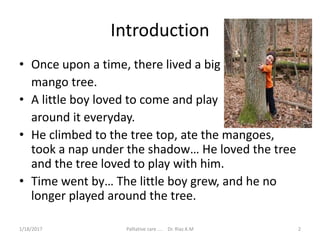
• Once upon a time, there lived a big
mango tree.
• A little boy loved to come and play
around it everyday.
• He climbed to the tree top, ate the mangoes,
took a nap under the shadow… He loved the tree
and the tree loved to play with him.
• Time went by… The little boy grew, and he no
longer played around the tree.
2Palliative care .... Dr. Riaz.K.M1/18/2017
Introduction
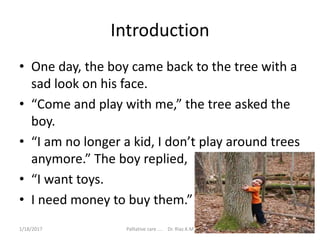
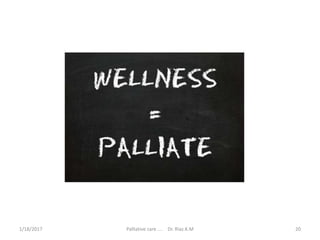
• One day, the boy came back to the tree with a
sad look on his face.
• “Come and play with me,” the tree asked the
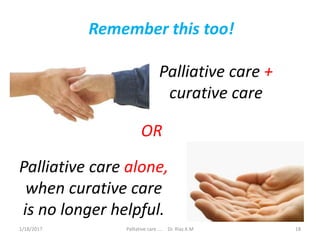
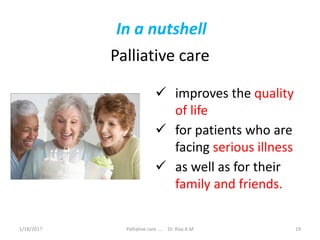
boy.
• “I am no longer a kid, I don’t play around trees
anymore.” The boy replied,
• “I want toys.
• I need money to buy them.”
3Palliative care .... Dr. Riaz.K.M1/18/2017
Introduction
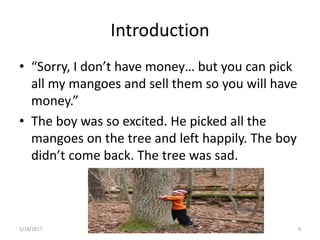
• “Sorry, I don’t have money… but you can pick
all my mangoes and sell them so you will have
money.”
• The boy was so excited. He picked all the
mangoes on the tree and left happily. The boy
didn’t come back. The tree was sad.
4Palliative care .... Dr. Riaz.K.M1/18/2017
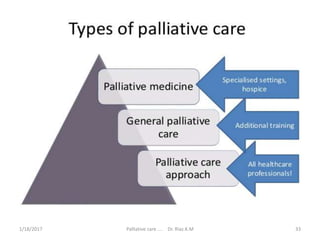
Introduction
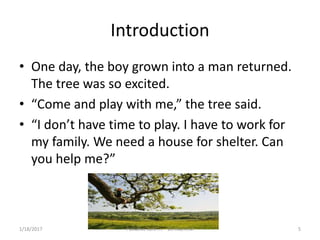
• One day, the boy grown into a man returned.
The tree was so excited.
• “Come and play with me,” the tree said.
• “I don’t have time to play. I have to work for
my family. We need a house for shelter. Can
you help me?”
5Palliative care .... Dr. Riaz.K.M1/18/2017
Introduction
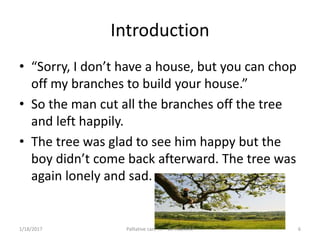
• “Sorry, I don’t have a house, but you can chop
off my branches to build your house.”
• So the man cut all the branches off the tree
and left happily.
• The tree was glad to see him happy but the
boy didn’t come back afterward. The tree was
again lonely and sad.
6Palliative care .... Dr. Riaz.K.M1/18/2017
Introduction
• One hot summer day, the man
returned and the tree was delighted.
• “Come and play with me!” The tree said.
• “I am sad and getting old. I want to go sailing to
relax myself. Can you give me a boat?”
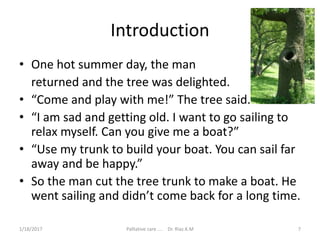
• “Use my trunk to build your boat. You can sail far
away and be happy.”
• So the man cut the tree trunk to make a boat. He
went sailing and didn’t come back for a long time.
7Palliative care .... Dr. Riaz.K.M1/18/2017
Introduction
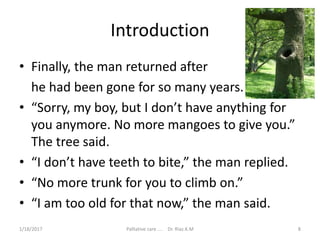
• Finally, the man returned after
he had been gone for so many years.
• “Sorry, my boy, but I don’t have anything for
you anymore. No more mangoes to give you.”
The tree said.
• “I don’t have teeth to bite,” the man replied.
• “No more trunk for you to climb on.”
• “I am too old for that now,” the man said.
8Palliative care .... Dr. Riaz.K.M1/18/2017
Introduction
• “I really can’t give you anything…
the only thing left is my dying roots,
the tree said with sadness.
• “I don’t need much now, just a place to rest. I
am tired after all these years,” the man
replied.
• “Good! Old tree roots are the best place to
lean on and rest. Come sit down with me and
rest.”
9Palliative care .... Dr. Riaz.K.M1/18/2017
Purpose of life
1. Who are you ?
2. What you did ?
3. Whom you did it for?
4. What they wanted?
5. What they got ?
10Palliative care .... Dr. Riaz.K.M1/18/2017
Palliative care - facts
1. We all going to die
2. Dying is not a medical experience;
it’s a human experience
1. We all act like we are not (most of the time)
2. Worst thing in life
1. The thought that I have lived and I am not going
to die
2. I haven't lived and I am going to die
11Palliative care .... Dr. Riaz.K.M1/18/2017
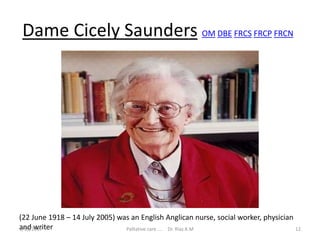
Dame Cicely Saunders OM DBE FRCS FRCP FRCN
(22 June 1918 – 14 July 2005) was an English Anglican nurse, social worker, physician
and writer 12Palliative care .... Dr. Riaz.K.M1/18/2017
13Palliative care .... Dr. Riaz.K.M1/18/2017
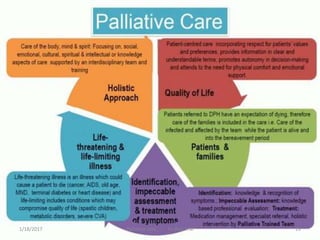
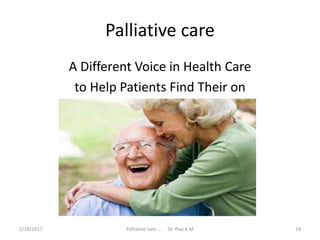
Palliative care
A Different Voice in Health Care
to Help Patients Find Their on
14Palliative care .... Dr. Riaz.K.M1/18/2017
Palliative care- Beware
• More you do
more you decrease the quality
• Stealing from you
what you want to do
• Too much focused on disease
miss to focus human being
• Dealing with sickest of the sick
15Palliative care .... Dr. Riaz.K.M1/18/2017
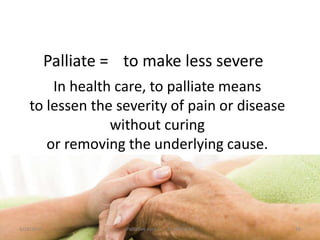
Palliate = to make less severe
In health care, to palliate means
to lessen the severity of pain or disease
without curing
or removing the underlying cause.
16Palliative care .... Dr. Riaz.K.M1/18/2017
Remember this!
Palliative care
treats, prevents, or relieves
the symptoms
of a serious or chronic illness
but does not cure it.
17Palliative care .... Dr. Riaz.K.M1/18/2017
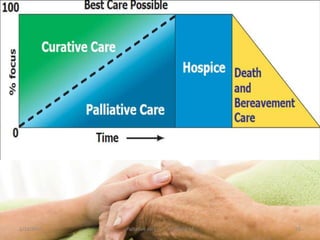
Palliative care +
curative care
Remember this too!
Palliative care alone,
when curative care
is no longer helpful.
OR
18Palliative care .... Dr. Riaz.K.M1/18/2017
In a nutshell
Palliative care
 improves the quality
of life
 for patients who are
facing serious illness
 as well as for their
family and friends.
19Palliative care .... Dr. Riaz.K.M1/18/2017
20Palliative care .... Dr. Riaz.K.M1/18/2017
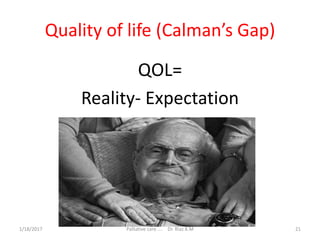
Quality of life (Calman’s Gap)
QOL=
Reality- Expectation
21Palliative care .... Dr. Riaz.K.M1/18/2017
Quality of life
“Whatever the
patient says it is”
22Palliative care .... Dr. Riaz.K.M1/18/2017
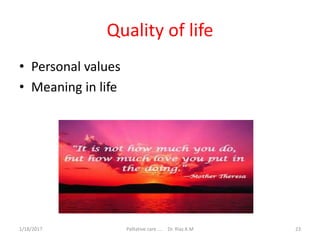
Quality of life
• Personal values
• Meaning in life
23Palliative care .... Dr. Riaz.K.M1/18/2017
Personal values
Altruistic values >
Egoistic values
Increased QOL
24Palliative care .... Dr. Riaz.K.M1/18/2017
Meaning in life
It’s not what's next is important
… its
what's important to you is
important
25Palliative care .... Dr. Riaz.K.M1/18/2017
Palliative care
Hospice care
Pain management
Comfort care
26Palliative care .... Dr. Riaz.K.M1/18/2017
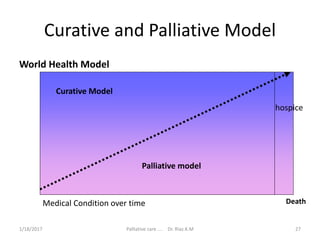
Curative and Palliative Model
World Health Model
Curative Model
Palliative model
hospice
Medical Condition over time Death
27Palliative care .... Dr. Riaz.K.M1/18/2017
28Palliative care .... Dr. Riaz.K.M1/18/2017
Palliative care
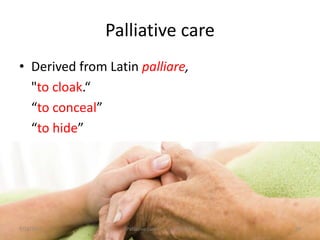
• Derived from Latin palliare,
"to cloak.“
“to conceal”
“to hide”
29Palliative care .... Dr. Riaz.K.M1/18/2017
KEY ISSUES
• Pain
• Awareness needs
• Live as a human being
• Lack of empowerment
• Interruption free care
• Autonomy in physical activities
• To meet social needs
• Intervention for Spiritual needs
• Ventilation (Emotional) needs
• Ethical needs
30Palliative care .... Dr. Riaz.K.M1/18/2017
Palliative care
• Pain
• AIDS
• Liver Diseases
• Leukaemia
• Infections
• Alzheimer's diseases
• Tuberculosis
• Intracranial lesions
• Ventricular failures
• Encephalopathies
• Cardiac disorders
• Arthritis
• Respiratory disorders
• Endocrine disorders
31Palliative care .... Dr. Riaz.K.M1/18/2017
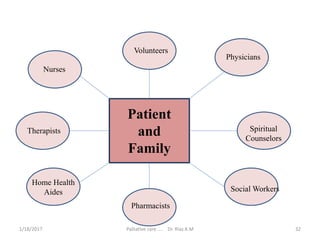
Patient
and
Family
Volunteers
Physicians
Spiritual
Counselors
Social Workers
Pharmacists
Home Health
Aides
Therapists
Nurses
32Palliative care .... Dr. Riaz.K.M1/18/2017
33Palliative care .... Dr. Riaz.K.M1/18/2017
Principles
1. Caring attitude
2. Consideration of individuality
3. Cultural considerations
4. Consent
5. Choice of site of care
6. Communication
7. Clinical context: Appropriate treatment
8. Comprehensive inter-professional care
9. Care excellence
10. Consistent medical care
11. Coordinated care
12. Continuity of care
13. Caregiver support
14. Continued reassessment 34Palliative care .... Dr. Riaz.K.M1/18/2017
Palliative Care Patient Support
Services
1. Pain management
– vital for comfort and to reduce patients’
distress.
– Health care professionals and families can
collaborate to identify the sources of pain and
relieve them
35Palliative care .... Dr. Riaz.K.M1/18/2017
Palliative Care Patient Support Services
2. Symptom management
–Nausea,
–Weakness,
–Bowel and bladder problems,
–Mental confusion,
–Fatigue, and
–Difficulty breathing
36Palliative care .... Dr. Riaz.K.M1/18/2017
Palliative Care Patient Support
Services
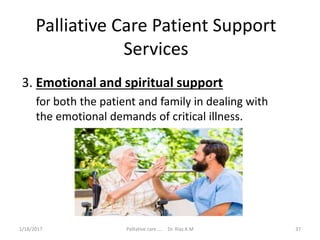
3. Emotional and spiritual support
for both the patient and family in dealing with
the emotional demands of critical illness.
37Palliative care .... Dr. Riaz.K.M1/18/2017
Symptom Management
• Agitation/Delirium
• Anxiety/Depression
• Anorexia/Cachexia
• Constipation
• Dyspnea/Shortness of
Breath
• Control of Secretions
• Fatigue
• Pain
38Palliative care .... Dr. Riaz.K.M1/18/2017
Symptom Management
Delirium
• Occurs in up to 85% of terminally ill pts
• Common in last 24-48hours of life
• Disturbance in consciousness and cognition: develops in
SHORT PERIOD OF TIME
• Poor attention, psychomotor agitation or psychomotor
retardation, perceptual disturbances, disordered sleep-wake
cycle
• Related to medical condition
39Palliative care .... Dr. Riaz.K.M1/18/2017
Symptom Management
Delirium
Causes:
• Medications
• Brain Tumor
• Metabolic abnormalities
• Organ failure
• Dehydration
• Infection
• Hypoxemia
• Fecal Impaction
• Urinary Retention
• Unfamiliar environment
40Palliative care .... Dr. Riaz.K.M1/18/2017
Symptom Management
Delirium Assessment:
• Know your resident
• History: important to know onset of change in
condition
• Medication Review
• Physical Exam
• Identify Reversible Causes….(what can we
change…)
41Palliative care .... Dr. Riaz.K.M1/18/2017
Symptom Management
Delirium Treatment
• Treat underlying cause: correct what can be
reversed.
• Symptom control: may need medications
• Medications:
– Neuroleptics: mainstay of treatment…use with
caution
– Benzodiazepines: cautious use indicated
42Palliative care .... Dr. Riaz.K.M1/18/2017
Symptom Management
Delirium Treatment: Non-Pharmacologic
• Avoid over-stimulation
• Quiet room with familiar objects
• Proper lighting
• Orientation: visible clock, calendar
• Family member at bedside
• Fall Risk
43Palliative care .... Dr. Riaz.K.M1/18/2017
Falls Prevention
• Team approach to determine interventions
• Safety alarm
• Low beds, mats
• Move resident closer to nurses station
• Toileting Program
44Palliative care .... Dr. Riaz.K.M1/18/2017
Symptom Management
Anorexia/Cachexia
• Prevalence: 24 to 80% in geriatric population
• Definition: Progressive weight loss, lipolysis,
loss of organ and skeletal protein and
profound loss of appetite.
45Palliative care .... Dr. Riaz.K.M1/18/2017
Symptom Management
Anorexia/Cachexia
Causes
• Immune mediators
• Tumor products
• Change in taste, dry
mouth, mouth sores
• Nausea, constipation
• Gastritis, Peptic ulcer
disease
• Candidiasis of GI tract
• Radiation/Chemo TX
• Drugs/Medications
• Metabolic changes:
dehydration
• Depression
• Pain
46Palliative care .... Dr. Riaz.K.M1/18/2017
Symptom Management
Anorexia/Cachexia
Identify and treat reversible causes:
• Reversible causes:
• Dry mouth
• Oral yeast/Candida infection
• Acid Reflux, affecting the esophagus
• Nausea/vomiting, constipation
• Pain
• Depression
47Palliative care .... Dr. Riaz.K.M1/18/2017
Symptom Management
Anorexia/Cachexia
Dietary Changes
• Involve resident in menu planning
• Offer small portions of resident’s favorite
foods
• Avoid foods with strong odors
• Offer easy-to-swallow food: semi-liquids,
puddings, ice cream, soft or pureed foods.
48Palliative care .... Dr. Riaz.K.M1/18/2017
Symptom Management
Anorexia/Cachexia Medication Management:
Caveat: Nothing works for very long, all medications have side
effects, and short durations of action.
Appetite Stimulants
• Corticosteroids
• Progestational drugs
• Cannabioids
• Thalidomide
49Palliative care .... Dr. Riaz.K.M1/18/2017
Symptom Management
Anorexia/Cachexia
Education
• Part of the disease process
• Not starving
• Forced feeding can cause discomfort
• Artificial feeding usually not beneficial
• Human body can survive comfortably on very
little food
50Palliative care .... Dr. Riaz.K.M1/18/2017
Symptom Management
Pain
• Prevalence
– 72% non-cancer patients experience pain in their
last 6 months
– 87% cancer patients experience pain in their last 6
months
Retrospective survey of 1472 non-cancer deaths and 202 cancer deaths
in the UK. Addington-Hall and Karlsen, 1999
51Palliative care .... Dr. Riaz.K.M1/18/2017
Symptom Management
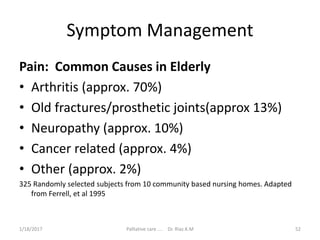
Pain: Common Causes in Elderly
• Arthritis (approx. 70%)
• Old fractures/prosthetic joints(approx 13%)
• Neuropathy (approx. 10%)
• Cancer related (approx. 4%)
• Other (approx. 2%)
325 Randomly selected subjects from 10 community based nursing homes. Adapted
from Ferrell, et al 1995
52Palliative care .... Dr. Riaz.K.M1/18/2017
Symptom Management
Pain
• Multi-dimensional,
– “what the resident says it is”,
– affects all aspects of the persons life.
• Consistent evidence that pain is under-
assessed and under-treated
• Systems Barriers
– Resident, family, staff, physician
53Palliative care .... Dr. Riaz.K.M1/18/2017
Symptom Management
Guidelines for Pain
• Assessment
• Regularly scheduled pain medications (not prn
only)
• Increased use of opioids
• Non-pharmacologic analgesia
54Palliative care .... Dr. Riaz.K.M1/18/2017
Symptom Management
Pain Assessment
– Resident self-report, if cognitively able
• Numeric
• Color/ Visual Analog
• Faces
– Behavioral tools
• Observe breathing, behavior, body language,
vocalization, consolable
– Interview
55Palliative care .... Dr. Riaz.K.M1/18/2017
Symptom Management
Pain Treatment
• World Health Organization Step Model
– Mild (1-3)
– Moderate (4-6)
– Severe (7-10)
• Use opioids when indicated: moderate to
severe pain.
56Palliative care .... Dr. Riaz.K.M1/18/2017
Symptom Management
Pain Treatment- Barriers
• Fear of addiction
• Fear of stigma
• Fear of opioids
• Related to resident, family, staff, physician
• Under report
57Palliative care .... Dr. Riaz.K.M1/18/2017
Symptom Management
Pain Treatment Non-Pharmacologic
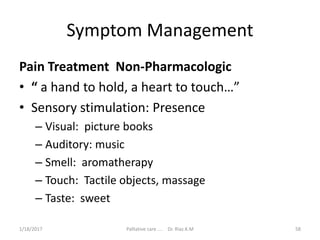
• “ a hand to hold, a heart to touch…”
• Sensory stimulation: Presence
– Visual: picture books
– Auditory: music
– Smell: aromatherapy
– Touch: Tactile objects, massage
– Taste: sweet
58Palliative care .... Dr. Riaz.K.M1/18/2017
Symptom Management
Pain Treatment Non-Pharmacologic
• Exercise programs
• Acupuncture
• Transcutaneous nerve stimulation (TENS)
• Relaxation therapy, guided imagery
59Palliative care .... Dr. Riaz.K.M1/18/2017
Overall Goals of Palliative Care
• To eliminate or reduce discomfort
• To improve quality of life
• To improve mood
• To decrease fatigue
• To decrease pain
60Palliative care .... Dr. Riaz.K.M1/18/2017
Communication
• Essential to palliative medicine
• Includes:
– Honesty
– Willingness to talk about dying
– Sensitive delivery of bad news
– Encourages questions
• Identifies choices with benefits and burdens
• Assists patient/family make decisions in
keeping with their goals
61Palliative care .... Dr. Riaz.K.M1/18/2017
Goals of Care
• Patient/Resident specific
• Realistic
• Related to life expectancy
• Determined by care setting
• Patient/Resident driven
62Palliative care .... Dr. Riaz.K.M1/18/2017
What does Palliative Care Provide to
the Patient?
• Helps patients gain the strength and peace
of mind to carry on with daily life
• Aid the ability to tolerate medical
treatments
• Helps patients to better understand their
choices for care
63Palliative care .... Dr. Riaz.K.M1/18/2017
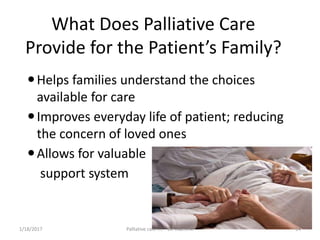
What Does Palliative Care
Provide for the Patient’s Family?
Helps families understand the choices
available for care
Improves everyday life of patient; reducing
the concern of loved ones
Allows for valuable
support system
64Palliative care .... Dr. Riaz.K.M1/18/2017
Conclusion
Change your life
1. Get out of your comfort zone
2. Challenge your assumptions so that you can find
your truths
3. Speak the language of the person you seek to
become
4. Make the little decisions with your brain and big
one with your heart
5. How can you create the most positive impact on
as many lives as possible
65Palliative care .... Dr. Riaz.K.M1/18/2017
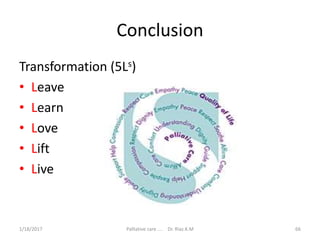
Conclusion
Transformation (5Ls)
• Leave
• Learn
• Love
• Lift
• Live
66Palliative care .... Dr. Riaz.K.M1/18/2017
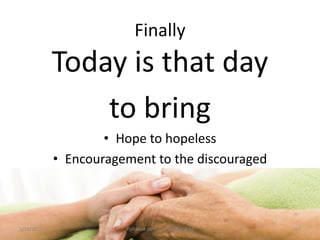
Finally
Today is that day
to bring
• Hope to hopeless
• Encouragement to the discouraged
67Palliative care .... Dr. Riaz.K.M1/18/2017
68Palliative care .... Dr. Riaz.K.M1/18/2017
Dr Riaz.K.M,
Assistant Professor,
Government College of Nursing,
Thrissur. +919495837181
riazmarakkar@gmail.com
69Palliative care .... Dr. Riaz.K.M1/18/2017

Palliative care

  • 1.
    Dr Riaz.K.M, Assistant Professor, GovernmentCollege of Nursing, Thrissur.
  • 2.
    Introduction • Once upona time, there lived a big mango tree. • A little boy loved to come and play around it everyday. • He climbed to the tree top, ate the mangoes, took a nap under the shadow… He loved the tree and the tree loved to play with him. • Time went by… The little boy grew, and he no longer played around the tree. 2Palliative care .... Dr. Riaz.K.M1/18/2017
  • 3.
    Introduction • One day,the boy came back to the tree with a sad look on his face. • “Come and play with me,” the tree asked the boy. • “I am no longer a kid, I don’t play around trees anymore.” The boy replied, • “I want toys. • I need money to buy them.” 3Palliative care .... Dr. Riaz.K.M1/18/2017
  • 4.
    Introduction • “Sorry, Idon’t have money… but you can pick all my mangoes and sell them so you will have money.” • The boy was so excited. He picked all the mangoes on the tree and left happily. The boy didn’t come back. The tree was sad. 4Palliative care .... Dr. Riaz.K.M1/18/2017
  • 5.
    Introduction • One day,the boy grown into a man returned. The tree was so excited. • “Come and play with me,” the tree said. • “I don’t have time to play. I have to work for my family. We need a house for shelter. Can you help me?” 5Palliative care .... Dr. Riaz.K.M1/18/2017
  • 6.
    Introduction • “Sorry, Idon’t have a house, but you can chop off my branches to build your house.” • So the man cut all the branches off the tree and left happily. • The tree was glad to see him happy but the boy didn’t come back afterward. The tree was again lonely and sad. 6Palliative care .... Dr. Riaz.K.M1/18/2017
  • 7.
    Introduction • One hotsummer day, the man returned and the tree was delighted. • “Come and play with me!” The tree said. • “I am sad and getting old. I want to go sailing to relax myself. Can you give me a boat?” • “Use my trunk to build your boat. You can sail far away and be happy.” • So the man cut the tree trunk to make a boat. He went sailing and didn’t come back for a long time. 7Palliative care .... Dr. Riaz.K.M1/18/2017
  • 8.
    Introduction • Finally, theman returned after he had been gone for so many years. • “Sorry, my boy, but I don’t have anything for you anymore. No more mangoes to give you.” The tree said. • “I don’t have teeth to bite,” the man replied. • “No more trunk for you to climb on.” • “I am too old for that now,” the man said. 8Palliative care .... Dr. Riaz.K.M1/18/2017
  • 9.
    Introduction • “I reallycan’t give you anything… the only thing left is my dying roots, the tree said with sadness. • “I don’t need much now, just a place to rest. I am tired after all these years,” the man replied. • “Good! Old tree roots are the best place to lean on and rest. Come sit down with me and rest.” 9Palliative care .... Dr. Riaz.K.M1/18/2017
  • 10.
    Purpose of life 1.Who are you ? 2. What you did ? 3. Whom you did it for? 4. What they wanted? 5. What they got ? 10Palliative care .... Dr. Riaz.K.M1/18/2017
  • 11.
    Palliative care -facts 1. We all going to die 2. Dying is not a medical experience; it’s a human experience 1. We all act like we are not (most of the time) 2. Worst thing in life 1. The thought that I have lived and I am not going to die 2. I haven't lived and I am going to die 11Palliative care .... Dr. Riaz.K.M1/18/2017
  • 12.
    Dame Cicely SaundersOM DBE FRCS FRCP FRCN (22 June 1918 – 14 July 2005) was an English Anglican nurse, social worker, physician and writer 12Palliative care .... Dr. Riaz.K.M1/18/2017
  • 13.
    13Palliative care ....Dr. Riaz.K.M1/18/2017
  • 14.
    Palliative care A DifferentVoice in Health Care to Help Patients Find Their on 14Palliative care .... Dr. Riaz.K.M1/18/2017
  • 15.
    Palliative care- Beware •More you do more you decrease the quality • Stealing from you what you want to do • Too much focused on disease miss to focus human being • Dealing with sickest of the sick 15Palliative care .... Dr. Riaz.K.M1/18/2017
  • 16.
    Palliate = tomake less severe In health care, to palliate means to lessen the severity of pain or disease without curing or removing the underlying cause. 16Palliative care .... Dr. Riaz.K.M1/18/2017
  • 17.
    Remember this! Palliative care treats,prevents, or relieves the symptoms of a serious or chronic illness but does not cure it. 17Palliative care .... Dr. Riaz.K.M1/18/2017
  • 18.
    Palliative care + curativecare Remember this too! Palliative care alone, when curative care is no longer helpful. OR 18Palliative care .... Dr. Riaz.K.M1/18/2017
  • 19.
    In a nutshell Palliativecare  improves the quality of life  for patients who are facing serious illness  as well as for their family and friends. 19Palliative care .... Dr. Riaz.K.M1/18/2017
  • 20.
    20Palliative care ....Dr. Riaz.K.M1/18/2017
  • 21.
    Quality of life(Calman’s Gap) QOL= Reality- Expectation 21Palliative care .... Dr. Riaz.K.M1/18/2017
  • 22.
    Quality of life “Whateverthe patient says it is” 22Palliative care .... Dr. Riaz.K.M1/18/2017
  • 23.
    Quality of life •Personal values • Meaning in life 23Palliative care .... Dr. Riaz.K.M1/18/2017
  • 24.
    Personal values Altruistic values> Egoistic values Increased QOL 24Palliative care .... Dr. Riaz.K.M1/18/2017
  • 25.
    Meaning in life It’snot what's next is important … its what's important to you is important 25Palliative care .... Dr. Riaz.K.M1/18/2017
  • 26.
    Palliative care Hospice care Painmanagement Comfort care 26Palliative care .... Dr. Riaz.K.M1/18/2017
  • 27.
    Curative and PalliativeModel World Health Model Curative Model Palliative model hospice Medical Condition over time Death 27Palliative care .... Dr. Riaz.K.M1/18/2017
  • 28.
    28Palliative care ....Dr. Riaz.K.M1/18/2017
  • 29.
    Palliative care • Derivedfrom Latin palliare, "to cloak.“ “to conceal” “to hide” 29Palliative care .... Dr. Riaz.K.M1/18/2017
  • 30.
    KEY ISSUES • Pain •Awareness needs • Live as a human being • Lack of empowerment • Interruption free care • Autonomy in physical activities • To meet social needs • Intervention for Spiritual needs • Ventilation (Emotional) needs • Ethical needs 30Palliative care .... Dr. Riaz.K.M1/18/2017
  • 31.
    Palliative care • Pain •AIDS • Liver Diseases • Leukaemia • Infections • Alzheimer's diseases • Tuberculosis • Intracranial lesions • Ventricular failures • Encephalopathies • Cardiac disorders • Arthritis • Respiratory disorders • Endocrine disorders 31Palliative care .... Dr. Riaz.K.M1/18/2017
  • 32.
  • 33.
    33Palliative care ....Dr. Riaz.K.M1/18/2017
  • 34.
    Principles 1. Caring attitude 2.Consideration of individuality 3. Cultural considerations 4. Consent 5. Choice of site of care 6. Communication 7. Clinical context: Appropriate treatment 8. Comprehensive inter-professional care 9. Care excellence 10. Consistent medical care 11. Coordinated care 12. Continuity of care 13. Caregiver support 14. Continued reassessment 34Palliative care .... Dr. Riaz.K.M1/18/2017
  • 35.
    Palliative Care PatientSupport Services 1. Pain management – vital for comfort and to reduce patients’ distress. – Health care professionals and families can collaborate to identify the sources of pain and relieve them 35Palliative care .... Dr. Riaz.K.M1/18/2017
  • 36.
    Palliative Care PatientSupport Services 2. Symptom management –Nausea, –Weakness, –Bowel and bladder problems, –Mental confusion, –Fatigue, and –Difficulty breathing 36Palliative care .... Dr. Riaz.K.M1/18/2017
  • 37.
    Palliative Care PatientSupport Services 3. Emotional and spiritual support for both the patient and family in dealing with the emotional demands of critical illness. 37Palliative care .... Dr. Riaz.K.M1/18/2017
  • 38.
    Symptom Management • Agitation/Delirium •Anxiety/Depression • Anorexia/Cachexia • Constipation • Dyspnea/Shortness of Breath • Control of Secretions • Fatigue • Pain 38Palliative care .... Dr. Riaz.K.M1/18/2017
  • 39.
    Symptom Management Delirium • Occursin up to 85% of terminally ill pts • Common in last 24-48hours of life • Disturbance in consciousness and cognition: develops in SHORT PERIOD OF TIME • Poor attention, psychomotor agitation or psychomotor retardation, perceptual disturbances, disordered sleep-wake cycle • Related to medical condition 39Palliative care .... Dr. Riaz.K.M1/18/2017
  • 40.
    Symptom Management Delirium Causes: • Medications •Brain Tumor • Metabolic abnormalities • Organ failure • Dehydration • Infection • Hypoxemia • Fecal Impaction • Urinary Retention • Unfamiliar environment 40Palliative care .... Dr. Riaz.K.M1/18/2017
  • 41.
    Symptom Management Delirium Assessment: •Know your resident • History: important to know onset of change in condition • Medication Review • Physical Exam • Identify Reversible Causes….(what can we change…) 41Palliative care .... Dr. Riaz.K.M1/18/2017
  • 42.
    Symptom Management Delirium Treatment •Treat underlying cause: correct what can be reversed. • Symptom control: may need medications • Medications: – Neuroleptics: mainstay of treatment…use with caution – Benzodiazepines: cautious use indicated 42Palliative care .... Dr. Riaz.K.M1/18/2017
  • 43.
    Symptom Management Delirium Treatment:Non-Pharmacologic • Avoid over-stimulation • Quiet room with familiar objects • Proper lighting • Orientation: visible clock, calendar • Family member at bedside • Fall Risk 43Palliative care .... Dr. Riaz.K.M1/18/2017
  • 44.
    Falls Prevention • Teamapproach to determine interventions • Safety alarm • Low beds, mats • Move resident closer to nurses station • Toileting Program 44Palliative care .... Dr. Riaz.K.M1/18/2017
  • 45.
    Symptom Management Anorexia/Cachexia • Prevalence:24 to 80% in geriatric population • Definition: Progressive weight loss, lipolysis, loss of organ and skeletal protein and profound loss of appetite. 45Palliative care .... Dr. Riaz.K.M1/18/2017
  • 46.
    Symptom Management Anorexia/Cachexia Causes • Immunemediators • Tumor products • Change in taste, dry mouth, mouth sores • Nausea, constipation • Gastritis, Peptic ulcer disease • Candidiasis of GI tract • Radiation/Chemo TX • Drugs/Medications • Metabolic changes: dehydration • Depression • Pain 46Palliative care .... Dr. Riaz.K.M1/18/2017
  • 47.
    Symptom Management Anorexia/Cachexia Identify andtreat reversible causes: • Reversible causes: • Dry mouth • Oral yeast/Candida infection • Acid Reflux, affecting the esophagus • Nausea/vomiting, constipation • Pain • Depression 47Palliative care .... Dr. Riaz.K.M1/18/2017
  • 48.
    Symptom Management Anorexia/Cachexia Dietary Changes •Involve resident in menu planning • Offer small portions of resident’s favorite foods • Avoid foods with strong odors • Offer easy-to-swallow food: semi-liquids, puddings, ice cream, soft or pureed foods. 48Palliative care .... Dr. Riaz.K.M1/18/2017
  • 49.
    Symptom Management Anorexia/Cachexia MedicationManagement: Caveat: Nothing works for very long, all medications have side effects, and short durations of action. Appetite Stimulants • Corticosteroids • Progestational drugs • Cannabioids • Thalidomide 49Palliative care .... Dr. Riaz.K.M1/18/2017
  • 50.
    Symptom Management Anorexia/Cachexia Education • Partof the disease process • Not starving • Forced feeding can cause discomfort • Artificial feeding usually not beneficial • Human body can survive comfortably on very little food 50Palliative care .... Dr. Riaz.K.M1/18/2017
  • 51.
    Symptom Management Pain • Prevalence –72% non-cancer patients experience pain in their last 6 months – 87% cancer patients experience pain in their last 6 months Retrospective survey of 1472 non-cancer deaths and 202 cancer deaths in the UK. Addington-Hall and Karlsen, 1999 51Palliative care .... Dr. Riaz.K.M1/18/2017
  • 52.
    Symptom Management Pain: CommonCauses in Elderly • Arthritis (approx. 70%) • Old fractures/prosthetic joints(approx 13%) • Neuropathy (approx. 10%) • Cancer related (approx. 4%) • Other (approx. 2%) 325 Randomly selected subjects from 10 community based nursing homes. Adapted from Ferrell, et al 1995 52Palliative care .... Dr. Riaz.K.M1/18/2017
  • 53.
    Symptom Management Pain • Multi-dimensional, –“what the resident says it is”, – affects all aspects of the persons life. • Consistent evidence that pain is under- assessed and under-treated • Systems Barriers – Resident, family, staff, physician 53Palliative care .... Dr. Riaz.K.M1/18/2017
  • 54.
    Symptom Management Guidelines forPain • Assessment • Regularly scheduled pain medications (not prn only) • Increased use of opioids • Non-pharmacologic analgesia 54Palliative care .... Dr. Riaz.K.M1/18/2017
  • 55.
    Symptom Management Pain Assessment –Resident self-report, if cognitively able • Numeric • Color/ Visual Analog • Faces – Behavioral tools • Observe breathing, behavior, body language, vocalization, consolable – Interview 55Palliative care .... Dr. Riaz.K.M1/18/2017
  • 56.
    Symptom Management Pain Treatment •World Health Organization Step Model – Mild (1-3) – Moderate (4-6) – Severe (7-10) • Use opioids when indicated: moderate to severe pain. 56Palliative care .... Dr. Riaz.K.M1/18/2017
  • 57.
    Symptom Management Pain Treatment-Barriers • Fear of addiction • Fear of stigma • Fear of opioids • Related to resident, family, staff, physician • Under report 57Palliative care .... Dr. Riaz.K.M1/18/2017
  • 58.
    Symptom Management Pain TreatmentNon-Pharmacologic • “ a hand to hold, a heart to touch…” • Sensory stimulation: Presence – Visual: picture books – Auditory: music – Smell: aromatherapy – Touch: Tactile objects, massage – Taste: sweet 58Palliative care .... Dr. Riaz.K.M1/18/2017
  • 59.
    Symptom Management Pain TreatmentNon-Pharmacologic • Exercise programs • Acupuncture • Transcutaneous nerve stimulation (TENS) • Relaxation therapy, guided imagery 59Palliative care .... Dr. Riaz.K.M1/18/2017
  • 60.
    Overall Goals ofPalliative Care • To eliminate or reduce discomfort • To improve quality of life • To improve mood • To decrease fatigue • To decrease pain 60Palliative care .... Dr. Riaz.K.M1/18/2017
  • 61.
    Communication • Essential topalliative medicine • Includes: – Honesty – Willingness to talk about dying – Sensitive delivery of bad news – Encourages questions • Identifies choices with benefits and burdens • Assists patient/family make decisions in keeping with their goals 61Palliative care .... Dr. Riaz.K.M1/18/2017
  • 62.
    Goals of Care •Patient/Resident specific • Realistic • Related to life expectancy • Determined by care setting • Patient/Resident driven 62Palliative care .... Dr. Riaz.K.M1/18/2017
  • 63.
    What does PalliativeCare Provide to the Patient? • Helps patients gain the strength and peace of mind to carry on with daily life • Aid the ability to tolerate medical treatments • Helps patients to better understand their choices for care 63Palliative care .... Dr. Riaz.K.M1/18/2017
  • 64.
    What Does PalliativeCare Provide for the Patient’s Family? Helps families understand the choices available for care Improves everyday life of patient; reducing the concern of loved ones Allows for valuable support system 64Palliative care .... Dr. Riaz.K.M1/18/2017
  • 65.
    Conclusion Change your life 1.Get out of your comfort zone 2. Challenge your assumptions so that you can find your truths 3. Speak the language of the person you seek to become 4. Make the little decisions with your brain and big one with your heart 5. How can you create the most positive impact on as many lives as possible 65Palliative care .... Dr. Riaz.K.M1/18/2017
  • 66.
    Conclusion Transformation (5Ls) • Leave •Learn • Love • Lift • Live 66Palliative care .... Dr. Riaz.K.M1/18/2017
  • 67.
    Finally Today is thatday to bring • Hope to hopeless • Encouragement to the discouraged 67Palliative care .... Dr. Riaz.K.M1/18/2017
  • 68.
    68Palliative care ....Dr. Riaz.K.M1/18/2017
  • 69.
    Dr Riaz.K.M, Assistant Professor, GovernmentCollege of Nursing, Thrissur. +919495837181 riazmarakkar@gmail.com 69Palliative care .... Dr. Riaz.K.M1/18/2017

Editor's Notes

  • #17 But what is palliative care? Palliative care is a relatively new field of medicine. The name comes from the term “palliate,” which means, to make less severe or intense. In medicine, “palliate” means to lessen the severity of pain or disease without curing or removing the underlying cause. So, for example, palliative chemotherapy usually aims to shrink or slow the growth of a cancer, not to cure the cancer. Palliative radiation therapy usually helps lessen symptoms like shortness of breath, confusion or pain, but will not make the tumor go away. And palliative care in general focuses on improving the overall quality of life for people facing serious or life-threatening illness, not on curing the cause of the illness.
  • #18 So this is this first important point. Palliative care treats, prevents or relieves the symptoms of a serious or life-threatening illness, but it does not cure it.
  • #19 The second important thing to remember about palliative care is that it can be delivered at any time in a patient’s illness. It can be delivered at the same time as curative treatment, or it can be delivered by itself, when further curative treatment wouldn’t be useful. The ultimate goal is to improve quality of life for patients who are facing serious illness, as well as for their family and friends.
  • #20 So, in a nutshell, palliative care improves the quality of life for patients who are facing serious illness as well as for their family and friends.
  • #27 When a patient is approaching the end of life, you may hear various terms to describe the patient’s options for care. In addition to “palliative care,” you may hear terms like “hospice care”, “pain management”, and “comfort care.” How are these related?
  • #33 This diagram shows the connection between the Palliative Care team and the patient. With the collaborative effort of the team of experts, a patient and their family can benefit from their assistance.
  • #38 “Religion and spirituality play a role in coping with illness for many cancer patients. This study examined religiousness and spiritual support in advanced cancer patients of diverse racial/ethnic backgrounds and associations with quality of life (QOL), treatment preferences, and advance care planning.” -from “Religiousness and Spiritual Support Among Advanced Cancer Patients and Associations With End-of-Life Treatment Preferences and Quality of Life”, an article in the Journal of Clinical Oncology. Article from The Harvard Radiation Oncology Program; Center for Psycho-Oncology and Palliative Care Research.
  • #64 What are the benefits of palliative care? High-quality palliative care can make the difference between a comfortable existence and one that involves much suffering. There is no need for patients to suffer from shortness of breath, uncontrolled pain, or nausea. Palliative care also can help a patient’s loved ones begin to deal with the issues of grief and bereavement. © Copyright 1995-2009 The Cleveland Clinic Foundation. All rights reserved. - http://my.clevelandclinic.org/disorders/cancer/hic_palliative_care.aspx
  • #65  “We [palliative care team] can…provide a support system to help relatives and friends cope with your illness.”  -http://www.mmc.org/mmc_body.cfm?id=3463
  • #69 Questions, anyone?