Pakistan Vision 2025
■ Submitted By:Waleed Said
■ Class: MBA 3rd
■ Submitted to: Sir Latif
■ Department: Business Administration
■ Roll Number:01
Preparation And Approval:
■ Planning Commission has accomplished the important task of preparing the Pakistan Vision
2025 document.
■ Approval of Pakistan Vision 2025 By National Economic Council 29th May, 2014.
■ National EconomicCouncil’s Members are:
– Mamnoon Hussain President of Pakistan
– Mohammad Nawaz Sharif Prime Minister of Pakistan
– Prof. Ahsan Iqbal Minister for Planning, Development & Reform
– Muhammad Shahbaz Sharif Chief Minister, Punjab
– Qaim Ali Shah Chief Minister, Sindh
– Parvez Khattak Chief Minister, Khyber Pakhtunkhwa
– Abdul Malik Baloch Chief Minister, Balochistan
Contents:
■ Introduction
■ New Global Context,Trends and Realities
■ Socioeconomic Performance Review
■ Framework for Growth and Development
■ Key Enablers
■ Pillar I: Putting People First – Developing Human and Social Capital
■ Pillar II: Achieving Sustained, Indigenous and Inclusive Growth
■ Pillar III: DemocraticGovernance, Institutional Reform and
Modernization of the Public Sector
■ Pillar IV: Water, Energy and Food Security
■ PillarV: Private Sector and Entrepreneurship Led Growth
■ PillarVI: Developing a Competitive Knowledge Economy throughValue
Addition
■ PillarVII: ModernizingTransportation Infrastructure and Greater
Regional Connectivity
■ Implementation, Implementation & Implementation!
■ “Passionate Pakistan” – Creating a National Brand
■ 25 Goals for Pakistan 2025
Introduction:
■ Our shared destination
■ Building a consensus national vision
■ The founding vision
■ Impact of population growth:
Elements OfVision:
■ People First
■ Inclusive Growth
■ Governance
■ Water, Energy, Food
■ Private Sector
■ Knowledge Economy
■ Regional Connectivity
New Global Context,Trends & Realities:
■ EconomicTrends:
– Shifting epicenter of global economic activity
– Globalization and Regionalization:
 Increasing interconnectedness and cross-border
trade
 The Knowledge Revolution
 Financial and Economic Fragility
■ SocialTrends:
– Demographic shifts; aging west vs. youth bulge in
the developing world
– Increasing urbanization and rising incomes
■ Physical & EnvironmentalTrends:
– Climate change
– Energy demand spiraling globally; all eyes turning to

alternative fuels
– Food and water security real concerns for
governments worldwide
– Sustainable practices needed to preserve the earth
for the future
Socioeconomic Performance Review:
■ Comparative Per Capita Income
■ Pakistan 67Years Of Development (1947-2013)
■ Structure Of Economy (% share of GDP)
■ Key Drivers of GDP growth in Pakistan
■ Key Factors:
■ Political Stability
■ Investment In Human Resource
■ High Saving
■ Investment In Science AndTechnology
■ Peace
Framework for Growth and
Development:
■ The Framework comprises of four levels:
– Mission
– Vision
– Enabling Conditions
– The Pillars:
 People First
 Inclusive Growth
 Governance
 Water, Energy, Food
 Private Sector
 Knowledge Economy
 Regional Connectivity
Key Enablers:
a) SharedVision
b) Political Stability & Continuity of Policies
c) Peace and Security
d) Rule of Law
e) SocialJustice
Pillar-I
■ Putting People First:
– Developing Human and Social Capital
– Education
– Higher Education
– Population and Health
– Youth
– Gender Equality andWomen’s
Development
– Inclusion ofVulnerable Segments
– Interfaith Harmony and Religious Diversity
– Art, Culture & Heritage
– Sports
– Ethical andValues Driven Society
Pillar-II
■ Achieving Sustained, Indigenous and Inclusive
Growth
■ Macroeconomic Framework
■ Capital Markets
■ Strategic Initiatives:
a) Formalizing the Parallel Economy
b) Resource Mobilization
c) Pakistani Diaspora
d) Urban Development and Smart Cities
e) Social Protection Framework
Pillar-III
■ Democratic Governance, Institutional Reform &
Modernization of the Public Sector
■ New Governance Paradigm
■ Parliamentary / StandingCommittees
■ Civil Service Reforms
■ Judicial System Reforms
■ Police Reforms
■ Tax Reforms
■ Anti-Corruption
■ High Performance & FAST Government - Governance for the
Future
■ E-Governance
■ Open Government
Pillar-IV
■ Energy,Water & Food Security:
– Energy
– Integrated Energy Development Model
– Energy efficiency
– Water
– Food Security
– Climate Change
Pillar-V
■ Private Sector & Entrepreneurship Led
GROWTH:
■ Strengthening Institutions
■ Removing Infrastructure Bottlenecks
■ Macro-Economic Stability
■ Privatization
■ Public Private Partnership (PPP)
■ Encouraging Investment
■ Small and Medium Enterprises (SME’s)
Pillar-VI
■ Developing a Competitive Knowledge Economy throughValue
Addition:
■ Firm Commitment to Enhancing Competitiveness
■ Fixing the Basics for a Healthy and Educated Workforce
■ Laying the Foundations of a Knowledge Economy
■ Increasing Goods Market Efficiency
■ Increasing Labour Market Efficiency
■ Greater Financial Market Sophistication
■ Information and CommunicationTechnology- Putting Pakistan
on the ICT Map
■ Tapping Large Domestic and Regional Market Size
■ Cluster Based Development
■ Value Chain Improvements
■ Driving Innovation
■ Technology Parks and Business Incubation Centers
■ Applying Knowledge for Increased Productivity in
Agriculture
■ Increasing Competitiveness of Industry and
Manufacturing
■ Tapping Natural Endowments in Mining and Minerals
■ Increasing Competitiveness of the Services Sector
Pillar-VII
■ ModernizingTransportation Infrastructure & Greater Regional
Connectivity
■ Opportunities for Realizing Regional Connectivity Potential
■ China-Pakistan Economic Corridor
■ SAARC & ASEAN
■ Central Asian States
■ ECO
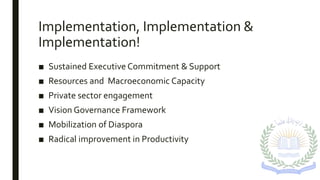
Implementation, Implementation &
Implementation!
■ Sustained Executive Commitment & Support
■ Resources and Macroeconomic Capacity
■ Private sector engagement
■ Vision Governance Framework
■ Mobilization of Diaspora
■ Radical improvement in Productivity
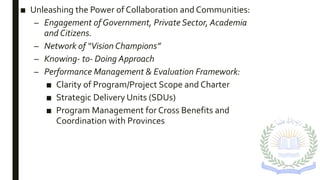
■ Unleashing the Power of Collaboration and Communities:
– Engagement of Government, Private Sector, Academia
and Citizens.
– Network of “Vision Champions”
– Knowing- to- Doing Approach
– Performance Management & Evaluation Framework:
■ Clarity of Program/Project Scope and Charter
■ Strategic Delivery Units (SDUs)
■ Program Management for Cross Benefits and
Coordination with Provinces
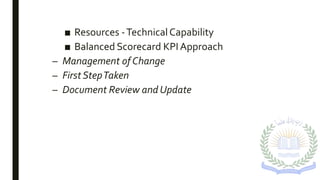
■ Resources -TechnicalCapability
■ Balanced Scorecard KPI Approach
– Management of Change
– First StepTaken
– Document Review and Update
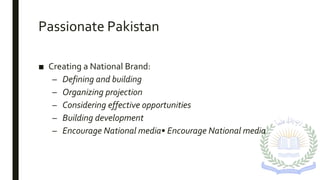
Passionate Pakistan
■ Creating a National Brand:
– Defining and building
– Organizing projection
– Considering effective opportunities
– Building development
– Encourage National media• Encourage National media
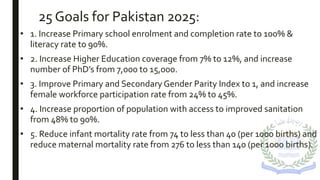
25 Goals for Pakistan 2025:
• 1. Increase Primary school enrolment and completion rate to 100% &
literacy rate to 90%.
• 2. Increase Higher Education coverage from 7% to 12%, and increase
number of PhD’s from 7,000 to 15,000.
• 3. Improve Primary and Secondary Gender Parity Index to 1, and increase
female workforce participation rate from 24% to 45%.
• 4. Increase proportion of population with access to improved sanitation
from 48% to 90%.
• 5. Reduce infant mortality rate from 74 to less than 40 (per 1000 births) and
reduce maternal mortality rate from 276 to less than 140 (per 1000 births).
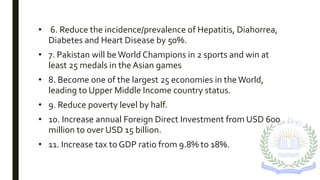
• 6. Reduce the incidence/prevalence of Hepatitis, Diahorrea,
Diabetes and Heart Disease by 50%.
• 7. Pakistan will beWorld Champions in 2 sports and win at
least 25 medals in the Asian games
• 8. Become one of the largest 25 economies in theWorld,
leading to Upper Middle Income country status.
• 9. Reduce poverty level by half.
• 10. Increase annual Foreign Direct Investment from USD 600
million to over USD 15 billion.
• 11. Increase tax to GDP ratio from 9.8% to 18%.
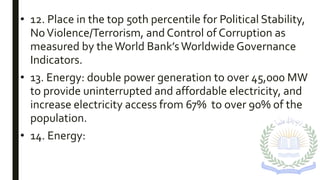
• 12. Place in the top 50th percentile for Political Stability,
NoViolence/Terrorism, and Control of Corruption as
measured by theWorld Bank’sWorldwide Governance
Indicators.
• 13. Energy: double power generation to over 45,000 MW
to provide uninterrupted and affordable electricity, and
increase electricity access from 67% to over 90% of the
population.
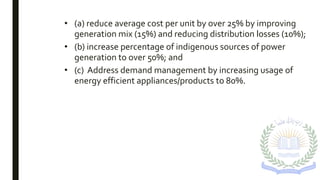
• 14. Energy:
• (a) reduce average cost per unit by over 25% by improving
generation mix (15%) and reducing distribution losses (10%);
• (b) increase percentage of indigenous sources of power
generation to over 50%; and
• (c) Address demand management by increasing usage of
energy efficient appliances/products to 80%.
• 15.Water: increase storage capacity to 90 days, improve efficiency of
usage in agriculture by 20%, and ensure access to clean drinking water for
all Pakistanis.
• 16. Food: Reduce food insecure population from 60% to 30%.
• 17. Rank in the top 50 countries on theWorld Bank’s Ease of Doing
Business Rankings
• 18. Increase Diaspora investment (via remittances) in private
sector from USD 14 billion to USD 40 billion.
• 19. Create at least 5 global Pakistani brands (having more
than 50% sales coming from consumers outside Pakistan),
and make ‘Made in Pakistan’ a symbol of quality.
• 20. Join the ranks of the top 75 countries as measured by the
World Economic Forum’s Global Competitiveness Report.
• 21.Triple labour and capital productivity.
• 22. Improve Pakistan’s score on theWorld Bank Institute’s Knowledge
Economy Index from 2.2 to 4.0, and increase internet penetration to over
50% 23. Increase the number of tourist arrivals to 2 million.
• 24. Increase road density from 32 km/100 km2 to 64 km/ 100 km2, and
share of rail in transport from 4% to 20%.
• 25. Increase annual exports from US$ 25 billion to US$ 150 billion.
Pakistan vision 2025 slides

Pakistan vision 2025 slides

  • 1.
  • 2.
    ■ Submitted By:WaleedSaid ■ Class: MBA 3rd ■ Submitted to: Sir Latif ■ Department: Business Administration ■ Roll Number:01
  • 3.
    Preparation And Approval: ■Planning Commission has accomplished the important task of preparing the Pakistan Vision 2025 document. ■ Approval of Pakistan Vision 2025 By National Economic Council 29th May, 2014. ■ National EconomicCouncil’s Members are: – Mamnoon Hussain President of Pakistan – Mohammad Nawaz Sharif Prime Minister of Pakistan – Prof. Ahsan Iqbal Minister for Planning, Development & Reform – Muhammad Shahbaz Sharif Chief Minister, Punjab – Qaim Ali Shah Chief Minister, Sindh – Parvez Khattak Chief Minister, Khyber Pakhtunkhwa – Abdul Malik Baloch Chief Minister, Balochistan
  • 4.
    Contents: ■ Introduction ■ NewGlobal Context,Trends and Realities ■ Socioeconomic Performance Review ■ Framework for Growth and Development ■ Key Enablers ■ Pillar I: Putting People First – Developing Human and Social Capital ■ Pillar II: Achieving Sustained, Indigenous and Inclusive Growth ■ Pillar III: DemocraticGovernance, Institutional Reform and Modernization of the Public Sector
  • 5.
    ■ Pillar IV:Water, Energy and Food Security ■ PillarV: Private Sector and Entrepreneurship Led Growth ■ PillarVI: Developing a Competitive Knowledge Economy throughValue Addition ■ PillarVII: ModernizingTransportation Infrastructure and Greater Regional Connectivity ■ Implementation, Implementation & Implementation! ■ “Passionate Pakistan” – Creating a National Brand ■ 25 Goals for Pakistan 2025
  • 6.
    Introduction: ■ Our shareddestination ■ Building a consensus national vision ■ The founding vision ■ Impact of population growth:
  • 7.
    Elements OfVision: ■ PeopleFirst ■ Inclusive Growth ■ Governance ■ Water, Energy, Food ■ Private Sector ■ Knowledge Economy ■ Regional Connectivity
  • 8.
    New Global Context,Trends& Realities: ■ EconomicTrends: – Shifting epicenter of global economic activity – Globalization and Regionalization:  Increasing interconnectedness and cross-border trade  The Knowledge Revolution  Financial and Economic Fragility
  • 9.
    ■ SocialTrends: – Demographicshifts; aging west vs. youth bulge in the developing world – Increasing urbanization and rising incomes ■ Physical & EnvironmentalTrends: – Climate change – Energy demand spiraling globally; all eyes turning to alternative fuels – Food and water security real concerns for governments worldwide – Sustainable practices needed to preserve the earth for the future
  • 10.
    Socioeconomic Performance Review: ■Comparative Per Capita Income ■ Pakistan 67Years Of Development (1947-2013) ■ Structure Of Economy (% share of GDP) ■ Key Drivers of GDP growth in Pakistan ■ Key Factors:
  • 11.
    ■ Political Stability ■Investment In Human Resource ■ High Saving ■ Investment In Science AndTechnology ■ Peace
  • 12.
    Framework for Growthand Development: ■ The Framework comprises of four levels: – Mission – Vision – Enabling Conditions
  • 13.
    – The Pillars: People First  Inclusive Growth  Governance  Water, Energy, Food  Private Sector  Knowledge Economy  Regional Connectivity
  • 14.
    Key Enablers: a) SharedVision b)Political Stability & Continuity of Policies c) Peace and Security d) Rule of Law e) SocialJustice
  • 15.
    Pillar-I ■ Putting PeopleFirst: – Developing Human and Social Capital – Education – Higher Education – Population and Health – Youth – Gender Equality andWomen’s Development
  • 16.
    – Inclusion ofVulnerableSegments – Interfaith Harmony and Religious Diversity – Art, Culture & Heritage – Sports – Ethical andValues Driven Society
  • 17.
    Pillar-II ■ Achieving Sustained,Indigenous and Inclusive Growth ■ Macroeconomic Framework ■ Capital Markets
  • 18.
    ■ Strategic Initiatives: a)Formalizing the Parallel Economy b) Resource Mobilization c) Pakistani Diaspora d) Urban Development and Smart Cities e) Social Protection Framework
  • 19.
    Pillar-III ■ Democratic Governance,Institutional Reform & Modernization of the Public Sector ■ New Governance Paradigm ■ Parliamentary / StandingCommittees ■ Civil Service Reforms ■ Judicial System Reforms
  • 20.
    ■ Police Reforms ■Tax Reforms ■ Anti-Corruption ■ High Performance & FAST Government - Governance for the Future ■ E-Governance ■ Open Government
  • 21.
    Pillar-IV ■ Energy,Water &Food Security: – Energy – Integrated Energy Development Model – Energy efficiency – Water – Food Security – Climate Change
  • 22.
    Pillar-V ■ Private Sector& Entrepreneurship Led GROWTH: ■ Strengthening Institutions ■ Removing Infrastructure Bottlenecks ■ Macro-Economic Stability ■ Privatization ■ Public Private Partnership (PPP) ■ Encouraging Investment ■ Small and Medium Enterprises (SME’s)
  • 23.
    Pillar-VI ■ Developing aCompetitive Knowledge Economy throughValue Addition: ■ Firm Commitment to Enhancing Competitiveness ■ Fixing the Basics for a Healthy and Educated Workforce ■ Laying the Foundations of a Knowledge Economy ■ Increasing Goods Market Efficiency ■ Increasing Labour Market Efficiency ■ Greater Financial Market Sophistication ■ Information and CommunicationTechnology- Putting Pakistan on the ICT Map ■ Tapping Large Domestic and Regional Market Size
  • 24.
    ■ Cluster BasedDevelopment ■ Value Chain Improvements ■ Driving Innovation ■ Technology Parks and Business Incubation Centers ■ Applying Knowledge for Increased Productivity in Agriculture ■ Increasing Competitiveness of Industry and Manufacturing ■ Tapping Natural Endowments in Mining and Minerals ■ Increasing Competitiveness of the Services Sector
  • 25.
    Pillar-VII ■ ModernizingTransportation Infrastructure& Greater Regional Connectivity ■ Opportunities for Realizing Regional Connectivity Potential ■ China-Pakistan Economic Corridor ■ SAARC & ASEAN ■ Central Asian States ■ ECO
  • 26.
    Implementation, Implementation & Implementation! ■Sustained Executive Commitment & Support ■ Resources and Macroeconomic Capacity ■ Private sector engagement ■ Vision Governance Framework ■ Mobilization of Diaspora ■ Radical improvement in Productivity
  • 27.
    ■ Unleashing thePower of Collaboration and Communities: – Engagement of Government, Private Sector, Academia and Citizens. – Network of “Vision Champions” – Knowing- to- Doing Approach – Performance Management & Evaluation Framework: ■ Clarity of Program/Project Scope and Charter ■ Strategic Delivery Units (SDUs) ■ Program Management for Cross Benefits and Coordination with Provinces
  • 28.
    ■ Resources -TechnicalCapability ■Balanced Scorecard KPI Approach – Management of Change – First StepTaken – Document Review and Update
  • 29.
    Passionate Pakistan ■ Creatinga National Brand: – Defining and building – Organizing projection – Considering effective opportunities – Building development – Encourage National media• Encourage National media
  • 30.
    25 Goals forPakistan 2025: • 1. Increase Primary school enrolment and completion rate to 100% & literacy rate to 90%. • 2. Increase Higher Education coverage from 7% to 12%, and increase number of PhD’s from 7,000 to 15,000. • 3. Improve Primary and Secondary Gender Parity Index to 1, and increase female workforce participation rate from 24% to 45%. • 4. Increase proportion of population with access to improved sanitation from 48% to 90%. • 5. Reduce infant mortality rate from 74 to less than 40 (per 1000 births) and reduce maternal mortality rate from 276 to less than 140 (per 1000 births).
  • 31.
    • 6. Reducethe incidence/prevalence of Hepatitis, Diahorrea, Diabetes and Heart Disease by 50%. • 7. Pakistan will beWorld Champions in 2 sports and win at least 25 medals in the Asian games • 8. Become one of the largest 25 economies in theWorld, leading to Upper Middle Income country status. • 9. Reduce poverty level by half. • 10. Increase annual Foreign Direct Investment from USD 600 million to over USD 15 billion. • 11. Increase tax to GDP ratio from 9.8% to 18%.
  • 32.
    • 12. Placein the top 50th percentile for Political Stability, NoViolence/Terrorism, and Control of Corruption as measured by theWorld Bank’sWorldwide Governance Indicators. • 13. Energy: double power generation to over 45,000 MW to provide uninterrupted and affordable electricity, and increase electricity access from 67% to over 90% of the population. • 14. Energy:
  • 33.
    • (a) reduceaverage cost per unit by over 25% by improving generation mix (15%) and reducing distribution losses (10%); • (b) increase percentage of indigenous sources of power generation to over 50%; and • (c) Address demand management by increasing usage of energy efficient appliances/products to 80%.
  • 34.
    • 15.Water: increasestorage capacity to 90 days, improve efficiency of usage in agriculture by 20%, and ensure access to clean drinking water for all Pakistanis. • 16. Food: Reduce food insecure population from 60% to 30%. • 17. Rank in the top 50 countries on theWorld Bank’s Ease of Doing Business Rankings
  • 35.
    • 18. IncreaseDiaspora investment (via remittances) in private sector from USD 14 billion to USD 40 billion. • 19. Create at least 5 global Pakistani brands (having more than 50% sales coming from consumers outside Pakistan), and make ‘Made in Pakistan’ a symbol of quality. • 20. Join the ranks of the top 75 countries as measured by the World Economic Forum’s Global Competitiveness Report. • 21.Triple labour and capital productivity.
  • 36.
    • 22. ImprovePakistan’s score on theWorld Bank Institute’s Knowledge Economy Index from 2.2 to 4.0, and increase internet penetration to over 50% 23. Increase the number of tourist arrivals to 2 million. • 24. Increase road density from 32 km/100 km2 to 64 km/ 100 km2, and share of rail in transport from 4% to 20%. • 25. Increase annual exports from US$ 25 billion to US$ 150 billion.