Towards a Growth and Development Strategy
1
Planning Commission
• Preoccupation with stabilization and crisis
• Growth policy by default
– Aggregation of projects
– Sectoral focus
• Result: sporadic growth
• Lack of structural reform: declining potential
growth rate
2
Characteristics of Growth in Pakistan
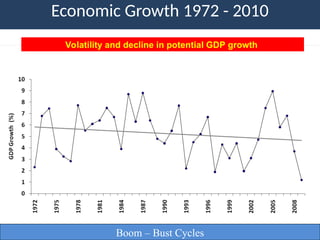
Economic Growth 1972 - 2010
3
Boom – Bust Cycles
Volatility and decline in potential GDP growth
Demographic Challenge
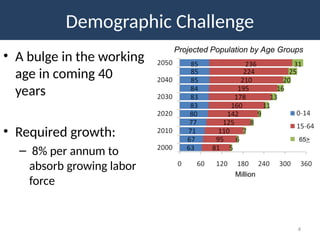
• A bulge in the working
age in coming 40
years
• Required growth:
– 8% per annum to
absorb growing labor
force
4
Projected Population by Age Groups
Million
65>
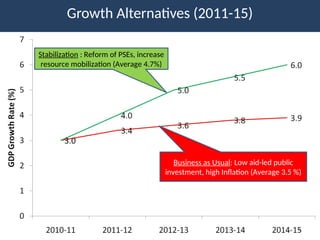
Growth Alternatives (2011-15)
5
Business as Usual: Low aid-led public
investment, high Inflation (Average 3.5 %)
Stabilization : Reform of PSEs, increase
resource mobilization (Average 4.7%)
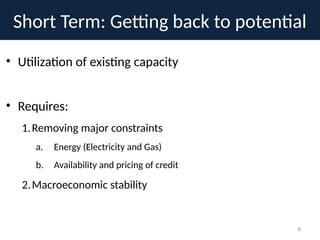
Short Term: Getting back to potential
• Utilization of existing capacity
• Requires:
1.Removing major constraints
a. Energy (Electricity and Gas)
b. Availability and pricing of credit
2.Macroeconomic stability
6
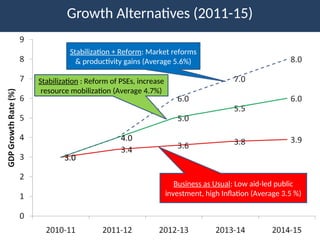
Growth Alternatives (2011-15)
7
Business as Usual: Low aid-led public
investment, high Inflation (Average 3.5 %)
Stabilization : Reform of PSEs, increase
resource mobilization (Average 4.7%)
Stabilization + Reform: Market reforms
& productivity gains (Average 5.6%)
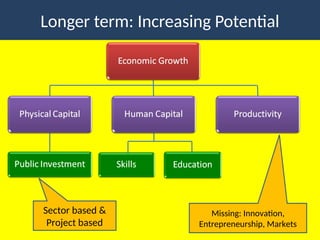
Longer term: Increasing Potential
8
Sector based &
Project based
Missing: Innovation,
Entrepreneurship, Markets
9
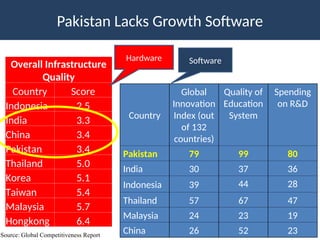
Overall Infrastructure
Quality
Country Score
Indonesia 2.5
India 3.3
China 3.4
Pakistan 3.4
Thailand 5.0
Korea 5.1
Taiwan 5.4
Malaysia 5.7
Hongkong 6.4
Source: Global Competitiveness Report
Country
Global
Innovation
Index (out
of 132
countries)
Quality of
Education
System
Spending
on R&D
Pakistan 79 99 80
India 30 37 36
Indonesia 39 44 28
Thailand 57 67 47
Malaysia 24 23 19
China 26 52 23
Hardware Software
Pakistan Lacks Growth Software
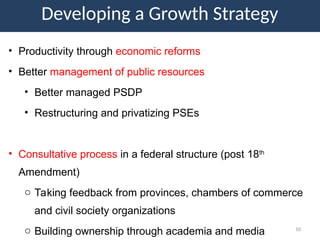
Developing a Growth Strategy
10
• Productivity through economic reforms
• Better management of public resources
• Better managed PSDP
• Restructuring and privatizing PSEs
• Consultative process in a federal structure (post 18th
Amendment)
o Taking feedback from provinces, chambers of commerce
and civil society organizations
o Building ownership through academia and media
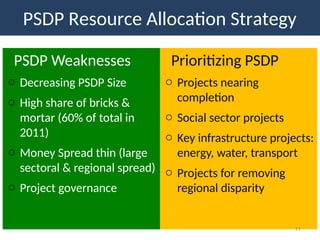
PSDP Weaknesses
o Decreasing PSDP Size
o High share of bricks &
mortar (60% of total in
2011)
o Money Spread thin (large
sectoral & regional spread)
o Project governance
Prioritizing PSDP
o Projects nearing
completion
o Social sector projects
o Key infrastructure projects:
energy, water, transport
o Projects for removing
regional disparity
11
PSDP Resource Allocation Strategy
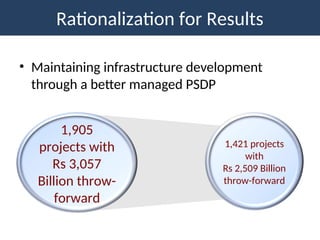
Rationalization for Results
1,905
projects with
Rs 3,057
Billion throw-
forward
1,421 projects
with
Rs 2,509 Billion
throw-forward
• Maintaining infrastructure development
through a better managed PSDP
• Ongoing:
– Modernization of feasibility reports
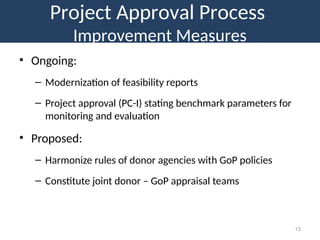
– Project approval (PC-I) stating benchmark parameters for
monitoring and evaluation
• Proposed:
– Harmonize rules of donor agencies with GoP policies
– Constitute joint donor – GoP appraisal teams
13
Project Approval Process
Improvement Measures
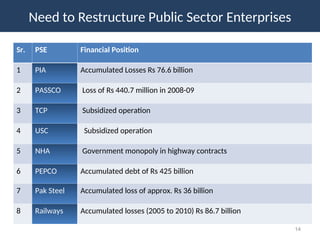
Need to Restructure Public Sector Enterprises
Sr. PSE Financial Position
1 PIA Accumulated Losses Rs 76.6 billion
2 PASSCO Loss of Rs 440.7 million in 2008-09
3 TCP Subsidized operation
4 USC Subsidized operation
5 NHA Government monopoly in highway contracts
6 PEPCO Accumulated debt of Rs 425 billion
7 Pak Steel Accumulated loss of approx. Rs 36 billion
8 Railways Accumulated losses (2005 to 2010) Rs 86.7 billion
14
Ongoing PSE Reform Efforts
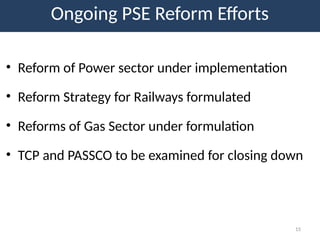
• Reform of Power sector under implementation
• Reform Strategy for Railways formulated
• Reforms of Gas Sector under formulation
• TCP and PASSCO to be examined for closing down
15
16
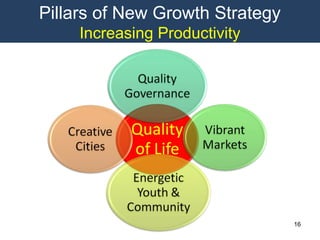
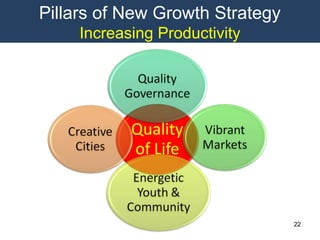
Pillars of New Growth Strategy
Increasing Productivity
Potential Governance Agenda
17
• Civil service reform –structure and incentives to attract
talent
– Monetized salaries, merit based promotions, and easy entry
& exit
• Devolution of powers, responsibilities and resources to
lower tiers of government for better service delivery
• Performance based governance
• Business process reengineering with technology
(outdated regulations & multiplicity of processing
layers)
Markets & Entrepreneurship
18
• Modernize laws and regulations for better markets
– Agriculture market committees
– Entry of new investment into the engineering sector
– Bankruptcy law (legislation drafted)
• Deregulating markets e.g. wheat, sugar & commodities exchange
(under implementation)
• Encouraging innovation through incubation centers, cluster
strengthening (e.g. Sialkot, Gujranwala, Wazirabad)
• Improving environment for domestic commerce
– Taxation regime, rent laws
– Legal structures for common property ownership (shops &
flats)
Cities as Hubs of Commerce
19
• Reform zoning and building regulations
– Two zoning laws
– Restrictive limits on heights
• Various needs unmet (office space, commerce,
flats, warehouses, schools etc.)
• Property rights and land markets (issues of
titles, taxation structures etc.)
• Freeing government land for commercial
purposes
Youth & Community
20
• Youth bulge - policy priority
• Making social capital available for youth
– Community & social infrastructure (libraries,
community centers etc.)
• Difficult to productively employ growing
young labor force
– Develop framework for youth self employment
Conclusion
• Reform, reform reform!
• Focus on productivity
• Merit and competition
21
22
Pillars of New Growth Strategy
Increasing Productivity
Thank You
www.pc.gov.pk
23
Thank You

Towards a Growth and Development Strategy.ppt

  • 1.
    Towards a Growthand Development Strategy 1 Planning Commission
  • 2.
    • Preoccupation withstabilization and crisis • Growth policy by default – Aggregation of projects – Sectoral focus • Result: sporadic growth • Lack of structural reform: declining potential growth rate 2 Characteristics of Growth in Pakistan
  • 3.
    Economic Growth 1972- 2010 3 Boom – Bust Cycles Volatility and decline in potential GDP growth
  • 4.
    Demographic Challenge • Abulge in the working age in coming 40 years • Required growth: – 8% per annum to absorb growing labor force 4 Projected Population by Age Groups Million 65>
  • 5.
    Growth Alternatives (2011-15) 5 Businessas Usual: Low aid-led public investment, high Inflation (Average 3.5 %) Stabilization : Reform of PSEs, increase resource mobilization (Average 4.7%)
  • 6.
    Short Term: Gettingback to potential • Utilization of existing capacity • Requires: 1.Removing major constraints a. Energy (Electricity and Gas) b. Availability and pricing of credit 2.Macroeconomic stability 6
  • 7.
    Growth Alternatives (2011-15) 7 Businessas Usual: Low aid-led public investment, high Inflation (Average 3.5 %) Stabilization : Reform of PSEs, increase resource mobilization (Average 4.7%) Stabilization + Reform: Market reforms & productivity gains (Average 5.6%)
  • 8.
    Longer term: IncreasingPotential 8 Sector based & Project based Missing: Innovation, Entrepreneurship, Markets
  • 9.
    9 Overall Infrastructure Quality Country Score Indonesia2.5 India 3.3 China 3.4 Pakistan 3.4 Thailand 5.0 Korea 5.1 Taiwan 5.4 Malaysia 5.7 Hongkong 6.4 Source: Global Competitiveness Report Country Global Innovation Index (out of 132 countries) Quality of Education System Spending on R&D Pakistan 79 99 80 India 30 37 36 Indonesia 39 44 28 Thailand 57 67 47 Malaysia 24 23 19 China 26 52 23 Hardware Software Pakistan Lacks Growth Software
  • 10.
    Developing a GrowthStrategy 10 • Productivity through economic reforms • Better management of public resources • Better managed PSDP • Restructuring and privatizing PSEs • Consultative process in a federal structure (post 18th Amendment) o Taking feedback from provinces, chambers of commerce and civil society organizations o Building ownership through academia and media
  • 11.
    PSDP Weaknesses o DecreasingPSDP Size o High share of bricks & mortar (60% of total in 2011) o Money Spread thin (large sectoral & regional spread) o Project governance Prioritizing PSDP o Projects nearing completion o Social sector projects o Key infrastructure projects: energy, water, transport o Projects for removing regional disparity 11 PSDP Resource Allocation Strategy
  • 12.
    Rationalization for Results 1,905 projectswith Rs 3,057 Billion throw- forward 1,421 projects with Rs 2,509 Billion throw-forward • Maintaining infrastructure development through a better managed PSDP
  • 13.
    • Ongoing: – Modernizationof feasibility reports – Project approval (PC-I) stating benchmark parameters for monitoring and evaluation • Proposed: – Harmonize rules of donor agencies with GoP policies – Constitute joint donor – GoP appraisal teams 13 Project Approval Process Improvement Measures
  • 14.
    Need to RestructurePublic Sector Enterprises Sr. PSE Financial Position 1 PIA Accumulated Losses Rs 76.6 billion 2 PASSCO Loss of Rs 440.7 million in 2008-09 3 TCP Subsidized operation 4 USC Subsidized operation 5 NHA Government monopoly in highway contracts 6 PEPCO Accumulated debt of Rs 425 billion 7 Pak Steel Accumulated loss of approx. Rs 36 billion 8 Railways Accumulated losses (2005 to 2010) Rs 86.7 billion 14
  • 15.
    Ongoing PSE ReformEfforts • Reform of Power sector under implementation • Reform Strategy for Railways formulated • Reforms of Gas Sector under formulation • TCP and PASSCO to be examined for closing down 15
  • 16.
    16 Pillars of NewGrowth Strategy Increasing Productivity
  • 17.
    Potential Governance Agenda 17 •Civil service reform –structure and incentives to attract talent – Monetized salaries, merit based promotions, and easy entry & exit • Devolution of powers, responsibilities and resources to lower tiers of government for better service delivery • Performance based governance • Business process reengineering with technology (outdated regulations & multiplicity of processing layers)
  • 18.
    Markets & Entrepreneurship 18 •Modernize laws and regulations for better markets – Agriculture market committees – Entry of new investment into the engineering sector – Bankruptcy law (legislation drafted) • Deregulating markets e.g. wheat, sugar & commodities exchange (under implementation) • Encouraging innovation through incubation centers, cluster strengthening (e.g. Sialkot, Gujranwala, Wazirabad) • Improving environment for domestic commerce – Taxation regime, rent laws – Legal structures for common property ownership (shops & flats)
  • 19.
    Cities as Hubsof Commerce 19 • Reform zoning and building regulations – Two zoning laws – Restrictive limits on heights • Various needs unmet (office space, commerce, flats, warehouses, schools etc.) • Property rights and land markets (issues of titles, taxation structures etc.) • Freeing government land for commercial purposes
  • 20.
    Youth & Community 20 •Youth bulge - policy priority • Making social capital available for youth – Community & social infrastructure (libraries, community centers etc.) • Difficult to productively employ growing young labor force – Develop framework for youth self employment
  • 21.
    Conclusion • Reform, reformreform! • Focus on productivity • Merit and competition 21
  • 22.
    22 Pillars of NewGrowth Strategy Increasing Productivity
  • 23.

Editor's Notes

  • #1 Minister, VP Excellencies, ladies and gentlemen The title is towards....... It is probably a give away...We are making a growth strategy.... For the last few decades we had plans....which basically articulated public sector investment demands and projects. The assumption was that public sector demand would create infrastructure—physical and social—and hence catalyze investment and growth. It did not happen. The relationship between public investment and growth remains empirically weak. So ladies and gentlemen this is an invitation to think?
  • #2 Continual crisis…Chasing stabilization Macro economic stability growth tradeoff. Stabilization recessionary At best, growth may be exogenous…or stabilization is a necessary condition for growth. Growth has to be built separately Can growth be an aggregation of projects or even sectoral initiatives The result is that Pakistan growth is volatile…. No sustainability. In fact long term potential growth or average growth seems to be declining. Perhaps this is indicative of a lack of structural reform
  • #3 U can see growth touchs 6-7 % and pulls back quickly to 3-4% Cannot be sustained The average is falling …probably pointing to the build up of inefficiencies in the system The key question we should all face is how can growth be accelerated to levels that are required and then sustained? Bear in mind that productivity growth in Pakistan remain very low and among the lowest in South Asia. Structure of our industry remains static. No new industry Services grow but remain over regulated Export GDP ratio static Structural rigidities
  • #4 The demographic bulge is well known. The working age population is on the rise. Youth coming onstream Labor force growth of about 3.6% per annum Output employment elasticity of .45 give us a required growth of 8% if we are absorb the growth of youth employment. For those of us who are worried about the mischief that youth can get into we should take note of this simple analysis.
  • #5 Lack of stabilization High inflation No money for public investment Growth remains low With stabilization and some PSE reform especially progress on energy reform will allow growth to reach 6% in 5 years. But Pse reform will require 2-3 years of sustained effort and implemnetation. Assumption: For the first two years we are constrained by power sector etc. We need time to come back to our trend growth rate. Once these constrained are lifted, then u start eliminating excess capacity after which fresh investment is expected.
  • #6 Given the existing excess capacity, the first order of business is getting back to full capacity. That is a quick way of generating employment.
  • #7 Our estimates suggest that a strategy of sustained reform focused on increasing our productivity and competitiveness would allow for an acceleration in growth This is the what our growth strategy hopes to develop.
  • #8 To develop a growth strategy that will attain a higher growth and sustain it, we need some conceptualization. Current strategy Green boxes The focus is on projects What is missing ? Productivity...the closest we come to it is capacity building projects
  • #9 Score:1= underdeveloped, 7=as extensive and efficient as the world’s best There are many indicators available for understanding constraints to investment and growth In reviewing these we found some common themes emerging Pakistan seems to have the hardware of growth. In terms of physical infrastructure. What it lacks is the software. Quality. Governance Organization Management innovation
  • #10 For developing our growth strategy We need an emphasis on building productivity Economic and organizational reform Emphasis on quality Doing things better....quality innovation Of course PSDP and our current activities will continue But we want to do them better. If we create assets, we want to use them to the full In the 18 amend world and a more open economy Consultation ...an owned strategy A new way of doing business
  • #11 Process too politicized Maintenance and running costs seldom provided for. Over long run perhaps we should merge the 2 budgets
  • #12 Will ever finish these? At what cost? Pressure to increase our portfolio Unfunded projects How to close them down in tough budgetary times
  • #13  To build greater rigour in PC-I appraisal and approval process, it is important to enhance capacity of sponsoring ministries for better project preparation. Some times PC-Is lack clear indication of quality benchmarks. Synchronization of GOP and donors policies and greater understanding of processes. PC1 held up to stop growth in throw forward or growth in unfunded projects
  • #14 How to destroy the public sector balance sheet? Not only are they adding to the deficit but often impeding market development
  • #15 Key reform ...getting government out of commodity markets...commodity exchange storage
  • #16 Global experience Informed ourselves by talking to large number of global thinkers Talking to a lot of local groups ..ngos academics business consumers
  • #22 Global experience Informed ourselves by talking to large number of global thinkers Talking to a lot of local groups ..ngos academics business consumers