PAIN ASSESSMENT
&
TOOL
BY:
KJ AZNIE WATTY BINTI AZMI
DEFINITION
 Pain is an
unpleasant sensory
& emotional
experience
associated with
actual & potential
tissue damage or
described in term of
such damage
InternationalAssociation fortheStudy ofPain1996
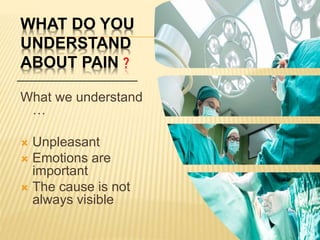
WHAT DO YOU
UNDERSTAND
ABOUT PAIN ?
What we understand
…
 Unpleasant
 Emotions are
important
 The cause is not
always visible
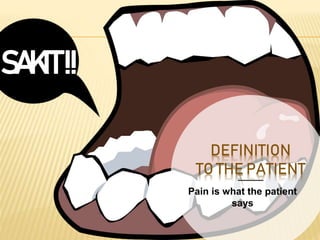
Pain is what the patient
says
SAKIT!!
DEFINITION
TO THE PATIENT
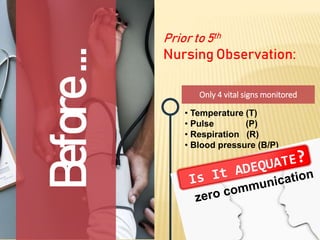
• Temperature (T)
• Pulse (P)
• Respiration (R)
• Blood pressure (B/P)
Prior to 5th
Nursing Observation:
Before
... Only 4 vital signs monitored
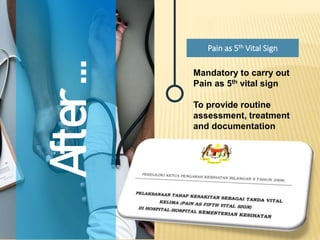
After
...
Pain as 5th Vital Sign
Mandatory to carry out
Pain as 5th vital sign
To provide routine
assessment, treatment
and documentation
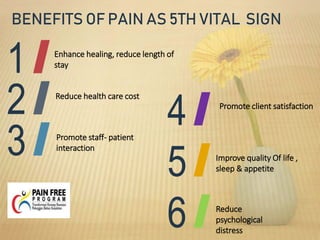
Promote client satisfaction
4
6 Reduce
psychological
distress
1 Enhance healing, reduce length of
stay
2 Reduce health care cost
3 Promote staff- patient
interaction
BENEFITS OF PAIN AS 5TH VITAL SIGN
5 Improve quality Of life ,
sleep & appetite
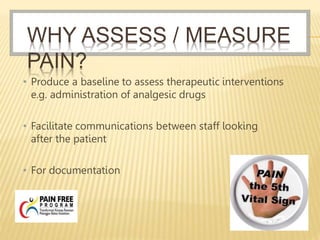
WHY ASSESS / MEASURE
PAIN?
• Produce a baseline to assess therapeutic interventions
e.g. administration of analgesic drugs
• Facilitate communications between staff looking
after the patient
• For documentation
CLINICAL TECHNIQUES FOR
MEASUREMENT OF PAIN
• Self reporting by the patient
• Gold standard
• Best method
• Observer assessment
• Observation of behaviour and vital signs
• Functional assessment
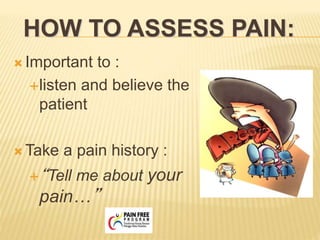
HOW TO ASSESS PAIN:
 Important to :
listen and believe the
patient
 Take a pain history :
“Tell me about your
pain…”
HOW TO ASSESS PAIN:
P: Place or site of pain
“Where does it hurt?”
(record on a body chart)
A: Aggravating factors
“What makes the pain worse?”
I : Intensity
“How bad is the pain?”
N: Nature and neutralizing factors
“What does it feel like” “What makes the pain better?”
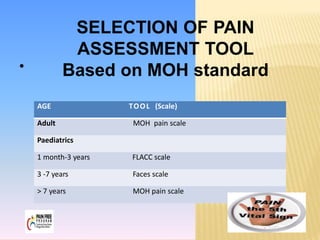
SELECTION OF
PAIN ASSESSMENT TOOL
• Use the standard tool for pain assessment
• Use appropriate scale
• Appropriate for age, learning, development
*Always use the same tool for the same patient
•
AGE TOOL (Scale)
Adult MOH pain scale
Paediatrics
1 month-3 years FLACC scale
3 -7 years Faces scale
> 7 years MOH pain scale
SELECTION OF PAIN
ASSESSMENT TOOL
Based on MOH standard
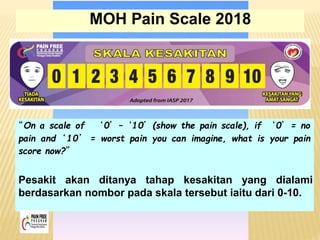
10
@~ ~[§@&~DLJ&~
3 4 56 7 8
Adopted from IASP 2017
“On a scale of ‘0’ – ‘10’ (show the pain scale), if ‘0’ = no
pain and ‘10’ = worst pain you can imagine, what is your pain
score now?”
Pesakit akan ditanya tahap kesakitan yang dialami
berdasarkan nombor pada skala tersebut iaitu dari 0-10.
9
2
MOH Pain Scale 2018
PAIN MEASUREMENT
Scales used in children / infants and
in cognitively impaired patients
 Faces Scale
 FLACC scale
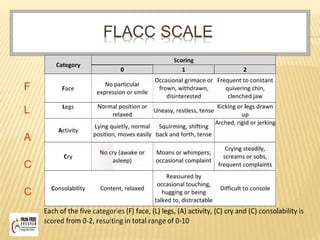
FLACC SCALE
F
L
A
C
C
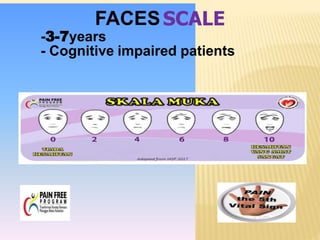
FACESSCALE
-3-7years
- Cognitive impaired patients
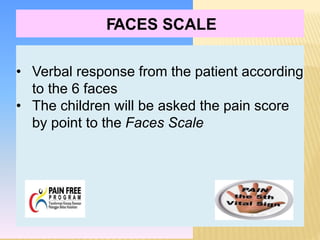
• Verbal response from the patient according
to the 6 faces
• The children will be asked the pain score
by point to the Faces Scale
FACES SCALE
Cont…
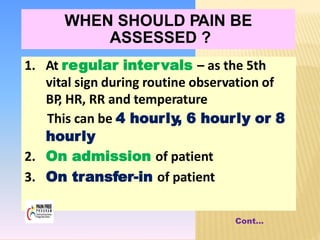
1. At regular intervals – as the 5th
vital sign during routine observation of
BP
, HR, RR and temperature
This can be 4 hourly, 6 hourly or 8
hourly
2. On admission of patient
3. On transfer-in of patient
WHEN SHOULD PAIN BE
ASSESSED ?
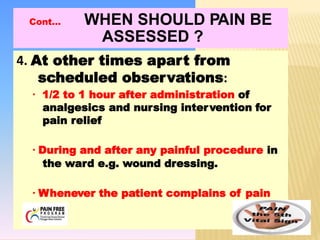
4. At other times apart from
scheduled observations:
▪ 1/2 to 1 hour after administration of
analgesics and nursing intervention for
pain relief
▪ During and after any painful procedure in
the ward e.g. wound dressing.
▪ Whenever the patient complains of pain
Cont… WHEN SHOULD PAIN BE
ASSESSED ?
WHO SHOULD BE ASSESSED?
ALL PATIENTS
• Patient in labour room
• Operating theatre (recovery room)
• ICU/ HDU/CCU
• Ambulatory day care units
• Clinics
WHO DOES PAIN ASSESSMENT?
EVERYONE
• All nurses/ paramedics
• All doctors
• All student nurses
• All medical students
• All allied health personnel
How to do Pain Assessment
1 . Greet patient / salam
2. Inform the purpose : to get the
patient’scorrect pain score for proper
treatment
3. Show and teach patient pain assessment
tool
“If ‘0’(no expression) – no pain
‘10’(most frowning face) – worst pain imaginable,
What is your pain score now?”
PAIN?
UNABLE TO ASSESS
Record ‘Unable to Score’ for :
1) Unconscious patients
2) Sedated patients
BUT Ventilated but conscious is still able
to
give a pain score!
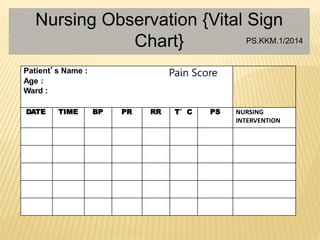
Patient’s Name :
Age :
Ward :
Pain Score
DATE TIME BP PR RR T°C PS NURSING
INTERVENTION
Nursing Observation {Vital Sign
Chart} PS.KKM.1/2014
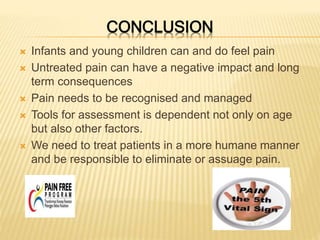
CONCLUSION
 Infants and young children can and do feel pain
 Untreated pain can have a negative impact and long
term consequences
 Pain needs to be recognised and managed
 Tools for assessment is dependent not only on age
but also other factors.
 We need to treat patients in a more humane manner
and be responsible to eliminate or assuage pain.
gohsk.2009

Pain.pptx

  • 1.
  • 2.
    DEFINITION  Pain isan unpleasant sensory & emotional experience associated with actual & potential tissue damage or described in term of such damage InternationalAssociation fortheStudy ofPain1996
  • 3.
    WHAT DO YOU UNDERSTAND ABOUTPAIN ? What we understand …  Unpleasant  Emotions are important  The cause is not always visible
  • 4.
    Pain is whatthe patient says SAKIT!! DEFINITION TO THE PATIENT
  • 5.
    • Temperature (T) •Pulse (P) • Respiration (R) • Blood pressure (B/P) Prior to 5th Nursing Observation: Before ... Only 4 vital signs monitored
  • 6.
    After ... Pain as 5thVital Sign Mandatory to carry out Pain as 5th vital sign To provide routine assessment, treatment and documentation
  • 7.
    Promote client satisfaction 4 6Reduce psychological distress 1 Enhance healing, reduce length of stay 2 Reduce health care cost 3 Promote staff- patient interaction BENEFITS OF PAIN AS 5TH VITAL SIGN 5 Improve quality Of life , sleep & appetite
  • 8.
    WHY ASSESS /MEASURE PAIN? • Produce a baseline to assess therapeutic interventions e.g. administration of analgesic drugs • Facilitate communications between staff looking after the patient • For documentation
  • 9.
    CLINICAL TECHNIQUES FOR MEASUREMENTOF PAIN • Self reporting by the patient • Gold standard • Best method • Observer assessment • Observation of behaviour and vital signs • Functional assessment
  • 10.
    HOW TO ASSESSPAIN:  Important to : listen and believe the patient  Take a pain history : “Tell me about your pain…”
  • 11.
    HOW TO ASSESSPAIN: P: Place or site of pain “Where does it hurt?” (record on a body chart) A: Aggravating factors “What makes the pain worse?” I : Intensity “How bad is the pain?” N: Nature and neutralizing factors “What does it feel like” “What makes the pain better?”
  • 12.
    SELECTION OF PAIN ASSESSMENTTOOL • Use the standard tool for pain assessment • Use appropriate scale • Appropriate for age, learning, development *Always use the same tool for the same patient
  • 13.
    • AGE TOOL (Scale) AdultMOH pain scale Paediatrics 1 month-3 years FLACC scale 3 -7 years Faces scale > 7 years MOH pain scale SELECTION OF PAIN ASSESSMENT TOOL Based on MOH standard
  • 14.
    10 @~ ~[§@&~DLJ&~ 3 456 7 8 Adopted from IASP 2017 “On a scale of ‘0’ – ‘10’ (show the pain scale), if ‘0’ = no pain and ‘10’ = worst pain you can imagine, what is your pain score now?” Pesakit akan ditanya tahap kesakitan yang dialami berdasarkan nombor pada skala tersebut iaitu dari 0-10. 9 2 MOH Pain Scale 2018
  • 15.
    PAIN MEASUREMENT Scales usedin children / infants and in cognitively impaired patients  Faces Scale  FLACC scale
  • 16.
  • 17.
  • 18.
    • Verbal responsefrom the patient according to the 6 faces • The children will be asked the pain score by point to the Faces Scale FACES SCALE
  • 19.
    Cont… 1. At regularintervals – as the 5th vital sign during routine observation of BP , HR, RR and temperature This can be 4 hourly, 6 hourly or 8 hourly 2. On admission of patient 3. On transfer-in of patient WHEN SHOULD PAIN BE ASSESSED ?
  • 20.
    4. At othertimes apart from scheduled observations: ▪ 1/2 to 1 hour after administration of analgesics and nursing intervention for pain relief ▪ During and after any painful procedure in the ward e.g. wound dressing. ▪ Whenever the patient complains of pain Cont… WHEN SHOULD PAIN BE ASSESSED ?
  • 21.
    WHO SHOULD BEASSESSED? ALL PATIENTS • Patient in labour room • Operating theatre (recovery room) • ICU/ HDU/CCU • Ambulatory day care units • Clinics
  • 22.
    WHO DOES PAINASSESSMENT? EVERYONE • All nurses/ paramedics • All doctors • All student nurses • All medical students • All allied health personnel
  • 23.
    How to doPain Assessment 1 . Greet patient / salam 2. Inform the purpose : to get the patient’scorrect pain score for proper treatment 3. Show and teach patient pain assessment tool “If ‘0’(no expression) – no pain ‘10’(most frowning face) – worst pain imaginable, What is your pain score now?”
  • 24.
    PAIN? UNABLE TO ASSESS Record‘Unable to Score’ for : 1) Unconscious patients 2) Sedated patients BUT Ventilated but conscious is still able to give a pain score!
  • 25.
    Patient’s Name : Age: Ward : Pain Score DATE TIME BP PR RR T°C PS NURSING INTERVENTION Nursing Observation {Vital Sign Chart} PS.KKM.1/2014
  • 26.
    CONCLUSION  Infants andyoung children can and do feel pain  Untreated pain can have a negative impact and long term consequences  Pain needs to be recognised and managed  Tools for assessment is dependent not only on age but also other factors.  We need to treat patients in a more humane manner and be responsible to eliminate or assuage pain.
  • 28.