ENVIRONMENTAL IMPACTS OF
HYDROCARBONS AND ITS
PHYTOREMEDIATION
APPROACHES
By- Shreya Kumari
INTRODUCTION
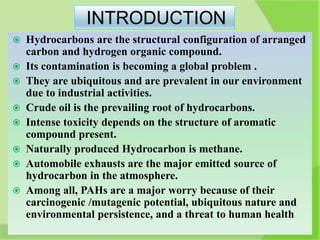
 Hydrocarbons are the structural configuration of arranged
carbon and hydrogen organic compound.
 Its contamination is becoming a global problem .
 They are ubiquitous and are prevalent in our environment
due to industrial activities.
 Crude oil is the prevailing root of hydrocarbons.
 Intense toxicity depends on the structure of aromatic
compound present.
 Naturally produced Hydrocarbon is methane.
 Automobile exhausts are the major emitted source of
hydrocarbon in the atmosphere.
 Among all, PAHs are a major worry because of their
carcinogenic /mutagenic potential, ubiquitous nature and
environmental persistence, and a threat to human health
Categories of Hydrocarbons
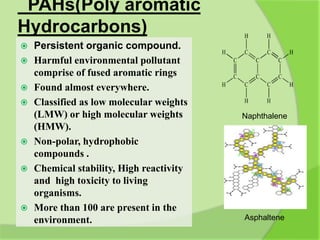
PAHs(Poly aromatic
Hydrocarbons)
 Persistent organic compound.
 Harmful environmental pollutant
comprise of fused aromatic rings
 Found almost everywhere.
 Classified as low molecular weights
(LMW) or high molecular weights
(HMW).
 Non-polar, hydrophobic
compounds .
 Chemical stability, High reactivity
and high toxicity to living
organisms.
 More than 100 are present in the
environment.
Naphthalene
Asphaltene
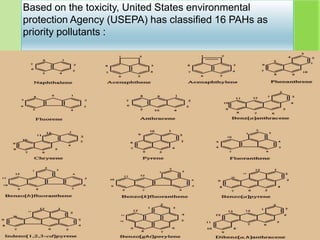
Based on the toxicity, United States environmental
protection Agency (USEPA) has classified 16 PAHs as
priority pollutants :
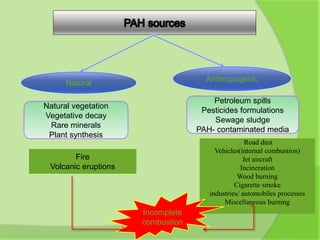
Natural
Anthropogenic
Natural vegetation
Vegetative decay
Rare minerals
Plant synthesis
Petroleum spills
Pesticides formulations
Sewage sludge
PAH- contaminated media
Fire
Volcanic eruptions
Road dust
Vehicles(internal combustion)
Jet aircraft
Incineration
Wood burning
Cigarette smoke
industries/ automobiles processes
Miscellaneous burning
Incomplete
combustion
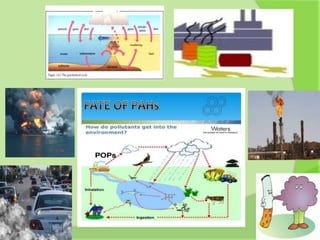
 Environmental sources
of PAHs
 PAHs emission all over
the world.
ENVIRONMENTAL IMPACTS OF
HYDROCARBONS
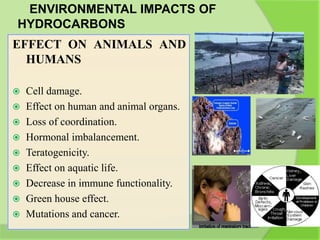
EFFECT ON ANIMALS AND
HUMANS
 Cell damage.
 Effect on human and animal organs.
 Loss of coordination.
 Hormonal imbalancement.
 Teratogenicity.
 Effect on aquatic life.
 Decrease in immune functionality.
 Green house effect.
 Mutations and cancer.
EFFECTS ON PLANTS
 Delayed seed germination.
 Limit the embryonic development.
 Damage to plant parts.
 Destroy the growth of vegetation.
 Induce oxidative stress in cell or
tissues
 Effect photosynthetic activity.
 Acid rain formation, which destroy
plants.
 Chlorosis.
 Dealth of plant.
Phytoremediation
 Term coined by Ilya Raskin in 1994.
 Green technology.
 Mainly it depends on the natural
symbiotic relationship between plants
and microorganisms.
 Also referred to as
phytotransformation.
 Useful in remediation of different
pollutants like organics or in organics.
 Ecological compatible tool for
environment clean up.
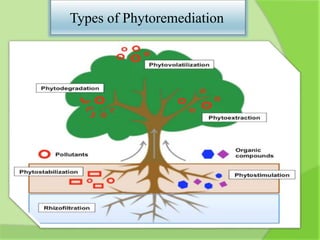
Types of Phytoremediation
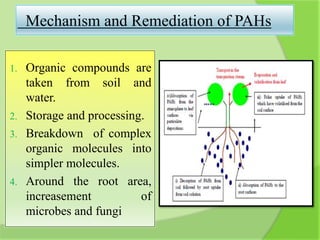
Mechanism and Remediation of PAHs
1. Organic compounds are
taken from soil and
water.
2. Storage and processing.
3. Breakdown of complex
organic molecules into
simpler molecules.
4. Around the root area,
increasement of
microbes and fungi
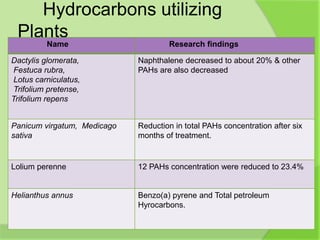
Hydrocarbons utilizing
Plants
Name Research findings
Dactylis glomerata,
Festuca rubra,
Lotus carniculatus,
Trifolium pretense,
Trifolium repens
Naphthalene decreased to about 20% & other
PAHs are also decreased
Panicum virgatum, Medicago
sativa
Reduction in total PAHs concentration after six
months of treatment.
Lolium perenne 12 PAHs concentration were reduced to 23.4%
Helianthus annus Benzo(a) pyrene and Total petroleum
Hyrocarbons.
Name Research findings
Festuca arundinacea The concentrations of pyrene were
decreased.
Andropogon gerardi,
Sorghastrum nutans,
Elymus canadensis,
Agropyron smithii,
Bouteloua gracilis
Proved that the plants can potentially
enhance the remediation of the PAHs
concentrations from the soil
Mimosa monancistra The dissipation of B[a]P was more
pronounced in vegetated soils and about
96% of B[a]P was dissipated in 90 days.
Salix viminalis The reduction in mineral oil was 57%
whereas for PAHs the planted treatments
showed 23% reduction.
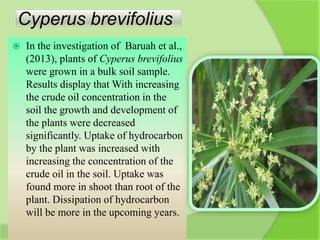
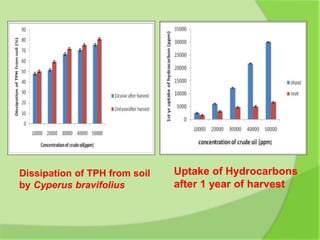
Cyperus brevifolius
 In the investigation of Baruah et al.,
(2013), plants of Cyperus brevifolius
were grown in a bulk soil sample.
Results display that With increasing
the crude oil concentration in the
soil the growth and development of
the plants were decreased
significantly. Uptake of hydrocarbon
by the plant was increased with
increasing the concentration of the
crude oil in the soil. Uptake was
found more in shoot than root of the
plant. Dissipation of hydrocarbon
will be more in the upcoming years.
Dissipation of TPH from soil
by Cyperus bravifolius
Uptake of Hydrocarbons
after 1 year of harvest
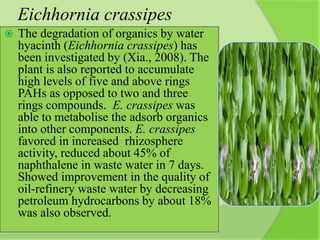
Eichhornia crassipes
 The degradation of organics by water
hyacinth (Eichhornia crassipes) has
been investigated by (Xia., 2008). The
plant is also reported to accumulate
high levels of five and above rings
PAHs as opposed to two and three
rings compounds. E. crassipes was
able to metabolise the adsorb organics
into other components. E. crassipes
favored in increased rhizosphere
activity, reduced about 45% of
naphthalene in waste water in 7 days.
Showed improvement in the quality of
oil-refinery waste water by decreasing
petroleum hydrocarbons by about 18%
was also observed.
CONCLUSION AND FUTURE PROSPECTS
 Polycyclic aromatic hydrocarbons are highly toxic and pose
considerable human health risks, thus have generated
significant interest worldwide. A number of approved
technologies are currently used to remediate PAHs at
hazardous waste sites. Biological technologies have been
shown to be effective and less costly for in-situ remediation
of PAHs in comparison to conventional remediation
methods. The modern tools of microbial biology promise to
improve the understanding of Plant-bacteria synergies and
will hopefully lead to better models for designing and
developing effective biological remediation schemes.
Treatment of Industrial effluents should also be done
strictly.
References
 Abdel, I.H. and Mansour, M.M. (2016). A review on polycyclic aromatic
hydrocarbons: Source, environmental impact, effect on human health and
remediation. Egyptian Journal of Petroleum . 25: 107–123.
 Baruah, P. and Deka,S. (2013). Removal of Hydrocarbon from Crude oil
Contaminated Soil by Cyperus brevifolius Rottb.Bull.Env. Pharmacol. Life
Sci. 2 : 123- 130 .
 Ukiwe, N.L., Egereonu, U.U., Njoku, C.P., Nwoko, A.C. and Allinor,
I.J. (2003) Polycyclic Aromatic Hydrocarbons Degradation Techniques: A
Review. International Journal of Chemistry. 5(4): 1916-9701.
 Xia, H. (2008). Enhanced disappearance of dicofol by water hyacinth in
water. Environmental Technology, 29: 297-302.
Phytoremediation of PAHs

Phytoremediation of PAHs

  • 1.
    ENVIRONMENTAL IMPACTS OF HYDROCARBONSAND ITS PHYTOREMEDIATION APPROACHES By- Shreya Kumari
  • 2.
    INTRODUCTION  Hydrocarbons arethe structural configuration of arranged carbon and hydrogen organic compound.  Its contamination is becoming a global problem .  They are ubiquitous and are prevalent in our environment due to industrial activities.  Crude oil is the prevailing root of hydrocarbons.  Intense toxicity depends on the structure of aromatic compound present.  Naturally produced Hydrocarbon is methane.  Automobile exhausts are the major emitted source of hydrocarbon in the atmosphere.  Among all, PAHs are a major worry because of their carcinogenic /mutagenic potential, ubiquitous nature and environmental persistence, and a threat to human health
  • 3.
  • 4.
    PAHs(Poly aromatic Hydrocarbons)  Persistentorganic compound.  Harmful environmental pollutant comprise of fused aromatic rings  Found almost everywhere.  Classified as low molecular weights (LMW) or high molecular weights (HMW).  Non-polar, hydrophobic compounds .  Chemical stability, High reactivity and high toxicity to living organisms.  More than 100 are present in the environment. Naphthalene Asphaltene
  • 5.
    Based on thetoxicity, United States environmental protection Agency (USEPA) has classified 16 PAHs as priority pollutants :
  • 6.
    Natural Anthropogenic Natural vegetation Vegetative decay Rareminerals Plant synthesis Petroleum spills Pesticides formulations Sewage sludge PAH- contaminated media Fire Volcanic eruptions Road dust Vehicles(internal combustion) Jet aircraft Incineration Wood burning Cigarette smoke industries/ automobiles processes Miscellaneous burning Incomplete combustion
  • 8.
     Environmental sources ofPAHs  PAHs emission all over the world.
  • 9.
    ENVIRONMENTAL IMPACTS OF HYDROCARBONS EFFECTON ANIMALS AND HUMANS  Cell damage.  Effect on human and animal organs.  Loss of coordination.  Hormonal imbalancement.  Teratogenicity.  Effect on aquatic life.  Decrease in immune functionality.  Green house effect.  Mutations and cancer.
  • 10.
    EFFECTS ON PLANTS Delayed seed germination.  Limit the embryonic development.  Damage to plant parts.  Destroy the growth of vegetation.  Induce oxidative stress in cell or tissues  Effect photosynthetic activity.  Acid rain formation, which destroy plants.  Chlorosis.  Dealth of plant.
  • 11.
    Phytoremediation  Term coinedby Ilya Raskin in 1994.  Green technology.  Mainly it depends on the natural symbiotic relationship between plants and microorganisms.  Also referred to as phytotransformation.  Useful in remediation of different pollutants like organics or in organics.  Ecological compatible tool for environment clean up.
  • 12.
  • 13.
    Mechanism and Remediationof PAHs 1. Organic compounds are taken from soil and water. 2. Storage and processing. 3. Breakdown of complex organic molecules into simpler molecules. 4. Around the root area, increasement of microbes and fungi
  • 14.
    Hydrocarbons utilizing Plants Name Researchfindings Dactylis glomerata, Festuca rubra, Lotus carniculatus, Trifolium pretense, Trifolium repens Naphthalene decreased to about 20% & other PAHs are also decreased Panicum virgatum, Medicago sativa Reduction in total PAHs concentration after six months of treatment. Lolium perenne 12 PAHs concentration were reduced to 23.4% Helianthus annus Benzo(a) pyrene and Total petroleum Hyrocarbons.
  • 15.
    Name Research findings Festucaarundinacea The concentrations of pyrene were decreased. Andropogon gerardi, Sorghastrum nutans, Elymus canadensis, Agropyron smithii, Bouteloua gracilis Proved that the plants can potentially enhance the remediation of the PAHs concentrations from the soil Mimosa monancistra The dissipation of B[a]P was more pronounced in vegetated soils and about 96% of B[a]P was dissipated in 90 days. Salix viminalis The reduction in mineral oil was 57% whereas for PAHs the planted treatments showed 23% reduction.
  • 16.
    Cyperus brevifolius  Inthe investigation of Baruah et al., (2013), plants of Cyperus brevifolius were grown in a bulk soil sample. Results display that With increasing the crude oil concentration in the soil the growth and development of the plants were decreased significantly. Uptake of hydrocarbon by the plant was increased with increasing the concentration of the crude oil in the soil. Uptake was found more in shoot than root of the plant. Dissipation of hydrocarbon will be more in the upcoming years.
  • 17.
    Dissipation of TPHfrom soil by Cyperus bravifolius Uptake of Hydrocarbons after 1 year of harvest
  • 18.
    Eichhornia crassipes  Thedegradation of organics by water hyacinth (Eichhornia crassipes) has been investigated by (Xia., 2008). The plant is also reported to accumulate high levels of five and above rings PAHs as opposed to two and three rings compounds. E. crassipes was able to metabolise the adsorb organics into other components. E. crassipes favored in increased rhizosphere activity, reduced about 45% of naphthalene in waste water in 7 days. Showed improvement in the quality of oil-refinery waste water by decreasing petroleum hydrocarbons by about 18% was also observed.
  • 20.
    CONCLUSION AND FUTUREPROSPECTS  Polycyclic aromatic hydrocarbons are highly toxic and pose considerable human health risks, thus have generated significant interest worldwide. A number of approved technologies are currently used to remediate PAHs at hazardous waste sites. Biological technologies have been shown to be effective and less costly for in-situ remediation of PAHs in comparison to conventional remediation methods. The modern tools of microbial biology promise to improve the understanding of Plant-bacteria synergies and will hopefully lead to better models for designing and developing effective biological remediation schemes. Treatment of Industrial effluents should also be done strictly.
  • 21.
    References  Abdel, I.H.and Mansour, M.M. (2016). A review on polycyclic aromatic hydrocarbons: Source, environmental impact, effect on human health and remediation. Egyptian Journal of Petroleum . 25: 107–123.  Baruah, P. and Deka,S. (2013). Removal of Hydrocarbon from Crude oil Contaminated Soil by Cyperus brevifolius Rottb.Bull.Env. Pharmacol. Life Sci. 2 : 123- 130 .  Ukiwe, N.L., Egereonu, U.U., Njoku, C.P., Nwoko, A.C. and Allinor, I.J. (2003) Polycyclic Aromatic Hydrocarbons Degradation Techniques: A Review. International Journal of Chemistry. 5(4): 1916-9701.  Xia, H. (2008). Enhanced disappearance of dicofol by water hyacinth in water. Environmental Technology, 29: 297-302.