Boluntarismo sa QuezBoluntarismo sa QuezBoluntarismo sa QuezBoluntarismo sa QuezBoluntarismo sa Quezon Cityon Cityon Cityon Cityon City JailJailJailJailJail
P a h i n u n g ó d B e h i n d B a r s:P a h i n u n g ó d B e h i n d B a r s:P a h i n u n g ó d B e h i n d B a r s:P a h i n u n g ó d B e h i n d B a r s:P a h i n u n g ó d B e h i n d B a r s:
Boluntarismo sa QuezBoluntarismo sa QuezBoluntarismo sa QuezBoluntarismo sa QuezBoluntarismo sa Quezon City Jailon City Jailon City Jailon City Jailon City Jail
PPPPPahinungód Behind Bahinungód Behind Bahinungód Behind Bahinungód Behind Bahinungód Behind Barsarsarsarsars
Boluntarismo sa QuezBoluntarismo sa QuezBoluntarismo sa QuezBoluntarismo sa QuezBoluntarismo sa Quezon Cityon Cityon Cityon Cityon City JailJailJailJailJail
P a h i n u n g ó d B e h i n d B a r s:P a h i n u n g ó d B e h i n d B a r s:P a h i n u n g ó d B e h i n d B a r s:P a h i n u n g ó d B e h i n d B a r s:P a h i n u n g ó d B e h i n d B a r s:
Boluntarismo sa QuezBoluntarismo sa QuezBoluntarismo sa QuezBoluntarismo sa QuezBoluntarismo sa Quezon City Jailon City Jailon City Jailon City Jailon City Jail
UgnaUgnaUgnaUgnaUgnayyyyyan ng Pan ng Pan ng Pan ng Pan ng Pahinungód-Dilimanahinungód-Dilimanahinungód-Dilimanahinungód-Dilimanahinungód-Diliman
Opisina ng ChanselorOpisina ng ChanselorOpisina ng ChanselorOpisina ng ChanselorOpisina ng Chanselor
Unibersidad ng PilipinasUnibersidad ng PilipinasUnibersidad ng PilipinasUnibersidad ng PilipinasUnibersidad ng Pilipinas
Diliman, LDiliman, LDiliman, LDiliman, LDiliman, Lunsod Quezunsod Quezunsod Quezunsod Quezunsod Quezononononon
22222000000000011111
PPPPPahinungód Behind Bahinungód Behind Bahinungód Behind Bahinungód Behind Bahinungód Behind Barsarsarsarsars
P a h i n u n g ó d B e h i n d B a r s:P a h i n u n g ó d B e h i n d B a r s:P a h i n u n g ó d B e h i n d B a r s:P a h i n u n g ó d B e h i n d B a r s:P a h i n u n g ó d B e h i n d B a r s:
Boluntarismo sa QuezBoluntarismo sa QuezBoluntarismo sa QuezBoluntarismo sa QuezBoluntarismo sa Quezon City Jailon City Jailon City Jailon City Jailon City Jail
Karapatan sa Paglalathala © 2001
Ugnayan ng Pahinungód-Diliman
Opisina ng Chanselor
Coral Bldg. Lakandula cor Delos Reyes Sts.
Unibersidad ng Pilipinas
Diliman, Lunsod Quezon
ISBN 971-92208-2-1
Ma. TherMa. TherMa. TherMa. TherMa. Theresa L. De Villaesa L. De Villaesa L. De Villaesa L. De Villaesa L. De Villa
LLLLLedivina Vedivina Vedivina Vedivina Vedivina V. Cariño. Cariño. Cariño. Cariño. Cariño
Mga Patnugot
Ma. Abigail S. MerMa. Abigail S. MerMa. Abigail S. MerMa. Abigail S. MerMa. Abigail S. Mercadocadocadocadocado
Konsepto at Disenyo ng Aklat
AnthonAnthonAnthonAnthonAnthony John R. By John R. By John R. By John R. By John R. Balisialisialisialisialisi
Dibuho sa Pabalat
MarMarMarMarMarco Rco Rco Rco Rco Ruben Tuben Tuben Tuben Tuben T. Malto II. Malto II. Malto II. Malto II. Malto II
Mga Ilustrasyon
Nilimbag ng Regan Printers
Boluntarismo sa QuezBoluntarismo sa QuezBoluntarismo sa QuezBoluntarismo sa QuezBoluntarismo sa Quezon Cityon Cityon Cityon Cityon City JailJailJailJailJail
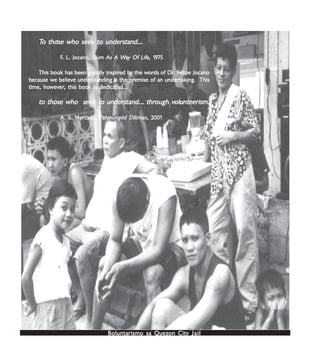
TTTTTo those who seek to understand…o those who seek to understand…o those who seek to understand…o those who seek to understand…o those who seek to understand…
FFFFF. L. Jocano,. L. Jocano,. L. Jocano,. L. Jocano,. L. Jocano, Slum As A WSlum As A WSlum As A WSlum As A WSlum As A Waaaaay Of Lify Of Lify Of Lify Of Lify Of Lifeeeee, 1, 1, 1, 1, 1999997777755555
This book has been grThis book has been grThis book has been grThis book has been grThis book has been greatly inspireatly inspireatly inspireatly inspireatly inspired bed bed bed bed by the wy the wy the wy the wy the wororororords of Drds of Drds of Drds of Drds of Dr. F. F. F. F. Felipe Jocanoelipe Jocanoelipe Jocanoelipe Jocanoelipe Jocano
because wbecause wbecause wbecause wbecause we beliee beliee beliee beliee believvvvve understanding is the pre understanding is the pre understanding is the pre understanding is the pre understanding is the premise of an underemise of an underemise of an underemise of an underemise of an undertaking. Thistaking. Thistaking. Thistaking. Thistaking. This
time, hotime, hotime, hotime, hotime, howwwwweeeeevvvvvererererer, this book is dedicated..., this book is dedicated..., this book is dedicated..., this book is dedicated..., this book is dedicated...
to those who seek to understand... thrto those who seek to understand... thrto those who seek to understand... thrto those who seek to understand... thrto those who seek to understand... through vough vough vough vough volunteerism.olunteerism.olunteerism.olunteerism.olunteerism.
A. S. MerA. S. MerA. S. MerA. S. MerA. S. Mercado,cado,cado,cado,cado, PPPPPahinungód Dilimanahinungód Dilimanahinungód Dilimanahinungód Dilimanahinungód Diliman, 2, 2, 2, 2, 2000000000011111
PPPPPahinungód Behind Bahinungód Behind Bahinungód Behind Bahinungód Behind Bahinungód Behind Barsarsarsarsars
Boluntarismo sa QuezBoluntarismo sa QuezBoluntarismo sa QuezBoluntarismo sa QuezBoluntarismo sa Quezon Cityon Cityon Cityon Cityon City JailJailJailJailJail
PPPPPaunang Salitaaunang Salitaaunang Salitaaunang Salitaaunang Salita iii
Napakaraming paraan upang maging boluntir sa Pahinungód Diliman. At kadalasan, marami
ang nahihikayat maging Pahinungód sa ilalim ng progamang Social Welfare, kung saan mga
bata ang kalimitang pinaglilingkuran, o di kaya ay sa Ecology Camp, upang magbigay halaga sa
pagpapanatili ng kaayusan ng kapaligiran. Pagkatapos ng kanilang kolehiyo, marami ring mga UP
gradweyt ang umaasang maging Gurong Pahinungód, sa hangarin nilang maglingkod sa ibayong pook
sa pamamagitan ng pagtuturo. Subalit kung minsan, may iilan din namang mga estudyante at guro ng
Unibersidad ang nangarap magbigay tulong sa paraang alam at kaya nila sa mga taong kalimitan ay
tinutukoy na “salot sa lipunan.” Ang mga taong binabansagang “kriminal” ng karamihan ang ninais
paglingkuran ng QuezQuezQuezQuezQuezon City Jail Pron City Jail Pron City Jail Pron City Jail Pron City Jail Projectojectojectojectoject at ito ang simulain ng aming kuwento.
Madaling maintindihan ng iba kung bakit kailangang tulungan ang mga batang may malubhang
sakit o di kaya ay napabayaan na ng kani-kanilang pamilya. Alam din ng karamihan sa atin kung bakit
dapat nating bigyan ng maagap na atensiyon ang ating kapaligiran. Naniniwala ang karamihan sa atin
sa kahalagahan ng edukasyon kung kaya’t kinakailangan ng marami pang dedikadong guro tungo sa
pagpapaunlad ng kaalaman. Ngunit, malimit ay mahirap maintindihan kung bakit kinakailangan ding
bigyan ng pansin ang mga pangangailangan ng mga taong nakakulong sa preso.
Sa pagbuo ng “P“P“P“P“Pahinungód Behind Bahinungód Behind Bahinungód Behind Bahinungód Behind Bahinungód Behind Bars: Boluntarismo sa Quezars: Boluntarismo sa Quezars: Boluntarismo sa Quezars: Boluntarismo sa Quezars: Boluntarismo sa Quezon City Jail,”on City Jail,”on City Jail,”on City Jail,”on City Jail,” mithiin namin sa
Pahinungód, kasama ang mga nagpasimuno sa adhikaing ito, lahat ng mga boluntir sa programa, at
mga preso sa QC Jail, ang magdulot ng kakaibang pagtanaw sa mga bilanggo at sa kanilang pamumuhay
sa loob. Pangarap din namin na maipakilala ang mga tao sa likod ng katagang “preso” at mag-udyok
ng panibagong pang-unawa sa kanila at sa iba pang katulad nila. Sa paraang ito, layunin din namin na
ipaunawa sa inyong mambabasa kung bakit pinili naming maglingkod sa mga taong lubos na
kinamumuhian at kinatatakutan ng marami.
Karamihan sa mga boluntir sa QC Jail Project ay sumali dahil ginusto nilang tahakin ang kakaibang
landas ng paglilingkod. Unique kasi ang kalimitang bansag sa programang ito o di kaya ay matapang
o brave ang pagtingin ng iba sa mga nagboboluntir dito. Mayroon din namang naging bahagi ng
programa dahil nakita nila ang kahalagahan ng paglilingkod kapalit ng pagsulat ng research paper para
sa kanilang kurso o sa pamamagitan ng Service Learning Option. Sinikap ng mga boluntir na ito
(kasama ng ilang preso at dating bilanggo na ngayon ay nakalaya na) na isulat ang kanilang karanasan
sa loob upang maibahagi ang kanilang mga natutunan bilang boluntir (at bilanggo) sa QC Jail at
magbigay linaw sa mga bagay na mahirap maintindihan ng karamihan. Sakop ng mga nailathalang
kuwento ang mga gawaing Pahinungód sa Quezon City Jail mula taong 1997 hanggang 2001.
Makatulong sana ang lathalaing ito upang ating higit na makilala ang mga taong madalas ay
pagkaitan ng kinakailangang pang-unawa at makita rin kung paano maiiugnay ang mga natutunan sa
klasrum sa labas nito.
PPPPPahinungód Behind Bahinungód Behind Bahinungód Behind Bahinungód Behind Bahinungód Behind Barsarsarsarsars
Boluntarismo sa QuezBoluntarismo sa QuezBoluntarismo sa QuezBoluntarismo sa QuezBoluntarismo sa Quezon Cityon Cityon Cityon Cityon City JailJailJailJailJail
MensaheMensaheMensaheMensaheMensahe v
To our dear readers
Producing a book on the impact of a program which some consider insignificant to the aca
demic life of the students and faculty is indeed no mean task. But with the inspiration,
support, and steadfastness of the student and faculty volunteers, and that of the coordinator – the
book is here – a record of the seven-year experiences of working and learning with the QC Jail
inmates, officials and other volunteers.
This book is a manifesto of the commitment and dedication of people in the University who
have actualized one of the University’s mission – serving the people.
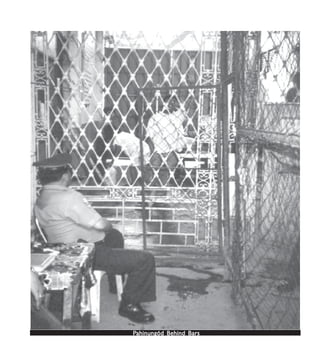
We would like to thank the following volunteers for making the QC Jail Program one of the
strongest programs of Pahinungod Diliman.
AbbAbbAbbAbbAbby Mery Mery Mery Mery Mercadocadocadocadocado, the coordinator, for keeping faith in the program and infecting the volunteers
with commitment and belief in the value of human dignity;
Ma’am LMa’am LMa’am LMa’am LMa’am Leddy Cariñoeddy Cariñoeddy Cariñoeddy Cariñoeddy Cariño and Ma’am Maricon AlfMa’am Maricon AlfMa’am Maricon AlfMa’am Maricon AlfMa’am Maricon Alfilerilerilerileriler for initiating the program and maintaining
the interest and enthusiasm in serving one of the marginalized sectors of society and in living the
principle of good public governance;
MarMarMarMarMarge Pge Pge Pge Pge Pambidambidambidambidambid, the first coordinator, for doing the spadework (initial meetings, coordinating
with partners, preparing documentation, etc.)
Sol IglesiasSol IglesiasSol IglesiasSol IglesiasSol Iglesias and Anne BAnne BAnne BAnne BAnne Barlisarlisarlisarlisarlis for providing the initiative by making the initial visits thus the
opportunity to help;
Sir OskSir OskSir OskSir OskSir Oskee Fee Fee Fee Fee Ferrerrerrerrerrererererer and Ma’am GrMa’am GrMa’am GrMa’am GrMa’am Grace Dace Dace Dace Dace Dalisaalisaalisaalisaalisayyyyy, previous Diliman directors who provided initial
motivation and assistance in all possible forms;
AAAAAttyttyttyttytty. Alber. Alber. Alber. Alber. Albert Muyt Muyt Muyt Muyt Muyooooottttt and the stafstafstafstafstaff of the Institute of Human Righf of the Institute of Human Righf of the Institute of Human Righf of the Institute of Human Righf of the Institute of Human Rights, College of Lats, College of Lats, College of Lats, College of Lats, College of Lawwwww for the
fruitful sessions with inmates and volunteers;
Diliman fDiliman fDiliman fDiliman fDiliman facultyacultyacultyacultyaculty: (NCPAG – Erwin Alampay, Minerva Baylon, Edna Co, Lily Domingo; CSSP –
Mark Reese; CHE – Bianca Villarino, Mila Querubin) for inspiring their students to make their
learnings more meaningful;
PPPPPahinungód Behind Bahinungód Behind Bahinungód Behind Bahinungód Behind Bahinungód Behind Barsarsarsarsars
Student vStudent vStudent vStudent vStudent volunteersolunteersolunteersolunteersolunteers from the following Diliman colleges: CAL, CHK, College of Music, CHE,
CSSP, NCPAG, College of Law for keeping the program dynamic, vibrant and relevant;
FrFrFrFrFr. T. T. T. T. Tononononony Ranaday Ranaday Ranaday Ranaday Ranada of PRESO Foundation for maintaining the network and believing in the UP
Pahinungod;
The QC GoQC GoQC GoQC GoQC Govvvvvernmenternmenternmenternmenternment thru then Mayor Ismael Mathay Jr., for providing the moral support;
The officials and staff of the BurBurBurBurBureau of Jail Management and Peau of Jail Management and Peau of Jail Management and Peau of Jail Management and Peau of Jail Management and Penologyenologyenologyenologyenology, and the QC JailQC JailQC JailQC JailQC Jail
wwwwwararararardensdensdensdensdens (past and present) for believing in the program and the volunteers;
RaRaRaRaRaymund Narymund Narymund Narymund Narymund Naragagagagag or KKKKKuyuyuyuyuya Raa Raa Raa Raa Raymundymundymundymundymund for the steadfast support and belief in the utter goodness of
the humankind;
Zak, VZak, VZak, VZak, VZak, Venus, Carlin, Hazenus, Carlin, Hazenus, Carlin, Hazenus, Carlin, Hazenus, Carlin, Hazel, Janice, Horel, Janice, Horel, Janice, Horel, Janice, Horel, Janice, Horace, Gloria, Jerlyn, Detace, Gloria, Jerlyn, Detace, Gloria, Jerlyn, Detace, Gloria, Jerlyn, Detace, Gloria, Jerlyn, Det and the other volunteers for
staying on and believing in volunteerism as a significant part of their growth as students and human
beings;
TTTTTuniuniuniuniuni and MarMarMarMarMarccccc for taking on the challenge of doing the significant other tasks to meet the
deadline and have this volume out on schedule;
Sa lahat ng pangklahat ng pangklahat ng pangklahat ng pangklahat ng pangkat sa QCJailat sa QCJailat sa QCJailat sa QCJailat sa QCJail, maraming salamat sa inyong taos-pusong pagtulong, pakikiisa,
pakikibalikat, at paniniwala sa kabutihang loob ng kapwa.
Sa stafstafstafstafstaff ng Pf ng Pf ng Pf ng Pf ng Pahinungod Diliman (noon at ngaahinungod Diliman (noon at ngaahinungod Diliman (noon at ngaahinungod Diliman (noon at ngaahinungod Diliman (noon at ngayyyyyon)on)on)on)on) sa masaya at makabuluhang talakayan sa
samu’t saring problema at hamon sa pagpapadaloy ng mga programa;
Sa administradministradministradministradministrasyasyasyasyasyon ng UP Dilimanon ng UP Dilimanon ng UP Dilimanon ng UP Dilimanon ng UP Diliman, sa patuloy ng suporta at paniniwala sa kahalagahan ng
Ugnayan ng Pahinungod sa Unibersidad;
Sa inyong lahat at sa mga di nabanggit ngunit naging malaking bahagi sa aming patuloy na paglago
MARAMING SMARAMING SMARAMING SMARAMING SMARAMING SALAMAALAMAALAMAALAMAALAMAT MULI -T MULI -T MULI -T MULI -T MULI -
BUONG PUSONG INIHAHANDOG ANG LIBRBUONG PUSONG INIHAHANDOG ANG LIBRBUONG PUSONG INIHAHANDOG ANG LIBRBUONG PUSONG INIHAHANDOG ANG LIBRBUONG PUSONG INIHAHANDOG ANG LIBRONG ITONG ITONG ITONG ITONG ITO SO SO SO SO SA INYA INYA INYA INYA INYONG LAHAONG LAHAONG LAHAONG LAHAONG LAHATTTTT.....
TTTTTerererereret L. de Villaet L. de Villaet L. de Villaet L. de Villaet L. de Villa
DisyDisyDisyDisyDisyembrembrembrembrembre 2e 2e 2e 2e 2000000000011111
Boluntarismo sa QuezBoluntarismo sa QuezBoluntarismo sa QuezBoluntarismo sa QuezBoluntarismo sa Quezon Cityon Cityon Cityon Cityon City JailJailJailJailJail
Ledivina V. Cariño
LLLLLessons fressons fressons fressons fressons from Prisonom Prisonom Prisonom Prisonom Prison
Since 1997, the Ugnayan ng Pahinungod has been sending volunteers into Quezon City Jail as
paralegals, literacy tutors, and leadership training facilitators. Among the volunteers are
students who take the Service Learning Option in my Administrative Ethics class. Through SLO,
students learn while they serve and serve while they learn. I grade them on the basis of how better
they have understood Immanuel Kant, Socrates, and other ethical philosophers because they have
made Quezon City Jail their teacher. I assess how much they have learned about Public Administra-
tion and Governance by serving in the Jail. I do not judge how well they serve; that is between them,
the inmates they serve, and God. But I am confident of the quality of their service, based on the
feedback I receive from the inmates and the Pahinungod office, and what I see of their developing
personhood.
Last Monday, the Diliman Pahinungod office sent me the first 16 articles for our book on Quezon
City Jail. These are the students’ reflections and assessments of their experience as pahinungods - a
Cebuano term that is the closest Filipino equivalent to the word “oblation.” To be a pahinungod is to
make an offering of self, and is an iskolar ng bayan’s attempt to be the living answer to Rizal’s
question: where are the youth who will sacrifice their golden hours for the good of their country?
These pahinungods, these children of the Oblation say as did Isaiah: here we are, send us.
Since the Church of the Risen Lord is embarking on a prison ministry, I thought it opportune to
share some of the lessons we have learned from being a volunteer “batang city jail” for a semester. It
may also answer some questions I have heard from some of our members and other people from UP
O Lord, our Lord, how marvelous is thy name in all the earth…
When I consider the heavens, the work of thy fingers, the moon and
the stars which thou has ordained,
What is man, that thou art mindful of him, and the son of man, that
thou visitest him?
For thou hast made him a little lower than the angels, and has crowned
him with glory and honor…
Psa. 8: 1-8.
vii
PPPPPahinungód Behind Bahinungód Behind Bahinungód Behind Bahinungód Behind Bahinungód Behind Barsarsarsarsars
about why we should go to QC Jail - or any other jail for that matter - at all.
I was in prison and you visited me.
The first reason is the biblical injunction about serving the least of our brethren. A Catholic
priest who heads the PRESO Foundation, a multi-sectoral NGO that focuses on prisoners’ rehabilita-
tion, Fr. Tony Ranada, puts the issue succinctly: a jail is primarily a place of the poor. Most inmates of
QC Jail are people awaiting trial. A small group is charged with non-bailable offenses. The bigger
percentage would not be there at all if they had any money for bail. If your offense is bailable, you will
not suffer staying with 1,500 other people in an area meant for 600. You will not sleep on a mat
where your half-stretched arms touch the bed above you, which (by the way) has two other beds
above it. You will not choose to subsist on a food allowance of P30 a day, eating your slop within a few
feet of the toilet. You will not want to clean that toilet just to get a share of the food that other
inmates receive from their visitors. But you will have no choice, if you are poor.
Innocent or guilty, is this any way to treat a human being?
As in the outside world, where there is poverty, inequality and injustice follow. We are all aware
of a famous prisoner whose major complaint is the lack of curtains in his Fort Sto. Domingo bunga-
low. In QC Jail, while the average prisoner sleeps in a quadruple-decker, the leader of a cell gets to
cordon off as much as a fourth of that cell for his living quarters - where he can put his electric fan,
tv, stereo, and sometimes also his wife and children. He is regularly visited by a lawyer and he never
misses a court hearing.
Meanwhile, the rest of the inmates don’t even know the status of their case. This is why they
need paralegals. It is the pahinungods who get their case numbers and then go through the labyrinth
of the bureaucracy. From the warden and jail personnel who sometimes intentionally miss telling the
inmates that they have a hearing today because the jail does not have a vehicle to take them to court.
From the public attorneys who have time to play poker in their offices but not the time to work on
their cases or talk with their clients. Then there are the judges who treat the case perfunctorily
because the accused are poor and ignorant anyway.
Somehow, although these experiences are duplicated many times, the pahinungods do not end
up disillusioned. Instead, they come to me with eyes shining when they are able to get a case moving,
or get the family of the inmates to visit. Or better yet, when they are able to have an inmate released.
Nakapagpalaya ako! They exult, echoing Mel Gibson’s cry in Braveheart: FREEDOM!
This happens sometimes because the pahinungod’s interest has prodded the bureaucracy to
conclude the case. Sometimes, it is because their research showed that the person has served time
Boluntarismo sa QuezBoluntarismo sa QuezBoluntarismo sa QuezBoluntarismo sa QuezBoluntarismo sa Quezon Cityon Cityon Cityon Cityon City JailJailJailJailJail
in prison longer than his actual punishment had he been convicted. For instance, one inmate was
released after being in prison for two years, when the maximum sentence for his offense - had he
been found guilty - would have been only one year. And he staunchly maintains he is innocent so he
should not even have served a day in jail.
Let me not romanticize the prisoners because they are not necessarily faultless. One student was
able to get an inmate out within the first six weeks of his pahinungod service, only to meet him again
just before the semester ended, because, alas, the man was caught in a robbery again. Another
student learned an unlikely explanation for recidivism: some inmates value freedom less than three
meals and a roof over their heads. The jail is crowded, dirty, hot, smelly, has leaking roofs, riots at
the drop of a hat. The food is dismal. Can you imagine people choosing that intentionally because it
is better than what they have outside? This also explains why there are so many children inside the
jail. When a parent is detained, visitors would sneak in the children so they can also have free board
and lodging. After that, the guards would simply ignore them in the jail, although if you ask them
officially, they will swear that children are not allowed even to visit, let alone live inside the cells.
The other ills of the outside world are magnified inside the jail. There are innocents who
become criminals in jail - raping or harassing females and homosexuals, alleviating their loneliness by
sniffing drugs, fighting their powerlessness by being quarrelsome, or joining violent gangs.
But the jail is not a microcosm of society only in the negative way. Because there are many
examples of nobility among the inmates we have met. Raymond Narag is a graduate of my College
who has been languishing in jail since 1995 when he was accused of the murder of Dennis Venturina,
then the chair of our Student Council. Dennis was a sure cum laude, the only son of average-earning
professionals, the hope of his family for a better future. He had joined a fraternity where he was
dubbed as an intellectual - as against their warrior class - as a way of ensuring that future. Raymond’s
biography is practically the same, except that instead of being the victim of a fraternity rumble, he
became the accused. It is taking him more than six years to prove his innocence. Charged with a
non-bailable offense, he was committed to Quezon City Jail in 1995. Throughout his confinement,
Raymond has made himself useful. He was acquitted in the Student Disciplinary Tribunal but was
charged in court anyway. UP refused to graduate him cum laude until he was cleared in court. He
had nevertheless enrolled in the Open University for advanced master’s degree credits. He has been
the mainstay of the leadership, literacy and skills training programs in the jail. He helps train the
Pahinungod paralegals. He solicited an XT computer so that he could improve the prison’s record
system. In one of my visits, one nun was so overwhelmed by the magnitude and quality of Raymond’s
volunteerism that she hugged him and said: “Oh Raymond. I hope you never leave us.” (That’s the
worst thing you can say to a prisoner!)
There are other heartening examples of the best of humanity in the jail. Once I attended the
closing of a training program there. I was almost irritated by the Mayora of the Jail, a native of
ix
PPPPPahinungód Behind Bahinungód Behind Bahinungód Behind Bahinungód Behind Bahinungód Behind Barsarsarsarsars
Cagayan de Oro City, charged with estafa, who had been asked to give the closing prayer. She kept
badgering me on what to say, where to stand, whether to look at the audience or not, and so forth
and so on. In my most patient style, I answered her questions, but I silently thought: KSP, kulang sa
pansin yata ito. However, she surprised me with her beautiful, heartfelt prayer in perfect Tagalog,
ending with “sa ngalan ng aming manunubos na si Kristo Jesus.” Then she sat down beside me and
asked if what she did was all right. I was genuinely touched by her prayer, and said so. Then she told
me: “I was so afraid I might offend someone. You see, I am a Muslim.”
Such displays of tolerance and respect for another’s religion are sorely needed by the outside
world in these trying times, when Muslims feel the heat from even devout Christians, who label all of
them as bandits and Abu Sayyah, allowing the age-old prejudices to come through without any
apology. We have much to learn from this inmate. And from many other inmates, who because of
poverty, or passion, or a failing of the social structure, are now in the city jail. There, but for the
grace of God, go you and I.
And if you feel belittled by being placed in the same category as prisoners, let me recall for you
the analogy of Dwight Moody, the famous preacher. According to him, the difference between our
sins and theirs is similar to the view one gets from the Empire State Building, or the Petronas Tower
in Malaysia, now the tallest building in the world. When you look down from the top of these
buildings to the people below, you can barely make out the difference between a Shaquille O’Neal
and a little boy, or between a Lincoln Continental and a Volkswagen. He said that is like the view of
God about our badness - or goodness. From the commanding heights, we all look like ants. It does
not matter if we are supposed to be saint or sinner by the standards of the world. Judge not, the
Bible says, that ye be not judged… For all have sinned, and come short of the glory of God.
The prison allows us to appreciate this truth, even as we learn, as we meet them close up, that
there is a basic goodness and humanity in everyone.
As you have done this to the least of these my brethren,
you have done it unto me.
But what is it that we do to our brethren? Jeffrey Roden, a former inmate and now my student
assistant, describes the situation in this way: “The Quezon City jail… is where one can find the
gargantuan problems of this country, perhaps in a miniscule scale, but no less systemic and
systematic. It is one big theater where one can see all the problems of our society encapsulated in a
diorama of sorts… There are human rights abuses, inadequate food, water and shelter space. Also,
there are problems in garbage collection, division and gang competition. Of course, the heart of all
these problems is the ignorance of inmates being continuously exploited by the corruption and
unscrupulousness of the officials.
Boluntarismo sa QuezBoluntarismo sa QuezBoluntarismo sa QuezBoluntarismo sa QuezBoluntarismo sa Quezon Cityon Cityon Cityon Cityon City JailJailJailJailJail
“I remember it being said in the movie Con Air, that in order to measure how civilized a country
is, you merely have to look at the way it treats its prisoners.”
By that measure, just how civilized, how Christian, are we?
Where are the youth who will sacrifice their golden hours…?
Jeffrey has discussed the world’s usual behavior towards the jail. Now let me tell you about the
people who minister to the inmates. They are young and adventurous, usually idealistic, but not
always. Every semester I read in their reflection papers confessions of the wrong things that led them
to volunteer to the Quezon City Jail. Some join because their crush is joining, and it offers many
occasions to get to hold her hand when she is scared by the tough inmates. Some volunteer to get on
the good graces of the teacher. Some think it is easier to do than a term paper from which I exempt
all service learners. By the time they are climbing the stairs of Quezon City Hall for the third time on
the same day, they know it is much more difficult than reading tomes in the library. But at that point,
they are already hooked, by the sob stories of the prisoners - which may or may not be true - and by
the challenge that replaces their fear of the jail. They may not have volunteered for the right reasons,
but they come out of jail voluntarism a different person.
I have learned from Virginia Davide - the recently retired head of NEDA’s voluntary service
agency and the wife of Filipino of the Year Chief Justice Hilario Davide - that one should never worry
why people volunteer. Gigi further says: Worry only if the experience does not change them. And in
the space of one semester, they do change.
No one leaves the pahinungod jail service without having learned for themselves the great lesson
from the theologian Reinhold Niebuhr: “Justice which is only justice soon degenerates into some-
thing less than justice. It must be saved by something which is more than justice.” Even in the cleanest
and least corrupt prisons, where strict adherence to the letter of the law masquerades as justice, it
must be saved by something which is more than justice. This is what Fr. Brian Wren calls “loving
justice,” justice that is not aimed at avenging the wrong done against society, but instead lifts up its
perpetrators, recognizes their humanity, and sees in them the face of God. Let me paraphrase what
one of my students, JunJun Binay, said he learned from Quezon City Jail. “You remember,” he told
us, “that practically alone in this class, I defended the death penalty as both legal and moral in the
beginning of this semester. But having served at QC Jail, I find I cannot allow any one of them - even
the most ruthless - to be killed by the state. Our justice must be rehabilitative justice.”
Others report being more serene about their lives and more able to face problems, after due
comparison of their little problems - lovers’ quarrels, disputes with parents, the dilemma of study
versus gimmicks - with the enormity of imprisonment. Many mention getting from the fortitude of
xi
PPPPPahinungód Behind Bahinungód Behind Bahinungód Behind Bahinungód Behind Bahinungód Behind Barsarsarsarsars
the inmates the courage to confront the uncaring lawyers and wardens as well as the bullies of their
own lives. Many learn first hand what “public interest” means and the need for public service reform,
as they see up close the inequality and unfairness of the social structure.
But then, you protest, you are able to help only a few people. Let me tell you a story I first heard
from Lorraine Salazar, a pahinungod in another project.
A woman walked along a beach for her exercise, back and forth, one kilometer each way. The
beach had many starfishes that struggled on the sands; if they cannot get back to the water, they
would die. As she walked, she would throw every starfish on her path back to the sea. Daily she
would do this and daily, there would be new starfishes. A friend of hers laughed at her efforts,
ridiculing her for the futility of it all. You can never save all the starfishes, her friend said. But, she
replied as she rescued yet another starfish, it is important to this starfish.
It is important to each human being we touch.
ConclusionsConclusionsConclusionsConclusionsConclusions
So this is what the jail has taught us. First that it is a microcosm of society, where in a small
crowded space gather all the banes of our existence - poverty, inequality, injustice, enslavement,
abuse. But it is also like society as many people rise above these ills - where we find inmates and
volunteers giving us models of tolerance, compassion, caring, justice, service, love.
Second, it mirrors what we make of our society. We now think of hospitals as centers of
wellness because although we treat the sick there, their main function must be to prevent further
pain and misery. Can we think of our prisons as centers of justice, where, although we put there
those whom we think have broken the law, their main function must be to prevent further criminal-
ity, to rehabilitate those who have been wrong, and not to allow to sink into evil those who have been
wrongly accused? But how many of us care that our civilization and Christianity are so poorly
mirrored in our prisons?
Third, when we serve in the jail, we become better people, not because we find out how terrible
and how sinful the inmates there are, but because the jail and the prisoners themselves are good
teachers. They show us courage and patience, they warn us to guard our anger, they teach repen-
tance and forgiveness, they show us kindness, what it means to be human. And as we criticize the
social structure and cultural weaknesses that are perpetrated in the jail, we understand that we
cannot be whole if we let revenge, corruption and abuse to ran our lives and our country. The public
interest demands our compassion. The quest for justice calls for our love. We become more fully
human as we serve “the least of these our brethren.” This is why Jesus makes visiting prisoners a
measure of whether we really follow him or not.
Boluntarismo sa QuezBoluntarismo sa QuezBoluntarismo sa QuezBoluntarismo sa QuezBoluntarismo sa Quezon Cityon Cityon Cityon Cityon City JailJailJailJailJail
Our text asks: What is man, what are human beings, that you God, are mindful of them? The
prison ministry goes to the core of this question as it teaches us that every person, in jail or out, is
worth our attention, is worth our loving justice. Because every person, not just the so-called
righteous, meaning those who have never been caught, all of us sons and daughters of Adam and
Eve, were made a little lower than the angels, crowned with glory and honor.
O Lord, our Lord, how marvelous is your name in all the earth! Amen.
Come, ye blessed of my Father, inherit the kingdom prepared for you
from the foundation of the world: For I was an hungred, and ye gave me
meat. I was thirsty and ye gave me drink. I was a stranger, and ye took me
in. Naked, and ye clothed me. I was sick, and ye visited me. I was in prison,
and ye came unto me.
Then shall the righteous answer him, saying:
Lord, when saw we thee a stranger and took thee in? Or naked, and
clothed thee? Or when saw we thee sick, or in prison, and came unto thee?
And the King shall answer and say unto them, Verily I say unto you,
Inasmuch as ye have done it unto one of the least of these my brethren, ye
have done it unto me.
Matt. 25: 31-40.
xiii
PPPPPahinungód Behind Bahinungód Behind Bahinungód Behind Bahinungód Behind Bahinungód Behind Barsarsarsarsars
Boluntarismo sa QuezBoluntarismo sa QuezBoluntarismo sa QuezBoluntarismo sa QuezBoluntarismo sa Quezon Cityon Cityon Cityon Cityon City JailJailJailJailJail
Mga NilalamanMga NilalamanMga NilalamanMga NilalamanMga Nilalaman
Paunang Salita iii
Mensahe v
Lessons from prison vii
Mga Kuwentong Pahinungód 1
The beginnings/ Ako bilang batang city jail/ Si Aiza/ Salamat po!
Attorney/ Service at commitment/ Why volunteer?
Detinadong komunidad/ Ang aking karanasang Pahinungód sa loob
Beyond these four walls/ Cheyrman/ Tulong/ A sense of freedom
Mga Kuwento Sa Loob 41
Bilanggo/ The practice/A jail love story
Pangkatan ka ba?/ Rancho... atbpang salitang loob
Filipino values that thrive at the QC Jail
Mga Kuwento Sa Logbook at Panulaan 77
Of skies, jails, moon and freedom
Si Panyang/ Si Gorio
Feelings/ An expected visit
Hiram na buhay/ Logged notes
x v
PPPPPahinungód Behind Bahinungód Behind Bahinungód Behind Bahinungód Behind Bahinungód Behind Barsarsarsarsars
Boluntarismo sa QuezBoluntarismo sa QuezBoluntarismo sa QuezBoluntarismo sa QuezBoluntarismo sa Quezon Cityon Cityon Cityon Cityon City JailJailJailJailJail
1
The beginnings
Ako bilang batang city jail
Si Aiza
Salamat po!
Attorney
Service at commitment
Why volunteer?
Detinadong komunidad
Ang aking karanasang Pahinungód sa loob
Beyond these four walls
Cheyrman
Tulong
A sense of freedom
Mga Kuwentong Pahinungód
PPPPPahinungód Behind Bahinungód Behind Bahinungód Behind Bahinungód Behind Bahinungód Behind Barsarsarsarsars
The beginningsThe beginningsThe beginningsThe beginningsThe beginnings
What may have started as a U.P. tragedy resulted in a program that offers voluntary
assistance from the University constituents to one of the most misjudged sectors of
society—the people of Quezon City Jail.
On Dec. 6, 1994, Scintilla Juris members allegedly attacked Sigma Rhoan Dennis Venturina with
baseball bats and lead pipes while he was having lunch at a popular barbecue kitchenette behind the
UP main library. According to reports, Venturina fell into a coma after sustaining severe concussions
and eventually died. Dennis Venturina was then a senior Public Administration student and chair of
the College Student Council. Both victims of this tragic incident—Venturina and the person who was
positively identified to be one of the main suspects— are students of Public Administration.
Two years after the death of Venturina, Dr. Maricon Alfiler, Secretary of the then College of
Public Administration, together with her husband and members of the College Student Council—Sol
Iglesias and Anne Barlis, decided to visit Raymund Narag. Narag is a UP-CPA graduate and one of the
two Scintilla Juris members still awaiting trial in the said jail while their nine other fraternity brothers
who were also involved are now out on bail.
“What happened to Dennis was really terrible. It triggered the whole crisis in the College, tapos
matindi... We had to have counselors helping the students… processing… They were all emotionally
affected by the death of Dennis. Panahon ‘yon ni Dean Tapales and I was the College Secretary, and
as a College Sec, I was close to the student government, the students were coming to me… so I
thought we needed a healing process.” Dr. Alfiler remembers the tragic incident that prompted her
and the students to visit Narag at the QC Jail.
She further explained, “We didn’t feel that we should condemn. Tingin namin they (Narag &
Venturina) were both victims of the system that was very violent and macho. Binisita namin si Raymund,
in a way, to bring cheers kasi Christmas season ‘yon, pero providential talaga ang pagkikita namin ni
Fr. Tony. That paved the way for us to team up with the PRESO Foundation.”
It was during this historic visit that Dr. Alfiler met Fr. Tony Ranada, the president of PRESO
Foundation. Upon knowing that the University of the Philippines has a volunteer program, Fr.
Ranada challenged the UP community to offer Pahinungód work to the QC Jail. Dr. Alfiler proposed
It may not be known to most of the present volunteers, but the Quezon City Jail Project would not have become one of
Pahinungód’s major and longest running programs had not some people had the courage to come up with a different way of serving while
educating at the same time. Get to know these people and their stories that marked the birth of the Quezon City Jail Project.
2
Boluntarismo sa QuezBoluntarismo sa QuezBoluntarismo sa QuezBoluntarismo sa QuezBoluntarismo sa Quezon Cityon Cityon Cityon Cityon City JailJailJailJailJail
the idea to Dr. Ledivina Cariño who was then the System Director of
the Ugnayan ng Pahinungód System and a faculty of the same college.
The latter thought the project may be directly conducted by the CPA
as its Pahinungód project.
Dr. Cariño went to the jail upon the invitation of Dr. Alfiler. She
recalls her first visit and how she was able to distinguish Narag, though
she had never met him before, amidst the crowds of people in the jail
compound.
“I remember there was this distinguished-looking man, standing
straight, wearing a white shirt. Upon seeing him, I immediately knew
it was Raymund. Nevertheless, I was shocked to know that I was right!
I thought, how could I make out a UP student in such circumstances?
Parang di yata tama ‘yon,” Dr. Cariño ends with an amazed laugh.
She recalled her first visit being on an Ash Wednesday so there
was a mass going on in the jail’s chapel. Dr. Carino disclosed that
although she was prepared for the worst, she wasn’t ready to see
what she witnessed the minute she entered the jail premises.
“I saw a big pile of garbage and it was in a place where water was
running through it. I was overcome by the smell. Then there were so
many people roaming around the area. There were children and I
even saw at least three men with ‘dos por dos’. It didn’t look like a jail
at all! It was more like a town plaza!”
Dr. Cariño related that as faculty of the College (where both stu-
dent victims of the incident belong), they felt they had the moral
responsibility to deal with the Venturina case—finishing the case and
caring for the accused. Although it worried them what the Venturinas
would think of the idea, they reasoned that they were not proclaiming
the innocence of the accused. “But it cannot be denied that it was
Raymund’s confinement in that jail that drove us there,” Dr. Cariño
admitted. She said that Narag is a born leader and that even before
the Pahinungód program had begun he was already trying to start to
serve the inmates.
3
PPPPPahinungód Behind Bahinungód Behind Bahinungód Behind Bahinungód Behind Bahinungód Behind Barsarsarsarsars
Although initially proposed to be the College of Public Administration’s undertaking, the jail
project eventually became one of Pahinungód’s programs when Dr. Cariño brought up the idea to
one of her staff, Margarita Pambid, who became the first coordinator for the project.
“Ma’am Leddy handed me this note about the possibility of a jail program. A few days later, I
found myself writing the concept paper for the QC Jail Project,” relates Pambid.
When asked why the five components— paralegal, counseling, functional literacy, livelihood and
research—Pambid said the inmates were already conducting related activities in the jail to address
these needs. She added that although the inmates expressed their primary need for paralegal assis-
tance, people behind the program also thought to support the functional literacy aspect since they
were already having classes for the interested students. Narag, on the other hand, suggested that
since they had an on-going livelihood program, the inmates asked for assistance in terms of marketing
the finished products. The counseling component evolved way before the Pahinungód program in the
jail has started. A group of UP students from the College of Education majoring in Counseling went
to QC Jail for their practicum through the coordination of Pambid. Narag said that although the
project hadn’t been officially launched yet, the inmates were already identifying all the UP students
doing volunteer service in their area as Pahinungóds. Hence, during the conceptualization of the
project, the proponents thought to continue the counseling part, too. The project proponents also
anticipated written outputs from the volunteers so they added the research component in the pro-
gram concept. The idea was to collate all the researches that would come out from the project
deemed as helpful in improving the inmates’ condition and the jail management.
Yet according to the main project proponent, “That wasn’t the original concept of the program.
Nag-evolve na lang into those five components.” Dr. Alfiler disclosed that they initially planned for it
to be a Public Administration project to help the Bureau of Jail Management and Penology. She
further revealed, “It was meant to be a management structure study, but it evolved because the BJMP
was not open to the idea of opening the records to the students.”
Apprehensions concerning the security of those who will volunteer to the project were also
discussed. According to Dr. Cariño, “The faculty from our College weren’t worried at all. Ganyan
naman dito sa College, kasi it’s really for public service. Ako nga yata ang pinakatakot noon. So the
risks or difficulties do not face the faculty, the question was who was going to do it?” Nonetheless,
she said that they did consider the security of the volunteers. Therefore, they tapped the office that
heads the jail management—the Bureau of Jail Management and Penology. According to the Memo-
randum of Agreement signed on October 2,1997, the Bureau, then under the leadership of Col.
Josue Engaño, shall “ensure and take the lead role in maintaining the security and safety of volun-
teers” and “provide a safe space for counseling of one or two individuals at a time for the counseling
component of the project” among its other agreed responsibilities in the implementation of the
4
Boluntarismo sa QuezBoluntarismo sa QuezBoluntarismo sa QuezBoluntarismo sa QuezBoluntarismo sa Quezon Cityon Cityon Cityon Cityon City JailJailJailJailJail
program. When this was brought up with Narag, he said even before this official agreement there was already an
understanding among the detainees that they will ensure the security of the volunteers the minute the stepped into
their community.
Other than the BJMP, the MOA for the project also involved
the Quezon City Government signed by then Mayor Ismael
Mathay, and the PRESO Foundation, signed by Fr. Anthony
Ranada. After its launching on September 19, 1997, the QC Jail
Project was turned over to Pahinungód Diliman for its imple-
mentation. Dr. Grace Aguiling-Dalisay, then the Pahinungód
Diliman Director, graciously accepted the challenge and was the
person who supported me in becoming the new coordinator
for the QC Jail Project. The first batch of Pahinungóds to the
QC Jail were students of the College of Public Administration.
The CPA-Student Council through Anne Barlis then played a major
role in promoting the project and recruiting volunteers to this
new undertaking. Eventually, Pahinungód Diliman took full con-
trol of the program with minimal support from the CPA-Student
Council.
Since then, the program has blossomed. Dr. Alfiler shared
some of her views why students volunteer to this project.
“Ang nakita ko sa mga students, they never realized how
oppressed the members or the people who are in the Quezon
City Jail really are… that they are victims of our social system, of
social justice… when the students go there, somehow naa-affect
ang kanilang soul… their hearts… kaya sila pabalik-balik na
nagboboluntir doon.” Dr. Cariño, on the one hand, believes,
“Just being there is a conversion!”
Tracing the beginnings of an endeavor serves to remind us
of its significance. Now nearing its fourth year, the Quezon City
Jail Project faces an uncertain future within the University.
Looming questions on its effectiveness and worthiness of imple-
mentation may hamper us as we struggle to meet the increasing
demands of the program, but to all those who seek to under-
stand, we offer you our stories.
5
QC Jail History
The Quezon City Jail was established
during the administration of the late Presi-
dent Manuel L. Quezon in 1935. Located
at Brgy. Kamuning within the Quezon City
Police Force (QCPF) compound, it started
as a reformatory jail for the confinement
of 15-20 offenders. The building made of
wood and nipa initially came about in a
compound with only 1,854.44 sq.m.
In 1947, the Quezon City government
took full control of the jail and was
manned by the QCPF. When RA 6975,
otherwise known as the Department of the
Interior and Local Government (DILG)
Law, which took effect on Jan. 2, 1991, the
Bureau of Jail Management and Penology
under the wardenship of Supt. Temistocles
Jamisolamin formally took over the respon-
sibilities of the administration and super-
vision of the QC Jail operations from the
jurisdiction of the Philippine National Po-
lice. The Jail comprises a total of 40 cells
in the old building. The construction and
the opening of a new building in the area
added 20 more.
Based on troop organization and
equipment, the QC Jail has an actual
strength of 155 BJMP personnel to consti-
tute part of the security, custody and con-
trol of about 2,000 offenders awaiting tri-
als in the different courts of Quezon City.
Ma. Abigail MerMa. Abigail MerMa. Abigail MerMa. Abigail MerMa. Abigail Mercado based on intercado based on intercado based on intercado based on intercado based on intervievievievieviews with Lws with Lws with Lws with Lws with Ledivina Cariño, Maricon Alfedivina Cariño, Maricon Alfedivina Cariño, Maricon Alfedivina Cariño, Maricon Alfedivina Cariño, Maricon Alfiler & Mariler & Mariler & Mariler & Mariler & Marge Pge Pge Pge Pge Pambidambidambidambidambid
PPPPPahinungód Behind Bahinungód Behind Bahinungód Behind Bahinungód Behind Bahinungód Behind Barsarsarsarsars
Matapos ang mahabang pagbabalik-tanaw sa mga nangyari mula nang ako’y magboluntir sa
QC Jail Project, ang katagang ito ni Mother Teresa ang unang pumasok sa aking isipan.
Dahil kami’y nasa aspektong paralegal pa lamang, mga simpleng bagay lang ang mga ginagawa ng
boluntir. Nagbibigay kami ng form sa mga inmates. Dito nila inilalagay ang mga mahahalagang
impormasyon na kailangan naming malaman tulad ng branch number, kung saan nakabinbin ang kaso
nila, kung ano ang kaso at kung may abugado silang galing sa PAO o kaya’y pribadong abugado.
Pagkatapos nito ay pupunta kami sa QC Hall of Justice upang alamin ang estado ng kaso, kung kailan
ang huli at susunod na hearing, at iba pang kinakailangang impormasyon ng inmates. Sunod dito ay
babalik kami sa kulungan upang alamin muli ang mga hinaing ng bilanggo tungkol sa kanyang kaso.
Maaari kaming mag-counsel sa bahaging ito pero hindi puwedeng magbigay ng legal advice. Kung
kinakailangan naming makausap ang abugado ng inmate upang tanungin kung nakapag-apply na siya
ng probation o kaya’y iparating ang mga hinaing ng inmate, ito ay ginagawa namin. Ganyan kadali ang
proseso ng paralegal. Ang problema nga lamang sa aming mga boluntir ay nakakaubos ito ng aming
oras at kung minsan ay dumarating ang pagkapagod. Hindi ko inaalintana ang pagod at oras dahil
mahal ko at masaya ako sa ginagawa ko.
Bakit nga ba ako nag-boluntir? Bakit tuwing Martes at Miyerkules ay nasa QC Jail ako o kaya’y sa
QC Hall of Justice sa halip na nagpapakasaya o gumagala sa shopping malls tutal ay wala naman akong
klase? Ang pagiging boluntir ko ay nakakapagdulot sa akin ng ligaya na hindi matutumbasan ng panonood
ng sine, pagpunta sa disco o paggala sa mga shopping malls. Ito ang konsepto ng altruismo. Dahil sa
pagmamahal ko sa aking kapwa, may kasiyahan akong nararamdaman kapag tumutulong ako sa
kanila. Wala akong hinihintay na kapalit, pagkilala o kabayaran sa aking ginagawa. Ang tanging
kompensasyon ko lamang ay makitang masaya ang aking mga natutulungan at nararamdaman ko sa
aking sarili na ako ay may silbi at kahit na sa munting paraan ay nakakapagdulot ako ng pagbabago sa
buhay ng ibang tao. Sabi nga ni Charles Walcott, “the quality of a man’s life is measured by how
deeply he has touched the lives of others.”
Sa ating kultura, ang kulungan ay simbolo ng kasamaan, pagdurusa at dito napupunta ang mga
taong halang ang kaluluwa. Ganito kalimitado ang pagtingin natin sa bilangguan kaya kapag nalaman
natin na ang isang tao ay bilanggo o naging bilanggo, nababawasan ang respeto at pagtitiwala natin sa
kanya. Hindi natin nakikita ang katotohanang hindi lahat ng nakapiit ay nagkasala sa batas at ang mga
bilanggo ay nagnanasa rin na magkaroon ng bagong buhay.
AkAkAkAkAko bilang batang city jailo bilang batang city jailo bilang batang city jailo bilang batang city jailo bilang batang city jail
“We can do no great things—only small things with great love.”—Mother Teresa
6
Boluntarismo sa QuezBoluntarismo sa QuezBoluntarismo sa QuezBoluntarismo sa QuezBoluntarismo sa Quezon Cityon Cityon Cityon Cityon City JailJailJailJailJail
Ang pinakamatagal na pagtigil o pamamalagi sa QC Jail ay anim na
taon. Ang mga nahatulan na ng habambuhay na pagkabilanggo at mga
iba pang mabigat na parusa ay nilipat sa Bilibid o iba pang piitan. Sa QC
Jail nakakulong ang mga dinirinig pa ang kaso. Nandito rin ang mga
nahatulan ng anim na buwan hanggang anim na taon at isang araw na
pagkakakulong.
Kung may tinatawag na “life after death” ay mayroon din “life
after jail” pero ipinagkakait ito ng lipunan. May paghuhusga sa mga
bilanggo na sila ay masama habambuhay. Kaya karamihan sa mga
bilanggo ay pabalik-balik sa kulungan dahil paulit-ulit nilang ginagawa
ang paglabag sa batas. Ito ay sanhi ng paghuhusga ng ibang tao. Gawin
nating halimbawa sa pagpasok sa trabaho. Bago ka matanggap sa
trabaho ay kailangan mong makakuha ng kung anu-anong clearance.
Kapag ang isang tao ay may record na ng pagkakapiit ay mahirap na
siyang makakuha ng trabaho dahil sa “prejudice” ng ibang tao na
maaaring ulitin niya ang ginawang pagkakasala. Kaya nga may cycle na
ang buhay ng isang inmate. Mapuputol lamang ito kapag ang lipunan
ay magbabago ng pananaw sa mga taong bilanggo. Mangyayari ito
kapag mamamayani ang katarungan ng pagmamahal. Ayon kay Brian
Wren, ang katarungan ng pagmamahal o loving justice ay ang
katarungang walang paghahatol, lakip sa pagkakaibigan, pagmamalasakit
at pagtanggap sa tao bilang tao.
Ang mga nakalaya na sa bilanggo ay nakapagbayad na sa kanilang
kasalanan. Kailangan nila ng bagong buhay. Mahirap mang mangyari
iyon pero kung ang lipunang kanilang babalikan ay tatanggapin muli
sila na ng walang paghahatol, mas madali nilang matatanggal ang bahid
sa kanilang dangal.
Minsan, may nakausap akong inmate na mas bata pa sa akin. Labing-
walong taong gulang pa lamang siya pero naaaninag na sa kanyang
mukha ang kapaguran sa buhay. Inireklamo daw siya ng kanyang amo
ng pagnanakaw. Ang hatol sa kanya ay anim na buwang pagkabilanggo.
Napansin kong hindi siya gaanong nagsasalita. Kung ano ang tanungin
ko ay siya niyang sasagutin at hindi siya nagbibigay ng iba pang
impormasyon. Sa huli ay tinanong ko kung ano ang puwede naming
maitulong sa kanya. Sabi niya ay wala raw. Ang bigat ng loob ko
pagkatapos ko siyang makapanayam. Bakit nga ba ganun ang buhay?
Halos magkasing-edad lang naman kami. Pareho kaming galing ng
7
PPPPPahinungód Behind Bahinungód Behind Bahinungód Behind Bahinungód Behind Bahinungód Behind Barsarsarsarsars
probinsiya pero ako ay malayang nakakagalaw at magawa ang gusto ko. Samantalang siya ay nakakulong
at halos wala ng pag-asa sa buhay.
Naalala ko tuloy ang teyorya ni John Rawls na Justice as Fairness. Ayon sa kanya, mabibigyan
lamang ng katwiran ang mga di-kapantayan (ng yaman, estado, gahom at kita) kung sila ay pare-
parehong nagbibigay ng pinakamalaking biyaya sa mga kawawa at kaalinsabay ng mga posisyon na
bukas sa lahat naman sa kondisyon ng makatarungang pantay. Nangyayari ba ito sa lipunan natin?
Hindi at malabong mangyari. Laganap ang di-kapantayan sa atin. Ang mga nabibigyan ng mas maraming
biyaya ay mga maykaya dahil sila ang nakapag-aral, mabait, masipag at iba pang magagandang katangian.
Kung may mga posisyon na bukas, ang mga ito ay pabor sa mga mayayaman. Kaya kung minsan ang
kahirapan ang nag-uudyok sa mga tao na gumawa ng masama. Pero hindi dapat ganun ang mangyari.
Ipinanganak tayong pantay-pantay. Sa mata ng Diyos, walang mayaman o mahirap, maganda o pangit.
Lahat tayo ay nabibigyan ng pagkakataon na gumawa ng sarili nating buhay; kaya nga may konsepto
ng “human free will.” Pero kung hahayaan natin na ang lipunan ang magdidikta sa atin, wala talaga
tayong patutunguhan. Sa lipunan kasi nagkakaroon ng “convergence” ang lahat ng bagay. Wala itong
ibang direksiyon na pinupuntahan. Kung wala nang masasabing “sarili” ang isang tao tapos ilagay siya
sa lipunan ng tulad sa atin, mawawala siya sa landas.
Ang mga bilanggo ngayon sa QC Jail ay mga taong ayon sa batas ay nagkasala. Pero bago pa man
nangyari ang ginawa nilang kasalanan ay may konsepto na sila kung ano ang mabuti o masama.
Marahil ang iba sa kanila ay mas pinili ang maging masama kaysa sa mabuti. Marahil ang iba rin ay
napasama dahil sa mga pangyayari o pagkakataon. Ano ngayon ang papel ng boluntir? Nandito kami
upang ipamalas sa kanila na may mga mga tao pang natitira na nagmamahal sa kanila sa kabila ng
pagiging “basura” sa lipunan. Tutulong kami sa alam naming paraan, gaano man ito kaliit o kababaw,
dahil kami ay naniniwalang may oras pa upang sila ay magbago. Hindi malayong mangyari na kapag
sila ay malaya na, sila ay magiging boluntir din tulad namin.
Tapos na ang SLO sa PA 161 pero hindi dito nagtatapos ang aking pagiging boluntir. Itutuloy ko
pa rin ang adhikain ng QC Jail Project. Maaaring isang taon mula ngayon ay puwede kong ipagmayabang
na ako ay nakatulong upang mapalaya ang sampung bilanggo at lahat sila ay nagbabagong-buhay na.
Sana…
Emily B. MaglaEmily B. MaglaEmily B. MaglaEmily B. MaglaEmily B. Maglayyyyyaaaaa
8
Boluntarismo sa QuezBoluntarismo sa QuezBoluntarismo sa QuezBoluntarismo sa QuezBoluntarismo sa Quezon Cityon Cityon Cityon Cityon City JailJailJailJailJail
Minsan sa buhay ng isang tao ay nakakakita siya ng katapat
na nag-iiwan ng malaking impresyon sa kanyang buhay.
Maaaring ang taong ito’y nagasasalita mula sa kanyang intelek o di
kaya’y mula sa sariling karanasan na hindi hinahaluan ng anumang
teknikalidad… ito’y purong usaping buhay lamang. Ako na isang
estudyante ay malimit nang makasalubong ng mga unang tipo na
nagmumulat sa aking kaalaman tungkol sa siyensiya, literatura,
matematika at iba pa. Marami tayong katanungan sa buhay at minsan
ang mga kasagutan ay nanggagaling pa sa mga di-inaasahang tao… mga
taong hindi pumunta sa unibersidad para talakayin ang kanilang mga
kuwentong-buhay kundi nagsasalita mula sa sarili nilang leksiyon at
karanasan sa buhay. Nakakalungkot mang isipin, ang mga taong ito’y
bihirang marining. Ngayong dumating ang ganitong oportunidad sa
aking buhay, hindi ko na ito pinakawalan.
Aiza ang pangalan ng isa… malusog na babae at sa tono ng kanyang
pananalita ay masasabi mong nakapag-aral at maykaya. Kung titingnan
mo ang pisikal niyang kaanyuan, hindi siya kaiba sa atin. Subalit kung
ako’y malaya, siya’y hindi. Isa siyang preso na bago napasok sa city jail
ay tulad nating mga ordinaryong tao subalit nalihis ang landas marahil
dahil sa kapalaran o sariling gawa o kamalasan… hindi ko na inalam.
Bagaman parang pahapyaw at paloko niyang inilahad sa amin ang
kanyang mga karanasan sa Quezon City Jail, makikita mo sa kanyang
mga mata ang kalungkutang bumabalot sa kanyang pagkatao. Malakas
sa ating mga isipan ang konseptong ang mga kulungan ay mundo ng
mga kalalakihan (“man’s world”). Kaya naman bilib ako sa katapangang
ipinamalas ni Aiza bilang babae na harapin ang sitwasyong
kinapapalooban niya.
Ang karanasang ito ay isang pagmumulat para sa akin kaya naman
labis ko itong pinahahalagahan… isang pagmumulat sa mas personal na
lebel. Minsan sa kurso ng pagkukuwento ni Aiza, hindi ko maiwasang
ikumpara ang aking sarili sa kanya. Ito ako na nagtataglay ng mas
maraming pribilehiyo sa buhay kaysa sa kanya subalit nakapagtatakang
mas taglay pa niya ang katahimikan sa pag-iisip (“peace of mind”) kaysa
sa akin. Kung siya’y nagpipilit makabilang muli sa galaw ng mga tao sa
daigdig, ako nama’y nagmumuni-muni sa mga sandaling ako’y
Si AizaSi AizaSi AizaSi AizaSi Aiza
9
PPPPPahinungód Behind Bahinungód Behind Bahinungód Behind Bahinungód Behind Bahinungód Behind Barsarsarsarsars
makakapagpahinga mula sa magulong takbo ng buhay sa mundo. At kung nakilala na niya ang
Panginoon doon, ako nama’y pilit pang naghahanap sa Kanya dito sa labas. Sa mga kuwento niya,
wala raw mayaman at mahirap sa loob, pantay-pantay lang ang lahat at mayroon daw silang mga
organisadong pamunuan na nagsisiguro ng katahimikan at katiwasayan sa loob ng kulungan… bagaman
hindi perpekto, mukha bang ideyalistiko? Sila itong itinuturing na delingkuwente ng lipunan subalit
lumalabas na mas mukhang disiplinado pa sila kaysa sa atin na nasa laya na binansagang matitino dahil
hindi naman nakakulong (o baka naman kasi hindi lang nahuhuli). Minsan naiisip ko na marahil labis
ang kontrol niya sa sarili kaysa sa akin dahil mas maliit ang mundong kanyang ginagalawan samantalang
ako’y napakalaki at kinakaharap ng mas maraming mga oportunidad na kailangang pagpilian, mga
taong kailangang pakisamahan at mga kaguluhan o kademonyohan na kailangang iwasan. Subalit
maaari akong mamili kung gusto kong harapin ang mundo o hindi, subalit siya, parang wala. Nakita
ko sa kanyang mga mata ang determinasyon para magpatuloy at ipaglaban ang kanyang kalayaan…
isang kasayangan ito kung maisip niyang tumalikod sa kanyang sitwasyon. Sabi nila, natutuwa raw sila
sa amin dahil parang mangha kami sa kanilang buhay sa kulungan. Kami rin nama’y natutuwa sa
kanila dahil ganundin sila sa buhay namin sa laya. Minsan hinahamon pa rin ako ng bilin ni Aiza, mag-
“palit-ulo” daw kami kahit na isang araw lang … sulit kaya?
10
DDDDDannieannieannieannieannievi Vvi Vvi Vvi Vvi V. Castillon. Castillon. Castillon. Castillon. Castillon
Boluntarismo sa QuezBoluntarismo sa QuezBoluntarismo sa QuezBoluntarismo sa QuezBoluntarismo sa Quezon Cityon Cityon Cityon Cityon City JailJailJailJailJail
IIIII
Panginoon, aming Diyos at Amang lumikha ng lahat, pinupuri
at pinasasalamatan Kita sa lahat ng bagay at grasyang
ipinagkaloob Mo sa akin sa mga panahong inilagi ko dito sa mundo.
Malapit nang matapos ang panahong aking ilalagi sa kolehiyong ito,
ngunit hindi kailanman, at alam kong hindi kailanman matatawaran ng
kahit na ano pang halaga ng salapi ang lahat ng bagay na ginawa Mo
para sa ikabubuti ko. Isa sa mga bagay na iyon Panginoon, ang
pagkakataong ibinigay Ninyo upang maisagawa ko nang maayos at
mahusay ang gawaing ito. Katulad nga po ng nasabi ng isa nating
bayaning si Gat Andres Bonifacio sa kanyang dekalogo, “Hangarin ang
kalayaan ng isa’t isa maging huwaran ng kanyang kapwa sa mabuting
pagpapasunod at pagtupad ng kanyang tungkulin.” Ibinigay Ninyo sa
akin ang pagkakataong muling matutunan ang naturang pangungusap.
Maraming salamat Panginoon sa lahat ng mga pagsubok na ibinigay
Ninyo upang malaman ko kung ano ang tamang landas na dapat kong
tahakin upang masunod ang nais Mong ako ay makatulong sa aking
kapwa, isa sa mga naisin at adhikain ng kursong ito.
IIIIIIIIII
Panginoon, maraming salamat sa pagbibigay Mo sa akin ng aking
mga magulang na palaging nariyan at handang tumulong sa lahat ng
pagkakataong kailangan ko sila. Nariyan sila kapag ako’y nalulungkot,
at nakikisalo sa mga sandali ng saya. Maraming salamat sa pagbibigay
ng ama at ina na ang tanging naisin ay ang ikakabuti naming
magkakapatid. Isang ama at inang pinagyayaman ang isipan at damdamin
ng kanilang mga anak sa pamamagitan ng pagbibigay sa mga ito sa abot
ng kanilang makakaya ng edukasyon, isang hindi kailanman mawawalang
pamana ng panahon. Salamat sa pagbibigay ng magulang na simula ng
pagkabata ay natutunan ko na kung paano maging makatao, isang
pahalaga na kung saan maipapakita ko sa aking kapwa kung paano
ituturing nang maayos ang mga tao sa aking paligid, mga taong hindi ko
kilala subalit kailangan kong pakitunguhan nang maayos sa simpleng
Salamat po!Salamat po!Salamat po!Salamat po!Salamat po!
Dalangin ng Isang Boluntir
11
PPPPPahinungód Behind Bahinungód Behind Bahinungód Behind Bahinungód Behind Bahinungód Behind Barsarsarsarsars
dahilan na sila ay tao rin. Tinuruan din nila ako kung papaano ang tamang pamamaraan ng
pakikipagkapwa-tao, pakikitungo nang maayos sa mga kakilala at kaibigan. Lahat ng ito ay nagamit ko
sa paglilingkod sa mga bilanggo na hindi ko naman kilala at lalong hindi kaano-ano na dapat kong
tulungan sapagkat sila ang mga taong higit na nangangailangan ng aking tulong, sila ang mga taong
kung pagpipilii’y hindi naman gugustuhing mabulid sa ganoong kinasadlakan, mga taong kung ituturing
bilang tao ay aakto rin bilang isa. Mga taong sa katotohanan ay hindi naman kailangan ng mahabang
panahong pagsubaybay kundi ng simpleng pagpapakita lamang ng malasakit at pamamaraan at sila na
ang magkukusang gawin ang anumang trabahong ipapagawa sa kanila, kung minsan nga ay mas
magaling pa sa tagapagturo.
IIIIIIIIIIIIIII
Maraming salamat Panginoon sa pagbibigay sa akin ng pagkakataong makapag-aral sa pamantasang
ito lalong-lalo na sa pagkakataong makasama sa hanay ng mga mga mag-aaral na dumaan sa mapagpalang
kamay ni Dr. Ledivina Carino. Sa kanya ay natutunan ko kung paanong ang isang unibersidad na
nagbibigay ng isang quality education nang hindi lamang nakapokus sa apat na sulok ng silid-aralan
kundi maging nang nasa labas din. Hindi lamang ito sa pamamagitan ng simpleng mga field at expo-
sure trips kundi sa pamamagitan ng paghuhubog ng kamaharlikaan ng pag-iisip at pagkatao na nababatay
sa paghuhubog ng isang etika ng pamantasan na hindi lamang nakatuon sa kalayaang pang-akademiko
at kagalingan dito kundi maging sa pagpapahalaga sa karangalan, katarungang panlipunan at kapantayan,
pagmamahal sa bayan, pananagutan sa taong-bayan, paglilingkod-bayan, pamahalaang demokratiko at
kalayaang institusyunal. Upang maipakita nila ito nang husto, kinakailangan ang programang
Pahinungod. Kahit sasandali akong naging bahagi ng programang ito, masasabi ko na ring kahit
papaano ay nakamit ng unibersidad sa akin ang mga adhikaing nabanggit. Maaaring maliit na bahagi
lamang ng populasyon ang mga grupo ng mga taong natulungan namin, ngunit kahit ganito, nakita ko
namang bahagi sila ng bayan, at dapat magtamo ng pakinabang mula dito. Ako ay isang iskolar ng
bayan, nararapat lamang siguro, Panginoon, na suklian ko ng paglilingkod ang mga taong sumusuporta
sa aking edukasyon. Natutunan ko rin mula sa aking guro, kung paanong nagkakaiba ang etika ng
puso ni Gilligan at ang etika ng isip ni Kohlberg. Kung minsan din naman kasi naiisip ko kung paanong
ang pamamaraan dapat tingnan ang kaso ng isang taong hindi sumusunod sa batas at patakaran na
kung tutuusin ay dapat na tumutugon sa kagalingan at pagtatanggol ng karapatan ng kalahatan. Paano
ngayon ang pagtataguyod ng etikal na buhay ng mga bilanggo? Paano na ang isang Mario Zinampan
at ang isang Raymund Narag? Ibig bang sabihin ay wala na silang etika ng katarungan? Ano man ang
isipin, nananaig pa rin sa akin ang sinabi ng aking guro noong ako ay nasa hayskul pa lamang at ang
isiping sila ay tao at mahalaga bilang tao at ang paghuhusga sa kanila ay dapat damahin ng ayon sa
paraang makapagbibigay ng mas maraming saya at kaunting sakit sa mas maraming bilang ng mga tao.
Basbasan mo ang mga mga guro, Panginoon.
12
Boluntarismo sa QuezBoluntarismo sa QuezBoluntarismo sa QuezBoluntarismo sa QuezBoluntarismo sa Quezon Cityon Cityon Cityon Cityon City JailJailJailJailJail
IVIVIVIVIV
Maraming salamat Panginoon sa pagbibigay Mo ng pagkakataong makilala ko ang mga bilanggong
tulad ni Kuya Raymund, Kuya Mario at iba pa nilang kasama. Naalala ko tuloy si Dizon, isang bilanggo
na isinasama ng aking tiyuhin mula sa Sablayan Penal Colony (Occidental Mindoro) kung saan siya
nagtrabaho. Siya na halos ang nagpalaki sa aking mga pinsan. Siya ang nagluluto, naglalaba, naglilinis
ng bahay, naghahatid sa paaralan at kadalasan ay kalaro pa ng aking mga pinsan. Si Dizon, si Kuya
Mario at Kuya Raymund…lahat sila ay maituturing nabiktima ng mapagbirong tadhana gaano man
kabigat ang nagawa nilang kasalanan o ano man ang bagay na ipinararatang sa kanila. Sa kanila ay
natutunan ko ang kahalagahan ng salitang kalayaan lalo na tuwing umaalis kami sa bilangguang iyun.
Sa kanila ay natutunan ko kung papaano magagamit nang maayos at maitsa-channel ang aking enerhiya
lalo na sa mga oras na wala akong ginigawa. Sa kanila ay nakita ko kung papaanong ang buhay
kaakibat ng mga yaman at pagsubok na ibinigay nito ay nararapat na pag-ingatan at gamitin nang
maayos. Nuong una ay wala akong pakialam sa iba, basta sa akin sinusunod ko lamang ang nais ng
lipunan at mga taong nakapaligid sa akin (conventional kumbaga). Ang mahalaga ay nagagawa ko ang
dapat kong gawin at pansariling concerns. Hindi pala sapat iyon sapagkat may pananagutan ako sa
aking kapwa tulad ng isang ina sa kanyang anak, guro sa kanyang mag-aaral at iba pa. May pananagutan
akong tulungan sila lalo na sa pagsapit ng panahong nandoon na ako sa serbisyo-gobyerno mas lalo
akong dapat na manindigan na isagawa ang mga responsibilidad na nakaatang sa aking mga balikat.
Sila ang mabuting halimbawa kung papaano ang dapat kong gawin sa panahon ng pagsubok, halatang
pinaglalabanan talaga nila ang kanilang mga problema. Nakukuha nilang ngumiti at tumawa at bagamat
hindi ko maintindihan ay nararamdaman ko ang kahungkagan ng bawat tunog nito. Panginoon,
tulungan Mo sila.
VVVVV
Diyos ko, isa ring naging lugar ng aking pagkatuto ay ang jail management mismo. Dito ay nakita
ko kung papaano ang pananagutan nila ay nakatuon lamang sa regularidad (marahil dahil hindi ko
naman nakita at nakausap nang husto ang mga nangangasiwa). Sa pagpasok sa tarangkahan ng
bilangguan, kinakapkapan kami. Medyo nakakailang nga nang kaunti sapagkat hanggang ang maselang
bahagi ng aming katawan ay hinihipo pero wala kaming magagawa dahil bahagi iyon ng pangangasiwa
ng kaayusan sa kulungan. Ang mga guwardiyang tulad nila ay may pananagutan sa panahong may
mangyaring masama sa lugar na iyon. Isa iyong pamamaraan ng kontrol upang maayos ang lahat at
lubusan ko naman iyong naiintindihan. Patuloy ninyo silang gabayan at pagpalain.
13
PPPPPahinungód Behind Bahinungód Behind Bahinungód Behind Bahinungód Behind Bahinungód Behind Barsarsarsarsars
VIVIVIVIVI
Panginoon, lubos din akong nagpapasalamat sa pagkakataong ibinigay Ninyo upang mabisita ko
ang QC Hall of Justice. Sa totoo lang, ngayon lamang ako nakarating sa lugar na tulad nito. Ngayon
lang ako nakakita ng “live” na trial sa isang court room. Ganoon pala iyon. Alam kong bibihirang
dumating sa puntong nagkakaroon ng katarungan ng pagmamahal sa lugar na ito. Ngunit alam ko rin
namang ang payak na katarungan at ang katarungan bilang kalayaan ang nag-uudyok sa husgado dito.
Ang mga isinasaad sa batas at ang maayos na paghahatol ay isa ng katarungan basta walang kinikilingan,
kumbaga dapat lagi silang objective. Sa pagkakataong ito Panginoon, naibigay rin nila ang isang
kalayaan sa mga taong walang kasalanan ngunit hindi lang iyon, nagbibigay din sila ng kalayaan sa mga
taong nagkasala, kahit papaano ay isang kalayaan mula sa kanilang konsiyensiya at budhi. Kung
tutuusin, meron silang kapangyarihan, ngunit alam kong sa mukha ng bawat husgado na aking nakita
sa mga kasong ipina-follow-up, hindi nila ginagamit ang kanilang gahom sa maling pamamaraan. Siguro
lang sa ngayon, malaki pa rin ang tiwala ko sa kanila.
VIIVIIVIIVIIVII
At bilang panghuli Panginoon, ipinagpapasalamat ko sa inyo ang mga volunteers na handang
tumulong maging kapalit man ito ng kanilang panahon, kayamanan at talino. Sila ang mga bagong
bayani ng ating bayan. Hesukristo, bigyan nawa Ninyo sila ng lakas ng katawan at pag-iisip upang
maisagawa at maipagpatuloy ang kanilang mga gawain.
Ang lahat ng ito Panginoon ay natutunan ko sa paglilingkod ko bilang boluntir sa Quezon City Jail
Project. Tunay ngang napakaikli ng panahong ibinigay para sa akin ngunit ang lahat ng ito ay tataglayin
ko bilang isang masayang karanasan saan mang dako ng Pilipinas o mundo ako mapupunta. Isa lang
ang tanging hiling ko, ang mabigyang muli ng pagkakataong makapaglingkod ng tulad nito marahil sa
ibang panahon at sa ibang lugar, marahil sa sarili kong lalawigan. Hihintayin ko Diyos ang panahong
iyon.
Ang lahat ng ito, Panginoon ay itinataas ko sa ngalan ni Hesukristo, sa tulong ni Mariang aming
Ina, AMEN.
Maria FMaria FMaria FMaria FMaria Fatima Patima Patima Patima Patima Paglicaaglicaaglicaaglicaaglicawwwwwananananan
14
Boluntarismo sa QuezBoluntarismo sa QuezBoluntarismo sa QuezBoluntarismo sa QuezBoluntarismo sa Quezon Cityon Cityon Cityon Cityon City JailJailJailJailJail
When I qualified in the Affirmative Action Program of the
Ugnayan ng Pahinungód, I vowed to be among its volun-
teers if I would pass the UPCAT. I was an incoming fourth year high
school student then.
The Affirmative Action Program is a two-week class (in Math,
Physics, History, Chemistry and English) in selected provinces with the
UP volunteers (faculty, students, and alumni) as the teachers and orga-
nizers of activities. I was so pleased and exalted to be a part of it. I
looked up to the volunteers as citizens who are fulfilling their role in
the Philippine society. So that when I qualified for the University of
the Philippines in Diliman for the academic year 1999-2000, I looked
for the volunteer service program of the University.
I was fortunate to have met a volunteer in my integrated Spanish
class. She was a volunteer to the Social Welfare program of Pahinungód
Diliman. I kept asking her about how to join, when the orientation
would be, and all the other needed information since I was really ea-
ger to be a member of the Pahinungod Family. Finally she informed
me, “Venus, on Wednesday, 10 o’clock in the morning, there will be a
General Orientation for interested volunteers at the Quezon Hall roof-
top. Punta ka ha?”
Attend? Oh yes, I was very willing to be present and accomplish
my mission. Details on the different programs were given for the
incoming volunteers to decide which program to join. I knew all about
the programs earlier and I had already decided to join any of the
following three programs; Social Welfare (a program for the street-
children and kids with cancer), Ecology Camp (a program that pro-
motes environmental awareness), and of course, the Affirmative
Action Program. But never did it enter my mind, not even in my
wildest dreams, to affiliate with the Quezon City Jail Project—a pro-
gram for the inmates of the Quezon City Jail. Who would want to go
there and give help to detainees, I thought, until the speaker of the
said program finished her sharing during the orientation. Listening to
her opened my mind in considering the program. I can still remember
the speaker saying, “It’s mostly paralegal work.”
AAAAAttornettornettornettornettorneyyyyy
15
PPPPPahinungód Behind Bahinungód Behind Bahinungód Behind Bahinungód Behind Bahinungód Behind Barsarsarsarsars
16 Paralegal? Paralegal. After finishing a lot of John Grisham novels, I wanted to put into action
everything that I absorbed from his books. Although I did not have enough knowledge of the law
and am still confused of legal terms, I wanted to try learning it and appreciate it, too. Oh well, I
thought it wasn’t a bad idea after all to give it a try. After the orientation, we were asked to sign-up
in the different programs that we were interested to join. With determination, I marched head-up
towards the sign up sheet of the QC Jail program and scribbled my name first on the list.
I had never been to the Quezon City Jail before. My first visit there as a volunteer was in
February 2000 during the birthday of the Jail Warden. I really prepared myself for that ‘first visit.’
I read over and over again the Do’s and Don’ts when visiting the jail and all the other guidelines. The
night before, I had a hard time sleeping wondering if that ‘first visit’ would be the reason for my not
continuing to volunteer or it would be the ground for my having the courage to continue my mission.
I hoped it would be the latter.
Fortunately it was. The stinking smell of the jail, the overcrowded environment, the big, long-
haired, tattooed guys, and the stare of the inmates didn’t discourage me to say goodbye to my dream
to be a Pahinungód. Honestly, I didn’t feel like I was in a jail—the home of the so-called ‘mga salot sa
lipunan.’ Maybe hard to believe but true.
Interviewing an inmate was the first step; one would ask ask what can be done to help them.
This ‘help’ ranges from getting the hearing schedule, supervising the release order of inmates who
have already been acquitted or those who have served sentence, working on the transfer of con-
victed prisoners, focusing on an inmate’s application for probation, to visiting those whose relatives
seemed to have vanished.
My first interview was a shocking one because he was talking in a serious and nice way until I
asked him what his offense was. Well, he nonchalantly said ‘murder.’ I, on the other hand, was of
course taken aback. I have also experienced interviewing an inmate who didn’t really need any help.
He just wanted someone who would listen to him, all about the story of his life before jail and why he
was committed. There were also those who stutter, seeking advice while having a hard time
speaking. There were also those who are very shy and speak in the lowest volume of voice you have
to come closer to be able to understand them. Still, there were those who constantly reminded
you on the help they needed. And finally, there were those who stared at you straight into the eyes
at the longest possible time and spoke in a hoarse-loud manner you could melt and half-wish the
ground would eat you up in the meantime. But, even with these ‘there were those who…’ I loved
going to the jail and listening to every word they uttered. And up to now, I still am trying my best to
be patient and courteous in getting along with them.
New experiences came my way, both good and bad. I was mocked by the medico-legal at the
East Avenue Medical Center while trying to request for a medical certificate that was requested by an
Boluntarismo sa QuezBoluntarismo sa QuezBoluntarismo sa QuezBoluntarismo sa QuezBoluntarismo sa Quezon Cityon Cityon Cityon Cityon City JailJailJailJailJail
Maria RMaria RMaria RMaria RMaria Rosalynd Vosalynd Vosalynd Vosalynd Vosalynd Venus Corenus Corenus Corenus Corenus Corazaazaazaazaaza
17inmate to be used for his defense. Why was I getting a medical certificates for a case daw eh I was
neither a lawyer nor a staff of any branch in the QC Hall of Justice? Not even a law student for that
matter. But proudly, I explained to him in the nicest way I could that I am a ‘volunteer.’
I went all the way to Precinct 6 to secure a police blotter, again asked of me by an inmate, and
searched for the document in those thick, dusty files placed on the floor in a very hot and crampy
room only to find out that it was torn out of the files. I have handled probation applications and
worked on them as hard as I could but they were all denied. Oftentimes, I was ignored by the
snobbish clerks of most branches in the QC Hall of Justice asking me what I wanted in a monster-like
voice that would make children run off. I had a hard time answering their questions with all those
confusing legal terms before. I was full of ahhs, ehhs, uhhs and errs. Well, even up to now.
Yet somehow, I did not feel tired, nor thought of it as a tiring work; neither did I complain of the
inmates’ requests. And even though it wasn’t really my ambition (only my parents’) to become a
lawyer, I was happy because I felt as if I were acting as one. My co-volunteers and I would often joke
and refer to each other as ‘attorney’ and feel as if the inmates were our clients. Moreover, we were
lent modules on human rights by the UP College of Law and would be given a paralegal seminar in
the future. Now I am thinking of someday pursuing a career in law. Hmmm…
But being a paralegal volunteer at the Quezon City Jail was no big joke. One should be very
sincere in doing it. Otherwise, she/he wouldn’t be faithful and open to volunteer work, to the
inmates, and even to oneself. Relating with the inmates and courtesy will have to be learned since
one will meet lots of new people other than the inmates— the public attorneys, relatives of the
inmates, complainants of the case, and the people in every section, every branch, every office, every
floor, and every door of the Quezon City Hall of Justice.
I have tried my best to be good at it. Also, I realized that reading the novels of John Grisham was
completely different from how the reality of justice system evolves in the Philippines. I am hoping I’ll
never lose the courage to lend a hand to the inmates, wishing I’ll never be too busy to serve them
especially now that I am going on my higher year and will be taking my major subjects, and praying
I will able to continue this volunteer work with all the strength and courage that I have. I keep on
imagining that I am going to be an ‘attorney’ after I graduate. Believe me, I do.
PPPPPahinungód Behind Bahinungód Behind Bahinungód Behind Bahinungód Behind Bahinungód Behind Barsarsarsarsars
Pagpasok ko sa UP, inakala ko na dito ay kailangang sarili ko ang mundo. Inakala ko na lahat
dito ay pag-aaral, mga libro, teorya at kung anu-ano pa. Pero, na-realize ko na ang dami
palang magagandang bagay na puwede kong pagtuunan ng pansin katulad ng Pahinungód.
Una ko siyang nakita sa t-shirt ng dati kong blockmate. Nakuha agad nito ang atensiyon ko dahil
pangalan pa lang kakaiba na. Hanggang nalaman ko na isa pala itong institusyon dito sa UP na
nagbibigay ng boluntaryong serbisyo sa pamamagitan ng iba’t ibang mga programa. Kaya sa aking
ikalawang taon sa Unibersidad, nag-decide akong sumali. Naalala ko pa na hindi ako sinipot ng mga
kasama ko sa orientation. Sa totoo lang, nahirapan akong magdesisyon kung anong programa ang
sasalihan. Lahat yata gusto ko, pati nga Gurong Pahinungód. Hanggang napag-isip-isip ko na sumali
sa QC Jail Project.
Excited ako na medyo takot dahil hindi ko alam kung ano ang pinapasukan ko pero sige lang.
Nuong QC Jail Orientation, SHUCKS!!! Hindi ko alam kung ano ang dapat maramdaman, matatakot
ba at huwag na lang o ma-e-encourage sa kuwento ng mga dating volunteers. I decided to give it a try.
At hindi ko pinagsisisihan ang desisyong ginawa ko.
Isang malaking bagay para sa akin ang pagpa-Pahinungód. In a way, iminulat niya ako sa mga
katotohanan sa paligid na minsan ay nakakaligtaan kong tingnan. Ipinakilala niya sa akin si SERVICE
at COMMITMENT na dati pa palang nagpapakilala sa akin at hindi ko lang pinansin. Tinuruan ako
nitong humarap sa iba’t ibang uri ng tao na may iba’t ibang karanasan na kapupulutan pa ng aral
basta’t makikinig lang. Puwede pala akong maging kapaki-pakinabang sa ibang tao kahit sa maliit na
paraan.
Napakaraming natutulungan ng Pahinungód kaya sana’y magtagal pa ito at patuloy akong maging
bahagi ng institusyong ito. Sana ay mas malawak pa ang maabot ng mga programa nito dahil tunay
naman itong kapaki-pakinabang. Sana ay dumami pa ang volunteers. Sana…
SerSerSerSerService at commitmentvice at commitmentvice at commitmentvice at commitmentvice at commitment
HazHazHazHazHazel Tel Tel Tel Tel Torrorrorrorrorrerererererooooo
18
Boluntarismo sa QuezBoluntarismo sa QuezBoluntarismo sa QuezBoluntarismo sa QuezBoluntarismo sa Quezon Cityon Cityon Cityon Cityon City JailJailJailJailJail
Why volunteer? Why look for hard times when in fact one can use the spare time with
friends? Why volunteer just to share the victim’s hardships and sufferings? Why make
life complicated by being involved in other people’s problems? What can one get from volunteering?
Depression? Despair? Sadness? Why help a stranger? Why not help someone else – a friend or a
relative?
I joined Pahinungód when I was a freshman. When I heard it was about volunteering, I didn’t
hesitate to join, though I had no idea at all about commitment and responsibility. All I knew then was
I wanted to help. I found myself very relaxed then, so instead of going to the mall and watching
movies, I thought of spending more of my spare time in a better way, something worthwhile and
beneficial to others. My friends went about their usual college life, but I chose to be different. I
chose to volunteer. And nothing changed in our relationship. In fact, they became interested in
joining Pahinungód too.
My main reason for volunteering was to extend my help to the less privileged ones. I did not
realize then that being Pahinungód would have a significant impact on me. I have come to love what
I am doing that I cannot give up Pahinungód despite the pressure added on by my academic require-
ments. To me, volunteering is something that I have committed myself to, something I want to make
out of my life. I used to tell myself more often that I would make my stay in the University memo-
rable and meaningful — something of value and of worth. Through volunteering, I can truly say that
I am making most valuable use of my time.
Why would I help people I don’t know? It is because people I know do not need that much help.
They can cope by themselves. In Pahinungód, I get to interact with people who are really in need of
help. I get to know them and to relate with their situation. I am involved with their problems and
gradually get attached with the people I help. This is the hardest part, as I tend to absorb some of
their feelings, yet I am able to help, even by simply listening, or any of the littlest possible ways.
Volunteering was also a learning experience for me. Interacting with people allowed me to see
the real world. It taught me that life is not that simple — different people have different lives. Some
WhWhWhWhWhy vy vy vy vy volunteer?olunteer?olunteer?olunteer?olunteer? 19
PPPPPahinungód Behind Bahinungód Behind Bahinungód Behind Bahinungód Behind Bahinungód Behind Barsarsarsarsars
may be happy, yet some are miserable. Despite the misery though, they see through life. They know
how to live life. However, there are those who lose hope. But then there’s the support of the
volunteers who share whatever they have learned from others too. But looking back, I realized that
I did not only help them, but also learned from them.
For these reasons, I will never regret being a volunteer. I cannot imagine giving up my volunteer-
ing. I cannot imagine life without Pahinungód.
Janice MorJanice MorJanice MorJanice MorJanice Moranteanteanteanteante
20
Boluntarismo sa QuezBoluntarismo sa QuezBoluntarismo sa QuezBoluntarismo sa QuezBoluntarismo sa Quezon Cityon Cityon Cityon Cityon City JailJailJailJailJail
Nakapangingilabot… nakadidiri… mga salitang ginagamit upang ilarawan ang loob ng kulungan.
Dito raw nagtitipon-tipon ang lahat ng masasamang tao, mga imoral, rapist, magnanakaw,
mamamatay-tao at iba pa. Ano ngayon ang mararamdaman mo kapag nalaman mong dadalaw ang
iyong klase sa Quezon City Jail? Bakit ba kami pupunta doon? May kaugnayan ba ito sa aming pinag-
aaralan? Sabi nila magulo daw sa kulungan, paano ngayon ‘yan?
Pagpasok pa lamang namin sa QC Jail, nakakita na ako ng lalaking tadtad ng tattoo ang katawan.
At naku, ang mga babae, daig pa si Donya Victorina sa kasupladahan. Umikot kami sa loob. Pumasok
kami sa kuwarto ng kababaihan. Nakipagkuwentuhan kami sa ilan sa kanila. Doon ko napagtanto na
hindi lahat ng nakakulong ay masasama at kapag nagkasala man sila noon, pinagsisisihan na nila ito
ngayon. Maliliit lang ang mga kuwarto nila ngunit bawat kuwarto ay may sariling banyo. Libre daw
ang suplay ng kuryente kaya’t puwede kahit maraming electric fan. Ngunit, pagkarami-rami mang
electric fan ay napakainit pa rin ng lugar sa dami nilang nagsisiksikan sa kuwarto. Mga humigit-
kumulang na dalawampu’t lima ang nakatira sa bawat kuwarto. Ngunit gaano man ito kainit at
kasikip, ito’y presentable naman. Ang bawat kuwarto ay may motif. Nililinis nila ito nang mabuti
sapagkat may pa-kontest sa kulungan sa pagandahan at palinisan ng kuwarto. Ang QC Jail ay parang
isang maliit na komunidad. May nagtitinda ng pagkain sa loob, may munti silang chapel at may banda
pang tumutugtog. Sa baba naman ay naroon ang basketball court.
Organisado at magalang ang mga bilanggo. Hindi ko ito inasahan. Ang kulungan kung minsan ay
instrumento ng naghaharing uri ng lipunan upang parusahan ang mga kumakalaban sa kanila. Sabi
nila ito rin daw ay institusyon ng reporma. Ngunit paano ito matatawag na institusyon ng pagababago?
Gaano ito katotoo? Paano nga ba magbabago ang isang bilanggo kung sa umpisa pa lamang ay
kinokondena na sila ng mga tao? Napakalaki kong tanga nang maniwala ako na ang lahat ng mga
nakakulong ay masasama. Kinaiinisan ko ang lipunan na patuloy na kumukutya sa mga bilanggo
ngunit ang aking sarili ay hindi ko man lang mapagsabihan.
Ang pagpunta ko sa kulungan ay nagbukas sa aking isipan sa isang bagay na noon ay hindi ko
nakita— pagbibigay halaga sa mga bilanggo. Sa aming pakikipanayam sa kanila, nalaman ko ang isang
hibla ng kasaysayan sa kanilang buhay. Naging aral sa akin ang kanilang naging mga karanasan upang
sa gayo’y mapaghandaan ko rin ang bukas na darating nang hindi lumilihis ng daan. Ang kanilang
naging karanasan ay magiging bahagi rin ng aking kasaysayan sapagkat ito ang aking gagamiting
instrumento sa pagtatasa kung ano ang tama sa mali.
Detinadong kDetinadong kDetinadong kDetinadong kDetinadong komunidadomunidadomunidadomunidadomunidad
Ma. RMa. RMa. RMa. RMa. Rufufufufufina Sablaina Sablaina Sablaina Sablaina Sablayyyyy
21
PPPPPahinungód Behind Bahinungód Behind Bahinungód Behind Bahinungód Behind Bahinungód Behind Barsarsarsarsars
When I signed-up for the QC Jail project, one rainy Wednesday morning, I didn’t expect to
gain much from the experience. Actually, I didn’t even expect I’d become a regular
volunteer for it. It is one of those things that looks interesting on paper but is never given serious
consideration. But, as fate would have it, all things seemed to point to the direction of the QC Jail
project. Firstly, instead of attending the Social Work orientation I “mistakenly” showed-up for the
QC Jail project without knowing what I had gotten myself into. Secondly, my free time happened to
be the visiting schedule to the jail. After a while, I simply decided to accept this peculiar turn of events
as if it was meant to be all along. And, it was!
Much to my surprise and after the initial shock that came with my first visit to the jail, I found
myself going back often during my first semester of volunteer work. Most of the time, I had to go
back for “business” (a term my fellow volunteer used). However, there were times when I found
myself inside the jail with no real work to be done because the inmate I talked to had a court hearing
or because there were no updates in an inmate’s case. So, instead of interviewing more inmates and
adding to an already troublesome load, I’d spend the time chatting with Kuya Raymund in his room
over a glass of cold coke and a pack of skyflakes. We would talk mostly about how life was in a jail
along with the different roles of inmates in a brigada. One time, though, we even had a discussion
about UP student politics and politics in general with me asking most of the questions and Kuya
Raymund being ever so articulate with his answers. I still remember that discussion fondly because his
girlfriend was also there for a visit and she brought along a styrofoam container of Chowking food.
And there we were, three people in a cozy room talking normally as if we were anywhere else in this
big city. From that time on, I could not think of the jail as just a jail anymore. It became a functioning
community, full of the normal everyday people one would find on the street. This affected my
volunteer work by making me understand that I wasn’t just interviewing inmates who needed help
with their cases but that I was listening to people relay a part of their lives to me, giving me their trust
and hopes even if I was a total stranger.
Naturally, I became more curious about how things worked in a jail. Kuya Raymund told me
stories, even let me read the pieces he wrote narrating jail life. Because of his stories and after further
research, I learned about the different structures organized to provide discipline and control power.
However, I also discovered that these same structures turned out to be oppressive in nature and ran
counter to what I believed jail life should be. The idea that some inmates continued to indulge invices
in a place where they were supposed to be rehabilitated bothered me very much. My ideals of the
world I comfortably lived in were suddenly in doubt. On one hand, I felt guilty for not being able to
uplift the plight of inmates, but then I felt the rampant corruption or mishandling of inmates was too
much for one volunteer to change. It reached a point when I didn’t want to go and visit the jail for a
time because it felt burdensome and depressing. I justified it by reasoning I did not need more
BeBeBeBeBeyyyyyond these fond these fond these fond these fond these four wour wour wour wour wallsallsallsallsalls
22
Boluntarismo sa QuezBoluntarismo sa QuezBoluntarismo sa QuezBoluntarismo sa QuezBoluntarismo sa Quezon Cityon Cityon Cityon Cityon City JailJailJailJailJail
problems to add to my long list. My selfishness persisted for a while,
even if I went to visit the jail for business. I kept my thoughts to myself
and went on acting as a normal volunteer. Except that I no longer
interviewed anyone nor was I enthusiastic about following up cases.
I guess this feeling, this unwillingness to accept things and look at the
brighter side would’ve continued had it not been for one of the tasks
I had to do as a long-time volunteer. It involved accompanying the
newest batch of SLO volunteers on their first visit to the jail and I had
not been too enthusiastic to do it. Nevertheless, I met them, brought
them to the jail, and held an on-site orientation. It was during this
activity, while looking at their faces full of anxiety and wonder, did I
realize that was me a few semesters back. I was suddenly inspired by
their display of energy. They even went back to the jail to do follow-up
work without supervision. Through their courage and desire to help,
I was able to muster my own courage and energy to try and transform
my perceived burden into an apparent blessing. It has not been easy
for me to continue doing volunteer work especially since my academic
and even extra-curricular loads have increased through the years in
UP. But, in-between the little volunteer work I do, I still find myself
occasionally wanting to go back to the jail for no particular reason
except maybe for another one of those long discussions. Or maybe
even for just a short conversation with an inmate who will willingly
share his or her life story.
My personal quest for what is right and how to make things right
still continues. But I get less easily upset now every time I face large
obstacles or feel that I’m carrying too heavy a burden on my shoul-
ders. I have come to understand that my ideals don’t have to be com-
promised in my search for what is right. Knowing this world can’t be
changed overnight is actually a comforting thought if you consider the
sheer magnitude of what needs to be changed. Moreover, through this
unique project, I have come to meet many interesting and selfless people
who, like me, seek the same goals and foster the same ideals. Many of
them have become my good friends and teachers. It is from them I
gain wisdom and strength to face these constant challenges to my op-
timism as a Filipino human being and to my desire for change as a
student. I will forever be grateful to Pahinungod for opening my heart
and mind to the realities of life; for teaching me ideas beyond the
traditional four walls; and for the opportunity to actually do some-
thing with what I’ve learned. Zak YZak YZak YZak YZak Yusonusonusonusonuson
23
PPPPPahinungód Behind Bahinungód Behind Bahinungód Behind Bahinungód Behind Bahinungód Behind Barsarsarsarsars
Mahirap hulihin sa pamamagitan ng mga salita ang aking mga nararamdaman at kaisipan
patungkol sa piitan, boluntarismo, pagiging lider, at magkakaugnay na karanasan ukol dito.
Ang papel na ito ay isang pagtatangka na sumahin ang mga pagbabago sa akin magmula nang ako’y
makilahok sa proyektong Quezon City Jail.
PPPPPaano Akaano Akaano Akaano Akaano Ako Naging Bo Naging Bo Naging Bo Naging Bo Naging Bahagi ng Prahagi ng Prahagi ng Prahagi ng Prahagi ng Progrogrogrogrograma?ama?ama?ama?ama?
Ang partisipasyon ko sa proyekto ay hindi maililimita sa pagiging bahagi nito sa mga rekisito ng
kursong PA 161 o Ethics and Accountability. Sa pagtukoy pa lamang ng bilangguan bilang isang
depressed area ay nasa paligid na ako ng eksena. Bumabalik-balik ako sa jail kasama ng mga iba pang
estudyanteng gustong maging bahagi ng programa para dumalaw. At sa pagpasok ng aming konseho
sa simula ng academic year 1997-1998, ang QC Jail Project ay isa sa mga proyektong binigyang-halaga.
Naging bahagi kami sa makasaysayang pagbubuo ng Memorandum of Agreement sa pagitan ng UP,
BJMP, QC Government, PRESO Foundation, at Ugnayan ng Pahinungód para sa ikabubuti ng piitan.
Naglunsad kami ng information drive para sa proyekto at hinikayat ang mga mag-aaral na sumali dito.
Dahil dito, naging mahirap sa akin nang ako ay nag-Service Learning Option na tukuyin ang aking
tunay na partisipasyon sa programa: Ako ba’y PA 161 SLO volunteer? Naririto dahil sa Student
Council? Nandirito dahil may kaibigan ako sa kulungan? Sa tuwing iisipin ko ang mga nakakalitong
katanungang ito, isa lamang ang pumapasok sa isip ko— na ako ay nandito dahil PPPPPahinungód akahinungód akahinungód akahinungód akahinungód akooooo. Isa
itong pagsusuma ng mga kadahilanang hindi naman dapat himay-himayin. Isa itong inspirasyon sa
kabila ng malakas na pressure na dala ng mga nabanggit na patung-patong na kadahilanan at
responsibilidad.
Ano ang Aking BAno ang Aking BAno ang Aking BAno ang Aking BAno ang Aking Bahagi sa Prahagi sa Prahagi sa Prahagi sa Prahagi sa Progrogrogrogrograma?ama?ama?ama?ama?
Ang bahagi ko sa programa ay hindi pangkaraniwan. Di tulad ng regular na mga Lingkod-Aral
kung saan ang boluntir ay nagbibigay-serbisyo sa mga nangangailangan, ang trabaho ko sa Proyekto
ay hindi direktang tumutulong sa mga inmate. Hindi ako regular na humahawak ng kanilang kaso.
Ang gawain ko ay ang manghagilap at mangulit ng mga boluntir na dumalo sa mga pagtitipon at
asikasuhin ang mga hawak nilang kaso. Hindi rin gaya ng regular na pagtulong kung saan natutuwa
ang mga tinutulungan, ako ay maaaring kinaiinisan na minsan ng mga boluntir dahil sa aking kakulitan.
Pero, hindi ko naman sila pinipilit kung may mahalaga silang gagawin. Ang akin lamang ay paalala na
gawin nila kung ano ang ipinangako nila sa inmate at sa Proyekto.
Ang aking kAng aking kAng aking kAng aking kAng aking karararararanasang Panasang Panasang Panasang Panasang Pahinungód sa loobahinungód sa loobahinungód sa loobahinungód sa loobahinungód sa loob
24
Boluntarismo sa QuezBoluntarismo sa QuezBoluntarismo sa QuezBoluntarismo sa QuezBoluntarismo sa Quezon Cityon Cityon Cityon Cityon City JailJailJailJailJail
Ang PrAng PrAng PrAng PrAng Proooooyyyyyekto at ang Kekto at ang Kekto at ang Kekto at ang Kekto at ang Kalagaalagaalagaalagaalagayyyyyan sa Lan sa Lan sa Lan sa Lan sa Loobooboobooboob
Dahil sa katagalan ko na sa Proyekto, kahit tulog ako ay kaya ko
nang mag-orient ng isang bagong boluntir ukol sa QC Jail Project. Ang
limang components nito na paralegal, counseling, functional literacy,
livelihood, at research ay mabiis kong nasasabi. Bagaman masaya kong
ikinukuwento na ang programa ay mainit na tinatanggap ng mga in-
mates lalo na ang aspektong paralegal, nalulungkot naman ako kapag
ang kalagayan sa jail ang pinag-uusapan.
Kung maselan ang ilong o tiyan ng sinumang dadalaw sa bilangguan,
siguradong babaligtad ang kanyang sikmura sa mabaho at lumlom na
hangin sa loob ng maliliit at pinagsisiksikang selda. Sa mga seldang ito
sila nagtuturo, kumakain, naglalaba, namamahinga at natutulog. Ang
kulungang ito na ideyal lamang para sa 600 katao ay naglalaman ng
mahigit sa 1500 at ang bilang na ito ay nadaragdagan ng dalawa bawat
linggo. Hindi lahat ng mga inmates ay may dalaw. Sila na tinatawag na
buyuneros ay nagsisilbing utusan ng mga iba na may mas maraming
pera at pagkain. Marami rin sa mga nakakulong ang walang kamag-
anak sa lunsod o kung mayroon man ay wala nang pakialam sa kanila.
Nuong una, ang pangunahing nakahila sa akin na magpatuloy sa
programa ay ang katotohanan na marami sa kanila ay hindi pa con-
victed o nasa ilalim pa lamang ng pagsusuri (at ang iba naman ay may
minimum penalty na anim na buwan hanggang tatlong taon). Ngunit
nang lumaon, naunawaan ko na sakaling maysala man sila, nararapat
pa rin silang kalingain ng lipunan at pamahalaan sapagkat kung tutuusin,
biktima lamang sila ng ating lipunang nababalot ng kasamaan. Sa
pamamagitan ng pagtulong sa kanila, maaari pa nilang maramdaman
at makita na may Dios at may pag-asa.
Mga NatutunanMga NatutunanMga NatutunanMga NatutunanMga Natutunan
Bilang Isang Lider
Bilang isang lider-estudyante, napatunayan ko na ang isang aktibismo
ay hindi lang nagtatapos sa kalye. Kasabay ng pag-iiba ng panahon ang
pag-iiba ng mga paraan ng pagsusulong sa pagbabago. At isa rito ay
ang boluntarismo. Alam ko na mapalad ako sapagkat nabigyan ako ng
pagkakataon na maging bahagi ng krusadang ito.
25
PPPPPahinungód Behind Bahinungód Behind Bahinungód Behind Bahinungód Behind Bahinungód Behind Barsarsarsarsars
Ngunit kasama ng pagiging lider ang pressures, frustrations, at disappointments. Dahil sa Proyekto,
natutunan kong maging mas maunawain sa iba’t ibang prayoridad ng mga tao. Naturuan kong
bigyang-laya silang mag-isip at gumalaw. Nalaman ko ring mahalaga ang reyalistikong pagpaplano at
paglilinaw ng expectations mula sa isa’t isa. Ang bukas na komunikasyon at pantay-pantay na turingan
ay importante rin.
Isa sa mga mabibigat na pressures na nadaanan ko ay ang panahon na wala akong motibasyon at
hindi ko ito puwedeng ipakita sa kanila. Ang pagiging delicate ng Proyekto ay nangangailangan ng
palagiang pagmomotiba sa mga kasama; hindi naman sila fragile at pukpukin ngunit pakiramdam ko
ay responsibilidad ko sila. Ang seguridad halimbawa ng mga boluntir ay dapat ikonsidera. Ako na
at-home na sa jail ay natatakot para sa mga boluntir. Hindi lang naman responsibilidad ang tingin ko
sa mga kasama. Mula sa mga karanasan nila bilang direktang tumutulong sa mga inmates ay nakakakuha
rin ako ng inspirasyon.
Bilang hamon sa mga susunod na lider, maisali sana sa programa ang mas maraming estudyante
upang madama nila ang alab ng pakiramdam ng paglilingkod sa mga nangangailangan; gawing regular
ang pagbisita sa kulungan; at harapin na rin sa tulong ng ibang mga indibidwal at organisasyon ang
ibang components ng proyekto na hindi pa nauumpisahan.
Bilang Isang Boluntir
Ipagmalaki ko mang isa akong lider ng mga boluntir, pagpasok ko sa kulungan ay isa rin akong
regular na boluntir. Nakadama rin ako ng pagkamangha sa kakaibang paraan ng pamumuhay sa
loob. Hindi ako natakot, ngunit naisip ko na kung magtutulong-tulong ang mga inmates, kayang-kaya
nilang sirain ang gate, i-out-number ang mga guwardiya at tumakas dahil sa kalumaan at karupukan
ng mga bakod.
Mayroon din akong nakakatuwang istorya tungkol sa mga inmates. Kahit na lagi silang nagbibigay
ng mga sobre para sa kanilang money-making contests tulad ng Mr. & Ms. QC Jail, ay masasabing
tunay na hospitable sila. Iaalok nila sigurado ang upuan makita ka lang na nakatayo. May mga
inmates na makuwento at meron namang tingin lang nang tingin at ayaw makipag-usap. Masarap ang
pakiramdam na kilala ka na ng mga inmates. Nakakalungkot lang dahil napapansin nila kapag tumataba
ka na.
Totoong may sari-saring istorya sa loob ng jail at hindi lahat ng ito ay totoo. Sabi nga, gagawin
lahat ng isang desperadong inmate makalaya lamang. Natutunan kong parehong makinig at ingatan
ang aking sarili mula sa posible nilang panloloko.Hindi ko puwedeng hindi banggitin ang inspirasyong
nakuha ko sa mga inmates mismo ng bilangguan. Ang mga katulad ni Raymund Narag, isang matagal
nang kaibigan, at ang kanyang mga kasama sa Kapit-Bisig 2000 (pinakamataas na organisasyon ng
26
Boluntarismo sa QuezBoluntarismo sa QuezBoluntarismo sa QuezBoluntarismo sa QuezBoluntarismo sa Quezon Cityon Cityon Cityon Cityon City JailJailJailJailJail
lahat ng mga inmates sa QC Jail) ay tunay na kahanga-hanga. Isa sa mga mahiwagang kaisipan na
nakuha ko kay Kuya Raymund ay mula sa binanggit niyang kasabihan na: “Ang ginto saan mo man
ilagay o itapon, siguradong kikinang.”
AplikAplikAplikAplikAplikasyasyasyasyasyon ng mga Ton ng mga Ton ng mga Ton ng mga Ton ng mga Teoreoreoreoreoryyyyyaaaaa
Malaki ang naitulong ng mga teoryang tinalakay sa klase sa pagsasakonteksto ng mga karanasan
sa Lingkod-Aral. Naging maliwanag para sa akin ang mga konsepto ng katarungan at kapantayan na
may malaking kinalaman sa sistema ng hustisya at bilangguan. Isa sa mga konkretong pagkakataon ay
ang malalim na etikal na pagpapasya na kinailangan kong harapin.
Ito ay nang ang tiyahin ko ay brutal na pinatay ng isang di pa kilala ngunit pinaghihinalaang drug
addict noong Setyembre taong 1997. Aktibo na ako noon sa Proyekto. Ngunit nang nangyari iyon,
magkahalong takot at pagkalito ang bumalot sa akin. Takot dahil sa loob ng jail ay may mga taong
may kapasidad na pagsasasaksaking din ng 32 beses ang isang taong nananahimik sa kanyang tahanan.
Pagkalito dahil naisip ko at naramdaman ko na bilang tanda ng pagmamahal ko sa aking tiya, hindi ako
tutulong ni makikisalamuha sa mga tulad nila ngunit alam ko rin na mali ito. Ilang linggo rin akong
hindi bumalik sa jail. Buti na lang at nag-sem-break kaya nagkaroon ako ng panahon para makapag-
isip at mahimasmasan.
Tulad ng katarungang sinasabi ni Immanuel KImmanuel KImmanuel KImmanuel KImmanuel Kantantantantant na pagturing sa tao bilang tao at hindi instrumento,
natutunan kong unti-unting tanggapin na may sala man o wala, may mga karapatan pa rin ang mga
inmates. Ito na siguro ang pinakamalaking hamon sa akin sa pagsasabuhay sa sinasabing rehabilitative
justice na natutunan ko mula kay FrFrFrFrFr. T. T. T. T. Tononononony Ranaday Ranaday Ranaday Ranaday Ranada, pinuno ng PRESO FPRESO FPRESO FPRESO FPRESO Foundationoundationoundationoundationoundation, at mula na rin sa
mga pinunong inmates. Mabigat mang isabuhay ang sinasabing kapantayan at katarungan kapag ikaw
na ang involved, pinilit kong ilagay sa isip na dapat itong gawin sapagkat ito rin ay makapagpapalaya sa
akin.
Sa pagpapatuloy ko sa paglilingkod sa jail, nakikita ko na hindi ako nagkamali sa desisyon ko.
Natutunan kong tingnan ang suliranin sa kriminalidad sa mas malawak na perspektibo. Ito marahil
ang sinasabi ni FleishmanFleishmanFleishmanFleishmanFleishman na pagtataguyod sa pakinabang ng bayan—isang pagkilos na pangmatagalan
at para sa kapakinabangan ng nakararami. Ang pagkukulong sa sarili sa mga masasakit at personal na
karanasan ang nakakahadlang sa pagresulba sa mga suliranin sa lipunan. Na-realize ko na malala na
nga talaga ang problema sa droga sa bansa. Maging sa aming barangay ay may manipestasyon na ito.
Sa kasalukuyan, kinikilala ng aming Sangguniang Kabataan sa Gapan, Nueva Ecija ang lumalalang
suliraning ito. Ang pagsasaalang-alang ko sa aking karanasan ay nakakatulong sa pagsusulong ng mga
proyektong laban sa adiksyon.
Natutunan ko rin ang relasyon ng pananagutan sa bayan at ng paglilingkod sa bilangguan. Ang
responsiveness bilang isang sukatan ay naisasabuhay sa pamamagitan ng pagtugon sa mga pangunahing
27
PPPPPahinungód Behind Bahinungód Behind Bahinungód Behind Bahinungód Behind Bahinungód Behind Barsarsarsarsars
pangangailangan ng mga natukoy na sector, at sa kasong ito, sa sistemang penal at sa mga bilanggo sa
piitan.
Nuong una, tinatanong ko ang aking sarili ukol sa aking motibo sa pagtulong na nagsimula dahil
sa pagkakaroon ko ng kaibigan sa loob. Ngayon, naunawaan ko na hindi masama na magkaroon ng
pribadong interes sa loob ng kabuuang interes para sa kapakinabangan ng bayan kung hindi naman
magkatunggali ang layunin ng dalawa. Sa aking kaso, naging mahalaga ang personal na salik dahil
naging pundasyon ito ng ugnayan at tulungan.
Dagdag sa sinasabing pagtulong sa iba, pansariling pakinabang rin pala ang paglilingkod ko sa jail.
Ang kaalamang ito ay nakabawas sa aking “heroic tendencies.” Sa aking karanasan, ito ay matatawag
na punyagi tungo sa pinakamagaling at punyagi tungo sa kasayahan mula sa pagtulong sa kapwa.
Kabilang din dito ang karaniwang pansariling interes nang nagkaroon ako ng maraming kaibigan at
napaunlad ang aking kakayahan sa pakikitungo sa kapwa.
Sa aking hinaharap na pagtatapos at pagtatrabaho, alam kong marami akong haharaping pasya na
nangangailangan ng malalim na pag-iisip at konsiderasyon. Maaaring makalimutan ko na ang ibang
teorya, ngunit panatag ako sapagkat ang sandata ko ay ang oryentasyong ibinigay ng kursong ito—
ukol sa pananagutan sa lipunan na inherent sa bawat mamamayan, sa mas pormal na pananagutang
hinihingi ng pagiging lingkod-publiko, at sa kahalagahan ng pagiging moral at etikal sa mga kilos at
desisyon.
Ang Lingkod-Aral sa Quezon City Jail ay isang magandang laboratoryo para sa mga kumukuha ng
kursong ito. Bukod sa aplikasyon ng mga teorya ukol sa etika at pananagutan sa paglilingkod-publiko,
nagkaroon din ng pagmumuni ang mag-aaral ukol sa kanyang mga sariling pahalaga ukol sa mga bagay
na sa kanya dati ay nasa hangin lamang tulad ng katarungan, kapantayan, at hustisya. Kapag naging
malinaw na ang kanyang posisyon sa mga usaping ito, higit na magiging madali na ang pagsasabuhay
ng mga ito at pagdedesisyon ukol dito.
Anne Marie BAnne Marie BAnne Marie BAnne Marie BAnne Marie Barlisarlisarlisarlisarlis
28
Boluntarismo sa QuezBoluntarismo sa QuezBoluntarismo sa QuezBoluntarismo sa QuezBoluntarismo sa Quezon Cityon Cityon Cityon Cityon City JailJailJailJailJail
Ihave had quite a rare opportunity and experience as a UP
student: that of being a UP student incarcerated at the Quezon
City Jail, and being not just a volunteer, but a coordinator of the
paralegal activities of the UP Pahinungód Quezon City Jail Program.
It was in August of 1999 when I first got involved in the Paralegal
Committee of the Kapit-Bisig 2000, Inc. -- the recognized inmates’
association of Quezon City Jail. As the outcome of a revamp of offi-
cials, I found myself as the reluctant chairman of the Paralegal Com-
mittee. I was reluctant for many reasons, among which were: 1) it
was a very important committee, one whose activities struck at the
very core of an inmate’s needs and concerns; 2) I didn’t know how
to deal with the UP student-volunteers, whom I thought wouldn’t
equally know what to do upon meeting a fellow UP student locked
behind bars.
Before I relate my experiences with the UP Pahinungód, let me
share with you briefly when and how I got jailed; as I know you’re
already itching to find out yourself.
I got involved in a fraternity hazing case back in August 1998. In
that incident, a 3rd Year BA Public Administration student of UP
Diliman by the name of Alexander Miguel Icasiano died as a result of
final initiation rites conducted by the Alpha Phi Beta Fraternity. The
case became a national news story, which compelled the then
President Joseph Estrada to order a manhunt for all the fraternity’s
officers and members. My name was included in the final list of those
charged. On November 13, 1998, around 8:30 p.m., I found myself
entering my detention center in Taft Avenue, Manila. It was a Friday
when I and my co-accused voluntarily yielded to the authorities.
We were transferred to the Quezon City Jail on January 21, 1999
on the ground that it had the proper jurisdiction over us since the
case was then pending at the Quezon City Regional Trial Court.
I tried to assimilate with the environment almost as soon as we got
committed to the QC Jail. It was, after all, a long and indefinite
CheCheCheCheCheyrmanyrmanyrmanyrmanyrman
29
PPPPPahinungód Behind Bahinungód Behind Bahinungód Behind Bahinungód Behind Bahinungód Behind Barsarsarsarsars
sojourn, or so I thought then. Within two weeks, I chaired the Sports Committee and began
planning a sports festival for the inmates which was quite successful in spite of the limited resources
and funds in our hands.
In any prison or detention center, activities are important distractions to keep all the idle minds
as busy as possible. For one, basketball games make them think it’s just a championship game and
that they’re just inside one big coliseum or gymnasium. It somehow makes them temporarily forget
about their families, their husbands, wives and children. To put it in a more positive light, it gives
them something to do, making it appear as though the world is still moving with them and that life
goes on - somehow.
It was amidst this gloomy painting that I accepted the responsibility of making a difference in the
desolate lives of the people around me. Partly, it was voluntary in view of what to me then was a
different kind of challenge. Partly, though, I will have to admit that it came as the inevitable conse-
quence of the fact that I, too, was part of the desolate place I had wanted to transform and reform.
And yet I felt that I had to rise above the situation, that the inmates, no matter how dark and dubious
their past may be, deserved upliftment in their lives.
The first thing I replaced was the policy of handling as many cases as possible. From my meetings
and consultations with the different cell leaders, as well as the student-volunteers and their coordina-
tors, I related my position that quality in handling the cases in lieu of quantity was going to be my
policy. So I proceeded to sort and classify the various cases piled before me, armed with the belief
that I will be able to see an inmate go free during my tenure as chairman. We were quite effective in
the implementation of that policy, and I personally witnessed the release of quite a number of
inmates whose cases were either dismissed, long overdue and pending beyond the prosecutorial
allowance set by the law, or whose applications for probation were approved as a result of the
volunteers’ relentless follow-up efforts. It was a joy each time I closed an inmate’s file and marked it
with the words: CASE CLOSED. Although inside me I hoped that the inmate found true change and
reformation in his or her brief stay in the jail.
The UP Pahinungód is a valuable agent of social justice and social change. It is the embodiment
of what the Oblation intends to portray. The UP Pahinungód, particularly the Quezon City Jail
Program is a concrete avenue for fulfilling the University of the Philippines’ obligations to the society
that it belongs to. Being the premier state university in our country, it is our sole responsibility to
shape the direction of social change and social justice; when and how this is to be undertaken. F o r
amidst all the sloganeering and name-calling, the finger-pointing, whining and blaming, the scholar
must lead the call for change. A kind of change that is translated into actions, actions that involve the
student’s very self - no less. This, in my opinion, is where the UP Pahinungód’s social role as a catalyst
lies. It is that instrument by and through which a UP student is able to enlighten his or her actual role
30
Boluntarismo sa QuezBoluntarismo sa QuezBoluntarismo sa QuezBoluntarismo sa QuezBoluntarismo sa Quezon Cityon Cityon Cityon Cityon City JailJailJailJailJail
in Philippine society beyond the books and readings of the University. Upon gaining that enlighten-
ment, it also serves as his or her conduit for positive action and contribution. And what could be a
more appropriate place to start with than the prison system of the locality. It is where he or she can
find the gargantuan problems of this country, perhaps in a miniscule scale, but no less systemic and
systematic. I remember it being said in the movie Con Air, that in order to measure how civilized a
country is, you merely have to look at the way it treats its prisoners.
The Quezon City Jail is one big theater where one can see all the problems of our society
encapsulated in a diorama of sorts, where the inmates and the jailguards are the actors, and UP
student-volunteers try to come in and effect change. There are problems on human rights abuse,
inadequate food, water, and shelter space. Also, there are problems in garbage collection, division
and gang competition. Of course, the heart of all these problems is the ignorance of inmates being
continuously exploited by the corruption and unscrupulousness of the officials. But that is another
story altogether.
JefJefJefJefJeffrfrfrfrfreeeeey Ry Ry Ry Ry Rodenodenodenodenoden
31
PPPPPahinungód Behind Bahinungód Behind Bahinungód Behind Bahinungód Behind Bahinungód Behind Barsarsarsarsars
Mayroon ba? May nangyari ba? Katulad pa rin ng dating istruktura ang kulungan. Ang
sistema ng pandurugas ay nandiyan pa rin. Ang mga kapwa inmate ay instrumento pa rin
ng korupsyon. Nandiyan pa rin ang ilang mga buraot na jail guards. Kumokotong sa lahat ng
pagkakataon. Malaki pa rin ang problema sa prostitusyon; ang ilang babaeng inmates, noong bagong
sampa ay mga dalaga pa, ngayon, mga nanay na. Nandiyan pa rin ang alak. Lalong naging talamak
ang problema sa droga. Marami nga ang nakakulong na di alam kung ano ang drugs noong simula,
paglaya, mga drug addict na. May mga katulad akong simpleng estudyante, walang kamalay-malay sa
kahalayan ng mundo, ngayon, mga pinuno na sila ng mga pangkat. Utak preso. Halang ang mga
kaluluwa.
Marami pa rin ang mga nagtatangkang tumakas. Wala kasi silang nakikitang pag-asa: mabagal na
takbo ng kaso, parating naililiban. Hirap pa rin ang kanilang kalagayan. Aba’y mahirap nga naman
ang nakatunganga ng buong maghapon. Nagbibilang ng mga rehas sa kisame, naghahanap ng musika
sa padyak ng mga naglalakad na tao. Kaya minabuti nilang takbuhan ang batas. Di bale nang itaya
ang buhay, makita lang ang pamilya. Tutal sa loob, buhay nga, patay pa rin naman ang turing.
Samantala, meron namang ilan na pabalik-balik sa kulungan. Ginawa na nga itong bakasyunan.
Kasi ba naman, mas may pagkakataon pa silang mabuhay ng maayos dito kaysa sa laya. Kahit papaano,
libre ang pagkain, tubig at koryente. Pati nga guwardiya, libre. Kumpara sa laya, mas tahimik na ang
buhay nila sa loob. Di kasi sila hinahayaang pumarehas ng mga pulis: ang tingin sa kanila laging
gagawa ng krimen. Baka ma-salvage pa. Magbakasyon na lang muna sa city jail.
Tinatanong ako ngayon kung ano ang repleksyon ko sa UP Pahinungod. Mag-aapat na taon na
simula nang sila ay naging pormal na bahagi ng mga volunteers ng Quezon City Jail. ‘Yan ang
sitwasyon noon. ‘Yan pa rin ngayon. Mayroon ba silang naitulong sa pagbabago ng kulungan? Ah,
meron ba?
Ang mga volunteers ay pumupunta rito at kumukuha ng mga problemadong kaso ng mga
inmates. Mula sa simple: tulad ng pagkuha ng date of hearing, kung kailan ang arraignment at date
of promulgation, hanggang sa mabigat: tulad ng paggawa ng mga testimonya at paghanap ng mga
testigo. Sila ay nakipaggitgitan sa mga empleyado ng jail, minsan nakikipagtarayan pa, para lang
maibigay sa mga inmates ang resulta ng kaso. Minsan nga ay napapaiyak: matapos mamuti ang mga
mata sa kahihintay sa korte sa resulta ng papel na inilalakad, ay sasabihan na babalik na lang sa ibang
araw. Muntik na ring mabaliw, lalo na kung matapos sabihang pumunta sa ganitong opisina ay
ipapasa naman sa iba, at susunod naman at ipapasang muli. Ginagastusan nila mula sa kanilang
sariling bulsa: pamasahe para hanapin ang mga nawawalang presinto ng pulis para makuha ang
certificate of detention, pagpapa-xerox sa mga mahahalagang dokumento tulad ng commitment
TTTTTulongulongulongulongulong
32
Boluntarismo sa QuezBoluntarismo sa QuezBoluntarismo sa QuezBoluntarismo sa QuezBoluntarismo sa Quezon Cityon Cityon Cityon Cityon City JailJailJailJailJail
order sa mental hospital, at pang-long distance sa mga nakakalimot na
kamag-anak. Pinagpapaguran at itinataguyod. Pilit na pinapakilos ang
ga-pagong na pag-usad ng burukrasya. Ah, inangkin na ng mga volun-
teers ang problema ng mga detenido: sensitibo sila para sa mga
kaluluwang nawalan na ng pandama.
Oo, maraming natulungan ang mga volunteers. Ilang nga ba ang
ina ang di magkamayaw sa pasasalamat noong maiabot ang kanilang
mga release order? Kita ko sa kanilang mga mata ang kasabikang makita
ang mga anak. Ah, kung wala sina Zak, Madet, Venus, Carlyn, Tet,
Janice, at iba pa, siguro mananatili pa sila ng ilang buwan o dili kaya ay
taon bago nila masilayan ang kanilang pamilya. At paano kung nahuli
na, paano kung ang kanilang anak ay napariwara na rin? Ah, di lang
natulungan ang mga taong nakakulong, natulungan din ang mga
kaluluwang umaasa sa mga kanila.
Kahit lang sa pantawid gutom. Nang maibenta ng mga volunteers
ang paper bags na gawa ni Malou, isang worker ng livelihood program,
aba, nabayaran niya lahat ang utang sa kanyang Mayora. At nakapaglibre
pa. Ang grupo ni Anthon ay pumapakyaw ng mga produkto, at kanilang
ibinebenta sa mga estudyante sa UP. Wala ng tubo, ang mahalaga,
tuloy ang produksyon nina Malou.
Minsan nakakatuwang panoorin sina Len at Joan habang tinuturuan
nila ng pagbabasa ang isang babaeng halos ina na nilang maituring. O
dili kaya ay sina Roseanne, Loray, Kathy at Jhen na nakikipagkulitan
upang maituro ang grammar sa grupo ng mga lalaking inmates na
walang ginawa kundi magpa-cute sa kanila. Dama ko na di lamang
tinuturuan ang mga detenido ng basic literacy, nag-uugnayan din ang
kanilang mga kalooban. May komunikasyon na nagaganap: isang
pagtanggap sa mga boses na matagal nang di napapakinggan. Muli
silang nabibigyan ng pagkakataon upang buhayin ang pagkawalang-
muwang sa kanilang mga puso. Pagkawalang-muwang na matagal nang
pinatay ng kahalayan at panlilinlang ng mundo.
Ngunit ang kahalayan ng mundo ay sadyang napakalakas. Tila
sinasabi na ang tao ay sadyang may kahinaan ang loob, di marunong
ipaglaban ang tama. Hindi ko maintidihan bakit si Chabelita, matapos
ang pagpa-follow up ng kanyang kaso ng grupo nina Maricel, mula
pagkuha ng date of arraignment hanggang dismissal order, ay nandito
33
PPPPPahinungód Behind Bahinungód Behind Bahinungód Behind Bahinungód Behind Bahinungód Behind Barsarsarsarsars
na naman. Muli na naman daw siyang napagbintangan ng pagkuha ng t-shirt sa ShoeMart. Nagkaroon
na naman ng ilusyon na siya ay anak ni Henry Sy at puwedeng mag-shopping kahit walang pera. At
nang tinanong kung bakit narito, ang sagot: kailangan niya ng pambili ng gatas ang nagugutom na
pamangkin. Diyos na mahabagin! Ilang anak at pamangkin ang kailangang mabuhay na ang kapalit ay
kalayaan ng mga nagbigay sa kanila ng buhay?
Kapit sa patalim. ‘Yan ang karaniwang sagot ng mga detenido kung bakit sila nakakagawa ng mga
krimen. Maging sa loob ng kulungan. Si Ricky na tagabenta ng saging sa laya, at napag-trip-an ng mga
pulis noong minsang umihi siya sa pader,ay ngayon kabayo na rin, o runner ng magbebenta ng droga.
Ewan ko kung paano natuto, subalit alam na niya ang lahat ng diskarte. Di siya papayag na paghahatian
ng mga kapatid ng kanyang asawa ang kanyang limang anak. Kailangan niyang kumita sa loob ng
kulungan kahit sa anong kaparaanan. Dahil noong siya ay inalagak sa apat ng kuwadro ng kulungang
ito, kailan man ay hindi tumigil ang kanyang responsibilidad bilang isang ama. Buhay ang dugo na
nananalaytay sa kanyang katawan, kamatayan man ang simoy ng kanyang kapaligiran, kanya itong
hihigupin, maibuga man lamang ng sariwang hangin sa kanyang mga kadugo.
Pilit kong inilalapit si Ricky sa mga volunteers: Na sana ay mapalaya siya bago tuluyang maging
adik. Si Ricky ay isang tao na nasa bingit na ng kumunoy, hinihigop, mamaya lang ay matutuluyan na
siya. Ang mga volunteers ang nagsisilbing mga kahoy na kanyang pagkakapitan upang siya ay maiahon.
Pansamantala, sila ang mga tagapagligtas. Oo, pansamantala. Sapagkat maiahon man siya sa kumunoy
ngayon, walang kasiguruhan na siya ay di mahuhulog muli. Maibigay man ang tulong na kailangan niya
ngayon, nariyan pa rin ang panganib na muli ito ay babalik
At ang kwento ni Ricky ay kasaysayan ng karamihan ng mga inmates. Kwentong paulit-ulit. Di
maubos-ubos. Di matapos-tapos.
Ang kailangan ng mga detenido ay alternatibo sa kasalukuyan nilang kalagayan. Kailangan nila ng
mga livelihood programs upang maging produktibo sa loob. Hindi sila dapat umaasa lamang sa dalaw.
Ang pamahalaan nama’y hikahos sa pondo upang tugunan kahit man lang batayang pangangailan ng
mga detenido. Kadalasan, ito ang dahilan kung bakit ang mga inmate ay parang linta na sinisipsip ang
dugo ng kapwa inmate. At ang mga mahihina, ang mga walang pera, ang mga walang kapangyarihan
ay kawawa. Pinagkaitan na ng katarungan ng lipunan, alila pa sila ng mga naghaharian sa kulungan.
Kailangan nila ng edukasyon upang sa kanilang paglaya ay di na sila mangmang. Maimulat sa
kanila ang tama at mali. Malaman nila ang kanilang mga karapatan bilang mga mamamayan. Bigyan
sila ng kapangyarihang mag-isip para sa kanilang mga sarili. Ang edukasyon ay kanilang armas laban sa
pang-aabuso ng mga pulis, ang kanilang sandata sa mga manlilinlang na abugado, ang kanilang katwiran
upang isiwalat ang katotohanan sa husgado, ang kanilang gabay upang tanggapin ang repormasyon na
iniaalok ng pamahalaan. Hayaan nating mangmang ang mga taong ito at makikita nating di na kailangang
gumawa pa ng kulungan: tayo’y napapalibot na rito.
34
Boluntarismo sa QuezBoluntarismo sa QuezBoluntarismo sa QuezBoluntarismo sa QuezBoluntarismo sa Quezon Cityon Cityon Cityon Cityon City JailJailJailJailJail
Tulong. Kailangang umusad ang kanilang mga kaso upang di sila manghinayang sa oras na tumatakbo
at kakakitaan sila ng pag-asa. Kailangan nila ng mga makikinig sa kanilang panig ng kwento, kailangan
nila ng mapagbubuhusan ng mga sama ng loob. Opo, maaring nagawa nila ang krimen, subalit kailangan
malaman nila ang kanilang pagkakamali upang di na sila gagawa ng isa pang pagkakamali.
Ang UP-Ugna-Ugna-Ugna-Ugna-Ugnayyyyyan ng Pan ng Pan ng Pan ng Pan ng Pahinungodahinungodahinungodahinungodahinungod ay naging daluyan ng mga proyektong ito. At magiging daluyan
pa. Di man lahat ng detenido ay nabibigyan ng kanilang serbisyo, di man lahat ay kanilang napapakinggan,
di man lahat ay tuluyan nilang natulungan, di man nagbabago ang istruktura ng pandarambong sa
kulungan, malaki na ang kanilang naitulong.
Sapagkat ang kanilang tulong ay naroon sa puso ng bawat isa na kanilang nahipo. Naroon sa mga
taong napanatiling malinis ang kanilang kalooban bagamat marumi ang sitwasyon. Naroon sa mga
taong ayaw tanggapin ang bansag na kriminal, bagamat kriminal na silang naturingan. Naroon sa mga
taong kumilala at nagbigay halaga sa mga tulong.
At ako’y lubos na nagpapasalamat at kumikilala sa tulong ng Pahinungod. Sa aking anim na taon
inilagi sa kulungan, hindi ako naging isang kriminal. At kailan man ay hindi.
RaRaRaRaRaymund Narymund Narymund Narymund Narymund Naragagagagag
35
PPPPPahinungód Behind Bahinungód Behind Bahinungód Behind Bahinungód Behind Bahinungód Behind Barsarsarsarsars
1868 inmates. Prior to spending most of my time trying to maintain, if not to make the
Quezon City Jail Project work, this figure only meant a shocking totality of males and
females who have been accused of committing various crimes to society currently suffering the price
of their alleged wrongdoings in the jail of Quezon City. Today, having been the coordinator of this
program since it was officially turned over to me in the latter part of 1997, I have completely turned
away from this impression. After my countless visits to the jail, meeting more than a few of the
inmates, knowing their stories and gaining an improved perception of them, each of the 1,868 in-
mates started to form faces in my mind. They weren’t just numbers anymore for they have started
to shape like people… normal people, just like me.
Indeed, they are very much like me except for their lack of life’s conveniences that could other-
wise be remedied if we would only do our share in making the system work. True, some, and
I repeat, only some of them have committed the crime being accused to them, and there are those
who are simply indicted. Nonetheless, having committed a crime should not be the end of all the
chances of a person to live normally. Yet in our society, merely being accused of a crime marks the
end of one’s opportunity to live life the way most of us would want to. Instead of helping these
people who have wronged others, we often force them to go on with their criminal ways by not
giving them the opportunity to become better members of the society.
The drug addicts (a large percentage of the inmates of QCJ have drug related cases) for instance,
definitely need help. We may not be able to offer the medical or psychiatric assistance that each of
them should be provided with in the first place, but we absolutely can do something about it. I am not
even referring to campaigns that numerous anti-drug advocates do, I am simply talking about this act
that each of us can do on our own — not being judgmental to dope victims. I know this may not be
as easy as it may seem. I understand that after reading or watching news stories of heinous crimes
committed by seemingly crazy people under the influence of heroine or any kind of drug, it is very
hard not to judge. However, reading and listening to testimonies of drug addicts would reveal that
the most important thing they need to overcome their trial is our understanding. What about the
case of a thief or someone who committed estafa or even that of murder? Must we just forget all they
have done to their victims in order to give way to their reasons and understand them in the end? This
is not the argument of my story. I contest that people should be responsible for their acts. I also
agree that justice must rule and the perpetrators of crimes must be punished. Nevertheless, I also
believe in giving people second, third or fourth chances, if needed, to improve themselves and learn
to do good deeds by showing them ways to achieve these goals. I know groups of people who try to
do their share through countless acts of kindness.
A sense of frA sense of frA sense of frA sense of frA sense of freedomeedomeedomeedomeedom
36
Boluntarismo sa QuezBoluntarismo sa QuezBoluntarismo sa QuezBoluntarismo sa QuezBoluntarismo sa Quezon Cityon Cityon Cityon Cityon City JailJailJailJailJail
They go to the jail, not being related or knowing anyone of the
inmates, yet serving them in any way they can… what they do is often
referred to as an act of volunteerism, I call it an act of love… that of an
unconditional love. I have been privileged to get to know some of
these people through my task of supervising volunteers to the QC Jail
Project. I help them prepare for their future role as Pahinungóds at
Quezon City Jail. I try to guide them as they go along doing some
paralegal work here and some counseling activities there. After almost
four years of fulfilling this task, I have come to form different
categories of volunteers as follows: “the dedicated” (sometimes even
over-dedicated who wouldn’t give up until the case is finished), “the
just-curious” (who just really want to see what’s in a jail), “the lost”
(trying to put more meaning into their lives by doing volunteer work),
“the adventurous” (who think that the jail project spells adventure),
and “the friends” (friends of the dedicated ones who simply want to
tag along or friends of the inmates whom we wish to serve). There
may be different types of volunteers, but I have come to conclude that
deep in their hearts, all of them simply wish to serve the community
of people not all volunteers would want to help. I have witnessed how
being volunteers to this program have created an impact on their lives
and transformed them. Some of them may have disappointed me, yet,
most of them continuously inspire and endow me with the much-
needed support to go on being the coordinator of the program.
There were times when these volunteers would come to me and
share their feelings… the feeling of not being able to do more… the
feeling of being able to do only this much for the inmates. For such
sentiments, this is what I say to them: “Finishing a case or handing over
the release papers of some inmates does not mark one’s success as a
jail volunteer. Some of you may be able to make a difference in the
lives of some inmates, some may not, but the more important part is…
serving them has made a difference in yours.”
I have never considered my job as the Quezon City Jail Project
coordinator as difficult as I do now. I am beginning to feel certain
emotions that weren’t there during my early times of involvement in
the project. I used to enjoy visiting the jail, talking with the inmates and
knowing what’s on their minds. “Used to” meaning such sentiment no
longer holds true to this moment.
37
PPPPPahinungód Behind Bahinungód Behind Bahinungód Behind Bahinungód Behind Bahinungód Behind Barsarsarsarsars
The hassles and discomforts from having to go through the thorough body search, the stinking
odor of oftentimes uncollected garbage that welcomes any visitor upon entering the jail complex, the
fear for the tattooed men dominating the area, the hostile looks from some female inmates if they
have never seen you before in the vicinity, the humidity inside their pitiful cells … none of these serve
as my reason for recently dreading the days when I am obliged to go to the jail.
I have to go to QC Jail tomorrow. I will be seeing the same awful conditions of 1,856 inmates
forcibly being accommodated in a jail which was constructed to house at most only one-fourth of the
present inmate population. I will be witnessing the loneliness in them even as they try to mask it with
wide grins and cheery eyes. I will get a glimpse of those who obviously wish to go out of their cells
and be free to move about the environment that they have, but cannot because of some jail political
structure that further curtails what’s left of their freedom as persons. I will be tormented once again
by the fact that some of them do not deserve to be there at all! I will be meeting the same hopeful
eyes whenever they see me around knowing I could not give them what they really want most… their
freedom. After almost four years of doing my share to alleviate the conditions in the jail, I feel like
giving up when I face the same pathetic conditions whenever I go to there. These are the reasons why
I now resent going to the QC Jail and why I find my job assignment more difficult than it used to be.
When Ma’am Grace Dalisay, former Pahinungód Diliman and System Director, first requested
me to accompany them during their visit to the QC Jail for project documentation, I panicked and
anticipated the occasion at the same time. It was an opportunity for me to finally see “what’s in a
jail.” The momentous visit made me more than just appreciate my present condition as a free citizen.
It was this realization that encouraged me to volunteer as the key person for the QC Jail Project.
For years since the project was officially handed over to me in 1997, I found myself focusing more
on the QC Jail Project tasks rather than on my official assignments then as the Information Officer
(and I must add, even now that I have become the University Researcher of the Ugnayan ng Pahinungód
Diliman). The closer I got to the inmates, the more emotionally attached I got to the project.
Consequently, I felt all the more driven to do all that I can within the bounds of my capability, just so
I could do my share in improving the conditions of the sufferers from the confines of a jail.
For a while, I thought everything was going smoothly. The students of then College of Public
Administration, who were the first volunteers to the program, were following up the status of their
assigned cases. As a result, the volunteers discovered that some of the cases were already dismissed.
However, these were not brought forth to the knowledge and attention of the inmates concerned
until the persistent Pahinungóds did so. Simultaneous with the monitoring part, related activities
were also being conducted at the QC Jail. Yet, everyone knew that the most important task was the
case-monitoring component of the program.
38
Boluntarismo sa QuezBoluntarismo sa QuezBoluntarismo sa QuezBoluntarismo sa QuezBoluntarismo sa Quezon Cityon Cityon Cityon Cityon City JailJailJailJailJail
During the latter part of the second semester of AY 1997-1998, the increase in problems due to
the academic load and extra curricular activities of the student volunteers began. Such concerns
were constantly discussed in every meeting’s agenda. Together with the program proponent and
adviser, Dr. Maricon Alfiler, I acknowledged the limitations of the volunteers as students. But this
recognition was not fully realized by the hopeful inmates of QCJ. They noticed, however, the sudden
halt to the UP volunteers’ visits to their community during that time. While activities such as health
education seminars, paralegal lectures, marketing of QCJ products and other medical support
extended to the inmates might have depicted UP’s sincere interest to support them in their quest for
improved jail conditions, the disappearance of the regular volunteers in the jail, on the one hand,
might have reflected the volunteers’ lack of dedication to help the detainees. This impression might
not be true, but since some of the volunteers did not pursue the monitoring of their case assign-
ments, the inmates can only assume and conclude this. These problems persist to this day, but the
detainees who now know the volunteers better than before, have come to understand their limita-
tions as student volunteers.
Most of the inmates at the QC Jail thirst for people to listen to their angst, while some simply
need someone to talk with. For case monitoring purposes, the volunteers hold interview sessions
with the inmates. It is during this activity that personal interaction between a volunteer and an
inmate occurs. Furthermore, it is during such situation that a volunteer earns the trust of a detainee
and vice versa. The unfolding of an inmate’s life story evokes various emotions on the part of the
volunteer. As the coordinator of the project, I did not get the chance to handle cases. This premise
did not, however, stop me from having personal interactions with the inmates. During my visits to
the jail, I see to it that I get to say “hello” to the inmates whom I got to meet during my previous visits.
This way, they know that I remember, not only the persons, but also what I have told these people.
Keeping in mind what I have told them made me persist in my search for prospective people, organi-
zations, and offices for the realization of their proposed projects. The project taught us rule #1 at the
QC Jail: Do not make any promises to the inmates unless you are certain to fulfill them. I did not
make any promises, but I kept my word when I said I would do my best to support them.
The Quezon City Jail Project is a very sensitive program in many aspects. Firstly, it involves lives,
not only of the detainees, but also, of the victims. Secondly, it deals with trust. Trust in the volunteers
whenever the inmates convey their fateful stories, and trust in the inmates whenever the volunteers
listen to their tragic tales. With such serious considerations involved, dedication becomes the primary
proviso that the project entails from any of the volunteers along with the other people involved in the
program.
We are often questioned by many of our choice to serve this kind of people. They reason the
risks involved in the service that we offer. They believe there are far better volunteer programs
wherein the students, faculty, staff or alumni of the University of the Philippines can devote their
39
PPPPPahinungód Behind Bahinungód Behind Bahinungód Behind Bahinungód Behind Bahinungód Behind Barsarsarsarsars
knowledge, skills and time to. They say we can do more if we prioritize educational programs.
I understand their apprehensions but I cannot comprehend why they cannot see the educational
component of the QC Jail Project and why we should help precisely this kind of people.
If everyone else would keep ignoring these already often-forgotten members of the society, who
else would take note of them? Among my seemingly endless list of learnings from the program, my
service as the coordinator of the QC Jail Project has made me realize the value of my freedom — my
freedom to live my life the way I want to outside the confines of a jail, and my freedom to serve the
people living inside the jail.
Ma. Abigail MerMa. Abigail MerMa. Abigail MerMa. Abigail MerMa. Abigail Mercadocadocadocadocado
40
Boluntarismo sa QuezBoluntarismo sa QuezBoluntarismo sa QuezBoluntarismo sa QuezBoluntarismo sa Quezon Cityon Cityon Cityon Cityon City JailJailJailJailJail
41
Mga Kuwento Sa Loob
Bilanggo
The practice
A jail love story
Pangkatan ka ba?
Rancho... atbpang salitang loob
Filipino values that thrive at the QC Jail
PPPPPahinungód Behind Bahinungód Behind Bahinungód Behind Bahinungód Behind Bahinungód Behind Barsarsarsarsars
Maganda si Eva. Maputi at makinis ang kanyang kutis ngunit para siyang diwatang nawalan
ng buhay. Siya ay labing siyam na taong gulang. Sa kanyang kaanyuan, hindi siya mukhang
bilanggo. Pero bakit siya nakakulong?
Ipinakulong siya ng kanyang amo dahil nagnakaw daw siya ng mga alahas. Apat na buwan nang
nakakulong si Eva sa Quezon City Jail. Si Eva ay isang katulong bago siya nakulong. Siya ay taga-
Visayas bago napadpad sa Maynila. Ayon na rin sa kanya ay ginahasa siya ng kanyang among lalaki.
Nalaman ng asawa nito ang nangyari. Sa galit ng kanyang among babae, pinagbintangan si Eva na
gumawa ng isang kasalanang hindi man lamang niya naisip na gawin — ang pagnanakaw. Dahil nga
estranghero siya dito sa Maynila ay wala siyang nagawa para patunayan ang kanyang kawalan ng
kasalanan. Sa maikling salita, siya ay ikinulong.
Ang istorya ni Eva ay hindi bago. Siya ay isang walang malay na batang pinagsamantalahan ng
kanyang amo. Wala siyang makuhang abogado na magtatanggol sa kanya kaya’t inaasahan niya na
ang hatol sa kanya ay kampi sa amo niyang manlalamang. Gustuhin man ni Eva na itayo ang kanyang
dangal at ilagan ang mga dagok sa kanyang pagkatao ay hindi niya magawa sapagkat kulang ang
kanyang nalalaman tungkol sa batas at sa kanyang mga karapatan.
Ang mga ganitong kasaysayan ng buhay ay hindi na bago sa atin. Malimit natin itong mabasa sa
mga pahayagan at mapanood sa telebisyon. Bakit nga ba padami sila nang padami? Ganyan na ba
kabulok ang sistemang ating kinabibilangan? Ang sagot ko ay oo, ganyan na nga! Sino ba ang dapat
nating sisihin sa sinapit ni Eva at ng kanyang mga kauri? Hindi ba’t ang lipunan lamang?
Hindi nila kasalanan ang magpunta dito sa Maynila upang makipagsapalaran sa buhay. Hindi rin
naman nila kasalanan kung hindi sila naturuan ng kanilang mga karapatan. Labis akong nanlulumo
kapag nakakarinig ako ng mga ganitong uri ng kuwento. Ayaw ko ang katotohanang nakabilad sa
aking harapan, ang katotohanang maraming naaapi sa lipunang ating ginagalawan, ang katotohanang
hindi pantay-pantay ang mga tao pagdating sa napakaraming aspekto ng pamumuhay tulad ng pera,
kapangyarihan at lalung-lalo na sa batas.
BilanggoBilanggoBilanggoBilanggoBilanggo
KristofKristofKristofKristofKristoffffffer Vincent San Migueler Vincent San Migueler Vincent San Migueler Vincent San Migueler Vincent San Miguel
42
Boluntarismo sa QuezBoluntarismo sa QuezBoluntarismo sa QuezBoluntarismo sa QuezBoluntarismo sa Quezon Cityon Cityon Cityon Cityon City JailJailJailJailJail
Iam an avid fan of The PrThe PrThe PrThe PrThe Practiceacticeacticeacticeactice, an award winning drama
episode shown in RPN-9. I usually do not join my friends on
their Saturday night videoke gimmicks just to watch it. And now that it
was moved to Tuesday nights, I forego my review sessions just to hear
their closing arguments. I devour every word the actors and actresses
say. I am thrilled no end by what they can do for their clients.
The series revolves around criminal lawyers who come to the aid
of some beleaguered defendants. They make sure that the right of the
accused to equal protection of the law will not be violated. They present
their cases with intelligent arguments and convincing emotions. Their
dialogues are well crafted.
I want to become a great lawyer like them. I can almost imagine
myself in the middle of the courtroom smashing my opponents’ argu-
ments to smithereens. I can feel that I am delivering justice, being a
pillar of democracy. But not just yet. I cannot take up law classes.
There’s a conflict of schedule. There are restrictions on my move-
ments. I have to settle to being a volunteer.
I volunteered to be part of the paralegal committee in one of the
big jails in Metro Manila. I tied up with the University of the Philip-
pines-Ugnayan ng Pahinungód Diliman. There, I interviewed many
inmates who have problems with their cases. And like Eugene Young
of The Practice, I was shocked by my interviews.
There is one accused of playing tong-its and have stayed in jail for
more than two years already and the case is still on going! Another is
waiting for the promulgation of his case for three years now when
cases have to be decided in a 90-day period. What happened to the
provision about giving the accused a speedy, fair and public trial?
I have been a paralegal volunteer for five years now and I have
come to terms with the realities of the Philippine justice system. The
Practice is only good for television.
The prThe prThe prThe prThe practiceacticeacticeacticeactice
43
PPPPPahinungód Behind Bahinungód Behind Bahinungód Behind Bahinungód Behind Bahinungód Behind Barsarsarsarsars
In The Practice, the accused tell their stories and their lawyers take it from there and prepare
their defense. Here, the accused are mahiyain, they stand in awe if not in fear of their lawyers. This
is specially true for those who make use of the services of the Public Attorneys Office who discuss the
nature of their defense only moments before the accused take the witness stand. Kaya nagkautal-utal
ang inmate. Inamin ang di dapat aminin. In The Practice, the defense lawyers tell their clients to plead
guilty only when they have truly committed the crime so they can bargain for lighter penalties. In the
Philippines, PAO lawyers advise their clients on the first day they meet to plead guilty so they can
move to another case. (This is why they are known among the detaineess as PAO PAAMIN.) Never
mind if the accused are innocent. Admission of guilt is the convenient way out.
In The Practice, the judges, the state prosecutors, the defense lawyers, the accused, the witness,
and the victims are treated as equals. Here, everyone is treated differently. The lowest in the social
order are the accused.
In The Practice, the prosecutors fight for the state and for the administration of justice. In our
ase, they are in the service of the complainant. They are instruments for exacting vengeance to the
point of manufacturing lies.
In my favorite TV series, cases are decided based on the merits. Here in our country, cases are
decided on the basis of the litigant’s proximity to those who hold political power. Brasuhan, gapangan,
gulangan…
The Practice flourishes under a system of fair play and honest work. Here, the practice labors
under a system of double standards, dishonesty and trickery. Theirs is an embodiment of justice.
Ours is a mockery of it.
That is the difference between The Practice and our practice. They pratice law. We praktis law.
I know, napagpraktisan na ako ng sistema.
44
RRRRRoberoberoberoberoberto Ragespinoto Ragespinoto Ragespinoto Ragespinoto Ragespino
Boluntarismo sa QuezBoluntarismo sa QuezBoluntarismo sa QuezBoluntarismo sa QuezBoluntarismo sa Quezon Cityon Cityon Cityon Cityon City JailJailJailJailJail
Jay could not date his wife this Valentine’s Day. He has been
locked up in the Quezon City Jail for quite some time now.
Their relationship is turning sour. His present condition is draining his
family resources. Three days before the season of hearts, February
11, his wife visited him, without their two children. He sensed some-
thing.
Their conversation was cold. It was an unromantic litany of what
to do with the kids and the house. The same set of problems and
complaints was irritating Jay. This was followed by their recurrent
debate on whose fault it was. They were about to go on blaming each
other when they were suddenly interrupted by the wild cheering of
the inmates out in the veranda of the jail. Someone was playing the
guitar. They stopped fighting. They could not resist listening to the
music. It was one of their favorites.
From their cramped cell at the jail’s congested Annex building,
they went out, asked for the jail guard’s permission, and treated them-
selves to hearing more wonderful tunes at the jail’s plaza. There they
witnessed a group of young students from the University of the Philip-
pines College of Music, who volunteered to Pahinungód’s Quezon City
Jail Project, performing a pre-Valentine show for them. The mini-
concert, made more festive because of the simultaneous celebration
of the Quezon City Jail Warden’s birthday, was taking them back to
good old times. A thousand inmates and their visitors were singing to
the played tunes. They, too, hummed with the crowd. A serenade
with a flute, a guitar and a vocalist for about two hours had softened
their hardened hearts. Before Jay could realize it, his wife was holding
on to his hand. And when the guitarist plucked the strings to the tune
A jail loA jail loA jail loA jail loA jail lovvvvve store store store store storyyyyy
Oftentimes, volunteers come to us expressing that they don’t feel worthy to be
called Pahinungód. This is due to their perception that as volunteers they benefit
more from the program than the inmates whom they are supposed to be serving. As
the program coordinator of the Quezon City Jail Project, I wish to share this story
with all the volunteers who often do not see how even their littlest effort could
touch the lives of other people.
45
PPPPPahinungód Behind Bahinungód Behind Bahinungód Behind Bahinungód Behind Bahinungód Behind Barsarsarsarsars
of “It Might Be You,” Jay’s wife cried. They were playing their song. They suddenly hugged each
other and the old feelings were brought to life.
The program ended to give way to the jail’s due headcount. Jay escorted his wife to the gate on
her way out before going back to his jam-packed cell. Though his wife had to leave him again, he no
longer felt alarmed. He promised he would be a changed man upon release. His wife bade him
goodbye with the hopeful line “Maghihintay kami sa ‘yo.”
RaRaRaRaRaymund Narymund Narymund Narymund Narymund Naragagagagag
46
Boluntarismo sa QuezBoluntarismo sa QuezBoluntarismo sa QuezBoluntarismo sa QuezBoluntarismo sa Quezon Cityon Cityon Cityon Cityon City JailJailJailJailJail
Nabuo ang aming ideya para sa papel noong unang punta pa
lang namin sa Quezon City Jail bilang mga bagong saltang
Pahinungód. Nakita namin ang mga simbolo sa iba’t ibang gusali.
Napag-alaman naming mga bahay pala ito ng mga tinatawag nilang
“gang” sa loob ng kulungan. Napag-isip-isip namin kung ang lahat ng
mga pumapasok sa kulungang ito ay kabilang sa mga pangkat na iyon.
Nang tinanong namin si Kuya Raymund at Chris (mga inmates na galing
UP at bahagi ng proyekto) kung sila ba ay bahagi ng pangkat, ang
sagot nila ay hindi. Naging palaisipan tuloy sa amin ito. Bakit at papaano
pumapasok ang mga inmates sa gang? Bakit ang iba ay hindi sumasapi?
Ang mga babae ba ay kasapi rin sa mga gang na ito? Ano ang pagkakaiba
ng gang sa bawat isa?
Ang kAng kAng kAng kAng kasaasaasaasaasayyyyysasasasasayyyyyan ng mga Pan ng mga Pan ng mga Pan ng mga Pan ng mga Pangkangkangkangkangkat sa QC Jailat sa QC Jailat sa QC Jailat sa QC Jailat sa QC Jail
Sigue-Sigue Sputnik
Ang pinakamatandang nabubuhay na pangkat. Ito ay itinayo
matapos mabuwag ang Sigue-Sigue Gang noong 1959. Ang matagumpay
na paglapag ng spaceship na Sputnik sa buwan ang nabunsod upang
pangalanan na Sputnik ang nasabing pangkat noong 1962. Sa unang
limang taon ng Sputnik, mula 1959-1964, ang kapanahunan na halos
araw-araw ang giyera sa Muntinlupa, ito ay mabilis na lumaki. Halos
isang-katlo (1/3) ng populasyon ng Munti ay kasapi rito. Ang mabilis
na paglaki ng Sigue-Sigue Sputnik ay naging daan rin para ito ay
makakitaan ng kahinaan. Dahil sa likas na rehiyonalismo ng mga Pilipino,
marami ang tumiwalag sa Sputnik at nagbuo ng sari-sariling pangkat.
Sa panahon ng pamamayagpag ng Sputnik, naitayo ang Genuine Ilokano
Gang ng mga mula sa hilaga. Happy Go Lucky ng mga Cebuano at ang
Batang Mindanao o Batman ng mga mula sa timog na bahagi ng Pilipinas.
Ang mga kasapi nitong lumaya ay nagsama-sama pa rin at itinayo nila
ang kanilang pangkat sa labas ng kulungan. Ang mga nakulong muli sa
mga detention centers at sa mga city jails ang siyang nagtayo naman ng
Sputnik dito. Sa Quezon City Jail, naitayo ang Sputnik noong 1974.
Ang Sputnik ay malakas na sa mga city jails lalo na sa Manila, Caloocan
at Quezon City Jails. Marami sa mga pulis-presinto ang tumatangkilik
PPPPPangkangkangkangkangkatan katan katan katan katan ka ba?a ba?a ba?a ba?a ba?
47
PPPPPahinungód Behind Bahinungód Behind Bahinungód Behind Bahinungód Behind Bahinungód Behind Barsarsarsarsars
sa Sputnik kung kaya’t marami itong nare-recruit sa mga presinto pa lamang. Marami sa mga squat-
ters area sa nasabing siyudad ay may buhay na organisasyon ng Sputnik.
Sigue-Sigue Commando
Ito ang pangalawang pangkat na naitayo mula sa Sigue-Sigue Gang. Noong Setyembre 18,1958,
sila ay humiwalay mula sa pinakahanay na pangkat. Nakita nila ang malupit na pamamalakad ng mga
nanunungkulan ng nasabing pangkat kung kaya’t sila ay nagnais na humiwalay. Ang Commando ang
pinakamahigpit na naging kaaway ng Sputnik, ang naiwan na Sigue-Sigue. Ito ay naging pormal na
pangkat noong 1966. Mula 1959-1966, matinding hirap ang naging buhay ng Commando. Ang kanilang
kasapi ay hiwa-hiwalay at wala silang sariling bahay. Subalit ang matinding hangarin ng mga ito na
magtayo ng sariling pangkat ang naging dahilan para ibigay sa kanila ang isang brigada sa Muntinlupa.
Karamihan sa mga naging kasapi nito ay mga Kapampangan o mga tubong Region 3. Ang matagumpay
na pagkabuo ng Commando ang naging simula rin para magsunuran ang mga ibang rehiyon. Sa mga
panahong ito, halos araw-araw pa rin ang giyera sa loob ng Munti.
Tulad ng Sputnik, karamihan sa mga lumaya ay nagsama-sama at nagtayo ng mga pangkat sa labas
ng kulungan. Ang Commando ay malakas sa Baguio City, Angeles at iba pang siyudad sa Gitnang
Luzon. Naitayo ang Commando Gang sa loob ng Quezon City jail noong 1993. Tulad ng naranasan
nila sa Muntinlupa, di rin sila kaagad nagkaroon ng bahay sa QC Jail. Sila ay naghiwa-hiwalay sa iba’t
ibang brigada. Sa dami nila at sa pangambang magkagulo, minabuti ng management na sila ay pagsama-
samahin na lamang. Ang Commando ang pinakakaunti sa kasalukuyan sa Quezon City jail.
Batang City Jail International (BCJ 32)
Ang Batang City Jail ang pinakabago sa lahat ng pangkat sa Muntinlupa. Ito ay mula sa Ex-convict
organization o OXO at nabuo bilang reaksyon sa pagdodomina ng Sputnik. Ito ay itinatag noong 1967,
ang panahon nang nasa pinakamataas na punto ng kaguluhan sa Munti. Ito ay binuo ng tatlumpu’t
dalawang katao (32) na kung saan nila hinango ang pangalang BCJ 32. Ito ang pangkat na mahigpit na
nagpapatupad ng kanilang mga batas. Sa ngayon, ang Batang City Jail ang pinakamalaking pangkat sa
Muntinlupa. Ito ay dahil sa mga death convicts na napupunta sa kanilang brigada.
Ang Batang City Jail ang pinakamabilis na lumago sa mga pangkat na naitayo batay sa rehiyonalismo.
Ang mga kasapi nito ay karaniwang mga taga- Visayas na napadpad sa Maynila. Ang pakikipag-alyansa
nito sa mga pangkat na galing sa timog tulad ng Batman, Happy Go Lucky at Batang-Samar-Leyte ang
nagbigay sa kanya ng malakas na pundasyon upang banggain ang mga tradisyonal na pangkat sa Munti.
Kaunti ang mga presintong hawak ng Batang City Jail sa Metro Manila subalit malakas ang kanilang
pagre-recruit sa mga city jail mismo. Sa kasalukuyan, ang may pinakamaraming miyembro sa QC Jail
ay ang BCJ.
48
Boluntarismo sa QuezBoluntarismo sa QuezBoluntarismo sa QuezBoluntarismo sa QuezBoluntarismo sa Quezon Cityon Cityon Cityon Cityon City JailJailJailJailJail
PPPPPakikipanaakikipanaakikipanaakikipanaakikipanayyyyyam Sa Mga Maam Sa Mga Maam Sa Mga Maam Sa Mga Maam Sa Mga May Py Py Py Py Pangkangkangkangkangkatatatatat
Si Sam, Isang Kapwa UPian
Una naming nakapanayam si Sam. Isa rin siyang UPian at sa katunayan ay nakapagtapos ng BS
Economics. Nakulong siya dahil sa paglabag sa RA 6425 o ang Dangerous Drugs Act. Siya ay may
edad na 35-40, payat, matangkad at maputi. Halos dalawa’t kalahating taon na siya sa loob dahil tulad
ng karamihan ding nakapiit sa QCJ, nasa proseso pa lamang ng paglilitis ang kanyang kaso. May
dalawa siyang anak sa kanyang kinakasama ngunit di na niya nakikita ang kanyang anim na taong
panganay na anak. Gayon man, nakikita naman niya ang dalawang taon niyang anak na babae.
Kasapi siya ng isang bantog na fraternity sa UP noong dekada ‘70. Kilala rin ang frat na ito sa pagiging
sangkot sa mga rambol. Ipinagmamalaki ni Sam na ni minsan ay hindi pa sila natatalo, bagamat
masama ang impresyon ng karamihan dito.
Malawak na ang kaalaman ni Sam ukol sa mga kapatiran tulad ng frat kaya’t hind na siya nahirapang
intindihin ang mga gangs nang siya’y mapasok sa loob. Ayon sa kanya, maraming nanghimok sa kanya
mula sa iba’t ibang gangs na siya ay sumali sa kanila. Malamang dahil sa sanay na rin siya sa mga
grupong ganito dahil sa kanyang pagiging fratman at mulat na siya sa esensya ng kapatiran ay hindi na
kakaiba kung sumali man siya. Pinag-aralan niyang mabuti ang istruktura ng bawat pangkat, mula sa
mga patakaran, uri ng pamamalakd ng mga pinuno hanggang sa mga klase ng taong bumubuo ng
pangkat. Pagkatapos ng mahabang panahon ng pagninilay-nilay ay sumali siya sa BCJ. Sa kasalukuyan
ay bastonero siya ng BCJ sa ikaapat na brigada. Kusang loob at walang puwersa siyang sumali sa BCJ.
Hindi alam ng kanyang asawa ang pangyayaring ito. Nang malaman nga ay tumutol pa ito. “Sumali
ako dahil gusto ko!” Ito ang sabi ni Sam sa kanyang asawa. Hindi naman daw kasi maaari na ang
sabihin niyang rason ay dahil sa may pakinabang ang gang para sa kanya habang nasa loob siya ng
piitan. Hindi raw siya ganoon kababaw. Pinagmulan ito ng kanilang di-pagkakaintindihan ng kanyang
asawa at naging resulta nito ang di na pagdalaw ng huli.
Naging masaya ang aming kuwentuhan ni Sam. Sa katunayan nga ay hindi na kami nakapag-notes
habang nakikipag-usap kami sa kanya sapagkat mas ninais pa naming makinig na lamang sa kanyang
mga kuwento at mga opinyon ukol sa mga bagay-bagay. Marami siyang ibinahagi ukol sa buhay sa
loob, mga patakaran nila sa BCJ at mga kakaibang mga karanasan niya sa loob. Halos dalawang oras
din kaming nagkuwentuhan nina Sam. Isinulat na lamang namin ang kanyang mga sinabi pagkatapos
ng panayam.
Isang Hamon sa Aming Kakayahan sa Pakikipagpanayam: Si Nonoy
Pagakatapos ni Sam ay ipinakilala naman kami ni Kuya R kay Nonoy, isang BCJ rin na kasama nila
sa Selda 12. Si Nonoy ay tubong-Samar at 24 taong gulang na. Hindi ito kapansin-pansin sapagkat
49
PPPPPahinungód Behind Bahinungód Behind Bahinungód Behind Bahinungód Behind Bahinungód Behind Barsarsarsarsars
mas mukha siyang matanda sa kanyang tunay na edad. Marahil ay bunga ito ng kanyang malawak na
karanasan sa buhay. Multiple Murder ang kanyang kaso. Apat na taon na siya sa QCJ ngunit nagtagal
din siya ng isang taon sa kulungan sa Samar. Dito niya nakilala ang isa ring nakapiit na kasapi sa BCJ.
Ito na ring taong ito ang nagtatak sa kanya upang maging kasapi na rin siya ng BCJ. Ang tatak ay
ipinalagay niya sa kanyang ulo kaya hindi ito kita. Kaya noong nailipat siya sa QCJ ay madali para sa
kanya na hindi muna ipaalam na siya’y kasapi na ng BCJ. Nang tanungin namin sa kanya ang kanyang
rason sa di muna pagpapakilala ay gusto raw niyang makasiguro na hindi niya pagsisisihan ang kanyang
pagsapi. Isang rason na hindi namin maintindihan sapagkat kasapi na nga siya rito. Sa katunayan ay
nabanggit nga rin niyang kung hindi niya magustuhan ang BCJ ay maaari pa siyang magpatatak sa
ibang pangkat. Gusto rin daw niyang ilagay muna sa lugar ang sarili niya sa pangkat bago siya tuluyang
sumapi. Nang natiyak na niya ang kanyang kalagayan sa pangkat ay ibinunyag na niya na siya nga’y
dati nang natatakan ng BCJ.
“Di ako takot mamatay ngunit banggitin mo lang ang kulungan ay takot na ako. Takot akong
makulong.” Ito ang mga katagang binitiwan ni Nonoy nang tanungin naming siya ukol sa pananaw
niya sa kulungan noong laya pa siya. Napakapusok raw niya noon na akala niya hindi na siya maaaring
magbago lalo na kung ikukulong siya. Ngunit nang maglaon ay nagbago rin ang kanyang pananaw.
Sabi niya, “Sana pala nagpakulong na ako. Sana nakalaya na ako. Di na sana umabot sa ganito.” Para
sa kanya ay may bukas pa siya. Plano niyang bumalik sa kanyang pamilya at magbagong-buhay na.
Hindi na raw siya gaanong mapusok ngayon at naniniwala siyang nakabuti sa kanya ang kulungan.
Si Ador, Isang Nagsisising Pangkatan
Oktubre ng taong 1998 nang pumasok sa QC Jail si Ador. Malaki ang kanyang pangangatawan,
maitim at may katangkaran. Sa kanyang pangangatawang ito ay napakalumanay siyang magsalita. Siya
ay may 24 taong gulang at taga-Tacloban, Leyte ngunit sa Tondo nakatira. Ayon sa kaniya, inakusahan
siya ng ‘murder’ ng pamilya ng isang taong tinulungan lamang niya. Hindi ito ang unang pagkakatong
nakulong siya. Inamin niya ang una niyang kaso at sinabi niyang nabaril lamang niya ang tao dahil sa
kagustuhang mailigtas din ang sarili (self-defense). Sa pagkakataong ito ay napagbintangan lamang
siya. Nag-aaral daw siya ng pagpapari bago siya muling nakulong.
Kusa ang pagsali niya sa Sputnik ngunit sa tingin niya ay napilitan din lamang siya. Nang sa presinto
pa lamang siya nakakulong ay may kasama siyang Sputnik din na labas masok sa kulungan. Ayon sa
kanya, marami rin siyang kapitbahay sa Tondo na miyembro ng Sputnik. Marami na rin siyang kakilala
kaya… “Basta nakulong ako, sumama na lang ako sa pangkat na ‘yan.” Naging padrino niya ang
kapitbahay niyang Sputnik. Nadala siya ng takot sa buhay sa loob kaya namangkat na lamang siya.
Ilang beses niyang inuulit-ulit na ayaw niyang may pangkat at pinagsisisihan na niya ito. “Pinagsisisihan
ko rin kung bakit ako nagpadala sa takot, di rin pala totoo na kapag nasa Querna ka…” Ang buhay
kasi sa Querna (isa sa mga distrito ng mga walang gang), ayon sa ibang kasapi ng mga pangkat at ayon
50
Boluntarismo sa QuezBoluntarismo sa QuezBoluntarismo sa QuezBoluntarismo sa QuezBoluntarismo sa Quezon Cityon Cityon Cityon Cityon City JailJailJailJailJail
na rin sa mga tagaroon na di pangkatan, ay napakahirap. Walang dadamay sa iyo. Kumbaga ay
bahala-ka-sa-buhay-mo ang buhay doon. “Swerte-swerte lang dito sa loob.” Kaya naman ganoon na
lang ang takot niyang hindi pumangkat. Ganun na lamang ang kanyang pagsisisi na kung mabibigyan
siya ng pagkakataong makausap ang isang baguhan sa QCJ ay, “Hindi ko siya hihikayatin na papasok
sa ganon. Siya ang magdedesisyon.” Ayaw niyang siya ang sisihin kung sakaling hindi rin niya
magustuhan ang pagkakaroon ng pangkat.
Kasalukuyan siyang chief coordinator sa Sputnik. Siya ang namamahala sa kalinisan ng kanilang
distrito. Tulad ng ibang mga may pangkat ay namamalagi lang siya sa loob ng kanyang kubol. Gitarista
rin siya ng choir sa QCJ at tumutugtog kapag may misa tuwing Linggo. Kinukuha nga raw siya ng No
Bail Band bilang gitarista ngunit ayaw niya. Napakahusay nga niyang tumugtog. Sa katunayan, sa
pagtatapos ng aming pakikipanayam sa kanya ay tumugtog pa siya at kumanta para sa amin.
Si Rody at ang Walang Kamuwang-muwang Niyang Pagsali sa Gang
Si Rody, 30 taong gulang, ay pandak at maliit ang pangangatawan. Pinuntahan namin siya sa
bahay ng Commando pagkatapos naming makapanayam si Ador. Inihatid kami nina Kuya R at Chris
sa bahay ng Commando na nasa tapat lamang ng Querna. Sa may pasukan lamang kami nanatili at
doon kami nag-usap-usap. Iniwan na lamang kami nina Kuya R at Chris dahil bawal pumasok sa bahay
ang mga inmates na hindi kasapi sa grupo. Naroon ang mga kakosa niya at nasa labas kami kaya
maingay. Nahirapan kaming marinig ang mga sinasabi niya at nahirapan din siyang magkuwento
sapagkat naroon ang kanyang mga kakosa.
Unang pasok lamang ni Rody sa kulungan. Tatlong kaso ang isinampa sa kanya sa iisang insidente
lamang—murder, illegal possession of deadly weapon at trespassing. Isang taon at kalahati na siya sa
loob. Nang pumasok siya sa QCJ ay wala siyang kamalay-malay tungkol sa iba’t ibang pangkat sa
loob. Nagugulumihan at nangangamba siya dahil wala siyang kakilala nang siya ay pumasok. Bagong
salta pa siya sa Maynila kaya’t hindi niya talaga alam ang likaw ng sikmura ng mga tao dito. Nang
umakyat siya sa tower upang mag-report sa mga guwardiya ay bigla niyang nakita ang isa sa mga
kaibigan niya sa labas na nagtitinda ng sampaguita. Tuwang-tuwa siya dahil sa wakas ay may makakasama
na siya sa loob ng bilangguan na kakilala niya. Tuwang-tuwa din ang kanyang kaibigan nang siya ay
makita. Maatapos ang mahabang pagkakamustahan ay biglang itinuro at sabay sinabi na, “Ayun ang
bahay natin, o!” Tuwang-tuwa naman siya at may matutulugan na kaagad siya sa gabing ‘yon. Niyaya
nito ang kanyang kaibigan na bumaba na dahil gusto na niyang magpahinga. Dagli namang sinamahan
siya at binigyan ng mahihigaan. Nang gabing iyon ay bigla silang ipinatawag ng pinuno ng Commando
at nagbigay oryentasyon sa mga bagong pasok. Nabigla siya dahil ang kanyang napasukang bahay ay
bahay pala ng Commando. Hindi man lamang ito ipinaliwanang sa kanya ng kanyang kaibigan bago
sila pumasok. Dahil sa naging mainit naman ang pagtanggap sa kanya ng mga miyembro ng Com-
mando at sa wala na rin siyang mapupuntahan iba ay pumayag na siyang mapabilang dito. At isa pa,
nahihiya na itong hindi na sumapi sapagkat may utang na loob na siya sa grupo. Ayaw niya rin sanang
51
PPPPPahinungód Behind Bahinungód Behind Bahinungód Behind Bahinungód Behind Bahinungód Behind Barsarsarsarsars
magpatatak subalit dahil kailangan iyon para maging ganap na miyembro ay nagpatatak na rin siya.
Ipinakita niya sa amin ang malaking tattoo sa kanyang likod. Doon siya nagpalagay upang hindi
kaagad makita ng sinuman. Nagsisisi man siya kanyang kinasapitan ay wala na siyang magawa dahil
nakatatak na siya at binigyan na rin siya ng katungkulan niya sa selda bilang bastonero.
Si Rody ay may asawa at limang anak. Hindi na siya dinadalaw ng mga ito. Sa limang anak niya
ay dalawa ang namatay dito habang nasa loob siya. Hindi man lamang siya sinasabihan ng kanyang
pamilya, sa ibang tao pa niya ito nalaman. Kitang-kita sa kanya ang pangungulila sa kanyang pamilya.
Sabi nga niya, “Mas mabuti pang sabihin na lang nila na hindi na sila dadalaw kasi mas mahirap ‘yong
ganitong umaasa ka.” Sa mahigit na isang taon niya sa loob ay araw-araw siyang umaasang may
dadalaw pa sa kanya. Tulad ng iba ring mga pangkatan ay doon lamang siya sa loob ng bahay ng
Commando at walang ginagawa. Kaya siguro sabik na sabik siyang makipagkuwentuhan sa amin.
Alam ng kanyang mga magulang nakasapi siya sa isang pangkat sa QCJ. Natural na nagalit sila
nang malaman iyon ngunit wala silang magagawa. Sa sobrang pagsisisi niya sa pagsali sa pangkat ay
hindi lamang daw niya iniisip na may pangkat nga siya. Ang linyang sinabi niya na talagang di namin
nakalimutan ay, “Pagpasok mo rito, lalambot ka. Susunod ka talaga.” Patungkol siguro ito sa kakaibang
sistema nila sa loob lalo na sa loob ng isang gang.
PPPPPakikipanaakikipanaakikipanaakikipanaakikipanayyyyyam Sa Mga Inmate Na Wam Sa Mga Inmate Na Wam Sa Mga Inmate Na Wam Sa Mga Inmate Na Wam Sa Mga Inmate Na Walang Palang Palang Palang Palang Pangkangkangkangkangkatatatatat
Si Bobby, Ang Artista
Si Bobby ay isang artista. Composer siya ng mga kanta ng ibang mga sikat na singer natin ngayon.
Naging guro siya sa isang tanyag na music school. May asawa siya at limang anak. May mga apo na rin
siya—tatlo. Subalit nagkaroon siya ng relasyon sa isang Haponesa at nagkaroon sila ng isang anak.
Dahil dito, kinasuhan siya ng kanyang asawa ng bigamy at siya’y nakulong sa Manila City Jail. Ikalawang
balik na niya sa kulungan dahil naman sa kasong illegal recruitment.
Dalawa’t kalahating taon na siya sa loob at ni minsan ay di man lamang sumagi sa kanyang isipan
ang pagsali sa anumang pangkat. Marami siyang rason kung bakit ayaw niyang sumali. Unang-una,
bilang isang artista, ayaw niyang malimitahan ang kanyang mundo sa loob. Sabi nga niya, “Artist ako.
Kailangan kong makita ang paligid ko.” Ikalawa ay may pagpapahalaga siya sa kanyang buhay kaya
takot siya sa mga riot. “Matapang kami sa paninindigan pero pagdating sa trobol, duwag kami dun…
Ang buhay natin ay iisa lamang. Bakit natin ipagsasapalaran?” Ikatlo, isinasaisip pa rin niya ang
kanyang kinabukasan at ang panahon ng kanyang muling paglaya. “Pumasok akong malinis, lalabas
akong malinis.” Ito ang ipinangako niya sa kanyang sarili. Ikaapat, hindi niya nakikita ang
pangangailangang sumali pa siya sa isang pangkat sapagkat ayon sa kanya, ang pangkat ay bagay sa
52
Boluntarismo sa QuezBoluntarismo sa QuezBoluntarismo sa QuezBoluntarismo sa QuezBoluntarismo sa Quezon Cityon Cityon Cityon Cityon City JailJailJailJailJail
mga taong maraming kaaway. Siya naman daw ay “peace-loving.” Wala naman siyang kaaway kaya
hindi niya kailangan ito. Hindi niya kailangan ng proteksiyon.
Kasalukuyan siyang presidente ng Paper Dolls Society, isang organisasyon ng mga bakla sa QCJ.
Sila ang namamahala sa mga kasayahan sa loob tulad ng mga beauty contests at kung anu-ano pang
uri ng entertainment. Hindi lamang puro bakla ang miyembro pero halos 70% ng mga kasapi ay mula
sa ganitong kasarian. Si Bobby rin ang namamahala sa choir ng QCJ. Siya ang konduktor nito. Halos
lahat ng miyembro ng kanyang choir ay may mga pangkat ngunit hindi naman nagiging balakid ito
para sa kanila. Chairman siya ng Selda 7, ang seldang inilaan para sa mga bading. Siya rin ang
sekretarya ng kanilang brigada. Napakaaktibo niya sa loob sa kasalukuyan ngunit ayon na rin sa
kanya ay hindi siya ganito kaaktibo noong bago lamang siya sa loob. Kinukulit siya dati ni Kuya R na
mamuno sa choir dahil may talento naman ito ngunit ayaw niya. Nakonsensiya lamang siya nang
marinig na niya ang choir at terible talaga! Noon niya napagpasiyahan na tumulong na siya sa pagbubuo
ng choir at maging aktibo na sa loob.
Si Bobby ay interesado rin sa Astrology at mga panghuhula. Sa katunayan ay nang matapos ang
aming panayam sa kanya ay hinulaan pa niya kami. Halos maniwala na nga kami ngunit naalala namin
na illegal recruitment nga pala ang kaso niya. Sa kabila nito ay masaya ang aming pakikipag-usap sa
kanya. Napakabuhay at interesante niyang kausap.
Si Orly, Isang Political Prisoner
Si Orly ay isang political prisoner na inilipat sa QCJ mula sa Caloocan City Jail na kung saan ay
nanatili siya ng isang taon. Dalawang taon na siya ngayon sa QCJ. Isa siyang community organizer sa
kanilang lugar sa Tondo bago siya nakulong. Dapat nga raw ay sa Crame siya ngunit ginawang
kriminal ang kanyang kaso at inakusahan siya ng murder at illegal possession of firearms. Tubong
Nueva Ecija siya at may asawa’t isang anak. Dahil nga sa nakakaburyo ang buhay sa loob ay nagtayo
siya ng tindahan kasama ang isa pang political prisoner.
Marami nang nagtangkang i-recruit siya sa kani-kanilang pangkat ngunit ayaw talaga niyang sumali.
“Political prisoner ako. Iba naman ang ipinaglalaban ko sa kanila. Hindi ko kailangan iyan.” Ito ang
katwiran ni Orly. Idinagdag pa niya na hindi naman masamang tumanggi sa mga nagre-recruit basta
tama lamang ang iyong sagot. Maaari naman daw niyang maging kaibigan lahat sila nang hindi na
kailangan pang sumali sa anumang pangkat. Sa kabila nito, maigi ring may kaalaman ka sa mga
patakaran ng mga pangkat sa loob lalo na kung gusto mong itama ang mga pamamaraan ng ibang
pangkatan na lumalabag na pala sa kanilang mga batas. Sa pamamagitan nito, ayon kaya Orly, kaya
mo silang “isandal sa pader.” Kapansin-pansin ang paninindigan ni Orly. Malinaw sa kanya ang
kanyang mga ipinaglalaban.
53
PPPPPahinungód Behind Bahinungód Behind Bahinungód Behind Bahinungód Behind Bahinungód Behind Barsarsarsarsars
Si Ate Virgie
Si Ate Virgie ay may 31 taong gulang na at dalawang taon ng nakakulong. RA 6425 ang kaso niya.
Siya ang kasalukuyang coordinator ng Female Auxiliary. May isang anak na siya subalit hiwalay sa
asawa. Broken family sila at ang nanay lang niya ang dumadalaw sa kanya.
Para sa kanya ay baduy ang pagiging miyembro ng pangkat. Ayaw na ayaw niya na magkaroon ng
tattoo dahil layunin niya talagang makalaya at makapagtrabaho sa ibang bansa. Tuwang-tuwa niyang
ibinalita sa akin na huling hearing na raw niya sa darating na linggo at sana’t makalaya na siyang
tuluyan. Tingin niya sa gang noong bago siya makulong ay parang fraternity o brotherhood. Sa
kanya, hindi na niya kailangang magkaroon ng pangkat dahil walang problema sa kanya ang pakikisama.
Sa katunayan ay naging opisyal pa siya ng buong brigada ng mga kababaihan. Mas naging pabor ang
pagkakaroon ng posisyon dahil nakakapag-utos siya at iginagalang ng mga kapwa niya babaeng in-
mate. Hindi rin siya sumasabay na kumain sa kanyang mga ka-rancho at may tagakuha na lamang siya
ng kanyang pagkain. Wala naman daw pinag-iba ang mga babaeng may tatak sa mga babaeng walang
tatak dahil iisa lang ang kanilang bahay. Kapag nag-riot daw ay ikinukulong din naman silang mga
babae at hindi hinahayaang lumabas.
Masaya niyang ikinuwento sa akin ang paraan ng pagliligawan sa loob. Kapag dinadalhan ng
lalaking inmate ang isang babaeng inmate ng pagkain ay nanliligaw na ito sa kanya. Marami ang
nanligaw sa kanya subalit mas nagugustuhan niya ngayon ang isang empleyado ng BJMP. Mabuti ngang
nanligaw ito sa kanya dahil medyo umiiwas-iwas na ang mga inmates na nanliligaw sa kanya. Bilang
isang coordinator ay marami daw siyang tungkulin. Kahit disoras ng gabi bastat kailangang maasikaso
niya ang isang trabaho ay kailangan niyang magising. Siya rin ang namamahala ng mga gawain kung
may palatuntunan sa loob ng jail.
Para sa kanya ay isang napakalaking bangungot itong kanyang pagkakakulong. Hindi niya maisip
ang anumang magagandang bagay na naranasan niya sa loob na maibabahagi niya sa labas. Gustong-
gusto na niyang lumabas. Nasasabik na rin siya sa dalaw kaya tinanong niya ako kung kailan ako
babalik. Hindi ako nangako subalit sisikapin kong dalawin siya sakaling ako’y bumalik. Sinabi ko na
sana sa aming muling pagkikita ay sa bahay niya na ko siya bibisitahin. Tuwang-tuwa niyang ibinigay sa
akin ang kanyang address at telephone number. Isang masayang pamamaalam ang nagtapos sa aming
pag-uusap.
PPPPPag-aanalisa sa mga kuwag-aanalisa sa mga kuwag-aanalisa sa mga kuwag-aanalisa sa mga kuwag-aanalisa sa mga kuwento ng aking mga nakento ng aking mga nakento ng aking mga nakento ng aking mga nakento ng aking mga nakapanaapanaapanaapanaapanayyyyyamamamamam
Ang karaniwang paniniwalang ikinakabit sa salitang “gang” o “pangkat” ay ito ay binubuo ng mga
lalaki lamang. Matapang, malakas, basag-ulero ang mga lalaking ito. Ito’y napatunayan naming
walang katotohanan sapagkat maliban sa mga babae’t bakla na pawang mga kasapi ng mga pangkat ay
may mga kasapi ding taliwas sa mga ugaling nabanggit. Gayunpaman, sa kabila ng pagkakaroon ng
54
Boluntarismo sa QuezBoluntarismo sa QuezBoluntarismo sa QuezBoluntarismo sa QuezBoluntarismo sa Quezon Cityon Cityon Cityon Cityon City JailJailJailJailJail
mga pangkat ng mga babae’t bakla bilang miyembro ay may diskriminasyon pa rin. Nananatiling
patriarchal ang sistema ng pamamalakad ng mga pangkat. Makikita ito sa mga riot dahil walang
partisipasyon ang mga babae at hindi rin obligado ang mga bata na makisali sa gulo. Wala ring
pinanghahawakang mataas na posisyon ang mga babae’t bakla sa mga pangkat. Mayroon ding paniniwala
na ang mga pumapangkat ay mula sa uring mahirap at mga walang pinag-aralan. Walang katotohanan
ang mga ito sapagkat mayroon ding mga sumapi na may kaya sa buhay at mga nakapagtapos pa ng
pag-aaral. Ngunit marami pa rin sa kanila ang hindi nakakaintindi ng kanilang pinasukan. Marami o
halos lahat ng aming mga nakapanayam ay hindi alam ang layunin ng kanilang samahan. Hindi man
lamang nila alam kung paano nagsimula ang kanilang grupo. Nagpapakita ito na pansariling interes
nga ang naghahari sa desisyong sumapi sa pangkat.
Halos pare-pareho ng motibasyon ang mga pumapangkat. Una, proteksiyon at pansariling
seguridad ang nangungunang rason sa kanilang pagsapi. Nakita nila ang kapasidad ng kulungan na
maaaring magpadali sa kanilang buhay. Kung sa labas ay maaari silang naghaharian, sa loob ay nababahag
ang kanilang buntot. Kung halang ang kanilang kaluluwa ay mas marami pa ang halang na kaluluwa sa
loob. Sa madaling salita, ang takot nila na mapatay ang nagbunsod sa kanila upang maghanap ng
proteksiyon. Pangalawa ay dahilang pinansiyal. Karaniwan sa aming mga nakapanayam ay hindi na
dinadalaw ng kanilang mga kamag-anak kaya wala na rin silang pera. Dahil limitado ang kanilang
rasyon at wala silang seguridad sa kalagayan ng kanilang kalusugan sa loob, kailangan nila ng
masasandalan upang hindi maging problema ang mga ito. Kahit na ibigay pa nila ang kanilang buong
pagkatao ay gagawin nila upang mabuhay lamang sa loob. Panghuli, para magkaroon ng pangalawang
pamilya. Pangungulila ang matinding kalaban ng mga inmates. Karaniwan sa aming mga nakapanayam
ay may problema sa pamilya at hindi nadadalaw. Ang pagkakaroon ng pangkat ay isang paraan upang
maibsan ang pangungulilang nararamdaman. Dito ay mayroon silang makakausap at palaging
nakakasama. Proteksiyon, pera, at tulong emosyonal ang nakikita nilang bentahe sa pagkakaroon ng
pangkat.
Maliban sa mga nabanggit na nakita rin namin ang ilan pang maaaring rason ng kanilang pagsapi.
Sa loob ng kulungan ay malaki ang pribilehiyo ng mga nanunungkulan sa mga pangkat. Nariyan ang
pagkakaroon ng malaki at komportableng tulugan, mga alalay at mga taong sumusunod sa lahat ng
utos at pagkakaroon ng status symbol. Malaking kaginhawahan para sa isang inmate ang manungkulan
lalo na kapag walang dalaw at walang pera. Dito pumapasok ang tinatawag ni WWWWWeberebereberebereber na three P’s:
power, prestige at privilege. Ang pagsapi sa isang gang ay isang paraan upang makamit ang mga ito.
Pansariling interes ang umiiral dito.
Sa isa namang banda, ang pangkat din ay may pamamaraan na kung saan ginagamit nito ang mga
miyembro upang makamit ang isang hangarin. Ipinaliwanag sa amin ang mga tunay na dahilan ng mga
riot sa loob ng QC Jail. Ayon nga kay Sam, ang riot daw ay parang “larong bata” lamang ngunit kung
tutuusin ay may mas malalim pa itong politikal na dahilan na minsan ay pinapalabas lamang na alitan
o ukol sa isang babae o anumang iba pang mababaw na rason. Unang dahilan ay ang “estafahan.” Ito
55
PPPPPahinungód Behind Bahinungód Behind Bahinungód Behind Bahinungód Behind Bahinungód Behind Barsarsarsarsars
ang terminong ginagamit sa mga di binabayaran o di nabayarang utang sa mga biniling droga mula sa
isang pangkat. Kapag ito’y hindi na madaan sa usapan ng mga pinuno ay nagra-riot na lamang sila na
pinapalabas nilang nagsimula sa isang simpleng alitan lamang ng dalawang miyembro. Isang napakalaking
kontrobersiya ang pagpapasok at pagbebenta ng droga sa loob kaya kailangan nilang pagtakpan ito.
Ang pangalawang dahilan ay upang makakuha ng atensiyon. Halimbawang hindi nila gusto ang
Warden dahil hindi nila makasundo o masyadong mahigpit, ay nagra-riot upang makuha ang atensiyon
ng media. Lalabas ngayon na hindi kaya ng Warden na kontrolin ang mga inmate kaya patatalsikin
siya. Pinag-aaway ang kanilang walang kamalay-malay na miyembro para sa interes ng pangkat.
Maliban sa limitasyon ng kanilang galaw at espasyo sa loob ay nagkakaroon din ng instant na mga
kaaway ang sinumang sumapi sa pangkat. Kahit hindi mo away kung sangkot ang iyong pangkat sa
riot ay kailangang naroroon ka rin. “All for one, one for all,” ika nga ng isa sa aming mga nakapanayam.
Pare-pareho lang naman ng mga patakaran sa loob ng kulungan ngunit nagkakaiba lamang ang mga
pangkat sa pagpapatupad sa mga patakarang ito, ayon kay Sam. Isa ring kapansin-pansin sa mga
miyembro ng pangkat ang bulag nilang pagsunod sa anumang utos at patakaran ng kanilang mga
pinuno. Dala na rin marahil ng takot na sumaway dahil sa kakaiba na pinaiiral na batas sa loob. Ang
bawat pagkakasala, maliit man o malaki, ay may katumbas na pisikal na sakit sa anyo ng mga parusa.
Grabe ang mga parusang ipinapataw sa sinumang nagkasala tulad na lang ng “takal”, “basag”,
“pumping”, “sabit” at kung anu-ano pa. Sabi nga ni Rody, “Kung nasa loob ka, susunod ka talaga.”
Kung ganoon nga naman ang mga parusa ay kahit sino ay susunod nga. Paggalang sa empleyado, mga
dalaw at kapwa inmate ay mahalaga sa kanila pati na rin sa paglugar sa sarili. Sa tingin namin, sa likod
nitong mga “pagpapahalaga” na sinasabi nilang ito ay ang malubhang pagkatakot sa parusang maaaring
matanggap kung sila ay sumasaway. Sumusunod sila dahil takot silang maparusahan.
Ang “tatak” o “tattoo” ay pangkaraniwang simbolo o pagkilala sa mga pangkat. Ayon kay
KKKKKalaalaalaalaalawwwww, ito ay nangangahulugang opisyal ng miyembro ang indibidwal. Sa aming palagay, isa pa itong di
bentahe ng pagkakaroon ng isang pangkat. Napakaruming tingnan ng pagkakaroon ng tatak. Isa pa,
napakanegatibo ng konotasyon ng pagkakaroon ng tatak. Nakakawala ng kredibilidad lalo na sa mga
awtoridad. Ito’y parang nagsasabing pag-aari ka na ng pangkat dahil dala-dala mo ang kanilang
simbolo. Kumbaga, para kang isang baka na tinatakan upang masabi na isa ka na sa mga pag-aari. Oo
nga’t nakakatulong ang pagpapangkat sa pananatili ng katahimikan at kaayusan sa kulungan ngunit
napakalaki naman ng kapalit na hinihingi nito sa mga indibidwal at pati na rin sa management.
Nagkakaroon ito ng kapangyarihang magdikta at magmanipula.
Ang Mga WAng Mga WAng Mga WAng Mga WAng Mga Walang Boses: Mga Di-Palang Boses: Mga Di-Palang Boses: Mga Di-Palang Boses: Mga Di-Palang Boses: Mga Di-Pangkangkangkangkangkatanatanatanatanatan
Sa kabila ng pagiging maimpluwensiya ng mga pangkat sa loob ay nananatiling may mga bilanggo
pa rin na piniling hindi pumangkat. May kani-kaniya silang rason at mga paninindigan. Kapansin-
pansin sa kanila ang pagiging kritikal at maprinsipyo. Makikita sa kanila ang pagpapahalaga sa
56
Boluntarismo sa QuezBoluntarismo sa QuezBoluntarismo sa QuezBoluntarismo sa QuezBoluntarismo sa Quezon Cityon Cityon Cityon Cityon City JailJailJailJailJail
kinabukasan at ang buhay ng isang laya. Sila ang mga taong may pakikisama. Siya ay iyong mga
walang kaaway at nakakasundo naman ang ibang inmates—may pangkat man o wala. Isang disente at
malinis na pamumuhay ang gusto nilang panatilihin, nasa loob man sila ng piitan sa kasalukuyan.
Tulad na lamang ng sinabi ni Bobby, “Pumasok ako ng malinis, lalabas akong malinis.” Makikita rin
ang kanilang pagpapahalaga sa anumang kaunting kalayaang mayroon sila. Limitado na nga ang
kanilang galaw sa loob ng kulungan ay mas malilimitahan pa kung sasapi sila sa isang gang. Kalayaan
ang mas binibigyan ng kahulugan at hindi ang proteksiyong hindi naman nila kailangan. Maaaring
sabihing wala silang mga pribilehiyong tulad ng mga nasa pangkat ngunit sila nama’y may pribilehiyong
mamuhay nang walang restriksiyon sa isang institusyong napakalimitado na nga ng buhay.
Lizza Olivia MaLizza Olivia MaLizza Olivia MaLizza Olivia MaLizza Olivia May Apolinar at Maricel Capapasy Apolinar at Maricel Capapasy Apolinar at Maricel Capapasy Apolinar at Maricel Capapasy Apolinar at Maricel Capapas
57
PPPPPahinungód Behind Bahinungód Behind Bahinungód Behind Bahinungód Behind Bahinungód Behind Barsarsarsarsars
Rancho… atbpang salitang loobRancho… atbpang salitang loobRancho… atbpang salitang loobRancho… atbpang salitang loobRancho… atbpang salitang loob
Higit pa sa isang daang taon ang
m a k a p a g p a p a t u n a y
ng kahalagahan ng ating wika. Naging
kasangkapan ng ating pagkilala at
pagkakakilanlan sa ating lipunan. Kasabay
ng kalinangan nito ay kalinangan din ng
kultura. Hindi maipagkakaila na
sinasalamin nito ang kayamanan ng ating
kultura at maging ang mga pagbabagong
nararanasan ng mga taong nagmamay-ari
nito.
Upang pagtibayin at liwanagin ang
larawan ng kulturang Pilipino, mahalagang
siyasatin at pag-aralan ang ugnayan ng
kultura at wika. Ang patuloy na pagkilala
at paggalugad ng kaalaman tungkol sa ating
kultura ay maglilingkod bilang batayan sa
pag-aaral sa ugnayan ng kultura at wika sa
loob ng Quezon City Jail. Ang wikang
tinutukoy sa pag-aaral na ito ay ang mga
salita at mga pariralang kadalasan sa loob
lamang ng bilangguan. Jail lingo ang tawag
dito.
Ayon kay Zeus Salazar, ang kultura
ay ang kabuuan ng isip,,,,, damdamin, gawi,
kaalaman, at karanasan na nagtatakda ng
maaangking kakayahan ng isang kalipunan
ng tao (1973). Bilang isang pamayanan, ang
kultura sa Quezon City Jail ay may
malaking papel sa pagsilang ng sarili nitong
wika o ang jail lingo na tinutukoy sa pag-
aaral na ito. Sa simula ay di pa gaanong
marami ang mga salitang kabilang sa jail
lingo. Noong una ay sinasabing gumamit
ang mga inmates ng mga di-berbal na wika
58
Mga Katawagan sa mga Nanunungkulan
Mayor, Bise Mayor, Bastunero, Chief Bastunero-
nanunungkalan sa Seldang Querna o walang
pangkat
Gobernador, Bise-Gobernador, Chief Trustee,
Kulturero,Inspektor, Trustee- nanunungkulan sa
brigadang Querna o walang pangkat
Mayores, Bise-Mayores, Chief Bastunero, Chief
Jury, Jury, Bantay Prito, Bantay, Buyon, Coordi-
nator- nanunungkulan sa brigadang may
pangkat
Mga Bansag sa Kilalang Personalidad
Adviser- tagapayo
Aning- taong wala sa tamang pag-iisip; malabo
ang desisyon; dulot ng shabu, may takot at
hinala kahit kanino
Asintado- guwardiya
Bagito- bago pa lamang sa bilangguan
Bagong commit- taong kararating sa bilangguan
mula sa presinto
Bantay-bayan-- pulis
Barandilla girls- babaeng inmates na mahilig
tumambay sa barandilla
Bosyo- taong matagal na sa bilangguan at dati
nang nanunungkulan; di kasama sa paggawa
Buyunero- tagalinis ng buyon o palikuran
Empleyado- empleyado ng BJMP
Jokard- babaeng nagtitinda ng panandaliang
aliw o may kasong bagansya
Kitchen boys- lalaking inmates na naghahanda
ng pagkain sa kusina
Boluntarismo sa QuezBoluntarismo sa QuezBoluntarismo sa QuezBoluntarismo sa QuezBoluntarismo sa Quezon Cityon Cityon Cityon Cityon City JailJailJailJailJail
tulad ng mga senyales at iba pang galaw ng katawan. Sa kalaunan,
napansin na ng mga empleyado ng bilangguan ang ganitong sistema at
pinagbawalan nila ang mga inmates lalo na at di nauunawaan ng mga
empleyado. Dahil dito, nagsimulang pagyamanin ng mga inmates ang
berbal na wika. Sa ngayon, maging ang mga empleyado ay gumagamit
at nakakaunawa na rin nito. Sa pagyabong ng jail lingo sa QC Jail, hindi
matiyak kung paano at kailan umusbong ang mga ito.
Bagamat wala pang tiyak at pormal na nakapagtala at nakapagsulat
kung kailan at paano sumulpot ang jail lingo sa QC Jail, mayroong ilang
paliwanag na nakalap si Raymund Narag tungkol sa pagkakabuo ng
mga salita. Isang halimbawa nito ay ang salitang “jokard”. Ayon sa
kanya, kung tatanggalin ang letrang “r” sa nasabing salita, “jokad” ang
kalalabasan nito. Kung bibigkasin ito nang mabilis at paulit-ulit, kapansin-
pansin ang paglabas ng salitang “kadyot” na may konotasyong sekswal.
Dahil dito, nabigyan ng kahulugan ang salitang “jokard” bilang isang
babaeng puta o kalapating mababa ang lipad. Sa ganitong paraan
nagsimulang gamitin ang salitang ito upang tukuyin ang mga babaeng
inmates na “nagbebenta ng panandaliang aliw sa halagang isang daang
piso at kung minsan ay hindi na nagpapabayad” lalo na kung
nagkakamabutihan na ang lalaking inmate at ang jokard. (Evangelista
at Prudencio, 2000). Ang pagkabuo ng salitang “jokard” ay nag-ugat
marahil sa lumalaganap na pagbebenta ng panandaliang aliw ng ilang
babaeng inmates sa kulungan.
Ang mga salitang nabuo sa loob ng bilangguan ay maaaring
nagsimula sa karaniwang gamit sa laya subalit mayroon ng ibang
pakahulugan sa loob (Narag, 2000). Sapagkat iba-iba ang kinagisnang
kapaligiran at karanasan ng mga inmates, ang wikang ginamit nila noon
sa labas ng bilangguan ay nabibigyan nila ng bagong kahulugan. Dahil
sa bago nilang kalagayan sa pagkakapiit, ang ilang salita ay nabuo upang
gamitin nila bilang pansariling paraan ng komunikasyon. Mahalaga para
sa kanila ang jail lingo sapagkat ito ay nagsisilbing proteksyon sa mga
puwersang nakapalibot sa kanila. Maaaring maihambing sa mga bakla
ang sitwasyon. Ayon kay Pastor, sa panahong ang mga bakla ay naging
tampulan ng pang-uuyam ng media nagkaroon ng pangangailangan na
magbukod para sa proteksyon na nagbigay daan sa pagkakaroon ng
gay lingo. Hindi maikakailang nagbigay daan sa pagbubuklod ng mga
inmates ang pagkakabuo ng jail lingo.
59
PPPPPahinungód Behind Bahinungód Behind Bahinungód Behind Bahinungód Behind Bahinungód Behind Barsarsarsarsars
Maraming salik ang nakakaapekto sa kultura at wika sa
loob ng bilangguan. Karamihan sa mga ito ay masasalamin
sa katangiang dinamiko ng jail lingo. Sapagkat patuloy na
nag-iiba ang kapaligiran, nagkakaroon ng pag-unlad sa
teknolohiya, pagpasok ng mga inmates na kabilang sa bagong
henerasyon, at iba pang mga kaugnay na pagbabago —
nadaragdagan at nababawasan ang mga salitang ginagamit
sa loob ng bilangguan. Dala na rin marahil ang mga
pagbabagong ito ng mga bagong karanasan na nagbibigay
daan sa pagbuo ng mga bagong salita at mga parirala. Isang
halimbawa nito ay ang pagdagsa ng ilang inmates mula sa
ibang bilangguan tulad ng Munti. Sa kanilang paninirahan sa
QC Jail ay nakapagpapakilala sila ng mga bagong salita na
nakuha nila sa kanilang dating kinapipiitan. Maikukumpara
ang mga ito sa mga hiram na salita buhat sa ibang wika na
tinatanggap at inaangking sarili. Sumasangayon ang ganitong
pag-angkin sa teyorya ni Whatmough, isang antropolohista,
na ang kultura ay nagtatakda ng wika. Ayon pa sa kanya,
ang mga bagong karanasang kultural ay masasalamin sa wika
(Dalisay, 2000)
Sa pagsusuri ng jail lingo sa QCJ, matutuklasan na ang
karamihan sa mga salita at parirala na nabuo sa loob ng
bilangguan ay tumutukoy sa mga bagay o pangyayari na may
direktang kaugnayan sa pang-araw-araw na pamumuhay ng
mga inmates. Karamihan sa grupo ng mga salitang ito na
ipinakita sa naunang bahagi ng papel ay may kinalaman sa
pagkakaroon ng proteksyon sa kapwa inmates, custodial
force at maging sa pisikal na kapaligiran. Mapapansin na
maraming uri ng mga inmates na nanunungkulan ay
nakakatulong at malaki ang nagagawa sa pagpapanatili ng
kapayapaan at kaayusan sa loob. Sa pamamagitan ng pag-
aaral ng jail lingo sa QC Jail, malalamang bilang isang
pamayanan ay di-maiiwasang magkaroon ng pulitika dito.
Upang magkaroon ng kaayusan sa lipunan, sinisikap ng mga
empleyado at mga inmates na maisaayos ang kani-kanilang
pansarili at pangkalahatang interes. Kapansin-pansin ito sa
pagkakaroon ng iba’t ibang katawagan sa mga
nanunungkulan. lpinapakita rin sa mga salitang ito ang antas
60
Kuya- respeto sa nakababatang inmate na may
katungkulan
Lost boys- inmates na walang dalaw
Magulang- ‘tayman’ na may katungkulan
Mahinorya- bantay sa gabi; tanging
nanunungkulan sa gabi
Nana- respeto sa empleyadong babae
Nanay-respeto sa babaeng inmate na may edad
na
PAO PAO; PAOaminin; AmPAO- abugadong
nagpapabaya sa inmate
Praning- taong padalus-dalos sa paggawa ng
desisyon
Surot at ipis- mga pasok na nagpapahirap sa mga
inmates
Tata- respeto sa mga empleyadong lalaki
Tatay- respeto sa mga lalaking inmates na may
edad na
Tayman- taong galing na sa Munti at nakapagsilbi
na ng kanyang sentensya
VIP-Very Important Preso; inmate na kadalasang
may dalaw
Mga Katawagan sa Ilang Lugar sa Loob
Barandilla- lugar kung saan madalas tumambay
ang ilang babaeng inmates
Buyon- palikuran
Kubol- maliit na kuwarto na may tarima (kuwarto
ng mga inmates na may kaya sa buhay)
Pasilyo- maluwang na lugar kung saan maaaring
tanggapin ang mga dalaw
Tarima- kamang tinutulugan
Boluntarismo sa QuezBoluntarismo sa QuezBoluntarismo sa QuezBoluntarismo sa QuezBoluntarismo sa Quezon Cityon Cityon Cityon Cityon City JailJailJailJailJail
61ng kapangyarihan ng mga nanunungkulan. Marami rin silang
ginagamit na mga parirala na nagpapahiwatig ng pagkilala sa
mga may kapangyarihan tulad ng “matuto kang makiraan.”
Maliban sa mga may kapangyarihan, kapansin-pansin din ang
pagtatalaga ng kakaibang pangalan sa mga tao upang
pagtibayin ang natatanging pagkakakilanlan sa loob ng
bilangguan tulad ng buyunero, bagito, tayman at bosyo.
Buhay din sa loob ng QC Jai ang ilang magagandang
katangian ng mga Pilipino at ang mga ito ay nakasalamin sa
kanilang jail lingo. Matatandaang ang mga inmates ay may
tiyak na katawagan sa mga nanunungkulan at sa mga may
edad nilang kasama tulad ng tata, nana, kuya, at iba pa na
nagpapahiwatig ng pagiging magalang. Kapansin- pansin din
na ang mga katawagang ito ay likas sa wikang Filipino. Isa
pang magandang katangian ay ang pagkakaisa at pagsisikap
na maging malinis ng mga ito sa katawan at sa kapaligiran.
(Tingnan ang listahan ng mga salita at pariralang may
kinalaman sa pagkakaisa at kalinsan.)
Hindi lamang ang ilang positibong katangian ng mga
Pilipino ang nakasalamin sa jail lingo kundi maging ang ilang
negatibong katangian. Isa ay ang pagiging talamak sa paghingi
ng pabor kapalit ng isang bagay. Mayroon ding mga salita na
nagpapakita ng direktang paglabag sa mga alituntunin sa
bilangguan. Marahil bunga na rin ito ng pagiging talamak ng
mga di kanais-nais na mga katangiang taglay ng mga inmates.
Kabilang sa mga salitang ito ang busabos at ugaling laya na
nangangahulugan na hindi pagsunod sa patakaran at kawalan
ng pakialam sa kapakanan ng kapwa inmates. Isa pang
kapansin-pansin ay ang mga salita na may kinalaman sa
pagkakaroon ng gulo o away. Ang mga salitang ito ay
matagumpay na nakapagtatago ng tunay na kahulugan na
nagiging paraan upang makaiwas sa kaakibat na parusa na
maaaring ipataw sakaling matukiasan ng custodial force.
(Tingnan ang listahan ng mga salita at pariralang may
kinalaman sa away.)
Iba’t Ibang Katangian ng mga Inmates
Ayon sa Batas sa Loob
Balatuba- hindi masinop sa gamit, panga-ngatuwiran
at pananalita
Busabos- hindi sumusunod sa patakaran;hindi pa
alam ang mga batas sa kulungan
Patakaran- mga batas na dapat sundin sa bilangguan
na nakatala sa papel at dapat sundin
Ugaling Laya- walang pakialam sa iba; sariling interes
lang ang pinoprotektahan; hindi marunong
makiraan
Mga Salitang May Kinalaman sa Pagkain
Kachokaran- kapalagayang-loob; kadikit; kaibigan sa
pagkain
Karancho- kadikit; kaibigan; kasama sa pagkain
Palakad- pagkain o anumang gamit na ipinamimigay
para sa lahat
Pujanga pagkain na nahihingi
Rancho- pagkain
Responde- pagkaing ibinibigay kapalit ng isang pabor
Mga Salitang May Kinalaman sa Away
Aminin- papatayin
Balila- pamalo; kahoy na pangdisiplina
Baryo-Baryo- Paggrupo-grupo; pagkahati-hati
Bundol- iniintriga; pinag-aaway-away
I--record- Isama sa papatayin
Mabutasan- naghahanap ng butas ng pagkakamali
na maaaring gamitin laban sa kaaway
Nasalisihan- nadamay sa gulo; naloko
Padala- panggulo
Takal- pamalo
PPPPPahinungód Behind Bahinungód Behind Bahinungód Behind Bahinungód Behind Bahinungód Behind Barsarsarsarsars
62
Mga Salitang May Kinalaman
sa Paghingi ng Pabor
Buraot- sobra nang paghingi; wala na sa ayos
Fifty-fifty- hating-kapatid; paghingi na maluwag sa
puso
Hirit- paghingi ng may katungkulan sa wala
Matic- dagliang bayad sa hinihinging pabor
Piyansahan- tulungan na huwag maparusahan
Saluhin- tulungan; proteksiyunan
Sandalan- pinagkakapitan
Takpan- itago ang pagkakamali
Mga Salitang May Kinalaman sa Pagkakaisa
at Kalinisan
Buhos- sabay-sabay na pagkilos
Dos Tres- sabay-sabay na paglilinis
Limpiyesa- paglilinis ng selda o brigada
Mga Pariralang May Kinalaman sa Pagkilala
sa mga May Kapangyarihan
Matuto kang makiraan- kumunsulta sa dapat na tao
Alamin kung may nababanggang pader- dapat malaman
ang iba’t ibang puwersa sa loob ng bilangguan
Ang takot sa Diyos ang simula ng karunungan- dapat
magkaroon ng takot sa mayor ng gang upang
mapunta sa tamang lugar
Kung ano ang tugtog, iyon ang sayaw- sumunod sa agos;
huwag sumalungat
Apat na sulok ng kulungan- huwag maging tibak,
maaari kang balikan
Mga Pariralang May Kaugnayan sa Pag-iingat
at Pag-iwas sa Gulo
Magbasa kahit walang letra- magmasid kung may
nagbabadyang kaguluhan
Mag-aral kang bukas ang iyong mga mata- maging
alisto
Mainit ang plaza- may gulo
Basahin ang mga pangyayari- magmasid
Iwasan nating sumikip ang ating daraanan- iwasang
magkaroon ng kaaway
Mga Pariralang May Kinalaman
sa Pagkakaisa ng mga Gang
Iwasan ang pagbabaryo-baryo- iwasan ang
pagkakahati-hati sa loob ng pangkat
Ang sakit ng kalingkingan ay sakit ng buong katawan-
ang sakit ng isang miyembro ay sakit ng buong
pangkat
Mga Pariralang May Kinalaman
sa Pagdadala ng Sarili
Huwag kang tira pasok/wala sa hulog- huwag
magsalita na hindi alam ang istorya
Ilagay ang sarili sa tamang lugar- kumilos nang tama
Laro lang/Huwag magpa-dribol- sa pulitika, maglaro
lang, huwag magpasakay, huwag magpakita ng
kulay
Dapat mayroon kang taingang tulad sa lobo-
madaling malaman ang mga pangyayari
Huwag kang maging kasapi ng huwad na kapatiran-
iwasang mapabilang sa false brotherhood
Huwag kang magtuturo (pinpoint); Nakakulong ka
na magtuturo ka pa- maging tahimik ka lang,
huwag manuro ng iba baka lalo ka pang
mapahamak
Boluntarismo sa QuezBoluntarismo sa QuezBoluntarismo sa QuezBoluntarismo sa QuezBoluntarismo sa Quezon Cityon Cityon Cityon Cityon City JailJailJailJailJail
63KKKKKonklusyonklusyonklusyonklusyonklusyononononon
Sa kabuuan, natuklasan namin ang ilang mga bagay na nag-uugnay sa kulturang Pilipino at sa
pamayanan ng QC Jail. Ang pagtingin sa jail lingo ay mahalaga sa pagkakabuo ng konklusyong ito sa
kadahilanang nagsisilbing gabay ito sa pagtuklas ng nakapailalim na kultura na umiiral sa pamayanan
na maaaring sabihing kultura na tinataglay ng mga Pilipino. Mapapansing mayroong pagbabanggaan
sa pagitan ng kultura ng mga inmates at mga alituntuning ipinapatupad sa kanila. Ang pagbabanggaang
ito ay makikita rin sa kontekstong nasyonal sa pamamagitan ng pagsusuri sa kultura ng mga Pilipino
at mga batas sa Pilipinas..... Kadalasan mas naaayon pa sa kulturang kanluranin kaysa sa kulturang
katutubo ang mga batas. Dahil dito ay nagkakaroon ng kontradiksyon sa lipunan. Ito ay naipapakita sa
pag-aatubili na sumunod sa isang batas na di angkop sa nakagawiang mga gawain. Sa pamamagitan ng
matamang obserbasyon ay natuklasan din namin na sa mga pagbabanggaang ito, mas malaki ang
impluwensya ng kultura kaysa sa pagsunod sa mga batas at alituntunin. Katunayan, sa pagkakataong
hindi na maiwasan ang banggaan maraming batas at alituntunin ang nalalabag. Isang halimbawa nito
ang mga alituntunin sa QC Jail na di angkop sa nakagawian na ng mga inmates. Ang mga alituntunin
tulad ng pagbabawal ng pagsusulat o pagdidibuho sa pader, sahig, at mga gamit sa loob ng bilangguan
at ang pakikibahagi sa anumang gang o pangkat na ang layunin ay ihiwalay ang sarili sa iba ay talaga
namang di angkop sa kultura sa QC Jail. Sa lugar na ito kung saan ang pagiging kabilang sa pangkat ay
isa ng pangangailangan o di kaya’y di maiiwasan at bawat pangkat ay di-maiiwasang maglagay ng
simbolo sa kanilang mga lugar na lumalabag naman sa pagsusulat sa mga pader. Sa kontradiksyong
ito, hindi na kataka-taka na tanggapin ng lahat ang kasalukuyang sistema at mawalan na ng saysay ang
ilang alituntunin. Isa pang bunga ng banggaang ito ang pagbibigay ng patagong kahulugan sa mga
bagay o pangyayari na maaaring magdulot ng kapahamakan sapagkat ipinagbabawal din ng
administrayon.
Sa pamamagitan din ng pagsusuri sa kultura ng pamayanan sa QC Jail sa tulong ng jail lingo,
maipapakita ang mga positibo at negatibong pag-uugali ng mga Pilipino. Kabilang sa mga positibong
pag-uugali ay ang paggalang sa mga nakatatanda at may kapangyarihan, pagkakaisa at pagsisikap na
mapanatiling malinis ang sarili at kapaligiran, pagpapahalaga sa organisasyon, at pag-iingat sa sarili.
Kabilang naman sa mga negatibong pag-uugali ay ang talamak na paghingi ng pabor maging sa pagkain,
direktang paglabag sa ilang mga alituntunin, at madalas na pagkakaroon ng away o gulo.
Joseph Boma, TJoseph Boma, TJoseph Boma, TJoseph Boma, TJoseph Boma, Trina Ching, Marie Bernadette Jandusarina Ching, Marie Bernadette Jandusarina Ching, Marie Bernadette Jandusarina Ching, Marie Bernadette Jandusarina Ching, Marie Bernadette Jandusayyyyy,,,,,
MyrMyrMyrMyrMyrel Eden Julio, Ael Eden Julio, Ael Eden Julio, Ael Eden Julio, Ael Eden Julio, Agnes Villaseñorgnes Villaseñorgnes Villaseñorgnes Villaseñorgnes Villaseñor at Raat Raat Raat Raat Raymund Narymund Narymund Narymund Narymund Naragagagagag
PPPPPahinungód Behind Bahinungód Behind Bahinungód Behind Bahinungód Behind Bahinungód Behind Barsarsarsarsars
It is indeed very interesting to note why people behave the way they do. This researcher’s
assumption is that we often try to understand a person’s ways in the context of the person’s
milieu. The community or social setting in which a group of people belongs plays a significant part in
honing or dictating how the members of that social group should behave. Yet, when the existing
environment cannot possibly serve as the basis of the members’ behaviors, we refer to their deeply
imbued values system in explaining such manners.
This research student considers the inmates of Quezon City Jail as one social organization that
has its own social environment. The jail structure creates a unique kind of social setting which
propels its populace to behave the way the do. However, this researcher has observed that despite
the existing milieu, the inmates of Quezon City Jail still manifest ways that could only take root in
their being Filipinos. The research is an attempt to present possible explanations as to why the QC
Jail inmates behave the way they do considering the jail conditions. Being a jail project coordinator
for about three years now has allowed this student to note the remarkable ways of the inmates even
in their given setting. Specifically, this paper aims to highlight the Filipino values that survive even
inside the Quezon City Jail.
To achieve these objectives, the initial part of the paper is an effort to situate the readers in the
Quezon City Jail by depicting its physical and socio-political environment. Subsequently, this
researcher will probe into the popular Filipino values that thrive inside the jail considering the repres-
sive conditions of its detainees.
The Quezon City Jail: A Situationer
At a glance, the Quezon City Jail would appear like a very small community of ordinary people.
It is composed of a series of connected buildings located at the ground and upper level of the
complex. These buildings are divided into very large and very small rooms (also known as
“districts”), which are further subdivided into miniature cells. Other notable facilities in the jail
include the plaza at the ground level, also referred to as the multi-purpose quadrangle or the basket-
ball court (where sports and all other major activities are held), the chapel at the upper level of the
complex (where religious and paralegal among other seminars are conducted), the rancho at the
upper level (where jail food is prepared), the livelihood corner at the upper level (where various
handicrafts and metal crafts are produced, and which also houses the official parlor of the inmates—
“The QC Jail Salon”), the visiting area at the upper level (where “common” inmates get to interact
with their visitors and which transforms into lovers’ lane in the evening), and the expanding sari-sari
stores also at the upper level (where almost all kinds of goods are sold). At one corner of the plaza
is the headquarters for the Kapit-Bisig 2000, Inc., the official organization of all organized and non-
Filipino vFilipino vFilipino vFilipino vFilipino values that thrivalues that thrivalues that thrivalues that thrivalues that thrive at the QC Jaile at the QC Jaile at the QC Jaile at the QC Jaile at the QC Jail64
Boluntarismo sa QuezBoluntarismo sa QuezBoluntarismo sa QuezBoluntarismo sa QuezBoluntarismo sa Quezon Cityon Cityon Cityon Cityon City JailJailJailJailJail
organized inmates at the Quezon City Jail. Attached to all these facili-
ties is the office of the jail management. At the jail entrance, jail
visitors are received by a group of jail guards (also known as the “gaters”
since they are the people at the jail gate), who will then refer the
visitors to the search inspectors. The search involves both baggage
and body search.
Contrary to the usual concept of a prisoner behind rusty iron
bars, a detainee until convicted of a crime is free to move about the
surroundings at the QC Jail. This condition, however, may not apply
to some gang affiliated inmates. Most detainees, contradictory to what
most non-inmates perceive them to be, are very polite and respectful
in their dealings with one another, most especially with the visitors,
whether their personal guests or the others’. To avoid misunderstand-
ing with their fellow detainees, they rule that no inmate should glance
at or have direct eye contact with other inmates’ visitors. Although it
is true that most of them have tattoos due to their gang affiliation, the
inmates still look very much like ordinary people. They still wear
ordinary clothes and move about the normal way. The yellow shirt
has a significant meaning to the inmates. When one gets to wear this
color, it means that the inmate has a most-awaited hearing to attend.
As of July 2001, inmates awaiting trial at the Quezon City Jail total
1,868. An average of 100-120 inmates add to this total every week,
while a fortunate hundred are released during the same week. Other
than the 179 female inmates, the rest consists of male and a few gay
inmates. The jail is divided into seven districts. Each district is com-
posed of five to seven cells with each cell housing an approximate
number of 50 to 70 inmates. An average cell measures an approxi-
mate twelve by four meters.
One of the seven districts is being occupied by the female inmates,
while the others are assigned to the male and gay inmates in the jail.
Each district has a name that either reflects the gender or the gang
affiliation of the inmates staying inside the cells. Hence, they have the
Women’s Auxiliary Brigade housing the female inmates, the three dis-
tricts named after the Batang City Jail Gang serving as the shelter and
fortress of its 452 members, the Sigue-Sigue Sputnik Gang District
housing an estimate of 360 inmate members, the Sigue-Sigue Gang
Commando District protecting around 125 inmate members, and lastly
65
PPPPPahinungód Behind Bahinungód Behind Bahinungód Behind Bahinungód Behind Bahinungód Behind Barsarsarsarsars
the district for non-gang members called the Cuerna comprising of more than 542 male inmates.
The Cuerna is further divided into Annex, Brgy. Obrero and Brgy. Roxas.
Also housed in these facilities are non-inmates totaling to more than a hundred, who are either
the wives or husbands of the inmates accompanied by their children. This practice adds to the
congestion problem in the jail. According to the inmates, these non-inmates serve as their
“purchaser” of various necessities outside the jail. About 30 of the non-inmates are children as young
as newborn to as old as 14 years. During riots, these children suffer the same fate as the gang
members when jail guards spray tear gas in the cells. Some more rational inmate parents, on the one
hand, send their children home upon sensing an about-to-erupt riot. However, one may anticipate
their immediate return to the jail after the riot. When asked why they let their children grow up in
a jail environment, they would merely reason that no one else outside the jail would take charge of
their children. This is the common situation for couples that were both admitted to the jail. The
others, however, just could not survive the jail conditions without their wives and children.
The Bureau of Jail Management and Penology (BJMP) provisions do not allow “stay-ins” at the
Quezon City Jail, yet certain “arrangements” with the Jail Warden make such privileges permissible.
Since riots are also sometimes caused by the inmates’ boredom and refusal of such requests, the
Warden usually finds it easier and more peaceable to simply give in to their wishes. This negotiated
practice, however, gives way to more graft and corruption opportunities in the jail. Other than the
regular non-inmates who have decided to live with their accused wives, husbands or parents in the
jail, visitors of some VIP inmates are also allowed to stay overnight at the QC Jail, provided the inmate
pays a certain fee to particular jail guards and inmate officials.
A “common” inmate (meaning an inmate without any position, gang affiliation or monetary
means) has the bare cemented floor to sleep on every night or even during daytime. This type of
inmate shares this condition with majority of the male inmates in the jail. In most cases, more than a
hundred inmates share a very small room with beds available only for half of the total inmates.
At mealtime, the inmates get rations from the “rancho.” Rancho may refer to the jail food, the food
ration grouping or the jail kitchen. The inmates have to cook their own meals out of the available
sahog provided by the jail management. Hence, they have to allot a space in their small room to cook
their meals. Having to cook their meals inside their cells, the inmates have to tolerate the smoke as
well as the smell of the fish being prepared.
Being the minority in the jail, the female inmates have a much better condition than the males.
Nevertheless, a common female inmate have to sleep on the floor, too. A male VIP or Very Impor-
tant Preso, on the one hand, may construct his own “kubol” inside the cell. It is a very small room
measuring about two and one fourth by one and a half meters. He may have a bed, an exhaust fan,
an electric fan, a television set matched with a video player, a cassette player, and other amenities.
There are many VIPs at the QC Jail, but they represent the smallest portion in the jail. Some VIPs,
66
Boluntarismo sa QuezBoluntarismo sa QuezBoluntarismo sa QuezBoluntarismo sa QuezBoluntarismo sa Quezon Cityon Cityon Cityon Cityon City JailJailJailJailJail
particularly among the female inmates, may not have their own kubol but they at least have their
own “tarima” or a double-deck bed walled with curtains to give them some privacy. During meal-
time, the VIPs do not have any preparations to do since they can just ask a common inmate to do the
cooking for them. This inmate is referred to as the “trustee.” Most VIPs have their respective
trustees to do the cooking, laundry and even kubol cleaning for them. In exchange for such services,
the trustee is paid about a hundred pesos a week, fed and rationed with cigarettes.
The People and Their Government
To get a partial understanding of the jail culture, it is important to give special attention to the
social strata of the people inside the jail. However, this cannot be explored without having to discuss
its political system. Jail culture does not totally equate with gang culture. Nevertheless, the latter’s
way of thinking and doing things inside the jail highly affects the total way of living at the Quezon City
Jail. It is understandable that numerous studies have been devoted to the gang culture since it plays
the dominant role in the lives of inmates. But how exactly does a gang operate? How did it acquire
its governing power in the jail? Why do the detainees see their affiliation to particular gangs as
protection? Why should they be feared? According to F. Landa Jocano (Slum As A Way Of Life,
1975), to understand gang leadership is to understand that such is anchored on the status, not on the
role of the individual.
One way of answering such inquiries would be to refer to a more familiar structure in the
University — the fraternity. During an interview with a UP student while he was awaiting trial at the
QC Jail due to his involvement in a frat case, a comparison and contrast between gangs and fraterni-
ties were brought forth into this student’s cognition. A gang and a frat are similar in the aspect of
hierarchical structure but differ in the use of terminologies when referring to their heads and
members. While a gang is solely based on brotherhood, a fraternity has other academic and social
goals to pursue upon affiliation. To be a gang member, one must simply acquire a certain design of
tattoo as form of initiation. To be a frat member, however, one must undergo a long and difficult
process of having to prove his worthiness through the most commonly known hazing and other sorts
of public humiliating activities. Democracy is being practiced during elections and assemblies of
fraternities. A lowly gang member, on the one hand, should simply keep his opinions to himself to be
spared of gang punishments or vindications. Other than mere eye contacts and allegations, women
generally cause “riots” in the case of gangs, and “rumbles” in the case of fraternities. Yet, according
to another UP frat man in the jail, gang riots have deeper causes which may involve the political
structure of the jail and the gang itself. In comparison, he added that frat rumbles are simply caused
by “misplaced pride” or petty intrigahan. Every detainee can sense when a riot is about to occur—
no inmate would dare loiter in the plaza and instead the “sundalos” or the army of each gang are the
ones visible in the area. These sundalos are equipped with riot armaments such as knives and other
pointed utensils. An about-to-explode frat rumble, on the other hand, is hard to detect. It simply
happens. Hence, a frat member must always be armed with a lead pipe, a tear gas and a cutter to
67
PPPPPahinungód Behind Bahinungód Behind Bahinungód Behind Bahinungód Behind Bahinungód Behind Barsarsarsarsars
protect himself during rumbles. The gangs in their effort to prevent a riot directly punish the sole
offender upon being informed of his offense. This is a major “no-no” among the fraternities as it
involves humiliating a “frat brod.” In settling rumbles, fighting fraternities are usually convened by
the University’s Student Disciplinary Tribunal (SDT). But to avoid this, some fraternities would
simply settle the rumble peacefully among themselves. To stop a riot, the Kapit-Bisig (the umbrella
organization at the QC Jail) usually conducts the mediation between the quarrelling gangs. If the riot
still persists, then the Warden will undertake such responsibility.
These are just some of the similarities and differences between a gang in a jail and a fraternity in
a University. Nonetheless, the heads of both structures are highly respected as well as feared by their
subordinates. The heads followed by the other officials are the symbols of power in both organiza-
tions. But how does the head of the frat or in the case of the inmates, the head of a gang as well as
the other jail officials acquire their status in the jail? How can a detainee become the Commando of
a gang or the Mini-City Mayor of the city jail? A QC Jail inmate disclosed that gang members of the
Sigue Sigue Commando and Sigue Sigue Sputnik have the right to choose their head through
elections. The head of the Batang City Jail Gang, on the one hand, is selected by its Council of Elders.
In the case of a fraternity, a Lord Chancellor is chosen through elections.
Being affiliated with any gang is considered a source of protection and security for some lowly
detainees. The collective power as well as the monetary resources of gangs can be very enticing
particularly to newly committed inmates. The seemingly very orderly way of governing also leads to
gang affiliation. In comparison with the Annex (a non-gang district), the BCJ, Sputnik and Com-
mando districts appear to offer better facilities. While the Annex is filled with filthy air and is
overcrowded with inmates, the gang districts are relatively better ventilated and well kept by the
members. This condition can be traced back to the procedure that all newly committed inmates are
placed in the Annex. Thus, to enjoy more comfort in the gang districts, one must first undergo
affiliation. This is the common reason for such affiliation for most gang members. However, once a
detainee becomes a member of a particular gang, gang rules will limit his freedom to do anything he
wants including his privilege to move about the QC Jail complex. These rights along with the other
fringe benefits of being an inmate are taken away from a gang member. In return, some detainees
shared they still feel much safer in the hands of their Commandos.
To further illustrate this gang scenario, when entering the Batang City Jail District for an official
business (or any other gang district for that matter), you must first see the “Bastunero” or the guard
of the district. Apart from the assigned jail guard, all gang districts have their official guards. The
Bastunero usually has the authority to let you in or not. If you pass through him, you have to see the
other officials especially their highest authority—the Commander (often referred to as the “Com-
mando”). For the male gang districts, the Commando is acknowledged to be the most powerful
inmate. He is assisted by other district officials. The cell of each district is headed by a “Mayores”
who functions as the “Commando” in every cell. He is also joined by other cell officials who also
68
Boluntarismo sa QuezBoluntarismo sa QuezBoluntarismo sa QuezBoluntarismo sa QuezBoluntarismo sa Quezon Cityon Cityon Cityon Cityon City JailJailJailJailJail
enjoy certain privileges due to their positions. For non-gang districts such as the Brgy. Obrero and
Brgy. Roxas, the inmates only have the “Mayores” to govern them. The Annex, having the biggest
number of members in the non-gang district, is headed by a “Gobernador” and a “Bise- Gobernador.”
There are no gang affiliations among the female detainees. Yet their relationships with particular
gang members also influence their status in the jail. The female district is headed by a “Gobernadora,”
who functions as the overall leader of the female district. Under her is a “Kulturera,” who serves as
the guard (or “bastunera”) for the whole district, “Coordinator,” who oversees all the activities of
the female district, “Assistant Coordinator,” who serves with the coordinator, “Mayora,” who is
referred to as the “nanay” of every cell, and the “Bastunera” or the guard of a particular cell. Other
than the Mayora and Bastunera, there are also recognized officials for every cell. Nonetheless, they
have minimal authority in comparison with the whole district officials. In visiting a “positionless”
female inmate, one must not fail to acknowledge the powerful heads both of the whole district and
of the particular cell of the inmate.
All districts have a “Buyonero” (for male) or “Buyonera” (for female), which refers to the
detainee who is officially tasked to clean and guard the cells’ respective comfort rooms. Apart from
these officials, other supporting officers govern at the QC Jail.
The Kapit-Bisig 2000, Inc., the umbrella organization of all the gangs and non-gang detainees in
the jail, may appear to have more power than the gangs, but an inmate would know better than this.
The Kapit-Bisig is headed by a “Mini-City Mayor.” The Mini-City Mayor is elected while the rest of the
officials may either be mandated or appointed. Even the Commandos of every gang recognize the
Mini-City Mayor’s authority. He convenes the weekly assembly of all the gang leaders and other
district leaders. But, it is the Batang City Jail Commando, the head of the largest-affiliated gang at the
QC Jail, who is known to be the most powerful of them all. During such regular gatherings, the
inmate officials tackle various issues which may range from riot problems to water and electricity
concerns. The Warden is present during such occasions but it is the Mini-City Mayor and Vice-Mayor
who discuss all the detainees’ miseries. It is commendable to note that when the inmates present
their problems, they also come up with their own resolutions. They do not depend much on the
Warden. The inmates have the funds to support their own projects. Major sources of the inmates’
funds are the regular collection of P2.00 per week among gang members (also known as the
“palakpak”) and the P5.00 dalaw fee among all inmates. Another alleged primary source is the
illegal distribution of drugs inside and outside the Quezon City Jail. These resources, for the re-
searcher, could be the reasons why the Warden respects the positions of such inmates.
The Warden together with the other jail employees may have the official authority in the jail, but
upon knowing the jail’s political system, one will realize that the underlying power of gang officials
and Kapit-Bisig officers complement the jail officials’ legitimate authority at the QC Jail. This proce-
dure is recognized by the lowest-ranking detainee to the highest-ranking jail official—the Warden.
69
PPPPPahinungód Behind Bahinungód Behind Bahinungód Behind Bahinungód Behind Bahinungód Behind Barsarsarsarsars
It is a rule among inmates to respect the jail guards. However, not all jail guards enjoy this recogni-
tion. Only those with strong authority get to be respected by the inmates.
The Economy
The QC Jail is becoming a very lucrative place for various business ventures these days as
reflected by the newest market to hit the jail— the “QC Jail Salon.” There are about three sari-sari
stores cum carinderia beside the chapel and visiting area. These are situated at the second floor
complex of the jail. The business-minded inmates simply started with selling cigarettes and candies,
but the diverse needs of the fast-growing market encouraged them to venture into all sorts of
businesses. The used-to-be small stalls for sari-sari stores have been extended into kitchenettes.
Depending on their position in the jail structure, some inmate owners have expanded their reach by
setting up their respective tables and chairs all over the vicinity. When asked how they acquired
their stalls, they disclosed that the jail management permitted them. The same people also allowed
the use of kitchen utensils such as knives and forks for such a business. (This researcher was in-
formed that some jail officials benefit from such business through allocation of free meals or agree-
ment for delayed payment.) In the case of some inmates with cosmetology skills, they can earn
their keep by offering haircuts for the price of P20, hair dye, cellophane and hot oil at P20 (as long
as the hair color and other hair cosmetics are provided by the customer), and manicure/pedicure
also at P20. These services are offered at relatively low costs only at the QC Jail Salon. Some
inmates, who cannot afford to put up their own business and are not cosmetologically-skilled, labor
under the heads of the livelihood division of the jail. It is in this department that handicrafts and
metal crafts are produced.
Other than these money-making schemes in the jail, an ordinary inmate without financial sup-
port from their families and friends may still earn a living in the jail by becoming a “trustee” or a
personal domestic helper of an inmate. Since there are also babies born at the QC Jail, some
inmates are employed by the mother inmates as a “yaya” of a “baby city jail.” An inmate may also
serve as the “runner” of some jail employees and inmates who wish to profit in the jail. Some jail
employees sell liquor among the inmates. The runner has the task of selling for the jail employees
who conduct such illegal transaction. In return, the runner gets a percentage from the total profit.
Liquor is sold at extremely high prices in the jail. Still, this does not serve as a deterrent for the
inmates who welcome and support such illegal market. A runner is also employed by some inmates
who sell their personal belongings in order to pay their acquired debts in the jail. Sunday plays a
significant role in the jail business for it is the day allotted for the collection of various payments.
The Spirit
About 90% of the inmates are Catholic. Hence, they try to prevent non-Catholic groups from
organizing religious activities inside the jail. These activities usually involve regular celebration of
70
Boluntarismo sa QuezBoluntarismo sa QuezBoluntarismo sa QuezBoluntarismo sa QuezBoluntarismo sa Quezon Cityon Cityon Cityon Cityon City JailJailJailJailJail
masses, Bible studies and the like. When non-Catholic organizations insist on their activities, the
inmate officials permit them provided they promise not to baptize the inmates in the process of
renewing them. Some UP students who are presently held at the QC Jail shared that during their
first few months in the place, they tried to console themselves by philosophizing and rationalizing
the fate that befell them. A few more months followed by years in the jail, however, made them
more spiritual in seeing things. They disclosed that they started to have a stronger faith in God.
Hence, it can be observed that most inmates have images of Jesus Christ or Mother Mary pasted on
their walls, if not tattooed on their bodies. The chapel situated in the center at the upper level of the
jail complex, also plays a significant part in the lives of the inmates. It is in this chapel that newly
committed inmates are formally oriented about jail life. Yet, it is interesting to note that the orien-
tation focuses not so much on the jail rules and regulations, but more on topics such as “Self-
Discovery of Personal Values, Social Values, Moral Values, Cultural Values and Spiritual Values.”
The Mind
Some of the inmates have attained college education while most have only been privileged to
finish secondary school. Still, there are others who do not even know how to write or read their
own names. To respond to this condition, a functional literacy-numeracy program was organized by
the inmates for the inmates. Apart from some Pahinungód volunteers who taught in the jail for
some period, majority of the teachers were inmates with high educational background and were
willing to serve their fellow inmates in their own way. The program aimed to equip the inmates with
knowledge and skills they consider necessary not only in the jail, but more so in life after jail.
Unfortunately, the program is often set aside because the room originally constructed for the
program had to be converted into cells in order to accommodate the increasing number of inmates
at the QC Jail. An assessment of the program also concluded that most inmates have very little
interest in attending the functional literacy-numeracy classes because to them, education is useless in
their present condition. By browsing over the provided program materials by the DECS, this
researcher discovered that the given curriculum was not really “functional” for inmates. This find-
ing can be assumed as a primary cause of the inmates’ minimal if not lack of interest in the program.
Just recently, a non-governmental organization started their own functional literacy program at the
QC Jail using more functional educational modules. An inmate who is a graduate of UP Diliman
heads this program.
Filipino VFilipino VFilipino VFilipino VFilipino Values that thrivalues that thrivalues that thrivalues that thrivalues that thrive at the QC Jaile at the QC Jaile at the QC Jaile at the QC Jaile at the QC Jail
Having illustrated the physical and socio-political environment at the Quezon City Jail, this part
of the paper will now feature the notable Filipino ways that the detainees practice despite their
current condition which, for some of them, could be considered entirely different from the environ-
ment from which they came.
71
PPPPPahinungód Behind Bahinungód Behind Bahinungód Behind Bahinungód Behind Bahinungód Behind Barsarsarsarsars
Filipino Hospitality
Once a visitor enters the Quezon City Jail, Filipino hospitality begins not at the gate entrance
manned by jail guards, but at the respective cells of the inmates. This Filipino way of welcoming and
accommodating non-detainees is very much practiced at the Quezon City Jail. Therefore, if the
visitor stays until lunch, the inmates will gladly sacrifice their rationed meals for lunchtime along with
their appropriated meal for the evening just to be able to offer the visitor a decent meal. And
despite their sleeping conditions, other inmates will not mind if some inmates’ visitors stay the night
in their very limited space. If the inmate is financially capable, he or she will be charged a certain fee
for such privilege. But if not, then some more capable inmates, knowing how important a visit is to
a detainee, would simply shoulder such payment. The concern or “bahala” aspect of the moral
imperative “dangal” is clearly being manifested through this practice. During visiting hours, it is a
rule among all inmates that none of them should take a bath during such period. The reason behind
this is for the comfort rooms to be available once the guests would need to use one. But when
special visitors ask for the use of a comfort room, the inmates will readily offer the best comfort
room at the Quezon City Jail— the one located at the Batang City Jail District. This show of proper
decorum suggests that even in the jail, Filipino inmates still have some “delicadeza” to take pride in.
Although, this example may be a very simple case, this student considers that such practice could be
credited to the propriety norm of the “damdamin” element of “asal.”
“Pakikipagkapwa”
Despite the jail environment, most inmates find it quite easy to adjust to each other. It has
been noted that even the newly-committed inmates can get along with the old ones with ease.
According to them, this is due to the fact that Filipinos are very flexible when it comes to being with
people, no matter how different they are. The “pakikitungo” norm of the relational imperative
“kapwa” reigns even among the detainees. Furthermore, almost all inmates thirst for sincere
people to listen to their angst, while some simply need someone to talk with. Thus, the pakikisama,
pakikitungo and pakikiramay principles, all of which are supportive norms of the “kapwa” element
of “asal”, are deeply valued in the jail. In sickness, free medicine from the other detainees can be
expected since it is so hard to acquire medicine from the jail’s clinic. The inmates also hold sharing
sessions among themselves where they try to unburden their problems to one another in the
process. When a particular inmate is sentenced to death penalty, for example, the others will
readily offer the convicted inmate some comfort by being there or simply listening, among other
ways. When a detainee is transferred to Muntinlupa upon being convicted by the court, the
inmates particularly the gang members appropriate a certain amount of their common funds as the
“pabaon” or allowance. In fact, this researcher learned that the main purpose of their regular
collection of P2.00 a week is for such circumstances. This practice could also be attributed to the
“dangal” element of “asal” particularly to its supportive norm “bahala,” or to the “damdamin”
factor, specifically to its supportive norm “awa.”
72
Boluntarismo sa QuezBoluntarismo sa QuezBoluntarismo sa QuezBoluntarismo sa QuezBoluntarismo sa Quezon Cityon Cityon Cityon Cityon City JailJailJailJailJail
In the case of gangs, damay or concern over the difficulties or misfortunes of another is not
only a source of internal cohesion among gang affiliates but may also be a starting point for mem-
bership. Utang na loob or debt of gratitude is deemed as one of the most important sources of
group cohesion. It is also sometimes the basis of recruitment or reason for joining the gang.
Pakikisama, also a norm underlying group cohesion among gangs, is used by older members of the
group to test the new recruit and is also extended to newcomers in the neighborhood. (Jocano,
1976) Although Jocano referred to street-corner gangs in citing this observation, this student noted
that the same practice is even more observed inside a city jail, specifically at the QC Jail. It could be
assumed that gangs inside the city jail are even more cohesive that those outside the confines of a
jail. This is probably due to the fact that being forcibly confined in a small community leaves them
no choice but to stick closer to each member.
“Bayanihan,” also a manifestation of the “kapwa” concept, is commonly practiced at the QC
Jail. Natural calamities such as flood, and man-made disasters such as overflowing of septic tanks
and garbage area, do not spare the city jail. During such gruesome times, all the detainees do their
share in cleaning up their community after the incident.
Close Family Ties
Never mind the stinking garbage that welcomes all the jail visitors. Never mind all the discom-
forts inside the inmates’ airless and dump cells. Even with these physical inconveniences, the family
members of some detainees frequent the Quezon City Jail if only to bring their loved ones some
momentary comfort and happiness. This, however, leads to some husbands or wives also staying
inside the QC Jail, if only to be with their spouses.
“Bahala Na”
The commendable Filipino resiliency survives even under jail conditions. One will be amazed
to see more happy faces than the opposite when visiting the QC Jail. This can be attributed to the
Filipinos’ “bahala na” or fatalistic way of looking at things. This also reflects the Filipino’s great faith
in the Almighty amidst the discouraging system in the jail, as well the hopeless judicial system in the
country. Thus, if you ask a male detainee whose wife has just left him due to his newfound condi-
tion what he will do about it, the ever-familiar bahala na is all you are going to get for an answer.
“Masayahin”
Even with their fateful destinies, the detainees at the QC Jail never run out of stories to tell or
jokes to crack. Except in extreme cases, the visitor rarely catches a brooding inmate sitting in the
corner of the jail fortress.
73
PPPPPahinungód Behind Bahinungód Behind Bahinungód Behind Bahinungód Behind Bahinungód Behind Barsarsarsarsars
Filipino Festivities
Since Filipinos are fun-loving people, celebrations are very prominent and frequent even at the
QC Jail. The inmates celebrate their feast every last week of October in time with the National
Correctional Consciousness and Prison Awareness Week by holding week-long jovial activities. But,
other than this occasion, the inmates incessantly organize similar festivities deemed as their way of
alleviating loneliness and boredom in their place. Hence, they have “palaro” every now and then,
regular beauty pageants among the female and gay inmates (that sometimes they have the Ms.
January, Ms. February and the rest of the months’ beauty titlists), discos, and other similar affairs.
At Christmastime, they also hold their “Simbang Gabi” which are held during late afternoons so as
not to give detainees an opportunity to escape. They also honor “Semana Santa” practices during
the Lenten season by fasting and holding Pabasa and Senakulo.
The Filipinos’ Love for Music
The QC Jail inmates have a singing culture. Just like most Filipinos who console themselves by
singing, some detainees have their guitars and other musical instruments to turn to during their
lonely moments. As a result, the popular “No Bail Band” was formed at the QC Jail. The fame
gained by the band and its members, however, led to the emergence of more witnesses against
some of the players and the filing of new complaints versus the other band members. Recently, the
videoke craze has also reached the Quezon City Jail. For P5.00 a song, the detainees can gladly sing
their blues away.
“Kung ano ang tugtog, ‘yon ang sayaw”
Apart from singing, the Filipinos also dance their sorrows away through the “Kung ano ang
tugtog, ‘yon ang sayaw” principle. This pervasive Filipino practice also influences the way of life in
the jail. Common inmates easily give in to the whims of the powerful inmates to avoid further
conflicts. Although this somehow serves as a survival mechanism for most detainees, it often works
to the disadvantage of the many. Most inmates remain passive despite the abuse of power of some
jail employees and their fellow inmates. It appears that the detainees utilize this as their mechanism
to co-exist with each other or “pakikitungo” as well as to avoid unnecessary tensions. Thus, instead
of doing something about the wicked system, they simply conform to it. Instead of advocating
change in the management, they develop ways to cope with it. Matiisin at masunurin ang mga
ordinaryong inmates. This masunurin quality of the inmates could also be considered as their way
of paying due respect to the people in power—“paggalang.” An attribute which also supplements
such characteristics is the Filipinos’ “shy” quality. Being shy is a predominant feature of the inmates.
This by-product of more than three and a half centuries of colonial oppression facilitates the per-
petuation of further abuses in the jail.
74
Boluntarismo sa QuezBoluntarismo sa QuezBoluntarismo sa QuezBoluntarismo sa QuezBoluntarismo sa Quezon Cityon Cityon Cityon Cityon City JailJailJailJailJail
ConclusionConclusionConclusionConclusionConclusion
The jail culture is significantly dominated by the gang culture. Apart from some abusive jail
guards and jail employees, gangs represent the centers of power in a jail. And since the gang leaders
have the must-acquire power to rule, these illegitimate holders of authority overrule the way of
thinking and behaving inside the jail. It can be observed that when in jail, everything moves in the
name of power. Majority of the inmates are powerless and thus are mere followers of the system.
Nevertheless, it is worth noting that despite the oppressive nature of the power structure in the jail
along with the inhumane conditions that most detainees have to endure, the inmates of the Quezon
City Jail maintain their Filipino values and manifest ways that are deeply embedded in the conscious-
ness of every Filipino.
Thus, even with the illustrated oppressive jail situations, Filipino ways that are commonly prac-
ticed in a normal environment can still be observed at the QC Jail because of the inmates’ inherent
Filipino values. Further analysis of the cited Filipino values that thrive at the QC Jail would lead to a
realization that most of these Filipino values and ways are rooted in the “kapwa, ” “damdamin,” and
“dangal” elements of “asal.” Nonetheless, it is the “kapwa” element that dominates most of the
depicted values. It seems that this relational imperative performs the most vital role among all the
elements of “asal” in a jail environment. In a social organization of people commonly perceived as
perpetuators of crimes, this notable phenomenon of “pakikipagkapwa” among them merits some
kind of commendation. Most people who consider all detainees in a jail as convicted criminals would
almost certainly be amazed by this observation. Such realization would probably make them recon-
sider their common perception towards people awaiting trial in city jails. The supporting norms of
“dangal” such as “bahala,” “galang” and “utang na loob” are also very prominent among the
detainees. The same thing goes for the emotional imperative “damdamin,” specifically its supportive
norms “delicadeza” and “awa.”
Ma. Abigail MerMa. Abigail MerMa. Abigail MerMa. Abigail MerMa. Abigail Mercadocadocadocadocado
75
PPPPPahinungód Behind Bahinungód Behind Bahinungód Behind Bahinungód Behind Bahinungód Behind Barsarsarsarsars
76
Boluntarismo sa QuezBoluntarismo sa QuezBoluntarismo sa QuezBoluntarismo sa QuezBoluntarismo sa Quezon Cityon Cityon Cityon Cityon City JailJailJailJailJail
Mga Kuwento Sa Logbook at Panulaan
Of skies, jails, moon and freedom
Si Panyang
Si Gorio
Feelings
An expected visit
Hiram na buhay
Logged notes
77
PPPPPahinungód Behind Bahinungód Behind Bahinungód Behind Bahinungód Behind Bahinungód Behind Barsarsarsarsars
78
A sky with a moon is a jail with freedom
Without a moon, only darkness exists:
stars can fall
Without freedom, need not exist:
kill ‘em all
Without moon, sky is left
with forlorn stars
Without freedom, jail shrouded
with wailing souls.
The sky is an endless jail
that gives everyone their freedom
The jail is an endless sky that gives everyone their moon
The moon is treasured by souls who believe in nature
The freedom is believed by souls
who treasure life.
Of skies, jails, moon and frOf skies, jails, moon and frOf skies, jails, moon and frOf skies, jails, moon and frOf skies, jails, moon and freedomeedomeedomeedomeedom
RRRRRoberoberoberoberoberto Ragespinoto Ragespinoto Ragespinoto Ragespinoto Ragespino
Boluntarismo sa QuezBoluntarismo sa QuezBoluntarismo sa QuezBoluntarismo sa QuezBoluntarismo sa Quezon Cityon Cityon Cityon Cityon City JailJailJailJailJail
79
Si Panyang paboritong bakasyunan
Ang kulungan
Tingin sa kanya ng mga preso
‘Sang turistang nagbalikbayan.
Kaibigan niya ang Warden
Suki ‘tong maaasahan
Kasi kapag nasa laya si Panyang
Sustendado ang kanyang kabalbalan.
Pag nasa loob, tuloy ang negosyo
Tulak roon, kabig riyan, lako rito
Naturingang prinsesa ng puting-bato
Pinaliligaya mga buryong na preso.
Mga mayores ay walang problema
Sagot ang pondo ng pangkat nila
Mga empleyado ay tuwang-tuwa
May balukol sa kanilang bulsa.
Mga pulis na humuli sa kanya
Sa korte ay di na nagpakita
Isa-isa niyang inareglo
Lahat napipi at naglaho.
Si PSi PSi PSi PSi Panananananyyyyyangangangangang
PPPPPahinungód Behind Bahinungód Behind Bahinungód Behind Bahinungód Behind Bahinungód Behind Barsarsarsarsars
80
Ang mabagsik na piskalya’y nang-iinis
Alam na adik, anim na buwang pinanis
Subalit sa kakulangan ng ebidensiya
Dinismis ng Hukom ang kasong pikit-mata.
Si Panyang ay suwerte’t at lalaya na naman
Bukas-palad ang pagtanggap ng lipunan
Naghihintay sina Mayor at Congressman
Dating kakompetensiya ngayo’y kaibigan.
Si Panyang prinsesa, anak ng kulungan
Dumalaw sa paboritong bakasyunan
Pasalubong sa preso’y bitaminang pampagising
Sa warden ay bagong source na di nangbibitin.
Si Panyang tinitingala ng mga preso
Adik, sugarol, magnanakaw, mamamatay-tao
Sa kanilang paglaya siya’y hahanapin
Sa panibagong-buhay, kay Panyang sila paaalipin.
RRRRRoberoberoberoberoberto Ragespinoto Ragespinoto Ragespinoto Ragespinoto Ragespino
Boluntarismo sa QuezBoluntarismo sa QuezBoluntarismo sa QuezBoluntarismo sa QuezBoluntarismo sa Quezon Cityon Cityon Cityon Cityon City JailJailJailJailJail
81
Si Gorio nagbebenta ng yosi
Nakaupo, tahimik, naghihintay ng suki
Minsa’y pagod, nakakaidlip, gigisingin muli
Tulog ay sira, sa sampisong halaga ng inutang na yosi.
Buong magdamag, kakarampot na tubo
Ngingiti, magpapasalamat, may pambili ng rekado
Para di maanemya sa kanyang pagkahapo
Sa sulok ng selda ang kaluluwa niya’y magtatago.
Buong araw tulog, sa magdamag gising
Pilit pinapatay oras na dumarating
Hinagpis at hinanakit ay kanyang kapiling
Alaala ng pamilya, sa isip ay sumasaling.
Si Gorio larawan ng balisang kaluluwa
Pilit hinahanap ang kalayaang nawala
Minsan nadaan sa kalyeng pasugalan
Nireyd ng pulis: sabi kasama siya sa saklaan.
Iwas-gulo, simple at tahimik naman
Sila ang mga taong nabubulok sa kulungan
Mangmang at walang-kaya, biktima ng lipunan
Ito ang kuwento ng ating bayan.
Si Gorio nagbebenta ng yosi ay tuluyan nang lumaya
Kapiling ang mga diyos, santo at diwata
Sa sariling mundo, walang rehas at bakal na mapakla
Lahat ay nakangiti basta’t may yosi sa bunganga.
Si GorioSi GorioSi GorioSi GorioSi Gorio
PPPPPahinungód Behind Bahinungód Behind Bahinungód Behind Bahinungód Behind Bahinungód Behind Barsarsarsarsars
82
When I visit them
when I see them
when I talk with them
realize what has
become of them
maze of emotions
invades this being
still the feeling
of deep sadness
never fails
to top them all.
I saw this woman
in the jail
looking happy
talking freely
but when she sang
those foolish songs
I felt injustice
ever pervasive
for she’s insane
shouldn’t be there.
How I wish
they would all
be set free
so they may live
a better way
given…
another chance.
Hope
has become
simply what it is—
hope.
FFFFFeelingseelingseelingseelingseelings
GailGailGailGailGail
Boluntarismo sa QuezBoluntarismo sa QuezBoluntarismo sa QuezBoluntarismo sa QuezBoluntarismo sa Quezon Cityon Cityon Cityon Cityon City JailJailJailJailJail
83
Sleek rays of sunlight peek
and sneak thru bars;
they sat in the paper
and stretch’d
to my pen, waiting
for the ink.
“Why do you try to sleep?”
At the doorway,
a man standing alone
impedes
the entrance;
a penumbra
of immortal fixation.
While the orange dot
which he inhales
crawls to its pantheon.
The pectinate skeleton
of the gate opens
for visitors to come
on Sundays, when convicts
take the reluctant poses
under the trees
An eAn eAn eAn eAn expected visitxpected visitxpected visitxpected visitxpected visit
PPPPPahinungód Behind Bahinungód Behind Bahinungód Behind Bahinungód Behind Bahinungód Behind Barsarsarsarsars
84
to hide
from the punitive sun.
The faraway figure
of a woman with a child
is piercing the path
which leads to us,
whose eyes roll to corners
of hope, to search
for a familiar smile.
A huddle of prisoners
Bursts into sinful laughter
At the guy who sulked
And squats on grass.
I scribble down:
“Why don’t you try to sleep?
JefJefJefJefJeffrfrfrfrfreeeeey Ry Ry Ry Ry Rodenodenodenodenoden
Boluntarismo sa QuezBoluntarismo sa QuezBoluntarismo sa QuezBoluntarismo sa QuezBoluntarismo sa Quezon Cityon Cityon Cityon Cityon City JailJailJailJailJail
85
Sa lupa nagmula
Doon din magwawakas ang bawat nilikha
Di alam ang bukas
Sa mata ng Diyos tulad nati’y burak
Doon ka niya nilikha
Doon ka rin babagsak
Nung ika’y likhain
Ano ang alam mo
Kundi ang umiyak paglitaw sa mundo
Binigyan ng isip buong pagkatao
Upang siyang lumikha ng landas sa mundo
(K(K(K(K(Korororororo I)o I)o I)o I)o I)
Panay panglalamang at pang-aabuso
Magtaksil, magnakaw, pumatay ng tao
Anumang dahilan ba’t nangyari ito
Hindi ang Maylikha ang nag-utos nito
Sa libro ng Diyos ang lahat ng tao
Pagdating ng araw hahatulan tayo
Iwaksi sa isip itong kasabihan
“Buhay ay inutang
Siya ring kabayaran”
Kung sa iyo nangyari
HirHirHirHirHiram na buhaam na buhaam na buhaam na buhaam na buhayyyyy (Awit)
PPPPPahinungód Behind Bahinungód Behind Bahinungód Behind Bahinungód Behind Bahinungód Behind Barsarsarsarsars
86
Sana’y huwag damdamin
Huwag sisihin ang Diyos
Sa iyong kasalanan
Ang lahat ng sala
Tao ang may gawa
Ang lahat ng mali
Sa atin isisi
Tayong nagkasala
Tayo ang marupok
Nadala sa tuksong
Diyablo ang nag-utos
(K(K(K(K(Korororororo II)o II)o II)o II)o II)
Alin ba ang dapat dito’y masunod
Batas bang tao o batas ng Diyos?
Oo’t nagkamali, nagkasalang lubos
Sapat bang bawiin ang buhay na handog
Buhay na taglay mo sa Diyos mo hiniram
Ang pagbawi nito’y di n’yo karapatan
Hintayin n’yong Siya ang magtakda
Ng araw kung kukunin na niya
Ang buhay na hiram.
(Ulitin ang K(Ulitin ang K(Ulitin ang K(Ulitin ang K(Ulitin ang Korororororo I & II)o I & II)o I & II)o I & II)o I & II)
titik at musiktitik at musiktitik at musiktitik at musiktitik at musika ni Bobba ni Bobba ni Bobba ni Bobba ni Bobby Escasa,y Escasa,y Escasa,y Escasa,y Escasa, No BNo BNo BNo BNo Bail Bail Bail Bail Bail Bandandandandand
Boluntarismo sa QuezBoluntarismo sa QuezBoluntarismo sa QuezBoluntarismo sa QuezBoluntarismo sa Quezon Cityon Cityon Cityon Cityon City JailJailJailJailJail
87
“We all know that volunteering is a very
noble thing to do, but beyond that, in the deepest
of our hearts, it’s not because we just want to be
noble that we do it. We do it because we love
our neighbor… (it is) loving those, especially those
who have been forgotten. These inmates are per-
ceived to be bad people, but we do not completely
understand why these things happen. But when
we go to them, they will have that connection to
the good people, and if ever, sabihin na natin,
99% bad ang nandodoon, ‘yong 1% na good-
ness doon sa person na ‘yon mata-tap. And it
will overflow, maco-cover na ‘yong 99%.”
Marge Salandanan-Pambid
former QC Jail Project coordinator
LLLLLogged noogged noogged noogged noogged notestestestestes
PPPPPahinungód Behind Bahinungód Behind Bahinungód Behind Bahinungód Behind Bahinungód Behind Barsarsarsarsars
88 July 20, 2000
Hi Kuya Raymund!
Eto na ang first “in-house” (naks!) logbook para sa mga volunteers at pati na rin sa mga “dor-
mers”. I hope tatagal ito.
Sorry (2X) na hindi pa ako nakakabalik diyan. May balak akong ayusin muna ang floor plan
ng QC Hall of Justice para sa ating primer. Pero baka by next week pa magagawa. Tungkol sa
tutorial classes, puwede ba next month na lang ako mag-uumpisa? Busy pa ako this month!
Kumusta na Kuya Raymund? Okay pa ba kayo ni Sheila? Sana mabuti naman. As for my love
life, non-existent pa rin. Or kung mayroon man, hindi ko alam.
ZAK
July 22, 2000
Dear Pipol,
Hello sa inyong lahat! Kumusta ba ang pagfollow-up sa QC Hall? Sana di kayo mahirapan.
Okey naman sila…so far… pero minsan, kainis. Anyway, okay naman dito di ba? Parang nasa bahay
lang tayo. Feel at home ba. Huwag kayong matakot sa kanila. Mas nakakatakot nga sa UP eh, di
ba? Sana huwag tayong magsawa kahit masungit ang iilang tao. Lagi lang tayong mag-smile. ‘Yun
lang! Sa muling pagsusulat! Bye!
VANI
August 7, 2000
Hay naku, Raymund! Kahit kelan talaga, ang drama mo. (hehehe)
Alam ko ‘yong feeling, kahit hindi ako inmate, I have been relating with “dormers” for so long na
alam ko na kung paano kayo nabuburyong, nalulungkot at umiiyak. Alam ko kung paano katagal
Boluntarismo sa QuezBoluntarismo sa QuezBoluntarismo sa QuezBoluntarismo sa QuezBoluntarismo sa Quezon Cityon Cityon Cityon Cityon City JailJailJailJailJail
89maghintay… at maghintay… at maghintay. Alam ko kung paano mabigo, kung paano umasa sa mga
taong inaakala mong tutulong at kung paano mabigo, muli. Alam ko kung paano matakot sa mga
bagay na “unknown”. Ang hirap noh? ‘Yun bang tipong kahit na wala ka namang kasalanan pero
people perceive you pa rin as the “latak ng lipunan”. At paglabas mo, mas mahirap pa.
Pero ‘wag kang mag-alala, may purpose naman ang lahat ng bagay, di ba? Siguro kung hindi ka
nakulong, malamang hindi mo nahanap si Sheila at malamang you wouldn’t have made that much
impact sa society. Kaya, pasalamat pa rin tayo.
Lahat ng bagay ay may kadahilanan. Tatanda rin ang mga taong namumuhi sa ‘yo at eventu-
ally, sa katandaan nila, hindi na nila maaalala kung ano ang nangyari. Naalala ko tuloy ‘yong
kuwento ng babae sa “Scarlet Letter”. She was caught having an adulterous affair so she was con-
victed by the society of such crime. Lahat ng damit niya tinatakan ng letter “A” for adultery. Tapos,
lahat ng tao galit sa kanya, namumuhi sa kanya. Pero she still continued doing good and what is
right. Then, dumating ang panahon na tumanda na lahat ang mga taong namumuhi sa kanya at
nakalimutan na nila ang ibig sabihin ng “A” sa mga damit niya. Nung tinanong nila sa kanya kung
ano ‘yon, sabi niya… “A” meant ANGEL or something to that effect.
Okay lang ‘yon, Raymund. Ika nga… THIS TOO WILL PASS AWAY.
THET
Jan 16, 2001
Para sa mga bagong batch ng QCJ volunteers,
Salamat sa pagpili n’yo sa QC Jail bilang lugar na kayo ay boluntir. Ito ay lugar na taliwas sa
inyong kinagisnan sa UP. Dito ay medyo siksikan at mabaho aaminin ko, at marami ay di naghangad
na mapunta rito. Kaya’t laking galak ko, sampu ng aking mga kasamang inmates, na kayo ay
magiging kaibigan namin.
Sana marami kayong matutunan sa inyong “exposure” sa isang kulungan. Malalaman n’yong
mayroon kaming munting komunidad dito. Pilit kaming nabubuhay at nakikibaka kahit pa kami
PPPPPahinungód Behind Bahinungód Behind Bahinungód Behind Bahinungód Behind Bahinungód Behind Barsarsarsarsars
90 ay binansagang mga “Patay na Buhay.” Pilit itinatayo ang aming dignidad na nawasak dahil sa
kahihiyan ng pagkakulong.
Tulad ng isang komunidad, may maganda at pangit sa aming sistema. Di ko na palalawigan
ang mga sistemang iyan, nasa inyo na upang pag-usapan at pag-aralan. Ang suhestiyon ko lang ay
maging mapagmasid. Di bale, ang sekuridad ninyo ay parating nasa aming “top priority” at kailanman
ay magiging matahimik ang inyong pagpunta rito.
Goodluck! Ang bawat pagpunta n’yo rito ay indikasyon na may nagmamahal sa amin. Nawa’y
maging instrumento kayo upang mabigyan liwanag ang mga kaluluwang matagal nang nabubuhay
sa kadiliman.
KUYA RAYMUND
March 11,2001
Sa aking mga kakosa,
Basahin n’yo naman ang kuwento ko... First time pupunta sa QC Jail, kasama ko si Sheila. Sa
bus pa lang, ninenerbiyos na ako. Until finally, dumating na kami. Nagulat ako sa nakita ko!
Hindi parang kulangan ang QC Jail, para lang itong “isang low class na barangay!”
Nagulat ako sa manner ng pagfri-frisk ng mga guwardya pagpasok namin sa gate. Lahat na yat
ng kalamnan ko napindot nila. Nang pumasok kami, grabe... ang dami ng tao. May sumalubong sa
amin. Si Chris daw sita at taga--APB. Pinaakyat niya kami sa kubol niya. Nagulat ako sa nakita
ko. Mayroon siyang isang buong entertainment system.
Halos anim na oras kami doon. Ewan ko... pero pag-alis ko ng kulungan, nakaramdam ako ng
matinding pagkalungkot.
BENTLEY
Boluntarismo sa QuezBoluntarismo sa QuezBoluntarismo sa QuezBoluntarismo sa QuezBoluntarismo sa Quezon Cityon Cityon Cityon Cityon City JailJailJailJailJail
91March 17,2001
Mga kakosa! Si Bentley ulit ito at may kwento ulit ako. Bumalik ako kanina sa QC Jail. Ang
ganda pala ng experience kapag ikaw mismo ang nag-i-interview sa mga inmates na tinutulungan mo.
Iba ang feeling kapag nakakausap mo sila, gustung-gusto mo lalu silang tulungan. By this time, wala
na sa akin ang pagse-search nila. Wala namang mawawala sa akin eh. Hindi na rin ako nakiliti.
Nakilala ko nga rin pala ang iba pang mga taga--Alpha Phi Beta na nakakulong dahil sa Mark
Icasiano case. Nakita ko rin si Dan na dati kong kasama sa UP Debate Society. Sayang!
March 19, 2001
Mga Batang QC Jail!
Huling hirit na ito! Kailangan ko lang talagang ma--i-share sa inyo itong kuwentong ito.
Perhaps, this is my most unforgettable experience! Nakuha ko ang release order ni Allejandro
Villalon, kilala n’yo ba siya? Anyway, I was so proud and excited to go back to the jail. Kaya
pagdating ko sa jail, kinausap ko kaagad si Kuya Raymund. Pinatawag niya agad si Alejandro, kaya
lang, walang nag-respond. Pero okay pa rin. Basta ang alam ko, I was able to help a man regain his
freedom today! I really can’t wait to tell this to my mom!
BENTLEY (pa rin!)
April 23, 2001
Dear Kuya Raymund,
Magandang hot summer sa ‘yo at sa lahat sa loob. I-try naming mag-visit nang mas madalas
pero hindi talaga ako maka-promise. Everyday kasi ang klase ko tapos parang confused pa ‘yong isang
class ko kung survey course siya o critical approaches. Pero I know na babalik-balik pa rin ako dito
PPPPPahinungód Behind Bahinungód Behind Bahinungód Behind Bahinungód Behind Bahinungód Behind Barsarsarsarsars
kasi ang natutunan ko dito sa loob ay never na mapapantayan ng kahit na anong achievement ko sa
labas. One way or another, alam ko namang nakakatulong din ang pagdalaw-dalaw ko sa loob. Iba
kasi ang karanasang naiipon ko sa pagpunta rito.
HORACE
WEEEEE!!! Another laya!!!--- VENUS
Hango sa logbook ng mga boluntirHango sa logbook ng mga boluntirHango sa logbook ng mga boluntirHango sa logbook ng mga boluntirHango sa logbook ng mga boluntir
92

Pahinungod Behind Bars

  • 3.
    Boluntarismo sa QuezBoluntarismosa QuezBoluntarismo sa QuezBoluntarismo sa QuezBoluntarismo sa Quezon Cityon Cityon Cityon Cityon City JailJailJailJailJail P a h i n u n g ó d B e h i n d B a r s:P a h i n u n g ó d B e h i n d B a r s:P a h i n u n g ó d B e h i n d B a r s:P a h i n u n g ó d B e h i n d B a r s:P a h i n u n g ó d B e h i n d B a r s: Boluntarismo sa QuezBoluntarismo sa QuezBoluntarismo sa QuezBoluntarismo sa QuezBoluntarismo sa Quezon City Jailon City Jailon City Jailon City Jailon City Jail
  • 4.
    PPPPPahinungód Behind BahinungódBehind Bahinungód Behind Bahinungód Behind Bahinungód Behind Barsarsarsarsars
  • 5.
    Boluntarismo sa QuezBoluntarismosa QuezBoluntarismo sa QuezBoluntarismo sa QuezBoluntarismo sa Quezon Cityon Cityon Cityon Cityon City JailJailJailJailJail P a h i n u n g ó d B e h i n d B a r s:P a h i n u n g ó d B e h i n d B a r s:P a h i n u n g ó d B e h i n d B a r s:P a h i n u n g ó d B e h i n d B a r s:P a h i n u n g ó d B e h i n d B a r s: Boluntarismo sa QuezBoluntarismo sa QuezBoluntarismo sa QuezBoluntarismo sa QuezBoluntarismo sa Quezon City Jailon City Jailon City Jailon City Jailon City Jail UgnaUgnaUgnaUgnaUgnayyyyyan ng Pan ng Pan ng Pan ng Pan ng Pahinungód-Dilimanahinungód-Dilimanahinungód-Dilimanahinungód-Dilimanahinungód-Diliman Opisina ng ChanselorOpisina ng ChanselorOpisina ng ChanselorOpisina ng ChanselorOpisina ng Chanselor Unibersidad ng PilipinasUnibersidad ng PilipinasUnibersidad ng PilipinasUnibersidad ng PilipinasUnibersidad ng Pilipinas Diliman, LDiliman, LDiliman, LDiliman, LDiliman, Lunsod Quezunsod Quezunsod Quezunsod Quezunsod Quezononononon 22222000000000011111
  • 6.
    PPPPPahinungód Behind BahinungódBehind Bahinungód Behind Bahinungód Behind Bahinungód Behind Barsarsarsarsars P a h i n u n g ó d B e h i n d B a r s:P a h i n u n g ó d B e h i n d B a r s:P a h i n u n g ó d B e h i n d B a r s:P a h i n u n g ó d B e h i n d B a r s:P a h i n u n g ó d B e h i n d B a r s: Boluntarismo sa QuezBoluntarismo sa QuezBoluntarismo sa QuezBoluntarismo sa QuezBoluntarismo sa Quezon City Jailon City Jailon City Jailon City Jailon City Jail Karapatan sa Paglalathala © 2001 Ugnayan ng Pahinungód-Diliman Opisina ng Chanselor Coral Bldg. Lakandula cor Delos Reyes Sts. Unibersidad ng Pilipinas Diliman, Lunsod Quezon ISBN 971-92208-2-1 Ma. TherMa. TherMa. TherMa. TherMa. Theresa L. De Villaesa L. De Villaesa L. De Villaesa L. De Villaesa L. De Villa LLLLLedivina Vedivina Vedivina Vedivina Vedivina V. Cariño. Cariño. Cariño. Cariño. Cariño Mga Patnugot Ma. Abigail S. MerMa. Abigail S. MerMa. Abigail S. MerMa. Abigail S. MerMa. Abigail S. Mercadocadocadocadocado Konsepto at Disenyo ng Aklat AnthonAnthonAnthonAnthonAnthony John R. By John R. By John R. By John R. By John R. Balisialisialisialisialisi Dibuho sa Pabalat MarMarMarMarMarco Rco Rco Rco Rco Ruben Tuben Tuben Tuben Tuben T. Malto II. Malto II. Malto II. Malto II. Malto II Mga Ilustrasyon Nilimbag ng Regan Printers
  • 7.
    Boluntarismo sa QuezBoluntarismosa QuezBoluntarismo sa QuezBoluntarismo sa QuezBoluntarismo sa Quezon Cityon Cityon Cityon Cityon City JailJailJailJailJail TTTTTo those who seek to understand…o those who seek to understand…o those who seek to understand…o those who seek to understand…o those who seek to understand… FFFFF. L. Jocano,. L. Jocano,. L. Jocano,. L. Jocano,. L. Jocano, Slum As A WSlum As A WSlum As A WSlum As A WSlum As A Waaaaay Of Lify Of Lify Of Lify Of Lify Of Lifeeeee, 1, 1, 1, 1, 1999997777755555 This book has been grThis book has been grThis book has been grThis book has been grThis book has been greatly inspireatly inspireatly inspireatly inspireatly inspired bed bed bed bed by the wy the wy the wy the wy the wororororords of Drds of Drds of Drds of Drds of Dr. F. F. F. F. Felipe Jocanoelipe Jocanoelipe Jocanoelipe Jocanoelipe Jocano because wbecause wbecause wbecause wbecause we beliee beliee beliee beliee believvvvve understanding is the pre understanding is the pre understanding is the pre understanding is the pre understanding is the premise of an underemise of an underemise of an underemise of an underemise of an undertaking. Thistaking. Thistaking. Thistaking. Thistaking. This time, hotime, hotime, hotime, hotime, howwwwweeeeevvvvvererererer, this book is dedicated..., this book is dedicated..., this book is dedicated..., this book is dedicated..., this book is dedicated... to those who seek to understand... thrto those who seek to understand... thrto those who seek to understand... thrto those who seek to understand... thrto those who seek to understand... through vough vough vough vough volunteerism.olunteerism.olunteerism.olunteerism.olunteerism. A. S. MerA. S. MerA. S. MerA. S. MerA. S. Mercado,cado,cado,cado,cado, PPPPPahinungód Dilimanahinungód Dilimanahinungód Dilimanahinungód Dilimanahinungód Diliman, 2, 2, 2, 2, 2000000000011111
  • 8.
    PPPPPahinungód Behind BahinungódBehind Bahinungód Behind Bahinungód Behind Bahinungód Behind Barsarsarsarsars
  • 9.
    Boluntarismo sa QuezBoluntarismosa QuezBoluntarismo sa QuezBoluntarismo sa QuezBoluntarismo sa Quezon Cityon Cityon Cityon Cityon City JailJailJailJailJail PPPPPaunang Salitaaunang Salitaaunang Salitaaunang Salitaaunang Salita iii Napakaraming paraan upang maging boluntir sa Pahinungód Diliman. At kadalasan, marami ang nahihikayat maging Pahinungód sa ilalim ng progamang Social Welfare, kung saan mga bata ang kalimitang pinaglilingkuran, o di kaya ay sa Ecology Camp, upang magbigay halaga sa pagpapanatili ng kaayusan ng kapaligiran. Pagkatapos ng kanilang kolehiyo, marami ring mga UP gradweyt ang umaasang maging Gurong Pahinungód, sa hangarin nilang maglingkod sa ibayong pook sa pamamagitan ng pagtuturo. Subalit kung minsan, may iilan din namang mga estudyante at guro ng Unibersidad ang nangarap magbigay tulong sa paraang alam at kaya nila sa mga taong kalimitan ay tinutukoy na “salot sa lipunan.” Ang mga taong binabansagang “kriminal” ng karamihan ang ninais paglingkuran ng QuezQuezQuezQuezQuezon City Jail Pron City Jail Pron City Jail Pron City Jail Pron City Jail Projectojectojectojectoject at ito ang simulain ng aming kuwento. Madaling maintindihan ng iba kung bakit kailangang tulungan ang mga batang may malubhang sakit o di kaya ay napabayaan na ng kani-kanilang pamilya. Alam din ng karamihan sa atin kung bakit dapat nating bigyan ng maagap na atensiyon ang ating kapaligiran. Naniniwala ang karamihan sa atin sa kahalagahan ng edukasyon kung kaya’t kinakailangan ng marami pang dedikadong guro tungo sa pagpapaunlad ng kaalaman. Ngunit, malimit ay mahirap maintindihan kung bakit kinakailangan ding bigyan ng pansin ang mga pangangailangan ng mga taong nakakulong sa preso. Sa pagbuo ng “P“P“P“P“Pahinungód Behind Bahinungód Behind Bahinungód Behind Bahinungód Behind Bahinungód Behind Bars: Boluntarismo sa Quezars: Boluntarismo sa Quezars: Boluntarismo sa Quezars: Boluntarismo sa Quezars: Boluntarismo sa Quezon City Jail,”on City Jail,”on City Jail,”on City Jail,”on City Jail,” mithiin namin sa Pahinungód, kasama ang mga nagpasimuno sa adhikaing ito, lahat ng mga boluntir sa programa, at mga preso sa QC Jail, ang magdulot ng kakaibang pagtanaw sa mga bilanggo at sa kanilang pamumuhay sa loob. Pangarap din namin na maipakilala ang mga tao sa likod ng katagang “preso” at mag-udyok ng panibagong pang-unawa sa kanila at sa iba pang katulad nila. Sa paraang ito, layunin din namin na ipaunawa sa inyong mambabasa kung bakit pinili naming maglingkod sa mga taong lubos na kinamumuhian at kinatatakutan ng marami. Karamihan sa mga boluntir sa QC Jail Project ay sumali dahil ginusto nilang tahakin ang kakaibang landas ng paglilingkod. Unique kasi ang kalimitang bansag sa programang ito o di kaya ay matapang o brave ang pagtingin ng iba sa mga nagboboluntir dito. Mayroon din namang naging bahagi ng programa dahil nakita nila ang kahalagahan ng paglilingkod kapalit ng pagsulat ng research paper para sa kanilang kurso o sa pamamagitan ng Service Learning Option. Sinikap ng mga boluntir na ito (kasama ng ilang preso at dating bilanggo na ngayon ay nakalaya na) na isulat ang kanilang karanasan sa loob upang maibahagi ang kanilang mga natutunan bilang boluntir (at bilanggo) sa QC Jail at magbigay linaw sa mga bagay na mahirap maintindihan ng karamihan. Sakop ng mga nailathalang kuwento ang mga gawaing Pahinungód sa Quezon City Jail mula taong 1997 hanggang 2001. Makatulong sana ang lathalaing ito upang ating higit na makilala ang mga taong madalas ay pagkaitan ng kinakailangang pang-unawa at makita rin kung paano maiiugnay ang mga natutunan sa klasrum sa labas nito.
  • 10.
    PPPPPahinungód Behind BahinungódBehind Bahinungód Behind Bahinungód Behind Bahinungód Behind Barsarsarsarsars
  • 11.
    Boluntarismo sa QuezBoluntarismosa QuezBoluntarismo sa QuezBoluntarismo sa QuezBoluntarismo sa Quezon Cityon Cityon Cityon Cityon City JailJailJailJailJail MensaheMensaheMensaheMensaheMensahe v To our dear readers Producing a book on the impact of a program which some consider insignificant to the aca demic life of the students and faculty is indeed no mean task. But with the inspiration, support, and steadfastness of the student and faculty volunteers, and that of the coordinator – the book is here – a record of the seven-year experiences of working and learning with the QC Jail inmates, officials and other volunteers. This book is a manifesto of the commitment and dedication of people in the University who have actualized one of the University’s mission – serving the people. We would like to thank the following volunteers for making the QC Jail Program one of the strongest programs of Pahinungod Diliman. AbbAbbAbbAbbAbby Mery Mery Mery Mery Mercadocadocadocadocado, the coordinator, for keeping faith in the program and infecting the volunteers with commitment and belief in the value of human dignity; Ma’am LMa’am LMa’am LMa’am LMa’am Leddy Cariñoeddy Cariñoeddy Cariñoeddy Cariñoeddy Cariño and Ma’am Maricon AlfMa’am Maricon AlfMa’am Maricon AlfMa’am Maricon AlfMa’am Maricon Alfilerilerilerileriler for initiating the program and maintaining the interest and enthusiasm in serving one of the marginalized sectors of society and in living the principle of good public governance; MarMarMarMarMarge Pge Pge Pge Pge Pambidambidambidambidambid, the first coordinator, for doing the spadework (initial meetings, coordinating with partners, preparing documentation, etc.) Sol IglesiasSol IglesiasSol IglesiasSol IglesiasSol Iglesias and Anne BAnne BAnne BAnne BAnne Barlisarlisarlisarlisarlis for providing the initiative by making the initial visits thus the opportunity to help; Sir OskSir OskSir OskSir OskSir Oskee Fee Fee Fee Fee Ferrerrerrerrerrererererer and Ma’am GrMa’am GrMa’am GrMa’am GrMa’am Grace Dace Dace Dace Dace Dalisaalisaalisaalisaalisayyyyy, previous Diliman directors who provided initial motivation and assistance in all possible forms; AAAAAttyttyttyttytty. Alber. Alber. Alber. Alber. Albert Muyt Muyt Muyt Muyt Muyooooottttt and the stafstafstafstafstaff of the Institute of Human Righf of the Institute of Human Righf of the Institute of Human Righf of the Institute of Human Righf of the Institute of Human Rights, College of Lats, College of Lats, College of Lats, College of Lats, College of Lawwwww for the fruitful sessions with inmates and volunteers; Diliman fDiliman fDiliman fDiliman fDiliman facultyacultyacultyacultyaculty: (NCPAG – Erwin Alampay, Minerva Baylon, Edna Co, Lily Domingo; CSSP – Mark Reese; CHE – Bianca Villarino, Mila Querubin) for inspiring their students to make their learnings more meaningful;
  • 12.
    PPPPPahinungód Behind BahinungódBehind Bahinungód Behind Bahinungód Behind Bahinungód Behind Barsarsarsarsars Student vStudent vStudent vStudent vStudent volunteersolunteersolunteersolunteersolunteers from the following Diliman colleges: CAL, CHK, College of Music, CHE, CSSP, NCPAG, College of Law for keeping the program dynamic, vibrant and relevant; FrFrFrFrFr. T. T. T. T. Tononononony Ranaday Ranaday Ranaday Ranaday Ranada of PRESO Foundation for maintaining the network and believing in the UP Pahinungod; The QC GoQC GoQC GoQC GoQC Govvvvvernmenternmenternmenternmenternment thru then Mayor Ismael Mathay Jr., for providing the moral support; The officials and staff of the BurBurBurBurBureau of Jail Management and Peau of Jail Management and Peau of Jail Management and Peau of Jail Management and Peau of Jail Management and Penologyenologyenologyenologyenology, and the QC JailQC JailQC JailQC JailQC Jail wwwwwararararardensdensdensdensdens (past and present) for believing in the program and the volunteers; RaRaRaRaRaymund Narymund Narymund Narymund Narymund Naragagagagag or KKKKKuyuyuyuyuya Raa Raa Raa Raa Raymundymundymundymundymund for the steadfast support and belief in the utter goodness of the humankind; Zak, VZak, VZak, VZak, VZak, Venus, Carlin, Hazenus, Carlin, Hazenus, Carlin, Hazenus, Carlin, Hazenus, Carlin, Hazel, Janice, Horel, Janice, Horel, Janice, Horel, Janice, Horel, Janice, Horace, Gloria, Jerlyn, Detace, Gloria, Jerlyn, Detace, Gloria, Jerlyn, Detace, Gloria, Jerlyn, Detace, Gloria, Jerlyn, Det and the other volunteers for staying on and believing in volunteerism as a significant part of their growth as students and human beings; TTTTTuniuniuniuniuni and MarMarMarMarMarccccc for taking on the challenge of doing the significant other tasks to meet the deadline and have this volume out on schedule; Sa lahat ng pangklahat ng pangklahat ng pangklahat ng pangklahat ng pangkat sa QCJailat sa QCJailat sa QCJailat sa QCJailat sa QCJail, maraming salamat sa inyong taos-pusong pagtulong, pakikiisa, pakikibalikat, at paniniwala sa kabutihang loob ng kapwa. Sa stafstafstafstafstaff ng Pf ng Pf ng Pf ng Pf ng Pahinungod Diliman (noon at ngaahinungod Diliman (noon at ngaahinungod Diliman (noon at ngaahinungod Diliman (noon at ngaahinungod Diliman (noon at ngayyyyyon)on)on)on)on) sa masaya at makabuluhang talakayan sa samu’t saring problema at hamon sa pagpapadaloy ng mga programa; Sa administradministradministradministradministrasyasyasyasyasyon ng UP Dilimanon ng UP Dilimanon ng UP Dilimanon ng UP Dilimanon ng UP Diliman, sa patuloy ng suporta at paniniwala sa kahalagahan ng Ugnayan ng Pahinungod sa Unibersidad; Sa inyong lahat at sa mga di nabanggit ngunit naging malaking bahagi sa aming patuloy na paglago MARAMING SMARAMING SMARAMING SMARAMING SMARAMING SALAMAALAMAALAMAALAMAALAMAT MULI -T MULI -T MULI -T MULI -T MULI - BUONG PUSONG INIHAHANDOG ANG LIBRBUONG PUSONG INIHAHANDOG ANG LIBRBUONG PUSONG INIHAHANDOG ANG LIBRBUONG PUSONG INIHAHANDOG ANG LIBRBUONG PUSONG INIHAHANDOG ANG LIBRONG ITONG ITONG ITONG ITONG ITO SO SO SO SO SA INYA INYA INYA INYA INYONG LAHAONG LAHAONG LAHAONG LAHAONG LAHATTTTT..... TTTTTerererereret L. de Villaet L. de Villaet L. de Villaet L. de Villaet L. de Villa DisyDisyDisyDisyDisyembrembrembrembrembre 2e 2e 2e 2e 2000000000011111
  • 13.
    Boluntarismo sa QuezBoluntarismosa QuezBoluntarismo sa QuezBoluntarismo sa QuezBoluntarismo sa Quezon Cityon Cityon Cityon Cityon City JailJailJailJailJail Ledivina V. Cariño LLLLLessons fressons fressons fressons fressons from Prisonom Prisonom Prisonom Prisonom Prison Since 1997, the Ugnayan ng Pahinungod has been sending volunteers into Quezon City Jail as paralegals, literacy tutors, and leadership training facilitators. Among the volunteers are students who take the Service Learning Option in my Administrative Ethics class. Through SLO, students learn while they serve and serve while they learn. I grade them on the basis of how better they have understood Immanuel Kant, Socrates, and other ethical philosophers because they have made Quezon City Jail their teacher. I assess how much they have learned about Public Administra- tion and Governance by serving in the Jail. I do not judge how well they serve; that is between them, the inmates they serve, and God. But I am confident of the quality of their service, based on the feedback I receive from the inmates and the Pahinungod office, and what I see of their developing personhood. Last Monday, the Diliman Pahinungod office sent me the first 16 articles for our book on Quezon City Jail. These are the students’ reflections and assessments of their experience as pahinungods - a Cebuano term that is the closest Filipino equivalent to the word “oblation.” To be a pahinungod is to make an offering of self, and is an iskolar ng bayan’s attempt to be the living answer to Rizal’s question: where are the youth who will sacrifice their golden hours for the good of their country? These pahinungods, these children of the Oblation say as did Isaiah: here we are, send us. Since the Church of the Risen Lord is embarking on a prison ministry, I thought it opportune to share some of the lessons we have learned from being a volunteer “batang city jail” for a semester. It may also answer some questions I have heard from some of our members and other people from UP O Lord, our Lord, how marvelous is thy name in all the earth… When I consider the heavens, the work of thy fingers, the moon and the stars which thou has ordained, What is man, that thou art mindful of him, and the son of man, that thou visitest him? For thou hast made him a little lower than the angels, and has crowned him with glory and honor… Psa. 8: 1-8. vii
  • 14.
    PPPPPahinungód Behind BahinungódBehind Bahinungód Behind Bahinungód Behind Bahinungód Behind Barsarsarsarsars about why we should go to QC Jail - or any other jail for that matter - at all. I was in prison and you visited me. The first reason is the biblical injunction about serving the least of our brethren. A Catholic priest who heads the PRESO Foundation, a multi-sectoral NGO that focuses on prisoners’ rehabilita- tion, Fr. Tony Ranada, puts the issue succinctly: a jail is primarily a place of the poor. Most inmates of QC Jail are people awaiting trial. A small group is charged with non-bailable offenses. The bigger percentage would not be there at all if they had any money for bail. If your offense is bailable, you will not suffer staying with 1,500 other people in an area meant for 600. You will not sleep on a mat where your half-stretched arms touch the bed above you, which (by the way) has two other beds above it. You will not choose to subsist on a food allowance of P30 a day, eating your slop within a few feet of the toilet. You will not want to clean that toilet just to get a share of the food that other inmates receive from their visitors. But you will have no choice, if you are poor. Innocent or guilty, is this any way to treat a human being? As in the outside world, where there is poverty, inequality and injustice follow. We are all aware of a famous prisoner whose major complaint is the lack of curtains in his Fort Sto. Domingo bunga- low. In QC Jail, while the average prisoner sleeps in a quadruple-decker, the leader of a cell gets to cordon off as much as a fourth of that cell for his living quarters - where he can put his electric fan, tv, stereo, and sometimes also his wife and children. He is regularly visited by a lawyer and he never misses a court hearing. Meanwhile, the rest of the inmates don’t even know the status of their case. This is why they need paralegals. It is the pahinungods who get their case numbers and then go through the labyrinth of the bureaucracy. From the warden and jail personnel who sometimes intentionally miss telling the inmates that they have a hearing today because the jail does not have a vehicle to take them to court. From the public attorneys who have time to play poker in their offices but not the time to work on their cases or talk with their clients. Then there are the judges who treat the case perfunctorily because the accused are poor and ignorant anyway. Somehow, although these experiences are duplicated many times, the pahinungods do not end up disillusioned. Instead, they come to me with eyes shining when they are able to get a case moving, or get the family of the inmates to visit. Or better yet, when they are able to have an inmate released. Nakapagpalaya ako! They exult, echoing Mel Gibson’s cry in Braveheart: FREEDOM! This happens sometimes because the pahinungod’s interest has prodded the bureaucracy to conclude the case. Sometimes, it is because their research showed that the person has served time
  • 15.
    Boluntarismo sa QuezBoluntarismosa QuezBoluntarismo sa QuezBoluntarismo sa QuezBoluntarismo sa Quezon Cityon Cityon Cityon Cityon City JailJailJailJailJail in prison longer than his actual punishment had he been convicted. For instance, one inmate was released after being in prison for two years, when the maximum sentence for his offense - had he been found guilty - would have been only one year. And he staunchly maintains he is innocent so he should not even have served a day in jail. Let me not romanticize the prisoners because they are not necessarily faultless. One student was able to get an inmate out within the first six weeks of his pahinungod service, only to meet him again just before the semester ended, because, alas, the man was caught in a robbery again. Another student learned an unlikely explanation for recidivism: some inmates value freedom less than three meals and a roof over their heads. The jail is crowded, dirty, hot, smelly, has leaking roofs, riots at the drop of a hat. The food is dismal. Can you imagine people choosing that intentionally because it is better than what they have outside? This also explains why there are so many children inside the jail. When a parent is detained, visitors would sneak in the children so they can also have free board and lodging. After that, the guards would simply ignore them in the jail, although if you ask them officially, they will swear that children are not allowed even to visit, let alone live inside the cells. The other ills of the outside world are magnified inside the jail. There are innocents who become criminals in jail - raping or harassing females and homosexuals, alleviating their loneliness by sniffing drugs, fighting their powerlessness by being quarrelsome, or joining violent gangs. But the jail is not a microcosm of society only in the negative way. Because there are many examples of nobility among the inmates we have met. Raymond Narag is a graduate of my College who has been languishing in jail since 1995 when he was accused of the murder of Dennis Venturina, then the chair of our Student Council. Dennis was a sure cum laude, the only son of average-earning professionals, the hope of his family for a better future. He had joined a fraternity where he was dubbed as an intellectual - as against their warrior class - as a way of ensuring that future. Raymond’s biography is practically the same, except that instead of being the victim of a fraternity rumble, he became the accused. It is taking him more than six years to prove his innocence. Charged with a non-bailable offense, he was committed to Quezon City Jail in 1995. Throughout his confinement, Raymond has made himself useful. He was acquitted in the Student Disciplinary Tribunal but was charged in court anyway. UP refused to graduate him cum laude until he was cleared in court. He had nevertheless enrolled in the Open University for advanced master’s degree credits. He has been the mainstay of the leadership, literacy and skills training programs in the jail. He helps train the Pahinungod paralegals. He solicited an XT computer so that he could improve the prison’s record system. In one of my visits, one nun was so overwhelmed by the magnitude and quality of Raymond’s volunteerism that she hugged him and said: “Oh Raymond. I hope you never leave us.” (That’s the worst thing you can say to a prisoner!) There are other heartening examples of the best of humanity in the jail. Once I attended the closing of a training program there. I was almost irritated by the Mayora of the Jail, a native of ix
  • 16.
    PPPPPahinungód Behind BahinungódBehind Bahinungód Behind Bahinungód Behind Bahinungód Behind Barsarsarsarsars Cagayan de Oro City, charged with estafa, who had been asked to give the closing prayer. She kept badgering me on what to say, where to stand, whether to look at the audience or not, and so forth and so on. In my most patient style, I answered her questions, but I silently thought: KSP, kulang sa pansin yata ito. However, she surprised me with her beautiful, heartfelt prayer in perfect Tagalog, ending with “sa ngalan ng aming manunubos na si Kristo Jesus.” Then she sat down beside me and asked if what she did was all right. I was genuinely touched by her prayer, and said so. Then she told me: “I was so afraid I might offend someone. You see, I am a Muslim.” Such displays of tolerance and respect for another’s religion are sorely needed by the outside world in these trying times, when Muslims feel the heat from even devout Christians, who label all of them as bandits and Abu Sayyah, allowing the age-old prejudices to come through without any apology. We have much to learn from this inmate. And from many other inmates, who because of poverty, or passion, or a failing of the social structure, are now in the city jail. There, but for the grace of God, go you and I. And if you feel belittled by being placed in the same category as prisoners, let me recall for you the analogy of Dwight Moody, the famous preacher. According to him, the difference between our sins and theirs is similar to the view one gets from the Empire State Building, or the Petronas Tower in Malaysia, now the tallest building in the world. When you look down from the top of these buildings to the people below, you can barely make out the difference between a Shaquille O’Neal and a little boy, or between a Lincoln Continental and a Volkswagen. He said that is like the view of God about our badness - or goodness. From the commanding heights, we all look like ants. It does not matter if we are supposed to be saint or sinner by the standards of the world. Judge not, the Bible says, that ye be not judged… For all have sinned, and come short of the glory of God. The prison allows us to appreciate this truth, even as we learn, as we meet them close up, that there is a basic goodness and humanity in everyone. As you have done this to the least of these my brethren, you have done it unto me. But what is it that we do to our brethren? Jeffrey Roden, a former inmate and now my student assistant, describes the situation in this way: “The Quezon City jail… is where one can find the gargantuan problems of this country, perhaps in a miniscule scale, but no less systemic and systematic. It is one big theater where one can see all the problems of our society encapsulated in a diorama of sorts… There are human rights abuses, inadequate food, water and shelter space. Also, there are problems in garbage collection, division and gang competition. Of course, the heart of all these problems is the ignorance of inmates being continuously exploited by the corruption and unscrupulousness of the officials.
  • 17.
    Boluntarismo sa QuezBoluntarismosa QuezBoluntarismo sa QuezBoluntarismo sa QuezBoluntarismo sa Quezon Cityon Cityon Cityon Cityon City JailJailJailJailJail “I remember it being said in the movie Con Air, that in order to measure how civilized a country is, you merely have to look at the way it treats its prisoners.” By that measure, just how civilized, how Christian, are we? Where are the youth who will sacrifice their golden hours…? Jeffrey has discussed the world’s usual behavior towards the jail. Now let me tell you about the people who minister to the inmates. They are young and adventurous, usually idealistic, but not always. Every semester I read in their reflection papers confessions of the wrong things that led them to volunteer to the Quezon City Jail. Some join because their crush is joining, and it offers many occasions to get to hold her hand when she is scared by the tough inmates. Some volunteer to get on the good graces of the teacher. Some think it is easier to do than a term paper from which I exempt all service learners. By the time they are climbing the stairs of Quezon City Hall for the third time on the same day, they know it is much more difficult than reading tomes in the library. But at that point, they are already hooked, by the sob stories of the prisoners - which may or may not be true - and by the challenge that replaces their fear of the jail. They may not have volunteered for the right reasons, but they come out of jail voluntarism a different person. I have learned from Virginia Davide - the recently retired head of NEDA’s voluntary service agency and the wife of Filipino of the Year Chief Justice Hilario Davide - that one should never worry why people volunteer. Gigi further says: Worry only if the experience does not change them. And in the space of one semester, they do change. No one leaves the pahinungod jail service without having learned for themselves the great lesson from the theologian Reinhold Niebuhr: “Justice which is only justice soon degenerates into some- thing less than justice. It must be saved by something which is more than justice.” Even in the cleanest and least corrupt prisons, where strict adherence to the letter of the law masquerades as justice, it must be saved by something which is more than justice. This is what Fr. Brian Wren calls “loving justice,” justice that is not aimed at avenging the wrong done against society, but instead lifts up its perpetrators, recognizes their humanity, and sees in them the face of God. Let me paraphrase what one of my students, JunJun Binay, said he learned from Quezon City Jail. “You remember,” he told us, “that practically alone in this class, I defended the death penalty as both legal and moral in the beginning of this semester. But having served at QC Jail, I find I cannot allow any one of them - even the most ruthless - to be killed by the state. Our justice must be rehabilitative justice.” Others report being more serene about their lives and more able to face problems, after due comparison of their little problems - lovers’ quarrels, disputes with parents, the dilemma of study versus gimmicks - with the enormity of imprisonment. Many mention getting from the fortitude of xi
  • 18.
    PPPPPahinungód Behind BahinungódBehind Bahinungód Behind Bahinungód Behind Bahinungód Behind Barsarsarsarsars the inmates the courage to confront the uncaring lawyers and wardens as well as the bullies of their own lives. Many learn first hand what “public interest” means and the need for public service reform, as they see up close the inequality and unfairness of the social structure. But then, you protest, you are able to help only a few people. Let me tell you a story I first heard from Lorraine Salazar, a pahinungod in another project. A woman walked along a beach for her exercise, back and forth, one kilometer each way. The beach had many starfishes that struggled on the sands; if they cannot get back to the water, they would die. As she walked, she would throw every starfish on her path back to the sea. Daily she would do this and daily, there would be new starfishes. A friend of hers laughed at her efforts, ridiculing her for the futility of it all. You can never save all the starfishes, her friend said. But, she replied as she rescued yet another starfish, it is important to this starfish. It is important to each human being we touch. ConclusionsConclusionsConclusionsConclusionsConclusions So this is what the jail has taught us. First that it is a microcosm of society, where in a small crowded space gather all the banes of our existence - poverty, inequality, injustice, enslavement, abuse. But it is also like society as many people rise above these ills - where we find inmates and volunteers giving us models of tolerance, compassion, caring, justice, service, love. Second, it mirrors what we make of our society. We now think of hospitals as centers of wellness because although we treat the sick there, their main function must be to prevent further pain and misery. Can we think of our prisons as centers of justice, where, although we put there those whom we think have broken the law, their main function must be to prevent further criminal- ity, to rehabilitate those who have been wrong, and not to allow to sink into evil those who have been wrongly accused? But how many of us care that our civilization and Christianity are so poorly mirrored in our prisons? Third, when we serve in the jail, we become better people, not because we find out how terrible and how sinful the inmates there are, but because the jail and the prisoners themselves are good teachers. They show us courage and patience, they warn us to guard our anger, they teach repen- tance and forgiveness, they show us kindness, what it means to be human. And as we criticize the social structure and cultural weaknesses that are perpetrated in the jail, we understand that we cannot be whole if we let revenge, corruption and abuse to ran our lives and our country. The public interest demands our compassion. The quest for justice calls for our love. We become more fully human as we serve “the least of these our brethren.” This is why Jesus makes visiting prisoners a measure of whether we really follow him or not.
  • 19.
    Boluntarismo sa QuezBoluntarismosa QuezBoluntarismo sa QuezBoluntarismo sa QuezBoluntarismo sa Quezon Cityon Cityon Cityon Cityon City JailJailJailJailJail Our text asks: What is man, what are human beings, that you God, are mindful of them? The prison ministry goes to the core of this question as it teaches us that every person, in jail or out, is worth our attention, is worth our loving justice. Because every person, not just the so-called righteous, meaning those who have never been caught, all of us sons and daughters of Adam and Eve, were made a little lower than the angels, crowned with glory and honor. O Lord, our Lord, how marvelous is your name in all the earth! Amen. Come, ye blessed of my Father, inherit the kingdom prepared for you from the foundation of the world: For I was an hungred, and ye gave me meat. I was thirsty and ye gave me drink. I was a stranger, and ye took me in. Naked, and ye clothed me. I was sick, and ye visited me. I was in prison, and ye came unto me. Then shall the righteous answer him, saying: Lord, when saw we thee a stranger and took thee in? Or naked, and clothed thee? Or when saw we thee sick, or in prison, and came unto thee? And the King shall answer and say unto them, Verily I say unto you, Inasmuch as ye have done it unto one of the least of these my brethren, ye have done it unto me. Matt. 25: 31-40. xiii
  • 20.
    PPPPPahinungód Behind BahinungódBehind Bahinungód Behind Bahinungód Behind Bahinungód Behind Barsarsarsarsars
  • 21.
    Boluntarismo sa QuezBoluntarismosa QuezBoluntarismo sa QuezBoluntarismo sa QuezBoluntarismo sa Quezon Cityon Cityon Cityon Cityon City JailJailJailJailJail Mga NilalamanMga NilalamanMga NilalamanMga NilalamanMga Nilalaman Paunang Salita iii Mensahe v Lessons from prison vii Mga Kuwentong Pahinungód 1 The beginnings/ Ako bilang batang city jail/ Si Aiza/ Salamat po! Attorney/ Service at commitment/ Why volunteer? Detinadong komunidad/ Ang aking karanasang Pahinungód sa loob Beyond these four walls/ Cheyrman/ Tulong/ A sense of freedom Mga Kuwento Sa Loob 41 Bilanggo/ The practice/A jail love story Pangkatan ka ba?/ Rancho... atbpang salitang loob Filipino values that thrive at the QC Jail Mga Kuwento Sa Logbook at Panulaan 77 Of skies, jails, moon and freedom Si Panyang/ Si Gorio Feelings/ An expected visit Hiram na buhay/ Logged notes x v
  • 22.
    PPPPPahinungód Behind BahinungódBehind Bahinungód Behind Bahinungód Behind Bahinungód Behind Barsarsarsarsars
  • 23.
    Boluntarismo sa QuezBoluntarismosa QuezBoluntarismo sa QuezBoluntarismo sa QuezBoluntarismo sa Quezon Cityon Cityon Cityon Cityon City JailJailJailJailJail 1 The beginnings Ako bilang batang city jail Si Aiza Salamat po! Attorney Service at commitment Why volunteer? Detinadong komunidad Ang aking karanasang Pahinungód sa loob Beyond these four walls Cheyrman Tulong A sense of freedom Mga Kuwentong Pahinungód
  • 24.
    PPPPPahinungód Behind BahinungódBehind Bahinungód Behind Bahinungód Behind Bahinungód Behind Barsarsarsarsars The beginningsThe beginningsThe beginningsThe beginningsThe beginnings What may have started as a U.P. tragedy resulted in a program that offers voluntary assistance from the University constituents to one of the most misjudged sectors of society—the people of Quezon City Jail. On Dec. 6, 1994, Scintilla Juris members allegedly attacked Sigma Rhoan Dennis Venturina with baseball bats and lead pipes while he was having lunch at a popular barbecue kitchenette behind the UP main library. According to reports, Venturina fell into a coma after sustaining severe concussions and eventually died. Dennis Venturina was then a senior Public Administration student and chair of the College Student Council. Both victims of this tragic incident—Venturina and the person who was positively identified to be one of the main suspects— are students of Public Administration. Two years after the death of Venturina, Dr. Maricon Alfiler, Secretary of the then College of Public Administration, together with her husband and members of the College Student Council—Sol Iglesias and Anne Barlis, decided to visit Raymund Narag. Narag is a UP-CPA graduate and one of the two Scintilla Juris members still awaiting trial in the said jail while their nine other fraternity brothers who were also involved are now out on bail. “What happened to Dennis was really terrible. It triggered the whole crisis in the College, tapos matindi... We had to have counselors helping the students… processing… They were all emotionally affected by the death of Dennis. Panahon ‘yon ni Dean Tapales and I was the College Secretary, and as a College Sec, I was close to the student government, the students were coming to me… so I thought we needed a healing process.” Dr. Alfiler remembers the tragic incident that prompted her and the students to visit Narag at the QC Jail. She further explained, “We didn’t feel that we should condemn. Tingin namin they (Narag & Venturina) were both victims of the system that was very violent and macho. Binisita namin si Raymund, in a way, to bring cheers kasi Christmas season ‘yon, pero providential talaga ang pagkikita namin ni Fr. Tony. That paved the way for us to team up with the PRESO Foundation.” It was during this historic visit that Dr. Alfiler met Fr. Tony Ranada, the president of PRESO Foundation. Upon knowing that the University of the Philippines has a volunteer program, Fr. Ranada challenged the UP community to offer Pahinungód work to the QC Jail. Dr. Alfiler proposed It may not be known to most of the present volunteers, but the Quezon City Jail Project would not have become one of Pahinungód’s major and longest running programs had not some people had the courage to come up with a different way of serving while educating at the same time. Get to know these people and their stories that marked the birth of the Quezon City Jail Project. 2
  • 25.
    Boluntarismo sa QuezBoluntarismosa QuezBoluntarismo sa QuezBoluntarismo sa QuezBoluntarismo sa Quezon Cityon Cityon Cityon Cityon City JailJailJailJailJail the idea to Dr. Ledivina Cariño who was then the System Director of the Ugnayan ng Pahinungód System and a faculty of the same college. The latter thought the project may be directly conducted by the CPA as its Pahinungód project. Dr. Cariño went to the jail upon the invitation of Dr. Alfiler. She recalls her first visit and how she was able to distinguish Narag, though she had never met him before, amidst the crowds of people in the jail compound. “I remember there was this distinguished-looking man, standing straight, wearing a white shirt. Upon seeing him, I immediately knew it was Raymund. Nevertheless, I was shocked to know that I was right! I thought, how could I make out a UP student in such circumstances? Parang di yata tama ‘yon,” Dr. Cariño ends with an amazed laugh. She recalled her first visit being on an Ash Wednesday so there was a mass going on in the jail’s chapel. Dr. Carino disclosed that although she was prepared for the worst, she wasn’t ready to see what she witnessed the minute she entered the jail premises. “I saw a big pile of garbage and it was in a place where water was running through it. I was overcome by the smell. Then there were so many people roaming around the area. There were children and I even saw at least three men with ‘dos por dos’. It didn’t look like a jail at all! It was more like a town plaza!” Dr. Cariño related that as faculty of the College (where both stu- dent victims of the incident belong), they felt they had the moral responsibility to deal with the Venturina case—finishing the case and caring for the accused. Although it worried them what the Venturinas would think of the idea, they reasoned that they were not proclaiming the innocence of the accused. “But it cannot be denied that it was Raymund’s confinement in that jail that drove us there,” Dr. Cariño admitted. She said that Narag is a born leader and that even before the Pahinungód program had begun he was already trying to start to serve the inmates. 3
  • 26.
    PPPPPahinungód Behind BahinungódBehind Bahinungód Behind Bahinungód Behind Bahinungód Behind Barsarsarsarsars Although initially proposed to be the College of Public Administration’s undertaking, the jail project eventually became one of Pahinungód’s programs when Dr. Cariño brought up the idea to one of her staff, Margarita Pambid, who became the first coordinator for the project. “Ma’am Leddy handed me this note about the possibility of a jail program. A few days later, I found myself writing the concept paper for the QC Jail Project,” relates Pambid. When asked why the five components— paralegal, counseling, functional literacy, livelihood and research—Pambid said the inmates were already conducting related activities in the jail to address these needs. She added that although the inmates expressed their primary need for paralegal assis- tance, people behind the program also thought to support the functional literacy aspect since they were already having classes for the interested students. Narag, on the other hand, suggested that since they had an on-going livelihood program, the inmates asked for assistance in terms of marketing the finished products. The counseling component evolved way before the Pahinungód program in the jail has started. A group of UP students from the College of Education majoring in Counseling went to QC Jail for their practicum through the coordination of Pambid. Narag said that although the project hadn’t been officially launched yet, the inmates were already identifying all the UP students doing volunteer service in their area as Pahinungóds. Hence, during the conceptualization of the project, the proponents thought to continue the counseling part, too. The project proponents also anticipated written outputs from the volunteers so they added the research component in the pro- gram concept. The idea was to collate all the researches that would come out from the project deemed as helpful in improving the inmates’ condition and the jail management. Yet according to the main project proponent, “That wasn’t the original concept of the program. Nag-evolve na lang into those five components.” Dr. Alfiler disclosed that they initially planned for it to be a Public Administration project to help the Bureau of Jail Management and Penology. She further revealed, “It was meant to be a management structure study, but it evolved because the BJMP was not open to the idea of opening the records to the students.” Apprehensions concerning the security of those who will volunteer to the project were also discussed. According to Dr. Cariño, “The faculty from our College weren’t worried at all. Ganyan naman dito sa College, kasi it’s really for public service. Ako nga yata ang pinakatakot noon. So the risks or difficulties do not face the faculty, the question was who was going to do it?” Nonetheless, she said that they did consider the security of the volunteers. Therefore, they tapped the office that heads the jail management—the Bureau of Jail Management and Penology. According to the Memo- randum of Agreement signed on October 2,1997, the Bureau, then under the leadership of Col. Josue Engaño, shall “ensure and take the lead role in maintaining the security and safety of volun- teers” and “provide a safe space for counseling of one or two individuals at a time for the counseling component of the project” among its other agreed responsibilities in the implementation of the 4
  • 27.
    Boluntarismo sa QuezBoluntarismosa QuezBoluntarismo sa QuezBoluntarismo sa QuezBoluntarismo sa Quezon Cityon Cityon Cityon Cityon City JailJailJailJailJail program. When this was brought up with Narag, he said even before this official agreement there was already an understanding among the detainees that they will ensure the security of the volunteers the minute the stepped into their community. Other than the BJMP, the MOA for the project also involved the Quezon City Government signed by then Mayor Ismael Mathay, and the PRESO Foundation, signed by Fr. Anthony Ranada. After its launching on September 19, 1997, the QC Jail Project was turned over to Pahinungód Diliman for its imple- mentation. Dr. Grace Aguiling-Dalisay, then the Pahinungód Diliman Director, graciously accepted the challenge and was the person who supported me in becoming the new coordinator for the QC Jail Project. The first batch of Pahinungóds to the QC Jail were students of the College of Public Administration. The CPA-Student Council through Anne Barlis then played a major role in promoting the project and recruiting volunteers to this new undertaking. Eventually, Pahinungód Diliman took full con- trol of the program with minimal support from the CPA-Student Council. Since then, the program has blossomed. Dr. Alfiler shared some of her views why students volunteer to this project. “Ang nakita ko sa mga students, they never realized how oppressed the members or the people who are in the Quezon City Jail really are… that they are victims of our social system, of social justice… when the students go there, somehow naa-affect ang kanilang soul… their hearts… kaya sila pabalik-balik na nagboboluntir doon.” Dr. Cariño, on the one hand, believes, “Just being there is a conversion!” Tracing the beginnings of an endeavor serves to remind us of its significance. Now nearing its fourth year, the Quezon City Jail Project faces an uncertain future within the University. Looming questions on its effectiveness and worthiness of imple- mentation may hamper us as we struggle to meet the increasing demands of the program, but to all those who seek to under- stand, we offer you our stories. 5 QC Jail History The Quezon City Jail was established during the administration of the late Presi- dent Manuel L. Quezon in 1935. Located at Brgy. Kamuning within the Quezon City Police Force (QCPF) compound, it started as a reformatory jail for the confinement of 15-20 offenders. The building made of wood and nipa initially came about in a compound with only 1,854.44 sq.m. In 1947, the Quezon City government took full control of the jail and was manned by the QCPF. When RA 6975, otherwise known as the Department of the Interior and Local Government (DILG) Law, which took effect on Jan. 2, 1991, the Bureau of Jail Management and Penology under the wardenship of Supt. Temistocles Jamisolamin formally took over the respon- sibilities of the administration and super- vision of the QC Jail operations from the jurisdiction of the Philippine National Po- lice. The Jail comprises a total of 40 cells in the old building. The construction and the opening of a new building in the area added 20 more. Based on troop organization and equipment, the QC Jail has an actual strength of 155 BJMP personnel to consti- tute part of the security, custody and con- trol of about 2,000 offenders awaiting tri- als in the different courts of Quezon City. Ma. Abigail MerMa. Abigail MerMa. Abigail MerMa. Abigail MerMa. Abigail Mercado based on intercado based on intercado based on intercado based on intercado based on intervievievievieviews with Lws with Lws with Lws with Lws with Ledivina Cariño, Maricon Alfedivina Cariño, Maricon Alfedivina Cariño, Maricon Alfedivina Cariño, Maricon Alfedivina Cariño, Maricon Alfiler & Mariler & Mariler & Mariler & Mariler & Marge Pge Pge Pge Pge Pambidambidambidambidambid
  • 28.
    PPPPPahinungód Behind BahinungódBehind Bahinungód Behind Bahinungód Behind Bahinungód Behind Barsarsarsarsars Matapos ang mahabang pagbabalik-tanaw sa mga nangyari mula nang ako’y magboluntir sa QC Jail Project, ang katagang ito ni Mother Teresa ang unang pumasok sa aking isipan. Dahil kami’y nasa aspektong paralegal pa lamang, mga simpleng bagay lang ang mga ginagawa ng boluntir. Nagbibigay kami ng form sa mga inmates. Dito nila inilalagay ang mga mahahalagang impormasyon na kailangan naming malaman tulad ng branch number, kung saan nakabinbin ang kaso nila, kung ano ang kaso at kung may abugado silang galing sa PAO o kaya’y pribadong abugado. Pagkatapos nito ay pupunta kami sa QC Hall of Justice upang alamin ang estado ng kaso, kung kailan ang huli at susunod na hearing, at iba pang kinakailangang impormasyon ng inmates. Sunod dito ay babalik kami sa kulungan upang alamin muli ang mga hinaing ng bilanggo tungkol sa kanyang kaso. Maaari kaming mag-counsel sa bahaging ito pero hindi puwedeng magbigay ng legal advice. Kung kinakailangan naming makausap ang abugado ng inmate upang tanungin kung nakapag-apply na siya ng probation o kaya’y iparating ang mga hinaing ng inmate, ito ay ginagawa namin. Ganyan kadali ang proseso ng paralegal. Ang problema nga lamang sa aming mga boluntir ay nakakaubos ito ng aming oras at kung minsan ay dumarating ang pagkapagod. Hindi ko inaalintana ang pagod at oras dahil mahal ko at masaya ako sa ginagawa ko. Bakit nga ba ako nag-boluntir? Bakit tuwing Martes at Miyerkules ay nasa QC Jail ako o kaya’y sa QC Hall of Justice sa halip na nagpapakasaya o gumagala sa shopping malls tutal ay wala naman akong klase? Ang pagiging boluntir ko ay nakakapagdulot sa akin ng ligaya na hindi matutumbasan ng panonood ng sine, pagpunta sa disco o paggala sa mga shopping malls. Ito ang konsepto ng altruismo. Dahil sa pagmamahal ko sa aking kapwa, may kasiyahan akong nararamdaman kapag tumutulong ako sa kanila. Wala akong hinihintay na kapalit, pagkilala o kabayaran sa aking ginagawa. Ang tanging kompensasyon ko lamang ay makitang masaya ang aking mga natutulungan at nararamdaman ko sa aking sarili na ako ay may silbi at kahit na sa munting paraan ay nakakapagdulot ako ng pagbabago sa buhay ng ibang tao. Sabi nga ni Charles Walcott, “the quality of a man’s life is measured by how deeply he has touched the lives of others.” Sa ating kultura, ang kulungan ay simbolo ng kasamaan, pagdurusa at dito napupunta ang mga taong halang ang kaluluwa. Ganito kalimitado ang pagtingin natin sa bilangguan kaya kapag nalaman natin na ang isang tao ay bilanggo o naging bilanggo, nababawasan ang respeto at pagtitiwala natin sa kanya. Hindi natin nakikita ang katotohanang hindi lahat ng nakapiit ay nagkasala sa batas at ang mga bilanggo ay nagnanasa rin na magkaroon ng bagong buhay. AkAkAkAkAko bilang batang city jailo bilang batang city jailo bilang batang city jailo bilang batang city jailo bilang batang city jail “We can do no great things—only small things with great love.”—Mother Teresa 6
  • 29.
    Boluntarismo sa QuezBoluntarismosa QuezBoluntarismo sa QuezBoluntarismo sa QuezBoluntarismo sa Quezon Cityon Cityon Cityon Cityon City JailJailJailJailJail Ang pinakamatagal na pagtigil o pamamalagi sa QC Jail ay anim na taon. Ang mga nahatulan na ng habambuhay na pagkabilanggo at mga iba pang mabigat na parusa ay nilipat sa Bilibid o iba pang piitan. Sa QC Jail nakakulong ang mga dinirinig pa ang kaso. Nandito rin ang mga nahatulan ng anim na buwan hanggang anim na taon at isang araw na pagkakakulong. Kung may tinatawag na “life after death” ay mayroon din “life after jail” pero ipinagkakait ito ng lipunan. May paghuhusga sa mga bilanggo na sila ay masama habambuhay. Kaya karamihan sa mga bilanggo ay pabalik-balik sa kulungan dahil paulit-ulit nilang ginagawa ang paglabag sa batas. Ito ay sanhi ng paghuhusga ng ibang tao. Gawin nating halimbawa sa pagpasok sa trabaho. Bago ka matanggap sa trabaho ay kailangan mong makakuha ng kung anu-anong clearance. Kapag ang isang tao ay may record na ng pagkakapiit ay mahirap na siyang makakuha ng trabaho dahil sa “prejudice” ng ibang tao na maaaring ulitin niya ang ginawang pagkakasala. Kaya nga may cycle na ang buhay ng isang inmate. Mapuputol lamang ito kapag ang lipunan ay magbabago ng pananaw sa mga taong bilanggo. Mangyayari ito kapag mamamayani ang katarungan ng pagmamahal. Ayon kay Brian Wren, ang katarungan ng pagmamahal o loving justice ay ang katarungang walang paghahatol, lakip sa pagkakaibigan, pagmamalasakit at pagtanggap sa tao bilang tao. Ang mga nakalaya na sa bilanggo ay nakapagbayad na sa kanilang kasalanan. Kailangan nila ng bagong buhay. Mahirap mang mangyari iyon pero kung ang lipunang kanilang babalikan ay tatanggapin muli sila na ng walang paghahatol, mas madali nilang matatanggal ang bahid sa kanilang dangal. Minsan, may nakausap akong inmate na mas bata pa sa akin. Labing- walong taong gulang pa lamang siya pero naaaninag na sa kanyang mukha ang kapaguran sa buhay. Inireklamo daw siya ng kanyang amo ng pagnanakaw. Ang hatol sa kanya ay anim na buwang pagkabilanggo. Napansin kong hindi siya gaanong nagsasalita. Kung ano ang tanungin ko ay siya niyang sasagutin at hindi siya nagbibigay ng iba pang impormasyon. Sa huli ay tinanong ko kung ano ang puwede naming maitulong sa kanya. Sabi niya ay wala raw. Ang bigat ng loob ko pagkatapos ko siyang makapanayam. Bakit nga ba ganun ang buhay? Halos magkasing-edad lang naman kami. Pareho kaming galing ng 7
  • 30.
    PPPPPahinungód Behind BahinungódBehind Bahinungód Behind Bahinungód Behind Bahinungód Behind Barsarsarsarsars probinsiya pero ako ay malayang nakakagalaw at magawa ang gusto ko. Samantalang siya ay nakakulong at halos wala ng pag-asa sa buhay. Naalala ko tuloy ang teyorya ni John Rawls na Justice as Fairness. Ayon sa kanya, mabibigyan lamang ng katwiran ang mga di-kapantayan (ng yaman, estado, gahom at kita) kung sila ay pare- parehong nagbibigay ng pinakamalaking biyaya sa mga kawawa at kaalinsabay ng mga posisyon na bukas sa lahat naman sa kondisyon ng makatarungang pantay. Nangyayari ba ito sa lipunan natin? Hindi at malabong mangyari. Laganap ang di-kapantayan sa atin. Ang mga nabibigyan ng mas maraming biyaya ay mga maykaya dahil sila ang nakapag-aral, mabait, masipag at iba pang magagandang katangian. Kung may mga posisyon na bukas, ang mga ito ay pabor sa mga mayayaman. Kaya kung minsan ang kahirapan ang nag-uudyok sa mga tao na gumawa ng masama. Pero hindi dapat ganun ang mangyari. Ipinanganak tayong pantay-pantay. Sa mata ng Diyos, walang mayaman o mahirap, maganda o pangit. Lahat tayo ay nabibigyan ng pagkakataon na gumawa ng sarili nating buhay; kaya nga may konsepto ng “human free will.” Pero kung hahayaan natin na ang lipunan ang magdidikta sa atin, wala talaga tayong patutunguhan. Sa lipunan kasi nagkakaroon ng “convergence” ang lahat ng bagay. Wala itong ibang direksiyon na pinupuntahan. Kung wala nang masasabing “sarili” ang isang tao tapos ilagay siya sa lipunan ng tulad sa atin, mawawala siya sa landas. Ang mga bilanggo ngayon sa QC Jail ay mga taong ayon sa batas ay nagkasala. Pero bago pa man nangyari ang ginawa nilang kasalanan ay may konsepto na sila kung ano ang mabuti o masama. Marahil ang iba sa kanila ay mas pinili ang maging masama kaysa sa mabuti. Marahil ang iba rin ay napasama dahil sa mga pangyayari o pagkakataon. Ano ngayon ang papel ng boluntir? Nandito kami upang ipamalas sa kanila na may mga mga tao pang natitira na nagmamahal sa kanila sa kabila ng pagiging “basura” sa lipunan. Tutulong kami sa alam naming paraan, gaano man ito kaliit o kababaw, dahil kami ay naniniwalang may oras pa upang sila ay magbago. Hindi malayong mangyari na kapag sila ay malaya na, sila ay magiging boluntir din tulad namin. Tapos na ang SLO sa PA 161 pero hindi dito nagtatapos ang aking pagiging boluntir. Itutuloy ko pa rin ang adhikain ng QC Jail Project. Maaaring isang taon mula ngayon ay puwede kong ipagmayabang na ako ay nakatulong upang mapalaya ang sampung bilanggo at lahat sila ay nagbabagong-buhay na. Sana… Emily B. MaglaEmily B. MaglaEmily B. MaglaEmily B. MaglaEmily B. Maglayyyyyaaaaa 8
  • 31.
    Boluntarismo sa QuezBoluntarismosa QuezBoluntarismo sa QuezBoluntarismo sa QuezBoluntarismo sa Quezon Cityon Cityon Cityon Cityon City JailJailJailJailJail Minsan sa buhay ng isang tao ay nakakakita siya ng katapat na nag-iiwan ng malaking impresyon sa kanyang buhay. Maaaring ang taong ito’y nagasasalita mula sa kanyang intelek o di kaya’y mula sa sariling karanasan na hindi hinahaluan ng anumang teknikalidad… ito’y purong usaping buhay lamang. Ako na isang estudyante ay malimit nang makasalubong ng mga unang tipo na nagmumulat sa aking kaalaman tungkol sa siyensiya, literatura, matematika at iba pa. Marami tayong katanungan sa buhay at minsan ang mga kasagutan ay nanggagaling pa sa mga di-inaasahang tao… mga taong hindi pumunta sa unibersidad para talakayin ang kanilang mga kuwentong-buhay kundi nagsasalita mula sa sarili nilang leksiyon at karanasan sa buhay. Nakakalungkot mang isipin, ang mga taong ito’y bihirang marining. Ngayong dumating ang ganitong oportunidad sa aking buhay, hindi ko na ito pinakawalan. Aiza ang pangalan ng isa… malusog na babae at sa tono ng kanyang pananalita ay masasabi mong nakapag-aral at maykaya. Kung titingnan mo ang pisikal niyang kaanyuan, hindi siya kaiba sa atin. Subalit kung ako’y malaya, siya’y hindi. Isa siyang preso na bago napasok sa city jail ay tulad nating mga ordinaryong tao subalit nalihis ang landas marahil dahil sa kapalaran o sariling gawa o kamalasan… hindi ko na inalam. Bagaman parang pahapyaw at paloko niyang inilahad sa amin ang kanyang mga karanasan sa Quezon City Jail, makikita mo sa kanyang mga mata ang kalungkutang bumabalot sa kanyang pagkatao. Malakas sa ating mga isipan ang konseptong ang mga kulungan ay mundo ng mga kalalakihan (“man’s world”). Kaya naman bilib ako sa katapangang ipinamalas ni Aiza bilang babae na harapin ang sitwasyong kinapapalooban niya. Ang karanasang ito ay isang pagmumulat para sa akin kaya naman labis ko itong pinahahalagahan… isang pagmumulat sa mas personal na lebel. Minsan sa kurso ng pagkukuwento ni Aiza, hindi ko maiwasang ikumpara ang aking sarili sa kanya. Ito ako na nagtataglay ng mas maraming pribilehiyo sa buhay kaysa sa kanya subalit nakapagtatakang mas taglay pa niya ang katahimikan sa pag-iisip (“peace of mind”) kaysa sa akin. Kung siya’y nagpipilit makabilang muli sa galaw ng mga tao sa daigdig, ako nama’y nagmumuni-muni sa mga sandaling ako’y Si AizaSi AizaSi AizaSi AizaSi Aiza 9
  • 32.
    PPPPPahinungód Behind BahinungódBehind Bahinungód Behind Bahinungód Behind Bahinungód Behind Barsarsarsarsars makakapagpahinga mula sa magulong takbo ng buhay sa mundo. At kung nakilala na niya ang Panginoon doon, ako nama’y pilit pang naghahanap sa Kanya dito sa labas. Sa mga kuwento niya, wala raw mayaman at mahirap sa loob, pantay-pantay lang ang lahat at mayroon daw silang mga organisadong pamunuan na nagsisiguro ng katahimikan at katiwasayan sa loob ng kulungan… bagaman hindi perpekto, mukha bang ideyalistiko? Sila itong itinuturing na delingkuwente ng lipunan subalit lumalabas na mas mukhang disiplinado pa sila kaysa sa atin na nasa laya na binansagang matitino dahil hindi naman nakakulong (o baka naman kasi hindi lang nahuhuli). Minsan naiisip ko na marahil labis ang kontrol niya sa sarili kaysa sa akin dahil mas maliit ang mundong kanyang ginagalawan samantalang ako’y napakalaki at kinakaharap ng mas maraming mga oportunidad na kailangang pagpilian, mga taong kailangang pakisamahan at mga kaguluhan o kademonyohan na kailangang iwasan. Subalit maaari akong mamili kung gusto kong harapin ang mundo o hindi, subalit siya, parang wala. Nakita ko sa kanyang mga mata ang determinasyon para magpatuloy at ipaglaban ang kanyang kalayaan… isang kasayangan ito kung maisip niyang tumalikod sa kanyang sitwasyon. Sabi nila, natutuwa raw sila sa amin dahil parang mangha kami sa kanilang buhay sa kulungan. Kami rin nama’y natutuwa sa kanila dahil ganundin sila sa buhay namin sa laya. Minsan hinahamon pa rin ako ng bilin ni Aiza, mag- “palit-ulo” daw kami kahit na isang araw lang … sulit kaya? 10 DDDDDannieannieannieannieannievi Vvi Vvi Vvi Vvi V. Castillon. Castillon. Castillon. Castillon. Castillon
  • 33.
    Boluntarismo sa QuezBoluntarismosa QuezBoluntarismo sa QuezBoluntarismo sa QuezBoluntarismo sa Quezon Cityon Cityon Cityon Cityon City JailJailJailJailJail IIIII Panginoon, aming Diyos at Amang lumikha ng lahat, pinupuri at pinasasalamatan Kita sa lahat ng bagay at grasyang ipinagkaloob Mo sa akin sa mga panahong inilagi ko dito sa mundo. Malapit nang matapos ang panahong aking ilalagi sa kolehiyong ito, ngunit hindi kailanman, at alam kong hindi kailanman matatawaran ng kahit na ano pang halaga ng salapi ang lahat ng bagay na ginawa Mo para sa ikabubuti ko. Isa sa mga bagay na iyon Panginoon, ang pagkakataong ibinigay Ninyo upang maisagawa ko nang maayos at mahusay ang gawaing ito. Katulad nga po ng nasabi ng isa nating bayaning si Gat Andres Bonifacio sa kanyang dekalogo, “Hangarin ang kalayaan ng isa’t isa maging huwaran ng kanyang kapwa sa mabuting pagpapasunod at pagtupad ng kanyang tungkulin.” Ibinigay Ninyo sa akin ang pagkakataong muling matutunan ang naturang pangungusap. Maraming salamat Panginoon sa lahat ng mga pagsubok na ibinigay Ninyo upang malaman ko kung ano ang tamang landas na dapat kong tahakin upang masunod ang nais Mong ako ay makatulong sa aking kapwa, isa sa mga naisin at adhikain ng kursong ito. IIIIIIIIII Panginoon, maraming salamat sa pagbibigay Mo sa akin ng aking mga magulang na palaging nariyan at handang tumulong sa lahat ng pagkakataong kailangan ko sila. Nariyan sila kapag ako’y nalulungkot, at nakikisalo sa mga sandali ng saya. Maraming salamat sa pagbibigay ng ama at ina na ang tanging naisin ay ang ikakabuti naming magkakapatid. Isang ama at inang pinagyayaman ang isipan at damdamin ng kanilang mga anak sa pamamagitan ng pagbibigay sa mga ito sa abot ng kanilang makakaya ng edukasyon, isang hindi kailanman mawawalang pamana ng panahon. Salamat sa pagbibigay ng magulang na simula ng pagkabata ay natutunan ko na kung paano maging makatao, isang pahalaga na kung saan maipapakita ko sa aking kapwa kung paano ituturing nang maayos ang mga tao sa aking paligid, mga taong hindi ko kilala subalit kailangan kong pakitunguhan nang maayos sa simpleng Salamat po!Salamat po!Salamat po!Salamat po!Salamat po! Dalangin ng Isang Boluntir 11
  • 34.
    PPPPPahinungód Behind BahinungódBehind Bahinungód Behind Bahinungód Behind Bahinungód Behind Barsarsarsarsars dahilan na sila ay tao rin. Tinuruan din nila ako kung papaano ang tamang pamamaraan ng pakikipagkapwa-tao, pakikitungo nang maayos sa mga kakilala at kaibigan. Lahat ng ito ay nagamit ko sa paglilingkod sa mga bilanggo na hindi ko naman kilala at lalong hindi kaano-ano na dapat kong tulungan sapagkat sila ang mga taong higit na nangangailangan ng aking tulong, sila ang mga taong kung pagpipilii’y hindi naman gugustuhing mabulid sa ganoong kinasadlakan, mga taong kung ituturing bilang tao ay aakto rin bilang isa. Mga taong sa katotohanan ay hindi naman kailangan ng mahabang panahong pagsubaybay kundi ng simpleng pagpapakita lamang ng malasakit at pamamaraan at sila na ang magkukusang gawin ang anumang trabahong ipapagawa sa kanila, kung minsan nga ay mas magaling pa sa tagapagturo. IIIIIIIIIIIIIII Maraming salamat Panginoon sa pagbibigay sa akin ng pagkakataong makapag-aral sa pamantasang ito lalong-lalo na sa pagkakataong makasama sa hanay ng mga mga mag-aaral na dumaan sa mapagpalang kamay ni Dr. Ledivina Carino. Sa kanya ay natutunan ko kung paanong ang isang unibersidad na nagbibigay ng isang quality education nang hindi lamang nakapokus sa apat na sulok ng silid-aralan kundi maging nang nasa labas din. Hindi lamang ito sa pamamagitan ng simpleng mga field at expo- sure trips kundi sa pamamagitan ng paghuhubog ng kamaharlikaan ng pag-iisip at pagkatao na nababatay sa paghuhubog ng isang etika ng pamantasan na hindi lamang nakatuon sa kalayaang pang-akademiko at kagalingan dito kundi maging sa pagpapahalaga sa karangalan, katarungang panlipunan at kapantayan, pagmamahal sa bayan, pananagutan sa taong-bayan, paglilingkod-bayan, pamahalaang demokratiko at kalayaang institusyunal. Upang maipakita nila ito nang husto, kinakailangan ang programang Pahinungod. Kahit sasandali akong naging bahagi ng programang ito, masasabi ko na ring kahit papaano ay nakamit ng unibersidad sa akin ang mga adhikaing nabanggit. Maaaring maliit na bahagi lamang ng populasyon ang mga grupo ng mga taong natulungan namin, ngunit kahit ganito, nakita ko namang bahagi sila ng bayan, at dapat magtamo ng pakinabang mula dito. Ako ay isang iskolar ng bayan, nararapat lamang siguro, Panginoon, na suklian ko ng paglilingkod ang mga taong sumusuporta sa aking edukasyon. Natutunan ko rin mula sa aking guro, kung paanong nagkakaiba ang etika ng puso ni Gilligan at ang etika ng isip ni Kohlberg. Kung minsan din naman kasi naiisip ko kung paanong ang pamamaraan dapat tingnan ang kaso ng isang taong hindi sumusunod sa batas at patakaran na kung tutuusin ay dapat na tumutugon sa kagalingan at pagtatanggol ng karapatan ng kalahatan. Paano ngayon ang pagtataguyod ng etikal na buhay ng mga bilanggo? Paano na ang isang Mario Zinampan at ang isang Raymund Narag? Ibig bang sabihin ay wala na silang etika ng katarungan? Ano man ang isipin, nananaig pa rin sa akin ang sinabi ng aking guro noong ako ay nasa hayskul pa lamang at ang isiping sila ay tao at mahalaga bilang tao at ang paghuhusga sa kanila ay dapat damahin ng ayon sa paraang makapagbibigay ng mas maraming saya at kaunting sakit sa mas maraming bilang ng mga tao. Basbasan mo ang mga mga guro, Panginoon. 12
  • 35.
    Boluntarismo sa QuezBoluntarismosa QuezBoluntarismo sa QuezBoluntarismo sa QuezBoluntarismo sa Quezon Cityon Cityon Cityon Cityon City JailJailJailJailJail IVIVIVIVIV Maraming salamat Panginoon sa pagbibigay Mo ng pagkakataong makilala ko ang mga bilanggong tulad ni Kuya Raymund, Kuya Mario at iba pa nilang kasama. Naalala ko tuloy si Dizon, isang bilanggo na isinasama ng aking tiyuhin mula sa Sablayan Penal Colony (Occidental Mindoro) kung saan siya nagtrabaho. Siya na halos ang nagpalaki sa aking mga pinsan. Siya ang nagluluto, naglalaba, naglilinis ng bahay, naghahatid sa paaralan at kadalasan ay kalaro pa ng aking mga pinsan. Si Dizon, si Kuya Mario at Kuya Raymund…lahat sila ay maituturing nabiktima ng mapagbirong tadhana gaano man kabigat ang nagawa nilang kasalanan o ano man ang bagay na ipinararatang sa kanila. Sa kanila ay natutunan ko ang kahalagahan ng salitang kalayaan lalo na tuwing umaalis kami sa bilangguang iyun. Sa kanila ay natutunan ko kung papaano magagamit nang maayos at maitsa-channel ang aking enerhiya lalo na sa mga oras na wala akong ginigawa. Sa kanila ay nakita ko kung papaanong ang buhay kaakibat ng mga yaman at pagsubok na ibinigay nito ay nararapat na pag-ingatan at gamitin nang maayos. Nuong una ay wala akong pakialam sa iba, basta sa akin sinusunod ko lamang ang nais ng lipunan at mga taong nakapaligid sa akin (conventional kumbaga). Ang mahalaga ay nagagawa ko ang dapat kong gawin at pansariling concerns. Hindi pala sapat iyon sapagkat may pananagutan ako sa aking kapwa tulad ng isang ina sa kanyang anak, guro sa kanyang mag-aaral at iba pa. May pananagutan akong tulungan sila lalo na sa pagsapit ng panahong nandoon na ako sa serbisyo-gobyerno mas lalo akong dapat na manindigan na isagawa ang mga responsibilidad na nakaatang sa aking mga balikat. Sila ang mabuting halimbawa kung papaano ang dapat kong gawin sa panahon ng pagsubok, halatang pinaglalabanan talaga nila ang kanilang mga problema. Nakukuha nilang ngumiti at tumawa at bagamat hindi ko maintindihan ay nararamdaman ko ang kahungkagan ng bawat tunog nito. Panginoon, tulungan Mo sila. VVVVV Diyos ko, isa ring naging lugar ng aking pagkatuto ay ang jail management mismo. Dito ay nakita ko kung papaano ang pananagutan nila ay nakatuon lamang sa regularidad (marahil dahil hindi ko naman nakita at nakausap nang husto ang mga nangangasiwa). Sa pagpasok sa tarangkahan ng bilangguan, kinakapkapan kami. Medyo nakakailang nga nang kaunti sapagkat hanggang ang maselang bahagi ng aming katawan ay hinihipo pero wala kaming magagawa dahil bahagi iyon ng pangangasiwa ng kaayusan sa kulungan. Ang mga guwardiyang tulad nila ay may pananagutan sa panahong may mangyaring masama sa lugar na iyon. Isa iyong pamamaraan ng kontrol upang maayos ang lahat at lubusan ko naman iyong naiintindihan. Patuloy ninyo silang gabayan at pagpalain. 13
  • 36.
    PPPPPahinungód Behind BahinungódBehind Bahinungód Behind Bahinungód Behind Bahinungód Behind Barsarsarsarsars VIVIVIVIVI Panginoon, lubos din akong nagpapasalamat sa pagkakataong ibinigay Ninyo upang mabisita ko ang QC Hall of Justice. Sa totoo lang, ngayon lamang ako nakarating sa lugar na tulad nito. Ngayon lang ako nakakita ng “live” na trial sa isang court room. Ganoon pala iyon. Alam kong bibihirang dumating sa puntong nagkakaroon ng katarungan ng pagmamahal sa lugar na ito. Ngunit alam ko rin namang ang payak na katarungan at ang katarungan bilang kalayaan ang nag-uudyok sa husgado dito. Ang mga isinasaad sa batas at ang maayos na paghahatol ay isa ng katarungan basta walang kinikilingan, kumbaga dapat lagi silang objective. Sa pagkakataong ito Panginoon, naibigay rin nila ang isang kalayaan sa mga taong walang kasalanan ngunit hindi lang iyon, nagbibigay din sila ng kalayaan sa mga taong nagkasala, kahit papaano ay isang kalayaan mula sa kanilang konsiyensiya at budhi. Kung tutuusin, meron silang kapangyarihan, ngunit alam kong sa mukha ng bawat husgado na aking nakita sa mga kasong ipina-follow-up, hindi nila ginagamit ang kanilang gahom sa maling pamamaraan. Siguro lang sa ngayon, malaki pa rin ang tiwala ko sa kanila. VIIVIIVIIVIIVII At bilang panghuli Panginoon, ipinagpapasalamat ko sa inyo ang mga volunteers na handang tumulong maging kapalit man ito ng kanilang panahon, kayamanan at talino. Sila ang mga bagong bayani ng ating bayan. Hesukristo, bigyan nawa Ninyo sila ng lakas ng katawan at pag-iisip upang maisagawa at maipagpatuloy ang kanilang mga gawain. Ang lahat ng ito Panginoon ay natutunan ko sa paglilingkod ko bilang boluntir sa Quezon City Jail Project. Tunay ngang napakaikli ng panahong ibinigay para sa akin ngunit ang lahat ng ito ay tataglayin ko bilang isang masayang karanasan saan mang dako ng Pilipinas o mundo ako mapupunta. Isa lang ang tanging hiling ko, ang mabigyang muli ng pagkakataong makapaglingkod ng tulad nito marahil sa ibang panahon at sa ibang lugar, marahil sa sarili kong lalawigan. Hihintayin ko Diyos ang panahong iyon. Ang lahat ng ito, Panginoon ay itinataas ko sa ngalan ni Hesukristo, sa tulong ni Mariang aming Ina, AMEN. Maria FMaria FMaria FMaria FMaria Fatima Patima Patima Patima Patima Paglicaaglicaaglicaaglicaaglicawwwwwananananan 14
  • 37.
    Boluntarismo sa QuezBoluntarismosa QuezBoluntarismo sa QuezBoluntarismo sa QuezBoluntarismo sa Quezon Cityon Cityon Cityon Cityon City JailJailJailJailJail When I qualified in the Affirmative Action Program of the Ugnayan ng Pahinungód, I vowed to be among its volun- teers if I would pass the UPCAT. I was an incoming fourth year high school student then. The Affirmative Action Program is a two-week class (in Math, Physics, History, Chemistry and English) in selected provinces with the UP volunteers (faculty, students, and alumni) as the teachers and orga- nizers of activities. I was so pleased and exalted to be a part of it. I looked up to the volunteers as citizens who are fulfilling their role in the Philippine society. So that when I qualified for the University of the Philippines in Diliman for the academic year 1999-2000, I looked for the volunteer service program of the University. I was fortunate to have met a volunteer in my integrated Spanish class. She was a volunteer to the Social Welfare program of Pahinungód Diliman. I kept asking her about how to join, when the orientation would be, and all the other needed information since I was really ea- ger to be a member of the Pahinungod Family. Finally she informed me, “Venus, on Wednesday, 10 o’clock in the morning, there will be a General Orientation for interested volunteers at the Quezon Hall roof- top. Punta ka ha?” Attend? Oh yes, I was very willing to be present and accomplish my mission. Details on the different programs were given for the incoming volunteers to decide which program to join. I knew all about the programs earlier and I had already decided to join any of the following three programs; Social Welfare (a program for the street- children and kids with cancer), Ecology Camp (a program that pro- motes environmental awareness), and of course, the Affirmative Action Program. But never did it enter my mind, not even in my wildest dreams, to affiliate with the Quezon City Jail Project—a pro- gram for the inmates of the Quezon City Jail. Who would want to go there and give help to detainees, I thought, until the speaker of the said program finished her sharing during the orientation. Listening to her opened my mind in considering the program. I can still remember the speaker saying, “It’s mostly paralegal work.” AAAAAttornettornettornettornettorneyyyyy 15
  • 38.
    PPPPPahinungód Behind BahinungódBehind Bahinungód Behind Bahinungód Behind Bahinungód Behind Barsarsarsarsars 16 Paralegal? Paralegal. After finishing a lot of John Grisham novels, I wanted to put into action everything that I absorbed from his books. Although I did not have enough knowledge of the law and am still confused of legal terms, I wanted to try learning it and appreciate it, too. Oh well, I thought it wasn’t a bad idea after all to give it a try. After the orientation, we were asked to sign-up in the different programs that we were interested to join. With determination, I marched head-up towards the sign up sheet of the QC Jail program and scribbled my name first on the list. I had never been to the Quezon City Jail before. My first visit there as a volunteer was in February 2000 during the birthday of the Jail Warden. I really prepared myself for that ‘first visit.’ I read over and over again the Do’s and Don’ts when visiting the jail and all the other guidelines. The night before, I had a hard time sleeping wondering if that ‘first visit’ would be the reason for my not continuing to volunteer or it would be the ground for my having the courage to continue my mission. I hoped it would be the latter. Fortunately it was. The stinking smell of the jail, the overcrowded environment, the big, long- haired, tattooed guys, and the stare of the inmates didn’t discourage me to say goodbye to my dream to be a Pahinungód. Honestly, I didn’t feel like I was in a jail—the home of the so-called ‘mga salot sa lipunan.’ Maybe hard to believe but true. Interviewing an inmate was the first step; one would ask ask what can be done to help them. This ‘help’ ranges from getting the hearing schedule, supervising the release order of inmates who have already been acquitted or those who have served sentence, working on the transfer of con- victed prisoners, focusing on an inmate’s application for probation, to visiting those whose relatives seemed to have vanished. My first interview was a shocking one because he was talking in a serious and nice way until I asked him what his offense was. Well, he nonchalantly said ‘murder.’ I, on the other hand, was of course taken aback. I have also experienced interviewing an inmate who didn’t really need any help. He just wanted someone who would listen to him, all about the story of his life before jail and why he was committed. There were also those who stutter, seeking advice while having a hard time speaking. There were also those who are very shy and speak in the lowest volume of voice you have to come closer to be able to understand them. Still, there were those who constantly reminded you on the help they needed. And finally, there were those who stared at you straight into the eyes at the longest possible time and spoke in a hoarse-loud manner you could melt and half-wish the ground would eat you up in the meantime. But, even with these ‘there were those who…’ I loved going to the jail and listening to every word they uttered. And up to now, I still am trying my best to be patient and courteous in getting along with them. New experiences came my way, both good and bad. I was mocked by the medico-legal at the East Avenue Medical Center while trying to request for a medical certificate that was requested by an
  • 39.
    Boluntarismo sa QuezBoluntarismosa QuezBoluntarismo sa QuezBoluntarismo sa QuezBoluntarismo sa Quezon Cityon Cityon Cityon Cityon City JailJailJailJailJail Maria RMaria RMaria RMaria RMaria Rosalynd Vosalynd Vosalynd Vosalynd Vosalynd Venus Corenus Corenus Corenus Corenus Corazaazaazaazaaza 17inmate to be used for his defense. Why was I getting a medical certificates for a case daw eh I was neither a lawyer nor a staff of any branch in the QC Hall of Justice? Not even a law student for that matter. But proudly, I explained to him in the nicest way I could that I am a ‘volunteer.’ I went all the way to Precinct 6 to secure a police blotter, again asked of me by an inmate, and searched for the document in those thick, dusty files placed on the floor in a very hot and crampy room only to find out that it was torn out of the files. I have handled probation applications and worked on them as hard as I could but they were all denied. Oftentimes, I was ignored by the snobbish clerks of most branches in the QC Hall of Justice asking me what I wanted in a monster-like voice that would make children run off. I had a hard time answering their questions with all those confusing legal terms before. I was full of ahhs, ehhs, uhhs and errs. Well, even up to now. Yet somehow, I did not feel tired, nor thought of it as a tiring work; neither did I complain of the inmates’ requests. And even though it wasn’t really my ambition (only my parents’) to become a lawyer, I was happy because I felt as if I were acting as one. My co-volunteers and I would often joke and refer to each other as ‘attorney’ and feel as if the inmates were our clients. Moreover, we were lent modules on human rights by the UP College of Law and would be given a paralegal seminar in the future. Now I am thinking of someday pursuing a career in law. Hmmm… But being a paralegal volunteer at the Quezon City Jail was no big joke. One should be very sincere in doing it. Otherwise, she/he wouldn’t be faithful and open to volunteer work, to the inmates, and even to oneself. Relating with the inmates and courtesy will have to be learned since one will meet lots of new people other than the inmates— the public attorneys, relatives of the inmates, complainants of the case, and the people in every section, every branch, every office, every floor, and every door of the Quezon City Hall of Justice. I have tried my best to be good at it. Also, I realized that reading the novels of John Grisham was completely different from how the reality of justice system evolves in the Philippines. I am hoping I’ll never lose the courage to lend a hand to the inmates, wishing I’ll never be too busy to serve them especially now that I am going on my higher year and will be taking my major subjects, and praying I will able to continue this volunteer work with all the strength and courage that I have. I keep on imagining that I am going to be an ‘attorney’ after I graduate. Believe me, I do.
  • 40.
    PPPPPahinungód Behind BahinungódBehind Bahinungód Behind Bahinungód Behind Bahinungód Behind Barsarsarsarsars Pagpasok ko sa UP, inakala ko na dito ay kailangang sarili ko ang mundo. Inakala ko na lahat dito ay pag-aaral, mga libro, teorya at kung anu-ano pa. Pero, na-realize ko na ang dami palang magagandang bagay na puwede kong pagtuunan ng pansin katulad ng Pahinungód. Una ko siyang nakita sa t-shirt ng dati kong blockmate. Nakuha agad nito ang atensiyon ko dahil pangalan pa lang kakaiba na. Hanggang nalaman ko na isa pala itong institusyon dito sa UP na nagbibigay ng boluntaryong serbisyo sa pamamagitan ng iba’t ibang mga programa. Kaya sa aking ikalawang taon sa Unibersidad, nag-decide akong sumali. Naalala ko pa na hindi ako sinipot ng mga kasama ko sa orientation. Sa totoo lang, nahirapan akong magdesisyon kung anong programa ang sasalihan. Lahat yata gusto ko, pati nga Gurong Pahinungód. Hanggang napag-isip-isip ko na sumali sa QC Jail Project. Excited ako na medyo takot dahil hindi ko alam kung ano ang pinapasukan ko pero sige lang. Nuong QC Jail Orientation, SHUCKS!!! Hindi ko alam kung ano ang dapat maramdaman, matatakot ba at huwag na lang o ma-e-encourage sa kuwento ng mga dating volunteers. I decided to give it a try. At hindi ko pinagsisisihan ang desisyong ginawa ko. Isang malaking bagay para sa akin ang pagpa-Pahinungód. In a way, iminulat niya ako sa mga katotohanan sa paligid na minsan ay nakakaligtaan kong tingnan. Ipinakilala niya sa akin si SERVICE at COMMITMENT na dati pa palang nagpapakilala sa akin at hindi ko lang pinansin. Tinuruan ako nitong humarap sa iba’t ibang uri ng tao na may iba’t ibang karanasan na kapupulutan pa ng aral basta’t makikinig lang. Puwede pala akong maging kapaki-pakinabang sa ibang tao kahit sa maliit na paraan. Napakaraming natutulungan ng Pahinungód kaya sana’y magtagal pa ito at patuloy akong maging bahagi ng institusyong ito. Sana ay mas malawak pa ang maabot ng mga programa nito dahil tunay naman itong kapaki-pakinabang. Sana ay dumami pa ang volunteers. Sana… SerSerSerSerService at commitmentvice at commitmentvice at commitmentvice at commitmentvice at commitment HazHazHazHazHazel Tel Tel Tel Tel Torrorrorrorrorrerererererooooo 18
  • 41.
    Boluntarismo sa QuezBoluntarismosa QuezBoluntarismo sa QuezBoluntarismo sa QuezBoluntarismo sa Quezon Cityon Cityon Cityon Cityon City JailJailJailJailJail Why volunteer? Why look for hard times when in fact one can use the spare time with friends? Why volunteer just to share the victim’s hardships and sufferings? Why make life complicated by being involved in other people’s problems? What can one get from volunteering? Depression? Despair? Sadness? Why help a stranger? Why not help someone else – a friend or a relative? I joined Pahinungód when I was a freshman. When I heard it was about volunteering, I didn’t hesitate to join, though I had no idea at all about commitment and responsibility. All I knew then was I wanted to help. I found myself very relaxed then, so instead of going to the mall and watching movies, I thought of spending more of my spare time in a better way, something worthwhile and beneficial to others. My friends went about their usual college life, but I chose to be different. I chose to volunteer. And nothing changed in our relationship. In fact, they became interested in joining Pahinungód too. My main reason for volunteering was to extend my help to the less privileged ones. I did not realize then that being Pahinungód would have a significant impact on me. I have come to love what I am doing that I cannot give up Pahinungód despite the pressure added on by my academic require- ments. To me, volunteering is something that I have committed myself to, something I want to make out of my life. I used to tell myself more often that I would make my stay in the University memo- rable and meaningful — something of value and of worth. Through volunteering, I can truly say that I am making most valuable use of my time. Why would I help people I don’t know? It is because people I know do not need that much help. They can cope by themselves. In Pahinungód, I get to interact with people who are really in need of help. I get to know them and to relate with their situation. I am involved with their problems and gradually get attached with the people I help. This is the hardest part, as I tend to absorb some of their feelings, yet I am able to help, even by simply listening, or any of the littlest possible ways. Volunteering was also a learning experience for me. Interacting with people allowed me to see the real world. It taught me that life is not that simple — different people have different lives. Some WhWhWhWhWhy vy vy vy vy volunteer?olunteer?olunteer?olunteer?olunteer? 19
  • 42.
    PPPPPahinungód Behind BahinungódBehind Bahinungód Behind Bahinungód Behind Bahinungód Behind Barsarsarsarsars may be happy, yet some are miserable. Despite the misery though, they see through life. They know how to live life. However, there are those who lose hope. But then there’s the support of the volunteers who share whatever they have learned from others too. But looking back, I realized that I did not only help them, but also learned from them. For these reasons, I will never regret being a volunteer. I cannot imagine giving up my volunteer- ing. I cannot imagine life without Pahinungód. Janice MorJanice MorJanice MorJanice MorJanice Moranteanteanteanteante 20
  • 43.
    Boluntarismo sa QuezBoluntarismosa QuezBoluntarismo sa QuezBoluntarismo sa QuezBoluntarismo sa Quezon Cityon Cityon Cityon Cityon City JailJailJailJailJail Nakapangingilabot… nakadidiri… mga salitang ginagamit upang ilarawan ang loob ng kulungan. Dito raw nagtitipon-tipon ang lahat ng masasamang tao, mga imoral, rapist, magnanakaw, mamamatay-tao at iba pa. Ano ngayon ang mararamdaman mo kapag nalaman mong dadalaw ang iyong klase sa Quezon City Jail? Bakit ba kami pupunta doon? May kaugnayan ba ito sa aming pinag- aaralan? Sabi nila magulo daw sa kulungan, paano ngayon ‘yan? Pagpasok pa lamang namin sa QC Jail, nakakita na ako ng lalaking tadtad ng tattoo ang katawan. At naku, ang mga babae, daig pa si Donya Victorina sa kasupladahan. Umikot kami sa loob. Pumasok kami sa kuwarto ng kababaihan. Nakipagkuwentuhan kami sa ilan sa kanila. Doon ko napagtanto na hindi lahat ng nakakulong ay masasama at kapag nagkasala man sila noon, pinagsisisihan na nila ito ngayon. Maliliit lang ang mga kuwarto nila ngunit bawat kuwarto ay may sariling banyo. Libre daw ang suplay ng kuryente kaya’t puwede kahit maraming electric fan. Ngunit, pagkarami-rami mang electric fan ay napakainit pa rin ng lugar sa dami nilang nagsisiksikan sa kuwarto. Mga humigit- kumulang na dalawampu’t lima ang nakatira sa bawat kuwarto. Ngunit gaano man ito kainit at kasikip, ito’y presentable naman. Ang bawat kuwarto ay may motif. Nililinis nila ito nang mabuti sapagkat may pa-kontest sa kulungan sa pagandahan at palinisan ng kuwarto. Ang QC Jail ay parang isang maliit na komunidad. May nagtitinda ng pagkain sa loob, may munti silang chapel at may banda pang tumutugtog. Sa baba naman ay naroon ang basketball court. Organisado at magalang ang mga bilanggo. Hindi ko ito inasahan. Ang kulungan kung minsan ay instrumento ng naghaharing uri ng lipunan upang parusahan ang mga kumakalaban sa kanila. Sabi nila ito rin daw ay institusyon ng reporma. Ngunit paano ito matatawag na institusyon ng pagababago? Gaano ito katotoo? Paano nga ba magbabago ang isang bilanggo kung sa umpisa pa lamang ay kinokondena na sila ng mga tao? Napakalaki kong tanga nang maniwala ako na ang lahat ng mga nakakulong ay masasama. Kinaiinisan ko ang lipunan na patuloy na kumukutya sa mga bilanggo ngunit ang aking sarili ay hindi ko man lang mapagsabihan. Ang pagpunta ko sa kulungan ay nagbukas sa aking isipan sa isang bagay na noon ay hindi ko nakita— pagbibigay halaga sa mga bilanggo. Sa aming pakikipanayam sa kanila, nalaman ko ang isang hibla ng kasaysayan sa kanilang buhay. Naging aral sa akin ang kanilang naging mga karanasan upang sa gayo’y mapaghandaan ko rin ang bukas na darating nang hindi lumilihis ng daan. Ang kanilang naging karanasan ay magiging bahagi rin ng aking kasaysayan sapagkat ito ang aking gagamiting instrumento sa pagtatasa kung ano ang tama sa mali. Detinadong kDetinadong kDetinadong kDetinadong kDetinadong komunidadomunidadomunidadomunidadomunidad Ma. RMa. RMa. RMa. RMa. Rufufufufufina Sablaina Sablaina Sablaina Sablaina Sablayyyyy 21
  • 44.
    PPPPPahinungód Behind BahinungódBehind Bahinungód Behind Bahinungód Behind Bahinungód Behind Barsarsarsarsars When I signed-up for the QC Jail project, one rainy Wednesday morning, I didn’t expect to gain much from the experience. Actually, I didn’t even expect I’d become a regular volunteer for it. It is one of those things that looks interesting on paper but is never given serious consideration. But, as fate would have it, all things seemed to point to the direction of the QC Jail project. Firstly, instead of attending the Social Work orientation I “mistakenly” showed-up for the QC Jail project without knowing what I had gotten myself into. Secondly, my free time happened to be the visiting schedule to the jail. After a while, I simply decided to accept this peculiar turn of events as if it was meant to be all along. And, it was! Much to my surprise and after the initial shock that came with my first visit to the jail, I found myself going back often during my first semester of volunteer work. Most of the time, I had to go back for “business” (a term my fellow volunteer used). However, there were times when I found myself inside the jail with no real work to be done because the inmate I talked to had a court hearing or because there were no updates in an inmate’s case. So, instead of interviewing more inmates and adding to an already troublesome load, I’d spend the time chatting with Kuya Raymund in his room over a glass of cold coke and a pack of skyflakes. We would talk mostly about how life was in a jail along with the different roles of inmates in a brigada. One time, though, we even had a discussion about UP student politics and politics in general with me asking most of the questions and Kuya Raymund being ever so articulate with his answers. I still remember that discussion fondly because his girlfriend was also there for a visit and she brought along a styrofoam container of Chowking food. And there we were, three people in a cozy room talking normally as if we were anywhere else in this big city. From that time on, I could not think of the jail as just a jail anymore. It became a functioning community, full of the normal everyday people one would find on the street. This affected my volunteer work by making me understand that I wasn’t just interviewing inmates who needed help with their cases but that I was listening to people relay a part of their lives to me, giving me their trust and hopes even if I was a total stranger. Naturally, I became more curious about how things worked in a jail. Kuya Raymund told me stories, even let me read the pieces he wrote narrating jail life. Because of his stories and after further research, I learned about the different structures organized to provide discipline and control power. However, I also discovered that these same structures turned out to be oppressive in nature and ran counter to what I believed jail life should be. The idea that some inmates continued to indulge invices in a place where they were supposed to be rehabilitated bothered me very much. My ideals of the world I comfortably lived in were suddenly in doubt. On one hand, I felt guilty for not being able to uplift the plight of inmates, but then I felt the rampant corruption or mishandling of inmates was too much for one volunteer to change. It reached a point when I didn’t want to go and visit the jail for a time because it felt burdensome and depressing. I justified it by reasoning I did not need more BeBeBeBeBeyyyyyond these fond these fond these fond these fond these four wour wour wour wour wallsallsallsallsalls 22
  • 45.
    Boluntarismo sa QuezBoluntarismosa QuezBoluntarismo sa QuezBoluntarismo sa QuezBoluntarismo sa Quezon Cityon Cityon Cityon Cityon City JailJailJailJailJail problems to add to my long list. My selfishness persisted for a while, even if I went to visit the jail for business. I kept my thoughts to myself and went on acting as a normal volunteer. Except that I no longer interviewed anyone nor was I enthusiastic about following up cases. I guess this feeling, this unwillingness to accept things and look at the brighter side would’ve continued had it not been for one of the tasks I had to do as a long-time volunteer. It involved accompanying the newest batch of SLO volunteers on their first visit to the jail and I had not been too enthusiastic to do it. Nevertheless, I met them, brought them to the jail, and held an on-site orientation. It was during this activity, while looking at their faces full of anxiety and wonder, did I realize that was me a few semesters back. I was suddenly inspired by their display of energy. They even went back to the jail to do follow-up work without supervision. Through their courage and desire to help, I was able to muster my own courage and energy to try and transform my perceived burden into an apparent blessing. It has not been easy for me to continue doing volunteer work especially since my academic and even extra-curricular loads have increased through the years in UP. But, in-between the little volunteer work I do, I still find myself occasionally wanting to go back to the jail for no particular reason except maybe for another one of those long discussions. Or maybe even for just a short conversation with an inmate who will willingly share his or her life story. My personal quest for what is right and how to make things right still continues. But I get less easily upset now every time I face large obstacles or feel that I’m carrying too heavy a burden on my shoul- ders. I have come to understand that my ideals don’t have to be com- promised in my search for what is right. Knowing this world can’t be changed overnight is actually a comforting thought if you consider the sheer magnitude of what needs to be changed. Moreover, through this unique project, I have come to meet many interesting and selfless people who, like me, seek the same goals and foster the same ideals. Many of them have become my good friends and teachers. It is from them I gain wisdom and strength to face these constant challenges to my op- timism as a Filipino human being and to my desire for change as a student. I will forever be grateful to Pahinungod for opening my heart and mind to the realities of life; for teaching me ideas beyond the traditional four walls; and for the opportunity to actually do some- thing with what I’ve learned. Zak YZak YZak YZak YZak Yusonusonusonusonuson 23
  • 46.
    PPPPPahinungód Behind BahinungódBehind Bahinungód Behind Bahinungód Behind Bahinungód Behind Barsarsarsarsars Mahirap hulihin sa pamamagitan ng mga salita ang aking mga nararamdaman at kaisipan patungkol sa piitan, boluntarismo, pagiging lider, at magkakaugnay na karanasan ukol dito. Ang papel na ito ay isang pagtatangka na sumahin ang mga pagbabago sa akin magmula nang ako’y makilahok sa proyektong Quezon City Jail. PPPPPaano Akaano Akaano Akaano Akaano Ako Naging Bo Naging Bo Naging Bo Naging Bo Naging Bahagi ng Prahagi ng Prahagi ng Prahagi ng Prahagi ng Progrogrogrogrograma?ama?ama?ama?ama? Ang partisipasyon ko sa proyekto ay hindi maililimita sa pagiging bahagi nito sa mga rekisito ng kursong PA 161 o Ethics and Accountability. Sa pagtukoy pa lamang ng bilangguan bilang isang depressed area ay nasa paligid na ako ng eksena. Bumabalik-balik ako sa jail kasama ng mga iba pang estudyanteng gustong maging bahagi ng programa para dumalaw. At sa pagpasok ng aming konseho sa simula ng academic year 1997-1998, ang QC Jail Project ay isa sa mga proyektong binigyang-halaga. Naging bahagi kami sa makasaysayang pagbubuo ng Memorandum of Agreement sa pagitan ng UP, BJMP, QC Government, PRESO Foundation, at Ugnayan ng Pahinungód para sa ikabubuti ng piitan. Naglunsad kami ng information drive para sa proyekto at hinikayat ang mga mag-aaral na sumali dito. Dahil dito, naging mahirap sa akin nang ako ay nag-Service Learning Option na tukuyin ang aking tunay na partisipasyon sa programa: Ako ba’y PA 161 SLO volunteer? Naririto dahil sa Student Council? Nandirito dahil may kaibigan ako sa kulungan? Sa tuwing iisipin ko ang mga nakakalitong katanungang ito, isa lamang ang pumapasok sa isip ko— na ako ay nandito dahil PPPPPahinungód akahinungód akahinungód akahinungód akahinungód akooooo. Isa itong pagsusuma ng mga kadahilanang hindi naman dapat himay-himayin. Isa itong inspirasyon sa kabila ng malakas na pressure na dala ng mga nabanggit na patung-patong na kadahilanan at responsibilidad. Ano ang Aking BAno ang Aking BAno ang Aking BAno ang Aking BAno ang Aking Bahagi sa Prahagi sa Prahagi sa Prahagi sa Prahagi sa Progrogrogrogrograma?ama?ama?ama?ama? Ang bahagi ko sa programa ay hindi pangkaraniwan. Di tulad ng regular na mga Lingkod-Aral kung saan ang boluntir ay nagbibigay-serbisyo sa mga nangangailangan, ang trabaho ko sa Proyekto ay hindi direktang tumutulong sa mga inmate. Hindi ako regular na humahawak ng kanilang kaso. Ang gawain ko ay ang manghagilap at mangulit ng mga boluntir na dumalo sa mga pagtitipon at asikasuhin ang mga hawak nilang kaso. Hindi rin gaya ng regular na pagtulong kung saan natutuwa ang mga tinutulungan, ako ay maaaring kinaiinisan na minsan ng mga boluntir dahil sa aking kakulitan. Pero, hindi ko naman sila pinipilit kung may mahalaga silang gagawin. Ang akin lamang ay paalala na gawin nila kung ano ang ipinangako nila sa inmate at sa Proyekto. Ang aking kAng aking kAng aking kAng aking kAng aking karararararanasang Panasang Panasang Panasang Panasang Pahinungód sa loobahinungód sa loobahinungód sa loobahinungód sa loobahinungód sa loob 24
  • 47.
    Boluntarismo sa QuezBoluntarismosa QuezBoluntarismo sa QuezBoluntarismo sa QuezBoluntarismo sa Quezon Cityon Cityon Cityon Cityon City JailJailJailJailJail Ang PrAng PrAng PrAng PrAng Proooooyyyyyekto at ang Kekto at ang Kekto at ang Kekto at ang Kekto at ang Kalagaalagaalagaalagaalagayyyyyan sa Lan sa Lan sa Lan sa Lan sa Loobooboobooboob Dahil sa katagalan ko na sa Proyekto, kahit tulog ako ay kaya ko nang mag-orient ng isang bagong boluntir ukol sa QC Jail Project. Ang limang components nito na paralegal, counseling, functional literacy, livelihood, at research ay mabiis kong nasasabi. Bagaman masaya kong ikinukuwento na ang programa ay mainit na tinatanggap ng mga in- mates lalo na ang aspektong paralegal, nalulungkot naman ako kapag ang kalagayan sa jail ang pinag-uusapan. Kung maselan ang ilong o tiyan ng sinumang dadalaw sa bilangguan, siguradong babaligtad ang kanyang sikmura sa mabaho at lumlom na hangin sa loob ng maliliit at pinagsisiksikang selda. Sa mga seldang ito sila nagtuturo, kumakain, naglalaba, namamahinga at natutulog. Ang kulungang ito na ideyal lamang para sa 600 katao ay naglalaman ng mahigit sa 1500 at ang bilang na ito ay nadaragdagan ng dalawa bawat linggo. Hindi lahat ng mga inmates ay may dalaw. Sila na tinatawag na buyuneros ay nagsisilbing utusan ng mga iba na may mas maraming pera at pagkain. Marami rin sa mga nakakulong ang walang kamag- anak sa lunsod o kung mayroon man ay wala nang pakialam sa kanila. Nuong una, ang pangunahing nakahila sa akin na magpatuloy sa programa ay ang katotohanan na marami sa kanila ay hindi pa con- victed o nasa ilalim pa lamang ng pagsusuri (at ang iba naman ay may minimum penalty na anim na buwan hanggang tatlong taon). Ngunit nang lumaon, naunawaan ko na sakaling maysala man sila, nararapat pa rin silang kalingain ng lipunan at pamahalaan sapagkat kung tutuusin, biktima lamang sila ng ating lipunang nababalot ng kasamaan. Sa pamamagitan ng pagtulong sa kanila, maaari pa nilang maramdaman at makita na may Dios at may pag-asa. Mga NatutunanMga NatutunanMga NatutunanMga NatutunanMga Natutunan Bilang Isang Lider Bilang isang lider-estudyante, napatunayan ko na ang isang aktibismo ay hindi lang nagtatapos sa kalye. Kasabay ng pag-iiba ng panahon ang pag-iiba ng mga paraan ng pagsusulong sa pagbabago. At isa rito ay ang boluntarismo. Alam ko na mapalad ako sapagkat nabigyan ako ng pagkakataon na maging bahagi ng krusadang ito. 25
  • 48.
    PPPPPahinungód Behind BahinungódBehind Bahinungód Behind Bahinungód Behind Bahinungód Behind Barsarsarsarsars Ngunit kasama ng pagiging lider ang pressures, frustrations, at disappointments. Dahil sa Proyekto, natutunan kong maging mas maunawain sa iba’t ibang prayoridad ng mga tao. Naturuan kong bigyang-laya silang mag-isip at gumalaw. Nalaman ko ring mahalaga ang reyalistikong pagpaplano at paglilinaw ng expectations mula sa isa’t isa. Ang bukas na komunikasyon at pantay-pantay na turingan ay importante rin. Isa sa mga mabibigat na pressures na nadaanan ko ay ang panahon na wala akong motibasyon at hindi ko ito puwedeng ipakita sa kanila. Ang pagiging delicate ng Proyekto ay nangangailangan ng palagiang pagmomotiba sa mga kasama; hindi naman sila fragile at pukpukin ngunit pakiramdam ko ay responsibilidad ko sila. Ang seguridad halimbawa ng mga boluntir ay dapat ikonsidera. Ako na at-home na sa jail ay natatakot para sa mga boluntir. Hindi lang naman responsibilidad ang tingin ko sa mga kasama. Mula sa mga karanasan nila bilang direktang tumutulong sa mga inmates ay nakakakuha rin ako ng inspirasyon. Bilang hamon sa mga susunod na lider, maisali sana sa programa ang mas maraming estudyante upang madama nila ang alab ng pakiramdam ng paglilingkod sa mga nangangailangan; gawing regular ang pagbisita sa kulungan; at harapin na rin sa tulong ng ibang mga indibidwal at organisasyon ang ibang components ng proyekto na hindi pa nauumpisahan. Bilang Isang Boluntir Ipagmalaki ko mang isa akong lider ng mga boluntir, pagpasok ko sa kulungan ay isa rin akong regular na boluntir. Nakadama rin ako ng pagkamangha sa kakaibang paraan ng pamumuhay sa loob. Hindi ako natakot, ngunit naisip ko na kung magtutulong-tulong ang mga inmates, kayang-kaya nilang sirain ang gate, i-out-number ang mga guwardiya at tumakas dahil sa kalumaan at karupukan ng mga bakod. Mayroon din akong nakakatuwang istorya tungkol sa mga inmates. Kahit na lagi silang nagbibigay ng mga sobre para sa kanilang money-making contests tulad ng Mr. & Ms. QC Jail, ay masasabing tunay na hospitable sila. Iaalok nila sigurado ang upuan makita ka lang na nakatayo. May mga inmates na makuwento at meron namang tingin lang nang tingin at ayaw makipag-usap. Masarap ang pakiramdam na kilala ka na ng mga inmates. Nakakalungkot lang dahil napapansin nila kapag tumataba ka na. Totoong may sari-saring istorya sa loob ng jail at hindi lahat ng ito ay totoo. Sabi nga, gagawin lahat ng isang desperadong inmate makalaya lamang. Natutunan kong parehong makinig at ingatan ang aking sarili mula sa posible nilang panloloko.Hindi ko puwedeng hindi banggitin ang inspirasyong nakuha ko sa mga inmates mismo ng bilangguan. Ang mga katulad ni Raymund Narag, isang matagal nang kaibigan, at ang kanyang mga kasama sa Kapit-Bisig 2000 (pinakamataas na organisasyon ng 26
  • 49.
    Boluntarismo sa QuezBoluntarismosa QuezBoluntarismo sa QuezBoluntarismo sa QuezBoluntarismo sa Quezon Cityon Cityon Cityon Cityon City JailJailJailJailJail lahat ng mga inmates sa QC Jail) ay tunay na kahanga-hanga. Isa sa mga mahiwagang kaisipan na nakuha ko kay Kuya Raymund ay mula sa binanggit niyang kasabihan na: “Ang ginto saan mo man ilagay o itapon, siguradong kikinang.” AplikAplikAplikAplikAplikasyasyasyasyasyon ng mga Ton ng mga Ton ng mga Ton ng mga Ton ng mga Teoreoreoreoreoryyyyyaaaaa Malaki ang naitulong ng mga teoryang tinalakay sa klase sa pagsasakonteksto ng mga karanasan sa Lingkod-Aral. Naging maliwanag para sa akin ang mga konsepto ng katarungan at kapantayan na may malaking kinalaman sa sistema ng hustisya at bilangguan. Isa sa mga konkretong pagkakataon ay ang malalim na etikal na pagpapasya na kinailangan kong harapin. Ito ay nang ang tiyahin ko ay brutal na pinatay ng isang di pa kilala ngunit pinaghihinalaang drug addict noong Setyembre taong 1997. Aktibo na ako noon sa Proyekto. Ngunit nang nangyari iyon, magkahalong takot at pagkalito ang bumalot sa akin. Takot dahil sa loob ng jail ay may mga taong may kapasidad na pagsasasaksaking din ng 32 beses ang isang taong nananahimik sa kanyang tahanan. Pagkalito dahil naisip ko at naramdaman ko na bilang tanda ng pagmamahal ko sa aking tiya, hindi ako tutulong ni makikisalamuha sa mga tulad nila ngunit alam ko rin na mali ito. Ilang linggo rin akong hindi bumalik sa jail. Buti na lang at nag-sem-break kaya nagkaroon ako ng panahon para makapag- isip at mahimasmasan. Tulad ng katarungang sinasabi ni Immanuel KImmanuel KImmanuel KImmanuel KImmanuel Kantantantantant na pagturing sa tao bilang tao at hindi instrumento, natutunan kong unti-unting tanggapin na may sala man o wala, may mga karapatan pa rin ang mga inmates. Ito na siguro ang pinakamalaking hamon sa akin sa pagsasabuhay sa sinasabing rehabilitative justice na natutunan ko mula kay FrFrFrFrFr. T. T. T. T. Tononononony Ranaday Ranaday Ranaday Ranaday Ranada, pinuno ng PRESO FPRESO FPRESO FPRESO FPRESO Foundationoundationoundationoundationoundation, at mula na rin sa mga pinunong inmates. Mabigat mang isabuhay ang sinasabing kapantayan at katarungan kapag ikaw na ang involved, pinilit kong ilagay sa isip na dapat itong gawin sapagkat ito rin ay makapagpapalaya sa akin. Sa pagpapatuloy ko sa paglilingkod sa jail, nakikita ko na hindi ako nagkamali sa desisyon ko. Natutunan kong tingnan ang suliranin sa kriminalidad sa mas malawak na perspektibo. Ito marahil ang sinasabi ni FleishmanFleishmanFleishmanFleishmanFleishman na pagtataguyod sa pakinabang ng bayan—isang pagkilos na pangmatagalan at para sa kapakinabangan ng nakararami. Ang pagkukulong sa sarili sa mga masasakit at personal na karanasan ang nakakahadlang sa pagresulba sa mga suliranin sa lipunan. Na-realize ko na malala na nga talaga ang problema sa droga sa bansa. Maging sa aming barangay ay may manipestasyon na ito. Sa kasalukuyan, kinikilala ng aming Sangguniang Kabataan sa Gapan, Nueva Ecija ang lumalalang suliraning ito. Ang pagsasaalang-alang ko sa aking karanasan ay nakakatulong sa pagsusulong ng mga proyektong laban sa adiksyon. Natutunan ko rin ang relasyon ng pananagutan sa bayan at ng paglilingkod sa bilangguan. Ang responsiveness bilang isang sukatan ay naisasabuhay sa pamamagitan ng pagtugon sa mga pangunahing 27
  • 50.
    PPPPPahinungód Behind BahinungódBehind Bahinungód Behind Bahinungód Behind Bahinungód Behind Barsarsarsarsars pangangailangan ng mga natukoy na sector, at sa kasong ito, sa sistemang penal at sa mga bilanggo sa piitan. Nuong una, tinatanong ko ang aking sarili ukol sa aking motibo sa pagtulong na nagsimula dahil sa pagkakaroon ko ng kaibigan sa loob. Ngayon, naunawaan ko na hindi masama na magkaroon ng pribadong interes sa loob ng kabuuang interes para sa kapakinabangan ng bayan kung hindi naman magkatunggali ang layunin ng dalawa. Sa aking kaso, naging mahalaga ang personal na salik dahil naging pundasyon ito ng ugnayan at tulungan. Dagdag sa sinasabing pagtulong sa iba, pansariling pakinabang rin pala ang paglilingkod ko sa jail. Ang kaalamang ito ay nakabawas sa aking “heroic tendencies.” Sa aking karanasan, ito ay matatawag na punyagi tungo sa pinakamagaling at punyagi tungo sa kasayahan mula sa pagtulong sa kapwa. Kabilang din dito ang karaniwang pansariling interes nang nagkaroon ako ng maraming kaibigan at napaunlad ang aking kakayahan sa pakikitungo sa kapwa. Sa aking hinaharap na pagtatapos at pagtatrabaho, alam kong marami akong haharaping pasya na nangangailangan ng malalim na pag-iisip at konsiderasyon. Maaaring makalimutan ko na ang ibang teorya, ngunit panatag ako sapagkat ang sandata ko ay ang oryentasyong ibinigay ng kursong ito— ukol sa pananagutan sa lipunan na inherent sa bawat mamamayan, sa mas pormal na pananagutang hinihingi ng pagiging lingkod-publiko, at sa kahalagahan ng pagiging moral at etikal sa mga kilos at desisyon. Ang Lingkod-Aral sa Quezon City Jail ay isang magandang laboratoryo para sa mga kumukuha ng kursong ito. Bukod sa aplikasyon ng mga teorya ukol sa etika at pananagutan sa paglilingkod-publiko, nagkaroon din ng pagmumuni ang mag-aaral ukol sa kanyang mga sariling pahalaga ukol sa mga bagay na sa kanya dati ay nasa hangin lamang tulad ng katarungan, kapantayan, at hustisya. Kapag naging malinaw na ang kanyang posisyon sa mga usaping ito, higit na magiging madali na ang pagsasabuhay ng mga ito at pagdedesisyon ukol dito. Anne Marie BAnne Marie BAnne Marie BAnne Marie BAnne Marie Barlisarlisarlisarlisarlis 28
  • 51.
    Boluntarismo sa QuezBoluntarismosa QuezBoluntarismo sa QuezBoluntarismo sa QuezBoluntarismo sa Quezon Cityon Cityon Cityon Cityon City JailJailJailJailJail Ihave had quite a rare opportunity and experience as a UP student: that of being a UP student incarcerated at the Quezon City Jail, and being not just a volunteer, but a coordinator of the paralegal activities of the UP Pahinungód Quezon City Jail Program. It was in August of 1999 when I first got involved in the Paralegal Committee of the Kapit-Bisig 2000, Inc. -- the recognized inmates’ association of Quezon City Jail. As the outcome of a revamp of offi- cials, I found myself as the reluctant chairman of the Paralegal Com- mittee. I was reluctant for many reasons, among which were: 1) it was a very important committee, one whose activities struck at the very core of an inmate’s needs and concerns; 2) I didn’t know how to deal with the UP student-volunteers, whom I thought wouldn’t equally know what to do upon meeting a fellow UP student locked behind bars. Before I relate my experiences with the UP Pahinungód, let me share with you briefly when and how I got jailed; as I know you’re already itching to find out yourself. I got involved in a fraternity hazing case back in August 1998. In that incident, a 3rd Year BA Public Administration student of UP Diliman by the name of Alexander Miguel Icasiano died as a result of final initiation rites conducted by the Alpha Phi Beta Fraternity. The case became a national news story, which compelled the then President Joseph Estrada to order a manhunt for all the fraternity’s officers and members. My name was included in the final list of those charged. On November 13, 1998, around 8:30 p.m., I found myself entering my detention center in Taft Avenue, Manila. It was a Friday when I and my co-accused voluntarily yielded to the authorities. We were transferred to the Quezon City Jail on January 21, 1999 on the ground that it had the proper jurisdiction over us since the case was then pending at the Quezon City Regional Trial Court. I tried to assimilate with the environment almost as soon as we got committed to the QC Jail. It was, after all, a long and indefinite CheCheCheCheCheyrmanyrmanyrmanyrmanyrman 29
  • 52.
    PPPPPahinungód Behind BahinungódBehind Bahinungód Behind Bahinungód Behind Bahinungód Behind Barsarsarsarsars sojourn, or so I thought then. Within two weeks, I chaired the Sports Committee and began planning a sports festival for the inmates which was quite successful in spite of the limited resources and funds in our hands. In any prison or detention center, activities are important distractions to keep all the idle minds as busy as possible. For one, basketball games make them think it’s just a championship game and that they’re just inside one big coliseum or gymnasium. It somehow makes them temporarily forget about their families, their husbands, wives and children. To put it in a more positive light, it gives them something to do, making it appear as though the world is still moving with them and that life goes on - somehow. It was amidst this gloomy painting that I accepted the responsibility of making a difference in the desolate lives of the people around me. Partly, it was voluntary in view of what to me then was a different kind of challenge. Partly, though, I will have to admit that it came as the inevitable conse- quence of the fact that I, too, was part of the desolate place I had wanted to transform and reform. And yet I felt that I had to rise above the situation, that the inmates, no matter how dark and dubious their past may be, deserved upliftment in their lives. The first thing I replaced was the policy of handling as many cases as possible. From my meetings and consultations with the different cell leaders, as well as the student-volunteers and their coordina- tors, I related my position that quality in handling the cases in lieu of quantity was going to be my policy. So I proceeded to sort and classify the various cases piled before me, armed with the belief that I will be able to see an inmate go free during my tenure as chairman. We were quite effective in the implementation of that policy, and I personally witnessed the release of quite a number of inmates whose cases were either dismissed, long overdue and pending beyond the prosecutorial allowance set by the law, or whose applications for probation were approved as a result of the volunteers’ relentless follow-up efforts. It was a joy each time I closed an inmate’s file and marked it with the words: CASE CLOSED. Although inside me I hoped that the inmate found true change and reformation in his or her brief stay in the jail. The UP Pahinungód is a valuable agent of social justice and social change. It is the embodiment of what the Oblation intends to portray. The UP Pahinungód, particularly the Quezon City Jail Program is a concrete avenue for fulfilling the University of the Philippines’ obligations to the society that it belongs to. Being the premier state university in our country, it is our sole responsibility to shape the direction of social change and social justice; when and how this is to be undertaken. F o r amidst all the sloganeering and name-calling, the finger-pointing, whining and blaming, the scholar must lead the call for change. A kind of change that is translated into actions, actions that involve the student’s very self - no less. This, in my opinion, is where the UP Pahinungód’s social role as a catalyst lies. It is that instrument by and through which a UP student is able to enlighten his or her actual role 30
  • 53.
    Boluntarismo sa QuezBoluntarismosa QuezBoluntarismo sa QuezBoluntarismo sa QuezBoluntarismo sa Quezon Cityon Cityon Cityon Cityon City JailJailJailJailJail in Philippine society beyond the books and readings of the University. Upon gaining that enlighten- ment, it also serves as his or her conduit for positive action and contribution. And what could be a more appropriate place to start with than the prison system of the locality. It is where he or she can find the gargantuan problems of this country, perhaps in a miniscule scale, but no less systemic and systematic. I remember it being said in the movie Con Air, that in order to measure how civilized a country is, you merely have to look at the way it treats its prisoners. The Quezon City Jail is one big theater where one can see all the problems of our society encapsulated in a diorama of sorts, where the inmates and the jailguards are the actors, and UP student-volunteers try to come in and effect change. There are problems on human rights abuse, inadequate food, water, and shelter space. Also, there are problems in garbage collection, division and gang competition. Of course, the heart of all these problems is the ignorance of inmates being continuously exploited by the corruption and unscrupulousness of the officials. But that is another story altogether. JefJefJefJefJeffrfrfrfrfreeeeey Ry Ry Ry Ry Rodenodenodenodenoden 31
  • 54.
    PPPPPahinungód Behind BahinungódBehind Bahinungód Behind Bahinungód Behind Bahinungód Behind Barsarsarsarsars Mayroon ba? May nangyari ba? Katulad pa rin ng dating istruktura ang kulungan. Ang sistema ng pandurugas ay nandiyan pa rin. Ang mga kapwa inmate ay instrumento pa rin ng korupsyon. Nandiyan pa rin ang ilang mga buraot na jail guards. Kumokotong sa lahat ng pagkakataon. Malaki pa rin ang problema sa prostitusyon; ang ilang babaeng inmates, noong bagong sampa ay mga dalaga pa, ngayon, mga nanay na. Nandiyan pa rin ang alak. Lalong naging talamak ang problema sa droga. Marami nga ang nakakulong na di alam kung ano ang drugs noong simula, paglaya, mga drug addict na. May mga katulad akong simpleng estudyante, walang kamalay-malay sa kahalayan ng mundo, ngayon, mga pinuno na sila ng mga pangkat. Utak preso. Halang ang mga kaluluwa. Marami pa rin ang mga nagtatangkang tumakas. Wala kasi silang nakikitang pag-asa: mabagal na takbo ng kaso, parating naililiban. Hirap pa rin ang kanilang kalagayan. Aba’y mahirap nga naman ang nakatunganga ng buong maghapon. Nagbibilang ng mga rehas sa kisame, naghahanap ng musika sa padyak ng mga naglalakad na tao. Kaya minabuti nilang takbuhan ang batas. Di bale nang itaya ang buhay, makita lang ang pamilya. Tutal sa loob, buhay nga, patay pa rin naman ang turing. Samantala, meron namang ilan na pabalik-balik sa kulungan. Ginawa na nga itong bakasyunan. Kasi ba naman, mas may pagkakataon pa silang mabuhay ng maayos dito kaysa sa laya. Kahit papaano, libre ang pagkain, tubig at koryente. Pati nga guwardiya, libre. Kumpara sa laya, mas tahimik na ang buhay nila sa loob. Di kasi sila hinahayaang pumarehas ng mga pulis: ang tingin sa kanila laging gagawa ng krimen. Baka ma-salvage pa. Magbakasyon na lang muna sa city jail. Tinatanong ako ngayon kung ano ang repleksyon ko sa UP Pahinungod. Mag-aapat na taon na simula nang sila ay naging pormal na bahagi ng mga volunteers ng Quezon City Jail. ‘Yan ang sitwasyon noon. ‘Yan pa rin ngayon. Mayroon ba silang naitulong sa pagbabago ng kulungan? Ah, meron ba? Ang mga volunteers ay pumupunta rito at kumukuha ng mga problemadong kaso ng mga inmates. Mula sa simple: tulad ng pagkuha ng date of hearing, kung kailan ang arraignment at date of promulgation, hanggang sa mabigat: tulad ng paggawa ng mga testimonya at paghanap ng mga testigo. Sila ay nakipaggitgitan sa mga empleyado ng jail, minsan nakikipagtarayan pa, para lang maibigay sa mga inmates ang resulta ng kaso. Minsan nga ay napapaiyak: matapos mamuti ang mga mata sa kahihintay sa korte sa resulta ng papel na inilalakad, ay sasabihan na babalik na lang sa ibang araw. Muntik na ring mabaliw, lalo na kung matapos sabihang pumunta sa ganitong opisina ay ipapasa naman sa iba, at susunod naman at ipapasang muli. Ginagastusan nila mula sa kanilang sariling bulsa: pamasahe para hanapin ang mga nawawalang presinto ng pulis para makuha ang certificate of detention, pagpapa-xerox sa mga mahahalagang dokumento tulad ng commitment TTTTTulongulongulongulongulong 32
  • 55.
    Boluntarismo sa QuezBoluntarismosa QuezBoluntarismo sa QuezBoluntarismo sa QuezBoluntarismo sa Quezon Cityon Cityon Cityon Cityon City JailJailJailJailJail order sa mental hospital, at pang-long distance sa mga nakakalimot na kamag-anak. Pinagpapaguran at itinataguyod. Pilit na pinapakilos ang ga-pagong na pag-usad ng burukrasya. Ah, inangkin na ng mga volun- teers ang problema ng mga detenido: sensitibo sila para sa mga kaluluwang nawalan na ng pandama. Oo, maraming natulungan ang mga volunteers. Ilang nga ba ang ina ang di magkamayaw sa pasasalamat noong maiabot ang kanilang mga release order? Kita ko sa kanilang mga mata ang kasabikang makita ang mga anak. Ah, kung wala sina Zak, Madet, Venus, Carlyn, Tet, Janice, at iba pa, siguro mananatili pa sila ng ilang buwan o dili kaya ay taon bago nila masilayan ang kanilang pamilya. At paano kung nahuli na, paano kung ang kanilang anak ay napariwara na rin? Ah, di lang natulungan ang mga taong nakakulong, natulungan din ang mga kaluluwang umaasa sa mga kanila. Kahit lang sa pantawid gutom. Nang maibenta ng mga volunteers ang paper bags na gawa ni Malou, isang worker ng livelihood program, aba, nabayaran niya lahat ang utang sa kanyang Mayora. At nakapaglibre pa. Ang grupo ni Anthon ay pumapakyaw ng mga produkto, at kanilang ibinebenta sa mga estudyante sa UP. Wala ng tubo, ang mahalaga, tuloy ang produksyon nina Malou. Minsan nakakatuwang panoorin sina Len at Joan habang tinuturuan nila ng pagbabasa ang isang babaeng halos ina na nilang maituring. O dili kaya ay sina Roseanne, Loray, Kathy at Jhen na nakikipagkulitan upang maituro ang grammar sa grupo ng mga lalaking inmates na walang ginawa kundi magpa-cute sa kanila. Dama ko na di lamang tinuturuan ang mga detenido ng basic literacy, nag-uugnayan din ang kanilang mga kalooban. May komunikasyon na nagaganap: isang pagtanggap sa mga boses na matagal nang di napapakinggan. Muli silang nabibigyan ng pagkakataon upang buhayin ang pagkawalang- muwang sa kanilang mga puso. Pagkawalang-muwang na matagal nang pinatay ng kahalayan at panlilinlang ng mundo. Ngunit ang kahalayan ng mundo ay sadyang napakalakas. Tila sinasabi na ang tao ay sadyang may kahinaan ang loob, di marunong ipaglaban ang tama. Hindi ko maintidihan bakit si Chabelita, matapos ang pagpa-follow up ng kanyang kaso ng grupo nina Maricel, mula pagkuha ng date of arraignment hanggang dismissal order, ay nandito 33
  • 56.
    PPPPPahinungód Behind BahinungódBehind Bahinungód Behind Bahinungód Behind Bahinungód Behind Barsarsarsarsars na naman. Muli na naman daw siyang napagbintangan ng pagkuha ng t-shirt sa ShoeMart. Nagkaroon na naman ng ilusyon na siya ay anak ni Henry Sy at puwedeng mag-shopping kahit walang pera. At nang tinanong kung bakit narito, ang sagot: kailangan niya ng pambili ng gatas ang nagugutom na pamangkin. Diyos na mahabagin! Ilang anak at pamangkin ang kailangang mabuhay na ang kapalit ay kalayaan ng mga nagbigay sa kanila ng buhay? Kapit sa patalim. ‘Yan ang karaniwang sagot ng mga detenido kung bakit sila nakakagawa ng mga krimen. Maging sa loob ng kulungan. Si Ricky na tagabenta ng saging sa laya, at napag-trip-an ng mga pulis noong minsang umihi siya sa pader,ay ngayon kabayo na rin, o runner ng magbebenta ng droga. Ewan ko kung paano natuto, subalit alam na niya ang lahat ng diskarte. Di siya papayag na paghahatian ng mga kapatid ng kanyang asawa ang kanyang limang anak. Kailangan niyang kumita sa loob ng kulungan kahit sa anong kaparaanan. Dahil noong siya ay inalagak sa apat ng kuwadro ng kulungang ito, kailan man ay hindi tumigil ang kanyang responsibilidad bilang isang ama. Buhay ang dugo na nananalaytay sa kanyang katawan, kamatayan man ang simoy ng kanyang kapaligiran, kanya itong hihigupin, maibuga man lamang ng sariwang hangin sa kanyang mga kadugo. Pilit kong inilalapit si Ricky sa mga volunteers: Na sana ay mapalaya siya bago tuluyang maging adik. Si Ricky ay isang tao na nasa bingit na ng kumunoy, hinihigop, mamaya lang ay matutuluyan na siya. Ang mga volunteers ang nagsisilbing mga kahoy na kanyang pagkakapitan upang siya ay maiahon. Pansamantala, sila ang mga tagapagligtas. Oo, pansamantala. Sapagkat maiahon man siya sa kumunoy ngayon, walang kasiguruhan na siya ay di mahuhulog muli. Maibigay man ang tulong na kailangan niya ngayon, nariyan pa rin ang panganib na muli ito ay babalik At ang kwento ni Ricky ay kasaysayan ng karamihan ng mga inmates. Kwentong paulit-ulit. Di maubos-ubos. Di matapos-tapos. Ang kailangan ng mga detenido ay alternatibo sa kasalukuyan nilang kalagayan. Kailangan nila ng mga livelihood programs upang maging produktibo sa loob. Hindi sila dapat umaasa lamang sa dalaw. Ang pamahalaan nama’y hikahos sa pondo upang tugunan kahit man lang batayang pangangailan ng mga detenido. Kadalasan, ito ang dahilan kung bakit ang mga inmate ay parang linta na sinisipsip ang dugo ng kapwa inmate. At ang mga mahihina, ang mga walang pera, ang mga walang kapangyarihan ay kawawa. Pinagkaitan na ng katarungan ng lipunan, alila pa sila ng mga naghaharian sa kulungan. Kailangan nila ng edukasyon upang sa kanilang paglaya ay di na sila mangmang. Maimulat sa kanila ang tama at mali. Malaman nila ang kanilang mga karapatan bilang mga mamamayan. Bigyan sila ng kapangyarihang mag-isip para sa kanilang mga sarili. Ang edukasyon ay kanilang armas laban sa pang-aabuso ng mga pulis, ang kanilang sandata sa mga manlilinlang na abugado, ang kanilang katwiran upang isiwalat ang katotohanan sa husgado, ang kanilang gabay upang tanggapin ang repormasyon na iniaalok ng pamahalaan. Hayaan nating mangmang ang mga taong ito at makikita nating di na kailangang gumawa pa ng kulungan: tayo’y napapalibot na rito. 34
  • 57.
    Boluntarismo sa QuezBoluntarismosa QuezBoluntarismo sa QuezBoluntarismo sa QuezBoluntarismo sa Quezon Cityon Cityon Cityon Cityon City JailJailJailJailJail Tulong. Kailangang umusad ang kanilang mga kaso upang di sila manghinayang sa oras na tumatakbo at kakakitaan sila ng pag-asa. Kailangan nila ng mga makikinig sa kanilang panig ng kwento, kailangan nila ng mapagbubuhusan ng mga sama ng loob. Opo, maaring nagawa nila ang krimen, subalit kailangan malaman nila ang kanilang pagkakamali upang di na sila gagawa ng isa pang pagkakamali. Ang UP-Ugna-Ugna-Ugna-Ugna-Ugnayyyyyan ng Pan ng Pan ng Pan ng Pan ng Pahinungodahinungodahinungodahinungodahinungod ay naging daluyan ng mga proyektong ito. At magiging daluyan pa. Di man lahat ng detenido ay nabibigyan ng kanilang serbisyo, di man lahat ay kanilang napapakinggan, di man lahat ay tuluyan nilang natulungan, di man nagbabago ang istruktura ng pandarambong sa kulungan, malaki na ang kanilang naitulong. Sapagkat ang kanilang tulong ay naroon sa puso ng bawat isa na kanilang nahipo. Naroon sa mga taong napanatiling malinis ang kanilang kalooban bagamat marumi ang sitwasyon. Naroon sa mga taong ayaw tanggapin ang bansag na kriminal, bagamat kriminal na silang naturingan. Naroon sa mga taong kumilala at nagbigay halaga sa mga tulong. At ako’y lubos na nagpapasalamat at kumikilala sa tulong ng Pahinungod. Sa aking anim na taon inilagi sa kulungan, hindi ako naging isang kriminal. At kailan man ay hindi. RaRaRaRaRaymund Narymund Narymund Narymund Narymund Naragagagagag 35
  • 58.
    PPPPPahinungód Behind BahinungódBehind Bahinungód Behind Bahinungód Behind Bahinungód Behind Barsarsarsarsars 1868 inmates. Prior to spending most of my time trying to maintain, if not to make the Quezon City Jail Project work, this figure only meant a shocking totality of males and females who have been accused of committing various crimes to society currently suffering the price of their alleged wrongdoings in the jail of Quezon City. Today, having been the coordinator of this program since it was officially turned over to me in the latter part of 1997, I have completely turned away from this impression. After my countless visits to the jail, meeting more than a few of the inmates, knowing their stories and gaining an improved perception of them, each of the 1,868 in- mates started to form faces in my mind. They weren’t just numbers anymore for they have started to shape like people… normal people, just like me. Indeed, they are very much like me except for their lack of life’s conveniences that could other- wise be remedied if we would only do our share in making the system work. True, some, and I repeat, only some of them have committed the crime being accused to them, and there are those who are simply indicted. Nonetheless, having committed a crime should not be the end of all the chances of a person to live normally. Yet in our society, merely being accused of a crime marks the end of one’s opportunity to live life the way most of us would want to. Instead of helping these people who have wronged others, we often force them to go on with their criminal ways by not giving them the opportunity to become better members of the society. The drug addicts (a large percentage of the inmates of QCJ have drug related cases) for instance, definitely need help. We may not be able to offer the medical or psychiatric assistance that each of them should be provided with in the first place, but we absolutely can do something about it. I am not even referring to campaigns that numerous anti-drug advocates do, I am simply talking about this act that each of us can do on our own — not being judgmental to dope victims. I know this may not be as easy as it may seem. I understand that after reading or watching news stories of heinous crimes committed by seemingly crazy people under the influence of heroine or any kind of drug, it is very hard not to judge. However, reading and listening to testimonies of drug addicts would reveal that the most important thing they need to overcome their trial is our understanding. What about the case of a thief or someone who committed estafa or even that of murder? Must we just forget all they have done to their victims in order to give way to their reasons and understand them in the end? This is not the argument of my story. I contest that people should be responsible for their acts. I also agree that justice must rule and the perpetrators of crimes must be punished. Nevertheless, I also believe in giving people second, third or fourth chances, if needed, to improve themselves and learn to do good deeds by showing them ways to achieve these goals. I know groups of people who try to do their share through countless acts of kindness. A sense of frA sense of frA sense of frA sense of frA sense of freedomeedomeedomeedomeedom 36
  • 59.
    Boluntarismo sa QuezBoluntarismosa QuezBoluntarismo sa QuezBoluntarismo sa QuezBoluntarismo sa Quezon Cityon Cityon Cityon Cityon City JailJailJailJailJail They go to the jail, not being related or knowing anyone of the inmates, yet serving them in any way they can… what they do is often referred to as an act of volunteerism, I call it an act of love… that of an unconditional love. I have been privileged to get to know some of these people through my task of supervising volunteers to the QC Jail Project. I help them prepare for their future role as Pahinungóds at Quezon City Jail. I try to guide them as they go along doing some paralegal work here and some counseling activities there. After almost four years of fulfilling this task, I have come to form different categories of volunteers as follows: “the dedicated” (sometimes even over-dedicated who wouldn’t give up until the case is finished), “the just-curious” (who just really want to see what’s in a jail), “the lost” (trying to put more meaning into their lives by doing volunteer work), “the adventurous” (who think that the jail project spells adventure), and “the friends” (friends of the dedicated ones who simply want to tag along or friends of the inmates whom we wish to serve). There may be different types of volunteers, but I have come to conclude that deep in their hearts, all of them simply wish to serve the community of people not all volunteers would want to help. I have witnessed how being volunteers to this program have created an impact on their lives and transformed them. Some of them may have disappointed me, yet, most of them continuously inspire and endow me with the much- needed support to go on being the coordinator of the program. There were times when these volunteers would come to me and share their feelings… the feeling of not being able to do more… the feeling of being able to do only this much for the inmates. For such sentiments, this is what I say to them: “Finishing a case or handing over the release papers of some inmates does not mark one’s success as a jail volunteer. Some of you may be able to make a difference in the lives of some inmates, some may not, but the more important part is… serving them has made a difference in yours.” I have never considered my job as the Quezon City Jail Project coordinator as difficult as I do now. I am beginning to feel certain emotions that weren’t there during my early times of involvement in the project. I used to enjoy visiting the jail, talking with the inmates and knowing what’s on their minds. “Used to” meaning such sentiment no longer holds true to this moment. 37
  • 60.
    PPPPPahinungód Behind BahinungódBehind Bahinungód Behind Bahinungód Behind Bahinungód Behind Barsarsarsarsars The hassles and discomforts from having to go through the thorough body search, the stinking odor of oftentimes uncollected garbage that welcomes any visitor upon entering the jail complex, the fear for the tattooed men dominating the area, the hostile looks from some female inmates if they have never seen you before in the vicinity, the humidity inside their pitiful cells … none of these serve as my reason for recently dreading the days when I am obliged to go to the jail. I have to go to QC Jail tomorrow. I will be seeing the same awful conditions of 1,856 inmates forcibly being accommodated in a jail which was constructed to house at most only one-fourth of the present inmate population. I will be witnessing the loneliness in them even as they try to mask it with wide grins and cheery eyes. I will get a glimpse of those who obviously wish to go out of their cells and be free to move about the environment that they have, but cannot because of some jail political structure that further curtails what’s left of their freedom as persons. I will be tormented once again by the fact that some of them do not deserve to be there at all! I will be meeting the same hopeful eyes whenever they see me around knowing I could not give them what they really want most… their freedom. After almost four years of doing my share to alleviate the conditions in the jail, I feel like giving up when I face the same pathetic conditions whenever I go to there. These are the reasons why I now resent going to the QC Jail and why I find my job assignment more difficult than it used to be. When Ma’am Grace Dalisay, former Pahinungód Diliman and System Director, first requested me to accompany them during their visit to the QC Jail for project documentation, I panicked and anticipated the occasion at the same time. It was an opportunity for me to finally see “what’s in a jail.” The momentous visit made me more than just appreciate my present condition as a free citizen. It was this realization that encouraged me to volunteer as the key person for the QC Jail Project. For years since the project was officially handed over to me in 1997, I found myself focusing more on the QC Jail Project tasks rather than on my official assignments then as the Information Officer (and I must add, even now that I have become the University Researcher of the Ugnayan ng Pahinungód Diliman). The closer I got to the inmates, the more emotionally attached I got to the project. Consequently, I felt all the more driven to do all that I can within the bounds of my capability, just so I could do my share in improving the conditions of the sufferers from the confines of a jail. For a while, I thought everything was going smoothly. The students of then College of Public Administration, who were the first volunteers to the program, were following up the status of their assigned cases. As a result, the volunteers discovered that some of the cases were already dismissed. However, these were not brought forth to the knowledge and attention of the inmates concerned until the persistent Pahinungóds did so. Simultaneous with the monitoring part, related activities were also being conducted at the QC Jail. Yet, everyone knew that the most important task was the case-monitoring component of the program. 38
  • 61.
    Boluntarismo sa QuezBoluntarismosa QuezBoluntarismo sa QuezBoluntarismo sa QuezBoluntarismo sa Quezon Cityon Cityon Cityon Cityon City JailJailJailJailJail During the latter part of the second semester of AY 1997-1998, the increase in problems due to the academic load and extra curricular activities of the student volunteers began. Such concerns were constantly discussed in every meeting’s agenda. Together with the program proponent and adviser, Dr. Maricon Alfiler, I acknowledged the limitations of the volunteers as students. But this recognition was not fully realized by the hopeful inmates of QCJ. They noticed, however, the sudden halt to the UP volunteers’ visits to their community during that time. While activities such as health education seminars, paralegal lectures, marketing of QCJ products and other medical support extended to the inmates might have depicted UP’s sincere interest to support them in their quest for improved jail conditions, the disappearance of the regular volunteers in the jail, on the one hand, might have reflected the volunteers’ lack of dedication to help the detainees. This impression might not be true, but since some of the volunteers did not pursue the monitoring of their case assign- ments, the inmates can only assume and conclude this. These problems persist to this day, but the detainees who now know the volunteers better than before, have come to understand their limita- tions as student volunteers. Most of the inmates at the QC Jail thirst for people to listen to their angst, while some simply need someone to talk with. For case monitoring purposes, the volunteers hold interview sessions with the inmates. It is during this activity that personal interaction between a volunteer and an inmate occurs. Furthermore, it is during such situation that a volunteer earns the trust of a detainee and vice versa. The unfolding of an inmate’s life story evokes various emotions on the part of the volunteer. As the coordinator of the project, I did not get the chance to handle cases. This premise did not, however, stop me from having personal interactions with the inmates. During my visits to the jail, I see to it that I get to say “hello” to the inmates whom I got to meet during my previous visits. This way, they know that I remember, not only the persons, but also what I have told these people. Keeping in mind what I have told them made me persist in my search for prospective people, organi- zations, and offices for the realization of their proposed projects. The project taught us rule #1 at the QC Jail: Do not make any promises to the inmates unless you are certain to fulfill them. I did not make any promises, but I kept my word when I said I would do my best to support them. The Quezon City Jail Project is a very sensitive program in many aspects. Firstly, it involves lives, not only of the detainees, but also, of the victims. Secondly, it deals with trust. Trust in the volunteers whenever the inmates convey their fateful stories, and trust in the inmates whenever the volunteers listen to their tragic tales. With such serious considerations involved, dedication becomes the primary proviso that the project entails from any of the volunteers along with the other people involved in the program. We are often questioned by many of our choice to serve this kind of people. They reason the risks involved in the service that we offer. They believe there are far better volunteer programs wherein the students, faculty, staff or alumni of the University of the Philippines can devote their 39
  • 62.
    PPPPPahinungód Behind BahinungódBehind Bahinungód Behind Bahinungód Behind Bahinungód Behind Barsarsarsarsars knowledge, skills and time to. They say we can do more if we prioritize educational programs. I understand their apprehensions but I cannot comprehend why they cannot see the educational component of the QC Jail Project and why we should help precisely this kind of people. If everyone else would keep ignoring these already often-forgotten members of the society, who else would take note of them? Among my seemingly endless list of learnings from the program, my service as the coordinator of the QC Jail Project has made me realize the value of my freedom — my freedom to live my life the way I want to outside the confines of a jail, and my freedom to serve the people living inside the jail. Ma. Abigail MerMa. Abigail MerMa. Abigail MerMa. Abigail MerMa. Abigail Mercadocadocadocadocado 40
  • 63.
    Boluntarismo sa QuezBoluntarismosa QuezBoluntarismo sa QuezBoluntarismo sa QuezBoluntarismo sa Quezon Cityon Cityon Cityon Cityon City JailJailJailJailJail 41 Mga Kuwento Sa Loob Bilanggo The practice A jail love story Pangkatan ka ba? Rancho... atbpang salitang loob Filipino values that thrive at the QC Jail
  • 64.
    PPPPPahinungód Behind BahinungódBehind Bahinungód Behind Bahinungód Behind Bahinungód Behind Barsarsarsarsars Maganda si Eva. Maputi at makinis ang kanyang kutis ngunit para siyang diwatang nawalan ng buhay. Siya ay labing siyam na taong gulang. Sa kanyang kaanyuan, hindi siya mukhang bilanggo. Pero bakit siya nakakulong? Ipinakulong siya ng kanyang amo dahil nagnakaw daw siya ng mga alahas. Apat na buwan nang nakakulong si Eva sa Quezon City Jail. Si Eva ay isang katulong bago siya nakulong. Siya ay taga- Visayas bago napadpad sa Maynila. Ayon na rin sa kanya ay ginahasa siya ng kanyang among lalaki. Nalaman ng asawa nito ang nangyari. Sa galit ng kanyang among babae, pinagbintangan si Eva na gumawa ng isang kasalanang hindi man lamang niya naisip na gawin — ang pagnanakaw. Dahil nga estranghero siya dito sa Maynila ay wala siyang nagawa para patunayan ang kanyang kawalan ng kasalanan. Sa maikling salita, siya ay ikinulong. Ang istorya ni Eva ay hindi bago. Siya ay isang walang malay na batang pinagsamantalahan ng kanyang amo. Wala siyang makuhang abogado na magtatanggol sa kanya kaya’t inaasahan niya na ang hatol sa kanya ay kampi sa amo niyang manlalamang. Gustuhin man ni Eva na itayo ang kanyang dangal at ilagan ang mga dagok sa kanyang pagkatao ay hindi niya magawa sapagkat kulang ang kanyang nalalaman tungkol sa batas at sa kanyang mga karapatan. Ang mga ganitong kasaysayan ng buhay ay hindi na bago sa atin. Malimit natin itong mabasa sa mga pahayagan at mapanood sa telebisyon. Bakit nga ba padami sila nang padami? Ganyan na ba kabulok ang sistemang ating kinabibilangan? Ang sagot ko ay oo, ganyan na nga! Sino ba ang dapat nating sisihin sa sinapit ni Eva at ng kanyang mga kauri? Hindi ba’t ang lipunan lamang? Hindi nila kasalanan ang magpunta dito sa Maynila upang makipagsapalaran sa buhay. Hindi rin naman nila kasalanan kung hindi sila naturuan ng kanilang mga karapatan. Labis akong nanlulumo kapag nakakarinig ako ng mga ganitong uri ng kuwento. Ayaw ko ang katotohanang nakabilad sa aking harapan, ang katotohanang maraming naaapi sa lipunang ating ginagalawan, ang katotohanang hindi pantay-pantay ang mga tao pagdating sa napakaraming aspekto ng pamumuhay tulad ng pera, kapangyarihan at lalung-lalo na sa batas. BilanggoBilanggoBilanggoBilanggoBilanggo KristofKristofKristofKristofKristoffffffer Vincent San Migueler Vincent San Migueler Vincent San Migueler Vincent San Migueler Vincent San Miguel 42
  • 65.
    Boluntarismo sa QuezBoluntarismosa QuezBoluntarismo sa QuezBoluntarismo sa QuezBoluntarismo sa Quezon Cityon Cityon Cityon Cityon City JailJailJailJailJail Iam an avid fan of The PrThe PrThe PrThe PrThe Practiceacticeacticeacticeactice, an award winning drama episode shown in RPN-9. I usually do not join my friends on their Saturday night videoke gimmicks just to watch it. And now that it was moved to Tuesday nights, I forego my review sessions just to hear their closing arguments. I devour every word the actors and actresses say. I am thrilled no end by what they can do for their clients. The series revolves around criminal lawyers who come to the aid of some beleaguered defendants. They make sure that the right of the accused to equal protection of the law will not be violated. They present their cases with intelligent arguments and convincing emotions. Their dialogues are well crafted. I want to become a great lawyer like them. I can almost imagine myself in the middle of the courtroom smashing my opponents’ argu- ments to smithereens. I can feel that I am delivering justice, being a pillar of democracy. But not just yet. I cannot take up law classes. There’s a conflict of schedule. There are restrictions on my move- ments. I have to settle to being a volunteer. I volunteered to be part of the paralegal committee in one of the big jails in Metro Manila. I tied up with the University of the Philip- pines-Ugnayan ng Pahinungód Diliman. There, I interviewed many inmates who have problems with their cases. And like Eugene Young of The Practice, I was shocked by my interviews. There is one accused of playing tong-its and have stayed in jail for more than two years already and the case is still on going! Another is waiting for the promulgation of his case for three years now when cases have to be decided in a 90-day period. What happened to the provision about giving the accused a speedy, fair and public trial? I have been a paralegal volunteer for five years now and I have come to terms with the realities of the Philippine justice system. The Practice is only good for television. The prThe prThe prThe prThe practiceacticeacticeacticeactice 43
  • 66.
    PPPPPahinungód Behind BahinungódBehind Bahinungód Behind Bahinungód Behind Bahinungód Behind Barsarsarsarsars In The Practice, the accused tell their stories and their lawyers take it from there and prepare their defense. Here, the accused are mahiyain, they stand in awe if not in fear of their lawyers. This is specially true for those who make use of the services of the Public Attorneys Office who discuss the nature of their defense only moments before the accused take the witness stand. Kaya nagkautal-utal ang inmate. Inamin ang di dapat aminin. In The Practice, the defense lawyers tell their clients to plead guilty only when they have truly committed the crime so they can bargain for lighter penalties. In the Philippines, PAO lawyers advise their clients on the first day they meet to plead guilty so they can move to another case. (This is why they are known among the detaineess as PAO PAAMIN.) Never mind if the accused are innocent. Admission of guilt is the convenient way out. In The Practice, the judges, the state prosecutors, the defense lawyers, the accused, the witness, and the victims are treated as equals. Here, everyone is treated differently. The lowest in the social order are the accused. In The Practice, the prosecutors fight for the state and for the administration of justice. In our ase, they are in the service of the complainant. They are instruments for exacting vengeance to the point of manufacturing lies. In my favorite TV series, cases are decided based on the merits. Here in our country, cases are decided on the basis of the litigant’s proximity to those who hold political power. Brasuhan, gapangan, gulangan… The Practice flourishes under a system of fair play and honest work. Here, the practice labors under a system of double standards, dishonesty and trickery. Theirs is an embodiment of justice. Ours is a mockery of it. That is the difference between The Practice and our practice. They pratice law. We praktis law. I know, napagpraktisan na ako ng sistema. 44 RRRRRoberoberoberoberoberto Ragespinoto Ragespinoto Ragespinoto Ragespinoto Ragespino
  • 67.
    Boluntarismo sa QuezBoluntarismosa QuezBoluntarismo sa QuezBoluntarismo sa QuezBoluntarismo sa Quezon Cityon Cityon Cityon Cityon City JailJailJailJailJail Jay could not date his wife this Valentine’s Day. He has been locked up in the Quezon City Jail for quite some time now. Their relationship is turning sour. His present condition is draining his family resources. Three days before the season of hearts, February 11, his wife visited him, without their two children. He sensed some- thing. Their conversation was cold. It was an unromantic litany of what to do with the kids and the house. The same set of problems and complaints was irritating Jay. This was followed by their recurrent debate on whose fault it was. They were about to go on blaming each other when they were suddenly interrupted by the wild cheering of the inmates out in the veranda of the jail. Someone was playing the guitar. They stopped fighting. They could not resist listening to the music. It was one of their favorites. From their cramped cell at the jail’s congested Annex building, they went out, asked for the jail guard’s permission, and treated them- selves to hearing more wonderful tunes at the jail’s plaza. There they witnessed a group of young students from the University of the Philip- pines College of Music, who volunteered to Pahinungód’s Quezon City Jail Project, performing a pre-Valentine show for them. The mini- concert, made more festive because of the simultaneous celebration of the Quezon City Jail Warden’s birthday, was taking them back to good old times. A thousand inmates and their visitors were singing to the played tunes. They, too, hummed with the crowd. A serenade with a flute, a guitar and a vocalist for about two hours had softened their hardened hearts. Before Jay could realize it, his wife was holding on to his hand. And when the guitarist plucked the strings to the tune A jail loA jail loA jail loA jail loA jail lovvvvve store store store store storyyyyy Oftentimes, volunteers come to us expressing that they don’t feel worthy to be called Pahinungód. This is due to their perception that as volunteers they benefit more from the program than the inmates whom they are supposed to be serving. As the program coordinator of the Quezon City Jail Project, I wish to share this story with all the volunteers who often do not see how even their littlest effort could touch the lives of other people. 45

  • 68.
    PPPPPahinungód Behind BahinungódBehind Bahinungód Behind Bahinungód Behind Bahinungód Behind Barsarsarsarsars of “It Might Be You,” Jay’s wife cried. They were playing their song. They suddenly hugged each other and the old feelings were brought to life. The program ended to give way to the jail’s due headcount. Jay escorted his wife to the gate on her way out before going back to his jam-packed cell. Though his wife had to leave him again, he no longer felt alarmed. He promised he would be a changed man upon release. His wife bade him goodbye with the hopeful line “Maghihintay kami sa ‘yo.” RaRaRaRaRaymund Narymund Narymund Narymund Narymund Naragagagagag 46
  • 69.
    Boluntarismo sa QuezBoluntarismosa QuezBoluntarismo sa QuezBoluntarismo sa QuezBoluntarismo sa Quezon Cityon Cityon Cityon Cityon City JailJailJailJailJail Nabuo ang aming ideya para sa papel noong unang punta pa lang namin sa Quezon City Jail bilang mga bagong saltang Pahinungód. Nakita namin ang mga simbolo sa iba’t ibang gusali. Napag-alaman naming mga bahay pala ito ng mga tinatawag nilang “gang” sa loob ng kulungan. Napag-isip-isip namin kung ang lahat ng mga pumapasok sa kulungang ito ay kabilang sa mga pangkat na iyon. Nang tinanong namin si Kuya Raymund at Chris (mga inmates na galing UP at bahagi ng proyekto) kung sila ba ay bahagi ng pangkat, ang sagot nila ay hindi. Naging palaisipan tuloy sa amin ito. Bakit at papaano pumapasok ang mga inmates sa gang? Bakit ang iba ay hindi sumasapi? Ang mga babae ba ay kasapi rin sa mga gang na ito? Ano ang pagkakaiba ng gang sa bawat isa? Ang kAng kAng kAng kAng kasaasaasaasaasayyyyysasasasasayyyyyan ng mga Pan ng mga Pan ng mga Pan ng mga Pan ng mga Pangkangkangkangkangkat sa QC Jailat sa QC Jailat sa QC Jailat sa QC Jailat sa QC Jail Sigue-Sigue Sputnik Ang pinakamatandang nabubuhay na pangkat. Ito ay itinayo matapos mabuwag ang Sigue-Sigue Gang noong 1959. Ang matagumpay na paglapag ng spaceship na Sputnik sa buwan ang nabunsod upang pangalanan na Sputnik ang nasabing pangkat noong 1962. Sa unang limang taon ng Sputnik, mula 1959-1964, ang kapanahunan na halos araw-araw ang giyera sa Muntinlupa, ito ay mabilis na lumaki. Halos isang-katlo (1/3) ng populasyon ng Munti ay kasapi rito. Ang mabilis na paglaki ng Sigue-Sigue Sputnik ay naging daan rin para ito ay makakitaan ng kahinaan. Dahil sa likas na rehiyonalismo ng mga Pilipino, marami ang tumiwalag sa Sputnik at nagbuo ng sari-sariling pangkat. Sa panahon ng pamamayagpag ng Sputnik, naitayo ang Genuine Ilokano Gang ng mga mula sa hilaga. Happy Go Lucky ng mga Cebuano at ang Batang Mindanao o Batman ng mga mula sa timog na bahagi ng Pilipinas. Ang mga kasapi nitong lumaya ay nagsama-sama pa rin at itinayo nila ang kanilang pangkat sa labas ng kulungan. Ang mga nakulong muli sa mga detention centers at sa mga city jails ang siyang nagtayo naman ng Sputnik dito. Sa Quezon City Jail, naitayo ang Sputnik noong 1974. Ang Sputnik ay malakas na sa mga city jails lalo na sa Manila, Caloocan at Quezon City Jails. Marami sa mga pulis-presinto ang tumatangkilik PPPPPangkangkangkangkangkatan katan katan katan katan ka ba?a ba?a ba?a ba?a ba? 47
  • 70.
    PPPPPahinungód Behind BahinungódBehind Bahinungód Behind Bahinungód Behind Bahinungód Behind Barsarsarsarsars sa Sputnik kung kaya’t marami itong nare-recruit sa mga presinto pa lamang. Marami sa mga squat- ters area sa nasabing siyudad ay may buhay na organisasyon ng Sputnik. Sigue-Sigue Commando Ito ang pangalawang pangkat na naitayo mula sa Sigue-Sigue Gang. Noong Setyembre 18,1958, sila ay humiwalay mula sa pinakahanay na pangkat. Nakita nila ang malupit na pamamalakad ng mga nanunungkulan ng nasabing pangkat kung kaya’t sila ay nagnais na humiwalay. Ang Commando ang pinakamahigpit na naging kaaway ng Sputnik, ang naiwan na Sigue-Sigue. Ito ay naging pormal na pangkat noong 1966. Mula 1959-1966, matinding hirap ang naging buhay ng Commando. Ang kanilang kasapi ay hiwa-hiwalay at wala silang sariling bahay. Subalit ang matinding hangarin ng mga ito na magtayo ng sariling pangkat ang naging dahilan para ibigay sa kanila ang isang brigada sa Muntinlupa. Karamihan sa mga naging kasapi nito ay mga Kapampangan o mga tubong Region 3. Ang matagumpay na pagkabuo ng Commando ang naging simula rin para magsunuran ang mga ibang rehiyon. Sa mga panahong ito, halos araw-araw pa rin ang giyera sa loob ng Munti. Tulad ng Sputnik, karamihan sa mga lumaya ay nagsama-sama at nagtayo ng mga pangkat sa labas ng kulungan. Ang Commando ay malakas sa Baguio City, Angeles at iba pang siyudad sa Gitnang Luzon. Naitayo ang Commando Gang sa loob ng Quezon City jail noong 1993. Tulad ng naranasan nila sa Muntinlupa, di rin sila kaagad nagkaroon ng bahay sa QC Jail. Sila ay naghiwa-hiwalay sa iba’t ibang brigada. Sa dami nila at sa pangambang magkagulo, minabuti ng management na sila ay pagsama- samahin na lamang. Ang Commando ang pinakakaunti sa kasalukuyan sa Quezon City jail. Batang City Jail International (BCJ 32) Ang Batang City Jail ang pinakabago sa lahat ng pangkat sa Muntinlupa. Ito ay mula sa Ex-convict organization o OXO at nabuo bilang reaksyon sa pagdodomina ng Sputnik. Ito ay itinatag noong 1967, ang panahon nang nasa pinakamataas na punto ng kaguluhan sa Munti. Ito ay binuo ng tatlumpu’t dalawang katao (32) na kung saan nila hinango ang pangalang BCJ 32. Ito ang pangkat na mahigpit na nagpapatupad ng kanilang mga batas. Sa ngayon, ang Batang City Jail ang pinakamalaking pangkat sa Muntinlupa. Ito ay dahil sa mga death convicts na napupunta sa kanilang brigada. Ang Batang City Jail ang pinakamabilis na lumago sa mga pangkat na naitayo batay sa rehiyonalismo. Ang mga kasapi nito ay karaniwang mga taga- Visayas na napadpad sa Maynila. Ang pakikipag-alyansa nito sa mga pangkat na galing sa timog tulad ng Batman, Happy Go Lucky at Batang-Samar-Leyte ang nagbigay sa kanya ng malakas na pundasyon upang banggain ang mga tradisyonal na pangkat sa Munti. Kaunti ang mga presintong hawak ng Batang City Jail sa Metro Manila subalit malakas ang kanilang pagre-recruit sa mga city jail mismo. Sa kasalukuyan, ang may pinakamaraming miyembro sa QC Jail ay ang BCJ. 48
  • 71.
    Boluntarismo sa QuezBoluntarismosa QuezBoluntarismo sa QuezBoluntarismo sa QuezBoluntarismo sa Quezon Cityon Cityon Cityon Cityon City JailJailJailJailJail PPPPPakikipanaakikipanaakikipanaakikipanaakikipanayyyyyam Sa Mga Maam Sa Mga Maam Sa Mga Maam Sa Mga Maam Sa Mga May Py Py Py Py Pangkangkangkangkangkatatatatat Si Sam, Isang Kapwa UPian Una naming nakapanayam si Sam. Isa rin siyang UPian at sa katunayan ay nakapagtapos ng BS Economics. Nakulong siya dahil sa paglabag sa RA 6425 o ang Dangerous Drugs Act. Siya ay may edad na 35-40, payat, matangkad at maputi. Halos dalawa’t kalahating taon na siya sa loob dahil tulad ng karamihan ding nakapiit sa QCJ, nasa proseso pa lamang ng paglilitis ang kanyang kaso. May dalawa siyang anak sa kanyang kinakasama ngunit di na niya nakikita ang kanyang anim na taong panganay na anak. Gayon man, nakikita naman niya ang dalawang taon niyang anak na babae. Kasapi siya ng isang bantog na fraternity sa UP noong dekada ‘70. Kilala rin ang frat na ito sa pagiging sangkot sa mga rambol. Ipinagmamalaki ni Sam na ni minsan ay hindi pa sila natatalo, bagamat masama ang impresyon ng karamihan dito. Malawak na ang kaalaman ni Sam ukol sa mga kapatiran tulad ng frat kaya’t hind na siya nahirapang intindihin ang mga gangs nang siya’y mapasok sa loob. Ayon sa kanya, maraming nanghimok sa kanya mula sa iba’t ibang gangs na siya ay sumali sa kanila. Malamang dahil sa sanay na rin siya sa mga grupong ganito dahil sa kanyang pagiging fratman at mulat na siya sa esensya ng kapatiran ay hindi na kakaiba kung sumali man siya. Pinag-aralan niyang mabuti ang istruktura ng bawat pangkat, mula sa mga patakaran, uri ng pamamalakd ng mga pinuno hanggang sa mga klase ng taong bumubuo ng pangkat. Pagkatapos ng mahabang panahon ng pagninilay-nilay ay sumali siya sa BCJ. Sa kasalukuyan ay bastonero siya ng BCJ sa ikaapat na brigada. Kusang loob at walang puwersa siyang sumali sa BCJ. Hindi alam ng kanyang asawa ang pangyayaring ito. Nang malaman nga ay tumutol pa ito. “Sumali ako dahil gusto ko!” Ito ang sabi ni Sam sa kanyang asawa. Hindi naman daw kasi maaari na ang sabihin niyang rason ay dahil sa may pakinabang ang gang para sa kanya habang nasa loob siya ng piitan. Hindi raw siya ganoon kababaw. Pinagmulan ito ng kanilang di-pagkakaintindihan ng kanyang asawa at naging resulta nito ang di na pagdalaw ng huli. Naging masaya ang aming kuwentuhan ni Sam. Sa katunayan nga ay hindi na kami nakapag-notes habang nakikipag-usap kami sa kanya sapagkat mas ninais pa naming makinig na lamang sa kanyang mga kuwento at mga opinyon ukol sa mga bagay-bagay. Marami siyang ibinahagi ukol sa buhay sa loob, mga patakaran nila sa BCJ at mga kakaibang mga karanasan niya sa loob. Halos dalawang oras din kaming nagkuwentuhan nina Sam. Isinulat na lamang namin ang kanyang mga sinabi pagkatapos ng panayam. Isang Hamon sa Aming Kakayahan sa Pakikipagpanayam: Si Nonoy Pagakatapos ni Sam ay ipinakilala naman kami ni Kuya R kay Nonoy, isang BCJ rin na kasama nila sa Selda 12. Si Nonoy ay tubong-Samar at 24 taong gulang na. Hindi ito kapansin-pansin sapagkat 49
  • 72.
    PPPPPahinungód Behind BahinungódBehind Bahinungód Behind Bahinungód Behind Bahinungód Behind Barsarsarsarsars mas mukha siyang matanda sa kanyang tunay na edad. Marahil ay bunga ito ng kanyang malawak na karanasan sa buhay. Multiple Murder ang kanyang kaso. Apat na taon na siya sa QCJ ngunit nagtagal din siya ng isang taon sa kulungan sa Samar. Dito niya nakilala ang isa ring nakapiit na kasapi sa BCJ. Ito na ring taong ito ang nagtatak sa kanya upang maging kasapi na rin siya ng BCJ. Ang tatak ay ipinalagay niya sa kanyang ulo kaya hindi ito kita. Kaya noong nailipat siya sa QCJ ay madali para sa kanya na hindi muna ipaalam na siya’y kasapi na ng BCJ. Nang tanungin namin sa kanya ang kanyang rason sa di muna pagpapakilala ay gusto raw niyang makasiguro na hindi niya pagsisisihan ang kanyang pagsapi. Isang rason na hindi namin maintindihan sapagkat kasapi na nga siya rito. Sa katunayan ay nabanggit nga rin niyang kung hindi niya magustuhan ang BCJ ay maaari pa siyang magpatatak sa ibang pangkat. Gusto rin daw niyang ilagay muna sa lugar ang sarili niya sa pangkat bago siya tuluyang sumapi. Nang natiyak na niya ang kanyang kalagayan sa pangkat ay ibinunyag na niya na siya nga’y dati nang natatakan ng BCJ. “Di ako takot mamatay ngunit banggitin mo lang ang kulungan ay takot na ako. Takot akong makulong.” Ito ang mga katagang binitiwan ni Nonoy nang tanungin naming siya ukol sa pananaw niya sa kulungan noong laya pa siya. Napakapusok raw niya noon na akala niya hindi na siya maaaring magbago lalo na kung ikukulong siya. Ngunit nang maglaon ay nagbago rin ang kanyang pananaw. Sabi niya, “Sana pala nagpakulong na ako. Sana nakalaya na ako. Di na sana umabot sa ganito.” Para sa kanya ay may bukas pa siya. Plano niyang bumalik sa kanyang pamilya at magbagong-buhay na. Hindi na raw siya gaanong mapusok ngayon at naniniwala siyang nakabuti sa kanya ang kulungan. Si Ador, Isang Nagsisising Pangkatan Oktubre ng taong 1998 nang pumasok sa QC Jail si Ador. Malaki ang kanyang pangangatawan, maitim at may katangkaran. Sa kanyang pangangatawang ito ay napakalumanay siyang magsalita. Siya ay may 24 taong gulang at taga-Tacloban, Leyte ngunit sa Tondo nakatira. Ayon sa kaniya, inakusahan siya ng ‘murder’ ng pamilya ng isang taong tinulungan lamang niya. Hindi ito ang unang pagkakatong nakulong siya. Inamin niya ang una niyang kaso at sinabi niyang nabaril lamang niya ang tao dahil sa kagustuhang mailigtas din ang sarili (self-defense). Sa pagkakataong ito ay napagbintangan lamang siya. Nag-aaral daw siya ng pagpapari bago siya muling nakulong. Kusa ang pagsali niya sa Sputnik ngunit sa tingin niya ay napilitan din lamang siya. Nang sa presinto pa lamang siya nakakulong ay may kasama siyang Sputnik din na labas masok sa kulungan. Ayon sa kanya, marami rin siyang kapitbahay sa Tondo na miyembro ng Sputnik. Marami na rin siyang kakilala kaya… “Basta nakulong ako, sumama na lang ako sa pangkat na ‘yan.” Naging padrino niya ang kapitbahay niyang Sputnik. Nadala siya ng takot sa buhay sa loob kaya namangkat na lamang siya. Ilang beses niyang inuulit-ulit na ayaw niyang may pangkat at pinagsisisihan na niya ito. “Pinagsisisihan ko rin kung bakit ako nagpadala sa takot, di rin pala totoo na kapag nasa Querna ka…” Ang buhay kasi sa Querna (isa sa mga distrito ng mga walang gang), ayon sa ibang kasapi ng mga pangkat at ayon 50
  • 73.
    Boluntarismo sa QuezBoluntarismosa QuezBoluntarismo sa QuezBoluntarismo sa QuezBoluntarismo sa Quezon Cityon Cityon Cityon Cityon City JailJailJailJailJail na rin sa mga tagaroon na di pangkatan, ay napakahirap. Walang dadamay sa iyo. Kumbaga ay bahala-ka-sa-buhay-mo ang buhay doon. “Swerte-swerte lang dito sa loob.” Kaya naman ganoon na lang ang takot niyang hindi pumangkat. Ganun na lamang ang kanyang pagsisisi na kung mabibigyan siya ng pagkakataong makausap ang isang baguhan sa QCJ ay, “Hindi ko siya hihikayatin na papasok sa ganon. Siya ang magdedesisyon.” Ayaw niyang siya ang sisihin kung sakaling hindi rin niya magustuhan ang pagkakaroon ng pangkat. Kasalukuyan siyang chief coordinator sa Sputnik. Siya ang namamahala sa kalinisan ng kanilang distrito. Tulad ng ibang mga may pangkat ay namamalagi lang siya sa loob ng kanyang kubol. Gitarista rin siya ng choir sa QCJ at tumutugtog kapag may misa tuwing Linggo. Kinukuha nga raw siya ng No Bail Band bilang gitarista ngunit ayaw niya. Napakahusay nga niyang tumugtog. Sa katunayan, sa pagtatapos ng aming pakikipanayam sa kanya ay tumugtog pa siya at kumanta para sa amin. Si Rody at ang Walang Kamuwang-muwang Niyang Pagsali sa Gang Si Rody, 30 taong gulang, ay pandak at maliit ang pangangatawan. Pinuntahan namin siya sa bahay ng Commando pagkatapos naming makapanayam si Ador. Inihatid kami nina Kuya R at Chris sa bahay ng Commando na nasa tapat lamang ng Querna. Sa may pasukan lamang kami nanatili at doon kami nag-usap-usap. Iniwan na lamang kami nina Kuya R at Chris dahil bawal pumasok sa bahay ang mga inmates na hindi kasapi sa grupo. Naroon ang mga kakosa niya at nasa labas kami kaya maingay. Nahirapan kaming marinig ang mga sinasabi niya at nahirapan din siyang magkuwento sapagkat naroon ang kanyang mga kakosa. Unang pasok lamang ni Rody sa kulungan. Tatlong kaso ang isinampa sa kanya sa iisang insidente lamang—murder, illegal possession of deadly weapon at trespassing. Isang taon at kalahati na siya sa loob. Nang pumasok siya sa QCJ ay wala siyang kamalay-malay tungkol sa iba’t ibang pangkat sa loob. Nagugulumihan at nangangamba siya dahil wala siyang kakilala nang siya ay pumasok. Bagong salta pa siya sa Maynila kaya’t hindi niya talaga alam ang likaw ng sikmura ng mga tao dito. Nang umakyat siya sa tower upang mag-report sa mga guwardiya ay bigla niyang nakita ang isa sa mga kaibigan niya sa labas na nagtitinda ng sampaguita. Tuwang-tuwa siya dahil sa wakas ay may makakasama na siya sa loob ng bilangguan na kakilala niya. Tuwang-tuwa din ang kanyang kaibigan nang siya ay makita. Maatapos ang mahabang pagkakamustahan ay biglang itinuro at sabay sinabi na, “Ayun ang bahay natin, o!” Tuwang-tuwa naman siya at may matutulugan na kaagad siya sa gabing ‘yon. Niyaya nito ang kanyang kaibigan na bumaba na dahil gusto na niyang magpahinga. Dagli namang sinamahan siya at binigyan ng mahihigaan. Nang gabing iyon ay bigla silang ipinatawag ng pinuno ng Commando at nagbigay oryentasyon sa mga bagong pasok. Nabigla siya dahil ang kanyang napasukang bahay ay bahay pala ng Commando. Hindi man lamang ito ipinaliwanang sa kanya ng kanyang kaibigan bago sila pumasok. Dahil sa naging mainit naman ang pagtanggap sa kanya ng mga miyembro ng Com- mando at sa wala na rin siyang mapupuntahan iba ay pumayag na siyang mapabilang dito. At isa pa, nahihiya na itong hindi na sumapi sapagkat may utang na loob na siya sa grupo. Ayaw niya rin sanang 51
  • 74.
    PPPPPahinungód Behind BahinungódBehind Bahinungód Behind Bahinungód Behind Bahinungód Behind Barsarsarsarsars magpatatak subalit dahil kailangan iyon para maging ganap na miyembro ay nagpatatak na rin siya. Ipinakita niya sa amin ang malaking tattoo sa kanyang likod. Doon siya nagpalagay upang hindi kaagad makita ng sinuman. Nagsisisi man siya kanyang kinasapitan ay wala na siyang magawa dahil nakatatak na siya at binigyan na rin siya ng katungkulan niya sa selda bilang bastonero. Si Rody ay may asawa at limang anak. Hindi na siya dinadalaw ng mga ito. Sa limang anak niya ay dalawa ang namatay dito habang nasa loob siya. Hindi man lamang siya sinasabihan ng kanyang pamilya, sa ibang tao pa niya ito nalaman. Kitang-kita sa kanya ang pangungulila sa kanyang pamilya. Sabi nga niya, “Mas mabuti pang sabihin na lang nila na hindi na sila dadalaw kasi mas mahirap ‘yong ganitong umaasa ka.” Sa mahigit na isang taon niya sa loob ay araw-araw siyang umaasang may dadalaw pa sa kanya. Tulad ng iba ring mga pangkatan ay doon lamang siya sa loob ng bahay ng Commando at walang ginagawa. Kaya siguro sabik na sabik siyang makipagkuwentuhan sa amin. Alam ng kanyang mga magulang nakasapi siya sa isang pangkat sa QCJ. Natural na nagalit sila nang malaman iyon ngunit wala silang magagawa. Sa sobrang pagsisisi niya sa pagsali sa pangkat ay hindi lamang daw niya iniisip na may pangkat nga siya. Ang linyang sinabi niya na talagang di namin nakalimutan ay, “Pagpasok mo rito, lalambot ka. Susunod ka talaga.” Patungkol siguro ito sa kakaibang sistema nila sa loob lalo na sa loob ng isang gang. PPPPPakikipanaakikipanaakikipanaakikipanaakikipanayyyyyam Sa Mga Inmate Na Wam Sa Mga Inmate Na Wam Sa Mga Inmate Na Wam Sa Mga Inmate Na Wam Sa Mga Inmate Na Walang Palang Palang Palang Palang Pangkangkangkangkangkatatatatat Si Bobby, Ang Artista Si Bobby ay isang artista. Composer siya ng mga kanta ng ibang mga sikat na singer natin ngayon. Naging guro siya sa isang tanyag na music school. May asawa siya at limang anak. May mga apo na rin siya—tatlo. Subalit nagkaroon siya ng relasyon sa isang Haponesa at nagkaroon sila ng isang anak. Dahil dito, kinasuhan siya ng kanyang asawa ng bigamy at siya’y nakulong sa Manila City Jail. Ikalawang balik na niya sa kulungan dahil naman sa kasong illegal recruitment. Dalawa’t kalahating taon na siya sa loob at ni minsan ay di man lamang sumagi sa kanyang isipan ang pagsali sa anumang pangkat. Marami siyang rason kung bakit ayaw niyang sumali. Unang-una, bilang isang artista, ayaw niyang malimitahan ang kanyang mundo sa loob. Sabi nga niya, “Artist ako. Kailangan kong makita ang paligid ko.” Ikalawa ay may pagpapahalaga siya sa kanyang buhay kaya takot siya sa mga riot. “Matapang kami sa paninindigan pero pagdating sa trobol, duwag kami dun… Ang buhay natin ay iisa lamang. Bakit natin ipagsasapalaran?” Ikatlo, isinasaisip pa rin niya ang kanyang kinabukasan at ang panahon ng kanyang muling paglaya. “Pumasok akong malinis, lalabas akong malinis.” Ito ang ipinangako niya sa kanyang sarili. Ikaapat, hindi niya nakikita ang pangangailangang sumali pa siya sa isang pangkat sapagkat ayon sa kanya, ang pangkat ay bagay sa 52
  • 75.
    Boluntarismo sa QuezBoluntarismosa QuezBoluntarismo sa QuezBoluntarismo sa QuezBoluntarismo sa Quezon Cityon Cityon Cityon Cityon City JailJailJailJailJail mga taong maraming kaaway. Siya naman daw ay “peace-loving.” Wala naman siyang kaaway kaya hindi niya kailangan ito. Hindi niya kailangan ng proteksiyon. Kasalukuyan siyang presidente ng Paper Dolls Society, isang organisasyon ng mga bakla sa QCJ. Sila ang namamahala sa mga kasayahan sa loob tulad ng mga beauty contests at kung anu-ano pang uri ng entertainment. Hindi lamang puro bakla ang miyembro pero halos 70% ng mga kasapi ay mula sa ganitong kasarian. Si Bobby rin ang namamahala sa choir ng QCJ. Siya ang konduktor nito. Halos lahat ng miyembro ng kanyang choir ay may mga pangkat ngunit hindi naman nagiging balakid ito para sa kanila. Chairman siya ng Selda 7, ang seldang inilaan para sa mga bading. Siya rin ang sekretarya ng kanilang brigada. Napakaaktibo niya sa loob sa kasalukuyan ngunit ayon na rin sa kanya ay hindi siya ganito kaaktibo noong bago lamang siya sa loob. Kinukulit siya dati ni Kuya R na mamuno sa choir dahil may talento naman ito ngunit ayaw niya. Nakonsensiya lamang siya nang marinig na niya ang choir at terible talaga! Noon niya napagpasiyahan na tumulong na siya sa pagbubuo ng choir at maging aktibo na sa loob. Si Bobby ay interesado rin sa Astrology at mga panghuhula. Sa katunayan ay nang matapos ang aming panayam sa kanya ay hinulaan pa niya kami. Halos maniwala na nga kami ngunit naalala namin na illegal recruitment nga pala ang kaso niya. Sa kabila nito ay masaya ang aming pakikipag-usap sa kanya. Napakabuhay at interesante niyang kausap. Si Orly, Isang Political Prisoner Si Orly ay isang political prisoner na inilipat sa QCJ mula sa Caloocan City Jail na kung saan ay nanatili siya ng isang taon. Dalawang taon na siya ngayon sa QCJ. Isa siyang community organizer sa kanilang lugar sa Tondo bago siya nakulong. Dapat nga raw ay sa Crame siya ngunit ginawang kriminal ang kanyang kaso at inakusahan siya ng murder at illegal possession of firearms. Tubong Nueva Ecija siya at may asawa’t isang anak. Dahil nga sa nakakaburyo ang buhay sa loob ay nagtayo siya ng tindahan kasama ang isa pang political prisoner. Marami nang nagtangkang i-recruit siya sa kani-kanilang pangkat ngunit ayaw talaga niyang sumali. “Political prisoner ako. Iba naman ang ipinaglalaban ko sa kanila. Hindi ko kailangan iyan.” Ito ang katwiran ni Orly. Idinagdag pa niya na hindi naman masamang tumanggi sa mga nagre-recruit basta tama lamang ang iyong sagot. Maaari naman daw niyang maging kaibigan lahat sila nang hindi na kailangan pang sumali sa anumang pangkat. Sa kabila nito, maigi ring may kaalaman ka sa mga patakaran ng mga pangkat sa loob lalo na kung gusto mong itama ang mga pamamaraan ng ibang pangkatan na lumalabag na pala sa kanilang mga batas. Sa pamamagitan nito, ayon kaya Orly, kaya mo silang “isandal sa pader.” Kapansin-pansin ang paninindigan ni Orly. Malinaw sa kanya ang kanyang mga ipinaglalaban. 53
  • 76.
    PPPPPahinungód Behind BahinungódBehind Bahinungód Behind Bahinungód Behind Bahinungód Behind Barsarsarsarsars Si Ate Virgie Si Ate Virgie ay may 31 taong gulang na at dalawang taon ng nakakulong. RA 6425 ang kaso niya. Siya ang kasalukuyang coordinator ng Female Auxiliary. May isang anak na siya subalit hiwalay sa asawa. Broken family sila at ang nanay lang niya ang dumadalaw sa kanya. Para sa kanya ay baduy ang pagiging miyembro ng pangkat. Ayaw na ayaw niya na magkaroon ng tattoo dahil layunin niya talagang makalaya at makapagtrabaho sa ibang bansa. Tuwang-tuwa niyang ibinalita sa akin na huling hearing na raw niya sa darating na linggo at sana’t makalaya na siyang tuluyan. Tingin niya sa gang noong bago siya makulong ay parang fraternity o brotherhood. Sa kanya, hindi na niya kailangang magkaroon ng pangkat dahil walang problema sa kanya ang pakikisama. Sa katunayan ay naging opisyal pa siya ng buong brigada ng mga kababaihan. Mas naging pabor ang pagkakaroon ng posisyon dahil nakakapag-utos siya at iginagalang ng mga kapwa niya babaeng in- mate. Hindi rin siya sumasabay na kumain sa kanyang mga ka-rancho at may tagakuha na lamang siya ng kanyang pagkain. Wala naman daw pinag-iba ang mga babaeng may tatak sa mga babaeng walang tatak dahil iisa lang ang kanilang bahay. Kapag nag-riot daw ay ikinukulong din naman silang mga babae at hindi hinahayaang lumabas. Masaya niyang ikinuwento sa akin ang paraan ng pagliligawan sa loob. Kapag dinadalhan ng lalaking inmate ang isang babaeng inmate ng pagkain ay nanliligaw na ito sa kanya. Marami ang nanligaw sa kanya subalit mas nagugustuhan niya ngayon ang isang empleyado ng BJMP. Mabuti ngang nanligaw ito sa kanya dahil medyo umiiwas-iwas na ang mga inmates na nanliligaw sa kanya. Bilang isang coordinator ay marami daw siyang tungkulin. Kahit disoras ng gabi bastat kailangang maasikaso niya ang isang trabaho ay kailangan niyang magising. Siya rin ang namamahala ng mga gawain kung may palatuntunan sa loob ng jail. Para sa kanya ay isang napakalaking bangungot itong kanyang pagkakakulong. Hindi niya maisip ang anumang magagandang bagay na naranasan niya sa loob na maibabahagi niya sa labas. Gustong- gusto na niyang lumabas. Nasasabik na rin siya sa dalaw kaya tinanong niya ako kung kailan ako babalik. Hindi ako nangako subalit sisikapin kong dalawin siya sakaling ako’y bumalik. Sinabi ko na sana sa aming muling pagkikita ay sa bahay niya na ko siya bibisitahin. Tuwang-tuwa niyang ibinigay sa akin ang kanyang address at telephone number. Isang masayang pamamaalam ang nagtapos sa aming pag-uusap. PPPPPag-aanalisa sa mga kuwag-aanalisa sa mga kuwag-aanalisa sa mga kuwag-aanalisa sa mga kuwag-aanalisa sa mga kuwento ng aking mga nakento ng aking mga nakento ng aking mga nakento ng aking mga nakento ng aking mga nakapanaapanaapanaapanaapanayyyyyamamamamam Ang karaniwang paniniwalang ikinakabit sa salitang “gang” o “pangkat” ay ito ay binubuo ng mga lalaki lamang. Matapang, malakas, basag-ulero ang mga lalaking ito. Ito’y napatunayan naming walang katotohanan sapagkat maliban sa mga babae’t bakla na pawang mga kasapi ng mga pangkat ay may mga kasapi ding taliwas sa mga ugaling nabanggit. Gayunpaman, sa kabila ng pagkakaroon ng 54
  • 77.
    Boluntarismo sa QuezBoluntarismosa QuezBoluntarismo sa QuezBoluntarismo sa QuezBoluntarismo sa Quezon Cityon Cityon Cityon Cityon City JailJailJailJailJail mga pangkat ng mga babae’t bakla bilang miyembro ay may diskriminasyon pa rin. Nananatiling patriarchal ang sistema ng pamamalakad ng mga pangkat. Makikita ito sa mga riot dahil walang partisipasyon ang mga babae at hindi rin obligado ang mga bata na makisali sa gulo. Wala ring pinanghahawakang mataas na posisyon ang mga babae’t bakla sa mga pangkat. Mayroon ding paniniwala na ang mga pumapangkat ay mula sa uring mahirap at mga walang pinag-aralan. Walang katotohanan ang mga ito sapagkat mayroon ding mga sumapi na may kaya sa buhay at mga nakapagtapos pa ng pag-aaral. Ngunit marami pa rin sa kanila ang hindi nakakaintindi ng kanilang pinasukan. Marami o halos lahat ng aming mga nakapanayam ay hindi alam ang layunin ng kanilang samahan. Hindi man lamang nila alam kung paano nagsimula ang kanilang grupo. Nagpapakita ito na pansariling interes nga ang naghahari sa desisyong sumapi sa pangkat. Halos pare-pareho ng motibasyon ang mga pumapangkat. Una, proteksiyon at pansariling seguridad ang nangungunang rason sa kanilang pagsapi. Nakita nila ang kapasidad ng kulungan na maaaring magpadali sa kanilang buhay. Kung sa labas ay maaari silang naghaharian, sa loob ay nababahag ang kanilang buntot. Kung halang ang kanilang kaluluwa ay mas marami pa ang halang na kaluluwa sa loob. Sa madaling salita, ang takot nila na mapatay ang nagbunsod sa kanila upang maghanap ng proteksiyon. Pangalawa ay dahilang pinansiyal. Karaniwan sa aming mga nakapanayam ay hindi na dinadalaw ng kanilang mga kamag-anak kaya wala na rin silang pera. Dahil limitado ang kanilang rasyon at wala silang seguridad sa kalagayan ng kanilang kalusugan sa loob, kailangan nila ng masasandalan upang hindi maging problema ang mga ito. Kahit na ibigay pa nila ang kanilang buong pagkatao ay gagawin nila upang mabuhay lamang sa loob. Panghuli, para magkaroon ng pangalawang pamilya. Pangungulila ang matinding kalaban ng mga inmates. Karaniwan sa aming mga nakapanayam ay may problema sa pamilya at hindi nadadalaw. Ang pagkakaroon ng pangkat ay isang paraan upang maibsan ang pangungulilang nararamdaman. Dito ay mayroon silang makakausap at palaging nakakasama. Proteksiyon, pera, at tulong emosyonal ang nakikita nilang bentahe sa pagkakaroon ng pangkat. Maliban sa mga nabanggit na nakita rin namin ang ilan pang maaaring rason ng kanilang pagsapi. Sa loob ng kulungan ay malaki ang pribilehiyo ng mga nanunungkulan sa mga pangkat. Nariyan ang pagkakaroon ng malaki at komportableng tulugan, mga alalay at mga taong sumusunod sa lahat ng utos at pagkakaroon ng status symbol. Malaking kaginhawahan para sa isang inmate ang manungkulan lalo na kapag walang dalaw at walang pera. Dito pumapasok ang tinatawag ni WWWWWeberebereberebereber na three P’s: power, prestige at privilege. Ang pagsapi sa isang gang ay isang paraan upang makamit ang mga ito. Pansariling interes ang umiiral dito. Sa isa namang banda, ang pangkat din ay may pamamaraan na kung saan ginagamit nito ang mga miyembro upang makamit ang isang hangarin. Ipinaliwanag sa amin ang mga tunay na dahilan ng mga riot sa loob ng QC Jail. Ayon nga kay Sam, ang riot daw ay parang “larong bata” lamang ngunit kung tutuusin ay may mas malalim pa itong politikal na dahilan na minsan ay pinapalabas lamang na alitan o ukol sa isang babae o anumang iba pang mababaw na rason. Unang dahilan ay ang “estafahan.” Ito 55
  • 78.
    PPPPPahinungód Behind BahinungódBehind Bahinungód Behind Bahinungód Behind Bahinungód Behind Barsarsarsarsars ang terminong ginagamit sa mga di binabayaran o di nabayarang utang sa mga biniling droga mula sa isang pangkat. Kapag ito’y hindi na madaan sa usapan ng mga pinuno ay nagra-riot na lamang sila na pinapalabas nilang nagsimula sa isang simpleng alitan lamang ng dalawang miyembro. Isang napakalaking kontrobersiya ang pagpapasok at pagbebenta ng droga sa loob kaya kailangan nilang pagtakpan ito. Ang pangalawang dahilan ay upang makakuha ng atensiyon. Halimbawang hindi nila gusto ang Warden dahil hindi nila makasundo o masyadong mahigpit, ay nagra-riot upang makuha ang atensiyon ng media. Lalabas ngayon na hindi kaya ng Warden na kontrolin ang mga inmate kaya patatalsikin siya. Pinag-aaway ang kanilang walang kamalay-malay na miyembro para sa interes ng pangkat. Maliban sa limitasyon ng kanilang galaw at espasyo sa loob ay nagkakaroon din ng instant na mga kaaway ang sinumang sumapi sa pangkat. Kahit hindi mo away kung sangkot ang iyong pangkat sa riot ay kailangang naroroon ka rin. “All for one, one for all,” ika nga ng isa sa aming mga nakapanayam. Pare-pareho lang naman ng mga patakaran sa loob ng kulungan ngunit nagkakaiba lamang ang mga pangkat sa pagpapatupad sa mga patakarang ito, ayon kay Sam. Isa ring kapansin-pansin sa mga miyembro ng pangkat ang bulag nilang pagsunod sa anumang utos at patakaran ng kanilang mga pinuno. Dala na rin marahil ng takot na sumaway dahil sa kakaiba na pinaiiral na batas sa loob. Ang bawat pagkakasala, maliit man o malaki, ay may katumbas na pisikal na sakit sa anyo ng mga parusa. Grabe ang mga parusang ipinapataw sa sinumang nagkasala tulad na lang ng “takal”, “basag”, “pumping”, “sabit” at kung anu-ano pa. Sabi nga ni Rody, “Kung nasa loob ka, susunod ka talaga.” Kung ganoon nga naman ang mga parusa ay kahit sino ay susunod nga. Paggalang sa empleyado, mga dalaw at kapwa inmate ay mahalaga sa kanila pati na rin sa paglugar sa sarili. Sa tingin namin, sa likod nitong mga “pagpapahalaga” na sinasabi nilang ito ay ang malubhang pagkatakot sa parusang maaaring matanggap kung sila ay sumasaway. Sumusunod sila dahil takot silang maparusahan. Ang “tatak” o “tattoo” ay pangkaraniwang simbolo o pagkilala sa mga pangkat. Ayon kay KKKKKalaalaalaalaalawwwww, ito ay nangangahulugang opisyal ng miyembro ang indibidwal. Sa aming palagay, isa pa itong di bentahe ng pagkakaroon ng isang pangkat. Napakaruming tingnan ng pagkakaroon ng tatak. Isa pa, napakanegatibo ng konotasyon ng pagkakaroon ng tatak. Nakakawala ng kredibilidad lalo na sa mga awtoridad. Ito’y parang nagsasabing pag-aari ka na ng pangkat dahil dala-dala mo ang kanilang simbolo. Kumbaga, para kang isang baka na tinatakan upang masabi na isa ka na sa mga pag-aari. Oo nga’t nakakatulong ang pagpapangkat sa pananatili ng katahimikan at kaayusan sa kulungan ngunit napakalaki naman ng kapalit na hinihingi nito sa mga indibidwal at pati na rin sa management. Nagkakaroon ito ng kapangyarihang magdikta at magmanipula. Ang Mga WAng Mga WAng Mga WAng Mga WAng Mga Walang Boses: Mga Di-Palang Boses: Mga Di-Palang Boses: Mga Di-Palang Boses: Mga Di-Palang Boses: Mga Di-Pangkangkangkangkangkatanatanatanatanatan Sa kabila ng pagiging maimpluwensiya ng mga pangkat sa loob ay nananatiling may mga bilanggo pa rin na piniling hindi pumangkat. May kani-kaniya silang rason at mga paninindigan. Kapansin- pansin sa kanila ang pagiging kritikal at maprinsipyo. Makikita sa kanila ang pagpapahalaga sa 56
  • 79.
    Boluntarismo sa QuezBoluntarismosa QuezBoluntarismo sa QuezBoluntarismo sa QuezBoluntarismo sa Quezon Cityon Cityon Cityon Cityon City JailJailJailJailJail kinabukasan at ang buhay ng isang laya. Sila ang mga taong may pakikisama. Siya ay iyong mga walang kaaway at nakakasundo naman ang ibang inmates—may pangkat man o wala. Isang disente at malinis na pamumuhay ang gusto nilang panatilihin, nasa loob man sila ng piitan sa kasalukuyan. Tulad na lamang ng sinabi ni Bobby, “Pumasok ako ng malinis, lalabas akong malinis.” Makikita rin ang kanilang pagpapahalaga sa anumang kaunting kalayaang mayroon sila. Limitado na nga ang kanilang galaw sa loob ng kulungan ay mas malilimitahan pa kung sasapi sila sa isang gang. Kalayaan ang mas binibigyan ng kahulugan at hindi ang proteksiyong hindi naman nila kailangan. Maaaring sabihing wala silang mga pribilehiyong tulad ng mga nasa pangkat ngunit sila nama’y may pribilehiyong mamuhay nang walang restriksiyon sa isang institusyong napakalimitado na nga ng buhay. Lizza Olivia MaLizza Olivia MaLizza Olivia MaLizza Olivia MaLizza Olivia May Apolinar at Maricel Capapasy Apolinar at Maricel Capapasy Apolinar at Maricel Capapasy Apolinar at Maricel Capapasy Apolinar at Maricel Capapas 57
  • 80.
    PPPPPahinungód Behind BahinungódBehind Bahinungód Behind Bahinungód Behind Bahinungód Behind Barsarsarsarsars Rancho… atbpang salitang loobRancho… atbpang salitang loobRancho… atbpang salitang loobRancho… atbpang salitang loobRancho… atbpang salitang loob Higit pa sa isang daang taon ang m a k a p a g p a p a t u n a y ng kahalagahan ng ating wika. Naging kasangkapan ng ating pagkilala at pagkakakilanlan sa ating lipunan. Kasabay ng kalinangan nito ay kalinangan din ng kultura. Hindi maipagkakaila na sinasalamin nito ang kayamanan ng ating kultura at maging ang mga pagbabagong nararanasan ng mga taong nagmamay-ari nito. Upang pagtibayin at liwanagin ang larawan ng kulturang Pilipino, mahalagang siyasatin at pag-aralan ang ugnayan ng kultura at wika. Ang patuloy na pagkilala at paggalugad ng kaalaman tungkol sa ating kultura ay maglilingkod bilang batayan sa pag-aaral sa ugnayan ng kultura at wika sa loob ng Quezon City Jail. Ang wikang tinutukoy sa pag-aaral na ito ay ang mga salita at mga pariralang kadalasan sa loob lamang ng bilangguan. Jail lingo ang tawag dito. Ayon kay Zeus Salazar, ang kultura ay ang kabuuan ng isip,,,,, damdamin, gawi, kaalaman, at karanasan na nagtatakda ng maaangking kakayahan ng isang kalipunan ng tao (1973). Bilang isang pamayanan, ang kultura sa Quezon City Jail ay may malaking papel sa pagsilang ng sarili nitong wika o ang jail lingo na tinutukoy sa pag- aaral na ito. Sa simula ay di pa gaanong marami ang mga salitang kabilang sa jail lingo. Noong una ay sinasabing gumamit ang mga inmates ng mga di-berbal na wika 58 Mga Katawagan sa mga Nanunungkulan Mayor, Bise Mayor, Bastunero, Chief Bastunero- nanunungkalan sa Seldang Querna o walang pangkat Gobernador, Bise-Gobernador, Chief Trustee, Kulturero,Inspektor, Trustee- nanunungkulan sa brigadang Querna o walang pangkat Mayores, Bise-Mayores, Chief Bastunero, Chief Jury, Jury, Bantay Prito, Bantay, Buyon, Coordi- nator- nanunungkulan sa brigadang may pangkat Mga Bansag sa Kilalang Personalidad Adviser- tagapayo Aning- taong wala sa tamang pag-iisip; malabo ang desisyon; dulot ng shabu, may takot at hinala kahit kanino Asintado- guwardiya Bagito- bago pa lamang sa bilangguan Bagong commit- taong kararating sa bilangguan mula sa presinto Bantay-bayan-- pulis Barandilla girls- babaeng inmates na mahilig tumambay sa barandilla Bosyo- taong matagal na sa bilangguan at dati nang nanunungkulan; di kasama sa paggawa Buyunero- tagalinis ng buyon o palikuran Empleyado- empleyado ng BJMP Jokard- babaeng nagtitinda ng panandaliang aliw o may kasong bagansya Kitchen boys- lalaking inmates na naghahanda ng pagkain sa kusina
  • 81.
    Boluntarismo sa QuezBoluntarismosa QuezBoluntarismo sa QuezBoluntarismo sa QuezBoluntarismo sa Quezon Cityon Cityon Cityon Cityon City JailJailJailJailJail tulad ng mga senyales at iba pang galaw ng katawan. Sa kalaunan, napansin na ng mga empleyado ng bilangguan ang ganitong sistema at pinagbawalan nila ang mga inmates lalo na at di nauunawaan ng mga empleyado. Dahil dito, nagsimulang pagyamanin ng mga inmates ang berbal na wika. Sa ngayon, maging ang mga empleyado ay gumagamit at nakakaunawa na rin nito. Sa pagyabong ng jail lingo sa QC Jail, hindi matiyak kung paano at kailan umusbong ang mga ito. Bagamat wala pang tiyak at pormal na nakapagtala at nakapagsulat kung kailan at paano sumulpot ang jail lingo sa QC Jail, mayroong ilang paliwanag na nakalap si Raymund Narag tungkol sa pagkakabuo ng mga salita. Isang halimbawa nito ay ang salitang “jokard”. Ayon sa kanya, kung tatanggalin ang letrang “r” sa nasabing salita, “jokad” ang kalalabasan nito. Kung bibigkasin ito nang mabilis at paulit-ulit, kapansin- pansin ang paglabas ng salitang “kadyot” na may konotasyong sekswal. Dahil dito, nabigyan ng kahulugan ang salitang “jokard” bilang isang babaeng puta o kalapating mababa ang lipad. Sa ganitong paraan nagsimulang gamitin ang salitang ito upang tukuyin ang mga babaeng inmates na “nagbebenta ng panandaliang aliw sa halagang isang daang piso at kung minsan ay hindi na nagpapabayad” lalo na kung nagkakamabutihan na ang lalaking inmate at ang jokard. (Evangelista at Prudencio, 2000). Ang pagkabuo ng salitang “jokard” ay nag-ugat marahil sa lumalaganap na pagbebenta ng panandaliang aliw ng ilang babaeng inmates sa kulungan. Ang mga salitang nabuo sa loob ng bilangguan ay maaaring nagsimula sa karaniwang gamit sa laya subalit mayroon ng ibang pakahulugan sa loob (Narag, 2000). Sapagkat iba-iba ang kinagisnang kapaligiran at karanasan ng mga inmates, ang wikang ginamit nila noon sa labas ng bilangguan ay nabibigyan nila ng bagong kahulugan. Dahil sa bago nilang kalagayan sa pagkakapiit, ang ilang salita ay nabuo upang gamitin nila bilang pansariling paraan ng komunikasyon. Mahalaga para sa kanila ang jail lingo sapagkat ito ay nagsisilbing proteksyon sa mga puwersang nakapalibot sa kanila. Maaaring maihambing sa mga bakla ang sitwasyon. Ayon kay Pastor, sa panahong ang mga bakla ay naging tampulan ng pang-uuyam ng media nagkaroon ng pangangailangan na magbukod para sa proteksyon na nagbigay daan sa pagkakaroon ng gay lingo. Hindi maikakailang nagbigay daan sa pagbubuklod ng mga inmates ang pagkakabuo ng jail lingo. 59
  • 82.
    PPPPPahinungód Behind BahinungódBehind Bahinungód Behind Bahinungód Behind Bahinungód Behind Barsarsarsarsars Maraming salik ang nakakaapekto sa kultura at wika sa loob ng bilangguan. Karamihan sa mga ito ay masasalamin sa katangiang dinamiko ng jail lingo. Sapagkat patuloy na nag-iiba ang kapaligiran, nagkakaroon ng pag-unlad sa teknolohiya, pagpasok ng mga inmates na kabilang sa bagong henerasyon, at iba pang mga kaugnay na pagbabago — nadaragdagan at nababawasan ang mga salitang ginagamit sa loob ng bilangguan. Dala na rin marahil ang mga pagbabagong ito ng mga bagong karanasan na nagbibigay daan sa pagbuo ng mga bagong salita at mga parirala. Isang halimbawa nito ay ang pagdagsa ng ilang inmates mula sa ibang bilangguan tulad ng Munti. Sa kanilang paninirahan sa QC Jail ay nakapagpapakilala sila ng mga bagong salita na nakuha nila sa kanilang dating kinapipiitan. Maikukumpara ang mga ito sa mga hiram na salita buhat sa ibang wika na tinatanggap at inaangking sarili. Sumasangayon ang ganitong pag-angkin sa teyorya ni Whatmough, isang antropolohista, na ang kultura ay nagtatakda ng wika. Ayon pa sa kanya, ang mga bagong karanasang kultural ay masasalamin sa wika (Dalisay, 2000) Sa pagsusuri ng jail lingo sa QCJ, matutuklasan na ang karamihan sa mga salita at parirala na nabuo sa loob ng bilangguan ay tumutukoy sa mga bagay o pangyayari na may direktang kaugnayan sa pang-araw-araw na pamumuhay ng mga inmates. Karamihan sa grupo ng mga salitang ito na ipinakita sa naunang bahagi ng papel ay may kinalaman sa pagkakaroon ng proteksyon sa kapwa inmates, custodial force at maging sa pisikal na kapaligiran. Mapapansin na maraming uri ng mga inmates na nanunungkulan ay nakakatulong at malaki ang nagagawa sa pagpapanatili ng kapayapaan at kaayusan sa loob. Sa pamamagitan ng pag- aaral ng jail lingo sa QC Jail, malalamang bilang isang pamayanan ay di-maiiwasang magkaroon ng pulitika dito. Upang magkaroon ng kaayusan sa lipunan, sinisikap ng mga empleyado at mga inmates na maisaayos ang kani-kanilang pansarili at pangkalahatang interes. Kapansin-pansin ito sa pagkakaroon ng iba’t ibang katawagan sa mga nanunungkulan. lpinapakita rin sa mga salitang ito ang antas 60 Kuya- respeto sa nakababatang inmate na may katungkulan Lost boys- inmates na walang dalaw Magulang- ‘tayman’ na may katungkulan Mahinorya- bantay sa gabi; tanging nanunungkulan sa gabi Nana- respeto sa empleyadong babae Nanay-respeto sa babaeng inmate na may edad na PAO PAO; PAOaminin; AmPAO- abugadong nagpapabaya sa inmate Praning- taong padalus-dalos sa paggawa ng desisyon Surot at ipis- mga pasok na nagpapahirap sa mga inmates Tata- respeto sa mga empleyadong lalaki Tatay- respeto sa mga lalaking inmates na may edad na Tayman- taong galing na sa Munti at nakapagsilbi na ng kanyang sentensya VIP-Very Important Preso; inmate na kadalasang may dalaw Mga Katawagan sa Ilang Lugar sa Loob Barandilla- lugar kung saan madalas tumambay ang ilang babaeng inmates Buyon- palikuran Kubol- maliit na kuwarto na may tarima (kuwarto ng mga inmates na may kaya sa buhay) Pasilyo- maluwang na lugar kung saan maaaring tanggapin ang mga dalaw Tarima- kamang tinutulugan
  • 83.
    Boluntarismo sa QuezBoluntarismosa QuezBoluntarismo sa QuezBoluntarismo sa QuezBoluntarismo sa Quezon Cityon Cityon Cityon Cityon City JailJailJailJailJail 61ng kapangyarihan ng mga nanunungkulan. Marami rin silang ginagamit na mga parirala na nagpapahiwatig ng pagkilala sa mga may kapangyarihan tulad ng “matuto kang makiraan.” Maliban sa mga may kapangyarihan, kapansin-pansin din ang pagtatalaga ng kakaibang pangalan sa mga tao upang pagtibayin ang natatanging pagkakakilanlan sa loob ng bilangguan tulad ng buyunero, bagito, tayman at bosyo. Buhay din sa loob ng QC Jai ang ilang magagandang katangian ng mga Pilipino at ang mga ito ay nakasalamin sa kanilang jail lingo. Matatandaang ang mga inmates ay may tiyak na katawagan sa mga nanunungkulan at sa mga may edad nilang kasama tulad ng tata, nana, kuya, at iba pa na nagpapahiwatig ng pagiging magalang. Kapansin- pansin din na ang mga katawagang ito ay likas sa wikang Filipino. Isa pang magandang katangian ay ang pagkakaisa at pagsisikap na maging malinis ng mga ito sa katawan at sa kapaligiran. (Tingnan ang listahan ng mga salita at pariralang may kinalaman sa pagkakaisa at kalinsan.) Hindi lamang ang ilang positibong katangian ng mga Pilipino ang nakasalamin sa jail lingo kundi maging ang ilang negatibong katangian. Isa ay ang pagiging talamak sa paghingi ng pabor kapalit ng isang bagay. Mayroon ding mga salita na nagpapakita ng direktang paglabag sa mga alituntunin sa bilangguan. Marahil bunga na rin ito ng pagiging talamak ng mga di kanais-nais na mga katangiang taglay ng mga inmates. Kabilang sa mga salitang ito ang busabos at ugaling laya na nangangahulugan na hindi pagsunod sa patakaran at kawalan ng pakialam sa kapakanan ng kapwa inmates. Isa pang kapansin-pansin ay ang mga salita na may kinalaman sa pagkakaroon ng gulo o away. Ang mga salitang ito ay matagumpay na nakapagtatago ng tunay na kahulugan na nagiging paraan upang makaiwas sa kaakibat na parusa na maaaring ipataw sakaling matukiasan ng custodial force. (Tingnan ang listahan ng mga salita at pariralang may kinalaman sa away.) Iba’t Ibang Katangian ng mga Inmates Ayon sa Batas sa Loob Balatuba- hindi masinop sa gamit, panga-ngatuwiran at pananalita Busabos- hindi sumusunod sa patakaran;hindi pa alam ang mga batas sa kulungan Patakaran- mga batas na dapat sundin sa bilangguan na nakatala sa papel at dapat sundin Ugaling Laya- walang pakialam sa iba; sariling interes lang ang pinoprotektahan; hindi marunong makiraan Mga Salitang May Kinalaman sa Pagkain Kachokaran- kapalagayang-loob; kadikit; kaibigan sa pagkain Karancho- kadikit; kaibigan; kasama sa pagkain Palakad- pagkain o anumang gamit na ipinamimigay para sa lahat Pujanga pagkain na nahihingi Rancho- pagkain Responde- pagkaing ibinibigay kapalit ng isang pabor Mga Salitang May Kinalaman sa Away Aminin- papatayin Balila- pamalo; kahoy na pangdisiplina Baryo-Baryo- Paggrupo-grupo; pagkahati-hati Bundol- iniintriga; pinag-aaway-away I--record- Isama sa papatayin Mabutasan- naghahanap ng butas ng pagkakamali na maaaring gamitin laban sa kaaway Nasalisihan- nadamay sa gulo; naloko Padala- panggulo Takal- pamalo
  • 84.
    PPPPPahinungód Behind BahinungódBehind Bahinungód Behind Bahinungód Behind Bahinungód Behind Barsarsarsarsars 62 Mga Salitang May Kinalaman sa Paghingi ng Pabor Buraot- sobra nang paghingi; wala na sa ayos Fifty-fifty- hating-kapatid; paghingi na maluwag sa puso Hirit- paghingi ng may katungkulan sa wala Matic- dagliang bayad sa hinihinging pabor Piyansahan- tulungan na huwag maparusahan Saluhin- tulungan; proteksiyunan Sandalan- pinagkakapitan Takpan- itago ang pagkakamali Mga Salitang May Kinalaman sa Pagkakaisa at Kalinisan Buhos- sabay-sabay na pagkilos Dos Tres- sabay-sabay na paglilinis Limpiyesa- paglilinis ng selda o brigada Mga Pariralang May Kinalaman sa Pagkilala sa mga May Kapangyarihan Matuto kang makiraan- kumunsulta sa dapat na tao Alamin kung may nababanggang pader- dapat malaman ang iba’t ibang puwersa sa loob ng bilangguan Ang takot sa Diyos ang simula ng karunungan- dapat magkaroon ng takot sa mayor ng gang upang mapunta sa tamang lugar Kung ano ang tugtog, iyon ang sayaw- sumunod sa agos; huwag sumalungat Apat na sulok ng kulungan- huwag maging tibak, maaari kang balikan Mga Pariralang May Kaugnayan sa Pag-iingat at Pag-iwas sa Gulo Magbasa kahit walang letra- magmasid kung may nagbabadyang kaguluhan Mag-aral kang bukas ang iyong mga mata- maging alisto Mainit ang plaza- may gulo Basahin ang mga pangyayari- magmasid Iwasan nating sumikip ang ating daraanan- iwasang magkaroon ng kaaway Mga Pariralang May Kinalaman sa Pagkakaisa ng mga Gang Iwasan ang pagbabaryo-baryo- iwasan ang pagkakahati-hati sa loob ng pangkat Ang sakit ng kalingkingan ay sakit ng buong katawan- ang sakit ng isang miyembro ay sakit ng buong pangkat Mga Pariralang May Kinalaman sa Pagdadala ng Sarili Huwag kang tira pasok/wala sa hulog- huwag magsalita na hindi alam ang istorya Ilagay ang sarili sa tamang lugar- kumilos nang tama Laro lang/Huwag magpa-dribol- sa pulitika, maglaro lang, huwag magpasakay, huwag magpakita ng kulay Dapat mayroon kang taingang tulad sa lobo- madaling malaman ang mga pangyayari Huwag kang maging kasapi ng huwad na kapatiran- iwasang mapabilang sa false brotherhood Huwag kang magtuturo (pinpoint); Nakakulong ka na magtuturo ka pa- maging tahimik ka lang, huwag manuro ng iba baka lalo ka pang mapahamak
  • 85.
    Boluntarismo sa QuezBoluntarismosa QuezBoluntarismo sa QuezBoluntarismo sa QuezBoluntarismo sa Quezon Cityon Cityon Cityon Cityon City JailJailJailJailJail 63KKKKKonklusyonklusyonklusyonklusyonklusyononononon Sa kabuuan, natuklasan namin ang ilang mga bagay na nag-uugnay sa kulturang Pilipino at sa pamayanan ng QC Jail. Ang pagtingin sa jail lingo ay mahalaga sa pagkakabuo ng konklusyong ito sa kadahilanang nagsisilbing gabay ito sa pagtuklas ng nakapailalim na kultura na umiiral sa pamayanan na maaaring sabihing kultura na tinataglay ng mga Pilipino. Mapapansing mayroong pagbabanggaan sa pagitan ng kultura ng mga inmates at mga alituntuning ipinapatupad sa kanila. Ang pagbabanggaang ito ay makikita rin sa kontekstong nasyonal sa pamamagitan ng pagsusuri sa kultura ng mga Pilipino at mga batas sa Pilipinas..... Kadalasan mas naaayon pa sa kulturang kanluranin kaysa sa kulturang katutubo ang mga batas. Dahil dito ay nagkakaroon ng kontradiksyon sa lipunan. Ito ay naipapakita sa pag-aatubili na sumunod sa isang batas na di angkop sa nakagawiang mga gawain. Sa pamamagitan ng matamang obserbasyon ay natuklasan din namin na sa mga pagbabanggaang ito, mas malaki ang impluwensya ng kultura kaysa sa pagsunod sa mga batas at alituntunin. Katunayan, sa pagkakataong hindi na maiwasan ang banggaan maraming batas at alituntunin ang nalalabag. Isang halimbawa nito ang mga alituntunin sa QC Jail na di angkop sa nakagawian na ng mga inmates. Ang mga alituntunin tulad ng pagbabawal ng pagsusulat o pagdidibuho sa pader, sahig, at mga gamit sa loob ng bilangguan at ang pakikibahagi sa anumang gang o pangkat na ang layunin ay ihiwalay ang sarili sa iba ay talaga namang di angkop sa kultura sa QC Jail. Sa lugar na ito kung saan ang pagiging kabilang sa pangkat ay isa ng pangangailangan o di kaya’y di maiiwasan at bawat pangkat ay di-maiiwasang maglagay ng simbolo sa kanilang mga lugar na lumalabag naman sa pagsusulat sa mga pader. Sa kontradiksyong ito, hindi na kataka-taka na tanggapin ng lahat ang kasalukuyang sistema at mawalan na ng saysay ang ilang alituntunin. Isa pang bunga ng banggaang ito ang pagbibigay ng patagong kahulugan sa mga bagay o pangyayari na maaaring magdulot ng kapahamakan sapagkat ipinagbabawal din ng administrayon. Sa pamamagitan din ng pagsusuri sa kultura ng pamayanan sa QC Jail sa tulong ng jail lingo, maipapakita ang mga positibo at negatibong pag-uugali ng mga Pilipino. Kabilang sa mga positibong pag-uugali ay ang paggalang sa mga nakatatanda at may kapangyarihan, pagkakaisa at pagsisikap na mapanatiling malinis ang sarili at kapaligiran, pagpapahalaga sa organisasyon, at pag-iingat sa sarili. Kabilang naman sa mga negatibong pag-uugali ay ang talamak na paghingi ng pabor maging sa pagkain, direktang paglabag sa ilang mga alituntunin, at madalas na pagkakaroon ng away o gulo. Joseph Boma, TJoseph Boma, TJoseph Boma, TJoseph Boma, TJoseph Boma, Trina Ching, Marie Bernadette Jandusarina Ching, Marie Bernadette Jandusarina Ching, Marie Bernadette Jandusarina Ching, Marie Bernadette Jandusarina Ching, Marie Bernadette Jandusayyyyy,,,,, MyrMyrMyrMyrMyrel Eden Julio, Ael Eden Julio, Ael Eden Julio, Ael Eden Julio, Ael Eden Julio, Agnes Villaseñorgnes Villaseñorgnes Villaseñorgnes Villaseñorgnes Villaseñor at Raat Raat Raat Raat Raymund Narymund Narymund Narymund Narymund Naragagagagag
  • 86.
    PPPPPahinungód Behind BahinungódBehind Bahinungód Behind Bahinungód Behind Bahinungód Behind Barsarsarsarsars It is indeed very interesting to note why people behave the way they do. This researcher’s assumption is that we often try to understand a person’s ways in the context of the person’s milieu. The community or social setting in which a group of people belongs plays a significant part in honing or dictating how the members of that social group should behave. Yet, when the existing environment cannot possibly serve as the basis of the members’ behaviors, we refer to their deeply imbued values system in explaining such manners. This research student considers the inmates of Quezon City Jail as one social organization that has its own social environment. The jail structure creates a unique kind of social setting which propels its populace to behave the way the do. However, this researcher has observed that despite the existing milieu, the inmates of Quezon City Jail still manifest ways that could only take root in their being Filipinos. The research is an attempt to present possible explanations as to why the QC Jail inmates behave the way they do considering the jail conditions. Being a jail project coordinator for about three years now has allowed this student to note the remarkable ways of the inmates even in their given setting. Specifically, this paper aims to highlight the Filipino values that survive even inside the Quezon City Jail. To achieve these objectives, the initial part of the paper is an effort to situate the readers in the Quezon City Jail by depicting its physical and socio-political environment. Subsequently, this researcher will probe into the popular Filipino values that thrive inside the jail considering the repres- sive conditions of its detainees. The Quezon City Jail: A Situationer At a glance, the Quezon City Jail would appear like a very small community of ordinary people. It is composed of a series of connected buildings located at the ground and upper level of the complex. These buildings are divided into very large and very small rooms (also known as “districts”), which are further subdivided into miniature cells. Other notable facilities in the jail include the plaza at the ground level, also referred to as the multi-purpose quadrangle or the basket- ball court (where sports and all other major activities are held), the chapel at the upper level of the complex (where religious and paralegal among other seminars are conducted), the rancho at the upper level (where jail food is prepared), the livelihood corner at the upper level (where various handicrafts and metal crafts are produced, and which also houses the official parlor of the inmates— “The QC Jail Salon”), the visiting area at the upper level (where “common” inmates get to interact with their visitors and which transforms into lovers’ lane in the evening), and the expanding sari-sari stores also at the upper level (where almost all kinds of goods are sold). At one corner of the plaza is the headquarters for the Kapit-Bisig 2000, Inc., the official organization of all organized and non- Filipino vFilipino vFilipino vFilipino vFilipino values that thrivalues that thrivalues that thrivalues that thrivalues that thrive at the QC Jaile at the QC Jaile at the QC Jaile at the QC Jaile at the QC Jail64

  • 87.
    Boluntarismo sa QuezBoluntarismosa QuezBoluntarismo sa QuezBoluntarismo sa QuezBoluntarismo sa Quezon Cityon Cityon Cityon Cityon City JailJailJailJailJail organized inmates at the Quezon City Jail. Attached to all these facili- ties is the office of the jail management. At the jail entrance, jail visitors are received by a group of jail guards (also known as the “gaters” since they are the people at the jail gate), who will then refer the visitors to the search inspectors. The search involves both baggage and body search. Contrary to the usual concept of a prisoner behind rusty iron bars, a detainee until convicted of a crime is free to move about the surroundings at the QC Jail. This condition, however, may not apply to some gang affiliated inmates. Most detainees, contradictory to what most non-inmates perceive them to be, are very polite and respectful in their dealings with one another, most especially with the visitors, whether their personal guests or the others’. To avoid misunderstand- ing with their fellow detainees, they rule that no inmate should glance at or have direct eye contact with other inmates’ visitors. Although it is true that most of them have tattoos due to their gang affiliation, the inmates still look very much like ordinary people. They still wear ordinary clothes and move about the normal way. The yellow shirt has a significant meaning to the inmates. When one gets to wear this color, it means that the inmate has a most-awaited hearing to attend. As of July 2001, inmates awaiting trial at the Quezon City Jail total 1,868. An average of 100-120 inmates add to this total every week, while a fortunate hundred are released during the same week. Other than the 179 female inmates, the rest consists of male and a few gay inmates. The jail is divided into seven districts. Each district is com- posed of five to seven cells with each cell housing an approximate number of 50 to 70 inmates. An average cell measures an approxi- mate twelve by four meters. One of the seven districts is being occupied by the female inmates, while the others are assigned to the male and gay inmates in the jail. Each district has a name that either reflects the gender or the gang affiliation of the inmates staying inside the cells. Hence, they have the Women’s Auxiliary Brigade housing the female inmates, the three dis- tricts named after the Batang City Jail Gang serving as the shelter and fortress of its 452 members, the Sigue-Sigue Sputnik Gang District housing an estimate of 360 inmate members, the Sigue-Sigue Gang Commando District protecting around 125 inmate members, and lastly 65

  • 88.
    PPPPPahinungód Behind BahinungódBehind Bahinungód Behind Bahinungód Behind Bahinungód Behind Barsarsarsarsars the district for non-gang members called the Cuerna comprising of more than 542 male inmates. The Cuerna is further divided into Annex, Brgy. Obrero and Brgy. Roxas. Also housed in these facilities are non-inmates totaling to more than a hundred, who are either the wives or husbands of the inmates accompanied by their children. This practice adds to the congestion problem in the jail. According to the inmates, these non-inmates serve as their “purchaser” of various necessities outside the jail. About 30 of the non-inmates are children as young as newborn to as old as 14 years. During riots, these children suffer the same fate as the gang members when jail guards spray tear gas in the cells. Some more rational inmate parents, on the one hand, send their children home upon sensing an about-to-erupt riot. However, one may anticipate their immediate return to the jail after the riot. When asked why they let their children grow up in a jail environment, they would merely reason that no one else outside the jail would take charge of their children. This is the common situation for couples that were both admitted to the jail. The others, however, just could not survive the jail conditions without their wives and children. The Bureau of Jail Management and Penology (BJMP) provisions do not allow “stay-ins” at the Quezon City Jail, yet certain “arrangements” with the Jail Warden make such privileges permissible. Since riots are also sometimes caused by the inmates’ boredom and refusal of such requests, the Warden usually finds it easier and more peaceable to simply give in to their wishes. This negotiated practice, however, gives way to more graft and corruption opportunities in the jail. Other than the regular non-inmates who have decided to live with their accused wives, husbands or parents in the jail, visitors of some VIP inmates are also allowed to stay overnight at the QC Jail, provided the inmate pays a certain fee to particular jail guards and inmate officials. A “common” inmate (meaning an inmate without any position, gang affiliation or monetary means) has the bare cemented floor to sleep on every night or even during daytime. This type of inmate shares this condition with majority of the male inmates in the jail. In most cases, more than a hundred inmates share a very small room with beds available only for half of the total inmates. At mealtime, the inmates get rations from the “rancho.” Rancho may refer to the jail food, the food ration grouping or the jail kitchen. The inmates have to cook their own meals out of the available sahog provided by the jail management. Hence, they have to allot a space in their small room to cook their meals. Having to cook their meals inside their cells, the inmates have to tolerate the smoke as well as the smell of the fish being prepared. Being the minority in the jail, the female inmates have a much better condition than the males. Nevertheless, a common female inmate have to sleep on the floor, too. A male VIP or Very Impor- tant Preso, on the one hand, may construct his own “kubol” inside the cell. It is a very small room measuring about two and one fourth by one and a half meters. He may have a bed, an exhaust fan, an electric fan, a television set matched with a video player, a cassette player, and other amenities. There are many VIPs at the QC Jail, but they represent the smallest portion in the jail. Some VIPs, 66


  • 89.
    Boluntarismo sa QuezBoluntarismosa QuezBoluntarismo sa QuezBoluntarismo sa QuezBoluntarismo sa Quezon Cityon Cityon Cityon Cityon City JailJailJailJailJail particularly among the female inmates, may not have their own kubol but they at least have their own “tarima” or a double-deck bed walled with curtains to give them some privacy. During meal- time, the VIPs do not have any preparations to do since they can just ask a common inmate to do the cooking for them. This inmate is referred to as the “trustee.” Most VIPs have their respective trustees to do the cooking, laundry and even kubol cleaning for them. In exchange for such services, the trustee is paid about a hundred pesos a week, fed and rationed with cigarettes. The People and Their Government To get a partial understanding of the jail culture, it is important to give special attention to the social strata of the people inside the jail. However, this cannot be explored without having to discuss its political system. Jail culture does not totally equate with gang culture. Nevertheless, the latter’s way of thinking and doing things inside the jail highly affects the total way of living at the Quezon City Jail. It is understandable that numerous studies have been devoted to the gang culture since it plays the dominant role in the lives of inmates. But how exactly does a gang operate? How did it acquire its governing power in the jail? Why do the detainees see their affiliation to particular gangs as protection? Why should they be feared? According to F. Landa Jocano (Slum As A Way Of Life, 1975), to understand gang leadership is to understand that such is anchored on the status, not on the role of the individual. One way of answering such inquiries would be to refer to a more familiar structure in the University — the fraternity. During an interview with a UP student while he was awaiting trial at the QC Jail due to his involvement in a frat case, a comparison and contrast between gangs and fraterni- ties were brought forth into this student’s cognition. A gang and a frat are similar in the aspect of hierarchical structure but differ in the use of terminologies when referring to their heads and members. While a gang is solely based on brotherhood, a fraternity has other academic and social goals to pursue upon affiliation. To be a gang member, one must simply acquire a certain design of tattoo as form of initiation. To be a frat member, however, one must undergo a long and difficult process of having to prove his worthiness through the most commonly known hazing and other sorts of public humiliating activities. Democracy is being practiced during elections and assemblies of fraternities. A lowly gang member, on the one hand, should simply keep his opinions to himself to be spared of gang punishments or vindications. Other than mere eye contacts and allegations, women generally cause “riots” in the case of gangs, and “rumbles” in the case of fraternities. Yet, according to another UP frat man in the jail, gang riots have deeper causes which may involve the political structure of the jail and the gang itself. In comparison, he added that frat rumbles are simply caused by “misplaced pride” or petty intrigahan. Every detainee can sense when a riot is about to occur— no inmate would dare loiter in the plaza and instead the “sundalos” or the army of each gang are the ones visible in the area. These sundalos are equipped with riot armaments such as knives and other pointed utensils. An about-to-explode frat rumble, on the other hand, is hard to detect. It simply happens. Hence, a frat member must always be armed with a lead pipe, a tear gas and a cutter to 67
  • 90.
    PPPPPahinungód Behind BahinungódBehind Bahinungód Behind Bahinungód Behind Bahinungód Behind Barsarsarsarsars protect himself during rumbles. The gangs in their effort to prevent a riot directly punish the sole offender upon being informed of his offense. This is a major “no-no” among the fraternities as it involves humiliating a “frat brod.” In settling rumbles, fighting fraternities are usually convened by the University’s Student Disciplinary Tribunal (SDT). But to avoid this, some fraternities would simply settle the rumble peacefully among themselves. To stop a riot, the Kapit-Bisig (the umbrella organization at the QC Jail) usually conducts the mediation between the quarrelling gangs. If the riot still persists, then the Warden will undertake such responsibility. These are just some of the similarities and differences between a gang in a jail and a fraternity in a University. Nonetheless, the heads of both structures are highly respected as well as feared by their subordinates. The heads followed by the other officials are the symbols of power in both organiza- tions. But how does the head of the frat or in the case of the inmates, the head of a gang as well as the other jail officials acquire their status in the jail? How can a detainee become the Commando of a gang or the Mini-City Mayor of the city jail? A QC Jail inmate disclosed that gang members of the Sigue Sigue Commando and Sigue Sigue Sputnik have the right to choose their head through elections. The head of the Batang City Jail Gang, on the one hand, is selected by its Council of Elders. In the case of a fraternity, a Lord Chancellor is chosen through elections. Being affiliated with any gang is considered a source of protection and security for some lowly detainees. The collective power as well as the monetary resources of gangs can be very enticing particularly to newly committed inmates. The seemingly very orderly way of governing also leads to gang affiliation. In comparison with the Annex (a non-gang district), the BCJ, Sputnik and Com- mando districts appear to offer better facilities. While the Annex is filled with filthy air and is overcrowded with inmates, the gang districts are relatively better ventilated and well kept by the members. This condition can be traced back to the procedure that all newly committed inmates are placed in the Annex. Thus, to enjoy more comfort in the gang districts, one must first undergo affiliation. This is the common reason for such affiliation for most gang members. However, once a detainee becomes a member of a particular gang, gang rules will limit his freedom to do anything he wants including his privilege to move about the QC Jail complex. These rights along with the other fringe benefits of being an inmate are taken away from a gang member. In return, some detainees shared they still feel much safer in the hands of their Commandos. To further illustrate this gang scenario, when entering the Batang City Jail District for an official business (or any other gang district for that matter), you must first see the “Bastunero” or the guard of the district. Apart from the assigned jail guard, all gang districts have their official guards. The Bastunero usually has the authority to let you in or not. If you pass through him, you have to see the other officials especially their highest authority—the Commander (often referred to as the “Com- mando”). For the male gang districts, the Commando is acknowledged to be the most powerful inmate. He is assisted by other district officials. The cell of each district is headed by a “Mayores” who functions as the “Commando” in every cell. He is also joined by other cell officials who also 68
  • 91.
    Boluntarismo sa QuezBoluntarismosa QuezBoluntarismo sa QuezBoluntarismo sa QuezBoluntarismo sa Quezon Cityon Cityon Cityon Cityon City JailJailJailJailJail enjoy certain privileges due to their positions. For non-gang districts such as the Brgy. Obrero and Brgy. Roxas, the inmates only have the “Mayores” to govern them. The Annex, having the biggest number of members in the non-gang district, is headed by a “Gobernador” and a “Bise- Gobernador.” There are no gang affiliations among the female detainees. Yet their relationships with particular gang members also influence their status in the jail. The female district is headed by a “Gobernadora,” who functions as the overall leader of the female district. Under her is a “Kulturera,” who serves as the guard (or “bastunera”) for the whole district, “Coordinator,” who oversees all the activities of the female district, “Assistant Coordinator,” who serves with the coordinator, “Mayora,” who is referred to as the “nanay” of every cell, and the “Bastunera” or the guard of a particular cell. Other than the Mayora and Bastunera, there are also recognized officials for every cell. Nonetheless, they have minimal authority in comparison with the whole district officials. In visiting a “positionless” female inmate, one must not fail to acknowledge the powerful heads both of the whole district and of the particular cell of the inmate. All districts have a “Buyonero” (for male) or “Buyonera” (for female), which refers to the detainee who is officially tasked to clean and guard the cells’ respective comfort rooms. Apart from these officials, other supporting officers govern at the QC Jail. The Kapit-Bisig 2000, Inc., the umbrella organization of all the gangs and non-gang detainees in the jail, may appear to have more power than the gangs, but an inmate would know better than this. The Kapit-Bisig is headed by a “Mini-City Mayor.” The Mini-City Mayor is elected while the rest of the officials may either be mandated or appointed. Even the Commandos of every gang recognize the Mini-City Mayor’s authority. He convenes the weekly assembly of all the gang leaders and other district leaders. But, it is the Batang City Jail Commando, the head of the largest-affiliated gang at the QC Jail, who is known to be the most powerful of them all. During such regular gatherings, the inmate officials tackle various issues which may range from riot problems to water and electricity concerns. The Warden is present during such occasions but it is the Mini-City Mayor and Vice-Mayor who discuss all the detainees’ miseries. It is commendable to note that when the inmates present their problems, they also come up with their own resolutions. They do not depend much on the Warden. The inmates have the funds to support their own projects. Major sources of the inmates’ funds are the regular collection of P2.00 per week among gang members (also known as the “palakpak”) and the P5.00 dalaw fee among all inmates. Another alleged primary source is the illegal distribution of drugs inside and outside the Quezon City Jail. These resources, for the re- searcher, could be the reasons why the Warden respects the positions of such inmates. The Warden together with the other jail employees may have the official authority in the jail, but upon knowing the jail’s political system, one will realize that the underlying power of gang officials and Kapit-Bisig officers complement the jail officials’ legitimate authority at the QC Jail. This proce- dure is recognized by the lowest-ranking detainee to the highest-ranking jail official—the Warden. 69
  • 92.
    PPPPPahinungód Behind BahinungódBehind Bahinungód Behind Bahinungód Behind Bahinungód Behind Barsarsarsarsars It is a rule among inmates to respect the jail guards. However, not all jail guards enjoy this recogni- tion. Only those with strong authority get to be respected by the inmates. The Economy The QC Jail is becoming a very lucrative place for various business ventures these days as reflected by the newest market to hit the jail— the “QC Jail Salon.” There are about three sari-sari stores cum carinderia beside the chapel and visiting area. These are situated at the second floor complex of the jail. The business-minded inmates simply started with selling cigarettes and candies, but the diverse needs of the fast-growing market encouraged them to venture into all sorts of businesses. The used-to-be small stalls for sari-sari stores have been extended into kitchenettes. Depending on their position in the jail structure, some inmate owners have expanded their reach by setting up their respective tables and chairs all over the vicinity. When asked how they acquired their stalls, they disclosed that the jail management permitted them. The same people also allowed the use of kitchen utensils such as knives and forks for such a business. (This researcher was in- formed that some jail officials benefit from such business through allocation of free meals or agree- ment for delayed payment.) In the case of some inmates with cosmetology skills, they can earn their keep by offering haircuts for the price of P20, hair dye, cellophane and hot oil at P20 (as long as the hair color and other hair cosmetics are provided by the customer), and manicure/pedicure also at P20. These services are offered at relatively low costs only at the QC Jail Salon. Some inmates, who cannot afford to put up their own business and are not cosmetologically-skilled, labor under the heads of the livelihood division of the jail. It is in this department that handicrafts and metal crafts are produced. Other than these money-making schemes in the jail, an ordinary inmate without financial sup- port from their families and friends may still earn a living in the jail by becoming a “trustee” or a personal domestic helper of an inmate. Since there are also babies born at the QC Jail, some inmates are employed by the mother inmates as a “yaya” of a “baby city jail.” An inmate may also serve as the “runner” of some jail employees and inmates who wish to profit in the jail. Some jail employees sell liquor among the inmates. The runner has the task of selling for the jail employees who conduct such illegal transaction. In return, the runner gets a percentage from the total profit. Liquor is sold at extremely high prices in the jail. Still, this does not serve as a deterrent for the inmates who welcome and support such illegal market. A runner is also employed by some inmates who sell their personal belongings in order to pay their acquired debts in the jail. Sunday plays a significant role in the jail business for it is the day allotted for the collection of various payments. The Spirit About 90% of the inmates are Catholic. Hence, they try to prevent non-Catholic groups from organizing religious activities inside the jail. These activities usually involve regular celebration of 70
  • 93.
    Boluntarismo sa QuezBoluntarismosa QuezBoluntarismo sa QuezBoluntarismo sa QuezBoluntarismo sa Quezon Cityon Cityon Cityon Cityon City JailJailJailJailJail masses, Bible studies and the like. When non-Catholic organizations insist on their activities, the inmate officials permit them provided they promise not to baptize the inmates in the process of renewing them. Some UP students who are presently held at the QC Jail shared that during their first few months in the place, they tried to console themselves by philosophizing and rationalizing the fate that befell them. A few more months followed by years in the jail, however, made them more spiritual in seeing things. They disclosed that they started to have a stronger faith in God. Hence, it can be observed that most inmates have images of Jesus Christ or Mother Mary pasted on their walls, if not tattooed on their bodies. The chapel situated in the center at the upper level of the jail complex, also plays a significant part in the lives of the inmates. It is in this chapel that newly committed inmates are formally oriented about jail life. Yet, it is interesting to note that the orien- tation focuses not so much on the jail rules and regulations, but more on topics such as “Self- Discovery of Personal Values, Social Values, Moral Values, Cultural Values and Spiritual Values.” The Mind Some of the inmates have attained college education while most have only been privileged to finish secondary school. Still, there are others who do not even know how to write or read their own names. To respond to this condition, a functional literacy-numeracy program was organized by the inmates for the inmates. Apart from some Pahinungód volunteers who taught in the jail for some period, majority of the teachers were inmates with high educational background and were willing to serve their fellow inmates in their own way. The program aimed to equip the inmates with knowledge and skills they consider necessary not only in the jail, but more so in life after jail. Unfortunately, the program is often set aside because the room originally constructed for the program had to be converted into cells in order to accommodate the increasing number of inmates at the QC Jail. An assessment of the program also concluded that most inmates have very little interest in attending the functional literacy-numeracy classes because to them, education is useless in their present condition. By browsing over the provided program materials by the DECS, this researcher discovered that the given curriculum was not really “functional” for inmates. This find- ing can be assumed as a primary cause of the inmates’ minimal if not lack of interest in the program. Just recently, a non-governmental organization started their own functional literacy program at the QC Jail using more functional educational modules. An inmate who is a graduate of UP Diliman heads this program. Filipino VFilipino VFilipino VFilipino VFilipino Values that thrivalues that thrivalues that thrivalues that thrivalues that thrive at the QC Jaile at the QC Jaile at the QC Jaile at the QC Jaile at the QC Jail Having illustrated the physical and socio-political environment at the Quezon City Jail, this part of the paper will now feature the notable Filipino ways that the detainees practice despite their current condition which, for some of them, could be considered entirely different from the environ- ment from which they came. 71
  • 94.
    PPPPPahinungód Behind BahinungódBehind Bahinungód Behind Bahinungód Behind Bahinungód Behind Barsarsarsarsars Filipino Hospitality Once a visitor enters the Quezon City Jail, Filipino hospitality begins not at the gate entrance manned by jail guards, but at the respective cells of the inmates. This Filipino way of welcoming and accommodating non-detainees is very much practiced at the Quezon City Jail. Therefore, if the visitor stays until lunch, the inmates will gladly sacrifice their rationed meals for lunchtime along with their appropriated meal for the evening just to be able to offer the visitor a decent meal. And despite their sleeping conditions, other inmates will not mind if some inmates’ visitors stay the night in their very limited space. If the inmate is financially capable, he or she will be charged a certain fee for such privilege. But if not, then some more capable inmates, knowing how important a visit is to a detainee, would simply shoulder such payment. The concern or “bahala” aspect of the moral imperative “dangal” is clearly being manifested through this practice. During visiting hours, it is a rule among all inmates that none of them should take a bath during such period. The reason behind this is for the comfort rooms to be available once the guests would need to use one. But when special visitors ask for the use of a comfort room, the inmates will readily offer the best comfort room at the Quezon City Jail— the one located at the Batang City Jail District. This show of proper decorum suggests that even in the jail, Filipino inmates still have some “delicadeza” to take pride in. Although, this example may be a very simple case, this student considers that such practice could be credited to the propriety norm of the “damdamin” element of “asal.” “Pakikipagkapwa” Despite the jail environment, most inmates find it quite easy to adjust to each other. It has been noted that even the newly-committed inmates can get along with the old ones with ease. According to them, this is due to the fact that Filipinos are very flexible when it comes to being with people, no matter how different they are. The “pakikitungo” norm of the relational imperative “kapwa” reigns even among the detainees. Furthermore, almost all inmates thirst for sincere people to listen to their angst, while some simply need someone to talk with. Thus, the pakikisama, pakikitungo and pakikiramay principles, all of which are supportive norms of the “kapwa” element of “asal”, are deeply valued in the jail. In sickness, free medicine from the other detainees can be expected since it is so hard to acquire medicine from the jail’s clinic. The inmates also hold sharing sessions among themselves where they try to unburden their problems to one another in the process. When a particular inmate is sentenced to death penalty, for example, the others will readily offer the convicted inmate some comfort by being there or simply listening, among other ways. When a detainee is transferred to Muntinlupa upon being convicted by the court, the inmates particularly the gang members appropriate a certain amount of their common funds as the “pabaon” or allowance. In fact, this researcher learned that the main purpose of their regular collection of P2.00 a week is for such circumstances. This practice could also be attributed to the “dangal” element of “asal” particularly to its supportive norm “bahala,” or to the “damdamin” factor, specifically to its supportive norm “awa.” 72
  • 95.
    Boluntarismo sa QuezBoluntarismosa QuezBoluntarismo sa QuezBoluntarismo sa QuezBoluntarismo sa Quezon Cityon Cityon Cityon Cityon City JailJailJailJailJail In the case of gangs, damay or concern over the difficulties or misfortunes of another is not only a source of internal cohesion among gang affiliates but may also be a starting point for mem- bership. Utang na loob or debt of gratitude is deemed as one of the most important sources of group cohesion. It is also sometimes the basis of recruitment or reason for joining the gang. Pakikisama, also a norm underlying group cohesion among gangs, is used by older members of the group to test the new recruit and is also extended to newcomers in the neighborhood. (Jocano, 1976) Although Jocano referred to street-corner gangs in citing this observation, this student noted that the same practice is even more observed inside a city jail, specifically at the QC Jail. It could be assumed that gangs inside the city jail are even more cohesive that those outside the confines of a jail. This is probably due to the fact that being forcibly confined in a small community leaves them no choice but to stick closer to each member. “Bayanihan,” also a manifestation of the “kapwa” concept, is commonly practiced at the QC Jail. Natural calamities such as flood, and man-made disasters such as overflowing of septic tanks and garbage area, do not spare the city jail. During such gruesome times, all the detainees do their share in cleaning up their community after the incident. Close Family Ties Never mind the stinking garbage that welcomes all the jail visitors. Never mind all the discom- forts inside the inmates’ airless and dump cells. Even with these physical inconveniences, the family members of some detainees frequent the Quezon City Jail if only to bring their loved ones some momentary comfort and happiness. This, however, leads to some husbands or wives also staying inside the QC Jail, if only to be with their spouses. “Bahala Na” The commendable Filipino resiliency survives even under jail conditions. One will be amazed to see more happy faces than the opposite when visiting the QC Jail. This can be attributed to the Filipinos’ “bahala na” or fatalistic way of looking at things. This also reflects the Filipino’s great faith in the Almighty amidst the discouraging system in the jail, as well the hopeless judicial system in the country. Thus, if you ask a male detainee whose wife has just left him due to his newfound condi- tion what he will do about it, the ever-familiar bahala na is all you are going to get for an answer. “Masayahin” Even with their fateful destinies, the detainees at the QC Jail never run out of stories to tell or jokes to crack. Except in extreme cases, the visitor rarely catches a brooding inmate sitting in the corner of the jail fortress. 73
  • 96.
    PPPPPahinungód Behind BahinungódBehind Bahinungód Behind Bahinungód Behind Bahinungód Behind Barsarsarsarsars Filipino Festivities Since Filipinos are fun-loving people, celebrations are very prominent and frequent even at the QC Jail. The inmates celebrate their feast every last week of October in time with the National Correctional Consciousness and Prison Awareness Week by holding week-long jovial activities. But, other than this occasion, the inmates incessantly organize similar festivities deemed as their way of alleviating loneliness and boredom in their place. Hence, they have “palaro” every now and then, regular beauty pageants among the female and gay inmates (that sometimes they have the Ms. January, Ms. February and the rest of the months’ beauty titlists), discos, and other similar affairs. At Christmastime, they also hold their “Simbang Gabi” which are held during late afternoons so as not to give detainees an opportunity to escape. They also honor “Semana Santa” practices during the Lenten season by fasting and holding Pabasa and Senakulo. The Filipinos’ Love for Music The QC Jail inmates have a singing culture. Just like most Filipinos who console themselves by singing, some detainees have their guitars and other musical instruments to turn to during their lonely moments. As a result, the popular “No Bail Band” was formed at the QC Jail. The fame gained by the band and its members, however, led to the emergence of more witnesses against some of the players and the filing of new complaints versus the other band members. Recently, the videoke craze has also reached the Quezon City Jail. For P5.00 a song, the detainees can gladly sing their blues away. “Kung ano ang tugtog, ‘yon ang sayaw” Apart from singing, the Filipinos also dance their sorrows away through the “Kung ano ang tugtog, ‘yon ang sayaw” principle. This pervasive Filipino practice also influences the way of life in the jail. Common inmates easily give in to the whims of the powerful inmates to avoid further conflicts. Although this somehow serves as a survival mechanism for most detainees, it often works to the disadvantage of the many. Most inmates remain passive despite the abuse of power of some jail employees and their fellow inmates. It appears that the detainees utilize this as their mechanism to co-exist with each other or “pakikitungo” as well as to avoid unnecessary tensions. Thus, instead of doing something about the wicked system, they simply conform to it. Instead of advocating change in the management, they develop ways to cope with it. Matiisin at masunurin ang mga ordinaryong inmates. This masunurin quality of the inmates could also be considered as their way of paying due respect to the people in power—“paggalang.” An attribute which also supplements such characteristics is the Filipinos’ “shy” quality. Being shy is a predominant feature of the inmates. This by-product of more than three and a half centuries of colonial oppression facilitates the per- petuation of further abuses in the jail. 74
  • 97.
    Boluntarismo sa QuezBoluntarismosa QuezBoluntarismo sa QuezBoluntarismo sa QuezBoluntarismo sa Quezon Cityon Cityon Cityon Cityon City JailJailJailJailJail ConclusionConclusionConclusionConclusionConclusion The jail culture is significantly dominated by the gang culture. Apart from some abusive jail guards and jail employees, gangs represent the centers of power in a jail. And since the gang leaders have the must-acquire power to rule, these illegitimate holders of authority overrule the way of thinking and behaving inside the jail. It can be observed that when in jail, everything moves in the name of power. Majority of the inmates are powerless and thus are mere followers of the system. Nevertheless, it is worth noting that despite the oppressive nature of the power structure in the jail along with the inhumane conditions that most detainees have to endure, the inmates of the Quezon City Jail maintain their Filipino values and manifest ways that are deeply embedded in the conscious- ness of every Filipino. Thus, even with the illustrated oppressive jail situations, Filipino ways that are commonly prac- ticed in a normal environment can still be observed at the QC Jail because of the inmates’ inherent Filipino values. Further analysis of the cited Filipino values that thrive at the QC Jail would lead to a realization that most of these Filipino values and ways are rooted in the “kapwa, ” “damdamin,” and “dangal” elements of “asal.” Nonetheless, it is the “kapwa” element that dominates most of the depicted values. It seems that this relational imperative performs the most vital role among all the elements of “asal” in a jail environment. In a social organization of people commonly perceived as perpetuators of crimes, this notable phenomenon of “pakikipagkapwa” among them merits some kind of commendation. Most people who consider all detainees in a jail as convicted criminals would almost certainly be amazed by this observation. Such realization would probably make them recon- sider their common perception towards people awaiting trial in city jails. The supporting norms of “dangal” such as “bahala,” “galang” and “utang na loob” are also very prominent among the detainees. The same thing goes for the emotional imperative “damdamin,” specifically its supportive norms “delicadeza” and “awa.” Ma. Abigail MerMa. Abigail MerMa. Abigail MerMa. Abigail MerMa. Abigail Mercadocadocadocadocado 75
  • 98.
    PPPPPahinungód Behind BahinungódBehind Bahinungód Behind Bahinungód Behind Bahinungód Behind Barsarsarsarsars 76
  • 99.
    Boluntarismo sa QuezBoluntarismosa QuezBoluntarismo sa QuezBoluntarismo sa QuezBoluntarismo sa Quezon Cityon Cityon Cityon Cityon City JailJailJailJailJail Mga Kuwento Sa Logbook at Panulaan Of skies, jails, moon and freedom Si Panyang Si Gorio Feelings An expected visit Hiram na buhay Logged notes 77
  • 100.
    PPPPPahinungód Behind BahinungódBehind Bahinungód Behind Bahinungód Behind Bahinungód Behind Barsarsarsarsars 78 A sky with a moon is a jail with freedom Without a moon, only darkness exists: stars can fall Without freedom, need not exist: kill ‘em all Without moon, sky is left with forlorn stars Without freedom, jail shrouded with wailing souls. The sky is an endless jail that gives everyone their freedom The jail is an endless sky that gives everyone their moon The moon is treasured by souls who believe in nature The freedom is believed by souls who treasure life. Of skies, jails, moon and frOf skies, jails, moon and frOf skies, jails, moon and frOf skies, jails, moon and frOf skies, jails, moon and freedomeedomeedomeedomeedom RRRRRoberoberoberoberoberto Ragespinoto Ragespinoto Ragespinoto Ragespinoto Ragespino
  • 101.
    Boluntarismo sa QuezBoluntarismosa QuezBoluntarismo sa QuezBoluntarismo sa QuezBoluntarismo sa Quezon Cityon Cityon Cityon Cityon City JailJailJailJailJail 79 Si Panyang paboritong bakasyunan Ang kulungan Tingin sa kanya ng mga preso ‘Sang turistang nagbalikbayan. Kaibigan niya ang Warden Suki ‘tong maaasahan Kasi kapag nasa laya si Panyang Sustendado ang kanyang kabalbalan. Pag nasa loob, tuloy ang negosyo Tulak roon, kabig riyan, lako rito Naturingang prinsesa ng puting-bato Pinaliligaya mga buryong na preso. Mga mayores ay walang problema Sagot ang pondo ng pangkat nila Mga empleyado ay tuwang-tuwa May balukol sa kanilang bulsa. Mga pulis na humuli sa kanya Sa korte ay di na nagpakita Isa-isa niyang inareglo Lahat napipi at naglaho. Si PSi PSi PSi PSi Panananananyyyyyangangangangang
  • 102.
    PPPPPahinungód Behind BahinungódBehind Bahinungód Behind Bahinungód Behind Bahinungód Behind Barsarsarsarsars 80 Ang mabagsik na piskalya’y nang-iinis Alam na adik, anim na buwang pinanis Subalit sa kakulangan ng ebidensiya Dinismis ng Hukom ang kasong pikit-mata. Si Panyang ay suwerte’t at lalaya na naman Bukas-palad ang pagtanggap ng lipunan Naghihintay sina Mayor at Congressman Dating kakompetensiya ngayo’y kaibigan. Si Panyang prinsesa, anak ng kulungan Dumalaw sa paboritong bakasyunan Pasalubong sa preso’y bitaminang pampagising Sa warden ay bagong source na di nangbibitin. Si Panyang tinitingala ng mga preso Adik, sugarol, magnanakaw, mamamatay-tao Sa kanilang paglaya siya’y hahanapin Sa panibagong-buhay, kay Panyang sila paaalipin. RRRRRoberoberoberoberoberto Ragespinoto Ragespinoto Ragespinoto Ragespinoto Ragespino
  • 103.
    Boluntarismo sa QuezBoluntarismosa QuezBoluntarismo sa QuezBoluntarismo sa QuezBoluntarismo sa Quezon Cityon Cityon Cityon Cityon City JailJailJailJailJail 81 Si Gorio nagbebenta ng yosi Nakaupo, tahimik, naghihintay ng suki Minsa’y pagod, nakakaidlip, gigisingin muli Tulog ay sira, sa sampisong halaga ng inutang na yosi. Buong magdamag, kakarampot na tubo Ngingiti, magpapasalamat, may pambili ng rekado Para di maanemya sa kanyang pagkahapo Sa sulok ng selda ang kaluluwa niya’y magtatago. Buong araw tulog, sa magdamag gising Pilit pinapatay oras na dumarating Hinagpis at hinanakit ay kanyang kapiling Alaala ng pamilya, sa isip ay sumasaling. Si Gorio larawan ng balisang kaluluwa Pilit hinahanap ang kalayaang nawala Minsan nadaan sa kalyeng pasugalan Nireyd ng pulis: sabi kasama siya sa saklaan. Iwas-gulo, simple at tahimik naman Sila ang mga taong nabubulok sa kulungan Mangmang at walang-kaya, biktima ng lipunan Ito ang kuwento ng ating bayan. Si Gorio nagbebenta ng yosi ay tuluyan nang lumaya Kapiling ang mga diyos, santo at diwata Sa sariling mundo, walang rehas at bakal na mapakla Lahat ay nakangiti basta’t may yosi sa bunganga. Si GorioSi GorioSi GorioSi GorioSi Gorio
  • 104.
    PPPPPahinungód Behind BahinungódBehind Bahinungód Behind Bahinungód Behind Bahinungód Behind Barsarsarsarsars 82 When I visit them when I see them when I talk with them realize what has become of them maze of emotions invades this being still the feeling of deep sadness never fails to top them all. I saw this woman in the jail looking happy talking freely but when she sang those foolish songs I felt injustice ever pervasive for she’s insane shouldn’t be there. How I wish they would all be set free so they may live a better way given… another chance. Hope has become simply what it is— hope. FFFFFeelingseelingseelingseelingseelings GailGailGailGailGail
  • 105.
    Boluntarismo sa QuezBoluntarismosa QuezBoluntarismo sa QuezBoluntarismo sa QuezBoluntarismo sa Quezon Cityon Cityon Cityon Cityon City JailJailJailJailJail 83 Sleek rays of sunlight peek and sneak thru bars; they sat in the paper and stretch’d to my pen, waiting for the ink. “Why do you try to sleep?” At the doorway, a man standing alone impedes the entrance; a penumbra of immortal fixation. While the orange dot which he inhales crawls to its pantheon. The pectinate skeleton of the gate opens for visitors to come on Sundays, when convicts take the reluctant poses under the trees An eAn eAn eAn eAn expected visitxpected visitxpected visitxpected visitxpected visit
  • 106.
    PPPPPahinungód Behind BahinungódBehind Bahinungód Behind Bahinungód Behind Bahinungód Behind Barsarsarsarsars 84 to hide from the punitive sun. The faraway figure of a woman with a child is piercing the path which leads to us, whose eyes roll to corners of hope, to search for a familiar smile. A huddle of prisoners Bursts into sinful laughter At the guy who sulked And squats on grass. I scribble down: “Why don’t you try to sleep? JefJefJefJefJeffrfrfrfrfreeeeey Ry Ry Ry Ry Rodenodenodenodenoden
  • 107.
    Boluntarismo sa QuezBoluntarismosa QuezBoluntarismo sa QuezBoluntarismo sa QuezBoluntarismo sa Quezon Cityon Cityon Cityon Cityon City JailJailJailJailJail 85 Sa lupa nagmula Doon din magwawakas ang bawat nilikha Di alam ang bukas Sa mata ng Diyos tulad nati’y burak Doon ka niya nilikha Doon ka rin babagsak Nung ika’y likhain Ano ang alam mo Kundi ang umiyak paglitaw sa mundo Binigyan ng isip buong pagkatao Upang siyang lumikha ng landas sa mundo (K(K(K(K(Korororororo I)o I)o I)o I)o I) Panay panglalamang at pang-aabuso Magtaksil, magnakaw, pumatay ng tao Anumang dahilan ba’t nangyari ito Hindi ang Maylikha ang nag-utos nito Sa libro ng Diyos ang lahat ng tao Pagdating ng araw hahatulan tayo Iwaksi sa isip itong kasabihan “Buhay ay inutang Siya ring kabayaran” Kung sa iyo nangyari HirHirHirHirHiram na buhaam na buhaam na buhaam na buhaam na buhayyyyy (Awit)
  • 108.
    PPPPPahinungód Behind BahinungódBehind Bahinungód Behind Bahinungód Behind Bahinungód Behind Barsarsarsarsars 86 Sana’y huwag damdamin Huwag sisihin ang Diyos Sa iyong kasalanan Ang lahat ng sala Tao ang may gawa Ang lahat ng mali Sa atin isisi Tayong nagkasala Tayo ang marupok Nadala sa tuksong Diyablo ang nag-utos (K(K(K(K(Korororororo II)o II)o II)o II)o II) Alin ba ang dapat dito’y masunod Batas bang tao o batas ng Diyos? Oo’t nagkamali, nagkasalang lubos Sapat bang bawiin ang buhay na handog Buhay na taglay mo sa Diyos mo hiniram Ang pagbawi nito’y di n’yo karapatan Hintayin n’yong Siya ang magtakda Ng araw kung kukunin na niya Ang buhay na hiram. (Ulitin ang K(Ulitin ang K(Ulitin ang K(Ulitin ang K(Ulitin ang Korororororo I & II)o I & II)o I & II)o I & II)o I & II) titik at musiktitik at musiktitik at musiktitik at musiktitik at musika ni Bobba ni Bobba ni Bobba ni Bobba ni Bobby Escasa,y Escasa,y Escasa,y Escasa,y Escasa, No BNo BNo BNo BNo Bail Bail Bail Bail Bail Bandandandandand
  • 109.
    Boluntarismo sa QuezBoluntarismosa QuezBoluntarismo sa QuezBoluntarismo sa QuezBoluntarismo sa Quezon Cityon Cityon Cityon Cityon City JailJailJailJailJail 87 “We all know that volunteering is a very noble thing to do, but beyond that, in the deepest of our hearts, it’s not because we just want to be noble that we do it. We do it because we love our neighbor… (it is) loving those, especially those who have been forgotten. These inmates are per- ceived to be bad people, but we do not completely understand why these things happen. But when we go to them, they will have that connection to the good people, and if ever, sabihin na natin, 99% bad ang nandodoon, ‘yong 1% na good- ness doon sa person na ‘yon mata-tap. And it will overflow, maco-cover na ‘yong 99%.” Marge Salandanan-Pambid former QC Jail Project coordinator LLLLLogged noogged noogged noogged noogged notestestestestes
  • 110.
    PPPPPahinungód Behind BahinungódBehind Bahinungód Behind Bahinungód Behind Bahinungód Behind Barsarsarsarsars 88 July 20, 2000 Hi Kuya Raymund! Eto na ang first “in-house” (naks!) logbook para sa mga volunteers at pati na rin sa mga “dor- mers”. I hope tatagal ito. Sorry (2X) na hindi pa ako nakakabalik diyan. May balak akong ayusin muna ang floor plan ng QC Hall of Justice para sa ating primer. Pero baka by next week pa magagawa. Tungkol sa tutorial classes, puwede ba next month na lang ako mag-uumpisa? Busy pa ako this month! Kumusta na Kuya Raymund? Okay pa ba kayo ni Sheila? Sana mabuti naman. As for my love life, non-existent pa rin. Or kung mayroon man, hindi ko alam. ZAK July 22, 2000 Dear Pipol, Hello sa inyong lahat! Kumusta ba ang pagfollow-up sa QC Hall? Sana di kayo mahirapan. Okey naman sila…so far… pero minsan, kainis. Anyway, okay naman dito di ba? Parang nasa bahay lang tayo. Feel at home ba. Huwag kayong matakot sa kanila. Mas nakakatakot nga sa UP eh, di ba? Sana huwag tayong magsawa kahit masungit ang iilang tao. Lagi lang tayong mag-smile. ‘Yun lang! Sa muling pagsusulat! Bye! VANI August 7, 2000 Hay naku, Raymund! Kahit kelan talaga, ang drama mo. (hehehe) Alam ko ‘yong feeling, kahit hindi ako inmate, I have been relating with “dormers” for so long na alam ko na kung paano kayo nabuburyong, nalulungkot at umiiyak. Alam ko kung paano katagal
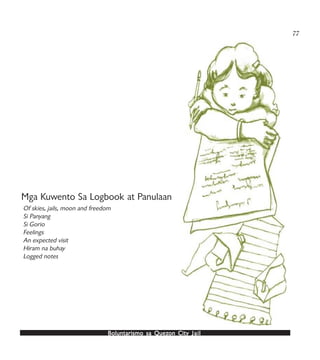
  • 111.
    Boluntarismo sa QuezBoluntarismosa QuezBoluntarismo sa QuezBoluntarismo sa QuezBoluntarismo sa Quezon Cityon Cityon Cityon Cityon City JailJailJailJailJail 89maghintay… at maghintay… at maghintay. Alam ko kung paano mabigo, kung paano umasa sa mga taong inaakala mong tutulong at kung paano mabigo, muli. Alam ko kung paano matakot sa mga bagay na “unknown”. Ang hirap noh? ‘Yun bang tipong kahit na wala ka namang kasalanan pero people perceive you pa rin as the “latak ng lipunan”. At paglabas mo, mas mahirap pa. Pero ‘wag kang mag-alala, may purpose naman ang lahat ng bagay, di ba? Siguro kung hindi ka nakulong, malamang hindi mo nahanap si Sheila at malamang you wouldn’t have made that much impact sa society. Kaya, pasalamat pa rin tayo. Lahat ng bagay ay may kadahilanan. Tatanda rin ang mga taong namumuhi sa ‘yo at eventu- ally, sa katandaan nila, hindi na nila maaalala kung ano ang nangyari. Naalala ko tuloy ‘yong kuwento ng babae sa “Scarlet Letter”. She was caught having an adulterous affair so she was con- victed by the society of such crime. Lahat ng damit niya tinatakan ng letter “A” for adultery. Tapos, lahat ng tao galit sa kanya, namumuhi sa kanya. Pero she still continued doing good and what is right. Then, dumating ang panahon na tumanda na lahat ang mga taong namumuhi sa kanya at nakalimutan na nila ang ibig sabihin ng “A” sa mga damit niya. Nung tinanong nila sa kanya kung ano ‘yon, sabi niya… “A” meant ANGEL or something to that effect. Okay lang ‘yon, Raymund. Ika nga… THIS TOO WILL PASS AWAY. THET Jan 16, 2001 Para sa mga bagong batch ng QCJ volunteers, Salamat sa pagpili n’yo sa QC Jail bilang lugar na kayo ay boluntir. Ito ay lugar na taliwas sa inyong kinagisnan sa UP. Dito ay medyo siksikan at mabaho aaminin ko, at marami ay di naghangad na mapunta rito. Kaya’t laking galak ko, sampu ng aking mga kasamang inmates, na kayo ay magiging kaibigan namin. Sana marami kayong matutunan sa inyong “exposure” sa isang kulungan. Malalaman n’yong mayroon kaming munting komunidad dito. Pilit kaming nabubuhay at nakikibaka kahit pa kami
  • 112.
    PPPPPahinungód Behind BahinungódBehind Bahinungód Behind Bahinungód Behind Bahinungód Behind Barsarsarsarsars 90 ay binansagang mga “Patay na Buhay.” Pilit itinatayo ang aming dignidad na nawasak dahil sa kahihiyan ng pagkakulong. Tulad ng isang komunidad, may maganda at pangit sa aming sistema. Di ko na palalawigan ang mga sistemang iyan, nasa inyo na upang pag-usapan at pag-aralan. Ang suhestiyon ko lang ay maging mapagmasid. Di bale, ang sekuridad ninyo ay parating nasa aming “top priority” at kailanman ay magiging matahimik ang inyong pagpunta rito. Goodluck! Ang bawat pagpunta n’yo rito ay indikasyon na may nagmamahal sa amin. Nawa’y maging instrumento kayo upang mabigyan liwanag ang mga kaluluwang matagal nang nabubuhay sa kadiliman. KUYA RAYMUND March 11,2001 Sa aking mga kakosa, Basahin n’yo naman ang kuwento ko... First time pupunta sa QC Jail, kasama ko si Sheila. Sa bus pa lang, ninenerbiyos na ako. Until finally, dumating na kami. Nagulat ako sa nakita ko! Hindi parang kulangan ang QC Jail, para lang itong “isang low class na barangay!” Nagulat ako sa manner ng pagfri-frisk ng mga guwardya pagpasok namin sa gate. Lahat na yat ng kalamnan ko napindot nila. Nang pumasok kami, grabe... ang dami ng tao. May sumalubong sa amin. Si Chris daw sita at taga--APB. Pinaakyat niya kami sa kubol niya. Nagulat ako sa nakita ko. Mayroon siyang isang buong entertainment system. Halos anim na oras kami doon. Ewan ko... pero pag-alis ko ng kulungan, nakaramdam ako ng matinding pagkalungkot. BENTLEY
  • 113.
    Boluntarismo sa QuezBoluntarismosa QuezBoluntarismo sa QuezBoluntarismo sa QuezBoluntarismo sa Quezon Cityon Cityon Cityon Cityon City JailJailJailJailJail 91March 17,2001 Mga kakosa! Si Bentley ulit ito at may kwento ulit ako. Bumalik ako kanina sa QC Jail. Ang ganda pala ng experience kapag ikaw mismo ang nag-i-interview sa mga inmates na tinutulungan mo. Iba ang feeling kapag nakakausap mo sila, gustung-gusto mo lalu silang tulungan. By this time, wala na sa akin ang pagse-search nila. Wala namang mawawala sa akin eh. Hindi na rin ako nakiliti. Nakilala ko nga rin pala ang iba pang mga taga--Alpha Phi Beta na nakakulong dahil sa Mark Icasiano case. Nakita ko rin si Dan na dati kong kasama sa UP Debate Society. Sayang! March 19, 2001 Mga Batang QC Jail! Huling hirit na ito! Kailangan ko lang talagang ma--i-share sa inyo itong kuwentong ito. Perhaps, this is my most unforgettable experience! Nakuha ko ang release order ni Allejandro Villalon, kilala n’yo ba siya? Anyway, I was so proud and excited to go back to the jail. Kaya pagdating ko sa jail, kinausap ko kaagad si Kuya Raymund. Pinatawag niya agad si Alejandro, kaya lang, walang nag-respond. Pero okay pa rin. Basta ang alam ko, I was able to help a man regain his freedom today! I really can’t wait to tell this to my mom! BENTLEY (pa rin!) April 23, 2001 Dear Kuya Raymund, Magandang hot summer sa ‘yo at sa lahat sa loob. I-try naming mag-visit nang mas madalas pero hindi talaga ako maka-promise. Everyday kasi ang klase ko tapos parang confused pa ‘yong isang class ko kung survey course siya o critical approaches. Pero I know na babalik-balik pa rin ako dito
  • 114.
    PPPPPahinungód Behind BahinungódBehind Bahinungód Behind Bahinungód Behind Bahinungód Behind Barsarsarsarsars kasi ang natutunan ko dito sa loob ay never na mapapantayan ng kahit na anong achievement ko sa labas. One way or another, alam ko namang nakakatulong din ang pagdalaw-dalaw ko sa loob. Iba kasi ang karanasang naiipon ko sa pagpunta rito. HORACE WEEEEE!!! Another laya!!!--- VENUS Hango sa logbook ng mga boluntirHango sa logbook ng mga boluntirHango sa logbook ng mga boluntirHango sa logbook ng mga boluntirHango sa logbook ng mga boluntir 92