Pediatric Sepsis
and Septic Shock
Presenter: Dr Chebet Kimeto
Pediatric Intensivist
Outline
• Introduction
• Epidemiology of sepsis/septic shock
• Normal cardiovascular physiology
• Pathophysiology of septic shock
• Guidelines for the management of
septic shock
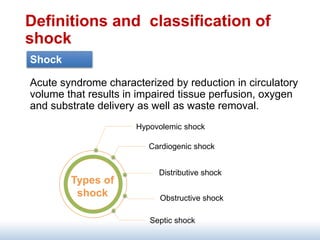
Definitions and classification of
shock
Acute syndrome characterized by reduction in circulatory
volume that results in impaired tissue perfusion, oxygen
and substrate delivery as well as waste removal.
Shock
Hypovolemic shock
Cardiogenic shock
Distributive shock
Obstructive shock
Septic shock
Types of
shock
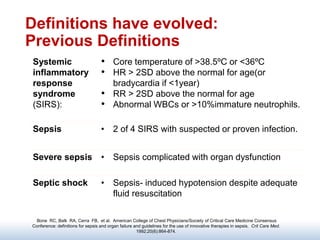
Definitions have evolved:
Previous Definitions
Bone RC, Balk RA, Cerra FB, et al. American College of Chest Physicians/Society of Critical Care Medicine Consensus
Conference: definitions for sepsis and organ failure and guidelines for the use of innovative therapies in sepsis. Crit Care Med.
1992;20(6):864-874.
Systemic
inflammatory
response
syndrome
(SIRS):
• Core temperature of >38.5ºC or <36ºC
• HR > 2SD above the normal for age(or
bradycardia if <1year)
• RR > 2SD above the normal for age
• Abnormal WBCs or >10%immature neutrophils.
Sepsis • 2 of 4 SIRS with suspected or proven infection.
Severe sepsis • Sepsis complicated with organ dysfunction
Septic shock • Sepsis- induced hypotension despite adequate
fluid resuscitation
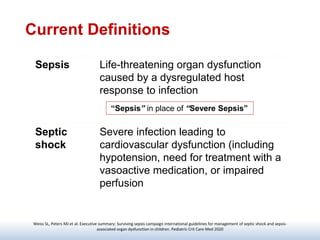
Current Definitions
Weiss SL, Peters MJ et al. Executive summary: Surviving sepsis campaign international guidelines for management of septic shock and sepsis-
associated organ dysfunction in children. Pediatric Crit Care Med 2020
Sepsis Life-threatening organ dysfunction
caused by a dysregulated host
response to infection
Septic
shock
Severe infection leading to
cardiovascular dysfunction (including
hypotension, need for treatment with a
vasoactive medication, or impaired
perfusion
“Sepsis” in place of “Severe Sepsis”
Epidemiology
• 7.5 million paediatric deaths per year globally
• 49% have predisposing co-morbid condition: chronic lung
disease, cancer, malnutrition
• Greater than 50% of sepsis fatalities occur within 24 hours
and half of these patients die before transfer to Pediatric Intensive
Care Unit (PICU) care
• No single biomarker that has proven specific or sensitive enough
to diagnose sepsis or prognosticate outcome
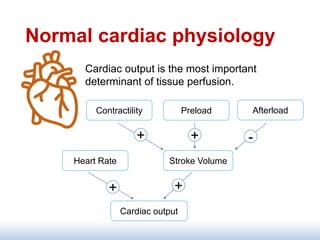
Normal cardiac physiology
Cardiac output is the most important
determinant of tissue perfusion.
Cardiac output
Preload
Contractility
Heart Rate Stroke Volume
Afterload
+ -
+
+
+
Risk factors for sepsis/septic
shock
• Age (prematurity, newborns,
<1year old)
• Primary and acquired
immunodeficiencies
• Neutropenia
• Underlying co-morbid conditions
• Indwelling invasive catheters
• Boys
Kawasaki T. Update on pediatric sepsis: a review. J Intensive Care. 2017;5:47. Published 2017 Jul 20. doi:10.1186/s40560-017-0240-1
Pathophysiology
• Complex interaction between the pathogen and the host’s immune
system.
• Physiologic response to infection:
 activation of the host defence mechanisms
 influx of activated neutrophils and monocytes
 a release of inflammatory mediators
 local vasodilation
 increased endothelial permeability
 activation of coagulation pathways.
Pathophysiology
Clinical Findings
• Hyperthermia/hypothermia
• Tachycardia
• Tachypnea
• Abnormal pulse (diminished, weak, or bounding)
• Abnormal capillary refill (central refill ≥3 seconds or flash
refill [<1 second])
• Altered mental status
• Purpura anywhere on the body or petechiae below the
nipple line
• Hypotension- may be present
Management of
septic shock
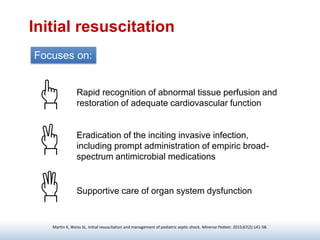
Initial resuscitation
Martin K, Weiss SL. Initial resuscitation and management of pediatric septic shock. Minerva Pediatr. 2015;67(2):141-58.
Focuses on:
Rapid recognition of abnormal tissue perfusion and
restoration of adequate cardiovascular function
Eradication of the inciting invasive infection,
including prompt administration of empiric broad-
spectrum antimicrobial medications
Supportive care of organ system dysfunction
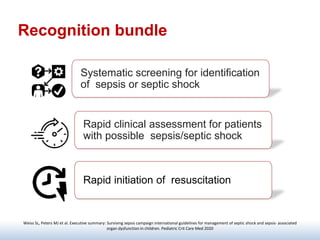
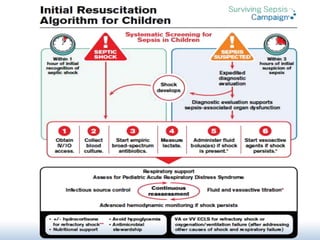
Recognition bundle
Weiss SL, Peters MJ et al. Executive summary: Surviving sepsis campaign international guidelines for management of septic shock and sepsis- associated
organ dysfunction in children. Pediatric Crit Care Med 2020
Systematic screening for identification
of sepsis or septic shock
Rapid clinical assessment for patients
with possible sepsis/septic shock
Rapid initiation of resuscitation
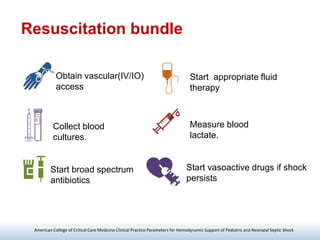
Resuscitation bundle
American College of Critical Care Medicine Clinical Practice Parameters for Hemodynamic Support of Pediatric and Neonatal Septic Shock
Obtain vascular(IV/IO)
access
Collect blood
cultures.
Start broad spectrum
antibiotics
Measure blood
lactate.
Start appropriate fluid
therapy
Start vasoactive drugs if shock
persists
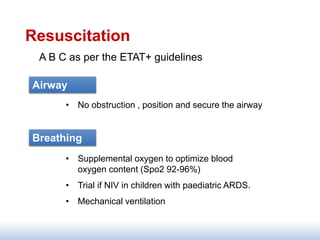
Resuscitation
A B C as per the ETAT+ guidelines
• No obstruction , position and secure the airway
Airway
Breathing
• Supplemental oxygen to optimize blood
oxygen content (Spo2 92-96%)
• Trial if NIV in children with paediatric ARDS.
• Mechanical ventilation
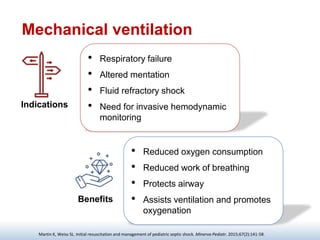
Mechanical ventilation
Indications
Benefits
Martin K, Weiss SL. Initial resuscitation and management of pediatric septic shock. Minerva Pediatr. 2015;67(2):141-58.
• Respiratory failure
• Altered mentation
• Fluid refractory shock
• Need for invasive hemodynamic
monitoring
• Reduced oxygen consumption
• Reduced work of breathing
• Protects airway
• Assists ventilation and promotes
oxygenation
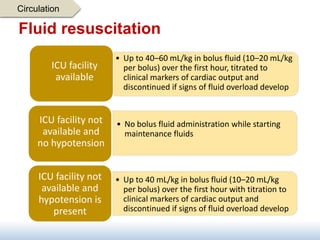
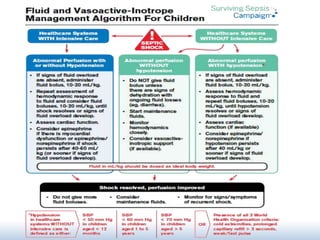
Fluid resuscitation
• Up to 40–60 mL/kg in bolus fluid (10–20 mL/kg
per bolus) over the first hour, titrated to
clinical markers of cardiac output and
discontinued if signs of fluid overload develop
ICU facility
available
• No bolus fluid administration while starting
maintenance fluids
ICU facility not
available and
no hypotension
• Up to 40 mL/kg in bolus fluid (10–20 mL/kg
per bolus) over the first hour with titration to
clinical markers of cardiac output and
discontinued if signs of fluid overload develop
ICU facility not
available and
hypotension is
present
Circulation
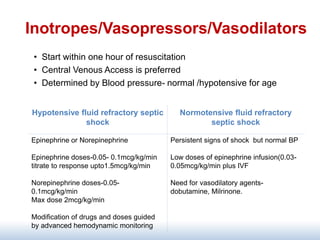
Inotropes/Vasopressors/Vasodilators
• Start within one hour of resuscitation
• Central Venous Access is preferred
• Determined by Blood pressure- normal /hypotensive for age
Hypotensive fluid refractory septic
shock
Normotensive fluid refractory
septic shock
Epinephrine or Norepinephrine
Epinephrine doses-0.05- 0.1mcg/kg/min
titrate to response upto1.5mcg/kg/min
Norepinephrine doses-0.05-
0.1mcg/kg/min
Max dose 2mcg/kg/min
Modification of drugs and doses guided
by advanced hemodynamic monitoring
Persistent signs of shock but normal BP
Low doses of epinephrine infusion(0.03-
0.05mcg/kg/min plus IVF
Need for vasodilatory agents-
dobutamine, Milrinone.
Catecholamine - Resistant Septic
shock
• Evaluate for unrecognized morbidities-
pneumothorax, pericardial effusions, on-
going blood losses
• Start hydrocortisone 2-4mg/kg /day. max
dose 200mg/day.
• Critical illness related corticosteroid
insufficiency.
Hemodynamic monitoring
Target MAP:
Between 5th and 50th
centile or > 50th centile
for age
Bedside clinical signs:
Not use in isolation to categorize
septic shock in children as
“warm” or “cold”
Advanced hemodynamic
variables:
Use when available, in addition
to bedside clinical variables to
guide the resuscitation of
children
Antibiotic Therapy
• Empirical antibiotic therapy within 1hour of recognition
of septic shock
• In sepsis associated organ dysfunction but without
shock, start antimicrobial therapy as soon as possible
after appropriate evaluation within 3 hrs of recognition
• Samples for cultures should be taken prior to antibiotic
administration where possible.
• If no pathogen is identified on blood culture, de-escalate
based on daily assessment-clinical and laboratory,
narrow or stop empiric antimicrobial according to clinical
presentation, site of infection, host risk factors and
adequacy of clinical improvement.
Narrow or stop empiric antimicrobial therapy according to clinical
presentation, site of infection, host risk factors, and adequacy of
clinical improvement
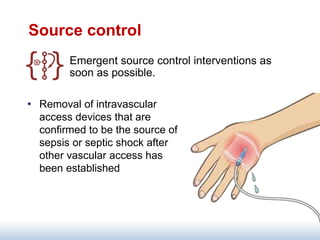
Source control
Emergent source control interventions as
soon as possible.
• Removal of intravascular
access devices that are
confirmed to be the source of
sepsis or septic shock after
other vascular access has
been established
Blood products
• During resuscitation, hemoglobin
levels of 10 g/ dL are targeted.
• After stabilization and recovery
from shock and hypoxemia, then
a lower target > 7.0 g/dL can be
considered reasonable
• No routine prophylactic use of
platelets and FFP based on
platelet counts in non-bleeding
children
Weiss SL, Peters MJ et al. Executive summary: Surviving sepsis campaign international guidelines for management of septic shock and sepsis- associated
organ dysfunction in children. Pediatric Crit Care Med 2020
Endocrine and metabolic
• No insulin therapy to maintain a
blood glucose target at or below
140 mg/dL (7.8 mmol/L)
• Consensus to target blood
glucose levels below 180 mg/dL
(10 mmol/L)
• No consensus about the lower
limit of the target range
• Calcium replacement when blood
levels are below normal range
Nutrition
● Preference to commence early EN within 48 hours of
admission
● EN as the preferred method and PN may be withheld in the
first 7 days of PICU admission
● Do not withhold EN solely on the basis of vasoactive-inotropic
administration
● Gastric tube preferred rather than post-pyloric feeding tube
No Routine use of prokinetic agents for the treatment of feeding
intolerance
Prophylaxis
• No consensus on routine
use of stress ulcer
prophylaxis
• No routine use of IV
immunoglobulins
• No routine use of DVT
prophylaxis in children
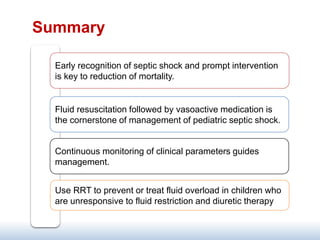
Summary
Fluid resuscitation followed by vasoactive medication is
the cornerstone of management of pediatric septic shock.
Early recognition of septic shock and prompt intervention
is key to reduction of mortality.
Continuous monitoring of clinical parameters guides
management.
Use RRT to prevent or treat fluid overload in children who
are unresponsive to fluid restriction and diuretic therapy
References
1. Venkat Raman, Narayanaswamy & Shiraz, Mohamed & Boban, DD.
(2014). Sepsis in Obstetrics.. Foundation Years Journal. Volume 8, Issue
9: Obstetrics and Gynaecology - Part 2. 72-79.
2. Randolph AG, McCulloh RJ. Pediatric sepsis: important considerations
for diagnosing and managing severe infections in infants, children, and
adolescents. Virulence. 2013;5(1):179-89.
3. Mbevi G, Ayieko P, Irimu G, Akech S, English M, Clinical Information
Network authors. Prevalence, aetiology, treatment and outcomes of
shock in children admitted to Kenyan hospitals. BMC Med.
2016;14(1):184. Published 2016 Nov 16. doi:10.1186/s12916-016-0728-
x
4. Surviving Sepsis Campaign: International Guidelines for Management of
Severe Sepsis and Septic Shock, 2020
http://www.survivingsepsis.org/Guidelines/Pages/default.aspx
Questions
Comments
Thank you

Septic shock in pediatric population 2021

  • 1.
    Pediatric Sepsis and SepticShock Presenter: Dr Chebet Kimeto Pediatric Intensivist
  • 2.
    Outline • Introduction • Epidemiologyof sepsis/septic shock • Normal cardiovascular physiology • Pathophysiology of septic shock • Guidelines for the management of septic shock
  • 3.
    Definitions and classificationof shock Acute syndrome characterized by reduction in circulatory volume that results in impaired tissue perfusion, oxygen and substrate delivery as well as waste removal. Shock Hypovolemic shock Cardiogenic shock Distributive shock Obstructive shock Septic shock Types of shock
  • 4.
    Definitions have evolved: PreviousDefinitions Bone RC, Balk RA, Cerra FB, et al. American College of Chest Physicians/Society of Critical Care Medicine Consensus Conference: definitions for sepsis and organ failure and guidelines for the use of innovative therapies in sepsis. Crit Care Med. 1992;20(6):864-874. Systemic inflammatory response syndrome (SIRS): • Core temperature of >38.5ºC or <36ºC • HR > 2SD above the normal for age(or bradycardia if <1year) • RR > 2SD above the normal for age • Abnormal WBCs or >10%immature neutrophils. Sepsis • 2 of 4 SIRS with suspected or proven infection. Severe sepsis • Sepsis complicated with organ dysfunction Septic shock • Sepsis- induced hypotension despite adequate fluid resuscitation
  • 5.
    Current Definitions Weiss SL,Peters MJ et al. Executive summary: Surviving sepsis campaign international guidelines for management of septic shock and sepsis- associated organ dysfunction in children. Pediatric Crit Care Med 2020 Sepsis Life-threatening organ dysfunction caused by a dysregulated host response to infection Septic shock Severe infection leading to cardiovascular dysfunction (including hypotension, need for treatment with a vasoactive medication, or impaired perfusion “Sepsis” in place of “Severe Sepsis”
  • 6.
    Epidemiology • 7.5 millionpaediatric deaths per year globally • 49% have predisposing co-morbid condition: chronic lung disease, cancer, malnutrition • Greater than 50% of sepsis fatalities occur within 24 hours and half of these patients die before transfer to Pediatric Intensive Care Unit (PICU) care • No single biomarker that has proven specific or sensitive enough to diagnose sepsis or prognosticate outcome
  • 7.
    Normal cardiac physiology Cardiacoutput is the most important determinant of tissue perfusion. Cardiac output Preload Contractility Heart Rate Stroke Volume Afterload + - + + +
  • 8.
    Risk factors forsepsis/septic shock • Age (prematurity, newborns, <1year old) • Primary and acquired immunodeficiencies • Neutropenia • Underlying co-morbid conditions • Indwelling invasive catheters • Boys Kawasaki T. Update on pediatric sepsis: a review. J Intensive Care. 2017;5:47. Published 2017 Jul 20. doi:10.1186/s40560-017-0240-1
  • 9.
    Pathophysiology • Complex interactionbetween the pathogen and the host’s immune system. • Physiologic response to infection:  activation of the host defence mechanisms  influx of activated neutrophils and monocytes  a release of inflammatory mediators  local vasodilation  increased endothelial permeability  activation of coagulation pathways.
  • 10.
  • 11.
    Clinical Findings • Hyperthermia/hypothermia •Tachycardia • Tachypnea • Abnormal pulse (diminished, weak, or bounding) • Abnormal capillary refill (central refill ≥3 seconds or flash refill [<1 second]) • Altered mental status • Purpura anywhere on the body or petechiae below the nipple line • Hypotension- may be present
  • 12.
  • 13.
    Initial resuscitation Martin K,Weiss SL. Initial resuscitation and management of pediatric septic shock. Minerva Pediatr. 2015;67(2):141-58. Focuses on: Rapid recognition of abnormal tissue perfusion and restoration of adequate cardiovascular function Eradication of the inciting invasive infection, including prompt administration of empiric broad- spectrum antimicrobial medications Supportive care of organ system dysfunction
  • 14.
    Recognition bundle Weiss SL,Peters MJ et al. Executive summary: Surviving sepsis campaign international guidelines for management of septic shock and sepsis- associated organ dysfunction in children. Pediatric Crit Care Med 2020 Systematic screening for identification of sepsis or septic shock Rapid clinical assessment for patients with possible sepsis/septic shock Rapid initiation of resuscitation
  • 15.
    Resuscitation bundle American Collegeof Critical Care Medicine Clinical Practice Parameters for Hemodynamic Support of Pediatric and Neonatal Septic Shock Obtain vascular(IV/IO) access Collect blood cultures. Start broad spectrum antibiotics Measure blood lactate. Start appropriate fluid therapy Start vasoactive drugs if shock persists
  • 16.
    Resuscitation A B Cas per the ETAT+ guidelines • No obstruction , position and secure the airway Airway Breathing • Supplemental oxygen to optimize blood oxygen content (Spo2 92-96%) • Trial if NIV in children with paediatric ARDS. • Mechanical ventilation
  • 17.
    Mechanical ventilation Indications Benefits Martin K,Weiss SL. Initial resuscitation and management of pediatric septic shock. Minerva Pediatr. 2015;67(2):141-58. • Respiratory failure • Altered mentation • Fluid refractory shock • Need for invasive hemodynamic monitoring • Reduced oxygen consumption • Reduced work of breathing • Protects airway • Assists ventilation and promotes oxygenation
  • 18.
    Fluid resuscitation • Upto 40–60 mL/kg in bolus fluid (10–20 mL/kg per bolus) over the first hour, titrated to clinical markers of cardiac output and discontinued if signs of fluid overload develop ICU facility available • No bolus fluid administration while starting maintenance fluids ICU facility not available and no hypotension • Up to 40 mL/kg in bolus fluid (10–20 mL/kg per bolus) over the first hour with titration to clinical markers of cardiac output and discontinued if signs of fluid overload develop ICU facility not available and hypotension is present Circulation
  • 19.
    Inotropes/Vasopressors/Vasodilators • Start withinone hour of resuscitation • Central Venous Access is preferred • Determined by Blood pressure- normal /hypotensive for age Hypotensive fluid refractory septic shock Normotensive fluid refractory septic shock Epinephrine or Norepinephrine Epinephrine doses-0.05- 0.1mcg/kg/min titrate to response upto1.5mcg/kg/min Norepinephrine doses-0.05- 0.1mcg/kg/min Max dose 2mcg/kg/min Modification of drugs and doses guided by advanced hemodynamic monitoring Persistent signs of shock but normal BP Low doses of epinephrine infusion(0.03- 0.05mcg/kg/min plus IVF Need for vasodilatory agents- dobutamine, Milrinone.
  • 20.
    Catecholamine - ResistantSeptic shock • Evaluate for unrecognized morbidities- pneumothorax, pericardial effusions, on- going blood losses • Start hydrocortisone 2-4mg/kg /day. max dose 200mg/day. • Critical illness related corticosteroid insufficiency.
  • 21.
    Hemodynamic monitoring Target MAP: Between5th and 50th centile or > 50th centile for age Bedside clinical signs: Not use in isolation to categorize septic shock in children as “warm” or “cold” Advanced hemodynamic variables: Use when available, in addition to bedside clinical variables to guide the resuscitation of children
  • 22.
    Antibiotic Therapy • Empiricalantibiotic therapy within 1hour of recognition of septic shock • In sepsis associated organ dysfunction but without shock, start antimicrobial therapy as soon as possible after appropriate evaluation within 3 hrs of recognition • Samples for cultures should be taken prior to antibiotic administration where possible. • If no pathogen is identified on blood culture, de-escalate based on daily assessment-clinical and laboratory, narrow or stop empiric antimicrobial according to clinical presentation, site of infection, host risk factors and adequacy of clinical improvement. Narrow or stop empiric antimicrobial therapy according to clinical presentation, site of infection, host risk factors, and adequacy of clinical improvement
  • 23.
    Source control Emergent sourcecontrol interventions as soon as possible. • Removal of intravascular access devices that are confirmed to be the source of sepsis or septic shock after other vascular access has been established
  • 24.
    Blood products • Duringresuscitation, hemoglobin levels of 10 g/ dL are targeted. • After stabilization and recovery from shock and hypoxemia, then a lower target > 7.0 g/dL can be considered reasonable • No routine prophylactic use of platelets and FFP based on platelet counts in non-bleeding children Weiss SL, Peters MJ et al. Executive summary: Surviving sepsis campaign international guidelines for management of septic shock and sepsis- associated organ dysfunction in children. Pediatric Crit Care Med 2020
  • 25.
    Endocrine and metabolic •No insulin therapy to maintain a blood glucose target at or below 140 mg/dL (7.8 mmol/L) • Consensus to target blood glucose levels below 180 mg/dL (10 mmol/L) • No consensus about the lower limit of the target range • Calcium replacement when blood levels are below normal range
  • 26.
    Nutrition ● Preference tocommence early EN within 48 hours of admission ● EN as the preferred method and PN may be withheld in the first 7 days of PICU admission ● Do not withhold EN solely on the basis of vasoactive-inotropic administration ● Gastric tube preferred rather than post-pyloric feeding tube No Routine use of prokinetic agents for the treatment of feeding intolerance
  • 27.
    Prophylaxis • No consensuson routine use of stress ulcer prophylaxis • No routine use of IV immunoglobulins • No routine use of DVT prophylaxis in children
  • 28.
    Summary Fluid resuscitation followedby vasoactive medication is the cornerstone of management of pediatric septic shock. Early recognition of septic shock and prompt intervention is key to reduction of mortality. Continuous monitoring of clinical parameters guides management. Use RRT to prevent or treat fluid overload in children who are unresponsive to fluid restriction and diuretic therapy
  • 31.
    References 1. Venkat Raman,Narayanaswamy & Shiraz, Mohamed & Boban, DD. (2014). Sepsis in Obstetrics.. Foundation Years Journal. Volume 8, Issue 9: Obstetrics and Gynaecology - Part 2. 72-79. 2. Randolph AG, McCulloh RJ. Pediatric sepsis: important considerations for diagnosing and managing severe infections in infants, children, and adolescents. Virulence. 2013;5(1):179-89. 3. Mbevi G, Ayieko P, Irimu G, Akech S, English M, Clinical Information Network authors. Prevalence, aetiology, treatment and outcomes of shock in children admitted to Kenyan hospitals. BMC Med. 2016;14(1):184. Published 2016 Nov 16. doi:10.1186/s12916-016-0728- x 4. Surviving Sepsis Campaign: International Guidelines for Management of Severe Sepsis and Septic Shock, 2020 http://www.survivingsepsis.org/Guidelines/Pages/default.aspx
  • 32.
  • 33.