Improving Child ProtectionImproving Child Protection
with Highly Resistantwith Highly Resistant
FamiliesFamilies
Dr. Siobhan LairdDr. Siobhan Laird
Centre for Social WorkCentre for Social Work
University of NottinghamUniversity of Nottingham
siobhan.laird@nottingham.ac.usiobhan.laird@nottingham.ac.ukk
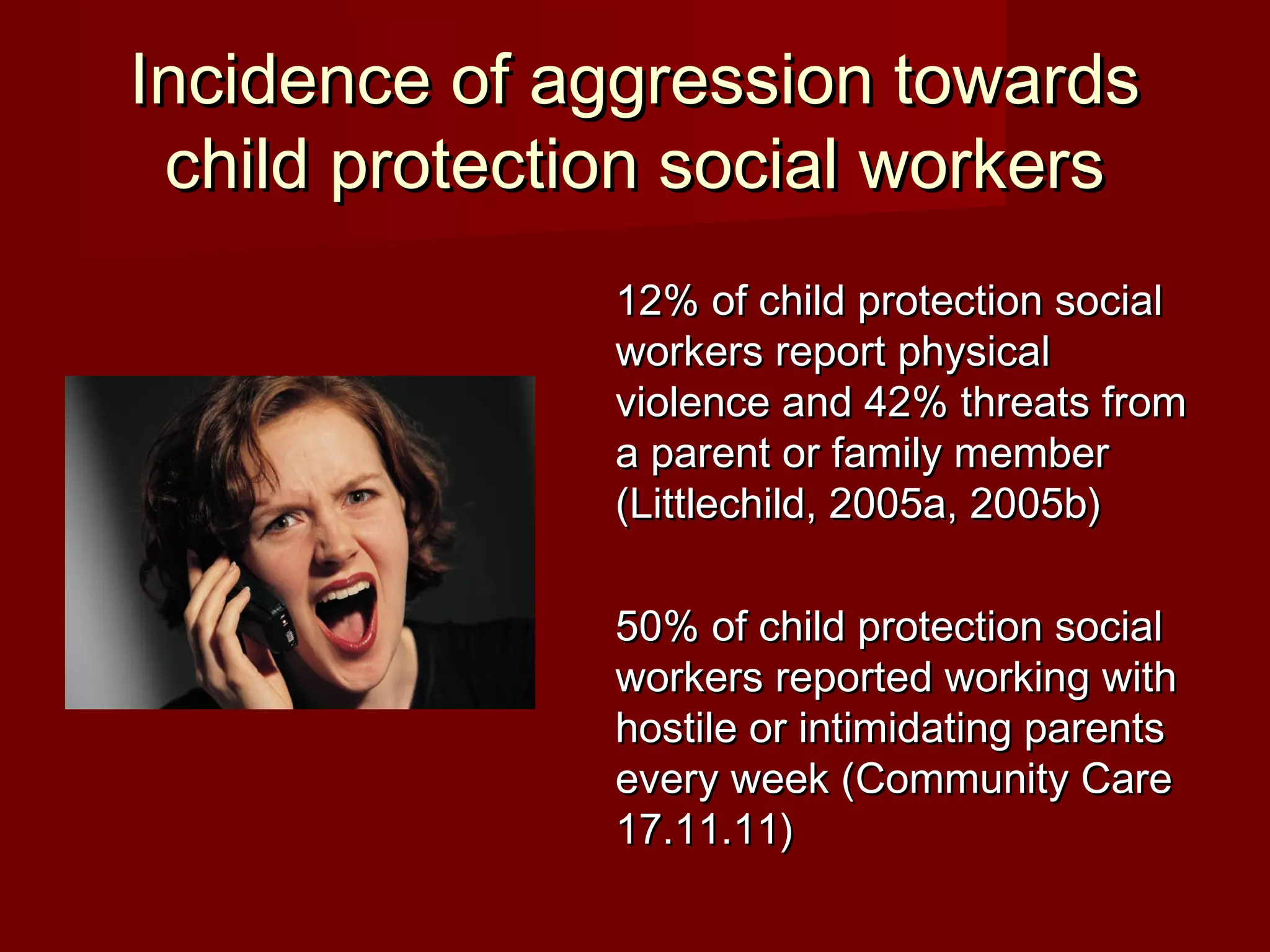
Incidence of aggression towardsIncidence of aggression towards
child protection social workerschild protection social workers
12% of child protection social12% of child protection social
workers report physicalworkers report physical
violence and 42% threats fromviolence and 42% threats from
a parent or family membera parent or family member
(Littlechild, 2005a, 2005b)(Littlechild, 2005a, 2005b)
50% of child protection social50% of child protection social
workers reported working withworkers reported working with
hostile or intimidating parentshostile or intimidating parents
every week (Community Careevery week (Community Care
17.11.11)17.11.11)
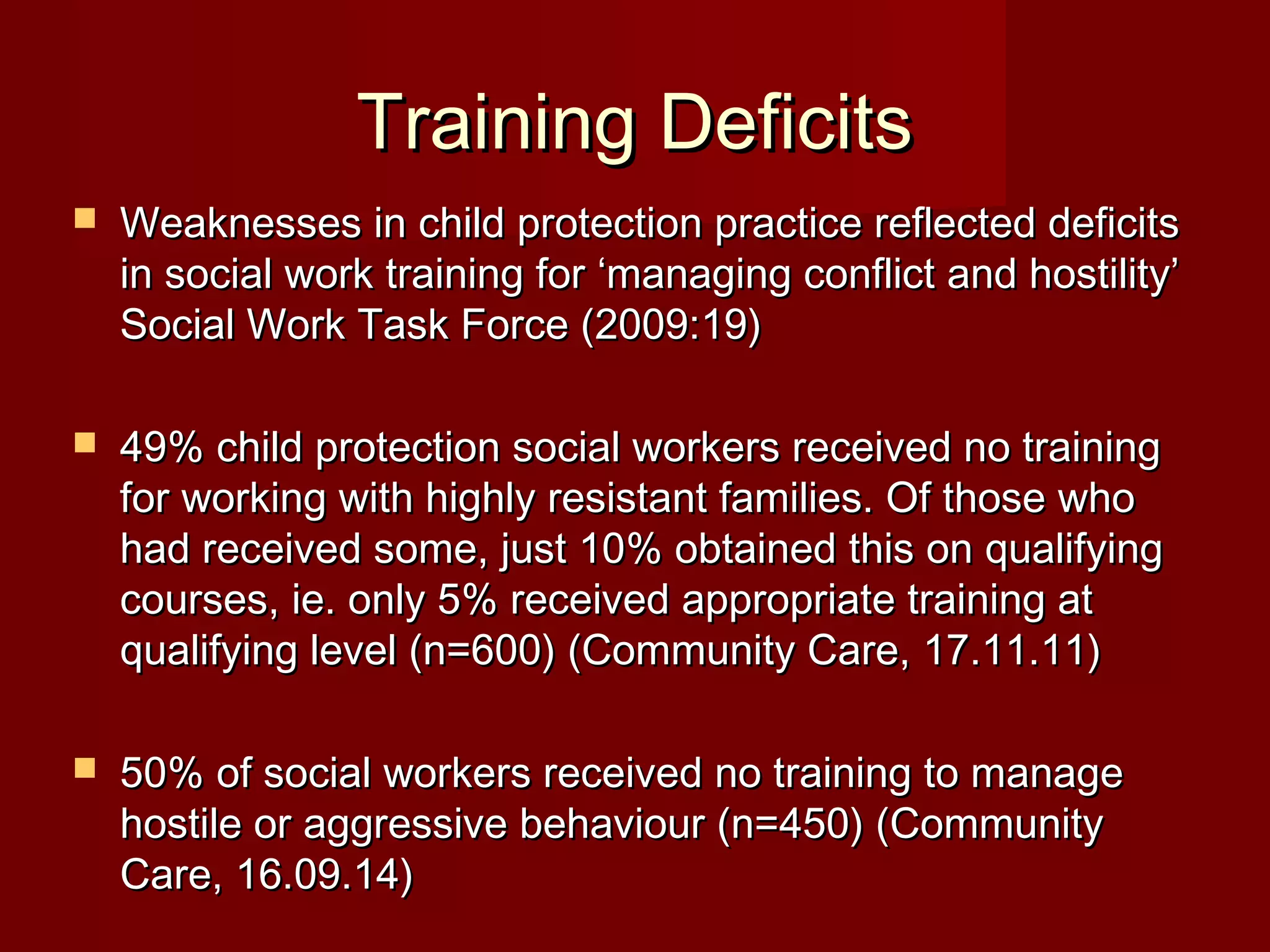
Training DeficitsTraining Deficits
 Weaknesses in child protection practice reflected deficitsWeaknesses in child protection practice reflected deficits
in social work training for ‘managing conflict and hostility’in social work training for ‘managing conflict and hostility’
Social Work Task Force (2009:19)Social Work Task Force (2009:19)
 49% child protection social workers received no training49% child protection social workers received no training
for working with highly resistant families. Of those whofor working with highly resistant families. Of those who
had received some, just 10% obtained this on qualifyinghad received some, just 10% obtained this on qualifying
courses, ie. only 5% received appropriate training atcourses, ie. only 5% received appropriate training at
qualifying level (n=600) (Community Care, 17.11.11)qualifying level (n=600) (Community Care, 17.11.11)
 50% of social workers received no training to manage50% of social workers received no training to manage
hostile or aggressive behaviour (n=450) (Communityhostile or aggressive behaviour (n=450) (Community
Care, 16.09.14)Care, 16.09.14)
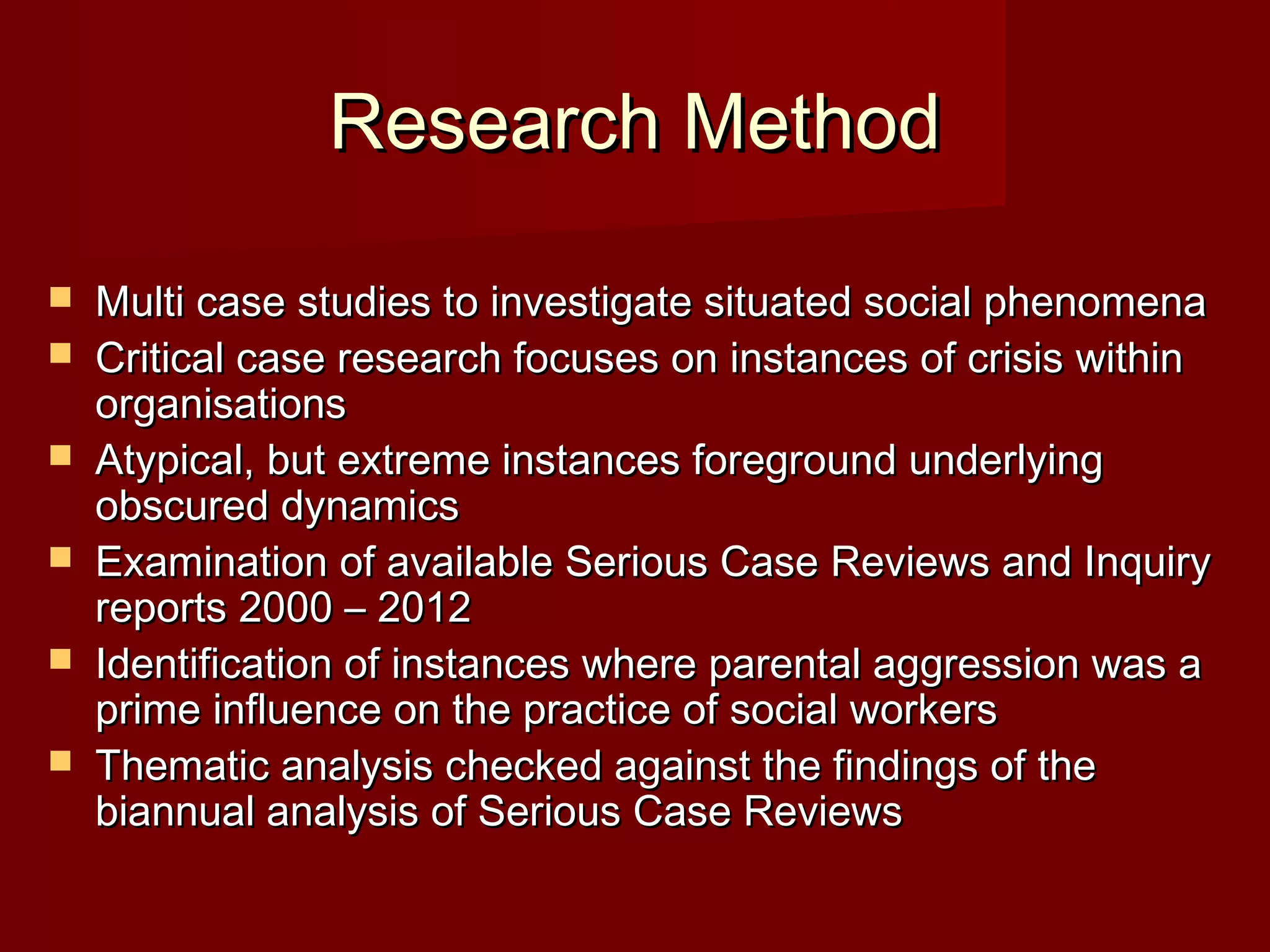
Research MethodResearch Method
 Multi case studies to investigate situated social phenomenaMulti case studies to investigate situated social phenomena
 Critical case research focuses on instances of crisis withinCritical case research focuses on instances of crisis within
organisationsorganisations
 Atypical, but extreme instances foreground underlyingAtypical, but extreme instances foreground underlying
obscured dynamicsobscured dynamics
 Examination of available Serious Case Reviews and InquiryExamination of available Serious Case Reviews and Inquiry
reports 2000 – 2012reports 2000 – 2012
 Identification of instances where parental aggression was aIdentification of instances where parental aggression was a
prime influence on the practice of social workersprime influence on the practice of social workers
 Thematic analysis checked against the findings of theThematic analysis checked against the findings of the
biannual analysis of Serious Case Reviewsbiannual analysis of Serious Case Reviews
Haringey Local SafeguardingHaringey Local Safeguarding
Children Board (2010)Children Board (2010)
 Mother intimidated professionals – volatileMother intimidated professionals – volatile
temper, angry outbursts when challengedtemper, angry outbursts when challenged
 Criticism of solution-focussed model whichCriticism of solution-focussed model which
emphasised parental strengths at expense of anemphasised parental strengths at expense of an
authoritative approachauthoritative approach
 One-dimensional characterisation of service-One-dimensional characterisation of service-
users as disadvantaged and disempoweredusers as disadvantaged and disempowered
means that manipulative, deceitful andmeans that manipulative, deceitful and
aggressive behaviour can often be downplayedaggressive behaviour can often be downplayed
Implications for TrainingImplications for Training
 Conversation management approachesConversation management approaches
 Development ofDevelopment of aggressive scriptaggressive scriptss
 Skills Deficiency ModelSkills Deficiency Model
Barking and Dagenham SafeguardingBarking and Dagenham Safeguarding
Children Board (2010)Children Board (2010)
 Mother verbally abusive to professionalsMother verbally abusive to professionals
and made repeated complaintsand made repeated complaints
 Mother made allegations of racism againstMother made allegations of racism against
social workers which were not challengedsocial workers which were not challenged
 Criticism that mother was perceivedCriticism that mother was perceived
primarily as a disadvantaged single parentprimarily as a disadvantaged single parent
and a victim of domestic violence resultingand a victim of domestic violence resulting
in an over-empathetic approachin an over-empathetic approach
Implications for TrainingImplications for Training
 Personality disorders,Personality disorders,
mental health conditionsmental health conditions
and aggressiveand aggressive
behaviourbehaviour
 Transaction analysisTransaction analysis
 Anti-oppressive practiceAnti-oppressive practice
 Use of complaints asUse of complaints as
intimationintimation
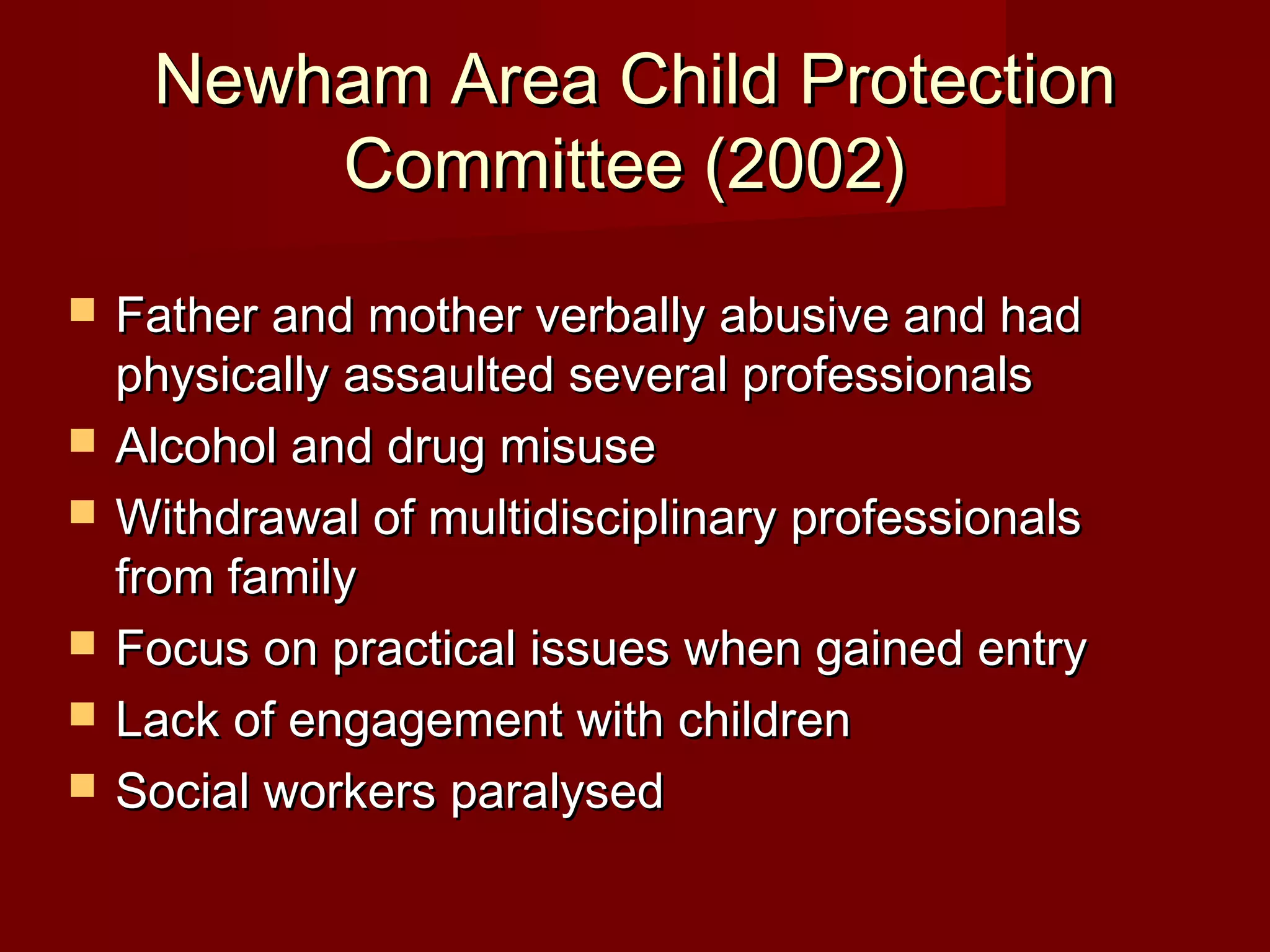
Newham Area Child ProtectionNewham Area Child Protection
Committee (2002)Committee (2002)
 Father and mother verbally abusive and hadFather and mother verbally abusive and had
physically assaulted several professionalsphysically assaulted several professionals
 Alcohol and drug misuseAlcohol and drug misuse
 Withdrawal of multidisciplinary professionalsWithdrawal of multidisciplinary professionals
from familyfrom family
 Focus on practical issues when gained entryFocus on practical issues when gained entry
 Lack of engagement with childrenLack of engagement with children
 Social workers paralysedSocial workers paralysed
Implications for TrainingImplications for Training
 Impact of drug and alcoholImpact of drug and alcohol
misusemisuse
 Hostage theoryHostage theory
 Anxiety managementAnxiety management
 Aggressive Incident ModelAggressive Incident Model
 The Assault CycleThe Assault Cycle
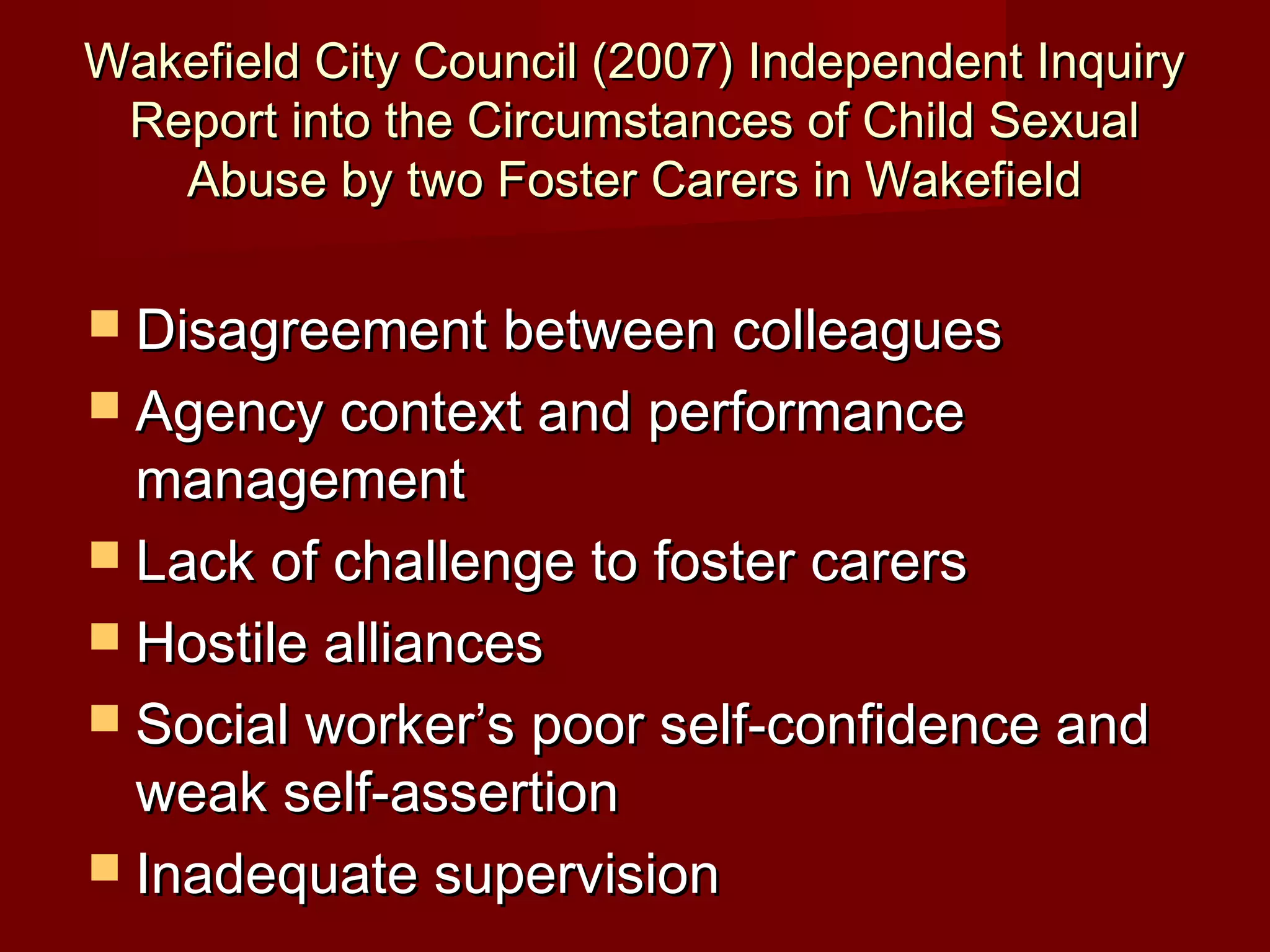
Wakefield City Council (2007) Independent InquiryWakefield City Council (2007) Independent Inquiry
Report into the Circumstances of Child SexualReport into the Circumstances of Child Sexual
Abuse by two Foster Carers in WakefieldAbuse by two Foster Carers in Wakefield
 Disagreement between colleaguesDisagreement between colleagues
 Agency context and performanceAgency context and performance
managementmanagement
 Lack of challenge to foster carersLack of challenge to foster carers
 Hostile alliancesHostile alliances
 Social worker’s poor self-confidence andSocial worker’s poor self-confidence and
weak self-assertionweak self-assertion
 Inadequate supervisionInadequate supervision
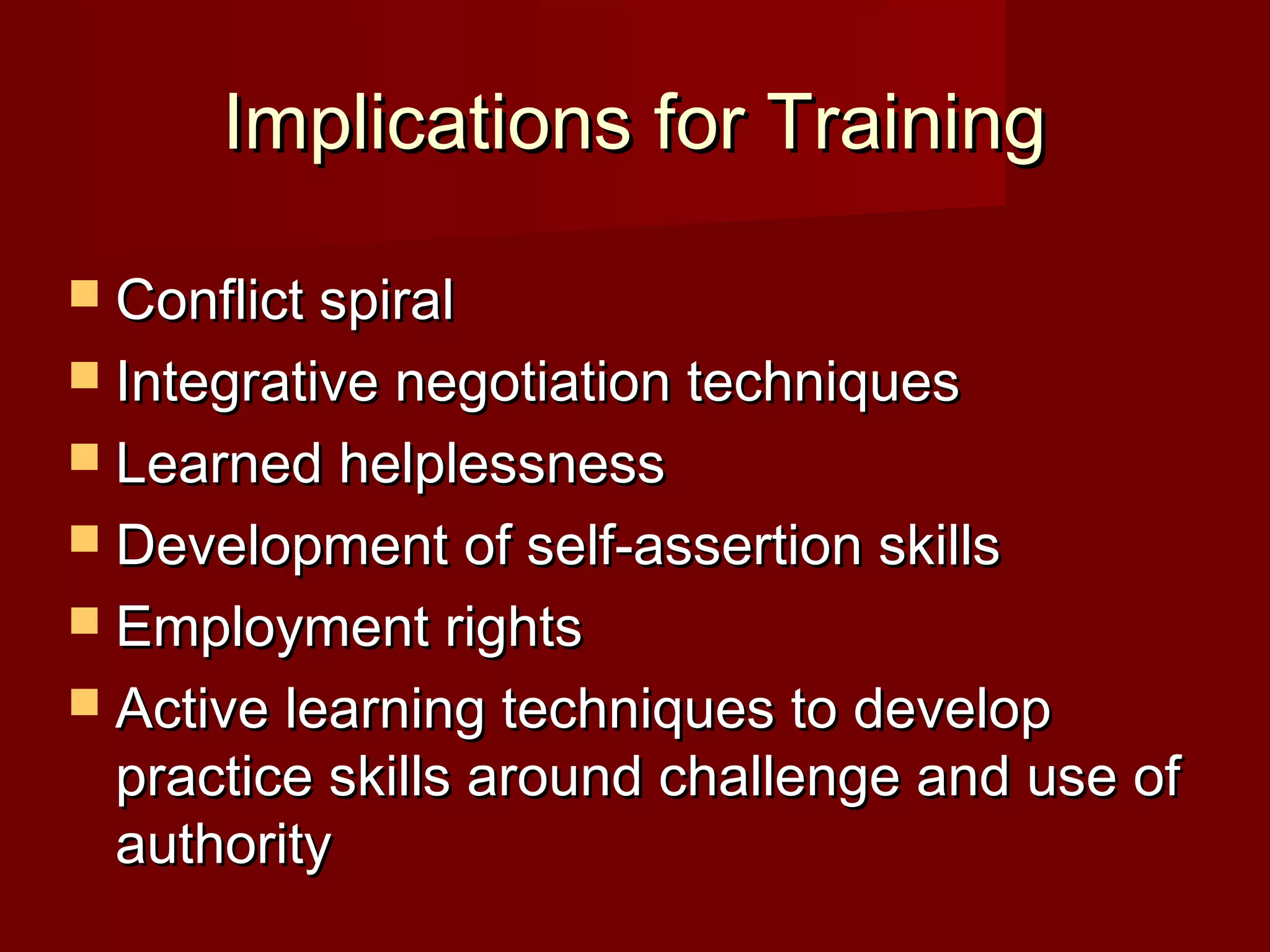
Implications for TrainingImplications for Training
 Conflict spiralConflict spiral
 Integrative negotiation techniquesIntegrative negotiation techniques
 Learned helplessnessLearned helplessness
 Development of self-assertion skillsDevelopment of self-assertion skills
 Employment rightsEmployment rights
 Active learning techniques to developActive learning techniques to develop
practice skills around challenge and use ofpractice skills around challenge and use of
authorityauthority
Cases ExaminedCases Examined
 Barking and Dagenham Safeguarding Children BoardBarking and Dagenham Safeguarding Children Board
(2010)(2010) Serious Case Review: Services Provided for ChildSerious Case Review: Services Provided for Child
T and Child R August 1997- February 2010,T and Child R August 1997- February 2010, London,London,
Barking and Dagenham Safeguarding Children Board.Barking and Dagenham Safeguarding Children Board.
 Haringey Local Safeguarding Children Board (2010)Haringey Local Safeguarding Children Board (2010)
Serious Case Review ‘Child A’,Serious Case Review ‘Child A’, London, Department forLondon, Department for
Education.Education.
 Newham Area Child Protection Committee (2002)Newham Area Child Protection Committee (2002) AinleeAinlee
Labonte: Chapter 8 ReviewLabonte: Chapter 8 Review,,
 London, Newham Area Child Protection Committee.London, Newham Area Child Protection Committee.
 Wakefield City Council (2007) Independent Inquiry ReportWakefield City Council (2007) Independent Inquiry Report
into the Circumstances of Child Sexual Abuse by twointo the Circumstances of Child Sexual Abuse by two
Foster Carers in Wakefield Wakefield, Wakefield CityFoster Carers in Wakefield Wakefield, Wakefield City
CouncilCouncil
ReferencesReferences
 Littlechild, B. (2005a) ‘The stresses arising from violence, threats andLittlechild, B. (2005a) ‘The stresses arising from violence, threats and
aggression against child protection social workers’,aggression against child protection social workers’, Journal of SocialJournal of Social
Work,Work, 5(1) 61-82.5(1) 61-82.
 Littlechild, B. (2005b) ‘The nature and effects of violence againstLittlechild, B. (2005b) ‘The nature and effects of violence against
child-protection social workers: providing effective support’,child-protection social workers: providing effective support’, BritishBritish
Journal of Social Work,Journal of Social Work, 35 387-401.35 387-401.
 Community Care (17.11.11) ‘Two out of three social workersCommunity Care (17.11.11) ‘Two out of three social workers
threatened by aggressive parents’,threatened by aggressive parents’, Community Care MagazineCommunity Care Magazine, 4-5., 4-5.
 Community Care (16.09.14) ‘Violence against social work staff’Community Care (16.09.14) ‘Violence against social work staff’
(http://www.communitycare.co.uk/2014/09/16/violence-social-workers-(http://www.communitycare.co.uk/2014/09/16/violence-social-workers-
just-part-job-70-incidents-investigated/)just-part-job-70-incidents-investigated/)
 Laird, S.E. (2013)Laird, S.E. (2013) Child Protection: Managing Conflict, Hostility and
Aggression Bristol: Policy Press.Bristol: Policy Press.
 Laird, S.E. (2014) Training social workers to effectively manageLaird, S.E. (2014) Training social workers to effectively manage
aggressive parental behaviour in child protection in Australia, theaggressive parental behaviour in child protection in Australia, the
United States and the United KingdomUnited States and the United Kingdom British Journal of Social Work,British Journal of Social Work,
44(7) 1967-83.44(7) 1967-83.

Improving Child Protection with Highly Resistant Families

  • 1.
    Improving Child ProtectionImprovingChild Protection with Highly Resistantwith Highly Resistant FamiliesFamilies Dr. Siobhan LairdDr. Siobhan Laird Centre for Social WorkCentre for Social Work University of NottinghamUniversity of Nottingham siobhan.laird@nottingham.ac.usiobhan.laird@nottingham.ac.ukk
  • 2.
    Incidence of aggressiontowardsIncidence of aggression towards child protection social workerschild protection social workers 12% of child protection social12% of child protection social workers report physicalworkers report physical violence and 42% threats fromviolence and 42% threats from a parent or family membera parent or family member (Littlechild, 2005a, 2005b)(Littlechild, 2005a, 2005b) 50% of child protection social50% of child protection social workers reported working withworkers reported working with hostile or intimidating parentshostile or intimidating parents every week (Community Careevery week (Community Care 17.11.11)17.11.11)
  • 3.
    Training DeficitsTraining Deficits Weaknesses in child protection practice reflected deficitsWeaknesses in child protection practice reflected deficits in social work training for ‘managing conflict and hostility’in social work training for ‘managing conflict and hostility’ Social Work Task Force (2009:19)Social Work Task Force (2009:19)  49% child protection social workers received no training49% child protection social workers received no training for working with highly resistant families. Of those whofor working with highly resistant families. Of those who had received some, just 10% obtained this on qualifyinghad received some, just 10% obtained this on qualifying courses, ie. only 5% received appropriate training atcourses, ie. only 5% received appropriate training at qualifying level (n=600) (Community Care, 17.11.11)qualifying level (n=600) (Community Care, 17.11.11)  50% of social workers received no training to manage50% of social workers received no training to manage hostile or aggressive behaviour (n=450) (Communityhostile or aggressive behaviour (n=450) (Community Care, 16.09.14)Care, 16.09.14)
  • 4.
    Research MethodResearch Method Multi case studies to investigate situated social phenomenaMulti case studies to investigate situated social phenomena  Critical case research focuses on instances of crisis withinCritical case research focuses on instances of crisis within organisationsorganisations  Atypical, but extreme instances foreground underlyingAtypical, but extreme instances foreground underlying obscured dynamicsobscured dynamics  Examination of available Serious Case Reviews and InquiryExamination of available Serious Case Reviews and Inquiry reports 2000 – 2012reports 2000 – 2012  Identification of instances where parental aggression was aIdentification of instances where parental aggression was a prime influence on the practice of social workersprime influence on the practice of social workers  Thematic analysis checked against the findings of theThematic analysis checked against the findings of the biannual analysis of Serious Case Reviewsbiannual analysis of Serious Case Reviews
  • 5.
    Haringey Local SafeguardingHaringeyLocal Safeguarding Children Board (2010)Children Board (2010)  Mother intimidated professionals – volatileMother intimidated professionals – volatile temper, angry outbursts when challengedtemper, angry outbursts when challenged  Criticism of solution-focussed model whichCriticism of solution-focussed model which emphasised parental strengths at expense of anemphasised parental strengths at expense of an authoritative approachauthoritative approach  One-dimensional characterisation of service-One-dimensional characterisation of service- users as disadvantaged and disempoweredusers as disadvantaged and disempowered means that manipulative, deceitful andmeans that manipulative, deceitful and aggressive behaviour can often be downplayedaggressive behaviour can often be downplayed
  • 6.
    Implications for TrainingImplicationsfor Training  Conversation management approachesConversation management approaches  Development ofDevelopment of aggressive scriptaggressive scriptss  Skills Deficiency ModelSkills Deficiency Model
  • 7.
    Barking and DagenhamSafeguardingBarking and Dagenham Safeguarding Children Board (2010)Children Board (2010)  Mother verbally abusive to professionalsMother verbally abusive to professionals and made repeated complaintsand made repeated complaints  Mother made allegations of racism againstMother made allegations of racism against social workers which were not challengedsocial workers which were not challenged  Criticism that mother was perceivedCriticism that mother was perceived primarily as a disadvantaged single parentprimarily as a disadvantaged single parent and a victim of domestic violence resultingand a victim of domestic violence resulting in an over-empathetic approachin an over-empathetic approach
  • 8.
    Implications for TrainingImplicationsfor Training  Personality disorders,Personality disorders, mental health conditionsmental health conditions and aggressiveand aggressive behaviourbehaviour  Transaction analysisTransaction analysis  Anti-oppressive practiceAnti-oppressive practice  Use of complaints asUse of complaints as intimationintimation
  • 9.
    Newham Area ChildProtectionNewham Area Child Protection Committee (2002)Committee (2002)  Father and mother verbally abusive and hadFather and mother verbally abusive and had physically assaulted several professionalsphysically assaulted several professionals  Alcohol and drug misuseAlcohol and drug misuse  Withdrawal of multidisciplinary professionalsWithdrawal of multidisciplinary professionals from familyfrom family  Focus on practical issues when gained entryFocus on practical issues when gained entry  Lack of engagement with childrenLack of engagement with children  Social workers paralysedSocial workers paralysed
  • 10.
    Implications for TrainingImplicationsfor Training  Impact of drug and alcoholImpact of drug and alcohol misusemisuse  Hostage theoryHostage theory  Anxiety managementAnxiety management  Aggressive Incident ModelAggressive Incident Model  The Assault CycleThe Assault Cycle
  • 11.
    Wakefield City Council(2007) Independent InquiryWakefield City Council (2007) Independent Inquiry Report into the Circumstances of Child SexualReport into the Circumstances of Child Sexual Abuse by two Foster Carers in WakefieldAbuse by two Foster Carers in Wakefield  Disagreement between colleaguesDisagreement between colleagues  Agency context and performanceAgency context and performance managementmanagement  Lack of challenge to foster carersLack of challenge to foster carers  Hostile alliancesHostile alliances  Social worker’s poor self-confidence andSocial worker’s poor self-confidence and weak self-assertionweak self-assertion  Inadequate supervisionInadequate supervision
  • 12.
    Implications for TrainingImplicationsfor Training  Conflict spiralConflict spiral  Integrative negotiation techniquesIntegrative negotiation techniques  Learned helplessnessLearned helplessness  Development of self-assertion skillsDevelopment of self-assertion skills  Employment rightsEmployment rights  Active learning techniques to developActive learning techniques to develop practice skills around challenge and use ofpractice skills around challenge and use of authorityauthority
  • 13.
    Cases ExaminedCases Examined Barking and Dagenham Safeguarding Children BoardBarking and Dagenham Safeguarding Children Board (2010)(2010) Serious Case Review: Services Provided for ChildSerious Case Review: Services Provided for Child T and Child R August 1997- February 2010,T and Child R August 1997- February 2010, London,London, Barking and Dagenham Safeguarding Children Board.Barking and Dagenham Safeguarding Children Board.  Haringey Local Safeguarding Children Board (2010)Haringey Local Safeguarding Children Board (2010) Serious Case Review ‘Child A’,Serious Case Review ‘Child A’, London, Department forLondon, Department for Education.Education.  Newham Area Child Protection Committee (2002)Newham Area Child Protection Committee (2002) AinleeAinlee Labonte: Chapter 8 ReviewLabonte: Chapter 8 Review,,  London, Newham Area Child Protection Committee.London, Newham Area Child Protection Committee.  Wakefield City Council (2007) Independent Inquiry ReportWakefield City Council (2007) Independent Inquiry Report into the Circumstances of Child Sexual Abuse by twointo the Circumstances of Child Sexual Abuse by two Foster Carers in Wakefield Wakefield, Wakefield CityFoster Carers in Wakefield Wakefield, Wakefield City CouncilCouncil
  • 14.
    ReferencesReferences  Littlechild, B.(2005a) ‘The stresses arising from violence, threats andLittlechild, B. (2005a) ‘The stresses arising from violence, threats and aggression against child protection social workers’,aggression against child protection social workers’, Journal of SocialJournal of Social Work,Work, 5(1) 61-82.5(1) 61-82.  Littlechild, B. (2005b) ‘The nature and effects of violence againstLittlechild, B. (2005b) ‘The nature and effects of violence against child-protection social workers: providing effective support’,child-protection social workers: providing effective support’, BritishBritish Journal of Social Work,Journal of Social Work, 35 387-401.35 387-401.  Community Care (17.11.11) ‘Two out of three social workersCommunity Care (17.11.11) ‘Two out of three social workers threatened by aggressive parents’,threatened by aggressive parents’, Community Care MagazineCommunity Care Magazine, 4-5., 4-5.  Community Care (16.09.14) ‘Violence against social work staff’Community Care (16.09.14) ‘Violence against social work staff’ (http://www.communitycare.co.uk/2014/09/16/violence-social-workers-(http://www.communitycare.co.uk/2014/09/16/violence-social-workers- just-part-job-70-incidents-investigated/)just-part-job-70-incidents-investigated/)  Laird, S.E. (2013)Laird, S.E. (2013) Child Protection: Managing Conflict, Hostility and Aggression Bristol: Policy Press.Bristol: Policy Press.  Laird, S.E. (2014) Training social workers to effectively manageLaird, S.E. (2014) Training social workers to effectively manage aggressive parental behaviour in child protection in Australia, theaggressive parental behaviour in child protection in Australia, the United States and the United KingdomUnited States and the United Kingdom British Journal of Social Work,British Journal of Social Work, 44(7) 1967-83.44(7) 1967-83.